
Activism and Advocacy
Herland’s mission – to provide a safe space where feminist and lesbian women could gather, access resources, learn, and find community – was closely connected to the organization’s activism. Many of Herland’s members participated in public protests, raised funds for local and national causes, attended parades, and worked with vulnerable communities. Through these activities, Herland extended its work beyond the bookstore and helped its members respond collectively to political and social issues affected women and LGBTQ+ people.
As was common within lesbian and feminist movements of the 1970s and 1980s, Herland hosted consciousness-raising sessions in which women connected their personal experiences to broader patterns of gender inequality. According to member Margaret Cox, participants discussed “all the thousand and one cuts of patriarchy and of male-centered business.”1 Topics included whether women should change their last names when they married, women’s inability to get credit without a man’s signature, the unequal distribution of domestic labor, and other forms of discrimination embedded in everyday life.2 These conversations reflected the feminist principle that personal experiences could reveal – and become the basis for challenging – larger systems of power.
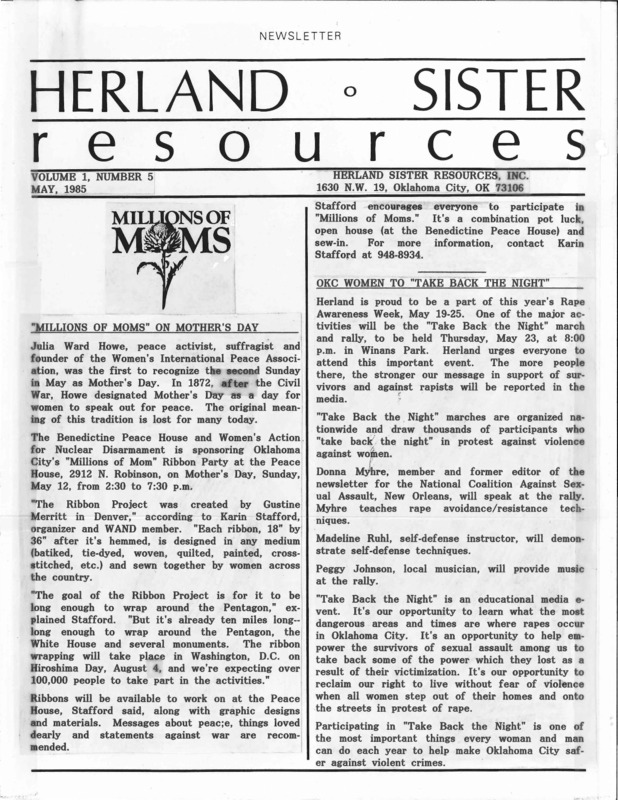
Herland’s activism also addressed sexual and domestic violence. Members such as Pat Reaves worked with the YWCA Women’s Center to aid survivors of abuse and domestic violence. Herland also participated in an annual Take Back the Night rally, which brought women together to speak publicly about sexual violence, support survivors, and assert their right to move through public spaces without fear. A notice in Herland’s May 1985 newsletter explained the event’s purpose.
“’Take Back the Night’ marches are organized nationwide and draw thousands of participants who ‘take back the night’ in protest against violence against women… It’s an opportunity to help empower the survivors of sexual assault among us to take back some of the power which they lost as a result of their victimization. It’s our opportunity to reclaim our right to live without fear of violence…”3
The 1985 Take Back the Night event also featured Donna Myhre, identified in the newsletter as a “member and former editor of the newsletter for the National Coalition Against Sexual Assault, New Orleans,” who spoke about safety techniques for women. Self-defense instructor Madeline Ruhl also shared physical defense methods.4 By combining public protest, survivor empowerment, education, and practical instruction, the event illustrates the multiple forms that Herland’s anti-violence activism could take.
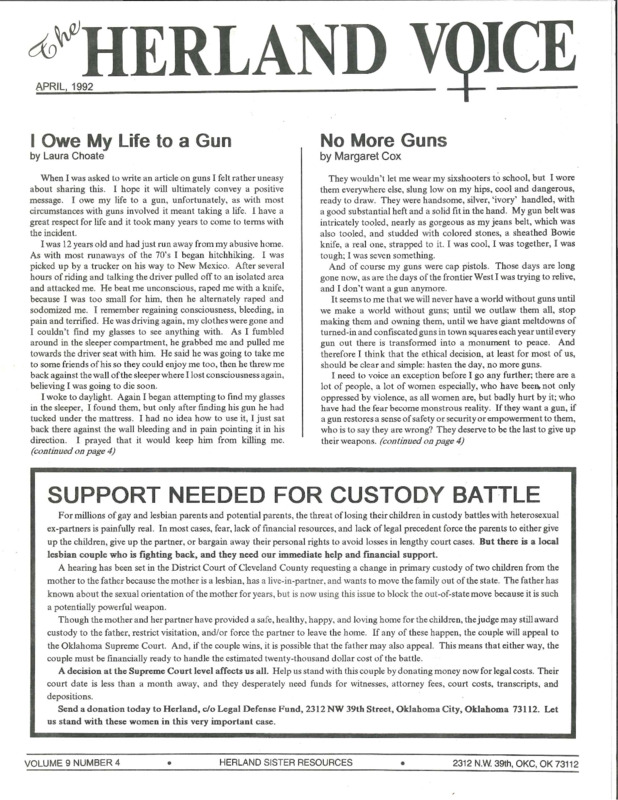
The Herland Legal Defense Fund (HLDF) was another significant expression of the organization’s advocacy. Herland established the fund in 1992 to aid Donna Fox, a lesbian mother, in a custody battle. A later account of the case explains, “Divorced in 1988, with a joint custody motion denied in 1989, in 1992 the father of the children filed for full custody based solely upon the children’s mother’s sexuality, despite already knowing her live-in girlfriend and their providing a safe home for well over two years.”5
After lower courts granted the father full custody, the HLDF helped Donna Fox file an appeal with the Oklahoma Supreme Court, which ultimately ruled in her favor.6 Herland presented Fox’s case not only as a private custody dispute but also as part of a broader pattern of legal discrimination against lesbian and gay parents. An appeal for community support emphasized the widespread consequences of such cases.
“For millions of gay and lesbian parents and potential parents, the threat of losing their children in custody battles with heterosexual ex-partners is painfully real. In most cases, fear, lack of financial resources, and lack of legal precedent force the parent to either give up the children, give up the partner, or bargain away their personal rights to avoid losses in lengthy court cases. But there is a local lesbian couple who is fighting back, and the need our immediate help and financial support.”7
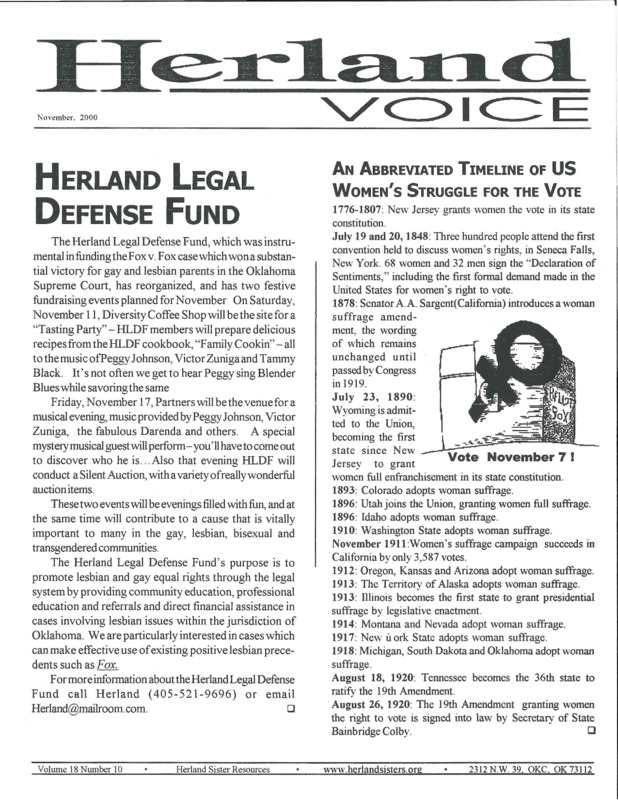
The fund continued operating after the resolution of Fox’s case and expanded its mission to include public education, professional referrals, and financial assistance. In a November 2000 issue of the Herland Voice, the organization described the HLDF’s purpose.
“The Herland Legal Defense Fund’s purpose is to promote lesbian and gay equal rights through the legal system by providing community education, professional education and referrals and direct financial assistance in cases involving lesbian issues within the jurisdiction of Oklahoma. We are particularly interested in cases which can make effective use of existing positive lesbian precedents such as Fox.”8
Through consciousness-raising, anti-violence organizing, public demonstrations, and legal advocacy, Herland created connections between personal experience and collective action. Its activism grew directly from its role as a community institution. The relationships and resources developed within Herland enabled its members to respond to discrimination both inside and outside the organization’s walls.
Notes
- Cox, Oral History Interview, 2016. ↩
- Cox, Oral History Interview, 2016. ↩
- “OKC Women to ‘Take Back the Night,’ Herland Sister Resources 1, no. 5, (May 1985): 1. ↩
- "OKC Women to 'Take Back the Night,'" 1. ↩
- B. Hinesley, “Herland Sister Resources: A Lesbian Feminist Collective’s Changes to Oklahoma Herstory,” (MA Thesis, Northwestern Oklahoma State University, 2017): 121. ↩
- Hinesley, "Herland Sister Resources," 122. ↩
- “Support Needed for Custody Battle,” The Herland Voice 9, no. 4, (April 1992): 1.↩
- “The Herland Legal Defense Fund,” The Herland Voice 18, no. 11 (November 2000): 1.↩