Building a Feminist Institution
In 1985, Herland’s organizers applied for nonprofit status. To meet the requirements for incorporation, they established a board to oversee the organization’s operations. Following in the tradition of the broader feminist movement, they adopted a non-hierarchical board structure based on consensus. Rather than appointing a president or other conventional officers, the board consisted of three members known as Sister 1, Sister 2, and Sister 3. These roles carried distinct responsibilities and rotated among board members over time. Herland member Margaret Cox later described how this structure was intended to distribute knowledge and authority throughout the organization, while also acknowledging the difficulties of putting consensus into practice.
“We tried to be non-hierarchical, and we tried to always do everything by consensus, which is possible but was very very very hard. It’s really hard to do without bullying some people into going along. But for the most part, we did a good job. And one of the things we did instead of having a president or chair or secretary, [we had] sisters. And we had a rotation. Ideally, everyone went through the entire rotation at least once, and by the end of the rotations, which was a year and a half or two depending on how you did it, you should know almost everything about Herland. And so we started off with three. Roughly, sister three was secretary, sister two was treasurer, and sister one was chair. She did chair the meetings and get the agenda together, but otherwise she had no more power than anybody else. We changed it to four and we put in an assistant for the treasurer because that was the big job."1
All board decisions were reached by consensus rather than majority vote. As Cox’s account suggests, consensus did not eliminate conflict or unequal influence, and many members, including Cleveland, found the process tedious.2 Nevertheless, Herland’s organizers recognized its importance in preserving a nonhierarchical structure. The model reflected a broader feminist effort to distribute authority, encourage participation, and avoid concentrating organizational knowledge or power in a single leader. Since 1985, Herland Sister Resources has maintained both its nonprofit status and its consensus-driven board.
Although the initial vision for Herland was a bookstore, the organization soon developed into a broader community resource. In addition to selling feminist literature and music, Herland operated as a lending library for people who could not afford to purchase books. Over the years, Herland assembled an extensive collection of feminist and lesbian fiction, nonfiction, and periodicals, including Lesbian Connection, Feminist Bookstore News, and Dimensions. These resources connected women in Oklahoma with the broader world of feminist and lesbian writing, politics, and culture. Through its bookstore and library, Herland made publications available that were often difficult to find in mainstream bookstores and public libraries.3
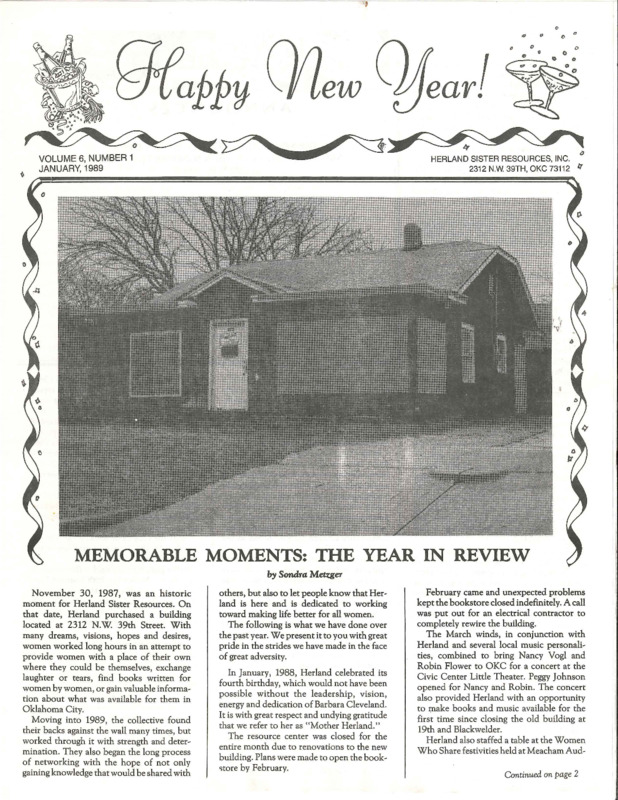
In 1987, Herland Sister Resources purchased a house at 2312 NW 39th Street to serve as its permanent home. The organization operated there until the property was sold in 2022. The new location placed Herland into the nearby “Gayborhood” along 39th Street, an area that became an important center of LGBTQ+ social and community life in Oklahoma City. Members spent more than a year renovating the property, and in 1988, they held a grand opening celebration. The purchase gave Herland greater stability and provided space not only for books and periodicals, but also for meetings, events, and community gatherings.4
Notes
- Margaret Cox, Interview for the Herland Oral History Project, 2016, Herland Archive, Edmond, Oklahoma, https://www.youtube.com/watch?v=kVqnZ-KrIUI. ↩
- Churchill, “Barbara ‘Wahru’ Cleveland,” 256. ↩
- Churchill, “Barbara ‘Wahru’ Cleveland,” 250. ↩
- Sondra Metger, “Memorable Moments: The Year in Review,” Herland Sister Resources 6, no. 1, (January 1989): 1. ↩