Creating Community
Herland provided a space for community building. The collective helped sustain feminist community in the state with a wide range of programs, including music events, workshops, retreats, discussions, book clubs, and other social gatherings. These programs provided opportunities for women to meet one another, share resources, and build community outside mainstream institutions. For some, Herland was the only place where lesbian identity was openly affirmed celebrated. Member Pat Reaves recalled the importance of creating spaces in which women and lesbians could express affection and move freely without fear.
“Everything we did was about providing a safe space for lesbians and women in general… It’s so different [now] because last weekend… I was at the women’s march and, you know, there are people all around me and women holding hands. I got to the ball game at OU and I see women walking down the concourse holding hands. We thought we would be killed if we did things like that. I mean, really, we lived with that kind of fear. There was no way we would have been publicly demonstrable… You literally didn’t touch anybody unless it was safe, unless you knew you were in a place where it was okay. So the concerts, the building, the events we did later on, the retreats, all of those were places where women could be free to be themselves without that kind of constraint.”1
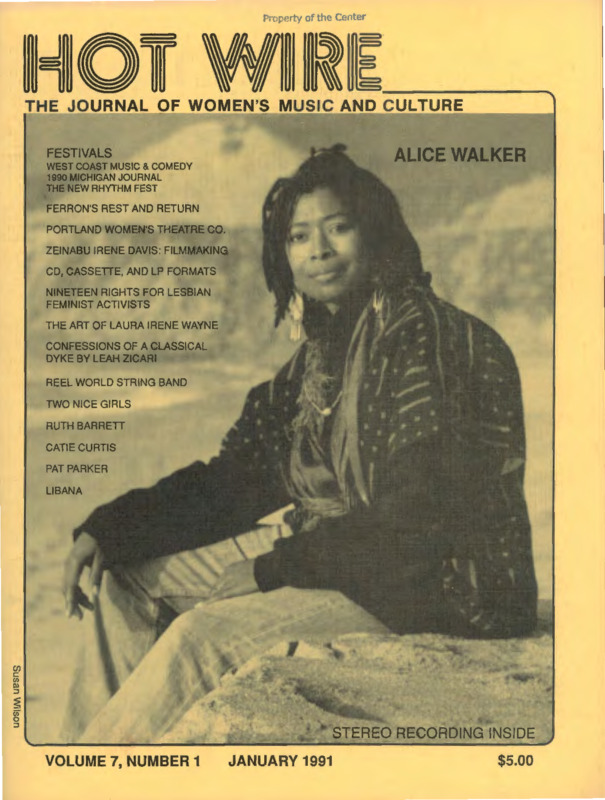
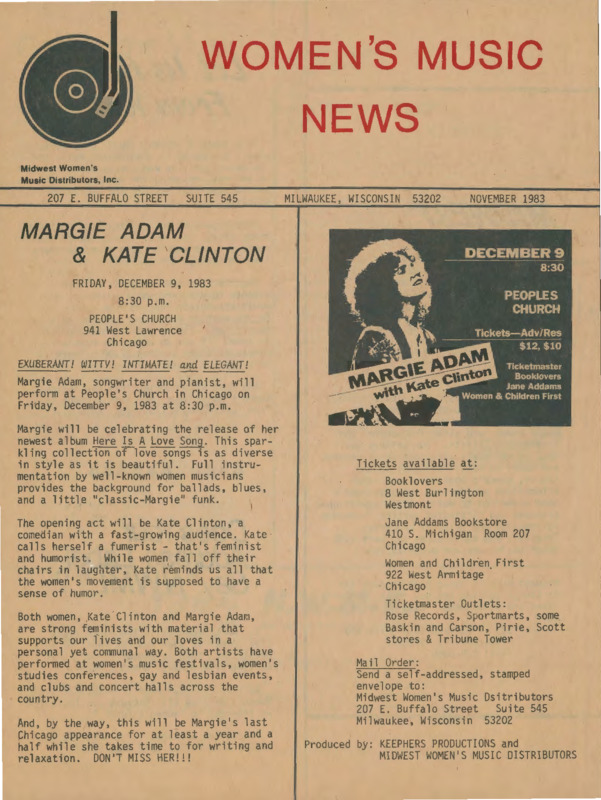
Music was central to the Herland community and connected the organization to the broader women’s music movement of the 1970s and 1980s. Women’s music was closely tied to lesbian feminism during this period, froming a cultural network through which women could hear openly lesbian and feminist performers, attend women-centered concerts and festivals, and participate in spaces organized outside of the male-dominated music industry. For many lesbian feminists, women’s music was not only entertainment but also a form of political expression, community building, and visibility. Herland’s music events tied the Oklahoma City community to this wider cultural movement. Herland hosted both local performers and nationally touring women musicians, and live music became central to many of the organization’s gatherings. Newsletters often included spotlight articles for local women musicians, signifying the importance of women’s music within lesbian feminist culture.
Retreats were another important part of Herland’s annual calendar. Usually held in the spring and fall, the retreats took place at state parks and were open to women who registered in advance. They brought together women from Oklahoma and neighboring states for workshops, seminars, music, recreation, and rest. In a 1988 annual review published in the Herland Sister Resources newsletter, Sondra Metzger described the retreats as one of Herland’s “trademark festivities.” She noted that the spring retreat that year was held at Boiling Springs State Park and included musical performers by the Sisters of Swing and the Shartels. Metzger also emphasized the considerable labor involved in planning these events, writing that Herland’s camp director, Laura, spent more than 800 hours each year organizing retreats, reserving campsites, arranging workshops, scheduling entertainment, and planning activities.2 Interviews conducted for the Herland Oral History Project further demonstrate the retreats’ significance to participants. Herland member Jo Soske recalled that the gatherings provided a rare opportunity to step away from the demands of work and family life.
I have very good memories of the retreats. I remember that they provided an opportunity for me – I was a single mother and a full-time teacher and a part-time counselor – and here was this weekend that sometimes I would get away and just lay on the cot and read all weekend or for hours at a time. And I loved that. And I loved the music – the music was phenomenal. It was really good. I remember watching women dance and loving the dancing.3
Soske’s memories reveal that the retreats served several purposes as once. They were sites of education and cultural exchange, but they also offered women time for leisure, solitude, and resoration.
Herland’s retreats also reflected broader debates within lesbian feminism over separatism and the importance of women-only space. During the period in which Herland opened, lesbian feminists across the country practiced various forms of separation from male-dominated institutions and social lie. Because they viewed patriarchy as an all-encompassing system, some women joined the back-to-the-land movement, moving to the countryside to build women-only communities. Others created women-only businesses and organizations.
Herland did not generally operate as a women-only organization. Its retreats, however, were intentionally reserved for women. In her oral history interview, Margaret Cox explained that this policy was intended to provide participants – particularly survivors of violence and abuse – with an opportunity to feel safe and fully at ease.
“Herland itself, the building, was not a women-only space. Some men… spent a good deal of time there in meetings and things. The retreats were women-only, and this is because a lot of women, well to this day also, but especially in the 80s, had been injured by men… But having women-only space gave them a chance, out at Roman Nose Park or something, to completely relax and not have to worry about any triggering… So just those two times a year we had the female-only retreats and over time we adopted a policy where boy children up to the age of 10 could come.”4
Cox’s account illustrates how Herland balanced its broader community-center model with temporary women-only spaces created for safety, healing, and rest. Rather than adopting complete separatism, the organization made women-only space available at particular times and for particular purposes.
Notes
- Pat Reaves, Interviewed by Jacob Crystal for the Herland Oral History Project, January 28, 2017, Herland Archive, Edmond, Oklahoma, https://www.youtube.com/watch?v=pwDMdLJilC4. ↩
- Metzger, “Memorable Moments,” 2. ↩
- Jo Soske, Interview for the Herland Oral History Project, 2016, Herland Archive, Edmond, Oklahoma, https://www.youtube.com/watch?v=A7pIk3X30C8&list=PLfobseV2uSi-XjCPXH3TsWYmJEnmvY1N6&index=3. ↩
- Cox, Oral History Interview, 2016. ↩