La Salle des Femmes to Herland
In the early 1980s, two publications helped connect Oklahoma’s feminist community: Brazen Hussy Rag and Sister Advocate. In 1982, a group of women involved in local feminist organizing and these two publications decided to open a women’s bookstore geared toward lesbian and feminist women. After successfully convincing a property owner to rent them a storefront, the group began renovations and gathering donated books from the community.1
Their vision for the bookstore was closely connected to the broader lesbian feminist movement developing throughout the United States. They hope to create a safe space where women could gather, support one another, share resources, and find community outside the bar scene. They named the bookstore La Salle des Femmes, or “The Women’s Room.”
Conflict within the group, however, eventually stalled the project. Several members withdrew, and the women who remained discovered that the bookstore’s account had been mysteriously emptied. One participant, Jo Soske, recalled the uncertainty surrounding the project’s collapse.
“Suddenly, things went bad. Jana and T.J. broke up. T.J. left town and we found that our bookstore account was empty. We were all terribly disillusioned. We had worked so hard and we didn't have a cent to continue. The newspaper folded. Murray lost patience with the stand-still in our plans. She pad-locked the door shut. That is when Barbara Cleveland arrived on the scene with her gift for organization, planning, and leadership. She was able to convince Murray to give the bookstore dream one more chance. The rest is Herland herstory. Barbara actualized the dream."2
At this critical moment, Barbara “Wahru” Cleveland – the woman later honored as Herland’s founding mother – stepped in to revive the bookstore project. Cleveland convinced the store owner to give her an opportunity to reorganize the effort and move it forward. She changed the store’s name from La Salle des Femme to Herland and began transforming the unfinished project into a functioning bookstore and community center.
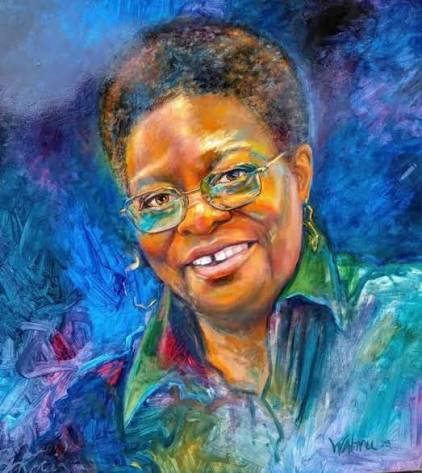
Barbara “Wahru” Cleveland was born in Oklahoma City on April 2, 1945. As an African American woman during the era of segregation, she was no stranger to discrimination. Cleveland was raised by her mother and grandmother, first in Geary, Oklahoma and then in Oklahoma City. As a teenager, Cleveland participated in the burgeoning civil rights movement in Oklahoma City. 3
In 1962, she enrolled at Central State University, now the University of Central Oklahoma. Although she could have attended Oklahoma’s historically Black university, Langston University, Cleveland chose to advocate for integration at Central State. According to Lindsey Churchill’s article on Cleveland,
“Instructors at Central State worked actively to flunk out the four African American students involved in the science program. During her college years Cleveland also remembers experiencing police harassment on several different occasions and having a police officer pull a gun on her at the University of Oklahoma Health Sciences Center, where she worked as a lab supervisor. ” 4
Despite the discrimination she encountered, Clevland found support among her fellow student athletes. When she struggled to pay her room and board on time, they took turns bringing her sack lunches from the cafeteria. When she needed a ride home, they picked her up. Her friends helped her continue her education.
Cleveland graduated with a Bachelor of Science in chemistry, biology, and medical technology. While continuing her day job at the University of Oklahoma’s Health Sciences Center, Cleveland spent her weekends renovating, organizing, and developing the bookstore. Reflecting on these early days, she later explained:
“When I took on the bookstore project I only took on a building and some boxes of books and a dream of having a bookstore in Oklahoma City. To be clearer, the dreams may have been similar, but my dreams were not the same."5
Although she supported the idea of a bookstore geared specifically to lesbian women, Cleveland wanted to make it clear that all women, from all backgrounds, were welcome at Herland. Her vision expanded the original bookstore proposal into a broader women’s center that addressed a range of political, cultural, and social concerns. As Cleveland recalled, “Many of those who helped me get Herland open seemed to share my vision and change of direction. So, Herland, in fact, opened as a woman's bookstore that addressed all issues, pertinent to women, including lesbianism.” 6 She believed this inclusive, community-centered approach was essential to Herland’s survival: “The non-profit women's center approach, I think, is why Herland is still going. I feel that the initial attempt to reach into the women's community for diversity is what held her up."7
To promote the store, Cleveland wrote articles highlighting the women’s literature and music available at Herland. These pieces were published in the local National Organization for Women’s newsletter. Other women soon joined her efforts, helping transform Herland into both a sustainable bookstore and a center of feminist community life.
-
Jo Soske, “La Salle des Femmes,” The Herland Voice 9, no. 8, (August 1992): 1. ↩
-
Soske, “La Salle des Femmes,” 3. ↩
-
Lindsey Churchill, “Barbara ‘Wahru’ Cleveland and Herland Sister Resources,” in This Land is Herland: Gendered Activism in Oklahoma from the 1870s to the 2010s, ed. Sarah Eppler Janda and Patricia Loughlin (Norman: University of Oklahoma Press, 2021), 247. ↩
-
Churchill, "Barbara 'Wahru' Cleveland," 247. ↩
-
Barbara “Wahru” Cleveland, “From La Salle De[s] Femmes to Herland: Why Not the Same Name or Same Direction?” The Herland Voice 22, no. 3, (March 2004): 1. ↩
-
Cleveland, “From La Salle De[s] Femmes to Herland,” 1. ↩
-
Cleveland, “From La Salle De[s] Femmes to Herland,” 4. ↩