
The Herland Voice : v.8: no.1(1991)
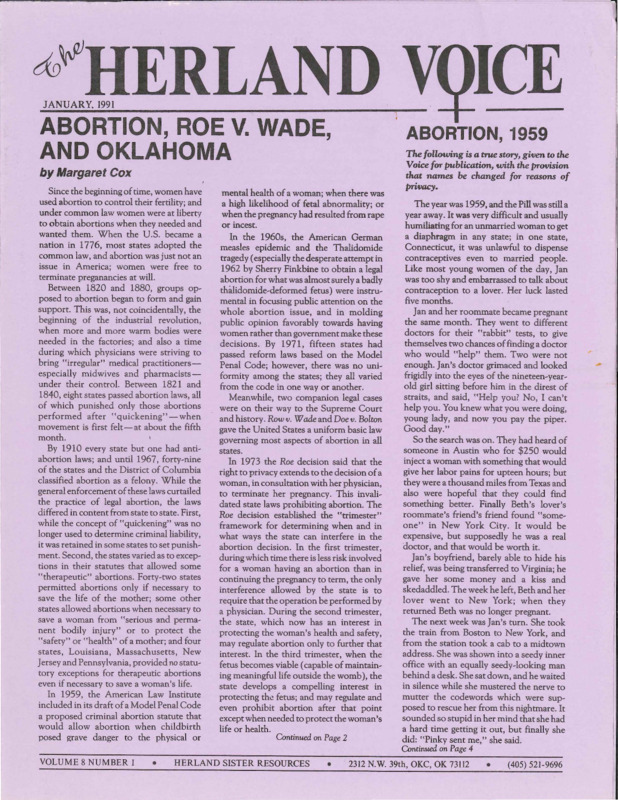
- Title
- The Herland Voice : v.8: no.1(1991)
- Description
- The Herland Voice is the monthly publication of Herland Sister Resources, a womanist organization with a strong lesbian focus based in Oklahoma City.
- Publisher
- en_US Herland Sister Resources
- Date Issued
- 1991-01
- Relation
- Herland Voice
- Rights
- All rights reserved by Herland Sister Resources. Contact UCO Archives & Special Collections for the permission policy on the use, reproduction or distribution of these materials.
- Is Part Of
- Herland Voice
- Creator
- Herland Sister Resources
- Date
- 2017-09-02T17:02:42Z
- Date Available
- 2017-09-02T17:02:42Z
- Subject
- Oklahoma
- Type
- application/pdf
- extracted text
-
JANUARY, 1991
ABORTION, ROE V. WADE,
AND OKLAHOMA
ABORTION, 1959
Th£ following is a tnre story, given to th£
Voice for publication, with the provision
that names be changed for reasons of
by Margaret Cox
Since the beginning of time, women have
used abortion to control their fertility; and
under common law women were at liberty
to obtain abortions when they needed and
wanted them. When the U.S. became a
nation in 1776, most states adopted the
common law, and abortion was just not an
issue in America; women were free to
terminate preganancies at will.
Between 1820 and 1880, groups opposed to abortion began to form and gain
support. This was, not coincidentally, the
beginning of the i~dustrial revolution,
when more and more warm bodies were
needed in the factories; and also a time
during which physicians were striving to
bring "irregular" medical practitioners especially midwives and pharmacists under their control. Between 1821 and
1840, eight states passed abortion laws, all
of which punished only those abortions
performed after "quickening" - when
movement is first felt - at about the fifth
month.
By 1910 every state but one had antiabortion laws; and until 1967, forty-nine
of the states and the District of Columbia
classified abortion as a felony. While the
general enforcement of these laws curtailed
the practice of legal abortion, the laws
differed in content from state to state. First,
while the concept of "quickening" was no
longer used to determine criminal liability,
it was retained in some states to set punishment. Second, the states varied as to exceptions in their statutes that allowed some
"therapeutic" abortions. Forty-two states
permitted abortions only if necessary to
save the life of the mother; some other
states allowed abortions when necessary to
save a woman from "serious and permanent bodily injury" or to protect the
"safety" or "health" of a mother; and four
states, Louisiana, Massachusetts, New
Jersey and Pennsylvania, provided no statutory exceptions for therapeutic abortions
even if necessary to save a woman's life.
In 1959, the American Law Institute
included in its draft of a Model Penal Code
a proposed criminal abortion statute that
would allow abortion when childbirth
posed grave danger to the physical or
mental health of a woman; when there was
a high likelihood of fetal abnormality; or
when the pregnancy had resulted from rape
or incest.
In the 1960s, the American German
measles epidemic and the Thalidomide
tragedy (especially the desperate attempt in
1962 by Sherry Finkbine to obtain a legal
abortion for what was almost surely a badly
thalidomide-deformed fetus) were instrumental in focusing public attention on the
whole abortion issue, and in molding
public opinion favorably towards having
women rather than government make these
decisions. By 1971, fifteen states had
passed reform laws based on the Model
Penal Code; however, there was no uniformity among the states; they all varied
from the code in one way or another.
Meanwhile, two companion legal cases
were on their way to the Supreme Court
and history. Row v. Wade and Doe v. Bolton
gave the United States a uniform basic law
governing most aspects of abortion in all
states.
In 1973 the Roe decision said that the
right to privacy extends to the decision of a
woman, in consultation with her physician,
to terminate her pregnancy. This invalidated state laws prohibiting abortion. The
Roe decision established the "trimester"
framework for determining when and in
what ways the state can interfere in the
abortion decision. In the first trimester,
during which time there is less risk involved
for a woman having an abortion than in
continuing the pregnancy to term, the only
interference allowed by the state is to
require that the operation be performed by
a physician. During the second trimester,
the state, which now has an interest in
protecting the woman's health and safety,
may regulate abortion only to further that
interest. In the third trimester, when the
fetus becomes viable (capable of maintaining meaningful life outside the womb), the
state develops a compelling interest in
protecting th~ fetus; and may regulate and
even prohibit abortion after that point
except when needed to protect the woman's
life or health.
Continued on Page 2
pri'1acy.
The year was 1959, and the Pill was still a
year away. It was very difficult and usually
humiliating for an unmarried woman to get
a diaphragm in any state; in one state,
Connecticut, it was unlawful to dispense
contraceptives even to married people.
Like most young women of the day, Jan
was too shy and embarrassed to talk about
contraception to a lover. Her luck lasted
five months.
Jan and her roommate became pregnant
the same month. They went to different
doctors for their "rabbit" tests, to give
themselves two chances of finding a doctor
who would "help" them. Two were not
enough. Jan's doctor grimaced and looked
frigidly into the eyes of the nineteen-yearold girl sitting before him in the direst of
straits, and said, "Help you? No, I can't
help you. You knew what you were doing,
young lady, and now you pay the piper.
Good day."
So the search was on. They had heard of
someone in Austin who for $250 would
inject a woman with something that would
give her labor pains for upteen hours; but
they were a thousand miles from Texas and
also were hopeful that they could find
something better. Finally Beth's lover's
roommate's friend's friend found "someone" in New York City. It would be
expensive, but supposedly he was a real
doctor, and that would be worth it.
Jan's boyfriend, barely able to hide his
relief, was being transferred to Virginia; he
gave her some money and a kiss and
skedaddled. The week he left, Beth and her
lover went to New York ; when they
returned Beth was no longer pregnant.
The next week was Jan's turn. She took
the train from Boston to New York, and
from the station took a cab to a midtown
address. She was shown into a seedy inner
office with an equally seedy-looking man
behind a desk. She sat down, and he waited
in silence while she mustered the nerve to
mutter the codewords which were supposed to rescue her from this nightmare. It
sounded so stupid in her mind that she had
a hard time getting it out, but finally she
did: "Pinky sent me," she said.
Continued on Page 4
VOLUME 8 NUMBER l
•
HERLAND SISTER RESOURCES
•
2312 N.W. 39th, OKC, OK 73112
•
(405) 521-9696
Roe v. Wade (cantinued fmm page 1)
The lesser known Doe v. Bolton further
defined Row's guarantees. It forbids states
from allowing abortions only in the case of
fetal deformity, rape, incest or medical
necessity; and from establishing a bar to a
woman's choice for abortion in the guise of
protecting her health, for instance, requiring that abortions be performed in accredited hospitals with the concurrence of
multiple physicians and a hospital committee.
Clearly, the Roe and Doe decisions
closely involve the medical profe5sion in
the process, and a woman's choice is in part
dependent on the availability of health
institutions and professionals willing to
perform abortions. This is a crucial legal
issue for low-income and rural women,
who still often have no access to or funds to
pay for legal abortions.
The United States Supreme Court's July
3, 1989 Webster decision, in Webster vs.
Reproductive Health Services (in Missouri)
was not in · itself as devastating as it was
feared it might be; however, to quote
Justice Blackmun in his eloquent dissent,
which was joined by Justices Brennan and
Marshall, "For today, at least, the law of
abortion stands undisturbed. For today,
the women of this Nation will retain the
liberty to control their destinies. But the
signs are evident and very ominous, and a
chill wind blows."
The W ebster decision's " chill wind" has
three parts.
1. The five-person majority allowed
Missouri to adopt, as a "value statement"
with allegedly no impact on abortion or
other medical practice, a declaration that
life begins at conception. This decision also
allows other states to enact any sort of
" value statement" into law. This "value
5ta rement" has already b een used in
Missouri to override more than one woman's
pricacy rights; and could be the basis for
outlawing much of die most reliable birth
control currently available.
2. Webster upheld a provision prohibiting the performance of abortions in public
faci lities, even where private patients seek
m pay p rivate doctors who have hospital
privileges at such a tacility.
3 . Webster also upheld a provision requir.ng doctors to conduct tests designed to
~stablish the viability of the fetus upon any
.voman more than nineteen weeks pregnant
desiring an abortion, this despite persistent
medical evidence that viability is not a
possibility until around the 24 th week; and
:iespite the fact that the woman is required
to pay for such tests, although they are not
in her health interest.
These last two rulings further increase
the financial burden and time constraints
on the poor and the rural, who in great
measure rely on public facilities.
2
HSR JANUARY 1991
Oklahoma Anti-Choice Initiative
In Oklahoma, an organization calling
itself the Oklahoma Coalition to Restrict
Abortion, Inc., filed an initiative petition
to put to the vote of the people a measure
that would substantially reduce reproductive freedom in Oklahoma. It includes a
"values statement" similar to the one upheld in 'X1 ebster decision, declaring life to
begin at the moment of conception. This
"values statement" could well be used to
prohibit much of the most effective birth
control in use today: the pill and the IUD.
Additionally, and flying in the face of the
Doe decision, the Oklahoma petition would
make abortion unlawful except:
• When necessary to save the mother's life
or to avoid grave impairment of the
mother's physical or mental health
• When the pregnancy results from rape
or incest;
• When the fetus would be born with
grave physical or mental defect.
Further, the petition provides for extreme criminal sanctions. It would subject
persons performing unlawful abortions,
and those aiding and abetting them, to
imprisonment for a term not less than four
years, and those organizations aiding and
abetting them to a fine between $10,000
and $100,000. The constitutionality of this
petition is currently being researched and
examined by the Attorney General's office.
If it is found to be constitutional, it will be
brought to a vote of the people sometime in
1991.
Roe v. Wade, The Players
On January 22, 1973, the Supreme
Court vote on the Roe v. Wade case gave
women access to safe, legal, and relatively
affordable abortion services. "Jane Roe"
was the legal pseudonym of the Plaintiff,
Norma McCorvey. " Wade" was Henry
Wade, District Attorney of Dallas County,
Texas.
More than three years before the historic
d ecision, in the fall of 196 9 , Norma
McCorvey was a pregnant 2 1-year-old
divorced mother of a five-year-old daughter. She had neither the financial nor the
emotional resources for another child, and
was seeking an abortion. Linda Coffee, 26,
and Sarah W eddington, just 23, were a
couple of young attorneys looking to challenge the Texas law outlawing abortion.
They were eventually wildly successful,
challenging and overturning laws forbidding abortions through the United States
with their case. Of the two young lawyers,
Weddington was the one who actually
argued the case before the Supreme Court;
and consequently is today the much better
known of the two.
Clearly, the decision came too late to
help Norma McCorvey obtain an abortion.
After giving birth in 1970, she gave the
child up for adoption. Nevertheless, when
informed of the Supreme Court's decision,
she is reported to have said "I feel like I'm
on top of Mt. Everest."
Justice Harry Blackmun was the Supreme
Court Justice who wrote the Roe v. Wade
decision .
•
91o/o OF ALL
ABORTIONS
PERFORMED IN
FIRST TRIMESTER
The following information is from the
NOW Legal Defense and Education
Fund's Resource Manual, "Facts on Reproductive Rights:"
The vast majority of legal abortions,
a full 91 %, are performed in the first
three months of a pregnancy:
• 5 0 .8 % are performed at o r before 8
weeks after the woman's last menstrual period ( LMP)*.
• 26.9 % are performed at 9-10 weeks.
• 13.8% are performed at 11-12 weeks.
• 5.8% are performed at 13-15 weeks.
• 3.4% are performed at 16-20 weeks.
• .8% are performed at or after 21
weeks.
LM P: This scudy places che momenl uf conception
at the woman's last mentrual period. T his creates a ~1
margin for error that m e<JerJ case, the actual 1~
period of gestarion can be as much as 4 weeks
i horter chan these figures imply. That is, a W071Uln rmay have conceived at any time during the monrh r•
following her last menstrual period.
PUBLISHED BY: Herland Sister
Resources, Inc. 2312 NW 39th,
Oklahoma City, OK 73112
NEWSLETIER COMMITIEE:
Margaret Cox, Deborah Fox, Pat
Reaves
CIRCULATION. 750
GENERAL INFO: (405) 521-9696 (leave
message)
SUBSCRIPTIONS to the Her/and Voice
are free upon request.
"CREATING CHANGE"
CONFERENCE HOSTS
700 ACTIVISTS
Minneapolis-Over 700 lesbian, gay male,
and bisexual activists and straight allies
immersed themselves in gay and lesbian
politics at the third annual Creating Change
conference, organized and sponsored by
the National Gay and Lesbian Task Force in
Minneapolis, November 9- 12.
The 1990 Creating Change conference
was held for the first time outside the
Washington DC area and surpassed previous attendance levels bv at least 200
participants. The Gay and Lesbian Community Action Council of Minneapolis convened a local host committee comprising
more than 100 volunteers. Creating Change
'90 was the largest gathering ever held at the
Twin Cities' Holiday Inn Metrodome.
The conference featured four jampacked plenary sessions, 46 workshops, 21
caucuses/meetings, and many related social
events and gatherings. Plenary speakers
Barbara Smith, C.T. Vivian, Kate Clinton
and a panel of five activists from the
Midwest inspired and motivated hundreds
of women and men from 40 states and
several foreign countries with thoughtprovoking speeches.
Some conference highlights:
•Over 70 gay men and lesbians of color
attended a pre-conference daylong People of Color Organizing Institute.
Attendees called for a national conference for gay men and lesbians of color
within the next two years.
CELEBRATING
AUDRELORDE
On Octoberr 5, 1990, Audre Lorde
(self-described as a Black lesbian feminist
warrior poet mother), was honored with a
celebration/ conference attended by more
than a thousand people, including Lorde
herself. The I Am Your Sister Cele/
conference, three days of worksessions,
plenary sessions, poetry and empowerment, achieved the amazing goal of 50%
attendance by women of color and women
from impoverished backgrounds from
around the world.
Two separte, lengthy and sometimes
disparate reports of this cele/ conference
appear in the December issue of Off Our
Backs. If you are interested in learning
more about the cele/conference, stop by
the store and read about it in Herland's
copy of OOB. We also have books by Ms.
Lorde, both for sale and in the lending
•
library.
NLC-GULF REGION TO
SPONSOR REGULAR
POTLUCKS AT
HERLAND
•Over 110 people attended a preconference daylong Fundraising Institute, led by Kim Klein of the Funding
Exchange and Rinku Sen of the Center
for Third World Organizing.
•Eight women and men participated in a
five-workshop Campus Track devoted
to strengthening and building lesbian/
gay /bisexual student organizations. The
campus caucus later requested that the
Campus Track be separated from the
conference itself and established as a preconference institute.
• Lesbian performance artist and activist
Holly Hughes and Russian gay activist
Roman Kalinin made guest appearances during plenary sessions. Hughes
urged the gay and lesbian movement to
support gay and lesbian artists and called
on gay and lesbian artists to form a
national association. Kalinin, on his first
visit to the U.S. from the Soviet Union,
spoke of KGB harassment of his country's only gay /lesbian publication, Terna.
Kalinin also said he hoped to initiate an
Act Up style political organization in
Moscow, his home city.
•Creating Change 1990 received extensive coverage in the Twin Cities media, as
well as national print coverage.
•Creating Change 1991 will be held in
the Washington, DC metropolitan area
at the Old Colony Inn in Alexandria,
VA, Nov. 8-11, 1991.
•
The NLC-Gulf Region will hold a
variety of events including pot luck suppers
and women's video nights, dances, and
slumber parties at Her land, 2312 NW 39th
Street every 2nd and 4th Saturday of every
month at 6:30 p.m. beginning Jan. 12 and
running through April 10, 1991.
The scheduled events for January 12th
are a pot luck supper and video night.
Videos will be "By Design" and "The
Miracle Worker" both starring Patty Duke.
"By Design" is an excellent, yet little
known film about two professional women
in a committed relationship with each
other who decide they want a baby and go
about doing just that. "The Miracle Worker"
is a film classic about the early life of an
incredible woman named Helen Keller.
January 26th there will be a pot luck
supper and sock hop with music from the
60's. So, bring your favorite dish and don't
forget your bobbie socks and come ready
to boogie!
Come out and join us for the great home
cooked food or just for the fun that
follows.
Requested donation for each night of
fun is $5.00-more if you can, less if you
can't. Just don't let the lack of funds keep
you from joining in the fun.
Herland is a chem-free woman's space. A
percentage of all proceeds from NLC fun
nights will go to Herland for use of this
woman's space. For more information
about the fun nights call Maria at 525-7996
or Karen at 528-3151.
•
GULF REGION MEETING
Dallas is hosting the next gulf regional
meeting of the National Lesbian Conference (NLC). It will be held January 25-27,
1991 . The Gulf Region includes Arkansas,
Louisiana, Oklahoma and Texas. It is a
chance for lesbians from these four states
to network, get to know each other, attend
workshops, and prepare for the NLC,
which will be in Atlanta, Georgia in April,
1991.
Workshops at the meeting will cover
important issues such as lesbian mothers,
lesbian battering, and incest survival.
The purpose of the NLC in Atlanta is to
satisfy the Lesbian Nation's need to create,
publicize and implement a national lesbian
agenda. Through this conference, lesbians
can meet each other, identify common
issues, have fun, build coaliti.ons, and plan
for their collective future. It may also be
seen as a vehicle for creating a foundation
for empowerment of social and political
change in America.
For more information, contact Kathy
Rome in Dallasat(214) 841-0375 or 5218919. Or in Oklahoma City Karen Lewis at
(405) 528-3151 or Maria Tahenakos at
525-7996.
•
GULF REGION LOGO
CONTEST
.
The Gulf Region (Arkansas, Louisiana,
Oklahoma, and Texas) of the National
Lesbian Conference (NLC) is sponsoring a
logo contest. The logo is to be used on
T-shirts as a representation of the Gulf
. Region. This is to generate education and
interest for the NLC in Atlanta in April,
1991.
The logo is to be limited to black and
white and of camera-ready quality and will
be printed on colored shirts. The finished
product will be silk-screened onto the
shirts.
The winner wil be announced at the next
Gulf Region meeting which wil be January
25-27 in Dallas, Texas.
.For more information on submitting
entries contact Karen Lewis at ( 405)
528-3151.
•
HSR JANUARY 1991
3
Abortion 1959
(continued from page 1)
It seemed to sound stupid to him, too.
He narrowed his eyes and barked at her:
"What?! What are you talking about?"
And so he made her sputter and squirm
and, as ifhe didn't know full well, tell him
in so many awful, illegal words what she
was there for. After making sure that she
had the money, he gave her an address to go
to on Long Island. Until then, Jan had not
known that there would be a middleman the proc~dure must have been changed
from week to week for safety's sake; she
had been told nothing of going more than
one place or ofleaving Manhattan. It added
another level to her apprehension and dread,
but it never occurred to her to call it off.
After a long ride to Long Island, the cab
pulled into a middle class neighborhood,
and Jan walked up to what looked like
some family's suburban dream house. A
small discreet plate on the door instructed
her to come in, and she did.
She was in a small neat waiting room,
and evidently she was alone. She sat and
smoked a while, got up and looked with
blind eyes at the pictures and the No
Smoking signs, of which there were several.
For about fifteen minutes she smoked and
looked at those signs; this was as unlike her
in those days as it would be for most people
today to knowingly park in a handicapped
space; and if she had actually seen the signs
she would have put out her cigarette. She
obeyed all laws in those days. (Does this
sound funny, considering her "predicament" and where she was? She doesn't
think so; it's just that laws of nature and
survival sometimes-always? -supersede
man's laws).
In time the man whom she sincerely
hoped was a doctor came in. He introduced
and indeed a
himself as Doctor
few years later she was to learn not only
that he was in fact a doctor but that that was
his real name. He led her into what was
clearly the operating room, with a small
metal table and the usual stirrups, washbasin, etc. The first order of business was
business, and at his request she handed him
her envelope with twenty $20 bills in it.
Four hundred dollars; a very decent month's
wages in 1959. He was supposed to be the
best, and the best was supposed to be worth
it.
The abortion procedure itself could have
been worse, and would have been if she did
not have the capacity to go numb in her
mind. She was about seven weeks pregnant,
and the doctor performed a simple D&Cbasically a scraping of the uterine walls. It
was painful, for maybe ten or fifteen
minutes, and she coped by enforcing a
discipline on herself and allowing herself
no sound nor sign of pain. He was mildly
abusive verbally just once, with a remark
4
HSR JANUARY 1991
that confused her more than it hurt; something about her being smart enough to
know how to get pregnant but not smart
enough to know about ergot. Ergot? To this
day, while she knows that erg:>t is used in
drugs to cause uterine contractions, she
doesn't know of anyone who goes and gets
it and uses it to self-abort. Other than that,
he was basically quite decent to her. When
he said "That's it," she leaned up and asked
to see; "Just a little blood," he said; and
that was all it seemed to be. He got her up,
gave her a huge kotex and had her lie down
in a small side room. The cot was clean and
comfortable; she easily kept her mind in its
state of numb, as she listened to him
cleaning up in the other room.
She bled very lightly afterwards, and
after an hour or so he called her a cab to
take her back into the city. She bought a
couple of apples for her supper at a stand
near the hotel, and ran a huge steaming tub
while she called her parents to tell them
what fun time she and her friends were
having in the big City. She steamed herself
until the tub cooled, put on a fresh kotex,
and went to bed; and thought about how
lucky, how very lucky, she was.
And she was very lucky. Having a roommate to go through it with helped; especially having one capable of making hard
decisions and moving fast when necessary.
On her own she would probably have
dithered around into the second trimester,
maybe worse. And they did find a decent
doctor; they had a good friend in Texas
who was raped by the "doctor" before he
performed her abortion. And the money!
They had managed to raise what was then a
huge amount of money; and it did seem to
buy them both simple clean abortions with
no complications. And extra money, too.
The round trip train ticket and hotel room
were a considerable added expense; and if
she had arrived in New York City with her
$400 but not enough for the cab fare to and
from Long Island, what then? Back to
Boston and square one?
Yes, she was lucky. About a year later,
when her friend Barbara got that look in
her eye and asked Jan if she had ever been
afraid she might be pregnant, she had no
hesitation in sending Barbara to the same
doctor; and it turned out well for Barbara
too. Lucky.
So lucky, so clean and simple, one might
think it hardly worth talking about; except
for two things: the first, so few women have
or have access to that much money. The
fear, danger, pain and apprehension that
Jan, Beth and Barbara felt was magnified
mightily for women on each step down the
economic ladder.
And the other thing: it was maybe three
years later, and Jan was thousands of miles
away. An envelope came in the mail with
no return address but unmistakably in
Barb's handwriting, containing a newspaper article about a respected New York
doctor who had been performing illegal
abortions for years, it seems, when something went wrong and a woman died. His
first thought was to hide her body, and he
chopped and sawed her up as small as he
could; but still his plumbing clogged. He
packed his bags, bought a plane ticket out
of the country, and for some unearthly
reason called a plumber to come fix the
pipes. The horrified plumber called the
police, and they caught Jan's Doctor
_____ at the airport. She doesn't
know how much time he served; she never
tried to find out.
•
CONTRACEPTIVE
FAILURE RATES
The fallowing information is from the
NOW Legal Defense and Education Fund's
Resource Manual, "Facts on Reproductive
Rights:"
Although use of contraceptives greatly reduces the risk of unwanted pregnancy,
no contraceptive currently available is
100 percent effective. Many women who
have abortions were practicing contraception which failed when they conceived. A
study of contraceptive failure rates released by the Alan Guttmacher Institute
in 1989 reveals the following facts:
• The actual failure rates for contraceptives used for a 1-year period are
more than 113 higher than was
previously believed, due to error in
prior studies.
• The Pill fails 6 .2% of the time.
• The condom fails 14.2% of the time.
• The diaphragm fails 15.6% of the
time.
• The rhythm method fails 16.2% of
the time.
• Spermicides fail 26.3% of the time.
(This figure includes foam, suppositories, and the sponge.)
The IUD was not included in this study,
as so few forms of it remain on the U.S.
market, where the study was conducted.)
CELESTIAL ADVICE
(The spirit of Sybil Ludington, Matron
Saint of the Invisible Woman, will be an
occasional columnist in the Voice.)
Dear St. Sybil:
Why is it that the third child in a
family is often different somehow from
its siblings-more creative, or funnier,
more radical, smarter, more trouble and
more joy, or just a bit fey? I've noticed it
often, and have never figured out why it
is.
Sincerely, your curious friend and
fan, Jess Wondrin
Dear Jess,
That's a good question, and one that has
stumped all kinds of emminent psychologists
looking at the effects of birth order. The
simple fact is that the third child is very often
a "miracle" child. Why? Because the parents
were quite happy with their little family
(table settings, cars and prize trips to Disneyland all seem to come for four); and were
actively trying not to have another pup.
Possibly the mother was on the pill, took an
antibiotic for strep or something and kaboom! the pill stopped working and along
come little Fey. Or she was using a diaphragm, gained ten pounds over the holidays,
causing a poor fit, and shazam! (And no,
doctors almost never think to tell women
about the adverse effect of antibiotics on the
pill or weight gain & loss on the diaphragm.)
So. Here comes this incredibly determinedto-be-here kid, with sort of an 'In your face,
Mama, I'm coming whether you like it or
not!" and as a consequence its parents greet it
and treat it with an awe and respect which
transforms the little critter into someone
special and, as you say, "different" and
frequently fey as all get out.
So, Jess, remember: don't rely on the pill
when you're on antibiotics; don't use the
diaphragm if your weight yo-yos; and if you
want a different, difficult, weird, wacky and
wonderful kid, treat it with all the respect
you give your boss and the wonder you give
any miracle.
Fondly, Sybil
DAUGHTER OF THE
GODDESS
by Deborah Fox
Ah, if only I had a daughter, I've often
wished, but the Goddess ordained me a
son. This too is a special honor, for the
world is in need of such men as I can
produce. May She bless me in this task.
Children belong to their mothers who've borne them of their own bodies,
and female is not inferior to male, though
these truths have been denied since the
men of might began to rule, and many
women have become co-conspintors with
male dominance .. .
I have felt I was born into the wrong
place in time-surely I am more suited to
the life of Priestess or tribal Amazon,
which in these times is scarce or unheard
of .. . but there are no mistakes in life and
so my life must be a conglomerate for I
can fill no role created by men.
It has taken me a long time to fit the
pieces of the puzzle of my life in order to
understand the impulses and passions
that have led me thus far, for, to not fit in
has given me cause to think that my
nature was somehow wrong, and to not
feel "right in the world."
This is the curse laid upon Woman by
the sword-wielding men, and those of us
who have rebelled against their rules,
ethics, values, and aspirations, who would
not be boxed into the roles they imposed
upon womanhood, nor would join them
to compete in the " man's world," have
been visciously attacked and murdered.
I have felt the movement of the
awakening Goddess, emerging as from a
deep cave within me. She calls upon Her
daughters, Her call unsettles us from lives
of passive acceptance of the so-called
"norm," and from the trance-like seduction of familiar (though unnatural) order
of the superimposed world of men.
Many of us have feared for our sanity-
Dear Sybil:
Where you are, are there men?
Thank you. Hope Knott
DISPLAY ADS:
business card or 1110 Page ...
114 page , .. , .... , . . .... .
12 page .. . •• • •. . .. , . . • .•
full page ... . .. , .• • . , , • • .
Dear Hope:
Certainly, there are men here. Redemption is as possible for men as it is for women.
ln foct, it was a man, Graham Greene (Patron
Saint of Recovering Catholics) who wrote
one of the most beautiful lines on redemption in the English language:
Between the saddle and the ground,
He mercy sought, and mercy found.
Kisses, Sybil
CLASSIFIED ADS:
p.s. Besides, who do you think types my
columns?
the unquenchable longing and restlessness
She sends to awaken us puts us out of
synch with the life we have been conditioned to accept. Many of us find ourselves in inner conflict, for all these years
have internalized the oppressor as well;
we ridicule ourselves and feel "silly" for
our womanspirit ways.
I have learned to wait upon the Moon,
for She will endow if one seeks in earnest,
and I have learned to feel her power in the
fullness of my menstruating womanbody
instead of the bloated "unattractiveness"
designated by patriarchy, and I have remembered our connection to all life-everything
is alive with spirit, and I have tasted
womanpower and have been awed by its
potency (sisters awake! We have been
living but have not been 'alive'), and I am
devoted to Her. Initiation has begun and
the Mysteries so long now obscurred are
being revealed again within woman's
mindheart and bodythought. And though
many religions continue to twist and
pervert the Mysteries in God's name, She
has awoken genetic memory in Woman
the Keepers of Sacred Secrets. We are the
embodiment of the Great Goddess, we
have only forgotten what that means.
And so I have come to trust the 'knowing' we women are endowed with but so
long now have ignored, and though I do
not always clearly see my path, my feet
are as surefooted upon it as my mare's
upon a trail or my cat's upon the
window's ledge.
Sisters do not fear; our power is One
with Nature's and Mother Earth's, but
heed Her call, for the Mighty Cretrix has
come up from Her descent and She will
raise us to our rightful status and we will
lead the world to safety.
Perhaps one day I'll have the time for
another child and I will have the daughter
I longed to raise with Goddess images to
sing her praises . . . or perhaps; I have been ·
she.
•
S 15.00
$ 35.00
S 60.00
$ 100.00
firs! 10 WOfdS • • •• •• •• •• •. . •• $2.50
each additional word . . •••• • . •• S .10
DISCOUNTS: available on advance
prepaid orders only
1-3 months order ... . ........ none
4 - 6 months . • . • . . • . . . . . • . . 10%
7 - 9 months . . . . . . . . . . . • . . • 15%
10 - 12 monlhs . . . . . .. .••• • • • 20%
PLEASE NOTE: There will be a minimal
charge for typesetting done to any
sdvertlslng.
Leave :nessage for Ginger at H.SR,
(521-WMYNJ 10 place an ad.
HSR JANUARY 1991
THE WOMEN'S ISSUE
EVERYBODY IGNORES
by Ron Po/Jack
eople talk a lot about women's rights, but
there isn't much talk about one serious
concern of many women: the right to live
a decent life in your later years.
Usually people don't talk about women's issues
and the problems of older Americans in the same
breath. But the majority of older Americans are
women. Women make up about 60% of Americans
over age 65; about 70% of those over 85.
The financial situation of older women is often
particularly harsh. An unexpected household expense,
a sudden siege of illness, a new expensive medication
- these can put their limited budgets into the red.
Older women are twice as likely to be poor as
older men. One out of every six women over age 65
is living below the poverty line. Among black older
women, the situation is even worse: one out of three
are surviving below the poverty line, as are one out
of four Hispanic elderly women.
Poverty doesn't just happen
If you are an older woman having difficulty
making ends meet, look back on your life for a
moment. Consider how the financial difficulties you
now face may be due to inequities you faced as a
woman all through your life. Poverty among older
women doesn't just happen; it reflects the economic
problems to which women of all ages are vulnerable.
You interrupted your career to raise your children,
you couldn't go back to work because there wasn't
day care available, you worked for a lot less per hour
than the men in your workplace, you had only
limited job opportunities as a woman: all these
problems translate over a period of time into higher
poverty rates for older women.
Look around at the older women you know. Many
of the widows with the lowest incomes worked hard as
housewives but never participated in the paid work
force. Others went in and out of the labor force between children, always having to start new jobs at
entry-level wages. When retirement age arrives, their
Social Security checks- reflecting only their paid work
years, not the work they did at home- are meager.
Still other older women never had much in savings
to show for their long lives of hard work because
they had been crowded into low paying "women's
work" with few if any fringe benefits. Some of the
P
poorest elderly women today- often black or
Hispanic- were domestic workers during the
decades when the Social Security system excluded
them from participation.
But if many of the neediest elderly are women,
women are also filling the ranks of activist senior
organizations, the groups who are fighting to improve
the well-being of the most vulnerable among us.
They are women like Madeline Helbok of Denver,
Colorado, who is crusading for affordable health
care. Or Freda Mulkern, who is fighting to block
health insurance increases in Massachusetts. Or
Lucille Thornburg of Knoxville, Tennessee, a former
union organizer who is still organizing; one of her
recent struggles was for the rights of nursing home
residents. Women like Rose Kryzak of Queens, New
York, the fiery leader of a statewide coalition that has
helped protect hospital patients from being forced to
go home before their health can handle it. Or
Mildred Taylor of Charlotte, North Carolina, who is
working to make houses available for low-income
families. Or the former mayor of Lincoln, Nebraska,
Helen Boosalis, who is helping people in her state
organize around health care issues.
One issue on which older women are speaking out
these days is long term care. Of course, that's not
surprising, when you think about the role that many
60-year-old women play as caregivers for their
husbands or their 85 -year-old parents.
Parenting their parents
After years of taking care of their children, they
now are parenting their parents. When it comes to
caregiving, they are the "sandwich generation." They
know what they're talking about when they speak
out for far-reaching reforms in how our society pays
for long term care.
Once you reach your fifties or sixties, it starts
getting tricky to try to distinguish between women's
issues and aging issues. But, after all, why try to
separate them? The thing to do is to get on with the
job of solving the problems that interfere with this
basic right of both women and men: the right to live
a decent life throughout all of your years.
•
Ron Po/Jack is executive director of
Families USA Foundation
SENIOR WATCH IS AN EDITORIAL SERVICE OF F AMILIFS USA FOUNDATION
6
HSR JANUARY 1991
THANKS TO ALL those who have sent gift subscriptions to Herland. We now
receive M.S., The Progressive, Off Our Backs, and Science of Mind as well as
newsletters from women's organizations around the country. If there is a
magazine or newspaper you'd like to see available at Herland, please consider
sending a gift subscription. We'd especially like to receive New Directions for
Women and Utne Reaaer . .. . .
The Center for Women Policy Studies has announced a new national
newsletter for and about young women. The newsletter will be a tool foro
encouraging young women to take leading roles on feminist iss{ies and a source of
information on opportunities available to young women. To subscribe send $10
to: Center for Women Policy Studies, Feminist Futures Network News, 2000 P.
St., N.W., Suite 508, Washington, D.C. 20036 .. . ..
NOTE TO J- We are interested in your idea for a column. Please call Margaret
Cox (528-0604) or Pat Reaves (524-7510 or 236- 1911) .....
The Black Gay and Lesbian Leadership Forum is holding its 1991
conference in February. The conference will be in downtown Los Angeles,
California, from Wednesday, February 13 to Sunday, February 18. The Program
Committee is looking for Black Lesbians and Gays to facilitate workshops and
contribute their talents. If you are interested in facilitating or attending, contact
Yolanda Whittington, 914 S. Wilton Place, #221, Los Angeles, CA 90019;
telephone (213) 735-9881 .... .
RAPE CRISIS VOLUNTEER NEEDED The YWCA Rape Crisis Volunteer
Program in Oklahoma City has scheduled its next volunteer training for January
22, 24, 29 and 31, 1991. Training will be held in the evening. The Rape Crisis
Center depends on volunteers to help support survivors of sexual assault. Please
call Karen Riddle Sullivan at Crisis Intervention Service, ( 405) 94 7-4506, if you
would like to sign up for the training, or if you have any questions. It is possible
that an all-day workshop on ::t convenient Saturday will be held if the need is felt
for one . . ... .
MAILING LABELS. Is your name and/or address on our mailing label garbled
almost beyond repair? Do you get your Herland Voice only because your mail
carrier likes you and has a sense of humor to boot? If this sounds like you and
you would like it changed, please take just a minute to send us a note with your
name and address typed or really carefully printed, and we will see to it that even
a substitute mail carrier will be able to figure out the label. Thanks.
•
WILL PRESIDENT SIGN
IMIGRATION BILL?
Washington, D.C.- The National Gay and
Lesbian Task Force (NGLTF) has urged
President Bush to sign into law landmark
legislation which removes immigration exclusions for lesbians, gay men, and people
with AIDS.
Since the 1950's the Immigration and
Naturalization Service (INS) has held that
individuals "afflicted with psychopathic
personality, or sexual deviation" are ineligible to enter the U.S. Although the
American Psychological Association and
other groups removed homosexuality from
a list of mental disorders over fifteen years
ago, the INS continues to dell.¥ visas to
lesbians and gay men.
The Family Unity and Employment
Opportunity Act, passed by Congress on
October 2 7, removes the McCarthy-era
immigration restrictions on lesbians and
gay men. The bill also effectively erases the
AIDS immigration restrictions created by
Sen. Jesse Helms in the previous Congress,
and empowers the Department of Health
and Human Services (HHS) to delete AIDS
and HIV from the list of restricted diseases.
"When President Bush signs this momentous legislation," said Rochelle, "the
United States will break from the ranks of
Cuba and South Africa, and join the free
world in rejecting senseless discrimination
against people with AIDS, lesbians and gay
men in immigration policy."
•
ohings .Ceft Unsaid
Here sfi.e comes,
With tfi.at stride
of self-confidence.
My fi.eart races
And without warning
A smile appears.
With infinite patience
And fi.umorous wit,
Sfi.e talks to me.
an occassional nod,
Here and tfi.ere,
9 am unusually quiet.
A tender fi.ug
And a warm good-6ye,
ofi.e sfi.e's gone
Sadness settles in
'Jor all 9 fi.ave
Ce{t unsaid to fi.er.
micfielle j.
k.!uka.s
11-13-90
BE A PART OF HERLAND
Herland is the collective effort of the
women of Oklahoma. You can be a part of
creating and sustaining this very special
community we call Herland. Join a committee, volunteer to work in the resource
center, or make a contribution to help
meet the monthly expenses. Herland will
be what you make it.
YES, I want to help Herland continue
to grow.
0
I'm interested in working on a committe. Please have the committee
chair call me.
0
I'd like to volun teer at Herland.
Please have the volunteer coordinator call me with more information.
0
Here's my contribution of _ _ __
to help support Herland.
Name: ____________
Phone ____________
Address _ _ _ _ _ _ _ _ _ _ __
City _ _ _ _ _ _ _ _ _ _ __
State/ZIP - - - - - - - -- --
HSR JANUARY 1991
7
Edwina V. Johnson, D.D.S.
"Catering to Cowards needing Tender Care"
in Comprehensive Dentistry
Kay Killgore, M.Ed.
5009 North Pennsylvania Ave, Suite 103
(405) 840-5410
Woman to Woman Counseling
Night & Sunday practice by appt. only
Emergencies welcome
1010 N.W. 45th
Oklahoma City, Oklahoma 73118
(405) 524-1062
Insurance accepted
~usie
366-0923
~outhwell, M. Ed.
HELEN HOLGATE
COUNSELOR
2912 N. Clauen, Suite 102~----09
Oklahoma City, Oklahoma 73106·- . . - Telephone: (405) 556·4105
Comprehensive Dental Care
Sam L. Nicolosi, D.V.M.
Office Hours By Appointment
Debra K. Browning, R.Ph, D.D.S.
NICOLOSI ANIMAL HOSPITAL
4015 N.W. 23rd
Oklahoma City
Certified Alcoholism & Drug Abuse
Counselor
by Appointment
Phone (405) 947-5545
5009 N. Pennsylvania, Suite 103
Oklahoma City, OK 73112
( 405) 843-3281
H,i\PPY NE\\1 YEAR!
TREAT YOURSELF TO THE "TOUCH OF GOLD."
848-5429
Treat your special someone, too, for $10 off her Massage!
oouch of Qold
HEALTHFUL • STRESS RELIEVING MASSAGE
Special
discounts
available
to all
Her land
mulers 1
SHIRLEY M. HUNTER, M.Ed.
6y
Melanie ~· McKiddy
MASSAGE THERAPIST
360-6945
"Portable"
LICENSED PROFESSIONAL COUNSELOR
massage
Emphasis on the problems of gay people.
table
available
for your
PENN PARK OFFICE COMPLEX e SUITE 102
5009 N. PENNSYLVANIA e OKLAHOMA CITY, OK73112
convenience.
Lowest Prices On
Unique Crystal Jewelry,
Books and Prints
1011 N.W. 43rd St.
Oklahoma City, Ok 73118
(405) 557-0903
-
JANUARY, 1991
ABORTION, ROE V. WADE,
AND OKLAHOMA
ABORTION, 1959
Th£ following is a tnre story, given to th£
Voice for publication, with the provision
that names be changed for reasons of
by Margaret Cox
Since the beginning of time, women have
used abortion to control their fertility; and
under common law women were at liberty
to obtain abortions when they needed and
wanted them. When the U.S. became a
nation in 1776, most states adopted the
common law, and abortion was just not an
issue in America; women were free to
terminate preganancies at will.
Between 1820 and 1880, groups opposed to abortion began to form and gain
support. This was, not coincidentally, the
beginning of the i~dustrial revolution,
when more and more warm bodies were
needed in the factories; and also a time
during which physicians were striving to
bring "irregular" medical practitioners especially midwives and pharmacists under their control. Between 1821 and
1840, eight states passed abortion laws, all
of which punished only those abortions
performed after "quickening" - when
movement is first felt - at about the fifth
month.
By 1910 every state but one had antiabortion laws; and until 1967, forty-nine
of the states and the District of Columbia
classified abortion as a felony. While the
general enforcement of these laws curtailed
the practice of legal abortion, the laws
differed in content from state to state. First,
while the concept of "quickening" was no
longer used to determine criminal liability,
it was retained in some states to set punishment. Second, the states varied as to exceptions in their statutes that allowed some
"therapeutic" abortions. Forty-two states
permitted abortions only if necessary to
save the life of the mother; some other
states allowed abortions when necessary to
save a woman from "serious and permanent bodily injury" or to protect the
"safety" or "health" of a mother; and four
states, Louisiana, Massachusetts, New
Jersey and Pennsylvania, provided no statutory exceptions for therapeutic abortions
even if necessary to save a woman's life.
In 1959, the American Law Institute
included in its draft of a Model Penal Code
a proposed criminal abortion statute that
would allow abortion when childbirth
posed grave danger to the physical or
mental health of a woman; when there was
a high likelihood of fetal abnormality; or
when the pregnancy had resulted from rape
or incest.
In the 1960s, the American German
measles epidemic and the Thalidomide
tragedy (especially the desperate attempt in
1962 by Sherry Finkbine to obtain a legal
abortion for what was almost surely a badly
thalidomide-deformed fetus) were instrumental in focusing public attention on the
whole abortion issue, and in molding
public opinion favorably towards having
women rather than government make these
decisions. By 1971, fifteen states had
passed reform laws based on the Model
Penal Code; however, there was no uniformity among the states; they all varied
from the code in one way or another.
Meanwhile, two companion legal cases
were on their way to the Supreme Court
and history. Row v. Wade and Doe v. Bolton
gave the United States a uniform basic law
governing most aspects of abortion in all
states.
In 1973 the Roe decision said that the
right to privacy extends to the decision of a
woman, in consultation with her physician,
to terminate her pregnancy. This invalidated state laws prohibiting abortion. The
Roe decision established the "trimester"
framework for determining when and in
what ways the state can interfere in the
abortion decision. In the first trimester,
during which time there is less risk involved
for a woman having an abortion than in
continuing the pregnancy to term, the only
interference allowed by the state is to
require that the operation be performed by
a physician. During the second trimester,
the state, which now has an interest in
protecting the woman's health and safety,
may regulate abortion only to further that
interest. In the third trimester, when the
fetus becomes viable (capable of maintaining meaningful life outside the womb), the
state develops a compelling interest in
protecting th~ fetus; and may regulate and
even prohibit abortion after that point
except when needed to protect the woman's
life or health.
Continued on Page 2
pri'1acy.
The year was 1959, and the Pill was still a
year away. It was very difficult and usually
humiliating for an unmarried woman to get
a diaphragm in any state; in one state,
Connecticut, it was unlawful to dispense
contraceptives even to married people.
Like most young women of the day, Jan
was too shy and embarrassed to talk about
contraception to a lover. Her luck lasted
five months.
Jan and her roommate became pregnant
the same month. They went to different
doctors for their "rabbit" tests, to give
themselves two chances of finding a doctor
who would "help" them. Two were not
enough. Jan's doctor grimaced and looked
frigidly into the eyes of the nineteen-yearold girl sitting before him in the direst of
straits, and said, "Help you? No, I can't
help you. You knew what you were doing,
young lady, and now you pay the piper.
Good day."
So the search was on. They had heard of
someone in Austin who for $250 would
inject a woman with something that would
give her labor pains for upteen hours; but
they were a thousand miles from Texas and
also were hopeful that they could find
something better. Finally Beth's lover's
roommate's friend's friend found "someone" in New York City. It would be
expensive, but supposedly he was a real
doctor, and that would be worth it.
Jan's boyfriend, barely able to hide his
relief, was being transferred to Virginia; he
gave her some money and a kiss and
skedaddled. The week he left, Beth and her
lover went to New York ; when they
returned Beth was no longer pregnant.
The next week was Jan's turn. She took
the train from Boston to New York, and
from the station took a cab to a midtown
address. She was shown into a seedy inner
office with an equally seedy-looking man
behind a desk. She sat down, and he waited
in silence while she mustered the nerve to
mutter the codewords which were supposed to rescue her from this nightmare. It
sounded so stupid in her mind that she had
a hard time getting it out, but finally she
did: "Pinky sent me," she said.
Continued on Page 4
VOLUME 8 NUMBER l
•
HERLAND SISTER RESOURCES
•
2312 N.W. 39th, OKC, OK 73112
•
(405) 521-9696
Roe v. Wade (cantinued fmm page 1)
The lesser known Doe v. Bolton further
defined Row's guarantees. It forbids states
from allowing abortions only in the case of
fetal deformity, rape, incest or medical
necessity; and from establishing a bar to a
woman's choice for abortion in the guise of
protecting her health, for instance, requiring that abortions be performed in accredited hospitals with the concurrence of
multiple physicians and a hospital committee.
Clearly, the Roe and Doe decisions
closely involve the medical profe5sion in
the process, and a woman's choice is in part
dependent on the availability of health
institutions and professionals willing to
perform abortions. This is a crucial legal
issue for low-income and rural women,
who still often have no access to or funds to
pay for legal abortions.
The United States Supreme Court's July
3, 1989 Webster decision, in Webster vs.
Reproductive Health Services (in Missouri)
was not in · itself as devastating as it was
feared it might be; however, to quote
Justice Blackmun in his eloquent dissent,
which was joined by Justices Brennan and
Marshall, "For today, at least, the law of
abortion stands undisturbed. For today,
the women of this Nation will retain the
liberty to control their destinies. But the
signs are evident and very ominous, and a
chill wind blows."
The W ebster decision's " chill wind" has
three parts.
1. The five-person majority allowed
Missouri to adopt, as a "value statement"
with allegedly no impact on abortion or
other medical practice, a declaration that
life begins at conception. This decision also
allows other states to enact any sort of
" value statement" into law. This "value
5ta rement" has already b een used in
Missouri to override more than one woman's
pricacy rights; and could be the basis for
outlawing much of die most reliable birth
control currently available.
2. Webster upheld a provision prohibiting the performance of abortions in public
faci lities, even where private patients seek
m pay p rivate doctors who have hospital
privileges at such a tacility.
3 . Webster also upheld a provision requir.ng doctors to conduct tests designed to
~stablish the viability of the fetus upon any
.voman more than nineteen weeks pregnant
desiring an abortion, this despite persistent
medical evidence that viability is not a
possibility until around the 24 th week; and
:iespite the fact that the woman is required
to pay for such tests, although they are not
in her health interest.
These last two rulings further increase
the financial burden and time constraints
on the poor and the rural, who in great
measure rely on public facilities.
2
HSR JANUARY 1991
Oklahoma Anti-Choice Initiative
In Oklahoma, an organization calling
itself the Oklahoma Coalition to Restrict
Abortion, Inc., filed an initiative petition
to put to the vote of the people a measure
that would substantially reduce reproductive freedom in Oklahoma. It includes a
"values statement" similar to the one upheld in 'X1 ebster decision, declaring life to
begin at the moment of conception. This
"values statement" could well be used to
prohibit much of the most effective birth
control in use today: the pill and the IUD.
Additionally, and flying in the face of the
Doe decision, the Oklahoma petition would
make abortion unlawful except:
• When necessary to save the mother's life
or to avoid grave impairment of the
mother's physical or mental health
• When the pregnancy results from rape
or incest;
• When the fetus would be born with
grave physical or mental defect.
Further, the petition provides for extreme criminal sanctions. It would subject
persons performing unlawful abortions,
and those aiding and abetting them, to
imprisonment for a term not less than four
years, and those organizations aiding and
abetting them to a fine between $10,000
and $100,000. The constitutionality of this
petition is currently being researched and
examined by the Attorney General's office.
If it is found to be constitutional, it will be
brought to a vote of the people sometime in
1991.
Roe v. Wade, The Players
On January 22, 1973, the Supreme
Court vote on the Roe v. Wade case gave
women access to safe, legal, and relatively
affordable abortion services. "Jane Roe"
was the legal pseudonym of the Plaintiff,
Norma McCorvey. " Wade" was Henry
Wade, District Attorney of Dallas County,
Texas.
More than three years before the historic
d ecision, in the fall of 196 9 , Norma
McCorvey was a pregnant 2 1-year-old
divorced mother of a five-year-old daughter. She had neither the financial nor the
emotional resources for another child, and
was seeking an abortion. Linda Coffee, 26,
and Sarah W eddington, just 23, were a
couple of young attorneys looking to challenge the Texas law outlawing abortion.
They were eventually wildly successful,
challenging and overturning laws forbidding abortions through the United States
with their case. Of the two young lawyers,
Weddington was the one who actually
argued the case before the Supreme Court;
and consequently is today the much better
known of the two.
Clearly, the decision came too late to
help Norma McCorvey obtain an abortion.
After giving birth in 1970, she gave the
child up for adoption. Nevertheless, when
informed of the Supreme Court's decision,
she is reported to have said "I feel like I'm
on top of Mt. Everest."
Justice Harry Blackmun was the Supreme
Court Justice who wrote the Roe v. Wade
decision .
•
91o/o OF ALL
ABORTIONS
PERFORMED IN
FIRST TRIMESTER
The following information is from the
NOW Legal Defense and Education
Fund's Resource Manual, "Facts on Reproductive Rights:"
The vast majority of legal abortions,
a full 91 %, are performed in the first
three months of a pregnancy:
• 5 0 .8 % are performed at o r before 8
weeks after the woman's last menstrual period ( LMP)*.
• 26.9 % are performed at 9-10 weeks.
• 13.8% are performed at 11-12 weeks.
• 5.8% are performed at 13-15 weeks.
• 3.4% are performed at 16-20 weeks.
• .8% are performed at or after 21
weeks.
LM P: This scudy places che momenl uf conception
at the woman's last mentrual period. T his creates a ~1
margin for error that m e<JerJ case, the actual 1~
period of gestarion can be as much as 4 weeks
i horter chan these figures imply. That is, a W071Uln rmay have conceived at any time during the monrh r•
following her last menstrual period.
PUBLISHED BY: Herland Sister
Resources, Inc. 2312 NW 39th,
Oklahoma City, OK 73112
NEWSLETIER COMMITIEE:
Margaret Cox, Deborah Fox, Pat
Reaves
CIRCULATION. 750
GENERAL INFO: (405) 521-9696 (leave
message)
SUBSCRIPTIONS to the Her/and Voice
are free upon request.
"CREATING CHANGE"
CONFERENCE HOSTS
700 ACTIVISTS
Minneapolis-Over 700 lesbian, gay male,
and bisexual activists and straight allies
immersed themselves in gay and lesbian
politics at the third annual Creating Change
conference, organized and sponsored by
the National Gay and Lesbian Task Force in
Minneapolis, November 9- 12.
The 1990 Creating Change conference
was held for the first time outside the
Washington DC area and surpassed previous attendance levels bv at least 200
participants. The Gay and Lesbian Community Action Council of Minneapolis convened a local host committee comprising
more than 100 volunteers. Creating Change
'90 was the largest gathering ever held at the
Twin Cities' Holiday Inn Metrodome.
The conference featured four jampacked plenary sessions, 46 workshops, 21
caucuses/meetings, and many related social
events and gatherings. Plenary speakers
Barbara Smith, C.T. Vivian, Kate Clinton
and a panel of five activists from the
Midwest inspired and motivated hundreds
of women and men from 40 states and
several foreign countries with thoughtprovoking speeches.
Some conference highlights:
•Over 70 gay men and lesbians of color
attended a pre-conference daylong People of Color Organizing Institute.
Attendees called for a national conference for gay men and lesbians of color
within the next two years.
CELEBRATING
AUDRELORDE
On Octoberr 5, 1990, Audre Lorde
(self-described as a Black lesbian feminist
warrior poet mother), was honored with a
celebration/ conference attended by more
than a thousand people, including Lorde
herself. The I Am Your Sister Cele/
conference, three days of worksessions,
plenary sessions, poetry and empowerment, achieved the amazing goal of 50%
attendance by women of color and women
from impoverished backgrounds from
around the world.
Two separte, lengthy and sometimes
disparate reports of this cele/ conference
appear in the December issue of Off Our
Backs. If you are interested in learning
more about the cele/conference, stop by
the store and read about it in Herland's
copy of OOB. We also have books by Ms.
Lorde, both for sale and in the lending
•
library.
NLC-GULF REGION TO
SPONSOR REGULAR
POTLUCKS AT
HERLAND
•Over 110 people attended a preconference daylong Fundraising Institute, led by Kim Klein of the Funding
Exchange and Rinku Sen of the Center
for Third World Organizing.
•Eight women and men participated in a
five-workshop Campus Track devoted
to strengthening and building lesbian/
gay /bisexual student organizations. The
campus caucus later requested that the
Campus Track be separated from the
conference itself and established as a preconference institute.
• Lesbian performance artist and activist
Holly Hughes and Russian gay activist
Roman Kalinin made guest appearances during plenary sessions. Hughes
urged the gay and lesbian movement to
support gay and lesbian artists and called
on gay and lesbian artists to form a
national association. Kalinin, on his first
visit to the U.S. from the Soviet Union,
spoke of KGB harassment of his country's only gay /lesbian publication, Terna.
Kalinin also said he hoped to initiate an
Act Up style political organization in
Moscow, his home city.
•Creating Change 1990 received extensive coverage in the Twin Cities media, as
well as national print coverage.
•Creating Change 1991 will be held in
the Washington, DC metropolitan area
at the Old Colony Inn in Alexandria,
VA, Nov. 8-11, 1991.
•
The NLC-Gulf Region will hold a
variety of events including pot luck suppers
and women's video nights, dances, and
slumber parties at Her land, 2312 NW 39th
Street every 2nd and 4th Saturday of every
month at 6:30 p.m. beginning Jan. 12 and
running through April 10, 1991.
The scheduled events for January 12th
are a pot luck supper and video night.
Videos will be "By Design" and "The
Miracle Worker" both starring Patty Duke.
"By Design" is an excellent, yet little
known film about two professional women
in a committed relationship with each
other who decide they want a baby and go
about doing just that. "The Miracle Worker"
is a film classic about the early life of an
incredible woman named Helen Keller.
January 26th there will be a pot luck
supper and sock hop with music from the
60's. So, bring your favorite dish and don't
forget your bobbie socks and come ready
to boogie!
Come out and join us for the great home
cooked food or just for the fun that
follows.
Requested donation for each night of
fun is $5.00-more if you can, less if you
can't. Just don't let the lack of funds keep
you from joining in the fun.
Herland is a chem-free woman's space. A
percentage of all proceeds from NLC fun
nights will go to Herland for use of this
woman's space. For more information
about the fun nights call Maria at 525-7996
or Karen at 528-3151.
•
GULF REGION MEETING
Dallas is hosting the next gulf regional
meeting of the National Lesbian Conference (NLC). It will be held January 25-27,
1991 . The Gulf Region includes Arkansas,
Louisiana, Oklahoma and Texas. It is a
chance for lesbians from these four states
to network, get to know each other, attend
workshops, and prepare for the NLC,
which will be in Atlanta, Georgia in April,
1991.
Workshops at the meeting will cover
important issues such as lesbian mothers,
lesbian battering, and incest survival.
The purpose of the NLC in Atlanta is to
satisfy the Lesbian Nation's need to create,
publicize and implement a national lesbian
agenda. Through this conference, lesbians
can meet each other, identify common
issues, have fun, build coaliti.ons, and plan
for their collective future. It may also be
seen as a vehicle for creating a foundation
for empowerment of social and political
change in America.
For more information, contact Kathy
Rome in Dallasat(214) 841-0375 or 5218919. Or in Oklahoma City Karen Lewis at
(405) 528-3151 or Maria Tahenakos at
525-7996.
•
GULF REGION LOGO
CONTEST
.
The Gulf Region (Arkansas, Louisiana,
Oklahoma, and Texas) of the National
Lesbian Conference (NLC) is sponsoring a
logo contest. The logo is to be used on
T-shirts as a representation of the Gulf
. Region. This is to generate education and
interest for the NLC in Atlanta in April,
1991.
The logo is to be limited to black and
white and of camera-ready quality and will
be printed on colored shirts. The finished
product will be silk-screened onto the
shirts.
The winner wil be announced at the next
Gulf Region meeting which wil be January
25-27 in Dallas, Texas.
.For more information on submitting
entries contact Karen Lewis at ( 405)
528-3151.
•
HSR JANUARY 1991
3
Abortion 1959
(continued from page 1)
It seemed to sound stupid to him, too.
He narrowed his eyes and barked at her:
"What?! What are you talking about?"
And so he made her sputter and squirm
and, as ifhe didn't know full well, tell him
in so many awful, illegal words what she
was there for. After making sure that she
had the money, he gave her an address to go
to on Long Island. Until then, Jan had not
known that there would be a middleman the proc~dure must have been changed
from week to week for safety's sake; she
had been told nothing of going more than
one place or ofleaving Manhattan. It added
another level to her apprehension and dread,
but it never occurred to her to call it off.
After a long ride to Long Island, the cab
pulled into a middle class neighborhood,
and Jan walked up to what looked like
some family's suburban dream house. A
small discreet plate on the door instructed
her to come in, and she did.
She was in a small neat waiting room,
and evidently she was alone. She sat and
smoked a while, got up and looked with
blind eyes at the pictures and the No
Smoking signs, of which there were several.
For about fifteen minutes she smoked and
looked at those signs; this was as unlike her
in those days as it would be for most people
today to knowingly park in a handicapped
space; and if she had actually seen the signs
she would have put out her cigarette. She
obeyed all laws in those days. (Does this
sound funny, considering her "predicament" and where she was? She doesn't
think so; it's just that laws of nature and
survival sometimes-always? -supersede
man's laws).
In time the man whom she sincerely
hoped was a doctor came in. He introduced
and indeed a
himself as Doctor
few years later she was to learn not only
that he was in fact a doctor but that that was
his real name. He led her into what was
clearly the operating room, with a small
metal table and the usual stirrups, washbasin, etc. The first order of business was
business, and at his request she handed him
her envelope with twenty $20 bills in it.
Four hundred dollars; a very decent month's
wages in 1959. He was supposed to be the
best, and the best was supposed to be worth
it.
The abortion procedure itself could have
been worse, and would have been if she did
not have the capacity to go numb in her
mind. She was about seven weeks pregnant,
and the doctor performed a simple D&Cbasically a scraping of the uterine walls. It
was painful, for maybe ten or fifteen
minutes, and she coped by enforcing a
discipline on herself and allowing herself
no sound nor sign of pain. He was mildly
abusive verbally just once, with a remark
4
HSR JANUARY 1991
that confused her more than it hurt; something about her being smart enough to
know how to get pregnant but not smart
enough to know about ergot. Ergot? To this
day, while she knows that erg:>t is used in
drugs to cause uterine contractions, she
doesn't know of anyone who goes and gets
it and uses it to self-abort. Other than that,
he was basically quite decent to her. When
he said "That's it," she leaned up and asked
to see; "Just a little blood," he said; and
that was all it seemed to be. He got her up,
gave her a huge kotex and had her lie down
in a small side room. The cot was clean and
comfortable; she easily kept her mind in its
state of numb, as she listened to him
cleaning up in the other room.
She bled very lightly afterwards, and
after an hour or so he called her a cab to
take her back into the city. She bought a
couple of apples for her supper at a stand
near the hotel, and ran a huge steaming tub
while she called her parents to tell them
what fun time she and her friends were
having in the big City. She steamed herself
until the tub cooled, put on a fresh kotex,
and went to bed; and thought about how
lucky, how very lucky, she was.
And she was very lucky. Having a roommate to go through it with helped; especially having one capable of making hard
decisions and moving fast when necessary.
On her own she would probably have
dithered around into the second trimester,
maybe worse. And they did find a decent
doctor; they had a good friend in Texas
who was raped by the "doctor" before he
performed her abortion. And the money!
They had managed to raise what was then a
huge amount of money; and it did seem to
buy them both simple clean abortions with
no complications. And extra money, too.
The round trip train ticket and hotel room
were a considerable added expense; and if
she had arrived in New York City with her
$400 but not enough for the cab fare to and
from Long Island, what then? Back to
Boston and square one?
Yes, she was lucky. About a year later,
when her friend Barbara got that look in
her eye and asked Jan if she had ever been
afraid she might be pregnant, she had no
hesitation in sending Barbara to the same
doctor; and it turned out well for Barbara
too. Lucky.
So lucky, so clean and simple, one might
think it hardly worth talking about; except
for two things: the first, so few women have
or have access to that much money. The
fear, danger, pain and apprehension that
Jan, Beth and Barbara felt was magnified
mightily for women on each step down the
economic ladder.
And the other thing: it was maybe three
years later, and Jan was thousands of miles
away. An envelope came in the mail with
no return address but unmistakably in
Barb's handwriting, containing a newspaper article about a respected New York
doctor who had been performing illegal
abortions for years, it seems, when something went wrong and a woman died. His
first thought was to hide her body, and he
chopped and sawed her up as small as he
could; but still his plumbing clogged. He
packed his bags, bought a plane ticket out
of the country, and for some unearthly
reason called a plumber to come fix the
pipes. The horrified plumber called the
police, and they caught Jan's Doctor
_____ at the airport. She doesn't
know how much time he served; she never
tried to find out.
•
CONTRACEPTIVE
FAILURE RATES
The fallowing information is from the
NOW Legal Defense and Education Fund's
Resource Manual, "Facts on Reproductive
Rights:"
Although use of contraceptives greatly reduces the risk of unwanted pregnancy,
no contraceptive currently available is
100 percent effective. Many women who
have abortions were practicing contraception which failed when they conceived. A
study of contraceptive failure rates released by the Alan Guttmacher Institute
in 1989 reveals the following facts:
• The actual failure rates for contraceptives used for a 1-year period are
more than 113 higher than was
previously believed, due to error in
prior studies.
• The Pill fails 6 .2% of the time.
• The condom fails 14.2% of the time.
• The diaphragm fails 15.6% of the
time.
• The rhythm method fails 16.2% of
the time.
• Spermicides fail 26.3% of the time.
(This figure includes foam, suppositories, and the sponge.)
The IUD was not included in this study,
as so few forms of it remain on the U.S.
market, where the study was conducted.)
CELESTIAL ADVICE
(The spirit of Sybil Ludington, Matron
Saint of the Invisible Woman, will be an
occasional columnist in the Voice.)
Dear St. Sybil:
Why is it that the third child in a
family is often different somehow from
its siblings-more creative, or funnier,
more radical, smarter, more trouble and
more joy, or just a bit fey? I've noticed it
often, and have never figured out why it
is.
Sincerely, your curious friend and
fan, Jess Wondrin
Dear Jess,
That's a good question, and one that has
stumped all kinds of emminent psychologists
looking at the effects of birth order. The
simple fact is that the third child is very often
a "miracle" child. Why? Because the parents
were quite happy with their little family
(table settings, cars and prize trips to Disneyland all seem to come for four); and were
actively trying not to have another pup.
Possibly the mother was on the pill, took an
antibiotic for strep or something and kaboom! the pill stopped working and along
come little Fey. Or she was using a diaphragm, gained ten pounds over the holidays,
causing a poor fit, and shazam! (And no,
doctors almost never think to tell women
about the adverse effect of antibiotics on the
pill or weight gain & loss on the diaphragm.)
So. Here comes this incredibly determinedto-be-here kid, with sort of an 'In your face,
Mama, I'm coming whether you like it or
not!" and as a consequence its parents greet it
and treat it with an awe and respect which
transforms the little critter into someone
special and, as you say, "different" and
frequently fey as all get out.
So, Jess, remember: don't rely on the pill
when you're on antibiotics; don't use the
diaphragm if your weight yo-yos; and if you
want a different, difficult, weird, wacky and
wonderful kid, treat it with all the respect
you give your boss and the wonder you give
any miracle.
Fondly, Sybil
DAUGHTER OF THE
GODDESS
by Deborah Fox
Ah, if only I had a daughter, I've often
wished, but the Goddess ordained me a
son. This too is a special honor, for the
world is in need of such men as I can
produce. May She bless me in this task.
Children belong to their mothers who've borne them of their own bodies,
and female is not inferior to male, though
these truths have been denied since the
men of might began to rule, and many
women have become co-conspintors with
male dominance .. .
I have felt I was born into the wrong
place in time-surely I am more suited to
the life of Priestess or tribal Amazon,
which in these times is scarce or unheard
of .. . but there are no mistakes in life and
so my life must be a conglomerate for I
can fill no role created by men.
It has taken me a long time to fit the
pieces of the puzzle of my life in order to
understand the impulses and passions
that have led me thus far, for, to not fit in
has given me cause to think that my
nature was somehow wrong, and to not
feel "right in the world."
This is the curse laid upon Woman by
the sword-wielding men, and those of us
who have rebelled against their rules,
ethics, values, and aspirations, who would
not be boxed into the roles they imposed
upon womanhood, nor would join them
to compete in the " man's world," have
been visciously attacked and murdered.
I have felt the movement of the
awakening Goddess, emerging as from a
deep cave within me. She calls upon Her
daughters, Her call unsettles us from lives
of passive acceptance of the so-called
"norm," and from the trance-like seduction of familiar (though unnatural) order
of the superimposed world of men.
Many of us have feared for our sanity-
Dear Sybil:
Where you are, are there men?
Thank you. Hope Knott
DISPLAY ADS:
business card or 1110 Page ...
114 page , .. , .... , . . .... .
12 page .. . •• • •. . .. , . . • .•
full page ... . .. , .• • . , , • • .
Dear Hope:
Certainly, there are men here. Redemption is as possible for men as it is for women.
ln foct, it was a man, Graham Greene (Patron
Saint of Recovering Catholics) who wrote
one of the most beautiful lines on redemption in the English language:
Between the saddle and the ground,
He mercy sought, and mercy found.
Kisses, Sybil
CLASSIFIED ADS:
p.s. Besides, who do you think types my
columns?
the unquenchable longing and restlessness
She sends to awaken us puts us out of
synch with the life we have been conditioned to accept. Many of us find ourselves in inner conflict, for all these years
have internalized the oppressor as well;
we ridicule ourselves and feel "silly" for
our womanspirit ways.
I have learned to wait upon the Moon,
for She will endow if one seeks in earnest,
and I have learned to feel her power in the
fullness of my menstruating womanbody
instead of the bloated "unattractiveness"
designated by patriarchy, and I have remembered our connection to all life-everything
is alive with spirit, and I have tasted
womanpower and have been awed by its
potency (sisters awake! We have been
living but have not been 'alive'), and I am
devoted to Her. Initiation has begun and
the Mysteries so long now obscurred are
being revealed again within woman's
mindheart and bodythought. And though
many religions continue to twist and
pervert the Mysteries in God's name, She
has awoken genetic memory in Woman
the Keepers of Sacred Secrets. We are the
embodiment of the Great Goddess, we
have only forgotten what that means.
And so I have come to trust the 'knowing' we women are endowed with but so
long now have ignored, and though I do
not always clearly see my path, my feet
are as surefooted upon it as my mare's
upon a trail or my cat's upon the
window's ledge.
Sisters do not fear; our power is One
with Nature's and Mother Earth's, but
heed Her call, for the Mighty Cretrix has
come up from Her descent and She will
raise us to our rightful status and we will
lead the world to safety.
Perhaps one day I'll have the time for
another child and I will have the daughter
I longed to raise with Goddess images to
sing her praises . . . or perhaps; I have been ·
she.
•
S 15.00
$ 35.00
S 60.00
$ 100.00
firs! 10 WOfdS • • •• •• •• •• •. . •• $2.50
each additional word . . •••• • . •• S .10
DISCOUNTS: available on advance
prepaid orders only
1-3 months order ... . ........ none
4 - 6 months . • . • . . • . . . . . • . . 10%
7 - 9 months . . . . . . . . . . . • . . • 15%
10 - 12 monlhs . . . . . .. .••• • • • 20%
PLEASE NOTE: There will be a minimal
charge for typesetting done to any
sdvertlslng.
Leave :nessage for Ginger at H.SR,
(521-WMYNJ 10 place an ad.
HSR JANUARY 1991
THE WOMEN'S ISSUE
EVERYBODY IGNORES
by Ron Po/Jack
eople talk a lot about women's rights, but
there isn't much talk about one serious
concern of many women: the right to live
a decent life in your later years.
Usually people don't talk about women's issues
and the problems of older Americans in the same
breath. But the majority of older Americans are
women. Women make up about 60% of Americans
over age 65; about 70% of those over 85.
The financial situation of older women is often
particularly harsh. An unexpected household expense,
a sudden siege of illness, a new expensive medication
- these can put their limited budgets into the red.
Older women are twice as likely to be poor as
older men. One out of every six women over age 65
is living below the poverty line. Among black older
women, the situation is even worse: one out of three
are surviving below the poverty line, as are one out
of four Hispanic elderly women.
Poverty doesn't just happen
If you are an older woman having difficulty
making ends meet, look back on your life for a
moment. Consider how the financial difficulties you
now face may be due to inequities you faced as a
woman all through your life. Poverty among older
women doesn't just happen; it reflects the economic
problems to which women of all ages are vulnerable.
You interrupted your career to raise your children,
you couldn't go back to work because there wasn't
day care available, you worked for a lot less per hour
than the men in your workplace, you had only
limited job opportunities as a woman: all these
problems translate over a period of time into higher
poverty rates for older women.
Look around at the older women you know. Many
of the widows with the lowest incomes worked hard as
housewives but never participated in the paid work
force. Others went in and out of the labor force between children, always having to start new jobs at
entry-level wages. When retirement age arrives, their
Social Security checks- reflecting only their paid work
years, not the work they did at home- are meager.
Still other older women never had much in savings
to show for their long lives of hard work because
they had been crowded into low paying "women's
work" with few if any fringe benefits. Some of the
P
poorest elderly women today- often black or
Hispanic- were domestic workers during the
decades when the Social Security system excluded
them from participation.
But if many of the neediest elderly are women,
women are also filling the ranks of activist senior
organizations, the groups who are fighting to improve
the well-being of the most vulnerable among us.
They are women like Madeline Helbok of Denver,
Colorado, who is crusading for affordable health
care. Or Freda Mulkern, who is fighting to block
health insurance increases in Massachusetts. Or
Lucille Thornburg of Knoxville, Tennessee, a former
union organizer who is still organizing; one of her
recent struggles was for the rights of nursing home
residents. Women like Rose Kryzak of Queens, New
York, the fiery leader of a statewide coalition that has
helped protect hospital patients from being forced to
go home before their health can handle it. Or
Mildred Taylor of Charlotte, North Carolina, who is
working to make houses available for low-income
families. Or the former mayor of Lincoln, Nebraska,
Helen Boosalis, who is helping people in her state
organize around health care issues.
One issue on which older women are speaking out
these days is long term care. Of course, that's not
surprising, when you think about the role that many
60-year-old women play as caregivers for their
husbands or their 85 -year-old parents.
Parenting their parents
After years of taking care of their children, they
now are parenting their parents. When it comes to
caregiving, they are the "sandwich generation." They
know what they're talking about when they speak
out for far-reaching reforms in how our society pays
for long term care.
Once you reach your fifties or sixties, it starts
getting tricky to try to distinguish between women's
issues and aging issues. But, after all, why try to
separate them? The thing to do is to get on with the
job of solving the problems that interfere with this
basic right of both women and men: the right to live
a decent life throughout all of your years.
•
Ron Po/Jack is executive director of
Families USA Foundation
SENIOR WATCH IS AN EDITORIAL SERVICE OF F AMILIFS USA FOUNDATION
6
HSR JANUARY 1991
THANKS TO ALL those who have sent gift subscriptions to Herland. We now
receive M.S., The Progressive, Off Our Backs, and Science of Mind as well as
newsletters from women's organizations around the country. If there is a
magazine or newspaper you'd like to see available at Herland, please consider
sending a gift subscription. We'd especially like to receive New Directions for
Women and Utne Reaaer . .. . .
The Center for Women Policy Studies has announced a new national
newsletter for and about young women. The newsletter will be a tool foro
encouraging young women to take leading roles on feminist iss{ies and a source of
information on opportunities available to young women. To subscribe send $10
to: Center for Women Policy Studies, Feminist Futures Network News, 2000 P.
St., N.W., Suite 508, Washington, D.C. 20036 .. . ..
NOTE TO J- We are interested in your idea for a column. Please call Margaret
Cox (528-0604) or Pat Reaves (524-7510 or 236- 1911) .....
The Black Gay and Lesbian Leadership Forum is holding its 1991
conference in February. The conference will be in downtown Los Angeles,
California, from Wednesday, February 13 to Sunday, February 18. The Program
Committee is looking for Black Lesbians and Gays to facilitate workshops and
contribute their talents. If you are interested in facilitating or attending, contact
Yolanda Whittington, 914 S. Wilton Place, #221, Los Angeles, CA 90019;
telephone (213) 735-9881 .... .
RAPE CRISIS VOLUNTEER NEEDED The YWCA Rape Crisis Volunteer
Program in Oklahoma City has scheduled its next volunteer training for January
22, 24, 29 and 31, 1991. Training will be held in the evening. The Rape Crisis
Center depends on volunteers to help support survivors of sexual assault. Please
call Karen Riddle Sullivan at Crisis Intervention Service, ( 405) 94 7-4506, if you
would like to sign up for the training, or if you have any questions. It is possible
that an all-day workshop on ::t convenient Saturday will be held if the need is felt
for one . . ... .
MAILING LABELS. Is your name and/or address on our mailing label garbled
almost beyond repair? Do you get your Herland Voice only because your mail
carrier likes you and has a sense of humor to boot? If this sounds like you and
you would like it changed, please take just a minute to send us a note with your
name and address typed or really carefully printed, and we will see to it that even
a substitute mail carrier will be able to figure out the label. Thanks.
•
WILL PRESIDENT SIGN
IMIGRATION BILL?
Washington, D.C.- The National Gay and
Lesbian Task Force (NGLTF) has urged
President Bush to sign into law landmark
legislation which removes immigration exclusions for lesbians, gay men, and people
with AIDS.
Since the 1950's the Immigration and
Naturalization Service (INS) has held that
individuals "afflicted with psychopathic
personality, or sexual deviation" are ineligible to enter the U.S. Although the
American Psychological Association and
other groups removed homosexuality from
a list of mental disorders over fifteen years
ago, the INS continues to dell.¥ visas to
lesbians and gay men.
The Family Unity and Employment
Opportunity Act, passed by Congress on
October 2 7, removes the McCarthy-era
immigration restrictions on lesbians and
gay men. The bill also effectively erases the
AIDS immigration restrictions created by
Sen. Jesse Helms in the previous Congress,
and empowers the Department of Health
and Human Services (HHS) to delete AIDS
and HIV from the list of restricted diseases.
"When President Bush signs this momentous legislation," said Rochelle, "the
United States will break from the ranks of
Cuba and South Africa, and join the free
world in rejecting senseless discrimination
against people with AIDS, lesbians and gay
men in immigration policy."
•
ohings .Ceft Unsaid
Here sfi.e comes,
With tfi.at stride
of self-confidence.
My fi.eart races
And without warning
A smile appears.
With infinite patience
And fi.umorous wit,
Sfi.e talks to me.
an occassional nod,
Here and tfi.ere,
9 am unusually quiet.
A tender fi.ug
And a warm good-6ye,
ofi.e sfi.e's gone
Sadness settles in
'Jor all 9 fi.ave
Ce{t unsaid to fi.er.
micfielle j.
k.!uka.s
11-13-90
BE A PART OF HERLAND
Herland is the collective effort of the
women of Oklahoma. You can be a part of
creating and sustaining this very special
community we call Herland. Join a committee, volunteer to work in the resource
center, or make a contribution to help
meet the monthly expenses. Herland will
be what you make it.
YES, I want to help Herland continue
to grow.
0
I'm interested in working on a committe. Please have the committee
chair call me.
0
I'd like to volun teer at Herland.
Please have the volunteer coordinator call me with more information.
0
Here's my contribution of _ _ __
to help support Herland.
Name: ____________
Phone ____________
Address _ _ _ _ _ _ _ _ _ _ __
City _ _ _ _ _ _ _ _ _ _ __
State/ZIP - - - - - - - -- --
HSR JANUARY 1991
7
Edwina V. Johnson, D.D.S.
"Catering to Cowards needing Tender Care"
in Comprehensive Dentistry
Kay Killgore, M.Ed.
5009 North Pennsylvania Ave, Suite 103
(405) 840-5410
Woman to Woman Counseling
Night & Sunday practice by appt. only
Emergencies welcome
1010 N.W. 45th
Oklahoma City, Oklahoma 73118
(405) 524-1062
Insurance accepted
~usie
366-0923
~outhwell, M. Ed.
HELEN HOLGATE
COUNSELOR
2912 N. Clauen, Suite 102~----09
Oklahoma City, Oklahoma 73106·- . . - Telephone: (405) 556·4105
Comprehensive Dental Care
Sam L. Nicolosi, D.V.M.
Office Hours By Appointment
Debra K. Browning, R.Ph, D.D.S.
NICOLOSI ANIMAL HOSPITAL
4015 N.W. 23rd
Oklahoma City
Certified Alcoholism & Drug Abuse
Counselor
by Appointment
Phone (405) 947-5545
5009 N. Pennsylvania, Suite 103
Oklahoma City, OK 73112
( 405) 843-3281
H,i\PPY NE\\1 YEAR!
TREAT YOURSELF TO THE "TOUCH OF GOLD."
848-5429
Treat your special someone, too, for $10 off her Massage!
oouch of Qold
HEALTHFUL • STRESS RELIEVING MASSAGE
Special
discounts
available
to all
Her land
mulers 1
SHIRLEY M. HUNTER, M.Ed.
6y
Melanie ~· McKiddy
MASSAGE THERAPIST
360-6945
"Portable"
LICENSED PROFESSIONAL COUNSELOR
massage
Emphasis on the problems of gay people.
table
available
for your
PENN PARK OFFICE COMPLEX e SUITE 102
5009 N. PENNSYLVANIA e OKLAHOMA CITY, OK73112
convenience.
Lowest Prices On
Unique Crystal Jewelry,
Books and Prints
1011 N.W. 43rd St.
Oklahoma City, Ok 73118
(405) 557-0903
- Temporal Coverage
- 1990-1999
Linked resources
- Hierarchies
-
Herland Archive
- All Resources (Private)
- Themes
- LGBTQ+ (482 items)
- Feminism (40 items)
- Faith and Religion (51 items)
- Activism and Advocacy (69 items)
- HIV/AIDS (25 items)
- Education (18 items)
- Literature (20 items)
- Art (16 items)
- Themes
- All Resources (Private)