
Hot Wire : Nov. (1986)
- Title
- Hot Wire : Nov. (1986)
- Description
- Hot Wire: The Journal of Women’s Music and Culture is a Journal that includes articles about Women in Music, Poetry, and Linguistics. Some of the Topics include Music Festivals, Specific Musician, Concerts, Music Genres, and Intersecting Identities of Women in Music.
- Date Issued
- 1986-11
- Relation
- Hot Wire
- Rights
- Contact UCO Chambers Library's Digital Initiatives Working Group at diwg@uco.edu for the permission policy on the use, reproduction or distribution of this material.
- Contributor
- Empty Closet Enterprises
- Date
- 2024-11-26T00:00:03Z
- Date Available
- 2024-11-26T00:00:03Z
- Subject
- Music
- extracted text
-
IP, v.,
~; .y
cf the Cer,t<;r
IRE ___
THE JOURNAL OF WOMEN'S MUSIC AND CULTURE
Ol
C:
:::,
~
Q)
C:
~
VOLUME TWO, NUMBER FOUR, NOVEMBER 1986
$5.00
FROM THE EDITOR'S DESK
"WOMEN'S MUSIC" AND
"LESBIAN MUSIC" -ARE
THEY SYNONYMOUS?
It's the age-old question. This
is an excerpt from the Michigan
Womyn's Music Festival 1986 program that deals well with it:
Who is this Womyn's Festival
for anyway? The Michigan Womyn's Music Festival is for all
womyn, and we believe that it
reflects our common womyn's herstory-ancient and recent.
The Festival is also a celebration of lesbian heritage. It is one
of the few places where lesbian
identity is the dominant culture
and that presents unusual aspects
for all of us. It's sometimes awkward and unfamiliar to lesbians
who have never felt such validation or freedom. It is also sometimes awkward and alienating for
womyn who don't identify as lesbians to feel not included, "unseen," simply because "lesbian"
is the general and not the "other
option."
It is our intention that this
Womyn's Festival belong to and
reflect all womyn in the fullest
extent and definition. It is our
belief that each womon brings her
essential identity, whatever that
is. And, it is our hope that each
womon leaves feeling more empowered and more infused with
her strength and beauty as a
womon.
"If it wasn't for the women,
we would not be living,
we would not be joyful, singing,
loving and beloved, women"
-Alix Dobkin sing-along
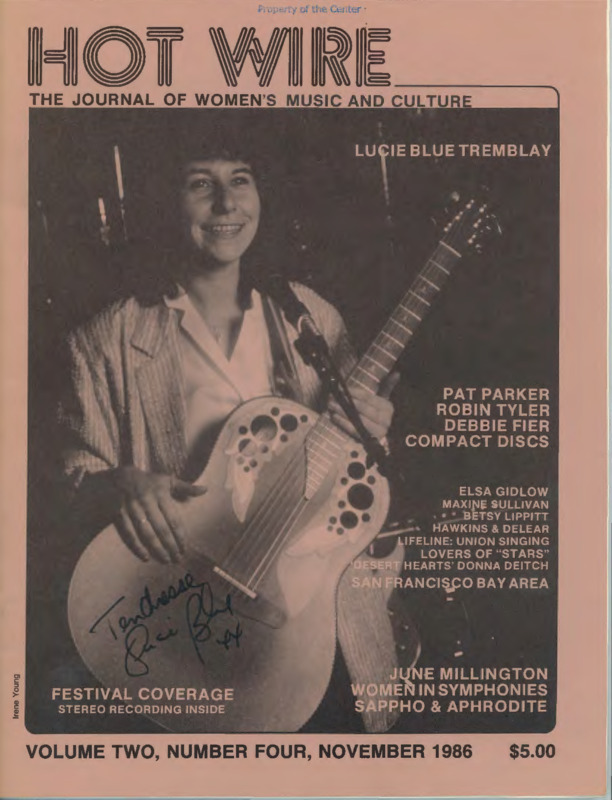
ON THE COVER
This issue's cover
features
Canadian singer/songwriter Lucie
Blue Tremblay from Quebec,
who has recently released her
first album on Olivia Records.
Read the interview with her (on
page 2) and hear "So Lucky"
on the soundsheet (inside back
cover).
CORRECTIONS
Despite our careful attention,
something always seems to slip
by. Please note from Volume 2
Number 3 (July 1986, Ferron on
the cover): the beautiful "Mothertongue" graphic page 61 was done
HOW MUCH OF AN
EXPERT ARE YOU
ON WOMEN'S MUSIC?
For those of you who feel like
you know what's what and where
it's happening, here's a challenge:
a free subscription goes to anyone
who can list, in order, the five
cities that receive the highest
number of HOT WIREs (85% of
the copies are shipped the day
they come back from the printer;
the figures include individual subscribers, bookstore accounts, and
distributors/producers who sell the
journal). Another free subscription
goes to anyone who can similarly
name our top five states. You can
use the sub as a gift or an extension of your current subscription.
How do you think your city and
state measure up in terms of informed readers?
BACK ISSUES
by Mary Angela Collins. In "The
Audio Angle" on page 11, the last
sentence should read: "When an
artist signs with a major label,
the record company executives
take control and make a lot of
decisions
concerning
production
of the record ... " Finally, in the
article about Redwood, two things
should be noted: Holly Near, Redwood's founder, was not included
in the photo on page 26, and (see
page 29), Redwood said in a letter to HOT WIRE, "Redwood Records might spend $20,000 plus for
promotion, but usually it's $3,000$10,000. We wish we had $20,000$25,000 to put into each release."
LOCAL DISTRIBUTION
If you can sell 5-10 copies of
HOT WIRE in your area, you can
help us increase our distribution
and you can make a profit. Keep
yourself in HOT WIREs this winter. Send a SASE for details.
We get many requests for info
regarding the availability of back
issues. We have a few copies of
all the issues except Volume 1
Number 1 (Kate Clinton cover).
We are running out of both the
Linda Tillery and Millington issues
(though we have some without
soundsheets). Send SASE.
YOU SEEM TO LIKE ...
The mail during the past few
months has continued to include
favorable comments about both
the Laadan and Sappho columns.
We have received many compliments on the soundsheets feature
as well. Women in the Directors
Chair reports a substantial amount
of mail following the "Novembermoon" article.
-Toni L. Armstrong
managing editor/publisher
'HOT WIRE' Journal
HOT WIRE
Volume 3, Number 1, November 1986
The Journal of Women's
Music & Culture
Publisher & Managing Editor
Toni L. Armstrong
Production Coordinators
Chris Crosby
Annie Lee
Advertising & Soundsheets
Lois A. Parsons
Joy Rosenblatt
Retreat Coordinator
Dawn Popelka
Founders
Toni L. Armstrong
Michele Gautreaux
Ann Morris
Yvonne Zipter
Features _ _ _ _ _ _ _ _ _ __
Interview with Lucie Blue Tremblay by T.L. Armstror,g
Maxine Sullivan: Going Strong at 75 by Betty MacDonald
The San Francisco Bay Area: Is it the "Mecca" for
Lesbian Feminist Culture? by Kate Brandt
'Desert Hearts' Donna Deitch by Jorjet Harper
"Wives, Widows, or Groupies" - On Being Lovers
of the "Stars" by Q.W. Bloch
Berlin's 'Lesbenwoche': Notes of a Jewish Lesbian
from the U.S. Playing in Germany by Debbie Fier
Betsy Lippitt by Catherine Roma
Hawkins & DeLear by Lois A. Parsons
Elsa Gidlow: in memoriam by Celeste West
2
19
20
23
36
40
44
46
58
Typesetting
equipment courtesy of
Chicago's Windy City Times
Printer
GraphicHouse
Skokie, Illinois
Staff
Tracy Baim
Celia Guse
Linda Salmon
Jean Durkin
Joan Eichler
Sarah Shaftman
Dawn Eng
Starla Sholl
Betsy Godwin
Paula Walowitz
Margles Singleton
Columnists
Kristan Aspen
Linda Dederman
Suzette H. Elgin
Kay Gardner
Jorjet Harper
Karen Kane
Janna MacAuslan
Joy Rosenblatt
Contributing Writers
Kate Brandt
Ellen Elias
Jorjet Harper
Betty MacDonald
Rosetta Reitz
Catherine Roma
Susanna Sturgis
Rena Yount
Contributing Artists
and Photographers
T.L. Armstrong
Alison Bechdel
Marcy J. Hochberg
JEB
Deborah Jenkins
Quasar
Nancy Seeger
Ellen Spiro
Lucinda Smith
Vada Vernee
Susan Wilson
Irene Young
Subscriptions (U.S. money equivalents only): $14/U.S.,
$17 / Canada, $19/institutions. Countries outside of
North America require extra postage charge. Back
issues when available are $5.
HOT WIRE: The Journal of Women 's
Music & Culture
ISSN 0747-8887
Published three times yearly, in March , July, and
November by Empty Closet Enterprises, 1417 W.
Thome, Chicago, IL 60660. (312) 274-8298. Unless
otherwise noted all material including photos is copyrighted by HOT WIRE.
Festivals _ _ _ _ _ _ _ _ _ __
Sisterfire: Why Did Roadwork Skip 1986? by N. Seeger
Keeping "The Land" by Robin Tyler
The Southern Festival & Disability by Judy McVey
Four Pages of Festival Photos
26
28
30
32
Departments _ _ _ _ _ _ _ __
Hotline by Joy Rosenblatt
On Stage and Off by Rena Yount
"Lifeline: Singing for Union Audiences"
The Audio Angle "Compact Discs" by Karen Kane
Noteworthy Women by J. MacAuslan & K. Aspen
"Women in Symphony Orchestras"
Laadan Lesson #3 by Suzette Haden Elgin
The Tenth Muse by Jorjet Harper
"Sappho and the Goddess Aphrodite"
Mulling It Over by June Millington
"Music, Life, and Politics"
Re:lnking by Pat Parker
"Poetry at Women's Music Festivals: Oil and Water"
Behind the Scenes by Lucy Diamond
Denise "Dino" Sierp and Karen Merry
Freestyle by Kay Gardner
"I Come With a Song For Elsa"
Soundsheets by Joy Rosenblatt & Lois Parsons
Featuring: Lucie Blue Tremblay, Lifeline,
Hawkins & DeLear, Betsy Lippitt
6
8
10
12
14
16
48
52
54
56
64
LUCIE BLUE TREMBLAY
An interview by Toni L. Armstrong
Lucie Blue Tremblay from Montreal
received three of four awards at the 1984
French Song Festival: Best Singer/
Songwriter, the Press Award, and the
Public A ward. She has appeared more
than 20 times on Canadian television in
addition to doing numerous live radio
shows. She was asked to sing the theme
song for the Francophone national holiday for a government sponsored recording, and in the U.S. Lucie has toured
extensively. She has performed at most
of the national women's music festivals .
She released her first album, 'Lucie Blue
Tremblay, ' on Olivia Records this fall.
HOT WIRE: How did you get the
name Lucie Blue?
LUCIE BLUE TREMBLAY:
Blue
is my favorite color - it's intense
and calming. Also, blue is the
color of the throat chakra. After
I won the awards in 1984 I knew
the timing was right and that I
would begin to get a lot of media
attention. I became Lucie Blue
at that time.
HW: What made you choose Olivia
Records for your first album?
LBT: It was thanks to Irene
Young. We met in Winnipeg at
the women's music festival. She
came to see me after my concert
and asked if I had a press packet
she could bring back to her California friends. Later I got a phone
call from Judy Dlugacz [president
of Olivia Records] and she said
she really liked what I did, what
she'd seen and heard - I sent a
little video - and she said that
she really felt my spmt. We
talked about it and I thought I
could maybe go to California and
talk to these people. In that same
period I had come to Michigan
and performed.
I really
liked
speaking to Holly Near and those
people; we connected very well,
and I was doing the opening for
Holly in Toronto, and that was
making me very excited. I think
she's so precious. At the same
time I thought I could come and
see everybody out in California.
Irene and Penny Rosenwasser and
all of them worked on producing
a concert with me and Jennifer
Berezan - two Canadian women.
I went and there were a lot of
people from Olivia and Redwood,
also Deidre [McCalla], rhiannon,
and Lisa [Vogel] and Boo [Price]
came. It was a very intimate concert at Valencia Rose with a lot
of heavies from women's music.
That was fun. And then we just
talked.
I went home and thought about
it. I knew I was going to produce
the album and I felt very attracted at that point in my life; they
just attracted me to work with
them. The spirit was really intense and emotionally quick. When
your heart says to go somewhere
you like to follow it. But then
I went home to see what my head
would say.
We negotiated from November
until March, and in March we
knew that it would work. They
have, since then, worked very
hard. I have a lot of respect for
all of the other people who work
in the industry as well. I have
signed with Olivia but I feel that
it doesn't mean I like the other
companies less.
HW: You were offered contracts
with other companies?
LBT: For the past two years I had
been offered contracts with Canadian companies. But I wanted to
have artistic control on the contents of my album. I asked one
of the producers about "Voix d'
Enfant," my song about incest.
I said that it was very important
to me and that I wanted it on
2 HOT WIRE November 1986
my album. He said,
can't do that. It's a
song; no one wants to
thing that heavy." So
v.ouldn't work, doing
together.
"Oh, you
real heavy
hear someI knew it
the album
HW: You've made a point to include "Voix d'Enfant" on your album. You've also performed it on
television?
LBT: I had the opportunity to do
mainstream [Canadian] television,
and I wanted to do something so
people would know that I try to
do things that touch you one way
or another. It [incest] is a pretty
hot
subject.
People's reactions
were pretty positive, with some
very negative because they were
totally disturbed. And I can understand that. But the fact that
they reacted positively or negatively is good.
HW: In previous conversations you
have said that you don't need to
necessarily say anything specific
about women or lesbians in each
song but that you bring "total
consciousness" to everything you
write. How do you write songs?
LBT: The consciousness is where
it starts. Then if you're writing
about women you go and write
about women. If you're writing
about lesbians, about being an incest survivor, or a love song, the
thing is where the basis of it iswhere you start and where you
go from, and why.
I just feel that my songs are
honest, for me. When they're being written I'm aware only of how
I'm amplifying emotions. It's funny
how I write songs; I'll be feeling
something ... it's very hard for me
to sit down and say, "Okay, I'm
writing a song now." I can write
six songs in say three weeks and
then not write anything again for
six months. But what I do is play
an instrument and I'll be feeling
a certain emotion, whatever it
is. I'll play a chord that makes
me feel that emotion even more.
Then I nurture that emotion,
whether it be sadness or happiness
or thinking of someone. If I'm
m1ssrng that person, if I'm mad
at that person, you'll tell the difference in the color of the chord.
When I'm sad it can be a very
masochistic thing to do. I go on
that way, and I really get into
whatever emotion I'm into. The
words will come out, and that's
how I write songs.
I'm very accessible and open.
I put myself out very much in my
songs. The public knows me very
well from listening to my songs,
it up. Singing a love song when
you're really pissed off, or you're
not in love, or you don't want to
be in love, something like that.
It's a lot of work, and I really
like it. But sometimes it looks
a lot easier than what it is.
HW: Five songs on your album are
in French and fiv~ are in English.
How did you decide to mix the
languages?
LBT: I grew up with English. In
the last years I haven't been surrounded with English people, so
I don't have a chance to practice
it much except when I come to
these festivals. I've always been
influenced by, and written in,
English (and also slangish English"goin'," stuff like that) and I have
ments on the language laws and
change things to make more space
for the English, even though our
province is majority French speaking. Inside all of Canada we
French people of Quebec are a
minority. To me it's been very
important not to lose my identity
as a Francophone, and it's so easy
to do. We have to fight right now
so that the commercial radio station will play 55 percent French
music. Otherwise it would be English and American music. We are
bombarded all the time. If you
don't
defend yourself,
protect
yourself, and prepare yourself you
can lose very easily.
It's a bit like the feminist
movement, how you move ahead
through a lot of struggling and
a lot of people doing a lot. And
then the years pass and the militants get tked and burned out and
they rest. The new people come
and take a lot of things for
granted. Then things start changing and slipping backwards. It's
the same thing.
I try to have a conscious vision when I write; I'm very conscious of my French roots. So we
did five songs in French and five
in English. It was important because this way I felt that I was
really saying who I was.
HW: What's it like for you being
a Francophone traveling so extensively
through
English-speaking
areas on your tours?
and they recognize themselves because I write about things everyone feels every day. But then it's
difficult for me when the feeling
is over. For example, when I
wrote "Voix d'Enfant" I was very
disturbed about the subject and
about certain people around me
and about myself as an incest
survivor. I was really into this
song when I wrote it, very hurt
and upset thinking about lots of
things. But that was then. Now
I find myself, years later, performing that song when I'm not
in that mood. I do the song and
go through it all over again. It's
very hard emotionally to do that,
and it's the same with the sad
songs or the love songs, to dredge
never stopped myself from singing
in English. I felt it was a part
of myself.
At the same time, going into
English milieus in the rest of
Canada [outside of Quebec) and
in the U.S. is scary because there
is a fear of assimilation.
HW: Fear of being assimilated
into the English-dominant culture?
LBT: We've been fighting for a
long time in Quebec to keep our
language and culture; it's very
difficult not to be assimilated
even in our own province. Every
time there's a new government
voted in there's a slim chance
that they're going to put amend-
LBT: Well, if I talk to you in
English and ask you if you speak
French, you will probably tell me
no. Yet maybe you took French
in school, a lot of women have.
A little bit, maybe six months.
It doesn't take much to say,
"Bonjour." But because the person
who is English-speaking is living
in the language majority, if that
person cannot show that they are
perfect in mastering the language
they will not speak it. So unless
you are perfect in French, or
know enough to have a really
good conversation - and then you
would say, "I speak a little,"
right? - even if you can only
say, "Bonjour, comment <ta va?"
you'll say, "No, I don't speak
French." And I find that a lot of
times it's just because it's hard
to be talking to someone in a
language minority without being
HOT WIRE November 1986 3
perfect. And yet if you say to
me, "Bonjour, comment "a va?"
it means so much more to me because you've communicated, "Yes,
I speak a little bit of French. I
can s:;iy, 'Hello, how are you?"'
That touches me because you are
daring into something that you
don't know much of. And no,
you're not perfect, but you're
trying.
HW: How does the Canadian women's music scene compare to what
is happening in the United States?
LBT: The Canadian Women's Music
Festival in Winnipeg is in its third
year. I don't think we really have
that type of label in Canada,
though. Look at Heather Bishop.
She's just doing what she does
best, and she is great at it. She's
not defining it. It's like we're not
defining what we do as "women's
music," we're just being a part
of the mainstream music world
labeled differently. It's not as big
and organized because we've had
to just be in the mainstream in
order to survive. So we exist, and
do not try to create a new circuit, but to just live and be and
do what we do best.
So in that sense in the U.S.
it's a little bit easier because you
have ... well, it depends on what
you want. But let's say that you
have the possibility of playing for
women in the women's music industry by doing festivals, selling
your records, being in HOT WIRE
and all the papers-all within the
women's circuit. And if you
choose to, you can just be in
there ... and have a part-time job!
You can do it because the U.S.
is huge.
But in Canada I think that we
just came out and continued doing
what we do best at concerts.
Through that we meet and have
the bond. It makes us want to be
together. It makes me a little
player who sometimes plays with
Heather, has an album coming
out. Katherine McKay is an incredible songwriter from Toronto.
And of course Lillian Allen from
Toronto. There are many.
HW: What is your
"women's music"?
definition of
LBT: Music written with a woman's consciousness, whether it be
lesbian-identified
or
feministidentified. Women's music to me
is conscious music. Some women
are lesbian-oriented, and that's
fine; others are not out with the
"L" word, but they're singing
other things that are conscious,
that are healing. I feel that women's music is healing music. We
have this energy that is very
powerful and what we do with our
songs is a responsibility.
When I heard Alive! do "Spirit
Healer" at the Montreal Jazz Festival the place was filled with
"If you tell me ,'bonjour, comment fa va?' it means so
much to me. You've told me, 'yes, I speak a little bit
of French - I can say hello, how are you?'
That touches me because you are daring into something
that you don't know much of. And no, you're not perfect,
but you're trying."
and people are seeing us that
way. It's wonderful to see Heather do lesbian songs and children's
songs because there are children
there along with the women and
the men in the room.
HW: If women and lesbians are
so integrated into the mainstream
music scene, why would it be
necessary to have a separate festival like the one at Winnipeg?
LBT: Because it's really a privilege to get together with women
from all over and to be able to
see each other perform. When you
are a performer, you don't have
the opportunity to meet that
many people unless you play the
festivals, and I think that festivals are really important in that
sense.
It's not that women's music
doesn't exist, it's just that it's
skeptical to talk about Canada
because I am so Quebecois - you
can't imagine how apart we are
from our own country. The culture
is completely different; as soon
as you step into Quebec you feel
you're in another country. The
way of life, the way of thinking ...
I can talk about Canada when I
really should say Quebec.
HW: Which Canadian artists besides yourself and Heather Bishop
& Tracy Riley might fans of
women's music want to hear?
LBT: Ferron and Connie Kaldor.
Maybe Anita Best from Newfoundland.
Jennifer
Berez an writes
really good stuff. She has a song
called "Teacher's Song" which
talks about a lesbian teacher who
gets kicked out of school. Wonderbrass does experimental electronic jazz. Sherry Shute, a guitar
4 HOT WIRE November 1986
people from all over Montreal,
men and women, and everyone
was standing there. The tears,
they just came out of my eyes.
You could just feel it and not
stop yourself. Just let go and listen to it; that is power. That is
energy and it's positive. That's
what we have - the power to do
it, and all the tools that we need
to make this energy work, and
we have a real thirst for growth.
When I go into women's communities I see how many women are
in therapy, and that's because
there's a lot of growth there.
When you're in therapy, it's because you're trying to grow and
you need some help on the way.
That in itself says a lot about
women's energy.
HW: Can styles other than the
traditional singer-songwriter folk
music be "women's music"?
J
LBT: Yeah. I like rhythmic stuff;
I really like to boogie. It depends
on what's written in it and how
it's performed and arranged. I
think we're trying new ways. If
it comes into my life, my home,
and I feel that this lady is talking
to me, that this lady when she
wrote that song knew what she
was talking about ... if I can feel
the performer, and know where
she's coming from, then I will like
that music. I won't be touched
by Whitney Houston because I
know she's saving all her love for
say, "I'm rising in love with you,"
and for me that's what makes
that song different. I felt I was
"rising" in love when I always fell
flat on my face before. That was
the difference; the thing ~when
you're writing songs to try to
grow. Women's music has a basic
consciousness no matter what the
subject is.
HW: Have you always been involved with music?
LBT: My
family
background
Cl
C
~
HW: Anything else?
LBT: I'm really touched by how
people are receiving the French
culture. It's been difficult for a
long time. Going into western
Canada or the United States with
half your songs in French is scary
Cl
C
g
.
is
myself and have arrangements
that are in my mind that I want
to develop with time. Working on
the album was good for that because it made me use my instincts a lot.
Cl
C
e
g
<
<
1n
E
E
<
_j
E
_j
_j
·c:
!
whatever man she's saving it for.
And I know that that's not touching me. For love songs, I want
to be touched. Even if she doesn't
say "man" I know where she's
coming from.
HW: What if you found out that
Whitney Houston was in fact a
lesbian?
LBT: Still she didn't write the
song. You look at the video andhave you seen it? - it does not
touch me. It's not women's music.
HW: The
message of that song
seems retrogressive in that it
glorifies the old stereotype of a
woman waiting powerlessly for
some man.
LBT: But we do wait around we do! I'm not PC. We do wait
around. I do it. When I'm in love,
I'm in love.
HW: Then what makes one song
about women's experience "women's music" and another song not
"women's music"?
--
LBT: There are different ways of
doing it. You can only say so
much in love songs; they've been
said 10,000 times and it's very
hard to say them differently. The
thing that makes it different is
that, for example, in one song I
0
I-
very musical. My mother is a
musician - keyboards. She pushed
me to sing and to do music since
I was six years old. She had a
five-piece band with a sax, bass,
drum, and guitar. They did Top
40 and dance music for weddings
and different types of parties. I
was always following them around
when they would play. My mother
always had trouble with drummers. They were problems because
they were after a lot of women
or drinking or just late-drummers
are difficult ones, in the boys.
When I was about 10, that drummer taught me how to do slow
dances on the kit so that he could
go cruise the girls. Then it went
to different rhythms. I ended up
becoming the drummer for the
next two or three years. I got
better, and so I grew up. When
I was 14 I got my first guitar,
and I just started to play by myself.
when you're used to traveling in
places where five years ago you
would go with a Quebec license
plate and get three flat tires. We
are looked upon as being separatist. The reason being we're so
radical, trying to keep the language. So now the times have
changed and to be able to be
accepted with my language, with
my culture, and with my errors
in English. I just find that people
are very open to me, and it
touches me a lot. People are trying to speak French. When I talk
to them about that, people do say
"bonjour," and that feels really
good. It really does. I just want
to thank those people for being
so good to me.•
ABOUT THE AUTHOR: Toni L. Armstrong teaches special education in a
high school, is pursuing a second Masters degree, publishes & edits 'HOT
WIRE, · and is happy to report her TypeA tendencies are almost under control.
HW: What about the piano?
LBT: I've only been playing piano
for very little time, about two
years. I can only play what I
write. I don't consider myself an
excellent, accomplished musician.
I want to learn a lot. In my spare
time I'd like to take a course.
I'd like to be known in my life
for being a good songwriter, for
my melodic lines. I accompany
Photographers
We are very interested in your
black and white photos of
women musicians and performers.
Action shots, especially from
festivals, are needed. Send to
HOT WIRE Graphics Department.
HOT WIRE November 1986 5
HOTLINE
By JOY ROSENBLATT
MARVEL COMICS is seeking
a 10-14 year old fem ale who can
sing and dance for the Captain
America Broadway musical, says
Bitch.
GATHERINGS
The THIRD ANNUAL SOUTHERN
WOMEN'S
MUSIC
AND
COMEDY FEST sponsored its own
version of Hands Across America
on site at the festival May 25.
"Dykes Around the Lake" raised
$1,600 which was donated to the
Georgia Women's Shelter Network
to be used for anti-homophobic
training for shelter staff throughout the state, said off our backs.
The Southern California Committee for the first WEST COAST
CONFERENCE OF OLD LESBIANS
has announced plans for a two-day
conference by and for lesbians
over 60 and their friends. It is
planned for spring 1987 and will
be held in the greater Los Angeles area. Contact: West Coast
Celebration, 2953 Lincoln Blvd.,
Santa Monica, CA 90405.
At press time, plans were underway for the THIRD NATIONAL
WOMEN'S CHORAL
FESTIVAL,
to be held in Chicago November
7-10. More than 200 singers from
11 choruses were expected to participate. Contact: Ann Morris,
Artemis Singers, 1416 W. Winnemac, Chicago, IL 60640.
The 1987 NATIONAL WOMEN'S
STUDIES ASSOCIATION CONFERENCE will convene at Spelman
College in Atlanta June 24-28,
1987. According to Atalanta, the
conference,
"Weaving
Women's
Colors: A Decade of Empowerment," will explore the intersection of race and gender. Contact:
NWSA '87, Emory University, P.O.
Box 21223, Atlanta, GA 30322.
(404) 727-7845.
HOTLINE announces upcoming events
in women's music and culture, presents
capsule reports of past happenings, and
passes on various tidbits of information.
PUBLICATIONS
~
✓
LAMMAS: Happy 13th. Adrienne Rich
with Joanne Jimason (foreground),
owner Mary Farmer, Donna Niles, and
Debbie Morris (standing) at the Grand
Opening weekend ceremonies.
ANNIVERSARIES
In August, Washington, DC's
LAMMAS BOOKSTORE celebrated
its 13th anniversary. LAMMAS
opened a second store April 1,
making it the first women's bookstore to have two branches in the
same city. The Grand Opening
weekend featured author receptions for ADRIENNE RICH and
CHERYL CLARKE. The stores are
located on Capitol Hill at 321 7th
St. SE, (202) 546-7282, and at Dupont Circle, 1426 21st St. NW,
(202) 775-8218.
WANTED
Listener-sponsored NPR radio
station KUNR is seeking women's
music records for airplay on
"Women in Tune," their hour-long
weekly program. At 20,000 watts
stereo, their listening area includes Lake Tahoe and Carson
City, a total service area of 370,
000. Contact: "Women in Tune,"
Joyce Hansen, KUNR-88, University of Nevada/Reno, Office of
Communication and Broadcasting,
Reno, NV 89557. (702) 784-6591.
6 HOT WIRE November 1986
CROSSING PRESS has a new
line of books, "Woman-As-Sleuth
Mysteries," which focus on female
protagonists and are written by
women. Contact: Irene Zahava,
307 W. State St., Ithaca, NY
14850.
NAIAD PRESS is seeking fiction works by lesbian authors in
the international intrigue and spy
novel genre as well as in science
fiction.
Contact:
Naiad Press,
P.O. Box 10543, Tallahassee, FL
32302.
THE WOMEN'S HISTORY RESEARCH CENTER of Berkeley has
published three series of documents on microfilm. Herstory is
90 reels covering 21,000 issues
of 821 women's newsletters, journals, and newspapers published by
and about women's liberation, professional, religious, civil rights,
and peace groups.
WOMYN'S
BRAILLE PRESS,
INC. was created in 1980 by six
blind women in Minneapolis, reports Communique Elles, and it
has been working on the problem
of the lack of feminist literature
in formats accessible to blind and
visually impaired women. They
provide books on tape (160 titles)
and in Braille, periodicals on
tape, and a quarterly newsletter
which is available in Braille and
on tape. Contact: Womyn's Braille
Press, P.O. Box 8475, Minneapolis,
MN 55408. (612) 872-4352 days,
(612) 822-0549 nights.
I
ALYSON
PUBLICATIONS
is
seeking coming out stories for two
future collections. Contact: Alyson
Publications, attn: Coming Out
Project, 40 Plympton St., Boston,
MA 02118.
WOMEN
KATE SMITH died at the age
of 79. She was best-known for her
renditions of patriotic songs, especially "God Bless America." Her
operatic voice was completely untrained and she never had a singing lesson.
JANIS IAN is songwriting and
touring again for the first time
since 1981. Feeling burned out,
and reportedly tired of recording
songs by other people that she
didn't believe in, she decided to
"stop being a famous person and
go back to being a writer," according to Bitch. She has been
writing
son~with Nashville's
Rhonda Kye Fleming.
ANNE FRANK, the well-known
World War II Jewish diarist and
concentration camp victim, was
a lesbian, according to Philadelphia Gay News. That conclusion
was drawn after an unedited version of the famous diary was published by the Dutch government.
It contained specifically lesbian
passages.
LYNETTE WOODARD has been
selected by the Harlem Globetrotters as their first female player.
Also, the all-woman soul group
9.9 has been chosen by the Globetrotters to introduce the new version of their theme song, according to Bitch.
86-year-old writer and social
activist FLORENCE REECE died
August 3 in Nashville of a heart
ailment. Her song, "Which Side
Are You On," written during the
1930s to describe the plight of
Harlan County mine workers, became an anthem for the labor
movement after it was recorded
by Pete Seeger in 1941.
TERESA TRULL, now working
with BONNIE HA YES, will release
an album entitled A Step Away
on Redwood Records. Her previous
recordings have been on the Olivia
label.
SIMONE DE BEAUVOIR, feminist philosopher and forerunner
of the women's liberation movement, died in Paris April 21 at
the age of 78. In her book, The
Second Sex, she broke new ground
by saying that women are made,
not born, and that femininity is
a socially-imposed idea that is
linked to women's oppression.
NEWS
The recently-inaugurated ROCK
HALL OF FAME in Cleveland,
Ohio did not elect any women for
the initial presentation, according
to Bitch, and no women are on
the election committee. ROBERT A
FLACK was the only woman presenter.
SHE ROCK, a new all-woman
pop quintet, has become the first
U.S. pop group invited over to
tour the People's Republic of
China, stated Bitch. While they
are there they will record an album for release in China only and
film a Chinese TV broadcast.
Atalanta reports that "BANG
BANG UBER ALLES," the musical
written by JUNE JORDAN and
ADRIENNE TORF, had a fiveweek run in Atlanta over the
summer, with the last night as
a benefit for the Atlanta Lesbian
Feminist Alliance._
"MISOGYNY IN ROCK VIDEO,"
a pamphlet exploring the antiwoman trend, has been produced
by EVELYN KANE. It discusses
content,
program ming,
audience
demographics,
current research,
and how to effect change. Contact: Women Against Pornography,
358 W. 47th St., New York, NY
10036.
FILM & TV
TURNING TIDE PRODUCTIONS
released a 30-minute documentary
on the lives of five women who
actively participated in the social
revolution in Spain during the
civil war in the 1930s. Broomstick
said it is entitled All Our Lives/
De Toda La Vida, and that the
women are as dynamic now in
their eighties as they were during
the revolt.
Women in the Director's Chair
will sponsor their ANNUAL WOMEN'S FILM & VIDEO FESTIVAL
on March 6-8, 1987, exhibiting the
best current and classic media by
women from around the world.
Contact: Women in the Director's
Chair, P.O. Box 4044, Chicago,
IL 60654.
•
NANCY LIEBERMAN, a close
friend of MARTINA NAVRATILOVA who is discussed in Martina's
autobiography, is making a movie
about a basketball player programmed to perfection by a computer, reports Philadelphia Gay
News.
ROCK VIDEOS: MUCH MORE
THAN MUSIC is a 25-minute program which examines values, sex
roles, and love relationships as
depicted in current rock videos.
Hysteria stated it is produced by
Victoria Canada's Women Against
Pornography and is accompanied
by an information kit that includes
background
information,
ideas for discussion, a content
analysis of a four-hour viewing
period of Muchmusic (Canada's
MTV), and a bibliography. Contact: Women Against Pornography,
1221 Oxford St., Victoria BC, V8V
2V6, Canada.
STEPHANIE BENNETT of Delilah Films in Connecticut, which
did the home video compilation
films The Girl Groups and The
Compleat Beatles, is working on
a project called "Women in Rock,"
which will feature interviews and
performances by female stars, according to Bitch.
Music historian and archivist
JEANNIE POOL has produced a
video documenting California's allwomen orchestras from 1893 to
the present. It is now available
at no charge for educational, nonprofit use. Specify VHS, Beta, or
3/4". Contact: Cal State University Dept. of Music, Northridge,
CA 91330. (818) 885-3157.
continued on page 59
ABOUT THE AUTHOR: Joy Rosenblatt
does production at Mountain Moving
Coffeehouse. In her spare time, she
works f9r the State of Illinois as a welfare
counselor.
HOT WIRE November 1986 7
ON STAGE AND OFF
Bread and Roses Revisited:
Singing for Union Audiences
By Rena Yount
Each year the AFL-CIO and
the University of College Labor
Education Association sponsor several week-long "summer schools,"
leadership training sessions for
union women. Women from a variety of unions throughout a particular region of the country spend
the week in intense, often exhausting, study and discussion.
At one such summer school
three years ago, the organizers
mentioned several times through
the week that a band would be
coming to perform on Friday, and
there would be a dance afterwards.
All week women kept asking,
"Who are we going to dance
with?" The organizers had no
comment.
On Friday evening the band,
Lifeline, arrived and played a long
set. Then the Lifeline women put
a dance tape on, got out on the
floor, and began to dance.
With each other.
Slowly, other women began to
join them. Then the pace picked
up. After awhile the whole room
was in motion, with line dances
everywhere. It was a party, a
blast, an escape valve-a way to
blow off steam and to affirm
their unity beyond the tensions
of the week. for most of the
women there, it was a new experience.
"By the end of the night we
couldn't get them to stop," Jeanne
Mackey of Lifeline says. "That's
what music is about-it draws people together on a lot of different
levels."
There is not a clearly-defined
labor audience that women musicians can tap into in the same
way they would approach, say, the
college circuit. But a large patenON STAGE AND OFF addresses issues
of interest to musicians and performers.
Lifeline: bridging the gap between the
labor movement and the women's
community.
tial audience is there. for Lifeline, performing for labor events,
including many audiences of union
women, has become a mainstay
of their performing circuit.
Lifeline is a four-woman band
with an eclectic style drawing on
folk, rock, jazz, and country. They
recently added Rochelle Loconto,
a drummer formerly of the rock
band Acrilix and the women's rock
band Squeeze Louise.
from the start, Lifeline has
had something of a dual identity.
It is a women's band, deeply
rooted in the feminist movement,
at home at Sisterfire or the National Women's Music festival.
At the same time, Lifeline identifies strongly with the labor
movement. Their goal, in Mary
Trevor's words, is to "bridge the
gap between various movements,
especially between the women's
community and the labor movement."
8 HOT WIRE November 1986
Their early labor-related gigs
were at strike rallies, picketlines,
and union fundraisers. They performed free or for little money
as a way of giving support to
particular unions and strikes. At
the same time, they were building
contacts. With that background,
Lifeline has been able to move
to the next level and take advantage of the fact that there are
unions with the resources to payand sometimes pay well-for music
at their conferences and other
events.
Mary says, "In the past, there
was a whole tradition of using
music to organize and encourage
people. That's largely been lost.
But we're encouraging unions to
rediscover it. We're trying to help
build a labor circuit."
Lifeline plays for both general
and women's labor audiences. for
instance, they recently performed
at
the annual conference of
AFSCME
(American
federation
of State, County, and Municipal
Employees), with 8,000 delegates
in attendance.
But the main areas for union
orgamzrng today are minorities
and women, especially in the service sector. These are people who
historically have been unorganized. As unions turn their attention to the service sector, there
is a new emphasis on all-women
conferences, leadership training,
and other ways of involving
women in the unions.
Women, including women of
color, are finding they have more
opportunity to rise to leadership
positions within a union structure
than in the corporate world. This
is a very relative statement, of
course. It's not that women have
a lot of power in unions. Not yet,
anyway. But there is a growing
network of active union women.
When they are looking for musicians, they are likely to call on
Lifeline.
For many union women, Lifeline's performances mark their
first exposure to women's music
or to any alternative culture. The
pro-labor content of the music
often guarantees a positive response; working-class people frequently have a sense of being
ignored or patronized by the
mainstream culture, and by alternative movements as well. Kris
Koth, Lifeline's bass player, says,
"For a lot of women, it's the
first time they have seen a performer get up on stage and go
to bat for them."
express what we have to say,"
Kris says. "We have pre-gig meetings and we work it out very
carefully - the songs, the raps."
They have to be prepared for
diverse, sometimes unpredictable,
reactions. For example, Lifeline
recently performed a song on the
contributions of Asian Americans
before a union audience, where
there is frequently resentment of
Asian immigrants "stealing our
jobs." The song was well-received.
Then they did an anti-militarist
song, "What If the Russians Don't
Come?",
which
usually
brings
laughter and applause. That day
it met with silence. "You can't
let that throw you," Kris says.
"You plow on."
Still, Lifeline does not limit
itself to work-related material.
"Monday Shutdown," which voices
the alienation most of us feel in
our jobs, may lead into an antiwar piece; a song about Harriet
Tubman may be followed by one
addressed to legislators who voted
against the ERA: "You screwed
us over/ You voted 'Nay' / We're
gonna get you / Come election
day ... "
"Women find that one very
therapeutic," says Jeanne Mackey,
a founding member of Lifeline.
Lifeline
sings
love
songs,
feminist
humorous
songs,
and
material such as Betsy Rose'1,
"Coming Into My Years," or their
New/Wave rock version of "No
Hole in My Head," the Malvina
Reynolds classic:
Lifeline women do not overtly
identify themselves as lesbian in
union contexts. However, many
women recognize them as lesbian.
"We've had a number of lesbians
tell us that we've made their
lives and jobs a little bit easier,"
Jeanne says. "We're up there performing, playing good music, singing to union women about their
lives and their issues-we're hard
to discount. That begins to break
down people's homophobia." Kris
adds, "Women come up to me
after a performance and say, 'It
makes us so happy to see you
here.' Again, it's something they
haven't seen before-a lesbian on
stage
singing
to
a
basically
straight audience and getting away
with it. They think it's great."
Homophobia is wide-spread in
unions, of course, as it is in the
rest of the culture. But it is
beginning to be challenged by progressive union women. This comes
partly from the recognition that
"queer baiting" is used to attack
and undermine all strong women.
Also, there is a union tradition
of solidarity, of standing by your
fellow workers even if they are
different, that can be drawn on.
At
one
women's
summer
school, the staff felt it was necessary to begin dealing with
homophobia more directly. Lifeline
women were involved in staff discussions on how best to raise the
issue. The decision was to focus
on teachers and on the issue of
job discrimination on the basis of
sexual preference. Lifeline started
it all off with Charlie King's song
to Anita Bryant:
Everybody thinks my head's full
of nothing,
Wants to put his special stuff in Fill it up with candy wrappers,
Keep out sex and revolution But there's no hole in my head.
Too bad.
"Music
brings out
people's
more open-minded aspects," says
Jeanne. "There are things that
would get people real shaken up
if you said it in a speech, but you
can slip it through in a song."
Still, the concept of bridging gaps
between different movements inevitably means dealing with people
who have not been exposed to
your views, or who disagree with
them.
"We spend a lot of time selecting appropriate material to
Thank you, Anita,
You couldn't have been sweeter.
You brought us together like
never before.
Thanks to your mission,
You new-found profession,
It's now your obsession, not mine
anymore.
There followed two days of
intense discussion in which Lifeline women participated as well.
A number of union women came
out to the co-unionists for the
first time. "It was hard. It was
upsetting," Kris says. "There was
a lot of homophobia. But as I was
rather abruptly told when my
anger hit a high point, 'Don't you
realize this is the beginning? We
were doing this three years ago
about racism in the union.' "
"Wherever people are trying
to work out new values, there is
conflict," Mary says. "That's part
of the process."
In the past several years feminist musicians have been making
increasing cross-overs and connections with other communities,
from anti-nuke organizations to
New Age bookstores. This process
is important in developing a
broader base of support for our
music, and in building coalitions
that can have a greater impact
on the country as a whole.
What connections are open to
individual women or bands depends
on their own interests and areas
of knowledge. For women interested in exploring labor-related
work, there are points to be
aware of:
•You will need to develop a
body of songs that is work-related
and union-related. Whatever else
you have to say or sing about,
it starts with that.
•You will probably have to "pay
your dues" through free or lowpay performances connected to
local labor issues: strikes, local
conferences, etc. Since there is
not a developed "labor circuit"
for musicians, personal contacts
and recommendations are essential. You will need to become
acquainted with the labor scene
continued on page 61
ABOUT THE AUTHOR: Rena Yount is a
freelance writer in Washington, DC. She
is a member of the women 's poetry
group Stone Soup, and recently published her first fiction .
HOT WIRE November 1986 9
THE AUDIO ANGLE
Compact Discs
By Karen Kane
Rejoice! No more worries
about ruining your nice new
needle with an old scratchy
record or destroying a nice
new album with an old wornout needle.
Those days are slowly leaving
us - the compact disc is here!
In my opinion (especially with
the revolution of the CD Walkperson and the CD car player), compact discs are here to stay. They
can store more than an hour's
worth of music, and are just
about as convenient as cassettes.
They have better sound quality
than cassettes or records and,
most importantly, don't wear out
like vinyl or magnetic tape can.
The quality remains intact as well
as the actual physical product itself because it does not use
needles that touch its surface.
Utilizing a laser system, the compact
disc
is
never
actually
touched and therefore will not
deteriorate at all.
The CD brings the consumer
much closer to hearing the original quality of the master tape of
a recording. According to the July
1986 issue of Digital Audio &
Compact Disc Review, "The CD
is going to be much more than
simply a replacement for the LP
record. The CD is an extremely
versatile digital medium, able to
store a wide range of audio, data,
graphics, and software. The CDs
of tomorrow will represent enormous storage capacities that will
change our listening and buying
habits."
THE AUDIO ANGLE discusses information about recording, the mysteries
of the recording studio, and answers
technical questions submitted by HOT
WIRE readers.
>-
"C
"'
I"
b
,,
;;;
al
WHAT ARE COMPACT DISCS?
In order to properly answer
this question, I must first explain
some new advances in the recording process.
Since the turn of the century
the analog, magnetic tape recorder has been the norm for
storing sound onto various kinds
of materials, one of them being
magnetic tape.
"Analog means similar or in
direct relation with," explain Robert Runstein and David Miles
Huber in Modern Recording Techniques. "When applied to the analog tape recorder, it refers to the
fact that the magnetic energy
stored onto a magnetic tape (in
the form of the smallest known
permanent magnets) is in direct
relation with and in proportion
to the electrical signal given at
its input."
The analog tape recorder is
plagued by many problems, as is
magnetic tape with all of its nonlinearities. Noise (caused by both
tape hiss and machine electronics), distortion, and other irregularities result in deterioration of
the original sound source when
reproduced.
However, most of
these problems are minimized by
the technicians who make the
machines and by the maintenance
people who take care of them.
"Recently," say Runstein and
Huber, "the digital revolution and
10 HOT WIRE November 1986
the storage of information onto
tape in the form of a digital
stream of binary numbers [binary
means consisting of two parts or
things, or being a system of numbers having two as its base) has
given new life to the recording
industry by raising the clarity and
quality of sound reproduction to
new heights. With digital recording equipment, the end result is
a recording that is free from all
the non-linearities inherent to the
analog medium."
Nowadays when you go into
the recording studio you can
choose to record in either format.
Digital equipment is very expensive, so the studios that do have
it are going to charge a lot for
its use. In the New England area,
not one studio has a digital multitrack recording machine, but many
have the necessary digital equipment available for mixing. This
means if you record onto a 16track or 24-track machine here
in New England, it will be the
analog format. When you mix
(balance all the tracks together)
down to a stereo master tape,
then you could choose the digital
format. One reason I personally
like to do this-besides the clarity-is the absolute absence of tape
hiss when digital equipment is
used. Whether you record analog
or digital, you can produce vinyl,
cassettes, or compact discs from
your final product.
In order to understand the CD,
it is necessary to understand the
manufacturing process of both
vinyl and CDs. When you are having vinyl made from your finished
master tape, the tape is played
back and fed through a disc mastering console onto a disc-cutting
lathe. The electrical signals are
converted into the mechanical
motion of a stylus and cut into
the surface of a lacquer-coated
I
1
(
recording disc. This disc gets sent
to the plating plant and is electroplated with nickel. After completion of the electroplating, the
nickel plate is pulled away from
the disc. This nickel plate is
called the "matrix" and is a negative image of the master.
This negative image is electroplated to produce a nickel positive
image called a "mother." The
mother
is
electroplated
many
times, producing the "stampers"
(negative images) which are used
to press the records. The stampers are placed on the top (Side
1) and the bottom (Side 2) of a
hydraulic press with a lump of
vinyl placed in the middle. With
the press closed, steam lets the
vinyl flow
around the raised
grooves of the stampers. A cooling system makes sure that the
vinyl becomes cool before the
press is opened. When opened, the
vinyl gets pulled off the mold.
There
are
many
problems
plaguing the vinyl-making process,
so a new format has been a long
time c oming. With the intervention of digital recording in the
industry came the process of
making compact discs. According
to Runstein and Huber, "The CD,
a silvery plastic disc, has its information
digitally
transferred
onto the reflective underside of
the disc in the form of microscopic 'pits.' When placed in a
com pact disc player, a laser is
reflected off this pitted surface
and returned back to a 'pick-up'
in the form of a digital stream
of information. This stream of information is then restored back
to the music (sound) through complex digital-to-analog conversion
procedures."
In manufacturing the CDs,
after all the digital processing has
been done, the process is very
similar to record pressing. The
CD master goes through an electroplating process, creating stampers used in the same manner as
the vinyl process.
CD history began on September l, 1984 when the first CD
manufacturing plant was opened
in Terre Haute, Indiana. Bruce
Springsteen's Born in the USA was
the first CD to be manufactured.
In December of 1984 came the
first "CD/L V" player, which can
play either CDs or videodiscs. The
CFD-5 (otherwise known as the
"CD Boom Box") came along in
July of 1984. Also in July many
companies came up with the
2-in- l CD player, allowing 150
minutes of playing time. The CD
explosion was really evident when
The Compact Disc Group opened
a toll-free hotline for consumers
and retailers (800-872-5565).
Increasing numbers of record
companies are making compact
discs along with their vinyl and
cassettes. I've read in the latest
CD magazines that record companies are beginning to re-manufacture a lot of old recordings
into CDs. Now you can really
throw out all those old scratchy
records!
There also seems to be a
great demand for CDs that is exceeding the availability. Some industry experts predict that CD
sales will equal the combined
sales of LPs and cassettes by
1989. There are presently 16
major CD manufacturing facilities
in the U.S., and even with increased production at these facilities the consumer can still expect
a long dry spell. CD production
is expected to increase by l 00
million each year for the next
several years.
Compact disc players started
out being extremely expensive,
but I have started to see the nonportable ones for around $200.
What dictates the price is the
quality of the laser beam in the
CD. The CD Walkperson has been
averaging between $150-$300. I
suspect that these prices will
come down even further. A CD
doesn't need a lot of special attention in its care. It will consistently deliver high-quality sound
and will virtually last a lifetime.
music to sell CDs, but she is confident that the change will come.
She already carries CDs of Windham Hill artists, Suzanne Vega,
and Joan Arma trading.
The biggest impact of CDs on
women's music is at the record
store level, according to Karen
Gotzler of Midwest Music. "Alternative labels that do not have
CDs-like the labels that the WILD
distributors mostly carry-are getting less and less space because
stores are making room for compact discs," she said. "Surveys
show that every CD (because of
its cost) replaces three records,
so a store that has a certain dollar budget available for record
buying can only buy one third the
number of CDs that they could
of records. When they do that
they then have to cut out that
many albums."
WILD distributors are now getting less and less display space
in stores as well as orders for
lower quantities of records. The
problem is not affecting sales in
alternative outlets like bookstores,
but there is an increasing impac t
in the mainstream record stores.
CDs are here to stay. e
ABOUT THE AUTHOR: Karen Kane ,
first woman sound engineer in the Boston area, has produced/ engineered more
than 50 albums, including those by Alix
Dobkin, Kay Gardner, Debbie Fier, Maxine Feldman, and Betsy Rose. Questions
and comments can be sent directly to
329 Highland Ave., Somerville, MA 02144.
l********........,. ..................,. ......111t11t11H1t11H~•••
!j VACATION
and SAIL !
FLORIDA GULF COAST i
i
:
:
,&
$
ii
:
talked with Merle Bicknell
of the WILD distribution network
here in Boston to get her comments concerning women's music
and the CD. She believes that
CDs are definitely in our future
and has heard the difference in
quality for herself. She added that
Redwood Records is talking about
releasing five titles onto CD very
soon. The change will be slow in
coming, however. Right now Merle
is having a hard time convincing
the places that carry women's
:
LYND A SUZ ANN E
••
USCG LIC CAPTAIN
:
.i
"TERRAPIN"
.i
:
:
SAILING
INSTRUCTION
:
:
:
CDs AND WOMEN'S MUSIC
i
DAY SA ILING
CHARLOTTE HARBOR AREA
:
.:
:
:
i
:
:
:.•
f
:
£
i
:
;
27'SLOOP
:
CUSTOM
CH ART ERS
*
•
explore the undeveloped shoreline of an island
<A•i ldhfe refuge
relax.swim.sunbathe.shell
dolphin watch
owrnight accomm0d<111~ns on islands
accessible by• bodt only
*
-1L
~
:
!
.:
*
:
remote h1deaw<1y um
18131 %4 -2021
:
i
~:~~t~>n I~ l~al·h
send SASE to WHELK WOMEN
PO Box 1006 h Boca Grande Fla 33921
:
:
:
'••
~
:
:
:
:...........................................................................:
HOT WIRE November 1986 11
NOTEWORTHY WOMEN
Women in Symphony Orchestras
A History of Activism
By Janna MacAuslan and Kristan Aspen
Since the beginning of patriarchal times women have had
their "proper place" in society defined by men. In music certain
instruments were considered appropriate for women to play,
namely harp, guitar, and keyboard
instruments. Notice that the only
orchestral instrument listed here
is the harp. Women have been
largely barred from traditional
symphony orchestras up until very
recent decades.
While female vocal ensembles
have been prized since Baroque
times (early 1600s), there have
been only occasional ensembles
of female instrumentalists. Most
documentation about such groups
makes it clear that they were an
oddity, and certainly not the rule,
The most famous of these exceptions occurred in Venice where
female orphans were taught instruments in orphanages called
ospedali. During his travels to
Venice for the French government
in 1739-40, Charles de Brosses
heard some of the performances
of the female orchestra at one
of the ospedali. His description
is quite interesting:
" The ospedali have the best music here.
There are four of them all for illegitimate or
orphaned girls or those whose parents cannot support them. These are brought up at
the State's expense and trained exclusively
in music . Indeed they sing like angels, play
the violin, flute, organ , oboe, cello, bassoonin short, no instrument is large enough to
frighten them ... Of the four orphanages I go
most to the Ospedali della Pieta. It ranks first
for the perfection of its symphonies.'' '
As the reputation of the ospedali musicians grew, the upper
classes began paying tuition to
send their daughters to these
NOTEWORTHY WOMEN is devoted to
reclaiming and celebrating the talent
and accomplishments of our lost and
denied musical foremothers.
1978 New England Women's Symphony
schools for training in music. In
1771 Dr. Charles Burney, the
noted historian of music, described
a visit he made to one of the,
by then, famous female music
schools:
"I obtained permission to be admitted into
the music school of the Mendicanti (of which
Signor Bartoni is maestro) , and was favored
with a concert , which was wholly performed
on my account, and lasted two hours, by the
best vocal and instrumental performers of
this hospital. It was curious to see, as well as
to hear every part of this excellent concert ,
performed by female violins, hautbois, tenors,
bases , harpsichord, French horns , and even
double bases." 2
At least one famous composerVivaldi-worked with these orchestras, and yet it is a full 100
years later before another reference can be found in music history books to women playing in
an orchestra. It remains for today's researchers to delve deeper
and discover what happened during
that 100 years.
What follows is a brief outline
of the development of women's
orchestras beginning in the late
1800s.
The Vienna Darnen Orchester
came to the U.S. in 1871. This
women's ensemble toured in the
fall of 1871, prompting many
American imitators to spring up
after the Austrian group returned
to Europe. The group consisted
12 HOT WIRE November 1986
mostly of strings, having no brass,
clarinets,
oboes,
or
bassoons.
Their repertory was light classics,
waltzes, operetta themes, and an
occasional movement of a symphony, The most famous of the
imitators was the Ladies' Elite
Orchestra which performed regularly at Atlantic Garden for more
than 35 years. While New York
had the majority of these beer
garden entertainment ensembles,
there were also ladies' orchestras
in Ohio, Massachusetts, California,
and elsewhere.
Between 1870 and 1900 there
was a big increase in the number
of women who were studying instruments and hoping to have
careers in music, either as players
or as teachers. Judith Tick, in the
new book, Women Making Music:
The Western Art Tradition, 11501950, states that the U.S. census
reports show the biggest leap in
females entering the music profession from 1870-1900. This trend
is also documented by membership
rolls of professional musical organizations. The percentage of
women employed in music between
1870 and 1900 rose dramatically
from 36 percent 3 to 56.4 percent
of all musicians.
It was during
this time that a few female harpists (harp being still considered
a "female" instrument) began to
enter male-dominated symphony
orchestras, usually being the only
female
member.
The
Chicago
Symphony had a woman harpist
during its first season (1892-93).
The Musicians' Union legally
excluded women from participation
in symphony orchestras until 1904
when it joined the American
federation of Labor. Many orchestra leaders were caught offguard
when the union merger came, and
the following opinion was voiced
in an article in the Music Standard which was published in 1904:
"Women harpists are most desirable in an
orchestra but as cornetist, clarinetists, flutists and the like, they are quite impossible,
except in concert work [meaning as soloists]. Women cannot possibly play brass
instruments and look pretty, and why should
they spoil their looks?"•
With prejudice against them
so strong, women, with the exception of a few harpists, were
forced to start their own ensembles.
By 1900 there were a number
of reputable female orchestras.
One of the most famous and longest-lived was the Boston Fadette
Orchestra. The Fadettes were
organized by conductor Caroline
Nichols in 1888. They were booked
in theaters all over the U.S. by
vaudeville manager B.F. Keith.
Their repertory was quite diverse.
They played classical, standard,
and popular works consisting of
symphonies, opera overtures, salon
music, and dramatic "film" music
used as background for early
silent films. They also worked
comedy routines into their act.
All this folderol was apparently
necessary for a female orchestra
to survive financially, They had
to appeal to a broad audience,
and the comedy undoubtedly contributed to their unique, unconventional image. But being an
oddity was not Caroline Nichols'
goal for the Fadettes. She sought
to provide employment for young
players who were not being employed by male orchestras.
In Carol Neuls-Bates' anthology
of source readings Women in
Music, she quotes Nichols from
a 1908 interview in the Pittsburgh
Gazette Times:
" There are 20-30 woman 's orchestras of a
professional character i n the United States
today ," she said recently , " and while none of
them has gained the fame that has come to
the Fadettes, they all managed to make a
good living for their members. If young
women are going to earn their living, why not
put them at something that will be refined,
elevating in its influences, and artistic in its
development? Don't you think the viol in is
better than the typewriter? Hasn't the girl
who makes her living with a fiddle a better
opportunity and greater social prestige than
her sister who works her way through life
playing the keys of a typewriter in a stuffy
office? Mind you I do not disparage the
typist! But I say all things considered , isn't it
better to fit a girl to earn her living by music
than in a commercial pursuit of any sort? I
only use the typewriter as an illustration
because there are more girls doing that sort
of thing perhaps than in any other single
avenue of breadwinnning for women .'''
The Fadettes were unique in
that they held their own with
male orchestras of the time, occasionally sharing the stage with
John Phillip Sousa's band and
other popular male ensembles.
From 1925-45 was a period of
major development for ladies' orchestras. This increase in the
number of women's ensembles was
part of the mainstream trend
after World War II toward more
orchestras in general. There were
also growing numbers of graduates
from the new music institutions
which were formed in the 1920s:
Eastman (1921), the Curtis Institute (1924), and J uilliard (1924).
Due to the new acceptability of
women pursuing careers in music,
the majority of music graduates
from these institutions were female. These women, highly trained
in the finest American music
schools, were not content to work
in vaudeville theaters and hotels.
They aspired to
the concert
stage, where they could play a
completely symphonic repertory.
They were, however, still barred
from traditional male orchestras.
With nearly 30 active women's
orchestras in the U.S. from the
1920s through the 1940s, almost
every major city had one. California had one of the largest, the
105-member Women's Symphony
of Long Beach. Chicago had 100
members in its Women's Symphony. Other cities included Portland, Oregon; Cleveland, Ohio; St.
Louis, Missouri; and Minneapolis,
Minnesota. In Canada the city of
Montreal also had a women's symphony, founded in 1940, which
lasted until 1965.
Not all of the orchestras had
women conductors, but often even
if a man started out in this position, later in the life of the orchestra a woman would become
conductor. Some of the early
women's ensembles filled in with
men players, and one even required the male members to dress
in drag to give the illusion of an
all-female ensemble!
The women's orchestras of the
1920s-40s often had highly competent female conductors who
were not being hired in the traditional conducting circles. Elizabeth
Kuper had tried to start a women's symphony in Berlin in 1910,
and the Hague and London in
1922, before coming to America
in 1924 to found the American
Women's Symphony Orchestra of
New York. The attempts she made
were unsuccessful for financial
reasons.
Also organized in 1924 were
the Women's Symphony Orchestra
of Chicago, whose coQductors included Ethel Leginska [see "Noteworthy Women" in the March 1986
issue of HOT WIRE) and Ebba
Sundstrom. Leginska went on to
start two more women's symphonies: in Boston (1926) and
briefly, in New York, the National Women's Symphony (1932).
Frederique
Petrides
founded
the Orchesrette Classique of New
York. She also published a newsletter, "Women in Music," that
documented the activities of her
own and other women's orchestras
across the country. It was published from 1935 until 1940 when
she ran into financial difficulty.
It also became a forum for
women to speak out about being
barred from entry into male orchestras.
In 1934 Antonia Brico started
the New York Women's Symphony
Orchestra [see "Noteworthy Women" in the March 1986 issue of
HOT WIRE). Brico was very outspoken about women being barred
from orchestras:
" The law, medicine, economics, politics,
and many other professions are open to
women ," she said. "Why then should not
music be equally open to them? There is no
lack of opportunity to study, what with tuitionless schools, music colleges , private
teachers . And the union admits us to its
ranks . But what after that? Where shall we
work, when so many organizations will not
only not accept us, but not even give us
auditions.?"•
Others like Sir Thomas Beec ham had already made up their
minds:
"There is no good reason why women
should not be employed in orchestras. The
chief question to be asked is whether they
can play as well as men. After that other
considerations may be taken up. Can a conductor enforce discipline among the women
as well as he can among men , or will they
continued on page 60
ABOUT THE AUTHORS: Janna MacAuslan and Kristan Aspen make up the
guitar and flute duo Musica Femina . The
group has raised eyebrows from coast
to coast with their concert/ informance
and lectures about women 's contributions to classical music. The duo has
also produced two cassettes of classical
women 's music.
HOT WIRE November 1986 13
~
LAADAN
Lesson #3
By Suzette Haden Elgin
Wolaya Wohi'ya Lub
(The Little Red Hen)
LAADAN LESSONS
Recommended materials
A First Dictionary and Grammar of Laadan by
B(ide:
Rilrili wolaya woh(ya lub wo.
Eril n~halehal be i naya alub bethath i thaahel be wo. Wemeneya
eril di lub, "B(i aril dala le edeth
wa." I mime be, "Ba'a aril den bebaa leth?" "Bli ra le hulehul wa!"
eril di muda bedim wo. "Br1 ra
le hulehul wa!" eril di eesh bedim
wo. I "Br1 ra le hulehul wa!" eril
di dithemid bedim wo. "B(i aril
hal le sholanenal wi," eril di lub.
I eril shub be haleth wo.
Wumaneya eril di be, "B(i aril
r6o le edeth i el le baleth wa.
Baa aril den bebaa leth?" "B(i ra
le hulehul wa!" eril di muda. "Bt'i
ra le hulehul wa!" eril di eesh.
I "B(i ra le hulehul wa!" eril di
dithemid. "B(i aril ha! le sholanenal wi," eril di lub. I eril shub
be haleth wo.
Ihee di be, "Bfi aril nayod le
baleth. Baada aril den bebaa
Jeth?" "B(i aril meden neth lezh
hulehul wa!" medi muda i eesh
i dithemid. "Bo' mewam nezh!"
eril di lub. "B(idi aril meyod le
i alub letha baleth - hulehul wi!" Blidi eril hinal wo.
NOTES:
1. As these lessons go along and
the readings get more complicated, I have to start making
changes in their format; otherwise, they'd soon take a dozen
pages instead of two. From now
LAADAN: "the language of those who
perceive," a language constructed to
express the perceptions of women. This
column presents translation-lessons for
those interested in learning to use the
language. Suzette Haden Elgin welcomes
correspondence from women interested
in the further development of Laadan.
Route 4, Box 192-E, Huntsville, AR 72740.
Suzette Haden
able from SF3,
(if you cannot
bookstore) . $8
Elgin. This reference book is availP.O . Box 1624, Madison , WI 53701
obtain it from your local women 's
plus $1 .50 postage and handling .
Grammar tape to accompany the dictionary/ grammar reference book . $3 includes postage and handling. From Suzette Haden Elgin, Rt 4 Box 192-E,
Huntsville, AR 72740.
L6adan: A Language for Women , articl e about the
development of the language, in November 1985
issue of HOT WIRE.
on, therefore, I'll do what I did
in this lesson: I'll abbreviate
grammatical labels as much as
I can; I will substitute summaries
for full translations where that's
possible; and I won't keep translating the same forms over and
over again. If you find it impossible to understand, please let me
know and I'll try to figure out
another way of doing it.
2. The pronouns in this story are
in sets, and if you don't have the
grammar book they may cor.fuse
you. Briefly, the forms go like
this: "le, ne, be" for "I, you, she/
it/he"; "le, lezh, len" for "I, WESEVERAL, WE-MANY." (And "ne,
nezh, nen," "be, bezh, ben.")
3. The very first line of the "Linguist's Translation" has a null
symbol (,0) in it, as a courtesy to
speakers of English. Laadan has
no "copula"-that is, no obligatory
form of "be" that has to appear;
for "she is tired," Laadan, like
many other languages, would have
just "she tired." The null is where
the "be" form would go if Laadan
had one.
4. When the hen asks, "Who will
help me?" for the last time, she
puts the affix "-da" on the question word "Baa." This "-da" is the
marker that means, "I say this
to you only as a joke."
5. Finally, when she tells the donothings she doesn't need their
help to eat the bread, she adds
14 HOT WIRE November 1986
the teaching affix "-di" to the
declarative, to let them know
that she's hoping they will understand this and learn from it. And
the command form "B6" that
starts her speech is one used very
rarely, and usually for speaking
to small children.
6. CORRECTIONS: There were
three typos in Lesson # 2 (July
1986 issue). The word for "carpet"
is "rem" not "ren." The word for
"melody," "wethalehale," is not
"melody path"; it is "music path,"
which makes more sense. And I
forgot entirely to tell you that
"Aranesha" is a kind of pet name
for Arkansas; the full form is the
"Arahanesha" that is in your dictionary. Someone who disliked
Arkansas intensely would use the
pejorative marker "-lh-" and turn
that into "Lharahaneshalh," marked
for negative content at both ends.
Very handy, that "-lh-" marker!
And then there was the set
of corrections provided in the lesson, with the explanation that
they were primarily for misplaced
or omitted tone markers... but none
of the words had any tone markers AT ALL. Let's try those one
more time please.
Laadan does not ever allow
double vowels unless one of them
is marked for tone. Any time you
see something like "neeha" you
will know that it has to be a
mistake, and that it should have
either "nee-" or "nee-" as a first
syllable.
7. You might be interested in
knowing a little more about the
words for "bridge" and "butterfly."
ABOUT THE AUTHOR: Suzette Haden
Elgin is a Doctor of Linguistics. She has
taught at the University of California,
specializing in Native American languages. She has written numerous linguistic texts in addition to 11 major
science fiction and fantasy novels, including 'Native Tongue.'
LINGUIST'S TRANSLATION
"The Little Red Hen"
First line: Laadan
Second line: morpheme-by-morpheme, upper case
Third line: "free" translation
I. Blide: (DECLARATIVE-NARRATIVE, "I say to you, in a story:")
(!l) wolaya
woh(ya
lub
wo.
2. Rilrili
HYPOTHETICAL RELATIVE-RED RELATIVE-LITTLE HEN HYPOTHETICAL.
3. Once upon a time, there was a little red hen.
J. Eril
rnihalehal
be i
naya
6tub
2. PAST CONTINUE-WORK-VERY SHE AND ' LOOK-AFTER CHICK
bethath
SHE-POSSESSIVE-BY-BIRTH
3. She worked very hard, and looked after her chick
I. i
tha6hel be
wo.
2. AND GET-BY SHE HYPOTHETICAL. (3. and she got by.)
tub, "B(i
aril
data
le
edeth
I. Wemeneya eril di
2. SPRING-IN PAST SAY HEN, DEC FUTURE PLANT I GRAIN-OBJECT
wa."
MY-PERCEPTIONS.
3. In the spring the hen said, "I will plant the grain."
I. I
mime be, "Baa aril
den
bebaa
Jeth?"
2. AND ASK SHE Q FUTURE HELP 3rd PERSON-Q I-OBJECT
3. And she asked, "Who will help me?"
wa!" eril di
muda bedim wo.
J. "B!i ra le hulehul
2. DEC NEG I FOR-SURE M.P. PAST SAY PIG SHE-TO HYPOTHETICAL
3. "Not me!" said the pig to her. [Repeat for "eesh" (the sheep) and
"dithemid," (the cow).)
I. "Bfi aril
hal
le sholanenal wi, 11
eril
di
lub. I
eril
shub
2. DEC FUTURE WORK I ALONE-MANNER PAST SAY HEN. AND PAST DO
be
haleth
wo.
SHE WORK OBJ-HYPOTHETICAL.
3. "I will do it all by myself," said the hen. And she did the work.
I. Wumaneya eril di be, "B(i aril r6'o le edeth i el le baleth wa."
2. SUMMER-IN
HARVEST
MAKE BREAD-OBJ
3. In the summer, she said, "I will harvest the grain and make the bread."
(ADD "Who will help me?" AND AS BEFORE, THEY ALL SAY "Not me!"
AND SHE SAYS SHE WILL DO IT ALONE, AND SHE DOES.)
One of the things that women do
in their language behavior, in all
of the languages I know, is a
whole lot of body language work.
I wanted that work to be less in
Laadan, and the
language is
therefore constructed to lexicalize
body language. (That . is, to give
it a pronounced form, instead of
leaving it all to be done by tone
of voice and gesture and facial
expression and so on.) That's why
you have the set of words that
tell whether the sentence coming
up is a statement or question or
something else; and that's why
you have the endings that tell
whether the sentence is meant
as a joke or a lesson or a narrative or something else-to reduce
the communications labor for the
women speaking. The word for
bridge, when its tone markers are
in the right place, has a sound
pattern like this: _J"\_ The word
for butterfly is like this: '\__/"'
Since intonation (the melody that
carries the spoken words) is part
of body language, this is another
way of lexicalizing it. For both
of these words, the voice makes
the shape of the thing named, in
the ear's space and the ear's
time. Shapes "in the air," you
perceive, but for the ear rather
than for the eye. •
A DOZEN CORRECTIONS TO
ADD TO YOUR DICTIONARY
ALIEN (noun) : neeha
AT LAST, FINALLY : dool
BABY NURSE: hawitha
BARREN ONE : rawoobana
TO BETRAY: ulhad
TO BRAID : boobin
BRIDGE: oodoo
BUT: izh
BUTTERFLY: aalaa
COUSIN : edin
CUPBOARD , DRESSER: dimidim
TO BE CLEAN : the second entry of " to be
clean " should be "to be clear"
I. Ihee di be, "BO aril nayod le baleth. B.fada aril den beb6a leth?"
2. LATER
START-EAT
Q-JOKE
3. Later she said, "I'm going to eat the bread. Who will help me?"
I. "B(i aril meden
neth
lezh hulehul wa!" medi
PLURAL-SAY
2.
PLURAL-HELP YOU-OBJ WE
muda
i eesh i dithemid.
3. "We will help you!" said the pig and the sheep and the cow.
aril
I. "B6
mewam
nezh!" eril di lub. "B(idi
DEC-TEACHING
2. COMMAND PLURAL-BE STILL YOU
meyod
PLURAL-EAT
3. "You just stay where you are!" said the hen. "We will eat the bread,
I. le i alub letha baleth-hulehul-wa!" B(ide eril hinal wo.
THUS
3. me and my chick!" And that's the way it was.
~
Second Annual
'HOT WIRE' Readers'
Choice Award
Now is the time for readers of
'HOT WIRE' to send in nominations for the second annual
Readers' Choice Award.
See page 51 for details
HOT WIRE November 1986 15
THE TENTH MUSE
Sappho and the Goddess Aphrodite
Sappho's Religion: the erotic dimension of the sacred
By Jorjet Harper
This is the third of a series of
articles on Sappho of Lesbos: her
life, her work, her loves, her historical influence, the controversies surrounding her, and how
her work was lost and some of it
recovered.
For the ancient Greeks, gods
and goddesses were not metaphors
but real entities. These immortal
beings took a great interest in
human events, and their progeny
could be found in the trees, in
the streams, in the rustling of the
woods. They revealed themselves
through nature, through other people, through dreams and even in
conscious thoughts and v1s10ns.
You never knew when a god or
goddess might be appearing to you
in the form of, say, a beggar, or
a beautiful woman, or an animal
(a favorite guise of the rather
bestial king of the gods, Zeus,
when he went out to seduce
mortal women). And these divinities, especially personal favorites,
could be summoned by their
devotees.
Though Sappho's poetry mentions several other goddesses and
gods-Artemis, Hera, Apollo-the
most important divinity by far in
her life was the Goddess Aphrodite.
The Boeotian farmer and epic
poet Hesiod, who lived in the
eighth century B.C. (several centuries after Homer and before
Sappho), is the source of much
of our knowledge of the religious
beliefs of the ancient Greek peoples. In his Theogony he describes
how the Goddess Aphrodite was
THE TENTH MUSE: Who was Sappho of
Lesbos, praised by Plato as "the Tenth
Muse"? This column explores the facts,
speculations, and controversies surrounding
the wortd's first famous Lesbian.
The Aphrodite from Artes, attributed to
Praxiteles, c. 350-330 B.C. Roman copy.
Paris, Louvre.
created from sea foam: the Titan
Cronos (Time) ambushed his own
father
Uranos
(Heaven)
and
severed his genitals with a jagged-toothed flint sickle. When the
genitals of Heaven were cast into
the sea, "a white foam spread
around them from the immortal
flesh and in it there grew a
maiden." This was Aphrodite.
Hesiod's story was undoubtedly
taken as literal truth by some of
the people of his time. Today we
can interpret it as an example
of the woman-coming-from-man,
male-as-primary-creator type of
myth that is familiar in a number
of religious-mythological contexts.
In all likelihood, such stories
served as propaganda-sometimes
blatant, sometimes subtle-for the
16 HOT WIRE November 1986
patriarchal
consciousness
that
was, from roughly the fifteenth
century B.C. onward, eroding the
worship of the Great Mother, the
original focus of religious mystery
since the paleolithic beginnings
of human culture.
It is believed that Aphrodite
actually originated as a fertility
goddess in the Orient, or perhaps
on the island of Crete, and may
have been a triple goddess, that
is, worshipped as virgin, mother,
and crone (associated with the
three Fates). She was often identified with Astarte and sometimes
with Isis as the supreme goddess,
presiding over all aspects of birth
and death. Worship of Aphrodite
spread throughout Greece as she
was assimilated into the Greek
pantheon as the goddess of love,
birth, beauty, marriage, sexuality,
hunting, and the sea. Her following was particularly strong on the
island of Cyprus, and consequently
she is sometimes called "the
Cyprian." During Sappho's time,
the sixth century B.C., it was this
"incarnation" of Aphrodite that
flourished, though probably traces
of the earlier concept of the allencompassing goddess still prevailed, especially among those
who, like Sappho, were her priestesses and followers.
When the Greek culture was
eclipsed by the power of Rome,
Aphrodite became the Roman goddess Venus, and her focus was
further narrowed: she became the
Goddess of Love-especially sexual
love. Her statues proliferated.
Many of them were-as in the
case with much ancient statuary
that has survived-Roman copies
of now-lost Greek originals. The
Birth of Venus, the adventures of
her son Eros (the Roman Cupid),
and tales of her many love affairs
enjoyed a triumphant popularity
in the art of the Renaissance. As
such, Venus became the prototype
of the modern "sex goddess."
SACRED CONCEPTS
OF LOVE AND BEAUTY
It is difficult for us to gain
insight into the spiritual system
of the ancient Greeks, especially
through the layers of mythology
and its constant reinterpretation,
history, changing artistic iconography, and above all, through the
veil of the totally male-oriented
belief systems we have been
taught in our so-called modern
world. But judging from her poetry, there is no doubt that Sappho
wholly believed in the existence
of Aphrodite, and dedicated her
life and art to her own interpretation of the sacred concepts of
love and beauty that the goddess
embodied for the ancient world.
"Aphrodite is not merely the
goddess of love," notes eminent
Greek scholar Sir Maurice Bowra,
"or rather, because she is, she is
also much besides. She is as much
the goddess of beauty as of the
desire of it. She is the goddess
of flowers and of the smiling incalculable sea. Her power lies in
the enchantment which she throws
over things, and therefore her
attendants are Eros and Peitho,
Desire and Attraction ... But since
the strongest of all attachments
is the human form, the goddess
who gives it is responsible for the
spell which it lays on all who see
it.
"In her own way Aphrodite
stands for an absolute value, for
the magic light which falls at
times on life and makes someone
or something seem so desirable
that men [sic) are driven almost
to madness. Therefore the Greeks
regarded the gifts of Aphrodite
as akin to madness and thought
that her girdle contained those
arts of enticement 'which steal
away the wits of even the wise'
(a quote from Homer, The Iliad).
In the beauty of girls and the enchantment which it laid upon her,
Sappho saw the work of Aphrodite, and because she was the
presiding deity of her own powerful longings, she found in her both
strength and consolation."
Lesbian poet Judy Grahn gives
a psychic dimension to her interpretation of Sappho's connection
with Aphrodite. Grahn, a believer
in telepathy and other psychic
phenomena, theorizes that "what
the ancients named as gods were
highly developed psychic states.....
Suppose that, when Sappho said
that Aphrodite lives in a golden
house, she was describing the way
love looks, when we are able to
enter the psychic mode of seeing/
feeling, as she was. I say that
Sappho was able to enter that
plane of being because tribal people do; they maintain everyday
contact with the spirit world, the
world of dreams and vision."
Grahn links the suppression of
Sappho's work with "suppression
of the psychic plane (until recently) and of the erotic dimension
of the sacred."
However we attempt to explain
Sappho's devotion to Aphrodite,
it is clear that in the ancient
world, and for Sappho in particular, the concept of "sacred" was
not, as it came to be believed
in the Christian era, opposed to
the earthly. The Greeks conceived
of a unity in which worship and
erotic love were not seen as
necessarily
separate
acts,
or
worse, as opposites, one sacred
and holy, the other profane and
debased.
Grahn's
phrase,
"the
erotic dimension of the sacred,"
is an apt one.
SAPPHO'S POEMS TO
THE GODDESS
Two of the poems of Sappho's
which have survived are ones in
which Sappho speaks directly, and
at some length, to Aphrodite.
One is a hymn in which Sappho
summons Aphrodite to be present
at a feast. This poem is badly
preserved and contains some gapsit was found on a fragment of
pottery dating from the third century B.C.-but in what remains,
Sappho's respect for Aphrodite is
mingled with feelings of intimacy
between herself and the goddess:
In here is a meadow, with horses
grazing, alive
with spring blossoms and breezes
that blow redolent.
And here may you, Cyprian, pour
with graceful charm ,
your nectar, mixed with our own festive
rites.
into these golden cups.
Sappho
fully
expects
that
Aphrodite will come in response
to her invitation, and will mix
holy nectar into the wine of
Sappho
and
her
companions.
Flowers, horses, and apples were
all associated with Aphrodite, so
it
makes
perfect sense
that
Sappho would mention that these
things were present in the place
in which she awaits the presence
of the goddess.
The other poem in which
Sappho addresses Aphrodite is the
only complete, undamaged poem
of Sappho's to come down to us
from her entire life's work.
This poem is cast in the form
of a prayer. It is highly personal,
and only survived at all because
it was quoted in its entirety by
Dionysius of Halicarnassus in a
book he wrote in Rome during
the reign of Augustus. The book
was essentially a textbook, and
in it Dionysius presents the sevenverse ode-composed in what is
known as the Sapphic meter-as
an example for students of literary composition, to illustrate "the
verbal beauty and enchantment
of her cohesion and smoothness
of construction."
The poem is an appeal to
Aphrodite
to
grant
that
the
women whom Sappho is in love
with will love her in return. She
speaks to Aphrodite not only as
a goddess capable of granting this
favor, but as she would speak to
a close friend. She sees Aphrodite
very clearly, describes how she
looks, and recalls what Aphrodite
said the last time Sappho asked
for help:
Come to me here, from Crete,
to this sacred temple of the lovely
apple grove.
Your altars are fragrant here with
offerings of frankincense ,
and cool water rustles through the
apple shoots.
Whom, Sappho,
shall I lead to be your love
this time?
All the place is shadowed with roses
and deep sleep slips down through the
shimmering leaves.
Sappho reminds Aphrodite that
on the previous occasion the goddess had granted "what my heart
HOT WIRE November 1986 17
most craved," and had promised
Sappho that
Even if she flees you, soon she'll chase,
And if she scorns your gifts, why,
she will offer hers.
And if she does not love you,
soon she'll love, even if she
does not want to.
And Aphrodite must have been
true to her word, because now
Sappho is calling on her to repeat
this miracle of seductive conversion-presumably upon another
woman!
"DIVINE SANCTIONS FOR
THE PASSIONS"
"Though Sappho wrote on other
subjects, it was love that meant
most to her," says Bowra. "She
knew it was the gift of Aphrodite, who furthered and fostered
it, and through it led her to the
Graces and the Muses, It was indeed something sent by the gods
and at the moment it brought
Sappho close to them, not merely
in her vision of Aphrodite, but
in her belief that the girls whom
she loved wer~ divine in their
beauty." Reflecting on how this
affected her poems he says, "It
is this conviction of a divine
sanction for the passions which
gives Sappho's work a peculiar
quality and distinction."
Despite
Sappho's
repeated
bouts of lovesickness, "her love
had something divine in it, and
she had no qualms or misgivings
about its rightness."
Speaking of the prayer poem
in particular, Bowra says, "The
appearance of Aphrodite must be
treated as a genuine experience,
even if it is hardly possible to
translate it into modern terms.
There is no hint that it is a
dream, and indeed it can hardly
be one; for it comes in answer
to a prayer which Sappho presumably made in her conscious,
waking hours. It is certainly more
like a v1s10n, and a v1s10n in
which something is revealed with
unusual clarity and force." This
kind of experience is "by no
means impossible for a woman
who believed implicitly in the
existence of Aphrodite and passed
hours of imaginative communication with her. The poem shows
Sappho thought herself to be
specially favored, and this would
strengthen her belief in the visitations of the goddess."
Another expert on Greek poetry, scholar Herbert Weir Smyth,
explains in his book Greek Melic
Poets how Greek Lyric poetry has
been categorized according to the
system of the Alexandrians (who
possessed all of Sappho's work in
their
library).
They
grouped
Sappho's work under the category
they called Erotikon. Smyth comments, "In Sappho even the hymn
is made tributary to the theme
of love, and all her verse is essentially erotic."
As love informed the spiritual
center of Sappho's being, the pursuit of love and the expression
of passion was a holy connection
with her goddess, one she believed
the goddess understood and approved of. But at the same time
it was intertwined with the passionate attractions her companions
aroused in her; perhaps it was
even transposed onto them. The
goddess herself could be thought
of as embodied ("incarnated," she
says in one poem) in the girls
Sappho loved and desired - the
"erotic dimension of the sacred"
becoming the sacred dimension
of the erotic.
Even in our fiercely rational
modern world, we know that love
can be like that sometimes. If
we're lucky.•
© 1986 Jorjet Harper
ABOUT THE AUTHOR: Jorjet Harper
writes fiction and non-fiction. She is a
regular contributor to 'HOT WIRE' and
to the 'Windy City Times', a Chicago
newspaper. She is the National Coordinator of the Feminist Writers Guild.
Celebrating the release of their third album
"Portavoz" (Spanish: Porta-to carry, Voz-voice)
On Flying Fish Records
1986 FALL TOUR (MIDWEST/SOUTHWEST TOUR)
9/27
10/1-2
10/4
10/5
10/9
10/10
10/11
10/17
10/18
Phoenix
*Santa Fe
Albuquerque
Alamosa, CO
Ft. Collins
Denver
Colorado Springs
Lincoln, NE
Kansas City, MO
10/19
*Lawrence, KS
10/23
Springfield, IL
10/24 *Champaign/Urbana
10/25
Chicago
10/31
Lansing, Ml
11/1
Detroit
11/2
Ann Arbor, Ml
11/7
Madison
11/8
11/9
11/12
11/13
11/14
11/15
11/22
11/23
11/25
*Milwaukee
Minneapolis
*Lexington, KY
*Louisville
Elsah, IL
St. Louis, MO
Dallas
Austin
Tucson
*denotes tentative tour date
Spring 1987 Tour (Northeast/Southeast): watch for dates to be announced!
"L.A. -based New Song group ... SABIA plays dozens of instruments with graceful
understatement, weaving their voices into rich tapestries of harmony and
melodic counterpoint. .. entrancing and uplifting."
-San Francisco Bay Guardian
For more information:
SABIA, P.O. Box 603, Pacific Palisades, CA 90272
18 HOT WIRE November 1986
(818) 505-9817
Maxine Sullivan
Honored in Sacramento with a "Maxine Sullivan Day,"
this jazz singer is going strong at 75.
By Betty MacDonald
When you're up there on the
stage, it all seems so glamorous.
But it didn't just happen overnight, and nobody knows better
than you do about the amount of
work that went into getting yourself up there in the spotlight.
Well, Maxine Sullivan knows!
She's put in 40 years of time and
energy, taking a 12-year break
after the first 20 years tired her
out.
Maxine was 75 on May 13,
1986 and she's still going strong.
It took me a month to track her
down for a phone interview which
I wanted to air on my jazz radio
show. She was due to perform at
the Greene County Council on the
Arts'
Third
Annual
Riverboat
Cruise to be held on the Hudson
River.
Maxine, who is mostly selftaught, was discovered singing at
the Benjamin Harrison Literary
Club in Pittsburgh by Gladys
Mosier, pianist in the all-women
band of Ina Ray Hutton. She became a protege of arranger and
big-band leader Claude Thornhill,
and soon after made her record
debut.
In 1938 she married band leader John Kirby, and hit it big with
a swing version of "Loch Lomond." Unfortunately, the folksong
typecast her, and it was only in
the late 1960s-after she emerged
from
her
retirement-that she
came into her own as a jazz
singer. "Even now," Maxine says,
"there's always somebody in the
audience who'll ask me to do
'Loch Lomond'." She has dropped
the tune from her repertoire.
Maxine's talent took her into
the movies, starring with jazz
great Louis Armstrong in Singing
the Dream (a jazz version of Midsummer Night's Dream), followed
by roles in St. Louis Blues and
Going Places. She also appeared
in the off-Broadway production
of My Old Friends, which won her
a Tony award nomination.
She disappeared from the jazz
scene for much of the late 1950s
and early 1960s, occupying her
time with teaching and studying
the trumpet and valve trombone
which she later used on her gigs.
She made her comeback in 1967
at Town Hall in New York City,
and it wasn't long before she was
traveling all over the world performing in concerts, clubs, and
at festivals. One of her world
tours was with The World's Greatest Jazz Band, and she is honored
in Sacramento with a "Maxine
Sullivan Day."
Maxine's voice strikes listeners
with its light, gently swinging
quality and warmth. She's a tiny
woman with an engaging smile,
and aside from singing she has
devoted a good part of her life
giving to others. She conducts
workshops
and
lectures
about
music and anticipates publishing
her talks. Maxine loves helping
younger musicians. In 1975, the
Bronx resident founded The House
That Jazz Built, which has concerts and encourages local talent.
continued on page 60
ABOUT THE AUTHOR: Betty MacDonald is on the air six nights a week
with "The Sounds of Jazz" on WOST
FM100 from Woodstock, NY... the jazz
connection for the Hudson Valley. Musicmachine's Fourth Annual Readers Poll
recently listed her as one of the Top Ten
Radio Personalities. She has produced a
cassette of her own music, 'Waltzing
Through The Sage Brush.'
HOT WIRE November 1986 19
The San Francisco Bay Area
Is it the "mecca" for lesbian feminist culture?
By Kate Brandt
Think of fog. It moves, it
changes shape, it's dense, it's
sparse, it's sensuous, it's ominous,
it's pervasive. And, to some people, it's symbolic of San Francisco.
In fact, it has a lot in common with our women's community.
There's a strong case to be
made for anointing the San Francisco Bay Area* a "mecca" for
women's businesses and culture.
It's a place where a women's
directory just published a l 05-page
tenth anniversary edition. It's a
place where a local women's cafe
owner produces an annual guide
listing more than 30 woman-owned
and/or -oriented businesses on one
10-block stretch in The City. It's
home to the premiere women's
record companies, Olivia and Redwood, as well as to many of their
artists.
But other cities, such as New
York, Los Angeles, Cambridge,
and Chicago have distinct women's communities. What is so special about San Francisco?
Its size, for one thing. Although socioeconomic factors rank
San Francisco as a major American city, it's actually nothing
more than a small town in fancy
clothes.
Its
compactness
has
proved beneficial for women looking to establish community.
"The power struggles in San
Francisco are not the same as in
big cities, where people are
spread out," according to Sara
Lewinstein, owner of the Artemis
Cafe. "This is a small city-there's
a foundation to build on. There
are just enough people-if there's
no burnout!"
Musician Hunter Davis also
sees practical advantages to the
population density here:
"If you get a place [such as
San Francisco] where people cen-
tralize, it cuts down on transportation costs. For example, if you
were recording in Boston and you
wanted to use women musicians,
you would have to fly them to
Boston. That can double your pro-
dental phenomenon.
Olivia Records moved from its
home base in Washington, DC to
Los Angeles in 1975 in order to
be closer to the record industry.
But the company relocated once
Judy Dlugacz of Olivia Records: "[The Bay Area] is a center of activity in
terms of women's music-a tremendous amount comes out of here."
duct ion budget."
In the small town where she
had lived previously, Hunter was
the only woman musician, and she
found that, as a woman, "I
couldn't get beyond a certain
level because people wouldn't give
me the time I needed." She calls
her relocation to the Bay Area
"a studied move, a strictly professional move" made in order to
get a contract with a women's
record company. [Hunter now records with Redwood. See HOT
WIRE, July 1986.]
~ m Corsaro, editor of the
lesbian/gay
newspaper
Coming
Up!, calls women's music "a major
binding force in the community."
The prominence of women's music
in the Bay Area is not an acci-
20 HOT WIRE November 1986
more in 1977, to Oakland, because
the Bay Area is "a receptive
place for independent labels," according to Judy Dlugacz, president
of Olivia.
"Being a small label in Los
Angeles as opposed to San Francisco," she says, "was like night
and day."
Judy felt that the women's
community in Los Angeles was
dispersed, and that "the Bay Area
would be a place for women's
music to blossom. It's a center
of activity in terms of women's
music
a tremendous amount
comes out of here. It was important for us to be here."
Olivia's move to the Bay Area
in the mid 1970s coincided with
a growth in women's businesses
during those years. One leader in
that growth was Sara Lewinstein,
who in February 1977 established
Artemis Cafe, a restaurant featuring live entertainment.
"l was very young," she says,
"and wanted to take a chance on
owning my own business. My attitude was 'let's see how it goes,'
and it always worked. We're nearly 10 years in the same location."
This sense of risk-taking also
motivated Carol Seajay to establish Old Wives' Tales bookstore
at about the same time. As she
relates in Words In Our Pockets:
"I joined [A Woman's Place
Bookstore] collective [in Oakland] ... For a year and a half, I
commuted two to three hours a
day from my home in San Francisco ... Then
suddenly
an
idea
formed: if I hated commuting to
Oakland to get to the women's
bookstore, other San Francisco
women must, too... I could open
up a women's bookstore in San
Francisco and support myself. ..
Using [my lover's] car, a friend's
signature, and our combined experience ... the local feminist credit
union loaned us $6,000. No one
else would have. We were able
to open Old Wives' Tales seven
weeks later on Halloween, 1976."
The establishment
of each
woman-owned endeavor had a ripple effect. For example, Pell, a
former member of the Old Wives'
Tales collective, had plans of
owning her own business in a
neighborhood frequented by women. Finally, after three years in
the
bookstore,
Pell
opened
WomanCrafts West in 1983. The
store specializes in collectable
women's art, such as one-of-a-kind
ceremonial
pieces
in
pottery,
jewelry, textiles, and graphics,
made by women from all over the
country.
Artemis, Old Wives' Tales, and
WomanCrafts West are all located
on Valencia Street, a major thoroughfare in The City's mostly
Hispanic Mission District. Over
the past 10 years, encouraged by
Sara Lewinstein's example and her
zealous belief that women should
own their own businesses, enough
such enterprises have opened for
Lewinstein to publish "The Woman's Guide to Valencia Street."
This pocket-sized handbook, which
unfolds to a 19"xl4" information
sheet, advertises 32 establishments
of interest to (and mostly owned
by) women: bookstores, restaurants
and bars, counseling and health
services, auto supply and repair
centers, a travel agent, a hair
salon, insurance and tax consultants, a woman-only bathhouse, a
lesbian/gay newspaper, the San
Francisco AIDS Foundation, and
the Women's Building (Edificio de
Mujeres), a "clearinghouse" for
several women's groups.
Is this kind of woman-intensive
neighborhood evidence of a thriving women's community or of a
"ghettoization" of women-particularly of lesbians?
"Both," responds Old Wives'
Tales Jennifer Krebs. "Valencia
Street is an inexpensive street to
live on or rent space for a business, so in that sense it's 'ghettoization,' although the majority of
Valencia Street residents are Latino. On the other hand, the
Women's Building, Artemis, Old
Wives' Tales, etc. are a gathering
ground, very positive for lesbians."
Pell
of
WomanCrafts
And
agrees that while Valencia Street
is "not yet thriving, it's developing into a lesbian/feminist community."
In fact, most of the women
spoke with, who represent a
cross-section of the women's community, are lesbians. In the San
Francisco Bay Area, is the term
"women's community" synonymous
with "lesbian/feminist community"?
Not necessarily, thinks Andrea
Lewis, a member of the collective
that publishes the feminist newspaper Plexus. "There's also a progressive feminist community that
is not necessarily lesbian. Plexus
is woman-oriented; it's not a lesbian newspaper, it's a feminist
paper. That's why it's important."
But Hunter Davis finds the
balance to be a bit more lopsided.
"Without a shadow of a doubt,"
she says, "the women's community
[here] is a predominantly lesbian
community. A lot of us would like
to deny that."
But denial is difficult in the
face of the evidence. The women's cafes, bookstores, newspapers, and clubs all have a strongly
BAY AREA RESOURCES
San Francisco Bay Area Women 's Yellow
Pages, 270 Napolean St ., San Francisco, CA
94124. $4.95 (includes postage ). For information about other local directorie s, contact
The National Association of Women 's Yellow
Pages, c / o Leslie Stone, P. 0 . Box 66093, Los
Angeles, CA 90066.
"The Woman's Guide to Valencia Street,
1985-1986." Street guide by Sara Lewinstein ,
(415) 821-0232. Graphics by Gaye Cavanah .
Coming Up! 592 Castro St. , San Francisco,
CA 94114. The gay/ lesbian community newspaper and calender of events for the Bay
Area.
Words in our Pockets: The Feminist Writers
Guild Handbook on How to Gain Power, Get
Published, and Get Paid, $9.95. plus $1 .00
(!l
w
--,
©
Tina Arruda of Old Wives' Tales bookstore collective (left) with customers.
postage. Celeste West, Booklegger Press ,
555 29th St ., San Francisco , CA . Excerpt
reprinted with permission.
Plexus, 545 Athol Ave. , Oakland , CA 94606.
West Coast women 's press, subscriptions
$10/ year.
HOT WIRE November 1986 21
lesbian orientation. Old Wives'
Tales has separate, and fullystocked, sections for lesbian fiction, non-fiction, poetry. Lesbian
musicians perform at Artemis,
Baybrick Inn, Mama Bears. Even
Plexus' news stories and calendar
listings feature events of interest
to lesbians.
Again-why here? Other cities
have large centers of lesbian and
gay activity; San Francisco is
known as a lesbian/gay center,
What is it that draws lesbians to
this area?
"Politicians, i.e., Harvey Milk
[the openly gay San Francisco
Supervisor who was assassinated
in 1978), have given national publicity to being gay in San Francisco,"
explains
Jennifer
Krebs.
"Women are drawn here by tales
of other women's and gay men's
visits ... "
San Francisco's historical reputation for tolerance and variety
is another factor.
"The diversity of women here
ethnically, culturally, and from
different countries with different
political situations and from different class backgrounds attracts
women from all over for totally
different reasons," theorizes Kit
Quan of Old Wives' Tales. "Some
women come for the political activity while others come for just
the 'wimmin's culture' or because
they think California's a laid back
sort of place where you can do
whatever you want and have it
be considered part of the women's
movement."
Olivia's Judy Dlugacz experie nced the positive effects of the
diversity when she lived with a
lover and her child on a street
with other lesbian mothers. She
says, "The children grow up not
being the only ones. There's more
tolerance ... This is a place that
people come to; in the last few
years there's been an influx of
women. It's a better place to be
an out lesbian-a better lifestyle
here, less stressful. The negatives
are
less
compared
to
other
places. As a lesbian it's hard to
move from here."
While the
lesbian presence
offers what Judy calls "more
community - a level of comfort,"
there are some women who may
not be looking specifically for
that community, but discover that
it finds them. As East Bay resi-
dent Toni Langfield describes it,
"When one lives in a city like
Berkeley where lesbians are so
much a part of the scene, I think
the possibility of becoming one
seeps into the subsconscious unknowingly." In Toni's case, it led
to coming out at age 50 after a
divorce, and "discovering all over
again that it's all about risktaking, trust, and love."
But for other women this
potential is not necessarily a welcome one. When student Patricia
Bergeron first moved to San Francisco from New Orleans and was
looking for shared living space,
she specified straight women and
gay men as potential roommates;
not having known any lesbians,
she thought they would "try to
come on" to her. The first time
she went to a women's bookstore
and saw "butchy-looking" women,
she felt extremely out of place.
She admits now that this response
was in part a fear of her own
sexuality - a situation faced by
many heterosexual women whose
feminist sensibilities lead them
to the realization that they, too,
have the potential to be gay.
Complexities and contradictions
are not restricted to straight
feminists, however. They abound
in the lesbian-feminist community
as well. First, there is the question of whether a unified community even exists. Hunter Davis
sees a measure of shared identity
among Bay Area women: "I think
of a community as a place that
reads the same literature, such
as Plexus and Coming Up!, and
checks out the same bulletin
boards, at Artemis and the Women's Building ... We go and support
certain artists that are women,
and [go to) businesses that are
women-run,"
Andrea Lewis of Plexus agrees
up to a point. "The San Francisco
women's community is unified in
the sense of being a large community," she says. "There are lots
of
women's
organizations
and
businesses that flourish and probably couldn't in a less feminist,
less progressive kind of community. But while women imagine
that San Francisco is an idyllic
utopian
women's
community,
there's just as much a diversity
of women and interests here as
anywhere. Everyone has her own
interests; it's not as easy to make
22 HOT WIRE November 1986
progress as you might think."
However, the Plexus collective
had an opportunity to experience
first-hand the ways in which Bay
Area feminists can find a common
interest, and unify to protect that
interest. Earlier this year, Plexus
underwent a financial crisis so
severe as to cause the· cancellation of its April 1986 issue (the
first such measure in its 13-year
history), and to threaten future
publication. The collective published an abbreviated May issue,
putting the problem boldly before
its readership and asking for help.
The response, in terms of money
and moral support, was enough
to ensure the newspaper's survival, a situation that collective
member Andrea Lewis calls "real
encouraging."
She says she was personally
surprised by the response. "When
you work for a newspaper, you
can become insulated in terms of
how you're perceived by the community. And I'd heard some criticism of Plexus so I wasn't • sure
what would happen. The letters
we received from all over the
country showed that women care
about Plexus, and that this is not
a post-feminist age where things
are going under. It's good to know
we're of value."
But sometimes the "diversity
of women and interests" represents some very profound differences, Kit Quan explains her perspective as an Asian woman:
"The women's culture/community works the same as the rest
of society, the haves and have
nots ... For some Third World women, they come [to San Francisco)
to find other women of color although they find that this place
is still a white woman's wonderland unless they look real hard
and real long. I immigrated here
with my family when I was eight.
I had no idea of what was in
store for me here. My lifeline is
Chinatown, not Valencia Street."
continued on page 62
ABOUT THE AUTHOR: Kate Brandt
plans to run for mayor of San Francisco
in 1995. She wants to thank Toni L.
Armstrong, Toni Langfield, Lucinda
Smith, Tam Martin of Olivia Records,
Celeste West of Book/egger Press, and
Dotty Winter of S.F. Bay Area Women 's
Yellow Pages, as well as all the women
who answered questionnaires and gave
interviews, for their help with this article.
'Desert Hearts'
DONNA DEITCH
An interview by Jorjet Harper
Donna Deitch, producer and director of the film 'Desert Hearts, ' spoke
with 'HOT WIRE' columnist Jorjet
Harper after returning from a week
of promotional work to pave the way
for the film's August release in London. The London opening marked
the film 's European premiere . Donna
Deitch appeared this year at the
Michigan Womyn's Music Festival,
where she did a workshop on filmmaking and answered questions after
the Friday night screening of 'Desert
Hearts.' The festival showing played
to the largest-ever audience of lesbians, approximately 3,000 women.
JORJET HARPER:What made you
decide to make a movie out of
this particular book, Jane Rule's
Desert of the Heart?
DONNA DEITCH:
wanted to
make a movie that was about a
love story between two women.
JH: That was your initial motivation?
DD: Yes, it was. And actually,
somebody gave me the book at
a party in 1979 and I was very
drawn to it.
JH:
You weren't familiar with
Jane Rule's work before that?
DD:
"If the film continues to do well at the
box office it could then be trendsetting, because it shows that people
are interested in the subject matter."
No,
wasn't.
thought
Desert of the Heart would translate well to film for a variety
of reasons. One was because of
the central
metaphor of the
novel, having to do with risk and
gambling and the relationship of
two women set in the context of
that. Also, I liked the characters
very much. I thought they were
very strong, very visual characters. And I liked the '50s setting
and the West as a location.
This interview is reprinted with permission from 'Entre Nous,' the lesbian section of 'Windy City Times.'
HOT WIRE November 1986 23
JH: There are a number of
changes that were made from the
book to the movie. How many
were changes that you made and
how many the result of the
screenplay? How did that work?
DD: Well, they were all changes
I made with Natalie Cooper, the
writer. And they were all made
as a part of an adaption from the
novel to film. For example, one
of the changes everybody notices
is that the book takes place in
a boarding house and the film
takes place on a dude ranch. The
reason I did that was I wanted
the English professor to step off
the train and not drive around the
corner to where the boarding
houses are, relative to the train
station, but to cover that expanse
of territory in the desert where
you understand that she is in a
completely unfamiliar, alien environment. And once we got to
the dude ranch, it afforded the
opportunity to have more divorcees, to have a scene with
horses, to have a wrangler, and
all sorts of things that are common to a dude ranch but not to
a boarding house.
JH: And why did you make the
Cay Rivvers character a sculptor
instead of a cartoonist?
DD: Because I felt it was more
visual, more filmic.
JH: I also thought it was interesting that you made the professor
an East Coast person rather than
Californian.
DD: I wanted her to come a
greater distance, and be more
alienated. Because Berkeley in the
late '50s and early '60s was a
pretty liberal place, and I wanted
to have her coming from a more
conservative, conventional background.
JH: What was Jane Rule's input
into this, if any?
ing the money for it?
DD: The first thing I did was
write the screenplay. Initially, I
wrote it. The screenplay as it
exists is Natalie Cooper's. She did
a complete rewrite after I had
raised the money and could afford
to hire somebody to do that.
JH: So you wrote the first version
of the screenplay based on the
novel, and used that to try to
raise money for the movie.
DD: Yes. And then I raised all
the money. Took me two and a
half years.
JH: How did you go about that?
DD: What I did was a very intense process of networking. I
went from one person to the
next, I gathered a lot of names,
and I had investors parties all
over the country.
JH: Did you concentrate primarily
on the lesbian community?
DD: In part, yes. To a great extent, yes, though not all my investors are lesbians. The greater
percentage of my investors are
women, and the greater percentage of those women are lesbians.
But my single largest investor is
a man. There are definitely more
women than men who invested in
the film.
JH: And when it takes that long
to get money together for a
movie, how do you keep the initial investors believing in the project?
DD: You take their checks and
hold them in an escrow account.
JH: And raising the money occupied all your time for those
years?
DD: It occupied
~
my time.
Ray, Buddy Holly ... The cost of
an average Hollywood movie is,
I think, about $14 million.
JH: How do you think the fact
that the film has to do with lesbianism has affected its reception
at the box office? Obviously it's
a sensitive subject for some people, and a very welcome subject
for others.
DD: People must be interested
in knowing more about it, or in
finding out more about it, or else
they wouldn't be going and buying
the tickets. It hasn't gotten consistently good reviews. It's not
like every critic in the country
has been saying "this is a good
movie, go see this movie." In general we've probably had more support from the ticket-buying population than we have from the
critics. We've had situations where
it has not been reviewed well, but
it has done well at the box office. So I think that the subject
matter does stimulate a ticketbuying response. Maybe some people are turned away because of
the subject matter, I don't know.
But it doesn't seem to have hurt
us in any way. And many people
are going to see it more than
once. And the second time, or the
third time, or whatever, I think
it's a great time to bring your
mother or your father or your
best friend from college who's
straight or something. Because I
do think the film can be used as
a sort of positive communication
tool.
JH: Are you planning to do more
movies that have lesbian characters in them?
DD: Well, I don't know at this
point. I'm not specifically thinking
about that on this next film. Although I might again at some
time.
JH: You've started working on a
new film?
JH: How much did the movie cost
DD: Well, she's supportive. She
didn't participate in the writing
of it, but she was supportive
throughout the process.
JH: Once you decided you wanted
to make a movie out of this
book, how did you go about rais-
altogether?
DD: A million and a half. And
$250,000 of that went to the
music because it's all Top 40
country & western songs from the
1950s: Elvis Presley, Patsy Kline,
Kitty Wells, Johnny Cash, Johnny
24 HOT WIRE November 1986
DD: It's
stages.
in
the
scriptwriting
JH: What is it about?
DD: Well, it's kind of hard to talk
about at this moment. It's about
three generations of American
'
•
women, the relationship between
a daughter, a mother, and a
grandmother.
JH: With
frame?
a
contemporary
time-
DD: Contemporary, yes. And we're
thinking of setting it in Chicago.
That's where it's set at the moment. It's hard to really talk
about it.
JH: Have you started raising
money for this new film yet?
DD: Not yet.
JH: Do you think that Desert
Hearts will start a trend toward
showing more lesbians in mainstream movies or do you think
that it's sort of a fad?
anybody I was interested in, so
I decided to go to New York and
have a look around. I saw Patricia's photograph in the midst of
hundreds of submissions, and when
I saw the photograph, I realized
that she looked exactly as I
imagined the character to look.
So I called her in for a reading,
and she did a really fantastic
reading. I called her back again,
and again it was equally good.
I spent some time talking with
her about the character and the
project, and then I hired her. I
went back to L.A., and at that
point I hired a casting director
who brought me about 12 or 15
actors for each part. And coincidentally, his first thought for the
part of the English professor was
Helen Shaver. When I narrowed
it down to three actresses for
a significance in book form can
take on much more significance
when you visualize it, put it up
on the screen. I just didn't want
to do that with that particular
image.
JH: I thought the · reason might
have been because it could suggest the old cliche that homosexuality is based on narcissism.
DD: Yes, well, that's why I didn't
want to do it; it would take that
on. Once you actually do it, it
takes on incredible symbolic significance, because everybody has
to talk about it.
JH: Also, the movie is
ated by humor, which
case with the book.
that come from? Are
so punctuis not the
Where did
those the
"I had to cast the two of them together,
I had to know the chemistry was there.
When she and Helen read together
it was really something quite special,
and obviously the right combination."
DD: I think if the film continues
to do well at the box office, it
could then by trend-setting because it shows that people are
interested in the subject matter,
and that's what counts.
JH: What has happened since the
film opened?
DD: We're at just about breakeven at this point. The film is
doing very well.
JH: How did you choose the actresses for Desert Hearts?
DD: The first person I cast in the
whole picture was Patricia Charbonneau. I auditioned about a hundred young women in Los Angeles
for that part, and I didn't find
that part of Vivian Bell, I flew
Patricia in from New York. I
needed her to be there in the
room. I mean, I had to cast the
two of them together, I had to
know the chemistry was there.
When she and Helen read together
it was really something quite
special, and obviously the right
combination.
JH: In the book, the two characters look very much alike.
DD: Yes. I decided to do away
with that because when you do
a book it's the individual reader
who conjures up those images in
his or her own mind. But when
you're doing a film, it all becomes bigger than life. Something
that may have something less than
screenwriter's jokes or yours?
DD: All the dialogue is Natalie
Cooper's dialogue.
JH: And you also decided to put
yourself in one cameo scene. Why
did you do that?
DD: 'Cause I want to be in the
movies. What better way to get
in? •
In the March issue of 'HOT WIRE ': an
interview with Patricia Charbonneau.
ABOUT THE AUTHOR: Jorjet Harper
writes fiction and non-fiction. She is a
regular contributor to 'HOT WIRE' and
'Windy City Times ,' a Chicago newspaper. She is the National Coordinator
of the Feminist Writers Guild.
HOT WIRE November 1986 25
SISTER FIRE
Why did Roadwork skip 1986?
By Nancy Seeger
Something important was missing from the women's festival
schedule this past summer. For
the first time in four years, Sisterfire, the two-day open-air festival of women's culture, did not
happen. In previous years, Sisterfire has given its audiences a
much-needed feeling of renewal
and a sense of friendship among
diverse communities. It has indeed
been a highlight of the women's
music scene.
Conceived as a "celebration...
an acknowledgement of women
as vital carriers of culture," Sisterfire has become one of the
largest women's festivals in the
United
States.
Roadwork,
the
community-based cultural organization headquartered in Washington, DC [see "Roadwork," March
1986 HOT WIRE), has produced
the festival since 1982 at Takoma
Park
Junior
High
School
in
Takoma Park, Maryland (just outside of Washington, DC).
Roadwork has decided to take
1986 off from producing Sisterfire
and its other usual heavy scheduling to reorganize and redefine itself and its work. However, Sisterfire will be back in 1987, and
Roadwork anticipates the site will
be within the District of Columbia
city limits.
Sisterfire was originally devised
as a fundraiser for Roadwork. 25
performers worked for free on one
stage for one day. The event was
so popular it was brought back
for the next three years. Before
long it expanded into a two-day,
four-stage affair with 80 individual performers. During those four
years, Sisterfire has presented a
wide array of artists-from the
well-knowns such as Holly Near
and Sweet Honey In The Rock to
the not-so-well-knowns like deaf
actress Marybeth Miller and singer
Kim Jordan with Top Flight.
In addition, Sisterfire boasts
a creative and independent childspace program, and 125 craftswomen operate the marketplace
where food, crafts, and services
are exhibited. More than 16 sign
language interpreters are employed
to make Sisterfire an accessible
experience. Volunteers from Maine
to California, 300-500 strong during Sisterfire week, JOin forces
to make the festival the success
it has always been.
Why then, with all this wonderful success and support, did
Roadwork have to shut down Sisterfire for a year?
Amy Horowitz, founder and
executive director of Roadwork,
says, "In 1985 the festival costs
amounted to 96% of its income.
This left a marginal percentage
unable to support its continuation
this year. The more we stretched
it, the less of a fundraiser it became, until it became a fiscal
liability for the organization."
Also, with a staff of only two
full-time and two part-time employees, Roadwork had to depend
on a huge number of volunteers
just to pull the festival off.
Adding to these concerns within Roadwork was the growing
negative response from the Takoma Park community. In 1985
the community drew up a petition
saying the festival caused traffic
and parking problems, too much
noise, and that the smell of marijuana smoke drifted across the
junior high school grounds. Also,
complained the petitioners, some
women attending the festival wore
no shirts. The natives wanted Sisterfire out of their neighborhood.
In March of 1985 a compromise was worked out between
Roadwork and the City Council,
and Sisterfire was able to go on
as usual in June of 1985. But
another blow came when Sam
26 HOT WIRE November 1986
Abbott, mayor of Takoma Park
and an ardent advocate of Sisterfire, was voted out of office.
Roadwork lost a powerful ally.
However, the crux of the reason why Sisterfire is not here this
year lies within Roadwork. Says
Horowitz, "We didn't give ourselves the time to really build a
strong internal structure, and the
activities and projects continued
only because of the incredible
dedication of community members
and volunteers. We've been better
community and political organizers
than businesspeople."
The painful concept which the
organization has had to face is
that, according to Horowitz, "in
order to succeed, in order to survive, we had to grow smaller. We
won't be any good to ourselves
or to anybody out there unless
we stop and do a number of
things at home." Consequently,
they have cut out Sisterfire, an
event which takes eight months
to organize, and have drastically
reduced other activities and programs.
Roadwork priorities for community outreach this year are
threefold: 1) Sweet Honey In The
Rock national and international
bookings;
2)
three
Roadworkproduced national tours; and 3)
Sisterfire '87 (preparations begin
September 1). This may not seem
to be a reduction in activity for
a cultural organization, but Roadwork is accustomed to serving a
multitude of communities. Their
tours for artists such as Holly
Near, Meg Christian, Cris Williamson, and Sweet Honey have
seen not only most points in the
U.S., but also countries such as
Japan, Kenya, Sweden, and Germany. These tours have addressed
such issues as anti-nuclear activism, black rights, the struggle
of Native Americans, and anti-gay
'
legislation.
Yet Roadwork's activity is not
restricted to musical tours.
"One of our weakest areas has
been in publicizing and promoting
what we do," says Horowitz, who
in 1984 wrote five radio shows
on Palestinian and Jewish culture
in Israel. A more recent Roadwork
accomplishment has been their
involvement in a one-day deaf
women's cultural event. Being
"one of the most exciting coalition projects [they have] ever
undertaken," it was an event produced by deaf women for deaf
women. Roadwork has also served
as cultural coordinator and/or
consultant for various festivals,
marches, and rallies. It's painful
because,
says
Horowitz,
"the
phone rings and we hear need
from everywhere, women artists
want to go on tour ... people are
struggling for their lives."
e
~
C
<1>
---m
Sweet Honey In The Rock workshop, 1985.
INTERNAL CHANGES
Internally, Roadwork is undergoing major changes in preparation
for becoming the "cultural resource and training center of
local, national, and international
scope" that they want to be.
have a newlyThey
now
expanded (from eight) 14-member
legal Board of Directors, which
has been at work on outlining
various committees which will be
activated over the next months.
Their by-laws have been revised
and updated.
The issue of volunteer coordination and development has been
addressed. In their new by-laws
Roadwork has included a committee dealing with volunteers and
the importance of having volunteers as members of the Board
of Directors and/or committees
whereby their voices can be
heard. In addition, Horowitz envisions "a structure for volunteers
where there's a very organized
way in which [they] come into the
organization, where they spend
'x' amount of time in training,
[after which) clearly defined areas
of involvement can continue."
Roadwork has recently acquired
a computer. Ysaye Barnwell of
Sweet Honey will act as information consultant in an effort to
ease the process of computerizing
eight years' worth of Roadwork
files. This computer will enable
Kate Clinton, Sisterfire '85.
Urban Bush Women, Faith Petric, and Edwina
Lee Tyler.
them to organize, expand, and
offer their resources to the local
and national communities. They
would like to assemble information
about political artists from every
nation, covering many movements
including
labor,
anti-apartheid,
women's, and New Song. Their resource center would have information on the histories of progressive cultural movements around
the world, providing others with
access to historical information
that might serve as a model and
an inspiration.
Also planned is an archive of
film, video, and sound recordings,
and a library of periodicals, microfilm, and books. Not only would
Roadwork be a center to which
artists, media, or governments
could come for resources and
information, but also a "training
ground through which [Roadwork]
can help the next generation of
activists."
Of course even with volunteers
and computerization none of this
could happen without money. So
naturally Roadwork is concentrating on fundraising efforts. The
direct mail campaign was in full
swing earlier this year, at which
time 12,000 letters were mailed
out. They have also established
a Development Committee of six
women and men to focus completely on high-dollar fundraising
and long-range planning.
The
summer
months
were
spent
reviewing
and
revising
their
1986-87
annual budget,
which
went into effect August l at the
outset of their fiscal year. For
community support, Roadwork has
staged periodic fundraiser events,
such as an August Moon Cruise,
a dance, and a fundraiser for Sisterfire '87 held at the Washington, DC premiere screening of the
film Desert Hearts. [Editor's note:
on sale now is Sisterfire!, the live
album recorded in 1984 which
features 12 acts.]
Because Roadwork has always
given a tremendous amount of
time, energy, and commitment to
various communities, it is hoped
that these communities and those
who
benefit
from
Roadwork's
continued on page 59
Moving Star Hall Singers with J. Casselberry
and Evelyn Harris.
ABOUT THE AUTHOR: Nancy Seeger is a
librarian for the federal government in Washington, DC. She has written various arts
reviews and articles for 'The Washington
Blade,' 'Unicorn Times, ' and 'Ta/kin' Union.'
HOT WIRE November 1986 27
Keeping ''The Land''
By Robin Tyler
"In California gays and lesbians are supposed to
be protected against discrimination
in renting, and yet here is the city of
San Francisco openly, blatantly discriminating."
The most difficult thing about
putting on a festival is getting
and keeping the land. This year
the New England Women's Musical
Retreat (NEWMR) lost its site
because the Scouts, who were
renting to them, wanted the word
"lesbian" taken out of the program, among other unreasonable
requests. NEWMR refused, lost
the land, and had to cancel this
year. And this was not the first
time they lost land. Sisterfire,
while not a women-only festival,
also lost its site [see "Sisterfire"
article by Nancy Seeger in this
issue of HOT WIRE]. One of the
reasons
the
Michigan
festival
bought land is that for the final
two years in Hesperia the women
were having increasing amounts
of trouble from the man they
were renting from.
Even the National Women's
Music Festival has had problems.
It was thrown off the campus at
Champaign-Urbana
(Illinois)
because it was a lesbian festival.
I know because I was the production manager during its last year
there and went to the Dean who
made the decision. He told us
that. It's been held in Bloomington, Indiana on campus with only
minor problems because the festival rents the facilities and pays
high prices. But the one in Champaign was sponsored by the student union and was, therefore,
less costly.
This has happened to the festivals I produce with Lisa UlrichMarsh and Pat Harrison as well.
We rented a campground in Geo'.'gia for the Southern Women's
Music and Comedy Festival. The
reason we chose that particular
campground was
that it was
owned and operated by the Union
of American Hebrew Coi:igregations. Being Jewish, I knew these
people were supposed to be liberal Jews. As a matter of fact,
many of the gay synagogues belong to U.A.H.C. They have a
policy of non-discrimination toward gays.
After the second year, however, a Baptist newspaper reporter
came out with an article about
"extreme feminists" at the camp
going around holding hands, etc.
Then one of the county councilmen decided that they should
punish the camp by raising the
camp's taxes because we were not
a "religious group." Instead of
fighting the county, which has a
history of extreme anti-Semitism
in addition to racism ( the county
has allowed the KKK to meet
there), the camp chose to try to
get rid of us. Although the board
voted to have us back last year,
the
increased
pressure
scared
them this year.
But we are going back. Our
attorney, Kay Tsennin, and I went
to Susan McGreivy of the American Civil Liberties Union in Los
Angeles. She in turn got in touch
with Nan Hunter, the attorney for
the newly-formed ACLU National
Lesbian-Gay Rights Project in
New York. They got in touch with
both the U.A.H.C. and the camp.
They said that we could not come
back because they had the right
to rent to whomever they wanted.
However, with the ACLU intervening, we are gorng back for the
28 HOT WIRE November 1986
fourth festival. But it has been
quite a struggle and, being Jewish, I was disappointed that I had
to struggle with my own people.
There have also been problems
with the West Coast Music and
Comedy Festival in California.
The city of San Francisco owns
Camp Mather. The West Coast
Women's Music Festival was the
first group they rented the camp
out to seven years ago. We had
the camp for two years. A few
local people complained, and the
city of San Francisco threw us
out. They used the excuse that
we had too many people for the
camp (at the time, 3,500). Last
year, while at Camp Tawonga,
where the festival is presently
held, I found out that the Strawberry Festival, a "straight" festival, had 6,000 people at Camp
Mather. Not only that, but they
were allowed to do it on Labor
Day, whic:h we were refused seven
years ago, and the Strawberry
Festival has a long-term contractwhich we were also refused.
We tried making an appointment with Parks and Rec to try
to rent the camp on another
weekend that year, and our attorney was told they didn't know if
this event was "appropriate" for
Camp Mather. In California gays
and lesbians are supposed to be
protected against discrimination
in renting, and yet here is the
city of San Francisco openly,
blatantly discriminating.
You can bet we intend to pursue it. Our attorney has been in
touch with them, and we have informed the ACLU. Recently a
lesbian won a case against Magic
Mountain in Los Angeles because
they did not want to rent to gays
for a gay night. If San Francisco
Parks and Rec continues to discriminate against lesbians, we will
sue for our rights. Prior to this,
the Boy Scout camp in Willitts,
run from the Oakland office,
threw us out. At the time we
thought the camp was not suitable
anyway, but today I would sue on
principle.
In spite of everything, we've
managed to keep the festival
going, and it has grown back up
to the original numbers of women. The best thing for us is the
letters we get from lesbians saying that they feel free and safe,
a lot of them for the first time
in their lives. In the South women
came onto the land and broke
down crying;
they had never
"come out" before, and had never
been with other lesbians where
they were in the majority. Even
here, on the West Coast, we get
the same response.
We've not only hung on but
expanded the festivals as well.
We've added a film festival and
a disco dance every night, and
we are sponsoring lesbian authors
in addition to the political speakers we always have.
We are having a rally against
the La Rouche amendment on
Saturday night on the Main Stage.
We have never done this before,
but feel that this initiative is the
most oppressive and dangerous to
the gay and lesbian movement in
recent years. Couple that with
the Supreme Court decision on
sodomy ... and we felt it was time
for a Main Stage political rally.
We also book many more performers than we originally did.
The most difficult thing for
me, though, is that by the time
I get there, I am burnt out from
the constant battle to get and
keep land, as well as all the work
involved. I am very thankful that
we have wonderfully dedicated
women, including a terrific crew
of coordinators and workers, with
us on the land. Without them, we
could never do it. e
ABOUT THE AUTHOR.·Robin Tyler is a
long-time activist and festival producer.
She has also performed extensively, solo
as well as with Pat Harrison as the pioneering feminist 'Harrison & Tyler'
comedy team.
THE OZARK
CENTER FOR
LANGUAGE
STUDIES
For info send us a
self-addressed stamped envelope
OCLS, Route 4 Box 192-E
Huntsville, AR 72740
NOTE: Except for the Magic Granny Line. which is a
cottage micro-industry producing fi/k music. w e are
entirely non-profit.
Based at OCLS:
The Laadan Group, The Ozark Network,
The Lonesome Node, Lovingkindness,
The American Syntonics Association,
and The Magic Granny LinerM
NEW JAZZ CASSETTE
AVAILABLE THROUGH
LADYSLIPPER AND WHEREVER
WOMEN'S MUSIC IS SOLD
OCLS Topics:
MANAGEMENT CONTACT:
Women & Language, Ozark English,
Verbal Self-Defense, Language and
Health Care, Religious Language,
Linguistics/Music Interface,
Language and the Brain, and
Linguistics/Science Fiction Interface
MACDEE MUSIC
221 TINKER STREET
WOODSTOCK, NY 12498
KAREN KANE
RECORDING ENGINEER/PRODUCER
4
•
Dedicated professional with more than
50 album credits to date.
Unbiased advice about recording.
AVAILABLE FOR STUDIO WORK
AND/OR CONSULTATION
ALBUM CREDITS INCLUDE: Kay Gardner, Alix Dobkin, Debbie Fier,
Betsy Rose, Ruth Pelham, Marcia Taylor, Cathy Winter, Susan Graetz,
Maxine Feldman, Catherine D' Amato, many others.
KAREN KANE
329 HIGHLAND AVENUE
SOMERVILLE, MA 02144
(617) 628-6469
HOT WIRE November 1986 29
The Southern Festival
and Disability
By Judy McVey
arrived at the Southern
Women's Music and Comedy Festival after a full day of work on
the job, yet there was still time
to set up camp, get settled, and
eat before the first concert. It
makes a world of difference to
differently-abled women to have
a festival so close to home-the
South in this case. It is a major
task to gather equipment and
pack, try to anticipate all the
needs and problems on the trip
(you can't), then arrive exhausted
and perhaps in pain with camp
yet to be set up before looking
forward to relaxation.
The Southern festival is nestled
in the beautiful north Georgia
mountains. Such a terrain is difficult to maneuver with a physical
impairment, but not impossible
with assistance. The dining hall
is perched on the side of a steep
slope, and the main concert stage
is on another hill across the lake.
The workshop areas, the crafts
area, health facilities and the
cabins were scattered around the
lake with a dirt road connecting
them, Most of the workshop areas
were fairly accessible, two or
three steps at the most. The
crafts area was very difficult to
maneuver even for able-bodied
women, as it was on a hillside.
One foot was always walking an
inch lower than the other; that
will put anyone's spine out of
whack! Many people last year had
requested that it be moved to the
sheltered
registration
area
or
spread along the flat footpath by
the lake, but here it was again
on uneven ground. The only place
that was totally inaccessible was
the Day Stage and T-shirt sales
area, on a steep hillside with no
direct road access.
A special area in the dining
hall was set aside for craftswomen and DIA women, and a shuttle
could drive almost to the tables.
The kitchen workers were supportive and saw that food was available to us. No one questioned the
right of ourselves or friends to
be there, even if we didn't look
disabled. It was such a relief not
to be challenged; we get enough
of it from outside.
At the Main Stage we had reserved seating. It took several experiments the first year to find
the best place for us. We ended
up in chairs in front of the sound
equipment (which worked well).
The first two years there was no
accessible toilet facility on the
same level as the Main Stage, and
it was a major hassle to get permission to use the one backstage
shared by the performers. This
year the situation was much improved, with a porta-potty just
beyond the stage area that was
wheelchair accessible. Other seating areas were specially designated, too: non-smoking, alcoholfree, and hearing impaired.
All main events were interpreted for the hearing impaired
by some of the best signers in
the business. It was also requested
that women who could sign do so
for their workshifts throughout
the festival. I don't know how
successful this effort was as none
of these women were staying this
year in the DIA area.
Since all of the important festival places were located along
a road that ran around the lake
they were potentially accessible
to all. Last year, however, only
two
shuttle
cars
were
used
throughout the entire festival, and
there was no plan as to how they
would be used.
This year the number of shuttles was increased to at least
four to serve approximately 40
women. This included the fat liberationists who also camped in
30 HOT WIRE November 1986
our area. (Fat is a physical disability in our culture and often
leads to other disabilities.) Having
more cars was a vast improvement since it meant women had
more choices about when to leave
for concerts and meals. They were
not at the mercy of one or two
drivers who arbitrarily came and
went. The shuttles were a problem
at the concerts, too-basically they
went at the beginning and stayed
until the end or until the driver
wanted to leave. Women could not
leave at any time because they
were tired and wanted sleep or
were in pain and needed medication. Anyone who has been to a
festival has watched the constant
comings and goings, especially between sets. Yet the differentlyabled women did not have that
choice.
Meals and concerts are only
a small part of a music festival.
What about the crafts area, buying a festival T-shirt or hamburger, going to workshops and AA
meetings? All of these could be
made fully accessible, but the
shuttle cars for the most part remained parked in front of the
DI A cabin. A woman could ask
for a ride to an event, and then
hope the driver would remember
an hour later to pick her up. A
reasonable solution to this problem
would be to run the shuttles like
a bus system every 15 to 30 minutes apart going around the lake
and back. Independence and a
sense of personal power are the
very essence of feminism, and
DI A women especially need that
sense of independence, of saying,
"I can do it on my own."
The center and focus for the
differently-abled was a cabin at
one end of the road. It is on a
slight hill looking out over the
lake, and the path from the dining
hall to the Main Stage runs just
!Property of the Center
l
below the cabin and along the
lake. Every woman in the festival
passed by at least once a day,
and all we had to do was sit on
the porch
and watch. Great
scenery. It was a beautiful setting, and that porch was a warm
center for all of us. We made
friends with each other fast and
shared many experiences there.
At
night
after concerts and
dances were over a group would
gather below us along the lake
in a campfire circle and sing
songs into the night. The first
night brought back memories as
Girl Scout and camp songs filled
the air. (After that it degenerated
into TV commercials and theme
songs, but it was a good start ... ).
The final night of the festival
Karen Mackay dropped by with
her "git-tar" and sang some tunes.
Her magic energy and love soon
had us all singing the refrains she
taught us. Some of us pulled out
our own instruments and contributed more than voices, and tears
were in every eye as she ended
her visit with "Shine On, Darlin'." It was a very moving experience,
though
we
probably
should have done our singing
closer to the lake. I know we
were disturbing some women who
desperately needed sleep before
driving home.
The facilities of the cabin itself were much improved from
the year before with a longer
ramp, a stool for sitting in the
shower, and grab bars for the
shower and toilets. A refrigerator
was provided for special foods and
medicines. Those of us who did
not sleep in the cabin stayed in
tents or various vehicles we
parked in the area for sleeping.
Last year there were complaints
from participants who needed help
from Holistic Health Care but
could not get there because the
cabin had six to eight stairs and
required a shuttle. This year in
response to previous complaints
massage and chiropractic adjustments were given just outside the
DIA cabin. This was a tremendous
improvement and is certainly appreciated. Holistic Health still
needs to be accessible, though,
and the AA cabin also has many
stairs. Perhaps these cabins could
be relocated. There are two cabins just to the back of the main
road, for example, that have
almost no steps at all.
Most festivals request that
participants sign up for a workshift to cut down on festival cost
and
make
things
run
more
smoothly.
There were sign-up
sheets for attendants or escorts
to work with differently-abled,
presumably to assist by carrying
luggage, helping us get settled,
driving shuttles, bringing meals,
and other such aids. Unfortunately, when the attendants showed
up no one was there to tell them
what to do. They offered to help
with the more obvious errands,
but many DIA women said, "No
thank you," not realizing this was
their job. The attendants had no
visible means of identifying themselves to us. By Saturday afternoon, though, things were getting
"Independence and
a sense of personal
power are the
essence of feminism,
and D/ A women
especially need
that sense of
independence, of
saying, 'I can do
it on my own.' "
more organized, and attendants
were wearing
arm bands.
Keys
were being made available for
shuttle drives, and specific suggestions were given for assistance. That night at the concert
one of them cleared the way to
our seats for a wheelchair, got
food at the concession stand, then
walked back to the cabin with a
woman who needed an elbow to
lean on. Next year hopefully this
most important aid will be organized and available from the very
beginning. I might add that DI A
women also signed up to do workshifts but were unable to because
shuttles were not running on
schedule.
ferent from the beginning, and
I was never led to believe that
producers Robin Tyler and Lisa
Ulrich-Marsh were trying to recreate Michigan in the South.
Many of the festival-goers, however, have seen an entire feminist
culture created. from the years
of trial and error in Michigan. It
was Michigan that taught us how
to cook for 6,000 women, how to
live together cooperatively with
our vast differences, how to encourage and develop our own arts
and crafts, how to heal ourselves
emotionally and physically, how
to produce music in our home
communities-and how to make a
four-day primitive camping experience accessible to all women, regardless of their abilities. That
festival is a miracle each year,
but the success of DART, the
differently-abled
resource
tent,
is to me the most amazing.
Severely disabled quadriplegics
who would not ordinarily travel
away for even a weekend come
once a year from all over the
country. They come with confidence that they will be safe, that
their lovers and friends will not
have the total responsibility for
their needs, that others will care
for them because that's their
workshift, and that they will have
medical and holistic care and
comfort. Most of all they know
they will be honored and respected by coordinators and participants alike because they are
strong brave women who are
struggling in an unsympathetic
world against great odds. The entire festival is committed to making one safe place in our feminist
culture for these women to be.
Many of the feminist concepts
around disability were formed
right there in Michigan. Why are
we not carrying these ideas back
to our communities, gatherings,
and festivals each year? Why are
we not using what has been
learned through great pain over
the years of Michigan? As the
saying goes, why re-invent the
wheel over and over again? We
should not have to ask for shower
grab bars, for wheelchair ramps,
continued on page 61
It would be unfair to compare
the Southern festival to Michigan,
that great grandmother of all
festivals. Indeed, the entire philosophies of the two have been dif-
ABOUT THE AUTHOR: Judy McVey has
masters degrees in music and counseling,
and she teaches in the public schools. She
has a small organic farm in south Georgia
which she shares with her women friends.
HOT WIRE November 1986 31
Ol
C:
e
-:;;
,
E
<
_j
c0
f-
Lucie blued more than 200 women at summer festivals
The Dance Brigade: socially conscious dance
1986
FESTIVAL
PHOTOGRAPHS
ASL concert interpreter Ariel Hall
Ol
a;
.0
.c
0
0
I
--;
>,
0
:0
:,
Bay Area bassist Jan Martinelli of the Robin
Flower Band and Gayle Marie's band
0,
C:
g
E
<
_j
·c
0
f-
Nuru Dafina Pili Abena of Kay Gardner's Sunwomyn Ensemble, Michigan Acoustic Stage
32 HOT WIRE November 1986
Karen Mackay: afternoon Main Stage at the West Coast Women's Music & Comedy Festival
0)
:;;
D
.c
<.J
0
I
-;
>,
!::'
::;;
"'
Sue Fink makes more big promises in Bloomington at the National Festival
--,
>,
<.J
ffl
::;;
"GOI-Get Over It" humorist Linda Moakes
Hunter "Elvis" Davis at Michigan Day Stage Round Robin
0)
:;;
D
.c
<.J
0
I
-;
>,
<.J
ffl
::;;
Alix "Never Been Better" Dobkin
Cris Williamson: "Oh, renegade, for you it is the hard road-you chose it anyway."
HOT WIRE November 1986 33
Cl
C:
g
E
<
_j
C:
0
>--
DEUCE: Jean Fineberg and Ellen Seeling
Cl
C:
g
E
<
_j
'c:0
>--
Judy Fjell: "I have a middle-aged body with teenage emotions"
Heartthrob Tracy Chapman
Lori "Laura Petrie" Noelle
..,,.
Cl
:;;
.0
'" ~:~
.c
0
0
I
-;
>-
0
:;;
::;
Comic Karen Ripley: "I have a woman come in
twice a week to clean" (NWMF Showcase)
"Dykes Around The Lake" at the Southern Fest: Hands Across America fundraiser, May 1986
34 HOT WIRE November 1986
Cl
:;;
.0
.c
"0
I
Barbara Grier of Naiad Press, NWMF Writers Conference
Edwina Lee Tyler, Michigan Day Stage percussion jam
rhiannon: "We're from other planets and we're on our first date."
Doralynn Folce and Bonnie Sherwood: "Let's talk about our love,"
interpreting for Lucie Blue Tremblay/Alix Dobkin duet
HOT WIRE November 1986 35
''Wives, Widows, or Groupies''
On Being Lovers of the "Stars"
By Q.W. Bloch
The stage! Exotic, exhausting,
exciting. Glamorous. Enticing. You
see your honey enter the spotlight
to sing, make beautiful music,
dance, or tell jokes. It's exhilarating. You can hardly believe
that you know this woman, have
dinner with her, do your laundry
together, or cuddle in bed with
her. Is this the same woman, or
are you dreaming a beautiful
dream? Will she come home with
you; will you rub the tension out
of her neck; will she cook breakfast in the morning? Or will you
kiss her goodbye to see her again
after the tour several weeks or
months later?
At Michigan some call us
"widows," the small group of
lovers who follow the "stars"
around waiting for them off stage
or maybe front row. We have the
right wrist band color to eat in
the tent of the "stars." We can
entertain ourselves quite well as
we wait and wait and wait. The
widows' lovers are unofficially
"dead" to them while at the festival, belonging instead to the fans,
other musicians, and stage personnel who bustle them around demanding time and attention.
I don't like the title "widow,"
having known one too many lesbian widows whose lovers have
really died. I find it an offensive
and insulting term, but hey, they
have to call us something. We
exist, but we don't fit into any
of the other categories that lesbians seem to need to define ourselves. And "significant others"
is just too much to say.
We have special problems and
concerns ... some we inflict upon
ourselves, some others inflict upon
us through ignorance and lack of
sensitivity. Deep down I still have
that early feminist sisterhood belief that we won't hurt each
other intentionally. I think that
the root of the problem is "star
tripping," the raising up of our
musicians/minstrels to the status
of demi-goddesses. Just because
someone sings and plays an instrument doesn't mean she is better
than general folk.
How
many performers can
boast of long-term relationships?
I know of maybe three, counting
my own. I don't believe that performers all really want nonmonogamy or even serial monogamy, the constant upheaval on
the homefront with draining emotional scenes. Maybe it's conducive for the creation of some
music or humor, but in the long
run it doesn't help performers
deal with the stresses and demands of their work. As for the
lovers who choose the musicians,
comics, or other public women,
they do so because these performers are unique, stimulating,
and interesting. I don't think performers or their lovers can thrive
on constant emotional, heartbreaking scenes in their lives.
This article is about some of
the problems that can be caused
when one woman in a relationship
is seen and treated as a goddess
her
partner
is
barely
while
acknowledged. I'm
writing for
three reasons: to get some of it
off my chest, to support other
women in public-lover relationships, and to hopefully raise a little consciousness among the producers and fans.
My biggest fear has been that
I'm creating an issue where there
is none except in my own insecure
head. But when I have spoken to
women one-on-one, I have felt
reassured. Though the details of
our individual circumstances differ
from woman to woman, most have
seemed able to relate to my experience. Because of isolation,
lack of communication, and fear
36 HOT WIRE November 1986
of talking honestly with one another, these problems within the
lesbian community are ignored or
blamed on the failures of individual relationships.
I sent a questionnaire to 30
performers asking them to give
the questions to their lovers/partners (though perhaps I should have
asked that they give them to
their former lovers). Participants
were guaranteed anonymity.
I've culled the questions which
got the most responses. No one
has definitive answers because all
women's situations are different.
That's the personal part. But
women who answered could relate
to and identify with several of
the issues. This, in my mind,
makes the issue political.
How do you deal with sharing
your sweetie with hundreds/thousands of adoring fans? Do you
see them as a threat?
Commonly expressed concerns
included
pretty
young
women
throwing themselves at the "star";
one-night stands; the attraction
of love without commitment; the
worry of your sweetie's meeting
someone exciting and new and
falling in love; and the feeling
of losing her to the romance of
the road.
One woman wrote that she
feared her honey wouldn't ever
come home, that the simplicity
of ~ouring would seduce her into
further travel-especially when the
bills were due at home, the relationship was uneasy, the dog was
sick, and the house was falling
down around their ears.
Even after eight years with
my "star" lover, I hesitate before
telling her on the phone that anything is wrong at home, fearing
that the "easy" life will attract
her more than I will. (Now per-
formers, calm your bones ... I know
the road is not easy because of
constant
demands,
rehearsals,
staying in strangers' homes. But
to me, on the other end of the
phone, having just cleaned up the
dog's puke, the road is glamorous.) People take my lover out
to dinner while I'm eating frozen
food. There is constant excitement and stimulation for her
while I, at home, deal with everyday concerns.
Another woman wrote that she
feared she wouldn't be special
enough to hold her lover. Still another said she was jealous because
her lover seemed to be irresistible
to other women and knew it ... and
there she was, alone on tour.
Though some of the feelings
may be irrational, they are real.
What do you do with them? Can
you voice them without sounding
negative?
A secure, monogamous relationship doesn't always seem to
ease the fears. I still get stomach
knots every time my honey tells
me about a stimulating woman
she has had an interesting dinner
conversation with. I voice the
anxieties to her, overstating and
making jokes of them. She usually
listens and tells me it's me she
loves.
How do you handle the privileges
which come with being the lover
of a "star"?
"What privileges? A free seat
at the concert?"
blah blah MICHIGAN blah
$$$ blah LISA & BOO blah
SO I SAID TO TAM & JUDY
blah$¢$ blah THEN DINO ...
IT'S YOUR TURN-
~
"When there's a ride, take it!"
"Just enjoy them."
"I have no privileges because
we keep our relationship a secret.
She has a lover at home, and I
only see her when she's on tour
or at a festival."
This issue is a hard one for
me personally. Sometimes at a
concert I just go through the back
door to avoid saying, "[My lover]
left a ticket here for me," or "I
am with [my lover]." Otherwise
it draws unwanted attention to
me, and I feel as I sit down in
the selected seat that the word
is spread... "That's her lover ... !"
I feel as if I'm giving a miniperformance in the audience, and
I've no desire to be a performer.
Sometimes I bring a book to
the concert, especially when I'm
on the road and have heard the
concert several times in a row.
Also, because we live together,
I've heard her songs in their
boring birthing stages. She'll practice the same notes or phrases
over and over again; frankly, I'm
pretty bored with it. But I get
the feeling that if I don't give
my full attention to her music,
women will think I don't like the
music. I admit that it may be my
own paranoia. Nonetheless, the
feelings are persistently real.
The Michigan festival is a difficult situation, too. Big crowds
do not thrill me, even if the
crowd
is of
laughing,
naked
women. By going to Michigan with
my "star" lover, I'm given a privilege which is uncomfortable for
ALIX POINTED OUT blah
blah LADYSLIPPER INSISTS
blahSO KAREN MERRY blah
'HOT WIRE ' blah blah
WHOSE PLAY IS IT?
I
me. The right color wrist band
gives me access to the stage area
and to meals in the eating tent
reserved for the "stars." It also
gives me the "privilege" of getting
resented by those who do not
have that perk. I rationalize that
if I didn't have that colored band
on, I would never be able to
spend time with my lover or with
any of the friends I've met
through her. We'd never have any
relaxed time together.
Do you catch yourself wanting to
identify yourself as the lover of
the "star" in order to raise your
own worth in the eyes of others?
My saying, "Hello, I'm [her]
lover," always stops conversation
and rivets attention on my next
words. Suddenly I'm worth talking
to, listening to. What I do, especially in relation to my lover, is
fascinating to people. It's tempting to use this identification ploy,
especially when I'm being ignored.
Other survey respondents also expressed the sentiment that once
the relationship is made clear,
"all of a sudden I seem to be
worth something."
One woman wrote that she
finds herself wanting to brag
about being lovers with So-andso, even though both parties are
well-known within women's music.
She said people always seem impressed, and it seems to elevate
her image with them. Conversation about her lover guarantees
an
interesting
exchange,
and
people always want to know what
So-and-so is really like.
"Sometimes it does bug me!"
another woman wrote. "I've tried
to keep my own identity alive,
but I get insecure as 'the girlfriend.' " Another worn an said,
"Occasionally I want to identify
myself as the star's lover, but
only when I'm in her element. I
get the feeling that folks think
that's all I need to accomplish
in my life."
Do you feel inhibited talking about
problems in your relationship?
After another "social night out," Elizabeth vows
to never again become lovers with a woman
involved with the women's music industry.
Who can you talk with, especially if you're on the road?
There is a fear of having your
problems spread like wildfire, i.e.,
"Did you know that [she) and
Q.W. are having problems? Etc."
HOT WIRE November 1986 37
Women love to gossip about
"stars." How else would the National Enquirer reach such (tainted) glory? The juicier the gossip
the better. And if it's not juicy
enough, along the way the juice
will be invented.
One woman wrote that if she
were talking about her relationship with a non-celebrity lover,
nobody would care, but since her
lover gets up on a stage, suddenly
everyone is interested. One learns
to be guarded and careful in the
choice of confidants.
How do you maintain your own
identity?
In any relationship-especially
when your partner is in the limelight, has decided what her life's
path is, and sticks to it-it's hard
to maintain your identity. I'm
still groping for mine, still trying
to maintain my sense of Self.
Long absences have demanded
that I take care of myself and
my own needs. Her focus on her
life has made it imperative that
I speak up and butt in about my
own life.
Lovers of celebrities have different methods of dealing with
the issue. Sometimes both women
in the couple have celebrity
status, and feelings of competition
are the main threat to their individual identities. Sometimes the
lover is also a business partner-an
agent, booker, accountant, secretary, or roadie. These business relationships may be official working
arrangements, or the lover of the
performer may get "stuck" doing
the work-with or without pay.
I have fought hard not to be
swept into my lover's business.
I don't travel with her much. I
don't help her write songs, though
cause the music may have touched
her, but not my lover personally.)
I was on the inside, between
them, and was catching all the
drool meant for my lover. I asked
politely (really, I did) if she
wanted me to move so she could
salivate directly upon her object
of adoration, but she totally ignored me.
I've met this kind of woman
before, a woman so blinded by
the light of the "star" that she
can't see anyone or anything else.
So I kept quiet, expecting the fan
to finish and leave. But she just
kept on and on, squishing me inbetween. I asked her again, but
it was like I was an inanimate
partition in the booth. Finally, I'd
had enough! When she leaned over
me to clasp my lover's magical
hand, I bit her ... not hard, but hard
enough that she realized there
was a living creature beside her
"The right color wristband gives me access to the stage
area and to meals in the eating tent reserved for
the 'stars.' It also gives me the 'privilege' of getting
resented by those who do not have that perk."
on different life-hats to see if
any fit. My lover knew she would
perform when she was a child.
Her parents trained and supported
her. She maintains that strength
and support now through her fans
and colleagues. Her work ~ important, touching people deeply
and
resolutely,
even changing
women's lives. Her work is allabsorbing, touching everything she
does and every dream she has.
No one lets you forget it. How
does a lover find space to be a
millworker, a waitress, a bookkeeper, or an amateur writer with
absolutely no inclination to be
famous or even rich?
This identity problem, which
can surface in any relationship,
can be intensified if one woman
is a celebrity. My last lover and
I merged so completely (taking
the two-halves-make-a-whole doctrine to heart) that the relationship grew stale. We separated, and
I felt I had no individual identity
to fall back on. I decided I never
wanted to go through that void
again. Relating to someone as
strong as my lover has forced me
I do tell her whether I like them
or not. Sometimes I just decide
I won't go to this concert or that
because I'd rather stay home and
watch TV. I'm not impressed by
this "star" business; it's just another line of work.
Do you avoid restaurants, bars,
and concerts by other performers
because people assume your
honey is public domain?
Lovers of celebrities have differing emotional responses to the
lack of anonymity. Some like the
status, some like meeting new
people, some feel confident asserting themselves in those situations. But often the lover of the
"star" is neglected, ignored, or
actively resented. She is too frequently invisible as a person.
Once in a women's bar in Boston my lover and I were sitting
in a booth, quietly enjoying a
beer or two. A woman came up
to drool over my lover, exclaiming
how wonderful she was, how much
she had changed this woman's
life. (This seems silly to me be-
38 HOT WIRE November 1986
(a small dog, yes), and that her
rudeness was going to be met in
kind.
It's perfectly acceptable to pay
your respects in a public place,
but fans should do so and then
leave. Don't assume you are welcome to join us. If you have
something longer to say, arrange
a meeting or write a letter. A
performer needs private time, and
just because you've paid for her
album or a concert seat, you do
not own her. The person she's
with has rights, too! The celebrity's lover has the right to have
her presence acknowledged; the
right to spend time alone with
her lover; and the right to be included in conversation, even if
it forces the talk to veer away
from music and into other fields.
Well ...
Those are some of the topics
that I think are relevant because
they touch me and the women
who wrote back to me. It must
be remembered that the perspective represents a small sampling
of people, and that these issues
are not problems for every woman
who is in a relationship with a
"star."
But the recognition of these
problems might help some women
feel less alone. for public women
and their lovers, security on the
homefront gives them focus and
energy for other efforts, encouraging them both to strive for
more. The women's music network
is evolving like the rest of our
women's culture, opening to new
ways of relating and working
things through. I hope that bringing this issue to the surface will
force us to look at it further.
I'm writing to support those
of us who love our "stars," the
women who support them, listen
to them and comfort them, the
women who keep the home fires
burning so that the performers
may go out to entertain and
spread women's culture. Seen as
wives, widows, or groupies, we
are the women who are personally
there for our stars.
My experience is limited. My
lover and I have a monogamous,
life-partner relationship. I enjoy
my role as homemaker, because
I'm able to explore my own life
and my own potential. Other
women who participated in the
survey include those with situations vastly different from mine:
those who have more than one
relationship at a time, those who
do not live in the same household
with their lovers, those who are
part of a relationship between two
"stars," and those whose participation as business partners is a crucial element of the celebrities'
continued stardom. We each have
a different story to tell.
I examined this issue to make
women think, whether they are
fans, or producers, or women like
myself who think they're a lone
and misunderstood. Maybe some
of the stress-produc ing situations
can be reduced-or even avoidedwith just a little sensitivity.
Maybe someday the actual root
of the problem, star-tripping, can
be looked at closely and analyzed.
Why do we put some women up
and out of reach? Are they the
magicians just because .they can
play an instrument and carry a
tune? Someday...
But now we deal with the
symptoms and try to see that
they are indications of a larger
problem, a problem not just within
individual relationships, but one
which may be within the creation
of our c ulture. e
ABOUT THE AUTHOR: Q. W. Bloch is a
pseudonym for a writer who does not want
fame, blame, or recognition, just respect.
Under her real name she has had poetry and
stories published in 'Womanspirit.' She is
currently working on a chapter for an
anthology on lesbian couples.
INDEX-DIRECTORY OF WOMEN'S MEDIA
Extensive listing of resources, primarily mainstream feminist: radio, N, presses/publishers,
video, cable, film, speakers bureaus, library collections, etc. International listings include
150 feminist periodicals. A steal at S12.
Fully endorsed by 'HOT WIRE.'
WOMEN'S INSTITUTE FOR FREEDOM OF THE PRESS
3306 Ross Place NW, Washington, DC 20008
t,o m
SINISTER WISDOM : a special double issue (#29/30)
SANDPIPER BOOKS PRESENTS
TRACKING OUR
WAY THROUGH
THE TRIBE OF DINA:
TIME
A JEWISH WOMEN'S ANTHOLOGY
A LESBIAN HERSTORV
CALENDAR/JOURNAL
A pe rfect Lesbian gih, TOWTT is
260 spi ral-bound pages packed
with hundreds of Lesbian facts,
100 Lesbian photos, dozens of
Lesbian quotes, and lots of Lesbian graphics. Dated by month
and date only (so it is never out of
date l), t his 6"x9" treasure is
st urdi ly crahed for continuous use
as an engagement ca lendar and/
or j ou rnal
$ 11. 50 incl udes postage
Sandpiper Books
P.O. Box 268139
Chicago, IL 60626-8139
EDITED BY: MELANIE KAYE/KANTROWITZ
!RENA KLEPFISZ
FICTION •ESSAYS• ART• POETRY• PHOTOGRAPHS• TRANSLATIONS
• INTERVIEWS WITH ISRAELI PEACE, CIVIL RIGHTS, FEMINIST
ACTIVISTS• BOBE MAYSES • SECULAR JEWISH IDENTITY• SECOM·
ING A RABBI • GROWING UP IN ARGENTINA : CHINA• SEPHARDIC
IDENTITY• SURVIVING THE HOLOCAUST• ANTI-SEMITISM & RACISM
• JEWISH LESBIANS • RADICAL JEWISH WOMEN 'S HISTORY •
T
~
YIDDISH KAY T•JUDAISM & FEMINISM •JEWISH FOOD •
ISBN 0-931103-02-9
•
1986
336pp . $9.95
•
Add $1 /postage
- - - - SINISTER WISDOM Subscription : 4 issues yearl y $15 .00 - - - -
SINISTER WISDOM BOOKS• p.o. box 1308 • Mont elier, VT
05602
HOT WIRE November 1986 39
BERLIN'S 'LESBENWOCHE'
Notes of A Jewish Lesbian from the United States
Playing Women's Music in Germany
By Debbie Fier
Before I went to Germany I had
many preconceived ideas. I didn 't
know much about the feminist or
lesbian movement/culture there,
though I knew that the German
women were political. I had quite a
lot to ponder going to a country
where I didn't know anyone and
didn 't know the language . Everything
I knew about the culture was enough
to keep me -as a Jew and as a
lesbian -away. Actually it felt lifethreatening to me at times. My Polish
Jewish grandparents could NOT
understand my going to Germany.
But something inside of me knew it
was an opportunity for me, personally and professionally, that I could
not resist. This is the story of my
experience.
In September of 1985 I performed at the Artemis Cafe in
San Francisco and then at Mama
Bears in Oakland. Between sets
at Mama Bears I met a woman
from Berlin named Rula, who told
me that she was involved in the
production of Lesbenwoche (Lesbian Week), which would take
place in Berlin October 26 through
November 2. She asked me if I
would be interested in performing
there.
"Berlin, California?" I asked.
"No," she replied. "West Germany."
I thought for a minute and
said I'd love to find out more
about it. She told me she would
call Berlin the following day, and
the women there would meet and
call her back. Well, having worked
in enough collectives to know
about that form of decisionmaking, I believed they'd do itit just would take a few months,
at which point the festival would
be over.
I was amazed and impressed
when Rula called me the next
evening to say it was all worked
out. I heard from her soon and
received my ticket within three
weeks.
It was my first flight overseas, and I was unprepared when
told to turn my clock ahead from
3:00 a.m. to 10:00 a.m. So even
though it was the middle of the
night I had to function as if I had
just had a full night's sleep.
I was met at the airport by
Lise, one of the organiz•e rs of
Lesbenwoche.
We
found
each
other easily even though we had
never met before.
Debbie Fier with Anni, the editor of
Lesbenstich.
We went to my housing, which
was a two-bedroom flat heated
with coal. Two women, a nurse
and a student, lived there. After
taking a nap, I took my first
Ubahn (underground train), which
was the way I traveled most frequently during my stay in Berlin.
The neighborhood I stayed in was
considered to be the poorer punk
part of town. Many Turkish people
live in this part of town. There
is a lot of racist antagonism
toward the Turks, who comprise
the largest community of people
of color in Berlin, from the
whites.
LESBENWOCHE
Saturday was the opening night
40 HOT WIRE November 1986
of Lesbenwoche. We went at 3:00
p.m. to an enormous round tent,
the Tempodrom, for the soundcheck. The show started at 8:30,
and included two martial arts
groups, a local Berlin rock band,
a cabaret group, the British duo
Ova, and myself. The martial arts
performers were beautiful, but I
felt the local band definitely
needed more work. I couldn't follow the cabaret because of the
language barrier. Ova's performance, on the other hand, was in
English. Jana and Rosemary of
Ova are practiced and professional, and they came across as
powerful performers.
I was nervous about performing
for an audience full of people who
knew little English. I decided that
in order to make a lasting impression on these women I would
have to emphasize musically and
emotionally what they were missing lyrically. I also decided to
perform a variety of instrumental
music including drumming, a universal language in which words
are unnecessary. I was warmly
welcomed by the 2,500 women
present. Most of the women were
from Germany, but many came
from Austria, Amsterdam, France,
and England as well.
Three days later I had my own
concert at a school in Berlin. The
enthusiasm for exciting feminist
lesbian music was high and, as
a performer, it felt wonderful!
were
dancing
through
Women
parts of the show, even though
the concert consisted only of my
voice, a piano, and my conga
drums (with some percussion improvisation with Ova). I had a few
women tell me that they had
never seen or heard a woman play
the piano like I did, which came
as a surprise to me, being in the
home of Steinways.
I was amazed that these Ger-
man women had so much energy.
Concert production was not something that many of these women
had done before. But for both of
my concerts they moved a piano
from
someone's
second
floor
apartment to the Tempodrom and
then to the school-no problem.
There was a strong willingness to
do hard work, and they had lots
of enthusiasm even though they
didn't know me at all.
I was further amazed by how
much we could communicate-in
half German and the other half
what is happening in Berlin and
London.
Part of the punk style I observed in Berlin consisted of
metal and leather. This disturbed
me and it bothers many lesbians
who live with it daily. Many of
the punks and lesbians dress in
military drag. Most of the punk
clothing shops I visited sold old
army boots, old army jackets, old
army medals, pants, shirts-everything but swastikas. It was something I could not and did not
want to get used to. In Berlin,
had to do with alcohol consumption. As a culture and within the
lesbian community, the Germans
drink a great deal of alcohol.
Germany is one of the top beer
manufacturers in the world. Beer
was readily available even though
it was sometimes difficult to buy
good water.
I was happy to note that women's clubs in Berlin do not allow
men inside. Men who attempt to
stay are physically removed from
the premises. One of the clubs
I went to was cozy, bright, and
"Concert production was not something that
many of these women had done before. But for
both of my concerts they moved a piano from
someone's second floor apartment to the
Tempodrom to the school- no problem."
English-without understanding each
other's every word. Most women
spoke a little English and I picked
up a bit of German while I was
there. They have many words with
10-20 letters, so learning German
is a mouthful.
Women I met were independent, anarchist, rebellious, political, and talented (women had
their arts and crafts set up all
week). I met a lesbian surgeon,
women working at women's centers, and others who were unemployed: a cross-section of the
diverse classes and backgrounds
that exist in the European lesbian
community.
I found a whole new audience
to tap into musically. Berlin is
such a center for music, theater,
and politics. On the local radio,
some stations were exclusively
German, some were British, and
others played the U.S. Top 40.
OBSERVATIONS OF A JEWISH
LESBIAN IN GERMANY
The hair colors and styles
saw were incredible, making Los
Angeles and New York seem like
small-town timid places in comparison. It was easy to see how
much of the punk/new wave
movement in the U.S. follows
many lesbians outrightly call this
form of dress and behavior "fascist" and "nazism." The ones
wearing the clothing say it's just
fashion. Either way, it's quite
frightening to me.
I didn't feel fully safe in Berlin; my skin bristled hearing sirens
and encountering military people
in uniforms speaking German got
my adrenalin going. Sometimes
while walking the streets I had
the urge to approach people
around the age of 55 and just
shake them ... and ask them how
they could have let the Holocaust
happen. Once, while waiting for
the train and spotting militarylooking men, I wondered how they
would act if they knew I was
Jewish.
After a few days I experienced
a strange feeling. I realized that
hardly anybody had dark, curly
hair like mine. It was eerie to
consider that the Holocaust was
about killing Jews off in order
to make room for a falsely supremist culture. I did, however,
meet some Jewish women there
who feel strongly that Germany
is their home and they don't want
to leave. Also exciting was meeting Italian Jews and South American Jews.
Another unsettling observation
very popular-somewhat of a contrast to many of the hole-in-thewall U.S. lesbian bars.
Being surrounded by "the wall"
is creepy. Berlin is surrounded by
the German Democratic Republic,
known as East Germany. This
makes for barbed wire and a lot
of police around. I heard many
stories of people trying to escape
into Berlin and being killed by the
variety of high-tech methods the
government has invented. If you
want to venture into East Germany there is a curfew time by
which you must leave. I felt like
I got a taste of Russia by hearing
such vivid details of communist
living.
All in all, though, it was exciting to be in Europe, to think
about touring there and exploring
and discovering the many different cultures that live close to
each other. I met women who
each spoke three or four different
languages because there are so
many countries within a small
radius, much like traveling from
state to state within the U.S.
I got more of a perspective
about the United States, too-seeing how readily the U.S. government has gotten itself into places
and situations where it has no
continued on page 42
HOT WIRE November 1986 41
WOMEN'S MUSIC IN
MUNICH
Things are changing in Munich. Traditionally women's music festivals have
taken place in northern Germany, especially in the area around Cologne.
But this year will see the first women's
music festival held in southern Germany. On the weekend of February 28March 2 there will be three days of live
music by women for a women-only
audience, workshops, courses, opportunities to improvise, discussion
groups, and in general a chance for
women involved in all areas of music to
get together and exchange tips/information. The high point of the festival
will undoubtedly be the "Sirenade" (a
play on the word "serenade"), a big
women's dance in Munich's Alabama
Halle.
The preliminary program of the
Munich Festival looks like this:
CONCERTS
Susanne Weinhoppel (Munich): "Harp &
inappropriate songs"; Brest (Berlin): women 's rock band ; Ginette Kleinmann (Strassbourg): Chansons; Ulrike Haage/Anne Gebauer (Hamburg): jazz improv voice/ piano;
Reichlich Weiblich: the only German women's jazz orchestra (14 women); Sirenenensang (Munich): vocal ensemble of the "Sirenen"; Ruth Geiersberger/Laila Muhs (Munich) : vocal improv; Miss C (Munich): "no
wave " rock band; Double-x Project (Aachen): experimental music; Sibylle Pomorin
(Rikkerode): free jazz; FAM (Vienna) : free
music/ modern jazz; ADJE (Bonn): African
sounds; Contagious (Denmark): traditional
jazz; Samt und Saile (Munich): blues; Elisabeth Kollek/Anneliese Jung (Munich);
works of women composers for alto voice/ piano; Renate Lettenbauer/Elisabeth Prossel (Munich): works of women composers
for soprano/ piano; Leonardaensemble (Cologne): madrigals of women composers;
also piano compositions by women through
the centuries, chamber music by women
composers.
WORKSHOPS
flute improv: Anka Hauler (Vienna); vocal
improv: Laila Muhs (Munich); classical voice
education: Elisabeth Kollek (Munich); music
& meditation: Luisa Francia (Munich); music
therapy: Eva Bauer (Munich); drums & percussion: Bettina Busse (Berlin); instrument
building: Sabine Stegmuller (Rosenheim);
music-technical equipment: Jean Miller
(Berlin); music theory-harmony & arrangement: Andrea Simmendinger (Munich).
LECTURES & DISCUSSIONS
Five centuries of women composers: Eva
Weissweller (Cologne); Music & law
(GEMA), contracts: Gaby Werth (Munich);
Rock music as a career: Kerstin Kilanovsky
(Cologne); Societal status of women in
the music business: Andrea Simmendinger
(Munich).
... ALSO ...
jam sessions; exhibit: women in music;
video clips of women musicians; cafe/forum as a communication tool; women's
dance.
"SIREN EN"
The group producing the festival, the
"Sirenen" (Sirens), was initially simply
a "Stammtisch," a support group meeting once a month for women involved
in music. The Sirens are now a strong
organizing group with well over 30
active members. The basic purpose for
the group's existence remains the same:
to work together so that more women
have more to say in the music world.
(According to figures published by the
German office of statistics in 1980, the
percentage of women in the German
music world: professional musicians,
2.8%; conductors, 1%; orchestral musicians, 10.5%.)
The "Sirenen" are made up of composers, text-writers, instrumentalists,
singers, technical specialists, producers, music teachers, stage hands, and
music lovers of all kinds. The group
produces concerts, courses, and workshops in all areas of music as well as
the informal monthly gatherings to meet
each other and exchange information.
The "Sirenen" are there to support the
work of women musicians in all areas
of music, the development of a female
music culture, and individual musicians
and projects through information, referrals, and practical help.
-Lavenda Schaff, Hamburg
right to be.
My last night in Berlin was
a bit traumatic. A few of us were
going out to dinner and I had gotten the wrong address for the
restaurant. I asked a man working at the underground for help
and got none. I asked a cop who
feigned knowing no English. Then
I asked two somewhat friendlylooking men (my mistake) who
were not at all helpful. It was
frustrating; none of the above
made any attempt to assist me.
This illustrates (even before all
the recent violent acts performed
by
the
U.S.
government)
how
many Europeans have a negative
attitude toward Americans.
Closing night of Lesbenwoche
was a performance by a satiric
lesbian folksinger from Munich and
then a dance with taped music.
They asked me to perform again,
but by that time I was fully exhausted. Again women showed up
in droves. It was incredible to
realize that when I arrived in
Berlin I knew no one, and now
there were many women with
whom I had warm, budding friendships. One friend made me a tape
of European women's music to
bring home. Of course I invited
them to the Michigan Womyn's
Music Festival (where a few of
them were in 1985).
I hope to return to Berlin and
other parts of Germany because
overall it was an expanding, eyeopening, heart-opening experience
for me personally, musically, and
culturally. And it's terrific being
part of international networking
that feminists and lesbians are
doing-especially focusing on bringing our different cultures together
around music and art.e
ABOUT THE AUTHOR: Deb Fier has
two albums of original music: 'In Your
Hands ' and 'Firelight.' She recently relocated to Oakland so she can enjoy the
sunshine while not on the road.
Cl
ai
.D
.c
"0
I
>-
";;;
::;
42 HOT WIRE November 1986
PLEASE WRITE
TO US ABOUT
WOMEN'S MUSIC
IN YOUR AREA
Look To The People
... for music.
Look To The People
... for love.
'PAID MY DUES'
Back issues of historic
women's music journal from
the 197Os now available
through 'HOT WIRE.'
Original Milwaukee as well
as later Chicago volumes.
Send SASE for price list
on these collectors' items.
'PMD' c/o 'HOT WIRE'
1417 W. Thome
Chicago, IL 60660
The First National Gift &,
Referral Service for
Licensed Massage Therapy
J\Aofle
•SM::~j~
SHIATSU•SPORTSMASSAGE
• FOOT REFLEXOWGY •
HundredsofE.rpert Practitioners
LOOK TO THE PEOPLE
A NEW ALBUM BY RUTH PELHAM
ON FLYING FISH~
Ruth Pelham is hailed as the composer of some of the finest songs of this decade.
With a voice and vision that have earned her the affection of audiences young
and old alike, her songs embody the spirit of community and sing out with simple
honesty for world peace and social justice.
Look To The People includes Pelham originals like The Activity Room, I Cried
and / Am A Woman - songs known and loved through the recordings and
performances of Holly Near, Ronnie Gilbert, Pete Seeger and well over thirty other
artists.
Vibrant with songs that range in style from rousing anthems to tender ballads.
Look To The People is a joyful and invigorating musical adventure celebrating life.
$9.00 LP or cassette
Ruth Pelham P.O. Box 6024 Albany, NY 12206
Under One Sky is Ruth's collection of songs for children ripe with love and magic!
$8.00 cassette
Now Booking 19 87 National Album Release Tour
call (518) 462-8714
MOVING?
Please, please write to us!
It costs us a lot of money if we mail 'HOT WIRE' to the wrong
address-and you lose an issue. Let us know today if you have
moved within the last four months.
• Gift Certificates and Referrals
• Employee Incentives and Bonuses
• Customized Business Services
• Special Corporate Events
(212) 371-4949
420 Lexington Ave. #2860,
New York, NY 10170
5th ANNUAL
MIDWINTER MINIFEST
Chicago's annual winter one-day
festival, featuring dozens of artisans
and hours of live entertainment.
This year's entertainment includes
Tret Fure and Band
Saturday, December 6, 1986
Mountain Moving Coffeehouse
for Womyn and Children
1655 W. School, Chicago
[312) 769-6899
Advance tickets $7 at the coffeehouse
or from Women & Children First Bookstore
1967 N. Halsted, Chicago, IL 60614
[please enclose SASE)
Mountain Moving is in its 11th seaso n
as a weekly Saturday night coffeehouse
for womyn & children on ly.
HOT WIRE November 1986 43
Betsy Lippitt
From the Bar Mitzvah Band to Michigan
By Catherine Roma
Betsy Lippitt is most familiar
to the national women's music
audience through her work with
Cincinnati-based
Therese
("the
voice of Michigan") Edell [see
HOT WIRE, March 1986], who introduced her to the network. Together they have appeared at the
third, fifth, sixth, and tenth Michigan Womyn's Music festivals, and
the sixth (in Champaign) and tenth
(in Bloomington) National Women's
Music festivals, as well as the
New England Women's Musical
Retreat. Betsy has appeared with
Therese or as a soloist at numerous colleges,
universities,
and
clubs across the U.S. and Europe.
Betsy's training, hard work,
spontaneous and innate musicality
have combined to form a composer-performer who refuses to
be pigeon-holed. Is she a folk musician, jazz-rock-pop performer,
a classical prima donna, a creator
of women's music? All of these,
and yet none. This refusal to be
categorized has enabled Betsy to
remain free and to find her own
characteristic
fluid
style
and
voice,
to develop on various
musical fronts simultaneously.
This fall, Betsy will release
her first album, a collection of
songs which, according to the artist, "chronicles my growth over
the last 15 years; the songs, all
of which I composed, span the
years 1972-1983."
Betsy grew up in a very musical family. Everybody played
music, or sang, or wanted to
dance. Her father, who plays
piano by ear, used to sing with
big bands. Her mother holds a
music degree, plays piano, and
conducted the Mother Singers, a
women's chorus associated with
the PTA at Betsy's elementary
school in Dayton. As a youngster
Betsy started to harmonize melodies and vocalize because she
loved doing it and because she
got encouragement and support
from her parents.
When Betsy was in fourth
grade, violin lessons were offered
in school, and Betsy began studying and playing in public.
"I studied violin for a year,"
says Betsy, "and at the end of
that time I participated in my
private teacher's student recital.
After this performance my parents found me another teacher,
because she didn't make people
play in tune, though I pretty much
did. They found me a good teacher named Eugene Piotrowski. He
was very musical, and was a good
influence on me. He could draw
music out of the least talented
child."
Betsy went the usual route of
a talented public-school student:
entering state competitions as a
vocal and violin soloist, participating in two high school choirs,
and playing violin in the orchestra. Eugene Piotrowski was her
only private teacher until she
reached the College-Conservatory
of Music. Betsy had a few piano
lessons and vocal coaching sessions during her senior year in
high school, but it wasn't until
she came to Cincinnati as a
freshman that she began more
serious musical study.
Betsy says she didn't really
feel pressure as a child to become
a musician. "I always felt that
I was a musician and that I had
lived past lives as a musician,
that I could get what I wanted
musically if I just worked. I never
thought about being a performer.
I either wanted to be a missionary, or a social worker, or a
musician. And I thought, well, if
I teach, then I can be helping
people, as with those other professions.
"I was getting a music educa-
44 HOT WIRE November 1986
tion degree in school. My father
always worked with handicapped
people," Betsy says, "and so I
spent a lot of time being involved
with volunteer work when I was
growing up. I saw him use music
as a therapeutic kind of recreational activity. When I started
college, what I really wanted was
a music therapy degree."
Betsy began formal study at
the
College-Conservatory
of
Music and had vocal lessons from
Jeannine
Philippe
for
several
years, suffering through juries
(with allergies). She also took music theory and music history
courses. Doing very well, but not
getting exactly what she wanted
at CCM, Betsy quit during her
senior year and started to do substitute teaching in the public
schools in music as well as in
special education classes. At this
time, however, a change happened
in Betsy's life which was to profoundly affect her musical future.
She started playing her violin
and singing back-up vocals with
Little Rick and the Door Jambs,
Hirschberg Circus, and the Bar
Mitzvah Band in a folk club called
The family Owl. At the same
time, Betsy began performing in
a musical theater company called
freedEntertainment,
where
she
sang roles in Jesus Christ Superstar, Tommy, and Godspell.
Also significant during this
time was meeting Therese Edell,
who had joined the rock opera
company. Therese had been playing at the Blind Lemon, a club
in Mount Adams, and Betsy began
to sit in with her, singing and
playing violin and guitar. They
formed a trio called Lady Grace
with
Louise
Anderson
playing
bass.
"So instead of pursuing music
therapy, I decided that I would
perform and learn about music
that way," Betsy says. "Later on,
I would do music therapy instead
of becoming a performer when
I was 40, having lost my youthful
appeal. I didn't think that would
work. I figured I'd go back to
music therapy when I grew up."
Betsy learned to play guitar
in high school, but didn't begin
performing until 1971 or 1972. "I
had been sitting in and playing
with Therese," Betsy explains,
"and I just started playing my
guitar more and started singing
some,
too.
After awhile, we
started playing together all the
time and we got an extra night
at the Blind Lemon. For awhile
Therese had to take a vocal rest
and I filled in for her. A few
months before, I had started
working up some songs and auditioned to play at Zino's Restaurant. I went to my audition knowing three or four songs and told
In 1976, Betsy toured with
Gypsy Fire, a Denver-based group.
Later, she performed extensively
in San Francisco and on the West
Coast, first as a soloist and then
with feminist poet/musician Lallo.
She also began an enduring musical relationship with violinist
Sylvia Mitchell.
Returning to Ohio, Betsy rejoined Therese, and they began
their long and exciting career in
women's music.
During the summer of 1979,
Betsy studied with internationallyacclaimed Oregan, the acoustic
group. Her most musically challenging endeavor was with a group
called Elberon, which performed
progressive folk-jazz during the
mid and late 1970s.
Currently, in addition to performing every Wednesday in Cincinnati and working in the studio
on her forthcoming album, Betsy
"This is a quest kind of album, not
the having found it, nirvana album;
it is more about struggle and growth."
them I could play for three hours
if I got the job. I went home.
I was pretty sure I had the job,
so I crammed in 25 or 30 songs
and started working there the
next week."
she gives private musical instruction. She recently completed a
series of songs based on the work
experience of several Cincinnati
women in the early 1920s. Her
interest in holistic healing has led
to a long-awaited degree in music
therapy, awarded 'in 1985 from
the College of Mount St. Joseph.
"One vision I have," she says,
"is to continue writing, and working with a few people musically
on a continuous basis-singing, performing, and playing as a way to
support ourselves. Some of the
writing I want to do is towards
music and healing, so I'd like to
be involved with some kind of
group of people who are interested in that. In Charleston, I'm
talking with a cellist from the
orchestra. She's a music teacher
and has a few retarded children
in her string program. I volunteered to do a workshop with her
and the kids. I'm looking forward
to that. I'm not exactly sure in
what direction my interests will
lead me, but I hope to perform
and continue to work with special
needs people, individually or in
groups."
According to Betsy, most of
the time her experience with the
compositional process has been
varied. "Some melodies," she says,
"would just come as I'd sit and
play my guitar, and then words
would follow, sometimes spontaneously. Sometimes it was the
other way around. I'd write lyrics
but wouldn't necessarily have a
melody for them. I'd keep them
around and put fragments to
music, and somehow those fragments might find their way to
each other in a song.
"I don't really write the versechorus kind of music. The bridge
of a song holds a pivotal position.
If I do write a verse-chorus song,
the bridge is different, a little
more experimental and expansive.
The pieces I write don't use a lot
of chords."
About the songs on the album,
which at this point include no incontinued on page 63
plays violin in the Charleston,
West Virginia, Symphony Orchestra. She also is a member of the
Fleeting Moments Waltz and Quick
Step Orchestra, doing vintage music from the 1880s to 1920, and
ABOUT THE AUTHOR: Catherine Roma
is completing her doctorate in choral
conducting at the College-Conservatory
of Music in Cincinnati. She has been
directing women 's choirs for 12 years,
bpth in Philadelphia ( Anna Crusis) and
Cincinnati (MUSE). In the old days she
wrote for 'Paid My Dues.'
HOT WIRE November 1986 45
"The More Labels the Better"
HAWKINS & DELEAR
By Lois A. Parsons
The dimly-glowing lights of a
16-channel rack mount mixer, the
drum machine, the keyboards, and
the other instruments crowd the
stage as the audience awaits the
appearance of Hawkins & DeLear.
Chris Hawkins, lead vocalist, steps
into this uncommon collection of
instruments and smiles at Gillian
DeLear, seated behind her drums.
The audience is treated to a visual orchestration of song; the sound
of Hawkins's haunting soprano is
heightened and sharpened by the
texture of DeLear's accompaniment. The variety of the percussion from drums to suspended
wind chimes to Chinese temple
blocks brings nuances of unusual
sounds. Together they create a
fresh new addition to women's
music.
This duo's music incorporates
technology and variety in a way
that the women's music circuit
has not seen. DeLear puts character into her music through the
use of numerous percussion instruments; in addition to those listed
above, she uses a Simmons SDS·
9 electric drum set and an RX11 drum machine, along with an
electric bass. Hawkins plays Oberheim matrix 12 and Yamaha dx7 keyboards, and occasionally adds
a special dimension by playing the
saxophone, in addition to singing.
Hawkins & DeLear have been
described as "progressive," "energizing," "versatile," "delightful,"
and "captivating." Labels to define
the type of music they do, however, are more difficult.
Do they consider their brand
of technopop to be "women's
music"?
"I'm very much a feminist,"
says Hawkins, "and I hope this
message comes through in my
music. Perhaps it can reach some
ears that it might not reach
otherwise. I started out doing folk
music. A lot of women's music
has been folk, for a variety of
reasons. Folk is more intimate,
it's from the heart, it's grassroots. However, I think it has also
not reached a lot of people. In
making my music a little more
pop sounding, I hope it will reach
people that may or may not consider themselves feminists, egalitarians, or whatever. Our music
is such a combination of things;
it is feminist because it is from
our feminist hearts, it is political
because it is our politics. I don't
know if I would label it one thing
or the other."
DeLear adds, "I would label
it any which way people want to
label it - and the more labels the
better."
Hawkins & DeLear want to
speak about the experiences that
46 HOT WIRE November 1986
they feel they share with many
women. They have observed that
women who are going through
changes are often judged when
they most need understanding.
They speculate that perhaps some
regression in the women's movement happens because sharing has
not been forthcoming between the
women who are just coming into
an awareness and those older in
the movement.
Music is a way of life that
can dominate one's existence.
Hawkins & DeLear consistently
take time from their busy schedules to research everything they
can about music, exploring the
"nuts and bolts" of record labels
and the whole album-making process. They feel that artists who
do their homework in exploring
labels, selecting good record pro-
ducers, and obtaining appealing
album covers will have a better
chance of crossing over to mainstream music, and will be generally more professional.
Hawkins & DeLear have some
excellent equipment and are looking forward to pursuing new musical ideas that they have so far
been unable to do. "Just creating
sounds, and different kinds of
music, is exciting to me," says
Gillian DeLear. Both of them have
future plans to explore performance art and to integrate other
media with their music, such as
slide projectors, movies, painting,
or sculpture.
They each bring a varied background to their combo in terms
of the kinds of music they perform and explore. Both women
had classical training and some
jazz, but there is where the similarity ends. DeLear was into rock
& roll and progressive rock, while
Hawkins came from the folk
scene. It's that blend, called by
some listeners "high tech folk,"
that has been a strong factor in
their music.
This duo brings together lifelong interests in music. Hawkins,
who loves peaceful walks in the
country and feels they contribute
to her creativity, grew up in
rural Ohio. She loves swimming,
painting,
and
science
fiction
novels, particularly those written
by women. She graduated from
Indiana University's School of Music, with an unusual classical ma-
jor in bassoon. Before teaming up
with DeLear, she spent three
years as a soloist in the St. Louis
area.
They met at the movie Terms
of Endearment. Hawkins & DeLear
soon discovered their common love
of music and decided to get together to jam. An hour later, they
were performing for the St. Louis
women's coffeehouse with congas
and an acoustic guitar. They have
been together almost three years.
Gillian DeLear is the rhythm
section, and she adds vocal harmonies. She is currently studying
applied electronics and exploring
new electronic music techniques.
Born in California, DeLear
spent most of her childhood in
the St. Louis area. She is the
third generation of performers in
her family. Her grandfather was
a stage technician in San Francisco's theatrical revival following
the big earthquake. Her grandmother
and
great-aunt
were
dancers who performed with Al
Jolson and other legendary entertainers. Her baritone-bass father
and pianist mother toured the
country as a duo, performing
everything from Broadway tunes
to classical arias. In such an environment it seemed natural that
young Gillian began picking up instruments as early as age five.
As a physical diversion, DeLear enjoys karate. She's quite
accomplished, having earned a
brown belt in Ken-Po. She intends
to persevere until she has earned
her black belt.
Working together since 1984,
Hawkins & DeLear have developed
their abilities to communicate
with audiences. Their listeners
hear true-to-life situations in the
songs. For example, in Midnite
Silence [see the soundsheet in this
issue] they sing of • the fear a
woman feels going out at night.
Midnite Silence is the title cut
of their soon-to-be released tape,
available through Ladyslipper.
Midnight silence binds me home
Midnight silence won't leave me alone
They tell me I can't go out at night
They tell me I've got to stay out of sight
I'm telling you it's hard to do
Wondering what a man's going to do
Midnight silence binds me home
Midnight silence won't leave me alone
Midnight silence, where's a woman
to roam?
"My favorite thing to do on
stage is to communicate," says
Hawkins, "to feel like I've connected and that they understand.
That is gratifying to me."
The duo will be touring the
Midwest this fall and hopefully
the West Coast in the winter.
They are currently seeking a
booker for national tours and a
technical person to travel with
them and do sound. They have
plans for an album release in
1987 . •
ABOUT THE AUTHOR: Lois A. Parsons
is pursuing a degree in operations research. Her interests include poetry,
dulcimer, and guitar.
You've heard them at Festivals
You're heard them on record with
Laura Nyro, Sister Sledge, Margie Adam ...
NOW THEIR DEBUT ALBUM HAS ARRIVED!
DEUCE
Produced by
ELLEN SEELING and JEAN FINEBERG
Red hot Blues, Rock, Latin & Jazz Fusion
with vocals by Teresa Trull & Carol MacDonald
on Redwood Records. At your local record store
or call toll-free, 24 hours, 7 days a week
800-227-2400 (ext 976)
FOR BOOKINGS: (212) 736-3284
HOT WIRE November 1986 47
MULLING IT OVER
Music, Life, and Politics
By June Millington
When
first started playing
music, politics was the last thing
on my mind. It was groove,
groove, groove, and survive, survive, survive. But when I think
about it now, playing Motown and
rock & roll when we did (in the
early to mid '60s) was a very political act. My sister Jean and I
were young and brown, and no one
near our age and color (or gender
for that matter) was doing it as
far as the eye could see, or the
ears could hear. Everyone was
both threatened and intrigued by
us, and why not? We were independent, doing our own thing, and
stepping out of the norm. If a
girlfriend joined the band, as
many did for a month or maybe
more, then there were not only
daily after-school rehearsals, but
forays to air force bases, fraternity parties, or high school functions, and God alone knew what
else.
And do you know what? They
were right to be concerned. We
really did feel the throbbing of
our own beat, did see the effect
in people's eyes, the desire to
know more, the excitement of it
all. If only we had a message.
But-maybe not. Maybe it was
enough just to see us, to get the
uneasy feeling that there was
something stirring, something that
was out of "their" control. There
was a wind, and we were riding
on the fringe of it, heralding ...
what? Women in music? Women's
(wimmin/womyn/womon's)
music?
Women, women, women? I think
that it was all of that. And it
sure was fun doing it out of instinct, acting from the hip.
MULLING IT OVER is a forum for discussion of connections between art and
politics. Each guest columnist discusses
her personal politics as they influence
her art.
I'll never forget our first
woman drummer. Kathy, her name
was. She called us and wanted to
start aband. Up until that point,
it was folk and singing Beatles
songs during the intermissions of
our boyfriends I surf band (Jean
and I always seemed to have boyfriends who were in the same
band. I think it was for company).
There were four of us, all
playing acoustic guitars, playing
the same chords, trying to rock
out. Then Kathy called, then Sandy dropped out, then it was June
and Jean and Kathy and Cathy.
That was the beginning of the
never-ending saga of the girls in
the band. They would literally
come and go. We would fervently
practice songs like "Heat Wave"
after school, and have to drive
over to each other's houses, where
we would hole up for hours, having some serious fun. And, we
started to make some money. And
48 HOT WIRE November 1986
meet a lot of people. And not
have the time to go out with the
regular boyfriend on just any old
Friday or Saturday night. In fact,
what with school, rehearsals, and
gigs, there really wasn't any time
left at all for the normal activities. Boyfriends flipped out. Moms
and Dads couldn't see it at all.
We were out of their control.
Slowly it dawned on us: we
really could sorta do what we
wanted. Act different. Act out.
Make our own decisions. Make
money. Have a really good time,
and still make those good grades.
It really wasn't that hard.
Well, Kathy had the strictest
parents, and she was the wildest.
We had to rehearse at their
house, and her parents had to accompany us to every gig, including
a long haul up to Portland, Oregon. She couldn't wait to jump
into bed with any guy who moved
(it seemed). I really wasn't that
interested, and at that point
couldn't quite figure it out.
I sublimated my interest in
some of the other girls through
work, work, work. I booked the
gigs, negotiated the deals, bought
the records and learned the songs
and taught them to everyone else.
I was the only one who could
back up the trailer.
I felt really out of it on every
level except books and music. I
felt really unattractive. I had zits
and was brown and the guys were
always picking up the girls in predictable order, first Cathy (long,
golden hair, hedonistically good
looks, daughter of a tennis pro),
then Kathy (short, brownish-blonde
hair, pixie-ish good looks), then
Jean (brown and so alluring looking, always took good care of
herself), and then me, but not
really. I had no sense of the political then; if I had, I might have
thought there was a racial moti-
vation there, instead of the natural pecking order of things. As
it was, I was angry enough. I just
didn't know whom to direct it at,
or how.
I was really mad at myself,
and had a hard time. Like, once
when I was on acid in Lake Tahoe
I heard some of the guys in the
other band talking about which
of the girls was a good lay. And
like, I was just there stretched
out in the back seat in the parking lot late at night, stoned out
of my mind and minding my own
business, when they gathered right
outside the back door and started
shooting the shit. And like, they
never even mentioned me. I was
kinda glad but real confused, and
that was no time to hear it. And
like, there was a serpent growing
in my belly and it took years before I began to understand and
unravel my own anger. These were
the guys I played and hung out
with, and now I didn't even know
them or what they were sayingthey were different creatures. And
like, why? Why did what they
were saying make me really, really angry, except I couldn't say
it? And why did I just lie there
in the car stoned out by myself
in the middle of the night and
try to forget just as quick as I
could that I'd ever heard a thing?
Because I thought it was my
fault, that's why. Something was
wrong with me.
The music helped make it all
right. And slowly, ever so slowly,
politics crept into my life. When
we were in Fanny, we were asked
by the press constantly if we
were feminists. We had to answer
quite honestly that we weren't
sure what a feminist was, but
that we thought we were doing
what feminism stood for: doing
what we wanted to do, expressing
ourselves and being independent.
In this way maybe we were after
all. What the heck, we honestly
didn't know.
Z Budapest tells me now that
she tried to get into our dressing
room at the Whiskey a Go Go in
Los Angeles in the early days, and
couldn't make it past the door.
We were well-protected then,
partly because in fact there were
a lot of weirdos who wanted to
check us out. But we had come
such a long way, and struggled
so hard to get there, and there
was nothing to do but prove that
we could play like guys. And when
I say "nothing to do but," I don't
mean that lightly. I mean it literally. It was the only avenue open,
the only route to take, although
it was the hardest one. It was
climbing Mount Everest. No one
had done it, and it had to be
done, it had to be done for generations to come, really.
Isn't that political? We sort
of knew it, but it was so hard
to articulate. It was pure impulse.
We were doing it all so instinctively, and we felt our destiny
so keenly. Moreover, we didn't
come from a political base at all.
It was as if we were just reflecting some raw force which was to
be shaped and refined later by
the girls/women and the
all
groups to come. That was our
politics: to do it, to survive, and
to enjoy watching what was to
come. And we knew it was coming. We would talk about it, and
feel proud. But there were no
support groups then, no Lesbian
Alliances on campuses, no Audre
Lorde, no Judy Grahn or Rita Mae
Brown or Rubyfruit Jungle, no
Personal Best or anything to look
into and see ourselves reflected.
So it was a lonely thing, what we
did, and we clung to each other
as the changes took place outside,
where there were the "others."
And there were others, all
right. Now we know there were
thousands, hundreds of thousands,
mobilizing. But we didn't quite
know that then, and when I quit
Fanny and left Hollywood in 1973
it was a tired and terrified woman who crept out, not even
bothering to ask about money or
rights or anything. But I'd learned
a lot, when I could remember and
look back.
Playing on Cris Williamson's
The Changer and the Changed in
1975 didn't even change me, not
right away. I didn't know what
Cris was talking about, although
I recognized hers as a very good,
very strong music (I don't think
"powerful" was in my vocabulary
back then). We were both pretty
shy of one another, and going
through our own changes, so it
took awhile to get to know each
other. And I remember now that
when I was playing with her in
1976 Karlene Faith tried to clue
me in to the fact that this was
healing music, but I'm sure I must
have been very polite because I
didn't know what she was talking
about.
It took playing for a particular
audience in L.A.-and one specific
date in Yellow Springs, Ohio-for
the energy to sink in. In L.A. it
was an audience of such joy, of
so many different ages and in so
large a number that I couldn't
help but notice. Here was something different, and I was really,
really a part of it. In Yellow
Springs we stayed at a woman's
house who was a divorcee fighting
for the custody of her children.
But it didn't seem like she was
fighting at all-in fact, hers was
a gentle spirit. I saw that she and
her lover had a different energy
around them, which now I would
call "centered." And I remember
how they put the kids to bed, and
the double
deckers, and the
warm, warm feeling. Here was
the real thing. And at that
moment, although I couldn't tell
you that at the time and it probably took years to manifest, I
think I became really political.
I was
writing
songs
like
"You've Got a Home" in the early
'70s when I was in Fanny, songs
with dim political leanings, as if
I were in the shadows but struggling to reach out. The punch line
to this one was, "You may not
have a father, but you've got a
home." You can tell I'm still
deferring to the male figure there
(the use of "but"). Still, this was
a song written from the genuine
sentiment of watching the girl
child of Brie Berry (one of our
original drummers) growing up in
our house in Hollywood while her
mom gigged around L.A., a single
mother. Brie had gotten an art
scholarship but had passed it up
to get married to her high school
boyfriend the week after graduation, much over her best friend
Jean's protests. Jean was so mad
at her, she stopped talking to her
for awhile. And now that I think
of it, wasn't that sort of political? Jean was boycotting her because of her action, which she
was convinced would lead her nowhere. So perhaps the personal
was political, although no one
knew to call it that. All we could
do was watch Brie sort of get
taken up, have her husband lord
continued on next page
HOT WIRE November 1986 49
over her, and later-when she began to play with us again after
an interim of other drummerswatch her play on those drums
in club after club until she was
seven months pregnant.
We all ended up in San Jose,
and Brie had her beautiful baby
whom we nicknamed Punkin. Brie
and Mike got in these terrible
fights and split up. We went to
L.A., and even though Brie wasn't
playing with us any more, she and
Punkin wound up living with us.
We would come home after those
tours, months on the road, and
I would see Punkin growing up.
And I thought, it's okay; she's
being taken care of, we're all
here. I used to do yoga to Jimi
Hendrix, and she would do her
best to keep up with me, huffing
and puffing. She was so cute, so
precious and bright. And brown
like us. You see, Brie was just
like me and Jean: Filipine-American, down to the Filipina mother,
American
father.
And
Mike's
white, so Punkin's a super-hybrid,
which I love to this day. I love
any mixture of peoples-it's the
world
truly
melting
together,
becoming as one.
There was another song about
children that made it on a Fanny
album, called "Think About the
Children." It echoed the idea
which Native Americans have held
as a sacred tenet for hundreds
of years, that of thinking seven
generations ahead. If you know
the earth as Mother, sustainer of
all, and you think of the welfare
of her children at least seven
generations ahead, there is no way
you can paint the world into the
fearful corner it's in now. I didn't
know of these details back thenonce again, I was writing from
instinct more than from welldeveloped ideas, and was emulating the style of Chinese poetry
and Japanese haiku: spare, beautiful, and full of references to nature. (One of my biggest personal
thrills was hearing this song preconcert in L.A. at a Rolling
Stones show, back in the days
when Stevie Wonder was still
opening for them. It floated over
the speakers, so ethereal and yet
so beautifully loud as only sound
at a rock concert can be. And
it soared. That they had chosen
to play it was a complete surprise
to me.)
In contrast to the awesome
maturity of the songs on Changer,
however, one can only say, "Nice
try." Which is perfectly okay by
me. After all, they helped me to
make the jump, too, and Cris was
born to manifest these songs just
as I was to be born brown in the
Phillipines but to come here and
play rock & roll. It was our destiny.
The songs on Changer, and almost all the ones that have come
through the mouthpiece of women's music since then, have been
a blend of the personal, political,
and spiritual-and not necessarily
in that order. And although I believe people are more watchful
about what they write now, more
spond to, as in a calling. And who
could help but hear that voice?
Some gave it in song, some in
poetry, still others in sculpture
or street theater or dinner pieces,
in any of the ways we could and
would dare. And whose voice is
it but our own, and c;1ll of the
voices who lived before us, and
are yet to come? We sing as one,
and are responsible to all.
So now I can hardly help but
see the political in everything I
do. It's been a long time coming,
and it came to me despite my
instinct
to
just
do,
original
groove, and survive. I'm a product
of the times. Now I can write a
song like "Brown Like Me" and
have someone like Angela Davis
"They were right to be concerned. We really did feel the throbbing of our own
beat, did see the effect in people's eyes, the desire to know more, the excitement
of it all." (June far right).
conscious of what they're saying
and of the ramifications, at the
genesis of the manifestation of
all this female energy the goddess
was simply showing herself, and
one had hardly the time to think
about it. Not that there weren't
people reflecting, or that there
weren't amazingly insightful and
informative books written; not
that there wasn't a political
movement which hundreds, thousands of women had to attend to,
and devote their daily lives and
precious hours to, like the light
of a common fire.
But this was an energy which
had to be, which was thousands
of years in the coming, and which
we all had no choice but to re-
50 HOT WIRE November 1986
tell me that she really loves the
song. And next to her, I feel like
I know nothing at all about politics.
But I'm learning.•
ABOUT THE AUTHOR: June Millington, involved in women 's music since its
beginnings, was a founding member of
Fanny, the first a/I-woman rock band to
gain national prominence. Fanny made
four albums on Warner Brothers and
toured extensively in the U.S. and in
Europe. See the article about June and
her sister Jean in 'HOT WIRE, ' July 1985.
Support Your Local
Women's Bookstore!
Second Annual HOT WIRE'
1
READERS' CHOICE AWARDS
Each year at the Music Industry Conference (held at the National Women's
Music Festival in Bloomington) awards are given to women who work in the
women's music business to recognize outstanding achievements and contributions to our network.
In 1986 'HOT WIRE' presented its first annual Readers' Choice Awards.
Individuals and groups were nominated by readers, and winners were
selected by majority vote.
Congratulations again to our 1986 winners:
Individual: Kay Weaver & Martha Wheelock,
fo.r their film 'One Fine Day'
Group: Ladyslipper Inc., for maintaining the world's
most comprehensive catalog of recordings by women
At this time we ask our readers for nominations for the 1987 awards, to be
presented at the 1987 MIC Banquet in Bloomington. Write the name of your
nominee and explain in 50 words or less the contribution to women's music
and culture that your nominee has made. Please be specific. All nominations
will appear in the March issue, at which time readers will write in their votes.
1
HOT WIRE' Readers' Choice Awards
1417 w. Thome, Chicago, IL 60660
All nominations should be received by us no later than January 5, 1987
HOT WIRE November 1986 51
RE:INKING
Poetry at Women's Music Festivals: Oil and Water
By Pat Parker
My presence at the National
Women's Music Festival surprised
many women. As I walked the
grounds during the day prior to
my performance, I was often met
with, "Oh, how nice to see you,"
followed in rapid succession by
"What are you doing here?"
I was neither surprised nor
angered by this response, but
somewhat disappointed that the
battle I have been waging for the
last 20 years is still not finished.
It seems that there are people
who believe that the combination
of poetry and music, like oil and
water, simply cannot mix, and to
carry that combination to a concert stage is unfathomable. The
belief carries with it certain unsupported conclusions: that poetry
cannot stand alone as a performing art and will be automatically
overwhelmed by any music with
perhaps the exception of light
classical; that audiences will not
come out in large numbers for
poetry; that even the audience
that does come out can only
tolerate a small amount of poetry
in a sitting, definitely no more
than 15 to 20 minutes.
For more than 20 years I have
been fighting to destroy these
myths, lay them like so many
others
women
have
struggled
against: women become unstable
when pre-menstrual and thus cannot be placed in positions of
authority and power; a woman is
not complete unless she has given
birth. I want to lay them in a
deeply-buried tomb out of our
existence.
It is not difficult to understand
RE:INKING articles deal with women's writing as a cultural phenomenon, including individual writers,
women's publishing ventures, and
the growing Women-In-Print movement.
"It seems that there are people who
believe that the combination of poetry
and music, like oil and water, simply
cannot mix, and to carry that combination to a concert stage is unfathomable."
the resistance to the idea of
poetry as a performing art. For
years our concept of poetry and
its presentation has been dominated by male academic ivory
towerites. We have been conditioned to find poetry isolated and
secluded from the masses of people, a pursuit only to be understood and especially enjoyed by
those who possess trained minds
and favored breeding. It has long
been touted as an art form to be
admired for its stylistic machinations with severe limitations on
its concepts and subject matter.
Many of us sat in classrooms
across this country and were told
by balding men in tweed jackets,
sisters in black habits, or highcollared
women
exactly
what
poetry was and how it was to be
read. We were forced to memo-
52 HOT WIRE November 1986
rize poems of bloody but unbowed
heads, multi-faceted love, and
mothers' hopes for their sons. We
left those classrooms for the most
part turned off by the clinical
dissection of words to the point
of sterility.
Some of us left those rooms
and have never since looked between the covers of a book of
poetry or crossed the threshold
of a room where poetry was being
read. Some of us, in spite of the
antiseptic approach to the art,
developed and retained a love for
poetry; we were able to get past
the archaic rituals and see the
beauty
and power of honing
thought to its bare essence.
Yet we also took with the art
form the trappings that surrounded
it. We were content to go into
sterile university poetry centers
and dimly-lit coffeehouses and sit
on hard, straight chairs and supportless sofas to listen to poets:
young brash poets, old alcoholic
poets, women in long skirts with
straight long hair. They were almost always white and almost
always men.
In the 1960s, things began to
change. Hundreds of thousands of
people took to the streets and
began voicing other concerns.
Concerns that touched our lives:
a war in a far-away place with
an unknown people; the separateness of America's ethnic minorities and the inequality of her perceptions of them; the role of
women and the rape of our minds
and bodies.
The poets and the poetry also
changed. The concerns voiced by
people in the streets appeared on
pages clutched by angry hands.
The audiences and the forums also
began changing.
Women poets
started
leaving the university
reading rooms and coffeehouses
and began going to women's cen-
ters. The move toward consciousness had created a different need
and a new way to approach poetry
and its presentation.
Women's centers, which in
many instances were represented
by a single night allocated to
women in the backroom of a coffeehouse or YWCA, started sponsoring poetry reading.
Women began applying the lessons learned in consciousnessraising to their work and to their
approach to other writers. The
competitiveness
and
the
oneupmanship of the male poetry
scene was replaced by a joyful
sharing of ideas and a commitment to sisterhood. The antagonistic discussions between poets
regarding who was published and
who was not and by whom; how
many chapbooks poets had to
their credit; and who should read
last (the honored position) in a
reading were replaced by discussions about the need for more
presses, feminist publishers, and
women's spaces to promote the
work of all as opposed to a few.
Yet even as we moved away
from the past, we still refused
to let go of all the rituals. Our
poetry readings were all women
poets and all women audiences,
yet we still believed poetry to
be a quiet, passive art form to
be read in small rooms with other
poets. On occasion the sets would
be shared with musicians, and
then only one musician usually
playing a guitar.
In the early 1970s I convinced
a bar owner in San Francisco
(actually a local bar owner's girlfriend) to bring poetry into the
bar, but not before hearing all
of the usual objections: bar women would not sit still for poetry,
bar women would not give up
their junkboxes and pool tables
for poetry, and so forth. But
eventually
a
compromise
was
struck that would alter my life.
We agreed to have the shows
on Sunday afternoons, a historically slow time for the bar. We
also agreed to four 20-minute
sets: two poetry, two music. Finding the musicians was easy; finding poets who were willing to
stand on a pool table covered
with plywood and read to a bar
of dykes while strictly adhering
to a 20-minute time limit was almost impossible.
The first Sunday was met with
curiosity, and the audience was
more one of place and circumstance than of desire to view the
performances, but word spread.
Soon Sunday afternoons became
one of the more popular times
to attend that bar, and I became
convinced that the fusion of women's music and poetry was a powerful combination that would do
more to the raising of women's
consciousness than either poet or
musician could hope to accomplish
singularly.
In the mid '70s, poet Judy
Grahn was approached by the
women of Olivia Records to
record an album. She asked me
to record with her, and Where
Would I Be Without You was completed in August of 1976. This
opened up another door.
The women of Olivia wanted
to produce shows featuring their
recording artists, and Judy and
I were Olivia artists. So negotiations were begun. One major snag
was over the performers' fees.
Someone put forth the idea that
since musicians had to rehearse
they should be paid more than the
poets. The poets put forth that
they had been rehearsing their entire lives for those poems. The
matter was settled, and the combination of poets and musicians
took to the auditorium stage.
"Women on Wheels" produced
several concerts and the "Varied
Voices of Black Women" took to
the road during 1977 and 1978.
Thousands of women saw and felt
the experience, It had been proven
successfully that the combination
worked. Women who had convinced
themselves that they hated poetry
were reintroduced to the art form
and loved it, Women who loved
poetry but were totally unaware
of women's music heard it and
loved it.
Even with the evidence before
us we still tried to deny the feasibility of the two forms coexisting on stage. Women's music
festivals were flourishing across
the country, and there was one
very large absence: poetry. The
same arguments that were voiced
15 years ago were being repeated,
Thus I was not surprised by
the reactions of women in Bloomington this year to a poet in their
midst. There has not been enough
experience for them to realize
and feel comfortable with the
idea that poets and poetry belong
at women's festivals.
It is not easy even with consciousness to discard the environmental trappings that accompany
most art forms. Most of us still
expect to see classical musicians
in white blouses and long black
skirts-but we are changing and
growing.
I was also not surprised by the
reactions of women following my
performance in Bloomington. One
woman in the stage crew ran up
to me and exclaimed, "They're
standing up; they're giving you
a standing ovation." The surprise
in her voice told me that she had
never seen a poetry performance;
she had never felt the energy reverberate through a room with
the Audre Lordes, Adrienne Richs,
and Judy Grahns of this world.
The glow in her face also told
me that she would do so in the
future.
continued on page 63
ABOUT THE AUTHOR: Born in Houston in 1944, Pat Parker has been writing
since she was a child. 'Jonestown &
Other Madness' is her fifth book of
poetry about being black, female, and
gay.
Put your money into
women's music
PHOTOGRAPHY BY
SUSAN WILSON
Specializing in
entertainment
and the arts
CAMERA WORK STUDIO
33 RICHDALE A VENUE
CAMBRIDGE, MA OZ140
(617) 547·§457
HOT WIRE November 1986 53
BEHIND THE SCENES
Dino Sierp and Karen Merry
By Lucy Diamond
"Re-igniting the spirit": Dino Sierp
It was a muggy Sunday evening
in May when a chorus of women's
voices chanted a familiar name
to the heavens in Bloomington,
Indiana. Yes, it was this year's
National Women's Music Festival
at the University of Indiana, and
the chant was, "Dino! Dino! Dino!"
Denise "Dino" Sierp was being
honored by the Women in the
Arts Board of the National Women's Music Festival for her four
years of heart-filled dedication
and work. Dino has officially coordinated and produced the Showcase Stage, as well as serving as
liaison coordinator to the Music
Industry Conference, since 1983.
In addition, she has coordinated
the open mikes, coffeehouses, festival dances, and round-robin activities at each year's festival.
BEHIND THE SCENES profiles the
"unsung" women who keep the women's
music network running: producers, distributors, technicians, bookers, back-up
musicians, organizers, and dedicated
workers of all kinds.
Addressing this year's MIC
opening session, she delivered the
keynote message in which she
urged all women in the network
to "re-ignite the spirit" and further unite in a more professional
manner.
Born in Seymour, Indiana in
1954, Dino has two brothers, a
sister-in-law, and parents who are
both living. She graduated from
college in 1976 with a BSW in
Social Work. A hard worker, Dino
began at 13 years old taking on
a variety of jobs, from cleaning
semi's and toilets to working with
mentally ill, retarded, and abused
children for the Board of Health.
She is now a full-time producer,
owns her own business (Branching
Out Productions), and does work
in promotion of artists, contractual conference organizing with
non-profit organizations, and is
an eager founding member of the
newly-formed national Association
of Women's Music and Culture.
Dino quit her full-time job
with the Parks Department in Indianapolis in August, 1985 to devote her full energies to women's
culture. Since that time she has
produced many concert events in
her community, including Linda
Tillery, Kate Clinton, Holly Near,
Ronnie Gilbert, and Debbie Fier.
She has had the opportunity to
produce
numerous
lesser-known
artists at the Showcase Stage at
the Bloomington festival, and says
"it's the women" in the network
that keep her spirits high and
her heart filled. One particular
memory is special: at Showcase
this year Dino had the honor of
presenting Helen Worth to the
audience. Helen, Judy Garland's
ghost singer in the 1930s and
'40s, delighted this year's festival
audience.
Dino's dedication and love for
women is constantly shown in her
54 HOT WIRE November 1986
work. She delights in the opportunity to provide a stage for new
artists, and speaks to the issues
of professionalism and new challenges for the network with great
conviction. Dino sees A WMAC as
a vehicle to thread the network
together. She believes strongly in
the development of a Code of
Ethics in our business dealings,
and respect for individuals and
the judgments they make to survive in their businesses.
Dino's thoughts for our future
include bridge-building and the
strength to challenge ourselves
so that we can grow as women
and as a network.
"The label 'women's music' is an asset,
not a liability": Karen Merry
For being one of the new kids
on the block, distributor Karen
Merry is doing great!
She bought Paradigm Distribution from Betsy York in August
of 1984, and didn't really even
know what the term "cash flow"
was all about. The term soon be-
came clear as she assumed the
responsibilities of owning her own
business and distributing records
in a territory that covers southern
California, southern Nevada, New
Mexico, Arizona, and El Paso,
Texas.
After two years, Karen not
only distributes records, but she
also does grassroots concert productions in San Diego and writes
a column for the Lesbian News
in Los Angeles and the Gayzette
in San Diego.
Even
though
Karen's columns deal mainly with
women's music and trends in the
music network, she also discusses
other interesting topics in women's culture. Karen's Gayzette
column, in particular, fills a large
gap for the San Diego-area women's community where no women's newspaper currently exists.
Before Karen became a fulltime business owner in the women's music network, she spent 14
years with the County of San
Diego working in child protective
services. Karen's duties for the
county included investigations in
the areas of child abuse, sexual
abuse, and neglect. She was very
successful at her job and was in
many cases first on the scene
with police when a situation
arose. But after years of seeing
a seemingly endless wave of
abused children, Karen found her
resistance breaking down, and she
began looking for a new profession.
When the opportunity presented
itself for her to own her own
business, she jumped right in! With
Paradigm she could be her own
boss and create her own working
environment-which was a welcome
relief after 14 years of a structured and sometimes inflexible
bureaucracy.
Karen graduated in 1968 from
Cal Western University in San
Diego with a bachelor's degree
in Humanities. Before she changed
her major to Humanities, she
studied religion with the hopes
of one day helping people as a
pursued
this
missionary.
She
course until she became disenchanted with organized religion.
After graduation, Karen entered San Diego State University
where, in 1970, she received a
master's in social work. It was
shortly thereafter that she began
her work with the County of San
Diego.
Karen is a dabbler and has
been all her life. She values being
a straight shooter in her business
dealings and likes to move forward. Karen is proud to be part
of our network, and sees the
label of "women's music" as an
asset-not a liability-for artists.
Karen is also actively involved
in the area of children's music.
She still has a strong connection
with children and wants to see
healthy music available for them.
But there is no doubt that
Karen Merry's heart is with
women. She especially loves her
sister distributors in the Women's
Independent
Label
Distribution
(WILD) network. She sees the distributors as the "heartbeat" of the
network, and feels special pride
in being one of them. e
ABOUT THE AUTHOR: Lucy Diamond,
aka Linda Dederman, has been involved
with women's music since 1974. She has
done concert production, artist management, booking, and record distribution.
An upbeat, original mixture
of R&B , funk, rock, and
reggae about being and
lovin women.
/ J.
~
~
J ,
\
' - -: -. ; :
•
l\\
. . ,.,
,t\ ·
a ,,.._,
l
-
New musical energy you
won't want to miss.
Available from Ladyslipper
or send $8.98 to:
LABRYS-1
P.O. Box 174
Tolland, CT 06084
INSTRUMENTAL MUSIC
BY PIANIST
DEBBIE FIER
1986
Women's Music Plus
Directory of Resources
in Women's Music & Culture
Extensive listing specifically
compiled for the use of women
interested in the women's music
and culture industry.
Producers, WILD record distributors,
coffeehouses, festivals, bookstores,
record labels, performers, writers,
organizations, publications, more.
Women's Music Plus
Empty Closet Enterprises
1417 W. Thome
Chicago, IL 60660
$5 includes postage & handling
A WOMAN-IDENTIFIED
VIDEO
distributed by
LADYSLIPPER
P.O. BOX 3124
DURHAM, NC 27705
or wherever women's music
is sold
• 54 MIN
• COLOR I STEREO
• $48.50
ADD $3.00 FOR
RUSH HOLIDAY DELIVERY
• VHS / BETA (Speclfv1
• SENSUOUSLY EROTIC
• Music By Ruth Barrett & Cyntia Smith
Tri-Image Productions (a Lesbian-owned Company)
PO Box 15911 #D-1, Long Beach, CA 90815-0911
HOT WIRE November 1986 55
FREESTYLE
I Come With a Song for Elsa
By Kay Gardner
Ten years ago at "Through the
Looking Glass," the first women's
spirituality conference in Boston,
I was privileged to attend Elsa
Gidlow's workshop on aging. Then
78, she was vital, graceful, and
bright, a true role model to
remember when thinking of one's
advancing years.
I'd read her poetry in Country
Women and later in Womanspirit
(both magazines are no longer
published), and I felt a strong
bonding with her gentle form of
women's spirituality, her trust in
the
universal
Woman-consciousness, her love of Earth.
Upon finishing a short autobiographical volume of songs, poetry,
and journal entries, I sent it to
Elsa. She was encouraging about
my work, and she invited me to
come visit her at her home whenever a tour brought me to Northern California.
Journal Entry, November 9, 1977:
"Friday
afternoon
drove
through a forest of ferns, gnarled
trees and redwoods to visit poet
Elsa Gidlow. The dirt road was
very rough. On a knoll behind a
fence stood her little house, the
chimney smoking a welcome. She
met me at the gate with a warm
hug and an invitation to come inside and sit by the fire with her.
She served me herb tea and dried
fruits, and we shared our lives'
dreams. After she played· me a
recording of beautiful harp music,
she gave me books of her poems
and philosophical writings. We
liked each other right away, and
when I left she hugged me again
and said she'd like to correspond
with me. When I had left San
FREESTYLE: the musings of Kay
Gardner.
"You say I am mysterious.
Let me explain myself:
In a land of oranges
I am faithful to apples."
-Elsa Gidlow (1898-1986)
Francisco for
I was going
grandmother,
myself with a
her home I thought
to visit a spiritual
but instead I found
new friend!"
Elsa and I corresponded regularly for the next nine years, and
she always had supportive things
to say about my work and my
struggles, sharing her creative
ebbs and flows with me, and
offering me insights and advice
born of her many years as artist
and lesbian-feminist. It was a
precious and treasured friendship.
Elsa was born in England and
moved to Canada when she was
six years old. Self-educated, she
left Montreal to become poetry
editor for the progressive Pearson's Magazine in New York.
With her lover, Violet HenryAnderson ("Tommy"), she sailed
to San Francisco via the Panama
Canal in 1926. [See "Elsa Gidlow:
In Memoriam" on page 58.]
In 1923 her poetry book, On
a Gray Thread, became the first
North American publication to
celebrate love between women.
Her
later
anthology,
Sapphic
Songs: Eighteen to Eighty, was
published in 1982. I set three of
these poems to music: "Experience" (1922), "Love Song" (1922),
and "A Creed for free Women"
(1979) (premiered by the Cincinnati Women's Choir on the Spring
Equinox in 1982). Elsa was very
pleased to have her sensual words
sung and wondered if I'd think her
greedy to wish they'd all be set
to music someday.
56 HOT WIRE November 1986
Since 1981 Elsa had been
working on her autobiography,
Elsa: I Come With My Songs. Each
winter brought me letters of her
health struggles and frustrations
at being totally immersed in such
a huge project. I had an uneasy
feeling that once the book was
published Elsa would leave us.
I visited her for the last time
on May 29th, three weeks after
a series of strokes confined her
to her bed. Though she couldn't
converse, she was alert and aware
of my being there. Words seemed
inappropriate, so we just held
hands for a long time. She looked
very tiny and frail, but her hand
seemed to send surges of loving
energy to me. for awhile she lay
there, eyes closed, just stroking
my arm ... such a dear, sweet
friend.
Elsa died, as she lived, with
poetic
dignity.
Nine
women
friends formed a "circle of care,"
keeping watch. Elsa wished no
drugs or life-extending procedures
to interfere with her passing
naturally.
Love Song
1. My Love, you destroy me, you rend
You tear me apart.
You are a wild swan I have caught
And housed in my heart.
2. My Sister, my Love, I am shattered ,
Broken , dismayed.
The live wings, the wild wings are beating,
They make me afraid .
3. Fold your wings , brood like a dove ,
Be a dove I can cherish
More calmly, my tempestuous Love,
Or I cherish.
-Elsa Gidlow (1922)
continued on page 63
ABOUT THE AUTHOR: Kay Gardner,
M.Mus., has extensive recording and
performing credits . She has been deeply
involved in women's music since 1973.
She is also in demand as a teacher of the
healing properties of music. Her fifth
album of original works, 'Fishersdaughter: Troubador Songs,' was released in
mid August on her own Even Keel
Records label.
woHs: E/s.,G}tl/DW
~ ~rt!,,~,.
LOVE ..Sot{G
~J ;, I iP Jjfj' Ijj B[ U I
~ CmaJ·
Emaj
E maJ
----
Amin
-· - - .•
L J (~ E)
/
>
r
J
"·~
• Ply
.. -
........
,
•
- ......__....-:it::
..
I
.
,,. -~-
,,.
- p11rT.
Guifar
'
...
-Tt
#-
.
.
.,, ,..
·--·
~,,_
rJ
.,
•
"- 1v,1/ ..rwUJ I
.
- ..
..
'
reu-
-·
,,.
-
r
Yw£ 2.
'
y
,.
,,..
u
~~
J,4..-e
C.CUjhf-
~~=---
...__~~
.
I '\
. . . . . . I-
~ l>'ly
- r.. -...
-~:-I
I
I
•
•
--
Or I
+
.
An/ h4U.f~✓ ,;, "'l
--- ...
-F•
I)
.
maJ
-.
.
....
,,..
7
.=j ..
,;;r-ish.
-
~
F·
rnz.
---------
.
-
-;- +-,- •
~.
GmaJ
ma.1 »,.
..- .- . .
•
...
.,
,,,
-.:-.
,,..
.......
11.-
Fmaj
.....
(1~)
J
~
-.
me
•
,,
.
-~·
.
CmaJ
J
-,
Y6u
Fmaj
ma.1
.. ...
,..~
~j
•
J
,,,,
. • , ...
..
. i9-.
EmaJ
'I
'1""'
~aj
4~.
I
. 1':-t c-;-J ...-~ ... ....
---,
~--
... .
""- ..
,& ♦
A min
Int!.~
~
a.re.
...
.
--.
,
.
~I:.
.
,
.,.,,'f
,
CmaJ·
EmaJ
,
-: ~,~
u.
.
--...,
..
Y""' e/4.
""ye.
~
~
,
--
FmaJ
EmaJ·
"ii;-• ~-!,, ......
~-'
~
:Zr.
'(o°ice..
GmaJ
\
V£J(SE
_.
'11USic.:
F
-
-
•
•
- ... _.,___.. =-••
.a
~
~~
,
-z:: ....___,"1'""
mol!N ,.,h.hL - - - - - - - _ - _____ ;
©111z £1s, G;-.,;.,,., , RG'.,t/19/V"
HOT WIRE November 1986 57
Elsa Gidlow: in memoriam
By Celeste West
Poet-philosopher and lesbianfeminist pioneer Elsa Gidlow died
peacefully June 8, 1986, in her
mountain retreat "Druid Heights."
She is survived by her sister Thea
Gidlow,
her
cat Burma,
and
countless friends, many of whom
came to know Elsa through her
poetry volumes, essays, and the
film Word is Out.
Born in Yorkshire, England, in
1898, six-year-old Elsa immigrated
with her family of nine to a
French
Canadian
village
near
Montreal. Raised in privation, she
was mainly self-educated, allowing
her what she called "the untutored
space to Be." Leaving Montreal
art circles for Manhattan in 1920,
Elsa became poetry editor of the
progressive, much-censored Pearson's Magazine.
She sailed to San Francisco
in 1926 with her older, aristocratic Jover, Violet Henry-Anderson ("Tommy"), with whom she
lived until Tommy died. In San
Francisco, she became friends
with Del Martin, Phyllis Lyon,
Ansel Adams, Robinson Jeffers,
Kenneth Rexroth, Lou Harrison,
and Margo St. James, and became
the beloved "sister" of zen philosopher Alan Watts, who dedicated
his autobiography to her,
Elsa led the precarious career
of a freelance journalist, while
often
supporting
family
and
others, Despite economic struggle
and family tragedy, she created
a motherlode of spiritual, erotic,
and protest writings. She slowly
began creating Druid Heights in
the 1950s with her lover of ten
years, Isabel Quallo. Isolated Druid
Heights became a pilgrimage for
women throughout the country,
a bon vivant garden-run with zen
discipline. In 1962 Elsa co-founded
Reprinted with permission from the
Summer 1986 Feminist Writers Guild
national newsletter.
ger Press), the first full-life, explicitly lesbian autobiography ever
published, a magnificent "portrait
of the artist as an old woman."
Elsa had the capacity to fight
class privilege, religious and political dogma, and sexism, while
celebrating all varieties of love
and beauty. This is why the Irish
mystic
and
revolutionary
Ella
Young called Elsa "the poet warrior." Elsa insisted her life was
her art: "We consider the artist
a special sort of person. It is
more likely that each of us is a
special sort of artist."
one of the first organizations to
bring Eastern wisdom to the
West, the Society of Comparative
Philosophy.
Elsa was North America's first
published writer of a poetry volume openly celebrating lesbian
love (1923). Of Elsa's large body
of poetry and prose, five of her
13 books remain in print, including
her luminous love poetry, Sapphic
Songs, and her recently released
autobiography, Elsa: I Come With
My Songs. Elsa was a charter
member of the feminist Writers
Guild.
friends always joked that Elsa
was born avant garde, She was
a radical feminist of the first and
second waves, as well as an activist
prosecuted
during
the
McCarthy era. She was a member
of
San
Francisco's
bohemian,
psychedelic, New Age, and women's spirituality circles. Just before she died, she completed Elsa:
I Come With My Songs (Bookieg=
Books in print by Elsa Gidlow
Ask No Man Pardon: The Philosophical
Significance of Being a Lesbian
ELSA: I Come With My Songs
Makings for Meditation
Sapphic Songs: Eighteen to Eighty
Shattering the Mirror
All are available from Booklegger Press,,
555 29th Street, San Francisco, CA 94131 .
58 HOT WIRE November 1986
A "circle of care" was formed
on May 12 of this year when
Elsa, at 87, had an incapacitating
stroke.
Nine friends scheduled
their lives to keep vigil with her
at home and coordinate professional care. Elsa's "living will"
forbade drugs, intravenous feeding, and any attempt to interfere
with the natural cycle of death.
Elsa thus died as she lived: with
grace, dignity, clarity-and Capricornian earthiness. In clarifying
Elsa's last wishes, she shot back
a fine zen koan: "Elsa, when you
are gone ... " "Where am I going?"
On her choice regarding the
various Buddhist death rituals, she
replied, "Toss a coin."
When she completed her own
rites of passage here, Elsa's body
was covered with a dozen kinds
of wild and cultivated flowers
from her garden. She was robed
in this coat of many colors, windows flung wide to the morning
light. As always, she did it her
way-with poetry.
continued on page 61
ABOUT THE AUTHOR: Celeste West of
Book/egger Press in San Francisco has
worked as a freelance journalist, publicist, designer, book and magazine publisher, and editor. She is currently working on a feminist comedy of manners.
HOTLINE from page 7
PATRICIA
CHARBONNEAU,
who played Cay Rivvers in the
film Desert Hearts, appears in
eight episodes of the TV show
Crime Stories, to be broadcast
in the fall TV lineup.
HONORS
LILY TOMLIN received a 1986
Tony award for her one-woman
Broadway show, Appearing Nitelr=_ Accepting with her was cowriter JANE WAGNER, co-creator
of the show and Lily's long-time
partner. off our backs reported
that the continuation of that
play, The Search for Intelligent
Life in the Universe, has two
main characters who are lesbians.
Lily is also scheduled to be reunited in film with DOLLY PARTON and JANE FONDA in an as
yet untitled spy film.
DEBBIE FIER's latest release,
the instrumental Firelight album,
was nominated by the National
Association of Independent Record
Distributors for best New Age album and best New Age album
cover.
KOKO TAYLOR swept the
W.C. Handy Blues Awards, according to Bitch. She won as blues
entertainer of the year, vocalist
of the year, and contemporary
female blues artist. ALBERT A
HUNTER won as traditional female blues artist.
BEYERL Y SILLS has become
the youngest artist to be honored
with a Kennedy Performing Arts
Center Award, reports Bitch.
American Music Awards this
year went to: TINA TURNER (female vocalist), PAT BENATAR
(female video artist), CRYSTAL
SISTERFIRE from page 27
efforts will return the love and
generosity.
And how will Sister fire '87
look when it returns to us? According to Horowitz, "It can
GAYLE (country female vocalist
and country female video artist),
ARETHA FRANKLIN
(soul/R&B
female vocalist, soul/R&B female
video artist), THE POINTER SISTERS (video group), and WHITNEY
HOUSTON (soul single, soul video
single). Also, according to Bitch,
Whitney Houston's mother, Cissy,
appeared with her in the video
"The Greatest Love of All," shot
at the Apollo. She also swept the
Ohio Valley Urban Music Awards
as best female performer, female
performer in a video, and album.
HELEN
GURLEY
BROWN,
Cosmopolitan's founder and editor,
has had the Hearst Corporation
name a magazine journalism research professorship in her honor
at
Northwestern
University's
Medill School of Journalism.
SHEILA E took the Barn mie
(Bay Area Music Award) for top
percussionist and top female vocalist this year, reports Bitch.
GRACE SLICK was ineligible as
she has won it three years in a
row.
ELLA FITZGERALD received
an honorary degree from Yale,
where she made her debut in 1935
singing at a celebration.
More news from Bitch: The
Women's Rock Newsletter with
Bite: SADE became the first black
woman to be nominated for best
female
artist
by the British
Phonographic
Industry;
DOLLY
PARTON has won a Muppet Magazine Kermie; BARBARA MANDRELL got a "Saved By The Belt"
award from the American Seat
Belt Council following her serious
traffic accident; PEGGY LEE is
now performing again after successfully recovering from open
heart surgery, and she won an
Aggie from the Songwriter's Guild
of America; and PATTI LABELLE
recently received the B'nai B'rith
Creative Achievement Award. e
maintain the best of its first four
years, but also [we will] allow her
to risk being new and to not go
into it with a real rigid idea of
doing it just like we've always
done it. We'll kind of take it
apart and put it back together."
We can't wait. •
BOOKSTORES
of interest to our readers
A Different Light, 4014 Santa
Monica Blvd., Los Angeles, CA 90029.
(213) 668-0629. Primarily gay/lesbian.
A Room of One's Own, 317 W.
Johnson St., Madison, WI 53703. (608)
257-7888. Primarily feminist.
Bookwoman, 324 E. Sixth St.,
Austin, TX 78701. (512) 472-2785.
Feminist and gay/lesbian.
Dreams & Swords, 828 E. 64th,
Indianapolis, IN 46220. (317) 2539966. Primarily feminist.
Emma Women's Books & Gifts,
168 Elmwood Ave., Buffalo, NY
14201. (716) 885-2285. Primarily
feminist.
Faubourg Marigny Bookstore,
600 Frenchmen, New Orleans, LA
70116. (504) 943-9875. Primarily gay
& lesbian.
Giovanni's Room, 345 S. 12th St.,
Philadelphia, PA 19107. 1-800-2226996. Feminist and gay/lesbian.
Old Wives' Tales, 1009 Valencia,
San Francisco, CA 94110. (415) 8214675. Primarily feminist.
Oscar Wilde Memorial Bookshop,
15 Christopher St., New York, NY
10014. (212) 255-8097. Primarily
gay/lesbian.
Page One - Books By & For
Women, 966 N. Lake Ave., Pasadena,
CA 91104. (818) 798-8694. Feminist
with extensive women's music
collection.
Women & Children First, 1967 N.
Halsted, Chicago, IL 60614. (312)
440-8824. Feminist and children's.
PERIODICALS
Bitch: The Rock Women's Newsletter With Bite, c/o San Jose Face
fi164, 478 W. Hamilton, Campbell,
CA 95008. Opposing, clashing viewpoints aired, ranging from heavy metal
headbangers to New Age Wicca-ans.
Common Lives/Lesbian Lives,
P.O. Box 1533, Iowa City, IA 52244.
We print the experiences and ideas of
common lesbians. Quarterly; $12/year,
$4/sample.
SAGE: A Scholarly Journal on
Black Women, P.O. Box 42741,
Atlanta, GA 30311. Interdisciplinary
forum for discussion of critical issues
facing black women. Biannual;
$15/$25.
Talkin' Union, P.O. Box 5349,
Takoma Park, MD 20912. Songs and
folklore from America's working
women and men. 3x/year; $7.50/year,
$2.50/sample.
TRIVIA, A Journal of Ideas, P. 0.
Box 606, North Amherst, MA 01059.
Radical feminist visionary writing.
Fall 1986: Sonia Johnson, Sarah
Hoagland, Anna Lee, more.
HOT WIRE November 1986 59
ORCHESTRAS from page 13
have recourse to the defense of tears when
the hard-hearted one addresses the instrumental body in merciless rebuke? Can women
endure the severe strain of long and repeated
rehearsals?"'
Even as late as 1970 Zubin
Mehta told the New York Times:
"I do not like, and never will, the association of men and women in orchestras and
other instrumental combinations ... As a
member of the orchestra once said to me, 'If
she is attractive I can't play with her, and if
she is not I won't.' " 8
"I don't think women should be in an
orchestra. They become men . Men treat
them as equals; they even change their pants
in front of them. I think it's terrible."•
The issues were debated long
and hard, but it was not until
WWII and the draft, which sent
men overseas, that women were
suddenly in great demand in mainstream orchestras. While some
musicologists claim that women,
after the war, generally held their
positions whereas women in other
areas of employment were told
to give back the jobs to men,
other scholars maintain that those
who were retained after the war
were generally first chair players
and many women were, in fact,
told to go home. A more thorough
study and analysis of this period
is definitely needed. It is true
that not many of the women's
orchestras lasted beyond the end
of the war. It remains a question
whether this was because women
really had "made it" into mainstream orchestras by then or
whether they were forced by the
"cult of domesticity" to leave
their careers and return home to
become homemakers [see "The
International Sweethearts of Rhythm" in the March 1986 issue].
SULLIVAN from page 19
The small building is presently being refurbished, and Maxine is
working to raise funds to reopen
the organization so it can sponsor
more workshops and concerts for
aspiring musicians.
In the last few years, Maxine
Sullivan has released several albums. She received a Grammy
nomination for her Great Songs
From The Cotton Club, featuring
the music of Harold Arlen and
Ted Koehler (available through
Within the last 10 years we
have seen several new women's
orchestras emerge. In 1978 Kay
Gardner helped found the New
England Women's Symphony. Its
stated purpose was to provide a
performance vehicle for largescale compositions by women, a
podium for women conductors, and
an organization to educate the
public and performing organizations as to the existence of women's orchestral literature and female conductors. This organization
lasted several years and recorded
a beautiful album, Women's Orchestral Works (Galaxia Records,
available through Ladyslipper), but
disbanded, sadly, due to financial
reasons. The theme of financial
difficulty runs throughout the history of women's orchestras. We
can easily imagine how hard it
is to maintain such a major institution within a hostile patriarchal
society. Can you envision a men's
auxiliary working tirelessly to
raise funds for a female orchestra? Yet women's organizations
help sustain major symphonies
today.
One women's orchestra that
is currently alive and well is the
Bay Area Women's Philharmonic,
now in its fifth season. This orchestra has won awards from
ASCAP and from the American
Symphony Orchestra League for
"Adventuresome Programming of
Contemporary Music." They have,
in five years, presented performances of 80 works by 51 different
women composers of both orchestral and chamber music. Since
1985 Joann Falletta has been the
conductor, but Elizabeth Minn was
founding conductor, and various
guest conductors have worked with
the group.
The Maryland Women's Symphony is a recently-formed group
co-founded by conductor Deborah
Freedman and pianist Selma Epstein. Its purpose is to bring little-known music by women composers to the attention of the
general public. It is the only allwoman orchestra in the eastern
U.S. today.
Women's orchestras of the
1980s seem to have a slightly different focus than the ensembles
of the past. In addition to providing conducting and playing opportunities for women, they are programming works by women composers. It is a daring choice they
have made to spend enormous
amounts of time and energy researching and preparing music by
women from the past as well as
presenting new works by living
composers. This kind of programming does not guarantee selling
out the box office. Yet these
orchestras, and in particular the
Bay Area Women's Philharmonic,
have succeeded in creating an
enthusiastic audience for their
performances. They do a great
service to all of society by presenting the best of international
women's music through the ages.
Their work will ensure that women will no longer be lost or ignored in music history. e
Ladyslipper). Her repertoire seems
endless, and the personal delivery
of any tune she does makes it her
own. She's right from the heart.
On Saturday, June 21-on the
solstice with a gorgeous full
moon-Maxine, Natalie Lamb, and
I performed on the Rip Van
Winkle cruise, billed as "A RedHot Mamma's Festival." And redhot we were. It has become one
of the most outstanding nights
amongst my memories of making
music.
Natalie Lamb, incidentally, is
a fantastic blues singer. Her rich,
brassy contralto voice makes you
feel like you're in New Orleans
somewhere. She's right from the
Bessie Smith-Ma Rainey school
of singin' the blues... and she hits
it all. She's low-down, mean, evil,
dirty, heartbroken, and raw-edged.
The climax of the evening
came as the boat was docking,
and we three joined together for
a jam with the band. You put
three "red-hot mammas" together
and you ain't gonna do anything
but cook!
Maxine Sullivan is a real gem.
Check her out. •
60 HOT WIRE November 1986
ENDNOTES
1. Carol Neu ls-Bates, Women in Music, (New York :
Harper and Row, 1982), p. 66.
2. Neuls-Bates, p. 68.
3. Jane Bowers and Judith Tick (editors) , Women
Making Music, The Western Art Tradition, 11501950, (Urbana and Chicago: University of Illinois,
1986), p. 326.
4. Bowers and Tick, p. 332.
5. Neuls-Bates, p. 196.
6. Neuls-Bates, p. 252.
7. Neuls-Bates, p. 249.
8. Christine Ammer, Unsung A History of Women
in American Music, (Westport, Ct.: Greenwood
Press, 1980). p. 202.
9. The New York Times, 1970.
SOUTHERN from page 31
for private accessible toilet facilities, for special seating for clean
and sober, hearing-impaired and
differently-abled, and for roundthe-clock shuttles. We have already seen the need for these
things. There is so much more for
us to improve and re-create beyond the obvious. Michigan only
got us started.
The festival is finally over and
we must leave after four days of
intense sharing, music, and loving.
But it is not really over if each
of us can take back home what
we've learned about living cooperatively and respecting our differences, if we use these lessons to
better our own communities.
Next year the Southern festival will have improvements and
new challenges, and we in the
South look forward to it happening
again. All of us together can
make it better. e
FREESTYLE from page 58
Let none speak sadly of October,
I, Elsa, from the peak of years,
Say this: I have loved all seasons.
-excerpt 'From the Peak of Years'
• written at age 80
According to Elsa's wishes,
proceeds from her books and
donations will help fund a trust
for women artists. Memorial donations may be made to the Druid
Heights Trust for Women Artists,
P.O. Box 426, Larkspur, CA
94939 • •
"Hands Around The Lake" - Southern Fest's "Hands Across America."
GIVE THE GIFT OF 'HOT WIRE' TODAY
Melissa at the Southern Women's Music
& Comedy Festival, 1986.
LIFELINE from page 9
in your area. What unions are
strong? Are AFSCME or SEIU,
major organizers of state and
local government employees, active? Are there organizing drives
among hospital workers? Start
noticing picket lines!
• Working with unions requires
flexibility in how you are willing
to use your music. At a week-long
conference, Lifeline may do one
concert-type performance. They
may also be used to help lead a
workshop, to fill in time and release tension, and for wake-up
music (8:30 a.m., trying to sound
enthusiastic ... ).
• You will need to think carefully about what concerns-lesbian,
feminist, and otherwise-are important to you as a musician. How
are you willing to present yourself
and your beliefs? Equally important, you will have to approach
unions with a willingness to listen
and learn. Because working-class
people are often treated condescendingly by the media, by
schools, by performers, and so on,
anyone coming from "the outside"
may be viewed warily. That wariness will dissipate to the extent
that you are able to show understanding and respect for the experiences of the people you meet.
In the long run, time spent
developing labor connections can
be very rewarding for women musicians. The emergence of a labor
circuit offers challenge, learning,
money (!), and a chance to reach
a new audience, including many
women who will never show up
at Michigan unless more bridges
are
built
between
"us"
and
"them."
There should not, of course,
be such a sense of "us" and
"them." There is an overlap and
a natural connection between the
feminist community and the labor
movement. Both have an essential
interest in changing the current
divisions of power and privilege.
The more their connection is
developed, the better chance each
has to succeed. •
HOT WIRE November 1986 61
ORCHESTRAS from page 13
have recourse to the defense of tears when
the hard-hearted one addresses the instrumental body in merciless rebuke? Can women
endure the severe strain of long and repeated
rehearsals?"'
Even as late as 1970 Zubin
Mehta told the New York Times:
"I do not like, and never will , the association of men and women in orchestras and
other instrumental combinations ... As a
member of the orchestra once said to me, 'If
she is attractive I can 't play with her, and if
she is not I won't.' " 6
"I don 't think women should be in an
orchestra. They become men . Men treat
them as equals; they even change their pants
in front of them . I think it's terrible .'' 9
The issues were debated long
and hard, but it was not until
WWII and the draft, which sent
men overseas, that women were
suddenly in great demand in mainstream orchestras. While some
musicologists claim that women,
after the war, generally held their
positions whereas women in other
areas of employment were told
to give back the jobs to men,
other scholars maintain that those
who were retained after the war
were generally first chair players
and many women were, in fact,
told to go home. A more thorough
study and analysis of this period
is definitely needed. It is true
that not many of the women's
orchestras lasted beyond the end
of the war. It remains a question
whether this was because women
really had "made it" into mainstream orchestras by then or
whether they were forced by the
"cult of domesticity" to leave
their careers and return home to
become homemakers [see "The
International Sweethearts of Rhythm" in the March 1986 issue).
SULLIVAN from page 19
The small building is presently being refurbished, and Maxine is
working to raise funds to reopen
the organization so it can sponsor
more workshops and concerts for
aspiring musicians.
In the last few years, Maxine
Sullivan has released several albums. She received a Grammy
nomination for her Great Songs
From The Cotton Club, featuring
the music of Harold Arlen and
Ted Koehler {available through
Within the last 10 years we
have seen several new women's
orchestras emerge. In 1978 Kay
Gardner helped found the New
England Women's Symphony. Its
stated purpose was to provide a
performance vehicle for largescale compositions by women, a
podium for women conductors, and
an organization to educate the
public and performing organizations as to the existence of women's orchestral literature and female conductors. This organization
lasted several years and recorded
a beautiful album, Women's Orchestral Works {Galaxia Records,
available through Ladyslipper), but
disbanded, sadly, due to financial
reasons. The theme of financial
difficulty runs throughout the history of women's orchestras. We
can easily imagine how hard it
is to maintain such a major institution within a hostile patriarchal
society. Can you envision a men's
auxiliary working tirelessly to
raise funds for a female orchestra? Yet women's organizations
help sustain major symphonies
today.
One women's orchestra that
is currently alive and well is the
Bay Area Women's Philharmonic,
now in its fifth season. This orchestra has won awards from
ASCAP and from the American
Symphony Orchestra League for
"Adventuresome Programming of
Contemporary Music." They have,
in five years, presented performances of 80 works by 51 different
women composers of both orchestral and chamber music. Since
1985 Joann Falletta has been the
conductor, but Elizabeth Minn was
founding conductor, and various
guest conductors have worked with
the group.
The Maryland Women's Symphony is a recently-formed group
co-founded by conductor Deborah
Freedman and pianist Selma Epstein. Its purpose is to bring little-known music by women composers to the attention of the
general public. It is the only allwoman orchestra in the eastern
U.S. today.
Women's orchestras of the
1980s seem to have a slightly different focus than the ensembles
of the past. In addition to providing conducting and playing opportunities for women, they are programming works by women composers. It is a daring choice they
have made to spend enormous
amounts of time and energy researching and preparing music by
women from the past as well as
presenting new works by living
composers. This kind of programming does not guarantee selling
out the box office. Yet these
orchestras, and in particular the
Bay Area Women's Philharmonic,
have succeeded in creating an
enthusiastic audience for their
performances. They do a great
service to all of society by presenting the best of international
women's music through the ages.
Their work will ensure that women will no longer be lost or ignored in music history.
Ladyslipper). Her repertoire seems
endless, and the personal delivery
of any tune she does makes it her
own. She's right from the heart.
On Saturday, June 21-on the
solstice with a gorgeous full
moon-Maxine, Natalie Lamb, and
I performed on the Rip Van
Winkle cruise, billed as "A RedHot Mamma's Festival." And redhot we were. It has become one
of the most outstanding nights
amongst my memories of making
music.
Natalie Lamb, incidentally, is
a fantastic blues singer. Her rich,
brassy contralto voice makes you
feel like you're in New Orleans
somewhere. She's right from the
Bessie Smith-Ma Rainey school
of singin' the blues ... and she hits
it all. She's low-down, mean, evil,
dirty, heartbroken, and raw-edged.
The climax of the evening
came as the boat was docking,
and we three joined together for
a jam with the band. You put
three "red-hot mammas" together
and you ain't gonna do anything
but cook!
Maxine Sullivan is a real gem.
Check her out.
60 HOT WIRE November 1986
e
ENDNOTES
1. Carol Neuls-Bates, Women in Music , (New York :
Harper and Row, 1982) , p. 66.
2. Neuls-Bates, p. 68.
3. Jane Bowers and Judith Tick (editors) , Women
Making Music, The Western Art Tradition , 11501950, (Urbana and Chicago: University of Illinois,
1986). p. 326.
4. Bowers and Tick , p. 332.
5. Neuls-Bates, p. 196.
6. Neuls-Bates, p. 252.
7. Neuls-Bates, p. 249.
8. Christine Ammer, Unsung A History of Women
in American Music , (Westport, Ct .: Greenwood
Press, 1980). p. 202.
9. The New York Times, 1970.
e
BAY AREA from page 22
And Kim Corsaro of Coming
!:!._Q1 in discussing women's music
as a "binding force" in the community, admits, "Women of color
aren't necessarily part of it [in
that] their music doesn't get the
attention
that
white women's
gets."
Kim also sees political and
economic factors as having an effect on community among lesbian
feminists. "We're not nearly as
organized as four or five years
ago," she says. "This is a result
of living in the Reagan years. The
community is not nearly as activist as it used to be. There are
a lot of different groups within
the lesbian community working
on issues: Central American solidarity, mainstream politics with
gay men, East Bay women buying
homes and starting community
groups. No big events are drawing
hundreds of women as before, except music ... "
She
observes,
"Everything
seems diffuse, not coherent. What
do we want? We carry on about
class oppression, but people get
good jobs, become the oppressorthere's no viable community alternative. This generation of lesbians
came out in their early 20s ... now,
we get older, we want different
things, basic stability. It's the
natural process of aging. You get
tired of fighting, dealing with
classism and racism, although you
deal with it anyway. It's exhausting. The community has never
learned to take care of themselves properly-there's a lot of
burnout."
This is a trend which may be
reversing itself on some fronts,
however. Women's historical tendency to be the nurturers is now
being turned to our own advantage. Women's massage centers
are becoming common in the Bay
Area (one women's health clinic
recently began offering the services of a masseuse), as are alcohol-free gathering places. Sara
Lewinstein, who established Artemis Cafe as an alternative to
bars for gay women, says that
while half of her runs a cafe and
restaurant, "the other half is a
sports fanatic."
Sara, an organizer of the cosexual Gay Games II [Gay Olympics] which took place in San
Francisco this past August, says,
"For health reasons, I encourage
women in sports. Women come
out, they are happy about themselves-and this [physical activity]
follows."
Her goal is to bring gay women and men together "as survivors, so the world will look at
us differently."
The question of solidarity versus separatism is a recurrent one
for the lesbian community. The
AIDS epidemic and the recent
Supreme Court anti-sodomy decision have worked to a certain
extent to bond lesbians and gay
men, since the resulting anti-gay
backlash has included women as
well as men.
Kim Corsaro is another community leader who advocates cosexuality, a position she had to
choose early in her editorship of
Coming Up!. The newspaper was
started in 1979 by two gay men.
In 1981, Kim was hired as its
first staffwoman, in a move to
expand the newspaper and include
the women's community. At the
same time that Coming Up! recruited her, Kim was offered the
position of news editor at a women's publication. She chose Coming
Up! because "it had a different
structure and I felt I could get
a lot more done."
When one of the founding editors left, Kim became editor and
had to decide whether to "dump
the men" and turn Coming Up!
into a women's newspaper. Her
choice of cosexuality came about
because of her belief that it is
"necessary for the two communities to work together and respect
each other's needs and perspectives ... We publish a fair amount
of 'politically incorrect' material.
The key is diversity. We try to
recognize
the different places
people are coming from, and to
get as many different communities within the gay and lesbian
community into Coming Up! as
they want to be represented."
And Hunter Davis also sees
the need to move beyond safe
boundaries. "My whole life is the
women's community [but sometimes] I need to take refuge from
it ... I want to work in straight
clubs and say 'I'm gay but I'm
normal,' or rather 'I'm gay and
I'm normal.' That's my thing now.
How can I reach out to the next
62 HOT WIRE November 1986
generation if I perform for just
women? Women-only spaces are
important but I want to get out
to tour in the Midwest and say,
'It's okay to be gay.' "
This desire to set an example,
to be the vanguard, is echoed by
Sara Lewinstein. Asked whether
she regarded San Francisco as a
"mecca" for women, Sara replied,
"We have a long way to go to become a mecca. But it's a place
of change, growing-it's a teaching
mecca [around AIDS issues, for
example]. We are teachers, and
we have to continue-but we have
to start someplace."
Judy Dlugacz agrees. "We're
still a small community and fairly
invisible compared to others," she
says, "but we're making headway.
A lot of women who live here
don't necessarily appreciate how
others perceive it."
On a more personal level that
reflects our political endurance
as well, Toni Langfield muses,
"Why does one take a chance
again? I guess, some kind of perpetual optimism at work ... "
And Patricia Bergeron states,
"I would not have become a feminist if I had stayed in New Orleans. Most of the people I knew
were not serious about politics;
there's no strong feeling that they
can change things. That feeling
is here [in San Francisco]."
"There are things we lack,"
notes Sara Lewinstein, "but not
because there's no room. They
just have to be done."
And they will get done, because the women of San Francisco
are changing its reputation for
transience and building a community with "perpetual optimism at
work."
As Judy Dlugacz says, "I
wouldn't move-I couldn't conceive
of moving." e
*The area popularly referred to
as "San Francisco" is actually a
larger collection of cities in the
vicinity of the San Francisco Bay.
This article generally concerns itself with The City and the East
Bay cities of Oakland and Berkeley. As a certified City chauvinist, I may slip and use the terms
"San Francisco" and "Bay Area"
interchangeably.
-K. Brandt
PAT PARKER from page 53
LIPPITT from page 45
Many women approached me
in the days following my performance, wanting to know why I
hadn't been at this festival before
and when I was coming to that
one. The answers to those questions do not lie with me. We still
have many myths to bury and
many biases to change. Producers
feel-and rightfully so-that they
have an obligation to provide
entertainment that women want
and will like, and the last they
checked we "didn't like poetry."
So, to those who would still
doubt the mix of poetry and
music, I would remind them of
the ingredients needed for Good
Seasons salad dressing mix: spices,
vinegar, oil and water. •
strumentals, Betsy says, "I'm playing guitar, 12-string, six-string,
classical, and singing everything.
I am overdubbing my voice and
Therese is singing harmonies on
one of them. There's nothing of
a violin sound coming from me
now, though there might be by
the time it gets done."
Betsy hired women and men
she knew and respected to work
on the album, including producer
Sylvia Mitchell, who also plays
violin on the album. Betsy says
Sylvia has an overall view of arrangement ideas but it's been a
joint effort. "I had ideas of different instruments that I wanted
on certain songs. When I began,
Therese and Teresa Boykin were
producing, working with me and
contacting
people
and
talking
about instrumentation. The engineer has had a lot of input in the
types of sounds that we've gotten
from different instruments. As far
as instrumentalists, we've hired
people that can play the instruments the best we could find-and
so left them open to their ideas.
Some
are
classical
musicians,
others are jazz-rock performers.
On the album we have guitar, recorder, violin, keyboards, saxo-
GIDLOW from page 56
In Elsa's honor, a solstice
gathering was held at Druid
Heights.
Her extended family,
numerous friends and admirers
participated in a ritual, enjoyed
the garden, banqueted, and toasted
the poetry of Elsa Gidlow being
among us.
e
phone, percussions, and drums."
There will be 10 tunes on the
album. Betsy says "Hesitate" [on
the soundsheet in this issue of
HOT WIRE] is very rhythmic and
jazz-oriented.
"Orphan
Lullaby"
is a "reflective kind of piece,
probably the most ethereal song
on the album, and it's very much
not a verse-chorus piece; rather
it's in continuous motion, at least
until the last section, where it
settles in." Other songs include
the pseudo-reggae "For Therese";
"Aphrodite Love" [editor's note:
see the article about Aphrodite
in this issue's "The Tenth Muse"]
which has a mandocello on it; the
"WWEZ easy listening" slow dance
song "The Song We Sing"; and
"Sylvia," which tells the story of
how Betsy met Sylvia Mitchell.
"In summing up," Betsy says,
"a lot of songs come out of personal experience, and for others
I've just been thinking about
something in myself or around
me. In the course of thinking, I've
been able to put it into song.
There are themes that run through
the album: happy/sad, a lot of
duality, a lot about friendships.
This is a quest kind of album, not
the having found it, nirvana album; it is more about struggle
and growth."
e
v.£ WE:R£ f-\ER.£ AT "Ti-+£. fESi-.VAL, BtJT
IT WAS ALL
iR
FO~
PIFFE.Rf..NT/
,
!-\OURS, S1'ARvlNC:,-.
FINALLY GOT ,o 11-tE f
WfR_[. rEEDlr--1.G
Bl
us
~)(.-LOVER
AN l'vE.E
DD£SS, IT
E./ E.\/f
T Wt,H/
I
fWC:r/
li>'F£RSEt-lSI
SHE.DI-¥:\;. SV
Fo~~S\\
I DIDN'T
f'ENUOVE.!v.JHAT A SURPRISE! WHEN WAS
rr:- , R u ~ of 7'/, \oli-1f.N wf: CN\£..
HE.~£ 'TOGf-"TH-fR?! H0'l'.J5 yo!JR MOTHER;,
HOT WIRE November 1986 63
SOUNDSHEETS
By Joy Rosenblatt & Lois A. Parsons
LIFELINE
"The Harder They Come"
Performed by: Lifeline; Mary Trevor (lead vocal, electric guitar), Jeanne Mackey (vocals,
electric guitar), and Kris Koth
(electric bass), with studio mus1c1ans Chris Parker (drums),
Dave Immer (electric organ)
Written by: Jimmy Cliff, with
additional lyrics by M. Trevor
from: Never Stop, extended play
(EP) record
Lifeline
722 Ritchie Avenue
Silver Spring, MD 20910
(301) 589-0649
"Midnite Silence"
Performed by: Chris Hawkins &
Gillian DeLear
Written by: Hawkins & DeLear
from: Midnite Silence tape
The independently-produced Never
Stop EP by the Washington-based
women's pop/rock band Lifeline
includes "We Can Get It If We
Organize," the Motels' "Monday
Shutdown," and Mary Trevor's original "You Coulda Loved Me."
Lifeline was formed in 1982;
drum mer Rochelle Loconto joined
them this summer.
BETSY LIPPITT
Hawkins & DeLear
1134 Corrington
Ballwin, MO 63011
(314) 576-4657
LUCIE BLUE TREMBLAY
"So Lucky"
Performed and written by: Lucie
Blue Tremblay
from: Lucie Blue Tremblay
Olivia Records
4400 Market Street
Oakland, CA 94608
(415) 655-0364
Canadian Lucie Blue Tremblay has
been seen at women's music festivals throughout the United States
and Canada. "So Lucky" is one
of five English songs (the other
five are in French) on her first
album, Lucie Blue Tremblayo
"Hesitate"
Hawkins & DeLear is a feminist
musical duo whose style is considered "high-tech folk rock." They
use music and vignettes to express the feelings of women in
everyday life, their heroes, their
relationships with other people.
Performed by: Betsy Lippitt (vocals), Mike Sharfe (bass), Steve
Hoskins (keyboards, sax), Kenny
Bobinger (drums), Richard Jensen (percussion)
Written by: Betsy Lippitt
from: Betsy Lippitt
Womonfolk & Jazz Records
P.O. Box 20222
Cincinnati, OH 45220
SOUNDSHEETS
HAWKINS & DELEAR
Material is recorded on both sides in stereo .
Do not b.e nd the soundsheet . Place it on
turntable at 33 1/ 3 rpm. A coin placed on the
label where indicated prevents slipping . If your
turntable has a ridged mat , placing the soundsheet on top of an LP may be advisable.
Questions and comments about the soundsheets? Recording specifications and costs
will be sent upon request. Send SASE to HOT
WIRE, 1417 Thome, Chicago, IL 60660.
64 HOT WIRE November 1986
"Hesitate" is a featured cut from
Betsy Lippitt's debut solo album.
Having recorded and performed
with Therese Edell for women's
audiences, Betsy now offers ten
original songs. Hers is a modern
folk idiom and suggests both jazz
and light rock.
Brings Classical Women's Music
& Herstory to a hall near you.
Currently booking Spring '86
National Tour. Contact:
Kristan Ac.;pen
(503) 233-1206
ATTENTION
MOBILE WOMEN
FISHERS DAUGHTER
Kay Gardner's
new album on
Even Keel
Records
Distributed by:
Ladyslipper
P. O. Box 3124
Durham, NC 27705
Troubador Songs
Our subscribers move to new
locations at an incredible rate. If
we are not notified in writing of
address change_
s prior to our
mailing of the magazines, there
is no way we can guarantee
delivery.
Magazines are rarely returned
to us. If they are, subscribers can
get them re-mailed (by us) for a
postage & handling fee. Most
often, the 'HOT WIRE's are lost
forever.
'HOT WIRE' can not assume
responsibility for lost magazines
if we were not notified in advance
of address corrections.
Thanks for your cooperation!
INVESTORS & BUSINESS PARTNERS WANTED
Business/management opportunities with June Millington
and Fabulous Records. Looking for investors and women with
management/development skills. If you are looking for
something challenging, exciting, and creative this could be
the one. Expanding into video and planning a 1988 Turning 40
Celebration Tour. All inquiries welcome. Call or write:
June Millington, 1427 Union Drive, Davis, CA 95616
(916) 753-3997.
"iWore Flute - Guitar Music By Women Composers"
1J(U4~1emina,
Available on cassette
from local distributors
or send $8.50 each to:
~
if~U"4?"~~
Muska Femina
P.O. Box 15121
Portland, OR 97215
Brings Classical Women's Music
& Herstory to a hall near you.
Currently booking Spring '86
National Tour. Contact:
Kristan Aspen
(503) 233-1206
Property of the Center
Women's music festival coverage, including four pages of photos, pages 26-35.
Pictured here: ASL concert interpreter Elizabeth Fides.
Ol
C
...0
cii
E
...
<3::
_j
C
0
I-
Debbie Fier: A Jewish lesbian travels to Germany
-
IP, v.,
~; .y
cf the Cer,t<;r
IRE ___
THE JOURNAL OF WOMEN'S MUSIC AND CULTURE
Ol
C:
:::,
~
Q)
C:
~
VOLUME TWO, NUMBER FOUR, NOVEMBER 1986
$5.00
FROM THE EDITOR'S DESK
"WOMEN'S MUSIC" AND
"LESBIAN MUSIC" -ARE
THEY SYNONYMOUS?
It's the age-old question. This
is an excerpt from the Michigan
Womyn's Music Festival 1986 program that deals well with it:
Who is this Womyn's Festival
for anyway? The Michigan Womyn's Music Festival is for all
womyn, and we believe that it
reflects our common womyn's herstory-ancient and recent.
The Festival is also a celebration of lesbian heritage. It is one
of the few places where lesbian
identity is the dominant culture
and that presents unusual aspects
for all of us. It's sometimes awkward and unfamiliar to lesbians
who have never felt such validation or freedom. It is also sometimes awkward and alienating for
womyn who don't identify as lesbians to feel not included, "unseen," simply because "lesbian"
is the general and not the "other
option."
It is our intention that this
Womyn's Festival belong to and
reflect all womyn in the fullest
extent and definition. It is our
belief that each womon brings her
essential identity, whatever that
is. And, it is our hope that each
womon leaves feeling more empowered and more infused with
her strength and beauty as a
womon.
"If it wasn't for the women,
we would not be living,
we would not be joyful, singing,
loving and beloved, women"
-Alix Dobkin sing-along
ON THE COVER
This issue's cover
features
Canadian singer/songwriter Lucie
Blue Tremblay from Quebec,
who has recently released her
first album on Olivia Records.
Read the interview with her (on
page 2) and hear "So Lucky"
on the soundsheet (inside back
cover).
CORRECTIONS
Despite our careful attention,
something always seems to slip
by. Please note from Volume 2
Number 3 (July 1986, Ferron on
the cover): the beautiful "Mothertongue" graphic page 61 was done
HOW MUCH OF AN
EXPERT ARE YOU
ON WOMEN'S MUSIC?
For those of you who feel like
you know what's what and where
it's happening, here's a challenge:
a free subscription goes to anyone
who can list, in order, the five
cities that receive the highest
number of HOT WIREs (85% of
the copies are shipped the day
they come back from the printer;
the figures include individual subscribers, bookstore accounts, and
distributors/producers who sell the
journal). Another free subscription
goes to anyone who can similarly
name our top five states. You can
use the sub as a gift or an extension of your current subscription.
How do you think your city and
state measure up in terms of informed readers?
BACK ISSUES
by Mary Angela Collins. In "The
Audio Angle" on page 11, the last
sentence should read: "When an
artist signs with a major label,
the record company executives
take control and make a lot of
decisions
concerning
production
of the record ... " Finally, in the
article about Redwood, two things
should be noted: Holly Near, Redwood's founder, was not included
in the photo on page 26, and (see
page 29), Redwood said in a letter to HOT WIRE, "Redwood Records might spend $20,000 plus for
promotion, but usually it's $3,000$10,000. We wish we had $20,000$25,000 to put into each release."
LOCAL DISTRIBUTION
If you can sell 5-10 copies of
HOT WIRE in your area, you can
help us increase our distribution
and you can make a profit. Keep
yourself in HOT WIREs this winter. Send a SASE for details.
We get many requests for info
regarding the availability of back
issues. We have a few copies of
all the issues except Volume 1
Number 1 (Kate Clinton cover).
We are running out of both the
Linda Tillery and Millington issues
(though we have some without
soundsheets). Send SASE.
YOU SEEM TO LIKE ...
The mail during the past few
months has continued to include
favorable comments about both
the Laadan and Sappho columns.
We have received many compliments on the soundsheets feature
as well. Women in the Directors
Chair reports a substantial amount
of mail following the "Novembermoon" article.
-Toni L. Armstrong
managing editor/publisher
'HOT WIRE' Journal
HOT WIRE
Volume 3, Number 1, November 1986
The Journal of Women's
Music & Culture
Publisher & Managing Editor
Toni L. Armstrong
Production Coordinators
Chris Crosby
Annie Lee
Advertising & Soundsheets
Lois A. Parsons
Joy Rosenblatt
Retreat Coordinator
Dawn Popelka
Founders
Toni L. Armstrong
Michele Gautreaux
Ann Morris
Yvonne Zipter
Features _ _ _ _ _ _ _ _ _ __
Interview with Lucie Blue Tremblay by T.L. Armstror,g
Maxine Sullivan: Going Strong at 75 by Betty MacDonald
The San Francisco Bay Area: Is it the "Mecca" for
Lesbian Feminist Culture? by Kate Brandt
'Desert Hearts' Donna Deitch by Jorjet Harper
"Wives, Widows, or Groupies" - On Being Lovers
of the "Stars" by Q.W. Bloch
Berlin's 'Lesbenwoche': Notes of a Jewish Lesbian
from the U.S. Playing in Germany by Debbie Fier
Betsy Lippitt by Catherine Roma
Hawkins & DeLear by Lois A. Parsons
Elsa Gidlow: in memoriam by Celeste West
2
19
20
23
36
40
44
46
58
Typesetting
equipment courtesy of
Chicago's Windy City Times
Printer
GraphicHouse
Skokie, Illinois
Staff
Tracy Baim
Celia Guse
Linda Salmon
Jean Durkin
Joan Eichler
Sarah Shaftman
Dawn Eng
Starla Sholl
Betsy Godwin
Paula Walowitz
Margles Singleton
Columnists
Kristan Aspen
Linda Dederman
Suzette H. Elgin
Kay Gardner
Jorjet Harper
Karen Kane
Janna MacAuslan
Joy Rosenblatt
Contributing Writers
Kate Brandt
Ellen Elias
Jorjet Harper
Betty MacDonald
Rosetta Reitz
Catherine Roma
Susanna Sturgis
Rena Yount
Contributing Artists
and Photographers
T.L. Armstrong
Alison Bechdel
Marcy J. Hochberg
JEB
Deborah Jenkins
Quasar
Nancy Seeger
Ellen Spiro
Lucinda Smith
Vada Vernee
Susan Wilson
Irene Young
Subscriptions (U.S. money equivalents only): $14/U.S.,
$17 / Canada, $19/institutions. Countries outside of
North America require extra postage charge. Back
issues when available are $5.
HOT WIRE: The Journal of Women 's
Music & Culture
ISSN 0747-8887
Published three times yearly, in March , July, and
November by Empty Closet Enterprises, 1417 W.
Thome, Chicago, IL 60660. (312) 274-8298. Unless
otherwise noted all material including photos is copyrighted by HOT WIRE.
Festivals _ _ _ _ _ _ _ _ _ __
Sisterfire: Why Did Roadwork Skip 1986? by N. Seeger
Keeping "The Land" by Robin Tyler
The Southern Festival & Disability by Judy McVey
Four Pages of Festival Photos
26
28
30
32
Departments _ _ _ _ _ _ _ __
Hotline by Joy Rosenblatt
On Stage and Off by Rena Yount
"Lifeline: Singing for Union Audiences"
The Audio Angle "Compact Discs" by Karen Kane
Noteworthy Women by J. MacAuslan & K. Aspen
"Women in Symphony Orchestras"
Laadan Lesson #3 by Suzette Haden Elgin
The Tenth Muse by Jorjet Harper
"Sappho and the Goddess Aphrodite"
Mulling It Over by June Millington
"Music, Life, and Politics"
Re:lnking by Pat Parker
"Poetry at Women's Music Festivals: Oil and Water"
Behind the Scenes by Lucy Diamond
Denise "Dino" Sierp and Karen Merry
Freestyle by Kay Gardner
"I Come With a Song For Elsa"
Soundsheets by Joy Rosenblatt & Lois Parsons
Featuring: Lucie Blue Tremblay, Lifeline,
Hawkins & DeLear, Betsy Lippitt
6
8
10
12
14
16
48
52
54
56
64
LUCIE BLUE TREMBLAY
An interview by Toni L. Armstrong
Lucie Blue Tremblay from Montreal
received three of four awards at the 1984
French Song Festival: Best Singer/
Songwriter, the Press Award, and the
Public A ward. She has appeared more
than 20 times on Canadian television in
addition to doing numerous live radio
shows. She was asked to sing the theme
song for the Francophone national holiday for a government sponsored recording, and in the U.S. Lucie has toured
extensively. She has performed at most
of the national women's music festivals .
She released her first album, 'Lucie Blue
Tremblay, ' on Olivia Records this fall.
HOT WIRE: How did you get the
name Lucie Blue?
LUCIE BLUE TREMBLAY:
Blue
is my favorite color - it's intense
and calming. Also, blue is the
color of the throat chakra. After
I won the awards in 1984 I knew
the timing was right and that I
would begin to get a lot of media
attention. I became Lucie Blue
at that time.
HW: What made you choose Olivia
Records for your first album?
LBT: It was thanks to Irene
Young. We met in Winnipeg at
the women's music festival. She
came to see me after my concert
and asked if I had a press packet
she could bring back to her California friends. Later I got a phone
call from Judy Dlugacz [president
of Olivia Records] and she said
she really liked what I did, what
she'd seen and heard - I sent a
little video - and she said that
she really felt my spmt. We
talked about it and I thought I
could maybe go to California and
talk to these people. In that same
period I had come to Michigan
and performed.
I really
liked
speaking to Holly Near and those
people; we connected very well,
and I was doing the opening for
Holly in Toronto, and that was
making me very excited. I think
she's so precious. At the same
time I thought I could come and
see everybody out in California.
Irene and Penny Rosenwasser and
all of them worked on producing
a concert with me and Jennifer
Berezan - two Canadian women.
I went and there were a lot of
people from Olivia and Redwood,
also Deidre [McCalla], rhiannon,
and Lisa [Vogel] and Boo [Price]
came. It was a very intimate concert at Valencia Rose with a lot
of heavies from women's music.
That was fun. And then we just
talked.
I went home and thought about
it. I knew I was going to produce
the album and I felt very attracted at that point in my life; they
just attracted me to work with
them. The spirit was really intense and emotionally quick. When
your heart says to go somewhere
you like to follow it. But then
I went home to see what my head
would say.
We negotiated from November
until March, and in March we
knew that it would work. They
have, since then, worked very
hard. I have a lot of respect for
all of the other people who work
in the industry as well. I have
signed with Olivia but I feel that
it doesn't mean I like the other
companies less.
HW: You were offered contracts
with other companies?
LBT: For the past two years I had
been offered contracts with Canadian companies. But I wanted to
have artistic control on the contents of my album. I asked one
of the producers about "Voix d'
Enfant," my song about incest.
I said that it was very important
to me and that I wanted it on
2 HOT WIRE November 1986
my album. He said,
can't do that. It's a
song; no one wants to
thing that heavy." So
v.ouldn't work, doing
together.
"Oh, you
real heavy
hear someI knew it
the album
HW: You've made a point to include "Voix d'Enfant" on your album. You've also performed it on
television?
LBT: I had the opportunity to do
mainstream [Canadian] television,
and I wanted to do something so
people would know that I try to
do things that touch you one way
or another. It [incest] is a pretty
hot
subject.
People's reactions
were pretty positive, with some
very negative because they were
totally disturbed. And I can understand that. But the fact that
they reacted positively or negatively is good.
HW: In previous conversations you
have said that you don't need to
necessarily say anything specific
about women or lesbians in each
song but that you bring "total
consciousness" to everything you
write. How do you write songs?
LBT: The consciousness is where
it starts. Then if you're writing
about women you go and write
about women. If you're writing
about lesbians, about being an incest survivor, or a love song, the
thing is where the basis of it iswhere you start and where you
go from, and why.
I just feel that my songs are
honest, for me. When they're being written I'm aware only of how
I'm amplifying emotions. It's funny
how I write songs; I'll be feeling
something ... it's very hard for me
to sit down and say, "Okay, I'm
writing a song now." I can write
six songs in say three weeks and
then not write anything again for
six months. But what I do is play
an instrument and I'll be feeling
a certain emotion, whatever it
is. I'll play a chord that makes
me feel that emotion even more.
Then I nurture that emotion,
whether it be sadness or happiness
or thinking of someone. If I'm
m1ssrng that person, if I'm mad
at that person, you'll tell the difference in the color of the chord.
When I'm sad it can be a very
masochistic thing to do. I go on
that way, and I really get into
whatever emotion I'm into. The
words will come out, and that's
how I write songs.
I'm very accessible and open.
I put myself out very much in my
songs. The public knows me very
well from listening to my songs,
it up. Singing a love song when
you're really pissed off, or you're
not in love, or you don't want to
be in love, something like that.
It's a lot of work, and I really
like it. But sometimes it looks
a lot easier than what it is.
HW: Five songs on your album are
in French and fiv~ are in English.
How did you decide to mix the
languages?
LBT: I grew up with English. In
the last years I haven't been surrounded with English people, so
I don't have a chance to practice
it much except when I come to
these festivals. I've always been
influenced by, and written in,
English (and also slangish English"goin'," stuff like that) and I have
ments on the language laws and
change things to make more space
for the English, even though our
province is majority French speaking. Inside all of Canada we
French people of Quebec are a
minority. To me it's been very
important not to lose my identity
as a Francophone, and it's so easy
to do. We have to fight right now
so that the commercial radio station will play 55 percent French
music. Otherwise it would be English and American music. We are
bombarded all the time. If you
don't
defend yourself,
protect
yourself, and prepare yourself you
can lose very easily.
It's a bit like the feminist
movement, how you move ahead
through a lot of struggling and
a lot of people doing a lot. And
then the years pass and the militants get tked and burned out and
they rest. The new people come
and take a lot of things for
granted. Then things start changing and slipping backwards. It's
the same thing.
I try to have a conscious vision when I write; I'm very conscious of my French roots. So we
did five songs in French and five
in English. It was important because this way I felt that I was
really saying who I was.
HW: What's it like for you being
a Francophone traveling so extensively
through
English-speaking
areas on your tours?
and they recognize themselves because I write about things everyone feels every day. But then it's
difficult for me when the feeling
is over. For example, when I
wrote "Voix d'Enfant" I was very
disturbed about the subject and
about certain people around me
and about myself as an incest
survivor. I was really into this
song when I wrote it, very hurt
and upset thinking about lots of
things. But that was then. Now
I find myself, years later, performing that song when I'm not
in that mood. I do the song and
go through it all over again. It's
very hard emotionally to do that,
and it's the same with the sad
songs or the love songs, to dredge
never stopped myself from singing
in English. I felt it was a part
of myself.
At the same time, going into
English milieus in the rest of
Canada [outside of Quebec) and
in the U.S. is scary because there
is a fear of assimilation.
HW: Fear of being assimilated
into the English-dominant culture?
LBT: We've been fighting for a
long time in Quebec to keep our
language and culture; it's very
difficult not to be assimilated
even in our own province. Every
time there's a new government
voted in there's a slim chance
that they're going to put amend-
LBT: Well, if I talk to you in
English and ask you if you speak
French, you will probably tell me
no. Yet maybe you took French
in school, a lot of women have.
A little bit, maybe six months.
It doesn't take much to say,
"Bonjour." But because the person
who is English-speaking is living
in the language majority, if that
person cannot show that they are
perfect in mastering the language
they will not speak it. So unless
you are perfect in French, or
know enough to have a really
good conversation - and then you
would say, "I speak a little,"
right? - even if you can only
say, "Bonjour, comment <ta va?"
you'll say, "No, I don't speak
French." And I find that a lot of
times it's just because it's hard
to be talking to someone in a
language minority without being
HOT WIRE November 1986 3
perfect. And yet if you say to
me, "Bonjour, comment "a va?"
it means so much more to me because you've communicated, "Yes,
I speak a little bit of French. I
can s:;iy, 'Hello, how are you?"'
That touches me because you are
daring into something that you
don't know much of. And no,
you're not perfect, but you're
trying.
HW: How does the Canadian women's music scene compare to what
is happening in the United States?
LBT: The Canadian Women's Music
Festival in Winnipeg is in its third
year. I don't think we really have
that type of label in Canada,
though. Look at Heather Bishop.
She's just doing what she does
best, and she is great at it. She's
not defining it. It's like we're not
defining what we do as "women's
music," we're just being a part
of the mainstream music world
labeled differently. It's not as big
and organized because we've had
to just be in the mainstream in
order to survive. So we exist, and
do not try to create a new circuit, but to just live and be and
do what we do best.
So in that sense in the U.S.
it's a little bit easier because you
have ... well, it depends on what
you want. But let's say that you
have the possibility of playing for
women in the women's music industry by doing festivals, selling
your records, being in HOT WIRE
and all the papers-all within the
women's circuit. And if you
choose to, you can just be in
there ... and have a part-time job!
You can do it because the U.S.
is huge.
But in Canada I think that we
just came out and continued doing
what we do best at concerts.
Through that we meet and have
the bond. It makes us want to be
together. It makes me a little
player who sometimes plays with
Heather, has an album coming
out. Katherine McKay is an incredible songwriter from Toronto.
And of course Lillian Allen from
Toronto. There are many.
HW: What is your
"women's music"?
definition of
LBT: Music written with a woman's consciousness, whether it be
lesbian-identified
or
feministidentified. Women's music to me
is conscious music. Some women
are lesbian-oriented, and that's
fine; others are not out with the
"L" word, but they're singing
other things that are conscious,
that are healing. I feel that women's music is healing music. We
have this energy that is very
powerful and what we do with our
songs is a responsibility.
When I heard Alive! do "Spirit
Healer" at the Montreal Jazz Festival the place was filled with
"If you tell me ,'bonjour, comment fa va?' it means so
much to me. You've told me, 'yes, I speak a little bit
of French - I can say hello, how are you?'
That touches me because you are daring into something
that you don't know much of. And no, you're not perfect,
but you're trying."
and people are seeing us that
way. It's wonderful to see Heather do lesbian songs and children's
songs because there are children
there along with the women and
the men in the room.
HW: If women and lesbians are
so integrated into the mainstream
music scene, why would it be
necessary to have a separate festival like the one at Winnipeg?
LBT: Because it's really a privilege to get together with women
from all over and to be able to
see each other perform. When you
are a performer, you don't have
the opportunity to meet that
many people unless you play the
festivals, and I think that festivals are really important in that
sense.
It's not that women's music
doesn't exist, it's just that it's
skeptical to talk about Canada
because I am so Quebecois - you
can't imagine how apart we are
from our own country. The culture
is completely different; as soon
as you step into Quebec you feel
you're in another country. The
way of life, the way of thinking ...
I can talk about Canada when I
really should say Quebec.
HW: Which Canadian artists besides yourself and Heather Bishop
& Tracy Riley might fans of
women's music want to hear?
LBT: Ferron and Connie Kaldor.
Maybe Anita Best from Newfoundland.
Jennifer
Berez an writes
really good stuff. She has a song
called "Teacher's Song" which
talks about a lesbian teacher who
gets kicked out of school. Wonderbrass does experimental electronic jazz. Sherry Shute, a guitar
4 HOT WIRE November 1986
people from all over Montreal,
men and women, and everyone
was standing there. The tears,
they just came out of my eyes.
You could just feel it and not
stop yourself. Just let go and listen to it; that is power. That is
energy and it's positive. That's
what we have - the power to do
it, and all the tools that we need
to make this energy work, and
we have a real thirst for growth.
When I go into women's communities I see how many women are
in therapy, and that's because
there's a lot of growth there.
When you're in therapy, it's because you're trying to grow and
you need some help on the way.
That in itself says a lot about
women's energy.
HW: Can styles other than the
traditional singer-songwriter folk
music be "women's music"?
J
LBT: Yeah. I like rhythmic stuff;
I really like to boogie. It depends
on what's written in it and how
it's performed and arranged. I
think we're trying new ways. If
it comes into my life, my home,
and I feel that this lady is talking
to me, that this lady when she
wrote that song knew what she
was talking about ... if I can feel
the performer, and know where
she's coming from, then I will like
that music. I won't be touched
by Whitney Houston because I
know she's saving all her love for
say, "I'm rising in love with you,"
and for me that's what makes
that song different. I felt I was
"rising" in love when I always fell
flat on my face before. That was
the difference; the thing ~when
you're writing songs to try to
grow. Women's music has a basic
consciousness no matter what the
subject is.
HW: Have you always been involved with music?
LBT: My
family
background
Cl
C
~
HW: Anything else?
LBT: I'm really touched by how
people are receiving the French
culture. It's been difficult for a
long time. Going into western
Canada or the United States with
half your songs in French is scary
Cl
C
g
.
is
myself and have arrangements
that are in my mind that I want
to develop with time. Working on
the album was good for that because it made me use my instincts a lot.
Cl
C
e
g
<
<
1n
E
E
<
_j
E
_j
_j
·c:
!
whatever man she's saving it for.
And I know that that's not touching me. For love songs, I want
to be touched. Even if she doesn't
say "man" I know where she's
coming from.
HW: What if you found out that
Whitney Houston was in fact a
lesbian?
LBT: Still she didn't write the
song. You look at the video andhave you seen it? - it does not
touch me. It's not women's music.
HW: The
message of that song
seems retrogressive in that it
glorifies the old stereotype of a
woman waiting powerlessly for
some man.
LBT: But we do wait around we do! I'm not PC. We do wait
around. I do it. When I'm in love,
I'm in love.
HW: Then what makes one song
about women's experience "women's music" and another song not
"women's music"?
--
LBT: There are different ways of
doing it. You can only say so
much in love songs; they've been
said 10,000 times and it's very
hard to say them differently. The
thing that makes it different is
that, for example, in one song I
0
I-
very musical. My mother is a
musician - keyboards. She pushed
me to sing and to do music since
I was six years old. She had a
five-piece band with a sax, bass,
drum, and guitar. They did Top
40 and dance music for weddings
and different types of parties. I
was always following them around
when they would play. My mother
always had trouble with drummers. They were problems because
they were after a lot of women
or drinking or just late-drummers
are difficult ones, in the boys.
When I was about 10, that drummer taught me how to do slow
dances on the kit so that he could
go cruise the girls. Then it went
to different rhythms. I ended up
becoming the drummer for the
next two or three years. I got
better, and so I grew up. When
I was 14 I got my first guitar,
and I just started to play by myself.
when you're used to traveling in
places where five years ago you
would go with a Quebec license
plate and get three flat tires. We
are looked upon as being separatist. The reason being we're so
radical, trying to keep the language. So now the times have
changed and to be able to be
accepted with my language, with
my culture, and with my errors
in English. I just find that people
are very open to me, and it
touches me a lot. People are trying to speak French. When I talk
to them about that, people do say
"bonjour," and that feels really
good. It really does. I just want
to thank those people for being
so good to me.•
ABOUT THE AUTHOR: Toni L. Armstrong teaches special education in a
high school, is pursuing a second Masters degree, publishes & edits 'HOT
WIRE, · and is happy to report her TypeA tendencies are almost under control.
HW: What about the piano?
LBT: I've only been playing piano
for very little time, about two
years. I can only play what I
write. I don't consider myself an
excellent, accomplished musician.
I want to learn a lot. In my spare
time I'd like to take a course.
I'd like to be known in my life
for being a good songwriter, for
my melodic lines. I accompany
Photographers
We are very interested in your
black and white photos of
women musicians and performers.
Action shots, especially from
festivals, are needed. Send to
HOT WIRE Graphics Department.
HOT WIRE November 1986 5
HOTLINE
By JOY ROSENBLATT
MARVEL COMICS is seeking
a 10-14 year old fem ale who can
sing and dance for the Captain
America Broadway musical, says
Bitch.
GATHERINGS
The THIRD ANNUAL SOUTHERN
WOMEN'S
MUSIC
AND
COMEDY FEST sponsored its own
version of Hands Across America
on site at the festival May 25.
"Dykes Around the Lake" raised
$1,600 which was donated to the
Georgia Women's Shelter Network
to be used for anti-homophobic
training for shelter staff throughout the state, said off our backs.
The Southern California Committee for the first WEST COAST
CONFERENCE OF OLD LESBIANS
has announced plans for a two-day
conference by and for lesbians
over 60 and their friends. It is
planned for spring 1987 and will
be held in the greater Los Angeles area. Contact: West Coast
Celebration, 2953 Lincoln Blvd.,
Santa Monica, CA 90405.
At press time, plans were underway for the THIRD NATIONAL
WOMEN'S CHORAL
FESTIVAL,
to be held in Chicago November
7-10. More than 200 singers from
11 choruses were expected to participate. Contact: Ann Morris,
Artemis Singers, 1416 W. Winnemac, Chicago, IL 60640.
The 1987 NATIONAL WOMEN'S
STUDIES ASSOCIATION CONFERENCE will convene at Spelman
College in Atlanta June 24-28,
1987. According to Atalanta, the
conference,
"Weaving
Women's
Colors: A Decade of Empowerment," will explore the intersection of race and gender. Contact:
NWSA '87, Emory University, P.O.
Box 21223, Atlanta, GA 30322.
(404) 727-7845.
HOTLINE announces upcoming events
in women's music and culture, presents
capsule reports of past happenings, and
passes on various tidbits of information.
PUBLICATIONS
~
✓
LAMMAS: Happy 13th. Adrienne Rich
with Joanne Jimason (foreground),
owner Mary Farmer, Donna Niles, and
Debbie Morris (standing) at the Grand
Opening weekend ceremonies.
ANNIVERSARIES
In August, Washington, DC's
LAMMAS BOOKSTORE celebrated
its 13th anniversary. LAMMAS
opened a second store April 1,
making it the first women's bookstore to have two branches in the
same city. The Grand Opening
weekend featured author receptions for ADRIENNE RICH and
CHERYL CLARKE. The stores are
located on Capitol Hill at 321 7th
St. SE, (202) 546-7282, and at Dupont Circle, 1426 21st St. NW,
(202) 775-8218.
WANTED
Listener-sponsored NPR radio
station KUNR is seeking women's
music records for airplay on
"Women in Tune," their hour-long
weekly program. At 20,000 watts
stereo, their listening area includes Lake Tahoe and Carson
City, a total service area of 370,
000. Contact: "Women in Tune,"
Joyce Hansen, KUNR-88, University of Nevada/Reno, Office of
Communication and Broadcasting,
Reno, NV 89557. (702) 784-6591.
6 HOT WIRE November 1986
CROSSING PRESS has a new
line of books, "Woman-As-Sleuth
Mysteries," which focus on female
protagonists and are written by
women. Contact: Irene Zahava,
307 W. State St., Ithaca, NY
14850.
NAIAD PRESS is seeking fiction works by lesbian authors in
the international intrigue and spy
novel genre as well as in science
fiction.
Contact:
Naiad Press,
P.O. Box 10543, Tallahassee, FL
32302.
THE WOMEN'S HISTORY RESEARCH CENTER of Berkeley has
published three series of documents on microfilm. Herstory is
90 reels covering 21,000 issues
of 821 women's newsletters, journals, and newspapers published by
and about women's liberation, professional, religious, civil rights,
and peace groups.
WOMYN'S
BRAILLE PRESS,
INC. was created in 1980 by six
blind women in Minneapolis, reports Communique Elles, and it
has been working on the problem
of the lack of feminist literature
in formats accessible to blind and
visually impaired women. They
provide books on tape (160 titles)
and in Braille, periodicals on
tape, and a quarterly newsletter
which is available in Braille and
on tape. Contact: Womyn's Braille
Press, P.O. Box 8475, Minneapolis,
MN 55408. (612) 872-4352 days,
(612) 822-0549 nights.
I
ALYSON
PUBLICATIONS
is
seeking coming out stories for two
future collections. Contact: Alyson
Publications, attn: Coming Out
Project, 40 Plympton St., Boston,
MA 02118.
WOMEN
KATE SMITH died at the age
of 79. She was best-known for her
renditions of patriotic songs, especially "God Bless America." Her
operatic voice was completely untrained and she never had a singing lesson.
JANIS IAN is songwriting and
touring again for the first time
since 1981. Feeling burned out,
and reportedly tired of recording
songs by other people that she
didn't believe in, she decided to
"stop being a famous person and
go back to being a writer," according to Bitch. She has been
writing
son~with Nashville's
Rhonda Kye Fleming.
ANNE FRANK, the well-known
World War II Jewish diarist and
concentration camp victim, was
a lesbian, according to Philadelphia Gay News. That conclusion
was drawn after an unedited version of the famous diary was published by the Dutch government.
It contained specifically lesbian
passages.
LYNETTE WOODARD has been
selected by the Harlem Globetrotters as their first female player.
Also, the all-woman soul group
9.9 has been chosen by the Globetrotters to introduce the new version of their theme song, according to Bitch.
86-year-old writer and social
activist FLORENCE REECE died
August 3 in Nashville of a heart
ailment. Her song, "Which Side
Are You On," written during the
1930s to describe the plight of
Harlan County mine workers, became an anthem for the labor
movement after it was recorded
by Pete Seeger in 1941.
TERESA TRULL, now working
with BONNIE HA YES, will release
an album entitled A Step Away
on Redwood Records. Her previous
recordings have been on the Olivia
label.
SIMONE DE BEAUVOIR, feminist philosopher and forerunner
of the women's liberation movement, died in Paris April 21 at
the age of 78. In her book, The
Second Sex, she broke new ground
by saying that women are made,
not born, and that femininity is
a socially-imposed idea that is
linked to women's oppression.
NEWS
The recently-inaugurated ROCK
HALL OF FAME in Cleveland,
Ohio did not elect any women for
the initial presentation, according
to Bitch, and no women are on
the election committee. ROBERT A
FLACK was the only woman presenter.
SHE ROCK, a new all-woman
pop quintet, has become the first
U.S. pop group invited over to
tour the People's Republic of
China, stated Bitch. While they
are there they will record an album for release in China only and
film a Chinese TV broadcast.
Atalanta reports that "BANG
BANG UBER ALLES," the musical
written by JUNE JORDAN and
ADRIENNE TORF, had a fiveweek run in Atlanta over the
summer, with the last night as
a benefit for the Atlanta Lesbian
Feminist Alliance._
"MISOGYNY IN ROCK VIDEO,"
a pamphlet exploring the antiwoman trend, has been produced
by EVELYN KANE. It discusses
content,
program ming,
audience
demographics,
current research,
and how to effect change. Contact: Women Against Pornography,
358 W. 47th St., New York, NY
10036.
FILM & TV
TURNING TIDE PRODUCTIONS
released a 30-minute documentary
on the lives of five women who
actively participated in the social
revolution in Spain during the
civil war in the 1930s. Broomstick
said it is entitled All Our Lives/
De Toda La Vida, and that the
women are as dynamic now in
their eighties as they were during
the revolt.
Women in the Director's Chair
will sponsor their ANNUAL WOMEN'S FILM & VIDEO FESTIVAL
on March 6-8, 1987, exhibiting the
best current and classic media by
women from around the world.
Contact: Women in the Director's
Chair, P.O. Box 4044, Chicago,
IL 60654.
•
NANCY LIEBERMAN, a close
friend of MARTINA NAVRATILOVA who is discussed in Martina's
autobiography, is making a movie
about a basketball player programmed to perfection by a computer, reports Philadelphia Gay
News.
ROCK VIDEOS: MUCH MORE
THAN MUSIC is a 25-minute program which examines values, sex
roles, and love relationships as
depicted in current rock videos.
Hysteria stated it is produced by
Victoria Canada's Women Against
Pornography and is accompanied
by an information kit that includes
background
information,
ideas for discussion, a content
analysis of a four-hour viewing
period of Muchmusic (Canada's
MTV), and a bibliography. Contact: Women Against Pornography,
1221 Oxford St., Victoria BC, V8V
2V6, Canada.
STEPHANIE BENNETT of Delilah Films in Connecticut, which
did the home video compilation
films The Girl Groups and The
Compleat Beatles, is working on
a project called "Women in Rock,"
which will feature interviews and
performances by female stars, according to Bitch.
Music historian and archivist
JEANNIE POOL has produced a
video documenting California's allwomen orchestras from 1893 to
the present. It is now available
at no charge for educational, nonprofit use. Specify VHS, Beta, or
3/4". Contact: Cal State University Dept. of Music, Northridge,
CA 91330. (818) 885-3157.
continued on page 59
ABOUT THE AUTHOR: Joy Rosenblatt
does production at Mountain Moving
Coffeehouse. In her spare time, she
works f9r the State of Illinois as a welfare
counselor.
HOT WIRE November 1986 7
ON STAGE AND OFF
Bread and Roses Revisited:
Singing for Union Audiences
By Rena Yount
Each year the AFL-CIO and
the University of College Labor
Education Association sponsor several week-long "summer schools,"
leadership training sessions for
union women. Women from a variety of unions throughout a particular region of the country spend
the week in intense, often exhausting, study and discussion.
At one such summer school
three years ago, the organizers
mentioned several times through
the week that a band would be
coming to perform on Friday, and
there would be a dance afterwards.
All week women kept asking,
"Who are we going to dance
with?" The organizers had no
comment.
On Friday evening the band,
Lifeline, arrived and played a long
set. Then the Lifeline women put
a dance tape on, got out on the
floor, and began to dance.
With each other.
Slowly, other women began to
join them. Then the pace picked
up. After awhile the whole room
was in motion, with line dances
everywhere. It was a party, a
blast, an escape valve-a way to
blow off steam and to affirm
their unity beyond the tensions
of the week. for most of the
women there, it was a new experience.
"By the end of the night we
couldn't get them to stop," Jeanne
Mackey of Lifeline says. "That's
what music is about-it draws people together on a lot of different
levels."
There is not a clearly-defined
labor audience that women musicians can tap into in the same
way they would approach, say, the
college circuit. But a large patenON STAGE AND OFF addresses issues
of interest to musicians and performers.
Lifeline: bridging the gap between the
labor movement and the women's
community.
tial audience is there. for Lifeline, performing for labor events,
including many audiences of union
women, has become a mainstay
of their performing circuit.
Lifeline is a four-woman band
with an eclectic style drawing on
folk, rock, jazz, and country. They
recently added Rochelle Loconto,
a drummer formerly of the rock
band Acrilix and the women's rock
band Squeeze Louise.
from the start, Lifeline has
had something of a dual identity.
It is a women's band, deeply
rooted in the feminist movement,
at home at Sisterfire or the National Women's Music festival.
At the same time, Lifeline identifies strongly with the labor
movement. Their goal, in Mary
Trevor's words, is to "bridge the
gap between various movements,
especially between the women's
community and the labor movement."
8 HOT WIRE November 1986
Their early labor-related gigs
were at strike rallies, picketlines,
and union fundraisers. They performed free or for little money
as a way of giving support to
particular unions and strikes. At
the same time, they were building
contacts. With that background,
Lifeline has been able to move
to the next level and take advantage of the fact that there are
unions with the resources to payand sometimes pay well-for music
at their conferences and other
events.
Mary says, "In the past, there
was a whole tradition of using
music to organize and encourage
people. That's largely been lost.
But we're encouraging unions to
rediscover it. We're trying to help
build a labor circuit."
Lifeline plays for both general
and women's labor audiences. for
instance, they recently performed
at
the annual conference of
AFSCME
(American
federation
of State, County, and Municipal
Employees), with 8,000 delegates
in attendance.
But the main areas for union
orgamzrng today are minorities
and women, especially in the service sector. These are people who
historically have been unorganized. As unions turn their attention to the service sector, there
is a new emphasis on all-women
conferences, leadership training,
and other ways of involving
women in the unions.
Women, including women of
color, are finding they have more
opportunity to rise to leadership
positions within a union structure
than in the corporate world. This
is a very relative statement, of
course. It's not that women have
a lot of power in unions. Not yet,
anyway. But there is a growing
network of active union women.
When they are looking for musicians, they are likely to call on
Lifeline.
For many union women, Lifeline's performances mark their
first exposure to women's music
or to any alternative culture. The
pro-labor content of the music
often guarantees a positive response; working-class people frequently have a sense of being
ignored or patronized by the
mainstream culture, and by alternative movements as well. Kris
Koth, Lifeline's bass player, says,
"For a lot of women, it's the
first time they have seen a performer get up on stage and go
to bat for them."
express what we have to say,"
Kris says. "We have pre-gig meetings and we work it out very
carefully - the songs, the raps."
They have to be prepared for
diverse, sometimes unpredictable,
reactions. For example, Lifeline
recently performed a song on the
contributions of Asian Americans
before a union audience, where
there is frequently resentment of
Asian immigrants "stealing our
jobs." The song was well-received.
Then they did an anti-militarist
song, "What If the Russians Don't
Come?",
which
usually
brings
laughter and applause. That day
it met with silence. "You can't
let that throw you," Kris says.
"You plow on."
Still, Lifeline does not limit
itself to work-related material.
"Monday Shutdown," which voices
the alienation most of us feel in
our jobs, may lead into an antiwar piece; a song about Harriet
Tubman may be followed by one
addressed to legislators who voted
against the ERA: "You screwed
us over/ You voted 'Nay' / We're
gonna get you / Come election
day ... "
"Women find that one very
therapeutic," says Jeanne Mackey,
a founding member of Lifeline.
Lifeline
sings
love
songs,
feminist
humorous
songs,
and
material such as Betsy Rose'1,
"Coming Into My Years," or their
New/Wave rock version of "No
Hole in My Head," the Malvina
Reynolds classic:
Lifeline women do not overtly
identify themselves as lesbian in
union contexts. However, many
women recognize them as lesbian.
"We've had a number of lesbians
tell us that we've made their
lives and jobs a little bit easier,"
Jeanne says. "We're up there performing, playing good music, singing to union women about their
lives and their issues-we're hard
to discount. That begins to break
down people's homophobia." Kris
adds, "Women come up to me
after a performance and say, 'It
makes us so happy to see you
here.' Again, it's something they
haven't seen before-a lesbian on
stage
singing
to
a
basically
straight audience and getting away
with it. They think it's great."
Homophobia is wide-spread in
unions, of course, as it is in the
rest of the culture. But it is
beginning to be challenged by progressive union women. This comes
partly from the recognition that
"queer baiting" is used to attack
and undermine all strong women.
Also, there is a union tradition
of solidarity, of standing by your
fellow workers even if they are
different, that can be drawn on.
At
one
women's
summer
school, the staff felt it was necessary to begin dealing with
homophobia more directly. Lifeline
women were involved in staff discussions on how best to raise the
issue. The decision was to focus
on teachers and on the issue of
job discrimination on the basis of
sexual preference. Lifeline started
it all off with Charlie King's song
to Anita Bryant:
Everybody thinks my head's full
of nothing,
Wants to put his special stuff in Fill it up with candy wrappers,
Keep out sex and revolution But there's no hole in my head.
Too bad.
"Music
brings out
people's
more open-minded aspects," says
Jeanne. "There are things that
would get people real shaken up
if you said it in a speech, but you
can slip it through in a song."
Still, the concept of bridging gaps
between different movements inevitably means dealing with people
who have not been exposed to
your views, or who disagree with
them.
"We spend a lot of time selecting appropriate material to
Thank you, Anita,
You couldn't have been sweeter.
You brought us together like
never before.
Thanks to your mission,
You new-found profession,
It's now your obsession, not mine
anymore.
There followed two days of
intense discussion in which Lifeline women participated as well.
A number of union women came
out to the co-unionists for the
first time. "It was hard. It was
upsetting," Kris says. "There was
a lot of homophobia. But as I was
rather abruptly told when my
anger hit a high point, 'Don't you
realize this is the beginning? We
were doing this three years ago
about racism in the union.' "
"Wherever people are trying
to work out new values, there is
conflict," Mary says. "That's part
of the process."
In the past several years feminist musicians have been making
increasing cross-overs and connections with other communities,
from anti-nuke organizations to
New Age bookstores. This process
is important in developing a
broader base of support for our
music, and in building coalitions
that can have a greater impact
on the country as a whole.
What connections are open to
individual women or bands depends
on their own interests and areas
of knowledge. For women interested in exploring labor-related
work, there are points to be
aware of:
•You will need to develop a
body of songs that is work-related
and union-related. Whatever else
you have to say or sing about,
it starts with that.
•You will probably have to "pay
your dues" through free or lowpay performances connected to
local labor issues: strikes, local
conferences, etc. Since there is
not a developed "labor circuit"
for musicians, personal contacts
and recommendations are essential. You will need to become
acquainted with the labor scene
continued on page 61
ABOUT THE AUTHOR: Rena Yount is a
freelance writer in Washington, DC. She
is a member of the women 's poetry
group Stone Soup, and recently published her first fiction .
HOT WIRE November 1986 9
THE AUDIO ANGLE
Compact Discs
By Karen Kane
Rejoice! No more worries
about ruining your nice new
needle with an old scratchy
record or destroying a nice
new album with an old wornout needle.
Those days are slowly leaving
us - the compact disc is here!
In my opinion (especially with
the revolution of the CD Walkperson and the CD car player), compact discs are here to stay. They
can store more than an hour's
worth of music, and are just
about as convenient as cassettes.
They have better sound quality
than cassettes or records and,
most importantly, don't wear out
like vinyl or magnetic tape can.
The quality remains intact as well
as the actual physical product itself because it does not use
needles that touch its surface.
Utilizing a laser system, the compact
disc
is
never
actually
touched and therefore will not
deteriorate at all.
The CD brings the consumer
much closer to hearing the original quality of the master tape of
a recording. According to the July
1986 issue of Digital Audio &
Compact Disc Review, "The CD
is going to be much more than
simply a replacement for the LP
record. The CD is an extremely
versatile digital medium, able to
store a wide range of audio, data,
graphics, and software. The CDs
of tomorrow will represent enormous storage capacities that will
change our listening and buying
habits."
THE AUDIO ANGLE discusses information about recording, the mysteries
of the recording studio, and answers
technical questions submitted by HOT
WIRE readers.
>-
"C
"'
I"
b
,,
;;;
al
WHAT ARE COMPACT DISCS?
In order to properly answer
this question, I must first explain
some new advances in the recording process.
Since the turn of the century
the analog, magnetic tape recorder has been the norm for
storing sound onto various kinds
of materials, one of them being
magnetic tape.
"Analog means similar or in
direct relation with," explain Robert Runstein and David Miles
Huber in Modern Recording Techniques. "When applied to the analog tape recorder, it refers to the
fact that the magnetic energy
stored onto a magnetic tape (in
the form of the smallest known
permanent magnets) is in direct
relation with and in proportion
to the electrical signal given at
its input."
The analog tape recorder is
plagued by many problems, as is
magnetic tape with all of its nonlinearities. Noise (caused by both
tape hiss and machine electronics), distortion, and other irregularities result in deterioration of
the original sound source when
reproduced.
However, most of
these problems are minimized by
the technicians who make the
machines and by the maintenance
people who take care of them.
"Recently," say Runstein and
Huber, "the digital revolution and
10 HOT WIRE November 1986
the storage of information onto
tape in the form of a digital
stream of binary numbers [binary
means consisting of two parts or
things, or being a system of numbers having two as its base) has
given new life to the recording
industry by raising the clarity and
quality of sound reproduction to
new heights. With digital recording equipment, the end result is
a recording that is free from all
the non-linearities inherent to the
analog medium."
Nowadays when you go into
the recording studio you can
choose to record in either format.
Digital equipment is very expensive, so the studios that do have
it are going to charge a lot for
its use. In the New England area,
not one studio has a digital multitrack recording machine, but many
have the necessary digital equipment available for mixing. This
means if you record onto a 16track or 24-track machine here
in New England, it will be the
analog format. When you mix
(balance all the tracks together)
down to a stereo master tape,
then you could choose the digital
format. One reason I personally
like to do this-besides the clarity-is the absolute absence of tape
hiss when digital equipment is
used. Whether you record analog
or digital, you can produce vinyl,
cassettes, or compact discs from
your final product.
In order to understand the CD,
it is necessary to understand the
manufacturing process of both
vinyl and CDs. When you are having vinyl made from your finished
master tape, the tape is played
back and fed through a disc mastering console onto a disc-cutting
lathe. The electrical signals are
converted into the mechanical
motion of a stylus and cut into
the surface of a lacquer-coated
I
1
(
recording disc. This disc gets sent
to the plating plant and is electroplated with nickel. After completion of the electroplating, the
nickel plate is pulled away from
the disc. This nickel plate is
called the "matrix" and is a negative image of the master.
This negative image is electroplated to produce a nickel positive
image called a "mother." The
mother
is
electroplated
many
times, producing the "stampers"
(negative images) which are used
to press the records. The stampers are placed on the top (Side
1) and the bottom (Side 2) of a
hydraulic press with a lump of
vinyl placed in the middle. With
the press closed, steam lets the
vinyl flow
around the raised
grooves of the stampers. A cooling system makes sure that the
vinyl becomes cool before the
press is opened. When opened, the
vinyl gets pulled off the mold.
There
are
many
problems
plaguing the vinyl-making process,
so a new format has been a long
time c oming. With the intervention of digital recording in the
industry came the process of
making compact discs. According
to Runstein and Huber, "The CD,
a silvery plastic disc, has its information
digitally
transferred
onto the reflective underside of
the disc in the form of microscopic 'pits.' When placed in a
com pact disc player, a laser is
reflected off this pitted surface
and returned back to a 'pick-up'
in the form of a digital stream
of information. This stream of information is then restored back
to the music (sound) through complex digital-to-analog conversion
procedures."
In manufacturing the CDs,
after all the digital processing has
been done, the process is very
similar to record pressing. The
CD master goes through an electroplating process, creating stampers used in the same manner as
the vinyl process.
CD history began on September l, 1984 when the first CD
manufacturing plant was opened
in Terre Haute, Indiana. Bruce
Springsteen's Born in the USA was
the first CD to be manufactured.
In December of 1984 came the
first "CD/L V" player, which can
play either CDs or videodiscs. The
CFD-5 (otherwise known as the
"CD Boom Box") came along in
July of 1984. Also in July many
companies came up with the
2-in- l CD player, allowing 150
minutes of playing time. The CD
explosion was really evident when
The Compact Disc Group opened
a toll-free hotline for consumers
and retailers (800-872-5565).
Increasing numbers of record
companies are making compact
discs along with their vinyl and
cassettes. I've read in the latest
CD magazines that record companies are beginning to re-manufacture a lot of old recordings
into CDs. Now you can really
throw out all those old scratchy
records!
There also seems to be a
great demand for CDs that is exceeding the availability. Some industry experts predict that CD
sales will equal the combined
sales of LPs and cassettes by
1989. There are presently 16
major CD manufacturing facilities
in the U.S., and even with increased production at these facilities the consumer can still expect
a long dry spell. CD production
is expected to increase by l 00
million each year for the next
several years.
Compact disc players started
out being extremely expensive,
but I have started to see the nonportable ones for around $200.
What dictates the price is the
quality of the laser beam in the
CD. The CD Walkperson has been
averaging between $150-$300. I
suspect that these prices will
come down even further. A CD
doesn't need a lot of special attention in its care. It will consistently deliver high-quality sound
and will virtually last a lifetime.
music to sell CDs, but she is confident that the change will come.
She already carries CDs of Windham Hill artists, Suzanne Vega,
and Joan Arma trading.
The biggest impact of CDs on
women's music is at the record
store level, according to Karen
Gotzler of Midwest Music. "Alternative labels that do not have
CDs-like the labels that the WILD
distributors mostly carry-are getting less and less space because
stores are making room for compact discs," she said. "Surveys
show that every CD (because of
its cost) replaces three records,
so a store that has a certain dollar budget available for record
buying can only buy one third the
number of CDs that they could
of records. When they do that
they then have to cut out that
many albums."
WILD distributors are now getting less and less display space
in stores as well as orders for
lower quantities of records. The
problem is not affecting sales in
alternative outlets like bookstores,
but there is an increasing impac t
in the mainstream record stores.
CDs are here to stay. e
ABOUT THE AUTHOR: Karen Kane ,
first woman sound engineer in the Boston area, has produced/ engineered more
than 50 albums, including those by Alix
Dobkin, Kay Gardner, Debbie Fier, Maxine Feldman, and Betsy Rose. Questions
and comments can be sent directly to
329 Highland Ave., Somerville, MA 02144.
l********........,. ..................,. ......111t11t11H1t11H~•••
!j VACATION
and SAIL !
FLORIDA GULF COAST i
i
:
:
,&
$
ii
:
talked with Merle Bicknell
of the WILD distribution network
here in Boston to get her comments concerning women's music
and the CD. She believes that
CDs are definitely in our future
and has heard the difference in
quality for herself. She added that
Redwood Records is talking about
releasing five titles onto CD very
soon. The change will be slow in
coming, however. Right now Merle
is having a hard time convincing
the places that carry women's
:
LYND A SUZ ANN E
••
USCG LIC CAPTAIN
:
.i
"TERRAPIN"
.i
:
:
SAILING
INSTRUCTION
:
:
:
CDs AND WOMEN'S MUSIC
i
DAY SA ILING
CHARLOTTE HARBOR AREA
:
.:
:
:
i
:
:
:.•
f
:
£
i
:
;
27'SLOOP
:
CUSTOM
CH ART ERS
*
•
explore the undeveloped shoreline of an island
<A•i ldhfe refuge
relax.swim.sunbathe.shell
dolphin watch
owrnight accomm0d<111~ns on islands
accessible by• bodt only
*
-1L
~
:
!
.:
*
:
remote h1deaw<1y um
18131 %4 -2021
:
i
~:~~t~>n I~ l~al·h
send SASE to WHELK WOMEN
PO Box 1006 h Boca Grande Fla 33921
:
:
:
'••
~
:
:
:
:...........................................................................:
HOT WIRE November 1986 11
NOTEWORTHY WOMEN
Women in Symphony Orchestras
A History of Activism
By Janna MacAuslan and Kristan Aspen
Since the beginning of patriarchal times women have had
their "proper place" in society defined by men. In music certain
instruments were considered appropriate for women to play,
namely harp, guitar, and keyboard
instruments. Notice that the only
orchestral instrument listed here
is the harp. Women have been
largely barred from traditional
symphony orchestras up until very
recent decades.
While female vocal ensembles
have been prized since Baroque
times (early 1600s), there have
been only occasional ensembles
of female instrumentalists. Most
documentation about such groups
makes it clear that they were an
oddity, and certainly not the rule,
The most famous of these exceptions occurred in Venice where
female orphans were taught instruments in orphanages called
ospedali. During his travels to
Venice for the French government
in 1739-40, Charles de Brosses
heard some of the performances
of the female orchestra at one
of the ospedali. His description
is quite interesting:
" The ospedali have the best music here.
There are four of them all for illegitimate or
orphaned girls or those whose parents cannot support them. These are brought up at
the State's expense and trained exclusively
in music . Indeed they sing like angels, play
the violin, flute, organ , oboe, cello, bassoonin short, no instrument is large enough to
frighten them ... Of the four orphanages I go
most to the Ospedali della Pieta. It ranks first
for the perfection of its symphonies.'' '
As the reputation of the ospedali musicians grew, the upper
classes began paying tuition to
send their daughters to these
NOTEWORTHY WOMEN is devoted to
reclaiming and celebrating the talent
and accomplishments of our lost and
denied musical foremothers.
1978 New England Women's Symphony
schools for training in music. In
1771 Dr. Charles Burney, the
noted historian of music, described
a visit he made to one of the,
by then, famous female music
schools:
"I obtained permission to be admitted into
the music school of the Mendicanti (of which
Signor Bartoni is maestro) , and was favored
with a concert , which was wholly performed
on my account, and lasted two hours, by the
best vocal and instrumental performers of
this hospital. It was curious to see, as well as
to hear every part of this excellent concert ,
performed by female violins, hautbois, tenors,
bases , harpsichord, French horns , and even
double bases." 2
At least one famous composerVivaldi-worked with these orchestras, and yet it is a full 100
years later before another reference can be found in music history books to women playing in
an orchestra. It remains for today's researchers to delve deeper
and discover what happened during
that 100 years.
What follows is a brief outline
of the development of women's
orchestras beginning in the late
1800s.
The Vienna Darnen Orchester
came to the U.S. in 1871. This
women's ensemble toured in the
fall of 1871, prompting many
American imitators to spring up
after the Austrian group returned
to Europe. The group consisted
12 HOT WIRE November 1986
mostly of strings, having no brass,
clarinets,
oboes,
or
bassoons.
Their repertory was light classics,
waltzes, operetta themes, and an
occasional movement of a symphony, The most famous of the
imitators was the Ladies' Elite
Orchestra which performed regularly at Atlantic Garden for more
than 35 years. While New York
had the majority of these beer
garden entertainment ensembles,
there were also ladies' orchestras
in Ohio, Massachusetts, California,
and elsewhere.
Between 1870 and 1900 there
was a big increase in the number
of women who were studying instruments and hoping to have
careers in music, either as players
or as teachers. Judith Tick, in the
new book, Women Making Music:
The Western Art Tradition, 11501950, states that the U.S. census
reports show the biggest leap in
females entering the music profession from 1870-1900. This trend
is also documented by membership
rolls of professional musical organizations. The percentage of
women employed in music between
1870 and 1900 rose dramatically
from 36 percent 3 to 56.4 percent
of all musicians.
It was during
this time that a few female harpists (harp being still considered
a "female" instrument) began to
enter male-dominated symphony
orchestras, usually being the only
female
member.
The
Chicago
Symphony had a woman harpist
during its first season (1892-93).
The Musicians' Union legally
excluded women from participation
in symphony orchestras until 1904
when it joined the American
federation of Labor. Many orchestra leaders were caught offguard
when the union merger came, and
the following opinion was voiced
in an article in the Music Standard which was published in 1904:
"Women harpists are most desirable in an
orchestra but as cornetist, clarinetists, flutists and the like, they are quite impossible,
except in concert work [meaning as soloists]. Women cannot possibly play brass
instruments and look pretty, and why should
they spoil their looks?"•
With prejudice against them
so strong, women, with the exception of a few harpists, were
forced to start their own ensembles.
By 1900 there were a number
of reputable female orchestras.
One of the most famous and longest-lived was the Boston Fadette
Orchestra. The Fadettes were
organized by conductor Caroline
Nichols in 1888. They were booked
in theaters all over the U.S. by
vaudeville manager B.F. Keith.
Their repertory was quite diverse.
They played classical, standard,
and popular works consisting of
symphonies, opera overtures, salon
music, and dramatic "film" music
used as background for early
silent films. They also worked
comedy routines into their act.
All this folderol was apparently
necessary for a female orchestra
to survive financially, They had
to appeal to a broad audience,
and the comedy undoubtedly contributed to their unique, unconventional image. But being an
oddity was not Caroline Nichols'
goal for the Fadettes. She sought
to provide employment for young
players who were not being employed by male orchestras.
In Carol Neuls-Bates' anthology
of source readings Women in
Music, she quotes Nichols from
a 1908 interview in the Pittsburgh
Gazette Times:
" There are 20-30 woman 's orchestras of a
professional character i n the United States
today ," she said recently , " and while none of
them has gained the fame that has come to
the Fadettes, they all managed to make a
good living for their members. If young
women are going to earn their living, why not
put them at something that will be refined,
elevating in its influences, and artistic in its
development? Don't you think the viol in is
better than the typewriter? Hasn't the girl
who makes her living with a fiddle a better
opportunity and greater social prestige than
her sister who works her way through life
playing the keys of a typewriter in a stuffy
office? Mind you I do not disparage the
typist! But I say all things considered , isn't it
better to fit a girl to earn her living by music
than in a commercial pursuit of any sort? I
only use the typewriter as an illustration
because there are more girls doing that sort
of thing perhaps than in any other single
avenue of breadwinnning for women .'''
The Fadettes were unique in
that they held their own with
male orchestras of the time, occasionally sharing the stage with
John Phillip Sousa's band and
other popular male ensembles.
From 1925-45 was a period of
major development for ladies' orchestras. This increase in the
number of women's ensembles was
part of the mainstream trend
after World War II toward more
orchestras in general. There were
also growing numbers of graduates
from the new music institutions
which were formed in the 1920s:
Eastman (1921), the Curtis Institute (1924), and J uilliard (1924).
Due to the new acceptability of
women pursuing careers in music,
the majority of music graduates
from these institutions were female. These women, highly trained
in the finest American music
schools, were not content to work
in vaudeville theaters and hotels.
They aspired to
the concert
stage, where they could play a
completely symphonic repertory.
They were, however, still barred
from traditional male orchestras.
With nearly 30 active women's
orchestras in the U.S. from the
1920s through the 1940s, almost
every major city had one. California had one of the largest, the
105-member Women's Symphony
of Long Beach. Chicago had 100
members in its Women's Symphony. Other cities included Portland, Oregon; Cleveland, Ohio; St.
Louis, Missouri; and Minneapolis,
Minnesota. In Canada the city of
Montreal also had a women's symphony, founded in 1940, which
lasted until 1965.
Not all of the orchestras had
women conductors, but often even
if a man started out in this position, later in the life of the orchestra a woman would become
conductor. Some of the early
women's ensembles filled in with
men players, and one even required the male members to dress
in drag to give the illusion of an
all-female ensemble!
The women's orchestras of the
1920s-40s often had highly competent female conductors who
were not being hired in the traditional conducting circles. Elizabeth
Kuper had tried to start a women's symphony in Berlin in 1910,
and the Hague and London in
1922, before coming to America
in 1924 to found the American
Women's Symphony Orchestra of
New York. The attempts she made
were unsuccessful for financial
reasons.
Also organized in 1924 were
the Women's Symphony Orchestra
of Chicago, whose coQductors included Ethel Leginska [see "Noteworthy Women" in the March 1986
issue of HOT WIRE) and Ebba
Sundstrom. Leginska went on to
start two more women's symphonies: in Boston (1926) and
briefly, in New York, the National Women's Symphony (1932).
Frederique
Petrides
founded
the Orchesrette Classique of New
York. She also published a newsletter, "Women in Music," that
documented the activities of her
own and other women's orchestras
across the country. It was published from 1935 until 1940 when
she ran into financial difficulty.
It also became a forum for
women to speak out about being
barred from entry into male orchestras.
In 1934 Antonia Brico started
the New York Women's Symphony
Orchestra [see "Noteworthy Women" in the March 1986 issue of
HOT WIRE). Brico was very outspoken about women being barred
from orchestras:
" The law, medicine, economics, politics,
and many other professions are open to
women ," she said. "Why then should not
music be equally open to them? There is no
lack of opportunity to study, what with tuitionless schools, music colleges , private
teachers . And the union admits us to its
ranks . But what after that? Where shall we
work, when so many organizations will not
only not accept us, but not even give us
auditions.?"•
Others like Sir Thomas Beec ham had already made up their
minds:
"There is no good reason why women
should not be employed in orchestras. The
chief question to be asked is whether they
can play as well as men. After that other
considerations may be taken up. Can a conductor enforce discipline among the women
as well as he can among men , or will they
continued on page 60
ABOUT THE AUTHORS: Janna MacAuslan and Kristan Aspen make up the
guitar and flute duo Musica Femina . The
group has raised eyebrows from coast
to coast with their concert/ informance
and lectures about women 's contributions to classical music. The duo has
also produced two cassettes of classical
women 's music.
HOT WIRE November 1986 13
~
LAADAN
Lesson #3
By Suzette Haden Elgin
Wolaya Wohi'ya Lub
(The Little Red Hen)
LAADAN LESSONS
Recommended materials
A First Dictionary and Grammar of Laadan by
B(ide:
Rilrili wolaya woh(ya lub wo.
Eril n~halehal be i naya alub bethath i thaahel be wo. Wemeneya
eril di lub, "B(i aril dala le edeth
wa." I mime be, "Ba'a aril den bebaa leth?" "Bli ra le hulehul wa!"
eril di muda bedim wo. "Br1 ra
le hulehul wa!" eril di eesh bedim
wo. I "Br1 ra le hulehul wa!" eril
di dithemid bedim wo. "B(i aril
hal le sholanenal wi," eril di lub.
I eril shub be haleth wo.
Wumaneya eril di be, "B(i aril
r6o le edeth i el le baleth wa.
Baa aril den bebaa leth?" "B(i ra
le hulehul wa!" eril di muda. "Bt'i
ra le hulehul wa!" eril di eesh.
I "B(i ra le hulehul wa!" eril di
dithemid. "B(i aril ha! le sholanenal wi," eril di lub. I eril shub
be haleth wo.
Ihee di be, "Bfi aril nayod le
baleth. Baada aril den bebaa
Jeth?" "B(i aril meden neth lezh
hulehul wa!" medi muda i eesh
i dithemid. "Bo' mewam nezh!"
eril di lub. "B(idi aril meyod le
i alub letha baleth - hulehul wi!" Blidi eril hinal wo.
NOTES:
1. As these lessons go along and
the readings get more complicated, I have to start making
changes in their format; otherwise, they'd soon take a dozen
pages instead of two. From now
LAADAN: "the language of those who
perceive," a language constructed to
express the perceptions of women. This
column presents translation-lessons for
those interested in learning to use the
language. Suzette Haden Elgin welcomes
correspondence from women interested
in the further development of Laadan.
Route 4, Box 192-E, Huntsville, AR 72740.
Suzette Haden
able from SF3,
(if you cannot
bookstore) . $8
Elgin. This reference book is availP.O . Box 1624, Madison , WI 53701
obtain it from your local women 's
plus $1 .50 postage and handling .
Grammar tape to accompany the dictionary/ grammar reference book . $3 includes postage and handling. From Suzette Haden Elgin, Rt 4 Box 192-E,
Huntsville, AR 72740.
L6adan: A Language for Women , articl e about the
development of the language, in November 1985
issue of HOT WIRE.
on, therefore, I'll do what I did
in this lesson: I'll abbreviate
grammatical labels as much as
I can; I will substitute summaries
for full translations where that's
possible; and I won't keep translating the same forms over and
over again. If you find it impossible to understand, please let me
know and I'll try to figure out
another way of doing it.
2. The pronouns in this story are
in sets, and if you don't have the
grammar book they may cor.fuse
you. Briefly, the forms go like
this: "le, ne, be" for "I, you, she/
it/he"; "le, lezh, len" for "I, WESEVERAL, WE-MANY." (And "ne,
nezh, nen," "be, bezh, ben.")
3. The very first line of the "Linguist's Translation" has a null
symbol (,0) in it, as a courtesy to
speakers of English. Laadan has
no "copula"-that is, no obligatory
form of "be" that has to appear;
for "she is tired," Laadan, like
many other languages, would have
just "she tired." The null is where
the "be" form would go if Laadan
had one.
4. When the hen asks, "Who will
help me?" for the last time, she
puts the affix "-da" on the question word "Baa." This "-da" is the
marker that means, "I say this
to you only as a joke."
5. Finally, when she tells the donothings she doesn't need their
help to eat the bread, she adds
14 HOT WIRE November 1986
the teaching affix "-di" to the
declarative, to let them know
that she's hoping they will understand this and learn from it. And
the command form "B6" that
starts her speech is one used very
rarely, and usually for speaking
to small children.
6. CORRECTIONS: There were
three typos in Lesson # 2 (July
1986 issue). The word for "carpet"
is "rem" not "ren." The word for
"melody," "wethalehale," is not
"melody path"; it is "music path,"
which makes more sense. And I
forgot entirely to tell you that
"Aranesha" is a kind of pet name
for Arkansas; the full form is the
"Arahanesha" that is in your dictionary. Someone who disliked
Arkansas intensely would use the
pejorative marker "-lh-" and turn
that into "Lharahaneshalh," marked
for negative content at both ends.
Very handy, that "-lh-" marker!
And then there was the set
of corrections provided in the lesson, with the explanation that
they were primarily for misplaced
or omitted tone markers... but none
of the words had any tone markers AT ALL. Let's try those one
more time please.
Laadan does not ever allow
double vowels unless one of them
is marked for tone. Any time you
see something like "neeha" you
will know that it has to be a
mistake, and that it should have
either "nee-" or "nee-" as a first
syllable.
7. You might be interested in
knowing a little more about the
words for "bridge" and "butterfly."
ABOUT THE AUTHOR: Suzette Haden
Elgin is a Doctor of Linguistics. She has
taught at the University of California,
specializing in Native American languages. She has written numerous linguistic texts in addition to 11 major
science fiction and fantasy novels, including 'Native Tongue.'
LINGUIST'S TRANSLATION
"The Little Red Hen"
First line: Laadan
Second line: morpheme-by-morpheme, upper case
Third line: "free" translation
I. Blide: (DECLARATIVE-NARRATIVE, "I say to you, in a story:")
(!l) wolaya
woh(ya
lub
wo.
2. Rilrili
HYPOTHETICAL RELATIVE-RED RELATIVE-LITTLE HEN HYPOTHETICAL.
3. Once upon a time, there was a little red hen.
J. Eril
rnihalehal
be i
naya
6tub
2. PAST CONTINUE-WORK-VERY SHE AND ' LOOK-AFTER CHICK
bethath
SHE-POSSESSIVE-BY-BIRTH
3. She worked very hard, and looked after her chick
I. i
tha6hel be
wo.
2. AND GET-BY SHE HYPOTHETICAL. (3. and she got by.)
tub, "B(i
aril
data
le
edeth
I. Wemeneya eril di
2. SPRING-IN PAST SAY HEN, DEC FUTURE PLANT I GRAIN-OBJECT
wa."
MY-PERCEPTIONS.
3. In the spring the hen said, "I will plant the grain."
I. I
mime be, "Baa aril
den
bebaa
Jeth?"
2. AND ASK SHE Q FUTURE HELP 3rd PERSON-Q I-OBJECT
3. And she asked, "Who will help me?"
wa!" eril di
muda bedim wo.
J. "B!i ra le hulehul
2. DEC NEG I FOR-SURE M.P. PAST SAY PIG SHE-TO HYPOTHETICAL
3. "Not me!" said the pig to her. [Repeat for "eesh" (the sheep) and
"dithemid," (the cow).)
I. "Bfi aril
hal
le sholanenal wi, 11
eril
di
lub. I
eril
shub
2. DEC FUTURE WORK I ALONE-MANNER PAST SAY HEN. AND PAST DO
be
haleth
wo.
SHE WORK OBJ-HYPOTHETICAL.
3. "I will do it all by myself," said the hen. And she did the work.
I. Wumaneya eril di be, "B(i aril r6'o le edeth i el le baleth wa."
2. SUMMER-IN
HARVEST
MAKE BREAD-OBJ
3. In the summer, she said, "I will harvest the grain and make the bread."
(ADD "Who will help me?" AND AS BEFORE, THEY ALL SAY "Not me!"
AND SHE SAYS SHE WILL DO IT ALONE, AND SHE DOES.)
One of the things that women do
in their language behavior, in all
of the languages I know, is a
whole lot of body language work.
I wanted that work to be less in
Laadan, and the
language is
therefore constructed to lexicalize
body language. (That . is, to give
it a pronounced form, instead of
leaving it all to be done by tone
of voice and gesture and facial
expression and so on.) That's why
you have the set of words that
tell whether the sentence coming
up is a statement or question or
something else; and that's why
you have the endings that tell
whether the sentence is meant
as a joke or a lesson or a narrative or something else-to reduce
the communications labor for the
women speaking. The word for
bridge, when its tone markers are
in the right place, has a sound
pattern like this: _J"\_ The word
for butterfly is like this: '\__/"'
Since intonation (the melody that
carries the spoken words) is part
of body language, this is another
way of lexicalizing it. For both
of these words, the voice makes
the shape of the thing named, in
the ear's space and the ear's
time. Shapes "in the air," you
perceive, but for the ear rather
than for the eye. •
A DOZEN CORRECTIONS TO
ADD TO YOUR DICTIONARY
ALIEN (noun) : neeha
AT LAST, FINALLY : dool
BABY NURSE: hawitha
BARREN ONE : rawoobana
TO BETRAY: ulhad
TO BRAID : boobin
BRIDGE: oodoo
BUT: izh
BUTTERFLY: aalaa
COUSIN : edin
CUPBOARD , DRESSER: dimidim
TO BE CLEAN : the second entry of " to be
clean " should be "to be clear"
I. Ihee di be, "BO aril nayod le baleth. B.fada aril den beb6a leth?"
2. LATER
START-EAT
Q-JOKE
3. Later she said, "I'm going to eat the bread. Who will help me?"
I. "B(i aril meden
neth
lezh hulehul wa!" medi
PLURAL-SAY
2.
PLURAL-HELP YOU-OBJ WE
muda
i eesh i dithemid.
3. "We will help you!" said the pig and the sheep and the cow.
aril
I. "B6
mewam
nezh!" eril di lub. "B(idi
DEC-TEACHING
2. COMMAND PLURAL-BE STILL YOU
meyod
PLURAL-EAT
3. "You just stay where you are!" said the hen. "We will eat the bread,
I. le i alub letha baleth-hulehul-wa!" B(ide eril hinal wo.
THUS
3. me and my chick!" And that's the way it was.
~
Second Annual
'HOT WIRE' Readers'
Choice Award
Now is the time for readers of
'HOT WIRE' to send in nominations for the second annual
Readers' Choice Award.
See page 51 for details
HOT WIRE November 1986 15
THE TENTH MUSE
Sappho and the Goddess Aphrodite
Sappho's Religion: the erotic dimension of the sacred
By Jorjet Harper
This is the third of a series of
articles on Sappho of Lesbos: her
life, her work, her loves, her historical influence, the controversies surrounding her, and how
her work was lost and some of it
recovered.
For the ancient Greeks, gods
and goddesses were not metaphors
but real entities. These immortal
beings took a great interest in
human events, and their progeny
could be found in the trees, in
the streams, in the rustling of the
woods. They revealed themselves
through nature, through other people, through dreams and even in
conscious thoughts and v1s10ns.
You never knew when a god or
goddess might be appearing to you
in the form of, say, a beggar, or
a beautiful woman, or an animal
(a favorite guise of the rather
bestial king of the gods, Zeus,
when he went out to seduce
mortal women). And these divinities, especially personal favorites,
could be summoned by their
devotees.
Though Sappho's poetry mentions several other goddesses and
gods-Artemis, Hera, Apollo-the
most important divinity by far in
her life was the Goddess Aphrodite.
The Boeotian farmer and epic
poet Hesiod, who lived in the
eighth century B.C. (several centuries after Homer and before
Sappho), is the source of much
of our knowledge of the religious
beliefs of the ancient Greek peoples. In his Theogony he describes
how the Goddess Aphrodite was
THE TENTH MUSE: Who was Sappho of
Lesbos, praised by Plato as "the Tenth
Muse"? This column explores the facts,
speculations, and controversies surrounding
the wortd's first famous Lesbian.
The Aphrodite from Artes, attributed to
Praxiteles, c. 350-330 B.C. Roman copy.
Paris, Louvre.
created from sea foam: the Titan
Cronos (Time) ambushed his own
father
Uranos
(Heaven)
and
severed his genitals with a jagged-toothed flint sickle. When the
genitals of Heaven were cast into
the sea, "a white foam spread
around them from the immortal
flesh and in it there grew a
maiden." This was Aphrodite.
Hesiod's story was undoubtedly
taken as literal truth by some of
the people of his time. Today we
can interpret it as an example
of the woman-coming-from-man,
male-as-primary-creator type of
myth that is familiar in a number
of religious-mythological contexts.
In all likelihood, such stories
served as propaganda-sometimes
blatant, sometimes subtle-for the
16 HOT WIRE November 1986
patriarchal
consciousness
that
was, from roughly the fifteenth
century B.C. onward, eroding the
worship of the Great Mother, the
original focus of religious mystery
since the paleolithic beginnings
of human culture.
It is believed that Aphrodite
actually originated as a fertility
goddess in the Orient, or perhaps
on the island of Crete, and may
have been a triple goddess, that
is, worshipped as virgin, mother,
and crone (associated with the
three Fates). She was often identified with Astarte and sometimes
with Isis as the supreme goddess,
presiding over all aspects of birth
and death. Worship of Aphrodite
spread throughout Greece as she
was assimilated into the Greek
pantheon as the goddess of love,
birth, beauty, marriage, sexuality,
hunting, and the sea. Her following was particularly strong on the
island of Cyprus, and consequently
she is sometimes called "the
Cyprian." During Sappho's time,
the sixth century B.C., it was this
"incarnation" of Aphrodite that
flourished, though probably traces
of the earlier concept of the allencompassing goddess still prevailed, especially among those
who, like Sappho, were her priestesses and followers.
When the Greek culture was
eclipsed by the power of Rome,
Aphrodite became the Roman goddess Venus, and her focus was
further narrowed: she became the
Goddess of Love-especially sexual
love. Her statues proliferated.
Many of them were-as in the
case with much ancient statuary
that has survived-Roman copies
of now-lost Greek originals. The
Birth of Venus, the adventures of
her son Eros (the Roman Cupid),
and tales of her many love affairs
enjoyed a triumphant popularity
in the art of the Renaissance. As
such, Venus became the prototype
of the modern "sex goddess."
SACRED CONCEPTS
OF LOVE AND BEAUTY
It is difficult for us to gain
insight into the spiritual system
of the ancient Greeks, especially
through the layers of mythology
and its constant reinterpretation,
history, changing artistic iconography, and above all, through the
veil of the totally male-oriented
belief systems we have been
taught in our so-called modern
world. But judging from her poetry, there is no doubt that Sappho
wholly believed in the existence
of Aphrodite, and dedicated her
life and art to her own interpretation of the sacred concepts of
love and beauty that the goddess
embodied for the ancient world.
"Aphrodite is not merely the
goddess of love," notes eminent
Greek scholar Sir Maurice Bowra,
"or rather, because she is, she is
also much besides. She is as much
the goddess of beauty as of the
desire of it. She is the goddess
of flowers and of the smiling incalculable sea. Her power lies in
the enchantment which she throws
over things, and therefore her
attendants are Eros and Peitho,
Desire and Attraction ... But since
the strongest of all attachments
is the human form, the goddess
who gives it is responsible for the
spell which it lays on all who see
it.
"In her own way Aphrodite
stands for an absolute value, for
the magic light which falls at
times on life and makes someone
or something seem so desirable
that men [sic) are driven almost
to madness. Therefore the Greeks
regarded the gifts of Aphrodite
as akin to madness and thought
that her girdle contained those
arts of enticement 'which steal
away the wits of even the wise'
(a quote from Homer, The Iliad).
In the beauty of girls and the enchantment which it laid upon her,
Sappho saw the work of Aphrodite, and because she was the
presiding deity of her own powerful longings, she found in her both
strength and consolation."
Lesbian poet Judy Grahn gives
a psychic dimension to her interpretation of Sappho's connection
with Aphrodite. Grahn, a believer
in telepathy and other psychic
phenomena, theorizes that "what
the ancients named as gods were
highly developed psychic states.....
Suppose that, when Sappho said
that Aphrodite lives in a golden
house, she was describing the way
love looks, when we are able to
enter the psychic mode of seeing/
feeling, as she was. I say that
Sappho was able to enter that
plane of being because tribal people do; they maintain everyday
contact with the spirit world, the
world of dreams and vision."
Grahn links the suppression of
Sappho's work with "suppression
of the psychic plane (until recently) and of the erotic dimension
of the sacred."
However we attempt to explain
Sappho's devotion to Aphrodite,
it is clear that in the ancient
world, and for Sappho in particular, the concept of "sacred" was
not, as it came to be believed
in the Christian era, opposed to
the earthly. The Greeks conceived
of a unity in which worship and
erotic love were not seen as
necessarily
separate
acts,
or
worse, as opposites, one sacred
and holy, the other profane and
debased.
Grahn's
phrase,
"the
erotic dimension of the sacred,"
is an apt one.
SAPPHO'S POEMS TO
THE GODDESS
Two of the poems of Sappho's
which have survived are ones in
which Sappho speaks directly, and
at some length, to Aphrodite.
One is a hymn in which Sappho
summons Aphrodite to be present
at a feast. This poem is badly
preserved and contains some gapsit was found on a fragment of
pottery dating from the third century B.C.-but in what remains,
Sappho's respect for Aphrodite is
mingled with feelings of intimacy
between herself and the goddess:
In here is a meadow, with horses
grazing, alive
with spring blossoms and breezes
that blow redolent.
And here may you, Cyprian, pour
with graceful charm ,
your nectar, mixed with our own festive
rites.
into these golden cups.
Sappho
fully
expects
that
Aphrodite will come in response
to her invitation, and will mix
holy nectar into the wine of
Sappho
and
her
companions.
Flowers, horses, and apples were
all associated with Aphrodite, so
it
makes
perfect sense
that
Sappho would mention that these
things were present in the place
in which she awaits the presence
of the goddess.
The other poem in which
Sappho addresses Aphrodite is the
only complete, undamaged poem
of Sappho's to come down to us
from her entire life's work.
This poem is cast in the form
of a prayer. It is highly personal,
and only survived at all because
it was quoted in its entirety by
Dionysius of Halicarnassus in a
book he wrote in Rome during
the reign of Augustus. The book
was essentially a textbook, and
in it Dionysius presents the sevenverse ode-composed in what is
known as the Sapphic meter-as
an example for students of literary composition, to illustrate "the
verbal beauty and enchantment
of her cohesion and smoothness
of construction."
The poem is an appeal to
Aphrodite
to
grant
that
the
women whom Sappho is in love
with will love her in return. She
speaks to Aphrodite not only as
a goddess capable of granting this
favor, but as she would speak to
a close friend. She sees Aphrodite
very clearly, describes how she
looks, and recalls what Aphrodite
said the last time Sappho asked
for help:
Come to me here, from Crete,
to this sacred temple of the lovely
apple grove.
Your altars are fragrant here with
offerings of frankincense ,
and cool water rustles through the
apple shoots.
Whom, Sappho,
shall I lead to be your love
this time?
All the place is shadowed with roses
and deep sleep slips down through the
shimmering leaves.
Sappho reminds Aphrodite that
on the previous occasion the goddess had granted "what my heart
HOT WIRE November 1986 17
most craved," and had promised
Sappho that
Even if she flees you, soon she'll chase,
And if she scorns your gifts, why,
she will offer hers.
And if she does not love you,
soon she'll love, even if she
does not want to.
And Aphrodite must have been
true to her word, because now
Sappho is calling on her to repeat
this miracle of seductive conversion-presumably upon another
woman!
"DIVINE SANCTIONS FOR
THE PASSIONS"
"Though Sappho wrote on other
subjects, it was love that meant
most to her," says Bowra. "She
knew it was the gift of Aphrodite, who furthered and fostered
it, and through it led her to the
Graces and the Muses, It was indeed something sent by the gods
and at the moment it brought
Sappho close to them, not merely
in her vision of Aphrodite, but
in her belief that the girls whom
she loved wer~ divine in their
beauty." Reflecting on how this
affected her poems he says, "It
is this conviction of a divine
sanction for the passions which
gives Sappho's work a peculiar
quality and distinction."
Despite
Sappho's
repeated
bouts of lovesickness, "her love
had something divine in it, and
she had no qualms or misgivings
about its rightness."
Speaking of the prayer poem
in particular, Bowra says, "The
appearance of Aphrodite must be
treated as a genuine experience,
even if it is hardly possible to
translate it into modern terms.
There is no hint that it is a
dream, and indeed it can hardly
be one; for it comes in answer
to a prayer which Sappho presumably made in her conscious,
waking hours. It is certainly more
like a v1s10n, and a v1s10n in
which something is revealed with
unusual clarity and force." This
kind of experience is "by no
means impossible for a woman
who believed implicitly in the
existence of Aphrodite and passed
hours of imaginative communication with her. The poem shows
Sappho thought herself to be
specially favored, and this would
strengthen her belief in the visitations of the goddess."
Another expert on Greek poetry, scholar Herbert Weir Smyth,
explains in his book Greek Melic
Poets how Greek Lyric poetry has
been categorized according to the
system of the Alexandrians (who
possessed all of Sappho's work in
their
library).
They
grouped
Sappho's work under the category
they called Erotikon. Smyth comments, "In Sappho even the hymn
is made tributary to the theme
of love, and all her verse is essentially erotic."
As love informed the spiritual
center of Sappho's being, the pursuit of love and the expression
of passion was a holy connection
with her goddess, one she believed
the goddess understood and approved of. But at the same time
it was intertwined with the passionate attractions her companions
aroused in her; perhaps it was
even transposed onto them. The
goddess herself could be thought
of as embodied ("incarnated," she
says in one poem) in the girls
Sappho loved and desired - the
"erotic dimension of the sacred"
becoming the sacred dimension
of the erotic.
Even in our fiercely rational
modern world, we know that love
can be like that sometimes. If
we're lucky.•
© 1986 Jorjet Harper
ABOUT THE AUTHOR: Jorjet Harper
writes fiction and non-fiction. She is a
regular contributor to 'HOT WIRE' and
to the 'Windy City Times', a Chicago
newspaper. She is the National Coordinator of the Feminist Writers Guild.
Celebrating the release of their third album
"Portavoz" (Spanish: Porta-to carry, Voz-voice)
On Flying Fish Records
1986 FALL TOUR (MIDWEST/SOUTHWEST TOUR)
9/27
10/1-2
10/4
10/5
10/9
10/10
10/11
10/17
10/18
Phoenix
*Santa Fe
Albuquerque
Alamosa, CO
Ft. Collins
Denver
Colorado Springs
Lincoln, NE
Kansas City, MO
10/19
*Lawrence, KS
10/23
Springfield, IL
10/24 *Champaign/Urbana
10/25
Chicago
10/31
Lansing, Ml
11/1
Detroit
11/2
Ann Arbor, Ml
11/7
Madison
11/8
11/9
11/12
11/13
11/14
11/15
11/22
11/23
11/25
*Milwaukee
Minneapolis
*Lexington, KY
*Louisville
Elsah, IL
St. Louis, MO
Dallas
Austin
Tucson
*denotes tentative tour date
Spring 1987 Tour (Northeast/Southeast): watch for dates to be announced!
"L.A. -based New Song group ... SABIA plays dozens of instruments with graceful
understatement, weaving their voices into rich tapestries of harmony and
melodic counterpoint. .. entrancing and uplifting."
-San Francisco Bay Guardian
For more information:
SABIA, P.O. Box 603, Pacific Palisades, CA 90272
18 HOT WIRE November 1986
(818) 505-9817
Maxine Sullivan
Honored in Sacramento with a "Maxine Sullivan Day,"
this jazz singer is going strong at 75.
By Betty MacDonald
When you're up there on the
stage, it all seems so glamorous.
But it didn't just happen overnight, and nobody knows better
than you do about the amount of
work that went into getting yourself up there in the spotlight.
Well, Maxine Sullivan knows!
She's put in 40 years of time and
energy, taking a 12-year break
after the first 20 years tired her
out.
Maxine was 75 on May 13,
1986 and she's still going strong.
It took me a month to track her
down for a phone interview which
I wanted to air on my jazz radio
show. She was due to perform at
the Greene County Council on the
Arts'
Third
Annual
Riverboat
Cruise to be held on the Hudson
River.
Maxine, who is mostly selftaught, was discovered singing at
the Benjamin Harrison Literary
Club in Pittsburgh by Gladys
Mosier, pianist in the all-women
band of Ina Ray Hutton. She became a protege of arranger and
big-band leader Claude Thornhill,
and soon after made her record
debut.
In 1938 she married band leader John Kirby, and hit it big with
a swing version of "Loch Lomond." Unfortunately, the folksong
typecast her, and it was only in
the late 1960s-after she emerged
from
her
retirement-that she
came into her own as a jazz
singer. "Even now," Maxine says,
"there's always somebody in the
audience who'll ask me to do
'Loch Lomond'." She has dropped
the tune from her repertoire.
Maxine's talent took her into
the movies, starring with jazz
great Louis Armstrong in Singing
the Dream (a jazz version of Midsummer Night's Dream), followed
by roles in St. Louis Blues and
Going Places. She also appeared
in the off-Broadway production
of My Old Friends, which won her
a Tony award nomination.
She disappeared from the jazz
scene for much of the late 1950s
and early 1960s, occupying her
time with teaching and studying
the trumpet and valve trombone
which she later used on her gigs.
She made her comeback in 1967
at Town Hall in New York City,
and it wasn't long before she was
traveling all over the world performing in concerts, clubs, and
at festivals. One of her world
tours was with The World's Greatest Jazz Band, and she is honored
in Sacramento with a "Maxine
Sullivan Day."
Maxine's voice strikes listeners
with its light, gently swinging
quality and warmth. She's a tiny
woman with an engaging smile,
and aside from singing she has
devoted a good part of her life
giving to others. She conducts
workshops
and
lectures
about
music and anticipates publishing
her talks. Maxine loves helping
younger musicians. In 1975, the
Bronx resident founded The House
That Jazz Built, which has concerts and encourages local talent.
continued on page 60
ABOUT THE AUTHOR: Betty MacDonald is on the air six nights a week
with "The Sounds of Jazz" on WOST
FM100 from Woodstock, NY... the jazz
connection for the Hudson Valley. Musicmachine's Fourth Annual Readers Poll
recently listed her as one of the Top Ten
Radio Personalities. She has produced a
cassette of her own music, 'Waltzing
Through The Sage Brush.'
HOT WIRE November 1986 19
The San Francisco Bay Area
Is it the "mecca" for lesbian feminist culture?
By Kate Brandt
Think of fog. It moves, it
changes shape, it's dense, it's
sparse, it's sensuous, it's ominous,
it's pervasive. And, to some people, it's symbolic of San Francisco.
In fact, it has a lot in common with our women's community.
There's a strong case to be
made for anointing the San Francisco Bay Area* a "mecca" for
women's businesses and culture.
It's a place where a women's
directory just published a l 05-page
tenth anniversary edition. It's a
place where a local women's cafe
owner produces an annual guide
listing more than 30 woman-owned
and/or -oriented businesses on one
10-block stretch in The City. It's
home to the premiere women's
record companies, Olivia and Redwood, as well as to many of their
artists.
But other cities, such as New
York, Los Angeles, Cambridge,
and Chicago have distinct women's communities. What is so special about San Francisco?
Its size, for one thing. Although socioeconomic factors rank
San Francisco as a major American city, it's actually nothing
more than a small town in fancy
clothes.
Its
compactness
has
proved beneficial for women looking to establish community.
"The power struggles in San
Francisco are not the same as in
big cities, where people are
spread out," according to Sara
Lewinstein, owner of the Artemis
Cafe. "This is a small city-there's
a foundation to build on. There
are just enough people-if there's
no burnout!"
Musician Hunter Davis also
sees practical advantages to the
population density here:
"If you get a place [such as
San Francisco] where people cen-
tralize, it cuts down on transportation costs. For example, if you
were recording in Boston and you
wanted to use women musicians,
you would have to fly them to
Boston. That can double your pro-
dental phenomenon.
Olivia Records moved from its
home base in Washington, DC to
Los Angeles in 1975 in order to
be closer to the record industry.
But the company relocated once
Judy Dlugacz of Olivia Records: "[The Bay Area] is a center of activity in
terms of women's music-a tremendous amount comes out of here."
duct ion budget."
In the small town where she
had lived previously, Hunter was
the only woman musician, and she
found that, as a woman, "I
couldn't get beyond a certain
level because people wouldn't give
me the time I needed." She calls
her relocation to the Bay Area
"a studied move, a strictly professional move" made in order to
get a contract with a women's
record company. [Hunter now records with Redwood. See HOT
WIRE, July 1986.]
~ m Corsaro, editor of the
lesbian/gay
newspaper
Coming
Up!, calls women's music "a major
binding force in the community."
The prominence of women's music
in the Bay Area is not an acci-
20 HOT WIRE November 1986
more in 1977, to Oakland, because
the Bay Area is "a receptive
place for independent labels," according to Judy Dlugacz, president
of Olivia.
"Being a small label in Los
Angeles as opposed to San Francisco," she says, "was like night
and day."
Judy felt that the women's
community in Los Angeles was
dispersed, and that "the Bay Area
would be a place for women's
music to blossom. It's a center
of activity in terms of women's
music
a tremendous amount
comes out of here. It was important for us to be here."
Olivia's move to the Bay Area
in the mid 1970s coincided with
a growth in women's businesses
during those years. One leader in
that growth was Sara Lewinstein,
who in February 1977 established
Artemis Cafe, a restaurant featuring live entertainment.
"l was very young," she says,
"and wanted to take a chance on
owning my own business. My attitude was 'let's see how it goes,'
and it always worked. We're nearly 10 years in the same location."
This sense of risk-taking also
motivated Carol Seajay to establish Old Wives' Tales bookstore
at about the same time. As she
relates in Words In Our Pockets:
"I joined [A Woman's Place
Bookstore] collective [in Oakland] ... For a year and a half, I
commuted two to three hours a
day from my home in San Francisco ... Then
suddenly
an
idea
formed: if I hated commuting to
Oakland to get to the women's
bookstore, other San Francisco
women must, too... I could open
up a women's bookstore in San
Francisco and support myself. ..
Using [my lover's] car, a friend's
signature, and our combined experience ... the local feminist credit
union loaned us $6,000. No one
else would have. We were able
to open Old Wives' Tales seven
weeks later on Halloween, 1976."
The establishment
of each
woman-owned endeavor had a ripple effect. For example, Pell, a
former member of the Old Wives'
Tales collective, had plans of
owning her own business in a
neighborhood frequented by women. Finally, after three years in
the
bookstore,
Pell
opened
WomanCrafts West in 1983. The
store specializes in collectable
women's art, such as one-of-a-kind
ceremonial
pieces
in
pottery,
jewelry, textiles, and graphics,
made by women from all over the
country.
Artemis, Old Wives' Tales, and
WomanCrafts West are all located
on Valencia Street, a major thoroughfare in The City's mostly
Hispanic Mission District. Over
the past 10 years, encouraged by
Sara Lewinstein's example and her
zealous belief that women should
own their own businesses, enough
such enterprises have opened for
Lewinstein to publish "The Woman's Guide to Valencia Street."
This pocket-sized handbook, which
unfolds to a 19"xl4" information
sheet, advertises 32 establishments
of interest to (and mostly owned
by) women: bookstores, restaurants
and bars, counseling and health
services, auto supply and repair
centers, a travel agent, a hair
salon, insurance and tax consultants, a woman-only bathhouse, a
lesbian/gay newspaper, the San
Francisco AIDS Foundation, and
the Women's Building (Edificio de
Mujeres), a "clearinghouse" for
several women's groups.
Is this kind of woman-intensive
neighborhood evidence of a thriving women's community or of a
"ghettoization" of women-particularly of lesbians?
"Both," responds Old Wives'
Tales Jennifer Krebs. "Valencia
Street is an inexpensive street to
live on or rent space for a business, so in that sense it's 'ghettoization,' although the majority of
Valencia Street residents are Latino. On the other hand, the
Women's Building, Artemis, Old
Wives' Tales, etc. are a gathering
ground, very positive for lesbians."
Pell
of
WomanCrafts
And
agrees that while Valencia Street
is "not yet thriving, it's developing into a lesbian/feminist community."
In fact, most of the women
spoke with, who represent a
cross-section of the women's community, are lesbians. In the San
Francisco Bay Area, is the term
"women's community" synonymous
with "lesbian/feminist community"?
Not necessarily, thinks Andrea
Lewis, a member of the collective
that publishes the feminist newspaper Plexus. "There's also a progressive feminist community that
is not necessarily lesbian. Plexus
is woman-oriented; it's not a lesbian newspaper, it's a feminist
paper. That's why it's important."
But Hunter Davis finds the
balance to be a bit more lopsided.
"Without a shadow of a doubt,"
she says, "the women's community
[here] is a predominantly lesbian
community. A lot of us would like
to deny that."
But denial is difficult in the
face of the evidence. The women's cafes, bookstores, newspapers, and clubs all have a strongly
BAY AREA RESOURCES
San Francisco Bay Area Women 's Yellow
Pages, 270 Napolean St ., San Francisco, CA
94124. $4.95 (includes postage ). For information about other local directorie s, contact
The National Association of Women 's Yellow
Pages, c / o Leslie Stone, P. 0 . Box 66093, Los
Angeles, CA 90066.
"The Woman's Guide to Valencia Street,
1985-1986." Street guide by Sara Lewinstein ,
(415) 821-0232. Graphics by Gaye Cavanah .
Coming Up! 592 Castro St. , San Francisco,
CA 94114. The gay/ lesbian community newspaper and calender of events for the Bay
Area.
Words in our Pockets: The Feminist Writers
Guild Handbook on How to Gain Power, Get
Published, and Get Paid, $9.95. plus $1 .00
(!l
w
--,
©
Tina Arruda of Old Wives' Tales bookstore collective (left) with customers.
postage. Celeste West, Booklegger Press ,
555 29th St ., San Francisco , CA . Excerpt
reprinted with permission.
Plexus, 545 Athol Ave. , Oakland , CA 94606.
West Coast women 's press, subscriptions
$10/ year.
HOT WIRE November 1986 21
lesbian orientation. Old Wives'
Tales has separate, and fullystocked, sections for lesbian fiction, non-fiction, poetry. Lesbian
musicians perform at Artemis,
Baybrick Inn, Mama Bears. Even
Plexus' news stories and calendar
listings feature events of interest
to lesbians.
Again-why here? Other cities
have large centers of lesbian and
gay activity; San Francisco is
known as a lesbian/gay center,
What is it that draws lesbians to
this area?
"Politicians, i.e., Harvey Milk
[the openly gay San Francisco
Supervisor who was assassinated
in 1978), have given national publicity to being gay in San Francisco,"
explains
Jennifer
Krebs.
"Women are drawn here by tales
of other women's and gay men's
visits ... "
San Francisco's historical reputation for tolerance and variety
is another factor.
"The diversity of women here
ethnically, culturally, and from
different countries with different
political situations and from different class backgrounds attracts
women from all over for totally
different reasons," theorizes Kit
Quan of Old Wives' Tales. "Some
women come for the political activity while others come for just
the 'wimmin's culture' or because
they think California's a laid back
sort of place where you can do
whatever you want and have it
be considered part of the women's
movement."
Olivia's Judy Dlugacz experie nced the positive effects of the
diversity when she lived with a
lover and her child on a street
with other lesbian mothers. She
says, "The children grow up not
being the only ones. There's more
tolerance ... This is a place that
people come to; in the last few
years there's been an influx of
women. It's a better place to be
an out lesbian-a better lifestyle
here, less stressful. The negatives
are
less
compared
to
other
places. As a lesbian it's hard to
move from here."
While the
lesbian presence
offers what Judy calls "more
community - a level of comfort,"
there are some women who may
not be looking specifically for
that community, but discover that
it finds them. As East Bay resi-
dent Toni Langfield describes it,
"When one lives in a city like
Berkeley where lesbians are so
much a part of the scene, I think
the possibility of becoming one
seeps into the subsconscious unknowingly." In Toni's case, it led
to coming out at age 50 after a
divorce, and "discovering all over
again that it's all about risktaking, trust, and love."
But for other women this
potential is not necessarily a welcome one. When student Patricia
Bergeron first moved to San Francisco from New Orleans and was
looking for shared living space,
she specified straight women and
gay men as potential roommates;
not having known any lesbians,
she thought they would "try to
come on" to her. The first time
she went to a women's bookstore
and saw "butchy-looking" women,
she felt extremely out of place.
She admits now that this response
was in part a fear of her own
sexuality - a situation faced by
many heterosexual women whose
feminist sensibilities lead them
to the realization that they, too,
have the potential to be gay.
Complexities and contradictions
are not restricted to straight
feminists, however. They abound
in the lesbian-feminist community
as well. First, there is the question of whether a unified community even exists. Hunter Davis
sees a measure of shared identity
among Bay Area women: "I think
of a community as a place that
reads the same literature, such
as Plexus and Coming Up!, and
checks out the same bulletin
boards, at Artemis and the Women's Building ... We go and support
certain artists that are women,
and [go to) businesses that are
women-run,"
Andrea Lewis of Plexus agrees
up to a point. "The San Francisco
women's community is unified in
the sense of being a large community," she says. "There are lots
of
women's
organizations
and
businesses that flourish and probably couldn't in a less feminist,
less progressive kind of community. But while women imagine
that San Francisco is an idyllic
utopian
women's
community,
there's just as much a diversity
of women and interests here as
anywhere. Everyone has her own
interests; it's not as easy to make
22 HOT WIRE November 1986
progress as you might think."
However, the Plexus collective
had an opportunity to experience
first-hand the ways in which Bay
Area feminists can find a common
interest, and unify to protect that
interest. Earlier this year, Plexus
underwent a financial crisis so
severe as to cause the· cancellation of its April 1986 issue (the
first such measure in its 13-year
history), and to threaten future
publication. The collective published an abbreviated May issue,
putting the problem boldly before
its readership and asking for help.
The response, in terms of money
and moral support, was enough
to ensure the newspaper's survival, a situation that collective
member Andrea Lewis calls "real
encouraging."
She says she was personally
surprised by the response. "When
you work for a newspaper, you
can become insulated in terms of
how you're perceived by the community. And I'd heard some criticism of Plexus so I wasn't • sure
what would happen. The letters
we received from all over the
country showed that women care
about Plexus, and that this is not
a post-feminist age where things
are going under. It's good to know
we're of value."
But sometimes the "diversity
of women and interests" represents some very profound differences, Kit Quan explains her perspective as an Asian woman:
"The women's culture/community works the same as the rest
of society, the haves and have
nots ... For some Third World women, they come [to San Francisco)
to find other women of color although they find that this place
is still a white woman's wonderland unless they look real hard
and real long. I immigrated here
with my family when I was eight.
I had no idea of what was in
store for me here. My lifeline is
Chinatown, not Valencia Street."
continued on page 62
ABOUT THE AUTHOR: Kate Brandt
plans to run for mayor of San Francisco
in 1995. She wants to thank Toni L.
Armstrong, Toni Langfield, Lucinda
Smith, Tam Martin of Olivia Records,
Celeste West of Book/egger Press, and
Dotty Winter of S.F. Bay Area Women 's
Yellow Pages, as well as all the women
who answered questionnaires and gave
interviews, for their help with this article.
'Desert Hearts'
DONNA DEITCH
An interview by Jorjet Harper
Donna Deitch, producer and director of the film 'Desert Hearts, ' spoke
with 'HOT WIRE' columnist Jorjet
Harper after returning from a week
of promotional work to pave the way
for the film's August release in London. The London opening marked
the film 's European premiere . Donna
Deitch appeared this year at the
Michigan Womyn's Music Festival,
where she did a workshop on filmmaking and answered questions after
the Friday night screening of 'Desert
Hearts.' The festival showing played
to the largest-ever audience of lesbians, approximately 3,000 women.
JORJET HARPER:What made you
decide to make a movie out of
this particular book, Jane Rule's
Desert of the Heart?
DONNA DEITCH:
wanted to
make a movie that was about a
love story between two women.
JH: That was your initial motivation?
DD: Yes, it was. And actually,
somebody gave me the book at
a party in 1979 and I was very
drawn to it.
JH:
You weren't familiar with
Jane Rule's work before that?
DD:
"If the film continues to do well at the
box office it could then be trendsetting, because it shows that people
are interested in the subject matter."
No,
wasn't.
thought
Desert of the Heart would translate well to film for a variety
of reasons. One was because of
the central
metaphor of the
novel, having to do with risk and
gambling and the relationship of
two women set in the context of
that. Also, I liked the characters
very much. I thought they were
very strong, very visual characters. And I liked the '50s setting
and the West as a location.
This interview is reprinted with permission from 'Entre Nous,' the lesbian section of 'Windy City Times.'
HOT WIRE November 1986 23
JH: There are a number of
changes that were made from the
book to the movie. How many
were changes that you made and
how many the result of the
screenplay? How did that work?
DD: Well, they were all changes
I made with Natalie Cooper, the
writer. And they were all made
as a part of an adaption from the
novel to film. For example, one
of the changes everybody notices
is that the book takes place in
a boarding house and the film
takes place on a dude ranch. The
reason I did that was I wanted
the English professor to step off
the train and not drive around the
corner to where the boarding
houses are, relative to the train
station, but to cover that expanse
of territory in the desert where
you understand that she is in a
completely unfamiliar, alien environment. And once we got to
the dude ranch, it afforded the
opportunity to have more divorcees, to have a scene with
horses, to have a wrangler, and
all sorts of things that are common to a dude ranch but not to
a boarding house.
JH: And why did you make the
Cay Rivvers character a sculptor
instead of a cartoonist?
DD: Because I felt it was more
visual, more filmic.
JH: I also thought it was interesting that you made the professor
an East Coast person rather than
Californian.
DD: I wanted her to come a
greater distance, and be more
alienated. Because Berkeley in the
late '50s and early '60s was a
pretty liberal place, and I wanted
to have her coming from a more
conservative, conventional background.
JH: What was Jane Rule's input
into this, if any?
ing the money for it?
DD: The first thing I did was
write the screenplay. Initially, I
wrote it. The screenplay as it
exists is Natalie Cooper's. She did
a complete rewrite after I had
raised the money and could afford
to hire somebody to do that.
JH: So you wrote the first version
of the screenplay based on the
novel, and used that to try to
raise money for the movie.
DD: Yes. And then I raised all
the money. Took me two and a
half years.
JH: How did you go about that?
DD: What I did was a very intense process of networking. I
went from one person to the
next, I gathered a lot of names,
and I had investors parties all
over the country.
JH: Did you concentrate primarily
on the lesbian community?
DD: In part, yes. To a great extent, yes, though not all my investors are lesbians. The greater
percentage of my investors are
women, and the greater percentage of those women are lesbians.
But my single largest investor is
a man. There are definitely more
women than men who invested in
the film.
JH: And when it takes that long
to get money together for a
movie, how do you keep the initial investors believing in the project?
DD: You take their checks and
hold them in an escrow account.
JH: And raising the money occupied all your time for those
years?
DD: It occupied
~
my time.
Ray, Buddy Holly ... The cost of
an average Hollywood movie is,
I think, about $14 million.
JH: How do you think the fact
that the film has to do with lesbianism has affected its reception
at the box office? Obviously it's
a sensitive subject for some people, and a very welcome subject
for others.
DD: People must be interested
in knowing more about it, or in
finding out more about it, or else
they wouldn't be going and buying
the tickets. It hasn't gotten consistently good reviews. It's not
like every critic in the country
has been saying "this is a good
movie, go see this movie." In general we've probably had more support from the ticket-buying population than we have from the
critics. We've had situations where
it has not been reviewed well, but
it has done well at the box office. So I think that the subject
matter does stimulate a ticketbuying response. Maybe some people are turned away because of
the subject matter, I don't know.
But it doesn't seem to have hurt
us in any way. And many people
are going to see it more than
once. And the second time, or the
third time, or whatever, I think
it's a great time to bring your
mother or your father or your
best friend from college who's
straight or something. Because I
do think the film can be used as
a sort of positive communication
tool.
JH: Are you planning to do more
movies that have lesbian characters in them?
DD: Well, I don't know at this
point. I'm not specifically thinking
about that on this next film. Although I might again at some
time.
JH: You've started working on a
new film?
JH: How much did the movie cost
DD: Well, she's supportive. She
didn't participate in the writing
of it, but she was supportive
throughout the process.
JH: Once you decided you wanted
to make a movie out of this
book, how did you go about rais-
altogether?
DD: A million and a half. And
$250,000 of that went to the
music because it's all Top 40
country & western songs from the
1950s: Elvis Presley, Patsy Kline,
Kitty Wells, Johnny Cash, Johnny
24 HOT WIRE November 1986
DD: It's
stages.
in
the
scriptwriting
JH: What is it about?
DD: Well, it's kind of hard to talk
about at this moment. It's about
three generations of American
'
•
women, the relationship between
a daughter, a mother, and a
grandmother.
JH: With
frame?
a
contemporary
time-
DD: Contemporary, yes. And we're
thinking of setting it in Chicago.
That's where it's set at the moment. It's hard to really talk
about it.
JH: Have you started raising
money for this new film yet?
DD: Not yet.
JH: Do you think that Desert
Hearts will start a trend toward
showing more lesbians in mainstream movies or do you think
that it's sort of a fad?
anybody I was interested in, so
I decided to go to New York and
have a look around. I saw Patricia's photograph in the midst of
hundreds of submissions, and when
I saw the photograph, I realized
that she looked exactly as I
imagined the character to look.
So I called her in for a reading,
and she did a really fantastic
reading. I called her back again,
and again it was equally good.
I spent some time talking with
her about the character and the
project, and then I hired her. I
went back to L.A., and at that
point I hired a casting director
who brought me about 12 or 15
actors for each part. And coincidentally, his first thought for the
part of the English professor was
Helen Shaver. When I narrowed
it down to three actresses for
a significance in book form can
take on much more significance
when you visualize it, put it up
on the screen. I just didn't want
to do that with that particular
image.
JH: I thought the · reason might
have been because it could suggest the old cliche that homosexuality is based on narcissism.
DD: Yes, well, that's why I didn't
want to do it; it would take that
on. Once you actually do it, it
takes on incredible symbolic significance, because everybody has
to talk about it.
JH: Also, the movie is
ated by humor, which
case with the book.
that come from? Are
so punctuis not the
Where did
those the
"I had to cast the two of them together,
I had to know the chemistry was there.
When she and Helen read together
it was really something quite special,
and obviously the right combination."
DD: I think if the film continues
to do well at the box office, it
could then by trend-setting because it shows that people are
interested in the subject matter,
and that's what counts.
JH: What has happened since the
film opened?
DD: We're at just about breakeven at this point. The film is
doing very well.
JH: How did you choose the actresses for Desert Hearts?
DD: The first person I cast in the
whole picture was Patricia Charbonneau. I auditioned about a hundred young women in Los Angeles
for that part, and I didn't find
that part of Vivian Bell, I flew
Patricia in from New York. I
needed her to be there in the
room. I mean, I had to cast the
two of them together, I had to
know the chemistry was there.
When she and Helen read together
it was really something quite
special, and obviously the right
combination.
JH: In the book, the two characters look very much alike.
DD: Yes. I decided to do away
with that because when you do
a book it's the individual reader
who conjures up those images in
his or her own mind. But when
you're doing a film, it all becomes bigger than life. Something
that may have something less than
screenwriter's jokes or yours?
DD: All the dialogue is Natalie
Cooper's dialogue.
JH: And you also decided to put
yourself in one cameo scene. Why
did you do that?
DD: 'Cause I want to be in the
movies. What better way to get
in? •
In the March issue of 'HOT WIRE ': an
interview with Patricia Charbonneau.
ABOUT THE AUTHOR: Jorjet Harper
writes fiction and non-fiction. She is a
regular contributor to 'HOT WIRE' and
'Windy City Times ,' a Chicago newspaper. She is the National Coordinator
of the Feminist Writers Guild.
HOT WIRE November 1986 25
SISTER FIRE
Why did Roadwork skip 1986?
By Nancy Seeger
Something important was missing from the women's festival
schedule this past summer. For
the first time in four years, Sisterfire, the two-day open-air festival of women's culture, did not
happen. In previous years, Sisterfire has given its audiences a
much-needed feeling of renewal
and a sense of friendship among
diverse communities. It has indeed
been a highlight of the women's
music scene.
Conceived as a "celebration...
an acknowledgement of women
as vital carriers of culture," Sisterfire has become one of the
largest women's festivals in the
United
States.
Roadwork,
the
community-based cultural organization headquartered in Washington, DC [see "Roadwork," March
1986 HOT WIRE), has produced
the festival since 1982 at Takoma
Park
Junior
High
School
in
Takoma Park, Maryland (just outside of Washington, DC).
Roadwork has decided to take
1986 off from producing Sisterfire
and its other usual heavy scheduling to reorganize and redefine itself and its work. However, Sisterfire will be back in 1987, and
Roadwork anticipates the site will
be within the District of Columbia
city limits.
Sisterfire was originally devised
as a fundraiser for Roadwork. 25
performers worked for free on one
stage for one day. The event was
so popular it was brought back
for the next three years. Before
long it expanded into a two-day,
four-stage affair with 80 individual performers. During those four
years, Sisterfire has presented a
wide array of artists-from the
well-knowns such as Holly Near
and Sweet Honey In The Rock to
the not-so-well-knowns like deaf
actress Marybeth Miller and singer
Kim Jordan with Top Flight.
In addition, Sisterfire boasts
a creative and independent childspace program, and 125 craftswomen operate the marketplace
where food, crafts, and services
are exhibited. More than 16 sign
language interpreters are employed
to make Sisterfire an accessible
experience. Volunteers from Maine
to California, 300-500 strong during Sisterfire week, JOin forces
to make the festival the success
it has always been.
Why then, with all this wonderful success and support, did
Roadwork have to shut down Sisterfire for a year?
Amy Horowitz, founder and
executive director of Roadwork,
says, "In 1985 the festival costs
amounted to 96% of its income.
This left a marginal percentage
unable to support its continuation
this year. The more we stretched
it, the less of a fundraiser it became, until it became a fiscal
liability for the organization."
Also, with a staff of only two
full-time and two part-time employees, Roadwork had to depend
on a huge number of volunteers
just to pull the festival off.
Adding to these concerns within Roadwork was the growing
negative response from the Takoma Park community. In 1985
the community drew up a petition
saying the festival caused traffic
and parking problems, too much
noise, and that the smell of marijuana smoke drifted across the
junior high school grounds. Also,
complained the petitioners, some
women attending the festival wore
no shirts. The natives wanted Sisterfire out of their neighborhood.
In March of 1985 a compromise was worked out between
Roadwork and the City Council,
and Sisterfire was able to go on
as usual in June of 1985. But
another blow came when Sam
26 HOT WIRE November 1986
Abbott, mayor of Takoma Park
and an ardent advocate of Sisterfire, was voted out of office.
Roadwork lost a powerful ally.
However, the crux of the reason why Sisterfire is not here this
year lies within Roadwork. Says
Horowitz, "We didn't give ourselves the time to really build a
strong internal structure, and the
activities and projects continued
only because of the incredible
dedication of community members
and volunteers. We've been better
community and political organizers
than businesspeople."
The painful concept which the
organization has had to face is
that, according to Horowitz, "in
order to succeed, in order to survive, we had to grow smaller. We
won't be any good to ourselves
or to anybody out there unless
we stop and do a number of
things at home." Consequently,
they have cut out Sisterfire, an
event which takes eight months
to organize, and have drastically
reduced other activities and programs.
Roadwork priorities for community outreach this year are
threefold: 1) Sweet Honey In The
Rock national and international
bookings;
2)
three
Roadworkproduced national tours; and 3)
Sisterfire '87 (preparations begin
September 1). This may not seem
to be a reduction in activity for
a cultural organization, but Roadwork is accustomed to serving a
multitude of communities. Their
tours for artists such as Holly
Near, Meg Christian, Cris Williamson, and Sweet Honey have
seen not only most points in the
U.S., but also countries such as
Japan, Kenya, Sweden, and Germany. These tours have addressed
such issues as anti-nuclear activism, black rights, the struggle
of Native Americans, and anti-gay
'
legislation.
Yet Roadwork's activity is not
restricted to musical tours.
"One of our weakest areas has
been in publicizing and promoting
what we do," says Horowitz, who
in 1984 wrote five radio shows
on Palestinian and Jewish culture
in Israel. A more recent Roadwork
accomplishment has been their
involvement in a one-day deaf
women's cultural event. Being
"one of the most exciting coalition projects [they have] ever
undertaken," it was an event produced by deaf women for deaf
women. Roadwork has also served
as cultural coordinator and/or
consultant for various festivals,
marches, and rallies. It's painful
because,
says
Horowitz,
"the
phone rings and we hear need
from everywhere, women artists
want to go on tour ... people are
struggling for their lives."
e
~
C
<1>
---m
Sweet Honey In The Rock workshop, 1985.
INTERNAL CHANGES
Internally, Roadwork is undergoing major changes in preparation
for becoming the "cultural resource and training center of
local, national, and international
scope" that they want to be.
have a newlyThey
now
expanded (from eight) 14-member
legal Board of Directors, which
has been at work on outlining
various committees which will be
activated over the next months.
Their by-laws have been revised
and updated.
The issue of volunteer coordination and development has been
addressed. In their new by-laws
Roadwork has included a committee dealing with volunteers and
the importance of having volunteers as members of the Board
of Directors and/or committees
whereby their voices can be
heard. In addition, Horowitz envisions "a structure for volunteers
where there's a very organized
way in which [they] come into the
organization, where they spend
'x' amount of time in training,
[after which) clearly defined areas
of involvement can continue."
Roadwork has recently acquired
a computer. Ysaye Barnwell of
Sweet Honey will act as information consultant in an effort to
ease the process of computerizing
eight years' worth of Roadwork
files. This computer will enable
Kate Clinton, Sisterfire '85.
Urban Bush Women, Faith Petric, and Edwina
Lee Tyler.
them to organize, expand, and
offer their resources to the local
and national communities. They
would like to assemble information
about political artists from every
nation, covering many movements
including
labor,
anti-apartheid,
women's, and New Song. Their resource center would have information on the histories of progressive cultural movements around
the world, providing others with
access to historical information
that might serve as a model and
an inspiration.
Also planned is an archive of
film, video, and sound recordings,
and a library of periodicals, microfilm, and books. Not only would
Roadwork be a center to which
artists, media, or governments
could come for resources and
information, but also a "training
ground through which [Roadwork]
can help the next generation of
activists."
Of course even with volunteers
and computerization none of this
could happen without money. So
naturally Roadwork is concentrating on fundraising efforts. The
direct mail campaign was in full
swing earlier this year, at which
time 12,000 letters were mailed
out. They have also established
a Development Committee of six
women and men to focus completely on high-dollar fundraising
and long-range planning.
The
summer
months
were
spent
reviewing
and
revising
their
1986-87
annual budget,
which
went into effect August l at the
outset of their fiscal year. For
community support, Roadwork has
staged periodic fundraiser events,
such as an August Moon Cruise,
a dance, and a fundraiser for Sisterfire '87 held at the Washington, DC premiere screening of the
film Desert Hearts. [Editor's note:
on sale now is Sisterfire!, the live
album recorded in 1984 which
features 12 acts.]
Because Roadwork has always
given a tremendous amount of
time, energy, and commitment to
various communities, it is hoped
that these communities and those
who
benefit
from
Roadwork's
continued on page 59
Moving Star Hall Singers with J. Casselberry
and Evelyn Harris.
ABOUT THE AUTHOR: Nancy Seeger is a
librarian for the federal government in Washington, DC. She has written various arts
reviews and articles for 'The Washington
Blade,' 'Unicorn Times, ' and 'Ta/kin' Union.'
HOT WIRE November 1986 27
Keeping ''The Land''
By Robin Tyler
"In California gays and lesbians are supposed to
be protected against discrimination
in renting, and yet here is the city of
San Francisco openly, blatantly discriminating."
The most difficult thing about
putting on a festival is getting
and keeping the land. This year
the New England Women's Musical
Retreat (NEWMR) lost its site
because the Scouts, who were
renting to them, wanted the word
"lesbian" taken out of the program, among other unreasonable
requests. NEWMR refused, lost
the land, and had to cancel this
year. And this was not the first
time they lost land. Sisterfire,
while not a women-only festival,
also lost its site [see "Sisterfire"
article by Nancy Seeger in this
issue of HOT WIRE]. One of the
reasons
the
Michigan
festival
bought land is that for the final
two years in Hesperia the women
were having increasing amounts
of trouble from the man they
were renting from.
Even the National Women's
Music Festival has had problems.
It was thrown off the campus at
Champaign-Urbana
(Illinois)
because it was a lesbian festival.
I know because I was the production manager during its last year
there and went to the Dean who
made the decision. He told us
that. It's been held in Bloomington, Indiana on campus with only
minor problems because the festival rents the facilities and pays
high prices. But the one in Champaign was sponsored by the student union and was, therefore,
less costly.
This has happened to the festivals I produce with Lisa UlrichMarsh and Pat Harrison as well.
We rented a campground in Geo'.'gia for the Southern Women's
Music and Comedy Festival. The
reason we chose that particular
campground was
that it was
owned and operated by the Union
of American Hebrew Coi:igregations. Being Jewish, I knew these
people were supposed to be liberal Jews. As a matter of fact,
many of the gay synagogues belong to U.A.H.C. They have a
policy of non-discrimination toward gays.
After the second year, however, a Baptist newspaper reporter
came out with an article about
"extreme feminists" at the camp
going around holding hands, etc.
Then one of the county councilmen decided that they should
punish the camp by raising the
camp's taxes because we were not
a "religious group." Instead of
fighting the county, which has a
history of extreme anti-Semitism
in addition to racism ( the county
has allowed the KKK to meet
there), the camp chose to try to
get rid of us. Although the board
voted to have us back last year,
the
increased
pressure
scared
them this year.
But we are going back. Our
attorney, Kay Tsennin, and I went
to Susan McGreivy of the American Civil Liberties Union in Los
Angeles. She in turn got in touch
with Nan Hunter, the attorney for
the newly-formed ACLU National
Lesbian-Gay Rights Project in
New York. They got in touch with
both the U.A.H.C. and the camp.
They said that we could not come
back because they had the right
to rent to whomever they wanted.
However, with the ACLU intervening, we are gorng back for the
28 HOT WIRE November 1986
fourth festival. But it has been
quite a struggle and, being Jewish, I was disappointed that I had
to struggle with my own people.
There have also been problems
with the West Coast Music and
Comedy Festival in California.
The city of San Francisco owns
Camp Mather. The West Coast
Women's Music Festival was the
first group they rented the camp
out to seven years ago. We had
the camp for two years. A few
local people complained, and the
city of San Francisco threw us
out. They used the excuse that
we had too many people for the
camp (at the time, 3,500). Last
year, while at Camp Tawonga,
where the festival is presently
held, I found out that the Strawberry Festival, a "straight" festival, had 6,000 people at Camp
Mather. Not only that, but they
were allowed to do it on Labor
Day, whic:h we were refused seven
years ago, and the Strawberry
Festival has a long-term contractwhich we were also refused.
We tried making an appointment with Parks and Rec to try
to rent the camp on another
weekend that year, and our attorney was told they didn't know if
this event was "appropriate" for
Camp Mather. In California gays
and lesbians are supposed to be
protected against discrimination
in renting, and yet here is the
city of San Francisco openly,
blatantly discriminating.
You can bet we intend to pursue it. Our attorney has been in
touch with them, and we have informed the ACLU. Recently a
lesbian won a case against Magic
Mountain in Los Angeles because
they did not want to rent to gays
for a gay night. If San Francisco
Parks and Rec continues to discriminate against lesbians, we will
sue for our rights. Prior to this,
the Boy Scout camp in Willitts,
run from the Oakland office,
threw us out. At the time we
thought the camp was not suitable
anyway, but today I would sue on
principle.
In spite of everything, we've
managed to keep the festival
going, and it has grown back up
to the original numbers of women. The best thing for us is the
letters we get from lesbians saying that they feel free and safe,
a lot of them for the first time
in their lives. In the South women
came onto the land and broke
down crying;
they had never
"come out" before, and had never
been with other lesbians where
they were in the majority. Even
here, on the West Coast, we get
the same response.
We've not only hung on but
expanded the festivals as well.
We've added a film festival and
a disco dance every night, and
we are sponsoring lesbian authors
in addition to the political speakers we always have.
We are having a rally against
the La Rouche amendment on
Saturday night on the Main Stage.
We have never done this before,
but feel that this initiative is the
most oppressive and dangerous to
the gay and lesbian movement in
recent years. Couple that with
the Supreme Court decision on
sodomy ... and we felt it was time
for a Main Stage political rally.
We also book many more performers than we originally did.
The most difficult thing for
me, though, is that by the time
I get there, I am burnt out from
the constant battle to get and
keep land, as well as all the work
involved. I am very thankful that
we have wonderfully dedicated
women, including a terrific crew
of coordinators and workers, with
us on the land. Without them, we
could never do it. e
ABOUT THE AUTHOR.·Robin Tyler is a
long-time activist and festival producer.
She has also performed extensively, solo
as well as with Pat Harrison as the pioneering feminist 'Harrison & Tyler'
comedy team.
THE OZARK
CENTER FOR
LANGUAGE
STUDIES
For info send us a
self-addressed stamped envelope
OCLS, Route 4 Box 192-E
Huntsville, AR 72740
NOTE: Except for the Magic Granny Line. which is a
cottage micro-industry producing fi/k music. w e are
entirely non-profit.
Based at OCLS:
The Laadan Group, The Ozark Network,
The Lonesome Node, Lovingkindness,
The American Syntonics Association,
and The Magic Granny LinerM
NEW JAZZ CASSETTE
AVAILABLE THROUGH
LADYSLIPPER AND WHEREVER
WOMEN'S MUSIC IS SOLD
OCLS Topics:
MANAGEMENT CONTACT:
Women & Language, Ozark English,
Verbal Self-Defense, Language and
Health Care, Religious Language,
Linguistics/Music Interface,
Language and the Brain, and
Linguistics/Science Fiction Interface
MACDEE MUSIC
221 TINKER STREET
WOODSTOCK, NY 12498
KAREN KANE
RECORDING ENGINEER/PRODUCER
4
•
Dedicated professional with more than
50 album credits to date.
Unbiased advice about recording.
AVAILABLE FOR STUDIO WORK
AND/OR CONSULTATION
ALBUM CREDITS INCLUDE: Kay Gardner, Alix Dobkin, Debbie Fier,
Betsy Rose, Ruth Pelham, Marcia Taylor, Cathy Winter, Susan Graetz,
Maxine Feldman, Catherine D' Amato, many others.
KAREN KANE
329 HIGHLAND AVENUE
SOMERVILLE, MA 02144
(617) 628-6469
HOT WIRE November 1986 29
The Southern Festival
and Disability
By Judy McVey
arrived at the Southern
Women's Music and Comedy Festival after a full day of work on
the job, yet there was still time
to set up camp, get settled, and
eat before the first concert. It
makes a world of difference to
differently-abled women to have
a festival so close to home-the
South in this case. It is a major
task to gather equipment and
pack, try to anticipate all the
needs and problems on the trip
(you can't), then arrive exhausted
and perhaps in pain with camp
yet to be set up before looking
forward to relaxation.
The Southern festival is nestled
in the beautiful north Georgia
mountains. Such a terrain is difficult to maneuver with a physical
impairment, but not impossible
with assistance. The dining hall
is perched on the side of a steep
slope, and the main concert stage
is on another hill across the lake.
The workshop areas, the crafts
area, health facilities and the
cabins were scattered around the
lake with a dirt road connecting
them, Most of the workshop areas
were fairly accessible, two or
three steps at the most. The
crafts area was very difficult to
maneuver even for able-bodied
women, as it was on a hillside.
One foot was always walking an
inch lower than the other; that
will put anyone's spine out of
whack! Many people last year had
requested that it be moved to the
sheltered
registration
area
or
spread along the flat footpath by
the lake, but here it was again
on uneven ground. The only place
that was totally inaccessible was
the Day Stage and T-shirt sales
area, on a steep hillside with no
direct road access.
A special area in the dining
hall was set aside for craftswomen and DIA women, and a shuttle
could drive almost to the tables.
The kitchen workers were supportive and saw that food was available to us. No one questioned the
right of ourselves or friends to
be there, even if we didn't look
disabled. It was such a relief not
to be challenged; we get enough
of it from outside.
At the Main Stage we had reserved seating. It took several experiments the first year to find
the best place for us. We ended
up in chairs in front of the sound
equipment (which worked well).
The first two years there was no
accessible toilet facility on the
same level as the Main Stage, and
it was a major hassle to get permission to use the one backstage
shared by the performers. This
year the situation was much improved, with a porta-potty just
beyond the stage area that was
wheelchair accessible. Other seating areas were specially designated, too: non-smoking, alcoholfree, and hearing impaired.
All main events were interpreted for the hearing impaired
by some of the best signers in
the business. It was also requested
that women who could sign do so
for their workshifts throughout
the festival. I don't know how
successful this effort was as none
of these women were staying this
year in the DIA area.
Since all of the important festival places were located along
a road that ran around the lake
they were potentially accessible
to all. Last year, however, only
two
shuttle
cars
were
used
throughout the entire festival, and
there was no plan as to how they
would be used.
This year the number of shuttles was increased to at least
four to serve approximately 40
women. This included the fat liberationists who also camped in
30 HOT WIRE November 1986
our area. (Fat is a physical disability in our culture and often
leads to other disabilities.) Having
more cars was a vast improvement since it meant women had
more choices about when to leave
for concerts and meals. They were
not at the mercy of one or two
drivers who arbitrarily came and
went. The shuttles were a problem
at the concerts, too-basically they
went at the beginning and stayed
until the end or until the driver
wanted to leave. Women could not
leave at any time because they
were tired and wanted sleep or
were in pain and needed medication. Anyone who has been to a
festival has watched the constant
comings and goings, especially between sets. Yet the differentlyabled women did not have that
choice.
Meals and concerts are only
a small part of a music festival.
What about the crafts area, buying a festival T-shirt or hamburger, going to workshops and AA
meetings? All of these could be
made fully accessible, but the
shuttle cars for the most part remained parked in front of the
DI A cabin. A woman could ask
for a ride to an event, and then
hope the driver would remember
an hour later to pick her up. A
reasonable solution to this problem
would be to run the shuttles like
a bus system every 15 to 30 minutes apart going around the lake
and back. Independence and a
sense of personal power are the
very essence of feminism, and
DI A women especially need that
sense of independence, of saying,
"I can do it on my own."
The center and focus for the
differently-abled was a cabin at
one end of the road. It is on a
slight hill looking out over the
lake, and the path from the dining
hall to the Main Stage runs just
!Property of the Center
l
below the cabin and along the
lake. Every woman in the festival
passed by at least once a day,
and all we had to do was sit on
the porch
and watch. Great
scenery. It was a beautiful setting, and that porch was a warm
center for all of us. We made
friends with each other fast and
shared many experiences there.
At
night
after concerts and
dances were over a group would
gather below us along the lake
in a campfire circle and sing
songs into the night. The first
night brought back memories as
Girl Scout and camp songs filled
the air. (After that it degenerated
into TV commercials and theme
songs, but it was a good start ... ).
The final night of the festival
Karen Mackay dropped by with
her "git-tar" and sang some tunes.
Her magic energy and love soon
had us all singing the refrains she
taught us. Some of us pulled out
our own instruments and contributed more than voices, and tears
were in every eye as she ended
her visit with "Shine On, Darlin'." It was a very moving experience,
though
we
probably
should have done our singing
closer to the lake. I know we
were disturbing some women who
desperately needed sleep before
driving home.
The facilities of the cabin itself were much improved from
the year before with a longer
ramp, a stool for sitting in the
shower, and grab bars for the
shower and toilets. A refrigerator
was provided for special foods and
medicines. Those of us who did
not sleep in the cabin stayed in
tents or various vehicles we
parked in the area for sleeping.
Last year there were complaints
from participants who needed help
from Holistic Health Care but
could not get there because the
cabin had six to eight stairs and
required a shuttle. This year in
response to previous complaints
massage and chiropractic adjustments were given just outside the
DIA cabin. This was a tremendous
improvement and is certainly appreciated. Holistic Health still
needs to be accessible, though,
and the AA cabin also has many
stairs. Perhaps these cabins could
be relocated. There are two cabins just to the back of the main
road, for example, that have
almost no steps at all.
Most festivals request that
participants sign up for a workshift to cut down on festival cost
and
make
things
run
more
smoothly.
There were sign-up
sheets for attendants or escorts
to work with differently-abled,
presumably to assist by carrying
luggage, helping us get settled,
driving shuttles, bringing meals,
and other such aids. Unfortunately, when the attendants showed
up no one was there to tell them
what to do. They offered to help
with the more obvious errands,
but many DIA women said, "No
thank you," not realizing this was
their job. The attendants had no
visible means of identifying themselves to us. By Saturday afternoon, though, things were getting
"Independence and
a sense of personal
power are the
essence of feminism,
and D/ A women
especially need
that sense of
independence, of
saying, 'I can do
it on my own.' "
more organized, and attendants
were wearing
arm bands.
Keys
were being made available for
shuttle drives, and specific suggestions were given for assistance. That night at the concert
one of them cleared the way to
our seats for a wheelchair, got
food at the concession stand, then
walked back to the cabin with a
woman who needed an elbow to
lean on. Next year hopefully this
most important aid will be organized and available from the very
beginning. I might add that DI A
women also signed up to do workshifts but were unable to because
shuttles were not running on
schedule.
ferent from the beginning, and
I was never led to believe that
producers Robin Tyler and Lisa
Ulrich-Marsh were trying to recreate Michigan in the South.
Many of the festival-goers, however, have seen an entire feminist
culture created. from the years
of trial and error in Michigan. It
was Michigan that taught us how
to cook for 6,000 women, how to
live together cooperatively with
our vast differences, how to encourage and develop our own arts
and crafts, how to heal ourselves
emotionally and physically, how
to produce music in our home
communities-and how to make a
four-day primitive camping experience accessible to all women, regardless of their abilities. That
festival is a miracle each year,
but the success of DART, the
differently-abled
resource
tent,
is to me the most amazing.
Severely disabled quadriplegics
who would not ordinarily travel
away for even a weekend come
once a year from all over the
country. They come with confidence that they will be safe, that
their lovers and friends will not
have the total responsibility for
their needs, that others will care
for them because that's their
workshift, and that they will have
medical and holistic care and
comfort. Most of all they know
they will be honored and respected by coordinators and participants alike because they are
strong brave women who are
struggling in an unsympathetic
world against great odds. The entire festival is committed to making one safe place in our feminist
culture for these women to be.
Many of the feminist concepts
around disability were formed
right there in Michigan. Why are
we not carrying these ideas back
to our communities, gatherings,
and festivals each year? Why are
we not using what has been
learned through great pain over
the years of Michigan? As the
saying goes, why re-invent the
wheel over and over again? We
should not have to ask for shower
grab bars, for wheelchair ramps,
continued on page 61
It would be unfair to compare
the Southern festival to Michigan,
that great grandmother of all
festivals. Indeed, the entire philosophies of the two have been dif-
ABOUT THE AUTHOR: Judy McVey has
masters degrees in music and counseling,
and she teaches in the public schools. She
has a small organic farm in south Georgia
which she shares with her women friends.
HOT WIRE November 1986 31
Ol
C:
e
-:;;
,
E
<
_j
c0
f-
Lucie blued more than 200 women at summer festivals
The Dance Brigade: socially conscious dance
1986
FESTIVAL
PHOTOGRAPHS
ASL concert interpreter Ariel Hall
Ol
a;
.0
.c
0
0
I
--;
>,
0
:0
:,
Bay Area bassist Jan Martinelli of the Robin
Flower Band and Gayle Marie's band
0,
C:
g
E
<
_j
·c
0
f-
Nuru Dafina Pili Abena of Kay Gardner's Sunwomyn Ensemble, Michigan Acoustic Stage
32 HOT WIRE November 1986
Karen Mackay: afternoon Main Stage at the West Coast Women's Music & Comedy Festival
0)
:;;
D
.c
<.J
0
I
-;
>,
!::'
::;;
"'
Sue Fink makes more big promises in Bloomington at the National Festival
--,
>,
<.J
ffl
::;;
"GOI-Get Over It" humorist Linda Moakes
Hunter "Elvis" Davis at Michigan Day Stage Round Robin
0)
:;;
D
.c
<.J
0
I
-;
>,
<.J
ffl
::;;
Alix "Never Been Better" Dobkin
Cris Williamson: "Oh, renegade, for you it is the hard road-you chose it anyway."
HOT WIRE November 1986 33
Cl
C:
g
E
<
_j
C:
0
>--
DEUCE: Jean Fineberg and Ellen Seeling
Cl
C:
g
E
<
_j
'c:0
>--
Judy Fjell: "I have a middle-aged body with teenage emotions"
Heartthrob Tracy Chapman
Lori "Laura Petrie" Noelle
..,,.
Cl
:;;
.0
'" ~:~
.c
0
0
I
-;
>-
0
:;;
::;
Comic Karen Ripley: "I have a woman come in
twice a week to clean" (NWMF Showcase)
"Dykes Around The Lake" at the Southern Fest: Hands Across America fundraiser, May 1986
34 HOT WIRE November 1986
Cl
:;;
.0
.c
"0
I
Barbara Grier of Naiad Press, NWMF Writers Conference
Edwina Lee Tyler, Michigan Day Stage percussion jam
rhiannon: "We're from other planets and we're on our first date."
Doralynn Folce and Bonnie Sherwood: "Let's talk about our love,"
interpreting for Lucie Blue Tremblay/Alix Dobkin duet
HOT WIRE November 1986 35
''Wives, Widows, or Groupies''
On Being Lovers of the "Stars"
By Q.W. Bloch
The stage! Exotic, exhausting,
exciting. Glamorous. Enticing. You
see your honey enter the spotlight
to sing, make beautiful music,
dance, or tell jokes. It's exhilarating. You can hardly believe
that you know this woman, have
dinner with her, do your laundry
together, or cuddle in bed with
her. Is this the same woman, or
are you dreaming a beautiful
dream? Will she come home with
you; will you rub the tension out
of her neck; will she cook breakfast in the morning? Or will you
kiss her goodbye to see her again
after the tour several weeks or
months later?
At Michigan some call us
"widows," the small group of
lovers who follow the "stars"
around waiting for them off stage
or maybe front row. We have the
right wrist band color to eat in
the tent of the "stars." We can
entertain ourselves quite well as
we wait and wait and wait. The
widows' lovers are unofficially
"dead" to them while at the festival, belonging instead to the fans,
other musicians, and stage personnel who bustle them around demanding time and attention.
I don't like the title "widow,"
having known one too many lesbian widows whose lovers have
really died. I find it an offensive
and insulting term, but hey, they
have to call us something. We
exist, but we don't fit into any
of the other categories that lesbians seem to need to define ourselves. And "significant others"
is just too much to say.
We have special problems and
concerns ... some we inflict upon
ourselves, some others inflict upon
us through ignorance and lack of
sensitivity. Deep down I still have
that early feminist sisterhood belief that we won't hurt each
other intentionally. I think that
the root of the problem is "star
tripping," the raising up of our
musicians/minstrels to the status
of demi-goddesses. Just because
someone sings and plays an instrument doesn't mean she is better
than general folk.
How
many performers can
boast of long-term relationships?
I know of maybe three, counting
my own. I don't believe that performers all really want nonmonogamy or even serial monogamy, the constant upheaval on
the homefront with draining emotional scenes. Maybe it's conducive for the creation of some
music or humor, but in the long
run it doesn't help performers
deal with the stresses and demands of their work. As for the
lovers who choose the musicians,
comics, or other public women,
they do so because these performers are unique, stimulating,
and interesting. I don't think performers or their lovers can thrive
on constant emotional, heartbreaking scenes in their lives.
This article is about some of
the problems that can be caused
when one woman in a relationship
is seen and treated as a goddess
her
partner
is
barely
while
acknowledged. I'm
writing for
three reasons: to get some of it
off my chest, to support other
women in public-lover relationships, and to hopefully raise a little consciousness among the producers and fans.
My biggest fear has been that
I'm creating an issue where there
is none except in my own insecure
head. But when I have spoken to
women one-on-one, I have felt
reassured. Though the details of
our individual circumstances differ
from woman to woman, most have
seemed able to relate to my experience. Because of isolation,
lack of communication, and fear
36 HOT WIRE November 1986
of talking honestly with one another, these problems within the
lesbian community are ignored or
blamed on the failures of individual relationships.
I sent a questionnaire to 30
performers asking them to give
the questions to their lovers/partners (though perhaps I should have
asked that they give them to
their former lovers). Participants
were guaranteed anonymity.
I've culled the questions which
got the most responses. No one
has definitive answers because all
women's situations are different.
That's the personal part. But
women who answered could relate
to and identify with several of
the issues. This, in my mind,
makes the issue political.
How do you deal with sharing
your sweetie with hundreds/thousands of adoring fans? Do you
see them as a threat?
Commonly expressed concerns
included
pretty
young
women
throwing themselves at the "star";
one-night stands; the attraction
of love without commitment; the
worry of your sweetie's meeting
someone exciting and new and
falling in love; and the feeling
of losing her to the romance of
the road.
One woman wrote that she
feared her honey wouldn't ever
come home, that the simplicity
of ~ouring would seduce her into
further travel-especially when the
bills were due at home, the relationship was uneasy, the dog was
sick, and the house was falling
down around their ears.
Even after eight years with
my "star" lover, I hesitate before
telling her on the phone that anything is wrong at home, fearing
that the "easy" life will attract
her more than I will. (Now per-
formers, calm your bones ... I know
the road is not easy because of
constant
demands,
rehearsals,
staying in strangers' homes. But
to me, on the other end of the
phone, having just cleaned up the
dog's puke, the road is glamorous.) People take my lover out
to dinner while I'm eating frozen
food. There is constant excitement and stimulation for her
while I, at home, deal with everyday concerns.
Another woman wrote that she
feared she wouldn't be special
enough to hold her lover. Still another said she was jealous because
her lover seemed to be irresistible
to other women and knew it ... and
there she was, alone on tour.
Though some of the feelings
may be irrational, they are real.
What do you do with them? Can
you voice them without sounding
negative?
A secure, monogamous relationship doesn't always seem to
ease the fears. I still get stomach
knots every time my honey tells
me about a stimulating woman
she has had an interesting dinner
conversation with. I voice the
anxieties to her, overstating and
making jokes of them. She usually
listens and tells me it's me she
loves.
How do you handle the privileges
which come with being the lover
of a "star"?
"What privileges? A free seat
at the concert?"
blah blah MICHIGAN blah
$$$ blah LISA & BOO blah
SO I SAID TO TAM & JUDY
blah$¢$ blah THEN DINO ...
IT'S YOUR TURN-
~
"When there's a ride, take it!"
"Just enjoy them."
"I have no privileges because
we keep our relationship a secret.
She has a lover at home, and I
only see her when she's on tour
or at a festival."
This issue is a hard one for
me personally. Sometimes at a
concert I just go through the back
door to avoid saying, "[My lover]
left a ticket here for me," or "I
am with [my lover]." Otherwise
it draws unwanted attention to
me, and I feel as I sit down in
the selected seat that the word
is spread... "That's her lover ... !"
I feel as if I'm giving a miniperformance in the audience, and
I've no desire to be a performer.
Sometimes I bring a book to
the concert, especially when I'm
on the road and have heard the
concert several times in a row.
Also, because we live together,
I've heard her songs in their
boring birthing stages. She'll practice the same notes or phrases
over and over again; frankly, I'm
pretty bored with it. But I get
the feeling that if I don't give
my full attention to her music,
women will think I don't like the
music. I admit that it may be my
own paranoia. Nonetheless, the
feelings are persistently real.
The Michigan festival is a difficult situation, too. Big crowds
do not thrill me, even if the
crowd
is of
laughing,
naked
women. By going to Michigan with
my "star" lover, I'm given a privilege which is uncomfortable for
ALIX POINTED OUT blah
blah LADYSLIPPER INSISTS
blahSO KAREN MERRY blah
'HOT WIRE ' blah blah
WHOSE PLAY IS IT?
I
me. The right color wrist band
gives me access to the stage area
and to meals in the eating tent
reserved for the "stars." It also
gives me the "privilege" of getting
resented by those who do not
have that perk. I rationalize that
if I didn't have that colored band
on, I would never be able to
spend time with my lover or with
any of the friends I've met
through her. We'd never have any
relaxed time together.
Do you catch yourself wanting to
identify yourself as the lover of
the "star" in order to raise your
own worth in the eyes of others?
My saying, "Hello, I'm [her]
lover," always stops conversation
and rivets attention on my next
words. Suddenly I'm worth talking
to, listening to. What I do, especially in relation to my lover, is
fascinating to people. It's tempting to use this identification ploy,
especially when I'm being ignored.
Other survey respondents also expressed the sentiment that once
the relationship is made clear,
"all of a sudden I seem to be
worth something."
One woman wrote that she
finds herself wanting to brag
about being lovers with So-andso, even though both parties are
well-known within women's music.
She said people always seem impressed, and it seems to elevate
her image with them. Conversation about her lover guarantees
an
interesting
exchange,
and
people always want to know what
So-and-so is really like.
"Sometimes it does bug me!"
another woman wrote. "I've tried
to keep my own identity alive,
but I get insecure as 'the girlfriend.' " Another worn an said,
"Occasionally I want to identify
myself as the star's lover, but
only when I'm in her element. I
get the feeling that folks think
that's all I need to accomplish
in my life."
Do you feel inhibited talking about
problems in your relationship?
After another "social night out," Elizabeth vows
to never again become lovers with a woman
involved with the women's music industry.
Who can you talk with, especially if you're on the road?
There is a fear of having your
problems spread like wildfire, i.e.,
"Did you know that [she) and
Q.W. are having problems? Etc."
HOT WIRE November 1986 37
Women love to gossip about
"stars." How else would the National Enquirer reach such (tainted) glory? The juicier the gossip
the better. And if it's not juicy
enough, along the way the juice
will be invented.
One woman wrote that if she
were talking about her relationship with a non-celebrity lover,
nobody would care, but since her
lover gets up on a stage, suddenly
everyone is interested. One learns
to be guarded and careful in the
choice of confidants.
How do you maintain your own
identity?
In any relationship-especially
when your partner is in the limelight, has decided what her life's
path is, and sticks to it-it's hard
to maintain your identity. I'm
still groping for mine, still trying
to maintain my sense of Self.
Long absences have demanded
that I take care of myself and
my own needs. Her focus on her
life has made it imperative that
I speak up and butt in about my
own life.
Lovers of celebrities have different methods of dealing with
the issue. Sometimes both women
in the couple have celebrity
status, and feelings of competition
are the main threat to their individual identities. Sometimes the
lover is also a business partner-an
agent, booker, accountant, secretary, or roadie. These business relationships may be official working
arrangements, or the lover of the
performer may get "stuck" doing
the work-with or without pay.
I have fought hard not to be
swept into my lover's business.
I don't travel with her much. I
don't help her write songs, though
cause the music may have touched
her, but not my lover personally.)
I was on the inside, between
them, and was catching all the
drool meant for my lover. I asked
politely (really, I did) if she
wanted me to move so she could
salivate directly upon her object
of adoration, but she totally ignored me.
I've met this kind of woman
before, a woman so blinded by
the light of the "star" that she
can't see anyone or anything else.
So I kept quiet, expecting the fan
to finish and leave. But she just
kept on and on, squishing me inbetween. I asked her again, but
it was like I was an inanimate
partition in the booth. Finally, I'd
had enough! When she leaned over
me to clasp my lover's magical
hand, I bit her ... not hard, but hard
enough that she realized there
was a living creature beside her
"The right color wristband gives me access to the stage
area and to meals in the eating tent reserved for
the 'stars.' It also gives me the 'privilege' of getting
resented by those who do not have that perk."
on different life-hats to see if
any fit. My lover knew she would
perform when she was a child.
Her parents trained and supported
her. She maintains that strength
and support now through her fans
and colleagues. Her work ~ important, touching people deeply
and
resolutely,
even changing
women's lives. Her work is allabsorbing, touching everything she
does and every dream she has.
No one lets you forget it. How
does a lover find space to be a
millworker, a waitress, a bookkeeper, or an amateur writer with
absolutely no inclination to be
famous or even rich?
This identity problem, which
can surface in any relationship,
can be intensified if one woman
is a celebrity. My last lover and
I merged so completely (taking
the two-halves-make-a-whole doctrine to heart) that the relationship grew stale. We separated, and
I felt I had no individual identity
to fall back on. I decided I never
wanted to go through that void
again. Relating to someone as
strong as my lover has forced me
I do tell her whether I like them
or not. Sometimes I just decide
I won't go to this concert or that
because I'd rather stay home and
watch TV. I'm not impressed by
this "star" business; it's just another line of work.
Do you avoid restaurants, bars,
and concerts by other performers
because people assume your
honey is public domain?
Lovers of celebrities have differing emotional responses to the
lack of anonymity. Some like the
status, some like meeting new
people, some feel confident asserting themselves in those situations. But often the lover of the
"star" is neglected, ignored, or
actively resented. She is too frequently invisible as a person.
Once in a women's bar in Boston my lover and I were sitting
in a booth, quietly enjoying a
beer or two. A woman came up
to drool over my lover, exclaiming
how wonderful she was, how much
she had changed this woman's
life. (This seems silly to me be-
38 HOT WIRE November 1986
(a small dog, yes), and that her
rudeness was going to be met in
kind.
It's perfectly acceptable to pay
your respects in a public place,
but fans should do so and then
leave. Don't assume you are welcome to join us. If you have
something longer to say, arrange
a meeting or write a letter. A
performer needs private time, and
just because you've paid for her
album or a concert seat, you do
not own her. The person she's
with has rights, too! The celebrity's lover has the right to have
her presence acknowledged; the
right to spend time alone with
her lover; and the right to be included in conversation, even if
it forces the talk to veer away
from music and into other fields.
Well ...
Those are some of the topics
that I think are relevant because
they touch me and the women
who wrote back to me. It must
be remembered that the perspective represents a small sampling
of people, and that these issues
are not problems for every woman
who is in a relationship with a
"star."
But the recognition of these
problems might help some women
feel less alone. for public women
and their lovers, security on the
homefront gives them focus and
energy for other efforts, encouraging them both to strive for
more. The women's music network
is evolving like the rest of our
women's culture, opening to new
ways of relating and working
things through. I hope that bringing this issue to the surface will
force us to look at it further.
I'm writing to support those
of us who love our "stars," the
women who support them, listen
to them and comfort them, the
women who keep the home fires
burning so that the performers
may go out to entertain and
spread women's culture. Seen as
wives, widows, or groupies, we
are the women who are personally
there for our stars.
My experience is limited. My
lover and I have a monogamous,
life-partner relationship. I enjoy
my role as homemaker, because
I'm able to explore my own life
and my own potential. Other
women who participated in the
survey include those with situations vastly different from mine:
those who have more than one
relationship at a time, those who
do not live in the same household
with their lovers, those who are
part of a relationship between two
"stars," and those whose participation as business partners is a crucial element of the celebrities'
continued stardom. We each have
a different story to tell.
I examined this issue to make
women think, whether they are
fans, or producers, or women like
myself who think they're a lone
and misunderstood. Maybe some
of the stress-produc ing situations
can be reduced-or even avoidedwith just a little sensitivity.
Maybe someday the actual root
of the problem, star-tripping, can
be looked at closely and analyzed.
Why do we put some women up
and out of reach? Are they the
magicians just because .they can
play an instrument and carry a
tune? Someday...
But now we deal with the
symptoms and try to see that
they are indications of a larger
problem, a problem not just within
individual relationships, but one
which may be within the creation
of our c ulture. e
ABOUT THE AUTHOR: Q. W. Bloch is a
pseudonym for a writer who does not want
fame, blame, or recognition, just respect.
Under her real name she has had poetry and
stories published in 'Womanspirit.' She is
currently working on a chapter for an
anthology on lesbian couples.
INDEX-DIRECTORY OF WOMEN'S MEDIA
Extensive listing of resources, primarily mainstream feminist: radio, N, presses/publishers,
video, cable, film, speakers bureaus, library collections, etc. International listings include
150 feminist periodicals. A steal at S12.
Fully endorsed by 'HOT WIRE.'
WOMEN'S INSTITUTE FOR FREEDOM OF THE PRESS
3306 Ross Place NW, Washington, DC 20008
t,o m
SINISTER WISDOM : a special double issue (#29/30)
SANDPIPER BOOKS PRESENTS
TRACKING OUR
WAY THROUGH
THE TRIBE OF DINA:
TIME
A JEWISH WOMEN'S ANTHOLOGY
A LESBIAN HERSTORV
CALENDAR/JOURNAL
A pe rfect Lesbian gih, TOWTT is
260 spi ral-bound pages packed
with hundreds of Lesbian facts,
100 Lesbian photos, dozens of
Lesbian quotes, and lots of Lesbian graphics. Dated by month
and date only (so it is never out of
date l), t his 6"x9" treasure is
st urdi ly crahed for continuous use
as an engagement ca lendar and/
or j ou rnal
$ 11. 50 incl udes postage
Sandpiper Books
P.O. Box 268139
Chicago, IL 60626-8139
EDITED BY: MELANIE KAYE/KANTROWITZ
!RENA KLEPFISZ
FICTION •ESSAYS• ART• POETRY• PHOTOGRAPHS• TRANSLATIONS
• INTERVIEWS WITH ISRAELI PEACE, CIVIL RIGHTS, FEMINIST
ACTIVISTS• BOBE MAYSES • SECULAR JEWISH IDENTITY• SECOM·
ING A RABBI • GROWING UP IN ARGENTINA : CHINA• SEPHARDIC
IDENTITY• SURVIVING THE HOLOCAUST• ANTI-SEMITISM & RACISM
• JEWISH LESBIANS • RADICAL JEWISH WOMEN 'S HISTORY •
T
~
YIDDISH KAY T•JUDAISM & FEMINISM •JEWISH FOOD •
ISBN 0-931103-02-9
•
1986
336pp . $9.95
•
Add $1 /postage
- - - - SINISTER WISDOM Subscription : 4 issues yearl y $15 .00 - - - -
SINISTER WISDOM BOOKS• p.o. box 1308 • Mont elier, VT
05602
HOT WIRE November 1986 39
BERLIN'S 'LESBENWOCHE'
Notes of A Jewish Lesbian from the United States
Playing Women's Music in Germany
By Debbie Fier
Before I went to Germany I had
many preconceived ideas. I didn 't
know much about the feminist or
lesbian movement/culture there,
though I knew that the German
women were political. I had quite a
lot to ponder going to a country
where I didn't know anyone and
didn 't know the language . Everything
I knew about the culture was enough
to keep me -as a Jew and as a
lesbian -away. Actually it felt lifethreatening to me at times. My Polish
Jewish grandparents could NOT
understand my going to Germany.
But something inside of me knew it
was an opportunity for me, personally and professionally, that I could
not resist. This is the story of my
experience.
In September of 1985 I performed at the Artemis Cafe in
San Francisco and then at Mama
Bears in Oakland. Between sets
at Mama Bears I met a woman
from Berlin named Rula, who told
me that she was involved in the
production of Lesbenwoche (Lesbian Week), which would take
place in Berlin October 26 through
November 2. She asked me if I
would be interested in performing
there.
"Berlin, California?" I asked.
"No," she replied. "West Germany."
I thought for a minute and
said I'd love to find out more
about it. She told me she would
call Berlin the following day, and
the women there would meet and
call her back. Well, having worked
in enough collectives to know
about that form of decisionmaking, I believed they'd do itit just would take a few months,
at which point the festival would
be over.
I was amazed and impressed
when Rula called me the next
evening to say it was all worked
out. I heard from her soon and
received my ticket within three
weeks.
It was my first flight overseas, and I was unprepared when
told to turn my clock ahead from
3:00 a.m. to 10:00 a.m. So even
though it was the middle of the
night I had to function as if I had
just had a full night's sleep.
I was met at the airport by
Lise, one of the organiz•e rs of
Lesbenwoche.
We
found
each
other easily even though we had
never met before.
Debbie Fier with Anni, the editor of
Lesbenstich.
We went to my housing, which
was a two-bedroom flat heated
with coal. Two women, a nurse
and a student, lived there. After
taking a nap, I took my first
Ubahn (underground train), which
was the way I traveled most frequently during my stay in Berlin.
The neighborhood I stayed in was
considered to be the poorer punk
part of town. Many Turkish people
live in this part of town. There
is a lot of racist antagonism
toward the Turks, who comprise
the largest community of people
of color in Berlin, from the
whites.
LESBENWOCHE
Saturday was the opening night
40 HOT WIRE November 1986
of Lesbenwoche. We went at 3:00
p.m. to an enormous round tent,
the Tempodrom, for the soundcheck. The show started at 8:30,
and included two martial arts
groups, a local Berlin rock band,
a cabaret group, the British duo
Ova, and myself. The martial arts
performers were beautiful, but I
felt the local band definitely
needed more work. I couldn't follow the cabaret because of the
language barrier. Ova's performance, on the other hand, was in
English. Jana and Rosemary of
Ova are practiced and professional, and they came across as
powerful performers.
I was nervous about performing
for an audience full of people who
knew little English. I decided that
in order to make a lasting impression on these women I would
have to emphasize musically and
emotionally what they were missing lyrically. I also decided to
perform a variety of instrumental
music including drumming, a universal language in which words
are unnecessary. I was warmly
welcomed by the 2,500 women
present. Most of the women were
from Germany, but many came
from Austria, Amsterdam, France,
and England as well.
Three days later I had my own
concert at a school in Berlin. The
enthusiasm for exciting feminist
lesbian music was high and, as
a performer, it felt wonderful!
were
dancing
through
Women
parts of the show, even though
the concert consisted only of my
voice, a piano, and my conga
drums (with some percussion improvisation with Ova). I had a few
women tell me that they had
never seen or heard a woman play
the piano like I did, which came
as a surprise to me, being in the
home of Steinways.
I was amazed that these Ger-
man women had so much energy.
Concert production was not something that many of these women
had done before. But for both of
my concerts they moved a piano
from
someone's
second
floor
apartment to the Tempodrom and
then to the school-no problem.
There was a strong willingness to
do hard work, and they had lots
of enthusiasm even though they
didn't know me at all.
I was further amazed by how
much we could communicate-in
half German and the other half
what is happening in Berlin and
London.
Part of the punk style I observed in Berlin consisted of
metal and leather. This disturbed
me and it bothers many lesbians
who live with it daily. Many of
the punks and lesbians dress in
military drag. Most of the punk
clothing shops I visited sold old
army boots, old army jackets, old
army medals, pants, shirts-everything but swastikas. It was something I could not and did not
want to get used to. In Berlin,
had to do with alcohol consumption. As a culture and within the
lesbian community, the Germans
drink a great deal of alcohol.
Germany is one of the top beer
manufacturers in the world. Beer
was readily available even though
it was sometimes difficult to buy
good water.
I was happy to note that women's clubs in Berlin do not allow
men inside. Men who attempt to
stay are physically removed from
the premises. One of the clubs
I went to was cozy, bright, and
"Concert production was not something that
many of these women had done before. But for
both of my concerts they moved a piano from
someone's second floor apartment to the
Tempodrom to the school- no problem."
English-without understanding each
other's every word. Most women
spoke a little English and I picked
up a bit of German while I was
there. They have many words with
10-20 letters, so learning German
is a mouthful.
Women I met were independent, anarchist, rebellious, political, and talented (women had
their arts and crafts set up all
week). I met a lesbian surgeon,
women working at women's centers, and others who were unemployed: a cross-section of the
diverse classes and backgrounds
that exist in the European lesbian
community.
I found a whole new audience
to tap into musically. Berlin is
such a center for music, theater,
and politics. On the local radio,
some stations were exclusively
German, some were British, and
others played the U.S. Top 40.
OBSERVATIONS OF A JEWISH
LESBIAN IN GERMANY
The hair colors and styles
saw were incredible, making Los
Angeles and New York seem like
small-town timid places in comparison. It was easy to see how
much of the punk/new wave
movement in the U.S. follows
many lesbians outrightly call this
form of dress and behavior "fascist" and "nazism." The ones
wearing the clothing say it's just
fashion. Either way, it's quite
frightening to me.
I didn't feel fully safe in Berlin; my skin bristled hearing sirens
and encountering military people
in uniforms speaking German got
my adrenalin going. Sometimes
while walking the streets I had
the urge to approach people
around the age of 55 and just
shake them ... and ask them how
they could have let the Holocaust
happen. Once, while waiting for
the train and spotting militarylooking men, I wondered how they
would act if they knew I was
Jewish.
After a few days I experienced
a strange feeling. I realized that
hardly anybody had dark, curly
hair like mine. It was eerie to
consider that the Holocaust was
about killing Jews off in order
to make room for a falsely supremist culture. I did, however,
meet some Jewish women there
who feel strongly that Germany
is their home and they don't want
to leave. Also exciting was meeting Italian Jews and South American Jews.
Another unsettling observation
very popular-somewhat of a contrast to many of the hole-in-thewall U.S. lesbian bars.
Being surrounded by "the wall"
is creepy. Berlin is surrounded by
the German Democratic Republic,
known as East Germany. This
makes for barbed wire and a lot
of police around. I heard many
stories of people trying to escape
into Berlin and being killed by the
variety of high-tech methods the
government has invented. If you
want to venture into East Germany there is a curfew time by
which you must leave. I felt like
I got a taste of Russia by hearing
such vivid details of communist
living.
All in all, though, it was exciting to be in Europe, to think
about touring there and exploring
and discovering the many different cultures that live close to
each other. I met women who
each spoke three or four different
languages because there are so
many countries within a small
radius, much like traveling from
state to state within the U.S.
I got more of a perspective
about the United States, too-seeing how readily the U.S. government has gotten itself into places
and situations where it has no
continued on page 42
HOT WIRE November 1986 41
WOMEN'S MUSIC IN
MUNICH
Things are changing in Munich. Traditionally women's music festivals have
taken place in northern Germany, especially in the area around Cologne.
But this year will see the first women's
music festival held in southern Germany. On the weekend of February 28March 2 there will be three days of live
music by women for a women-only
audience, workshops, courses, opportunities to improvise, discussion
groups, and in general a chance for
women involved in all areas of music to
get together and exchange tips/information. The high point of the festival
will undoubtedly be the "Sirenade" (a
play on the word "serenade"), a big
women's dance in Munich's Alabama
Halle.
The preliminary program of the
Munich Festival looks like this:
CONCERTS
Susanne Weinhoppel (Munich): "Harp &
inappropriate songs"; Brest (Berlin): women 's rock band ; Ginette Kleinmann (Strassbourg): Chansons; Ulrike Haage/Anne Gebauer (Hamburg): jazz improv voice/ piano;
Reichlich Weiblich: the only German women's jazz orchestra (14 women); Sirenenensang (Munich): vocal ensemble of the "Sirenen"; Ruth Geiersberger/Laila Muhs (Munich) : vocal improv; Miss C (Munich): "no
wave " rock band; Double-x Project (Aachen): experimental music; Sibylle Pomorin
(Rikkerode): free jazz; FAM (Vienna) : free
music/ modern jazz; ADJE (Bonn): African
sounds; Contagious (Denmark): traditional
jazz; Samt und Saile (Munich): blues; Elisabeth Kollek/Anneliese Jung (Munich);
works of women composers for alto voice/ piano; Renate Lettenbauer/Elisabeth Prossel (Munich): works of women composers
for soprano/ piano; Leonardaensemble (Cologne): madrigals of women composers;
also piano compositions by women through
the centuries, chamber music by women
composers.
WORKSHOPS
flute improv: Anka Hauler (Vienna); vocal
improv: Laila Muhs (Munich); classical voice
education: Elisabeth Kollek (Munich); music
& meditation: Luisa Francia (Munich); music
therapy: Eva Bauer (Munich); drums & percussion: Bettina Busse (Berlin); instrument
building: Sabine Stegmuller (Rosenheim);
music-technical equipment: Jean Miller
(Berlin); music theory-harmony & arrangement: Andrea Simmendinger (Munich).
LECTURES & DISCUSSIONS
Five centuries of women composers: Eva
Weissweller (Cologne); Music & law
(GEMA), contracts: Gaby Werth (Munich);
Rock music as a career: Kerstin Kilanovsky
(Cologne); Societal status of women in
the music business: Andrea Simmendinger
(Munich).
... ALSO ...
jam sessions; exhibit: women in music;
video clips of women musicians; cafe/forum as a communication tool; women's
dance.
"SIREN EN"
The group producing the festival, the
"Sirenen" (Sirens), was initially simply
a "Stammtisch," a support group meeting once a month for women involved
in music. The Sirens are now a strong
organizing group with well over 30
active members. The basic purpose for
the group's existence remains the same:
to work together so that more women
have more to say in the music world.
(According to figures published by the
German office of statistics in 1980, the
percentage of women in the German
music world: professional musicians,
2.8%; conductors, 1%; orchestral musicians, 10.5%.)
The "Sirenen" are made up of composers, text-writers, instrumentalists,
singers, technical specialists, producers, music teachers, stage hands, and
music lovers of all kinds. The group
produces concerts, courses, and workshops in all areas of music as well as
the informal monthly gatherings to meet
each other and exchange information.
The "Sirenen" are there to support the
work of women musicians in all areas
of music, the development of a female
music culture, and individual musicians
and projects through information, referrals, and practical help.
-Lavenda Schaff, Hamburg
right to be.
My last night in Berlin was
a bit traumatic. A few of us were
going out to dinner and I had gotten the wrong address for the
restaurant. I asked a man working at the underground for help
and got none. I asked a cop who
feigned knowing no English. Then
I asked two somewhat friendlylooking men (my mistake) who
were not at all helpful. It was
frustrating; none of the above
made any attempt to assist me.
This illustrates (even before all
the recent violent acts performed
by
the
U.S.
government)
how
many Europeans have a negative
attitude toward Americans.
Closing night of Lesbenwoche
was a performance by a satiric
lesbian folksinger from Munich and
then a dance with taped music.
They asked me to perform again,
but by that time I was fully exhausted. Again women showed up
in droves. It was incredible to
realize that when I arrived in
Berlin I knew no one, and now
there were many women with
whom I had warm, budding friendships. One friend made me a tape
of European women's music to
bring home. Of course I invited
them to the Michigan Womyn's
Music Festival (where a few of
them were in 1985).
I hope to return to Berlin and
other parts of Germany because
overall it was an expanding, eyeopening, heart-opening experience
for me personally, musically, and
culturally. And it's terrific being
part of international networking
that feminists and lesbians are
doing-especially focusing on bringing our different cultures together
around music and art.e
ABOUT THE AUTHOR: Deb Fier has
two albums of original music: 'In Your
Hands ' and 'Firelight.' She recently relocated to Oakland so she can enjoy the
sunshine while not on the road.
Cl
ai
.D
.c
"0
I
>-
";;;
::;
42 HOT WIRE November 1986
PLEASE WRITE
TO US ABOUT
WOMEN'S MUSIC
IN YOUR AREA
Look To The People
... for music.
Look To The People
... for love.
'PAID MY DUES'
Back issues of historic
women's music journal from
the 197Os now available
through 'HOT WIRE.'
Original Milwaukee as well
as later Chicago volumes.
Send SASE for price list
on these collectors' items.
'PMD' c/o 'HOT WIRE'
1417 W. Thome
Chicago, IL 60660
The First National Gift &,
Referral Service for
Licensed Massage Therapy
J\Aofle
•SM::~j~
SHIATSU•SPORTSMASSAGE
• FOOT REFLEXOWGY •
HundredsofE.rpert Practitioners
LOOK TO THE PEOPLE
A NEW ALBUM BY RUTH PELHAM
ON FLYING FISH~
Ruth Pelham is hailed as the composer of some of the finest songs of this decade.
With a voice and vision that have earned her the affection of audiences young
and old alike, her songs embody the spirit of community and sing out with simple
honesty for world peace and social justice.
Look To The People includes Pelham originals like The Activity Room, I Cried
and / Am A Woman - songs known and loved through the recordings and
performances of Holly Near, Ronnie Gilbert, Pete Seeger and well over thirty other
artists.
Vibrant with songs that range in style from rousing anthems to tender ballads.
Look To The People is a joyful and invigorating musical adventure celebrating life.
$9.00 LP or cassette
Ruth Pelham P.O. Box 6024 Albany, NY 12206
Under One Sky is Ruth's collection of songs for children ripe with love and magic!
$8.00 cassette
Now Booking 19 87 National Album Release Tour
call (518) 462-8714
MOVING?
Please, please write to us!
It costs us a lot of money if we mail 'HOT WIRE' to the wrong
address-and you lose an issue. Let us know today if you have
moved within the last four months.
• Gift Certificates and Referrals
• Employee Incentives and Bonuses
• Customized Business Services
• Special Corporate Events
(212) 371-4949
420 Lexington Ave. #2860,
New York, NY 10170
5th ANNUAL
MIDWINTER MINIFEST
Chicago's annual winter one-day
festival, featuring dozens of artisans
and hours of live entertainment.
This year's entertainment includes
Tret Fure and Band
Saturday, December 6, 1986
Mountain Moving Coffeehouse
for Womyn and Children
1655 W. School, Chicago
[312) 769-6899
Advance tickets $7 at the coffeehouse
or from Women & Children First Bookstore
1967 N. Halsted, Chicago, IL 60614
[please enclose SASE)
Mountain Moving is in its 11th seaso n
as a weekly Saturday night coffeehouse
for womyn & children on ly.
HOT WIRE November 1986 43
Betsy Lippitt
From the Bar Mitzvah Band to Michigan
By Catherine Roma
Betsy Lippitt is most familiar
to the national women's music
audience through her work with
Cincinnati-based
Therese
("the
voice of Michigan") Edell [see
HOT WIRE, March 1986], who introduced her to the network. Together they have appeared at the
third, fifth, sixth, and tenth Michigan Womyn's Music festivals, and
the sixth (in Champaign) and tenth
(in Bloomington) National Women's
Music festivals, as well as the
New England Women's Musical
Retreat. Betsy has appeared with
Therese or as a soloist at numerous colleges,
universities,
and
clubs across the U.S. and Europe.
Betsy's training, hard work,
spontaneous and innate musicality
have combined to form a composer-performer who refuses to
be pigeon-holed. Is she a folk musician, jazz-rock-pop performer,
a classical prima donna, a creator
of women's music? All of these,
and yet none. This refusal to be
categorized has enabled Betsy to
remain free and to find her own
characteristic
fluid
style
and
voice,
to develop on various
musical fronts simultaneously.
This fall, Betsy will release
her first album, a collection of
songs which, according to the artist, "chronicles my growth over
the last 15 years; the songs, all
of which I composed, span the
years 1972-1983."
Betsy grew up in a very musical family. Everybody played
music, or sang, or wanted to
dance. Her father, who plays
piano by ear, used to sing with
big bands. Her mother holds a
music degree, plays piano, and
conducted the Mother Singers, a
women's chorus associated with
the PTA at Betsy's elementary
school in Dayton. As a youngster
Betsy started to harmonize melodies and vocalize because she
loved doing it and because she
got encouragement and support
from her parents.
When Betsy was in fourth
grade, violin lessons were offered
in school, and Betsy began studying and playing in public.
"I studied violin for a year,"
says Betsy, "and at the end of
that time I participated in my
private teacher's student recital.
After this performance my parents found me another teacher,
because she didn't make people
play in tune, though I pretty much
did. They found me a good teacher named Eugene Piotrowski. He
was very musical, and was a good
influence on me. He could draw
music out of the least talented
child."
Betsy went the usual route of
a talented public-school student:
entering state competitions as a
vocal and violin soloist, participating in two high school choirs,
and playing violin in the orchestra. Eugene Piotrowski was her
only private teacher until she
reached the College-Conservatory
of Music. Betsy had a few piano
lessons and vocal coaching sessions during her senior year in
high school, but it wasn't until
she came to Cincinnati as a
freshman that she began more
serious musical study.
Betsy says she didn't really
feel pressure as a child to become
a musician. "I always felt that
I was a musician and that I had
lived past lives as a musician,
that I could get what I wanted
musically if I just worked. I never
thought about being a performer.
I either wanted to be a missionary, or a social worker, or a
musician. And I thought, well, if
I teach, then I can be helping
people, as with those other professions.
"I was getting a music educa-
44 HOT WIRE November 1986
tion degree in school. My father
always worked with handicapped
people," Betsy says, "and so I
spent a lot of time being involved
with volunteer work when I was
growing up. I saw him use music
as a therapeutic kind of recreational activity. When I started
college, what I really wanted was
a music therapy degree."
Betsy began formal study at
the
College-Conservatory
of
Music and had vocal lessons from
Jeannine
Philippe
for
several
years, suffering through juries
(with allergies). She also took music theory and music history
courses. Doing very well, but not
getting exactly what she wanted
at CCM, Betsy quit during her
senior year and started to do substitute teaching in the public
schools in music as well as in
special education classes. At this
time, however, a change happened
in Betsy's life which was to profoundly affect her musical future.
She started playing her violin
and singing back-up vocals with
Little Rick and the Door Jambs,
Hirschberg Circus, and the Bar
Mitzvah Band in a folk club called
The family Owl. At the same
time, Betsy began performing in
a musical theater company called
freedEntertainment,
where
she
sang roles in Jesus Christ Superstar, Tommy, and Godspell.
Also significant during this
time was meeting Therese Edell,
who had joined the rock opera
company. Therese had been playing at the Blind Lemon, a club
in Mount Adams, and Betsy began
to sit in with her, singing and
playing violin and guitar. They
formed a trio called Lady Grace
with
Louise
Anderson
playing
bass.
"So instead of pursuing music
therapy, I decided that I would
perform and learn about music
that way," Betsy says. "Later on,
I would do music therapy instead
of becoming a performer when
I was 40, having lost my youthful
appeal. I didn't think that would
work. I figured I'd go back to
music therapy when I grew up."
Betsy learned to play guitar
in high school, but didn't begin
performing until 1971 or 1972. "I
had been sitting in and playing
with Therese," Betsy explains,
"and I just started playing my
guitar more and started singing
some,
too.
After awhile, we
started playing together all the
time and we got an extra night
at the Blind Lemon. For awhile
Therese had to take a vocal rest
and I filled in for her. A few
months before, I had started
working up some songs and auditioned to play at Zino's Restaurant. I went to my audition knowing three or four songs and told
In 1976, Betsy toured with
Gypsy Fire, a Denver-based group.
Later, she performed extensively
in San Francisco and on the West
Coast, first as a soloist and then
with feminist poet/musician Lallo.
She also began an enduring musical relationship with violinist
Sylvia Mitchell.
Returning to Ohio, Betsy rejoined Therese, and they began
their long and exciting career in
women's music.
During the summer of 1979,
Betsy studied with internationallyacclaimed Oregan, the acoustic
group. Her most musically challenging endeavor was with a group
called Elberon, which performed
progressive folk-jazz during the
mid and late 1970s.
Currently, in addition to performing every Wednesday in Cincinnati and working in the studio
on her forthcoming album, Betsy
"This is a quest kind of album, not
the having found it, nirvana album;
it is more about struggle and growth."
them I could play for three hours
if I got the job. I went home.
I was pretty sure I had the job,
so I crammed in 25 or 30 songs
and started working there the
next week."
she gives private musical instruction. She recently completed a
series of songs based on the work
experience of several Cincinnati
women in the early 1920s. Her
interest in holistic healing has led
to a long-awaited degree in music
therapy, awarded 'in 1985 from
the College of Mount St. Joseph.
"One vision I have," she says,
"is to continue writing, and working with a few people musically
on a continuous basis-singing, performing, and playing as a way to
support ourselves. Some of the
writing I want to do is towards
music and healing, so I'd like to
be involved with some kind of
group of people who are interested in that. In Charleston, I'm
talking with a cellist from the
orchestra. She's a music teacher
and has a few retarded children
in her string program. I volunteered to do a workshop with her
and the kids. I'm looking forward
to that. I'm not exactly sure in
what direction my interests will
lead me, but I hope to perform
and continue to work with special
needs people, individually or in
groups."
According to Betsy, most of
the time her experience with the
compositional process has been
varied. "Some melodies," she says,
"would just come as I'd sit and
play my guitar, and then words
would follow, sometimes spontaneously. Sometimes it was the
other way around. I'd write lyrics
but wouldn't necessarily have a
melody for them. I'd keep them
around and put fragments to
music, and somehow those fragments might find their way to
each other in a song.
"I don't really write the versechorus kind of music. The bridge
of a song holds a pivotal position.
If I do write a verse-chorus song,
the bridge is different, a little
more experimental and expansive.
The pieces I write don't use a lot
of chords."
About the songs on the album,
which at this point include no incontinued on page 63
plays violin in the Charleston,
West Virginia, Symphony Orchestra. She also is a member of the
Fleeting Moments Waltz and Quick
Step Orchestra, doing vintage music from the 1880s to 1920, and
ABOUT THE AUTHOR: Catherine Roma
is completing her doctorate in choral
conducting at the College-Conservatory
of Music in Cincinnati. She has been
directing women 's choirs for 12 years,
bpth in Philadelphia ( Anna Crusis) and
Cincinnati (MUSE). In the old days she
wrote for 'Paid My Dues.'
HOT WIRE November 1986 45
"The More Labels the Better"
HAWKINS & DELEAR
By Lois A. Parsons
The dimly-glowing lights of a
16-channel rack mount mixer, the
drum machine, the keyboards, and
the other instruments crowd the
stage as the audience awaits the
appearance of Hawkins & DeLear.
Chris Hawkins, lead vocalist, steps
into this uncommon collection of
instruments and smiles at Gillian
DeLear, seated behind her drums.
The audience is treated to a visual orchestration of song; the sound
of Hawkins's haunting soprano is
heightened and sharpened by the
texture of DeLear's accompaniment. The variety of the percussion from drums to suspended
wind chimes to Chinese temple
blocks brings nuances of unusual
sounds. Together they create a
fresh new addition to women's
music.
This duo's music incorporates
technology and variety in a way
that the women's music circuit
has not seen. DeLear puts character into her music through the
use of numerous percussion instruments; in addition to those listed
above, she uses a Simmons SDS·
9 electric drum set and an RX11 drum machine, along with an
electric bass. Hawkins plays Oberheim matrix 12 and Yamaha dx7 keyboards, and occasionally adds
a special dimension by playing the
saxophone, in addition to singing.
Hawkins & DeLear have been
described as "progressive," "energizing," "versatile," "delightful,"
and "captivating." Labels to define
the type of music they do, however, are more difficult.
Do they consider their brand
of technopop to be "women's
music"?
"I'm very much a feminist,"
says Hawkins, "and I hope this
message comes through in my
music. Perhaps it can reach some
ears that it might not reach
otherwise. I started out doing folk
music. A lot of women's music
has been folk, for a variety of
reasons. Folk is more intimate,
it's from the heart, it's grassroots. However, I think it has also
not reached a lot of people. In
making my music a little more
pop sounding, I hope it will reach
people that may or may not consider themselves feminists, egalitarians, or whatever. Our music
is such a combination of things;
it is feminist because it is from
our feminist hearts, it is political
because it is our politics. I don't
know if I would label it one thing
or the other."
DeLear adds, "I would label
it any which way people want to
label it - and the more labels the
better."
Hawkins & DeLear want to
speak about the experiences that
46 HOT WIRE November 1986
they feel they share with many
women. They have observed that
women who are going through
changes are often judged when
they most need understanding.
They speculate that perhaps some
regression in the women's movement happens because sharing has
not been forthcoming between the
women who are just coming into
an awareness and those older in
the movement.
Music is a way of life that
can dominate one's existence.
Hawkins & DeLear consistently
take time from their busy schedules to research everything they
can about music, exploring the
"nuts and bolts" of record labels
and the whole album-making process. They feel that artists who
do their homework in exploring
labels, selecting good record pro-
ducers, and obtaining appealing
album covers will have a better
chance of crossing over to mainstream music, and will be generally more professional.
Hawkins & DeLear have some
excellent equipment and are looking forward to pursuing new musical ideas that they have so far
been unable to do. "Just creating
sounds, and different kinds of
music, is exciting to me," says
Gillian DeLear. Both of them have
future plans to explore performance art and to integrate other
media with their music, such as
slide projectors, movies, painting,
or sculpture.
They each bring a varied background to their combo in terms
of the kinds of music they perform and explore. Both women
had classical training and some
jazz, but there is where the similarity ends. DeLear was into rock
& roll and progressive rock, while
Hawkins came from the folk
scene. It's that blend, called by
some listeners "high tech folk,"
that has been a strong factor in
their music.
This duo brings together lifelong interests in music. Hawkins,
who loves peaceful walks in the
country and feels they contribute
to her creativity, grew up in
rural Ohio. She loves swimming,
painting,
and
science
fiction
novels, particularly those written
by women. She graduated from
Indiana University's School of Music, with an unusual classical ma-
jor in bassoon. Before teaming up
with DeLear, she spent three
years as a soloist in the St. Louis
area.
They met at the movie Terms
of Endearment. Hawkins & DeLear
soon discovered their common love
of music and decided to get together to jam. An hour later, they
were performing for the St. Louis
women's coffeehouse with congas
and an acoustic guitar. They have
been together almost three years.
Gillian DeLear is the rhythm
section, and she adds vocal harmonies. She is currently studying
applied electronics and exploring
new electronic music techniques.
Born in California, DeLear
spent most of her childhood in
the St. Louis area. She is the
third generation of performers in
her family. Her grandfather was
a stage technician in San Francisco's theatrical revival following
the big earthquake. Her grandmother
and
great-aunt
were
dancers who performed with Al
Jolson and other legendary entertainers. Her baritone-bass father
and pianist mother toured the
country as a duo, performing
everything from Broadway tunes
to classical arias. In such an environment it seemed natural that
young Gillian began picking up instruments as early as age five.
As a physical diversion, DeLear enjoys karate. She's quite
accomplished, having earned a
brown belt in Ken-Po. She intends
to persevere until she has earned
her black belt.
Working together since 1984,
Hawkins & DeLear have developed
their abilities to communicate
with audiences. Their listeners
hear true-to-life situations in the
songs. For example, in Midnite
Silence [see the soundsheet in this
issue] they sing of • the fear a
woman feels going out at night.
Midnite Silence is the title cut
of their soon-to-be released tape,
available through Ladyslipper.
Midnight silence binds me home
Midnight silence won't leave me alone
They tell me I can't go out at night
They tell me I've got to stay out of sight
I'm telling you it's hard to do
Wondering what a man's going to do
Midnight silence binds me home
Midnight silence won't leave me alone
Midnight silence, where's a woman
to roam?
"My favorite thing to do on
stage is to communicate," says
Hawkins, "to feel like I've connected and that they understand.
That is gratifying to me."
The duo will be touring the
Midwest this fall and hopefully
the West Coast in the winter.
They are currently seeking a
booker for national tours and a
technical person to travel with
them and do sound. They have
plans for an album release in
1987 . •
ABOUT THE AUTHOR: Lois A. Parsons
is pursuing a degree in operations research. Her interests include poetry,
dulcimer, and guitar.
You've heard them at Festivals
You're heard them on record with
Laura Nyro, Sister Sledge, Margie Adam ...
NOW THEIR DEBUT ALBUM HAS ARRIVED!
DEUCE
Produced by
ELLEN SEELING and JEAN FINEBERG
Red hot Blues, Rock, Latin & Jazz Fusion
with vocals by Teresa Trull & Carol MacDonald
on Redwood Records. At your local record store
or call toll-free, 24 hours, 7 days a week
800-227-2400 (ext 976)
FOR BOOKINGS: (212) 736-3284
HOT WIRE November 1986 47
MULLING IT OVER
Music, Life, and Politics
By June Millington
When
first started playing
music, politics was the last thing
on my mind. It was groove,
groove, groove, and survive, survive, survive. But when I think
about it now, playing Motown and
rock & roll when we did (in the
early to mid '60s) was a very political act. My sister Jean and I
were young and brown, and no one
near our age and color (or gender
for that matter) was doing it as
far as the eye could see, or the
ears could hear. Everyone was
both threatened and intrigued by
us, and why not? We were independent, doing our own thing, and
stepping out of the norm. If a
girlfriend joined the band, as
many did for a month or maybe
more, then there were not only
daily after-school rehearsals, but
forays to air force bases, fraternity parties, or high school functions, and God alone knew what
else.
And do you know what? They
were right to be concerned. We
really did feel the throbbing of
our own beat, did see the effect
in people's eyes, the desire to
know more, the excitement of it
all. If only we had a message.
But-maybe not. Maybe it was
enough just to see us, to get the
uneasy feeling that there was
something stirring, something that
was out of "their" control. There
was a wind, and we were riding
on the fringe of it, heralding ...
what? Women in music? Women's
(wimmin/womyn/womon's)
music?
Women, women, women? I think
that it was all of that. And it
sure was fun doing it out of instinct, acting from the hip.
MULLING IT OVER is a forum for discussion of connections between art and
politics. Each guest columnist discusses
her personal politics as they influence
her art.
I'll never forget our first
woman drummer. Kathy, her name
was. She called us and wanted to
start aband. Up until that point,
it was folk and singing Beatles
songs during the intermissions of
our boyfriends I surf band (Jean
and I always seemed to have boyfriends who were in the same
band. I think it was for company).
There were four of us, all
playing acoustic guitars, playing
the same chords, trying to rock
out. Then Kathy called, then Sandy dropped out, then it was June
and Jean and Kathy and Cathy.
That was the beginning of the
never-ending saga of the girls in
the band. They would literally
come and go. We would fervently
practice songs like "Heat Wave"
after school, and have to drive
over to each other's houses, where
we would hole up for hours, having some serious fun. And, we
started to make some money. And
48 HOT WIRE November 1986
meet a lot of people. And not
have the time to go out with the
regular boyfriend on just any old
Friday or Saturday night. In fact,
what with school, rehearsals, and
gigs, there really wasn't any time
left at all for the normal activities. Boyfriends flipped out. Moms
and Dads couldn't see it at all.
We were out of their control.
Slowly it dawned on us: we
really could sorta do what we
wanted. Act different. Act out.
Make our own decisions. Make
money. Have a really good time,
and still make those good grades.
It really wasn't that hard.
Well, Kathy had the strictest
parents, and she was the wildest.
We had to rehearse at their
house, and her parents had to accompany us to every gig, including
a long haul up to Portland, Oregon. She couldn't wait to jump
into bed with any guy who moved
(it seemed). I really wasn't that
interested, and at that point
couldn't quite figure it out.
I sublimated my interest in
some of the other girls through
work, work, work. I booked the
gigs, negotiated the deals, bought
the records and learned the songs
and taught them to everyone else.
I was the only one who could
back up the trailer.
I felt really out of it on every
level except books and music. I
felt really unattractive. I had zits
and was brown and the guys were
always picking up the girls in predictable order, first Cathy (long,
golden hair, hedonistically good
looks, daughter of a tennis pro),
then Kathy (short, brownish-blonde
hair, pixie-ish good looks), then
Jean (brown and so alluring looking, always took good care of
herself), and then me, but not
really. I had no sense of the political then; if I had, I might have
thought there was a racial moti-
vation there, instead of the natural pecking order of things. As
it was, I was angry enough. I just
didn't know whom to direct it at,
or how.
I was really mad at myself,
and had a hard time. Like, once
when I was on acid in Lake Tahoe
I heard some of the guys in the
other band talking about which
of the girls was a good lay. And
like, I was just there stretched
out in the back seat in the parking lot late at night, stoned out
of my mind and minding my own
business, when they gathered right
outside the back door and started
shooting the shit. And like, they
never even mentioned me. I was
kinda glad but real confused, and
that was no time to hear it. And
like, there was a serpent growing
in my belly and it took years before I began to understand and
unravel my own anger. These were
the guys I played and hung out
with, and now I didn't even know
them or what they were sayingthey were different creatures. And
like, why? Why did what they
were saying make me really, really angry, except I couldn't say
it? And why did I just lie there
in the car stoned out by myself
in the middle of the night and
try to forget just as quick as I
could that I'd ever heard a thing?
Because I thought it was my
fault, that's why. Something was
wrong with me.
The music helped make it all
right. And slowly, ever so slowly,
politics crept into my life. When
we were in Fanny, we were asked
by the press constantly if we
were feminists. We had to answer
quite honestly that we weren't
sure what a feminist was, but
that we thought we were doing
what feminism stood for: doing
what we wanted to do, expressing
ourselves and being independent.
In this way maybe we were after
all. What the heck, we honestly
didn't know.
Z Budapest tells me now that
she tried to get into our dressing
room at the Whiskey a Go Go in
Los Angeles in the early days, and
couldn't make it past the door.
We were well-protected then,
partly because in fact there were
a lot of weirdos who wanted to
check us out. But we had come
such a long way, and struggled
so hard to get there, and there
was nothing to do but prove that
we could play like guys. And when
I say "nothing to do but," I don't
mean that lightly. I mean it literally. It was the only avenue open,
the only route to take, although
it was the hardest one. It was
climbing Mount Everest. No one
had done it, and it had to be
done, it had to be done for generations to come, really.
Isn't that political? We sort
of knew it, but it was so hard
to articulate. It was pure impulse.
We were doing it all so instinctively, and we felt our destiny
so keenly. Moreover, we didn't
come from a political base at all.
It was as if we were just reflecting some raw force which was to
be shaped and refined later by
the girls/women and the
all
groups to come. That was our
politics: to do it, to survive, and
to enjoy watching what was to
come. And we knew it was coming. We would talk about it, and
feel proud. But there were no
support groups then, no Lesbian
Alliances on campuses, no Audre
Lorde, no Judy Grahn or Rita Mae
Brown or Rubyfruit Jungle, no
Personal Best or anything to look
into and see ourselves reflected.
So it was a lonely thing, what we
did, and we clung to each other
as the changes took place outside,
where there were the "others."
And there were others, all
right. Now we know there were
thousands, hundreds of thousands,
mobilizing. But we didn't quite
know that then, and when I quit
Fanny and left Hollywood in 1973
it was a tired and terrified woman who crept out, not even
bothering to ask about money or
rights or anything. But I'd learned
a lot, when I could remember and
look back.
Playing on Cris Williamson's
The Changer and the Changed in
1975 didn't even change me, not
right away. I didn't know what
Cris was talking about, although
I recognized hers as a very good,
very strong music (I don't think
"powerful" was in my vocabulary
back then). We were both pretty
shy of one another, and going
through our own changes, so it
took awhile to get to know each
other. And I remember now that
when I was playing with her in
1976 Karlene Faith tried to clue
me in to the fact that this was
healing music, but I'm sure I must
have been very polite because I
didn't know what she was talking
about.
It took playing for a particular
audience in L.A.-and one specific
date in Yellow Springs, Ohio-for
the energy to sink in. In L.A. it
was an audience of such joy, of
so many different ages and in so
large a number that I couldn't
help but notice. Here was something different, and I was really,
really a part of it. In Yellow
Springs we stayed at a woman's
house who was a divorcee fighting
for the custody of her children.
But it didn't seem like she was
fighting at all-in fact, hers was
a gentle spirit. I saw that she and
her lover had a different energy
around them, which now I would
call "centered." And I remember
how they put the kids to bed, and
the double
deckers, and the
warm, warm feeling. Here was
the real thing. And at that
moment, although I couldn't tell
you that at the time and it probably took years to manifest, I
think I became really political.
I was
writing
songs
like
"You've Got a Home" in the early
'70s when I was in Fanny, songs
with dim political leanings, as if
I were in the shadows but struggling to reach out. The punch line
to this one was, "You may not
have a father, but you've got a
home." You can tell I'm still
deferring to the male figure there
(the use of "but"). Still, this was
a song written from the genuine
sentiment of watching the girl
child of Brie Berry (one of our
original drummers) growing up in
our house in Hollywood while her
mom gigged around L.A., a single
mother. Brie had gotten an art
scholarship but had passed it up
to get married to her high school
boyfriend the week after graduation, much over her best friend
Jean's protests. Jean was so mad
at her, she stopped talking to her
for awhile. And now that I think
of it, wasn't that sort of political? Jean was boycotting her because of her action, which she
was convinced would lead her nowhere. So perhaps the personal
was political, although no one
knew to call it that. All we could
do was watch Brie sort of get
taken up, have her husband lord
continued on next page
HOT WIRE November 1986 49
over her, and later-when she began to play with us again after
an interim of other drummerswatch her play on those drums
in club after club until she was
seven months pregnant.
We all ended up in San Jose,
and Brie had her beautiful baby
whom we nicknamed Punkin. Brie
and Mike got in these terrible
fights and split up. We went to
L.A., and even though Brie wasn't
playing with us any more, she and
Punkin wound up living with us.
We would come home after those
tours, months on the road, and
I would see Punkin growing up.
And I thought, it's okay; she's
being taken care of, we're all
here. I used to do yoga to Jimi
Hendrix, and she would do her
best to keep up with me, huffing
and puffing. She was so cute, so
precious and bright. And brown
like us. You see, Brie was just
like me and Jean: Filipine-American, down to the Filipina mother,
American
father.
And
Mike's
white, so Punkin's a super-hybrid,
which I love to this day. I love
any mixture of peoples-it's the
world
truly
melting
together,
becoming as one.
There was another song about
children that made it on a Fanny
album, called "Think About the
Children." It echoed the idea
which Native Americans have held
as a sacred tenet for hundreds
of years, that of thinking seven
generations ahead. If you know
the earth as Mother, sustainer of
all, and you think of the welfare
of her children at least seven
generations ahead, there is no way
you can paint the world into the
fearful corner it's in now. I didn't
know of these details back thenonce again, I was writing from
instinct more than from welldeveloped ideas, and was emulating the style of Chinese poetry
and Japanese haiku: spare, beautiful, and full of references to nature. (One of my biggest personal
thrills was hearing this song preconcert in L.A. at a Rolling
Stones show, back in the days
when Stevie Wonder was still
opening for them. It floated over
the speakers, so ethereal and yet
so beautifully loud as only sound
at a rock concert can be. And
it soared. That they had chosen
to play it was a complete surprise
to me.)
In contrast to the awesome
maturity of the songs on Changer,
however, one can only say, "Nice
try." Which is perfectly okay by
me. After all, they helped me to
make the jump, too, and Cris was
born to manifest these songs just
as I was to be born brown in the
Phillipines but to come here and
play rock & roll. It was our destiny.
The songs on Changer, and almost all the ones that have come
through the mouthpiece of women's music since then, have been
a blend of the personal, political,
and spiritual-and not necessarily
in that order. And although I believe people are more watchful
about what they write now, more
spond to, as in a calling. And who
could help but hear that voice?
Some gave it in song, some in
poetry, still others in sculpture
or street theater or dinner pieces,
in any of the ways we could and
would dare. And whose voice is
it but our own, and c;1ll of the
voices who lived before us, and
are yet to come? We sing as one,
and are responsible to all.
So now I can hardly help but
see the political in everything I
do. It's been a long time coming,
and it came to me despite my
instinct
to
just
do,
original
groove, and survive. I'm a product
of the times. Now I can write a
song like "Brown Like Me" and
have someone like Angela Davis
"They were right to be concerned. We really did feel the throbbing of our own
beat, did see the effect in people's eyes, the desire to know more, the excitement
of it all." (June far right).
conscious of what they're saying
and of the ramifications, at the
genesis of the manifestation of
all this female energy the goddess
was simply showing herself, and
one had hardly the time to think
about it. Not that there weren't
people reflecting, or that there
weren't amazingly insightful and
informative books written; not
that there wasn't a political
movement which hundreds, thousands of women had to attend to,
and devote their daily lives and
precious hours to, like the light
of a common fire.
But this was an energy which
had to be, which was thousands
of years in the coming, and which
we all had no choice but to re-
50 HOT WIRE November 1986
tell me that she really loves the
song. And next to her, I feel like
I know nothing at all about politics.
But I'm learning.•
ABOUT THE AUTHOR: June Millington, involved in women 's music since its
beginnings, was a founding member of
Fanny, the first a/I-woman rock band to
gain national prominence. Fanny made
four albums on Warner Brothers and
toured extensively in the U.S. and in
Europe. See the article about June and
her sister Jean in 'HOT WIRE, ' July 1985.
Support Your Local
Women's Bookstore!
Second Annual HOT WIRE'
1
READERS' CHOICE AWARDS
Each year at the Music Industry Conference (held at the National Women's
Music Festival in Bloomington) awards are given to women who work in the
women's music business to recognize outstanding achievements and contributions to our network.
In 1986 'HOT WIRE' presented its first annual Readers' Choice Awards.
Individuals and groups were nominated by readers, and winners were
selected by majority vote.
Congratulations again to our 1986 winners:
Individual: Kay Weaver & Martha Wheelock,
fo.r their film 'One Fine Day'
Group: Ladyslipper Inc., for maintaining the world's
most comprehensive catalog of recordings by women
At this time we ask our readers for nominations for the 1987 awards, to be
presented at the 1987 MIC Banquet in Bloomington. Write the name of your
nominee and explain in 50 words or less the contribution to women's music
and culture that your nominee has made. Please be specific. All nominations
will appear in the March issue, at which time readers will write in their votes.
1
HOT WIRE' Readers' Choice Awards
1417 w. Thome, Chicago, IL 60660
All nominations should be received by us no later than January 5, 1987
HOT WIRE November 1986 51
RE:INKING
Poetry at Women's Music Festivals: Oil and Water
By Pat Parker
My presence at the National
Women's Music Festival surprised
many women. As I walked the
grounds during the day prior to
my performance, I was often met
with, "Oh, how nice to see you,"
followed in rapid succession by
"What are you doing here?"
I was neither surprised nor
angered by this response, but
somewhat disappointed that the
battle I have been waging for the
last 20 years is still not finished.
It seems that there are people
who believe that the combination
of poetry and music, like oil and
water, simply cannot mix, and to
carry that combination to a concert stage is unfathomable. The
belief carries with it certain unsupported conclusions: that poetry
cannot stand alone as a performing art and will be automatically
overwhelmed by any music with
perhaps the exception of light
classical; that audiences will not
come out in large numbers for
poetry; that even the audience
that does come out can only
tolerate a small amount of poetry
in a sitting, definitely no more
than 15 to 20 minutes.
For more than 20 years I have
been fighting to destroy these
myths, lay them like so many
others
women
have
struggled
against: women become unstable
when pre-menstrual and thus cannot be placed in positions of
authority and power; a woman is
not complete unless she has given
birth. I want to lay them in a
deeply-buried tomb out of our
existence.
It is not difficult to understand
RE:INKING articles deal with women's writing as a cultural phenomenon, including individual writers,
women's publishing ventures, and
the growing Women-In-Print movement.
"It seems that there are people who
believe that the combination of poetry
and music, like oil and water, simply
cannot mix, and to carry that combination to a concert stage is unfathomable."
the resistance to the idea of
poetry as a performing art. For
years our concept of poetry and
its presentation has been dominated by male academic ivory
towerites. We have been conditioned to find poetry isolated and
secluded from the masses of people, a pursuit only to be understood and especially enjoyed by
those who possess trained minds
and favored breeding. It has long
been touted as an art form to be
admired for its stylistic machinations with severe limitations on
its concepts and subject matter.
Many of us sat in classrooms
across this country and were told
by balding men in tweed jackets,
sisters in black habits, or highcollared
women
exactly
what
poetry was and how it was to be
read. We were forced to memo-
52 HOT WIRE November 1986
rize poems of bloody but unbowed
heads, multi-faceted love, and
mothers' hopes for their sons. We
left those classrooms for the most
part turned off by the clinical
dissection of words to the point
of sterility.
Some of us left those rooms
and have never since looked between the covers of a book of
poetry or crossed the threshold
of a room where poetry was being
read. Some of us, in spite of the
antiseptic approach to the art,
developed and retained a love for
poetry; we were able to get past
the archaic rituals and see the
beauty
and power of honing
thought to its bare essence.
Yet we also took with the art
form the trappings that surrounded
it. We were content to go into
sterile university poetry centers
and dimly-lit coffeehouses and sit
on hard, straight chairs and supportless sofas to listen to poets:
young brash poets, old alcoholic
poets, women in long skirts with
straight long hair. They were almost always white and almost
always men.
In the 1960s, things began to
change. Hundreds of thousands of
people took to the streets and
began voicing other concerns.
Concerns that touched our lives:
a war in a far-away place with
an unknown people; the separateness of America's ethnic minorities and the inequality of her perceptions of them; the role of
women and the rape of our minds
and bodies.
The poets and the poetry also
changed. The concerns voiced by
people in the streets appeared on
pages clutched by angry hands.
The audiences and the forums also
began changing.
Women poets
started
leaving the university
reading rooms and coffeehouses
and began going to women's cen-
ters. The move toward consciousness had created a different need
and a new way to approach poetry
and its presentation.
Women's centers, which in
many instances were represented
by a single night allocated to
women in the backroom of a coffeehouse or YWCA, started sponsoring poetry reading.
Women began applying the lessons learned in consciousnessraising to their work and to their
approach to other writers. The
competitiveness
and
the
oneupmanship of the male poetry
scene was replaced by a joyful
sharing of ideas and a commitment to sisterhood. The antagonistic discussions between poets
regarding who was published and
who was not and by whom; how
many chapbooks poets had to
their credit; and who should read
last (the honored position) in a
reading were replaced by discussions about the need for more
presses, feminist publishers, and
women's spaces to promote the
work of all as opposed to a few.
Yet even as we moved away
from the past, we still refused
to let go of all the rituals. Our
poetry readings were all women
poets and all women audiences,
yet we still believed poetry to
be a quiet, passive art form to
be read in small rooms with other
poets. On occasion the sets would
be shared with musicians, and
then only one musician usually
playing a guitar.
In the early 1970s I convinced
a bar owner in San Francisco
(actually a local bar owner's girlfriend) to bring poetry into the
bar, but not before hearing all
of the usual objections: bar women would not sit still for poetry,
bar women would not give up
their junkboxes and pool tables
for poetry, and so forth. But
eventually
a
compromise
was
struck that would alter my life.
We agreed to have the shows
on Sunday afternoons, a historically slow time for the bar. We
also agreed to four 20-minute
sets: two poetry, two music. Finding the musicians was easy; finding poets who were willing to
stand on a pool table covered
with plywood and read to a bar
of dykes while strictly adhering
to a 20-minute time limit was almost impossible.
The first Sunday was met with
curiosity, and the audience was
more one of place and circumstance than of desire to view the
performances, but word spread.
Soon Sunday afternoons became
one of the more popular times
to attend that bar, and I became
convinced that the fusion of women's music and poetry was a powerful combination that would do
more to the raising of women's
consciousness than either poet or
musician could hope to accomplish
singularly.
In the mid '70s, poet Judy
Grahn was approached by the
women of Olivia Records to
record an album. She asked me
to record with her, and Where
Would I Be Without You was completed in August of 1976. This
opened up another door.
The women of Olivia wanted
to produce shows featuring their
recording artists, and Judy and
I were Olivia artists. So negotiations were begun. One major snag
was over the performers' fees.
Someone put forth the idea that
since musicians had to rehearse
they should be paid more than the
poets. The poets put forth that
they had been rehearsing their entire lives for those poems. The
matter was settled, and the combination of poets and musicians
took to the auditorium stage.
"Women on Wheels" produced
several concerts and the "Varied
Voices of Black Women" took to
the road during 1977 and 1978.
Thousands of women saw and felt
the experience, It had been proven
successfully that the combination
worked. Women who had convinced
themselves that they hated poetry
were reintroduced to the art form
and loved it, Women who loved
poetry but were totally unaware
of women's music heard it and
loved it.
Even with the evidence before
us we still tried to deny the feasibility of the two forms coexisting on stage. Women's music
festivals were flourishing across
the country, and there was one
very large absence: poetry. The
same arguments that were voiced
15 years ago were being repeated,
Thus I was not surprised by
the reactions of women in Bloomington this year to a poet in their
midst. There has not been enough
experience for them to realize
and feel comfortable with the
idea that poets and poetry belong
at women's festivals.
It is not easy even with consciousness to discard the environmental trappings that accompany
most art forms. Most of us still
expect to see classical musicians
in white blouses and long black
skirts-but we are changing and
growing.
I was also not surprised by the
reactions of women following my
performance in Bloomington. One
woman in the stage crew ran up
to me and exclaimed, "They're
standing up; they're giving you
a standing ovation." The surprise
in her voice told me that she had
never seen a poetry performance;
she had never felt the energy reverberate through a room with
the Audre Lordes, Adrienne Richs,
and Judy Grahns of this world.
The glow in her face also told
me that she would do so in the
future.
continued on page 63
ABOUT THE AUTHOR: Born in Houston in 1944, Pat Parker has been writing
since she was a child. 'Jonestown &
Other Madness' is her fifth book of
poetry about being black, female, and
gay.
Put your money into
women's music
PHOTOGRAPHY BY
SUSAN WILSON
Specializing in
entertainment
and the arts
CAMERA WORK STUDIO
33 RICHDALE A VENUE
CAMBRIDGE, MA OZ140
(617) 547·§457
HOT WIRE November 1986 53
BEHIND THE SCENES
Dino Sierp and Karen Merry
By Lucy Diamond
"Re-igniting the spirit": Dino Sierp
It was a muggy Sunday evening
in May when a chorus of women's
voices chanted a familiar name
to the heavens in Bloomington,
Indiana. Yes, it was this year's
National Women's Music Festival
at the University of Indiana, and
the chant was, "Dino! Dino! Dino!"
Denise "Dino" Sierp was being
honored by the Women in the
Arts Board of the National Women's Music Festival for her four
years of heart-filled dedication
and work. Dino has officially coordinated and produced the Showcase Stage, as well as serving as
liaison coordinator to the Music
Industry Conference, since 1983.
In addition, she has coordinated
the open mikes, coffeehouses, festival dances, and round-robin activities at each year's festival.
BEHIND THE SCENES profiles the
"unsung" women who keep the women's
music network running: producers, distributors, technicians, bookers, back-up
musicians, organizers, and dedicated
workers of all kinds.
Addressing this year's MIC
opening session, she delivered the
keynote message in which she
urged all women in the network
to "re-ignite the spirit" and further unite in a more professional
manner.
Born in Seymour, Indiana in
1954, Dino has two brothers, a
sister-in-law, and parents who are
both living. She graduated from
college in 1976 with a BSW in
Social Work. A hard worker, Dino
began at 13 years old taking on
a variety of jobs, from cleaning
semi's and toilets to working with
mentally ill, retarded, and abused
children for the Board of Health.
She is now a full-time producer,
owns her own business (Branching
Out Productions), and does work
in promotion of artists, contractual conference organizing with
non-profit organizations, and is
an eager founding member of the
newly-formed national Association
of Women's Music and Culture.
Dino quit her full-time job
with the Parks Department in Indianapolis in August, 1985 to devote her full energies to women's
culture. Since that time she has
produced many concert events in
her community, including Linda
Tillery, Kate Clinton, Holly Near,
Ronnie Gilbert, and Debbie Fier.
She has had the opportunity to
produce
numerous
lesser-known
artists at the Showcase Stage at
the Bloomington festival, and says
"it's the women" in the network
that keep her spirits high and
her heart filled. One particular
memory is special: at Showcase
this year Dino had the honor of
presenting Helen Worth to the
audience. Helen, Judy Garland's
ghost singer in the 1930s and
'40s, delighted this year's festival
audience.
Dino's dedication and love for
women is constantly shown in her
54 HOT WIRE November 1986
work. She delights in the opportunity to provide a stage for new
artists, and speaks to the issues
of professionalism and new challenges for the network with great
conviction. Dino sees A WMAC as
a vehicle to thread the network
together. She believes strongly in
the development of a Code of
Ethics in our business dealings,
and respect for individuals and
the judgments they make to survive in their businesses.
Dino's thoughts for our future
include bridge-building and the
strength to challenge ourselves
so that we can grow as women
and as a network.
"The label 'women's music' is an asset,
not a liability": Karen Merry
For being one of the new kids
on the block, distributor Karen
Merry is doing great!
She bought Paradigm Distribution from Betsy York in August
of 1984, and didn't really even
know what the term "cash flow"
was all about. The term soon be-
came clear as she assumed the
responsibilities of owning her own
business and distributing records
in a territory that covers southern
California, southern Nevada, New
Mexico, Arizona, and El Paso,
Texas.
After two years, Karen not
only distributes records, but she
also does grassroots concert productions in San Diego and writes
a column for the Lesbian News
in Los Angeles and the Gayzette
in San Diego.
Even
though
Karen's columns deal mainly with
women's music and trends in the
music network, she also discusses
other interesting topics in women's culture. Karen's Gayzette
column, in particular, fills a large
gap for the San Diego-area women's community where no women's newspaper currently exists.
Before Karen became a fulltime business owner in the women's music network, she spent 14
years with the County of San
Diego working in child protective
services. Karen's duties for the
county included investigations in
the areas of child abuse, sexual
abuse, and neglect. She was very
successful at her job and was in
many cases first on the scene
with police when a situation
arose. But after years of seeing
a seemingly endless wave of
abused children, Karen found her
resistance breaking down, and she
began looking for a new profession.
When the opportunity presented
itself for her to own her own
business, she jumped right in! With
Paradigm she could be her own
boss and create her own working
environment-which was a welcome
relief after 14 years of a structured and sometimes inflexible
bureaucracy.
Karen graduated in 1968 from
Cal Western University in San
Diego with a bachelor's degree
in Humanities. Before she changed
her major to Humanities, she
studied religion with the hopes
of one day helping people as a
pursued
this
missionary.
She
course until she became disenchanted with organized religion.
After graduation, Karen entered San Diego State University
where, in 1970, she received a
master's in social work. It was
shortly thereafter that she began
her work with the County of San
Diego.
Karen is a dabbler and has
been all her life. She values being
a straight shooter in her business
dealings and likes to move forward. Karen is proud to be part
of our network, and sees the
label of "women's music" as an
asset-not a liability-for artists.
Karen is also actively involved
in the area of children's music.
She still has a strong connection
with children and wants to see
healthy music available for them.
But there is no doubt that
Karen Merry's heart is with
women. She especially loves her
sister distributors in the Women's
Independent
Label
Distribution
(WILD) network. She sees the distributors as the "heartbeat" of the
network, and feels special pride
in being one of them. e
ABOUT THE AUTHOR: Lucy Diamond,
aka Linda Dederman, has been involved
with women's music since 1974. She has
done concert production, artist management, booking, and record distribution.
An upbeat, original mixture
of R&B , funk, rock, and
reggae about being and
lovin women.
/ J.
~
~
J ,
\
' - -: -. ; :
•
l\\
. . ,.,
,t\ ·
a ,,.._,
l
-
New musical energy you
won't want to miss.
Available from Ladyslipper
or send $8.98 to:
LABRYS-1
P.O. Box 174
Tolland, CT 06084
INSTRUMENTAL MUSIC
BY PIANIST
DEBBIE FIER
1986
Women's Music Plus
Directory of Resources
in Women's Music & Culture
Extensive listing specifically
compiled for the use of women
interested in the women's music
and culture industry.
Producers, WILD record distributors,
coffeehouses, festivals, bookstores,
record labels, performers, writers,
organizations, publications, more.
Women's Music Plus
Empty Closet Enterprises
1417 W. Thome
Chicago, IL 60660
$5 includes postage & handling
A WOMAN-IDENTIFIED
VIDEO
distributed by
LADYSLIPPER
P.O. BOX 3124
DURHAM, NC 27705
or wherever women's music
is sold
• 54 MIN
• COLOR I STEREO
• $48.50
ADD $3.00 FOR
RUSH HOLIDAY DELIVERY
• VHS / BETA (Speclfv1
• SENSUOUSLY EROTIC
• Music By Ruth Barrett & Cyntia Smith
Tri-Image Productions (a Lesbian-owned Company)
PO Box 15911 #D-1, Long Beach, CA 90815-0911
HOT WIRE November 1986 55
FREESTYLE
I Come With a Song for Elsa
By Kay Gardner
Ten years ago at "Through the
Looking Glass," the first women's
spirituality conference in Boston,
I was privileged to attend Elsa
Gidlow's workshop on aging. Then
78, she was vital, graceful, and
bright, a true role model to
remember when thinking of one's
advancing years.
I'd read her poetry in Country
Women and later in Womanspirit
(both magazines are no longer
published), and I felt a strong
bonding with her gentle form of
women's spirituality, her trust in
the
universal
Woman-consciousness, her love of Earth.
Upon finishing a short autobiographical volume of songs, poetry,
and journal entries, I sent it to
Elsa. She was encouraging about
my work, and she invited me to
come visit her at her home whenever a tour brought me to Northern California.
Journal Entry, November 9, 1977:
"Friday
afternoon
drove
through a forest of ferns, gnarled
trees and redwoods to visit poet
Elsa Gidlow. The dirt road was
very rough. On a knoll behind a
fence stood her little house, the
chimney smoking a welcome. She
met me at the gate with a warm
hug and an invitation to come inside and sit by the fire with her.
She served me herb tea and dried
fruits, and we shared our lives'
dreams. After she played· me a
recording of beautiful harp music,
she gave me books of her poems
and philosophical writings. We
liked each other right away, and
when I left she hugged me again
and said she'd like to correspond
with me. When I had left San
FREESTYLE: the musings of Kay
Gardner.
"You say I am mysterious.
Let me explain myself:
In a land of oranges
I am faithful to apples."
-Elsa Gidlow (1898-1986)
Francisco for
I was going
grandmother,
myself with a
her home I thought
to visit a spiritual
but instead I found
new friend!"
Elsa and I corresponded regularly for the next nine years, and
she always had supportive things
to say about my work and my
struggles, sharing her creative
ebbs and flows with me, and
offering me insights and advice
born of her many years as artist
and lesbian-feminist. It was a
precious and treasured friendship.
Elsa was born in England and
moved to Canada when she was
six years old. Self-educated, she
left Montreal to become poetry
editor for the progressive Pearson's Magazine in New York.
With her lover, Violet HenryAnderson ("Tommy"), she sailed
to San Francisco via the Panama
Canal in 1926. [See "Elsa Gidlow:
In Memoriam" on page 58.]
In 1923 her poetry book, On
a Gray Thread, became the first
North American publication to
celebrate love between women.
Her
later
anthology,
Sapphic
Songs: Eighteen to Eighty, was
published in 1982. I set three of
these poems to music: "Experience" (1922), "Love Song" (1922),
and "A Creed for free Women"
(1979) (premiered by the Cincinnati Women's Choir on the Spring
Equinox in 1982). Elsa was very
pleased to have her sensual words
sung and wondered if I'd think her
greedy to wish they'd all be set
to music someday.
56 HOT WIRE November 1986
Since 1981 Elsa had been
working on her autobiography,
Elsa: I Come With My Songs. Each
winter brought me letters of her
health struggles and frustrations
at being totally immersed in such
a huge project. I had an uneasy
feeling that once the book was
published Elsa would leave us.
I visited her for the last time
on May 29th, three weeks after
a series of strokes confined her
to her bed. Though she couldn't
converse, she was alert and aware
of my being there. Words seemed
inappropriate, so we just held
hands for a long time. She looked
very tiny and frail, but her hand
seemed to send surges of loving
energy to me. for awhile she lay
there, eyes closed, just stroking
my arm ... such a dear, sweet
friend.
Elsa died, as she lived, with
poetic
dignity.
Nine
women
friends formed a "circle of care,"
keeping watch. Elsa wished no
drugs or life-extending procedures
to interfere with her passing
naturally.
Love Song
1. My Love, you destroy me, you rend
You tear me apart.
You are a wild swan I have caught
And housed in my heart.
2. My Sister, my Love, I am shattered ,
Broken , dismayed.
The live wings, the wild wings are beating,
They make me afraid .
3. Fold your wings , brood like a dove ,
Be a dove I can cherish
More calmly, my tempestuous Love,
Or I cherish.
-Elsa Gidlow (1922)
continued on page 63
ABOUT THE AUTHOR: Kay Gardner,
M.Mus., has extensive recording and
performing credits . She has been deeply
involved in women's music since 1973.
She is also in demand as a teacher of the
healing properties of music. Her fifth
album of original works, 'Fishersdaughter: Troubador Songs,' was released in
mid August on her own Even Keel
Records label.
woHs: E/s.,G}tl/DW
~ ~rt!,,~,.
LOVE ..Sot{G
~J ;, I iP Jjfj' Ijj B[ U I
~ CmaJ·
Emaj
E maJ
----
Amin
-· - - .•
L J (~ E)
/
>
r
J
"·~
• Ply
.. -
........
,
•
- ......__....-:it::
..
I
.
,,. -~-
,,.
- p11rT.
Guifar
'
...
-Tt
#-
.
.
.,, ,..
·--·
~,,_
rJ
.,
•
"- 1v,1/ ..rwUJ I
.
- ..
..
'
reu-
-·
,,.
-
r
Yw£ 2.
'
y
,.
,,..
u
~~
J,4..-e
C.CUjhf-
~~=---
...__~~
.
I '\
. . . . . . I-
~ l>'ly
- r.. -...
-~:-I
I
I
•
•
--
Or I
+
.
An/ h4U.f~✓ ,;, "'l
--- ...
-F•
I)
.
maJ
-.
.
....
,,..
7
.=j ..
,;;r-ish.
-
~
F·
rnz.
---------
.
-
-;- +-,- •
~.
GmaJ
ma.1 »,.
..- .- . .
•
...
.,
,,,
-.:-.
,,..
.......
11.-
Fmaj
.....
(1~)
J
~
-.
me
•
,,
.
-~·
.
CmaJ
J
-,
Y6u
Fmaj
ma.1
.. ...
,..~
~j
•
J
,,,,
. • , ...
..
. i9-.
EmaJ
'I
'1""'
~aj
4~.
I
. 1':-t c-;-J ...-~ ... ....
---,
~--
... .
""- ..
,& ♦
A min
Int!.~
~
a.re.
...
.
--.
,
.
~I:.
.
,
.,.,,'f
,
CmaJ·
EmaJ
,
-: ~,~
u.
.
--...,
..
Y""' e/4.
""ye.
~
~
,
--
FmaJ
EmaJ·
"ii;-• ~-!,, ......
~-'
~
:Zr.
'(o°ice..
GmaJ
\
V£J(SE
_.
'11USic.:
F
-
-
•
•
- ... _.,___.. =-••
.a
~
~~
,
-z:: ....___,"1'""
mol!N ,.,h.hL - - - - - - - _ - _____ ;
©111z £1s, G;-.,;.,,., , RG'.,t/19/V"
HOT WIRE November 1986 57
Elsa Gidlow: in memoriam
By Celeste West
Poet-philosopher and lesbianfeminist pioneer Elsa Gidlow died
peacefully June 8, 1986, in her
mountain retreat "Druid Heights."
She is survived by her sister Thea
Gidlow,
her
cat Burma,
and
countless friends, many of whom
came to know Elsa through her
poetry volumes, essays, and the
film Word is Out.
Born in Yorkshire, England, in
1898, six-year-old Elsa immigrated
with her family of nine to a
French
Canadian
village
near
Montreal. Raised in privation, she
was mainly self-educated, allowing
her what she called "the untutored
space to Be." Leaving Montreal
art circles for Manhattan in 1920,
Elsa became poetry editor of the
progressive, much-censored Pearson's Magazine.
She sailed to San Francisco
in 1926 with her older, aristocratic Jover, Violet Henry-Anderson ("Tommy"), with whom she
lived until Tommy died. In San
Francisco, she became friends
with Del Martin, Phyllis Lyon,
Ansel Adams, Robinson Jeffers,
Kenneth Rexroth, Lou Harrison,
and Margo St. James, and became
the beloved "sister" of zen philosopher Alan Watts, who dedicated
his autobiography to her,
Elsa led the precarious career
of a freelance journalist, while
often
supporting
family
and
others, Despite economic struggle
and family tragedy, she created
a motherlode of spiritual, erotic,
and protest writings. She slowly
began creating Druid Heights in
the 1950s with her lover of ten
years, Isabel Quallo. Isolated Druid
Heights became a pilgrimage for
women throughout the country,
a bon vivant garden-run with zen
discipline. In 1962 Elsa co-founded
Reprinted with permission from the
Summer 1986 Feminist Writers Guild
national newsletter.
ger Press), the first full-life, explicitly lesbian autobiography ever
published, a magnificent "portrait
of the artist as an old woman."
Elsa had the capacity to fight
class privilege, religious and political dogma, and sexism, while
celebrating all varieties of love
and beauty. This is why the Irish
mystic
and
revolutionary
Ella
Young called Elsa "the poet warrior." Elsa insisted her life was
her art: "We consider the artist
a special sort of person. It is
more likely that each of us is a
special sort of artist."
one of the first organizations to
bring Eastern wisdom to the
West, the Society of Comparative
Philosophy.
Elsa was North America's first
published writer of a poetry volume openly celebrating lesbian
love (1923). Of Elsa's large body
of poetry and prose, five of her
13 books remain in print, including
her luminous love poetry, Sapphic
Songs, and her recently released
autobiography, Elsa: I Come With
My Songs. Elsa was a charter
member of the feminist Writers
Guild.
friends always joked that Elsa
was born avant garde, She was
a radical feminist of the first and
second waves, as well as an activist
prosecuted
during
the
McCarthy era. She was a member
of
San
Francisco's
bohemian,
psychedelic, New Age, and women's spirituality circles. Just before she died, she completed Elsa:
I Come With My Songs (Bookieg=
Books in print by Elsa Gidlow
Ask No Man Pardon: The Philosophical
Significance of Being a Lesbian
ELSA: I Come With My Songs
Makings for Meditation
Sapphic Songs: Eighteen to Eighty
Shattering the Mirror
All are available from Booklegger Press,,
555 29th Street, San Francisco, CA 94131 .
58 HOT WIRE November 1986
A "circle of care" was formed
on May 12 of this year when
Elsa, at 87, had an incapacitating
stroke.
Nine friends scheduled
their lives to keep vigil with her
at home and coordinate professional care. Elsa's "living will"
forbade drugs, intravenous feeding, and any attempt to interfere
with the natural cycle of death.
Elsa thus died as she lived: with
grace, dignity, clarity-and Capricornian earthiness. In clarifying
Elsa's last wishes, she shot back
a fine zen koan: "Elsa, when you
are gone ... " "Where am I going?"
On her choice regarding the
various Buddhist death rituals, she
replied, "Toss a coin."
When she completed her own
rites of passage here, Elsa's body
was covered with a dozen kinds
of wild and cultivated flowers
from her garden. She was robed
in this coat of many colors, windows flung wide to the morning
light. As always, she did it her
way-with poetry.
continued on page 61
ABOUT THE AUTHOR: Celeste West of
Book/egger Press in San Francisco has
worked as a freelance journalist, publicist, designer, book and magazine publisher, and editor. She is currently working on a feminist comedy of manners.
HOTLINE from page 7
PATRICIA
CHARBONNEAU,
who played Cay Rivvers in the
film Desert Hearts, appears in
eight episodes of the TV show
Crime Stories, to be broadcast
in the fall TV lineup.
HONORS
LILY TOMLIN received a 1986
Tony award for her one-woman
Broadway show, Appearing Nitelr=_ Accepting with her was cowriter JANE WAGNER, co-creator
of the show and Lily's long-time
partner. off our backs reported
that the continuation of that
play, The Search for Intelligent
Life in the Universe, has two
main characters who are lesbians.
Lily is also scheduled to be reunited in film with DOLLY PARTON and JANE FONDA in an as
yet untitled spy film.
DEBBIE FIER's latest release,
the instrumental Firelight album,
was nominated by the National
Association of Independent Record
Distributors for best New Age album and best New Age album
cover.
KOKO TAYLOR swept the
W.C. Handy Blues Awards, according to Bitch. She won as blues
entertainer of the year, vocalist
of the year, and contemporary
female blues artist. ALBERT A
HUNTER won as traditional female blues artist.
BEYERL Y SILLS has become
the youngest artist to be honored
with a Kennedy Performing Arts
Center Award, reports Bitch.
American Music Awards this
year went to: TINA TURNER (female vocalist), PAT BENATAR
(female video artist), CRYSTAL
SISTERFIRE from page 27
efforts will return the love and
generosity.
And how will Sister fire '87
look when it returns to us? According to Horowitz, "It can
GAYLE (country female vocalist
and country female video artist),
ARETHA FRANKLIN
(soul/R&B
female vocalist, soul/R&B female
video artist), THE POINTER SISTERS (video group), and WHITNEY
HOUSTON (soul single, soul video
single). Also, according to Bitch,
Whitney Houston's mother, Cissy,
appeared with her in the video
"The Greatest Love of All," shot
at the Apollo. She also swept the
Ohio Valley Urban Music Awards
as best female performer, female
performer in a video, and album.
HELEN
GURLEY
BROWN,
Cosmopolitan's founder and editor,
has had the Hearst Corporation
name a magazine journalism research professorship in her honor
at
Northwestern
University's
Medill School of Journalism.
SHEILA E took the Barn mie
(Bay Area Music Award) for top
percussionist and top female vocalist this year, reports Bitch.
GRACE SLICK was ineligible as
she has won it three years in a
row.
ELLA FITZGERALD received
an honorary degree from Yale,
where she made her debut in 1935
singing at a celebration.
More news from Bitch: The
Women's Rock Newsletter with
Bite: SADE became the first black
woman to be nominated for best
female
artist
by the British
Phonographic
Industry;
DOLLY
PARTON has won a Muppet Magazine Kermie; BARBARA MANDRELL got a "Saved By The Belt"
award from the American Seat
Belt Council following her serious
traffic accident; PEGGY LEE is
now performing again after successfully recovering from open
heart surgery, and she won an
Aggie from the Songwriter's Guild
of America; and PATTI LABELLE
recently received the B'nai B'rith
Creative Achievement Award. e
maintain the best of its first four
years, but also [we will] allow her
to risk being new and to not go
into it with a real rigid idea of
doing it just like we've always
done it. We'll kind of take it
apart and put it back together."
We can't wait. •
BOOKSTORES
of interest to our readers
A Different Light, 4014 Santa
Monica Blvd., Los Angeles, CA 90029.
(213) 668-0629. Primarily gay/lesbian.
A Room of One's Own, 317 W.
Johnson St., Madison, WI 53703. (608)
257-7888. Primarily feminist.
Bookwoman, 324 E. Sixth St.,
Austin, TX 78701. (512) 472-2785.
Feminist and gay/lesbian.
Dreams & Swords, 828 E. 64th,
Indianapolis, IN 46220. (317) 2539966. Primarily feminist.
Emma Women's Books & Gifts,
168 Elmwood Ave., Buffalo, NY
14201. (716) 885-2285. Primarily
feminist.
Faubourg Marigny Bookstore,
600 Frenchmen, New Orleans, LA
70116. (504) 943-9875. Primarily gay
& lesbian.
Giovanni's Room, 345 S. 12th St.,
Philadelphia, PA 19107. 1-800-2226996. Feminist and gay/lesbian.
Old Wives' Tales, 1009 Valencia,
San Francisco, CA 94110. (415) 8214675. Primarily feminist.
Oscar Wilde Memorial Bookshop,
15 Christopher St., New York, NY
10014. (212) 255-8097. Primarily
gay/lesbian.
Page One - Books By & For
Women, 966 N. Lake Ave., Pasadena,
CA 91104. (818) 798-8694. Feminist
with extensive women's music
collection.
Women & Children First, 1967 N.
Halsted, Chicago, IL 60614. (312)
440-8824. Feminist and children's.
PERIODICALS
Bitch: The Rock Women's Newsletter With Bite, c/o San Jose Face
fi164, 478 W. Hamilton, Campbell,
CA 95008. Opposing, clashing viewpoints aired, ranging from heavy metal
headbangers to New Age Wicca-ans.
Common Lives/Lesbian Lives,
P.O. Box 1533, Iowa City, IA 52244.
We print the experiences and ideas of
common lesbians. Quarterly; $12/year,
$4/sample.
SAGE: A Scholarly Journal on
Black Women, P.O. Box 42741,
Atlanta, GA 30311. Interdisciplinary
forum for discussion of critical issues
facing black women. Biannual;
$15/$25.
Talkin' Union, P.O. Box 5349,
Takoma Park, MD 20912. Songs and
folklore from America's working
women and men. 3x/year; $7.50/year,
$2.50/sample.
TRIVIA, A Journal of Ideas, P. 0.
Box 606, North Amherst, MA 01059.
Radical feminist visionary writing.
Fall 1986: Sonia Johnson, Sarah
Hoagland, Anna Lee, more.
HOT WIRE November 1986 59
ORCHESTRAS from page 13
have recourse to the defense of tears when
the hard-hearted one addresses the instrumental body in merciless rebuke? Can women
endure the severe strain of long and repeated
rehearsals?"'
Even as late as 1970 Zubin
Mehta told the New York Times:
"I do not like, and never will, the association of men and women in orchestras and
other instrumental combinations ... As a
member of the orchestra once said to me, 'If
she is attractive I can't play with her, and if
she is not I won't.' " 8
"I don't think women should be in an
orchestra. They become men . Men treat
them as equals; they even change their pants
in front of them. I think it's terrible."•
The issues were debated long
and hard, but it was not until
WWII and the draft, which sent
men overseas, that women were
suddenly in great demand in mainstream orchestras. While some
musicologists claim that women,
after the war, generally held their
positions whereas women in other
areas of employment were told
to give back the jobs to men,
other scholars maintain that those
who were retained after the war
were generally first chair players
and many women were, in fact,
told to go home. A more thorough
study and analysis of this period
is definitely needed. It is true
that not many of the women's
orchestras lasted beyond the end
of the war. It remains a question
whether this was because women
really had "made it" into mainstream orchestras by then or
whether they were forced by the
"cult of domesticity" to leave
their careers and return home to
become homemakers [see "The
International Sweethearts of Rhythm" in the March 1986 issue].
SULLIVAN from page 19
The small building is presently being refurbished, and Maxine is
working to raise funds to reopen
the organization so it can sponsor
more workshops and concerts for
aspiring musicians.
In the last few years, Maxine
Sullivan has released several albums. She received a Grammy
nomination for her Great Songs
From The Cotton Club, featuring
the music of Harold Arlen and
Ted Koehler (available through
Within the last 10 years we
have seen several new women's
orchestras emerge. In 1978 Kay
Gardner helped found the New
England Women's Symphony. Its
stated purpose was to provide a
performance vehicle for largescale compositions by women, a
podium for women conductors, and
an organization to educate the
public and performing organizations as to the existence of women's orchestral literature and female conductors. This organization
lasted several years and recorded
a beautiful album, Women's Orchestral Works (Galaxia Records,
available through Ladyslipper), but
disbanded, sadly, due to financial
reasons. The theme of financial
difficulty runs throughout the history of women's orchestras. We
can easily imagine how hard it
is to maintain such a major institution within a hostile patriarchal
society. Can you envision a men's
auxiliary working tirelessly to
raise funds for a female orchestra? Yet women's organizations
help sustain major symphonies
today.
One women's orchestra that
is currently alive and well is the
Bay Area Women's Philharmonic,
now in its fifth season. This orchestra has won awards from
ASCAP and from the American
Symphony Orchestra League for
"Adventuresome Programming of
Contemporary Music." They have,
in five years, presented performances of 80 works by 51 different
women composers of both orchestral and chamber music. Since
1985 Joann Falletta has been the
conductor, but Elizabeth Minn was
founding conductor, and various
guest conductors have worked with
the group.
The Maryland Women's Symphony is a recently-formed group
co-founded by conductor Deborah
Freedman and pianist Selma Epstein. Its purpose is to bring little-known music by women composers to the attention of the
general public. It is the only allwoman orchestra in the eastern
U.S. today.
Women's orchestras of the
1980s seem to have a slightly different focus than the ensembles
of the past. In addition to providing conducting and playing opportunities for women, they are programming works by women composers. It is a daring choice they
have made to spend enormous
amounts of time and energy researching and preparing music by
women from the past as well as
presenting new works by living
composers. This kind of programming does not guarantee selling
out the box office. Yet these
orchestras, and in particular the
Bay Area Women's Philharmonic,
have succeeded in creating an
enthusiastic audience for their
performances. They do a great
service to all of society by presenting the best of international
women's music through the ages.
Their work will ensure that women will no longer be lost or ignored in music history. e
Ladyslipper). Her repertoire seems
endless, and the personal delivery
of any tune she does makes it her
own. She's right from the heart.
On Saturday, June 21-on the
solstice with a gorgeous full
moon-Maxine, Natalie Lamb, and
I performed on the Rip Van
Winkle cruise, billed as "A RedHot Mamma's Festival." And redhot we were. It has become one
of the most outstanding nights
amongst my memories of making
music.
Natalie Lamb, incidentally, is
a fantastic blues singer. Her rich,
brassy contralto voice makes you
feel like you're in New Orleans
somewhere. She's right from the
Bessie Smith-Ma Rainey school
of singin' the blues... and she hits
it all. She's low-down, mean, evil,
dirty, heartbroken, and raw-edged.
The climax of the evening
came as the boat was docking,
and we three joined together for
a jam with the band. You put
three "red-hot mammas" together
and you ain't gonna do anything
but cook!
Maxine Sullivan is a real gem.
Check her out. •
60 HOT WIRE November 1986
ENDNOTES
1. Carol Neu ls-Bates, Women in Music, (New York :
Harper and Row, 1982), p. 66.
2. Neuls-Bates, p. 68.
3. Jane Bowers and Judith Tick (editors) , Women
Making Music, The Western Art Tradition, 11501950, (Urbana and Chicago: University of Illinois,
1986), p. 326.
4. Bowers and Tick, p. 332.
5. Neuls-Bates, p. 196.
6. Neuls-Bates, p. 252.
7. Neuls-Bates, p. 249.
8. Christine Ammer, Unsung A History of Women
in American Music, (Westport, Ct.: Greenwood
Press, 1980). p. 202.
9. The New York Times, 1970.
SOUTHERN from page 31
for private accessible toilet facilities, for special seating for clean
and sober, hearing-impaired and
differently-abled, and for roundthe-clock shuttles. We have already seen the need for these
things. There is so much more for
us to improve and re-create beyond the obvious. Michigan only
got us started.
The festival is finally over and
we must leave after four days of
intense sharing, music, and loving.
But it is not really over if each
of us can take back home what
we've learned about living cooperatively and respecting our differences, if we use these lessons to
better our own communities.
Next year the Southern festival will have improvements and
new challenges, and we in the
South look forward to it happening
again. All of us together can
make it better. e
FREESTYLE from page 58
Let none speak sadly of October,
I, Elsa, from the peak of years,
Say this: I have loved all seasons.
-excerpt 'From the Peak of Years'
• written at age 80
According to Elsa's wishes,
proceeds from her books and
donations will help fund a trust
for women artists. Memorial donations may be made to the Druid
Heights Trust for Women Artists,
P.O. Box 426, Larkspur, CA
94939 • •
"Hands Around The Lake" - Southern Fest's "Hands Across America."
GIVE THE GIFT OF 'HOT WIRE' TODAY
Melissa at the Southern Women's Music
& Comedy Festival, 1986.
LIFELINE from page 9
in your area. What unions are
strong? Are AFSCME or SEIU,
major organizers of state and
local government employees, active? Are there organizing drives
among hospital workers? Start
noticing picket lines!
• Working with unions requires
flexibility in how you are willing
to use your music. At a week-long
conference, Lifeline may do one
concert-type performance. They
may also be used to help lead a
workshop, to fill in time and release tension, and for wake-up
music (8:30 a.m., trying to sound
enthusiastic ... ).
• You will need to think carefully about what concerns-lesbian,
feminist, and otherwise-are important to you as a musician. How
are you willing to present yourself
and your beliefs? Equally important, you will have to approach
unions with a willingness to listen
and learn. Because working-class
people are often treated condescendingly by the media, by
schools, by performers, and so on,
anyone coming from "the outside"
may be viewed warily. That wariness will dissipate to the extent
that you are able to show understanding and respect for the experiences of the people you meet.
In the long run, time spent
developing labor connections can
be very rewarding for women musicians. The emergence of a labor
circuit offers challenge, learning,
money (!), and a chance to reach
a new audience, including many
women who will never show up
at Michigan unless more bridges
are
built
between
"us"
and
"them."
There should not, of course,
be such a sense of "us" and
"them." There is an overlap and
a natural connection between the
feminist community and the labor
movement. Both have an essential
interest in changing the current
divisions of power and privilege.
The more their connection is
developed, the better chance each
has to succeed. •
HOT WIRE November 1986 61
ORCHESTRAS from page 13
have recourse to the defense of tears when
the hard-hearted one addresses the instrumental body in merciless rebuke? Can women
endure the severe strain of long and repeated
rehearsals?"'
Even as late as 1970 Zubin
Mehta told the New York Times:
"I do not like, and never will , the association of men and women in orchestras and
other instrumental combinations ... As a
member of the orchestra once said to me, 'If
she is attractive I can 't play with her, and if
she is not I won't.' " 6
"I don 't think women should be in an
orchestra. They become men . Men treat
them as equals; they even change their pants
in front of them . I think it's terrible .'' 9
The issues were debated long
and hard, but it was not until
WWII and the draft, which sent
men overseas, that women were
suddenly in great demand in mainstream orchestras. While some
musicologists claim that women,
after the war, generally held their
positions whereas women in other
areas of employment were told
to give back the jobs to men,
other scholars maintain that those
who were retained after the war
were generally first chair players
and many women were, in fact,
told to go home. A more thorough
study and analysis of this period
is definitely needed. It is true
that not many of the women's
orchestras lasted beyond the end
of the war. It remains a question
whether this was because women
really had "made it" into mainstream orchestras by then or
whether they were forced by the
"cult of domesticity" to leave
their careers and return home to
become homemakers [see "The
International Sweethearts of Rhythm" in the March 1986 issue).
SULLIVAN from page 19
The small building is presently being refurbished, and Maxine is
working to raise funds to reopen
the organization so it can sponsor
more workshops and concerts for
aspiring musicians.
In the last few years, Maxine
Sullivan has released several albums. She received a Grammy
nomination for her Great Songs
From The Cotton Club, featuring
the music of Harold Arlen and
Ted Koehler {available through
Within the last 10 years we
have seen several new women's
orchestras emerge. In 1978 Kay
Gardner helped found the New
England Women's Symphony. Its
stated purpose was to provide a
performance vehicle for largescale compositions by women, a
podium for women conductors, and
an organization to educate the
public and performing organizations as to the existence of women's orchestral literature and female conductors. This organization
lasted several years and recorded
a beautiful album, Women's Orchestral Works {Galaxia Records,
available through Ladyslipper), but
disbanded, sadly, due to financial
reasons. The theme of financial
difficulty runs throughout the history of women's orchestras. We
can easily imagine how hard it
is to maintain such a major institution within a hostile patriarchal
society. Can you envision a men's
auxiliary working tirelessly to
raise funds for a female orchestra? Yet women's organizations
help sustain major symphonies
today.
One women's orchestra that
is currently alive and well is the
Bay Area Women's Philharmonic,
now in its fifth season. This orchestra has won awards from
ASCAP and from the American
Symphony Orchestra League for
"Adventuresome Programming of
Contemporary Music." They have,
in five years, presented performances of 80 works by 51 different
women composers of both orchestral and chamber music. Since
1985 Joann Falletta has been the
conductor, but Elizabeth Minn was
founding conductor, and various
guest conductors have worked with
the group.
The Maryland Women's Symphony is a recently-formed group
co-founded by conductor Deborah
Freedman and pianist Selma Epstein. Its purpose is to bring little-known music by women composers to the attention of the
general public. It is the only allwoman orchestra in the eastern
U.S. today.
Women's orchestras of the
1980s seem to have a slightly different focus than the ensembles
of the past. In addition to providing conducting and playing opportunities for women, they are programming works by women composers. It is a daring choice they
have made to spend enormous
amounts of time and energy researching and preparing music by
women from the past as well as
presenting new works by living
composers. This kind of programming does not guarantee selling
out the box office. Yet these
orchestras, and in particular the
Bay Area Women's Philharmonic,
have succeeded in creating an
enthusiastic audience for their
performances. They do a great
service to all of society by presenting the best of international
women's music through the ages.
Their work will ensure that women will no longer be lost or ignored in music history.
Ladyslipper). Her repertoire seems
endless, and the personal delivery
of any tune she does makes it her
own. She's right from the heart.
On Saturday, June 21-on the
solstice with a gorgeous full
moon-Maxine, Natalie Lamb, and
I performed on the Rip Van
Winkle cruise, billed as "A RedHot Mamma's Festival." And redhot we were. It has become one
of the most outstanding nights
amongst my memories of making
music.
Natalie Lamb, incidentally, is
a fantastic blues singer. Her rich,
brassy contralto voice makes you
feel like you're in New Orleans
somewhere. She's right from the
Bessie Smith-Ma Rainey school
of singin' the blues ... and she hits
it all. She's low-down, mean, evil,
dirty, heartbroken, and raw-edged.
The climax of the evening
came as the boat was docking,
and we three joined together for
a jam with the band. You put
three "red-hot mammas" together
and you ain't gonna do anything
but cook!
Maxine Sullivan is a real gem.
Check her out.
60 HOT WIRE November 1986
e
ENDNOTES
1. Carol Neuls-Bates, Women in Music , (New York :
Harper and Row, 1982) , p. 66.
2. Neuls-Bates, p. 68.
3. Jane Bowers and Judith Tick (editors) , Women
Making Music, The Western Art Tradition , 11501950, (Urbana and Chicago: University of Illinois,
1986). p. 326.
4. Bowers and Tick , p. 332.
5. Neuls-Bates, p. 196.
6. Neuls-Bates, p. 252.
7. Neuls-Bates, p. 249.
8. Christine Ammer, Unsung A History of Women
in American Music , (Westport, Ct .: Greenwood
Press, 1980). p. 202.
9. The New York Times, 1970.
e
BAY AREA from page 22
And Kim Corsaro of Coming
!:!._Q1 in discussing women's music
as a "binding force" in the community, admits, "Women of color
aren't necessarily part of it [in
that] their music doesn't get the
attention
that
white women's
gets."
Kim also sees political and
economic factors as having an effect on community among lesbian
feminists. "We're not nearly as
organized as four or five years
ago," she says. "This is a result
of living in the Reagan years. The
community is not nearly as activist as it used to be. There are
a lot of different groups within
the lesbian community working
on issues: Central American solidarity, mainstream politics with
gay men, East Bay women buying
homes and starting community
groups. No big events are drawing
hundreds of women as before, except music ... "
She
observes,
"Everything
seems diffuse, not coherent. What
do we want? We carry on about
class oppression, but people get
good jobs, become the oppressorthere's no viable community alternative. This generation of lesbians
came out in their early 20s ... now,
we get older, we want different
things, basic stability. It's the
natural process of aging. You get
tired of fighting, dealing with
classism and racism, although you
deal with it anyway. It's exhausting. The community has never
learned to take care of themselves properly-there's a lot of
burnout."
This is a trend which may be
reversing itself on some fronts,
however. Women's historical tendency to be the nurturers is now
being turned to our own advantage. Women's massage centers
are becoming common in the Bay
Area (one women's health clinic
recently began offering the services of a masseuse), as are alcohol-free gathering places. Sara
Lewinstein, who established Artemis Cafe as an alternative to
bars for gay women, says that
while half of her runs a cafe and
restaurant, "the other half is a
sports fanatic."
Sara, an organizer of the cosexual Gay Games II [Gay Olympics] which took place in San
Francisco this past August, says,
"For health reasons, I encourage
women in sports. Women come
out, they are happy about themselves-and this [physical activity]
follows."
Her goal is to bring gay women and men together "as survivors, so the world will look at
us differently."
The question of solidarity versus separatism is a recurrent one
for the lesbian community. The
AIDS epidemic and the recent
Supreme Court anti-sodomy decision have worked to a certain
extent to bond lesbians and gay
men, since the resulting anti-gay
backlash has included women as
well as men.
Kim Corsaro is another community leader who advocates cosexuality, a position she had to
choose early in her editorship of
Coming Up!. The newspaper was
started in 1979 by two gay men.
In 1981, Kim was hired as its
first staffwoman, in a move to
expand the newspaper and include
the women's community. At the
same time that Coming Up! recruited her, Kim was offered the
position of news editor at a women's publication. She chose Coming
Up! because "it had a different
structure and I felt I could get
a lot more done."
When one of the founding editors left, Kim became editor and
had to decide whether to "dump
the men" and turn Coming Up!
into a women's newspaper. Her
choice of cosexuality came about
because of her belief that it is
"necessary for the two communities to work together and respect
each other's needs and perspectives ... We publish a fair amount
of 'politically incorrect' material.
The key is diversity. We try to
recognize
the different places
people are coming from, and to
get as many different communities within the gay and lesbian
community into Coming Up! as
they want to be represented."
And Hunter Davis also sees
the need to move beyond safe
boundaries. "My whole life is the
women's community [but sometimes] I need to take refuge from
it ... I want to work in straight
clubs and say 'I'm gay but I'm
normal,' or rather 'I'm gay and
I'm normal.' That's my thing now.
How can I reach out to the next
62 HOT WIRE November 1986
generation if I perform for just
women? Women-only spaces are
important but I want to get out
to tour in the Midwest and say,
'It's okay to be gay.' "
This desire to set an example,
to be the vanguard, is echoed by
Sara Lewinstein. Asked whether
she regarded San Francisco as a
"mecca" for women, Sara replied,
"We have a long way to go to become a mecca. But it's a place
of change, growing-it's a teaching
mecca [around AIDS issues, for
example]. We are teachers, and
we have to continue-but we have
to start someplace."
Judy Dlugacz agrees. "We're
still a small community and fairly
invisible compared to others," she
says, "but we're making headway.
A lot of women who live here
don't necessarily appreciate how
others perceive it."
On a more personal level that
reflects our political endurance
as well, Toni Langfield muses,
"Why does one take a chance
again? I guess, some kind of perpetual optimism at work ... "
And Patricia Bergeron states,
"I would not have become a feminist if I had stayed in New Orleans. Most of the people I knew
were not serious about politics;
there's no strong feeling that they
can change things. That feeling
is here [in San Francisco]."
"There are things we lack,"
notes Sara Lewinstein, "but not
because there's no room. They
just have to be done."
And they will get done, because the women of San Francisco
are changing its reputation for
transience and building a community with "perpetual optimism at
work."
As Judy Dlugacz says, "I
wouldn't move-I couldn't conceive
of moving." e
*The area popularly referred to
as "San Francisco" is actually a
larger collection of cities in the
vicinity of the San Francisco Bay.
This article generally concerns itself with The City and the East
Bay cities of Oakland and Berkeley. As a certified City chauvinist, I may slip and use the terms
"San Francisco" and "Bay Area"
interchangeably.
-K. Brandt
PAT PARKER from page 53
LIPPITT from page 45
Many women approached me
in the days following my performance, wanting to know why I
hadn't been at this festival before
and when I was coming to that
one. The answers to those questions do not lie with me. We still
have many myths to bury and
many biases to change. Producers
feel-and rightfully so-that they
have an obligation to provide
entertainment that women want
and will like, and the last they
checked we "didn't like poetry."
So, to those who would still
doubt the mix of poetry and
music, I would remind them of
the ingredients needed for Good
Seasons salad dressing mix: spices,
vinegar, oil and water. •
strumentals, Betsy says, "I'm playing guitar, 12-string, six-string,
classical, and singing everything.
I am overdubbing my voice and
Therese is singing harmonies on
one of them. There's nothing of
a violin sound coming from me
now, though there might be by
the time it gets done."
Betsy hired women and men
she knew and respected to work
on the album, including producer
Sylvia Mitchell, who also plays
violin on the album. Betsy says
Sylvia has an overall view of arrangement ideas but it's been a
joint effort. "I had ideas of different instruments that I wanted
on certain songs. When I began,
Therese and Teresa Boykin were
producing, working with me and
contacting
people
and
talking
about instrumentation. The engineer has had a lot of input in the
types of sounds that we've gotten
from different instruments. As far
as instrumentalists, we've hired
people that can play the instruments the best we could find-and
so left them open to their ideas.
Some
are
classical
musicians,
others are jazz-rock performers.
On the album we have guitar, recorder, violin, keyboards, saxo-
GIDLOW from page 56
In Elsa's honor, a solstice
gathering was held at Druid
Heights.
Her extended family,
numerous friends and admirers
participated in a ritual, enjoyed
the garden, banqueted, and toasted
the poetry of Elsa Gidlow being
among us.
e
phone, percussions, and drums."
There will be 10 tunes on the
album. Betsy says "Hesitate" [on
the soundsheet in this issue of
HOT WIRE] is very rhythmic and
jazz-oriented.
"Orphan
Lullaby"
is a "reflective kind of piece,
probably the most ethereal song
on the album, and it's very much
not a verse-chorus piece; rather
it's in continuous motion, at least
until the last section, where it
settles in." Other songs include
the pseudo-reggae "For Therese";
"Aphrodite Love" [editor's note:
see the article about Aphrodite
in this issue's "The Tenth Muse"]
which has a mandocello on it; the
"WWEZ easy listening" slow dance
song "The Song We Sing"; and
"Sylvia," which tells the story of
how Betsy met Sylvia Mitchell.
"In summing up," Betsy says,
"a lot of songs come out of personal experience, and for others
I've just been thinking about
something in myself or around
me. In the course of thinking, I've
been able to put it into song.
There are themes that run through
the album: happy/sad, a lot of
duality, a lot about friendships.
This is a quest kind of album, not
the having found it, nirvana album; it is more about struggle
and growth."
e
v.£ WE:R£ f-\ER.£ AT "Ti-+£. fESi-.VAL, BtJT
IT WAS ALL
iR
FO~
PIFFE.Rf..NT/
,
!-\OURS, S1'ARvlNC:,-.
FINALLY GOT ,o 11-tE f
WfR_[. rEEDlr--1.G
Bl
us
~)(.-LOVER
AN l'vE.E
DD£SS, IT
E./ E.\/f
T Wt,H/
I
fWC:r/
li>'F£RSEt-lSI
SHE.DI-¥:\;. SV
Fo~~S\\
I DIDN'T
f'ENUOVE.!v.JHAT A SURPRISE! WHEN WAS
rr:- , R u ~ of 7'/, \oli-1f.N wf: CN\£..
HE.~£ 'TOGf-"TH-fR?! H0'l'.J5 yo!JR MOTHER;,
HOT WIRE November 1986 63
SOUNDSHEETS
By Joy Rosenblatt & Lois A. Parsons
LIFELINE
"The Harder They Come"
Performed by: Lifeline; Mary Trevor (lead vocal, electric guitar), Jeanne Mackey (vocals,
electric guitar), and Kris Koth
(electric bass), with studio mus1c1ans Chris Parker (drums),
Dave Immer (electric organ)
Written by: Jimmy Cliff, with
additional lyrics by M. Trevor
from: Never Stop, extended play
(EP) record
Lifeline
722 Ritchie Avenue
Silver Spring, MD 20910
(301) 589-0649
"Midnite Silence"
Performed by: Chris Hawkins &
Gillian DeLear
Written by: Hawkins & DeLear
from: Midnite Silence tape
The independently-produced Never
Stop EP by the Washington-based
women's pop/rock band Lifeline
includes "We Can Get It If We
Organize," the Motels' "Monday
Shutdown," and Mary Trevor's original "You Coulda Loved Me."
Lifeline was formed in 1982;
drum mer Rochelle Loconto joined
them this summer.
BETSY LIPPITT
Hawkins & DeLear
1134 Corrington
Ballwin, MO 63011
(314) 576-4657
LUCIE BLUE TREMBLAY
"So Lucky"
Performed and written by: Lucie
Blue Tremblay
from: Lucie Blue Tremblay
Olivia Records
4400 Market Street
Oakland, CA 94608
(415) 655-0364
Canadian Lucie Blue Tremblay has
been seen at women's music festivals throughout the United States
and Canada. "So Lucky" is one
of five English songs (the other
five are in French) on her first
album, Lucie Blue Tremblayo
"Hesitate"
Hawkins & DeLear is a feminist
musical duo whose style is considered "high-tech folk rock." They
use music and vignettes to express the feelings of women in
everyday life, their heroes, their
relationships with other people.
Performed by: Betsy Lippitt (vocals), Mike Sharfe (bass), Steve
Hoskins (keyboards, sax), Kenny
Bobinger (drums), Richard Jensen (percussion)
Written by: Betsy Lippitt
from: Betsy Lippitt
Womonfolk & Jazz Records
P.O. Box 20222
Cincinnati, OH 45220
SOUNDSHEETS
HAWKINS & DELEAR
Material is recorded on both sides in stereo .
Do not b.e nd the soundsheet . Place it on
turntable at 33 1/ 3 rpm. A coin placed on the
label where indicated prevents slipping . If your
turntable has a ridged mat , placing the soundsheet on top of an LP may be advisable.
Questions and comments about the soundsheets? Recording specifications and costs
will be sent upon request. Send SASE to HOT
WIRE, 1417 Thome, Chicago, IL 60660.
64 HOT WIRE November 1986
"Hesitate" is a featured cut from
Betsy Lippitt's debut solo album.
Having recorded and performed
with Therese Edell for women's
audiences, Betsy now offers ten
original songs. Hers is a modern
folk idiom and suggests both jazz
and light rock.
Brings Classical Women's Music
& Herstory to a hall near you.
Currently booking Spring '86
National Tour. Contact:
Kristan Ac.;pen
(503) 233-1206
ATTENTION
MOBILE WOMEN
FISHERS DAUGHTER
Kay Gardner's
new album on
Even Keel
Records
Distributed by:
Ladyslipper
P. O. Box 3124
Durham, NC 27705
Troubador Songs
Our subscribers move to new
locations at an incredible rate. If
we are not notified in writing of
address change_
s prior to our
mailing of the magazines, there
is no way we can guarantee
delivery.
Magazines are rarely returned
to us. If they are, subscribers can
get them re-mailed (by us) for a
postage & handling fee. Most
often, the 'HOT WIRE's are lost
forever.
'HOT WIRE' can not assume
responsibility for lost magazines
if we were not notified in advance
of address corrections.
Thanks for your cooperation!
INVESTORS & BUSINESS PARTNERS WANTED
Business/management opportunities with June Millington
and Fabulous Records. Looking for investors and women with
management/development skills. If you are looking for
something challenging, exciting, and creative this could be
the one. Expanding into video and planning a 1988 Turning 40
Celebration Tour. All inquiries welcome. Call or write:
June Millington, 1427 Union Drive, Davis, CA 95616
(916) 753-3997.
"iWore Flute - Guitar Music By Women Composers"
1J(U4~1emina,
Available on cassette
from local distributors
or send $8.50 each to:
~
if~U"4?"~~
Muska Femina
P.O. Box 15121
Portland, OR 97215
Brings Classical Women's Music
& Herstory to a hall near you.
Currently booking Spring '86
National Tour. Contact:
Kristan Aspen
(503) 233-1206
Property of the Center
Women's music festival coverage, including four pages of photos, pages 26-35.
Pictured here: ASL concert interpreter Elizabeth Fides.
Ol
C
...0
cii
E
...
<3::
_j
C
0
I-
Debbie Fier: A Jewish lesbian travels to Germany
- Temporal Coverage
- 1980-1989
- Site pages
- Community Organizing
- Media
-
 HotWire_Nov1986.pdf
Linked resources
- Hierarchies
-
Herland Archive
- All Resources (Private)
- Themes
- LGBTQ+ (482 items)
- Feminism (40 items)
- Faith and Religion (51 items)
- Activism and Advocacy (69 items)
- HIV/AIDS (25 items)
- Education (18 items)
- Literature (20 items)
- Art (16 items)
- Themes
- All Resources (Private)