
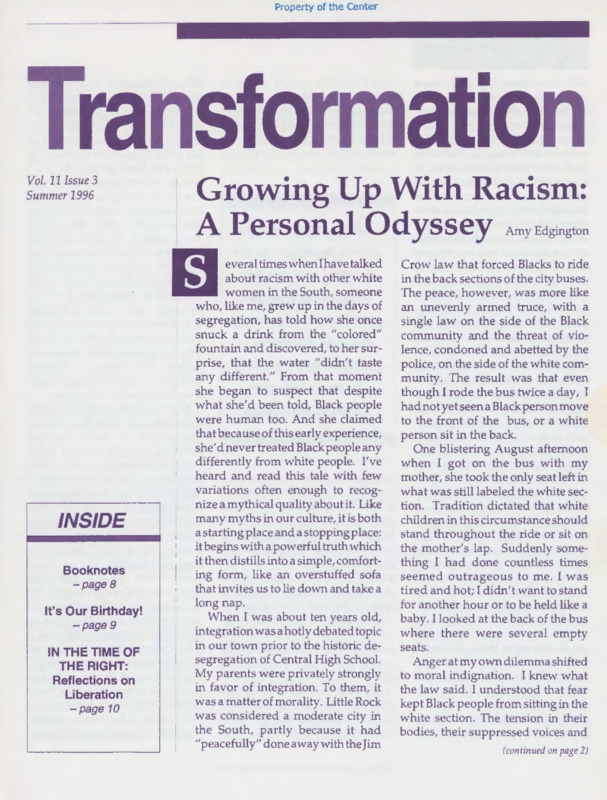
Transformation : v.11:no.3(1996:Summer)
- Title
- Transformation : v.11:no.3(1996:Summer)
- Description
- Transformation is published by the Women's Project. This issue has an article talking about race in America and the intersections of gender. There is also a section of new books in their library and a Women's Project birthday announcement.
- Date Issued
- 1996
- Relation
- Transformation
- Rights
- Contact UCO Chambers Library's Digital Initiatives Working Group at diwg@uco.edu for the permission policy on the use, reproduction or distribution of this material.
- Is Part Of
-
 Transformation: Women's Watchcare Network Log
- Transformation: Women's Watchcare Network Log
- Creator
- Edgington, Amy
- Contributor
- Women's Project
- Date
- 2025-04-18T14:54:28Z
- Date Available
- 2025-04-18T14:54:28Z
- Subject
- LGBTQ+ newsletters
- Race
- Type
- Periodical
- extracted text
-
Property of the Center
Vol. 11 Issue 3
Summer 1996
I
I
Growing Up With Racism:
A Personal Odyssey
AmyEdgington
S
INSIDE
Booknotes
-page 8
It's Our Birthday!
-page 9
IN THE TIME OF
THE RIGHT:
Reflections on
Liberation
-page 10
ever al times when I have talked
about racism with other white
women in the South, someone
who, like me, grew up in the days of
segregation, has told how she once
snuck a drink from the "colored"
fountain and discovered, to her surprise, that the water "didn't taste
any different." From that moment
she began to suspect that despite
what she'd been told, Black people
were human too. And she claimed
that because of this early experience,
she'd never treated Black people any
differently from white people. I've
heard and read this tale with few
variations often enough to recognize a mythical quality about it. Like
many myths in our culture, it is both
a starting place and a stopping place:
it begins with a powerful truth which
it then distills into a simple, comforting form, like an overstuffed sofa
that invites us to lie down and take a
long nap.
When I was about ten years old,
integration was a hotly debated topic
in our town prior to the historic desegregation of Central High School.
My parents were privately strongly
in favor of integration. To them, it
was a matter of morality. Little Rock
was considered a moderate city in
the South, partly because it had
"peacefully" done away with the Jim
Crow law that forced Blacks to ride
in the back sections of the city buses.
The peace, however, was more like
an unevenly armed truce, with a
single law on the side of the Black
community and the threat of violence, condoned and abetted by the
police, on the side of the white community. The result was that even
though I rode the bus twice a day, I
had not yet seen a Black person move
to the front of the bus, or a white
person sit in the back.
One blistering August afternoon
when I got on the bus with my
mother, she took the only seat left in
what was still labeled the white section. Tradition dictated that white
children in this circumstance should
stand throughout the ride or sit on
the mother's lap. Suddenly something I had done countless times
seemed outrageous to me. I was
tired and hot; I didn't want to stand
for another hour or to be held like a
baby. I looked at the back of the bus
where there were several empty
seats.
Anger at my own dilemma shifted
to moral indignation. I knew what
the law said. I understood that fear
kept Black people from sitting in the
white section. The tension in their
bodies, their suppressed voices and
(continued on page 2)
GrowingUp WithRacism
frompage1
downcast eyes, the uniformed
white bus driver whose thin veneer of jocularity demanded submission-these
things I could
grasp intuitively as a child in a
world ruled by adults. But what
kept white people from sitting in
the back? I figured it could only be
prejudice. Most whites acted as
though they thought Blacks were
dirty and avoided any close proximity to them. I thought they were
wrong. I'd been told by my parents that they were wrong. It
dawned on me that each time I did
what I was supposed to do, everyone assumed I agreed with bigotry. I spotted a Black girl a few
years older than I was, boldly
strode down the aisle, and sat in
the empty seat next to her. I did
not speak to her, or even look at
her after I'd sat down. I sat there,
thrilled with myself, braving the
glares aimed at me from passengers in the front of the bus, heart
thudding for fear the bus driver
might stop and put me off the bus,
as I had seen him do to Black
people he considered "uppity".
By the time I got off the bus at
our stop, I had nearly nominated
myself for sainthood. I thought
that Black girl would remember
me forever as the first tolerant
white person she'd encountered.
My mother sat me on a bench at
the bus stop and gently brought
me down a notch or two. First, she
said, I'm proud of you for trying
to do the right thing. Second, I
don't ever want you to do that
again. She passed on to me that
day a parent's terror for her child
in a potentially explosive situ.ation and the fear that made her too
passive to risk expressing her
views to white people who disagreed with them. But I do give
her credit for the things she made
me think about. Did I realize, she
asked, the danger I had put the
Black girl in? She had taken a far
Our guilt may cause us
intensediscomfort,but it is
peopleof colorwho bear
the burdenof white guilt,
since it causeswhite people
to colludewith racism,to
avoid or lash out at the
peoplewe believeare
makingus feel so guilty.
greater risk than I had by remaining in the seat next to me, instead
of getting up and moving to sit
with another Black person, leaving me the seat to myself, as tradition demanded. There was no way
the Black girl or even the white
people could have known that it
was not my intention to make her
give up her seat. I had given her
no choice but to face possible violence or certain humiliation. I had
never really thought about her feelings at all, except to expect her
gratitude.
My involvement in civil rights
and my efforts in making friends
across racial lines in high school
and college were tentative. I was
Page 2 • Transformation• Summer 1996
still determined to do what I saw
as right, but I was more aware of
the limitations of my moral vision. I often closed my heart because I was afraid I might do or
say something racist or thoughtlessly put Black people at risk. I
was no longer sure at all that I
could do anything right. I felt
stuck on that bus where there was
no moral place to sit or stand. Guilt
was keeping me from learning
anything useful or doing anything
effective. It's ironic that we speak
so often about being burdened by
our guilt as white people. In fact
our guilt may cause us intense
discomfort, but it is people of color
who bear the burden of white guilt,
since it causes white people to
collude with racism, to avoid or
lash out at the people we believe
are making us feel so guilty.
In 1969, I tried to get as far away
as I could from Little Rock, thinking that racism was a regional
problem, and that the only way I
could avoid being part of the problem was by leaving the South. I
had stu.died German in college,
worked and saved for a year afterwards. My parents gave me a plane
ticket as a belated graduation
present; so, at 23, I packed my
bags and landed on a continent
where I had not even the name
and address of a single person and
only rudimentary knowledge of a
fairly difficult language. Only ignorance of the magnitude of what
I was doing made me this brave. I
had told my parents I was going to
stu.dy for a year. Secretly, I had no
intentions of ever returning home
for more than a visit. I stu.died and
found jobs in Germany, visited
Holland, Morocco, Spain, Ireland
and France for periods of one to
six rnon ths.
The privilege of travel gave me
the experience of having to learn
the rules of another society from
scratch. For the first time, I became aware of equally complex,
unwritten rules that governed my
own society, rules which no one
seemed to notice or question. I
discovered, to my astonishment,
that many of the students and a
wonderful professor I admired,
belonged to one of several factions labeled communist or socialist. Talk about folks I had been
taught to look down on-even by
my parents! Yet I found them to
be some of the most concerned,
intelligent, and kindest people I'd
known. I thought some of their
ideas impractical, wrong-headed
or contradictory, but I gained great
ill urnina tion from a viewpoint that
made economics primary. Since
the issue of class was among the
most hidden and obscure in
American education and culture,
I definitely needed some balance.
Growing up, I had only understood politics as something that
happened every couple of years
when elections were held. For the
first time I understood politics as
something that affected people's
daily lives.
I discovered that as an American I had enormous power and
privilege coupled with equally
vast ignorance cultivated by media and schools that deliberately
treat the rest of the world and its
peoples as if they were mere scenery or servants, either literally or
in the form of military or business
"interests". As I read works by
authors such as James Baldwin,
Malcolm X, Angela Davis, Ann
Moody, Ralph Ellison and
Eldridge Cleaver, I started to understand that as a white person
living in America, I had also inherited a dangerous combination
of privilege and self-centered
What constrainedour
thinkingwere the unwritten
rulesof feminism,which
assumedthat the
experiencesof middle-class
white womendefined
sexismand which attempted
to rank oppressions,with
sexismfirst and worst.
obliviousness towards people of
other races. I was an imperialist
within my own country.
Travel to different countries
gave me insight into how racism
and colonialism operate outside
the U.S. I was particularly struck
by the example of Ireland, a nation which must surely have been
the testing ground for England's
harshest methods before its heyday as an imperial power. I knew
about the military occupation in
Northern Ireland, but I was
startled to learn to what extent the
Republic of Ireland continues to
be kept in economic dependence
and exploited as a source of cheap
labor, much like former colonial
Page 3 • Transfornwtion• Summer 1996
nations of the Third World. This
led me to think about how much
the economy of the Sou th has functioned like a colony within U.S.
borders, how the North had profited from, colluded with and encouraged slavery. Later, industries
were lured South, with local bond
issues that paid to build factories,
with low taxes and wages which
insured that most of the profits
would flow back to absentee owners in the North. Bosses told white
workers that if they let unions in,
Blacks would take their jobs. While
factory owners manipulated fear
and prejudice, Jim Crow laws were
set up to insure that Blacks remained "in their place," yet most
white people still failed to prosper. More than a hundred years
after the Civil War ended the Dixie
states lagged far behind other regions of the country in health care,
education and income, for Blacks
especially, but also for whites. This
was not a sign of congenital Southern stupidity, and it was no accident. I began to understand that
racism exists because it is extremely profitable for many white
people and because even the poorest have been made to fear that
they would be worse off economically without it. Clearly, racism
was far more than a regional problem I could move away from. No
wonder I had failed in approaching racism as a moral issue: it was
simply too huge.
Moving back to the States after
four years involved a series of
events I think of as simultaneously
corning out and corning home.
Within a few years, I claimed two
identities I had tried to reject since
early childhood-as a lesbian and
a woman with disabilities. I also
acknowledged my more recent
past as a survivor of rape. Last of
all, I freed myself from an abusive
relationship and began to talk
about lesbian battering. Each of
these steps brought me closer to
home, to the core of who I am.
Each also removed me further
from the mainstream and made
me more of an outsider. Understanding my own oppression
turned out to be an important step
in understanding
my personal
stake in fighting racism.
My thinking about race during
the late 70s and early 80s was affected by working with primarily
white feminists and lesbian separatists where I lived in Northwest
Arkansas and the Bay Area of
Northern California. We began the
crucial, mind-expanding process
of telling our stories and trying to
listen to each other's experiences.
What constrained our thinking
were the unwritten rules of feminism, which assumed that the experiences of middle-class white
women defined sexism and which
attempted to rank oppressions,
with sexism first and worst. The
rules just didn't seem to fit the real
women I knew, who like myself,
brought
multiple
identities
through the collective door.
Women who talked about race,
class, anti-semitism, age or disabilitywere labeled divisive if they
were not willing to chop off pieces
of themselves and put them in
order-vaginas
only, in the front
row.
We focused too narrowly on
the barriers that kept us from forming friendships across economic
and racial barriers. Once we realized that sisterhood could not be
created just by hanging a "Women
only" sign on the front door, we
demanded endless explanations
from women of color, who grew
tired of being unpaid teachers.
Then we turned the truth, that we
could never experience racism on
our own bodies, into an excuse to
stop trying to understand. Confrontation burnout led many of us
to split off into smaller groups:
working-class lesbians, lesbians of
color, disabled lesbians, old lesbians, Jewish lesbians, finding in
such groups a limited haven. But
meanwhile, sodomy laws were
passed, anti-gay initiatives were
launched, "reverse discrimination" suits were filed by white
men. I asked myself if focusing so
much energy on politics as it affects individual behavior wasn't
as misguided as approaching racism as a moral issue. Why on earth
would any woman of color risk
being my friend if I was doing
nothing to change the quality of
her life out in the world where she
had to survive.
What helped me reach this conclusion were books by women of
color and some white womenmany of them Jewish-who were
rewriting and expanding feminism, lesbian politics and anti-racist work. I found much that challenged me and much that confirmed my own dis-ease with
white feminism. I learned that all
oppressors use similar tactics, that
the majority of women and many
men in the world experience multiple oppressions, that most of us
who are oppressed also experience being someone's oppressor
at some point in our lives. Oppressions do not operate independently or order themselves into a
Page 4 • Transformation • Summer 1996
neat heirarchy; they interlock like
a three-dimensional web. It was
pointless to argue which strand
came first or was strongest, because every strand of oppression
reinforces others and tightens the
web, whether that particular
strand touches your own life or
not.
From my own experience, I
could agree with women of color
that forming political alliances
based on identity alone had limited value. For over a year I belonged to a group of lesbians with
disabilities: it felt liberating to
bring all of myself into that room
and feel safe for two hours every
·week. But our stories revealed
widely different experiences with
disability. In addition, some felt
being poor or female or lesbian or
Jewish had impacted their lives
morethandisability. Butwestuck
together, because we realized that
if we bonded only with those who
shared identical experiences, we
would split into even smaller
goups. Those who had suffered
the most numerous oppressions
might find themselves
in a
"group" of only two or three or
someone might wind up talking
to herself. We would become totally ineffective. We also noticed
that common experiences do not
necessarily make common goals,
and as we began to work with
women who were temporarily
able-bodied and with men who
had disabilities, we learned that
we might find support for our issues in spite of differences.
I began to hear that women of
color need white women as allies.
Friendship might happen, but it
would be gravy: allies are the meat
and pot atoes of effective coalitions.
I had to understand that, because
when I worked with men I did not
count on or wait for friendship;
what !looked for first was a shared
understanding of and commitment to issues. And as women of
color wrote more and more about
their long, painful history with
white women, I began to realize
that no woman of color has any
more reason to feel immediate
trust or eventual friendship towards me than I do towards a
man.
This period of my life brought
me back to my home town at age
forty. This meant getting on a Little
Rock bus for the first time since
early in 1969. I was not conscious
that day of remembering the many
times I had seen African Americans humiliated on the bus or how
frustrated and helpless I had felt.
I associated my sense of dread
with the discomfort and tedium of
one of the same long routes I had
ridden since before I could talk or
walk. I took my seat in the middle
of a bus with fewer passengers
than in the past, but as had frequently been the case in my childhood, most riders were African
American, female, middle-aged or
older. Although I had noticed
buses driven by African Americans, some of them women, this
driver was a white man. I numbed
my mind for the first ten or fifteen
minutes. Then my immediate surroundings crept back into awareness: all around me were the voices
of African American women in
full tone; laughter, hilarious or
ironic; bodies and gestures loosened in sharing tales.
This was kitchen table talk, the
kind African Americans never
used to let slip in front of white
peoplewhenlhadgrown
up here.
At one point the driver stopped
on his route and went into a small
laundromat. Buses often stopped
for a while when they ran ahead of
schedule, but this time the wait
stretched out. The women around
me began to swap theories full of
Collective white guilt
includeda childish
arrogancethat told me
peopleof color should
be gratefulfor gestures
of toleranceon my part.
increasing mockery, about just
what might be taking the driver so
long, openly poking fun in front
of white people at a uniformed
white male figure who had once
been a powerful tin god in the
South. Eventually,heretumedand
the ride resumed; conversation
continued to flow around me, and
I found that my heart was cracking open, letting a ten-year old's
impotent fear, anger and shame
flow out of my body and seep
silently down my face. I turned
toward the window to hide my
tears. Too little had changed in
Little Rock, but this had, and my
tears were tears of gratitude. I was
grateful for a glimpse of intimacy,
Page 5 • Transformation• Summer 1996
strength and spirit that had been
carefully nurtured and shielded
from white eyes for so long in the
South; I was far more grateful that
getting on the bus no longer meant
unavoidably casting my lot with
racists. I had long known that African Americans, particularly
women much like those around
me, had done most of the dangerous work that made this possible,
starting with the Montgomery bus
boycott, continuing with the unnamed African Americans who
braved their way up the aisle to
the front of every Little Rock bus,
including the driver's seat. But
now I was feeling in the roots of
my being what I owe those civil
rights warriors: certainly, I was
not the intended beneficiary of
their struggle, but nevertheless,
they helped create a world where
I have the chance to become a true
adult, instead ofremaining a child
who must sit or stand where white
men dictate.
In spite of the distress guilt
causes white people, it's probably
more comforting than gratitude.
As a white person I had been
taught to feel superior, but true
gratitude is a humbling experience. It'salsodemanding. Itawakened a need in me to become worthy of what I have been given.
Collective white guilt included a
childish arrogance that told me
people of color should be grateful
for gestures of tolerance on my
part. It's ironic to me now to remember how white people who
backed integration constantly encouraged other whites to be more
tolerant, as if we were the ones
suffering from our racist attitudes.
Every day in Little Rock, when I
interact with African Americans
where I work or in any other public place, I am amazed at the tolerance shown to me as a white person, given the history of this town
and this country, and at the degree of openness I often receive,
by doing as little as making eye
contact and listening to an African American stranger. I hope
someday to acheive even half the
degree of faith, the degree of humanity this willingness to take a
risk demonstrates. But I do find
that by letting go of the guilt that
made my eyes slide aside and
filled my ears with self-important
worries about doing and saying
the right thing, I can attend to the
person in front of me; I can respond in a way that enhances my
faith and makes me more human.
I am learning also not to expect
openness, to accept the fact that
many people of color cannot and
will not tolerate the real possibility of any foolishness or worse on
my part. That response is certainly
not "racism" on their part. And it
does not let me off the hook in the
least.
Ironically, collective white guilt
allows each individual white person to maintain a child's pose of
innocence and powerlessness- "It
started long before I was born. It's
not my fault. There's nothing I
can do about it anyway." To start
growing up, I must replace collective guilt with the concepts of
collective privilege and collective
responsibility. I need to acknowledge and learn from my individual
mistakes, while recognizing the
huge amount of advantage white
skin has given me every day of
my life, regardless of how I behaved. I must assume my share of
responsiblity for dismantling racism, by using my influence with
other white people, to challenge
economic injustice, police brutality, courts where justice is sold to
the privileged, prisons that are
becoming apartheid homelands,
media distortions and silence, government indifference and neglect-every strand that binds racism together.
Feeling at a soul level my indebtedness to African Americans
has allowed me to know how
much I need people of color as my
allies in this world and to care
enough about what happens to
them to risk my safety and privilege. Caring means going back to
school, because being white has
meant never needing to think
about race, being sure that my
view of the world meant" reality,"
tuning out the feelings, culture
and experiences of people of color.
As one way of learning, I have
immersed myself for the last ten
years in fiction, poetry and biographies by people of color, particularly
African American
women. This literature is kitchen
table talk brought to a high art
form. It speaks to me with an intimacy that few people of color can
risk with me in person. It has been
a fountain of wisdom that allows
me to begin to appreciate both
what we have in common and the
various, unique flavors of African
American life.
This literature delights while it
educates, but it does not romanticize. The myth that oppression
makes people noble pervades our
society. Both liberals and the oppressed themselves often tend to
believe it. For instance, I once bePage 6 • Transformation • Summer 1996
lieved that women were morally
superior to men, and nearly died
in a battering relationship with a
woman before I could admit that
some of us are just as dangerous
as any man. African American
literature brings home the truth:
racism wounds and scars people,
including those who do manage
to survive and even thrive. It is
interesting to me to see the amount
of attention paid in our popular
culture to the lifelong damage individuals suffer from such traumas as incest, child abuse, neglect,
rape, and battering. I am glad notice is finally being given to these
issues. But I would also like to see
our culture acknowledge that racism, although different, is surely
as devastating, particularly when
combined with the horrors of poverty. How, exactly, is a person of
color supposed to escape a dysfunctional relationship with white
society? Where can one go to recover from racist abuse that never
stops? African American literature makes it clear that people
behave nobly, when they do, at
great cost and in spite of injury,
not because of it. I am glad that
oppression does not enoble us. If
racism were about turning people
into saints, why would we want to
stop it?
No amount of reading could
teach me to know racism from the
inside. People of color will always
be the experts and the leaders on
this issue. As a white person I've
been taught that the only worthy
results are those that surpass others. To devote myself to understanding racism and pursuing justice, when I am guaranteed never
to reach the top, flies in the face of
Property of the Center
conditioning, but it fills other
needs: not to be the best at others'
expense, but to do better by everyone; to contribute through action,
instead of profiting by doing nothing. As I do so, I become smarter
and tougher in my struggles as a
woman, a lesbian, a person with
disabilities. And I gain powerful
allies.
These days, I am learning
through the Women's Project, the
first feminist organization I have
seen and, I suspect, still one of
few, that truly places anti-racist
work on a par with fighting sexism, and one that does not shuffle
homophobia or any other unpopular issue to the bottom of the
agenda in order to gain acceptance. Nothing has helped me
understand racism more, or feel
more productive and hopeful in
fighting it than the work, writing,
and friendship of Suzanne Pharr,
Kerry Lobel, Janet Perkins, and
Kelly Mitchell-Clark, and the stories and energy contributed by
many, many others I have worked
and partied with at the Women's
Project over the last ten years.
These women are far ahead of me
on the road and I am grateful for
all they have taught me and the
patience they have shown.
I encourage those of you who
want to transform the world we
have inherited, those of you who
want to make a difference, but
have not been sure how to get
involved, those of you who have
felt immobilized by fear or guilt,
to use the Women's Project as a
place to learn as you contribute to
our work. We have a wonderful
library of literature by people of
color and a wonderful librarian,
Lynn Frost, who can guide you to
the books, audio tapes and videos
you need. The public library also
has a substantial collection by African Americans and the Main
branch has a list of these books
available on request at the circulation desk. I urge you to lend your
personal as well as your financial
I am gladthat
oppressiondoes not
enoble us. If racismwere
about turningpeople
into saints,why would
we want to stop it?
support to the work we do to oppose oppression. We have a network of Watchcare volunteers
who monitor incidents of hate violence and the activities of white
supremacists around the state. The
MIW A TCH program needs volunteers to transport children from
around thestatetovisittheirmothers in prison. Come hang out and
stuff envelopes, join one of our
phone banks, or put your name on
a list of those who are willing to
participate in silent vigils of protest when white supremacists like
Thom Robb make public appearances, to make visible a counterforce to the growing power of the
Page 7 • Transformation• Summer 1996
right wing. I have found that learning and doing go hand in hand,
that the mind and heart follow
where the body leads.
Most of the Women's Project's
work is done by active volunteers,
while the staff provide such essentials as a meeting place, library,
telephones, mailing lists, copiers,
vision and guidance. I would like
to start a reading/audio/video
group centered on works by and
about people of color that would
help us understand racism and
our stake in fighting it. I would
also like to expand the Watchcare
Project to include a group of
women and men who are willing
to monitor and analyze local news
stories for incidents and attitudes
that create the climate of hatred
which leads to acts of violence,
and to take the further step of
writing letters to the editor that
counter this hatred, to make the
voices of justice-loving people
heard in our communities. Oppression thrives on silence, even
more than on hate speech. I know
that I myself have stayed silent
out of a sense that I could never
find time and energy to respond
to all the racism I see in the news.
But in fact, we can and should
divide this work, and we don't
need to be gifted writers to do it.
We can help each other find the
words, and the act of speaking up
and signing our names to what we
stand for is the most eloquent
thing we can do. It is risk-taking,
privilege-sharing work. Leave a
message for me at the Women's
Project, if you are interested in
these ideas or if you have some
idea of your O\Vnthat you would
like to get off the ground. il
ance building. Each area of interest
is clarified and contextualized by
introductions that trace the issues
as they've developed over the years.
BOOKNOTES
Silver Rights by Constance Curry,
with introduction by Marian Wright
Edelman (Algonquin). Taken from
the term some Southern blacks used
for civil rights, this book draws on
letters and interviews between the
author and the Carter family in Drew,
Mississippi, to describe the family's
heroic battle to send eight of their
children to an all-white high school.
WOMEN'S
PROJECT
~
hensive handbook with concise and
challenging analysis, first-voice oral
histories, and concrete practice strategies that address the complex interaction of race/ethnicity and feminism in psychotherapy."
... Val
Kanuha "Just the book that we in
the antiracism movement need-a
compelling tool for validation and
empowerment." ...Gloria Anzaldua
Virtual Equality: The Mainstreaming of Gay and Lesbian Liberation
by Urvashi Vaid (Anchor Books) is
the amazing story of the gay and
lesbian community's transformation from a hidden minority into a
visible presence in the American
mainstream." ...a wise, powerfullyargued work filled with vivid insights into the history of gay and
lesbian liberation and containing a
host of shrewd suggestions for its
future. This book is a must read not
only for gays and lesbians but for all
who would understand the prospects for (and impediments to) social change in this country." ...Martin Duberman.
Front Line Feminism, 1975-1995:
Essays from Sojourner's First 20
Years, edited by Karen Kahn (Aunt
Lute). Sojourner: The Women's Forum, one the oldest and largest
women's newspapers, has been
used by feminists to debate theory
and strategy, to galvanize the movement and to examine the ways in
which the personal is political. Kahn
has selected over 100 essays which
are organized around eight topics:
identity, economic injustice, politics of family, reproductive freedom,
women's health, sex and sexuality,
violence against women and alli-
TheMemphisDiaryofldaB.
Wells,
edited by Miriam DeCosta-Willis
(Beacon Press). "In reading this
book, I couldn't help thinking that
in her diary, Ida B. Wells closed some
doors and left others slightly ajar because she believed one day the right
scholar would open them with care
and with love. DeCosta-Willis is without question that scholar. Her editing
is so inspired and creative-so attentive to details-that the young Wells
seems to speak directly to us, sharing
the private self willingly and at times
with a sense of urgency." ...Gloria
Wade-Gayles D
NEW BOOKS IN THE LIBRARY
Lynn Frost
Divided Sisters: Bridging the Gap
Between Black Women & White
Women by Midge Wilson & Kathy
Russell (Anchor Books) is based on
scores of interviews, firsthand accounts, cultural literature, and extensive research. The authors address such volatile issues as interracial sex and marriage, peer pressure
over racial relationships, and competition in the workplace and on
the political front. "An exploration
of tightly guarded beliefs regarding
color and its relationship to status
andself-worth ...This thoughtful work
pierces through denial and stereotypes and invites people to look into
a mirror, see beyond color and probe
the soul." ...Atlanta Constitution
Racism in the Lives of Women: Testimony, Theory, and Guides to
Antiracist Practice, Jeanne Adleman, & Gloria Enguidanos, Eds.
(Harrington Park Press)" A comp re-
Page 8 • TransfomUition• Summer 1996
Keep this date open!
5epte,nber 7, 1996
he
Women's Project will be celebrating 15 years of working
for social justice. To celebrate, the Women's Project will sponsor
a concert by Odetta, who helped to bring folk songs out of the
archives and backwoods and into the mainstream of popular
culture. Using her music to speak on political issues, she has
performed at civil rights demonstrations and peace rallies. Work
songs, freedom and prison songs, spirituals, ballads, and blues
are part of a repertoire she sings around the world.
Please watch your mail for further
information about our birthday
celebration!
Page 9 • Transformation• Summer 1996
f
IN THE TIME
OFTHERIGHT
Reflections
on Liberation
Suzanne Pharr
author of Homophobia:
A Weapon of Sexism
"This essential book provides keen analysis and tactical guidance to
people concerned about the growing power of the Right. Pharr 's
dissection of the Right is accessible, informed and always strategic. "
-Urvashi
Vaid, author of Virtual Equality: The Mainstreaming of Gay and Lesbian Liberation
IN THE TIME OF THE RIGHT: Reflections on Liberation
constructs a progressive view of the politics of our time that will make sense to
students, activists and all who are trying to understand the current threat to
democracy. A long-time economic and social justice activist from the South, Pharr
blends personal anecdote and contemporary cutting-edge analysis-along with a
vision of a multi-issue, multi-racial movement-to create a powerful call to action
for each of us.
Including:
T DOMINATION
POUTICS
T HOMOPHOBIA AND RACISM:
The merger of economic injustice and oppression, institutional support for domination and
the effects of systematic oppression and
exploitation.
T THE RIGHT AND THEIR AGENDA
The Right's overall goals, the targets of their
organizing efforts, the strategies they employ,
and who benefits from their agenda.
STRATEGIES OF DIVISION
How the Right uses homophobia and racism to drive a
wedge between targeted communities, at the same time
gaining support from their agenda.
T REFLECTIONS
ON LIBERATION
Suggestions for philosophies and practices that foster a
true liberation movement toward a just and caring society
in which everyone's participation is sought and valued.
"Suzanne's Pharr's calm voice protests the angry divisiveness of the right-wing forces battling to dominate
our society. Her vision of inclusion will guide us in building a truly democratic movement for social change
seeking equal rights, freedom from fear, and economic justice for all. "
-Chip Berlet, Senior Analyst, Political Research Associates
and editor of Eyes Right! Challenging the Right Wing Backlash
Page 10 • Transformation • Summer 1996
1
,--
Property of the Center
iiill
~ll
Hlilillli1~il~llf
---------------7
Univl11ilr1~111l1ilf r1md,
OK
M 001 111 298
.----------THE WOMEN'S PROJECT
ORDER FORM
The Women's Project, working
for social and economic justice
since 1981, uses educational and
organizing strategies to create a
world free of discrimination,
violence and economic injustice.
$ Amount
# Copies
__
__
In the Time of the Right: Reflections on Liberation @ $10.95
Homophobia: A Weapon of Sexism
@ $9.95
(40% discount on orders of 5 or more books)
Shipping & Handling: $2.00 for 1st book, $.50 each add'l.
TOTAL
Women's Project membership
D
All profits from In The Time of
tbe Rigbt: Reflections 01z Liberation
and Homophobia: A Weapon of
Sexism are used to fund the
ongoing work of the Women's
Project.
NAME_______________
CllY _______
Membership in the Women's
Project is available for $25.00 and
includes
a subscription
to
Transformation, a newsletter of
political analysis and opinion.
_
STATE__
ZIP
MakecheckspayabletoThe Women's Project
and mail to. The Women's Project
2224 Main Street
Little Rock, AR 72206
~-~---
Mc
$25.00
_
ADDRESS____________
Visa
I
............
--------,----account num b er
I
I
I
voice 501-372-5113 / fax 372-0009
email: wproi·ect @aol.com
.
I
I
signature
L _______________________________________
~
Current Projects
■
Prison Project
A support and advocacy project for women in
prison that provides support groups for battered
women in prison, a prisoner-led AIDS program
and a transportation program for the children of
incarcerated mothers.
■
The Social Justice Project
Workshops
on understanding
racism and
homophobia and developing methods to eliminate
them; women's economic issues; organizational
development for social change organizations.
■
Women's Watchcare Network
A project to monitor and respond to incidents of
racial, religious, sexual, and anti-gay violence; and
to provide education and strategies to counter the
activities of hate groups and the Radical Right.
African-American Women's
Institute for Social Justice
A project which creates strategies for overcoming
the barriers that hinder African-American
women's efforts toward power and selfdetermina tion.
■
■
■
Women and AIDS
A project to develop strategies for working with
women and caregivers around AIDS issues.
Published four times a year
by the Women's Project,
2224 Main Street, Little Rock,
Arkansas, 72206.
Phone: 501-372-5113
Letters to the editor are welcome.
Communications and Events
A newsletter, a lending library, statewide and
regional conferences, and production of women
singers, poets and novelists.
Transformation
Editor
Suzanne Pharr
Art Director
Melissa Britton James
*
Printed
on recycled paper.
*
Page 11 • Transfomw.tion• Summer 1996
Women's Project Staff:
Linda Coyle
FeliciaDavidson
Lynn Frost
Janet Perkins
Suzanne Pharr
©1996 The Women's Project
Women's
Project
Non-Profit Organization
U. S. Postage Paid
Little Rock, Arkansas
Permit No. 448
2224 Main Street
Little Rock, AR 72206
ADDRESS CORRECTION REQUESTED
HERLANu
SISTER RES.
2312 NW39TH
OKLAHOMA
CITY Ok 73112
-
Property of the Center
Vol. 11 Issue 3
Summer 1996
I
I
Growing Up With Racism:
A Personal Odyssey
AmyEdgington
S
INSIDE
Booknotes
-page 8
It's Our Birthday!
-page 9
IN THE TIME OF
THE RIGHT:
Reflections on
Liberation
-page 10
ever al times when I have talked
about racism with other white
women in the South, someone
who, like me, grew up in the days of
segregation, has told how she once
snuck a drink from the "colored"
fountain and discovered, to her surprise, that the water "didn't taste
any different." From that moment
she began to suspect that despite
what she'd been told, Black people
were human too. And she claimed
that because of this early experience,
she'd never treated Black people any
differently from white people. I've
heard and read this tale with few
variations often enough to recognize a mythical quality about it. Like
many myths in our culture, it is both
a starting place and a stopping place:
it begins with a powerful truth which
it then distills into a simple, comforting form, like an overstuffed sofa
that invites us to lie down and take a
long nap.
When I was about ten years old,
integration was a hotly debated topic
in our town prior to the historic desegregation of Central High School.
My parents were privately strongly
in favor of integration. To them, it
was a matter of morality. Little Rock
was considered a moderate city in
the South, partly because it had
"peacefully" done away with the Jim
Crow law that forced Blacks to ride
in the back sections of the city buses.
The peace, however, was more like
an unevenly armed truce, with a
single law on the side of the Black
community and the threat of violence, condoned and abetted by the
police, on the side of the white community. The result was that even
though I rode the bus twice a day, I
had not yet seen a Black person move
to the front of the bus, or a white
person sit in the back.
One blistering August afternoon
when I got on the bus with my
mother, she took the only seat left in
what was still labeled the white section. Tradition dictated that white
children in this circumstance should
stand throughout the ride or sit on
the mother's lap. Suddenly something I had done countless times
seemed outrageous to me. I was
tired and hot; I didn't want to stand
for another hour or to be held like a
baby. I looked at the back of the bus
where there were several empty
seats.
Anger at my own dilemma shifted
to moral indignation. I knew what
the law said. I understood that fear
kept Black people from sitting in the
white section. The tension in their
bodies, their suppressed voices and
(continued on page 2)
GrowingUp WithRacism
frompage1
downcast eyes, the uniformed
white bus driver whose thin veneer of jocularity demanded submission-these
things I could
grasp intuitively as a child in a
world ruled by adults. But what
kept white people from sitting in
the back? I figured it could only be
prejudice. Most whites acted as
though they thought Blacks were
dirty and avoided any close proximity to them. I thought they were
wrong. I'd been told by my parents that they were wrong. It
dawned on me that each time I did
what I was supposed to do, everyone assumed I agreed with bigotry. I spotted a Black girl a few
years older than I was, boldly
strode down the aisle, and sat in
the empty seat next to her. I did
not speak to her, or even look at
her after I'd sat down. I sat there,
thrilled with myself, braving the
glares aimed at me from passengers in the front of the bus, heart
thudding for fear the bus driver
might stop and put me off the bus,
as I had seen him do to Black
people he considered "uppity".
By the time I got off the bus at
our stop, I had nearly nominated
myself for sainthood. I thought
that Black girl would remember
me forever as the first tolerant
white person she'd encountered.
My mother sat me on a bench at
the bus stop and gently brought
me down a notch or two. First, she
said, I'm proud of you for trying
to do the right thing. Second, I
don't ever want you to do that
again. She passed on to me that
day a parent's terror for her child
in a potentially explosive situ.ation and the fear that made her too
passive to risk expressing her
views to white people who disagreed with them. But I do give
her credit for the things she made
me think about. Did I realize, she
asked, the danger I had put the
Black girl in? She had taken a far
Our guilt may cause us
intensediscomfort,but it is
peopleof colorwho bear
the burdenof white guilt,
since it causeswhite people
to colludewith racism,to
avoid or lash out at the
peoplewe believeare
makingus feel so guilty.
greater risk than I had by remaining in the seat next to me, instead
of getting up and moving to sit
with another Black person, leaving me the seat to myself, as tradition demanded. There was no way
the Black girl or even the white
people could have known that it
was not my intention to make her
give up her seat. I had given her
no choice but to face possible violence or certain humiliation. I had
never really thought about her feelings at all, except to expect her
gratitude.
My involvement in civil rights
and my efforts in making friends
across racial lines in high school
and college were tentative. I was
Page 2 • Transformation• Summer 1996
still determined to do what I saw
as right, but I was more aware of
the limitations of my moral vision. I often closed my heart because I was afraid I might do or
say something racist or thoughtlessly put Black people at risk. I
was no longer sure at all that I
could do anything right. I felt
stuck on that bus where there was
no moral place to sit or stand. Guilt
was keeping me from learning
anything useful or doing anything
effective. It's ironic that we speak
so often about being burdened by
our guilt as white people. In fact
our guilt may cause us intense
discomfort, but it is people of color
who bear the burden of white guilt,
since it causes white people to
collude with racism, to avoid or
lash out at the people we believe
are making us feel so guilty.
In 1969, I tried to get as far away
as I could from Little Rock, thinking that racism was a regional
problem, and that the only way I
could avoid being part of the problem was by leaving the South. I
had stu.died German in college,
worked and saved for a year afterwards. My parents gave me a plane
ticket as a belated graduation
present; so, at 23, I packed my
bags and landed on a continent
where I had not even the name
and address of a single person and
only rudimentary knowledge of a
fairly difficult language. Only ignorance of the magnitude of what
I was doing made me this brave. I
had told my parents I was going to
stu.dy for a year. Secretly, I had no
intentions of ever returning home
for more than a visit. I stu.died and
found jobs in Germany, visited
Holland, Morocco, Spain, Ireland
and France for periods of one to
six rnon ths.
The privilege of travel gave me
the experience of having to learn
the rules of another society from
scratch. For the first time, I became aware of equally complex,
unwritten rules that governed my
own society, rules which no one
seemed to notice or question. I
discovered, to my astonishment,
that many of the students and a
wonderful professor I admired,
belonged to one of several factions labeled communist or socialist. Talk about folks I had been
taught to look down on-even by
my parents! Yet I found them to
be some of the most concerned,
intelligent, and kindest people I'd
known. I thought some of their
ideas impractical, wrong-headed
or contradictory, but I gained great
ill urnina tion from a viewpoint that
made economics primary. Since
the issue of class was among the
most hidden and obscure in
American education and culture,
I definitely needed some balance.
Growing up, I had only understood politics as something that
happened every couple of years
when elections were held. For the
first time I understood politics as
something that affected people's
daily lives.
I discovered that as an American I had enormous power and
privilege coupled with equally
vast ignorance cultivated by media and schools that deliberately
treat the rest of the world and its
peoples as if they were mere scenery or servants, either literally or
in the form of military or business
"interests". As I read works by
authors such as James Baldwin,
Malcolm X, Angela Davis, Ann
Moody, Ralph Ellison and
Eldridge Cleaver, I started to understand that as a white person
living in America, I had also inherited a dangerous combination
of privilege and self-centered
What constrainedour
thinkingwere the unwritten
rulesof feminism,which
assumedthat the
experiencesof middle-class
white womendefined
sexismand which attempted
to rank oppressions,with
sexismfirst and worst.
obliviousness towards people of
other races. I was an imperialist
within my own country.
Travel to different countries
gave me insight into how racism
and colonialism operate outside
the U.S. I was particularly struck
by the example of Ireland, a nation which must surely have been
the testing ground for England's
harshest methods before its heyday as an imperial power. I knew
about the military occupation in
Northern Ireland, but I was
startled to learn to what extent the
Republic of Ireland continues to
be kept in economic dependence
and exploited as a source of cheap
labor, much like former colonial
Page 3 • Transfornwtion• Summer 1996
nations of the Third World. This
led me to think about how much
the economy of the Sou th has functioned like a colony within U.S.
borders, how the North had profited from, colluded with and encouraged slavery. Later, industries
were lured South, with local bond
issues that paid to build factories,
with low taxes and wages which
insured that most of the profits
would flow back to absentee owners in the North. Bosses told white
workers that if they let unions in,
Blacks would take their jobs. While
factory owners manipulated fear
and prejudice, Jim Crow laws were
set up to insure that Blacks remained "in their place," yet most
white people still failed to prosper. More than a hundred years
after the Civil War ended the Dixie
states lagged far behind other regions of the country in health care,
education and income, for Blacks
especially, but also for whites. This
was not a sign of congenital Southern stupidity, and it was no accident. I began to understand that
racism exists because it is extremely profitable for many white
people and because even the poorest have been made to fear that
they would be worse off economically without it. Clearly, racism
was far more than a regional problem I could move away from. No
wonder I had failed in approaching racism as a moral issue: it was
simply too huge.
Moving back to the States after
four years involved a series of
events I think of as simultaneously
corning out and corning home.
Within a few years, I claimed two
identities I had tried to reject since
early childhood-as a lesbian and
a woman with disabilities. I also
acknowledged my more recent
past as a survivor of rape. Last of
all, I freed myself from an abusive
relationship and began to talk
about lesbian battering. Each of
these steps brought me closer to
home, to the core of who I am.
Each also removed me further
from the mainstream and made
me more of an outsider. Understanding my own oppression
turned out to be an important step
in understanding
my personal
stake in fighting racism.
My thinking about race during
the late 70s and early 80s was affected by working with primarily
white feminists and lesbian separatists where I lived in Northwest
Arkansas and the Bay Area of
Northern California. We began the
crucial, mind-expanding process
of telling our stories and trying to
listen to each other's experiences.
What constrained our thinking
were the unwritten rules of feminism, which assumed that the experiences of middle-class white
women defined sexism and which
attempted to rank oppressions,
with sexism first and worst. The
rules just didn't seem to fit the real
women I knew, who like myself,
brought
multiple
identities
through the collective door.
Women who talked about race,
class, anti-semitism, age or disabilitywere labeled divisive if they
were not willing to chop off pieces
of themselves and put them in
order-vaginas
only, in the front
row.
We focused too narrowly on
the barriers that kept us from forming friendships across economic
and racial barriers. Once we realized that sisterhood could not be
created just by hanging a "Women
only" sign on the front door, we
demanded endless explanations
from women of color, who grew
tired of being unpaid teachers.
Then we turned the truth, that we
could never experience racism on
our own bodies, into an excuse to
stop trying to understand. Confrontation burnout led many of us
to split off into smaller groups:
working-class lesbians, lesbians of
color, disabled lesbians, old lesbians, Jewish lesbians, finding in
such groups a limited haven. But
meanwhile, sodomy laws were
passed, anti-gay initiatives were
launched, "reverse discrimination" suits were filed by white
men. I asked myself if focusing so
much energy on politics as it affects individual behavior wasn't
as misguided as approaching racism as a moral issue. Why on earth
would any woman of color risk
being my friend if I was doing
nothing to change the quality of
her life out in the world where she
had to survive.
What helped me reach this conclusion were books by women of
color and some white womenmany of them Jewish-who were
rewriting and expanding feminism, lesbian politics and anti-racist work. I found much that challenged me and much that confirmed my own dis-ease with
white feminism. I learned that all
oppressors use similar tactics, that
the majority of women and many
men in the world experience multiple oppressions, that most of us
who are oppressed also experience being someone's oppressor
at some point in our lives. Oppressions do not operate independently or order themselves into a
Page 4 • Transformation • Summer 1996
neat heirarchy; they interlock like
a three-dimensional web. It was
pointless to argue which strand
came first or was strongest, because every strand of oppression
reinforces others and tightens the
web, whether that particular
strand touches your own life or
not.
From my own experience, I
could agree with women of color
that forming political alliances
based on identity alone had limited value. For over a year I belonged to a group of lesbians with
disabilities: it felt liberating to
bring all of myself into that room
and feel safe for two hours every
·week. But our stories revealed
widely different experiences with
disability. In addition, some felt
being poor or female or lesbian or
Jewish had impacted their lives
morethandisability. Butwestuck
together, because we realized that
if we bonded only with those who
shared identical experiences, we
would split into even smaller
goups. Those who had suffered
the most numerous oppressions
might find themselves
in a
"group" of only two or three or
someone might wind up talking
to herself. We would become totally ineffective. We also noticed
that common experiences do not
necessarily make common goals,
and as we began to work with
women who were temporarily
able-bodied and with men who
had disabilities, we learned that
we might find support for our issues in spite of differences.
I began to hear that women of
color need white women as allies.
Friendship might happen, but it
would be gravy: allies are the meat
and pot atoes of effective coalitions.
I had to understand that, because
when I worked with men I did not
count on or wait for friendship;
what !looked for first was a shared
understanding of and commitment to issues. And as women of
color wrote more and more about
their long, painful history with
white women, I began to realize
that no woman of color has any
more reason to feel immediate
trust or eventual friendship towards me than I do towards a
man.
This period of my life brought
me back to my home town at age
forty. This meant getting on a Little
Rock bus for the first time since
early in 1969. I was not conscious
that day of remembering the many
times I had seen African Americans humiliated on the bus or how
frustrated and helpless I had felt.
I associated my sense of dread
with the discomfort and tedium of
one of the same long routes I had
ridden since before I could talk or
walk. I took my seat in the middle
of a bus with fewer passengers
than in the past, but as had frequently been the case in my childhood, most riders were African
American, female, middle-aged or
older. Although I had noticed
buses driven by African Americans, some of them women, this
driver was a white man. I numbed
my mind for the first ten or fifteen
minutes. Then my immediate surroundings crept back into awareness: all around me were the voices
of African American women in
full tone; laughter, hilarious or
ironic; bodies and gestures loosened in sharing tales.
This was kitchen table talk, the
kind African Americans never
used to let slip in front of white
peoplewhenlhadgrown
up here.
At one point the driver stopped
on his route and went into a small
laundromat. Buses often stopped
for a while when they ran ahead of
schedule, but this time the wait
stretched out. The women around
me began to swap theories full of
Collective white guilt
includeda childish
arrogancethat told me
peopleof color should
be gratefulfor gestures
of toleranceon my part.
increasing mockery, about just
what might be taking the driver so
long, openly poking fun in front
of white people at a uniformed
white male figure who had once
been a powerful tin god in the
South. Eventually,heretumedand
the ride resumed; conversation
continued to flow around me, and
I found that my heart was cracking open, letting a ten-year old's
impotent fear, anger and shame
flow out of my body and seep
silently down my face. I turned
toward the window to hide my
tears. Too little had changed in
Little Rock, but this had, and my
tears were tears of gratitude. I was
grateful for a glimpse of intimacy,
Page 5 • Transformation• Summer 1996
strength and spirit that had been
carefully nurtured and shielded
from white eyes for so long in the
South; I was far more grateful that
getting on the bus no longer meant
unavoidably casting my lot with
racists. I had long known that African Americans, particularly
women much like those around
me, had done most of the dangerous work that made this possible,
starting with the Montgomery bus
boycott, continuing with the unnamed African Americans who
braved their way up the aisle to
the front of every Little Rock bus,
including the driver's seat. But
now I was feeling in the roots of
my being what I owe those civil
rights warriors: certainly, I was
not the intended beneficiary of
their struggle, but nevertheless,
they helped create a world where
I have the chance to become a true
adult, instead ofremaining a child
who must sit or stand where white
men dictate.
In spite of the distress guilt
causes white people, it's probably
more comforting than gratitude.
As a white person I had been
taught to feel superior, but true
gratitude is a humbling experience. It'salsodemanding. Itawakened a need in me to become worthy of what I have been given.
Collective white guilt included a
childish arrogance that told me
people of color should be grateful
for gestures of tolerance on my
part. It's ironic to me now to remember how white people who
backed integration constantly encouraged other whites to be more
tolerant, as if we were the ones
suffering from our racist attitudes.
Every day in Little Rock, when I
interact with African Americans
where I work or in any other public place, I am amazed at the tolerance shown to me as a white person, given the history of this town
and this country, and at the degree of openness I often receive,
by doing as little as making eye
contact and listening to an African American stranger. I hope
someday to acheive even half the
degree of faith, the degree of humanity this willingness to take a
risk demonstrates. But I do find
that by letting go of the guilt that
made my eyes slide aside and
filled my ears with self-important
worries about doing and saying
the right thing, I can attend to the
person in front of me; I can respond in a way that enhances my
faith and makes me more human.
I am learning also not to expect
openness, to accept the fact that
many people of color cannot and
will not tolerate the real possibility of any foolishness or worse on
my part. That response is certainly
not "racism" on their part. And it
does not let me off the hook in the
least.
Ironically, collective white guilt
allows each individual white person to maintain a child's pose of
innocence and powerlessness- "It
started long before I was born. It's
not my fault. There's nothing I
can do about it anyway." To start
growing up, I must replace collective guilt with the concepts of
collective privilege and collective
responsibility. I need to acknowledge and learn from my individual
mistakes, while recognizing the
huge amount of advantage white
skin has given me every day of
my life, regardless of how I behaved. I must assume my share of
responsiblity for dismantling racism, by using my influence with
other white people, to challenge
economic injustice, police brutality, courts where justice is sold to
the privileged, prisons that are
becoming apartheid homelands,
media distortions and silence, government indifference and neglect-every strand that binds racism together.
Feeling at a soul level my indebtedness to African Americans
has allowed me to know how
much I need people of color as my
allies in this world and to care
enough about what happens to
them to risk my safety and privilege. Caring means going back to
school, because being white has
meant never needing to think
about race, being sure that my
view of the world meant" reality,"
tuning out the feelings, culture
and experiences of people of color.
As one way of learning, I have
immersed myself for the last ten
years in fiction, poetry and biographies by people of color, particularly
African American
women. This literature is kitchen
table talk brought to a high art
form. It speaks to me with an intimacy that few people of color can
risk with me in person. It has been
a fountain of wisdom that allows
me to begin to appreciate both
what we have in common and the
various, unique flavors of African
American life.
This literature delights while it
educates, but it does not romanticize. The myth that oppression
makes people noble pervades our
society. Both liberals and the oppressed themselves often tend to
believe it. For instance, I once bePage 6 • Transformation • Summer 1996
lieved that women were morally
superior to men, and nearly died
in a battering relationship with a
woman before I could admit that
some of us are just as dangerous
as any man. African American
literature brings home the truth:
racism wounds and scars people,
including those who do manage
to survive and even thrive. It is
interesting to me to see the amount
of attention paid in our popular
culture to the lifelong damage individuals suffer from such traumas as incest, child abuse, neglect,
rape, and battering. I am glad notice is finally being given to these
issues. But I would also like to see
our culture acknowledge that racism, although different, is surely
as devastating, particularly when
combined with the horrors of poverty. How, exactly, is a person of
color supposed to escape a dysfunctional relationship with white
society? Where can one go to recover from racist abuse that never
stops? African American literature makes it clear that people
behave nobly, when they do, at
great cost and in spite of injury,
not because of it. I am glad that
oppression does not enoble us. If
racism were about turning people
into saints, why would we want to
stop it?
No amount of reading could
teach me to know racism from the
inside. People of color will always
be the experts and the leaders on
this issue. As a white person I've
been taught that the only worthy
results are those that surpass others. To devote myself to understanding racism and pursuing justice, when I am guaranteed never
to reach the top, flies in the face of
Property of the Center
conditioning, but it fills other
needs: not to be the best at others'
expense, but to do better by everyone; to contribute through action,
instead of profiting by doing nothing. As I do so, I become smarter
and tougher in my struggles as a
woman, a lesbian, a person with
disabilities. And I gain powerful
allies.
These days, I am learning
through the Women's Project, the
first feminist organization I have
seen and, I suspect, still one of
few, that truly places anti-racist
work on a par with fighting sexism, and one that does not shuffle
homophobia or any other unpopular issue to the bottom of the
agenda in order to gain acceptance. Nothing has helped me
understand racism more, or feel
more productive and hopeful in
fighting it than the work, writing,
and friendship of Suzanne Pharr,
Kerry Lobel, Janet Perkins, and
Kelly Mitchell-Clark, and the stories and energy contributed by
many, many others I have worked
and partied with at the Women's
Project over the last ten years.
These women are far ahead of me
on the road and I am grateful for
all they have taught me and the
patience they have shown.
I encourage those of you who
want to transform the world we
have inherited, those of you who
want to make a difference, but
have not been sure how to get
involved, those of you who have
felt immobilized by fear or guilt,
to use the Women's Project as a
place to learn as you contribute to
our work. We have a wonderful
library of literature by people of
color and a wonderful librarian,
Lynn Frost, who can guide you to
the books, audio tapes and videos
you need. The public library also
has a substantial collection by African Americans and the Main
branch has a list of these books
available on request at the circulation desk. I urge you to lend your
personal as well as your financial
I am gladthat
oppressiondoes not
enoble us. If racismwere
about turningpeople
into saints,why would
we want to stop it?
support to the work we do to oppose oppression. We have a network of Watchcare volunteers
who monitor incidents of hate violence and the activities of white
supremacists around the state. The
MIW A TCH program needs volunteers to transport children from
around thestatetovisittheirmothers in prison. Come hang out and
stuff envelopes, join one of our
phone banks, or put your name on
a list of those who are willing to
participate in silent vigils of protest when white supremacists like
Thom Robb make public appearances, to make visible a counterforce to the growing power of the
Page 7 • Transformation• Summer 1996
right wing. I have found that learning and doing go hand in hand,
that the mind and heart follow
where the body leads.
Most of the Women's Project's
work is done by active volunteers,
while the staff provide such essentials as a meeting place, library,
telephones, mailing lists, copiers,
vision and guidance. I would like
to start a reading/audio/video
group centered on works by and
about people of color that would
help us understand racism and
our stake in fighting it. I would
also like to expand the Watchcare
Project to include a group of
women and men who are willing
to monitor and analyze local news
stories for incidents and attitudes
that create the climate of hatred
which leads to acts of violence,
and to take the further step of
writing letters to the editor that
counter this hatred, to make the
voices of justice-loving people
heard in our communities. Oppression thrives on silence, even
more than on hate speech. I know
that I myself have stayed silent
out of a sense that I could never
find time and energy to respond
to all the racism I see in the news.
But in fact, we can and should
divide this work, and we don't
need to be gifted writers to do it.
We can help each other find the
words, and the act of speaking up
and signing our names to what we
stand for is the most eloquent
thing we can do. It is risk-taking,
privilege-sharing work. Leave a
message for me at the Women's
Project, if you are interested in
these ideas or if you have some
idea of your O\Vnthat you would
like to get off the ground. il
ance building. Each area of interest
is clarified and contextualized by
introductions that trace the issues
as they've developed over the years.
BOOKNOTES
Silver Rights by Constance Curry,
with introduction by Marian Wright
Edelman (Algonquin). Taken from
the term some Southern blacks used
for civil rights, this book draws on
letters and interviews between the
author and the Carter family in Drew,
Mississippi, to describe the family's
heroic battle to send eight of their
children to an all-white high school.
WOMEN'S
PROJECT
~
hensive handbook with concise and
challenging analysis, first-voice oral
histories, and concrete practice strategies that address the complex interaction of race/ethnicity and feminism in psychotherapy."
... Val
Kanuha "Just the book that we in
the antiracism movement need-a
compelling tool for validation and
empowerment." ...Gloria Anzaldua
Virtual Equality: The Mainstreaming of Gay and Lesbian Liberation
by Urvashi Vaid (Anchor Books) is
the amazing story of the gay and
lesbian community's transformation from a hidden minority into a
visible presence in the American
mainstream." ...a wise, powerfullyargued work filled with vivid insights into the history of gay and
lesbian liberation and containing a
host of shrewd suggestions for its
future. This book is a must read not
only for gays and lesbians but for all
who would understand the prospects for (and impediments to) social change in this country." ...Martin Duberman.
Front Line Feminism, 1975-1995:
Essays from Sojourner's First 20
Years, edited by Karen Kahn (Aunt
Lute). Sojourner: The Women's Forum, one the oldest and largest
women's newspapers, has been
used by feminists to debate theory
and strategy, to galvanize the movement and to examine the ways in
which the personal is political. Kahn
has selected over 100 essays which
are organized around eight topics:
identity, economic injustice, politics of family, reproductive freedom,
women's health, sex and sexuality,
violence against women and alli-
TheMemphisDiaryofldaB.
Wells,
edited by Miriam DeCosta-Willis
(Beacon Press). "In reading this
book, I couldn't help thinking that
in her diary, Ida B. Wells closed some
doors and left others slightly ajar because she believed one day the right
scholar would open them with care
and with love. DeCosta-Willis is without question that scholar. Her editing
is so inspired and creative-so attentive to details-that the young Wells
seems to speak directly to us, sharing
the private self willingly and at times
with a sense of urgency." ...Gloria
Wade-Gayles D
NEW BOOKS IN THE LIBRARY
Lynn Frost
Divided Sisters: Bridging the Gap
Between Black Women & White
Women by Midge Wilson & Kathy
Russell (Anchor Books) is based on
scores of interviews, firsthand accounts, cultural literature, and extensive research. The authors address such volatile issues as interracial sex and marriage, peer pressure
over racial relationships, and competition in the workplace and on
the political front. "An exploration
of tightly guarded beliefs regarding
color and its relationship to status
andself-worth ...This thoughtful work
pierces through denial and stereotypes and invites people to look into
a mirror, see beyond color and probe
the soul." ...Atlanta Constitution
Racism in the Lives of Women: Testimony, Theory, and Guides to
Antiracist Practice, Jeanne Adleman, & Gloria Enguidanos, Eds.
(Harrington Park Press)" A comp re-
Page 8 • TransfomUition• Summer 1996
Keep this date open!
5epte,nber 7, 1996
he
Women's Project will be celebrating 15 years of working
for social justice. To celebrate, the Women's Project will sponsor
a concert by Odetta, who helped to bring folk songs out of the
archives and backwoods and into the mainstream of popular
culture. Using her music to speak on political issues, she has
performed at civil rights demonstrations and peace rallies. Work
songs, freedom and prison songs, spirituals, ballads, and blues
are part of a repertoire she sings around the world.
Please watch your mail for further
information about our birthday
celebration!
Page 9 • Transformation• Summer 1996
f
IN THE TIME
OFTHERIGHT
Reflections
on Liberation
Suzanne Pharr
author of Homophobia:
A Weapon of Sexism
"This essential book provides keen analysis and tactical guidance to
people concerned about the growing power of the Right. Pharr 's
dissection of the Right is accessible, informed and always strategic. "
-Urvashi
Vaid, author of Virtual Equality: The Mainstreaming of Gay and Lesbian Liberation
IN THE TIME OF THE RIGHT: Reflections on Liberation
constructs a progressive view of the politics of our time that will make sense to
students, activists and all who are trying to understand the current threat to
democracy. A long-time economic and social justice activist from the South, Pharr
blends personal anecdote and contemporary cutting-edge analysis-along with a
vision of a multi-issue, multi-racial movement-to create a powerful call to action
for each of us.
Including:
T DOMINATION
POUTICS
T HOMOPHOBIA AND RACISM:
The merger of economic injustice and oppression, institutional support for domination and
the effects of systematic oppression and
exploitation.
T THE RIGHT AND THEIR AGENDA
The Right's overall goals, the targets of their
organizing efforts, the strategies they employ,
and who benefits from their agenda.
STRATEGIES OF DIVISION
How the Right uses homophobia and racism to drive a
wedge between targeted communities, at the same time
gaining support from their agenda.
T REFLECTIONS
ON LIBERATION
Suggestions for philosophies and practices that foster a
true liberation movement toward a just and caring society
in which everyone's participation is sought and valued.
"Suzanne's Pharr's calm voice protests the angry divisiveness of the right-wing forces battling to dominate
our society. Her vision of inclusion will guide us in building a truly democratic movement for social change
seeking equal rights, freedom from fear, and economic justice for all. "
-Chip Berlet, Senior Analyst, Political Research Associates
and editor of Eyes Right! Challenging the Right Wing Backlash
Page 10 • Transformation • Summer 1996
1
,--
Property of the Center
iiill
~ll
Hlilillli1~il~llf
---------------7
Univl11ilr1~111l1ilf r1md,
OK
M 001 111 298
.----------THE WOMEN'S PROJECT
ORDER FORM
The Women's Project, working
for social and economic justice
since 1981, uses educational and
organizing strategies to create a
world free of discrimination,
violence and economic injustice.
$ Amount
# Copies
__
__
In the Time of the Right: Reflections on Liberation @ $10.95
Homophobia: A Weapon of Sexism
@ $9.95
(40% discount on orders of 5 or more books)
Shipping & Handling: $2.00 for 1st book, $.50 each add'l.
TOTAL
Women's Project membership
D
All profits from In The Time of
tbe Rigbt: Reflections 01z Liberation
and Homophobia: A Weapon of
Sexism are used to fund the
ongoing work of the Women's
Project.
NAME_______________
CllY _______
Membership in the Women's
Project is available for $25.00 and
includes
a subscription
to
Transformation, a newsletter of
political analysis and opinion.
_
STATE__
ZIP
MakecheckspayabletoThe Women's Project
and mail to. The Women's Project
2224 Main Street
Little Rock, AR 72206
~-~---
Mc
$25.00
_
ADDRESS____________
Visa
I
............
--------,----account num b er
I
I
I
voice 501-372-5113 / fax 372-0009
email: wproi·ect @aol.com
.
I
I
signature
L _______________________________________
~
Current Projects
■
Prison Project
A support and advocacy project for women in
prison that provides support groups for battered
women in prison, a prisoner-led AIDS program
and a transportation program for the children of
incarcerated mothers.
■
The Social Justice Project
Workshops
on understanding
racism and
homophobia and developing methods to eliminate
them; women's economic issues; organizational
development for social change organizations.
■
Women's Watchcare Network
A project to monitor and respond to incidents of
racial, religious, sexual, and anti-gay violence; and
to provide education and strategies to counter the
activities of hate groups and the Radical Right.
African-American Women's
Institute for Social Justice
A project which creates strategies for overcoming
the barriers that hinder African-American
women's efforts toward power and selfdetermina tion.
■
■
■
Women and AIDS
A project to develop strategies for working with
women and caregivers around AIDS issues.
Published four times a year
by the Women's Project,
2224 Main Street, Little Rock,
Arkansas, 72206.
Phone: 501-372-5113
Letters to the editor are welcome.
Communications and Events
A newsletter, a lending library, statewide and
regional conferences, and production of women
singers, poets and novelists.
Transformation
Editor
Suzanne Pharr
Art Director
Melissa Britton James
*
Printed
on recycled paper.
*
Page 11 • Transfomw.tion• Summer 1996
Women's Project Staff:
Linda Coyle
FeliciaDavidson
Lynn Frost
Janet Perkins
Suzanne Pharr
©1996 The Women's Project
Women's
Project
Non-Profit Organization
U. S. Postage Paid
Little Rock, Arkansas
Permit No. 448
2224 Main Street
Little Rock, AR 72206
ADDRESS CORRECTION REQUESTED
HERLANu
SISTER RES.
2312 NW39TH
OKLAHOMA
CITY Ok 73112
- Temporal Coverage
- 1990-1999
Linked resources
- Hierarchies
-
Herland Archive
- All Resources (Private)
- Themes
- LGBTQ+ (482 items)
- Feminism (40 items)
- Faith and Religion (51 items)
- Activism and Advocacy (69 items)
- HIV/AIDS (25 items)
- Education (18 items)
- Literature (20 items)
- Art (16 items)
- Themes
- All Resources (Private)