
Transformation : v.12:no.4(1997:Fall)
- Title
- Transformation : v.12:no.4(1997:Fall)
- Description
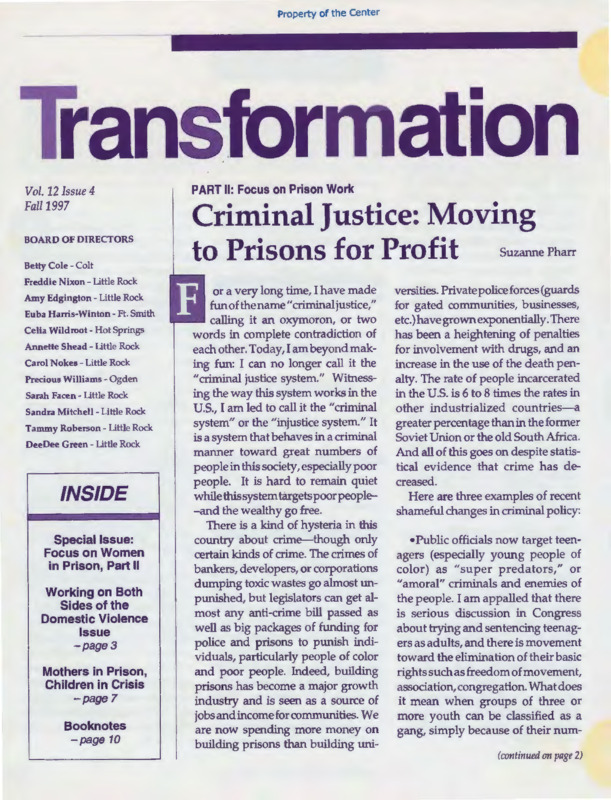
- Transformation is published by the Women's Project. This issue discusses Women in prison and issues of abuse, motherhood, HIV/AIDs, racism, and other issues of incarceration. Additionally, there are ads for future additions and other women's periodicals.
- Date Issued
- 1997
- Relation
- Transformation
- Rights
- Contact UCO Chambers Library's Digital Initiatives Working Group at diwg@uco.edu for the permission policy on the use, reproduction or distribution of this material.
- Is Part Of
-
 Transformation: Women's Watchcare Network Log
- Transformation: Women's Watchcare Network Log
- Creator
- Pharr, Suzanne
- Contributor
- Women's Project
- Date
- 2025-04-18T15:01:12Z
- Date Available
- 2025-04-18T15:01:12Z
- Subject
- LGBTQ+ newsletters
- Women
- Type
- Periodical
- extracted text
-
Property of the Center
,rans rm
Vol. 12 Issue4
PARTII: Focuson PrisonWork
Fall 1997
Criminal Justice: Moving
to Prisons for Profit SuzannePharr
BOARD OF DIRECTORS
Betty Cole - Colt
Freddie Nixon - Little Rock
Amy Edgington - Little Rock
Euba Harris-Winton - Ft. Smith
Celia Wildroot - Hot Springs
Annette Shead - Little Rock
Carol Nokes - Little Rock
Precious Williams - Ogden
Sarah Facen - Little Rock
Sandra Mitchell - Little Rock
Tammy Roberson - Little Rock
DeeDee Green - Little Rock
INSIDE
Special Issue:
Focus on Women
in Prison, Part II
Working on Both
Sides of the
Domestic Violence
Issue
-page3
Mothers in Prison,
Children in Crisis
-page7
Booknotes
-page 10
or a very long time, I have made
fun of the name" criminal justice,"
calling it an oxymoron, or two
words in complete contradiction of
each other. Today, I am beyond making fun: I can no longer call it the
"criminal justice system." Witnessing the way this system works in the
U.S., I am led to call it the "criminal
system" or the "injustice system." It
is a system that behaves in a criminal
manner toward great numbers of
people in this society, especially poor
people. It is hard to remain quiet
while this system targetspoorpeopl~
-and the wealthy go free.
There is a kind of hysteria in this
country about crim~though only
certain kinds of crime. The crimes of
bankers, developers, or corporations
dumping toxic wastes go almost unpunished, but legislators can get almost any anti-crime bill passed as
well as big packages of funding for
police and prisons to punish individuals, particularly people of color
and poor people. Indeed, building
prisons has become a major growth
industry and is seen as a source of
jobs and income for communities. We
are now spending more money on
building prisons than building uni-
versities. Private police forces(guards
for gated communities, businesses,
etc.)have grown exponentially.There
has been a heightening of penalties
for involvement with drugs, and an
increase in the use of the death penalty. The rate of people incarcerated
in the U.S. is 6 to 8 times the rates in
other industrialized countries-a
greater percentage than in the former
Soviet Union or the old South Africa.
And all of this goes on despite statistical evidence that crime has decreased.
Here are three examples of recent
shameful changes in criminal policy:
• Public officials now target teenagers (especially young people of
color) as "super predators," or
"amoral" criminals and enemies of
the people. I am appalled that there
is serious discussion in Congress
about trying and sentencing teenagers as adults, and there is movement
toward the elimination of their basic
rights such as freedom of movement,
association, congregation. What does
it mean when groups of three or
more youth can be classified as a
gang, simply because of their num(continuedon page2)
Womenin Prison
CriminalJustice
hers? The fact that U.S. children
die by murder and suicide at 12
times the rate of other industrialized nations-that children are
killing children- is an indication
that there is something terribly
wrong with U.S. adults and our
systemic lack of support of children and families. (What would
good support look like? Universal and equalized health care, education, and child care, jobs with
livable wages, good libraries,
parks, and after-school programs.)
Not only do I feel ashamed of
our treatment of people in "the
land of the free,"butl worry about
the future. On the one hand, corporate globalization has eliminated good-paying jobs here and
created the greatest disparity between the rich and the poor since
the last century, job training programs and services are being eliminated, and welfare is being re-
There are now
• Congress has expanded the
use of the death penalty, and many
states are using it with relish. Arkansas executed three men in a
single day last year, and the state of
Texas is heading for the Guinness
Bookof Records for the most killed
in the death chamber. In fact, a
recent NY Times article reported
that the high frequency has had a
numbing effect on local citizens
who pay less and less attention to
the executions.
• Greater numbers of women
arenowbeingincarceratedfornonviolent crimes: hot checks, petty
theft, drugs, prostitution, accomplices to men's crimes. In the majority of their cases, their crime is
trying to survive poverty. In Little
Rock,they are jailed in a "Community Punishment Center." They
are separated from their children
and families, and they return to
them as "punished" individuals,
not rehabilitated and trained to contribute to the work force and their
community.
124 private prisons
open which have
74,000 beds.
pealed. At the same time, in the
last decade, we have had a doubling of the numbers of people
incarcerated (to 1.63million or 615
for every 100,000persons) along
with the rapid development of
prisons which are now privatized
and being managed by corporations that are not accountable to
voters. There are now 124private
prisons open which have 74,000
beds and the private prison industry is growing at an annual
rate of 35%. As corporations take
overtheprisonindustry, more and
more prisoners are required to
work for businesses to pay for their
care. The number of prisoners emPage 2 •Transformation• Fall 1997
ployed grew from ~1,000 in 1980
to 75,000workers in 1995who produced $1 billion dollars of goods
and services. Companies such as
TWA, Microsoft, Eddie Bauer, and
JC Penney's have prison businesses where prisoners take reservations and clothing orders, packagecomputerparts,andmakeuniforms. The majority of prisoners
are employed by state and federal
programs making everything
from office furniture to military
uniforms. Prisoners work for
wages similar to what businesses
pay Third World workers, are prevented from organizing, and are
not protected by OSHA (Occupational Safety and Health Administration) standards.
Where can this lead as more
people lose jobs from downsizing
and 4 million welfare recipients
are put on the street without job
possibilities as welfare cutbacks
are implemented? I worry that
prisons will increasingly become
warehouses for holding and controlling the people our economic
system considers to be throwaways.
I fear a future where the only
hope for poor people to find work
in this country will be within
prison walls, working for the profit
of private companies. We have
fought long and hard to dismantle
systems of slavery: what we currently call criminal justice is moving us again to the inhumane and
immoral practice of using imprisonedhumans fortheprofitof those
who do not consider them fully
human. ■
Womenin Prison
Domestic Violence
Working on Both Sides of the
Dom.estic Violence Issue
Janet Perkins
m
11my life I had to fight. I
had to fight my daddy. I
had to fight my brothers.
I had to fight my cousins and my
uncles. A girl child ain't safe in a
family of men. But I never thought
I'd have to fight in my own
house." She let out her breath. "I
loves Harpo," she says. "God
knows I do. But I'll kill him dead
before I let him beat me."
This is a quote from the book,
The ColorPurple, by Alice Walker.
The speaker is Sophia, who is expressing her anger and frustration to Miss Celie, her mother-inlaw, about how her husband
Harpo is very determined to make
her be submissive to him.
In a conversation with his father, Harpo questions what he has
to do to make Sophia mind. "I
tell her one thing, she do another.
Never do what I say. Always
backtalk." In response to his son's
comment the father asks, "You
ever hit her?" Looking down at
his hands and somewhat embarrassed, Harpo admits he has never
hit Sophia, which his father replies, "Well how you spect to
make her mind? Wives is like children. You have to let 'em know
who got the upper hand. Nothing can do that better than a good
sound beating."
These scenes are too familiar
The decision to offer
weekly classes to
incarcerated men was
based on many
factors.
for many of us. Women talking to
other women about their experiences of being abused. Men advising other men on how to
"handle their women."
So many women have been
subjected to being beaten, raped
and emotionally abused all of
their lives. We know that a
woman is more likely to be attacked in her own home by a relaPage 3 •Transformation• Fall 1997
tive than on city •streets by a
stranger. In the above scenario,
Sophia speaks of having to fight
all of her life. Many women never
fight back, because they fear the
severity of the beating if they try
to defend themselves. And we
know, if a woman attempts to flee
the abusive situation she risks being killed or killing her abuser.
The Women's Project has a
long history of working on the
issue of domestic violence. In the
early 80s the Women's Project,
along with other women in northwest Arkansas, worked tirelessly
to create safe space for women
and their children. The first battered women's shelters grew out
of this effort. More importantly
the old guard rules were challenged and no longer did women
have to suffer the abuse they were
experiencing in silence and
shame. No longer could the issue
of domestic violence be denied
and seen as an insignificant problem, because now it had a public
face which was demonstrated by
the numbers of women and children that sought refuge in shelters. As many of us know, even
today shelters operate at capacity, or near capacity most of the
time, which speaks to the fact that
much more work is needed to
eliminate violence in the lives of
women and children.
As many other organizations
and individuals joined in the effort to work on behalf of battered
Womenin Prison
Domestic Violence
A Participant's Reaction
to the Men's Domestic
Violence Class at Tucker
I'vebeen
goii\g
toJheDot
mestic Violence classesfora
whilenow. Ari.<l
lwo:uldlike
to thank Ms. Jari4tt Perkins
and Ms. Felicia Davidson.for
tal.:ing the time to Jlrii\g
ffie
Aridfrommi :Peliefs)
I
formeda mask ofviolenceto
shieldfilf~lf from !!ll'.:
own
f~;from
thatwhicnlc61.1ld
riot understand af the time;
now.
IsYe.neverbeat on mY
DomesticViolencedasstothe
woman,I:velea:rned
thfqligh
men in the. pr~t~JI~irst
our classes
m.Yverbal a.buse
gramf I also would like to
was jµ.sfas bad as ff I had
thank Ms. Beulah ;§amptonHeat her. Howeyer Ifve
for allq~ii\g
me to BeEitl6£ learned tltr9M.M.
the domes:the.pr~~;~J~,~ arid m,m.esijctic yiglin~~classes to §l2P
violence classes.In ll~i~gthe andthinkahoufothers..feelt
oldest person in ffie ~l#~esi ij).~~to talk fbij).g$over iri a
I'd like to say that I've learned civil manner arid to f0JXlpro•
a g:reafdealaooutm~~f~asa mise to both our benefits
person.
wnire
s:foWms
fpgetn.erana
In one
ofthe dasseswe
~i~mffigmore aware bf each
talked about ~e~g ma$is; othert ;fhese ar~j;i§f some of
1 tho~ght
ofan wey:;;11 ffi~~~Iamli~gwhile
wore the ma$k of violence. g~~~gig wijtlf~tiY•·
A nd it
ThoµghI reallydidn't like to goes without~~f!Ag;
It's time
be violent;I hadto be because
to 'ivakeµ:p.,.~Yb1·hthersarid
of the life I was J.iv~g;'You si~t~t$1and stq:pthe vfolerice
see, when I was col'ningµ.pit ijg~~tone arioffiei!
was a lot harder than U is
J.B:rariam
Page 4 • Transformation• Fall 1997
women and their children by developing shelters, domestic violence coalitions, support groups
and affecting public policy, the
Women's Project moved our focus on domestic violence to working with women who are incarcerated.
The Women's Project began
working with women who are incarcerated at the Arkansas Department of Correction Women's
Unit through the Pre-Release Program, which focused on assisting
women to make the transition
from prison back into the community. Our role was to provide
two classes per month to offer information on building employment skills. In these classes, many
of the women shared their experiences with incest, rape, physical
and emotional violence. A closer
examination of physical and
sexual abuse experienced by
women who are incarcerated, revealed that over 85% of these
women had experienced violence
as children or as an adult. According to a national report published by the Bureau of Justice
Statistics, an estimated 41% of
women in prison reported that
they had been previously sexually or physically abused. It became very apparent that classes
which dealt with sexual and
physical abuse were needed for
incarcerated women.
In 1989, Women's Project
former staff member, Kerry Lobel
Womenin Prison
Domestic Violence
initiated the first classes for incarcerated women on Understanding Domestic Violenceand Abuse
Against ~omen. Today we continue our work with incarcerated
women, giving them information
and support that will hopefully
enhance their lives and prepare
them to move back into the community to live a life that is free of
violence.
As we continue to evaluate
our work and question where we
should focus our efforts, we expanded our involvement on domestic violence in the prison to
incarcerated men. The decision to
offer weekly classes to incarcerated men was based on many factors.
We are seeing this growing
movement among men to be re-
sponsible and take their rightful
places in the family and in the
community. Those who advocate
for the reestablishment of family
values encourage men to go back
in their homes, be real men, and
be the heads of their households.
A lot of the information I have
read has this nostalgic flavor, romanticizing yesterday as a standard by which our familiesshould
The Male Illusion: Another Participant's
Reaction to the Domestic Violence Class for Men
Orteoflhe biggest pig§l~!l\$men must stand up and be true
The male's per~pe~i¥ii
of
is that some men refuse to ac~ men .cl:gaffi
domestic violence somewhat
p;y~tqp trt!atip:gour
cepf
()~~~~WP
of
the
••
oblem
differs from. the fema.le's. We,
~!;Mei
.or loved ones as if fu¢y
and
therefore·thebroli
car-were §l?j~cfs
to answer our evas men, Jail to a~~o~!~g,ge
ried
over
irifo
the
next
relation:.
~Frlittle want. When we as
hi fuis soda.I
the part we Pl!Y
sJ:J.iPt
We Want to be m c:om- men start to prbte<:t the most
disease that affects the whole
control
ffii:&hi
be
mand~ttotal
pfijgfq-ys
l?ii1'gs7t9ur wof~ilj.
a
better
word:
meri.;_;;:_then
and oijy then will
Domestic violence from a
~j
ma~g
the
females
feel
theptqp(eij)sof domestic viohasanummale!s pe~§B~SiY~
ber of ~t~trtjngpom,t§:
vet J;,c3,l a.tfault;we delude ourselves irito leij~e; child abuse,. spouse
werxe
q}sijM",
':It is not i;t1,µse;
al:>u~; emotional llb1,1~,and tiijij}tfflg
:r:ape;fijinilya1'use;µysmx
fault.
n
is
:not
me/'
I1ve
pJ:,.y§i~~X
abuse. Theuse o.fver-functional t~lijfj9tj~1J,ips,and
learned
and
tried
to.
~9t\i~Y:
that
~g use §j children. cease to
bal confrontation and thenJhe
taketnereal me~g
exist
more agm'es~t;y;ebehavior we wemust
of
what
mannooa.
is
and
hold
;thank Y;.Q.p; Women's
jttSt~ as
w;l~9:~g our
confronted
marih.oocL
••j how we can onto it: that wneri
:Jit#§i~t.forall of the great work
withcrisiswemustleamtdcom
..
y:~;qare doing for filltiily,
comju.s~ the means t;Mwhicnwe
iri those inurucate our feefffi~ and atthe
create fear and P8:W,
ml.lhi~and sC>d~~.
.elevate our loved
same fime:;;
we sc1:y:
welov:e: We fotihd out
that 87% of the men iri each ones. Th.atwe as men must teclas.s didn't unders.tand or
§E~~f
the. tiglJ,!§
and 9P~R~ of
OdelHolman
our women artd listen, If ao,,
Pre,,Release Counselor and
would not ~i~~il~s!Sitheir
re§po~lbt1li
for the b~9l1l~µi,; mes.ticviolence is to stqI?i we as
Inmate, Tucker Unit
Page 5 • Transformation• Fall 1997
Womenin Prison
Domestic Violence
be governed today.
It is very hard to argue with
the fact that men should be responsible, contribute to the financial stability of their families and
be involved in strengthening their
homes and communities. But
very little of the philosophy and
teachings of most of these movements for men suggest that they
are scrutinizing how they have
devalued and dehumanized
women. Very little suggests that
men are evaluating how they have
misused their power to control and
dominate women. I have not seen
where they are promoting that
men understand, regret, apologize
and stop attempting to beat
women into humbly submitting to
men's rules, desires and needs.
Large numbers of men are
joining these movements across
the country, which indicates that
men are searching for those places
to have contact with other men
and to grow. But has this need to
bond and network with other men
been born out of their fear that
they have lost control of women?
The weekly sessions we are
now offering to incarcerated men
is an effort to give them an opportunity to be involved in discussions which are directed toward understanding the dynamics of domestic violence and their
role as men in ending violence in
the lives of women and children.
I'm not going to tell you that
all the information that Felicia
Davidson and l present in these
sessions is accepted without resistance.
One group of men participates
in the sessions for a month. Without fail, at the beginning of each
Much more work is
needed to eliminate
violence in the lives
of women and
children.
monthly session, one man will be
brave enough to open his mouth
to say, "Well what about how
women beat up men," to which
we reply that 99% of those who
are beaten each year are women,
98% of those arrested on domestic violence charges are men and
each year over 1 million women
seek medical treatment for injuries inflicted by husbands, ex-husbands or boyfriends.
During these sessions we utilize videos which describe the violence women have experienced
and how this has affected their
lives and the lives of their children. One powerful video interPage 6 • Transformation • Fall 1997
views women who·are incarcerated for killing their abusers,
which has a profound impact and
sparks very good discussions.
We acknowledge that men
and women experience the world
differently, and we may never
agree on some things, but one
point we continue to keep up front
in our classes is that violence does
not have to be the cornerstone of
our relationships. Violence hurts
and too often kills women and
does irreversible harm to children.
Men are damaged by their violent
acts and the community suffers.
Often when Felicia and I leave
the prison after working with both
the women and the men, we know
that some of the information we
are presenting is being absorbed
and processed. We are painfully
aware that much more work must
be done to bring an end to domestic violence but our dream is
that the women will leave prison
with a better understanding of
their self-worth and recognize
that they are valuable human beings who deserve to be treated
with respect. Hopefully we have
planted seeds in the minds of the
men that will help them to understand how they participate in and
support domestic violence, and
their role in ending abuse.
Currently this is our work on
ending domestic violence, but we
will continue to strengthen our
work and move to those places
where we see we are needed. ■
Property of the Center
Womenin Prison
Mothers in Prison
I
'
l
'
Mothers in Prison,
Children in Crisis
n
he Mothers in Prison,
Children in Crisis campaign is in its third year.
More than 350 groups in 36 states
are involved in the effort to get
people to understand the harm
that is being done to children and
families by our current criminal
justice policies. The Women's
Project has been involved because
our work with the MIWATCH
program and the domestic violence classes for incarcerated
women have clearly demonstrated
to us the harm that comes from the
emphasis on punishment, not prevention.
The United States incarcerates
more people than any other country in the world. The National
Institute ofJusticepredicts that at
the rate we're going, 1 in every 20
U.S. residents can expect to be
incarcerated at some time in their
life. That's not 1 in 20 of some
other distant people. It's 1 in 20
of us and it's 1 in 20 of our children.
It's been said that "the United
States doesn't have a crime epidemic but that what we're really
facing is an 'epidemic of incarceration'." We're spending billions of dollars building prisons
hoping we can lock away the so-
Susan Phillips
cial and economic injustice in this
country. If the mass incarcerations of Americans was the solution to our problems, Ameri~a
It's been said "that the
United States doesn't
have a crime epidemic
but that what we're
really facing is an
'epidemic of
incarceration'."
would be the safest country in the
world-BUT IT IS NOT!
Sociologists and criminologists are telling us that the very
policies that we intended to fight
crime are destroying families and
devastating entire countries and,
rather than reducing crime, we
are feeding the conditions that lead
to crime. Nowhere is that truth
more evident than in the plight of
the 1.5 million children in this
Page 7 • Transformation•Fall 1997
country whose mothers are imprisoned. This isn't just a problem
that someone else's children face.
Part of those 1.5 million children
are right here in Arkansas.
The greatest growth in the
prison population in Arkansas has
been among women. Eight out of
10 of these women are mothers.
Their children are left with grandparents and aunts and uncles who
have to give custody of the children over to the state in order to
getanysubstantialhelp. There are
14,000 children in Arkansas who
have a mother under the supervision of the courts. That's 14,000
children who, according to research studies, are 5 to 6 times
more likely than other children to
end up incarcerated. Without
multiple means of support, we
know that many of these children
will end up taking their parent's
place behind bars.
What have we done to prevent
the future incarceration of these
at-risk children?
Well, our decision-makers
spent nearly $20 million dollars
on a new for-profit prison for
women-a prison that can potentially hold 2/3 more women than
the present women's prison. The
one great truth we have learned is:
If you build them, they will come.
We know that from the growth of
the prison industries and the burgeoning of the prison population.
Wall Street investors know that
and back the construction of prisons. And the stock holders who
Womenin Prison
Mothersin Prison
are making money from the forprofit prisons know it as well.
We could have made other
decisions.
We could have decided to
spend the $20 million on drug
treatment for women. Substance
abuse is the number one reason
that women are sent to prison, but
only 3% of the money spent on
substance abuse treatment in Arkansas is spent on women with
children. For the same money
we're spending to build a prison
to incarcerate 600 women, we
could have invested in drug treatment and comprehensive services
for 5,800mothers and therapeutic
intervention for more than 11,000
children.
We could have decided to
spend that money on child abuse
prevention or battered women's
shelters-options that would have
addressed factors that are often
precursors to women becoming
incarcerated. We could have spent
the money to prevent abuse or
help women escape domestic violence, but we didn't. We bought a
prison.
We could have decided to
spend $20 million on Drug Courts.
Drug courts require first-time offenders to participate in an extensivedrugtreatmentprogram while
they continue to work and support
their families. We could have, but
we didn't. We bought a prison.
We could have decided to
spend $20 million on programs
available through the Department
of Community Punishment-programs that provide substance
abuse treatment while teaching
mothers how to be better citizens
and better parents. We could have
invested in those programs, but
we didn't. In fact, we cut spending for th~se programs because
The consequences
of our decisions will
not be felt only by
this generation of
children but by
generations to
come.
we decided to buy a prison.
Are prisons cost-effective punishment for most women? No.
Women in this state are most often locked up for fraud, forgery
and theft. Many of these crimes
are related to a substance abuse
problem. A report from the University of Arkansas for Medical
Sciences finds that a woman and
her two children could receive
substance abuse treatment, edu-
Page 8 •
Transformation•Fall 1997
cation, trauma co1:ffiseling,and
family and employment counseling for less than it costs to lock
her up for one year. And when a
mother goes to prison, the children often end up in foster care.
We could have been humane and
cost-effective, but we bought a
prison.
The consequences of our decisions will not be felt only by this
generation of children but they'll
be felt by generations to come. We
made a decision to follow the path
that has taken other states to a
placewherethey'recuttingspending for education and health in
order to support the prison-industrial complex.
The Mothers in Prison, Children in Crisis campaign came into
being because we want something
better for our children's future
than prisons. But to get something
better, we have to ask for something better. We have to tell people
who are in decision-making positions that we want them to invest
in drug courts, community-based
punishment and substance abuse
treatment so that there will be alternatives to sending mothers who
commit non-violent crimes to
prison. ■
SusanPhillipsis the Parentingfrom
PrisonCommunityResourceDevelopment Coordinator
for the Centers
for YouthandFamiliesin LittleRock.
Womenin Prison
Ne,vs & Notes
UPDATE
Since the last issue of Transforthe
mation was. published,
Women's Project has extended its
prison programs to include the
facilities at Wrightsville and
Benton. We are now providing
the men incarcerated at Wrightsville with HIV/ AIDS information
and conducting the Understanding Domestic Abuse of Women
and Children for the men incarcerated at Benton.
The Women's Project staff and
representatives of other community organizations that work with
the women incarcerated at the
Tucker Women's Unit have met
with the new warden of the private prison being constructed in
Newport by the Wackenhut Corporation. Thisnewprisonisscheduled to open in January, 1998
which will mean the transfer of
women from the old site in central
Arkansas to the new prison in
northern Arkansas, about 2-1/2
hours from Little Rock.
AIDS DAY
November30,1997
3:30 - 6:00 p.m.
Arkansas Arts
Center
MacArthur Park
We appreciatethosewho have
helpedthe workof the Women's
Projectby donating'officesupplies
and equipment. Thesetax deductiblegiftsfacilitateour workwhile
reducingour operatingexpenses.
To supportour prisonwork,we
havea continuingneedfor:
A NOTE
OF
APPRECIATION
Supplies for Domestic Violence and HIV/AIDS Classes
t/ photocopier paper (white)
Since the Women's Project bet/ black pens.
came involved in working with
incarcerated women in the 1980s, t/ folders (two pocket)
we have benefited from the time, t/ manila file folders
t/ 8-1/2 x 11 inch writing pads
commitment and talents of many
individuals. To those who have
t/ double density 3.5 inch
negotiated with prison staff, set
diskettes
up and taught classes, led supt/ 1" 3-ring binders
port groups, writteninstructional . t/ blank videocassettes to tape
materials, advocated for indieducational programs
vidual women inmates, transt/ laser cartridges for printers
ported children to visit their
mothers, donated items, or gave
For MIWATCH Project
of their time to change policies
t/ personal hygiene products
affecting incarcerated women, we
t/ children's car seats
say thank you!
t/ used books and magazines
Mark Your Calendars
WORLD
• WISHLIST•
WOMEN'S PROJECT
HOLIDAY
OPEN HOUSE
AND
For Meetings and Classes
t/ flip chart pads
t/ bold tipped markers
For the Library
t/ $ to purchase resource books
on HIV/ AIDS and domestic
violence
t/ bookshelf
SILENT AUCTION
Friday, Dec. 12
5:00 - 7:00 p.m.
Page 9 • Transformation• Fall 1997
For General Office Use
t/ FAX paper rolls
t/ cleaning supplies
t/ paper towels, toilet paper
Lynn Frost
Books on Prison in our Library
Unruly Women:
The Politics of
Confinement &
Resistance, by
Karlene Faith
(Press Gang Publishers), challenges misconceptions of "deviant" women and investigates
the many ways by which
women transgress social order.
...this incisive work critically
examines such topics as patterns of female crimes and punishments, institutionalized violence against incarcerated
women; women loving women
in prison; Holly-wood's formulaic women-in-prison films; and
more, all firmly grounded in a
feminist analysis.
They Always Call Us Ladies:
Stories from Prison, by Jean
Harris (Charles Scribne~s
Sons). The author brings us inside the walls of the Bedford
Hills Correctional Facility,
where she is an inmate, and reveals more about the brutal life
of women in prison than we
have ever seen before.
Legal Lynching: Racism, Injustice & the Death Penalty, by
Rev. Jesse Jackson (Marlowe
& Co.) "Using real people and
real evidence, (Rev. Jackson)
makes a powerful argument
against a reversion to barbarism and for a return to reasonableness." ...Governor Mario
Cuomo
Finding Freedom: Writings from
Death Row, by JarvisJay Masters
(Padma Publishing) is a thoughtful, inspiring and often humorous
collection of stories and personal
reflections by a 35-year-old African American inmate on San
Quentin's death row. Unlike most
prison stories written primarily
from an experience of predation
and horror, this unflinching account presents the healing perspective of compassionate observation
and courageous action for the good
of others.
New Books in the Library
Waterlily by Ella Cara Deloria
(Univ. of Nebraska). Written
nearly a half century ago, but published now for the first time,
Waterlily is a novel of the Dakotas, or Sioux. The author, herself a
Sioux, sought to record and preserve traditional Sioux ways
through this imaginative re-creation of life in the camp circle. It is
of special value because it is told
from a woman's perspective.
Carryin' On in the Lesbian & Gay
South, edited by John Howard
(New York Univ. Press). "This assortment of touching, hilarious,
and very smart essays moves lesbian and gay history to a new
place, geographically and analytically .... the authors explore the
intersecting meanings of southernness and sexuality with attention
Page 10 • Transformation• Fall 1997
to the widest angles of vision,
and to the telling details of daily
experience." ...Lisa Duggan
Great Books for- Girls by
Kathleen Odean (Ballantine
Books). This first reference of
its kind is an invaluable list of
more than six hundred titles that
will encourage, challenge, and
ultimately nurture in girls the
strong qualities our culture so
ofter suppresses.
Feminism and Disability by
BarbaraHillyer (Univ. of Oklahoma Press). "Hillyer breaks
fearlessly into new territory ...
Her book is a major contribution to the growing dialogue
between the two movemen ts.II
...Women's Review of Books
Toward Amnesia by Sarah Van
Arsdale (Riverhead Books).
Nominated for the Lambda Literary Award for Lesbian
Fiction,..."Van Arsdale understands both loss and the reeducation of the heart to which loss,
if we're lucky, can lead. Here's
a wonderful new writer, passionate, funny, charmin~ and
wise." ...Mark Doty, author of
My Alexandria
Everyday Acts Against Racism:
Raising Children in A Multiracial World, edited by Maureen
T. Reddy (Seal Press). In this
empowering book, mothers and
teachers look at the effects of
racism on our children and communities-and suggest practical
ways to end racial divisions.
Property of the Center
CurrentProjects
• Women's Watchcare Network
• Social Justice Project
The Women's Watchcare Network monitors and
documents biased violence, whether it be from far
right groups such as the KKK or militias, the religious
right, or individual acts of violence against people because of their race, gender, class, age, disability,
ethnicity, sexual orientation, gender identity or religion. We publish a yearly log of anecdotal evidence
of this violence and use it to educate the general public, advocate with public officials to ensure civil rights
protections and to work with communities to prevent
violence.
Through the Social Justice Project, we provide
popular education about the oppressions, how they
are linked, and develop strategies for dismantling
them. We work with social change organizations to
strengthen them, incubate new projects, and bring
people together in Arkansas and the South to form
progressive networks that support a progressive
agenda that includes everyone. Through our African
American Women's Institute for Social Justice, we
create strategies for overcoming the barriers that
hinder African American women's efforts toward
power and self-determination.
• Prison Project
• Publications and Events
Through the Prison Project we provide support
groups for battered women, train women to be HIV/
AIDS educators, provide domestic violence education
for incarcerated men, work with community organizations on advocacy for prisoners and work with
United Methodist Women to provide transportation
for children to visit their mothers (MIW ATCH) and
to provide toiletry items to women who cannot purchase them.
Our publications and events include a newsletter, a
lending library, resource manuals, statewide and
regional conferences, and the production of women
performers and writers. We also distribute Homophobia: A Weapon of Sexism and In the Time of
the Right: Reflections on Liberation, by Suzanne
Pharr.
• Economic Justice Project
Transformation is alsoavailableas an ASCIIfile and
In our struggle for economic justice we work with low- on audiotape.
income women to understand economic realities, to
fight discrimination and to create employment opportunities.
~ Yes, I would like to join
r-------------------,
~ the Women'sProject.
Transformation
Editor
Art Director
Judy Matsuoka
Melissa Britton James
Women's Project Staff.
Felicia Davidson
Janet Perkins
Lynn Frost
Suzanne Pharr
Judy Matsuoka
Published four times a year by the Women's Project,
2224 Main Street, Little Rock, Arkansas, 72206.
Phone: 501-372-5113
Name
_______________
Address
______________
_
City_______________
_
_ ~p ________
State_____
©1997
TheWomen's
Project
_
Phone/day
______________
_
Phone/evening
--------------
0
$10.00
(low income)
0
D
$ 25
$ 75
□ $ 50
0
$100
Make checks payable to:
Letters to the editor are welcome.
• Printed on recycled paper. •
_
Women's Project
2224 Main Street
Little Rock, AR 72206
L ___________________
Page 11 • Transformation• Fall 1997
J
Women's
Project
2224 Main Street
Little Rock, AR 72206
Non-Profit Organization
U.S. Postage Paid
Little Rock, Arkansas
Permit No. 448
ADDRESS CORRECTION REQUESTED
HERLAND
SISTERRESOURCES
2312 NW39TH
OKLAHOMA
CITY OK 73112
-
Property of the Center
,rans rm
Vol. 12 Issue4
PARTII: Focuson PrisonWork
Fall 1997
Criminal Justice: Moving
to Prisons for Profit SuzannePharr
BOARD OF DIRECTORS
Betty Cole - Colt
Freddie Nixon - Little Rock
Amy Edgington - Little Rock
Euba Harris-Winton - Ft. Smith
Celia Wildroot - Hot Springs
Annette Shead - Little Rock
Carol Nokes - Little Rock
Precious Williams - Ogden
Sarah Facen - Little Rock
Sandra Mitchell - Little Rock
Tammy Roberson - Little Rock
DeeDee Green - Little Rock
INSIDE
Special Issue:
Focus on Women
in Prison, Part II
Working on Both
Sides of the
Domestic Violence
Issue
-page3
Mothers in Prison,
Children in Crisis
-page7
Booknotes
-page 10
or a very long time, I have made
fun of the name" criminal justice,"
calling it an oxymoron, or two
words in complete contradiction of
each other. Today, I am beyond making fun: I can no longer call it the
"criminal justice system." Witnessing the way this system works in the
U.S., I am led to call it the "criminal
system" or the "injustice system." It
is a system that behaves in a criminal
manner toward great numbers of
people in this society, especially poor
people. It is hard to remain quiet
while this system targetspoorpeopl~
-and the wealthy go free.
There is a kind of hysteria in this
country about crim~though only
certain kinds of crime. The crimes of
bankers, developers, or corporations
dumping toxic wastes go almost unpunished, but legislators can get almost any anti-crime bill passed as
well as big packages of funding for
police and prisons to punish individuals, particularly people of color
and poor people. Indeed, building
prisons has become a major growth
industry and is seen as a source of
jobs and income for communities. We
are now spending more money on
building prisons than building uni-
versities. Private police forces(guards
for gated communities, businesses,
etc.)have grown exponentially.There
has been a heightening of penalties
for involvement with drugs, and an
increase in the use of the death penalty. The rate of people incarcerated
in the U.S. is 6 to 8 times the rates in
other industrialized countries-a
greater percentage than in the former
Soviet Union or the old South Africa.
And all of this goes on despite statistical evidence that crime has decreased.
Here are three examples of recent
shameful changes in criminal policy:
• Public officials now target teenagers (especially young people of
color) as "super predators," or
"amoral" criminals and enemies of
the people. I am appalled that there
is serious discussion in Congress
about trying and sentencing teenagers as adults, and there is movement
toward the elimination of their basic
rights such as freedom of movement,
association, congregation. What does
it mean when groups of three or
more youth can be classified as a
gang, simply because of their num(continuedon page2)
Womenin Prison
CriminalJustice
hers? The fact that U.S. children
die by murder and suicide at 12
times the rate of other industrialized nations-that children are
killing children- is an indication
that there is something terribly
wrong with U.S. adults and our
systemic lack of support of children and families. (What would
good support look like? Universal and equalized health care, education, and child care, jobs with
livable wages, good libraries,
parks, and after-school programs.)
Not only do I feel ashamed of
our treatment of people in "the
land of the free,"butl worry about
the future. On the one hand, corporate globalization has eliminated good-paying jobs here and
created the greatest disparity between the rich and the poor since
the last century, job training programs and services are being eliminated, and welfare is being re-
There are now
• Congress has expanded the
use of the death penalty, and many
states are using it with relish. Arkansas executed three men in a
single day last year, and the state of
Texas is heading for the Guinness
Bookof Records for the most killed
in the death chamber. In fact, a
recent NY Times article reported
that the high frequency has had a
numbing effect on local citizens
who pay less and less attention to
the executions.
• Greater numbers of women
arenowbeingincarceratedfornonviolent crimes: hot checks, petty
theft, drugs, prostitution, accomplices to men's crimes. In the majority of their cases, their crime is
trying to survive poverty. In Little
Rock,they are jailed in a "Community Punishment Center." They
are separated from their children
and families, and they return to
them as "punished" individuals,
not rehabilitated and trained to contribute to the work force and their
community.
124 private prisons
open which have
74,000 beds.
pealed. At the same time, in the
last decade, we have had a doubling of the numbers of people
incarcerated (to 1.63million or 615
for every 100,000persons) along
with the rapid development of
prisons which are now privatized
and being managed by corporations that are not accountable to
voters. There are now 124private
prisons open which have 74,000
beds and the private prison industry is growing at an annual
rate of 35%. As corporations take
overtheprisonindustry, more and
more prisoners are required to
work for businesses to pay for their
care. The number of prisoners emPage 2 •Transformation• Fall 1997
ployed grew from ~1,000 in 1980
to 75,000workers in 1995who produced $1 billion dollars of goods
and services. Companies such as
TWA, Microsoft, Eddie Bauer, and
JC Penney's have prison businesses where prisoners take reservations and clothing orders, packagecomputerparts,andmakeuniforms. The majority of prisoners
are employed by state and federal
programs making everything
from office furniture to military
uniforms. Prisoners work for
wages similar to what businesses
pay Third World workers, are prevented from organizing, and are
not protected by OSHA (Occupational Safety and Health Administration) standards.
Where can this lead as more
people lose jobs from downsizing
and 4 million welfare recipients
are put on the street without job
possibilities as welfare cutbacks
are implemented? I worry that
prisons will increasingly become
warehouses for holding and controlling the people our economic
system considers to be throwaways.
I fear a future where the only
hope for poor people to find work
in this country will be within
prison walls, working for the profit
of private companies. We have
fought long and hard to dismantle
systems of slavery: what we currently call criminal justice is moving us again to the inhumane and
immoral practice of using imprisonedhumans fortheprofitof those
who do not consider them fully
human. ■
Womenin Prison
Domestic Violence
Working on Both Sides of the
Dom.estic Violence Issue
Janet Perkins
m
11my life I had to fight. I
had to fight my daddy. I
had to fight my brothers.
I had to fight my cousins and my
uncles. A girl child ain't safe in a
family of men. But I never thought
I'd have to fight in my own
house." She let out her breath. "I
loves Harpo," she says. "God
knows I do. But I'll kill him dead
before I let him beat me."
This is a quote from the book,
The ColorPurple, by Alice Walker.
The speaker is Sophia, who is expressing her anger and frustration to Miss Celie, her mother-inlaw, about how her husband
Harpo is very determined to make
her be submissive to him.
In a conversation with his father, Harpo questions what he has
to do to make Sophia mind. "I
tell her one thing, she do another.
Never do what I say. Always
backtalk." In response to his son's
comment the father asks, "You
ever hit her?" Looking down at
his hands and somewhat embarrassed, Harpo admits he has never
hit Sophia, which his father replies, "Well how you spect to
make her mind? Wives is like children. You have to let 'em know
who got the upper hand. Nothing can do that better than a good
sound beating."
These scenes are too familiar
The decision to offer
weekly classes to
incarcerated men was
based on many
factors.
for many of us. Women talking to
other women about their experiences of being abused. Men advising other men on how to
"handle their women."
So many women have been
subjected to being beaten, raped
and emotionally abused all of
their lives. We know that a
woman is more likely to be attacked in her own home by a relaPage 3 •Transformation• Fall 1997
tive than on city •streets by a
stranger. In the above scenario,
Sophia speaks of having to fight
all of her life. Many women never
fight back, because they fear the
severity of the beating if they try
to defend themselves. And we
know, if a woman attempts to flee
the abusive situation she risks being killed or killing her abuser.
The Women's Project has a
long history of working on the
issue of domestic violence. In the
early 80s the Women's Project,
along with other women in northwest Arkansas, worked tirelessly
to create safe space for women
and their children. The first battered women's shelters grew out
of this effort. More importantly
the old guard rules were challenged and no longer did women
have to suffer the abuse they were
experiencing in silence and
shame. No longer could the issue
of domestic violence be denied
and seen as an insignificant problem, because now it had a public
face which was demonstrated by
the numbers of women and children that sought refuge in shelters. As many of us know, even
today shelters operate at capacity, or near capacity most of the
time, which speaks to the fact that
much more work is needed to
eliminate violence in the lives of
women and children.
As many other organizations
and individuals joined in the effort to work on behalf of battered
Womenin Prison
Domestic Violence
A Participant's Reaction
to the Men's Domestic
Violence Class at Tucker
I'vebeen
goii\g
toJheDot
mestic Violence classesfora
whilenow. Ari.<l
lwo:uldlike
to thank Ms. Jari4tt Perkins
and Ms. Felicia Davidson.for
tal.:ing the time to Jlrii\g
ffie
Aridfrommi :Peliefs)
I
formeda mask ofviolenceto
shieldfilf~lf from !!ll'.:
own
f~;from
thatwhicnlc61.1ld
riot understand af the time;
now.
IsYe.neverbeat on mY
DomesticViolencedasstothe
woman,I:velea:rned
thfqligh
men in the. pr~t~JI~irst
our classes
m.Yverbal a.buse
gramf I also would like to
was jµ.sfas bad as ff I had
thank Ms. Beulah ;§amptonHeat her. Howeyer Ifve
for allq~ii\g
me to BeEitl6£ learned tltr9M.M.
the domes:the.pr~~;~J~,~ arid m,m.esijctic yiglin~~classes to §l2P
violence classes.In ll~i~gthe andthinkahoufothers..feelt
oldest person in ffie ~l#~esi ij).~~to talk fbij).g$over iri a
I'd like to say that I've learned civil manner arid to f0JXlpro•
a g:reafdealaooutm~~f~asa mise to both our benefits
person.
wnire
s:foWms
fpgetn.erana
In one
ofthe dasseswe
~i~mffigmore aware bf each
talked about ~e~g ma$is; othert ;fhese ar~j;i§f some of
1 tho~ght
ofan wey:;;11 ffi~~~Iamli~gwhile
wore the ma$k of violence. g~~~gig wijtlf~tiY•·
A nd it
ThoµghI reallydidn't like to goes without~~f!Ag;
It's time
be violent;I hadto be because
to 'ivakeµ:p.,.~Yb1·hthersarid
of the life I was J.iv~g;'You si~t~t$1and stq:pthe vfolerice
see, when I was col'ningµ.pit ijg~~tone arioffiei!
was a lot harder than U is
J.B:rariam
Page 4 • Transformation• Fall 1997
women and their children by developing shelters, domestic violence coalitions, support groups
and affecting public policy, the
Women's Project moved our focus on domestic violence to working with women who are incarcerated.
The Women's Project began
working with women who are incarcerated at the Arkansas Department of Correction Women's
Unit through the Pre-Release Program, which focused on assisting
women to make the transition
from prison back into the community. Our role was to provide
two classes per month to offer information on building employment skills. In these classes, many
of the women shared their experiences with incest, rape, physical
and emotional violence. A closer
examination of physical and
sexual abuse experienced by
women who are incarcerated, revealed that over 85% of these
women had experienced violence
as children or as an adult. According to a national report published by the Bureau of Justice
Statistics, an estimated 41% of
women in prison reported that
they had been previously sexually or physically abused. It became very apparent that classes
which dealt with sexual and
physical abuse were needed for
incarcerated women.
In 1989, Women's Project
former staff member, Kerry Lobel
Womenin Prison
Domestic Violence
initiated the first classes for incarcerated women on Understanding Domestic Violenceand Abuse
Against ~omen. Today we continue our work with incarcerated
women, giving them information
and support that will hopefully
enhance their lives and prepare
them to move back into the community to live a life that is free of
violence.
As we continue to evaluate
our work and question where we
should focus our efforts, we expanded our involvement on domestic violence in the prison to
incarcerated men. The decision to
offer weekly classes to incarcerated men was based on many factors.
We are seeing this growing
movement among men to be re-
sponsible and take their rightful
places in the family and in the
community. Those who advocate
for the reestablishment of family
values encourage men to go back
in their homes, be real men, and
be the heads of their households.
A lot of the information I have
read has this nostalgic flavor, romanticizing yesterday as a standard by which our familiesshould
The Male Illusion: Another Participant's
Reaction to the Domestic Violence Class for Men
Orteoflhe biggest pig§l~!l\$men must stand up and be true
The male's per~pe~i¥ii
of
is that some men refuse to ac~ men .cl:gaffi
domestic violence somewhat
p;y~tqp trt!atip:gour
cepf
()~~~~WP
of
the
••
oblem
differs from. the fema.le's. We,
~!;Mei
.or loved ones as if fu¢y
and
therefore·thebroli
car-were §l?j~cfs
to answer our evas men, Jail to a~~o~!~g,ge
ried
over
irifo
the
next
relation:.
~Frlittle want. When we as
hi fuis soda.I
the part we Pl!Y
sJ:J.iPt
We Want to be m c:om- men start to prbte<:t the most
disease that affects the whole
control
ffii:&hi
be
mand~ttotal
pfijgfq-ys
l?ii1'gs7t9ur wof~ilj.
a
better
word:
meri.;_;;:_then
and oijy then will
Domestic violence from a
~j
ma~g
the
females
feel
theptqp(eij)sof domestic viohasanummale!s pe~§B~SiY~
ber of ~t~trtjngpom,t§:
vet J;,c3,l a.tfault;we delude ourselves irito leij~e; child abuse,. spouse
werxe
q}sijM",
':It is not i;t1,µse;
al:>u~; emotional llb1,1~,and tiijij}tfflg
:r:ape;fijinilya1'use;µysmx
fault.
n
is
:not
me/'
I1ve
pJ:,.y§i~~X
abuse. Theuse o.fver-functional t~lijfj9tj~1J,ips,and
learned
and
tried
to.
~9t\i~Y:
that
~g use §j children. cease to
bal confrontation and thenJhe
taketnereal me~g
exist
more agm'es~t;y;ebehavior we wemust
of
what
mannooa.
is
and
hold
;thank Y;.Q.p; Women's
jttSt~ as
w;l~9:~g our
confronted
marih.oocL
••j how we can onto it: that wneri
:Jit#§i~t.forall of the great work
withcrisiswemustleamtdcom
..
y:~;qare doing for filltiily,
comju.s~ the means t;Mwhicnwe
iri those inurucate our feefffi~ and atthe
create fear and P8:W,
ml.lhi~and sC>d~~.
.elevate our loved
same fime:;;
we sc1:y:
welov:e: We fotihd out
that 87% of the men iri each ones. Th.atwe as men must teclas.s didn't unders.tand or
§E~~f
the. tiglJ,!§
and 9P~R~ of
OdelHolman
our women artd listen, If ao,,
Pre,,Release Counselor and
would not ~i~~il~s!Sitheir
re§po~lbt1li
for the b~9l1l~µi,; mes.ticviolence is to stqI?i we as
Inmate, Tucker Unit
Page 5 • Transformation• Fall 1997
Womenin Prison
Domestic Violence
be governed today.
It is very hard to argue with
the fact that men should be responsible, contribute to the financial stability of their families and
be involved in strengthening their
homes and communities. But
very little of the philosophy and
teachings of most of these movements for men suggest that they
are scrutinizing how they have
devalued and dehumanized
women. Very little suggests that
men are evaluating how they have
misused their power to control and
dominate women. I have not seen
where they are promoting that
men understand, regret, apologize
and stop attempting to beat
women into humbly submitting to
men's rules, desires and needs.
Large numbers of men are
joining these movements across
the country, which indicates that
men are searching for those places
to have contact with other men
and to grow. But has this need to
bond and network with other men
been born out of their fear that
they have lost control of women?
The weekly sessions we are
now offering to incarcerated men
is an effort to give them an opportunity to be involved in discussions which are directed toward understanding the dynamics of domestic violence and their
role as men in ending violence in
the lives of women and children.
I'm not going to tell you that
all the information that Felicia
Davidson and l present in these
sessions is accepted without resistance.
One group of men participates
in the sessions for a month. Without fail, at the beginning of each
Much more work is
needed to eliminate
violence in the lives
of women and
children.
monthly session, one man will be
brave enough to open his mouth
to say, "Well what about how
women beat up men," to which
we reply that 99% of those who
are beaten each year are women,
98% of those arrested on domestic violence charges are men and
each year over 1 million women
seek medical treatment for injuries inflicted by husbands, ex-husbands or boyfriends.
During these sessions we utilize videos which describe the violence women have experienced
and how this has affected their
lives and the lives of their children. One powerful video interPage 6 • Transformation • Fall 1997
views women who·are incarcerated for killing their abusers,
which has a profound impact and
sparks very good discussions.
We acknowledge that men
and women experience the world
differently, and we may never
agree on some things, but one
point we continue to keep up front
in our classes is that violence does
not have to be the cornerstone of
our relationships. Violence hurts
and too often kills women and
does irreversible harm to children.
Men are damaged by their violent
acts and the community suffers.
Often when Felicia and I leave
the prison after working with both
the women and the men, we know
that some of the information we
are presenting is being absorbed
and processed. We are painfully
aware that much more work must
be done to bring an end to domestic violence but our dream is
that the women will leave prison
with a better understanding of
their self-worth and recognize
that they are valuable human beings who deserve to be treated
with respect. Hopefully we have
planted seeds in the minds of the
men that will help them to understand how they participate in and
support domestic violence, and
their role in ending abuse.
Currently this is our work on
ending domestic violence, but we
will continue to strengthen our
work and move to those places
where we see we are needed. ■
Property of the Center
Womenin Prison
Mothers in Prison
I
'
l
'
Mothers in Prison,
Children in Crisis
n
he Mothers in Prison,
Children in Crisis campaign is in its third year.
More than 350 groups in 36 states
are involved in the effort to get
people to understand the harm
that is being done to children and
families by our current criminal
justice policies. The Women's
Project has been involved because
our work with the MIWATCH
program and the domestic violence classes for incarcerated
women have clearly demonstrated
to us the harm that comes from the
emphasis on punishment, not prevention.
The United States incarcerates
more people than any other country in the world. The National
Institute ofJusticepredicts that at
the rate we're going, 1 in every 20
U.S. residents can expect to be
incarcerated at some time in their
life. That's not 1 in 20 of some
other distant people. It's 1 in 20
of us and it's 1 in 20 of our children.
It's been said that "the United
States doesn't have a crime epidemic but that what we're really
facing is an 'epidemic of incarceration'." We're spending billions of dollars building prisons
hoping we can lock away the so-
Susan Phillips
cial and economic injustice in this
country. If the mass incarcerations of Americans was the solution to our problems, Ameri~a
It's been said "that the
United States doesn't
have a crime epidemic
but that what we're
really facing is an
'epidemic of
incarceration'."
would be the safest country in the
world-BUT IT IS NOT!
Sociologists and criminologists are telling us that the very
policies that we intended to fight
crime are destroying families and
devastating entire countries and,
rather than reducing crime, we
are feeding the conditions that lead
to crime. Nowhere is that truth
more evident than in the plight of
the 1.5 million children in this
Page 7 • Transformation•Fall 1997
country whose mothers are imprisoned. This isn't just a problem
that someone else's children face.
Part of those 1.5 million children
are right here in Arkansas.
The greatest growth in the
prison population in Arkansas has
been among women. Eight out of
10 of these women are mothers.
Their children are left with grandparents and aunts and uncles who
have to give custody of the children over to the state in order to
getanysubstantialhelp. There are
14,000 children in Arkansas who
have a mother under the supervision of the courts. That's 14,000
children who, according to research studies, are 5 to 6 times
more likely than other children to
end up incarcerated. Without
multiple means of support, we
know that many of these children
will end up taking their parent's
place behind bars.
What have we done to prevent
the future incarceration of these
at-risk children?
Well, our decision-makers
spent nearly $20 million dollars
on a new for-profit prison for
women-a prison that can potentially hold 2/3 more women than
the present women's prison. The
one great truth we have learned is:
If you build them, they will come.
We know that from the growth of
the prison industries and the burgeoning of the prison population.
Wall Street investors know that
and back the construction of prisons. And the stock holders who
Womenin Prison
Mothersin Prison
are making money from the forprofit prisons know it as well.
We could have made other
decisions.
We could have decided to
spend the $20 million on drug
treatment for women. Substance
abuse is the number one reason
that women are sent to prison, but
only 3% of the money spent on
substance abuse treatment in Arkansas is spent on women with
children. For the same money
we're spending to build a prison
to incarcerate 600 women, we
could have invested in drug treatment and comprehensive services
for 5,800mothers and therapeutic
intervention for more than 11,000
children.
We could have decided to
spend that money on child abuse
prevention or battered women's
shelters-options that would have
addressed factors that are often
precursors to women becoming
incarcerated. We could have spent
the money to prevent abuse or
help women escape domestic violence, but we didn't. We bought a
prison.
We could have decided to
spend $20 million on Drug Courts.
Drug courts require first-time offenders to participate in an extensivedrugtreatmentprogram while
they continue to work and support
their families. We could have, but
we didn't. We bought a prison.
We could have decided to
spend $20 million on programs
available through the Department
of Community Punishment-programs that provide substance
abuse treatment while teaching
mothers how to be better citizens
and better parents. We could have
invested in those programs, but
we didn't. In fact, we cut spending for th~se programs because
The consequences
of our decisions will
not be felt only by
this generation of
children but by
generations to
come.
we decided to buy a prison.
Are prisons cost-effective punishment for most women? No.
Women in this state are most often locked up for fraud, forgery
and theft. Many of these crimes
are related to a substance abuse
problem. A report from the University of Arkansas for Medical
Sciences finds that a woman and
her two children could receive
substance abuse treatment, edu-
Page 8 •
Transformation•Fall 1997
cation, trauma co1:ffiseling,and
family and employment counseling for less than it costs to lock
her up for one year. And when a
mother goes to prison, the children often end up in foster care.
We could have been humane and
cost-effective, but we bought a
prison.
The consequences of our decisions will not be felt only by this
generation of children but they'll
be felt by generations to come. We
made a decision to follow the path
that has taken other states to a
placewherethey'recuttingspending for education and health in
order to support the prison-industrial complex.
The Mothers in Prison, Children in Crisis campaign came into
being because we want something
better for our children's future
than prisons. But to get something
better, we have to ask for something better. We have to tell people
who are in decision-making positions that we want them to invest
in drug courts, community-based
punishment and substance abuse
treatment so that there will be alternatives to sending mothers who
commit non-violent crimes to
prison. ■
SusanPhillipsis the Parentingfrom
PrisonCommunityResourceDevelopment Coordinator
for the Centers
for YouthandFamiliesin LittleRock.
Womenin Prison
Ne,vs & Notes
UPDATE
Since the last issue of Transforthe
mation was. published,
Women's Project has extended its
prison programs to include the
facilities at Wrightsville and
Benton. We are now providing
the men incarcerated at Wrightsville with HIV/ AIDS information
and conducting the Understanding Domestic Abuse of Women
and Children for the men incarcerated at Benton.
The Women's Project staff and
representatives of other community organizations that work with
the women incarcerated at the
Tucker Women's Unit have met
with the new warden of the private prison being constructed in
Newport by the Wackenhut Corporation. Thisnewprisonisscheduled to open in January, 1998
which will mean the transfer of
women from the old site in central
Arkansas to the new prison in
northern Arkansas, about 2-1/2
hours from Little Rock.
AIDS DAY
November30,1997
3:30 - 6:00 p.m.
Arkansas Arts
Center
MacArthur Park
We appreciatethosewho have
helpedthe workof the Women's
Projectby donating'officesupplies
and equipment. Thesetax deductiblegiftsfacilitateour workwhile
reducingour operatingexpenses.
To supportour prisonwork,we
havea continuingneedfor:
A NOTE
OF
APPRECIATION
Supplies for Domestic Violence and HIV/AIDS Classes
t/ photocopier paper (white)
Since the Women's Project bet/ black pens.
came involved in working with
incarcerated women in the 1980s, t/ folders (two pocket)
we have benefited from the time, t/ manila file folders
t/ 8-1/2 x 11 inch writing pads
commitment and talents of many
individuals. To those who have
t/ double density 3.5 inch
negotiated with prison staff, set
diskettes
up and taught classes, led supt/ 1" 3-ring binders
port groups, writteninstructional . t/ blank videocassettes to tape
materials, advocated for indieducational programs
vidual women inmates, transt/ laser cartridges for printers
ported children to visit their
mothers, donated items, or gave
For MIWATCH Project
of their time to change policies
t/ personal hygiene products
affecting incarcerated women, we
t/ children's car seats
say thank you!
t/ used books and magazines
Mark Your Calendars
WORLD
• WISHLIST•
WOMEN'S PROJECT
HOLIDAY
OPEN HOUSE
AND
For Meetings and Classes
t/ flip chart pads
t/ bold tipped markers
For the Library
t/ $ to purchase resource books
on HIV/ AIDS and domestic
violence
t/ bookshelf
SILENT AUCTION
Friday, Dec. 12
5:00 - 7:00 p.m.
Page 9 • Transformation• Fall 1997
For General Office Use
t/ FAX paper rolls
t/ cleaning supplies
t/ paper towels, toilet paper
Lynn Frost
Books on Prison in our Library
Unruly Women:
The Politics of
Confinement &
Resistance, by
Karlene Faith
(Press Gang Publishers), challenges misconceptions of "deviant" women and investigates
the many ways by which
women transgress social order.
...this incisive work critically
examines such topics as patterns of female crimes and punishments, institutionalized violence against incarcerated
women; women loving women
in prison; Holly-wood's formulaic women-in-prison films; and
more, all firmly grounded in a
feminist analysis.
They Always Call Us Ladies:
Stories from Prison, by Jean
Harris (Charles Scribne~s
Sons). The author brings us inside the walls of the Bedford
Hills Correctional Facility,
where she is an inmate, and reveals more about the brutal life
of women in prison than we
have ever seen before.
Legal Lynching: Racism, Injustice & the Death Penalty, by
Rev. Jesse Jackson (Marlowe
& Co.) "Using real people and
real evidence, (Rev. Jackson)
makes a powerful argument
against a reversion to barbarism and for a return to reasonableness." ...Governor Mario
Cuomo
Finding Freedom: Writings from
Death Row, by JarvisJay Masters
(Padma Publishing) is a thoughtful, inspiring and often humorous
collection of stories and personal
reflections by a 35-year-old African American inmate on San
Quentin's death row. Unlike most
prison stories written primarily
from an experience of predation
and horror, this unflinching account presents the healing perspective of compassionate observation
and courageous action for the good
of others.
New Books in the Library
Waterlily by Ella Cara Deloria
(Univ. of Nebraska). Written
nearly a half century ago, but published now for the first time,
Waterlily is a novel of the Dakotas, or Sioux. The author, herself a
Sioux, sought to record and preserve traditional Sioux ways
through this imaginative re-creation of life in the camp circle. It is
of special value because it is told
from a woman's perspective.
Carryin' On in the Lesbian & Gay
South, edited by John Howard
(New York Univ. Press). "This assortment of touching, hilarious,
and very smart essays moves lesbian and gay history to a new
place, geographically and analytically .... the authors explore the
intersecting meanings of southernness and sexuality with attention
Page 10 • Transformation• Fall 1997
to the widest angles of vision,
and to the telling details of daily
experience." ...Lisa Duggan
Great Books for- Girls by
Kathleen Odean (Ballantine
Books). This first reference of
its kind is an invaluable list of
more than six hundred titles that
will encourage, challenge, and
ultimately nurture in girls the
strong qualities our culture so
ofter suppresses.
Feminism and Disability by
BarbaraHillyer (Univ. of Oklahoma Press). "Hillyer breaks
fearlessly into new territory ...
Her book is a major contribution to the growing dialogue
between the two movemen ts.II
...Women's Review of Books
Toward Amnesia by Sarah Van
Arsdale (Riverhead Books).
Nominated for the Lambda Literary Award for Lesbian
Fiction,..."Van Arsdale understands both loss and the reeducation of the heart to which loss,
if we're lucky, can lead. Here's
a wonderful new writer, passionate, funny, charmin~ and
wise." ...Mark Doty, author of
My Alexandria
Everyday Acts Against Racism:
Raising Children in A Multiracial World, edited by Maureen
T. Reddy (Seal Press). In this
empowering book, mothers and
teachers look at the effects of
racism on our children and communities-and suggest practical
ways to end racial divisions.
Property of the Center
CurrentProjects
• Women's Watchcare Network
• Social Justice Project
The Women's Watchcare Network monitors and
documents biased violence, whether it be from far
right groups such as the KKK or militias, the religious
right, or individual acts of violence against people because of their race, gender, class, age, disability,
ethnicity, sexual orientation, gender identity or religion. We publish a yearly log of anecdotal evidence
of this violence and use it to educate the general public, advocate with public officials to ensure civil rights
protections and to work with communities to prevent
violence.
Through the Social Justice Project, we provide
popular education about the oppressions, how they
are linked, and develop strategies for dismantling
them. We work with social change organizations to
strengthen them, incubate new projects, and bring
people together in Arkansas and the South to form
progressive networks that support a progressive
agenda that includes everyone. Through our African
American Women's Institute for Social Justice, we
create strategies for overcoming the barriers that
hinder African American women's efforts toward
power and self-determination.
• Prison Project
• Publications and Events
Through the Prison Project we provide support
groups for battered women, train women to be HIV/
AIDS educators, provide domestic violence education
for incarcerated men, work with community organizations on advocacy for prisoners and work with
United Methodist Women to provide transportation
for children to visit their mothers (MIW ATCH) and
to provide toiletry items to women who cannot purchase them.
Our publications and events include a newsletter, a
lending library, resource manuals, statewide and
regional conferences, and the production of women
performers and writers. We also distribute Homophobia: A Weapon of Sexism and In the Time of
the Right: Reflections on Liberation, by Suzanne
Pharr.
• Economic Justice Project
Transformation is alsoavailableas an ASCIIfile and
In our struggle for economic justice we work with low- on audiotape.
income women to understand economic realities, to
fight discrimination and to create employment opportunities.
~ Yes, I would like to join
r-------------------,
~ the Women'sProject.
Transformation
Editor
Art Director
Judy Matsuoka
Melissa Britton James
Women's Project Staff.
Felicia Davidson
Janet Perkins
Lynn Frost
Suzanne Pharr
Judy Matsuoka
Published four times a year by the Women's Project,
2224 Main Street, Little Rock, Arkansas, 72206.
Phone: 501-372-5113
Name
_______________
Address
______________
_
City_______________
_
_ ~p ________
State_____
©1997
TheWomen's
Project
_
Phone/day
______________
_
Phone/evening
--------------
0
$10.00
(low income)
0
D
$ 25
$ 75
□ $ 50
0
$100
Make checks payable to:
Letters to the editor are welcome.
• Printed on recycled paper. •
_
Women's Project
2224 Main Street
Little Rock, AR 72206
L ___________________
Page 11 • Transformation• Fall 1997
J
Women's
Project
2224 Main Street
Little Rock, AR 72206
Non-Profit Organization
U.S. Postage Paid
Little Rock, Arkansas
Permit No. 448
ADDRESS CORRECTION REQUESTED
HERLAND
SISTERRESOURCES
2312 NW39TH
OKLAHOMA
CITY OK 73112
- Temporal Coverage
- 1990-1999
Linked resources
- Hierarchies
-
Herland Archive
- All Resources (Private)
- Themes
- LGBTQ+ (482 items)
- Feminism (40 items)
- Faith and Religion (51 items)
- Activism and Advocacy (69 items)
- HIV/AIDS (25 items)
- Education (18 items)
- Literature (20 items)
- Art (16 items)
- Themes
- All Resources (Private)