
Hot Wire : Jan.(1991)
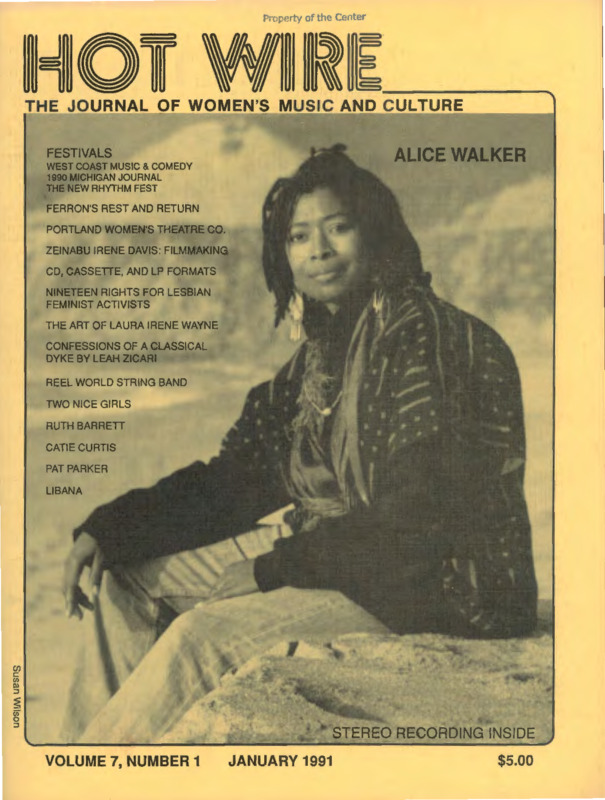
- Title
- Hot Wire : Jan.(1991)
- Description
- Hot Wire: The Journal of Women’s Music and Culture is a Journal that includes articles about Women in Music, Poetry, and Linguistics. This Edition includes articles and interviews from Women of Color in Music, Women’s Music Festivals, and Women Musicians from around the World.
- Date Issued
- 1991-01
- Relation
- Hot Wire
- Rights
- Contact UCO Chambers Library's Digital Initiatives Working Group at diwg@uco.edu for the permission policy on the use, reproduction or distribution of this material.
- Contributor
- Empty Closet Enterprises
- Date
- 2024-11-26T00:00:04Z
- Date Available
- 2024-11-26T00:00:04Z
- Subject
- Music
- extracted text
-
r;-r:perty of the Center
~RE----------
THE JO~RNAL OF WOMEN'S MUSIC AND CULTURE
A
FESTIVALS
WEST COAST MUSIC & COMEDY
1990 MICHIGAN JOURNAL
THE NEW RHYTHM FEST
WALKER
FERRON'S REST AND RETURN
PORTLAND WOMEN'S TH6AT8i.CO.
ZEINABU IRENE DAVIS: FILMMAK!NG
CD, CASSETTE, AND LP FORMATS
NINETEEN RIGHTS FOR LESBIAN
FEMINIST ACTIVISTS
THE ART OF LAURA IRENE WAYNE
CONFESSIONS OF A CLASSICAL
DYKE BY LEAH ZICARI
REEL WORLD STRING BAND
TWO NICE GIRLS
RUTH BARRETT
CATIE CURTIS
PAT PARKER
LIBANA
en
C
(/)
Sl.l
::::,
~
'iii
0
::::,
"' STEREO RECORDING INSIDE
VOLUME 7, NUMBER 1
JANUARY 1991
$5.00
FROM THE EDITOR'S DESK
The 'HOT WIRE'
EDITORIAL PHILOSOPHY
HOT WIRE specializes in woman-identified
music and culture, primarily the performing
arts, literature, and film/video. We strongly
believe in the power of the arts to affect social
change, and enjoy documenting the combination of "creativity" and "politics/philosophy."
We are committed to covering female artists
and women's groups who prioritize feminist
and/or lesbian content and ideals in their creative products and events. We enjoy helping to
both create and strengthen the international
community of those who love the creativity of
women.
SPELL CHECK
For those of you who have asked about HOT
WIRE's policy re the spelling of the words
"woman" and "women" ... We spell it the
traditional way as a matter of style. However,
we respect the preferences of our writers, and
that's why you'll see these words spelled several different ways, even within one issue.
AND FROM THE
MECHANICAL SPELL
CHECK DEPARTMENT
I find it amusing that some of our most
commonly used words are kicked back by our
computer's spell-checker as potentially wrong.
These include lesbian, homophobia, dyke,
womyn/wimmin/womin/womon, antiracism,
antiracist, fundraiser, and dreadlocks.
COMPLAINTS
AND QUESTIONS ...
... are best addressed to Deb & Ginny, our office
managers. Writing directly to them will get
you better results than calling and leaving a
message-irate or otherwise---on our answering machine.
IF YOU'VE MOVED ...
.. .in the last four months, or if you will be
moving within the next four months, please tell
us immediately. Magazines mailed to wrong
addresses are usually thrown away by the post
office, not forwarded to you, and not returned to
us. We absolutely cannot afford to replace magazines that are lost this way, and in every issue
we print a notice to this effect. It is very frustrating to receive mail or phone calls saying, "I
paid for a subscription but haven't gotten my
last two issues. Are you still publishing? Send
immediately. By the way, I moved ... "
~
e>
~
~
~
copyright-and would be a direct ripoff of the
artists.) The point of having music on the
soundsheet is to promote the songs, and with
LP turntables being gradually but definitely replaced by CD players and tape players, we
understand the desire to have the songs on the
convenient cassette format. So enjoy. (And by
the way, an historical note: Ruth Dworin of Toronto is the woman who originally suggested
we do soundsheets, back in 1985. So when you
next listen to your little black record, think
appreciative thoughts of her.)
AND SPEAKING OF TAPES ...
'HOT WIRE' editor Toni Jr. urges the
Michigan festival crowd to sing the L
word. (Pictured here last summer with
Kay Gardner and Alix Dobkin, playing
together as the Lavender Jane band.)
READERS' CHOICE AWARDS
It's time again for the annual HOT WIRE Readers' Choice Awards nominations. Each year
awards are given to recognize women for outstanding achievements/ contributions in the
area of women's music and culture. The
awards are determined solely on the basis of
write-in nominations and votes-the readers do
the nominating and selecting, not the magazine staff. It is time now for readers to send
up to fifty words nominating women in two
categories: individual and organization. These
must be received by February 20 for inclusion
in the May issue. Send to HOT WIRE Readers'
Choice Awards, 5210 N. Wayne, Chicago, IL
60640.
TAPING SONGS
FROM THE SOUNDSHEET
We get inquiries regularly regarding whether
or not women can make copies of the songs
from the soundsheets onto cassette tapes for
their own listening pleasure (usually for use at
parties or in the car). This is fine-as long as
you are not selling these tapes for profit. (Sale
of this material would be an infringement of
ON THE COVER
Alice Walker's many books of published works include poetry, short
stories, essays, novels, and children's
books. Her Pulitzer Prize-winning
novel The Color Purple was made into
a major motion picture starring
Whoopi Goldberg.
I have started to work out regularly in the
weight room at the school where I am employed. We always have music playing, so I
made a tape and donated it. It includes fasttempo selections from mainstream women
artists such as Bonnie Raitt, Aretha, Martha &
The Vandellas, Gloria Estefan, Janet Jackson,
Alicia Bridges, Sister Sledge, and Donna Summer-pl us cuts from our pals Melissa
Etheridge (several songs), k.d. Jang ("Bopalena" and "Big Big Love''), Teresa Trull ("Rosalie" and "A Step Away'), DEUCE ("Partly Sonny"), Ferron (''Misty Mountain"), Linda Tillery
("Special Kind of Love"), Deidre McCalla ("All
Day Always"), Casselberry-DuPree ("Positive
Vibration''), Sherry Shute ('No Crime''), Helen
Hooke ("Sex Roulette"), Meg and Cris at Carnegie ("Anniversary" and "Come Hell or High
Water"), plus Meg Christian's "Gym II." It's
great fun to watch these selections become "hit
songs" with the teachers and students who
hum along as they work out, and I love hearing the familiar strains of these songs floating
in the hallways as I walk by. Plus, I love knowing that some of the girls who are hearing this
music now will encounter it again later in life,
and that they will always remember they
heard it first in their high school.
I strongly urge women who are making
similar anthology tapes--for work-out music,
for dance party music, etc.-to seriously put
effort into including women's music. I am often
surprised (unpleasantly) to notice women's
music by its absence. For example, tapes are
frequently played as ambience music before a
women's music concert starts--and these tapes
feature good mainstream women but not "our
own." Each of us can take responsibility for doing something about that! After fifteen years,
there's plenty to choose from, in just about
every style of music.•
Toni Armstrong Jr.
Publisher/Managing Editor
PUBLISHER
Ton Armstrong Jr.
MANAGING EDITORS
Toni Armstrong Jr. & Lynn Siniscalchi
PRODUCTION
Kathryn Davis Annie Lee L.everitt
Jenn~er Parello
SOUNDSHEETS & ADVERTISING
Joy Rosenblatt &Toni Armstrong Jr.
PROOFREADING
Dawn Eng Joan Eichler Anne Dreibel:lis
Susan Waller Micki Leventhal
Crystal Pearl Sara Wetter.berger
OFFICE MANAGERS
Deb Dettman & Ginny Newsom
BOOKSTORE ACCOUNTS
Toni Armstrong Jr. & Ginny Newsom
COMPUTER DEPARTMENT
Lynn Siniscalchi Toni Armstrong Jr.
Kris Johnson Cathy Milner Julie Walstra
Sara Wetter.berger Glenda Woods
'HOT WIRE' STAFF
Tracy Baim Cindy Dobbs Shona Dudley Betsy Godwin
Brenda Goldstein Mary Hulnagl C.J. Knox Janet Meyer
Sandy McNabb Dawn Popeka Therese Cll.inn
Michelle Rappeport Barb Sanderson StaM Sholl
Susan Waller Laurel Wathan
STAFF WRITERS
Claudia Allen Toni Armstrong Jr. Kristan Aspen
Suzette Haden Elgin Kay Gardner Gerri Grbi
Jorjet Harper Terri Jewell Karen Kane Connie Kuhns
Janna MacAus!an Laura Post Rosetta Reitz
Catherine Roma Joy Rosenblatt Nancy Seeger
Sequoia Judith Sloan Paula Walowitz Susan Wilson
STAFF ARTISTS & PHOTOGRAPHERS
Toni Armstrong Jr. Alison Bechdel Jill Cruse
Joan E. Biren (JEB) Sharon Farmer Diane Germain
Marcy J. Hochberg Kris Kovick Andrea Leigh Natalie
Ursula Roma Nancy Seeger Vada Vernee
Susan Wilson Irene Young
FAIRY GODMOTHERS
(FINANCIAL SPONSORS)
Tori Armstrong Jr • Toni Armstrong Sr. • Lois Barleman • Maribeth
Buchanan • Sue Am Butwell• Sue lrown/Perfect Pitdl Music
Marxeting • Mary Byrne • Becky Carroll • Vioo M. Cool • K Crooks
Liz Devine• Rhonda [lggs • Ruth Dworil!Womyny Way• Linda S.
Dye •G.E• Marie C. Erwin• Franz Rnancial Plamng Ltd.
JoAnne Fritz• Brenda Goldstein• E.J. GolcicMlectric Vilage
Sandy Gray• Esther Hill • Susan D. lndesVAthena ProdJctions
Claudia-Lou Irwin• Elena Jordan• Ame Leet• C.LK • Donna
Korones • Patricia Lyons• Kate Mahoney• LM.•Mary McGrath
Maggie McKenna • Morgan• Sally Neely• Faith Nelson , Beth A.
Nitschke • Jess Hawk Okenstar • Mary F. O'Sulivan • Jeanette
Paroly • Marlene Powers • Professional Women's Netwo111 • G.R.
Susan Riter• Katieen Roc:knl • Janet Soule • S.B.S. • Joam K.
Thompson • Linda Thrush • Jane Van Coney • Alexis Walls
J.K. Wells• Wanda Wencel • S. Yntema
PRINTING & SPECIAL EQUIPMENT
C&D Print Shop, Chicago
'Outlines' newsmonthly, Chicago
FOUNDING MOTHERS (1984)
Toni Armstrong Jr. Ann Morris
Michele Gautreaux Yvonne Zipter
HOT WIRE (ISSN 0747-8887) is published in January,
May, and Septen-ber by Errpty Closet Enterprises, 521 O
N. Wayne, Chicago, IL 60640. (312) 769-9009. • All
material is COPYRIGHTED: do not reproduce withoU1
permission. • SUBSCRIPTIONS: U.S.··$1 Slyr. SURFACE
mail to countries outside U.S.-$18/yr. AIR MAIL rates:
Africa/Asia/Australia: $30/yr. Europe/So. America: $26/yr.
Central America: $22/yr. • BACK ISSUES are $6 postpaid.
HOT WIRE: THE JOURNAL OF
WOMEN'S MUSIC & CULTURE
VOLUME 7, NUMBER 1, JANUARY 1991
FEATURES
2
18
20
22
24
28
40
Alice Walker interviewed by Toni Armstrong Jr.
Woman With a Mission: Zeinabu irene Davis on Filmmaking
Womyn Work by Laura Irene Wayne
Nineteen Rights For Lesbian Feminist Activists by Terri Jewell
Ferron Returns to Women's Music as told to Laura Post
Confessions of a Classical Dyke by Leah Zicari
The Double Bill: fantasies compiled by Toni Armstrong Jr.
featuring Karen Williams, Julie Homi, Jewelle Gomez, Suede, Audre Lorde, Terri
Jewell, Alix Dobkin and Lee Lynch
44
46
Libana: Celebrating Women's World Music by M.Rounds
The Reel World String Band by Bev Futrell & Karen Jones
1990 FESTIVALS
30
32
34
38
48
Report From the West Coast Women's Music and
Comedy Festival by Dell Richards
1990 Festival Photos
1990 Michigan Journal by Liza Cowan
A New Attitude, A New Festival: Rhythm Fest by M.J. Hochberg
Poetry at Women's Music Festivals by Pat Parker
DEPARTMENTS
6
10
11
Hotline by Toni Armstrong Jr. and Annie Lee
Soapbox Letters from Readers
Inquiring WimMinds Want to Know
12
Opening Night by Claudia Allen
14
The Audio Angle by Dakota
16
On Stage and Off
50
Re:lnking "The Making of Two Books: Take Me to the Underground (Renee
Hansen), and Silverleaf's Choice: An Anthology of Lesbian Humor (Ann E. Larson)"
Irene Young, Joy Julks, Katherine V. Forrest
"The Portland Women's Theatre Company"
52
"Final Vinyl: Say Goodbye"
"How to Sell Your Music and Still Face Yourself in the
Morning" (Catie Curtis), plus "Two Nice Girls" (Noelle Hanrahan)
Freestyle by Kay Gardner
"Are White Spiritual Feminists Exploiting Native American Spirituality?"
54
Mulling It Over by Robin Fre
"Ruth Barrett: Tasting of Mysteries"
58
60
64
'Dykes to Watch Out For' cartoons by Alison Bechdel
Classified Ads
Soundsheets by Joy Rosenblatt "Inside Track" Ferron;
"I, Black Woman" Faith Nolan; "Kadistu" Ruth Barrett; "Naomi" Alice
Di Micale; "Children's Song (Wouldn't That Be Fun?)" Leah Zicari
Spirit Helper for Modern Times
ALICE WALKER
Interviewed by Toni Armstrong Jr.
Alice Walker was born in Eatonton,
Georgia. She attended Spelman College in
Atlanta, and received a B.A. degree from
Sarah Lawrence College in 1965.
She is the author of the novel 'The
Color Purple,' for which she won the Pulitzer Prize and the American Book Award in
1983, the same year she published 'In Search
of Our Mothers' Gardens: Womanist Prose.'
In 1984 came her fourth volume of poetry,
'Horses Make a Landscape Look More
Beautiful.'
'The Color Purple' was the basis of a
major motion picture in 1985, and three
other works- "The Diary of an African
Nun,• "Finding the Green Stone,• and
"How Did I Get Away With Killing the Biggest Lawyer in the State? It Was Easy"have also been the basis of films.
Alice Walker's other published works
include two collections of short stories ['In
Love and Trouble' and 'You Can't Keep a
Good Woman Down']; three earlier volumes
of poetry ['Once,' 'Revolutionary Petunias,'
and 'Goodnight Willie Lee, I'll See You in
the Morning']; two previous novels ['The
Third Life of Grange Copeland' and 'Meridian']; and a biography of Langston Hughes
written for children. She has also edited a
Zora Neale Hurston reader ['I Love Myself
When I Am Laughing, and Then Again
When I Am Looking Mean and Impressive'].
In 1988 she published a second children's
book ['To Hell With Dying'] and a second
book of essays ['Living by the Word']. Her
latest novel, 'The Temple of My Familiar'which she calls "a romance of the last
500,000 years"-was published in May of
1989 by Harcourt Brace Jovanovich. Her
works have been translated into twenty-two
languages, including Chinese, Russian, Finnish, Spanish, French, Hebrew, and SerboCroatian.
She started her own publishing company, Wild Trees Press, in 1984.
HOT WIRE: WHAT'S HAPPENING
WITH WILD TREES PRESS?
ALICE WALKER: We've stopped. It
was founded in 1984, and I was publisher
2 HOT WIRE January 1991
and Robert Allen was business manager.
Belvie Rooks was publicist. It was basically about having something engrossing
to do in the country when Robert and I
were not working on our various books
and articles. And to publish really wonderful books by other people. It was sort
of like a cottage industry; we published
six books by six great people, including
launching the press with California Cooper's A Piece of Mine. But after the sixth
one-a fabulous book by a Balinese painter that we met in Bali-it became too
much. We became too successful. We
didn't really want to tum it over to other
people because it was our vision. We
stopped in 1988.
WHAT HAPPENED TO THE WORK OF
THOSE WRITERS?
Well, California Cooper went on to
St. Martin's Press and Septima Clark's
book was picked up by Africa World
Press. The Balinese painter's book, we just
gave him all the copies and sent them to
him in Bali, and he just sells them out of
his gallery. I think there are two that nob~dy has offered to buy yet, but the rest
are continuing.
I
Allee Walker: "On my desk there Is a
picture of me when I was six-dauntless eyes, springy hair, optimistic satin
bow and all-and I look at It often; I
realize I am always trying to keep faith
with the child I was." [From "looking
to the Side, and Back']
DO YOU MISS IT?
No, not at all. It was a big strain because I had to read hundreds of manuscripts in addition to my usual flood of
stuff. And it was ruining my eyes.
c
~
t::
~
"I think I'm part of so many communities because I feel connected to so
much of life."
PUBLISHING ALWAYS SEEMS LIKE
SUCH A GREAT IDEA, AND THEN
THERE'S ALWAYS SO MUCH MORE
THAN YOU ANTICIPATE. I KNOW
WHEN WE STARTED HOT WIRE IT
WAS THAT SAME THING: "WELL,
WE'LL JUST DO THIS. IT WILL BE
GREAT." AND THEN ALL OF A
SUDDEN IT TAKES OVER YOUR LIFE.
But it is great. What I love about our
six books is that they are as perfect as we
could make them-in every way. Each
writer had everything to say about the
jackets, the design, and the illustrations.
So each book was a partnership and it
was beautiful. It felt really good.
YOUR DEFINITION OF "WOMANIST''ANYTHING YOU WOULD CHANGE
OR ADD, OR ARE XOU STILL
TOTALLY SATISFIED WITH m
I feel pretty good about it the way it
is. I don't think there's anything I would
add, no. The point of it was to have a
word that non-lesbians and lesbians
could use and understand that they were
equally women, equally valid, and that
the basis of their self-respect was their
own self-love. Rather than having a word
that immediately put some people in the
position of defending whatever.
Gathering of great minds, winter 19n. From left: (standing) Verta Mae Grosvenor,
Allee Walker, Lori Sharpe, Bessie Smith [In photo], Toni Morrison, June Jordan;
(seated) Nana Maynard, Ntozake Shange, Audrey Edwards.
WOMANIST
1. From womanish. (Opp. of "girlish," i.e., frivolous, irresponsible,
not serious.) A black feminist or feminist of color. From the black
folk expression of mothers to female children, "You acting
womanish," i.e., like a woman. Usually referring to outrageous,
audacious, courageous, or willful behavior. Wanting to know
more and in greater depth than is considered "good" for one.
Interested in grown-up doings. Acting grown up. Being grown up.
Interchangeable with another black folk expression: 'You trying
to be grown." Responsible. In charge. Serious. 2. Also: A woman
who loves other women, sexually and/ or nonsexually. Appreciates and prefers women's culture, women's emotional flexibility
(values tears as natural counter-balance of laughter). and
women's strength. Sometimes loves individual men, sexually
and/or nonsexually. Committed to survival and wholeness of
entire people, male and female. Not a separatist, except
periodically, for health. Traditionally universalist, as in: "Mama,
why are we brown, pink, and yellow, and our cousins are white,
beige, and black?" Answer: 'Well, you know the colored race is
just like a flower garden, with every color flower represented."
Traditionally capable, as in: "Mama, I'm walking to Canada and
I'm taking you and a bunch of other slaves with me." Reply: "It
wouldn't be the first time." 3. Loves music. Loves dance. Loves
the moon. Loves the Spirit. Loves love and food and roundness.
Loves struggle. Loves the Folk. Loves herself. Regardless.
4. Womanist is to feminist as purple to lavender.
-From 'In Search of Our Mothers' Gardens: Womanist Prose'
by Alice Walker (1983, Harcourt Brace Jovanovich)
HAVE YOU FOUND THAT IT'S GETTING INTO COMMON USAGE?
Yes, people use it all the time. Interestingly enough it's used in spirituality
and religious explorations, which pleases
me very much because so much of my
work is about spirituality and religion.
And that's of course an aspect that the
mainstream doesn't recognize, and if it
did recognize wouldn't know what to do
with it.
WHEN YOU WRITE ABOUT SPIRITUAL THINGS, DO YOU DO MUCH
REWRITING OR DOES IT PRETTY
MUCH FLOW?
All of my work happens before I
start to write, or most of it. I really am a
great believer in waiting for it to compose
itself. And then writing it as it is already
composed. Some of my more frustrating
times occur as I'm writing. I may come up
with half of something and not know
what the end is, and often because I have
started too soon, I never know what the
end is.
FOR EXAMPLE. ..?
Well, this is a very strange example
because something actually did come out
of it, and to most people it would appear
to be a whole thing, but to me it is a half
thing. One of my stories is called "Laurel"
[from You Can't Keep a Good Woman
Down].I wrote this story because it was
very important to me to acknowledge
and validate in writing some of the really
intense emotional artd sexual relationships between Black women and white
men who worked together in the civil
rights movement in Mississippi, Alabama, and Georgia in the '60s. So I sat
down and I wrote this story based on this
very passionate relationship. Part of it's
HOT WIRE January 1991 3
about this young white man who came
down to work in the civil rights movement and r.e was run off the road by the
white racist Klan or whatever they were.
He was almost killed, and to this day if
he's still alive he can hardly walk or talk.
So I wrote this story about that experience
and going to see him after he was in the
hospital. It's a story, and it's a complete
story-but what I understood much later
is that it's just, for me, the starting point
of a much longer story. I mean, it was
really a novel rather than a short story,
and if I had had patience I would have
understood that.
DO YOU THINK YOU'LL DO MORE
WITH IT EVENTUALLY?
No, it's done. But that was one of
those times when it was so painful and so
scary and so risky.. .l felt that if I didn't
write it then, I wouldn't do it at all.
HOW DO YOU FEEL YOUR WRITING
HAS CHANGED OVER TIME? HAS
BEING FAMOUS HAD AN IMPACT
ON EITHER YOUR WRITING OR
YOUR CREATIVITY?
Well, I find myself overwhelmed by
the things that come to me from other
people. They want me to read things,
come and speak, join marches, endorse
this and that. And it's a very great struggle not to be inundated with other people's needs. It's something that I'm learning to do very well, but it takes its toll.
Even though I have an assistant [Joan
Miura) who's wonderful and really fights
to make sure I have time and space to create, it's still very difficult. And I think that
is the biggest problem that has come with
my degree of notoriety.
CONTINUALLY BEING IN DEMAND...
HOW DO YOU DECIDE?
The best thing for me is that I have a
kind of natural cycle where I work and
. work and work and I do things for other
people (and for myself, of course)-I go
here, and I speak there, and I protest
here-and then I just get exhausted. Then
I withdraw, and I've learned when I start
feeling better and stronger after being depleted not to come back out so soon.
Instead I stay and spend time on myself,
to do my own work. That really helps. It's
about the best I can do so far.
STAY HOME A LOT, READ, WRITE,
THINGS LIKE THAT?
Right. And I want to do more of
4 HOT WIRE January 1991
that, because I think that although I may
be useful in these other areas, it is really
in my writing and in my thinking that I
can be most useful, and above all feel myself more centered and in my real being.
YOU END UP PRETTY MUCH IN
CYCLES THEN-REAL BUSY, THEN
YOU'RE A HERMIT FOR A WHILE?
Yes. And those hermit periods are
really great. They're both great in a way,
but I think the hermit side of me is the
more "me" me.
WHAT DO YOU FIND THE MOST
REJUVENATING THESE DAYS?
Actually, I go to a therapist. I've
been having some knotty knots that I
need some help with, and I've been going
to see this really wise woman. I think that
has been the most rejuvenating thing
because it's such a relief to have someone
help you untie knots that you just can't
do yourself. So I've been feeling really
good about that. Also, my daughter and I
just gave a huge housewarming party for
ourselves in the country. We danced for
hours and hours with all these other
wonderful dancing people, and that felt
great. The next day I thought I wouldn't
be able to move, and in fact I was just
perfectly energized. So, I think dancing
with people you love is a wonderful
thing. And of course I spend time outside
walking, gardening, swimming- all of
the everyday things that you would do
during the summer.
YOUR WORK SPEAKS TO SO MANY
COMMUNITIES, AND SO MANY
COMMUNITIES THINK OF YOU AS
ONE OF THEM. HOW DO YOU
RECONCILE THE CULTURAL DIFFERENCES AND ALL THE EXPECTATIONS? EVERY COMMUNITY IS
DYING TO HAVE A SPOKESPERSON.
I REMEMBER EVERY TIME I OPENED
A MAGAZINE OR NEWSPAPER
SOMEBODY ELSE WAS MAD ABOUT
THE WAY THE COLOR PURPLE WAS
BEING MADE-HOW BLACK MEN
WERE BEING REPRESENTED, HOW
THE LESBIANISM WAS PORTRAYED.
HOW DO YOU HANDLE ALL THAT?
Well, I don't know if I handle it at
all. I think I'm a part of so many communities because I feel connected to so
much of life, and it all feels perfectly
natural. The only time I cannot be active
in a particular community is when I'm
tired-I'm too exhausted and I have to
say no. Just recently there's been a very
big fight against the logging companies
up in Mendocino, where I live. And I
haven't been much a part of it except to
donate money and to offer my house for
people to come and speak about it. I've
felt a little bad about that, because I really
care very deeply about trees. But I've just
been really exhausted, so I haven't been
able to go and speak at rallies or sit-in, or
participate in any of the things that have
been happening this summer. But I have
to say to myself that my energy is limited
and I'll just sit this one out; there will
always be another thing to do when I'm
feeling stronger. I don't mind giving my
time or whatever I have when I have it.
What I'm learning now is that when I
don't have it there's no need to feel bad. I
can just withdraw and know there will
always be another time.
AND IN TERMS OF THE KINDS OF
PRESSURES THAT VARIOUS GROUPS
WANT TO EXERT? FOR EXAMPLE,
AROUND THE MOVIE ...?
Well, that's their problem really. I
mean it really is. You know if they have a
story that they would like to say differently, then they should do that. I know
that I did my absolute best in the writing
of the book and also what I could do for
the movie.
WHAT WAS YOUR ROLE?
Consultant. Some people understand how hard it is to make a movie, and
how many people have input, and how
you don't ever have control-nobody has
control, not even the director has complete control. People who understand
didn't really condemn my efforts. It's only
people who have a very naive notion of
movie-making and a very judgmental
frame of mind who were upset because it
wasn't exactly the way they wanted it to
be. Well, it wasn't exactly the way I wanted it to be either. I wanted more explicit
womanism and paganism, for instance,
and not so much preacher and church
and Mister in every frame. But it is still a
very good movie, and it still does very
good things for people. It moves them to
think about incest and child abuse and
sexual domination and all those things
that are sometimes very difficult for us to
deal with.
SO EVEN AS IT'S HAPPENING,
YOU'RE ABLE TO JUST SAY, "WELL,
THAT'S YOUR PROBLEM"-AND IT
JUST DOESN'T BOTHER YOU?
Of course it bothers me, although I
don't think it bothers me in the way it
might bother someone else. But that's
only because when you do your very best
to do your best, you feel differently than
you feel if you only make half an effort. I
feel like I had very nearly killed myself
making this the best that it could be, and
to ask anything more of me would be to
ask me to just give up my life itself-and
that's too much. So then it was very easy
to say, "No thank you. This is my life and
you're not going to get that. I will give
you all of my work and a lot of my love,
but you're not going to get my life." At
that point I just turned to taking care of
myself and trusted that people who
didn't like it would either not go see it or
would grow to be a bit more charitable in
their judgement of other people.
MOSTLY PEOPLE DID.
Yes, mostly they did. There were so
many people who let me know that they
were just fine. And there are people who
had problems with it and pointed them
out, but said that overall they had gotten
x, y, or z from it. And that was good. The
main thing is that when you create it's so
much about what you need to do for
yourself and how you're growing that I
think it's really fatal to be deterred by
other people's prejudices and disappointments or angers. You can always
just be stopped in your tracks.
A LOT OF THE WOMEN WHO READ
'HOT WIRE' ARE CREATIVE-IN
MUSIC, FILM, ART, OR WRITING.
MANY ARE SURROUNDED BY
FAMILY, FRIENDS, OR COMMUNITIES THAT AREN'T SUPPORTIVE OF
WHAT THEY'RE DOING. WHAT
"It's the same story wherever you go,
and It is one immense story that women are writing."(Top: with Balinese
friend Ketut; second: from left, designer Renee Moreno, painter Ester Hernandez, writer Alice Walker, photographer Graciela Iturbide; third: with Indian/British filmmaker Pratlbha Parmar; bottom: with Dutch-American
artist Sherard.)
ADVICE DO YOU HAVE FOR THEM?
Just remember that you have a right
to your vision, whatever it is. And if your
vision is not about killing the planet and
hurting other people, then you have a
duty to your soul to make it visible, to
manifest it. In writing a book like The
Temple of My Familiar, for example, what I
understood was that this wasn't the mainstream world's notion of creation, time
spent on this planet, history, and women
and men and animals, but this is my
vision. In the tradition of the Sioux
Native Americans-and I really appreciate some of their wisdom---€very person by a certain age is supposed to have
had a great vision. And if you're lucky
enough to have this, then you have to act
it out. I think that every whole person, at
least once in her or his life, is given a
great vision. It's not even that you're
given it-you work for it, but the moment
that it comes it's so graceful that you feel
like it's given to you. Then it's your
responsibility at that point to manifest it.
It's obviously by its nature a healing
thing, and you really have to be true to it.
And that is the burden and joy of the
artist. You do have this great visiongreat not in terms of huge or anything,
but great in terms of where you are
finally able to get. You have enlarged
your own vision of what you're able to
understand and see. That's why it's a
great vision-its the biggest one you've
had yet.
DO YOU THINK OF THIS VISION AS
AN INSIGHT, OR SORT OF A
MEMORY REVEALED, OR...?
It's the culmination of all that you
have thought and dreamed, wondered
about and feared and learned throughout
your whole life and possibly lifetimes before. It's a moment when you feel like you
have a grasp of the whole. You could call
it an insight, but it's about the whole
rather than about a fragment. For example, if you take my short stories-all of
those are sort of fragments, and even the
other novels are sort of fragments even
though they are about whole worlds. But
The Temple of My Familiar is different in
the sense that what is glimpsed in it is the
whole, not just this community or that
continued on page 59
ABOUT THE WRITER: Toni Armstrong
Jr. has full-time careers in both special
education and women's music & culture.
Interests include movies, sign language,
vampires, neurophysiology, pinball, and
the occasional nap.
Ho·r WIRE January 1991
s
HOTLINE
by Toni Armstrong Jr. and Annie Lee
TRIVIA CONTEST
The TV show The Avengers premiered on British TV in 1961, and was one of the first to feature a strong woman character-the judoexpert, crime-fighting, liberated Mrs. Catherine
Gale. When the show came to U.S. TV in 1966,
Mrs. Gale was replaced by Emma Peel, and
eventually Tara King. The first reader to accurately name all three actresses will win a
year's subscription. Send answers to HOTLINE
TRIVIA CONTEST, 5210 N. Wayne, Chicago,
IL 60640.
WOMEN
Singer MARY WELLS, 47-whose '60s hits for
Motown include "My Guy" and many othersis receiving outpatient radiation treatment for
throat cancer at County USC Medical Center in
Los Angeles. She has no health insurance, and
was recently evicted from her apartment.
Donations can be sent to Mary Wells Care and
Treatment c/o Rhythm and Blues foundation,
the Smithsonian Institution Museum of
American History, Room 4603, 14th St. and
Constitution Ave. NW, Washington, DC 20560.
"LESLEY GORE ON K.D. LANG ... and Vice
Versa" is the title of the conversation between
the two women singers in the September Ms.
magazine (in a format similar to HOT WIRE's
"Confabulation " column). The conversation focuses on being a popular female singer in the
'60s compared to the '90s.
MELISSA HOWDEN, formerly with Redwood Records doing marketing, publicity, and
road management for Holly Near, is now
director of marketing and promotion at
Chameleon Records. Following her time with
Redwood, Melissa worked in independent
film. HOLLY NEAR and FERRON have also
signed with Chameleon.
The May /June 1990 issue of Ache features a
lengthy interview with women's music pioneer
GWEN AVERY. Among other things, she and
Skye Ward discuss Black lesbian invisibility in
women's music from the early '70s to the present. The same issue includes an interview with
comic KAREN WILLIAMS. Ache, P.O. Box
6071, Albany, CA 94706. (415) 824-0703.
HOTLINE presents capsule reports of
past happenings, announces upcoming events, and passes on various tldb Its of Information. Send press releases, notices, and newspaper clippings to Hotline/ HOT WIRE, 5210 N.
Wayne, Chicago, IL 60640.
6 HOT WIRE January 1991
Wholesome Roe Is a multicultural alternative art space providing gallery
exhibits, poetry readings, video and
film screenings, and performances of
music and theater. Pictured: Simone
Bouyer and Stephanie Coleman, owners of Wholesome Roe, 1444 N. Greenview, Chicago, IL 60622. (312) 252-1905.
Metal rocker LITA FORD was one of the headliners at the fiftieth annual Black Hills Motor
Classic motorcycle convention in Sturgis,
South Dakota last year. 275,000 bikers participated.
Writes MOLLY NELSON of Oklahoma Oty in
the September 20 issue of Rolling Stone: "As a
black woman, I find it offensive that explicitly
violent, anti-woman lyrics are being considered black culture. Being a black male does
not make you sexist, and finding 2 Live Crew's
lyrics obscene does not make you a bigot. It is
too bad the media has made martyrs of this
group."
Have you heard BETTE MIDLER's "From a
Distance" on the radio yet? We guess she must
have heard SUEDE's version on the July 1988
soundsheet in HOT WIRE. (One major difference is Suede plays trumpet on her own
version.)
CARYLE MURPHY of the Washington Post
was the only American reporter in Kuwait
when Iraqi troops invaded last August 2. According to Time, "Her calm, lucid eyewitness
reports-some printed without bylines to disguise the fact that she was there-will surely
be among the prime candidates for journalism
prizes next spring."
The new AWMAC board: SANDRA WASHINGTON (president), SHERYL SMITH (vice
president), CATHY ROMA (secretary), DEB
CIRKSENA (treasurer). Other steering com-
mittee members: RETTS SCAUZILLO (technicians), KAREN HESTER (labels), MERLE
BICKNELL (record distributors), RUTH SIMKIN (producers), MARTIE VAN DER
VOORT (performers), MARTHA RICHARDS
Oegal/financial), MARY CROWDER (sign language interpreters), JACQUELINE GROSS
(feminist press/bookstores), JILL CRUSE (designers/photographers/film-video), HALEY
(managers/bookers), VONDORA CORZEN
(women of color). Committee chairs: MANDY
CARTER (conference '91), DEB CIRKSENA
(budget/finance), BOO PRICE (by-laws),
MARY CROWDER (education), RUTH SIMKIN (fundraising), JACQUELINE GROSS
(ethical/judicial), VONDORA CORZEN
(membership), HELEN HOLGATE (PR) JUDI
FRIEDMAN (affirmative action).
Growing up, country music star WYNONNA
JUDD says she dreamed of becoming a backup
singer for BONNIE RAITT. Bonnie plays slide
guitar on the recent recording "Rompin'
Stompin' Blues" by Naomi and Wynonna Judd.
Referring to the song, Wynonna says, "To this
day, when I sing it onstage, I shut my eyes and
Bonnie is right along with me."
Z BUDAPEST spent ten weeks in Europe, including a visit to her native Hungary, according to Thesmophoria's New Moon. She observes
that the Goddess Movement there is growing
fast, but that it is "not safe to be a feminist" in
the countries she visited.
HONORS
WHAT DID MISS DARRINGTON SEE? AN
ANTHOLOGY OF FEMINIST SUPERNATURAL FICTION, edited by Jessica Amanda
Salmonson, received the Readercon Small
Press 1990 Award for Best Anthology and also
a Lambda Literary Award in the Lesbian Science Fiction category.
JINX BEERS, who published The Lesbian News
from 1974 to 1989, was named Woman of the
Year by the Long Beach Lambda Democratic
Oub last fall.
At the Emmy Awards last fall, The Simpsons
was nominated for best animated program, but
NANCY CARTWRIGHT-who would have
been eligible for a best actress prize as the
voice of Bart-was ignored, according to Entertainment Weekly.
According to Mary Lou Novitsky, producer of
the TV show Deaf Mosaic, SHANNON JONES
was declared All-Around Logging Champion
for the second year in a row at the 1990 World
Deaf Trmberfest in Oregon.
MARY MORELL's manuscript Final Session (or
Fatal Session)-"a murder mystery written for
fun and revenge"-is the winner of the Spinsters Lesbian Novel Contest. Joanna Russ was
the judge for the contest, which carried a
$2,000 prize. The book will be published by
Spinsters this coming spring. Mary is co-owner
of Full Circle Books in Albuquerque.
AUDRE LORDE was chosen to be recipient of
the second annual Bill Whitehead Award,
given by the Publishing Triangle to honor a
writer's general contribution to the development and furthering of gay and lesbian writing. Audre accepted the recognition, but took
the Triangle to task for tokenism. She refused
' the monetary part of the award, according to
Feminist Bookstore News, charging the Triangle
to use the money to promote new lesbian/ gay
writers of color in the coming year.
WHOOPI GOLDBERG was presented with
the Human Rights Award of the American
Civil Liberty Union's Lesbian and Gay Rights
Chapter last September in Hollywood.
The national lesbian/ gay quarterly OUT/
LOOK was named Best Special-Interest Publication by the Utne Reader Alternative Press
Awards. Also, for the second year in a row,
OUT/LOOK received the Best Overall Design
Award from the Gay and Lesbian Press Association.
The all-time best-selling album in women's
music is Cris Williamson's THE CHANGER
AND THE CHANGED (Olivia Records), which
made its debut in 1975.
The CHICAGO FOUNDATION FOR WOMEN recently celebrated its fifth anniversary. To
date, they have awarded $863,000 in grants by
giving financial assistance to 150 programs.
Women's and girls' groups receive less than
four percent of the foundation philanthropic
dollars awarded in the U.S.
HOT WIRE begins its seventh year of publica-
tion with this issue. We will celebrate with a
benefit this spring at Mountain Moving Coffeehouse, featuring the slideshow by cartoonist/staff member Alison Bechdel. We also plan
to have our annual staff brunch the morning
after Alison's show.
FOND FAREWELLS
ANNE PRIDE, editor of one of the first feminist presses of the '7~, died of cancer in Pittsburgh on April 24, at the age of 47. Anne
directed two women's publishing companies-KNOW, Inc. (founded in 1970) and Motheroot
Publications (founded in 1977). She also edited
Motheroot Journal, a book review quarterly
which emphasized books from feminist and
other alternative presses.
CIRCLES OF EXCHANGE is a round-robin
correspondence and creative exchange for
spiritual women across North America. SASE
to Nan Hawthorne, 4807-50th Ave. South, Seattle, WA 98118.
The non-profit ORGANIZATION FOR
EQUAL EDUCATION OF THE SEXES has
produced four new Spanish-language posters
encouraging young people to complete high
school. They feature teenage girls from various
Hispanic backgrounds. Posters and a catalog
are available from OEE, 80! Union St., Brooklyn, NY 11215. (718) 783-0332.
Midwestern women: to get on the mailing list
of JUMPIN' JERUSHA PRODUCTIONS,
write 2559 Lakeshore, Niles, MI 49120.
Girls Clubs of America, Inc.-the national
youth organization serving 250,000 girls and
young women-is changing its name to
GIRLS INCORPORATED "to better reflect the
seriousness of its mission and its leadership as
an advocate for girls," according to New Directions for Women.
Olivia Records is opening a marketing division
to give OLIVIA HOUSE PARTIES-"like
women's music Tupperware parties," says the
AWMAC Newsletter. Women interested in being sales reps should contact Olivia Records,
4400 Market, Oakland, CA 94608.
AURORA, the journal of speculative feminist
Clothespin Fever Press singled out Paragon
Press for "MOST GODAWFUL TITLE" for
Life is Painful, Nasty and Short .. ln My Case It
Has Only Been Painful and Nasty: An Informal
Memoir of Djuna Barnes (1978-1981).
ANNIVERSARIES
AMAZON BOOKSTORE (Minneapolis) celebrated its twentieth anniversary with Holly
Near. It is the oldest women's bookstore in the
U.S.
And OFF OUR BACKS women's newsjournal
(Washington D.C.) recently celebrated its twentieth anniversary. oob, 2423 18th St., Washington, DC 20009.
The WOMEN'S MUSIC ARCHIVES (based in
Fairfield, Connecticut) is celebrating its fifteen th anniversary. They perpetually seek
donations of recordings, photos, concert and
festival memorabilia, press kits, T-shirts,
posters, buttons, and other items that are represen ta tive of woman-identified music by
women. Queries to The Women's Music
Archives c/o Kim Kimber, P.O. Box 217, New
Haven, CT 06513.
The WOMYN'S BRAILLE PRESS, 'created in
Minneapolis by six blind women, celebrated its
tenth anniversary last fall. WBP produces feminist literature on tape and in Braille. According
to Dykes, Disability & Stuff, there are now more
than 250 subscribers on three continents, more
than 500 books on tape, and dozens in Braille.
science fiction, has ceased publication with its
summer 1990 issue. The pioneering Janus
(which evolved into Aurora) premiered in 1975,
and earned three Hugo nominations over the
years. Since 1982, the journal has been published irregularly and is now officially saying
goodbye to its friends and fans. Feminist SF
fans interested in back issues can send SASE to
Aurora c/o SF3, P.O. Box 1624, Madison, WI
53701-1624.
GROUPS
One of the projects of the Association of Women's Music and Culture (AWMAC) is to get
health insurance at group rates for women
who are self-employed. If interested, SASE to
Deb Cirksena c/o AWMAC, 2124 Kitteredge
St. #104, Berkeley, CA 94704.
The AUSTRALIAN GAY ARCHIVES houses
an extensive collection from all over the world.
Send lesbian music recordings, press kits,
posters, buttons, T-shirts, publications to AGA,
P.O. Box 124, Parkville 3052 Australia.
The WOMEN'S SPIRITUALITY FORUM is a
nonprofit organization dedicated to "bringing
the Goddess to mainstream and feminist
awareness." The Forum sponsors educational
programs, public events, holiday rituals and
celebrations, an ongoing series of monthly
gatherings, a speakers bureau, and an info/
referral service. They produce the cable TV
series 13th Hearen. WSF, P.O. Box 5143, Berkeley, CA 94705. (415) 420-1454.
Teachers note: the gay /lesbian caucus of the
AMERICAN FEDERATION OF TEACHERS
is gaining momentum. At the convention last
July, the AFT added a "non-discrimination on
the basis of sexual orientation" clause to their
constitution, reports dinah. For further info: Jan
Lenz (513) 242-2491 or Polly Riseling (513) 6813439.
MOVIES, TV, THEATER
GODDESS TELEVISION-"GTV"--i!nters its
third year of taping, with guests including
Vicki Noble, Elinor Gadon, and Gaia's Voice
Choir, according to Callisto . Hosted by Zsuzsanna Budapest, the show 13th Heaven is now
seeking women to serve as technicians and
crew. To volunteer, be part of the live studio
audience, or sponsor GTV in your cable area:
GTV, P.O. Box 5143, Berkeley, CA 94705. (415)
420-1454.
In her August 1990 keynote address at the annual Screen Actors Guild convention, MERYL
STREEP derided the American film industry
for the low number of parts for women. According to a Screen Actors Guild study, women
took twenty-nine percent of all movie parts in
1989. Three years ago, according to the same
study, actresses claimed one third of all film
roles. "If the Hollywood trend continues,"
Meryl said, "by the year 2,000 we will have
thirteen percent of roles ...and in twenty years
we will be eliminated from the movies."
Speaking of MERYL.Did you notice the pink
HOT WIRE January 1991
7
triangle button on her jean jacket in Postcards
from the Edge?
Following Peppermint Sodil and Entre Nous,
Goldwyn's C'EST LA VIE is the final installment in Diane Kurys' autobiographical trilogy.
This time the story is told from the point of
view of a thirteen-year-old girl who's watching
her parents' marriage break up, according to
Premiere.
NORA DUNN has been dropped from the
Saturdily Night Live cast. SNL denies that her
boycott of the May 12 show (hosted by the sexist/homophobic Andrew Dice Oay) was a factor in the decision. Nora plans to publish some
of the more-than-2,000 "incredible, eloquent,
intelligent, witty letters" she received supporting her stand. She says writers ran the
gamut of Oay's targets-minorities, lesbians
and gay men, women, the disabled. 'These are
all the people who have been abandoned by
the media and do not have a voice," says Nora
in Mother Jones.
ing Global Connections Across Differences,"
conference events included readings, and films
honoring Audre Lorde and celebrating women
and women's communities.
Phranc headlined a benefit concert-with Sue
Fink as emcee-for PROJECT 10/Santa Monica High School last September. Waves, the
Santa Monica Bay Area Lesbian and Gay Alliance, has been working with the Santa MonicaMalibu School District this past year to bring
Project 10-a counseling and education curriculum designed to inform students about les-
New York will be the host city for the 1994
GAY GAMES IV. SASE to The Federation of
Gay Games, 584 Castro St. #383, San Francisco,
CA94114.
The Black Gay and Lesbian Leadership Forum
will sponsor its fourth annual NATIONAL
BLACK GAY AND LESBIAN LEADERSHIP
CONFERENCE February 13-18 in Los
Angeles. SASE to Yolanda Whittington, 914 5.
Wilton Pl. #221, Los Angeles, CA 90019. (213)
735-9881 .
The fifth annual WOMEN IN THE VISUAL
ARTS SHOW will celebrate International
Women's Day in New York Gty March 7-31.
Women in the Director's Chair has scheduled
its tenth annual WOMEN'S FILM & VIDEO
FESTIVAL during the week of March 8. SASE
to Women's in the Director's Chair, 3435 N.
Sheffield, Chicago, IL 60657. (312) 281-4988.
OUTWRITE '91, the national gay /lesbian
writers conference, will be held this March in
San Francisco. SASE to OUTWRITE '91, 2940
16th St. #319, San Francisco, CA 94103.
A conference celebrating AUDRE LORDE
AND HER WORK was held in Boston last
October 5-8. Entitled "I Am Your Sister: Forg-
8 HOT WIRE January 1991
Through May: "Men and Women: A HISTORY
OF COSTUME, GENDER, AND POWER" at
the National Museum of American History,
Smithsonian Institution in Washington, D.C.
"A femin ist exhibit illustrating how clothes
have been used to enforce society's strict
images for males and females, and how they
have changed from the 1780s to the 1980s," according to New Directions for Women.
WANTED
Researcher currently working on a thesis for an
MA in Social Anthropology seeks information
from women who have been or currently are
on IN-VITRO FERTILIZATION programs.
Sally Abel, Anthropology Dept., University of
Auckland, Private Bag, Auckland, New
Zealand/ Aotearoa.
GATHERINGS
The NATIONAL LESBIAN CONFERENCE
(April 24-28 in Atlanta) is seeking proposals to
fill hundreds of slots for workshops and panels
"in both traditional and non-traditional formats." More than 5,000 lesbians are·expected to
participate. Send one-page descriptions and
short bio on yourself/your experiences to
NLC, P.O. Box 1999, Decatur, GA 30031. (404)
373-0000. For other NLC info, SASE to Michelle Crone, P.O. Box 3057, Albany, NY 12203.
(518) 463-1051.
The second annual ZORA NEALE HURSTON
FESTIVAL OF THE ARTS is scheduled for
January 24-27 in Eatonville, Florida. The contributions and significance of Zora Neale
Hurston and her work are detailed in the writings of Alice Walker.
PAPERBACK BOOKS wanted for women in
jail. Poetry, lesbian erotica, fiction, and books
by/ about people of color especially in demand. To donate, contact Amy or Catherine at
Alameda County Library, (415) 745-1477.
P~o by Irons YOiJl!O
Singer-songwriter Judy Fjell still
aspires to have her picture on every
woman's refrigerator. To receive the
latest picture-postcard, SASE to Judy
Fjell, P.O. Box 1065, Davis, CA 95617.
bian/gay issues-to Santa Monica High
School. Proceeds from the Phranc/Sue Fink
benefit will be used to pay for books for the
school library and for training teachers and
counselors about the needs of lesbian and gay
youth, reports The Lesbilln News .
The first JAPAN-U.S. CONFERENCE ON
WOMEN'S ISSUES is planned for May 3-7 in
Phoenix, jointly sponsored by Women's Organizations of Japan & America along with
Global Interactions, Inc. The official languages
of the conference will be Japanese and English.
For info on planning, attending, presenting, or
sponsoring, SASE to Global Interactions, 3332
W. Thomas Rd., Phoenix, AZ 85017. (602) 2723438. FAX: (602) 272-2260.
Olympia Dukakis hosted WOMEN IN CONCERT, a benefit event to try to help combat the
cycles of poverty, illiteracy, and violence that
affect women and children. Performers included Dionne Warwick, the Roches, and
Wynonna and Naomi Judd, reports the Chicago Tribune.
The literary executor of BARBARA DEMING's estate is looking for a feminist scholar to
write about the life and work of this civil rights
and anti-war activist. Barbara's papers have recently been brought to their permanent home
at the Schlesinger Library, Radcliffe College.
Contact Judith McDaniel, 28 Corlear St.,
Albany, NY 12209.
Registered nurse working with dying people
in hospice situation is doing research project
on DAUGHTERS WHO HAVE LOST THEIR
MOTHERS. Letters, essays, journal entries,
artwork, photos, etc. "Confidentiality will be
maintained." Di Graham, 23 Hiropi St., Newton, Wellington 2, New Zealand/ Aotearoa.
SUBMISSIONS SOUGHT
Anthology now being compiled on the topic of
LESBIAN HEALING from loss of relationships due to break-up or death. Stories should
focus on recovery. SASE to Anita Pace, P.O.
Box 57795, Sherman Oaks, CA 91413.
Susan T. Chasin and Sarah Barbara Watstein
seek contributions for an anthology tentatively
entitled WELLNESS: Optimum Physical, Mentill, ilnd SpiritUill Helllth. Queries with SASE to
Susan Chasin c/o Visibilities, P.O. Box 1258
Stuyvesant Station, New York, NY 10009-1258.
(212) 473-4635.
Rising Tide Press is soliciting manuscripts for
full-length LESBIAN NOVELS in all genres.
Nonfiction also welcome. For guidelines, SASE
to RTP, 5 Kivy St. Huntington Station, New
York, NY 11746. (516) 427-1289.
Joan Nestle wants creative writing, essays, and
photos for an upcoming anthology exploring
BUTCH/FEMME IDENTITY from women
who define themselves as butch or femme.
Cassette format acceptable. Joan Nestle, 215 W.
92nd St., New York, NY 10025.
The producers' caucus of AWMAC is planning
a WOMEN'S MUSIC CALENDAR as a fundraiser. Send dates (birthdays, festivals, historic
events) and photos to Helen Holgate, Rainbow
Productions, P.O. Box 2951, Norman OK 73070.
Hag Rag Intergalactic Lesbian Feminist
Newspaper deadlines: ENVIRONMENTAL
ISSUES due February 1; WIMMIN'S/WOMYN'S SPACE due April 1; HORIZONTAL
HOSTILITY due June 1. Also, LESBIAN ORGANIZERS who are organizing and performing in difficult, fun, or creative ways are invited to send stories along with 100-word bio
sketch and photos. For contributor guidelines,
SASE to Hag Rag, P.O. Box 1171, Madison, WI
53701.
The National Women's Studies Association
sponsors several writing prizes, scholarships,
and fellowships. The PAT PARKER POETRY
AWARD, founded by Women in the Moon
Press: $250 awarded for an outstanding poem
by a Black lesbian feminist poet. Applicant's
name should not appear on the submitted
poems, only on the cover letter; applications
must be postmarked by March 31. The ILLIN OI S-NWSA MANUSCRIPT AWARD:
$1,000 prize in addition to publication for the
best book-length manuscript on women's
studies. Looking for any subject that expands
understanding of women's lives or gender systems. Two PERGAMON-NWSA SCHOLARSHIPS for graduate interdisciplinary work in
women's studies are available, as well as an
award for graduate work in JEWISH WOMEN'S STUDIES and the NAIAD PRESS
AWARD FOR LESBIAN STUDIES. SASE to
NWSA, University of Maryland, College Park,
MD20742.
Dykes, Disability & Stuff, the international networking newsletter especially for LESBIANS
WITH DISABILITIES AND/OR CHRONIC
ILLNESSES, seeks fiction, art, poetry, comics,
news, resources. Available in Braille, cassette,
print, and large print, so those interested in
subscribing need to specify format. DDS, P.O.
Box 6194, Boston, MA 02114.
The Yale Journal of Law and Feminism seeks new
work dealing with issues related to WOMEN
AND THE LAW. Autobiography, fiction,
poetry, essays, artwork. SASE to JLF, Box 401A
Yale Station, New Haven, CT 06520.
Making Waves: A JOURNAL BY AND ABOUT
ASIAN/PACIFIC ISLANDER WOMEN seeks
essays, articles, prose, poetry, fiction, and artwork for its upcoming issue. SASE to Nancy
Yamaguchi, Center for Women Policy Studies,
2000 P St. NW #508, Washington, DC 20036.
(202) 872-1770.
Broomstick seeks submissions for its second annual WRITING CONTEST BY, FOR, AND
ABOUT WOMEN OVER FORTY. Deadline:
March 30. For entry form and details, SASE to
Broomstick, Box 251 RD#l, Uniondale, PA
18470.
A new literary magazine showcasing the
artistic and writing talents of WOMEN IN
THE SOUTHEAST is starting. Entitled Moonseed: A Collection of Southern Feminist Art, the
periodical needs seed money now. Checks payable to Women's Energy Bank. Send to Rena
c/o WEB, P.O. Box 15524, St. Petersburg, FL
33733-5524.
CRAZY QUILT, "a patchwork of writing from
women of all descriptions, a place for us to
share our secret wisdom, our forbidden
thoughts, our journal entries and dreams, our
imaginings and our realities with each other,"
is a new quarterly. Organizer Carol SheBear
also founded Sage Wom11n. SASE to Cruy Quilt,
P.O. Box 390575, Mountain View, CA 94039.
The new Two Eagles: An International Native
American Gay and Lesbian Quarterly features
articles, writing, and art by NATIVE AMERICANS with special emphasis on spiritual and
cultural concerns. American Indian Gays and
Lesbians, P.O. Box 10229, Minneapolis, MN
55458.
WHAT JS A LESBIAN? anthology seeks
"radical, creative, uncensored approaches" to
the topic. SASE to Lise Weil, P.O. Box 70, Montague, MA 01351.
AFRAGODDESS, a spiritual and cultural network, seeks articles, reviews, short stories, rituals, and notices of events for its quarterly
Mam11roots. SASE to Asungi Productions, 3661
N. Cambell Ave. #108, Tucson, AZ 85719-1524.
The spring issue of AQUELARRE: Latin American Women's Mag11Zine featured women and
art. The articles in each issue are published in
both Spanish and English. Aquelarre, P.O. Box
65535 Station F, Vancouver, BC, Canada V5N
5K6. (£,04) 251-6678, FAX (£,04) 553-3073.
"Don't be isolated; link into active lesbian networks," says the new monthly AUCKLAND
LESBIANS Newsletter, P.O. Box 46-118, Herme
Bay, Auckland, New Zealand/ Aotearoa. Phone
Karen (09) 764-380 or Megan (09) 861-017.
..,
Playwright Claudia Allen In Los Angeles for a reading of her play 'The
Long Awaited,' featuring 'Golden Girl'
Rue McClanahan In the lead role.
The National Gay Alliance for Young Adults
sponsors an ANNUAL ESSAY CONTEST
FOR HIGH SCHOOL STUDENTS in grades
ten through twelve. The theme of the 1990 contest was 'What Is It Like Being Gay /Lesbian in
America Today?" For info re the 1991 contest,
SASE to NGAYA, P.O. Box 190426, Dallas, TX
75919-0426.
PUBLICATIONS
BROADSHEET, the feminist magazine of New
Zealand/ Aotearoa, changed distributors last
September, resulting in a short-term but serious financial shortfall. They are in need of an
injection of funds right now. Send checks to
BT011dsheet, Suite 5 Eden Hall, 476 Mt. Eden Rd.,
Mt Eden, Box 56-147, Auckland 3, New Zealand/ Aotearoa.
EMERGE! is a ''healing journal of emergence"
by/ for Christian Scientists who support lesbians and gay men. Emerge, P.O. Box 581, Kentfield, CA 94914. (415) 485-1881.
OCTAVA: A Newsletter for the Eight Se11sonal
Feasts. "Women's wisdom, scholarly articles,
myth, ritual, dreams, herbs, gardens, women's
history, food, music, letters, reviews, calendars,
poetry." SASE to Octllva, P.O. Box 8, Oear Lake,
WA98235.
The first women's press in the USSR is in the
process of forming. The purpose of Ariadna,
according to Feminist Bookstore News, is to publish modern WOMEN WRITERS FROM THE
USSR and other countries, to present forgotten
or unknown women authors of the past, and to
promote lesbian culture. For info/to help
financially, write N. Panina, Malaya Naberezhnaya 13/7-17, 123362, Moscow, USSR.•
ABOUT THE WRITERS: Annie Lee works
for a commercial printer in Chicago. She
also does production work on both 'HOT
WIRE' and 'Outlines,' which is as close
as she gets to aerobic exercise. Toni
Armstrong Jr. has been involved with
women's music and culture for the past
fifteen years. She would like to hear from
anyone who shares her interest in female vampires.
HOT WIRE January 1991
9
SOAPBOX
The song has become very special to
many of us in womin's and indigenous struggle here. The reason I need to contact its author
is that I have just had a feminist political novel
set in Northern Ireland accepted for publication here. 'The Mountain Song" was part of my
inspiration for a title, because the land struggle
is equally significant to both my people and
the Irish people. Also, in Belfast, where the
novel is set, is The Black Mountain-a beautiful, inspiring mountain that to me as an indigenous womin is a source of much spiritual
strength. My novel-set in West Bellast during
-'5 the '70s and '80s-tells the story of Deirdre, a
• g' pro-Republican womin who challenges sexism
and racism from the time of her teens until her
widowhood as she nears fifty. Her attachment
·c to Ireland runs deep, and the mountain is a
i2 symbol of hope and eventual peace with justice and is threaded through the story.
Allx Dobkin always waxes enthusiastic about 'HOT WIRE.' Pictured here with (from
"The Mountain Song" has given me so
left) Vicki Randle, Jemma Mammlna, Allx, ASL Interpreter Sherry Hicks (In a rare
much inspiration in our womin's movement
struggles, and I have sung it many times as a
vocal performance), Penny Rosenwasser, and Debbie Fler.
form of nonviolent protest at frontline political
actions. I first heard it ten years ago, being
Women are still struggling to find a voice and
This letter was sent to the new Ms. magllZine.
sung by Maori lesbian womin at the protest
Dear Robin, Gloria & Ms. Editors:
outlet for our creativity in American theater.
against the annual celebrations of the signing
This covers women of color and of varied
I've just finished a cover-to-cover readof the Treaty of Waitangi. I hope very much to
religious and ethnic backgrounds. Production
ing of Ms. (Vol.1#2). It's good-looking, wellobtain permission to use the title and include
costs being what they are, small theater groups
the rest of the song in my novel, as I feel very
produced, well-written, and Andrea Dworkin
crop up, mount a production-and then we
is brilliant (as usual), but I am left feeling agstrongly that the song is a part of Deirdre's
lose touch with those daring, innovative womgravated, frustrated, and angry. Why is this?
story. I am hoping that you will pass this letter
en. Each spring the women's theater festival in
on to the songwriter, and that she is prepared
The answer: Your magazine may be by
Massachusetts gives us a taste of what's hiding
to give her permission. I have been in our
and for women but it's about men and how
out in the wilderness of women's theater. For
womin 's movement for over ten years now.
bad they are for women. This is important inthe most part we have to rely on word of
Anna Meihana
formation, and I'm always happy to read wommouth and being in the right place at the right
Auckland, Aotearai (New Zealand)
en writing the truth, but we all know all this
time. It's a lot of work to keep up with who's
Editor's note: "The Mountain Song" was written
already. Or should. Why are we stuck here?
out there beyond New York's Women's Project
by Holly Near. She can be reached through RedI've also just finished reading HOT
and Productions and Minneapolis' At The Foot
WIRE (The Journal of Women's Music and Culwood Records, 6400 Hollis St. #8, Emeryville, CA
of the Mountain. Still, there is amazing work
94608. Please see the classified ad section of 'HOT
ture). It, too, is good-looking, well-produced,
being done by women who are seen only as
WIRE' for the addresses of many more performers,
and well-written. It leaves me feeling hopeful,
flashes in the male-dominated theater scene. I
publishers, producers, craftswomen, etc.
iflspired, and happy. Why is this?
would like to hear from other women to put
The answer: It's about women.
together an anthology and bibliography of lesXX, Alix Dobkin
Michelle Shocked is very brave [September
bian plays and playwrights-a ready resource.
Woodstock, New York
1990 issue]. Do you suppose more women perAnne Clare, New York City
The conversation between Alison Bechdel and
formers will be as honest now that it's the
Editor's note: The curtain goes up in this issue on
Kris Kovick [September 1990 issue] was bril1990s? Seems to me Shocked has a lot to lose,
a new column by Claudia Allen. See "Opening
liant. I see their cartoons and never really wonand wants to "make it" based on who she
Night" on page 12.
dered about the women behind the jokes. I
really is, not on some media package. It's a real
have a much deeper appreciation of their art.
challenge to other feminists and lesbians to do
And it's good to know they're really funny in
the same, though she hersell would never preKia Ora,
real life too.
sume to tell them what to do. I had never
Greetings
in
my
indigenous
language.
Sheila Polk
heard of "outing," and I think I agree with her
Aotearoa, you will note, is the correct name of
Boone, North Carolina
moderate views about it as a political tactic.
my country, but unfortunately it cannot stand
M.Marshak
alone with the international postal services. I
SEND LETTERS to SOAPBOX/HOT
Ellicott
City, Maryland
am writing in the hope that you can put me in
WIRE, 5210 N. Wayne, Chicago, IL
touch with the woman who wrote "The Moun60640. Letters may be edited for length
tain Song" ("I haTJe dreamed on this mountain/
and clarity. Please enclose your
since first I was my mother's daughter/and you
BUY FROM WOMEN WHENEVER YOU CAN
address when writing.
can't just take my dreams away...... ").
i
.<
10 HOT WIRE January 1991
Inquiring WimMinds
Want to Know
FOR KATHERINE V. FORREST. my Jaoori.te wri.ter: How do you get ideas for
books? You write so many different
things.
Karen Desmond. Pasadena. California
Katherine V. Forrest responds:
Thank you for your high compliment and your good question. The
variety of my work is due to the fact
that like most writers, I tend to write
the kind of books I prefer to read. I've
always read good women writers
wherever I've found them, and some of
the best of them work in the mystexy
and science fiction fields, while others
observe a more conventional milieu.
My own novels evolve out of a
situation or premise that I want to explore. In Curi.ous Wine it was the passion and beauty and rightness of our
love, and why we are willing to accept
the high price that we pay. In Daughters of a Coral Dawn. it was the kind of
world women might build, given our
feminine nature and if left to our own
devices. An Emergence of Green is a
contemporaxy coming-out stoxy reflecting the awareness of our sexuality in
the mid 1980s. The Kate Delafield
mystexy series arose from my desire to
portray a contemporaxy lesbian life in
process-a lesbian woman in the highvisibility, high-pressure, difficult profession of police work.
I hope to continue to write these
many different kinds of novels.
FOR IRENE YOUNG: How many pictures do you take of a subject in order
to get one or two she can use professionally? Also, how much in advance
do people have to hire you? Finally. if
you had to choose one woman from
women's music, who would you say
was the most.fun to photograph?
Beth Gebert. New Haven, Connecticut
Irene Young responds:
I usually shoot four rolls of film in
a promo session, and I would say
there are at least twenty to twenty-five
Joy Julks: "Playing behind singers, the
five-string gives me a smooth, rounded
sound."
good photos from our work ... sometimes more. Getting a photo worth
using professionally is easy... gettlng a
masterpiece is the goal, and that depends not only on me, but the performer as well. People book me two
weeks to a month in advance, but it
really depends on the type of session
they want to hire me for.
As to who the most fun to photograph is, I guess I txy to make it look
like fun, but it is a lot of work and
takes energy. (And not evexyone is a
pleasure to work with.) Cris Williamson has always been good to work
with. I feel she has an understanding
of what I go through. Judy Fjell is incredibly nice and fun. Jennifer Berezan is inspiring, and Dianne Davidson
gives me the photographs rather than
my taking them. I like to work with
people who let me grow, and who like
to do it right-right from the start. The
main thing is getting better. I always
want to get better.
FOR JOY JULKS: I am a big fan of
women who play bass. most especially
Joy Julks. Specifically I would like to
know what equipment (bass and amp)
she owns now. what she would buy if
she had an unlimited budget, and
what she thinks of.five- and six-string
electric basses.
LaDonna Austin. Dayton. Ohio
Joy Julks responds:
I'm pleased to hear from people
who are enjoying what I'm doing on
the bass. My current equipment includes: a Tobias six-string bass, a Tobias five-string fretless bass, a Tune
five-string bass, and a Zon five-string
bass. The amp I'm using now is an
S.W.R SM400 with Goliath Junior
speaker cabinets. For bigger shows I
use one or two fifteen-inch cabinets
underneath the Juniors. For effects
I'm using a Digitech Bass Harmony
Machine for occasional octave below
doubling and other preset harmonies
that are good to use for solos, and the
Alesis reverb units for reverb and
delay and chorusing.
For me the five-string is the norm
because the low B-string provides a
real rich sound that's ideal for playing
many styles. In rock, you can really
pump with a good five-string that has
a tight, punchy low B. Playing behind
singers, the five-string gives me a
smooth, rounded sound. (Keep in mind
that you should use the low B string
sparingly, with taste.) On records by
adult-contemporaxy and R&B singers,
such as Anita Baker or Angela Bofill,
you hear the five-string bass almost
exclusively. The six-string bass is more
of a specialty instrument that is excellent for jazz but can be used in the
same way that a five-string is approached. The four-string bass is still
vexy common and is still the easiest to
"slap" on.
If I had an unlimited budget, the
first thing I'd pick up would be a Mac
Plus computer for writing and sequencing. Then maybe I'd purchase
basses by all the "top builders" (such
as Ken Smith, Moon Basses) and I'd
probably get another Tobias with different wood than the ones I own now.
Well, didn't mean to write an entire book, but I hope this answers your
questions. Thank you and hope to see
you at future concerts or clinics.•
HOT WIRE January 1991
11
OPENING NIGHT
THE PORTLAND WOMEN'S THEATRE CO.
By Claudia Allen
Welcome to the opening night for my
new 'HOT WIRE' column about women's
theater. As I find them, I'll tell you about
theaters and theater groups worth knowing
about. And I want "Opening Night" to be a
fcrum for upcoming lesbian playwrights. I
want to let 'HOT WIRE' women know
where to see a good lesbian play, be it in
Chicago or Oregon, and I hope to present excerpts from unpublished lesbian plays to
introduce us to women who will be writing
the lesbian plays of tomorrow. (And hopefully someone out there has a theater or a
barn or a porch where they can produce some
of these playwrights.) "Opening Night" is
about opening doors.
There are many reasons to go to
Portland, Oregon: the roses, lilacs, and
hydrangeas in the spring; the sounds of
Muska Femina; Powell's Bookstore; fresh
chinook salmon; a nice view of Mt. St.
Helens (from a safe distance); and that
wonderfully mild weather. But there's no
better reason to visit than to see a play
done by the dynamic Portland Women's
Theatre Company.
Ten years ago the women of Portland started a theater company for women only, and today PWfC is still there. It's
thriving, and there are still no men
allowed on stage.
Over the years, the women of
PWfC have gone from being theatrical
hoboes-renting space wherever they
could-to becoming the proud lesbian
parents of a space all their own. They
knew that to grow is to take chances, so
when current Artistic Director Cherise
Millhouse saw a storefront for rent, they
took the leap.
It's all woman-built and womanmaintained, with a seating capacity of
about fifty, a steady group of volunteers,
and a talented pool of actresses that includes the daughter of a Mouseketeer.
Their primary source of revenue is
through ticket sales, and they accept private contributions. They have twice re-
12 HOT WIRE January 1991
ceived the local Metropolitan Arts Commission grant through the city of Portland.
The PWfC started out as a collective, and two years ago they formed a
seven-woman board of directors . The
board members-all of whom have other
full-time jobs-wear many hats: in addition to volunteering their time for board
responsibilities, they act, build sets, take
publicity photos, and so forth. Although
most of the work is done on a volunteer
basis, the organization does contract for
specific positions, such as director,
technical director, and set designer.
In the early years, the group had
quite a difficult time in their script
searches, according to Cherise. They used
to advertise in the Village Voice and in
local newspapers, and depended heavily
on word-of-mouth networking. But,
"starting about a year ago, the Lavender
Network started up. It's made up of gay
theater companies, and they have a script
referral service," she says. "Scripts are also
arriving unsolicited now, thanks to publicity generated through the International
Playwrights Association."
The theater company has open auditions, which are advertised through the
mainstream press, the monthly newsmagazine Just Out, and The Lesbian Community Project newsletter. The group also
sends out their own newsletter--entitled
Showcase-three times a year to publicize
their events.
PWfC plays usually run Friday and
Saturday nights for six or seven weeks.
They've done the lesbian classics of Jane
Chambers as well as a takeoff on the
legend of Nancy Drew; plays by Leslea
Newman and Sarah Dreher; and all sorts
of other new works by women, including
the one-act version of my script Movie
Queens.
"We did Last Summer at Bluefish
Cove by Jane Chambers twice," says Cherise. "It's about a group of women who
traditionally meet at the ocean every year.
This particular year is very special, because one of the women has terminal cancer, and all of her friends believe that it
will most likely be her last.
"This Child's Family by Amy Rubin
is a play about a group of women who
have been together as friends for many
years, and have swapped partners a
couple of times. They have a tradition of
gathering for Thanksgiving every year. A
woman by the name of Sada and her
partner have a special reason for being
excited about this particular Thanksgiving gathering: they are going to tell
their friends that Sada has been artificially inseminated and is pregnant. It's
the first time any of them has had a
child," says Cherise.
"Paradykes Lost by Lisa Krohn is a
Noel Coward-type genre mysterycomedy which takes place in the late
'30s/early '40s. This nasty, evil woman
has invited everyone for the weekend.
Several guests and two uninvited people
(burglars) show up. The detective, of
course, has to solve the mystery. There's
lots of physical comedy in this show.
"We did the world premiere of
Ladies Room by Aden Ross, about a group
of women who have come to Las Vegas
for various reasons. The central characters are a lesbian blackjack dealer-who
meets a woman who has just graduated
from the seminary and is on her way to
Beaver, Oregon when her car breaks
down-and the seminarian, who has
some very fixed ideas about what kind of
people lesbians are. The lesbian blackjack
dealer has some very fixed ideas about
who religious figures are, too; it's quite
cerebral. The whole play takes place in a
Las Vegas ladies' restroom, so it's a very
ornate set-lots of reds and golds. It's a
question of direction; how we define ourselves. The dialogue is very lively and
thought-provoking.
"In January, we're doing the West
Coast premiere of Framework, a play by
the Australian playwright Sandra Shot-
lander. This one is also about how women
define themselves. It centers around two
women: a former Australian who's lived
in New York for twenty years and who is
just ending a marriage meets a younger
woman in the New York Art Museum.
The two pieces of art that are interwoven
throughout the play are Georgia
O'Keefe's 'Black Iris' and Picasso's portrait
of Gertrude Stein. The characters, of
course, identify with those. It's about how
they meet, how they fall in love, and how
they become individuals.
play is that we get to pay our respects
and acknowledgments to the old diesel
dykes that paved the way for many of
us-and I like that."
When the Portland Women's Theater Company produced Movie Queens in
the spring of 1989 as part of the "Just
Between Us" evening of one-acts (which
ran from April 14 through May 22), I was
given a tremendously warm welcome. I
even got to take part in their party specialty: charades. A highlight was someone acting out a famous line blunder
(from their production of Last Summer at
Bluefish Cove) in which an actress declared
that she never put a finger in-rather
than laid a finger on-Donna.
New Release
MUSlCA
FEMINA
FLUTE GUITAR DUO
Professionalism mixed with playfulness are what I find so special about this
company. They work damned hard to
produce good theater on a shoestring, yet
they'll also hold contests to determine
who in the company has the best lips (former Artistic Director Kathay Duff always
wins) or the best hair (Cherise Millhouse
runs strong in this category).
But don't for a minute think that just
because they're not tiresome and dogmatic the women of PWTC are not serious about their purpose. In your program, you'll read the following statement:
directed by Kathay Duff
April 14 to May 22, 1989
Portland Women's
Theatre Company
"In the spring we're going to do
Against The Rising Sea by Kelly Matterson.
It's a compare-and-contrast between two
lesbian couples, one of which has been together for thirty years. One of the older
women has been crossdressing as a man
so she could work in construction and
keep them going. Of the younger lesbian
couple, one woman is into instant success
and instant relationships-a motivated,
bright, successful woman. She's very
interested in the older lesbian couple's
home (which they built), and is trying to
negotiate the sale of it. Her partner is sort
of looking at both of the relationships,
and wondering if maybe they're not
missing something along the way by
jumping into all of this so quickly. It
really questions values," says Cherise.
"And one of my favorite things about this
"The Portland Women's Theatre Company is
a nonprofit, tax-exempt organization
dedicated to presenting productions that
focus on women's issues, both lesbian and
straight. We hope our efforts will help to
nurture respect within our community for
the diversities in all of us."
The women of the Portland Women's Theatre Company are there to produce theater that nurtures and celebrates
our lives. If you live in the Northwest-or
if you're looking for a beautiful area to
visit-try to time your visit to take advantage of a great natural resource: the
Portland Women's Theatre Company.
For more information or to get on their
mailing list: Portland Women's Theatre
Company, 1728 NE 40th, Portland, OR
97232. (503) 287-7707. Also, the Lavender
Network can be reached c/o Cherise, Portland Women's Theatre Company.•
ABOUT THE WRITER: Claudia Allen is
the author of numerous lesbian and feminist plays and short stories. Her play
'The Long Awaited' won the Jeff Award
for Best New Work making her the first
woman to win this honor.
"Returning
the Muse
to Music"
P.O. Box 15121
Portland, OR 97215
Cassette: $10.00
Compact Disc: $15.00
plus $1 postage & handling
Music by:
Clark, Edell, MacAuslan,
Leonarda, Walker, plus more.
HOT WIRE January 1991
13
THE AUDIO ANGLE
FINAL VINYL: SAY GOODBYE
By Dakota
When you last visited your local
women's bookstore or neighborhood record store, you may have noticed a dearth
of 12" vinyl records. Lining the racks instead are compact discs and cassette
tapes. Mainstream record companies
claim that LP demand has fallen off drastically-but then again it's in their best interest to manipulate that demand for the
sake of higher profits. As technology is
refined, manufacturing costs drop. However, you may have noticed that the cost
of CDs in your local record store hasn't
gone down much from their debut prices
a few years back. Mainstream record
companies are making even more money
on CDs than they did on LPs.
Nonetheless, CDs are certainly here
to stay, and LP manufacturing is dwindling. In Nashville, one of the music industry's hubs in this country, LP manufacturers have all but disappeared. Three
years ago, there were twelve pressing
plants operating in Nashville. As of September 1990, there were two left, and only
one pressed 12" (regular album size). It's
clear that within a very short time, LPs
may not be manufactured at all.
According to one industry source,
however, LPs are selling well in certain
genres of music. Tin Pan Alley, Delta
blues, and rap music all sell well on LPs.
In fact, approximately fifty percent of all
rap music sales are on LPs, the other fifty
percent are cassettes; CDs are virtually
non-existent in that market. Also, rap
sales account for more than half of all LPs
sold.
Companies like Rounder that are
selling Delta blues and other genres of
music report that LP sales are strong.
Women's music sales to individuals still
reflect some demand for LPs, though casTHE AUDIO ANGLE discusses Information about recording, live sound
engineering, the mysteries of the record Ing studio, and other topics of
Interest to audiophiles.
14 HOT WIRE January 1991
sette format is stronger, and women's
music LPs don't sell well in record stores.
The well-known music industry
magazine Billboard reports "sales by format" figures for the industry. Cassettes
top the list at seventy-three percent of the
market; CDs have twenty-two percent;
and LPs lag behind at five percent. Rap
LP sales account for more than half of all
LPs sold. Though pressing plants are closing, LPs are still expected to be available----at least for now. Expect the cost of
manufacturing LPs to rise, due to the
paucity of pressing plants.
LPs LOSING
The trend is clear, and in women's
music, like mainstream music, LP sales
are weak. Olivia Records and Ladyslipper
(both records and distribution) report
"negative" LP sales-which means that
LPs are being returned from retail outlets.
They're just not selling. Olivia's four newest projects were released on cassette
only. On previous releases, LP sales were
"nominal," according to Mary Massara at
Olivia. Ladyslipper and other women's
music labels report similar sales trends.
Laurie Fuchs says that as a distributor,
Ladyslipper will still carry LPs if available, but as a record company, they are
not pressing LPs. Their three most recent
projects were released either as cassetteonly or cassette/CD.
WHAT INDEPENDENT
ARTISTS ARE DOING
Tsunami Records, which released Jamie Anderson's Closer To Home album in
1989, came out with LP and cassette. The
LP was pressed primarily with airplay
and promotions in mind. "Although the
LPs have been selling," says Jamie, "they
have been used extensively for promo
copies to both college and community
radio stations."
Other independent artists, such as
Sue Fink (Frostfire label), are going with
cassette and CD releases. Still others, like
Mimi Baczewska, Erica Wheeler, and
Catie Curtis are releasing their music on
cassette only.
Laurie Fuchs stressed that the target
market,. has a Jot to do with the importance of the various formats. The New
Age/spirituality market has Jong favored
cassettes. However, more mainstreamoriented New Age music, like that on the
Windham Hill label, must be offered on
CD.
As an independent, some of the
questions to ask before deciding on formats are: Who do I want to reach? Are
there radio stations out there that play
this type of music? Are they commercial
or non-commercial (like college stations
and community stations)? Will they play
my music? Is airplay important to my
success? What other ways can I build a
following?
Sue Fink released her second (and
latest) album True Life Adventure on cassette and CD; her first project [Big
Promise] was released on cassette and LP.
• "I don't take LPs on the road with me and
I only sell them occasionally. They're too
hard to carry around," she says. "But if
you want to get airplay or even reviews,
it's important to have LPs or CDs." Although she hasn't heavily promoted her
latest album to radio stations, she recognizes that for most independent artists a
CD promotion to radio stations-at about
$6 per unit total cost-can get expensive
fast.
It is also important as an independent artist to check into the sales figures
of various formats (cassette, CD, LP) in
the genre and market that you are trying
to reach. If you are a rap artist, for example, LPs will probably sell. Check with
independent labels who sell the type of
music you offer and find out what formats they're having success with. Also
keep in mind that if you do not have LPs
or CDs, you will have a more difficult (if
not impossible) time getting radio airplay.
So decide how important airplay is to
your success before deciding on formats.
Whether an artist is new or established, promotions are an important part
of sales. Bookstores and other outlets
generally prefer promo copies on cassette.
However, radio stations require either LP
or CD because cassettes are so difficult to
"cue up" (start at the beginning of the
song). The initial cost of CDs is higher
than that of cassettes, and for a small independent company, it can be prohibitively expensive to manufacture CDs
and send them as promos. For independents, this can mean the difference between greater exposure through radio airplay and no airplay at all.
FORMAT CHOICES
What are your choices, given that as
an independent artist your resources are
limited? (If you have unlimited financial
resources, I'd love to meet you.)
A common choice is to release LPs
along with cassettes. Keep in mind that
unless you are working in one of the previously mentioned genres, you will probably not sell many LPs. But if you can get
LPs for a fairly low cost, they are still
good for sending to reviewers and radio
stations. The 12" square format for album
covers tends to be very expensive to have
printed in four colors, which drives unit
prices higher.
Your second viable option is to release cassettes and CDs. You will have a
higher initial investment than a cassetteonly release, but you stand to earn more
when you sell the CDs. Remember that
because the per-unit price is a bit higher,
it's going to cost you more to send them
to radio stations and reviewers, so you'll
want to be very selective in that process.
Finally, you can release your material only on cassettes. The costs of mastering, duplicating, and printing are far
lower than for any other type of release.
In women's music, there seems to have
been a stigma about cassette-only releases, many viewing this format as a
"less than serious" effort. But cassettes are
still an inexpensive format and have the
ability to reach many more listeners than
CDs. The cost of a portable cassette player is low enough that it is well within the
reach of many more people than are
stereo systems and CD players. CDs are
more expensive and are considered
"better" than other formats, but how
many women own CD players right now?
Most do, however, have a cassette player
in their home, in their car, and/or in their
backpacks (in the form of a "walkwomon," as we call the tiny portables).
No one on my block has a CD player in
her car...yet.
Historically, a project that came out
on cassette and LP had more perceived
legitimacy than a cassette-only release.
Why? Perhaps when music came out on
on LP and cassette, it was an indication
that there was more money behind the
project, which lent it a measure of
legitimacy. The good news is that everyone interviewed for this article agreed
that there used to be a negative attitude
toward cassette-only releases and that it
has shifted recently. Will the CD lend the
same legitimacy as an LP once did? Most
likely. CDs are another indicator that
there is more money behind a project.
Does it make the artist "more serious
about her music"? Not necessarily. It just
means there's a bigger financial risk to the
artist, her investors, and her label.
It's important to understand our cultural attitudes about the various formats
so we can be intelligent consumers as
well as responsive artists. Often cassetteonly releases are the result of women
scraping together every spare nickel they
can conjure up to put a project together.
Granted, some projects that come out on
cassette-only are less than ideal (okay,
some are even bad). But some are truly
excellent. [Like Adrienne Torfs new Find
a Way album.] A cassette-only release is
often the result of hours of labor and is a
viable means of making many types of
music available at a relatively low cost.
Conversely, because a cassette-only
release is more accessible, there will be a
broader range of women making cassettes, and they will run the gamut from
superb to horrendous. Remember, wellwritten songs and a well-produced
recording will receive the attention from
listeners that it rightly deserves, regardless of formats. And garbage will always
be garbage.
One final "four-letter word": duplication. Since the rise of cassette popularity (and now the advent of DAT tape
format), unauthorized duplication has become a major problem for independent
artists. Many women don't think twice
about giving a copy of a tape to a friend
("It's a great tape, I'll make a copy for
you..."). Resist the temptation! That practice
undermines the entire women's music
industry by denying rightful income to
women's music artists, labels, distributors, and others.
Profits for independent companies
are tiny (if they exist at all). It's entirely
possible that on a small project the artist
is making anywhere from about 25t to $3
per cassette sold (sometimes more, but
we're talking about small, independent
labels here). Your decision to buy instead
of copy could be the deciding factor in
whether or not that artist can afford to
make her music available in the future.
It's safe to say that the future of women's
music depends on not copying tapes. If
you enjoy women's music, help ensure its
future by purchasing rather than copying.
FORMAT FINANCES
The choice in women's music is now
almost solely between cassette only releases and cassette/CD releases . That
choice raises numerous economic considerations for independent artists and
labels.
As Karen Kane mentioned in her
"Audio Angle" column [January 1990
HOT WIRE], the manufacturing costs of
LPs now rival that of CDs. LPs costs have
gone up, while the cost of CDs have come
down. As technology is refined, the cost
of manufacturing CDs should come
down even further. With the cost of CD
players now about equivalent to a good
cassette deck in a stereo system, many
more people are purchasing CD players
instead of record players.
Since there are now several choices
of format to choose from (cassette, LP,
CD, cassette single, CD single, vinyl
single), for many artists the choice is one
constrained by finances. Most artists in
women's music do not release singles, as
sales do not justify the extra costs involved. With LP pressing plants closing,
you'll find higher and higher LP pressing
costs. So you can see why the two other
formats are the clear-cut choices by mainstream labels and by many independent
labels as well.
continued on page 57
ABOUT THE WRITER: Dakota is a
computer-dweeb and MBA by day; she is
an independent record producer and coowner of Tsunami Records by night. She
is starting a support group for women
interested in economics.
YARD SALE REPORT
'HOT WIRE' sponsored a fundraising yard
sale in September and raised almost $600
for our coffers. Women from our local
community and from the Seps conference
were extremely supportive. Thank you!
HOT WIRE January 1991
15
ON STAGE AND OFF
HOW TO SELL YOUR MUSIC
AND STILL FACE YOURSELF IN THE MORNING
By Catie Curtis
Suppose you were the person booking acts for a coffeehouse. Would you feel
confident hiring a performer you had
never seen before, who called and said,
"Well, I was just wondering, because,
well, I do play guitar and sing, and I've
written some pretty good songs, and anyways I was hoping maybe, if you have an
opening, I could play at your coffeehouse?"
Most of us wouldn't.
Yet this is how I presented myself
when I first started making booking calls
here in Boston. And believe me, I wasn't
buying the cat food (or anything else, for
that matter) with my profits. I was not
getting the gigs I wanted and I couldn't
understand why. I knew that I was at
least as good as others who were out
there performing regularly-yet many of
the places where I wanted to perform
were not even giving me a chance.
Finally, I realized that it's not always how
good we are, but how good we (and
others) say we are.
In general, people don't like to hear
others brag. If someone walked up to me
and said, 'Tm a hot new performer and
everywhere I go masses of fans follow," I
would probably assume this person to be
something of a sociopath. Most of us have
an innate sensibility advising us against
going around talking about all of our
talents. (I've noticed that women tend to
have this sensibility more than men). But
sometimes modesty can prevent good
music from ever being heard by an audience larger than, say, one friend. When I
go to open mic's in the folk community,
there are at least five times more men
than women who get up on stage, and I
wonder if it's because a lot of women feel
their music isn't worth performing, or
they don't want to "compete" with men,
ON STAGE AND OFF addresses issues
of interest to and about musicians and
performers.
16 HOT WIRE January 1991
Catie Curtis: "The whole process can
be very hard on those of us who struggle to define our own self worth."
or what? The music business is still dominated by men, and maybe part of the
reason is that society teaches us as women that it is okay to be good at something,
as long as we don't bring too much attention to ourselves.
But we have to make a big deal
about ourselves, no matter where we perform our music. We deserve to be recognized for what we do. Fortunately, there
are several ways to show how good we
are without constantly having to say it.
The first contact with the co,ffeehouse, club, or festival is often made by
sending a promo packet. "Wait!" you
might say. "Packet? That sounds like
packaging!" Yup, sure does. For a while I
resisted. I sent out the most plain looking
notes, probably scribbled on the back of
old grocery lists, and my home recordings, taped over forgotten albums by
bands like Foreigner and Journey. I
wouldn't recommend this approach.
A good packet should include a
nice-looking and unabashedly glowing
'bio" (information sheet like a resume in
narrative form), supplemented-if possible-by a couple of good reviews (sometimes hard to get together, but painless
thereafter). It is important to include a
high-quality demo tape with an aesthetically pleasing insert, or J-card. Sometimes it's important to send along an 8x10
black and white photo as well. All these
materials will cost you money at first, but
when you start getting gigs, they pay for
themselves. Try to remember that it is a
business.
Once the press packet is sent, it's
time to start thinking about the dreaded
phone calls. Most of the time, more than
one phone call has to be made before a
gig will be granted to a less-than-wellknown performer. Often it takes several
well-timed calls to the person booking
music. Don't get discouraged. Just ask
when you should call again, mark it on
your calendar, and call back. If you have
a hard time speaking about yourself with
unbridled enthusiasm, try to get an outgoing friend with a confident manner to
make some calls for you. If you can afford
it, you may want to hire a booking agent.
She will find the contacts, make the calls,
and negotiate your contract with the prod ucers.
And while we're on the subject of
others doing the talking for you, start collecting quotes. Anytime someone with a
good reputation in your field (a radio DJ,
a critic, a club owner, another performer)
says something nice about you, ask if you
can quote them. If it sounds impressive,
use it on your "bio." [For more detailed
information on press kits, contracts, demo
tapes, and booking, see articles in previous issues of HOT WIRE : "The Do-It-
Yourself Agent" by Kay Gardner, July
1985 and March 1985; "Bananas, Production Notes, and Press Kits" by Kay Gardner, November 1985; "Playing the Conference Circuit" by Gerri Gribi, November
1985; 'Tour Booking and Promotion" by
Susie Gaynes, Penny Rosenwasser, Jill
Davey, and Trudy Wood, July 1986; "Playing the College Circuit" by Elaine Townsend, July 1986; 'The Captive Audience:
Playing in Prisons" by Gerri Gribi, July
1987; "Demo Tapes" by Karen Kane and
Cris Newport, March 1988; "How to Get
Airplay on Non-Commercial Radio" by
Kay Gardner, September 1990.]
The whole process can be very hard
on those of us who struggle to define our
own self-worth without depending on
what others say and think about us. Truth
is, though, in this business we constantly
must prove that we will draw a crowd.
That we will be liked. It's not easy. The
risks of believing our own promo material (which says we are flawless) or of believing our critics (who can't find anything right with what we do) are enormous.
It helps to have a sense of humor
about the whole thing. At the West Coast
Women's Music and Comedy Festival, I
visited the wonderfully funny performer
Jamie Anderson at the booth where she
was marketing her T-shirts which quoted
her "Why Do Straight Women Look So
Butch To Me?" song. The first thing out of
her mouth was, "Well, here I am shamelessly promoting myself." And recently
Eve Goodman, a talented singer/ song-
TWO NICE GIRLS
By Noelle Hanrahan
Born and raised on the fertile
Austin, Texas 1980s hardcore punk music
scene and the folk-infused women's cultural community, Two Nice Girls are
founders Gretchen Phillips and Kathy
Korniloff on acoustic and electric guitars,
with Pam Bargar on drums, and Meg
Hentges rounding out the band on bass.
Like a Version, their second recording on
Rough Trade Records, is a six-song EP re-
leased in May which consists of five
covers and a remix of their rousing anthem "I Spent My Last $10 (On Birth Control and Beer)." They are currently working on a full-length album slated to be released in early '91. Being signed to an
alternative independent label with a solid
reputation has been a big plus for the
career of Two Nice Girls, bringing them
to the attention of critics and fans who
writer from Boston, sent me some of her
best quotes (about herself) so I could advertise a gig we were doing together. She
wrote, "Well, C.C., here's the sludge, use
what you want." She couldn't have said it
any better.
Ultimately, we have to learn to separate our true identities (our sense of self)
from the image that we try to put across
or that comes back to us in the form of a
review. So go for it, tell the world how
great you are, and then have yourself a
good chuckle.•
ABOUT THE WRITER: Hear "Dandelion"-the title cut from Catie Curtis's
album of twelve original songs-on the
soundsheet in the September 1990 issue
of 'HOT WIRE.'
follow independent rock and punk/new
wavebands.
Take heed of my warning: if you
know anything about this band, avoid the
creeping temptation to label what they
do. Originality, daring, courage, and lesbian sentiments on vinyl often get labeled
incorrectly when frustrated critics who
are really high on heavy doses of homophobia don't get where the music is
coming from.
The women of Two Nice Girls are
exploring powerful terrain. They are the
.v anguard of "out" lesbians in mainstream
music who-along with Phranc (Island
Records)-are openly documenting the
complex emotions and reality of their experience as lesbians. It is interesting to
watch this occur in the mainstream, after
a long period of time in women's music
where lyrics dealing with lesbian-feminism have been notable in their absence.
It has been observed that in the 1980s,
several feminist/gay male performers put
more explicit emphasis on lesbians in
their lyrics than many lesbian performers
did, even when the women were performing to lesbian audiences. The women
of Two Nice Girls are not willing to deny
their lesbian-feminism by omission.
"I have an unflappable optimism
about the world right now," says Kathy. "I
am doing this because it is important to
me to take a lot of risks and come out-to
talk honestly about my life and the lives
continued on page 27
ABOUT THE WRITER: Noelle Hanrahan
writes freelance for several publications,
including 'Outweek' and the AWMAC
newsletter.
HOT WIRE January 1991
17
WOMAN WITH A MISSION
Zeinabu irene Davis on Filmmaking
I was introduced to the power of
mass media by a Black woman. Filled
with a thousand pounds of energy, vitality, and political consciousness, Gini
Booth, a young Black single mother, became my mentor and big sister in 1980.
As a sophomore at Brown University, I
thought that a media internship would be
interesting and would certainly enhance
my future credentials as the world-renowned international lawyer I was
bound to become. One month of working
with Gini was to change that desire for a
law degree forever.
Gini was the host and producer of
Shades, a minority public affairs program
broadcast on the local public television
station in Providence, Rhode Island .
Through the experience of working with
her, I quickly discovered the power of the
media and began to see that the power in
shaping views lay not only in front of the
camera, but behind it as well.
In 1981, I decided to spend some
time studying in Kenya, East Africa. This
experience proved to further instill goals
of working in media that had been fostered in me from working with Gini.
While in Kenya, I met another woman
from the States, dancer and journalist
Asma Feyijinmi, as well as the celebrated
Kenyan author, Ngugi wa Thiong'o. From
the verandas of various bars in Nairobi,
Asma, Ngugi, and I would discuss many
issues, including the number of foreign
film companies that came into the country to do wildlife films. These filmmakers
always seemed to ignore the rich history
of the Kenyan people.
ABOUT THE WRITER: While not awaiting her period with a bag of potato chips
and chocolate ice cream by her side,
Zeinabu irene Davis is an independent
filmmaker who primarily teaches film product ion at Antioch College in Yellow
Springs, Ohio. For more information on
Zeinabu's films: Wimmin with a Mission
Productions, 275 W Center College St.
#144, Yellow Springs, OH 45387.
18 HOT WIRE January 1991
At that time, Ngugi was working on
a play, I Will Marry When I Want. Asma
was acting in the play, and Ngugi had
asked me to do slides for him as a backdrop for the set of this outdoor production which would use the local community as its base for actors. Though the
play was historical in nature, the Kenyan
government felt it was too politically
charged to be staged. Three days after the
play opened in Nairobi to packed houses,
the government bulldozed the theater. I
have never forgotten this profound and
deeply moving connection between art
and politics. After those experiences, I
vowed to come back to Kenya someday
and work with Ngugi on a peoples' narrative history of Kenya.
When I returned to the States, I
knew I wanted to be a director, but I
didn't want to work in television-I
wanted to work in film. Unfortunately
there weren't (and still aren't) too many
women film directors to seek out for apprenticeships or even advice. I also knew
that working my way up the ladder
would take too long-I had too many
stories that needed to be told as soon as
possible. So, I began to look into graduate
programs in African and film studies.
After speaking with a number of independent Black filmmakers, I decided to
go to the site of what one critic has called
"The L.A. Rebellion," a term that described the new and innovative work
done by Black graduate students at
UCLA film school. I knew that was the
place for me.
I initially enrolled in the African
Studies program, and quickly realizing
the need for an automobile in Los Angeles to do anything, I worked several
jobs and saved money for a car and for
film school projects. By the time I got into
the film school, 'The L.A. Rebellion" had
ended and there were fewer Blacks in the
school than ever. Needless to say, it was a
difficult experience to study there. Any
independent visions I may have had
about film were often crushed by the
shadow of Hollywood conventions and
narrow-minded professors who were always at your back. Though I had some
good instructors there, most did not teach
well. Personally, I learned more from my
fellow students than I did from most of
my instructors.
Though I came to the film school
with a bent towards documentary, I chose
to explore different genres-during my
four years I made and worked on narratives, documentaries, music video, and
even did some animation. Though there
is a natural stigma that leans towards film
since the image is generally more beautiful than video, I still choose to work in
both media. The project and its financial considerations decide the medium for me.
To this day, I hate to be labelled as
any particular type of filmmaker. I might
do a video documentary this year and an
experimental narrative the next. The only
element of my work that unifies the
whole is that my work is centered around
women of color and mostly Black women. I identify very strongly with the historical truth that is the African diaspora,
which for me means this: as an African
American woman I base my culture and
philosophy of life in the Black experience
of North America, but I also realize that I
have roots in Africa, the Caribbean, and
Latin America. I feel free to borrow from
that larger cultural base for both my personal tastes and for the subjects and ideas
that I choose to explore on the screen. For
instance, in my film Cycles, many women
have asked me about the intricate ground
paintings that the actresses dance on. This
ground painting is called a 'Veve," and is
done in Haitian Vokun ceremonies to invoke the various goddesses from whom
one might request guidance. In Cycles, the
main character, Rasheeda Allen, dreams
of Erzulie Freda-goddess of creativity,
fertility, and beauty-and finds comfort
in her identification with the goddess.
Like other independent filmmakers-such as Michelle Parkerson [see July 1987
HOT WIRE] and Martha Wheelock and
Kay Weaver [see March 1988 HOT
WIRE]-1 find that the most essential
problem we have as filmmakers is financing our visions. Filmmaking is a
cash-intensive business, and at every
juncture there seems to be some item you
must pay for immediately in order to continue your work. Michelle Parkerson
stated in her HOT WIRE article that it
costs about $2,000 a minute to produce a
film; well, some three years down the
line, the costs have probably risen by
more than half. Cycles cost me approximately $13,000, and this is without the
cost of renting the equipment or paying
for studio time for the sound mix. Even if
a filmmaker does manage to get a distributor for her work, she must still absorb the cost of her prints and publicity
materials.
University, the camera we used was a
hand-wound 16mm Bolex. I went back to
that camera for Cycles and did some work
with pixillation, a process of shooting
film that greatly exaggerates real time. I
asked Titilayo to continue working with
me on the film. She had a full-time job, so
we shot whenever we could, which was
around the holidays in December 1987.
A Powerful Thang began once more
as one of Owanda's journal entries, this
time in 1988. As a loose sequel to Cycles,
the story again concentrates on a woman
who is waiting. This time, however, the
main character-Yasmine Allen, a writer
and single mother-is struggling with her
need to express her desires for physical
intimacy.
Unfortunately, my efforts to fundraise money for the film in Los Angeles
with Yoruba-derived New-World religions such as Santeria (Spanish-speaking
America), Vodun (Haiti and Southern
U.S.), and Condomble (Brazil).
Cycles began as a journal entry by
one of my best friends, Doris Owanda
Johnson, while on a trip to Toronto. For
nearly three hours she would not speak
on the plane, but was furiously writing.
She finally finished when we were just
about to land, and she pushed her journal
in front of me. What she wrote was so
beautiful and simple, the power of her
words jumped off the page and immediately created strong visual images
for me. I asked her permission to adapt
the piece to film.
In the beginning of the process of
bringing Cycles from the page to the
screen, Owanda thought I was crazy-or
C
g
Cl>
C)
"'
w
.,
Cl>
·c
8
'I I I.,;
'_'. '
As a loose sequel to 'Cycles,' the story of 'A Powerful Thang' again concentrates
on a woman who Is waiting. (Director Zelnabu Irene Davis, far left; actress Asma
Feyijinml, far right.)
As an independent I try to do small
fundraisers on the side like home and
community screenings, but those never
bring in any large amounts of cash. The
most successful fundraising idea I have
had so far is to produce T-shirts that promote my new work. The artwork was
done by Yolanda Brown, a Black woman
artist from Dayton, and the shirt states
the name of my production company
("Wimmin with a Mission"), and the title
of my next work, A Powerful Thang.
As far as my choice of subject is concerned, I tend to seek out issues or topics
that are not generally discussed in public
or those not covered in film. Cycles illustrates those moments of waiting for menstruation to begin. It is a subtle and very
spiritual piece for me. It also reflects my
growing knowledge of spirituality and
connection with my Yoruba ancestors and
at least not serious. She was wrong. I
originally conceived of Cycles as an animated film, since I was taking an animation class and needed a project anyway. I
asked another friend, Stephanie Ingram
(now Titilayo Nkululeko), to be the character Rasheeda Allen in the film. She
agreed, and Owanda and I began shooting black and white photographs of
Titilayo.
Slowly I began to realize that Cycles
was not going to work as an animated
film. Not only would it take years to do in
animation, it needed more of a dramatic
impact that I was not quite able to get
with the materials and equipment then
available to me. It needed to be a live action drama, and so I sought ways to fuse
what I had already done in animation
with live performance.
When I made my first film at Brown
h
i
f
1\
Edwina Lee Tyler and Linda Thomas
Jones In the Afro-Haitian dance scene
from 'A Powerful Thang.'
were fruitless. After I moved from Los
Angeles to Ohio in 1989, the story began
to be rooted in the colorful geography
and history of southwestern Ohio, where
a rich history of Black culture dating from
the Underground Railroad exists. In addition to issues surrounding intimacy, the
film also deals in subtle ways with sexual
responsibility, and the inclusion of people
who share alternative relationships. Unfortunately, most black independent narrative-such as works by Spike Lee,
namely She's Gotta Have It and School
Dau, and the Hudlin Brothers' House Partyserve only to inflate (rather than eradicate) homophobia in the Black community. Hopefully, A Powerful Thang will
make small steps in addressing these
"taboo" issues surrounding sexuality, and
will provoke discussion.
continued on page 56
HOT WIRE January 1991
19
WOMVNWORK
By Laura Irene Wayne
Growing up female wasn't easy, and
growing up as an Afro-American female
in a neighborhood infested with drugs
and oversexed males was even worse. But
then there was Josie. Watching my
mother trying to escape the strong hard
fists of my father, through overdoses,
slashed wrists, alcohol, and mental
wards. But then there was Josie. Me as a
child, having my brother's unwanted
touch yank away my childhood.
But then there was Josie. A next
door neighbor, a tall muscular womyn
with mahogany skin. She carried herself
with strength and stature; nobody even
thought to mess with her-and if they
did, the thought didn't last very long. She
was a safe retreat from a harsh environment. She was my mentor, my savior, my
Amazon Queen.
Throughout history we as womyn
have overcome the impossible by believing in ourselves, our mothers, our sisters,
our lovers, and partners. We have struggled agaimt domination, fought, sacrificed, suffered, and resisted in hope of
attaining our divine vision of equality. We
were and are soldiers, warriors, politicians, leaders, queens, mothers, and
teachers, making many major contributions to society.
For me Josie possessed great authority and power. She was Queen Hatshepsut, the first Warrior Queen in African
history, who ruled Egypt for thirty-three
years. She was Queen Tiyre, the powerful
Nubian Queen of Egypt who ruled before
Cleopatra and Nefertiti. She was the
African Queen Makeda of Egypt and
Ethiopia, the great administrator, builder,
and international stateswomyn who ruled
a vast empire. She was Cleopatra, the
beautiful Black African Queen of Egypt
who used strategic methods to protect
her throne from the worst aspects of
Roman domination. She was Harriet Tubman, an ex-slave who liberated herself
and many other African slaves from
bondage through the underground railroad. She was Sojourner Truth, the talking
20 HOT WIRE January 1991
LAURA IRENE WAYNE
"Womyn Work"
Artist's Reception
July 7 7-9 PM
Studio 856
856 8th A venue (and "'E" Street)
Laura Wayne's woodcu1-prin1s
renecl 1he hcrilagc, cullure and
experiences of her people and
!heir environml!nl. Some of !he
people she crca1cs arc portrayed
wilh no facial fealures 10 a\'Oid
perpe1ua1ing a stereotype. Her
work has illuslrated books and
appeared in Outlook, Matrix,
Black Scholar, and other journals. Her newesl work consists
of large expressive painlings of
a lifes1yle seldom seen.
Viewing by appointment, 233-61"'9
Ql
C
>-
~
Ql
C
~
e
1il
..J
abolitionist, lecturer, preacher, seer, and
teacher of the anti-slavery and womyn's
suffrage movement. She was Rosa Parks,
who risked imprisonment and her safety
at the hands of the white racist police in
Montgomery, Alabama by refusing to
give up her seat to a white person and go
to the back of the bus. She was the spark
that created a decade of resistance. She
was Fannie Lou Hamer, freedom fighter,
public speaker, and Mississippi sharecropper, who became a symbol of determination to overcome discrimination. She
was Winnie Mandela, mother of South
Africa, the voice of liberation.
Josie taught me that I too have the
voice of these womyn, that we are of the
same blood. That I have a spark in me
lying dormant, waiting for the fire of
motivation to light it. So I too can move
into action, pick up arms, and resist and
organize against all forms of oppression.
We as womyn are warriors and the
world is our battlefield. We possess the
voice and strength to overcome hardships
and accomplish whatever we partake.
The voice is inherent in all of us. For
some the sparks have not yet been lit.
As an artist and educator I have
chosen to pass this herstory on to other
womyn so they too can have positive
images of womyn to identify with and
gain strength from. This was the foundation of my business Womyn Work, a supplier of womyn cards, T-shirts, prints,
paintings, and pins, all created by me,
Laura Irene Wayne.
I grew up in a Womyn's World on
the lower east side of Detroit-a world of
six sisters, and a mother who had many
strong Black womyn friends (among
them was Josie). This is the world I look
into for my strength, my inspiration-to
create and re-create Womyn's Work. My
peace that she passed down to me. Her
words were the first words of encouragement that I received. Her self-assured
instruction and warmth penetrated my
five-year-old soul and helped me form
my ideas of becoming an artist. I knew
what art could do for me and others, so I
set off on my artistic journey to do just
that.
The road that I chose has not been
smooth by far; there have been many obstacles. As an Afro-American womyn
artist, I have been discouraged and
harassed by white male professors in the
university system, encouraging me to
paint and draw as Europeans do, mean:_!!
ing to draw and cultivate white culture
rather than my own. Having a strong
:_!!
bond to my culture, nothing could per-~ suade me from painting and drawing
~ how I see fit. I guess it's the Amazon in
j
me.
Cll
C
i
f
Cll
_.,,.,,___.u_gC
~
~
1989 that my artwork captured our community's eye. Recognition led to a group
showing in San Francisco entitled
"Dynamics of Color Art Exhibit: Works by
Lesbian Artists on Racism." Two pieces of
my artwork were chosen: "Home Street
Home," a print addressing the issue of the
homelessness of womyn and children;
and "Dream of Freedom," which was
chosen for the invitational mailer for the
exhibit. I then began to submit my artwork and poetry to other womyn's and
lesbian journals and newspapers. My
work reflects the heritage, culture, and
experiences of my people and their
environment. Some of the images that I
create are portrayed with no facial features to avoid perpetuating stereotypes
and to cultivate sisterhood. It is as if the
blank face is a mirror reflecting the
viewer's own beauty.
My talent and inspiration to become
an artist was acquired during the many
absences of my father, when my mother
transformed into this warm loving person. She would turn the kitchen table into
an artist's easel, supplying paint, brushes,
pencils-anything that we could use to
express ourselves through art. I remember how this kitchen-table art brought us
together, and gave my mother an inner
continued on page 57
..
ABOUT THE WRITER: Laura Irene
Wayne says it is through the support of
:.i! her partner Johanna, the womyn's com• _g munity, and sisterhood that she has
~ been successful with her business.
:_!!
f
j
. ·.•
:_I!
>~
>
~
j
After graduating from Michigan
State University in 1984, my life companion Johanna and I moved to California to attend graduate school. In the summer of that year we took our $300 in savings and invested in Irenes Graphics and
Fine Art. I chose the name Irene because
it is not only my mother's first, but is also
the middle name she gave to her seven
daughters. Womyn Work is a division of
Irenes Graphics and Fine Art. It is a
home-based business run by Johanna and
myself, while we both attend grad school
and work full-time. We started with four
card designs and went from business to
business trying to promote them. We created our own catalogs and mailers.
But it wasn't until September of
HOT WIRE January 1991
21
NINETEEN RIGHTS FOR
LESBIAN FEMINIST ACTIVISTS
By Terri L. Jewell
3. YOU HAVE A RIGHT TO BE THE
FINAL JUDGE OF YOUR
FEELINGS AND TO ACCEPT
THEM AS LEGITIMATE.
You wept at viewing the departure
of Ron and Nancy from the White House.
You feel that Armageddon is precisely
three weeks, five days, seven hours,
twenty-three minutes and nine seconds ...
eight seconds ... seven seconds away. You
begin to store canned goods (light syrup,
of course). You don't have to explain to
nobody!
6. YOU HAVE A RIGHT TO
PROTEST UNFAIR TREATMENT
OR CRITICISM.
You've just finished an hellacious
week of coalition-building. You get home
and your honey is mad at you because
you've been late for dinner one time too
many. She jumps on your case without
mercy, then flies off into the bedroom and
slams the door. Go to the bedroom door,
scream nonsense syllables at the top of
your lungs until you are spent, then go
heat up what she had cooked. Have a
great dinner while watching TV or playing the album she hates and you love.
1. YOU HAVE A RIGHT TO PUT
YOURSELF FIRST SOMETIMES.
The committee will not fall apart if
you do not chair it or if you choose to
miss a meeting or two. If it does, the
others involved weren't serious to begin
with anyway, so go out and have a snack
under a tree. Watch the women walk by,
and smile at each and every one of them.
4. YOU HAVE A RIGHT
TO HAVE YOUR OWN OPINIONS
AND CONVICTIONS.
The latest lesbian guru states that air
is addicting since we must have it despite
its many proven contaminants. It is fine
for you to continue to breathe without assistance from a five-step support program. And how about busing to the Animal Rights rally in your leather Birkenstocks-and that beautiful pheasantfeather medicine bag around your neck?
What writ requires human consistency
100 percent of the time? If you have such
a writ in your possession, burn it.
2. YOU HAVE A RIGHT
TO MAKE MISTAKES.
So what if you misquote and/or
misprint the number of Lesbian Socialists
commuting between Florida and Sri
Lanka! So what if you don't have a star
dyke's brand of coffee available before
her benefit concert! So what if you mail
all 13,000 letters of protest to the wrong
administrator in the wrong building in
the wrong state for the wrong cause. Will
these mistakes cause you loss of life, limb,
liberty, or lover? Apologize, then ask for
assistance.
5. YOU HAVE A RIGHT TO
CHANGE YOUR MIND
OR DECIDE ON A DIFFERENT
COURSE OF ACTION.
You have volunteered to plan the
next dykes' organizational meeting. You
ask Buffy if the women can gather at her
condo and use her spa afterwards. Buffy
loves the idea. But a week later, you decide to hold the meeting in your oneroom basement apartment with the
broken sewage line as a point of class
consciousness-raising. No problem!
7. YOU HAVE A RIGHT TO
INTERRUPT IN ORDER TO
ASK FOR CLARIFICATION.
A Nigerian feminist is lecturing at a
local bookstore. In several places during
her talk, she speaks in Yoruba and does
not translate. You cannot gain her meaning in context or anything else! Do you sit
in silence, dear activist, or do you attempt
to gain the full richness of her message by
getting her attention, then asking what
she just said? Or do you wish to try repeating the Yoruba to her later for translation? Or are you simply a cultural
imperialist who will either negate the language through silence or misinterpret the
entire lecture in your article? The worst
thing that could happen is you'll be
ignored. And that has happened before,
right?
We activists lobby, march, write,
lecture, spend our awn money, and engage in physical combat for the rights of
other people. We activists are also
evicted, fired, listed with the FBI and
CIA, jailed, hospitalized, rejected, and
branded as rabid, oftentimes due to our
passions. So, who stands up for the
health, well-being, and rights of the
activists?! Well .... The first battle must
begin at the front lines. Once the Lesbian Feminist Activist stops moving
toward something or someone else long
enough, she must self-activate so she
can continue the struggle for yet another
decade without losing her awn marbles.
There is no specific "type" to such a persona. She is simply who she is. So, listen
up, ya'll! "We activists have rights, too!"
22 HOT WIRE January 1991
8. YOU HAVE A RIGHT TO
NEGOTIATE FOR CHANGE.
Your regional political organization
has just acquired its first Anglo member.
Everyone is excited by the possibilities for
the future, and are happy to see such
positive results of their networking
efforts. You want two more Anglo lesbians involved, but everyone else feels
enough has been done for now. Do what
you do best to convince them that the organization would benefit by more Anglo
involvement.
9. YOU HAVE A RIGHT TO
ASK FOR HELP OR
EMOTIONAL SUPPORT.
It is absolutely fine to ask for help in
carrying those twenty-six boxes of
pamphlets, distributing the 6,000 latex
dental dams, setting up the sound equipment, typing (yes, typing!) the list of
demands, digging the trenches, building
the speakers' platform in the west field,
and attending that program where you
plan to "come out" in front of your legislator brother, your Catholic priest, your
favorite hairdresser, and your father's
employer.
10. YOU HAVE A RIGHT TO
FEEL AND EXPRESS PAIN.
Any time and anywhere you damn
well choose!
11. YOU HAVE A RIGHT TO
IGNORE THE ADVICE OF OTHERS.
And this goes for oat bran instead of
pork chops (for your health), the single
gold earring instead of the plastic pair
(for your class standing), monogamy
instead of non-monogamy (for your
social standing) ...
12. YOU HAVE A RIGHT TO
RECEIVE FORMAL RECOGNITION
FOR YOUR WORK AND
ACHIEVEMENTS.
Eliminate the phrase "I don't deserve ... " from your language. No need to
campaign for "equal pay for equal work"
and then do ninety times more than the
most inept fool for free or in total obscurity, unless you choose this path. You
are no power monger for not wanting to
be taken for granted. So, next time you
write a brilliant tract and everyone wants
to read it out to the masses, make sure
you are acknowledged as well as the
woman who sold the most T-shirts for the
fundraiser.
13. YOU HAVE A RIGHT TO
CHOOSE NOT TO RESPOND
TO A SITUATION.
A flaming Moral Majority member
affronts you verbally during the last sixty
seconds of your speech to the Lesbian
Nation. No need to be "nice" or "fair" or
"civil" by breaking up your message with
comments to this person. A show of indifference is by far more painful to (and
effective against) a heckler. Bursting a
blood vessel in your neck from screaming
button slogans at this idiot would please
no one but the heckler. So, just chill the
sucker.
14. YOU HAVE A RIGHT NOT TO
JUSTIFY YOURSELF TO OTHERS.
Just because you do not have an
empirically tested and approved reason
for your emotional outburst, you do not
have to stand before the ninjas for the
[you fill in the blank] with an explanation! An inability (or lack of desire) to
articulate why you do not wish to solicit
money door-to-door or trash the S/M lesbians does not mean you are somehow
socially dysfunctional and in need of
therapy, ya'll. It simply means it's no
one's business!
15. YOU HAVE A RIGHT NOT TO
TAKE RESPONSIBILITY FOR
SOMEONE ELSE'S PROBLEM.
If a women's movement worker
stalls out in a blizzard sixty miles north of
town and you are the only person with a
4x4 truck, hook and chain, in no way
does this obligate you to leave your hot
tea, your Gloria Swanson movie and the
promise of a highly erotic night with a
new love for a rescue. And even if you
are doing absolutely nothing (big sin in
this society!), you need not take on the
troubles of the world. There are always
lies that sound perfectly honest. Use
those should all else fail to deliver you
from unwanted responsibility.
16. YOU HAVE A RIGHT NOT TO
HAVE TO ANTICIPATE THE NEEDS
AND WISHES OF OTHERS.
Let someone else sharpen the pencils, make the coffee, give an unsolicited
neck-rub or hug, or welcome the silent
stranger in the far corner of the room.
Rather than being a presumptuous caretaker, be bossy and have others take care
of you.
17. YOU HAVE A RIGHT NOT TO
ALWAYS WORRY ABOUT THE
GOODWILL OF OTHERS.
Constant genuflection can be fatal.
And there are some women who are
indeed big-time pains in the butt! Why do
you have to clutter up your life with being
the socially-acceptable female who is
pleasant under all conditions? No need to
take courses in anthropology in your attempts to understand some people .
Chuck these folks and move on with the
real business of living. It can be fun and
liberating to be the bitch!
18. YOU HAVE A RIGHT TO BE
ALONE, EVEN IF OTHERS WOULD
PREFER YOUR COMPANY.
Reread items #1, #3, #11, #13, #14
especially, and #16. Besides, others may
want your company only because they
could then use your personal computer.
Or maybe they could convince you to pay
for everyone's burritos ... again. You can
say you are working on your co-dependency issues!
19. YOU HAVE A RIGHT
TO SAY "NO."
Didn't Nancy chisel that catchy little
word into our brains?! "Just say no" to the
dolphins, the Nicaraguans, to recycling,
Perrier water, Native American "lore,"
anti-racism workshops, abortion rights,
women's music, anti-poverty measures,
womyn-made language, aerobics, "callwaiting" and answering machines,
"Women-don't-need-balls-to-play," global
thinking/local acting, surviving incest,
substance abuse, pornography, nuke
harassment, and the monumental stresses
many of us know of as "daily life." Just ...
say... no ... and give yourself a long-needed
rest, activist.•
ABOUT THE WRITER: Terri L. Jewell is
a Black lesbian feminist activist currently
co-editing a Black lesbian literary anthology; editing the 'DreadWoman/LockSister' book; and working on her first poetry
chapbook, '.... And They Counted Our
Teeth. ' She wiff again co-ordinate the
Women of Color conference at the National Women's Music Festival in 1991.
'HOT WIRE' subscriptions
and gift subscriptions
64 pages ..... 3x per year
each issue includes stereo recording
$15/USA
$18/outside of USA
($US funds only)
5210 N. Wayne
Chicago, IL 60640
HOT WIRE January 1991
23
taking a new step in an old direction
THE RETURN OF FERRON
TO WOMEN'S MUSIC
an exclusive interview as told to Laura Post
In listening to Ferron 's music, we are
allowed to acknowledge the passage of time,
people, memories, and hopes through her
poetic metaphors. Her familiar vernacular,
direct statements, enlightened associations,
warm husky voice, and engaging stage
presence have permitted us to identify with
her experiences and her process, her struggles and her wisdom, our own anguish and
strength. Beginning in 1986, however, many
of her followers began to wonder at and
mourn her absence from recording and touring.
Born on June 2, 1952, Ferron grew up
in a semi-rural suburb of Vancouver, British
Columbia, the eldest of seven children in a
working-class family. After leaving home at
fifteen, she scrambled financially, supporting
herself by driving a cab, waitressing, shovelling gravel, and packing five-pound bags of
coffee in a factory. From her basement, she
recorded and distributed 'Ferron' (1977) and
'Ferron Backed Up' (1978). Since both albums are now out-of-print collector's items,
The Testimony and Shadows era was
good for me, but there was a transition after Shadows, with people telling me what I
was, what I wasn't, what I would never
be, what I could have been. I was in my
middle thirties and having to sit down
and figure out what I cared about, what I
absolutely could not live without, what
was worth everything.
I wasn't sleeping well. I was always
in a different city. How could I get down
to finding out what I was doing when
everything was changing all the time?
There were seve1'al people around me
who said that it was not a good time for
me to stop touring because I was getting
attention, and you're supposed to dive
after it. Luckily, Gayle, my manager,
agreed with me. So, hell or high water,
fame, or whatever, I just had to stop doing the music the way we had been because I wanted to know about something
else; I wanted to test me, to find out what
I was made of.
24 HOT WIRE January 1991
Ferron has decided to re-release much of their
material on subsequent albums, as she has
begun to do with "Rosalee" and "Who
Loses" on 'Testimony' and "White Wing
Mercy" on 'Phantom Center.'
In 1978, Ferron was "discovered" by
Gayle Scott, an American living and working in film production in Vancouver who
became Ferron 's first and only manager and
business partner. Ferron and Gayle collaborated on Ferron' s next two studio albums:
'Testimony' (Lucy Records, 1980) and
'Shadows On A Dime' (Lucy Records,
1984), on which she continued to convey her
polished messages of raw truths, through
sharply lyrical, soothingly melodic music
dealing with the cyclicity of relationships,
questions of survival and identity, and optimism amid fear. Despite a small budget
dependent on loans and contributions, in the
absence of organized promotion, 'Shadows
On A Dime' received wide distribution and
praise, garnering a four-star rating from
'Rolling Stone' magazine.
So I stopped touring for a while, for
a year really stopped, and that was interesting, and difficult. I would get an invitation to come down to San Francisco to
do a show, and I was ready to go, ready
to get away from me and get back into
performing full-time. And, I tried to remember that I was quitting something
that wasn't good for me: there was something in the work that had kept me
going-a new person, a revelation, a new
face-and I just got lost.
Then I started to calm down. For
one thing, I didn't have to pay attention
to time six months in advance. I needed
to pay attention to my body, to me. Of
course, the danger was-and what happened was-that I loved it, and I never
wanted to come back again. I had a couple of years of really doubting whether I
would come back again. At the time, I
thought I could have made a decision not
to, but I didn't know what else to do; I
don't like anything else as much, and I'm
In October of 1985, Ferron received a
Canada Council Arts Grant, enabling her to
take a much-needed year off: ostensibly to
write and take voice lessons but also to recover a long-neglected personal life.
Recognizing that she would need more
time than a year to fully heal from the hardships of the road and the vagaries of the
business, Ferron remained withdrawn from
the spotlight. After the grant money ran out,
she earned a living by laboring as a carpenter's assistant and a bartender, by doing
day care. Having reconnected with her physical and spiritual roots, having reaffirmed and
redefined her own needs, Ferron has returned
to the studio and the stage with a fresh body
of work, manifest in her newest release,
'Phantom Center' (Chameleon 1990), having
come to a remarkable new peace.
This interview was conducted in two
parts: during the final production stages of
'Phantom Center' in July 1990, and during
the Celebration 90: Gay Games III and Cultural Festival in August 1990.
not good at anything else the way I seem
to be good at this.
After deciding that I wanted to have
time, I lived in a smaller area; I lived on
an island, in British Columbia, then I
went to Santa Fe for a while. What I
wanted was to separate from urban life
and to have time for me. For a while, I
was caught up in myself. I had hidden
from a lot of things, and I had to first
learn that I was hiding, and then I had to
figure out what I was hiding from, and
whether I wanted to hide any more, and
what it was going to cost me.
When I was in Santa Fe, I started to
see that my actions were really hurting
me. It finally hurt so much that I had to
change. One of the ways that I was able to
experience some kind of discipline in my
life was to not consume alcohol any more.
I had been hiding my feelings with alcohol, and that little act of self-love- stopping drinking-opened up a huge door
for me. I'm really happy that I have been
able to do that, but the stopping drinking
is not what's interesting; what's interesting is what led up to stopping drinking.
That had to do with victimization.
This probably sounds really contradictory. I mean, I'm a writer, I get to go on
the stage, I have people who love my
work and everything-what kind of
victim am I? But, I have my own set of
memories of things, and I felt that something used to hurt me. When that thing
stopped hurting me, I started hurting me.
I wanted to stop the process of creating
something negative that I was used to. I
finally got to a place where I could no
longer live with what I knew. No, there is
a whole other way I'd like to tell you the
story.
I got worried that I wasn't good
enough at anything, and that my life was
kind of gray. As a matter of fact, the most
intense that that feeling got was through
the months of February and March, 1986,
in Vancouver, when it was raining all the
time. I'd stopped touring. I stopped
trying to steer my life. Well, when you
wait and see what life's going to give you,
life can only respond to what's going on
inside.
I took a job taking care of kids,
working in a group home. These kids
were "pissed off, and they were kind of a
drag to be around. It was very intense. So,
the next thing I knew, my job had me
working out in Richmond, British Columbia, where I grew up, near a house where
we had lived that held a lot of bad
memories.
After a while, I found that I got in
my car, and I drove toward this house,
and I sat in the car, and I looked at the
house. I'd look at the address, and I'd
look at the house, and I'd get more and
more numb. As I was still working with
these disturbed kids, it all started to collide-but I didn't know that. Then, someone came up to me and told me that
somebody in Jalapa, Mexico, wanted to
meet me. I'd never been to a Third World
country. I was in rainy Vancouver.
I called up Gayle and said that I
wanted to go to Mexico. Well, to tell you
the truth, I wanted to go anywhere, but I
didn't know that, either-I wasn't knowing, I was living. Gayle told me that I had
a show in Hawaii and that I could go to
Mexico afterward. So, in a matter of
weeks, I was scooped out of the bummer
that I was in, I got second-degree burns
from the sun because I'd never been in
sun, and then I went to Mexico. There's
more, and I want to tell you about what
happened before Mexico, before the
drinking stopped.
In December of 198.5, Gayle invited
me to do a meditation. So we went on a
ten-day Vipassana meditation where you
don't look at each other, you don't talk. In
the meditation, you do a thing called
storming; I stormed like crazy, and I
thought I was having a breakdown. I
think it was really the release of negative
stuff. I couldn't sleep. I thought I had
bugs crawling on me. I mean it was just
the worst. I had one rough night. But then
it got better and better, and by the time I
left there I was, to quote my friends, a
"shimmering love object." When I came
out of there, I had been opened; my heart
chakra had been opened.
Ferron: "I had to first learn that I was
hiding, and then I had to figure out what I
was hiding from, and whether I wanted
to hide any more, and what It was going
to cost me."
After the meditation, we were driving home in the car, and Crosby, Stills,
Nash, and Young singing "Teach Your
Children" came on the radio, and I started
crying. I couldn't stop crying, and Gayle
kept saying, "What is the matter?" and I
didn't know. I knew that there was this
whole direction everyone was going in
the 1960s, and it was all fucked. I was crying because I saw the end of a dream.
We did that in December of 198.5. By
the following May I was still wild. The
world wasn't enough anymore. There
was some big new feeling of gratitude, of
love; it was so big, and it wasn't in my
life. And so then I went to Mexico, and
things were beautiful and exotic and hot
and the colors of the earth. I went into my
senses; I partied for about six months,
and then it was over. I got hepatitis and
had to stop drinking. But what it was that
I had wanted with the drinking was the
intensity of life that I knew existed, that I,
in fact, experienced in the meditation.
I think that after I meditated I realized that I had been on a bummer all my
life, and that life was to be enjoyed and
loved and celebrated, and I went too far. I
just kept celebrating and celebrating and
celebrating. And I see now that's it's another kind of celebration.
That was more than three years ago,
so it's really steadied out. It's really
sweet-I mean I have what I wanted. It is
a celebration, but it's a kind of slow celebration. My life's more peaceful now, and
everything around me makes sense.
You know, there are people out
there who have given me responsibilities;
they can't go over the edge, they can't afford to. I think my job is to go a little bit
near the edge and come back and talk
about it, but I don't have to put myself
over the edge. I can just live, and it'll be
okay. That's what I started to learn and
what I wanted to report. I wanted to absolutely try something out and learn how
to live a calmer life with juice in it. I was
afraid that there would be no more art, no
more music, no more poetry, wit, sarcasm, that there would be nothing good,
just an austere life. But, that's not true.
I don't know how public I want to
be about not drinking. I just don't know.
It's my life, and I don't want to be on a
bandwagon. But I'm alive, I'm committed.
So, on that level, I want to talk about it
everywhere.
I do have a bitch about alcohol: as
gay people, our love of ourselves is not
very developed because of our culture;
and then being gay, we have gone into
dark rooms. Since I was nineteen years
old, I have been going into dark rooms
with black walls so that I could be with
people like myself, and there was always
liquid between us.
There's a song on Phantom Center
called "Stand Up" that talks about taking
our pride a step farther-not being burdened down in dark places but coming
out and being with ourselves. I don't
mean out as in, 'Tm gay, I'm gay" only,
but as we are completely. And so it has
occurred to me that not drinking was a
revolutionary act.
This is a nice year for me. It's the
twelfth anniversary of working together
with Gayle and doing the dream, and the
record is coming out.
I spent five years being asked for
another album. That attention kept me
HOT WIRE January 1991
25
trying, trying to come through in this big
relationship. Recording made it real. I
didn't make Phantom Center because of
other people's desire, but that expectation
helped.
We learn, in affirmative thinking,
that without visualizing in a personal,
active way, things can't come. Last fall,
before we had even signed with a record
company, Gayle and I saw an ad in the
Ladyslipper catalog about my "upcoming
album," date unknown, title unknown. I
knew then that I would do another album. Some rumor went out, some desire
went out. Things happened out of desire,
and it was an honor-I was really
touched-to hear that desire.
I have been working since 1985 and
up to the present on music for Phantom
Center. The first song was "Stand Up." I
wanted to make a statement about wanting to have integrity in the world, to not
be afraid of others, to have more selfesteem, to be myself. Because of the writing I do, which is a form of exploration,
the next song was "Indian Dreams," about
wondering how come I hadn't had selfesteem in the past, why it has taken me
such a long time to make my own emotional analysis.
I got the grant in October of 1985,
and stopped touring. I had lived on a
rural island of 200 people on and off from
1970 through 1986, and it was there that I
did all the stuff from the grant. On the
island, I had written "White Wing Mercy"
in 1978 for Ferron Backed Up, though I rerecorded it in 1990 for Phantom Center.
"Heart of Destruction" I wrote in 1982,
and "Phantom Center" was done in 1986.
I performed it that year at Bloomington,
right after Mexico.
"Harmless Love" I wrote while living in Vancouver. I had run into some old
friends, some kids I'd gone to school with
who were, when I saw them again, a couple and in love. I realized that I wanted to
write "harmless love" into my life, that I
wanted to bless those people in their tenderness. I was moving to Santa Fe the
next morning, and I stayed up until 5:30
a.m. writing the song. That was in January of 1987.
Five or six weeks later, in Santa Fe, I
wrote "Sunken City." I was going through
a lot of changes and doing a lot of writing. As I went through more changes in
my life, I kept making music.
In my twenties, I tried to define who
I was in relation to authority, to aloneness, to self-esteem, to love. On Testimony, I wrote "Ain't Life a Brook." That
26 HOT WIRE January 1991
song wasn't about a particular person, it
was a metaphor for the connections between people. It is interesting how a relationship with another is about letting
them be who they are, how very opposite
from the idea of romance and wanting
people to be a certain way.
Shadows came in my thirties, when I
was trying to find my place in time. You
know the line "who would I be if I didn't
sing?" [from Shadows on a Dime] is really a
study in interdependence for me. On the
same album, "Proud Crowd/Pride Cried"
hinted at what was beginning to happen
to me. I was connecting with other people
and aware of the darkness of being
spiritually bankrupt. I used the idea of
crawling in a back alley metaphorically,
and began to understand that nothing
could happen unless I surrendered to that
darkness. In the song, I did that, allowed
light to shine on me, felt cool about the
light. Then, of course, the light went
away.
"Proud Crowd" was really my first
awakening. Part of that song came out of
hiking alone, when I was twenty-one, on
a rigorous trail, on a day off. I saw a field
of mountain flowers, Baby's Breath, in a
strong wind. It was truly beautiful, and I
cried. "Proud Crowd," written when I was
thirty-two, is about the idea that in my
darkest moments I can recapture those
flowers, that there is beauty and strength
everywhere, even in me. When I started
writing the song, I was focused on a relationship not working, the language between us broken, and I wanted to study
that breakdown. I remembered the flowers and their gift from life. I put "Proud
Crowd" on Shadows for me, to be finished
with it, to be able to listen to it. I didn't
perform it for years, because I didn't
think that people would be really interested in it.
On Phantom Center, "Inside Track"
took up where "Proud Crowd" left off. I
was in my late thirties and in Santa Fe
when I wrote "Inside Track," six months
after "Harmless Love" and "Sunken City."
That part of New Mexico had no flowers
and was dusty, but there was soft beauty
in the clouds. "Inside Track" came at a
time when I was merging parts of my
identity and dispelling ideas about other
parts of me. I went back to Santa Fe to
visit, in May of 1989-right after I'd gotten my green card, and moved back to the
coast, to Seattle-and met a loneliness
that I had not known that I had had in
New Mexico.
In Seattle, I bought an electronic
keyboard and a computer and wrote a lot
of music. What the keyboard has allowed
me to do is to be private, to create without having to have other people hear it.
'The Cart" was the last song to be written
for Phantom Center. Actually, the first
verse was written in 1973 and the rest of
it in April 1990, after signing the record
deal and moving to Provincetown.
I think that what has been important to me about Phantom Center is to
have the courage to go after what we
wanted musically. Gayle and I took a step
in a particular direction, and it was a
logical next step. It's a big sound, and I
need that sound, I want that sound. Recording technology is incredibly different
than it was in 1984. Some of these songs
have forty tracks. I couldn't do it alone.
I eagerly awaited the opportunity to
work with intense musicians and to take
a song to its ultimate musical conclusion.
If that meant I was going to be rock-oriented for some passages of the song, I
meant it. I have always wanted to take
the music where it wanted to go, and I
hope people will accept that. Even
though Gayle and I signed a record deal,
we were very much participants in the
process.
I'm excited about this album, and
I'm excited to think about people listening to this album and completely accepting that what's on the record I wanted to
be there. That I was present.
Phantom Center will show that I am a
woman, a gay woman, a cultural survivor, alive and kicking. Women's music
is not only about women opening up, it's
about all people opening up to women.
When I think of the first women's music, I
think of the mid 70s, of early Olivia, of
women learning thi\t we could be women
together. I wasn't then performing in
women's music; I was doing folk music
up in Vancouver, playing to men and
women, some gay, some of them straight.
Someone asked me recently, "Does it
make you feel proud to live in gay Provincetown?" It makes me feel proud to be
gay in the world. I want our sensibilities
to be out there . The original thing was
ABOUT THE WRITER: Laura Post is a
staff writer for 'HOT WIRE.' She gives
special thanks and appreciation to Gayle
Scott, Ferron, Karen Hester of Redwood
Records, and Melissa Howden of Chameleon Records for their generous and
invaluable assistance in the preparation
of this article.
that women's music was to change consciousness. And it did.
It's great to be back in Vancouver for
me, since I have a lot of friends here. The
opening ceremony of the Gay Games was
really powerful. I felt part of it. I was
proud to be here, and I need this contact.
In 1990, the Gay Games took out a fullpage ad in the Vancouver newspaper. Ten
years ago, you couldn't put the word
"gay" into the paper. Being here gives me
strength and conviction to be a gay woman in the world. It's an interdependency
because I think that people also get
strength from me, since I have decided
who I am, and I am myself in public. Being a gay woman and playing to audi-
ences, I think that I do give other people
strength.
TWO NICE GIRLS from 17
taken seriously. Two Nice Girls transcends the Ozzie and Harriet backyard
barbecue version of American reality,
where our musical leaders are bought off
by the highest bidder. This band is a
marked difference. "In punk, people are
used to saying what they think," says
Gretchen. "Punk thinking has been a lot
more embracing of difference, including
differences of sexuality."
The group is well aware of their hybrid sound. "The country comes from
deep inside of Gretchen's soul," says
Kathy. Gretchen's affinity for the mandolin keeps the songs grounded in bluegrass and country, yet the sound draws
on other influences as well. "My Heart
Crawls Off" (from the first LP) is pure
Carpenters and Partridge Family pop. "I
like the screaming electric guitar sound,
and it is represented in my music," says
Gretchen. "The combination of acoustic
guitar and electric guitar is such a cool
sound."
of people I know, to not shy away from it.
I don't want to cave in to any sort of notion of being palatable in order to be successful."
Gretchen agrees. "You really have to
do what pleases you, what is interesting,
and what you think is important, because
you are going to have to listen to yourself
every night, whether you have a record
contract or not. There are a lot of lesbian
artists, or homosexual artists in general,
for whom it is not necessarily the thing
that they want to say. They do not want
to crusade to homosexuality. Well, "she
says, "we do."
We live in a world that spawned
and created John Denver, M.D.C. (Millions of Dead Christians/Millions of
Dead Cops), Cris Williamson, and Patti
Smith at the same time. Rarely are artists
able to straddle these enormous contradictions. Stripping traditions and
lyrical content bare of embellishment and
adding choice speed rock elements, Two
Nice Girls are able to capture such
diverse outgrowths of their generation.
They use the abandon and intensity of
hardcore without letting its inherent consumptive energy dissolve the more
acoustic emotional dynamic range. This
band also holds fast to the punk manifesto "Get up on stage and let the audience revel in the consequences."
These four women have an unusual
sensibility: Austin country mixed with a
defiant charisma and an adolescent flair,
hippie because of the acoustic instruments (including mandolin), and punk
because of the chutzpah and dedicated
arrogance that demands their work be
On August 11, 1990, Ferron was the
featured performer at the sold out Gayla! A
Celebration of Women's Culture, the women's finale of Gay Games 90 in Vancouver.
Ingenuous and engaging, Ferron acknowledged her Vancouver beginnings: "When I
started here, twenty years ago, I had two
songs, one of which was 'O, Louise' ...[applause, a few chords] ...How does it start?"
Through the anthemic "It Won't Take Long•
and the well-loved "Ain't Life A Brook,"
Ferron continued to be relaxed and focused .
Singing against the sound track, she performed for the first time publicly the album
Laced with a serious and dry humor, Like a Version is a psychedelic reworking of five cover tunes and their
original composition "I Spent My Last $10
(On Birth Control and Beer) ." The song
[on the September 1990 soundsheet in
HOT WIRE] is a remix of a Two Nice Girls
hit of last spring. Given all of the "lesbians-are-going-back-to-men" hype of
this past year, "Last $10" crystallizes the
humorous sentiments that poke fun at
stale and inflexible definitions, with lines
like "I spent my last ten dollars on birth
control and beer /my life was so much
easier when I was sober and queer."
Four of the cover songs selected
were originally made into gold records by
the 1970s AOR radio station machinery
versions of three new songs: "Stand Up,"
which she dedicated to the memory of Harvey
Milk and to Svend Robinson, the openly gay
British Columbia M .P. who had spoken so
forcefully and with feminist awareness at the
opening ceremonies of Gay Games III; the
bold "Sunken City"; and the. bouncy "Heart
of Destructio7?:" while playfully exchanging
dance steps with emcee Kate Clinton who
was lambada-ing in the background. Coaxing
"a big voice and long harmonies" from the
audience on "Harmless Love," Ferron graciously returned for the proud "Testimony"
with the entire cast and crew of Gayla,
singing to the audience then merging into
the swaying line of performers and producers.•
that spit out the likes of REO Speedwagon, Toto, and Foreigner. This "sound"
was ever-present, and Like a Version finds
something meaningful in these memories.
Two Nice Girls' effort to revive this material (which was vapid and almost deadon-arrival the first time through) actually
works in a strange and perverse way. This
collection of songs either transcends or is
a tribute to Wonder Bread; Swanson's
Hungry Man Dinners; Meatloaf (the performer or the meal); sugar for breakfast,
sugar for lunch, and sugar for dinnerthose amazingly empty calories that we
grew up on. Covers on the EP include "I
Feel Like Makin' Love" (Bad Company)
and "I Feel Love" (Donna Summer) done
as a medley; and "Top of the World" by
Karen Carpenter. (The sheer feat of pulling off the quintessential straight version
of this song is a sure-fire way to expose
and bring to the surface all of this song's
inherent incongruities. I can't help recalling Karen and Richard Carpenter on
the White House lawn with Richard
Nixon. I will also not forget that Karen
Carpenter was a pioneer, a drummer
when few women were behind a kit. She
is also an ever present reminder of patriarchy's self-inflicted deaths, having died
of anorexia nervosa.)
"Speed Racer," on the other hand, is
a cover of the cartoon theme song, revised to have the main character drop
some speed (the drug) and tow the
karmic line, an appreciated dose of reality
superimposed over the cartoon character.
In the end speed racer cracks up, which is
a nice ideological twist- yet another effort at making inconsistencies more apcontinued on page 47
HOT WIRE January 1991
27
CONFESSIONS OF A
CLASSICAL DYKE
By Leah Zicari
It was one of the first warm days of
spring, which come quite late to western
New York. People were swarming the
campus playing frisbee, heading for the
creek, picnicking, generally hanging out.
It was just after 5 p.m., so most classes
had finished for the day. Since it was very
possible that tomorrow it could be snowing again, the students were taking
advantage of the long-awaited beautiful
weather.
Except me. I was in my seven-byeight-foot practice room, watching these
events from the long, narrow window
which did not open. I was diligently
hacking away at my Segovia Scales,
Arpeggios, Giuliani Right Hand Studies.
It was my first year of college and I was
majoring in Classical Guitar Performance.
I had chosen the life of a music major, and
knew that my summers would be spent
differently than most students' from now
on.
Life for a music major is not quite
the same as for other students. While we
go to classes and do homework as others
do, we must also devote an additional
three to six (or more) hours a day practicing our instruments. In addition, there
are rehearsals with other large and small
ensembles in which we are required to
participate. It is this extra time dedicated
to our studies which distinguishes between a student of the Arts and an
average college student.
Many students devote similar time
in non-Arts fields to such requirements as
science labs, internships, student teaching, and medical rounds. But for these
students this type of time commitment
generally doesn't begin until the final
year of their bachelor degrees, or in
graduate school. But the musician has already been doing this kind of work for
years, usually since childhood. A person
who wishes to major in music has already
achieved a certain degree of proficiency
on her instrument; she has been taking
lessons for many years and has always
28 HOT WIRE January 1991
set aside time for practicing, even in
grammar school and high school.
The potential music student must
pass an audition to display the technique
and ability she already possesses. Several
faculty members observe the audition
and the decision must be unanimous.
Some people may wonder why a
person would go through all this. Why
would someone miss out on many things
in life to practice an instrument?
For me, it was what I loved to do. I
got into music at the age of five when my
parents-who had noticed musical abilities in me since infancy-found a community music school which had classes
for young children. They enrolled me at
the Hochstein School of Music (Rochester,
New York), where I was a student on and
off until age fourteen. While there were
times in my childhood when I wasn't taking music lessons of some sort, I was
always doing something musical. It was
no surprise to people when I decided to
continue my music training on the college
level.
Nonetheless, I did not decide to
study music right away-which gets me
back to the question of why anyone
would want to sacrifice other things in
life for her art. I didn't think I wanted to.
I'd begun to feel that I'd given up enough
and now wanted to do other things. But
even after taking a year off following
high school to have fun and experience
new things, I went head-first into a music
program because I knew I had the talent
to excel as a guitar player. I loved the
instrument. I loved music.
My parents excluded, everyone
said, "What are you going to do with a
music degree? How will you make a
living?" (Remember, this was 1982, the
beginning of Reaganomics and Yuppieism.) I didn't know, I didn't care. I had a
passion for music and knew that I could
make it work. My life wasn't going to be
controlled by tax bracket status. I wasn't
going to be one of the millions who come
home daily bitching about the job they've
hated for the last twenty years. I was
going to give up a little time now doing
something I loved so I wouldn't have to
give up the rest of my life working a
miserable job.
So on I went. My dream at the time
was to be a great jazz player and studio
musician. But my budget would only
allow a state university, not Berklee or
Miami. At the time, no state college had a
jazz guitar program, so I chose Fredonia
State College because of its reputation
and because the teacher there was a
woman (always had my priorities
straight, so to speak). She was-and is-a
great teacher, too. The following year,
when she left Fredonia to teach at the
University at Buffalo, I went too.
Over the next three years my
growth as a guitarist (and my friendship
with and loyalty to her) influenced my
decision to pursue the classical style.
I was granted scholarships based on
musical aptitude. I was developing into a
polished classical guitarist and was, by
my senior year, considered number one in
the department. Since all was well, the
next obvious step was to apply for UB's
Masters program and continue my guitar
studies. I wanted to be one of the few female classical guitarists performing in the
circuit, and to run my own guitar program at a university. The music school
must have wanted the same for me, since
they accepted me and gave me a Teaching
Assistantship, whereby they waived tuition and paid me a biweekly stipend to
attend school as a graduate student. My
life was great. I was happy. Things
couldn't have been better.
Then came 1986, the year from hell.
Three weeks before I was to give my senior graduation recital in April (you cannot receive a degree without giving this
performance), my father died . Denial and
shock did their job and I presented a successful, musically sound concert to a
packed hall. That's about as good as it
got, too. Whatever could go wrong that
year did, including the breakup of a rela-
interaction with me was the minimum
she was required to give: our one-hour
lesson per week. No more extra lessons,
no lunches together, no more nights out.
Barely a "hello" when I passed her in the
hall. Her input of ideas to the pieces I was
working on was as limited as she could
make it. I was being "punished." I'd
known her long enough to know that she
was thinking, "Why should I waste my
time if she's not committed?" Coming
from her graduate-school-professor mentality, I understood this.
I also understood, though it was
never said, that she was very hurt. She
had given me a great deal of her time and
energy, and here I was telling her I was
thinking of flying the coop. Teachers
spend their entire careers waiting for "the
one student" whom they know can go
places and "do it." We worked six years
together for the same goal, then I let her
down (from her perspective).
But I had to be true to myself, as I
had been when I decided I was going to
study music in the first place. The classical world was not a place where a flaming dyke like myself could be comfortable. As my feminist consciousness and
political perspective developed, I found I
could not cater to an audience of white,
elite heterosexual men whose wives were
clad in fur coats and whose biggest world
concern was that it was going to rain on
golf day. In addition, I did not want to become another narrow-minded college
professor, perpetuating the non-creative
study of music.
So, when I presented my final solo
c:
Master's degree recital in April, 1988which was passable, but marginal at best
ci for my standards and ability-I performed my last classical concert to date. I
still love the instrument and its style, and
Leah Zicari: "As my feminist consciousness and polltlcal perspective developed, I
have worked on classical pieces and techfound I could not cater to an audience of white, elite heterosexual men whose
niques since to keep my chops up, but I
wives were clad In fur coats and whose biggest world concern was that It was
have
a block (somewhere in my second
going to rain on golf day."
chakra) about practicing religiously, and
"What are you, a lesbian or musiposedly creative art had become nothing
certainly about performing classical
cian?" she'd begun to ask me. I tried to exmore than a daily left-brained exercise in
music. Over the last two years; I've been
self-discipline. It's no wonder that my
plain that I was both, that they were
trying to unblock and reframe the whole
integrated and could not, by my own
two years in graduate school were very
experience a little at a time.
identity, be separated. She had always
unproductive, and my art stagnant.
In the meantime, I have begun a
So it came to surface that maybe I
been supportive of my lesbianism, but
continued on page 57
didn't want to be Ms. Classical Guitarist
could not understand that because of my
USA after all. These doubts made school
lifestyle, the personal was political. She
ABOUT THE WRITER: Leah Zicari says
even more difficult. One day, in a rather
didn't mind my being a lesbian; thz probher twelve years of Catholic School
hard discussion with my teacher, I very
lem occurred when my lesbian politics
helped shape her rebellious nature. She
reluctantly confessed these feelings to her.
interfered with my musical progress. She
began writing petitions in sixth grade (for
I didn't want to tell her because I knew
was just doing her job, but by the time
the right to become an altar girl), and is
graduate school started, she'd lost her
there'd be consequences with no chance
proud of the fact that she never dated a
for absolution. After the disclosure, her
patience with my "wandering" ways. It
boy throughout high school.
tionship. By the end of August, shock and
denial began to wear off, grief set in,
graduate school started, and I was a
basket case.
At this time my friendship with my
guitar teacher also began to get strained.
My undergraduate school years had been
filled with intense political activism,
which included just about every cause
you could think of. I was a radical dyke
with energy enough to save the world
several times over. I was active in the
school's Gay and Lesbian Alliance, serving as president in 1985-86. I sang and
played my guitar at every school rally I
could. I did the work of ten people at
times, and my art would "suffer"-meaning I had not improved according to my
ability during a particular week. This was
the root of the problem between my
teacher and me.
was time to, in her words, "shit or get off
the pot."
To explain, professors have an entirely different attitude toward graduates
than they do undergraduates. (At least
most of the ones in my department did).
They don't take you too seriously as a
student until you tell them that you want
to study your field more intensely at a
higher education level. Once you're in
graduate school, they relate to you in a
"you-want-this-to-be-your-career, wellprove-it" sort of way. The requirements
are highly structured and rigid, with no
room for digression as they define it.
While I understand why many espouse
that philosophy, I think it's bullshit.
Graduate school for me was the most
stifling, uncreative experience of my life.
There was no room for diversity or different and opposing ideas. This sup-
j
HOT WIRE January 1991
29
REPORT FROM THE 1990
WEST COAST WOMEN'S
MUSIC & COMEDY FEST
By Dell Richards, Former Festival Virgin
Picture this: a festival virgin. Fortytwo years old, fifteen years gay, and
never been to a women's music celebration. Her musical tastes are pretty esoteric. She goes for performance artists like
Laurie Anderson-and not much else.
But she took the plunge, packing a
backpack, hiking boots, and long underwear to be ready for those rugged days
and cold nights in the woods. Then she
drove five hours into the Sierra Nevada
mountains to a private campground near
Yosemite National Park for the West
Coast Women's Music and Comedy Festival.
She didn't know what to expect.
She'd heard horror stories about festivals:
two hour lines for food that was inedible
or showers that were cold. Mosquitos
larger than dragonflies. Political battles
that made the back rooms of Tammany
Hall look like a picnic.
As if that weren't bad enough ,
there'd been a major forest fire in Yosemite two weeks earlier. The roads had been
closed for days. Maybe there'd be nothing
left but blackened hills. But Camp
Tawonga's secluded valley had been
spared. Npne of the paks, pines, or incense cedars had been touched.
What greeted her were 2,000 women, many bare-breasted. She'd seen tits
before, but the woman usually wanted
her to look and touch. This was different.
She didn't want to stare, but she could
hardly get her eyes off the cornucopia of
shapes, sizes, and colors. She found herself repeating a mantra: "Look at the eyes,
the eyes!"
But whether she stared or not, a
new sense of the world-of what it had
been like and what it could be like-began
to dawn on her. For four days, she was
going to live in a world where women
did not have to cover their breasts or be
ashamed of their bodies, no matter what
kind of breasts they had. For four days,
30 HOT WIRE January 1991
she was going to be free of the heterosexual conventions seemingly accepted
by everyone: constant male ridicule, sexual harassment, and being treated like an
object.
Despite the scenery, she wasn't in
the best of moods when she arrived. She
was recovering from a sore throat and
still taking antibiotics. She was hot, tired,
and dirty-and this city slicker hadn't
been camping in years.
Plus, 2,000 lesbians were great in
theory, but most were couples and she
was there alone. She felt like a spiny starfish in a shimmering sea of couples.
And as she unpacked, she realized
she wasn't used to relaxing. Being one of
those modern American women who
does nothing but work, she had little appreciation for leisure. Sex, jogging in the
foothills, and the occasional Saturday
night movie after another long day at the
office was about as much recreation as
she ever took.
She began to wonder as she lay
down to rest on her bunkbed if this inability to relax wasn't a phenomenon that
sometimes marred women's music festivals. After all, if yoµ 're organizing protests or fighting about politics, you don't
have to deal with the anxiety that comes
from having time on your hands and
nothing to fill it with.
But once she got to the stage and
began to listen to the music, she perked
up. The music wasn't anything like she'd
imagined. It ranged from the new lesbian
folk satire of Jamie Anderson with her
"Why Do Straight Girls Look So Butch To
Me?" to the contemporary Japanese music
of Rakugaki with koto and shakuhachi
flute.
When Altazor, four women from
Central and Latin America who play
songs of their native countries, spoke
against the fiasco in Iraq as an introduction to an anti-war song, she began to
feel really at home. It was the first time
she'd heard anyone say anything publicly
about the U.S. involvement in Iraq-or
such highly suspect issues as flag-burning or playing dominance games with the
world . She knew Republicans were using
these patriotic issues to keep everyone's
minds off the problems of homelessness
and drug abuse that they can't begin to
fix, but it was the first time she'd heard
anyone say it publicly.
By the time the rhythmo-fusion
Blazing Redheads took to the Main Stage
that night with their blend of jazzy salsa,
she was rarin' to go. The music had made
her blood boil and her body want to
move. She began bopping to the beat, by
herself. The music was so hot, she didn't
even care if she had a partner. All she
wanted to do was dance.
After it was over, she walked back
to her cabin in the dark. As she was rambling along, she became aware of someone behind her following her. Her heart
began to race. She should turn around
and confront the person or run. But then
she realized she didn't have to wonder
who it was; it was a woman following
h~r- Being in a place without men, she
didn't have to worry about the violence
toward women that underlies heterosexual society-the constant threat of
assault, rape, and murder.
For four days, she would be living
in a version of Old Europe 10,000 years
ago, a time when there were no weapons,
no fortifications around the cities, and no
war; a time when women had total sexual
and economic freedom; a time that's only
recently been reconstructed from archeological evidence by Marija Gimbutas. In
other words, a lost matriarchal paradise
that we can only envision-and re-create
for short periods of time at events like
this.
The next day, she woke up exhausted. A night trying to stay warm in a
sleeping bag had left her stiff, cold, and
grouchy. So much so that she'd had it. She
told herself that if she didn't feel any
better by lunch, she'd get in her car and
head back to civilization. To heck with the
past!
Luckily, the hot showers did more
for her mind than her body. She stood
under the spigot and let the water wash
away her aches and pains. A couple of
extra vitamin C's and she could make it
through the day.
The first workshop she went to was
one on butch-femme roles by Jeanne
"Kicking the Habit" Cordova, which
turned out to be more of a comedy routine than a lecture. Cordova had created
this classification system that was so complicated even she couldn't follow it.
Butches were divided into fourteen categories, including: 'True Grit"-the strongbu t-silen t John Wayne one; "Corporate"-that wear earrings and the traditional female drag to seventy-hour-a-
owned retreat for all-women events. They
say the events discriminate against men.
Tyler currently is battling the city, arguing
that people who are discriminated
against need to have a space of their own
to see what kind of culture they would
create without the oppressor there to
dominate them. [See the interview with
Robin Tyler in the March 1988 issue of
HOT WIRE; also 'The Fight to Save the
Southern Fest" in the September 1990
issue.]
And Tyler is right. For our virgin the
feel of the world was already changing.
She no longer noticed women's bodies.
She no longer felt like an object, looked at
and measured against an outwardly imposed Twiggy-type standard. Although
she had not taken off her shirt, the casualness of the nakedness was beginning to
make her feel more in tune with her own
body and even with the earth.
And there were other, even more
profound differences. She already knew
before-some ten years later, the peace
and love of Woodstock degenerated into
the death and destruction of Altamont.
By comparison, women's music festivals
have been going on for nearly fifteen
years and there hasn't been any violence
yet.
•
The only battles are verbal-arguments about racism, sado-masochism,
and the necessity of excluding adolescent
boys is as violent as it gets.
The S/M controversy that surfaced
at the Michigan festival this year did
erupt at dinner that night. Author Margaret Sloan-Hunter questioned its
validity for feminists while Jeanne Cordova argued for the freedom of sexual
expression. During the discussion, our
virgin realized she should go to the S/M
workshop. She knew almost nothing
about it and felt she should be more informed if she was going to have an
opinion on such an emotionally charged
subject.
=
Q)
~
Q.
Q)
Q)
Q)
C
C
C
::,
--,
::,
--,::,
--,
Music to boll the blood at the West Coast Women's Music & Comedy Festival. (From left: the politically
Inspiring Altazor; She-Ra, Princess of Power; and the rhythmo-fuslon of the Blazing Redheads.)
week jobs; "Stone Butch"-a 1950's term
for a vanilla "top." There were also ten
types of femmes, ranging from femmefatales-which are generally known as
"Lipstick Lesbians"-to "Leather," Sporty,"
"Androgynous," and "Granola."
Festival producer Robin Tyler came
on the stage later to talk about the ongoing problem she has renting land for a
lesbian festival. Even the city of San Francisco-one of the most liberal cities in the
world-has refused to let her use a city-
intellectually that women could do anything men could do, but when she saw
women building stages, and setting up
tents, and driving trucks full of musical
equipment, she felt an emotion much
stronger than pride. She felt robbed of a
strength that could belong to every woman if she weren't conditioned into footbindingly tight roles.
What the city doesn't understand is
that we already know what music festivals with men are like. We've seen it
At the workshop the next day, she
got more than she bargained for. She had
an icy, almost academic response-until
one of the speakers looked right at her as
continued on page 47
ABOUT THE WRITER: Dell Richards is
a syndicated journalist whose book 'Lesbian Lists' is available nationwide. This
article was written in the genre of "New
Journalism"-fact written as a fictional
piece.
HOT WIRE January 1991
Pr perty of the Center
31
~
g,
~
E '
Rock veterans June Millington and Sherry Shute jam
together on the Michigan festival day stage
c(
Helen [Deadly Nightshade] Hooke returns to women's music
...;
Cl
C
~
E
c(
Sawagi Taiko: precision drumming, dance, and martial arts
Judy Grahn uses voice, keyboards, and synthesizer in her
Virtual Poetry performance art
L interpreter Susan Freundlich, performing with Holly Near
32 HOT WIRE January 1991
From left: Comic Karen Williams and singer Phranc with 'Dykes to
Watch Out For' cartoonist Alison Bechdel
1990 FESTIVAL PHOTOS
Double your pleasure, double your fun: The twin Washington
Sisters on apartheid, peace, feminism, and relationships
/'"'
Nana Simopoulos: Instrumentalist, vocalist, and composer of
world music and jazz
.
She juggles, she tells stories: character actress Judith Sloan
Assar Santana, leader of the Montreal-based Chamel No. 6 band
HOT WIRE January 1991 33
This was my eighth or ninth trip to the Michigan Womyn's Music Festival. I started at the second annual festival as a general
festie-goer; after that I always went as a craftseller, selling my postcards and buttons, and sometimes making photo buttons. My first
time as a festival worker (in 1987), I went for ten days and worked in Oasis, which is the emotional care center for festival-goers. In 1989
and again this year I returned with the job of Worker Support, a team of workers who do much the same job as Oasis, but for festival
workers. We listen to, talk to, and-to a limited extent-provide counseling to workers who come to us with a range of problems and
issues: overwork, guilt, problems with lovers, incest issues, panic, work related problems. We arrange peer support meetings and 12-step
meetings. We mediate disputes between crew members or between coordinators and crew members. Mediations can be between two
women or entire crews, sometimes up to twenty women.
Whatever issues women come to the festival with seem always to be intensified during this time. Women often think of the festival
as "safe space," as indeed it is in many ways. Emotionally, however, the festival seems to function as a cauldron for our stew of emotions.
There are many hard things about being a Worker Support worker. We mainly hear yuckky things about women's festival experience, and it is hard not to have this affect our own perceptions. We are living with, eating with, showering with, and sometimes sleeping
with the same women whom we are counseling, mediating, and providing support to. Boundaries become mighty blurry, if they exist at
all.
There are 8,000 stories in the naked city. This is mine, colored by my feelings and experiences from the green and white striped
Worker Support tent, the one just over there, next to the massage tent-the one with the view of all downtown and its activities.
~~/"4:J.6
Alix and I arrived at suppertime.
I've never been here so early in the year.
Only two tents are up-the worker kitchen (minus equipment) and the office.
Supper is cooked over the fire. I found a
secluded place to set up my tent. I love
my tent. Showers are still cold. My Worker Support co-worker Deborah Lea is
already here.
~;4:1.1
The Worker Support tent is still not
up so I helped in the office, the big yellow
and white striped tent. We laid carpet. I
filed festie-goer attendance forms. Supper
over the fire again. AB, a newcomer, told
me how excited she is that she will be
working with all women, excited to be
working in non-hierarchical formations . I
warned her it may not be the way she
imagines. My first worker support.
S~,/"4:1.a
More women arrived . Tents went
up, including the Belly Bowl, a big red
and white striped tent which will serve as
our dining room and our living room .
The weather is beautiful. It's beginning to
look more like the worker village. And
we have hot water. The shower area is becoming beautiful.
SwuJ<U/1 /"4 :J.9
Women arrived in droves. Registra-
34 HOT WIRE January 1991
tion started. We checked everyone in, put
hot pink bands on their wrists, gave them
orientations. I took Polaroid photos all
day, which will go on the big photo
board. I am greedy to be the photographer. Reminds me of my old work in
Crafts. I get to see everyone and say hello.
I consider it a bonding experience . I
offered them lipstick and a hairbrush if
they complained of looking road weary. I
see who finds this amusing, who is horrified.
Where to put the Worker Support
tent this year? [Festival Producer] Boo,
[Worker Support coordinator] Moka, and
I had to decide. It's exciting to see women
pounding tent stakes. Moka's a dedicated
stake pounder. I could have had a try, but
declined. I prefer to lift weights in my
aerobics class. What a gal! We had our
first workers' meeting. I ran it. The women were rowdy and I loved it.
We began to get our Worker Support tent in shape. We have carpet this
year, castoffs from the office. We laid it
jute side up, so we can sweep off the
everpresent dirt and dust. I have brought
bright sheets from home to section off a
little confe1ence room. The fabric gives
the illusion of privacy. Privacy is always
illusory at Michigan. Newcomers' meet-
ing tonight. Moka and I talked too much,
but it was good. They wondered about
safety, what it's like to be here alone,
what's expected.
Pissing down rain and thunder all
day. Thank goodness some of the big
tents are up. Not much outdoor work got
done. We continued to get Worker Support in shape. Community meeting in the
Witches clearing. The issues are compost
and making sure we remember that many
women are from abroad and are speaking
English as a second language. Speak
slowly. In the Belly Bowl I struck up a
conversation with L from New York.
When it was time to say goodnight we
kissed. I didn't expect this.
~~,11~:J.
Spent the morning with JG, who
had passed a horrible night paralyzed
with fear of the thunder and lightning.
Took her hours to recover. We set up a
network of her neighbors to check in on
her next time there is a storm. The carpenters finished building the floor of the
Main Stage. Flowing, coordinator of the
Land Crew, lead a tour of the land. After
"the great fire" in Chicago, a zillion trees
were cut down in this part of Michigan to
rebuild the city. Long walk with L, after
which we go back to my tent. Fade to
black.
~,(/~3
Some cows got stuck in the swamp
early this morning. I could hear them
mooing far away. At the general meeting
Moka did a hilarious demo of how to pull
your shorts over your breasts when you
hear the cars honking warning that there
are men on the land. Continuous rain.
Ugh. A woman came into worker support
tonight in the depths of an incest memory
"spin." I worked with her using the blackboard and chalk, she drawing out what
was going on for her. We worked for
quite a while. It was helpful to her, and I
found it fascinating. My Jungian teacher
says that the most useful thing you can
do with a client is to accompany their unconscious.
Pa poosa led cultural diversity/ antiracism workshops. All the workers had to
go. It was very emotional but I don't
think I learned very much. I liked that she
said "It is not our differences that separate
us but our inability to recognize and celebrate difference."
This evening was the San-O-Tation
parade. Second annual. Each crew dresses
and makes props and even transportation
according to a theme. A great deal of secrecy and scurrying about all day in preparation. The Worker Support gals dressed
all in white, and made up a co-dependency chant with choreography. "I won't
be happy till you're happy, too ." We
modeled "doo rags," a head garment that
co-workers tell you to wear when you are
impossibly bitchy. I modeled the new
1990 version, the "ooh baby do me rag,"
which was made of dental dams, matching my latex rubber gloves. I carried Safe
Snoopy who was wearing a life preserver
with a condom stuck in his belt. Snoopy
is the Worker Support mascot. He makes
overnight house calls. Things are getting
hard between Alix and me. We are not
lovers but our lives are entwined, and
when I get a lover I tend to ignore her
and we get awful with each other. I can't
seem to get out of it. I hate this.
am getting desperate for privacy! I hated
to come back to the land after being out
for dinner in a place where no one knew
us. Everyone knows everyone's business
here. Great to have a day off when no one
is working. It's hard to take time off and
feel okay about it when everyone else is
working. This is a big issue we hear lots
about at Worker Support.
<J~,,(/~7
Today I facilitated a crew meeting.
They had terrible communications problems. The coordinator basically just wanted to get the work done, the workers
wanted to be let in on decisions and to
have some group process. One thing that
came out was that the crew, which was all
first-year workers except for one woman
who just arrived yesterday, had thought
that the festival was run as a collective
and that all decisions about their work
were going to be made by the group.
They were surprised to find out that the
festival is run as a hierarchy, that it is a
business, and that they had relatively
little to say about how things were run.
They were relieved, anyway, to be clear
about it. They were also relieved to finally
be talking to each other. I love mediation.
'kl~,,(/~8
A's Grandmother died today. She
got word on the phone. She lives too far
away to go home. She and I spent many
hours today talking, lying in the hammock. Three people in my family have
died, and it's relatively easy for me to talk
to other people about deaths in the family. I relive it somewhat each time, but
there's healing in that for me, too. Sadomasochism is coming up as an issue in
the worker village. The SM workers are
feeling alienated. Sometimes it's hard to
figure out exactly what festival policy is.
Is there a dress code? I don't think so, but
I wonder what would happen if someone
dressed for work in all leather. Some nonSM women are planning a safe sex
workshop for workers. The SM women
want to do a safe SM demo and are not
clear if that's allowed. This comes under
the heading of Worker Support. I will talk
to Boo tomorrow.
<J~,,(/~9
Today was the camp's official day
off. Lots of women went to a place nearby
to swim and eat. L and I stayed in my
tent all day, then went to a nearby town
to have dinner. Do I want to hang out
with everyone on my day off? No way! I
Had a chat with Boo about safe SM
demo. She said, "Fine, lets have it in the
meeting tent." I was relieved. I hate for
anyone in our community to be alienated.
We sometimes get women in Worker Support who are upset by the SM presence
here, and we have learned to ask them
what it is they are responding to. What
upsets them? Not always, but a lot of
times women are either ignorant or are
responding to issues about their own
sexuality. My thinking on this issue is not
without confusion, but I am becoming
friends with some of the SM women, and
my opinions are changing. I do know I
hate to have women disenfranchised .
Like in the novel Animal Farm, "All
animals are equal but some are more
equal than others."
I'm having some drama with L. This
stays on my mind and in my heart.
There's nowhere to get away from The
Fishbowl, which is what I now call the
worker village. I see everything, everyone
sees everything. This place is taxing me
deeply. Last year I counted the days till I
could leave. I still have two-and-a-half
weeks.
Getting laundry done here is a constant problem. This afternoon Mary and I
took my car to town to do some loads. We
had a nice chat over ice cream sodas. It's
very hard for me to be on the land. Came
back and went to Denslow's pop-up
trailer for an Alix pre-birthday tea. Many
years ago Denslow and I were both lovers
with Alix and had our share of festival
drama. Alix and I are still having a hard
time, but today I needed to be with her
just a bit to remember who I am in real
life.
150 women arrived today. The tenday crews. I was depressed most of the
day, mainly about my relationships, and I
guess it showed, because Sue took me
aside and told me to get an attitude
adjustment. I decided she was right. I
swigged some Rescue Remedy and ordered myself out of my funky mood .
Took photos of the new arrivals and put a
smile on my own face. Huge community
meeting, took forever with intros of all
the new women. Then we had a barter
market. A woman had brought a strapless black dress that she made for herself
but decided to sell . She asked me to
model it for her and I did. Wow! What a
response I got including two dinner invitations, one in Amsterdam. Amazing
what a difference a little black dress
makes. I simply had to buy it for myself.
The SM safety demo took place around
ten o'clock. About forty women attended.
HOT WIRE January 1991 35
J led the demo, displaying accessories
and discussing techniques. The rules
were no demos on live bodies, so it was
sort of weird and sort of amusing that she
had to show whip techniques on an
empty leather jacket that someone held.
g""~,/1~1.2
Today Margaret Sloan-Hunter led
two cultural diversity/ anti-racism workshops for the workers. Everyone who
hadn't been to Papoosa's had to go. There
are hundreds of workers here now. Food
lines are long and women are cranky
waiting for their meals. Why are they not
nicer to the food servers? Outland tents
are going up fast. The landscape is changing. They did soundchecks on the Night
Stage this afternoon. Tapes.
M~/1~13
I took a day off today. L and I went
to Ludington to the beach. Then out to
dinner. Sat by the water watching boats
and drawing maps of our neighborhoods
in NYC. Are we homesick or what? I
dreaded going back to camp. I hate facing
everyone. The workers had a No Talent
Show in the evening on the Day Stage.
We missed it.
~~,/l~IJ/.
The festie-goers started arriving
today. I hung out with [ASL interpreter)
Sherry Hicks; we walked to the main gate
to watch them come in. Balloon arches.
Hot sunny day. Long car lines. Women
seemed happy to arrive.
'k/etL,,.~ , t i ~ 15
Intensive Workshops today. We decided to close Worker Support for the
afternoon so we could attend some. I
went to Kay Hagen's 'The Wilderness of
Intimacy." Kay's a friend and I always enjoy her classes. I discovered that I am
wildest when I am alone. I love the Intensiv es day. Learning excites me much
more than mu sic. I wish this whole festival were a school rather than a series of
concerts . What's so great about being
entertained? Even by women? Promotes
passive consumer "culture" rather than
active participatory culture.
~~/1~16
Today was a day I barely could deal
with. First of all, a worker was kicked off
staff. She had snuck someone on the land
and given her a worker wristband. This is
clearly not to be done. But I think it could
have been handled better. It was handled
through the office, not Worker Support so
36 HOT WIRE January 1991
I didn't know about it till it was done. The
members of her crew were livid; they had
not been informed and they needed her
work. Many questions being asked here
now. What recourse do workers have? Do
workers get to participate in decision
making? How? What time frame? Tough
questions, tempers are hot, and it's the
first day of the festival. I wished I could
float out of my body and just not have to
deal. It's all so complex and difficult. Alix
turned fifty today. She performed on the
Night Stage, first solo then with Kay
Gardner and Toni Armstrong Jr.-a
Lavender Jane Reunion. They sounded
fabulous . During the third song, I saw
SueTree beckoning me. I walked over to
her and she told me L's brother had died,
and she was in the trailer on the phone.
Oh my Goddess.
~/1~17
Drove L to the Grand Rapids airport
so she could go to the funeral. Sad. We
managed to have fun, anyway. Back to
the land by mid afternoon. During the
festival I have to work in the office four
hours a day. This is the worst job because
everyone has a question, a different question or request, and I don't know the answers. "How can I get a truck?" "Where
do I sign up for shuttle?" "Where are the
forms for xeroxes?" The night concerts
were amazing. Vicki Randle gets better all
the time, and Linda Tillery is so powerful.
Image to remember: ASL interpreter Dora
Lynn Folse interpreting Billie Holliday's
Strange Fruit as sung by Judith Casselberry. I spoke to Dora Lynn later back at
the Belly Bowl and she was still kind of in
trance from it.
s~,/1~1a
There's a zillion women here. It's so
strange to step out of the worker village
and be in the midst of everyone. Went
over to the Acoustic Stage and hung out
in the sound booth with my pal Karen
Kane. Rhiannon was blowing everyone
away.
Sw.Jat,, / I ~ 19
A festival moment: I'm at the crafts
area in the booth of Sudie Rakusin, one of
my favorite Lesbian painters and illustrators . In walks Alison Bechdel, my other
fave. Apparently this is the first time
they've met. They begin asking each other
questions about work: "Do you work all
day? You do so much it seems like you
must. I· hate to even have to say this, it
seems so obvious, but I love your work,
you are fabulous." I was overwhelmed at
what seemed to me an historical moment.
I left them alone. The image stays in my
memory.
M~/l~.20
Festival's over. Came and went so
fast. Worked in the office today, then to
Grand Rapids to meet Lat the airport. We
decided to stay overnight at a hotel. Goddess. A real bed, and a bathtub. We are so
used to tent life that we whisper when we
are alone in our room.
~~,/l~.21
I dread going back to The Fishbowl.
Why am I doing this? Got back in time for
the end of the wrap up meeting. Many
women are leaving today; it's the end of
the ten-day crews.
'k/,J,,.~ , t i ~ 22.
Another crew mediation. Tempers
wear thin as these two co-coordinators
want to get work done, and done their
way, while workers want more autonomy
in planning their own work. Is this a
structural problem? A control issue? Is it
a communications problem? I watch
women saying all the wrong things to
each other. We managed to patch it up,
but today it's just a bandaid.
~~,/l~.23
Alix is leaving tomorrow with the
car. I packed up most of my stuff to send
back with her. It's a day off day and many
women went off land to a big dinner.
Deborah Lea and I drove to town to a restaurant.
~ , ,t/~.21/Things are getting quiet. Many
women have left. There are only about a
hundred of us left, and it doesn't even
feel like that many. I'm supposed to leave
next Wednesday, but there's very little left
for me to do, and I don't know how much
more of this place I can stand. I decided
to fly out Monday morning.
s~,/l~.25
Kim and I began to pack up the
Worker Support tent. Put inventory in
boxes and cleaned. At night there was a
workers' meeting at Worker Support.
About fifty women showed up and discussed workers' rights, collectivity, a
workers' union, the history of workers at
the festival. Could the workers share the
profit and be part of the decision-making
process? Can it ever happen here? I'm
sorry that so many workers have already
gone home, but glad that this Ir\eeting
chanted over and over, "I'm not in Michigan anymore!"
My dear friend Arya picked me up
at the airport, took me back to her house
in Woodstock for dinner. Jumped in her
pool for a ritual swim. Then home.
Finally.
took place. I feel like I'm seeing some of
these issues for the first time this year. At
last year's final community meeting I
suddenly saw that Michigan existed primarily as a hierarchical business with a
kind of overlay of community. This year,
I'm beginning to listen to women who are
challenging the rightness of that. Why do
most of us work so hard for free, and why
is this expected of us? How much say do
we have in festival policies? Is this feminist? These tough questions leave my
head spinning and my heart a little sore.
L and I spent our last Michigan night together. I, for one, will not miss the confines of the tent and The Fishbowl. If I
never hear another tent zipper again it
will be too soon.
Each Michigan experience is different . It's not just the festival, but who
we are, what issues and needs we bring
to it, how we respond to it. This year was
the most difficult festival I've ever had.
I've been home three weeks now and I
feel like I'm still recovering. As usual, I
learned a Jot. This year I learned about
myself, community, boundaries. I don't
think I'll go back next year, but I've never
gone more than two years in a row anyway. Who knows how I will change and
grow in the next few years, and how the
festival will. I will probably hear it calling
to me again. Maybe I'll even have an easy
time. Meanwhile, someone else can bring
the lipstick.•
Swicleu,, I I ~ .26
Kim and I finished packing up
Worker Support. I packed up my belongings and my tent. Kerry and I went to
Ludington for dinner. It's our last time together this year. Soon she will be going
home to Australia. When we got back,
there was a big ritual bonfire, but I
couldn't face the crowd . I read and
I
I
f - l[)j ' ·~ . -
?>
D
()
=;;;;RECORDS"~
New Release
HARD
HEARTS
LINDA SMITH
You can't just wait for change ...
~
ORDER
NOW
HARD HEARTS Tee Shirts & Cassettes 1990
WOMAN WHO NEEDS Cassettes 1989
(Please print clearly)
Name: _ _ _ _ _ _ _ _ _ __
Address: _ _ _ _ _ _ _ _ _ __
City: _ _ _ _ _ _ _ _ _ _ __
Stace: _ _ _ _ _
Zip: _ _ _ __
_ _ FREE: put me on the mailing list
_ _ WOMAN WHO NEEDS
cassette(s) x $10 = $_ __
_ _ HARD HEARTS
cassette(s) x $10 = $_ __
~
Day twenty-five: "Went over to the Acoustic Stage and hung out In the sound
booth with my pal Karen Kane (left). Rhiannon was blowing everyone away."
listened to music and slept my last night
in Kerry's tent, which is really my tent
that I lent her. I'm so glad it's my last
night. Finally, I removed my wristband.
9 a.m. shuttle to the Grand Rapids
Airport. I was so happy to get on the
plane. Slept all the way to Chicago.
O'Hare Airport looked grand to me, and
the flight to Albany was pure joy. I
_ _ HARD HEARTS tee shirt(s)
shirt size XL L M S
X $10 = $_ __
(Add $1 shipping & handling for ea, item)
ABOUT THE WRITER: Liza Cowan is
the former editor of 'DYKE, A Quarterly.'
She is a Trainer of Neuro-Linguistic Programming, works as an art therapist, and
writes freelance for lesbian and gay publications.
WOMEN'S MUSIC & CULTURE IS THRIVING AND
CHANGING THE WORLD IN WHICH WE LIVE
$,_ __
TOTAL COST OF ORDER: $. _ __
(Allow 4-6 weeks for delivery)
To place orders or for bookings contact:
~ d o n :Pu61,sl,;nq
11420 RUPP HOLLOW 11D.
DUBUQUE, IA 52001
(31 9) 557-9700
HOT WIRE January 1991
37
a new attitude, a new festival
RHYTHM FEST 1990
By Marcy J. Hochberg
I confess. It all began with The
Rumor: there was this new festival
beginning this year called Rhythm Fest,
happening somewhere down in Tennessee or Georgia or Alabama-you know,
one of those Southern states-and
Melissa Etheridge was going to be there.
That was what friends of mine claimed
upon returning from "Southern" (the
Southern Women's Music and Comedy
Festival). And this wasn't just hearsay.
This was presumably coming from
people in-the-know, women with
connections.
I vacillated for awhile. Actually I totally put off making a decision until the
week before Labor Day weekend, when
Rhythm Fest was being held. On the one
hand, I couldn't believe that Melissa
Etheridge was actually going to be at
another women's music festival, now that
she had a mainstream record label and
did world tours and that sort of thing. On
the other hand, some of the women organizing this new fest supposedly knew
her personally, and if there was any
chance at all that she might be there, I
was certainly willing to go the distance to
see it.
Melissa was there. And she did play.
But Rhythm Fest was much much more.
Aside from being able to boast some of
the most impressive first-year entertainment of any new women's music fest, it
was organized differently than other festivals, and it showed.
Rhythm Fest was produced by a
five-woman collective comprised of
Mandy Carter, Michelle Crone, Susan
Fuchs, Kathleen Mahoney, and Barbara
Savage. It was billed as a festival of women's music, art and politics. I liked that
they included the "politics" part, in writing, on the logo. It seems like it's a fairly
common underlying element of lesbian
culture anyway, but we don't always put
the word down so openly.
Unlike other existing festivals, the
goal was to put on a festival without a
hierarchy, without separations, with as
38 HOT WIRE January 1991
few divisions and differing privileges as
possible. As Michelle explained, the idea
was to create a festival without "attitude." In keeping with this sentiment,
very few areas on the grounds were off
limits to anyone, and organizers, workers,
entertainers and festi-goers mingled quite
easily and comfortably.
I could clearly see that this collective
was not new to this sort of work. They
obviously took advantage of their years
of previous experience working other
festivals, incorporating into Rhythm Fest
what they liked and improvising where
they needed to. Pulled together on a
shoestring budget, relying on word of
mouth and limited advertising, you could
see women from every corner of the lesbian community here-working as well
as attending. The lack of attitude came in
handy-women worked together focused
on a task, not on what someone was
wearing (like makeup, or leather, or a
sundress ... ).
We could feel it as soon as we
entered. My friends and I checked in, unloaded our car and then parked and
waited for a shuttle onto the campground. Rhythm Fest was held on the
grounds of a horseback riding camp, atop
Lookout Mountain. I'm still not exactly
sure what state we were actually in, we
kept crossing time zones and state Jines
so often, but the view was incredible. The
tourist signs for Lookout Mountain
claimed you could see seven states from
the top. I couldn't tell you whether I saw
all seven; only that the outlines of greyblue mountains against the eastern sky
giving way to the sensuous curves of
deep green valleys was spectacular.
We dropped our gear, signed in and
got our cabin assignments, and I went to
the office to check in as a festival photographer while my friends signed up for
their work shifts. I tried to contain my
surprise and look cool and nonchalant
while a short, smiling woman handed me
a release form to fill out-it was Melissa,
doing her part working in the office. We
heard she'd been helping out, answering
the phone and confirming that "yes,
Melissa Etheridge will be here, she will be
playing on Saturday night.. .."
We'd arrived in time for dinner,
which included a chicken entree along
with the more usual grains, beans, and
vegetables. It was another little thing
which stood out, another consideration of
diversity. I don't have a problem eating
vegetarian meals for a long weekend, but
I've heard many of my carnivore friends
complain bitterly about the food at other
festivals. I thought of them as I took that
first bite of chicken, munching it down
along with tabouli and hummus, pitas
and soup. In addition to the three meals
provided daily (some of which were entirely vegetarian and some of which were
not), you could also buy food from concession stands throughout most of the
day and evening, including burgers and
hot dogs, chicken, tempeh burgers and
tofu dogs, as well as snacks and sodas.
Many things that have worked well
at other festivals were incorporated here.
Concert seating and cabin spaces were set
up with spaces reserved for "clean and
sober," "chemically free," and "accessible/disabled" to accomodate women's
special needs. There was a medical cabin
with the familiar blend of holistic, herbal,
and traditional therapies available, message boards for sharing and communicating information, areas for childcare.
My favorite juxtaposition was the
tent set up near the crafts area-a combination of rumor control, political networking, and sexual awareness. Mainly it
seemed to be a place for meeting, writing
questions and comments in the notebooks
left on the front table, and picking up information and literature. It was these unlikely combinations of purpose that
helped set Rhythm Fest apart for me.
As the opening paragraph in the
schedule mentioned: "Some things will
be near perfect while others will be a bit
bumpy, so we ask for your understanding
and cooperation. We would like this festi-
val to be a true community effort that will
grow with input from everyone. If you
see something you like let us know. If you
think something should be different,
please don't hesitate to speak up."
Quite a bit was near perfect. The
only real problem we encountered the entire time was the water shortage. Evidently the campground had never handled
more than 300 people in the past, and sufficient water supplies were an ongoing
concern. We missed the first drought, arriving on Friday afternoon after the
showers had been restored by diligent
women plumbers. But the hot temperatures and limited shade increased the demand again and knocked water pressure
down to a trickle by Saturday afternoon;
on Monday morning I was still washing
up with a cloth and a coveted jug of bottled water given to me by a friend. But
hey-the first time out there's always
something.
There were a couple of small lakes
on the grounds; the one which was closer
to the front gate had a few canoes and
rowboats available, and a roped-in area in
which to swim. There was Day Stage music happening from 10 a.m. until late
afternoon, dinner theatre pieces, and a
number of facilities designed for leisure.
It made for a very relaxed weekend.
And then there was the music. It
was quite a lineup for a first year fest. The
official "head lesbian," Alix Dobkin, was
there. As Michelle Crone mentioned
when she introduced her, Alix was the
first entertainer signed to appear at
Rhythm Fest. She'd heard about the collective' s efforts to create an event that
was as open and egalitarian as possible,
and she wanted to be a part of that. Other
noted musicians soon followed.
Thursday night's show presented
Laura Berkson, Marjy Plant, and Jaque &
Joyce. Alix emceed Friday's show, introducing Mary Gemini, the very brash
comedienne Renee Hicks, the Reel World
String Band, and the very tight rock & roll
band Yer Girlfriend. Alix opened the Saturday night show, which continued with
the very funny and charming Marga Gomez, who ended her routine, assisted by a
pair of dancers, with a rap called "Do the
Dyke Thing."
Michelle took advantage of the full
audience waiting anxiously for Melissa's
set, and used the time during the set
change to talk about the National Lesbian
Conference which she is involved in helping organize. [It's scheduled to take place
in Atlanta in April 1991.) As she spoke,
security women went through the crowd
with open garbage bags collecting money; they raised $2,300 for the cause.
And then it was time. I've seen
Melissa Etheridge perform with her band
a number of times, but it didn't prepare
me for the raw intensity of seeing her solo. When she's up on a stage alone---torn
blue jeans, boots, dazzling smile, and her
guitar-this woman gives a new meaning
to the word "powerful." But it also felt
different, happening here at a women's
music festival. She seemed comfortable,
happy almost-certainly less tormented
than her lyrics and usual stage persona
seem to project.
In addition to doing material from
her two albums she sang a few new songs
which had their performance debut before this crowd. It could have been the
c.
e.
~
5l
·5
_g
Rhythm Fest producer Barbara Savage
(left), the Barbara mentioned In Melissa's song "You Can Sleep While I Drive."
music, the women in attendance, her
mood, or maybe just the calm clear summer night, but she talked easily to the
audience, explaining where some of the
ideas came from, describing what she's
been going through lately. The new
tunes-"From Where I Stand," "Place
Your Hand," "The Letting Go," "Blue
Lights on the Runway," ''The Changer,"
and "Fill It Up, Joe" -ranged from sweet
sentimental ballads to bluesy boogiewoogie. By the time Barbara Marino
joined in on saxophone for a few tunes towards the end of her set, the stage was
cooking. She impishly dedicated "Bring
Me Some Water" to Michelle Crone, referring to the water shortages plaguing the
fest, and closed her set with "Let's Get It
On," which the audience requested.
Melissa agreed to sign anything and
everything the following morning, and
for almost three hours a line stretched
from the rumor control tent down past
the crafts area as women waited patiently
for her signature on T-shirts, tapes and
CDs, souvenirs, body parts, and anything
else they could find. Cameras clicked furiously as she'd pause for a moment,
glancing up smiling and surveying the
seemingly constant stream of women.
Sunday's show was another tour de
force. Holly Near began the night with
Adrienne Torf's gifted fingers accompanying her. The two blended effortlessly.
They were joined on one number by
Sarah Crowell (formerly of Dance Brigade), whose graceful body movements
and physical interpretation added visual
beauty to the song. But the most striking
moment of Holly's set for me was when
she tried to convey to the audience what
it would be like to "hear" the concert
through one of the sign language interpreters. For a full minute I watched her
lips move silently as she swayed in time
with the unheard music, and I watched a
signer's hands move quietly and intently.
It brought a feeling home more poignantly than a thousand words ever could.
Toshi Reagon' s Band followed
Holly's set with non-stop rollicking rock
& roll, and then we jumped into the Lesbo A Go-Go, Lea DeLaria's hysterical performance piece. Casselberry-DuPree finished up the night with their beautiful
melodies and vocal harmonies.
Each night after the Main Stage entertainment, the happening place to be
was the Hip Sway Cafe, where you could
catch a little more music, dance with the
gals and nosh a bit. Some women, seeking calmer forms of connecting in the evening, hopped on the back of a tractordrawn flatbed for a hayride.
But aside from Melissa and the rest
of the music, what I remember most is the
graffiti. Remember, Rhythm Fest took
place on the grounds of a horseback
riding camp, a girls horseback riding
camp. So all over the cabins, the shower
barn, the bathroom stalls, were young
continued on page 59
ABOUT THE WRITER: Marcy J. Hochberg is a freelance writer, photographer,
and sound engineer. She also makes
one of the best cups of coffee in Chicago. When she isn't dedicating her life to
promoting lesbian culture, she can be
found on tour following the Grateful
Dead.
HOT WIRE January 1991
39
THE DOUBLE BILL
fantasies compiled by Toni Armstrong Jr.
The women's music and culture industry has always differentiated itself from the mainstream entertainment world by emphasizing and promoting cooperation rather than competition between women celebrities.
Despite the occasional, inevitable personality conflict, mutual respect and admiration are the norm within our
subculture. The following artists were asked, "If you could perform on a double bill with any other women's
music and culture act-musician, writer, comic, speaker/lecturer, film-video presentation, etc.-who would it
be and where would you perform?" These are the wonderful shows we could see if our talented sisters had the
universe their way.
C
such as a festival with sober services, a recovery event, or a gay recovery facility.
My other wish would be to appear
with Bonnie Zimmerman, whose book
The Safe Sea of Women: Lesbian Fiction
1969-1989 has just been released by Beacon Press. I'd be proud to be on a panel of
writers she's discussed, like Jane Rule,
Elana (Nachmann) Dykewomon, Becky
Birtha, or any number of others, perhaps
reading passages she's found significant
while she talks about our literature. Because her book and ideas are accessible to
more than an academic audience, such a
panel could be presented not only at a
National Women's Studies Conference,
but also at gay pride celebrations, writers'
conferences, and festivals. I appreciate
that Bonnie takes lesbian writers and
writing seriously.
Q)
.c
~
Q)
C
C
><
oc"'
Julie Homl: returning with her band to the Great American Music Hall, co-starring
Linda Tillery.
LEE LYNCH
Lee Lynch's latest is the novel 'That
Old Studebaker' (Naiad Press). Her novels
and short stories collections include 'Toothpick House,' 'Old Dyke Tales,' 'The Swashbuckler,' 'Home in Your Hands,' 'Dusty 's
Queen of Hearts Diner,' and 'Sue Slate,
Private Eye, ' plus 'The Amazon Trail,' a
collection of her syndicated columns. In the
late 1960s, she began submitting lesbian
stories and poetry to 'The Ladder,' then
edited by Barbara Grier. Her column appears
regularly in publications around the country. She lives in Southern Oregon where she
40 HOT WIRE January 1991
works in the social services.
I have two performance wishes. The
first is to do a Recovery Evening with my
lover, singer Akia Woods. She's completing a tape of recovery songs right
now, and I would add stories I have written out of my experience with alcoholism,
such as the Jefferson series in Home In
Your Hands, and sections of Dusty's
Queen of Hearts Diner, and/or some of the
"At A Bar" stories from Old Dyke Tales .
I've seen the enormous gift Akia has
given audiences by singing her story and
I'd love to be part of that at a concert/
reading in a recovery-supportive setting,
KAREN
WILLIAMS
Stand-up comic Karen Williams is also
a writer, poet, and lesbian mom. She was
nominated for the 1989 Cable Car Award for
Outstanding Comic of the Year and was a
finalist for three years in the Bay Area Black
Comedy Competition. In addition to performing and emceeing at festivals, Karen appeared this year in 'Dolores Street,' a light
comedy about lesbian life, at San Francisco's
Theatre Rhinoceros. She is currently planning to produce a comedy tape.
I would like to say: Lillian Allen at
the Great American Music Hall in San
Francisco. I got her tape a few months
ago, and my children and I chant it
around the house. Today I was par-
anything like us again, and it would be
sweet!
ALIX DOBKIN
Alix Dobkin has been a folksinger since
the mid 'S0s, and has been writing and singing music specifically for women since the
early '70s, when she and Kay Gardner produced the first internationally distributed
lesbian album ('Lavender Jane Loves Women'). Other albums include 'Living With
Lesbians' (1976); 'XX Alix' (1980); 'Never
Been Better/We Are Everywhere' EP (1985);
and 'These Women/Never Been Better
(1986). Alix's latest album-'Yahoo Australia: Alix Live from Sydney'-was released in
time for her fiftieth birthday, which she celebrated at the 1990 Michigan Womyn's
Music Festival. She is an unrelenting advocate for global indigenous lesbian culture.
There are several people I would do
a series of double bills with if I could. In
each case, we'd sing and say "lesbian"
mainstream. I like that! Also, Faith
Nolan-I love her humor (usually) and
her politics. She's a good folkie whose
material feels comfortable and familiar
(my commie past). Andrea Dworkin is
courageous, brilliant, and 100 percent devoted to women. She's a splendid, galvanizing speaker. Finally, I'd enjoy performing with Karen Williams, who's
thoughtful, honest, and wonderfully
funny. She does a great show, and she
does not make jokes at women's expense.
musician she is extraordinary. She plays a
guitar like no contemporary rock starmale or female-that I know. She isn't
afraid of her power nor does she ignore
the subtlety the guitar is capable of. As a
composer she's brilliant-which she
doesn't mind telling you! Her lyrics are
poetry, and as someone fascinated by the
use of language I'd never tire of listening
to hers. They're eloquent but they also acknowledge the complexity of human relationships. Like her melodies, they are
rarely unified concepts that finish off
neatly. They are quirky, like human
beings are.
At a time when most women performers in the mainstream use sex rather
than talent as their selling point, it's exciting to see a Black woman with subtle
sensuality who accentuates her music.
But unlike many women who worked to
avoid the sexual stereotyping, Joan has
not denuded herself of sensuality. She
simply recreated it on her own terms.
JEWELLE
GOMEZ
Jewelle Gomez is the author of two collections of poetry, 'The Lipstick Papers' and
'Flamingoes and Bears.' Her first novel, 'The ·
Gilda Stories' will be published by Firebrand
Books in Spring of 1991. She has written
book reviews for 'Belle Lettres,' 'The New
I'd love to work with Joan in a kind
~
0)
C:
g
(/)
E
<
·c:
~
Alix Dobkin: a series of shows, with Phranc, Faith Nolan, Andrea Dworkin, and
Karen Williams. (Pictured with her daughter Adrian Hood at Michigan 1990.)
Writer Jewelle Gomez: doubling up for
a hot show with Joan Armatradlng.
and be fun, affirming, and educational.
I'd love Michigan as a venue, of course. If
the shows didn't happen there, I'd want
to perform in smallish (300-350 seats),
comfortable, non-alcoholic clubs with
good sound and visibility.
I would like to double-bill with
Phranc; she's a wonderful performer
whose work I admire and respect . She's
an out-front lesbian taking on the hostile
of fantasy situation-all working class
women, women from correctional
facilities, mothers on public assistance. In
front of women who are struggling for
their existence and know a lot about the
world and how it works, but who rarely
have the chance to experience their own
power articulated. Armatrading's supple
voice would ring out like a siren. A call to
arms.
42 HOT WIRE January 1991
York Times,' 'The Village Voice,' and Wellesley's 'Women's Review of Books,' as well as
having been a gutst on the 'Sally Jesse
Raphael Show' and 'Our Voices,' the weekly
show on Black Entertainment Television. She
is one of the subjects of a documentary
produced by Pop Video called 'Lesbian
Tongues.'
More than anyone I'd love to share
the stage with Joan Armatrading. As a
anything like us again, and it would be
sweet!
ALIX DOBKIN
Alix Dobkin has been a folksinger since
the mid '50s, and has been writing and singing music specifically for women since the
early '70s, when she and Kay Gardner produced the first internationally distributed
lesbian album ('Lavender Jane Loves Women'). Other albums include 'Living With
Lesbians' (1976); 'XX Alix' (1980); 'Never
Been Better/We Are Everywhere' EP (1985);
and 'These Women/Never Been Better
(1986). Alix's latest album-'Yahoo Australia: Alix Live from Sydney'-was released in
time for her fiftieth birthday, which she celebrated at the 1990 Michigan Womyn's
Music Festival. She is an unrelenting advocate for global indigenous lesbian culture.
There are several people I would do
a series of double bills with if I could. In
each case, we'd sing and say "lesbian"
mainstream. I like that! Also, Faith
Nolan-I love her humor (usually) and
her politics. She's a good folkie whose
material feels comfortable and familiar
(my commie past). Andrea Dworkin is
courageous, brilliant, and 100 percent devoted to women. She's a splendid, galvanizing speaker. Finally, I'd enjoy performing with Karen Williams, who's
thoughtful, honest, and wonderfully
funny. She does a great show, and she
does not make jokes at women's expense.
JEWELLE
GOMEZ
Jewelle Gomez is the author of two collections of poetry, 'The Lipstick Papers' and
'Flamingoes and Bears.' Her first novel, 'The
Gilda Stories' will be published by Firebrand
Books in Spring of 1991 . She has written
book reviews for 'Belle Lettres,' 'The New
musician she is extraordinary. She plays a
guitar like no contemporary rock starmale or female-that I know. She isn't
afraid of her power nor does she ignore
the subtlety the guitar is capable of. As a
composer she's brill~ant-which she
doesn't mind telling you! Her lyrics are
poetry, and as someone fascinated by the
use of language I'd never tire of listening
to hers. They're eloquent but they also acknowledge the complexity of human relationships. Like her melodies, they are
rarely unified concepts that finish off
neatly. They are quirky, like human
beings are.
At a time when most women performers in the mainstream use sex rather
than talent as their selling point, it's exciting to see a Black woman with subtle
sensuality who accentuates her music.
But unlike many women who worked to
avoid the sexual stereotyping, Joan has
not denuded herself of sensuality. She
simply recreated it on her own terms.
I'd love to work with Joan in a kind
'
l1
.f_
cij
' c3
~~
Alix Dobkin: a series of shows, with Phranc, Faith Nolan, Andrea Dworkin, and
Karen Williams. (Pictured with her daughter Adrian Hood at Michigan 1990.)
and be fun, affirming, and educational.
I'd love Michigan as a venue, of course. If
the shows didn't happen there, I'd want
to perform in smallish (300-350 seats),
comfortable, non-alcoholic clubs with
good sound and visibility.
I would like to double-bill with
Phranc; she's a wonderful performer
whose work I admire and respect. She's
an out-front lesbian taking on the hostile
42 HOT WIRE January 1991
York Times,' 'The Village Voice,' and Wellesley's 'Women's Review of Books,' as well as
having been a guest on the 'Sally Jesse
Raphael Show' and 'Our Voices,' the weekly
show on Black Entertainment Television . She
is one of the subjects of a documentary
produced by Pop Video called 'Lesbian
Tongues.'
More than anyone I'd love to share
the stage with Joan Armatrading. As a
✓
'·--&.«:f(t
Writer Jewelle Gomez: doubling up for
a hot show with Joan Armatradlng.
of fantasy situation-all working class
women, women from correctional
facilities, mothers on public assistance. In
front of women who are struggling for
their existence and know a lot about the
world and how it works, but who rarely
have the chance to experience their own
power articulated. Armatrading's supple
voice would ring out like a siren. A call to
arms.
c.i
AUDRE LORDE
SUEDE
Suede began playing the piano at three
and the bugle at five. She was one of three
finalists for Best Female Jazz Vocalist (Manhattan Association of Cabaret Awards) in
1988 . She has toured nationally and performed at several women's music festivals.
Her version of the song "From A Dis tance"-from her debut album 'Easily
Suede'-was on the 1988 'HOT WIRE'
soundsheet.
How can I pick just one!? For
comics I'd love to do another show with
Kate Clinton. Her timing, political sense,
and stage presence are unmatched in my
opinion. Also I just discovered the hilarious Maggie Cassella in New Englandvery sharp, quick wit with a lot of class.
A double bill with my performance style
would be a full balance of wild fun and
passionate intensity.
Musically speaking I'd jump at the
opportunity to perform with Adrienne
Torf. Her attention to detail, stylistic versatility, and emotional expression
through her music have been admired
and highly respected by this performer
for many years. I would be honored to
share music and a stage with an artist of
her quality.
How about getting JEB to put Katherine V. Forrest's Daughters Of A Coral
Dawn on film with the music written and
performed by Lucie Blue Tremblay and
yours truly? This would of course be
available on video for all festivals and
home enjoyment, but would be released
at the magnificent Senator Theatre in Baltimore. What potential for love song
heaven!
WHY PAY MORE?
BRENDA GOLDSTEIN
Travel Agent
1-800-762-7755
Telex 283591
Member American Society of Travel Agents
Highly Recommended by 'HOT WIRE' staffers
Due to a last-m inute editorial decision, the ending portion of Laura Post's article about the
Olivia cruise in the September 1990 issue was
deleted without her knowledge. She feels this
omission changes the entire tone of the piece.
For this we apologize. Here, then, is the original
conclusion ot the article.
I would want to be on a double bill
with drummer Edwina Tyler and A Piece
of the World, and do poetry and music together to thousands of women with poet
Joy Harjo and her music. I love their
vitality and spirituality. I would also like
to do "Need" as a Black Women's Chorale
with two other Black women. Are you
going to make it happen?•
"Next to going to confession on a
Saturday afternoon, watching
Two in Twenty is one of my
favorite things to do."
-
Kate Clinton
The wo,-ld's only
lesbian soap ope,-a
is still available!
This collecto,-'s
item is the pef'Ject
holiday gift Jo,youf' gi,-/f,-iend,
~ ~ ;~~\"{
TRAVELING FOR
BUSINESS OR PLEASURE?
You'll be amazed at what a good travel
agent can do! Let me help you find the
cheapest, most convenient travel plans...
or the luxury trip of your dreams.
National and international planning.
YOU PAY NO FEE.
CORRECTION FROM
LAST ISSUE
Audre Lorde, one of the most eminent
lesbian poets/essayists of our generation, has
been widely published in feminist and progressive periodicals. Among her books are
'The Cancer Journals,' 'Zami: A New Spelling of My Name,' 'Chosen Poems Old and
New,' 'Sister Outsider,' and 'A Burst of
Light.' Her life, work, and related topics were
the focus of a conference last fall in Boston.
She presently resides in St. Croix and is involved with the nonprofit Sojourner Sisters-a five-woman organization dedicated
to education and supportive programming
for women and children in the Virgin
Islands.
\~o,~'~
YO,:;ti::,n!
youm/f.
r - - - - - - - - - - - --,
Send check to Two in Twenty, P.O . Box 105,
I Somerville, MA 02144 (617)625-7882 . All videos I
I are close captioned for hearing impaired viewers. I
I Tape A (episodes 1 & 2)
I
_ _ copies® $39.95 =
I
___
1
---
I
I Tape B (episodes 3 & 4)
.
_ _ copies@ $39.95 =
I Complete Series (3 tapes: 5 episodes
I & outtakes) _ _ copies @ $99.95 =
I T -Shirts with 2 ;,. 20 logo (Circle your
size: ML XL) _ _ shirts @ $8.00 =
I Sweatshirts
I
I
(XL only)
__ shirts@ $16.00 = _ _ _ I
I Shipping/handling ($6/tapes, $2 /shircs): _ _ _ I
__
__ .J
L _ _ _ _Total:
__ _____
Looking back, as I finally regain my
"land legs," I see some things more clearly. The
cruise offered a good time, but to whom? I recall very few women of color-perhaps five
black women in addition to Deidre McCalla
and Donyell Carter; Marga Gomez was the
only Latina I saw. Speaking of seeing, none of
the concerts were ASL-interpreted, and there
were few deaf or hearing impaired women that
I knew of. Also few visible differently-abled
women-Le., in wheelchairs-though there
was a small elevator on the ship. There were
only four 12-step meetings, one per day, and little recovery consciousness was evident to me.
One might argue that a cruise is not the
place to go looking for the feminist awareness
found commonly in the rarefied atmosphere of
my Bay Area home or in the lesbian cultural
network that we have created in other settings.
Nonetheless, I felt perturbed by and concerned
about the apparent financial/racial/ ableis t
homogeneity of the women on board. I wasn't
necessarily searching for intense political discussions over every meal, but I would have
preferred more holistic, feminist awareness.
Perhaps in learning to better define my
own lesbian identity, I feel uncomfortable at
the idea that our lesbian community is not
even a "community," loosely defined. Instead,
it seems to be enclaves of woman-identified
women with some enclaves striving for antiism, struggling for mutual understanding and
acceptance while other enclaves live as if in the
mainstream except that their couples are samegender.
Throughout the entire cruise, we lesbians succumbed to many prescribed heterosexualist rituals (Captain's Reception, wedding, obsequious service by staff who were
mostly men of color, competitive games) with
little apparent reluctance. The trip did provide
tourist delight, indeed, but I felt catapulted
backwards in my path of coming out as a lesbian, as a feminist, as an egalitarian, antiracist,
antiageist, antiableist, anticlassist woman.
I am left with a faint tan and with many
questions and only the stirring of answers:
how do we keep our thinking thriving in all
contexts? How do we prevent isms in our
community? Can we, having established viable, alternative, radical lesbian cultures, expand our lesbian selves into heretofore oppressive patriarchal structures for our own use and
benefit without ourselves remaining oppressed
or becoming oppressive?
HOT WIRE January 1991
43
celebrating women's world music
LIBANA
By Martha Rounds
I've been an avid fan of Cambridge,
Massachusetts-based Libana ever since I
first heard the group in 1982. I've joined
the standing ovation of numerous Libana
audiences, and have found that the
group's music and performances grow
better every year.
Libana's performances routinely
blow its audiences away, but it's hard to
say exactly why. The group performs music that most people have never heard before. They rarely sing a tune that audiences go away humming to themselves.
In fact, most of their songs-sung in any
of a dozen or more languages-are intensely challenging on first listening.
Libana is a group of women who
have devoted their lives for the past ten
years to finding, performing, and recording women's world music. Their songs
reflect women's experience in traditional
cultures and offer contemporary expressions of women's lives around the world.
Libana performs women's work
songs, love songs, dance songs, and ritual
music from around the globe. "We're
drawn to unusual vocal and instrumental
timbres," says Artistic Director Susan
Robbins. "We're drawn to singing together, and creating all the different
sounds and textures we can, simply with
our voices. We do music that reflects
women's experience, either cross-culturally, thematically, or archetypally."
Libana concerts open their listeners
to the intense harmonies of Eastern
Europe, the languid, sensual melodies of
the Middle East, the piercing whistle-tone
of Bolivia, and the drums of West Africa.
Libana presents them all with vigor, affection, and humor.
Over the years, Libana has featured
a wide range of traditional songs that il1umina te women's cultural vitality:
"Thugamar Fein' An Samradh Linn," an
Irish song sung by processions of women
on the morning of the feast of Beltane;
"Zeto Zeli," a Croatian women's harvesting song; "Vorsghan'akhper," an
Armenian mourning song; "Sovev galgal
44 HOT WIRE January 1991
Rehaim," a Yemenite Jewish wheat grinding song; "Lili'ue," a traditional Hawaiian
chant and hula praising Liliukolani, last
reigning queen of the islands. The group
has also explored more contemporary
music through the songs of the Latin
America-inspired Sabia and through the
music of Djurdjura, a contemporary
Algerian feminist group banned in their
native country [hear "Ad Cethent Tulas"
on the soundsheet in the May 1990 issue
of HOT WIRE) .
plex and constantly changing music itself.
Maybe it's the performers' intensely cooperative performing style and their obvious affection and respect for one another. Maybe it's that the audience always
gets to learn and sing one of the group's
haunting rounds and chants. Or that the
audience sometimes gets to dance during
a concert.
"Most people don't come to our concerts because they're in love with ethnic
music," says Susan Robbins. "We open
Llbana: reflecting women's experience In traditional cultures, offering
contemporary expressions of women's lives around the world.
In a world constantly bombarded
people's hearts and ears to listening to
with one-sided news and the colorless remusic in a cultural context, and help
ports of wire services, Libana provides inthem realize that art and culture are
sight and authentic perspective on culessential to women's identity. As a comtures which are ignored by many
munity of women, when we perform the
Westerners.
music of the women of the world, we beBut a Libana concert does more than
come, for that moment, a mirror of a
take listeners on a musical world tour.
larger community of women. Through
Maybe it's the performers' passion for
our songs, we and the audience experience the differences and connectedness of
their unusual music. Maybe it's the com-
the larger world community. The music
lifts us out of our own individual realities
of the moment and connects us to more
universal experience."
Group member Marytha Paffrath
agrees. "It took talking with quite a few
audience members, often with tears in
their eyes, to understand that in some
ways we become the community we're
singing about, a global women's community. And our audiences are part of
our community. They're part of our larger
sphere. They're part of us," she says.
Libana concerts also reflect the
members' extraordinary musical skill and
diversity. Over the years, audience members have marveled at the range and complexity of vocal colors achieved in a
single performance. Libana draws on
Western vocal style infrequently. Instead,
the group focuses on recreating the distinct sounds of other cultures: the close
harmonies of Bulgaria; the intense
nasality of Greece; the lyricism of the
British Isles.
Most Libana members play at least
one instrument in addition to singing.
Concerts generally require twenty or
more instruments. Group members have
been inspired to learn most of these instruments over the years in order to capture a particular regional style.
Concerts typically include twenty or
more songs from a dozen different cultures and language groups, all performed
from memory. The artistic director provides only a quiet pitch or a down beat
before a song; even the most complex,
multi-part choral music is performed
without obvious direction.
Everyone helps research and
choose the music. All music is transcribed, note by precious note, from field
or commercial recordings. All instruments, to the greatest extent possible, are
authentic. The meaning and pronunciation of the language for every song is
painstakingly researched, always with
native speakers or singers. Originally,
Libana made almost every decision collectively, but the group has evolved so
that much of the business now takes
place without members' day-to-day
involvement. However, they still spend
hours every month on decision-making,
planning, and mutual support. "Libana
operates on a fine line between being a
collective and operating with a leader,"
according to Susan.
" Libana members have maintained
outside professional careers and
mothered several children in addition to
their musical life. This group and individual caretaking, in Libana's view,
fosters the quality of music they are able
to achieve.
Group members have gone to extraordinary lengths to ensure the authenticity and purity of their sounds. While
Libana was performing Hungarian music,
Linda Ugelow, Lisa Bosley, and former
member Beth Cohen traveled to Hungary
during their annual break from Libana to
study traditional instruments and dance
music styles. Jane Goodman, just before
her return to Boston after a two-month
music research stint in Paris and Algeria,
spent ten hours one day on a train to
southern France in search of a quality 'ud.
[A Middle Eastern stringed instrument].
Libana has produced four recordings and two songbooks in the last
six years. Two of these, Handed Down
(1985, Spinning Records) and Sojourns
(1989, Shanachie) feature the traditional
music that has been the cornerstone of
Libana's growing national reputation.
These recordings come with detailed explanations of the origins and translations
of each song. The group's other two recordings, A Circle Is Cast (1986, Spinning
Records) and Fire Within (1990, Ladyslipper) are made up of simpler rounds
and chants that Libana teaches audiences
during concerts and at Libana-sponsored
community sings. These songs are also
used for the spiritual caretaking of the
group itself. A Circle Is Cast has enjoyed
remarkable success since its release,
selling thousands of copies throughout
the U.S. and in Europe.
"The open arms with which A
Circle Is Cast was received by the world
really took us by surprise," says Susan.
"What makes this recording different is
that although some of the music comes
from other cultures-other centuries
even-it is approachable and singable
music."
What are Libana's goals? To recreate
the music of women from around the
globe, and through this music to encourage solidarity among all women. To
reveal women's vital but often hidden or
ignored contributions to the cultures of
the world. To lend perspective to littleknown regions around the globe.
You're never going to see anything
like Libana anywhere else in the world.
That's a fact, plain and simple.•
ABOUT THE WRITER: Martha Rounds
is a Boston-based freelance writer and
music lover.
TOO
CONTROVERSIAi,
Alice Di Mice/e's
third album
"The hardest hitting,
smoothest sounding album
I've heard in a long time"
(Shane, Talking Leaves, Eugene , OR)
SEND:
$9.95 per cassette
$14.95 per CD
Plus $1.50 postage each item
TO:
Alice Di Micale
Box 281
Williams, OR 97544
....
•. . :
ALSO AVAILABLE:
Jt'S A Mi®Ietcassette or CD}
Makes Cham,e(cassette only)
Beautiful new woman-to-woman greeting cards ,
featuring erotic, humorous, loving imagery by
nationally-known photographer Susan Wilson.
Special introductory offer: 6 stunningly different
cards, all printed on heavy gloss stock, and suitable
for framing . Envelopes induded . Send $10 check or
money order (Mass. residents add 50 cents tax) :
SO'S YOUR SISTER GRAPHICS
33 Rlchdale Ave. Box H
Cambridge, MA 02140.
Allow 3-4 weeks for delivery.
Distributor and retail outlet inquiries welcome.
HOT WIRE January 1991
45
"Feminist Hillbilly Music"
THE REEL WORLD
STRING BAND
By Bev Futrell and Karen Jones
The Reel World has just completed
its thirteenth year of playing traditional
and contemporary "feminist hillbilly"
music. The core presently consists of Bev
Futrell, mandolin, guitar and harmonica;
Sue Massek, banjo and guitar; and Karen
Jones, fiddle. (The band originally
included Sharon Ruble on bass and Belle
Jackson on guitar.) Elise Melrood, a
dynamic blues and honkey tonk piano
player, has also appeared with the band
at various events, including the 1990
National Women's Music Festival and at
RhythmFest in Georgia. The youngest
member of the band is Stacy Futrell, Bev's
fourteen-year-old fiddling daughter, who
accompanied the trio to Italy last year for
a two-week, twenty-four concert tour.
The band certainly has had its share
of traveling through the years, kicking up
its feet with the likes of such bluegrass
notables as The Osborne Brothers and
New Grass Revival, folk legends Pete
Seeger and Hazel Dickens, and rocker
Ellen Mclllwaine. If it's not a folk festival
or summer concert at the Lincoln Center,
then it's a picket line or a 'Take Back the
Night" rally at home. But full-time gigging is a youthful enterprise, with the
stress of traveling, financial underemployment, and the distaste of commercial hustle. The trio has now carved
out a comfortable compromise of music
and real life.
The "reel" life-our musical worldnow consists of short tours, primarily
over long weekends to women's music
festivals, folk festivals, communityoriented concerts, and conferences, where
we present our songs and occasionally
call a dance. Some of our most exciting
moments have been spent in workshops,
sharing songs and experiences: at Highlander Center in New Market, Tennessee
with Sara Ogan Gunning, The Daughters
of Mother Jones, and Sweet Honey in the
Rock; at Winnipeg, Canada with Patsy
Montana and Elizabeth Cotton; and at
46 HOT WIRE January 1991
Q)
:0
::,
a:
C
~
.r::;
Cl)
Reel World String Band, a difficult band to pigeonhole. If It's not a folk festival or
summer concert at the Lincoln Center, then It's a picket line or a "Take Back the
Night" rally at home.
women's music festivals when we hold
workshops where performers and festigoers jam together. And, late night one
night at the Hudson River Clearwater
Festival in 198.5, we played every Emmy
Lou Harris and Hank Williams song we
knew-along with some we did not quite
know-with Ferron singing lead. Lending a hand and a tune to communitybased groups concerned with environmental issues, women's rights, and working people's struggles keeps us grounded.
In "real" life in Lexington, Kentucky,
Bev is a custom computer software developer; Karen is an attorney with Protection
and Advocacy, representing residents of
psychiatric hospitals; and Sue is a
naturalist at Lexington's Raven Run Wildlife Sanctuary.
Our music is difficult to pigeonhole. Often the band is labelled as just another bluegrass or string band from one
of those Southern mountain states. Two
strikes; oh, and did you say they are all
women-STRIKE THREE! A very diffi-
cult sale sometimes.
Actually, we do not play bluegrass
music. We are folk musicians and storytellers: Sue's clawhammer style of banjo
picking is the old-time way: pre-bluegrass, very rhythmic, and just made for
dancing. Karen's fiddle oftentimes can be
heard in a duet with the banjo, leading
the dance on, or maybe weaving a haunting melody around the stories.
The stories in our songs are told in
three part harmony-but none of them
are traditional tunes where the woman
gets stabbed in the heart and tossed in the
river or tied up in her apron strings.
Instead, we choose to perform herstories
of strong mountain women, such as Florence Reece who wrote "Which Side Are
You On" during the days of 1930s Bloody
Harlan; West Virginia's Hazel Dickens;
Memphis Minnie; and Janis Joplin.
Our latest album, Appalachian Wind,
shows off the writing of Bev and Sue.
Bev's "Mama Used To Dance" reflects the
story of many women we all know who
never got the opportunity to express the
music within them; Sue's "Appalachian
Wind" speaks of the winds of change that
must nag the powers that be.
Sue grew up in the Flint Hills of
Kansas, with her mother's lullabies of
country melodies accompanied by the
guitar. Little did her mother know those
beginnings would soon send her off
hitchhiking to the festivals of Virginia
and West Virginia, seeking the sounds of
the old-time banjo players. Karen attended Berea College in Berea, Kentucky"where the Bluegrass meets the Cumberland"-and was a country dancer. She
started her own dance troupe of youngsters after finishing college, and studied
with a fiddler from Metcalfe County,
Kentucky so that she could accompany
the dancers with live music. Bev moved
from Texas to Kentucky just about the
same time Sue and Karen were planting
their feet deep into the Southern
mountain culture. A guitar from Sears
was one of the first purchases she made
once she had finished high school and got
a job. Many years that guitar hung on the
wall while she was raising a family, but in
1977-The International Year of the
Woman-she tuned it up and found a
way to sing her song.
Politics, a way of life, and a lyrical
tour de force have thrust the Reel World
into settings that mix the daily struggle
with the nightly dancing and harmonizing. For us, there is no better mix.
We have managed to stay together
as a band for so long because we love the
music and the tradition from which it
comes-to sing with your heart and soul,
and entice everyone else to join in. And,
with an occasional hug from the real
stars, we will keep playing until we are
the old-timers.
We have also diversified. Sue often
performs as a solo artist. Every Sunday
evening, Karen, Bev, and their radio show
"Wominsounds" are a "voice to be heard"
throughout Central and Eastern Kentucky. The two-hour radio show of music,
readings, and announcements of upcoming women's events is aired over
WEKU-FM 88.9, WEKH-FM 90.9, listener
supported radio from Eastern Kentucky
University in Richmond, Kentucky. The
show began more than twelve years ago,
hosted by Sky Hedman, who was looking
for a way for the new women's culture
that was bursting forth in the late 1970s to
be heard. Women's production groups,
record companies, distributors, and allwomen bands were springing up
everywhere (including The Reel World).
Karen and Bev have co-hosted the
"Wominsounds" for about four years. Any
Sunday evening from 8 to 10 p.m. one
may hear The International Sweethearts
of Rhythm, Alive!, Memphis Minnie, and
Jean Ritchie along with tapes of new
women artists we first hear at festivals
(or that are sent to us for their first
exposure in Central Kentucky). If you are
ever traveling down 1-75 or across on 1-64
through Kentucky on a Sunday night,
tune in. This is the reel world.•
WEST COAST
a woman she didn't know. While she was
talking to the woman, she suddenly had
an idea. Maybe it was the dominatrix,
maybe it was being around so many
beautiful bodies for so many days. But
she wanted to offer the woman something really special, something quite out
of the ordinary. She wanted to offer herself.
As a lesbian, she came from a long
line of women whose sexuality has never
been tamed. As a lesbian, she is the
daughter of non-monogamous tribal
Amazons and temple prostitutes.
The perfect gift, she thought, would
be to offer to do anything the woman
wanted-for free. After four days of uninhibited physical freedom, four days of
belonging to an extended tribe of
Amazons, she had become so free that
she could think of giving herself for a gift.
She could suddenly see that in a
more utopian world, sex could be an
extension of friendship. In a woman's
world, sex could flow naturally from
affection without the sense of ownership
and property rights we have inherited
from heterosexuality.
But like so many fleeting thoughts,
fantasies are often better than realityexcitingly pure and safe, much less
threatening than reality. Even as it flashed
through her mind, she knew she'd never
have the nerve. That evening, she would
go back to her cabin alone and spend the
night dreaming of electric blankets.
After all, she was a festival-not a
vestal-virgin. •
together. For all of 1989, the members
were holding down full-time jobs as well
as practicing and gigging at every possible opportunity.
"From the beginning we have never
made money off of this band," says
Gretchen. "Everything has gone into a
band fund that we use to buy more
strings and pay for a rehearsal space. We
don't ever pay ourselves. We really need a
van so that we can tour, and if everybody
who read this sent us a dollar we could
do it. We hope to sell a lot of records and
do well in that way-not because we are
money-hungry sluts, but so we can keep
doing it. We want this to be our job."
Kathy feels the band is constantly
improving. "We are just getting better and
better. The pace is perfect; we are steadily
moving along, and we hope the next album will give us the opportunity to tour
more nationally," she says. "We are ready."
The vanguard just does not get any
better than Two Nice Girls.•
from page 31
she said she'd seen this woman so beautiful she'd do anything for her. The rush
our virgin felt at that moment knocked
her right off base. So much for intellectual
analysis. No one had ever offered to do
"anything" for her, much less in front of
people! She was so turned on, she was
ready to go home with the woman on the
spot!
Only later--after she practically ran
out of the workshop to escape her raging
impulses-did she find out that the woman was a professional dominatrix. She
would do anything all right-as long as
the person paid!
That night, after a set by the band
Jane Doe, she went to a birthday party for
TWO NICE GIRLS
from27
parent. "Cotton Crown" (written by Sonic
Youth) betrays Gretchen's reverence for
screaming electric guitar parts, as well as
the fact that both she and Meg kicked
• around with social and musical dynamite
for a while as members of Meat Joy
(Austin) and the Neo-Boys (Portland)
respectively.
Two Nice Girls have been living off
of inspiration for a long time, with the
work as a business just starting to come
ABOUT THE WRITERS: Reel World
String Band has recorded four albums
and they appear on the 'Sisterfire' anthology (Redwood) and 'They'll Never Keep
Us Down: Women's Coal Mining Songs'
(Rounder). Reel World and the 'Wominsounds' radio show can be reached at
P.O. Box 1972, Lexington, KY 40593.
HOT WIRE January 1991
47
read last (the honored position) in a reading were replaced by discussions about
the need for more presses, feminist publishers, and women's spaces to promote
the work of all as opposed to a few.
Yet even as we moved away from
the past, we still refused to let go of all
the rituals. Our poetry readings were all
women poets and all women audiences,
yet we still believed poetry to be a quiet,
passive art form to be read in small
rooms with other poets. On occasion the
sets would be shared with musiciansand then only one musician, usually playing a guitar.
In the early 1970s, I convinced a bar
owner in San Francisco-actually a local
bar owner's girlfriend-to bring poetry
into the bar, but not before hearing all of
the usual objections: bar women would
not sit still for poetry; bar women would
not give up their junkboxes and pool
tables for poetry; and so forth. But eventually a compromise was struck that
would alter my life.
We agreed to have the shows on
Sunday afternoons, a historically slow
time for the bar. We also agreed to four
twenty-minute sets: two poetry, two music. Finding the musicians was easy; finding poets who were willing to stand on a
pool table covered with plywood and
read to a bar of dykes while strictly adhering to a twenty-minute time limit was
almost impossible.
The first Sunday was met with
curiosity, and the audience was more one
of place and circumstance than of desire
to view the performances-but word
spread. Soon Sunday afternoons became
one of the more popular times to attend
that bar, and I became convinced that the
fusion of women's music and poetry was
a powerful combination that would do
more to the raising of women's consciousness than either poet or musician could
hope to accomplish singularly.
In the mid '70s, poet Judy Grahn
was approached by the women of Olivia
Records to record an album. She asked
me to record with her, and Where Would I
Be Without You was completed in August
of 1976. This opened up another door.
The women of Olivia wanted to produce shows featuring their recording
artists, and Judy and I were Olivia artists.
So negotiations were begun. One major
snag was over the performers' fees. Someone put forth the idea that since musicians had to rehearse they should be paid
more than the poets. The poets put forth
that they had been rehearsing their entire
lives for those poems. The matter was
settled, and the combination of poets and
musicians took to the auditorium's stage.
"Women on Wheels" produced several concerts, and the Varied Voices of
Black Women show took to the road during 1977 and 1978. Thousands of women
saw and felt the experience. It had been
proven successfully that the combination
worked. Women who had convinced
themselves that they hated poetry were
reintroduced to the art form and loved it.
Women who loved poetry but were totally unaware of women's music heard it
and loved it.
Even with the evidence before us we
still tried to deny the feasibility of the two
forms co-existing on stage. Women's music festivals were flourishing across the
country, and there was one very large absence: poetry. The same arguments that
were voiced fifteen years ago were being
repeated.
Thus I was not surprised by the reactions of women in Bloomington this
year to a poet in their midst. There has
not been enough experience for them to
realize and feel comfortable with the idea
that poets and poetry belong at women's
festivals.
It is not easy even with consciousness to discard the environmental trappings that accompany most art forms .
Most of us still expect to see classical musicians in white blouses and long black
skirts-but we are changing and growing.
I was also not surprised by the reactions of women following my performance in Bloomington. One woman in the
stage crew ran up to me and exclaimed,
'Tfi.ey're standing up; they're giving you a
standing ovation!" The surprise in her
voice told me that she had never seen a
poetry performance; she had never felt
the energy reverberate through a room
with the Audre Lordes, Adrienne Richs,
and Judy Grahns of this world. The glow
in her face also told me that she would do
so in the future.
Many women approached me in the
days following my performance, wanting
to know why I hadn't been at this festival
before, and when I was coming to that
one. The answers to those questions do
not lie with me. We still have many myths
to bury and many biases to change. Producers feel-and rightfully so-that they
have an obligation to provide entertainment that women want and will like, and
the last they checked, we "didn't like
poetry."
So, to those who would still doubt
the mix of poetry and music, I would remind them of the ingredients needed for
Good Seasons salad· dressing mix: spices,
vinegar, oil, and water. •
ABOUT THE WRITER: 'HOT WIRE' staff
writer Pat Parker-Black lesbian poet,
feminist medical administrator, mother of
two daughters, lover of women, softball
devotee, and general progressive
troublemaker-passed on June 17, 1989
of breast cancer at the age of 45. She
was born in Houston in 1944, and had
been writing since she was a child.
'Movement in Black,' her signature collection, is back in print thanks to Firebrand Press. Pat is sorely missed by all
who knew her.
LESBIAN HUMOR
from 51
poems, essays, and cartoons. We finally
pulled together what we felt was a great
collection, ranging from some contemplative, wryly amusing essays and poems
to some real gut-busters.
Little did we realize the hardest part
was still before u~hoosing a title. We
wanted a funny title for a humor anthology. We tried using puns or taking cliches
and twisting them a bit. Unfortunately,
everything I thought was funny Carole
thought was stupid, and everything she
thought was funny, I thought was awful.
We came up with eight pages of clever
titles that neither one of us could stand.
Finally, inspiration struck-what had we
done with this book but pick what we
considered the best? It was no absolute
judgment, just our choice-so we decided
to call the book Silverleaf's Choice: An
Anthology of Lesbian Humor.
From there, it was about three
months of paperwork (corresponding
with authors, contracts, permissions, etc.)
and production (typesetting, paste-up,
and the never ending proofreading). Distribution was already set up for Si!verleaf' s other books (Inland and Bookpeople distribute to the bookstores, and
mail order to individuals). Two months at
the printer's gave me a breather to work
on publicity.
And in May 1990, Silverleaf's Choice
was hot off the press. •
SUBSCRIBE
TO 'HOT WIRE'
HOT WIRE January 1991
49
RE:INKING
THE MAKING OF TWO BOOKS
Renee Hansen's Take Me to the Underground
and Silverleaf's Lesbian Humor Anthology
IN SEARCH OF LESBIANS
(and other intelligent signs in the universe)
By Renee Hansen
When I was in New York someone
told me about the bar where Chastity
hung out, and so on a walk through the
village I stopped in there to take a look.
No Chastity.
But later I thought about that. Why
do I spend so much time kicking around,
wondering about and searching for lesbians? Recently, with Greta Garbo's
death, I've spent time speculating on why
Garbo wanted to be left alone. They put it
so adroitly in the Chicago Tribune, stating
her new biography will mention the
women who fell in love with Garbo (but
not, it seems, that Garbo fell in love with
them). Was Garbo a dyke?
And why do I get all hyped trying
to figure it out?
And need I mention the secret
watching and hoping that goes on around
k.d ., Phranc, Michelle, Tracy, and Melissa? I read between the lines of every interview. We all "know." But why, I ask
myself, I ask you, why are we so eager to
know?
As a literature teacher, I have
scanned every biography section looking
for the clues to the big question: which
writer was a dyke? I have biographers
such as Judy Grahn to thank for naming the
names. Those full-time and part-time
lesbians (Grahn calls them), such as Gertrude Stein, Virginia Wolfe, Violette
RE:INKING articles deal with women's
writing, including Individual women writers, book projects, and related issues.
50 HOT WIRE January 1991
Renee Hansen: "My search for my
story led me to the women's bookstores and finally to the process of
writing a book myself."
LeDuc, Collette, Natalie Barney, Djuna
Barnes, Amy Lowell, H .D., Margaret Anderson, and Renee Vivien. After much
studying and guessing I have a few more
names to add to Grahn's list, women that
I speculate about: Willa Cather, Carson
McCullers, Lorraine Hansberry, Katherine
Mansfield, and Emily Dickinson.
And still the question : Why this
search?
Someone told me recently that she
went to the Virginia Slims tournament,
had a pair of binoculars, and began the
evening by following the tennis ball from
Martina to her opponent. But then she
started going through the audience looking for other lesbians, and noticed quite a
few women who appeared to be doing
the same-going through the audience
with their binoculars. As it turned out,
my friend soon noticed that the women
with binoculars appeared to be lesbians
looking for other lesbians. It seemed by
the end of the evening that all the lesbians had spotted each other with their
binoculars and no one was willing to pass
the binoculars down.
And still the question: why am I so
determined to uncover the lesbians?
What am I trying to get to here?
What am I looking for? What are we all
looking for? The woman who told me
about searching the stands with her
binoculars has a life partner, is very happy in this relationship, went to the Slims
tournament with her life partner, and
definitely was not cruising the stands for
women. What was she searching for?
We kid each other about cruising,
about looking, about checking the women
out as they walk past us down the street.
But is that what it is? Cruising? Curiosity? Something for gossip? Or is it a
greater search we're involved in, and almost compelled to take part in: the search
for lesbian images?
The next time you walk down the
street checking out the lesbians, consider
this: The search that every lesbian goes on
is a search to see her own image reflected
back to her from society. We are looking
for our mythology, our story, ourselves.
And we are looking for our mentors, our
heroines. For some of us it is a search for
the one woman who seems to have accomplished what we want to accomplish.
Some of us are searching for that lesbian
artist, doctor, spiritualist, actor, or writer.
For other women it is a search for lesbian
society. Looking through the binoculars at
the Slims tournament, attending festivals,
checking women for "dykeness" as they
walk past on the street-all these are part
of our search for our society, our culture.
We are looking for the lesbians who will
validate and breathe life into our own
existence. Finding these women runs
parallel to our own process of discovery.
The search is for lesbian culture, and
we create it by searching for images.
Yes, as an author and ex-literature
major I know Faulkner, I know Hemingway, I know Tolstoy, I know Dickens, and
Milton, and Dryden, and Pope. I know all
about their story. I know that story so
well, too well. But it isn't my story. No, it
isn't my story. Where is my story? That's
the question that runs through my mind
all the hundreds and thousands of times I
have read their story.
My search for my story led me to
the women's bookstores and finally to the
process of writing a book myself.
When I sat down to write my novel
Take Me To The Underground (1990, The
Crossing Press) I wrote it for one reason: I
needed a story. My story was one of always being in a relationship and always
falling in Jove with a woman I was not in
the relationship with, with someone who
looked better. My story was one of affairs.
My capacity for passion was beyond my
LESBIAN LAUGHTER
Comes Out of the Closet
By Ann E. Larson
"A lesbian humor anthology?"
When I first floated the idea, skeptics
were everywhere.
"Lesbians take themselves too seriously," they said.
"That's why we need this book," I
replied.
"It will never be politically correct,"
they said.
"That's why we need this book," I
replied.
Having convinced myself and coeditor Carole Carr of our need to laugh at
ourselves, we set out to find that elusive
lesbian sense of humor. We sent out a
press release announcing our call for submissions in January of 1989 to everybody
we could think of, using lists of lesbian,
gay, and women's publications. We also
sent the call to Women's Studies Departments at colleges and universities. We set
a tentative deadline of October 1989, nine
months from the mailing, sure it would
stretch into a year. We figured that sending the call to the widest possible range of
publications would give us a diverse pool
of contributors. We also trusted that from
our initial mailing, word-of-mouth would
spread it even further. This appeared to
be the case, as we eventually received
contributions from as far away as Australia and New Zealand.
Carole and I had worked well together on Silverleafs first publication,
and we became friends . That project led
to a wonderful collection of short stories
called Crossing the Mainstream: New Fiction by Women Writers. They were great
stories, but mostly very serious. When
she heard that I was going to do a humor
anthology, she couldn't pass up a chance
to see what the mail would bring in this
time.
I think the most crucial element in
co-editing an anthology is for both editors
to share a common vision of what the
project will be. If you don't have that, you
won't be able to agree on anything else.
Also you must trust your own judgment
as well as that of your co-editor. Carole
and I worked by consensus, both of us
having to like a piece for it to be seriously
considered.
We found that the humor anthology
was a harder project-we seemed to have
more difficulty deciding what was funny
than what was good writing. The most
important criteria for both books turned
out to be how well a piece held up after
repeated readings. Was it still good/
capacity to control it. My story was one of
same-sex melding and an internalized belief that she would be "the one." My story
was one of love obsession which grew to
the point where I couldn't function in the
supermarket or at the laundromat unless
I was thinking of her. I don't see this
story as unique in the lesbian community.
Because of homophobic pressures from
society, we might have a stronger desire
continued on page 55
ABOUT THE WRITER: Renee Hansen is
currently a Professor of Literature at
Columbia College in Chicago. She was
the recipient of the 1986 Illinois Arts
Council Award in Playwrighting and is
currently co-chair of the Gay and Lesbian Caucus of the Modern Language
Association.
funny after we had read it two or three or
four times, or did it lose its luster the second time around? We also wanted to
make sure that we didn't include any
pieces that were mean-we didn't want
any that put somebody down. That's not
funny.
We tended to agree on most things,
although obviously we each liked some
pieces more than the other one did . We
had a third party read a few pieces about
w hich we couldn't decide. One of the
hardest things about doing an anthology
is having the patience to keep at it for a
year, believing that enough contributions
will come, that you will be able to eventually get enough with real quality to do a
full-length book.
By the end of March 1989, the contributions had started trickling in. They
were good. Funny. Interesting. Some
went over our heads (what is it about lesbians and cats, anyway?). By summer,
they were coming in fairly steadily.
Funny, diverse, some a bit off-the-wall.
Baby dykes to RV dykes, lesbian dating to
(gasp) lesbian weddings. Lesbian intellectuals to bar dykes to the real Statue of
Liberty. By fall, it was a flood of stories,
continued on page 49
ABOUT THE WRITER: Ann E. Larson is
the founder/publisher of Silver/ea( Press
in Seattle. She has edited (with Carole A.
Carr) 'Silverleaf's Choice: An Anthology
of Lesbian Humor' and 'Crossing the
Mainstream: New Fiction by Women
Writers. '
HOT WIRE January 1991 51
FREESTYLE
ARE WHITE SPIRITUAL FEMINISTS EXPLO.ITING
NATIVE AMERICAN SPIRITUALITY?
By Kay Gardner
Editor's note: The word "Indian• as
used in this article refers to Native American
people rather than those from the country of
India.
At the Michigan Womyn's Music
Festival in August, I sat with my partner
at her quilt booth one afternoon as distant
drumming and sounds of shouting
wafted toward us. "Nothing unusual," I
thought. 'This is Michigan after all. "
The drumming got closer. It wasn't
the annual march of the girls' camp. No
richly costumed children with faces
painted in many colors paraded through
the crafts area. Instead it was an organized group of womyn of color, angrily
shouting something like "Stop spiritual
exploitation. We are not for sale," and
handing out position papers entitled
"Indian Spiritual Abuse."
The !>houting was not aimed indiscriminately. The group of women stopped
at the booths of particular craftswomyn
and yelled at the proprietors. We were
next to a booth of womyn selling frame
drums, rattles, and Southwestern incenses, and across from another booth
selling only multi-sized frame drums.
Nearby was a well-known feminist
jeweler who uses feather imagery and
shield-like forms in her work. The parade
stopped at each of these booths, shouting
their slogan and, in two cases, violently
shaking their fists at the craftswomyn.
Though I knew the protesters had a right
to their anger, the violence was disturbing.
I read the handout, a copy of
Andrea Smith's position paper that had
been included in the materials of the 1989
National Women's Studies Association
conference. The points which touched me
the most were: 1) that New Age interest
in Native American spirituality has triviFREESTYLE: The musings and experiences of Kay Gardner, who has been
deeply Involved In women's music and
culture since 1973.
52 HOT WIRE January 1991
alized it through romanticization; 2) that ·
some white feminists, having no genuine
understanding of Native American spiritual practices, are exploiting Indian spirituality by commercializing events such as
sweat lodges and sacred pipe ceremonies;
3) that some white writers (Lynn Andrews was mentioned specifically)
destroy Native American spirituality by
making themselves heard-through the
white privilege of access to marketing-at
Native American expense. ["Our voices
are silenced as a result," writes Andrea.
"Consequently, the younger generation of
Indians who are trying to find their way
back to the Old Ways become hopelessly
lost in this morass of consumerist spirituality."]; and 4) white feminists who
wish to act in solidarity with their Native
American sisters must not buy products
which exploit Native American spirituality, whether they're books, records,
sacred ceremonies, workshops, or (as
evidenced by the protest at Michigan)
crafts items. ["Promotion of this material
is destroying the freedom of speech for
Native Americans by ensuring that our
voices will never be heard. Feminists
must make a choice: will they respect Indian political and spiritual autonomy, or
will they promote materials that are fundamentally racist under the guise of 'freedom of speech'?"]
Every Michigan festival has a major
issue. This year-€ven with the dramatic
leafleting by a low-flying airplane suspected by some to have been hired by certain ousted and furious S/M womynthe march by the womyn of color in support of the Native American womyn's
position paper seemed to me the most important. It was an extension of last year's
major issue: racism (though in 1989 it was
more concentrated on the relationships
between African-Americans and whites).
I recalled that one of the booths in
the crafts area had a pamphlet by Amoja
Three Rivers. I immediately went over to
buy one. Cultural Etiquette: A Guide for
the Well-Intentioned was put together by
the womyn of the festival's Womyn of
Color Tent, including those whose ancestry is African, Asian, Pacific Islander,
Latina, Middle Eastern, Native American,
and "mixed." [Cultural Etiquette is available for $5 through Market Wimmin, Box
28, Indian Valley, VA 24105.]
Though later I read the entire booklet, finding it clearly and lovingly presented, I immediately turned to the chapter "How Not to Talk to an Indian," and in
five pages had received an education in
"trigger" words such as: "squaw "-a
French corruption of a Native word
meaning "male genitalia"; "Ten Little Indians "-a song used to count dead Native
bodies during the invasion of the West;
"scalping"-a custom introduced by the
French, Dutch and British; "illiteracy"-in
which language ... the invaders? or their
own?
All of this reminded me of an inci- •
dent that happened last year at the
Acoustic Stage. There was a beautiful
tribute to the late Black poet Pat Parker. I
was at the top of the hill under the big
oak tree and overheard some white women saying that Black women could be
racist too. I interjected, "How can people
who are part of an oppressed group be
racist?" These womyn acted as if I had offended them, and they clammed up. An
African-American woman nearby
nodded in resignation, or disgust. I tearfully asked her, "What can we do about
our racism? How can we learn?" She said,
"It's up to you to deal with your own
racism. We cannot be teaching you." And
I recalled how I used to feel years earlier
when asked by straight friends to educate
them about their homophobia. At first I
was okay about it, but soon I got tired of
it and wanted them to leave me alone and
examine their attitudes themselves.
So, yes, it is far beyond time for us
to take action and unlearn our racism.
The world is changing fast. We white
people are in the minority and have much
to learn about cultures other than our
own. This does not mean that we must
romanticize them, becoming "wannabees"
by aping their cultures, but we must look
to our own backgrounds-our own
roots-and discover what the good parts
are, the parts that celebrate life and diversity and healing.
I learned much from the action that
was taken by the womyn of color in support of the Native American position
paper. I know that I, and white womyn in
general, have a whole lot more to learn,
living as we do in a white ethnocentric
society. I'm glad that womyn such as
Margaret Sloan-Hunter are out there presenting "Unlearning Racism" workshops,
and that Amoja Three Rivers took the
time to put together her important booklet (a booklet that should be reread often
as part of every womyn's library).
There are two things, though, that
bothered me about the Michigan protest. I
wish that rather than such a violent confrontation, the offended womyn had demanded a meeting with the craftswomyn,
especially those whose wares they felt
were exploitative, so that a constructive
dialogue out of sisterly concern could
have begun. By coming at them so violently, the womyn of color created alienation among some womyn who have been
very open to dialogue. To me, violence
should have no part in relationships
between feminist womyn.
My second concern is that there are
certain ritual objects that are common to
many earth religions on many continents.
As a Wiccan priestess of European and
Middle Eastern descent, I know that the
frame drum is an instrument indigenous
to ancient Ireland and Greece as well as
the Native American cultures. If these instruments are built by white womyn and
sold as Native American drums, the exploitation issue is valid. If, on the other
hand, they are presented as frame drums,
the craftswomyn should not be attacked
for creating ritual objects that come from
their own innate spirituality. As for the
use of feathers or shields in artworks,
again, if these are presented as representations of Native American ritual objects,
then, yes, they are exploitative-but
feathers, shields, and depictions of sun,
moon, and stars are also sacred to pagan
cultures throughout the world. We must
all be very careful not to presume that
any one culture owns any of Nature's
gifts. The intent behind the making of
these crafts and the spirituality of the
craftswomyn should be considered.
We are so lucky to have Michigan
and other venues where we may share
our issues and our concerns as feminists
and as spiritual womyn. We can do
nothing but learn from the incidents that
arise as we grow through both joy and
pain into a true womyn's culture.
I leave you with some of the closing
words from Cultural Etiquette: "Our ultimate challenge and our ultimate goal is
to love and nurture one another and all
things in creation. Peace and love to all
the children of the Earth."•
ABOUT THE WRITER: Kay Gardner is a
composer/performer, teacher, author,
priestess, and broadcaster. Her book
'Sounding the Inner Landscape: Music
as Medicine' (Caduceus Publications)
and its companion tape are now available at feminist bookstores everywhere.
SOUNDING
THE
INNER LANDSCAPE
Music as Medicine
•
Kay Gardner
Sounding the Inner
Landscape
Music as Medicine
An
by Kay Gardner
internationally known composer
of healing music and a pioneer in the
women's spirituality movement, Kay
Gardner takes the reader on an inspirational journey through the curative and
transformative ingredients of music and
sound. Amply illustrated and clearly
written, this book offers the readers insights into the origins and mysteries of
music and sound, and how they may be
used in the healing process.
• Medicine Wheels and "Unseen" Bodies
• Droning, Toning, Mantra, and Chant
• Harmonics: Stairway to the Spiritual
• Rhythm as Pulse
• Moods and Shapes of Harmony
• Melody: The Heart and Soul of Music
• The Instrumental Spectrum
• Form and the Divine Proportion
• Sounding the Inner Landscape
Caduceus Publications
P.O. Box27
Stonington, Maine 04681
(207) 367-5552
13.95 paper, ISBN 0-9627200-3-8, 6 x 9,
250 pp., Index, Illustrations, November 1990
..Adrienne Tort hopes the storms will
hold off until her performance is done
Book and companion cassette tape available
from the following distributors: New Leaf,
Inland, Music Design, Bookpeople, and
Ladyslipper.
HOT WIRE January 1991
53
MULLING IT OVER
RUTH BARRETT: TASTING OF MYSTERIES
By Robin Fre
Ruth Barrett: "The spiritual Is political. What you believe Is a reflection of your
values in the world."
How can we move forward if we
don't know where we've been? How can
we envision the future when the past remains unfocused? We have a rich women's culture that has been growing over
thousands of years-changing, evolving,
becoming ripe with women's wisdom.
Ruth Barrett shares her love of
women's mysteries in her songs and
teachings. Rich in texture and melody, her
music stirs the memory, tickles the senses,
and lets us vision the world as a healthier
and more womanly place. In this world, it
MULLING IT OVER Is a forum for the
discussion of the connections between art and politics.
54 HOT WIRE January 1991
is possible to give birth to oneself. Ruth
Barrett's albums, including her latest release Parthenogenesis, capture the magic
and strength of women's collective memories.
"I visualize matriarchy as a system
where women's values are dominant, life
affirming, and peace loving," says Ruth.
"Men are taught reverence for women
from birth, and the culture reinforces respect for women's values. The path to
matriarchy has to start with women creating a different world by eradicating internalized patriarchy. The first step is to do
healing work with women, to get rid of
patriarchy as a thought-form both
internally and externally."
Ruth sees music taking us on that
path. She says she sings about things that
she feels very clear about, visions that she
can see. One of these is parthenogenesis.
"Legends tell us that women could give
birth without intercourse with men," says
Ruth. "One way that the ancient women
knew how to do it was to go into the
ocean, enter into a meditative state, and
allow the ocean waves to rush up the
birth canal to pierce the ovum. This is all
that was-and is-needed to get the cells
to divide and grow into a parthenogenetically-produced child. I'm using the
image of parthenogenesis not just literally
but also as the image of women giving
birth to ourselves spiritually. Biologically
it happens more than we think, but that's
not the point of how I'm using it. We have
been giving birth to a whole new
spirituality in the past twenty years, and
that's really what my new album is dedicated to-this rebirth of spirit and our
ability to heal ourselves."
Ruth believes that her music reflects
her woman-identified values and the importance of restoring the image of the
goddess to human consciousness. "For
example, in patriarchy the worst thing a
woman can do is to age," she says. "In my
song 'Crone'-which is about the old
woman I will become one day-I have
some Jines:
I raise my eyes into my eyes
And there I see you beckoning
Conspirator, adventurer
Upon the spiral way
Whose approach is creamed
away in lies,
You are not refused in me.
I'm not resisting her, I'm not afraid of her
in me. I welcome her as the wise woman I
will become. Also the crone is part of the
life cycle that is ending so that other
things may begin. The crone energy is the
destruction that makes way for new life."
Ruth asserts that the culture we live
in is completely youth-obsessed. "Youth is
so eroticized that the only thing that is
erotic is a certain age group. It's very dangerous because it perpetuates self-hatred
in women, and puts pressure on us to do
such things as have face lifts and tummy
tucks and breast lifts. My intent is always
to bring in other choices through my
imagery," she says. "Replacing images
that are oppressive with new images is
really important. The chorus to 'Crone' is
an incantation: 'Untie a knot, tie a new
knot, bind it and set it free ... ' The knot represents the thing that is fixed, so when the
knot is untied, we're undoing reality as it
is, and we're tying a new knot: bringing
in a new reality and binding it, setting it,
and releasing it so that it will become
true. In other words, we are creating a
new reality."
On the cover of Ruth's new album
Parthenogenesis is an Amazon, a strong
woman, done by Sudie Rakusin. Ruth
asked her to match the lyrics of the title
song with one of her paintings. She sent
back many choices, and Ruth liked· the
one where there is a woman surrounded
by many, many animals in the water and
yet she is focused internally. It differs
from her other album covers, which have
a medieval look.
"Yes, the Renaissance-girl days are
over," says Ruth. "It's my growth. Because
I began in traditional British Isles folk
music, the album covers reflected that,
and I was also trying to please the folk
music audience. Now I'm not covertly
slipping in pagan philosophy anymore;
I'm coming out with it, not hiding behind
anything. I've been ostracized from certain segments of the folk community because of my sexual orientation and my spirituality."
Ruth sees a clear connection between spirituality and politics. "The
spiritual is political," she says. "What you
believe-your religion or spirituality-is
a reflection of your values in the world. If
your values are for protecting the earth,
loving women and children, you are
probably not going to go out and murder
or pollute. If your spirituality is of the
earth, then you'll do everything you can
to protect the earth. The Jerry Falwells of
the world use their religions to 'holy roll'
against the earth, against lesbians and
gays, against anything that isn't them.
"I feel that the function of spirituality is very deep. If I'm a feminist
activist during the week and I go to
church on Sunday to worship a male god
that hates women, that doesn't reflect
what I'm doing in the world. I believe
that spirituality has to reflect your
values-how you see yourself, how you
see the world, how you want the world to
be."
Ruth intends Parthenogenesis to be a
collection of imagery about a new world,
restoring value and sacredness to the
world. "It's my hope for saving the earth,"
she says.
If asked, what would she pick from
Parthenogenesis as her feminist "holy roll"
song? "I would pick my 'Invocation to
Free Women,' a song which puts out a
continuum-where we've been, where we
are, and where we're going," she says.
"It's rooted in traditional music, but yet it
has a more modern setting. It contains an
ancient feeling but has contemporary
words."
A wide range of feelings inspired
the songs on Parthenogenesis . "I believe in
the power of women's anger; I believe it's
a healing force that needs to be facilitated
and not pacified," says Ruth. "Righteous
anger is an appropriate and healthy reaction to atrocity; women's anger is important for changing the world. There are
things to get angry about, that we must
get angry about or we're dead people. I
get angry about the rape of children, the
rape of women, and the threat of nuclear
annihilation. I know that we can change
the world; it's already happening.
"Parthenogenesis conveys a full
range of feelings aside from anger, like
love and my reverence for women, as in
the song, 'Kadistu (Holy Woman),' a sacred lovesong [on the soundsheet in this
issue]. The kadistu were originally sacred
'prostitutes' in ancient temples. They were
the gateway to the divinity. Human
beings would connect with these sacred
priestesses, later called 'prostitutes' by the
patriarchy, and through the process
would connect with their own divinity.
The kadistu would be the guides. Sexuality was sacred. Kadistu is in all of us.
Raven haired Kadistu,
full lipped and spicy wet,
circle my body in your radiance ...
Queen of Love whose kiss is Life.
In addition to performing, Ruth
does workshops called "Reconciling
Feminist Politics and Spirituality"; "Our
Sacred Bloods" (a workshop on our
bodies and our rites of passage); and
"Introduction to Women's Mysteries." She
also views her music as teaching. "Young
women want women who have had
hands-on experience to come and share
with them," she says. 'They read a lot, but
meeting someone with more experience
brings everything they've read to life. My
job is to go and blend the intellect with
the emotional. I do it by talking about
feminist philosophy and feminist spirituality. After talking about the concepts, we
do ritual work. Hands-on ritual work.
When I see young women who have
learned to hate themselves get a sparkle
of maybe-I-could-love-myself. ..maybe-1could-look-in-the-mirror-and-not-hate-mybody...l know that my work is important
and has to be done. That's why I'm here."
In Ruth's experience, the young
women she meets are begging for the
information. Ruth wants to tour more
with combinations of workshops and
concerts. She would also like to do a song
and chant tape as well as theatrical productions with music, dance, and actingritual theater performances where audiences walk out changed.
If Ruth Barrett's visions come true,
we women will be stronger not only in
body and mind but in spirit as well. We
will cultivate a world-changing anger. Future generations will reap the harvest
from seeds planted by such visionaries
and teachers as Ruth Barrett.•
ABOUT THE WRITER: Robin Fre has
written for 'HOT WIRE' under the pseudonym 0. W. Block. She wrote the song
"Thyme" that appears on Kay Gardner's
'Fishersdaughter' album, and currently
lives on the coast of Maine with her partner and her cat Isis.
RENEE HANSEN from 51
to retreat into the safety of another woman.
Take Me To The Underground is a
uniquely lesbian love story. It is the story
about a high, incredible kind of Jove. It is
also the story of growth as the main
character realizes it's okay to let go, to go
out into the world alone. In this sense it is
a nontraditional love story.
I suppose alJ writers are driven to
tell their story, the one that flashes up in
images and dreams. It is a wonderful experience right now to be a lesbian author,
as we are just beginning to give voice to
the lesbian characters that have lain silent
within us for so long. In this way we will
re-engender our myths, create new archetypes, and keep alive our search for the
lesbian. •
HOT WIRE January 1991
55
ZEINABU DAVIS
I R E N E Y O Li N G
PHOTOGRAPHER
415.654.3846
Tivela
Be Your Dream
Alternative Feminist Folk
with a Planetary Consciousness
To order cassette send:
10.95 U.S . in U .S.
11 .95 U .S. outside U .S.
Postage & Handling included
T o:
Be Your Dream Produ cti on s
P.O. Box 41 3
Epping, N .H . 03042
56 HOT WIRE January 1991
from 19
Unlike Cycles, A Powerful Thang is
done in color, although there are some
black and white sequences. Color combinations were very important in the design of this film, and I worked extensively
with my art director (Christina Springer)
in choosing what color schemes we
would use on the set. On a very basic
human level, I find that color sets the
mood for sensuality, and this film toys
around with the status quo's perceptions
of what eroticism and Black sexuality are.
Connected with concerns around
color was the invocation of a goddess to
guide and nurture this particular film .
The Vodun goddess Erzulie was heavily
referred to in Cycles . As my production
crew began to plan the "look" of the film,
the colors of blue and white seemed to
stand out most in our minds in terms of
lighting patterns. "Bing!" All of a sudden,
sea shells and a Black madonna seemed
to appear on the set, and then we knew
Yemaya was with us . The crew was
taught to call names of goddesses for
scene numbers, and names from Aida
Wedo to Isis were ritually evoked.
Although A Powerful Thang is much
more traditional in structure than Cycles,
typical Zeinabuisms will be done, meaning I will play around with the form as
much as possible so that my film can
reflect an African American woman's perspective and aesthetic.
My work process is generally very
collaborative, and my crew was mostly
female, with a fairly even balance between professionals and students. It was
important to have my students from
Antioch College work on this production,
as there are not many opportunities for
them to gain actual production experience.
I truly enjoy teaching. It gives me
the chance to give back to others the
training I received . Graduate education is
getting out of the reach of many students,
especially people of color. I have over
$40,000 in student loans that I have to repay. Why make other people go through
those hoops, when I can demystify the
process of filmmaking much earlier on in
their education? This attitude toward
filmmaking is popular with my students,
and I am very proud to say that I have attracted a number of women of color to
my classes.
Currently, A Powerful Thang is just in
the beginning stages of the long process
of post-production, but I am very excited
about the possibilities for women's music
in this film. I plan on using some women
jazz instrumentalists from Ohio, but I'd
also like to include a woman rapper as
well. Master drummers Edwina Lee Tyler
and Linda Thomas Jones perform in the
film and provide Afro-Haitian drum and
percussion rhythms. For years I have
wanted to utilize the talents of master
drummer Edwina, and the fact that I was
able to secure grants from the Ohio Arts
Council and Apparatus Productions
made this dream finally come true.
My plan is to release A Powerful
Thang in September 1991. I teach full-time
during the academic year, which limits
my availability to work on the film, but I
also must fill my spare time with additional grantwriting and fundraising to
support the post-production phase. (The
total cost for the film is near $50,000, so if
I'm not finished by next September,
please don't kill me, just send more
money!)
I know that I don't have the money
to be Hollywood, and I have consciously
rejected their standards and conventions.
What I am searching for already exists in
the vast arena of African-diasporic culture that spans the globe. Personally, I
look to the conventions and techniques of
early cinema and adapt them to my film
style.
What independent filmmakers need
from an audience such as HOT WIRE
readers is financial and administrative
support. We need more women supporting each other as film investors, accountants, producers, and publicists.
Filmmaking is a business, but it is also a
collaborative venture that can be shared
and enjoyed by a multitude of women.
As artists, filmmakers need to let go of
the "director syndrome" that forces people to be individualistic and paranoid of
others, especially when sharing grant
information.
Julie Dash-an illustrious Black
woman filmmaker and the director of the
soon-to-be-released Daughters Of The
Dust-predicts the '90s will be the time
for women filmmakers, particularly
women of color. The gradual interchange
and infusion of women's culture, music,
and art is particularly exciting to me, and
I hope this saturation of artistic form is
manifested in my work.•
"THAT OLD CLOSET CANNOT HOLD ME AGAIN."
-Meg Christian, "Can't nun Back'
FINAL VINYL from page 15
Let's look at some actual numbers
for duplicating costs to demonstrate the
different costs involved.
1,000
CASSETTE LP
Duplicating/Printing
Shipping
Mastering type:
TOTALS
PRICE/UNIT
$1500
$50
Digital
$1550
$1.55
CD
$2500 $3200
$75
$150
Lacquer Glass
$2650 $3275
$2.65 $3.27
Now let's assume that you are selling your cassettes, LPs, and CDs at the
going rate: $10 for cassette/LP and $16
for CD (this price varies, but $15.95 is the
most common price throughout the Ladyslipper catalog). The cost difference between a cassette ($1.55) and a CD ($3.27)
is $1.72, or about the cost of an additional
cassette. Women with limited resources
often choose to release cassette-only, or
even cassette and LP, because CDs were
more than twice as much each.
There are trade-offs. Though the initial investment is higher for CDs, there's a
better profit margin if they're selling for
more. Here are some comparisons:
CD
CASSETTE
Selling price
$10.00
Manufacturing cost $1.55
Gross profit
$8.45
$15.95
$3.27
$12.68
As you can see, your gross profit margin•
is about thirty percent higher when
selling CDs.
SO WHY AREN'T
WE ALL FILTHY RICH?
A few important disclaimers: First,
the costs of musicians, arrangers, producers, studio time, engineers, graphic artists, printing, and more are not included
in the above cost. These costs get added
into the cost of each unit, and the gross
profit margin falls considerably. It's not
unusual for a small company to have a
net profit margin• of 25¢ to $1 on the first
run (accounting for all costs on the initial
order). In addition, all of the prices
quoted are based on the average of several manufacturers. Some companies
make "deals" based on large volume, repeat business, etc. so these costs can vary
greatly.
Keep in mind that when selling to a
distributor, your selling price is going to
be about forty to fifty percent of retail,
which in some cases means that you
break even or actually lose money every
time you sell to a distributor. (There are
many reasons why you still want to do
that, but that is another article
altogether...).
Women wanting to contact me
directly about any of the issues discussed
in this article can write c/o Tsunami Records, P.O. Box 42282, Tucson, AZ 857332282.
•DEFINITIONS: (1) Target market: the people you think would be interested in your
music. (2) Gross profit margin: the amount
of money you make after the cost of production is deducted. (3) Net profit margin: when
you subtract all your costs-like studio time,
musicians, copyright fees, etc.-from the
gross profit margin, you end up with the
amount of money you actually make. This is
net profit.•
LEAH ZICARI
from page 29
whole new life as (what else) a lesbian
folksinger. After taking the summer off to
regain my health and to take a three-week
Eastern States motorcycle trip, I became
one of the gainfully self-employed and
began supporting myself as a freelance
teacher and performer. Last year, I started
working on my first recording, Wouldn't
That Be Fun? which was released this past
May. [Hear the title cut on the soundsheet
in this issue of HOT WIRE.) The debut of
this tape has been extremely successful,
with major distributors of lesbian/ gay
and women's music picking it up. Also, at
the time of this printing, I will have
finished my first tour with Romanovsky
& Phillips.
My life has taken a major turn from
its classical roots.
Becoming a singer of lesbian and
gay music was the perfect and natural
way to integrate my music with my politics. I am now playing music that speaks
a message relevant to me while performing for the people I feel most comfortable
with-people who can truly understand
where my message comes from. I don't
regret a minute of my classical training,
since it has given me a great ability and
was the very experience which guided
me in this direction. I learned excellent
skills that are helpful in other areas of my
life, and are useful now as I learn to play
other styles of guitar. And as I work to
get my right brain back into my music, I
see a whole new musical growth happening. It's exciting to experience-but more
importantly, I'm doing it the way that
works for me, according to my own rules.
And there's no penance for that.e
WOMYN WORK
from page 21
print "SISTAH" appeared on the cover of
Ache in November of 1989. Several other
pieces of my work have appeared on the
covers of Matrix, The Black Scholar, Spare
Rib, OUT/Look, The Literary Xpress, Gay
and Lesbian Nation, San Diego Lesbian
Press, and HABARI-L.A.G.A.D.U. [Editor's
note: with this issue, Laura Irene Wayne
joins HOT WIRE as a staff artist.)
I have also entered slides in art
shows that pique my interest, and have
been chosen to exhibit. I act as my own
agent, and only solicit galleries I feel are
appropriate to exhibit my work.
Last July, my exhibit "Womyn Work"
was held at STUDIO 856, a womyn-only
space located in the art district of downtown San Diego. It is open for womyn to
exhibit their work, as well as hosting
other womyn's functions. The works in
my exhibit were large, expressive paintings of a lifestyle seldom seen. Generally
I choose alternative gallery space run by
womyn, and I do womyn's arts and crafts
shows. I will be exhibiting and selling my
work at the 1990 Women's Building Art
Fair in San Francisco in December.•
SILVERLEAF'S CHOICE:
AN ANTHOLOGY OF LESBIAN HUMOR
Edited by Ann E. Larson and Carole A. Ca rr
arte . .tio,.!! d)'kes ever1whe~!! ':l"e you
aware +"ot ofte" you , unw1H1~91y,dress
Ii ke a lesb ia" 7
Wit lioUIP tfHNHM •
Ml.OE WlAI IO>lf:flllN&
u,E fll ,t.T? If ,M,AIC.fS
He.( ~K ~tt I Lt\&I
INCLUDES SHORT STORIES. ESSAYS.
POEMS. AND CARTOONS
$8.95+ $1.00 SHIPPING
Sil~deaf«P.O. BOX 70189
SEATTLE, WA 98107
CHECK OUT OUR CLASSIFIEDS
HOT WIRE January 1991
57
01
0)
:I:
0
-t
:E
:::0
m
Cartoons by Alison Bechdel
DYKES TO WATCH OUT FOR
c...
O>
:::,
C
O>
'<
......
(0
(0
......
~
f/ARR1£T.'_
\
\
"" I I
W.11/f////(/1. 'it(llltl//({ln( I
I___,_ J
-----
(
----- }
- ----
G)({u_ OUR
lA(ijRJ,o<JJ~E.
HEPOINES'
WWN;, 1ll
OYEIWI'£
llJrs soc;.c.y
srAn: or
AffArltS?
~oDP£55
k'NOWS...l}Jfrl
QJ~ llf;t,-
POIG~l\rJr
EP150D£ .'
_ lrageou
!!l:i.l.DwrNb 1l-1£iRflD,C£ FEUD AND
SUBl[QU£NT .so& 5£11/0N,
OUR
COURA<,£0C/I COUl'lE
5££1'\S MOR£ D[T[RMr,/EcD
Tortu,ze
RAl'TUROIJS COHOITloN
~
l>OM!.STIC
PARTN£RSIII P .1
TuA>.J £U£R,o
WT£R ltJ,o-rnNr
K;JowtJ ,s
A WA,SI .1 TO MO ANP
fiAR!rH. 1 i",\y lHfY UV'- LOtJC,
ANO HAPPrq TOUTlff.JI., AND MAY
lHiY HIRE MOvEJ>S So I Cow,-
11Av'6. 1D HAL.IL Tut:.1R St-1rT Uf>
:n+<E~
F1-1GHf5 of
Sr;,u '
ALICE WALKER
frompage5
community, or these people or that people, but the whole thing and how it is
connected. How it's connected not only
geographically but also in terms of time
and so forth. So your responsibility as an
artist is to having the vision, bearing the
burden of the vision, and manifesting the
vision for the healing that it can bring to
everyone who can deal with it.
AND WHEN LIFE JUST STARTS
WEARING THE CREATIVE PERSON
DOWN?
Well, a certain degree of wearing
down is, I'm afraid, the life of the artist.
All I can say is we're all worn down, but
you have to learn ways to rejuvenate.
Dancing all night is one way; swimming
until you're silly is another way. It may be
just dropping out totally, or, I don't watch
television myself, but maybe just spacing
out in front of the television set. By all
means learn to take care of yourself, because if you don't learn that then there's
not much point in learning anything else.
You'll never be able, really, to help other
people take care of themselves. That's
why in Temple there's so much emphasis
on things like massage and exercise and
food. It's es·s ential that we understand
that taking care of the planet will be done
as we 'take care of ourselves. You know
that you can't really make much of a difference· in things until you change your~elf. You can do it simultaneously; you
can work on both the outside, the planet,
and the inside, yourself, at the same time.
But I think one of the old ways of artists
was for the artist to not only live in a
garrett but also be self-destructive. You
know: drugs, alcohol, late nights, men,
women, horrible relationships with
people-and I just think that's not necessary. We have to have faith that we can
create as healthy people as well as we can
create as unhealthy people.
IN YOUR ESSAY "SAVING THE LIFE
THAT IS YOUR OWN" YOU WROTE:
"BLACK WRITERS AND WHITE
WRITERS SEEM TO ME TO BE WRITING ONE IMMENSE STORY, THE
SAME STORY FOR THE MOST PART,
WITH DIFFERENT PARTS OF THIS
IMMENSE STORY COMING FROM A
MULTITUDE OF DIFFERENT PERSPECTIVES." WOULD YOU SAY THE
SAME IS TRUE FOR WOMEN OF
VARIOUS RACES, CULTURES, AND
BACKGROUNDS?
I think so. I was struck by a book
that I just read by an Indian woman
writer named Rohini, called To Do Something Beautiful. It has a very fine exploration of relationships between womenvery supportive relationships between
very poor women in India. What was so
remarkable is that even though the
culture-it's set in Bombay-is quite different from San Francisco or whatever,
here-I had no difficulty understanding
what the struggle was because it is the
same struggle women around the U.S. are
engaged in. Each woman was trying to be
free, trying to be independent, she was
trying to relate to the people she loved in
ways that were not self-destructive. So it's
the same story wherever you go, and it is
one immense story that women are writing. But it looks different because we
come from different cultures; we come
wearing whatever or cooking whatever
that's different from what other women
may know. But when you get right down
to it-because the human heart is the
same, the human spirit is the same-there
are many different characters, but there
are basic urges that people have (and that
women have in particular, since we're
talking about women) that are identical.
And that's one of the reasons that one
feels at home in world literature, and
why the Chinese people think that The
Color Purple is a Chinese story, or that I
read something from Zimbabwe and I
think, "This is very American." Because
it's about a woman who's trying to
preserve her self-respect and to live in
integrity and joy.
ARE THERE ANY PUBLICATIONS
THAT YOU WOULD ESPECIALLY
RECOMMEND TO WOMEN OF
COLOR?
I think Spare Rib from England is
really superb. It started out as a more
middle-class feminist magazine, but they
took a sharp left tum and now it includes
women from everywhere. It's often Third
World, and almost all the recent covers
have women of color on them. There's
very good reporting on places like Ireland. It's refreshingly straightforward,
hard-hitting, and world-oriented. It's one
of my favorite publications. I also admire
the new Ms. I read In These Times. There's
also a new magazine for Black lesbians
and (presumably) for womanists of whatever orientation called Ache that I like. I
subscribe to Sojourner out of Boston, and
Woman of Power, which is sometimes
beautiful and deep beyond belief.
WHO HELPS US KEEP GOING?
I believe that at every point in life
we have spirit helpers-other people or
beings who help us grow and be clearer
and be strong. Not all of these helpers are
dead, though of cour~ true spirit helpers
apparently never die, and that is the way
you can identify them. Sometimes, often,
these helpers are philosophers, like Mary
Daly and Susan Griffin, women I often
think of as the smartest women in
America-and they're both of Irish
descent! (I just realized.) Which pleases
me, because I think the old Irish blood is
very powerful and knows its connection
to more worlds than one. Sometimes they
are musicians: for instance, my spirit has
been completely invigorated recently by
African music by Youssou N'Dour, Salif
Keita, and Baaba Maal. They are playing
and singing some of the most soulenlivening music on the planet. Then
there are activists like Angela Davis and
Gloria Steinem, whose radiance is at least
as striking as their political work-and as
inspiring. Or Winnie Mandela and Bob
Marley who, between them, have carried
me over many a rough spot over many a
year. Or Sweet Honey in the Rock!
Spirit helpers are sometimes movie
producers, even. The true reason I trusted
Steven Spielberg and Quincy Jones to
make The Color Purple was that when they
dropped out of the blue to see me and ask
my permission, I saw the Goddess/the
healing, caring life force in them. And
loved them, easily. I could not have said
yes under any other conditions.
It is a risk to connect. But the
artist-the one the Creator shows-does
so. With the understanding that connection itself is simply the expression of her
or his being, and that not to at least make
the effort is to die. And to encourage the
people to die also.
Special thanks to the r,ery busy Alice
Walker and Joan Miura for pro'Oiding great photos,
and for the care and attention they gar,e to the
initial interoiew and subsequent editorial process. •
RHYTHM FEST
from page 39
girls' scribbles about their favorite horses.
"Delta Blue is my favorite." "Apples is
the best." "I love Amber." All that young,
displaced, adolescent sexual energy. It
was pretty amusing, and oddly appropriate, that a little lesbian energy was left behind here as well.
Good energy, great music, a mountain view, 1200 women and no attitudewhat more could you want? •
HOT WIRE January 1991
59
CLASSIFIEDS
RATES for one year (three consecutive
insertions): $40 prepaid/$50 if we bill you.
One-time insertion/pre-paid only: $20.
Ads include name/address/phone plus 10
more words. Cost for additional words is
25¢ per word.
DEADLINES: February 10 for May issue; May 20 for September issue; October 1O for January issue. Send to HOT
WIRE/Classifieds, 5210 N. Wayne,
Chicago, IL 60640.
CRAFTSWOMEN
AMAZON MOON PRODUCTIONS. 2123 Bowie,
Carrolton, TX 75006. (214) 418-0716. Amazon
herstory recreated in powerful, sensual color
prints, notecards, buttons, etc. Free catalog.
Send SASE.
BROADCARDS. PO Box 354, Mount Hawthorn
6016, Australia. Feminist greeting cards. Pack
of 101$12 Australian.
MARKET WIMMIN. PO Box 28, Indian Valley,
VA 24105. (804) 287-2026 . Professional
womon-crafted shekeres and gourd rattles. Original design T-shirts. "4,000 Years of Womyn's
Music"iNo Limits for Black Women.• Brochure
$1, refundable with first order.
SIGN OF THE UNICORN. 1126 Guerrero #3,
San Francisco, CA 94110. (415) 826-8262 .
Women's mythic symbols in jewelry and scul,r
ture. Crystals set, jewelry and ritual objects
made to order.
WOMYN WORK. Laura Irene Wayne, PO Box
128184, San Diego, CA 92112. Womyn identified image, T-shirts, prints, paintings. Also
custom orders. Catalog $1.50.
RIVER SPIRIT RETREAT BED & BREAKFAST.
PO Box 23305, St. Louis, MO 63156. (618) 4624051 . Women's culture through B&B for traveling women.
SEA GNOMES HOME. PO Box 33, Stonington,
ME 04681 . (207) 367-5076. Women's rooming
house on the Maine coast; open June-September. Several rooms; ocean view.
PRODUCERS
OF WOMEN'S MUSIC & CULTURE EVENTS
CAMPFEST. RR3 Box 185, Franklinville, NJ
08322. (609) 694-2037. The comfortable wimmin 's music festival. Every Memorial Day
Weekend.
CRONES HARVEST c/o Shockro, PO Box 322,
Cambridge, MA 02140. An invitation to undistributed musicians performing political lesbianidentified music. Submit tapes for possible retail
distribution and concert at Crones Harvest, a
new women's bookstore in Boston. Distributed
musicians invited to submit materials for possible booking.
I.M.R.U. PRODUCTIONS. Daryl Moore, Sue
Harnly, Vicki Silver. PO Box 2602, Eugene, OR
97402. (503) 683-6498. 24+ cultural/entertainment events annually; alcohol/smoke free
venues.
60 HOT WIRE January 1991
PHOTOGRAPHERS experienced shooting live
performances. 'HOT WIRE' is in perpetual need
of good quality photos from women's festivals
and other events. Looking for photos from early
'70s to present. Contact editor if interested.
SERVICES
GRAPHIC SERVICES FROM A TO Z. Lambda
Publications (publishers of Outlines lesbian/ gay
newsmonthly), 3059 N. Southport, Chicago, IL
60657. (312) 871-7610. Using advanced desktop publishing, we can meet your artistic and
graphic needs, including posters, menus, flyers,
brochures, letterheads, newsletters, ads,
resumes, and more.
HAVE EARS WILL TRAVEL. Recording engineer/album producer Karen Kane, 726 Windermere Ave., Toronto, Ont. Canada M6S 3M1 (416)
760-7896. More than 85 album credits-cassette, CD, vinyl; all styles of music and voice;
live and studio projects. Available for studio
work and/or consultation.
LESBIAN CPA: serving wimmin nationwide.
Deb Murphy CPA, 1830 N. Sherman Ave. #205,
Evanston, IL 60201 (708) 864-5217 or 2250 W.
Farragut, Chicago, IL 60625 (312) 728-4706
FAX (708) 864-5393. Personalized accounting,
tax services, financial consulting, and business
planning for small businesses and individuals.
VIDEOS
TRAVEL
BUTTERFLY INN. PO Box J, Kurtistown, HI
96760. (808) 966-7936. Women's 8&8 near
volcano. Steamhouse, hot tub.
BRENDA GOLDSTEIN. Vega Travel, 1-800762-7755. You pay no fees. Traveling for business or pleasure? See how much time and
money a dedicated travel agent can save you.
THE HIGHLANDS INN. PO Box 1180, Valley
View Lane, Bethlehem, NH 03574. (603) 8693978. A lesbian paradise! 100 scenic acres,
pool, hot tub, trails.
LAUREL RIDGE. RFD 2 Box 277, Lincolnville,
ME 04849. (207) 338-1913. Country retreat for
women in secluded small farm setting; camping.
MARGE & JOANNE'S. PO Box 457, Glen
Arbor, Ml 49636. (616) 334-3346 . Women's
8&8 located in Sleeping Bear Dunes National
Lake-shore area of northern Michigan. Open all
year.
MOUNTAIN MAMA PACKING & RIDING COMPANY. Harpy, PO Box 698, Tesuque, NM 87545.
(505) 986-1924. Horsepack trips into beautiful
mountains of northern New Mexico. Also rustic
bed & breakfast.
WANTED
MICHIGAN WOMYN'S MUSIC FESTIVAL. PO
Box 22, Walhalla, Ml 49458. Largest annual
festival; 1990 is fifteenth year.
MOUNTAIN MOVING COFFEEHOUSE. PO Box
409159, Chicago, IL 60640 . Joy Rosenblatt
(312) 769-6899/Marcy J. Hochberg (312) 9732477.Oldest women-only coffeehouse in the
world. 40+ Saturday night shows/year; all types
of entertainment; "big names· and novices.
Chem-free; annual midwinter festival. Recently
moved to new, non-homophobic space.
WOMONGATHERING. RR3 Box 185, Franklinville, NJ 08322. (609) 694-2037. The festival of
women's spirituality; in May.
STORES & PLACES
WOMANWILDITREASURES BY WOMEN.
5237 N. Clark, Chicago, IL 60640. (312) 8780300. Extraordinary women-crafted jewelry,
crafts, one-of-a-kind art, and clothing for the
amazing women in our lives.
COUNTRY ATTITUDE. PO Box 103, Lakeside,
CA 92040 (619) 390-9830. Country Western
dance instruction featuring Tush Push, CC
Shuffle, Slap Leather, Ramblin. $24.95.
FOR LOVE AND FOR LIFE: The 1987 March
on Washington for Lesbian & Gay Rights.
Naiad Press, PO Box 10543, Tallahassee, FL
32302. Places the march's events in history
TOUCH OF TOUCH. Ladyslipper, PO Box 3124,
Durham, NC 27705. Music video: Mary Gemini
sings of a woman who travels to the moon,
finding new frameworks for love, life, and
liberty.
BOOKSTORES
BRIGIT BOOKS. 3434-4th St. N., St. Petersburg, FL 33704. (813) 522-5775. New and used
books, lesbian/feminist/women's, music, jewelry, etc. Open every day.
CATEGORY SIX BOOKS. 1029 E. 11th Ave.,
Denver,. CO 80218. (303) 832-6263. Gay/lesbian/feminist. Complete selection of women's
music.
CRAZV LADIES BOOKSTORE. 4112 Hamilton
Ave ., Cincinnati, OH 45223 . (513) 541-4198.
Women's books, music, gifts. Feminist/lesbian/gay.
CRONES' HARVEST c/o Shockro, PO Box 322,
Cambridge MA 02140. An invitation to undistributed musicians performing political, lesbianidentified music. Submit tapes for possible retail
distribution and concert at Crones' Harvest, a
new women's bookstore in Boston. Distributed
musicians invited to submit materials for possible concert booking.
EVE'S GARDEN. 119 W. 57th St. 14th floor,
New York, NY 10019. (212) 757-8651 . Women's sexuality boutique. A comfortable environment where women can buy tools of pleasure.
Open noon to 7pm. Catalog $1.
INKLINGS--an alternative bookshop. 1846
Richmond Ave., Houston, TX 77098. (713) 521 3369. Full-service women's bookstore, with
large selection of women's fiction & women's
music.
LAMBDA PASSAGES BOOKSTORE. 7545
Biscayne Blvd ., Miami, FL 33138. (305) 7546900. 20% off all gay & lesbian book titles, no
matter where you find them listed or catalogued, when you order by mail. $2 S/H first
book, 50 cents each additional. Catalog $2.
LUNARIA. 90 King St., Northampton, MA
01060. (413) 586-7851 voice or TTY/TDD.
Lesbian/feminist new, used, and rare and outof-print books, periodicals, music.
,,
JAMIE ANDERSON. PO Box 42282, Tucson,
AZ. 85733-2282 (602) 325-7828. Lesbian feminist singer/songwriter; contemporary folk,
blues, country, and comedy.
BAND OF TWO c/o J. Harris, PO Box 8161 ,
Pittsburgh, PA 15217. (412) 381-3093/521-7911 .
Their diverse sound ranges from rock to blues,
new wave, and reggae.
HEATHER BISHOP. Mother of Pearl Records,
Woodmore, Manitoba, Canada ROA 2M0.
Bookings: Joan Miller. Contemporary, feministlesbian, folk, blues, children's.
KATE CLINTON. 1450 6th St., Berkeley, CA
94610. Booking : (415) 527-7545; Management:
(508) 487-0301 . Lesbian, feminist. humorist.
Concert touring, lecturing, workshops. Fun!
ALICE DI MICELE. PO Box 281, Williams, OR
97544. (503) 846-6837. Earth-loving, womynloving folksinger. National tours, two recordings: 'Make a Change' and 'It's a Miracle.'
Call/write for promo and booking information.
EXIT 154 (Jal Conroy/Drew Dooley). PO Box
3512, Albuquerque, NM 87190-3512. (505) 8319310/344-7123. Contemporary women's folk
music with pizazz. Book now without regrets
later.
..
At festivals, it's not uncommon for performers to invite friends and audience
members to participate. Pictured here: part of June and Jean Millington's "choir."
OSCAR WILDE MEMORIAL BOOKSHOP. 15
Christopher St., New York, NY 10014. (212)
255-8097 . The world's first gay/lesbian storefront-since 1967.
WOMANKIND BOOKS. Dept. HT, 5 Kivy St.,
Huntington Station, New York, NY 11746. (516)
427-1289. Free lesbian mail order catalog
describing 500 books, videos, and music. Send
two 25 cent stamps. A lesbian owned and
operated company. Books in stock shipped in
48 hours. VisaMasterCard orders call toll free
1-800-648-5333.
WOMEN & CHILDREN FIRST. 5233 N. Clark,
Chicago, IL 60640 . (312) 769-9299. Since 1979.
Feminist/lesbian books, records, tapes, posters,
jewelry. Weekly programming. Now in our new,
bigger Andersonville/Edgewater location.
Lynn, at the piano, regales with lavender songs
and comedy. Gay/lesbian cabaret.
BETSY LIPPITT. PO Box 20222, Cincinnati , OH
45220. (513) 221-5918. Bookings : Nina Dryer
/513) 542-9170. Concerts, workshops, including music and healing.
MUSICA FEMINA. PO Box 15121, Portland, OR
97215 . (503) 233-1206. Flute/guitar duo.
National tours and recordings of classical
women composers & "new classical" originals.
HOLLY NEAR. 6400 Hollis St. #8, Emeryville,
CA 94608. (415) 428-9191. Redwood Records
order line: 1-800-888-SONG.
JUDITH SLOAN & SOPHIE. PO Box 1867, New
Haven, CT 06508. (203) 782-2587.Sloan transforms herself, performing compassionate
riveting characters and zany comedy theater.
ELAINE TOWNSEND. (707) 838-7326. Dynamic and versatile singer-songwriter-guitarist.
Folk, rock, blues, and bluegrass. Excellent
debut album on cassette: 'Heartbreaker Blues. '
NANCY TUCKER. PO Box 186, Bloomfield, CT
06002. (203) 242-5053. Original guitar instrumental, comedy, and serious songs. A
uniquely versatile show.
WOMEN PERFORMERS
and SPEAKERS
KAY GARDNER. PO Box 33, Stonington, ME
04681 . (207) 367-5076. Concerts; workshops:
Music and Healing; Women, Music and Power
Ritual. Also Sunwomyn Ensemble.
RONNIE GILBERT. PO Box 7765, Berkeley, CA
94707. (415) 527-9610. "Grande Dame of Political Folk Song.• Booking, filming, Tamulevich
(313) 995-9066.
GAYLE MARIE. 2838 Atwell Ave., Oakland, CA
94601 . (415) 534-8205. Feminist singer who
loves songs and occasional arias.
SONIA JOHNSON. Wildfire Books, PO Box
10286, Albuquerque, NM 87184 . (505) 3444790 . Books, audio & video tapes, live
speeches and workshops.
LYNN LAVNER. 480 E. 17th St., Brooklyn, NY
11226. Manager Ardis Sperber (718) 284-4473.
PERIODICALS
~
ACHE: Journal for Black Lesbians. PO Box
6071 , Albany, CA 94706. (415) 824-0703. Bimonthly publication by black lesbians for the
benefit of all black women. 6xlyr; $10-$25 sliding scale subscription.
BITCH: The Women's Rock Mag With Bite.
c/o San Jose Face #164, 478 W. Hamilton ,
Campbell, CA 95008. Opposing, clashing viewpoints aired, from heavy metal head-bangers to
New Age Wiccans. $15112 issues.
BROADSHEET. 476 Mt. Eden Rd. Box 56-147,
Auckland 3, New Zealand . Phone 608-535 .
New Zealand's feminist magazine. Ten 40-48
page issues per year- regular music section.
FEMINIST BOOKSTORE NEWS. PO Box
882554, San Francisco, CA 94188. (415) 6261556. Trade publication for women 's bookstores. FBN's 'Writing Wanted' column is sheer
inspiration for writers. Easily worth the price of
the magazine. $5016 issues; $5/sample.
FEMINIST TEACHER. Ballantine Hall 447, Indiana University, Bloomington, IN 47405. Multidisciplinary magazine committed to combatting
sexism, racism, other forms of oppression in
the classroom. 3xlyear; $12/year, $4/sample.
GOLDEN THREADS. PO Box 2416, Quincy, MA
02169. A contact quarterly for lesbians over 50.
Nationwide, confidential, reliable. Quarterly; $5/
sample.
HOT WIRE: The Journal of Women's Music &
Culture. 5210 N. Wayne, Chicago, IL 60640.
(312) 769-9009. Only publication devoted to
national woman -identified music & culture
scene. Music, writing, film, dance, comedy.
Many photos. Each 64-page issue includes
two-sided stereo recording. 3x/year; $15/year,
$6/sample (includes postage). Canada :
$18US/year. Overseas: write for rates.
HURRICANE ALICE. 207 Lind Hall/207 Church
St. SE, Minneapolis, MN 55455. Feminist re-
HOT WIRE January 1991
61
view of literature/arts/culture featuring essay/
reviews/art/ fiction. Quarterly; $9/year.
LADYSLIPPER CATALOG. PO Box 3124, Durham, NC 27705. World's most comprehensive
catalog of records/tapes/CDs/Videos by women;
free but stamps appreciated. Annual.
LESBIAN CONTRADICTION: A Journal of
l"everent Feminism. 584 Castro St. #263, San
Francisco, CA 94114. Commentary, analysis,
humor, reviews, cartoons by women who agree
to disagree. Quarterly; $6year, $1.50/sample.
THE LESBIAN NEWS c/o Pat Sampson, 1025
Coronado, Long Beach, CA 90804. A digest of
information from Southern California and
beyond. Monthly; $12/year.
MAMAROOTS. Asungi Productions, 3661 N.
Campbell #108, Tucson , AZ 85719-1524 (602)
327-0987. Dedicated to Afracentric Spirituality
and Cultural Awareness. (See also AFRAGODDESS SPIRITUAL & CULTURAL SISTAHOOD
NETWORK in GROUPS section.]
OF A LIKE MIND. PO Box 6021 , Madison, WI
53716. A leading international network and
newspaper of women's spirituality. Quarterly;
$13-33 (sliding scale)lyear, $3/sample.
OUTLINES. Editor Tracy Baim, 3059 N. Southport, Chicago, IL 60657. (312) 871-7610. Free
in Chicago; $25/year by mail. Lesbian/gay
newsmonthly; extensive women 's music & culture coverage. Midwest and national focus.
TRIVIA, A JOURNAL OF IDEAS. PO Box 606,
N. Amherst, MA 01059. Publishing radical, creative feminist thought in the form of essays,
reviews, translations, and experimental prose.
VISIBILITIES, THE LESBIAN MAGAZINE. Dept.
HW, PO Box 1258, Peter Stuyvesant Station, New
York, NY 10009-1258. Interviews, features, columns, cartoons-all by, for, and about lesbians.
Publishing since 1987. $1518 issues ($US 23 Canada and overseas). Sample copiest$2.25 ($US 3
Canada and overseas). SASE for writers' guidelines.
RECORDINGS
AVALON: Solo Flute Meditations, Kay Gardner. Ladyslipper, PO Box 3124, Durham , NC
27705. 7 pieces, each channelled at a different
holy site in what once was Avalon.
BACK AND FORTH, Ann Reed. Turtlecub Productions, 3857 Harriet Ave. So., Minneapolis,
MN 55409. The best of Ann Reed's first two albums plus three new songs.
BRACE YOURSELF, Marjy Plant. Jargot Records, PO Box 41023, Nashville, TN 37204 .
Conversational country lyrics about classical
everyday themes.
CLOSER TO HOME, Jamie Anderson. Tsunami
Records, PO Box 42282, Tucson, AZ 85733 .
Women's music wi th strength & humor. Includes "Wedding Song, · "Straight Girl Blues,·
and "Nothing.•
A DUCK IN NEW YORK CITY, Heather Bishop.
Mother of Pearl Records. Woodmore, Manitoba,
Canada ROA 2M0. Ten fun songs for kids.
Lyrics included.
DRUM DRAMA, Edwina Lee Tyler. Percussion
Piquant, Inc., 2 Ellen St. , Ringwood NJ 07456.
Intensely dramatic, meditative; African drums
and percussion.
62 HOT WIRE January 1991
GARDEN OF ECSTASY, Kay Gardner. Ladyslipper Records, PO Box 3124, Durham , NC
27715. "These compositions describe the colors, fragrances , and sounds which have
greeted me since I composed 'A Rainbow
Path.' Rather than re-explore a meditative path,
my muse this time took me on a different, more
active journey.• (All women musicians/techs.)
HEARTBREAKER BLUES, Elaine Townsend.
Hands in Flight Music, 3871 Piedmont Ave.,
Oakland, CA 94611 . Original songs in styles
from samba to bluegrass-reggae to rock.
IN SEARCH OF THE HAMMER/RETURN OF
THE HAMMER by Cappy Kotz, lyrics by Phrin
Prickett. Friends of the Hammer, 5445 26th Ave
SW, Seattle, WA 98106. Two lesbian musicals
performed by lesbian-feminist theater group
Front Room Theater Guild.
ITS A MIRACLE, Alice Di Micele. Box 281, Williams, OR 97544. Heartfelt songs about today's
politics and environment.
JUMP FOR JOY, Koko Taylor. Alligator Records,
PO Box 60234, Chicago, IL 60660. Modem-day
blues queen Koko Taylor's latest.
LADY OF THE SERPENT SKIRT, Barbara Borden and Sheila Glover. Cloud 9 Music, 21 Manzanita Ave., San Rafael, CA 94901 . Electronic
music and world-beat drum stylings blend in
this evocative instrumental tape.
LIVIN' ON DREAMS, Judy Fjell. Honey Pie
Music, PO Box 1065, Davis , CA 95617-1065.
New release ; songs with violin and piano
accompaniment.
OVERCOMING STAGE FRIGHT, Karen Beth.
Stardance Recordings, Box 371, Bearsville, NY
12409. Help for performers through guided
imagery and affirmations.
RAINBOWS IN MY MIND, Carole and Bren .
RR1 Box 1420, Vergennes, VT 05491 . Songs
of love, spirituality, and activism blend into a
joyful affirmation of life.
RETURNING THE MUSE TO MUSIC. Musica
Femina, PO Box 15121 , Portland, OR 97215.
Rutelguitar duo; $10 cassette/$15 CD, plus $1
postage. Available summer '89.
SINGER IN THE STORM, Holly Near. Chameleon Records,'3355 W. El Segundo Blvd., Hawthorne , CA 90250 . (213) 973-8282. Strong
songs of peace and social change, some in
Spanish. Mercedes Sosa, Melissa Etheridge.
SOJOURNS, Libana. PO Box 530, Cambridge,
MA 02140. From Bulgaria to Bolivia, Libana
intertwines the sounds and rhythms of the
world's women.
SONGS YOU CAN SEE. Peggy Lipschulz &
Becky Armstrong, 1122 Seward, Evanston , IL
60202. (312) 475-7269. Contemporary songs
plus full-color live drawing.
THE SPIRIT WHO SINGS, Andrea Lyman. PO
Box 135, Sagle, ID 83860. Songs of Spirit, honoring the sacredness of all life.
TO EACH ONE OF US. Karen Beth, Stardance
Recordings, PO Box 371, Bearsville, NY 12409.
Songs of the heart & spirit, blending folk and
New Age.
.
VERSE-ABILITY. Helen Hooke, Montana Blake,
PO Box 888, Hoboken, NJ 07030-0888. Helen
Hooke, of Deadly Nightshade fame, on lead
vocals, guitar, and violin.
THE WAY YOU MOVE, Melanie Morrison. CB
Productions, 2514 W. Carter Dr., Tempe, AZ
85282. A funk/rock bluesy album with some
jazz mixed in.
YAHOO AUSTRALIA, Alix Dobkin. PO Box 727,
Woodstock, NY 12498. (914) 679-6168. Recorded live during Alix's 1990 "Down Under•
tour.
PUBLICATIONS
ALL WOMEN ARE HEALERS by Diane Stein.
Crossing Press, PO Box 1048, Freedom, CA
95019. Stones and crystals, reiki, Chinese healing, acupressure, reflexology, pendulums,
kinesiology, vitamins, minerals, herbs, homeopathy, flower remedies, gem e/ixers.
ANTHOLOGY OF LESBIAN HUMOR edited by
Ann E. Larson and Carole Carr. Silverleaf Press,
PO Box 70189, Seattle, WA 98107. (206) 7842834 . Cartoons, short stories, essays, and
poems from 27 writers and artists.
BERRIGAN by Vicki P. McDonnell. Naiad
Press, PO Box 10543, Tallahassee, FL 32302.
By the author of the Nyla Wade series ; a
charming memoir of the turbulent 70s.
THE BEVERLY MALIBU by Katherine V. Forrest. Naiad Press, PO Box 10543, Tallahassee,
FL 32302. Third mystery in series featuring lesbian policewoman Kate Delafield. This time:
murder of an old-time Hollywood director.
CHOICE CENTERED TAROT by Gail Fairfield.
Newcastle Publishing, PO Box 7589, Van Nuys,
CA 91409. The Tarot presented wl simplicity
and clarity as a tool for personal empowerment,
introspection, clarifying issues, making choices.
THE CHESAPEAKE PROJECT by Phyllis Horn.
Naiad Press, PO Box 10543, Tallahassee, FL
32302. Jessie works the Chesapeake Bay with
her father until he is murdered, then she and
her lover Meredith are pursued by both killers
and federal agents.
CHRIS by Randy Salem. Naiad Press, PO Box
10543, Tallahassee, FL 32302. A classic early
novel when love between women was a
shadowy forbidden adventure.
CLUB TWELVE by Amanda Kyle Williams .
Naiad Press, PO Box 10543, Tallahassee, FL
32302 . Fast-paced international espionage
thriller.
CONFESSING CONSCIENCE: Churched
Women on Abortion. Abingdon Press, 201 8th
Ave. So., Nashville, TN 37202. Christian women share different perspectives on the abortion •
debate.
DEATH DOWN UNDER by Claire McNab. Naiad
Press, PO Box 10543, Tallahassee, FL 32302.
Murder and movie-making in the third mystery
featuring detective Carol Ashton.
DOC AND FLUFF by Pat Califia. Alyson Publications, 40 Plympton St.. Boston, MA 02118.
(617) 542-5679. "The distopian tale of a girl and
her biker•--a futuristic SIM lesbian novel.
'DYKES TO WATCH
FOR 1991 CALENDER by Alison Bechdel. Firebrand Books, 141
The Commons, Ithaca, NY 14850. A year of fun
with Mo and friends by favorite lesbian cartoonist Alison Bechdel, recipient of the 1990 'HOT
WIRE' Readers' Choice Award.
ENTER PASSWORD: RECOVERY by Elly
Bulkin. Turtle Books, PO Box 9141, Albany, NY
12209-0141. (518) 463-4811. Transforming the
self thru language; memory as catalyst; dyke
origins; sexual abuse; feminist politics; radical
our
Jews.
THE FABLESINGER by Judith Woolcock
Colombo. Crossing Press, 22D Roache Rd., Box
1048, Freedom CA 95019. A girl without confidence develops into a powerful woman who
can control the forces of nature.
FINDING THE LESBIANS edited by Julia
Penelope and Sarah Valentine. Crossing Press,
PO Box 1048, Freedom, CA 95019. Personal
accounts from around the world.
IN HER OWN RITE: Constructing Feminist
Liturgical Tradition by Marjorie Procter-Smith.
Abingdon Press, 201 8th Ave. So., Nashville, TN
37202. Addresses the benefits of dialogue between the feminist and liturgical movements.
LESBIAN LISTS by Dell Richards. Alyson Publications, 40 Plympton St., Boston, MA 02118. A
look at lesbian culture, history, and personalities. 129 lists in five categories, including
'HOT WIRE' editor's favorite lesbian songs.
LESBIAN PHILOSOPHIES & CULTURES
edited by Jeffner Allen. State University of New
York Press, Albany, NY 12246. Essay, fiction,
autobiography on lesbian culture.
THE LESBIAN SURVIVAL MANUAL by Rhonda Dickson. Naiad Press, PO Box 10543, Tallahassee, FL 32302. Laughs, lust, and the lesbian police!
LESBIANS IN GERMANY: 1820s-1920s by
Lillian Faderman & Brigitte Ericksson. Naiad
Press, PO Box 10543, Tallahassee, FL 32302.
Translations of turn-of-the-century lesbian
documents available for the first time.
LETTERS FROM A WAR ZONE by Andrea
Dworkin . Sacher & Warburg Ltd ., Michelin
House, 81 Fulham Rd., London SW3-6RB .
Collection of writings spanning 1976-1987.
LIFTING BELLY by Gertrude Stein. Naiad
Press, PO Box 10543, Tallahassee, FL 32302.
Erotic poetry by the acclaimed experimental
lesbian writer.
LIFESTYLES by Jackie Calhoun. Naiad Press,
PO Box 10543, Tallahassee, FL 32302. Kate
Sweeney; Pat Thompson; Kate's brother, ill with
AIDS; a lakeside cabin.
LOVE, POLITICS & RESCUE by Diana Rabenold. Her Books, PO Box 7467, Santa Cruz, CA
95061 . Booklet on co-dependency in lesbian
relationships; offers tools for identifying and resolving problems on our own.
MEMORIES & VISIONS: Women's Fantasy &
Science Fiction edited by Susanna J. Sturgis.
Crossing Press, 22d Roache Rd., PO Box 1048,
Freedom, CA 95019. Stories about women who
travel, fight, and celebrate together across
times and cultures.
MONTANA FEATHERS by Penny Hayes. Naiad
Press, PO Box 10543, Tallahassee, FL 10543.
Young and pampered Elizabeth Reynolds discovers Montana and Vivian Blake on her aunt's
ranch.
MOVEMENT IN BLACK by Pat Parker. Firebrand Books, 141 The Commons, Ithaca, NY
14850. Pat Parl<er-Black lesbian poet, feminist
medical administrator, mother of two daughters,
lover of women, softball devotee, and general
progressive troublemaker---<lied of breast cancer on June 17, 1989 at the age of 45. Long before •coalition• became a f)Olitical watchword,
Pat's life and work embodied its principles.
Back in print again is her signature collection.
MURDER AT RED ROCK RANCH by Dorothy
Tell. Naiad Press, PO Box 10543, Tallahassee,
FL 32302 . Sixty-five-year-old investigator
Poppy Dillworth returns in this murder mystery.
~
-,
~'
~
>,
g>
·H~
, I "'
§
'v<
>J·c
~
,
..z:
Ill.
,
,..,Ac_
./j ~
:,-r,,,.{
.,r;~.- ,
Robin Fre (left} and Kay Gardner enjoy
a tabloldal moment with the September Issue of 'HOT WIRE.'
MURDER BY THE BOOK by Pat Welch. Naiad
Press, PO Box 10543, Tallahassee, FL 32302.
Meet Helen Black; accompany her on her first
homicide case in the debut of this new mystery
MURDER IS RELATIVE by Karen Saum. Naiad
Press, PO Box 10543, Tallahassee, FL 32302.
Dramatic murder investigation reveals shocking
family secrets.
NINTH LIFE by Lauren Wright Douglas. Naiad
Press, PO Box 10543, Tallahassee, FL 32302.
An animal rights activist is murdered in the
second Caitlin Reese mystery.
NOTE BY NOTE: A GUIDE TO CONCERT
PRODUCTION by Joanie Shoemaker. Redwood
Cultural Work, PO Box 10408, Oakland, CA
94608. (415) 428-9191. 288-page step-by-step
guide.
PAPERBACK THRILLER by Lynn Meyer.
Crossing Press, 22D Roache Rd ., Box 1048,
Freedom, CA 95019 . Psychoanalyst Sarah
Chayse is drawn into a bizarre case involving
medical ethics and murder.
PLAYERS by Robbie Sommers. Naiad Press,
PO Box 10543, Tallahassee, FL 32302. A novel
of romantic complications by the author of
'Pleasures.'
PRIORITlES by Lynda Lyons . Naiad Press, PO
Box 10543, Tallahassee, FL 32302. Adventure
tale of the future. First in the Controllers series.
RAPTURE AND THE SECOND COMING by
Wendy Bergstrom. Alyson Publications. Collection of lesbian erotica; follows nurse Gwen as
she acts out her sexual fantasies.
RICE & BEANS by Valerie Taylor. Naiad Press,
PO Box 10543, Tallahassee, FL 32302. Story of
women struggling to find tt:eir place in a world
of uncertain attachments.
A ROOMFUL OF WOMEN by Elizabeth Nonas.
Naiad Press, PO Box 10543, Tallahasse, FL
32302. A novel of contemporary lesbian life by
the author of 'For Keeps.'
ROSE PENSKI by Roz Perry. Naiad Press, PO
Box 10543, Tallahassee, FL 32302. Warm story
about a long-time lesbian couple dealing with
breast cancer.
SCUTTLEBUT by Jana Williams. Firebrand
Books, 141 The Commons, Ithaca, NY 14850.
Enter the world of Navy bootcamp in this novel
about female recruits.
THE SECOND WOMANSLEUTH ANTHOL·
OGY:Contemporary Mystery Stories by Women edited by Irene Zahava, Crossing Press, 22D
Roache Rd. , Box 1048, Freedom, CA 95019.
SILVERLEAF'S CHOICE: ANTHOLOGY OF
LESBIAN HUMOR. Silverleaf Press, PO Box
70189, Seatlle, WA 98107. Laughter: a gift for
yourself or a friend. Writing, drawings, fun.
SUE SLATE, PRIVATE EYE by Lee Lynch .
Naiad Press , PO Box 10543, Tallahassee, FL
32302 . Delightful romp through a mystery,
feline-style.
TAKE ME TO THE UNDERGROUND by Renee
Hansen. Crossing Press, 22D Roache Rd., Box
1048, Freedom , CA 95019. Novel of obsessive
love between two women.
THERE'S SOMETHING l'VE BEEN MEANING
TO TELL YOU. Naiad Press, PO Box 10543,
Tallahassee, FL 32302 . Collection of true
stories about honesty between lesbians/gay
men and our families.
THREE WOMEN by March Hastings. Naiad
Press, PO Box 10543, Tallahassee, FL 32302.
One of the best novels to come out during the
"golden age• of lesbian publishing (late '50s).
TRESPASSING AND OTHER STORIES by
Valerie Minor. Crossing Press, 22D Roache Rd.,
PO Box 1048, Freedom, CA 95019 . Short
stories which examine the quiet shifts in
relationships and an individual's sense of self.
WHO WEARS THE TUX? by Julia Willis.
Banned Books , PO Box 32380, Austin, TX
78764 . "The Original Great American Dyke
Quiz.• Trashy and hilarious lesbian humor.
THE WOMANSLEUTH ANTHOLOGY: Contemporary Mystery Stories By Women, edited by
Irene Zahara. Crossing Press, 22D Roache Rd.,
Box 1048, Freedom, CA 95019.
GROUPS
AFRAGODDESS SPIRITUAL & CULTURAL
SISTAHOOD NETWORK. Asungi Productions,
3661 N. Campbell #108, Tucson, AZ 857191524 (602) 327-0987. Membership includes
subscription to Mamaroots quarterly, dedicated
to Afracentric Spirituality and Cuhural Awareness. Seeking $$ contributions and submissions: articles, reviews, short stories, rituals,
events, correspondence, resources. Membershiplsubscription: $18-$25/year.
THE NEW DAWN. PO Box 1849, Alexandria, VA
22313. Large, reputable correspondence club
for gay women; hundreds of members; memberships for individuals & couples. Since 1980.
Confidentiality maintained. Directory (30+
pages) mailed 4x/yr in discreet envelope. SASE
for membership information. •
HOT WIRE January 1991
63
SOUNDSHEETS
By Joy Rosenblatt
NAOMI
KADISTU
WRITTEN BY: Alice Di Micele
PERFORMED BY: Alice Di Micele (vocals,
WRITTEN BY: Ruth Barrett
PERFORMED BY: Ruth Barrett (vocals/dul-
cimer); Kay Gardner (flute); Cyntia Smith (dulcimer); Su Livingston; Caroline Asplin (vocals/synthesizer/ guitar); Melena (percussion);
Scott Fraser (synthesizer); Ed Willett (cello).
FROM: Parthenogenesis
Ruth Barrett c/o Aradia Music
P.O. Box 1608
Topanga, CA 90290
(213) 455-3684
Ruth Barrett's first solo album, Parthenogenesis,
is a collection of original songs of powerful
woman-identified mythic imagery expressed
in a unique blending of modern synthesized
sounds and traditional acoustic instruments.
Ruth is an internationally known dulcimer
artist and vocalist who has previously recorded three albums as half the duo of Ruth
Barrett and Cyntia Smith . Ruth describes
"Kadistu (Holy Woman)" as "a sacred Jove
song."
LEAH ZICARI
CHILDREN'S SONG
(WOULDN'T THAT BE FUN?)
WRITTEN/ARRANGED BY: Leah Zicari
PERFORMED BY: Leah Zicari (vocal, guitars,
bass); Bob Schulz (drums); The Child-Within
Adult Choir (Children's voices): Kathy Moriarty, Jr.; Michele Keffer, Jr.; Patty Herkey, Jr.;
Friedrich, Jr.; EMD, Jr.; Cathleen A. McGuire, Jr.
FROM: Wouldn't That Be Fun
Leah Zicari c/o Gender Bender Music
P.O. Box 164
Buffalo, NY 142CJ7
Leah wrote this song in response to her twelve
years of Catholic school training. She says as
the mainstream Catholic religion continues to
reject women as anything other than "mindless
breeders with no real aspirations of our own,"
and as they continue to repress a woman's
right to make her own life decisions, she wrote
this for all the little girls who are sitting in
Catholic schools today being taught the outdated social mores of a patriarchal culture.
This is her attempt to offer them other options.
acoustic guitar); Leah Hinchcliff (bass); Debbie
Pier (keyboard, congas, percussion).
FROM: Too Controversial
Alice Di Micele
Box 281
Williams, OR 97544
(503) 846-6837
The recent release of Alice Di Micele's third recording, Too Controversial, has been met with
much excitement and encouragement. One reviewer called it "the hardest hitting, smoothest
sounding album I've heard in a long time"
(Shane, Talking Leaves). "Naomi" is a sweet song
that celebrates a woman's love for another
woman. "I wrote this song for Naomi," says
Alice, "but I sing it as an affirmation of lesbian
loving. It's scary to be 'out' in such a homophobic world, but if it helps one woman accept
and love her lesbian-self, it's worth the risk!"
RUTH BARRETT
ALICE DI MICELE
INSIDE TRACK
WRITTEN/SUNG BY: Ferron
FROM: Phantom Center
Ferron c/o Chameleon Records
3355 W. El Segundo Blvd.
Hawthorne, CA 90250
(213) 973-8282
Ferron's two independently produced records-Testimony and Shadows on a Dimereceived across-the-board critical acclaim and
gained her a nearly fanatical following. Now,
nearly six years after Shadows garnered a fourstar rating and was nominated for best album
of the year by the Boston Globe, Ferron returns
with Phantom Center.
64 HOT WIRE January 1991
I, BLACK WOMAN
FERRON
;,t '
r::../~ ~
FAITH NOLAN
WORDS & MUSIC BY: Faith Nolan
FROM: Freedom to Lore/Redwood Records
Faith Nolan c/o Encore Productions
P.O. Box 69494 Station K
Vancouver, B.C. Canada
V5K4W6
(604) 327-5422
Faith Nolan is a singer/songwriter/guitarist
who hails from Nova Scotia. She embraces
jazz, folk, reggae, and funk with a resonant
voice nurtured in the blues tradition. "I wrote
this song to say I will fight against the
racist/sexist ways we as Black women are
forced to live," says Faith.e
'iiilil~IJ'(§]
. .. ...,
,;.,.,
.
,,;
EAST COAST LESBIANS'
FESTIVAL
,;
i•font1lltiN
..,,,;c,
~l)'j)l)'j)(IJ]~~
An International, Multicultural Celebration of
Lesbian Pride!
June 20 -23, 1991
Lakeside Camp, NY/PA Border
The llU§ conference - The International Lesbian Information
Service Conference will be held in conjunction with the festival their first time in North America!
•Lesbian Art Gallery
*Lesbian Films and Videos
*Lesbian Workshops & Panels
*Lesbian Made Crafts
*Lesbian Comedy
*Lesbian Theatre
*Lesbian Clowns
*Lesbian Minstrels
*Tents: Lesbians of Colors, Lesbian Writers, Jewish Lesbians,
Separatists, Sober Support, Crystal Free Areas, and Morel
~ ,.
_,l ~~ e"-r:,
, ~ <f:,,r:,~
rl:o~,
JA~~
@>'$!J""
~~® ~~e
<iJ~
> ~:(\~o~~~~"\
@
-~--
Group/conference/gathering reservations available: Please
~~ ~:~ ~~~
write: ~D!lll\l lrN!lnw!lfi~: l!Ds11KID©Mfim llllir~M@!lfl@ll\l~: 132
f?J~,. -:,e'l>«e'i:>
Montague Street, Box 274, Brooklyn, NY 11201 (718)643-3284 ~'(!}~ :(\e 41>\~e
~~~
-~
•• ~-, •
~'«~~ ~tt>~··
Festival des Amazones Quebecolses
Labor Day Weekend, 19911
Lesbian Cultural Festival 1 112 hrs. NE of Montreal
~~.& ~
~v -~
<c'l>
o"-e·
,~1>
.>v~~~
,§}"9'\
~
i'~
~W ~tt>r:, :<'"\ ~
ASL interpreted.
ti
l~!t11i,111,~1~il~I
KAREN KANE
· · · ·•§u, •~rt~•·•RiB•1~••1•rua•t~•• • • •
RECORDING ENGINEER/PRODUCER
! .§ ~urn • • • • • • • • • • • <
\fJ~.tm~
fY§i K§
•TPlilJ.f!csltiit
••••••/
•• •
i.
•·woMEN~
•t•••••Iije•• eaggg§MQE
t••••••••••• u•• •
S LANGUAGE''}
(g!liNo±~~;&~ill~¢![11)
2
6
"ff•
4
C
Over 85 album credits to date
Fast, efficient, and patient
••. ·tbt•J~gh·•gg~~l• ~~~ii•Bl~l·~~ii~¥•1id•• • • •
• • • • c@i:l(tqf $?2-M (ptj~tp~9)/§f ~ lf #iii:cl•••••••••••
1·•· ..•.
n@ibefM?expi@tjM•#WlWl$NMP)•. (o: • • • •·
~iij!~1~
!l~~m6~i~
P.ot sox 1131
<
>
<
ffi.1Biiv1";; AR 7~74P <
• ·• · · •yq,.(irl~Y:i:@:ili~Jt
~~,.11••!B{•~1•aj:lc:I
•t~•c:lj~tti!:MMc:W
~!•1,~~~,Ts·· · •· · · ·<
· · ·• ·
t~iA@iiMfi~a·r~fJ~t
i,~~iJ!1
sw~ll~~~~l$f ™i1~w:
•·•· ·•a;{&f
J1?s;i•••••••••••••••••••
SOUNDSHEETS
AVAILABLE FOR STUDIO WORK
AND/OR CONSULTATION.
Reasonable, negotiable fees. Will travel to your city.
CREDITS INCLUDE: Kay Gardner, Alix Dobkin, Betsy Rose, Judy Fjell,
Suede, The Fabulous Dyketones, Debbie Fier, Maxine Feldman, Ruth
Pelham, Marcia Taylor, Cathy Winter, Mimi Baczewska, Laura Berkson,
Wheeler & Carol, Diane Mariechild & Shuli Goodman, and many others.
KAREN KANE (416) 760-7896
726 Windermere Ave., Toronto, Ontario, Canada M6S 3MI
Write or call for more details.
Material is recorded on both sides in stereo. Do not crease the soundsheet. Place it on turntable
at 33-1/2 rpm . A coin placed on the label where indicated prevents slipping. If your turntable has a
ridged mat, placing the soundsheet on top of an LP may be advisable. Questions and comments
about the soundsheets? Recording specifications and other details will be sent upon request.
Froperty of the Center
~lll[~fliil~lli[l~l [f~ll~d,
Univi1[ilr1~[11l~11iiij\
OK
M 001 111 570
-'5
Cl
C
◄
g
.,
E
<(
·c
~
,--.au..T..-
TO HOLD YOU THROUGH THE WINTER UNTIL THE FESTIVAL SEASON STARTS AGAIN
This issue includes twelve pages of festival coverage. Clockwise from upper left: Melissa Etheridge returned to women's music (Rhythm Fest '90);
Holly Near celebrated her new autobiography; Rachel Bagby engaged crowds with storytelling; Vicki Randle and Nydia Mata pulsated (as always).
...;
g'
g
.,
E
<
·c
~
-
r;-r:perty of the Center
~RE----------
THE JO~RNAL OF WOMEN'S MUSIC AND CULTURE
A
FESTIVALS
WEST COAST MUSIC & COMEDY
1990 MICHIGAN JOURNAL
THE NEW RHYTHM FEST
WALKER
FERRON'S REST AND RETURN
PORTLAND WOMEN'S TH6AT8i.CO.
ZEINABU IRENE DAVIS: FILMMAK!NG
CD, CASSETTE, AND LP FORMATS
NINETEEN RIGHTS FOR LESBIAN
FEMINIST ACTIVISTS
THE ART OF LAURA IRENE WAYNE
CONFESSIONS OF A CLASSICAL
DYKE BY LEAH ZICARI
REEL WORLD STRING BAND
TWO NICE GIRLS
RUTH BARRETT
CATIE CURTIS
PAT PARKER
LIBANA
en
C
(/)
Sl.l
::::,
~
'iii
0
::::,
"' STEREO RECORDING INSIDE
VOLUME 7, NUMBER 1
JANUARY 1991
$5.00
FROM THE EDITOR'S DESK
The 'HOT WIRE'
EDITORIAL PHILOSOPHY
HOT WIRE specializes in woman-identified
music and culture, primarily the performing
arts, literature, and film/video. We strongly
believe in the power of the arts to affect social
change, and enjoy documenting the combination of "creativity" and "politics/philosophy."
We are committed to covering female artists
and women's groups who prioritize feminist
and/or lesbian content and ideals in their creative products and events. We enjoy helping to
both create and strengthen the international
community of those who love the creativity of
women.
SPELL CHECK
For those of you who have asked about HOT
WIRE's policy re the spelling of the words
"woman" and "women" ... We spell it the
traditional way as a matter of style. However,
we respect the preferences of our writers, and
that's why you'll see these words spelled several different ways, even within one issue.
AND FROM THE
MECHANICAL SPELL
CHECK DEPARTMENT
I find it amusing that some of our most
commonly used words are kicked back by our
computer's spell-checker as potentially wrong.
These include lesbian, homophobia, dyke,
womyn/wimmin/womin/womon, antiracism,
antiracist, fundraiser, and dreadlocks.
COMPLAINTS
AND QUESTIONS ...
... are best addressed to Deb & Ginny, our office
managers. Writing directly to them will get
you better results than calling and leaving a
message-irate or otherwise---on our answering machine.
IF YOU'VE MOVED ...
.. .in the last four months, or if you will be
moving within the next four months, please tell
us immediately. Magazines mailed to wrong
addresses are usually thrown away by the post
office, not forwarded to you, and not returned to
us. We absolutely cannot afford to replace magazines that are lost this way, and in every issue
we print a notice to this effect. It is very frustrating to receive mail or phone calls saying, "I
paid for a subscription but haven't gotten my
last two issues. Are you still publishing? Send
immediately. By the way, I moved ... "
~
e>
~
~
~
copyright-and would be a direct ripoff of the
artists.) The point of having music on the
soundsheet is to promote the songs, and with
LP turntables being gradually but definitely replaced by CD players and tape players, we
understand the desire to have the songs on the
convenient cassette format. So enjoy. (And by
the way, an historical note: Ruth Dworin of Toronto is the woman who originally suggested
we do soundsheets, back in 1985. So when you
next listen to your little black record, think
appreciative thoughts of her.)
AND SPEAKING OF TAPES ...
'HOT WIRE' editor Toni Jr. urges the
Michigan festival crowd to sing the L
word. (Pictured here last summer with
Kay Gardner and Alix Dobkin, playing
together as the Lavender Jane band.)
READERS' CHOICE AWARDS
It's time again for the annual HOT WIRE Readers' Choice Awards nominations. Each year
awards are given to recognize women for outstanding achievements/ contributions in the
area of women's music and culture. The
awards are determined solely on the basis of
write-in nominations and votes-the readers do
the nominating and selecting, not the magazine staff. It is time now for readers to send
up to fifty words nominating women in two
categories: individual and organization. These
must be received by February 20 for inclusion
in the May issue. Send to HOT WIRE Readers'
Choice Awards, 5210 N. Wayne, Chicago, IL
60640.
TAPING SONGS
FROM THE SOUNDSHEET
We get inquiries regularly regarding whether
or not women can make copies of the songs
from the soundsheets onto cassette tapes for
their own listening pleasure (usually for use at
parties or in the car). This is fine-as long as
you are not selling these tapes for profit. (Sale
of this material would be an infringement of
ON THE COVER
Alice Walker's many books of published works include poetry, short
stories, essays, novels, and children's
books. Her Pulitzer Prize-winning
novel The Color Purple was made into
a major motion picture starring
Whoopi Goldberg.
I have started to work out regularly in the
weight room at the school where I am employed. We always have music playing, so I
made a tape and donated it. It includes fasttempo selections from mainstream women
artists such as Bonnie Raitt, Aretha, Martha &
The Vandellas, Gloria Estefan, Janet Jackson,
Alicia Bridges, Sister Sledge, and Donna Summer-pl us cuts from our pals Melissa
Etheridge (several songs), k.d. Jang ("Bopalena" and "Big Big Love''), Teresa Trull ("Rosalie" and "A Step Away'), DEUCE ("Partly Sonny"), Ferron (''Misty Mountain"), Linda Tillery
("Special Kind of Love"), Deidre McCalla ("All
Day Always"), Casselberry-DuPree ("Positive
Vibration''), Sherry Shute ('No Crime''), Helen
Hooke ("Sex Roulette"), Meg and Cris at Carnegie ("Anniversary" and "Come Hell or High
Water"), plus Meg Christian's "Gym II." It's
great fun to watch these selections become "hit
songs" with the teachers and students who
hum along as they work out, and I love hearing the familiar strains of these songs floating
in the hallways as I walk by. Plus, I love knowing that some of the girls who are hearing this
music now will encounter it again later in life,
and that they will always remember they
heard it first in their high school.
I strongly urge women who are making
similar anthology tapes--for work-out music,
for dance party music, etc.-to seriously put
effort into including women's music. I am often
surprised (unpleasantly) to notice women's
music by its absence. For example, tapes are
frequently played as ambience music before a
women's music concert starts--and these tapes
feature good mainstream women but not "our
own." Each of us can take responsibility for doing something about that! After fifteen years,
there's plenty to choose from, in just about
every style of music.•
Toni Armstrong Jr.
Publisher/Managing Editor
PUBLISHER
Ton Armstrong Jr.
MANAGING EDITORS
Toni Armstrong Jr. & Lynn Siniscalchi
PRODUCTION
Kathryn Davis Annie Lee L.everitt
Jenn~er Parello
SOUNDSHEETS & ADVERTISING
Joy Rosenblatt &Toni Armstrong Jr.
PROOFREADING
Dawn Eng Joan Eichler Anne Dreibel:lis
Susan Waller Micki Leventhal
Crystal Pearl Sara Wetter.berger
OFFICE MANAGERS
Deb Dettman & Ginny Newsom
BOOKSTORE ACCOUNTS
Toni Armstrong Jr. & Ginny Newsom
COMPUTER DEPARTMENT
Lynn Siniscalchi Toni Armstrong Jr.
Kris Johnson Cathy Milner Julie Walstra
Sara Wetter.berger Glenda Woods
'HOT WIRE' STAFF
Tracy Baim Cindy Dobbs Shona Dudley Betsy Godwin
Brenda Goldstein Mary Hulnagl C.J. Knox Janet Meyer
Sandy McNabb Dawn Popeka Therese Cll.inn
Michelle Rappeport Barb Sanderson StaM Sholl
Susan Waller Laurel Wathan
STAFF WRITERS
Claudia Allen Toni Armstrong Jr. Kristan Aspen
Suzette Haden Elgin Kay Gardner Gerri Grbi
Jorjet Harper Terri Jewell Karen Kane Connie Kuhns
Janna MacAus!an Laura Post Rosetta Reitz
Catherine Roma Joy Rosenblatt Nancy Seeger
Sequoia Judith Sloan Paula Walowitz Susan Wilson
STAFF ARTISTS & PHOTOGRAPHERS
Toni Armstrong Jr. Alison Bechdel Jill Cruse
Joan E. Biren (JEB) Sharon Farmer Diane Germain
Marcy J. Hochberg Kris Kovick Andrea Leigh Natalie
Ursula Roma Nancy Seeger Vada Vernee
Susan Wilson Irene Young
FAIRY GODMOTHERS
(FINANCIAL SPONSORS)
Tori Armstrong Jr • Toni Armstrong Sr. • Lois Barleman • Maribeth
Buchanan • Sue Am Butwell• Sue lrown/Perfect Pitdl Music
Marxeting • Mary Byrne • Becky Carroll • Vioo M. Cool • K Crooks
Liz Devine• Rhonda [lggs • Ruth Dworil!Womyny Way• Linda S.
Dye •G.E• Marie C. Erwin• Franz Rnancial Plamng Ltd.
JoAnne Fritz• Brenda Goldstein• E.J. GolcicMlectric Vilage
Sandy Gray• Esther Hill • Susan D. lndesVAthena ProdJctions
Claudia-Lou Irwin• Elena Jordan• Ame Leet• C.LK • Donna
Korones • Patricia Lyons• Kate Mahoney• LM.•Mary McGrath
Maggie McKenna • Morgan• Sally Neely• Faith Nelson , Beth A.
Nitschke • Jess Hawk Okenstar • Mary F. O'Sulivan • Jeanette
Paroly • Marlene Powers • Professional Women's Netwo111 • G.R.
Susan Riter• Katieen Roc:knl • Janet Soule • S.B.S. • Joam K.
Thompson • Linda Thrush • Jane Van Coney • Alexis Walls
J.K. Wells• Wanda Wencel • S. Yntema
PRINTING & SPECIAL EQUIPMENT
C&D Print Shop, Chicago
'Outlines' newsmonthly, Chicago
FOUNDING MOTHERS (1984)
Toni Armstrong Jr. Ann Morris
Michele Gautreaux Yvonne Zipter
HOT WIRE (ISSN 0747-8887) is published in January,
May, and Septen-ber by Errpty Closet Enterprises, 521 O
N. Wayne, Chicago, IL 60640. (312) 769-9009. • All
material is COPYRIGHTED: do not reproduce withoU1
permission. • SUBSCRIPTIONS: U.S.··$1 Slyr. SURFACE
mail to countries outside U.S.-$18/yr. AIR MAIL rates:
Africa/Asia/Australia: $30/yr. Europe/So. America: $26/yr.
Central America: $22/yr. • BACK ISSUES are $6 postpaid.
HOT WIRE: THE JOURNAL OF
WOMEN'S MUSIC & CULTURE
VOLUME 7, NUMBER 1, JANUARY 1991
FEATURES
2
18
20
22
24
28
40
Alice Walker interviewed by Toni Armstrong Jr.
Woman With a Mission: Zeinabu irene Davis on Filmmaking
Womyn Work by Laura Irene Wayne
Nineteen Rights For Lesbian Feminist Activists by Terri Jewell
Ferron Returns to Women's Music as told to Laura Post
Confessions of a Classical Dyke by Leah Zicari
The Double Bill: fantasies compiled by Toni Armstrong Jr.
featuring Karen Williams, Julie Homi, Jewelle Gomez, Suede, Audre Lorde, Terri
Jewell, Alix Dobkin and Lee Lynch
44
46
Libana: Celebrating Women's World Music by M.Rounds
The Reel World String Band by Bev Futrell & Karen Jones
1990 FESTIVALS
30
32
34
38
48
Report From the West Coast Women's Music and
Comedy Festival by Dell Richards
1990 Festival Photos
1990 Michigan Journal by Liza Cowan
A New Attitude, A New Festival: Rhythm Fest by M.J. Hochberg
Poetry at Women's Music Festivals by Pat Parker
DEPARTMENTS
6
10
11
Hotline by Toni Armstrong Jr. and Annie Lee
Soapbox Letters from Readers
Inquiring WimMinds Want to Know
12
Opening Night by Claudia Allen
14
The Audio Angle by Dakota
16
On Stage and Off
50
Re:lnking "The Making of Two Books: Take Me to the Underground (Renee
Hansen), and Silverleaf's Choice: An Anthology of Lesbian Humor (Ann E. Larson)"
Irene Young, Joy Julks, Katherine V. Forrest
"The Portland Women's Theatre Company"
52
"Final Vinyl: Say Goodbye"
"How to Sell Your Music and Still Face Yourself in the
Morning" (Catie Curtis), plus "Two Nice Girls" (Noelle Hanrahan)
Freestyle by Kay Gardner
"Are White Spiritual Feminists Exploiting Native American Spirituality?"
54
Mulling It Over by Robin Fre
"Ruth Barrett: Tasting of Mysteries"
58
60
64
'Dykes to Watch Out For' cartoons by Alison Bechdel
Classified Ads
Soundsheets by Joy Rosenblatt "Inside Track" Ferron;
"I, Black Woman" Faith Nolan; "Kadistu" Ruth Barrett; "Naomi" Alice
Di Micale; "Children's Song (Wouldn't That Be Fun?)" Leah Zicari
Spirit Helper for Modern Times
ALICE WALKER
Interviewed by Toni Armstrong Jr.
Alice Walker was born in Eatonton,
Georgia. She attended Spelman College in
Atlanta, and received a B.A. degree from
Sarah Lawrence College in 1965.
She is the author of the novel 'The
Color Purple,' for which she won the Pulitzer Prize and the American Book Award in
1983, the same year she published 'In Search
of Our Mothers' Gardens: Womanist Prose.'
In 1984 came her fourth volume of poetry,
'Horses Make a Landscape Look More
Beautiful.'
'The Color Purple' was the basis of a
major motion picture in 1985, and three
other works- "The Diary of an African
Nun,• "Finding the Green Stone,• and
"How Did I Get Away With Killing the Biggest Lawyer in the State? It Was Easy"have also been the basis of films.
Alice Walker's other published works
include two collections of short stories ['In
Love and Trouble' and 'You Can't Keep a
Good Woman Down']; three earlier volumes
of poetry ['Once,' 'Revolutionary Petunias,'
and 'Goodnight Willie Lee, I'll See You in
the Morning']; two previous novels ['The
Third Life of Grange Copeland' and 'Meridian']; and a biography of Langston Hughes
written for children. She has also edited a
Zora Neale Hurston reader ['I Love Myself
When I Am Laughing, and Then Again
When I Am Looking Mean and Impressive'].
In 1988 she published a second children's
book ['To Hell With Dying'] and a second
book of essays ['Living by the Word']. Her
latest novel, 'The Temple of My Familiar'which she calls "a romance of the last
500,000 years"-was published in May of
1989 by Harcourt Brace Jovanovich. Her
works have been translated into twenty-two
languages, including Chinese, Russian, Finnish, Spanish, French, Hebrew, and SerboCroatian.
She started her own publishing company, Wild Trees Press, in 1984.
HOT WIRE: WHAT'S HAPPENING
WITH WILD TREES PRESS?
ALICE WALKER: We've stopped. It
was founded in 1984, and I was publisher
2 HOT WIRE January 1991
and Robert Allen was business manager.
Belvie Rooks was publicist. It was basically about having something engrossing
to do in the country when Robert and I
were not working on our various books
and articles. And to publish really wonderful books by other people. It was sort
of like a cottage industry; we published
six books by six great people, including
launching the press with California Cooper's A Piece of Mine. But after the sixth
one-a fabulous book by a Balinese painter that we met in Bali-it became too
much. We became too successful. We
didn't really want to tum it over to other
people because it was our vision. We
stopped in 1988.
WHAT HAPPENED TO THE WORK OF
THOSE WRITERS?
Well, California Cooper went on to
St. Martin's Press and Septima Clark's
book was picked up by Africa World
Press. The Balinese painter's book, we just
gave him all the copies and sent them to
him in Bali, and he just sells them out of
his gallery. I think there are two that nob~dy has offered to buy yet, but the rest
are continuing.
I
Allee Walker: "On my desk there Is a
picture of me when I was six-dauntless eyes, springy hair, optimistic satin
bow and all-and I look at It often; I
realize I am always trying to keep faith
with the child I was." [From "looking
to the Side, and Back']
DO YOU MISS IT?
No, not at all. It was a big strain because I had to read hundreds of manuscripts in addition to my usual flood of
stuff. And it was ruining my eyes.
c
~
t::
~
"I think I'm part of so many communities because I feel connected to so
much of life."
PUBLISHING ALWAYS SEEMS LIKE
SUCH A GREAT IDEA, AND THEN
THERE'S ALWAYS SO MUCH MORE
THAN YOU ANTICIPATE. I KNOW
WHEN WE STARTED HOT WIRE IT
WAS THAT SAME THING: "WELL,
WE'LL JUST DO THIS. IT WILL BE
GREAT." AND THEN ALL OF A
SUDDEN IT TAKES OVER YOUR LIFE.
But it is great. What I love about our
six books is that they are as perfect as we
could make them-in every way. Each
writer had everything to say about the
jackets, the design, and the illustrations.
So each book was a partnership and it
was beautiful. It felt really good.
YOUR DEFINITION OF "WOMANIST''ANYTHING YOU WOULD CHANGE
OR ADD, OR ARE XOU STILL
TOTALLY SATISFIED WITH m
I feel pretty good about it the way it
is. I don't think there's anything I would
add, no. The point of it was to have a
word that non-lesbians and lesbians
could use and understand that they were
equally women, equally valid, and that
the basis of their self-respect was their
own self-love. Rather than having a word
that immediately put some people in the
position of defending whatever.
Gathering of great minds, winter 19n. From left: (standing) Verta Mae Grosvenor,
Allee Walker, Lori Sharpe, Bessie Smith [In photo], Toni Morrison, June Jordan;
(seated) Nana Maynard, Ntozake Shange, Audrey Edwards.
WOMANIST
1. From womanish. (Opp. of "girlish," i.e., frivolous, irresponsible,
not serious.) A black feminist or feminist of color. From the black
folk expression of mothers to female children, "You acting
womanish," i.e., like a woman. Usually referring to outrageous,
audacious, courageous, or willful behavior. Wanting to know
more and in greater depth than is considered "good" for one.
Interested in grown-up doings. Acting grown up. Being grown up.
Interchangeable with another black folk expression: 'You trying
to be grown." Responsible. In charge. Serious. 2. Also: A woman
who loves other women, sexually and/ or nonsexually. Appreciates and prefers women's culture, women's emotional flexibility
(values tears as natural counter-balance of laughter). and
women's strength. Sometimes loves individual men, sexually
and/or nonsexually. Committed to survival and wholeness of
entire people, male and female. Not a separatist, except
periodically, for health. Traditionally universalist, as in: "Mama,
why are we brown, pink, and yellow, and our cousins are white,
beige, and black?" Answer: 'Well, you know the colored race is
just like a flower garden, with every color flower represented."
Traditionally capable, as in: "Mama, I'm walking to Canada and
I'm taking you and a bunch of other slaves with me." Reply: "It
wouldn't be the first time." 3. Loves music. Loves dance. Loves
the moon. Loves the Spirit. Loves love and food and roundness.
Loves struggle. Loves the Folk. Loves herself. Regardless.
4. Womanist is to feminist as purple to lavender.
-From 'In Search of Our Mothers' Gardens: Womanist Prose'
by Alice Walker (1983, Harcourt Brace Jovanovich)
HAVE YOU FOUND THAT IT'S GETTING INTO COMMON USAGE?
Yes, people use it all the time. Interestingly enough it's used in spirituality
and religious explorations, which pleases
me very much because so much of my
work is about spirituality and religion.
And that's of course an aspect that the
mainstream doesn't recognize, and if it
did recognize wouldn't know what to do
with it.
WHEN YOU WRITE ABOUT SPIRITUAL THINGS, DO YOU DO MUCH
REWRITING OR DOES IT PRETTY
MUCH FLOW?
All of my work happens before I
start to write, or most of it. I really am a
great believer in waiting for it to compose
itself. And then writing it as it is already
composed. Some of my more frustrating
times occur as I'm writing. I may come up
with half of something and not know
what the end is, and often because I have
started too soon, I never know what the
end is.
FOR EXAMPLE. ..?
Well, this is a very strange example
because something actually did come out
of it, and to most people it would appear
to be a whole thing, but to me it is a half
thing. One of my stories is called "Laurel"
[from You Can't Keep a Good Woman
Down].I wrote this story because it was
very important to me to acknowledge
and validate in writing some of the really
intense emotional artd sexual relationships between Black women and white
men who worked together in the civil
rights movement in Mississippi, Alabama, and Georgia in the '60s. So I sat
down and I wrote this story based on this
very passionate relationship. Part of it's
HOT WIRE January 1991 3
about this young white man who came
down to work in the civil rights movement and r.e was run off the road by the
white racist Klan or whatever they were.
He was almost killed, and to this day if
he's still alive he can hardly walk or talk.
So I wrote this story about that experience
and going to see him after he was in the
hospital. It's a story, and it's a complete
story-but what I understood much later
is that it's just, for me, the starting point
of a much longer story. I mean, it was
really a novel rather than a short story,
and if I had had patience I would have
understood that.
DO YOU THINK YOU'LL DO MORE
WITH IT EVENTUALLY?
No, it's done. But that was one of
those times when it was so painful and so
scary and so risky.. .l felt that if I didn't
write it then, I wouldn't do it at all.
HOW DO YOU FEEL YOUR WRITING
HAS CHANGED OVER TIME? HAS
BEING FAMOUS HAD AN IMPACT
ON EITHER YOUR WRITING OR
YOUR CREATIVITY?
Well, I find myself overwhelmed by
the things that come to me from other
people. They want me to read things,
come and speak, join marches, endorse
this and that. And it's a very great struggle not to be inundated with other people's needs. It's something that I'm learning to do very well, but it takes its toll.
Even though I have an assistant [Joan
Miura) who's wonderful and really fights
to make sure I have time and space to create, it's still very difficult. And I think that
is the biggest problem that has come with
my degree of notoriety.
CONTINUALLY BEING IN DEMAND...
HOW DO YOU DECIDE?
The best thing for me is that I have a
kind of natural cycle where I work and
. work and work and I do things for other
people (and for myself, of course)-I go
here, and I speak there, and I protest
here-and then I just get exhausted. Then
I withdraw, and I've learned when I start
feeling better and stronger after being depleted not to come back out so soon.
Instead I stay and spend time on myself,
to do my own work. That really helps. It's
about the best I can do so far.
STAY HOME A LOT, READ, WRITE,
THINGS LIKE THAT?
Right. And I want to do more of
4 HOT WIRE January 1991
that, because I think that although I may
be useful in these other areas, it is really
in my writing and in my thinking that I
can be most useful, and above all feel myself more centered and in my real being.
YOU END UP PRETTY MUCH IN
CYCLES THEN-REAL BUSY, THEN
YOU'RE A HERMIT FOR A WHILE?
Yes. And those hermit periods are
really great. They're both great in a way,
but I think the hermit side of me is the
more "me" me.
WHAT DO YOU FIND THE MOST
REJUVENATING THESE DAYS?
Actually, I go to a therapist. I've
been having some knotty knots that I
need some help with, and I've been going
to see this really wise woman. I think that
has been the most rejuvenating thing
because it's such a relief to have someone
help you untie knots that you just can't
do yourself. So I've been feeling really
good about that. Also, my daughter and I
just gave a huge housewarming party for
ourselves in the country. We danced for
hours and hours with all these other
wonderful dancing people, and that felt
great. The next day I thought I wouldn't
be able to move, and in fact I was just
perfectly energized. So, I think dancing
with people you love is a wonderful
thing. And of course I spend time outside
walking, gardening, swimming- all of
the everyday things that you would do
during the summer.
YOUR WORK SPEAKS TO SO MANY
COMMUNITIES, AND SO MANY
COMMUNITIES THINK OF YOU AS
ONE OF THEM. HOW DO YOU
RECONCILE THE CULTURAL DIFFERENCES AND ALL THE EXPECTATIONS? EVERY COMMUNITY IS
DYING TO HAVE A SPOKESPERSON.
I REMEMBER EVERY TIME I OPENED
A MAGAZINE OR NEWSPAPER
SOMEBODY ELSE WAS MAD ABOUT
THE WAY THE COLOR PURPLE WAS
BEING MADE-HOW BLACK MEN
WERE BEING REPRESENTED, HOW
THE LESBIANISM WAS PORTRAYED.
HOW DO YOU HANDLE ALL THAT?
Well, I don't know if I handle it at
all. I think I'm a part of so many communities because I feel connected to so
much of life, and it all feels perfectly
natural. The only time I cannot be active
in a particular community is when I'm
tired-I'm too exhausted and I have to
say no. Just recently there's been a very
big fight against the logging companies
up in Mendocino, where I live. And I
haven't been much a part of it except to
donate money and to offer my house for
people to come and speak about it. I've
felt a little bad about that, because I really
care very deeply about trees. But I've just
been really exhausted, so I haven't been
able to go and speak at rallies or sit-in, or
participate in any of the things that have
been happening this summer. But I have
to say to myself that my energy is limited
and I'll just sit this one out; there will
always be another thing to do when I'm
feeling stronger. I don't mind giving my
time or whatever I have when I have it.
What I'm learning now is that when I
don't have it there's no need to feel bad. I
can just withdraw and know there will
always be another time.
AND IN TERMS OF THE KINDS OF
PRESSURES THAT VARIOUS GROUPS
WANT TO EXERT? FOR EXAMPLE,
AROUND THE MOVIE ...?
Well, that's their problem really. I
mean it really is. You know if they have a
story that they would like to say differently, then they should do that. I know
that I did my absolute best in the writing
of the book and also what I could do for
the movie.
WHAT WAS YOUR ROLE?
Consultant. Some people understand how hard it is to make a movie, and
how many people have input, and how
you don't ever have control-nobody has
control, not even the director has complete control. People who understand
didn't really condemn my efforts. It's only
people who have a very naive notion of
movie-making and a very judgmental
frame of mind who were upset because it
wasn't exactly the way they wanted it to
be. Well, it wasn't exactly the way I wanted it to be either. I wanted more explicit
womanism and paganism, for instance,
and not so much preacher and church
and Mister in every frame. But it is still a
very good movie, and it still does very
good things for people. It moves them to
think about incest and child abuse and
sexual domination and all those things
that are sometimes very difficult for us to
deal with.
SO EVEN AS IT'S HAPPENING,
YOU'RE ABLE TO JUST SAY, "WELL,
THAT'S YOUR PROBLEM"-AND IT
JUST DOESN'T BOTHER YOU?
Of course it bothers me, although I
don't think it bothers me in the way it
might bother someone else. But that's
only because when you do your very best
to do your best, you feel differently than
you feel if you only make half an effort. I
feel like I had very nearly killed myself
making this the best that it could be, and
to ask anything more of me would be to
ask me to just give up my life itself-and
that's too much. So then it was very easy
to say, "No thank you. This is my life and
you're not going to get that. I will give
you all of my work and a lot of my love,
but you're not going to get my life." At
that point I just turned to taking care of
myself and trusted that people who
didn't like it would either not go see it or
would grow to be a bit more charitable in
their judgement of other people.
MOSTLY PEOPLE DID.
Yes, mostly they did. There were so
many people who let me know that they
were just fine. And there are people who
had problems with it and pointed them
out, but said that overall they had gotten
x, y, or z from it. And that was good. The
main thing is that when you create it's so
much about what you need to do for
yourself and how you're growing that I
think it's really fatal to be deterred by
other people's prejudices and disappointments or angers. You can always
just be stopped in your tracks.
A LOT OF THE WOMEN WHO READ
'HOT WIRE' ARE CREATIVE-IN
MUSIC, FILM, ART, OR WRITING.
MANY ARE SURROUNDED BY
FAMILY, FRIENDS, OR COMMUNITIES THAT AREN'T SUPPORTIVE OF
WHAT THEY'RE DOING. WHAT
"It's the same story wherever you go,
and It is one immense story that women are writing."(Top: with Balinese
friend Ketut; second: from left, designer Renee Moreno, painter Ester Hernandez, writer Alice Walker, photographer Graciela Iturbide; third: with Indian/British filmmaker Pratlbha Parmar; bottom: with Dutch-American
artist Sherard.)
ADVICE DO YOU HAVE FOR THEM?
Just remember that you have a right
to your vision, whatever it is. And if your
vision is not about killing the planet and
hurting other people, then you have a
duty to your soul to make it visible, to
manifest it. In writing a book like The
Temple of My Familiar, for example, what I
understood was that this wasn't the mainstream world's notion of creation, time
spent on this planet, history, and women
and men and animals, but this is my
vision. In the tradition of the Sioux
Native Americans-and I really appreciate some of their wisdom---€very person by a certain age is supposed to have
had a great vision. And if you're lucky
enough to have this, then you have to act
it out. I think that every whole person, at
least once in her or his life, is given a
great vision. It's not even that you're
given it-you work for it, but the moment
that it comes it's so graceful that you feel
like it's given to you. Then it's your
responsibility at that point to manifest it.
It's obviously by its nature a healing
thing, and you really have to be true to it.
And that is the burden and joy of the
artist. You do have this great visiongreat not in terms of huge or anything,
but great in terms of where you are
finally able to get. You have enlarged
your own vision of what you're able to
understand and see. That's why it's a
great vision-its the biggest one you've
had yet.
DO YOU THINK OF THIS VISION AS
AN INSIGHT, OR SORT OF A
MEMORY REVEALED, OR...?
It's the culmination of all that you
have thought and dreamed, wondered
about and feared and learned throughout
your whole life and possibly lifetimes before. It's a moment when you feel like you
have a grasp of the whole. You could call
it an insight, but it's about the whole
rather than about a fragment. For example, if you take my short stories-all of
those are sort of fragments, and even the
other novels are sort of fragments even
though they are about whole worlds. But
The Temple of My Familiar is different in
the sense that what is glimpsed in it is the
whole, not just this community or that
continued on page 59
ABOUT THE WRITER: Toni Armstrong
Jr. has full-time careers in both special
education and women's music & culture.
Interests include movies, sign language,
vampires, neurophysiology, pinball, and
the occasional nap.
Ho·r WIRE January 1991
s
HOTLINE
by Toni Armstrong Jr. and Annie Lee
TRIVIA CONTEST
The TV show The Avengers premiered on British TV in 1961, and was one of the first to feature a strong woman character-the judoexpert, crime-fighting, liberated Mrs. Catherine
Gale. When the show came to U.S. TV in 1966,
Mrs. Gale was replaced by Emma Peel, and
eventually Tara King. The first reader to accurately name all three actresses will win a
year's subscription. Send answers to HOTLINE
TRIVIA CONTEST, 5210 N. Wayne, Chicago,
IL 60640.
WOMEN
Singer MARY WELLS, 47-whose '60s hits for
Motown include "My Guy" and many othersis receiving outpatient radiation treatment for
throat cancer at County USC Medical Center in
Los Angeles. She has no health insurance, and
was recently evicted from her apartment.
Donations can be sent to Mary Wells Care and
Treatment c/o Rhythm and Blues foundation,
the Smithsonian Institution Museum of
American History, Room 4603, 14th St. and
Constitution Ave. NW, Washington, DC 20560.
"LESLEY GORE ON K.D. LANG ... and Vice
Versa" is the title of the conversation between
the two women singers in the September Ms.
magazine (in a format similar to HOT WIRE's
"Confabulation " column). The conversation focuses on being a popular female singer in the
'60s compared to the '90s.
MELISSA HOWDEN, formerly with Redwood Records doing marketing, publicity, and
road management for Holly Near, is now
director of marketing and promotion at
Chameleon Records. Following her time with
Redwood, Melissa worked in independent
film. HOLLY NEAR and FERRON have also
signed with Chameleon.
The May /June 1990 issue of Ache features a
lengthy interview with women's music pioneer
GWEN AVERY. Among other things, she and
Skye Ward discuss Black lesbian invisibility in
women's music from the early '70s to the present. The same issue includes an interview with
comic KAREN WILLIAMS. Ache, P.O. Box
6071, Albany, CA 94706. (415) 824-0703.
HOTLINE presents capsule reports of
past happenings, announces upcoming events, and passes on various tldb Its of Information. Send press releases, notices, and newspaper clippings to Hotline/ HOT WIRE, 5210 N.
Wayne, Chicago, IL 60640.
6 HOT WIRE January 1991
Wholesome Roe Is a multicultural alternative art space providing gallery
exhibits, poetry readings, video and
film screenings, and performances of
music and theater. Pictured: Simone
Bouyer and Stephanie Coleman, owners of Wholesome Roe, 1444 N. Greenview, Chicago, IL 60622. (312) 252-1905.
Metal rocker LITA FORD was one of the headliners at the fiftieth annual Black Hills Motor
Classic motorcycle convention in Sturgis,
South Dakota last year. 275,000 bikers participated.
Writes MOLLY NELSON of Oklahoma Oty in
the September 20 issue of Rolling Stone: "As a
black woman, I find it offensive that explicitly
violent, anti-woman lyrics are being considered black culture. Being a black male does
not make you sexist, and finding 2 Live Crew's
lyrics obscene does not make you a bigot. It is
too bad the media has made martyrs of this
group."
Have you heard BETTE MIDLER's "From a
Distance" on the radio yet? We guess she must
have heard SUEDE's version on the July 1988
soundsheet in HOT WIRE. (One major difference is Suede plays trumpet on her own
version.)
CARYLE MURPHY of the Washington Post
was the only American reporter in Kuwait
when Iraqi troops invaded last August 2. According to Time, "Her calm, lucid eyewitness
reports-some printed without bylines to disguise the fact that she was there-will surely
be among the prime candidates for journalism
prizes next spring."
The new AWMAC board: SANDRA WASHINGTON (president), SHERYL SMITH (vice
president), CATHY ROMA (secretary), DEB
CIRKSENA (treasurer). Other steering com-
mittee members: RETTS SCAUZILLO (technicians), KAREN HESTER (labels), MERLE
BICKNELL (record distributors), RUTH SIMKIN (producers), MARTIE VAN DER
VOORT (performers), MARTHA RICHARDS
Oegal/financial), MARY CROWDER (sign language interpreters), JACQUELINE GROSS
(feminist press/bookstores), JILL CRUSE (designers/photographers/film-video), HALEY
(managers/bookers), VONDORA CORZEN
(women of color). Committee chairs: MANDY
CARTER (conference '91), DEB CIRKSENA
(budget/finance), BOO PRICE (by-laws),
MARY CROWDER (education), RUTH SIMKIN (fundraising), JACQUELINE GROSS
(ethical/judicial), VONDORA CORZEN
(membership), HELEN HOLGATE (PR) JUDI
FRIEDMAN (affirmative action).
Growing up, country music star WYNONNA
JUDD says she dreamed of becoming a backup
singer for BONNIE RAITT. Bonnie plays slide
guitar on the recent recording "Rompin'
Stompin' Blues" by Naomi and Wynonna Judd.
Referring to the song, Wynonna says, "To this
day, when I sing it onstage, I shut my eyes and
Bonnie is right along with me."
Z BUDAPEST spent ten weeks in Europe, including a visit to her native Hungary, according to Thesmophoria's New Moon. She observes
that the Goddess Movement there is growing
fast, but that it is "not safe to be a feminist" in
the countries she visited.
HONORS
WHAT DID MISS DARRINGTON SEE? AN
ANTHOLOGY OF FEMINIST SUPERNATURAL FICTION, edited by Jessica Amanda
Salmonson, received the Readercon Small
Press 1990 Award for Best Anthology and also
a Lambda Literary Award in the Lesbian Science Fiction category.
JINX BEERS, who published The Lesbian News
from 1974 to 1989, was named Woman of the
Year by the Long Beach Lambda Democratic
Oub last fall.
At the Emmy Awards last fall, The Simpsons
was nominated for best animated program, but
NANCY CARTWRIGHT-who would have
been eligible for a best actress prize as the
voice of Bart-was ignored, according to Entertainment Weekly.
According to Mary Lou Novitsky, producer of
the TV show Deaf Mosaic, SHANNON JONES
was declared All-Around Logging Champion
for the second year in a row at the 1990 World
Deaf Trmberfest in Oregon.
MARY MORELL's manuscript Final Session (or
Fatal Session)-"a murder mystery written for
fun and revenge"-is the winner of the Spinsters Lesbian Novel Contest. Joanna Russ was
the judge for the contest, which carried a
$2,000 prize. The book will be published by
Spinsters this coming spring. Mary is co-owner
of Full Circle Books in Albuquerque.
AUDRE LORDE was chosen to be recipient of
the second annual Bill Whitehead Award,
given by the Publishing Triangle to honor a
writer's general contribution to the development and furthering of gay and lesbian writing. Audre accepted the recognition, but took
the Triangle to task for tokenism. She refused
' the monetary part of the award, according to
Feminist Bookstore News, charging the Triangle
to use the money to promote new lesbian/ gay
writers of color in the coming year.
WHOOPI GOLDBERG was presented with
the Human Rights Award of the American
Civil Liberty Union's Lesbian and Gay Rights
Chapter last September in Hollywood.
The national lesbian/ gay quarterly OUT/
LOOK was named Best Special-Interest Publication by the Utne Reader Alternative Press
Awards. Also, for the second year in a row,
OUT/LOOK received the Best Overall Design
Award from the Gay and Lesbian Press Association.
The all-time best-selling album in women's
music is Cris Williamson's THE CHANGER
AND THE CHANGED (Olivia Records), which
made its debut in 1975.
The CHICAGO FOUNDATION FOR WOMEN recently celebrated its fifth anniversary. To
date, they have awarded $863,000 in grants by
giving financial assistance to 150 programs.
Women's and girls' groups receive less than
four percent of the foundation philanthropic
dollars awarded in the U.S.
HOT WIRE begins its seventh year of publica-
tion with this issue. We will celebrate with a
benefit this spring at Mountain Moving Coffeehouse, featuring the slideshow by cartoonist/staff member Alison Bechdel. We also plan
to have our annual staff brunch the morning
after Alison's show.
FOND FAREWELLS
ANNE PRIDE, editor of one of the first feminist presses of the '7~, died of cancer in Pittsburgh on April 24, at the age of 47. Anne
directed two women's publishing companies-KNOW, Inc. (founded in 1970) and Motheroot
Publications (founded in 1977). She also edited
Motheroot Journal, a book review quarterly
which emphasized books from feminist and
other alternative presses.
CIRCLES OF EXCHANGE is a round-robin
correspondence and creative exchange for
spiritual women across North America. SASE
to Nan Hawthorne, 4807-50th Ave. South, Seattle, WA 98118.
The non-profit ORGANIZATION FOR
EQUAL EDUCATION OF THE SEXES has
produced four new Spanish-language posters
encouraging young people to complete high
school. They feature teenage girls from various
Hispanic backgrounds. Posters and a catalog
are available from OEE, 80! Union St., Brooklyn, NY 11215. (718) 783-0332.
Midwestern women: to get on the mailing list
of JUMPIN' JERUSHA PRODUCTIONS,
write 2559 Lakeshore, Niles, MI 49120.
Girls Clubs of America, Inc.-the national
youth organization serving 250,000 girls and
young women-is changing its name to
GIRLS INCORPORATED "to better reflect the
seriousness of its mission and its leadership as
an advocate for girls," according to New Directions for Women.
Olivia Records is opening a marketing division
to give OLIVIA HOUSE PARTIES-"like
women's music Tupperware parties," says the
AWMAC Newsletter. Women interested in being sales reps should contact Olivia Records,
4400 Market, Oakland, CA 94608.
AURORA, the journal of speculative feminist
Clothespin Fever Press singled out Paragon
Press for "MOST GODAWFUL TITLE" for
Life is Painful, Nasty and Short .. ln My Case It
Has Only Been Painful and Nasty: An Informal
Memoir of Djuna Barnes (1978-1981).
ANNIVERSARIES
AMAZON BOOKSTORE (Minneapolis) celebrated its twentieth anniversary with Holly
Near. It is the oldest women's bookstore in the
U.S.
And OFF OUR BACKS women's newsjournal
(Washington D.C.) recently celebrated its twentieth anniversary. oob, 2423 18th St., Washington, DC 20009.
The WOMEN'S MUSIC ARCHIVES (based in
Fairfield, Connecticut) is celebrating its fifteen th anniversary. They perpetually seek
donations of recordings, photos, concert and
festival memorabilia, press kits, T-shirts,
posters, buttons, and other items that are represen ta tive of woman-identified music by
women. Queries to The Women's Music
Archives c/o Kim Kimber, P.O. Box 217, New
Haven, CT 06513.
The WOMYN'S BRAILLE PRESS, 'created in
Minneapolis by six blind women, celebrated its
tenth anniversary last fall. WBP produces feminist literature on tape and in Braille. According
to Dykes, Disability & Stuff, there are now more
than 250 subscribers on three continents, more
than 500 books on tape, and dozens in Braille.
science fiction, has ceased publication with its
summer 1990 issue. The pioneering Janus
(which evolved into Aurora) premiered in 1975,
and earned three Hugo nominations over the
years. Since 1982, the journal has been published irregularly and is now officially saying
goodbye to its friends and fans. Feminist SF
fans interested in back issues can send SASE to
Aurora c/o SF3, P.O. Box 1624, Madison, WI
53701-1624.
GROUPS
One of the projects of the Association of Women's Music and Culture (AWMAC) is to get
health insurance at group rates for women
who are self-employed. If interested, SASE to
Deb Cirksena c/o AWMAC, 2124 Kitteredge
St. #104, Berkeley, CA 94704.
The AUSTRALIAN GAY ARCHIVES houses
an extensive collection from all over the world.
Send lesbian music recordings, press kits,
posters, buttons, T-shirts, publications to AGA,
P.O. Box 124, Parkville 3052 Australia.
The WOMEN'S SPIRITUALITY FORUM is a
nonprofit organization dedicated to "bringing
the Goddess to mainstream and feminist
awareness." The Forum sponsors educational
programs, public events, holiday rituals and
celebrations, an ongoing series of monthly
gatherings, a speakers bureau, and an info/
referral service. They produce the cable TV
series 13th Hearen. WSF, P.O. Box 5143, Berkeley, CA 94705. (415) 420-1454.
Teachers note: the gay /lesbian caucus of the
AMERICAN FEDERATION OF TEACHERS
is gaining momentum. At the convention last
July, the AFT added a "non-discrimination on
the basis of sexual orientation" clause to their
constitution, reports dinah. For further info: Jan
Lenz (513) 242-2491 or Polly Riseling (513) 6813439.
MOVIES, TV, THEATER
GODDESS TELEVISION-"GTV"--i!nters its
third year of taping, with guests including
Vicki Noble, Elinor Gadon, and Gaia's Voice
Choir, according to Callisto . Hosted by Zsuzsanna Budapest, the show 13th Heaven is now
seeking women to serve as technicians and
crew. To volunteer, be part of the live studio
audience, or sponsor GTV in your cable area:
GTV, P.O. Box 5143, Berkeley, CA 94705. (415)
420-1454.
In her August 1990 keynote address at the annual Screen Actors Guild convention, MERYL
STREEP derided the American film industry
for the low number of parts for women. According to a Screen Actors Guild study, women
took twenty-nine percent of all movie parts in
1989. Three years ago, according to the same
study, actresses claimed one third of all film
roles. "If the Hollywood trend continues,"
Meryl said, "by the year 2,000 we will have
thirteen percent of roles ...and in twenty years
we will be eliminated from the movies."
Speaking of MERYL.Did you notice the pink
HOT WIRE January 1991
7
triangle button on her jean jacket in Postcards
from the Edge?
Following Peppermint Sodil and Entre Nous,
Goldwyn's C'EST LA VIE is the final installment in Diane Kurys' autobiographical trilogy.
This time the story is told from the point of
view of a thirteen-year-old girl who's watching
her parents' marriage break up, according to
Premiere.
NORA DUNN has been dropped from the
Saturdily Night Live cast. SNL denies that her
boycott of the May 12 show (hosted by the sexist/homophobic Andrew Dice Oay) was a factor in the decision. Nora plans to publish some
of the more-than-2,000 "incredible, eloquent,
intelligent, witty letters" she received supporting her stand. She says writers ran the
gamut of Oay's targets-minorities, lesbians
and gay men, women, the disabled. 'These are
all the people who have been abandoned by
the media and do not have a voice," says Nora
in Mother Jones.
ing Global Connections Across Differences,"
conference events included readings, and films
honoring Audre Lorde and celebrating women
and women's communities.
Phranc headlined a benefit concert-with Sue
Fink as emcee-for PROJECT 10/Santa Monica High School last September. Waves, the
Santa Monica Bay Area Lesbian and Gay Alliance, has been working with the Santa MonicaMalibu School District this past year to bring
Project 10-a counseling and education curriculum designed to inform students about les-
New York will be the host city for the 1994
GAY GAMES IV. SASE to The Federation of
Gay Games, 584 Castro St. #383, San Francisco,
CA94114.
The Black Gay and Lesbian Leadership Forum
will sponsor its fourth annual NATIONAL
BLACK GAY AND LESBIAN LEADERSHIP
CONFERENCE February 13-18 in Los
Angeles. SASE to Yolanda Whittington, 914 5.
Wilton Pl. #221, Los Angeles, CA 90019. (213)
735-9881 .
The fifth annual WOMEN IN THE VISUAL
ARTS SHOW will celebrate International
Women's Day in New York Gty March 7-31.
Women in the Director's Chair has scheduled
its tenth annual WOMEN'S FILM & VIDEO
FESTIVAL during the week of March 8. SASE
to Women's in the Director's Chair, 3435 N.
Sheffield, Chicago, IL 60657. (312) 281-4988.
OUTWRITE '91, the national gay /lesbian
writers conference, will be held this March in
San Francisco. SASE to OUTWRITE '91, 2940
16th St. #319, San Francisco, CA 94103.
A conference celebrating AUDRE LORDE
AND HER WORK was held in Boston last
October 5-8. Entitled "I Am Your Sister: Forg-
8 HOT WIRE January 1991
Through May: "Men and Women: A HISTORY
OF COSTUME, GENDER, AND POWER" at
the National Museum of American History,
Smithsonian Institution in Washington, D.C.
"A femin ist exhibit illustrating how clothes
have been used to enforce society's strict
images for males and females, and how they
have changed from the 1780s to the 1980s," according to New Directions for Women.
WANTED
Researcher currently working on a thesis for an
MA in Social Anthropology seeks information
from women who have been or currently are
on IN-VITRO FERTILIZATION programs.
Sally Abel, Anthropology Dept., University of
Auckland, Private Bag, Auckland, New
Zealand/ Aotearoa.
GATHERINGS
The NATIONAL LESBIAN CONFERENCE
(April 24-28 in Atlanta) is seeking proposals to
fill hundreds of slots for workshops and panels
"in both traditional and non-traditional formats." More than 5,000 lesbians are·expected to
participate. Send one-page descriptions and
short bio on yourself/your experiences to
NLC, P.O. Box 1999, Decatur, GA 30031. (404)
373-0000. For other NLC info, SASE to Michelle Crone, P.O. Box 3057, Albany, NY 12203.
(518) 463-1051.
The second annual ZORA NEALE HURSTON
FESTIVAL OF THE ARTS is scheduled for
January 24-27 in Eatonville, Florida. The contributions and significance of Zora Neale
Hurston and her work are detailed in the writings of Alice Walker.
PAPERBACK BOOKS wanted for women in
jail. Poetry, lesbian erotica, fiction, and books
by/ about people of color especially in demand. To donate, contact Amy or Catherine at
Alameda County Library, (415) 745-1477.
P~o by Irons YOiJl!O
Singer-songwriter Judy Fjell still
aspires to have her picture on every
woman's refrigerator. To receive the
latest picture-postcard, SASE to Judy
Fjell, P.O. Box 1065, Davis, CA 95617.
bian/gay issues-to Santa Monica High
School. Proceeds from the Phranc/Sue Fink
benefit will be used to pay for books for the
school library and for training teachers and
counselors about the needs of lesbian and gay
youth, reports The Lesbilln News .
The first JAPAN-U.S. CONFERENCE ON
WOMEN'S ISSUES is planned for May 3-7 in
Phoenix, jointly sponsored by Women's Organizations of Japan & America along with
Global Interactions, Inc. The official languages
of the conference will be Japanese and English.
For info on planning, attending, presenting, or
sponsoring, SASE to Global Interactions, 3332
W. Thomas Rd., Phoenix, AZ 85017. (602) 2723438. FAX: (602) 272-2260.
Olympia Dukakis hosted WOMEN IN CONCERT, a benefit event to try to help combat the
cycles of poverty, illiteracy, and violence that
affect women and children. Performers included Dionne Warwick, the Roches, and
Wynonna and Naomi Judd, reports the Chicago Tribune.
The literary executor of BARBARA DEMING's estate is looking for a feminist scholar to
write about the life and work of this civil rights
and anti-war activist. Barbara's papers have recently been brought to their permanent home
at the Schlesinger Library, Radcliffe College.
Contact Judith McDaniel, 28 Corlear St.,
Albany, NY 12209.
Registered nurse working with dying people
in hospice situation is doing research project
on DAUGHTERS WHO HAVE LOST THEIR
MOTHERS. Letters, essays, journal entries,
artwork, photos, etc. "Confidentiality will be
maintained." Di Graham, 23 Hiropi St., Newton, Wellington 2, New Zealand/ Aotearoa.
SUBMISSIONS SOUGHT
Anthology now being compiled on the topic of
LESBIAN HEALING from loss of relationships due to break-up or death. Stories should
focus on recovery. SASE to Anita Pace, P.O.
Box 57795, Sherman Oaks, CA 91413.
Susan T. Chasin and Sarah Barbara Watstein
seek contributions for an anthology tentatively
entitled WELLNESS: Optimum Physical, Mentill, ilnd SpiritUill Helllth. Queries with SASE to
Susan Chasin c/o Visibilities, P.O. Box 1258
Stuyvesant Station, New York, NY 10009-1258.
(212) 473-4635.
Rising Tide Press is soliciting manuscripts for
full-length LESBIAN NOVELS in all genres.
Nonfiction also welcome. For guidelines, SASE
to RTP, 5 Kivy St. Huntington Station, New
York, NY 11746. (516) 427-1289.
Joan Nestle wants creative writing, essays, and
photos for an upcoming anthology exploring
BUTCH/FEMME IDENTITY from women
who define themselves as butch or femme.
Cassette format acceptable. Joan Nestle, 215 W.
92nd St., New York, NY 10025.
The producers' caucus of AWMAC is planning
a WOMEN'S MUSIC CALENDAR as a fundraiser. Send dates (birthdays, festivals, historic
events) and photos to Helen Holgate, Rainbow
Productions, P.O. Box 2951, Norman OK 73070.
Hag Rag Intergalactic Lesbian Feminist
Newspaper deadlines: ENVIRONMENTAL
ISSUES due February 1; WIMMIN'S/WOMYN'S SPACE due April 1; HORIZONTAL
HOSTILITY due June 1. Also, LESBIAN ORGANIZERS who are organizing and performing in difficult, fun, or creative ways are invited to send stories along with 100-word bio
sketch and photos. For contributor guidelines,
SASE to Hag Rag, P.O. Box 1171, Madison, WI
53701.
The National Women's Studies Association
sponsors several writing prizes, scholarships,
and fellowships. The PAT PARKER POETRY
AWARD, founded by Women in the Moon
Press: $250 awarded for an outstanding poem
by a Black lesbian feminist poet. Applicant's
name should not appear on the submitted
poems, only on the cover letter; applications
must be postmarked by March 31. The ILLIN OI S-NWSA MANUSCRIPT AWARD:
$1,000 prize in addition to publication for the
best book-length manuscript on women's
studies. Looking for any subject that expands
understanding of women's lives or gender systems. Two PERGAMON-NWSA SCHOLARSHIPS for graduate interdisciplinary work in
women's studies are available, as well as an
award for graduate work in JEWISH WOMEN'S STUDIES and the NAIAD PRESS
AWARD FOR LESBIAN STUDIES. SASE to
NWSA, University of Maryland, College Park,
MD20742.
Dykes, Disability & Stuff, the international networking newsletter especially for LESBIANS
WITH DISABILITIES AND/OR CHRONIC
ILLNESSES, seeks fiction, art, poetry, comics,
news, resources. Available in Braille, cassette,
print, and large print, so those interested in
subscribing need to specify format. DDS, P.O.
Box 6194, Boston, MA 02114.
The Yale Journal of Law and Feminism seeks new
work dealing with issues related to WOMEN
AND THE LAW. Autobiography, fiction,
poetry, essays, artwork. SASE to JLF, Box 401A
Yale Station, New Haven, CT 06520.
Making Waves: A JOURNAL BY AND ABOUT
ASIAN/PACIFIC ISLANDER WOMEN seeks
essays, articles, prose, poetry, fiction, and artwork for its upcoming issue. SASE to Nancy
Yamaguchi, Center for Women Policy Studies,
2000 P St. NW #508, Washington, DC 20036.
(202) 872-1770.
Broomstick seeks submissions for its second annual WRITING CONTEST BY, FOR, AND
ABOUT WOMEN OVER FORTY. Deadline:
March 30. For entry form and details, SASE to
Broomstick, Box 251 RD#l, Uniondale, PA
18470.
A new literary magazine showcasing the
artistic and writing talents of WOMEN IN
THE SOUTHEAST is starting. Entitled Moonseed: A Collection of Southern Feminist Art, the
periodical needs seed money now. Checks payable to Women's Energy Bank. Send to Rena
c/o WEB, P.O. Box 15524, St. Petersburg, FL
33733-5524.
CRAZY QUILT, "a patchwork of writing from
women of all descriptions, a place for us to
share our secret wisdom, our forbidden
thoughts, our journal entries and dreams, our
imaginings and our realities with each other,"
is a new quarterly. Organizer Carol SheBear
also founded Sage Wom11n. SASE to Cruy Quilt,
P.O. Box 390575, Mountain View, CA 94039.
The new Two Eagles: An International Native
American Gay and Lesbian Quarterly features
articles, writing, and art by NATIVE AMERICANS with special emphasis on spiritual and
cultural concerns. American Indian Gays and
Lesbians, P.O. Box 10229, Minneapolis, MN
55458.
WHAT JS A LESBIAN? anthology seeks
"radical, creative, uncensored approaches" to
the topic. SASE to Lise Weil, P.O. Box 70, Montague, MA 01351.
AFRAGODDESS, a spiritual and cultural network, seeks articles, reviews, short stories, rituals, and notices of events for its quarterly
Mam11roots. SASE to Asungi Productions, 3661
N. Cambell Ave. #108, Tucson, AZ 85719-1524.
The spring issue of AQUELARRE: Latin American Women's Mag11Zine featured women and
art. The articles in each issue are published in
both Spanish and English. Aquelarre, P.O. Box
65535 Station F, Vancouver, BC, Canada V5N
5K6. (£,04) 251-6678, FAX (£,04) 553-3073.
"Don't be isolated; link into active lesbian networks," says the new monthly AUCKLAND
LESBIANS Newsletter, P.O. Box 46-118, Herme
Bay, Auckland, New Zealand/ Aotearoa. Phone
Karen (09) 764-380 or Megan (09) 861-017.
..,
Playwright Claudia Allen In Los Angeles for a reading of her play 'The
Long Awaited,' featuring 'Golden Girl'
Rue McClanahan In the lead role.
The National Gay Alliance for Young Adults
sponsors an ANNUAL ESSAY CONTEST
FOR HIGH SCHOOL STUDENTS in grades
ten through twelve. The theme of the 1990 contest was 'What Is It Like Being Gay /Lesbian in
America Today?" For info re the 1991 contest,
SASE to NGAYA, P.O. Box 190426, Dallas, TX
75919-0426.
PUBLICATIONS
BROADSHEET, the feminist magazine of New
Zealand/ Aotearoa, changed distributors last
September, resulting in a short-term but serious financial shortfall. They are in need of an
injection of funds right now. Send checks to
BT011dsheet, Suite 5 Eden Hall, 476 Mt. Eden Rd.,
Mt Eden, Box 56-147, Auckland 3, New Zealand/ Aotearoa.
EMERGE! is a ''healing journal of emergence"
by/ for Christian Scientists who support lesbians and gay men. Emerge, P.O. Box 581, Kentfield, CA 94914. (415) 485-1881.
OCTAVA: A Newsletter for the Eight Se11sonal
Feasts. "Women's wisdom, scholarly articles,
myth, ritual, dreams, herbs, gardens, women's
history, food, music, letters, reviews, calendars,
poetry." SASE to Octllva, P.O. Box 8, Oear Lake,
WA98235.
The first women's press in the USSR is in the
process of forming. The purpose of Ariadna,
according to Feminist Bookstore News, is to publish modern WOMEN WRITERS FROM THE
USSR and other countries, to present forgotten
or unknown women authors of the past, and to
promote lesbian culture. For info/to help
financially, write N. Panina, Malaya Naberezhnaya 13/7-17, 123362, Moscow, USSR.•
ABOUT THE WRITERS: Annie Lee works
for a commercial printer in Chicago. She
also does production work on both 'HOT
WIRE' and 'Outlines,' which is as close
as she gets to aerobic exercise. Toni
Armstrong Jr. has been involved with
women's music and culture for the past
fifteen years. She would like to hear from
anyone who shares her interest in female vampires.
HOT WIRE January 1991
9
SOAPBOX
The song has become very special to
many of us in womin's and indigenous struggle here. The reason I need to contact its author
is that I have just had a feminist political novel
set in Northern Ireland accepted for publication here. 'The Mountain Song" was part of my
inspiration for a title, because the land struggle
is equally significant to both my people and
the Irish people. Also, in Belfast, where the
novel is set, is The Black Mountain-a beautiful, inspiring mountain that to me as an indigenous womin is a source of much spiritual
strength. My novel-set in West Bellast during
-'5 the '70s and '80s-tells the story of Deirdre, a
• g' pro-Republican womin who challenges sexism
and racism from the time of her teens until her
widowhood as she nears fifty. Her attachment
·c to Ireland runs deep, and the mountain is a
i2 symbol of hope and eventual peace with justice and is threaded through the story.
Allx Dobkin always waxes enthusiastic about 'HOT WIRE.' Pictured here with (from
"The Mountain Song" has given me so
left) Vicki Randle, Jemma Mammlna, Allx, ASL Interpreter Sherry Hicks (In a rare
much inspiration in our womin's movement
struggles, and I have sung it many times as a
vocal performance), Penny Rosenwasser, and Debbie Fler.
form of nonviolent protest at frontline political
actions. I first heard it ten years ago, being
Women are still struggling to find a voice and
This letter was sent to the new Ms. magllZine.
sung by Maori lesbian womin at the protest
Dear Robin, Gloria & Ms. Editors:
outlet for our creativity in American theater.
against the annual celebrations of the signing
This covers women of color and of varied
I've just finished a cover-to-cover readof the Treaty of Waitangi. I hope very much to
religious and ethnic backgrounds. Production
ing of Ms. (Vol.1#2). It's good-looking, wellobtain permission to use the title and include
costs being what they are, small theater groups
the rest of the song in my novel, as I feel very
produced, well-written, and Andrea Dworkin
crop up, mount a production-and then we
is brilliant (as usual), but I am left feeling agstrongly that the song is a part of Deirdre's
lose touch with those daring, innovative womgravated, frustrated, and angry. Why is this?
story. I am hoping that you will pass this letter
en. Each spring the women's theater festival in
on to the songwriter, and that she is prepared
The answer: Your magazine may be by
Massachusetts gives us a taste of what's hiding
to give her permission. I have been in our
and for women but it's about men and how
out in the wilderness of women's theater. For
womin 's movement for over ten years now.
bad they are for women. This is important inthe most part we have to rely on word of
Anna Meihana
formation, and I'm always happy to read wommouth and being in the right place at the right
Auckland, Aotearai (New Zealand)
en writing the truth, but we all know all this
time. It's a lot of work to keep up with who's
Editor's note: "The Mountain Song" was written
already. Or should. Why are we stuck here?
out there beyond New York's Women's Project
by Holly Near. She can be reached through RedI've also just finished reading HOT
and Productions and Minneapolis' At The Foot
WIRE (The Journal of Women's Music and Culwood Records, 6400 Hollis St. #8, Emeryville, CA
of the Mountain. Still, there is amazing work
94608. Please see the classified ad section of 'HOT
ture). It, too, is good-looking, well-produced,
being done by women who are seen only as
WIRE' for the addresses of many more performers,
and well-written. It leaves me feeling hopeful,
flashes in the male-dominated theater scene. I
publishers, producers, craftswomen, etc.
iflspired, and happy. Why is this?
would like to hear from other women to put
The answer: It's about women.
together an anthology and bibliography of lesXX, Alix Dobkin
Michelle Shocked is very brave [September
bian plays and playwrights-a ready resource.
Woodstock, New York
1990 issue]. Do you suppose more women perAnne Clare, New York City
The conversation between Alison Bechdel and
formers will be as honest now that it's the
Editor's note: The curtain goes up in this issue on
Kris Kovick [September 1990 issue] was bril1990s? Seems to me Shocked has a lot to lose,
a new column by Claudia Allen. See "Opening
liant. I see their cartoons and never really wonand wants to "make it" based on who she
Night" on page 12.
dered about the women behind the jokes. I
really is, not on some media package. It's a real
have a much deeper appreciation of their art.
challenge to other feminists and lesbians to do
And it's good to know they're really funny in
the same, though she hersell would never preKia Ora,
real life too.
sume to tell them what to do. I had never
Greetings
in
my
indigenous
language.
Sheila Polk
heard of "outing," and I think I agree with her
Aotearoa, you will note, is the correct name of
Boone, North Carolina
moderate views about it as a political tactic.
my country, but unfortunately it cannot stand
M.Marshak
alone with the international postal services. I
SEND LETTERS to SOAPBOX/HOT
Ellicott
City, Maryland
am writing in the hope that you can put me in
WIRE, 5210 N. Wayne, Chicago, IL
touch with the woman who wrote "The Moun60640. Letters may be edited for length
tain Song" ("I haTJe dreamed on this mountain/
and clarity. Please enclose your
since first I was my mother's daughter/and you
BUY FROM WOMEN WHENEVER YOU CAN
address when writing.
can't just take my dreams away...... ").
i
.<
10 HOT WIRE January 1991
Inquiring WimMinds
Want to Know
FOR KATHERINE V. FORREST. my Jaoori.te wri.ter: How do you get ideas for
books? You write so many different
things.
Karen Desmond. Pasadena. California
Katherine V. Forrest responds:
Thank you for your high compliment and your good question. The
variety of my work is due to the fact
that like most writers, I tend to write
the kind of books I prefer to read. I've
always read good women writers
wherever I've found them, and some of
the best of them work in the mystexy
and science fiction fields, while others
observe a more conventional milieu.
My own novels evolve out of a
situation or premise that I want to explore. In Curi.ous Wine it was the passion and beauty and rightness of our
love, and why we are willing to accept
the high price that we pay. In Daughters of a Coral Dawn. it was the kind of
world women might build, given our
feminine nature and if left to our own
devices. An Emergence of Green is a
contemporaxy coming-out stoxy reflecting the awareness of our sexuality in
the mid 1980s. The Kate Delafield
mystexy series arose from my desire to
portray a contemporaxy lesbian life in
process-a lesbian woman in the highvisibility, high-pressure, difficult profession of police work.
I hope to continue to write these
many different kinds of novels.
FOR IRENE YOUNG: How many pictures do you take of a subject in order
to get one or two she can use professionally? Also, how much in advance
do people have to hire you? Finally. if
you had to choose one woman from
women's music, who would you say
was the most.fun to photograph?
Beth Gebert. New Haven, Connecticut
Irene Young responds:
I usually shoot four rolls of film in
a promo session, and I would say
there are at least twenty to twenty-five
Joy Julks: "Playing behind singers, the
five-string gives me a smooth, rounded
sound."
good photos from our work ... sometimes more. Getting a photo worth
using professionally is easy... gettlng a
masterpiece is the goal, and that depends not only on me, but the performer as well. People book me two
weeks to a month in advance, but it
really depends on the type of session
they want to hire me for.
As to who the most fun to photograph is, I guess I txy to make it look
like fun, but it is a lot of work and
takes energy. (And not evexyone is a
pleasure to work with.) Cris Williamson has always been good to work
with. I feel she has an understanding
of what I go through. Judy Fjell is incredibly nice and fun. Jennifer Berezan is inspiring, and Dianne Davidson
gives me the photographs rather than
my taking them. I like to work with
people who let me grow, and who like
to do it right-right from the start. The
main thing is getting better. I always
want to get better.
FOR JOY JULKS: I am a big fan of
women who play bass. most especially
Joy Julks. Specifically I would like to
know what equipment (bass and amp)
she owns now. what she would buy if
she had an unlimited budget, and
what she thinks of.five- and six-string
electric basses.
LaDonna Austin. Dayton. Ohio
Joy Julks responds:
I'm pleased to hear from people
who are enjoying what I'm doing on
the bass. My current equipment includes: a Tobias six-string bass, a Tobias five-string fretless bass, a Tune
five-string bass, and a Zon five-string
bass. The amp I'm using now is an
S.W.R SM400 with Goliath Junior
speaker cabinets. For bigger shows I
use one or two fifteen-inch cabinets
underneath the Juniors. For effects
I'm using a Digitech Bass Harmony
Machine for occasional octave below
doubling and other preset harmonies
that are good to use for solos, and the
Alesis reverb units for reverb and
delay and chorusing.
For me the five-string is the norm
because the low B-string provides a
real rich sound that's ideal for playing
many styles. In rock, you can really
pump with a good five-string that has
a tight, punchy low B. Playing behind
singers, the five-string gives me a
smooth, rounded sound. (Keep in mind
that you should use the low B string
sparingly, with taste.) On records by
adult-contemporaxy and R&B singers,
such as Anita Baker or Angela Bofill,
you hear the five-string bass almost
exclusively. The six-string bass is more
of a specialty instrument that is excellent for jazz but can be used in the
same way that a five-string is approached. The four-string bass is still
vexy common and is still the easiest to
"slap" on.
If I had an unlimited budget, the
first thing I'd pick up would be a Mac
Plus computer for writing and sequencing. Then maybe I'd purchase
basses by all the "top builders" (such
as Ken Smith, Moon Basses) and I'd
probably get another Tobias with different wood than the ones I own now.
Well, didn't mean to write an entire book, but I hope this answers your
questions. Thank you and hope to see
you at future concerts or clinics.•
HOT WIRE January 1991
11
OPENING NIGHT
THE PORTLAND WOMEN'S THEATRE CO.
By Claudia Allen
Welcome to the opening night for my
new 'HOT WIRE' column about women's
theater. As I find them, I'll tell you about
theaters and theater groups worth knowing
about. And I want "Opening Night" to be a
fcrum for upcoming lesbian playwrights. I
want to let 'HOT WIRE' women know
where to see a good lesbian play, be it in
Chicago or Oregon, and I hope to present excerpts from unpublished lesbian plays to
introduce us to women who will be writing
the lesbian plays of tomorrow. (And hopefully someone out there has a theater or a
barn or a porch where they can produce some
of these playwrights.) "Opening Night" is
about opening doors.
There are many reasons to go to
Portland, Oregon: the roses, lilacs, and
hydrangeas in the spring; the sounds of
Muska Femina; Powell's Bookstore; fresh
chinook salmon; a nice view of Mt. St.
Helens (from a safe distance); and that
wonderfully mild weather. But there's no
better reason to visit than to see a play
done by the dynamic Portland Women's
Theatre Company.
Ten years ago the women of Portland started a theater company for women only, and today PWfC is still there. It's
thriving, and there are still no men
allowed on stage.
Over the years, the women of
PWfC have gone from being theatrical
hoboes-renting space wherever they
could-to becoming the proud lesbian
parents of a space all their own. They
knew that to grow is to take chances, so
when current Artistic Director Cherise
Millhouse saw a storefront for rent, they
took the leap.
It's all woman-built and womanmaintained, with a seating capacity of
about fifty, a steady group of volunteers,
and a talented pool of actresses that includes the daughter of a Mouseketeer.
Their primary source of revenue is
through ticket sales, and they accept private contributions. They have twice re-
12 HOT WIRE January 1991
ceived the local Metropolitan Arts Commission grant through the city of Portland.
The PWfC started out as a collective, and two years ago they formed a
seven-woman board of directors . The
board members-all of whom have other
full-time jobs-wear many hats: in addition to volunteering their time for board
responsibilities, they act, build sets, take
publicity photos, and so forth. Although
most of the work is done on a volunteer
basis, the organization does contract for
specific positions, such as director,
technical director, and set designer.
In the early years, the group had
quite a difficult time in their script
searches, according to Cherise. They used
to advertise in the Village Voice and in
local newspapers, and depended heavily
on word-of-mouth networking. But,
"starting about a year ago, the Lavender
Network started up. It's made up of gay
theater companies, and they have a script
referral service," she says. "Scripts are also
arriving unsolicited now, thanks to publicity generated through the International
Playwrights Association."
The theater company has open auditions, which are advertised through the
mainstream press, the monthly newsmagazine Just Out, and The Lesbian Community Project newsletter. The group also
sends out their own newsletter--entitled
Showcase-three times a year to publicize
their events.
PWfC plays usually run Friday and
Saturday nights for six or seven weeks.
They've done the lesbian classics of Jane
Chambers as well as a takeoff on the
legend of Nancy Drew; plays by Leslea
Newman and Sarah Dreher; and all sorts
of other new works by women, including
the one-act version of my script Movie
Queens.
"We did Last Summer at Bluefish
Cove by Jane Chambers twice," says Cherise. "It's about a group of women who
traditionally meet at the ocean every year.
This particular year is very special, because one of the women has terminal cancer, and all of her friends believe that it
will most likely be her last.
"This Child's Family by Amy Rubin
is a play about a group of women who
have been together as friends for many
years, and have swapped partners a
couple of times. They have a tradition of
gathering for Thanksgiving every year. A
woman by the name of Sada and her
partner have a special reason for being
excited about this particular Thanksgiving gathering: they are going to tell
their friends that Sada has been artificially inseminated and is pregnant. It's
the first time any of them has had a
child," says Cherise.
"Paradykes Lost by Lisa Krohn is a
Noel Coward-type genre mysterycomedy which takes place in the late
'30s/early '40s. This nasty, evil woman
has invited everyone for the weekend.
Several guests and two uninvited people
(burglars) show up. The detective, of
course, has to solve the mystery. There's
lots of physical comedy in this show.
"We did the world premiere of
Ladies Room by Aden Ross, about a group
of women who have come to Las Vegas
for various reasons. The central characters are a lesbian blackjack dealer-who
meets a woman who has just graduated
from the seminary and is on her way to
Beaver, Oregon when her car breaks
down-and the seminarian, who has
some very fixed ideas about what kind of
people lesbians are. The lesbian blackjack
dealer has some very fixed ideas about
who religious figures are, too; it's quite
cerebral. The whole play takes place in a
Las Vegas ladies' restroom, so it's a very
ornate set-lots of reds and golds. It's a
question of direction; how we define ourselves. The dialogue is very lively and
thought-provoking.
"In January, we're doing the West
Coast premiere of Framework, a play by
the Australian playwright Sandra Shot-
lander. This one is also about how women
define themselves. It centers around two
women: a former Australian who's lived
in New York for twenty years and who is
just ending a marriage meets a younger
woman in the New York Art Museum.
The two pieces of art that are interwoven
throughout the play are Georgia
O'Keefe's 'Black Iris' and Picasso's portrait
of Gertrude Stein. The characters, of
course, identify with those. It's about how
they meet, how they fall in love, and how
they become individuals.
play is that we get to pay our respects
and acknowledgments to the old diesel
dykes that paved the way for many of
us-and I like that."
When the Portland Women's Theater Company produced Movie Queens in
the spring of 1989 as part of the "Just
Between Us" evening of one-acts (which
ran from April 14 through May 22), I was
given a tremendously warm welcome. I
even got to take part in their party specialty: charades. A highlight was someone acting out a famous line blunder
(from their production of Last Summer at
Bluefish Cove) in which an actress declared
that she never put a finger in-rather
than laid a finger on-Donna.
New Release
MUSlCA
FEMINA
FLUTE GUITAR DUO
Professionalism mixed with playfulness are what I find so special about this
company. They work damned hard to
produce good theater on a shoestring, yet
they'll also hold contests to determine
who in the company has the best lips (former Artistic Director Kathay Duff always
wins) or the best hair (Cherise Millhouse
runs strong in this category).
But don't for a minute think that just
because they're not tiresome and dogmatic the women of PWTC are not serious about their purpose. In your program, you'll read the following statement:
directed by Kathay Duff
April 14 to May 22, 1989
Portland Women's
Theatre Company
"In the spring we're going to do
Against The Rising Sea by Kelly Matterson.
It's a compare-and-contrast between two
lesbian couples, one of which has been together for thirty years. One of the older
women has been crossdressing as a man
so she could work in construction and
keep them going. Of the younger lesbian
couple, one woman is into instant success
and instant relationships-a motivated,
bright, successful woman. She's very
interested in the older lesbian couple's
home (which they built), and is trying to
negotiate the sale of it. Her partner is sort
of looking at both of the relationships,
and wondering if maybe they're not
missing something along the way by
jumping into all of this so quickly. It
really questions values," says Cherise.
"And one of my favorite things about this
"The Portland Women's Theatre Company is
a nonprofit, tax-exempt organization
dedicated to presenting productions that
focus on women's issues, both lesbian and
straight. We hope our efforts will help to
nurture respect within our community for
the diversities in all of us."
The women of the Portland Women's Theatre Company are there to produce theater that nurtures and celebrates
our lives. If you live in the Northwest-or
if you're looking for a beautiful area to
visit-try to time your visit to take advantage of a great natural resource: the
Portland Women's Theatre Company.
For more information or to get on their
mailing list: Portland Women's Theatre
Company, 1728 NE 40th, Portland, OR
97232. (503) 287-7707. Also, the Lavender
Network can be reached c/o Cherise, Portland Women's Theatre Company.•
ABOUT THE WRITER: Claudia Allen is
the author of numerous lesbian and feminist plays and short stories. Her play
'The Long Awaited' won the Jeff Award
for Best New Work making her the first
woman to win this honor.
"Returning
the Muse
to Music"
P.O. Box 15121
Portland, OR 97215
Cassette: $10.00
Compact Disc: $15.00
plus $1 postage & handling
Music by:
Clark, Edell, MacAuslan,
Leonarda, Walker, plus more.
HOT WIRE January 1991
13
THE AUDIO ANGLE
FINAL VINYL: SAY GOODBYE
By Dakota
When you last visited your local
women's bookstore or neighborhood record store, you may have noticed a dearth
of 12" vinyl records. Lining the racks instead are compact discs and cassette
tapes. Mainstream record companies
claim that LP demand has fallen off drastically-but then again it's in their best interest to manipulate that demand for the
sake of higher profits. As technology is
refined, manufacturing costs drop. However, you may have noticed that the cost
of CDs in your local record store hasn't
gone down much from their debut prices
a few years back. Mainstream record
companies are making even more money
on CDs than they did on LPs.
Nonetheless, CDs are certainly here
to stay, and LP manufacturing is dwindling. In Nashville, one of the music industry's hubs in this country, LP manufacturers have all but disappeared. Three
years ago, there were twelve pressing
plants operating in Nashville. As of September 1990, there were two left, and only
one pressed 12" (regular album size). It's
clear that within a very short time, LPs
may not be manufactured at all.
According to one industry source,
however, LPs are selling well in certain
genres of music. Tin Pan Alley, Delta
blues, and rap music all sell well on LPs.
In fact, approximately fifty percent of all
rap music sales are on LPs, the other fifty
percent are cassettes; CDs are virtually
non-existent in that market. Also, rap
sales account for more than half of all LPs
sold.
Companies like Rounder that are
selling Delta blues and other genres of
music report that LP sales are strong.
Women's music sales to individuals still
reflect some demand for LPs, though casTHE AUDIO ANGLE discusses Information about recording, live sound
engineering, the mysteries of the record Ing studio, and other topics of
Interest to audiophiles.
14 HOT WIRE January 1991
sette format is stronger, and women's
music LPs don't sell well in record stores.
The well-known music industry
magazine Billboard reports "sales by format" figures for the industry. Cassettes
top the list at seventy-three percent of the
market; CDs have twenty-two percent;
and LPs lag behind at five percent. Rap
LP sales account for more than half of all
LPs sold. Though pressing plants are closing, LPs are still expected to be available----at least for now. Expect the cost of
manufacturing LPs to rise, due to the
paucity of pressing plants.
LPs LOSING
The trend is clear, and in women's
music, like mainstream music, LP sales
are weak. Olivia Records and Ladyslipper
(both records and distribution) report
"negative" LP sales-which means that
LPs are being returned from retail outlets.
They're just not selling. Olivia's four newest projects were released on cassette
only. On previous releases, LP sales were
"nominal," according to Mary Massara at
Olivia. Ladyslipper and other women's
music labels report similar sales trends.
Laurie Fuchs says that as a distributor,
Ladyslipper will still carry LPs if available, but as a record company, they are
not pressing LPs. Their three most recent
projects were released either as cassetteonly or cassette/CD.
WHAT INDEPENDENT
ARTISTS ARE DOING
Tsunami Records, which released Jamie Anderson's Closer To Home album in
1989, came out with LP and cassette. The
LP was pressed primarily with airplay
and promotions in mind. "Although the
LPs have been selling," says Jamie, "they
have been used extensively for promo
copies to both college and community
radio stations."
Other independent artists, such as
Sue Fink (Frostfire label), are going with
cassette and CD releases. Still others, like
Mimi Baczewska, Erica Wheeler, and
Catie Curtis are releasing their music on
cassette only.
Laurie Fuchs stressed that the target
market,. has a Jot to do with the importance of the various formats. The New
Age/spirituality market has Jong favored
cassettes. However, more mainstreamoriented New Age music, like that on the
Windham Hill label, must be offered on
CD.
As an independent, some of the
questions to ask before deciding on formats are: Who do I want to reach? Are
there radio stations out there that play
this type of music? Are they commercial
or non-commercial (like college stations
and community stations)? Will they play
my music? Is airplay important to my
success? What other ways can I build a
following?
Sue Fink released her second (and
latest) album True Life Adventure on cassette and CD; her first project [Big
Promise] was released on cassette and LP.
• "I don't take LPs on the road with me and
I only sell them occasionally. They're too
hard to carry around," she says. "But if
you want to get airplay or even reviews,
it's important to have LPs or CDs." Although she hasn't heavily promoted her
latest album to radio stations, she recognizes that for most independent artists a
CD promotion to radio stations-at about
$6 per unit total cost-can get expensive
fast.
It is also important as an independent artist to check into the sales figures
of various formats (cassette, CD, LP) in
the genre and market that you are trying
to reach. If you are a rap artist, for example, LPs will probably sell. Check with
independent labels who sell the type of
music you offer and find out what formats they're having success with. Also
keep in mind that if you do not have LPs
or CDs, you will have a more difficult (if
not impossible) time getting radio airplay.
So decide how important airplay is to
your success before deciding on formats.
Whether an artist is new or established, promotions are an important part
of sales. Bookstores and other outlets
generally prefer promo copies on cassette.
However, radio stations require either LP
or CD because cassettes are so difficult to
"cue up" (start at the beginning of the
song). The initial cost of CDs is higher
than that of cassettes, and for a small independent company, it can be prohibitively expensive to manufacture CDs
and send them as promos. For independents, this can mean the difference between greater exposure through radio airplay and no airplay at all.
FORMAT CHOICES
What are your choices, given that as
an independent artist your resources are
limited? (If you have unlimited financial
resources, I'd love to meet you.)
A common choice is to release LPs
along with cassettes. Keep in mind that
unless you are working in one of the previously mentioned genres, you will probably not sell many LPs. But if you can get
LPs for a fairly low cost, they are still
good for sending to reviewers and radio
stations. The 12" square format for album
covers tends to be very expensive to have
printed in four colors, which drives unit
prices higher.
Your second viable option is to release cassettes and CDs. You will have a
higher initial investment than a cassetteonly release, but you stand to earn more
when you sell the CDs. Remember that
because the per-unit price is a bit higher,
it's going to cost you more to send them
to radio stations and reviewers, so you'll
want to be very selective in that process.
Finally, you can release your material only on cassettes. The costs of mastering, duplicating, and printing are far
lower than for any other type of release.
In women's music, there seems to have
been a stigma about cassette-only releases, many viewing this format as a
"less than serious" effort. But cassettes are
still an inexpensive format and have the
ability to reach many more listeners than
CDs. The cost of a portable cassette player is low enough that it is well within the
reach of many more people than are
stereo systems and CD players. CDs are
more expensive and are considered
"better" than other formats, but how
many women own CD players right now?
Most do, however, have a cassette player
in their home, in their car, and/or in their
backpacks (in the form of a "walkwomon," as we call the tiny portables).
No one on my block has a CD player in
her car...yet.
Historically, a project that came out
on cassette and LP had more perceived
legitimacy than a cassette-only release.
Why? Perhaps when music came out on
on LP and cassette, it was an indication
that there was more money behind the
project, which lent it a measure of
legitimacy. The good news is that everyone interviewed for this article agreed
that there used to be a negative attitude
toward cassette-only releases and that it
has shifted recently. Will the CD lend the
same legitimacy as an LP once did? Most
likely. CDs are another indicator that
there is more money behind a project.
Does it make the artist "more serious
about her music"? Not necessarily. It just
means there's a bigger financial risk to the
artist, her investors, and her label.
It's important to understand our cultural attitudes about the various formats
so we can be intelligent consumers as
well as responsive artists. Often cassetteonly releases are the result of women
scraping together every spare nickel they
can conjure up to put a project together.
Granted, some projects that come out on
cassette-only are less than ideal (okay,
some are even bad). But some are truly
excellent. [Like Adrienne Torfs new Find
a Way album.] A cassette-only release is
often the result of hours of labor and is a
viable means of making many types of
music available at a relatively low cost.
Conversely, because a cassette-only
release is more accessible, there will be a
broader range of women making cassettes, and they will run the gamut from
superb to horrendous. Remember, wellwritten songs and a well-produced
recording will receive the attention from
listeners that it rightly deserves, regardless of formats. And garbage will always
be garbage.
One final "four-letter word": duplication. Since the rise of cassette popularity (and now the advent of DAT tape
format), unauthorized duplication has become a major problem for independent
artists. Many women don't think twice
about giving a copy of a tape to a friend
("It's a great tape, I'll make a copy for
you..."). Resist the temptation! That practice
undermines the entire women's music
industry by denying rightful income to
women's music artists, labels, distributors, and others.
Profits for independent companies
are tiny (if they exist at all). It's entirely
possible that on a small project the artist
is making anywhere from about 25t to $3
per cassette sold (sometimes more, but
we're talking about small, independent
labels here). Your decision to buy instead
of copy could be the deciding factor in
whether or not that artist can afford to
make her music available in the future.
It's safe to say that the future of women's
music depends on not copying tapes. If
you enjoy women's music, help ensure its
future by purchasing rather than copying.
FORMAT FINANCES
The choice in women's music is now
almost solely between cassette only releases and cassette/CD releases . That
choice raises numerous economic considerations for independent artists and
labels.
As Karen Kane mentioned in her
"Audio Angle" column [January 1990
HOT WIRE], the manufacturing costs of
LPs now rival that of CDs. LPs costs have
gone up, while the cost of CDs have come
down. As technology is refined, the cost
of manufacturing CDs should come
down even further. With the cost of CD
players now about equivalent to a good
cassette deck in a stereo system, many
more people are purchasing CD players
instead of record players.
Since there are now several choices
of format to choose from (cassette, LP,
CD, cassette single, CD single, vinyl
single), for many artists the choice is one
constrained by finances. Most artists in
women's music do not release singles, as
sales do not justify the extra costs involved. With LP pressing plants closing,
you'll find higher and higher LP pressing
costs. So you can see why the two other
formats are the clear-cut choices by mainstream labels and by many independent
labels as well.
continued on page 57
ABOUT THE WRITER: Dakota is a
computer-dweeb and MBA by day; she is
an independent record producer and coowner of Tsunami Records by night. She
is starting a support group for women
interested in economics.
YARD SALE REPORT
'HOT WIRE' sponsored a fundraising yard
sale in September and raised almost $600
for our coffers. Women from our local
community and from the Seps conference
were extremely supportive. Thank you!
HOT WIRE January 1991
15
ON STAGE AND OFF
HOW TO SELL YOUR MUSIC
AND STILL FACE YOURSELF IN THE MORNING
By Catie Curtis
Suppose you were the person booking acts for a coffeehouse. Would you feel
confident hiring a performer you had
never seen before, who called and said,
"Well, I was just wondering, because,
well, I do play guitar and sing, and I've
written some pretty good songs, and anyways I was hoping maybe, if you have an
opening, I could play at your coffeehouse?"
Most of us wouldn't.
Yet this is how I presented myself
when I first started making booking calls
here in Boston. And believe me, I wasn't
buying the cat food (or anything else, for
that matter) with my profits. I was not
getting the gigs I wanted and I couldn't
understand why. I knew that I was at
least as good as others who were out
there performing regularly-yet many of
the places where I wanted to perform
were not even giving me a chance.
Finally, I realized that it's not always how
good we are, but how good we (and
others) say we are.
In general, people don't like to hear
others brag. If someone walked up to me
and said, 'Tm a hot new performer and
everywhere I go masses of fans follow," I
would probably assume this person to be
something of a sociopath. Most of us have
an innate sensibility advising us against
going around talking about all of our
talents. (I've noticed that women tend to
have this sensibility more than men). But
sometimes modesty can prevent good
music from ever being heard by an audience larger than, say, one friend. When I
go to open mic's in the folk community,
there are at least five times more men
than women who get up on stage, and I
wonder if it's because a lot of women feel
their music isn't worth performing, or
they don't want to "compete" with men,
ON STAGE AND OFF addresses issues
of interest to and about musicians and
performers.
16 HOT WIRE January 1991
Catie Curtis: "The whole process can
be very hard on those of us who struggle to define our own self worth."
or what? The music business is still dominated by men, and maybe part of the
reason is that society teaches us as women that it is okay to be good at something,
as long as we don't bring too much attention to ourselves.
But we have to make a big deal
about ourselves, no matter where we perform our music. We deserve to be recognized for what we do. Fortunately, there
are several ways to show how good we
are without constantly having to say it.
The first contact with the co,ffeehouse, club, or festival is often made by
sending a promo packet. "Wait!" you
might say. "Packet? That sounds like
packaging!" Yup, sure does. For a while I
resisted. I sent out the most plain looking
notes, probably scribbled on the back of
old grocery lists, and my home recordings, taped over forgotten albums by
bands like Foreigner and Journey. I
wouldn't recommend this approach.
A good packet should include a
nice-looking and unabashedly glowing
'bio" (information sheet like a resume in
narrative form), supplemented-if possible-by a couple of good reviews (sometimes hard to get together, but painless
thereafter). It is important to include a
high-quality demo tape with an aesthetically pleasing insert, or J-card. Sometimes it's important to send along an 8x10
black and white photo as well. All these
materials will cost you money at first, but
when you start getting gigs, they pay for
themselves. Try to remember that it is a
business.
Once the press packet is sent, it's
time to start thinking about the dreaded
phone calls. Most of the time, more than
one phone call has to be made before a
gig will be granted to a less-than-wellknown performer. Often it takes several
well-timed calls to the person booking
music. Don't get discouraged. Just ask
when you should call again, mark it on
your calendar, and call back. If you have
a hard time speaking about yourself with
unbridled enthusiasm, try to get an outgoing friend with a confident manner to
make some calls for you. If you can afford
it, you may want to hire a booking agent.
She will find the contacts, make the calls,
and negotiate your contract with the prod ucers.
And while we're on the subject of
others doing the talking for you, start collecting quotes. Anytime someone with a
good reputation in your field (a radio DJ,
a critic, a club owner, another performer)
says something nice about you, ask if you
can quote them. If it sounds impressive,
use it on your "bio." [For more detailed
information on press kits, contracts, demo
tapes, and booking, see articles in previous issues of HOT WIRE : "The Do-It-
Yourself Agent" by Kay Gardner, July
1985 and March 1985; "Bananas, Production Notes, and Press Kits" by Kay Gardner, November 1985; "Playing the Conference Circuit" by Gerri Gribi, November
1985; 'Tour Booking and Promotion" by
Susie Gaynes, Penny Rosenwasser, Jill
Davey, and Trudy Wood, July 1986; "Playing the College Circuit" by Elaine Townsend, July 1986; 'The Captive Audience:
Playing in Prisons" by Gerri Gribi, July
1987; "Demo Tapes" by Karen Kane and
Cris Newport, March 1988; "How to Get
Airplay on Non-Commercial Radio" by
Kay Gardner, September 1990.]
The whole process can be very hard
on those of us who struggle to define our
own self-worth without depending on
what others say and think about us. Truth
is, though, in this business we constantly
must prove that we will draw a crowd.
That we will be liked. It's not easy. The
risks of believing our own promo material (which says we are flawless) or of believing our critics (who can't find anything right with what we do) are enormous.
It helps to have a sense of humor
about the whole thing. At the West Coast
Women's Music and Comedy Festival, I
visited the wonderfully funny performer
Jamie Anderson at the booth where she
was marketing her T-shirts which quoted
her "Why Do Straight Women Look So
Butch To Me?" song. The first thing out of
her mouth was, "Well, here I am shamelessly promoting myself." And recently
Eve Goodman, a talented singer/ song-
TWO NICE GIRLS
By Noelle Hanrahan
Born and raised on the fertile
Austin, Texas 1980s hardcore punk music
scene and the folk-infused women's cultural community, Two Nice Girls are
founders Gretchen Phillips and Kathy
Korniloff on acoustic and electric guitars,
with Pam Bargar on drums, and Meg
Hentges rounding out the band on bass.
Like a Version, their second recording on
Rough Trade Records, is a six-song EP re-
leased in May which consists of five
covers and a remix of their rousing anthem "I Spent My Last $10 (On Birth Control and Beer)." They are currently working on a full-length album slated to be released in early '91. Being signed to an
alternative independent label with a solid
reputation has been a big plus for the
career of Two Nice Girls, bringing them
to the attention of critics and fans who
writer from Boston, sent me some of her
best quotes (about herself) so I could advertise a gig we were doing together. She
wrote, "Well, C.C., here's the sludge, use
what you want." She couldn't have said it
any better.
Ultimately, we have to learn to separate our true identities (our sense of self)
from the image that we try to put across
or that comes back to us in the form of a
review. So go for it, tell the world how
great you are, and then have yourself a
good chuckle.•
ABOUT THE WRITER: Hear "Dandelion"-the title cut from Catie Curtis's
album of twelve original songs-on the
soundsheet in the September 1990 issue
of 'HOT WIRE.'
follow independent rock and punk/new
wavebands.
Take heed of my warning: if you
know anything about this band, avoid the
creeping temptation to label what they
do. Originality, daring, courage, and lesbian sentiments on vinyl often get labeled
incorrectly when frustrated critics who
are really high on heavy doses of homophobia don't get where the music is
coming from.
The women of Two Nice Girls are
exploring powerful terrain. They are the
.v anguard of "out" lesbians in mainstream
music who-along with Phranc (Island
Records)-are openly documenting the
complex emotions and reality of their experience as lesbians. It is interesting to
watch this occur in the mainstream, after
a long period of time in women's music
where lyrics dealing with lesbian-feminism have been notable in their absence.
It has been observed that in the 1980s,
several feminist/gay male performers put
more explicit emphasis on lesbians in
their lyrics than many lesbian performers
did, even when the women were performing to lesbian audiences. The women
of Two Nice Girls are not willing to deny
their lesbian-feminism by omission.
"I have an unflappable optimism
about the world right now," says Kathy. "I
am doing this because it is important to
me to take a lot of risks and come out-to
talk honestly about my life and the lives
continued on page 27
ABOUT THE WRITER: Noelle Hanrahan
writes freelance for several publications,
including 'Outweek' and the AWMAC
newsletter.
HOT WIRE January 1991
17
WOMAN WITH A MISSION
Zeinabu irene Davis on Filmmaking
I was introduced to the power of
mass media by a Black woman. Filled
with a thousand pounds of energy, vitality, and political consciousness, Gini
Booth, a young Black single mother, became my mentor and big sister in 1980.
As a sophomore at Brown University, I
thought that a media internship would be
interesting and would certainly enhance
my future credentials as the world-renowned international lawyer I was
bound to become. One month of working
with Gini was to change that desire for a
law degree forever.
Gini was the host and producer of
Shades, a minority public affairs program
broadcast on the local public television
station in Providence, Rhode Island .
Through the experience of working with
her, I quickly discovered the power of the
media and began to see that the power in
shaping views lay not only in front of the
camera, but behind it as well.
In 1981, I decided to spend some
time studying in Kenya, East Africa. This
experience proved to further instill goals
of working in media that had been fostered in me from working with Gini.
While in Kenya, I met another woman
from the States, dancer and journalist
Asma Feyijinmi, as well as the celebrated
Kenyan author, Ngugi wa Thiong'o. From
the verandas of various bars in Nairobi,
Asma, Ngugi, and I would discuss many
issues, including the number of foreign
film companies that came into the country to do wildlife films. These filmmakers
always seemed to ignore the rich history
of the Kenyan people.
ABOUT THE WRITER: While not awaiting her period with a bag of potato chips
and chocolate ice cream by her side,
Zeinabu irene Davis is an independent
filmmaker who primarily teaches film product ion at Antioch College in Yellow
Springs, Ohio. For more information on
Zeinabu's films: Wimmin with a Mission
Productions, 275 W Center College St.
#144, Yellow Springs, OH 45387.
18 HOT WIRE January 1991
At that time, Ngugi was working on
a play, I Will Marry When I Want. Asma
was acting in the play, and Ngugi had
asked me to do slides for him as a backdrop for the set of this outdoor production which would use the local community as its base for actors. Though the
play was historical in nature, the Kenyan
government felt it was too politically
charged to be staged. Three days after the
play opened in Nairobi to packed houses,
the government bulldozed the theater. I
have never forgotten this profound and
deeply moving connection between art
and politics. After those experiences, I
vowed to come back to Kenya someday
and work with Ngugi on a peoples' narrative history of Kenya.
When I returned to the States, I
knew I wanted to be a director, but I
didn't want to work in television-I
wanted to work in film. Unfortunately
there weren't (and still aren't) too many
women film directors to seek out for apprenticeships or even advice. I also knew
that working my way up the ladder
would take too long-I had too many
stories that needed to be told as soon as
possible. So, I began to look into graduate
programs in African and film studies.
After speaking with a number of independent Black filmmakers, I decided to
go to the site of what one critic has called
"The L.A. Rebellion," a term that described the new and innovative work
done by Black graduate students at
UCLA film school. I knew that was the
place for me.
I initially enrolled in the African
Studies program, and quickly realizing
the need for an automobile in Los Angeles to do anything, I worked several
jobs and saved money for a car and for
film school projects. By the time I got into
the film school, 'The L.A. Rebellion" had
ended and there were fewer Blacks in the
school than ever. Needless to say, it was a
difficult experience to study there. Any
independent visions I may have had
about film were often crushed by the
shadow of Hollywood conventions and
narrow-minded professors who were always at your back. Though I had some
good instructors there, most did not teach
well. Personally, I learned more from my
fellow students than I did from most of
my instructors.
Though I came to the film school
with a bent towards documentary, I chose
to explore different genres-during my
four years I made and worked on narratives, documentaries, music video, and
even did some animation. Though there
is a natural stigma that leans towards film
since the image is generally more beautiful than video, I still choose to work in
both media. The project and its financial considerations decide the medium for me.
To this day, I hate to be labelled as
any particular type of filmmaker. I might
do a video documentary this year and an
experimental narrative the next. The only
element of my work that unifies the
whole is that my work is centered around
women of color and mostly Black women. I identify very strongly with the historical truth that is the African diaspora,
which for me means this: as an African
American woman I base my culture and
philosophy of life in the Black experience
of North America, but I also realize that I
have roots in Africa, the Caribbean, and
Latin America. I feel free to borrow from
that larger cultural base for both my personal tastes and for the subjects and ideas
that I choose to explore on the screen. For
instance, in my film Cycles, many women
have asked me about the intricate ground
paintings that the actresses dance on. This
ground painting is called a 'Veve," and is
done in Haitian Vokun ceremonies to invoke the various goddesses from whom
one might request guidance. In Cycles, the
main character, Rasheeda Allen, dreams
of Erzulie Freda-goddess of creativity,
fertility, and beauty-and finds comfort
in her identification with the goddess.
Like other independent filmmakers-such as Michelle Parkerson [see July 1987
HOT WIRE] and Martha Wheelock and
Kay Weaver [see March 1988 HOT
WIRE]-1 find that the most essential
problem we have as filmmakers is financing our visions. Filmmaking is a
cash-intensive business, and at every
juncture there seems to be some item you
must pay for immediately in order to continue your work. Michelle Parkerson
stated in her HOT WIRE article that it
costs about $2,000 a minute to produce a
film; well, some three years down the
line, the costs have probably risen by
more than half. Cycles cost me approximately $13,000, and this is without the
cost of renting the equipment or paying
for studio time for the sound mix. Even if
a filmmaker does manage to get a distributor for her work, she must still absorb the cost of her prints and publicity
materials.
University, the camera we used was a
hand-wound 16mm Bolex. I went back to
that camera for Cycles and did some work
with pixillation, a process of shooting
film that greatly exaggerates real time. I
asked Titilayo to continue working with
me on the film. She had a full-time job, so
we shot whenever we could, which was
around the holidays in December 1987.
A Powerful Thang began once more
as one of Owanda's journal entries, this
time in 1988. As a loose sequel to Cycles,
the story again concentrates on a woman
who is waiting. This time, however, the
main character-Yasmine Allen, a writer
and single mother-is struggling with her
need to express her desires for physical
intimacy.
Unfortunately, my efforts to fundraise money for the film in Los Angeles
with Yoruba-derived New-World religions such as Santeria (Spanish-speaking
America), Vodun (Haiti and Southern
U.S.), and Condomble (Brazil).
Cycles began as a journal entry by
one of my best friends, Doris Owanda
Johnson, while on a trip to Toronto. For
nearly three hours she would not speak
on the plane, but was furiously writing.
She finally finished when we were just
about to land, and she pushed her journal
in front of me. What she wrote was so
beautiful and simple, the power of her
words jumped off the page and immediately created strong visual images
for me. I asked her permission to adapt
the piece to film.
In the beginning of the process of
bringing Cycles from the page to the
screen, Owanda thought I was crazy-or
C
g
Cl>
C)
"'
w
.,
Cl>
·c
8
'I I I.,;
'_'. '
As a loose sequel to 'Cycles,' the story of 'A Powerful Thang' again concentrates
on a woman who Is waiting. (Director Zelnabu Irene Davis, far left; actress Asma
Feyijinml, far right.)
As an independent I try to do small
fundraisers on the side like home and
community screenings, but those never
bring in any large amounts of cash. The
most successful fundraising idea I have
had so far is to produce T-shirts that promote my new work. The artwork was
done by Yolanda Brown, a Black woman
artist from Dayton, and the shirt states
the name of my production company
("Wimmin with a Mission"), and the title
of my next work, A Powerful Thang.
As far as my choice of subject is concerned, I tend to seek out issues or topics
that are not generally discussed in public
or those not covered in film. Cycles illustrates those moments of waiting for menstruation to begin. It is a subtle and very
spiritual piece for me. It also reflects my
growing knowledge of spirituality and
connection with my Yoruba ancestors and
at least not serious. She was wrong. I
originally conceived of Cycles as an animated film, since I was taking an animation class and needed a project anyway. I
asked another friend, Stephanie Ingram
(now Titilayo Nkululeko), to be the character Rasheeda Allen in the film. She
agreed, and Owanda and I began shooting black and white photographs of
Titilayo.
Slowly I began to realize that Cycles
was not going to work as an animated
film. Not only would it take years to do in
animation, it needed more of a dramatic
impact that I was not quite able to get
with the materials and equipment then
available to me. It needed to be a live action drama, and so I sought ways to fuse
what I had already done in animation
with live performance.
When I made my first film at Brown
h
i
f
1\
Edwina Lee Tyler and Linda Thomas
Jones In the Afro-Haitian dance scene
from 'A Powerful Thang.'
were fruitless. After I moved from Los
Angeles to Ohio in 1989, the story began
to be rooted in the colorful geography
and history of southwestern Ohio, where
a rich history of Black culture dating from
the Underground Railroad exists. In addition to issues surrounding intimacy, the
film also deals in subtle ways with sexual
responsibility, and the inclusion of people
who share alternative relationships. Unfortunately, most black independent narrative-such as works by Spike Lee,
namely She's Gotta Have It and School
Dau, and the Hudlin Brothers' House Partyserve only to inflate (rather than eradicate) homophobia in the Black community. Hopefully, A Powerful Thang will
make small steps in addressing these
"taboo" issues surrounding sexuality, and
will provoke discussion.
continued on page 56
HOT WIRE January 1991
19
WOMVNWORK
By Laura Irene Wayne
Growing up female wasn't easy, and
growing up as an Afro-American female
in a neighborhood infested with drugs
and oversexed males was even worse. But
then there was Josie. Watching my
mother trying to escape the strong hard
fists of my father, through overdoses,
slashed wrists, alcohol, and mental
wards. But then there was Josie. Me as a
child, having my brother's unwanted
touch yank away my childhood.
But then there was Josie. A next
door neighbor, a tall muscular womyn
with mahogany skin. She carried herself
with strength and stature; nobody even
thought to mess with her-and if they
did, the thought didn't last very long. She
was a safe retreat from a harsh environment. She was my mentor, my savior, my
Amazon Queen.
Throughout history we as womyn
have overcome the impossible by believing in ourselves, our mothers, our sisters,
our lovers, and partners. We have struggled agaimt domination, fought, sacrificed, suffered, and resisted in hope of
attaining our divine vision of equality. We
were and are soldiers, warriors, politicians, leaders, queens, mothers, and
teachers, making many major contributions to society.
For me Josie possessed great authority and power. She was Queen Hatshepsut, the first Warrior Queen in African
history, who ruled Egypt for thirty-three
years. She was Queen Tiyre, the powerful
Nubian Queen of Egypt who ruled before
Cleopatra and Nefertiti. She was the
African Queen Makeda of Egypt and
Ethiopia, the great administrator, builder,
and international stateswomyn who ruled
a vast empire. She was Cleopatra, the
beautiful Black African Queen of Egypt
who used strategic methods to protect
her throne from the worst aspects of
Roman domination. She was Harriet Tubman, an ex-slave who liberated herself
and many other African slaves from
bondage through the underground railroad. She was Sojourner Truth, the talking
20 HOT WIRE January 1991
LAURA IRENE WAYNE
"Womyn Work"
Artist's Reception
July 7 7-9 PM
Studio 856
856 8th A venue (and "'E" Street)
Laura Wayne's woodcu1-prin1s
renecl 1he hcrilagc, cullure and
experiences of her people and
!heir environml!nl. Some of !he
people she crca1cs arc portrayed
wilh no facial fealures 10 a\'Oid
perpe1ua1ing a stereotype. Her
work has illuslrated books and
appeared in Outlook, Matrix,
Black Scholar, and other journals. Her newesl work consists
of large expressive painlings of
a lifes1yle seldom seen.
Viewing by appointment, 233-61"'9
Ql
C
>-
~
Ql
C
~
e
1il
..J
abolitionist, lecturer, preacher, seer, and
teacher of the anti-slavery and womyn's
suffrage movement. She was Rosa Parks,
who risked imprisonment and her safety
at the hands of the white racist police in
Montgomery, Alabama by refusing to
give up her seat to a white person and go
to the back of the bus. She was the spark
that created a decade of resistance. She
was Fannie Lou Hamer, freedom fighter,
public speaker, and Mississippi sharecropper, who became a symbol of determination to overcome discrimination. She
was Winnie Mandela, mother of South
Africa, the voice of liberation.
Josie taught me that I too have the
voice of these womyn, that we are of the
same blood. That I have a spark in me
lying dormant, waiting for the fire of
motivation to light it. So I too can move
into action, pick up arms, and resist and
organize against all forms of oppression.
We as womyn are warriors and the
world is our battlefield. We possess the
voice and strength to overcome hardships
and accomplish whatever we partake.
The voice is inherent in all of us. For
some the sparks have not yet been lit.
As an artist and educator I have
chosen to pass this herstory on to other
womyn so they too can have positive
images of womyn to identify with and
gain strength from. This was the foundation of my business Womyn Work, a supplier of womyn cards, T-shirts, prints,
paintings, and pins, all created by me,
Laura Irene Wayne.
I grew up in a Womyn's World on
the lower east side of Detroit-a world of
six sisters, and a mother who had many
strong Black womyn friends (among
them was Josie). This is the world I look
into for my strength, my inspiration-to
create and re-create Womyn's Work. My
peace that she passed down to me. Her
words were the first words of encouragement that I received. Her self-assured
instruction and warmth penetrated my
five-year-old soul and helped me form
my ideas of becoming an artist. I knew
what art could do for me and others, so I
set off on my artistic journey to do just
that.
The road that I chose has not been
smooth by far; there have been many obstacles. As an Afro-American womyn
artist, I have been discouraged and
harassed by white male professors in the
university system, encouraging me to
paint and draw as Europeans do, mean:_!!
ing to draw and cultivate white culture
rather than my own. Having a strong
:_!!
bond to my culture, nothing could per-~ suade me from painting and drawing
~ how I see fit. I guess it's the Amazon in
j
me.
Cll
C
i
f
Cll
_.,,.,,___.u_gC
~
~
1989 that my artwork captured our community's eye. Recognition led to a group
showing in San Francisco entitled
"Dynamics of Color Art Exhibit: Works by
Lesbian Artists on Racism." Two pieces of
my artwork were chosen: "Home Street
Home," a print addressing the issue of the
homelessness of womyn and children;
and "Dream of Freedom," which was
chosen for the invitational mailer for the
exhibit. I then began to submit my artwork and poetry to other womyn's and
lesbian journals and newspapers. My
work reflects the heritage, culture, and
experiences of my people and their
environment. Some of the images that I
create are portrayed with no facial features to avoid perpetuating stereotypes
and to cultivate sisterhood. It is as if the
blank face is a mirror reflecting the
viewer's own beauty.
My talent and inspiration to become
an artist was acquired during the many
absences of my father, when my mother
transformed into this warm loving person. She would turn the kitchen table into
an artist's easel, supplying paint, brushes,
pencils-anything that we could use to
express ourselves through art. I remember how this kitchen-table art brought us
together, and gave my mother an inner
continued on page 57
..
ABOUT THE WRITER: Laura Irene
Wayne says it is through the support of
:.i! her partner Johanna, the womyn's com• _g munity, and sisterhood that she has
~ been successful with her business.
:_!!
f
j
. ·.•
:_I!
>~
>
~
j
After graduating from Michigan
State University in 1984, my life companion Johanna and I moved to California to attend graduate school. In the summer of that year we took our $300 in savings and invested in Irenes Graphics and
Fine Art. I chose the name Irene because
it is not only my mother's first, but is also
the middle name she gave to her seven
daughters. Womyn Work is a division of
Irenes Graphics and Fine Art. It is a
home-based business run by Johanna and
myself, while we both attend grad school
and work full-time. We started with four
card designs and went from business to
business trying to promote them. We created our own catalogs and mailers.
But it wasn't until September of
HOT WIRE January 1991
21
NINETEEN RIGHTS FOR
LESBIAN FEMINIST ACTIVISTS
By Terri L. Jewell
3. YOU HAVE A RIGHT TO BE THE
FINAL JUDGE OF YOUR
FEELINGS AND TO ACCEPT
THEM AS LEGITIMATE.
You wept at viewing the departure
of Ron and Nancy from the White House.
You feel that Armageddon is precisely
three weeks, five days, seven hours,
twenty-three minutes and nine seconds ...
eight seconds ... seven seconds away. You
begin to store canned goods (light syrup,
of course). You don't have to explain to
nobody!
6. YOU HAVE A RIGHT TO
PROTEST UNFAIR TREATMENT
OR CRITICISM.
You've just finished an hellacious
week of coalition-building. You get home
and your honey is mad at you because
you've been late for dinner one time too
many. She jumps on your case without
mercy, then flies off into the bedroom and
slams the door. Go to the bedroom door,
scream nonsense syllables at the top of
your lungs until you are spent, then go
heat up what she had cooked. Have a
great dinner while watching TV or playing the album she hates and you love.
1. YOU HAVE A RIGHT TO PUT
YOURSELF FIRST SOMETIMES.
The committee will not fall apart if
you do not chair it or if you choose to
miss a meeting or two. If it does, the
others involved weren't serious to begin
with anyway, so go out and have a snack
under a tree. Watch the women walk by,
and smile at each and every one of them.
4. YOU HAVE A RIGHT
TO HAVE YOUR OWN OPINIONS
AND CONVICTIONS.
The latest lesbian guru states that air
is addicting since we must have it despite
its many proven contaminants. It is fine
for you to continue to breathe without assistance from a five-step support program. And how about busing to the Animal Rights rally in your leather Birkenstocks-and that beautiful pheasantfeather medicine bag around your neck?
What writ requires human consistency
100 percent of the time? If you have such
a writ in your possession, burn it.
2. YOU HAVE A RIGHT
TO MAKE MISTAKES.
So what if you misquote and/or
misprint the number of Lesbian Socialists
commuting between Florida and Sri
Lanka! So what if you don't have a star
dyke's brand of coffee available before
her benefit concert! So what if you mail
all 13,000 letters of protest to the wrong
administrator in the wrong building in
the wrong state for the wrong cause. Will
these mistakes cause you loss of life, limb,
liberty, or lover? Apologize, then ask for
assistance.
5. YOU HAVE A RIGHT TO
CHANGE YOUR MIND
OR DECIDE ON A DIFFERENT
COURSE OF ACTION.
You have volunteered to plan the
next dykes' organizational meeting. You
ask Buffy if the women can gather at her
condo and use her spa afterwards. Buffy
loves the idea. But a week later, you decide to hold the meeting in your oneroom basement apartment with the
broken sewage line as a point of class
consciousness-raising. No problem!
7. YOU HAVE A RIGHT TO
INTERRUPT IN ORDER TO
ASK FOR CLARIFICATION.
A Nigerian feminist is lecturing at a
local bookstore. In several places during
her talk, she speaks in Yoruba and does
not translate. You cannot gain her meaning in context or anything else! Do you sit
in silence, dear activist, or do you attempt
to gain the full richness of her message by
getting her attention, then asking what
she just said? Or do you wish to try repeating the Yoruba to her later for translation? Or are you simply a cultural
imperialist who will either negate the language through silence or misinterpret the
entire lecture in your article? The worst
thing that could happen is you'll be
ignored. And that has happened before,
right?
We activists lobby, march, write,
lecture, spend our awn money, and engage in physical combat for the rights of
other people. We activists are also
evicted, fired, listed with the FBI and
CIA, jailed, hospitalized, rejected, and
branded as rabid, oftentimes due to our
passions. So, who stands up for the
health, well-being, and rights of the
activists?! Well .... The first battle must
begin at the front lines. Once the Lesbian Feminist Activist stops moving
toward something or someone else long
enough, she must self-activate so she
can continue the struggle for yet another
decade without losing her awn marbles.
There is no specific "type" to such a persona. She is simply who she is. So, listen
up, ya'll! "We activists have rights, too!"
22 HOT WIRE January 1991
8. YOU HAVE A RIGHT TO
NEGOTIATE FOR CHANGE.
Your regional political organization
has just acquired its first Anglo member.
Everyone is excited by the possibilities for
the future, and are happy to see such
positive results of their networking
efforts. You want two more Anglo lesbians involved, but everyone else feels
enough has been done for now. Do what
you do best to convince them that the organization would benefit by more Anglo
involvement.
9. YOU HAVE A RIGHT TO
ASK FOR HELP OR
EMOTIONAL SUPPORT.
It is absolutely fine to ask for help in
carrying those twenty-six boxes of
pamphlets, distributing the 6,000 latex
dental dams, setting up the sound equipment, typing (yes, typing!) the list of
demands, digging the trenches, building
the speakers' platform in the west field,
and attending that program where you
plan to "come out" in front of your legislator brother, your Catholic priest, your
favorite hairdresser, and your father's
employer.
10. YOU HAVE A RIGHT TO
FEEL AND EXPRESS PAIN.
Any time and anywhere you damn
well choose!
11. YOU HAVE A RIGHT TO
IGNORE THE ADVICE OF OTHERS.
And this goes for oat bran instead of
pork chops (for your health), the single
gold earring instead of the plastic pair
(for your class standing), monogamy
instead of non-monogamy (for your
social standing) ...
12. YOU HAVE A RIGHT TO
RECEIVE FORMAL RECOGNITION
FOR YOUR WORK AND
ACHIEVEMENTS.
Eliminate the phrase "I don't deserve ... " from your language. No need to
campaign for "equal pay for equal work"
and then do ninety times more than the
most inept fool for free or in total obscurity, unless you choose this path. You
are no power monger for not wanting to
be taken for granted. So, next time you
write a brilliant tract and everyone wants
to read it out to the masses, make sure
you are acknowledged as well as the
woman who sold the most T-shirts for the
fundraiser.
13. YOU HAVE A RIGHT TO
CHOOSE NOT TO RESPOND
TO A SITUATION.
A flaming Moral Majority member
affronts you verbally during the last sixty
seconds of your speech to the Lesbian
Nation. No need to be "nice" or "fair" or
"civil" by breaking up your message with
comments to this person. A show of indifference is by far more painful to (and
effective against) a heckler. Bursting a
blood vessel in your neck from screaming
button slogans at this idiot would please
no one but the heckler. So, just chill the
sucker.
14. YOU HAVE A RIGHT NOT TO
JUSTIFY YOURSELF TO OTHERS.
Just because you do not have an
empirically tested and approved reason
for your emotional outburst, you do not
have to stand before the ninjas for the
[you fill in the blank] with an explanation! An inability (or lack of desire) to
articulate why you do not wish to solicit
money door-to-door or trash the S/M lesbians does not mean you are somehow
socially dysfunctional and in need of
therapy, ya'll. It simply means it's no
one's business!
15. YOU HAVE A RIGHT NOT TO
TAKE RESPONSIBILITY FOR
SOMEONE ELSE'S PROBLEM.
If a women's movement worker
stalls out in a blizzard sixty miles north of
town and you are the only person with a
4x4 truck, hook and chain, in no way
does this obligate you to leave your hot
tea, your Gloria Swanson movie and the
promise of a highly erotic night with a
new love for a rescue. And even if you
are doing absolutely nothing (big sin in
this society!), you need not take on the
troubles of the world. There are always
lies that sound perfectly honest. Use
those should all else fail to deliver you
from unwanted responsibility.
16. YOU HAVE A RIGHT NOT TO
HAVE TO ANTICIPATE THE NEEDS
AND WISHES OF OTHERS.
Let someone else sharpen the pencils, make the coffee, give an unsolicited
neck-rub or hug, or welcome the silent
stranger in the far corner of the room.
Rather than being a presumptuous caretaker, be bossy and have others take care
of you.
17. YOU HAVE A RIGHT NOT TO
ALWAYS WORRY ABOUT THE
GOODWILL OF OTHERS.
Constant genuflection can be fatal.
And there are some women who are
indeed big-time pains in the butt! Why do
you have to clutter up your life with being
the socially-acceptable female who is
pleasant under all conditions? No need to
take courses in anthropology in your attempts to understand some people .
Chuck these folks and move on with the
real business of living. It can be fun and
liberating to be the bitch!
18. YOU HAVE A RIGHT TO BE
ALONE, EVEN IF OTHERS WOULD
PREFER YOUR COMPANY.
Reread items #1, #3, #11, #13, #14
especially, and #16. Besides, others may
want your company only because they
could then use your personal computer.
Or maybe they could convince you to pay
for everyone's burritos ... again. You can
say you are working on your co-dependency issues!
19. YOU HAVE A RIGHT
TO SAY "NO."
Didn't Nancy chisel that catchy little
word into our brains?! "Just say no" to the
dolphins, the Nicaraguans, to recycling,
Perrier water, Native American "lore,"
anti-racism workshops, abortion rights,
women's music, anti-poverty measures,
womyn-made language, aerobics, "callwaiting" and answering machines,
"Women-don't-need-balls-to-play," global
thinking/local acting, surviving incest,
substance abuse, pornography, nuke
harassment, and the monumental stresses
many of us know of as "daily life." Just ...
say... no ... and give yourself a long-needed
rest, activist.•
ABOUT THE WRITER: Terri L. Jewell is
a Black lesbian feminist activist currently
co-editing a Black lesbian literary anthology; editing the 'DreadWoman/LockSister' book; and working on her first poetry
chapbook, '.... And They Counted Our
Teeth. ' She wiff again co-ordinate the
Women of Color conference at the National Women's Music Festival in 1991.
'HOT WIRE' subscriptions
and gift subscriptions
64 pages ..... 3x per year
each issue includes stereo recording
$15/USA
$18/outside of USA
($US funds only)
5210 N. Wayne
Chicago, IL 60640
HOT WIRE January 1991
23
taking a new step in an old direction
THE RETURN OF FERRON
TO WOMEN'S MUSIC
an exclusive interview as told to Laura Post
In listening to Ferron 's music, we are
allowed to acknowledge the passage of time,
people, memories, and hopes through her
poetic metaphors. Her familiar vernacular,
direct statements, enlightened associations,
warm husky voice, and engaging stage
presence have permitted us to identify with
her experiences and her process, her struggles and her wisdom, our own anguish and
strength. Beginning in 1986, however, many
of her followers began to wonder at and
mourn her absence from recording and touring.
Born on June 2, 1952, Ferron grew up
in a semi-rural suburb of Vancouver, British
Columbia, the eldest of seven children in a
working-class family. After leaving home at
fifteen, she scrambled financially, supporting
herself by driving a cab, waitressing, shovelling gravel, and packing five-pound bags of
coffee in a factory. From her basement, she
recorded and distributed 'Ferron' (1977) and
'Ferron Backed Up' (1978). Since both albums are now out-of-print collector's items,
The Testimony and Shadows era was
good for me, but there was a transition after Shadows, with people telling me what I
was, what I wasn't, what I would never
be, what I could have been. I was in my
middle thirties and having to sit down
and figure out what I cared about, what I
absolutely could not live without, what
was worth everything.
I wasn't sleeping well. I was always
in a different city. How could I get down
to finding out what I was doing when
everything was changing all the time?
There were seve1'al people around me
who said that it was not a good time for
me to stop touring because I was getting
attention, and you're supposed to dive
after it. Luckily, Gayle, my manager,
agreed with me. So, hell or high water,
fame, or whatever, I just had to stop doing the music the way we had been because I wanted to know about something
else; I wanted to test me, to find out what
I was made of.
24 HOT WIRE January 1991
Ferron has decided to re-release much of their
material on subsequent albums, as she has
begun to do with "Rosalee" and "Who
Loses" on 'Testimony' and "White Wing
Mercy" on 'Phantom Center.'
In 1978, Ferron was "discovered" by
Gayle Scott, an American living and working in film production in Vancouver who
became Ferron 's first and only manager and
business partner. Ferron and Gayle collaborated on Ferron' s next two studio albums:
'Testimony' (Lucy Records, 1980) and
'Shadows On A Dime' (Lucy Records,
1984), on which she continued to convey her
polished messages of raw truths, through
sharply lyrical, soothingly melodic music
dealing with the cyclicity of relationships,
questions of survival and identity, and optimism amid fear. Despite a small budget
dependent on loans and contributions, in the
absence of organized promotion, 'Shadows
On A Dime' received wide distribution and
praise, garnering a four-star rating from
'Rolling Stone' magazine.
So I stopped touring for a while, for
a year really stopped, and that was interesting, and difficult. I would get an invitation to come down to San Francisco to
do a show, and I was ready to go, ready
to get away from me and get back into
performing full-time. And, I tried to remember that I was quitting something
that wasn't good for me: there was something in the work that had kept me
going-a new person, a revelation, a new
face-and I just got lost.
Then I started to calm down. For
one thing, I didn't have to pay attention
to time six months in advance. I needed
to pay attention to my body, to me. Of
course, the danger was-and what happened was-that I loved it, and I never
wanted to come back again. I had a couple of years of really doubting whether I
would come back again. At the time, I
thought I could have made a decision not
to, but I didn't know what else to do; I
don't like anything else as much, and I'm
In October of 1985, Ferron received a
Canada Council Arts Grant, enabling her to
take a much-needed year off: ostensibly to
write and take voice lessons but also to recover a long-neglected personal life.
Recognizing that she would need more
time than a year to fully heal from the hardships of the road and the vagaries of the
business, Ferron remained withdrawn from
the spotlight. After the grant money ran out,
she earned a living by laboring as a carpenter's assistant and a bartender, by doing
day care. Having reconnected with her physical and spiritual roots, having reaffirmed and
redefined her own needs, Ferron has returned
to the studio and the stage with a fresh body
of work, manifest in her newest release,
'Phantom Center' (Chameleon 1990), having
come to a remarkable new peace.
This interview was conducted in two
parts: during the final production stages of
'Phantom Center' in July 1990, and during
the Celebration 90: Gay Games III and Cultural Festival in August 1990.
not good at anything else the way I seem
to be good at this.
After deciding that I wanted to have
time, I lived in a smaller area; I lived on
an island, in British Columbia, then I
went to Santa Fe for a while. What I
wanted was to separate from urban life
and to have time for me. For a while, I
was caught up in myself. I had hidden
from a lot of things, and I had to first
learn that I was hiding, and then I had to
figure out what I was hiding from, and
whether I wanted to hide any more, and
what it was going to cost me.
When I was in Santa Fe, I started to
see that my actions were really hurting
me. It finally hurt so much that I had to
change. One of the ways that I was able to
experience some kind of discipline in my
life was to not consume alcohol any more.
I had been hiding my feelings with alcohol, and that little act of self-love- stopping drinking-opened up a huge door
for me. I'm really happy that I have been
able to do that, but the stopping drinking
is not what's interesting; what's interesting is what led up to stopping drinking.
That had to do with victimization.
This probably sounds really contradictory. I mean, I'm a writer, I get to go on
the stage, I have people who love my
work and everything-what kind of
victim am I? But, I have my own set of
memories of things, and I felt that something used to hurt me. When that thing
stopped hurting me, I started hurting me.
I wanted to stop the process of creating
something negative that I was used to. I
finally got to a place where I could no
longer live with what I knew. No, there is
a whole other way I'd like to tell you the
story.
I got worried that I wasn't good
enough at anything, and that my life was
kind of gray. As a matter of fact, the most
intense that that feeling got was through
the months of February and March, 1986,
in Vancouver, when it was raining all the
time. I'd stopped touring. I stopped
trying to steer my life. Well, when you
wait and see what life's going to give you,
life can only respond to what's going on
inside.
I took a job taking care of kids,
working in a group home. These kids
were "pissed off, and they were kind of a
drag to be around. It was very intense. So,
the next thing I knew, my job had me
working out in Richmond, British Columbia, where I grew up, near a house where
we had lived that held a lot of bad
memories.
After a while, I found that I got in
my car, and I drove toward this house,
and I sat in the car, and I looked at the
house. I'd look at the address, and I'd
look at the house, and I'd get more and
more numb. As I was still working with
these disturbed kids, it all started to collide-but I didn't know that. Then, someone came up to me and told me that
somebody in Jalapa, Mexico, wanted to
meet me. I'd never been to a Third World
country. I was in rainy Vancouver.
I called up Gayle and said that I
wanted to go to Mexico. Well, to tell you
the truth, I wanted to go anywhere, but I
didn't know that, either-I wasn't knowing, I was living. Gayle told me that I had
a show in Hawaii and that I could go to
Mexico afterward. So, in a matter of
weeks, I was scooped out of the bummer
that I was in, I got second-degree burns
from the sun because I'd never been in
sun, and then I went to Mexico. There's
more, and I want to tell you about what
happened before Mexico, before the
drinking stopped.
In December of 198.5, Gayle invited
me to do a meditation. So we went on a
ten-day Vipassana meditation where you
don't look at each other, you don't talk. In
the meditation, you do a thing called
storming; I stormed like crazy, and I
thought I was having a breakdown. I
think it was really the release of negative
stuff. I couldn't sleep. I thought I had
bugs crawling on me. I mean it was just
the worst. I had one rough night. But then
it got better and better, and by the time I
left there I was, to quote my friends, a
"shimmering love object." When I came
out of there, I had been opened; my heart
chakra had been opened.
Ferron: "I had to first learn that I was
hiding, and then I had to figure out what I
was hiding from, and whether I wanted
to hide any more, and what It was going
to cost me."
After the meditation, we were driving home in the car, and Crosby, Stills,
Nash, and Young singing "Teach Your
Children" came on the radio, and I started
crying. I couldn't stop crying, and Gayle
kept saying, "What is the matter?" and I
didn't know. I knew that there was this
whole direction everyone was going in
the 1960s, and it was all fucked. I was crying because I saw the end of a dream.
We did that in December of 198.5. By
the following May I was still wild. The
world wasn't enough anymore. There
was some big new feeling of gratitude, of
love; it was so big, and it wasn't in my
life. And so then I went to Mexico, and
things were beautiful and exotic and hot
and the colors of the earth. I went into my
senses; I partied for about six months,
and then it was over. I got hepatitis and
had to stop drinking. But what it was that
I had wanted with the drinking was the
intensity of life that I knew existed, that I,
in fact, experienced in the meditation.
I think that after I meditated I realized that I had been on a bummer all my
life, and that life was to be enjoyed and
loved and celebrated, and I went too far. I
just kept celebrating and celebrating and
celebrating. And I see now that's it's another kind of celebration.
That was more than three years ago,
so it's really steadied out. It's really
sweet-I mean I have what I wanted. It is
a celebration, but it's a kind of slow celebration. My life's more peaceful now, and
everything around me makes sense.
You know, there are people out
there who have given me responsibilities;
they can't go over the edge, they can't afford to. I think my job is to go a little bit
near the edge and come back and talk
about it, but I don't have to put myself
over the edge. I can just live, and it'll be
okay. That's what I started to learn and
what I wanted to report. I wanted to absolutely try something out and learn how
to live a calmer life with juice in it. I was
afraid that there would be no more art, no
more music, no more poetry, wit, sarcasm, that there would be nothing good,
just an austere life. But, that's not true.
I don't know how public I want to
be about not drinking. I just don't know.
It's my life, and I don't want to be on a
bandwagon. But I'm alive, I'm committed.
So, on that level, I want to talk about it
everywhere.
I do have a bitch about alcohol: as
gay people, our love of ourselves is not
very developed because of our culture;
and then being gay, we have gone into
dark rooms. Since I was nineteen years
old, I have been going into dark rooms
with black walls so that I could be with
people like myself, and there was always
liquid between us.
There's a song on Phantom Center
called "Stand Up" that talks about taking
our pride a step farther-not being burdened down in dark places but coming
out and being with ourselves. I don't
mean out as in, 'Tm gay, I'm gay" only,
but as we are completely. And so it has
occurred to me that not drinking was a
revolutionary act.
This is a nice year for me. It's the
twelfth anniversary of working together
with Gayle and doing the dream, and the
record is coming out.
I spent five years being asked for
another album. That attention kept me
HOT WIRE January 1991
25
trying, trying to come through in this big
relationship. Recording made it real. I
didn't make Phantom Center because of
other people's desire, but that expectation
helped.
We learn, in affirmative thinking,
that without visualizing in a personal,
active way, things can't come. Last fall,
before we had even signed with a record
company, Gayle and I saw an ad in the
Ladyslipper catalog about my "upcoming
album," date unknown, title unknown. I
knew then that I would do another album. Some rumor went out, some desire
went out. Things happened out of desire,
and it was an honor-I was really
touched-to hear that desire.
I have been working since 1985 and
up to the present on music for Phantom
Center. The first song was "Stand Up." I
wanted to make a statement about wanting to have integrity in the world, to not
be afraid of others, to have more selfesteem, to be myself. Because of the writing I do, which is a form of exploration,
the next song was "Indian Dreams," about
wondering how come I hadn't had selfesteem in the past, why it has taken me
such a long time to make my own emotional analysis.
I got the grant in October of 1985,
and stopped touring. I had lived on a
rural island of 200 people on and off from
1970 through 1986, and it was there that I
did all the stuff from the grant. On the
island, I had written "White Wing Mercy"
in 1978 for Ferron Backed Up, though I rerecorded it in 1990 for Phantom Center.
"Heart of Destruction" I wrote in 1982,
and "Phantom Center" was done in 1986.
I performed it that year at Bloomington,
right after Mexico.
"Harmless Love" I wrote while living in Vancouver. I had run into some old
friends, some kids I'd gone to school with
who were, when I saw them again, a couple and in love. I realized that I wanted to
write "harmless love" into my life, that I
wanted to bless those people in their tenderness. I was moving to Santa Fe the
next morning, and I stayed up until 5:30
a.m. writing the song. That was in January of 1987.
Five or six weeks later, in Santa Fe, I
wrote "Sunken City." I was going through
a lot of changes and doing a lot of writing. As I went through more changes in
my life, I kept making music.
In my twenties, I tried to define who
I was in relation to authority, to aloneness, to self-esteem, to love. On Testimony, I wrote "Ain't Life a Brook." That
26 HOT WIRE January 1991
song wasn't about a particular person, it
was a metaphor for the connections between people. It is interesting how a relationship with another is about letting
them be who they are, how very opposite
from the idea of romance and wanting
people to be a certain way.
Shadows came in my thirties, when I
was trying to find my place in time. You
know the line "who would I be if I didn't
sing?" [from Shadows on a Dime] is really a
study in interdependence for me. On the
same album, "Proud Crowd/Pride Cried"
hinted at what was beginning to happen
to me. I was connecting with other people
and aware of the darkness of being
spiritually bankrupt. I used the idea of
crawling in a back alley metaphorically,
and began to understand that nothing
could happen unless I surrendered to that
darkness. In the song, I did that, allowed
light to shine on me, felt cool about the
light. Then, of course, the light went
away.
"Proud Crowd" was really my first
awakening. Part of that song came out of
hiking alone, when I was twenty-one, on
a rigorous trail, on a day off. I saw a field
of mountain flowers, Baby's Breath, in a
strong wind. It was truly beautiful, and I
cried. "Proud Crowd," written when I was
thirty-two, is about the idea that in my
darkest moments I can recapture those
flowers, that there is beauty and strength
everywhere, even in me. When I started
writing the song, I was focused on a relationship not working, the language between us broken, and I wanted to study
that breakdown. I remembered the flowers and their gift from life. I put "Proud
Crowd" on Shadows for me, to be finished
with it, to be able to listen to it. I didn't
perform it for years, because I didn't
think that people would be really interested in it.
On Phantom Center, "Inside Track"
took up where "Proud Crowd" left off. I
was in my late thirties and in Santa Fe
when I wrote "Inside Track," six months
after "Harmless Love" and "Sunken City."
That part of New Mexico had no flowers
and was dusty, but there was soft beauty
in the clouds. "Inside Track" came at a
time when I was merging parts of my
identity and dispelling ideas about other
parts of me. I went back to Santa Fe to
visit, in May of 1989-right after I'd gotten my green card, and moved back to the
coast, to Seattle-and met a loneliness
that I had not known that I had had in
New Mexico.
In Seattle, I bought an electronic
keyboard and a computer and wrote a lot
of music. What the keyboard has allowed
me to do is to be private, to create without having to have other people hear it.
'The Cart" was the last song to be written
for Phantom Center. Actually, the first
verse was written in 1973 and the rest of
it in April 1990, after signing the record
deal and moving to Provincetown.
I think that what has been important to me about Phantom Center is to
have the courage to go after what we
wanted musically. Gayle and I took a step
in a particular direction, and it was a
logical next step. It's a big sound, and I
need that sound, I want that sound. Recording technology is incredibly different
than it was in 1984. Some of these songs
have forty tracks. I couldn't do it alone.
I eagerly awaited the opportunity to
work with intense musicians and to take
a song to its ultimate musical conclusion.
If that meant I was going to be rock-oriented for some passages of the song, I
meant it. I have always wanted to take
the music where it wanted to go, and I
hope people will accept that. Even
though Gayle and I signed a record deal,
we were very much participants in the
process.
I'm excited about this album, and
I'm excited to think about people listening to this album and completely accepting that what's on the record I wanted to
be there. That I was present.
Phantom Center will show that I am a
woman, a gay woman, a cultural survivor, alive and kicking. Women's music
is not only about women opening up, it's
about all people opening up to women.
When I think of the first women's music, I
think of the mid 70s, of early Olivia, of
women learning thi\t we could be women
together. I wasn't then performing in
women's music; I was doing folk music
up in Vancouver, playing to men and
women, some gay, some of them straight.
Someone asked me recently, "Does it
make you feel proud to live in gay Provincetown?" It makes me feel proud to be
gay in the world. I want our sensibilities
to be out there . The original thing was
ABOUT THE WRITER: Laura Post is a
staff writer for 'HOT WIRE.' She gives
special thanks and appreciation to Gayle
Scott, Ferron, Karen Hester of Redwood
Records, and Melissa Howden of Chameleon Records for their generous and
invaluable assistance in the preparation
of this article.
that women's music was to change consciousness. And it did.
It's great to be back in Vancouver for
me, since I have a lot of friends here. The
opening ceremony of the Gay Games was
really powerful. I felt part of it. I was
proud to be here, and I need this contact.
In 1990, the Gay Games took out a fullpage ad in the Vancouver newspaper. Ten
years ago, you couldn't put the word
"gay" into the paper. Being here gives me
strength and conviction to be a gay woman in the world. It's an interdependency
because I think that people also get
strength from me, since I have decided
who I am, and I am myself in public. Being a gay woman and playing to audi-
ences, I think that I do give other people
strength.
TWO NICE GIRLS from 17
taken seriously. Two Nice Girls transcends the Ozzie and Harriet backyard
barbecue version of American reality,
where our musical leaders are bought off
by the highest bidder. This band is a
marked difference. "In punk, people are
used to saying what they think," says
Gretchen. "Punk thinking has been a lot
more embracing of difference, including
differences of sexuality."
The group is well aware of their hybrid sound. "The country comes from
deep inside of Gretchen's soul," says
Kathy. Gretchen's affinity for the mandolin keeps the songs grounded in bluegrass and country, yet the sound draws
on other influences as well. "My Heart
Crawls Off" (from the first LP) is pure
Carpenters and Partridge Family pop. "I
like the screaming electric guitar sound,
and it is represented in my music," says
Gretchen. "The combination of acoustic
guitar and electric guitar is such a cool
sound."
of people I know, to not shy away from it.
I don't want to cave in to any sort of notion of being palatable in order to be successful."
Gretchen agrees. "You really have to
do what pleases you, what is interesting,
and what you think is important, because
you are going to have to listen to yourself
every night, whether you have a record
contract or not. There are a lot of lesbian
artists, or homosexual artists in general,
for whom it is not necessarily the thing
that they want to say. They do not want
to crusade to homosexuality. Well, "she
says, "we do."
We live in a world that spawned
and created John Denver, M.D.C. (Millions of Dead Christians/Millions of
Dead Cops), Cris Williamson, and Patti
Smith at the same time. Rarely are artists
able to straddle these enormous contradictions. Stripping traditions and
lyrical content bare of embellishment and
adding choice speed rock elements, Two
Nice Girls are able to capture such
diverse outgrowths of their generation.
They use the abandon and intensity of
hardcore without letting its inherent consumptive energy dissolve the more
acoustic emotional dynamic range. This
band also holds fast to the punk manifesto "Get up on stage and let the audience revel in the consequences."
These four women have an unusual
sensibility: Austin country mixed with a
defiant charisma and an adolescent flair,
hippie because of the acoustic instruments (including mandolin), and punk
because of the chutzpah and dedicated
arrogance that demands their work be
On August 11, 1990, Ferron was the
featured performer at the sold out Gayla! A
Celebration of Women's Culture, the women's finale of Gay Games 90 in Vancouver.
Ingenuous and engaging, Ferron acknowledged her Vancouver beginnings: "When I
started here, twenty years ago, I had two
songs, one of which was 'O, Louise' ...[applause, a few chords] ...How does it start?"
Through the anthemic "It Won't Take Long•
and the well-loved "Ain't Life A Brook,"
Ferron continued to be relaxed and focused .
Singing against the sound track, she performed for the first time publicly the album
Laced with a serious and dry humor, Like a Version is a psychedelic reworking of five cover tunes and their
original composition "I Spent My Last $10
(On Birth Control and Beer) ." The song
[on the September 1990 soundsheet in
HOT WIRE] is a remix of a Two Nice Girls
hit of last spring. Given all of the "lesbians-are-going-back-to-men" hype of
this past year, "Last $10" crystallizes the
humorous sentiments that poke fun at
stale and inflexible definitions, with lines
like "I spent my last ten dollars on birth
control and beer /my life was so much
easier when I was sober and queer."
Four of the cover songs selected
were originally made into gold records by
the 1970s AOR radio station machinery
versions of three new songs: "Stand Up,"
which she dedicated to the memory of Harvey
Milk and to Svend Robinson, the openly gay
British Columbia M .P. who had spoken so
forcefully and with feminist awareness at the
opening ceremonies of Gay Games III; the
bold "Sunken City"; and the. bouncy "Heart
of Destructio7?:" while playfully exchanging
dance steps with emcee Kate Clinton who
was lambada-ing in the background. Coaxing
"a big voice and long harmonies" from the
audience on "Harmless Love," Ferron graciously returned for the proud "Testimony"
with the entire cast and crew of Gayla,
singing to the audience then merging into
the swaying line of performers and producers.•
that spit out the likes of REO Speedwagon, Toto, and Foreigner. This "sound"
was ever-present, and Like a Version finds
something meaningful in these memories.
Two Nice Girls' effort to revive this material (which was vapid and almost deadon-arrival the first time through) actually
works in a strange and perverse way. This
collection of songs either transcends or is
a tribute to Wonder Bread; Swanson's
Hungry Man Dinners; Meatloaf (the performer or the meal); sugar for breakfast,
sugar for lunch, and sugar for dinnerthose amazingly empty calories that we
grew up on. Covers on the EP include "I
Feel Like Makin' Love" (Bad Company)
and "I Feel Love" (Donna Summer) done
as a medley; and "Top of the World" by
Karen Carpenter. (The sheer feat of pulling off the quintessential straight version
of this song is a sure-fire way to expose
and bring to the surface all of this song's
inherent incongruities. I can't help recalling Karen and Richard Carpenter on
the White House lawn with Richard
Nixon. I will also not forget that Karen
Carpenter was a pioneer, a drummer
when few women were behind a kit. She
is also an ever present reminder of patriarchy's self-inflicted deaths, having died
of anorexia nervosa.)
"Speed Racer," on the other hand, is
a cover of the cartoon theme song, revised to have the main character drop
some speed (the drug) and tow the
karmic line, an appreciated dose of reality
superimposed over the cartoon character.
In the end speed racer cracks up, which is
a nice ideological twist- yet another effort at making inconsistencies more apcontinued on page 47
HOT WIRE January 1991
27
CONFESSIONS OF A
CLASSICAL DYKE
By Leah Zicari
It was one of the first warm days of
spring, which come quite late to western
New York. People were swarming the
campus playing frisbee, heading for the
creek, picnicking, generally hanging out.
It was just after 5 p.m., so most classes
had finished for the day. Since it was very
possible that tomorrow it could be snowing again, the students were taking
advantage of the long-awaited beautiful
weather.
Except me. I was in my seven-byeight-foot practice room, watching these
events from the long, narrow window
which did not open. I was diligently
hacking away at my Segovia Scales,
Arpeggios, Giuliani Right Hand Studies.
It was my first year of college and I was
majoring in Classical Guitar Performance.
I had chosen the life of a music major, and
knew that my summers would be spent
differently than most students' from now
on.
Life for a music major is not quite
the same as for other students. While we
go to classes and do homework as others
do, we must also devote an additional
three to six (or more) hours a day practicing our instruments. In addition, there
are rehearsals with other large and small
ensembles in which we are required to
participate. It is this extra time dedicated
to our studies which distinguishes between a student of the Arts and an
average college student.
Many students devote similar time
in non-Arts fields to such requirements as
science labs, internships, student teaching, and medical rounds. But for these
students this type of time commitment
generally doesn't begin until the final
year of their bachelor degrees, or in
graduate school. But the musician has already been doing this kind of work for
years, usually since childhood. A person
who wishes to major in music has already
achieved a certain degree of proficiency
on her instrument; she has been taking
lessons for many years and has always
28 HOT WIRE January 1991
set aside time for practicing, even in
grammar school and high school.
The potential music student must
pass an audition to display the technique
and ability she already possesses. Several
faculty members observe the audition
and the decision must be unanimous.
Some people may wonder why a
person would go through all this. Why
would someone miss out on many things
in life to practice an instrument?
For me, it was what I loved to do. I
got into music at the age of five when my
parents-who had noticed musical abilities in me since infancy-found a community music school which had classes
for young children. They enrolled me at
the Hochstein School of Music (Rochester,
New York), where I was a student on and
off until age fourteen. While there were
times in my childhood when I wasn't taking music lessons of some sort, I was
always doing something musical. It was
no surprise to people when I decided to
continue my music training on the college
level.
Nonetheless, I did not decide to
study music right away-which gets me
back to the question of why anyone
would want to sacrifice other things in
life for her art. I didn't think I wanted to.
I'd begun to feel that I'd given up enough
and now wanted to do other things. But
even after taking a year off following
high school to have fun and experience
new things, I went head-first into a music
program because I knew I had the talent
to excel as a guitar player. I loved the
instrument. I loved music.
My parents excluded, everyone
said, "What are you going to do with a
music degree? How will you make a
living?" (Remember, this was 1982, the
beginning of Reaganomics and Yuppieism.) I didn't know, I didn't care. I had a
passion for music and knew that I could
make it work. My life wasn't going to be
controlled by tax bracket status. I wasn't
going to be one of the millions who come
home daily bitching about the job they've
hated for the last twenty years. I was
going to give up a little time now doing
something I loved so I wouldn't have to
give up the rest of my life working a
miserable job.
So on I went. My dream at the time
was to be a great jazz player and studio
musician. But my budget would only
allow a state university, not Berklee or
Miami. At the time, no state college had a
jazz guitar program, so I chose Fredonia
State College because of its reputation
and because the teacher there was a
woman (always had my priorities
straight, so to speak). She was-and is-a
great teacher, too. The following year,
when she left Fredonia to teach at the
University at Buffalo, I went too.
Over the next three years my
growth as a guitarist (and my friendship
with and loyalty to her) influenced my
decision to pursue the classical style.
I was granted scholarships based on
musical aptitude. I was developing into a
polished classical guitarist and was, by
my senior year, considered number one in
the department. Since all was well, the
next obvious step was to apply for UB's
Masters program and continue my guitar
studies. I wanted to be one of the few female classical guitarists performing in the
circuit, and to run my own guitar program at a university. The music school
must have wanted the same for me, since
they accepted me and gave me a Teaching
Assistantship, whereby they waived tuition and paid me a biweekly stipend to
attend school as a graduate student. My
life was great. I was happy. Things
couldn't have been better.
Then came 1986, the year from hell.
Three weeks before I was to give my senior graduation recital in April (you cannot receive a degree without giving this
performance), my father died . Denial and
shock did their job and I presented a successful, musically sound concert to a
packed hall. That's about as good as it
got, too. Whatever could go wrong that
year did, including the breakup of a rela-
interaction with me was the minimum
she was required to give: our one-hour
lesson per week. No more extra lessons,
no lunches together, no more nights out.
Barely a "hello" when I passed her in the
hall. Her input of ideas to the pieces I was
working on was as limited as she could
make it. I was being "punished." I'd
known her long enough to know that she
was thinking, "Why should I waste my
time if she's not committed?" Coming
from her graduate-school-professor mentality, I understood this.
I also understood, though it was
never said, that she was very hurt. She
had given me a great deal of her time and
energy, and here I was telling her I was
thinking of flying the coop. Teachers
spend their entire careers waiting for "the
one student" whom they know can go
places and "do it." We worked six years
together for the same goal, then I let her
down (from her perspective).
But I had to be true to myself, as I
had been when I decided I was going to
study music in the first place. The classical world was not a place where a flaming dyke like myself could be comfortable. As my feminist consciousness and
political perspective developed, I found I
could not cater to an audience of white,
elite heterosexual men whose wives were
clad in fur coats and whose biggest world
concern was that it was going to rain on
golf day. In addition, I did not want to become another narrow-minded college
professor, perpetuating the non-creative
study of music.
So, when I presented my final solo
c:
Master's degree recital in April, 1988which was passable, but marginal at best
ci for my standards and ability-I performed my last classical concert to date. I
still love the instrument and its style, and
Leah Zicari: "As my feminist consciousness and polltlcal perspective developed, I
have worked on classical pieces and techfound I could not cater to an audience of white, elite heterosexual men whose
niques since to keep my chops up, but I
wives were clad In fur coats and whose biggest world concern was that It was
have
a block (somewhere in my second
going to rain on golf day."
chakra) about practicing religiously, and
"What are you, a lesbian or musiposedly creative art had become nothing
certainly about performing classical
cian?" she'd begun to ask me. I tried to exmore than a daily left-brained exercise in
music. Over the last two years; I've been
self-discipline. It's no wonder that my
plain that I was both, that they were
trying to unblock and reframe the whole
integrated and could not, by my own
two years in graduate school were very
experience a little at a time.
identity, be separated. She had always
unproductive, and my art stagnant.
In the meantime, I have begun a
So it came to surface that maybe I
been supportive of my lesbianism, but
continued on page 57
didn't want to be Ms. Classical Guitarist
could not understand that because of my
USA after all. These doubts made school
lifestyle, the personal was political. She
ABOUT THE WRITER: Leah Zicari says
even more difficult. One day, in a rather
didn't mind my being a lesbian; thz probher twelve years of Catholic School
hard discussion with my teacher, I very
lem occurred when my lesbian politics
helped shape her rebellious nature. She
reluctantly confessed these feelings to her.
interfered with my musical progress. She
began writing petitions in sixth grade (for
I didn't want to tell her because I knew
was just doing her job, but by the time
the right to become an altar girl), and is
graduate school started, she'd lost her
there'd be consequences with no chance
proud of the fact that she never dated a
for absolution. After the disclosure, her
patience with my "wandering" ways. It
boy throughout high school.
tionship. By the end of August, shock and
denial began to wear off, grief set in,
graduate school started, and I was a
basket case.
At this time my friendship with my
guitar teacher also began to get strained.
My undergraduate school years had been
filled with intense political activism,
which included just about every cause
you could think of. I was a radical dyke
with energy enough to save the world
several times over. I was active in the
school's Gay and Lesbian Alliance, serving as president in 1985-86. I sang and
played my guitar at every school rally I
could. I did the work of ten people at
times, and my art would "suffer"-meaning I had not improved according to my
ability during a particular week. This was
the root of the problem between my
teacher and me.
was time to, in her words, "shit or get off
the pot."
To explain, professors have an entirely different attitude toward graduates
than they do undergraduates. (At least
most of the ones in my department did).
They don't take you too seriously as a
student until you tell them that you want
to study your field more intensely at a
higher education level. Once you're in
graduate school, they relate to you in a
"you-want-this-to-be-your-career, wellprove-it" sort of way. The requirements
are highly structured and rigid, with no
room for digression as they define it.
While I understand why many espouse
that philosophy, I think it's bullshit.
Graduate school for me was the most
stifling, uncreative experience of my life.
There was no room for diversity or different and opposing ideas. This sup-
j
HOT WIRE January 1991
29
REPORT FROM THE 1990
WEST COAST WOMEN'S
MUSIC & COMEDY FEST
By Dell Richards, Former Festival Virgin
Picture this: a festival virgin. Fortytwo years old, fifteen years gay, and
never been to a women's music celebration. Her musical tastes are pretty esoteric. She goes for performance artists like
Laurie Anderson-and not much else.
But she took the plunge, packing a
backpack, hiking boots, and long underwear to be ready for those rugged days
and cold nights in the woods. Then she
drove five hours into the Sierra Nevada
mountains to a private campground near
Yosemite National Park for the West
Coast Women's Music and Comedy Festival.
She didn't know what to expect.
She'd heard horror stories about festivals:
two hour lines for food that was inedible
or showers that were cold. Mosquitos
larger than dragonflies. Political battles
that made the back rooms of Tammany
Hall look like a picnic.
As if that weren't bad enough ,
there'd been a major forest fire in Yosemite two weeks earlier. The roads had been
closed for days. Maybe there'd be nothing
left but blackened hills. But Camp
Tawonga's secluded valley had been
spared. Npne of the paks, pines, or incense cedars had been touched.
What greeted her were 2,000 women, many bare-breasted. She'd seen tits
before, but the woman usually wanted
her to look and touch. This was different.
She didn't want to stare, but she could
hardly get her eyes off the cornucopia of
shapes, sizes, and colors. She found herself repeating a mantra: "Look at the eyes,
the eyes!"
But whether she stared or not, a
new sense of the world-of what it had
been like and what it could be like-began
to dawn on her. For four days, she was
going to live in a world where women
did not have to cover their breasts or be
ashamed of their bodies, no matter what
kind of breasts they had. For four days,
30 HOT WIRE January 1991
she was going to be free of the heterosexual conventions seemingly accepted
by everyone: constant male ridicule, sexual harassment, and being treated like an
object.
Despite the scenery, she wasn't in
the best of moods when she arrived. She
was recovering from a sore throat and
still taking antibiotics. She was hot, tired,
and dirty-and this city slicker hadn't
been camping in years.
Plus, 2,000 lesbians were great in
theory, but most were couples and she
was there alone. She felt like a spiny starfish in a shimmering sea of couples.
And as she unpacked, she realized
she wasn't used to relaxing. Being one of
those modern American women who
does nothing but work, she had little appreciation for leisure. Sex, jogging in the
foothills, and the occasional Saturday
night movie after another long day at the
office was about as much recreation as
she ever took.
She began to wonder as she lay
down to rest on her bunkbed if this inability to relax wasn't a phenomenon that
sometimes marred women's music festivals. After all, if yoµ 're organizing protests or fighting about politics, you don't
have to deal with the anxiety that comes
from having time on your hands and
nothing to fill it with.
But once she got to the stage and
began to listen to the music, she perked
up. The music wasn't anything like she'd
imagined. It ranged from the new lesbian
folk satire of Jamie Anderson with her
"Why Do Straight Girls Look So Butch To
Me?" to the contemporary Japanese music
of Rakugaki with koto and shakuhachi
flute.
When Altazor, four women from
Central and Latin America who play
songs of their native countries, spoke
against the fiasco in Iraq as an introduction to an anti-war song, she began to
feel really at home. It was the first time
she'd heard anyone say anything publicly
about the U.S. involvement in Iraq-or
such highly suspect issues as flag-burning or playing dominance games with the
world . She knew Republicans were using
these patriotic issues to keep everyone's
minds off the problems of homelessness
and drug abuse that they can't begin to
fix, but it was the first time she'd heard
anyone say it publicly.
By the time the rhythmo-fusion
Blazing Redheads took to the Main Stage
that night with their blend of jazzy salsa,
she was rarin' to go. The music had made
her blood boil and her body want to
move. She began bopping to the beat, by
herself. The music was so hot, she didn't
even care if she had a partner. All she
wanted to do was dance.
After it was over, she walked back
to her cabin in the dark. As she was rambling along, she became aware of someone behind her following her. Her heart
began to race. She should turn around
and confront the person or run. But then
she realized she didn't have to wonder
who it was; it was a woman following
h~r- Being in a place without men, she
didn't have to worry about the violence
toward women that underlies heterosexual society-the constant threat of
assault, rape, and murder.
For four days, she would be living
in a version of Old Europe 10,000 years
ago, a time when there were no weapons,
no fortifications around the cities, and no
war; a time when women had total sexual
and economic freedom; a time that's only
recently been reconstructed from archeological evidence by Marija Gimbutas. In
other words, a lost matriarchal paradise
that we can only envision-and re-create
for short periods of time at events like
this.
The next day, she woke up exhausted. A night trying to stay warm in a
sleeping bag had left her stiff, cold, and
grouchy. So much so that she'd had it. She
told herself that if she didn't feel any
better by lunch, she'd get in her car and
head back to civilization. To heck with the
past!
Luckily, the hot showers did more
for her mind than her body. She stood
under the spigot and let the water wash
away her aches and pains. A couple of
extra vitamin C's and she could make it
through the day.
The first workshop she went to was
one on butch-femme roles by Jeanne
"Kicking the Habit" Cordova, which
turned out to be more of a comedy routine than a lecture. Cordova had created
this classification system that was so complicated even she couldn't follow it.
Butches were divided into fourteen categories, including: 'True Grit"-the strongbu t-silen t John Wayne one; "Corporate"-that wear earrings and the traditional female drag to seventy-hour-a-
owned retreat for all-women events. They
say the events discriminate against men.
Tyler currently is battling the city, arguing
that people who are discriminated
against need to have a space of their own
to see what kind of culture they would
create without the oppressor there to
dominate them. [See the interview with
Robin Tyler in the March 1988 issue of
HOT WIRE; also 'The Fight to Save the
Southern Fest" in the September 1990
issue.]
And Tyler is right. For our virgin the
feel of the world was already changing.
She no longer noticed women's bodies.
She no longer felt like an object, looked at
and measured against an outwardly imposed Twiggy-type standard. Although
she had not taken off her shirt, the casualness of the nakedness was beginning to
make her feel more in tune with her own
body and even with the earth.
And there were other, even more
profound differences. She already knew
before-some ten years later, the peace
and love of Woodstock degenerated into
the death and destruction of Altamont.
By comparison, women's music festivals
have been going on for nearly fifteen
years and there hasn't been any violence
yet.
•
The only battles are verbal-arguments about racism, sado-masochism,
and the necessity of excluding adolescent
boys is as violent as it gets.
The S/M controversy that surfaced
at the Michigan festival this year did
erupt at dinner that night. Author Margaret Sloan-Hunter questioned its
validity for feminists while Jeanne Cordova argued for the freedom of sexual
expression. During the discussion, our
virgin realized she should go to the S/M
workshop. She knew almost nothing
about it and felt she should be more informed if she was going to have an
opinion on such an emotionally charged
subject.
=
Q)
~
Q.
Q)
Q)
Q)
C
C
C
::,
--,
::,
--,::,
--,
Music to boll the blood at the West Coast Women's Music & Comedy Festival. (From left: the politically
Inspiring Altazor; She-Ra, Princess of Power; and the rhythmo-fuslon of the Blazing Redheads.)
week jobs; "Stone Butch"-a 1950's term
for a vanilla "top." There were also ten
types of femmes, ranging from femmefatales-which are generally known as
"Lipstick Lesbians"-to "Leather," Sporty,"
"Androgynous," and "Granola."
Festival producer Robin Tyler came
on the stage later to talk about the ongoing problem she has renting land for a
lesbian festival. Even the city of San Francisco-one of the most liberal cities in the
world-has refused to let her use a city-
intellectually that women could do anything men could do, but when she saw
women building stages, and setting up
tents, and driving trucks full of musical
equipment, she felt an emotion much
stronger than pride. She felt robbed of a
strength that could belong to every woman if she weren't conditioned into footbindingly tight roles.
What the city doesn't understand is
that we already know what music festivals with men are like. We've seen it
At the workshop the next day, she
got more than she bargained for. She had
an icy, almost academic response-until
one of the speakers looked right at her as
continued on page 47
ABOUT THE WRITER: Dell Richards is
a syndicated journalist whose book 'Lesbian Lists' is available nationwide. This
article was written in the genre of "New
Journalism"-fact written as a fictional
piece.
HOT WIRE January 1991
Pr perty of the Center
31
~
g,
~
E '
Rock veterans June Millington and Sherry Shute jam
together on the Michigan festival day stage
c(
Helen [Deadly Nightshade] Hooke returns to women's music
...;
Cl
C
~
E
c(
Sawagi Taiko: precision drumming, dance, and martial arts
Judy Grahn uses voice, keyboards, and synthesizer in her
Virtual Poetry performance art
L interpreter Susan Freundlich, performing with Holly Near
32 HOT WIRE January 1991
From left: Comic Karen Williams and singer Phranc with 'Dykes to
Watch Out For' cartoonist Alison Bechdel
1990 FESTIVAL PHOTOS
Double your pleasure, double your fun: The twin Washington
Sisters on apartheid, peace, feminism, and relationships
/'"'
Nana Simopoulos: Instrumentalist, vocalist, and composer of
world music and jazz
.
She juggles, she tells stories: character actress Judith Sloan
Assar Santana, leader of the Montreal-based Chamel No. 6 band
HOT WIRE January 1991 33
This was my eighth or ninth trip to the Michigan Womyn's Music Festival. I started at the second annual festival as a general
festie-goer; after that I always went as a craftseller, selling my postcards and buttons, and sometimes making photo buttons. My first
time as a festival worker (in 1987), I went for ten days and worked in Oasis, which is the emotional care center for festival-goers. In 1989
and again this year I returned with the job of Worker Support, a team of workers who do much the same job as Oasis, but for festival
workers. We listen to, talk to, and-to a limited extent-provide counseling to workers who come to us with a range of problems and
issues: overwork, guilt, problems with lovers, incest issues, panic, work related problems. We arrange peer support meetings and 12-step
meetings. We mediate disputes between crew members or between coordinators and crew members. Mediations can be between two
women or entire crews, sometimes up to twenty women.
Whatever issues women come to the festival with seem always to be intensified during this time. Women often think of the festival
as "safe space," as indeed it is in many ways. Emotionally, however, the festival seems to function as a cauldron for our stew of emotions.
There are many hard things about being a Worker Support worker. We mainly hear yuckky things about women's festival experience, and it is hard not to have this affect our own perceptions. We are living with, eating with, showering with, and sometimes sleeping
with the same women whom we are counseling, mediating, and providing support to. Boundaries become mighty blurry, if they exist at
all.
There are 8,000 stories in the naked city. This is mine, colored by my feelings and experiences from the green and white striped
Worker Support tent, the one just over there, next to the massage tent-the one with the view of all downtown and its activities.
~~/"4:J.6
Alix and I arrived at suppertime.
I've never been here so early in the year.
Only two tents are up-the worker kitchen (minus equipment) and the office.
Supper is cooked over the fire. I found a
secluded place to set up my tent. I love
my tent. Showers are still cold. My Worker Support co-worker Deborah Lea is
already here.
~;4:1.1
The Worker Support tent is still not
up so I helped in the office, the big yellow
and white striped tent. We laid carpet. I
filed festie-goer attendance forms. Supper
over the fire again. AB, a newcomer, told
me how excited she is that she will be
working with all women, excited to be
working in non-hierarchical formations . I
warned her it may not be the way she
imagines. My first worker support.
S~,/"4:1.a
More women arrived . Tents went
up, including the Belly Bowl, a big red
and white striped tent which will serve as
our dining room and our living room .
The weather is beautiful. It's beginning to
look more like the worker village. And
we have hot water. The shower area is becoming beautiful.
SwuJ<U/1 /"4 :J.9
Women arrived in droves. Registra-
34 HOT WIRE January 1991
tion started. We checked everyone in, put
hot pink bands on their wrists, gave them
orientations. I took Polaroid photos all
day, which will go on the big photo
board. I am greedy to be the photographer. Reminds me of my old work in
Crafts. I get to see everyone and say hello.
I consider it a bonding experience . I
offered them lipstick and a hairbrush if
they complained of looking road weary. I
see who finds this amusing, who is horrified.
Where to put the Worker Support
tent this year? [Festival Producer] Boo,
[Worker Support coordinator] Moka, and
I had to decide. It's exciting to see women
pounding tent stakes. Moka's a dedicated
stake pounder. I could have had a try, but
declined. I prefer to lift weights in my
aerobics class. What a gal! We had our
first workers' meeting. I ran it. The women were rowdy and I loved it.
We began to get our Worker Support tent in shape. We have carpet this
year, castoffs from the office. We laid it
jute side up, so we can sweep off the
everpresent dirt and dust. I have brought
bright sheets from home to section off a
little confe1ence room. The fabric gives
the illusion of privacy. Privacy is always
illusory at Michigan. Newcomers' meet-
ing tonight. Moka and I talked too much,
but it was good. They wondered about
safety, what it's like to be here alone,
what's expected.
Pissing down rain and thunder all
day. Thank goodness some of the big
tents are up. Not much outdoor work got
done. We continued to get Worker Support in shape. Community meeting in the
Witches clearing. The issues are compost
and making sure we remember that many
women are from abroad and are speaking
English as a second language. Speak
slowly. In the Belly Bowl I struck up a
conversation with L from New York.
When it was time to say goodnight we
kissed. I didn't expect this.
~~,11~:J.
Spent the morning with JG, who
had passed a horrible night paralyzed
with fear of the thunder and lightning.
Took her hours to recover. We set up a
network of her neighbors to check in on
her next time there is a storm. The carpenters finished building the floor of the
Main Stage. Flowing, coordinator of the
Land Crew, lead a tour of the land. After
"the great fire" in Chicago, a zillion trees
were cut down in this part of Michigan to
rebuild the city. Long walk with L, after
which we go back to my tent. Fade to
black.
~,(/~3
Some cows got stuck in the swamp
early this morning. I could hear them
mooing far away. At the general meeting
Moka did a hilarious demo of how to pull
your shorts over your breasts when you
hear the cars honking warning that there
are men on the land. Continuous rain.
Ugh. A woman came into worker support
tonight in the depths of an incest memory
"spin." I worked with her using the blackboard and chalk, she drawing out what
was going on for her. We worked for
quite a while. It was helpful to her, and I
found it fascinating. My Jungian teacher
says that the most useful thing you can
do with a client is to accompany their unconscious.
Pa poosa led cultural diversity/ antiracism workshops. All the workers had to
go. It was very emotional but I don't
think I learned very much. I liked that she
said "It is not our differences that separate
us but our inability to recognize and celebrate difference."
This evening was the San-O-Tation
parade. Second annual. Each crew dresses
and makes props and even transportation
according to a theme. A great deal of secrecy and scurrying about all day in preparation. The Worker Support gals dressed
all in white, and made up a co-dependency chant with choreography. "I won't
be happy till you're happy, too ." We
modeled "doo rags," a head garment that
co-workers tell you to wear when you are
impossibly bitchy. I modeled the new
1990 version, the "ooh baby do me rag,"
which was made of dental dams, matching my latex rubber gloves. I carried Safe
Snoopy who was wearing a life preserver
with a condom stuck in his belt. Snoopy
is the Worker Support mascot. He makes
overnight house calls. Things are getting
hard between Alix and me. We are not
lovers but our lives are entwined, and
when I get a lover I tend to ignore her
and we get awful with each other. I can't
seem to get out of it. I hate this.
am getting desperate for privacy! I hated
to come back to the land after being out
for dinner in a place where no one knew
us. Everyone knows everyone's business
here. Great to have a day off when no one
is working. It's hard to take time off and
feel okay about it when everyone else is
working. This is a big issue we hear lots
about at Worker Support.
<J~,,(/~7
Today I facilitated a crew meeting.
They had terrible communications problems. The coordinator basically just wanted to get the work done, the workers
wanted to be let in on decisions and to
have some group process. One thing that
came out was that the crew, which was all
first-year workers except for one woman
who just arrived yesterday, had thought
that the festival was run as a collective
and that all decisions about their work
were going to be made by the group.
They were surprised to find out that the
festival is run as a hierarchy, that it is a
business, and that they had relatively
little to say about how things were run.
They were relieved, anyway, to be clear
about it. They were also relieved to finally
be talking to each other. I love mediation.
'kl~,,(/~8
A's Grandmother died today. She
got word on the phone. She lives too far
away to go home. She and I spent many
hours today talking, lying in the hammock. Three people in my family have
died, and it's relatively easy for me to talk
to other people about deaths in the family. I relive it somewhat each time, but
there's healing in that for me, too. Sadomasochism is coming up as an issue in
the worker village. The SM workers are
feeling alienated. Sometimes it's hard to
figure out exactly what festival policy is.
Is there a dress code? I don't think so, but
I wonder what would happen if someone
dressed for work in all leather. Some nonSM women are planning a safe sex
workshop for workers. The SM women
want to do a safe SM demo and are not
clear if that's allowed. This comes under
the heading of Worker Support. I will talk
to Boo tomorrow.
<J~,,(/~9
Today was the camp's official day
off. Lots of women went to a place nearby
to swim and eat. L and I stayed in my
tent all day, then went to a nearby town
to have dinner. Do I want to hang out
with everyone on my day off? No way! I
Had a chat with Boo about safe SM
demo. She said, "Fine, lets have it in the
meeting tent." I was relieved. I hate for
anyone in our community to be alienated.
We sometimes get women in Worker Support who are upset by the SM presence
here, and we have learned to ask them
what it is they are responding to. What
upsets them? Not always, but a lot of
times women are either ignorant or are
responding to issues about their own
sexuality. My thinking on this issue is not
without confusion, but I am becoming
friends with some of the SM women, and
my opinions are changing. I do know I
hate to have women disenfranchised .
Like in the novel Animal Farm, "All
animals are equal but some are more
equal than others."
I'm having some drama with L. This
stays on my mind and in my heart.
There's nowhere to get away from The
Fishbowl, which is what I now call the
worker village. I see everything, everyone
sees everything. This place is taxing me
deeply. Last year I counted the days till I
could leave. I still have two-and-a-half
weeks.
Getting laundry done here is a constant problem. This afternoon Mary and I
took my car to town to do some loads. We
had a nice chat over ice cream sodas. It's
very hard for me to be on the land. Came
back and went to Denslow's pop-up
trailer for an Alix pre-birthday tea. Many
years ago Denslow and I were both lovers
with Alix and had our share of festival
drama. Alix and I are still having a hard
time, but today I needed to be with her
just a bit to remember who I am in real
life.
150 women arrived today. The tenday crews. I was depressed most of the
day, mainly about my relationships, and I
guess it showed, because Sue took me
aside and told me to get an attitude
adjustment. I decided she was right. I
swigged some Rescue Remedy and ordered myself out of my funky mood .
Took photos of the new arrivals and put a
smile on my own face. Huge community
meeting, took forever with intros of all
the new women. Then we had a barter
market. A woman had brought a strapless black dress that she made for herself
but decided to sell . She asked me to
model it for her and I did. Wow! What a
response I got including two dinner invitations, one in Amsterdam. Amazing
what a difference a little black dress
makes. I simply had to buy it for myself.
The SM safety demo took place around
ten o'clock. About forty women attended.
HOT WIRE January 1991 35
J led the demo, displaying accessories
and discussing techniques. The rules
were no demos on live bodies, so it was
sort of weird and sort of amusing that she
had to show whip techniques on an
empty leather jacket that someone held.
g""~,/1~1.2
Today Margaret Sloan-Hunter led
two cultural diversity/ anti-racism workshops for the workers. Everyone who
hadn't been to Papoosa's had to go. There
are hundreds of workers here now. Food
lines are long and women are cranky
waiting for their meals. Why are they not
nicer to the food servers? Outland tents
are going up fast. The landscape is changing. They did soundchecks on the Night
Stage this afternoon. Tapes.
M~/1~13
I took a day off today. L and I went
to Ludington to the beach. Then out to
dinner. Sat by the water watching boats
and drawing maps of our neighborhoods
in NYC. Are we homesick or what? I
dreaded going back to camp. I hate facing
everyone. The workers had a No Talent
Show in the evening on the Day Stage.
We missed it.
~~,/l~IJ/.
The festie-goers started arriving
today. I hung out with [ASL interpreter)
Sherry Hicks; we walked to the main gate
to watch them come in. Balloon arches.
Hot sunny day. Long car lines. Women
seemed happy to arrive.
'k/etL,,.~ , t i ~ 15
Intensive Workshops today. We decided to close Worker Support for the
afternoon so we could attend some. I
went to Kay Hagen's 'The Wilderness of
Intimacy." Kay's a friend and I always enjoy her classes. I discovered that I am
wildest when I am alone. I love the Intensiv es day. Learning excites me much
more than mu sic. I wish this whole festival were a school rather than a series of
concerts . What's so great about being
entertained? Even by women? Promotes
passive consumer "culture" rather than
active participatory culture.
~~/1~16
Today was a day I barely could deal
with. First of all, a worker was kicked off
staff. She had snuck someone on the land
and given her a worker wristband. This is
clearly not to be done. But I think it could
have been handled better. It was handled
through the office, not Worker Support so
36 HOT WIRE January 1991
I didn't know about it till it was done. The
members of her crew were livid; they had
not been informed and they needed her
work. Many questions being asked here
now. What recourse do workers have? Do
workers get to participate in decision
making? How? What time frame? Tough
questions, tempers are hot, and it's the
first day of the festival. I wished I could
float out of my body and just not have to
deal. It's all so complex and difficult. Alix
turned fifty today. She performed on the
Night Stage, first solo then with Kay
Gardner and Toni Armstrong Jr.-a
Lavender Jane Reunion. They sounded
fabulous . During the third song, I saw
SueTree beckoning me. I walked over to
her and she told me L's brother had died,
and she was in the trailer on the phone.
Oh my Goddess.
~/1~17
Drove L to the Grand Rapids airport
so she could go to the funeral. Sad. We
managed to have fun, anyway. Back to
the land by mid afternoon. During the
festival I have to work in the office four
hours a day. This is the worst job because
everyone has a question, a different question or request, and I don't know the answers. "How can I get a truck?" "Where
do I sign up for shuttle?" "Where are the
forms for xeroxes?" The night concerts
were amazing. Vicki Randle gets better all
the time, and Linda Tillery is so powerful.
Image to remember: ASL interpreter Dora
Lynn Folse interpreting Billie Holliday's
Strange Fruit as sung by Judith Casselberry. I spoke to Dora Lynn later back at
the Belly Bowl and she was still kind of in
trance from it.
s~,/1~1a
There's a zillion women here. It's so
strange to step out of the worker village
and be in the midst of everyone. Went
over to the Acoustic Stage and hung out
in the sound booth with my pal Karen
Kane. Rhiannon was blowing everyone
away.
Sw.Jat,, / I ~ 19
A festival moment: I'm at the crafts
area in the booth of Sudie Rakusin, one of
my favorite Lesbian painters and illustrators . In walks Alison Bechdel, my other
fave. Apparently this is the first time
they've met. They begin asking each other
questions about work: "Do you work all
day? You do so much it seems like you
must. I· hate to even have to say this, it
seems so obvious, but I love your work,
you are fabulous." I was overwhelmed at
what seemed to me an historical moment.
I left them alone. The image stays in my
memory.
M~/l~.20
Festival's over. Came and went so
fast. Worked in the office today, then to
Grand Rapids to meet Lat the airport. We
decided to stay overnight at a hotel. Goddess. A real bed, and a bathtub. We are so
used to tent life that we whisper when we
are alone in our room.
~~,/l~.21
I dread going back to The Fishbowl.
Why am I doing this? Got back in time for
the end of the wrap up meeting. Many
women are leaving today; it's the end of
the ten-day crews.
'k/,J,,.~ , t i ~ 22.
Another crew mediation. Tempers
wear thin as these two co-coordinators
want to get work done, and done their
way, while workers want more autonomy
in planning their own work. Is this a
structural problem? A control issue? Is it
a communications problem? I watch
women saying all the wrong things to
each other. We managed to patch it up,
but today it's just a bandaid.
~~,/l~.23
Alix is leaving tomorrow with the
car. I packed up most of my stuff to send
back with her. It's a day off day and many
women went off land to a big dinner.
Deborah Lea and I drove to town to a restaurant.
~ , ,t/~.21/Things are getting quiet. Many
women have left. There are only about a
hundred of us left, and it doesn't even
feel like that many. I'm supposed to leave
next Wednesday, but there's very little left
for me to do, and I don't know how much
more of this place I can stand. I decided
to fly out Monday morning.
s~,/l~.25
Kim and I began to pack up the
Worker Support tent. Put inventory in
boxes and cleaned. At night there was a
workers' meeting at Worker Support.
About fifty women showed up and discussed workers' rights, collectivity, a
workers' union, the history of workers at
the festival. Could the workers share the
profit and be part of the decision-making
process? Can it ever happen here? I'm
sorry that so many workers have already
gone home, but glad that this Ir\eeting
chanted over and over, "I'm not in Michigan anymore!"
My dear friend Arya picked me up
at the airport, took me back to her house
in Woodstock for dinner. Jumped in her
pool for a ritual swim. Then home.
Finally.
took place. I feel like I'm seeing some of
these issues for the first time this year. At
last year's final community meeting I
suddenly saw that Michigan existed primarily as a hierarchical business with a
kind of overlay of community. This year,
I'm beginning to listen to women who are
challenging the rightness of that. Why do
most of us work so hard for free, and why
is this expected of us? How much say do
we have in festival policies? Is this feminist? These tough questions leave my
head spinning and my heart a little sore.
L and I spent our last Michigan night together. I, for one, will not miss the confines of the tent and The Fishbowl. If I
never hear another tent zipper again it
will be too soon.
Each Michigan experience is different . It's not just the festival, but who
we are, what issues and needs we bring
to it, how we respond to it. This year was
the most difficult festival I've ever had.
I've been home three weeks now and I
feel like I'm still recovering. As usual, I
learned a Jot. This year I learned about
myself, community, boundaries. I don't
think I'll go back next year, but I've never
gone more than two years in a row anyway. Who knows how I will change and
grow in the next few years, and how the
festival will. I will probably hear it calling
to me again. Maybe I'll even have an easy
time. Meanwhile, someone else can bring
the lipstick.•
Swicleu,, I I ~ .26
Kim and I finished packing up
Worker Support. I packed up my belongings and my tent. Kerry and I went to
Ludington for dinner. It's our last time together this year. Soon she will be going
home to Australia. When we got back,
there was a big ritual bonfire, but I
couldn't face the crowd . I read and
I
I
f - l[)j ' ·~ . -
?>
D
()
=;;;;RECORDS"~
New Release
HARD
HEARTS
LINDA SMITH
You can't just wait for change ...
~
ORDER
NOW
HARD HEARTS Tee Shirts & Cassettes 1990
WOMAN WHO NEEDS Cassettes 1989
(Please print clearly)
Name: _ _ _ _ _ _ _ _ _ __
Address: _ _ _ _ _ _ _ _ _ __
City: _ _ _ _ _ _ _ _ _ _ __
Stace: _ _ _ _ _
Zip: _ _ _ __
_ _ FREE: put me on the mailing list
_ _ WOMAN WHO NEEDS
cassette(s) x $10 = $_ __
_ _ HARD HEARTS
cassette(s) x $10 = $_ __
~
Day twenty-five: "Went over to the Acoustic Stage and hung out In the sound
booth with my pal Karen Kane (left). Rhiannon was blowing everyone away."
listened to music and slept my last night
in Kerry's tent, which is really my tent
that I lent her. I'm so glad it's my last
night. Finally, I removed my wristband.
9 a.m. shuttle to the Grand Rapids
Airport. I was so happy to get on the
plane. Slept all the way to Chicago.
O'Hare Airport looked grand to me, and
the flight to Albany was pure joy. I
_ _ HARD HEARTS tee shirt(s)
shirt size XL L M S
X $10 = $_ __
(Add $1 shipping & handling for ea, item)
ABOUT THE WRITER: Liza Cowan is
the former editor of 'DYKE, A Quarterly.'
She is a Trainer of Neuro-Linguistic Programming, works as an art therapist, and
writes freelance for lesbian and gay publications.
WOMEN'S MUSIC & CULTURE IS THRIVING AND
CHANGING THE WORLD IN WHICH WE LIVE
$,_ __
TOTAL COST OF ORDER: $. _ __
(Allow 4-6 weeks for delivery)
To place orders or for bookings contact:
~ d o n :Pu61,sl,;nq
11420 RUPP HOLLOW 11D.
DUBUQUE, IA 52001
(31 9) 557-9700
HOT WIRE January 1991
37
a new attitude, a new festival
RHYTHM FEST 1990
By Marcy J. Hochberg
I confess. It all began with The
Rumor: there was this new festival
beginning this year called Rhythm Fest,
happening somewhere down in Tennessee or Georgia or Alabama-you know,
one of those Southern states-and
Melissa Etheridge was going to be there.
That was what friends of mine claimed
upon returning from "Southern" (the
Southern Women's Music and Comedy
Festival). And this wasn't just hearsay.
This was presumably coming from
people in-the-know, women with
connections.
I vacillated for awhile. Actually I totally put off making a decision until the
week before Labor Day weekend, when
Rhythm Fest was being held. On the one
hand, I couldn't believe that Melissa
Etheridge was actually going to be at
another women's music festival, now that
she had a mainstream record label and
did world tours and that sort of thing. On
the other hand, some of the women organizing this new fest supposedly knew
her personally, and if there was any
chance at all that she might be there, I
was certainly willing to go the distance to
see it.
Melissa was there. And she did play.
But Rhythm Fest was much much more.
Aside from being able to boast some of
the most impressive first-year entertainment of any new women's music fest, it
was organized differently than other festivals, and it showed.
Rhythm Fest was produced by a
five-woman collective comprised of
Mandy Carter, Michelle Crone, Susan
Fuchs, Kathleen Mahoney, and Barbara
Savage. It was billed as a festival of women's music, art and politics. I liked that
they included the "politics" part, in writing, on the logo. It seems like it's a fairly
common underlying element of lesbian
culture anyway, but we don't always put
the word down so openly.
Unlike other existing festivals, the
goal was to put on a festival without a
hierarchy, without separations, with as
38 HOT WIRE January 1991
few divisions and differing privileges as
possible. As Michelle explained, the idea
was to create a festival without "attitude." In keeping with this sentiment,
very few areas on the grounds were off
limits to anyone, and organizers, workers,
entertainers and festi-goers mingled quite
easily and comfortably.
I could clearly see that this collective
was not new to this sort of work. They
obviously took advantage of their years
of previous experience working other
festivals, incorporating into Rhythm Fest
what they liked and improvising where
they needed to. Pulled together on a
shoestring budget, relying on word of
mouth and limited advertising, you could
see women from every corner of the lesbian community here-working as well
as attending. The lack of attitude came in
handy-women worked together focused
on a task, not on what someone was
wearing (like makeup, or leather, or a
sundress ... ).
We could feel it as soon as we
entered. My friends and I checked in, unloaded our car and then parked and
waited for a shuttle onto the campground. Rhythm Fest was held on the
grounds of a horseback riding camp, atop
Lookout Mountain. I'm still not exactly
sure what state we were actually in, we
kept crossing time zones and state Jines
so often, but the view was incredible. The
tourist signs for Lookout Mountain
claimed you could see seven states from
the top. I couldn't tell you whether I saw
all seven; only that the outlines of greyblue mountains against the eastern sky
giving way to the sensuous curves of
deep green valleys was spectacular.
We dropped our gear, signed in and
got our cabin assignments, and I went to
the office to check in as a festival photographer while my friends signed up for
their work shifts. I tried to contain my
surprise and look cool and nonchalant
while a short, smiling woman handed me
a release form to fill out-it was Melissa,
doing her part working in the office. We
heard she'd been helping out, answering
the phone and confirming that "yes,
Melissa Etheridge will be here, she will be
playing on Saturday night.. .."
We'd arrived in time for dinner,
which included a chicken entree along
with the more usual grains, beans, and
vegetables. It was another little thing
which stood out, another consideration of
diversity. I don't have a problem eating
vegetarian meals for a long weekend, but
I've heard many of my carnivore friends
complain bitterly about the food at other
festivals. I thought of them as I took that
first bite of chicken, munching it down
along with tabouli and hummus, pitas
and soup. In addition to the three meals
provided daily (some of which were entirely vegetarian and some of which were
not), you could also buy food from concession stands throughout most of the
day and evening, including burgers and
hot dogs, chicken, tempeh burgers and
tofu dogs, as well as snacks and sodas.
Many things that have worked well
at other festivals were incorporated here.
Concert seating and cabin spaces were set
up with spaces reserved for "clean and
sober," "chemically free," and "accessible/disabled" to accomodate women's
special needs. There was a medical cabin
with the familiar blend of holistic, herbal,
and traditional therapies available, message boards for sharing and communicating information, areas for childcare.
My favorite juxtaposition was the
tent set up near the crafts area-a combination of rumor control, political networking, and sexual awareness. Mainly it
seemed to be a place for meeting, writing
questions and comments in the notebooks
left on the front table, and picking up information and literature. It was these unlikely combinations of purpose that
helped set Rhythm Fest apart for me.
As the opening paragraph in the
schedule mentioned: "Some things will
be near perfect while others will be a bit
bumpy, so we ask for your understanding
and cooperation. We would like this festi-
val to be a true community effort that will
grow with input from everyone. If you
see something you like let us know. If you
think something should be different,
please don't hesitate to speak up."
Quite a bit was near perfect. The
only real problem we encountered the entire time was the water shortage. Evidently the campground had never handled
more than 300 people in the past, and sufficient water supplies were an ongoing
concern. We missed the first drought, arriving on Friday afternoon after the
showers had been restored by diligent
women plumbers. But the hot temperatures and limited shade increased the demand again and knocked water pressure
down to a trickle by Saturday afternoon;
on Monday morning I was still washing
up with a cloth and a coveted jug of bottled water given to me by a friend. But
hey-the first time out there's always
something.
There were a couple of small lakes
on the grounds; the one which was closer
to the front gate had a few canoes and
rowboats available, and a roped-in area in
which to swim. There was Day Stage music happening from 10 a.m. until late
afternoon, dinner theatre pieces, and a
number of facilities designed for leisure.
It made for a very relaxed weekend.
And then there was the music. It
was quite a lineup for a first year fest. The
official "head lesbian," Alix Dobkin, was
there. As Michelle Crone mentioned
when she introduced her, Alix was the
first entertainer signed to appear at
Rhythm Fest. She'd heard about the collective' s efforts to create an event that
was as open and egalitarian as possible,
and she wanted to be a part of that. Other
noted musicians soon followed.
Thursday night's show presented
Laura Berkson, Marjy Plant, and Jaque &
Joyce. Alix emceed Friday's show, introducing Mary Gemini, the very brash
comedienne Renee Hicks, the Reel World
String Band, and the very tight rock & roll
band Yer Girlfriend. Alix opened the Saturday night show, which continued with
the very funny and charming Marga Gomez, who ended her routine, assisted by a
pair of dancers, with a rap called "Do the
Dyke Thing."
Michelle took advantage of the full
audience waiting anxiously for Melissa's
set, and used the time during the set
change to talk about the National Lesbian
Conference which she is involved in helping organize. [It's scheduled to take place
in Atlanta in April 1991.) As she spoke,
security women went through the crowd
with open garbage bags collecting money; they raised $2,300 for the cause.
And then it was time. I've seen
Melissa Etheridge perform with her band
a number of times, but it didn't prepare
me for the raw intensity of seeing her solo. When she's up on a stage alone---torn
blue jeans, boots, dazzling smile, and her
guitar-this woman gives a new meaning
to the word "powerful." But it also felt
different, happening here at a women's
music festival. She seemed comfortable,
happy almost-certainly less tormented
than her lyrics and usual stage persona
seem to project.
In addition to doing material from
her two albums she sang a few new songs
which had their performance debut before this crowd. It could have been the
c.
e.
~
5l
·5
_g
Rhythm Fest producer Barbara Savage
(left), the Barbara mentioned In Melissa's song "You Can Sleep While I Drive."
music, the women in attendance, her
mood, or maybe just the calm clear summer night, but she talked easily to the
audience, explaining where some of the
ideas came from, describing what she's
been going through lately. The new
tunes-"From Where I Stand," "Place
Your Hand," "The Letting Go," "Blue
Lights on the Runway," ''The Changer,"
and "Fill It Up, Joe" -ranged from sweet
sentimental ballads to bluesy boogiewoogie. By the time Barbara Marino
joined in on saxophone for a few tunes towards the end of her set, the stage was
cooking. She impishly dedicated "Bring
Me Some Water" to Michelle Crone, referring to the water shortages plaguing the
fest, and closed her set with "Let's Get It
On," which the audience requested.
Melissa agreed to sign anything and
everything the following morning, and
for almost three hours a line stretched
from the rumor control tent down past
the crafts area as women waited patiently
for her signature on T-shirts, tapes and
CDs, souvenirs, body parts, and anything
else they could find. Cameras clicked furiously as she'd pause for a moment,
glancing up smiling and surveying the
seemingly constant stream of women.
Sunday's show was another tour de
force. Holly Near began the night with
Adrienne Torf's gifted fingers accompanying her. The two blended effortlessly.
They were joined on one number by
Sarah Crowell (formerly of Dance Brigade), whose graceful body movements
and physical interpretation added visual
beauty to the song. But the most striking
moment of Holly's set for me was when
she tried to convey to the audience what
it would be like to "hear" the concert
through one of the sign language interpreters. For a full minute I watched her
lips move silently as she swayed in time
with the unheard music, and I watched a
signer's hands move quietly and intently.
It brought a feeling home more poignantly than a thousand words ever could.
Toshi Reagon' s Band followed
Holly's set with non-stop rollicking rock
& roll, and then we jumped into the Lesbo A Go-Go, Lea DeLaria's hysterical performance piece. Casselberry-DuPree finished up the night with their beautiful
melodies and vocal harmonies.
Each night after the Main Stage entertainment, the happening place to be
was the Hip Sway Cafe, where you could
catch a little more music, dance with the
gals and nosh a bit. Some women, seeking calmer forms of connecting in the evening, hopped on the back of a tractordrawn flatbed for a hayride.
But aside from Melissa and the rest
of the music, what I remember most is the
graffiti. Remember, Rhythm Fest took
place on the grounds of a horseback
riding camp, a girls horseback riding
camp. So all over the cabins, the shower
barn, the bathroom stalls, were young
continued on page 59
ABOUT THE WRITER: Marcy J. Hochberg is a freelance writer, photographer,
and sound engineer. She also makes
one of the best cups of coffee in Chicago. When she isn't dedicating her life to
promoting lesbian culture, she can be
found on tour following the Grateful
Dead.
HOT WIRE January 1991
39
THE DOUBLE BILL
fantasies compiled by Toni Armstrong Jr.
The women's music and culture industry has always differentiated itself from the mainstream entertainment world by emphasizing and promoting cooperation rather than competition between women celebrities.
Despite the occasional, inevitable personality conflict, mutual respect and admiration are the norm within our
subculture. The following artists were asked, "If you could perform on a double bill with any other women's
music and culture act-musician, writer, comic, speaker/lecturer, film-video presentation, etc.-who would it
be and where would you perform?" These are the wonderful shows we could see if our talented sisters had the
universe their way.
C
such as a festival with sober services, a recovery event, or a gay recovery facility.
My other wish would be to appear
with Bonnie Zimmerman, whose book
The Safe Sea of Women: Lesbian Fiction
1969-1989 has just been released by Beacon Press. I'd be proud to be on a panel of
writers she's discussed, like Jane Rule,
Elana (Nachmann) Dykewomon, Becky
Birtha, or any number of others, perhaps
reading passages she's found significant
while she talks about our literature. Because her book and ideas are accessible to
more than an academic audience, such a
panel could be presented not only at a
National Women's Studies Conference,
but also at gay pride celebrations, writers'
conferences, and festivals. I appreciate
that Bonnie takes lesbian writers and
writing seriously.
Q)
.c
~
Q)
C
C
><
oc"'
Julie Homl: returning with her band to the Great American Music Hall, co-starring
Linda Tillery.
LEE LYNCH
Lee Lynch's latest is the novel 'That
Old Studebaker' (Naiad Press). Her novels
and short stories collections include 'Toothpick House,' 'Old Dyke Tales,' 'The Swashbuckler,' 'Home in Your Hands,' 'Dusty 's
Queen of Hearts Diner,' and 'Sue Slate,
Private Eye, ' plus 'The Amazon Trail,' a
collection of her syndicated columns. In the
late 1960s, she began submitting lesbian
stories and poetry to 'The Ladder,' then
edited by Barbara Grier. Her column appears
regularly in publications around the country. She lives in Southern Oregon where she
40 HOT WIRE January 1991
works in the social services.
I have two performance wishes. The
first is to do a Recovery Evening with my
lover, singer Akia Woods. She's completing a tape of recovery songs right
now, and I would add stories I have written out of my experience with alcoholism,
such as the Jefferson series in Home In
Your Hands, and sections of Dusty's
Queen of Hearts Diner, and/or some of the
"At A Bar" stories from Old Dyke Tales .
I've seen the enormous gift Akia has
given audiences by singing her story and
I'd love to be part of that at a concert/
reading in a recovery-supportive setting,
KAREN
WILLIAMS
Stand-up comic Karen Williams is also
a writer, poet, and lesbian mom. She was
nominated for the 1989 Cable Car Award for
Outstanding Comic of the Year and was a
finalist for three years in the Bay Area Black
Comedy Competition. In addition to performing and emceeing at festivals, Karen appeared this year in 'Dolores Street,' a light
comedy about lesbian life, at San Francisco's
Theatre Rhinoceros. She is currently planning to produce a comedy tape.
I would like to say: Lillian Allen at
the Great American Music Hall in San
Francisco. I got her tape a few months
ago, and my children and I chant it
around the house. Today I was par-
anything like us again, and it would be
sweet!
ALIX DOBKIN
Alix Dobkin has been a folksinger since
the mid 'S0s, and has been writing and singing music specifically for women since the
early '70s, when she and Kay Gardner produced the first internationally distributed
lesbian album ('Lavender Jane Loves Women'). Other albums include 'Living With
Lesbians' (1976); 'XX Alix' (1980); 'Never
Been Better/We Are Everywhere' EP (1985);
and 'These Women/Never Been Better
(1986). Alix's latest album-'Yahoo Australia: Alix Live from Sydney'-was released in
time for her fiftieth birthday, which she celebrated at the 1990 Michigan Womyn's
Music Festival. She is an unrelenting advocate for global indigenous lesbian culture.
There are several people I would do
a series of double bills with if I could. In
each case, we'd sing and say "lesbian"
mainstream. I like that! Also, Faith
Nolan-I love her humor (usually) and
her politics. She's a good folkie whose
material feels comfortable and familiar
(my commie past). Andrea Dworkin is
courageous, brilliant, and 100 percent devoted to women. She's a splendid, galvanizing speaker. Finally, I'd enjoy performing with Karen Williams, who's
thoughtful, honest, and wonderfully
funny. She does a great show, and she
does not make jokes at women's expense.
musician she is extraordinary. She plays a
guitar like no contemporary rock starmale or female-that I know. She isn't
afraid of her power nor does she ignore
the subtlety the guitar is capable of. As a
composer she's brilliant-which she
doesn't mind telling you! Her lyrics are
poetry, and as someone fascinated by the
use of language I'd never tire of listening
to hers. They're eloquent but they also acknowledge the complexity of human relationships. Like her melodies, they are
rarely unified concepts that finish off
neatly. They are quirky, like human
beings are.
At a time when most women performers in the mainstream use sex rather
than talent as their selling point, it's exciting to see a Black woman with subtle
sensuality who accentuates her music.
But unlike many women who worked to
avoid the sexual stereotyping, Joan has
not denuded herself of sensuality. She
simply recreated it on her own terms.
JEWELLE
GOMEZ
Jewelle Gomez is the author of two collections of poetry, 'The Lipstick Papers' and
'Flamingoes and Bears.' Her first novel, 'The ·
Gilda Stories' will be published by Firebrand
Books in Spring of 1991. She has written
book reviews for 'Belle Lettres,' 'The New
I'd love to work with Joan in a kind
~
0)
C:
g
(/)
E
<
·c:
~
Alix Dobkin: a series of shows, with Phranc, Faith Nolan, Andrea Dworkin, and
Karen Williams. (Pictured with her daughter Adrian Hood at Michigan 1990.)
Writer Jewelle Gomez: doubling up for
a hot show with Joan Armatradlng.
and be fun, affirming, and educational.
I'd love Michigan as a venue, of course. If
the shows didn't happen there, I'd want
to perform in smallish (300-350 seats),
comfortable, non-alcoholic clubs with
good sound and visibility.
I would like to double-bill with
Phranc; she's a wonderful performer
whose work I admire and respect . She's
an out-front lesbian taking on the hostile
of fantasy situation-all working class
women, women from correctional
facilities, mothers on public assistance. In
front of women who are struggling for
their existence and know a lot about the
world and how it works, but who rarely
have the chance to experience their own
power articulated. Armatrading's supple
voice would ring out like a siren. A call to
arms.
42 HOT WIRE January 1991
York Times,' 'The Village Voice,' and Wellesley's 'Women's Review of Books,' as well as
having been a gutst on the 'Sally Jesse
Raphael Show' and 'Our Voices,' the weekly
show on Black Entertainment Television. She
is one of the subjects of a documentary
produced by Pop Video called 'Lesbian
Tongues.'
More than anyone I'd love to share
the stage with Joan Armatrading. As a
anything like us again, and it would be
sweet!
ALIX DOBKIN
Alix Dobkin has been a folksinger since
the mid '50s, and has been writing and singing music specifically for women since the
early '70s, when she and Kay Gardner produced the first internationally distributed
lesbian album ('Lavender Jane Loves Women'). Other albums include 'Living With
Lesbians' (1976); 'XX Alix' (1980); 'Never
Been Better/We Are Everywhere' EP (1985);
and 'These Women/Never Been Better
(1986). Alix's latest album-'Yahoo Australia: Alix Live from Sydney'-was released in
time for her fiftieth birthday, which she celebrated at the 1990 Michigan Womyn's
Music Festival. She is an unrelenting advocate for global indigenous lesbian culture.
There are several people I would do
a series of double bills with if I could. In
each case, we'd sing and say "lesbian"
mainstream. I like that! Also, Faith
Nolan-I love her humor (usually) and
her politics. She's a good folkie whose
material feels comfortable and familiar
(my commie past). Andrea Dworkin is
courageous, brilliant, and 100 percent devoted to women. She's a splendid, galvanizing speaker. Finally, I'd enjoy performing with Karen Williams, who's
thoughtful, honest, and wonderfully
funny. She does a great show, and she
does not make jokes at women's expense.
JEWELLE
GOMEZ
Jewelle Gomez is the author of two collections of poetry, 'The Lipstick Papers' and
'Flamingoes and Bears.' Her first novel, 'The
Gilda Stories' will be published by Firebrand
Books in Spring of 1991 . She has written
book reviews for 'Belle Lettres,' 'The New
musician she is extraordinary. She plays a
guitar like no contemporary rock starmale or female-that I know. She isn't
afraid of her power nor does she ignore
the subtlety the guitar is capable of. As a
composer she's brill~ant-which she
doesn't mind telling you! Her lyrics are
poetry, and as someone fascinated by the
use of language I'd never tire of listening
to hers. They're eloquent but they also acknowledge the complexity of human relationships. Like her melodies, they are
rarely unified concepts that finish off
neatly. They are quirky, like human
beings are.
At a time when most women performers in the mainstream use sex rather
than talent as their selling point, it's exciting to see a Black woman with subtle
sensuality who accentuates her music.
But unlike many women who worked to
avoid the sexual stereotyping, Joan has
not denuded herself of sensuality. She
simply recreated it on her own terms.
I'd love to work with Joan in a kind
'
l1
.f_
cij
' c3
~~
Alix Dobkin: a series of shows, with Phranc, Faith Nolan, Andrea Dworkin, and
Karen Williams. (Pictured with her daughter Adrian Hood at Michigan 1990.)
and be fun, affirming, and educational.
I'd love Michigan as a venue, of course. If
the shows didn't happen there, I'd want
to perform in smallish (300-350 seats),
comfortable, non-alcoholic clubs with
good sound and visibility.
I would like to double-bill with
Phranc; she's a wonderful performer
whose work I admire and respect. She's
an out-front lesbian taking on the hostile
42 HOT WIRE January 1991
York Times,' 'The Village Voice,' and Wellesley's 'Women's Review of Books,' as well as
having been a guest on the 'Sally Jesse
Raphael Show' and 'Our Voices,' the weekly
show on Black Entertainment Television . She
is one of the subjects of a documentary
produced by Pop Video called 'Lesbian
Tongues.'
More than anyone I'd love to share
the stage with Joan Armatrading. As a
✓
'·--&.«:f(t
Writer Jewelle Gomez: doubling up for
a hot show with Joan Armatradlng.
of fantasy situation-all working class
women, women from correctional
facilities, mothers on public assistance. In
front of women who are struggling for
their existence and know a lot about the
world and how it works, but who rarely
have the chance to experience their own
power articulated. Armatrading's supple
voice would ring out like a siren. A call to
arms.
c.i
AUDRE LORDE
SUEDE
Suede began playing the piano at three
and the bugle at five. She was one of three
finalists for Best Female Jazz Vocalist (Manhattan Association of Cabaret Awards) in
1988 . She has toured nationally and performed at several women's music festivals.
Her version of the song "From A Dis tance"-from her debut album 'Easily
Suede'-was on the 1988 'HOT WIRE'
soundsheet.
How can I pick just one!? For
comics I'd love to do another show with
Kate Clinton. Her timing, political sense,
and stage presence are unmatched in my
opinion. Also I just discovered the hilarious Maggie Cassella in New Englandvery sharp, quick wit with a lot of class.
A double bill with my performance style
would be a full balance of wild fun and
passionate intensity.
Musically speaking I'd jump at the
opportunity to perform with Adrienne
Torf. Her attention to detail, stylistic versatility, and emotional expression
through her music have been admired
and highly respected by this performer
for many years. I would be honored to
share music and a stage with an artist of
her quality.
How about getting JEB to put Katherine V. Forrest's Daughters Of A Coral
Dawn on film with the music written and
performed by Lucie Blue Tremblay and
yours truly? This would of course be
available on video for all festivals and
home enjoyment, but would be released
at the magnificent Senator Theatre in Baltimore. What potential for love song
heaven!
WHY PAY MORE?
BRENDA GOLDSTEIN
Travel Agent
1-800-762-7755
Telex 283591
Member American Society of Travel Agents
Highly Recommended by 'HOT WIRE' staffers
Due to a last-m inute editorial decision, the ending portion of Laura Post's article about the
Olivia cruise in the September 1990 issue was
deleted without her knowledge. She feels this
omission changes the entire tone of the piece.
For this we apologize. Here, then, is the original
conclusion ot the article.
I would want to be on a double bill
with drummer Edwina Tyler and A Piece
of the World, and do poetry and music together to thousands of women with poet
Joy Harjo and her music. I love their
vitality and spirituality. I would also like
to do "Need" as a Black Women's Chorale
with two other Black women. Are you
going to make it happen?•
"Next to going to confession on a
Saturday afternoon, watching
Two in Twenty is one of my
favorite things to do."
-
Kate Clinton
The wo,-ld's only
lesbian soap ope,-a
is still available!
This collecto,-'s
item is the pef'Ject
holiday gift Jo,youf' gi,-/f,-iend,
~ ~ ;~~\"{
TRAVELING FOR
BUSINESS OR PLEASURE?
You'll be amazed at what a good travel
agent can do! Let me help you find the
cheapest, most convenient travel plans...
or the luxury trip of your dreams.
National and international planning.
YOU PAY NO FEE.
CORRECTION FROM
LAST ISSUE
Audre Lorde, one of the most eminent
lesbian poets/essayists of our generation, has
been widely published in feminist and progressive periodicals. Among her books are
'The Cancer Journals,' 'Zami: A New Spelling of My Name,' 'Chosen Poems Old and
New,' 'Sister Outsider,' and 'A Burst of
Light.' Her life, work, and related topics were
the focus of a conference last fall in Boston.
She presently resides in St. Croix and is involved with the nonprofit Sojourner Sisters-a five-woman organization dedicated
to education and supportive programming
for women and children in the Virgin
Islands.
\~o,~'~
YO,:;ti::,n!
youm/f.
r - - - - - - - - - - - --,
Send check to Two in Twenty, P.O . Box 105,
I Somerville, MA 02144 (617)625-7882 . All videos I
I are close captioned for hearing impaired viewers. I
I Tape A (episodes 1 & 2)
I
_ _ copies® $39.95 =
I
___
1
---
I
I Tape B (episodes 3 & 4)
.
_ _ copies@ $39.95 =
I Complete Series (3 tapes: 5 episodes
I & outtakes) _ _ copies @ $99.95 =
I T -Shirts with 2 ;,. 20 logo (Circle your
size: ML XL) _ _ shirts @ $8.00 =
I Sweatshirts
I
I
(XL only)
__ shirts@ $16.00 = _ _ _ I
I Shipping/handling ($6/tapes, $2 /shircs): _ _ _ I
__
__ .J
L _ _ _ _Total:
__ _____
Looking back, as I finally regain my
"land legs," I see some things more clearly. The
cruise offered a good time, but to whom? I recall very few women of color-perhaps five
black women in addition to Deidre McCalla
and Donyell Carter; Marga Gomez was the
only Latina I saw. Speaking of seeing, none of
the concerts were ASL-interpreted, and there
were few deaf or hearing impaired women that
I knew of. Also few visible differently-abled
women-Le., in wheelchairs-though there
was a small elevator on the ship. There were
only four 12-step meetings, one per day, and little recovery consciousness was evident to me.
One might argue that a cruise is not the
place to go looking for the feminist awareness
found commonly in the rarefied atmosphere of
my Bay Area home or in the lesbian cultural
network that we have created in other settings.
Nonetheless, I felt perturbed by and concerned
about the apparent financial/racial/ ableis t
homogeneity of the women on board. I wasn't
necessarily searching for intense political discussions over every meal, but I would have
preferred more holistic, feminist awareness.
Perhaps in learning to better define my
own lesbian identity, I feel uncomfortable at
the idea that our lesbian community is not
even a "community," loosely defined. Instead,
it seems to be enclaves of woman-identified
women with some enclaves striving for antiism, struggling for mutual understanding and
acceptance while other enclaves live as if in the
mainstream except that their couples are samegender.
Throughout the entire cruise, we lesbians succumbed to many prescribed heterosexualist rituals (Captain's Reception, wedding, obsequious service by staff who were
mostly men of color, competitive games) with
little apparent reluctance. The trip did provide
tourist delight, indeed, but I felt catapulted
backwards in my path of coming out as a lesbian, as a feminist, as an egalitarian, antiracist,
antiageist, antiableist, anticlassist woman.
I am left with a faint tan and with many
questions and only the stirring of answers:
how do we keep our thinking thriving in all
contexts? How do we prevent isms in our
community? Can we, having established viable, alternative, radical lesbian cultures, expand our lesbian selves into heretofore oppressive patriarchal structures for our own use and
benefit without ourselves remaining oppressed
or becoming oppressive?
HOT WIRE January 1991
43
celebrating women's world music
LIBANA
By Martha Rounds
I've been an avid fan of Cambridge,
Massachusetts-based Libana ever since I
first heard the group in 1982. I've joined
the standing ovation of numerous Libana
audiences, and have found that the
group's music and performances grow
better every year.
Libana's performances routinely
blow its audiences away, but it's hard to
say exactly why. The group performs music that most people have never heard before. They rarely sing a tune that audiences go away humming to themselves.
In fact, most of their songs-sung in any
of a dozen or more languages-are intensely challenging on first listening.
Libana is a group of women who
have devoted their lives for the past ten
years to finding, performing, and recording women's world music. Their songs
reflect women's experience in traditional
cultures and offer contemporary expressions of women's lives around the world.
Libana performs women's work
songs, love songs, dance songs, and ritual
music from around the globe. "We're
drawn to unusual vocal and instrumental
timbres," says Artistic Director Susan
Robbins. "We're drawn to singing together, and creating all the different
sounds and textures we can, simply with
our voices. We do music that reflects
women's experience, either cross-culturally, thematically, or archetypally."
Libana concerts open their listeners
to the intense harmonies of Eastern
Europe, the languid, sensual melodies of
the Middle East, the piercing whistle-tone
of Bolivia, and the drums of West Africa.
Libana presents them all with vigor, affection, and humor.
Over the years, Libana has featured
a wide range of traditional songs that il1umina te women's cultural vitality:
"Thugamar Fein' An Samradh Linn," an
Irish song sung by processions of women
on the morning of the feast of Beltane;
"Zeto Zeli," a Croatian women's harvesting song; "Vorsghan'akhper," an
Armenian mourning song; "Sovev galgal
44 HOT WIRE January 1991
Rehaim," a Yemenite Jewish wheat grinding song; "Lili'ue," a traditional Hawaiian
chant and hula praising Liliukolani, last
reigning queen of the islands. The group
has also explored more contemporary
music through the songs of the Latin
America-inspired Sabia and through the
music of Djurdjura, a contemporary
Algerian feminist group banned in their
native country [hear "Ad Cethent Tulas"
on the soundsheet in the May 1990 issue
of HOT WIRE) .
plex and constantly changing music itself.
Maybe it's the performers' intensely cooperative performing style and their obvious affection and respect for one another. Maybe it's that the audience always
gets to learn and sing one of the group's
haunting rounds and chants. Or that the
audience sometimes gets to dance during
a concert.
"Most people don't come to our concerts because they're in love with ethnic
music," says Susan Robbins. "We open
Llbana: reflecting women's experience In traditional cultures, offering
contemporary expressions of women's lives around the world.
In a world constantly bombarded
people's hearts and ears to listening to
with one-sided news and the colorless remusic in a cultural context, and help
ports of wire services, Libana provides inthem realize that art and culture are
sight and authentic perspective on culessential to women's identity. As a comtures which are ignored by many
munity of women, when we perform the
Westerners.
music of the women of the world, we beBut a Libana concert does more than
come, for that moment, a mirror of a
take listeners on a musical world tour.
larger community of women. Through
Maybe it's the performers' passion for
our songs, we and the audience experience the differences and connectedness of
their unusual music. Maybe it's the com-
the larger world community. The music
lifts us out of our own individual realities
of the moment and connects us to more
universal experience."
Group member Marytha Paffrath
agrees. "It took talking with quite a few
audience members, often with tears in
their eyes, to understand that in some
ways we become the community we're
singing about, a global women's community. And our audiences are part of
our community. They're part of our larger
sphere. They're part of us," she says.
Libana concerts also reflect the
members' extraordinary musical skill and
diversity. Over the years, audience members have marveled at the range and complexity of vocal colors achieved in a
single performance. Libana draws on
Western vocal style infrequently. Instead,
the group focuses on recreating the distinct sounds of other cultures: the close
harmonies of Bulgaria; the intense
nasality of Greece; the lyricism of the
British Isles.
Most Libana members play at least
one instrument in addition to singing.
Concerts generally require twenty or
more instruments. Group members have
been inspired to learn most of these instruments over the years in order to capture a particular regional style.
Concerts typically include twenty or
more songs from a dozen different cultures and language groups, all performed
from memory. The artistic director provides only a quiet pitch or a down beat
before a song; even the most complex,
multi-part choral music is performed
without obvious direction.
Everyone helps research and
choose the music. All music is transcribed, note by precious note, from field
or commercial recordings. All instruments, to the greatest extent possible, are
authentic. The meaning and pronunciation of the language for every song is
painstakingly researched, always with
native speakers or singers. Originally,
Libana made almost every decision collectively, but the group has evolved so
that much of the business now takes
place without members' day-to-day
involvement. However, they still spend
hours every month on decision-making,
planning, and mutual support. "Libana
operates on a fine line between being a
collective and operating with a leader,"
according to Susan.
" Libana members have maintained
outside professional careers and
mothered several children in addition to
their musical life. This group and individual caretaking, in Libana's view,
fosters the quality of music they are able
to achieve.
Group members have gone to extraordinary lengths to ensure the authenticity and purity of their sounds. While
Libana was performing Hungarian music,
Linda Ugelow, Lisa Bosley, and former
member Beth Cohen traveled to Hungary
during their annual break from Libana to
study traditional instruments and dance
music styles. Jane Goodman, just before
her return to Boston after a two-month
music research stint in Paris and Algeria,
spent ten hours one day on a train to
southern France in search of a quality 'ud.
[A Middle Eastern stringed instrument].
Libana has produced four recordings and two songbooks in the last
six years. Two of these, Handed Down
(1985, Spinning Records) and Sojourns
(1989, Shanachie) feature the traditional
music that has been the cornerstone of
Libana's growing national reputation.
These recordings come with detailed explanations of the origins and translations
of each song. The group's other two recordings, A Circle Is Cast (1986, Spinning
Records) and Fire Within (1990, Ladyslipper) are made up of simpler rounds
and chants that Libana teaches audiences
during concerts and at Libana-sponsored
community sings. These songs are also
used for the spiritual caretaking of the
group itself. A Circle Is Cast has enjoyed
remarkable success since its release,
selling thousands of copies throughout
the U.S. and in Europe.
"The open arms with which A
Circle Is Cast was received by the world
really took us by surprise," says Susan.
"What makes this recording different is
that although some of the music comes
from other cultures-other centuries
even-it is approachable and singable
music."
What are Libana's goals? To recreate
the music of women from around the
globe, and through this music to encourage solidarity among all women. To
reveal women's vital but often hidden or
ignored contributions to the cultures of
the world. To lend perspective to littleknown regions around the globe.
You're never going to see anything
like Libana anywhere else in the world.
That's a fact, plain and simple.•
ABOUT THE WRITER: Martha Rounds
is a Boston-based freelance writer and
music lover.
TOO
CONTROVERSIAi,
Alice Di Mice/e's
third album
"The hardest hitting,
smoothest sounding album
I've heard in a long time"
(Shane, Talking Leaves, Eugene , OR)
SEND:
$9.95 per cassette
$14.95 per CD
Plus $1.50 postage each item
TO:
Alice Di Micale
Box 281
Williams, OR 97544
....
•. . :
ALSO AVAILABLE:
Jt'S A Mi®Ietcassette or CD}
Makes Cham,e(cassette only)
Beautiful new woman-to-woman greeting cards ,
featuring erotic, humorous, loving imagery by
nationally-known photographer Susan Wilson.
Special introductory offer: 6 stunningly different
cards, all printed on heavy gloss stock, and suitable
for framing . Envelopes induded . Send $10 check or
money order (Mass. residents add 50 cents tax) :
SO'S YOUR SISTER GRAPHICS
33 Rlchdale Ave. Box H
Cambridge, MA 02140.
Allow 3-4 weeks for delivery.
Distributor and retail outlet inquiries welcome.
HOT WIRE January 1991
45
"Feminist Hillbilly Music"
THE REEL WORLD
STRING BAND
By Bev Futrell and Karen Jones
The Reel World has just completed
its thirteenth year of playing traditional
and contemporary "feminist hillbilly"
music. The core presently consists of Bev
Futrell, mandolin, guitar and harmonica;
Sue Massek, banjo and guitar; and Karen
Jones, fiddle. (The band originally
included Sharon Ruble on bass and Belle
Jackson on guitar.) Elise Melrood, a
dynamic blues and honkey tonk piano
player, has also appeared with the band
at various events, including the 1990
National Women's Music Festival and at
RhythmFest in Georgia. The youngest
member of the band is Stacy Futrell, Bev's
fourteen-year-old fiddling daughter, who
accompanied the trio to Italy last year for
a two-week, twenty-four concert tour.
The band certainly has had its share
of traveling through the years, kicking up
its feet with the likes of such bluegrass
notables as The Osborne Brothers and
New Grass Revival, folk legends Pete
Seeger and Hazel Dickens, and rocker
Ellen Mclllwaine. If it's not a folk festival
or summer concert at the Lincoln Center,
then it's a picket line or a 'Take Back the
Night" rally at home. But full-time gigging is a youthful enterprise, with the
stress of traveling, financial underemployment, and the distaste of commercial hustle. The trio has now carved
out a comfortable compromise of music
and real life.
The "reel" life-our musical worldnow consists of short tours, primarily
over long weekends to women's music
festivals, folk festivals, communityoriented concerts, and conferences, where
we present our songs and occasionally
call a dance. Some of our most exciting
moments have been spent in workshops,
sharing songs and experiences: at Highlander Center in New Market, Tennessee
with Sara Ogan Gunning, The Daughters
of Mother Jones, and Sweet Honey in the
Rock; at Winnipeg, Canada with Patsy
Montana and Elizabeth Cotton; and at
46 HOT WIRE January 1991
Q)
:0
::,
a:
C
~
.r::;
Cl)
Reel World String Band, a difficult band to pigeonhole. If It's not a folk festival or
summer concert at the Lincoln Center, then It's a picket line or a "Take Back the
Night" rally at home.
women's music festivals when we hold
workshops where performers and festigoers jam together. And, late night one
night at the Hudson River Clearwater
Festival in 198.5, we played every Emmy
Lou Harris and Hank Williams song we
knew-along with some we did not quite
know-with Ferron singing lead. Lending a hand and a tune to communitybased groups concerned with environmental issues, women's rights, and working people's struggles keeps us grounded.
In "real" life in Lexington, Kentucky,
Bev is a custom computer software developer; Karen is an attorney with Protection
and Advocacy, representing residents of
psychiatric hospitals; and Sue is a
naturalist at Lexington's Raven Run Wildlife Sanctuary.
Our music is difficult to pigeonhole. Often the band is labelled as just another bluegrass or string band from one
of those Southern mountain states. Two
strikes; oh, and did you say they are all
women-STRIKE THREE! A very diffi-
cult sale sometimes.
Actually, we do not play bluegrass
music. We are folk musicians and storytellers: Sue's clawhammer style of banjo
picking is the old-time way: pre-bluegrass, very rhythmic, and just made for
dancing. Karen's fiddle oftentimes can be
heard in a duet with the banjo, leading
the dance on, or maybe weaving a haunting melody around the stories.
The stories in our songs are told in
three part harmony-but none of them
are traditional tunes where the woman
gets stabbed in the heart and tossed in the
river or tied up in her apron strings.
Instead, we choose to perform herstories
of strong mountain women, such as Florence Reece who wrote "Which Side Are
You On" during the days of 1930s Bloody
Harlan; West Virginia's Hazel Dickens;
Memphis Minnie; and Janis Joplin.
Our latest album, Appalachian Wind,
shows off the writing of Bev and Sue.
Bev's "Mama Used To Dance" reflects the
story of many women we all know who
never got the opportunity to express the
music within them; Sue's "Appalachian
Wind" speaks of the winds of change that
must nag the powers that be.
Sue grew up in the Flint Hills of
Kansas, with her mother's lullabies of
country melodies accompanied by the
guitar. Little did her mother know those
beginnings would soon send her off
hitchhiking to the festivals of Virginia
and West Virginia, seeking the sounds of
the old-time banjo players. Karen attended Berea College in Berea, Kentucky"where the Bluegrass meets the Cumberland"-and was a country dancer. She
started her own dance troupe of youngsters after finishing college, and studied
with a fiddler from Metcalfe County,
Kentucky so that she could accompany
the dancers with live music. Bev moved
from Texas to Kentucky just about the
same time Sue and Karen were planting
their feet deep into the Southern
mountain culture. A guitar from Sears
was one of the first purchases she made
once she had finished high school and got
a job. Many years that guitar hung on the
wall while she was raising a family, but in
1977-The International Year of the
Woman-she tuned it up and found a
way to sing her song.
Politics, a way of life, and a lyrical
tour de force have thrust the Reel World
into settings that mix the daily struggle
with the nightly dancing and harmonizing. For us, there is no better mix.
We have managed to stay together
as a band for so long because we love the
music and the tradition from which it
comes-to sing with your heart and soul,
and entice everyone else to join in. And,
with an occasional hug from the real
stars, we will keep playing until we are
the old-timers.
We have also diversified. Sue often
performs as a solo artist. Every Sunday
evening, Karen, Bev, and their radio show
"Wominsounds" are a "voice to be heard"
throughout Central and Eastern Kentucky. The two-hour radio show of music,
readings, and announcements of upcoming women's events is aired over
WEKU-FM 88.9, WEKH-FM 90.9, listener
supported radio from Eastern Kentucky
University in Richmond, Kentucky. The
show began more than twelve years ago,
hosted by Sky Hedman, who was looking
for a way for the new women's culture
that was bursting forth in the late 1970s to
be heard. Women's production groups,
record companies, distributors, and allwomen bands were springing up
everywhere (including The Reel World).
Karen and Bev have co-hosted the
"Wominsounds" for about four years. Any
Sunday evening from 8 to 10 p.m. one
may hear The International Sweethearts
of Rhythm, Alive!, Memphis Minnie, and
Jean Ritchie along with tapes of new
women artists we first hear at festivals
(or that are sent to us for their first
exposure in Central Kentucky). If you are
ever traveling down 1-75 or across on 1-64
through Kentucky on a Sunday night,
tune in. This is the reel world.•
WEST COAST
a woman she didn't know. While she was
talking to the woman, she suddenly had
an idea. Maybe it was the dominatrix,
maybe it was being around so many
beautiful bodies for so many days. But
she wanted to offer the woman something really special, something quite out
of the ordinary. She wanted to offer herself.
As a lesbian, she came from a long
line of women whose sexuality has never
been tamed. As a lesbian, she is the
daughter of non-monogamous tribal
Amazons and temple prostitutes.
The perfect gift, she thought, would
be to offer to do anything the woman
wanted-for free. After four days of uninhibited physical freedom, four days of
belonging to an extended tribe of
Amazons, she had become so free that
she could think of giving herself for a gift.
She could suddenly see that in a
more utopian world, sex could be an
extension of friendship. In a woman's
world, sex could flow naturally from
affection without the sense of ownership
and property rights we have inherited
from heterosexuality.
But like so many fleeting thoughts,
fantasies are often better than realityexcitingly pure and safe, much less
threatening than reality. Even as it flashed
through her mind, she knew she'd never
have the nerve. That evening, she would
go back to her cabin alone and spend the
night dreaming of electric blankets.
After all, she was a festival-not a
vestal-virgin. •
together. For all of 1989, the members
were holding down full-time jobs as well
as practicing and gigging at every possible opportunity.
"From the beginning we have never
made money off of this band," says
Gretchen. "Everything has gone into a
band fund that we use to buy more
strings and pay for a rehearsal space. We
don't ever pay ourselves. We really need a
van so that we can tour, and if everybody
who read this sent us a dollar we could
do it. We hope to sell a lot of records and
do well in that way-not because we are
money-hungry sluts, but so we can keep
doing it. We want this to be our job."
Kathy feels the band is constantly
improving. "We are just getting better and
better. The pace is perfect; we are steadily
moving along, and we hope the next album will give us the opportunity to tour
more nationally," she says. "We are ready."
The vanguard just does not get any
better than Two Nice Girls.•
from page 31
she said she'd seen this woman so beautiful she'd do anything for her. The rush
our virgin felt at that moment knocked
her right off base. So much for intellectual
analysis. No one had ever offered to do
"anything" for her, much less in front of
people! She was so turned on, she was
ready to go home with the woman on the
spot!
Only later--after she practically ran
out of the workshop to escape her raging
impulses-did she find out that the woman was a professional dominatrix. She
would do anything all right-as long as
the person paid!
That night, after a set by the band
Jane Doe, she went to a birthday party for
TWO NICE GIRLS
from27
parent. "Cotton Crown" (written by Sonic
Youth) betrays Gretchen's reverence for
screaming electric guitar parts, as well as
the fact that both she and Meg kicked
• around with social and musical dynamite
for a while as members of Meat Joy
(Austin) and the Neo-Boys (Portland)
respectively.
Two Nice Girls have been living off
of inspiration for a long time, with the
work as a business just starting to come
ABOUT THE WRITERS: Reel World
String Band has recorded four albums
and they appear on the 'Sisterfire' anthology (Redwood) and 'They'll Never Keep
Us Down: Women's Coal Mining Songs'
(Rounder). Reel World and the 'Wominsounds' radio show can be reached at
P.O. Box 1972, Lexington, KY 40593.
HOT WIRE January 1991
47
read last (the honored position) in a reading were replaced by discussions about
the need for more presses, feminist publishers, and women's spaces to promote
the work of all as opposed to a few.
Yet even as we moved away from
the past, we still refused to let go of all
the rituals. Our poetry readings were all
women poets and all women audiences,
yet we still believed poetry to be a quiet,
passive art form to be read in small
rooms with other poets. On occasion the
sets would be shared with musiciansand then only one musician, usually playing a guitar.
In the early 1970s, I convinced a bar
owner in San Francisco-actually a local
bar owner's girlfriend-to bring poetry
into the bar, but not before hearing all of
the usual objections: bar women would
not sit still for poetry; bar women would
not give up their junkboxes and pool
tables for poetry; and so forth. But eventually a compromise was struck that
would alter my life.
We agreed to have the shows on
Sunday afternoons, a historically slow
time for the bar. We also agreed to four
twenty-minute sets: two poetry, two music. Finding the musicians was easy; finding poets who were willing to stand on a
pool table covered with plywood and
read to a bar of dykes while strictly adhering to a twenty-minute time limit was
almost impossible.
The first Sunday was met with
curiosity, and the audience was more one
of place and circumstance than of desire
to view the performances-but word
spread. Soon Sunday afternoons became
one of the more popular times to attend
that bar, and I became convinced that the
fusion of women's music and poetry was
a powerful combination that would do
more to the raising of women's consciousness than either poet or musician could
hope to accomplish singularly.
In the mid '70s, poet Judy Grahn
was approached by the women of Olivia
Records to record an album. She asked
me to record with her, and Where Would I
Be Without You was completed in August
of 1976. This opened up another door.
The women of Olivia wanted to produce shows featuring their recording
artists, and Judy and I were Olivia artists.
So negotiations were begun. One major
snag was over the performers' fees. Someone put forth the idea that since musicians had to rehearse they should be paid
more than the poets. The poets put forth
that they had been rehearsing their entire
lives for those poems. The matter was
settled, and the combination of poets and
musicians took to the auditorium's stage.
"Women on Wheels" produced several concerts, and the Varied Voices of
Black Women show took to the road during 1977 and 1978. Thousands of women
saw and felt the experience. It had been
proven successfully that the combination
worked. Women who had convinced
themselves that they hated poetry were
reintroduced to the art form and loved it.
Women who loved poetry but were totally unaware of women's music heard it
and loved it.
Even with the evidence before us we
still tried to deny the feasibility of the two
forms co-existing on stage. Women's music festivals were flourishing across the
country, and there was one very large absence: poetry. The same arguments that
were voiced fifteen years ago were being
repeated.
Thus I was not surprised by the reactions of women in Bloomington this
year to a poet in their midst. There has
not been enough experience for them to
realize and feel comfortable with the idea
that poets and poetry belong at women's
festivals.
It is not easy even with consciousness to discard the environmental trappings that accompany most art forms .
Most of us still expect to see classical musicians in white blouses and long black
skirts-but we are changing and growing.
I was also not surprised by the reactions of women following my performance in Bloomington. One woman in the
stage crew ran up to me and exclaimed,
'Tfi.ey're standing up; they're giving you a
standing ovation!" The surprise in her
voice told me that she had never seen a
poetry performance; she had never felt
the energy reverberate through a room
with the Audre Lordes, Adrienne Richs,
and Judy Grahns of this world. The glow
in her face also told me that she would do
so in the future.
Many women approached me in the
days following my performance, wanting
to know why I hadn't been at this festival
before, and when I was coming to that
one. The answers to those questions do
not lie with me. We still have many myths
to bury and many biases to change. Producers feel-and rightfully so-that they
have an obligation to provide entertainment that women want and will like, and
the last they checked, we "didn't like
poetry."
So, to those who would still doubt
the mix of poetry and music, I would remind them of the ingredients needed for
Good Seasons salad· dressing mix: spices,
vinegar, oil, and water. •
ABOUT THE WRITER: 'HOT WIRE' staff
writer Pat Parker-Black lesbian poet,
feminist medical administrator, mother of
two daughters, lover of women, softball
devotee, and general progressive
troublemaker-passed on June 17, 1989
of breast cancer at the age of 45. She
was born in Houston in 1944, and had
been writing since she was a child.
'Movement in Black,' her signature collection, is back in print thanks to Firebrand Press. Pat is sorely missed by all
who knew her.
LESBIAN HUMOR
from 51
poems, essays, and cartoons. We finally
pulled together what we felt was a great
collection, ranging from some contemplative, wryly amusing essays and poems
to some real gut-busters.
Little did we realize the hardest part
was still before u~hoosing a title. We
wanted a funny title for a humor anthology. We tried using puns or taking cliches
and twisting them a bit. Unfortunately,
everything I thought was funny Carole
thought was stupid, and everything she
thought was funny, I thought was awful.
We came up with eight pages of clever
titles that neither one of us could stand.
Finally, inspiration struck-what had we
done with this book but pick what we
considered the best? It was no absolute
judgment, just our choice-so we decided
to call the book Silverleaf's Choice: An
Anthology of Lesbian Humor.
From there, it was about three
months of paperwork (corresponding
with authors, contracts, permissions, etc.)
and production (typesetting, paste-up,
and the never ending proofreading). Distribution was already set up for Si!verleaf' s other books (Inland and Bookpeople distribute to the bookstores, and
mail order to individuals). Two months at
the printer's gave me a breather to work
on publicity.
And in May 1990, Silverleaf's Choice
was hot off the press. •
SUBSCRIBE
TO 'HOT WIRE'
HOT WIRE January 1991
49
RE:INKING
THE MAKING OF TWO BOOKS
Renee Hansen's Take Me to the Underground
and Silverleaf's Lesbian Humor Anthology
IN SEARCH OF LESBIANS
(and other intelligent signs in the universe)
By Renee Hansen
When I was in New York someone
told me about the bar where Chastity
hung out, and so on a walk through the
village I stopped in there to take a look.
No Chastity.
But later I thought about that. Why
do I spend so much time kicking around,
wondering about and searching for lesbians? Recently, with Greta Garbo's
death, I've spent time speculating on why
Garbo wanted to be left alone. They put it
so adroitly in the Chicago Tribune, stating
her new biography will mention the
women who fell in love with Garbo (but
not, it seems, that Garbo fell in love with
them). Was Garbo a dyke?
And why do I get all hyped trying
to figure it out?
And need I mention the secret
watching and hoping that goes on around
k.d ., Phranc, Michelle, Tracy, and Melissa? I read between the lines of every interview. We all "know." But why, I ask
myself, I ask you, why are we so eager to
know?
As a literature teacher, I have
scanned every biography section looking
for the clues to the big question: which
writer was a dyke? I have biographers
such as Judy Grahn to thank for naming the
names. Those full-time and part-time
lesbians (Grahn calls them), such as Gertrude Stein, Virginia Wolfe, Violette
RE:INKING articles deal with women's
writing, including Individual women writers, book projects, and related issues.
50 HOT WIRE January 1991
Renee Hansen: "My search for my
story led me to the women's bookstores and finally to the process of
writing a book myself."
LeDuc, Collette, Natalie Barney, Djuna
Barnes, Amy Lowell, H .D., Margaret Anderson, and Renee Vivien. After much
studying and guessing I have a few more
names to add to Grahn's list, women that
I speculate about: Willa Cather, Carson
McCullers, Lorraine Hansberry, Katherine
Mansfield, and Emily Dickinson.
And still the question : Why this
search?
Someone told me recently that she
went to the Virginia Slims tournament,
had a pair of binoculars, and began the
evening by following the tennis ball from
Martina to her opponent. But then she
started going through the audience looking for other lesbians, and noticed quite a
few women who appeared to be doing
the same-going through the audience
with their binoculars. As it turned out,
my friend soon noticed that the women
with binoculars appeared to be lesbians
looking for other lesbians. It seemed by
the end of the evening that all the lesbians had spotted each other with their
binoculars and no one was willing to pass
the binoculars down.
And still the question: why am I so
determined to uncover the lesbians?
What am I trying to get to here?
What am I looking for? What are we all
looking for? The woman who told me
about searching the stands with her
binoculars has a life partner, is very happy in this relationship, went to the Slims
tournament with her life partner, and
definitely was not cruising the stands for
women. What was she searching for?
We kid each other about cruising,
about looking, about checking the women
out as they walk past us down the street.
But is that what it is? Cruising? Curiosity? Something for gossip? Or is it a
greater search we're involved in, and almost compelled to take part in: the search
for lesbian images?
The next time you walk down the
street checking out the lesbians, consider
this: The search that every lesbian goes on
is a search to see her own image reflected
back to her from society. We are looking
for our mythology, our story, ourselves.
And we are looking for our mentors, our
heroines. For some of us it is a search for
the one woman who seems to have accomplished what we want to accomplish.
Some of us are searching for that lesbian
artist, doctor, spiritualist, actor, or writer.
For other women it is a search for lesbian
society. Looking through the binoculars at
the Slims tournament, attending festivals,
checking women for "dykeness" as they
walk past on the street-all these are part
of our search for our society, our culture.
We are looking for the lesbians who will
validate and breathe life into our own
existence. Finding these women runs
parallel to our own process of discovery.
The search is for lesbian culture, and
we create it by searching for images.
Yes, as an author and ex-literature
major I know Faulkner, I know Hemingway, I know Tolstoy, I know Dickens, and
Milton, and Dryden, and Pope. I know all
about their story. I know that story so
well, too well. But it isn't my story. No, it
isn't my story. Where is my story? That's
the question that runs through my mind
all the hundreds and thousands of times I
have read their story.
My search for my story led me to
the women's bookstores and finally to the
process of writing a book myself.
When I sat down to write my novel
Take Me To The Underground (1990, The
Crossing Press) I wrote it for one reason: I
needed a story. My story was one of always being in a relationship and always
falling in Jove with a woman I was not in
the relationship with, with someone who
looked better. My story was one of affairs.
My capacity for passion was beyond my
LESBIAN LAUGHTER
Comes Out of the Closet
By Ann E. Larson
"A lesbian humor anthology?"
When I first floated the idea, skeptics
were everywhere.
"Lesbians take themselves too seriously," they said.
"That's why we need this book," I
replied.
"It will never be politically correct,"
they said.
"That's why we need this book," I
replied.
Having convinced myself and coeditor Carole Carr of our need to laugh at
ourselves, we set out to find that elusive
lesbian sense of humor. We sent out a
press release announcing our call for submissions in January of 1989 to everybody
we could think of, using lists of lesbian,
gay, and women's publications. We also
sent the call to Women's Studies Departments at colleges and universities. We set
a tentative deadline of October 1989, nine
months from the mailing, sure it would
stretch into a year. We figured that sending the call to the widest possible range of
publications would give us a diverse pool
of contributors. We also trusted that from
our initial mailing, word-of-mouth would
spread it even further. This appeared to
be the case, as we eventually received
contributions from as far away as Australia and New Zealand.
Carole and I had worked well together on Silverleafs first publication,
and we became friends . That project led
to a wonderful collection of short stories
called Crossing the Mainstream: New Fiction by Women Writers. They were great
stories, but mostly very serious. When
she heard that I was going to do a humor
anthology, she couldn't pass up a chance
to see what the mail would bring in this
time.
I think the most crucial element in
co-editing an anthology is for both editors
to share a common vision of what the
project will be. If you don't have that, you
won't be able to agree on anything else.
Also you must trust your own judgment
as well as that of your co-editor. Carole
and I worked by consensus, both of us
having to like a piece for it to be seriously
considered.
We found that the humor anthology
was a harder project-we seemed to have
more difficulty deciding what was funny
than what was good writing. The most
important criteria for both books turned
out to be how well a piece held up after
repeated readings. Was it still good/
capacity to control it. My story was one of
same-sex melding and an internalized belief that she would be "the one." My story
was one of love obsession which grew to
the point where I couldn't function in the
supermarket or at the laundromat unless
I was thinking of her. I don't see this
story as unique in the lesbian community.
Because of homophobic pressures from
society, we might have a stronger desire
continued on page 55
ABOUT THE WRITER: Renee Hansen is
currently a Professor of Literature at
Columbia College in Chicago. She was
the recipient of the 1986 Illinois Arts
Council Award in Playwrighting and is
currently co-chair of the Gay and Lesbian Caucus of the Modern Language
Association.
funny after we had read it two or three or
four times, or did it lose its luster the second time around? We also wanted to
make sure that we didn't include any
pieces that were mean-we didn't want
any that put somebody down. That's not
funny.
We tended to agree on most things,
although obviously we each liked some
pieces more than the other one did . We
had a third party read a few pieces about
w hich we couldn't decide. One of the
hardest things about doing an anthology
is having the patience to keep at it for a
year, believing that enough contributions
will come, that you will be able to eventually get enough with real quality to do a
full-length book.
By the end of March 1989, the contributions had started trickling in. They
were good. Funny. Interesting. Some
went over our heads (what is it about lesbians and cats, anyway?). By summer,
they were coming in fairly steadily.
Funny, diverse, some a bit off-the-wall.
Baby dykes to RV dykes, lesbian dating to
(gasp) lesbian weddings. Lesbian intellectuals to bar dykes to the real Statue of
Liberty. By fall, it was a flood of stories,
continued on page 49
ABOUT THE WRITER: Ann E. Larson is
the founder/publisher of Silver/ea( Press
in Seattle. She has edited (with Carole A.
Carr) 'Silverleaf's Choice: An Anthology
of Lesbian Humor' and 'Crossing the
Mainstream: New Fiction by Women
Writers. '
HOT WIRE January 1991 51
FREESTYLE
ARE WHITE SPIRITUAL FEMINISTS EXPLO.ITING
NATIVE AMERICAN SPIRITUALITY?
By Kay Gardner
Editor's note: The word "Indian• as
used in this article refers to Native American
people rather than those from the country of
India.
At the Michigan Womyn's Music
Festival in August, I sat with my partner
at her quilt booth one afternoon as distant
drumming and sounds of shouting
wafted toward us. "Nothing unusual," I
thought. 'This is Michigan after all. "
The drumming got closer. It wasn't
the annual march of the girls' camp. No
richly costumed children with faces
painted in many colors paraded through
the crafts area. Instead it was an organized group of womyn of color, angrily
shouting something like "Stop spiritual
exploitation. We are not for sale," and
handing out position papers entitled
"Indian Spiritual Abuse."
The !>houting was not aimed indiscriminately. The group of women stopped
at the booths of particular craftswomyn
and yelled at the proprietors. We were
next to a booth of womyn selling frame
drums, rattles, and Southwestern incenses, and across from another booth
selling only multi-sized frame drums.
Nearby was a well-known feminist
jeweler who uses feather imagery and
shield-like forms in her work. The parade
stopped at each of these booths, shouting
their slogan and, in two cases, violently
shaking their fists at the craftswomyn.
Though I knew the protesters had a right
to their anger, the violence was disturbing.
I read the handout, a copy of
Andrea Smith's position paper that had
been included in the materials of the 1989
National Women's Studies Association
conference. The points which touched me
the most were: 1) that New Age interest
in Native American spirituality has triviFREESTYLE: The musings and experiences of Kay Gardner, who has been
deeply Involved In women's music and
culture since 1973.
52 HOT WIRE January 1991
alized it through romanticization; 2) that ·
some white feminists, having no genuine
understanding of Native American spiritual practices, are exploiting Indian spirituality by commercializing events such as
sweat lodges and sacred pipe ceremonies;
3) that some white writers (Lynn Andrews was mentioned specifically)
destroy Native American spirituality by
making themselves heard-through the
white privilege of access to marketing-at
Native American expense. ["Our voices
are silenced as a result," writes Andrea.
"Consequently, the younger generation of
Indians who are trying to find their way
back to the Old Ways become hopelessly
lost in this morass of consumerist spirituality."]; and 4) white feminists who
wish to act in solidarity with their Native
American sisters must not buy products
which exploit Native American spirituality, whether they're books, records,
sacred ceremonies, workshops, or (as
evidenced by the protest at Michigan)
crafts items. ["Promotion of this material
is destroying the freedom of speech for
Native Americans by ensuring that our
voices will never be heard. Feminists
must make a choice: will they respect Indian political and spiritual autonomy, or
will they promote materials that are fundamentally racist under the guise of 'freedom of speech'?"]
Every Michigan festival has a major
issue. This year-€ven with the dramatic
leafleting by a low-flying airplane suspected by some to have been hired by certain ousted and furious S/M womynthe march by the womyn of color in support of the Native American womyn's
position paper seemed to me the most important. It was an extension of last year's
major issue: racism (though in 1989 it was
more concentrated on the relationships
between African-Americans and whites).
I recalled that one of the booths in
the crafts area had a pamphlet by Amoja
Three Rivers. I immediately went over to
buy one. Cultural Etiquette: A Guide for
the Well-Intentioned was put together by
the womyn of the festival's Womyn of
Color Tent, including those whose ancestry is African, Asian, Pacific Islander,
Latina, Middle Eastern, Native American,
and "mixed." [Cultural Etiquette is available for $5 through Market Wimmin, Box
28, Indian Valley, VA 24105.]
Though later I read the entire booklet, finding it clearly and lovingly presented, I immediately turned to the chapter "How Not to Talk to an Indian," and in
five pages had received an education in
"trigger" words such as: "squaw "-a
French corruption of a Native word
meaning "male genitalia"; "Ten Little Indians "-a song used to count dead Native
bodies during the invasion of the West;
"scalping"-a custom introduced by the
French, Dutch and British; "illiteracy"-in
which language ... the invaders? or their
own?
All of this reminded me of an inci- •
dent that happened last year at the
Acoustic Stage. There was a beautiful
tribute to the late Black poet Pat Parker. I
was at the top of the hill under the big
oak tree and overheard some white women saying that Black women could be
racist too. I interjected, "How can people
who are part of an oppressed group be
racist?" These womyn acted as if I had offended them, and they clammed up. An
African-American woman nearby
nodded in resignation, or disgust. I tearfully asked her, "What can we do about
our racism? How can we learn?" She said,
"It's up to you to deal with your own
racism. We cannot be teaching you." And
I recalled how I used to feel years earlier
when asked by straight friends to educate
them about their homophobia. At first I
was okay about it, but soon I got tired of
it and wanted them to leave me alone and
examine their attitudes themselves.
So, yes, it is far beyond time for us
to take action and unlearn our racism.
The world is changing fast. We white
people are in the minority and have much
to learn about cultures other than our
own. This does not mean that we must
romanticize them, becoming "wannabees"
by aping their cultures, but we must look
to our own backgrounds-our own
roots-and discover what the good parts
are, the parts that celebrate life and diversity and healing.
I learned much from the action that
was taken by the womyn of color in support of the Native American position
paper. I know that I, and white womyn in
general, have a whole lot more to learn,
living as we do in a white ethnocentric
society. I'm glad that womyn such as
Margaret Sloan-Hunter are out there presenting "Unlearning Racism" workshops,
and that Amoja Three Rivers took the
time to put together her important booklet (a booklet that should be reread often
as part of every womyn's library).
There are two things, though, that
bothered me about the Michigan protest. I
wish that rather than such a violent confrontation, the offended womyn had demanded a meeting with the craftswomyn,
especially those whose wares they felt
were exploitative, so that a constructive
dialogue out of sisterly concern could
have begun. By coming at them so violently, the womyn of color created alienation among some womyn who have been
very open to dialogue. To me, violence
should have no part in relationships
between feminist womyn.
My second concern is that there are
certain ritual objects that are common to
many earth religions on many continents.
As a Wiccan priestess of European and
Middle Eastern descent, I know that the
frame drum is an instrument indigenous
to ancient Ireland and Greece as well as
the Native American cultures. If these instruments are built by white womyn and
sold as Native American drums, the exploitation issue is valid. If, on the other
hand, they are presented as frame drums,
the craftswomyn should not be attacked
for creating ritual objects that come from
their own innate spirituality. As for the
use of feathers or shields in artworks,
again, if these are presented as representations of Native American ritual objects,
then, yes, they are exploitative-but
feathers, shields, and depictions of sun,
moon, and stars are also sacred to pagan
cultures throughout the world. We must
all be very careful not to presume that
any one culture owns any of Nature's
gifts. The intent behind the making of
these crafts and the spirituality of the
craftswomyn should be considered.
We are so lucky to have Michigan
and other venues where we may share
our issues and our concerns as feminists
and as spiritual womyn. We can do
nothing but learn from the incidents that
arise as we grow through both joy and
pain into a true womyn's culture.
I leave you with some of the closing
words from Cultural Etiquette: "Our ultimate challenge and our ultimate goal is
to love and nurture one another and all
things in creation. Peace and love to all
the children of the Earth."•
ABOUT THE WRITER: Kay Gardner is a
composer/performer, teacher, author,
priestess, and broadcaster. Her book
'Sounding the Inner Landscape: Music
as Medicine' (Caduceus Publications)
and its companion tape are now available at feminist bookstores everywhere.
SOUNDING
THE
INNER LANDSCAPE
Music as Medicine
•
Kay Gardner
Sounding the Inner
Landscape
Music as Medicine
An
by Kay Gardner
internationally known composer
of healing music and a pioneer in the
women's spirituality movement, Kay
Gardner takes the reader on an inspirational journey through the curative and
transformative ingredients of music and
sound. Amply illustrated and clearly
written, this book offers the readers insights into the origins and mysteries of
music and sound, and how they may be
used in the healing process.
• Medicine Wheels and "Unseen" Bodies
• Droning, Toning, Mantra, and Chant
• Harmonics: Stairway to the Spiritual
• Rhythm as Pulse
• Moods and Shapes of Harmony
• Melody: The Heart and Soul of Music
• The Instrumental Spectrum
• Form and the Divine Proportion
• Sounding the Inner Landscape
Caduceus Publications
P.O. Box27
Stonington, Maine 04681
(207) 367-5552
13.95 paper, ISBN 0-9627200-3-8, 6 x 9,
250 pp., Index, Illustrations, November 1990
..Adrienne Tort hopes the storms will
hold off until her performance is done
Book and companion cassette tape available
from the following distributors: New Leaf,
Inland, Music Design, Bookpeople, and
Ladyslipper.
HOT WIRE January 1991
53
MULLING IT OVER
RUTH BARRETT: TASTING OF MYSTERIES
By Robin Fre
Ruth Barrett: "The spiritual Is political. What you believe Is a reflection of your
values in the world."
How can we move forward if we
don't know where we've been? How can
we envision the future when the past remains unfocused? We have a rich women's culture that has been growing over
thousands of years-changing, evolving,
becoming ripe with women's wisdom.
Ruth Barrett shares her love of
women's mysteries in her songs and
teachings. Rich in texture and melody, her
music stirs the memory, tickles the senses,
and lets us vision the world as a healthier
and more womanly place. In this world, it
MULLING IT OVER Is a forum for the
discussion of the connections between art and politics.
54 HOT WIRE January 1991
is possible to give birth to oneself. Ruth
Barrett's albums, including her latest release Parthenogenesis, capture the magic
and strength of women's collective memories.
"I visualize matriarchy as a system
where women's values are dominant, life
affirming, and peace loving," says Ruth.
"Men are taught reverence for women
from birth, and the culture reinforces respect for women's values. The path to
matriarchy has to start with women creating a different world by eradicating internalized patriarchy. The first step is to do
healing work with women, to get rid of
patriarchy as a thought-form both
internally and externally."
Ruth sees music taking us on that
path. She says she sings about things that
she feels very clear about, visions that she
can see. One of these is parthenogenesis.
"Legends tell us that women could give
birth without intercourse with men," says
Ruth. "One way that the ancient women
knew how to do it was to go into the
ocean, enter into a meditative state, and
allow the ocean waves to rush up the
birth canal to pierce the ovum. This is all
that was-and is-needed to get the cells
to divide and grow into a parthenogenetically-produced child. I'm using the
image of parthenogenesis not just literally
but also as the image of women giving
birth to ourselves spiritually. Biologically
it happens more than we think, but that's
not the point of how I'm using it. We have
been giving birth to a whole new
spirituality in the past twenty years, and
that's really what my new album is dedicated to-this rebirth of spirit and our
ability to heal ourselves."
Ruth believes that her music reflects
her woman-identified values and the importance of restoring the image of the
goddess to human consciousness. "For
example, in patriarchy the worst thing a
woman can do is to age," she says. "In my
song 'Crone'-which is about the old
woman I will become one day-I have
some Jines:
I raise my eyes into my eyes
And there I see you beckoning
Conspirator, adventurer
Upon the spiral way
Whose approach is creamed
away in lies,
You are not refused in me.
I'm not resisting her, I'm not afraid of her
in me. I welcome her as the wise woman I
will become. Also the crone is part of the
life cycle that is ending so that other
things may begin. The crone energy is the
destruction that makes way for new life."
Ruth asserts that the culture we live
in is completely youth-obsessed. "Youth is
so eroticized that the only thing that is
erotic is a certain age group. It's very dangerous because it perpetuates self-hatred
in women, and puts pressure on us to do
such things as have face lifts and tummy
tucks and breast lifts. My intent is always
to bring in other choices through my
imagery," she says. "Replacing images
that are oppressive with new images is
really important. The chorus to 'Crone' is
an incantation: 'Untie a knot, tie a new
knot, bind it and set it free ... ' The knot represents the thing that is fixed, so when the
knot is untied, we're undoing reality as it
is, and we're tying a new knot: bringing
in a new reality and binding it, setting it,
and releasing it so that it will become
true. In other words, we are creating a
new reality."
On the cover of Ruth's new album
Parthenogenesis is an Amazon, a strong
woman, done by Sudie Rakusin. Ruth
asked her to match the lyrics of the title
song with one of her paintings. She sent
back many choices, and Ruth liked· the
one where there is a woman surrounded
by many, many animals in the water and
yet she is focused internally. It differs
from her other album covers, which have
a medieval look.
"Yes, the Renaissance-girl days are
over," says Ruth. "It's my growth. Because
I began in traditional British Isles folk
music, the album covers reflected that,
and I was also trying to please the folk
music audience. Now I'm not covertly
slipping in pagan philosophy anymore;
I'm coming out with it, not hiding behind
anything. I've been ostracized from certain segments of the folk community because of my sexual orientation and my spirituality."
Ruth sees a clear connection between spirituality and politics. "The
spiritual is political," she says. "What you
believe-your religion or spirituality-is
a reflection of your values in the world. If
your values are for protecting the earth,
loving women and children, you are
probably not going to go out and murder
or pollute. If your spirituality is of the
earth, then you'll do everything you can
to protect the earth. The Jerry Falwells of
the world use their religions to 'holy roll'
against the earth, against lesbians and
gays, against anything that isn't them.
"I feel that the function of spirituality is very deep. If I'm a feminist
activist during the week and I go to
church on Sunday to worship a male god
that hates women, that doesn't reflect
what I'm doing in the world. I believe
that spirituality has to reflect your
values-how you see yourself, how you
see the world, how you want the world to
be."
Ruth intends Parthenogenesis to be a
collection of imagery about a new world,
restoring value and sacredness to the
world. "It's my hope for saving the earth,"
she says.
If asked, what would she pick from
Parthenogenesis as her feminist "holy roll"
song? "I would pick my 'Invocation to
Free Women,' a song which puts out a
continuum-where we've been, where we
are, and where we're going," she says.
"It's rooted in traditional music, but yet it
has a more modern setting. It contains an
ancient feeling but has contemporary
words."
A wide range of feelings inspired
the songs on Parthenogenesis . "I believe in
the power of women's anger; I believe it's
a healing force that needs to be facilitated
and not pacified," says Ruth. "Righteous
anger is an appropriate and healthy reaction to atrocity; women's anger is important for changing the world. There are
things to get angry about, that we must
get angry about or we're dead people. I
get angry about the rape of children, the
rape of women, and the threat of nuclear
annihilation. I know that we can change
the world; it's already happening.
"Parthenogenesis conveys a full
range of feelings aside from anger, like
love and my reverence for women, as in
the song, 'Kadistu (Holy Woman),' a sacred lovesong [on the soundsheet in this
issue]. The kadistu were originally sacred
'prostitutes' in ancient temples. They were
the gateway to the divinity. Human
beings would connect with these sacred
priestesses, later called 'prostitutes' by the
patriarchy, and through the process
would connect with their own divinity.
The kadistu would be the guides. Sexuality was sacred. Kadistu is in all of us.
Raven haired Kadistu,
full lipped and spicy wet,
circle my body in your radiance ...
Queen of Love whose kiss is Life.
In addition to performing, Ruth
does workshops called "Reconciling
Feminist Politics and Spirituality"; "Our
Sacred Bloods" (a workshop on our
bodies and our rites of passage); and
"Introduction to Women's Mysteries." She
also views her music as teaching. "Young
women want women who have had
hands-on experience to come and share
with them," she says. 'They read a lot, but
meeting someone with more experience
brings everything they've read to life. My
job is to go and blend the intellect with
the emotional. I do it by talking about
feminist philosophy and feminist spirituality. After talking about the concepts, we
do ritual work. Hands-on ritual work.
When I see young women who have
learned to hate themselves get a sparkle
of maybe-I-could-love-myself. ..maybe-1could-look-in-the-mirror-and-not-hate-mybody...l know that my work is important
and has to be done. That's why I'm here."
In Ruth's experience, the young
women she meets are begging for the
information. Ruth wants to tour more
with combinations of workshops and
concerts. She would also like to do a song
and chant tape as well as theatrical productions with music, dance, and actingritual theater performances where audiences walk out changed.
If Ruth Barrett's visions come true,
we women will be stronger not only in
body and mind but in spirit as well. We
will cultivate a world-changing anger. Future generations will reap the harvest
from seeds planted by such visionaries
and teachers as Ruth Barrett.•
ABOUT THE WRITER: Robin Fre has
written for 'HOT WIRE' under the pseudonym 0. W. Block. She wrote the song
"Thyme" that appears on Kay Gardner's
'Fishersdaughter' album, and currently
lives on the coast of Maine with her partner and her cat Isis.
RENEE HANSEN from 51
to retreat into the safety of another woman.
Take Me To The Underground is a
uniquely lesbian love story. It is the story
about a high, incredible kind of Jove. It is
also the story of growth as the main
character realizes it's okay to let go, to go
out into the world alone. In this sense it is
a nontraditional love story.
I suppose alJ writers are driven to
tell their story, the one that flashes up in
images and dreams. It is a wonderful experience right now to be a lesbian author,
as we are just beginning to give voice to
the lesbian characters that have lain silent
within us for so long. In this way we will
re-engender our myths, create new archetypes, and keep alive our search for the
lesbian. •
HOT WIRE January 1991
55
ZEINABU DAVIS
I R E N E Y O Li N G
PHOTOGRAPHER
415.654.3846
Tivela
Be Your Dream
Alternative Feminist Folk
with a Planetary Consciousness
To order cassette send:
10.95 U.S . in U .S.
11 .95 U .S. outside U .S.
Postage & Handling included
T o:
Be Your Dream Produ cti on s
P.O. Box 41 3
Epping, N .H . 03042
56 HOT WIRE January 1991
from 19
Unlike Cycles, A Powerful Thang is
done in color, although there are some
black and white sequences. Color combinations were very important in the design of this film, and I worked extensively
with my art director (Christina Springer)
in choosing what color schemes we
would use on the set. On a very basic
human level, I find that color sets the
mood for sensuality, and this film toys
around with the status quo's perceptions
of what eroticism and Black sexuality are.
Connected with concerns around
color was the invocation of a goddess to
guide and nurture this particular film .
The Vodun goddess Erzulie was heavily
referred to in Cycles . As my production
crew began to plan the "look" of the film,
the colors of blue and white seemed to
stand out most in our minds in terms of
lighting patterns. "Bing!" All of a sudden,
sea shells and a Black madonna seemed
to appear on the set, and then we knew
Yemaya was with us . The crew was
taught to call names of goddesses for
scene numbers, and names from Aida
Wedo to Isis were ritually evoked.
Although A Powerful Thang is much
more traditional in structure than Cycles,
typical Zeinabuisms will be done, meaning I will play around with the form as
much as possible so that my film can
reflect an African American woman's perspective and aesthetic.
My work process is generally very
collaborative, and my crew was mostly
female, with a fairly even balance between professionals and students. It was
important to have my students from
Antioch College work on this production,
as there are not many opportunities for
them to gain actual production experience.
I truly enjoy teaching. It gives me
the chance to give back to others the
training I received . Graduate education is
getting out of the reach of many students,
especially people of color. I have over
$40,000 in student loans that I have to repay. Why make other people go through
those hoops, when I can demystify the
process of filmmaking much earlier on in
their education? This attitude toward
filmmaking is popular with my students,
and I am very proud to say that I have attracted a number of women of color to
my classes.
Currently, A Powerful Thang is just in
the beginning stages of the long process
of post-production, but I am very excited
about the possibilities for women's music
in this film. I plan on using some women
jazz instrumentalists from Ohio, but I'd
also like to include a woman rapper as
well. Master drummers Edwina Lee Tyler
and Linda Thomas Jones perform in the
film and provide Afro-Haitian drum and
percussion rhythms. For years I have
wanted to utilize the talents of master
drummer Edwina, and the fact that I was
able to secure grants from the Ohio Arts
Council and Apparatus Productions
made this dream finally come true.
My plan is to release A Powerful
Thang in September 1991. I teach full-time
during the academic year, which limits
my availability to work on the film, but I
also must fill my spare time with additional grantwriting and fundraising to
support the post-production phase. (The
total cost for the film is near $50,000, so if
I'm not finished by next September,
please don't kill me, just send more
money!)
I know that I don't have the money
to be Hollywood, and I have consciously
rejected their standards and conventions.
What I am searching for already exists in
the vast arena of African-diasporic culture that spans the globe. Personally, I
look to the conventions and techniques of
early cinema and adapt them to my film
style.
What independent filmmakers need
from an audience such as HOT WIRE
readers is financial and administrative
support. We need more women supporting each other as film investors, accountants, producers, and publicists.
Filmmaking is a business, but it is also a
collaborative venture that can be shared
and enjoyed by a multitude of women.
As artists, filmmakers need to let go of
the "director syndrome" that forces people to be individualistic and paranoid of
others, especially when sharing grant
information.
Julie Dash-an illustrious Black
woman filmmaker and the director of the
soon-to-be-released Daughters Of The
Dust-predicts the '90s will be the time
for women filmmakers, particularly
women of color. The gradual interchange
and infusion of women's culture, music,
and art is particularly exciting to me, and
I hope this saturation of artistic form is
manifested in my work.•
"THAT OLD CLOSET CANNOT HOLD ME AGAIN."
-Meg Christian, "Can't nun Back'
FINAL VINYL from page 15
Let's look at some actual numbers
for duplicating costs to demonstrate the
different costs involved.
1,000
CASSETTE LP
Duplicating/Printing
Shipping
Mastering type:
TOTALS
PRICE/UNIT
$1500
$50
Digital
$1550
$1.55
CD
$2500 $3200
$75
$150
Lacquer Glass
$2650 $3275
$2.65 $3.27
Now let's assume that you are selling your cassettes, LPs, and CDs at the
going rate: $10 for cassette/LP and $16
for CD (this price varies, but $15.95 is the
most common price throughout the Ladyslipper catalog). The cost difference between a cassette ($1.55) and a CD ($3.27)
is $1.72, or about the cost of an additional
cassette. Women with limited resources
often choose to release cassette-only, or
even cassette and LP, because CDs were
more than twice as much each.
There are trade-offs. Though the initial investment is higher for CDs, there's a
better profit margin if they're selling for
more. Here are some comparisons:
CD
CASSETTE
Selling price
$10.00
Manufacturing cost $1.55
Gross profit
$8.45
$15.95
$3.27
$12.68
As you can see, your gross profit margin•
is about thirty percent higher when
selling CDs.
SO WHY AREN'T
WE ALL FILTHY RICH?
A few important disclaimers: First,
the costs of musicians, arrangers, producers, studio time, engineers, graphic artists, printing, and more are not included
in the above cost. These costs get added
into the cost of each unit, and the gross
profit margin falls considerably. It's not
unusual for a small company to have a
net profit margin• of 25¢ to $1 on the first
run (accounting for all costs on the initial
order). In addition, all of the prices
quoted are based on the average of several manufacturers. Some companies
make "deals" based on large volume, repeat business, etc. so these costs can vary
greatly.
Keep in mind that when selling to a
distributor, your selling price is going to
be about forty to fifty percent of retail,
which in some cases means that you
break even or actually lose money every
time you sell to a distributor. (There are
many reasons why you still want to do
that, but that is another article
altogether...).
Women wanting to contact me
directly about any of the issues discussed
in this article can write c/o Tsunami Records, P.O. Box 42282, Tucson, AZ 857332282.
•DEFINITIONS: (1) Target market: the people you think would be interested in your
music. (2) Gross profit margin: the amount
of money you make after the cost of production is deducted. (3) Net profit margin: when
you subtract all your costs-like studio time,
musicians, copyright fees, etc.-from the
gross profit margin, you end up with the
amount of money you actually make. This is
net profit.•
LEAH ZICARI
from page 29
whole new life as (what else) a lesbian
folksinger. After taking the summer off to
regain my health and to take a three-week
Eastern States motorcycle trip, I became
one of the gainfully self-employed and
began supporting myself as a freelance
teacher and performer. Last year, I started
working on my first recording, Wouldn't
That Be Fun? which was released this past
May. [Hear the title cut on the soundsheet
in this issue of HOT WIRE.) The debut of
this tape has been extremely successful,
with major distributors of lesbian/ gay
and women's music picking it up. Also, at
the time of this printing, I will have
finished my first tour with Romanovsky
& Phillips.
My life has taken a major turn from
its classical roots.
Becoming a singer of lesbian and
gay music was the perfect and natural
way to integrate my music with my politics. I am now playing music that speaks
a message relevant to me while performing for the people I feel most comfortable
with-people who can truly understand
where my message comes from. I don't
regret a minute of my classical training,
since it has given me a great ability and
was the very experience which guided
me in this direction. I learned excellent
skills that are helpful in other areas of my
life, and are useful now as I learn to play
other styles of guitar. And as I work to
get my right brain back into my music, I
see a whole new musical growth happening. It's exciting to experience-but more
importantly, I'm doing it the way that
works for me, according to my own rules.
And there's no penance for that.e
WOMYN WORK
from page 21
print "SISTAH" appeared on the cover of
Ache in November of 1989. Several other
pieces of my work have appeared on the
covers of Matrix, The Black Scholar, Spare
Rib, OUT/Look, The Literary Xpress, Gay
and Lesbian Nation, San Diego Lesbian
Press, and HABARI-L.A.G.A.D.U. [Editor's
note: with this issue, Laura Irene Wayne
joins HOT WIRE as a staff artist.)
I have also entered slides in art
shows that pique my interest, and have
been chosen to exhibit. I act as my own
agent, and only solicit galleries I feel are
appropriate to exhibit my work.
Last July, my exhibit "Womyn Work"
was held at STUDIO 856, a womyn-only
space located in the art district of downtown San Diego. It is open for womyn to
exhibit their work, as well as hosting
other womyn's functions. The works in
my exhibit were large, expressive paintings of a lifestyle seldom seen. Generally
I choose alternative gallery space run by
womyn, and I do womyn's arts and crafts
shows. I will be exhibiting and selling my
work at the 1990 Women's Building Art
Fair in San Francisco in December.•
SILVERLEAF'S CHOICE:
AN ANTHOLOGY OF LESBIAN HUMOR
Edited by Ann E. Larson and Carole A. Ca rr
arte . .tio,.!! d)'kes ever1whe~!! ':l"e you
aware +"ot ofte" you , unw1H1~91y,dress
Ii ke a lesb ia" 7
Wit lioUIP tfHNHM •
Ml.OE WlAI IO>lf:flllN&
u,E fll ,t.T? If ,M,AIC.fS
He.( ~K ~tt I Lt\&I
INCLUDES SHORT STORIES. ESSAYS.
POEMS. AND CARTOONS
$8.95+ $1.00 SHIPPING
Sil~deaf«P.O. BOX 70189
SEATTLE, WA 98107
CHECK OUT OUR CLASSIFIEDS
HOT WIRE January 1991
57
01
0)
:I:
0
-t
:E
:::0
m
Cartoons by Alison Bechdel
DYKES TO WATCH OUT FOR
c...
O>
:::,
C
O>
'<
......
(0
(0
......
~
f/ARR1£T.'_
\
\
"" I I
W.11/f////(/1. 'it(llltl//({ln( I
I___,_ J
-----
(
----- }
- ----
G)({u_ OUR
lA(ijRJ,o<JJ~E.
HEPOINES'
WWN;, 1ll
OYEIWI'£
llJrs soc;.c.y
srAn: or
AffArltS?
~oDP£55
k'NOWS...l}Jfrl
QJ~ llf;t,-
POIG~l\rJr
EP150D£ .'
_ lrageou
!!l:i.l.DwrNb 1l-1£iRflD,C£ FEUD AND
SUBl[QU£NT .so& 5£11/0N,
OUR
COURA<,£0C/I COUl'lE
5££1'\S MOR£ D[T[RMr,/EcD
Tortu,ze
RAl'TUROIJS COHOITloN
~
l>OM!.STIC
PARTN£RSIII P .1
TuA>.J £U£R,o
WT£R ltJ,o-rnNr
K;JowtJ ,s
A WA,SI .1 TO MO ANP
fiAR!rH. 1 i",\y lHfY UV'- LOtJC,
ANO HAPPrq TOUTlff.JI., AND MAY
lHiY HIRE MOvEJ>S So I Cow,-
11Av'6. 1D HAL.IL Tut:.1R St-1rT Uf>
:n+<E~
F1-1GHf5 of
Sr;,u '
ALICE WALKER
frompage5
community, or these people or that people, but the whole thing and how it is
connected. How it's connected not only
geographically but also in terms of time
and so forth. So your responsibility as an
artist is to having the vision, bearing the
burden of the vision, and manifesting the
vision for the healing that it can bring to
everyone who can deal with it.
AND WHEN LIFE JUST STARTS
WEARING THE CREATIVE PERSON
DOWN?
Well, a certain degree of wearing
down is, I'm afraid, the life of the artist.
All I can say is we're all worn down, but
you have to learn ways to rejuvenate.
Dancing all night is one way; swimming
until you're silly is another way. It may be
just dropping out totally, or, I don't watch
television myself, but maybe just spacing
out in front of the television set. By all
means learn to take care of yourself, because if you don't learn that then there's
not much point in learning anything else.
You'll never be able, really, to help other
people take care of themselves. That's
why in Temple there's so much emphasis
on things like massage and exercise and
food. It's es·s ential that we understand
that taking care of the planet will be done
as we 'take care of ourselves. You know
that you can't really make much of a difference· in things until you change your~elf. You can do it simultaneously; you
can work on both the outside, the planet,
and the inside, yourself, at the same time.
But I think one of the old ways of artists
was for the artist to not only live in a
garrett but also be self-destructive. You
know: drugs, alcohol, late nights, men,
women, horrible relationships with
people-and I just think that's not necessary. We have to have faith that we can
create as healthy people as well as we can
create as unhealthy people.
IN YOUR ESSAY "SAVING THE LIFE
THAT IS YOUR OWN" YOU WROTE:
"BLACK WRITERS AND WHITE
WRITERS SEEM TO ME TO BE WRITING ONE IMMENSE STORY, THE
SAME STORY FOR THE MOST PART,
WITH DIFFERENT PARTS OF THIS
IMMENSE STORY COMING FROM A
MULTITUDE OF DIFFERENT PERSPECTIVES." WOULD YOU SAY THE
SAME IS TRUE FOR WOMEN OF
VARIOUS RACES, CULTURES, AND
BACKGROUNDS?
I think so. I was struck by a book
that I just read by an Indian woman
writer named Rohini, called To Do Something Beautiful. It has a very fine exploration of relationships between womenvery supportive relationships between
very poor women in India. What was so
remarkable is that even though the
culture-it's set in Bombay-is quite different from San Francisco or whatever,
here-I had no difficulty understanding
what the struggle was because it is the
same struggle women around the U.S. are
engaged in. Each woman was trying to be
free, trying to be independent, she was
trying to relate to the people she loved in
ways that were not self-destructive. So it's
the same story wherever you go, and it is
one immense story that women are writing. But it looks different because we
come from different cultures; we come
wearing whatever or cooking whatever
that's different from what other women
may know. But when you get right down
to it-because the human heart is the
same, the human spirit is the same-there
are many different characters, but there
are basic urges that people have (and that
women have in particular, since we're
talking about women) that are identical.
And that's one of the reasons that one
feels at home in world literature, and
why the Chinese people think that The
Color Purple is a Chinese story, or that I
read something from Zimbabwe and I
think, "This is very American." Because
it's about a woman who's trying to
preserve her self-respect and to live in
integrity and joy.
ARE THERE ANY PUBLICATIONS
THAT YOU WOULD ESPECIALLY
RECOMMEND TO WOMEN OF
COLOR?
I think Spare Rib from England is
really superb. It started out as a more
middle-class feminist magazine, but they
took a sharp left tum and now it includes
women from everywhere. It's often Third
World, and almost all the recent covers
have women of color on them. There's
very good reporting on places like Ireland. It's refreshingly straightforward,
hard-hitting, and world-oriented. It's one
of my favorite publications. I also admire
the new Ms. I read In These Times. There's
also a new magazine for Black lesbians
and (presumably) for womanists of whatever orientation called Ache that I like. I
subscribe to Sojourner out of Boston, and
Woman of Power, which is sometimes
beautiful and deep beyond belief.
WHO HELPS US KEEP GOING?
I believe that at every point in life
we have spirit helpers-other people or
beings who help us grow and be clearer
and be strong. Not all of these helpers are
dead, though of cour~ true spirit helpers
apparently never die, and that is the way
you can identify them. Sometimes, often,
these helpers are philosophers, like Mary
Daly and Susan Griffin, women I often
think of as the smartest women in
America-and they're both of Irish
descent! (I just realized.) Which pleases
me, because I think the old Irish blood is
very powerful and knows its connection
to more worlds than one. Sometimes they
are musicians: for instance, my spirit has
been completely invigorated recently by
African music by Youssou N'Dour, Salif
Keita, and Baaba Maal. They are playing
and singing some of the most soulenlivening music on the planet. Then
there are activists like Angela Davis and
Gloria Steinem, whose radiance is at least
as striking as their political work-and as
inspiring. Or Winnie Mandela and Bob
Marley who, between them, have carried
me over many a rough spot over many a
year. Or Sweet Honey in the Rock!
Spirit helpers are sometimes movie
producers, even. The true reason I trusted
Steven Spielberg and Quincy Jones to
make The Color Purple was that when they
dropped out of the blue to see me and ask
my permission, I saw the Goddess/the
healing, caring life force in them. And
loved them, easily. I could not have said
yes under any other conditions.
It is a risk to connect. But the
artist-the one the Creator shows-does
so. With the understanding that connection itself is simply the expression of her
or his being, and that not to at least make
the effort is to die. And to encourage the
people to die also.
Special thanks to the r,ery busy Alice
Walker and Joan Miura for pro'Oiding great photos,
and for the care and attention they gar,e to the
initial interoiew and subsequent editorial process. •
RHYTHM FEST
from page 39
girls' scribbles about their favorite horses.
"Delta Blue is my favorite." "Apples is
the best." "I love Amber." All that young,
displaced, adolescent sexual energy. It
was pretty amusing, and oddly appropriate, that a little lesbian energy was left behind here as well.
Good energy, great music, a mountain view, 1200 women and no attitudewhat more could you want? •
HOT WIRE January 1991
59
CLASSIFIEDS
RATES for one year (three consecutive
insertions): $40 prepaid/$50 if we bill you.
One-time insertion/pre-paid only: $20.
Ads include name/address/phone plus 10
more words. Cost for additional words is
25¢ per word.
DEADLINES: February 10 for May issue; May 20 for September issue; October 1O for January issue. Send to HOT
WIRE/Classifieds, 5210 N. Wayne,
Chicago, IL 60640.
CRAFTSWOMEN
AMAZON MOON PRODUCTIONS. 2123 Bowie,
Carrolton, TX 75006. (214) 418-0716. Amazon
herstory recreated in powerful, sensual color
prints, notecards, buttons, etc. Free catalog.
Send SASE.
BROADCARDS. PO Box 354, Mount Hawthorn
6016, Australia. Feminist greeting cards. Pack
of 101$12 Australian.
MARKET WIMMIN. PO Box 28, Indian Valley,
VA 24105. (804) 287-2026 . Professional
womon-crafted shekeres and gourd rattles. Original design T-shirts. "4,000 Years of Womyn's
Music"iNo Limits for Black Women.• Brochure
$1, refundable with first order.
SIGN OF THE UNICORN. 1126 Guerrero #3,
San Francisco, CA 94110. (415) 826-8262 .
Women's mythic symbols in jewelry and scul,r
ture. Crystals set, jewelry and ritual objects
made to order.
WOMYN WORK. Laura Irene Wayne, PO Box
128184, San Diego, CA 92112. Womyn identified image, T-shirts, prints, paintings. Also
custom orders. Catalog $1.50.
RIVER SPIRIT RETREAT BED & BREAKFAST.
PO Box 23305, St. Louis, MO 63156. (618) 4624051 . Women's culture through B&B for traveling women.
SEA GNOMES HOME. PO Box 33, Stonington,
ME 04681 . (207) 367-5076. Women's rooming
house on the Maine coast; open June-September. Several rooms; ocean view.
PRODUCERS
OF WOMEN'S MUSIC & CULTURE EVENTS
CAMPFEST. RR3 Box 185, Franklinville, NJ
08322. (609) 694-2037. The comfortable wimmin 's music festival. Every Memorial Day
Weekend.
CRONES HARVEST c/o Shockro, PO Box 322,
Cambridge, MA 02140. An invitation to undistributed musicians performing political lesbianidentified music. Submit tapes for possible retail
distribution and concert at Crones Harvest, a
new women's bookstore in Boston. Distributed
musicians invited to submit materials for possible booking.
I.M.R.U. PRODUCTIONS. Daryl Moore, Sue
Harnly, Vicki Silver. PO Box 2602, Eugene, OR
97402. (503) 683-6498. 24+ cultural/entertainment events annually; alcohol/smoke free
venues.
60 HOT WIRE January 1991
PHOTOGRAPHERS experienced shooting live
performances. 'HOT WIRE' is in perpetual need
of good quality photos from women's festivals
and other events. Looking for photos from early
'70s to present. Contact editor if interested.
SERVICES
GRAPHIC SERVICES FROM A TO Z. Lambda
Publications (publishers of Outlines lesbian/ gay
newsmonthly), 3059 N. Southport, Chicago, IL
60657. (312) 871-7610. Using advanced desktop publishing, we can meet your artistic and
graphic needs, including posters, menus, flyers,
brochures, letterheads, newsletters, ads,
resumes, and more.
HAVE EARS WILL TRAVEL. Recording engineer/album producer Karen Kane, 726 Windermere Ave., Toronto, Ont. Canada M6S 3M1 (416)
760-7896. More than 85 album credits-cassette, CD, vinyl; all styles of music and voice;
live and studio projects. Available for studio
work and/or consultation.
LESBIAN CPA: serving wimmin nationwide.
Deb Murphy CPA, 1830 N. Sherman Ave. #205,
Evanston, IL 60201 (708) 864-5217 or 2250 W.
Farragut, Chicago, IL 60625 (312) 728-4706
FAX (708) 864-5393. Personalized accounting,
tax services, financial consulting, and business
planning for small businesses and individuals.
VIDEOS
TRAVEL
BUTTERFLY INN. PO Box J, Kurtistown, HI
96760. (808) 966-7936. Women's 8&8 near
volcano. Steamhouse, hot tub.
BRENDA GOLDSTEIN. Vega Travel, 1-800762-7755. You pay no fees. Traveling for business or pleasure? See how much time and
money a dedicated travel agent can save you.
THE HIGHLANDS INN. PO Box 1180, Valley
View Lane, Bethlehem, NH 03574. (603) 8693978. A lesbian paradise! 100 scenic acres,
pool, hot tub, trails.
LAUREL RIDGE. RFD 2 Box 277, Lincolnville,
ME 04849. (207) 338-1913. Country retreat for
women in secluded small farm setting; camping.
MARGE & JOANNE'S. PO Box 457, Glen
Arbor, Ml 49636. (616) 334-3346 . Women's
8&8 located in Sleeping Bear Dunes National
Lake-shore area of northern Michigan. Open all
year.
MOUNTAIN MAMA PACKING & RIDING COMPANY. Harpy, PO Box 698, Tesuque, NM 87545.
(505) 986-1924. Horsepack trips into beautiful
mountains of northern New Mexico. Also rustic
bed & breakfast.
WANTED
MICHIGAN WOMYN'S MUSIC FESTIVAL. PO
Box 22, Walhalla, Ml 49458. Largest annual
festival; 1990 is fifteenth year.
MOUNTAIN MOVING COFFEEHOUSE. PO Box
409159, Chicago, IL 60640 . Joy Rosenblatt
(312) 769-6899/Marcy J. Hochberg (312) 9732477.Oldest women-only coffeehouse in the
world. 40+ Saturday night shows/year; all types
of entertainment; "big names· and novices.
Chem-free; annual midwinter festival. Recently
moved to new, non-homophobic space.
WOMONGATHERING. RR3 Box 185, Franklinville, NJ 08322. (609) 694-2037. The festival of
women's spirituality; in May.
STORES & PLACES
WOMANWILDITREASURES BY WOMEN.
5237 N. Clark, Chicago, IL 60640. (312) 8780300. Extraordinary women-crafted jewelry,
crafts, one-of-a-kind art, and clothing for the
amazing women in our lives.
COUNTRY ATTITUDE. PO Box 103, Lakeside,
CA 92040 (619) 390-9830. Country Western
dance instruction featuring Tush Push, CC
Shuffle, Slap Leather, Ramblin. $24.95.
FOR LOVE AND FOR LIFE: The 1987 March
on Washington for Lesbian & Gay Rights.
Naiad Press, PO Box 10543, Tallahassee, FL
32302. Places the march's events in history
TOUCH OF TOUCH. Ladyslipper, PO Box 3124,
Durham, NC 27705. Music video: Mary Gemini
sings of a woman who travels to the moon,
finding new frameworks for love, life, and
liberty.
BOOKSTORES
BRIGIT BOOKS. 3434-4th St. N., St. Petersburg, FL 33704. (813) 522-5775. New and used
books, lesbian/feminist/women's, music, jewelry, etc. Open every day.
CATEGORY SIX BOOKS. 1029 E. 11th Ave.,
Denver,. CO 80218. (303) 832-6263. Gay/lesbian/feminist. Complete selection of women's
music.
CRAZV LADIES BOOKSTORE. 4112 Hamilton
Ave ., Cincinnati, OH 45223 . (513) 541-4198.
Women's books, music, gifts. Feminist/lesbian/gay.
CRONES' HARVEST c/o Shockro, PO Box 322,
Cambridge MA 02140. An invitation to undistributed musicians performing political, lesbianidentified music. Submit tapes for possible retail
distribution and concert at Crones' Harvest, a
new women's bookstore in Boston. Distributed
musicians invited to submit materials for possible concert booking.
EVE'S GARDEN. 119 W. 57th St. 14th floor,
New York, NY 10019. (212) 757-8651 . Women's sexuality boutique. A comfortable environment where women can buy tools of pleasure.
Open noon to 7pm. Catalog $1.
INKLINGS--an alternative bookshop. 1846
Richmond Ave., Houston, TX 77098. (713) 521 3369. Full-service women's bookstore, with
large selection of women's fiction & women's
music.
LAMBDA PASSAGES BOOKSTORE. 7545
Biscayne Blvd ., Miami, FL 33138. (305) 7546900. 20% off all gay & lesbian book titles, no
matter where you find them listed or catalogued, when you order by mail. $2 S/H first
book, 50 cents each additional. Catalog $2.
LUNARIA. 90 King St., Northampton, MA
01060. (413) 586-7851 voice or TTY/TDD.
Lesbian/feminist new, used, and rare and outof-print books, periodicals, music.
,,
JAMIE ANDERSON. PO Box 42282, Tucson,
AZ. 85733-2282 (602) 325-7828. Lesbian feminist singer/songwriter; contemporary folk,
blues, country, and comedy.
BAND OF TWO c/o J. Harris, PO Box 8161 ,
Pittsburgh, PA 15217. (412) 381-3093/521-7911 .
Their diverse sound ranges from rock to blues,
new wave, and reggae.
HEATHER BISHOP. Mother of Pearl Records,
Woodmore, Manitoba, Canada ROA 2M0.
Bookings: Joan Miller. Contemporary, feministlesbian, folk, blues, children's.
KATE CLINTON. 1450 6th St., Berkeley, CA
94610. Booking : (415) 527-7545; Management:
(508) 487-0301 . Lesbian, feminist. humorist.
Concert touring, lecturing, workshops. Fun!
ALICE DI MICELE. PO Box 281, Williams, OR
97544. (503) 846-6837. Earth-loving, womynloving folksinger. National tours, two recordings: 'Make a Change' and 'It's a Miracle.'
Call/write for promo and booking information.
EXIT 154 (Jal Conroy/Drew Dooley). PO Box
3512, Albuquerque, NM 87190-3512. (505) 8319310/344-7123. Contemporary women's folk
music with pizazz. Book now without regrets
later.
..
At festivals, it's not uncommon for performers to invite friends and audience
members to participate. Pictured here: part of June and Jean Millington's "choir."
OSCAR WILDE MEMORIAL BOOKSHOP. 15
Christopher St., New York, NY 10014. (212)
255-8097 . The world's first gay/lesbian storefront-since 1967.
WOMANKIND BOOKS. Dept. HT, 5 Kivy St.,
Huntington Station, New York, NY 11746. (516)
427-1289. Free lesbian mail order catalog
describing 500 books, videos, and music. Send
two 25 cent stamps. A lesbian owned and
operated company. Books in stock shipped in
48 hours. VisaMasterCard orders call toll free
1-800-648-5333.
WOMEN & CHILDREN FIRST. 5233 N. Clark,
Chicago, IL 60640 . (312) 769-9299. Since 1979.
Feminist/lesbian books, records, tapes, posters,
jewelry. Weekly programming. Now in our new,
bigger Andersonville/Edgewater location.
Lynn, at the piano, regales with lavender songs
and comedy. Gay/lesbian cabaret.
BETSY LIPPITT. PO Box 20222, Cincinnati , OH
45220. (513) 221-5918. Bookings : Nina Dryer
/513) 542-9170. Concerts, workshops, including music and healing.
MUSICA FEMINA. PO Box 15121, Portland, OR
97215 . (503) 233-1206. Flute/guitar duo.
National tours and recordings of classical
women composers & "new classical" originals.
HOLLY NEAR. 6400 Hollis St. #8, Emeryville,
CA 94608. (415) 428-9191. Redwood Records
order line: 1-800-888-SONG.
JUDITH SLOAN & SOPHIE. PO Box 1867, New
Haven, CT 06508. (203) 782-2587.Sloan transforms herself, performing compassionate
riveting characters and zany comedy theater.
ELAINE TOWNSEND. (707) 838-7326. Dynamic and versatile singer-songwriter-guitarist.
Folk, rock, blues, and bluegrass. Excellent
debut album on cassette: 'Heartbreaker Blues. '
NANCY TUCKER. PO Box 186, Bloomfield, CT
06002. (203) 242-5053. Original guitar instrumental, comedy, and serious songs. A
uniquely versatile show.
WOMEN PERFORMERS
and SPEAKERS
KAY GARDNER. PO Box 33, Stonington, ME
04681 . (207) 367-5076. Concerts; workshops:
Music and Healing; Women, Music and Power
Ritual. Also Sunwomyn Ensemble.
RONNIE GILBERT. PO Box 7765, Berkeley, CA
94707. (415) 527-9610. "Grande Dame of Political Folk Song.• Booking, filming, Tamulevich
(313) 995-9066.
GAYLE MARIE. 2838 Atwell Ave., Oakland, CA
94601 . (415) 534-8205. Feminist singer who
loves songs and occasional arias.
SONIA JOHNSON. Wildfire Books, PO Box
10286, Albuquerque, NM 87184 . (505) 3444790 . Books, audio & video tapes, live
speeches and workshops.
LYNN LAVNER. 480 E. 17th St., Brooklyn, NY
11226. Manager Ardis Sperber (718) 284-4473.
PERIODICALS
~
ACHE: Journal for Black Lesbians. PO Box
6071 , Albany, CA 94706. (415) 824-0703. Bimonthly publication by black lesbians for the
benefit of all black women. 6xlyr; $10-$25 sliding scale subscription.
BITCH: The Women's Rock Mag With Bite.
c/o San Jose Face #164, 478 W. Hamilton ,
Campbell, CA 95008. Opposing, clashing viewpoints aired, from heavy metal head-bangers to
New Age Wiccans. $15112 issues.
BROADSHEET. 476 Mt. Eden Rd. Box 56-147,
Auckland 3, New Zealand . Phone 608-535 .
New Zealand's feminist magazine. Ten 40-48
page issues per year- regular music section.
FEMINIST BOOKSTORE NEWS. PO Box
882554, San Francisco, CA 94188. (415) 6261556. Trade publication for women 's bookstores. FBN's 'Writing Wanted' column is sheer
inspiration for writers. Easily worth the price of
the magazine. $5016 issues; $5/sample.
FEMINIST TEACHER. Ballantine Hall 447, Indiana University, Bloomington, IN 47405. Multidisciplinary magazine committed to combatting
sexism, racism, other forms of oppression in
the classroom. 3xlyear; $12/year, $4/sample.
GOLDEN THREADS. PO Box 2416, Quincy, MA
02169. A contact quarterly for lesbians over 50.
Nationwide, confidential, reliable. Quarterly; $5/
sample.
HOT WIRE: The Journal of Women's Music &
Culture. 5210 N. Wayne, Chicago, IL 60640.
(312) 769-9009. Only publication devoted to
national woman -identified music & culture
scene. Music, writing, film, dance, comedy.
Many photos. Each 64-page issue includes
two-sided stereo recording. 3x/year; $15/year,
$6/sample (includes postage). Canada :
$18US/year. Overseas: write for rates.
HURRICANE ALICE. 207 Lind Hall/207 Church
St. SE, Minneapolis, MN 55455. Feminist re-
HOT WIRE January 1991
61
view of literature/arts/culture featuring essay/
reviews/art/ fiction. Quarterly; $9/year.
LADYSLIPPER CATALOG. PO Box 3124, Durham, NC 27705. World's most comprehensive
catalog of records/tapes/CDs/Videos by women;
free but stamps appreciated. Annual.
LESBIAN CONTRADICTION: A Journal of
l"everent Feminism. 584 Castro St. #263, San
Francisco, CA 94114. Commentary, analysis,
humor, reviews, cartoons by women who agree
to disagree. Quarterly; $6year, $1.50/sample.
THE LESBIAN NEWS c/o Pat Sampson, 1025
Coronado, Long Beach, CA 90804. A digest of
information from Southern California and
beyond. Monthly; $12/year.
MAMAROOTS. Asungi Productions, 3661 N.
Campbell #108, Tucson , AZ 85719-1524 (602)
327-0987. Dedicated to Afracentric Spirituality
and Cultural Awareness. (See also AFRAGODDESS SPIRITUAL & CULTURAL SISTAHOOD
NETWORK in GROUPS section.]
OF A LIKE MIND. PO Box 6021 , Madison, WI
53716. A leading international network and
newspaper of women's spirituality. Quarterly;
$13-33 (sliding scale)lyear, $3/sample.
OUTLINES. Editor Tracy Baim, 3059 N. Southport, Chicago, IL 60657. (312) 871-7610. Free
in Chicago; $25/year by mail. Lesbian/gay
newsmonthly; extensive women 's music & culture coverage. Midwest and national focus.
TRIVIA, A JOURNAL OF IDEAS. PO Box 606,
N. Amherst, MA 01059. Publishing radical, creative feminist thought in the form of essays,
reviews, translations, and experimental prose.
VISIBILITIES, THE LESBIAN MAGAZINE. Dept.
HW, PO Box 1258, Peter Stuyvesant Station, New
York, NY 10009-1258. Interviews, features, columns, cartoons-all by, for, and about lesbians.
Publishing since 1987. $1518 issues ($US 23 Canada and overseas). Sample copiest$2.25 ($US 3
Canada and overseas). SASE for writers' guidelines.
RECORDINGS
AVALON: Solo Flute Meditations, Kay Gardner. Ladyslipper, PO Box 3124, Durham , NC
27705. 7 pieces, each channelled at a different
holy site in what once was Avalon.
BACK AND FORTH, Ann Reed. Turtlecub Productions, 3857 Harriet Ave. So., Minneapolis,
MN 55409. The best of Ann Reed's first two albums plus three new songs.
BRACE YOURSELF, Marjy Plant. Jargot Records, PO Box 41023, Nashville, TN 37204 .
Conversational country lyrics about classical
everyday themes.
CLOSER TO HOME, Jamie Anderson. Tsunami
Records, PO Box 42282, Tucson, AZ 85733 .
Women's music wi th strength & humor. Includes "Wedding Song, · "Straight Girl Blues,·
and "Nothing.•
A DUCK IN NEW YORK CITY, Heather Bishop.
Mother of Pearl Records. Woodmore, Manitoba,
Canada ROA 2M0. Ten fun songs for kids.
Lyrics included.
DRUM DRAMA, Edwina Lee Tyler. Percussion
Piquant, Inc., 2 Ellen St. , Ringwood NJ 07456.
Intensely dramatic, meditative; African drums
and percussion.
62 HOT WIRE January 1991
GARDEN OF ECSTASY, Kay Gardner. Ladyslipper Records, PO Box 3124, Durham , NC
27715. "These compositions describe the colors, fragrances , and sounds which have
greeted me since I composed 'A Rainbow
Path.' Rather than re-explore a meditative path,
my muse this time took me on a different, more
active journey.• (All women musicians/techs.)
HEARTBREAKER BLUES, Elaine Townsend.
Hands in Flight Music, 3871 Piedmont Ave.,
Oakland, CA 94611 . Original songs in styles
from samba to bluegrass-reggae to rock.
IN SEARCH OF THE HAMMER/RETURN OF
THE HAMMER by Cappy Kotz, lyrics by Phrin
Prickett. Friends of the Hammer, 5445 26th Ave
SW, Seattle, WA 98106. Two lesbian musicals
performed by lesbian-feminist theater group
Front Room Theater Guild.
ITS A MIRACLE, Alice Di Micele. Box 281, Williams, OR 97544. Heartfelt songs about today's
politics and environment.
JUMP FOR JOY, Koko Taylor. Alligator Records,
PO Box 60234, Chicago, IL 60660. Modem-day
blues queen Koko Taylor's latest.
LADY OF THE SERPENT SKIRT, Barbara Borden and Sheila Glover. Cloud 9 Music, 21 Manzanita Ave., San Rafael, CA 94901 . Electronic
music and world-beat drum stylings blend in
this evocative instrumental tape.
LIVIN' ON DREAMS, Judy Fjell. Honey Pie
Music, PO Box 1065, Davis , CA 95617-1065.
New release ; songs with violin and piano
accompaniment.
OVERCOMING STAGE FRIGHT, Karen Beth.
Stardance Recordings, Box 371, Bearsville, NY
12409. Help for performers through guided
imagery and affirmations.
RAINBOWS IN MY MIND, Carole and Bren .
RR1 Box 1420, Vergennes, VT 05491 . Songs
of love, spirituality, and activism blend into a
joyful affirmation of life.
RETURNING THE MUSE TO MUSIC. Musica
Femina, PO Box 15121 , Portland, OR 97215.
Rutelguitar duo; $10 cassette/$15 CD, plus $1
postage. Available summer '89.
SINGER IN THE STORM, Holly Near. Chameleon Records,'3355 W. El Segundo Blvd., Hawthorne , CA 90250 . (213) 973-8282. Strong
songs of peace and social change, some in
Spanish. Mercedes Sosa, Melissa Etheridge.
SOJOURNS, Libana. PO Box 530, Cambridge,
MA 02140. From Bulgaria to Bolivia, Libana
intertwines the sounds and rhythms of the
world's women.
SONGS YOU CAN SEE. Peggy Lipschulz &
Becky Armstrong, 1122 Seward, Evanston , IL
60202. (312) 475-7269. Contemporary songs
plus full-color live drawing.
THE SPIRIT WHO SINGS, Andrea Lyman. PO
Box 135, Sagle, ID 83860. Songs of Spirit, honoring the sacredness of all life.
TO EACH ONE OF US. Karen Beth, Stardance
Recordings, PO Box 371, Bearsville, NY 12409.
Songs of the heart & spirit, blending folk and
New Age.
.
VERSE-ABILITY. Helen Hooke, Montana Blake,
PO Box 888, Hoboken, NJ 07030-0888. Helen
Hooke, of Deadly Nightshade fame, on lead
vocals, guitar, and violin.
THE WAY YOU MOVE, Melanie Morrison. CB
Productions, 2514 W. Carter Dr., Tempe, AZ
85282. A funk/rock bluesy album with some
jazz mixed in.
YAHOO AUSTRALIA, Alix Dobkin. PO Box 727,
Woodstock, NY 12498. (914) 679-6168. Recorded live during Alix's 1990 "Down Under•
tour.
PUBLICATIONS
ALL WOMEN ARE HEALERS by Diane Stein.
Crossing Press, PO Box 1048, Freedom, CA
95019. Stones and crystals, reiki, Chinese healing, acupressure, reflexology, pendulums,
kinesiology, vitamins, minerals, herbs, homeopathy, flower remedies, gem e/ixers.
ANTHOLOGY OF LESBIAN HUMOR edited by
Ann E. Larson and Carole Carr. Silverleaf Press,
PO Box 70189, Seattle, WA 98107. (206) 7842834 . Cartoons, short stories, essays, and
poems from 27 writers and artists.
BERRIGAN by Vicki P. McDonnell. Naiad
Press, PO Box 10543, Tallahassee, FL 32302.
By the author of the Nyla Wade series ; a
charming memoir of the turbulent 70s.
THE BEVERLY MALIBU by Katherine V. Forrest. Naiad Press, PO Box 10543, Tallahassee,
FL 32302. Third mystery in series featuring lesbian policewoman Kate Delafield. This time:
murder of an old-time Hollywood director.
CHOICE CENTERED TAROT by Gail Fairfield.
Newcastle Publishing, PO Box 7589, Van Nuys,
CA 91409. The Tarot presented wl simplicity
and clarity as a tool for personal empowerment,
introspection, clarifying issues, making choices.
THE CHESAPEAKE PROJECT by Phyllis Horn.
Naiad Press, PO Box 10543, Tallahassee, FL
32302. Jessie works the Chesapeake Bay with
her father until he is murdered, then she and
her lover Meredith are pursued by both killers
and federal agents.
CHRIS by Randy Salem. Naiad Press, PO Box
10543, Tallahassee, FL 32302. A classic early
novel when love between women was a
shadowy forbidden adventure.
CLUB TWELVE by Amanda Kyle Williams .
Naiad Press, PO Box 10543, Tallahassee, FL
32302 . Fast-paced international espionage
thriller.
CONFESSING CONSCIENCE: Churched
Women on Abortion. Abingdon Press, 201 8th
Ave. So., Nashville, TN 37202. Christian women share different perspectives on the abortion •
debate.
DEATH DOWN UNDER by Claire McNab. Naiad
Press, PO Box 10543, Tallahassee, FL 32302.
Murder and movie-making in the third mystery
featuring detective Carol Ashton.
DOC AND FLUFF by Pat Califia. Alyson Publications, 40 Plympton St.. Boston, MA 02118.
(617) 542-5679. "The distopian tale of a girl and
her biker•--a futuristic SIM lesbian novel.
'DYKES TO WATCH
FOR 1991 CALENDER by Alison Bechdel. Firebrand Books, 141
The Commons, Ithaca, NY 14850. A year of fun
with Mo and friends by favorite lesbian cartoonist Alison Bechdel, recipient of the 1990 'HOT
WIRE' Readers' Choice Award.
ENTER PASSWORD: RECOVERY by Elly
Bulkin. Turtle Books, PO Box 9141, Albany, NY
12209-0141. (518) 463-4811. Transforming the
self thru language; memory as catalyst; dyke
origins; sexual abuse; feminist politics; radical
our
Jews.
THE FABLESINGER by Judith Woolcock
Colombo. Crossing Press, 22D Roache Rd., Box
1048, Freedom CA 95019. A girl without confidence develops into a powerful woman who
can control the forces of nature.
FINDING THE LESBIANS edited by Julia
Penelope and Sarah Valentine. Crossing Press,
PO Box 1048, Freedom, CA 95019. Personal
accounts from around the world.
IN HER OWN RITE: Constructing Feminist
Liturgical Tradition by Marjorie Procter-Smith.
Abingdon Press, 201 8th Ave. So., Nashville, TN
37202. Addresses the benefits of dialogue between the feminist and liturgical movements.
LESBIAN LISTS by Dell Richards. Alyson Publications, 40 Plympton St., Boston, MA 02118. A
look at lesbian culture, history, and personalities. 129 lists in five categories, including
'HOT WIRE' editor's favorite lesbian songs.
LESBIAN PHILOSOPHIES & CULTURES
edited by Jeffner Allen. State University of New
York Press, Albany, NY 12246. Essay, fiction,
autobiography on lesbian culture.
THE LESBIAN SURVIVAL MANUAL by Rhonda Dickson. Naiad Press, PO Box 10543, Tallahassee, FL 32302. Laughs, lust, and the lesbian police!
LESBIANS IN GERMANY: 1820s-1920s by
Lillian Faderman & Brigitte Ericksson. Naiad
Press, PO Box 10543, Tallahassee, FL 32302.
Translations of turn-of-the-century lesbian
documents available for the first time.
LETTERS FROM A WAR ZONE by Andrea
Dworkin . Sacher & Warburg Ltd ., Michelin
House, 81 Fulham Rd., London SW3-6RB .
Collection of writings spanning 1976-1987.
LIFTING BELLY by Gertrude Stein. Naiad
Press, PO Box 10543, Tallahassee, FL 32302.
Erotic poetry by the acclaimed experimental
lesbian writer.
LIFESTYLES by Jackie Calhoun. Naiad Press,
PO Box 10543, Tallahassee, FL 32302. Kate
Sweeney; Pat Thompson; Kate's brother, ill with
AIDS; a lakeside cabin.
LOVE, POLITICS & RESCUE by Diana Rabenold. Her Books, PO Box 7467, Santa Cruz, CA
95061 . Booklet on co-dependency in lesbian
relationships; offers tools for identifying and resolving problems on our own.
MEMORIES & VISIONS: Women's Fantasy &
Science Fiction edited by Susanna J. Sturgis.
Crossing Press, 22d Roache Rd., PO Box 1048,
Freedom, CA 95019. Stories about women who
travel, fight, and celebrate together across
times and cultures.
MONTANA FEATHERS by Penny Hayes. Naiad
Press, PO Box 10543, Tallahassee, FL 10543.
Young and pampered Elizabeth Reynolds discovers Montana and Vivian Blake on her aunt's
ranch.
MOVEMENT IN BLACK by Pat Parker. Firebrand Books, 141 The Commons, Ithaca, NY
14850. Pat Parl<er-Black lesbian poet, feminist
medical administrator, mother of two daughters,
lover of women, softball devotee, and general
progressive troublemaker---<lied of breast cancer on June 17, 1989 at the age of 45. Long before •coalition• became a f)Olitical watchword,
Pat's life and work embodied its principles.
Back in print again is her signature collection.
MURDER AT RED ROCK RANCH by Dorothy
Tell. Naiad Press, PO Box 10543, Tallahassee,
FL 32302 . Sixty-five-year-old investigator
Poppy Dillworth returns in this murder mystery.
~
-,
~'
~
>,
g>
·H~
, I "'
§
'v<
>J·c
~
,
..z:
Ill.
,
,..,Ac_
./j ~
:,-r,,,.{
.,r;~.- ,
Robin Fre (left} and Kay Gardner enjoy
a tabloldal moment with the September Issue of 'HOT WIRE.'
MURDER BY THE BOOK by Pat Welch. Naiad
Press, PO Box 10543, Tallahassee, FL 32302.
Meet Helen Black; accompany her on her first
homicide case in the debut of this new mystery
MURDER IS RELATIVE by Karen Saum. Naiad
Press, PO Box 10543, Tallahassee, FL 32302.
Dramatic murder investigation reveals shocking
family secrets.
NINTH LIFE by Lauren Wright Douglas. Naiad
Press, PO Box 10543, Tallahassee, FL 32302.
An animal rights activist is murdered in the
second Caitlin Reese mystery.
NOTE BY NOTE: A GUIDE TO CONCERT
PRODUCTION by Joanie Shoemaker. Redwood
Cultural Work, PO Box 10408, Oakland, CA
94608. (415) 428-9191. 288-page step-by-step
guide.
PAPERBACK THRILLER by Lynn Meyer.
Crossing Press, 22D Roache Rd ., Box 1048,
Freedom, CA 95019 . Psychoanalyst Sarah
Chayse is drawn into a bizarre case involving
medical ethics and murder.
PLAYERS by Robbie Sommers. Naiad Press,
PO Box 10543, Tallahassee, FL 32302. A novel
of romantic complications by the author of
'Pleasures.'
PRIORITlES by Lynda Lyons . Naiad Press, PO
Box 10543, Tallahassee, FL 32302. Adventure
tale of the future. First in the Controllers series.
RAPTURE AND THE SECOND COMING by
Wendy Bergstrom. Alyson Publications. Collection of lesbian erotica; follows nurse Gwen as
she acts out her sexual fantasies.
RICE & BEANS by Valerie Taylor. Naiad Press,
PO Box 10543, Tallahassee, FL 32302. Story of
women struggling to find tt:eir place in a world
of uncertain attachments.
A ROOMFUL OF WOMEN by Elizabeth Nonas.
Naiad Press, PO Box 10543, Tallahasse, FL
32302. A novel of contemporary lesbian life by
the author of 'For Keeps.'
ROSE PENSKI by Roz Perry. Naiad Press, PO
Box 10543, Tallahassee, FL 32302. Warm story
about a long-time lesbian couple dealing with
breast cancer.
SCUTTLEBUT by Jana Williams. Firebrand
Books, 141 The Commons, Ithaca, NY 14850.
Enter the world of Navy bootcamp in this novel
about female recruits.
THE SECOND WOMANSLEUTH ANTHOL·
OGY:Contemporary Mystery Stories by Women edited by Irene Zahava, Crossing Press, 22D
Roache Rd. , Box 1048, Freedom, CA 95019.
SILVERLEAF'S CHOICE: ANTHOLOGY OF
LESBIAN HUMOR. Silverleaf Press, PO Box
70189, Seatlle, WA 98107. Laughter: a gift for
yourself or a friend. Writing, drawings, fun.
SUE SLATE, PRIVATE EYE by Lee Lynch .
Naiad Press , PO Box 10543, Tallahassee, FL
32302 . Delightful romp through a mystery,
feline-style.
TAKE ME TO THE UNDERGROUND by Renee
Hansen. Crossing Press, 22D Roache Rd., Box
1048, Freedom , CA 95019. Novel of obsessive
love between two women.
THERE'S SOMETHING l'VE BEEN MEANING
TO TELL YOU. Naiad Press, PO Box 10543,
Tallahassee, FL 32302 . Collection of true
stories about honesty between lesbians/gay
men and our families.
THREE WOMEN by March Hastings. Naiad
Press, PO Box 10543, Tallahassee, FL 32302.
One of the best novels to come out during the
"golden age• of lesbian publishing (late '50s).
TRESPASSING AND OTHER STORIES by
Valerie Minor. Crossing Press, 22D Roache Rd.,
PO Box 1048, Freedom, CA 95019 . Short
stories which examine the quiet shifts in
relationships and an individual's sense of self.
WHO WEARS THE TUX? by Julia Willis.
Banned Books , PO Box 32380, Austin, TX
78764 . "The Original Great American Dyke
Quiz.• Trashy and hilarious lesbian humor.
THE WOMANSLEUTH ANTHOLOGY: Contemporary Mystery Stories By Women, edited by
Irene Zahara. Crossing Press, 22D Roache Rd.,
Box 1048, Freedom, CA 95019.
GROUPS
AFRAGODDESS SPIRITUAL & CULTURAL
SISTAHOOD NETWORK. Asungi Productions,
3661 N. Campbell #108, Tucson, AZ 857191524 (602) 327-0987. Membership includes
subscription to Mamaroots quarterly, dedicated
to Afracentric Spirituality and Cuhural Awareness. Seeking $$ contributions and submissions: articles, reviews, short stories, rituals,
events, correspondence, resources. Membershiplsubscription: $18-$25/year.
THE NEW DAWN. PO Box 1849, Alexandria, VA
22313. Large, reputable correspondence club
for gay women; hundreds of members; memberships for individuals & couples. Since 1980.
Confidentiality maintained. Directory (30+
pages) mailed 4x/yr in discreet envelope. SASE
for membership information. •
HOT WIRE January 1991
63
SOUNDSHEETS
By Joy Rosenblatt
NAOMI
KADISTU
WRITTEN BY: Alice Di Micele
PERFORMED BY: Alice Di Micele (vocals,
WRITTEN BY: Ruth Barrett
PERFORMED BY: Ruth Barrett (vocals/dul-
cimer); Kay Gardner (flute); Cyntia Smith (dulcimer); Su Livingston; Caroline Asplin (vocals/synthesizer/ guitar); Melena (percussion);
Scott Fraser (synthesizer); Ed Willett (cello).
FROM: Parthenogenesis
Ruth Barrett c/o Aradia Music
P.O. Box 1608
Topanga, CA 90290
(213) 455-3684
Ruth Barrett's first solo album, Parthenogenesis,
is a collection of original songs of powerful
woman-identified mythic imagery expressed
in a unique blending of modern synthesized
sounds and traditional acoustic instruments.
Ruth is an internationally known dulcimer
artist and vocalist who has previously recorded three albums as half the duo of Ruth
Barrett and Cyntia Smith . Ruth describes
"Kadistu (Holy Woman)" as "a sacred Jove
song."
LEAH ZICARI
CHILDREN'S SONG
(WOULDN'T THAT BE FUN?)
WRITTEN/ARRANGED BY: Leah Zicari
PERFORMED BY: Leah Zicari (vocal, guitars,
bass); Bob Schulz (drums); The Child-Within
Adult Choir (Children's voices): Kathy Moriarty, Jr.; Michele Keffer, Jr.; Patty Herkey, Jr.;
Friedrich, Jr.; EMD, Jr.; Cathleen A. McGuire, Jr.
FROM: Wouldn't That Be Fun
Leah Zicari c/o Gender Bender Music
P.O. Box 164
Buffalo, NY 142CJ7
Leah wrote this song in response to her twelve
years of Catholic school training. She says as
the mainstream Catholic religion continues to
reject women as anything other than "mindless
breeders with no real aspirations of our own,"
and as they continue to repress a woman's
right to make her own life decisions, she wrote
this for all the little girls who are sitting in
Catholic schools today being taught the outdated social mores of a patriarchal culture.
This is her attempt to offer them other options.
acoustic guitar); Leah Hinchcliff (bass); Debbie
Pier (keyboard, congas, percussion).
FROM: Too Controversial
Alice Di Micele
Box 281
Williams, OR 97544
(503) 846-6837
The recent release of Alice Di Micele's third recording, Too Controversial, has been met with
much excitement and encouragement. One reviewer called it "the hardest hitting, smoothest
sounding album I've heard in a long time"
(Shane, Talking Leaves). "Naomi" is a sweet song
that celebrates a woman's love for another
woman. "I wrote this song for Naomi," says
Alice, "but I sing it as an affirmation of lesbian
loving. It's scary to be 'out' in such a homophobic world, but if it helps one woman accept
and love her lesbian-self, it's worth the risk!"
RUTH BARRETT
ALICE DI MICELE
INSIDE TRACK
WRITTEN/SUNG BY: Ferron
FROM: Phantom Center
Ferron c/o Chameleon Records
3355 W. El Segundo Blvd.
Hawthorne, CA 90250
(213) 973-8282
Ferron's two independently produced records-Testimony and Shadows on a Dimereceived across-the-board critical acclaim and
gained her a nearly fanatical following. Now,
nearly six years after Shadows garnered a fourstar rating and was nominated for best album
of the year by the Boston Globe, Ferron returns
with Phantom Center.
64 HOT WIRE January 1991
I, BLACK WOMAN
FERRON
;,t '
r::../~ ~
FAITH NOLAN
WORDS & MUSIC BY: Faith Nolan
FROM: Freedom to Lore/Redwood Records
Faith Nolan c/o Encore Productions
P.O. Box 69494 Station K
Vancouver, B.C. Canada
V5K4W6
(604) 327-5422
Faith Nolan is a singer/songwriter/guitarist
who hails from Nova Scotia. She embraces
jazz, folk, reggae, and funk with a resonant
voice nurtured in the blues tradition. "I wrote
this song to say I will fight against the
racist/sexist ways we as Black women are
forced to live," says Faith.e
'iiilil~IJ'(§]
. .. ...,
,;.,.,
.
,,;
EAST COAST LESBIANS'
FESTIVAL
,;
i•font1lltiN
..,,,;c,
~l)'j)l)'j)(IJ]~~
An International, Multicultural Celebration of
Lesbian Pride!
June 20 -23, 1991
Lakeside Camp, NY/PA Border
The llU§ conference - The International Lesbian Information
Service Conference will be held in conjunction with the festival their first time in North America!
•Lesbian Art Gallery
*Lesbian Films and Videos
*Lesbian Workshops & Panels
*Lesbian Made Crafts
*Lesbian Comedy
*Lesbian Theatre
*Lesbian Clowns
*Lesbian Minstrels
*Tents: Lesbians of Colors, Lesbian Writers, Jewish Lesbians,
Separatists, Sober Support, Crystal Free Areas, and Morel
~ ,.
_,l ~~ e"-r:,
, ~ <f:,,r:,~
rl:o~,
JA~~
@>'$!J""
~~® ~~e
<iJ~
> ~:(\~o~~~~"\
@
-~--
Group/conference/gathering reservations available: Please
~~ ~:~ ~~~
write: ~D!lll\l lrN!lnw!lfi~: l!Ds11KID©Mfim llllir~M@!lfl@ll\l~: 132
f?J~,. -:,e'l>«e'i:>
Montague Street, Box 274, Brooklyn, NY 11201 (718)643-3284 ~'(!}~ :(\e 41>\~e
~~~
-~
•• ~-, •
~'«~~ ~tt>~··
Festival des Amazones Quebecolses
Labor Day Weekend, 19911
Lesbian Cultural Festival 1 112 hrs. NE of Montreal
~~.& ~
~v -~
<c'l>
o"-e·
,~1>
.>v~~~
,§}"9'\
~
i'~
~W ~tt>r:, :<'"\ ~
ASL interpreted.
ti
l~!t11i,111,~1~il~I
KAREN KANE
· · · ·•§u, •~rt~•·•RiB•1~••1•rua•t~•• • • •
RECORDING ENGINEER/PRODUCER
! .§ ~urn • • • • • • • • • • • <
\fJ~.tm~
fY§i K§
•TPlilJ.f!csltiit
••••••/
•• •
i.
•·woMEN~
•t•••••Iije•• eaggg§MQE
t••••••••••• u•• •
S LANGUAGE''}
(g!liNo±~~;&~ill~¢ HotWire_Jan1991.pdf
Linked resources
- Hierarchies
-
Herland Archive
- All Resources (Private)
- Themes
- LGBTQ+ (482 items)
- Feminism (40 items)
- Faith and Religion (51 items)
- Activism and Advocacy (69 items)
- HIV/AIDS (25 items)
- Education (18 items)
- Literature (20 items)
- Art (16 items)
- Themes
- All Resources (Private)