
Spirits : v.1:no.5(1995:Dec.)
- Title
- Spirits : v.1:no.5(1995:Dec.)
- Description
- The December 1995 issue of the National Women & HIV/AIDS Project Newsletter addresses the diverse needs of women living with HIV/AIDS, emphasizing inclusivity and grassroots efforts. It reflects on accomplishments like the 1994 National Women & HIV/AIDS Summit and the creation of the National Women & HIV/AIDS Agenda. Features include updates on the "Building Bridges" project, which assists mothers with HIV/AIDS in planning stable guardianship for their children, and highlights the CDC's cryptosporidiosis "voice-fax" information line. Articles advocate for legislative support for HIV-related issues, such as the Ryan White CARE Act reauthorization and programs to enhance access to combination antiretroviral therapies. The newsletter underscores the importance of empowering women through education, healthcare access, and policy change, while inviting contributions from the community.
- Date Issued
- 1995-12
- Relation
- Spirits
- Rights
- Contact UCO Chambers Library's Digital Initiatives Working Group at diwg@uco.edu for the permission policy on the use, reproduction or distribution of this material.
- Creator
- Young, Antionette "Toni"
- Contributor
- National Women & HIV/AIDS Project
- Date
- 2025-04-14T20:48:21Z
- Date Available
- 2025-04-14T20:48:21Z
- Subject
- HIV/AIDS advocacy
- Women living with HIV
- Type
- Periodical
- extracted text
-
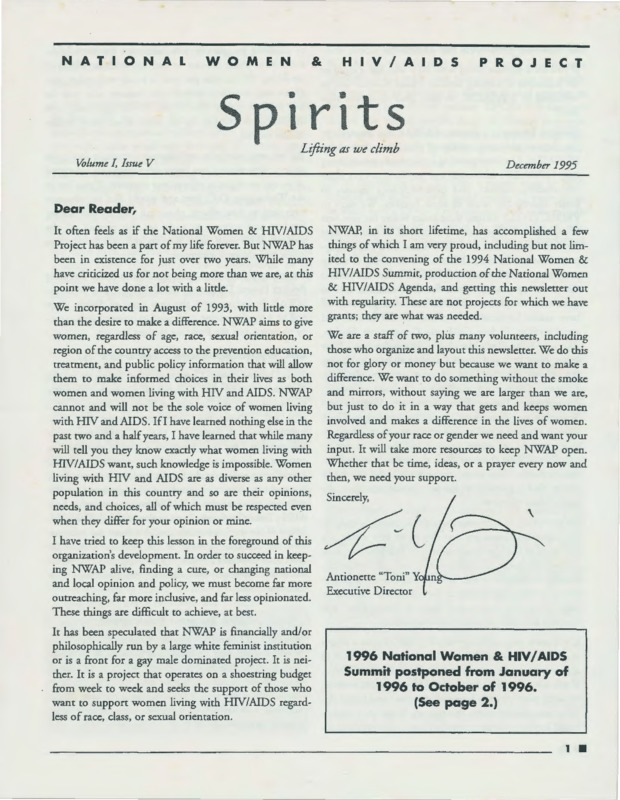
NATIONAL
WOMEN
&
HIV/AIDS
PROJECT
Spirits
Lifting as we climb
Volume l Issue V
December 1995
Dear Reader,
It often feels as if the National Women & HIV/AIDS
Project has been a part of my life forever. But NWAP has
been in existence for just over two years. While many
have criticized us for not being more than we are, at this
point we have done a lot with a little.
We incorporated in August of 1993, with little more
than the desire to make a difference. NWAP aims to give
women, regardless of age, race, sexual orientation, or
region of the country access to the prevention education,
treatment, and public policy information that will allow
them to make informed choices in their lives as both
women and women living with HIV and AIDS. NWAP
cannot and will not be the sole voice of women living
with HIV and AIDS. If! have learned nothing else in the
past two and a half years, I have learned that while many
will tell you they know exactly what women living with
HIV/AIDS want, such knowledge is impossible. Women
living with HIV and AIDS are as diverse as any other
population in this country and so are their opinions,
needs, and choices, all of which must be respected even
when they differ for your opinion or mine.
I have tried to keep this lesson in the foreground of this
organization's development. In order to succeed in keeping NWAP alive, finding a cure, or changing national
and local opinion and policy, we must become far more
outreaching, far more inclusive, and far less opinionated.
These things are difficult to achieve, at best.
It has been speculated that NWAP is financially and/or
philosophically run by a large white feminist institution
or is a front for a gay male dominated project. It is neither. It is a project that operates on a shoestring budget
from week to week and seeks the support of those who
want to support women living with HIV/AIDS regardless of race, class, or sexual orientation.
NWAP, in its short lifetime, has accomplished a few
things of which I am very proud, including but not limited to the convening of the 1994 National Women &
HIV/AIDS Summit, production of the National Women
& HIV/AIDS Agenda, and getting this newsletter out
with regularity. These are not projects for which we have
grants; they are what was needed.
We are a staff of two, plus many volunteers, including
those who organize and layout this newsletter. We do this
not for glory or money but because we want to make a
difference. We wanno do something without the smoke
and mirrors, without saying we are larger than we are,
but just to do it in a way that gets and keeps women
involved and makes a difference in the lives of women.
Regardless of your race or gender we need and want your
input. It will take more resources to keep NWAP open.
Whether that be time, ideas, or a prayer every now and
then, we need your support.
Sincerely,
\
Antionette "Toni" Y◄
Executive Director
nv-----
1996 National Women & HIV/AIDS
Summit postponed from January of
1996 to October of 1996.
(See page 2.)
1
■
BUILDING BRIDGES for Families
cy planning program in your area, and we don't know
about you, please contact us and let us know what you
If you are a woman living with HIV who has a child or are doing. We can also put you in touch with other proare interested in helping families whose children will be
grams and providers around the country who may be
orphaned by HIV/AIDS, we need your input and supable to assist you in your efforts. If you need help with
port!!
introducing legislation, we can share other states' legislaBuilding Bridges is a project of NWAP that responds to tion as models.
the future planning needs of families affected by
But we need your help, too! Share information about this
HIV/AIDS. Our ever-growing network of parents living
project with anyone you know who might be interested
with HIV/AIDS, advocates, and service providers share
so we can continue to expand our network. If you live in
information, support, and program/policy models to
the Washington D.C. area and would like to volunteer
better address the needs of these families. We want to
your time to these efforts, please call. We are still seeking
PROACTIVELY address these issues before the numbers
funding and support to truly get this project off the
of orphaned children rise out of control, so that mothers
ground. With your help, we can and will bring these
can feel assured that they have found safe, stable, supissues into national awareness.
portive homes for their children. We are trying to set up
programs that will work with families before the parents For more information, contact Kristin Neil, Building
die to set up custody plans for their children and to Bridges Project Director at (202) 547-1155 or write c/o
ensure that the parents, children, and future guardians all NWAP. Beginning with the next issue of Spirits, there
have access to necessary medical, mental health, and will be a regular section dedicated to issues of permanensocial services. To date, California, Connecticut, Florida, cy planning and the Building Bridges Project.
Illinois, Kentucky, Maryland, Massachusetts, New
Jersey, New York and North Carolina all have legislation CDC cryptosporidiosis "voice-fax"
that allows for this kind of prior custody planning. Scott Damon, Health Communication Specialist for the
Arizona, District of Columbia, Indiana, Georgia, National Center for Infectious Diseases, recently
Pennsylvania, Puerto Rico, Tennessee, Virginia and announced that the Centers for Disease Control (CDC)
Wyoming are all working on similar legislation. These now has a "voice-fax" telephone system for crypjoint or standby guardianship provisions allow terminal- tosporidiosis. Callers to this "Cryptosporidiosis
ly ill parents to name another individual to act as Information Line" can listen to recorded messages on
guardian of their children upon the parent's hospitaliza- cryptosporidiosis and order printed materials, designed
tion or death. These plans can be made ahead of time to for different audiences, by fax. One of the items available
ensure that a parent's wishes are upheld regarding the is a multi-page informational fact sheet designed specificare of their children.
cally for persons who are HIV positive or who have
AIDS. The information line number is (404) 330-1242.
We are trying to raise awareness about prior planning so
Many of the same materials available from the informathat these provisions are available in all fifty states. We
tion line are also available at the National Center for
also want to share program models so that effective, supInfectious Diseases Internet Home Page on the World
portive programs accompany this sort of legislation.
Wide Web, at http://www.cdc.gov/ncidod/diseases/crypFinally, we want to be able to help with training legal serto/ crypto.htm.
vice providers, social service providers, and families so
that all parties understand how to work their way
il996+'-summit:P,()~!PP'1!il
through the maze of prior planning options.
If you are a woman living with HIV/AIDS who is trying };he Seti:ind Annu:if National Wom2n (& ;:HIY';
to plan for your children, and you don't know how to
access services, we can try to find those contacts for you.
If you are a woman who has been able to access services,
we want your input to know what is most and least helpful as you move through this process. If you are a legal or
social service provider trying to implement a permanen■
2
~cJi~.d~e~:tJ~•·J~~db+'.\pf.:1'
~i
S~~g:whi~,~~.
~eenpostponed ~ntil ~ctb~ir ~?f I 9~f.44ft~ a ..•~~
,
tinancial. •:ommi;ment.
are stil~ :tty~p;gw
to ctj~irp1.:,
the new dat~. Watch this space fo~ ~of~,up4at~.~ Pl¢¥e :
•c:ontinue to .sub~it your 'Yorkshop requests artcl ~emt,:
/ t:ration information.
; 1 ; •· t •
Volunteers needed for study of HIV
viral load test
ical practice. Those in the HIV RNA arm will have
bDNA assays performed at least every four months
throughout the study, and clinicians will use the results
of these tests in addition to current clinical practice to
manage the care of these patients. CPCRA 036 does not
dictate the use of specific drugs or clinical strategies.
Decisions about preventive and therapeutic drug regimens will be decided by the study volunteers in consultation with their doctors.
NWDNews
A new multicenter study will determine if monitoring
levels of HIY, the virus that causes AIDS, in a person's
blood can keep patients healthier longer by helping doctors make better treatment decisions. The study, sponsored by the National Institute of Allergy and Infectious
Diseases (NIAID), is recruiting ll00 HIV-infected people through the NWD-supported Terry Beirn
Community Programs for Clinical Research on AIDS
(CPCRA), a community-based clinical trials network.
CPCRA study 036 is comparing two strategies for deciding when to change anti-HIV therapy: 1) current clinical
practice alone (monitoring the development of or
changes in HIV symptoms as well as blood levels of
CD4+ T cells, imtnune cells destroyed by HIV) versus 2)
current clinical practice plus periodic tests measuring the
amount of HIY, or viral load, in a given amount of
blood.
Although doctors commonly change a patient's antiretroviral therapy when drug efficacy appears to wane,
they need better tools for deciding when such changes
might be most beneficial. A new technology that detects
blood levels of HIV RNA, the genetic material of HIV,
has been suggested as a promising way for clinicians to
both gauge the effectiveness of therapy and predict when
the disease might get worse.
"While many people believe that changes in the level of
HIV RNA are good indicators of drug effectiveness, this
has never been proven. This study will determine
whether use of this expensive technology makes a difference in the quality of a patient's life," says Jack Killen,
MD, director of NIAID's Division of AIDS. It is not
known, for example, if keeping HIV burden at a minimum with available therapies will have any clinical benefit, or if switching treatments more frequently will result
in drug choices being exhausted too quickly.
The CPCRA study team has chosen to use the branched
DNA (bDNA) assay for HIV-1, one of several new
research tests that measure HIV viral load. The assay
yields reproducible results and is relatively simple to perform. Volunteers in CPCRA 036 will be divided at random into two groups of 550 each - a current clinical
practice (CCP) arm and an HIV RNA arm. Those in the
CCP arm will be taken care of according to current din-:
To be eligible for CPCRA 036, a person must be HIVinfected and in reasonably good health, 13 years of age
or older, have a CD4+ T cell count of 300 or fewer cells
per cubic millimeter of blood 16 weeks prior to randomization, and receive their care from a participating
CPCRAsite.
To obtain a list of CPCRA sites expected to participate
in the study, as well as contact telephone numbers at
those sites, call the AIDS Clinical Trials Information
Service at 1-800-TRIALS-A (1-800-874-2572) .
•'Aclve ~i s·i ng Rc:J.~es For ,s:p i..r.,.· its:
.•>:•.·''.·
-.:<.--:-.··:-:
.,.,-:
~
.
-._
•·
Corrzmercial ' >lf/)t
: F,ull 'Page
$750
; c7.5 ·xl0) ; 1/2 Pagt •
,·
{:
. (3.625
,
X ~
$360
,
•• •
:. Ii4 ;Page .
: (3~625·x 5 o
s
•'2wii>
...
•· •
• ,
:p±at~ir
,\,O ikHi
rpentu1;i .c .. •••.••. ~~!k!1~P~ltl:f ·J'\\j!,o~~}fitli~:3-~entf
addifionaLl5%ad~inistr~tive;Jee.
•will be·billed
.. .
:t
an
j
·Qalendar':iistin,g?,· /
<::.
>{:/:
•· gileddai listirig$"af~{re<!tolhlL' Pleal;¢<fuc1ptle 'the fc>l- •
\lbwi0;!finforirt[h~~= •
,
••
\ Event. Title>,
Descriptiqn .of,~~~nt
•
. . D~y, Qate, [iine; Cand,. ,.·
Event. Cost
Name of Contact Person
3
■
Thalidomide effective treatment for AIDS·
related mouth ulcers
NWDNews
Thalidomide effectively and safely heals severe mouth
ulcers (also called oral aphthous ulcers) in persons with
HN infection, according to an interim analysis of data
from a placebo-controlled study supported by the
National Institute of Allergy and Infectious Diseases
(NWD).
"t.rye rCommon Cerits
, pQnd for Women
,t;:;:~~~J!i!~;'
ifpott~r ~~a.r v <,. nd »p~wa}'S ,t9 s~rl'01;r ;~ ~,.
~1'9~£~ ah~ ~(!7~!ili7 ·doors ?PC!Il;;J;~;~~~~ ~ one.~n,.
w,-~ich not oruyr~ubuc every9n:y0µJaiow can sup--·
po~rr>:grassr9ots;or~anizatfop throg.gh.: irp-e·grassroots
'effom
•
•
·' .
.
The study (ACTG 251) compares the effectiveness and
safety of thalidomide with placebo for treating patients
:We.are dski~g,i ndiidtials rhro~\9ur Jhe U.S·:'Jd h71P,
with severe oral and esophageal ulcers. In the second or
~ ·this dfort/iand
µopejr, 'l~e ~the~ gr~sr9ots ~ :.
maintenance phase of the study, doctors are evaluating
·has'l~t~~ ..~eso~;ces . arid i••
thalidomide's ability to prevent recurrences of ulcers in R~~gn!t ·Jm -~~w.
needs th{h<?!P ofa~a1;t~ers like Nafton~B~~ .a~d ro,u. the mouth or the esophagus. As a result of the finding of
~re~4:~o
the interim analysis, current and newly enrolled study i11 ~r~~ -~~ivf Nario~~a~k®. .
•\~fct>li~cQoh~it<?!f6~,f~~ cha~ge ~~U:follecr:.~ tnariy ;~f•
participants with oral ulcers will all receive open-label
yzu -~ i(~'?J, ~C>~t:baflkswi!! not ~Cfent ~ ,:~gt;(th~t
thalidomide rather than being randomized to receive
i~ :11~t ;~.µ.id an~1:wr~pped: NationfB~® ill,as . agf~~4,
either placebo or drug. Patients with esophageal ulcers
fO ~~<;:an !;ce~tioirfor p~rticip~ts i~ ~he r<>mnto:~ '
will continue to be randomized. (The effectiveness of
CentsFFun<lieff~rpt,.In aq~ti<>~ •. re ~onating:your O'\V~i
thalidomide for patients with ulcers in the esophagus
:9hange, here1~re ;oili~r ideas•· tliat:yyill ~elj?'getth¢'fu~4 ·
could not be evaluated because of limited patient enrollsta.i;trfl: .
••
• '.
••
ment.)
Exj~~n ~ 7 pr()J~f io I?o/o~e.yo~ ;Kr()~- :
''Thalidomide is the first treatment shown in a rigorous
J?I~ce;aj;ir
in
offtce;inoajff)<>£
";itH:
scientific study to heal these ulcers. As the study continiiiformation'"ori: ;.&wAP .ana:·~k ./ii:iai:vidliils' J:O
ues, we anticipate additional valuable information about
~ i ~~J~<>r ~~j~. ;
the drug's effectiveness and long-term toxicity" said
•Puvani adyetfi~emenf iri yqµfio
Anthony S. Fauci, MD, director of NWD. The Ad Hoc
!'v~f .f; ;il~ora~~your\~h ~i::u.~r!to -~~e+~f::
Interim Review Committee found that the ulcers had
;~ o~)' ;or,of(erJ P;ize ~o ID7 personwho;:coBects <1f .
healed in 14 of 23 patients receiving thalidomide compared with only one out of 22 patients receiving placebo.
The committee also looked at the safety data available for
.J
·
.••..•·: .1
· ~~
.;.•·~ .·, · ·) fJ ' epp,le1
the first 73 patients enrolled in either the mouth ulcer or
:{:;:): :'•.
::::-:i.: .•,.
,..
.
esophageal ulcer part of the trial and found no significant
differences in severe side effects that could be attributable
to either thalidomide or placebo.
w~
:~ ¥
~z
h~
r~:~r
:~~.·r
s~~p,#!~~
. ;9Ei~~i11
~f~
~~ ~
According to study chair Jeffrey M. Jacobson, MD,
ACTG 251 is continuing to enroll HIV-infected men
and women at sites across the U.S. Study plans call for
164 participants. Thalidomide is known to cause malformations in infants born to women taking the drug, and
women of child-bearing age who participate in ACTG
251 are fully informed about this risk. For more information about this and other AIDS clinical trials, please
call the AIDS Clinical Trials Information Service at 1800-TRIALS-A (1-800-874-2572).
■ 4
it:p ~~~t.~:Ji1
:fjft~~~tii~
5~e '
fU: •' ~()Wri • • • 01·,.,
W()fk •. •f()~ r b9~h ; yog. ,,an~ •
:Nations~in½@ nlff~u~~t>to
~fl~p()1~S~l"
The <Eo~~nCen~:Fun~rin ~oir;arei,tplease fOilta~f
Toni You,pg at;;J SW~. •,NWAP .: i$ .a t •
•
zation.
ger~.~o!;rd
-
~
-
-
-
-
- -- - - - - - - - - - - - - - - - - - - - - - - - - - - - - - - - - - - --
r-----------------------------------------------,
Be a supporter of a true
I
grassroots network!
NWAP, I realize how difficult it is to develop a network
reflective of the women living with HN and AIDS and
I want to help. Here is my contribution:
No woman living with HN or AIDS will be denied
membership!
D
D
D
D
D
D
D
D
I would like to receive your material in a plain
envelope.
D
Sign me up for the Women & AIDS Advocacy
Corps.
$1000 Golden Patron
D
Here's my gift of $
$15
Women living with HN or AIDS
$25
Supporters
$50
Friends
$100
Organizations
$250
Businesses and Corporations
$500
Patrons
Send this form with your name, address, city, state,
and zip (plus phone, fax, and email, if you like) to
NWAP • 710 Eye Street, SE • Washington DC
20003.
NWAP is a tax exempt 50l(c) 3 organization.
L-----------------------------------------------J
Combination therapy: The next step
The results of two large drug studies - the Delta trial
and ACTG 175 - have important implications for the
treatment ofHN disease. These studies prove that combination treatment is more effective than monotherapy
in slowing disease progression and increasing survival
time, especially among individuals with no prior antiHN therapy.
These trials were carried out using first generation AIDS
drugs (AZT, ddI, ddC) that show only a limited benefit
for the treatment of HN infection. Researchers now
believe that combination regimens that include standard
treatments plus 3TC and one or more of the new protease inhibitor drugs will produce greater clinical benefits for a more sustained period. Broad patient access to
these promising new therapies will create, for the first
time, a real possibility for significantly improving the
standard of care for HN disease and for clinicians to
begin individualizing treatment for their patients.
For these reasons, it is imperative that the FDA act
promptly and decisively in granting accelerated approval
to 3TC and saquinavir, and take every action necessary
to hasten approval of the protease drugs from Merck and
Abbott now in Phase III studies. It is equally important
that Roche, Merck and Abbott immediately start studies
of the protease drugs in combination together and with
other anti-HN agents.
Combination regimens are already a part of the therapeutic arsenal for some individuals. The important next
step is for the FDA to quickly approve newer, more
effective anti-HN drugs like 3TC and the protease
inhibitors for use in 3- and 4-drug combinations that are
expected to improve the quality of life and extend survival among people with HN infection and AIDS.
For more information please contact Ronald Baker,
Editor-in-chief, Treatment Publications at 415-4878065.
All 6f you wh~ h~~ ·access to computer·•·•
networks can now reach>NW.AP at:
WotnenAlDs@aol~cdm
5
■
r-----------------------------------------------,
•
Spirits Survey
We want your input so we can adapt Spirits to suit your needs! Please fill in the survey below and
return it to us at NWAP; 710 Eye Street, SE; Washington, DC, 20003 .
1.
How often do you read Spirits?
1
2
5
Always
Are the articles informative?
1
2
No
3.
4
Sometimes
Never
2.
3
4
3
Adequate
5
Very
Do you share the copy or content of Spirits with others?
1
Never
2
3
4
Sometimes
5
Always
4.
What would you like to see more or less of in Spirits?
5.
Would you write an article for Spirits? If yes, either attach it or give us a call to discuss it.
L-----------------------------------------------~
NWAP is putting out a call for new
Board members!
We are seeking nominations for individuals who are living with HN or AIDS, have a background in fundraising and development, and want to be a part of seeing
NWAP grow. Please complete the nomination form at
right. You may nominate yourself or someone else. You
do not have to be HN positive or female. However, keep
in mind, NWAP and its Board of Directors must be
majority women and reflective of the HN/AIDS pandemic in women.
NWAP Board Nomination
Person Being Nominated
Organizational Affiliation if any
Address
City/State/Zip
Why they would be a good board member
Nominated By (your name)
■
6
Governor Pataki takes action to save
lives: Mothers to know the results of
their newborn's HIV test
AIDS Policy Center
Governor George E. Pataki (NY) announced in early
October a major policy change that will allow mothers to
learn the results of HIV antibody tests performed on
newborn infants by the State Health Department.
"This action is about saving lives," said Governor Pataki.
"New York has more babies born with HIV than any
other state. I am prepared to do all I can consistent with
existing laws to ensure that every HIV-infected infant
receives the necessary medical treatment."
The Governor's action settles a lawsuit brought against
the State by the Association to Benefit Children seeking
mandatory testing of newborn infants and disclosure of
the test results to mothers. Negotiations to settle the lawsuit were led by Attorney General Dennis C. Vacco, an
outspoken advocate for disclosure of newborn HIV test
results.
"Every mother has the right to know if her child has
been exposed to HIV so that she and her doctor can take
steps to protect her child's health," said Attorney General
Vacco. "This settlement is not just a victory for the hundreds of babies exposed to HIV in this state, but also a
victory for common sense."
The Governor has directed State Health Commissioner
Barbara A. DeBuono, MD, to develop regulations that
will mandate prenatal HIV counseling and provide a
mechanism for mothers to obtain their infants' HIV test
results. The regulations will:
•
•
•
•
Allow each mother to indicate on a consent form
whether she wants to be informed of her infant's
HIV antibody test result.
Require the Health Department's Wadsworth
Laboratory to send an infant's test result requested by
the mother to her physician, who will in turn notify
the infant's mother.
Require all prenatal care providers subject to Health
Department jurisdiction to counsel pregnant women
about the risk of mother-to-child transmission of
HIV and encourage all pregnant women to voluntarily be tested.
Require hospitals to inform new mothers at the time
of delivery that blood samples from their newborns
•
are tested for HIV antibodies by the State Health
Department.
Require hospitals to arrange for necessary follow-up
testing and referral to care for the mother and child
if the infant's test result is positive.
The State Health Department has been testing anonymous newborn blood samples for HIV antibodies since
late 1987, as a means of monitoring the rate of HIV
infection among child-bearing women. The test results
are not given to mothers or physicians since there is no
identifying information on the sample when the test is
done currently. The testing is anonymous to comply with
the State's HIV Confidentiality Law, which prohibits
HIV testing of any individual without written consent.
"The proposed new State regulation is consistent with
the HIV Confidentiality Law because the mother would
sign a consent form to obtain the child's HIV test result,"
said Governor Pataki. "Any mother who does not want
her child's test result may indicate her refusal on the consent form."
When a newborn infant tests positive for HIV antibodies it means that the mother is infected, because newborns have antibodies from their mother's blood at birth.
Further tests are necessary to determine if the baby is
infected. About 20 to 25 percent of infected mothers
transmit the virus to their babies.
Physicians can now significantly reduce the risk that an
HIV-infected mother will transmit the virus to her child
if it is known early in pregnancy that the mother is
infected. The antiviral drug AZT taken during pregnancy has been shown to reduce the risk of HIV transmission from a mother to a child by as much as two-thirds
- from 25 percent to 8 percent.
"This is the first really good news we have had in the 15year history of the AIDS epidemic," Commissioner
DeBuono said. "I firmly believe that if pregnant women
are given this important information, virtually every
woman will want to take the test to protect her child."
Prenatal care settings that would be required to counsel
pregnant women include hospitals, clinics, and managed
care organizations. The mandate would not apply to
physicians in private practice, although the Health
Department has appealed to all physicians to make HIV
counseling and voluntary testing a routine part of prenatal 91re.
continued on page 9
7
■
Women's Network for Change - Action Alerts!!
Proposals to cut the Earned Income Tax Credit
will hurt working poor
The Earned Income Tax Credit (EITC) is a refundable
tax credit available to the working poor. Since its creation, EITC has been supported by both Democrats and
Republicans. It was hailed by President Reagan as "the
best antipoverty, the best pro-family, the best job creation
measure to come out of Congress." Last year the EITC
helped more than 2 million families stay out of poverty,
yet the Senate is proposing to cut the EITC by $43.2 billion, and the House by $23.3 billion to pay for tax cuts
for higher income Americans.
•
•
•
Working poor families will pay for tax cuts for higher income Americans. Families struggling to remain
economically self-sufficient with incomes between
$11,630 and $25,300 will sustain tax increases or see
their incomes shrink, while those with incomes over
$200,000 will see big gains under the tax proposals.
Under the Senate proposal, almost 20% of the $245
billion in tax cuts will be financed by cuts in the
EITC.
Cuts in the EITC will disproportionately affect
women who represent nearly 75% of all EITC recipients. Almost half of all families headed by single
mothers are poor, partially because women earn on
average 70% of what men earn. Women who have
left welfare and can now support their families will
be hurt by the cuts in the EITC which helps them
pay for food, clothing, transportation, and shelter,
and keeps them from going back on welfare.
The Senate tax proposal could increase the number
of families needing public assistance by cutting a tax
benefit that strengthens incentives to work and has
helped keep working poor families off welfare. The
cuts in the EITC will increase taxes for as many as 17
million working poor families, forcing many who
cannot support their families to turn to welfare.
Welfare reform leaves women without iob training or child care
Since 1935, Aid to Families with Dependent Children
(AFDC) has been the main welfare program that provides basic cash assistance to needy families living below
the poverty line. Currently there are 14.1 million people
■
8
receiving AFDC, and of those 4.1 million (29 percent)
are women and 9.6 million (68 percent) are children.
Reviews and studies demonstrate that AFDC must be
overhauled. However, any overhaul of a social safety net
program of which 97 percent of recipients are women
and children must be done carefully, without hurting the
children and by realistically moving their mothers from
welfare to work.
•
•
•
The House and Senate welfare reform bills are unrealistic because the bills mandate that welfare recipients work, but do not include the education, job
training, or child care necessary to permanently leave
welfare for work. Half of the applicants for welfare
are re-applicants, many of whom have worked and
cannot earn enough money to support their children
with their existing skills.
The House bill penalizes poor children because it
denies aid to children born to unmarried teenage
mothers, children born to women already receiving
welfare, and children whose paternity has not been
established. If these policies were in place today, it is
estimated that 5-6 million children would lose all
support.
The Senate budget bill would increase taxes on the
working poor. Currently, the Earned Income Tax
Credit (EITC) decreases taxes for low-income working families and helps millions of low-income working families leave welfare and stay off of welfare. Last
year, over 2 million families stayed out of poverty
because of the EITC. The Senate bill drastically cuts
EITC, increasing taxes for 17 million low-income
working families.
Here's what you can do!
Call your Representatives or Senator (202-224-3121 and
tell them to oppose welfare reform that goes too far and
doesn't give women the skills and child care necessary to
leave welfare permanently. Ask them also to oppose cutting the EITC for working poor families.
Copy these alerts and post them in public places, such as
day care centers and supermarkets.
Share this information with friends and others in your
community.
"Governor Pataki"from page 7
New York State leads the nation in the cumulative num-..
her of diagnosed AIDS cases and the number of women
and children who have developed AIDS. To date, nearly
92,000 New Yorkers have developed AIDS, 19,000 of
whom are women, and 1700 are children who have
developed AIDS due to maternal transmission of the
virus.
The Health Department data reveal that approximately
1400 HIV-infected women give birth annually in New
York State, and 20 to 25 percent of their infants also
become infected. This means that about 300 to 350
HIV-infants are born each year in New York.
Regulations proposed by the State Health Department
must be published for a public comment period, and
adopted by the State Hospital Review and Planning
Council before they can take effect. The agreement is
subject to court approval.
I Ryan White reauthorization stalled
again
HIV Policy Watch, San Francisco AIDS Foundation (SFAF)
The Ryan White CARE Act reauthorization passed the
House of Representatives by voice vote on September
18th. The Senate passed its version of reauthorization in
July on a 97 to 3 vote. A conference.committee of House
and Senate members was to meet soon after the House
vote to iron out differences between the two bills before
a conference report (a unified bill) is sent to both chambers for a final vote and then to the President for signature. The current Ryan White Act expired September
30th.
Unfortunately, despite these great victories in each
chamber, both chambers delayed in appointing members
to the conference committee. The House has still to
appoint its conferees. As a result, the bills remain stalled
in conference committee. This is problematic as the
Congress is now ,becoming consumed with the massive
task of reconciling the many appropriations bills, tax
bills and Medicaid and Medicare overhauls to create a
complete FYI 996 budget.
The conference committee now appears unlikely to act
before early November. At present, this odd gap in
authorization for Ryan White will not cause any disruption in funding or operation of Ryan White programs
across the nation as funding for the programs is occurring through the Continuing Resolution that runs until
November 13th. If reauthorization is delayed much
longer, however, it could have negative implications for
Ryan White programs. These implications are as yet
unclear.
n ..·ti?1at.•'?··
O~SQB:8060"
As detailed in October's HIV Policy Watch, there remain
many important differences between the Senate and
House bills. Through the CAEAR Coalition (Cities
Advocating Emergency AIDS Relief), SFAF continues
to work against the horrible provision on mandatory
testing of pregnant women and newborns in the House
bill; against the nonsensical single appropriations mechanism for Tides I and II; and in favor of a strong hold
harmless provision for all current Tide I cities.
9
■
BULK RATE
i
U.S. POSTAGE
PAID
WASHINGTON, D.C.
PERMIT NO. 433
71 0 Eye Street, SE
Washington, DC 20003
lllillllW..&IW/IIISPrlild
MS MARGRET COX
HERLAND VOICE
2312 N.W. , 39TH STREET
OKLAHOMA
Cl~
73112
-
NATIONAL
WOMEN
&
HIV/AIDS
PROJECT
Spirits
Lifting as we climb
Volume l Issue V
December 1995
Dear Reader,
It often feels as if the National Women & HIV/AIDS
Project has been a part of my life forever. But NWAP has
been in existence for just over two years. While many
have criticized us for not being more than we are, at this
point we have done a lot with a little.
We incorporated in August of 1993, with little more
than the desire to make a difference. NWAP aims to give
women, regardless of age, race, sexual orientation, or
region of the country access to the prevention education,
treatment, and public policy information that will allow
them to make informed choices in their lives as both
women and women living with HIV and AIDS. NWAP
cannot and will not be the sole voice of women living
with HIV and AIDS. If! have learned nothing else in the
past two and a half years, I have learned that while many
will tell you they know exactly what women living with
HIV/AIDS want, such knowledge is impossible. Women
living with HIV and AIDS are as diverse as any other
population in this country and so are their opinions,
needs, and choices, all of which must be respected even
when they differ for your opinion or mine.
I have tried to keep this lesson in the foreground of this
organization's development. In order to succeed in keeping NWAP alive, finding a cure, or changing national
and local opinion and policy, we must become far more
outreaching, far more inclusive, and far less opinionated.
These things are difficult to achieve, at best.
It has been speculated that NWAP is financially and/or
philosophically run by a large white feminist institution
or is a front for a gay male dominated project. It is neither. It is a project that operates on a shoestring budget
from week to week and seeks the support of those who
want to support women living with HIV/AIDS regardless of race, class, or sexual orientation.
NWAP, in its short lifetime, has accomplished a few
things of which I am very proud, including but not limited to the convening of the 1994 National Women &
HIV/AIDS Summit, production of the National Women
& HIV/AIDS Agenda, and getting this newsletter out
with regularity. These are not projects for which we have
grants; they are what was needed.
We are a staff of two, plus many volunteers, including
those who organize and layout this newsletter. We do this
not for glory or money but because we want to make a
difference. We wanno do something without the smoke
and mirrors, without saying we are larger than we are,
but just to do it in a way that gets and keeps women
involved and makes a difference in the lives of women.
Regardless of your race or gender we need and want your
input. It will take more resources to keep NWAP open.
Whether that be time, ideas, or a prayer every now and
then, we need your support.
Sincerely,
\
Antionette "Toni" Y◄
Executive Director
nv-----
1996 National Women & HIV/AIDS
Summit postponed from January of
1996 to October of 1996.
(See page 2.)
1
■
BUILDING BRIDGES for Families
cy planning program in your area, and we don't know
about you, please contact us and let us know what you
If you are a woman living with HIV who has a child or are doing. We can also put you in touch with other proare interested in helping families whose children will be
grams and providers around the country who may be
orphaned by HIV/AIDS, we need your input and supable to assist you in your efforts. If you need help with
port!!
introducing legislation, we can share other states' legislaBuilding Bridges is a project of NWAP that responds to tion as models.
the future planning needs of families affected by
But we need your help, too! Share information about this
HIV/AIDS. Our ever-growing network of parents living
project with anyone you know who might be interested
with HIV/AIDS, advocates, and service providers share
so we can continue to expand our network. If you live in
information, support, and program/policy models to
the Washington D.C. area and would like to volunteer
better address the needs of these families. We want to
your time to these efforts, please call. We are still seeking
PROACTIVELY address these issues before the numbers
funding and support to truly get this project off the
of orphaned children rise out of control, so that mothers
ground. With your help, we can and will bring these
can feel assured that they have found safe, stable, supissues into national awareness.
portive homes for their children. We are trying to set up
programs that will work with families before the parents For more information, contact Kristin Neil, Building
die to set up custody plans for their children and to Bridges Project Director at (202) 547-1155 or write c/o
ensure that the parents, children, and future guardians all NWAP. Beginning with the next issue of Spirits, there
have access to necessary medical, mental health, and will be a regular section dedicated to issues of permanensocial services. To date, California, Connecticut, Florida, cy planning and the Building Bridges Project.
Illinois, Kentucky, Maryland, Massachusetts, New
Jersey, New York and North Carolina all have legislation CDC cryptosporidiosis "voice-fax"
that allows for this kind of prior custody planning. Scott Damon, Health Communication Specialist for the
Arizona, District of Columbia, Indiana, Georgia, National Center for Infectious Diseases, recently
Pennsylvania, Puerto Rico, Tennessee, Virginia and announced that the Centers for Disease Control (CDC)
Wyoming are all working on similar legislation. These now has a "voice-fax" telephone system for crypjoint or standby guardianship provisions allow terminal- tosporidiosis. Callers to this "Cryptosporidiosis
ly ill parents to name another individual to act as Information Line" can listen to recorded messages on
guardian of their children upon the parent's hospitaliza- cryptosporidiosis and order printed materials, designed
tion or death. These plans can be made ahead of time to for different audiences, by fax. One of the items available
ensure that a parent's wishes are upheld regarding the is a multi-page informational fact sheet designed specificare of their children.
cally for persons who are HIV positive or who have
AIDS. The information line number is (404) 330-1242.
We are trying to raise awareness about prior planning so
Many of the same materials available from the informathat these provisions are available in all fifty states. We
tion line are also available at the National Center for
also want to share program models so that effective, supInfectious Diseases Internet Home Page on the World
portive programs accompany this sort of legislation.
Wide Web, at http://www.cdc.gov/ncidod/diseases/crypFinally, we want to be able to help with training legal serto/ crypto.htm.
vice providers, social service providers, and families so
that all parties understand how to work their way
il996+'-summit:P,()~!PP'1!il
through the maze of prior planning options.
If you are a woman living with HIV/AIDS who is trying };he Seti:ind Annu:if National Wom2n (& ;:HIY';
to plan for your children, and you don't know how to
access services, we can try to find those contacts for you.
If you are a woman who has been able to access services,
we want your input to know what is most and least helpful as you move through this process. If you are a legal or
social service provider trying to implement a permanen■
2
~cJi~.d~e~:tJ~•·J~~db+'.\pf.:1'
~i
S~~g:whi~,~~.
~eenpostponed ~ntil ~ctb~ir ~?f I 9~f.44ft~ a ..•~~
,
tinancial. •:ommi;ment.
are stil~ :tty~p;gw
to ctj~irp1.:,
the new dat~. Watch this space fo~ ~of~,up4at~.~ Pl¢¥e :
•c:ontinue to .sub~it your 'Yorkshop requests artcl ~emt,:
/ t:ration information.
; 1 ; •· t •
Volunteers needed for study of HIV
viral load test
ical practice. Those in the HIV RNA arm will have
bDNA assays performed at least every four months
throughout the study, and clinicians will use the results
of these tests in addition to current clinical practice to
manage the care of these patients. CPCRA 036 does not
dictate the use of specific drugs or clinical strategies.
Decisions about preventive and therapeutic drug regimens will be decided by the study volunteers in consultation with their doctors.
NWDNews
A new multicenter study will determine if monitoring
levels of HIY, the virus that causes AIDS, in a person's
blood can keep patients healthier longer by helping doctors make better treatment decisions. The study, sponsored by the National Institute of Allergy and Infectious
Diseases (NIAID), is recruiting ll00 HIV-infected people through the NWD-supported Terry Beirn
Community Programs for Clinical Research on AIDS
(CPCRA), a community-based clinical trials network.
CPCRA study 036 is comparing two strategies for deciding when to change anti-HIV therapy: 1) current clinical
practice alone (monitoring the development of or
changes in HIV symptoms as well as blood levels of
CD4+ T cells, imtnune cells destroyed by HIV) versus 2)
current clinical practice plus periodic tests measuring the
amount of HIY, or viral load, in a given amount of
blood.
Although doctors commonly change a patient's antiretroviral therapy when drug efficacy appears to wane,
they need better tools for deciding when such changes
might be most beneficial. A new technology that detects
blood levels of HIV RNA, the genetic material of HIV,
has been suggested as a promising way for clinicians to
both gauge the effectiveness of therapy and predict when
the disease might get worse.
"While many people believe that changes in the level of
HIV RNA are good indicators of drug effectiveness, this
has never been proven. This study will determine
whether use of this expensive technology makes a difference in the quality of a patient's life," says Jack Killen,
MD, director of NIAID's Division of AIDS. It is not
known, for example, if keeping HIV burden at a minimum with available therapies will have any clinical benefit, or if switching treatments more frequently will result
in drug choices being exhausted too quickly.
The CPCRA study team has chosen to use the branched
DNA (bDNA) assay for HIV-1, one of several new
research tests that measure HIV viral load. The assay
yields reproducible results and is relatively simple to perform. Volunteers in CPCRA 036 will be divided at random into two groups of 550 each - a current clinical
practice (CCP) arm and an HIV RNA arm. Those in the
CCP arm will be taken care of according to current din-:
To be eligible for CPCRA 036, a person must be HIVinfected and in reasonably good health, 13 years of age
or older, have a CD4+ T cell count of 300 or fewer cells
per cubic millimeter of blood 16 weeks prior to randomization, and receive their care from a participating
CPCRAsite.
To obtain a list of CPCRA sites expected to participate
in the study, as well as contact telephone numbers at
those sites, call the AIDS Clinical Trials Information
Service at 1-800-TRIALS-A (1-800-874-2572) .
•'Aclve ~i s·i ng Rc:J.~es For ,s:p i..r.,.· its:
.•>:•.·''.·
-.:<.--:-.··:-:
.,.,-:
~
.
-._
•·
Corrzmercial ' >lf/)t
: F,ull 'Page
$750
; c7.5 ·xl0) ; 1/2 Pagt •
,·
{:
. (3.625
,
X ~
$360
,
•• •
:. Ii4 ;Page .
: (3~625·x 5 o
s
•'2wii>
...
•· •
• ,
:p±at~ir
,\,O ikHi
rpentu1;i .c .. •••.••. ~~!k!1~P~ltl:f ·J'\\j!,o~~}fitli~:3-~entf
addifionaLl5%ad~inistr~tive;Jee.
•will be·billed
.. .
:t
an
j
·Qalendar':iistin,g?,· /
<::.
>{:/:
•· gileddai listirig$"af~{re<!tolhlL' Pleal;¢<fuc1ptle 'the fc>l- •
\lbwi0;!finforirt[h~~= •
,
••
\ Event. Title>,
Descriptiqn .of,~~~nt
•
. . D~y, Qate, [iine; Cand,. ,.·
Event. Cost
Name of Contact Person
3
■
Thalidomide effective treatment for AIDS·
related mouth ulcers
NWDNews
Thalidomide effectively and safely heals severe mouth
ulcers (also called oral aphthous ulcers) in persons with
HN infection, according to an interim analysis of data
from a placebo-controlled study supported by the
National Institute of Allergy and Infectious Diseases
(NWD).
"t.rye rCommon Cerits
, pQnd for Women
,t;:;:~~~J!i!~;'
ifpott~r ~~a.r v <,. nd »p~wa}'S ,t9 s~rl'01;r ;~ ~,.
~1'9~£~ ah~ ~(!7~!ili7 ·doors ?PC!Il;;J;~;~~~~ ~ one.~n,.
w,-~ich not oruyr~ubuc every9n:y0µJaiow can sup--·
po~rr>:grassr9ots;or~anizatfop throg.gh.: irp-e·grassroots
'effom
•
•
·' .
.
The study (ACTG 251) compares the effectiveness and
safety of thalidomide with placebo for treating patients
:We.are dski~g,i ndiidtials rhro~\9ur Jhe U.S·:'Jd h71P,
with severe oral and esophageal ulcers. In the second or
~ ·this dfort/iand
µopejr, 'l~e ~the~ gr~sr9ots ~ :.
maintenance phase of the study, doctors are evaluating
·has'l~t~~ ..~eso~;ces . arid i••
thalidomide's ability to prevent recurrences of ulcers in R~~gn!t ·Jm -~~w.
needs th{h<?!P ofa~a1;t~ers like Nafton~B~~ .a~d ro,u. the mouth or the esophagus. As a result of the finding of
~re~4:~o
the interim analysis, current and newly enrolled study i11 ~r~~ -~~ivf Nario~~a~k®. .
•\~fct>li~cQoh~it<?!f6~,f~~ cha~ge ~~U:follecr:.~ tnariy ;~f•
participants with oral ulcers will all receive open-label
yzu -~ i(~'?J, ~C>~t:baflkswi!! not ~Cfent ~ ,:~gt;(th~t
thalidomide rather than being randomized to receive
i~ :11~t ;~.µ.id an~1:wr~pped: NationfB~® ill,as . agf~~4,
either placebo or drug. Patients with esophageal ulcers
fO ~~<;:an !;ce~tioirfor p~rticip~ts i~ ~he r<>mnto:~ '
will continue to be randomized. (The effectiveness of
CentsFFun<lieff~rpt,.In aq~ti<>~ •. re ~onating:your O'\V~i
thalidomide for patients with ulcers in the esophagus
:9hange, here1~re ;oili~r ideas•· tliat:yyill ~elj?'getth¢'fu~4 ·
could not be evaluated because of limited patient enrollsta.i;trfl: .
••
• '.
••
ment.)
Exj~~n ~ 7 pr()J~f io I?o/o~e.yo~ ;Kr()~- :
''Thalidomide is the first treatment shown in a rigorous
J?I~ce;aj;ir
in
offtce;inoajff)<>£
";itH:
scientific study to heal these ulcers. As the study continiiiformation'"ori: ;.&wAP .ana:·~k ./ii:iai:vidliils' J:O
ues, we anticipate additional valuable information about
~ i ~~J~<>r ~~j~. ;
the drug's effectiveness and long-term toxicity" said
•Puvani adyetfi~emenf iri yqµfio
Anthony S. Fauci, MD, director of NWD. The Ad Hoc
!'v~f .f; ;il~ora~~your\~h ~i::u.~r!to -~~e+~f::
Interim Review Committee found that the ulcers had
;~ o~)' ;or,of(erJ P;ize ~o ID7 personwho;:coBects <1f .
healed in 14 of 23 patients receiving thalidomide compared with only one out of 22 patients receiving placebo.
The committee also looked at the safety data available for
.J
·
.••..•·: .1
· ~~
.;.•·~ .·, · ·) fJ ' epp,le1
the first 73 patients enrolled in either the mouth ulcer or
:{:;:): :'•.
::::-:i.: .•,.
,..
.
esophageal ulcer part of the trial and found no significant
differences in severe side effects that could be attributable
to either thalidomide or placebo.
w~
:~ ¥
~z
h~
r~:~r
:~~.·r
s~~p,#!~~
. ;9Ei~~i11
~f~
~~ ~
According to study chair Jeffrey M. Jacobson, MD,
ACTG 251 is continuing to enroll HIV-infected men
and women at sites across the U.S. Study plans call for
164 participants. Thalidomide is known to cause malformations in infants born to women taking the drug, and
women of child-bearing age who participate in ACTG
251 are fully informed about this risk. For more information about this and other AIDS clinical trials, please
call the AIDS Clinical Trials Information Service at 1800-TRIALS-A (1-800-874-2572).
■ 4
it:p ~~~t.~:Ji1
:fjft~~~tii~
5~e '
fU: •' ~()Wri • • • 01·,.,
W()fk •. •f()~ r b9~h ; yog. ,,an~ •
:Nations~in½@ nlff~u~~t>to
~fl~p()1~S~l"
The <Eo~~nCen~:Fun~rin ~oir;arei,tplease fOilta~f
Toni You,pg at;;J SW~. •,NWAP .: i$ .a t •
•
zation.
ger~.~o!;rd
-
~
-
-
-
-
- -- - - - - - - - - - - - - - - - - - - - - - - - - - - - - - - - - - - --
r-----------------------------------------------,
Be a supporter of a true
I
grassroots network!
NWAP, I realize how difficult it is to develop a network
reflective of the women living with HN and AIDS and
I want to help. Here is my contribution:
No woman living with HN or AIDS will be denied
membership!
D
D
D
D
D
D
D
D
I would like to receive your material in a plain
envelope.
D
Sign me up for the Women & AIDS Advocacy
Corps.
$1000 Golden Patron
D
Here's my gift of $
$15
Women living with HN or AIDS
$25
Supporters
$50
Friends
$100
Organizations
$250
Businesses and Corporations
$500
Patrons
Send this form with your name, address, city, state,
and zip (plus phone, fax, and email, if you like) to
NWAP • 710 Eye Street, SE • Washington DC
20003.
NWAP is a tax exempt 50l(c) 3 organization.
L-----------------------------------------------J
Combination therapy: The next step
The results of two large drug studies - the Delta trial
and ACTG 175 - have important implications for the
treatment ofHN disease. These studies prove that combination treatment is more effective than monotherapy
in slowing disease progression and increasing survival
time, especially among individuals with no prior antiHN therapy.
These trials were carried out using first generation AIDS
drugs (AZT, ddI, ddC) that show only a limited benefit
for the treatment of HN infection. Researchers now
believe that combination regimens that include standard
treatments plus 3TC and one or more of the new protease inhibitor drugs will produce greater clinical benefits for a more sustained period. Broad patient access to
these promising new therapies will create, for the first
time, a real possibility for significantly improving the
standard of care for HN disease and for clinicians to
begin individualizing treatment for their patients.
For these reasons, it is imperative that the FDA act
promptly and decisively in granting accelerated approval
to 3TC and saquinavir, and take every action necessary
to hasten approval of the protease drugs from Merck and
Abbott now in Phase III studies. It is equally important
that Roche, Merck and Abbott immediately start studies
of the protease drugs in combination together and with
other anti-HN agents.
Combination regimens are already a part of the therapeutic arsenal for some individuals. The important next
step is for the FDA to quickly approve newer, more
effective anti-HN drugs like 3TC and the protease
inhibitors for use in 3- and 4-drug combinations that are
expected to improve the quality of life and extend survival among people with HN infection and AIDS.
For more information please contact Ronald Baker,
Editor-in-chief, Treatment Publications at 415-4878065.
All 6f you wh~ h~~ ·access to computer·•·•
networks can now reach>NW.AP at:
WotnenAlDs@aol~cdm
5
■
r-----------------------------------------------,
•
Spirits Survey
We want your input so we can adapt Spirits to suit your needs! Please fill in the survey below and
return it to us at NWAP; 710 Eye Street, SE; Washington, DC, 20003 .
1.
How often do you read Spirits?
1
2
5
Always
Are the articles informative?
1
2
No
3.
4
Sometimes
Never
2.
3
4
3
Adequate
5
Very
Do you share the copy or content of Spirits with others?
1
Never
2
3
4
Sometimes
5
Always
4.
What would you like to see more or less of in Spirits?
5.
Would you write an article for Spirits? If yes, either attach it or give us a call to discuss it.
L-----------------------------------------------~
NWAP is putting out a call for new
Board members!
We are seeking nominations for individuals who are living with HN or AIDS, have a background in fundraising and development, and want to be a part of seeing
NWAP grow. Please complete the nomination form at
right. You may nominate yourself or someone else. You
do not have to be HN positive or female. However, keep
in mind, NWAP and its Board of Directors must be
majority women and reflective of the HN/AIDS pandemic in women.
NWAP Board Nomination
Person Being Nominated
Organizational Affiliation if any
Address
City/State/Zip
Why they would be a good board member
Nominated By (your name)
■
6
Governor Pataki takes action to save
lives: Mothers to know the results of
their newborn's HIV test
AIDS Policy Center
Governor George E. Pataki (NY) announced in early
October a major policy change that will allow mothers to
learn the results of HIV antibody tests performed on
newborn infants by the State Health Department.
"This action is about saving lives," said Governor Pataki.
"New York has more babies born with HIV than any
other state. I am prepared to do all I can consistent with
existing laws to ensure that every HIV-infected infant
receives the necessary medical treatment."
The Governor's action settles a lawsuit brought against
the State by the Association to Benefit Children seeking
mandatory testing of newborn infants and disclosure of
the test results to mothers. Negotiations to settle the lawsuit were led by Attorney General Dennis C. Vacco, an
outspoken advocate for disclosure of newborn HIV test
results.
"Every mother has the right to know if her child has
been exposed to HIV so that she and her doctor can take
steps to protect her child's health," said Attorney General
Vacco. "This settlement is not just a victory for the hundreds of babies exposed to HIV in this state, but also a
victory for common sense."
The Governor has directed State Health Commissioner
Barbara A. DeBuono, MD, to develop regulations that
will mandate prenatal HIV counseling and provide a
mechanism for mothers to obtain their infants' HIV test
results. The regulations will:
•
•
•
•
Allow each mother to indicate on a consent form
whether she wants to be informed of her infant's
HIV antibody test result.
Require the Health Department's Wadsworth
Laboratory to send an infant's test result requested by
the mother to her physician, who will in turn notify
the infant's mother.
Require all prenatal care providers subject to Health
Department jurisdiction to counsel pregnant women
about the risk of mother-to-child transmission of
HIV and encourage all pregnant women to voluntarily be tested.
Require hospitals to inform new mothers at the time
of delivery that blood samples from their newborns
•
are tested for HIV antibodies by the State Health
Department.
Require hospitals to arrange for necessary follow-up
testing and referral to care for the mother and child
if the infant's test result is positive.
The State Health Department has been testing anonymous newborn blood samples for HIV antibodies since
late 1987, as a means of monitoring the rate of HIV
infection among child-bearing women. The test results
are not given to mothers or physicians since there is no
identifying information on the sample when the test is
done currently. The testing is anonymous to comply with
the State's HIV Confidentiality Law, which prohibits
HIV testing of any individual without written consent.
"The proposed new State regulation is consistent with
the HIV Confidentiality Law because the mother would
sign a consent form to obtain the child's HIV test result,"
said Governor Pataki. "Any mother who does not want
her child's test result may indicate her refusal on the consent form."
When a newborn infant tests positive for HIV antibodies it means that the mother is infected, because newborns have antibodies from their mother's blood at birth.
Further tests are necessary to determine if the baby is
infected. About 20 to 25 percent of infected mothers
transmit the virus to their babies.
Physicians can now significantly reduce the risk that an
HIV-infected mother will transmit the virus to her child
if it is known early in pregnancy that the mother is
infected. The antiviral drug AZT taken during pregnancy has been shown to reduce the risk of HIV transmission from a mother to a child by as much as two-thirds
- from 25 percent to 8 percent.
"This is the first really good news we have had in the 15year history of the AIDS epidemic," Commissioner
DeBuono said. "I firmly believe that if pregnant women
are given this important information, virtually every
woman will want to take the test to protect her child."
Prenatal care settings that would be required to counsel
pregnant women include hospitals, clinics, and managed
care organizations. The mandate would not apply to
physicians in private practice, although the Health
Department has appealed to all physicians to make HIV
counseling and voluntary testing a routine part of prenatal 91re.
continued on page 9
7
■
Women's Network for Change - Action Alerts!!
Proposals to cut the Earned Income Tax Credit
will hurt working poor
The Earned Income Tax Credit (EITC) is a refundable
tax credit available to the working poor. Since its creation, EITC has been supported by both Democrats and
Republicans. It was hailed by President Reagan as "the
best antipoverty, the best pro-family, the best job creation
measure to come out of Congress." Last year the EITC
helped more than 2 million families stay out of poverty,
yet the Senate is proposing to cut the EITC by $43.2 billion, and the House by $23.3 billion to pay for tax cuts
for higher income Americans.
•
•
•
Working poor families will pay for tax cuts for higher income Americans. Families struggling to remain
economically self-sufficient with incomes between
$11,630 and $25,300 will sustain tax increases or see
their incomes shrink, while those with incomes over
$200,000 will see big gains under the tax proposals.
Under the Senate proposal, almost 20% of the $245
billion in tax cuts will be financed by cuts in the
EITC.
Cuts in the EITC will disproportionately affect
women who represent nearly 75% of all EITC recipients. Almost half of all families headed by single
mothers are poor, partially because women earn on
average 70% of what men earn. Women who have
left welfare and can now support their families will
be hurt by the cuts in the EITC which helps them
pay for food, clothing, transportation, and shelter,
and keeps them from going back on welfare.
The Senate tax proposal could increase the number
of families needing public assistance by cutting a tax
benefit that strengthens incentives to work and has
helped keep working poor families off welfare. The
cuts in the EITC will increase taxes for as many as 17
million working poor families, forcing many who
cannot support their families to turn to welfare.
Welfare reform leaves women without iob training or child care
Since 1935, Aid to Families with Dependent Children
(AFDC) has been the main welfare program that provides basic cash assistance to needy families living below
the poverty line. Currently there are 14.1 million people
■
8
receiving AFDC, and of those 4.1 million (29 percent)
are women and 9.6 million (68 percent) are children.
Reviews and studies demonstrate that AFDC must be
overhauled. However, any overhaul of a social safety net
program of which 97 percent of recipients are women
and children must be done carefully, without hurting the
children and by realistically moving their mothers from
welfare to work.
•
•
•
The House and Senate welfare reform bills are unrealistic because the bills mandate that welfare recipients work, but do not include the education, job
training, or child care necessary to permanently leave
welfare for work. Half of the applicants for welfare
are re-applicants, many of whom have worked and
cannot earn enough money to support their children
with their existing skills.
The House bill penalizes poor children because it
denies aid to children born to unmarried teenage
mothers, children born to women already receiving
welfare, and children whose paternity has not been
established. If these policies were in place today, it is
estimated that 5-6 million children would lose all
support.
The Senate budget bill would increase taxes on the
working poor. Currently, the Earned Income Tax
Credit (EITC) decreases taxes for low-income working families and helps millions of low-income working families leave welfare and stay off of welfare. Last
year, over 2 million families stayed out of poverty
because of the EITC. The Senate bill drastically cuts
EITC, increasing taxes for 17 million low-income
working families.
Here's what you can do!
Call your Representatives or Senator (202-224-3121 and
tell them to oppose welfare reform that goes too far and
doesn't give women the skills and child care necessary to
leave welfare permanently. Ask them also to oppose cutting the EITC for working poor families.
Copy these alerts and post them in public places, such as
day care centers and supermarkets.
Share this information with friends and others in your
community.
"Governor Pataki"from page 7
New York State leads the nation in the cumulative num-..
her of diagnosed AIDS cases and the number of women
and children who have developed AIDS. To date, nearly
92,000 New Yorkers have developed AIDS, 19,000 of
whom are women, and 1700 are children who have
developed AIDS due to maternal transmission of the
virus.
The Health Department data reveal that approximately
1400 HIV-infected women give birth annually in New
York State, and 20 to 25 percent of their infants also
become infected. This means that about 300 to 350
HIV-infants are born each year in New York.
Regulations proposed by the State Health Department
must be published for a public comment period, and
adopted by the State Hospital Review and Planning
Council before they can take effect. The agreement is
subject to court approval.
I Ryan White reauthorization stalled
again
HIV Policy Watch, San Francisco AIDS Foundation (SFAF)
The Ryan White CARE Act reauthorization passed the
House of Representatives by voice vote on September
18th. The Senate passed its version of reauthorization in
July on a 97 to 3 vote. A conference.committee of House
and Senate members was to meet soon after the House
vote to iron out differences between the two bills before
a conference report (a unified bill) is sent to both chambers for a final vote and then to the President for signature. The current Ryan White Act expired September
30th.
Unfortunately, despite these great victories in each
chamber, both chambers delayed in appointing members
to the conference committee. The House has still to
appoint its conferees. As a result, the bills remain stalled
in conference committee. This is problematic as the
Congress is now ,becoming consumed with the massive
task of reconciling the many appropriations bills, tax
bills and Medicaid and Medicare overhauls to create a
complete FYI 996 budget.
The conference committee now appears unlikely to act
before early November. At present, this odd gap in
authorization for Ryan White will not cause any disruption in funding or operation of Ryan White programs
across the nation as funding for the programs is occurring through the Continuing Resolution that runs until
November 13th. If reauthorization is delayed much
longer, however, it could have negative implications for
Ryan White programs. These implications are as yet
unclear.
n ..·ti?1at.•'?··
O~SQB:8060"
As detailed in October's HIV Policy Watch, there remain
many important differences between the Senate and
House bills. Through the CAEAR Coalition (Cities
Advocating Emergency AIDS Relief), SFAF continues
to work against the horrible provision on mandatory
testing of pregnant women and newborns in the House
bill; against the nonsensical single appropriations mechanism for Tides I and II; and in favor of a strong hold
harmless provision for all current Tide I cities.
9
■
BULK RATE
i
U.S. POSTAGE
PAID
WASHINGTON, D.C.
PERMIT NO. 433
71 0 Eye Street, SE
Washington, DC 20003
lllillllW..&IW/IIISPrlild
MS MARGRET COX
HERLAND VOICE
2312 N.W. , 39TH STREET
OKLAHOMA
Cl~
73112
-
NATIONAL
WOMEN
&
HIV/AIDS
PROJECT
Spirits
Lifting as we climb
Volume l Issue V
December 1995
Dear Reader,
It often feels as if the National Women & HIV/AIDS
Project has been a part of my life forever. But NWAP has
been in existence for just over two years. While many
have criticized us for not being more than we are, at this
point we have done a lot with a little.
We incorporated in August of 1993, with little more
than the desire to make a difference. NWAP aims to give
women, regardless of age, race, sexual orientation, or
region of the country access to the prevention education,
treatment, and public policy information that will allow
them to make informed choices in their lives as both
women and women living with HIV and AIDS. NWAP
cannot and will not be the sole voice of women living
with HIV and AIDS. If! have learned nothing else in the
past two and a half years, I have learned that while many
will tell you they know exactly what women living with
HIV/AIDS want, such knowledge is impossible. Women
living with HIV and AIDS are as diverse as any other
population in this country and so are their opinions,
needs, and choices, all of which must be respected even
when they differ for your opinion or mine.
I have tried to keep this lesson in the foreground of this
organization's development. In order to succeed in keeping NWAP alive, finding a cure, or changing national
and local opinion and policy, we must become far more
outreaching, far more inclusive, and far less opinionated.
These things are difficult to achieve, at best.
It has been speculated that NWAP is financially and/or
philosophically run by a large white feminist institution
or is a front for a gay male dominated project. It is neither. It is a project that operates on a shoestring budget
from week to week and seeks the support of those who
want to support women living with HIV/AIDS regardless of race, class, or sexual orientation.
NWAP, in its short lifetime, has accomplished a few
things of which I am very proud, including but not limited to the convening of the 1994 National Women &
HIV/AIDS Summit, production of the National Women
& HIV/AIDS Agenda, and getting this newsletter out
with regularity. These are not projects for which we have
grants; they are what was needed.
We are a staff of two, plus many volunteers, including
those who organize and layout this newsletter. We do this
not for glory or money but because we want to make a
difference. We wanno do something without the smoke
and mirrors, without saying we are larger than we are,
but just to do it in a way that gets and keeps women
involved and makes a difference in the lives of women.
Regardless of your race or gender we need and want your
input. It will take more resources to keep NWAP open.
Whether that be time, ideas, or a prayer every now and
then, we need your support.
Sincerely,
\
Antionette "Toni" Y◄
Executive Director
nv-----
1996 National Women & HIV/AIDS
Summit postponed from January of
1996 to October of 1996.
(See page 2.)
1
■
BUILDING BRIDGES for Families
cy planning program in your area, and we don't know
about you, please contact us and let us know what you
If you are a woman living with HIV who has a child or are doing. We can also put you in touch with other proare interested in helping families whose children will be
grams and providers around the country who may be
orphaned by HIV/AIDS, we need your input and supable to assist you in your efforts. If you need help with
port!!
introducing legislation, we can share other states' legislaBuilding Bridges is a project of NWAP that responds to tion as models.
the future planning needs of families affected by
But we need your help, too! Share information about this
HIV/AIDS. Our ever-growing network of parents living
project with anyone you know who might be interested
with HIV/AIDS, advocates, and service providers share
so we can continue to expand our network. If you live in
information, support, and program/policy models to
the Washington D.C. area and would like to volunteer
better address the needs of these families. We want to
your time to these efforts, please call. We are still seeking
PROACTIVELY address these issues before the numbers
funding and support to truly get this project off the
of orphaned children rise out of control, so that mothers
ground. With your help, we can and will bring these
can feel assured that they have found safe, stable, supissues into national awareness.
portive homes for their children. We are trying to set up
programs that will work with families before the parents For more information, contact Kristin Neil, Building
die to set up custody plans for their children and to Bridges Project Director at (202) 547-1155 or write c/o
ensure that the parents, children, and future guardians all NWAP. Beginning with the next issue of Spirits, there
have access to necessary medical, mental health, and will be a regular section dedicated to issues of permanensocial services. To date, California, Connecticut, Florida, cy planning and the Building Bridges Project.
Illinois, Kentucky, Maryland, Massachusetts, New
Jersey, New York and North Carolina all have legislation CDC cryptosporidiosis "voice-fax"
that allows for this kind of prior custody planning. Scott Damon, Health Communication Specialist for the
Arizona, District of Columbia, Indiana, Georgia, National Center for Infectious Diseases, recently
Pennsylvania, Puerto Rico, Tennessee, Virginia and announced that the Centers for Disease Control (CDC)
Wyoming are all working on similar legislation. These now has a "voice-fax" telephone system for crypjoint or standby guardianship provisions allow terminal- tosporidiosis. Callers to this "Cryptosporidiosis
ly ill parents to name another individual to act as Information Line" can listen to recorded messages on
guardian of their children upon the parent's hospitaliza- cryptosporidiosis and order printed materials, designed
tion or death. These plans can be made ahead of time to for different audiences, by fax. One of the items available
ensure that a parent's wishes are upheld regarding the is a multi-page informational fact sheet designed specificare of their children.
cally for persons who are HIV positive or who have
AIDS. The information line number is (404) 330-1242.
We are trying to raise awareness about prior planning so
Many of the same materials available from the informathat these provisions are available in all fifty states. We
tion line are also available at the National Center for
also want to share program models so that effective, supInfectious Diseases Internet Home Page on the World
portive programs accompany this sort of legislation.
Wide Web, at http://www.cdc.gov/ncidod/diseases/crypFinally, we want to be able to help with training legal serto/ crypto.htm.
vice providers, social service providers, and families so
that all parties understand how to work their way
il996+'-summit:P,()~!PP'1!il
through the maze of prior planning options.
If you are a woman living with HIV/AIDS who is trying };he Seti:ind Annu:if National Wom2n (& ;:HIY';
to plan for your children, and you don't know how to
access services, we can try to find those contacts for you.
If you are a woman who has been able to access services,
we want your input to know what is most and least helpful as you move through this process. If you are a legal or
social service provider trying to implement a permanen■
2
~cJi~.d~e~:tJ~•·J~~db+'.\pf.:1'
~i
S~~g:whi~,~~.
~eenpostponed ~ntil ~ctb~ir ~?f I 9~f.44ft~ a ..•~~
,
tinancial. •:ommi;ment.
are stil~ :tty~p;gw
to ctj~irp1.:,
the new dat~. Watch this space fo~ ~of~,up4at~.~ Pl¢¥e :
•c:ontinue to .sub~it your 'Yorkshop requests artcl ~emt,:
/ t:ration information.
; 1 ; •· t •
Volunteers needed for study of HIV
viral load test
ical practice. Those in the HIV RNA arm will have
bDNA assays performed at least every four months
throughout the study, and clinicians will use the results
of these tests in addition to current clinical practice to
manage the care of these patients. CPCRA 036 does not
dictate the use of specific drugs or clinical strategies.
Decisions about preventive and therapeutic drug regimens will be decided by the study volunteers in consultation with their doctors.
NWDNews
A new multicenter study will determine if monitoring
levels of HIY, the virus that causes AIDS, in a person's
blood can keep patients healthier longer by helping doctors make better treatment decisions. The study, sponsored by the National Institute of Allergy and Infectious
Diseases (NIAID), is recruiting ll00 HIV-infected people through the NWD-supported Terry Beirn
Community Programs for Clinical Research on AIDS
(CPCRA), a community-based clinical trials network.
CPCRA study 036 is comparing two strategies for deciding when to change anti-HIV therapy: 1) current clinical
practice alone (monitoring the development of or
changes in HIV symptoms as well as blood levels of
CD4+ T cells, imtnune cells destroyed by HIV) versus 2)
current clinical practice plus periodic tests measuring the
amount of HIY, or viral load, in a given amount of
blood.
Although doctors commonly change a patient's antiretroviral therapy when drug efficacy appears to wane,
they need better tools for deciding when such changes
might be most beneficial. A new technology that detects
blood levels of HIV RNA, the genetic material of HIV,
has been suggested as a promising way for clinicians to
both gauge the effectiveness of therapy and predict when
the disease might get worse.
"While many people believe that changes in the level of
HIV RNA are good indicators of drug effectiveness, this
has never been proven. This study will determine
whether use of this expensive technology makes a difference in the quality of a patient's life," says Jack Killen,
MD, director of NIAID's Division of AIDS. It is not
known, for example, if keeping HIV burden at a minimum with available therapies will have any clinical benefit, or if switching treatments more frequently will result
in drug choices being exhausted too quickly.
The CPCRA study team has chosen to use the branched
DNA (bDNA) assay for HIV-1, one of several new
research tests that measure HIV viral load. The assay
yields reproducible results and is relatively simple to perform. Volunteers in CPCRA 036 will be divided at random into two groups of 550 each - a current clinical
practice (CCP) arm and an HIV RNA arm. Those in the
CCP arm will be taken care of according to current din-:
To be eligible for CPCRA 036, a person must be HIVinfected and in reasonably good health, 13 years of age
or older, have a CD4+ T cell count of 300 or fewer cells
per cubic millimeter of blood 16 weeks prior to randomization, and receive their care from a participating
CPCRAsite.
To obtain a list of CPCRA sites expected to participate
in the study, as well as contact telephone numbers at
those sites, call the AIDS Clinical Trials Information
Service at 1-800-TRIALS-A (1-800-874-2572) .
•'Aclve ~i s·i ng Rc:J.~es For ,s:p i..r.,.· its:
.•>:•.·''.·
-.:<.--:-.··:-:
.,.,-:
~
.
-._
•·
Corrzmercial ' >lf/)t
: F,ull 'Page
$750
; c7.5 ·xl0) ; 1/2 Pagt •
,·
{:
. (3.625
,
X ~
$360
,
•• •
:. Ii4 ;Page .
: (3~625·x 5 o
s
•'2wii>
...
•· •
• ,
:p±at~ir
,\,O ikHi
rpentu1;i .c .. •••.••. ~~!k!1~P~ltl:f ·J'\\j!,o~~}fitli~:3-~entf
addifionaLl5%ad~inistr~tive;Jee.
•will be·billed
.. .
:t
an
j
·Qalendar':iistin,g?,· /
<::.
>{:/:
•· gileddai listirig$"af~{re<!tolhlL' Pleal;¢<fuc1ptle 'the fc>l- •
\lbwi0;!finforirt[h~~= •
,
••
\ Event. Title>,
Descriptiqn .of,~~~nt
•
. . D~y, Qate, [iine; Cand,. ,.·
Event. Cost
Name of Contact Person
3
■
Thalidomide effective treatment for AIDS·
related mouth ulcers
NWDNews
Thalidomide effectively and safely heals severe mouth
ulcers (also called oral aphthous ulcers) in persons with
HN infection, according to an interim analysis of data
from a placebo-controlled study supported by the
National Institute of Allergy and Infectious Diseases
(NWD).
"t.rye rCommon Cerits
, pQnd for Women
,t;:;:~~~J!i!~;'
ifpott~r ~~a.r v <,. nd »p~wa}'S ,t9 s~rl'01;r ;~ ~,.
~1'9~£~ ah~ ~(!7~!ili7 ·doors ?PC!Il;;J;~;~~~~ ~ one.~n,.
w,-~ich not oruyr~ubuc every9n:y0µJaiow can sup--·
po~rr>:grassr9ots;or~anizatfop throg.gh.: irp-e·grassroots
'effom
•
•
·' .
.
The study (ACTG 251) compares the effectiveness and
safety of thalidomide with placebo for treating patients
:We.are dski~g,i ndiidtials rhro~\9ur Jhe U.S·:'Jd h71P,
with severe oral and esophageal ulcers. In the second or
~ ·this dfort/iand
µopejr, 'l~e ~the~ gr~sr9ots ~ :.
maintenance phase of the study, doctors are evaluating
·has'l~t~~ ..~eso~;ces . arid i••
thalidomide's ability to prevent recurrences of ulcers in R~~gn!t ·Jm -~~w.
needs th{h<?!P ofa~a1;t~ers like Nafton~B~~ .a~d ro,u. the mouth or the esophagus. As a result of the finding of
~re~4:~o
the interim analysis, current and newly enrolled study i11 ~r~~ -~~ivf Nario~~a~k®. .
•\~fct>li~cQoh~it<?!f6~,f~~ cha~ge ~~U:follecr:.~ tnariy ;~f•
participants with oral ulcers will all receive open-label
yzu -~ i(~'?J, ~C>~t:baflkswi!! not ~Cfent ~ ,:~gt;(th~t
thalidomide rather than being randomized to receive
i~ :11~t ;~.µ.id an~1:wr~pped: NationfB~® ill,as . agf~~4,
either placebo or drug. Patients with esophageal ulcers
fO ~~<;:an !;ce~tioirfor p~rticip~ts i~ ~he r<>mnto:~ '
will continue to be randomized. (The effectiveness of
CentsFFun<lieff~rpt,.In aq~ti<>~ •. re ~onating:your O'\V~i
thalidomide for patients with ulcers in the esophagus
:9hange, here1~re ;oili~r ideas•· tliat:yyill ~elj?'getth¢'fu~4 ·
could not be evaluated because of limited patient enrollsta.i;trfl: .
••
• '.
••
ment.)
Exj~~n ~ 7 pr()J~f io I?o/o~e.yo~ ;Kr()~- :
''Thalidomide is the first treatment shown in a rigorous
J?I~ce;aj;ir
in
offtce;inoajff)<>£
";itH:
scientific study to heal these ulcers. As the study continiiiformation'"ori: ;.&wAP .ana:·~k ./ii:iai:vidliils' J:O
ues, we anticipate additional valuable information about
~ i ~~J~<>r ~~j~. ;
the drug's effectiveness and long-term toxicity" said
•Puvani adyetfi~emenf iri yqµfio
Anthony S. Fauci, MD, director of NWD. The Ad Hoc
!'v~f .f; ;il~ora~~your\~h ~i::u.~r!to -~~e+~f::
Interim Review Committee found that the ulcers had
;~ o~)' ;or,of(erJ P;ize ~o ID7 personwho;:coBects <1f .
healed in 14 of 23 patients receiving thalidomide compared with only one out of 22 patients receiving placebo.
The committee also looked at the safety data available for
.J
·
.••..•·: .1
· ~~
.;.•·~ .·, · ·) fJ ' epp,le1
the first 73 patients enrolled in either the mouth ulcer or
:{:;:): :'•.
::::-:i.: .•,.
,..
.
esophageal ulcer part of the trial and found no significant
differences in severe side effects that could be attributable
to either thalidomide or placebo.
w~
:~ ¥
~z
h~
r~:~r
:~~.·r
s~~p,#!~~
. ;9Ei~~i11
~f~
~~ ~
According to study chair Jeffrey M. Jacobson, MD,
ACTG 251 is continuing to enroll HIV-infected men
and women at sites across the U.S. Study plans call for
164 participants. Thalidomide is known to cause malformations in infants born to women taking the drug, and
women of child-bearing age who participate in ACTG
251 are fully informed about this risk. For more information about this and other AIDS clinical trials, please
call the AIDS Clinical Trials Information Service at 1800-TRIALS-A (1-800-874-2572).
■ 4
it:p ~~~t.~:Ji1
:fjft~~~tii~
5~e '
fU: •' ~()Wri • • • 01·,.,
W()fk •. •f()~ r b9~h ; yog. ,,an~ •
:Nations~in½@ nlff~u~~t>to
~fl~p()1~S~l"
The <Eo~~nCen~:Fun~rin ~oir;arei,tplease fOilta~f
Toni You,pg at;;J SW~. •,NWAP .: i$ .a t •
•
zation.
ger~.~o!;rd
-
~
-
-
-
-
- -- - - - - - - - - - - - - - - - - - - - - - - - - - - - - - - - - - - --
r-----------------------------------------------,
Be a supporter of a true
I
grassroots network!
NWAP, I realize how difficult it is to develop a network
reflective of the women living with HN and AIDS and
I want to help. Here is my contribution:
No woman living with HN or AIDS will be denied
membership!
D
D
D
D
D
D
D
D
I would like to receive your material in a plain
envelope.
D
Sign me up for the Women & AIDS Advocacy
Corps.
$1000 Golden Patron
D
Here's my gift of $
$15
Women living with HN or AIDS
$25
Supporters
$50
Friends
$100
Organizations
$250
Businesses and Corporations
$500
Patrons
Send this form with your name, address, city, state,
and zip (plus phone, fax, and email, if you like) to
NWAP • 710 Eye Street, SE • Washington DC
20003.
NWAP is a tax exempt 50l(c) 3 organization.
L-----------------------------------------------J
Combination therapy: The next step
The results of two large drug studies - the Delta trial
and ACTG 175 - have important implications for the
treatment ofHN disease. These studies prove that combination treatment is more effective than monotherapy
in slowing disease progression and increasing survival
time, especially among individuals with no prior antiHN therapy.
These trials were carried out using first generation AIDS
drugs (AZT, ddI, ddC) that show only a limited benefit
for the treatment of HN infection. Researchers now
believe that combination regimens that include standard
treatments plus 3TC and one or more of the new protease inhibitor drugs will produce greater clinical benefits for a more sustained period. Broad patient access to
these promising new therapies will create, for the first
time, a real possibility for significantly improving the
standard of care for HN disease and for clinicians to
begin individualizing treatment for their patients.
For these reasons, it is imperative that the FDA act
promptly and decisively in granting accelerated approval
to 3TC and saquinavir, and take every action necessary
to hasten approval of the protease drugs from Merck and
Abbott now in Phase III studies. It is equally important
that Roche, Merck and Abbott immediately start studies
of the protease drugs in combination together and with
other anti-HN agents.
Combination regimens are already a part of the therapeutic arsenal for some individuals. The important next
step is for the FDA to quickly approve newer, more
effective anti-HN drugs like 3TC and the protease
inhibitors for use in 3- and 4-drug combinations that are
expected to improve the quality of life and extend survival among people with HN infection and AIDS.
For more information please contact Ronald Baker,
Editor-in-chief, Treatment Publications at 415-4878065.
All 6f you wh~ h~~ ·access to computer·•·•
networks can now reach>NW.AP at:
WotnenAlDs@aol~cdm
5
■
r-----------------------------------------------,
•
Spirits Survey
We want your input so we can adapt Spirits to suit your needs! Please fill in the survey below and
return it to us at NWAP; 710 Eye Street, SE; Washington, DC, 20003 .
1.
How often do you read Spirits?
1
2
5
Always
Are the articles informative?
1
2
No
3.
4
Sometimes
Never
2.
3
4
3
Adequate
5
Very
Do you share the copy or content of Spirits with others?
1
Never
2
3
4
Sometimes
5
Always
4.
What would you like to see more or less of in Spirits?
5.
Would you write an article for Spirits? If yes, either attach it or give us a call to discuss it.
L-----------------------------------------------~
NWAP is putting out a call for new
Board members!
We are seeking nominations for individuals who are living with HN or AIDS, have a background in fundraising and development, and want to be a part of seeing
NWAP grow. Please complete the nomination form at
right. You may nominate yourself or someone else. You
do not have to be HN positive or female. However, keep
in mind, NWAP and its Board of Directors must be
majority women and reflective of the HN/AIDS pandemic in women.
NWAP Board Nomination
Person Being Nominated
Organizational Affiliation if any
Address
City/State/Zip
Why they would be a good board member
Nominated By (your name)
■
6
Governor Pataki takes action to save
lives: Mothers to know the results of
their newborn's HIV test
AIDS Policy Center
Governor George E. Pataki (NY) announced in early
October a major policy change that will allow mothers to
learn the results of HIV antibody tests performed on
newborn infants by the State Health Department.
"This action is about saving lives," said Governor Pataki.
"New York has more babies born with HIV than any
other state. I am prepared to do all I can consistent with
existing laws to ensure that every HIV-infected infant
receives the necessary medical treatment."
The Governor's action settles a lawsuit brought against
the State by the Association to Benefit Children seeking
mandatory testing of newborn infants and disclosure of
the test results to mothers. Negotiations to settle the lawsuit were led by Attorney General Dennis C. Vacco, an
outspoken advocate for disclosure of newborn HIV test
results.
"Every mother has the right to know if her child has
been exposed to HIV so that she and her doctor can take
steps to protect her child's health," said Attorney General
Vacco. "This settlement is not just a victory for the hundreds of babies exposed to HIV in this state, but also a
victory for common sense."
The Governor has directed State Health Commissioner
Barbara A. DeBuono, MD, to develop regulations that
will mandate prenatal HIV counseling and provide a
mechanism for mothers to obtain their infants' HIV test
results. The regulations will:
•
•
•
•
Allow each mother to indicate on a consent form
whether she wants to be informed of her infant's
HIV antibody test result.
Require the Health Department's Wadsworth
Laboratory to send an infant's test result requested by
the mother to her physician, who will in turn notify
the infant's mother.
Require all prenatal care providers subject to Health
Department jurisdiction to counsel pregnant women
about the risk of mother-to-child transmission of
HIV and encourage all pregnant women to voluntarily be tested.
Require hospitals to inform new mothers at the time
of delivery that blood samples from their newborns
•
are tested for HIV antibodies by the State Health
Department.
Require hospitals to arrange for necessary follow-up
testing and referral to care for the mother and child
if the infant's test result is positive.
The State Health Department has been testing anonymous newborn blood samples for HIV antibodies since
late 1987, as a means of monitoring the rate of HIV
infection among child-bearing women. The test results
are not given to mothers or physicians since there is no
identifying information on the sample when the test is
done currently. The testing is anonymous to comply with
the State's HIV Confidentiality Law, which prohibits
HIV testing of any individual without written consent.
"The proposed new State regulation is consistent with
the HIV Confidentiality Law because the mother would
sign a consent form to obtain the child's HIV test result,"
said Governor Pataki. "Any mother who does not want
her child's test result may indicate her refusal on the consent form."
When a newborn infant tests positive for HIV antibodies it means that the mother is infected, because newborns have antibodies from their mother's blood at birth.
Further tests are necessary to determine if the baby is
infected. About 20 to 25 percent of infected mothers
transmit the virus to their babies.
Physicians can now significantly reduce the risk that an
HIV-infected mother will transmit the virus to her child
if it is known early in pregnancy that the mother is
infected. The antiviral drug AZT taken during pregnancy has been shown to reduce the risk of HIV transmission from a mother to a child by as much as two-thirds
- from 25 percent to 8 percent.
"This is the first really good news we have had in the 15year history of the AIDS epidemic," Commissioner
DeBuono said. "I firmly believe that if pregnant women
are given this important information, virtually every
woman will want to take the test to protect her child."
Prenatal care settings that would be required to counsel
pregnant women include hospitals, clinics, and managed
care organizations. The mandate would not apply to
physicians in private practice, although the Health
Department has appealed to all physicians to make HIV
counseling and voluntary testing a routine part of prenatal 91re.
continued on page 9
7
■
Women's Network for Change - Action Alerts!!
Proposals to cut the Earned Income Tax Credit
will hurt working poor
The Earned Income Tax Credit (EITC) is a refundable
tax credit available to the working poor. Since its creation, EITC has been supported by both Democrats and
Republicans. It was hailed by President Reagan as "the
best antipoverty, the best pro-family, the best job creation
measure to come out of Congress." Last year the EITC
helped more than 2 million families stay out of poverty,
yet the Senate is proposing to cut the EITC by $43.2 billion, and the House by $23.3 billion to pay for tax cuts
for higher income Americans.
•
•
•
Working poor families will pay for tax cuts for higher income Americans. Families struggling to remain
economically self-sufficient with incomes between
$11,630 and $25,300 will sustain tax increases or see
their incomes shrink, while those with incomes over
$200,000 will see big gains under the tax proposals.
Under the Senate proposal, almost 20% of the $245
billion in tax cuts will be financed by cuts in the
EITC.
Cuts in the EITC will disproportionately affect
women who represent nearly 75% of all EITC recipients. Almost half of all families headed by single
mothers are poor, partially because women earn on
average 70% of what men earn. Women who have
left welfare and can now support their families will
be hurt by the cuts in the EITC which helps them
pay for food, clothing, transportation, and shelter,
and keeps them from going back on welfare.
The Senate tax proposal could increase the number
of families needing public assistance by cutting a tax
benefit that strengthens incentives to work and has
helped keep working poor families off welfare. The
cuts in the EITC will increase taxes for as many as 17
million working poor families, forcing many who
cannot support their families to turn to welfare.
Welfare reform leaves women without iob training or child care
Since 1935, Aid to Families with Dependent Children
(AFDC) has been the main welfare program that provides basic cash assistance to needy families living below
the poverty line. Currently there are 14.1 million people
■
8
receiving AFDC, and of those 4.1 million (29 percent)
are women and 9.6 million (68 percent) are children.
Reviews and studies demonstrate that AFDC must be
overhauled. However, any overhaul of a social safety net
program of which 97 percent of recipients are women
and children must be done carefully, without hurting the
children and by realistically moving their mothers from
welfare to work.
•
•
•
The House and Senate welfare reform bills are unrealistic because the bills mandate that welfare recipients work, but do not include the education, job
training, or child care necessary to permanently leave
welfare for work. Half of the applicants for welfare
are re-applicants, many of whom have worked and
cannot earn enough money to support their children
with their existing skills.
The House bill penalizes poor children because it
denies aid to children born to unmarried teenage
mothers, children born to women already receiving
welfare, and children whose paternity has not been
established. If these policies were in place today, it is
estimated that 5-6 million children would lose all
support.
The Senate budget bill would increase taxes on the
working poor. Currently, the Earned Income Tax
Credit (EITC) decreases taxes for low-income working families and helps millions of low-income working families leave welfare and stay off of welfare. Last
year, over 2 million families stayed out of poverty
because of the EITC. The Senate bill drastically cuts
EITC, increasing taxes for 17 million low-income
working families.
Here's what you can do!
Call your Representatives or Senator (202-224-3121 and
tell them to oppose welfare reform that goes too far and
doesn't give women the skills and child care necessary to
leave welfare permanently. Ask them also to oppose cutting the EITC for working poor families.
Copy these alerts and post them in public places, such as
day care centers and supermarkets.
Share this information with friends and others in your
community.
"Governor Pataki"from page 7
New York State leads the nation in the cumulative num-..
her of diagnosed AIDS cases and the number of women
and children who have developed AIDS. To date, nearly
92,000 New Yorkers have developed AIDS, 19,000 of
whom are women, and 1700 are children who have
developed AIDS due to maternal transmission of the
virus.
The Health Department data reveal that approximately
1400 HIV-infected women give birth annually in New
York State, and 20 to 25 percent of their infants also
become infected. This means that about 300 to 350
HIV-infants are born each year in New York.
Regulations proposed by the State Health Department
must be published for a public comment period, and
adopted by the State Hospital Review and Planning
Council before they can take effect. The agreement is
subject to court approval.
I Ryan White reauthorization stalled
again
HIV Policy Watch, San Francisco AIDS Foundation (SFAF)
The Ryan White CARE Act reauthorization passed the
House of Representatives by voice vote on September
18th. The Senate passed its version of reauthorization in
July on a 97 to 3 vote. A conference.committee of House
and Senate members was to meet soon after the House
vote to iron out differences between the two bills before
a conference report (a unified bill) is sent to both chambers for a final vote and then to the President for signature. The current Ryan White Act expired September
30th.
Unfortunately, despite these great victories in each
chamber, both chambers delayed in appointing members
to the conference committee. The House has still to
appoint its conferees. As a result, the bills remain stalled
in conference committee. This is problematic as the
Congress is now ,becoming consumed with the massive
task of reconciling the many appropriations bills, tax
bills and Medicaid and Medicare overhauls to create a
complete FYI 996 budget.
The conference committee now appears unlikely to act
before early November. At present, this odd gap in
authorization for Ryan White will not cause any disruption in funding or operation of Ryan White programs
across the nation as funding for the programs is occurring through the Continuing Resolution that runs until
November 13th. If reauthorization is delayed much
longer, however, it could have negative implications for
Ryan White programs. These implications are as yet
unclear.
n ..·ti?1at.•'?··
O~SQB:8060"
As detailed in October's HIV Policy Watch, there remain
many important differences between the Senate and
House bills. Through the CAEAR Coalition (Cities
Advocating Emergency AIDS Relief), SFAF continues
to work against the horrible provision on mandatory
testing of pregnant women and newborns in the House
bill; against the nonsensical single appropriations mechanism for Tides I and II; and in favor of a strong hold
harmless provision for all current Tide I cities.
9
■
BULK RATE
i
U.S. POSTAGE
PAID
WASHINGTON, D.C.
PERMIT NO. 433
71 0 Eye Street, SE
Washington, DC 20003
lllillllW..&IW/IIISPrlild
MS MARGRET COX
HERLAND VOICE
2312 N.W. , 39TH STREET
OKLAHOMA
Cl~
73112
- Temporal Coverage
- 1990-1999
Linked resources
- Hierarchies
-
Herland Archive
- All Resources (Private)
- Themes
- LGBTQ+ (482 items)
- Feminism (40 items)
- Faith and Religion (51 items)
- Activism and Advocacy (69 items)
- HIV/AIDS (25 items)
- Education (18 items)
- Literature (20 items)
- Art (16 items)
- Themes
- All Resources (Private)