

Intermountain Woman : v.1:no.5(1997:March/April)
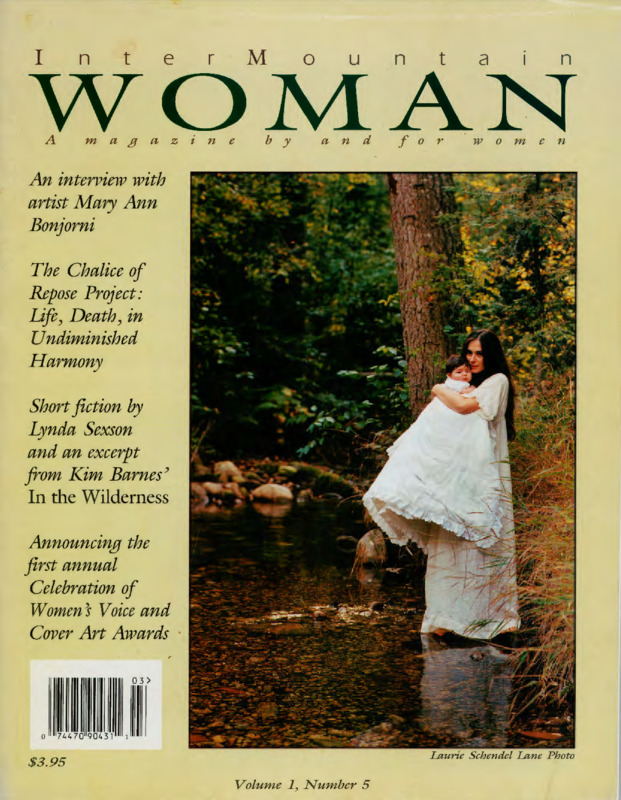
- Title
- Intermountain Woman : v.1:no.5(1997:March/April)
- Description
- This magazine features various essays, book excerpts, fiction, and poetry specifically for women in the international community. The first prominent article are musician-clinicians and their use of various instruments such as the harp to help expedite the healing process, highlighting their influence in the community. The next several pages deal exclusively with poetry. Large book excerpt on Kim Barnes’ family history. Interview with Mary Ann Bonjorni and epistemology. Additional book excerpts and poetry are scattered throughout the magazine that highlight various topics such as: Indigenous peoples, the future of women in the international setting, and influence of individuals.
- Date Issued
- 1997-04
- Relation
- InterMountain Woman
- Rights
- Contact UCO Chambers Library's Digital Initiatives Working Group at diwg@uco.edu for the permission policy on the use, reproduction or distribution of this material.
- Date
- 2025-03-03T19:40:25Z
- Date Available
- 2025-03-03T19:40:25Z
- Subject
- Women
- Type
- Periodical
- extracted text
-
n
I
e
t
r
magazine
A
M
b y
u
0
a
n
d
n
t
f
o r
n
a
w
o m
e n
An interview with
artist Mary Ann
Bonjorni
The Chalice of
Repose Project:
Life, Death, in
Undiminished
Harmony
Short fiction by
Lynda Sexson
and an excerpt
from I(im Barnes'
In the Wilderness
Announcing the
first annual
Celebration of
Womens Voice and
Cover Art Awards •
03>
o
744 7 0 904 31
1
Laurie Schendel Lane Photo
$ 3.95
Volume 1~ Number 5
16 X20" limited edition
poster, signed by the
artist and numbered.
$65 each. Also available
matted and framed,
20 X24", $165.
Make check or money
order payable to:
K. Bonnema Leslie,
c/o lnterMountain WOMAN,
P.O. Box 7487
Missoula, MT 59807.
Please add $5.00 shipping
and handling for poster;
$15 for framed poster.
FAITH AND FISHES
K. BONNEMA LESLIE
CONTENTS
FIC:rION
3
The Chalice of Repose Project:
Life, Death, in Undiminished '
Harmony
JoAnn Hoven
29
Mary Ann Bonjorni
On Postmodernism
an interview by
Simone Lazerri Ellis
DEPARTMENTS
;
58
Internet Navigating:
Getting a Web Site
Kathleen Ely
53
BOOK EXCERPT
17
from
In the Wilderness: Coming
of Age in Unknown Country
Kim Barnes
March/ April, 1997
40
Bathing with Women
Lorna Milne
Na'a
Historical Fiction by
Linda Davis Osler
45
Women Making it Happen:
Annick Smith
11
Water
Shan Bryan
33
This Is How We Got To Be
Three Pods and a Pea
Lynda Sexson
63
An OtherWise Opinion
On Sports
Michele Aranguiz
POETRY
-""-----
16
New Love
Beth Ferris
27
In the (Underwater)
Hanging Gardens
Judith Neva
44
Wrong Answer
Caeli Wolfson
50
Mad Alyce in February /III
B. J. Buckley
62
Findings
Tami Haaland
66
Your Health:
Natural Ways
To Help With Menopause
Robbin Roesche
69
Book Reviews
Rhiann Ellis reviews Headwaters
and Hamlet's Planets
72
Women's Voice and Cover Art
Awards Guidelines
InterMountain WOMAN
EDITOR Jeannine Nixon Laskowski
POETRY EDITORS B. J. Buckley, Janet Zupan
ART EDITOR Becki McVay
PHOTOGRAPHY EDITOR Laurie Lane
COVER PHOTOGRAPHY by Laurie Lane
ACCOUNT REPRESENTATIVES Jennifer Euell,
Maura Murphy, Laura Peterson
PRODUCTION Nathan Harding
For further information, write to:
InterMountain WOMAN, P. 0. Box 7487, Missoula,
Montana, 59807,phone(406) 721-8420
e-mail imwoman@marsweb.com
Volume 1 Number 5
InterMountain WOMAN, a magazine by and for
women, is published bimonthly by OtherWise
Productions, P. 0 . Box 7487, Missoula, MT 59807.
Postage paid at Missoula, MT 59807. Copyright ©1997
by OtherWise Productions ; contents may not be
reprinted without permission. All rights reserved.
Subscription rate is $20/ year in the U.S.; $30.00/ year
U.S. funds in Canada. POSTMASTER: Send address
change to InterMountain WOMAN, P. 0 . Box 7487,
Missoula, MT 59807.
Printed in the USA
Notes to the Xeader
Congratulations!
Annick Smith's "Virtue" was named a Distinguished Story of 1995 in Best American Short Stories:
1996. Marlene Nesary was awarded a Montana Arts Council Literature Fellowship for a work in
progress, Hanford Reach, from which "Matters Nuclear," (August/September Inter Mountain
WOMAN) was excerpted. Laurie Lane won an Addy award for excellence in photography for
the August/September cover. And Jori Frakie, author of "Tears" (December / January) recently
received a National Merit Scholarship in creative writing.
Celebration of Women's Voice and Cover Art Awards
Those of you have followed InterMountain WOMAN from the beginning may know that it was
founded on a dream (and a credit card). The muse which descended upon us was so excited
about the publication she proposed, that she failed to mention such things as budgets: and the
magazine has been funded largely by the skin of its teeth. While response to Inter Mountain
WOMAN has been overwhelmingly positive, it still has a way to go before it rests on solid
financial ground.
One thing we'd like very much to be able to do is pay our writers. Thus, our Celebration of
Women's Voice and Cover Art Awards, which we hope will help raise some money toward that
end. Due to the generosity of an anonymous benefactress, we are able to award cash prizes to
winners. We are grateful to Kirn Barnes, Mary Clearman Blew, and Patricia Goedicke, who have
agreed to judge the final entries in nonfiction, fiction, and poetry. Patricia Goedicke and Mary
Clearman Blew have appeared on our pages; an excerpt from Kirn Barnes' award-winning In the
Wilderness begins on page 17 of this issue. Contest details and submission guidelines are on page 72.
On Our Cover
Thanks to our cover models, Florentina Mocaneau-Schendel and Davia (Moses is a girl!).
Laurie Schendel Lane is a professional photographer who lives up the Blackfoot River, and a
children's advocate. She may be reached at (406) 543-8239 or 1-800-725-8239. Thanks also to
Kathy Bonnema Leslie for choosing cover colors.
What Happened to February?
Finally, you may have noticed that we mislaid February. This issue, Volume 1, Number 5, is
March/ April instead of February /March. We did this for several reasons, one being that it
eliminates the issue that straddles two years (December /January). Our bookkeeper is pleased.
Subscribers will still get six issues per subscription, but instead of a June/July this year we'll
have a May /June and a July/ August. And so on. We apologize for any inconvenience this may
have caused. Next year February will be paired with January, as it should be ..
InterMountain WOMAN, a magazine by and for women, is based on the belief that women have issues •
and concerns not always addressed by the mainstream media, and a voice not often enough published in
it. We hope to provide nonfiction articles that address those interests, as well as fiction, poetry, art and
essay by women.
Please send comments to:
Editor • InterMountain WOMAN • P. 0. Box 7487 • Missoula, MT 59807
Page 2
INTERMOUNTAIN
WOMAN
The Chalice of Repose Project:
Life, Death, in Undiminished Harmony
In Missoula/ Montana/ at St. Patrick Hospital/ a team of musician-clinicians
using harp and voice/ and a distinguished faculty/ introduce a new discipline
in care for the dying: Music-Thanatology
by JoAnn Hoven
T
he initial idea for the Chalice
of Repose Project began
when Therese SchroederSheker experienced the death of a
patient when she was working as a
nurse's aide in a geriatric home. It
was in this facility she first realized
the need for giving comfort to the
dying. "One day we were told a
man would probably die during
my shift," she remembers. "He was
a difficult resident, and he was
really the only resident who was
not well-loved. I came into his
room that night; he had
emphysema and his lungs were
filling up. He was thrashing
around and I ran to him and he
grabbed my hand. He was dying
and I knew he wanted someone
there with him. I didn't think
through my next step-I just held
him, my head next to his, my
Ph oto by Mich ael Gallacher
Musician and sch olar Therese Schroeder-Sheker, fo under
heartbeat to his, and I sang to him
of the Ch alice of Repose Projec t.
until he died."
From this first experience, Schroeder-Sheker founded The Chalice of Repose
Project more than 20 years ago in Denver. Now located in Missoula, Montana, the
Project offers music to comfort the dying. The Chalice members are called to the
bedside of a dying person, usually by a physician or family member. They observe
the patient's physiology- breathing, skin color, temperature-and make decisions
M ARCHI A PR IL
1997
Page3
as to which music to play to help comfort the
patient. This delivery of prescriptive music
at the bedside is given in teams of two, a
harpist by each side of the bed.
This discipline, called music-thanatology,
is a graduate level program at the only
school of its kind in the country, located at
St. Patrick Hospital in Missoula. Graduates
of the school are called music-thanatologists,
or musician clinicians. When they are on call,
they carry beepers just like other people in
the medical community. They have to be
prepared to be available in a very few
minutes. Physicians, nurses, social workers,
chaplains, sometimes family members, call,
and on special occasions, even the dying
person will call for themselves. Thirty-eight
percent of the patients Chalice members
attend are cancer patients; others include
patients with neurology (involving the really
slowly-moving degenerative diseases like
multiple sclerosis), cardiology, pulmonaryrespiratory, internal medicine, and infectious
disease.
This work with the dying is considered
new, but is in fact an extension of something
very old. In monastic medicine, the
infirmary work was concerned with the
question, "What can we do to help people
have a blessed, peaceful or consciOU$
death?" In Cluny, France, the monks had a
commitment to beauty and an
understanding that beauty is one way
through which people can experience the
divine. The monks manifested this
commitment by an endless devotion to
music in their community. In the infirmary,
from the time a person announced "My
death is coming," the monks chanted and
sang songs; it was important for the dying
person to know he was not alone.
All the prescriptive music is played on the
harp, a polyphonic instrument (one that can
combine two or more independent melodic
parts, like a piano). This characteristic is
important because with the skill of the
harpist, one single theme can be played
many different ways, according to the
physiological needs of the dying. SchroederSheker, master harpist, singer and scholar,
says, "I chose the harp initially because it
was the most beautiful sound I could find .
A team of
musicthanatologists
attends
patients.
Photo by
Lynn
Johnson,
National
~ Geographic
"'""· Society
Page 4
INTER.MOU NTAIN
WOMAN
Then I learned how to play and tune it. I
realized I had to tune 40-50 strings all the
time with minute hand gestures. I realized
the strings teach us so much about our own
inner lives. To go through the discipline and
practice of tuning is really a metaphor for
our own lives. Every single one of us has to
refine more: Is my thinking in tune with my
feeling? Is my feeling in tune with my
doing? Are we in tune with one another? By
constantly tuning and refining the strings of
a harp, these questions become more present
in our lives."
The music-thanatologists on call must be
outwardly and inwardly ready to respond.
Chalice members might have a call at St.
Pat's at 10 am, Village Health Care at noon,
and another at the hospice at 3 p.m. But no
matter the number of vigils, the health care
institutions in Missoula pay for the Chalice
services, so no family or person is billed.
Agencies across the entire country are
impressed with such a collaborative and
cooperative model in an age of competition.
The program is underwritten through
private donations from places like the
Charles Englehard Foundation, The Sisters
of Providence, and the Fetzer Institute.
Students pay a tuition that is only about 10%
of the actual cost of the education.
The School
Schroeder-Sheker developed a B.A.
degree in music-thanatology when she
chaired the music program at Regis
University in Denver. This undergraduate
curriculum later developed into a graduate
program through the school of theology at
St. Thomas Seminary in Denver.
However, she knew in her heart the
program would only flourish in a medical
setting, where internships at the bedside of
the dying could be developed. This would
take the school from a theoretical study to a
MARCH/APRIL
1997
real experience of being with patients.
She spoke at St. Patrick Hospital about the
program through the hospital's Institute of
Medicine and Humanities. After several
meetings, Schroeder-Shaker was approached
by the president of the hospital about
developing the Chalice School in Missoula.
The hospital had been interested in her
presentation about caring for patients at the
end of life. "When I met Larry White, he
asked me the question, 'Therese, what would
make you happy at this point?'
"I realized this was a destiny question. I
knew this man could help make it happen. I
knew exactly what I wanted, and I said, 'I
want a place for my students to practice this
work.'
"He looked away from me, and he came
back around to me with his Larry White jaw,
and he said, with a very big smile, 'I think
that could be arranged.'
"It was like all the doors down a long,
long, corridor had been opened."
She moved from her community she had
lived in for 21 years, gave up her tenuretrack position, her department chairship at
the University, and came to Missoula.
One might imagine that embracing the
concept of helping the dying through voice
and harp would be the most difficult
obstacle-What would doctors and nurses
say? Would they be resistant? Would they be
cynical? Instead, Schroeder-Sheker said the
tough questions were about being able to
Chalice of Repose Project Open House
Friday, July 11, 5-8pm
An opportunity to meet the board, staff, students,
faculty and ~ra~u~~es ~.~,~~.Sc~~.? l of M~.~i~i:
Thanatology. Featuring a p~:rformance 15y llie v
faculty ensemble called The Budaliget Consort,
preview of the Fetzer/Kaufman feature film on the
Chalice Project, contemplative musicianship, and
Therese Schroeder-Sheker. Refreshments and.,fours
:f~
of the Chalice facilities will be provided.
Page 5
teach others to do such an extraordinary
thing. Physicians asked, "Are you sure this is
replicable? What if just you have the
vocation, and it is an unteachable thing?" In
the beginning, even if the doctors didn't
understand exactly how it worked, it
obviously quieted patients, made them
require less pain medication, and enabled
them to sleep. Also, if death was imminent,
and all life saving measures had been
exhausted, the music helped the patient unbind and enter into a more peaceful death.
For example, faculty member Sharon
Murfin remembers some of her early vigils
with those people dying alone. "I went to a
vigil for a man who had the reputation of
being irascible, but very much loved by the
staff. As another team member was playing,
he took my hand, locked onto my face and
looked into my eyes for almost an hour,
without looking away. He looked at me with
everything in his face that I could only
imagine meant 'This is my life; it's leaving
and I'm a little frightened; I don't know
what's happening'-a multitude of
expressions on his face. I was overwhelmed
with gratitude that I was there."
The Students
The interview process for candidates is
intense. First, they complete a written
application with contemplative questions
about careers, vocation, and life experience.
The entire faculty reads these responses
together and discusses them. The faculty
makes decisions and sends letters to the
applicants either of redirection or an invitation
to proceed to the next stage. At stage two,
candidates are scheduled for a 30- to 45-minute
telephone conference with the entire faculty
present. Again, the faculty discusses each call,
and makes decisions. Final students are
selected from candidates from the third stage,
the on-site interview. Even after the candidates
Page 6
Chalice of Repose Project
First Annual Music-Thanatology Institute
July 9 - 12, 1997
Taught by Music-Thanatology faculty: Therese
Schroeder-Sheker, Sharon Murfin, Lois
Mandelko, Sile Harriss, Gloria Viglione
Master classes and advanced seminars in
continuing education for certified musicthanatologists, and introductory courses for the
public and potential future candidates for the
school. CaU406 542-0001, ext. 2810, to request
brochure with dates, descriptions and tuition
costs.
are chosen, the rigorous course work can
quickly reduce the numbers of students.
"The first semester, people come to the
Chalice with stars in their eyes: life with the
harp, beauty, harmony, contemplation! They
can't quite put it into the context of work.
Every step of the way they have to use
critical faculties the same way they would
have to use them in a university program,
and they have to train under a demanding
curriculum," Schroeder-Sheker says.
The program offers a mixture of the best
the liberal arts tradition has to offer, the best
that conservatory training has to offer and
the most problematic of what the medical
training has to offer. Intense course work is
divided into five components: academic,
musical, medical, clinical and innerdevelopment. Classes range from history,
anthropology, and medieval studies to
musicology. Medical classes include
anatomy, physiology, science, epistemology
and ethics. The whole second year of school
is internship at vigils with faculty members.
Graduation signifies the completion of the
course work; however, the students must
complete a professional paper,· a clinical
internship in which they attend a minimum
of 60 vigils and pass comprehensive exams
in order to be certified and eligible for
placement in hospitals and medical
institutions.
INTERMOUNTAJN
WOMAN
That first year, Schroeder-Sheker
assembled the faculty, the curriculum, and
interviewed students from all over the
country within a matter of months. As the
school has grown, the Chalice of Repose
Project has over 100 applicants every two
years for around 20 student openings. The
graduate program is a two-year course of
study with openings for students every
second year. In 1994, 18 students completed
the classwork in the world's only course in
music-thanatology. In 1996 there were 166
graduates from the United States, Spain and
Australia.
In the beginning, Schroeder-Sheker was
working 16-hour days-teaching,
responding to vigil requests, fundraising and
working as the CEO of the corporation.
Music-thanatologists working in Missoula
now number more than a dozen, and with
four of the first year graduates teaching with
her on the faculty, the work load is balanced.
More women than men have enrolled in
the school, but the men who come to the
program, like the men who entered the field
of nursing twenty years ago, are clear about
their gifts in the clinical setting. Some people
Spring Benefit Concert
Presented by the Chalice Philharmonia
a benefit to supp?rt the Chalice of Repose Project
Scholarship fund
Saturday, May 3, 1997 at 8 pm
St. Francis'Xavier Church
Missoula, Montana
Tickets are $7 for adults and $3 for children under
12 and may be purchased in advance at the
Chalice office.
Twenty six harpists and singers from the Chalice
of Repose Project's School of Music Thanatology
join together to present music from the twelfth to
the twentieth century. Music will be performed by
harp soloists and ensembles, and in the a cappella
tradition of the Schola Cantorum.
MARCH/ APRIL
1997
would say the strong feminine element in
music-thanatology is a natural outcome of
the cultural constructs that see women as
nurturers. It is true that people in pain and
people who are dying benefit from
•
compassionate care, but the men in the
program, says Schroeder-Sheker, in their
capacities to express tenderness and quality
care, challenge this stereotype in every way,
and not only equal the gifts women bring,
but help balance the picture.
"All students need to be present to the
music in a way that is very different from
that kind of presence needed for a concert
and recording career. You have to become
such an adept clinician, to see how the music
affects skin color, temperature, and breathing
patterns. Maybe because women have been
trained to reach out and be present to others,
and women who have given birth
understand how closely linked birth and
death actually are. I expect we will have
more men come to us who are very strong
and unworried about developing those
capacities within themselves further."
Whether the musician clinician is female
or male has a huge effect on the patient.
Sometimes a dying man has been alone for
40 years and it's a last, unbelievably human,
call for compensation-just to be held, he
may benefit from a feminine presence. Or, a
dying man who has been stoic throughout
his life might benefit from another man
touching his face, freeing him to let out his
feelings. Every patient requires individual
treatment, and whoever is on call will make
those difficult decisions. But each case is
different, and Schroeder-Sheker lives by an
ethical code of always putting the patient
first.
Faculty
The School of Music-Thanatology prides
itself with a distinguished national and local
Page7
The't11Niitli>'f Repose
Frojec\1'Fac~Jty
•' ,(,\
Kris Anderson, E,.N.
An~tomy & Phy;iology
Montana
Sile l:larriss
Assistant Cli.n,j.~fil Supervisor
Harp
,.
Resident Music-Thanatologist
Montana
,.
Lois Mandelko
Yoke
Resident Music--'trhanatologist
Montana
Sharon Murfin
Assistant Academic'Dean
Music Embodiment and Schola
Resident Music-Thanatologist
Monta;na
"Fred Paxton, PhD
Connecticut College
Medieval History
Alice R~ch, PfiD
Regis University
Anthropology
Colorado
ffi
Rol:>ert Sardello, PhD •
School of Spiritual Psychology
Spiritual Psychology
Connecticut
Therese Schroeder-Sheker
~c<\q~;q;i.jc~cm,~f.~ .991 of
Musjc-Thanatology
Music-Thanatology,1[tvtedieval Studies
!1~
Montana
Ken Thorp, M.D.
f]
Sparrow Hospital
Epistemology of
iw,,,SQ~ce.,&,Clinical Stµdies,.
Mic;}\igan
Gloria Viglione
~
Page 8
faculty drawn from the humanities and the clinical
sciences; this team actually totals 30, in various full and
part-time positions as professors, visiting professors,
guest lecturers and instructors. The resident faculty
members on staff on the 4th floor of St. Patrick Hospital,
once students themselves at the Chalice, made radical
changes to their already established lives by joining the
Chalice, and with all of them, something just clicked
when they heard about the school.
Faculty member Sharon Murfin is from Missoula and
received her music degree at the University of Montana
after her children got older. Immediately that fall, she
joined the Chalice's first class. Now part of the faculty,
she teaches the singing school, the Schola Cantorum.
Students who come to the Chalice are not required to
have any formal music training. "We teach people who
may not have had any formal experience with music,
which is very different from any other music programthere are no competitive try-outs-only careful listening
for possibility."
Gloria Viglione, a faculty harp instructor, was
working as an occupational therapist when she began
studying with Schroeder-Sheker in Denver. She
participated in the initial "teamwork" at the bedside in
1992 when music-thanatology was being introduced to
the medical community, then later graduated with the
first class in 1994.
As contemplative musicians, Viglione says their
intention is service rather than performance: "We work
to create a musical environment that becomes sanctuary
for the patients."
Lois Mandelko, a Missoula native, was teaching
English in Czechoslovakia when she saw a tiny story
about the Chalice of Repose starting a school thousands
of miles away in her home town. Something clicked.
Her move and study at the Chalice would require a
radical change for Lois-she was a regional musical
performer, both in town and in Virginia City. In
becoming a music-thanatologist, she set aside the
accolades of performing to be quiet enough to listen and
hear what each dying patient needed.
Lois teaches voice as a Chalice faculty member, and
finds the work incredibly rewarding in a way
performance couldn't be: "Working with the dying is
very humbling work."
INTERMOUNTAIN
WOMAN
Sfle Harriss was a working harp musician
in Seattle and immediately called SchroederSheker when she heard about the school. She
rented out her home, said goodbye to her
grown children, and started studying. "I
think I was a typical 20th century American
woman-I loved my work, my music, but I
didn't think deeply about the music or what
I was doing. I didn't go beyond the
sensations it gave me. Now, I take the music
and my job as Assistant Clinical Supervisor
very seriously-they are part of my holistic
life. II
Schroeder-Sheker is proud that the
resident faculty clinicians include no
theorists-everyone is actively involved in
the music and clinical side of the work. "In
working with death and dying, abstractions
are one set of obstacles leading quickly into
an epistemological arrogance, separating
that person from the patient who is in
physical and/ or spiritual pain. If we insulate
ourselves so we can't know or experience
the agony of, for instance, a mother who no
longer can hold her three children, there's no
way we can do prescriptive music."
This means the musician-clinicians must
have some sort of daily spiritual practice-prayer, meditation-some sort of reflective
activity. "If I'm still holding on to the bad
notes I played yesterday at the end of a long
and tiring day, how am I going to be able play
well for Mrs. Smith at her vigil this morning?
How will I be able to play if my ego is attached
to the fact I played wrong notes yesterday-or
that I played particularly well? We can't do
any of those sorts of the ego attachments,"
Schroeder-Sheker says. One of the
contemplative practices the Chalice members
practice every single day, regardless if they are
a humanist, realist, atheist, Catholic, Jew
Buddhist, or Sufi-is asking themselves, "what
can I die to today?"
"Look what goes into stasis in
corporations, organizations, academic
MARCH/APRIL
1997
settings because we don't let go of
something that happened in that committee
meeting. We hold our attachments our
grudges, our angers. We have to die to
something every single day."
As a contemplative musician, Chalice
members have to sacrifice the virtuosity built
up in their hands or voices. SchroederSheker says, "In a concert setting, you're
supposed to fill the whole hall, you're
supposed to thrill and move the audience,
you're supposed to play the most difficult
music. In the vigil setting, what matters is
how you can be of service to help the person.
You have to be ready to sacrifice this
virtuosity, and be ready to pick it up again
Photo by JoAnn Hoven
Some of the Chalice faculty members include
(from left to right) Gloria Viglione, Sharon Murfin,
Therese Schroeder-Sheker, Lois Mandelko and Sile
Harriss.
The Chalice of Repose Proje<;~~~~"~pr,i;-p~~f!t!at':} ,
exempt corporation: To make a'. referral or donati'.on
or for more information ori tneWorltof Musk- ''j •
Thanatology, c9,ntact:
Chalice of Repose Pr?ject
St. Patrick Hospital
.554 W. Broadway; Suite 4,36
Missoula, Montana 59802
Ph
06/542-0001, ext. 2810
Fax.
329-5614
\q:
ReferralLine: 329~5616
On-line: WWW.Sain atrickor
Page9
when asked to play in public."
Schroeder-Sheker manages this ego shift all
the time, balancing a successful recording and
concert career with her work with patients. She
has concertized all over the world, including
Carnegie Hall. "I have walked off a concert
stage strewn with roses, to a receiving line,
with somebody pushing their way through,
saying 'Please, you don't know me, but I've
heard of you-my husband is dying. Will you
come with me to this hospital?' I've gone
straight literally from the concert stage to the
hospital room."
Because of the support of the additional
faculty and administrative staff and the •
emphasis on working as a team, SchroederSheker has time now to be the national
spokesperson for music-thanatology, and
spends a good deal of the year addressing
medical schools, congresses and symposia. She
has addressed Harvard and Magill
Universities, and made 50 plenary addresses
for large physician conferences-including
those for cancer, hospice care, social work and
nursing. Her commitment is to spread the
word to help graduates get placed in
communities where they are needed.
In the next five years, The Chalice Board of
Directors would like to see the school accept a
new class every year, which means double the
faculty, double the commitment, double the
funding. Also, Chalice medical director Steven
Speckart, MD, wants members to increase their
hours from 12 hours on call a day to 24 hours a
day, 365 days a year-with three teams of three
shifts like other medical teams.
"It's really something to see a lifelong
dream come true," Schroeder-Sheker says.
"How must I grow so as to leave everybody in
good shape so at the right moment, I can finish
the phrase and disappear? I can leave now to
speak and fund-raise during the year; I could
not dream of doing this without this team of
women-the faculty and everyone on our
Page 10
staff. It takes a huge team to keep the school
and the clinical practice running. This is a kind
of intentional community, even though we are
people of enormous diversity-spiritually and
temperamentally. We are serious when we
work, but there is a great deal of celebration
amongst us. Without it, I don't think we could
keep doing this work every day.
"It's like a musical ensemble; we are able to
signal each other without any words or
explanations. When I need time out, someone
else is able to play." ❖ JoAnn Hoven is from Antelope,
Montana. She teaches English at the Unversity of Montana
and writes for St. Patrick Hospital.
Chalice of Repose Boara of Directors
Missoula, Montana
A. Craig Eddy, M.D.
Director of Trauma Center, St. Patrick Hospital
Grf gMuriro
Law School Faculty
The University of Montana
Stephen F. Speckart, M.D.
Missoula Medical Oncology and Infectious Disease
Sally:R. Weaver
Law School Faculty
The lJniversity of Montana
Lawrence L. White, Jr.
President, St. Patrick Hospital
Sensitive Women's Healthcare
Jennifer G. Hensley • Certified Nurse Midwife
Jeanne Hebl • Certified Nurse Midwife
We offer sensitive care,
meeting individual needs
for every stage of life:
Annual exams, family planning,
pregnancy, birthing options
in the hospital,
post-partum care and change of life.
Please call 728-4292 for an appointment
Physician Center #1 • 2825 Fort Missoula Rd.
In association with Kristin Rauch, M.D., and Stephen Smith, M.D.
INTERMOUNTAIN
WOMAN
~~
Shan Bryan
The photographic images on the following pages are of offerings hung on a
medicine tree by a pool of hot mineral water in the town of Hot Springs,
Montana. This healing water has been considered spiritual for hundreds of
years. Each of these hand-made offerings is a prayer for healing.
E
1
mily was dying. She held my hand close to her
face. She needed to feel something tangible, alive;
or so I needed to believe. I sat with her,
uncomfortable and sleepy, for what felt like hours. It was
only twenty minutes. I asked her if she wanted me to read
some poetry.
No.
I tried to make conversation, but there was nothing that
she wanted to say and I could not find words. My mind
raced as my eyes desperately searched the room for a
topic of conversation. I found nothing. No subject seemed
sensitive enough for the ears of a dying woman.
Silence caused horrible noises.
I asked if she would like to hear some scripture.
No.
I asked if I should pray.
No.
She looked at my face. I averted my eyes, not wanting to reveal my lie.
"Why does God keep me here? I don't want to be here any more." Emily was
grasping for change. I tried to pull my hand away. I did not want to go where
she was going.
She gripped tighter and pulled my hand closer to her mouth. Her breath was
hot, burning my skin. Her pale lips brushed my fingers, lingering for a few
seconds before she dropped my hand and closed her eyes.
I fled the scene quickly, careful not to touch any part of my body before I
reached the sink. I was not sure if I had been kissed by life or death and I did
not want to spread death all over my skin.
MARCH/ APRI L
1997
Page 11
I am making a film.
Scene 1:
Five women, sisters, sit in a circle, surrounding
a large piece of ivory silk. They could be a new
portrait of Matisse's dancers, repainted later in their
lives, aged and pained.
"Luckily Susan is an autumn, so she'll look
better in ivory."
"Why did she choose ivory?"
"Impurity. Honesty."
"What?"
"She has lived with Rod for a year."
Susan's mother is becoming angry.
"You all wore white and your 'purity' was more
than questionable."
All of the sisters look at Carla, who was forced
into marriage at seventeen because of a pregnancy.
She smiles, unaware of their stares, and refers to her
most recent wedding to her third husband. "Wasn't
my white suit a beauty?"
Change of subject.
"John and I went dancing last night."
"Do you remember when dancing was sin? I
went dancing every night and you told me that I
was buried in sin. I was dying because of my sin."
"That was that silly church talking."
"The one that we were raised in, that you chose
to stay in, until you met your third husband."
A family secret is told. Blank stares of denial
replace faces of shock as the sisters remember that
silence is family protocol for situations such as this.
"Mother will apologize to me for this just before
she dies, when there is no more fear of discovery."
"Daddy apologized to me when he was first
diagnosed with his disease. He told me that making
me marry at seventeen was his biggest mistake. I
almost paid for that mistake with my life, many
times."
"But you escaped, remarried, and reentered the
church."
"That is when I quit dancing. Fred and I were
such good dancers." Fred was Carla's second
husband.
Page 12
"You were incredible dancers."
"Sometimes I wonder if we would still be
married today if we hadn't given up dancing."
Carla forgets that she divorced because this man
abused her son. Mother of the bride leaves ·the room.
Her family's denial disgusts her. Thank God she
hasn't taught it to her children.
When she thinks of Fred she does not want to
believe in a forgiving God.
Sunlight washes my face as I struggle to
open my eyes. Memories of last night sweep
my mind. Rod spending the night.
Emily dying.
Rod spending the
night. Our talks, his
touch, and his breath.
His hands on my body
and his breath in my
ear. Kisses, movement,
climax.
Breathing.
Breathing Breathing.
Breath, building
and thickening the air,
until it can no longer
remain. A barrage of
images. His words,
"Oh, my God," ringing
in my ears.
In the morning,
watching shadows cast
by a rising sun, I
wonder what I had taken and what I had
given. The space behind my back is beginning
to exist.
Water flows from the faucet, clean, pure
reminding me of the nearby river.
I think of my first experience with a
Montana river.
I was used to deep, muddy, polluted
rivers. Growing up, the Mississippi was my
back yard and what I knew about rivers. It
was gray, slow, and wise, inching its massive
body toward the large gulf sea.
INTER.MOUNTAIN
WOMAN
The Mississippi was what I knew about
rivers.
Young, quick, uncluttered rivers were
unfamiliar to me.
They were beautiful and beckoned like a
new lover.
I jumped in.
The power of the current took me by
surprise. My swimming stroke wasn't strong
enough to take me to shore.
I had no choice but to follow the path of the
river and try to keep my bare skin from
scraping the sharp rocks below me.
Scene 2:
Women surround a table in the recreation room
of a retirement center. Scraps of bright fabric, slowly
united by tiny stitches, cover the table.
"One morning, years ago in Texas, I was setting
in my kitchen looking out my window at my
neighbor's baby. She used to set her outside in the
mornings so that she could catch the sun. On this
particular morning an eagle swept out of the sky
and snatched the baby away. I swear that this is the
God's honest truth. Eagles were more plentiful in
those days, you know. "
"I have heard of that happening with small
animals. I never left my babies outside, unguarded."
"What happened to the baby?"
"The eagle took it away to the mountains." (She
lowers her voice to a whisper) "I am sure that it was
eaten."
"I once heard of a baby found in an eagle's nest
in the mountains of west Texas ."
"You don't say. What year?"
"Oh, sometime in the thirties.
"The baby was said to be spiritual. "
"What do you mean by that?"
"He would talk to gods and goddesses and
mumble prayers before he could say anything else.
People were healed when they touched him. He was
a mystery, like the image of the virgin on a peasant's
jacket, but he died at the age offour."
"What on earth happened?"
MARCH/ APRIL
1997
"He was kidnapped and killed by a group of men
who said he was of the devil."
"Oh, heavens!"
"But how can a baby be of the devil?"
"Well, how can a baby be of god?"
I have been ignoring the garden. There are
many weeds to pull.
I notice that some of the tomatoes are ripe.
They are red and juicy. I begin to snatch them
quickly, greedily, ignoring the weeds. The
tomatoes can not be left to rot.
I fill several buckets and carry them inside.
Washing and sorting. I
will give them away.
A gentle rain
begins. I remember the :
weeds.
They will wait until
tomorrow.
I stand outside,
hovering inside my
wet, thirsty skin The
garden is green and lush under the slick finish
of the rain.
In ten minutes I am on the interstate headed
toward the coast. I start to breathe. I crave
water the way that many people around me
crave the mountains. In Montana, the rivers
are my refuge. The mountains exist only to
sustain the rivers. Today, however, the rivers
are not enough.
My mother explains my passion for water.
At the time of my birth my mother was
living alone, along the east coast, in a trailer by
the water. My father was missing. He was
away, fighting a war that had followed him
home when he returned from Vietnam.
I will never know this man.
From the beginning, I have walked with my
mother.
When I was two weeks old she carried me
along the beach and dipped my feet in the
Page 13
sparkling, salt water, teaching me that I was
not to be afraid of something bigger than
me.
We danced with the sea.
The sea took a breath.
A week later a hurricane hit.
We survived and celebrated.
Ocean sounds burn in my ears. They are a
childhood song, reminding me of strength.
Scene 3:
Goddesses stand under strong Hollywood lights,
ready to perform. Aphrodite holds a camera. All
stare at her luxurious curves.
"Aphrodite, you should be in front of the
camera. We need you in this show. You are at the
center of this plot."
Aphrodite laughs and hands the camera to one
of the Syrenees.
"We only need your voice, dear."
The Syrenees glare.
"Now, now, girls. You are all important to this
show."
Athena has entered the room with compelling
grace.
"Venus will take the lead. Men prefer her."
"Men prefer me." Aphrodite is angry. ·
"They love you for a moment ... "
"They love us," shout the Syrenees.
"You are a danger, concealed in beauty. In you
they find Aphrodite but never Venus."
"Venus is an ideal and she will be our star.
Through her image we gain power."
I have left my garden and am heading
west on I-90 toward the coast. I am avoiding
my first Catholic funeral. I worry about how
I will explain away my absence. It does not
matter. I will deal with people later. Right
now, I need to be by a massive body of
water.
I pass the mission church. It is empty and
resting. It beckons me to stop. The hill it rests
Page 14
on is green and plush,
inviting in the way that
my grandmother's thick,
pillow-covered bed
invites me. Before'! enter
the church, I inhale the
thin, cool air.
The church is dark.
Paintings of Bible stories
cover the walls. Visions
start to form and the
echoes of voices surround me ...
.. .I see a six-year-old girl, twisting on a
hard, wooden pew, itching under a red,
cotton shirt and blue polyester uniform. She
attends a small, Baptist school where she is
in the first grade. Every day students
alternate between wearing red and white
shirts. Today is actually white shirt day. Her
mother always forgets. She usually does not
mind this difference.
It is morning chapel. She listens, bored,
fearful, and restless. Between the Christian
and U.S. flags stands a minister in a crisp,
gray suit. He tells her that she is evil and full
of sin. The word evil rings in her ears. She is
told that she must repent.
She stares at the cross behind him and
tries to visualize the Jesus he describes. She
sees Jesus, floating before the cross. Her eyes
scan his body, from the bottom up. She
doesn't understand his humanity. She
doesn't understand his Divinity. She is told
that he is a sacrifice for her evil nature.
Shame fills her as she casts her eyes
downward, catching a glimpse of her red
shirt. She looks at the white shirts
surrounding her. Why is she the only one
covered in blood?
Guilt, that she finds no connection to,
pulses through her blood, shaking her body.
She heads up to the alter where she repents,
dies, and is reborn ...
... for the third time that week.
INTERMOUNTAIN
WOMAN
Scene 4:
Twelve young girls stand at a canvas covered
table in a cabin in the woods. They are kneading
clay.
"It's too quiet out here. I couldn't sleep last
night:"
"Back in my neighborhood guns are going off
all night. People are doing bad stuff That is what
I am used to sleeping to."
"My old neighborhood was like that but we
moved to a nicer place."
"My cousin was shot just before I came here
for vacation. Mama was glad I was leaving the
city for a while. I told her camp was worse."
"My brother was shot last year. He was doing
some bad stuff"
"Our counselor was talking about our futures
last night. I told her that I wouldn't live past
eighteen."
"Most of the people that I know don't."
"I hear my mama praying for me every night.
She says, 'Lord, please keep my baby safe.' She
says it over and over."
I am thirteen years old, piecing together a
mystery. My journal is filled with clues about
my beginning and the time before my birth.
My parents' bedroom is next to mine and I
can hear through the walls. I listen quietly
every night. Eventually, I become sick of
fragments and begin to ask questions. I find
out that my adoptive
,. father was married
before.
"Does he have any other
kids?" I ask.
I discover that my birth
father was in prison
when he signed away his
parental rights.
"Why?" I ask.
"He allegedly raped a
prostitute."
MARCH/APRIL
1997
I was not prepared for this.
My mother said that she had never seen
him violent.
The war had changed him.
I could not justify or rationalize. I wanted
to be sad. I wanted to be angry.
I obsessed about evil and worried that it
might be genetic.
Scene 5:
A king named Tereseus rapes his sister-in-law,
Philomena, and cuts her tongue so that she can
not speak of his evil.
.
She weaves a tapestry depicting the crime and
shows it to her sister, the king's wife.
The women plot.
They cut up the king's son and serve the flesh
to him for dinner.
While the king is eating Philomena brings the
boy's head in on a platter.
They are all transformed into birds:
Philomena, a nightingale; Procne, her sister, a
swallow; Tereseus, a hawk, and the boy, a
sandpiper.
I am twenty, threading my faith onto a
strand of fishing wire. I cast it into river after
river, but nothing bites. That wire, however,
is my path to God.
I fish for a long while, but tire and go to
the movies. I want to be far removed from
the visceral reality of nature. Images on
grainy, cheap, blue film rapidly pass my
eyes, revealing hidden scenes of high school
life. I cover my eyes with my hands but I can
not resist the temptation to peek. The film
freezes on the moment of horror that I knew
I would find. I stare at it for hours.
I discover the roots of my personal
feminist agenda.
The road before me seems never ending.
How much longer until I reach the water?
Page15
I have passed the mountains of
Idaho and the flat lands of eastern
Washington. I inhale the air of the
Cascade Mountains. The tall, sharp
peaks hover over me. No other cars
are passing; I am alone with the
earth. How will I survive, out here
alone? I am so small. I must make
peace: I park the car and run
through the trees. I twirl. They
move. We begin to dance together.
Scene 6:
A symphony is beginning in a park.
Locusts hum and moonlight reflects off
of the instruments and onto the fac es of
people in the crowd.
A single flute softly plays a melody.
Wind instruments join in.
Drums begin to sound.
Echoing beats take over.
Violinist's chords are heard in
empty spaces.
A woman closes her eyes, a mantra
forming on her lips. Beside her a child
sleeps and a man taps his f eet.
They are filled with peace.
God has visited them for a moment.
I am here. I have made it to the
coast, just as the sun is setting. I walk
toward the beach. Sand smoothes my
skin and sticks to my toes. The breeze
washes my face. I breathe the salty
air. Water splashes across my feet,
and then my knees. I stop to adjust to
its coolness and then continue to
walk. Water is up to my waist, my
chest and then my neck. I am ready
for my baptismal, longing for it. With
a breath I step forward and let myself
be covered by God. ❖
NevV Love
You toss stones into the creek, where the water
funnels through two rocks.
I lie holding the old cottonwood in my arms,
losing the argument in my head
against moving closer to you, touching your hand.
Always the same fear: we want to know too much
and think love is a risk
when not-love is the real risk we take everyday.
Behind your head
the yellow light of cottonwoods holds the trees.
This is tenderness. They are not afraid.
I could step out on the slanted light pouring
down on us and cross the valley on this path.
I would see the ghosts of summer assembled there,
the women who tear each leaf away
humming at their work. And the ghosts of old loves
smiling and encouraging us
now that they are free of fear,
now that they are open to all they couldn't trust.
This thought or some other makes me sit up
and lean toward your face. At first the fear
tells me you don't want this kiss. Then your fingertips
on my cheek bones talking.
We will open the half-dark of each other, they say
whisper of leaves in my ear
explaining it all clearly
as if we h<:1-d just returned
from where we will go.
-lJet/2 ferris
Shan Bryan is an artist currently working on
her MFA at the Universit o Montana
Page 16
INTERMOUNTAIN
WOMAN
An Excerpt from
In the Wilderness:
Coming of Age in Unknown Country
by Kim Barnes
Kim-Barnes' award-winning book is set in the Idaho wilderness where she
grew up, the backdrop for a wilderness of the soul, In the Wilderness is the
story of a woman who must choose between her family's fundamentalist
religion and her deepest sense of self Barnes captures exquisitely a time in a
woman's life when she is still young enough to believe she can be loved
unconditionally, and the beginning of her discovery that what she seeks is
something her church and culture won't allow, Her discovery is a heartbreak:
her strength of spirit in the search for self love, a triumph,
In the following excerpts from Chapter Two, Barnes traces her family's
history: the beginnings and foundation of her story,
I
begin in Oklahoma, in the late 1920s. In a one-room
farmhouse near Stigler, my father's mother sleeps on a
makeshift bed of muslin-covered cornhusks with her seven
brothers and sisters. They are used to sleeping this way, and
the warmth their bodies generate is a great comfort. Outside,
the wind sweeps the leaves and straw from the dirt yard. In the
morning when they wa.ke, the soiled blanket covering them
will be frosted with their moist breath.
Only one child stirs, my grandmother's eldest sister, Daisy.
Since the death of their mother, and then their stepmother a
few years later, it has been Daisy who has kept them clothed
and fed, who has shielded them from their father's drunken
rages. She's a beautiful girl, her light blue eyes brilliant against
the smooth brown skin inherited from her Cherokee
grandmother. She sits up slowly and sees her father slumped in
his chair, sour with whiskey and sweat. Raising her arms above
her head, she winds her long hair into a bun, then slides
carefully from between the other children. Quietly she begins
From IN THE WILDERNESS by Kirn Barnes. Copyright© 1996 by Kirn
Barnes. Used by permission of Doubleday, a division of Bantam
Doubleday Dell Publishing Group, Inc.
MARCH/ APRIL
1997
Page 17
to work her way around the single room,
knowing he'll whip her raw if he wakes to
find her gathering her shoes, pulling on
her two pairs of rough stockings, pulling
first one and then the other of her cotton
dresses over her flour-sack slip (even in
the cold she is wet with sweat), then her
winter coat.
She reaches to take the hard biscuits
wrapped in a clean tea towel from the
cupboard, but decides it will be a last
offering, something the youngest can
chew on while her father calls her name
across the fields. The door squeaks on its
leather hinges, and she thinks to run but
takes a breath and steps out onto the
packed red clay. Cold air cuts her lungs as
she walks toward the corn rows, stopping
to squat one last time, feeling the weight
of her cloth~s, all she owns, but never
once looking back.
How DID SHE SURVIVE HER JOURNEY THAT
night? She had seldom left the isolated
farm, had seen the city only a few times,
had never left the county she was born in.
A girl, maybe sixteen, bundled in
beggar's clothing, no luggage or purse,
walking, perhaps hitchhiking, her way
across the state line into Texas, kept warm
by fear and shame, kept going by the
exhilaration she felt whenever she
remembered she was free. In Texas, she
believed, she could find a way to live on
her own. In Texas, there was oil, money
and, if she were lucky, a man who would
find her comely enough to make her his
wife.
She found a job working early shift in
a small cafe in the panhandle. She knew
the first time he came in-square-jawed,
lips set-she'd marry him. He was going
somewhere, maybe not in oil, maybe not
in Texas, but somewhere. She could see it
in his shoulders, the way he focused on
Page 18
his food, how his hands weren't still-not
nervous, but always moving, stirring
sugar into the black coffee, rubbing water
rings off his fork, smoothing the napkin's
edge between his fingers. He didn't.
smoke, and she liked that about him.
There were things he wanted to do, and
he wasn't one to waste his time. Within a
month they were married, and it would
be his ambition that would lead my greatuncle Cly de Knight into the Idaho
wilderness, and it would be his lead that
m y family would follow.
BUT FIRST I MUST GO BACK TO THAT SHACK WHERE
the children are waking to find their sister
gone. My grandmother, because she is the
second-eldest girl, moves around her
sleeping father and stirs the ashes of last
night's fire, looking for an ember to breathe
on and bring to life. She thinks Daisy may
be out gathering more wood, but there is a
stillness in the house that doesn't feel right.
Why isn't the water heating? Their father
will expect it when he wakes, and she
trembles to think of his anger should he not
be met with warmed biscuits and the pale
liquid drawn from the grounds of
yesterday's coffee.
She opens the door. Even though the
wind whips her bare legs and makes her
teeth chatter, she wishes for the three-mile
walk to school. She misses the books, the
room and its little stove, the smell of drying
wool and chalk dust. But her father has said
she must stay home: sixth grade is enough
learning for any girl, and the other children
must be looked after.
She looks across the flat fields and
pasture for Daisy. She knows firewood is
getting harder to find, but she cannot
imagine why Daisy would wander so far
from the house in this weather, knowing that
in his state their father would want her to
keep the baby quiet.
lNTERMOUNTAIN WOMAN
She picks up the few remaining sticks
of oak left by the door. Her younger
brother Lee is awake now, stretching his
bad leg, rubbing it at the knee. Like her,
he limps across the room: both have been
crippled by TB. She doesn't even think of
it anymore, compensating for the
difference in the length of her legs by
walking on the toe of one foot. Already,
her hip is enlarged and her back curved
from the stress.
They go about their chores as though
in a church, cushioning each step,
hushing the four-year-old when he calls
for milk. But as the others wake and
begin clattering from the bed, they see
their father stir. He notes the fire first,
then turns his reddened eyes toward the
cookstove.
"Where's Daisy?" His voice is coarse
with phlegm. He coughs and spits into
the fire.
"Don't know, Daddy." Even as she says
it, she cringes away from his chair. Daisy
is the one he depends on to rub his feet
and fix his meals. Even as young as Daisy
is, she's had suitors, and he has run each
of them off with threats, a gun in his
hand.
Immediately he is suspicious. Hadn't
she tried to run away once already?
Raising himself from the chair, he
stumbles toward the door, groaning,
made angrier by the pain in his head. He
shouts her name once, then, still standing
on the threshold, opens his stained
trousers and pisses a long stream onto the
red dirt.
"Daisy! I'll whip you good, girl!"
My grandmother gathers up the baby
and sways to keep her quiet. She watches
the man walk toward the barn, still
calling, his stride becoming more
purposeful. He disappears into the barn
and she turns to the stove, knowing he's
leaving and may be gone for weeks. It is
not the first time. His trips into town to
drink and gamble are common enough,
but before he has left them with enough
cut wood, meat, flour and sugar to get by.
The children crowd to the door, watching
"Behaviors of Addiction"
The first in a regular series of informational
public presentations, featuring
DOROTHYLESCANTZ of the
St Pat's Addiction Treatment Program
When: Wednesday, April 9, 6:30 -8:30 p.m.
tt'here:St Pat's Auditorium
For more information, call
ACTION HEALTH at 243-2035.
/ff> St.PatrickHospital
MARCH/APRIL
1997
Page 19
the wind bend the dry corn
stalks to the ground, their
bellies already aching with
hunger.
0
MY
GRANDMOTHER TOOK
Daisy's place in that
ramshackle house,
enlisting the help of her
younger sisters to make
the meager meals, to cut
and sew the flour sacks
into baggy dresses and
shirts that raked their skin.
The bitterness she
harbored against her sister
kept her jaw tight and her
direction set: she would
not leave the others as
Daisy had, nor would she
ever admit that she longed
to do the same and be gone
from the house that reeked
of kerosene and urine.
Years later, when a
drinking partner of her
father's, Pat Barnes, a tall,
lean red-haired man, began
courting her, she allowed
herself to imagine another
life. The children were
older now. Certainly _her
younger sisters were
grown enough to cook and
clean. Her father didn't
like it, and although he
teased the man about
flirting with his daughter,
he forbade her to see him,
and threatened to beat
them both if she
disobeyed.
When she turned
Family Centered Maternity Care
Pediatrics and Adult Care
Three Missoula Area Family Practice Locations
DOWNTOWN
Corner of Front & Orange Streets
Judy McDonald, MD
Susan Selbach, MD
Judy Visscher, MD
(406) 721-5600
(800) 525-5688
COMMUNITY HOSPITAL
CAMPUS
Physician Center 3
LOLO FAMILY PRACTICE
Serving the Bitterroot Valley
Lalo Shopping Center, Hwy 93
R.D. Marks, MD
Deanna Phinney, MD
Janice Gomersall, MD
Ned Vasquez, MD
(406) 721-5600
(800) 525-5688
(406) 273-0045
Western Montana Clinic, P.C.
Page 20
INTER.MOUNTAIN
WOMAN
eighteen, they asked for
permission to marry, and
when her father said no
they eloped. They lived
first with my grandfather's
sister, a shrewish woman
whose only use for my
grandmother was as a
milker and maid. When
my grandmother became
pregnant with her first
child, she era ved one
delicacy: a fult sweet plum
from her sister-in-law's
tree. This the woman
denied her, taking special
pleasure in the smallness
of her cruelty. Because of
this, my grandmother
believed, her daughter was
born with a birthmark on
her hip, the exact size and
purple shade of the plum
she had longed for.
Even after she and her
husband found their own
piece of land to sharecrop,
her life seemed little
changed from the one she
had left. Except for this:
she loved the man who
worked the packed sod
and came home to her each
evening, a wide smile on
his dusty face. She would
give birth to four more
children, the next to the
last my father.
On their little acreage of
leased land, they grew
cotton and broomcorn.
They raised a few hogs and
a milk cow, enough to keep
food on the table and land
under their feet. My
MARCH/ APRIL
1997
grandfather never really
gave up fighting the heat,
the hailstorms and
tornados. A man bred to
the life, his fair skin
fissured and toughened,
his eyes permanently
squinted against the dry
silt wind and sun, he
might have made it if the
country had given just a
little, offered up something
he could depend on from
one season to the next But
this was the time of dust,
and what sustenance he
could not draw from the
seed and furrows he drew
from the still: the one thing
he could count on in that
land of baked soil was
alcohol, and he gave
himself to it more and
more.
His is an old and
familiar story in the toooften romanticized myth of
the twentieth-century
pioneers-the story of .men
broken by the land's
promise and the
government's lie that said
borrowed money, hard
work and patriotism
would see the country
through. And alongside
this story is the quieter
story of the women, who
sometimes endured but
more often did not, twice
betrayed, first by the land
and then by the men who
worked it.
IN THE SPRING OF 1955, MY
grandmother stood on the
porch, blocking the fierce
Oklahoma sun with her
raised hand. She pe'e red
across the field where the
old creek bed ran. She had
been waiting for her
husband's drunken arrival
when the noise had
reached her-the muffled
whump of earth and metal
colliding.
Had the fools run off
the road? She refused to
allow herself fear,
believing they were
probably hanging from the
doors even now, laughing
and deciding it was as
good a time as any to take
a pee.
She waited for several
minutes, then called
Roland from the house.
With Ronnie, the oldest, in
the service, it was Roland
she relied on to handle her
husband. Roland was not
afraid of his father, and if
need be, he could outrun
the staggering man and
hide until his rage died.
She watched Roland
climb into the car and take
off down the road,
disappearing over the
hill's crest, then saw him
again as he crossed the
bridge and dropped out of
sight behind the trees. She
stood there, feeling the
cooling wind catch the thin
skirt of her house dress,
feeling the sweat run from
Page 21
beneath her arms and pool
at her belted waist. When
she saw her son again, his
face was white behind the
wheel. Even from a
distance, she could see the
red blotches covering his
arms.
The boy staggered from
the car. He was crying.
"What is it? Tell me.
Are they dead?"
"Daddy's hurt bad.
Real bad."
"Go fetch Uncle Everett.
Do it now! Run!"
She turned and saw her
youngest boy looking at
her, his mouth drawn tight.
"Get in the house. You go
sit and be still, you hear?"
He was staring. Across
the front of her, handprints
bloomed like bloody roses.
My father wasn't there.
He was a high school
junior, gone to Lawton on
a class trip. But when he
stepped off the bus, he
knew what the girl who
waited for him, the one
who worked as the local
telephone operator, would
say. He had dreamed it
already: his father was
dead.
The accident that killed
my grandfather also killed
my grandmother's father.
Her brother-in-law, who
had been driving and
missed the bridge, sending
the car nose-first into the
dry creek bed; was injured
but survived. What did my
Page 22
grandmother have left to
sustain her? When the
letter came from Idaho,
they all agreed it would be
a new start, a way for the
boys to learn a trade.
Clyde guaranteed them
food and shelter, and that
was more than she had
ever been promised.
Roland would stay behind
until everything was
sold-furniture, pickup,
farm equipment, my
grandfather's beloved
hounds-and Ronnie
would follow the next
summer when his stint in
the service ended. My
father and his youngest
brother boarded the train
with their mother and
headed for the Northwest.
I HEARD MY
Uncle Clyde say, "I looked
to those hills and thought,
No man should ever go
hungry here." Deer, elk,
partridge, fish thick as a
baby's leg from the
smallest stream. And the
trees, stretching from the
Snake to the Clearwater,
Lochsa and Selway, from
Oregon and Washington to
Montana. With hard work,
guts and ingenuity, a man
could feed his family and
make money besides.
He had begun working
for his brother at Waha,
sending logs out by train
north to Lewiston. He
saved his money, took
MANY TIMES
extra odd jobs, asked the
markets for their old
produce and bread,
scavenged from garbage
bins. Every fall, he shot
one elk, one deer. Every
summer, he and Daisy
fished, filling milk cartons
with rainbow trout,
freezing them in solid
blocks of ice. They
harvested blackcaps,
huckleberries, plums,
cherries, apples, apricots,
anything and everything
they could gather or glean.
With some of the fruit, she
made pies and sold them
to the cafes.
For one winter and one
winter only, Clyde worked
for Potlatch Forests
Incorporated, mushing
into the isolated logging
camps along the North
Fork of the Clearwater
River with Daisy and their
daughter, Peggy, bundled
tight in the dogsled. The
only women in the camps
were prostitutes whom
Daisy, in her role as head
cook, immediately put to
work as flunkies serving
three meals a day to long
tables of hungry men,
washing stacks of dishes,
wringing from the plaid
wool shirts and denim
pants gallon after gallon of
ambered water.
Clyde bought used and
broken equipment,
military surplus he rigged
with booms and hitches.
INTERMOUNTAIN
WOMAN
He was a genius with
toolsr gears and ratchets.
What parts he couldn't
puy, he made. He knew
that his small wages were
nothing compared with the
profit gained by the
company, and when after
that first year he c-ame out
owing them money, he was
determined to strike out on
his own, to become what
the loggers called a gyppo,
independent of corporate
ties. With a good crew he
could do it.
By the time my father
and his family came to live
in the Clearwater National
Forest, Clyde had cleared a
site along Orofino Creek,
within fifteen miles of
Pierce, a town (population
five hundred to one
thousand, depending on
the season) located ninety
miles east and slightly
north of Lewiston. He gave
my grandmother her own
shack, put the boys in
another. For eight bits an
hour, they cut and
skidded, dodged windsnapped crowns and
barber-chaired fir, kickedback saws and heart-rotted
cedar. They spent the
evenings gathered in the
narrow room, laughing at
how bad the injury might
have been, how narrow the
escape, how close Death
got before they poked Him
in the eye with a peavey,
stomped His toe with
MARCH/ APRIL
1997
spiked boots, buried Him
beneath tons of piss pine.
They laughed at their own
foolishness, eight bits an
hour while the old rnan got
rich.
My father laughed
loudest. When his brothers
fought a frozen saw,
cursed and kicked a
jammed winch, my father
laughed . He laughed as
they tumbled over stumps,
madder at him than the
machinery. When he
stripped a gear, knotted
cable, caught an ankle
while decking logs, he
r~acted calinly, taking one
last drag off his Camel
before bending to survey
the damage, to undo what
needed to be undone.
There was nothing he
couldn't make sense of, no
breakdown or injury that
couldn't be learneq. from.
"People kill the things
they most love," said A. B.
Guthrie, who knew as
much as anybody about
love of land. Day after day
my father sawed, fell,
limbed, skidded and
burned what he lived for.
The money, what little he
earned, meant nothing.
The woods, he said, had
gotten in his blood.
1956, WHEN MY FATHER
called his high school
sweetheart and asked her
to marry him, the logging
camps lay surrounded by
IN
hundreds of miles of uncut
forest. The sites themselves
consisted of five or six
eight-by-twenty foot
clapboard trailers circled
like a wagon train amid
the new stumps and slash
piles. Each trailer held a
bed, woodstove, table, and
two straight-back chairs. A
few were equipped with
primitive plumbing-a
single sink that drained
onto the dirt below.
When my mother came
to Idaho, she was a young
and lovely woman making
her own escape into the
wilderness. She told her
grandmother with whom
she lived that she would be
back the next fall to finish
school. She climbed into
the car with Roland, her
future brother-in-law, who
had bartered and sold
what was left of the
family's possessions and
was headed for the woods.
It would be years before
she returned, holding me
by one hand, my brother
straddling her hip.
She has told me the first
months were hard, even
though she loved my
father and wanted to be
with him. The weeks
before the wedding, she
stayed in my
grandmother's small
shack, sharing the double
bed with her future
mother-in-law. Unlike my
father, she had no siblings,
Page 23
and the unaccustomed
closeness of another left
her unable to settle into
sleep, fearing the
movement of her own
dreaming body.
As cramped and selfconscious as she was, she
still believed herself lucky.
She had spent much of her
childhood in Oklahoma
City. Her father was a
professional gambler, a
grifter, and their
conditions were
determined by his
winnings. One day they
would be rich; the next
they would spend in a
cheap motel where she and
her mother waited the long
hours for my grandfather's
return. She remembers a
period of several months,
when she was four or five,
spent in California, in a
hotel whose lobby was
draped in red velvet.
There, while her parents
slept late, she would
wander the halls, accepting
candy and coins from the
bellboys and an old black
porter, who placed in her
palm each morning a new
and shiny dime. She
explored the surrounding
avenues and stores, taking
Princess Diamond Jill with
her, the champion-sired
English bulldog won by
her father in a card game.
Princess moved with
them to the house my
mother remembers as a
Page 24
mansion, and in my own
imagination the home and
its contents have taken on
fairy tale proportions: in
the closets the relinquished
clothes of a wealthy lawyer
and his wife; brocade
furniture; china plates and
silverware and pantry
full of food; my mother
carrying each dish from
kitchen to table with
painful care, feeling the
fragility of crystal,
trembling with the weighty
roasts and brown gravy,
while Red, as my
grandfather was known,
settled comfortably into
the captain's chair, pulling
from his pocket the heavy
gold watch won from the
man between whose
elegant and ironed sheets
he would soon sleep.
Then one night her
mother woke her, wrapped
her in a blanket and led
her to the car-a shining
Mercury with plush
upholstery. No matter
what else her father might
win or lose, he alwclys had
a fine new car.
They left the house as
they had found it-clothes
neatly pressed and hung,
the dishes nested in their
windowed cabinets-as
though their presence
there had been weightless.
Her father hunched behind
the wheel. She could smell
on him the hot bar
smells-the sawdust mixed
a
with spit and spilled beer,
the rank whiskey, the
perfume of someone she
did not know. They headed
out of town. She watched
the lights of Oklahoma
City fade, and when she
could see them no more,
she laid her head against
the window and gazed
into the starred night sky,
gently stroking the strong,
broad back of the dog.
From California, they
moved back to Luther, a
small town southwest of
Tulsa, where her maternal
grandmother kept a small
herd of dairy cows. After a
time, her parents drove
away, leaving her to a
more stable life, normal in
ways that seemed to
matter: regular schooling,
solid meals, a bedroom she
could wake to each
morning and believe
herself home.
Certainly they made a
wise decision. During the
few periods my mother
returned to live with them,
she would sometimes stay
at the bar they were
running, eating when she
felt like it, going to bed in
the back room when she
pleased, long before the
last drinkers had stumbled
out into the Oklahoma air,
thick with the whir of
cicadas. She watched the
headlights trail across her
walls, still hearing the
clink of glasses, her
lNTERMOU NTAJN
WOMAN
father's rough laughter
pushing her into sleep.
It's easy to romanticize
my grandparents'
ramblings, easy to see
them as exquisitely lost in
the economic and political
wreckage that was our
country during those
years. Oklahoma has
always symbolized
hardship and grit, peopled
by the disenfranchised and
disillusioned. Anyone who
could survive the hostile
weather, could scratch out
a living from the hard red
clay, was made of
something extraordinary,
like the blackjack oak
growing from the creek
bottoms, twisted by wind
and stunted by drought,
strong as steel at the core.
But for my mother,
there was nothing novel
about her parents' absence,
nothing humorous in the
stories they told of their
adventures on the road.
She distanced herself from
them, went to school, took
care of her aunt Sarah,
Granny's youngest
daughter, born nearly ten
years after iny mother, and
did her farm chores. One
day, she came home to find
Princess missing. She
searched the barn, the
creek bed, crawled beneath
the house, where the cat
lay blinking, nursing her
newest litter, and called
until her voice cracked and
MARCHI APRIL
1997
the sky darkened.
Several years ago, I
overheard a relative say
that my grandfather had
needed money to pay a
gambling debt and sold the
dog. As tough as Granny
could be, I imagine her
telling my mother that
Princess had been hit by a
car, holding her while she
cried, stroking her hair,
shushing her. "We'll get
you another dog, now.
Don't you worry." And
then to herself, the words I
myself have heard her say:
Always knew he was a snake
in the grass. Man never was
no good.
WHAT MY FATHER AND HIS
family left to come to
Idaho was economic
hardship and the painful
memory of a man who had
once been a caring
husband and father. My
mother left even less-a
family connected only by
blood. That first camp my
parents shared was made
up of orphans-my father
and his brothers; my
mother, running from
parents already dead to
her; my grandmother, at
once widowed and made
fatherless; her sister; and
my uncle Clyde, raised by
his sister after losing his
parents 1n a flu epidemic.
That circle was more than
a practical formation of
community: it held all their
pain and remaining
strength, the combined
belief that they could
survive.
My mother was drawn
into the circle by my
father's love, and what
remained of his life became
hers. My grandmother,
whom everyone called
Nan, cast herself in the role
of matriarch, and the
relationship they had was
both fiercely intimate and
silently combative. From
the beginning, Nan, whose
strong nature had given
her an indomitable will
and a ruling tongue, took
on the task of turning my
mother into a fit and
proficient wife and
daughter-in-law. Since my
father had no money of his
owh to pay for the wedding,
having given it all to Nan, it
was she who paid for-and
• Landscape Construction
• Underground Sprinkler Systems
• Complete Nursery Facility
~H{)
~D
642 -3415
Page 25
picked out-my mother's
wedding dress: a blue wool
suit, simple white blouse,
and pillbox hat. My mother
wanted a traditional gown,
but Nan scoffed at the idea
of spending so much money
on something that could
never. again be worn. The
suit, she reasoned, would do
for church and funerals as
well.
As disappointed as my
mother was, the o~ly
emotion that showed in her
face as she prepared for the
wedding was joy. The
photographs catch her
tucking in her blouse, elbows
akimbo, nearly knocking the
walls of the small shack. Her
elegance belies her agesixteen-and the suit gives
her an air of sophistication.
Tall, with a thin waist and
shapely legs, she resembles
the movie stars her own
mother as a teenager had cut
from the pages of magazines
and pasted in a scrapbook,
one of them, Claudette
Colbert, her namesake.
When the short ceremony
ended, my uncles chased my
parents through the streets of
Pierce and down the hairraising descent of Greer
Grade (Roland passing on
the right, making my
flatlander mother nearly
faint with fear that he would
sail off the road and plunge
into the canyon below) to a
little tavern on the river.
There, they drank and
laughed till nearly dawn,
Page 26
then drove the grade back to
the dirt roads rutted by
logging trucks and into the
woods, speeding alongside
the creeks and onto even
rougher roads before
arriving back at camp, where
they stepped out of the car
and my father lifted my
mother over the steps made
of bucked-up cedar and into
their own small trailer, still
warm with the famiiiar heat
of August.
drove herself and Nan to the
hospital.
The labor was hard and
fast. Nan remembered my
mother, eighteen years old,
her own family a thousand
miles away, bravely
preparing her mother-in-law
for the worst: "Nan, I might
have to scream." And then,
after enduring the labor,
after pushing her baby from
its watery chamber until its
head bore down against the
hard pelvis, just as the pain
Two YEARS AFTER MOVING HER
turned to an urge, a desire so
belt-lapped suitcase into my strong she lunged toward
father's one-room shack, two her own spread knees, just as
years after being married by the baby was about to
the Pentecostal minister and become real-flesh and bone,
his preacher wife, my mother dark hair, blue eyes, a girl
packed her bag again, then
like she wanted, the first one
sat on the trailer's threshold
a girl-the doctor breezed in,
and shaved her swollen legs. nuns tying strings, snapping
It was May, one week before gloves, and covered her face,
her due date. She had
filling her lungs with the
rearranged her few articles
stench of ether to stop the
pain he could not imagine,
of linen, bleached her hair,
painted her nails a snappy
thinking to save her from
pink, and said a prayer of
that wrenching moment
thanks each night for the
when I slid into the hands of
weight of her husband's
a stranger and began to
wail. ❖
hand resting on the shelf of
her stomach.
Kim Barnes' stories and
Six days later, when her
poems b,ave appeared in
water broke, Aunt Daisy left
numerous journals,
a message for my fatherincluding the Georgia
"Tell him it's time"-and
Review and Shenandoah.
drove my mother to Nan's,
She coedited, with Mary
who had remarried and
Clearman Blew, Circle of...
moved to Lewiston. She
Womep:
An Anthology of
soakedinthetub,hot
, Western Women Writers.
running water a luxury, the
She liv:s with her husband
tub even more so. When the
zand
children above the
pains started, she loaded her
Clearwater River in Idaho.
bag in the backseat and
INTER.MOUNTAIN
WOMAN
In the (underwater)
hanging gardens
I swear on my mother's grave, Cleopatra, I do not abandon birds.
Nor leave a trail of broken ornaments and waterpipes behind.
Tell me I do not.
Whose, the stale biscuits, the hardened triangles of brie? Like you, I was under water;
nobody retrieved me. But they found your paved streets. Long pier . Divers
leering at everything you touched.
Someday we will spangle their bodies. I had only stars to chart by. In the bow of my golden boat,
my sculpted hands opened like flowers. Hawks with outspread wings protected me.
I was thousands of colored beads.
Mine was a valley of suicides and wonders, rings of copper, fingerprints. On Butte's surface,
fool's gold. I didn't know the moon crossed over in my sleep. Sat in a depression
like a heavy rock on a thin sheet.
The charge was murder. Rumors, like ruins, lie. I do not have calm, obsidian eyes.
My only artifacts: a white cat, my own hostility. Everything collapsed. I swear I didn't kill myself
to kill my ex-: your lighthouse, one of seven wonders,
hadn't shifted out of existence. Imagine when it turned on him, relentless, burning ... the only law
is the law of light. An underwater camera shoots the remains . Where the affair took place .
Where stones and columns sang but wine needed tasting.
You were the tidal wave in that harbor, i,nscrutably familiar, kissing the snake. Terminal, with alternatives .
In a dream, you winked at me . Amid clusters of grapes, ancient trees bloomed white. Reaching
for something punguent, I took a bite.
-Judith Neva
MARCH/ APRIL
1997
Page 27
Mary Ann Bonjorni
Epistemology is the study of how we know what we know, and the
classical traditions have been the accepted structures to express
that. The symbols that we use to understand and communicate
with the world around us are both external and internalized. That
can confine us to classical constructions. But postmodernism has
led the way for options of language and its interpretation.
Postmodernism can be:
C
0
..c;
a.
>-,
a way out of the labyrinth
..c;
<fl
«l
..c;
(./)
E
an interview by Simone Lazzeri Ellis
S2
Mary Ann and Jigger
Ti
he night I interviewed painter, performance artist, horse woman, and art
professor Mary Ann Bonjorni at the University of Montana's Fine Arts
Department in Missoula, Montana, she was getting ready to get on a plane
with a bunch of art students and fly to Greece at an ungodly hour the next
morning. Though it was a long-john night in Montana, Bonjorni seemed to
have little but a passing interest in her packing, or that she really could wear
short sleeves somewhere in the world, a plane ride away.
Mary Ann Bonjorni is the kind of woman who is so capable she amazes, and
so ingenious that one gets the feeling she knows that if she didn't have "the
right clothes" she could nab something even better on the spot-she has a style
oozing with self-confidence and know-how. But then, when you're a
postmodernist, anything that is already on hand is perfect for whatever you
have in mind.
In the Vernacular
Mary Ann: After I got out of high school, I moved to a little town in
Washington. My grandfather lived there and he had Alzheimer's, and he never
knew who I was, and he lived in this little shack with no plumbing, and he'd
get lost downtown. I would take him to the store and he'd get this litany of
things-bologna, canned milk, Grandma's apple cookies. And I remember
thinking, well why can't I make art that if it were seen in this town by my
grandfather, he would know what it was?
I loved the Modernists, I loved the abstract expressionists. Who didn't? In the
Page 28
lNTERMOUNTAIN
WOMAN
mid-1980s I was introduced to writers such
as Bill Kittredge who were writing the stories
I was trying to paint! So that was a
serendipitous validation of what I wanted
out of my work.
A sense of wanting to find the vernacular
that is indicative to my experience is what
I'm going for. That's where the performance
comes in and all this other stuff.
Simone: How do you find that personal
vernacular?
Mary Ann: You can read it, you can write it,
you can eat it, all that stuff, you can ride
horses, you can go rodeo, but what makes
any of those experiences worth a picture?
Bein' a Postmodern Girl Painter
Simone: Do you have any thoughts on where
we, as women, are today? Are we in a
different place? See, I have an idea that
maybe we have ceased to make the male
world our object d'art, our object of
expression. We're not writing about them so
much, we're not painting them so much,
either in a positive or a negative fashion.
What do you think?
Mary Ann: Yeah! I think that's true. Except,
for example, in my own work when I use
classical composition to hold people there.
People react very strongly to those pieces,
because it's part of the Judeo-Christian sense
of design. And if you look at the art lineage
of that style, who designed it?
Simone: Exactly. There weren't many women
involved in that lineage.
Mary Ann: So, when I use that classical
composition (one that uses implied
symmetry and works around a vanishing
point), I use it knowing that I have to ask,
"Whose mind is this?" All I can say is that
when I use that and I look at my work, I
know that composition or format is not
directly mine, and I use it consciously,
knowing it is not of my design, and knowing
MARCH/ APRIL
1997
that it is definitely out of a tradition where
women were minor contributors.
Simone: Right, as in the classical design is the
patriarchy's design.
Mary Ann: It was the design of the
patriarchy, and it was the design of a social
construction reflective of the Church.
Simone: And of dialectical materialism.
Mary Ann: And I think, "God, you know,
that piece is really beautiful, and I love it,"
and then I think that's where part of the
riddling in my work comes in, because I'm
kind of messing with it. Testing how far I can
push the comforts of something visually
acceptable and still remain convincing.
Simone: Right, definitely you fight the
rectangle. You put up a major fight with that
rectangle.
Mary Ann: Yeah, in fact I fight all that stuff.
And sometimes I'll have people say, "Oh,
you've gone too far on this one," and I say,
"Good, I'll keep it right there." Because
they'll be disturbed by those, and then
they'll say, "Now this piece is really
working." And it will be that comfortable
classical design. And I'll say, "Well, whose
design is that?"
You know there are a lot of women my
age-a whole lot of women from 25-45,
single, just doing their thing, and do you
know what we do? We're painters,
performers, sculptors, we're in film and
video: we don't just glom on a schtik and do
the same thing over and over. It drives 'em
crazy.
And I think maybe the subconscious
message here is that we are fighting that
sense of traditional design. We keep looking
to fight that...but at the same time we want
to get our ideas out there, so we have to use
it.
Simone: On the other hand there is a certain
beauty to it.
Mary Ann: Oh, I love it! I can't say I don't
love it, but some of us are fighting that
Page 29
image related, rather than text
related.
Simone: So they're more like
tableaux? Three dimensional
painting?
Mary Ann: Yeah, yeah.
Simone: Flesh sculpture.
Mary Ann: I think it's
important to add that this
whole hypothesis of using the
historical sense of design,
while at the same time
messing with it at its
foundations-that's
postmodern, and without
getting too gender oriented
about it, I think there are a lot
of women out there doing
LOOKI NG FoR W ATER - Performance, 1988
this.
Simone: Could you be a postmodernist and not
design so much, that we are on the verge of
even know it?
making things look bad. I think part of what
you are saying is, can I make it look beautiful
Mary Ann: Oh, yeah. Sure. Absolutely. One of
the blessings of postmodernism is that it
and bad at the same time.
covers a huge breadth, and pathway. And then
Simone: That's it.
you have, as with any movement, tenets, or
Mary Ann: I'm part of that design tradition,
and I like the way it looks, but I don't like what cornerstones, that demark the most important
it represents, politically, because you know the focus of that era. And by nature, I am part of
symbolism of that tradition just sorta grates on that movement. Because I am a woman. And
because of the times in which I grew up.
you.
Simone: Is it the marginalization of women that
Simone: Indeed, it really does.
makes your work postmodernist?
Mary Ann: Because it represents something
Mary Ann: Yes, in part, because I think this is
that you are uncomfortable with. So, what I
one of the first times in history that women,
think, is "God, can I use that at the same
and other minorities, have contributed huge
time?" ... can I use this to instigate doubt?
amounts of information that's being absorbed
Simone: Use it and abuse it?
by the public at large. And so what's
Mary Ann: (laughing) Yeah.
happening is that the patriarchal stronghold is
Simone: And is the performance aspect of your
having to share power. And by power, I mean
art a way to challenge the traditional structure
information.
of design?
You know, I'm always thinking about
Mary Ann: No, no, really performance for me is
where my aesthetic comes from ...and I think
investigative. Yes, performance is like a
language, and then I take that language back to what I do is postmodern in the way that I use
symbols and signage, but it is extremely classical
the paintings. It's a quick way to see if it's
working or not, because it's so immediate. And in the way that I organize the picture plane.
So when you look at one of my large
what performances I've done are almost all
Page 30
lNTERMOUNTAlN
WOMAN
construction paintings, the composition is very
familiar, but the symbols and the combinations
aren't. A lot of my composition is right out of
the Renaissance.
A lot of times I'll play with that. Remember
the one with John Wayne, Jesus and Elvis at
the show you saw (Art Museum of Missoula)?
I think it was called A Duke and Two Kings?
Simone: Right! It sounded like a poker hand.
Mary Ann: Yeah! Well, in that particular piece I
was playing with that pictorial, classical
Renaissance composition. I like to see how far I
can get away from that, and still get away with
it. See, you can change your materials
(Bonjomi uses such things as pieces of tom-up
linoleum, half-rotted taxidermy, little plastic
figures, 7-day prayer candles, her own body,
tiny light bulbs, pieces of ribbed tin roofing, as
well as extremely skilled underpainting and
gestural painting strokes in her works).
..
_
And you can change your
signs, your meaning, and you
can change what I call the
vernacular of what you are
doing, but if you change your
spatial relationship too, you
might just...
Simone: Send a viewer around
the comer!
Mary Ann: Right over the
brink. So what I try to do is
back off a little bit, so that
when they see the painting,
they accept the piece
intuitively, because the
composition, at least, is
familiar.
I use that as part of
my hook, to say look at
the symbols, the
content, the
materials ...you know,
that information that I
am putting out there.
Simone: I had to go
back to (the show)
A D UKE AND Two KI NGS, 1996
MARCH/ APRIL
I 997
several times to really make sure I got it. I had
to see if the layers that I saw the first time were
really there. And they were. Your works are
almost like riddles. Like, if you can solve this
riddle, you can dig this painting.
Mary Ann: I like that. I often think of them as
sardonic, but riddles ... they really are like
riddles! But you know, that's how I think.
That's how all artists think a lot of the time. I
think (laughing) that basically I'm just
entertaining myself. All artists are entertaining
themselves.
Simone: Your pieces have a lot to do with
beauty, too.
Mary Ann: Beauty's hard.
Simone: And really needed, and really ineffable.
Mary Ann: I'm glad you think they're beautiful,
because I do think about that.
Simone: Certainly in Native America, beauty
and life are inseparable. There was no word for
..,..,,...,...,. . art in any of the first
languages, until European
contact. And in the
European sense, beauty
often is associated with
melancholy.
Mary Ann: One of the
characteristics of the beauty I
use in my work is
associated with
melancholy. It always
has been. But another is
place. I chose to come
back to the Northwest; I
was raised in rural
Washington. But I
think if we're ever
going to truly
understand the
mystical notion of
ourselves, then we
have to understand
our place. No matter
where you are ... New
York, Montana,
Page 31
Califomia ... Environment could also be traced
to beauty.
Simone: Not to mention truth.
Mary Ann: Well, that's way beyond me! A twist
of riddle, maybe, but truth! Boy, I dare you to
talk about truth and beauty; Simone, you're
biting off a big chunk there!
space art
Simone: What do you see coming next?
Mary Ann: I'm an object believer. I believe in
the object.
Simone: In other words, you don't see "art"
disappearing from the old mediums and
existing only in virtual space, the space of
technology?
Mary Ann: I believe that objects have resonance
and always will. I think that objects render
something that the homogenous surface, the
surface of reproduction, cannot. And so the
notion of painting will never be dead; we'll
always have it.
As far as pictorial epistemology, it's wide
open. So if epistemology is the study of how
we know what we know, pictorial
epistemology is the study of how we read and
organize symbols. I've heard that psychologists
say that something like 80% of our knowledge
comes through our senses.
So you'd have to think that in terms of
pictorial epistemology, when you look at these
pieces, the pictorial space of the painting must
contain some variations on knowing. As we
process technological information, that affects
our perception. When you look at the future of
painting, the art will just get more complex.
I think as a painter, you have to say, how
will technology affect me? And I find I put the
technology back into the work, into the handbuilt.
Our structures are fluid. We need not be
held hostage by them. ❖
Simone Lazzeri Ellis served as art critic for
PASATIEMPO at the Santa Fe New Mexican,
Crosswinds Magazine, The Albuquerque Journal
and others.
SHOOT.
5'x7'xl'
Among
other things,
Bonjorni
incorporates
technologythe light
bulb, "a
symbol to us
the way the
moon was
centuries
ago." The
heavy frame
alters the
rectangle
(Stella).
Page 32
lNTERMOUNTAIN
WOMAN
Don't Miss an Issue!
Send me a one-year (6 issue) subscription to InterMountain WOMAN,
beginning in May, for $20.00. (Canadian send $30.00 in U.S. funds)
Payment enclosed
D
Bill me
D
Name
Address _ _ _ _ _ _ _ _ _ _ _ _ _ _ _ _ _ _ _ _ _ _ __
City _ _ _ _ _ _ _ _ _ _ _ __
This subscription is a gift from
Please sign gift card from:
State
Zip _ _ __
Place
Stamp
Here
InterMountain WOMAN
P.O. Box 7487
Missoula, MT 59807
This Is How We Got to Be Three Pods and a Pea
by Lynda Sexson
I
've got three aunts and no mom. Not a breath of a dad and no uncles. One
grandaddy who says I've got too many aunts. Grandaddy says he was
cursed with all these females. That's counting me, too.
The aunts all agree to the date. It was sixteen years ago. Before me. He was
saying his grace every night at supper, and the aunts all agree down to the letter
that he prayed, Lord, too many girls, get a man for at least one of them or pack
me to Heaven, where there's sure to be lots of men and not hardly a woman.
Except when my aunts cried, he allowed that their momma is one female who
must surely be in Heaven. His wife. My Grandma Fernie. I only get to see her in
pictures Aunt Tish shows me, looking younger than my aunts look now. We
were young like you then, they tell me. So young it could hurt their feelings, as
they had to listen to him grumble about all these girls, even as one was missing
from the table, their mom, her empty chair almost still warm. Aunt Fern says I
sit in her chair. Aunt Celie says that I'm just lucky not ever to have had a mom,
because when she's dead and gone it's sa9-der than a naked bird.
He complained, they tell me,
I· · i J i ,, '.; •
, :' t • r,.' i. •
1
about the aunts' roast beef and
I . •• • / i/ ! • • '
,l
1 • ,' ·.' ft~
'!
pies. Even the peas weren't as
good as Grandma Fernie had
made. They still cried all the
time for her, they say, hating to
hear Grandaddy complain to
God about Grandma Fernie in
Heaven and not in the kitchen,
where his girls were so bad
they burned water. So that was
the year they tricked him. He's
been so mad ever since that he
gave up, Aunt Tish says,
praying for his virile heaven
and has, he always says, to
suffer in a house with not one
plumb wall and clotted up
J&'
1
1
Woodcut by Gennie DeWeese
M ARCHIAPRIL
1997
Page 33
with all these old girls. Can't
blame him completely.
Except that he says the one
young one's turning out the
same. But I'm not.
It was so hot Celie had to
big pile of rocks. It must have
make herself a shirt out of
been made by the first
Grandma Fernie's hankies,
prisoners themselves,
the only pretty things left me, working hard to wall
themselves in. Aunt Celie
says Aunt Fern, aside from
looked at the wall. Walked
Grandma Fernie's own frilly
name.
MY AUNT TISH SEES ME
right up to it and put her
That's one female down,
painting the cat's fingernails
hand against a stone, leaving
and sits down with me on the Grandaddy must have
a damp handprint that
evaporated so quick she
rug and says it was really my thought. He must have
Aunt Celie's doing . She
prayed her away, and he was almost forgot her name. She
felt the shock of the hundreds
means when Aunt Celie ran
thinking he could get rid of
the lot of them by prayers if
of men penned in there.
off, got as far as Deer Lodge,
not by marriage, Aunt Tish
Montana, and the fanbelt
Aunt Celie went to the
says.
drugstore, scraped her
popped. A prison town.
There she was, a saggy old
Aunt Celie showed me
knuckles on her Levi's
silk scarf holding back her in- how to make a hanky shirt
pulling money out of her
a-hurry hair, in her jeans
once. Forty-five seconds in a
pocket, sucked on a Coke,
and thought about those
real emergency, she says. I
she'd put on and sit down in
men. She knew they could
don't know what kind of
a tub of water, just so when
sense her presence too. Every
emergency.
they were dry, you'd know
Even though the mechanic single one of them. The
exactly who was inside them.
told Celie to stay where it
woman in the drug store told
She poked every record and
was cool, she walked around her a thousand men were
nail polish she ever owned
the hot town of Deer Lodge
locked up and somebody
into the Falcon, plus all the
so she wouldn't have to sit
should throw away the key,
mascaras and shadows
and smell the oil, look at how not worth a dime, the lot of
belonging to Aunt Tish and
sad thatFord was, and hear
them. It came to Aunt Celie
Aunt Fern, plus all their
again and again how it was
in a flash they were worth
sweaters and storybooks.
the damnedest thing, every
more than gold, and she was
Then Celie and the Falcon
size belt hanging there but
destined to make one of them
ran to a sweat across the hot
the one you need, it never
the jewel of them all, happy
summer.
Aunt Fern remembers it
fails . I can almost see them
after all his suffering. Aunt
myself, says Aunt Tish, those Celie tested the nail polish
too, and tells me, it served
imperfect bands of infinity,
and spun the paperback rack.
her right, Celie stole my
She picked out the Name
hanging on nails in the dank
angora sweater and
Your Baby book so she could
Grandaddy's station wagon
garage. Celie called the car
the Falcon, never the station
look up the names of the men
right out from under our
wagon, as Aunt Celie never
in the pen. The drugstore
noses. It served her right to
likes to humiliate anyone,
woman gave her a real
break down right in a prison
especially not a car that tried. sympathetic look when Celie
town. It was a sign. That
Celie didn't realize it was
paid for the Name Your Baby,
car's fanbelt dropped her
a prison at first. Tish explains and tossing her head toward
right were she belonged. In
the stone walls, asked, You
that it looked like an
jail almost.
here for a visit? How do you
Aunt Celie saw it as a sign, improbable castle, built by
visit? Aunt Celie asked her.
too, but on her side of things. men with small hopes and a
Page 34
lNTERMOUNTAIN
WOMAN
The fanbelt was still on its
way from Butte. Celie stayed
all night in a motel painted
turquoise. It must have
exactly matched my ring,
Aunt Tish recalls, the ring
that was your Grandma
Fernie's and the ring I told
Celie she was to leave in my
dresser drawer and she better
not wear it one step outside
of this house. Aunt Celie had
stuck it on her pointer finger
just before she took off in the
Falcon.
That night Celie untied the
hankies and washed them
out so she'd have a fresh
blouse in the morning when
she followed up on her plan.
She would go to the prison,
she schemed, and tell them
she was looking for her
brother, but only knew his
first name. They'd been
separated as babies after their
parents had been killed in a
flood, maybe a fire . Celie was
making a past to fit like skin.
She paced around half the
night in the little motel room,
naked, holding a pencil,
consulting her lists, her
hankies drying on the
shower rod . She had to
decide on a first name in
order to get to the second, in
order to get to the man. Aunt
Tish shakes her head at the
logic of it. The fated one from
among all those one
thousand inmates. Celie
reasoned that men named
Sedgwick didn't get to prison
and men named Thorkild
deserved it. Henry would be
MARCHI APRIL
1997
too bald; John was in for
crimes against nature,
Leonard against the state.
Tom stole a pig, Percy was in
for larceny. Charles for
bigamy, Victor for moving
boundary lines, Mike for
inciting a riot. Sheridan,
maybe. It was a chance, a
Sheridan caught for a horse
thief. Yes, a horse thief would
be all right. A car thief too
dull. A crime of passion, as
long as it was not too
gruesome or too common,
was what she wanted.
Passion itself is a crime and
he's still committing it in
there, longing for me, Celie
thought. She walked around
her motel room, burning her
image into the minds of those
one thousand sleepless
felons.
The next morning, sure at
last of the name of her madeup brother, really her secret
lover, Celie went right to the
deputy warden, got right in
with her clean shirtGrandma Fernie' s hankies in
knots. I got a brother in here,
she whispered, his name is
Drake. The assistant to the
absent warden was sorry, he
said, no Drakes. Well, the
people who took him in
called him Sheridan, maybe
he's enrolled under that
name. Sure am sorry. I got to
find him, she knew it was her
last chance, her third gamble,
her final wish. Grandma
Fernie always called him, she
hesitated as she and the
warden's assistant looked
down at Grandma Fernie' sor legally Aunt Fern'shankies wicking moisture
between her sweet breasts,
and inspired, murmured the
word Lacy. Grandma Fernie
always called him Lacy. The
name hadn't even been on
her list. She nearly cried.
Lacy, the deputy warden
nodded, don't say. About
twenty-six, you say? Yes. She
hadn't, but yes, she would.
What color's his hair? Celie
could feel all one thousand
perpetrators catch their
breath and flex their restless
backs. She mustn't make a
mistake. She looked into her
fog, trying to see the color of
the hair of the brother she
believed in more than God,
and burst out crying, because
firm and handsome as he
was in her forged memory,
he was wearing a hat and she
couldn't see his hair. He 's
wearing a little hat, she
sobbed. The deputy warden
took it for evidence of her
shattered childhood instead
of a clue to her fraud, and
confirmed, Lacy's your
brother, all right. There's a
proof, that little hat. He
handed her a Kleenex, since he
noted she could hardly spare a
hanky. He wrote down the
prisoner Lacy's last name and
long number, giving her
instructions to come back the
next day at two.
It was all right with Aunt
Celie, because first Butte
forgot to send the fan belt,
and then the Greyhound
Page 35
misplaced it and routed it on
to Seattle. At least it's a fan
belt that likes to run around,
Celie said to the garage man,
who felt so bad about the
mix-up. Aunt Celie went
back to the drugstore and got
some potato chips, red hots,
and a Coke. The woman at
the drugstore said, you got to
eat good now, even though
it's hot, and gave her a cheese
sandwich and another Coke.
Next day at 2 p.m ... Celie
lined up like a visitor and felt
like a movie. Someone put a
scratchy cardigan over her
shoulders, saying, no sense
asking for trouble.
Lacy came curious to his
side of the fence. He liked her
free story. He liked her runaway hair. They looked at
each other and both of them
knew for sure they were
brother and sister. His hair
was common brown, she
could have guessed. Lacy
looked strong and innocent,
just as she expected. They
touched fingertips and cried
and their laughter twined
around each other 'til that
grey place was like paradise.
That was when Aunt Celie
realized she'd outsmarted
herself. Aunt Fern says Celie
was all hot to mate up with
her inmate, but she wasn't
about to commit a crime
against nature. She had
failed, Aunt Tish explains, in
her mission to pick a pear1
from among those thousand
lonely men; instead she
found her long-lost and
Page 36
newly minted brother. Trying
to fool the guards, she fooled
herself.
So, with the Falcon belted
and gassed again, she
promised Lacy she'd write,
and came back home. Aunt
Celie never got married,
never even wrote the
prisoner Lacy a Christmas
card, so nobody could figure
out how she came back
pregnant. Had you nine
months to the hour of her
visitor's pass at Deer Lodge,
Aunt Tish tells me. We
always said she was your
aunt to preserve her feelings
and to keep you from looking
among the criminal element
for some Dad, our counterfeit
brother. That wouldn't be
good for our girl. But Celie,
Tish says admiringly, could
always take just what she
was after, even through
guards and guns and dogs
and stone walls. And I guess
it was you she was after. I
guess it was. It was me she
was after.
BUT AUNT CELIE, WHEN SHE
catches me staring out the
blind window, wraps me up
with her in Aunt Tish's
afghan and tells me it was
Aunt Fern who ran off that
summer sixteen years ago.
This is what Aunt Celie tells
me. Fern always knew where
she was going and headed
straight into the old calendar
picture of Sedona, Arizona. It
was the calendar page facing
up when Grandma Fernie
died so Aunt Fern didn't
know how to turn the page,
to go past it.
Karla her divorced friend
was left with nothing but
custody of the nine-year-old
dog, Sharp, the three-yearold boy, Geoffrey, and the
eleven year-old van, Van.
Karla didn't know which
way to turn, so Aunt Fern
gave her an idea, showed her
the picture and they headed
off toward it. Aunt Fern
tended Sharp, Geoff, and Van
while Karla sulked. Every
time they let Sharp out to
pee, he ran off following new
scents, and they'd lose
another hour. Geoff regularly
threw up every time the Van
turned a corner and had to be
bathed and soothed back
from motion sickness. Aunt
Fern used baking soda and
psychology and a road atlas.
Van lost its ability to go in
reverse, which was hard on
Geoff because it caused more
turning, but was a sign to
Aunt Fern to keep going and
keep taking care. She missed
Grandma Fernie so much she
still needed to nurse
anything sick.
Aunt Fern's still like that,
nursing everything: even the
African violets so fussy they
kill themselves if they even
touch a drop of the very
water they need to drink,
even the cranky lawnmower
that pitches parts of itself
across the yard, even me
when she mashed
strawberries for me when I
lNTERMOUNTAIN
WOMAN
had tonsillitis.
But next thing they knew
they were smack up against
Cathedral Rock and Aunt
Fern said, this is where I get
off. I can't listen to anything
louder than a stone, and put
her hands over her ears when
Karla said she didn't know
who had used her more, that
worthless guy Eddie, or Fern,
who hadn't paid a dollar on
Van's gas. Karla herself had
no business in some red
rocks. She left Aunt Fern by
the side of the road, waving
to Geoff and Sharp. Aunt
Fern turned around and
suddenly, just like Aunt Celie
had, she felt like she was in a
movie. At least maybe a
commercial. She listened to
the red rocks, the curled
scorpions, the tenacious
plants, until all of them were
too noisy. She climbed the
rocks until her own blood
was dry, red dust. With just a
little more effort she would
petrify. Aunt Celie calls her
the rolling stone every time
she takes off to visit some
scene she admires in a
magazine.
Still, Aunt Fern in trying to
be a rock was actually
turning them over, looking
for something human. Maybe
a man who would not jangle
her reverie. Maybe her mom.
She discovered the old
Indian graveyard and set up
her camp in the cemetery,
taking turns sleeping on each
grave, her ear to the ground.
Any grave too talkative,
MARCH/APRIL
1997
she'd get up and move in the
middle of the night until she
found one sufficiently quiet.
In the morning, Tish says,
Fern examined the tracery of
her sleep like hieroglyphs of
the spectral conversations left
in the red dust. All our socks,
Aunt Celie remembers, came
back pink and would never
bleach white again. We
thought she was trying to
hear from your Grandma
Fernie, who was one-quarter
blood herself, through those
graves. But your Grandma
Fernie was always quiet;
even when she was alive she
never said much.
Fern slept there until she
thought the old Indians
would talk her ear off and
she thought she might as
well be at home. They almost
sucked the air out of her just
so they could keep talking.
Before she left, I guess it was
the bones under the ground,
gave her a present. Or maybe
Grandma Fernie saw to it
that those dead Indians gave
Fern a little drawing of a
person inside her, just like
on the stones. I don't know,
they were not her tribe. And
really old. Anyway, Aunt
Fern came home pregnant.
We never wanted to tell
you, Aunt Tish confides,
because we didn't want our
little girl trying to find a
daddy in a boneyard, not
even among magic
petroglyphs. That was really
what Fern went out to get
from that calendar page; it
was you, my girl.
It was me she wanted.
GRANDADDY SHUFFLES
around the aunts and they
dose him by the spoonful
with sweet words and
chicken gravy. All the rest of
us eat little cups of yogurt
and it really makes
Grandaddy angry. He's
afraid we'll slip yogurt into
his mashed potatoes. He
caught Aunt Tish at it once,
he says.
THIS IS WHAT AUNT FERN
says, pulling the book out of
my hand and snapping it
shut without a marker,
crawling into midnight bed
with me to tell me it was
Aunt Tish, left alone in the
house that summer sixteen
years ago, left alone with the
screen door banging, flies
knocking into the windows,
and her heart beating. Tish
had to streak her hair and
bake her flesh with bottle
sunshine, Aunt Fern says,
because of staying indoors.
Aunt Tish wouldn't go out
for the mail, the movies, or
the Fourth of July. Wouldn't
go out for ice cream, she was
tied to the telephone like
chains. She watched the
fireworks from the tiny attic
window and felt like two
movies, like she was in blackand-white and the sky was in
color.
She ate the nasturtiums
she could reach from the
porch railing. She coaxed me
Page 37
to try that, too, hanging by
my knees, without using my
hands. She can still do it. Tish
wore her cutoff shorts,
measuring to get the legs
exactly even, pulling threads
from one side and then the
other. She couldn't go out
until she got them even, she
said, and ran out of material
before she ran out of
summertime, snipping her
scissors, pulling threads, 'til
there was little left to quarrel
over, with a difference, Aunt
Fern says, only Tish herself
could discern.
She'd wait for the phone
to ring. She'd listen to any
offer, aluminum siding, any
prize she won, ten free
bowling lessons. Put my
name down, Tish said, but
BUITF.RFLYIIFJ1ffi
'11ieNC1tnat11LuptSeleamrl
Oh, Thl,banlOhylmll
232 NOKIH IOOGINS AVENUE
MISSOULA,t.OTANA
(406) 721-8780
Mail Order
Page 38
wouldn't go out of the house
to stick her fingers in the face
of a bowling ball. She was
even polite to the kids who
called to say the refrigerator
was running and Prince
Albert was in a can. The real
reason she wouldn't leave
was because of the Wrong
Number. Who became the
insistent caller. Who became
the only breath in the house.
Her Wrong Number
persisted, calling at odd
hours in a cast of characters,
a dozen voices. The voice
started out as an obscene call
designed to shock, but it
made Tish laugh. Then the
voice called back as the
president. Then a swami,
then Gregory Peck, Bette
Davis, Bugs Bunny, a
leprechaun, the next-door
neighbor, even as a fortune
cookie. I would like to have
heard that one.
Anyway, it was the day
after Independence Day and
a storm rose over the
mountains, belittling the
fireworks of the night before.
Tish answered the phone on
the first ring. The caller was
doing another fancy voice,
making Tish laugh, telling
jokes about Heaven in the
voice of God. Aunt Tish was
very interested in the Heaven
jokes, always hoping to get
news of her mother. Then the
phone crackled, the maple
tree around the corner got a
big lightning gouge in it, and
the line was broken. I can still
see a trace of that lightning
strike. We've all put our
hands into that old wound,
where the tree went smooth
with fire that night. We never
told you, Aunt Fern says,
because we didn't want you
to reach for the phone every
time it rings, expecting a dad
to call you up, it's no way to
live. I actually heard once
that the Virgin Mary got
pregnant from the Dove
talking in her ear, but we're
Protestants. That caller with
all those voices never called
again. Tish never needed to
hear another word. The caller
had told her everything.
It was me.
GRANDADDY DOESN'T GO TO
work any more, so the aunts
send him after newspapers
and thread. Otherwise, now
that he doesn't get to go off
with his lunchbox, he sits on
the porch still trying to
puzzle out which one of his
bad girls is the worst. They
bring his lunch out to him in
the old lunchbox.
I don't mind being as pure
as Jesus. Maybe more pure:
not only no dad, not even a
mom. But I think I'll get out
of this house, get a guy, and
get a baby the regular way.
But now Grandaddy's started
following me around,
thinking he can keep it from
happening to me. Whatever
it was that happened.
The three aunts, Celie,
Fern, and Tish, puffed up all
at once, like a sudden
INTERMOUNTAIN
WOMAN
magician's bouquet. It nearly
killed Grandaddy to have
three-he didn't say the
word pregnant- daughters.
He claimed he would have
killed any one of them who
got herself knocked up, but
with all three wearing
smocks, a man couldn't kill
three women, and three little
ones, he said, if he let his
mind follow up. Where are
my cousins, you ask? Well,
my Aunts fooled Grandaddy.
Only one was pregnant. Only
one shell hid the pea. The
other two were pretending
just so Grandaddy couldn't
kill the ripe one, couldn't kill
her or banish her or pick on
her. He didn't know which
way to aim his shotgun, not a
suitor in sight, his three girls
puking, then sucking ice.
Then his three girls gnawing
on raw potatoes, then
chewing licorice, then eating
bread and jam, bacon and
eggs, eating him out of house
and home. Then his three
girls learning to knit and his
three girls packing up
toothbrushes and layettes.
They took off in the
Falcon, late one night. We
still have a picture of that car,
with the aunts all young, all
legs and hair and laughing,
draped all over it. Don't call
at the hospital, they ordered
him, we're going to another
town so there'll be no gossip.
They liked being the only
news that spring, but they
wouldn't submit to being
mere gossip. Paint the spare
MARCH/APRIL
1997
room, they ordered him.
We'll come home to a
nursery. Grandaddy was
ashamed at the hardware
store to ask for pink or blue,
so he cleverly asked for
yellow. And yellow my room
still is.
It was bright as a daffodil
when the three thin-again
daughters came home with
one basket, one baby, three
big smiles, six swollen and
leaking paps, Fern brags.
Grandaddy asked, who lost,
who's grieving, whose is
this? And all three said, I'm
her aunty and you're her
grandaddy. Then Grandaddy
realized he'd been tricked by
three evil daughters. Only
one of those gals had strayed
and the other two just
pretended, to protect the bad
one. He watched all birdeyed, but couldn't figure
whether Celie, Fern, or Tish
was the real momma. I'll get
a knife, then, and divide it up
in three parts, he threatened.
We didn't fall for that old
ploy, Aunt Tish says, there
was no wisdom in it.
Grandaddy complained, you
all paraded around town in
those hatching jackets
without the sense to be
ashamed, but not one of you
hags will own up to being a
mother. There's not a creature
on earth behaves this way.
You gals are witches and this
child's an orphan. Three
aunts can't equal one mother,
and that's the last he said.
Grandaddy's new name
rattled off their sharp little
tongues, and the baby, that
was me, changed them all
into aunts.
And here I am.
AND GRANDADDY THINKS IF
he figures out which aunt's a
morn, then he'll be happy.
What he's forgotten is that
whichever one he chooses,
he'll still be stuck with a
riddle. If he decides which
aunt got me, he still won't
know where I came from.
The aunties think their
daddy is a cross to bear, so
not one of them would have
inflicted a dad on me.
I sit with Grandaddy on
the porch swing and he raps
me on the knees with his
newspaper when I swing too
hard. So I tell him what I
think. It's this. The aunts
missed their morn so much,
my Grandma Fernie, they
just thought such morn
thoughts they had a miracle
and got a baby. You ought to
be caned, Grandaddy says,
whopping me with the
rolled-up newspaper. ❖
From Hamlet's Planets, by Lynda
Sexson. Copyright © 1996 by
Lynda Sexson. Used by permission
of Ohio State University Press.
'
'
Lynda Sexson is a professor of
hw}lanities at Montana State
University in Bozeman. She is
the author of Ordinarily
Sacred and Margaret of the
Imperfections.
Page 39
r,
I
athin_g with Women
by Lorna Milne
t was not as if I had never bathed with women before. It was
just that I had never bathed with women so young and so old,
so different from myself, yet so alike. Women heavy with fry bread,
seal oil, and kindness; and women shy of this white teacher who lived
alone, across the river.
Nonetheless my intrusion was inevitable. As soon as I purchased a
honeybucket, or chamber pot, and enough heating oil to last the
Alaskan winter, my new Eskimo friend asked, "Do you want to take a
steam?"
"A steam?" I asked.
"A bath, like the men do every night," Sophie said, her voice
impatient.
"I don't know." I shrugged, unconsciously imitating the ambiguous
response common among the villagers.
The next day after school, while boating to the island on which we
lived, Sophie shouted above the engine, "Tonight we steam."
"Who's we?" I asked. Sophie stared over the top of my head at the
water, steering the heavy wooden boat clear of a net set in the river.
"Julia, Margaret and me," she answered, averting her eyes, as if
daring me to accept the invitation.
Three of the best steamers in the village I knew from after-school
gossip. Sophie: a teacher's aide whose place was somewhere in
between the white and Eskimo culture, who had no place. A
connoisseur of steam baths, yet an Eskimo who knew little about
cutting fish, tanning hides, or sewing skins. Margaret: a traditional
Eskimo woman, quiet yet effective and skilled at keeping her small
house and four children clean without running water, at gutting fish,
plucking ducks, skinning beaver. Her husband, a village health
aide, had little time to fish or hunt so Margaret boated to check and
Page 40
INTERMOUNTAIN
WOMAN
reset their nets each day, and taught her 10year-old son to hunt. Julia: an excitable woman
who lacked the power and self-reliance of
Sophie or Margaret. Bound in an arranged
marriage she strived to please her husband,
who proved insatiable.
I had also learned that steaming was serious
business: the fire hot the steam thick the
moaning genuine. "I think I'll pass, Sophie. I
don't like the heat."
"We'll go easy on you/' Sophie promised.
"But what about scabies? Are there scabies
in the steamhouse?"
"Scabies!" Sophie began to laugh. "Not in
the steambath, it's too hot." She grinned as she
plowed the bow into the muddy bank, amused
by my fear of mites. I climbed over the plank
seats, grabbed the anchor and scooted across
the wooden bow to its point. I flung the anchor
into the mud and jumped ashore. From the
boat Sophie handed out my five-gallon jug of
water and sack of groceries, then stepped to
the ground with the grace of a woman who
learned how as a child. Empty-handed, she
started up the bank.
"I'll come/' I said.
Sophie glanced back, obviously pleased,
then disappeared onto her porch.
thaw, as if it resented change.
The village, in the midst of a delta, was
surrounded by more water than land, a
novelty for a woman from the arid plains of
Eastern Montana. So not only was I as
awkward as a newborn caribou when I
climbed in and out of boats, I was fascinated
by the treasures the w!lters offered. On the lake
behind my house ducks fed and muskrats
cruised the shoreline at dusk. The villagers told
me to enjoy the open water because it was
frozen eight months of the year, so I spent two
or three hours on the tundra each day, picking
berries and watching, returning home elated
by the wonders I had seen.
Sophie had said to come after the men were
through so I slipped on a robe, pulled on my
rubber boots and walked toward the
steamhouse in the fadmg light of fall. As I
arrived Sophie trudged up the riverbank
carrying a five-gallon bucket of water.
"Do you need help?" I asked.
"You can fill that bucket/' she said, nodding
to another just inside the door to the cooling
porch.
"With river water?" Last Saturday I had
watched old man Nicholai clean out his
honeybucket on the riverbank.
rep.
By the time I returned, the bottom of my
robe muddy from wading into the river where
the water flowed fast and freshest, Sophie had
stoked the fire in the stove. Benches
II'/
FROM MY KITCHEN WINDOW I WATCHED THE LAST
man leave the stearnhouse about half past
eight. No houses stood between mine and the
bath, a low, rectangular building divided into a
steam room and cooling porch. Tall green
grass, highlighted yellow by the setting sun,
leaned away from the window as if sharing
secrets with the team of dogs staked north of
the boardwalk. On weekend mornings or late
in the evening, when the dogs lay curled with
their noses in their fur, I stood at the window
and stared across their backs at the river.
Unobstructed by dams, the river never
relented in its determination to move on,
survive, like the people it sustained. In October
it was the last to freeze, and in May the last to
MARCH/ APRIL
1997
II
"Tum aside for an evening of old-world
hospitality and cooking"-Ray Risho
1106 W. Broadway
Tues.-Thurs. 5-9 • Fri & Sat. 5-10
543-3757
Page 41
surrounded three sides of the
stove, a rusted 55-gallon fuel
drum laid on its side. With
short stiff sweeps Sophie
cleaned the benches with an
old swan's wing. A bar of
Irish Spring sat in a dish next
to the bucket of water; the tiny
room was immaculate.
"Just killing scabies," she
said with a smile, then
stooped low through the stout
doorway that separated the
steam room from the cooling
porch, pulling the door closed
behind her. "We'll wait for the
others." Sophie reached under
the bench for a can of Coke,
pulled off the tab and started
to drink.
I poked my head out the
door and peered down the
boardwalk in the opposite
direction from which I had
come. Two figures moved in
the dusk, one after another on
the narrow walk that
extended from a small cluster
of houses. The women rarely
walked alone at night, partly
because they were afraid, and
partly because it was
dangerous. At first I had
dismissed their fears, felt so
safe in the tiny village, even
though I was daily harassed
by men in the stores or men
who gave me rides across the
river. "We'll come visit you
tonight," they would say, then
laugh. I reasoned that the
men's baiting was an
extension of the teasing I had
observed in school, at social
gatherings. Teasing, it seemed,
Page 42
was an indirect way to control
behavior, solve conflicts. Thus
I reassured myself. Until one
Friday night, when I came
home late from visiting
Sophie.
Eager to gab my camera
and photograph the rising
moon, I had run onto my
porch, tripping over a pair of
boots. I glanced down at my
feet to make sure I had my
boots on, then pushed open
the door that led to the
kitchen. I yelled, "Who's in
there?" The figure of a man
stood at the window where I
loved to stand. He had
watched me stride up the
boardwalk. I tore off the
porch, back to Sophie's for
help.
Sophie's husband, Abe, and
his brother returned with me,
armed with a gun and a
flashlight. But the intruder
had fled. I spent the night at
Sophie's; Abe, Sophie and I
watched for boats on the river,
tried to catch sight of the man
with the boots. But no one
crossed over before 1 a.m.
when we finally went to bed. I
curled up on the couch
opposite Sophie's oldest son,
five-year-old Jonathan. The
next morning I left at dawn,
eager to be home. But the
magic had escaped my shack
during the night. The fear I
had so gladly left behind
resettled in the back of my
mind: the fear of rape.
The entire village knew of
my intruder by Monday
morning. Margaret and Julia
told me horror stories about
sisters or cousins who had
been abused or attacked. I felt
let in on a darkvillage secret
and the old fear took such
hold that I bought a gun, dog,
and lock. So far the dog had
proved the greatest deterrent,
and best company. Whenever
a strange man walked too
close to the house my dog
sensed my fear and barked
with the viciousness of a
German shepherd.
Fortunately, the men seemed
afraid of unfamiliar dogs.
JULIA AND MARGARET CARRIED
their basins down the walk,
the quiet broken only by their
muffled voices. No boats
crossed between the village
and the island, basketballs no
longer bounced in the steady
thud, thud, thud on the courts
behind the school.
"They always come after
I've done all the work,"
Sophie said, disgusted. I
smiled at her as we sat in the
near-dark of the porch; she
was a cantankerous woman
whom I didn't take too
seriously. Julia bent down and
peeked through the door at
us.
"Hello," I answered to her
nod. She and Margaret kicked
off their boots and squeezed
into the porch.
"It's ready," Sophie said as
she stripped off her robe and
Abe's old T-shirt. Julia, then
Margaret, who rarely spoke in
INTERMOUNTAIN
WOMAN
English, also undressed. Three
square bottoms disappeared
into the steam room. Warmed
by the blast of hot air that
escaped, I hung my gown and
robe on a peg, handed in my
metal basin, then crawled, the
door too low for me to
manage a stoop, .into the
stifling room. The fire was
mostly coals, except for two
melted lumps of shriveled,
hard plastic.
"Damn that Abe," Sophie
said. "I told him not to bum
diapers. They stink." Already
Sophie's profile was beaded
with sweat; her cheeks
glistened like ripe cranberries
in the rain.
"Have you had more
visitors?" Julia asked me.
I shook my head no, felt
glad the women showed
concern.
"The kids say your house
has ghosts," she added.
"Ghosts!" I said,
incredulous.
She nodded, then turned
away, as if embarrassed by my
disbelief.
I looked from Sophie, to
Julia, to Margaret-each was
aglow; drops fell steadily from
their faces, to their breasts, to
their thighs, and tumbled
down their arms and backs.
Yet I barely perspired.
Margaret's breasts hung
heavy with milk, almost
touching the small rolls that
circled her waist. She still
nursed her youngest child, a
14-month-old daughter.
MARC H/ APRIL
1997
Methodically Margaret
poured two dippers full of
water into her basin, wet her
wash cloth, lifted her breasts
and wiped away the sweat.
Did the women believe in
ghosts? I wondered. Had the
villagers explained away my
visitor?
"Are you ready?" Sophie
asked.
"I'm not very wet," I said.
"Won't it bum if my skin is
dry?"
Margaret studied me then
spoke to Sophie in Yup'ik.
Sophie returned the dipper, a
dented metal can nailed to the
end of a long wooden handle,
to the bucket. I filled my basin
and sponged my back. We sat
and stared at the fire, each
preoccupied with her own
thoughts. Finally Sophie
turned to me again.
"I think I'm ready," I said,
anticipating her unvoiced
question.
Julia ran her index finger
down my arm and gauged the
dampness. "You kass'aqswhite people-hardly sweat,"
she said, nodding to Sophie,
who sat closest to the stove.
"I'll pour slow," Sophie
promised. "Let me know if it
gets too hot." Margaret
flashed me a look of
encouragement as Sophie
dribbled water over the redhot rocks that baked on the
stove top. She dipped the can
and poured again. And again.
Still I didn't feel a thing, only
heard-the water sizzling on
the rocks, Julia wringing her
washcloth, the breeze rattling
the stove pipe.
Sophie dropped the dipper
into the bucket and crouched
forward, her washcloth
clutched over her nose and
mouth. Suddenly the blast of
steam blew through us like a
gust of wind. I buried my face
in my cloth and drew my legs
to my chest. The heat
permeated my back, scalp and
arms like a fine dust. But it
didn't bum. Sophie was right.
It made me sweat more than I
had at harvest hoe-downs. But
it didn't bum. Only my long
hair felt fire-hot against my
shoulders, as if it would
frizzle and dissolve into ashes.
No wonder the women had
wrapped wet bandannas
around their heads. Sophie
hadn't told me to bring a
bandanna.
A few minutes later Sophie
said, "cali," and poured two
more cans of water over the
rocks, this time bravely
exposing her chest like a shewarrior sure of her amulet. I
had had enough. I waited for
the blast to dissipate, then
crept onto the porch. Soon we
all sat in the night breeze,
steam rising from our bodies
in a fog. Julia reached in her
robe pocket, retrieved a cold
can of Coke, and passed it
around.
"It didn't burn?" Sophie
asked, arching her eyebrows to
accentuate the question.
"No, it was good," I said. I
Page 43
took a drink, swallowed hard,
then asked, "Why do they say
my house has ghosts?"
Julia and Margaret looked
straight ahead, remained
silent. Sophie finished off the
pop then said, "People around
here aren't used to women
living alone."
I nodded, afraid I had
offended them. The women
settled back to gossip in
Yup'ik, apparently relieved I
had accepted Sophie's
explanation. After a while they
soaked their bandannas in an
extra basin, preparing to steam
again. I began to splash water
on my hair.
"You don't need to come,"
Margaret said, smiling at me.
"Sophie will make this one
real hot," Julia warned. "Next
time we wash without
pouring. Then it's good."
"OK," I said as I watched
them rise to a stoop. They were
ample women, not fat, rather
uninfluenced by my culture's
obsession with leanness. All
three women were about five
feet three inches tall, and
permed their straight black
hair. Their skin, except for their
hands and faces, was as light
as mine. And their hands as
old. They were puzzled by my
worn hands; it was the first
feature Sophie had noticed.
Behind the door I heard can
after canful of water splash
over the rocks. The women
moaned in a tone that
expressed neither pleasure nor
pain. I shuddered at the sound,
Page 44
yet for some reason wished I
was with them. From the
porch door I watched Sophie's
father-in-law lug a
honeybucket to the edge of the
lake. He bent over and
emptied the bucket into the
dump, careful not to splash. As
he turned to walk back he
glanced at the steamhouse,
saw me in the door frame, and
waved. Embarrassed, I backed
into the shadows without
responding. Would he tell his
sons about the naked kass'aq?
Think me bold? ❖
Lorna Milne's work has appeared in
Alaska, Boston Globe Magazine,
Highlights, Montana, and Pacific.
She lives in Helena, Montana.
-Wrong Answer
Afterwards, you ask what I am thinking.
When I was young, I could not sleep alone
or without elaborate ritual,
window shut tightly and locked,
shoes lining the wall like cavalry,
yellow pie slice of light
streaming protectively from the open door.
When voices in the kitchen waned, yawned
and padded to bed, the silence pounced, its coaxing breath
on my tl1roat, nudging my memory
for the darkest tl1ings it knew
I !mew/gloating witchlike at my aloneness.
I strained for the breath of my brother, useless
across the hall,
longed for the indolent jump of the clock.
Sometimes my father would type late into tl1e night,
the capgun shots of the keyboard like lullaby,
the promise of him answering over the
prowling blaclrness,
the mechanical dance of his fingers granting
drowsy amnesia.
You are silent until sleep
falls like invisible hands
running hypnotically over our faces.
-Caeli Wolfson
INTER.MOUNTAIN
WOMAN
Women making it happen:
Annick Smith
Freelance writer and film maker Annick Smith's latest project is a book called
Headwaters: Montana Writers on Water and Wilderness. Smith hopes this
collection, which she organized, developed, and edited, will help call attention to
concerns about natural resources, development, and pollution in Montana waters.
IMW - Let's talk about the book. What's the story-why did you do it,
how did it happen?
Let's start with saying that I've been really concerned, doing some
work, trying to write some articles and not having a huge success,
about the mine that's proposed at the headwaters of the Blackfoot,
that cyanide heap leach gold mine that [will be bigger] than the
Berkeley Pit in Butte. I live very near the Blackfoot and the river
seems to be my magical place, my sacred place.
As I-22 was making its way into the election process, and as
the huge amounts of money from outside corporations were being
spent and the initiative was defeated, I became more and more
frustrated. I started to think, what can I do that's special to me and
would involve a lot of people I know who are writers and who also
feel the same way, in a project which is different from the usual
political process? Not ruled by the spending of money or the
raising of money, something that might have some influence on
people in the state to make them rethink what the importance of a
river like the Blackfoot is in our lives. And there are places like
that, of course, all over the state, that are really vital, sacred places
to people, places endangered by either industrial development or
residential types of development.
I was aware of a book that Terry Tempest Williams and Steve
Initiative 122, which was was defeated in the Montana general election, would have required new and expanded iulrd-rock
mines to clean their water before discharging it into streams, instead of using segments of streams as "mixing zones" to
dilute po/111tio11.- Ed.
MARCH/APRIL
1997
Page 45
Trimble did in Utah as an
effort to help preserve some of
the southern Utah wilderness
from development. They
gathered twenty writers from
around the nation to write
essays about the importance
of wilderness, and they
submitted that book to
Congress, because it was a
federal issue, federal land that
they were concerned about. It
was a lovely little book called
Testimony. It was picked up by
Milkwee~ Editions, which
sold a trade edition with
profits going toward efforts to
save the Utah wilderness. I
thought Testimony was really a
remarkable achievement. I
talked to Terry Williams and
asked her, how did you do
this? She said, we did it in a
couple of months. It was a
crisis and we wanted to do
something, and so we got a
grant from a private donor
and we wrote people and they
responded, and we put this
book together. Then, of course,
it was distributed to the
opinion makers they wanted
to affect.
So I said, well, we could do
something like that too, but
' about the Blackfoot. With
much of the development
that's taking place in
Montana, it's the state that's
involved rather than the
federal government. So I
thought we needed a different
approach. We would be
talking to people who have
lived in Montana all their
Page 46
lives, who have hunted and
fished and walked the rivers
and climbed the mountains
and raised their children here.
People with stories that are
connected to those kinds of
places that are not political in
any way, that are very
personal.
So I thought, why not
contact a lot of the writers I
know and see if they would
be willing to write short
pieces, because I know the
attention span of Montana
legislators and a lot of other
people is not very long, given
all the things that they're
concerned with, and short
pithy pieces might have more
effect. I could include more
people in such a book if the
pieces were short, and I could
do it in a short period of time.
I knew I was going to go
away, and the legislature was
going to be in session, and I
wanted to have the book
available so it could be passed
out in the midst of the political
process.
I wrote up a proposal, and I
got the names of people who
might be possible donors to
fund such a book I had lunch
with one of them. I can't tell
you who because they prefer
to remain anonymous. I
showed this person my
proposal and she immediately
said, I like this, yes, I'll give
you the money you need. So
then we had the money.
I sent letters to a bunch of
writers. I called people like
Corby Skinner in Billings and
other people who knew
writers that I didn't know so
well. I think I was finding
myself including basically my
friends, and I wanted to make
the net broader. I got some
additional names of writers in
other parts of the state, and
then other names came up as
people heard about it.
Unfortunately, there were
writers I skipped just because
I didn't think of them at the
time. I was in such a rush, and
I'm really sorry, because there
should have been other
people involved who weren't
involved. And then some
writers turned me down
because they were really busy,
mostly the big name stars.
But eventually we got 49
writers. They submitted
pieces to me and I went
through them and did a
certain minimal amount of
editing, no editing on many
things, a little bit of editing on
some things and a little bit
more on others that were less
polished or more fragmentary.
I got a designer who was
willing to volunteer his time,
who put the book together,
and that was Roman Kuczer.
Roman was just wonderful; he
really spent a lot of time on
the book And then we got it
off to the printers.
That's the story. It took
about two months, the process
of soliciting manuscripts and
going through them and
designing [the book] and
lNTERMOUNTAIN
WOMAN
sending it off to the printer. It
given to be distributed rtot
took about a month for the
only to legislators and people
book to be printed, and here it in Helena, but to people that
live up and down the
is.
Blackfoot, and to schools and
The name Headwaters
libraries around the state, and
seemed very appropriate,
to opinion makers around the
because it has a metaphoric
country, to media, so they're
meaning as well as an actual
aware of what's going on here
meaning. Although I was
and what the writers in
inspired by the Blackfoot
situation, so quite a few pieces Montana feel about what's
going on.
are about the Blackfoot, I
wanted to broaden the book
How would you respond to the
beyond that, so there are
pieces about mining as well as idea that this is an elitist
approach, an approach for people
water. There are pieces about
who are able to afford a lifestyle
springs; Ralph Beer wrote
about a spring on his ranch in that doesn't include
Clancy. We have a story about development? That writers don't
headwaters at the Continental live in the real world.
Divide by Ruth Rudner. We
have Wally McRea writing
For one thing, a lot of these
about coal mining in Colstrip, writers are very much in the
real world. We have a
and so on, so we have quite a
carpenter who's a writer, we
variety of pieces. And I hope
have ranchers who are
that through all these little
writers, we have people who
anecdotes and stories and
have other, more traditional
minor diatribes that some
kinds of productive lives, that
people are touched who
are connected often to the
wouldn't ordinarily be
land. And I think what they're
touched, and will start to
saying is, it's not so much we
think differently about where
don't want any development,
they live and how
we don't want any more jobs,
development and
industrialization affect the
we don't want any more
industry, but they're saying,
stories of their lives.
be careful what you do,
The other part of the
because in the process of
concept of the book is to give
it away. It's not for sale; it's
perhaps creating a few jobsand especially in mining,
not a money-making project.
It's entirely frf>e, freely written. they're jobs that are here and
Nobody was paid for their
gone, and money that doesn't
work and nobody will receive really stay in the state--you
any kind of royalties or profits may be destroying something
that's of far greater value in
from it. This is a gift freely
MARCHI APRIL
1997
terms of who you are and
what you believe and what
you want your children to
have, in terms of the.long run.
We want readers to think
about economic development
with all its ramifications,
rather than just only the short
term immediate money in the
bank. So it's not just across the
board anti-development at all,
but we're saying wait a
minute. What are you doing
here? What are the real effects
of what you're doing? Effects
that really touch lives as well
as pocketbooks. And we hope
to help readers consider those
things in making decisions.
Do you think women respond to
environmental issues differently
than men?
In the kinds of stories that
were told in Headwaters, not
particularly. Maybe there
might be a little bit more
physical touch in some of the
women's pieces. They're more
concretely about physical
experience. And I think they
may not be as abstract or
ideological. Perhaps their
stories have more to do with
touchy feely experiences
rather than ideological ones. It
would take looking at the
book itself and looking at the
pieces more closely to really
decide if women responded
differently.
There are more men
represented in Headwaters
than women. That had to do
Page 47
with selecting writers who
were published, who had
books and so on. I think
there are more women who
are coming up with
published manuscripts, but
at the moment it's still male
heavy. I believe more women
read books than men, but not
necessarily in Montana and
not in the field of nature
writing.
You know, I think a lot of
women admire you, and I'd like
to touch a bit on how you got
where you are, how you became
the person that you are.
As far as my own evolution,
I'm sixty years old now, and
in my life I've done a million
different things before I ever
came to do anything that
you would call necessarily
creative. I was everything
from a store clerk to a
community organizer for
poverty programs, to an
editor of the business school
magazine at the university
and a book editor in Seattle
for the university press. I did
a lot of things in my life. I
was a school teacher at
Sentinel High School, and
then I got pregnant with
twins, and that was the end
of my school teaching career.
I'm a woman of the fifties .
I married very young, had
children very young, and
followed my husband
around, which landed me in
Montana because he got a
Page 48
job teaching at the university
in the English department.
David Smith was my
husband. I knew that there
were things that I wanted to
do but I didn't know quite
what, and so I grabbed at
whatever became available.
And it was all really
interesting and useful,
because I was therefore
allowed to see a lot of
different aspects of life and
to participate in things as
different as working with
low income people ih
Missoula and editing the
business school journal. So I
don't regret any of that, but
it took me a lohg time before
I actually started doing
anything creative, and again
I was following my
husband's lead. David got
very interested in film, and I
was very interested in film,
but more as a consumer than
as a creator. He decided he
wanted to make movies, and
that was very exciting to me
and I just kind of followed
along. Then after he died I
had the opportunity to
pursue that profession on
my own, and I did. I started
producing movies about
Native Americans in the
Northwest, out of Spokane
for public television. That
really was something that
clicked with me, and it
worked, and I was heavily
involved. Really my life was
fil,m making then for at least
ten years.
In the process I hooked up
with Bill Kittredge, and he
encouraged me to write. I
always liked to write, but I
never had any confidence in
myself. I was a secret, closet
writer. I wrote these little
poems and hid thein in
drawers. But Bill really
encouraged me to do it, and
then also encouraged me to
be serious about sending
things out to be published,
because this sort of secret,
closet writing isn't serious.
You don't really identify
yourself with what you do if
you're doing that. So I did,
and I was very lucky. I got
some things published,
starting with little regional
magazines. Outside finally
gave me my break in a large
market. And I discovered I
could write at home. I could
make a little money, not
much, but enough to kind of
pay my bills. I didn't have to
be traveling all over trying to
develop millions of dollars to
make films, which is really
hard, a hair-raising kind of
experience, and finally just
put me off of making films
all together. By writing I
could stay home, I could live
the life I loved, and I could
make a little money. That's
what got me into writing,
and I'm still there, although
I'm not sure I'm going to stay
there forever. I may run out of
ideas of things that I want to
write and pursue something
else in my old age.
INTER.MOUNTAIN
WOMAN
It's like a classic progression
from the inner life to the outer
life.
With me it's more from the
outer life to the inner life. I
never was a very selfconcerned person, really, I'm
not inward looking-as much
as ~utward looking. So
writing gives me a chance to
do that, which is kind offun,
although I try not to be too
self-concerned. Although my
book is in large part
memoirs, which is very selfconcerned. But I find that
writing about myself makes
sense with me only in terms
of how to connect with other
people's experiences and
other people's lives, and that
if I can write about things
that I've perceived and
experienced in my own life,
and if the work stimulates
other people to think of their
own lives in different ways,
then it's worthwhile. It's not
like I have some great need
to dance naked before the
world.
I was thinking about creativity
not being expressed, being
incubated somehow until it
becomes an outward expression,
which is kind of classic.
endeavors for it to have
meaning and a great effect
on other people and on the
world.
And I think experience does
gather energy over time, too. In
the writing world, a lot of
women don't get published
until they're older.
And also, you know, you
have something to write
about. ❖
-J. Laskowski
Yeah, and lots of people are
worried or sad because they
feel like they've not done
anything yet, but they've
done lots of things. And it
doesn't have to be expressed
in what we call creative
If Y9Jr' 're interested in
obtaining a copy of
Headwaters, contact
Hellgate Writers, P. 0. Box
7131, Missoula,, MT, 59807,
(406) 721-3620.
1/
Back Issues of InterMountain WOMAN still available:
Volume 1, No. 1 - June/July, 1996
Includes work by Annick Smith, Sandra Alcosser, cover art by
Dana Boussard
•
Volume 1, No. 2 -August/September, 1996
Includes work by Jocelyn Siler, Judy Blunt, B. J. Buckley, Gennie Nord; cover
photography by Laurie Lane
Volume 1, No. 3- October/November, 1996
Includes work by Kate Gadbow, Caroline Patterson, Patricia Goedicke; cover art by
Gennie De Weese
Volume 1, No. 4 - December 1996/January 1997
Includes work by Mary Clearman Blew, Megan McNamer, Lorna Milne; cover art by
K. Bonnema Leslie
Back issues are $3.95 each plus fifty cents postage and handling for each magazine.
Please allow six to eight weeks for delivery. For first class postage (your magazines will
arrive much sooner), add $2.00 for one magazine, fifty cents for each additional
magazine. Write:
InterMountain WOMAN • Back Orders • P. 0. Box 7487 • Missoula, MT 59807
MARCHI APRIL
1997
../4
Page 49
MAD ALYCE IN FEBRUARY/ III
for the white she-wolf who was matriarch of the first wild wolf packs in Glacier in this half
of the twentieth century, and for the hunter who shot her, legally, when she crossed the
border into Canada alone, early February I993
I,
fuR PRAYER
Wolf Mother, your grandchildren
have children and they travel,
White Mother who gave us Rome,
they have begun long journeys
it is mid-February and the snow is falling
south into the mountains
straight down and deep
and the valleys your bones
and weightless as dust, it is
remember-some men
February and the afternoon
are frightened and
is white and silent,
some men rejoice,
the flakes are little stars
but all women feel you in our blood,
that taste bittersweet
and we are grateful. We will live
melting on the tongue.
to
There is no darkness anywhere-
to our daughters.
all things are lights,
We owe you much.
hear your daughters singing
and nothing has a shadow.
White Mother, you were leaving us
A hard bright cold flew over us
three days past, the sky
anyway, bound north alone
the direction of wisdom.
burned wild blue and
There was wind, deep snow, deep dark,
elk came down again to eat
the cold relentless winter and it was
from the stacks of grass hay
your lover, though your worn teeth
meant for horses-no one
ached and your joints
begrudges it. Winter is
were stiffening and
hard breaking this year, such
your womb had borne its final fruit.
bitter cold so late into
We know that for the last long miles
the month of climbing light.
you were running almost headlong,
This snow buries us;
that you hardly slept
I cannot help but wonder
and did not hum,
if he left your naked flesh
though February calves were dropping
to be covered by it, too, that man
into this wet cold and
who thinks that he has
you could have had one
killed you, who thinks that now
easily. We know
he is a hunter.
the man and his gun did not
Page 50
INTERMOUNTAIN
WOMAN
dday you, that winter has you home,
what once was pleasure will be
Grandmother, we know
pain like steel exploding all those
this:
jagged edges and you'll wake to find
the world without you is not empty
you've filled a ghost her face
and we do not mourn.
will stare invisible from your mirror out of
shadows you will mount her like
It's February, and this snow
a dog her howls will terrify you oh
is full of lessons-how
her thighs will run with blood she'll
to
find a space
for silence, how to keep it;
smear it on your belly make low sounds
to pass, and leave no sign of passing.
in her throat make you afraid
If it is not too much to ask,
her children will be fem ale soft
I ask your blessing.
as ghosts and blonde and silent al ways
watching you they'll move
together you will never be alone they'll
2,
HER CURSE
tear meat from your mouth you'll never
feed their hunger in the darkness
Oh hunter you'll live long and long
it would be terrible for you to die
you'll take up your gun go out
into the winter trees the deer
too soon you've murdered
will stand and face you does and stags
what you do not understand she'll
will stand they will not run you'll have to
eat you anyway oh hunter keep
shoot them always in deep snow and
her wolf-skin close your lover's soft white
carry them for miles their blood will
skin will have a fur-gleam
soak your jacket stain
in the moonlight her teeth shining
your skin •your lover oh she '11
ivory yellow just before she
lick it off she'll lick and laugh and
sinks them oh but gently in the soft flesh
pull you into her again again
of your throat her eyes hard gold and you
again waking and sleeping till
must answer them she 'll grow
your hair goes ivory white your ribs
her fingernails all long and curved and rake
stick out like barren branches all
the skin in ribbons from your back to feed
your dreams will be of running dreams
her ecstasy she'll be insatiable and you
of things that hum in packs your heart
unable to r ··fuse her oh she'll stalk you
exploding shattered by a
even in your sleep your penis
bullet but you'll live
will go straight and hard as the blued barrel
you'll live you 'll live oh hunter
of a gun and your heart when you shoot
long and long and long
into her will pound a fist against
the bones that cage your breath
MARCH/ APRIL
1997
-B. J. Buckley
Page 51
Na'a
by Linda Davis Osler
Native American populations were decimated by
Anglo diseases such as smallpox. In 1834 the first
such mass epidemic wiped ou t 7,000 Blackfeet
Indians, half the estimated population. Smallpox
and other diseases returned periodically until the
turn of the century.
Second in a four-part series of women on the
Montana frontier, Na'a is a story about the loss
of culture that can occur when one race becomes
dominant over another.
S
he pulled the wiggling baby
across the buffalo robe and
wrapped his naked bottom and
legs in a rabbit skin stuffed with the
punk of cattails, then tucked him gently
in the back cradle, pushing down his
arms, over his protests. He wiggled a
hand free and caught her finger, pulled
it up to his face and gurgled, "Na' a."
He wanted to play, and fro wned at her
as she retrieved his hand and laced him
firmly into the cradle.
She staggered to her f eet with the
cradle on her back and moved through
the flap door of the tepee. The fever
pushed her to delirium , and her skin
itched and crawled with raw, pustular
sores. She fell on her knees, struggled to
stand, fell again. She crawled to the
edge of the camp near a large pile of
brush wedged between several lodgepole
pines.
She placed the cradle on the ground
Page 52
and gazed at her son. His black eyes
looked at her questioningly and he
puckered up his face as if to cry. She
touched his nose to signal silence. He
understood her command. At birth,
his nostrils were pinched closed when
he cried, forcing him to choose
between breathing and crying.
She took a last look at her son and
pulled the visor made of willow and
hide over his head to protect him. She
tied down the ermine tails hanging on
either side and touched the elk teeth
and quill-work decorating the cradle.
With a stick, she pushed the cradle as
far into the brush as she could reach .
She crawled away until her strength
gave out. Violent tremors shook her
body as the fever raged. She vomited
incessantly, drifting in and out of
consciousness. In the stillness of the
night air she heard it coming. The
fever had left her blind but she
smelled the fetid, rancid odor and
heard the lumbering approach of the
bear. She rose to her knees and tried to
move to the tepee. The first blow hit
her between the shoulder blades with
such force that it broke her back and
paralyzed her. She didn't feel the teeth
clasp down on her left side or the
razor-like claws rip open her stomach.
She was dead by the tiine the grizzly
began to feed on her viscera. Sated,
the animal covered the remains of the
body with dirt, urinated on it, and
then moved on.
lNTERMOUNTAJN
WOMAN
MA'S DEEP BROWN EYES BLIN KED
at the rays of the morning
sun coming through the
kitchen window. That
horned owl's perched on the
gate post, again, she thought.
Third time this week.
Granny would have said it
was a sign ... a sign of death
waiting. Granny's Indian
ways saw signs m
everything.
Ma shook her head.
Nonsense, those are the old
ways, she could hear her
own mother chide. We don't
follow the old ways. We live
now. The ow 1 flew off to the
north and the battle in her
mind ended. She sighed as
she turned to begin
breakfast.
Using a cup of water to
prime, Ma pumped the
handle quickly until water
gushed out to fill the enamel
coffee pot. I can't imagine
being without indoor water
now and it hasn't been that
long. Pushing her graystreaked hair behind her
ears, she wondered, how did
I manage without it?
She put the biscuits in the
oven of the wood stove, took
the bacon out of the frying
pan, and set it on a place
above the stove to stay
warm. She poured half the
bacon grease into another
pan, cracked a dozen eggs in
it, and covered the pan with
a lid. She mixed flour with
the grease in the frying pan
and slowly stirred in half a
11
MARCH/ APRIL ] 997
gallon of milk to a smooth
gravy. After flipping the
potatoes in the largest skillet,
she checked the biscuits, and
spooned coffee grounds into
a pot of boiling water.
She walked out on the
porch in the pre-dawn light,
rang the bell with all her
might, and called
"Breakfast!" Pa emerged
from the barn. Hal and Dan
appeared from the shed.
Sis came downstairs as Ma
reentered the kitchen. "Beds
are made, Ma."
"Put the spuds on the table.
Eggs and bacon, too, Sis,"
Ma said as she checked the
biscuits again, and
vigorously stirred the gravy
before she set it on the table.
The men slipped off their
muddy boots, hats, gloves,
and coats at the door and
went directly to the
soapstone sink, where they
washed their heads and
hands.
"We're gonna lose Effie,"
Pa said to Ma. "She just ain't
got the strength. But I think
the calf'll make it. You boys
can help me pull it after
breakfast."
"She's been a darn good
cow," Ma said. "Imagine
she's a little tired now. Must
be close to sixteen calves
she's dropped." She placed
the biscuits on the table.
"Sixteen, Sis. We're gonna
havta get you married off
soon. Effie's calved out and
you ain't even started.
Probably got an old maid on
our hands." Hal didn't really
believe this. His sister was
the comely result of a.mixed
heritage: dark eyes and skin
from a maternal Indian great
grandmother and silky
auburn hair from her father's
Scottish ancestors.
Sis bristled. "I don't see no
herds of women beatin'
down the doors to get at you,
Hal. And you're a lot older
than me."
Hal stepped over the back
of his chair as he sat down at
the table, tucking his shaggy
black hair behind both his
ears. He grabbed half a
dozen biscuits, poured gravy
over them, spooned four
eggs on top and threw on a
handful of bacon. "Ya, but
men is good for something
right up until the day they
die. Old maid's just a drain
on the family." His deep
brown eyes flashed another
challenge. He smiled as his
sister's face reddened.
"Sit down and eat, Sis.
You've got a long ride ahead
of you today," Pa said as he
dished himself his breakfast.
Sis did the same and sat
beside her father.
Pa pointed his fork across
the table at his oldest son.
"What'd ya get for a count
on those heifers, Dan?"
Dan shook back a flop of red
hair. "We' re still short
three ... and Gert," he said as he
piled a small mountain of
potatoes, eggs and bacon,
Page 53
poured gravy over all of it and
banked two biscuits on the
side for mopping up his plate.
"Gert will be fine ... this is
her seventh calf," Pa said
between bites. "But those
heifers need to be here. Ma,
will you watch out for those
three while you and Sis are
ridin' the line today?" Ma
nodded as she ate. "Take Old
Buck. He's reliable. And Sis
can ride the sorrel filly."
Normally the men took
turns riding the fence line
but during calving season, in
the spring, they were all
needed to help at the ranch.
Calving was a night and day
job that lasted three to four
weeks, if they were lucky.
The heifers, as first time
mothers, were the most
difficult.
"Sis, how about some
coffee?" Hal said.
Sis poured coffee all
around and set the pot on
the table.
"There's a little band of
Blackfeet hunting below
Tuchuck," Pa said. "You
might want to check them
out. I told the old man they
could take a steer if they
needed it. They probably
would anyhow; just saves
face for all of us."
Ma opened her mouth to
protest; Pa held up his hand
to silence her. "I know how
you feel, and I ain't as kin'
you to stay and visit, just
check so's we know if they' re
still there." Pa swished down
the last of his meal with a
swig of coffee and stood up.
"Dan, let's go pull that
calf," he said as he slipped
on his boots. "Hal, you go
saddle the horses for your
Ma. We'll expect you back
before supper, Ma. If you
ain't, we'll come lookin'.
Stick close to the fence." She
rose to kiss him goodbye. He
kissed her forehead and
patted her on the rear, as he
always did, stomped into his
boots and snagged his gear
on the way out the door.
Hal stuffed a few biscuits in
his coat pocket, pulled on his
boots and said, "I'll have those
horses in a few minutes."
Dan kissed his mother
goodbye and patted his
sister on the head as he
followed his younger brother
out the door.
THE NORTHEAST CORNER OF
the ranch was fenced to
prevent the cattle from
wandering into the hills. The
North Fork of the Flathead
River formed a natural
boundary to the south. Ma
and Sis had ridden the line
for almost three hours into
the north woods outside the
fence. Sis rode behind Ma
into a natural clearing that
had once been a small pond
in a shallow valley. It was
now filled with tall grass
ringed by black birch and
~FIE:.
Page 54
lNTERMOUNTAIN
WOMAN
pines. The sun marked late
morning and still no sign of
the heifers.
Old Buck pulled up short
and stopped, facing into the
breeze. Ma tried to nudge
him forward but he stood
firm, flicking his ears
forward and back. The
muscles on his neck twitched
and then tensed.
"What is it, Buck?" Ma
asked as she patted his neck.
She peered into the woods,
willing herself to see what
the horse was sensing. She
saw nothing.
The sorrel pulled up
alongside, ears cocked
forward, feet pawing the
ground. Sis had to pull the
reins down hard to still the
filly.
The woods were hushed.
Ma pulled the new 25-35
from its scabbard and cocked
a shell into the chamber,
resting the butt of the rifle on
her thigh, her thumb on the
half-cocked hammer. She
wrapped the reins around
the saddle horn and listened.
The breeze soughing in the
tops of the pines and the
cracking of the swaying
timber were all they heard.
Nothing else moved. Ma's
heart pounded in her ears,
interfering with her ability to
listen. She wished it would
slow down.
The reason for Buck's
uneasiness suddenly arose
from the grass ... a large,
silver-tipped grizzly sow not
M ARCH/ APRIL
1997
twenty yards away. It raised
its head and snarled but did
not charge.
The sorrel reared and
whinnied. Buck stood his
ground. Ma swung the rifle
snugly to her shoulder,
pulled the hammer all the
way back with her thumb,
took a deep breath and drew
the bead down the nickel
and steel barrel into the open
sight just above the bear's
head.She squeezed the
trigger. The report of the rifle
resounded like a cannon
through the little valley. The
grizzly wheeled and crashed
through the lodgepole
timber and brush.
Sis pulled down hard on
the reins and talked to the
filly. Ma quickly reloaded the
rifle and waited with the gun
at her shoulder until she was
certain the retreating bear
was not circling them. She let
out her breath with a long
sigh and put the hammer on
safety. "Likely that sow has a
cub near here."
THEY SMELLED THE CAMP
before sighting the first of
three tepees in an open, flat
area on the bank of a dry
creek bed. Each tepee
opened to the east. Several
lodgepoles supported the
skins, creating a smoke hole
at the top. "Blackfeet," Ma
said, "see the colored bands
around the tepees? But
somethin' ain't right. Don't
see no one around."
"Look over there, Ma." Sis
pointed to a mound on the
ground. "What's that?" They
rode over slowly, looking in
all directions, wary of the
quiet. Ma dismounted and
pushed at the mound with
her boot and rifle. A hand
fell to the side and they
recognized the mound as a
body of a woman. "What the
hell's going on?" she said as
she examined the body.
"Smallpox," Ma said,
pulling her bandanna over
her mouth and nose. Sis did
likewise. "Thought we were
done with this." Ma held the
reins of her horse in one
hand, the rifle in the other as
she walked between the
tepee looking for other clues.
"Looks like the bears smelled
this place, too ... two, maybe
three grizzlies. See the
different size tracks, Sis?
Here and over near that
tepee. Probably that sow we
saw earlier. And a big male
marked his territory," she
said, looking at a tamarack
with the bark scraped off
almost four feet above their
heads. "Males and females
don't ordinarily feed
together."
Ma kept her rifle handy as
they walked their horses
around the tepees, racks of
drying meat, and elk and
deer hides. She pieced
together a story of sickness
and carnage that lasted for
days. "Looks like they all
came down with the pox at
Page 55
different times. Those that are
bloated and putrid, covered in
maggots and flies, have
probably been dead for some
time. Probably died within a
few days and the others didn't
have the strength to bury the
dead or even move them
away from the camp. That's
when the grizzlies musta
found 'em."
"But Ma, surely the bears' ed
leave 'em be when they saw
how sick they was. Bears
don't bother people."
"These are grizzlies and I
don't think they're too picky
about what they eat."
"I'm gonna be sick, Ma. I
just can't believe they'd eat
these poor dying souls," Sis
said as she put her hand to her
mouth.
"What'd you think happens
to things that die out in the
woods? Creatures that can't
take care of themselves in the
woods-the young, the old,
the sick ones. It's nature's
way. .. this is just the part we
don't want to know about."
"What're we gonna do? We
can't leave 'em here for the
bears to keep feeding on.
Should we go back to the
house and get Pa? We can't
bury them all by ourselves."
"Pa can't leave during
calving. We'll have to take
care of this. We can use the
horses to pile some brush in
that gully over there and drag
the bodies onto the brush.
Then we'll bum 'em. That
should take care of 'em."
Page 56
The gully was a dry creek
bed with a dirt embankment.
They used the horses to drag a
small pitchy snag over the
edge, dropping it to the
bottom. "We'll pull that dry
brush between those pine
over here and pile the bodies
on top. Should make a hot fire
but it won't go nowheres."
"Throw me your rope, Ma."
Sis tied the rope around the
largest branch and said, "OK.
Pull away." Buck strained
against the wedged brush
until it finally broke free of the
trees.
"Ma, hold up. There's
somethin' caught in here." Sis
reached in through the
thickest part of the brush and
pulled out the cradle. She
flipped back the visor and
peered into the blackest eyes
she'd ever seen. "Hey, it's a
little 'un. He's alive," she said,
as she laid the cradle down
and uritied the laces.
"Don't touch him. He's
probably sick.
"No, he ain't, Ma. There's no
marks on him." She grasped
the bapy under his arms and
pulled him out, holding him
up so her mother could see.
He was dressed in a soft
leather tunic that came just to
his bottom. His silky black
hair hung loose except for a
single lock of hair down the
middle of his forehead, cut off
straight at the bridge of his
nose. A leather thong hung
around his neck, carrying a
small snake-like pouch which,
according to Blackfeet custom,
contained his dried umbilical
cord.
Sis could feel his heart
racing madly. His legs began
to pump up and down,
kicking off his rabbit skin
swaddling. Shock, then terror,
crossed his face. His chin
began to quiver and he called,
"Na'a, Na'a?"
Sis laughed. "He's just
darlin'. What's he saying,
Ma?"
"He's calling his mama."
His legs quit moving and
dangled in the air as he stared
at her. He urinated on her
boot, wetting the edge of her
britches.
"Well, for heaven sakes, you
scared the piss right out of
him," Ma said.
"Poor thing, lost your
mama," Sis said, pulling
down her bandanna so he
could see her smiling face.
"We'll take him home with
us ... won't we? Ma, we have
to."
"Best put him back in the
cradle for now. We got to
finish with these others," Ma
said, as she pulled on the
rope, moving the brush
towc1-rd the gully again.
Sis gave him water and tried
to feed him a piece of biscuit
but he promptly spit it out.
She chewed a pi(';ce of bacon
and put it in his mouth. He
swallowed that along with
more water. She frd him
bacon and water until he quit
taking it. She tucked him back
lNTERMOU NTAIN
WOMAN
in his pouch and hung the
cradle in a nearby tree so she
could see him while she
helped her mother.
did not understand. She felt
the meaning.. .felt Granny's
hands .. .felt the sadness in
Granny's eyes. The hurt of a
daughter denying who she
THERE WERE FOURTEEN BODIES.
was. The loss of her
The fortunate ones died of
grandchildren to another way,
disease. The smell of the dead a new way that didn't tolerate
and dying brought the
the old Indian ways.
grizzlies down from the hills
"T'weren't no way to die,"
to feed on the diseaseMa said, looking at the fire but
weakened kin. Ma and Sis
thinking of her grandmother.
tried not to look at the faces of The flames died down to
the dead as they piled them
glowing coals and smoldering
on the pyre. Men, women,
logs caked in white ash. "Let's
and children, gnarled, twisted, check on that little one."
tortured in the last minutes of
His round face and bright
life, lay forever frozen in their eyes followed their
death portraits.
movements as they
approached him. Sis and Ma
After stacking the last body,
Ma lit the pitchy log
removed their bandannas and
underneath the pile. The fire
wiped their sooty faces. He
burned hot and fast. Crackling smiled at them.
and spewing smoke forced
Ma pulled him out of his
them to move back They
cradle and checked under his
stared into the flames,
tunic. "No marks or scars.
mesmerized, lost in their own Must not've had the pox. I'd
thoughts.
say he's about five or six
The smoke carried smells of months. Healthy little un."
burning wood, leather, human
She handed him to Sis. Ma
hair and flesh. It was a greasy
took the blanket off the back
smoke that settled on the
of her saddle, laid it over her
ground in a black film. Ma
left shoulder and knotted it at
carried a burning branch to
her right hip. "We best cover
each tepee and tossed it
that little squirter of yours,"
she said, wrapping the rabbit
inside.
fur in diaper fashion around
"Best burn them, too. Clean
his bottom. "Hand him up to
this place out."
me when I get on my horse,
The sounds and the smells
Sis." She made a pocket in the
brought back another time.
Ma could see her Granny's
blanket to hold the baby,
tepee, feel the softness of the
hanging it across her chest
evenly to distribute his
skins and smell their smoked
richness. She could hear
weight. Tucking him in was
Granny's lullaby in words she no problem. He cuddled
MARCH/ APRIL
1997
down next to her breast,
letting out a sigh, and closed
his eyes. "We'll just see what
Pa has to say when we show
him the ealf-we found. Let's
go, Sis. We should be home
before supper."
Sis hung the back-cradle
over the saddle horn and
mounted her horse. They rode
silently back the way they had
come, through the narrow
valley and along the fence.
"Look, Ma." Sis pointed to
the ridge across the valley. The
sow and two cubs ambled
along the sidehill, foraging for
food.
"Shoot at her, Ma. Git her
out of here."
"No." Ma watched the cubs
tackle and cuff each other as
they rolled along, frequently
running into their mother.
"We all do what we can to
make our way... and we have
to live with that...forever." She
shifted her arm around the
baby and nudged Buck
forward with her knees. She
couldn't remember the words
to Granny's lullaby, so she
hummed the tune for the
sleeping child ... for
herself... and for the old
ways . ❖
ftitt,,da,,Qa;ei§+9§ler;:f§..s~ ",
educator consultanfa
lanc;wtiter who lives •
,.;~tifi;;~yi~, Montana. C
her series are being.
available. Please write
'
Osler, P. 0. Box
9438,
'.''M.iss6~ld!'MT7;>
59so7
r\\%¼'1\l!lfil'Jl?{!'kl
Page 57
lfhfflifiilkiif!iilliitf Getting A Web Sitel
by Kathleen Ely
I
f you have a business, you need to
have a site on the World Wide Web. I
don't say that just because I'm a web
publisher and it's my business. While it's
true that I make my living convincing people
that their business can be enhanced by
advertising on the Internet, I say that
because I have seen the dramatic results that
people get by using.the Internet to reach out
into markets beyond Montana and the
Northwest.
I confess, I am an Internet addict. Sure, I
can get help online if I need to-which is sort
of like sending an alcoholic to a bar for an
AA meeting-but I've chosen to make the
Internet my vocation instead. I'm a Montana
native and had the luxury of growing up in
the most beautiful place in the world, but
there always seemed to be something
missing, some connection with the world, a
paucity of books and information when I
craved it. When I went away to graduate
school to get the education I could not get
here, there being no doctoral programs in
English in Montana, I taught freshman
composition at Idaho State University and
ended up getting taught by one of my own
students about the Internet. I've been online
ever since-going on six years, which is
longer than 90% of the people now on the
Internet.
That's because the Internet has changed
radically in the past four years due to a
number of factors: computers have been
made more affordable, graphics technology
has made them easier to use, and the
Internet has transformed from the plaything
of academics and nerds to a readily
accessible medium so easy to use that m y
eleven year old, Kevin, has no trouble
Page 58
making his way around in it. In fact, if I can't
figure out how to do something, I ask him
and that's something I often refer to when
I'm helping people get on the Internet; if you
need help, ask any kid today.
Kevin has the Internet in the library of his
school, and you can go there any time of day
to find a cluster of children with wide eyes
exploring the world at their fingertips. I
want to mention in passing that all the scary
stories about nasty stuff on the Internet are
overblown; in my six years on the Internet,
I've never "stumbled" on a sex site .. .I can
find them and have even been hired to help
people find them, but they're not out there
waiting to grab your primed adolescent.
Kids like Kevin are more eager to use their
Internet access to visit the Smithsonian and
the Louvre and the Library of Congress (but
maybe that's his age; I'll let you know when
he's fifteen if he has moved on).
It's not just kids like Kevin, though, who
are surfing the Internet. A couple of weeks
ago I went skiing at Big Sky and did an
informal poll on the lifts. With only one
exception, every single person I talked to
from out of state had checked out Big Sky on
the Internet; the loner was a man from
Switzerland who had used a CD-ROM travel
planner derived from Internet web sites.
I just finished redoing a local bed and
breakfast's site because they felt they needed
an upgrade on their year-old site and their
Internet business justified it; at present, the
Appleton Inn gets nearly ten percent of their
customers from people who have visited
their web site. Keep It Simple Software,
located here in Helena, markets their
innovative solar panel batteries almost
exclusively from their web site to places as
INTERMOUNTAIN
WOMAN
far away as Uganda, where
Internet connection. Surf to
which include some 300
power supplies are unstable, see what other kinds of
individual pages. Look for
businesses similar to yours
providing a perfect market
the same things you would
for their products. I've had
are doing on the Internet.
in good desktop publishing.
requests for information on
Then it's important to define Are the graphics good? Is the
Jah Provide, a Helena-based
what you want to do with
layout clear? Do you
your site and what kind of
reggae and ska band, from
understand the site's
South Africa and France, and markets you want to reach,
presentation?
recently a T-shirt request
the kind of basic information
Then you need to check
from New Zealand. I work
that has probably already
out some things specific to
with Montana realtors a lot
helped you develop a
Internet publishing. Does the
and much as I hate the idea
site load quickly? (You get
business plan or marketing
of selling off Montana, I do
brochures.
about 12 seconds of the web
good business with them
With your own computer, surfer's time to grab them.)
because the Internet helps
you already have the tools
Can you navigate easily
them sell properties. These
necessary to develop a web
through the site? (I have my
Montana goods and services site and it's relatively easy to technophobe significant
would never have reached
learn how to build a basic
other test all my sites
web site. Most of that
these people without the
because he can get lost better
power of the Internet. That's information is free on the
than anyone I know; a
why I'm convinced that you
Internet and there are several beginning web surfer should
need to have your business
places that will host your site be able to move easily
on the Web.
around the site.)
for free. Often, if you have
When you decide to
basic Internet service, you
These aesthetic issues are
make the leap to the Internet have hosting space as part of all important to having a
to enhance your marketing, I your account. However, it is
good site, but most
want you to be an aware
very time-consuming and a
important is the marketing
buyer, though. I'm really
professional can provide you itself. Having a web site that
burned when I see people
with the marketing expertise is not marketed effectively is
getting ripped off on the
that is much more difficult to like having an unlisted
Internet, and I'd like to give
do effectively if you are a
number for your business.
beginner.
you some suggestions for
Asking a web designer to
making sure you get a good
Everybody has a brother
show you the META tags on
site that does what it is
who is hip to the Internet;
their sites is the quickest and
supposed to do: sell your
don't get sucked into having easiest way to find out if
product!
them do your web site. There they know what they're
First of all, it helps to
are about twenty people here doing; what you should see
know what you will be
in Helena who allege to be
is something like this one I
buying when you develop a
web designers, but there are
did for the Appleton Inn:
web site. It helps if you have only about three (me
included) that I would call
your own computer; if you
<META Name= .
don't have a computer, go to professionals. First of all, ask "keywords" Content=
your local library.. .in
to see their sites. Personally, I "Helena, Montana, Bed and
Montana, even the smallest
can show you about fifty
Breakfast, B&B, Victorian,
towns usually have some
sites that I've developed,
Historic, Northwest,
MARCH/APRIL
1997
Page 59
Rocky Mountains,
accommodations, hotel,
motel, lodging, Gold West, .
furniture, antiques, romantic,
private bath, photos, USA,
reservation, service, MT,
Inns, retreats, country,
workshops, conference (and
these words repeated six
times)">
If they don't have a clue
about what you're asking,
find somebody else to do the
job. If they pass this test,
then ask them about what
they'll do about basic
marketing, which means
getting your site out to the
search engines. I have a
professional Submit-It
account and it takes me
about two hours to get that
information out; without
one, it takes about ten hours.
You're probably
wondering about what kind
of prices you should be
paying for a web site. I'll tell
you what I charge and you
can comparison shop from
there. For a basic web page
(and that's an ill-defined
thing, but usually about as
much information as you can
fit on an 8-1/2 X 11 sheet of
paper), it's usually $50-100; a
basic web site usually has
about four pages but often
small businesses only need
one. I'll put your
photographs up for $5 each. I
do basic graphics as part of
the design but specialized
graphics are usually $50 per
hour.
Page 60
If you have your own
Internet access account and
can store it in your own
space, that's where I put it
and you only have to pay
your monthly Internet
Service Provider costs, which
should be no more than $20
per month. Otherwise, I'd
sell you your domain for
$25+ per month, with your
own address (or URL as it is
called on the Internet) such
as http://
www.yourbusinessname.com,
which has some prestige as
well as being easy to call up.
I do basic marketing for
$50 (putting the information
on 200 search engines) and
advanced marketing for $50
per hour, based on strategies
developed with the client. I
encourage all my clients to
have an account with
Internet Link Exchange
(ILE), an Internet marketing
strategy where I create a 400
X 40 pixel banner for the site.
Every time two visitors land
on your page where you
have a banner ad, then you
get one placement
somewhere out on the
Internet. For that, I charge
$25. For clients who don't
have email but do have fax, I
offer them email-to-fax
service and vice versa; it's all
data to me.
Of course, it's possible to
spend a lot more by
developing a web site with
an extensive database like
the one I currently work on
with the Montana
Association of Realtors,
which has a fully searchable
database of real estate
listings in Montana.
Final tips: once you have
your web site, I expect my
clients to put their email
address and web site URL on
all their advertising,
correspondence and business
cards. "Our" success depends
on "you" working to get
information out there, too.
Rereading this, I'm afraid
this sounds like too much of
an advertisement for MY
business; right now, I have a
thirty to sixty wait for people
wanting new sites. If you call
me, I'll help you or be glad
to refer you to someone good
in your area.
When I was asked to
write a column, I was eager
to do it because I really
LOVE the Internet and like
any convert, I'm eager to
promote the cause. I have a
book of short stories and
essays corning out this year
from Pecan Grove Press
because of a friendship I
forged with the publisher, in
an active online community,
CREWRT-L, where I get
great writing ideas every
day. In my next column, I'd
like to talk about listservs
and virtual communities and
how they can work the ·
Internet for you.
Earlier tonight Kevin and
I searched out information
on the Holocaust as we were
INTERMOUNTAIN
WOMAN
watching "Schindler's List."
As I was writing this online,
a friend from Missouri
emailed me to come out and
play Scrabble online and a
woman from the Harvard
Business School asked me
about doing site
development for a women's
web site on weight
management. All this after a
great day of skiing at Great
Divide, which means that
doing this I get to live and
work in Montana and never
hunger for the contact and
information missing from
my life when I grew up here.
My ex-husband always
says-in the most derogatory
fashion-in reference to my
growing up in Billings, "You
can take the girl out of the
South Side (as if HE did), but
you can't take South Side out
of the girl." Well, this South
Side girl is going places HE
can't imagine ... on the
Internet. ❖
Sit outside at midnight and close your eyes; feel the grass,
the air, the space. Listen to birds for ten minutes at dawn.
Memorize a flower.
--LAND CIRCLE
f1emonze a Flower
Women's Weekend Writing Retreats
at Linda Hasselstrom's
Windbreak House
Only three women at a time will be invited to work at
Windbreak House, where writing is our highest priority. To
benefit most from this retreat, you should be serious about
writing poetry or nonfiction, appreciate working in
solitude, and enjoy open space.
Writing Retreat Weekends, with an emphasis on private
writing time and including scheduled conferences with
Linda Hasselstrom, as well as Writing Evaluation
Weekends, with an emphasis on improving existing
writing, are offered.
In return for the nonrefundable application fee, all
applicants will receive Linda Hasselstrom's comments on
one writing sample, even if the application is not accepted.
The application fee, regularly $50, is $15 for readers of this
magazme.
Application deadline for all 1997 retreats: April 1, 1997
Some sites to check out:
Fee for each weekend retreat: $300
Kathleen Ely Web Publisher
Intemections http://
www.imageplaza.com
Big Sky
http:/ /www.bigsky.com
Jah Provide
http://
www.imageplaza.com/
jahprovide
Kathleen Ely's Site:
http://www.ixi.net/
~kathleen
MARCH/ APRIL
1997
For further information, contact:
WINDBREAK HOUSE RETREAT
Box 169
Hermosa, SD 577 44
(605) 255-4064
Linda Hasselstrom is the author of Windbreak: A Woman
Rancher on the Northern Plains (Barn Owl, 1987), Going
Over East: Reflections of a Woman Rancher and Land
Circle: Writings Collected from the Land (Fulcrum, 1987,
1991).
Page 61
Findings
Found what I think are the breast feathers
of a flicker lying in the melting snow
in front of the house . Found a crow feather
in Bozeman one spring and have kept it
in a vase on top of the dresser. Yarrow grows
where my son planted a root last summer,
and hyssop seeds have sprouted
with the wildflowers . Found spearmint
growing under the outside faucet
and tiny blue snails in the fallen apples
and black and white hornets stumbling drunk
around the rotting apples in August. The columbine
had eight inches of new growth in January,
and two summers ago found a red-breasted flicker
lying in the alley behind my house
with grass in its throat and wasps
crawling in and out of its mouth.
Its wing feathers were dazzling
and I took them, buried its body
in tall weeds, saved the feathers
in checkbook boxes in the dresser
beside a Norwegian pewter cake server,
a twenty dollar bill, some old ribbons
and a flat rock from the Marias .
His mate remained in the neighborhood until fall,
and this February a pair of flickers returned
to eat last year's sunflower seeds
at the side of the garage.
One spring, hundreds of crows filled a single tree,
their black wings shifting against dense bodies
and air, their voices calling across leaves
then reeling into space .
Saw flickers in the park last spring,
a male calling with such racket
my son covered his ears, and
from across the park, through twigs
and leaves pushing out from resinous shells,
a female approached, blended into bark
and clouds, and for an instant, opened to the sound .
-Tami Haaland
Page 62
INTERMOUNTAIN
WOMAN
1/
An
0
T
H
E
RO
'
.On Sports
-Michele Aranguiz •
When i was twelve years old, we moved from the innercity school in which I'd built my life to a suburban
netherworld. The skills which had served me so well in the
city-my ability to disregard ethnicity in my friendships, my
profound love of the classical violin, my prowess as a safety
guard, and my dexterity at stealing matches from the 7-11 to
start small fires with my friends-meant nothing in this
startling environment of straight and shiny blond hair which
moved like silk, girls who casually smiled perfect and
venomous toothpaste-ad smiles, young people who knew
the mysterious rules of soccer and field hockey.
I wanted desperately to fit in, and just as desperately I
knew that I couldn't. They had attended pre-school together,
they lived in huge houses with basketball hoops in the
driveways, they woke up with that hair. I would stand
looking at myself in the bathroom mirror of our small
apartment, pulling a curling iron through my ringlets
hoping that they would straighten, straighten, straighten. I
would will myself to be tall. I would jam paper clips in my
mouth to mimic the braces that everyone else wore as a
badge of privilege, those little rubber bands gathering spit in
the corners of their mouths. And looking in that mirror,
smiling my paper-clip smile, I knew that I was doomed.
Frizz rose from my tortured hair, my clothes fit wrong, and
worse, so much worse, I did not play sports.
Where was the concerned adult who could have led me to
a sport? Where was the English teacher who seeing my daily
social nightmare, my painful solitude, my awkward body,
could have walked me down to the gym and introduced me
to a coach, any coach?
I am strong and fast. I know that now. Thirty years old, I
work in the fitness industry, having spent these last ten years
learning the joy of movement and strength. I run, I swim, I
dance. I teach swimming and aerobics, and I coach track. I
lift weights and buy muscle magazines at the grocery store.
I've boxed and hiked and paddled a canoe. I am happy, but I
am also old, too old to compete seriously, although I am
training to run road races next spring. Where were the adults
who should have led me to sport? In their absence, I became
WP
I I
SN
E I
0
N
/,
~
MARCHI APRIL
••
1997
Page 63
a drug addict, a descent
which absorbed my
energies for the next eight
years and finally left me
homeless and pregnant on
the streets of San Francisco.
I am strong. I could have
been a champion.
Yesterday, I talked with a
ten-year-old girl on the
playground at my son's
school. We were playing
four-square, and at one
point, when the ball rushed
toward her too fast for her
hands, she reflexively lifted
her leg and kicked it to the
other side of the universe.
All right, the other side of .
the playground, but it was
the kind of kick that one
sees almost in slow motion,
it was so powerful. "Wow,"
I said, "What a soccer
player you must be!"
Suddenly, she looked at the
ground, as did her mother,
and a wave of discomfort
crashed over us. "I don't
play soccer," she
responded. "You should," I
replied. "I can't," she
whispered.
We talked, autumn leaves
blowing, the ball
abandoned in one corner of
the playground. "I'm fat,"
she wailed at one point,
pinching the tiny wrinkle of
skin on her upper arm. "I
swim fast," she confessed
later. "Well, why don't you
Madison Avenue is wrong .
Women are not the weaker sex.
We create families .
We grow companies.
We lead communities.
We strive for balance
and spirit and a strength that has
nothing to do with
the size of our biceps.
Inner strength.
C hannel yours .
The Women's Club is a health and fitness center ded icated
to a life of strength, balance and energy. For women only.
·T.!!~£7'°'.oAJ'--,
[ 'lf~-CL;;,UB_J
728-4410 • 2105 Bow in Missoula
___________
____ _ _
::__
Page 64
~
swim on the swim team?" I
ventured. She looked up at
her mother, then at me.
Suddenly, I had a
revelation, one of the kind
that makes you feel queasy.
She :heeds our permission.
She needs us to define those
arms as powerful. She
needs us to notice what
she's asking for with every
cell of her being. She is a
little girl, and we are
grown-up women. "Swim
team it is then," I say
heartily. Her face flushes
with relief; she even closes
her eyes for a moment.
I see the city swim team
coach that night and make
her an appointment. I call
the girl's house and tell her
over and over again what it
is like-that you swim back
and forth, trying to get
faster; that at first you don't
win, but you notice that
your times are improving;
that you're tired and chilly
when you get out of the
pool, that your swimsuits
disintegrate because of all
the chlorine, that your arms
ache sometimes as they get
stronger. She needs facts,
she needs to hear things
twice, she needs to know
where you put your clothes
while you swim and
whether you're ·allowed to
take a rest. Then, she's •
ready. She'll be a swimmer.
Maybe she won't be a
great swimmer. Perhaps
she'll eventually leave the
INTER.MOUNTAIN
WOMAN
sport. But she wants it now,
and she needs it now. She
needs the discipline and the
achievement and the social
giggling in the girls' locker
room after.
When I hang up the
telephone, I am shocked at
how angry I have become.
Why didn't anyone help
me? My mother was an
academic whose idea of
exercise was leg lifts on the
dining room floor; my
father was absent,
thoughtlessly dying just as I
leapt the crevice from
childhood to adolescence;
my teachers only noticed
my great book reports, and
no one seemed to worry
that I didn't know how to
play a sport, how to get on
a team, how to ask where
you put your clothes while
you swim. I was raised in
the non-competitive, New
Games, post-hippie
seventies, but even that
doesn't explain it, because
that was the historical
moment in which mandates
were suddenly opening
sports up for girls. If it were
history, or my family
background, it would not
be happening again to the
little girl I had just talked
to. It is twenty years later
and she is from an entirely
different lineage.
No. Sports is an industry,
now more than ever before.
High school coaches find
the kids that are already
MARCHIAPRIL
1997
proficient. A basketballplaying seventeen-year-old
can get a $100,000 Nike
contract before he even
plays pro ball in this world.
A child can be an elite
athlete at nine. The problem
is that there's no room for
imperfection in this ESPN
universe. Just do it, but do
it well, and in gritty black
and white with grace and
skill and sweat coating your
muscular body. Just do it,
but if you're clumsy and
don't know the rules of the
game then please don't do
it, because we're doing it
and we look so good we
don't have time to show
you what we're doing. Just
do it, but you go do it
somewhere else, OK?
because we're really doing
it hard and you can't keep up
with us. Maybe you can go
and do it with a video in
your living room or
something, OK? because
we're wearing our special
shoes here and hanging in
the air like we got sprinkled
with fairy dust and this is no
longer about joy, OK? it's
about power, pure power;
it's about being special.
I'm an athlete. I'm thirty
years old and have had two
children. Mixed in with all
this muscle are a bunch of
curves which indicate my
love of cheesecake and
croissant. I exercise now
because it gives me pleasure.
I'm almost a jock, except that
I also write and study and
teach. But truth be told, if
you were going to punish
me, you'd take my •
movement away, because
that's what I look forward to
each day, that's where I find
happiness.
I'm not special. What I've
acquired in adulthood is the
ability to be comfortable
looking foolish, and the
tenacity to find out what I
need to know-the rules,
where the game is played,
and how I get on the team. I
have a responsibility to open
up the game to the people
who were not born with
athletic gifts, to the people
who don't look like someone
on a sports drink
commercial, to the people
who are starting to walk
with their shoulders bent
because there is no joy of
movement in their lives.
There are strong and fast
little girls out there who
already think they are fat.
Where is the adult who will
show them that their arm is
built of muscle, that
underneath there's a core of
steel? ❖
Michele Aranguiz has published
and perfonned'many poems, stories
and essays. She was the 1995
writet-in-residence at Headlands
Centetforthe Arts in Sausalito;
CA, and .is currently a writer-inresidencefor Oregon public schools
through the Regional Arts Council.
A water aerobics instructor and the
mother'of two small cliildren, she
• lives in Portland, OR
Page 65
Your Health:
Natural Ways to Help with Menopause
by Robbin Roesche
Q: I'd like you to write about the natural way to help with menopause,
especially hot flashes. I've found a lot of help using Chinese herbs and
acupuncture. In fact I'm feeling better than I have in years!
I'm glad that you are
finding alternatives that
work for you! Self
education and reasonable
experimentation are
essential to finding a
healthier way of life.
Beginning with the
simplest intervention and
progressing through to the
most radical, menopausal
relief can be approached
just like any other health
concern.
There are a few changes
one can make just to be
comfortable and move
through a hot flash
gracefully. First of all, wear
stylish layered clothing that
make you feel fabulous,
preferably of natural fibers.
No, I'm not Anne Klein in
disguise! Natural fibers
"breathe" more readily,
letting surface moisture
move away from your skin
and evaporate more
quickly. Layers can be
removed and replaced as
the heat rises and falls. I've
known women who keep a
bottle of aroma therapy
skin spray in their pocket
Page 66
book just to spritz on
during a flash to cool off. If
you indulge in alcohol even
a little, be forewarned that
just one glass of wine can
trigger hot flashes during
the evening. Think of that
heat surge as a positive
experience if possible. I
have a friend who took up
yoga at mid-life, and
confided that after two
years of thinking her
kundalini energy was
rising, was shocked to be
told she was entering
menopause as an
explanation for her
symptoms. Up until then,
she had enjoyed each hot
flash as a signal that she
was spiritually progressing.
In my opinion, she was!!
If you make a conscious
effort to increase your
consumption of soy foods,
there is a good likelihood
that you will experience a
decrease in hot flashes. Soy
beans are rich in unique
phytoestrogens (plant
estrogens) called isoflavones.
Isoflavones look-and act
in ways-very similar to
the human sex hormone,
estrogen. They are what is
known as "weak
estrogens," as they are
about one hundred
thousandth less potent than
the natural estrogen
circulating in your blood
stream. Because they look
like estrogen, they hook
into the same estrogen
receptors in sensitive tissue
such as your breast tissue.
By doing this, they "lock
out" your natural estrogen
from that receptor. Because
they are weaker, they do
not produce as much effect
as your natural estrogen.
Like the wrong key in a
lock-it fits, but doesn't
turn or open the door. The
amount of isoflavones
ingested determines how
much natural estrogen will
be "locked out" of the
receptor sites.
Why would this decrease
hot flashes? There are
several theories about what
hot flashes are and why
they occur. A currently
popular one is that a hot
flash is a woman's
INTERMOUNTAIN
WOMAN
experience of the body's
attempt to regulate the
swinging hormonal levels
that occur as she comes
closer to her menopause.
Many women experience
hot flashes as well as other
symptoms which seem to
peak in the year before she
actually ceases
menstruation - although it's
not uncommon for some
symptoms to persist in a
milder form even
afterwards. By ingesting
foods containing
isoflavones, the body's
perception of "empty"
estrogen receptor sites is
averted, and there is less of
the increasingly urgent
attempt to fill them. We do
need to keep all this in
perspective-no one has
ever died from a hot flash,
even though the experience
of wanting to throw off
your clothes and run naked
in the snow has given some
of us "pause."
People who do not eat
soy foods have virtually no
isoflavones in their diet.
Soy is found in TVP
(textured vegetable protein
- a food additive), but other
than that incidental
amount, our western diet
does not contain enough
soy for many women to
benefit from the effects of
isoflavones. Tofu is easily
substituted for animal
protein in your diet, and is
MARCH/APRIL
1997
available in the produce
sections of most
supermarkets or health
food stores. Soy milk and
flour can be used in baking
with little discernible flavor
differences. There are
several good cookbooks
with "western" style
recipes using soy foods. A
few to look for are: Tofu
Goes West, Soy Foods
Cookery, and The Tofu
Cookbook. The easiest,
quickest way to add a
significant amount of soy to
your diet is to begin eating
NUTLETTES. A half cup of
this crunchy soy "cereal"
can be sneaked into your
diet many ways in the day.
With little flavor of its own,
it can be sprinkled over
fruits or soups, over other
(more flavorful) cereal,
baked into bread, etc. This
daily amount (1 /2 cup)
supplies 122 mg. of
isoflavones, 3-4 times the
amount of isoflavones in
similar portions of soy
milk, tofu, or TVP. 1
In addition to helping
with hot flashes, increasing
your intake of isoflavones
from soy foods bestows
other health benefits as
well. These include a
lowered risk for breast
cancer and osteoporosis,
lessening the chance of
heart attack, and lowering
cholesterol and blood
pressure. At least one study
had also indicated that soy
foods help dissolve
gallstones after .they have
formed!
Another easily
implemented dietary
change is to begin to use 1
to 2 tablespoons of cold
pressed flax seed oil daily.
Flax seed oil contains
gamma linoleic acid (GLA),
the same active
phytoestrogen found in the
.
.
more expensive evemng
primrose oil. Some people
can just swallow the
spoonful down; I find it
easier to use it as my salad
dressing each day. Don't
cook with this oil, as heat
will destroy its active
components.
What other remedies are
there for hot flashes and
their dreaded nocturnal
cousin, night sweats? After
nutritional approaches, the
next step on the treatment
ladder is to look at
supplementing your diet
with vitamins and minerals
that could alleviate the
symptoms. Natural Vitamin
E is an estrogen-rich
supplement that many of
us are familiar with
because of its skin soothing
properties. Taken
internally, 400 IU per day
should begin helping
within a week to 10 days. If
you find you are not
getting relief, try to add
incrementally more vitamin
Page 67
E, giving each new dose a
week or two at least to
begin to show results. You
may take up to 800 IU per
day, but DO NOT take
supplemental vitamin E if
you have ever experienced
high blood pressure or
diabetes. In those instances,
try vitaminE
supplementation only with
the guidance of a health
care practitioner who can
help monitor your
progress.
Many of the suggestions
for general good heal th also
apply: watch your diet,
exercise as much as
possible, try to get a good
night's rest, and love and
let yourself be loved by
others. I hope these
suggestions help!
-Robbin Roesche is the education
manager for Women of a Certain
Age in Missoula, Montana
0
;,4fe"'.1foU interested in alternatives
to'. conventional medicine? Do
you wa17J mc,re information about
a leading edge medical procedure? If you have a health question or c.oncern that. you would
like to see addressed in this col~.
u';'n., •pl.e~~e w~j/e to: ..R~bbin
Roesche, '·c/o lnferMountain
WOMAN, f:-O. Box 7487, . MisSciula, MT, ·59807, or e-mail us
at imwoman@marsweb.com.
•
,,,
fr.
1 Nutlettes are available from
DIXIE, USA. PO Box 55549,
Houston TX 77255. Write for a
catalog of familiar recipe ideas and
soy products. If you are near
Missoula, they are also available at
the Women of a Certain Age
pantry store.
Page 68
...and people to help 0ou ca.re for it:
A director0 of health ca.re professionals
Valley Eye Clinic, inc. (oPT1cAL msPENsARv)
Joseph L. Pattinson, Optician
300 N. 10th, Hamilton, MT, 59840. 406-363-1550. Mon.-Fri., 8:30-5:00
Michele Neal
Licensed Midwife
Dedicated to the family, promoting the
safety and beauty of childbirth at home
(406) 728-7031
Gracia Schall. MS
Licensed Professional Counselor
Individual • Group • Family • Couple Issues
Adult Children of Alcoholics
Adult Sexual Abuse & Incest Survivors
412 W. Alder 721-1774
Tina Godby-Ware R.N., BSN, CMT
Coreen Kelly CMT
Massage Therapy • CranioSacral Therapy
Professional Plaza • 217 North 3rd
Hamilton, MT 59840
By appointment • (406) 375-0220
Mary Hovland Jenni, Ph.D
Licensed Clinical Psychology
Individual Psychotherapy
Ne-w Location:
Professional Plaza, Suite 104A
913 SW Higgins • Missoula, MT• 721-8601
LQLQ FAMILY PRACTICE
Board Certified Family Practitioners
Serving the Bitterroot Valley Including
Family-Centered Maternity Care
11350 Highway 93 South
Lolo Shopping Center
273-0045
Janice Gomersall, MD
Ned Vasquez, MD
Western Montana Clinic P.C.
John Beighle, D.P.M.
B't:".a"'e.r.root' ..0.r~
217 N. 3rd St., Hamilton
y our he1A!th 1And prescription
Podiatry Practice on Thursdays
in the Bitterroot Valley
211 Main Street Hamilton, MT 59840
Missoula appt. telephone: 542-2108
(406) 363-3611 • (800) 231-2685
store since 1890
STEVENSVILLE MEDICAL CLINIC
777-2775
After Hours Services Available
HOURS: Mon. - Fri. 8 a.m. to 6 p.m. • Sat. 8:30 a.m. to 12 noon
INTERMOUNTAIN
WOMAN
InterMountain WOMAN: Book Reviews
participation, those
moments of interpretive
effort; at the same time, one
cannot help but feel an
answer or interpretation or
explanation would be
A parable, says Lynda
completely beside the
Sexson in an essay at the
point. Any "solution" to the
riddle of these stories
end of this collection of
short stories, "is, if
would necessarily be a
anything at all, a riddle."
patched-together,
Shegoesontodefinea
incomplete, and inadequate
thing. These parables
parable through what it is
attempt something out of
not: it is not an allegory,
because a parable cannot be reach of the merely
reduced to "ideas in
symbolic; they attempt the
nightgowns"; it is not a
unsayable.
That said, this book is a
moral fable, because it is
not composed of "foxes and jewel box. The stories are
exquisitely crafted; every
geese with warning labels
word of every sentence is
sewed to their vests."
Neither is a parable a myth, both perfectly weighted
and startling. Many phrases
exactly. While a myth
explains and defines, a
are simply drop-dead
parable questions. Unlike a gorgeous . When spring
myth, says Sexson, a
comes to "Pigs With Wings:
parable "is a fiction
A Domestic Tale," the
narrator
says, "What had
designed for change, not
been bare bones was thick
reassurance."
But like all these forms of and breathing." Hamlet 's
narrative, the stories in
Planets is full of similarly
Hamlet 's Planets "beg for
powerful and surprising
theories." One cannot read
moments. There's no
them simply for plot or
wasted space, no sloppy
lyricism, nothing stale or
character or a sense of
over-familiar here. It's
emotional release, though
refreshing to read such
the stories do have those
careful, beautiful work.
things, in varying degrees.
But they engage on another
Equally satisfying are the
level entirely. Like riddles,
ways in which the stories
they require the reader 's
differ from each other.
Hamlet's Planets: PARABLES
stories by Lynda Sexson,
woodcuts by Gennie DeWeese.
Ohio State University Press,
1996. 154 pages.
M ARC HI APRIL
1997
Many are quite mythy:
there are pregnant snakes
("Of All God's Creatures"),
kissing frogs
("Irreconcilable
Mutations,") and apples
everywhere. Others are
resolutely down-to-earth.
"Lunch" is a story within a
story, both of which are
about lunches, and at the
heart of the piece is a soggy,
heartbreaking, egg salad
sandwich. And some stories
arc up from the apparently
mundane to the
metaphysical: in "The
Incarnation of God Into the
Body of Florence," an old
woman's fretting about the
aesthetic degradation of the
world ("God, I remember
when oranges came
wrapped in purple tissue.
Nowadays they're bound
up in plastic. Isn't it just
about time for me to die"?)
results in God switching
bodies with her for a day
(and, incidentally, going
shopping and spending all
of her money). One of the
most surprising stories in
the volume is "Coach with
the Six Insides," which tells
of a little girl named Korey
who waits and waits for a
magical coach her mother
has told her about: The
Bookmobile. In Hamlet's
Planets, the most mundane
Page 69
of objects can carry
enormous weight.
It is this faith in the
physical object that unites
these stories. While the
parables concern
themselves very much with
the world of ideas, they
never abandon the concrete
world we live in. The tiniest
thing-a barrette shaped
like a hand mirror, a mud
puddle, the aforementioned
egg salad sandwich, or a
walnut-can contain an
entire universe of meaning
for us and for the characters
in the stories, while
remaining steadfastly
themselves. The egg salad
sandwich, while it carries
the weight of a little boy's
humiliation, and eventually
that of all human beings,
never really does more than
a sandwich can do. It can be
eaten, or it can be rejected .
In this way, Sexson is faithful
to the complexity of human
experience, and honors it.
Gennie DeWeese's
woodcuts-dark, blocky
illustrations liberally
scattered throughout the
volume-deserve their own
review. They are strange,
lovely, and funny, and
perfectly complement the
mysterious simplicity of the
stories in Hamlet's Planets .
All in all, this book is an
extraordinary object, even,
to quote the flap copy, "a
book for the millennium."
-Reviewed by Rhian Ellis
Page 70
Headwaters: Montana
Writers on Water &
Wilderness. Compiled and
edited by Annick Smith,
published by Hellgate
Writers, Inc.
This book is a very good
idea: a slender, accessible
anthology of writing about
Montana's wilderness,
particularly her rivers,
intended to persuade its
readers of the spiritual and
cultural value of an
undefiled natural world .
The recent defeat of the
Clean Water Initiative and
other impending
environmental travesties
make this project all the
more urgent and timely.
Lots of prominent local
names are featured here,
including William
Kittredge, Jims Welch and
Burke, Davids Quammen,
Long, and James Duncan,
Dierdre McNamer, Patricia
Goedicke, Ian Frazier,
editor Annick Smith ... fortynine in all. Headwaters is a
sort of multi-vitamin
version of the recent Last
Best Place collection of
Montana writing; while this
book lacks the previous
anthology's historical and
cultural sweep, it is a lot
more portable. In addition,
it's a wholly noncommercial publication,
paid for by a private donor
and distributed for free,
with a lovely, donated,
Russell Chatham cover.
And there's a lot of good
stuff here. Several of the
poems stand out, aI\d some
of the prose pieces are both
lyrical and thoughtprovoking. When reading
(or reviewing) Headwaters,
however, it's important to
keep in mind the book's
intended audience, as
stated in the preface:
legislators, the governor,
the media, schools and
libraries-people who
might otherwise have been
little exposed to Montana
writing. Busy leaders of our
state who lack the time or
fortitude for The Last Best
Place might have an easier
time opening up-and
opening up to-Headwaters .
The book has already
stirred up a bit of a
controversy over in Helena,
where it was to be
distributed to all the
legislators but was instead
promptly censored, owing
to some language that
appears in Kevin Canty's
story, "Honeymoon."
Should we be worried that
the people we just elected
might be offended by
words that have been
spray-painted across half
the boxcars that pass
through the Hi-line, and are
used by a large proportion
of the electorate? Yes.
However, all publicity is
good publicity in this
situation; let's just hope it
INTER.MOUNTAIN
WOMAN
spurs the lawmakers to pick
up their copies from the
sergeant-at-arms into whose
protective custody the books
have been relegated.
But the book's singleminded purpose has its
problems. Many of the prose
pieces are too short to be as
engaging as they might be,
and some come off like
compositions, "What the
Wilderness Means to Me,"
one thousand words or less.
If a reader wants a real
introduction to the work of
these writers, it would be a
good idea to look elsewhere.
Also, there are an awful lot
of trout-and the men who
catch them-in this book. It
might be time to give that
cliche a little breather, and
allow images of Montana to
show this state's startling
complexities, both cultural
and environmental, to
predominate. However, one
must again remember the
intended audience.
Legislators who might
otherwise be difficult to
reach should have no trouble
remembering this simple
equation: Poison rivers= no
fishing. And I have one last
gripe. Though it's usually
obvious, it's never indicated
whether the prose pieces are
fiction or non-fiction.
Criticizing Headwaters
feels a lot like looking a gift
horse in the mouth. It was
written out of the passion
these writers feel for
MARCH/ APRIL
1997
Montana, and this passion is
obvious on every page of the
book. The natural world and
our spiritual dependence
upon it is lovingly,
beautifully, and sometimes
movingly evoked.
Compiling this book was an
act of love, and any project
that puts literature into the
hands of people deciding the
future of this state is worthy
of the highest respect. And
we all have a lot to gain if it
works. As Ms. Smith says in
her preface, "If our stories,
ruminations, and poems
spark others to delve under
the surface waters of their
daily lives to the meanings
embedded in the bedrock of
spirit, we will have done the
job we set out to do."
Headwaters : Montana
Writers On Water &
Wilderness would make an
excellent gift for your
favorite (or least favorite)
policy maker, along with a
jar of huckleberry jam.
-Reviewed by Rhian Ellis
Other Notes of Interest:
Invisible Horses, Patricia
Goedicke's latest book of
poems, is now available.
B. J. Buckley reviewed this
book in our August/
September issue. "The
trivial and the profound,"
she wrote, "are weighted
with equal wonder, and the
poet's skill is such that the
internal and external
worlds are braided together
so expertly that they seem
part and parcel of the _s ame
inseparable whole ... It is
worth linkig arms with
[this] dancer, worth
stumbling over your own
feet in the attemt to follow
hers." Paperback, from
Milkweed Editions, $12.95.
Surviving the Western
State of Mind, a
companion to the Montana
Writers' Day book, features
over 104 Montana writers
in various genres-poetry,
nonfiction, fiction, essay,
and excerpts from longer
pieces. Writers include
Norman Maclean, Dierdre
McN amer, Cyr a
McFadden, Richard Hugo,
Dick Manning, and
Mildred Walker. Dave
Samuelson's art is on the
cover and inside. Up the
Creek Publishing, $15.00.
And, coming in June,
Leaning into the Wind:
Women Write from the
Heart of the West, edited
by Linda Hasselstrom,
Gaydell Collier and Nancy
Curtis . Women from
Montana, Wyoming,
Colorado, North and South
Dakota and Nebraska who
live and work on the land
write about what it means
to be a woman in the high
plains today. Published by
Houghton Mifflin, $25.00. ❖
Page 71
Announcing the First Annual
InterMountain WOMAN
Celebration of Women's Voice A-w-ards
First place prizes of $200; second place, $75, and third place, $25,
will be awarded in each of the following categories:
Poetry
Fiction
Nonfiction
Final Judge
Final Judge
Final Judge
Patricia Goedicke
Mary Clearman Ble-w-
Kim Barnes
The winning submissions will be published in the July / August, 1997, issue of InterMountain WOMAN.
Runners-up will be considered for publication.
Cover Art A-w-ard
In addition, one first-place prize of $200 will be awarded for art, including photography, to be printed on the
cover of the July/ August issue of InterMountain WOMAN in which the winners will be published.
Rules
1. Deadline: Submissions must be postmarked no earlier than February 1, 1997, and no later than April 30, 1997.
2. Fiction, nonfiction, poetry and artwork may be in any style or medium and on any subject. Regional focus is not a criteria
for selection. Please do not submit writing for children.
3. The maximum length for fiction and nonfiction is 6,000 words per submission; for poetry, five pages per submission . For
each art submission, you may send up to 12 3X5 prints or slides .
•
4. The entry fee is $15.00 for the first submission; $5.00 for each additional submission. Please make checks payable to
InterMountain WOMAN. All entrants will receive a one-year (six-issue) subscription to InterMountain WOMAN.
5. No previously published works, or works accepted for publication, are eligible. Work may be under consideration
elswhere, but it should be withdrawn from the competition if it is accepted for publication.
6. The author 's name must not appear anywhere on the manuscript. Enclose with your submission one 3" X 5" index card
bearing the following information:
Title(s) of work(s) submitted
Word count
Author's name and address
Phone number, fax number, e-mail address if any
7. Manuscripts will only be returned if accompanied by a self-addressed, stamped envelope. Include a self-addressed,
stamped envelope for announcement of winners. If you wish to be notified of the receipt of your material, also enclose a
self-addressed, stamped postcard. We do not accept responsiblity for uninsured material.
8. Manuscripts should be typed.
9. The winners will be announced in June of 1997. Send submissions to:
Women's Voice Award• P. 0. Box 7487 • Missoula, MT 59807
These are the only guidelines necessary
Page 72
lNTERMOUNTAJN WOMAN
~EST
GALLERY
WOMEN'S SHOW
ARTIST RECEPTION
April 4-May 1
April 4
5-8 p.m.
Lisa Autio
Kendahl Jan Jubb
Ellen Ornitz
Arin Waddell
Janet Whaley
SUTTON WEST GALLERY
121 W. Broadway
Missoula, MT
website
www.marsweb.com/suttonwest
clay sculpture by Janet Whaley
"The O ffering 71
Albert Ham
SINCE 1965
PHOTOGRAPHY
1205 South Higgins Ave. • Missoula, MT • 543-8239 • 1-800-725-8239
«Moses"
© Laurie Schendel Lane 1996
InterMountain WOMAN • P.O. Box 7487 • Missoula, MT 59807
-
n
I
e
t
r
magazine
A
M
b y
u
0
a
n
d
n
t
f
o r
n
a
w
o m
e n
An interview with
artist Mary Ann
Bonjorni
The Chalice of
Repose Project:
Life, Death, in
Undiminished
Harmony
Short fiction by
Lynda Sexson
and an excerpt
from I(im Barnes'
In the Wilderness
Announcing the
first annual
Celebration of
Womens Voice and
Cover Art Awards •
03>
o
744 7 0 904 31
1
Laurie Schendel Lane Photo
$ 3.95
Volume 1~ Number 5
16 X20" limited edition
poster, signed by the
artist and numbered.
$65 each. Also available
matted and framed,
20 X24", $165.
Make check or money
order payable to:
K. Bonnema Leslie,
c/o lnterMountain WOMAN,
P.O. Box 7487
Missoula, MT 59807.
Please add $5.00 shipping
and handling for poster;
$15 for framed poster.
FAITH AND FISHES
K. BONNEMA LESLIE
CONTENTS
FIC:rION
3
The Chalice of Repose Project:
Life, Death, in Undiminished '
Harmony
JoAnn Hoven
29
Mary Ann Bonjorni
On Postmodernism
an interview by
Simone Lazerri Ellis
DEPARTMENTS
;
58
Internet Navigating:
Getting a Web Site
Kathleen Ely
53
BOOK EXCERPT
17
from
In the Wilderness: Coming
of Age in Unknown Country
Kim Barnes
March/ April, 1997
40
Bathing with Women
Lorna Milne
Na'a
Historical Fiction by
Linda Davis Osler
45
Women Making it Happen:
Annick Smith
11
Water
Shan Bryan
33
This Is How We Got To Be
Three Pods and a Pea
Lynda Sexson
63
An OtherWise Opinion
On Sports
Michele Aranguiz
POETRY
-""-----
16
New Love
Beth Ferris
27
In the (Underwater)
Hanging Gardens
Judith Neva
44
Wrong Answer
Caeli Wolfson
50
Mad Alyce in February /III
B. J. Buckley
62
Findings
Tami Haaland
66
Your Health:
Natural Ways
To Help With Menopause
Robbin Roesche
69
Book Reviews
Rhiann Ellis reviews Headwaters
and Hamlet's Planets
72
Women's Voice and Cover Art
Awards Guidelines
InterMountain WOMAN
EDITOR Jeannine Nixon Laskowski
POETRY EDITORS B. J. Buckley, Janet Zupan
ART EDITOR Becki McVay
PHOTOGRAPHY EDITOR Laurie Lane
COVER PHOTOGRAPHY by Laurie Lane
ACCOUNT REPRESENTATIVES Jennifer Euell,
Maura Murphy, Laura Peterson
PRODUCTION Nathan Harding
For further information, write to:
InterMountain WOMAN, P. 0. Box 7487, Missoula,
Montana, 59807,phone(406) 721-8420
e-mail imwoman@marsweb.com
Volume 1 Number 5
InterMountain WOMAN, a magazine by and for
women, is published bimonthly by OtherWise
Productions, P. 0 . Box 7487, Missoula, MT 59807.
Postage paid at Missoula, MT 59807. Copyright ©1997
by OtherWise Productions ; contents may not be
reprinted without permission. All rights reserved.
Subscription rate is $20/ year in the U.S.; $30.00/ year
U.S. funds in Canada. POSTMASTER: Send address
change to InterMountain WOMAN, P. 0 . Box 7487,
Missoula, MT 59807.
Printed in the USA
Notes to the Xeader
Congratulations!
Annick Smith's "Virtue" was named a Distinguished Story of 1995 in Best American Short Stories:
1996. Marlene Nesary was awarded a Montana Arts Council Literature Fellowship for a work in
progress, Hanford Reach, from which "Matters Nuclear," (August/September Inter Mountain
WOMAN) was excerpted. Laurie Lane won an Addy award for excellence in photography for
the August/September cover. And Jori Frakie, author of "Tears" (December / January) recently
received a National Merit Scholarship in creative writing.
Celebration of Women's Voice and Cover Art Awards
Those of you have followed InterMountain WOMAN from the beginning may know that it was
founded on a dream (and a credit card). The muse which descended upon us was so excited
about the publication she proposed, that she failed to mention such things as budgets: and the
magazine has been funded largely by the skin of its teeth. While response to Inter Mountain
WOMAN has been overwhelmingly positive, it still has a way to go before it rests on solid
financial ground.
One thing we'd like very much to be able to do is pay our writers. Thus, our Celebration of
Women's Voice and Cover Art Awards, which we hope will help raise some money toward that
end. Due to the generosity of an anonymous benefactress, we are able to award cash prizes to
winners. We are grateful to Kirn Barnes, Mary Clearman Blew, and Patricia Goedicke, who have
agreed to judge the final entries in nonfiction, fiction, and poetry. Patricia Goedicke and Mary
Clearman Blew have appeared on our pages; an excerpt from Kirn Barnes' award-winning In the
Wilderness begins on page 17 of this issue. Contest details and submission guidelines are on page 72.
On Our Cover
Thanks to our cover models, Florentina Mocaneau-Schendel and Davia (Moses is a girl!).
Laurie Schendel Lane is a professional photographer who lives up the Blackfoot River, and a
children's advocate. She may be reached at (406) 543-8239 or 1-800-725-8239. Thanks also to
Kathy Bonnema Leslie for choosing cover colors.
What Happened to February?
Finally, you may have noticed that we mislaid February. This issue, Volume 1, Number 5, is
March/ April instead of February /March. We did this for several reasons, one being that it
eliminates the issue that straddles two years (December /January). Our bookkeeper is pleased.
Subscribers will still get six issues per subscription, but instead of a June/July this year we'll
have a May /June and a July/ August. And so on. We apologize for any inconvenience this may
have caused. Next year February will be paired with January, as it should be ..
InterMountain WOMAN, a magazine by and for women, is based on the belief that women have issues •
and concerns not always addressed by the mainstream media, and a voice not often enough published in
it. We hope to provide nonfiction articles that address those interests, as well as fiction, poetry, art and
essay by women.
Please send comments to:
Editor • InterMountain WOMAN • P. 0. Box 7487 • Missoula, MT 59807
Page 2
INTERMOUNTAIN
WOMAN
The Chalice of Repose Project:
Life, Death, in Undiminished Harmony
In Missoula/ Montana/ at St. Patrick Hospital/ a team of musician-clinicians
using harp and voice/ and a distinguished faculty/ introduce a new discipline
in care for the dying: Music-Thanatology
by JoAnn Hoven
T
he initial idea for the Chalice
of Repose Project began
when Therese SchroederSheker experienced the death of a
patient when she was working as a
nurse's aide in a geriatric home. It
was in this facility she first realized
the need for giving comfort to the
dying. "One day we were told a
man would probably die during
my shift," she remembers. "He was
a difficult resident, and he was
really the only resident who was
not well-loved. I came into his
room that night; he had
emphysema and his lungs were
filling up. He was thrashing
around and I ran to him and he
grabbed my hand. He was dying
and I knew he wanted someone
there with him. I didn't think
through my next step-I just held
him, my head next to his, my
Ph oto by Mich ael Gallacher
Musician and sch olar Therese Schroeder-Sheker, fo under
heartbeat to his, and I sang to him
of the Ch alice of Repose Projec t.
until he died."
From this first experience, Schroeder-Sheker founded The Chalice of Repose
Project more than 20 years ago in Denver. Now located in Missoula, Montana, the
Project offers music to comfort the dying. The Chalice members are called to the
bedside of a dying person, usually by a physician or family member. They observe
the patient's physiology- breathing, skin color, temperature-and make decisions
M ARCHI A PR IL
1997
Page3
as to which music to play to help comfort the
patient. This delivery of prescriptive music
at the bedside is given in teams of two, a
harpist by each side of the bed.
This discipline, called music-thanatology,
is a graduate level program at the only
school of its kind in the country, located at
St. Patrick Hospital in Missoula. Graduates
of the school are called music-thanatologists,
or musician clinicians. When they are on call,
they carry beepers just like other people in
the medical community. They have to be
prepared to be available in a very few
minutes. Physicians, nurses, social workers,
chaplains, sometimes family members, call,
and on special occasions, even the dying
person will call for themselves. Thirty-eight
percent of the patients Chalice members
attend are cancer patients; others include
patients with neurology (involving the really
slowly-moving degenerative diseases like
multiple sclerosis), cardiology, pulmonaryrespiratory, internal medicine, and infectious
disease.
This work with the dying is considered
new, but is in fact an extension of something
very old. In monastic medicine, the
infirmary work was concerned with the
question, "What can we do to help people
have a blessed, peaceful or consciOU$
death?" In Cluny, France, the monks had a
commitment to beauty and an
understanding that beauty is one way
through which people can experience the
divine. The monks manifested this
commitment by an endless devotion to
music in their community. In the infirmary,
from the time a person announced "My
death is coming," the monks chanted and
sang songs; it was important for the dying
person to know he was not alone.
All the prescriptive music is played on the
harp, a polyphonic instrument (one that can
combine two or more independent melodic
parts, like a piano). This characteristic is
important because with the skill of the
harpist, one single theme can be played
many different ways, according to the
physiological needs of the dying. SchroederSheker, master harpist, singer and scholar,
says, "I chose the harp initially because it
was the most beautiful sound I could find .
A team of
musicthanatologists
attends
patients.
Photo by
Lynn
Johnson,
National
~ Geographic
"'""· Society
Page 4
INTER.MOU NTAIN
WOMAN
Then I learned how to play and tune it. I
realized I had to tune 40-50 strings all the
time with minute hand gestures. I realized
the strings teach us so much about our own
inner lives. To go through the discipline and
practice of tuning is really a metaphor for
our own lives. Every single one of us has to
refine more: Is my thinking in tune with my
feeling? Is my feeling in tune with my
doing? Are we in tune with one another? By
constantly tuning and refining the strings of
a harp, these questions become more present
in our lives."
The music-thanatologists on call must be
outwardly and inwardly ready to respond.
Chalice members might have a call at St.
Pat's at 10 am, Village Health Care at noon,
and another at the hospice at 3 p.m. But no
matter the number of vigils, the health care
institutions in Missoula pay for the Chalice
services, so no family or person is billed.
Agencies across the entire country are
impressed with such a collaborative and
cooperative model in an age of competition.
The program is underwritten through
private donations from places like the
Charles Englehard Foundation, The Sisters
of Providence, and the Fetzer Institute.
Students pay a tuition that is only about 10%
of the actual cost of the education.
The School
Schroeder-Sheker developed a B.A.
degree in music-thanatology when she
chaired the music program at Regis
University in Denver. This undergraduate
curriculum later developed into a graduate
program through the school of theology at
St. Thomas Seminary in Denver.
However, she knew in her heart the
program would only flourish in a medical
setting, where internships at the bedside of
the dying could be developed. This would
take the school from a theoretical study to a
MARCH/APRIL
1997
real experience of being with patients.
She spoke at St. Patrick Hospital about the
program through the hospital's Institute of
Medicine and Humanities. After several
meetings, Schroeder-Shaker was approached
by the president of the hospital about
developing the Chalice School in Missoula.
The hospital had been interested in her
presentation about caring for patients at the
end of life. "When I met Larry White, he
asked me the question, 'Therese, what would
make you happy at this point?'
"I realized this was a destiny question. I
knew this man could help make it happen. I
knew exactly what I wanted, and I said, 'I
want a place for my students to practice this
work.'
"He looked away from me, and he came
back around to me with his Larry White jaw,
and he said, with a very big smile, 'I think
that could be arranged.'
"It was like all the doors down a long,
long, corridor had been opened."
She moved from her community she had
lived in for 21 years, gave up her tenuretrack position, her department chairship at
the University, and came to Missoula.
One might imagine that embracing the
concept of helping the dying through voice
and harp would be the most difficult
obstacle-What would doctors and nurses
say? Would they be resistant? Would they be
cynical? Instead, Schroeder-Sheker said the
tough questions were about being able to
Chalice of Repose Project Open House
Friday, July 11, 5-8pm
An opportunity to meet the board, staff, students,
faculty and ~ra~u~~es ~.~,~~.Sc~~.? l of M~.~i~i:
Thanatology. Featuring a p~:rformance 15y llie v
faculty ensemble called The Budaliget Consort,
preview of the Fetzer/Kaufman feature film on the
Chalice Project, contemplative musicianship, and
Therese Schroeder-Sheker. Refreshments and.,fours
:f~
of the Chalice facilities will be provided.
Page 5
teach others to do such an extraordinary
thing. Physicians asked, "Are you sure this is
replicable? What if just you have the
vocation, and it is an unteachable thing?" In
the beginning, even if the doctors didn't
understand exactly how it worked, it
obviously quieted patients, made them
require less pain medication, and enabled
them to sleep. Also, if death was imminent,
and all life saving measures had been
exhausted, the music helped the patient unbind and enter into a more peaceful death.
For example, faculty member Sharon
Murfin remembers some of her early vigils
with those people dying alone. "I went to a
vigil for a man who had the reputation of
being irascible, but very much loved by the
staff. As another team member was playing,
he took my hand, locked onto my face and
looked into my eyes for almost an hour,
without looking away. He looked at me with
everything in his face that I could only
imagine meant 'This is my life; it's leaving
and I'm a little frightened; I don't know
what's happening'-a multitude of
expressions on his face. I was overwhelmed
with gratitude that I was there."
The Students
The interview process for candidates is
intense. First, they complete a written
application with contemplative questions
about careers, vocation, and life experience.
The entire faculty reads these responses
together and discusses them. The faculty
makes decisions and sends letters to the
applicants either of redirection or an invitation
to proceed to the next stage. At stage two,
candidates are scheduled for a 30- to 45-minute
telephone conference with the entire faculty
present. Again, the faculty discusses each call,
and makes decisions. Final students are
selected from candidates from the third stage,
the on-site interview. Even after the candidates
Page 6
Chalice of Repose Project
First Annual Music-Thanatology Institute
July 9 - 12, 1997
Taught by Music-Thanatology faculty: Therese
Schroeder-Sheker, Sharon Murfin, Lois
Mandelko, Sile Harriss, Gloria Viglione
Master classes and advanced seminars in
continuing education for certified musicthanatologists, and introductory courses for the
public and potential future candidates for the
school. CaU406 542-0001, ext. 2810, to request
brochure with dates, descriptions and tuition
costs.
are chosen, the rigorous course work can
quickly reduce the numbers of students.
"The first semester, people come to the
Chalice with stars in their eyes: life with the
harp, beauty, harmony, contemplation! They
can't quite put it into the context of work.
Every step of the way they have to use
critical faculties the same way they would
have to use them in a university program,
and they have to train under a demanding
curriculum," Schroeder-Sheker says.
The program offers a mixture of the best
the liberal arts tradition has to offer, the best
that conservatory training has to offer and
the most problematic of what the medical
training has to offer. Intense course work is
divided into five components: academic,
musical, medical, clinical and innerdevelopment. Classes range from history,
anthropology, and medieval studies to
musicology. Medical classes include
anatomy, physiology, science, epistemology
and ethics. The whole second year of school
is internship at vigils with faculty members.
Graduation signifies the completion of the
course work; however, the students must
complete a professional paper,· a clinical
internship in which they attend a minimum
of 60 vigils and pass comprehensive exams
in order to be certified and eligible for
placement in hospitals and medical
institutions.
INTERMOUNTAJN
WOMAN
That first year, Schroeder-Sheker
assembled the faculty, the curriculum, and
interviewed students from all over the
country within a matter of months. As the
school has grown, the Chalice of Repose
Project has over 100 applicants every two
years for around 20 student openings. The
graduate program is a two-year course of
study with openings for students every
second year. In 1994, 18 students completed
the classwork in the world's only course in
music-thanatology. In 1996 there were 166
graduates from the United States, Spain and
Australia.
In the beginning, Schroeder-Sheker was
working 16-hour days-teaching,
responding to vigil requests, fundraising and
working as the CEO of the corporation.
Music-thanatologists working in Missoula
now number more than a dozen, and with
four of the first year graduates teaching with
her on the faculty, the work load is balanced.
More women than men have enrolled in
the school, but the men who come to the
program, like the men who entered the field
of nursing twenty years ago, are clear about
their gifts in the clinical setting. Some people
Spring Benefit Concert
Presented by the Chalice Philharmonia
a benefit to supp?rt the Chalice of Repose Project
Scholarship fund
Saturday, May 3, 1997 at 8 pm
St. Francis'Xavier Church
Missoula, Montana
Tickets are $7 for adults and $3 for children under
12 and may be purchased in advance at the
Chalice office.
Twenty six harpists and singers from the Chalice
of Repose Project's School of Music Thanatology
join together to present music from the twelfth to
the twentieth century. Music will be performed by
harp soloists and ensembles, and in the a cappella
tradition of the Schola Cantorum.
MARCH/ APRIL
1997
would say the strong feminine element in
music-thanatology is a natural outcome of
the cultural constructs that see women as
nurturers. It is true that people in pain and
people who are dying benefit from
•
compassionate care, but the men in the
program, says Schroeder-Sheker, in their
capacities to express tenderness and quality
care, challenge this stereotype in every way,
and not only equal the gifts women bring,
but help balance the picture.
"All students need to be present to the
music in a way that is very different from
that kind of presence needed for a concert
and recording career. You have to become
such an adept clinician, to see how the music
affects skin color, temperature, and breathing
patterns. Maybe because women have been
trained to reach out and be present to others,
and women who have given birth
understand how closely linked birth and
death actually are. I expect we will have
more men come to us who are very strong
and unworried about developing those
capacities within themselves further."
Whether the musician clinician is female
or male has a huge effect on the patient.
Sometimes a dying man has been alone for
40 years and it's a last, unbelievably human,
call for compensation-just to be held, he
may benefit from a feminine presence. Or, a
dying man who has been stoic throughout
his life might benefit from another man
touching his face, freeing him to let out his
feelings. Every patient requires individual
treatment, and whoever is on call will make
those difficult decisions. But each case is
different, and Schroeder-Sheker lives by an
ethical code of always putting the patient
first.
Faculty
The School of Music-Thanatology prides
itself with a distinguished national and local
Page7
The't11Niitli>'f Repose
Frojec\1'Fac~Jty
•' ,(,\
Kris Anderson, E,.N.
An~tomy & Phy;iology
Montana
Sile l:larriss
Assistant Cli.n,j.~fil Supervisor
Harp
,.
Resident Music-Thanatologist
Montana
,.
Lois Mandelko
Yoke
Resident Music--'trhanatologist
Montana
Sharon Murfin
Assistant Academic'Dean
Music Embodiment and Schola
Resident Music-Thanatologist
Monta;na
"Fred Paxton, PhD
Connecticut College
Medieval History
Alice R~ch, PfiD
Regis University
Anthropology
Colorado
ffi
Rol:>ert Sardello, PhD •
School of Spiritual Psychology
Spiritual Psychology
Connecticut
Therese Schroeder-Sheker
~c<\q~;q;i.jc~cm,~f.~ .991 of
Musjc-Thanatology
Music-Thanatology,1[tvtedieval Studies
!1~
Montana
Ken Thorp, M.D.
f]
Sparrow Hospital
Epistemology of
iw,,,SQ~ce.,&,Clinical Stµdies,.
Mic;}\igan
Gloria Viglione
~
Page 8
faculty drawn from the humanities and the clinical
sciences; this team actually totals 30, in various full and
part-time positions as professors, visiting professors,
guest lecturers and instructors. The resident faculty
members on staff on the 4th floor of St. Patrick Hospital,
once students themselves at the Chalice, made radical
changes to their already established lives by joining the
Chalice, and with all of them, something just clicked
when they heard about the school.
Faculty member Sharon Murfin is from Missoula and
received her music degree at the University of Montana
after her children got older. Immediately that fall, she
joined the Chalice's first class. Now part of the faculty,
she teaches the singing school, the Schola Cantorum.
Students who come to the Chalice are not required to
have any formal music training. "We teach people who
may not have had any formal experience with music,
which is very different from any other music programthere are no competitive try-outs-only careful listening
for possibility."
Gloria Viglione, a faculty harp instructor, was
working as an occupational therapist when she began
studying with Schroeder-Sheker in Denver. She
participated in the initial "teamwork" at the bedside in
1992 when music-thanatology was being introduced to
the medical community, then later graduated with the
first class in 1994.
As contemplative musicians, Viglione says their
intention is service rather than performance: "We work
to create a musical environment that becomes sanctuary
for the patients."
Lois Mandelko, a Missoula native, was teaching
English in Czechoslovakia when she saw a tiny story
about the Chalice of Repose starting a school thousands
of miles away in her home town. Something clicked.
Her move and study at the Chalice would require a
radical change for Lois-she was a regional musical
performer, both in town and in Virginia City. In
becoming a music-thanatologist, she set aside the
accolades of performing to be quiet enough to listen and
hear what each dying patient needed.
Lois teaches voice as a Chalice faculty member, and
finds the work incredibly rewarding in a way
performance couldn't be: "Working with the dying is
very humbling work."
INTERMOUNTAIN
WOMAN
Sfle Harriss was a working harp musician
in Seattle and immediately called SchroederSheker when she heard about the school. She
rented out her home, said goodbye to her
grown children, and started studying. "I
think I was a typical 20th century American
woman-I loved my work, my music, but I
didn't think deeply about the music or what
I was doing. I didn't go beyond the
sensations it gave me. Now, I take the music
and my job as Assistant Clinical Supervisor
very seriously-they are part of my holistic
life. II
Schroeder-Sheker is proud that the
resident faculty clinicians include no
theorists-everyone is actively involved in
the music and clinical side of the work. "In
working with death and dying, abstractions
are one set of obstacles leading quickly into
an epistemological arrogance, separating
that person from the patient who is in
physical and/ or spiritual pain. If we insulate
ourselves so we can't know or experience
the agony of, for instance, a mother who no
longer can hold her three children, there's no
way we can do prescriptive music."
This means the musician-clinicians must
have some sort of daily spiritual practice-prayer, meditation-some sort of reflective
activity. "If I'm still holding on to the bad
notes I played yesterday at the end of a long
and tiring day, how am I going to be able play
well for Mrs. Smith at her vigil this morning?
How will I be able to play if my ego is attached
to the fact I played wrong notes yesterday-or
that I played particularly well? We can't do
any of those sorts of the ego attachments,"
Schroeder-Sheker says. One of the
contemplative practices the Chalice members
practice every single day, regardless if they are
a humanist, realist, atheist, Catholic, Jew
Buddhist, or Sufi-is asking themselves, "what
can I die to today?"
"Look what goes into stasis in
corporations, organizations, academic
MARCH/APRIL
1997
settings because we don't let go of
something that happened in that committee
meeting. We hold our attachments our
grudges, our angers. We have to die to
something every single day."
As a contemplative musician, Chalice
members have to sacrifice the virtuosity built
up in their hands or voices. SchroederSheker says, "In a concert setting, you're
supposed to fill the whole hall, you're
supposed to thrill and move the audience,
you're supposed to play the most difficult
music. In the vigil setting, what matters is
how you can be of service to help the person.
You have to be ready to sacrifice this
virtuosity, and be ready to pick it up again
Photo by JoAnn Hoven
Some of the Chalice faculty members include
(from left to right) Gloria Viglione, Sharon Murfin,
Therese Schroeder-Sheker, Lois Mandelko and Sile
Harriss.
The Chalice of Repose Proje<;~~~~"~pr,i;-p~~f!t!at':} ,
exempt corporation: To make a'. referral or donati'.on
or for more information ori tneWorltof Musk- ''j •
Thanatology, c9,ntact:
Chalice of Repose Pr?ject
St. Patrick Hospital
.554 W. Broadway; Suite 4,36
Missoula, Montana 59802
Ph
06/542-0001, ext. 2810
Fax.
329-5614
\q:
ReferralLine: 329~5616
On-line: WWW.Sain atrickor
Page9
when asked to play in public."
Schroeder-Sheker manages this ego shift all
the time, balancing a successful recording and
concert career with her work with patients. She
has concertized all over the world, including
Carnegie Hall. "I have walked off a concert
stage strewn with roses, to a receiving line,
with somebody pushing their way through,
saying 'Please, you don't know me, but I've
heard of you-my husband is dying. Will you
come with me to this hospital?' I've gone
straight literally from the concert stage to the
hospital room."
Because of the support of the additional
faculty and administrative staff and the •
emphasis on working as a team, SchroederSheker has time now to be the national
spokesperson for music-thanatology, and
spends a good deal of the year addressing
medical schools, congresses and symposia. She
has addressed Harvard and Magill
Universities, and made 50 plenary addresses
for large physician conferences-including
those for cancer, hospice care, social work and
nursing. Her commitment is to spread the
word to help graduates get placed in
communities where they are needed.
In the next five years, The Chalice Board of
Directors would like to see the school accept a
new class every year, which means double the
faculty, double the commitment, double the
funding. Also, Chalice medical director Steven
Speckart, MD, wants members to increase their
hours from 12 hours on call a day to 24 hours a
day, 365 days a year-with three teams of three
shifts like other medical teams.
"It's really something to see a lifelong
dream come true," Schroeder-Sheker says.
"How must I grow so as to leave everybody in
good shape so at the right moment, I can finish
the phrase and disappear? I can leave now to
speak and fund-raise during the year; I could
not dream of doing this without this team of
women-the faculty and everyone on our
Page 10
staff. It takes a huge team to keep the school
and the clinical practice running. This is a kind
of intentional community, even though we are
people of enormous diversity-spiritually and
temperamentally. We are serious when we
work, but there is a great deal of celebration
amongst us. Without it, I don't think we could
keep doing this work every day.
"It's like a musical ensemble; we are able to
signal each other without any words or
explanations. When I need time out, someone
else is able to play." ❖ JoAnn Hoven is from Antelope,
Montana. She teaches English at the Unversity of Montana
and writes for St. Patrick Hospital.
Chalice of Repose Boara of Directors
Missoula, Montana
A. Craig Eddy, M.D.
Director of Trauma Center, St. Patrick Hospital
Grf gMuriro
Law School Faculty
The University of Montana
Stephen F. Speckart, M.D.
Missoula Medical Oncology and Infectious Disease
Sally:R. Weaver
Law School Faculty
The lJniversity of Montana
Lawrence L. White, Jr.
President, St. Patrick Hospital
Sensitive Women's Healthcare
Jennifer G. Hensley • Certified Nurse Midwife
Jeanne Hebl • Certified Nurse Midwife
We offer sensitive care,
meeting individual needs
for every stage of life:
Annual exams, family planning,
pregnancy, birthing options
in the hospital,
post-partum care and change of life.
Please call 728-4292 for an appointment
Physician Center #1 • 2825 Fort Missoula Rd.
In association with Kristin Rauch, M.D., and Stephen Smith, M.D.
INTERMOUNTAIN
WOMAN
~~
Shan Bryan
The photographic images on the following pages are of offerings hung on a
medicine tree by a pool of hot mineral water in the town of Hot Springs,
Montana. This healing water has been considered spiritual for hundreds of
years. Each of these hand-made offerings is a prayer for healing.
E
1
mily was dying. She held my hand close to her
face. She needed to feel something tangible, alive;
or so I needed to believe. I sat with her,
uncomfortable and sleepy, for what felt like hours. It was
only twenty minutes. I asked her if she wanted me to read
some poetry.
No.
I tried to make conversation, but there was nothing that
she wanted to say and I could not find words. My mind
raced as my eyes desperately searched the room for a
topic of conversation. I found nothing. No subject seemed
sensitive enough for the ears of a dying woman.
Silence caused horrible noises.
I asked if she would like to hear some scripture.
No.
I asked if I should pray.
No.
She looked at my face. I averted my eyes, not wanting to reveal my lie.
"Why does God keep me here? I don't want to be here any more." Emily was
grasping for change. I tried to pull my hand away. I did not want to go where
she was going.
She gripped tighter and pulled my hand closer to her mouth. Her breath was
hot, burning my skin. Her pale lips brushed my fingers, lingering for a few
seconds before she dropped my hand and closed her eyes.
I fled the scene quickly, careful not to touch any part of my body before I
reached the sink. I was not sure if I had been kissed by life or death and I did
not want to spread death all over my skin.
MARCH/ APRI L
1997
Page 11
I am making a film.
Scene 1:
Five women, sisters, sit in a circle, surrounding
a large piece of ivory silk. They could be a new
portrait of Matisse's dancers, repainted later in their
lives, aged and pained.
"Luckily Susan is an autumn, so she'll look
better in ivory."
"Why did she choose ivory?"
"Impurity. Honesty."
"What?"
"She has lived with Rod for a year."
Susan's mother is becoming angry.
"You all wore white and your 'purity' was more
than questionable."
All of the sisters look at Carla, who was forced
into marriage at seventeen because of a pregnancy.
She smiles, unaware of their stares, and refers to her
most recent wedding to her third husband. "Wasn't
my white suit a beauty?"
Change of subject.
"John and I went dancing last night."
"Do you remember when dancing was sin? I
went dancing every night and you told me that I
was buried in sin. I was dying because of my sin."
"That was that silly church talking."
"The one that we were raised in, that you chose
to stay in, until you met your third husband."
A family secret is told. Blank stares of denial
replace faces of shock as the sisters remember that
silence is family protocol for situations such as this.
"Mother will apologize to me for this just before
she dies, when there is no more fear of discovery."
"Daddy apologized to me when he was first
diagnosed with his disease. He told me that making
me marry at seventeen was his biggest mistake. I
almost paid for that mistake with my life, many
times."
"But you escaped, remarried, and reentered the
church."
"That is when I quit dancing. Fred and I were
such good dancers." Fred was Carla's second
husband.
Page 12
"You were incredible dancers."
"Sometimes I wonder if we would still be
married today if we hadn't given up dancing."
Carla forgets that she divorced because this man
abused her son. Mother of the bride leaves ·the room.
Her family's denial disgusts her. Thank God she
hasn't taught it to her children.
When she thinks of Fred she does not want to
believe in a forgiving God.
Sunlight washes my face as I struggle to
open my eyes. Memories of last night sweep
my mind. Rod spending the night.
Emily dying.
Rod spending the
night. Our talks, his
touch, and his breath.
His hands on my body
and his breath in my
ear. Kisses, movement,
climax.
Breathing.
Breathing Breathing.
Breath, building
and thickening the air,
until it can no longer
remain. A barrage of
images. His words,
"Oh, my God," ringing
in my ears.
In the morning,
watching shadows cast
by a rising sun, I
wonder what I had taken and what I had
given. The space behind my back is beginning
to exist.
Water flows from the faucet, clean, pure
reminding me of the nearby river.
I think of my first experience with a
Montana river.
I was used to deep, muddy, polluted
rivers. Growing up, the Mississippi was my
back yard and what I knew about rivers. It
was gray, slow, and wise, inching its massive
body toward the large gulf sea.
INTER.MOUNTAIN
WOMAN
The Mississippi was what I knew about
rivers.
Young, quick, uncluttered rivers were
unfamiliar to me.
They were beautiful and beckoned like a
new lover.
I jumped in.
The power of the current took me by
surprise. My swimming stroke wasn't strong
enough to take me to shore.
I had no choice but to follow the path of the
river and try to keep my bare skin from
scraping the sharp rocks below me.
Scene 2:
Women surround a table in the recreation room
of a retirement center. Scraps of bright fabric, slowly
united by tiny stitches, cover the table.
"One morning, years ago in Texas, I was setting
in my kitchen looking out my window at my
neighbor's baby. She used to set her outside in the
mornings so that she could catch the sun. On this
particular morning an eagle swept out of the sky
and snatched the baby away. I swear that this is the
God's honest truth. Eagles were more plentiful in
those days, you know. "
"I have heard of that happening with small
animals. I never left my babies outside, unguarded."
"What happened to the baby?"
"The eagle took it away to the mountains." (She
lowers her voice to a whisper) "I am sure that it was
eaten."
"I once heard of a baby found in an eagle's nest
in the mountains of west Texas ."
"You don't say. What year?"
"Oh, sometime in the thirties.
"The baby was said to be spiritual. "
"What do you mean by that?"
"He would talk to gods and goddesses and
mumble prayers before he could say anything else.
People were healed when they touched him. He was
a mystery, like the image of the virgin on a peasant's
jacket, but he died at the age offour."
"What on earth happened?"
MARCH/ APRIL
1997
"He was kidnapped and killed by a group of men
who said he was of the devil."
"Oh, heavens!"
"But how can a baby be of the devil?"
"Well, how can a baby be of god?"
I have been ignoring the garden. There are
many weeds to pull.
I notice that some of the tomatoes are ripe.
They are red and juicy. I begin to snatch them
quickly, greedily, ignoring the weeds. The
tomatoes can not be left to rot.
I fill several buckets and carry them inside.
Washing and sorting. I
will give them away.
A gentle rain
begins. I remember the :
weeds.
They will wait until
tomorrow.
I stand outside,
hovering inside my
wet, thirsty skin The
garden is green and lush under the slick finish
of the rain.
In ten minutes I am on the interstate headed
toward the coast. I start to breathe. I crave
water the way that many people around me
crave the mountains. In Montana, the rivers
are my refuge. The mountains exist only to
sustain the rivers. Today, however, the rivers
are not enough.
My mother explains my passion for water.
At the time of my birth my mother was
living alone, along the east coast, in a trailer by
the water. My father was missing. He was
away, fighting a war that had followed him
home when he returned from Vietnam.
I will never know this man.
From the beginning, I have walked with my
mother.
When I was two weeks old she carried me
along the beach and dipped my feet in the
Page 13
sparkling, salt water, teaching me that I was
not to be afraid of something bigger than
me.
We danced with the sea.
The sea took a breath.
A week later a hurricane hit.
We survived and celebrated.
Ocean sounds burn in my ears. They are a
childhood song, reminding me of strength.
Scene 3:
Goddesses stand under strong Hollywood lights,
ready to perform. Aphrodite holds a camera. All
stare at her luxurious curves.
"Aphrodite, you should be in front of the
camera. We need you in this show. You are at the
center of this plot."
Aphrodite laughs and hands the camera to one
of the Syrenees.
"We only need your voice, dear."
The Syrenees glare.
"Now, now, girls. You are all important to this
show."
Athena has entered the room with compelling
grace.
"Venus will take the lead. Men prefer her."
"Men prefer me." Aphrodite is angry. ·
"They love you for a moment ... "
"They love us," shout the Syrenees.
"You are a danger, concealed in beauty. In you
they find Aphrodite but never Venus."
"Venus is an ideal and she will be our star.
Through her image we gain power."
I have left my garden and am heading
west on I-90 toward the coast. I am avoiding
my first Catholic funeral. I worry about how
I will explain away my absence. It does not
matter. I will deal with people later. Right
now, I need to be by a massive body of
water.
I pass the mission church. It is empty and
resting. It beckons me to stop. The hill it rests
Page 14
on is green and plush,
inviting in the way that
my grandmother's thick,
pillow-covered bed
invites me. Before'! enter
the church, I inhale the
thin, cool air.
The church is dark.
Paintings of Bible stories
cover the walls. Visions
start to form and the
echoes of voices surround me ...
.. .I see a six-year-old girl, twisting on a
hard, wooden pew, itching under a red,
cotton shirt and blue polyester uniform. She
attends a small, Baptist school where she is
in the first grade. Every day students
alternate between wearing red and white
shirts. Today is actually white shirt day. Her
mother always forgets. She usually does not
mind this difference.
It is morning chapel. She listens, bored,
fearful, and restless. Between the Christian
and U.S. flags stands a minister in a crisp,
gray suit. He tells her that she is evil and full
of sin. The word evil rings in her ears. She is
told that she must repent.
She stares at the cross behind him and
tries to visualize the Jesus he describes. She
sees Jesus, floating before the cross. Her eyes
scan his body, from the bottom up. She
doesn't understand his humanity. She
doesn't understand his Divinity. She is told
that he is a sacrifice for her evil nature.
Shame fills her as she casts her eyes
downward, catching a glimpse of her red
shirt. She looks at the white shirts
surrounding her. Why is she the only one
covered in blood?
Guilt, that she finds no connection to,
pulses through her blood, shaking her body.
She heads up to the alter where she repents,
dies, and is reborn ...
... for the third time that week.
INTERMOUNTAIN
WOMAN
Scene 4:
Twelve young girls stand at a canvas covered
table in a cabin in the woods. They are kneading
clay.
"It's too quiet out here. I couldn't sleep last
night:"
"Back in my neighborhood guns are going off
all night. People are doing bad stuff That is what
I am used to sleeping to."
"My old neighborhood was like that but we
moved to a nicer place."
"My cousin was shot just before I came here
for vacation. Mama was glad I was leaving the
city for a while. I told her camp was worse."
"My brother was shot last year. He was doing
some bad stuff"
"Our counselor was talking about our futures
last night. I told her that I wouldn't live past
eighteen."
"Most of the people that I know don't."
"I hear my mama praying for me every night.
She says, 'Lord, please keep my baby safe.' She
says it over and over."
I am thirteen years old, piecing together a
mystery. My journal is filled with clues about
my beginning and the time before my birth.
My parents' bedroom is next to mine and I
can hear through the walls. I listen quietly
every night. Eventually, I become sick of
fragments and begin to ask questions. I find
out that my adoptive
,. father was married
before.
"Does he have any other
kids?" I ask.
I discover that my birth
father was in prison
when he signed away his
parental rights.
"Why?" I ask.
"He allegedly raped a
prostitute."
MARCH/APRIL
1997
I was not prepared for this.
My mother said that she had never seen
him violent.
The war had changed him.
I could not justify or rationalize. I wanted
to be sad. I wanted to be angry.
I obsessed about evil and worried that it
might be genetic.
Scene 5:
A king named Tereseus rapes his sister-in-law,
Philomena, and cuts her tongue so that she can
not speak of his evil.
.
She weaves a tapestry depicting the crime and
shows it to her sister, the king's wife.
The women plot.
They cut up the king's son and serve the flesh
to him for dinner.
While the king is eating Philomena brings the
boy's head in on a platter.
They are all transformed into birds:
Philomena, a nightingale; Procne, her sister, a
swallow; Tereseus, a hawk, and the boy, a
sandpiper.
I am twenty, threading my faith onto a
strand of fishing wire. I cast it into river after
river, but nothing bites. That wire, however,
is my path to God.
I fish for a long while, but tire and go to
the movies. I want to be far removed from
the visceral reality of nature. Images on
grainy, cheap, blue film rapidly pass my
eyes, revealing hidden scenes of high school
life. I cover my eyes with my hands but I can
not resist the temptation to peek. The film
freezes on the moment of horror that I knew
I would find. I stare at it for hours.
I discover the roots of my personal
feminist agenda.
The road before me seems never ending.
How much longer until I reach the water?
Page15
I have passed the mountains of
Idaho and the flat lands of eastern
Washington. I inhale the air of the
Cascade Mountains. The tall, sharp
peaks hover over me. No other cars
are passing; I am alone with the
earth. How will I survive, out here
alone? I am so small. I must make
peace: I park the car and run
through the trees. I twirl. They
move. We begin to dance together.
Scene 6:
A symphony is beginning in a park.
Locusts hum and moonlight reflects off
of the instruments and onto the fac es of
people in the crowd.
A single flute softly plays a melody.
Wind instruments join in.
Drums begin to sound.
Echoing beats take over.
Violinist's chords are heard in
empty spaces.
A woman closes her eyes, a mantra
forming on her lips. Beside her a child
sleeps and a man taps his f eet.
They are filled with peace.
God has visited them for a moment.
I am here. I have made it to the
coast, just as the sun is setting. I walk
toward the beach. Sand smoothes my
skin and sticks to my toes. The breeze
washes my face. I breathe the salty
air. Water splashes across my feet,
and then my knees. I stop to adjust to
its coolness and then continue to
walk. Water is up to my waist, my
chest and then my neck. I am ready
for my baptismal, longing for it. With
a breath I step forward and let myself
be covered by God. ❖
NevV Love
You toss stones into the creek, where the water
funnels through two rocks.
I lie holding the old cottonwood in my arms,
losing the argument in my head
against moving closer to you, touching your hand.
Always the same fear: we want to know too much
and think love is a risk
when not-love is the real risk we take everyday.
Behind your head
the yellow light of cottonwoods holds the trees.
This is tenderness. They are not afraid.
I could step out on the slanted light pouring
down on us and cross the valley on this path.
I would see the ghosts of summer assembled there,
the women who tear each leaf away
humming at their work. And the ghosts of old loves
smiling and encouraging us
now that they are free of fear,
now that they are open to all they couldn't trust.
This thought or some other makes me sit up
and lean toward your face. At first the fear
tells me you don't want this kiss. Then your fingertips
on my cheek bones talking.
We will open the half-dark of each other, they say
whisper of leaves in my ear
explaining it all clearly
as if we h<:1-d just returned
from where we will go.
-lJet/2 ferris
Shan Bryan is an artist currently working on
her MFA at the Universit o Montana
Page 16
INTERMOUNTAIN
WOMAN
An Excerpt from
In the Wilderness:
Coming of Age in Unknown Country
by Kim Barnes
Kim-Barnes' award-winning book is set in the Idaho wilderness where she
grew up, the backdrop for a wilderness of the soul, In the Wilderness is the
story of a woman who must choose between her family's fundamentalist
religion and her deepest sense of self Barnes captures exquisitely a time in a
woman's life when she is still young enough to believe she can be loved
unconditionally, and the beginning of her discovery that what she seeks is
something her church and culture won't allow, Her discovery is a heartbreak:
her strength of spirit in the search for self love, a triumph,
In the following excerpts from Chapter Two, Barnes traces her family's
history: the beginnings and foundation of her story,
I
begin in Oklahoma, in the late 1920s. In a one-room
farmhouse near Stigler, my father's mother sleeps on a
makeshift bed of muslin-covered cornhusks with her seven
brothers and sisters. They are used to sleeping this way, and
the warmth their bodies generate is a great comfort. Outside,
the wind sweeps the leaves and straw from the dirt yard. In the
morning when they wa.ke, the soiled blanket covering them
will be frosted with their moist breath.
Only one child stirs, my grandmother's eldest sister, Daisy.
Since the death of their mother, and then their stepmother a
few years later, it has been Daisy who has kept them clothed
and fed, who has shielded them from their father's drunken
rages. She's a beautiful girl, her light blue eyes brilliant against
the smooth brown skin inherited from her Cherokee
grandmother. She sits up slowly and sees her father slumped in
his chair, sour with whiskey and sweat. Raising her arms above
her head, she winds her long hair into a bun, then slides
carefully from between the other children. Quietly she begins
From IN THE WILDERNESS by Kirn Barnes. Copyright© 1996 by Kirn
Barnes. Used by permission of Doubleday, a division of Bantam
Doubleday Dell Publishing Group, Inc.
MARCH/ APRIL
1997
Page 17
to work her way around the single room,
knowing he'll whip her raw if he wakes to
find her gathering her shoes, pulling on
her two pairs of rough stockings, pulling
first one and then the other of her cotton
dresses over her flour-sack slip (even in
the cold she is wet with sweat), then her
winter coat.
She reaches to take the hard biscuits
wrapped in a clean tea towel from the
cupboard, but decides it will be a last
offering, something the youngest can
chew on while her father calls her name
across the fields. The door squeaks on its
leather hinges, and she thinks to run but
takes a breath and steps out onto the
packed red clay. Cold air cuts her lungs as
she walks toward the corn rows, stopping
to squat one last time, feeling the weight
of her cloth~s, all she owns, but never
once looking back.
How DID SHE SURVIVE HER JOURNEY THAT
night? She had seldom left the isolated
farm, had seen the city only a few times,
had never left the county she was born in.
A girl, maybe sixteen, bundled in
beggar's clothing, no luggage or purse,
walking, perhaps hitchhiking, her way
across the state line into Texas, kept warm
by fear and shame, kept going by the
exhilaration she felt whenever she
remembered she was free. In Texas, she
believed, she could find a way to live on
her own. In Texas, there was oil, money
and, if she were lucky, a man who would
find her comely enough to make her his
wife.
She found a job working early shift in
a small cafe in the panhandle. She knew
the first time he came in-square-jawed,
lips set-she'd marry him. He was going
somewhere, maybe not in oil, maybe not
in Texas, but somewhere. She could see it
in his shoulders, the way he focused on
Page 18
his food, how his hands weren't still-not
nervous, but always moving, stirring
sugar into the black coffee, rubbing water
rings off his fork, smoothing the napkin's
edge between his fingers. He didn't.
smoke, and she liked that about him.
There were things he wanted to do, and
he wasn't one to waste his time. Within a
month they were married, and it would
be his ambition that would lead my greatuncle Cly de Knight into the Idaho
wilderness, and it would be his lead that
m y family would follow.
BUT FIRST I MUST GO BACK TO THAT SHACK WHERE
the children are waking to find their sister
gone. My grandmother, because she is the
second-eldest girl, moves around her
sleeping father and stirs the ashes of last
night's fire, looking for an ember to breathe
on and bring to life. She thinks Daisy may
be out gathering more wood, but there is a
stillness in the house that doesn't feel right.
Why isn't the water heating? Their father
will expect it when he wakes, and she
trembles to think of his anger should he not
be met with warmed biscuits and the pale
liquid drawn from the grounds of
yesterday's coffee.
She opens the door. Even though the
wind whips her bare legs and makes her
teeth chatter, she wishes for the three-mile
walk to school. She misses the books, the
room and its little stove, the smell of drying
wool and chalk dust. But her father has said
she must stay home: sixth grade is enough
learning for any girl, and the other children
must be looked after.
She looks across the flat fields and
pasture for Daisy. She knows firewood is
getting harder to find, but she cannot
imagine why Daisy would wander so far
from the house in this weather, knowing that
in his state their father would want her to
keep the baby quiet.
lNTERMOUNTAIN WOMAN
She picks up the few remaining sticks
of oak left by the door. Her younger
brother Lee is awake now, stretching his
bad leg, rubbing it at the knee. Like her,
he limps across the room: both have been
crippled by TB. She doesn't even think of
it anymore, compensating for the
difference in the length of her legs by
walking on the toe of one foot. Already,
her hip is enlarged and her back curved
from the stress.
They go about their chores as though
in a church, cushioning each step,
hushing the four-year-old when he calls
for milk. But as the others wake and
begin clattering from the bed, they see
their father stir. He notes the fire first,
then turns his reddened eyes toward the
cookstove.
"Where's Daisy?" His voice is coarse
with phlegm. He coughs and spits into
the fire.
"Don't know, Daddy." Even as she says
it, she cringes away from his chair. Daisy
is the one he depends on to rub his feet
and fix his meals. Even as young as Daisy
is, she's had suitors, and he has run each
of them off with threats, a gun in his
hand.
Immediately he is suspicious. Hadn't
she tried to run away once already?
Raising himself from the chair, he
stumbles toward the door, groaning,
made angrier by the pain in his head. He
shouts her name once, then, still standing
on the threshold, opens his stained
trousers and pisses a long stream onto the
red dirt.
"Daisy! I'll whip you good, girl!"
My grandmother gathers up the baby
and sways to keep her quiet. She watches
the man walk toward the barn, still
calling, his stride becoming more
purposeful. He disappears into the barn
and she turns to the stove, knowing he's
leaving and may be gone for weeks. It is
not the first time. His trips into town to
drink and gamble are common enough,
but before he has left them with enough
cut wood, meat, flour and sugar to get by.
The children crowd to the door, watching
"Behaviors of Addiction"
The first in a regular series of informational
public presentations, featuring
DOROTHYLESCANTZ of the
St Pat's Addiction Treatment Program
When: Wednesday, April 9, 6:30 -8:30 p.m.
tt'here:St Pat's Auditorium
For more information, call
ACTION HEALTH at 243-2035.
/ff> St.PatrickHospital
MARCH/APRIL
1997
Page 19
the wind bend the dry corn
stalks to the ground, their
bellies already aching with
hunger.
0
MY
GRANDMOTHER TOOK
Daisy's place in that
ramshackle house,
enlisting the help of her
younger sisters to make
the meager meals, to cut
and sew the flour sacks
into baggy dresses and
shirts that raked their skin.
The bitterness she
harbored against her sister
kept her jaw tight and her
direction set: she would
not leave the others as
Daisy had, nor would she
ever admit that she longed
to do the same and be gone
from the house that reeked
of kerosene and urine.
Years later, when a
drinking partner of her
father's, Pat Barnes, a tall,
lean red-haired man, began
courting her, she allowed
herself to imagine another
life. The children were
older now. Certainly _her
younger sisters were
grown enough to cook and
clean. Her father didn't
like it, and although he
teased the man about
flirting with his daughter,
he forbade her to see him,
and threatened to beat
them both if she
disobeyed.
When she turned
Family Centered Maternity Care
Pediatrics and Adult Care
Three Missoula Area Family Practice Locations
DOWNTOWN
Corner of Front & Orange Streets
Judy McDonald, MD
Susan Selbach, MD
Judy Visscher, MD
(406) 721-5600
(800) 525-5688
COMMUNITY HOSPITAL
CAMPUS
Physician Center 3
LOLO FAMILY PRACTICE
Serving the Bitterroot Valley
Lalo Shopping Center, Hwy 93
R.D. Marks, MD
Deanna Phinney, MD
Janice Gomersall, MD
Ned Vasquez, MD
(406) 721-5600
(800) 525-5688
(406) 273-0045
Western Montana Clinic, P.C.
Page 20
INTER.MOUNTAIN
WOMAN
eighteen, they asked for
permission to marry, and
when her father said no
they eloped. They lived
first with my grandfather's
sister, a shrewish woman
whose only use for my
grandmother was as a
milker and maid. When
my grandmother became
pregnant with her first
child, she era ved one
delicacy: a fult sweet plum
from her sister-in-law's
tree. This the woman
denied her, taking special
pleasure in the smallness
of her cruelty. Because of
this, my grandmother
believed, her daughter was
born with a birthmark on
her hip, the exact size and
purple shade of the plum
she had longed for.
Even after she and her
husband found their own
piece of land to sharecrop,
her life seemed little
changed from the one she
had left. Except for this:
she loved the man who
worked the packed sod
and came home to her each
evening, a wide smile on
his dusty face. She would
give birth to four more
children, the next to the
last my father.
On their little acreage of
leased land, they grew
cotton and broomcorn.
They raised a few hogs and
a milk cow, enough to keep
food on the table and land
under their feet. My
MARCH/ APRIL
1997
grandfather never really
gave up fighting the heat,
the hailstorms and
tornados. A man bred to
the life, his fair skin
fissured and toughened,
his eyes permanently
squinted against the dry
silt wind and sun, he
might have made it if the
country had given just a
little, offered up something
he could depend on from
one season to the next But
this was the time of dust,
and what sustenance he
could not draw from the
seed and furrows he drew
from the still: the one thing
he could count on in that
land of baked soil was
alcohol, and he gave
himself to it more and
more.
His is an old and
familiar story in the toooften romanticized myth of
the twentieth-century
pioneers-the story of .men
broken by the land's
promise and the
government's lie that said
borrowed money, hard
work and patriotism
would see the country
through. And alongside
this story is the quieter
story of the women, who
sometimes endured but
more often did not, twice
betrayed, first by the land
and then by the men who
worked it.
IN THE SPRING OF 1955, MY
grandmother stood on the
porch, blocking the fierce
Oklahoma sun with her
raised hand. She pe'e red
across the field where the
old creek bed ran. She had
been waiting for her
husband's drunken arrival
when the noise had
reached her-the muffled
whump of earth and metal
colliding.
Had the fools run off
the road? She refused to
allow herself fear,
believing they were
probably hanging from the
doors even now, laughing
and deciding it was as
good a time as any to take
a pee.
She waited for several
minutes, then called
Roland from the house.
With Ronnie, the oldest, in
the service, it was Roland
she relied on to handle her
husband. Roland was not
afraid of his father, and if
need be, he could outrun
the staggering man and
hide until his rage died.
She watched Roland
climb into the car and take
off down the road,
disappearing over the
hill's crest, then saw him
again as he crossed the
bridge and dropped out of
sight behind the trees. She
stood there, feeling the
cooling wind catch the thin
skirt of her house dress,
feeling the sweat run from
Page 21
beneath her arms and pool
at her belted waist. When
she saw her son again, his
face was white behind the
wheel. Even from a
distance, she could see the
red blotches covering his
arms.
The boy staggered from
the car. He was crying.
"What is it? Tell me.
Are they dead?"
"Daddy's hurt bad.
Real bad."
"Go fetch Uncle Everett.
Do it now! Run!"
She turned and saw her
youngest boy looking at
her, his mouth drawn tight.
"Get in the house. You go
sit and be still, you hear?"
He was staring. Across
the front of her, handprints
bloomed like bloody roses.
My father wasn't there.
He was a high school
junior, gone to Lawton on
a class trip. But when he
stepped off the bus, he
knew what the girl who
waited for him, the one
who worked as the local
telephone operator, would
say. He had dreamed it
already: his father was
dead.
The accident that killed
my grandfather also killed
my grandmother's father.
Her brother-in-law, who
had been driving and
missed the bridge, sending
the car nose-first into the
dry creek bed; was injured
but survived. What did my
Page 22
grandmother have left to
sustain her? When the
letter came from Idaho,
they all agreed it would be
a new start, a way for the
boys to learn a trade.
Clyde guaranteed them
food and shelter, and that
was more than she had
ever been promised.
Roland would stay behind
until everything was
sold-furniture, pickup,
farm equipment, my
grandfather's beloved
hounds-and Ronnie
would follow the next
summer when his stint in
the service ended. My
father and his youngest
brother boarded the train
with their mother and
headed for the Northwest.
I HEARD MY
Uncle Clyde say, "I looked
to those hills and thought,
No man should ever go
hungry here." Deer, elk,
partridge, fish thick as a
baby's leg from the
smallest stream. And the
trees, stretching from the
Snake to the Clearwater,
Lochsa and Selway, from
Oregon and Washington to
Montana. With hard work,
guts and ingenuity, a man
could feed his family and
make money besides.
He had begun working
for his brother at Waha,
sending logs out by train
north to Lewiston. He
saved his money, took
MANY TIMES
extra odd jobs, asked the
markets for their old
produce and bread,
scavenged from garbage
bins. Every fall, he shot
one elk, one deer. Every
summer, he and Daisy
fished, filling milk cartons
with rainbow trout,
freezing them in solid
blocks of ice. They
harvested blackcaps,
huckleberries, plums,
cherries, apples, apricots,
anything and everything
they could gather or glean.
With some of the fruit, she
made pies and sold them
to the cafes.
For one winter and one
winter only, Clyde worked
for Potlatch Forests
Incorporated, mushing
into the isolated logging
camps along the North
Fork of the Clearwater
River with Daisy and their
daughter, Peggy, bundled
tight in the dogsled. The
only women in the camps
were prostitutes whom
Daisy, in her role as head
cook, immediately put to
work as flunkies serving
three meals a day to long
tables of hungry men,
washing stacks of dishes,
wringing from the plaid
wool shirts and denim
pants gallon after gallon of
ambered water.
Clyde bought used and
broken equipment,
military surplus he rigged
with booms and hitches.
INTERMOUNTAIN
WOMAN
He was a genius with
toolsr gears and ratchets.
What parts he couldn't
puy, he made. He knew
that his small wages were
nothing compared with the
profit gained by the
company, and when after
that first year he c-ame out
owing them money, he was
determined to strike out on
his own, to become what
the loggers called a gyppo,
independent of corporate
ties. With a good crew he
could do it.
By the time my father
and his family came to live
in the Clearwater National
Forest, Clyde had cleared a
site along Orofino Creek,
within fifteen miles of
Pierce, a town (population
five hundred to one
thousand, depending on
the season) located ninety
miles east and slightly
north of Lewiston. He gave
my grandmother her own
shack, put the boys in
another. For eight bits an
hour, they cut and
skidded, dodged windsnapped crowns and
barber-chaired fir, kickedback saws and heart-rotted
cedar. They spent the
evenings gathered in the
narrow room, laughing at
how bad the injury might
have been, how narrow the
escape, how close Death
got before they poked Him
in the eye with a peavey,
stomped His toe with
MARCH/ APRIL
1997
spiked boots, buried Him
beneath tons of piss pine.
They laughed at their own
foolishness, eight bits an
hour while the old rnan got
rich.
My father laughed
loudest. When his brothers
fought a frozen saw,
cursed and kicked a
jammed winch, my father
laughed . He laughed as
they tumbled over stumps,
madder at him than the
machinery. When he
stripped a gear, knotted
cable, caught an ankle
while decking logs, he
r~acted calinly, taking one
last drag off his Camel
before bending to survey
the damage, to undo what
needed to be undone.
There was nothing he
couldn't make sense of, no
breakdown or injury that
couldn't be learneq. from.
"People kill the things
they most love," said A. B.
Guthrie, who knew as
much as anybody about
love of land. Day after day
my father sawed, fell,
limbed, skidded and
burned what he lived for.
The money, what little he
earned, meant nothing.
The woods, he said, had
gotten in his blood.
1956, WHEN MY FATHER
called his high school
sweetheart and asked her
to marry him, the logging
camps lay surrounded by
IN
hundreds of miles of uncut
forest. The sites themselves
consisted of five or six
eight-by-twenty foot
clapboard trailers circled
like a wagon train amid
the new stumps and slash
piles. Each trailer held a
bed, woodstove, table, and
two straight-back chairs. A
few were equipped with
primitive plumbing-a
single sink that drained
onto the dirt below.
When my mother came
to Idaho, she was a young
and lovely woman making
her own escape into the
wilderness. She told her
grandmother with whom
she lived that she would be
back the next fall to finish
school. She climbed into
the car with Roland, her
future brother-in-law, who
had bartered and sold
what was left of the
family's possessions and
was headed for the woods.
It would be years before
she returned, holding me
by one hand, my brother
straddling her hip.
She has told me the first
months were hard, even
though she loved my
father and wanted to be
with him. The weeks
before the wedding, she
stayed in my
grandmother's small
shack, sharing the double
bed with her future
mother-in-law. Unlike my
father, she had no siblings,
Page 23
and the unaccustomed
closeness of another left
her unable to settle into
sleep, fearing the
movement of her own
dreaming body.
As cramped and selfconscious as she was, she
still believed herself lucky.
She had spent much of her
childhood in Oklahoma
City. Her father was a
professional gambler, a
grifter, and their
conditions were
determined by his
winnings. One day they
would be rich; the next
they would spend in a
cheap motel where she and
her mother waited the long
hours for my grandfather's
return. She remembers a
period of several months,
when she was four or five,
spent in California, in a
hotel whose lobby was
draped in red velvet.
There, while her parents
slept late, she would
wander the halls, accepting
candy and coins from the
bellboys and an old black
porter, who placed in her
palm each morning a new
and shiny dime. She
explored the surrounding
avenues and stores, taking
Princess Diamond Jill with
her, the champion-sired
English bulldog won by
her father in a card game.
Princess moved with
them to the house my
mother remembers as a
Page 24
mansion, and in my own
imagination the home and
its contents have taken on
fairy tale proportions: in
the closets the relinquished
clothes of a wealthy lawyer
and his wife; brocade
furniture; china plates and
silverware and pantry
full of food; my mother
carrying each dish from
kitchen to table with
painful care, feeling the
fragility of crystal,
trembling with the weighty
roasts and brown gravy,
while Red, as my
grandfather was known,
settled comfortably into
the captain's chair, pulling
from his pocket the heavy
gold watch won from the
man between whose
elegant and ironed sheets
he would soon sleep.
Then one night her
mother woke her, wrapped
her in a blanket and led
her to the car-a shining
Mercury with plush
upholstery. No matter
what else her father might
win or lose, he alwclys had
a fine new car.
They left the house as
they had found it-clothes
neatly pressed and hung,
the dishes nested in their
windowed cabinets-as
though their presence
there had been weightless.
Her father hunched behind
the wheel. She could smell
on him the hot bar
smells-the sawdust mixed
a
with spit and spilled beer,
the rank whiskey, the
perfume of someone she
did not know. They headed
out of town. She watched
the lights of Oklahoma
City fade, and when she
could see them no more,
she laid her head against
the window and gazed
into the starred night sky,
gently stroking the strong,
broad back of the dog.
From California, they
moved back to Luther, a
small town southwest of
Tulsa, where her maternal
grandmother kept a small
herd of dairy cows. After a
time, her parents drove
away, leaving her to a
more stable life, normal in
ways that seemed to
matter: regular schooling,
solid meals, a bedroom she
could wake to each
morning and believe
herself home.
Certainly they made a
wise decision. During the
few periods my mother
returned to live with them,
she would sometimes stay
at the bar they were
running, eating when she
felt like it, going to bed in
the back room when she
pleased, long before the
last drinkers had stumbled
out into the Oklahoma air,
thick with the whir of
cicadas. She watched the
headlights trail across her
walls, still hearing the
clink of glasses, her
lNTERMOU NTAJN
WOMAN
father's rough laughter
pushing her into sleep.
It's easy to romanticize
my grandparents'
ramblings, easy to see
them as exquisitely lost in
the economic and political
wreckage that was our
country during those
years. Oklahoma has
always symbolized
hardship and grit, peopled
by the disenfranchised and
disillusioned. Anyone who
could survive the hostile
weather, could scratch out
a living from the hard red
clay, was made of
something extraordinary,
like the blackjack oak
growing from the creek
bottoms, twisted by wind
and stunted by drought,
strong as steel at the core.
But for my mother,
there was nothing novel
about her parents' absence,
nothing humorous in the
stories they told of their
adventures on the road.
She distanced herself from
them, went to school, took
care of her aunt Sarah,
Granny's youngest
daughter, born nearly ten
years after iny mother, and
did her farm chores. One
day, she came home to find
Princess missing. She
searched the barn, the
creek bed, crawled beneath
the house, where the cat
lay blinking, nursing her
newest litter, and called
until her voice cracked and
MARCHI APRIL
1997
the sky darkened.
Several years ago, I
overheard a relative say
that my grandfather had
needed money to pay a
gambling debt and sold the
dog. As tough as Granny
could be, I imagine her
telling my mother that
Princess had been hit by a
car, holding her while she
cried, stroking her hair,
shushing her. "We'll get
you another dog, now.
Don't you worry." And
then to herself, the words I
myself have heard her say:
Always knew he was a snake
in the grass. Man never was
no good.
WHAT MY FATHER AND HIS
family left to come to
Idaho was economic
hardship and the painful
memory of a man who had
once been a caring
husband and father. My
mother left even less-a
family connected only by
blood. That first camp my
parents shared was made
up of orphans-my father
and his brothers; my
mother, running from
parents already dead to
her; my grandmother, at
once widowed and made
fatherless; her sister; and
my uncle Clyde, raised by
his sister after losing his
parents 1n a flu epidemic.
That circle was more than
a practical formation of
community: it held all their
pain and remaining
strength, the combined
belief that they could
survive.
My mother was drawn
into the circle by my
father's love, and what
remained of his life became
hers. My grandmother,
whom everyone called
Nan, cast herself in the role
of matriarch, and the
relationship they had was
both fiercely intimate and
silently combative. From
the beginning, Nan, whose
strong nature had given
her an indomitable will
and a ruling tongue, took
on the task of turning my
mother into a fit and
proficient wife and
daughter-in-law. Since my
father had no money of his
owh to pay for the wedding,
having given it all to Nan, it
was she who paid for-and
• Landscape Construction
• Underground Sprinkler Systems
• Complete Nursery Facility
~H{)
~D
642 -3415
Page 25
picked out-my mother's
wedding dress: a blue wool
suit, simple white blouse,
and pillbox hat. My mother
wanted a traditional gown,
but Nan scoffed at the idea
of spending so much money
on something that could
never. again be worn. The
suit, she reasoned, would do
for church and funerals as
well.
As disappointed as my
mother was, the o~ly
emotion that showed in her
face as she prepared for the
wedding was joy. The
photographs catch her
tucking in her blouse, elbows
akimbo, nearly knocking the
walls of the small shack. Her
elegance belies her agesixteen-and the suit gives
her an air of sophistication.
Tall, with a thin waist and
shapely legs, she resembles
the movie stars her own
mother as a teenager had cut
from the pages of magazines
and pasted in a scrapbook,
one of them, Claudette
Colbert, her namesake.
When the short ceremony
ended, my uncles chased my
parents through the streets of
Pierce and down the hairraising descent of Greer
Grade (Roland passing on
the right, making my
flatlander mother nearly
faint with fear that he would
sail off the road and plunge
into the canyon below) to a
little tavern on the river.
There, they drank and
laughed till nearly dawn,
Page 26
then drove the grade back to
the dirt roads rutted by
logging trucks and into the
woods, speeding alongside
the creeks and onto even
rougher roads before
arriving back at camp, where
they stepped out of the car
and my father lifted my
mother over the steps made
of bucked-up cedar and into
their own small trailer, still
warm with the famiiiar heat
of August.
drove herself and Nan to the
hospital.
The labor was hard and
fast. Nan remembered my
mother, eighteen years old,
her own family a thousand
miles away, bravely
preparing her mother-in-law
for the worst: "Nan, I might
have to scream." And then,
after enduring the labor,
after pushing her baby from
its watery chamber until its
head bore down against the
hard pelvis, just as the pain
Two YEARS AFTER MOVING HER
turned to an urge, a desire so
belt-lapped suitcase into my strong she lunged toward
father's one-room shack, two her own spread knees, just as
years after being married by the baby was about to
the Pentecostal minister and become real-flesh and bone,
his preacher wife, my mother dark hair, blue eyes, a girl
packed her bag again, then
like she wanted, the first one
sat on the trailer's threshold
a girl-the doctor breezed in,
and shaved her swollen legs. nuns tying strings, snapping
It was May, one week before gloves, and covered her face,
her due date. She had
filling her lungs with the
rearranged her few articles
stench of ether to stop the
pain he could not imagine,
of linen, bleached her hair,
painted her nails a snappy
thinking to save her from
pink, and said a prayer of
that wrenching moment
thanks each night for the
when I slid into the hands of
weight of her husband's
a stranger and began to
wail. ❖
hand resting on the shelf of
her stomach.
Kim Barnes' stories and
Six days later, when her
poems b,ave appeared in
water broke, Aunt Daisy left
numerous journals,
a message for my fatherincluding the Georgia
"Tell him it's time"-and
Review and Shenandoah.
drove my mother to Nan's,
She coedited, with Mary
who had remarried and
Clearman Blew, Circle of...
moved to Lewiston. She
Womep:
An Anthology of
soakedinthetub,hot
, Western Women Writers.
running water a luxury, the
She liv:s with her husband
tub even more so. When the
zand
children above the
pains started, she loaded her
Clearwater River in Idaho.
bag in the backseat and
INTER.MOUNTAIN
WOMAN
In the (underwater)
hanging gardens
I swear on my mother's grave, Cleopatra, I do not abandon birds.
Nor leave a trail of broken ornaments and waterpipes behind.
Tell me I do not.
Whose, the stale biscuits, the hardened triangles of brie? Like you, I was under water;
nobody retrieved me. But they found your paved streets. Long pier . Divers
leering at everything you touched.
Someday we will spangle their bodies. I had only stars to chart by. In the bow of my golden boat,
my sculpted hands opened like flowers. Hawks with outspread wings protected me.
I was thousands of colored beads.
Mine was a valley of suicides and wonders, rings of copper, fingerprints. On Butte's surface,
fool's gold. I didn't know the moon crossed over in my sleep. Sat in a depression
like a heavy rock on a thin sheet.
The charge was murder. Rumors, like ruins, lie. I do not have calm, obsidian eyes.
My only artifacts: a white cat, my own hostility. Everything collapsed. I swear I didn't kill myself
to kill my ex-: your lighthouse, one of seven wonders,
hadn't shifted out of existence. Imagine when it turned on him, relentless, burning ... the only law
is the law of light. An underwater camera shoots the remains . Where the affair took place .
Where stones and columns sang but wine needed tasting.
You were the tidal wave in that harbor, i,nscrutably familiar, kissing the snake. Terminal, with alternatives .
In a dream, you winked at me . Amid clusters of grapes, ancient trees bloomed white. Reaching
for something punguent, I took a bite.
-Judith Neva
MARCH/ APRIL
1997
Page 27
Mary Ann Bonjorni
Epistemology is the study of how we know what we know, and the
classical traditions have been the accepted structures to express
that. The symbols that we use to understand and communicate
with the world around us are both external and internalized. That
can confine us to classical constructions. But postmodernism has
led the way for options of language and its interpretation.
Postmodernism can be:
C
0
..c;
a.
>-,
a way out of the labyrinth
..c;
<fl
«l
..c;
(./)
E
an interview by Simone Lazzeri Ellis
S2
Mary Ann and Jigger
Ti
he night I interviewed painter, performance artist, horse woman, and art
professor Mary Ann Bonjorni at the University of Montana's Fine Arts
Department in Missoula, Montana, she was getting ready to get on a plane
with a bunch of art students and fly to Greece at an ungodly hour the next
morning. Though it was a long-john night in Montana, Bonjorni seemed to
have little but a passing interest in her packing, or that she really could wear
short sleeves somewhere in the world, a plane ride away.
Mary Ann Bonjorni is the kind of woman who is so capable she amazes, and
so ingenious that one gets the feeling she knows that if she didn't have "the
right clothes" she could nab something even better on the spot-she has a style
oozing with self-confidence and know-how. But then, when you're a
postmodernist, anything that is already on hand is perfect for whatever you
have in mind.
In the Vernacular
Mary Ann: After I got out of high school, I moved to a little town in
Washington. My grandfather lived there and he had Alzheimer's, and he never
knew who I was, and he lived in this little shack with no plumbing, and he'd
get lost downtown. I would take him to the store and he'd get this litany of
things-bologna, canned milk, Grandma's apple cookies. And I remember
thinking, well why can't I make art that if it were seen in this town by my
grandfather, he would know what it was?
I loved the Modernists, I loved the abstract expressionists. Who didn't? In the
Page 28
lNTERMOUNTAIN
WOMAN
mid-1980s I was introduced to writers such
as Bill Kittredge who were writing the stories
I was trying to paint! So that was a
serendipitous validation of what I wanted
out of my work.
A sense of wanting to find the vernacular
that is indicative to my experience is what
I'm going for. That's where the performance
comes in and all this other stuff.
Simone: How do you find that personal
vernacular?
Mary Ann: You can read it, you can write it,
you can eat it, all that stuff, you can ride
horses, you can go rodeo, but what makes
any of those experiences worth a picture?
Bein' a Postmodern Girl Painter
Simone: Do you have any thoughts on where
we, as women, are today? Are we in a
different place? See, I have an idea that
maybe we have ceased to make the male
world our object d'art, our object of
expression. We're not writing about them so
much, we're not painting them so much,
either in a positive or a negative fashion.
What do you think?
Mary Ann: Yeah! I think that's true. Except,
for example, in my own work when I use
classical composition to hold people there.
People react very strongly to those pieces,
because it's part of the Judeo-Christian sense
of design. And if you look at the art lineage
of that style, who designed it?
Simone: Exactly. There weren't many women
involved in that lineage.
Mary Ann: So, when I use that classical
composition (one that uses implied
symmetry and works around a vanishing
point), I use it knowing that I have to ask,
"Whose mind is this?" All I can say is that
when I use that and I look at my work, I
know that composition or format is not
directly mine, and I use it consciously,
knowing it is not of my design, and knowing
MARCH/ APRIL
1997
that it is definitely out of a tradition where
women were minor contributors.
Simone: Right, as in the classical design is the
patriarchy's design.
Mary Ann: It was the design of the
patriarchy, and it was the design of a social
construction reflective of the Church.
Simone: And of dialectical materialism.
Mary Ann: And I think, "God, you know,
that piece is really beautiful, and I love it,"
and then I think that's where part of the
riddling in my work comes in, because I'm
kind of messing with it. Testing how far I can
push the comforts of something visually
acceptable and still remain convincing.
Simone: Right, definitely you fight the
rectangle. You put up a major fight with that
rectangle.
Mary Ann: Yeah, in fact I fight all that stuff.
And sometimes I'll have people say, "Oh,
you've gone too far on this one," and I say,
"Good, I'll keep it right there." Because
they'll be disturbed by those, and then
they'll say, "Now this piece is really
working." And it will be that comfortable
classical design. And I'll say, "Well, whose
design is that?"
You know there are a lot of women my
age-a whole lot of women from 25-45,
single, just doing their thing, and do you
know what we do? We're painters,
performers, sculptors, we're in film and
video: we don't just glom on a schtik and do
the same thing over and over. It drives 'em
crazy.
And I think maybe the subconscious
message here is that we are fighting that
sense of traditional design. We keep looking
to fight that...but at the same time we want
to get our ideas out there, so we have to use
it.
Simone: On the other hand there is a certain
beauty to it.
Mary Ann: Oh, I love it! I can't say I don't
love it, but some of us are fighting that
Page 29
image related, rather than text
related.
Simone: So they're more like
tableaux? Three dimensional
painting?
Mary Ann: Yeah, yeah.
Simone: Flesh sculpture.
Mary Ann: I think it's
important to add that this
whole hypothesis of using the
historical sense of design,
while at the same time
messing with it at its
foundations-that's
postmodern, and without
getting too gender oriented
about it, I think there are a lot
of women out there doing
LOOKI NG FoR W ATER - Performance, 1988
this.
Simone: Could you be a postmodernist and not
design so much, that we are on the verge of
even know it?
making things look bad. I think part of what
you are saying is, can I make it look beautiful
Mary Ann: Oh, yeah. Sure. Absolutely. One of
the blessings of postmodernism is that it
and bad at the same time.
covers a huge breadth, and pathway. And then
Simone: That's it.
you have, as with any movement, tenets, or
Mary Ann: I'm part of that design tradition,
and I like the way it looks, but I don't like what cornerstones, that demark the most important
it represents, politically, because you know the focus of that era. And by nature, I am part of
symbolism of that tradition just sorta grates on that movement. Because I am a woman. And
because of the times in which I grew up.
you.
Simone: Is it the marginalization of women that
Simone: Indeed, it really does.
makes your work postmodernist?
Mary Ann: Because it represents something
Mary Ann: Yes, in part, because I think this is
that you are uncomfortable with. So, what I
one of the first times in history that women,
think, is "God, can I use that at the same
and other minorities, have contributed huge
time?" ... can I use this to instigate doubt?
amounts of information that's being absorbed
Simone: Use it and abuse it?
by the public at large. And so what's
Mary Ann: (laughing) Yeah.
happening is that the patriarchal stronghold is
Simone: And is the performance aspect of your
having to share power. And by power, I mean
art a way to challenge the traditional structure
information.
of design?
You know, I'm always thinking about
Mary Ann: No, no, really performance for me is
where my aesthetic comes from ...and I think
investigative. Yes, performance is like a
language, and then I take that language back to what I do is postmodern in the way that I use
symbols and signage, but it is extremely classical
the paintings. It's a quick way to see if it's
working or not, because it's so immediate. And in the way that I organize the picture plane.
So when you look at one of my large
what performances I've done are almost all
Page 30
lNTERMOUNTAlN
WOMAN
construction paintings, the composition is very
familiar, but the symbols and the combinations
aren't. A lot of my composition is right out of
the Renaissance.
A lot of times I'll play with that. Remember
the one with John Wayne, Jesus and Elvis at
the show you saw (Art Museum of Missoula)?
I think it was called A Duke and Two Kings?
Simone: Right! It sounded like a poker hand.
Mary Ann: Yeah! Well, in that particular piece I
was playing with that pictorial, classical
Renaissance composition. I like to see how far I
can get away from that, and still get away with
it. See, you can change your materials
(Bonjomi uses such things as pieces of tom-up
linoleum, half-rotted taxidermy, little plastic
figures, 7-day prayer candles, her own body,
tiny light bulbs, pieces of ribbed tin roofing, as
well as extremely skilled underpainting and
gestural painting strokes in her works).
..
_
And you can change your
signs, your meaning, and you
can change what I call the
vernacular of what you are
doing, but if you change your
spatial relationship too, you
might just...
Simone: Send a viewer around
the comer!
Mary Ann: Right over the
brink. So what I try to do is
back off a little bit, so that
when they see the painting,
they accept the piece
intuitively, because the
composition, at least, is
familiar.
I use that as part of
my hook, to say look at
the symbols, the
content, the
materials ...you know,
that information that I
am putting out there.
Simone: I had to go
back to (the show)
A D UKE AND Two KI NGS, 1996
MARCH/ APRIL
I 997
several times to really make sure I got it. I had
to see if the layers that I saw the first time were
really there. And they were. Your works are
almost like riddles. Like, if you can solve this
riddle, you can dig this painting.
Mary Ann: I like that. I often think of them as
sardonic, but riddles ... they really are like
riddles! But you know, that's how I think.
That's how all artists think a lot of the time. I
think (laughing) that basically I'm just
entertaining myself. All artists are entertaining
themselves.
Simone: Your pieces have a lot to do with
beauty, too.
Mary Ann: Beauty's hard.
Simone: And really needed, and really ineffable.
Mary Ann: I'm glad you think they're beautiful,
because I do think about that.
Simone: Certainly in Native America, beauty
and life are inseparable. There was no word for
..,..,,...,...,. . art in any of the first
languages, until European
contact. And in the
European sense, beauty
often is associated with
melancholy.
Mary Ann: One of the
characteristics of the beauty I
use in my work is
associated with
melancholy. It always
has been. But another is
place. I chose to come
back to the Northwest; I
was raised in rural
Washington. But I
think if we're ever
going to truly
understand the
mystical notion of
ourselves, then we
have to understand
our place. No matter
where you are ... New
York, Montana,
Page 31
Califomia ... Environment could also be traced
to beauty.
Simone: Not to mention truth.
Mary Ann: Well, that's way beyond me! A twist
of riddle, maybe, but truth! Boy, I dare you to
talk about truth and beauty; Simone, you're
biting off a big chunk there!
space art
Simone: What do you see coming next?
Mary Ann: I'm an object believer. I believe in
the object.
Simone: In other words, you don't see "art"
disappearing from the old mediums and
existing only in virtual space, the space of
technology?
Mary Ann: I believe that objects have resonance
and always will. I think that objects render
something that the homogenous surface, the
surface of reproduction, cannot. And so the
notion of painting will never be dead; we'll
always have it.
As far as pictorial epistemology, it's wide
open. So if epistemology is the study of how
we know what we know, pictorial
epistemology is the study of how we read and
organize symbols. I've heard that psychologists
say that something like 80% of our knowledge
comes through our senses.
So you'd have to think that in terms of
pictorial epistemology, when you look at these
pieces, the pictorial space of the painting must
contain some variations on knowing. As we
process technological information, that affects
our perception. When you look at the future of
painting, the art will just get more complex.
I think as a painter, you have to say, how
will technology affect me? And I find I put the
technology back into the work, into the handbuilt.
Our structures are fluid. We need not be
held hostage by them. ❖
Simone Lazzeri Ellis served as art critic for
PASATIEMPO at the Santa Fe New Mexican,
Crosswinds Magazine, The Albuquerque Journal
and others.
SHOOT.
5'x7'xl'
Among
other things,
Bonjorni
incorporates
technologythe light
bulb, "a
symbol to us
the way the
moon was
centuries
ago." The
heavy frame
alters the
rectangle
(Stella).
Page 32
lNTERMOUNTAIN
WOMAN
Don't Miss an Issue!
Send me a one-year (6 issue) subscription to InterMountain WOMAN,
beginning in May, for $20.00. (Canadian send $30.00 in U.S. funds)
Payment enclosed
D
Bill me
D
Name
Address _ _ _ _ _ _ _ _ _ _ _ _ _ _ _ _ _ _ _ _ _ _ __
City _ _ _ _ _ _ _ _ _ _ _ __
This subscription is a gift from
Please sign gift card from:
State
Zip _ _ __
Place
Stamp
Here
InterMountain WOMAN
P.O. Box 7487
Missoula, MT 59807
This Is How We Got to Be Three Pods and a Pea
by Lynda Sexson
I
've got three aunts and no mom. Not a breath of a dad and no uncles. One
grandaddy who says I've got too many aunts. Grandaddy says he was
cursed with all these females. That's counting me, too.
The aunts all agree to the date. It was sixteen years ago. Before me. He was
saying his grace every night at supper, and the aunts all agree down to the letter
that he prayed, Lord, too many girls, get a man for at least one of them or pack
me to Heaven, where there's sure to be lots of men and not hardly a woman.
Except when my aunts cried, he allowed that their momma is one female who
must surely be in Heaven. His wife. My Grandma Fernie. I only get to see her in
pictures Aunt Tish shows me, looking younger than my aunts look now. We
were young like you then, they tell me. So young it could hurt their feelings, as
they had to listen to him grumble about all these girls, even as one was missing
from the table, their mom, her empty chair almost still warm. Aunt Fern says I
sit in her chair. Aunt Celie says that I'm just lucky not ever to have had a mom,
because when she's dead and gone it's sa9-der than a naked bird.
He complained, they tell me,
I· · i J i ,, '.; •
, :' t • r,.' i. •
1
about the aunts' roast beef and
I . •• • / i/ ! • • '
,l
1 • ,' ·.' ft~
'!
pies. Even the peas weren't as
good as Grandma Fernie had
made. They still cried all the
time for her, they say, hating to
hear Grandaddy complain to
God about Grandma Fernie in
Heaven and not in the kitchen,
where his girls were so bad
they burned water. So that was
the year they tricked him. He's
been so mad ever since that he
gave up, Aunt Tish says,
praying for his virile heaven
and has, he always says, to
suffer in a house with not one
plumb wall and clotted up
J&'
1
1
Woodcut by Gennie DeWeese
M ARCHIAPRIL
1997
Page 33
with all these old girls. Can't
blame him completely.
Except that he says the one
young one's turning out the
same. But I'm not.
It was so hot Celie had to
big pile of rocks. It must have
make herself a shirt out of
been made by the first
Grandma Fernie's hankies,
prisoners themselves,
the only pretty things left me, working hard to wall
themselves in. Aunt Celie
says Aunt Fern, aside from
looked at the wall. Walked
Grandma Fernie's own frilly
name.
MY AUNT TISH SEES ME
right up to it and put her
That's one female down,
painting the cat's fingernails
hand against a stone, leaving
and sits down with me on the Grandaddy must have
a damp handprint that
evaporated so quick she
rug and says it was really my thought. He must have
Aunt Celie's doing . She
prayed her away, and he was almost forgot her name. She
felt the shock of the hundreds
means when Aunt Celie ran
thinking he could get rid of
the lot of them by prayers if
of men penned in there.
off, got as far as Deer Lodge,
not by marriage, Aunt Tish
Montana, and the fanbelt
Aunt Celie went to the
says.
drugstore, scraped her
popped. A prison town.
There she was, a saggy old
Aunt Celie showed me
knuckles on her Levi's
silk scarf holding back her in- how to make a hanky shirt
pulling money out of her
a-hurry hair, in her jeans
once. Forty-five seconds in a
pocket, sucked on a Coke,
and thought about those
real emergency, she says. I
she'd put on and sit down in
men. She knew they could
don't know what kind of
a tub of water, just so when
sense her presence too. Every
emergency.
they were dry, you'd know
Even though the mechanic single one of them. The
exactly who was inside them.
told Celie to stay where it
woman in the drug store told
She poked every record and
was cool, she walked around her a thousand men were
nail polish she ever owned
the hot town of Deer Lodge
locked up and somebody
into the Falcon, plus all the
so she wouldn't have to sit
should throw away the key,
mascaras and shadows
and smell the oil, look at how not worth a dime, the lot of
belonging to Aunt Tish and
sad thatFord was, and hear
them. It came to Aunt Celie
Aunt Fern, plus all their
again and again how it was
in a flash they were worth
sweaters and storybooks.
the damnedest thing, every
more than gold, and she was
Then Celie and the Falcon
size belt hanging there but
destined to make one of them
ran to a sweat across the hot
the one you need, it never
the jewel of them all, happy
summer.
Aunt Fern remembers it
fails . I can almost see them
after all his suffering. Aunt
myself, says Aunt Tish, those Celie tested the nail polish
too, and tells me, it served
imperfect bands of infinity,
and spun the paperback rack.
her right, Celie stole my
She picked out the Name
hanging on nails in the dank
angora sweater and
Your Baby book so she could
Grandaddy's station wagon
garage. Celie called the car
the Falcon, never the station
look up the names of the men
right out from under our
wagon, as Aunt Celie never
in the pen. The drugstore
noses. It served her right to
likes to humiliate anyone,
woman gave her a real
break down right in a prison
especially not a car that tried. sympathetic look when Celie
town. It was a sign. That
Celie didn't realize it was
paid for the Name Your Baby,
car's fanbelt dropped her
a prison at first. Tish explains and tossing her head toward
right were she belonged. In
the stone walls, asked, You
that it looked like an
jail almost.
here for a visit? How do you
Aunt Celie saw it as a sign, improbable castle, built by
visit? Aunt Celie asked her.
too, but on her side of things. men with small hopes and a
Page 34
lNTERMOUNTAIN
WOMAN
The fanbelt was still on its
way from Butte. Celie stayed
all night in a motel painted
turquoise. It must have
exactly matched my ring,
Aunt Tish recalls, the ring
that was your Grandma
Fernie's and the ring I told
Celie she was to leave in my
dresser drawer and she better
not wear it one step outside
of this house. Aunt Celie had
stuck it on her pointer finger
just before she took off in the
Falcon.
That night Celie untied the
hankies and washed them
out so she'd have a fresh
blouse in the morning when
she followed up on her plan.
She would go to the prison,
she schemed, and tell them
she was looking for her
brother, but only knew his
first name. They'd been
separated as babies after their
parents had been killed in a
flood, maybe a fire . Celie was
making a past to fit like skin.
She paced around half the
night in the little motel room,
naked, holding a pencil,
consulting her lists, her
hankies drying on the
shower rod . She had to
decide on a first name in
order to get to the second, in
order to get to the man. Aunt
Tish shakes her head at the
logic of it. The fated one from
among all those one
thousand inmates. Celie
reasoned that men named
Sedgwick didn't get to prison
and men named Thorkild
deserved it. Henry would be
MARCHI APRIL
1997
too bald; John was in for
crimes against nature,
Leonard against the state.
Tom stole a pig, Percy was in
for larceny. Charles for
bigamy, Victor for moving
boundary lines, Mike for
inciting a riot. Sheridan,
maybe. It was a chance, a
Sheridan caught for a horse
thief. Yes, a horse thief would
be all right. A car thief too
dull. A crime of passion, as
long as it was not too
gruesome or too common,
was what she wanted.
Passion itself is a crime and
he's still committing it in
there, longing for me, Celie
thought. She walked around
her motel room, burning her
image into the minds of those
one thousand sleepless
felons.
The next morning, sure at
last of the name of her madeup brother, really her secret
lover, Celie went right to the
deputy warden, got right in
with her clean shirtGrandma Fernie' s hankies in
knots. I got a brother in here,
she whispered, his name is
Drake. The assistant to the
absent warden was sorry, he
said, no Drakes. Well, the
people who took him in
called him Sheridan, maybe
he's enrolled under that
name. Sure am sorry. I got to
find him, she knew it was her
last chance, her third gamble,
her final wish. Grandma
Fernie always called him, she
hesitated as she and the
warden's assistant looked
down at Grandma Fernie' sor legally Aunt Fern'shankies wicking moisture
between her sweet breasts,
and inspired, murmured the
word Lacy. Grandma Fernie
always called him Lacy. The
name hadn't even been on
her list. She nearly cried.
Lacy, the deputy warden
nodded, don't say. About
twenty-six, you say? Yes. She
hadn't, but yes, she would.
What color's his hair? Celie
could feel all one thousand
perpetrators catch their
breath and flex their restless
backs. She mustn't make a
mistake. She looked into her
fog, trying to see the color of
the hair of the brother she
believed in more than God,
and burst out crying, because
firm and handsome as he
was in her forged memory,
he was wearing a hat and she
couldn't see his hair. He 's
wearing a little hat, she
sobbed. The deputy warden
took it for evidence of her
shattered childhood instead
of a clue to her fraud, and
confirmed, Lacy's your
brother, all right. There's a
proof, that little hat. He
handed her a Kleenex, since he
noted she could hardly spare a
hanky. He wrote down the
prisoner Lacy's last name and
long number, giving her
instructions to come back the
next day at two.
It was all right with Aunt
Celie, because first Butte
forgot to send the fan belt,
and then the Greyhound
Page 35
misplaced it and routed it on
to Seattle. At least it's a fan
belt that likes to run around,
Celie said to the garage man,
who felt so bad about the
mix-up. Aunt Celie went
back to the drugstore and got
some potato chips, red hots,
and a Coke. The woman at
the drugstore said, you got to
eat good now, even though
it's hot, and gave her a cheese
sandwich and another Coke.
Next day at 2 p.m ... Celie
lined up like a visitor and felt
like a movie. Someone put a
scratchy cardigan over her
shoulders, saying, no sense
asking for trouble.
Lacy came curious to his
side of the fence. He liked her
free story. He liked her runaway hair. They looked at
each other and both of them
knew for sure they were
brother and sister. His hair
was common brown, she
could have guessed. Lacy
looked strong and innocent,
just as she expected. They
touched fingertips and cried
and their laughter twined
around each other 'til that
grey place was like paradise.
That was when Aunt Celie
realized she'd outsmarted
herself. Aunt Fern says Celie
was all hot to mate up with
her inmate, but she wasn't
about to commit a crime
against nature. She had
failed, Aunt Tish explains, in
her mission to pick a pear1
from among those thousand
lonely men; instead she
found her long-lost and
Page 36
newly minted brother. Trying
to fool the guards, she fooled
herself.
So, with the Falcon belted
and gassed again, she
promised Lacy she'd write,
and came back home. Aunt
Celie never got married,
never even wrote the
prisoner Lacy a Christmas
card, so nobody could figure
out how she came back
pregnant. Had you nine
months to the hour of her
visitor's pass at Deer Lodge,
Aunt Tish tells me. We
always said she was your
aunt to preserve her feelings
and to keep you from looking
among the criminal element
for some Dad, our counterfeit
brother. That wouldn't be
good for our girl. But Celie,
Tish says admiringly, could
always take just what she
was after, even through
guards and guns and dogs
and stone walls. And I guess
it was you she was after. I
guess it was. It was me she
was after.
BUT AUNT CELIE, WHEN SHE
catches me staring out the
blind window, wraps me up
with her in Aunt Tish's
afghan and tells me it was
Aunt Fern who ran off that
summer sixteen years ago.
This is what Aunt Celie tells
me. Fern always knew where
she was going and headed
straight into the old calendar
picture of Sedona, Arizona. It
was the calendar page facing
up when Grandma Fernie
died so Aunt Fern didn't
know how to turn the page,
to go past it.
Karla her divorced friend
was left with nothing but
custody of the nine-year-old
dog, Sharp, the three-yearold boy, Geoffrey, and the
eleven year-old van, Van.
Karla didn't know which
way to turn, so Aunt Fern
gave her an idea, showed her
the picture and they headed
off toward it. Aunt Fern
tended Sharp, Geoff, and Van
while Karla sulked. Every
time they let Sharp out to
pee, he ran off following new
scents, and they'd lose
another hour. Geoff regularly
threw up every time the Van
turned a corner and had to be
bathed and soothed back
from motion sickness. Aunt
Fern used baking soda and
psychology and a road atlas.
Van lost its ability to go in
reverse, which was hard on
Geoff because it caused more
turning, but was a sign to
Aunt Fern to keep going and
keep taking care. She missed
Grandma Fernie so much she
still needed to nurse
anything sick.
Aunt Fern's still like that,
nursing everything: even the
African violets so fussy they
kill themselves if they even
touch a drop of the very
water they need to drink,
even the cranky lawnmower
that pitches parts of itself
across the yard, even me
when she mashed
strawberries for me when I
lNTERMOUNTAIN
WOMAN
had tonsillitis.
But next thing they knew
they were smack up against
Cathedral Rock and Aunt
Fern said, this is where I get
off. I can't listen to anything
louder than a stone, and put
her hands over her ears when
Karla said she didn't know
who had used her more, that
worthless guy Eddie, or Fern,
who hadn't paid a dollar on
Van's gas. Karla herself had
no business in some red
rocks. She left Aunt Fern by
the side of the road, waving
to Geoff and Sharp. Aunt
Fern turned around and
suddenly, just like Aunt Celie
had, she felt like she was in a
movie. At least maybe a
commercial. She listened to
the red rocks, the curled
scorpions, the tenacious
plants, until all of them were
too noisy. She climbed the
rocks until her own blood
was dry, red dust. With just a
little more effort she would
petrify. Aunt Celie calls her
the rolling stone every time
she takes off to visit some
scene she admires in a
magazine.
Still, Aunt Fern in trying to
be a rock was actually
turning them over, looking
for something human. Maybe
a man who would not jangle
her reverie. Maybe her mom.
She discovered the old
Indian graveyard and set up
her camp in the cemetery,
taking turns sleeping on each
grave, her ear to the ground.
Any grave too talkative,
MARCH/APRIL
1997
she'd get up and move in the
middle of the night until she
found one sufficiently quiet.
In the morning, Tish says,
Fern examined the tracery of
her sleep like hieroglyphs of
the spectral conversations left
in the red dust. All our socks,
Aunt Celie remembers, came
back pink and would never
bleach white again. We
thought she was trying to
hear from your Grandma
Fernie, who was one-quarter
blood herself, through those
graves. But your Grandma
Fernie was always quiet;
even when she was alive she
never said much.
Fern slept there until she
thought the old Indians
would talk her ear off and
she thought she might as
well be at home. They almost
sucked the air out of her just
so they could keep talking.
Before she left, I guess it was
the bones under the ground,
gave her a present. Or maybe
Grandma Fernie saw to it
that those dead Indians gave
Fern a little drawing of a
person inside her, just like
on the stones. I don't know,
they were not her tribe. And
really old. Anyway, Aunt
Fern came home pregnant.
We never wanted to tell
you, Aunt Tish confides,
because we didn't want our
little girl trying to find a
daddy in a boneyard, not
even among magic
petroglyphs. That was really
what Fern went out to get
from that calendar page; it
was you, my girl.
It was me she wanted.
GRANDADDY SHUFFLES
around the aunts and they
dose him by the spoonful
with sweet words and
chicken gravy. All the rest of
us eat little cups of yogurt
and it really makes
Grandaddy angry. He's
afraid we'll slip yogurt into
his mashed potatoes. He
caught Aunt Tish at it once,
he says.
THIS IS WHAT AUNT FERN
says, pulling the book out of
my hand and snapping it
shut without a marker,
crawling into midnight bed
with me to tell me it was
Aunt Tish, left alone in the
house that summer sixteen
years ago, left alone with the
screen door banging, flies
knocking into the windows,
and her heart beating. Tish
had to streak her hair and
bake her flesh with bottle
sunshine, Aunt Fern says,
because of staying indoors.
Aunt Tish wouldn't go out
for the mail, the movies, or
the Fourth of July. Wouldn't
go out for ice cream, she was
tied to the telephone like
chains. She watched the
fireworks from the tiny attic
window and felt like two
movies, like she was in blackand-white and the sky was in
color.
She ate the nasturtiums
she could reach from the
porch railing. She coaxed me
Page 37
to try that, too, hanging by
my knees, without using my
hands. She can still do it. Tish
wore her cutoff shorts,
measuring to get the legs
exactly even, pulling threads
from one side and then the
other. She couldn't go out
until she got them even, she
said, and ran out of material
before she ran out of
summertime, snipping her
scissors, pulling threads, 'til
there was little left to quarrel
over, with a difference, Aunt
Fern says, only Tish herself
could discern.
She'd wait for the phone
to ring. She'd listen to any
offer, aluminum siding, any
prize she won, ten free
bowling lessons. Put my
name down, Tish said, but
BUITF.RFLYIIFJ1ffi
'11ieNC1tnat11LuptSeleamrl
Oh, Thl,banlOhylmll
232 NOKIH IOOGINS AVENUE
MISSOULA,t.OTANA
(406) 721-8780
Mail Order
Page 38
wouldn't go out of the house
to stick her fingers in the face
of a bowling ball. She was
even polite to the kids who
called to say the refrigerator
was running and Prince
Albert was in a can. The real
reason she wouldn't leave
was because of the Wrong
Number. Who became the
insistent caller. Who became
the only breath in the house.
Her Wrong Number
persisted, calling at odd
hours in a cast of characters,
a dozen voices. The voice
started out as an obscene call
designed to shock, but it
made Tish laugh. Then the
voice called back as the
president. Then a swami,
then Gregory Peck, Bette
Davis, Bugs Bunny, a
leprechaun, the next-door
neighbor, even as a fortune
cookie. I would like to have
heard that one.
Anyway, it was the day
after Independence Day and
a storm rose over the
mountains, belittling the
fireworks of the night before.
Tish answered the phone on
the first ring. The caller was
doing another fancy voice,
making Tish laugh, telling
jokes about Heaven in the
voice of God. Aunt Tish was
very interested in the Heaven
jokes, always hoping to get
news of her mother. Then the
phone crackled, the maple
tree around the corner got a
big lightning gouge in it, and
the line was broken. I can still
see a trace of that lightning
strike. We've all put our
hands into that old wound,
where the tree went smooth
with fire that night. We never
told you, Aunt Fern says,
because we didn't want you
to reach for the phone every
time it rings, expecting a dad
to call you up, it's no way to
live. I actually heard once
that the Virgin Mary got
pregnant from the Dove
talking in her ear, but we're
Protestants. That caller with
all those voices never called
again. Tish never needed to
hear another word. The caller
had told her everything.
It was me.
GRANDADDY DOESN'T GO TO
work any more, so the aunts
send him after newspapers
and thread. Otherwise, now
that he doesn't get to go off
with his lunchbox, he sits on
the porch still trying to
puzzle out which one of his
bad girls is the worst. They
bring his lunch out to him in
the old lunchbox.
I don't mind being as pure
as Jesus. Maybe more pure:
not only no dad, not even a
mom. But I think I'll get out
of this house, get a guy, and
get a baby the regular way.
But now Grandaddy's started
following me around,
thinking he can keep it from
happening to me. Whatever
it was that happened.
The three aunts, Celie,
Fern, and Tish, puffed up all
at once, like a sudden
INTERMOUNTAIN
WOMAN
magician's bouquet. It nearly
killed Grandaddy to have
three-he didn't say the
word pregnant- daughters.
He claimed he would have
killed any one of them who
got herself knocked up, but
with all three wearing
smocks, a man couldn't kill
three women, and three little
ones, he said, if he let his
mind follow up. Where are
my cousins, you ask? Well,
my Aunts fooled Grandaddy.
Only one was pregnant. Only
one shell hid the pea. The
other two were pretending
just so Grandaddy couldn't
kill the ripe one, couldn't kill
her or banish her or pick on
her. He didn't know which
way to aim his shotgun, not a
suitor in sight, his three girls
puking, then sucking ice.
Then his three girls gnawing
on raw potatoes, then
chewing licorice, then eating
bread and jam, bacon and
eggs, eating him out of house
and home. Then his three
girls learning to knit and his
three girls packing up
toothbrushes and layettes.
They took off in the
Falcon, late one night. We
still have a picture of that car,
with the aunts all young, all
legs and hair and laughing,
draped all over it. Don't call
at the hospital, they ordered
him, we're going to another
town so there'll be no gossip.
They liked being the only
news that spring, but they
wouldn't submit to being
mere gossip. Paint the spare
MARCH/APRIL
1997
room, they ordered him.
We'll come home to a
nursery. Grandaddy was
ashamed at the hardware
store to ask for pink or blue,
so he cleverly asked for
yellow. And yellow my room
still is.
It was bright as a daffodil
when the three thin-again
daughters came home with
one basket, one baby, three
big smiles, six swollen and
leaking paps, Fern brags.
Grandaddy asked, who lost,
who's grieving, whose is
this? And all three said, I'm
her aunty and you're her
grandaddy. Then Grandaddy
realized he'd been tricked by
three evil daughters. Only
one of those gals had strayed
and the other two just
pretended, to protect the bad
one. He watched all birdeyed, but couldn't figure
whether Celie, Fern, or Tish
was the real momma. I'll get
a knife, then, and divide it up
in three parts, he threatened.
We didn't fall for that old
ploy, Aunt Tish says, there
was no wisdom in it.
Grandaddy complained, you
all paraded around town in
those hatching jackets
without the sense to be
ashamed, but not one of you
hags will own up to being a
mother. There's not a creature
on earth behaves this way.
You gals are witches and this
child's an orphan. Three
aunts can't equal one mother,
and that's the last he said.
Grandaddy's new name
rattled off their sharp little
tongues, and the baby, that
was me, changed them all
into aunts.
And here I am.
AND GRANDADDY THINKS IF
he figures out which aunt's a
morn, then he'll be happy.
What he's forgotten is that
whichever one he chooses,
he'll still be stuck with a
riddle. If he decides which
aunt got me, he still won't
know where I came from.
The aunties think their
daddy is a cross to bear, so
not one of them would have
inflicted a dad on me.
I sit with Grandaddy on
the porch swing and he raps
me on the knees with his
newspaper when I swing too
hard. So I tell him what I
think. It's this. The aunts
missed their morn so much,
my Grandma Fernie, they
just thought such morn
thoughts they had a miracle
and got a baby. You ought to
be caned, Grandaddy says,
whopping me with the
rolled-up newspaper. ❖
From Hamlet's Planets, by Lynda
Sexson. Copyright © 1996 by
Lynda Sexson. Used by permission
of Ohio State University Press.
'
'
Lynda Sexson is a professor of
hw}lanities at Montana State
University in Bozeman. She is
the author of Ordinarily
Sacred and Margaret of the
Imperfections.
Page 39
r,
I
athin_g with Women
by Lorna Milne
t was not as if I had never bathed with women before. It was
just that I had never bathed with women so young and so old,
so different from myself, yet so alike. Women heavy with fry bread,
seal oil, and kindness; and women shy of this white teacher who lived
alone, across the river.
Nonetheless my intrusion was inevitable. As soon as I purchased a
honeybucket, or chamber pot, and enough heating oil to last the
Alaskan winter, my new Eskimo friend asked, "Do you want to take a
steam?"
"A steam?" I asked.
"A bath, like the men do every night," Sophie said, her voice
impatient.
"I don't know." I shrugged, unconsciously imitating the ambiguous
response common among the villagers.
The next day after school, while boating to the island on which we
lived, Sophie shouted above the engine, "Tonight we steam."
"Who's we?" I asked. Sophie stared over the top of my head at the
water, steering the heavy wooden boat clear of a net set in the river.
"Julia, Margaret and me," she answered, averting her eyes, as if
daring me to accept the invitation.
Three of the best steamers in the village I knew from after-school
gossip. Sophie: a teacher's aide whose place was somewhere in
between the white and Eskimo culture, who had no place. A
connoisseur of steam baths, yet an Eskimo who knew little about
cutting fish, tanning hides, or sewing skins. Margaret: a traditional
Eskimo woman, quiet yet effective and skilled at keeping her small
house and four children clean without running water, at gutting fish,
plucking ducks, skinning beaver. Her husband, a village health
aide, had little time to fish or hunt so Margaret boated to check and
Page 40
INTERMOUNTAIN
WOMAN
reset their nets each day, and taught her 10year-old son to hunt. Julia: an excitable woman
who lacked the power and self-reliance of
Sophie or Margaret. Bound in an arranged
marriage she strived to please her husband,
who proved insatiable.
I had also learned that steaming was serious
business: the fire hot the steam thick the
moaning genuine. "I think I'll pass, Sophie. I
don't like the heat."
"We'll go easy on you/' Sophie promised.
"But what about scabies? Are there scabies
in the steamhouse?"
"Scabies!" Sophie began to laugh. "Not in
the steambath, it's too hot." She grinned as she
plowed the bow into the muddy bank, amused
by my fear of mites. I climbed over the plank
seats, grabbed the anchor and scooted across
the wooden bow to its point. I flung the anchor
into the mud and jumped ashore. From the
boat Sophie handed out my five-gallon jug of
water and sack of groceries, then stepped to
the ground with the grace of a woman who
learned how as a child. Empty-handed, she
started up the bank.
"I'll come/' I said.
Sophie glanced back, obviously pleased,
then disappeared onto her porch.
thaw, as if it resented change.
The village, in the midst of a delta, was
surrounded by more water than land, a
novelty for a woman from the arid plains of
Eastern Montana. So not only was I as
awkward as a newborn caribou when I
climbed in and out of boats, I was fascinated
by the treasures the w!lters offered. On the lake
behind my house ducks fed and muskrats
cruised the shoreline at dusk. The villagers told
me to enjoy the open water because it was
frozen eight months of the year, so I spent two
or three hours on the tundra each day, picking
berries and watching, returning home elated
by the wonders I had seen.
Sophie had said to come after the men were
through so I slipped on a robe, pulled on my
rubber boots and walked toward the
steamhouse in the fadmg light of fall. As I
arrived Sophie trudged up the riverbank
carrying a five-gallon bucket of water.
"Do you need help?" I asked.
"You can fill that bucket/' she said, nodding
to another just inside the door to the cooling
porch.
"With river water?" Last Saturday I had
watched old man Nicholai clean out his
honeybucket on the riverbank.
rep.
By the time I returned, the bottom of my
robe muddy from wading into the river where
the water flowed fast and freshest, Sophie had
stoked the fire in the stove. Benches
II'/
FROM MY KITCHEN WINDOW I WATCHED THE LAST
man leave the stearnhouse about half past
eight. No houses stood between mine and the
bath, a low, rectangular building divided into a
steam room and cooling porch. Tall green
grass, highlighted yellow by the setting sun,
leaned away from the window as if sharing
secrets with the team of dogs staked north of
the boardwalk. On weekend mornings or late
in the evening, when the dogs lay curled with
their noses in their fur, I stood at the window
and stared across their backs at the river.
Unobstructed by dams, the river never
relented in its determination to move on,
survive, like the people it sustained. In October
it was the last to freeze, and in May the last to
MARCH/ APRIL
1997
II
"Tum aside for an evening of old-world
hospitality and cooking"-Ray Risho
1106 W. Broadway
Tues.-Thurs. 5-9 • Fri & Sat. 5-10
543-3757
Page 41
surrounded three sides of the
stove, a rusted 55-gallon fuel
drum laid on its side. With
short stiff sweeps Sophie
cleaned the benches with an
old swan's wing. A bar of
Irish Spring sat in a dish next
to the bucket of water; the tiny
room was immaculate.
"Just killing scabies," she
said with a smile, then
stooped low through the stout
doorway that separated the
steam room from the cooling
porch, pulling the door closed
behind her. "We'll wait for the
others." Sophie reached under
the bench for a can of Coke,
pulled off the tab and started
to drink.
I poked my head out the
door and peered down the
boardwalk in the opposite
direction from which I had
come. Two figures moved in
the dusk, one after another on
the narrow walk that
extended from a small cluster
of houses. The women rarely
walked alone at night, partly
because they were afraid, and
partly because it was
dangerous. At first I had
dismissed their fears, felt so
safe in the tiny village, even
though I was daily harassed
by men in the stores or men
who gave me rides across the
river. "We'll come visit you
tonight," they would say, then
laugh. I reasoned that the
men's baiting was an
extension of the teasing I had
observed in school, at social
gatherings. Teasing, it seemed,
Page 42
was an indirect way to control
behavior, solve conflicts. Thus
I reassured myself. Until one
Friday night, when I came
home late from visiting
Sophie.
Eager to gab my camera
and photograph the rising
moon, I had run onto my
porch, tripping over a pair of
boots. I glanced down at my
feet to make sure I had my
boots on, then pushed open
the door that led to the
kitchen. I yelled, "Who's in
there?" The figure of a man
stood at the window where I
loved to stand. He had
watched me stride up the
boardwalk. I tore off the
porch, back to Sophie's for
help.
Sophie's husband, Abe, and
his brother returned with me,
armed with a gun and a
flashlight. But the intruder
had fled. I spent the night at
Sophie's; Abe, Sophie and I
watched for boats on the river,
tried to catch sight of the man
with the boots. But no one
crossed over before 1 a.m.
when we finally went to bed. I
curled up on the couch
opposite Sophie's oldest son,
five-year-old Jonathan. The
next morning I left at dawn,
eager to be home. But the
magic had escaped my shack
during the night. The fear I
had so gladly left behind
resettled in the back of my
mind: the fear of rape.
The entire village knew of
my intruder by Monday
morning. Margaret and Julia
told me horror stories about
sisters or cousins who had
been abused or attacked. I felt
let in on a darkvillage secret
and the old fear took such
hold that I bought a gun, dog,
and lock. So far the dog had
proved the greatest deterrent,
and best company. Whenever
a strange man walked too
close to the house my dog
sensed my fear and barked
with the viciousness of a
German shepherd.
Fortunately, the men seemed
afraid of unfamiliar dogs.
JULIA AND MARGARET CARRIED
their basins down the walk,
the quiet broken only by their
muffled voices. No boats
crossed between the village
and the island, basketballs no
longer bounced in the steady
thud, thud, thud on the courts
behind the school.
"They always come after
I've done all the work,"
Sophie said, disgusted. I
smiled at her as we sat in the
near-dark of the porch; she
was a cantankerous woman
whom I didn't take too
seriously. Julia bent down and
peeked through the door at
us.
"Hello," I answered to her
nod. She and Margaret kicked
off their boots and squeezed
into the porch.
"It's ready," Sophie said as
she stripped off her robe and
Abe's old T-shirt. Julia, then
Margaret, who rarely spoke in
INTERMOUNTAIN
WOMAN
English, also undressed. Three
square bottoms disappeared
into the steam room. Warmed
by the blast of hot air that
escaped, I hung my gown and
robe on a peg, handed in my
metal basin, then crawled, the
door too low for me to
manage a stoop, .into the
stifling room. The fire was
mostly coals, except for two
melted lumps of shriveled,
hard plastic.
"Damn that Abe," Sophie
said. "I told him not to bum
diapers. They stink." Already
Sophie's profile was beaded
with sweat; her cheeks
glistened like ripe cranberries
in the rain.
"Have you had more
visitors?" Julia asked me.
I shook my head no, felt
glad the women showed
concern.
"The kids say your house
has ghosts," she added.
"Ghosts!" I said,
incredulous.
She nodded, then turned
away, as if embarrassed by my
disbelief.
I looked from Sophie, to
Julia, to Margaret-each was
aglow; drops fell steadily from
their faces, to their breasts, to
their thighs, and tumbled
down their arms and backs.
Yet I barely perspired.
Margaret's breasts hung
heavy with milk, almost
touching the small rolls that
circled her waist. She still
nursed her youngest child, a
14-month-old daughter.
MARC H/ APRIL
1997
Methodically Margaret
poured two dippers full of
water into her basin, wet her
wash cloth, lifted her breasts
and wiped away the sweat.
Did the women believe in
ghosts? I wondered. Had the
villagers explained away my
visitor?
"Are you ready?" Sophie
asked.
"I'm not very wet," I said.
"Won't it bum if my skin is
dry?"
Margaret studied me then
spoke to Sophie in Yup'ik.
Sophie returned the dipper, a
dented metal can nailed to the
end of a long wooden handle,
to the bucket. I filled my basin
and sponged my back. We sat
and stared at the fire, each
preoccupied with her own
thoughts. Finally Sophie
turned to me again.
"I think I'm ready," I said,
anticipating her unvoiced
question.
Julia ran her index finger
down my arm and gauged the
dampness. "You kass'aqswhite people-hardly sweat,"
she said, nodding to Sophie,
who sat closest to the stove.
"I'll pour slow," Sophie
promised. "Let me know if it
gets too hot." Margaret
flashed me a look of
encouragement as Sophie
dribbled water over the redhot rocks that baked on the
stove top. She dipped the can
and poured again. And again.
Still I didn't feel a thing, only
heard-the water sizzling on
the rocks, Julia wringing her
washcloth, the breeze rattling
the stove pipe.
Sophie dropped the dipper
into the bucket and crouched
forward, her washcloth
clutched over her nose and
mouth. Suddenly the blast of
steam blew through us like a
gust of wind. I buried my face
in my cloth and drew my legs
to my chest. The heat
permeated my back, scalp and
arms like a fine dust. But it
didn't bum. Sophie was right.
It made me sweat more than I
had at harvest hoe-downs. But
it didn't bum. Only my long
hair felt fire-hot against my
shoulders, as if it would
frizzle and dissolve into ashes.
No wonder the women had
wrapped wet bandannas
around their heads. Sophie
hadn't told me to bring a
bandanna.
A few minutes later Sophie
said, "cali," and poured two
more cans of water over the
rocks, this time bravely
exposing her chest like a shewarrior sure of her amulet. I
had had enough. I waited for
the blast to dissipate, then
crept onto the porch. Soon we
all sat in the night breeze,
steam rising from our bodies
in a fog. Julia reached in her
robe pocket, retrieved a cold
can of Coke, and passed it
around.
"It didn't burn?" Sophie
asked, arching her eyebrows to
accentuate the question.
"No, it was good," I said. I
Page 43
took a drink, swallowed hard,
then asked, "Why do they say
my house has ghosts?"
Julia and Margaret looked
straight ahead, remained
silent. Sophie finished off the
pop then said, "People around
here aren't used to women
living alone."
I nodded, afraid I had
offended them. The women
settled back to gossip in
Yup'ik, apparently relieved I
had accepted Sophie's
explanation. After a while they
soaked their bandannas in an
extra basin, preparing to steam
again. I began to splash water
on my hair.
"You don't need to come,"
Margaret said, smiling at me.
"Sophie will make this one
real hot," Julia warned. "Next
time we wash without
pouring. Then it's good."
"OK," I said as I watched
them rise to a stoop. They were
ample women, not fat, rather
uninfluenced by my culture's
obsession with leanness. All
three women were about five
feet three inches tall, and
permed their straight black
hair. Their skin, except for their
hands and faces, was as light
as mine. And their hands as
old. They were puzzled by my
worn hands; it was the first
feature Sophie had noticed.
Behind the door I heard can
after canful of water splash
over the rocks. The women
moaned in a tone that
expressed neither pleasure nor
pain. I shuddered at the sound,
Page 44
yet for some reason wished I
was with them. From the
porch door I watched Sophie's
father-in-law lug a
honeybucket to the edge of the
lake. He bent over and
emptied the bucket into the
dump, careful not to splash. As
he turned to walk back he
glanced at the steamhouse,
saw me in the door frame, and
waved. Embarrassed, I backed
into the shadows without
responding. Would he tell his
sons about the naked kass'aq?
Think me bold? ❖
Lorna Milne's work has appeared in
Alaska, Boston Globe Magazine,
Highlights, Montana, and Pacific.
She lives in Helena, Montana.
-Wrong Answer
Afterwards, you ask what I am thinking.
When I was young, I could not sleep alone
or without elaborate ritual,
window shut tightly and locked,
shoes lining the wall like cavalry,
yellow pie slice of light
streaming protectively from the open door.
When voices in the kitchen waned, yawned
and padded to bed, the silence pounced, its coaxing breath
on my tl1roat, nudging my memory
for the darkest tl1ings it knew
I !mew/gloating witchlike at my aloneness.
I strained for the breath of my brother, useless
across the hall,
longed for the indolent jump of the clock.
Sometimes my father would type late into tl1e night,
the capgun shots of the keyboard like lullaby,
the promise of him answering over the
prowling blaclrness,
the mechanical dance of his fingers granting
drowsy amnesia.
You are silent until sleep
falls like invisible hands
running hypnotically over our faces.
-Caeli Wolfson
INTER.MOUNTAIN
WOMAN
Women making it happen:
Annick Smith
Freelance writer and film maker Annick Smith's latest project is a book called
Headwaters: Montana Writers on Water and Wilderness. Smith hopes this
collection, which she organized, developed, and edited, will help call attention to
concerns about natural resources, development, and pollution in Montana waters.
IMW - Let's talk about the book. What's the story-why did you do it,
how did it happen?
Let's start with saying that I've been really concerned, doing some
work, trying to write some articles and not having a huge success,
about the mine that's proposed at the headwaters of the Blackfoot,
that cyanide heap leach gold mine that [will be bigger] than the
Berkeley Pit in Butte. I live very near the Blackfoot and the river
seems to be my magical place, my sacred place.
As I-22 was making its way into the election process, and as
the huge amounts of money from outside corporations were being
spent and the initiative was defeated, I became more and more
frustrated. I started to think, what can I do that's special to me and
would involve a lot of people I know who are writers and who also
feel the same way, in a project which is different from the usual
political process? Not ruled by the spending of money or the
raising of money, something that might have some influence on
people in the state to make them rethink what the importance of a
river like the Blackfoot is in our lives. And there are places like
that, of course, all over the state, that are really vital, sacred places
to people, places endangered by either industrial development or
residential types of development.
I was aware of a book that Terry Tempest Williams and Steve
Initiative 122, which was was defeated in the Montana general election, would have required new and expanded iulrd-rock
mines to clean their water before discharging it into streams, instead of using segments of streams as "mixing zones" to
dilute po/111tio11.- Ed.
MARCH/APRIL
1997
Page 45
Trimble did in Utah as an
effort to help preserve some of
the southern Utah wilderness
from development. They
gathered twenty writers from
around the nation to write
essays about the importance
of wilderness, and they
submitted that book to
Congress, because it was a
federal issue, federal land that
they were concerned about. It
was a lovely little book called
Testimony. It was picked up by
Milkwee~ Editions, which
sold a trade edition with
profits going toward efforts to
save the Utah wilderness. I
thought Testimony was really a
remarkable achievement. I
talked to Terry Williams and
asked her, how did you do
this? She said, we did it in a
couple of months. It was a
crisis and we wanted to do
something, and so we got a
grant from a private donor
and we wrote people and they
responded, and we put this
book together. Then, of course,
it was distributed to the
opinion makers they wanted
to affect.
So I said, well, we could do
something like that too, but
' about the Blackfoot. With
much of the development
that's taking place in
Montana, it's the state that's
involved rather than the
federal government. So I
thought we needed a different
approach. We would be
talking to people who have
lived in Montana all their
Page 46
lives, who have hunted and
fished and walked the rivers
and climbed the mountains
and raised their children here.
People with stories that are
connected to those kinds of
places that are not political in
any way, that are very
personal.
So I thought, why not
contact a lot of the writers I
know and see if they would
be willing to write short
pieces, because I know the
attention span of Montana
legislators and a lot of other
people is not very long, given
all the things that they're
concerned with, and short
pithy pieces might have more
effect. I could include more
people in such a book if the
pieces were short, and I could
do it in a short period of time.
I knew I was going to go
away, and the legislature was
going to be in session, and I
wanted to have the book
available so it could be passed
out in the midst of the political
process.
I wrote up a proposal, and I
got the names of people who
might be possible donors to
fund such a book I had lunch
with one of them. I can't tell
you who because they prefer
to remain anonymous. I
showed this person my
proposal and she immediately
said, I like this, yes, I'll give
you the money you need. So
then we had the money.
I sent letters to a bunch of
writers. I called people like
Corby Skinner in Billings and
other people who knew
writers that I didn't know so
well. I think I was finding
myself including basically my
friends, and I wanted to make
the net broader. I got some
additional names of writers in
other parts of the state, and
then other names came up as
people heard about it.
Unfortunately, there were
writers I skipped just because
I didn't think of them at the
time. I was in such a rush, and
I'm really sorry, because there
should have been other
people involved who weren't
involved. And then some
writers turned me down
because they were really busy,
mostly the big name stars.
But eventually we got 49
writers. They submitted
pieces to me and I went
through them and did a
certain minimal amount of
editing, no editing on many
things, a little bit of editing on
some things and a little bit
more on others that were less
polished or more fragmentary.
I got a designer who was
willing to volunteer his time,
who put the book together,
and that was Roman Kuczer.
Roman was just wonderful; he
really spent a lot of time on
the book And then we got it
off to the printers.
That's the story. It took
about two months, the process
of soliciting manuscripts and
going through them and
designing [the book] and
lNTERMOUNTAIN
WOMAN
sending it off to the printer. It
given to be distributed rtot
took about a month for the
only to legislators and people
book to be printed, and here it in Helena, but to people that
live up and down the
is.
Blackfoot, and to schools and
The name Headwaters
libraries around the state, and
seemed very appropriate,
to opinion makers around the
because it has a metaphoric
country, to media, so they're
meaning as well as an actual
aware of what's going on here
meaning. Although I was
and what the writers in
inspired by the Blackfoot
situation, so quite a few pieces Montana feel about what's
going on.
are about the Blackfoot, I
wanted to broaden the book
How would you respond to the
beyond that, so there are
pieces about mining as well as idea that this is an elitist
approach, an approach for people
water. There are pieces about
who are able to afford a lifestyle
springs; Ralph Beer wrote
about a spring on his ranch in that doesn't include
Clancy. We have a story about development? That writers don't
headwaters at the Continental live in the real world.
Divide by Ruth Rudner. We
have Wally McRea writing
For one thing, a lot of these
about coal mining in Colstrip, writers are very much in the
real world. We have a
and so on, so we have quite a
carpenter who's a writer, we
variety of pieces. And I hope
have ranchers who are
that through all these little
writers, we have people who
anecdotes and stories and
have other, more traditional
minor diatribes that some
kinds of productive lives, that
people are touched who
are connected often to the
wouldn't ordinarily be
land. And I think what they're
touched, and will start to
saying is, it's not so much we
think differently about where
don't want any development,
they live and how
we don't want any more jobs,
development and
industrialization affect the
we don't want any more
industry, but they're saying,
stories of their lives.
be careful what you do,
The other part of the
because in the process of
concept of the book is to give
it away. It's not for sale; it's
perhaps creating a few jobsand especially in mining,
not a money-making project.
It's entirely frf>e, freely written. they're jobs that are here and
Nobody was paid for their
gone, and money that doesn't
work and nobody will receive really stay in the state--you
any kind of royalties or profits may be destroying something
that's of far greater value in
from it. This is a gift freely
MARCHI APRIL
1997
terms of who you are and
what you believe and what
you want your children to
have, in terms of the.long run.
We want readers to think
about economic development
with all its ramifications,
rather than just only the short
term immediate money in the
bank. So it's not just across the
board anti-development at all,
but we're saying wait a
minute. What are you doing
here? What are the real effects
of what you're doing? Effects
that really touch lives as well
as pocketbooks. And we hope
to help readers consider those
things in making decisions.
Do you think women respond to
environmental issues differently
than men?
In the kinds of stories that
were told in Headwaters, not
particularly. Maybe there
might be a little bit more
physical touch in some of the
women's pieces. They're more
concretely about physical
experience. And I think they
may not be as abstract or
ideological. Perhaps their
stories have more to do with
touchy feely experiences
rather than ideological ones. It
would take looking at the
book itself and looking at the
pieces more closely to really
decide if women responded
differently.
There are more men
represented in Headwaters
than women. That had to do
Page 47
with selecting writers who
were published, who had
books and so on. I think
there are more women who
are coming up with
published manuscripts, but
at the moment it's still male
heavy. I believe more women
read books than men, but not
necessarily in Montana and
not in the field of nature
writing.
You know, I think a lot of
women admire you, and I'd like
to touch a bit on how you got
where you are, how you became
the person that you are.
As far as my own evolution,
I'm sixty years old now, and
in my life I've done a million
different things before I ever
came to do anything that
you would call necessarily
creative. I was everything
from a store clerk to a
community organizer for
poverty programs, to an
editor of the business school
magazine at the university
and a book editor in Seattle
for the university press. I did
a lot of things in my life. I
was a school teacher at
Sentinel High School, and
then I got pregnant with
twins, and that was the end
of my school teaching career.
I'm a woman of the fifties .
I married very young, had
children very young, and
followed my husband
around, which landed me in
Montana because he got a
Page 48
job teaching at the university
in the English department.
David Smith was my
husband. I knew that there
were things that I wanted to
do but I didn't know quite
what, and so I grabbed at
whatever became available.
And it was all really
interesting and useful,
because I was therefore
allowed to see a lot of
different aspects of life and
to participate in things as
different as working with
low income people ih
Missoula and editing the
business school journal. So I
don't regret any of that, but
it took me a lohg time before
I actually started doing
anything creative, and again
I was following my
husband's lead. David got
very interested in film, and I
was very interested in film,
but more as a consumer than
as a creator. He decided he
wanted to make movies, and
that was very exciting to me
and I just kind of followed
along. Then after he died I
had the opportunity to
pursue that profession on
my own, and I did. I started
producing movies about
Native Americans in the
Northwest, out of Spokane
for public television. That
really was something that
clicked with me, and it
worked, and I was heavily
involved. Really my life was
fil,m making then for at least
ten years.
In the process I hooked up
with Bill Kittredge, and he
encouraged me to write. I
always liked to write, but I
never had any confidence in
myself. I was a secret, closet
writer. I wrote these little
poems and hid thein in
drawers. But Bill really
encouraged me to do it, and
then also encouraged me to
be serious about sending
things out to be published,
because this sort of secret,
closet writing isn't serious.
You don't really identify
yourself with what you do if
you're doing that. So I did,
and I was very lucky. I got
some things published,
starting with little regional
magazines. Outside finally
gave me my break in a large
market. And I discovered I
could write at home. I could
make a little money, not
much, but enough to kind of
pay my bills. I didn't have to
be traveling all over trying to
develop millions of dollars to
make films, which is really
hard, a hair-raising kind of
experience, and finally just
put me off of making films
all together. By writing I
could stay home, I could live
the life I loved, and I could
make a little money. That's
what got me into writing,
and I'm still there, although
I'm not sure I'm going to stay
there forever. I may run out of
ideas of things that I want to
write and pursue something
else in my old age.
INTER.MOUNTAIN
WOMAN
It's like a classic progression
from the inner life to the outer
life.
With me it's more from the
outer life to the inner life. I
never was a very selfconcerned person, really, I'm
not inward looking-as much
as ~utward looking. So
writing gives me a chance to
do that, which is kind offun,
although I try not to be too
self-concerned. Although my
book is in large part
memoirs, which is very selfconcerned. But I find that
writing about myself makes
sense with me only in terms
of how to connect with other
people's experiences and
other people's lives, and that
if I can write about things
that I've perceived and
experienced in my own life,
and if the work stimulates
other people to think of their
own lives in different ways,
then it's worthwhile. It's not
like I have some great need
to dance naked before the
world.
I was thinking about creativity
not being expressed, being
incubated somehow until it
becomes an outward expression,
which is kind of classic.
endeavors for it to have
meaning and a great effect
on other people and on the
world.
And I think experience does
gather energy over time, too. In
the writing world, a lot of
women don't get published
until they're older.
And also, you know, you
have something to write
about. ❖
-J. Laskowski
Yeah, and lots of people are
worried or sad because they
feel like they've not done
anything yet, but they've
done lots of things. And it
doesn't have to be expressed
in what we call creative
If Y9Jr' 're interested in
obtaining a copy of
Headwaters, contact
Hellgate Writers, P. 0. Box
7131, Missoula,, MT, 59807,
(406) 721-3620.
1/
Back Issues of InterMountain WOMAN still available:
Volume 1, No. 1 - June/July, 1996
Includes work by Annick Smith, Sandra Alcosser, cover art by
Dana Boussard
•
Volume 1, No. 2 -August/September, 1996
Includes work by Jocelyn Siler, Judy Blunt, B. J. Buckley, Gennie Nord; cover
photography by Laurie Lane
Volume 1, No. 3- October/November, 1996
Includes work by Kate Gadbow, Caroline Patterson, Patricia Goedicke; cover art by
Gennie De Weese
Volume 1, No. 4 - December 1996/January 1997
Includes work by Mary Clearman Blew, Megan McNamer, Lorna Milne; cover art by
K. Bonnema Leslie
Back issues are $3.95 each plus fifty cents postage and handling for each magazine.
Please allow six to eight weeks for delivery. For first class postage (your magazines will
arrive much sooner), add $2.00 for one magazine, fifty cents for each additional
magazine. Write:
InterMountain WOMAN • Back Orders • P. 0. Box 7487 • Missoula, MT 59807
MARCHI APRIL
1997
../4
Page 49
MAD ALYCE IN FEBRUARY/ III
for the white she-wolf who was matriarch of the first wild wolf packs in Glacier in this half
of the twentieth century, and for the hunter who shot her, legally, when she crossed the
border into Canada alone, early February I993
I,
fuR PRAYER
Wolf Mother, your grandchildren
have children and they travel,
White Mother who gave us Rome,
they have begun long journeys
it is mid-February and the snow is falling
south into the mountains
straight down and deep
and the valleys your bones
and weightless as dust, it is
remember-some men
February and the afternoon
are frightened and
is white and silent,
some men rejoice,
the flakes are little stars
but all women feel you in our blood,
that taste bittersweet
and we are grateful. We will live
melting on the tongue.
to
There is no darkness anywhere-
to our daughters.
all things are lights,
We owe you much.
hear your daughters singing
and nothing has a shadow.
White Mother, you were leaving us
A hard bright cold flew over us
three days past, the sky
anyway, bound north alone
the direction of wisdom.
burned wild blue and
There was wind, deep snow, deep dark,
elk came down again to eat
the cold relentless winter and it was
from the stacks of grass hay
your lover, though your worn teeth
meant for horses-no one
ached and your joints
begrudges it. Winter is
were stiffening and
hard breaking this year, such
your womb had borne its final fruit.
bitter cold so late into
We know that for the last long miles
the month of climbing light.
you were running almost headlong,
This snow buries us;
that you hardly slept
I cannot help but wonder
and did not hum,
if he left your naked flesh
though February calves were dropping
to be covered by it, too, that man
into this wet cold and
who thinks that he has
you could have had one
killed you, who thinks that now
easily. We know
he is a hunter.
the man and his gun did not
Page 50
INTERMOUNTAIN
WOMAN
dday you, that winter has you home,
what once was pleasure will be
Grandmother, we know
pain like steel exploding all those
this:
jagged edges and you'll wake to find
the world without you is not empty
you've filled a ghost her face
and we do not mourn.
will stare invisible from your mirror out of
shadows you will mount her like
It's February, and this snow
a dog her howls will terrify you oh
is full of lessons-how
her thighs will run with blood she'll
to
find a space
for silence, how to keep it;
smear it on your belly make low sounds
to pass, and leave no sign of passing.
in her throat make you afraid
If it is not too much to ask,
her children will be fem ale soft
I ask your blessing.
as ghosts and blonde and silent al ways
watching you they'll move
together you will never be alone they'll
2,
HER CURSE
tear meat from your mouth you'll never
feed their hunger in the darkness
Oh hunter you'll live long and long
it would be terrible for you to die
you'll take up your gun go out
into the winter trees the deer
too soon you've murdered
will stand and face you does and stags
what you do not understand she'll
will stand they will not run you'll have to
eat you anyway oh hunter keep
shoot them always in deep snow and
her wolf-skin close your lover's soft white
carry them for miles their blood will
skin will have a fur-gleam
soak your jacket stain
in the moonlight her teeth shining
your skin •your lover oh she '11
ivory yellow just before she
lick it off she'll lick and laugh and
sinks them oh but gently in the soft flesh
pull you into her again again
of your throat her eyes hard gold and you
again waking and sleeping till
must answer them she 'll grow
your hair goes ivory white your ribs
her fingernails all long and curved and rake
stick out like barren branches all
the skin in ribbons from your back to feed
your dreams will be of running dreams
her ecstasy she'll be insatiable and you
of things that hum in packs your heart
unable to r ··fuse her oh she'll stalk you
exploding shattered by a
even in your sleep your penis
bullet but you'll live
will go straight and hard as the blued barrel
you'll live you 'll live oh hunter
of a gun and your heart when you shoot
long and long and long
into her will pound a fist against
the bones that cage your breath
MARCH/ APRIL
1997
-B. J. Buckley
Page 51
Na'a
by Linda Davis Osler
Native American populations were decimated by
Anglo diseases such as smallpox. In 1834 the first
such mass epidemic wiped ou t 7,000 Blackfeet
Indians, half the estimated population. Smallpox
and other diseases returned periodically until the
turn of the century.
Second in a four-part series of women on the
Montana frontier, Na'a is a story about the loss
of culture that can occur when one race becomes
dominant over another.
S
he pulled the wiggling baby
across the buffalo robe and
wrapped his naked bottom and
legs in a rabbit skin stuffed with the
punk of cattails, then tucked him gently
in the back cradle, pushing down his
arms, over his protests. He wiggled a
hand free and caught her finger, pulled
it up to his face and gurgled, "Na' a."
He wanted to play, and fro wned at her
as she retrieved his hand and laced him
firmly into the cradle.
She staggered to her f eet with the
cradle on her back and moved through
the flap door of the tepee. The fever
pushed her to delirium , and her skin
itched and crawled with raw, pustular
sores. She fell on her knees, struggled to
stand, fell again. She crawled to the
edge of the camp near a large pile of
brush wedged between several lodgepole
pines.
She placed the cradle on the ground
Page 52
and gazed at her son. His black eyes
looked at her questioningly and he
puckered up his face as if to cry. She
touched his nose to signal silence. He
understood her command. At birth,
his nostrils were pinched closed when
he cried, forcing him to choose
between breathing and crying.
She took a last look at her son and
pulled the visor made of willow and
hide over his head to protect him. She
tied down the ermine tails hanging on
either side and touched the elk teeth
and quill-work decorating the cradle.
With a stick, she pushed the cradle as
far into the brush as she could reach .
She crawled away until her strength
gave out. Violent tremors shook her
body as the fever raged. She vomited
incessantly, drifting in and out of
consciousness. In the stillness of the
night air she heard it coming. The
fever had left her blind but she
smelled the fetid, rancid odor and
heard the lumbering approach of the
bear. She rose to her knees and tried to
move to the tepee. The first blow hit
her between the shoulder blades with
such force that it broke her back and
paralyzed her. She didn't feel the teeth
clasp down on her left side or the
razor-like claws rip open her stomach.
She was dead by the tiine the grizzly
began to feed on her viscera. Sated,
the animal covered the remains of the
body with dirt, urinated on it, and
then moved on.
lNTERMOUNTAJN
WOMAN
MA'S DEEP BROWN EYES BLIN KED
at the rays of the morning
sun coming through the
kitchen window. That
horned owl's perched on the
gate post, again, she thought.
Third time this week.
Granny would have said it
was a sign ... a sign of death
waiting. Granny's Indian
ways saw signs m
everything.
Ma shook her head.
Nonsense, those are the old
ways, she could hear her
own mother chide. We don't
follow the old ways. We live
now. The ow 1 flew off to the
north and the battle in her
mind ended. She sighed as
she turned to begin
breakfast.
Using a cup of water to
prime, Ma pumped the
handle quickly until water
gushed out to fill the enamel
coffee pot. I can't imagine
being without indoor water
now and it hasn't been that
long. Pushing her graystreaked hair behind her
ears, she wondered, how did
I manage without it?
She put the biscuits in the
oven of the wood stove, took
the bacon out of the frying
pan, and set it on a place
above the stove to stay
warm. She poured half the
bacon grease into another
pan, cracked a dozen eggs in
it, and covered the pan with
a lid. She mixed flour with
the grease in the frying pan
and slowly stirred in half a
11
MARCH/ APRIL ] 997
gallon of milk to a smooth
gravy. After flipping the
potatoes in the largest skillet,
she checked the biscuits, and
spooned coffee grounds into
a pot of boiling water.
She walked out on the
porch in the pre-dawn light,
rang the bell with all her
might, and called
"Breakfast!" Pa emerged
from the barn. Hal and Dan
appeared from the shed.
Sis came downstairs as Ma
reentered the kitchen. "Beds
are made, Ma."
"Put the spuds on the table.
Eggs and bacon, too, Sis,"
Ma said as she checked the
biscuits again, and
vigorously stirred the gravy
before she set it on the table.
The men slipped off their
muddy boots, hats, gloves,
and coats at the door and
went directly to the
soapstone sink, where they
washed their heads and
hands.
"We're gonna lose Effie,"
Pa said to Ma. "She just ain't
got the strength. But I think
the calf'll make it. You boys
can help me pull it after
breakfast."
"She's been a darn good
cow," Ma said. "Imagine
she's a little tired now. Must
be close to sixteen calves
she's dropped." She placed
the biscuits on the table.
"Sixteen, Sis. We're gonna
havta get you married off
soon. Effie's calved out and
you ain't even started.
Probably got an old maid on
our hands." Hal didn't really
believe this. His sister was
the comely result of a.mixed
heritage: dark eyes and skin
from a maternal Indian great
grandmother and silky
auburn hair from her father's
Scottish ancestors.
Sis bristled. "I don't see no
herds of women beatin'
down the doors to get at you,
Hal. And you're a lot older
than me."
Hal stepped over the back
of his chair as he sat down at
the table, tucking his shaggy
black hair behind both his
ears. He grabbed half a
dozen biscuits, poured gravy
over them, spooned four
eggs on top and threw on a
handful of bacon. "Ya, but
men is good for something
right up until the day they
die. Old maid's just a drain
on the family." His deep
brown eyes flashed another
challenge. He smiled as his
sister's face reddened.
"Sit down and eat, Sis.
You've got a long ride ahead
of you today," Pa said as he
dished himself his breakfast.
Sis did the same and sat
beside her father.
Pa pointed his fork across
the table at his oldest son.
"What'd ya get for a count
on those heifers, Dan?"
Dan shook back a flop of red
hair. "We' re still short
three ... and Gert," he said as he
piled a small mountain of
potatoes, eggs and bacon,
Page 53
poured gravy over all of it and
banked two biscuits on the
side for mopping up his plate.
"Gert will be fine ... this is
her seventh calf," Pa said
between bites. "But those
heifers need to be here. Ma,
will you watch out for those
three while you and Sis are
ridin' the line today?" Ma
nodded as she ate. "Take Old
Buck. He's reliable. And Sis
can ride the sorrel filly."
Normally the men took
turns riding the fence line
but during calving season, in
the spring, they were all
needed to help at the ranch.
Calving was a night and day
job that lasted three to four
weeks, if they were lucky.
The heifers, as first time
mothers, were the most
difficult.
"Sis, how about some
coffee?" Hal said.
Sis poured coffee all
around and set the pot on
the table.
"There's a little band of
Blackfeet hunting below
Tuchuck," Pa said. "You
might want to check them
out. I told the old man they
could take a steer if they
needed it. They probably
would anyhow; just saves
face for all of us."
Ma opened her mouth to
protest; Pa held up his hand
to silence her. "I know how
you feel, and I ain't as kin'
you to stay and visit, just
check so's we know if they' re
still there." Pa swished down
the last of his meal with a
swig of coffee and stood up.
"Dan, let's go pull that
calf," he said as he slipped
on his boots. "Hal, you go
saddle the horses for your
Ma. We'll expect you back
before supper, Ma. If you
ain't, we'll come lookin'.
Stick close to the fence." She
rose to kiss him goodbye. He
kissed her forehead and
patted her on the rear, as he
always did, stomped into his
boots and snagged his gear
on the way out the door.
Hal stuffed a few biscuits in
his coat pocket, pulled on his
boots and said, "I'll have those
horses in a few minutes."
Dan kissed his mother
goodbye and patted his
sister on the head as he
followed his younger brother
out the door.
THE NORTHEAST CORNER OF
the ranch was fenced to
prevent the cattle from
wandering into the hills. The
North Fork of the Flathead
River formed a natural
boundary to the south. Ma
and Sis had ridden the line
for almost three hours into
the north woods outside the
fence. Sis rode behind Ma
into a natural clearing that
had once been a small pond
in a shallow valley. It was
now filled with tall grass
ringed by black birch and
~FIE:.
Page 54
lNTERMOUNTAIN
WOMAN
pines. The sun marked late
morning and still no sign of
the heifers.
Old Buck pulled up short
and stopped, facing into the
breeze. Ma tried to nudge
him forward but he stood
firm, flicking his ears
forward and back. The
muscles on his neck twitched
and then tensed.
"What is it, Buck?" Ma
asked as she patted his neck.
She peered into the woods,
willing herself to see what
the horse was sensing. She
saw nothing.
The sorrel pulled up
alongside, ears cocked
forward, feet pawing the
ground. Sis had to pull the
reins down hard to still the
filly.
The woods were hushed.
Ma pulled the new 25-35
from its scabbard and cocked
a shell into the chamber,
resting the butt of the rifle on
her thigh, her thumb on the
half-cocked hammer. She
wrapped the reins around
the saddle horn and listened.
The breeze soughing in the
tops of the pines and the
cracking of the swaying
timber were all they heard.
Nothing else moved. Ma's
heart pounded in her ears,
interfering with her ability to
listen. She wished it would
slow down.
The reason for Buck's
uneasiness suddenly arose
from the grass ... a large,
silver-tipped grizzly sow not
M ARCH/ APRIL
1997
twenty yards away. It raised
its head and snarled but did
not charge.
The sorrel reared and
whinnied. Buck stood his
ground. Ma swung the rifle
snugly to her shoulder,
pulled the hammer all the
way back with her thumb,
took a deep breath and drew
the bead down the nickel
and steel barrel into the open
sight just above the bear's
head.She squeezed the
trigger. The report of the rifle
resounded like a cannon
through the little valley. The
grizzly wheeled and crashed
through the lodgepole
timber and brush.
Sis pulled down hard on
the reins and talked to the
filly. Ma quickly reloaded the
rifle and waited with the gun
at her shoulder until she was
certain the retreating bear
was not circling them. She let
out her breath with a long
sigh and put the hammer on
safety. "Likely that sow has a
cub near here."
THEY SMELLED THE CAMP
before sighting the first of
three tepees in an open, flat
area on the bank of a dry
creek bed. Each tepee
opened to the east. Several
lodgepoles supported the
skins, creating a smoke hole
at the top. "Blackfeet," Ma
said, "see the colored bands
around the tepees? But
somethin' ain't right. Don't
see no one around."
"Look over there, Ma." Sis
pointed to a mound on the
ground. "What's that?" They
rode over slowly, looking in
all directions, wary of the
quiet. Ma dismounted and
pushed at the mound with
her boot and rifle. A hand
fell to the side and they
recognized the mound as a
body of a woman. "What the
hell's going on?" she said as
she examined the body.
"Smallpox," Ma said,
pulling her bandanna over
her mouth and nose. Sis did
likewise. "Thought we were
done with this." Ma held the
reins of her horse in one
hand, the rifle in the other as
she walked between the
tepee looking for other clues.
"Looks like the bears smelled
this place, too ... two, maybe
three grizzlies. See the
different size tracks, Sis?
Here and over near that
tepee. Probably that sow we
saw earlier. And a big male
marked his territory," she
said, looking at a tamarack
with the bark scraped off
almost four feet above their
heads. "Males and females
don't ordinarily feed
together."
Ma kept her rifle handy as
they walked their horses
around the tepees, racks of
drying meat, and elk and
deer hides. She pieced
together a story of sickness
and carnage that lasted for
days. "Looks like they all
came down with the pox at
Page 55
different times. Those that are
bloated and putrid, covered in
maggots and flies, have
probably been dead for some
time. Probably died within a
few days and the others didn't
have the strength to bury the
dead or even move them
away from the camp. That's
when the grizzlies musta
found 'em."
"But Ma, surely the bears' ed
leave 'em be when they saw
how sick they was. Bears
don't bother people."
"These are grizzlies and I
don't think they're too picky
about what they eat."
"I'm gonna be sick, Ma. I
just can't believe they'd eat
these poor dying souls," Sis
said as she put her hand to her
mouth.
"What'd you think happens
to things that die out in the
woods? Creatures that can't
take care of themselves in the
woods-the young, the old,
the sick ones. It's nature's
way. .. this is just the part we
don't want to know about."
"What're we gonna do? We
can't leave 'em here for the
bears to keep feeding on.
Should we go back to the
house and get Pa? We can't
bury them all by ourselves."
"Pa can't leave during
calving. We'll have to take
care of this. We can use the
horses to pile some brush in
that gully over there and drag
the bodies onto the brush.
Then we'll bum 'em. That
should take care of 'em."
Page 56
The gully was a dry creek
bed with a dirt embankment.
They used the horses to drag a
small pitchy snag over the
edge, dropping it to the
bottom. "We'll pull that dry
brush between those pine
over here and pile the bodies
on top. Should make a hot fire
but it won't go nowheres."
"Throw me your rope, Ma."
Sis tied the rope around the
largest branch and said, "OK.
Pull away." Buck strained
against the wedged brush
until it finally broke free of the
trees.
"Ma, hold up. There's
somethin' caught in here." Sis
reached in through the
thickest part of the brush and
pulled out the cradle. She
flipped back the visor and
peered into the blackest eyes
she'd ever seen. "Hey, it's a
little 'un. He's alive," she said,
as she laid the cradle down
and uritied the laces.
"Don't touch him. He's
probably sick.
"No, he ain't, Ma. There's no
marks on him." She grasped
the bapy under his arms and
pulled him out, holding him
up so her mother could see.
He was dressed in a soft
leather tunic that came just to
his bottom. His silky black
hair hung loose except for a
single lock of hair down the
middle of his forehead, cut off
straight at the bridge of his
nose. A leather thong hung
around his neck, carrying a
small snake-like pouch which,
according to Blackfeet custom,
contained his dried umbilical
cord.
Sis could feel his heart
racing madly. His legs began
to pump up and down,
kicking off his rabbit skin
swaddling. Shock, then terror,
crossed his face. His chin
began to quiver and he called,
"Na'a, Na'a?"
Sis laughed. "He's just
darlin'. What's he saying,
Ma?"
"He's calling his mama."
His legs quit moving and
dangled in the air as he stared
at her. He urinated on her
boot, wetting the edge of her
britches.
"Well, for heaven sakes, you
scared the piss right out of
him," Ma said.
"Poor thing, lost your
mama," Sis said, pulling
down her bandanna so he
could see her smiling face.
"We'll take him home with
us ... won't we? Ma, we have
to."
"Best put him back in the
cradle for now. We got to
finish with these others," Ma
said, as she pulled on the
rope, moving the brush
towc1-rd the gully again.
Sis gave him water and tried
to feed him a piece of biscuit
but he promptly spit it out.
She chewed a pi(';ce of bacon
and put it in his mouth. He
swallowed that along with
more water. She frd him
bacon and water until he quit
taking it. She tucked him back
lNTERMOU NTAIN
WOMAN
in his pouch and hung the
cradle in a nearby tree so she
could see him while she
helped her mother.
did not understand. She felt
the meaning.. .felt Granny's
hands .. .felt the sadness in
Granny's eyes. The hurt of a
daughter denying who she
THERE WERE FOURTEEN BODIES.
was. The loss of her
The fortunate ones died of
grandchildren to another way,
disease. The smell of the dead a new way that didn't tolerate
and dying brought the
the old Indian ways.
grizzlies down from the hills
"T'weren't no way to die,"
to feed on the diseaseMa said, looking at the fire but
weakened kin. Ma and Sis
thinking of her grandmother.
tried not to look at the faces of The flames died down to
the dead as they piled them
glowing coals and smoldering
on the pyre. Men, women,
logs caked in white ash. "Let's
and children, gnarled, twisted, check on that little one."
tortured in the last minutes of
His round face and bright
life, lay forever frozen in their eyes followed their
death portraits.
movements as they
approached him. Sis and Ma
After stacking the last body,
Ma lit the pitchy log
removed their bandannas and
underneath the pile. The fire
wiped their sooty faces. He
burned hot and fast. Crackling smiled at them.
and spewing smoke forced
Ma pulled him out of his
them to move back They
cradle and checked under his
stared into the flames,
tunic. "No marks or scars.
mesmerized, lost in their own Must not've had the pox. I'd
thoughts.
say he's about five or six
The smoke carried smells of months. Healthy little un."
burning wood, leather, human
She handed him to Sis. Ma
hair and flesh. It was a greasy
took the blanket off the back
smoke that settled on the
of her saddle, laid it over her
ground in a black film. Ma
left shoulder and knotted it at
carried a burning branch to
her right hip. "We best cover
each tepee and tossed it
that little squirter of yours,"
she said, wrapping the rabbit
inside.
fur in diaper fashion around
"Best burn them, too. Clean
his bottom. "Hand him up to
this place out."
me when I get on my horse,
The sounds and the smells
Sis." She made a pocket in the
brought back another time.
Ma could see her Granny's
blanket to hold the baby,
tepee, feel the softness of the
hanging it across her chest
evenly to distribute his
skins and smell their smoked
richness. She could hear
weight. Tucking him in was
Granny's lullaby in words she no problem. He cuddled
MARCH/ APRIL
1997
down next to her breast,
letting out a sigh, and closed
his eyes. "We'll just see what
Pa has to say when we show
him the ealf-we found. Let's
go, Sis. We should be home
before supper."
Sis hung the back-cradle
over the saddle horn and
mounted her horse. They rode
silently back the way they had
come, through the narrow
valley and along the fence.
"Look, Ma." Sis pointed to
the ridge across the valley. The
sow and two cubs ambled
along the sidehill, foraging for
food.
"Shoot at her, Ma. Git her
out of here."
"No." Ma watched the cubs
tackle and cuff each other as
they rolled along, frequently
running into their mother.
"We all do what we can to
make our way... and we have
to live with that...forever." She
shifted her arm around the
baby and nudged Buck
forward with her knees. She
couldn't remember the words
to Granny's lullaby, so she
hummed the tune for the
sleeping child ... for
herself... and for the old
ways . ❖
ftitt,,da,,Qa;ei§+9§ler;:f§..s~ ",
educator consultanfa
lanc;wtiter who lives •
,.;~tifi;;~yi~, Montana. C
her series are being.
available. Please write
'
Osler, P. 0. Box
9438,
'.''M.iss6~ld!'MT7;>
59so7
r\\%¼'1\l!lfil'Jl?{!'kl
Page 57
lfhfflifiilkiif!iilliitf Getting A Web Sitel
by Kathleen Ely
I
f you have a business, you need to
have a site on the World Wide Web. I
don't say that just because I'm a web
publisher and it's my business. While it's
true that I make my living convincing people
that their business can be enhanced by
advertising on the Internet, I say that
because I have seen the dramatic results that
people get by using.the Internet to reach out
into markets beyond Montana and the
Northwest.
I confess, I am an Internet addict. Sure, I
can get help online if I need to-which is sort
of like sending an alcoholic to a bar for an
AA meeting-but I've chosen to make the
Internet my vocation instead. I'm a Montana
native and had the luxury of growing up in
the most beautiful place in the world, but
there always seemed to be something
missing, some connection with the world, a
paucity of books and information when I
craved it. When I went away to graduate
school to get the education I could not get
here, there being no doctoral programs in
English in Montana, I taught freshman
composition at Idaho State University and
ended up getting taught by one of my own
students about the Internet. I've been online
ever since-going on six years, which is
longer than 90% of the people now on the
Internet.
That's because the Internet has changed
radically in the past four years due to a
number of factors: computers have been
made more affordable, graphics technology
has made them easier to use, and the
Internet has transformed from the plaything
of academics and nerds to a readily
accessible medium so easy to use that m y
eleven year old, Kevin, has no trouble
Page 58
making his way around in it. In fact, if I can't
figure out how to do something, I ask him
and that's something I often refer to when
I'm helping people get on the Internet; if you
need help, ask any kid today.
Kevin has the Internet in the library of his
school, and you can go there any time of day
to find a cluster of children with wide eyes
exploring the world at their fingertips. I
want to mention in passing that all the scary
stories about nasty stuff on the Internet are
overblown; in my six years on the Internet,
I've never "stumbled" on a sex site .. .I can
find them and have even been hired to help
people find them, but they're not out there
waiting to grab your primed adolescent.
Kids like Kevin are more eager to use their
Internet access to visit the Smithsonian and
the Louvre and the Library of Congress (but
maybe that's his age; I'll let you know when
he's fifteen if he has moved on).
It's not just kids like Kevin, though, who
are surfing the Internet. A couple of weeks
ago I went skiing at Big Sky and did an
informal poll on the lifts. With only one
exception, every single person I talked to
from out of state had checked out Big Sky on
the Internet; the loner was a man from
Switzerland who had used a CD-ROM travel
planner derived from Internet web sites.
I just finished redoing a local bed and
breakfast's site because they felt they needed
an upgrade on their year-old site and their
Internet business justified it; at present, the
Appleton Inn gets nearly ten percent of their
customers from people who have visited
their web site. Keep It Simple Software,
located here in Helena, markets their
innovative solar panel batteries almost
exclusively from their web site to places as
INTERMOUNTAIN
WOMAN
far away as Uganda, where
Internet connection. Surf to
which include some 300
power supplies are unstable, see what other kinds of
individual pages. Look for
businesses similar to yours
providing a perfect market
the same things you would
for their products. I've had
are doing on the Internet.
in good desktop publishing.
requests for information on
Then it's important to define Are the graphics good? Is the
Jah Provide, a Helena-based
what you want to do with
layout clear? Do you
your site and what kind of
reggae and ska band, from
understand the site's
South Africa and France, and markets you want to reach,
presentation?
recently a T-shirt request
the kind of basic information
Then you need to check
from New Zealand. I work
that has probably already
out some things specific to
with Montana realtors a lot
helped you develop a
Internet publishing. Does the
and much as I hate the idea
site load quickly? (You get
business plan or marketing
of selling off Montana, I do
brochures.
about 12 seconds of the web
good business with them
With your own computer, surfer's time to grab them.)
because the Internet helps
you already have the tools
Can you navigate easily
them sell properties. These
necessary to develop a web
through the site? (I have my
Montana goods and services site and it's relatively easy to technophobe significant
would never have reached
learn how to build a basic
other test all my sites
web site. Most of that
these people without the
because he can get lost better
power of the Internet. That's information is free on the
than anyone I know; a
why I'm convinced that you
Internet and there are several beginning web surfer should
need to have your business
places that will host your site be able to move easily
on the Web.
around the site.)
for free. Often, if you have
When you decide to
basic Internet service, you
These aesthetic issues are
make the leap to the Internet have hosting space as part of all important to having a
to enhance your marketing, I your account. However, it is
good site, but most
want you to be an aware
very time-consuming and a
important is the marketing
buyer, though. I'm really
professional can provide you itself. Having a web site that
burned when I see people
with the marketing expertise is not marketed effectively is
getting ripped off on the
that is much more difficult to like having an unlisted
Internet, and I'd like to give
do effectively if you are a
number for your business.
beginner.
you some suggestions for
Asking a web designer to
making sure you get a good
Everybody has a brother
show you the META tags on
site that does what it is
who is hip to the Internet;
their sites is the quickest and
supposed to do: sell your
don't get sucked into having easiest way to find out if
product!
them do your web site. There they know what they're
First of all, it helps to
are about twenty people here doing; what you should see
know what you will be
in Helena who allege to be
is something like this one I
buying when you develop a
web designers, but there are
did for the Appleton Inn:
web site. It helps if you have only about three (me
included) that I would call
your own computer; if you
<META Name= .
don't have a computer, go to professionals. First of all, ask "keywords" Content=
your local library.. .in
to see their sites. Personally, I "Helena, Montana, Bed and
Montana, even the smallest
can show you about fifty
Breakfast, B&B, Victorian,
towns usually have some
sites that I've developed,
Historic, Northwest,
MARCH/APRIL
1997
Page 59
Rocky Mountains,
accommodations, hotel,
motel, lodging, Gold West, .
furniture, antiques, romantic,
private bath, photos, USA,
reservation, service, MT,
Inns, retreats, country,
workshops, conference (and
these words repeated six
times)">
If they don't have a clue
about what you're asking,
find somebody else to do the
job. If they pass this test,
then ask them about what
they'll do about basic
marketing, which means
getting your site out to the
search engines. I have a
professional Submit-It
account and it takes me
about two hours to get that
information out; without
one, it takes about ten hours.
You're probably
wondering about what kind
of prices you should be
paying for a web site. I'll tell
you what I charge and you
can comparison shop from
there. For a basic web page
(and that's an ill-defined
thing, but usually about as
much information as you can
fit on an 8-1/2 X 11 sheet of
paper), it's usually $50-100; a
basic web site usually has
about four pages but often
small businesses only need
one. I'll put your
photographs up for $5 each. I
do basic graphics as part of
the design but specialized
graphics are usually $50 per
hour.
Page 60
If you have your own
Internet access account and
can store it in your own
space, that's where I put it
and you only have to pay
your monthly Internet
Service Provider costs, which
should be no more than $20
per month. Otherwise, I'd
sell you your domain for
$25+ per month, with your
own address (or URL as it is
called on the Internet) such
as http://
www.yourbusinessname.com,
which has some prestige as
well as being easy to call up.
I do basic marketing for
$50 (putting the information
on 200 search engines) and
advanced marketing for $50
per hour, based on strategies
developed with the client. I
encourage all my clients to
have an account with
Internet Link Exchange
(ILE), an Internet marketing
strategy where I create a 400
X 40 pixel banner for the site.
Every time two visitors land
on your page where you
have a banner ad, then you
get one placement
somewhere out on the
Internet. For that, I charge
$25. For clients who don't
have email but do have fax, I
offer them email-to-fax
service and vice versa; it's all
data to me.
Of course, it's possible to
spend a lot more by
developing a web site with
an extensive database like
the one I currently work on
with the Montana
Association of Realtors,
which has a fully searchable
database of real estate
listings in Montana.
Final tips: once you have
your web site, I expect my
clients to put their email
address and web site URL on
all their advertising,
correspondence and business
cards. "Our" success depends
on "you" working to get
information out there, too.
Rereading this, I'm afraid
this sounds like too much of
an advertisement for MY
business; right now, I have a
thirty to sixty wait for people
wanting new sites. If you call
me, I'll help you or be glad
to refer you to someone good
in your area.
When I was asked to
write a column, I was eager
to do it because I really
LOVE the Internet and like
any convert, I'm eager to
promote the cause. I have a
book of short stories and
essays corning out this year
from Pecan Grove Press
because of a friendship I
forged with the publisher, in
an active online community,
CREWRT-L, where I get
great writing ideas every
day. In my next column, I'd
like to talk about listservs
and virtual communities and
how they can work the ·
Internet for you.
Earlier tonight Kevin and
I searched out information
on the Holocaust as we were
INTERMOUNTAIN
WOMAN
watching "Schindler's List."
As I was writing this online,
a friend from Missouri
emailed me to come out and
play Scrabble online and a
woman from the Harvard
Business School asked me
about doing site
development for a women's
web site on weight
management. All this after a
great day of skiing at Great
Divide, which means that
doing this I get to live and
work in Montana and never
hunger for the contact and
information missing from
my life when I grew up here.
My ex-husband always
says-in the most derogatory
fashion-in reference to my
growing up in Billings, "You
can take the girl out of the
South Side (as if HE did), but
you can't take South Side out
of the girl." Well, this South
Side girl is going places HE
can't imagine ... on the
Internet. ❖
Sit outside at midnight and close your eyes; feel the grass,
the air, the space. Listen to birds for ten minutes at dawn.
Memorize a flower.
--LAND CIRCLE
f1emonze a Flower
Women's Weekend Writing Retreats
at Linda Hasselstrom's
Windbreak House
Only three women at a time will be invited to work at
Windbreak House, where writing is our highest priority. To
benefit most from this retreat, you should be serious about
writing poetry or nonfiction, appreciate working in
solitude, and enjoy open space.
Writing Retreat Weekends, with an emphasis on private
writing time and including scheduled conferences with
Linda Hasselstrom, as well as Writing Evaluation
Weekends, with an emphasis on improving existing
writing, are offered.
In return for the nonrefundable application fee, all
applicants will receive Linda Hasselstrom's comments on
one writing sample, even if the application is not accepted.
The application fee, regularly $50, is $15 for readers of this
magazme.
Application deadline for all 1997 retreats: April 1, 1997
Some sites to check out:
Fee for each weekend retreat: $300
Kathleen Ely Web Publisher
Intemections http://
www.imageplaza.com
Big Sky
http:/ /www.bigsky.com
Jah Provide
http://
www.imageplaza.com/
jahprovide
Kathleen Ely's Site:
http://www.ixi.net/
~kathleen
MARCH/ APRIL
1997
For further information, contact:
WINDBREAK HOUSE RETREAT
Box 169
Hermosa, SD 577 44
(605) 255-4064
Linda Hasselstrom is the author of Windbreak: A Woman
Rancher on the Northern Plains (Barn Owl, 1987), Going
Over East: Reflections of a Woman Rancher and Land
Circle: Writings Collected from the Land (Fulcrum, 1987,
1991).
Page 61
Findings
Found what I think are the breast feathers
of a flicker lying in the melting snow
in front of the house . Found a crow feather
in Bozeman one spring and have kept it
in a vase on top of the dresser. Yarrow grows
where my son planted a root last summer,
and hyssop seeds have sprouted
with the wildflowers . Found spearmint
growing under the outside faucet
and tiny blue snails in the fallen apples
and black and white hornets stumbling drunk
around the rotting apples in August. The columbine
had eight inches of new growth in January,
and two summers ago found a red-breasted flicker
lying in the alley behind my house
with grass in its throat and wasps
crawling in and out of its mouth.
Its wing feathers were dazzling
and I took them, buried its body
in tall weeds, saved the feathers
in checkbook boxes in the dresser
beside a Norwegian pewter cake server,
a twenty dollar bill, some old ribbons
and a flat rock from the Marias .
His mate remained in the neighborhood until fall,
and this February a pair of flickers returned
to eat last year's sunflower seeds
at the side of the garage.
One spring, hundreds of crows filled a single tree,
their black wings shifting against dense bodies
and air, their voices calling across leaves
then reeling into space .
Saw flickers in the park last spring,
a male calling with such racket
my son covered his ears, and
from across the park, through twigs
and leaves pushing out from resinous shells,
a female approached, blended into bark
and clouds, and for an instant, opened to the sound .
-Tami Haaland
Page 62
INTERMOUNTAIN
WOMAN
1/
An
0
T
H
E
RO
'
.On Sports
-Michele Aranguiz •
When i was twelve years old, we moved from the innercity school in which I'd built my life to a suburban
netherworld. The skills which had served me so well in the
city-my ability to disregard ethnicity in my friendships, my
profound love of the classical violin, my prowess as a safety
guard, and my dexterity at stealing matches from the 7-11 to
start small fires with my friends-meant nothing in this
startling environment of straight and shiny blond hair which
moved like silk, girls who casually smiled perfect and
venomous toothpaste-ad smiles, young people who knew
the mysterious rules of soccer and field hockey.
I wanted desperately to fit in, and just as desperately I
knew that I couldn't. They had attended pre-school together,
they lived in huge houses with basketball hoops in the
driveways, they woke up with that hair. I would stand
looking at myself in the bathroom mirror of our small
apartment, pulling a curling iron through my ringlets
hoping that they would straighten, straighten, straighten. I
would will myself to be tall. I would jam paper clips in my
mouth to mimic the braces that everyone else wore as a
badge of privilege, those little rubber bands gathering spit in
the corners of their mouths. And looking in that mirror,
smiling my paper-clip smile, I knew that I was doomed.
Frizz rose from my tortured hair, my clothes fit wrong, and
worse, so much worse, I did not play sports.
Where was the concerned adult who could have led me to
a sport? Where was the English teacher who seeing my daily
social nightmare, my painful solitude, my awkward body,
could have walked me down to the gym and introduced me
to a coach, any coach?
I am strong and fast. I know that now. Thirty years old, I
work in the fitness industry, having spent these last ten years
learning the joy of movement and strength. I run, I swim, I
dance. I teach swimming and aerobics, and I coach track. I
lift weights and buy muscle magazines at the grocery store.
I've boxed and hiked and paddled a canoe. I am happy, but I
am also old, too old to compete seriously, although I am
training to run road races next spring. Where were the adults
who should have led me to sport? In their absence, I became
WP
I I
SN
E I
0
N
/,
~
MARCHI APRIL
••
1997
Page 63
a drug addict, a descent
which absorbed my
energies for the next eight
years and finally left me
homeless and pregnant on
the streets of San Francisco.
I am strong. I could have
been a champion.
Yesterday, I talked with a
ten-year-old girl on the
playground at my son's
school. We were playing
four-square, and at one
point, when the ball rushed
toward her too fast for her
hands, she reflexively lifted
her leg and kicked it to the
other side of the universe.
All right, the other side of .
the playground, but it was
the kind of kick that one
sees almost in slow motion,
it was so powerful. "Wow,"
I said, "What a soccer
player you must be!"
Suddenly, she looked at the
ground, as did her mother,
and a wave of discomfort
crashed over us. "I don't
play soccer," she
responded. "You should," I
replied. "I can't," she
whispered.
We talked, autumn leaves
blowing, the ball
abandoned in one corner of
the playground. "I'm fat,"
she wailed at one point,
pinching the tiny wrinkle of
skin on her upper arm. "I
swim fast," she confessed
later. "Well, why don't you
Madison Avenue is wrong .
Women are not the weaker sex.
We create families .
We grow companies.
We lead communities.
We strive for balance
and spirit and a strength that has
nothing to do with
the size of our biceps.
Inner strength.
C hannel yours .
The Women's Club is a health and fitness center ded icated
to a life of strength, balance and energy. For women only.
·T.!!~£7'°'.oAJ'--,
[ 'lf~-CL;;,UB_J
728-4410 • 2105 Bow in Missoula
___________
____ _ _
::__
Page 64
~
swim on the swim team?" I
ventured. She looked up at
her mother, then at me.
Suddenly, I had a
revelation, one of the kind
that makes you feel queasy.
She :heeds our permission.
She needs us to define those
arms as powerful. She
needs us to notice what
she's asking for with every
cell of her being. She is a
little girl, and we are
grown-up women. "Swim
team it is then," I say
heartily. Her face flushes
with relief; she even closes
her eyes for a moment.
I see the city swim team
coach that night and make
her an appointment. I call
the girl's house and tell her
over and over again what it
is like-that you swim back
and forth, trying to get
faster; that at first you don't
win, but you notice that
your times are improving;
that you're tired and chilly
when you get out of the
pool, that your swimsuits
disintegrate because of all
the chlorine, that your arms
ache sometimes as they get
stronger. She needs facts,
she needs to hear things
twice, she needs to know
where you put your clothes
while you swim and
whether you're ·allowed to
take a rest. Then, she's •
ready. She'll be a swimmer.
Maybe she won't be a
great swimmer. Perhaps
she'll eventually leave the
INTER.MOUNTAIN
WOMAN
sport. But she wants it now,
and she needs it now. She
needs the discipline and the
achievement and the social
giggling in the girls' locker
room after.
When I hang up the
telephone, I am shocked at
how angry I have become.
Why didn't anyone help
me? My mother was an
academic whose idea of
exercise was leg lifts on the
dining room floor; my
father was absent,
thoughtlessly dying just as I
leapt the crevice from
childhood to adolescence;
my teachers only noticed
my great book reports, and
no one seemed to worry
that I didn't know how to
play a sport, how to get on
a team, how to ask where
you put your clothes while
you swim. I was raised in
the non-competitive, New
Games, post-hippie
seventies, but even that
doesn't explain it, because
that was the historical
moment in which mandates
were suddenly opening
sports up for girls. If it were
history, or my family
background, it would not
be happening again to the
little girl I had just talked
to. It is twenty years later
and she is from an entirely
different lineage.
No. Sports is an industry,
now more than ever before.
High school coaches find
the kids that are already
MARCHIAPRIL
1997
proficient. A basketballplaying seventeen-year-old
can get a $100,000 Nike
contract before he even
plays pro ball in this world.
A child can be an elite
athlete at nine. The problem
is that there's no room for
imperfection in this ESPN
universe. Just do it, but do
it well, and in gritty black
and white with grace and
skill and sweat coating your
muscular body. Just do it,
but if you're clumsy and
don't know the rules of the
game then please don't do
it, because we're doing it
and we look so good we
don't have time to show
you what we're doing. Just
do it, but you go do it
somewhere else, OK?
because we're really doing
it hard and you can't keep up
with us. Maybe you can go
and do it with a video in
your living room or
something, OK? because
we're wearing our special
shoes here and hanging in
the air like we got sprinkled
with fairy dust and this is no
longer about joy, OK? it's
about power, pure power;
it's about being special.
I'm an athlete. I'm thirty
years old and have had two
children. Mixed in with all
this muscle are a bunch of
curves which indicate my
love of cheesecake and
croissant. I exercise now
because it gives me pleasure.
I'm almost a jock, except that
I also write and study and
teach. But truth be told, if
you were going to punish
me, you'd take my •
movement away, because
that's what I look forward to
each day, that's where I find
happiness.
I'm not special. What I've
acquired in adulthood is the
ability to be comfortable
looking foolish, and the
tenacity to find out what I
need to know-the rules,
where the game is played,
and how I get on the team. I
have a responsibility to open
up the game to the people
who were not born with
athletic gifts, to the people
who don't look like someone
on a sports drink
commercial, to the people
who are starting to walk
with their shoulders bent
because there is no joy of
movement in their lives.
There are strong and fast
little girls out there who
already think they are fat.
Where is the adult who will
show them that their arm is
built of muscle, that
underneath there's a core of
steel? ❖
Michele Aranguiz has published
and perfonned'many poems, stories
and essays. She was the 1995
writet-in-residence at Headlands
Centetforthe Arts in Sausalito;
CA, and .is currently a writer-inresidencefor Oregon public schools
through the Regional Arts Council.
A water aerobics instructor and the
mother'of two small cliildren, she
• lives in Portland, OR
Page 65
Your Health:
Natural Ways to Help with Menopause
by Robbin Roesche
Q: I'd like you to write about the natural way to help with menopause,
especially hot flashes. I've found a lot of help using Chinese herbs and
acupuncture. In fact I'm feeling better than I have in years!
I'm glad that you are
finding alternatives that
work for you! Self
education and reasonable
experimentation are
essential to finding a
healthier way of life.
Beginning with the
simplest intervention and
progressing through to the
most radical, menopausal
relief can be approached
just like any other health
concern.
There are a few changes
one can make just to be
comfortable and move
through a hot flash
gracefully. First of all, wear
stylish layered clothing that
make you feel fabulous,
preferably of natural fibers.
No, I'm not Anne Klein in
disguise! Natural fibers
"breathe" more readily,
letting surface moisture
move away from your skin
and evaporate more
quickly. Layers can be
removed and replaced as
the heat rises and falls. I've
known women who keep a
bottle of aroma therapy
skin spray in their pocket
Page 66
book just to spritz on
during a flash to cool off. If
you indulge in alcohol even
a little, be forewarned that
just one glass of wine can
trigger hot flashes during
the evening. Think of that
heat surge as a positive
experience if possible. I
have a friend who took up
yoga at mid-life, and
confided that after two
years of thinking her
kundalini energy was
rising, was shocked to be
told she was entering
menopause as an
explanation for her
symptoms. Up until then,
she had enjoyed each hot
flash as a signal that she
was spiritually progressing.
In my opinion, she was!!
If you make a conscious
effort to increase your
consumption of soy foods,
there is a good likelihood
that you will experience a
decrease in hot flashes. Soy
beans are rich in unique
phytoestrogens (plant
estrogens) called isoflavones.
Isoflavones look-and act
in ways-very similar to
the human sex hormone,
estrogen. They are what is
known as "weak
estrogens," as they are
about one hundred
thousandth less potent than
the natural estrogen
circulating in your blood
stream. Because they look
like estrogen, they hook
into the same estrogen
receptors in sensitive tissue
such as your breast tissue.
By doing this, they "lock
out" your natural estrogen
from that receptor. Because
they are weaker, they do
not produce as much effect
as your natural estrogen.
Like the wrong key in a
lock-it fits, but doesn't
turn or open the door. The
amount of isoflavones
ingested determines how
much natural estrogen will
be "locked out" of the
receptor sites.
Why would this decrease
hot flashes? There are
several theories about what
hot flashes are and why
they occur. A currently
popular one is that a hot
flash is a woman's
INTERMOUNTAIN
WOMAN
experience of the body's
attempt to regulate the
swinging hormonal levels
that occur as she comes
closer to her menopause.
Many women experience
hot flashes as well as other
symptoms which seem to
peak in the year before she
actually ceases
menstruation - although it's
not uncommon for some
symptoms to persist in a
milder form even
afterwards. By ingesting
foods containing
isoflavones, the body's
perception of "empty"
estrogen receptor sites is
averted, and there is less of
the increasingly urgent
attempt to fill them. We do
need to keep all this in
perspective-no one has
ever died from a hot flash,
even though the experience
of wanting to throw off
your clothes and run naked
in the snow has given some
of us "pause."
People who do not eat
soy foods have virtually no
isoflavones in their diet.
Soy is found in TVP
(textured vegetable protein
- a food additive), but other
than that incidental
amount, our western diet
does not contain enough
soy for many women to
benefit from the effects of
isoflavones. Tofu is easily
substituted for animal
protein in your diet, and is
MARCH/APRIL
1997
available in the produce
sections of most
supermarkets or health
food stores. Soy milk and
flour can be used in baking
with little discernible flavor
differences. There are
several good cookbooks
with "western" style
recipes using soy foods. A
few to look for are: Tofu
Goes West, Soy Foods
Cookery, and The Tofu
Cookbook. The easiest,
quickest way to add a
significant amount of soy to
your diet is to begin eating
NUTLETTES. A half cup of
this crunchy soy "cereal"
can be sneaked into your
diet many ways in the day.
With little flavor of its own,
it can be sprinkled over
fruits or soups, over other
(more flavorful) cereal,
baked into bread, etc. This
daily amount (1 /2 cup)
supplies 122 mg. of
isoflavones, 3-4 times the
amount of isoflavones in
similar portions of soy
milk, tofu, or TVP. 1
In addition to helping
with hot flashes, increasing
your intake of isoflavones
from soy foods bestows
other health benefits as
well. These include a
lowered risk for breast
cancer and osteoporosis,
lessening the chance of
heart attack, and lowering
cholesterol and blood
pressure. At least one study
had also indicated that soy
foods help dissolve
gallstones after .they have
formed!
Another easily
implemented dietary
change is to begin to use 1
to 2 tablespoons of cold
pressed flax seed oil daily.
Flax seed oil contains
gamma linoleic acid (GLA),
the same active
phytoestrogen found in the
.
.
more expensive evemng
primrose oil. Some people
can just swallow the
spoonful down; I find it
easier to use it as my salad
dressing each day. Don't
cook with this oil, as heat
will destroy its active
components.
What other remedies are
there for hot flashes and
their dreaded nocturnal
cousin, night sweats? After
nutritional approaches, the
next step on the treatment
ladder is to look at
supplementing your diet
with vitamins and minerals
that could alleviate the
symptoms. Natural Vitamin
E is an estrogen-rich
supplement that many of
us are familiar with
because of its skin soothing
properties. Taken
internally, 400 IU per day
should begin helping
within a week to 10 days. If
you find you are not
getting relief, try to add
incrementally more vitamin
Page 67
E, giving each new dose a
week or two at least to
begin to show results. You
may take up to 800 IU per
day, but DO NOT take
supplemental vitamin E if
you have ever experienced
high blood pressure or
diabetes. In those instances,
try vitaminE
supplementation only with
the guidance of a health
care practitioner who can
help monitor your
progress.
Many of the suggestions
for general good heal th also
apply: watch your diet,
exercise as much as
possible, try to get a good
night's rest, and love and
let yourself be loved by
others. I hope these
suggestions help!
-Robbin Roesche is the education
manager for Women of a Certain
Age in Missoula, Montana
0
;,4fe"'.1foU interested in alternatives
to'. conventional medicine? Do
you wa17J mc,re information about
a leading edge medical procedure? If you have a health question or c.oncern that. you would
like to see addressed in this col~.
u';'n., •pl.e~~e w~j/e to: ..R~bbin
Roesche, '·c/o lnferMountain
WOMAN, f:-O. Box 7487, . MisSciula, MT, ·59807, or e-mail us
at imwoman@marsweb.com.
•
,,,
fr.
1 Nutlettes are available from
DIXIE, USA. PO Box 55549,
Houston TX 77255. Write for a
catalog of familiar recipe ideas and
soy products. If you are near
Missoula, they are also available at
the Women of a Certain Age
pantry store.
Page 68
...and people to help 0ou ca.re for it:
A director0 of health ca.re professionals
Valley Eye Clinic, inc. (oPT1cAL msPENsARv)
Joseph L. Pattinson, Optician
300 N. 10th, Hamilton, MT, 59840. 406-363-1550. Mon.-Fri., 8:30-5:00
Michele Neal
Licensed Midwife
Dedicated to the family, promoting the
safety and beauty of childbirth at home
(406) 728-7031
Gracia Schall. MS
Licensed Professional Counselor
Individual • Group • Family • Couple Issues
Adult Children of Alcoholics
Adult Sexual Abuse & Incest Survivors
412 W. Alder 721-1774
Tina Godby-Ware R.N., BSN, CMT
Coreen Kelly CMT
Massage Therapy • CranioSacral Therapy
Professional Plaza • 217 North 3rd
Hamilton, MT 59840
By appointment • (406) 375-0220
Mary Hovland Jenni, Ph.D
Licensed Clinical Psychology
Individual Psychotherapy
Ne-w Location:
Professional Plaza, Suite 104A
913 SW Higgins • Missoula, MT• 721-8601
LQLQ FAMILY PRACTICE
Board Certified Family Practitioners
Serving the Bitterroot Valley Including
Family-Centered Maternity Care
11350 Highway 93 South
Lolo Shopping Center
273-0045
Janice Gomersall, MD
Ned Vasquez, MD
Western Montana Clinic P.C.
John Beighle, D.P.M.
B't:".a"'e.r.root' ..0.r~
217 N. 3rd St., Hamilton
y our he1A!th 1And prescription
Podiatry Practice on Thursdays
in the Bitterroot Valley
211 Main Street Hamilton, MT 59840
Missoula appt. telephone: 542-2108
(406) 363-3611 • (800) 231-2685
store since 1890
STEVENSVILLE MEDICAL CLINIC
777-2775
After Hours Services Available
HOURS: Mon. - Fri. 8 a.m. to 6 p.m. • Sat. 8:30 a.m. to 12 noon
INTERMOUNTAIN
WOMAN
InterMountain WOMAN: Book Reviews
participation, those
moments of interpretive
effort; at the same time, one
cannot help but feel an
answer or interpretation or
explanation would be
A parable, says Lynda
completely beside the
Sexson in an essay at the
point. Any "solution" to the
riddle of these stories
end of this collection of
short stories, "is, if
would necessarily be a
anything at all, a riddle."
patched-together,
Shegoesontodefinea
incomplete, and inadequate
thing. These parables
parable through what it is
attempt something out of
not: it is not an allegory,
because a parable cannot be reach of the merely
reduced to "ideas in
symbolic; they attempt the
nightgowns"; it is not a
unsayable.
That said, this book is a
moral fable, because it is
not composed of "foxes and jewel box. The stories are
exquisitely crafted; every
geese with warning labels
word of every sentence is
sewed to their vests."
Neither is a parable a myth, both perfectly weighted
and startling. Many phrases
exactly. While a myth
explains and defines, a
are simply drop-dead
parable questions. Unlike a gorgeous . When spring
myth, says Sexson, a
comes to "Pigs With Wings:
parable "is a fiction
A Domestic Tale," the
narrator
says, "What had
designed for change, not
been bare bones was thick
reassurance."
But like all these forms of and breathing." Hamlet 's
narrative, the stories in
Planets is full of similarly
Hamlet 's Planets "beg for
powerful and surprising
theories." One cannot read
moments. There's no
them simply for plot or
wasted space, no sloppy
lyricism, nothing stale or
character or a sense of
over-familiar here. It's
emotional release, though
refreshing to read such
the stories do have those
careful, beautiful work.
things, in varying degrees.
But they engage on another
Equally satisfying are the
level entirely. Like riddles,
ways in which the stories
they require the reader 's
differ from each other.
Hamlet's Planets: PARABLES
stories by Lynda Sexson,
woodcuts by Gennie DeWeese.
Ohio State University Press,
1996. 154 pages.
M ARC HI APRIL
1997
Many are quite mythy:
there are pregnant snakes
("Of All God's Creatures"),
kissing frogs
("Irreconcilable
Mutations,") and apples
everywhere. Others are
resolutely down-to-earth.
"Lunch" is a story within a
story, both of which are
about lunches, and at the
heart of the piece is a soggy,
heartbreaking, egg salad
sandwich. And some stories
arc up from the apparently
mundane to the
metaphysical: in "The
Incarnation of God Into the
Body of Florence," an old
woman's fretting about the
aesthetic degradation of the
world ("God, I remember
when oranges came
wrapped in purple tissue.
Nowadays they're bound
up in plastic. Isn't it just
about time for me to die"?)
results in God switching
bodies with her for a day
(and, incidentally, going
shopping and spending all
of her money). One of the
most surprising stories in
the volume is "Coach with
the Six Insides," which tells
of a little girl named Korey
who waits and waits for a
magical coach her mother
has told her about: The
Bookmobile. In Hamlet's
Planets, the most mundane
Page 69
of objects can carry
enormous weight.
It is this faith in the
physical object that unites
these stories. While the
parables concern
themselves very much with
the world of ideas, they
never abandon the concrete
world we live in. The tiniest
thing-a barrette shaped
like a hand mirror, a mud
puddle, the aforementioned
egg salad sandwich, or a
walnut-can contain an
entire universe of meaning
for us and for the characters
in the stories, while
remaining steadfastly
themselves. The egg salad
sandwich, while it carries
the weight of a little boy's
humiliation, and eventually
that of all human beings,
never really does more than
a sandwich can do. It can be
eaten, or it can be rejected .
In this way, Sexson is faithful
to the complexity of human
experience, and honors it.
Gennie DeWeese's
woodcuts-dark, blocky
illustrations liberally
scattered throughout the
volume-deserve their own
review. They are strange,
lovely, and funny, and
perfectly complement the
mysterious simplicity of the
stories in Hamlet's Planets .
All in all, this book is an
extraordinary object, even,
to quote the flap copy, "a
book for the millennium."
-Reviewed by Rhian Ellis
Page 70
Headwaters: Montana
Writers on Water &
Wilderness. Compiled and
edited by Annick Smith,
published by Hellgate
Writers, Inc.
This book is a very good
idea: a slender, accessible
anthology of writing about
Montana's wilderness,
particularly her rivers,
intended to persuade its
readers of the spiritual and
cultural value of an
undefiled natural world .
The recent defeat of the
Clean Water Initiative and
other impending
environmental travesties
make this project all the
more urgent and timely.
Lots of prominent local
names are featured here,
including William
Kittredge, Jims Welch and
Burke, Davids Quammen,
Long, and James Duncan,
Dierdre McNamer, Patricia
Goedicke, Ian Frazier,
editor Annick Smith ... fortynine in all. Headwaters is a
sort of multi-vitamin
version of the recent Last
Best Place collection of
Montana writing; while this
book lacks the previous
anthology's historical and
cultural sweep, it is a lot
more portable. In addition,
it's a wholly noncommercial publication,
paid for by a private donor
and distributed for free,
with a lovely, donated,
Russell Chatham cover.
And there's a lot of good
stuff here. Several of the
poems stand out, aI\d some
of the prose pieces are both
lyrical and thoughtprovoking. When reading
(or reviewing) Headwaters,
however, it's important to
keep in mind the book's
intended audience, as
stated in the preface:
legislators, the governor,
the media, schools and
libraries-people who
might otherwise have been
little exposed to Montana
writing. Busy leaders of our
state who lack the time or
fortitude for The Last Best
Place might have an easier
time opening up-and
opening up to-Headwaters .
The book has already
stirred up a bit of a
controversy over in Helena,
where it was to be
distributed to all the
legislators but was instead
promptly censored, owing
to some language that
appears in Kevin Canty's
story, "Honeymoon."
Should we be worried that
the people we just elected
might be offended by
words that have been
spray-painted across half
the boxcars that pass
through the Hi-line, and are
used by a large proportion
of the electorate? Yes.
However, all publicity is
good publicity in this
situation; let's just hope it
INTER.MOUNTAIN
WOMAN
spurs the lawmakers to pick
up their copies from the
sergeant-at-arms into whose
protective custody the books
have been relegated.
But the book's singleminded purpose has its
problems. Many of the prose
pieces are too short to be as
engaging as they might be,
and some come off like
compositions, "What the
Wilderness Means to Me,"
one thousand words or less.
If a reader wants a real
introduction to the work of
these writers, it would be a
good idea to look elsewhere.
Also, there are an awful lot
of trout-and the men who
catch them-in this book. It
might be time to give that
cliche a little breather, and
allow images of Montana to
show this state's startling
complexities, both cultural
and environmental, to
predominate. However, one
must again remember the
intended audience.
Legislators who might
otherwise be difficult to
reach should have no trouble
remembering this simple
equation: Poison rivers= no
fishing. And I have one last
gripe. Though it's usually
obvious, it's never indicated
whether the prose pieces are
fiction or non-fiction.
Criticizing Headwaters
feels a lot like looking a gift
horse in the mouth. It was
written out of the passion
these writers feel for
MARCH/ APRIL
1997
Montana, and this passion is
obvious on every page of the
book. The natural world and
our spiritual dependence
upon it is lovingly,
beautifully, and sometimes
movingly evoked.
Compiling this book was an
act of love, and any project
that puts literature into the
hands of people deciding the
future of this state is worthy
of the highest respect. And
we all have a lot to gain if it
works. As Ms. Smith says in
her preface, "If our stories,
ruminations, and poems
spark others to delve under
the surface waters of their
daily lives to the meanings
embedded in the bedrock of
spirit, we will have done the
job we set out to do."
Headwaters : Montana
Writers On Water &
Wilderness would make an
excellent gift for your
favorite (or least favorite)
policy maker, along with a
jar of huckleberry jam.
-Reviewed by Rhian Ellis
Other Notes of Interest:
Invisible Horses, Patricia
Goedicke's latest book of
poems, is now available.
B. J. Buckley reviewed this
book in our August/
September issue. "The
trivial and the profound,"
she wrote, "are weighted
with equal wonder, and the
poet's skill is such that the
internal and external
worlds are braided together
so expertly that they seem
part and parcel of the _s ame
inseparable whole ... It is
worth linkig arms with
[this] dancer, worth
stumbling over your own
feet in the attemt to follow
hers." Paperback, from
Milkweed Editions, $12.95.
Surviving the Western
State of Mind, a
companion to the Montana
Writers' Day book, features
over 104 Montana writers
in various genres-poetry,
nonfiction, fiction, essay,
and excerpts from longer
pieces. Writers include
Norman Maclean, Dierdre
McN amer, Cyr a
McFadden, Richard Hugo,
Dick Manning, and
Mildred Walker. Dave
Samuelson's art is on the
cover and inside. Up the
Creek Publishing, $15.00.
And, coming in June,
Leaning into the Wind:
Women Write from the
Heart of the West, edited
by Linda Hasselstrom,
Gaydell Collier and Nancy
Curtis . Women from
Montana, Wyoming,
Colorado, North and South
Dakota and Nebraska who
live and work on the land
write about what it means
to be a woman in the high
plains today. Published by
Houghton Mifflin, $25.00. ❖
Page 71
Announcing the First Annual
InterMountain WOMAN
Celebration of Women's Voice A-w-ards
First place prizes of $200; second place, $75, and third place, $25,
will be awarded in each of the following categories:
Poetry
Fiction
Nonfiction
Final Judge
Final Judge
Final Judge
Patricia Goedicke
Mary Clearman Ble-w-
Kim Barnes
The winning submissions will be published in the July / August, 1997, issue of InterMountain WOMAN.
Runners-up will be considered for publication.
Cover Art A-w-ard
In addition, one first-place prize of $200 will be awarded for art, including photography, to be printed on the
cover of the July/ August issue of InterMountain WOMAN in which the winners will be published.
Rules
1. Deadline: Submissions must be postmarked no earlier than February 1, 1997, and no later than April 30, 1997.
2. Fiction, nonfiction, poetry and artwork may be in any style or medium and on any subject. Regional focus is not a criteria
for selection. Please do not submit writing for children.
3. The maximum length for fiction and nonfiction is 6,000 words per submission; for poetry, five pages per submission . For
each art submission, you may send up to 12 3X5 prints or slides .
•
4. The entry fee is $15.00 for the first submission; $5.00 for each additional submission. Please make checks payable to
InterMountain WOMAN. All entrants will receive a one-year (six-issue) subscription to InterMountain WOMAN.
5. No previously published works, or works accepted for publication, are eligible. Work may be under consideration
elswhere, but it should be withdrawn from the competition if it is accepted for publication.
6. The author 's name must not appear anywhere on the manuscript. Enclose with your submission one 3" X 5" index card
bearing the following information:
Title(s) of work(s) submitted
Word count
Author's name and address
Phone number, fax number, e-mail address if any
7. Manuscripts will only be returned if accompanied by a self-addressed, stamped envelope. Include a self-addressed,
stamped envelope for announcement of winners. If you wish to be notified of the receipt of your material, also enclose a
self-addressed, stamped postcard. We do not accept responsiblity for uninsured material.
8. Manuscripts should be typed.
9. The winners will be announced in June of 1997. Send submissions to:
Women's Voice Award• P. 0. Box 7487 • Missoula, MT 59807
These are the only guidelines necessary
Page 72
lNTERMOUNTAJN WOMAN
~EST
GALLERY
WOMEN'S SHOW
ARTIST RECEPTION
April 4-May 1
April 4
5-8 p.m.
Lisa Autio
Kendahl Jan Jubb
Ellen Ornitz
Arin Waddell
Janet Whaley
SUTTON WEST GALLERY
121 W. Broadway
Missoula, MT
website
www.marsweb.com/suttonwest
clay sculpture by Janet Whaley
"The O ffering 71
Albert Ham
SINCE 1965
PHOTOGRAPHY
1205 South Higgins Ave. • Missoula, MT • 543-8239 • 1-800-725-8239
«Moses"
© Laurie Schendel Lane 1996
InterMountain WOMAN • P.O. Box 7487 • Missoula, MT 59807
-
n
I
e
t
r
magazine
A
M
b y
u
0
a
n
d
n
t
f
o r
n
a
w
o m
e n
An interview with
artist Mary Ann
Bonjorni
The Chalice of
Repose Project:
Life, Death, in
Undiminished
Harmony
Short fiction by
Lynda Sexson
and an excerpt
from I(im Barnes'
In the Wilderness
Announcing the
first annual
Celebration of
Womens Voice and
Cover Art Awards •
03>
o
744 7 0 904 31
1
Laurie Schendel Lane Photo
$ 3.95
Volume 1~ Number 5
16 X20" limited edition
poster, signed by the
artist and numbered.
$65 each. Also available
matted and framed,
20 X24", $165.
Make check or money
order payable to:
K. Bonnema Leslie,
c/o lnterMountain WOMAN,
P.O. Box 7487
Missoula, MT 59807.
Please add $5.00 shipping
and handling for poster;
$15 for framed poster.
FAITH AND FISHES
K. BONNEMA LESLIE
CONTENTS
FIC:rION
3
The Chalice of Repose Project:
Life, Death, in Undiminished '
Harmony
JoAnn Hoven
29
Mary Ann Bonjorni
On Postmodernism
an interview by
Simone Lazerri Ellis
DEPARTMENTS
;
58
Internet Navigating:
Getting a Web Site
Kathleen Ely
53
BOOK EXCERPT
17
from
In the Wilderness: Coming
of Age in Unknown Country
Kim Barnes
March/ April, 1997
40
Bathing with Women
Lorna Milne
Na'a
Historical Fiction by
Linda Davis Osler
45
Women Making it Happen:
Annick Smith
11
Water
Shan Bryan
33
This Is How We Got To Be
Three Pods and a Pea
Lynda Sexson
63
An OtherWise Opinion
On Sports
Michele Aranguiz
POETRY
-""-----
16
New Love
Beth Ferris
27
In the (Underwater)
Hanging Gardens
Judith Neva
44
Wrong Answer
Caeli Wolfson
50
Mad Alyce in February /III
B. J. Buckley
62
Findings
Tami Haaland
66
Your Health:
Natural Ways
To Help With Menopause
Robbin Roesche
69
Book Reviews
Rhiann Ellis reviews Headwaters
and Hamlet's Planets
72
Women's Voice and Cover Art
Awards Guidelines
InterMountain WOMAN
EDITOR Jeannine Nixon Laskowski
POETRY EDITORS B. J. Buckley, Janet Zupan
ART EDITOR Becki McVay
PHOTOGRAPHY EDITOR Laurie Lane
COVER PHOTOGRAPHY by Laurie Lane
ACCOUNT REPRESENTATIVES Jennifer Euell,
Maura Murphy, Laura Peterson
PRODUCTION Nathan Harding
For further information, write to:
InterMountain WOMAN, P. 0. Box 7487, Missoula,
Montana, 59807,phone(406) 721-8420
e-mail imwoman@marsweb.com
Volume 1 Number 5
InterMountain WOMAN, a magazine by and for
women, is published bimonthly by OtherWise
Productions, P. 0 . Box 7487, Missoula, MT 59807.
Postage paid at Missoula, MT 59807. Copyright ©1997
by OtherWise Productions ; contents may not be
reprinted without permission. All rights reserved.
Subscription rate is $20/ year in the U.S.; $30.00/ year
U.S. funds in Canada. POSTMASTER: Send address
change to InterMountain WOMAN, P. 0 . Box 7487,
Missoula, MT 59807.
Printed in the USA
Notes to the Xeader
Congratulations!
Annick Smith's "Virtue" was named a Distinguished Story of 1995 in Best American Short Stories:
1996. Marlene Nesary was awarded a Montana Arts Council Literature Fellowship for a work in
progress, Hanford Reach, from which "Matters Nuclear," (August/September Inter Mountain
WOMAN) was excerpted. Laurie Lane won an Addy award for excellence in photography for
the August/September cover. And Jori Frakie, author of "Tears" (December / January) recently
received a National Merit Scholarship in creative writing.
Celebration of Women's Voice and Cover Art Awards
Those of you have followed InterMountain WOMAN from the beginning may know that it was
founded on a dream (and a credit card). The muse which descended upon us was so excited
about the publication she proposed, that she failed to mention such things as budgets: and the
magazine has been funded largely by the skin of its teeth. While response to Inter Mountain
WOMAN has been overwhelmingly positive, it still has a way to go before it rests on solid
financial ground.
One thing we'd like very much to be able to do is pay our writers. Thus, our Celebration of
Women's Voice and Cover Art Awards, which we hope will help raise some money toward that
end. Due to the generosity of an anonymous benefactress, we are able to award cash prizes to
winners. We are grateful to Kirn Barnes, Mary Clearman Blew, and Patricia Goedicke, who have
agreed to judge the final entries in nonfiction, fiction, and poetry. Patricia Goedicke and Mary
Clearman Blew have appeared on our pages; an excerpt from Kirn Barnes' award-winning In the
Wilderness begins on page 17 of this issue. Contest details and submission guidelines are on page 72.
On Our Cover
Thanks to our cover models, Florentina Mocaneau-Schendel and Davia (Moses is a girl!).
Laurie Schendel Lane is a professional photographer who lives up the Blackfoot River, and a
children's advocate. She may be reached at (406) 543-8239 or 1-800-725-8239. Thanks also to
Kathy Bonnema Leslie for choosing cover colors.
What Happened to February?
Finally, you may have noticed that we mislaid February. This issue, Volume 1, Number 5, is
March/ April instead of February /March. We did this for several reasons, one being that it
eliminates the issue that straddles two years (December /January). Our bookkeeper is pleased.
Subscribers will still get six issues per subscription, but instead of a June/July this year we'll
have a May /June and a July/ August. And so on. We apologize for any inconvenience this may
have caused. Next year February will be paired with January, as it should be ..
InterMountain WOMAN, a magazine by and for women, is based on the belief that women have issues •
and concerns not always addressed by the mainstream media, and a voice not often enough published in
it. We hope to provide nonfiction articles that address those interests, as well as fiction, poetry, art and
essay by women.
Please send comments to:
Editor • InterMountain WOMAN • P. 0. Box 7487 • Missoula, MT 59807
Page 2
INTERMOUNTAIN
WOMAN
The Chalice of Repose Project:
Life, Death, in Undiminished Harmony
In Missoula/ Montana/ at St. Patrick Hospital/ a team of musician-clinicians
using harp and voice/ and a distinguished faculty/ introduce a new discipline
in care for the dying: Music-Thanatology
by JoAnn Hoven
T
he initial idea for the Chalice
of Repose Project began
when Therese SchroederSheker experienced the death of a
patient when she was working as a
nurse's aide in a geriatric home. It
was in this facility she first realized
the need for giving comfort to the
dying. "One day we were told a
man would probably die during
my shift," she remembers. "He was
a difficult resident, and he was
really the only resident who was
not well-loved. I came into his
room that night; he had
emphysema and his lungs were
filling up. He was thrashing
around and I ran to him and he
grabbed my hand. He was dying
and I knew he wanted someone
there with him. I didn't think
through my next step-I just held
him, my head next to his, my
Ph oto by Mich ael Gallacher
Musician and sch olar Therese Schroeder-Sheker, fo under
heartbeat to his, and I sang to him
of the Ch alice of Repose Projec t.
until he died."
From this first experience, Schroeder-Sheker founded The Chalice of Repose
Project more than 20 years ago in Denver. Now located in Missoula, Montana, the
Project offers music to comfort the dying. The Chalice members are called to the
bedside of a dying person, usually by a physician or family member. They observe
the patient's physiology- breathing, skin color, temperature-and make decisions
M ARCHI A PR IL
1997
Page3
as to which music to play to help comfort the
patient. This delivery of prescriptive music
at the bedside is given in teams of two, a
harpist by each side of the bed.
This discipline, called music-thanatology,
is a graduate level program at the only
school of its kind in the country, located at
St. Patrick Hospital in Missoula. Graduates
of the school are called music-thanatologists,
or musician clinicians. When they are on call,
they carry beepers just like other people in
the medical community. They have to be
prepared to be available in a very few
minutes. Physicians, nurses, social workers,
chaplains, sometimes family members, call,
and on special occasions, even the dying
person will call for themselves. Thirty-eight
percent of the patients Chalice members
attend are cancer patients; others include
patients with neurology (involving the really
slowly-moving degenerative diseases like
multiple sclerosis), cardiology, pulmonaryrespiratory, internal medicine, and infectious
disease.
This work with the dying is considered
new, but is in fact an extension of something
very old. In monastic medicine, the
infirmary work was concerned with the
question, "What can we do to help people
have a blessed, peaceful or consciOU$
death?" In Cluny, France, the monks had a
commitment to beauty and an
understanding that beauty is one way
through which people can experience the
divine. The monks manifested this
commitment by an endless devotion to
music in their community. In the infirmary,
from the time a person announced "My
death is coming," the monks chanted and
sang songs; it was important for the dying
person to know he was not alone.
All the prescriptive music is played on the
harp, a polyphonic instrument (one that can
combine two or more independent melodic
parts, like a piano). This characteristic is
important because with the skill of the
harpist, one single theme can be played
many different ways, according to the
physiological needs of the dying. SchroederSheker, master harpist, singer and scholar,
says, "I chose the harp initially because it
was the most beautiful sound I could find .
A team of
musicthanatologists
attends
patients.
Photo by
Lynn
Johnson,
National
~ Geographic
"'""· Society
Page 4
INTER.MOU NTAIN
WOMAN
Then I learned how to play and tune it. I
realized I had to tune 40-50 strings all the
time with minute hand gestures. I realized
the strings teach us so much about our own
inner lives. To go through the discipline and
practice of tuning is really a metaphor for
our own lives. Every single one of us has to
refine more: Is my thinking in tune with my
feeling? Is my feeling in tune with my
doing? Are we in tune with one another? By
constantly tuning and refining the strings of
a harp, these questions become more present
in our lives."
The music-thanatologists on call must be
outwardly and inwardly ready to respond.
Chalice members might have a call at St.
Pat's at 10 am, Village Health Care at noon,
and another at the hospice at 3 p.m. But no
matter the number of vigils, the health care
institutions in Missoula pay for the Chalice
services, so no family or person is billed.
Agencies across the entire country are
impressed with such a collaborative and
cooperative model in an age of competition.
The program is underwritten through
private donations from places like the
Charles Englehard Foundation, The Sisters
of Providence, and the Fetzer Institute.
Students pay a tuition that is only about 10%
of the actual cost of the education.
The School
Schroeder-Sheker developed a B.A.
degree in music-thanatology when she
chaired the music program at Regis
University in Denver. This undergraduate
curriculum later developed into a graduate
program through the school of theology at
St. Thomas Seminary in Denver.
However, she knew in her heart the
program would only flourish in a medical
setting, where internships at the bedside of
the dying could be developed. This would
take the school from a theoretical study to a
MARCH/APRIL
1997
real experience of being with patients.
She spoke at St. Patrick Hospital about the
program through the hospital's Institute of
Medicine and Humanities. After several
meetings, Schroeder-Shaker was approached
by the president of the hospital about
developing the Chalice School in Missoula.
The hospital had been interested in her
presentation about caring for patients at the
end of life. "When I met Larry White, he
asked me the question, 'Therese, what would
make you happy at this point?'
"I realized this was a destiny question. I
knew this man could help make it happen. I
knew exactly what I wanted, and I said, 'I
want a place for my students to practice this
work.'
"He looked away from me, and he came
back around to me with his Larry White jaw,
and he said, with a very big smile, 'I think
that could be arranged.'
"It was like all the doors down a long,
long, corridor had been opened."
She moved from her community she had
lived in for 21 years, gave up her tenuretrack position, her department chairship at
the University, and came to Missoula.
One might imagine that embracing the
concept of helping the dying through voice
and harp would be the most difficult
obstacle-What would doctors and nurses
say? Would they be resistant? Would they be
cynical? Instead, Schroeder-Sheker said the
tough questions were about being able to
Chalice of Repose Project Open House
Friday, July 11, 5-8pm
An opportunity to meet the board, staff, students,
faculty and ~ra~u~~es ~.~,~~.Sc~~.? l of M~.~i~i:
Thanatology. Featuring a p~:rformance 15y llie v
faculty ensemble called The Budaliget Consort,
preview of the Fetzer/Kaufman feature film on the
Chalice Project, contemplative musicianship, and
Therese Schroeder-Sheker. Refreshments and.,fours
:f~
of the Chalice facilities will be provided.
Page 5
teach others to do such an extraordinary
thing. Physicians asked, "Are you sure this is
replicable? What if just you have the
vocation, and it is an unteachable thing?" In
the beginning, even if the doctors didn't
understand exactly how it worked, it
obviously quieted patients, made them
require less pain medication, and enabled
them to sleep. Also, if death was imminent,
and all life saving measures had been
exhausted, the music helped the patient unbind and enter into a more peaceful death.
For example, faculty member Sharon
Murfin remembers some of her early vigils
with those people dying alone. "I went to a
vigil for a man who had the reputation of
being irascible, but very much loved by the
staff. As another team member was playing,
he took my hand, locked onto my face and
looked into my eyes for almost an hour,
without looking away. He looked at me with
everything in his face that I could only
imagine meant 'This is my life; it's leaving
and I'm a little frightened; I don't know
what's happening'-a multitude of
expressions on his face. I was overwhelmed
with gratitude that I was there."
The Students
The interview process for candidates is
intense. First, they complete a written
application with contemplative questions
about careers, vocation, and life experience.
The entire faculty reads these responses
together and discusses them. The faculty
makes decisions and sends letters to the
applicants either of redirection or an invitation
to proceed to the next stage. At stage two,
candidates are scheduled for a 30- to 45-minute
telephone conference with the entire faculty
present. Again, the faculty discusses each call,
and makes decisions. Final students are
selected from candidates from the third stage,
the on-site interview. Even after the candidates
Page 6
Chalice of Repose Project
First Annual Music-Thanatology Institute
July 9 - 12, 1997
Taught by Music-Thanatology faculty: Therese
Schroeder-Sheker, Sharon Murfin, Lois
Mandelko, Sile Harriss, Gloria Viglione
Master classes and advanced seminars in
continuing education for certified musicthanatologists, and introductory courses for the
public and potential future candidates for the
school. CaU406 542-0001, ext. 2810, to request
brochure with dates, descriptions and tuition
costs.
are chosen, the rigorous course work can
quickly reduce the numbers of students.
"The first semester, people come to the
Chalice with stars in their eyes: life with the
harp, beauty, harmony, contemplation! They
can't quite put it into the context of work.
Every step of the way they have to use
critical faculties the same way they would
have to use them in a university program,
and they have to train under a demanding
curriculum," Schroeder-Sheker says.
The program offers a mixture of the best
the liberal arts tradition has to offer, the best
that conservatory training has to offer and
the most problematic of what the medical
training has to offer. Intense course work is
divided into five components: academic,
musical, medical, clinical and innerdevelopment. Classes range from history,
anthropology, and medieval studies to
musicology. Medical classes include
anatomy, physiology, science, epistemology
and ethics. The whole second year of school
is internship at vigils with faculty members.
Graduation signifies the completion of the
course work; however, the students must
complete a professional paper,· a clinical
internship in which they attend a minimum
of 60 vigils and pass comprehensive exams
in order to be certified and eligible for
placement in hospitals and medical
institutions.
INTERMOUNTAJN
WOMAN
That first year, Schroeder-Sheker
assembled the faculty, the curriculum, and
interviewed students from all over the
country within a matter of months. As the
school has grown, the Chalice of Repose
Project has over 100 applicants every two
years for around 20 student openings. The
graduate program is a two-year course of
study with openings for students every
second year. In 1994, 18 students completed
the classwork in the world's only course in
music-thanatology. In 1996 there were 166
graduates from the United States, Spain and
Australia.
In the beginning, Schroeder-Sheker was
working 16-hour days-teaching,
responding to vigil requests, fundraising and
working as the CEO of the corporation.
Music-thanatologists working in Missoula
now number more than a dozen, and with
four of the first year graduates teaching with
her on the faculty, the work load is balanced.
More women than men have enrolled in
the school, but the men who come to the
program, like the men who entered the field
of nursing twenty years ago, are clear about
their gifts in the clinical setting. Some people
Spring Benefit Concert
Presented by the Chalice Philharmonia
a benefit to supp?rt the Chalice of Repose Project
Scholarship fund
Saturday, May 3, 1997 at 8 pm
St. Francis'Xavier Church
Missoula, Montana
Tickets are $7 for adults and $3 for children under
12 and may be purchased in advance at the
Chalice office.
Twenty six harpists and singers from the Chalice
of Repose Project's School of Music Thanatology
join together to present music from the twelfth to
the twentieth century. Music will be performed by
harp soloists and ensembles, and in the a cappella
tradition of the Schola Cantorum.
MARCH/ APRIL
1997
would say the strong feminine element in
music-thanatology is a natural outcome of
the cultural constructs that see women as
nurturers. It is true that people in pain and
people who are dying benefit from
•
compassionate care, but the men in the
program, says Schroeder-Sheker, in their
capacities to express tenderness and quality
care, challenge this stereotype in every way,
and not only equal the gifts women bring,
but help balance the picture.
"All students need to be present to the
music in a way that is very different from
that kind of presence needed for a concert
and recording career. You have to become
such an adept clinician, to see how the music
affects skin color, temperature, and breathing
patterns. Maybe because women have been
trained to reach out and be present to others,
and women who have given birth
understand how closely linked birth and
death actually are. I expect we will have
more men come to us who are very strong
and unworried about developing those
capacities within themselves further."
Whether the musician clinician is female
or male has a huge effect on the patient.
Sometimes a dying man has been alone for
40 years and it's a last, unbelievably human,
call for compensation-just to be held, he
may benefit from a feminine presence. Or, a
dying man who has been stoic throughout
his life might benefit from another man
touching his face, freeing him to let out his
feelings. Every patient requires individual
treatment, and whoever is on call will make
those difficult decisions. But each case is
different, and Schroeder-Sheker lives by an
ethical code of always putting the patient
first.
Faculty
The School of Music-Thanatology prides
itself with a distinguished national and local
Page7
The't11Niitli>'f Repose
Frojec\1'Fac~Jty
•' ,(,\
Kris Anderson, E,.N.
An~tomy & Phy;iology
Montana
Sile l:larriss
Assistant Cli.n,j.~fil Supervisor
Harp
,.
Resident Music-Thanatologist
Montana
,.
Lois Mandelko
Yoke
Resident Music--'trhanatologist
Montana
Sharon Murfin
Assistant Academic'Dean
Music Embodiment and Schola
Resident Music-Thanatologist
Monta;na
"Fred Paxton, PhD
Connecticut College
Medieval History
Alice R~ch, PfiD
Regis University
Anthropology
Colorado
ffi
Rol:>ert Sardello, PhD •
School of Spiritual Psychology
Spiritual Psychology
Connecticut
Therese Schroeder-Sheker
~c<\q~;q;i.jc~cm,~f.~ .991 of
Musjc-Thanatology
Music-Thanatology,1[tvtedieval Studies
!1~
Montana
Ken Thorp, M.D.
f]
Sparrow Hospital
Epistemology of
iw,,,SQ~ce.,&,Clinical Stµdies,.
Mic;}\igan
Gloria Viglione
~
Page 8
faculty drawn from the humanities and the clinical
sciences; this team actually totals 30, in various full and
part-time positions as professors, visiting professors,
guest lecturers and instructors. The resident faculty
members on staff on the 4th floor of St. Patrick Hospital,
once students themselves at the Chalice, made radical
changes to their already established lives by joining the
Chalice, and with all of them, something just clicked
when they heard about the school.
Faculty member Sharon Murfin is from Missoula and
received her music degree at the University of Montana
after her children got older. Immediately that fall, she
joined the Chalice's first class. Now part of the faculty,
she teaches the singing school, the Schola Cantorum.
Students who come to the Chalice are not required to
have any formal music training. "We teach people who
may not have had any formal experience with music,
which is very different from any other music programthere are no competitive try-outs-only careful listening
for possibility."
Gloria Viglione, a faculty harp instructor, was
working as an occupational therapist when she began
studying with Schroeder-Sheker in Denver. She
participated in the initial "teamwork" at the bedside in
1992 when music-thanatology was being introduced to
the medical community, then later graduated with the
first class in 1994.
As contemplative musicians, Viglione says their
intention is service rather than performance: "We work
to create a musical environment that becomes sanctuary
for the patients."
Lois Mandelko, a Missoula native, was teaching
English in Czechoslovakia when she saw a tiny story
about the Chalice of Repose starting a school thousands
of miles away in her home town. Something clicked.
Her move and study at the Chalice would require a
radical change for Lois-she was a regional musical
performer, both in town and in Virginia City. In
becoming a music-thanatologist, she set aside the
accolades of performing to be quiet enough to listen and
hear what each dying patient needed.
Lois teaches voice as a Chalice faculty member, and
finds the work incredibly rewarding in a way
performance couldn't be: "Working with the dying is
very humbling work."
INTERMOUNTAIN
WOMAN
Sfle Harriss was a working harp musician
in Seattle and immediately called SchroederSheker when she heard about the school. She
rented out her home, said goodbye to her
grown children, and started studying. "I
think I was a typical 20th century American
woman-I loved my work, my music, but I
didn't think deeply about the music or what
I was doing. I didn't go beyond the
sensations it gave me. Now, I take the music
and my job as Assistant Clinical Supervisor
very seriously-they are part of my holistic
life. II
Schroeder-Sheker is proud that the
resident faculty clinicians include no
theorists-everyone is actively involved in
the music and clinical side of the work. "In
working with death and dying, abstractions
are one set of obstacles leading quickly into
an epistemological arrogance, separating
that person from the patient who is in
physical and/ or spiritual pain. If we insulate
ourselves so we can't know or experience
the agony of, for instance, a mother who no
longer can hold her three children, there's no
way we can do prescriptive music."
This means the musician-clinicians must
have some sort of daily spiritual practice-prayer, meditation-some sort of reflective
activity. "If I'm still holding on to the bad
notes I played yesterday at the end of a long
and tiring day, how am I going to be able play
well for Mrs. Smith at her vigil this morning?
How will I be able to play if my ego is attached
to the fact I played wrong notes yesterday-or
that I played particularly well? We can't do
any of those sorts of the ego attachments,"
Schroeder-Sheker says. One of the
contemplative practices the Chalice members
practice every single day, regardless if they are
a humanist, realist, atheist, Catholic, Jew
Buddhist, or Sufi-is asking themselves, "what
can I die to today?"
"Look what goes into stasis in
corporations, organizations, academic
MARCH/APRIL
1997
settings because we don't let go of
something that happened in that committee
meeting. We hold our attachments our
grudges, our angers. We have to die to
something every single day."
As a contemplative musician, Chalice
members have to sacrifice the virtuosity built
up in their hands or voices. SchroederSheker says, "In a concert setting, you're
supposed to fill the whole hall, you're
supposed to thrill and move the audience,
you're supposed to play the most difficult
music. In the vigil setting, what matters is
how you can be of service to help the person.
You have to be ready to sacrifice this
virtuosity, and be ready to pick it up again
Photo by JoAnn Hoven
Some of the Chalice faculty members include
(from left to right) Gloria Viglione, Sharon Murfin,
Therese Schroeder-Sheker, Lois Mandelko and Sile
Harriss.
The Chalice of Repose Proje<;~~~~"~pr,i;-p~~f!t!at':} ,
exempt corporation: To make a'. referral or donati'.on
or for more information ori tneWorltof Musk- ''j •
Thanatology, c9,ntact:
Chalice of Repose Pr?ject
St. Patrick Hospital
.554 W. Broadway; Suite 4,36
Missoula, Montana 59802
Ph
06/542-0001, ext. 2810
Fax.
329-5614
\q:
ReferralLine: 329~5616
On-line: WWW.Sain atrickor
Page9
when asked to play in public."
Schroeder-Sheker manages this ego shift all
the time, balancing a successful recording and
concert career with her work with patients. She
has concertized all over the world, including
Carnegie Hall. "I have walked off a concert
stage strewn with roses, to a receiving line,
with somebody pushing their way through,
saying 'Please, you don't know me, but I've
heard of you-my husband is dying. Will you
come with me to this hospital?' I've gone
straight literally from the concert stage to the
hospital room."
Because of the support of the additional
faculty and administrative staff and the •
emphasis on working as a team, SchroederSheker has time now to be the national
spokesperson for music-thanatology, and
spends a good deal of the year addressing
medical schools, congresses and symposia. She
has addressed Harvard and Magill
Universities, and made 50 plenary addresses
for large physician conferences-including
those for cancer, hospice care, social work and
nursing. Her commitment is to spread the
word to help graduates get placed in
communities where they are needed.
In the next five years, The Chalice Board of
Directors would like to see the school accept a
new class every year, which means double the
faculty, double the commitment, double the
funding. Also, Chalice medical director Steven
Speckart, MD, wants members to increase their
hours from 12 hours on call a day to 24 hours a
day, 365 days a year-with three teams of three
shifts like other medical teams.
"It's really something to see a lifelong
dream come true," Schroeder-Sheker says.
"How must I grow so as to leave everybody in
good shape so at the right moment, I can finish
the phrase and disappear? I can leave now to
speak and fund-raise during the year; I could
not dream of doing this without this team of
women-the faculty and everyone on our
Page 10
staff. It takes a huge team to keep the school
and the clinical practice running. This is a kind
of intentional community, even though we are
people of enormous diversity-spiritually and
temperamentally. We are serious when we
work, but there is a great deal of celebration
amongst us. Without it, I don't think we could
keep doing this work every day.
"It's like a musical ensemble; we are able to
signal each other without any words or
explanations. When I need time out, someone
else is able to play." ❖ JoAnn Hoven is from Antelope,
Montana. She teaches English at the Unversity of Montana
and writes for St. Patrick Hospital.
Chalice of Repose Boara of Directors
Missoula, Montana
A. Craig Eddy, M.D.
Director of Trauma Center, St. Patrick Hospital
Grf gMuriro
Law School Faculty
The University of Montana
Stephen F. Speckart, M.D.
Missoula Medical Oncology and Infectious Disease
Sally:R. Weaver
Law School Faculty
The lJniversity of Montana
Lawrence L. White, Jr.
President, St. Patrick Hospital
Sensitive Women's Healthcare
Jennifer G. Hensley • Certified Nurse Midwife
Jeanne Hebl • Certified Nurse Midwife
We offer sensitive care,
meeting individual needs
for every stage of life:
Annual exams, family planning,
pregnancy, birthing options
in the hospital,
post-partum care and change of life.
Please call 728-4292 for an appointment
Physician Center #1 • 2825 Fort Missoula Rd.
In association with Kristin Rauch, M.D., and Stephen Smith, M.D.
INTERMOUNTAIN
WOMAN
~~
Shan Bryan
The photographic images on the following pages are of offerings hung on a
medicine tree by a pool of hot mineral water in the town of Hot Springs,
Montana. This healing water has been considered spiritual for hundreds of
years. Each of these hand-made offerings is a prayer for healing.
E
1
mily was dying. She held my hand close to her
face. She needed to feel something tangible, alive;
or so I needed to believe. I sat with her,
uncomfortable and sleepy, for what felt like hours. It was
only twenty minutes. I asked her if she wanted me to read
some poetry.
No.
I tried to make conversation, but there was nothing that
she wanted to say and I could not find words. My mind
raced as my eyes desperately searched the room for a
topic of conversation. I found nothing. No subject seemed
sensitive enough for the ears of a dying woman.
Silence caused horrible noises.
I asked if she would like to hear some scripture.
No.
I asked if I should pray.
No.
She looked at my face. I averted my eyes, not wanting to reveal my lie.
"Why does God keep me here? I don't want to be here any more." Emily was
grasping for change. I tried to pull my hand away. I did not want to go where
she was going.
She gripped tighter and pulled my hand closer to her mouth. Her breath was
hot, burning my skin. Her pale lips brushed my fingers, lingering for a few
seconds before she dropped my hand and closed her eyes.
I fled the scene quickly, careful not to touch any part of my body before I
reached the sink. I was not sure if I had been kissed by life or death and I did
not want to spread death all over my skin.
MARCH/ APRI L
1997
Page 11
I am making a film.
Scene 1:
Five women, sisters, sit in a circle, surrounding
a large piece of ivory silk. They could be a new
portrait of Matisse's dancers, repainted later in their
lives, aged and pained.
"Luckily Susan is an autumn, so she'll look
better in ivory."
"Why did she choose ivory?"
"Impurity. Honesty."
"What?"
"She has lived with Rod for a year."
Susan's mother is becoming angry.
"You all wore white and your 'purity' was more
than questionable."
All of the sisters look at Carla, who was forced
into marriage at seventeen because of a pregnancy.
She smiles, unaware of their stares, and refers to her
most recent wedding to her third husband. "Wasn't
my white suit a beauty?"
Change of subject.
"John and I went dancing last night."
"Do you remember when dancing was sin? I
went dancing every night and you told me that I
was buried in sin. I was dying because of my sin."
"That was that silly church talking."
"The one that we were raised in, that you chose
to stay in, until you met your third husband."
A family secret is told. Blank stares of denial
replace faces of shock as the sisters remember that
silence is family protocol for situations such as this.
"Mother will apologize to me for this just before
she dies, when there is no more fear of discovery."
"Daddy apologized to me when he was first
diagnosed with his disease. He told me that making
me marry at seventeen was his biggest mistake. I
almost paid for that mistake with my life, many
times."
"But you escaped, remarried, and reentered the
church."
"That is when I quit dancing. Fred and I were
such good dancers." Fred was Carla's second
husband.
Page 12
"You were incredible dancers."
"Sometimes I wonder if we would still be
married today if we hadn't given up dancing."
Carla forgets that she divorced because this man
abused her son. Mother of the bride leaves ·the room.
Her family's denial disgusts her. Thank God she
hasn't taught it to her children.
When she thinks of Fred she does not want to
believe in a forgiving God.
Sunlight washes my face as I struggle to
open my eyes. Memories of last night sweep
my mind. Rod spending the night.
Emily dying.
Rod spending the
night. Our talks, his
touch, and his breath.
His hands on my body
and his breath in my
ear. Kisses, movement,
climax.
Breathing.
Breathing Breathing.
Breath, building
and thickening the air,
until it can no longer
remain. A barrage of
images. His words,
"Oh, my God," ringing
in my ears.
In the morning,
watching shadows cast
by a rising sun, I
wonder what I had taken and what I had
given. The space behind my back is beginning
to exist.
Water flows from the faucet, clean, pure
reminding me of the nearby river.
I think of my first experience with a
Montana river.
I was used to deep, muddy, polluted
rivers. Growing up, the Mississippi was my
back yard and what I knew about rivers. It
was gray, slow, and wise, inching its massive
body toward the large gulf sea.
INTER.MOUNTAIN
WOMAN
The Mississippi was what I knew about
rivers.
Young, quick, uncluttered rivers were
unfamiliar to me.
They were beautiful and beckoned like a
new lover.
I jumped in.
The power of the current took me by
surprise. My swimming stroke wasn't strong
enough to take me to shore.
I had no choice but to follow the path of the
river and try to keep my bare skin from
scraping the sharp rocks below me.
Scene 2:
Women surround a table in the recreation room
of a retirement center. Scraps of bright fabric, slowly
united by tiny stitches, cover the table.
"One morning, years ago in Texas, I was setting
in my kitchen looking out my window at my
neighbor's baby. She used to set her outside in the
mornings so that she could catch the sun. On this
particular morning an eagle swept out of the sky
and snatched the baby away. I swear that this is the
God's honest truth. Eagles were more plentiful in
those days, you know. "
"I have heard of that happening with small
animals. I never left my babies outside, unguarded."
"What happened to the baby?"
"The eagle took it away to the mountains." (She
lowers her voice to a whisper) "I am sure that it was
eaten."
"I once heard of a baby found in an eagle's nest
in the mountains of west Texas ."
"You don't say. What year?"
"Oh, sometime in the thirties.
"The baby was said to be spiritual. "
"What do you mean by that?"
"He would talk to gods and goddesses and
mumble prayers before he could say anything else.
People were healed when they touched him. He was
a mystery, like the image of the virgin on a peasant's
jacket, but he died at the age offour."
"What on earth happened?"
MARCH/ APRIL
1997
"He was kidnapped and killed by a group of men
who said he was of the devil."
"Oh, heavens!"
"But how can a baby be of the devil?"
"Well, how can a baby be of god?"
I have been ignoring the garden. There are
many weeds to pull.
I notice that some of the tomatoes are ripe.
They are red and juicy. I begin to snatch them
quickly, greedily, ignoring the weeds. The
tomatoes can not be left to rot.
I fill several buckets and carry them inside.
Washing and sorting. I
will give them away.
A gentle rain
begins. I remember the :
weeds.
They will wait until
tomorrow.
I stand outside,
hovering inside my
wet, thirsty skin The
garden is green and lush under the slick finish
of the rain.
In ten minutes I am on the interstate headed
toward the coast. I start to breathe. I crave
water the way that many people around me
crave the mountains. In Montana, the rivers
are my refuge. The mountains exist only to
sustain the rivers. Today, however, the rivers
are not enough.
My mother explains my passion for water.
At the time of my birth my mother was
living alone, along the east coast, in a trailer by
the water. My father was missing. He was
away, fighting a war that had followed him
home when he returned from Vietnam.
I will never know this man.
From the beginning, I have walked with my
mother.
When I was two weeks old she carried me
along the beach and dipped my feet in the
Page 13
sparkling, salt water, teaching me that I was
not to be afraid of something bigger than
me.
We danced with the sea.
The sea took a breath.
A week later a hurricane hit.
We survived and celebrated.
Ocean sounds burn in my ears. They are a
childhood song, reminding me of strength.
Scene 3:
Goddesses stand under strong Hollywood lights,
ready to perform. Aphrodite holds a camera. All
stare at her luxurious curves.
"Aphrodite, you should be in front of the
camera. We need you in this show. You are at the
center of this plot."
Aphrodite laughs and hands the camera to one
of the Syrenees.
"We only need your voice, dear."
The Syrenees glare.
"Now, now, girls. You are all important to this
show."
Athena has entered the room with compelling
grace.
"Venus will take the lead. Men prefer her."
"Men prefer me." Aphrodite is angry. ·
"They love you for a moment ... "
"They love us," shout the Syrenees.
"You are a danger, concealed in beauty. In you
they find Aphrodite but never Venus."
"Venus is an ideal and she will be our star.
Through her image we gain power."
I have left my garden and am heading
west on I-90 toward the coast. I am avoiding
my first Catholic funeral. I worry about how
I will explain away my absence. It does not
matter. I will deal with people later. Right
now, I need to be by a massive body of
water.
I pass the mission church. It is empty and
resting. It beckons me to stop. The hill it rests
Page 14
on is green and plush,
inviting in the way that
my grandmother's thick,
pillow-covered bed
invites me. Before'! enter
the church, I inhale the
thin, cool air.
The church is dark.
Paintings of Bible stories
cover the walls. Visions
start to form and the
echoes of voices surround me ...
.. .I see a six-year-old girl, twisting on a
hard, wooden pew, itching under a red,
cotton shirt and blue polyester uniform. She
attends a small, Baptist school where she is
in the first grade. Every day students
alternate between wearing red and white
shirts. Today is actually white shirt day. Her
mother always forgets. She usually does not
mind this difference.
It is morning chapel. She listens, bored,
fearful, and restless. Between the Christian
and U.S. flags stands a minister in a crisp,
gray suit. He tells her that she is evil and full
of sin. The word evil rings in her ears. She is
told that she must repent.
She stares at the cross behind him and
tries to visualize the Jesus he describes. She
sees Jesus, floating before the cross. Her eyes
scan his body, from the bottom up. She
doesn't understand his humanity. She
doesn't understand his Divinity. She is told
that he is a sacrifice for her evil nature.
Shame fills her as she casts her eyes
downward, catching a glimpse of her red
shirt. She looks at the white shirts
surrounding her. Why is she the only one
covered in blood?
Guilt, that she finds no connection to,
pulses through her blood, shaking her body.
She heads up to the alter where she repents,
dies, and is reborn ...
... for the third time that week.
INTERMOUNTAIN
WOMAN
Scene 4:
Twelve young girls stand at a canvas covered
table in a cabin in the woods. They are kneading
clay.
"It's too quiet out here. I couldn't sleep last
night:"
"Back in my neighborhood guns are going off
all night. People are doing bad stuff That is what
I am used to sleeping to."
"My old neighborhood was like that but we
moved to a nicer place."
"My cousin was shot just before I came here
for vacation. Mama was glad I was leaving the
city for a while. I told her camp was worse."
"My brother was shot last year. He was doing
some bad stuff"
"Our counselor was talking about our futures
last night. I told her that I wouldn't live past
eighteen."
"Most of the people that I know don't."
"I hear my mama praying for me every night.
She says, 'Lord, please keep my baby safe.' She
says it over and over."
I am thirteen years old, piecing together a
mystery. My journal is filled with clues about
my beginning and the time before my birth.
My parents' bedroom is next to mine and I
can hear through the walls. I listen quietly
every night. Eventually, I become sick of
fragments and begin to ask questions. I find
out that my adoptive
,. father was married
before.
"Does he have any other
kids?" I ask.
I discover that my birth
father was in prison
when he signed away his
parental rights.
"Why?" I ask.
"He allegedly raped a
prostitute."
MARCH/APRIL
1997
I was not prepared for this.
My mother said that she had never seen
him violent.
The war had changed him.
I could not justify or rationalize. I wanted
to be sad. I wanted to be angry.
I obsessed about evil and worried that it
might be genetic.
Scene 5:
A king named Tereseus rapes his sister-in-law,
Philomena, and cuts her tongue so that she can
not speak of his evil.
.
She weaves a tapestry depicting the crime and
shows it to her sister, the king's wife.
The women plot.
They cut up the king's son and serve the flesh
to him for dinner.
While the king is eating Philomena brings the
boy's head in on a platter.
They are all transformed into birds:
Philomena, a nightingale; Procne, her sister, a
swallow; Tereseus, a hawk, and the boy, a
sandpiper.
I am twenty, threading my faith onto a
strand of fishing wire. I cast it into river after
river, but nothing bites. That wire, however,
is my path to God.
I fish for a long while, but tire and go to
the movies. I want to be far removed from
the visceral reality of nature. Images on
grainy, cheap, blue film rapidly pass my
eyes, revealing hidden scenes of high school
life. I cover my eyes with my hands but I can
not resist the temptation to peek. The film
freezes on the moment of horror that I knew
I would find. I stare at it for hours.
I discover the roots of my personal
feminist agenda.
The road before me seems never ending.
How much longer until I reach the water?
Page15
I have passed the mountains of
Idaho and the flat lands of eastern
Washington. I inhale the air of the
Cascade Mountains. The tall, sharp
peaks hover over me. No other cars
are passing; I am alone with the
earth. How will I survive, out here
alone? I am so small. I must make
peace: I park the car and run
through the trees. I twirl. They
move. We begin to dance together.
Scene 6:
A symphony is beginning in a park.
Locusts hum and moonlight reflects off
of the instruments and onto the fac es of
people in the crowd.
A single flute softly plays a melody.
Wind instruments join in.
Drums begin to sound.
Echoing beats take over.
Violinist's chords are heard in
empty spaces.
A woman closes her eyes, a mantra
forming on her lips. Beside her a child
sleeps and a man taps his f eet.
They are filled with peace.
God has visited them for a moment.
I am here. I have made it to the
coast, just as the sun is setting. I walk
toward the beach. Sand smoothes my
skin and sticks to my toes. The breeze
washes my face. I breathe the salty
air. Water splashes across my feet,
and then my knees. I stop to adjust to
its coolness and then continue to
walk. Water is up to my waist, my
chest and then my neck. I am ready
for my baptismal, longing for it. With
a breath I step forward and let myself
be covered by God. ❖
NevV Love
You toss stones into the creek, where the water
funnels through two rocks.
I lie holding the old cottonwood in my arms,
losing the argument in my head
against moving closer to you, touching your hand.
Always the same fear: we want to know too much
and think love is a risk
when not-love is the real risk we take everyday.
Behind your head
the yellow light of cottonwoods holds the trees.
This is tenderness. They are not afraid.
I could step out on the slanted light pouring
down on us and cross the valley on this path.
I would see the ghosts of summer assembled there,
the women who tear each leaf away
humming at their work. And the ghosts of old loves
smiling and encouraging us
now that they are free of fear,
now that they are open to all they couldn't trust.
This thought or some other makes me sit up
and lean toward your face. At first the fear
tells me you don't want this kiss. Then your fingertips
on my cheek bones talking.
We will open the half-dark of each other, they say
whisper of leaves in my ear
explaining it all clearly
as if we h<:1-d just returned
from where we will go.
-lJet/2 ferris
Shan Bryan is an artist currently working on
her MFA at the Universit o Montana
Page 16
INTERMOUNTAIN
WOMAN
An Excerpt from
In the Wilderness:
Coming of Age in Unknown Country
by Kim Barnes
Kim-Barnes' award-winning book is set in the Idaho wilderness where she
grew up, the backdrop for a wilderness of the soul, In the Wilderness is the
story of a woman who must choose between her family's fundamentalist
religion and her deepest sense of self Barnes captures exquisitely a time in a
woman's life when she is still young enough to believe she can be loved
unconditionally, and the beginning of her discovery that what she seeks is
something her church and culture won't allow, Her discovery is a heartbreak:
her strength of spirit in the search for self love, a triumph,
In the following excerpts from Chapter Two, Barnes traces her family's
history: the beginnings and foundation of her story,
I
begin in Oklahoma, in the late 1920s. In a one-room
farmhouse near Stigler, my father's mother sleeps on a
makeshift bed of muslin-covered cornhusks with her seven
brothers and sisters. They are used to sleeping this way, and
the warmth their bodies generate is a great comfort. Outside,
the wind sweeps the leaves and straw from the dirt yard. In the
morning when they wa.ke, the soiled blanket covering them
will be frosted with their moist breath.
Only one child stirs, my grandmother's eldest sister, Daisy.
Since the death of their mother, and then their stepmother a
few years later, it has been Daisy who has kept them clothed
and fed, who has shielded them from their father's drunken
rages. She's a beautiful girl, her light blue eyes brilliant against
the smooth brown skin inherited from her Cherokee
grandmother. She sits up slowly and sees her father slumped in
his chair, sour with whiskey and sweat. Raising her arms above
her head, she winds her long hair into a bun, then slides
carefully from between the other children. Quietly she begins
From IN THE WILDERNESS by Kirn Barnes. Copyright© 1996 by Kirn
Barnes. Used by permission of Doubleday, a division of Bantam
Doubleday Dell Publishing Group, Inc.
MARCH/ APRIL
1997
Page 17
to work her way around the single room,
knowing he'll whip her raw if he wakes to
find her gathering her shoes, pulling on
her two pairs of rough stockings, pulling
first one and then the other of her cotton
dresses over her flour-sack slip (even in
the cold she is wet with sweat), then her
winter coat.
She reaches to take the hard biscuits
wrapped in a clean tea towel from the
cupboard, but decides it will be a last
offering, something the youngest can
chew on while her father calls her name
across the fields. The door squeaks on its
leather hinges, and she thinks to run but
takes a breath and steps out onto the
packed red clay. Cold air cuts her lungs as
she walks toward the corn rows, stopping
to squat one last time, feeling the weight
of her cloth~s, all she owns, but never
once looking back.
How DID SHE SURVIVE HER JOURNEY THAT
night? She had seldom left the isolated
farm, had seen the city only a few times,
had never left the county she was born in.
A girl, maybe sixteen, bundled in
beggar's clothing, no luggage or purse,
walking, perhaps hitchhiking, her way
across the state line into Texas, kept warm
by fear and shame, kept going by the
exhilaration she felt whenever she
remembered she was free. In Texas, she
believed, she could find a way to live on
her own. In Texas, there was oil, money
and, if she were lucky, a man who would
find her comely enough to make her his
wife.
She found a job working early shift in
a small cafe in the panhandle. She knew
the first time he came in-square-jawed,
lips set-she'd marry him. He was going
somewhere, maybe not in oil, maybe not
in Texas, but somewhere. She could see it
in his shoulders, the way he focused on
Page 18
his food, how his hands weren't still-not
nervous, but always moving, stirring
sugar into the black coffee, rubbing water
rings off his fork, smoothing the napkin's
edge between his fingers. He didn't.
smoke, and she liked that about him.
There were things he wanted to do, and
he wasn't one to waste his time. Within a
month they were married, and it would
be his ambition that would lead my greatuncle Cly de Knight into the Idaho
wilderness, and it would be his lead that
m y family would follow.
BUT FIRST I MUST GO BACK TO THAT SHACK WHERE
the children are waking to find their sister
gone. My grandmother, because she is the
second-eldest girl, moves around her
sleeping father and stirs the ashes of last
night's fire, looking for an ember to breathe
on and bring to life. She thinks Daisy may
be out gathering more wood, but there is a
stillness in the house that doesn't feel right.
Why isn't the water heating? Their father
will expect it when he wakes, and she
trembles to think of his anger should he not
be met with warmed biscuits and the pale
liquid drawn from the grounds of
yesterday's coffee.
She opens the door. Even though the
wind whips her bare legs and makes her
teeth chatter, she wishes for the three-mile
walk to school. She misses the books, the
room and its little stove, the smell of drying
wool and chalk dust. But her father has said
she must stay home: sixth grade is enough
learning for any girl, and the other children
must be looked after.
She looks across the flat fields and
pasture for Daisy. She knows firewood is
getting harder to find, but she cannot
imagine why Daisy would wander so far
from the house in this weather, knowing that
in his state their father would want her to
keep the baby quiet.
lNTERMOUNTAIN WOMAN
She picks up the few remaining sticks
of oak left by the door. Her younger
brother Lee is awake now, stretching his
bad leg, rubbing it at the knee. Like her,
he limps across the room: both have been
crippled by TB. She doesn't even think of
it anymore, compensating for the
difference in the length of her legs by
walking on the toe of one foot. Already,
her hip is enlarged and her back curved
from the stress.
They go about their chores as though
in a church, cushioning each step,
hushing the four-year-old when he calls
for milk. But as the others wake and
begin clattering from the bed, they see
their father stir. He notes the fire first,
then turns his reddened eyes toward the
cookstove.
"Where's Daisy?" His voice is coarse
with phlegm. He coughs and spits into
the fire.
"Don't know, Daddy." Even as she says
it, she cringes away from his chair. Daisy
is the one he depends on to rub his feet
and fix his meals. Even as young as Daisy
is, she's had suitors, and he has run each
of them off with threats, a gun in his
hand.
Immediately he is suspicious. Hadn't
she tried to run away once already?
Raising himself from the chair, he
stumbles toward the door, groaning,
made angrier by the pain in his head. He
shouts her name once, then, still standing
on the threshold, opens his stained
trousers and pisses a long stream onto the
red dirt.
"Daisy! I'll whip you good, girl!"
My grandmother gathers up the baby
and sways to keep her quiet. She watches
the man walk toward the barn, still
calling, his stride becoming more
purposeful. He disappears into the barn
and she turns to the stove, knowing he's
leaving and may be gone for weeks. It is
not the first time. His trips into town to
drink and gamble are common enough,
but before he has left them with enough
cut wood, meat, flour and sugar to get by.
The children crowd to the door, watching
"Behaviors of Addiction"
The first in a regular series of informational
public presentations, featuring
DOROTHYLESCANTZ of the
St Pat's Addiction Treatment Program
When: Wednesday, April 9, 6:30 -8:30 p.m.
tt'here:St Pat's Auditorium
For more information, call
ACTION HEALTH at 243-2035.
/ff> St.PatrickHospital
MARCH/APRIL
1997
Page 19
the wind bend the dry corn
stalks to the ground, their
bellies already aching with
hunger.
0
MY
GRANDMOTHER TOOK
Daisy's place in that
ramshackle house,
enlisting the help of her
younger sisters to make
the meager meals, to cut
and sew the flour sacks
into baggy dresses and
shirts that raked their skin.
The bitterness she
harbored against her sister
kept her jaw tight and her
direction set: she would
not leave the others as
Daisy had, nor would she
ever admit that she longed
to do the same and be gone
from the house that reeked
of kerosene and urine.
Years later, when a
drinking partner of her
father's, Pat Barnes, a tall,
lean red-haired man, began
courting her, she allowed
herself to imagine another
life. The children were
older now. Certainly _her
younger sisters were
grown enough to cook and
clean. Her father didn't
like it, and although he
teased the man about
flirting with his daughter,
he forbade her to see him,
and threatened to beat
them both if she
disobeyed.
When she turned
Family Centered Maternity Care
Pediatrics and Adult Care
Three Missoula Area Family Practice Locations
DOWNTOWN
Corner of Front & Orange Streets
Judy McDonald, MD
Susan Selbach, MD
Judy Visscher, MD
(406) 721-5600
(800) 525-5688
COMMUNITY HOSPITAL
CAMPUS
Physician Center 3
LOLO FAMILY PRACTICE
Serving the Bitterroot Valley
Lalo Shopping Center, Hwy 93
R.D. Marks, MD
Deanna Phinney, MD
Janice Gomersall, MD
Ned Vasquez, MD
(406) 721-5600
(800) 525-5688
(406) 273-0045
Western Montana Clinic, P.C.
Page 20
INTER.MOUNTAIN
WOMAN
eighteen, they asked for
permission to marry, and
when her father said no
they eloped. They lived
first with my grandfather's
sister, a shrewish woman
whose only use for my
grandmother was as a
milker and maid. When
my grandmother became
pregnant with her first
child, she era ved one
delicacy: a fult sweet plum
from her sister-in-law's
tree. This the woman
denied her, taking special
pleasure in the smallness
of her cruelty. Because of
this, my grandmother
believed, her daughter was
born with a birthmark on
her hip, the exact size and
purple shade of the plum
she had longed for.
Even after she and her
husband found their own
piece of land to sharecrop,
her life seemed little
changed from the one she
had left. Except for this:
she loved the man who
worked the packed sod
and came home to her each
evening, a wide smile on
his dusty face. She would
give birth to four more
children, the next to the
last my father.
On their little acreage of
leased land, they grew
cotton and broomcorn.
They raised a few hogs and
a milk cow, enough to keep
food on the table and land
under their feet. My
MARCH/ APRIL
1997
grandfather never really
gave up fighting the heat,
the hailstorms and
tornados. A man bred to
the life, his fair skin
fissured and toughened,
his eyes permanently
squinted against the dry
silt wind and sun, he
might have made it if the
country had given just a
little, offered up something
he could depend on from
one season to the next But
this was the time of dust,
and what sustenance he
could not draw from the
seed and furrows he drew
from the still: the one thing
he could count on in that
land of baked soil was
alcohol, and he gave
himself to it more and
more.
His is an old and
familiar story in the toooften romanticized myth of
the twentieth-century
pioneers-the story of .men
broken by the land's
promise and the
government's lie that said
borrowed money, hard
work and patriotism
would see the country
through. And alongside
this story is the quieter
story of the women, who
sometimes endured but
more often did not, twice
betrayed, first by the land
and then by the men who
worked it.
IN THE SPRING OF 1955, MY
grandmother stood on the
porch, blocking the fierce
Oklahoma sun with her
raised hand. She pe'e red
across the field where the
old creek bed ran. She had
been waiting for her
husband's drunken arrival
when the noise had
reached her-the muffled
whump of earth and metal
colliding.
Had the fools run off
the road? She refused to
allow herself fear,
believing they were
probably hanging from the
doors even now, laughing
and deciding it was as
good a time as any to take
a pee.
She waited for several
minutes, then called
Roland from the house.
With Ronnie, the oldest, in
the service, it was Roland
she relied on to handle her
husband. Roland was not
afraid of his father, and if
need be, he could outrun
the staggering man and
hide until his rage died.
She watched Roland
climb into the car and take
off down the road,
disappearing over the
hill's crest, then saw him
again as he crossed the
bridge and dropped out of
sight behind the trees. She
stood there, feeling the
cooling wind catch the thin
skirt of her house dress,
feeling the sweat run from
Page 21
beneath her arms and pool
at her belted waist. When
she saw her son again, his
face was white behind the
wheel. Even from a
distance, she could see the
red blotches covering his
arms.
The boy staggered from
the car. He was crying.
"What is it? Tell me.
Are they dead?"
"Daddy's hurt bad.
Real bad."
"Go fetch Uncle Everett.
Do it now! Run!"
She turned and saw her
youngest boy looking at
her, his mouth drawn tight.
"Get in the house. You go
sit and be still, you hear?"
He was staring. Across
the front of her, handprints
bloomed like bloody roses.
My father wasn't there.
He was a high school
junior, gone to Lawton on
a class trip. But when he
stepped off the bus, he
knew what the girl who
waited for him, the one
who worked as the local
telephone operator, would
say. He had dreamed it
already: his father was
dead.
The accident that killed
my grandfather also killed
my grandmother's father.
Her brother-in-law, who
had been driving and
missed the bridge, sending
the car nose-first into the
dry creek bed; was injured
but survived. What did my
Page 22
grandmother have left to
sustain her? When the
letter came from Idaho,
they all agreed it would be
a new start, a way for the
boys to learn a trade.
Clyde guaranteed them
food and shelter, and that
was more than she had
ever been promised.
Roland would stay behind
until everything was
sold-furniture, pickup,
farm equipment, my
grandfather's beloved
hounds-and Ronnie
would follow the next
summer when his stint in
the service ended. My
father and his youngest
brother boarded the train
with their mother and
headed for the Northwest.
I HEARD MY
Uncle Clyde say, "I looked
to those hills and thought,
No man should ever go
hungry here." Deer, elk,
partridge, fish thick as a
baby's leg from the
smallest stream. And the
trees, stretching from the
Snake to the Clearwater,
Lochsa and Selway, from
Oregon and Washington to
Montana. With hard work,
guts and ingenuity, a man
could feed his family and
make money besides.
He had begun working
for his brother at Waha,
sending logs out by train
north to Lewiston. He
saved his money, took
MANY TIMES
extra odd jobs, asked the
markets for their old
produce and bread,
scavenged from garbage
bins. Every fall, he shot
one elk, one deer. Every
summer, he and Daisy
fished, filling milk cartons
with rainbow trout,
freezing them in solid
blocks of ice. They
harvested blackcaps,
huckleberries, plums,
cherries, apples, apricots,
anything and everything
they could gather or glean.
With some of the fruit, she
made pies and sold them
to the cafes.
For one winter and one
winter only, Clyde worked
for Potlatch Forests
Incorporated, mushing
into the isolated logging
camps along the North
Fork of the Clearwater
River with Daisy and their
daughter, Peggy, bundled
tight in the dogsled. The
only women in the camps
were prostitutes whom
Daisy, in her role as head
cook, immediately put to
work as flunkies serving
three meals a day to long
tables of hungry men,
washing stacks of dishes,
wringing from the plaid
wool shirts and denim
pants gallon after gallon of
ambered water.
Clyde bought used and
broken equipment,
military surplus he rigged
with booms and hitches.
INTERMOUNTAIN
WOMAN
He was a genius with
toolsr gears and ratchets.
What parts he couldn't
puy, he made. He knew
that his small wages were
nothing compared with the
profit gained by the
company, and when after
that first year he c-ame out
owing them money, he was
determined to strike out on
his own, to become what
the loggers called a gyppo,
independent of corporate
ties. With a good crew he
could do it.
By the time my father
and his family came to live
in the Clearwater National
Forest, Clyde had cleared a
site along Orofino Creek,
within fifteen miles of
Pierce, a town (population
five hundred to one
thousand, depending on
the season) located ninety
miles east and slightly
north of Lewiston. He gave
my grandmother her own
shack, put the boys in
another. For eight bits an
hour, they cut and
skidded, dodged windsnapped crowns and
barber-chaired fir, kickedback saws and heart-rotted
cedar. They spent the
evenings gathered in the
narrow room, laughing at
how bad the injury might
have been, how narrow the
escape, how close Death
got before they poked Him
in the eye with a peavey,
stomped His toe with
MARCH/ APRIL
1997
spiked boots, buried Him
beneath tons of piss pine.
They laughed at their own
foolishness, eight bits an
hour while the old rnan got
rich.
My father laughed
loudest. When his brothers
fought a frozen saw,
cursed and kicked a
jammed winch, my father
laughed . He laughed as
they tumbled over stumps,
madder at him than the
machinery. When he
stripped a gear, knotted
cable, caught an ankle
while decking logs, he
r~acted calinly, taking one
last drag off his Camel
before bending to survey
the damage, to undo what
needed to be undone.
There was nothing he
couldn't make sense of, no
breakdown or injury that
couldn't be learneq. from.
"People kill the things
they most love," said A. B.
Guthrie, who knew as
much as anybody about
love of land. Day after day
my father sawed, fell,
limbed, skidded and
burned what he lived for.
The money, what little he
earned, meant nothing.
The woods, he said, had
gotten in his blood.
1956, WHEN MY FATHER
called his high school
sweetheart and asked her
to marry him, the logging
camps lay surrounded by
IN
hundreds of miles of uncut
forest. The sites themselves
consisted of five or six
eight-by-twenty foot
clapboard trailers circled
like a wagon train amid
the new stumps and slash
piles. Each trailer held a
bed, woodstove, table, and
two straight-back chairs. A
few were equipped with
primitive plumbing-a
single sink that drained
onto the dirt below.
When my mother came
to Idaho, she was a young
and lovely woman making
her own escape into the
wilderness. She told her
grandmother with whom
she lived that she would be
back the next fall to finish
school. She climbed into
the car with Roland, her
future brother-in-law, who
had bartered and sold
what was left of the
family's possessions and
was headed for the woods.
It would be years before
she returned, holding me
by one hand, my brother
straddling her hip.
She has told me the first
months were hard, even
though she loved my
father and wanted to be
with him. The weeks
before the wedding, she
stayed in my
grandmother's small
shack, sharing the double
bed with her future
mother-in-law. Unlike my
father, she had no siblings,
Page 23
and the unaccustomed
closeness of another left
her unable to settle into
sleep, fearing the
movement of her own
dreaming body.
As cramped and selfconscious as she was, she
still believed herself lucky.
She had spent much of her
childhood in Oklahoma
City. Her father was a
professional gambler, a
grifter, and their
conditions were
determined by his
winnings. One day they
would be rich; the next
they would spend in a
cheap motel where she and
her mother waited the long
hours for my grandfather's
return. She remembers a
period of several months,
when she was four or five,
spent in California, in a
hotel whose lobby was
draped in red velvet.
There, while her parents
slept late, she would
wander the halls, accepting
candy and coins from the
bellboys and an old black
porter, who placed in her
palm each morning a new
and shiny dime. She
explored the surrounding
avenues and stores, taking
Princess Diamond Jill with
her, the champion-sired
English bulldog won by
her father in a card game.
Princess moved with
them to the house my
mother remembers as a
Page 24
mansion, and in my own
imagination the home and
its contents have taken on
fairy tale proportions: in
the closets the relinquished
clothes of a wealthy lawyer
and his wife; brocade
furniture; china plates and
silverware and pantry
full of food; my mother
carrying each dish from
kitchen to table with
painful care, feeling the
fragility of crystal,
trembling with the weighty
roasts and brown gravy,
while Red, as my
grandfather was known,
settled comfortably into
the captain's chair, pulling
from his pocket the heavy
gold watch won from the
man between whose
elegant and ironed sheets
he would soon sleep.
Then one night her
mother woke her, wrapped
her in a blanket and led
her to the car-a shining
Mercury with plush
upholstery. No matter
what else her father might
win or lose, he alwclys had
a fine new car.
They left the house as
they had found it-clothes
neatly pressed and hung,
the dishes nested in their
windowed cabinets-as
though their presence
there had been weightless.
Her father hunched behind
the wheel. She could smell
on him the hot bar
smells-the sawdust mixed
a
with spit and spilled beer,
the rank whiskey, the
perfume of someone she
did not know. They headed
out of town. She watched
the lights of Oklahoma
City fade, and when she
could see them no more,
she laid her head against
the window and gazed
into the starred night sky,
gently stroking the strong,
broad back of the dog.
From California, they
moved back to Luther, a
small town southwest of
Tulsa, where her maternal
grandmother kept a small
herd of dairy cows. After a
time, her parents drove
away, leaving her to a
more stable life, normal in
ways that seemed to
matter: regular schooling,
solid meals, a bedroom she
could wake to each
morning and believe
herself home.
Certainly they made a
wise decision. During the
few periods my mother
returned to live with them,
she would sometimes stay
at the bar they were
running, eating when she
felt like it, going to bed in
the back room when she
pleased, long before the
last drinkers had stumbled
out into the Oklahoma air,
thick with the whir of
cicadas. She watched the
headlights trail across her
walls, still hearing the
clink of glasses, her
lNTERMOU NTAJN
WOMAN
father's rough laughter
pushing her into sleep.
It's easy to romanticize
my grandparents'
ramblings, easy to see
them as exquisitely lost in
the economic and political
wreckage that was our
country during those
years. Oklahoma has
always symbolized
hardship and grit, peopled
by the disenfranchised and
disillusioned. Anyone who
could survive the hostile
weather, could scratch out
a living from the hard red
clay, was made of
something extraordinary,
like the blackjack oak
growing from the creek
bottoms, twisted by wind
and stunted by drought,
strong as steel at the core.
But for my mother,
there was nothing novel
about her parents' absence,
nothing humorous in the
stories they told of their
adventures on the road.
She distanced herself from
them, went to school, took
care of her aunt Sarah,
Granny's youngest
daughter, born nearly ten
years after iny mother, and
did her farm chores. One
day, she came home to find
Princess missing. She
searched the barn, the
creek bed, crawled beneath
the house, where the cat
lay blinking, nursing her
newest litter, and called
until her voice cracked and
MARCHI APRIL
1997
the sky darkened.
Several years ago, I
overheard a relative say
that my grandfather had
needed money to pay a
gambling debt and sold the
dog. As tough as Granny
could be, I imagine her
telling my mother that
Princess had been hit by a
car, holding her while she
cried, stroking her hair,
shushing her. "We'll get
you another dog, now.
Don't you worry." And
then to herself, the words I
myself have heard her say:
Always knew he was a snake
in the grass. Man never was
no good.
WHAT MY FATHER AND HIS
family left to come to
Idaho was economic
hardship and the painful
memory of a man who had
once been a caring
husband and father. My
mother left even less-a
family connected only by
blood. That first camp my
parents shared was made
up of orphans-my father
and his brothers; my
mother, running from
parents already dead to
her; my grandmother, at
once widowed and made
fatherless; her sister; and
my uncle Clyde, raised by
his sister after losing his
parents 1n a flu epidemic.
That circle was more than
a practical formation of
community: it held all their
pain and remaining
strength, the combined
belief that they could
survive.
My mother was drawn
into the circle by my
father's love, and what
remained of his life became
hers. My grandmother,
whom everyone called
Nan, cast herself in the role
of matriarch, and the
relationship they had was
both fiercely intimate and
silently combative. From
the beginning, Nan, whose
strong nature had given
her an indomitable will
and a ruling tongue, took
on the task of turning my
mother into a fit and
proficient wife and
daughter-in-law. Since my
father had no money of his
owh to pay for the wedding,
having given it all to Nan, it
was she who paid for-and
• Landscape Construction
• Underground Sprinkler Systems
• Complete Nursery Facility
~H{)
~D
642 -3415
Page 25
picked out-my mother's
wedding dress: a blue wool
suit, simple white blouse,
and pillbox hat. My mother
wanted a traditional gown,
but Nan scoffed at the idea
of spending so much money
on something that could
never. again be worn. The
suit, she reasoned, would do
for church and funerals as
well.
As disappointed as my
mother was, the o~ly
emotion that showed in her
face as she prepared for the
wedding was joy. The
photographs catch her
tucking in her blouse, elbows
akimbo, nearly knocking the
walls of the small shack. Her
elegance belies her agesixteen-and the suit gives
her an air of sophistication.
Tall, with a thin waist and
shapely legs, she resembles
the movie stars her own
mother as a teenager had cut
from the pages of magazines
and pasted in a scrapbook,
one of them, Claudette
Colbert, her namesake.
When the short ceremony
ended, my uncles chased my
parents through the streets of
Pierce and down the hairraising descent of Greer
Grade (Roland passing on
the right, making my
flatlander mother nearly
faint with fear that he would
sail off the road and plunge
into the canyon below) to a
little tavern on the river.
There, they drank and
laughed till nearly dawn,
Page 26
then drove the grade back to
the dirt roads rutted by
logging trucks and into the
woods, speeding alongside
the creeks and onto even
rougher roads before
arriving back at camp, where
they stepped out of the car
and my father lifted my
mother over the steps made
of bucked-up cedar and into
their own small trailer, still
warm with the famiiiar heat
of August.
drove herself and Nan to the
hospital.
The labor was hard and
fast. Nan remembered my
mother, eighteen years old,
her own family a thousand
miles away, bravely
preparing her mother-in-law
for the worst: "Nan, I might
have to scream." And then,
after enduring the labor,
after pushing her baby from
its watery chamber until its
head bore down against the
hard pelvis, just as the pain
Two YEARS AFTER MOVING HER
turned to an urge, a desire so
belt-lapped suitcase into my strong she lunged toward
father's one-room shack, two her own spread knees, just as
years after being married by the baby was about to
the Pentecostal minister and become real-flesh and bone,
his preacher wife, my mother dark hair, blue eyes, a girl
packed her bag again, then
like she wanted, the first one
sat on the trailer's threshold
a girl-the doctor breezed in,
and shaved her swollen legs. nuns tying strings, snapping
It was May, one week before gloves, and covered her face,
her due date. She had
filling her lungs with the
rearranged her few articles
stench of ether to stop the
pain he could not imagine,
of linen, bleached her hair,
painted her nails a snappy
thinking to save her from
pink, and said a prayer of
that wrenching moment
thanks each night for the
when I slid into the hands of
weight of her husband's
a stranger and began to
wail. ❖
hand resting on the shelf of
her stomach.
Kim Barnes' stories and
Six days later, when her
poems b,ave appeared in
water broke, Aunt Daisy left
numerous journals,
a message for my fatherincluding the Georgia
"Tell him it's time"-and
Review and Shenandoah.
drove my mother to Nan's,
She coedited, with Mary
who had remarried and
Clearman Blew, Circle of...
moved to Lewiston. She
Womep:
An Anthology of
soakedinthetub,hot
, Western Women Writers.
running water a luxury, the
She liv:s with her husband
tub even more so. When the
zand
children above the
pains started, she loaded her
Clearwater River in Idaho.
bag in the backseat and
INTER.MOUNTAIN
WOMAN
In the (underwater)
hanging gardens
I swear on my mother's grave, Cleopatra, I do not abandon birds.
Nor leave a trail of broken ornaments and waterpipes behind.
Tell me I do not.
Whose, the stale biscuits, the hardened triangles of brie? Like you, I was under water;
nobody retrieved me. But they found your paved streets. Long pier . Divers
leering at everything you touched.
Someday we will spangle their bodies. I had only stars to chart by. In the bow of my golden boat,
my sculpted hands opened like flowers. Hawks with outspread wings protected me.
I was thousands of colored beads.
Mine was a valley of suicides and wonders, rings of copper, fingerprints. On Butte's surface,
fool's gold. I didn't know the moon crossed over in my sleep. Sat in a depression
like a heavy rock on a thin sheet.
The charge was murder. Rumors, like ruins, lie. I do not have calm, obsidian eyes.
My only artifacts: a white cat, my own hostility. Everything collapsed. I swear I didn't kill myself
to kill my ex-: your lighthouse, one of seven wonders,
hadn't shifted out of existence. Imagine when it turned on him, relentless, burning ... the only law
is the law of light. An underwater camera shoots the remains . Where the affair took place .
Where stones and columns sang but wine needed tasting.
You were the tidal wave in that harbor, i,nscrutably familiar, kissing the snake. Terminal, with alternatives .
In a dream, you winked at me . Amid clusters of grapes, ancient trees bloomed white. Reaching
for something punguent, I took a bite.
-Judith Neva
MARCH/ APRIL
1997
Page 27
Mary Ann Bonjorni
Epistemology is the study of how we know what we know, and the
classical traditions have been the accepted structures to express
that. The symbols that we use to understand and communicate
with the world around us are both external and internalized. That
can confine us to classical constructions. But postmodernism has
led the way for options of language and its interpretation.
Postmodernism can be:
C
0
..c;
a.
>-,
a way out of the labyrinth
..c;
<fl
«l
..c;
(./)
E
an interview by Simone Lazzeri Ellis
S2
Mary Ann and Jigger
Ti
he night I interviewed painter, performance artist, horse woman, and art
professor Mary Ann Bonjorni at the University of Montana's Fine Arts
Department in Missoula, Montana, she was getting ready to get on a plane
with a bunch of art students and fly to Greece at an ungodly hour the next
morning. Though it was a long-john night in Montana, Bonjorni seemed to
have little but a passing interest in her packing, or that she really could wear
short sleeves somewhere in the world, a plane ride away.
Mary Ann Bonjorni is the kind of woman who is so capable she amazes, and
so ingenious that one gets the feeling she knows that if she didn't have "the
right clothes" she could nab something even better on the spot-she has a style
oozing with self-confidence and know-how. But then, when you're a
postmodernist, anything that is already on hand is perfect for whatever you
have in mind.
In the Vernacular
Mary Ann: After I got out of high school, I moved to a little town in
Washington. My grandfather lived there and he had Alzheimer's, and he never
knew who I was, and he lived in this little shack with no plumbing, and he'd
get lost downtown. I would take him to the store and he'd get this litany of
things-bologna, canned milk, Grandma's apple cookies. And I remember
thinking, well why can't I make art that if it were seen in this town by my
grandfather, he would know what it was?
I loved the Modernists, I loved the abstract expressionists. Who didn't? In the
Page 28
lNTERMOUNTAIN
WOMAN
mid-1980s I was introduced to writers such
as Bill Kittredge who were writing the stories
I was trying to paint! So that was a
serendipitous validation of what I wanted
out of my work.
A sense of wanting to find the vernacular
that is indicative to my experience is what
I'm going for. That's where the performance
comes in and all this other stuff.
Simone: How do you find that personal
vernacular?
Mary Ann: You can read it, you can write it,
you can eat it, all that stuff, you can ride
horses, you can go rodeo, but what makes
any of those experiences worth a picture?
Bein' a Postmodern Girl Painter
Simone: Do you have any thoughts on where
we, as women, are today? Are we in a
different place? See, I have an idea that
maybe we have ceased to make the male
world our object d'art, our object of
expression. We're not writing about them so
much, we're not painting them so much,
either in a positive or a negative fashion.
What do you think?
Mary Ann: Yeah! I think that's true. Except,
for example, in my own work when I use
classical composition to hold people there.
People react very strongly to those pieces,
because it's part of the Judeo-Christian sense
of design. And if you look at the art lineage
of that style, who designed it?
Simone: Exactly. There weren't many women
involved in that lineage.
Mary Ann: So, when I use that classical
composition (one that uses implied
symmetry and works around a vanishing
point), I use it knowing that I have to ask,
"Whose mind is this?" All I can say is that
when I use that and I look at my work, I
know that composition or format is not
directly mine, and I use it consciously,
knowing it is not of my design, and knowing
MARCH/ APRIL
1997
that it is definitely out of a tradition where
women were minor contributors.
Simone: Right, as in the classical design is the
patriarchy's design.
Mary Ann: It was the design of the
patriarchy, and it was the design of a social
construction reflective of the Church.
Simone: And of dialectical materialism.
Mary Ann: And I think, "God, you know,
that piece is really beautiful, and I love it,"
and then I think that's where part of the
riddling in my work comes in, because I'm
kind of messing with it. Testing how far I can
push the comforts of something visually
acceptable and still remain convincing.
Simone: Right, definitely you fight the
rectangle. You put up a major fight with that
rectangle.
Mary Ann: Yeah, in fact I fight all that stuff.
And sometimes I'll have people say, "Oh,
you've gone too far on this one," and I say,
"Good, I'll keep it right there." Because
they'll be disturbed by those, and then
they'll say, "Now this piece is really
working." And it will be that comfortable
classical design. And I'll say, "Well, whose
design is that?"
You know there are a lot of women my
age-a whole lot of women from 25-45,
single, just doing their thing, and do you
know what we do? We're painters,
performers, sculptors, we're in film and
video: we don't just glom on a schtik and do
the same thing over and over. It drives 'em
crazy.
And I think maybe the subconscious
message here is that we are fighting that
sense of traditional design. We keep looking
to fight that...but at the same time we want
to get our ideas out there, so we have to use
it.
Simone: On the other hand there is a certain
beauty to it.
Mary Ann: Oh, I love it! I can't say I don't
love it, but some of us are fighting that
Page 29
image related, rather than text
related.
Simone: So they're more like
tableaux? Three dimensional
painting?
Mary Ann: Yeah, yeah.
Simone: Flesh sculpture.
Mary Ann: I think it's
important to add that this
whole hypothesis of using the
historical sense of design,
while at the same time
messing with it at its
foundations-that's
postmodern, and without
getting too gender oriented
about it, I think there are a lot
of women out there doing
LOOKI NG FoR W ATER - Performance, 1988
this.
Simone: Could you be a postmodernist and not
design so much, that we are on the verge of
even know it?
making things look bad. I think part of what
you are saying is, can I make it look beautiful
Mary Ann: Oh, yeah. Sure. Absolutely. One of
the blessings of postmodernism is that it
and bad at the same time.
covers a huge breadth, and pathway. And then
Simone: That's it.
you have, as with any movement, tenets, or
Mary Ann: I'm part of that design tradition,
and I like the way it looks, but I don't like what cornerstones, that demark the most important
it represents, politically, because you know the focus of that era. And by nature, I am part of
symbolism of that tradition just sorta grates on that movement. Because I am a woman. And
because of the times in which I grew up.
you.
Simone: Is it the marginalization of women that
Simone: Indeed, it really does.
makes your work postmodernist?
Mary Ann: Because it represents something
Mary Ann: Yes, in part, because I think this is
that you are uncomfortable with. So, what I
one of the first times in history that women,
think, is "God, can I use that at the same
and other minorities, have contributed huge
time?" ... can I use this to instigate doubt?
amounts of information that's being absorbed
Simone: Use it and abuse it?
by the public at large. And so what's
Mary Ann: (laughing) Yeah.
happening is that the patriarchal stronghold is
Simone: And is the performance aspect of your
having to share power. And by power, I mean
art a way to challenge the traditional structure
information.
of design?
You know, I'm always thinking about
Mary Ann: No, no, really performance for me is
where my aesthetic comes from ...and I think
investigative. Yes, performance is like a
language, and then I take that language back to what I do is postmodern in the way that I use
symbols and signage, but it is extremely classical
the paintings. It's a quick way to see if it's
working or not, because it's so immediate. And in the way that I organize the picture plane.
So when you look at one of my large
what performances I've done are almost all
Page 30
lNTERMOUNTAlN
WOMAN
construction paintings, the composition is very
familiar, but the symbols and the combinations
aren't. A lot of my composition is right out of
the Renaissance.
A lot of times I'll play with that. Remember
the one with John Wayne, Jesus and Elvis at
the show you saw (Art Museum of Missoula)?
I think it was called A Duke and Two Kings?
Simone: Right! It sounded like a poker hand.
Mary Ann: Yeah! Well, in that particular piece I
was playing with that pictorial, classical
Renaissance composition. I like to see how far I
can get away from that, and still get away with
it. See, you can change your materials
(Bonjomi uses such things as pieces of tom-up
linoleum, half-rotted taxidermy, little plastic
figures, 7-day prayer candles, her own body,
tiny light bulbs, pieces of ribbed tin roofing, as
well as extremely skilled underpainting and
gestural painting strokes in her works).
..
_
And you can change your
signs, your meaning, and you
can change what I call the
vernacular of what you are
doing, but if you change your
spatial relationship too, you
might just...
Simone: Send a viewer around
the comer!
Mary Ann: Right over the
brink. So what I try to do is
back off a little bit, so that
when they see the painting,
they accept the piece
intuitively, because the
composition, at least, is
familiar.
I use that as part of
my hook, to say look at
the symbols, the
content, the
materials ...you know,
that information that I
am putting out there.
Simone: I had to go
back to (the show)
A D UKE AND Two KI NGS, 1996
MARCH/ APRIL
I 997
several times to really make sure I got it. I had
to see if the layers that I saw the first time were
really there. And they were. Your works are
almost like riddles. Like, if you can solve this
riddle, you can dig this painting.
Mary Ann: I like that. I often think of them as
sardonic, but riddles ... they really are like
riddles! But you know, that's how I think.
That's how all artists think a lot of the time. I
think (laughing) that basically I'm just
entertaining myself. All artists are entertaining
themselves.
Simone: Your pieces have a lot to do with
beauty, too.
Mary Ann: Beauty's hard.
Simone: And really needed, and really ineffable.
Mary Ann: I'm glad you think they're beautiful,
because I do think about that.
Simone: Certainly in Native America, beauty
and life are inseparable. There was no word for
..,..,,...,...,. . art in any of the first
languages, until European
contact. And in the
European sense, beauty
often is associated with
melancholy.
Mary Ann: One of the
characteristics of the beauty I
use in my work is
associated with
melancholy. It always
has been. But another is
place. I chose to come
back to the Northwest; I
was raised in rural
Washington. But I
think if we're ever
going to truly
understand the
mystical notion of
ourselves, then we
have to understand
our place. No matter
where you are ... New
York, Montana,
Page 31
Califomia ... Environment could also be traced
to beauty.
Simone: Not to mention truth.
Mary Ann: Well, that's way beyond me! A twist
of riddle, maybe, but truth! Boy, I dare you to
talk about truth and beauty; Simone, you're
biting off a big chunk there!
space art
Simone: What do you see coming next?
Mary Ann: I'm an object believer. I believe in
the object.
Simone: In other words, you don't see "art"
disappearing from the old mediums and
existing only in virtual space, the space of
technology?
Mary Ann: I believe that objects have resonance
and always will. I think that objects render
something that the homogenous surface, the
surface of reproduction, cannot. And so the
notion of painting will never be dead; we'll
always have it.
As far as pictorial epistemology, it's wide
open. So if epistemology is the study of how
we know what we know, pictorial
epistemology is the study of how we read and
organize symbols. I've heard that psychologists
say that something like 80% of our knowledge
comes through our senses.
So you'd have to think that in terms of
pictorial epistemology, when you look at these
pieces, the pictorial space of the painting must
contain some variations on knowing. As we
process technological information, that affects
our perception. When you look at the future of
painting, the art will just get more complex.
I think as a painter, you have to say, how
will technology affect me? And I find I put the
technology back into the work, into the handbuilt.
Our structures are fluid. We need not be
held hostage by them. ❖
Simone Lazzeri Ellis served as art critic for
PASATIEMPO at the Santa Fe New Mexican,
Crosswinds Magazine, The Albuquerque Journal
and others.
SHOOT.
5'x7'xl'
Among
other things,
Bonjorni
incorporates
technologythe light
bulb, "a
symbol to us
the way the
moon was
centuries
ago." The
heavy frame
alters the
rectangle
(Stella).
Page 32
lNTERMOUNTAIN
WOMAN
Don't Miss an Issue!
Send me a one-year (6 issue) subscription to InterMountain WOMAN,
beginning in May, for $20.00. (Canadian send $30.00 in U.S. funds)
Payment enclosed
D
Bill me
D
Name
Address _ _ _ _ _ _ _ _ _ _ _ _ _ _ _ _ _ _ _ _ _ _ __
City _ _ _ _ _ _ _ _ _ _ _ __
This subscription is a gift from
Please sign gift card from:
State
Zip _ _ __
Place
Stamp
Here
InterMountain WOMAN
P.O. Box 7487
Missoula, MT 59807
This Is How We Got to Be Three Pods and a Pea
by Lynda Sexson
I
've got three aunts and no mom. Not a breath of a dad and no uncles. One
grandaddy who says I've got too many aunts. Grandaddy says he was
cursed with all these females. That's counting me, too.
The aunts all agree to the date. It was sixteen years ago. Before me. He was
saying his grace every night at supper, and the aunts all agree down to the letter
that he prayed, Lord, too many girls, get a man for at least one of them or pack
me to Heaven, where there's sure to be lots of men and not hardly a woman.
Except when my aunts cried, he allowed that their momma is one female who
must surely be in Heaven. His wife. My Grandma Fernie. I only get to see her in
pictures Aunt Tish shows me, looking younger than my aunts look now. We
were young like you then, they tell me. So young it could hurt their feelings, as
they had to listen to him grumble about all these girls, even as one was missing
from the table, their mom, her empty chair almost still warm. Aunt Fern says I
sit in her chair. Aunt Celie says that I'm just lucky not ever to have had a mom,
because when she's dead and gone it's sa9-der than a naked bird.
He complained, they tell me,
I· · i J i ,, '.; •
, :' t • r,.' i. •
1
about the aunts' roast beef and
I . •• • / i/ ! • • '
,l
1 • ,' ·.' ft~
'!
pies. Even the peas weren't as
good as Grandma Fernie had
made. They still cried all the
time for her, they say, hating to
hear Grandaddy complain to
God about Grandma Fernie in
Heaven and not in the kitchen,
where his girls were so bad
they burned water. So that was
the year they tricked him. He's
been so mad ever since that he
gave up, Aunt Tish says,
praying for his virile heaven
and has, he always says, to
suffer in a house with not one
plumb wall and clotted up
J&'
1
1
Woodcut by Gennie DeWeese
M ARCHIAPRIL
1997
Page 33
with all these old girls. Can't
blame him completely.
Except that he says the one
young one's turning out the
same. But I'm not.
It was so hot Celie had to
big pile of rocks. It must have
make herself a shirt out of
been made by the first
Grandma Fernie's hankies,
prisoners themselves,
the only pretty things left me, working hard to wall
themselves in. Aunt Celie
says Aunt Fern, aside from
looked at the wall. Walked
Grandma Fernie's own frilly
name.
MY AUNT TISH SEES ME
right up to it and put her
That's one female down,
painting the cat's fingernails
hand against a stone, leaving
and sits down with me on the Grandaddy must have
a damp handprint that
evaporated so quick she
rug and says it was really my thought. He must have
Aunt Celie's doing . She
prayed her away, and he was almost forgot her name. She
felt the shock of the hundreds
means when Aunt Celie ran
thinking he could get rid of
the lot of them by prayers if
of men penned in there.
off, got as far as Deer Lodge,
not by marriage, Aunt Tish
Montana, and the fanbelt
Aunt Celie went to the
says.
drugstore, scraped her
popped. A prison town.
There she was, a saggy old
Aunt Celie showed me
knuckles on her Levi's
silk scarf holding back her in- how to make a hanky shirt
pulling money out of her
a-hurry hair, in her jeans
once. Forty-five seconds in a
pocket, sucked on a Coke,
and thought about those
real emergency, she says. I
she'd put on and sit down in
men. She knew they could
don't know what kind of
a tub of water, just so when
sense her presence too. Every
emergency.
they were dry, you'd know
Even though the mechanic single one of them. The
exactly who was inside them.
told Celie to stay where it
woman in the drug store told
She poked every record and
was cool, she walked around her a thousand men were
nail polish she ever owned
the hot town of Deer Lodge
locked up and somebody
into the Falcon, plus all the
so she wouldn't have to sit
should throw away the key,
mascaras and shadows
and smell the oil, look at how not worth a dime, the lot of
belonging to Aunt Tish and
sad thatFord was, and hear
them. It came to Aunt Celie
Aunt Fern, plus all their
again and again how it was
in a flash they were worth
sweaters and storybooks.
the damnedest thing, every
more than gold, and she was
Then Celie and the Falcon
size belt hanging there but
destined to make one of them
ran to a sweat across the hot
the one you need, it never
the jewel of them all, happy
summer.
Aunt Fern remembers it
fails . I can almost see them
after all his suffering. Aunt
myself, says Aunt Tish, those Celie tested the nail polish
too, and tells me, it served
imperfect bands of infinity,
and spun the paperback rack.
her right, Celie stole my
She picked out the Name
hanging on nails in the dank
angora sweater and
Your Baby book so she could
Grandaddy's station wagon
garage. Celie called the car
the Falcon, never the station
look up the names of the men
right out from under our
wagon, as Aunt Celie never
in the pen. The drugstore
noses. It served her right to
likes to humiliate anyone,
woman gave her a real
break down right in a prison
especially not a car that tried. sympathetic look when Celie
town. It was a sign. That
Celie didn't realize it was
paid for the Name Your Baby,
car's fanbelt dropped her
a prison at first. Tish explains and tossing her head toward
right were she belonged. In
the stone walls, asked, You
that it looked like an
jail almost.
here for a visit? How do you
Aunt Celie saw it as a sign, improbable castle, built by
visit? Aunt Celie asked her.
too, but on her side of things. men with small hopes and a
Page 34
lNTERMOUNTAIN
WOMAN
The fanbelt was still on its
way from Butte. Celie stayed
all night in a motel painted
turquoise. It must have
exactly matched my ring,
Aunt Tish recalls, the ring
that was your Grandma
Fernie's and the ring I told
Celie she was to leave in my
dresser drawer and she better
not wear it one step outside
of this house. Aunt Celie had
stuck it on her pointer finger
just before she took off in the
Falcon.
That night Celie untied the
hankies and washed them
out so she'd have a fresh
blouse in the morning when
she followed up on her plan.
She would go to the prison,
she schemed, and tell them
she was looking for her
brother, but only knew his
first name. They'd been
separated as babies after their
parents had been killed in a
flood, maybe a fire . Celie was
making a past to fit like skin.
She paced around half the
night in the little motel room,
naked, holding a pencil,
consulting her lists, her
hankies drying on the
shower rod . She had to
decide on a first name in
order to get to the second, in
order to get to the man. Aunt
Tish shakes her head at the
logic of it. The fated one from
among all those one
thousand inmates. Celie
reasoned that men named
Sedgwick didn't get to prison
and men named Thorkild
deserved it. Henry would be
MARCHI APRIL
1997
too bald; John was in for
crimes against nature,
Leonard against the state.
Tom stole a pig, Percy was in
for larceny. Charles for
bigamy, Victor for moving
boundary lines, Mike for
inciting a riot. Sheridan,
maybe. It was a chance, a
Sheridan caught for a horse
thief. Yes, a horse thief would
be all right. A car thief too
dull. A crime of passion, as
long as it was not too
gruesome or too common,
was what she wanted.
Passion itself is a crime and
he's still committing it in
there, longing for me, Celie
thought. She walked around
her motel room, burning her
image into the minds of those
one thousand sleepless
felons.
The next morning, sure at
last of the name of her madeup brother, really her secret
lover, Celie went right to the
deputy warden, got right in
with her clean shirtGrandma Fernie' s hankies in
knots. I got a brother in here,
she whispered, his name is
Drake. The assistant to the
absent warden was sorry, he
said, no Drakes. Well, the
people who took him in
called him Sheridan, maybe
he's enrolled under that
name. Sure am sorry. I got to
find him, she knew it was her
last chance, her third gamble,
her final wish. Grandma
Fernie always called him, she
hesitated as she and the
warden's assistant looked
down at Grandma Fernie' sor legally Aunt Fern'shankies wicking moisture
between her sweet breasts,
and inspired, murmured the
word Lacy. Grandma Fernie
always called him Lacy. The
name hadn't even been on
her list. She nearly cried.
Lacy, the deputy warden
nodded, don't say. About
twenty-six, you say? Yes. She
hadn't, but yes, she would.
What color's his hair? Celie
could feel all one thousand
perpetrators catch their
breath and flex their restless
backs. She mustn't make a
mistake. She looked into her
fog, trying to see the color of
the hair of the brother she
believed in more than God,
and burst out crying, because
firm and handsome as he
was in her forged memory,
he was wearing a hat and she
couldn't see his hair. He 's
wearing a little hat, she
sobbed. The deputy warden
took it for evidence of her
shattered childhood instead
of a clue to her fraud, and
confirmed, Lacy's your
brother, all right. There's a
proof, that little hat. He
handed her a Kleenex, since he
noted she could hardly spare a
hanky. He wrote down the
prisoner Lacy's last name and
long number, giving her
instructions to come back the
next day at two.
It was all right with Aunt
Celie, because first Butte
forgot to send the fan belt,
and then the Greyhound
Page 35
misplaced it and routed it on
to Seattle. At least it's a fan
belt that likes to run around,
Celie said to the garage man,
who felt so bad about the
mix-up. Aunt Celie went
back to the drugstore and got
some potato chips, red hots,
and a Coke. The woman at
the drugstore said, you got to
eat good now, even though
it's hot, and gave her a cheese
sandwich and another Coke.
Next day at 2 p.m ... Celie
lined up like a visitor and felt
like a movie. Someone put a
scratchy cardigan over her
shoulders, saying, no sense
asking for trouble.
Lacy came curious to his
side of the fence. He liked her
free story. He liked her runaway hair. They looked at
each other and both of them
knew for sure they were
brother and sister. His hair
was common brown, she
could have guessed. Lacy
looked strong and innocent,
just as she expected. They
touched fingertips and cried
and their laughter twined
around each other 'til that
grey place was like paradise.
That was when Aunt Celie
realized she'd outsmarted
herself. Aunt Fern says Celie
was all hot to mate up with
her inmate, but she wasn't
about to commit a crime
against nature. She had
failed, Aunt Tish explains, in
her mission to pick a pear1
from among those thousand
lonely men; instead she
found her long-lost and
Page 36
newly minted brother. Trying
to fool the guards, she fooled
herself.
So, with the Falcon belted
and gassed again, she
promised Lacy she'd write,
and came back home. Aunt
Celie never got married,
never even wrote the
prisoner Lacy a Christmas
card, so nobody could figure
out how she came back
pregnant. Had you nine
months to the hour of her
visitor's pass at Deer Lodge,
Aunt Tish tells me. We
always said she was your
aunt to preserve her feelings
and to keep you from looking
among the criminal element
for some Dad, our counterfeit
brother. That wouldn't be
good for our girl. But Celie,
Tish says admiringly, could
always take just what she
was after, even through
guards and guns and dogs
and stone walls. And I guess
it was you she was after. I
guess it was. It was me she
was after.
BUT AUNT CELIE, WHEN SHE
catches me staring out the
blind window, wraps me up
with her in Aunt Tish's
afghan and tells me it was
Aunt Fern who ran off that
summer sixteen years ago.
This is what Aunt Celie tells
me. Fern always knew where
she was going and headed
straight into the old calendar
picture of Sedona, Arizona. It
was the calendar page facing
up when Grandma Fernie
died so Aunt Fern didn't
know how to turn the page,
to go past it.
Karla her divorced friend
was left with nothing but
custody of the nine-year-old
dog, Sharp, the three-yearold boy, Geoffrey, and the
eleven year-old van, Van.
Karla didn't know which
way to turn, so Aunt Fern
gave her an idea, showed her
the picture and they headed
off toward it. Aunt Fern
tended Sharp, Geoff, and Van
while Karla sulked. Every
time they let Sharp out to
pee, he ran off following new
scents, and they'd lose
another hour. Geoff regularly
threw up every time the Van
turned a corner and had to be
bathed and soothed back
from motion sickness. Aunt
Fern used baking soda and
psychology and a road atlas.
Van lost its ability to go in
reverse, which was hard on
Geoff because it caused more
turning, but was a sign to
Aunt Fern to keep going and
keep taking care. She missed
Grandma Fernie so much she
still needed to nurse
anything sick.
Aunt Fern's still like that,
nursing everything: even the
African violets so fussy they
kill themselves if they even
touch a drop of the very
water they need to drink,
even the cranky lawnmower
that pitches parts of itself
across the yard, even me
when she mashed
strawberries for me when I
lNTERMOUNTAIN
WOMAN
had tonsillitis.
But next thing they knew
they were smack up against
Cathedral Rock and Aunt
Fern said, this is where I get
off. I can't listen to anything
louder than a stone, and put
her hands over her ears when
Karla said she didn't know
who had used her more, that
worthless guy Eddie, or Fern,
who hadn't paid a dollar on
Van's gas. Karla herself had
no business in some red
rocks. She left Aunt Fern by
the side of the road, waving
to Geoff and Sharp. Aunt
Fern turned around and
suddenly, just like Aunt Celie
had, she felt like she was in a
movie. At least maybe a
commercial. She listened to
the red rocks, the curled
scorpions, the tenacious
plants, until all of them were
too noisy. She climbed the
rocks until her own blood
was dry, red dust. With just a
little more effort she would
petrify. Aunt Celie calls her
the rolling stone every time
she takes off to visit some
scene she admires in a
magazine.
Still, Aunt Fern in trying to
be a rock was actually
turning them over, looking
for something human. Maybe
a man who would not jangle
her reverie. Maybe her mom.
She discovered the old
Indian graveyard and set up
her camp in the cemetery,
taking turns sleeping on each
grave, her ear to the ground.
Any grave too talkative,
MARCH/APRIL
1997
she'd get up and move in the
middle of the night until she
found one sufficiently quiet.
In the morning, Tish says,
Fern examined the tracery of
her sleep like hieroglyphs of
the spectral conversations left
in the red dust. All our socks,
Aunt Celie remembers, came
back pink and would never
bleach white again. We
thought she was trying to
hear from your Grandma
Fernie, who was one-quarter
blood herself, through those
graves. But your Grandma
Fernie was always quiet;
even when she was alive she
never said much.
Fern slept there until she
thought the old Indians
would talk her ear off and
she thought she might as
well be at home. They almost
sucked the air out of her just
so they could keep talking.
Before she left, I guess it was
the bones under the ground,
gave her a present. Or maybe
Grandma Fernie saw to it
that those dead Indians gave
Fern a little drawing of a
person inside her, just like
on the stones. I don't know,
they were not her tribe. And
really old. Anyway, Aunt
Fern came home pregnant.
We never wanted to tell
you, Aunt Tish confides,
because we didn't want our
little girl trying to find a
daddy in a boneyard, not
even among magic
petroglyphs. That was really
what Fern went out to get
from that calendar page; it
was you, my girl.
It was me she wanted.
GRANDADDY SHUFFLES
around the aunts and they
dose him by the spoonful
with sweet words and
chicken gravy. All the rest of
us eat little cups of yogurt
and it really makes
Grandaddy angry. He's
afraid we'll slip yogurt into
his mashed potatoes. He
caught Aunt Tish at it once,
he says.
THIS IS WHAT AUNT FERN
says, pulling the book out of
my hand and snapping it
shut without a marker,
crawling into midnight bed
with me to tell me it was
Aunt Tish, left alone in the
house that summer sixteen
years ago, left alone with the
screen door banging, flies
knocking into the windows,
and her heart beating. Tish
had to streak her hair and
bake her flesh with bottle
sunshine, Aunt Fern says,
because of staying indoors.
Aunt Tish wouldn't go out
for the mail, the movies, or
the Fourth of July. Wouldn't
go out for ice cream, she was
tied to the telephone like
chains. She watched the
fireworks from the tiny attic
window and felt like two
movies, like she was in blackand-white and the sky was in
color.
She ate the nasturtiums
she could reach from the
porch railing. She coaxed me
Page 37
to try that, too, hanging by
my knees, without using my
hands. She can still do it. Tish
wore her cutoff shorts,
measuring to get the legs
exactly even, pulling threads
from one side and then the
other. She couldn't go out
until she got them even, she
said, and ran out of material
before she ran out of
summertime, snipping her
scissors, pulling threads, 'til
there was little left to quarrel
over, with a difference, Aunt
Fern says, only Tish herself
could discern.
She'd wait for the phone
to ring. She'd listen to any
offer, aluminum siding, any
prize she won, ten free
bowling lessons. Put my
name down, Tish said, but
BUITF.RFLYIIFJ1ffi
'11ieNC1tnat11LuptSeleamrl
Oh, Thl,banlOhylmll
232 NOKIH IOOGINS AVENUE
MISSOULA,t.OTANA
(406) 721-8780
Mail Order
Page 38
wouldn't go out of the house
to stick her fingers in the face
of a bowling ball. She was
even polite to the kids who
called to say the refrigerator
was running and Prince
Albert was in a can. The real
reason she wouldn't leave
was because of the Wrong
Number. Who became the
insistent caller. Who became
the only breath in the house.
Her Wrong Number
persisted, calling at odd
hours in a cast of characters,
a dozen voices. The voice
started out as an obscene call
designed to shock, but it
made Tish laugh. Then the
voice called back as the
president. Then a swami,
then Gregory Peck, Bette
Davis, Bugs Bunny, a
leprechaun, the next-door
neighbor, even as a fortune
cookie. I would like to have
heard that one.
Anyway, it was the day
after Independence Day and
a storm rose over the
mountains, belittling the
fireworks of the night before.
Tish answered the phone on
the first ring. The caller was
doing another fancy voice,
making Tish laugh, telling
jokes about Heaven in the
voice of God. Aunt Tish was
very interested in the Heaven
jokes, always hoping to get
news of her mother. Then the
phone crackled, the maple
tree around the corner got a
big lightning gouge in it, and
the line was broken. I can still
see a trace of that lightning
strike. We've all put our
hands into that old wound,
where the tree went smooth
with fire that night. We never
told you, Aunt Fern says,
because we didn't want you
to reach for the phone every
time it rings, expecting a dad
to call you up, it's no way to
live. I actually heard once
that the Virgin Mary got
pregnant from the Dove
talking in her ear, but we're
Protestants. That caller with
all those voices never called
again. Tish never needed to
hear another word. The caller
had told her everything.
It was me.
GRANDADDY DOESN'T GO TO
work any more, so the aunts
send him after newspapers
and thread. Otherwise, now
that he doesn't get to go off
with his lunchbox, he sits on
the porch still trying to
puzzle out which one of his
bad girls is the worst. They
bring his lunch out to him in
the old lunchbox.
I don't mind being as pure
as Jesus. Maybe more pure:
not only no dad, not even a
mom. But I think I'll get out
of this house, get a guy, and
get a baby the regular way.
But now Grandaddy's started
following me around,
thinking he can keep it from
happening to me. Whatever
it was that happened.
The three aunts, Celie,
Fern, and Tish, puffed up all
at once, like a sudden
INTERMOUNTAIN
WOMAN
magician's bouquet. It nearly
killed Grandaddy to have
three-he didn't say the
word pregnant- daughters.
He claimed he would have
killed any one of them who
got herself knocked up, but
with all three wearing
smocks, a man couldn't kill
three women, and three little
ones, he said, if he let his
mind follow up. Where are
my cousins, you ask? Well,
my Aunts fooled Grandaddy.
Only one was pregnant. Only
one shell hid the pea. The
other two were pretending
just so Grandaddy couldn't
kill the ripe one, couldn't kill
her or banish her or pick on
her. He didn't know which
way to aim his shotgun, not a
suitor in sight, his three girls
puking, then sucking ice.
Then his three girls gnawing
on raw potatoes, then
chewing licorice, then eating
bread and jam, bacon and
eggs, eating him out of house
and home. Then his three
girls learning to knit and his
three girls packing up
toothbrushes and layettes.
They took off in the
Falcon, late one night. We
still have a picture of that car,
with the aunts all young, all
legs and hair and laughing,
draped all over it. Don't call
at the hospital, they ordered
him, we're going to another
town so there'll be no gossip.
They liked being the only
news that spring, but they
wouldn't submit to being
mere gossip. Paint the spare
MARCH/APRIL
1997
room, they ordered him.
We'll come home to a
nursery. Grandaddy was
ashamed at the hardware
store to ask for pink or blue,
so he cleverly asked for
yellow. And yellow my room
still is.
It was bright as a daffodil
when the three thin-again
daughters came home with
one basket, one baby, three
big smiles, six swollen and
leaking paps, Fern brags.
Grandaddy asked, who lost,
who's grieving, whose is
this? And all three said, I'm
her aunty and you're her
grandaddy. Then Grandaddy
realized he'd been tricked by
three evil daughters. Only
one of those gals had strayed
and the other two just
pretended, to protect the bad
one. He watched all birdeyed, but couldn't figure
whether Celie, Fern, or Tish
was the real momma. I'll get
a knife, then, and divide it up
in three parts, he threatened.
We didn't fall for that old
ploy, Aunt Tish says, there
was no wisdom in it.
Grandaddy complained, you
all paraded around town in
those hatching jackets
without the sense to be
ashamed, but not one of you
hags will own up to being a
mother. There's not a creature
on earth behaves this way.
You gals are witches and this
child's an orphan. Three
aunts can't equal one mother,
and that's the last he said.
Grandaddy's new name
rattled off their sharp little
tongues, and the baby, that
was me, changed them all
into aunts.
And here I am.
AND GRANDADDY THINKS IF
he figures out which aunt's a
morn, then he'll be happy.
What he's forgotten is that
whichever one he chooses,
he'll still be stuck with a
riddle. If he decides which
aunt got me, he still won't
know where I came from.
The aunties think their
daddy is a cross to bear, so
not one of them would have
inflicted a dad on me.
I sit with Grandaddy on
the porch swing and he raps
me on the knees with his
newspaper when I swing too
hard. So I tell him what I
think. It's this. The aunts
missed their morn so much,
my Grandma Fernie, they
just thought such morn
thoughts they had a miracle
and got a baby. You ought to
be caned, Grandaddy says,
whopping me with the
rolled-up newspaper. ❖
From Hamlet's Planets, by Lynda
Sexson. Copyright © 1996 by
Lynda Sexson. Used by permission
of Ohio State University Press.
'
'
Lynda Sexson is a professor of
hw}lanities at Montana State
University in Bozeman. She is
the author of Ordinarily
Sacred and Margaret of the
Imperfections.
Page 39
r,
I
athin_g with Women
by Lorna Milne
t was not as if I had never bathed with women before. It was
just that I had never bathed with women so young and so old,
so different from myself, yet so alike. Women heavy with fry bread,
seal oil, and kindness; and women shy of this white teacher who lived
alone, across the river.
Nonetheless my intrusion was inevitable. As soon as I purchased a
honeybucket, or chamber pot, and enough heating oil to last the
Alaskan winter, my new Eskimo friend asked, "Do you want to take a
steam?"
"A steam?" I asked.
"A bath, like the men do every night," Sophie said, her voice
impatient.
"I don't know." I shrugged, unconsciously imitating the ambiguous
response common among the villagers.
The next day after school, while boating to the island on which we
lived, Sophie shouted above the engine, "Tonight we steam."
"Who's we?" I asked. Sophie stared over the top of my head at the
water, steering the heavy wooden boat clear of a net set in the river.
"Julia, Margaret and me," she answered, averting her eyes, as if
daring me to accept the invitation.
Three of the best steamers in the village I knew from after-school
gossip. Sophie: a teacher's aide whose place was somewhere in
between the white and Eskimo culture, who had no place. A
connoisseur of steam baths, yet an Eskimo who knew little about
cutting fish, tanning hides, or sewing skins. Margaret: a traditional
Eskimo woman, quiet yet effective and skilled at keeping her small
house and four children clean without running water, at gutting fish,
plucking ducks, skinning beaver. Her husband, a village health
aide, had little time to fish or hunt so Margaret boated to check and
Page 40
INTERMOUNTAIN
WOMAN
reset their nets each day, and taught her 10year-old son to hunt. Julia: an excitable woman
who lacked the power and self-reliance of
Sophie or Margaret. Bound in an arranged
marriage she strived to please her husband,
who proved insatiable.
I had also learned that steaming was serious
business: the fire hot the steam thick the
moaning genuine. "I think I'll pass, Sophie. I
don't like the heat."
"We'll go easy on you/' Sophie promised.
"But what about scabies? Are there scabies
in the steamhouse?"
"Scabies!" Sophie began to laugh. "Not in
the steambath, it's too hot." She grinned as she
plowed the bow into the muddy bank, amused
by my fear of mites. I climbed over the plank
seats, grabbed the anchor and scooted across
the wooden bow to its point. I flung the anchor
into the mud and jumped ashore. From the
boat Sophie handed out my five-gallon jug of
water and sack of groceries, then stepped to
the ground with the grace of a woman who
learned how as a child. Empty-handed, she
started up the bank.
"I'll come/' I said.
Sophie glanced back, obviously pleased,
then disappeared onto her porch.
thaw, as if it resented change.
The village, in the midst of a delta, was
surrounded by more water than land, a
novelty for a woman from the arid plains of
Eastern Montana. So not only was I as
awkward as a newborn caribou when I
climbed in and out of boats, I was fascinated
by the treasures the w!lters offered. On the lake
behind my house ducks fed and muskrats
cruised the shoreline at dusk. The villagers told
me to enjoy the open water because it was
frozen eight months of the year, so I spent two
or three hours on the tundra each day, picking
berries and watching, returning home elated
by the wonders I had seen.
Sophie had said to come after the men were
through so I slipped on a robe, pulled on my
rubber boots and walked toward the
steamhouse in the fadmg light of fall. As I
arrived Sophie trudged up the riverbank
carrying a five-gallon bucket of water.
"Do you need help?" I asked.
"You can fill that bucket/' she said, nodding
to another just inside the door to the cooling
porch.
"With river water?" Last Saturday I had
watched old man Nicholai clean out his
honeybucket on the riverbank.
rep.
By the time I returned, the bottom of my
robe muddy from wading into the river where
the water flowed fast and freshest, Sophie had
stoked the fire in the stove. Benches
II'/
FROM MY KITCHEN WINDOW I WATCHED THE LAST
man leave the stearnhouse about half past
eight. No houses stood between mine and the
bath, a low, rectangular building divided into a
steam room and cooling porch. Tall green
grass, highlighted yellow by the setting sun,
leaned away from the window as if sharing
secrets with the team of dogs staked north of
the boardwalk. On weekend mornings or late
in the evening, when the dogs lay curled with
their noses in their fur, I stood at the window
and stared across their backs at the river.
Unobstructed by dams, the river never
relented in its determination to move on,
survive, like the people it sustained. In October
it was the last to freeze, and in May the last to
MARCH/ APRIL
1997
II
"Tum aside for an evening of old-world
hospitality and cooking"-Ray Risho
1106 W. Broadway
Tues.-Thurs. 5-9 • Fri & Sat. 5-10
543-3757
Page 41
surrounded three sides of the
stove, a rusted 55-gallon fuel
drum laid on its side. With
short stiff sweeps Sophie
cleaned the benches with an
old swan's wing. A bar of
Irish Spring sat in a dish next
to the bucket of water; the tiny
room was immaculate.
"Just killing scabies," she
said with a smile, then
stooped low through the stout
doorway that separated the
steam room from the cooling
porch, pulling the door closed
behind her. "We'll wait for the
others." Sophie reached under
the bench for a can of Coke,
pulled off the tab and started
to drink.
I poked my head out the
door and peered down the
boardwalk in the opposite
direction from which I had
come. Two figures moved in
the dusk, one after another on
the narrow walk that
extended from a small cluster
of houses. The women rarely
walked alone at night, partly
because they were afraid, and
partly because it was
dangerous. At first I had
dismissed their fears, felt so
safe in the tiny village, even
though I was daily harassed
by men in the stores or men
who gave me rides across the
river. "We'll come visit you
tonight," they would say, then
laugh. I reasoned that the
men's baiting was an
extension of the teasing I had
observed in school, at social
gatherings. Teasing, it seemed,
Page 42
was an indirect way to control
behavior, solve conflicts. Thus
I reassured myself. Until one
Friday night, when I came
home late from visiting
Sophie.
Eager to gab my camera
and photograph the rising
moon, I had run onto my
porch, tripping over a pair of
boots. I glanced down at my
feet to make sure I had my
boots on, then pushed open
the door that led to the
kitchen. I yelled, "Who's in
there?" The figure of a man
stood at the window where I
loved to stand. He had
watched me stride up the
boardwalk. I tore off the
porch, back to Sophie's for
help.
Sophie's husband, Abe, and
his brother returned with me,
armed with a gun and a
flashlight. But the intruder
had fled. I spent the night at
Sophie's; Abe, Sophie and I
watched for boats on the river,
tried to catch sight of the man
with the boots. But no one
crossed over before 1 a.m.
when we finally went to bed. I
curled up on the couch
opposite Sophie's oldest son,
five-year-old Jonathan. The
next morning I left at dawn,
eager to be home. But the
magic had escaped my shack
during the night. The fear I
had so gladly left behind
resettled in the back of my
mind: the fear of rape.
The entire village knew of
my intruder by Monday
morning. Margaret and Julia
told me horror stories about
sisters or cousins who had
been abused or attacked. I felt
let in on a darkvillage secret
and the old fear took such
hold that I bought a gun, dog,
and lock. So far the dog had
proved the greatest deterrent,
and best company. Whenever
a strange man walked too
close to the house my dog
sensed my fear and barked
with the viciousness of a
German shepherd.
Fortunately, the men seemed
afraid of unfamiliar dogs.
JULIA AND MARGARET CARRIED
their basins down the walk,
the quiet broken only by their
muffled voices. No boats
crossed between the village
and the island, basketballs no
longer bounced in the steady
thud, thud, thud on the courts
behind the school.
"They always come after
I've done all the work,"
Sophie said, disgusted. I
smiled at her as we sat in the
near-dark of the porch; she
was a cantankerous woman
whom I didn't take too
seriously. Julia bent down and
peeked through the door at
us.
"Hello," I answered to her
nod. She and Margaret kicked
off their boots and squeezed
into the porch.
"It's ready," Sophie said as
she stripped off her robe and
Abe's old T-shirt. Julia, then
Margaret, who rarely spoke in
INTERMOUNTAIN
WOMAN
English, also undressed. Three
square bottoms disappeared
into the steam room. Warmed
by the blast of hot air that
escaped, I hung my gown and
robe on a peg, handed in my
metal basin, then crawled, the
door too low for me to
manage a stoop, .into the
stifling room. The fire was
mostly coals, except for two
melted lumps of shriveled,
hard plastic.
"Damn that Abe," Sophie
said. "I told him not to bum
diapers. They stink." Already
Sophie's profile was beaded
with sweat; her cheeks
glistened like ripe cranberries
in the rain.
"Have you had more
visitors?" Julia asked me.
I shook my head no, felt
glad the women showed
concern.
"The kids say your house
has ghosts," she added.
"Ghosts!" I said,
incredulous.
She nodded, then turned
away, as if embarrassed by my
disbelief.
I looked from Sophie, to
Julia, to Margaret-each was
aglow; drops fell steadily from
their faces, to their breasts, to
their thighs, and tumbled
down their arms and backs.
Yet I barely perspired.
Margaret's breasts hung
heavy with milk, almost
touching the small rolls that
circled her waist. She still
nursed her youngest child, a
14-month-old daughter.
MARC H/ APRIL
1997
Methodically Margaret
poured two dippers full of
water into her basin, wet her
wash cloth, lifted her breasts
and wiped away the sweat.
Did the women believe in
ghosts? I wondered. Had the
villagers explained away my
visitor?
"Are you ready?" Sophie
asked.
"I'm not very wet," I said.
"Won't it bum if my skin is
dry?"
Margaret studied me then
spoke to Sophie in Yup'ik.
Sophie returned the dipper, a
dented metal can nailed to the
end of a long wooden handle,
to the bucket. I filled my basin
and sponged my back. We sat
and stared at the fire, each
preoccupied with her own
thoughts. Finally Sophie
turned to me again.
"I think I'm ready," I said,
anticipating her unvoiced
question.
Julia ran her index finger
down my arm and gauged the
dampness. "You kass'aqswhite people-hardly sweat,"
she said, nodding to Sophie,
who sat closest to the stove.
"I'll pour slow," Sophie
promised. "Let me know if it
gets too hot." Margaret
flashed me a look of
encouragement as Sophie
dribbled water over the redhot rocks that baked on the
stove top. She dipped the can
and poured again. And again.
Still I didn't feel a thing, only
heard-the water sizzling on
the rocks, Julia wringing her
washcloth, the breeze rattling
the stove pipe.
Sophie dropped the dipper
into the bucket and crouched
forward, her washcloth
clutched over her nose and
mouth. Suddenly the blast of
steam blew through us like a
gust of wind. I buried my face
in my cloth and drew my legs
to my chest. The heat
permeated my back, scalp and
arms like a fine dust. But it
didn't bum. Sophie was right.
It made me sweat more than I
had at harvest hoe-downs. But
it didn't bum. Only my long
hair felt fire-hot against my
shoulders, as if it would
frizzle and dissolve into ashes.
No wonder the women had
wrapped wet bandannas
around their heads. Sophie
hadn't told me to bring a
bandanna.
A few minutes later Sophie
said, "cali," and poured two
more cans of water over the
rocks, this time bravely
exposing her chest like a shewarrior sure of her amulet. I
had had enough. I waited for
the blast to dissipate, then
crept onto the porch. Soon we
all sat in the night breeze,
steam rising from our bodies
in a fog. Julia reached in her
robe pocket, retrieved a cold
can of Coke, and passed it
around.
"It didn't burn?" Sophie
asked, arching her eyebrows to
accentuate the question.
"No, it was good," I said. I
Page 43
took a drink, swallowed hard,
then asked, "Why do they say
my house has ghosts?"
Julia and Margaret looked
straight ahead, remained
silent. Sophie finished off the
pop then said, "People around
here aren't used to women
living alone."
I nodded, afraid I had
offended them. The women
settled back to gossip in
Yup'ik, apparently relieved I
had accepted Sophie's
explanation. After a while they
soaked their bandannas in an
extra basin, preparing to steam
again. I began to splash water
on my hair.
"You don't need to come,"
Margaret said, smiling at me.
"Sophie will make this one
real hot," Julia warned. "Next
time we wash without
pouring. Then it's good."
"OK," I said as I watched
them rise to a stoop. They were
ample women, not fat, rather
uninfluenced by my culture's
obsession with leanness. All
three women were about five
feet three inches tall, and
permed their straight black
hair. Their skin, except for their
hands and faces, was as light
as mine. And their hands as
old. They were puzzled by my
worn hands; it was the first
feature Sophie had noticed.
Behind the door I heard can
after canful of water splash
over the rocks. The women
moaned in a tone that
expressed neither pleasure nor
pain. I shuddered at the sound,
Page 44
yet for some reason wished I
was with them. From the
porch door I watched Sophie's
father-in-law lug a
honeybucket to the edge of the
lake. He bent over and
emptied the bucket into the
dump, careful not to splash. As
he turned to walk back he
glanced at the steamhouse,
saw me in the door frame, and
waved. Embarrassed, I backed
into the shadows without
responding. Would he tell his
sons about the naked kass'aq?
Think me bold? ❖
Lorna Milne's work has appeared in
Alaska, Boston Globe Magazine,
Highlights, Montana, and Pacific.
She lives in Helena, Montana.
-Wrong Answer
Afterwards, you ask what I am thinking.
When I was young, I could not sleep alone
or without elaborate ritual,
window shut tightly and locked,
shoes lining the wall like cavalry,
yellow pie slice of light
streaming protectively from the open door.
When voices in the kitchen waned, yawned
and padded to bed, the silence pounced, its coaxing breath
on my tl1roat, nudging my memory
for the darkest tl1ings it knew
I !mew/gloating witchlike at my aloneness.
I strained for the breath of my brother, useless
across the hall,
longed for the indolent jump of the clock.
Sometimes my father would type late into tl1e night,
the capgun shots of the keyboard like lullaby,
the promise of him answering over the
prowling blaclrness,
the mechanical dance of his fingers granting
drowsy amnesia.
You are silent until sleep
falls like invisible hands
running hypnotically over our faces.
-Caeli Wolfson
INTER.MOUNTAIN
WOMAN
Women making it happen:
Annick Smith
Freelance writer and film maker Annick Smith's latest project is a book called
Headwaters: Montana Writers on Water and Wilderness. Smith hopes this
collection, which she organized, developed, and edited, will help call attention to
concerns about natural resources, development, and pollution in Montana waters.
IMW - Let's talk about the book. What's the story-why did you do it,
how did it happen?
Let's start with saying that I've been really concerned, doing some
work, trying to write some articles and not having a huge success,
about the mine that's proposed at the headwaters of the Blackfoot,
that cyanide heap leach gold mine that [will be bigger] than the
Berkeley Pit in Butte. I live very near the Blackfoot and the river
seems to be my magical place, my sacred place.
As I-22 was making its way into the election process, and as
the huge amounts of money from outside corporations were being
spent and the initiative was defeated, I became more and more
frustrated. I started to think, what can I do that's special to me and
would involve a lot of people I know who are writers and who also
feel the same way, in a project which is different from the usual
political process? Not ruled by the spending of money or the
raising of money, something that might have some influence on
people in the state to make them rethink what the importance of a
river like the Blackfoot is in our lives. And there are places like
that, of course, all over the state, that are really vital, sacred places
to people, places endangered by either industrial development or
residential types of development.
I was aware of a book that Terry Tempest Williams and Steve
Initiative 122, which was was defeated in the Montana general election, would have required new and expanded iulrd-rock
mines to clean their water before discharging it into streams, instead of using segments of streams as "mixing zones" to
dilute po/111tio11.- Ed.
MARCH/APRIL
1997
Page 45
Trimble did in Utah as an
effort to help preserve some of
the southern Utah wilderness
from development. They
gathered twenty writers from
around the nation to write
essays about the importance
of wilderness, and they
submitted that book to
Congress, because it was a
federal issue, federal land that
they were concerned about. It
was a lovely little book called
Testimony. It was picked up by
Milkwee~ Editions, which
sold a trade edition with
profits going toward efforts to
save the Utah wilderness. I
thought Testimony was really a
remarkable achievement. I
talked to Terry Williams and
asked her, how did you do
this? She said, we did it in a
couple of months. It was a
crisis and we wanted to do
something, and so we got a
grant from a private donor
and we wrote people and they
responded, and we put this
book together. Then, of course,
it was distributed to the
opinion makers they wanted
to affect.
So I said, well, we could do
something like that too, but
' about the Blackfoot. With
much of the development
that's taking place in
Montana, it's the state that's
involved rather than the
federal government. So I
thought we needed a different
approach. We would be
talking to people who have
lived in Montana all their
Page 46
lives, who have hunted and
fished and walked the rivers
and climbed the mountains
and raised their children here.
People with stories that are
connected to those kinds of
places that are not political in
any way, that are very
personal.
So I thought, why not
contact a lot of the writers I
know and see if they would
be willing to write short
pieces, because I know the
attention span of Montana
legislators and a lot of other
people is not very long, given
all the things that they're
concerned with, and short
pithy pieces might have more
effect. I could include more
people in such a book if the
pieces were short, and I could
do it in a short period of time.
I knew I was going to go
away, and the legislature was
going to be in session, and I
wanted to have the book
available so it could be passed
out in the midst of the political
process.
I wrote up a proposal, and I
got the names of people who
might be possible donors to
fund such a book I had lunch
with one of them. I can't tell
you who because they prefer
to remain anonymous. I
showed this person my
proposal and she immediately
said, I like this, yes, I'll give
you the money you need. So
then we had the money.
I sent letters to a bunch of
writers. I called people like
Corby Skinner in Billings and
other people who knew
writers that I didn't know so
well. I think I was finding
myself including basically my
friends, and I wanted to make
the net broader. I got some
additional names of writers in
other parts of the state, and
then other names came up as
people heard about it.
Unfortunately, there were
writers I skipped just because
I didn't think of them at the
time. I was in such a rush, and
I'm really sorry, because there
should have been other
people involved who weren't
involved. And then some
writers turned me down
because they were really busy,
mostly the big name stars.
But eventually we got 49
writers. They submitted
pieces to me and I went
through them and did a
certain minimal amount of
editing, no editing on many
things, a little bit of editing on
some things and a little bit
more on others that were less
polished or more fragmentary.
I got a designer who was
willing to volunteer his time,
who put the book together,
and that was Roman Kuczer.
Roman was just wonderful; he
really spent a lot of time on
the book And then we got it
off to the printers.
That's the story. It took
about two months, the process
of soliciting manuscripts and
going through them and
designing [the book] and
lNTERMOUNTAIN
WOMAN
sending it off to the printer. It
given to be distributed rtot
took about a month for the
only to legislators and people
book to be printed, and here it in Helena, but to people that
live up and down the
is.
Blackfoot, and to schools and
The name Headwaters
libraries around the state, and
seemed very appropriate,
to opinion makers around the
because it has a metaphoric
country, to media, so they're
meaning as well as an actual
aware of what's going on here
meaning. Although I was
and what the writers in
inspired by the Blackfoot
situation, so quite a few pieces Montana feel about what's
going on.
are about the Blackfoot, I
wanted to broaden the book
How would you respond to the
beyond that, so there are
pieces about mining as well as idea that this is an elitist
approach, an approach for people
water. There are pieces about
who are able to afford a lifestyle
springs; Ralph Beer wrote
about a spring on his ranch in that doesn't include
Clancy. We have a story about development? That writers don't
headwaters at the Continental live in the real world.
Divide by Ruth Rudner. We
have Wally McRea writing
For one thing, a lot of these
about coal mining in Colstrip, writers are very much in the
real world. We have a
and so on, so we have quite a
carpenter who's a writer, we
variety of pieces. And I hope
have ranchers who are
that through all these little
writers, we have people who
anecdotes and stories and
have other, more traditional
minor diatribes that some
kinds of productive lives, that
people are touched who
are connected often to the
wouldn't ordinarily be
land. And I think what they're
touched, and will start to
saying is, it's not so much we
think differently about where
don't want any development,
they live and how
we don't want any more jobs,
development and
industrialization affect the
we don't want any more
industry, but they're saying,
stories of their lives.
be careful what you do,
The other part of the
because in the process of
concept of the book is to give
it away. It's not for sale; it's
perhaps creating a few jobsand especially in mining,
not a money-making project.
It's entirely frf>e, freely written. they're jobs that are here and
Nobody was paid for their
gone, and money that doesn't
work and nobody will receive really stay in the state--you
any kind of royalties or profits may be destroying something
that's of far greater value in
from it. This is a gift freely
MARCHI APRIL
1997
terms of who you are and
what you believe and what
you want your children to
have, in terms of the.long run.
We want readers to think
about economic development
with all its ramifications,
rather than just only the short
term immediate money in the
bank. So it's not just across the
board anti-development at all,
but we're saying wait a
minute. What are you doing
here? What are the real effects
of what you're doing? Effects
that really touch lives as well
as pocketbooks. And we hope
to help readers consider those
things in making decisions.
Do you think women respond to
environmental issues differently
than men?
In the kinds of stories that
were told in Headwaters, not
particularly. Maybe there
might be a little bit more
physical touch in some of the
women's pieces. They're more
concretely about physical
experience. And I think they
may not be as abstract or
ideological. Perhaps their
stories have more to do with
touchy feely experiences
rather than ideological ones. It
would take looking at the
book itself and looking at the
pieces more closely to really
decide if women responded
differently.
There are more men
represented in Headwaters
than women. That had to do
Page 47
with selecting writers who
were published, who had
books and so on. I think
there are more women who
are coming up with
published manuscripts, but
at the moment it's still male
heavy. I believe more women
read books than men, but not
necessarily in Montana and
not in the field of nature
writing.
You know, I think a lot of
women admire you, and I'd like
to touch a bit on how you got
where you are, how you became
the person that you are.
As far as my own evolution,
I'm sixty years old now, and
in my life I've done a million
different things before I ever
came to do anything that
you would call necessarily
creative. I was everything
from a store clerk to a
community organizer for
poverty programs, to an
editor of the business school
magazine at the university
and a book editor in Seattle
for the university press. I did
a lot of things in my life. I
was a school teacher at
Sentinel High School, and
then I got pregnant with
twins, and that was the end
of my school teaching career.
I'm a woman of the fifties .
I married very young, had
children very young, and
followed my husband
around, which landed me in
Montana because he got a
Page 48
job teaching at the university
in the English department.
David Smith was my
husband. I knew that there
were things that I wanted to
do but I didn't know quite
what, and so I grabbed at
whatever became available.
And it was all really
interesting and useful,
because I was therefore
allowed to see a lot of
different aspects of life and
to participate in things as
different as working with
low income people ih
Missoula and editing the
business school journal. So I
don't regret any of that, but
it took me a lohg time before
I actually started doing
anything creative, and again
I was following my
husband's lead. David got
very interested in film, and I
was very interested in film,
but more as a consumer than
as a creator. He decided he
wanted to make movies, and
that was very exciting to me
and I just kind of followed
along. Then after he died I
had the opportunity to
pursue that profession on
my own, and I did. I started
producing movies about
Native Americans in the
Northwest, out of Spokane
for public television. That
really was something that
clicked with me, and it
worked, and I was heavily
involved. Really my life was
fil,m making then for at least
ten years.
In the process I hooked up
with Bill Kittredge, and he
encouraged me to write. I
always liked to write, but I
never had any confidence in
myself. I was a secret, closet
writer. I wrote these little
poems and hid thein in
drawers. But Bill really
encouraged me to do it, and
then also encouraged me to
be serious about sending
things out to be published,
because this sort of secret,
closet writing isn't serious.
You don't really identify
yourself with what you do if
you're doing that. So I did,
and I was very lucky. I got
some things published,
starting with little regional
magazines. Outside finally
gave me my break in a large
market. And I discovered I
could write at home. I could
make a little money, not
much, but enough to kind of
pay my bills. I didn't have to
be traveling all over trying to
develop millions of dollars to
make films, which is really
hard, a hair-raising kind of
experience, and finally just
put me off of making films
all together. By writing I
could stay home, I could live
the life I loved, and I could
make a little money. That's
what got me into writing,
and I'm still there, although
I'm not sure I'm going to stay
there forever. I may run out of
ideas of things that I want to
write and pursue something
else in my old age.
INTER.MOUNTAIN
WOMAN
It's like a classic progression
from the inner life to the outer
life.
With me it's more from the
outer life to the inner life. I
never was a very selfconcerned person, really, I'm
not inward looking-as much
as ~utward looking. So
writing gives me a chance to
do that, which is kind offun,
although I try not to be too
self-concerned. Although my
book is in large part
memoirs, which is very selfconcerned. But I find that
writing about myself makes
sense with me only in terms
of how to connect with other
people's experiences and
other people's lives, and that
if I can write about things
that I've perceived and
experienced in my own life,
and if the work stimulates
other people to think of their
own lives in different ways,
then it's worthwhile. It's not
like I have some great need
to dance naked before the
world.
I was thinking about creativity
not being expressed, being
incubated somehow until it
becomes an outward expression,
which is kind of classic.
endeavors for it to have
meaning and a great effect
on other people and on the
world.
And I think experience does
gather energy over time, too. In
the writing world, a lot of
women don't get published
until they're older.
And also, you know, you
have something to write
about. ❖
-J. Laskowski
Yeah, and lots of people are
worried or sad because they
feel like they've not done
anything yet, but they've
done lots of things. And it
doesn't have to be expressed
in what we call creative
If Y9Jr' 're interested in
obtaining a copy of
Headwaters, contact
Hellgate Writers, P. 0. Box
7131, Missoula,, MT, 59807,
(406) 721-3620.
1/
Back Issues of InterMountain WOMAN still available:
Volume 1, No. 1 - June/July, 1996
Includes work by Annick Smith, Sandra Alcosser, cover art by
Dana Boussard
•
Volume 1, No. 2 -August/September, 1996
Includes work by Jocelyn Siler, Judy Blunt, B. J. Buckley, Gennie Nord; cover
photography by Laurie Lane
Volume 1, No. 3- October/November, 1996
Includes work by Kate Gadbow, Caroline Patterson, Patricia Goedicke; cover art by
Gennie De Weese
Volume 1, No. 4 - December 1996/January 1997
Includes work by Mary Clearman Blew, Megan McNamer, Lorna Milne; cover art by
K. Bonnema Leslie
Back issues are $3.95 each plus fifty cents postage and handling for each magazine.
Please allow six to eight weeks for delivery. For first class postage (your magazines will
arrive much sooner), add $2.00 for one magazine, fifty cents for each additional
magazine. Write:
InterMountain WOMAN • Back Orders • P. 0. Box 7487 • Missoula, MT 59807
MARCHI APRIL
1997
../4
Page 49
MAD ALYCE IN FEBRUARY/ III
for the white she-wolf who was matriarch of the first wild wolf packs in Glacier in this half
of the twentieth century, and for the hunter who shot her, legally, when she crossed the
border into Canada alone, early February I993
I,
fuR PRAYER
Wolf Mother, your grandchildren
have children and they travel,
White Mother who gave us Rome,
they have begun long journeys
it is mid-February and the snow is falling
south into the mountains
straight down and deep
and the valleys your bones
and weightless as dust, it is
remember-some men
February and the afternoon
are frightened and
is white and silent,
some men rejoice,
the flakes are little stars
but all women feel you in our blood,
that taste bittersweet
and we are grateful. We will live
melting on the tongue.
to
There is no darkness anywhere-
to our daughters.
all things are lights,
We owe you much.
hear your daughters singing
and nothing has a shadow.
White Mother, you were leaving us
A hard bright cold flew over us
three days past, the sky
anyway, bound north alone
the direction of wisdom.
burned wild blue and
There was wind, deep snow, deep dark,
elk came down again to eat
the cold relentless winter and it was
from the stacks of grass hay
your lover, though your worn teeth
meant for horses-no one
ached and your joints
begrudges it. Winter is
were stiffening and
hard breaking this year, such
your womb had borne its final fruit.
bitter cold so late into
We know that for the last long miles
the month of climbing light.
you were running almost headlong,
This snow buries us;
that you hardly slept
I cannot help but wonder
and did not hum,
if he left your naked flesh
though February calves were dropping
to be covered by it, too, that man
into this wet cold and
who thinks that he has
you could have had one
killed you, who thinks that now
easily. We know
he is a hunter.
the man and his gun did not
Page 50
INTERMOUNTAIN
WOMAN
dday you, that winter has you home,
what once was pleasure will be
Grandmother, we know
pain like steel exploding all those
this:
jagged edges and you'll wake to find
the world without you is not empty
you've filled a ghost her face
and we do not mourn.
will stare invisible from your mirror out of
shadows you will mount her like
It's February, and this snow
a dog her howls will terrify you oh
is full of lessons-how
her thighs will run with blood she'll
to
find a space
for silence, how to keep it;
smear it on your belly make low sounds
to pass, and leave no sign of passing.
in her throat make you afraid
If it is not too much to ask,
her children will be fem ale soft
I ask your blessing.
as ghosts and blonde and silent al ways
watching you they'll move
together you will never be alone they'll
2,
HER CURSE
tear meat from your mouth you'll never
feed their hunger in the darkness
Oh hunter you'll live long and long
it would be terrible for you to die
you'll take up your gun go out
into the winter trees the deer
too soon you've murdered
will stand and face you does and stags
what you do not understand she'll
will stand they will not run you'll have to
eat you anyway oh hunter keep
shoot them always in deep snow and
her wolf-skin close your lover's soft white
carry them for miles their blood will
skin will have a fur-gleam
soak your jacket stain
in the moonlight her teeth shining
your skin •your lover oh she '11
ivory yellow just before she
lick it off she'll lick and laugh and
sinks them oh but gently in the soft flesh
pull you into her again again
of your throat her eyes hard gold and you
again waking and sleeping till
must answer them she 'll grow
your hair goes ivory white your ribs
her fingernails all long and curved and rake
stick out like barren branches all
the skin in ribbons from your back to feed
your dreams will be of running dreams
her ecstasy she'll be insatiable and you
of things that hum in packs your heart
unable to r ··fuse her oh she'll stalk you
exploding shattered by a
even in your sleep your penis
bullet but you'll live
will go straight and hard as the blued barrel
you'll live you 'll live oh hunter
of a gun and your heart when you shoot
long and long and long
into her will pound a fist against
the bones that cage your breath
MARCH/ APRIL
1997
-B. J. Buckley
Page 51
Na'a
by Linda Davis Osler
Native American populations were decimated by
Anglo diseases such as smallpox. In 1834 the first
such mass epidemic wiped ou t 7,000 Blackfeet
Indians, half the estimated population. Smallpox
and other diseases returned periodically until the
turn of the century.
Second in a four-part series of women on the
Montana frontier, Na'a is a story about the loss
of culture that can occur when one race becomes
dominant over another.
S
he pulled the wiggling baby
across the buffalo robe and
wrapped his naked bottom and
legs in a rabbit skin stuffed with the
punk of cattails, then tucked him gently
in the back cradle, pushing down his
arms, over his protests. He wiggled a
hand free and caught her finger, pulled
it up to his face and gurgled, "Na' a."
He wanted to play, and fro wned at her
as she retrieved his hand and laced him
firmly into the cradle.
She staggered to her f eet with the
cradle on her back and moved through
the flap door of the tepee. The fever
pushed her to delirium , and her skin
itched and crawled with raw, pustular
sores. She fell on her knees, struggled to
stand, fell again. She crawled to the
edge of the camp near a large pile of
brush wedged between several lodgepole
pines.
She placed the cradle on the ground
Page 52
and gazed at her son. His black eyes
looked at her questioningly and he
puckered up his face as if to cry. She
touched his nose to signal silence. He
understood her command. At birth,
his nostrils were pinched closed when
he cried, forcing him to choose
between breathing and crying.
She took a last look at her son and
pulled the visor made of willow and
hide over his head to protect him. She
tied down the ermine tails hanging on
either side and touched the elk teeth
and quill-work decorating the cradle.
With a stick, she pushed the cradle as
far into the brush as she could reach .
She crawled away until her strength
gave out. Violent tremors shook her
body as the fever raged. She vomited
incessantly, drifting in and out of
consciousness. In the stillness of the
night air she heard it coming. The
fever had left her blind but she
smelled the fetid, rancid odor and
heard the lumbering approach of the
bear. She rose to her knees and tried to
move to the tepee. The first blow hit
her between the shoulder blades with
such force that it broke her back and
paralyzed her. She didn't feel the teeth
clasp down on her left side or the
razor-like claws rip open her stomach.
She was dead by the tiine the grizzly
began to feed on her viscera. Sated,
the animal covered the remains of the
body with dirt, urinated on it, and
then moved on.
lNTERMOUNTAJN
WOMAN
MA'S DEEP BROWN EYES BLIN KED
at the rays of the morning
sun coming through the
kitchen window. That
horned owl's perched on the
gate post, again, she thought.
Third time this week.
Granny would have said it
was a sign ... a sign of death
waiting. Granny's Indian
ways saw signs m
everything.
Ma shook her head.
Nonsense, those are the old
ways, she could hear her
own mother chide. We don't
follow the old ways. We live
now. The ow 1 flew off to the
north and the battle in her
mind ended. She sighed as
she turned to begin
breakfast.
Using a cup of water to
prime, Ma pumped the
handle quickly until water
gushed out to fill the enamel
coffee pot. I can't imagine
being without indoor water
now and it hasn't been that
long. Pushing her graystreaked hair behind her
ears, she wondered, how did
I manage without it?
She put the biscuits in the
oven of the wood stove, took
the bacon out of the frying
pan, and set it on a place
above the stove to stay
warm. She poured half the
bacon grease into another
pan, cracked a dozen eggs in
it, and covered the pan with
a lid. She mixed flour with
the grease in the frying pan
and slowly stirred in half a
11
MARCH/ APRIL ] 997
gallon of milk to a smooth
gravy. After flipping the
potatoes in the largest skillet,
she checked the biscuits, and
spooned coffee grounds into
a pot of boiling water.
She walked out on the
porch in the pre-dawn light,
rang the bell with all her
might, and called
"Breakfast!" Pa emerged
from the barn. Hal and Dan
appeared from the shed.
Sis came downstairs as Ma
reentered the kitchen. "Beds
are made, Ma."
"Put the spuds on the table.
Eggs and bacon, too, Sis,"
Ma said as she checked the
biscuits again, and
vigorously stirred the gravy
before she set it on the table.
The men slipped off their
muddy boots, hats, gloves,
and coats at the door and
went directly to the
soapstone sink, where they
washed their heads and
hands.
"We're gonna lose Effie,"
Pa said to Ma. "She just ain't
got the strength. But I think
the calf'll make it. You boys
can help me pull it after
breakfast."
"She's been a darn good
cow," Ma said. "Imagine
she's a little tired now. Must
be close to sixteen calves
she's dropped." She placed
the biscuits on the table.
"Sixteen, Sis. We're gonna
havta get you married off
soon. Effie's calved out and
you ain't even started.
Probably got an old maid on
our hands." Hal didn't really
believe this. His sister was
the comely result of a.mixed
heritage: dark eyes and skin
from a maternal Indian great
grandmother and silky
auburn hair from her father's
Scottish ancestors.
Sis bristled. "I don't see no
herds of women beatin'
down the doors to get at you,
Hal. And you're a lot older
than me."
Hal stepped over the back
of his chair as he sat down at
the table, tucking his shaggy
black hair behind both his
ears. He grabbed half a
dozen biscuits, poured gravy
over them, spooned four
eggs on top and threw on a
handful of bacon. "Ya, but
men is good for something
right up until the day they
die. Old maid's just a drain
on the family." His deep
brown eyes flashed another
challenge. He smiled as his
sister's face reddened.
"Sit down and eat, Sis.
You've got a long ride ahead
of you today," Pa said as he
dished himself his breakfast.
Sis did the same and sat
beside her father.
Pa pointed his fork across
the table at his oldest son.
"What'd ya get for a count
on those heifers, Dan?"
Dan shook back a flop of red
hair. "We' re still short
three ... and Gert," he said as he
piled a small mountain of
potatoes, eggs and bacon,
Page 53
poured gravy over all of it and
banked two biscuits on the
side for mopping up his plate.
"Gert will be fine ... this is
her seventh calf," Pa said
between bites. "But those
heifers need to be here. Ma,
will you watch out for those
three while you and Sis are
ridin' the line today?" Ma
nodded as she ate. "Take Old
Buck. He's reliable. And Sis
can ride the sorrel filly."
Normally the men took
turns riding the fence line
but during calving season, in
the spring, they were all
needed to help at the ranch.
Calving was a night and day
job that lasted three to four
weeks, if they were lucky.
The heifers, as first time
mothers, were the most
difficult.
"Sis, how about some
coffee?" Hal said.
Sis poured coffee all
around and set the pot on
the table.
"There's a little band of
Blackfeet hunting below
Tuchuck," Pa said. "You
might want to check them
out. I told the old man they
could take a steer if they
needed it. They probably
would anyhow; just saves
face for all of us."
Ma opened her mouth to
protest; Pa held up his hand
to silence her. "I know how
you feel, and I ain't as kin'
you to stay and visit, just
check so's we know if they' re
still there." Pa swished down
the last of his meal with a
swig of coffee and stood up.
"Dan, let's go pull that
calf," he said as he slipped
on his boots. "Hal, you go
saddle the horses for your
Ma. We'll expect you back
before supper, Ma. If you
ain't, we'll come lookin'.
Stick close to the fence." She
rose to kiss him goodbye. He
kissed her forehead and
patted her on the rear, as he
always did, stomped into his
boots and snagged his gear
on the way out the door.
Hal stuffed a few biscuits in
his coat pocket, pulled on his
boots and said, "I'll have those
horses in a few minutes."
Dan kissed his mother
goodbye and patted his
sister on the head as he
followed his younger brother
out the door.
THE NORTHEAST CORNER OF
the ranch was fenced to
prevent the cattle from
wandering into the hills. The
North Fork of the Flathead
River formed a natural
boundary to the south. Ma
and Sis had ridden the line
for almost three hours into
the north woods outside the
fence. Sis rode behind Ma
into a natural clearing that
had once been a small pond
in a shallow valley. It was
now filled with tall grass
ringed by black birch and
~FIE:.
Page 54
lNTERMOUNTAIN
WOMAN
pines. The sun marked late
morning and still no sign of
the heifers.
Old Buck pulled up short
and stopped, facing into the
breeze. Ma tried to nudge
him forward but he stood
firm, flicking his ears
forward and back. The
muscles on his neck twitched
and then tensed.
"What is it, Buck?" Ma
asked as she patted his neck.
She peered into the woods,
willing herself to see what
the horse was sensing. She
saw nothing.
The sorrel pulled up
alongside, ears cocked
forward, feet pawing the
ground. Sis had to pull the
reins down hard to still the
filly.
The woods were hushed.
Ma pulled the new 25-35
from its scabbard and cocked
a shell into the chamber,
resting the butt of the rifle on
her thigh, her thumb on the
half-cocked hammer. She
wrapped the reins around
the saddle horn and listened.
The breeze soughing in the
tops of the pines and the
cracking of the swaying
timber were all they heard.
Nothing else moved. Ma's
heart pounded in her ears,
interfering with her ability to
listen. She wished it would
slow down.
The reason for Buck's
uneasiness suddenly arose
from the grass ... a large,
silver-tipped grizzly sow not
M ARCH/ APRIL
1997
twenty yards away. It raised
its head and snarled but did
not charge.
The sorrel reared and
whinnied. Buck stood his
ground. Ma swung the rifle
snugly to her shoulder,
pulled the hammer all the
way back with her thumb,
took a deep breath and drew
the bead down the nickel
and steel barrel into the open
sight just above the bear's
head.She squeezed the
trigger. The report of the rifle
resounded like a cannon
through the little valley. The
grizzly wheeled and crashed
through the lodgepole
timber and brush.
Sis pulled down hard on
the reins and talked to the
filly. Ma quickly reloaded the
rifle and waited with the gun
at her shoulder until she was
certain the retreating bear
was not circling them. She let
out her breath with a long
sigh and put the hammer on
safety. "Likely that sow has a
cub near here."
THEY SMELLED THE CAMP
before sighting the first of
three tepees in an open, flat
area on the bank of a dry
creek bed. Each tepee
opened to the east. Several
lodgepoles supported the
skins, creating a smoke hole
at the top. "Blackfeet," Ma
said, "see the colored bands
around the tepees? But
somethin' ain't right. Don't
see no one around."
"Look over there, Ma." Sis
pointed to a mound on the
ground. "What's that?" They
rode over slowly, looking in
all directions, wary of the
quiet. Ma dismounted and
pushed at the mound with
her boot and rifle. A hand
fell to the side and they
recognized the mound as a
body of a woman. "What the
hell's going on?" she said as
she examined the body.
"Smallpox," Ma said,
pulling her bandanna over
her mouth and nose. Sis did
likewise. "Thought we were
done with this." Ma held the
reins of her horse in one
hand, the rifle in the other as
she walked between the
tepee looking for other clues.
"Looks like the bears smelled
this place, too ... two, maybe
three grizzlies. See the
different size tracks, Sis?
Here and over near that
tepee. Probably that sow we
saw earlier. And a big male
marked his territory," she
said, looking at a tamarack
with the bark scraped off
almost four feet above their
heads. "Males and females
don't ordinarily feed
together."
Ma kept her rifle handy as
they walked their horses
around the tepees, racks of
drying meat, and elk and
deer hides. She pieced
together a story of sickness
and carnage that lasted for
days. "Looks like they all
came down with the pox at
Page 55
different times. Those that are
bloated and putrid, covered in
maggots and flies, have
probably been dead for some
time. Probably died within a
few days and the others didn't
have the strength to bury the
dead or even move them
away from the camp. That's
when the grizzlies musta
found 'em."
"But Ma, surely the bears' ed
leave 'em be when they saw
how sick they was. Bears
don't bother people."
"These are grizzlies and I
don't think they're too picky
about what they eat."
"I'm gonna be sick, Ma. I
just can't believe they'd eat
these poor dying souls," Sis
said as she put her hand to her
mouth.
"What'd you think happens
to things that die out in the
woods? Creatures that can't
take care of themselves in the
woods-the young, the old,
the sick ones. It's nature's
way. .. this is just the part we
don't want to know about."
"What're we gonna do? We
can't leave 'em here for the
bears to keep feeding on.
Should we go back to the
house and get Pa? We can't
bury them all by ourselves."
"Pa can't leave during
calving. We'll have to take
care of this. We can use the
horses to pile some brush in
that gully over there and drag
the bodies onto the brush.
Then we'll bum 'em. That
should take care of 'em."
Page 56
The gully was a dry creek
bed with a dirt embankment.
They used the horses to drag a
small pitchy snag over the
edge, dropping it to the
bottom. "We'll pull that dry
brush between those pine
over here and pile the bodies
on top. Should make a hot fire
but it won't go nowheres."
"Throw me your rope, Ma."
Sis tied the rope around the
largest branch and said, "OK.
Pull away." Buck strained
against the wedged brush
until it finally broke free of the
trees.
"Ma, hold up. There's
somethin' caught in here." Sis
reached in through the
thickest part of the brush and
pulled out the cradle. She
flipped back the visor and
peered into the blackest eyes
she'd ever seen. "Hey, it's a
little 'un. He's alive," she said,
as she laid the cradle down
and uritied the laces.
"Don't touch him. He's
probably sick.
"No, he ain't, Ma. There's no
marks on him." She grasped
the bapy under his arms and
pulled him out, holding him
up so her mother could see.
He was dressed in a soft
leather tunic that came just to
his bottom. His silky black
hair hung loose except for a
single lock of hair down the
middle of his forehead, cut off
straight at the bridge of his
nose. A leather thong hung
around his neck, carrying a
small snake-like pouch which,
according to Blackfeet custom,
contained his dried umbilical
cord.
Sis could feel his heart
racing madly. His legs began
to pump up and down,
kicking off his rabbit skin
swaddling. Shock, then terror,
crossed his face. His chin
began to quiver and he called,
"Na'a, Na'a?"
Sis laughed. "He's just
darlin'. What's he saying,
Ma?"
"He's calling his mama."
His legs quit moving and
dangled in the air as he stared
at her. He urinated on her
boot, wetting the edge of her
britches.
"Well, for heaven sakes, you
scared the piss right out of
him," Ma said.
"Poor thing, lost your
mama," Sis said, pulling
down her bandanna so he
could see her smiling face.
"We'll take him home with
us ... won't we? Ma, we have
to."
"Best put him back in the
cradle for now. We got to
finish with these others," Ma
said, as she pulled on the
rope, moving the brush
towc1-rd the gully again.
Sis gave him water and tried
to feed him a piece of biscuit
but he promptly spit it out.
She chewed a pi(';ce of bacon
and put it in his mouth. He
swallowed that along with
more water. She frd him
bacon and water until he quit
taking it. She tucked him back
lNTERMOU NTAIN
WOMAN
in his pouch and hung the
cradle in a nearby tree so she
could see him while she
helped her mother.
did not understand. She felt
the meaning.. .felt Granny's
hands .. .felt the sadness in
Granny's eyes. The hurt of a
daughter denying who she
THERE WERE FOURTEEN BODIES.
was. The loss of her
The fortunate ones died of
grandchildren to another way,
disease. The smell of the dead a new way that didn't tolerate
and dying brought the
the old Indian ways.
grizzlies down from the hills
"T'weren't no way to die,"
to feed on the diseaseMa said, looking at the fire but
weakened kin. Ma and Sis
thinking of her grandmother.
tried not to look at the faces of The flames died down to
the dead as they piled them
glowing coals and smoldering
on the pyre. Men, women,
logs caked in white ash. "Let's
and children, gnarled, twisted, check on that little one."
tortured in the last minutes of
His round face and bright
life, lay forever frozen in their eyes followed their
death portraits.
movements as they
approached him. Sis and Ma
After stacking the last body,
Ma lit the pitchy log
removed their bandannas and
underneath the pile. The fire
wiped their sooty faces. He
burned hot and fast. Crackling smiled at them.
and spewing smoke forced
Ma pulled him out of his
them to move back They
cradle and checked under his
stared into the flames,
tunic. "No marks or scars.
mesmerized, lost in their own Must not've had the pox. I'd
thoughts.
say he's about five or six
The smoke carried smells of months. Healthy little un."
burning wood, leather, human
She handed him to Sis. Ma
hair and flesh. It was a greasy
took the blanket off the back
smoke that settled on the
of her saddle, laid it over her
ground in a black film. Ma
left shoulder and knotted it at
carried a burning branch to
her right hip. "We best cover
each tepee and tossed it
that little squirter of yours,"
she said, wrapping the rabbit
inside.
fur in diaper fashion around
"Best burn them, too. Clean
his bottom. "Hand him up to
this place out."
me when I get on my horse,
The sounds and the smells
Sis." She made a pocket in the
brought back another time.
Ma could see her Granny's
blanket to hold the baby,
tepee, feel the softness of the
hanging it across her chest
evenly to distribute his
skins and smell their smoked
richness. She could hear
weight. Tucking him in was
Granny's lullaby in words she no problem. He cuddled
MARCH/ APRIL
1997
down next to her breast,
letting out a sigh, and closed
his eyes. "We'll just see what
Pa has to say when we show
him the ealf-we found. Let's
go, Sis. We should be home
before supper."
Sis hung the back-cradle
over the saddle horn and
mounted her horse. They rode
silently back the way they had
come, through the narrow
valley and along the fence.
"Look, Ma." Sis pointed to
the ridge across the valley. The
sow and two cubs ambled
along the sidehill, foraging for
food.
"Shoot at her, Ma. Git her
out of here."
"No." Ma watched the cubs
tackle and cuff each other as
they rolled along, frequently
running into their mother.
"We all do what we can to
make our way... and we have
to live with that...forever." She
shifted her arm around the
baby and nudged Buck
forward with her knees. She
couldn't remember the words
to Granny's lullaby, so she
hummed the tune for the
sleeping child ... for
herself... and for the old
ways . ❖
ftitt,,da,,Qa;ei§+9§ler;:f§..s~ ",
educator consultanfa
lanc;wtiter who lives •
,.;~tifi;;~yi~, Montana. C
her series are being.
available. Please write
'
Osler, P. 0. Box
9438,
'.''M.iss6~ld!'MT7;>
59so7
r\\%¼'1\l!lfil'Jl?{!'kl
Page 57
lfhfflifiilkiif!iilliitf Getting A Web Sitel
by Kathleen Ely
I
f you have a business, you need to
have a site on the World Wide Web. I
don't say that just because I'm a web
publisher and it's my business. While it's
true that I make my living convincing people
that their business can be enhanced by
advertising on the Internet, I say that
because I have seen the dramatic results that
people get by using.the Internet to reach out
into markets beyond Montana and the
Northwest.
I confess, I am an Internet addict. Sure, I
can get help online if I need to-which is sort
of like sending an alcoholic to a bar for an
AA meeting-but I've chosen to make the
Internet my vocation instead. I'm a Montana
native and had the luxury of growing up in
the most beautiful place in the world, but
there always seemed to be something
missing, some connection with the world, a
paucity of books and information when I
craved it. When I went away to graduate
school to get the education I could not get
here, there being no doctoral programs in
English in Montana, I taught freshman
composition at Idaho State University and
ended up getting taught by one of my own
students about the Internet. I've been online
ever since-going on six years, which is
longer than 90% of the people now on the
Internet.
That's because the Internet has changed
radically in the past four years due to a
number of factors: computers have been
made more affordable, graphics technology
has made them easier to use, and the
Internet has transformed from the plaything
of academics and nerds to a readily
accessible medium so easy to use that m y
eleven year old, Kevin, has no trouble
Page 58
making his way around in it. In fact, if I can't
figure out how to do something, I ask him
and that's something I often refer to when
I'm helping people get on the Internet; if you
need help, ask any kid today.
Kevin has the Internet in the library of his
school, and you can go there any time of day
to find a cluster of children with wide eyes
exploring the world at their fingertips. I
want to mention in passing that all the scary
stories about nasty stuff on the Internet are
overblown; in my six years on the Internet,
I've never "stumbled" on a sex site .. .I can
find them and have even been hired to help
people find them, but they're not out there
waiting to grab your primed adolescent.
Kids like Kevin are more eager to use their
Internet access to visit the Smithsonian and
the Louvre and the Library of Congress (but
maybe that's his age; I'll let you know when
he's fifteen if he has moved on).
It's not just kids like Kevin, though, who
are surfing the Internet. A couple of weeks
ago I went skiing at Big Sky and did an
informal poll on the lifts. With only one
exception, every single person I talked to
from out of state had checked out Big Sky on
the Internet; the loner was a man from
Switzerland who had used a CD-ROM travel
planner derived from Internet web sites.
I just finished redoing a local bed and
breakfast's site because they felt they needed
an upgrade on their year-old site and their
Internet business justified it; at present, the
Appleton Inn gets nearly ten percent of their
customers from people who have visited
their web site. Keep It Simple Software,
located here in Helena, markets their
innovative solar panel batteries almost
exclusively from their web site to places as
INTERMOUNTAIN
WOMAN
far away as Uganda, where
Internet connection. Surf to
which include some 300
power supplies are unstable, see what other kinds of
individual pages. Look for
businesses similar to yours
providing a perfect market
the same things you would
for their products. I've had
are doing on the Internet.
in good desktop publishing.
requests for information on
Then it's important to define Are the graphics good? Is the
Jah Provide, a Helena-based
what you want to do with
layout clear? Do you
your site and what kind of
reggae and ska band, from
understand the site's
South Africa and France, and markets you want to reach,
presentation?
recently a T-shirt request
the kind of basic information
Then you need to check
from New Zealand. I work
that has probably already
out some things specific to
with Montana realtors a lot
helped you develop a
Internet publishing. Does the
and much as I hate the idea
site load quickly? (You get
business plan or marketing
of selling off Montana, I do
brochures.
about 12 seconds of the web
good business with them
With your own computer, surfer's time to grab them.)
because the Internet helps
you already have the tools
Can you navigate easily
them sell properties. These
necessary to develop a web
through the site? (I have my
Montana goods and services site and it's relatively easy to technophobe significant
would never have reached
learn how to build a basic
other test all my sites
web site. Most of that
these people without the
because he can get lost better
power of the Internet. That's information is free on the
than anyone I know; a
why I'm convinced that you
Internet and there are several beginning web surfer should
need to have your business
places that will host your site be able to move easily
on the Web.
around the site.)
for free. Often, if you have
When you decide to
basic Internet service, you
These aesthetic issues are
make the leap to the Internet have hosting space as part of all important to having a
to enhance your marketing, I your account. However, it is
good site, but most
want you to be an aware
very time-consuming and a
important is the marketing
buyer, though. I'm really
professional can provide you itself. Having a web site that
burned when I see people
with the marketing expertise is not marketed effectively is
getting ripped off on the
that is much more difficult to like having an unlisted
Internet, and I'd like to give
do effectively if you are a
number for your business.
beginner.
you some suggestions for
Asking a web designer to
making sure you get a good
Everybody has a brother
show you the META tags on
site that does what it is
who is hip to the Internet;
their sites is the quickest and
supposed to do: sell your
don't get sucked into having easiest way to find out if
product!
them do your web site. There they know what they're
First of all, it helps to
are about twenty people here doing; what you should see
know what you will be
in Helena who allege to be
is something like this one I
buying when you develop a
web designers, but there are
did for the Appleton Inn:
web site. It helps if you have only about three (me
included) that I would call
your own computer; if you
<META Name= .
don't have a computer, go to professionals. First of all, ask "keywords" Content=
your local library.. .in
to see their sites. Personally, I "Helena, Montana, Bed and
Montana, even the smallest
can show you about fifty
Breakfast, B&B, Victorian,
towns usually have some
sites that I've developed,
Historic, Northwest,
MARCH/APRIL
1997
Page 59
Rocky Mountains,
accommodations, hotel,
motel, lodging, Gold West, .
furniture, antiques, romantic,
private bath, photos, USA,
reservation, service, MT,
Inns, retreats, country,
workshops, conference (and
these words repeated six
times)">
If they don't have a clue
about what you're asking,
find somebody else to do the
job. If they pass this test,
then ask them about what
they'll do about basic
marketing, which means
getting your site out to the
search engines. I have a
professional Submit-It
account and it takes me
about two hours to get that
information out; without
one, it takes about ten hours.
You're probably
wondering about what kind
of prices you should be
paying for a web site. I'll tell
you what I charge and you
can comparison shop from
there. For a basic web page
(and that's an ill-defined
thing, but usually about as
much information as you can
fit on an 8-1/2 X 11 sheet of
paper), it's usually $50-100; a
basic web site usually has
about four pages but often
small businesses only need
one. I'll put your
photographs up for $5 each. I
do basic graphics as part of
the design but specialized
graphics are usually $50 per
hour.
Page 60
If you have your own
Internet access account and
can store it in your own
space, that's where I put it
and you only have to pay
your monthly Internet
Service Provider costs, which
should be no more than $20
per month. Otherwise, I'd
sell you your domain for
$25+ per month, with your
own address (or URL as it is
called on the Internet) such
as http://
www.yourbusinessname.com,
which has some prestige as
well as being easy to call up.
I do basic marketing for
$50 (putting the information
on 200 search engines) and
advanced marketing for $50
per hour, based on strategies
developed with the client. I
encourage all my clients to
have an account with
Internet Link Exchange
(ILE), an Internet marketing
strategy where I create a 400
X 40 pixel banner for the site.
Every time two visitors land
on your page where you
have a banner ad, then you
get one placement
somewhere out on the
Internet. For that, I charge
$25. For clients who don't
have email but do have fax, I
offer them email-to-fax
service and vice versa; it's all
data to me.
Of course, it's possible to
spend a lot more by
developing a web site with
an extensive database like
the one I currently work on
with the Montana
Association of Realtors,
which has a fully searchable
database of real estate
listings in Montana.
Final tips: once you have
your web site, I expect my
clients to put their email
address and web site URL on
all their advertising,
correspondence and business
cards. "Our" success depends
on "you" working to get
information out there, too.
Rereading this, I'm afraid
this sounds like too much of
an advertisement for MY
business; right now, I have a
thirty to sixty wait for people
wanting new sites. If you call
me, I'll help you or be glad
to refer you to someone good
in your area.
When I was asked to
write a column, I was eager
to do it because I really
LOVE the Internet and like
any convert, I'm eager to
promote the cause. I have a
book of short stories and
essays corning out this year
from Pecan Grove Press
because of a friendship I
forged with the publisher, in
an active online community,
CREWRT-L, where I get
great writing ideas every
day. In my next column, I'd
like to talk about listservs
and virtual communities and
how they can work the ·
Internet for you.
Earlier tonight Kevin and
I searched out information
on the Holocaust as we were
INTERMOUNTAIN
WOMAN
watching "Schindler's List."
As I was writing this online,
a friend from Missouri
emailed me to come out and
play Scrabble online and a
woman from the Harvard
Business School asked me
about doing site
development for a women's
web site on weight
management. All this after a
great day of skiing at Great
Divide, which means that
doing this I get to live and
work in Montana and never
hunger for the contact and
information missing from
my life when I grew up here.
My ex-husband always
says-in the most derogatory
fashion-in reference to my
growing up in Billings, "You
can take the girl out of the
South Side (as if HE did), but
you can't take South Side out
of the girl." Well, this South
Side girl is going places HE
can't imagine ... on the
Internet. ❖
Sit outside at midnight and close your eyes; feel the grass,
the air, the space. Listen to birds for ten minutes at dawn.
Memorize a flower.
--LAND CIRCLE
f1emonze a Flower
Women's Weekend Writing Retreats
at Linda Hasselstrom's
Windbreak House
Only three women at a time will be invited to work at
Windbreak House, where writing is our highest priority. To
benefit most from this retreat, you should be serious about
writing poetry or nonfiction, appreciate working in
solitude, and enjoy open space.
Writing Retreat Weekends, with an emphasis on private
writing time and including scheduled conferences with
Linda Hasselstrom, as well as Writing Evaluation
Weekends, with an emphasis on improving existing
writing, are offered.
In return for the nonrefundable application fee, all
applicants will receive Linda Hasselstrom's comments on
one writing sample, even if the application is not accepted.
The application fee, regularly $50, is $15 for readers of this
magazme.
Application deadline for all 1997 retreats: April 1, 1997
Some sites to check out:
Fee for each weekend retreat: $300
Kathleen Ely Web Publisher
Intemections http://
www.imageplaza.com
Big Sky
http:/ /www.bigsky.com
Jah Provide
http://
www.imageplaza.com/
jahprovide
Kathleen Ely's Site:
http://www.ixi.net/
~kathleen
MARCH/ APRIL
1997
For further information, contact:
WINDBREAK HOUSE RETREAT
Box 169
Hermosa, SD 577 44
(605) 255-4064
Linda Hasselstrom is the author of Windbreak: A Woman
Rancher on the Northern Plains (Barn Owl, 1987), Going
Over East: Reflections of a Woman Rancher and Land
Circle: Writings Collected from the Land (Fulcrum, 1987,
1991).
Page 61
Findings
Found what I think are the breast feathers
of a flicker lying in the melting snow
in front of the house . Found a crow feather
in Bozeman one spring and have kept it
in a vase on top of the dresser. Yarrow grows
where my son planted a root last summer,
and hyssop seeds have sprouted
with the wildflowers . Found spearmint
growing under the outside faucet
and tiny blue snails in the fallen apples
and black and white hornets stumbling drunk
around the rotting apples in August. The columbine
had eight inches of new growth in January,
and two summers ago found a red-breasted flicker
lying in the alley behind my house
with grass in its throat and wasps
crawling in and out of its mouth.
Its wing feathers were dazzling
and I took them, buried its body
in tall weeds, saved the feathers
in checkbook boxes in the dresser
beside a Norwegian pewter cake server,
a twenty dollar bill, some old ribbons
and a flat rock from the Marias .
His mate remained in the neighborhood until fall,
and this February a pair of flickers returned
to eat last year's sunflower seeds
at the side of the garage.
One spring, hundreds of crows filled a single tree,
their black wings shifting against dense bodies
and air, their voices calling across leaves
then reeling into space .
Saw flickers in the park last spring,
a male calling with such racket
my son covered his ears, and
from across the park, through twigs
and leaves pushing out from resinous shells,
a female approached, blended into bark
and clouds, and for an instant, opened to the sound .
-Tami Haaland
Page 62
INTERMOUNTAIN
WOMAN
1/
An
0
T
H
E
RO
'
.On Sports
-Michele Aranguiz •
When i was twelve years old, we moved from the innercity school in which I'd built my life to a suburban
netherworld. The skills which had served me so well in the
city-my ability to disregard ethnicity in my friendships, my
profound love of the classical violin, my prowess as a safety
guard, and my dexterity at stealing matches from the 7-11 to
start small fires with my friends-meant nothing in this
startling environment of straight and shiny blond hair which
moved like silk, girls who casually smiled perfect and
venomous toothpaste-ad smiles, young people who knew
the mysterious rules of soccer and field hockey.
I wanted desperately to fit in, and just as desperately I
knew that I couldn't. They had attended pre-school together,
they lived in huge houses with basketball hoops in the
driveways, they woke up with that hair. I would stand
looking at myself in the bathroom mirror of our small
apartment, pulling a curling iron through my ringlets
hoping that they would straighten, straighten, straighten. I
would will myself to be tall. I would jam paper clips in my
mouth to mimic the braces that everyone else wore as a
badge of privilege, those little rubber bands gathering spit in
the corners of their mouths. And looking in that mirror,
smiling my paper-clip smile, I knew that I was doomed.
Frizz rose from my tortured hair, my clothes fit wrong, and
worse, so much worse, I did not play sports.
Where was the concerned adult who could have led me to
a sport? Where was the English teacher who seeing my daily
social nightmare, my painful solitude, my awkward body,
could have walked me down to the gym and introduced me
to a coach, any coach?
I am strong and fast. I know that now. Thirty years old, I
work in the fitness industry, having spent these last ten years
learning the joy of movement and strength. I run, I swim, I
dance. I teach swimming and aerobics, and I coach track. I
lift weights and buy muscle magazines at the grocery store.
I've boxed and hiked and paddled a canoe. I am happy, but I
am also old, too old to compete seriously, although I am
training to run road races next spring. Where were the adults
who should have led me to sport? In their absence, I became
WP
I I
SN
E I
0
N
/,
~
MARCHI APRIL
••
1997
Page 63
a drug addict, a descent
which absorbed my
energies for the next eight
years and finally left me
homeless and pregnant on
the streets of San Francisco.
I am strong. I could have
been a champion.
Yesterday, I talked with a
ten-year-old girl on the
playground at my son's
school. We were playing
four-square, and at one
point, when the ball rushed
toward her too fast for her
hands, she reflexively lifted
her leg and kicked it to the
other side of the universe.
All right, the other side of .
the playground, but it was
the kind of kick that one
sees almost in slow motion,
it was so powerful. "Wow,"
I said, "What a soccer
player you must be!"
Suddenly, she looked at the
ground, as did her mother,
and a wave of discomfort
crashed over us. "I don't
play soccer," she
responded. "You should," I
replied. "I can't," she
whispered.
We talked, autumn leaves
blowing, the ball
abandoned in one corner of
the playground. "I'm fat,"
she wailed at one point,
pinching the tiny wrinkle of
skin on her upper arm. "I
swim fast," she confessed
later. "Well, why don't you
Madison Avenue is wrong .
Women are not the weaker sex.
We create families .
We grow companies.
We lead communities.
We strive for balance
and spirit and a strength that has
nothing to do with
the size of our biceps.
Inner strength.
C hannel yours .
The Women's Club is a health and fitness center ded icated
to a life of strength, balance and energy. For women only.
·T.!!~£7'°'.oAJ'--,
[ 'lf~-CL;;,UB_J
728-4410 • 2105 Bow in Missoula
___________
____ _ _
::__
Page 64
~
swim on the swim team?" I
ventured. She looked up at
her mother, then at me.
Suddenly, I had a
revelation, one of the kind
that makes you feel queasy.
She :heeds our permission.
She needs us to define those
arms as powerful. She
needs us to notice what
she's asking for with every
cell of her being. She is a
little girl, and we are
grown-up women. "Swim
team it is then," I say
heartily. Her face flushes
with relief; she even closes
her eyes for a moment.
I see the city swim team
coach that night and make
her an appointment. I call
the girl's house and tell her
over and over again what it
is like-that you swim back
and forth, trying to get
faster; that at first you don't
win, but you notice that
your times are improving;
that you're tired and chilly
when you get out of the
pool, that your swimsuits
disintegrate because of all
the chlorine, that your arms
ache sometimes as they get
stronger. She needs facts,
she needs to hear things
twice, she needs to know
where you put your clothes
while you swim and
whether you're ·allowed to
take a rest. Then, she's •
ready. She'll be a swimmer.
Maybe she won't be a
great swimmer. Perhaps
she'll eventually leave the
INTER.MOUNTAIN
WOMAN
sport. But she wants it now,
and she needs it now. She
needs the discipline and the
achievement and the social
giggling in the girls' locker
room after.
When I hang up the
telephone, I am shocked at
how angry I have become.
Why didn't anyone help
me? My mother was an
academic whose idea of
exercise was leg lifts on the
dining room floor; my
father was absent,
thoughtlessly dying just as I
leapt the crevice from
childhood to adolescence;
my teachers only noticed
my great book reports, and
no one seemed to worry
that I didn't know how to
play a sport, how to get on
a team, how to ask where
you put your clothes while
you swim. I was raised in
the non-competitive, New
Games, post-hippie
seventies, but even that
doesn't explain it, because
that was the historical
moment in which mandates
were suddenly opening
sports up for girls. If it were
history, or my family
background, it would not
be happening again to the
little girl I had just talked
to. It is twenty years later
and she is from an entirely
different lineage.
No. Sports is an industry,
now more than ever before.
High school coaches find
the kids that are already
MARCHIAPRIL
1997
proficient. A basketballplaying seventeen-year-old
can get a $100,000 Nike
contract before he even
plays pro ball in this world.
A child can be an elite
athlete at nine. The problem
is that there's no room for
imperfection in this ESPN
universe. Just do it, but do
it well, and in gritty black
and white with grace and
skill and sweat coating your
muscular body. Just do it,
but if you're clumsy and
don't know the rules of the
game then please don't do
it, because we're doing it
and we look so good we
don't have time to show
you what we're doing. Just
do it, but you go do it
somewhere else, OK?
because we're really doing
it hard and you can't keep up
with us. Maybe you can go
and do it with a video in
your living room or
something, OK? because
we're wearing our special
shoes here and hanging in
the air like we got sprinkled
with fairy dust and this is no
longer about joy, OK? it's
about power, pure power;
it's about being special.
I'm an athlete. I'm thirty
years old and have had two
children. Mixed in with all
this muscle are a bunch of
curves which indicate my
love of cheesecake and
croissant. I exercise now
because it gives me pleasure.
I'm almost a jock, except that
I also write and study and
teach. But truth be told, if
you were going to punish
me, you'd take my •
movement away, because
that's what I look forward to
each day, that's where I find
happiness.
I'm not special. What I've
acquired in adulthood is the
ability to be comfortable
looking foolish, and the
tenacity to find out what I
need to know-the rules,
where the game is played,
and how I get on the team. I
have a responsibility to open
up the game to the people
who were not born with
athletic gifts, to the people
who don't look like someone
on a sports drink
commercial, to the people
who are starting to walk
with their shoulders bent
because there is no joy of
movement in their lives.
There are strong and fast
little girls out there who
already think they are fat.
Where is the adult who will
show them that their arm is
built of muscle, that
underneath there's a core of
steel? ❖
Michele Aranguiz has published
and perfonned'many poems, stories
and essays. She was the 1995
writet-in-residence at Headlands
Centetforthe Arts in Sausalito;
CA, and .is currently a writer-inresidencefor Oregon public schools
through the Regional Arts Council.
A water aerobics instructor and the
mother'of two small cliildren, she
• lives in Portland, OR
Page 65
Your Health:
Natural Ways to Help with Menopause
by Robbin Roesche
Q: I'd like you to write about the natural way to help with menopause,
especially hot flashes. I've found a lot of help using Chinese herbs and
acupuncture. In fact I'm feeling better than I have in years!
I'm glad that you are
finding alternatives that
work for you! Self
education and reasonable
experimentation are
essential to finding a
healthier way of life.
Beginning with the
simplest intervention and
progressing through to the
most radical, menopausal
relief can be approached
just like any other health
concern.
There are a few changes
one can make just to be
comfortable and move
through a hot flash
gracefully. First of all, wear
stylish layered clothing that
make you feel fabulous,
preferably of natural fibers.
No, I'm not Anne Klein in
disguise! Natural fibers
"breathe" more readily,
letting surface moisture
move away from your skin
and evaporate more
quickly. Layers can be
removed and replaced as
the heat rises and falls. I've
known women who keep a
bottle of aroma therapy
skin spray in their pocket
Page 66
book just to spritz on
during a flash to cool off. If
you indulge in alcohol even
a little, be forewarned that
just one glass of wine can
trigger hot flashes during
the evening. Think of that
heat surge as a positive
experience if possible. I
have a friend who took up
yoga at mid-life, and
confided that after two
years of thinking her
kundalini energy was
rising, was shocked to be
told she was entering
menopause as an
explanation for her
symptoms. Up until then,
she had enjoyed each hot
flash as a signal that she
was spiritually progressing.
In my opinion, she was!!
If you make a conscious
effort to increase your
consumption of soy foods,
there is a good likelihood
that you will experience a
decrease in hot flashes. Soy
beans are rich in unique
phytoestrogens (plant
estrogens) called isoflavones.
Isoflavones look-and act
in ways-very similar to
the human sex hormone,
estrogen. They are what is
known as "weak
estrogens," as they are
about one hundred
thousandth less potent than
the natural estrogen
circulating in your blood
stream. Because they look
like estrogen, they hook
into the same estrogen
receptors in sensitive tissue
such as your breast tissue.
By doing this, they "lock
out" your natural estrogen
from that receptor. Because
they are weaker, they do
not produce as much effect
as your natural estrogen.
Like the wrong key in a
lock-it fits, but doesn't
turn or open the door. The
amount of isoflavones
ingested determines how
much natural estrogen will
be "locked out" of the
receptor sites.
Why would this decrease
hot flashes? There are
several theories about what
hot flashes are and why
they occur. A currently
popular one is that a hot
flash is a woman's
INTERMOUNTAIN
WOMAN
experience of the body's
attempt to regulate the
swinging hormonal levels
that occur as she comes
closer to her menopause.
Many women experience
hot flashes as well as other
symptoms which seem to
peak in the year before she
actually ceases
menstruation - although it's
not uncommon for some
symptoms to persist in a
milder form even
afterwards. By ingesting
foods containing
isoflavones, the body's
perception of "empty"
estrogen receptor sites is
averted, and there is less of
the increasingly urgent
attempt to fill them. We do
need to keep all this in
perspective-no one has
ever died from a hot flash,
even though the experience
of wanting to throw off
your clothes and run naked
in the snow has given some
of us "pause."
People who do not eat
soy foods have virtually no
isoflavones in their diet.
Soy is found in TVP
(textured vegetable protein
- a food additive), but other
than that incidental
amount, our western diet
does not contain enough
soy for many women to
benefit from the effects of
isoflavones. Tofu is easily
substituted for animal
protein in your diet, and is
MARCH/APRIL
1997
available in the produce
sections of most
supermarkets or health
food stores. Soy milk and
flour can be used in baking
with little discernible flavor
differences. There are
several good cookbooks
with "western" style
recipes using soy foods. A
few to look for are: Tofu
Goes West, Soy Foods
Cookery, and The Tofu
Cookbook. The easiest,
quickest way to add a
significant amount of soy to
your diet is to begin eating
NUTLETTES. A half cup of
this crunchy soy "cereal"
can be sneaked into your
diet many ways in the day.
With little flavor of its own,
it can be sprinkled over
fruits or soups, over other
(more flavorful) cereal,
baked into bread, etc. This
daily amount (1 /2 cup)
supplies 122 mg. of
isoflavones, 3-4 times the
amount of isoflavones in
similar portions of soy
milk, tofu, or TVP. 1
In addition to helping
with hot flashes, increasing
your intake of isoflavones
from soy foods bestows
other health benefits as
well. These include a
lowered risk for breast
cancer and osteoporosis,
lessening the chance of
heart attack, and lowering
cholesterol and blood
pressure. At least one study
had also indicated that soy
foods help dissolve
gallstones after .they have
formed!
Another easily
implemented dietary
change is to begin to use 1
to 2 tablespoons of cold
pressed flax seed oil daily.
Flax seed oil contains
gamma linoleic acid (GLA),
the same active
phytoestrogen found in the
.
.
more expensive evemng
primrose oil. Some people
can just swallow the
spoonful down; I find it
easier to use it as my salad
dressing each day. Don't
cook with this oil, as heat
will destroy its active
components.
What other remedies are
there for hot flashes and
their dreaded nocturnal
cousin, night sweats? After
nutritional approaches, the
next step on the treatment
ladder is to look at
supplementing your diet
with vitamins and minerals
that could alleviate the
symptoms. Natural Vitamin
E is an estrogen-rich
supplement that many of
us are familiar with
because of its skin soothing
properties. Taken
internally, 400 IU per day
should begin helping
within a week to 10 days. If
you find you are not
getting relief, try to add
incrementally more vitamin
Page 67
E, giving each new dose a
week or two at least to
begin to show results. You
may take up to 800 IU per
day, but DO NOT take
supplemental vitamin E if
you have ever experienced
high blood pressure or
diabetes. In those instances,
try vitaminE
supplementation only with
the guidance of a health
care practitioner who can
help monitor your
progress.
Many of the suggestions
for general good heal th also
apply: watch your diet,
exercise as much as
possible, try to get a good
night's rest, and love and
let yourself be loved by
others. I hope these
suggestions help!
-Robbin Roesche is the education
manager for Women of a Certain
Age in Missoula, Montana
0
;,4fe"'.1foU interested in alternatives
to'. conventional medicine? Do
you wa17J mc,re information about
a leading edge medical procedure? If you have a health question or c.oncern that. you would
like to see addressed in this col~.
u';'n., •pl.e~~e w~j/e to: ..R~bbin
Roesche, '·c/o lnferMountain
WOMAN, f:-O. Box 7487, . MisSciula, MT, ·59807, or e-mail us
at imwoman@marsweb.com.
•
,,,
fr.
1 Nutlettes are available from
DIXIE, USA. PO Box 55549,
Houston TX 77255. Write for a
catalog of familiar recipe ideas and
soy products. If you are near
Missoula, they are also available at
the Women of a Certain Age
pantry store.
Page 68
...and people to help 0ou ca.re for it:
A director0 of health ca.re professionals
Valley Eye Clinic, inc. (oPT1cAL msPENsARv)
Joseph L. Pattinson, Optician
300 N. 10th, Hamilton, MT, 59840. 406-363-1550. Mon.-Fri., 8:30-5:00
Michele Neal
Licensed Midwife
Dedicated to the family, promoting the
safety and beauty of childbirth at home
(406) 728-7031
Gracia Schall. MS
Licensed Professional Counselor
Individual • Group • Family • Couple Issues
Adult Children of Alcoholics
Adult Sexual Abuse & Incest Survivors
412 W. Alder 721-1774
Tina Godby-Ware R.N., BSN, CMT
Coreen Kelly CMT
Massage Therapy • CranioSacral Therapy
Professional Plaza • 217 North 3rd
Hamilton, MT 59840
By appointment • (406) 375-0220
Mary Hovland Jenni, Ph.D
Licensed Clinical Psychology
Individual Psychotherapy
Ne-w Location:
Professional Plaza, Suite 104A
913 SW Higgins • Missoula, MT• 721-8601
LQLQ FAMILY PRACTICE
Board Certified Family Practitioners
Serving the Bitterroot Valley Including
Family-Centered Maternity Care
11350 Highway 93 South
Lolo Shopping Center
273-0045
Janice Gomersall, MD
Ned Vasquez, MD
Western Montana Clinic P.C.
John Beighle, D.P.M.
B't:".a"'e.r.root' ..0.r~
217 N. 3rd St., Hamilton
y our he1A!th 1And prescription
Podiatry Practice on Thursdays
in the Bitterroot Valley
211 Main Street Hamilton, MT 59840
Missoula appt. telephone: 542-2108
(406) 363-3611 • (800) 231-2685
store since 1890
STEVENSVILLE MEDICAL CLINIC
777-2775
After Hours Services Available
HOURS: Mon. - Fri. 8 a.m. to 6 p.m. • Sat. 8:30 a.m. to 12 noon
INTERMOUNTAIN
WOMAN
InterMountain WOMAN: Book Reviews
participation, those
moments of interpretive
effort; at the same time, one
cannot help but feel an
answer or interpretation or
explanation would be
A parable, says Lynda
completely beside the
Sexson in an essay at the
point. Any "solution" to the
riddle of these stories
end of this collection of
short stories, "is, if
would necessarily be a
anything at all, a riddle."
patched-together,
Shegoesontodefinea
incomplete, and inadequate
thing. These parables
parable through what it is
attempt something out of
not: it is not an allegory,
because a parable cannot be reach of the merely
reduced to "ideas in
symbolic; they attempt the
nightgowns"; it is not a
unsayable.
That said, this book is a
moral fable, because it is
not composed of "foxes and jewel box. The stories are
exquisitely crafted; every
geese with warning labels
word of every sentence is
sewed to their vests."
Neither is a parable a myth, both perfectly weighted
and startling. Many phrases
exactly. While a myth
explains and defines, a
are simply drop-dead
parable questions. Unlike a gorgeous . When spring
myth, says Sexson, a
comes to "Pigs With Wings:
parable "is a fiction
A Domestic Tale," the
narrator
says, "What had
designed for change, not
been bare bones was thick
reassurance."
But like all these forms of and breathing." Hamlet 's
narrative, the stories in
Planets is full of similarly
Hamlet 's Planets "beg for
powerful and surprising
theories." One cannot read
moments. There's no
them simply for plot or
wasted space, no sloppy
lyricism, nothing stale or
character or a sense of
over-familiar here. It's
emotional release, though
refreshing to read such
the stories do have those
careful, beautiful work.
things, in varying degrees.
But they engage on another
Equally satisfying are the
level entirely. Like riddles,
ways in which the stories
they require the reader 's
differ from each other.
Hamlet's Planets: PARABLES
stories by Lynda Sexson,
woodcuts by Gennie DeWeese.
Ohio State University Press,
1996. 154 pages.
M ARC HI APRIL
1997
Many are quite mythy:
there are pregnant snakes
("Of All God's Creatures"),
kissing frogs
("Irreconcilable
Mutations,") and apples
everywhere. Others are
resolutely down-to-earth.
"Lunch" is a story within a
story, both of which are
about lunches, and at the
heart of the piece is a soggy,
heartbreaking, egg salad
sandwich. And some stories
arc up from the apparently
mundane to the
metaphysical: in "The
Incarnation of God Into the
Body of Florence," an old
woman's fretting about the
aesthetic degradation of the
world ("God, I remember
when oranges came
wrapped in purple tissue.
Nowadays they're bound
up in plastic. Isn't it just
about time for me to die"?)
results in God switching
bodies with her for a day
(and, incidentally, going
shopping and spending all
of her money). One of the
most surprising stories in
the volume is "Coach with
the Six Insides," which tells
of a little girl named Korey
who waits and waits for a
magical coach her mother
has told her about: The
Bookmobile. In Hamlet's
Planets, the most mundane
Page 69
of objects can carry
enormous weight.
It is this faith in the
physical object that unites
these stories. While the
parables concern
themselves very much with
the world of ideas, they
never abandon the concrete
world we live in. The tiniest
thing-a barrette shaped
like a hand mirror, a mud
puddle, the aforementioned
egg salad sandwich, or a
walnut-can contain an
entire universe of meaning
for us and for the characters
in the stories, while
remaining steadfastly
themselves. The egg salad
sandwich, while it carries
the weight of a little boy's
humiliation, and eventually
that of all human beings,
never really does more than
a sandwich can do. It can be
eaten, or it can be rejected .
In this way, Sexson is faithful
to the complexity of human
experience, and honors it.
Gennie DeWeese's
woodcuts-dark, blocky
illustrations liberally
scattered throughout the
volume-deserve their own
review. They are strange,
lovely, and funny, and
perfectly complement the
mysterious simplicity of the
stories in Hamlet's Planets .
All in all, this book is an
extraordinary object, even,
to quote the flap copy, "a
book for the millennium."
-Reviewed by Rhian Ellis
Page 70
Headwaters: Montana
Writers on Water &
Wilderness. Compiled and
edited by Annick Smith,
published by Hellgate
Writers, Inc.
This book is a very good
idea: a slender, accessible
anthology of writing about
Montana's wilderness,
particularly her rivers,
intended to persuade its
readers of the spiritual and
cultural value of an
undefiled natural world .
The recent defeat of the
Clean Water Initiative and
other impending
environmental travesties
make this project all the
more urgent and timely.
Lots of prominent local
names are featured here,
including William
Kittredge, Jims Welch and
Burke, Davids Quammen,
Long, and James Duncan,
Dierdre McNamer, Patricia
Goedicke, Ian Frazier,
editor Annick Smith ... fortynine in all. Headwaters is a
sort of multi-vitamin
version of the recent Last
Best Place collection of
Montana writing; while this
book lacks the previous
anthology's historical and
cultural sweep, it is a lot
more portable. In addition,
it's a wholly noncommercial publication,
paid for by a private donor
and distributed for free,
with a lovely, donated,
Russell Chatham cover.
And there's a lot of good
stuff here. Several of the
poems stand out, aI\d some
of the prose pieces are both
lyrical and thoughtprovoking. When reading
(or reviewing) Headwaters,
however, it's important to
keep in mind the book's
intended audience, as
stated in the preface:
legislators, the governor,
the media, schools and
libraries-people who
might otherwise have been
little exposed to Montana
writing. Busy leaders of our
state who lack the time or
fortitude for The Last Best
Place might have an easier
time opening up-and
opening up to-Headwaters .
The book has already
stirred up a bit of a
controversy over in Helena,
where it was to be
distributed to all the
legislators but was instead
promptly censored, owing
to some language that
appears in Kevin Canty's
story, "Honeymoon."
Should we be worried that
the people we just elected
might be offended by
words that have been
spray-painted across half
the boxcars that pass
through the Hi-line, and are
used by a large proportion
of the electorate? Yes.
However, all publicity is
good publicity in this
situation; let's just hope it
INTER.MOUNTAIN
WOMAN
spurs the lawmakers to pick
up their copies from the
sergeant-at-arms into whose
protective custody the books
have been relegated.
But the book's singleminded purpose has its
problems. Many of the prose
pieces are too short to be as
engaging as they might be,
and some come off like
compositions, "What the
Wilderness Means to Me,"
one thousand words or less.
If a reader wants a real
introduction to the work of
these writers, it would be a
good idea to look elsewhere.
Also, there are an awful lot
of trout-and the men who
catch them-in this book. It
might be time to give that
cliche a little breather, and
allow images of Montana to
show this state's startling
complexities, both cultural
and environmental, to
predominate. However, one
must again remember the
intended audience.
Legislators who might
otherwise be difficult to
reach should have no trouble
remembering this simple
equation: Poison rivers= no
fishing. And I have one last
gripe. Though it's usually
obvious, it's never indicated
whether the prose pieces are
fiction or non-fiction.
Criticizing Headwaters
feels a lot like looking a gift
horse in the mouth. It was
written out of the passion
these writers feel for
MARCH/ APRIL
1997
Montana, and this passion is
obvious on every page of the
book. The natural world and
our spiritual dependence
upon it is lovingly,
beautifully, and sometimes
movingly evoked.
Compiling this book was an
act of love, and any project
that puts literature into the
hands of people deciding the
future of this state is worthy
of the highest respect. And
we all have a lot to gain if it
works. As Ms. Smith says in
her preface, "If our stories,
ruminations, and poems
spark others to delve under
the surface waters of their
daily lives to the meanings
embedded in the bedrock of
spirit, we will have done the
job we set out to do."
Headwaters : Montana
Writers On Water &
Wilderness would make an
excellent gift for your
favorite (or least favorite)
policy maker, along with a
jar of huckleberry jam.
-Reviewed by Rhian Ellis
Other Notes of Interest:
Invisible Horses, Patricia
Goedicke's latest book of
poems, is now available.
B. J. Buckley reviewed this
book in our August/
September issue. "The
trivial and the profound,"
she wrote, "are weighted
with equal wonder, and the
poet's skill is such that the
internal and external
worlds are braided together
so expertly that they seem
part and parcel of the _s ame
inseparable whole ... It is
worth linkig arms with
[this] dancer, worth
stumbling over your own
feet in the attemt to follow
hers." Paperback, from
Milkweed Editions, $12.95.
Surviving the Western
State of Mind, a
companion to the Montana
Writers' Day book, features
over 104 Montana writers
in various genres-poetry,
nonfiction, fiction, essay,
and excerpts from longer
pieces. Writers include
Norman Maclean, Dierdre
McN amer, Cyr a
McFadden, Richard Hugo,
Dick Manning, and
Mildred Walker. Dave
Samuelson's art is on the
cover and inside. Up the
Creek Publishing, $15.00.
And, coming in June,
Leaning into the Wind:
Women Write from the
Heart of the West, edited
by Linda Hasselstrom,
Gaydell Collier and Nancy
Curtis . Women from
Montana, Wyoming,
Colorado, North and South
Dakota and Nebraska who
live and work on the land
write about what it means
to be a woman in the high
plains today. Published by
Houghton Mifflin, $25.00. ❖
Page 71
Announcing the First Annual
InterMountain WOMAN
Celebration of Women's Voice A-w-ards
First place prizes of $200; second place, $75, and third place, $25,
will be awarded in each of the following categories:
Poetry
Fiction
Nonfiction
Final Judge
Final Judge
Final Judge
Patricia Goedicke
Mary Clearman Ble-w-
Kim Barnes
The winning submissions will be published in the July / August, 1997, issue of InterMountain WOMAN.
Runners-up will be considered for publication.
Cover Art A-w-ard
In addition, one first-place prize of $200 will be awarded for art, including photography, to be printed on the
cover of the July/ August issue of InterMountain WOMAN in which the winners will be published.
Rules
1. Deadline: Submissions must be postmarked no earlier than February 1, 1997, and no later than April 30, 1997.
2. Fiction, nonfiction, poetry and artwork may be in any style or medium and on any subject. Regional focus is not a criteria
for selection. Please do not submit writing for children.
3. The maximum length for fiction and nonfiction is 6,000 words per submission; for poetry, five pages per submission . For
each art submission, you may send up to 12 3X5 prints or slides .
•
4. The entry fee is $15.00 for the first submission; $5.00 for each additional submission. Please make checks payable to
InterMountain WOMAN. All entrants will receive a one-year (six-issue) subscription to InterMountain WOMAN.
5. No previously published works, or works accepted for publication, are eligible. Work may be under consideration
elswhere, but it should be withdrawn from the competition if it is accepted for publication.
6. The author 's name must not appear anywhere on the manuscript. Enclose with your submission one 3" X 5" index card
bearing the following information:
Title(s) of work(s) submitted
Word count
Author's name and address
Phone number, fax number, e-mail address if any
7. Manuscripts will only be returned if accompanied by a self-addressed, stamped envelope. Include a self-addressed,
stamped envelope for announcement of winners. If you wish to be notified of the receipt of your material, also enclose a
self-addressed, stamped postcard. We do not accept responsiblity for uninsured material.
8. Manuscripts should be typed.
9. The winners will be announced in June of 1997. Send submissions to:
Women's Voice Award• P. 0. Box 7487 • Missoula, MT 59807
These are the only guidelines necessary
Page 72
lNTERMOUNTAJN WOMAN
~EST
GALLERY
WOMEN'S SHOW
ARTIST RECEPTION
April 4-May 1
April 4
5-8 p.m.
Lisa Autio
Kendahl Jan Jubb
Ellen Ornitz
Arin Waddell
Janet Whaley
SUTTON WEST GALLERY
121 W. Broadway
Missoula, MT
website
www.marsweb.com/suttonwest
clay sculpture by Janet Whaley
"The O ffering 71
Albert Ham
SINCE 1965
PHOTOGRAPHY
1205 South Higgins Ave. • Missoula, MT • 543-8239 • 1-800-725-8239
«Moses"
© Laurie Schendel Lane 1996
InterMountain WOMAN • P.O. Box 7487 • Missoula, MT 59807
- Temporal Coverage
- 1990-1999
- Hierarchies
-
Herland Archive
- All Resources (Private)
- Themes
- LGBTQ+ (482 items)
- Feminism (40 items)
- Faith and Religion (51 items)
- Activism and Advocacy (69 items)
- HIV/AIDS (25 items)
- Education (18 items)
- Literature (20 items)
- Art (16 items)
- Themes
- All Resources (Private)