
The Herland Voice : v.11: no.3(1994)
- Title
- The Herland Voice : v.11: no.3(1994)
- Description
- The Herland Voice is the monthly publication of Herland Sister Resources, a womanist organization with a strong lesbian focus based in Oklahoma City.
- Date Issued
- 1994-03
- Relation
- Herland Voice
- Rights
- All rights reserved by Herland Sister Resources. Contact UCO Archives & Special Collections for the permission policy on the use, reproduction or distribution of these materials.
- Is Part Of
- Herland Voice
- Creator
- Herland Sister Resources
- Date
- 2017-09-02T17:03:20Z
- Date Available
- 2017-09-02T17:03:20Z
- Subject
- Oklahoma
- Type
- application/pdf
- extracted text
-
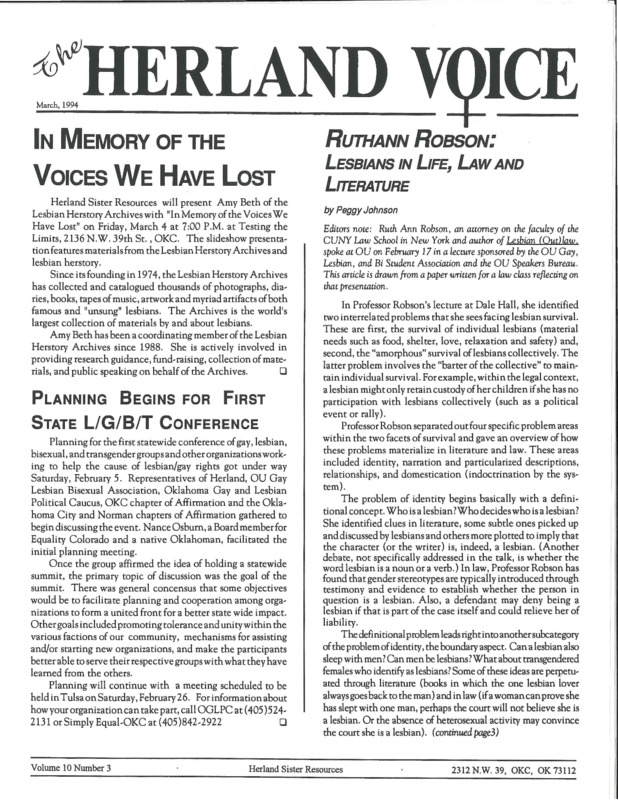
March, 1994
IN MEMORY OF THE
RUTHANN ROBSON:
VOICES WE HAVE LOST
Herland Sister Resources will present Amy Beth of the
Lesbian Herstory Archives with "In Memory of the Voices We
Have Lost" on Friday, March 4 at 7:00 P.M. at Testing the
Limits, 2136 N.W. 39th St. , OKC. The slideshow presentation features materials from the Lesbian Herstory Archives and
lesbian herstory.
Since its founding in 1974, the Lesbian Herstory Archives
has collected and catalogued thousands of photographs, diaries, books, tapes of music, artwork and myriad artifacts of both
famous and "unsung" lesbians. The Archives is the world's
largest collection of materials by and about lesbians.
Amy Beth has been a coordinating member of the Lesbian
Herstory Archives since 1988. She is actively involved in
providing research guidance, fund-raising, collection of materials, and public speaking on behalf of the Archives.
0
PLANNING
BEGINS FOR
FIRST
STATE L/G/B/T CONFERENCE
Planning for the first statewide conference of gay, lesbian,
bisexual, and transgender groups and otherorganizations working to help the cause of lesbian/gay rights got under way
Saturday, February 5. Representatives of Herland, OU Gay
Lesbian Bisexual Association, Oklahoma Gay and Lesbian
Political Caucus, OKC chapter of Affirmation and the Oklahoma City and Norman chapters of Affirmation gathered to
begin discussing the event. Nance Osburn, a Boardmemberfor
Equality Colorado and a native Oklahoman, facilitated the
initial planning meeting.
Once the group affirmed the idea of holding a statewide
summit, the primary topic of discussion was the goal of the
summit. There was general concensus that some objectives
would be to facilitate planning and cooperation among organ izations to form a united front for a better state wide impact.
Other goals included promoting tolerance and unity within the
various factions of our community, mechanisms for assisting
and/or starting new organizations, and make the participants
better able to serve their respective groups with what they have
learned from the others.
Planning will continue with a meeting scheduled to be
held in Tulsa on Saturday, February 26. For information about
how yourorganization can take part, call OGLPC at (405 )5242131 or Simply Equal-OKC at (405)842-2922
0
Volume 10 Number 3
LESBIANS IN LIFE,
LAw AND
LrrERATURE
by Peggy Johnson
Editors note: Ruth Ann Robson, an attorney on the faculty of the
CUNY Law School in New York and author of Lesbian (Oud/aw.
spoke at OU on February 17 in a lecture sponsored by the OU Gay ,
Lesbian, and Bi Student Association and the OU Speakers Bureau.
This article is drawn from a paper written for a law class reflecting on
that presentation .
In Professor Robson's lecture at Dale Hall, she identified
two interrelated problems that she sees facing lesbian survival.
These are first, the survival of individual lesbians (material
needs such as food, shelter, love, relaxation and safety) and,
second, the "amorphous" survival oflesbians collectively. The
latter problem involves the "barter of the collective" to maintain individual survival. For example, within the legal context,
a lesbian might only retain custody of her children if she has no
participation with lesbians collectively (such as a political
event or rally) .
Professor Robson separated out four specific problem areas
within the two facets of survival and gave an overview of how
these problems materialize in literature and law. These areas
included identity, narration and particularized descriptions ,
relationships, and domestication (indoctrination by the system) .
The problem of identity begins basically with a definitional concept. Who is a lesbian?Who decides who is a lesbian?
She identified clues in literature, some subtle ones picked up
and discussed by lesbians and others more plotted to imply that
the character (or the writer) is, indeed, a lesbian. (Another
debate, not specifically addressed in the talk, is whether the
word lesbian is a noun or a verb.) In law, Professor Robson has
found that gender stereotypes are typically introduced through
testimony and evidence to establish whether the person in
question is a lesbian. Also, a defendant may deny being a
lesbian if that is part of the case itself and could relieve her of
liability.
The definitional problem leads right into another subcategory
of the problem of identity, the boundary aspect. Can a lesbian also
sleep with men? Can men be lesbians?What about ttansgendered
females who identify as lesbians? Some of these ideas are perpetuated through literature (books in which the one lesbian lover
always goes back to the man) and in law (ifa woman can prove she
has slept with one man, perhaps the court will not believe she is
a lesbian. Or the absence of heterosexual activity may convince
the court she is a lesbian). (continUed page3)
Herland Sister Resources
2312 N.W. 39, OKC, OK 73112
ST. SYBIL
Dear St. Sybil,
In my innocent childhood dreams and fantasies of fame,
glory, and heroism, I more than once threw my thin but wondrously brave body on a dastardly Nazi's hand grenade. How
fortunate were my friends: not only were they favored by the
company of such a selfless, courageous comrade: I survived to fight
another day with them, as it turned out that the grenade was,
happily ( ! ) a dud.
Also more than once did I give a rousing Nathan Hale-esque
speech with a rope around my neck, or better yet and more often,
in front of a firing squad, with a cigarette dangling from my lips and
a scorned blindfold dangling from the hand of my admiring,
reluctant executioner; only to be saved in the nick of time by my
faithful friends and followers ... who thanks to my derringdo were
wildly successful not only in my rescue but in their cause. Life can
be awfully sweet in dreams. I wish I could be a hero today, but I
guess there aren't that many opportunities anymore, are there?
Regretfully,
Jess A. Wannabee
Dear Jess,
Sure, you've always wanted to be brave and resourceful and
unheeding of your own wellbeing - without suffering the consequences. Who hasn't? Oh to be Rosa Parks, to take a stand, spark
a movement and live to reap her just honors. Or Audie Murphy,
the most decorated soldier in WWII, who lived to write a book and
be a movie star. Or Nelson Mandela.
But the fact is, Nathan Hale was hanged, and people who
throw themselves on grenades die. For every Rosa Parks there was
amultitude.ofpoortired nameless black women who in ways large
and small fought the constrictions of American apartheid - and
suffered in ways large and small for it. For every Audie Murphy,
there were hordes who received their medals posthumously. For
Mandela there was Steven Biko and countless unnamed others;
for Jesse Jackson there was Medgar Evers, Martin and Malcolm.
There are always those who go before, who suffer, who lose,
who die, to pave the way for a better world. All honor to Anita
Hill, who has kindled an · awareness and resistance to sexual
harassment; she has made this country better for women, and
herself owes a debt to the little girls who walked up the school
house steps in Mississippi and Arkansas. The small cadre of white
civil rights workers in the sixties who participated in the voter
registration drives will always remember and honor Viola Gregg
Liuzzo; but how many others remember or even recognize the
name of the white mother of five from Detroit who was murdered
on a dark Alabama road in 1965.
The forty-hour work week we take for granted ·people died
to make it a reality. The right to vote was won with lives· and
deaths - dedicated to that struggle.
Today we often see extreme personal sacrifice by those who
lend themselves to lawsuits • class action or personal ones which
will change law, set new precedent, or in other ways alter interpretation of current laws; and increasingly it is lesbians and gay men
who are in the forefront, who are sacrificing, suffering, fighting;
who are the ones disrupting their lives, losing their privacy, their
careers, their children. Army Sgt Jose Zuniga and Naval Academy
Midshipman Joseph Steffan came out publicly, and were ousted
from their military careers as a result, because they felt that
2 Herland Voice March, 1994
continuing to be closeted was intolerable· and because they were
brought up to believe that America stands for equality, fairness,
decency, and justice for all, including them; and that consequently their cause would prevail. The sodomy law was overturned in Kentucky recently thanks to the hard work and legal
expertise of a couple of attorneys (inlcuding Shirley Wiegand,
now professor at OU Law School) and the personal courage of
Jeffrey Wasson.
The local women who have fought for their children in court,
rather than by running to another state, or by lying about their
lives and their relationships, are heroes of the ongoing struggle for
peace and justice. Honor them, keep the faith, and keep your eyes
open; opportunities for heroism abound.
D
SIMPLY EQIJAL. OKC l.AuNCtES MEDIA
PROJECT
Members of the lesbian and gay rights organization, Simply
Equal - OKC, are preparing a campaign to monitor the media in
Central Oklahoma. The organization's Communications Committee will coordinate the project but committee Co-chair Pat
Reaves said the ultimate success of the endeavor really depends on
individuals within the community. "The Media Project's goal is to
educate the local media about gay and lesbian issues. Most of the
education will come when individuals within our community, and
Simply Equal • OKC (SE-OKC) in particular, respond to the
media's treatment of lesbian and gay people and issues. Our
community must begin to make itself more vocal to the print and
electronic media," Reaves said.
SE-OKC officials say the effort has two main components.
Communications Committee Co-chair Alan Nyitray says the first
component of the Media Project will rely on individuals to alert
SE-OKC when newspapers, radio, or TV cover a gay and lesbian
issue. "If people notice something in the media that they think the
community should respond to, then they should call us at our
business line at 848-2922 and leave a message for the Media
Project. People need to leave their phone numbers so a Simply
Equal member can contact them and get more information."
Nyitray says the second component involves responding to
the newspaper or other media outlet with letters, phone calls, press
releases or other means. "Our goal to educate the media will be
accomplished when we tell them what they did right and what
they did wrong.
The Simply Equal - OKC Media Project can be reached at
405-848-2922.
D
Published by: Harland Sister Resources, Inc. 2312 N.W. 39th,
Oklahoma City, OK 73112
Newsletter Committee: Margaret Cox, Deborah Fox, Vivien Ng, Pat
Reaves
Clrculatlon: 1200
Advertising Rates: Business card $15; 1/4page$35; 1/2page$60;
full page $100
The Voice is offered as an open forum for community discourse.
Articles reflect the opinions of the author and not necessarily those of
Herland Sister Resources. Unsolicited articles and letters to the
editor are welcomed and must be signed by the writer with full name
and address. Upon request, letters or articles may be printed under
a pseudonym or anonymously.
Subscriptions to The Voice are free upon request.
The Voice is printed on recycled paper.
.
eeeeeeeeeeeeeeeeeeeeeeeeeeem
Sunday
Monday
Tuesday
On March 4, 1917,
Jeannette Rankin of
Montana, pacifist
and feminist, became
the first woman seated
in the US Congress.
I
7
8
6.
2
SIMPLY
EQIJAL
at
Her land
7 pm
SIMPLY
EQUAL
at
Herland
7 pm
Elizali·eth
Barrett
Brownin£S
1808 - t861
14
1
Herland Le£1al
Defense Fund
Committee
Meet.in£!
6:30 pm
2.
21
John Brown
f800 - 1859
16
Board
f'1eetln£1
4:30
28
Friday
Saturday
4
5
11
12
AMY SETH
of the Nat'l
Lesbian
Archives
al. TrianESle
7 Dm
u
CoDA, 7 pm
10 Harr1e
. t
Tubman.
RIP
f9f 3
ti
Teachers
Group
7pm, Herland
17
PEGGY
JOHNSON
at the
GratefUl Bean
10th &. Walker
9 - t2
ti
CoDA, 7 PIYI
18
19
#
OKC NOW
at the
Gaylord YWCA
2460 NW 39l.h
6:30 pm
22
CoDA, 7 pm
23
29
SIMPLY
EQUAL
at
Herland
7 pn1
24
~~riaSteinem 26
i934
SIMPLY
EQUAL
91l
Herl and
7 pm
:;:
27
~MPLY
EQIJAL
Herland, 7 pm
3
Cleveland
County NOW
Norman
Public library
7 pm
9
..
13
\\lednesday Thursday
PEG CY
JOHNSON
L• B.ieuelle
in Norman
9 - f2
&
Aretha
Franklin
t942
30
31.
...
Cesar Chavez
1927 - 1993
..
CoDA, 7 pm
....
---
1~·-
le
1
;
'
'
l l
)
~·-
-
~
-
-
-~
--
·~
SAVE THESE DATES:
I
April 17 -
'
Miss Brown To You
does a g i g in OKC
'
April 30 -
HERLAND SISTER RESOURCES, INC.
2312 N.\\I. 39th Street
Ol<lahoma City, Oklahoma 73112
(405) 521-9696
Hours: Saturdays iO - 6; Sundays i - 6
The Sweetheart Ball
(Bring your Sweetheart
or find one there)
May 20, 21, 22 Herland's Spring
Retreat at Roman Nose
NonProfit Org.
U.S. Postage
PAID
Oklahoma City, Okla.
2312 N. W. 39th Street
Oklahoma City, Oklahoma 73112
ADDRESS CORRECTION REQUESTED
RETURN POSTAGE GUARANTEED
Permit No. 861
ROBSON
(continued from page 1)
Other problems of identity include a heterosexist "accusation
of incompleteness" which denies lesbian existence absent a reference to gay men. Professor Robson suggests resisting the "coupling" that this gender parity requires but not to the point of saying
there are no alliances between the lesbian and gay communities.
Just make sure they are on equal footing. Finally, lack of coherence--how can you say lesbian since all lesbians are not alike?-causes problems with defining what lesbian means, especially in
law. For example, if there are "too many different types of you,"
there is little hope in overcoming the "discrete and insular
minority" prong of the test for suspect class status.
The second main problem area in focusing lesbian concerns
is that ofnarration or particularized descriptions. In literature, this
descriptive requirement "substitutes for theorizing about what we
want to do." In law, the emphasis on telling one's story causes cases
to tum on the particularized facts. This, in tum, observes Professor
Robson, interferes with the discrimination analysis and addressing
the systemic problems inherent in cases involving lesbians. For
example, if a lesbian mother loses custody of her children even
though she is otherwise a fit mother, the facts of the case cannot
belie to the conscious mind (though they often do to the court)
that she is losing custody because she is a lesbian.
Her third area of discussion involved the problem of relationships where lesbians tends to be "boxed in by the family" in both
law and literature. Professor Robson wonders where we are going
in our private lives if we continue to have so much focus on
relationships. She thinks it a gender problem that lesbian fiction
has such a focus and, in law, the problem presents a barrier to any
strides in the privacy argument since courts do not like to interfere
with relationships (even though through sodomy laws and child
custody cases the state does interfere with relationships). Even in
feminist legal theory, lesbian tends to be mentioned in chapters on
alternative forms of family.
Finally, Professor Robson addressed the fourth problem area
which I think is a major focus of her work. That problem is
domestication, the ways in which we are indoctrinated by the
system so that we believe certain concepts and have no idea why.
Marriage is one example. If lesbians get the legal right to marry,
the state-sanctioned relationship becomes somehow "better" on
the hierarchical scale than other lesbian relationships or the
single lesbian's choices. Thus would the heterosexist model be
reproduced and lesbians domesticated by the values of a system
that otherwise has always denied them. Professor Robson is
concerned that lesbians use legal concepts as substitutes for our
own theorizing. "It is hard to have a discussion about our own
values because we don't even know what they are."
Even though she finds that lesbian literature and culture is
"being diluted" and then we use that diluted product "to identify
each other," she is "quite hopeful" for lesbian survival. She
recognized that the lesbians who went before took lots of risks "to
preserve themselves so we could know them." She ended the
prepared portion ofher talk on a positive note by offering that "we
owe it to the lesbians who come after us to confront our problems
so they can come up with their own problems and solve them."
Her audience of about a hundred, mostly lesbian and gay,
listened intently to her highly substantive talk. The structure of
her presentation assured me that she is a law professor. Her
answers to questions from the crowd assured me that she cares
deeply about individual and collective lesbian survival. One
major area of discussion between her and the audience concerned
the assimilation of lesbian culture. Our visibility, she said, "is
being used and sold back to us." More specifically, "our hunger is
being directed for us." She suggests not buying into
commod ification in general and liking one's friends "for who they
are and not what they have."
One questioner addressed her role as a constitutional law
professor and wondered what she thinks about original intent. She
replied, "I don't really care what who wrote it thought about it.
They're not around anymore." The audience was pleased with
that response.
There were at least two men in the crowd who took issue with
the speaker concerning the "moral dilemma" they think that
"homosexuality" poses (a classic example of the gender parity
problem the professor had addressed in her talk, in that, the
questioners could not speak of lesbians without a reference to gay
men) and what about some people who find it "disgusting to see
same sex couples holding hands."
Finally, the last questioner asked Professor Robson what
motivates her work and suggested that perhaps she was not
"politically motivated." She said that perhaps different personalities make different choices on how to work politically. In a direct
affront to the questioners who had not caused her own tempo to
change but who had ruffled me, she ended the wonderful evening
by saying, "I've never been very motivated to be very tolerant of
people I think are not very bright."
0
WOMEN'S STUDIES AWARDS ANNOUNCED
The Women's Studies Program of the University of Okla- .
homa has announced that applications are being accepted for the
Betty Baum Hirschfield Scholarship, the Hillyer Prize, and the
Affleck-Carl Award.
The Betty Baum Hirschfield Scholarship is awarded to two
single mothers who have returned to school after interruption (at
any stage) of their education. At the time of application, they
must be a student at OU and have completed the equivalent of two
semesters of full-time study within the previous five years with at
least a B- average. Applications will be accepted until March 15.
The Hillyer Prize, named in honor of the founding Director
of the Women's Studies Program at OU, Dr. Barbara Hillyer, is
awarded to an outstanding student in a Women's Studies course.
Applicants must have been enrolled in the Women's Studies
course at OU during the 1993-94 school year. Applications will
be accepted until April 1.
The Affleck-Carroll Award is presented annually to women
Ph.D. students graduating who have completed dissertations on a
topic related to Women's Studies. The Judith S. Lewis Prize is
presented to the most outstanding Women's studies senior. Nominations are received from Women's Studies faculty.
For more information about any of these awards, please
contact the OU Women's Studies office at325-J481.
0
Rebecca R. Cohn, Ph.D.
Clinical Psychology
Norman, OK
321-2148
Couples,
Individuals, &
Family Therapy
Her/and Voice March, 1994
3
MUJERES
y
MAIZ
I never though I was rich -- not until I stood in a campesino family's home in Honduras. About a half-mile up a steep path from the closest
dirt road, the two room stucco house had neither windows nor doors, just simple openings and none of our "modem conveniences." The
daughter-in-law took us to see the small field (about two city lots) she and her husband work together. It's unusual for women to work the
fields in Honduras. Shyly, she told us how they had laid out contours and dug terraces by hand on the steeply sloping field. The supper we
ate later in a Honduran roadside cafe cost 4 lempiras -- about 1/2 dollar -- and a day's wage for a day laborer. A women's group sold calendars
for 15 lempira each to support their work -- my purchase of 10 for about $20 brought tears of happiness. It was as if someone had walked in
to Herland and given us a check for three hundred dollars the day the mortgage was due.
The drawings and writings below are reprinted from that calendar, "Mujers Y Maiz," which was produced by campesina women who
live in the Paris of San Gaspar in Taulabe, Comayagua, Honduras. The drawings were made with materials taken from the earth. We share
them in celebration of International Women's Day. --Pat Reaves
"We've been meeting for six years now to develop
ourselves in various ways. We have been discovering and
sharing the problems that we live and feel as women and
what is more, poor women.
We've realized that we have both intelligence and
wisdom, that we are an important part of the people of
Honduras, that we're fundamental to life (through reproduction) and not just objects of satisfaction to supply needs.
We think that health is not only physical well being, but also
emotional and spiritual equilibrium.
We also need good food, as the soil needs a good
compost to produce better fruits.
We are learning that it's important to love life, to
protect the trees, rivers, the earth and the animals.
Our intention is to continue struggling with great hope
that we can find our own space in this very disfigured society
of ours."
Translated and adapted from the original by Felipa
Zalmer6n
"Nos reunimos hace seis afios para capacitamos en
muches aspectos de lavida- Hemos descubierto los problemas
que vivimos y sentimos, desde la perspectiva de ser mujeres
y ademas mujeres pobres.
Conviviendo en un ambiente dominado por el machismoentremujeresy hombres; comprendimosquetenemos
inteligencia y sabidurfa, que somos parte importante del
pueblo, seres fundamentales de la vida (reproducci6n) y no
objetos de satisfacci6n de necesidades.
Pensamos que la salud no es solamente estar bien
fisicamente, sino emocional y espiritualmente porque
necesitamos buenaalimentaci6nal igual que la tierranecesita
el abono para dar mejores frutos.
Estamos aprendiendo lo importante que es proteger los
::j.rboles, rios, la tierra y los animales para la vida.
Nuestrasideassonseguirluchanoconmuchasesperanzas
para encountrar el espacio propio que tan to necesitamos, en
todos los aspectos, de esta sociedad que tenemos, tan
desfigurada."
Adaptado del original escrito por Felipa Zalmer6n
Poem About Com
Poema Sobre El Maiz
Campesinos work the earth
To sow maize
Because in our country the most important thing
Is maize
And like this we live,
all our lives ,
Sowing maize for the tortillas
And beans to make our meals complete
The birds of the sky sing and sing
With the heavenly rain
In the fields com cobs
Begin to bloom
When we gather the harvest
We find a great happiness
Because here in our homes
We have tortillas again
How pretty the time of water,
Pretty the cut maize
How lovely the com cobs
When they are bent over in the fields!
Los campesinos labran la tierra
para sembrar el ma£z
porque en nuestro pa£s lo mas importante
es elmafz
Y as( vivimos toda la vida
sembrando el ma(z
para las tortillas
y el frijol para el conque.
Las aves del cielo cantan y cantan
con la Uuvia celestial
en los campos los maizales
ya comienzan a florear.
Cuando sacamos la cosecha
nos encontramos con gran alegr(a
porque aUa en nuestras casas
tenemos siempre las tortillas.
jQue bonito el tiempo de agua,
bonito el ma(z giloteando
Que bonito los maizales
cuando ya estan doblando!
- Erlinda Argueta Medina
- Erlinda Argueta Medina
''We are awake when we were asleep."
4 Herland Voice March, 1994
Herland Voice March, 1994
5
HERLAND HERSTORY
Women working on projects, women singing or reading,
women sharing ideas ..... The story began over twelve years ago. It
was in the summer of 1982 that sisters and friends opened a
WOMMIN'S BOOKSTORE from the idea of La Salle des
Femmes. In an open letter, Barbara Cleveland outlined the plans
for this peaceful, tranquil "woman's place." From pictures of
getting the bookstore ready to open, there appeared to be plenty
of fun, frolic, and frustration (one can only guess what was not
pictured). With about fifty volumes of inventory, a plea was
made for writers, artists, and browsers to share in the excitement
of "a dream come true."
In November of 1984, the newsletter reported that the
bookstore had become HERLAND SISTER RESOURCES and the
following January (1985) was to be turned over to a feminist
collective to develop this "primary center supporting women in times
of creativitY and stress." Educational and entertainment events
nourished the expanding community and continued to be successful;
poetry readings, workshops, and music concerts dotted the calendar.
A now longstanding tradition began in the fall of 1985-the first
HSR RETREAT at Osage Hills State Palk on October 25-2 7.
A three year PLAN was developed in September of 1986
with one priority being to find a building to purchase. Through
much hard work and commitment, a move to the current location resulted in January 1988. During over six months of moving
and setting up time, the more than 150 volumes of book inventory with music and some jewelry was available by mail order in
a catalog. Another project of that summer was the Pride Parade
in June. Most of these endeavors had been documented in the
newsletter which became THE HERLAND VOICE in September of 1989.
In 1990 a new three year PLAN was developed as well as the
current MISS! ON STA TEMENT. Retreats both spring and fall
have continued to offer many possibilities to the wommin's community-a preserve, a refuge, a resort, a sanctuary, a shelter, an escape,
an evacuation, a flight, a withdrawal. At Red Rock Canyon (fall
1991), pictures show women in contemplation and excitation. In fall
of 1992 at Roman Nose, much the same is shown in snapshots but
with the addition of many of our four-legged friends sharing the
moments. Besides the on-going retreats twice a year, an accomplishment for 1991 was that HSRopened a CRAFTROOM in December.
A PAYOFF THE MORTGAGE celebration concluded the anticipated event by board members, volunteers, and friends inJanuary of
1993.
Women working on projects, women singing or reading,
women sharing ideas....This is a story that continues in 1994 and
beyond. There have been many contributors to HSR herstory
and this article is a meager outline (leaving out all the unpleasantness of fundraising and tempers flaring) taken from available
material. All pictures, momentos, cards, invitations, anecdotes,
flyers, ideas are needed; contact a board member, leave a message
at Herland (521-9696, or ask for Diane (524-3495). This is a story
that must be told.
0
A wommin's CODEPENDENTS ANONYMOUS group
meets at HSR at 7 P.M. on Fridays. CODA is an anonymous
fellowship of sharing experience, strength, and hope and using
a twelve step plan to develop healthy relationships. Any
woman interested in a twelve step meeting is welcome to
attend. For information call 524-3495.
6 Her/and Voice March, 1994
POWER FEMINISM
by Vivien Ng
I guess we have come a long way, baby. I still remember the old
days when the only time of the year that the media paid any attention
to us was the month of March, and we might find a serious article or
two about women's history in some magazines. Come April, all would
be forgotten and news about women would once again be relegated
to the "Style" or "Living" section of the local paper. If the past year
could be used as an index of change, I would have to say that times
have really changed for us. How many magazine and newspaper
stories have we read about "new" feminism or "power" feminism?
How many times have we seen the faces of latter-day feminists such
as Naomi Wolf or Katie Roiphe, all made-up, smiling alluringly at the
camera-and, presumably, at us? If the medium is the message,
the message is: "Move over, dumpy, flannel-shirted, bra-burning,
humorless, sexless, old-time feminists. Make room for the 'new'
generation of pleasure-seeking, men-loving, self-affirming, designer-clothed, I'm-responsible-for-my-life-and-therefore-nevera-victim 'power' feminists."
Media hype notwithstanding, the self-styled "new"feministsdid
not invent power feminism. Consider one early feminist, Virginia
Woolf, for example. In her work, Three Guineas, she characterized the
feminism of her time as "obsolete," not because she did not see herself
as a feminist, but because she believed that the women's movement
of her time (late 1930s) was too timid in their aims, seeking only to
obtain equality with men. She wanted a more radical approach, one
that would directly challenge not just the status quo but the values
that inform it. In the same vein, but almost 40 years later, Audre
Lorcle challenged feminists to forsake acquiring the master's tools, for
"the master's tools will never dismantle the master's house." Had the
"power" feminists done their homework, they would not be so smug
about their place in the history of the women's movement. They
would have recognized how anemic their agendas are compared
to those of Woolf and Lorde.
Only those who have not done their homework could write
off an entire generation of feminists as "anti-sex." They ridicule
the anti-pornography campaigns of Catharine MacKinnon and
Andrea Dworkin, but ignore the works of Audre Lorde and Carter
Heyward. Had they read Lord e's powerful essay, "The Uses of the
Erotic: The Erotic as Power,'' or Heyward's provocative Toughing
Our Strength: The Erotic As Power And The Love Of God, they
would (should) have been more modest in their claims of erotic
breakthrough.
Only those who have not done their homework could dismiss
an entire generation of feminists for perpetuating the victim
mentality in women. How else could they have missed the power
of Audre Lorde's "The Transfonnation of Silence into Language
and Action"? Or Cheryl Clarke's "Lesbianism: An Act of Resistance"? Or Rosario Morales' "I Am What I Am"? The list goes
on.
How could Naomi Wolf (Fire With Fire) and Katie Roiphe
(The Morning After: Sex, Fear And Feminism On Campus), both
intelligent and highly educated, make such mistakes? What can
explain the gaps in their knowledge? Racism, maybe? Classism,
maybe? Heterosexism, maybe?
To those who consider themselves ''new'' feminists, I have
one advice: enroll in a Women's Studies class and read your
assignments. Then, and only then, celebrate your new-found
~~.
0
t'
WOMEN OF THE WEST
by Deborah Fox
While cowboys are a national icon, cowgirls are a well-kept
secret. We have been taught that women were only reluctant
pioneers, self-affacing Prairie Madonnas, "bad girls" (i.e. dance
hall prostitutes or women as civilizers.) Truth be known there
were (and are) thousands of cowgirls, pioneers and homesteaders
who came for the adventure, opportunity and a new way of life.
"Women came West as independent entrepeneurs, to take up
land and build futures for themselves. From 1862-1934, under the
auspices of the Homestead Act and related legislation, thousands
of widows and single women proved up on homesteads. Women
made up a significant proportion of those who took out claims -in some areas, close to twenty percent. One study indicates that
women proved up more often than men." (Teresa Jordan, Cowgirls)
Oklahoman Elinore Pruitt Stewart, widow and single parent
who took employment as a house keeper for a well-to-do Scotch
cattleman, filed a claim on land in Wyoming adjoining her
employers in May, 1909. She believed homesteading was a way for
women to be independent and she made certain that she earned
every cent that went into her land and did the improvements
herself. "... any woman who can stand her own company, can see
the beauty of the sunset, loves growing things, and is willing to put
in as much time at careful labor as she does over the washtub, will
certainly succeed; will have independence, plenty to eat all the
time, and a home of her own in the end." (Elinore Pruitt Stewart,
Letters of A Woman Homesteader) /
Agnes Morley Cleveland, whose widowed mother kept the
New Mexico ranch her husband bought rather than sell it and
move back to town, recounts her adventures growing up on and
working a cattle ranch on the open range in the late 1800's. She
worked roundups, rode the range, hunted grizzly bears, and went after
the mail; "With icicles six inches long hanging from my pony's
nostrils, and with frost bitten feet, I have made the trip [15 miles oneway] in sub-zero weather, or, in midsummer, I have ridden it with the
sun blasting down with all the force of a glass furnace. I have ridden
it on easy-gaited horses, on rough-gaited horses, horses that were
gentle and horses that were not; I have ridden it when I wanted to and
when I didn't, when my excited imagination had Indians following
me, and when I knew coyotes were."
"I have spent the first half of my life
explaining. I'm going to start the second half
without explanation."
Margaret Duncan Brown and her husband bought 160 acres
on Elk River in Northwest Colorado in 1915. When her husband
died 3 years later she decided to stay on the ranch. She was 36
years ol~. She paid it out and expanded. "I suppose living here
alone is what other people call queer. No one can know the relief
this quiet has been to me. I have spent the first half of my life
explaining. I'm going to start the second half without explanation."
"Although women worked outside in virtually every capacity, they seldom had the bedrock right to the land their male
counterparts enjoyed. If they were daughters, they had less chance
of inheriting the ranch; if they were hired hands, they had fewer
chances for paid employment; if they were spouses, estate taxes
were biased against them; if they were owners, they needed the
cooperation of male colleagues. They were, after all, working
outside the more accepted role, and neither tradition nor law gave
them vested interest in the territory. They had good reason not to
draw attention to themselves." (T. Jordan)
"I have tried every kind of work this ranch
affords, and I can do any of it."
So although ranch women did not readily embrace the
women's movement, we can see that it is a more complex issue.
Perhaps they were a part of women's emancipation for western
states more quickly approved women's suffrage than eastern states.
"I have tried every kind of work this ranch affords, and I can do any
of it. Of course I am extra strong, but those who try know that
strength and knowledge come with doing. I just love to experiment, to work, and to prove out things, so that ranching life and
'roughing it' just suit me." (E.P. Stewart)
"Today, all over the country, women serve in leadership roles
in stock and woolgrower's associations, on loan boards of banks,
and in other policy-making positions to far greater extent than
ever before. The number of women who operate farms and
ranches has increased by 10,000 since 1979, even though the
number of farms has decreased. (T. Jordan)
From women in the West we also gain a different perspective
that the one we are most familiar with -- the heroic tales of rugged
individualist white men. "The Women's West challenges this
picture as racist, sexist, and romantic and rejects the customary
emphasis of traditional western history on the nineteenth-century
frontier, discovered and defined by Anglo men." (taken from the
back cover of The Women's West, edited by Susan Armitage and
Elizabeth Jameson)
From women's perspective we also gain a different view in
regards to the Native Americans. Fredrika Bremer had this to say
of Native American women, "With inward wonder I regarded
these beings, women like myself, with the spirit and feelings of
women, yet so unlike myself in their purpose of life ...I thought of
hard, gray, domestic life in the civilized world ... hedged in by
conventional opinion, with social duties ...with every prospect of
independence, liberty, activity, and joy closed, more rigidly closed
by invisible barriers that these wigwams by their buffalo hides ... and
I thought that the Indian hut and that Indian woman's life was better,
happier as earthly life...I thought that the wigwam of an Indian was a
betterand a happier world than that of the drawing-room. There they
sat at their ease, without stays or the anxiety to charm, without
constraint or effort, tote daughters of the forest." (Glenda Riley,
Women and Indians on the Frontier, 1825-1915)
As we can see when taking a look at history through women's
eyes, the stereotypes and "facts" of men's records of history are
only a partial truth. The history we are taught in school is
incomplete and would remain so were it not for women's perspecO
tives.
2109 S. Air Depot
Midwest City, OK 73110
(405)737-0496
Air Depot Animal Hospital
Call for Appointment
JOY HUSKA, D.V.M.
Herland Voice March, 1994
7
Dykes To Watch Out For
r----------,
I
II
I
1
I
i
I
BULLETIN BOARD
Writingwanted: ForaFeministAntho logy written by and for Women
with Chronic Illness. Currently accepting poetry, essays, fiction, oral
histories and autobiographies. Topics may include: religion, race, culture, body image, class, age, healing,
sexual orientation, medical establishment, invisible disabilities, feminist
identity, relationships, disabled identity and coping mechanisms. submission requirements; Entries should be
no longer than 15 pages; all submissions must be typed, double-spaced;
multiple submissions and previously
published material accepted (must be
notated); include a SASE; send brief
( 1 page) biography; submissions accepted in any language, please provide English translation. The anthology will be edited by Laurel Fain and
Pella Schafer, both recently diagnosed
with chronic illnesses. Currently accepting submissions until April 1,
1994, to ANTHOLOGY; P. 0 . Box
492, Santa Cruz, CA 95061.
Sixth Gulf Coast Womyn's Festival,
March31-April4, 1994, Hattiesburg,
MS. Womyn'smusicandculturewith
a Southern touch. For information,
contact Henson Productions, 1806
Curcor Drive, Gulfport, MS 39507,
(601) 344-1411.
I
II
I
Eco· Visions, a Conference about
Women, the Animals, the Earth, the
Future; March 18-20, 1994, Alexandria, VA. Panels and roundtable discussions on feminism and animal
rights; environmentalism and animal
rights; women in alternative communities; spirituality, nature, and ritual;
women in law - working for animals
and the environment; strategies for
feminist nonviolence; women's crafts,
vegan food, music, dance, ritual, art
and more. Wheelchair accessible,
sign-language interpreted. For information contact Friends of Animals,
2000 P Street, Suite 415, Washington, D.C. 20036, (202) 296-2172.
What About Vs? Children tell of
their lesbian/gay parents' breakup.
Seeking first-person stories, thoughts,
and drawings from children of all ages
for anthology. Deadline: June 30,
1994. Write to Jenn Christiansen, P.
0 . Box 1841, Champlain, NY 12919.
'-----------"'
-
March, 1994
IN MEMORY OF THE
RUTHANN ROBSON:
VOICES WE HAVE LOST
Herland Sister Resources will present Amy Beth of the
Lesbian Herstory Archives with "In Memory of the Voices We
Have Lost" on Friday, March 4 at 7:00 P.M. at Testing the
Limits, 2136 N.W. 39th St. , OKC. The slideshow presentation features materials from the Lesbian Herstory Archives and
lesbian herstory.
Since its founding in 1974, the Lesbian Herstory Archives
has collected and catalogued thousands of photographs, diaries, books, tapes of music, artwork and myriad artifacts of both
famous and "unsung" lesbians. The Archives is the world's
largest collection of materials by and about lesbians.
Amy Beth has been a coordinating member of the Lesbian
Herstory Archives since 1988. She is actively involved in
providing research guidance, fund-raising, collection of materials, and public speaking on behalf of the Archives.
0
PLANNING
BEGINS FOR
FIRST
STATE L/G/B/T CONFERENCE
Planning for the first statewide conference of gay, lesbian,
bisexual, and transgender groups and otherorganizations working to help the cause of lesbian/gay rights got under way
Saturday, February 5. Representatives of Herland, OU Gay
Lesbian Bisexual Association, Oklahoma Gay and Lesbian
Political Caucus, OKC chapter of Affirmation and the Oklahoma City and Norman chapters of Affirmation gathered to
begin discussing the event. Nance Osburn, a Boardmemberfor
Equality Colorado and a native Oklahoman, facilitated the
initial planning meeting.
Once the group affirmed the idea of holding a statewide
summit, the primary topic of discussion was the goal of the
summit. There was general concensus that some objectives
would be to facilitate planning and cooperation among organ izations to form a united front for a better state wide impact.
Other goals included promoting tolerance and unity within the
various factions of our community, mechanisms for assisting
and/or starting new organizations, and make the participants
better able to serve their respective groups with what they have
learned from the others.
Planning will continue with a meeting scheduled to be
held in Tulsa on Saturday, February 26. For information about
how yourorganization can take part, call OGLPC at (405 )5242131 or Simply Equal-OKC at (405)842-2922
0
Volume 10 Number 3
LESBIANS IN LIFE,
LAw AND
LrrERATURE
by Peggy Johnson
Editors note: Ruth Ann Robson, an attorney on the faculty of the
CUNY Law School in New York and author of Lesbian (Oud/aw.
spoke at OU on February 17 in a lecture sponsored by the OU Gay ,
Lesbian, and Bi Student Association and the OU Speakers Bureau.
This article is drawn from a paper written for a law class reflecting on
that presentation .
In Professor Robson's lecture at Dale Hall, she identified
two interrelated problems that she sees facing lesbian survival.
These are first, the survival of individual lesbians (material
needs such as food, shelter, love, relaxation and safety) and,
second, the "amorphous" survival oflesbians collectively. The
latter problem involves the "barter of the collective" to maintain individual survival. For example, within the legal context,
a lesbian might only retain custody of her children if she has no
participation with lesbians collectively (such as a political
event or rally) .
Professor Robson separated out four specific problem areas
within the two facets of survival and gave an overview of how
these problems materialize in literature and law. These areas
included identity, narration and particularized descriptions ,
relationships, and domestication (indoctrination by the system) .
The problem of identity begins basically with a definitional concept. Who is a lesbian?Who decides who is a lesbian?
She identified clues in literature, some subtle ones picked up
and discussed by lesbians and others more plotted to imply that
the character (or the writer) is, indeed, a lesbian. (Another
debate, not specifically addressed in the talk, is whether the
word lesbian is a noun or a verb.) In law, Professor Robson has
found that gender stereotypes are typically introduced through
testimony and evidence to establish whether the person in
question is a lesbian. Also, a defendant may deny being a
lesbian if that is part of the case itself and could relieve her of
liability.
The definitional problem leads right into another subcategory
of the problem of identity, the boundary aspect. Can a lesbian also
sleep with men? Can men be lesbians?What about ttansgendered
females who identify as lesbians? Some of these ideas are perpetuated through literature (books in which the one lesbian lover
always goes back to the man) and in law (ifa woman can prove she
has slept with one man, perhaps the court will not believe she is
a lesbian. Or the absence of heterosexual activity may convince
the court she is a lesbian). (continUed page3)
Herland Sister Resources
2312 N.W. 39, OKC, OK 73112
ST. SYBIL
Dear St. Sybil,
In my innocent childhood dreams and fantasies of fame,
glory, and heroism, I more than once threw my thin but wondrously brave body on a dastardly Nazi's hand grenade. How
fortunate were my friends: not only were they favored by the
company of such a selfless, courageous comrade: I survived to fight
another day with them, as it turned out that the grenade was,
happily ( ! ) a dud.
Also more than once did I give a rousing Nathan Hale-esque
speech with a rope around my neck, or better yet and more often,
in front of a firing squad, with a cigarette dangling from my lips and
a scorned blindfold dangling from the hand of my admiring,
reluctant executioner; only to be saved in the nick of time by my
faithful friends and followers ... who thanks to my derringdo were
wildly successful not only in my rescue but in their cause. Life can
be awfully sweet in dreams. I wish I could be a hero today, but I
guess there aren't that many opportunities anymore, are there?
Regretfully,
Jess A. Wannabee
Dear Jess,
Sure, you've always wanted to be brave and resourceful and
unheeding of your own wellbeing - without suffering the consequences. Who hasn't? Oh to be Rosa Parks, to take a stand, spark
a movement and live to reap her just honors. Or Audie Murphy,
the most decorated soldier in WWII, who lived to write a book and
be a movie star. Or Nelson Mandela.
But the fact is, Nathan Hale was hanged, and people who
throw themselves on grenades die. For every Rosa Parks there was
amultitude.ofpoortired nameless black women who in ways large
and small fought the constrictions of American apartheid - and
suffered in ways large and small for it. For every Audie Murphy,
there were hordes who received their medals posthumously. For
Mandela there was Steven Biko and countless unnamed others;
for Jesse Jackson there was Medgar Evers, Martin and Malcolm.
There are always those who go before, who suffer, who lose,
who die, to pave the way for a better world. All honor to Anita
Hill, who has kindled an · awareness and resistance to sexual
harassment; she has made this country better for women, and
herself owes a debt to the little girls who walked up the school
house steps in Mississippi and Arkansas. The small cadre of white
civil rights workers in the sixties who participated in the voter
registration drives will always remember and honor Viola Gregg
Liuzzo; but how many others remember or even recognize the
name of the white mother of five from Detroit who was murdered
on a dark Alabama road in 1965.
The forty-hour work week we take for granted ·people died
to make it a reality. The right to vote was won with lives· and
deaths - dedicated to that struggle.
Today we often see extreme personal sacrifice by those who
lend themselves to lawsuits • class action or personal ones which
will change law, set new precedent, or in other ways alter interpretation of current laws; and increasingly it is lesbians and gay men
who are in the forefront, who are sacrificing, suffering, fighting;
who are the ones disrupting their lives, losing their privacy, their
careers, their children. Army Sgt Jose Zuniga and Naval Academy
Midshipman Joseph Steffan came out publicly, and were ousted
from their military careers as a result, because they felt that
2 Herland Voice March, 1994
continuing to be closeted was intolerable· and because they were
brought up to believe that America stands for equality, fairness,
decency, and justice for all, including them; and that consequently their cause would prevail. The sodomy law was overturned in Kentucky recently thanks to the hard work and legal
expertise of a couple of attorneys (inlcuding Shirley Wiegand,
now professor at OU Law School) and the personal courage of
Jeffrey Wasson.
The local women who have fought for their children in court,
rather than by running to another state, or by lying about their
lives and their relationships, are heroes of the ongoing struggle for
peace and justice. Honor them, keep the faith, and keep your eyes
open; opportunities for heroism abound.
D
SIMPLY EQIJAL. OKC l.AuNCtES MEDIA
PROJECT
Members of the lesbian and gay rights organization, Simply
Equal - OKC, are preparing a campaign to monitor the media in
Central Oklahoma. The organization's Communications Committee will coordinate the project but committee Co-chair Pat
Reaves said the ultimate success of the endeavor really depends on
individuals within the community. "The Media Project's goal is to
educate the local media about gay and lesbian issues. Most of the
education will come when individuals within our community, and
Simply Equal • OKC (SE-OKC) in particular, respond to the
media's treatment of lesbian and gay people and issues. Our
community must begin to make itself more vocal to the print and
electronic media," Reaves said.
SE-OKC officials say the effort has two main components.
Communications Committee Co-chair Alan Nyitray says the first
component of the Media Project will rely on individuals to alert
SE-OKC when newspapers, radio, or TV cover a gay and lesbian
issue. "If people notice something in the media that they think the
community should respond to, then they should call us at our
business line at 848-2922 and leave a message for the Media
Project. People need to leave their phone numbers so a Simply
Equal member can contact them and get more information."
Nyitray says the second component involves responding to
the newspaper or other media outlet with letters, phone calls, press
releases or other means. "Our goal to educate the media will be
accomplished when we tell them what they did right and what
they did wrong.
The Simply Equal - OKC Media Project can be reached at
405-848-2922.
D
Published by: Harland Sister Resources, Inc. 2312 N.W. 39th,
Oklahoma City, OK 73112
Newsletter Committee: Margaret Cox, Deborah Fox, Vivien Ng, Pat
Reaves
Clrculatlon: 1200
Advertising Rates: Business card $15; 1/4page$35; 1/2page$60;
full page $100
The Voice is offered as an open forum for community discourse.
Articles reflect the opinions of the author and not necessarily those of
Herland Sister Resources. Unsolicited articles and letters to the
editor are welcomed and must be signed by the writer with full name
and address. Upon request, letters or articles may be printed under
a pseudonym or anonymously.
Subscriptions to The Voice are free upon request.
The Voice is printed on recycled paper.
.
eeeeeeeeeeeeeeeeeeeeeeeeeeem
Sunday
Monday
Tuesday
On March 4, 1917,
Jeannette Rankin of
Montana, pacifist
and feminist, became
the first woman seated
in the US Congress.
I
7
8
6.
2
SIMPLY
EQIJAL
at
Her land
7 pm
SIMPLY
EQUAL
at
Herland
7 pm
Elizali·eth
Barrett
Brownin£S
1808 - t861
14
1
Herland Le£1al
Defense Fund
Committee
Meet.in£!
6:30 pm
2.
21
John Brown
f800 - 1859
16
Board
f'1eetln£1
4:30
28
Friday
Saturday
4
5
11
12
AMY SETH
of the Nat'l
Lesbian
Archives
al. TrianESle
7 Dm
u
CoDA, 7 pm
10 Harr1e
. t
Tubman.
RIP
f9f 3
ti
Teachers
Group
7pm, Herland
17
PEGGY
JOHNSON
at the
GratefUl Bean
10th &. Walker
9 - t2
ti
CoDA, 7 PIYI
18
19
#
OKC NOW
at the
Gaylord YWCA
2460 NW 39l.h
6:30 pm
22
CoDA, 7 pm
23
29
SIMPLY
EQUAL
at
Herland
7 pn1
24
~~riaSteinem 26
i934
SIMPLY
EQUAL
91l
Herl and
7 pm
:;:
27
~MPLY
EQIJAL
Herland, 7 pm
3
Cleveland
County NOW
Norman
Public library
7 pm
9
..
13
\\lednesday Thursday
PEG CY
JOHNSON
L• B.ieuelle
in Norman
9 - f2
&
Aretha
Franklin
t942
30
31.
...
Cesar Chavez
1927 - 1993
..
CoDA, 7 pm
....
---
1~·-
le
1
;
'
'
l l
)
~·-
-
~
-
-
-~
--
·~
SAVE THESE DATES:
I
April 17 -
'
Miss Brown To You
does a g i g in OKC
'
April 30 -
HERLAND SISTER RESOURCES, INC.
2312 N.\\I. 39th Street
Ol<lahoma City, Oklahoma 73112
(405) 521-9696
Hours: Saturdays iO - 6; Sundays i - 6
The Sweetheart Ball
(Bring your Sweetheart
or find one there)
May 20, 21, 22 Herland's Spring
Retreat at Roman Nose
NonProfit Org.
U.S. Postage
PAID
Oklahoma City, Okla.
2312 N. W. 39th Street
Oklahoma City, Oklahoma 73112
ADDRESS CORRECTION REQUESTED
RETURN POSTAGE GUARANTEED
Permit No. 861
ROBSON
(continued from page 1)
Other problems of identity include a heterosexist "accusation
of incompleteness" which denies lesbian existence absent a reference to gay men. Professor Robson suggests resisting the "coupling" that this gender parity requires but not to the point of saying
there are no alliances between the lesbian and gay communities.
Just make sure they are on equal footing. Finally, lack of coherence--how can you say lesbian since all lesbians are not alike?-causes problems with defining what lesbian means, especially in
law. For example, if there are "too many different types of you,"
there is little hope in overcoming the "discrete and insular
minority" prong of the test for suspect class status.
The second main problem area in focusing lesbian concerns
is that ofnarration or particularized descriptions. In literature, this
descriptive requirement "substitutes for theorizing about what we
want to do." In law, the emphasis on telling one's story causes cases
to tum on the particularized facts. This, in tum, observes Professor
Robson, interferes with the discrimination analysis and addressing
the systemic problems inherent in cases involving lesbians. For
example, if a lesbian mother loses custody of her children even
though she is otherwise a fit mother, the facts of the case cannot
belie to the conscious mind (though they often do to the court)
that she is losing custody because she is a lesbian.
Her third area of discussion involved the problem of relationships where lesbians tends to be "boxed in by the family" in both
law and literature. Professor Robson wonders where we are going
in our private lives if we continue to have so much focus on
relationships. She thinks it a gender problem that lesbian fiction
has such a focus and, in law, the problem presents a barrier to any
strides in the privacy argument since courts do not like to interfere
with relationships (even though through sodomy laws and child
custody cases the state does interfere with relationships). Even in
feminist legal theory, lesbian tends to be mentioned in chapters on
alternative forms of family.
Finally, Professor Robson addressed the fourth problem area
which I think is a major focus of her work. That problem is
domestication, the ways in which we are indoctrinated by the
system so that we believe certain concepts and have no idea why.
Marriage is one example. If lesbians get the legal right to marry,
the state-sanctioned relationship becomes somehow "better" on
the hierarchical scale than other lesbian relationships or the
single lesbian's choices. Thus would the heterosexist model be
reproduced and lesbians domesticated by the values of a system
that otherwise has always denied them. Professor Robson is
concerned that lesbians use legal concepts as substitutes for our
own theorizing. "It is hard to have a discussion about our own
values because we don't even know what they are."
Even though she finds that lesbian literature and culture is
"being diluted" and then we use that diluted product "to identify
each other," she is "quite hopeful" for lesbian survival. She
recognized that the lesbians who went before took lots of risks "to
preserve themselves so we could know them." She ended the
prepared portion ofher talk on a positive note by offering that "we
owe it to the lesbians who come after us to confront our problems
so they can come up with their own problems and solve them."
Her audience of about a hundred, mostly lesbian and gay,
listened intently to her highly substantive talk. The structure of
her presentation assured me that she is a law professor. Her
answers to questions from the crowd assured me that she cares
deeply about individual and collective lesbian survival. One
major area of discussion between her and the audience concerned
the assimilation of lesbian culture. Our visibility, she said, "is
being used and sold back to us." More specifically, "our hunger is
being directed for us." She suggests not buying into
commod ification in general and liking one's friends "for who they
are and not what they have."
One questioner addressed her role as a constitutional law
professor and wondered what she thinks about original intent. She
replied, "I don't really care what who wrote it thought about it.
They're not around anymore." The audience was pleased with
that response.
There were at least two men in the crowd who took issue with
the speaker concerning the "moral dilemma" they think that
"homosexuality" poses (a classic example of the gender parity
problem the professor had addressed in her talk, in that, the
questioners could not speak of lesbians without a reference to gay
men) and what about some people who find it "disgusting to see
same sex couples holding hands."
Finally, the last questioner asked Professor Robson what
motivates her work and suggested that perhaps she was not
"politically motivated." She said that perhaps different personalities make different choices on how to work politically. In a direct
affront to the questioners who had not caused her own tempo to
change but who had ruffled me, she ended the wonderful evening
by saying, "I've never been very motivated to be very tolerant of
people I think are not very bright."
0
WOMEN'S STUDIES AWARDS ANNOUNCED
The Women's Studies Program of the University of Okla- .
homa has announced that applications are being accepted for the
Betty Baum Hirschfield Scholarship, the Hillyer Prize, and the
Affleck-Carl Award.
The Betty Baum Hirschfield Scholarship is awarded to two
single mothers who have returned to school after interruption (at
any stage) of their education. At the time of application, they
must be a student at OU and have completed the equivalent of two
semesters of full-time study within the previous five years with at
least a B- average. Applications will be accepted until March 15.
The Hillyer Prize, named in honor of the founding Director
of the Women's Studies Program at OU, Dr. Barbara Hillyer, is
awarded to an outstanding student in a Women's Studies course.
Applicants must have been enrolled in the Women's Studies
course at OU during the 1993-94 school year. Applications will
be accepted until April 1.
The Affleck-Carroll Award is presented annually to women
Ph.D. students graduating who have completed dissertations on a
topic related to Women's Studies. The Judith S. Lewis Prize is
presented to the most outstanding Women's studies senior. Nominations are received from Women's Studies faculty.
For more information about any of these awards, please
contact the OU Women's Studies office at325-J481.
0
Rebecca R. Cohn, Ph.D.
Clinical Psychology
Norman, OK
321-2148
Couples,
Individuals, &
Family Therapy
Her/and Voice March, 1994
3
MUJERES
y
MAIZ
I never though I was rich -- not until I stood in a campesino family's home in Honduras. About a half-mile up a steep path from the closest
dirt road, the two room stucco house had neither windows nor doors, just simple openings and none of our "modem conveniences." The
daughter-in-law took us to see the small field (about two city lots) she and her husband work together. It's unusual for women to work the
fields in Honduras. Shyly, she told us how they had laid out contours and dug terraces by hand on the steeply sloping field. The supper we
ate later in a Honduran roadside cafe cost 4 lempiras -- about 1/2 dollar -- and a day's wage for a day laborer. A women's group sold calendars
for 15 lempira each to support their work -- my purchase of 10 for about $20 brought tears of happiness. It was as if someone had walked in
to Herland and given us a check for three hundred dollars the day the mortgage was due.
The drawings and writings below are reprinted from that calendar, "Mujers Y Maiz," which was produced by campesina women who
live in the Paris of San Gaspar in Taulabe, Comayagua, Honduras. The drawings were made with materials taken from the earth. We share
them in celebration of International Women's Day. --Pat Reaves
"We've been meeting for six years now to develop
ourselves in various ways. We have been discovering and
sharing the problems that we live and feel as women and
what is more, poor women.
We've realized that we have both intelligence and
wisdom, that we are an important part of the people of
Honduras, that we're fundamental to life (through reproduction) and not just objects of satisfaction to supply needs.
We think that health is not only physical well being, but also
emotional and spiritual equilibrium.
We also need good food, as the soil needs a good
compost to produce better fruits.
We are learning that it's important to love life, to
protect the trees, rivers, the earth and the animals.
Our intention is to continue struggling with great hope
that we can find our own space in this very disfigured society
of ours."
Translated and adapted from the original by Felipa
Zalmer6n
"Nos reunimos hace seis afios para capacitamos en
muches aspectos de lavida- Hemos descubierto los problemas
que vivimos y sentimos, desde la perspectiva de ser mujeres
y ademas mujeres pobres.
Conviviendo en un ambiente dominado por el machismoentremujeresy hombres; comprendimosquetenemos
inteligencia y sabidurfa, que somos parte importante del
pueblo, seres fundamentales de la vida (reproducci6n) y no
objetos de satisfacci6n de necesidades.
Pensamos que la salud no es solamente estar bien
fisicamente, sino emocional y espiritualmente porque
necesitamos buenaalimentaci6nal igual que la tierranecesita
el abono para dar mejores frutos.
Estamos aprendiendo lo importante que es proteger los
::j.rboles, rios, la tierra y los animales para la vida.
Nuestrasideassonseguirluchanoconmuchasesperanzas
para encountrar el espacio propio que tan to necesitamos, en
todos los aspectos, de esta sociedad que tenemos, tan
desfigurada."
Adaptado del original escrito por Felipa Zalmer6n
Poem About Com
Poema Sobre El Maiz
Campesinos work the earth
To sow maize
Because in our country the most important thing
Is maize
And like this we live,
all our lives ,
Sowing maize for the tortillas
And beans to make our meals complete
The birds of the sky sing and sing
With the heavenly rain
In the fields com cobs
Begin to bloom
When we gather the harvest
We find a great happiness
Because here in our homes
We have tortillas again
How pretty the time of water,
Pretty the cut maize
How lovely the com cobs
When they are bent over in the fields!
Los campesinos labran la tierra
para sembrar el ma£z
porque en nuestro pa£s lo mas importante
es elmafz
Y as( vivimos toda la vida
sembrando el ma(z
para las tortillas
y el frijol para el conque.
Las aves del cielo cantan y cantan
con la Uuvia celestial
en los campos los maizales
ya comienzan a florear.
Cuando sacamos la cosecha
nos encontramos con gran alegr(a
porque aUa en nuestras casas
tenemos siempre las tortillas.
jQue bonito el tiempo de agua,
bonito el ma(z giloteando
Que bonito los maizales
cuando ya estan doblando!
- Erlinda Argueta Medina
- Erlinda Argueta Medina
''We are awake when we were asleep."
4 Herland Voice March, 1994
Herland Voice March, 1994
5
HERLAND HERSTORY
Women working on projects, women singing or reading,
women sharing ideas ..... The story began over twelve years ago. It
was in the summer of 1982 that sisters and friends opened a
WOMMIN'S BOOKSTORE from the idea of La Salle des
Femmes. In an open letter, Barbara Cleveland outlined the plans
for this peaceful, tranquil "woman's place." From pictures of
getting the bookstore ready to open, there appeared to be plenty
of fun, frolic, and frustration (one can only guess what was not
pictured). With about fifty volumes of inventory, a plea was
made for writers, artists, and browsers to share in the excitement
of "a dream come true."
In November of 1984, the newsletter reported that the
bookstore had become HERLAND SISTER RESOURCES and the
following January (1985) was to be turned over to a feminist
collective to develop this "primary center supporting women in times
of creativitY and stress." Educational and entertainment events
nourished the expanding community and continued to be successful;
poetry readings, workshops, and music concerts dotted the calendar.
A now longstanding tradition began in the fall of 1985-the first
HSR RETREAT at Osage Hills State Palk on October 25-2 7.
A three year PLAN was developed in September of 1986
with one priority being to find a building to purchase. Through
much hard work and commitment, a move to the current location resulted in January 1988. During over six months of moving
and setting up time, the more than 150 volumes of book inventory with music and some jewelry was available by mail order in
a catalog. Another project of that summer was the Pride Parade
in June. Most of these endeavors had been documented in the
newsletter which became THE HERLAND VOICE in September of 1989.
In 1990 a new three year PLAN was developed as well as the
current MISS! ON STA TEMENT. Retreats both spring and fall
have continued to offer many possibilities to the wommin's community-a preserve, a refuge, a resort, a sanctuary, a shelter, an escape,
an evacuation, a flight, a withdrawal. At Red Rock Canyon (fall
1991), pictures show women in contemplation and excitation. In fall
of 1992 at Roman Nose, much the same is shown in snapshots but
with the addition of many of our four-legged friends sharing the
moments. Besides the on-going retreats twice a year, an accomplishment for 1991 was that HSRopened a CRAFTROOM in December.
A PAYOFF THE MORTGAGE celebration concluded the anticipated event by board members, volunteers, and friends inJanuary of
1993.
Women working on projects, women singing or reading,
women sharing ideas....This is a story that continues in 1994 and
beyond. There have been many contributors to HSR herstory
and this article is a meager outline (leaving out all the unpleasantness of fundraising and tempers flaring) taken from available
material. All pictures, momentos, cards, invitations, anecdotes,
flyers, ideas are needed; contact a board member, leave a message
at Herland (521-9696, or ask for Diane (524-3495). This is a story
that must be told.
0
A wommin's CODEPENDENTS ANONYMOUS group
meets at HSR at 7 P.M. on Fridays. CODA is an anonymous
fellowship of sharing experience, strength, and hope and using
a twelve step plan to develop healthy relationships. Any
woman interested in a twelve step meeting is welcome to
attend. For information call 524-3495.
6 Her/and Voice March, 1994
POWER FEMINISM
by Vivien Ng
I guess we have come a long way, baby. I still remember the old
days when the only time of the year that the media paid any attention
to us was the month of March, and we might find a serious article or
two about women's history in some magazines. Come April, all would
be forgotten and news about women would once again be relegated
to the "Style" or "Living" section of the local paper. If the past year
could be used as an index of change, I would have to say that times
have really changed for us. How many magazine and newspaper
stories have we read about "new" feminism or "power" feminism?
How many times have we seen the faces of latter-day feminists such
as Naomi Wolf or Katie Roiphe, all made-up, smiling alluringly at the
camera-and, presumably, at us? If the medium is the message,
the message is: "Move over, dumpy, flannel-shirted, bra-burning,
humorless, sexless, old-time feminists. Make room for the 'new'
generation of pleasure-seeking, men-loving, self-affirming, designer-clothed, I'm-responsible-for-my-life-and-therefore-nevera-victim 'power' feminists."
Media hype notwithstanding, the self-styled "new"feministsdid
not invent power feminism. Consider one early feminist, Virginia
Woolf, for example. In her work, Three Guineas, she characterized the
feminism of her time as "obsolete," not because she did not see herself
as a feminist, but because she believed that the women's movement
of her time (late 1930s) was too timid in their aims, seeking only to
obtain equality with men. She wanted a more radical approach, one
that would directly challenge not just the status quo but the values
that inform it. In the same vein, but almost 40 years later, Audre
Lorcle challenged feminists to forsake acquiring the master's tools, for
"the master's tools will never dismantle the master's house." Had the
"power" feminists done their homework, they would not be so smug
about their place in the history of the women's movement. They
would have recognized how anemic their agendas are compared
to those of Woolf and Lorde.
Only those who have not done their homework could write
off an entire generation of feminists as "anti-sex." They ridicule
the anti-pornography campaigns of Catharine MacKinnon and
Andrea Dworkin, but ignore the works of Audre Lorde and Carter
Heyward. Had they read Lord e's powerful essay, "The Uses of the
Erotic: The Erotic as Power,'' or Heyward's provocative Toughing
Our Strength: The Erotic As Power And The Love Of God, they
would (should) have been more modest in their claims of erotic
breakthrough.
Only those who have not done their homework could dismiss
an entire generation of feminists for perpetuating the victim
mentality in women. How else could they have missed the power
of Audre Lorde's "The Transfonnation of Silence into Language
and Action"? Or Cheryl Clarke's "Lesbianism: An Act of Resistance"? Or Rosario Morales' "I Am What I Am"? The list goes
on.
How could Naomi Wolf (Fire With Fire) and Katie Roiphe
(The Morning After: Sex, Fear And Feminism On Campus), both
intelligent and highly educated, make such mistakes? What can
explain the gaps in their knowledge? Racism, maybe? Classism,
maybe? Heterosexism, maybe?
To those who consider themselves ''new'' feminists, I have
one advice: enroll in a Women's Studies class and read your
assignments. Then, and only then, celebrate your new-found
~~.
0
t'
WOMEN OF THE WEST
by Deborah Fox
While cowboys are a national icon, cowgirls are a well-kept
secret. We have been taught that women were only reluctant
pioneers, self-affacing Prairie Madonnas, "bad girls" (i.e. dance
hall prostitutes or women as civilizers.) Truth be known there
were (and are) thousands of cowgirls, pioneers and homesteaders
who came for the adventure, opportunity and a new way of life.
"Women came West as independent entrepeneurs, to take up
land and build futures for themselves. From 1862-1934, under the
auspices of the Homestead Act and related legislation, thousands
of widows and single women proved up on homesteads. Women
made up a significant proportion of those who took out claims -in some areas, close to twenty percent. One study indicates that
women proved up more often than men." (Teresa Jordan, Cowgirls)
Oklahoman Elinore Pruitt Stewart, widow and single parent
who took employment as a house keeper for a well-to-do Scotch
cattleman, filed a claim on land in Wyoming adjoining her
employers in May, 1909. She believed homesteading was a way for
women to be independent and she made certain that she earned
every cent that went into her land and did the improvements
herself. "... any woman who can stand her own company, can see
the beauty of the sunset, loves growing things, and is willing to put
in as much time at careful labor as she does over the washtub, will
certainly succeed; will have independence, plenty to eat all the
time, and a home of her own in the end." (Elinore Pruitt Stewart,
Letters of A Woman Homesteader) /
Agnes Morley Cleveland, whose widowed mother kept the
New Mexico ranch her husband bought rather than sell it and
move back to town, recounts her adventures growing up on and
working a cattle ranch on the open range in the late 1800's. She
worked roundups, rode the range, hunted grizzly bears, and went after
the mail; "With icicles six inches long hanging from my pony's
nostrils, and with frost bitten feet, I have made the trip [15 miles oneway] in sub-zero weather, or, in midsummer, I have ridden it with the
sun blasting down with all the force of a glass furnace. I have ridden
it on easy-gaited horses, on rough-gaited horses, horses that were
gentle and horses that were not; I have ridden it when I wanted to and
when I didn't, when my excited imagination had Indians following
me, and when I knew coyotes were."
"I have spent the first half of my life
explaining. I'm going to start the second half
without explanation."
Margaret Duncan Brown and her husband bought 160 acres
on Elk River in Northwest Colorado in 1915. When her husband
died 3 years later she decided to stay on the ranch. She was 36
years ol~. She paid it out and expanded. "I suppose living here
alone is what other people call queer. No one can know the relief
this quiet has been to me. I have spent the first half of my life
explaining. I'm going to start the second half without explanation."
"Although women worked outside in virtually every capacity, they seldom had the bedrock right to the land their male
counterparts enjoyed. If they were daughters, they had less chance
of inheriting the ranch; if they were hired hands, they had fewer
chances for paid employment; if they were spouses, estate taxes
were biased against them; if they were owners, they needed the
cooperation of male colleagues. They were, after all, working
outside the more accepted role, and neither tradition nor law gave
them vested interest in the territory. They had good reason not to
draw attention to themselves." (T. Jordan)
"I have tried every kind of work this ranch
affords, and I can do any of it."
So although ranch women did not readily embrace the
women's movement, we can see that it is a more complex issue.
Perhaps they were a part of women's emancipation for western
states more quickly approved women's suffrage than eastern states.
"I have tried every kind of work this ranch affords, and I can do any
of it. Of course I am extra strong, but those who try know that
strength and knowledge come with doing. I just love to experiment, to work, and to prove out things, so that ranching life and
'roughing it' just suit me." (E.P. Stewart)
"Today, all over the country, women serve in leadership roles
in stock and woolgrower's associations, on loan boards of banks,
and in other policy-making positions to far greater extent than
ever before. The number of women who operate farms and
ranches has increased by 10,000 since 1979, even though the
number of farms has decreased. (T. Jordan)
From women in the West we also gain a different perspective
that the one we are most familiar with -- the heroic tales of rugged
individualist white men. "The Women's West challenges this
picture as racist, sexist, and romantic and rejects the customary
emphasis of traditional western history on the nineteenth-century
frontier, discovered and defined by Anglo men." (taken from the
back cover of The Women's West, edited by Susan Armitage and
Elizabeth Jameson)
From women's perspective we also gain a different view in
regards to the Native Americans. Fredrika Bremer had this to say
of Native American women, "With inward wonder I regarded
these beings, women like myself, with the spirit and feelings of
women, yet so unlike myself in their purpose of life ...I thought of
hard, gray, domestic life in the civilized world ... hedged in by
conventional opinion, with social duties ...with every prospect of
independence, liberty, activity, and joy closed, more rigidly closed
by invisible barriers that these wigwams by their buffalo hides ... and
I thought that the Indian hut and that Indian woman's life was better,
happier as earthly life...I thought that the wigwam of an Indian was a
betterand a happier world than that of the drawing-room. There they
sat at their ease, without stays or the anxiety to charm, without
constraint or effort, tote daughters of the forest." (Glenda Riley,
Women and Indians on the Frontier, 1825-1915)
As we can see when taking a look at history through women's
eyes, the stereotypes and "facts" of men's records of history are
only a partial truth. The history we are taught in school is
incomplete and would remain so were it not for women's perspecO
tives.
2109 S. Air Depot
Midwest City, OK 73110
(405)737-0496
Air Depot Animal Hospital
Call for Appointment
JOY HUSKA, D.V.M.
Herland Voice March, 1994
7
Dykes To Watch Out For
r----------,
I
II
I
1
I
i
I
BULLETIN BOARD
Writingwanted: ForaFeministAntho logy written by and for Women
with Chronic Illness. Currently accepting poetry, essays, fiction, oral
histories and autobiographies. Topics may include: religion, race, culture, body image, class, age, healing,
sexual orientation, medical establishment, invisible disabilities, feminist
identity, relationships, disabled identity and coping mechanisms. submission requirements; Entries should be
no longer than 15 pages; all submissions must be typed, double-spaced;
multiple submissions and previously
published material accepted (must be
notated); include a SASE; send brief
( 1 page) biography; submissions accepted in any language, please provide English translation. The anthology will be edited by Laurel Fain and
Pella Schafer, both recently diagnosed
with chronic illnesses. Currently accepting submissions until April 1,
1994, to ANTHOLOGY; P. 0 . Box
492, Santa Cruz, CA 95061.
Sixth Gulf Coast Womyn's Festival,
March31-April4, 1994, Hattiesburg,
MS. Womyn'smusicandculturewith
a Southern touch. For information,
contact Henson Productions, 1806
Curcor Drive, Gulfport, MS 39507,
(601) 344-1411.
I
II
I
Eco· Visions, a Conference about
Women, the Animals, the Earth, the
Future; March 18-20, 1994, Alexandria, VA. Panels and roundtable discussions on feminism and animal
rights; environmentalism and animal
rights; women in alternative communities; spirituality, nature, and ritual;
women in law - working for animals
and the environment; strategies for
feminist nonviolence; women's crafts,
vegan food, music, dance, ritual, art
and more. Wheelchair accessible,
sign-language interpreted. For information contact Friends of Animals,
2000 P Street, Suite 415, Washington, D.C. 20036, (202) 296-2172.
What About Vs? Children tell of
their lesbian/gay parents' breakup.
Seeking first-person stories, thoughts,
and drawings from children of all ages
for anthology. Deadline: June 30,
1994. Write to Jenn Christiansen, P.
0 . Box 1841, Champlain, NY 12919.
'-----------"'
-
March, 1994
IN MEMORY OF THE
RUTHANN ROBSON:
VOICES WE HAVE LOST
Herland Sister Resources will present Amy Beth of the
Lesbian Herstory Archives with "In Memory of the Voices We
Have Lost" on Friday, March 4 at 7:00 P.M. at Testing the
Limits, 2136 N.W. 39th St. , OKC. The slideshow presentation features materials from the Lesbian Herstory Archives and
lesbian herstory.
Since its founding in 1974, the Lesbian Herstory Archives
has collected and catalogued thousands of photographs, diaries, books, tapes of music, artwork and myriad artifacts of both
famous and "unsung" lesbians. The Archives is the world's
largest collection of materials by and about lesbians.
Amy Beth has been a coordinating member of the Lesbian
Herstory Archives since 1988. She is actively involved in
providing research guidance, fund-raising, collection of materials, and public speaking on behalf of the Archives.
0
PLANNING
BEGINS FOR
FIRST
STATE L/G/B/T CONFERENCE
Planning for the first statewide conference of gay, lesbian,
bisexual, and transgender groups and otherorganizations working to help the cause of lesbian/gay rights got under way
Saturday, February 5. Representatives of Herland, OU Gay
Lesbian Bisexual Association, Oklahoma Gay and Lesbian
Political Caucus, OKC chapter of Affirmation and the Oklahoma City and Norman chapters of Affirmation gathered to
begin discussing the event. Nance Osburn, a Boardmemberfor
Equality Colorado and a native Oklahoman, facilitated the
initial planning meeting.
Once the group affirmed the idea of holding a statewide
summit, the primary topic of discussion was the goal of the
summit. There was general concensus that some objectives
would be to facilitate planning and cooperation among organ izations to form a united front for a better state wide impact.
Other goals included promoting tolerance and unity within the
various factions of our community, mechanisms for assisting
and/or starting new organizations, and make the participants
better able to serve their respective groups with what they have
learned from the others.
Planning will continue with a meeting scheduled to be
held in Tulsa on Saturday, February 26. For information about
how yourorganization can take part, call OGLPC at (405 )5242131 or Simply Equal-OKC at (405)842-2922
0
Volume 10 Number 3
LESBIANS IN LIFE,
LAw AND
LrrERATURE
by Peggy Johnson
Editors note: Ruth Ann Robson, an attorney on the faculty of the
CUNY Law School in New York and author of Lesbian (Oud/aw.
spoke at OU on February 17 in a lecture sponsored by the OU Gay ,
Lesbian, and Bi Student Association and the OU Speakers Bureau.
This article is drawn from a paper written for a law class reflecting on
that presentation .
In Professor Robson's lecture at Dale Hall, she identified
two interrelated problems that she sees facing lesbian survival.
These are first, the survival of individual lesbians (material
needs such as food, shelter, love, relaxation and safety) and,
second, the "amorphous" survival oflesbians collectively. The
latter problem involves the "barter of the collective" to maintain individual survival. For example, within the legal context,
a lesbian might only retain custody of her children if she has no
participation with lesbians collectively (such as a political
event or rally) .
Professor Robson separated out four specific problem areas
within the two facets of survival and gave an overview of how
these problems materialize in literature and law. These areas
included identity, narration and particularized descriptions ,
relationships, and domestication (indoctrination by the system) .
The problem of identity begins basically with a definitional concept. Who is a lesbian?Who decides who is a lesbian?
She identified clues in literature, some subtle ones picked up
and discussed by lesbians and others more plotted to imply that
the character (or the writer) is, indeed, a lesbian. (Another
debate, not specifically addressed in the talk, is whether the
word lesbian is a noun or a verb.) In law, Professor Robson has
found that gender stereotypes are typically introduced through
testimony and evidence to establish whether the person in
question is a lesbian. Also, a defendant may deny being a
lesbian if that is part of the case itself and could relieve her of
liability.
The definitional problem leads right into another subcategory
of the problem of identity, the boundary aspect. Can a lesbian also
sleep with men? Can men be lesbians?What about ttansgendered
females who identify as lesbians? Some of these ideas are perpetuated through literature (books in which the one lesbian lover
always goes back to the man) and in law (ifa woman can prove she
has slept with one man, perhaps the court will not believe she is
a lesbian. Or the absence of heterosexual activity may convince
the court she is a lesbian). (continUed page3)
Herland Sister Resources
2312 N.W. 39, OKC, OK 73112
ST. SYBIL
Dear St. Sybil,
In my innocent childhood dreams and fantasies of fame,
glory, and heroism, I more than once threw my thin but wondrously brave body on a dastardly Nazi's hand grenade. How
fortunate were my friends: not only were they favored by the
company of such a selfless, courageous comrade: I survived to fight
another day with them, as it turned out that the grenade was,
happily ( ! ) a dud.
Also more than once did I give a rousing Nathan Hale-esque
speech with a rope around my neck, or better yet and more often,
in front of a firing squad, with a cigarette dangling from my lips and
a scorned blindfold dangling from the hand of my admiring,
reluctant executioner; only to be saved in the nick of time by my
faithful friends and followers ... who thanks to my derringdo were
wildly successful not only in my rescue but in their cause. Life can
be awfully sweet in dreams. I wish I could be a hero today, but I
guess there aren't that many opportunities anymore, are there?
Regretfully,
Jess A. Wannabee
Dear Jess,
Sure, you've always wanted to be brave and resourceful and
unheeding of your own wellbeing - without suffering the consequences. Who hasn't? Oh to be Rosa Parks, to take a stand, spark
a movement and live to reap her just honors. Or Audie Murphy,
the most decorated soldier in WWII, who lived to write a book and
be a movie star. Or Nelson Mandela.
But the fact is, Nathan Hale was hanged, and people who
throw themselves on grenades die. For every Rosa Parks there was
amultitude.ofpoortired nameless black women who in ways large
and small fought the constrictions of American apartheid - and
suffered in ways large and small for it. For every Audie Murphy,
there were hordes who received their medals posthumously. For
Mandela there was Steven Biko and countless unnamed others;
for Jesse Jackson there was Medgar Evers, Martin and Malcolm.
There are always those who go before, who suffer, who lose,
who die, to pave the way for a better world. All honor to Anita
Hill, who has kindled an · awareness and resistance to sexual
harassment; she has made this country better for women, and
herself owes a debt to the little girls who walked up the school
house steps in Mississippi and Arkansas. The small cadre of white
civil rights workers in the sixties who participated in the voter
registration drives will always remember and honor Viola Gregg
Liuzzo; but how many others remember or even recognize the
name of the white mother of five from Detroit who was murdered
on a dark Alabama road in 1965.
The forty-hour work week we take for granted ·people died
to make it a reality. The right to vote was won with lives· and
deaths - dedicated to that struggle.
Today we often see extreme personal sacrifice by those who
lend themselves to lawsuits • class action or personal ones which
will change law, set new precedent, or in other ways alter interpretation of current laws; and increasingly it is lesbians and gay men
who are in the forefront, who are sacrificing, suffering, fighting;
who are the ones disrupting their lives, losing their privacy, their
careers, their children. Army Sgt Jose Zuniga and Naval Academy
Midshipman Joseph Steffan came out publicly, and were ousted
from their military careers as a result, because they felt that
2 Herland Voice March, 1994
continuing to be closeted was intolerable· and because they were
brought up to believe that America stands for equality, fairness,
decency, and justice for all, including them; and that consequently their cause would prevail. The sodomy law was overturned in Kentucky recently thanks to the hard work and legal
expertise of a couple of attorneys (inlcuding Shirley Wiegand,
now professor at OU Law School) and the personal courage of
Jeffrey Wasson.
The local women who have fought for their children in court,
rather than by running to another state, or by lying about their
lives and their relationships, are heroes of the ongoing struggle for
peace and justice. Honor them, keep the faith, and keep your eyes
open; opportunities for heroism abound.
D
SIMPLY EQIJAL. OKC l.AuNCtES MEDIA
PROJECT
Members of the lesbian and gay rights organization, Simply
Equal - OKC, are preparing a campaign to monitor the media in
Central Oklahoma. The organization's Communications Committee will coordinate the project but committee Co-chair Pat
Reaves said the ultimate success of the endeavor really depends on
individuals within the community. "The Media Project's goal is to
educate the local media about gay and lesbian issues. Most of the
education will come when individuals within our community, and
Simply Equal • OKC (SE-OKC) in particular, respond to the
media's treatment of lesbian and gay people and issues. Our
community must begin to make itself more vocal to the print and
electronic media," Reaves said.
SE-OKC officials say the effort has two main components.
Communications Committee Co-chair Alan Nyitray says the first
component of the Media Project will rely on individuals to alert
SE-OKC when newspapers, radio, or TV cover a gay and lesbian
issue. "If people notice something in the media that they think the
community should respond to, then they should call us at our
business line at 848-2922 and leave a message for the Media
Project. People need to leave their phone numbers so a Simply
Equal member can contact them and get more information."
Nyitray says the second component involves responding to
the newspaper or other media outlet with letters, phone calls, press
releases or other means. "Our goal to educate the media will be
accomplished when we tell them what they did right and what
they did wrong.
The Simply Equal - OKC Media Project can be reached at
405-848-2922.
D
Published by: Harland Sister Resources, Inc. 2312 N.W. 39th,
Oklahoma City, OK 73112
Newsletter Committee: Margaret Cox, Deborah Fox, Vivien Ng, Pat
Reaves
Clrculatlon: 1200
Advertising Rates: Business card $15; 1/4page$35; 1/2page$60;
full page $100
The Voice is offered as an open forum for community discourse.
Articles reflect the opinions of the author and not necessarily those of
Herland Sister Resources. Unsolicited articles and letters to the
editor are welcomed and must be signed by the writer with full name
and address. Upon request, letters or articles may be printed under
a pseudonym or anonymously.
Subscriptions to The Voice are free upon request.
The Voice is printed on recycled paper.
.
eeeeeeeeeeeeeeeeeeeeeeeeeeem
Sunday
Monday
Tuesday
On March 4, 1917,
Jeannette Rankin of
Montana, pacifist
and feminist, became
the first woman seated
in the US Congress.
I
7
8
6.
2
SIMPLY
EQIJAL
at
Her land
7 pm
SIMPLY
EQUAL
at
Herland
7 pm
Elizali·eth
Barrett
Brownin£S
1808 - t861
14
1
Herland Le£1al
Defense Fund
Committee
Meet.in£!
6:30 pm
2.
21
John Brown
f800 - 1859
16
Board
f'1eetln£1
4:30
28
Friday
Saturday
4
5
11
12
AMY SETH
of the Nat'l
Lesbian
Archives
al. TrianESle
7 Dm
u
CoDA, 7 pm
10 Harr1e
. t
Tubman.
RIP
f9f 3
ti
Teachers
Group
7pm, Herland
17
PEGGY
JOHNSON
at the
GratefUl Bean
10th &. Walker
9 - t2
ti
CoDA, 7 PIYI
18
19
#
OKC NOW
at the
Gaylord YWCA
2460 NW 39l.h
6:30 pm
22
CoDA, 7 pm
23
29
SIMPLY
EQUAL
at
Herland
7 pn1
24
~~riaSteinem 26
i934
SIMPLY
EQUAL
91l
Herl and
7 pm
:;:
27
~MPLY
EQIJAL
Herland, 7 pm
3
Cleveland
County NOW
Norman
Public library
7 pm
9
..
13
\\lednesday Thursday
PEG CY
JOHNSON
L• B.ieuelle
in Norman
9 - f2
&
Aretha
Franklin
t942
30
31.
...
Cesar Chavez
1927 - 1993
..
CoDA, 7 pm
....
---
1~·-
le
1
;
'
'
l l
)
~·-
-
~
-
-
-~
--
·~
SAVE THESE DATES:
I
April 17 -
'
Miss Brown To You
does a g i g in OKC
'
April 30 -
HERLAND SISTER RESOURCES, INC.
2312 N.\\I. 39th Street
Ol<lahoma City, Oklahoma 73112
(405) 521-9696
Hours: Saturdays iO - 6; Sundays i - 6
The Sweetheart Ball
(Bring your Sweetheart
or find one there)
May 20, 21, 22 Herland's Spring
Retreat at Roman Nose
NonProfit Org.
U.S. Postage
PAID
Oklahoma City, Okla.
2312 N. W. 39th Street
Oklahoma City, Oklahoma 73112
ADDRESS CORRECTION REQUESTED
RETURN POSTAGE GUARANTEED
Permit No. 861
ROBSON
(continued from page 1)
Other problems of identity include a heterosexist "accusation
of incompleteness" which denies lesbian existence absent a reference to gay men. Professor Robson suggests resisting the "coupling" that this gender parity requires but not to the point of saying
there are no alliances between the lesbian and gay communities.
Just make sure they are on equal footing. Finally, lack of coherence--how can you say lesbian since all lesbians are not alike?-causes problems with defining what lesbian means, especially in
law. For example, if there are "too many different types of you,"
there is little hope in overcoming the "discrete and insular
minority" prong of the test for suspect class status.
The second main problem area in focusing lesbian concerns
is that ofnarration or particularized descriptions. In literature, this
descriptive requirement "substitutes for theorizing about what we
want to do." In law, the emphasis on telling one's story causes cases
to tum on the particularized facts. This, in tum, observes Professor
Robson, interferes with the discrimination analysis and addressing
the systemic problems inherent in cases involving lesbians. For
example, if a lesbian mother loses custody of her children even
though she is otherwise a fit mother, the facts of the case cannot
belie to the conscious mind (though they often do to the court)
that she is losing custody because she is a lesbian.
Her third area of discussion involved the problem of relationships where lesbians tends to be "boxed in by the family" in both
law and literature. Professor Robson wonders where we are going
in our private lives if we continue to have so much focus on
relationships. She thinks it a gender problem that lesbian fiction
has such a focus and, in law, the problem presents a barrier to any
strides in the privacy argument since courts do not like to interfere
with relationships (even though through sodomy laws and child
custody cases the state does interfere with relationships). Even in
feminist legal theory, lesbian tends to be mentioned in chapters on
alternative forms of family.
Finally, Professor Robson addressed the fourth problem area
which I think is a major focus of her work. That problem is
domestication, the ways in which we are indoctrinated by the
system so that we believe certain concepts and have no idea why.
Marriage is one example. If lesbians get the legal right to marry,
the state-sanctioned relationship becomes somehow "better" on
the hierarchical scale than other lesbian relationships or the
single lesbian's choices. Thus would the heterosexist model be
reproduced and lesbians domesticated by the values of a system
that otherwise has always denied them. Professor Robson is
concerned that lesbians use legal concepts as substitutes for our
own theorizing. "It is hard to have a discussion about our own
values because we don't even know what they are."
Even though she finds that lesbian literature and culture is
"being diluted" and then we use that diluted product "to identify
each other," she is "quite hopeful" for lesbian survival. She
recognized that the lesbians who went before took lots of risks "to
preserve themselves so we could know them." She ended the
prepared portion ofher talk on a positive note by offering that "we
owe it to the lesbians who come after us to confront our problems
so they can come up with their own problems and solve them."
Her audience of about a hundred, mostly lesbian and gay,
listened intently to her highly substantive talk. The structure of
her presentation assured me that she is a law professor. Her
answers to questions from the crowd assured me that she cares
deeply about individual and collective lesbian survival. One
major area of discussion between her and the audience concerned
the assimilation of lesbian culture. Our visibility, she said, "is
being used and sold back to us." More specifically, "our hunger is
being directed for us." She suggests not buying into
commod ification in general and liking one's friends "for who they
are and not what they have."
One questioner addressed her role as a constitutional law
professor and wondered what she thinks about original intent. She
replied, "I don't really care what who wrote it thought about it.
They're not around anymore." The audience was pleased with
that response.
There were at least two men in the crowd who took issue with
the speaker concerning the "moral dilemma" they think that
"homosexuality" poses (a classic example of the gender parity
problem the professor had addressed in her talk, in that, the
questioners could not speak of lesbians without a reference to gay
men) and what about some people who find it "disgusting to see
same sex couples holding hands."
Finally, the last questioner asked Professor Robson what
motivates her work and suggested that perhaps she was not
"politically motivated." She said that perhaps different personalities make different choices on how to work politically. In a direct
affront to the questioners who had not caused her own tempo to
change but who had ruffled me, she ended the wonderful evening
by saying, "I've never been very motivated to be very tolerant of
people I think are not very bright."
0
WOMEN'S STUDIES AWARDS ANNOUNCED
The Women's Studies Program of the University of Okla- .
homa has announced that applications are being accepted for the
Betty Baum Hirschfield Scholarship, the Hillyer Prize, and the
Affleck-Carl Award.
The Betty Baum Hirschfield Scholarship is awarded to two
single mothers who have returned to school after interruption (at
any stage) of their education. At the time of application, they
must be a student at OU and have completed the equivalent of two
semesters of full-time study within the previous five years with at
least a B- average. Applications will be accepted until March 15.
The Hillyer Prize, named in honor of the founding Director
of the Women's Studies Program at OU, Dr. Barbara Hillyer, is
awarded to an outstanding student in a Women's Studies course.
Applicants must have been enrolled in the Women's Studies
course at OU during the 1993-94 school year. Applications will
be accepted until April 1.
The Affleck-Carroll Award is presented annually to women
Ph.D. students graduating who have completed dissertations on a
topic related to Women's Studies. The Judith S. Lewis Prize is
presented to the most outstanding Women's studies senior. Nominations are received from Women's Studies faculty.
For more information about any of these awards, please
contact the OU Women's Studies office at325-J481.
0
Rebecca R. Cohn, Ph.D.
Clinical Psychology
Norman, OK
321-2148
Couples,
Individuals, &
Family Therapy
Her/and Voice March, 1994
3
MUJERES
y
MAIZ
I never though I was rich -- not until I stood in a campesino family's home in Honduras. About a half-mile up a steep path from the closest
dirt road, the two room stucco house had neither windows nor doors, just simple openings and none of our "modem conveniences." The
daughter-in-law took us to see the small field (about two city lots) she and her husband work together. It's unusual for women to work the
fields in Honduras. Shyly, she told us how they had laid out contours and dug terraces by hand on the steeply sloping field. The supper we
ate later in a Honduran roadside cafe cost 4 lempiras -- about 1/2 dollar -- and a day's wage for a day laborer. A women's group sold calendars
for 15 lempira each to support their work -- my purchase of 10 for about $20 brought tears of happiness. It was as if someone had walked in
to Herland and given us a check for three hundred dollars the day the mortgage was due.
The drawings and writings below are reprinted from that calendar, "Mujers Y Maiz," which was produced by campesina women who
live in the Paris of San Gaspar in Taulabe, Comayagua, Honduras. The drawings were made with materials taken from the earth. We share
them in celebration of International Women's Day. --Pat Reaves
"We've been meeting for six years now to develop
ourselves in various ways. We have been discovering and
sharing the problems that we live and feel as women and
what is more, poor women.
We've realized that we have both intelligence and
wisdom, that we are an important part of the people of
Honduras, that we're fundamental to life (through reproduction) and not just objects of satisfaction to supply needs.
We think that health is not only physical well being, but also
emotional and spiritual equilibrium.
We also need good food, as the soil needs a good
compost to produce better fruits.
We are learning that it's important to love life, to
protect the trees, rivers, the earth and the animals.
Our intention is to continue struggling with great hope
that we can find our own space in this very disfigured society
of ours."
Translated and adapted from the original by Felipa
Zalmer6n
"Nos reunimos hace seis afios para capacitamos en
muches aspectos de lavida- Hemos descubierto los problemas
que vivimos y sentimos, desde la perspectiva de ser mujeres
y ademas mujeres pobres.
Conviviendo en un ambiente dominado por el machismoentremujeresy hombres; comprendimosquetenemos
inteligencia y sabidurfa, que somos parte importante del
pueblo, seres fundamentales de la vida (reproducci6n) y no
objetos de satisfacci6n de necesidades.
Pensamos que la salud no es solamente estar bien
fisicamente, sino emocional y espiritualmente porque
necesitamos buenaalimentaci6nal igual que la tierranecesita
el abono para dar mejores frutos.
Estamos aprendiendo lo importante que es proteger los
::j.rboles, rios, la tierra y los animales para la vida.
Nuestrasideassonseguirluchanoconmuchasesperanzas
para encountrar el espacio propio que tan to necesitamos, en
todos los aspectos, de esta sociedad que tenemos, tan
desfigurada."
Adaptado del original escrito por Felipa Zalmer6n
Poem About Com
Poema Sobre El Maiz
Campesinos work the earth
To sow maize
Because in our country the most important thing
Is maize
And like this we live,
all our lives ,
Sowing maize for the tortillas
And beans to make our meals complete
The birds of the sky sing and sing
With the heavenly rain
In the fields com cobs
Begin to bloom
When we gather the harvest
We find a great happiness
Because here in our homes
We have tortillas again
How pretty the time of water,
Pretty the cut maize
How lovely the com cobs
When they are bent over in the fields!
Los campesinos labran la tierra
para sembrar el ma£z
porque en nuestro pa£s lo mas importante
es elmafz
Y as( vivimos toda la vida
sembrando el ma(z
para las tortillas
y el frijol para el conque.
Las aves del cielo cantan y cantan
con la Uuvia celestial
en los campos los maizales
ya comienzan a florear.
Cuando sacamos la cosecha
nos encontramos con gran alegr(a
porque aUa en nuestras casas
tenemos siempre las tortillas.
jQue bonito el tiempo de agua,
bonito el ma(z giloteando
Que bonito los maizales
cuando ya estan doblando!
- Erlinda Argueta Medina
- Erlinda Argueta Medina
''We are awake when we were asleep."
4 Herland Voice March, 1994
Herland Voice March, 1994
5
HERLAND HERSTORY
Women working on projects, women singing or reading,
women sharing ideas ..... The story began over twelve years ago. It
was in the summer of 1982 that sisters and friends opened a
WOMMIN'S BOOKSTORE from the idea of La Salle des
Femmes. In an open letter, Barbara Cleveland outlined the plans
for this peaceful, tranquil "woman's place." From pictures of
getting the bookstore ready to open, there appeared to be plenty
of fun, frolic, and frustration (one can only guess what was not
pictured). With about fifty volumes of inventory, a plea was
made for writers, artists, and browsers to share in the excitement
of "a dream come true."
In November of 1984, the newsletter reported that the
bookstore had become HERLAND SISTER RESOURCES and the
following January (1985) was to be turned over to a feminist
collective to develop this "primary center supporting women in times
of creativitY and stress." Educational and entertainment events
nourished the expanding community and continued to be successful;
poetry readings, workshops, and music concerts dotted the calendar.
A now longstanding tradition began in the fall of 1985-the first
HSR RETREAT at Osage Hills State Palk on October 25-2 7.
A three year PLAN was developed in September of 1986
with one priority being to find a building to purchase. Through
much hard work and commitment, a move to the current location resulted in January 1988. During over six months of moving
and setting up time, the more than 150 volumes of book inventory with music and some jewelry was available by mail order in
a catalog. Another project of that summer was the Pride Parade
in June. Most of these endeavors had been documented in the
newsletter which became THE HERLAND VOICE in September of 1989.
In 1990 a new three year PLAN was developed as well as the
current MISS! ON STA TEMENT. Retreats both spring and fall
have continued to offer many possibilities to the wommin's community-a preserve, a refuge, a resort, a sanctuary, a shelter, an escape,
an evacuation, a flight, a withdrawal. At Red Rock Canyon (fall
1991), pictures show women in contemplation and excitation. In fall
of 1992 at Roman Nose, much the same is shown in snapshots but
with the addition of many of our four-legged friends sharing the
moments. Besides the on-going retreats twice a year, an accomplishment for 1991 was that HSRopened a CRAFTROOM in December.
A PAYOFF THE MORTGAGE celebration concluded the anticipated event by board members, volunteers, and friends inJanuary of
1993.
Women working on projects, women singing or reading,
women sharing ideas....This is a story that continues in 1994 and
beyond. There have been many contributors to HSR herstory
and this article is a meager outline (leaving out all the unpleasantness of fundraising and tempers flaring) taken from available
material. All pictures, momentos, cards, invitations, anecdotes,
flyers, ideas are needed; contact a board member, leave a message
at Herland (521-9696, or ask for Diane (524-3495). This is a story
that must be told.
0
A wommin's CODEPENDENTS ANONYMOUS group
meets at HSR at 7 P.M. on Fridays. CODA is an anonymous
fellowship of sharing experience, strength, and hope and using
a twelve step plan to develop healthy relationships. Any
woman interested in a twelve step meeting is welcome to
attend. For information call 524-3495.
6 Her/and Voice March, 1994
POWER FEMINISM
by Vivien Ng
I guess we have come a long way, baby. I still remember the old
days when the only time of the year that the media paid any attention
to us was the month of March, and we might find a serious article or
two about women's history in some magazines. Come April, all would
be forgotten and news about women would once again be relegated
to the "Style" or "Living" section of the local paper. If the past year
could be used as an index of change, I would have to say that times
have really changed for us. How many magazine and newspaper
stories have we read about "new" feminism or "power" feminism?
How many times have we seen the faces of latter-day feminists such
as Naomi Wolf or Katie Roiphe, all made-up, smiling alluringly at the
camera-and, presumably, at us? If the medium is the message,
the message is: "Move over, dumpy, flannel-shirted, bra-burning,
humorless, sexless, old-time feminists. Make room for the 'new'
generation of pleasure-seeking, men-loving, self-affirming, designer-clothed, I'm-responsible-for-my-life-and-therefore-nevera-victim 'power' feminists."
Media hype notwithstanding, the self-styled "new"feministsdid
not invent power feminism. Consider one early feminist, Virginia
Woolf, for example. In her work, Three Guineas, she characterized the
feminism of her time as "obsolete," not because she did not see herself
as a feminist, but because she believed that the women's movement
of her time (late 1930s) was too timid in their aims, seeking only to
obtain equality with men. She wanted a more radical approach, one
that would directly challenge not just the status quo but the values
that inform it. In the same vein, but almost 40 years later, Audre
Lorcle challenged feminists to forsake acquiring the master's tools, for
"the master's tools will never dismantle the master's house." Had the
"power" feminists done their homework, they would not be so smug
about their place in the history of the women's movement. They
would have recognized how anemic their agendas are compared
to those of Woolf and Lorde.
Only those who have not done their homework could write
off an entire generation of feminists as "anti-sex." They ridicule
the anti-pornography campaigns of Catharine MacKinnon and
Andrea Dworkin, but ignore the works of Audre Lorde and Carter
Heyward. Had they read Lord e's powerful essay, "The Uses of the
Erotic: The Erotic as Power,'' or Heyward's provocative Toughing
Our Strength: The Erotic As Power And The Love Of God, they
would (should) have been more modest in their claims of erotic
breakthrough.
Only those who have not done their homework could dismiss
an entire generation of feminists for perpetuating the victim
mentality in women. How else could they have missed the power
of Audre Lorde's "The Transfonnation of Silence into Language
and Action"? Or Cheryl Clarke's "Lesbianism: An Act of Resistance"? Or Rosario Morales' "I Am What I Am"? The list goes
on.
How could Naomi Wolf (Fire With Fire) and Katie Roiphe
(The Morning After: Sex, Fear And Feminism On Campus), both
intelligent and highly educated, make such mistakes? What can
explain the gaps in their knowledge? Racism, maybe? Classism,
maybe? Heterosexism, maybe?
To those who consider themselves ''new'' feminists, I have
one advice: enroll in a Women's Studies class and read your
assignments. Then, and only then, celebrate your new-found
~~.
0
t'
WOMEN OF THE WEST
by Deborah Fox
While cowboys are a national icon, cowgirls are a well-kept
secret. We have been taught that women were only reluctant
pioneers, self-affacing Prairie Madonnas, "bad girls" (i.e. dance
hall prostitutes or women as civilizers.) Truth be known there
were (and are) thousands of cowgirls, pioneers and homesteaders
who came for the adventure, opportunity and a new way of life.
"Women came West as independent entrepeneurs, to take up
land and build futures for themselves. From 1862-1934, under the
auspices of the Homestead Act and related legislation, thousands
of widows and single women proved up on homesteads. Women
made up a significant proportion of those who took out claims -in some areas, close to twenty percent. One study indicates that
women proved up more often than men." (Teresa Jordan, Cowgirls)
Oklahoman Elinore Pruitt Stewart, widow and single parent
who took employment as a house keeper for a well-to-do Scotch
cattleman, filed a claim on land in Wyoming adjoining her
employers in May, 1909. She believed homesteading was a way for
women to be independent and she made certain that she earned
every cent that went into her land and did the improvements
herself. "... any woman who can stand her own company, can see
the beauty of the sunset, loves growing things, and is willing to put
in as much time at careful labor as she does over the washtub, will
certainly succeed; will have independence, plenty to eat all the
time, and a home of her own in the end." (Elinore Pruitt Stewart,
Letters of A Woman Homesteader) /
Agnes Morley Cleveland, whose widowed mother kept the
New Mexico ranch her husband bought rather than sell it and
move back to town, recounts her adventures growing up on and
working a cattle ranch on the open range in the late 1800's. She
worked roundups, rode the range, hunted grizzly bears, and went after
the mail; "With icicles six inches long hanging from my pony's
nostrils, and with frost bitten feet, I have made the trip [15 miles oneway] in sub-zero weather, or, in midsummer, I have ridden it with the
sun blasting down with all the force of a glass furnace. I have ridden
it on easy-gaited horses, on rough-gaited horses, horses that were
gentle and horses that were not; I have ridden it when I wanted to and
when I didn't, when my excited imagination had Indians following
me, and when I knew coyotes were."
"I have spent the first half of my life
explaining. I'm going to start the second half
without explanation."
Margaret Duncan Brown and her husband bought 160 acres
on Elk River in Northwest Colorado in 1915. When her husband
died 3 years later she decided to stay on the ranch. She was 36
years ol~. She paid it out and expanded. "I suppose living here
alone is what other people call queer. No one can know the relief
this quiet has been to me. I have spent the first half of my life
explaining. I'm going to start the second half without explanation."
"Although women worked outside in virtually every capacity, they seldom had the bedrock right to the land their male
counterparts enjoyed. If they were daughters, they had less chance
of inheriting the ranch; if they were hired hands, they had fewer
chances for paid employment; if they were spouses, estate taxes
were biased against them; if they were owners, they needed the
cooperation of male colleagues. They were, after all, working
outside the more accepted role, and neither tradition nor law gave
them vested interest in the territory. They had good reason not to
draw attention to themselves." (T. Jordan)
"I have tried every kind of work this ranch
affords, and I can do any of it."
So although ranch women did not readily embrace the
women's movement, we can see that it is a more complex issue.
Perhaps they were a part of women's emancipation for western
states more quickly approved women's suffrage than eastern states.
"I have tried every kind of work this ranch affords, and I can do any
of it. Of course I am extra strong, but those who try know that
strength and knowledge come with doing. I just love to experiment, to work, and to prove out things, so that ranching life and
'roughing it' just suit me." (E.P. Stewart)
"Today, all over the country, women serve in leadership roles
in stock and woolgrower's associations, on loan boards of banks,
and in other policy-making positions to far greater extent than
ever before. The number of women who operate farms and
ranches has increased by 10,000 since 1979, even though the
number of farms has decreased. (T. Jordan)
From women in the West we also gain a different perspective
that the one we are most familiar with -- the heroic tales of rugged
individualist white men. "The Women's West challenges this
picture as racist, sexist, and romantic and rejects the customary
emphasis of traditional western history on the nineteenth-century
frontier, discovered and defined by Anglo men." (taken from the
back cover of The Women's West, edited by Susan Armitage and
Elizabeth Jameson)
From women's perspective we also gain a different view in
regards to the Native Americans. Fredrika Bremer had this to say
of Native American women, "With inward wonder I regarded
these beings, women like myself, with the spirit and feelings of
women, yet so unlike myself in their purpose of life ...I thought of
hard, gray, domestic life in the civilized world ... hedged in by
conventional opinion, with social duties ...with every prospect of
independence, liberty, activity, and joy closed, more rigidly closed
by invisible barriers that these wigwams by their buffalo hides ... and
I thought that the Indian hut and that Indian woman's life was better,
happier as earthly life...I thought that the wigwam of an Indian was a
betterand a happier world than that of the drawing-room. There they
sat at their ease, without stays or the anxiety to charm, without
constraint or effort, tote daughters of the forest." (Glenda Riley,
Women and Indians on the Frontier, 1825-1915)
As we can see when taking a look at history through women's
eyes, the stereotypes and "facts" of men's records of history are
only a partial truth. The history we are taught in school is
incomplete and would remain so were it not for women's perspecO
tives.
2109 S. Air Depot
Midwest City, OK 73110
(405)737-0496
Air Depot Animal Hospital
Call for Appointment
JOY HUSKA, D.V.M.
Herland Voice March, 1994
7
Dykes To Watch Out For
r----------,
I
II
I
1
I
i
I
BULLETIN BOARD
Writingwanted: ForaFeministAntho logy written by and for Women
with Chronic Illness. Currently accepting poetry, essays, fiction, oral
histories and autobiographies. Topics may include: religion, race, culture, body image, class, age, healing,
sexual orientation, medical establishment, invisible disabilities, feminist
identity, relationships, disabled identity and coping mechanisms. submission requirements; Entries should be
no longer than 15 pages; all submissions must be typed, double-spaced;
multiple submissions and previously
published material accepted (must be
notated); include a SASE; send brief
( 1 page) biography; submissions accepted in any language, please provide English translation. The anthology will be edited by Laurel Fain and
Pella Schafer, both recently diagnosed
with chronic illnesses. Currently accepting submissions until April 1,
1994, to ANTHOLOGY; P. 0 . Box
492, Santa Cruz, CA 95061.
Sixth Gulf Coast Womyn's Festival,
March31-April4, 1994, Hattiesburg,
MS. Womyn'smusicandculturewith
a Southern touch. For information,
contact Henson Productions, 1806
Curcor Drive, Gulfport, MS 39507,
(601) 344-1411.
I
II
I
Eco· Visions, a Conference about
Women, the Animals, the Earth, the
Future; March 18-20, 1994, Alexandria, VA. Panels and roundtable discussions on feminism and animal
rights; environmentalism and animal
rights; women in alternative communities; spirituality, nature, and ritual;
women in law - working for animals
and the environment; strategies for
feminist nonviolence; women's crafts,
vegan food, music, dance, ritual, art
and more. Wheelchair accessible,
sign-language interpreted. For information contact Friends of Animals,
2000 P Street, Suite 415, Washington, D.C. 20036, (202) 296-2172.
What About Vs? Children tell of
their lesbian/gay parents' breakup.
Seeking first-person stories, thoughts,
and drawings from children of all ages
for anthology. Deadline: June 30,
1994. Write to Jenn Christiansen, P.
0 . Box 1841, Champlain, NY 12919.
'-----------"'
- Temporal Coverage
- 1990-1999
Linked resources
- Hierarchies
-
Herland Archive
- All Resources (Private)
- Themes
- LGBTQ+ (482 items)
- Feminism (40 items)
- Faith and Religion (51 items)
- Activism and Advocacy (69 items)
- HIV/AIDS (25 items)
- Education (18 items)
- Literature (20 items)
- Art (16 items)
- Themes
- All Resources (Private)