
Hot Wire : Mar. (1986)
- Title
- Hot Wire : Mar. (1986)
- Description
- Hot Wire: The Journal of Women’s Music and Culture is a Journal that includes articles about Women in Music, Poetry, and Linguistics. Some of the Topics include Music Festivals, Specific Musician, Concerts, Music Genres, and Intersecting Identities of Women in Music.
- Date Issued
- 1986-03
- Relation
- Hot Wire
- Rights
- Contact UCO Chambers Library's Digital Initiatives Working Group at diwg@uco.edu for the permission policy on the use, reproduction or distribution of this material.
- Contributor
- Empty Closet Enterprises
- Date
- 2024-11-26T00:00:03Z
- Date Available
- 2024-11-26T00:00:03Z
- Subject
- Music
- extracted text
-
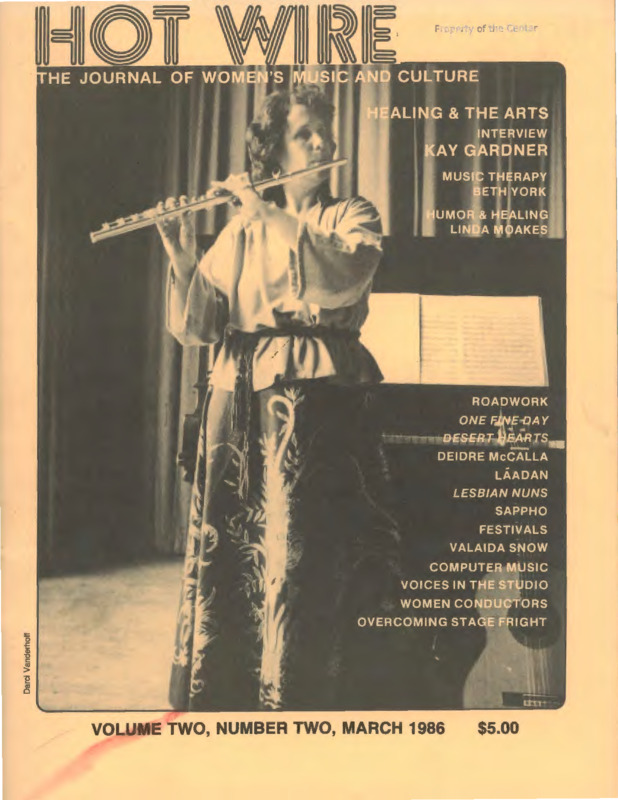
VOLUME TWO, NUMBER TWO, MARCH 1986
$5.00
To the readers:
SOUNDSHEETS
The
soundsheets
feature
is
temporarily on vacation. We hope
to have another one in the July
issue. These stereo
floppy-disk
recordings have been popular with
readers;
we've
received
much
positive feedback, including several letters from women who are
using the soundsheets on women's
radio programs. Artists who are
interested in having their work
featured on a soundsheet should
write to us for all the details.
Past issues have featured Mary
Watkins ("Comin' Home"), Sandra
and Sharon Washington ("Where
There is Love"), the Jane Finnigan Quintet ("Tia's Song"), The
Debbie Saunders Band ("Turn Me
Loose") [March 1985]; Betsy Rose
("Coming Into My Years"), Abyss
("Don't Run Me Around"), Karen
Mackay
("Annie
Oakley
Rides
Again"), Holy War ("Touch My
Love") [July 1985]; Debbie Fier
("The Journey"), Beth York ("Time
and Again"), Software ("Trust in
Me"), Linda Hirschhorn ("Circle
Chant"), and Anne Hills ("A Shadow Crossing the Land").
YOU SEEM TO LIKE ...
We have consistently received
letters from readers referring to
Paid My Dues: Journal of Women
and Music (last issue, 1980). The
letters ask if we're familiar with
PMD, inquire about ordering back
issues of PMD, and express some
version of the sentiment "I'm glad
someone is finally putting out a
quality publication that is devoted
to women's music." Letters frequently comment on the focus of
HOT WIRE (the "women's music"
network as the cultural arm of
the feminist/lesbian feminist political movement).
The other hot topic in the
mail lately has been the article
"Laadan: A Language for Women"
by Suzette Haden Elgin (November 1985 issue). That article has
generated more reader comment
and excitement (the letters havewithout exception-been positive)
than any other single article we
have published. Consequently, we
will be featuring Laadan regularly
beginning with this issue.
Toni L. Armstrong
SPECIAL THANKS
To WINDY CITY TIMES for
letting us use their typesetting
equipment ... to all the readers who
have written encouraging letters
which we haven't had time to answer personally ... and to reader
Sandy Gray for
financial
and
moral support.
SHUTTERBUGS
We are always in need of good
quality black and white photos,
especially from festivals. If you
are a photographer, won't you
keep us in mind?
Writings
All submissions must be typed double·
spaced . Your writing should include
verifiable facts and accurate dates; triple
check the spelling of all names. All
submissions must be accompanied by
a few sentences about the author, and
at least one black and white photo or
graphic relating to your article.
Graphics
We have a perpetual need for good black
and white photos and graphics of women
performing, women with instruments,
etc. Performance shots are highly pre·
ferable to promo shots. Graphics should
include caption(s) and photo credit(s) .
We do use photos and graphics as "filler,"
so submit items even if they do not
accompany an article.
Soundsheets
These floppy disk records provide HOT
WIRE readers with an opportunity to
hear women's music. Write for details.
Deadlines
fur March issue: November 15
fur July issue: March IS
fur November issue: July 15
(Unless special arrangements are made
in advance.)
Payment
PLEASE NOTE
In the July 1985 issue, the
photo of Susan Freundlich on page
43 and the photo of Dino Sierp
and Kate Clinton on page 63
should both be credited to Vada
Vernee.
Guidelines For
Contributors
ATTENTION
MOBILE WOMEN
OUR SUBSCRIBERS MOVE
TO NEW LOCATIONS AT AN
INCREDIBLE RATE. IF WE ARE
NOT NOTIFIED IN WRITING OF
ADDRESS CHANGES PRIOR
TO OUR MAILING OF THE
MAGAZINES, THERE IS NO
WAY WE CAN GUARANTEE
DELIVERY.
SOMETIMES MAGAZINES
ARE RETURNED TO US, AND
SUBSCRIBERS CAN GET THEM
RE-MAILED (BY US) FOR A
POSTAGE & HANDLING FEE.
MORE OFTEN, THE MAGAZINES ARE LOST FOREVER.
'HOT WIRE' WILL NOT ASSUME RESPONSIBILITY FOR
LOST MAGAZINES IF WE WERE
NOT NOTIFIED OF ADDRESS
CHANGES IN ADVANCE.
THANKS FOR YOUR
COOPERATION!
Payments vary. Send article proposal for
details.
HOT WIRE
1417 W. Thome
Chicago, IL 60660
·1 just love women who keep up with
women's music and culture. "
"Not all speed Is mo11ement... aln't no such
animal as an Instant guerllla."
Toni Cade Bambara (1937- )
Am . writer and activist
"Since when was genius found respect•
able?"
Elizabeth Barrett Browning (1806-1861)
English poet
HOT WIRE
Journal of Women's Music
and Culture
Publisher
Managing Editor
Toni L. Armstrong
Copy Editors
Jorjet Harper
Harriet Pacifica
Production Coordinators
Chris Crosby
Annie Lee
Soundsheets
Marilyn Wilson
Founders
Toni L. Armstrong
Michele Gautreaux
Ann Morris
Yvonne Zipter
Printed by
Graphic House
Skokie, IL
Staff
Tracy Baim
Barb Molitoris
Jean Durkin
Dawn Popelka
Elizabeth Fides
Judy Robinson
Sarah Lieb
Joy Rosenblatt
Paula Walowitz
Contributors
Kristan Aspen
Susan Baylies
Bonnie Cook
Linda Dederman
Suzette Haden Elgin
Ellen Elias
Jorjet Harper
Marcy Hochberg
JEB
Deborah Jenkins
Karen Kane
Polly Laurelchild
Janna MacAuslan
Nancy Norman
Shanta Nurullah
Rosetta Reitz
Laurie Rothfeld
Jody Steiner
Susanna Sturgis
Vada Vernee
Susan Wilson
Rena Yount
Subscriptions (U.S. money equivalents only) : $14/ U.S., $17 / Canada,
$19/ lnstitutions and other than North
America. Back issues when available
are $5. Discount rates apply to orders
of five or more copies.
HOT WIRE:Journal of
Women's Music & Culture
ISSN : 0747-8887
Published three times yearly, in March,
July, and November by Empty Closet
Enterprises, 1417 W. Thome, Chicago,
IL 60660 (312) 274-8298. Unless otherwise noted, all material is «:>1986 by
HOT WIRE. All rights reserved .
Table of Contents
Vol. 2, No. 2, March 1986
Features
Interview with Kay Gardner by Toni L. Armstrong
Women's Rock & Roll: Let's Be Reasonable
by Susan Lowell and Marg Herder (Software}
Computers, Synthesizers, & You by Nancy Norman
Music Therapy: The Practice & The Vision by Beth York
Warning: Humor May Be Hazardous to Your Health
by Linda Moakes
First Annual Readers' Choice Award
Moving Into the Mainstream: Deidre McCalla's
Don't Doubt It by Toni L. Armstrong
Roadwork: Putting Women's Culture on the Road
by Rena Yount
Hot Snow: Valaida Snow by Rosetta Reitz
Finally, Good News at the Movies:
One Fine Day and Desert Hearts by Tracy Baim
Overcoming Stage Fright by Jorjet Harper
2
18
20
22
24
27
28
32
40
42
45
Departments
Hot Line by Joy Rosenblatt
7
The Audio Angle by Karen Kane
"Playing With Voices in the Studio"
10
Noteworthy Women by Kristan Aspen & Janna MacAuslan
"Women Conductors"
12
Laadan by Suzette Haden Elgin
"Lesson 1: Woh(ya Wodedide Shosho Bethu"
14
The Tenth Muse by Jorjet Harper
"Sappho of Lesbos"
16
Mulling It Over by Linda Hirschhorn
"Merging Identities"
50
Re:lnking by Midge Stocker
"More Than a Controversy: Lesbian Nuns"
52
Behind the Scenes by Lucy Diamond
Denise Notzon and Therese Edell
54 •
Freestyle by Kay Gardner
"Early East Coast Women's Music & The Squirrel"
56
Festivals
West Coast Women's Music & Comedy Festival 1985
by Ellen Elias
Doin' the Day Stage: NEWMR 1985
by Cindee Grace
36
38
KAY GARDNER
An interview with Toni L. Armstrong
KAY GARDNER is best known
within women's music as an instrumentalist and proponent of
the healing properties of music.
She is also a composer whose
music is beginning to be used in
films and on TV. She travels the
country during the fall and spring
doing concerts and giving lectures
and workshops about music and
healing. She spends the summer
and winter months at her seacoast
home in Maine.
HOT WIRE: Your music
used in some films. How
come about, and how does
to have your music used
media?
is being
did this
it work
in other
KAY GARDNER: In December of
1984 a film crew from Australia
came to this country to film the
rituals and celebrations of pagan
groups for a theatrical movie
called The Occult Experience.
They also filmed groups in England, Ireland, and Australia. They
wanted to present an unbiased
look at some of the practices of
these circles, including groups organized by Z Budapest of California, Selena Fox in Wisconsin, and
Margot Adler in New York. I happened to be in California when
they filmed Z's ritual, and I participated in it. It was strange to
be doing this while being filmed,
but the director and producer
were sympathetic to the religions.
While they were setting up the
camera and lights-a process which
took about two hours-Z put A
Rainbow Path on the cassette
player. The guy in charge called
me the following June to ask if
he could use about six minutes
of the music, and how much I
would charge per minute.
Unless you have an agent-and
I don't-a musician doesn't know
these things. So, I called ASCAP
(American Society of Composers,
Authors and Publishers)-of which
I'm a member-and asked them.
I figured they would know since
2 HOT WIRE March 1986
they monitor their members' music on radio and TV, and pay royalties for such airplay. They gave
me a runaround, like, "If you
don't know, honey, you aren't
worth telling."
They told me to call the Harry
Fox Agency, which licenses the
mechanical rights of recordings
used in film and TV-it's like a
middle man between the publisher
and the filmmaker. Well, they
wouldn't tell me unless my publishing company, Sea Gnomes Music, was represented by them. It
isn't.
Then I called Meet the Composer, Inc. in New York City.
This funding organization has often
given
non-profit
sponsors
grants to bring me to their communities. They sent me to another
licensing
company,
American
Mechanical
Rights
Association,
which represents composers of
classical music.
They gave me the answer.
I charged $100 per minute, which
still seems like a lot to me since
the work was done long ago.
I guess it's just hard for me,
having worked for so little in
women's music over the past IO
years, to trust that the outside
world finds my work of value, literally.
A woman filmmaker in New
Zealand wanted to use some of
Moods and Rituals for an art film
called One Hundred Women, a ritual filmed on a beach. Since she
wasn't distributing it anywhere
but in New Zealand-and because
she is an artist doing her work
on little or no income-I didn't
charge her anything. I could certainly identify with her situation.
It depends upon what the circumstances are as to whether I
charge or not, and definitely has
to do with whether the filmmaker
has access to patriarchal money
sources. I may pursue this moreit's a really good way to supplement my income.
HW: How much money is involved
when a film uses your music?
HW: Is it the same for TV?
KG: An
"unknown"
composer,
which I am to the established music world, gets $500 per minute
for films distributed worldwide.
I called Australia back and
told the guy. He almost fainted,
saying that jn Australia they just
couldn't compete with American
prices. That made sense, so I told
him to make an offer. He ended
up giving me $250 per minute.
So, for six minutes I got what
seemed to me a huge check. It
was almost like back pay for all
the years I put into composing
A Rainbow Path at no pay.
Later a filmmaker from England called. She was doing a documentary called Invisible Women
and wanted to use six minutes of
A Rainbow Path. I asked for $250
per minute, but she said because
it was a women's film to be used
mostly on English TV that she
wasn't given much of a budget.
Since it was a women's project,
KG: This fall one of my favorite
shows, the science series "Nova,"
called and asked to use some
Moods and Rituals music on their
November 12th program. I was
touring in England and Scotland
at the time, so my partner Robin
took the call.
She had been
through the negotiations with the
filmmakers, so she asked, "Is
there any money in it?"
Evidently public TV doesn't
have to pay for usage rights like
the commercial stations do, but
they assured Robin that there
would be an honorarium and mention in the credits. She told them
to go ahead.
The honorarium was $150, and
no royalties are collected from
ASCAP or BMI for airplay on
public TV or radio.
HW: Lately you're working more
on
"functional"
applications
for
j
your music. In what directions are
you heading?
KG: A woman who is an airline
hostess came up to me during my
teaching at Omega Institute (a
sum mer holistic school in New
York) and asked me if I knew of
a way to camouflage the low vibrations she was forced to listen
to incessantly. I gave her suggestions.
So far nobody has ordered it,
but I did write to the Hollywood
company with questions, like how
you get permission from the labels, and whether royalties have
to be paid, etc. They wrote back,
and I did learn some things even
if the idea hasn't "paid off" for
me yet.
This activity may have been
of some value in another field,
though. Recently I got a letter
by school policy are 50 percent
women and 50 percent men-were
very receptive to my theories.
I find that my work in music
and healing is much more accepted by people in the· healing professions than it is by those in the
arts. Music schools never sponsor
me-they are uptight about my
looking at music as a functional
art rather than purely as aesthetics. Anyway, at this point music
is moving into medical situations
quite quickly.
HW: How so?
Eight years old, Freeport, NY
She said that airline passengers
were so stressed-out and jittery
these days, and I asked her
whether any airlines had listening
channels of relaxation music. She
didn't think so, and I began thinking
of
another
money-making
scheme.
I chose 10 airlines, called their
800 numbers for the right addresses, and sent out a letter offering to provide them with a
program that would relax their
passengers
and
their
in-flight
crews (not those in the cockpit!).
I offered to send them a sample
tape. All but two airlines answered. Two requested the tape
and the others referred me to the
companies that did their programming for them, one of which is
"Music in the Air" of Hollywood,
This project took me five
e ight-hour days of calling, writing, choosing tapes of stress-free
music, buying high-quality tapes,
and actually recording the program complete with voice-over
introduction by yours truly.
from The Yale School of Me dicine's Department of Anesthesiology asking me for everything I
know about "relaxation-hypnotic"
music for them to use in conjunction with anesthesia during surgical procedures.
HW: How have your music and
healing theories been received by
the traditional medical establishment so far?
KG: I told Yale that I know too
much to write in a letter, and
asked if they would like to sponsor one of my lectures or workshops. I told them that I have a
tape which takes the listener from
alertness to the meditative state
and back again.
I did my introductory music
and healing workshop at the Michigan State University School of
Human Medicine in November.
There were about 20 students in
attendance, which the organizer
said was a lot for an event given
by an outsider. The students-who
KG: Music is used in cardiac
wards to help regulate irregular
heartbeat. Patients in some hospitals are given the choice of using
more pain-killing medication or
listening to melodic tapes instead.
In Germany, students of anesthesiology are given a music course;
in France anesthetists and anesthesiologists play music before,
during, and after surgery to enhance the effects of the anesthesia. They've found that less drug
is needed if the right music is
playing.
I' ve been thinking about writing a work specifically for the
re lief of pain. Get t ing the letter
from Ya le may be t he impe tus
I need to get going on fundraising
so tha t I may t ake the time to
do the rese arc h and compose the
piece, A Rainbow Path is an introductory work, a generalize d
look at how music may be used
in hea ling. Now I must move to
more specific uses of music. So,
perhaps a new piece entit led
"Once More Anesthesia " (Anesthesia
means
"wi t hout
feeling"...
joke?).
HW: In 1980 you founded He aling
Through the Arts, Inc. What is
the purpose of this organization?
KG: It is a non-profit, tax-exempt
organization devoted to discovering through research and experiential workshops how the arts-in
all forms-relate to the healing
process. Half of my artist royalties from A Rainbow Path have
been set aside for HTA. Gina
Halpern's A Rainbow Path mandalas will be on sale, and some
of the proceeds from them will
go to HT A. These funds will seed
such activities as grants for those
HOT WIRE March 1986 3
researching the arts and their
healing properties, and for producing HT A festivals and pageants
and circuses.
When we began, we spent most
of our time raising money for A
Rainbow Path. We also published
a small journal, The Rose Window, for two years. Last year we
sent reprints from newspapers and
magazines to our members, articles having to do with healing and
the arts. Anyone interested can
write to HT A, P.O. Box 399, Stonington, ME 04681.
HW: Since the beginning of wom-
en's music as we know it, you
have been a champion of classical
music being considered an integral
part of the network. How has
that view been received over the
years?
KG: It's a constant fight as a socalled classical performer to get
the attention of the festival pro-
years the festival will collapse.
The classical women have to
look at themselves and why their
music is so intimidating to most
audiences. I mean, who wants to
hear classical music played by
women dressed in black with serious faces? Dress up a little, have
a stage set, add a dancer or some
lights. Look like you're enjoying
yourself. Enjoy yourself, and the
audiences will enjoy you, too.
As for producers, whether or
not classical music has a large
audience or not is not the point.
The point is that classical women
are terribly oppressed in their
world. They deserve to be heard
and seen at our musical festivals,
not shut out because they are not
understood. How do you ~ understood unless you have exposure? Classical music has to have
innovative marketing for it to
"sell." The New England Women's
Symphony and the Bay Area Women's Philharmonic have played to
can peoples into our country, or
our music would be totally boring.
I'm interested in exploring a
new music theory, one based upon
healing, unity of peoples, peace,
and womanstrength. This requires
synthesizing the commonalities of
women's music and healing music
from many different cultures, and
redefining the musical language.
New scales, new harmonies, new
ways of performing ...
HW: When you speak of new har-
monies, new scales, and redefining
the musical language-what is the
basis for your ideas?
KG: Right now in this Western
society we are only using about
65 scales in our musical language.
In South India there are over
5,000 different scales. How narrow
we are in our hearing. What potential is wasted!
In my research, over the past
10 years, I have found several
"I'm interested in exploring a new music
theory, one based on healing."
ducers and audiences. I fought the
battle for 10 years, and many of
those years as a lone voice in the
wilderness. Classical music should
be an equal part of the festival
activities. It should be on the
main stage right along with the
pop acts.
This is going to require some
give-and-take on both sides. The
producers are going to have to
respect classical musicians, and
the musicians are going to have
to redefine their presentations in
order to make them more palatable to those who think they
don't like classical music.
Right now there's a classical
women's music network which has
grown up out of the frustration
of dealing with this problem at
the National Festival. They are
arguing,
I
understand,
about
whether they can play men's music if it's an all-woman ensemble,
or if they can have men as players if the music is by women.
I say, NO, NO, NO. No men.
Come on, girls, you can play
men's music anywhere. The National Festival is women playing
women's music. Period. Change
that and believe me, within a few
4 HOT WIRE March 1986
sell-out houses. Maybe the Bloomington festival should book them
[BAWP].
HW: You have consistently put
forth the idea that women's music
needs a new musical language as
well as a new lyrical sensibility.
KG: I don't want to address the
subject of "how can instrumental
music-i.e., music without lyricsbe women's music?" I've been
tooting that horn to empty ears
for years. I will say that just as
women need a new language to
express ourselves (see Mary Daly's
writings, and Suzette Haden Elgin's "Laadan" in the November
issue of HOT WIRE), so do women
musicians who are committed to
a change toward women in power
need a new musical language.
We are still using a language
forced down our throats by the
Roman Church centuries ago. We
are still using tunings related to
a musical system invented 300
years
ago
(equal-temperament);
we're still stuck in harmonic sequences dictated by Western European teachings. Thank goodness
for the influx of Asian and Afri-
woman-identified scales from both
Greek and Hindu cultures. The
ones I tend to use are the Lydian
and Lesbian (Mixolydian) modes
(or scales), and the Saraswati
Raga (a raga, too, is a scale).
These scales were invented by
women, and speak to women and
to men who aren't afraid of their
female sensibilities.
This is probably why so many
say that my music is evocative,
haunting, etc. An ancient "memory" has been stirred just by listening to these women's scales.
We are still stuck in harmonies
dictated to us by the Roman
Church centuries ago, and by a
invented 300
harmony system
years ago, as I said before. We
are limited by the equal-tempered
scale, which came to use when
the piano was invented. It's a
technocratic scale, not the one
we hear in Nature. The natural
scale is much more interesting.
Fortunately, with the invention
of the synthesizer and computergenerated sound, we may more
accurately approach the natural
scales. They aren't that difficult
to program.
New instruments may be in-
vented to new tunings. These instruments will challenge us to listen in new ways. They will also
evoke new responses.
Other composers-like Laurie
Anderson,
Laurie Spiegel, and
Pauline Oliveros-are using electronic instruments to define a
truly new music. In order to make
changes in the world, the vibrations of the world must change.
How can they change if we're
stuck in the same musical language?
We women must be much more
adventurous in our musical expression. We must invent a new
woman-identified music theory!
scene.
They didn't assimilate.
They offered something new, stuck
with it, and now everyone is imitating them.
Why can't we have confidence
enough in our expression to do
this? I'd like to see a lot more
experimental music going on at
festivals. I know you need "big
names" to draw an audience, but
this shouldn't be at the expense
of women who are defining a new
women's culture through what
might seem to be avant garde expression.
HW: What do you think of the
current women's music and culture
scene?
KG: We in women's music have
gotten very complacent. We're not
activist enough. We rely on proven
formulas too much. We're afraid
of innovation.
Women's music has changed
a lot since the early days. We all
have become a lot more professional-performers, producers, record labels, all of us. I mean, we
really know what we're doing
now. We're good business women,
not just political workers with unrealistic and idealistic expectations of ourselves and others.
It's been an incredible growth
process over these past dozen
years. In the process, though, we
have lost a lot of the "joi de
vivre" and enthusiasm we had at
the beginning when there were
only a few of us going out there
with our music and our political
messages. This is kind of sad to
me, but inevitable.
I'm also disappointed in the
watered down lyrics and pop mentality that pervades our industry.
Women's music is extremely diverse, and yet we still go for the
commercial appeal-just like the
boys do. Sometimes I feel like we
are still playing their games, even
though we started our own industry so we wouldn't have to do it
any more.
I think we have to celebrate
our differences rather than trying
to assimilate, or trying to get
that Top-40 hit. For example, and
I've said this before, Motown
Records didn't compromise their
art to please the current music
inspired by Mary Watkins' music,
and by the magical performances
of Edwina Lee Tyler and A Piece
of the World. I'm also glad that
musicians who are primarily instrumentalists-like Beth York and
Adrienne Torf-are getting heard
and are getting gigs. This is progress. Now, where are the Asian
women? Let's hear more from
Hispanic women. I want to see
women's music include all women
from all global cultures.
I love that women's comedy
has recently evolved from selfdeprecating expression to positive,
strength-affirming humor. This is
new.
Olivia's naming their new label
Second Wave is timely. This is
what is happening as the "old
guard" has moved aside to let the
"new guard" have its say.
HW: You are always involved in
research of some kind. What new
things are you studying?
"It is a constant fight as a socalled classical performer to get
the attention of festival producers
and audiences."
I think the Michigan Womyn's
Music Festival has begun something which may encourage this.
They have added the acoustic
stage. We gave a midnight concert this year that was a combination of poetry and improvisational music. It was very wellreceived. It was 32° out, and yet
a thousand women stayed and are
still talking about the performance. We need much more of
this-much, much more!
HW: What aspects of today's
women's music and culture scene
excite you or make you feel optimistic?
KG: I'm really glad that the black
performers are coming to the
forefront now. For too long it's
been a middle-class white feminist phenomenon. I'm terrifically
KG: It's true, I've always been
a scholar. Learning new things excites me. Right now I'm studying
crystals and geometry. I'm not
quite sure how these studies will
apply to my work, but I know
that it'll come • together at some
point. It's really fascinating to
study the forms which occur when
music is played. Chladni experimented by putting metal filings
or sand on top of flat metal
plates. By drawing a bow across
the edge of the plate-depending
upon the tone produced-the sand
took on specific forms, almost
like mandalas.
There is an aspect of mathematics called sacred geometry.
It is ancient, but related to physical laws, so it's new at the
same time. I'm very interested
in how knowledge of this sacred
geometry, and its relationship to
music, can help the healing process. More on this as I learn
more.
.HW: What are some of your goals
for the future?
KG: I have one major goal: to do
work that will make a difference
in the world. I'm an Aquarian and
therefore am multi-faceted, so
I see myself doing many different
things. I love teaching, love turning folks on to their own potenHOT WIRE March 1986 5
It's as much of a high to me as
performing is. Of course I'm still
planning to perform and record
as a solo artist, as a conductor,
and as part of my group, The
Sunwomyn Ensemble.
I'm planning a series of cassette tapes of flute music • channeled at women's holy places
throughout the world, such as the
Temple of Aphrodite at Delphi,
or the Cave of the Sybil near
Naples, Italy. This project will
require hooking up with a women's mysteries tour guide-as well
~ as
getting funding from many
;;; sources.
And I'll continue composing.
>"'
·~ Performance pieces, as well as
0
healing works for specific uses
(such as anesthesia), will be on
my agenda.
Madonna, eat your heart out
Personal goal: I want to pitch
tial.
love sharing information my tipi in a wilderness clearing,
with people, and knowing that camp, and go kayaking with my
many will make good use of it. sweetie.
I
Beth York
.... ,,_
,....
t
__,,,,_..,.
.,..,._ -
•
..
"t\
"O
C:
An upbeat, original mixture .
of R&B, funk, rock, and
reggae about being and
lovin
men.
l
NEW YORK MUSIC AWARD
NOMINEE 1985
Best album
on an independent label
"Don't Doubt It announces the
arrival of a major singer-songwriter."
- The Boston Globe
TRANSFORMATIONS
Beth York
"Beth York's music is an inspiring
blend of instrumental jazz, classical,
and new_age sounds. York's training
as a music therapist shines through
her compositions with sensitivity,
compassion and joy. Hers is an
important presence on the
emerging healing music scene."
Kay Gardner
"Beth York has hands that sing, and
music that weaves together gentleness
and strength, and the quest for
harmony that lies beneath all our
struggles and discord."
Betsy Rose
l'-~- ,,~--
"Beth York's music fills a room with
silence, and a listener will always be
able to visualize paintings of expression,
of warmth and of beauty."
DinoSierp,
1984 NWMF Showcase Producer
New musical energy you
won't want to miss.
Available from Ladyslipper
or send $8.98 to:
LABRYS-1
P.O. Box 174
Tolland, CT 06084
GET iT WHILE IT'S HOT!
Available on Lady Slipper Records
For booking information call
415-655-0364
FREELANCE VIDEO
Jo Hamby
362 Mell Avenue, N.E.,
Atlanta, GA 30307
404-525-2023
specializing in
performing arts
RIXANNE WEHREN
Star Route
Redway, CA 95560
(707) 923-3289
6 HOT WIRE March 1986
$8. 98 LP or casselle
(postpaid)
4400 Market
Oakland, CA 94608
(415) 655-0364
#3
Support Your Local
Women's Bookstore!
HOTLINE
By JOY ROSENBLATT
GATHERINGS
In December the board of directors of the WOMEN'S JAZZ
FESTIVAL voted to cancel the
1986 fest and to take the steps
necessary to dissolve the organization. Info: Mary Hodges, Women's Jazz Festival, P.O. Box
22321, Kansas City, MO 64113.
San Francisco was the site of
the 6th ANNUAL WINTER ARTS
& CRAFTS FAIR held Dec. 7, 8,
14, and 15, 1985, to raise money
for further work and renovation
on the S.F. Women's Building.
There were more than 100 merchants, and entertainment included
the Robin Flower Band, Silvia Kohan, Gwen Avery, Mojo, Judy
Fjell, and others.
Atlanta will be the site of the
4th INTERNATIONAL CONGRESS
OF WOMEN AND MUSIC. Located
at Georgia State University on
May 20-23, 1986, the Congress
will feature works of women composers, a series of programs and
workshops, concerts, tours, and
other activities. Contact: Ruth
McDonald, GSU Archives of Music, Atlanta, GA 30303.
Chicago hosted the only other
winter festival on Nov. 30, 1985.
The 4th ANNUAL MIDWINTER
MINIFEST featured Kay Gardner,
Paula Walowitz, Lori Noelle, and
Make It Mime.
Denver was the site of the
7th NATIONAL CONFERENCE OF
LESBIAN & GAY BANDS OF
AMERICA. More than 60 women
and men representing 15 cities
participated.
Israel will be the site of the
1st INTERNATIONAL WOMEN'S
MUSIC FESTIVAL, to be held in
Beer-Sheva on June 23-28, 1986.
Some of the confirmed performers
will be Casselberry-Dupree, Sue
Fink, Beth York, and Joanna Cazden. Contact: Liora Morie!, P.O.
Box 3391, Beer-Sheva 84130, Israel.
Madison, WI was the site of
the 2nd WOMEN'S CHORAL FEST
where 11 choirs from all over the
U.S. participated. Forte reported
that only seven choirs were represented at the first festival, held
last year in Kansas City.
HOTLINE announces upcoming
events in women's music and culture, presents capsule reports of past
happenings, and passes on various
tidbits of information.
NEWS
ROSEMARY CURB & NANCY
MANAHAN, editors of Lesbian
Fashion statement: Monaco's
Princess Stephanie: "She
shouldn't wear those tight black
leather pants, leather jackets, and
other clothes that hide her femininity," says the December Star.
Santa Cruz, CA will hold the
3rd NATIONAL FESTIVAL OF
WOMEN'S THEATER
in 1986.
Works written and directed by
women, with casts in which at
least half of the actors are women, are being solicited by the organizers. Write by May. National
Festival of Women's Theater, P.O.
Box 1222, Santa Cruz, CA 95061.
Nuns, were evicted from their hotel in Ireland after appearing on
a local talk show, according to
the Windy City Times. The event
made front-page news in all the
papers, and put the books in store
windows that would not ordinarily
have carried them. Irish Customs
officials seized 15,000 copies, but
reversed the decision and released
them the next day.
Olivia Records president JUDY
DLUGACZ, in an effort to capture the impact of women's music
on history, has begun a musical,
written, and pictorial history of
Olivia that will consist of a tworecord album, a collection of photographs, and a book documenting
the company's history, according
to Forte. Potential contributors
contact:
Olivia Records, 4400
Market St., Oakland, CA 94608.
HOT WIRE March 1986 7
Women in the mainstream NEW
YORK MUSIC INDUSTRY have
organized a new group called
Women In Music. The first press
release states their purposes as:
helping women in the development
and advancement of their careers,
facilitated through a network of
women; to eliminate discriminatory practices in hiring, salaries,
and promotion; to channel the
power of the record business to
disseminate and improve a positive
image of women; and to improve
the under-representation of women
in the music industry. Alix Dobkin
and Beverly Carpenter attended
early meetings. Contact: Women
in Music, c/o the Raleigh Group,
250 W. 57th St., New York, NY
10019.
HERIZON, the social club in
upstate New York, celebrated its
tenth year of continuous operation
as a women-only space collectively run by its members. They
would like to communicate with
ex-members, who are asked to
send a SASE: Herizon, P.O. Box
1082, Binghamton, NY 13902.
The 3rd NATIONAL LESBIAN
SLIDE SHOW & COMPETITION
has announced winners for best
slides in two categories. 1st place
in lesbian sexuality went to: TEE
CORINNE of Sunny Valley, OR.
1st prize in action: CRISTINA
BIAGGI of Palisades, NY. $400
in cash prizes were awarded to
finalists in the contest.
DISNEYLAND has dropped its
ban against same sex dancing
after unsuccessfully fighting a
lawsuit, reports Au Courant. Disneyland maintains it dropped the
ban only because teenage girls repeatedly asked to dance together,
and that their policy change was
unrelated to a judge's ruling allowing same-sex dancing.
A new MIDWEST PRODUCERS
ALLIANCE has been formed to
promote women's music and culture in the Midwestern states.
Members now include Dino Sierp,
Indianapolis, IN; Jackie Pinkston,
Bloomington, IN; Joy Rosenblatt,
Chicago, IL; Liz Carlin, Madison,
WI. Contact: Dino Sierp, P.O. Box
2907, Indianapolis, IN 46206.
8 HOT WIRE March 1986
THE BAY AREA WOMEN'S
PHILHARMONIC in San Francisco
is the only orchestra dedicated
to promoting women composers,
conductors, and performers, reports the American Women Composers News/Forum. Since 1981
the Philharmonic ha_§ _performed
the works of 57 historical and
contemporary women composers.
Nan Washburn, research and artistic director, has been rediscovering the works of women
since 1975, and-partially because
of the impact of her academic
research on the subject-women
composers are becoming a "hot
field."
SISTAH BOOM, the women's
percussion ensemble from the San
Francisco Bay Area founded in
1981 by Carolyn Brandy, has recently initiated workshops to unlearn racism and has placed a
moratorium on white membership
while actively seeking women of
color to join us.
DOLLY PARTON is buying a
Tennessee amusement park, which
she plans to name either Dollyland or Dollywood, reports Bitch.
SISTER PAT O'DONNELL was
fired from her job . at Picture
Rocks Retreat near Tucson, AZ
following the publication of her
article in Lesbian Nuns, reports
Plexus. She had discussed the
piece with her director prior to
publication, but apparently pressure was placed on him to dismiss
her after the book came out. Her
Dominican community was not involved in this decision.
MOVIES
WOMEN
Screen rights to SOUTHERN
DISCOMFORT were purchased by
Margot Kidder, along with a
screenplay treatment from Rita
MAE BROWN, stated People. So
far no major Hollywood studio has
agreed to make it. Kidder will
be looking at independents next.
SHIRLEY CHISHOLM was in
the Bay Area recently to help
celebrate the tenth anniversary
of the Com mission on the Status
of Women, according to Plexus.
The first black woman elected to
Congress announced that her political career may be underway
again in 1988.
LESBIAN NUNS: BREAKING
SILENCE TV movie rights have
been sold to ABC-TV by Naiad
Press. Editors Curb and Manahan
are in contract negotiations with
ABC as consultants. See Re:Inking
column in this issue of HOT WIRE
for more about the status of this
ground-breaking book.
ELLA FITZGERALD and (posthumously) MARY LOU WILLIAMS
were inducted into the Jazz Hall
of Fame in September 1985.
LADYSLIPPER is celebrating
its tenth year in business, and codirector LAURIE FUCHS is likewise marking her tenth year of
working in women's music. The
new catalog now includes videos,
such as One Fine Day, Bette Midler' s Divine Madness, Lily Tomlin
Special # 1, Tina Turner's Private
Dancer, and Lianna.
The National Festival's MUSIC
INDUSTRY CONFERENCE coordinator (Denise Notzon) has resigned
due to a career change that she
says will not allow her to devote
the necessary time and energy.
Direct all inquiries to: Dino Sierp,
P.O. Box 2907, Indianapolis, IN
46206.
PUBLICATIONS
OTHERVIEWS,
published
by
Aradia in Grand Rapids, MI announced its last edition was December 1985 due to a shortage
of funds and energy. They hope
it might be revitalized at some
future time. Subscription refunds:
P.O. Box 7516, Grand Rapids, MI
49510.
BITCH is a new monthly newsletter first published in August
1985. It is self-described as "the
women's rock newsletter with
bite." It presents info on any female rockers big or obscure, tries
to cover things that aren't seen
elsewhere, and gives useful info
for women musicians. Contact:
San Jose Face, 478 W. Hamilton
# 164, Campbell, CA 95008.
GAY NEWS, Britain's leading
lesbian and gay newspaper, has
gone bankrupt following a disastrous change in ownership, staff
problems, and a failed attempt
by the staff to buy the paper, according to the Windy City Times.
BEV CARPENTER/INSURANCE:
A few months ago I sent out
a list of recommendations for
growth of the women's music industry to a number of producers,
distributors, performers, and other
women involved with the network.
These recommendations outlined
my personal ideas for some behind-the-scenes
additions
and
changes to our mode of operation.
The letters and cards I received in response were very interesting. The one most outstandingly positive response was in my
suggestion that health insurance
be available to participants in our
industry. Medical and dental insurance might be obtained by
forming a group entitling us to
purchase coverage at lower-thanusual costs.
I have reviewed and interviewed three different providers
of this type of coverage, and now
it is of the utmost importance
that women interested in such insurance contact me as soon as
possible.
At this point, we are looking
at an average monthly premium
of $85 which would cover hospital/surgical
and major medical
(office visits, prescription medications) with an average deductible
of $250 per subscriber per year.
This varies depending on many
factors, which is why I need input
as soon as possible. We as a group
will need to make the final decision on which of the plans and
carriers we will contact.
This project is progressing, so
remember that by the time you
read this I will have collected
more information than was available to me at press time.
Interested parties contact: Beverly
Carpenter, P. 0. Box 225, San Mateo, CA
94404.
ABOUT THE AUTHOR: Joy Rosenblatt does production for Mountain Moving Coffeehouse. In her
spare time, she works for the
State of Illinois as an employment
counselor to welfare mothers.
INDEPENDENT WOMEN'S BLUES
Volumes 1, 2, 3, 4
from ROSETTA RECORDS
uttBAJ'{ uttOC'f'HEl{S
Independent Women's Blues, Volume I
--···
-
Independent
Women's
Blues,
Volume 2
•
'--
Each double fold album with
photos and history is $10.00 and
includes packing and postage.
'!~tOAC~
ROSETTA RECORDS
115 W. 16th Street, New York, NY 10011
HOT WIRE March 1986 9
THE AUDIO ANGLE
Playing with Voices in the Studio
By Karen Kane
Hi. Karen Kane here with a
new, ongoing column about studio
recording. Please feel free to
write to me with your questions
for the next issue and thereafter.
I've been a recording engineer/
producer in the Boston area for
the past 11 years and have engineered and/or produced over 50
albums. I was lucky enough to
learn this skill the best way there
is-hands on. Being a studio manager in New York and Boston studios starting in 1969 gave me the
opportunity to be near the equipment all the time. When my interest in engineering finally became obsessive, I quit my position
as studio manager, took a cut in
pay, and became an apprentice
engineer. Eighteen months later,
I was a full engineer and have
been going strong ever since.
PLAYING WITH VOICES
One of the most important
things about how well a record
is received is the quality of the
vocal. The vocal is usually what
the listening audience tunes in to
right away. Most good songs would
not be that good without quality
vocals, and great vocals can enhance some mediocre songs. Recording vocals and "playing" with
the sound of it in the studio can
certainly enhance it, but you have
to be careful because in some
cases you can alter it too much,
taking away from the original
concept. Remember, the recording
engineer can only do so much.
You can't put something in that
wasn't in the original recording;
THE AUDIO ANGLE discusses information about recording, the mysteries
of the recording studio, and answers
technical questions submitted by
HOT WIRE readers.
10 HOT WIRE March 1986
you can only enhance the sound
that is already there.
People often ask me: how can
a person be singing the lead vocal
and all of the back-up vocals as
well? Recording in a 24 track
studio is like having 24 separate
tape machines running at once,
in sync. Only it's on one big tape
machine that holds 24 tracks on
a 2-inch reel of tape (at $150 per
reel!).
The basic rhythm tracks (piano, drums, bass, guitar) can be
done on one day and then on another day you can start putting
in other instruments. For example, if the rhythm tracks are on
tracks 1-6, then the string synthesizer and the saxophone could go
on tracks 7 and 8. This process
is called "overdubbing," dubbing
in
alongside
already
existing
tracks. When you get to the point
of putting vocals in, the artist
will sing the lead vocal listening
to the already existing instrumental tracks through headphones.
After the lead vocal is finished,
the engineer will switch to a new
track and the artist can now sing
a back-up vocal part, hearing in
the headphones the lead vocal
that was just recorded. You could
do this endlessly until you run out
of tracks.
·" OOMPH"
Another question I am asked
is, how much "oomph" can be put
into a voice? I then ask them:
are they asking about performance
"oomph" or the quality of the vocal sound itself (is the voice thin,
harsh, dull, or distant)? It is the
artist who must give "oomph" to
a vocal performance. It's in the
style, energy, phrasing, and interpretation, things that electronics
cannot change or bring out. However, the engineer can add sound
quality "oomph" in several different ways. Equalization and special
effects like reverb, double tracking, digital delay, and the Aphex
Aural Exciter provide this option.
Equalization, which plays with
the treble, mid-range, and bass
{like the tone controls on your
stereo) can brighten up a dull vocal or add depth and warm th to
a vocal track that is harsh or
thin. Overusing equalization can
seem artificial, so it is best to
get the proper tone at the time
of the recording.
REVERB
Reverb is probably the most
common effect used in recording.
If you stood in a church or gymnasium and sang or shouted, you
would notice your voice ringing
off the walls. That is the idea
behind reverb units, to artificially
create
these
sounds-everything
from being in a large concert hall
to a small church. A variety of
room sounds and programs are
available.
Reverb is most likely on every
record that you hear, particularly
on the vocal, whether you notice
it or not. You can be fairly subtle
with it or very obvious. Reverb
effects are usually used on the
instrumental tracks as well.
It
gives a consistency to all the
tracks, an environment in which
they all live. An example of obvious reverb is on Sue Fink's !!!.g_
Promise album. On the song "The
End is Near," you'll notice the
reverb get louder every time she
sings, "You think I'm crazy 'cause
I mumble to myself." The reverb
increase begins on the second and
third repeating line. Also in that
same song, on the chorus, when
she sings, "The world's about to
blow." On the word "blow," you'll
notice a deliberate increase of
reverb.
Double tracking is simply recording a lead vocal or back-up
vocal twice. Having it on two
separate tracks. It can create a
thickness that will emphasize certain lines in a song. Some people
might use the double track for
the entire lead vocal, creating a
special effect. On Cris Williamson's Blue Rider album there are
a few uses of the double track.
On "Peter Pan" and "Surrender
Dorothy," it sounds like the entire
lead vocal is doubled. On the song
"Night Patrol," listen to the line
"Coming to steal the time"; it is
double tracked both times it is
sung. If you don't have enough
tracks to do doubling, a single
lead vocal can be put into a digital delay unit and the effect of
double tracking can be achieved
electronically. However, in my
opinion, a real double track is
better than this electronically
produced one.
A digital delay is a piece of
equipment that can create a "discrete repeat" (an exact duplication
at a later point in time), also
called echo or slapback. Short delays create one kind of effect and
longer delays create another. Did
you ever notice when listening to
a song that the vocal has a slight
repeat to it, especially after the
"s" or "t" words? It's usually
subtle and mixed in the background. This effect created by
the digital delay unit adds a width
to the vocal sound that you could
not get otherwise. Ann Wilson of
the group Heart almost always
uses digital delay on her voice.
Good examples are the songs "Dog
and Butterfly" and "Tell It Like
It Is." On Sue Fink's song "Big
Promise," the digital delay on her
vocal is very obvious. Another obvious delay effect is on her song
"Love Won't Let Go." Here the
delay is shorter, which creates
two voices fairly close together.
The Aphex Aural Exciter was in-
vented by accident.
Someone
wired something the wrong way
and then discovered that it created an unusual "presence" to a
vocal (or any other) track-a clarity to the tone that makes it
stand out. You can't really tell
if Aphex is on a vocal or not
from listening to the final product. Aphex has become quite an
item in the recording industry.
All of the effects I have mentioned, except double tracking,
are almost always added in during
the mixdown process, after all the
recording is done. That way, you
have all the options open to you.
If you record a track with an effect on it, you can't undo it in
the mixing process. Mixing, for
those of you that don't know, is
taking all
those 24 separate
tracks that you recorded and creating the "perfect" balance. That
mix is what goes onto a record.
Finally, the artist must be
completely comfortable in order
to deliver a good vocal. It's very
difficult to put out a lot of energy standing in front of a microphone instead of singing to a live
audience. A well-balanced headphone mix to sing with is important, as well as something as simple as the right lighting. A good
rapport with all the people working together is essential.
In the 50 albums that I've
made, I've seen some extremely
creative electronic magic happen,
but all in all it's still the musicthe music has to be good. You
can't make it something that it
isn't.•
Karen Kane
329 Highland Avenue
Somerville, MA 02144
(617) 628-6469
ABOUT THE AUfHOR: Karen
Kane has produced/engineered
over 50 albums. She currently
resides in Massachusetts.
MOVING?
Please, please, please write to us!
It costs us a lot of money if we mail
HOT WIRE to the wrong address.
Let us know today if you've moved
within the last four months.
Here's an album for
feminists who love the
country and bluegrass
styles, but never could
handle the lyrics.
Dedicated to women in
country music from a
historical and contemporary
point of view.
$8.50 from:
Community Music
P.O. Box 5778
Tacoma Park, MD 20912
"... when she hits the festival
circuit or folks hear her music,
she's going to be a hit."
-Festival Records Newsletter
Vancouver, BC
ANNIE OAKLEY
RIDES AGAIN!
LP or cassette $9.00
Karen Mackay
West Virginia Woman Records
P.O. Box 3174
Madison, WI 53704
HOT WIRE March 1986 11
NOTEWORTHY WOMEN
Women Conductors
By Janna MacAuslan & Kristan Aspen
"A woman doesn 't have enough
upper arm strength to conduct."
"All the men were highly disgusted because she was allowed
to conduct herself."
"The audience doesn't want to
see a woman on the podium."
"A woman conductor? Whyher slip would show all the time."
These statements and other
similar absurdities faced women
conductors in the late 19th and
early 20th Centuries. The prejudice against women conductors
c ame from all directions: from
the audiences not used to seeing
a woman in a position of power,
from the orchestra members who
often doubted her musical abilities, from symphony boards and
managers who feared financial loss
if ticket subscribers were unhappy.
Few
women
have
broken
through the barriers obstructing
the path to the podium,
but
throughout history there have been
some who, through incredible skill
and perseverance, have had a
measure of success and notoriety
in this highly prestigious career.
According to an article by
Catherine Contos, "In 1661 Samuel
Pepys recorded in his diary having
seen a woman 'with a rod in her
hand keeping time to the musique
while it plays'." ("Brava Maestra!",
Musical America, 1971.) She was
conducting at the Globe theatre
in Greenwich.
This was the practice of conducting in earlier times; rather
than "modern" baton. Contos records in the same article that in
1739 a Frenchman visiting Venice
NOTEWORTHY WOMEN is devoted
to reclaiming and celebrating the
talent and accomplishments of our
lost and denied musical fore mothers.
12 HOT WIRE March 1986
There are 20-30 women's orchestras of a professional character in the U.S. today, and while
none of them has gained the
fame that has come to the
Fadettes they are all managing to make a good living for
their members . . . if young
women are going to earn their
living, why not put them at
something that will be refined,
elevated in its influences, and
artistic in its development?
Don 't you think the violin is
better than the typewrite!?-
Early Antonia Brico
noted "a pretty nun in white habit, with a bunch of pomegranate
blossoms over her ear, conducting
the orchestra and beating time
with all the grace and precision
imaginable."
The first reference found by
this writer to women conducting
in America was when an allwoman orchestra, the Vienna Ladies Orchestra, toured the U.S.
in 1871- 73. Their conductor and
founder was Josephine Wein lick.
After this tour, many women in
America
started
forming
allwomen orchestras. Caroline B.
Nichols founded one of the most
successful and long surviving-the
Fadette Lady Orchestra of Boston.
This organization lasted from 1888
to 1920.
According to an article about
Nichols and the Fadette Lady Orchestra in Carol Neuls-Bates' recent book Women in Music (Harper and Row), Nichols had a definite goal in mind for starting a
women's orchestra:
It is important to realize that
the reason so many all-women orchestras . were appearing is that
women were barred from playing
in traditionally male orchestras.
And the thought of a woman conducting one of these all-male orchestras was practically unthinkable. It was acceptable for a
woman to guest conduct a major
orchestra occasionally, as a novelty, but not to land a permanent
position. This pattern can be
traced in the careers of Ethel
Leginska,
Antonia
Brico,
and
Emma Steiner.
ETHEL LEGINSKA
Ethel Leginska was born Ethel
Liggins in England in 1886. She
was trained as a concert pianist
at the Hoch Conservatory in
Frankfurt.
She apparently ran
away to Vienna to study with another teacher. Her piano debut
with an orchestra was made in
London in 1902, when she was 16
years old. During her career as
a pianist she married composer
Roy Emerson Whithorne, and when
they divorced six years later,
there was a huge custody fight
over her young son. The judge
awarded custody . to the parents
of her ex-husband, because he expressed doubt that Ethel could
earn enough as a concert artist
to support both herself and her
son.
She later claimed that the only
way a woman could succeed in
the concert artist field in America was to dress and act like a
man. She refused to wear the
"acceptable" garb of bare shouldered evening gowns, choosing instead white silk shirts with collar
and cuffs, black velvet jackets,
and long black silk skirts. She also
had her hair done like Liszt, or
Paderewski. She had a flair for
promoting herself and creating
controversy.
Leginski appeared as a pianist
for a number of years to successful reviews. In 1919 she announced
that she would retire to study
composition and to teach. For a
while she studied composition with
Ernest Bloch.
In 1924, Leginska started yet
another career, that of conductor.
She is said to have conducted the
Paris Conservatory Orchestra, the
London Symphony, the Berlin Philharmonic, and the Munich Konzertverein Orchester. In 1925 she
traveled back to the U.S., where
she conducted the New York Symphony Orchestra, the People's Orchestra of Boston, and the L.A.
Symphony-all as a guest conductor.
In order to have a permanent
conducting job Leginska, in 1926,
founded an orchestra c alled the
Boston Philharmonic. All of the
players in this group were men
except the harpist and the pianist. Traditionally these were considered female instruments. This
organization lasted only one year.
Within 12 months she organized
the Boston Women's Symphony Orchestra. This orchestra had about
65 members and often played
works by women composers. It
lasted four years, and performed
over 200 concerts.
Leginska subsequently tried to
organize a women's orchestra in
New York in 1932. It was called
the National Women's Symphony,
and gave a well-received program
at Carnegie Hall, but it soon disbanded.
After
this,
Leginska's
conducting dates became few and
far between-again, back to guest
conducting. She moved to Los Angeles in 1939, where she taught
piano until the 1950s. She
in L.A. in 1970, at age 83.
died
ANTONIA BRICO
Much has been written about
Antonia Brico in recent years,
due in part to the excellent film
about her made by folksinger Judy
Collins. It is called Antonia: A
Portrait of the Woman.
Unlike Leginska, Brico started
her career in music as a conductor. She was the first American to graduate from the prestigious conducting school at the
Berlin State Academy of Music
in 1929. Her teachers were Karl
Muck, Wilhelm Furtwaengler, and
Bruno Walter. She made her conducting debut with the Berlin
Philharmonic. In the U.S. she conducted the Musicians Symphony
Orchestra
at
the Metropolitan
Opera in New York twice, but a
third concert was denied her because
a singer (John Charles
Thomas) refused to work under
a woman.
Brico continued to guest conduct for the next few years, but
in 1935 she organized the New
York Women's Symphony. This orchestra had 88 players and got
excellent reviews. It was founded,
in part, to prove to the world
that women could indeed excel
at music. By 1938, Brico felt she
had proven her point. She changed
the orchestra's name to the Brico
Symphony, and hired 10 male
players. Unfortunately, this group
was short-lived, and s_oon Antonia
Brico was without an orchestra
again. From 1938-1942 Brico did
some guest conducting, taught a
masterclass at Golden Gate College in San Francisco, and received
an
honorary
Doctorate
from Mills College in Oakland.
She also put together an orchestra
for the New York World's Fair.
Moving to Denver in 1942, she
taught piano and continued to
guest conduct. After World War
II, she took a five-month tour of
Europe, as a pianist and a conductor, but still no permanent
conducting job appeared. Orchestra
managers would not hire a woman, even as well-known and respected as Dr. Brico. They maintained that the audience was not
ready to see a woman on the podium. Many orchestral musicians
automatically started
rehearsals
under Antonia Brico grumbling
and doubting her skill as a conductor. Many of them also apologized after the . rehearsal.
Dr.
Brico still resides in Denver,
where she conducts the amateur
Brico Symphony Orchestra. In 1978
she was honored guest and conductor at the National Women's
Music Festival in Champaign, IL.
EMMA STEINER
Emma Steiner is mostly remembered as a composer and conductor of opera. She was born in
Baltimore in 1852, a musically
precocious child. She began composing at age seven and by 11 had
written one and one-half acts for
an opera entitled Aminaide. The
score was destroyed by fire in
1902, but apparently it had been
good enough for the director of
the Peabody Conservatory to produce one scene from it at Peabody.
Steiner composed waltzes and
popular songs, which •may have
attracted the attention of some
opera producers. She held several
positions, both as singer and as
assistant
musical
director
for
more than one touring light opera
company in the Chicago area. In
the 1880s and 1890s she conducted
Gilbert and Sullivan operas, which
were all the rage. Her own opera,
Fleurette, was produced in San
Francisco in 1889 and in New
York in 1891. She conducted it
herself, and received excellent reviews.
In
1896
Steiner
contracted
pneumonia. Although she recovered
her physician suggested "complete
rest" when she fell ill again within four years. Steiner seems to
have taken this to mean a change
of scenery. She took off for Alaska, where she became the first
white woman to explore the tin
continued to page 63
ABOUT THE AUTHOR: Janna MacAuslan and Kristan Aspen make
up the guitar and flute duo Musica Femina. The group has raised
eyebrows from coast to coast with
their concert/informance and lectures about women's contributions
to classical music. The duo has
also produced a cassette of classical women's music.
HOT WIRE March 1986 13
/
LAADAN
LESSON #1
,,
Wohiya Wodedide Shosho Bethu
By Suzette Haden Elgin
Wohi"ya Wodedide Sh6sho Bethu
B[ide eril wad i alehale Shosho wo. Eril aba i owa shaal; eril
thcia d~ela betho; lolaad Shbsho thena wo.
"BU
ril thi le shath wa,"
eril di be. "Wu shaal!" eril di Shbsho. "Radiidin ra; hathalehal sha'al
hi wa!"
LINGUISTS' TRANSLATION
First line: Laadan.
Second line: morpheme-by-morpheme, all in upper case.
Third line: 11 free" translation ... this is how we do it.
I. B(ide/ eril/ wad/ i/ alehale/ Shbsho/ wo.
2. DECLARATIVE +/ PAST/ SIT/ AND/ MUSIC/ MAGIC GRANNY/
PERCEIVED-HYPOTHETICALLY NARRATIVE.
3. This is a story I'm telling you, that I made up myself, about once
when Magic Granny was sitting and music-ing.
I. Eril/ aba/ i/ owa/ sha'al;/ eril/ thaa/ de"ela/ betho;
2. PAST/ FRAGRANT/ AND/ WARM/ DAY;/ PAST/ THRIVE/
GARDEN/ HER-OF
3. The day was fragrant and warm; her garden was thriving;
I. lol~ad/ Shbsho/ thena/ wo.
2. PERCEIVE-/ MAGIC GRANNY/ JOY-FOR-GOOD-REASONS/
PERCEIVED-HYPOTHETICALLY INTERNALLY.
3. Magic Granny was very - happy, and with good reason.
1. "B(i/ ril/ thi/ le/ shath/ wa," eril/ di/ be.
2. DECLARATIVE/ PAST/ HAVE/ I/ HARMONY+OBJECT/
MY-OWN-PERCEPTIONS/ PAST/ SAY/ SHE.
3. "To my way of perceiving things, all's right with my world,"
she said.
1. "Wu/ sha'al!"/ eril/ di/ Shbsho./ "Radi(din/ ra;/ hathalehal/ sha'al/
hi/ wa!"
2. SUCH-A/ DAY!/ PAST/ SAY/ MAGIC GRANNY./ NON-HOLIDAY/
NO;/ TIME-GOOD-VERY/ DAY/ THIS/ MY-OWN-PERCEPTIONS.
3. "Such a day!" said Magic Granny. "This is no non-holiday-this
is a fandangous day!"
LAADAN: "the language of those who
perceive," a language constructed to
express the perceptions of women. This
column presents translation-lessons for
those interested In learning to use the
language. Suzette Haden Elgin welcomes
correspondence from women interested
in the further development of Laadan.
Route 4, Box 192-E, Huntsville, AR 72740.
14 HOT WIRE March 1986
NOTES
The title means "A Little
Story
About
Magic
Granny."
English has no verb "to music,"
but
Laadan
does;
that
word
"non-holiday"
has
no
English
equivalent, but means an alleged
holiday when you have to work
A DOZEN NEW
WORDS TO ADD
TO YOUR
DICTIONARY
MAHANAL: desiringly, lustfully
(not a negative term)
RAWIHI: emotionlessness (not a
complimentary term)
HULEHUL: for-sure (an emphaticthe strong positive)
HATHEHATH: forever, time everlasting
RAHED: gadget, useless non-tool
URAHU: gate
DONIDANA: lovingkindnesser,
one who channels loving kindness
RAHIL: to non-attend, withhold
attention (if with negative intent ,
rahilh)
RAHIB: non-crime (a terrible thing
one does because it must be done,
but for which there can be no
blame because there is no choice;
neve~an a.,ccident)
RALAADA: non-perceiver, one
who fails to perceive
RALAADALH: non-perceiver, but
done deliberately
SHADON: truth
so hard that it's worse than
a
working
day.
"Fandangous"
is a better word for "superb."
ABOUT THE AUTHOR: Suzette
Haden Elgin is a Doctor of Linguistics. She has taught at the
University of California, specializing in Native American languages. She has written numerous linguistic texts in addition to
ten major SF and Fantasy novels
(including the just-completed sequel to 'Native Tongue').
What I want to do here is change keys. I'm going to give you
almost the same story, but with a slightly different vocabulary. You
do the translation.
Woh(ya Wodedide Sh6sho Bethu
B6de eril wod i delishe Shosho wo. Eril llithin i modi shifal; eril
n6tha"a de'ela betho; lolaad Sh6°sho shama wo. "Bli ril thi ra le shath
wa,"
eril
di
be.
"Wu sh~al!" eril di Sho'sho.
"Radldinelh hulehul;
harathalehal shifal hi wa!"
VOCABULARY
delishe: TO WEEP
li'ithin: GRAY
modi: UGLY
n6th{a: CEASE TO THRIVE
shama: GRIEF FOR GOOD REASONS, WITH NO ONE TO
BLAME, AND NOTHING TO
BE DONE ABOUT IT
ra: NEGATIVE, NO
radiidinelh:
NON-HOLIDAY +
PEJORATIVE
hulehul: FOR-SURE
harathalehal: VERY BAD, SAID
OF TIME
* * *
THE NEXT ISSUE OF HOT WIRE
WILL PRESENT A NEW LESSON
IN LAADAN FOR READERS TO
TRANSLATE. MEANWHILE, YOU
CAN ADDRESS ALL C_!:)RRESPONDENCE ABOUT
LAADAN
IN GENERAL OR ABOUT THIS
LESSON IN PARTICULAR TO
SUZETTE HADEN ELGIN.
LAADAN LESSONS
Recommended materials:
The word "di(din" ("HOLIDAY")
appears in the beginner's grammar
and dictionary book as 11 drfdin,"
with the tone marker over the
first i; this is a typographical
error, and it matters... one of
these days I will get time to
do an errata sheet for that
book, and I am hurrying; but
I can't get to it just yet.
A First Dictionary and Grammar of Liadan by Suzette Haden Elgin . This reference book is available from SF3, P.O.
Box 1624, Madison, WI 53701 if you
cannot obtain it from your local women's
bookstore. $8 plus $1 .50 postage and
handling.
Grammar tape to accompany the dictionary/ grammar reference book. $3 includes
postage and handling. From Suzette
Haden Elgin, Route4 Box 192-E, Huntsville , AR 72740.
Laadan: A Language for Women, article
about the development of the language,
in HOT WIRE, Nov. 1985 issue.
To the readers:
I've been getting letter after
letter from HOT WIRE readers
asking the same question: "What
can I do to help?" I can't answer
them all personally right now, as
I am finishing the sequel to Native Tongue, although I am working at it. Meanwhile, here is a
"needs list."
1. We need somebody to put together an errata list for the
grammar and dictionary published
by SF3, FAST-before lots of
women learn the errors. There are
so many typos in the book, and
it's not really SF3's fault. They
proofread it over and over, but
it wasn't like proofreading English; many of the errors are very
obvious to linguists, but they're
not obvious to lay readers, and
will be a source of trouble. It's
natural for dialects of a language
to develop, and for some of them
to have differences that result
from clerical (scribal!) error. But
to have this happen at this stage
of Laadan doesn't seemlike a
good idea to me.
2. We need somebody (maybe lots
of somebodies) to do a .reverse
dictionary that is, Laadan to
English. Not because there's so
much to read in the language and
you need to be able to look it
up, but because otherwise the
whole morphology gets lost. If you
look at the word "gate - urahu,"
it's just a sequence of sounds that
has to be learned; however, it's
composed of "u" which means
"open" and "rahu" which · means
"not open." The emphatic "for
sure - hulehul" is the marker for
"extreme degree or extent" redup-
NOTES
licated. L~adan has been carefully
designed to have a transparent
morphology, so that words can be
figured out from their parts. Perhaps all languages start that way,
and then it gets lost over the
centuries. In the learning of a
language, this sort of information
allows the learner to set up a
scheme
in
the
c ross-category
mind, so that learning isn't just
arbitrary memorization. If there
were a L~adan-English dictionary,
the word for gate would appear
in the same section as the word
for open, and the relationship between them would be obvious;
without such a dictionary it gets
lost. Except for the Core Vocabulary ( 100 essential "root" i terns
that I did first), almost all of
the Laadan vocabulary is built up
from parts in this way... it's what
linguists call a polysynthetic language. I can look at a word and
know what it really means-thus,
I know in what way it is intended
to express the perceptions of
women about that word and about
what it stands for in this world.
But if I am run over by a truck
tomorrow, that will all be lost,
and the words will look just as
arbitrary as numerals. I know that
"daletham" ("berry") is made of
"dal-thing" and "tham-circle" because the berry is round, and because the berry vine makes circles and wreaths naturally as it
grows. AND SO ON ... Without the
morphology (the pieces and the
parts), at least 50 percent of
what constitutes the "expression
of feminist perceptions" is opaque
to women using the language.
That's a dreadful waste; there
were reasons, woman-reasons, for
my choices of word-shapes. I think
that it would be Duck Soup for
a reverse dictionary to be prepared with a computer; but that
means the time to enter all the
morphemes and write the program
that sorts and alphabetizes them.
It's awful that I didn't have the
equipment when I began, to do
it as I went along-but I didn't.
And the more time goes by, the
bigger the task gets. I now have
enough new vocabulary to do a
large supplement to the dictionary-actually, to do another one
the same size as the first; so the
job has doubled itself, and it's not
done yet.
continued to page 59
HOT WIRE March 1986 15
THE TENTH MUSE
Sappho of Lesbos
By Jorjet Harper
This is the first of a series of
articles on Sappho of Lesbos: her
life, her work, her loves, her historical influence, the controversies surrounding her, and how
her work was lost and some of it
rediscovered.
You may forget but
Let me tell you
this: someone In
some future time
w/11 think of us.
Sappho, circa 600 B.C.
The poet Sappho of Lesbos was
acclaimed and honored throughout
ancient Greece and Rome, yet today almost all her work has been
lost or deliberately destroyed, and
details of her life remain largely
a mystery.
We do know that she was so
revered by the Greeks that it appears her verses were common
knowledge,
quoted
in
ancient
times much the way Shakespeare
is quoted today. She was so well
regarded that 600 years after her
death, Imperial Rome was minting
coins in her honor.
Sappho was praised by the philosopher Plato, who called her
"the tenth Muse." Socrates reportedly spoke of her as "Sappho the
Beautiful," and the Greek geographer Strabo, living in the time
of Julius Caesar, described her
as "miraculous."
Their high regard for Sappho's
genius is especially important because they had access to the full
body of her work-lost to us today-from which to make their
THE TENTH MUSE: Who was Sappho of
Lesbos, praised by Plato as "the Tenth
Muse"? This column explores the facts,
speculations, and controversies surrounding the world's first famous
Lesbian.
16 HOT WIRE March 1986
A Greek vase painting representing the Lesbian poets Sappho
and Alcaeus.
mercial trading island since the
earliest historical times. Remarkably, the city of Mytilene is still
Lesbos's commercial center today,
as it has been through the centuries. There is some dispute as to
whether Sappho was born in Mytilene or in a smaller town, Eresus,
but most believe Mytilene to be
her native home.
612 B.C. is the date usually
given for her birth, but this is
not certain-and she may have
died around the year 558, but
there is even less agreement on
this. How she died-like so much
else about Sappho-has been the
subject of some highly imaginative
legends (which we will discuss in
a future column).
Whatever the specific year of
Sappho's birth, Lesbos in the 6th
century B.C. was inhabited by
Aeolian Greeks, was at the height
of its • political and cultural power, and was known for its tradition of great lyric poets. Sappho
was to become not only the
greatest poetic artist of this tradition, but "the greatest poetess
of Greece." Not surprisingly, it
appears that during this high point
of "Lesbian culture" women enjoyed many privileges and much
more liberty than is characteristic
of other periods and places in
Greek society.
judgments.
Even in modern times, when
only 600 verses (many of them
mere fragments) have survived of
the 12,000 Sappho wrote during
her lifetime, poets · and scholars
have acknowledged her genius. The
English poet Swinburne considered
Sappho "beyond all question and
comparison the very greatest poet
that ever lived."
So who was this fascinating
woman and poetic genius? What
can reasonably be deduced about
The evidence for Sappho's abher life from the few historical
sorbing emotional and erotic indetails that remain and the few
terest in women is clearly apparpoems that have survived the 26
ent in the poetry that remains.
centuries since she lived?
Through her poems we know much
The one fact on which all
more of Sappho and her feelings
scholars and historians are agreed
for some of the women she knewis that Sappho was a native of
Lesbos.
Anactoria, Atthis, Gongyla, Hero,
Lesbos is a roughly triangular
Timas, Gyriuno, Andromeda, Dica,
island located in the Aegean Sea
and others-than we would ever
off the western coast of modern • be likely to learn from the recTurkey. Rugged, subject to periord-keeping of even the most
odic earthquakes, but fertile, Lescareful, sympathetic male historian.
bos has been an important com-
HER ORIGINS
Mary Barnard, a modern translator of Sappho's work, comments,
"Sappho was 'early' if you consider Periclean Athens the peak toward which Greek civilization was
tending, but this of course is a
point of view which could never
have occurred to her. She was
riding the crest of her own wave;
her world seemed as modern to
her as ours does to us, and just
as troubled."
It is believed that Sappho was
from an aristocratic Lesbian family, and that her father died while
she was young, during a war
against Athens. Historians have
collected no less than eight possible names for Sappho's father.
The one taken as most likely is
also the longest and most unwieldy, Scamandronymus.
About her mother there is
much less doubt: her name was
Cleis, and Sappho named her own
daughter Cleis after her. No mention is made in any of the surviving poems of her father, but
we have s.everal which mention
Cleis. It is also fairly certain that
she had three brothers.
Tradition has it that in ;1ppearance Sappho was small of
build, had dark skin and black
hair. Ovid, who lived 500 years
after Sappho's death, claims she
thought herself ugly, and quotes
her as saying, "If nature has unkindly refused me beauty, my· genius makes up for this lack ... I am
small in stature but my name can
fill the whole world." Horace
called her "masculine Sappho,"
although Athenaeus, who lived in
the first century A.O., even later
than Ovid, claims she was "a
most womanly woman." Certainly
all these writers were basing their
conjectures partly on contemporary stereotypes of beauty and
possibly also on their own romantic notions-in a fiercely misogynistic, male-dominated society-of
what a female genius would or
would not look like.
Raymond de Becker, author
of The Other Face of Love,
claims that as a young woman
Sappho was not interested in men,
but "was, however, loved by Alcaeus, a poet like herself, all of
whose advances she repulsed, and
whose homosexual liaisons were
notorious." The poet Alcaeus was
definitely Sappho's contemporary
and thus may have influenced her
work. There is, however, no real
evidence that Sappho and Alcaeus
ever met each other. This doesn't
stop de Becker from becoming
quite speculative, even fanciful,
in his analysis: "It looks as though
a certain degree of rivalry separated the two artists who, after
having been attracted to each
other at first, tried to assert
themselves by each taking refuge
in homosexuality." More cautious
scholars have suggested that she
and Alcaeus "may have exchanged
verses."
BANISHED FROM LESBOS
To understand Sappho's life,
particularly her early life, one
must take the surviving references
to her-often brief-from diverse
sources and try to make sense of
them by piecing them together.
The historian Eusebius noted
that Sappho "flourished" in the
'second year of the 46th Olympiad,' which would be the year
595 B.C. This would mean that
Sappho was already a poet of
some reputation on her native island of Lesbos by the age of 17.
The Parian Chronicle says that
her banishment from Lesbos took
place "during the rule of the
elder Kritias at Athens and the
rule of the Gamori in Syracuse."
This may tie Greek to us, but it
not only confirms the fact that
she was banished, but sets the
time frame for her banishment
between 605 and 591. Pittakos became Tyrant of Lesbos, and it is
believed that it was at the beginning of his reign that Sappho was
forced to leave her home. She
would have been 21 years old.
The Greek word tyrannos originally meant simply a Master or
a Lord. Tyrants were often installed in power in ancient Greece
as the result of revolts against
aristocratic oligarchies, that is,
rule by a number of powerful
families. Ironically, when these
families were overthrown, the Tyrant who replaced them woulc
consolidate his power and govern
as an absolute, hereditary monarch-who might often become a
tyrant in the modern sense: an
oppressive, all-powerful ruler.
It appears that Pittakos came
to power because of his leadership
in the war between Lesbos and
Athens in which Sappho's father
is thought to have died. Pittakos
was only half Lesbian by birth,
but proved himself an able general, and when, afterwards, he
was proclaimed Tyrant in Mytilene, he banished members of the
former ruling aristocratic families
that had opposed his appointment.
Sappho was sent, either by her
own choice or by Pittakos' command, across the sea to Sicily.
How deeply Sappho may have
been involved in a "plot" against
Pittakos has been the subject of
much debate. Some authors have
imagined her to be a kind of
guerilla fighter, hiding out in the
mou_ntains of Lesbos for a time.
There is some justification for
this rather romantic view, since
she may have first been banished
only as far as Pyrrha, a city set
high in the mountains in the central region of Lesbos itself. Some
ancient sources refer to her trip
to Sicily as her "second banishment." All that we can say for
certain is that her surviving poetry reflects little concern for politics, but a profound interest fn
personal relationships.
MARRIAGE
It is during her exile in Sicily
that Sappho is supposed to have
gotten married. According to legend, the lucky hubby was a very
rich merchant from the island of
Andros (about half-way between
Lesbos and Corinth). Imaginative
authors have had a field day in
this
area,
too,
wondering
if
Sappho perhaps met him on the
ship to Sicily (moonlight cruise
across the Aegean ... ) and how
huge an "estate" or "villa" she
may have presided over in Sicily
as the wife of a wealthy man.
The existence of this reputed
husband (whose name is usually
given as Kerkolas) does explain
how Sappho came by her daughter
Cleis, and how she was able to
continued to page 60
©1985 Jorjet Harper
ABOUT THE AUTHOR: Jorjet
• Harper writes fiction and nonfiction. She is a regular contributor
to the 'Windy City Times,' a Chicago newspaper. She is also the
National Coordinator of the Feminist Writers Guild.
HOT WIRE March 1986 17
WOMEN'S ROCK & ROLL
Let's Be Reasonable
By Susan Lowell & Marg Herder
We hear everybody complaining
that the women's music business
is losing money, audiences are
shrinking, and that-worst of allthere are no resources to spend
on new talent, no money to get
the new acts. Where does that
leave women like us, rockers who
are relatively new to the scene?
Women's music can and will
develop, combining its life-supporting "female" attributes with
the practicality and acceptability
of modern rock music (i.e., gentleness with a beat). If this idea
would be understood-and if there
would be less resistance to committing financial, promotional, and
audience support to the groups
that are developing this conceptthe industry as a whole could
benefit.
The women's music industry
is hard put to support the increasing costs of doing this type
of music [See "Women's Bands"
(March 1985) and "Rock and Women's Music" (July 1985) in HOT
WIRE), and rock acts simply cannot support themselves working
exclusively within women's music,
We are forced to look to the
mainstream music industry for at
least a percentage of our income,
by playing in "straight bars" or
marketing our recordings to a
broader-based audience.
Working in the mainstream industry is no picnic. Because of
the image of women that rock
music (and specifically rock videos) has presented to the buying
public, a female musician is usually expected to be some kind of
sexual prop. Her musical talents
matter much less than does her
physical appearance. Bruce Springsteen, for example, can get away
with wearing jeans and a T-shirt
in concert, whereas virtually no
women musicians are allowed the
same freedom of dress. An all-
18 HOT WIRE March 1986
female singing group that works
in the lndianapolls area was recently advertised on a club marquee as "three great pairs." Do
the "pairs" have something to do
with the music? The women's
music industry allows female rock
& rollers the freedom to be taken
seriously as artists first. This is
probably why several acts have
chosen to pursue their careers in
this field, even if there's no money in it yet,
MONEY
Rock & rollers: expect sacrifices, Establish credit or find financial backing early. (If you
want to play synthesizers, sell
your car too). Walk the mainstream
tightrope
all
you can
stand, take the money and run
to get the best deal on the most
versatile equipment. It takes two
things besides talent (code name:
hard work) to get the job done:
good equipment and good prod-
ucts. Good equipment is the first
investment to make. Quality hardware increases the musical potential of a rock artist.
Inferior equipment is the number one component of inferior
sound, so you're best off if you
go for the quality. If you're buying electronics, know from the
start that tomorrow there will be
a more versatile machine at half
the price, Call some of the big
stores that advertise in the industry magazines. And buy from a
dealer near you-no matter how
tempting the deal from far away,
problems that come up with the
equipment can be better handled
close to home.
SOFTWARE, as an all-female
synthesized light-rock band that
plays original music, is in a situation not far removed from that
of the majority of acts involved
with rock in women's music, Marg
Herder plays synthesizers and guitars, and sings. Her instruments
alone have cost over $10,000 in
Marg watching levels on Fostex four-track cassette recorder
as Susan works with Yamaha DX 21.
three years. Dianne Steinmetz's
drum set and percussion instruments have cost her over $5,000.
Tammy Decker's guitars and basses run a minimum of $300 each,
plus another $500 for her amp and
some effects boxes. The minimum
PA necessary just for rehearsals
took a couple of thousand dollars
to put together. And we can't
just throw this stuff in the back
of a Toyota and go-we need a
truck or van. It's difficult acquiring all of these expensive necessities and maintaining a decent
standard of living, especially since
like most rock artists we are
young. We have only about eight
years tops in the job world.
Usually rock & roll bands offer
two products: live performances
and recordings. As of now there
are few chances within women's
music for making money by performing live. Locally, there may
be women's coffeehouses or clubs,
but the standard pay is a percentage of the door (to split three,
four, five, or six ways). Performing at the women's music festi-
minute musical product. Top studios can charge more than $100
per hour for recording and mixdown time. An artist is lucky if
she can limit her time in the studio to two hours per minute of
finished product. This can only
be accomplished with proper preparation and a lot of luck-you
never can know when all this
technology will decide to take a
spontaneous vacation. Such sophisticated equipment is sensitive, and
frequently doesn't work properly.
The more complex the musical
arrangements are, the more difficult it is to keep recording costs
at a reasonable level.
SAVING MONEY
Since recording time is so expensive, it's crucial to record only
those songs that have already
been
completely
arranged
and
practiced. Of course, spontaneity
and improvisation are two of the
most enjoyable aspects of being
a musician, but no artist should
book studio time without a clear
and patterns. Not all songs are
cut out for drum machine use,
but most can be adapted quite
easily.
When recording Future Is Now,
SOFTWARE's newest ·c assette release [hear a cut from it, "Trust
in Me," on the Nov. 1985 soundsheet
in
HOT WIRE),
Dianne
Steinmetz
pre-programmed
the
rhythms into the drum machine,
brought it into the studio, plugged
it directly into the mixing board,
and was able to cut down the
time she would have normally
spent on the rhythm parts by well
more than half. Once the effects
and equalization were determined,
she just turned the drum machine
on and one take was sufficient.
Finally, consider releasing your
product on cassette only. Toshi
Reagon
and
SOFTWARE
are
among the women's rock acts that
have released music in this format. The difference in cost between a release on cassette and
the same music on a vinyl disk
can be thousands. The difference
can be spent on promotion.
"Know from the start that tomorrow
there will be a more versatile
machine at half the price."
vals is one of the best ways to
get the widespread exposure artists need to succeed outside of
their hometowns. But competition
is fierce for the handful of 20to 40-minute sets available on the
day stages and showcases. Often
more than 100 acts apply for
these spots. A band going on tour
(especially before they have established a following) is prohibitively expensive. Most producers
simply cannot afford to pay bands
anything
approaching
reasonable
compensation and travel expenses.
So realistically speaking, at
this time the only product available to rock & roll acts from
which they can hope to make a
profit is recordings.
Recording is, of course, expensive. Be aware that it's not too
difficult to spend tens of thousands of dollars recording one 45-
idea of what is to be accomplished and how. Knowing which
parts are played by whom, using
which instruments and audio effects, is the first step in efficiently using this highly valuable
time. This way, you can spend as
much time as you need, and really
allow yourself to experiment and
be creative during the final mixdown. The overall quality of the
final product is determined by the
final mix-down.
Another way to conserve money in the studio is to use drum
machines. Setting up a drum kit,
getting the proper effects, playing
consistently-all take a great deal
of time. A drum machine weighs
about three pounds and is so much
more convenient. These machines
require no less creativity than
playing real drums, because it
still involves figuring out parts
Cassettes are sturdier and easier to ship. Cassette players are
available in more situations than
record players. Call it an album
if you have to, but put it on
tape.
The rock & rollers will have
to give over much of their energy, thought, and money in this
initial phase of development within women's music. It is a tough
industry for rock, and artists are
without benefit of precedence or
patterns
for success. But the
women's music industry has made
continued to page 61
ABOUT THE AUTHOR: Susan
Lowell and Marg Herder are members of SOFTWARE. Hear "Trust
in Me" from their 'Future is Now'
cassette on the November 1985
soundsheet in HOT WIRE.
HOT WIRE March 1986 19
Computers, Synthesizers,
and You
By NANCY A. NORMAN
Does your restless mind create music which will never
be heard because you can't perform it or write it out?
Human nature being what it
is, our restless creative minds
have always striven beyond what
exists. This creative energy is
what has enabled us to move beyond i:riaking music by hitting hollowed logs to being able to produce the varied and complex
music available today. A trip to
hear a symphony will convince you
of that.
Once again the restlessness is
moving us beyond the confines of
what has become defined as traditional musical instruments and
traditional
music-making
techniques. Since musical instruments
have historically evolved as tools
which expand our range of expression through sound, the time
has come and the technology has
been developed which will enable
this generation of music makers
to write a new chapter in the
history of music making. These
new tools are primarily electronic
in nature, and include analog synthesizers,
digital
synthesizers,
computers,
and
other
soundprocessing devices.
But, why electronics?
First, consider the fact that
the highest tone on a piano has
a frequency of 4186 Hertz (Hz).
Yet, we can hear sounds up to
20,000 Hz! Also, for instruments
with fixed pitches-like the piano-there is a whole range of sounds
that exists "between the cracks."
For example, the frequencies of
two adjacent notes on the piano
are: A=440 Hz and A#=466.14 Hz.
That is quite a bit of sound that
could be used. Are we never to
use these sounds in a musical
context because our traditional
instruments are not tuned to produce them? In addition, each instrument has a history of how it
is supposed to be played. "Correct"
instrument
technique requires years of practice to ac-
20 HOT WIRE March 1986
quire.
If you have had an early start,
the physical abilities, the opportunities, and the drive to study a
musical instrument-in addition to
the ability to use the instrument
in a musically expressive waythen you are in luck. But what
about the individual whose restless mind creates music which
will never be heard because she
cannot perform it or write it out?
Or the individual who missed out
on an early start because her
family could not afford to buy
an instrument or pay for lessons?
Or the one who had bad first experiences with music and felt too
intimidated to try again? Are they
doomed to the music makers'
Never Never Land because the
requirements of making music by
traditional means necessarily eliminate a whole range of music and
musical people?
Since the technology is here,
why not put it to use in our continuing search for new and different sounds to enrich our music?
Why not use it to enable nonmusicians to explore music making
and to aid musicians in reaching
the outer ranges of their musical
imaginations?
ELECTRONICS IN MUSIC
Using electronic means to produce a sound is not unfamiliar to
you. Scan the song sheet from
Cris Williamson's Strange Paradise
album and you'll see that Cris and
June Millington used a variety of
electronic instruments to produce
the music. The records of all your
favorite artists are produced electronically, and you create a sound
environment in your home when
you play their records and tapes
on your electronic sound reproducing equipment (i.e., your stereo
system). The sound stage at the
last concert or music festival you
attended is a complex array of
electronic sound processing tools
which creates a large-scale sound
environment
for
your
listening
pleasure.
A synthesizer contains small
scale versions of some of these
same tools. A primary difference
is that prior to the last few
years, the original sound sources
for the recordings or the concert
were primarily mechanical in nature (drums, guitar, piano), with
perhaps some electric guitars or
organs to add a little spice. Now,
however, the sound sources are
increasingly electronic. This is especially true if you are a fan of
technopop a la the Pointer Sisters
or Sue Fink. An electronic sound
source such as the synthesizer
opens up the possibility of producing any sound imaginable, and
puts that power under your individual control.
So, specifically, what is a synthesizer? It's an electronic instrument consisting of several types
of
sound-producing
(oscillators,
noise
generators)
and
soundprocessing units (filters, envelope
generators,
amplifiers).
Synthesizers produce and modify sounds
by processing electrical signals.
The electrical signal is converted
to sound in the same way that
the signal from your turntable is
converted to sound-via an amplifier and speaker.
The
synthesizer
has
been
brought to us by the collaboration
of music-minded scientists and
technology-minded music makers.
The use of electricity to produce
music began at the turn of the
century. A 200-ton "electric music
plant," known as the Telharmonium, was invented around 1906
by Thaddeus Cahill. At 200 tons,
it was a bit unwieldy to take on
gigs, so it was designed to broad-
trast, Susan Ciani utilizes a Synclavier, Prophet V and Polymoog,
and other electronic devices as
the "meat and potatoes" of her
Seven Waves album.
The popular synthesizers of today are primarily keyboard instruments, Keyboard performers such
as Janet Small of Alive!, Adrienne
Torf, Diane Lindsay, and Barbara
Higbie are incorporating synthesizers into their performances.
Listen
to
Barbara's
"Heaven's
Lament" on Unexpected and try
to
distinguish
the
synthesizer
sounds. There are three instruments on that song, and each enters the music in serial order:
piano, Irish harp, synthesizer (experiment with the treble and bass
tone controls on your receiver
while listening).
Other less popular types of
synthesizers are also available:
guitar synths, wind synths, percussion synths, and their predecessor
the modular analog synthesizer.
Wendy Carlos (formerly Walter)
used a modular analog synthesizer
and the cut-and-paste method of
tape composition to produce her
immortal Switched on Bach.
YOU CAN DO IT
Q)
Q)
C
.;
>
"'
"O
>"'
Many factors which may have
prevented or discouraged you from
making music are increasingly becoming irrelevant when utilizing
a computer. Synthesizers really
aren't as scary as you may thinkespecially if made "user friendly"
continued to page 63
"It opens up the possibility of producing any
sound imaginable and puts that power under
your individual control."
cast over telephone lines.
Advances in technology have
come fast and furious since then,
and a variety of instruments and
techniques have come and gone.
Modern day synthesizers did not
come into popular use until the
1970s. By that time, advances in
electronic and digital technology,
practical designs, and reasonable
prices fueled a demand for electronic instruments, which caused
a virtual explosion in the variety
of the synthesizers available to-
day.
Compared to the histories of
other instruments, the synthesizer
is in its infancy (or maybe preschool age) and is still developing
both its physical appearance and
its capabilities.
Synthesizers can be used to
produce sound for sound effects
or
for musical purposes. Beth
York uses a Poly 6 on her Transformations album to produce sound
effects and musical "spice" which
she blends into her music. In con-
ABOUT THE AUTHOR: Nancy A.
Norman is a recovering corporate
climber who spends her "spare
time" as a freelance computer
instructor, aspiring composer, and
writer. Her studio- Music With
Computers- is an experiential environment and learning center for
creative computing and music
making.
HOT WIRE March 1986 21
MUSIC THERAPY
The Practice & The Vision
By BETH YORK
(I)
(I)
C
:;;
THE THERAPY
~
had students write songs and
perform them. The kids adapted
traditional
ballads
like
"Mary
Hamilton." Ballads have choruses
that repeat through the song, and
the kids wrote lyrics to fit themselves. Writing a song about yourself and hearing it sung can do
a lot towards increasing your self
esteem.
I took that a step further and
had them perform the songs for
each other
after
they'd gone
through the creative process of
writing. The idea was to project
the song, to help the children
learn to share the music. I did
that until they got comfortable
with what they were doing. It was
great fun for most of them, even
though some of them suffered
from a great lack of confidence.
The next phase was to plan
a program and do a performance.
Playing for the governor was the
result of this long process.
The performances were wonderful. In addition to the solo
singers, one show had a boys'
quartet that was written by one
of the kids. It was about growing
up on a farm in Alberta. The
kids, all juvenile delinquent types,
>
............_
... >
"My work has always included guided imagery through music."
Since my appearance on the
women's music scene three years
ago, many people have asked me
about my background as a music
therapist. "What do you do, sing
to the patients, or what?"
I heard about music therapy
from my high school choral director, the same year-1967-that
I started doing volunteer work for
Project Head Start in the summers. As a teacher's aide and a
folk singer, I started
budding
bringing my guitar into the classroom. That's where I got hooked
into the idea of working with
"special populations" with music.
Music seemed to be survival
for many of these kids. Witness
the empowerment of this wonderful street song:
Little Sally Walker
Sitting in the corner,
Rise, Sally, rise,
Wipe your weary eyes,
22 HOT WIRE March 1986
at the college level. Throughout
the country, music therapy degrees are offered at both the undergraduate and graduate levels.
They include-along with extensive
study in music, psychology, sociology,
and anthropology-a
sixmonth internship in a clinical setting under the guidance of a Registered Music Therapist.
My internship was at Porterville State Hospital in California,
working with severely developmentally disabled adults and children.
In 197 4 I accepted a position
with the Edmonton Public Schools
in Alberta, Canada. There I began
a music therapy program in a
public school for physically disabled and emotionally disturbed
children. Through an instrumental
music program, private lessons,
and music listening as a reward,
we worked on goals of improving
eye-hand coordination, increasing
self esteem, and encouraging maximum mobility. We developed performance groups and played for
the governor.
Fly to the east,
Fly to the west,
Fly to the one who you love
the best!
The children taught me and
listened to their stories, and
found common ground. In 1968,
I began my degree program in
music therapy at the University
of Georgia.
Music therapy as a clinical
practice began in VA hospitals
when volunteers entertained veterans of World Wars I and II. Professionals recognized that music
had therapeutic effects on individuals suffering from depressionmusic increased sociability and
seemed to evoke deep feelings in
the participants.
In 1950, the National Association of Music Therapy was established to set up research programs,
establish
training standards, and develop core curriculum
were in their teens and already
had a long string of problems with
the law. And there they were, all
dressed up like farm kids, really
acting out this kiq's story.
We had also had instrumental
performances by some of the physically disabled children. Instruments can be adapted. I used
drums a lot with kids who had
cerebral palsy, to develop eyehand coordination. You draw a big
circle in the middle of the drum,
and have the kids aim the drumstick toward the center of the
drum. Many children with CP have
a lot of spasticity in their movements, so it's not an easy thing
for them to do. We frequently
adapted mallets. If the student
doesn't have grasping ability, you
can use elasticized bands. The kid
can then use lateral movement
without worrying about holding
onto the mallet.
We used the autoharp because
it's a simple chordal instrument.
This was pre-high-tech, before the
availability of wonderful instruments like the little Casio keyboards which are used now.
The kids acted out stories with
musical accompaniment. "Creating
environmental sound" is a good
technique. Somebody would bring
in her favorite fairy tale, and we
would identify all the sounds. We
said, "Okay, the story is about
a little girl walking through a
forest-what kinds of sounds do
you hear in a forest?" We got all
these terrific animal sounds, and
the wind, and so forth. This might
be a class that would last seven
sessions.
Music therapists usually work
in a hospital setting, although
some have branched out into private practice. My work at the
Georgia Mental Health Institute
in Atlanta included consultation
with a treatment team made up
of nursing staff, a staff psychologist, a social worker, and a unit
psychiatrist. Plans are drawn up
with the identified client and the
team that includes music therapy
as a part of treatment. As an assessment tool, music experiences
can
determine
communication
skills, degree of social interaction, and identify thought and
mood disorders often associated
with mental illness.
The big difference between
music therapy and any other mu-
sic group or class is in the intent, not necessarily in the activities involved. The intent of music
therapy is to help a client/child/
person achieve a therapeutic goal
through the use of music. For instance, part of the physical therapy for a kid with cerebral palsy
might be to develop more lateral
movement in the use of her right
arm.
I worked with a lot of schizophrenics. If I was assessing someone with this disability, one thing
I looked at was attention spanhow long a person could attend
to an activity. Specifically in music, I looked for what their communication skills were and what
their memory was like. If someone
is brain damaged, there tends to
be a memory loss. To remember
the words of a song may be part
of the treatment to increase that
person's
memory.
Many people
who are schizophrenic can't do
The intent of
music therapy is
to help the
client/person
achieve a
therapeutic goal
through the use
of music.
tasks in sequence. I taught sequencing through playing the guitar: put your hands on the instrument and strum this way. A
schizophrenic person may not be
able to do simple tasks, especially
when they first come into therapy.
Another thing I did a lot in
assessment was to ask people
what kinds of songs they grew up
with, what kinds of music. Many
of these people had very negative
experiences
and
memories
of
growing up. If I could find something positive, that helped me to
know where to go in treatment.
It also helped me in taking information back to the treatment
team. It was good to be able to
say, "In this area, this person
shows some promise."
TRANSFORMATIONS
It was out of these experiences that my album Transformations was born. Group members
were encouraged, through the use
of psychodynamic techniques, poetry, and music to express their
experiences as art. By identifying
feelings through the use of improvised music, clients often wrote
about what they heard. One young
woman, after listening to what
became Section II of Transformations, wrote:
casual comfort
somewhat composed
lyrical yet intense expressions
coming on strongly soft
dancing light on thin air
to fall down gently on cloud cover
to be aware of pitfalls,
flare-ups
circles of despair. . .
My work has always included
guided imagery through music,
pioneered by Helen Bonny at the
Center for Consciousness and Music.
"Music," says Ms. Bonny,
"stimulates vivid mental imagery,
symbols, and feelings arising from
a deeper, conscious self."
Numerous research studies have
been conducted on the effects of
sedative music on heart rate and
blood pressure in heart patients,
both in the operating room and
on the coronary care unit. Empirical studies of the effects of music on learning of the multiply
handicapped-and
the
relearning
done by brain-damaged patientsis in abundant supply. Not to
mention the effects of music in
the workplace. Hans Jenny has
studied the effects of vibration
on inanimate objects such as sand
and metal shavings, and foundthrough stunning photographs-that
vibration not only changes form
continued to page 61
ABOUT THE AUTHOR: Beth York
has just ended her practice of
music therapy in its traditional
sense. She is writing a chamber
piece for woodwind quintet, and
working on two independent studies at the University of Georgia
in composition and piano improvisation.
HOT WIRE March 1986 23
WARNING
HUMOR MAY BE HAZARDOUS
TO YOUR ILLNESS
By Linda Moakes
Healing with humor is no joke.
There are numerous psychological and physiological benefits of
laughter.
The chart
from
my
workshop, Hilarity Balancing 101,
outlines some general principles.
Research indicates that laughter
is a factor in reducing stress and
pain, promoting longevity, exerc1smg the cardiovascular system
(yes, laughing is aerobic), enhancing creativity,
increasing selfesteem and productivity, managing
conflict, and generally enhancing
emotional and physical health. The
ramifications of these concepts
are enormous, and the research
has just begun.
Physiologically,
laughter
is
aerobic. When the involuntary nervous
system
is stimulated to
laugh, all the neural circuits reverberate, stomach muscles contract and expand, heart and respiration rates accelerate, faces
contort, jaws vibrate, and violent
gusts of air (up to 70 mph) blastattractively-out of our mouths.
People who laugh know what Jane
Fonda
means
when
she
says,
"Make it burn!" Laughter is an
aerobic workout for most organs
in the body-"inner jogging," you
might say.
Laughter is also chemical. It
stimulates the endocrine system,
and the pituitary gland releases
endorphins. Endorphins-which are
chemically related to morphine
and opium-act on the body to reduce pain and produce euphoria.
Laughing also releases catecholamines
(epinephrine,
dopamine),
which enhance alertness and stimulate/elevate moods.
Laughter has many specific
therapeutic effects. Research indicates that laughter reduces stress
and anxiety. It enhances creativity
by stimulating the right hemisphere of the brain. Prestigious
scientists and physicians like Nor-
24 HOT WIRE March 1986
than a chosen victim, it does not
heal. The cruelty or offensiveness
is easily recognized as thinlydisguised rage or self-hatred. This
corresponds to the one definition
of sarcasm-"to tear flesh." Divisive humor is similar to a doctor
cutting someone in the interest
of doing "first aid."
One typical model is:
Q: Why don't __ go on strike?
A. No one would notice the
difference.
man Cousins suggest that laughter
can interrupt what has been called
the "panic cycle" of an illness.
He asserts, "In blocking panic,
[laughter]
prevents
constriction
of blood vessels and negative biochemical changes ... Humor can play
an
important role
in medical
treatment."
HEALING VS.
DIVISIVE HUMOR
While research and discussion
continues on the health benefits
and effects of humor, the next
issue to explore involves the question "Is all humor healing?"
Humor seems to be perceived
either as a weapon or as a gift.
Our intent makes the difference.
An emergency room nurse may
need to laugh at very different
things than a frustrated parent
or a well-dressed cabaret audience.
If the intent of a joke is to
be "right" or to be more powerful
You can fill in the blank with
your least favorite sexual orientation, sex, culture, race, religion,
etc. The essential elements are
judgment,
continuing
negative
stereotypes,
and
victimization.
Many humorists inflict tension or
pain on a chosen victim, then
cleverly release that tension by
using a witty punchline. Such humor is divisive and the antithesis
of healing.
Most people know how it feels
to be judged, stereotyped, or dismissed. Most of us know oppression intimately and we don't like
it. We can, however, find our
connection and laugh together and
feel our love.
It is not the content but the
intent of humor that is significant (though the content can be
harm fut through ignorance). Humor
that heals promotes wholeness and
wellness. In metaphysical terms,
when we work from our heart we
work from a centered place of
profound and radical truth. When
we are balanced and moving easily
through the world, we are not
judgmental. Judgment of others
occurs in direct proportion to
self-judgment and to low selfesteem. This creates stress, which
is a co-factor in most disease.
Laughter reduces stress. We
•can laugh and we can consciously
BRILLIANT ANATOMICAL INFORMATION
ON THE EFFECTS OF LAUGHTER
IN THE HUMANOID*
Linda Moakes/Endorphin Therapist
CEREBRAL CORTEX:
NERVOUS SYSTEM:
Adrenalin released, euphoria
PITUITARY GLAND:
6th Chakra: Releases endorphins,
reduces pain
FACE CHAKRA:
Lacrimal glands release tears; muscles tense
then relax; jaw vibrates; air blasts reach
70mph; you look like a mess
VOCAL CORDS:
5th Chakra: Tense; spasm; relax; unable to
make intelligible sounds (some won't notice)
What's this phenomenon?
HINT:
BODY TEMPERATURE RISES
PULSE RATE CAN DOUBLE
SKIN MORE SENSITIVE
7th Chakra: Initiates message, triggers
endocrine system to release endorphins
HAIR CHAKRA:
May or may not move depending on MLQ
✓ (mou.,./ lougho, quoll,nl)
ARTERIES:
Contract then relax; increase blood flow
and oxygen supply; reduce blood pressure
HEART:
4th Chakra: Pace and force quicken to deal
with sudden oxygen demand, then relaxes
1st & 2nd Chakras: Contract and release for
chakral/ belly workout
SKELETAL STRUCTURE:
---------Skeletal muscles often weaken , causing
collapse (you can fall on the floor laughing).
~HAPPY FOOT
FINAL EXAM:
LAUGHING IS: _ _ _ _ _ _ _ _ __
*Info was stolen directly from
many sources who will receive
credit on their Karma Kredit Kard.
HOT WIRE March 1986 25
strive for wellness.
While the victim/illness motif
in humor is quite popular, we can
and do laugh more heartily and
with more positive effects from
a center of wholeness. We are all
brilliant, funny people who know
what we like and know why we
laugh. We can choose health.
HUMOR IN YOUR LIFE
The participants of Hilarity
Balancing 101 have, as part of
the workshop, focused on ways
to bring more humor into their
lives. Some practical techniques
for enhancing the quantity and
quality of humor in your life
could include:
*call in well, then stay home
from work
*attend a conference on
healing with humor
*start a bulletin board of jokes
at work
*subscribe to a funny journal,
and buy a subscription for
your employer
*watch more/less TV
*go to/avoid comedy clubs
*look for unintentional humor
*write a song parody
*attend 12-Step meetings
*spend more time with people
who make you laugh
*what are your brilliant ideas?
HB IO 1 explores the relationship
between healing and humor within
a metaphysical context. Even people who don't live in California
can and do discuss chakras (energy
centers in the body). In lecture,
small groups, diads, and largegroup brainstorming, participants
are encouraged to share their experiences with humor. Since every
group brings a different body of
anecdotes, observations, theories,
and biased opinions, each workshop
is unique. HBIOl focuses on historical, medical, and moral issues
surrounding healing with humor.
Participants are encouraged to
take humor seriously.
There is an Hawaiian legend
about a group of ancient women
who live inside a volcano. Their
job is to laugh-and through that
laughter they hold the universe
together. They heal the world
with laughter.
Women who laugh, and the
women comediennes who intentionally generate laughter, continue this tradition of balance and
planetary transformation. To hear
someone say, "You make me
laugh!" is an enormous honor. To
hear ourselves laugh is a gift of
self-love-and of healing. e
RESOURCES
The Happy Project, 110 Spring St.,
Saratoga Springs, NY 12866. Workshops,
speakers, networking; publication:
Laughing Matters
Institute for the Advancement of Human Behavior, P.O. Box 7226, Stanford,
CA 94305. Workshop: "The Healing
Power of Laughter and Play"
Nurses for Laughter, Oregon Health
Services University, 3181 SW Sam Jackson Park Rd., Portland, OR 97201. Network . Publication: PRN: Playfulness,
Revelry, Nonsense
Thalia: Studies In Literary Humor, c/o
English Dept., University of Ottawa,
Ottawa, Canada K1 N 6NS
Whole Mirth Catalog, 1034 Page St.,
San Francisco, CA 94117
Brain-Mind Bulletin, P.O. Box 42211,
Los Angeles, CA 90042
Journal of Irreproducible Results,
P.O. Box 234, Chicago Hts., IL 60411
ABOUT THE AUTHOR: Linda
Moakes' comedy career began
when she was a high school speech
teacher. She has performed at the
West Coast and National festivals, in addition to regularly performing in comedy clubs.
Kay Gardner
in concert
S/H
4/14-28
S/2-4
S/9-11
S/16-18
S/21
S/ZS-26
6/S-8
26
HOT WIRE March 1986
Watertown, MA * Music a Healln9
Intensive-Interface (617) 964-0500
Watertown, MA* Concert/Interface (617) 964-0500
Atlanta, GA * Music a Healln9 Workshop•
and Concert• w/■eth York •7 Stages (404) 284 8041
Seattle, WA * Music a Healln9 Workshop■ a Concert
(206) 325-4135 ,
Bandon-by-the-Sea, OR Music Healln9 Intensive
(503) 347-9389
Juneau, AK • Music a Healln9 lnt-■lve a Concert
Ketchikan, AK * Concert/KR■D-PM
Napa Valley, CA * Music a Healln9 Intensive
Willow (415) 841-4833
Portland, ME * Music a Healln9 Workshop a Concert
(207) 774-6396 Feminist Spiritual Community
Women & Power Conference
a
HOT WIRE FIRST ANNUAL
READERS' CHOICE AWARD
PHOTOGRAPHY BY
SUSAN WILSON
Specializing in
entertainment
and the arts
CAMERA WORK STUDIO
33 RICHDALE A VENUE
CAMBRIDGE, MA OZl40
(617) 547·5457
Each year at the Music Industry Conference (held at the National
Women's Music Festival), awards of various types are given to women who
work in the women's music and culture business. Starting in 1986, HOT WIRE
will present an award to the individual woman or women's organization who
has made an outstanding contribution to women's music and culture during
1985. Recognition, appreciation, and pats on the back are few and far between
for everyone committed to developing the network, though the hours are
endless and the financial rewards are yet to come.
In the November 1985 issue of HOT WIRE, readers were asked to submit
nominations (25 words or less) specifying their nominees' contributions. There
were no predetermined categories, and all nominations received appear here.
The award will be presented in Bloomington to the woman or organization
below that receives the most votes from HOT WIRE readers. All nominees will
receive recognition from HOT WIRE. The point is not competition, but
appreciation for those who have contributed to women's music and culture in
some especially outstanding way.
SUE FINK
DINO SIERP
... for popularizing technopop and
synthesizers within the context
of women's music.
... for four years of developing and
producing the Performer Showcase
and the Music Industry Conference
at the National Women's Music
Festival .
LADYSLIPPER
... for maintaining the most comprehensive catalog of recordings,
videotapes, books, and other resources by women.
MOUNTAIN MOVING
COFFEEHOUSE (CHICAGO)
... for 11 years of continuous operation as women-only space, providing at least 50 music and cultural events per year.
HOLLY NEAR
In I Love Women Who
Laugh, Heather Bishop
conveys her pride
and strength.
Kate Clinton says:
... for proving that politics and entertainment do mix, and for showing that performers do not have
to choose between drawing large
audiences and staying true to
what they believe.
LINDA TILLERY
... for the album Secrets, featuring
the title song which received medium and high rotation airplay on
radio stations nationwide.
KAY WEAVER &
MARTHA WHEELOCK
. .. for the women's history music
video/film One Fine Day, which
has been widely shown to great
acclaim in and out of women's
music circles.
THE WOMEN'S MUSIC
ARCHIVES
... for the preservation and documentation of our women's music
heritage, by carefully collecting
recordings, publications, and other
materials which relate to women's
music since the early 1970s.
"Heather has a voice
as big as Manitoba.
Her songs have the heart
to match her voice."
ROADWORK
MOTHER OF PEARL
RECORDS
General Delivery
Woodmore, MB.,
Canada
ROAZMO
TO VOTE: Send your vote to HOT WIRE AWARD, 1417 Thome,
Chicago, IL 60660. We must receive all votes no later than May 1, 1986.
Please vote only once.
. .. for being strong role models of
how to operate a multi-cultural,
multi-racial organization of women
devoted to coalition building.
GIVE THE GIFT OF A
"HOT WIRE" SUBS CR I PT ION TOD AV!
HOT WIRE March 1986 27
Moving Into The Mainstream
Deidre McCalla's Don't Doubt It
By Toni L. Armstrong
Deidre, Linda, and the Washingtons at NEWMR '85
"Overnight sensation" Deidre
Mccalla has been in the women's
music scene since the mid 1970s.
1985 was the year her music came
to the attention of the mainstream
music world as well as the national
women's music audience. How
did it happen?
1985 was the first year of the
New York Music Awards. These
awards, similar to the Grammys,
were the brainchild of Folk City's
Robbie Woliver, and are scheduled
for presentation in March of
1986.
Musicians who are New Yorkidentified-and who made their
first professional impression in the
New York City metropolitan areaare eligible for nomination. The
winners are determined by a com-
28 HOT WIRE March 1986
bination of committee vote and
popular "fan" vote. A committee
made up of industry professionals
votes to select winners in the 30plus categories, and experts are
chosen to vote on specialty categories like ethnic music. The general public votes by casting ballots in record stores and in the
newspaper.
It's a significant step forwardas well as a great thrill-that one
of "our" musicians has been nominated in two categories. Deidre
:McCalla's Don't Doubt It (on Olivia Records) has been nominated
for Best Album on an Independent
Label and Best Song from an Independent Album ("This Part of
the World," written by Ilene
Weiss). Other women artists nominated in various categories include
Cyndi Lauper, Whitney Houston,
Suzanne Vega, and the Roches.
The roadblocks to getting our
music
and
messages
through
established mainstream channels
have been well documented. These
difficulties, in combination with
the lack of opportunities to work
in most jobs within the industry,
acted as prime motivators leading
to the creation of what has grown
into the present-day women's music and culture industry.
It's been a steep uphill climb
to persuade the mainstream industry to respect-or even to noticeour artists, products, and businesses. Part of the overall significance of Deidre's nomination is
that it is tangible proof that
slowly but surely women's music
is moving into the mainstream.
It is beginning to be taken seriously by the wide world outside
the women's community.
"It's important that this nomination is coming out of New York
City, which is supposedly the center of entertainment,"
Deidre
says. "The critics tend to summarily dismiss products from the
women's music network. We hope
that-being responsible people-they
will at least listen to my album.
Even if they don't vote for it,
even if they hate it, at least they
have to hear that quality music
is coming out of the women's
network. They may at least listen
to the next album they get, be
it from me or anyone else. The
hardest thing is to get people in
the overall industry to take our
music seriously."
Women's music is beginning
to appear in the mainstream
press, but it's a mixed bag. Some
articles praise the artist but insult the network ("It's probably
a sign of progress, in a perverse
way, that some singers can now
be called 'women's musicians' in
the same way others are called
'black musicians' or 'Latin musicians' or whatever. Only trouble
is, the result is often the same:
a singer is put into an artistic
pigeonhole ... Which, in a growing
number of cases, is a shame. Take
Deidre
McCalla... although
she's
definitely a feminist, records for
a label which was launched to
give women musicians a voice,
and has been active in women's
music events, what she plays is
by no means just gender philosophy with a beat." NY Daily News,
May 10, 1980). Others, while not
putting down women's music as
a phenomenon, perpetuate negative
stereotypes ("Don't Doubt It ... is
proof, as if further proof were
needed, that 'women's' music isn't
the insular, solemn genre many
people still think it is." Sentinel
USA, April 11, 1985). The Boston
Globe summed up the stereotype
that lingers: "The term 'women's
music' may, alas, never outgrow
its own initial misconceptions.
True, when the first flurry of
feminist broadside balladeers appeared on the music scene more
than a decade back, there were
an inordinate number of young
white women with pianos and folk
guitars, heavy-handedly crooning
out their politics ... "
(May 7,
1985). Whether or not we, as the
pioneers of this new genre, remember it happening that way is
immaterial at this point; the
mainstream press will continue
to report on our circuit the way
they see it.
"Because of the stereotype
that has been imposed on women's
music," Deidre says, "people avoid
it based on what they think it is.
For the most part they go, 'Well,
the quality isn't very good, the
production isn't very good, and
it's just songs about hating men.'
I really have to strain to find one
album out of the hundreds that
bothers to write songs about hating men. It's the male perception.
There's Alix Dobkin, but even sonot really. It's still not true. Alix
basically doesn't waste her time.
She definitely calls a spade a
spade, and points out the wrongs
that have been done, but as for
the virulent hatred the men think
is present in the music-it's just
not there.
"Rather than have any knowledge of what lesbians are singing
about-since it is a primarily lesbian industry-we're dismissed as
'just man-hating dykes.' You find
out that the last time they listened was in 1976. Give me a
break."
MAKING THE ALBUM
Around the time of the Cris
Williamson-Meg Christian extravaganza at Carnegie Hall in November of 1982, Deidre decided it
was time to begin the long process of making a record. She had
been in the music business for
nine years, traveling the country,
and had released an album called
Fur Coats and Blue Jeans in
1973. Roulette Records shelved
the project soon after completion,
and the album went nowhere.
"It finally dawned on me that
enough women had taken the initiative to make albums themselves. I could die waiting for a
"... it's even more
apparent when I'm
playing a pizza
parlor or a
cocktail loungethe chord I seem to
strike in people is
most often struck
in women."
record executive to knock on my
door.
"The hardest thing was learning
how to ask for money. I decided
in November, and it took me until March of 1983 to get a fundra1srng letter out. It was hard to
say to people I didn't know, 'I
need a whole lot of money. Give
it to me-I'm worth it.'
"About 1,000 letters went out
to solicit the $14,000 I needed
to do the record. I developed a
mailing list in New York over the
years of playing there, Mountain
Moving Coffeehouse in Chicago
let me use their mailing list, and
Hurricane Productions in Milwaukee also sent out a mailing. I got
about a 15-20 percent return.
"Approximately
$2,300
was
contributed, not counting loans
(which did not come out of that
venture). It cost $14,000, and I
should have budgeted an additional $7,000 for promotion. But if
I would have thought about raising
$21,000, I would have said forget
it.
"The last thing I wanted to
do was become a record company.
At that point Olivia had always
been a silent friend of the project. Irene Young [the photographer] had done a lot of work
for them. When I was doing my
homework on getting an album
done, Judy Dlugacz was there to
answer questions. They were very
noncommittal, never saying that
Olivia had any interest. At best,
it was 'maybe we'll distribute it.'
When I hired Teresa Trull in April
of 1984 to produce it, Judy became actively interested in the
project. It was apparent at that
point that Don't Doubt It was going to be a serious project."
MARKETING THE ALBUM
At this point in women's music, we have a small-scale version
of the incredibly fierce competition that exists in the mainstream
music , industry. Dozens of acts
vie for the limited number of
concert sets at the nine major
women's music festivals (National,
Michigan, West Coast, Southern,
New England, Campfest, Sisterfire, Kansas City Jazz, and Canada). The days of "it's women's
music so I' II automatically go and
check it out" are long gone.
It is difficult enough to get
a hit record now within the women's music circuit; recognition in
the wider entertainment world is
even harder to come by.
Marketing strategies play an
important role in promoting an
LP. The sexist, exploitative ways
mainstream record companies frequently have marketed women
artists brings up the hackles of
many a feminist. One major plus
that musicians get when working
with independent labels is more
say-so over the marketing strategies. Attempts are made in women's music to market the product
as the object rather than the artist as the object.
Still, business reality dictates
that some sort of conventional
marketing strategies are required
to reach audiences of any size,
from the lesbian separatist com-
HOT WIRE March 1986 29
munities to the broad-based MTV
rock scene.
How has Don't Doubt It been
marketed? Olivia handles performance bookings and distribution of
the records and tapes.
"When you say 'Olivia,' people
think it's a big company. I have
to remind them that about four
people work there, and most of
the promotion work-like radio
tracking-falls on Tam Martin. She
does a terrific job, considering
how many jobs she has to do for
everyone," says Deidre, adding
that she wishes lottery money had
been available to pour into promotion of the album.
The New York Music Award
nomination indicates that Olivia
has been promoting the album.
But had more money and personnel been available, there are more
things that could have been done
to make the album do even better
than it did.
"Given the response I've had
to the album, particularly in the
first six months when it was still
a new item," Deidre says, "if I
had lottery money I would have
chosen to do a single and some
tracking.
"Tracking is sending out either
the single or the album with a
letter asking the radio station to
please play it. Then you call the
station's music director. You explain, 'This is so-and-so from Olivia Records. Did you get our product? Have you had a chance to
listen to it? No? Well, can you
at least listen to it and tell us
what you think?'
"CMI [Creative Music Index)
is an industry tip sheet. It's for
alternative stations-college stations, listener-sponsored and commercial stations who are inclined
to play music that's not from a
major record company. WNEW in
New York and WXRT in Chicago,
for example, list with CMI.
"I would have liked to have
seen those types of stations approached, because I have gotten
good radio response from commercial stations. But the way that
most stations heard about Don't
Doubt It is through concert promoters or distributors who worked
with those stations.
"Now I feel it's too late to
do extensive tracking. If you approach a station with an album
that's been out a year ... well, radio
30 HOT WIRE March 1986
stations like to think that they're
ahead of the times, not a year
behind."
BUILDING THE AUDIENCE
Development of an audience
is crucial; promotion dollars are
limited and must be carefully and
intentionally spent reaching the
people most likely to become an
artist's "following." Who is Deidre's audience?
"I have played everything from
cocktail lounges and pizza parlors
to college coffeehouses and big
concerts.
Always,
wherever
I
play-and it's even more apparent
when I'm playing a pizza parlor
or a cocktail lounge-the chord
I seem to strike in people is most
often struck in women. Whether
or not they know I'm a lesbian,
it's always the women in the audience that I get the strongest
response from.
"It was hard to say
to people I didn't
know: I need a
whole lot of money.
Give it to me,
I'm worth it."
"I have always been a feminist
and as a lesbian I've worked in
the growing women's music circuit. As more and more women's
coffeehouses were flourishing in
the mid- to late- l 970s, I always
wanted to play there and be a
part of what was happening. At
the same time, I was playing the
cocktail lounges and pizza parlors.
"But now, being part of Olivia,
I'm with a company that is part
of the history of women's music.
A lot of times people come to
my shows now knowing nothing
else about me except that I'm on
Olivia. There are certain expectations of quality and content. They
expect that even if it isn't outwardly lesbian-identified-as a lot
of people complain that most of
women's music isn't-at the very
least it won't be lesbian-offensive. A lot of times you go to
a concert in the mainstream and
they start to get on the edge of
making gay jokes and gay references. My defenses go up. So I
think when the audience comes
to hear an Olivia artist-and possibly a Redwood, Icebergg, . or Ladyslipper artist, or someone who has
been produced by a women's production company-there's a certain
expectation. That's what's building
the audience now."
Deidre has had support from
the folk music community, especially New York's Folk City which
has also booked Ferron, June Millington, Teresa Trull & Barbara
Higbie, the Harp Band, Gayle
Marie, Julie Homi, and Cris Williamson, among many others. Folk
City recently had a week-long
celebration of their 25th anniversary and was featured in Rolling
Stone.
---rc;lk music as a genre enjoyed
popularity until its wane in the
mid- l 970s. It appears to be reviving, despite the recent rise in the
popularity of technopop both in
mainstream music and in women's
music.
Deidre played in the "Two
Nights of Rising Stars" show. During the anniversary week, there
were four shows-I 2 acts each
show. Deidre says, "It was a
who's who of who's working the
village scene right now. It was
great. The 25th anniversary concert was wonderful. There were
over 8,000 people there. Folk City
got the pier performance space
for a really low rent because no
one expected the show to sell
out. They thought, 'Folk music.
Nobody is going to come out for
that,' but people came out of the
woodwork.
"There's supposed to be a new
folk scene rising. I don't think it's
really gone anywhere-it's a matter of what the industry plans to
focus on. So now that they've run
the gamut of everything else, they
are starting to look around and
say, 'What's going to be big
next?'
"People seem to be coming
back to music that speaks to the
heart more than it speaks to
amazing people with technological
prowess. My shows are going extremely well. I don't feel the lack
of having a band with me now.
Maybe people are tired of having
a whole lot of instrumentationperhaps in some ways it takes
away from their experience of the
performer."
"There is a wider range of
people being exposed to women's
music now, so there is beginning
to be enough [audiences] for all
of us. There are people willing
to listen to me or to Ferron who
wouldn't be able to stand five
minutes of Linda Tillery; there
are people who could listen to
Linda with her wonderful band
with the rhythm section and the
synthesizers, who would hear my
album and go 'Huh?' But we can
all survive as long as the market
is broad enough and constantly
expanding."
What channels are opening up
now that were inaccessible in the
earlier years of women's music?
Deidre feels that overground
media exposure is key.
"A
few
years ago, nobody
would have gotten a four-star review in Rolling Stone magazine
as Ferron [with Shadows on a
Dime) did. If Don't Doubt It had
not been as well done-which I'm
not sure it would have been a few
years ago-I don't think it would
have been of a quality that Folk
City would have wanted to present it for consideration to the
music awards committees.
"People are starting to see
dollar signs. Kate [Clinton) has
been selling out shows in regular
nightclubs. The Carnegie Hall people were wondering when Olivia
did the concert, "Meg and Cris?
Who are these women who want
to do this concert?' And it sold
out both shows. When you start
making that kind of impression
you have to be taken seriously.
"The powers-that-be media-wise
are helping expand our audience,"
she continues. "Susan Wilson did
a story for The Boston Globe
about Bloomington, and I have
personally gotten plenty in print
around the album.
"It was a trip to see a preview
in the [New York] Daily News
with a picture and everything before my concert at Folk City. My
parents heard from relatives that
they hadn't seen in years.
"Ferron has gotten exposure
in The New York Times. I'm not
devaluing the coverage we get in
the women's presses," she emphasizes, "but the circulation that
mainstream papers have widens
who we reach."
This is important not just in
terms of pulling in paying crowds
for the performers. It also helps
to get the word out to women
who might not otherwise have a
clue that women's music exists.
"For a lot of women who are
in the closet," Deidre says, "it
gives a certain safety and legitimacy. They can say at work, 'Oh,
I'm going because I saw it in The
Times.' As we reach out to those
women who are afraid, that's
where the market is growing. "
SUBSCRIBER SERVICE
Circle one:
new subscription
renewal subscription
gift subscription
To:
U.S./$14
Canada/ $17 (US money)
I nstitution/ $19
Single issues:
$5 when available
March 1985 (Linda Tillery cover;
copies without soundsheets only)
July 1985 (Millingtons cover;
only a few copies)
November 1985 (Alix Dobkin
cover; copies without
soundsheets only)
March 1986 (Kay Gardner cover)
Cl
ai
.0
.c
"
u"'
:;;
0
I
::;;
BLACK WOMEN
For years a chronic complaint
in our industry has been that the
circuit is predominantly a white
lesbian-feminist phenomenon. The
majority of the touring and recording
performers
have
been
white, as have been the distributors, record label owners, and
concert and festival producers.
Producers, with rare exceptions
[Editor's note:
see "Roadwork"
article in this issue HOT WIRE),
have not been able to bring in
audiences for the black performers like Deidre, Linda, Mary Watkins, · • and Sweet Honey In The
Rock. Production companies run
by black women did not spring
up to meet this need. Why?
continued to page 62
ABOUT THE AUTHOR: Toni L.
Armstrong teaches special education in a high school and is obtaining her second Masters degree in
addition to publishing HOT WIRE.
She is happy to report that her
Type-A lifestyle is somewhat in
remission.
Property of the Center
OVA
OVA... five years and three recordings later
OVA, the Two-Woman Band, returns to the
States. They're planning a tour here in Fa/11986
and need producers!
OVA... has toured extensively in Europe over
the last few years playing their exhilirating
combination of styles: jazz, folk, blues, and
beyond ... using African and Brazilian drums and
percussion as well as electric/acoustic guitar.
clarinet. and flute etc.
OVA... is a band with a difference, mixing
rhythm and politics, refusing to stick to one
style or instrument. OVA wrote Alix Dobkin's
hit song, " Some Little Girls Say No...
If you want to help the 1986 OVA U.S. tour
lby producing a concert, helplng to distribute publlclty, tell Ing us about your area,
etc. I contact:
Jenny Gibbs, Highgate Newtown Community
Centre,
25 Bertram Street. London, N19 5DO England
Telephone: (01) 281-2528
OVA recordlngs ... on Stroppy Cow
'OVA' cassette (1979)
'Out of Bounds' album/cassette (1982)
'Possibilities· album/cassette (1984)
'Ancestral Dream· Jana's solo cassette
improvised ritual music (1985I
New release planned (1986)
HOT WIRE March 1986 31
Sharon Farmer, Kathy Anderson , Evelyn Harris, Amy Horowitz, Urvashi Va id, Lucy DeBardelaben ,
Connie Chmura in Roadwork office
ROADWORK
Putting Women's Culture on the Road
By Rena Yount
Over thre_e quarters of a million people have attended concerts
booked by Roadwork; thousands
come to their annual Sisterfire
festival. But Roadwork itself remains largely invisible. It is one
of the background structures, part
of the web of brave and hearty
organizations
that
have
been
booking and promoting women musicians-and dancers, comedians,
poets, and other performers-since
the mid 70's. Roadwork has a
particularly strong commitment
to supporting women artists from
many backgrounds. Their goal is
to "build a movement that reflects us all."
At the same time, Roadwork
has felt the financial and organizational strains that are all too
32 HOT WIRE March 1986
familiar to women in alternative
cultural organizations. Now almost
eight years old, and with a lot
of solid work to its credit, Roadwork is wrestling with the next
stage of growth, and seeking to
create a more stable organizational base.
Roadwork began on the back
porch of a house in Washington,
DC in 1977. There Amy Horowitz
was spending hours every day doing booking for Sweet Honey In
The Rock, Holly Near, and the
Wallflower Order Dance Collective. She and others spent hours
in late-night conversations as the
idea of Roadwork took shape.
"It took about a year to work
up the courage to actually name
it and begin," Amy says. In Au-
gust of 1978, Roadwork was incorporated. The board members
were Amy, Bernice Reagon and
Evelyn Harris (both of Sweet Honey), and Konda Mason.
From the first, Roadwork was
conceived as a multi-racial, multicultural coalition of women. That
was a scary thing to attempt,
Amy says. Most coalitions are
formed between separate organizations, to work on some common
concern. Building a multi-cultural
women's organization was challenging because "it meant that
we had to look inside at our own
inabilities, our own shortcomings,
our own race and class issues.
There was a sense of stripping
down to a very vulnerable state,
and that's a frightening thing."
"It
takes
patience,"
Evelyn
Harris adds. "You have to listen
a lot, you have to listen for a
long time. There's no formula
around for this organization. We're
making up the map as we go
along."
Like most women's cultural
organizations,
Roadwork
started
with big dreams and few resources. The dream was to promote many kinds of artists; to
be a resource center; to discover
and promote women's culture from
other countries as well-all while
building an organization of women
sharing responsibility across lines
of race, class, and culture. In the
meantime, Amy and Konda, the
first two staff members, wrestled
with the ni tty-gritty: finding money to pay the phone bill, getting
a logo designed, fundraising, finding an office. The office turned
out to be in a boiler room, where
they stayed for two and a half
years before moving to their current rented rowhouse.
Support and encouragement for
the new organization came from
many women. Amy had gained
booking experience through working with Holly Near and Redwood
Records on the West Coast, and
Redwood partially underwrote her
early booking work in DC. The
Women's Law Coalition drew up
the incorporation papers; Womansound provided high-quality sound
work; volunteers like writer Michele Parkerson and photographer
Sharon Farmer stayed out all
night putting up posters. Printer
Tina Lunson was -called on late
one afternoon to print Roadwork's
first concert program-for that
very night-and got it done in
time. Roadwork was born in the
midst of a creative ferment, the
mid
70's
feminist
upsurge of
women venturing into new fields,
attempting things they had not
done before,
and urging each
other along at the same time.
Konda Mason took on the organization's first major project:
the Varied Voices of Black Women
tour. Roadwork conceived, raised
money for, and produced this tour
of 11 cities, providing a forum
for Linda Tillery, Pat Parker,
Gwen Avery, and Mary Watkins.
It was an exciting expression of
the dream from the back porchto encourage cultural sharing that
might not have happened otherwise.
And what of those all-toofamiliar problems of alternative
cultural organizations? Essentially
they are very simple, of course:
too much work, too little money.
"The economic struggles have
been ferocious," Amy says. The
result is a kind of necessary selfexploitation, in which women work
enormously long hours for almost
nothing. "It's been a real bind.
We've had to take on all this
work to marginally exist economically. If we didn't produce this
many concerts, we wouldn't be
able to bring in enough money to
pay the person who's producing
them. But if we did do this many
concerts, the person was going
to be exhausted."
Roadwork has set high standards in their work. Their concern
for quality, their respect for the
artists they present, shows in a
hundred details, from finely designed brochures to their practices
of checking decisions with the
artist all along the way. But all
this means endless labor, and
though it is a labor of love it can
still come to feel like being on
a treadmill: running full speed
just to keep up. The rewarding
aspects of the work, the shared
vision, give people energy. But
energy can't carry you forever.
Rent money and a little sleep
have their place too.
Like other women's organizations, Roadwork has experienced
a high turnover rate. There are
currently two full-dme staff people: Amy Horowitz and Lucy DeBardelaban. There are three parttimers: Evelyn Harris, Wendy Melechen, and Connie Chmura. Of
these, two have been with Roadwork from the start: Evelyn as
a board member and now staff;
Amy as staff and director. But
many other women have come and
gone. Sometimes they left for
positive reasons, taking their experience on to work in other
places. But often, Roadwork has
seen women leave for the same
reasons of burnout that we have
seen happen in many places. One
of Roadwork's current goals is to
change their work-patterns enough
that turnover can be cut down.
Meanwhile, caught along with
the rest of us between the vision
and
recalcitrant
daily
reality,
Roadwork
has
accomplished
a
great deal. They have booked hundreds of concerts-over 100 tours.
They have worked with well-known
women's musicians such as Holly
Near, Meg Christian, Linda Tillery, Cris Williamson, and Teresa
Trull. They have brought unfami-
<ii
E
:;;
u.
C
0
:;;
.c
Cf)
Sisterfire: a major expression of Roadwork's commitment to building
coalitions, especially among women.
HOT WIRE March 1986 33
liar artists to their audiences, as
in their tour on Women in J amaica. While music remains the
mainstay of Roadwork's bookings,
they have also promoted other
women artists, including the Mischief Mime Theater Company,
Spiderwoman Theater Company,
poet June Jordan, and the Iris
Feminist Film Collective.
One of the centerpieces of
Roadwork's work has been booking
Sweet Honey In The Rock, a
group whose powerful voices and
striking style have gained them
admirers in both the women's
community and the black community. Sweet Honey provided a core
for Roadwork's booking work to
evolve around. Beyond that, they
offered an encouraging example
of a durable cultural organization.
The group is now 12 years old and
still going strong. Twenty-one
black women have passed through
it over the years, yet something
stable remains. They have created
a unique a cappella sound, a rich
tapestry of voices that is always
unmistakably Sweet Honey.
"Watching the building of that
institution has given us courage,
inspiration, and tools," Amy says.
"It's been a reservoir of experiences from which many of Roadwork's
principles
have
been
drawn."
Another centerpiece for Roadwork has been Sisterfire, an annual two-day festival of women's
culture held near Washington, DC.
Sisterfire is a major expression
of Roadwork's commitment to
building coalitions, •both among
women and between the women's
movement and other progressive
movements. While the audience
is predominantly women, attendance is open to men as well. Performers address women's issues,
and also such issues as South Africa, Nicaragua, the environment,
or nuclear war. There are lesbian
and straight artists. Black performers are strongly represented,
and there is an ongoing effort to
include women from a range of
backgrounds such as Latin, Native
American, Asian American, rural,
poor, and working class.
Building a multi-cultural festival is a long process. Still, with
older women as well as young on
stage, with signing [for the hearing impaired) on every stage and
a strong commitment to accessi-
34 HOT WIRE March 1986
bility, with unexpected surprises
that crop up every year-an Appalachian storyteller, perhaps, or a
Yiddish singer-Sisterfire is a rare
experience in diversity.
The Roadwork staff has a
clear position on tlie importance
of
coalitions-both
within
the
women's community and beyond
it-and the complementary importance of having a "home base."
Amy says, "It's important for
various groups to have safe spaces
where it's pretty homogenous and
there's a lot in common. You can
relax there. You can affirm who
you are, and that's a deepening
experience. It's like going home."
<ii
~
lL
Evelyn Harris, Sisterfire '84
"Also, it's important to have
spaces where we move out of
that safety, into a space that
challenges us, where the voices
are more different. That doesn't
always feel good. But out of that
challenge and communication can
grow a broad-based movement.
That begins, for us, with coalitions among women, but ultimately it's about all people."
Sisterfire is "not as safe a
space as some of the festivals.
People are stretched. Aside from
the issue of having men present,
there's a cultural stretching going
on for women. They're going to
hear things they may not be familiar with, that aren't always
comfortable
and
don't
always
make sense to them."
It is true that while Sisterfire
always has a high and festive
energy, a sense of celebration,
there are also uneasy or jarring
moments. There are the complex
reactions (defensive, supportive,
sorry, wary) of white women
hearing Native American women
sing, "Did' God really tell you to
kill my grandmother that way?"
There is startled laughter from
straight women and men at the
outrageous lesbian humor of Kate
Clinton. There is the perplexity
of anti-church feminists who hear
black women singing powerful
political lyrics one minute and
traditional gospel the next.
Sisterfire brings together 70
or 80 performers, strong women
who speak from their widely different cultural roots. Those women have not reached concensus
on everything yet. Being exposed
to them is an exhilarating, informative, and sometimes edgy
experience.
On the issue of women-only
space, Evelyn Harris says, "I did
not know much about the women's
community before working with
Roadwork. As I got acquainted
with it, I admired the fact that
there is a sense of family. But
at the same time, as a black
woman I found it difficult when
men and boy children were exeluded. That's not where I was
coming from in my culture. There
is a need for those who live with
and love women to know women's
experiences too, to know what it
takes to support a woman. Also
I found that in woman-only spaces
women still need a lot of work
on how they deal with each
other."
Still, Evelyn has come to respect the need for woman-only
spaces, a view that Amy strongly
seconds. "It would be a sad day
if Michigan didn't exist. All of
the women's festivals are good,
are important. We need spaces
alone, and spaces for reaching out
and for sharing. These approaches
should work together."
So Roadwork's emphasis on coalitions and their commitment to
being a multi-cultural organization
comes from two places. . One is
pride in the richness of women's
many heritages, and the desire
to preserve and share that. The
other is the conviction that building cross-cultural coalitions among
women is the key to building a
community where women deal
well with each other, and from
which they can move out to
change the way the world is run.
As Roadwork considers its future development, a major goal
is building a more stable organizational base. There are not many
role models. By and large, alternative organizations are sustained
on a shoestring by sheer dedication. and are destroyed periodically by burnout.
"One thing we've recognized
in our own situation," Amy says,
"is that we have to operate more
like a business. That means developing our internal structures,
from filing systems all the way
to the board. It also means setting manageable tasks for people,
biting off less so that it's chewable."
It's no secret that alternative
institutions are often inefficient.
Partly that's due to high turnover, lack of money for equipment, and the pressures that
keep everyone dealing with immediate needs while underlying systems suffer. There has also been
distrust of business and management methods, which were not
created, after all, by people devoted to feminist values. How do
you translate your vision into a
viable business without losing the
vision?
Roadwork plans to take about
a year to retrench and focus on
their internal functioning. They
have made the decision to close
their West Coast office [Editor's
note: Penny Rosenwasser continues
to do booking and tour planning
work); they will be booking fewer
concerts and so will be somewhat
less visible for the next year.
One key to this year's work
will be computerizing. The donation of mini-computer has provided a major chance to streamline operations and get eight
years' worth of information into
more useable form. There will also be time spent on fundraising
and expanding Roadwork's policymaking board.
"If you see your cultural work
as a lifetime's work, there are
cycles," Amy says. "We see this
part of the cycle as a positive
thing." Roadwork has built up
enough reserve in terms of resources and reputation that they
can afford to take some time to
reorganize and proceed on a more
solid basis.
Roadwork has always served
as a resource and networking center as well as a booking agency;
but the long-term hope is to make
Roadwork a major resource, research, and information center on
many aspect's of women's culture.
Amy would like to see Roadwork
publishing
pamphlets,
helping
women develop a theoretical base.
Evelyn wants to see an international focus, in time.
"There's a community that extends all over the . world, of people who care about creating a
sane and humane society. I'd like
for people all over the world to
know eventually that Roadwork
is someplace you can go for resources,
because they've been
gathering information on women's
culture for 25 or 30 years."
That may seem like a long
shot for a full-time staff of two,
three part-timers, and a minicomputer. On the other hand,
neither Roadwork's problems nor
their dreams exist in a vacuum.
Maybe, as Evelyn says, "there's
no limit to what can be done in
a women's alternative network."
e
ABOUT THE AUTHOR: Rena
Yount is a freelance writer in Washington, DC. She is a member of
the women's poetry group Stone
Soup, and recently published her
first fiction.
FUSE magazine provides coverage of all
aspects of contemporary
culture - art film
music, video, bo~ks, per~
formance - without
avoiding the issues. If
you haven't been reading
FUSE, you've missed:
►
lnvestig.ating Rock
Video - From the Innocuous To The Subslime - a two part critique by Lisa Steele on
video content, from
domestic relations to
recession imagery
► Conditions of Producing:
Women & Writing - an
analysis by Cy-Thea Sand
of how women ' s circumstances influence
their writing form
FUSE
Sisterfire volunteers: alternative organizations are sustained on a
shoestring by sheer dedication.
Individuals: 1 yr. $12
Institutions: 1 yr. $18
5TH FLOOR 489 COllEGE ST
TORONTO, M6G 1A5
HOT WIRE March 1986 35
WEST COAST WOMEN'S
MUSIC & COMEDY FESTIVAL
By Ellen Elias
It all seems very California:
suntanned blondes emerge from
packed cars to see why we-an
endless line of tired travelersare not moving. We are perched
on the edge of a mountain chasm
awaiting entrance to Camp Towanga in the Yosemite area.
I'm stiff, too, so I stretch my
legs and walk ahead a mile or so
to see what the delay is. I can
tell this isn't Michigan. Where
else but the West Coast Women's
Music and Comedy Festival do you
see women arriving in their Mercedes?
I'm newly arrived in California. After years on the East
Coast and in the Midwest, I am
still a social observer here. In our
long line there are the Berkeley
Birkenstockers, the stylish Southern Californians,
the hardcore
vegetarians ( they' II like the food
here), and the hardcore leather
queens (they'll bring their own).
We are crystal planters and flannel shirt wearers. We are exotic
and ordinary, and probably 95 percent lesbian.
I'm not new to the festival
scene. With three Michigans, a
Bloomington, and a Georgia under
my belt before this Labor Day
event, I have some perspective.
I know that each festival has its
own tone, its own crises.
The Yosemite festival is small
by Michigan standards:
2,800
women and children. Judging by
the activity at the day stage, I'd
say about 800 of those are aspiring performers. Count me in.
Partner Susie Ciancimino and
I, as Sweet Surrender, are seeing
this festival in a light as performers on the day stage. We
sent in our tape and are scheduled
Los Angeles Women's Community Chorus, Yosemite 1985
36 HOT WIRE March 1986
to perform in the 9:30 a.m. slot.
My no-audience fears evaporate
as I realize that they're all still
in line for breakfast, and the line
winds around our stage. We get
a great reception. We spend the
next three days watching the
other day stage performances.
We're not the only ones. There
is always an audience here., and
it's almost always appreciative.
Women hunger for our own culture-isn't that why we go to festivals?-and as audiences go, we
sues confronting us. She also feels
it's important for women to meet
face-to-face those who have had
significant impact on our world
and ideas.
"I've always invited speakers
like Flo Kennedy, Gloria Steinem,
and Sonia Johnson," impressive and
insightful activists, says Tyler. She
feels giving women the chance
and the choice to discuss certain
issues is important. At Yosemite
this year sponsored workshops included Elaine Anderson of Leather
As producers, she, Lisa UlrichMarsh, and Pat Harrison are in
powerful positions. They choose
which issues and speakers are important. They are, after all, doing
the work of organizing the event.
And one can hear, in Tyler's
choices, the good intentions.
She seems eager to embrace
the
appellation
"controversial"seeking others and issues of her
kind ("If it's controversial, we'll
sponsor it"). She describes the
more than 500 evaluations returned this year as "95 percent
positive reaction to opening the
dialogue."
Tyler wants vegetarians and
meat-eaters, sober dykes and beer
drinkers, to be able to live together in harmony for the four
days of the event. Allowing each
other our differences is, for Tyler, the essence of feminism.
"From the beginning I wanted
to do a festival that was feminist, and that means choices," she
says. While Tyler doesn't personally agree with all points of view
presented in the workshops she
sponsors, it's her mission to provide a place for women to express their diversity to each other. And that she accomplished in
Yosemite, 1985.
Fl NALLY, WE PACK UP
Barbara Higbie and Teresa Trull were two of the performers featured at
the West Coast Women's Music & Comedy Festival.
are very supportive. Even when
the performers aren't quite so
good.
This festival has the usual special sections for disabled, hearing
impaired, chem free, etc. Do we
take these sections for granted
by now, I wonder? I notice lots
of women smoking where they
shouldn't and sitting in places
that they don't belong. Change
may come with time, but it takes
work to create new habits, I note
to myself.
EMPHASIS: DISCUSSION
Women can choose from the
usual collection of diverse workshops (more than 50 of them), but
with a difference. Certain sessions
were given special recognition by
being labeled "Festival Sponsored."
The idea, according to Robin
Tyler, is to provide a place where
women can discuss the urgent is-
and Lace discussing the politics
of sexuality, ACLU
and lesbian
activist Susan McGrievy on the
legal rights of unwed sperm, and
Ginny Foat on the experiences
that
led to
the book Never
Guilty, Never Free.
Tyler recognizes that many
women attend festivals with simply culture and other women on
their minds. In her role as producer she strongly resists forcefeeding women with ideas, activities, or food. Her voice is that
of one badly burned on the stake
of political correctness, which she
lampoons frequently in her comedy.
At the same time, Tyler has
her own political aims.
"If women come out of the
festival re-energized and re-politicized, or politicized for the first
time, then I've accomplished my
goal."
After attending more workshops, more workshifts, and more
concerts, we know it's coming to
an end. Fortunately, these festivals have a delightful way of
seeming long. That's good. Once
again, I wish I wouldn't have to
go back to a world where women
wear shirts and keep appointment
calendars.
Finally, we pack up. The line
of cars winds around mountains
and into towns. We get our last
licks in at an ice cream shop
near Oakdale, smiling at carloads
of women taking their first rest
stops. We await re-entry, and
think about return. •
ABOUT THE AUTHOR: Ellen Elias
performs as a member of the
music and comedy duo Sweet
Surrender, is general manager of
a modern dance company, and
writes about the arts and women's
culture whenever she gets the
chance.
HOT WIRE March 1986 37
NEWMR 1985
Doin' the Day Stage
By Cindee Grace
Susan and I arrived at the New
England Women's Musical Retreat
site during a rainstorm, sheltered
by ponchos, umbrellas and other
means of protecting ourselves and
our instruments. Kim Kimber, the
NEWMR Day Stage coordinator,
greeted us enthusiastically and answered our questions about sleeping quarters, food, and security.
By the end of the first afternoon
of NEWMR, the entire site had
been transformed into a huge,
muddy, grassy sponge! Workers and
attendees had noticeably dampened
spirits, as well as belongings, by
the time Night Stage performances were scheduled.
So began our first performance
as a duo outside of our home
state of Colorado.
Night Stage performances were
held in the dining hall rather than
outside because of the inclement
weather. Susan and I took in the
excellent performances of Alix
Dobkin
and
Casselberry-DuPree.
Afterwards, with the rest of the
camp, we attempted to stay warm
and dry during the rainy night.
Ours was the opening act for
Saturday's Day Stage and the first
scheduled for
a sound check.
Ariel Hall, our sign language interpreter, introduced herself and
thanked me for organizing my interpreting
materials
clearly.
Weeks ago, I had sent her not
only our lyrics and set list but
also an explanation of the puns.
For instance, in our song "Hundredth Monkey", I sing "I want
you to feel incomplete with your
yup, yup, yuppie life." The "yups"
are drawn out to be a stupidsounding "yep" as I nod my head.
To a hearing-impaired audience,
humor is not evident unless the
interpreter knows ahead of time
about any plays on words.
The stage and sound crews,
though forced to battle the ele-
38 HOT WIRE March 1986
cii
C
.c
"iii
r;
0
(/)
Q)
C
~
Labrys (Elena Jordan and Pat
Lyons), one of the NEWMR Day
Stage acts.
ments, were peaceful with human
Their
cordial
attitudes
beings.
impressed me. The greatest difficulty for our sound check was
out-of-tune
instruments.
Armed
with her blow-dryer, piano tuner
Jane Purtzer spent hours drying
the insides of the acoustic piano.
My guitar, like the piano, responded to the continuing humidity
by slipping out of tune. I had
loosened the guitar strings for our
airline flight and had left them
loose until the sound check. In
the dry weather of Colorado, the
strings would have "remembered"
their tuned length within a few
minutes. Luckily, by the time we
performed-a few hours after the
sound check-they held the tuning.
At 1 p.m., Day Stage began.
Our audience sat several yards
away from the stage itself. Their
faces
expressed,
understandably,
a chilly mood. Despite their phys-
ical and emotional distance, Susan
and I convinced them to warm
their bodies and hearts by cheering and clapping loudly, before
we played a note. We opened our
set with "Source-Heiress" (an invocation song) and followed it
with
"Pre-Enlightenment
Blues",
a rowdy number.
On the last note of "PreEnlightenment Blues", Susan and
I heard a strange instrument join
the piano's final bass note. The
generator for all Day Stage electricity had groaned to a halt!
After a few minutes of silence,
we knew it was time to send in
the clown-our emcee Nancy Buckwalter. For nearly an hour, Nancy
yelled across Day Stage field,
embarrassing warmth out of the
audience with her masturbation
jokes. Kate Clinton joined the
rescue effort while we waited for
the new generator to be installed.
Finally, with the new generator noisily clunking out electricity, Susan and I continued our
set. We could hardly hear ourselves onstage or through the
monitors; the roar of the generator backstage even came through
the microphones to some extent.
Unknowingly, I began to yell-sing
some of the remaining songs. The
audience heard us, even if Susan
and I could not!
The rest of our set inspired
laughter and applause from the
audience, responses that Susan and
I largely missed due to the generator's din. On "Hundredth Monkey"
I threw plastic bananas inscribed
"you're the 100th monkey" to the
audience. [NOTE: The hundredth
monkey image is an important
allegory for the U.S. peace movement. Based on a scientist's observations of monkeys living on
the island of Koshima near Japan,
it reflects how small changes can
become universal ones, how one
individual's decision may be the
catalyst needed for great change,
and how quickly evolution of
thought can happen]. Our finale
"Prayer" featured Susan throwing
an inflatable globe of Earth to
the
audience.
Fortunately,
the
wind was with us and helped these
props reach the first row. Barely
hearing the applause at the end
of our set, Susan and I assumed
we had bombed. Depressed, we
dragged ourselves to our sleeping
quarters where I had ample room
to mope before Saturday Night
Stage began.
We didn't dare listen to the
recording made of us from the
mixing board located in the middle of the audience. We thought
it would confirm our worst fears.
Finally, at breakfast the next
morning, I gathered up courage
and listened to it. To my surprise, I heard laughter, applause,
and appreciative comments. I informally
polled
my
oatmealmunching sisters and found that
the women who had caught our
act liked it. Without the recording
and human feedback, Susan and
I might not have learned that our
worst performance ever was actually fine.
Many women's music artists
get their first "big break" by performing on the Day Stage of a
women's music festival. From our
experience, here are some tips
for HOT WIRE readers that may
make entry to and getting through
Day Stage performing easier.
1. Organize and clarify your material so that the sign language
interpreter, mixing engineer, and
stage crew can more easily support your performance.
2. Prepare for changing weather.
Consider any costume changes,
instrument protection, and other
accomodations you might need to
make.
3. Have someone pass out flyers
about your albums, concerts, and/
or booking information during your
performance.
continued to page 61
ABOUT THE AUTHOR: Cindee
Grace and Susan Kay perform
feminist spirituality-oriented music, comedy, and magic. Cindee
has released an album, 'Songs of
the Goddess.'
TALKING WITH
NEWMR DAY STAGE
COORDINATOR
KIM KIMBER
CINDEE: What first got you interested in being Day Stage coordinator?
KIM: Chris Pattee, the founding
mother of NEWMR, came up with
the idea. I was familiar with a
number of performers because I'd
been involved in the Women's
Music Archives [see HOT WIRE,
Nov. 1985), so she and I decided
that my area should be Day
Stage.
CG: What do you like most and
least about being Day Stage coordinator?
KK: - I love being "Mother." I think
of myself as the Day Stage Mother. I take care of all my "kids."
And I love being able to expose
new people. I get bored with the
same performers over and over
again. I'm firmly convinced that
Day Stage is the place to be!
like)
least?
Wet
[What
do I
weather and recalcitrant generators!
CG: How many applications did
you get for Day Stage this year?
KK: In the vicinity of 70.
CG: How did you and the committee decide who would play?
KK: Personal preference was obviously a factor. But what I
looked for was variety. I didn't
want to have all "G.W.G."-girl
with guitar. And variety in the
kind of music. We tried to have
aspread of geographical areas,
even though we call ourselves the
"New England" Women's Musical
Retreat.
Each of us picked our nine top
choices individually and without
anyone else having input. Then
we compared notes. Those who
were unanimously chosen were obviously going to go on. For the
past few years, the first six or
seven seem to just fall into place
and we only have to haggle over
the last two or three.
We look for balance. One of
our policies is that we try to
have at least one-third of our
acts include women of color. We
have had a problem getting these
women to submit materials.
CG: Do you have any advice for
prospective Day Stage performers?
KK: They need to contact the
Day Stage coordinator and say
they want to be on the mailing
list for audition sheets.
CG: Once someone is accepted
for Day Stage, do you have any
requests of them to make your
job easier?
KK: Not on Day Stage. Day Stage
performers are wonderful! Night
Stage has the problem with them
getting
their
materials in on
time.
CG: How does someone get from
Day Stage to Night Stage at
NEWMR?
KK: Well, if I had my way, next
year the theme of NEWMR would
be "New Faces." In the past, when
we first started out, we did need
some of the "big names" to draw
attendees. But I'm convinced that
that's not the case any longer.
I really feel women come to the
festivals because they want to see
new things. They can see the big
names that go on concert tour
through all the major cities. But
they can't get to see these other
artists that are just as talented.
So, I would like to see the theme
for the next year be all new
faces. Forget the big names!
How do they get from this
stage to that stage? It's just a
matter of whether the planning
committee decides it would be
a musically and racially balanced
line-up for Night Stage. A big
consideration
is
transportation
costs, because we do pay transportation for Night Stage. We just
couldn't afford to fly everybody
in from the West Coast.
HOT WIRE March 1986 39
HOTSNOW
Valaida Snow: Queen of the Trumpet
By Rosetta Reitz
"She plays like a man," they
said about Valaida Snow when she
stood up and blew her horn. Think
what it took to be a woman
among men, standing on a stage,
playing a trumpet ... Plenty. And
Valaida had what it took and
more-much more.
When Valaida stepped out in
front to play, she asserted her
right to do so even though jazz
has traditionally been defined as
a male pursuit, particularly playing trumpet. But Valaida was a
master of the horn and had selfconfidence. She was a superb jazz
singer, a talented dancer, and
could play every instrument in an
orchestra well.
Valaida Snow's life was like
that of a mythological hero in
quest of the Golden Fleece. Her
odyssey, her search for her inner
self, took her to distant lands
(China, 1926; Russia, 1929; India,
1937). She suffered near-death
(reduced to 74 pounds in a German internment camp in 1941),
and was reborn to blow her sure
and sensuous high C's on the
trumpet.
In the 1920s, Valaida could
write down music while it was
being played-an uncommon ability. The musicians loved her, for
she was an easy person, generous
and full of fun. She wrote out
their musical ideas when they
asked her to, and was an excellent arranger.
Moreover, Valaida wrote lyrics,
conducted, and acted as producer
when called upon. Her pitch was
perfect and she could-on only one
hearing-accurately reproduce musical notes. It is no wonder that
she spoke seven languages.
What a foremother, what an
inspiration! Our ancestral history
as Americans is studded with brilliant women whom we must retrieve from obscurity. The know-
40 HOT WIRE March 1986
ledge of their contributions, their
struggle and survival give us courage and sustenance.
In the more than 1,000 jazz
books I looked at for Valaida
Snow, I found her in only a handful. She, like Ida Cox and the
others in my Women's Heritage
record series, must be acknowledged and placed, must be written with definition into the story
of jazz. These women are the female heritage we claim with pride
as we repossess our history.
1905-1929
On June 2, 1905 Valaida Snow
entered this world in Chattanooga, TN. She had three sisters, Lavaida, Alvaida, and Hattie, who
were professional singers, as well
Talking to an aspiring Sarah
Vaughan
as a brother, Arthur Bush. The
primary reasons for Valaida's success were her loving and encouraging mother and the fact that
she was born into a musical
household. Her father was a performer and her mother had been
trained at Howard University. She
taught her daughter how to play
cello, bass, violin, guitar, banjo,
mandolin, harp, accordion, clari-
net, saxophone, and trumpet. At
the age of four, Valaida was already performing. Mary Lou Williams said, "She was a great
show-woman who could walk out
and grab the audience."
At 15, Valaida was making
short work trips, and by the time
she was 18, she was traveling all
over the U.S. as a singer, dancer,
and trumpet player. During a long
stay in Barron Wilkins' Harlem
cabaret in 1922, she achieved
national recognition. The next
year she was featured in the
black musical Ramblin Round with
Blanche Calloway and Esther Bigeou. Later in 1923, Will Mastin
featured her in his Follow Me
revue with the comedian Billy
Higgins.
Early in 1924, Valaida was one
of the main attractions in Sissie
and Blake's In Bamville, which
was retitled The Chocolate Dandies when it came to Broadway.
Josephine Baker and Elizabeth
Welch were also part of that huge
cast.
She went to England in 1926
as a cast member of Blackbirds,
which opened at the London Pavillion and starred the great Florence Mills, whose part Valaida understudied. In August of that year
she traveled to Shanghai with
Jack Carter's band to work at the
Plaza Hotel.
Versatile Valaida created an
act for herself after she returned
to the U.S. that broke up the
house. After playing the trumpet
and singing, she did a specialty
dance number. Seven pairs of
shoes were placed in a row at the
front of the stage and she did a
dance in each pair for one chorus. The dances and shoes to
match were: soft-shoe, adagio
shoes, tap shoes, Dutch clogs,
Chinese straw sandals, Turkish
slippers, and Russian boots. Whi;m
Louis Armstrong saw the show one
night, he continued clapping after
others had stopped, and remarked,
"Boy, I never saw anything that
great."
Our venturesome hero was off
to Europe again in 1929. She was
in the Paris cast of Lew Leslie's
Blackbirds. Then she joined the
show Liza, which toured Russia,
Germany, and the Near East.
1931-1942
she cut more records in 1939 in
Stockholm and in Copenhagen until October 1940. After that, the
irony of ironies befell her. Valaida, who had seized life, who
had tried relentlessly to place it
under her own control, who had
struggled against enormous odds
to try to free herself from the
Jim Crow and anti-female prejudices, was dropped by the fates
into the darkest hole of imprisonment.
In 1931, back in New York,
Valaida had an important part in
the hit musical Rhapsody in Black
(starring Ethel Waters, who wrote
in her autobiography: "I discovered
that Lew Leslie had built his show
around Valaida Snow. Valaida was
also directing the stage band.").
Our spirited hero arranged
some spunky numbers for herself.
One of them consisted of heralding clarion calls on her trumpet
while standing on a huge drum,
and then dancing on it.
In 1933 she worked at The
Grand Terrace in Chicago, producWith the Count Basie Band in
ing and arranging the show as
1947
well as performing. Although it
was during the Great Depression,
Valaida Snow was scooped up
Valaida was doing well and sportin Copenhagen by the Nazis for
ed a Mercedes with a chauffeur.
being non-Aryan, and was sent to
When the Blackbirds of 1934
Wester-Faengle internment camp
revue opened at the London Coliwhere she remained for more than
seum in August, the leading lady
18 months. Everything was taken
was Valaida. She remained there,
from her: $7,000 in traveler's
starring again in the revue in
checks, all her jewelry and expen1935, as well as cutting several
sive clothes, and the gold trumpet
records.
She returned to California, and , that had been awarded her by
appeared in two films: Take It
Queen Wilhelmina of the NetherFrom Me and Irresistible You.
lands after a command performance.
Valaida was back at The Grand
Valaida, a free spirit, became
Terrace in 1936. When she left
in May to go on to the Apollo
a slave in bondage. One day, when
a child was being severely beaten,
Theater in New York, she was
followed by Billie Holiday.
Valaida fell out of line and covered the little girl with her body.
Our traveler was back in London in the fall where she recorded
The lashes fell on Valaida and
more sides until mid-1937. Somesplit her head open, causing blood
time in 1936 she found the time
to gush. For the rest of her life
to appear in a French mystery
she had a long scar underneath
film starring Erich von Stroheim
her hair, which she had to comb
called L'alibi. She also worked in
carefully in order to hide.
a classy club in Paris, sharing the
The Copenhagen police chief
bill with Maurice Chevalier.
was a jazz buff. He knew Valaida
Off she was again, to Shanghai
and arranged for her release as
(where there was an international
an exchange prisoner. She returned
set who loved and supported jazz)
to New York at the close of
and also to Hong Kong, Peking,
1942, sick and broken. Old friends
Burma, Rangoon, Turkey, Tokyo,
did not recognize her. She went
Bombay, and Cairo.
to a rest home for a couple of
From her discography we know
weeks. In an article she wrote,
entitled "I
Dead," she
lashings the
for months
were given
three times
Came Back From the
described the regular
prisoners got and how
the only food they
was a single potato,
a day.
1943-1956
In 1943, when her health returned, she resumed her career.
She began working with a road
tour, fronting the Sunset Royal
Orchestra, but because of her innate passion for independence, she
left and worked as a single. She
limited her traveling to the U.S.
and Canada, and recorded in Los
Angeles, New York, and Chicago.
In May of 1956 she took on
a strenuous engagement at the
Palace Theater in New York, performing
three
vigorous
shows
daily. After the last show of the
week, Valaida suffered a stroke
caused by a cerebral hemorrhage.
She died 21 days later, on May
30, in Kings County Hospital. She
was buried on her birthday in
Brooklyn's Evergreen Cemetery.
The obituary that appeared in
the July 7, 1956 English jazz publication, Melody Maker, was most
respectful and laudatory as they
expressed their deep sorrow, yet
the headline across the page was
"The Lady with the Unfeminine
Vibrato."
Rosetta Records has released
an album called HOT SNOW, a
collection of songs which illustrates Valaida Snow's numerous
dimensions, her wide range of talent as a singer and as a trumpet
player. She recorded 50 songs, but
most of them were cut in Europe.
The records she made in the U.S.
were on small labels that have
vanished,
The album includes the important song "Some of These Days,"
a hot song that is as good today
as it was over 70 years ago when
it was written (in 1910). It is significant because it represents the
history of American popular mucontinued to page 59
ABOUT THE AUTHOR: Rosetta
Reitz owns Rosetta Records, which
has released numerous albums in
the Women's Heritage series. She
is based in New York City.
HOT WIRE March 1986 41
FINALLY, GOOD NEWS
AT THE MOVIES:
One Fine Day and Desert Hearts
By TRACY BAIM
with contributions from T.L. Armstrong
There is something to be said
for affirmation on film. To see
positive lesbian images on the big
screen or on video reinforces a
legitimacy to our lives, and in
1985 there were two particular
high notes on the film scene.
And my road is a little easier
'cause she was here
I see a little clearer
Through the darkness called fear
Sister take my hand
It's with you I take my stand
And we'll be all we can
One fine day
ONE FINE DAY
The first-and certainly not the
last-time I saw Kay Weaver's One
Fine Day was among thousands
of women on the land at the 1985
Michigan Womyn's Music Festival.
The strength of spirit which arose
from that showing was something
which comes along very rarely in
our lives.
One Fine Day is a 5½-minute
music video/film about our sisters
before us, who struggled for their
own lives and the lives of women
born for years to come. The
these women
are
images of
flashed non-stop throughout, one
after another offering a strength
and hope for struggle and change.
Circe Records (Kay Weaver
and Martha Wheelock, the producers/directors) combined with
Ishtar films to produce this short
movie,
which
celebrates
"the
American woman, past and present." Sung to the tune of Weaver's "One Fine Day," the lyrics
and film begin in the 1800s with
recognition of Emily Dickinson,
with images flashed of Dickinson,
Margaret Fuller, Louisa May Alcott, Harriet Beecher Stowe, and
others. It is a "panopoly of American herstory" from the 19th century to the present day.
The chorus of the song further
strengthens the bonds which often
seem separated by the generations:
42 HOT WIRE March 1986
Kay Weaver: "And we'll be all we
can, one fine day."
Sojourner Truth, Marie Curie,
and other images are shown of
women
who,
while
un-named,
made significant contributions to
the past, and consequently to the
future.
The film moves into the late
19th and early 20th centuries with
photos of Willa Cather, women
working on the prairie, Native
American women, and others. Soon
arrives Harriet Tubman and Calamity Jane, Gertrude Stein with
Alice B. Toklas, and inevitably
the cheering of the crowds gains
intensity as each familiar image
appears. Women who have seen.
the film in several settings report
that the wild applause and yelling
are at their most frenzied during
the shots of Amelia Earhart, Billie
Jean King, Shirley Chisholm, and
Martina Navratilova.
In all, as this incomplete list
shows, this film-in just under six
minutes-provides a mini-herstory
which should make any feminist
stand up and applaud. It offers
a strength to continue a struggle
far from won.
It is obviously extremely wellresearched as well as professionally produced. Also, it does not
have "lesbian" stamped all across
its frames, though it features and
glorifies many prominent lesbians.
These qualities combine to make
it extremely popular in a variety
of settings. In addition to the
women's music festivals, One Fine
Day's screenings have been sponsored by: The National Education
Association, The Girl Scouts (in
Utah), Princeton University, U.S.
Dept. of the Interior, Coors Beer
Inc., Grade-school students at the
Twin Oaks Community in Virginia,
St. Joseph's Hospital in Parkersburg, WV (for the elderly and
terminally
ill),
Old
Dominion
California
(Catholic)
College,
Dept. of Education, NW Regional
Educational
Library
(Oregon),
National Women's Political Caucus, N.O.W. (National as well as
many state chapters), The Anchorage (Alaska) School District, University of Michigan History Dept.,
Massachusetts Dept. of Education,
New York City Public Schools,
Bureau of Jewish Education, International Women's Tribune Center
(United Nations), Federal Aviation
Agency, and Women in Fire Suppression (women firefighters). It
is perfect for women's studies
showings, women's history events,
and independent screenings of all
types.
One Fine Day
Cast in order
of appearance
VERSE I:
1) Julia Ward Howe: " Battle Hymn of
the Republic"
2) Louisa May Alcott , novelist
3) Lucy Stone, orator, early feminist
4) Margaret Fuller, philosopher
5) Harriet Beecher Stowe, novelist
6) New England painter
7) Alice Wright, sculptor
8) Emily Dickinson, poet
CHORUS:
1) Sojourner Truth, emancipator
2) Rowena Owen , Oregon painter
3) New England pianist
4) Maria Mitchell , astronomer
5) Marie Curie, physicist
6) Harriet Hosmer, sculptor
7) Subject with her portrait
8) Chansonetta Emmons,
photographer
9) Woman photographer on the beach
VERSE II:
1) Wagon crossing prairie
2) Pioneer with prairie schooner
3) South Dakota woman and sod
house
4) Four Nebraska sisters
5) Pioneer mother at Grand Canyon
6) Mother & children in garden
7) Lone prairie woman
8) Hattie Tom, Apache
9) Old Hopi woman
10) Navajo weaver
11) Willa Cather, writer
12) Cather on railroad car
CHORUS:
1) California cattle ranchers
2) Montana cattle brander
3) Calamity Jane, frontierswoman
4) Harriet Tubman, emancipator
5) Two rural classrooms
6) North Dakota quilting party
7) Women at wash tubs
8) Natalie Barney & Romaine Brooks,
writer & artist
9) Gertrude Stein & Alice B. Toklas,
writers
10) Helen Keller & Annie Sullivan
11) Marian Anderson, contralto
12) Georgia O'Keefe, painter
13) Frances Benjamin Johnston,
photographer
14) Four women wading in Lake
Michigan
VERSE Ill:
1) Series of women at work, early
1900s, photos by F.B. Johnston,
Lewis Hine
2) Women immigrants and their families,
Jacob Riis
3) Emma Goldman
CHORUS:
1) Emmaline Pankhurst, English
suffragist
2) Women distributing The Birth
Control Review
3) Susan B. Anthony & Elizabeth Cady
Stanton , suffrage leaders
4) Jeanette Rankin, first woman in
Congress, & Carrie Champman Catt,
suffrage leader
5) Carrie Chapman Catt
6) Various suffrage marches in New
York and Washington, DC 1909-1917
Stock footage:
1) American suffragists on way
to prison
2) Amelia Earhart, pilot
Color footage:
1) Space shuttle and Dr. Sally
Ride, astronaut
2) Diana Ross , singer
3) Sarah Caldwell , conductor
4) Billie Jean King
5) Dolly Parton, singer
6) Dolly Parton , Lily Tomlin , and
Jane Fonda in Nine to Five
7) Margaret Mead, anthropologist
8) Present day women's marches
9) Golda Meir, Israeli premier
10) Alice Paul, suffragist
11) Scenes from women's lives
12) Betty Friedan , feminist writerorganizer, founder of N.O.W.
13) Gloria Steinem , feminist writer,
founder of Ms. magazine
14) Shirley Chisholm, Congresswoman
15) Greta Weitz, marathon runner
16) Martina Navratilova, tennis
champion
17) Kay Weaver, singer-composer
18) Harlem Dance Company
19) Two women dancing in senior
citizen's home
20) Mary Van Ness at piano
21) Gloria Irizarry, actress w/ sign
22) Seneca Falls, NY: women's peace
encampment
23) Bella Abzug, Congresswoman and
writer
24) Anti-nuclear weapons protest ,
Seneca Falls, NY
25) Geraldine Ferraro, 1984 Vice
Presidential candidate
26) The Democratic National
Convention
27) Women's Peace Encampment,
Greenham, England
DESERT HEARTS
When Desert Hearts was first
screened at the International Film
Festival in Chicago, the reaction
from
the
predominantly-female
audience was one of great relief.
Finally, a film about lesbians-and
by a woman-which ends with hope
and treats lesbianism as a very
normal part of the characters'
lives.
Desert Hearts follows the lives
of two women, 35-year-old New
Yorker Vivian Bell (Helen Shaver)
who is seeking a divorce in Reno,
and free-loving, free-wheeling 25year- old Nevada native Cay Rivvers (Patricia Charbonneau), who
obviously caught the hearts of
many viewers. (Catch the car
scene when she first appears on
screen.)
While Rivvers is confident in
her own lifestyle/sexuality, she
is unsure about where her life is
headed. She is used to taking the
easy way out-for example, working in a casino rather than pursuing her artistic talents. She has
lived all her life under the watchful eyes of Frances (Audra Lindley), a woman her late father was
involved with for 10 years. The
relationship between Frances and
Cay is a strong part of this film.
Vivian, an English professor,
has endured a marriage where the
only passion seemed focused toward their respective careers.
When the two women first
meet, at Frances's home where
Vivian is staying, there is a definite chemistry at work. But Vivian, while not at all afraid of
Cay's obvious lesbianism, is deeply
buried in the traditions of heterosexuality.
Director
Donna
Deitch
has
done a wonderful job with Desert
Hearts, which is based on the
Jane Rule novel Desert of the
Heart. The photography is beautiful and the scenes of 1950s Nevada, along with the music of the
1950s, brings the film to life.
Deitch has not shied away
from serious love scenes, nor has
she exploited the love of two
women.
She
has created
love
scenes which are mutual, natural,
and real. To avoid an "X" rating,
she has to stop above the waist,
but the love scenes are still
among the most complete love
scenes between two women yet
to come out of the mainstream
(non-porn) cinema industry. There
is not just sex here, and it does
not dominate the film; there is
much love.
Natalie Cooper, with some help
from Deitch, wrote the humorous
HOT WIR E March 1986 43
and sensitive screenplay. Local
Reno citizens, many of them unemployed, were used in the film,
and the entire movie was shot in
just one month's time.
Deitch financed the movie enti rely on her own. For almost
three years, she traveled around
the nation selling stocks in increments of $15,000 to finance the
film. In this way, she has sole
control over the project.
Once she finished the film, she
was ready for a distributor. Samuel Goldwyn won the bid, and
Deitch said she did not have to
compromise any part of the film
when looking for a distributor.
"This sort of film was not going to come out of the [major)
studios," Deitch said in an interview last November. "If it was
going to, it probably would have
happened by now.
"One of the benefits of raising
the money myself was that I had
complete control over the picture.
There was nobody above me. The
downside was that if I ran over
budget or ran out of money-which
didn't happen-I wouldn't have
anybody to pick up the pieces."
With
Desert
Hearts
there
should be no pieces to pick up.
In fact, this is a ground-breaking
American lesbian film. It recog-
..
•
i
continued to page 59
ABOUT THE AUTHOR: Tracy
Baim is managing editor of the
Chicago-based gay & lesbian weekly newspaper Windy City Times.
Professor Vivian Bell (Helen Shaver) is seeking a Reno divorce, but she
unexpectedly finds romance with artist/casino worker Cay Rivvers
(Patricia Charbonneau).
"More Flute - Guitar Music By Women Composers"
1'(1141UL1emina,
Available on cassette
from local distributors
or send $8.50 each to:
~
i(Udtf4~~
44 HOT WIRE March 1986
Musica Femina
P.O. Box 15121
Portland, OR 97215
Brings Classical Women's Music
& Herstory to a hall near you.
Currently booking Spring '86
National Tour. Contact:
Kristan Aspen
(503) 233-1206
Overcoming Stage Fright
By Jorjet Harper
"There's nothing natural about
standing in front of thousands of
people and singing," Holly Near
once commented. Whether it's an
audience of three or three thousand, when all eyes in a room are
on you, when hot lights are glaring in your face, it's natural to
feel nervous. Learning to be at
ease onstage, and learning to put
an audience at ease, is something
that requires skill. It's something
that comes more "naturally" the
more you are able to do it. But
stage fright can be a tricky business. Some people never have
much trouble with it, some people
have a little, and some have it
bad. And the negative feedback
of repeated stage fright experiences can add to the fear, making
you afraid of how afraid you'll
be.
I consider myself a survivor
of stage fright-or, to use the
more genteel phrase, of "performance anxiety." That doesn't mean
I don't get feelings of anxiety before or during a performance. But
I feel like a survivor because at
least I can function onstage. I can
do a whole show now without
seeming to be afraid at all. People often tell me, "Oh, but you
looked so relaxed up there!" It
surprises me to hear that, because
inside it's still sometimes touch
and go suppressing the fear that
I'm going to forget the next line
of whatever song I'm singing. But
five years ago the very thought
of standing up on a stage made
my heart pound with fear.
NOTE: This article originally appeared in HOT WIRE Vol. 1 No. 1,
Nov. 1984, which is out of print
indefinitely. Due to popular
demand, we will be reprinting
selected articles from that volume in future issues.
THE FIGHT OR FLIGHT
RESPONSE
Natalie Rogers, of the department of psychiatry at Cornell
Medical College, divides the common symptoms of stage fright into
three categories: physical, mental,
and emotional. Physical symptoms
include rapid heartbeat, trembling
knees, quivering voice, tightness
in the throat, faintness, stomach
nervousness, uncontrolled gasping
for air, teary eyes, and even a
runny nose.
The
symptoms
that
affect
mental processes include loss of
memory; repetition of phrases,
words, or messages; general disorganization; and thought blockages
that can cause you to have no
idea of what you intended to say.
Emotional symptoms, which can
themselves be caused by the
physical and psychological effects,
include feelings of terror, a sense
of being overwhelmed or of having
lost control, helplessness, embarrassment, panic, shame, and humiliation.
Any of this sound familiar?
We could probably add a host
of more individual quirks brought
about by stage fright, too. Facial
tics,
unpredictable
aches
and
pains, unpleasant mental associations, and the certainty that your
zipper is open, your underwear-or
lack of it-is showing, your pants
are about to fall down ... In short,
the fear that somehow you are
going to make a fool of yourself
in front of others.
Rogers, a behavioral psychotherapist
and
former
actress,
specializes in training people for
public speaking. She has theorized
that stage fright is triggered by
feelings of separation from a
group; the audience is together,
"out there," while you are alone,
with high visibility, "on trial." The
speaker or performer must have
something to say, must prove herself, and has no choice but to
continue, even if no one is paying
attention.
"It will seem to you, although
not to the audience," says Rogers,
"that every .movement you make,
every gesture, every slip of the
tongue, is magnified a hundred
times in size and importance."
And if someone you want to im- ·
press is in the audience, "you
have all the more reason to feel
like a duck in a shooting gallery."
Kato Havas, who made her
debut at seven and performed at
Carnegie Hall for the first time
at 17, believes that stage fright
is "nothing more than the fear
of not being able to control one's
actions in front of other people."
For someone with the symptoms,
of course, this can become a
vicious cycle. Havas, a violinist
and teacher, has been leading
master classes for many years,
and her book, Stage Fright: Its
Causes and Cures, deals with the
specific ways stage fright manifests itself in violin players: fear
of not being loud enough, of not
being fast enough, of being out
of tune, fear of trembling fingers,
and the fear of "not being good
enough." The generalized fight or
flight reaction tends to localize
in these concrete fears, and her
method of helping students overcome them is to attack each one
of these fears separately as they
arise. Havas claims that the most
widespread fear of all among violinists is the fear of actually
dropping the violin on the floor.
As anyone who's suffered from
stage fright knows, the mere
thought of performing can bring
on symptoms. Stage fright operates by the well-known "fight or
flight" reaction. Performing is a
high-stress situation, particularly
HOT WIRE March 1986 45
for the beginner, and the brain's
thoughts affect the body. While
you are really not in any physical
danger (unless you've picked a
very nasty crowd to perform for),
you perceive that something is
threatening. This stress, or even
the anticipation of it, stimulates
the hypothalamus, a part of the
cerebrum, and this in turn triggers the sympathetic nervous system. Once the reaction begins,
it happens quite reflexively. Your
body starts pumping out the
chemicals that are appropriate for
danger situations. The nerves of
the sympathetic nervous system
secrete noradrenalin to the heart,
the smooth muscles, and the
glands. The adrenal medulla starts
to secrete adrenalin into the
bloodstream. So your heart rate
goes up, your blood pressure rises,
and your body is in an abnormal
state of excitement. There you
are, ready to stand and fight a
raging tiger or turn and run for
your life-only it's just a nice
crowd of people out to enjoy
some live entertainment.
BUILDING COURAGE
SLOWLY
As a child I was ready to sing
at the slightest invitation. In
grade school I always sang solos
at assemblies and performed in
class plays, and during my high
school years I sang in front of
audiences of several thousand people with no more than _a slight
. twinge of fear. But while I was
in college, for reasons that are
still unclear to me, I became increasingly.1 self-conscious. I became
deeply afraid of stepping up onto
a stage. This was compounded by
two particularly harrowing experiences on stage. I grew so demoralized by stage fright that for
years I was unable to sing or play
guitar or piano if I thought any-
46 HOT WIRE March 1986
one-anyone at all-was within earshot. I envied performers who
looked as though it was the simplest thing on earth to get up
there and "just" play. Every once
in awhile I'd try performing, but
even among close friends my panic level was very high. The less
I could bring myself to perform,
the more the phenomenon occurred.
When I began writing my own
songs several years ago, however,
I had a new impetus to try to get
over my stage fright. After all,
the world would be no worse off
for not having heard my personal
rendition of "House of the Rising
Sun," but if I didn't perform my
own songs, nobody would ever
hear them.
I tried doing one or two jittery, timid Open Mic performances, and felt like a bug under
the lens of a dissecting microscope. All I wanted to do was
disappear off that stage. The
turning point for me came when
I took a class in performance
skills given by singer/songwriter
Jo Mapes. Jo dealt with stage
fright a great deal in the course,
giving
us simulated audienceperformer situations. One particularly gruelling exercise was to
have us choose a song we felt
very deeply about, and then each
person would have to sing the
song they chose all the way
through, alone onstage, while the
rest of the class pretended to be
an unappreciative, even heckling,
audience. After each of us had
gotten through this exercise in
turn, we all felt surprisingly
strong, toughened by this simulated "combat" experience. We had
made it through one of our stage
fright nightmare scenarios in a
conscious game.
In Jo's class I met someone
else who was interested in going
to Open Mies, and the two of us
began making the rounds regularly
together, helping each other lessen
the fear. We didn't perform together, but we gave each other
moral support before each performance, and tactful critiques
afterward. In this way I worked
on my stage fright, going to at
least one, but sometimes two or
three, Open Mies a week, week
after week, for well over a year.
When I began this regimen, I
needed to take two aspirin tablets
45 minutes before going onstage
to keep my temperature from going through the roof, even in the
most
non-threatening
environments, places where there would
be no audience at all but my
friend and the bored bartender.
My worst fear was that I would
forget the lyrics of my songs or
lose my place on the guitar. Once
or twice I was so scared that I
did forget. I was shocked afterward to find that some people
didn't even notice. Sometimes I
practiced at home with a lamp
shining in my eyes, to get used
to the glare so it wouldn't spqok
me when I was actually onstage.
Personally, I feel that Open
Mies, as tedious as they sometimes are, are wonderful skillbuilding places. Half the audience
is waiting for their own turn onstage, so they sympathize, they
want you to reciprocate their politeness when it's their turn in
the spotlight. Yet you do have
a real audience, not just other
"student" performers. The cards
are stacked in your favor, and
no one is expecting top entertainment.
It's when you begin longing for
more than 15 minutes onstage
that you are just about ready to
graduate from
the Open Mic
scene. I went on to do full sets,
paid gigs in programs with professional performers, and now entire evenings of my own shows
National Women's Music Festival
• Music Industry Conference
• Over 100 workshops
• "Showcase" daily featuring the best
in up-coming women performers
May 29th through June 1
In-door housing, meals,
workshops and concerts
• Older Women Series
• Women's Classical Music Series
• Spirituality Conference
featuring special guests :
- Starhawk
- Margot Adler
- Diane Stein
Three nights of main stage concerts including:
t> Cris
Williamson
t> Robin Flower Band
t> Sue
t> Alix
Fink
Dobkin
For more Information or registration brochure write :
NWMF, Dept. HW, P.O. Box 5217, Bloomington, IN 47402,
or call 317-637-4938.
• Writer's Conference
featuring special guests:
- Barbara Grier
- Pat Parker
- Katherine V. Forrest
•
•
•
•
Women's Fine Arts Gallery
Coffeehouses
Open Mikes
Saturday Night Dance
,i
) ,..
."f ,
:>
·:,
,,,,,,,,
-r~"·;,- -•"' .. -,...iJ.'_1" ;.i'
, "~ · '''1:·;f. 41 ,.it~•
,\.~1•-··-';:
·'..,~:i~f~f~{
HOT WIRE March 1986 47
featuring my original songs and
stories.
Early in 1984
opened for
Adrienne Rich, reading a section
of the novel I've been writing.
The house was packed. I felt such
great anticipation that I couldn't
really tell if my jumping heartbeat was stage fright or just the
rhythm of my excitement, of the
thrill of what I was doing. And
the audience's appreciation and
applause served to strengthen my
conviction that it's been well
worth the time I've put in struggling to learn to enjoy myself
while onstage.
"IF ONLY l'D ... "
From my own experience and
from talking to many other performers who have suffered from
stage fright, I've formulated some
simple rule:, I've found useful for
fighting off the fear. They may
work for y"ou, or you may have
to adjust them to fit your own
particular situation.
(1) Always practice well.
(2) Perform material that you
believe in.
(3) Give yourself the time you
need before a show to prepare
yourself for going on.
(4) Don't dwell on your errors
while onstage.
(5) Avoid negative experiences
when you can.
There are some performers
who do better under stress, but
I'd be willing to bet that the
majority of performers have experienced that recurring regret,
"If only I'd played onstage as well
as I did in my living room!" The
best favor you can do for yourself
is to give yourself more than an
adequate amount of time to rehearse, because you need to know
the music to a far greater degree
for performing than you do in
order to play it well under nonstress conditions. You don't want
to be razzing yourself right before
a performance for not being to~ prepared technically.
If you don't want to practice,
maybe you should take a hard
look at your material. If you
don't believe in the material you
are performing, if it doesn't excite you or interest you much,
you can't expect an audience to
get involved in it either. When
48 HOT WIRE March 1986
the audience is listless or restless, you get more nervous.
Some people use yoga, deep
breathing
exercises,
or
other
physical relaxation techniques before performing. Some give themselves pep talks, tell themselves
that the way they act onstage is
going to change the lives of their
listeners. Others need to tell
themselves that this particular
performance is insignificant, that
whether they do well or badly
doesn't matter in the cosmic
scheme of things. Whatever you've
found that helps you prepare
yourself mentally and physically,
and minimizes your nervousness,
use it. Make sure you give yourseiftne time and space you need
to do that before you go on. It's
an important part of your preparation, just as rehearsal is, particularly for those of us with
stage fright problems. Tune out
the preshow hubbub, forget about
what the lighting tech is shouting
to the sound crew. Your job is
to perform your best, and whatever psychological and physical
techniques suit . your pre-show
workup, that's part of the job.
If you can relax enough to just
bop up there onstage at a moment's notice, that's great. But
when you need preparation time,
take it.
--
"HOW AM I DOING
NOW, FOLKS?"
All
performers,
no
matter
where they perform, want to be
good, want to create moments of
magic onstage, want the audience
to be enthralled by their talents.
We hope for this, but when we
expect it and it doesn't happen,
we can really lose our equilibrium.
We tend to judge our own performances much more harshly than
we would judge someone else's.
And when you're too sensitive to
your own goofs, you make it
harder for yourself to recover
from each slight mistake. If you
are constantly evaluating yourself
as you go along, reassessing the
situation, you are probably not
doing your best, because you can't
concentrate
wholeheartedly
on
your music, acting, whatever. The
seasoned performer is capable of
doing a complicated emotional
juggling act-letting go of the
things that don't go well while
maintaining the courage to relate
spontaneously to the audience and
to the material. The "How'm I
doin' now?" mind frame can be
lethal for the beginner, a judgmental game your mind can play
on itself, triggering spurts of
panic. So during a show, try to
recover
from mistakes, forget
them as best you can, and move
on.
There's plenty of time after
a performance for evaluation. If
you like, have a friend in the
audience deliberately take note
of any glaring mistakes for you,
so you don't feel obligated to
make a mental note of them
yourself at a time when it will
distract you even further. It's also
good if you can find a friend or
two who will discuss with you,
honestly but
sensitively, their
impressions of your overall control, the ebb and flow of your
set, and what parts the audience
reacted especially well or badly
to. When you think of what you're
doing as a learning experience,
this can help dampen your fear
of the situation. Group performers
often discuss these things as a
matter of course. You can also
make it a habit to tape your performances. Then listen, and congratulate yourself that you have
actually gotten up there and done
this brave thing. Evaluate your
performances,
but
don't
beat
yourself over the head for any
mistakes you hear on the tape.
Take the time to study your
own thoughts and feelings as you
watch others perform. When you
are in the audience, how exacting
are you, how forgiving of minor
flubs? Are you generous and
grateful toward a performer who
moves you with her music? Most
audiences are looking for the
highlights of a show, not the low
points.
The more you become accustomed to performing, the · more
it becomes a habit and not an abnormal, unique situation. So use
every opportunity you can to perform, learn to work up the courage to do it despite your fears
except in situations that you can
be fairly certain in advance are
going to be negative ones.
I've never been dragged off
a stage-not yet anyway-but there
have been times I'd have been
grateful to get the hook. Once
a drunk came up and blew smoke
in my face. Once some customers
in the bar I was playing in got
in a fistfight while I was onstage.
I still have tapes of old performances in which the shouting and
sounds of glass breaking are audible above my desperately cheerful
alto. At the time I was already
strong enough to keep my headfortified by Jo Mapes's exercises.
But if it had been during my very
early attempts, I might have been
devastated.
So to risk stating the obvious,
it's a good rule of thumb to avoid
hostile audiences. Every performer
will encounter audiences from
time to time that are indifferent
USING BETA BLOCKERS
Because it is based on so many
nebulous factors and not always
controllable
physical
triggers,
stage fright can recur even in
performers who have, for the
most part, conquered it. Some
musicians never get over stage
fright at all, but learn to live
with it as a part-an unpleasant
part-of their performing lives. I
spoke with one woman at the
National Women's Music festival
who said she'd been performing
professionally for almost 25 years
and had never significantly conquered her performance anxiety.
But she had, unlike others I've
talked to, rid herself of it,
beta blockers when you perform:
"You still have the sense that you
are onstage and that something
horrible could happen," but you
don't have the physical symptoms.
Clearly, if your hands don't shake
when you play your instrument,
this could go a long way toward
keeping your mind at ease, too.
But if you decide your stage
fright is extreme enough to warrant the use of chemical means
to overcome it, use care and caution. Propranolol is not recommended for individuals with lung
conditions
such
as
bronchial
asthma, chronic bronchitis, or emphysema, or for people with diabetes.
YOUR PANTS ARE ABOUT TO FALL DOWN .. .IT'S
THE FEAR THAT YOU ARE GOING TO MAKE A
FOOL OF YOURSELF IN FRONT OF PEOPLE
or even hostile. But to feel gradHow? With a prescription drug
ually more secure onstage, you
called Inderal. She takes the drug
want little challenges, not big
an hour or so before each perdisasters. It's dangerous to your
formance, and her stage fright
psyche to expose yourself to an
goes away.
audience that you can safely bet
doesn't like the kind of music you
found this very intriguing,
perform. Performers with estaband did some research. Inderal,
I discovered, is a brand name for
lished reputations can gamble on
giving an audience a sound they
a chemical compound called proaren't expecting, but even for
pranolol hydrochloride, a chemical
them there's a certain amount of
that is a member of a class of
risk. Bookers know better than
drugs known as beta-andrenergic
to bring in Jean Ritchie, the
blocking agents, or just "beta
mountain dulcimer player,
for
blockers." Quite simply, what beta
example, • as a warmup act for a
blockers do is block certain receptor sites on the membranes
heavy metal band, or to book a
rock group that plays top-40 hits
of cells, sites that would otherin a folk venue. A rowdy cowboy
wise bind with the adrenalin which
audience expecting Nashville counis released as part of the "fight
try music is not going to react
or flight" response. In this way
well to you if your repertoire is
the beta blocker prevents the
old English ballads with 17 verses _ adrenalin from affecting the tisand no chorus-even if you do
sues. So propranolol decreases the
have a voice like Betsy Lippitt.
heart rate, cardiac output, and
You have to learn to assess
blood pressure. In fact, the drug
venues and know when it's best - is widely used in the treatment
for you not to play as well as
of hypertension, certain cardiac
when youshould give it a try.
conditions, and for migraine headaches, easing the constriction of
Ask yourself, is this courage or
blood vessels.
foolhardiness? Don't walk into a
Dr. Alice Brandfonbrener, a
guaranteed bad situation on the
theory that you should be strong
staff physician at Northwestern
enough to play under any circumUniversity and Director of Student
Health at the Aspen Music festistances. It will only feed into
your stage fright -when you bomb.
val, describes the effect of using
CHANNELLING YOUR
ENERGY
Early in her career, Chicago
singer and guitarist Tricia Alexander used hypnosis to rid herself of stage fright. She went to
a hypnotist to cure her smoking
habit, but · before the treatment
began the hypnotist asked her if
there was anything else she'd like
to have suggested while she was
under. Tricia told her about the
stage fright.
"So under hypnosis she gave
me the suggestion about not
smoking, and she also gave me
this wonderful thing about chanelling the nervous energy of my
stage fright into actual vocal and
instrumental power."
The suggestion to stop smoking
didn't work, but the one to channel her stage fright did. "I came
out of the hypnosis singing.
went out to dinner with a friend
continued to page 60
©1985 Jorjet Harper
ABOUT THE AUTHOR: Jorjet
Harper writes fiction and nonfiction. She is a regular contributor
to the 'Windy City Times,' a Chicago newspaper. She is also the
National Coordinator of the Feminist Writers Guild.
HOT WIRE March 1986 49
MULLING IT OVER
MERGING IDENTITIES
By Linda Hirschhorn
It used to seem like there
were several people living inside
of me, so many that we hardly
even got together on weekends.
There was the me that sang folk
songs in dark coffeehouses: sad
ballads that I had just started
writing or picked off Joan Baez
and Judy Collins albums. Then
there was the me in political organizations: canvassing, answering
phones, cheering at rallies. On
there
was
the
me
weekends
teaching music in Hebrew schools
and entertaining at Jewish weddings. For hobbies I was a member of various professional symphony choruses and did some occasional improvisational theater.
In between I made a living
working as a counselor in a progressive counseling agency, and
gave private voice lessons to people who thought they were tone
deaf. No wonder I felt so unfocused and undirected!
One day, listening to music
at a large demonstration for Nicaragua, a friend turned to me
and said, "We should be up on
that stage doing political music
too!" and suddenly something made
a lot of sense as I saw the possibility of merging my political
work with my music and my need
to perform.
The early months of political
songwriting were as awkward and
as schlocky as my early love ballads. I constantly confronted the
challenge of writing political music which was not preachy, rhetorical, or obvious, a challenge
which has become only slightly
easier with time. I sought to ere-
MULLING IT OVER is a forum for
discussion of connections between
art and politics. Each guest columnist discusses her personal politics
as they influence her art.
50 HOT WIRE March 1986
"Should I stay in the closet about
the Jewish music I was writing?"
ate poetry that could touch emotions and lead to a more significant level of understanding and
motivation. This search forced me
to plumb my own feelings and
give more definition to my viewpoints. It meant trying to express
how world-wide issues were important in a personal way.
This led me to the writing of
women's songs. By this I don't only mean that I as a woman was
writing songs, but that I became
specifically interested in many
women's stories and situations in
the world today and in other historical periods.
I learned and
wrote about many different women: from the traditional matriarchal society of Belau trying to
protect their nuclear-free Pacific
islands, to the women of Argentina marching every week in the
central plaza of Buenos Aires demanding the whereabouts of their
disappeared family members (los
desaparecidos); from the immigrant women textile workers in
the early part of this century, to
women heroines like Emma Goldman, Karen Silkwood, and El Salvador's Commandante Anna Maria.
As a woman singer of women's
stories, I had to deal with the
question of who would be my audience. If it were exclusively
women, then at times I would be
addressing people who were already conscious of the issues I
raised. Yet, if I were to include
men, I might disrupt the intimate
feeling we have in an all-women's
gathering. I felt that there was
time for both. But it is not always without its conflicts: women
have resented the inclusion of
men; men have assumed the irrelevancy of women's music.
There can be a different kind
of problem in trying to integrate
political organizing and performing. I came to be so familiar as
a fellow organizer that even those
committee people who knew and
enjoyed my music did not consider
me as a performer when it came
time to put together a cultural
program: "real performers" don't
go . to committee meetings, they
are hard to get and must be cajoled. Trying to overcome this attitude can be a pretty humiliating
experience.
As an organizer/performer
became sensitive to the question
of the appropriate balance between political speeches and cultural presentations at rallies and
other events. I've been bored by
too many speeches which are often too long, or too short to have
significant content where a song,
a dance, or a poem could have
inspired me or educated me more
on the same point. It's probably
not my experience alone that I
became more politically involved
as a result of good experiences
with political culture. Were my
will to rule, rallies would be wallto-wall cultural events interrupted
very
occasionally
by
a short
speech.
As time went on, I began to
do more organizing on behalf of
mus1crnns and cultural workers.
In May 1982, I helped organize
the Freedom Song Network, a
large group of people that provides musicians for countless rallies and picket lines. In the course
of three years, hundreds of musicians have had far more opportunities to perform than they would
have otherwise. We have met regularly to give support and criticism for the songwriting members, and have provided for the
community a source of inspiring
political music. As an organization, we have progressed towards
such goals as bringing an awareness of the reasons to incorporate
more cultural programming at rallies, and of inculcating in political organizers a better understanding of the particular needs
of musicians. Some of these needs
have to do with providing an adequate sound system, or having our
work respected by not asking a
singer to cut a three-verse song
down to two.
The multi-racial and multicultural aspect of the Freedom
Song Network reflected the pride
that people took in their heritage
and the value they placed in sharing it with others. Should I then
stay in the closet about the Jewish music I was writing? Much of
my musical influence derives from
the semi-orthodox Jewish family
in which I was raised.
As I became more politically
active, I began to write songs
that contained both Hebrew and
English verses, and which reflected Jewish feminist consciousness.
Some of these songs included the
story of Ruth and Naomi (a biblical love story of two women,
of Jew and non-Jew, of mother
and daughter), and Sabbath songs
that drew on feminine evocations
of deity. In one song, I drew on
mystical images of the Sabbath
queen/bride, an image portraying
the deity as a merging of feminine and masculine, and the Sabbath as a marriage celebration
of these two spirits.
As I took my Jewish repertoire
out of the closet, I found that
assumptions were made about my
relationship to the state of Israel.
Some people in the politically
progressive audience dismissed my
music, assuming as a result of my
using Hebrew that I must support
the policies of that state. Among
some in the Jewish audience, people assumed that since I was politically active-known for having
been arrested at several demonstrations including at the local
Israeli consulate protesting the
massacres at Sabra and Shatilla
Refugee camps-I must be a. selfhating Jew seeking the destruction
of the state of Israel.
One song I have written from
inside this predicament is a song
about the biblical women, Sarah
and Hagar, wives of Abraham, the
respective mothers of Isaac and
Ishmael. (Ishmael is recognized
by the Quran as the founder of
the Arab nations; Isaac is one of
the Hebrew patriarchs of the
Torah.) In the song the two mothers acknowledge each other's oppression, and from the perspective
of 3,000 years of their offspring's
history they realize the need for
mutual recognition between today's Israelis and Palestinians lest
both peoples be annihilated.
It has been getting easier to
integrate my activism, my political music, and my Jewish music,
as progressive Jewish communities
have emerged in the [California]
Bay Area. For example, at Berkeley's Kehilla Community Synagogue, conscious attempts are being made to revise patriarchal
liturgy and to emphasize the human justice traditions of our heritage. Other politically progressive
currents are beginning to course
through even the mainstream Jewish community locally. Synagogues
are declaring sanctuary; rabbis are
getting arrested supporting South
African divestment.
Finally, with the local emergence of this progressive Jewish
trend, I have been given the
chance to fulfill an old childhood
dream of mine: performing as a
cantor. When I was a child, I was
exiled to the women's section in
the balcony from where I envied
my brothers' singing at their bar
mitzvahs-there is no equivalent
ceremony for girls in the orthodox
tradition-nonetheless, the cantor's
daughter and I would bellow out
from our seats on high and pretty
much dominate the singing.
The greatest dimension to my
growth in life is the birth of my
daughter, Talia, thre~ months old
at this writing [November 1985),
and the newest challenge of all:
to lead my life as mother and
performing musician in a political
context which reflects my heritage and personal style.
•
ABOUT THE AUTHOR: Linda
Hirschhorn is a singer/songwriter from the Bay Area. Hear "Circle Chant" from her 'Skies Ablaze'
album on the November 1985 soundsheet in HOT WIRE.
INTRODUCING A NEW
INSTRUMENT AL ALBUM
BY PIANIST
DEBBIE FIER
distributed by
LADYSLIPPER, INC.
P.O. BOX 3124
DURHAM, NC 27705
BETH YORK
and
KAYGARDNER
IN CONCERT
premiering their new works for
woodwinds and featuring
The Atlanta Women's Chorus
APRIL 25 & 26, 1986
in Atlanta, Georgia
"WOMEN'S VOICES"
7 STAGES PRODUCTIOMS'
WOMEN IN ARTS & LETTERS SIRIES
For information call:
LIiiian Yielding f404J 523·7647
HOT WIRE March 1986 51
RE:INKING
MORE THAN A CONTROVERSY
LESBIAN NUNS: A BRIEF HISTORY
By Midge Stocker
The controversy of the year 1985 was
undoubtedly the sale to 'Forum ' magazine of portions of the book 'Lesbian
Nuns: Breaking Silence.' As the feminist
papers filled their pages with heated
debate, many significant and interesting
events went unnoticed. Here are some
aspects of the story you may have missed.
It all started in 1981 at the
National Women's Studies Association conference. There Rosemary
Curb and Nancy Manahan were
introduced to one another by Margaret Cruikshank. They became
inspired by the idea that they
might be able to collect an anthology of autobiographical writings by lesbian former nuns, and
they were encouraged in this idea
both by Cruikshank and by Barbara Grier. As publisher at Naiad
Press, Grier offered to publish
such a book were Curb and Manahan able to produce it.
The creation of the book was
itself very exciting. The editors
placed ads in feminist periodicals
across the country asking for responses from lesbians who had
been nuns. They received many
letters-not only from former nuns
but also from women who were
still in Catholic orders.
The e ditors eventually chose
for publication the stories of 49
women. Some of the stories were
completely written by the women
themselves, and in other cases
were heavily edited for publication by Curb and Manahan. This
had recome a very personal book
for 2 lot of women. Most had
been through
painful
spiritual
RE:INKING articles deal with women's ivriting as a cultural phenomenon including individual writers,
womm's publishing ventures, and
the Q"OWing Women-In-Print movement.
52 HOT WIRE March 1986
quests and emotional upheaval in
the
process
of
acknowledging
themselves as lesbian and then
either leaving their orders (in
some cases by choice; in other
cases not) or remaining and restructuring some part of their understanding of themselves in the
Church. In this book, they were
making public their experience.
And then arose the question
of how public they were making
it. Curb and Manahan had signed
a contract with Naiad in the
summer of 1983. The manuscript
was given to Naiad in July of
1984, and scheduled for publication at the end of March 1985.
Naiad is a publisher primarily
of lesbian fiction. Naiad is small
compared to most commercial
publishers, but very large as feminist and/or lesbian publishers go.
It does about 15 percent of its
sales by direct mail, the rest
through gay and/or women's bookstores. Previous best sellers in
Naiad's terms were Outlander,
Curious Wine, and Faultline, all
of which are still under 40,000
for a total print run. Grier anticipated from the outset that Lesbian Nuns would be successful-but
she had no idea how successful.
By January 1985, it was clear
that Lesbian Nuns was unlike anything Naiad had previously dealt
with. Grier, apparently strongly
encouraged by editors Curb and
Manahan, scheduled an extensive
and ever-expanding national tour
for the editors to promote• the
book. The book was reviewed in
the Forecasts section of Publishers Weekly in early April; that
review was quickly followed by
large orders for the book from
the nationwide bookstore chains
B. Dalton and Waldenbooks.
Grier was approached by many
magazines for first serial rights
to portions of the book. She sold$50 for three stories from Philadelphia Gay News, $350 for one
story from Ms., and $2,000 for
four stories from Forum-or gave
away rights to 19 portions of the
book.
The sale of the rights to Forum, a subsidiary of Penthouse,
was remarkable enough that it (as
well as the sale of rights to Ms.)
was announced in the February
15, 1985, issue of Publishers
Weekly.
The intensity of the debate
in the feminist community over
the sale of serial rights to Forum
has been perhaps best reflected
by the glut of letters to the editor and related op-ed articles in
feminist, lesbian, and gay periodicals around the country throughout the spring and summer and
into the fall of 1985. The major
arguments revolved around two
points: ( 1) that is is morally rep-
rehensible for a feminist publisher
to sell anything to a pornographer
and (2) that the contributors (who
have no legal relationship to the
publisher whatsoever, as far as
I can tell, and whose legal relationship with the editors seems
to be the root of the problem)
whose piece$ were sold were
never asked for their permission.
The arguments about these issues
became directly linked to how
well or how poorly the contributors were being compensated for
their work-work which is ultimately going to bring large revenues to Naiad Press.
Eventually the sale to Forum
aroused so much controversy in
the feminist community that, for
example, some women were proposing a boycott of Naiad Press
by way of censure, and one woman wrote a letter to Ms. protesting that magazine's inclusion of
Naiad on a list of feminist publishers given in the October issue.
It should be noted that Curb, even
at her angriest, opposed a boycott
of Naiad, and acknowledged the
historical importance of Naiad as
a publisher of lesbian materials.
[Editor's note: for those interested
in the specific details of the controversy, including reprints of letters from Curb and Manahan, see
feminist periodicals such as off
our backs and Lesbian Connectioo,
spring through fa II issues, 1985.]
Serial rights were only the beginning. Naiad sold North American mass market paperback rights
to Warner Books ($65,000). The
press sold rights for British and
Irish editions to Columbus Books
($20,000), Australian and New
Zealand editions to Bantam/Australia ($15,000), Italian edition to
Tullio Pironti ($10,000), Spanish
edition to Seix Barra! ($4,000),
German quality paperback and
mass market paperback editions
to Droemer ($3,500 and $1,500),
and Dutch edition to A.W. Bruna
($2,500). And it sold rights to
ABC-TV for a made-for-TV movie
($25,000 in advance; $50,000 more
on start of production).
Three of the
four pieces
bought by Forum were excerpted
for the May 1985 issue of that
publication, which meant that the
issue was brought to a head at
the American Bookseller Association convention in San Francisco,
the Women in Print conference
in Berkeley, and the National
Women's Studies Association convention in Seattle in May-June.
Near the end of May, there
was what Curb describes as "the
movie contract meeting in L.A."
The next day, during the ABA in
San Francisco, Curb, Manahan,
Grier, and Donna McBride (Grier's
partner at Naiad) met with a
feminist lawyer who mediated the
disagreement between editors and
publisher, and drew up a new
agreement. In that agreement,
Naiad gave the editors a veto
over certain rights and altered
its royalty schedule to give the
editors a larger portion of the
proceeds from the book. An important thing to remember about
the figures reported here is that
the subsidiary rights money, however substantial it sounds, does
not include the royalties that
the editors will earn for all the
years the book remains in print;
THE SUM TOTAL OF
THE ADVANCES TO
BE PAID
SURROUNDING THE
SUBSIDIARY
RIGHTS TO THIS
BOOK COME TO
$198,900.
with
Naiad
Press-unlike with
many publishers-that means a long
time. Naiad has kept nearly all
of its books in print, something
practically unheard of among large
mainstream publishers, and very
difficult for small, alternative
publishers.
By the middle of June, Curb
and Manahan had made 33 joint
public appearances promoting the
book in bookstores, on campuses,
and on television. Curb had made
another 22 appearances by herself, as well as doing 24 radio interviews, 16 in-person newspaper
interviews, and 45-50 phone interviews. Television appearances included Donahue, The Sally Jessy
Raphael
Show, A.M.
Chicago,
.A.M. San Francisco, Hour Magazine (except in Boston, Philadelphia, Pittsburgh, and San Francisco), Sonya and Kelly & Company
(USA Cable Network). Curb and
Manahan were invited to appear
on People Are Talking, a television show in Boston on the Westinghouse-owned station WBZ-TV,
then disinvited-at least partly as
a result of pressure from the
Roman Catholic church in Boston,
and after a March 17 feature
story headlined "Nuns Speak Out
on Love, Sex in Forthcoming
Book" appeared in The Boston
Globe. The
television stations
across the country that did not
carry the Hour Magazine program
that included the lesbian nuns
were also owned by Westinghouse.
By September, when Curb and
Manahan (along with Wendy Sequoia, one of the contributors)
were in Europe talking about the
book, they said that they had
made over 90 public appearances
(in about seven months). They
traveled to England and Ireland
where they appeared at dozens
of places, including all the feminist and gay bookstores.
In London they spoke to one
group of women who were quite
upset, like their U.S. counterparts, about the Forum sale. In
Ireland, they were thrown out of
their hotel (the hotel manager's
daughter being convent-educated),
they appeared on Saturday night
on the popular TV Late Late
Show, and they made front-page
news in the papers for about a
week. Moreover, copies of the
book being brought into Ireland
were held up in customs (though
quickly released and then readily
avail.able in paperback at local
newsstands). Manahan also traveled
with her lover to Australia and
New Zealand.
As of September 23, 1985 (according .to a letter from Donna
McBride in the November 1985
issue of off our backs), the "sum
total of advances Ito be paid over
about two years] surrounding the
subsidiary rights to this book
came to $198,900."
As of the middle of November
1985, more than 550 articles
about or reviews of Lesbian Nuns
have
appeared in newspapers,
continued to page 62
ABOUT THE AUTHOR: Midge
Stocker, editor of the Feminist
Writers Guild Chicago newsletter, is a recovering Southerner
who makes her living as a freelance editor and writer.
HOT WIRE March 1986 53
BEHIND THE SCENES
By Lucy Diamond
Once upon a time, in a land
called Decatur, Michigan, lived
a child who was encouraged by
her step-father to stop being an
"allowa·n ce
freeloader"
and to
start working for her college future. So in 1967-at the age of
nine-she bought and started running a popcorn concession in the
diner at her parents' auction. She
continued her popcorn enterprise
until the age of 17, when she
branched out into the world of
hamburger waitress. Since that
time, she has had a wide variety
of jobs, including factory work,
building cabinets in RV's, and
selling knives at Sears. She was
a Kelly girl, a school district secretary in Alaska, and an English
tutor. Once a cook at a dude
ranch in Wyoming, she is best
known to us as DENISE NOTZON,
entrepreneur-the driving force behind CommuniCadence Publicity
and Promotion.
Denise describes herself as a
publicist, specializing in publicity
for music and the performing
arts. Her clients include organizations and festivals.
She has
worked with Margie Adam, Kate
Clinton, Debbie Fier, Sue Fink,
Diane Lindsay, Windham Hill Records (For Silvia Kohan), Goldenrod
Distribution, Ladyslipper Records,
Redwood Records, and the Michigan Womyn's Music Festival.
In 1979-when Denise "wasn't
too political"-a male friend invited her to a Margie Adam concert. She declined the invitation,
thinking it was just another liberal tangent of his. Then her life
began to change.
BEHIND THE SCENES profiles the
"unsu ng" women who keep the
women's music network running: producers, distributors, technicians, bookers, back-up musicians, organizers,
and dedicated workers of all kinds.
54 HOT WIRE March 1986
C:
0
.!!!.
~
.,
C:
"':::,
Cf)
Denise in the 'Not Ready for Small Percentages Players' skit at the 1985
Music Industry Conference.
Denise was a journalism major
at . Michigan State University,
where she received her B.A. in
1980. She worked on the school newspaper, The State News, and
became increasingly disillusioned
about the way the press treated
issues concerning women and gay
people.
While looking for another job,
a friend referred her to Terry
Grant at Goldenrod Distribution,
located in Lansing, Mio [See HOT
WIRE, Nov. 1985]. Before long,
Denise was promotion director.
She really had no idea what that
would involve, but she was confident in her ability to write. She
was soon preparing press releases
and media copy for new releases,
as well as developing promotion
in new territories with Terry
Grant. They would go into new
towns and get records in new
stores. Sometimes the job would
be to promote an individual rec-
ord, and other times women's
music itself needed promotion.
She developed her skills of getting
things from the point of being unknown to gaining some measure
of recognition in the media. Denise credits Terry Grant with
teaching her a lot about running
a business.
They worked together until
1983, when she and Margie Adam
put their heads together at the
Michigan festival. The outcome
of that meeting was manifested
three months later when Denise
moved to California and became
promotion director for Margie's
Here is a Love Song album tour.
Again Denise charged ahead, not
certain what working for a label
meant, but putting her best forward with positive results. She
considers Margie in many ways
her mentor in the network, and
their meeting at the festival an
experience that changed her life.
CommuniCadence, located in
Berkeley, is evidence of Denise's
commitment to building her business in the Bay Area and becoming more competitive and
more mainstream. She is expanding, and hopes to someday have
a staff of two or three. Denise
maintains her strong commitment
to the artistic and political integrity of women's music. She feels
that women's music includes a
broad spectrum of art and artists,
and is reaching a larger audience
all the time. Her fantasy for our
network includes credibility and
recogmt10n by such publications
as Billboard, and to someday find
our artists acknowledged in the
mainstream without having to
deny their roots or the term
"women's music."
THERESE EDELL
What THERESE EDELL likes
most about the women's music
network is "being in it," and she
has felt that way since she performed at the Second Michigan
Womyn's Music Festival in 1977.
In 1985, Therese could be found
hard at work with the sound crew
at the Showcase stage at the National festival in Bloomington.
ments and occasionally emceeing
the main stage. These activities
are only a small sampling of Therese's contributions to our network.
It was at the Second National
Women's Music Festival in Champaign, IL that Therese first discovered this network. Her friend
Annie Dinerman [Editor's note:
Annie is the writer of such songs
as Therese's "Moonflower" and
Meg Christian's hit "Face the Music"] was performing at the festival and encouraged Therese to go.
By the end of that festival,
she felt enthusiastic about this
new family she had found, and
determined to make her own contribution.
In March of 1977 some important changes happened in Therese's life. She met her partner
Teresa Boykin, and decided to record the album From Women's
Faces, on her own Sea Friends
label.
The album came out in May
of 1978. Therese was on tour, and
she met her finished product in
Montana. This album, she feels,
finally gave her "credibility" in
the women's music network. [Ed.
note: The test pressings of this
album-as well as copies of The-
Therese at Michigan '85 getting a private dose of Kate's jokes.
Therese is known as "the
voice" of the Michigan Womyn's
Music Festival, where she is heard
nightly doing voice-over announce-
rese's 1970 LP Prophecy's Childare considered by the Women's
Music Archives to be among their
most valuable acquisitions (see
HOT WIRE, Nov. 1985)].
Therese was born in South
Gate, CA on March 12, 1950.
When she was three weeks old,
her family moved to Sharon, PA,
where she lived in 'the same house
for 18 years. She moved to Cincinnati, OH in 1968, where she
has lived ever since,
In 1974 she graduated with a
bachelor's degree from the University of Cincinnati College of
Music, where she majored in education with a music concentration
in bassoon.
Therese began performing in
kindergarten, as she sang to the
girls in the bathroom line. She
began to play the accordian at
age six. From ages 10 to 16 she
played saxophone, baritone horn,
cello, bassoon, piano, and guitar.
During this time she performed
for organizations like the Masons,
the Knights of Columbus, and the
American Business Women's Organization. In college she did coffeehouse gigs playing her guitar.
Therese doesn't do much performing these days. She has multiple sclerosis, which has affected
her walking and energy level. She
can no longer play the guitar.
Today she is a writer, works
with her Apple computer, guides
people through vocal experiences,
and teaches music theory, She has
had a number of exciting past
professions, including word processing, typesetting, and proofreading. She has written articles about
women's music. Her latest challenge is the H and R Block Tax
Course.
But women's music has been
in Therese's life for a long time,
and she has been in the lives of
many women who have enjoyed
her music and "the voice" of the
Michigan Festival. When you ask
Therese what keeps her in the
network, she says, "never leaving
it." You can bet every year you
will see Therese in Bloomington
helping to create great sound, and
in Michigan emceeing and joining
•
in with her friends on stage.
ABOUT THE AUTHOR: Lucy Diamond, aka Linda Dederman, has
been involved with women's music
since 1974. She has done concert
production, artist management,
booking, and record distribution.
HOT WIRE March 1986 55
FREESTYLE
Early East Coast Women's Music
and The Squirrel
By Kay Gardner
You may think that women's
music recordings are West Coast
phenomena, but the women's music recording industry has its roots
firmly planted in East Coast soilor, more accurately, cement-for
it had its beginnings in the cities
of New York and Washington, DC.
Even now women's independent
labels are found all over the
country-Woodstock, Atlanta, Chicago, Cincinnati, Minneapolis, Boston, Madison, Durham, New York
City, and Stonington, Maine.
THE EARLY DAYS
The very first recording of
lesbian songs was Maxine Feldman's classic 45, "Angry Atthis,"
produced by Robin Tyler and recorded in Los Angeles in 1968.
1972 was a very significant
year. That was the year that Virgo Rising, an LP compilationof
traditional folksongs with their
lyrics changed to reflect feminist
sensibilities, was recorded in Colorado and was made nationally
available in women's bookstores.
Mountain Moving Day, featuring
the New Haven and Chicago
Women's Liberation Rock Bands,
was also released in 1972. It is
still carried by Ladyslipper. And
although it did not receive national distribution, A Few Loving
Women (featuring such artists as
J eriann Hilderley (J eritree) and
Margaret Slo·an singing her classic
"I'd Like To Make Love With
You" [later recorded by Teresa
Trull on Olivia Records]) was the
first lesbian LP. It was put out
by The Lesbian Liberation Organization in New York City.
The year 1973 marks the birth
of the women's recording industry. It was then that three stillFREESTYLE: the musings of Kay
Gardner.
56 HOT WIRE March 1986
Casse Culver, E. Shirley Watt,
and Joan Gibson during the 'Three
Gypsies' project.
existing
labels
were
founded.
Women's Wax Works, a label begun by Alix Dobkin and me, was
founded in New York City. Women's Wax Works produced the first
LP entirely produced, engineered,
financed, and performed by lesbians. This album, Lavender Jane
Loves Women, is still selling
steadily here in the U.S. and in
Europe, where it's the nurriber one
selling women's music album.
Simultaneously, in Washington,
DC, Olivia Records was beginning.
They recorded Meg Christian and
Cris Williamson on a landmark 45
with the intention of using the
proceeds to establish a national
women's recording company. Also,
Marnie Hall began Leonarda Records in New York City. This label
was-and still is-the only record
company offering high-quality recordings
of women's classical
music.
The next year, 1974, brought
out Olivia's first LP: Meg Christian's I Know You Know, recorded
and mixed for the most part in
Washington, DC. · This was the only
LP Olivia produced on the East
Coast, for soon afterwards the
entire company moved to Los Angeles.
197 4 also marked Willie Ty-
son's debut women's music album,
Full Count, recorded in Washington, DC on her own Lima Bean
Records label.
Thanks to the Olivia Record
collective, a national distribution
network was organized, and soon
these early women's music recordings were being sold in women's
bookstores everywhere!
My record Mooncircles (on
Vrana Records, a label founded
by engineer Marilyn Ries and me)
and Cris Williamson's The Changer
and the Changed (Olivia Records)
were out in time for the 1975
holiday season. These two albums,
with their musical messages of
healing and rebirth, quickly became classics along with the 1973
and 197 4 releases.
The women's music ball was
rolling! 1976 brought us Casse
Culver's Three Gypsies (Vrana),
Jade and Sarsaparilla (Submaureen), and Alix Dobkin's Living
With
Lesbians
(Women's
Wax
Works) from East Coast labels.
Margie Adam's Songwriter (Pleiades) came from the West Coast,
as did the album that introduced
Holly Near to the women's music
audiences, You Can Know All I
Am (Redwood Records).
-Another East Coast label active in the 1970s was the now defunct Galaxia Records, which produced the Boston lesbian dance
band Lilith, Maxine Feldman's
Closet Sale, and Women's Orchestral Works with the New England
Women's Symphony.
Rosetta Records, founded in
New York City by Rosetta Reitz,
began offering jazz and blues recordings in the late 1970s. These
recordings are remixed from old
radio broadcasts and feature such
famous artists as Ma Rainey, Bessie Smith, Billie Holiday, and the
International Sweethearts of Rhythm [featured in the March 1985
issue of HOT WIRE).
As time goes on, it is easy
to remember performers who recorded their contributions to early
women's music. But there were
many women whose behind-thescenes contributions were not in
a form where their names would
be familiar a decade or two
later. It is to one of these women
that this column is devoted.
PUTTING YOUR MONEY
WHERE YOUR MOUTH IS
E. Shirley Watt-better known
to her friends as Squirrel-was a
financial angel and friend to early
women's music. She passed away
in February of 1985.
I was raising money for my
first solo album, Mooncircles, in
1975. I took a handful of fundraising brochures to pass out at
the first Boston Women's Music
Festival. There I was introduced
to Shirley and Joan Gibson, her
companion of 12 years. They were
extremely preoccupied, having just
learned
that
their
specially
equipped van-which they needed
for getting around in their wheelchairs-had been stolen. I didn't
get to present them with my
fundraising spiel, but I did hand
them a brochure.
About a month later Joanie
called and asked how much money
I needed. I told her, and within
a week she had sent a check for
the entire amount!
It was difficult for Shirley and
Joanie to be away from home for
long periods of time. To thank
our
angels
personally,
Marilyn
Ries-engineer
and my business
partner in Wise Women Enterprises-decided to drive up to Stonington, ME from New York City.
The business and personal relationship which grew out of this
first meeting lasted through the
production
of
several women's
music albums, and beyond.
We were incredibly naive about
how to run a record business in
those days. We had an idealistic
political commitment and little
business experience, and we knew
we wanted to continue making
women's records. My pet project
was a children's record. Marilyn
wanted to record Casse Culver,
who had been the first lesbianfeminist performer to tour nationally. With Shirley and Joanie on
our new board of directors, we
decided to go with Casse's project, Three Gypsies.
Shirley was financing the e,ntire project, and it seemed fair
that she and Joanie participate
in the recording process. We decided to try to find a studio in
Maine. Fortunately, we found a
studio belonging to Noel Paul
Stookey ("Paul" of Peter, Paul,
and Mary) in a town only a half
hour's drive from Stonington.
A convocation of dykes soon
descended upon Stonington. Shirley, a great lover of lesbians, was
in
seventh
heaven,
while
the
young Stonington fishermen were
totally confused... "All these beautiful women are in town, and none
of them will even look at us!"
We all stayed atBirch Bend,
a lovely ,six-bedroom chalet in the
woods
five minutes
from
the
granite
ledges of the ocean's
shore-Shirley's summer "cottage."
Both Joanie and Shirley came to
Birch Bend for rehearsals and parties. When they also came to the
sessions in the studio on the third
floor of a converted barn, stronger women carried each of them
piggyback
up and down three
flights every day. Consciousness
of wheelchair accessibility was
quickly raised.
Making Three Gypsies was a
working vacation, with excursions
to the studio and the harbor islands. We shared lobster dinners,
clam
digging,
extemporaneous
music-making, and lots and lots
of laughter.
Fundraising for recordings is
a very time-consuming and tedious
task. I learned how from Alix
Dobkin, whom I watched asking
every women she knew at every
possible opportunity. Later, when
raising money for my own solo
albums, I used this fundraising
procedure:
HOT WIRE March 1986 57
I begin by sending a letter to
everyone I know, every working
member of my immediate and distant
family,
and strangers at
women's gatherings. I find handwritten letters are more effective
than typewritten. In this letter
I lay out my plan, my budget, and
my repayment process. Donations
are
preferred
over
loans,
of
course, but they are usually $10
or less.
I announce from the stage that
I am raising money, and am able
to get most of my funding in this
way. Also, friends and I organize
fundraising parties to which women whom we know have money
are cordially invited. At these
parties, tapes of my music are
played, flyers are passed out, and
I give a presentation of why my
music is unique and why it should
be supported. This was embarrassing at first but necessary; if I
couldn't "sell" my own work to
anyone, then why would they want
to invest?
Once a woman decides to
help, we sign a note defining the
terms of repayment and interest
(usually 10% simple interest). Repayment is based upon a percentage of quarterly sales returns.
Another good fundraising technique is to take advance orders.
This means a bit of book work,
but usually brings in a reasonable
amount of seed money. Considering that albums can cost from
$10,000 to 10 times that amount
to produce, fundraising skills are
extremely valuable to an artist
in this industry, at least until her
work is popular enough to woo
a label into taking the financial
risk of producing her.
Special mention must be made
of the behind-the-scenes angels
who have supported women's music throughout these years. Women
who have independent financial
means, as well as women who
work, have reached into their
jeans pockets or bank accounts
to make women's music come to
vinyl. A woman who owned some
health food stores in Florida gave
$7,000 toward the production of
one of our Urana recordings. A
medical doctor in Louisiana gave
$5,000. And Squirrel gave as much
as $72,000 for the production of
two Urana recordings.
58 HOT WIRE March 1986
Without
the help of these
women, the unsung heras of the
women's music industry, no labels
(especially in the early days) could
survive.
SQUIRRELLY
I can't finish this column without giving readers a sample of
Shirley's
outrageous
personality.
Shirley was basically a hermit who
preferred animals to people. In
her early days she trained thoroughbred horses, and at the 1952
Olympics in Stockholm she was
the only woman on the American
equestrian team. When her physical condition deteriorated due to
multiple sclerosis, she had to give
up riding
and horse breeding.
When I met her she had a small
menagerie: two cats, one dog, and
a skunk.
She smoked cigars, read lesbian pornography, had a cynical
dry wit, and delighted in local
gossip. One of her favorite pastimes was sitting with her large
ship's telescope focused on the
Stonington harbor. With a printed
yacht registry by her side, she
kept tabs on exactly who was
sailing into town, and was especially eager to see if Jackie O's
yacht
was
approaching.
She
dreamed that one day she would
be able to train her telescope on
any of the small islands in the
harbor and see nude women cavorting on the shores-a latter day
Maine Lesbos.
As I think about all Shirley
did for women's music and lesbian
culture, I think of the women
whose projects she totally or partially financed. This list does not
include everyone, because Shirley
wasn't the kind of person to blow
her own horn about helping. But
Maxine Feldman, Robin Flower,
Casse Culver, Mary Wings, the
Boston Daughters of Bilitis, Gina
Halpern, Susan Abod, Willie Tyson, and myself are some of the
women whose projects I know she
supported.
My most vibrant memory of
Shirley's outrageousness was when
she came to my 1976 concert at
the University of Maine in Orono.
Sponsored by the Wilde-Stein club,
the campus gay organization, the
concert had an audience comprised
of gay and straight students plus
a smattering of music school faculty members. Joanie and Shirley's
van pulled up to the door of the
building, and the van's wheelchair
lift hummed down to the walkway
with a most unusual audience
member aboard. It was Shirley,
dressed in a lavender blouse, many
necklaces with women's symbols
and labyris pendants, and a fulllength lavender satin skirt which
continuously got caught in her
wheels. She caused quite a stir
as she rolled up to the very front
row, her skirts demurely tucked
around her legs. Though looking
rather frail, Shirley passed the
pre-concert time quietly by lighting up and smoking a huge, smelly
cigar.
Oh Squirrel, you were certainly
quite a character! If you're in
Dyke Heaven, I hope you're happy. Thanks for really putting your
money where your mouth was, and
thanks for being truly queer. •
ABOUT THE AUTHOR: Kay Gardner, M. Mus, has extensive recording and performing credits. She
has been deeply involved in women's music since 1973, including
the New England Women's Symphony, Urana/Even Keel Records,
and Wise Women Enterprises. She
is a teacher of the healing properties of music.
SONGS OF THE
GODDESS
Cindee Grace
In SONGS OF THE GODDESS Cindee Grace's clear voice offers Neopagan teachings in poetic songs backed
by a women's band with a solid, contempora,y sound.
-Kay Gardner. composer
Our music company lets you try out
new music and gives you a refund if
you don't like itl
We're so confident that Songs of the Goddess
will inspire, amuse, and thoroughly entertain
you that each album has a moneyback guarantee. If for any reason you're not satisfied. return
the cassette and receipt within 10 days for a full
refund. The price includes a beautiful goldlettered card announcing your gift (for any occasion!. first class mailing, lyric sheet, and sales tax.
~
Don't miss thlsl
S9 each: cassette only
Grace & Goddess Unlimited
P.O. Box 4367
Boulder, CO 80306
FILMS from p. 44
nizes us without having one character
commit suicide
(Shirley
MacLaine in The Children's Hour),
get murdered (Sandy Dennis in
The Fox), choose a male lover in
the end (both The Fox and Personal Best end this way), or end
up loverless (in Lianna, the professor returns to her long-time
love in another city, leaving Lian-
na heartbroken). Desert Hearts
affirms us and all the while ereates a love story which a wide
variety of viewers can understand
and relate to.
* * *
With both One Fine Day and
Desert Hearts available for viewing, there is a definite promise
for change through film. Whether
it's Cay Rivvers and Vivian Bell
riding off on a train together or
Geraldine Ferraro and Sally Ride
proving that any work is women's
work, the message is the same:
women are making their own definitions of who they are-with humor, pride, love, sensitivity, and
courage.
It is now the hope that these
films reach women and young
girls across the nation, to give
them the courage to be who they
are, and to be who they want to
be.
/
LAADAN from p. 15
3. I want very much to have a
Laadan calendar and an "eniagement" calendar, with the Laadan
months and proper graphics. But
I can neither draw nor calligraph,
and all my attempts at doing this
have been unusable. There needs
to be notepaper, and greeting
cards. All of it is beyond me,
because I have the graphics talent
of a toenail. I wish I knew some
women artists who'd be interested
in such a project, and would work
with me on it. Ditto for music,
where things aren't quite so badI do write music, do my own
composition and leadsheets, can
play instruments and perform, and
so on-but would love to see the
activity go beyond me.
Women interested in any of
these projects, please contact me.
Suzette Haden Elgin
VALAIDA from p. 41
sic-written by a black ma n and
made famo us by a whi te woma n.
Sophie Tucker was Valaida's good
friend, and recording her signature
song was an artistic salute.
Ah, Va laida lives !
THE OZARK
CENTER FOR
LANGUAGE
STUDIES
For Info send us
• self.addr...ed sta•ped envelope,
OCU Route 4 Box 19Z•E
Huntsville, AR 7Z740
NOTE: Except for the M agic G ranny Line. w hich is a
cottage micro-industry p roducing filk music, we are
entirely non-profit.
" ... an d I hea r next Nei l Sim on 's going to make a Broadway
musical ou t of Mary Daly's Gyn/ Eco logy... "
Festival Coverage
HOT WIRE is looking for
women to photograph and
write about this year's
music festivals.
WRITE US TODAY!
Based at OCLS:
The Laadan Group, The Ozark Network,
The Lonesome Node, Lovingkindness,
The Planet Ozark Offworld Authority,
The American Syntonics Association,
and The Magic Granny Line rM
OCLS TOPICS:
Women & Language, Ozark English ,
Language in Health Care,
Relig ious Language, Verba l
Self Defense, Linguistics Materials
for Children, and
Linguistics/Science Fiction Interface
Linguistics/Music Interface
SANDPIPER BOOKS PRESENTS
TRACKING OUR
WAY THROUGH
TIME
A LESBIAN HERSTORY
CALENDAR/JOURNAL
A perfect Lesbian gilt, TOWTT is
260 spiral-bou nd pages packed
with hundreds of Lesbian facts.
100 Lesbian photos, dozens of
Lesbian quotes, and lots of Lesbian graphics. Dat ed by month
and date only (so it Is never out of
dat el), t his 6"x9" treasure Is
sturdily crafted for cont inuous use
as an engagement caiendar and/
or Journal.
$11.50 Inc ludes postage
Sandpiper Books
P.O. B011 268139
Chicago, IL 60626-8139
HOT WIRE March 1986 59
SAPPHO from p. 17
return to Lesbos such a rich
woman-rich enough to start her
own "school" for young women.
Strangely
enough,
however-or
maybe not so strangely-this husband is never referred to again
after this period of exile. One
can't help but wonder if the story
of her marriage is just one more
attempt to attach Sappho to men
(male writers in the Victorian Age
were especially eager to do this)
and downplay her interest in
women. No husband of Sappho,
STAGE FRIGHT from p. 49
before my show that night and
I was singing in the restaurant.
I was singing to the waitress. I
was rarin' to go. I just wanted
to sing!"
The suggestion lasted about
nine months. "I remember the
first performance I did when it
wore off," says Tricia. "I was getting ready to go onstage and it
was that same old nervous feeling. But I hadn't felt it for nine
or ten months, and I had been relaxed and working steady then for
so long that it was easy to recall
the good feeling and headset myself back into that state of
mind."
The "fight or flight" response
is reflexive, but it is one designed
to boost your energy, to help you
make a strenuous effort at something. Whether or not hypnosis,
yoga, deep breathing, qr some
other type of mental suggestion
helps you allay your initial fear
trigger, if you can channel that
energy into your performance, if
named Kerkolas or otherwise, is
ever mentioned in her poems,
though, to be fair, Sappho did
write many verses that celebrated
marriage (more about this, too,
in future columns).
Sappho's banishment is thought
to have lasted about five years,
which would have made her 26
upon her return to Lesbos. Historian Arthur Weigall speculates
that it was "possibly because Pittakos was now so firmly established there as Tyrant, and had
won the affections of the people
at large, that no danger of a ris-
ing was to be feared," so Sappho
and others were permitted to return home.
Back once more on Lesbos,
Sappho's most fertile period as
a poet began and • her fame
spread. Her reputation became so
well established that she attracted
girls and young women from all
over the Greek world to join her
on Lesbos. Was Sappho a teacher,
or a priestess? And who were the
women who were her pupils?•
In the next issue of 'HOT WIRE'
we'll continue to explore the life
and work of "the Tenth Muse."
you can direct that extra oomph
your body is putting out into your
music-that's a source of power.
The adrenalin pumping in your
veins is the same stuff you feel
when you experience the exuberance of giving a great, zingy,
powerful show, the same excitement as the excitement of accomplishment. If the goal of overcoming stage fright is to enjoy
yourself onstage to the fullest,
so the audience will get the most
out of your performance, you already have the energy throbbing
in you to give them the best you
have, without reservation.
Kato Havas, who has seen
thousands of cases of stage fright
in her years of teaching, says, "If
all our energies were channelled
into giving people, through the
medium of music, a deeper understanding of their own potential
as part of the wonderful mysteries that the universe contains,
we would not only do justice to
ourselves as musicians, but stage
fright would be banished from the
face of the earth forever."
It's not something one learns
to do overnight. But it can be
done, and some of the greatest
live performers you can see have
learned how to train themselves
to channel that energy into positive performance power. We'll
never know how many great musicians are out there in the world
yearning to share their talents
with others but afraid to perform
anywhere outside their attics. But
the performers who are up there
onstage are the ones who didn't
give up trying.
BEVERLY CARPENTER
* * * *
AUTHOR'S NOTE: The subject of
stage fright interests me very
much, and I'd like to begin compiling more information about it,
possibly for a future book. Whether you are an active performer
or not, if you've had some personal
experience
with
stage
fright, I'd appreciate hearing what
it was or is, and how you dealt
with or continue to deal with it.
Write to me c/o HOT WIRE. e
".. .Then one day, like a miracle, out of the darkness came a woman bearing
tender gifts of women making music-the most beautiful music I'd ever
heard. The medicine she brought came to heal me. In the healing I found my
Jost soul. . "
BEVERLY CARPENTER
~ So ,'evil
Available wherever Women's Music is sold or order from:
Phase 2 Records
2228 El Camino Real
P.O. Box 225
San Mateo, CA 94404
(415) 341-9032
$8.95 includes postage
Allow 4 to 6 weeks for delivery
60 HOT WIRE March 1986
for booking information, write to Phase 2 Records
ROCK & ROLL from p. 19
enormous strides. Publications such
as HOT WIRE and events like the
Music Industry Conference at the
National festival help by opening
discussion between industry participants so they can work together
and benefit from each other's
knowledge.
Equally
important,
though, are the sales of the product and the sup~of audiences
for live performances. Distributors, promoters, publicists, and
bookers have a lot of influence
in this area. They must realize
new music is a prime opportunity
for development of the potential
that lies in the women's music
industry.
Perhaps the talent and ability
of female musicians and businesswomen might temper a mainstream industry that in the past
has valued women-with rare exceptions-for visual impact only.
While working toward this goal,
artists must do everything possible
to be good. We must practice,
grow, keep costs to a minimum,
and continue developing resources
for support.
When
all
these
ingredients
come together, we'll put women's
music in the forefront of the
music industry, and blow the boys
away.e
MUSIC THERAPY from p. 23
( the metal shavings "dance" and
the sand forms mandalas), but
that the vibration is actually creating new form continuously!
Now, if ordered vibration-that
is, music-can enhance the lives
of disturbed individuals in our
health care settings, and if we
accept and allow music to facilitate healing within ourselves, just
think of the implications for creating planetary peace. This is the
intent of many of us who have
chosen to compose and perform
music of the "New Age." And
what an incredible challenge we
have as performers to create
sounds that speak to the greatest
yearnings of humankind.
This is the greatest music
therapy. e
S0FTS0UND
GETTING MUSIC
FROM MAC.HINES
SOFTSOUND is a sound engineering/production/equipmentrentaVcomposing/performing organization of four women. We offer the following services to
make your musical ideas
become reality:
SYNTHESIZER PROGRAMMING
$20/hr; includes rental of Roland Jupiter 6, Juno 6, Yamaha DX-21, Digital
Reverb, Digital Delay, & technicianprogrammer.
DRUM MACHINE
PROGRAMMING
$SO/song (4 min. or less); mail us a
cassette of your drum part, we return
a data cassette of drum part on any
major model drum machine. Specify
machine.
AUDIO ENGINEERING
RECORDING: $40/hr includes 16 track
studio facilities (Indianapolis). $25/hr
w/ ut studio time. LIVE: $350/ show
includes PA system for audience of
up to 400. Indoor only. 16 channels, 4
monitors, Peavey project 2 speaker
system, digital delay, reverb, exciter;
Shure, EV mikes; $60/show w/o PA
(engineering only).
COMMERCIAL COMPOSING
Write for quote. We turn your ideas
into a finished product. We have our
own 4 and 8 track recording studio
plus top of the line electronic instruments.
TAPE PRODUCTION
$200/3 mon of finished product includes drum machine and synth programming & rental & engineering.
ALSO
Live performances
Equipment rental
"I'm convinced," says Kim Kimber about NEWMR crowds, "women
come because they want to see new things."
NEWMR from p. 39
4. Record your performance from
the middle of the audience. Bring
your own battery-operated tape
recorder and tape.
5. Poll festival attendees and Day
Stage "family" so that you can
improve future performances.•
Photographers
We are very interested in your
black and white photos of
women musicians and performers.
Action shots, especially from
festivals, are needed. Send to
HOT WIRE Graphics Department.
We are highly qualified, and we are
experienced on all tape formats. As
professionals, we know the value of
responsible, quality work. Let SOFTSOUND be your creative link to technology.
Write for detailed price quotes; expenses (transportation, studio, etc.)
may not be reflected in above prices.
SOFTSOUND
5653 E. 62nd Place
Indianapolis, IN 46220
HOT WIRE March 1986 61
DEIDRE from p. 31
"Perhaps," Deidre speculates,
"there are not enough black women artists to support doing it on
a continued basis. Perhaps no music moves
them-except
maybe
Linda or Sweet Honey-to exist
on a continuing basis. There are
some black student unions and
Third World women's coalitions
that get together and bring me
in, but they wouldn't do that for
everyone. Also, to a large extent
it's a matter of privilege. There's
a larger pool of white women who
are able to give their services in
that way than there are of black
women, who perhaps don't have
energy for production and the music business due to matters of
economics.
"Linda Tillery," Deidre says,
"has presented the challenge to
the distributors and concert producers. In Bloomington [at the
NWMF M.I.C. ] she said, 'FIND my
audience.' There are black women, black lesbians out there who
will respond w i t h the same love
and enthusiasm as t heir whi te
counterpart s hav e t o M eg and
Cr is.
And
Linda
wants
them
found. The audience for C asselberry-Dupree also needs to be
found, though they may have even
a stronger stronghold within the
whole women's music cir c ui t. And
Toshi-her
music
is
roc k-soul,
which is another type.
"The black audience in -the circuit definitely needs outreach, and
more black women need to be
brought in. This was debated up
and down the walls at Bloomington. I don't have answers myself.
Linda and Redwood sent Secrets
to the black-oriented radio stations. That's where they went because that's where Linda's audience will be listening.
"I do not have-musically-the
same audience that Linda Tillery
does. I grew up listening to Motown, but my guitar learning was
the folk scene in the 1960s and
1970s. I have a lot of support
from black women, though not in
the same way that Linda does.
I think the vast majority of black
women are more akin to the music that Linda does. But if we,
as a network, keep expanding, we
will all have our audiences."
62 HOT WIRE March 1986
NOT DOUBTING
Keeping inspired and confident
in spite of all the business, artistic,
economic,
and
political
complexities is a challenge. Anyone who has made a long-term
commitment to a performing career must find ways to stay enthusiastic and self-assured.
Deidre
remembers
incidents
and other individuals to keep her
encouraged. "Irene Young comes
to mind, for her work as a photographer. The album is due to her
prodding, and her telling me for
many years to hang in there, saying for a long time before I heard
it, 'Deidre, you can do an album
yourself.'
"Other people who in their own
work-be they nurses or potters
or whatever-have encouraged me.
I always pull back and remember
that these are people I love, who
love me. I look at their work and
am inspired and in awe of it, and
I have to give cr edit to what they
te ll me about ,my own work. It 's
kept me going, t he people around
me who ar e art is t s. I say, they
must see something in me, and
I should probabl y hang in ther e
with this.
"In t he late 1970s I was asked
to be on a lesbian poets panel for
the Modern Language A ssociation
convention for English teachers
with Adrienne Rich. I thought
they had to be kidding. 'I can't
get up there and do my songs on
a panel with Adrienne Rich. This
is a joke.' Julia Penelope, the
separatist writer, said, 'No, you
belong there, I want you to be
there.' I said I would do it, but
I felt terribly outclassed, that a
tremendous
mistake
was being
made.
"But it all went fine. Everyone
got up and read some of their
work. Afterwards, Adrienne Rich
said, 'You are an extremely good
lyricist.' That simple statement
meant a lot coming from her, because I have learned so much
from-and been influenced by-her
work. It still reassures me to this
day [to remember the incident].
"Finally, I think of the fact
that Teresa Trull produced Don't
Doubt It. And I reassure myself:
if Teresa wants to do it, it must
be worthwhile."•
LESB IAN NUN S from p. 53
magazines, and journals around
the country, including not only
papers like off our backs, New
Directions for Women, and Gay
Community News, but •also in such
well-known publications as U.S.A.
Today, the Washington Post, Publishers Weekly, and Newsweek.
There are 75,000 copies of Naiad
editions in print, and the Warner
Books mass market edition is
scheduled to appear on the streets
in April 1986.
Thus the book was made public, much to the amazement and
concern of its authors, though also
clearly according to the lifelong
aims of the publisher-bringing the
issue of self-censorship in the
feminist community to a frothy
boil. e
LI NDA HIRSCHHORN
Skies Ablaze
Distributed by Redwood Records
4 76 W. MacArthur Blvd.
Oakland, CA 94609
For bookings:
Linda Hirschhorn/Oyster Albums
P.O . Box 3929
Berkeley, CA 94 703
(415)654-0799
WOMEN'S MUSIC PLUS
Directory of resources in
women's music & culture
PUBLICATION: M ay 1986
CONTAINS: p rod u cers, di strib u t or s, perfo r m er s, writ ers, boo k ers, co ff ee h ou ses,
f es tiv al s, publi ca ti on s, orga ni zat i ons ,
clu bs, b oo k stor es .. . 700-plu s li st i n gs.
THE ONLY DIRECTORY DEVOTED
TO THE WOMEN'S MUSIC
AND CULTURE NETWORK
$5 includes postage and handling.
WOMEN'S MUSIC PLUS
Empty Closet Enterprises
1417 Thome, Chicago, IL 60660
CONDUCTORS from p. 13
fields north of Nome. For the
next 10 years she prospected,
mined, and traveled around Alaska
carrying all her own gear and
tools-probably NOT what the doctor had in mind.
On returning to New York,
Steiner was a frequent lecturer,
complete with slides, on Alaska.
She continued to conduct and present programs of her own works.
She also took on a new project.
Together with her friend Margaret
MacDonald she organized a Home
for Aged and Infirm Musicians.
The proceeds from her "golden
jubilee" concert at the Metropolitan Opera were donated to this
cause. By 1929, when she died,
Emma Steiner had conducted over
6,000 performaf)ces of more than
50 operas and operettas, and she
ments, and needs, at the Univerhad written over 400 composisity of Oregon.
tions, according to Christine AmA second conference is planned
mer in Unsung (Greenwood Press).
Due to the extreme prejudice
for spring 1986. For more inforagainst women conductors in the
mation contact Marsha Mabrey,
late 19th and early 20th CentuWest Coast Women Conduc t or/
ries, all three of these women had
Composer Symposium, •School of
sporadic or abridged careers on
Music,
University
of
Oregon,
the podium. Have the conditions
Eugene, OR 97403. Mabry is on
changed for women today? There
the faculty of the School of Music
are still no women conducting
and conducts the university orchestra.
major European or U.S. orchestras. Most women in conducting
While women's orchestras were
sometimes founded to prove a
are with low-budget community
point, they did fulfill the real
orchestras, or are university professors who teach classes as well • needs of female players. At the
present time, the Bay Area Womas conduct the university symen's Philharmonic continues
to
phony, also usually at low pay.
meet those needs and to present
There may be more women with
fine orchestral works by women
experience conducting, but jobs
composers,
under
the
musical
are still hard to secure. Last year
direction of Elizabeth Min. A fuwomen conductors gathered for
ture article will be devoted to
the first known symposium focusing on their situations, achievewomen's orchestras.•
NEW AGE
LESBIAN WATCHING
" OM"MOVIES
COMPUTER MUSIC from 21
through the use of a computer.
You really don't need keyboard
performance skills to utilize a
synthesizer, because the computer
can play it! Laurie Spiegel utilizes
a computer on her Expanding Universe album (also recommended
because of the educational value
of the cover).
What matters most is your
musical sensitivity, your ability
to communicate your preferences,
and your ability to modify the
computer's performance based on
your musical tastes.
Computers, synthesizers,
and
other sound-processing devices can
be brought together "under one
roof" because of a standard recently adopted by the manufacturers
of
musical
instruments.
This standard is called the Musical Instrument Digital Interface.
For
a mus1crnn,
a computer
MIDied together to several synthesizers brings the possibility of
creating rich sound textures which
are instantly accessible and capable of being computer-controlled
to orchestrate your latest creative
endeavor.
Besides allowing for a fully
[Editor's note: See "Making Music
With Computers," Nancy Norman,
Nov. 1984; "Technopop and
Women's Music," Sue Fink, Nov.
1985.]
orchestrated composition as you
create it, computer usage enables
you to modify your work until it
is just right, and then save it on
a disk.
For the musical dabbler, userfriendly computers enable you to
enter the world of sound creation
and music-making. Through a process of trial and error, you can
learn to produce combinations of
sounds which are interesting and
aesthetically
pleasing
to
you.
Saving bits and pieces, and combining them in a variety of ways,
will enable you to build musical
phrases which can then be linked
together to form entire compositions: a composition which you've
created with the aid of your
"music processor."
This is the brave new world
of sound, synthesizers, and computers. Now what about you? Not
just the strong and the brave need
apply. If you are willing to put
in the time (computers are very
patient machines), and are willing
to bet on your musical ear and
brain power, then the rewards can
be tremendously satisfying. What
is you did miss out on the chance
to make music by traditional
means? Is the past going to prevent you from future possibilities?•
HOT WIRE March 1986 63
__ " ' ' \ }
_,,,,,❖w•
A.
Show Of
PHASES'
WITH
Ka f ha rine K AV
&
COMPANY
e" t
t ( l (J
1i "u. j
fl
CHICAGO
12 · 8=30
sug .
•
don . $6
BOOK I NG :
Info
312-348-7787 or 561-5742
tltfJtJnlniat P t " d . 012-487-2623
...... . .....................
. .................
. . ... .............
. . .. .. .. .. .. .. .. .......
......
FOR INFORMATION AND
• I 1612) 370-0004
MinneapoIis
50:2
March 6 I
· I (314/ 776-8
M ch7/StLoUIS
ar
I Chicago I
March 8
1 16171547-1378
March I Boston FL I (813/ 879-8537
March 16 / Tampa, . / /319/ 353-6265
March 20 I Iowa City WI I (608/ 783-0069
March 12 I La crosseOH I (614) 291-7543
April 12 / c-imbUS. / (216) 724-0218
April 13 / AJ<rofl, Off_ I (207/ 948-3131 x230
Anril 17 / Uni~ Mame
/ (413) 549-4600
,..,,
I Amherst, Mass
April 20
I (713/ 465-7398
April 26 / Houston
64 HOT WIRE March 1986
• I (512) 473-0493
April 27 I Austin NC I (919/ 477-5726
April I Durham, CI (704) 262-1996
April I B~\:hia I (215) 352-2069
April I Ph•~ I (208/ 345.7848
/Bo~,ID
M
Mav
Music Festival I av
National Womens
.
sic Festival I
. I Womens Mu
lntemat,ona Sheva Israel
June I Beer
I New Jersey
Camp/est I Mav
nd
more
to
come
...a
. formation contact
For further brthooki~T31391-BB78
Pam McCa Y
.
... .
•. ..... .
..•.•.•.•.•.•.•.•.•.•.•.•.•.•.•.............
. . . . . . . . . . . . . . . . . . . 7..~~.-.....
.
."'i •.•.•.•
............................
............................
...... . ..... . . . . . . ........ . .
............................
................................................................................................................
""t~_·,•,.•.•.•
l~••
~
~
'
• • •
Univi1i l1~[11l~1 iil1H[~fl[~iillii~r111[m~d,
OK
M 001 111 567
KAREN KANE
RECORDING ENGINEER/PRODUCER
INTERNATIONAL
WOMEN'S MUSIC
FESTIVAL
Dedicated professional with over
50 album credits to date.
Unbiased advice about recording.
ALBUM CREDITS INCLUDE: Kay Gardner, Debbie Fier,
Betsy Rose, Marcia Taylor, Cathy Winter,
Ruth Pelham, Maxine Feldman, and Susan Graetz.
AVAILABLE FOR STUDIO WORK
AND/OR CONSULTATION
KAREN KANE
329 Highland Avenue
Somerville, MA 02144
617-628-6469
PLEASE WRITE TO US
ABOUT WHAT IS
HAPPENING IN YOUR
CITY AND ST ATE
Put your money into
women's music
June 23-28, 1986
A CELEBRATION OF WOMEN IN ALL
FIELDS OF MUSICAL ENDEAVOR
performance in the Ramon Crater Park,
indoor and outdoor performances,
morning academic symposia, and
afterhours jams, cabarets , etc.
Liora Morie!, director
P.O. Box 3391,
Beer-Sheva 84130
Israel {057) 422083
or
Nancy Uscher
822 President Street #3
Brooklyn, NY 11215
(218) 636-3133
U.S. performers include Beth York, Sue
Fink, and Casselberry-DuPree
1986 INDEX-DIRECTORY
OF WOMEN'S MEDIA
Extensive listing of resources, primarily mainstream feminist: radio, TV, presses/publishers,
video, cable, film, speakers bureaus, library collections, etc. International listings include 150
feminist periodicals. A steal at $8. Fully endorsed by HOT WIRE.
WOMEN'S INSTITUTE FOR FREEDOM OF THE PRESS
3306 Ross Place NW, Washington, DC 20008
11
0NE FINE DAY" VIDEO
"A thrllllng celebration of the American woman both past and present."
-MS. magazine
NOW AVAILABLE on BETA or VHS VIDEO
5½ minute color video to KAY WEAVER's
rousing anthem, ONE FINE DAY
ONE FINE DAY (Beta or VHS) ............ S39.95
ONE FINE DAY (album/cassette) .......... S8.98
Circe Records 6253 Hollywood Blvd. #623,
Hollywood, CA 90028 (213} 461-1560
C
c..
ell
.c
0
>,._
ell
0
Kate Clinton in her yellow beret: the audience members in the back
are asking, "Why is she wearing a lemon peel on her head?"
-
VOLUME TWO, NUMBER TWO, MARCH 1986
$5.00
To the readers:
SOUNDSHEETS
The
soundsheets
feature
is
temporarily on vacation. We hope
to have another one in the July
issue. These stereo
floppy-disk
recordings have been popular with
readers;
we've
received
much
positive feedback, including several letters from women who are
using the soundsheets on women's
radio programs. Artists who are
interested in having their work
featured on a soundsheet should
write to us for all the details.
Past issues have featured Mary
Watkins ("Comin' Home"), Sandra
and Sharon Washington ("Where
There is Love"), the Jane Finnigan Quintet ("Tia's Song"), The
Debbie Saunders Band ("Turn Me
Loose") [March 1985]; Betsy Rose
("Coming Into My Years"), Abyss
("Don't Run Me Around"), Karen
Mackay
("Annie
Oakley
Rides
Again"), Holy War ("Touch My
Love") [July 1985]; Debbie Fier
("The Journey"), Beth York ("Time
and Again"), Software ("Trust in
Me"), Linda Hirschhorn ("Circle
Chant"), and Anne Hills ("A Shadow Crossing the Land").
YOU SEEM TO LIKE ...
We have consistently received
letters from readers referring to
Paid My Dues: Journal of Women
and Music (last issue, 1980). The
letters ask if we're familiar with
PMD, inquire about ordering back
issues of PMD, and express some
version of the sentiment "I'm glad
someone is finally putting out a
quality publication that is devoted
to women's music." Letters frequently comment on the focus of
HOT WIRE (the "women's music"
network as the cultural arm of
the feminist/lesbian feminist political movement).
The other hot topic in the
mail lately has been the article
"Laadan: A Language for Women"
by Suzette Haden Elgin (November 1985 issue). That article has
generated more reader comment
and excitement (the letters havewithout exception-been positive)
than any other single article we
have published. Consequently, we
will be featuring Laadan regularly
beginning with this issue.
Toni L. Armstrong
SPECIAL THANKS
To WINDY CITY TIMES for
letting us use their typesetting
equipment ... to all the readers who
have written encouraging letters
which we haven't had time to answer personally ... and to reader
Sandy Gray for
financial
and
moral support.
SHUTTERBUGS
We are always in need of good
quality black and white photos,
especially from festivals. If you
are a photographer, won't you
keep us in mind?
Writings
All submissions must be typed double·
spaced . Your writing should include
verifiable facts and accurate dates; triple
check the spelling of all names. All
submissions must be accompanied by
a few sentences about the author, and
at least one black and white photo or
graphic relating to your article.
Graphics
We have a perpetual need for good black
and white photos and graphics of women
performing, women with instruments,
etc. Performance shots are highly pre·
ferable to promo shots. Graphics should
include caption(s) and photo credit(s) .
We do use photos and graphics as "filler,"
so submit items even if they do not
accompany an article.
Soundsheets
These floppy disk records provide HOT
WIRE readers with an opportunity to
hear women's music. Write for details.
Deadlines
fur March issue: November 15
fur July issue: March IS
fur November issue: July 15
(Unless special arrangements are made
in advance.)
Payment
PLEASE NOTE
In the July 1985 issue, the
photo of Susan Freundlich on page
43 and the photo of Dino Sierp
and Kate Clinton on page 63
should both be credited to Vada
Vernee.
Guidelines For
Contributors
ATTENTION
MOBILE WOMEN
OUR SUBSCRIBERS MOVE
TO NEW LOCATIONS AT AN
INCREDIBLE RATE. IF WE ARE
NOT NOTIFIED IN WRITING OF
ADDRESS CHANGES PRIOR
TO OUR MAILING OF THE
MAGAZINES, THERE IS NO
WAY WE CAN GUARANTEE
DELIVERY.
SOMETIMES MAGAZINES
ARE RETURNED TO US, AND
SUBSCRIBERS CAN GET THEM
RE-MAILED (BY US) FOR A
POSTAGE & HANDLING FEE.
MORE OFTEN, THE MAGAZINES ARE LOST FOREVER.
'HOT WIRE' WILL NOT ASSUME RESPONSIBILITY FOR
LOST MAGAZINES IF WE WERE
NOT NOTIFIED OF ADDRESS
CHANGES IN ADVANCE.
THANKS FOR YOUR
COOPERATION!
Payments vary. Send article proposal for
details.
HOT WIRE
1417 W. Thome
Chicago, IL 60660
·1 just love women who keep up with
women's music and culture. "
"Not all speed Is mo11ement... aln't no such
animal as an Instant guerllla."
Toni Cade Bambara (1937- )
Am . writer and activist
"Since when was genius found respect•
able?"
Elizabeth Barrett Browning (1806-1861)
English poet
HOT WIRE
Journal of Women's Music
and Culture
Publisher
Managing Editor
Toni L. Armstrong
Copy Editors
Jorjet Harper
Harriet Pacifica
Production Coordinators
Chris Crosby
Annie Lee
Soundsheets
Marilyn Wilson
Founders
Toni L. Armstrong
Michele Gautreaux
Ann Morris
Yvonne Zipter
Printed by
Graphic House
Skokie, IL
Staff
Tracy Baim
Barb Molitoris
Jean Durkin
Dawn Popelka
Elizabeth Fides
Judy Robinson
Sarah Lieb
Joy Rosenblatt
Paula Walowitz
Contributors
Kristan Aspen
Susan Baylies
Bonnie Cook
Linda Dederman
Suzette Haden Elgin
Ellen Elias
Jorjet Harper
Marcy Hochberg
JEB
Deborah Jenkins
Karen Kane
Polly Laurelchild
Janna MacAuslan
Nancy Norman
Shanta Nurullah
Rosetta Reitz
Laurie Rothfeld
Jody Steiner
Susanna Sturgis
Vada Vernee
Susan Wilson
Rena Yount
Subscriptions (U.S. money equivalents only) : $14/ U.S., $17 / Canada,
$19/ lnstitutions and other than North
America. Back issues when available
are $5. Discount rates apply to orders
of five or more copies.
HOT WIRE:Journal of
Women's Music & Culture
ISSN : 0747-8887
Published three times yearly, in March,
July, and November by Empty Closet
Enterprises, 1417 W. Thome, Chicago,
IL 60660 (312) 274-8298. Unless otherwise noted, all material is «:>1986 by
HOT WIRE. All rights reserved .
Table of Contents
Vol. 2, No. 2, March 1986
Features
Interview with Kay Gardner by Toni L. Armstrong
Women's Rock & Roll: Let's Be Reasonable
by Susan Lowell and Marg Herder (Software}
Computers, Synthesizers, & You by Nancy Norman
Music Therapy: The Practice & The Vision by Beth York
Warning: Humor May Be Hazardous to Your Health
by Linda Moakes
First Annual Readers' Choice Award
Moving Into the Mainstream: Deidre McCalla's
Don't Doubt It by Toni L. Armstrong
Roadwork: Putting Women's Culture on the Road
by Rena Yount
Hot Snow: Valaida Snow by Rosetta Reitz
Finally, Good News at the Movies:
One Fine Day and Desert Hearts by Tracy Baim
Overcoming Stage Fright by Jorjet Harper
2
18
20
22
24
27
28
32
40
42
45
Departments
Hot Line by Joy Rosenblatt
7
The Audio Angle by Karen Kane
"Playing With Voices in the Studio"
10
Noteworthy Women by Kristan Aspen & Janna MacAuslan
"Women Conductors"
12
Laadan by Suzette Haden Elgin
"Lesson 1: Woh(ya Wodedide Shosho Bethu"
14
The Tenth Muse by Jorjet Harper
"Sappho of Lesbos"
16
Mulling It Over by Linda Hirschhorn
"Merging Identities"
50
Re:lnking by Midge Stocker
"More Than a Controversy: Lesbian Nuns"
52
Behind the Scenes by Lucy Diamond
Denise Notzon and Therese Edell
54 •
Freestyle by Kay Gardner
"Early East Coast Women's Music & The Squirrel"
56
Festivals
West Coast Women's Music & Comedy Festival 1985
by Ellen Elias
Doin' the Day Stage: NEWMR 1985
by Cindee Grace
36
38
KAY GARDNER
An interview with Toni L. Armstrong
KAY GARDNER is best known
within women's music as an instrumentalist and proponent of
the healing properties of music.
She is also a composer whose
music is beginning to be used in
films and on TV. She travels the
country during the fall and spring
doing concerts and giving lectures
and workshops about music and
healing. She spends the summer
and winter months at her seacoast
home in Maine.
HOT WIRE: Your music
used in some films. How
come about, and how does
to have your music used
media?
is being
did this
it work
in other
KAY GARDNER: In December of
1984 a film crew from Australia
came to this country to film the
rituals and celebrations of pagan
groups for a theatrical movie
called The Occult Experience.
They also filmed groups in England, Ireland, and Australia. They
wanted to present an unbiased
look at some of the practices of
these circles, including groups organized by Z Budapest of California, Selena Fox in Wisconsin, and
Margot Adler in New York. I happened to be in California when
they filmed Z's ritual, and I participated in it. It was strange to
be doing this while being filmed,
but the director and producer
were sympathetic to the religions.
While they were setting up the
camera and lights-a process which
took about two hours-Z put A
Rainbow Path on the cassette
player. The guy in charge called
me the following June to ask if
he could use about six minutes
of the music, and how much I
would charge per minute.
Unless you have an agent-and
I don't-a musician doesn't know
these things. So, I called ASCAP
(American Society of Composers,
Authors and Publishers)-of which
I'm a member-and asked them.
I figured they would know since
2 HOT WIRE March 1986
they monitor their members' music on radio and TV, and pay royalties for such airplay. They gave
me a runaround, like, "If you
don't know, honey, you aren't
worth telling."
They told me to call the Harry
Fox Agency, which licenses the
mechanical rights of recordings
used in film and TV-it's like a
middle man between the publisher
and the filmmaker. Well, they
wouldn't tell me unless my publishing company, Sea Gnomes Music, was represented by them. It
isn't.
Then I called Meet the Composer, Inc. in New York City.
This funding organization has often
given
non-profit
sponsors
grants to bring me to their communities. They sent me to another
licensing
company,
American
Mechanical
Rights
Association,
which represents composers of
classical music.
They gave me the answer.
I charged $100 per minute, which
still seems like a lot to me since
the work was done long ago.
I guess it's just hard for me,
having worked for so little in
women's music over the past IO
years, to trust that the outside
world finds my work of value, literally.
A woman filmmaker in New
Zealand wanted to use some of
Moods and Rituals for an art film
called One Hundred Women, a ritual filmed on a beach. Since she
wasn't distributing it anywhere
but in New Zealand-and because
she is an artist doing her work
on little or no income-I didn't
charge her anything. I could certainly identify with her situation.
It depends upon what the circumstances are as to whether I
charge or not, and definitely has
to do with whether the filmmaker
has access to patriarchal money
sources. I may pursue this moreit's a really good way to supplement my income.
HW: How much money is involved
when a film uses your music?
HW: Is it the same for TV?
KG: An
"unknown"
composer,
which I am to the established music world, gets $500 per minute
for films distributed worldwide.
I called Australia back and
told the guy. He almost fainted,
saying that jn Australia they just
couldn't compete with American
prices. That made sense, so I told
him to make an offer. He ended
up giving me $250 per minute.
So, for six minutes I got what
seemed to me a huge check. It
was almost like back pay for all
the years I put into composing
A Rainbow Path at no pay.
Later a filmmaker from England called. She was doing a documentary called Invisible Women
and wanted to use six minutes of
A Rainbow Path. I asked for $250
per minute, but she said because
it was a women's film to be used
mostly on English TV that she
wasn't given much of a budget.
Since it was a women's project,
KG: This fall one of my favorite
shows, the science series "Nova,"
called and asked to use some
Moods and Rituals music on their
November 12th program. I was
touring in England and Scotland
at the time, so my partner Robin
took the call.
She had been
through the negotiations with the
filmmakers, so she asked, "Is
there any money in it?"
Evidently public TV doesn't
have to pay for usage rights like
the commercial stations do, but
they assured Robin that there
would be an honorarium and mention in the credits. She told them
to go ahead.
The honorarium was $150, and
no royalties are collected from
ASCAP or BMI for airplay on
public TV or radio.
HW: Lately you're working more
on
"functional"
applications
for
j
your music. In what directions are
you heading?
KG: A woman who is an airline
hostess came up to me during my
teaching at Omega Institute (a
sum mer holistic school in New
York) and asked me if I knew of
a way to camouflage the low vibrations she was forced to listen
to incessantly. I gave her suggestions.
So far nobody has ordered it,
but I did write to the Hollywood
company with questions, like how
you get permission from the labels, and whether royalties have
to be paid, etc. They wrote back,
and I did learn some things even
if the idea hasn't "paid off" for
me yet.
This activity may have been
of some value in another field,
though. Recently I got a letter
by school policy are 50 percent
women and 50 percent men-were
very receptive to my theories.
I find that my work in music
and healing is much more accepted by people in the· healing professions than it is by those in the
arts. Music schools never sponsor
me-they are uptight about my
looking at music as a functional
art rather than purely as aesthetics. Anyway, at this point music
is moving into medical situations
quite quickly.
HW: How so?
Eight years old, Freeport, NY
She said that airline passengers
were so stressed-out and jittery
these days, and I asked her
whether any airlines had listening
channels of relaxation music. She
didn't think so, and I began thinking
of
another
money-making
scheme.
I chose 10 airlines, called their
800 numbers for the right addresses, and sent out a letter offering to provide them with a
program that would relax their
passengers
and
their
in-flight
crews (not those in the cockpit!).
I offered to send them a sample
tape. All but two airlines answered. Two requested the tape
and the others referred me to the
companies that did their programming for them, one of which is
"Music in the Air" of Hollywood,
This project took me five
e ight-hour days of calling, writing, choosing tapes of stress-free
music, buying high-quality tapes,
and actually recording the program complete with voice-over
introduction by yours truly.
from The Yale School of Me dicine's Department of Anesthesiology asking me for everything I
know about "relaxation-hypnotic"
music for them to use in conjunction with anesthesia during surgical procedures.
HW: How have your music and
healing theories been received by
the traditional medical establishment so far?
KG: I told Yale that I know too
much to write in a letter, and
asked if they would like to sponsor one of my lectures or workshops. I told them that I have a
tape which takes the listener from
alertness to the meditative state
and back again.
I did my introductory music
and healing workshop at the Michigan State University School of
Human Medicine in November.
There were about 20 students in
attendance, which the organizer
said was a lot for an event given
by an outsider. The students-who
KG: Music is used in cardiac
wards to help regulate irregular
heartbeat. Patients in some hospitals are given the choice of using
more pain-killing medication or
listening to melodic tapes instead.
In Germany, students of anesthesiology are given a music course;
in France anesthetists and anesthesiologists play music before,
during, and after surgery to enhance the effects of the anesthesia. They've found that less drug
is needed if the right music is
playing.
I' ve been thinking about writing a work specifically for the
re lief of pain. Get t ing the letter
from Ya le may be t he impe tus
I need to get going on fundraising
so tha t I may t ake the time to
do the rese arc h and compose the
piece, A Rainbow Path is an introductory work, a generalize d
look at how music may be used
in hea ling. Now I must move to
more specific uses of music. So,
perhaps a new piece entit led
"Once More Anesthesia " (Anesthesia
means
"wi t hout
feeling"...
joke?).
HW: In 1980 you founded He aling
Through the Arts, Inc. What is
the purpose of this organization?
KG: It is a non-profit, tax-exempt
organization devoted to discovering through research and experiential workshops how the arts-in
all forms-relate to the healing
process. Half of my artist royalties from A Rainbow Path have
been set aside for HTA. Gina
Halpern's A Rainbow Path mandalas will be on sale, and some
of the proceeds from them will
go to HT A. These funds will seed
such activities as grants for those
HOT WIRE March 1986 3
researching the arts and their
healing properties, and for producing HT A festivals and pageants
and circuses.
When we began, we spent most
of our time raising money for A
Rainbow Path. We also published
a small journal, The Rose Window, for two years. Last year we
sent reprints from newspapers and
magazines to our members, articles having to do with healing and
the arts. Anyone interested can
write to HT A, P.O. Box 399, Stonington, ME 04681.
HW: Since the beginning of wom-
en's music as we know it, you
have been a champion of classical
music being considered an integral
part of the network. How has
that view been received over the
years?
KG: It's a constant fight as a socalled classical performer to get
the attention of the festival pro-
years the festival will collapse.
The classical women have to
look at themselves and why their
music is so intimidating to most
audiences. I mean, who wants to
hear classical music played by
women dressed in black with serious faces? Dress up a little, have
a stage set, add a dancer or some
lights. Look like you're enjoying
yourself. Enjoy yourself, and the
audiences will enjoy you, too.
As for producers, whether or
not classical music has a large
audience or not is not the point.
The point is that classical women
are terribly oppressed in their
world. They deserve to be heard
and seen at our musical festivals,
not shut out because they are not
understood. How do you ~ understood unless you have exposure? Classical music has to have
innovative marketing for it to
"sell." The New England Women's
Symphony and the Bay Area Women's Philharmonic have played to
can peoples into our country, or
our music would be totally boring.
I'm interested in exploring a
new music theory, one based upon
healing, unity of peoples, peace,
and womanstrength. This requires
synthesizing the commonalities of
women's music and healing music
from many different cultures, and
redefining the musical language.
New scales, new harmonies, new
ways of performing ...
HW: When you speak of new har-
monies, new scales, and redefining
the musical language-what is the
basis for your ideas?
KG: Right now in this Western
society we are only using about
65 scales in our musical language.
In South India there are over
5,000 different scales. How narrow
we are in our hearing. What potential is wasted!
In my research, over the past
10 years, I have found several
"I'm interested in exploring a new music
theory, one based on healing."
ducers and audiences. I fought the
battle for 10 years, and many of
those years as a lone voice in the
wilderness. Classical music should
be an equal part of the festival
activities. It should be on the
main stage right along with the
pop acts.
This is going to require some
give-and-take on both sides. The
producers are going to have to
respect classical musicians, and
the musicians are going to have
to redefine their presentations in
order to make them more palatable to those who think they
don't like classical music.
Right now there's a classical
women's music network which has
grown up out of the frustration
of dealing with this problem at
the National Festival. They are
arguing,
I
understand,
about
whether they can play men's music if it's an all-woman ensemble,
or if they can have men as players if the music is by women.
I say, NO, NO, NO. No men.
Come on, girls, you can play
men's music anywhere. The National Festival is women playing
women's music. Period. Change
that and believe me, within a few
4 HOT WIRE March 1986
sell-out houses. Maybe the Bloomington festival should book them
[BAWP].
HW: You have consistently put
forth the idea that women's music
needs a new musical language as
well as a new lyrical sensibility.
KG: I don't want to address the
subject of "how can instrumental
music-i.e., music without lyricsbe women's music?" I've been
tooting that horn to empty ears
for years. I will say that just as
women need a new language to
express ourselves (see Mary Daly's
writings, and Suzette Haden Elgin's "Laadan" in the November
issue of HOT WIRE), so do women
musicians who are committed to
a change toward women in power
need a new musical language.
We are still using a language
forced down our throats by the
Roman Church centuries ago. We
are still using tunings related to
a musical system invented 300
years
ago
(equal-temperament);
we're still stuck in harmonic sequences dictated by Western European teachings. Thank goodness
for the influx of Asian and Afri-
woman-identified scales from both
Greek and Hindu cultures. The
ones I tend to use are the Lydian
and Lesbian (Mixolydian) modes
(or scales), and the Saraswati
Raga (a raga, too, is a scale).
These scales were invented by
women, and speak to women and
to men who aren't afraid of their
female sensibilities.
This is probably why so many
say that my music is evocative,
haunting, etc. An ancient "memory" has been stirred just by listening to these women's scales.
We are still stuck in harmonies
dictated to us by the Roman
Church centuries ago, and by a
invented 300
harmony system
years ago, as I said before. We
are limited by the equal-tempered
scale, which came to use when
the piano was invented. It's a
technocratic scale, not the one
we hear in Nature. The natural
scale is much more interesting.
Fortunately, with the invention
of the synthesizer and computergenerated sound, we may more
accurately approach the natural
scales. They aren't that difficult
to program.
New instruments may be in-
vented to new tunings. These instruments will challenge us to listen in new ways. They will also
evoke new responses.
Other composers-like Laurie
Anderson,
Laurie Spiegel, and
Pauline Oliveros-are using electronic instruments to define a
truly new music. In order to make
changes in the world, the vibrations of the world must change.
How can they change if we're
stuck in the same musical language?
We women must be much more
adventurous in our musical expression. We must invent a new
woman-identified music theory!
scene.
They didn't assimilate.
They offered something new, stuck
with it, and now everyone is imitating them.
Why can't we have confidence
enough in our expression to do
this? I'd like to see a lot more
experimental music going on at
festivals. I know you need "big
names" to draw an audience, but
this shouldn't be at the expense
of women who are defining a new
women's culture through what
might seem to be avant garde expression.
HW: What do you think of the
current women's music and culture
scene?
KG: We in women's music have
gotten very complacent. We're not
activist enough. We rely on proven
formulas too much. We're afraid
of innovation.
Women's music has changed
a lot since the early days. We all
have become a lot more professional-performers, producers, record labels, all of us. I mean, we
really know what we're doing
now. We're good business women,
not just political workers with unrealistic and idealistic expectations of ourselves and others.
It's been an incredible growth
process over these past dozen
years. In the process, though, we
have lost a lot of the "joi de
vivre" and enthusiasm we had at
the beginning when there were
only a few of us going out there
with our music and our political
messages. This is kind of sad to
me, but inevitable.
I'm also disappointed in the
watered down lyrics and pop mentality that pervades our industry.
Women's music is extremely diverse, and yet we still go for the
commercial appeal-just like the
boys do. Sometimes I feel like we
are still playing their games, even
though we started our own industry so we wouldn't have to do it
any more.
I think we have to celebrate
our differences rather than trying
to assimilate, or trying to get
that Top-40 hit. For example, and
I've said this before, Motown
Records didn't compromise their
art to please the current music
inspired by Mary Watkins' music,
and by the magical performances
of Edwina Lee Tyler and A Piece
of the World. I'm also glad that
musicians who are primarily instrumentalists-like Beth York and
Adrienne Torf-are getting heard
and are getting gigs. This is progress. Now, where are the Asian
women? Let's hear more from
Hispanic women. I want to see
women's music include all women
from all global cultures.
I love that women's comedy
has recently evolved from selfdeprecating expression to positive,
strength-affirming humor. This is
new.
Olivia's naming their new label
Second Wave is timely. This is
what is happening as the "old
guard" has moved aside to let the
"new guard" have its say.
HW: You are always involved in
research of some kind. What new
things are you studying?
"It is a constant fight as a socalled classical performer to get
the attention of festival producers
and audiences."
I think the Michigan Womyn's
Music Festival has begun something which may encourage this.
They have added the acoustic
stage. We gave a midnight concert this year that was a combination of poetry and improvisational music. It was very wellreceived. It was 32° out, and yet
a thousand women stayed and are
still talking about the performance. We need much more of
this-much, much more!
HW: What aspects of today's
women's music and culture scene
excite you or make you feel optimistic?
KG: I'm really glad that the black
performers are coming to the
forefront now. For too long it's
been a middle-class white feminist phenomenon. I'm terrifically
KG: It's true, I've always been
a scholar. Learning new things excites me. Right now I'm studying
crystals and geometry. I'm not
quite sure how these studies will
apply to my work, but I know
that it'll come • together at some
point. It's really fascinating to
study the forms which occur when
music is played. Chladni experimented by putting metal filings
or sand on top of flat metal
plates. By drawing a bow across
the edge of the plate-depending
upon the tone produced-the sand
took on specific forms, almost
like mandalas.
There is an aspect of mathematics called sacred geometry.
It is ancient, but related to physical laws, so it's new at the
same time. I'm very interested
in how knowledge of this sacred
geometry, and its relationship to
music, can help the healing process. More on this as I learn
more.
.HW: What are some of your goals
for the future?
KG: I have one major goal: to do
work that will make a difference
in the world. I'm an Aquarian and
therefore am multi-faceted, so
I see myself doing many different
things. I love teaching, love turning folks on to their own potenHOT WIRE March 1986 5
It's as much of a high to me as
performing is. Of course I'm still
planning to perform and record
as a solo artist, as a conductor,
and as part of my group, The
Sunwomyn Ensemble.
I'm planning a series of cassette tapes of flute music • channeled at women's holy places
throughout the world, such as the
Temple of Aphrodite at Delphi,
or the Cave of the Sybil near
Naples, Italy. This project will
require hooking up with a women's mysteries tour guide-as well
~ as
getting funding from many
;;; sources.
And I'll continue composing.
>"'
·~ Performance pieces, as well as
0
healing works for specific uses
(such as anesthesia), will be on
my agenda.
Madonna, eat your heart out
Personal goal: I want to pitch
tial.
love sharing information my tipi in a wilderness clearing,
with people, and knowing that camp, and go kayaking with my
many will make good use of it. sweetie.
I
Beth York
.... ,,_
,....
t
__,,,,_..,.
.,..,._ -
•
..
"t\
"O
C:
An upbeat, original mixture .
of R&B, funk, rock, and
reggae about being and
lovin
men.
l
NEW YORK MUSIC AWARD
NOMINEE 1985
Best album
on an independent label
"Don't Doubt It announces the
arrival of a major singer-songwriter."
- The Boston Globe
TRANSFORMATIONS
Beth York
"Beth York's music is an inspiring
blend of instrumental jazz, classical,
and new_age sounds. York's training
as a music therapist shines through
her compositions with sensitivity,
compassion and joy. Hers is an
important presence on the
emerging healing music scene."
Kay Gardner
"Beth York has hands that sing, and
music that weaves together gentleness
and strength, and the quest for
harmony that lies beneath all our
struggles and discord."
Betsy Rose
l'-~- ,,~--
"Beth York's music fills a room with
silence, and a listener will always be
able to visualize paintings of expression,
of warmth and of beauty."
DinoSierp,
1984 NWMF Showcase Producer
New musical energy you
won't want to miss.
Available from Ladyslipper
or send $8.98 to:
LABRYS-1
P.O. Box 174
Tolland, CT 06084
GET iT WHILE IT'S HOT!
Available on Lady Slipper Records
For booking information call
415-655-0364
FREELANCE VIDEO
Jo Hamby
362 Mell Avenue, N.E.,
Atlanta, GA 30307
404-525-2023
specializing in
performing arts
RIXANNE WEHREN
Star Route
Redway, CA 95560
(707) 923-3289
6 HOT WIRE March 1986
$8. 98 LP or casselle
(postpaid)
4400 Market
Oakland, CA 94608
(415) 655-0364
#3
Support Your Local
Women's Bookstore!
HOTLINE
By JOY ROSENBLATT
GATHERINGS
In December the board of directors of the WOMEN'S JAZZ
FESTIVAL voted to cancel the
1986 fest and to take the steps
necessary to dissolve the organization. Info: Mary Hodges, Women's Jazz Festival, P.O. Box
22321, Kansas City, MO 64113.
San Francisco was the site of
the 6th ANNUAL WINTER ARTS
& CRAFTS FAIR held Dec. 7, 8,
14, and 15, 1985, to raise money
for further work and renovation
on the S.F. Women's Building.
There were more than 100 merchants, and entertainment included
the Robin Flower Band, Silvia Kohan, Gwen Avery, Mojo, Judy
Fjell, and others.
Atlanta will be the site of the
4th INTERNATIONAL CONGRESS
OF WOMEN AND MUSIC. Located
at Georgia State University on
May 20-23, 1986, the Congress
will feature works of women composers, a series of programs and
workshops, concerts, tours, and
other activities. Contact: Ruth
McDonald, GSU Archives of Music, Atlanta, GA 30303.
Chicago hosted the only other
winter festival on Nov. 30, 1985.
The 4th ANNUAL MIDWINTER
MINIFEST featured Kay Gardner,
Paula Walowitz, Lori Noelle, and
Make It Mime.
Denver was the site of the
7th NATIONAL CONFERENCE OF
LESBIAN & GAY BANDS OF
AMERICA. More than 60 women
and men representing 15 cities
participated.
Israel will be the site of the
1st INTERNATIONAL WOMEN'S
MUSIC FESTIVAL, to be held in
Beer-Sheva on June 23-28, 1986.
Some of the confirmed performers
will be Casselberry-Dupree, Sue
Fink, Beth York, and Joanna Cazden. Contact: Liora Morie!, P.O.
Box 3391, Beer-Sheva 84130, Israel.
Madison, WI was the site of
the 2nd WOMEN'S CHORAL FEST
where 11 choirs from all over the
U.S. participated. Forte reported
that only seven choirs were represented at the first festival, held
last year in Kansas City.
HOTLINE announces upcoming
events in women's music and culture, presents capsule reports of past
happenings, and passes on various
tidbits of information.
NEWS
ROSEMARY CURB & NANCY
MANAHAN, editors of Lesbian
Fashion statement: Monaco's
Princess Stephanie: "She
shouldn't wear those tight black
leather pants, leather jackets, and
other clothes that hide her femininity," says the December Star.
Santa Cruz, CA will hold the
3rd NATIONAL FESTIVAL OF
WOMEN'S THEATER
in 1986.
Works written and directed by
women, with casts in which at
least half of the actors are women, are being solicited by the organizers. Write by May. National
Festival of Women's Theater, P.O.
Box 1222, Santa Cruz, CA 95061.
Nuns, were evicted from their hotel in Ireland after appearing on
a local talk show, according to
the Windy City Times. The event
made front-page news in all the
papers, and put the books in store
windows that would not ordinarily
have carried them. Irish Customs
officials seized 15,000 copies, but
reversed the decision and released
them the next day.
Olivia Records president JUDY
DLUGACZ, in an effort to capture the impact of women's music
on history, has begun a musical,
written, and pictorial history of
Olivia that will consist of a tworecord album, a collection of photographs, and a book documenting
the company's history, according
to Forte. Potential contributors
contact:
Olivia Records, 4400
Market St., Oakland, CA 94608.
HOT WIRE March 1986 7
Women in the mainstream NEW
YORK MUSIC INDUSTRY have
organized a new group called
Women In Music. The first press
release states their purposes as:
helping women in the development
and advancement of their careers,
facilitated through a network of
women; to eliminate discriminatory practices in hiring, salaries,
and promotion; to channel the
power of the record business to
disseminate and improve a positive
image of women; and to improve
the under-representation of women
in the music industry. Alix Dobkin
and Beverly Carpenter attended
early meetings. Contact: Women
in Music, c/o the Raleigh Group,
250 W. 57th St., New York, NY
10019.
HERIZON, the social club in
upstate New York, celebrated its
tenth year of continuous operation
as a women-only space collectively run by its members. They
would like to communicate with
ex-members, who are asked to
send a SASE: Herizon, P.O. Box
1082, Binghamton, NY 13902.
The 3rd NATIONAL LESBIAN
SLIDE SHOW & COMPETITION
has announced winners for best
slides in two categories. 1st place
in lesbian sexuality went to: TEE
CORINNE of Sunny Valley, OR.
1st prize in action: CRISTINA
BIAGGI of Palisades, NY. $400
in cash prizes were awarded to
finalists in the contest.
DISNEYLAND has dropped its
ban against same sex dancing
after unsuccessfully fighting a
lawsuit, reports Au Courant. Disneyland maintains it dropped the
ban only because teenage girls repeatedly asked to dance together,
and that their policy change was
unrelated to a judge's ruling allowing same-sex dancing.
A new MIDWEST PRODUCERS
ALLIANCE has been formed to
promote women's music and culture in the Midwestern states.
Members now include Dino Sierp,
Indianapolis, IN; Jackie Pinkston,
Bloomington, IN; Joy Rosenblatt,
Chicago, IL; Liz Carlin, Madison,
WI. Contact: Dino Sierp, P.O. Box
2907, Indianapolis, IN 46206.
8 HOT WIRE March 1986
THE BAY AREA WOMEN'S
PHILHARMONIC in San Francisco
is the only orchestra dedicated
to promoting women composers,
conductors, and performers, reports the American Women Composers News/Forum. Since 1981
the Philharmonic ha_§ _performed
the works of 57 historical and
contemporary women composers.
Nan Washburn, research and artistic director, has been rediscovering the works of women
since 1975, and-partially because
of the impact of her academic
research on the subject-women
composers are becoming a "hot
field."
SISTAH BOOM, the women's
percussion ensemble from the San
Francisco Bay Area founded in
1981 by Carolyn Brandy, has recently initiated workshops to unlearn racism and has placed a
moratorium on white membership
while actively seeking women of
color to join us.
DOLLY PARTON is buying a
Tennessee amusement park, which
she plans to name either Dollyland or Dollywood, reports Bitch.
SISTER PAT O'DONNELL was
fired from her job . at Picture
Rocks Retreat near Tucson, AZ
following the publication of her
article in Lesbian Nuns, reports
Plexus. She had discussed the
piece with her director prior to
publication, but apparently pressure was placed on him to dismiss
her after the book came out. Her
Dominican community was not involved in this decision.
MOVIES
WOMEN
Screen rights to SOUTHERN
DISCOMFORT were purchased by
Margot Kidder, along with a
screenplay treatment from Rita
MAE BROWN, stated People. So
far no major Hollywood studio has
agreed to make it. Kidder will
be looking at independents next.
SHIRLEY CHISHOLM was in
the Bay Area recently to help
celebrate the tenth anniversary
of the Com mission on the Status
of Women, according to Plexus.
The first black woman elected to
Congress announced that her political career may be underway
again in 1988.
LESBIAN NUNS: BREAKING
SILENCE TV movie rights have
been sold to ABC-TV by Naiad
Press. Editors Curb and Manahan
are in contract negotiations with
ABC as consultants. See Re:Inking
column in this issue of HOT WIRE
for more about the status of this
ground-breaking book.
ELLA FITZGERALD and (posthumously) MARY LOU WILLIAMS
were inducted into the Jazz Hall
of Fame in September 1985.
LADYSLIPPER is celebrating
its tenth year in business, and codirector LAURIE FUCHS is likewise marking her tenth year of
working in women's music. The
new catalog now includes videos,
such as One Fine Day, Bette Midler' s Divine Madness, Lily Tomlin
Special # 1, Tina Turner's Private
Dancer, and Lianna.
The National Festival's MUSIC
INDUSTRY CONFERENCE coordinator (Denise Notzon) has resigned
due to a career change that she
says will not allow her to devote
the necessary time and energy.
Direct all inquiries to: Dino Sierp,
P.O. Box 2907, Indianapolis, IN
46206.
PUBLICATIONS
OTHERVIEWS,
published
by
Aradia in Grand Rapids, MI announced its last edition was December 1985 due to a shortage
of funds and energy. They hope
it might be revitalized at some
future time. Subscription refunds:
P.O. Box 7516, Grand Rapids, MI
49510.
BITCH is a new monthly newsletter first published in August
1985. It is self-described as "the
women's rock newsletter with
bite." It presents info on any female rockers big or obscure, tries
to cover things that aren't seen
elsewhere, and gives useful info
for women musicians. Contact:
San Jose Face, 478 W. Hamilton
# 164, Campbell, CA 95008.
GAY NEWS, Britain's leading
lesbian and gay newspaper, has
gone bankrupt following a disastrous change in ownership, staff
problems, and a failed attempt
by the staff to buy the paper, according to the Windy City Times.
BEV CARPENTER/INSURANCE:
A few months ago I sent out
a list of recommendations for
growth of the women's music industry to a number of producers,
distributors, performers, and other
women involved with the network.
These recommendations outlined
my personal ideas for some behind-the-scenes
additions
and
changes to our mode of operation.
The letters and cards I received in response were very interesting. The one most outstandingly positive response was in my
suggestion that health insurance
be available to participants in our
industry. Medical and dental insurance might be obtained by
forming a group entitling us to
purchase coverage at lower-thanusual costs.
I have reviewed and interviewed three different providers
of this type of coverage, and now
it is of the utmost importance
that women interested in such insurance contact me as soon as
possible.
At this point, we are looking
at an average monthly premium
of $85 which would cover hospital/surgical
and major medical
(office visits, prescription medications) with an average deductible
of $250 per subscriber per year.
This varies depending on many
factors, which is why I need input
as soon as possible. We as a group
will need to make the final decision on which of the plans and
carriers we will contact.
This project is progressing, so
remember that by the time you
read this I will have collected
more information than was available to me at press time.
Interested parties contact: Beverly
Carpenter, P. 0. Box 225, San Mateo, CA
94404.
ABOUT THE AUTHOR: Joy Rosenblatt does production for Mountain Moving Coffeehouse. In her
spare time, she works for the
State of Illinois as an employment
counselor to welfare mothers.
INDEPENDENT WOMEN'S BLUES
Volumes 1, 2, 3, 4
from ROSETTA RECORDS
uttBAJ'{ uttOC'f'HEl{S
Independent Women's Blues, Volume I
--···
-
Independent
Women's
Blues,
Volume 2
•
'--
Each double fold album with
photos and history is $10.00 and
includes packing and postage.
'!~tOAC~
ROSETTA RECORDS
115 W. 16th Street, New York, NY 10011
HOT WIRE March 1986 9
THE AUDIO ANGLE
Playing with Voices in the Studio
By Karen Kane
Hi. Karen Kane here with a
new, ongoing column about studio
recording. Please feel free to
write to me with your questions
for the next issue and thereafter.
I've been a recording engineer/
producer in the Boston area for
the past 11 years and have engineered and/or produced over 50
albums. I was lucky enough to
learn this skill the best way there
is-hands on. Being a studio manager in New York and Boston studios starting in 1969 gave me the
opportunity to be near the equipment all the time. When my interest in engineering finally became obsessive, I quit my position
as studio manager, took a cut in
pay, and became an apprentice
engineer. Eighteen months later,
I was a full engineer and have
been going strong ever since.
PLAYING WITH VOICES
One of the most important
things about how well a record
is received is the quality of the
vocal. The vocal is usually what
the listening audience tunes in to
right away. Most good songs would
not be that good without quality
vocals, and great vocals can enhance some mediocre songs. Recording vocals and "playing" with
the sound of it in the studio can
certainly enhance it, but you have
to be careful because in some
cases you can alter it too much,
taking away from the original
concept. Remember, the recording
engineer can only do so much.
You can't put something in that
wasn't in the original recording;
THE AUDIO ANGLE discusses information about recording, the mysteries
of the recording studio, and answers
technical questions submitted by
HOT WIRE readers.
10 HOT WIRE March 1986
you can only enhance the sound
that is already there.
People often ask me: how can
a person be singing the lead vocal
and all of the back-up vocals as
well? Recording in a 24 track
studio is like having 24 separate
tape machines running at once,
in sync. Only it's on one big tape
machine that holds 24 tracks on
a 2-inch reel of tape (at $150 per
reel!).
The basic rhythm tracks (piano, drums, bass, guitar) can be
done on one day and then on another day you can start putting
in other instruments. For example, if the rhythm tracks are on
tracks 1-6, then the string synthesizer and the saxophone could go
on tracks 7 and 8. This process
is called "overdubbing," dubbing
in
alongside
already
existing
tracks. When you get to the point
of putting vocals in, the artist
will sing the lead vocal listening
to the already existing instrumental tracks through headphones.
After the lead vocal is finished,
the engineer will switch to a new
track and the artist can now sing
a back-up vocal part, hearing in
the headphones the lead vocal
that was just recorded. You could
do this endlessly until you run out
of tracks.
·" OOMPH"
Another question I am asked
is, how much "oomph" can be put
into a voice? I then ask them:
are they asking about performance
"oomph" or the quality of the vocal sound itself (is the voice thin,
harsh, dull, or distant)? It is the
artist who must give "oomph" to
a vocal performance. It's in the
style, energy, phrasing, and interpretation, things that electronics
cannot change or bring out. However, the engineer can add sound
quality "oomph" in several different ways. Equalization and special
effects like reverb, double tracking, digital delay, and the Aphex
Aural Exciter provide this option.
Equalization, which plays with
the treble, mid-range, and bass
{like the tone controls on your
stereo) can brighten up a dull vocal or add depth and warm th to
a vocal track that is harsh or
thin. Overusing equalization can
seem artificial, so it is best to
get the proper tone at the time
of the recording.
REVERB
Reverb is probably the most
common effect used in recording.
If you stood in a church or gymnasium and sang or shouted, you
would notice your voice ringing
off the walls. That is the idea
behind reverb units, to artificially
create
these
sounds-everything
from being in a large concert hall
to a small church. A variety of
room sounds and programs are
available.
Reverb is most likely on every
record that you hear, particularly
on the vocal, whether you notice
it or not. You can be fairly subtle
with it or very obvious. Reverb
effects are usually used on the
instrumental tracks as well.
It
gives a consistency to all the
tracks, an environment in which
they all live. An example of obvious reverb is on Sue Fink's !!!.g_
Promise album. On the song "The
End is Near," you'll notice the
reverb get louder every time she
sings, "You think I'm crazy 'cause
I mumble to myself." The reverb
increase begins on the second and
third repeating line. Also in that
same song, on the chorus, when
she sings, "The world's about to
blow." On the word "blow," you'll
notice a deliberate increase of
reverb.
Double tracking is simply recording a lead vocal or back-up
vocal twice. Having it on two
separate tracks. It can create a
thickness that will emphasize certain lines in a song. Some people
might use the double track for
the entire lead vocal, creating a
special effect. On Cris Williamson's Blue Rider album there are
a few uses of the double track.
On "Peter Pan" and "Surrender
Dorothy," it sounds like the entire
lead vocal is doubled. On the song
"Night Patrol," listen to the line
"Coming to steal the time"; it is
double tracked both times it is
sung. If you don't have enough
tracks to do doubling, a single
lead vocal can be put into a digital delay unit and the effect of
double tracking can be achieved
electronically. However, in my
opinion, a real double track is
better than this electronically
produced one.
A digital delay is a piece of
equipment that can create a "discrete repeat" (an exact duplication
at a later point in time), also
called echo or slapback. Short delays create one kind of effect and
longer delays create another. Did
you ever notice when listening to
a song that the vocal has a slight
repeat to it, especially after the
"s" or "t" words? It's usually
subtle and mixed in the background. This effect created by
the digital delay unit adds a width
to the vocal sound that you could
not get otherwise. Ann Wilson of
the group Heart almost always
uses digital delay on her voice.
Good examples are the songs "Dog
and Butterfly" and "Tell It Like
It Is." On Sue Fink's song "Big
Promise," the digital delay on her
vocal is very obvious. Another obvious delay effect is on her song
"Love Won't Let Go." Here the
delay is shorter, which creates
two voices fairly close together.
The Aphex Aural Exciter was in-
vented by accident.
Someone
wired something the wrong way
and then discovered that it created an unusual "presence" to a
vocal (or any other) track-a clarity to the tone that makes it
stand out. You can't really tell
if Aphex is on a vocal or not
from listening to the final product. Aphex has become quite an
item in the recording industry.
All of the effects I have mentioned, except double tracking,
are almost always added in during
the mixdown process, after all the
recording is done. That way, you
have all the options open to you.
If you record a track with an effect on it, you can't undo it in
the mixing process. Mixing, for
those of you that don't know, is
taking all
those 24 separate
tracks that you recorded and creating the "perfect" balance. That
mix is what goes onto a record.
Finally, the artist must be
completely comfortable in order
to deliver a good vocal. It's very
difficult to put out a lot of energy standing in front of a microphone instead of singing to a live
audience. A well-balanced headphone mix to sing with is important, as well as something as simple as the right lighting. A good
rapport with all the people working together is essential.
In the 50 albums that I've
made, I've seen some extremely
creative electronic magic happen,
but all in all it's still the musicthe music has to be good. You
can't make it something that it
isn't.•
Karen Kane
329 Highland Avenue
Somerville, MA 02144
(617) 628-6469
ABOUT THE AUfHOR: Karen
Kane has produced/engineered
over 50 albums. She currently
resides in Massachusetts.
MOVING?
Please, please, please write to us!
It costs us a lot of money if we mail
HOT WIRE to the wrong address.
Let us know today if you've moved
within the last four months.
Here's an album for
feminists who love the
country and bluegrass
styles, but never could
handle the lyrics.
Dedicated to women in
country music from a
historical and contemporary
point of view.
$8.50 from:
Community Music
P.O. Box 5778
Tacoma Park, MD 20912
"... when she hits the festival
circuit or folks hear her music,
she's going to be a hit."
-Festival Records Newsletter
Vancouver, BC
ANNIE OAKLEY
RIDES AGAIN!
LP or cassette $9.00
Karen Mackay
West Virginia Woman Records
P.O. Box 3174
Madison, WI 53704
HOT WIRE March 1986 11
NOTEWORTHY WOMEN
Women Conductors
By Janna MacAuslan & Kristan Aspen
"A woman doesn 't have enough
upper arm strength to conduct."
"All the men were highly disgusted because she was allowed
to conduct herself."
"The audience doesn't want to
see a woman on the podium."
"A woman conductor? Whyher slip would show all the time."
These statements and other
similar absurdities faced women
conductors in the late 19th and
early 20th Centuries. The prejudice against women conductors
c ame from all directions: from
the audiences not used to seeing
a woman in a position of power,
from the orchestra members who
often doubted her musical abilities, from symphony boards and
managers who feared financial loss
if ticket subscribers were unhappy.
Few
women
have
broken
through the barriers obstructing
the path to the podium,
but
throughout history there have been
some who, through incredible skill
and perseverance, have had a
measure of success and notoriety
in this highly prestigious career.
According to an article by
Catherine Contos, "In 1661 Samuel
Pepys recorded in his diary having
seen a woman 'with a rod in her
hand keeping time to the musique
while it plays'." ("Brava Maestra!",
Musical America, 1971.) She was
conducting at the Globe theatre
in Greenwich.
This was the practice of conducting in earlier times; rather
than "modern" baton. Contos records in the same article that in
1739 a Frenchman visiting Venice
NOTEWORTHY WOMEN is devoted
to reclaiming and celebrating the
talent and accomplishments of our
lost and denied musical fore mothers.
12 HOT WIRE March 1986
There are 20-30 women's orchestras of a professional character in the U.S. today, and while
none of them has gained the
fame that has come to the
Fadettes they are all managing to make a good living for
their members . . . if young
women are going to earn their
living, why not put them at
something that will be refined,
elevated in its influences, and
artistic in its development?
Don 't you think the violin is
better than the typewrite!?-
Early Antonia Brico
noted "a pretty nun in white habit, with a bunch of pomegranate
blossoms over her ear, conducting
the orchestra and beating time
with all the grace and precision
imaginable."
The first reference found by
this writer to women conducting
in America was when an allwoman orchestra, the Vienna Ladies Orchestra, toured the U.S.
in 1871- 73. Their conductor and
founder was Josephine Wein lick.
After this tour, many women in
America
started
forming
allwomen orchestras. Caroline B.
Nichols founded one of the most
successful and long surviving-the
Fadette Lady Orchestra of Boston.
This organization lasted from 1888
to 1920.
According to an article about
Nichols and the Fadette Lady Orchestra in Carol Neuls-Bates' recent book Women in Music (Harper and Row), Nichols had a definite goal in mind for starting a
women's orchestra:
It is important to realize that
the reason so many all-women orchestras . were appearing is that
women were barred from playing
in traditionally male orchestras.
And the thought of a woman conducting one of these all-male orchestras was practically unthinkable. It was acceptable for a
woman to guest conduct a major
orchestra occasionally, as a novelty, but not to land a permanent
position. This pattern can be
traced in the careers of Ethel
Leginska,
Antonia
Brico,
and
Emma Steiner.
ETHEL LEGINSKA
Ethel Leginska was born Ethel
Liggins in England in 1886. She
was trained as a concert pianist
at the Hoch Conservatory in
Frankfurt.
She apparently ran
away to Vienna to study with another teacher. Her piano debut
with an orchestra was made in
London in 1902, when she was 16
years old. During her career as
a pianist she married composer
Roy Emerson Whithorne, and when
they divorced six years later,
there was a huge custody fight
over her young son. The judge
awarded custody . to the parents
of her ex-husband, because he expressed doubt that Ethel could
earn enough as a concert artist
to support both herself and her
son.
She later claimed that the only
way a woman could succeed in
the concert artist field in America was to dress and act like a
man. She refused to wear the
"acceptable" garb of bare shouldered evening gowns, choosing instead white silk shirts with collar
and cuffs, black velvet jackets,
and long black silk skirts. She also
had her hair done like Liszt, or
Paderewski. She had a flair for
promoting herself and creating
controversy.
Leginski appeared as a pianist
for a number of years to successful reviews. In 1919 she announced
that she would retire to study
composition and to teach. For a
while she studied composition with
Ernest Bloch.
In 1924, Leginska started yet
another career, that of conductor.
She is said to have conducted the
Paris Conservatory Orchestra, the
London Symphony, the Berlin Philharmonic, and the Munich Konzertverein Orchester. In 1925 she
traveled back to the U.S., where
she conducted the New York Symphony Orchestra, the People's Orchestra of Boston, and the L.A.
Symphony-all as a guest conductor.
In order to have a permanent
conducting job Leginska, in 1926,
founded an orchestra c alled the
Boston Philharmonic. All of the
players in this group were men
except the harpist and the pianist. Traditionally these were considered female instruments. This
organization lasted only one year.
Within 12 months she organized
the Boston Women's Symphony Orchestra. This orchestra had about
65 members and often played
works by women composers. It
lasted four years, and performed
over 200 concerts.
Leginska subsequently tried to
organize a women's orchestra in
New York in 1932. It was called
the National Women's Symphony,
and gave a well-received program
at Carnegie Hall, but it soon disbanded.
After
this,
Leginska's
conducting dates became few and
far between-again, back to guest
conducting. She moved to Los Angeles in 1939, where she taught
piano until the 1950s. She
in L.A. in 1970, at age 83.
died
ANTONIA BRICO
Much has been written about
Antonia Brico in recent years,
due in part to the excellent film
about her made by folksinger Judy
Collins. It is called Antonia: A
Portrait of the Woman.
Unlike Leginska, Brico started
her career in music as a conductor. She was the first American to graduate from the prestigious conducting school at the
Berlin State Academy of Music
in 1929. Her teachers were Karl
Muck, Wilhelm Furtwaengler, and
Bruno Walter. She made her conducting debut with the Berlin
Philharmonic. In the U.S. she conducted the Musicians Symphony
Orchestra
at
the Metropolitan
Opera in New York twice, but a
third concert was denied her because
a singer (John Charles
Thomas) refused to work under
a woman.
Brico continued to guest conduct for the next few years, but
in 1935 she organized the New
York Women's Symphony. This orchestra had 88 players and got
excellent reviews. It was founded,
in part, to prove to the world
that women could indeed excel
at music. By 1938, Brico felt she
had proven her point. She changed
the orchestra's name to the Brico
Symphony, and hired 10 male
players. Unfortunately, this group
was short-lived, and s_oon Antonia
Brico was without an orchestra
again. From 1938-1942 Brico did
some guest conducting, taught a
masterclass at Golden Gate College in San Francisco, and received
an
honorary
Doctorate
from Mills College in Oakland.
She also put together an orchestra
for the New York World's Fair.
Moving to Denver in 1942, she
taught piano and continued to
guest conduct. After World War
II, she took a five-month tour of
Europe, as a pianist and a conductor, but still no permanent
conducting job appeared. Orchestra
managers would not hire a woman, even as well-known and respected as Dr. Brico. They maintained that the audience was not
ready to see a woman on the podium. Many orchestral musicians
automatically started
rehearsals
under Antonia Brico grumbling
and doubting her skill as a conductor. Many of them also apologized after the . rehearsal.
Dr.
Brico still resides in Denver,
where she conducts the amateur
Brico Symphony Orchestra. In 1978
she was honored guest and conductor at the National Women's
Music Festival in Champaign, IL.
EMMA STEINER
Emma Steiner is mostly remembered as a composer and conductor of opera. She was born in
Baltimore in 1852, a musically
precocious child. She began composing at age seven and by 11 had
written one and one-half acts for
an opera entitled Aminaide. The
score was destroyed by fire in
1902, but apparently it had been
good enough for the director of
the Peabody Conservatory to produce one scene from it at Peabody.
Steiner composed waltzes and
popular songs, which •may have
attracted the attention of some
opera producers. She held several
positions, both as singer and as
assistant
musical
director
for
more than one touring light opera
company in the Chicago area. In
the 1880s and 1890s she conducted
Gilbert and Sullivan operas, which
were all the rage. Her own opera,
Fleurette, was produced in San
Francisco in 1889 and in New
York in 1891. She conducted it
herself, and received excellent reviews.
In
1896
Steiner
contracted
pneumonia. Although she recovered
her physician suggested "complete
rest" when she fell ill again within four years. Steiner seems to
have taken this to mean a change
of scenery. She took off for Alaska, where she became the first
white woman to explore the tin
continued to page 63
ABOUT THE AUTHOR: Janna MacAuslan and Kristan Aspen make
up the guitar and flute duo Musica Femina. The group has raised
eyebrows from coast to coast with
their concert/informance and lectures about women's contributions
to classical music. The duo has
also produced a cassette of classical women's music.
HOT WIRE March 1986 13
/
LAADAN
LESSON #1
,,
Wohiya Wodedide Shosho Bethu
By Suzette Haden Elgin
Wohi"ya Wodedide Sh6sho Bethu
B[ide eril wad i alehale Shosho wo. Eril aba i owa shaal; eril
thcia d~ela betho; lolaad Shbsho thena wo.
"BU
ril thi le shath wa,"
eril di be. "Wu shaal!" eril di Shbsho. "Radiidin ra; hathalehal sha'al
hi wa!"
LINGUISTS' TRANSLATION
First line: Laadan.
Second line: morpheme-by-morpheme, all in upper case.
Third line: 11 free" translation ... this is how we do it.
I. B(ide/ eril/ wad/ i/ alehale/ Shbsho/ wo.
2. DECLARATIVE +/ PAST/ SIT/ AND/ MUSIC/ MAGIC GRANNY/
PERCEIVED-HYPOTHETICALLY NARRATIVE.
3. This is a story I'm telling you, that I made up myself, about once
when Magic Granny was sitting and music-ing.
I. Eril/ aba/ i/ owa/ sha'al;/ eril/ thaa/ de"ela/ betho;
2. PAST/ FRAGRANT/ AND/ WARM/ DAY;/ PAST/ THRIVE/
GARDEN/ HER-OF
3. The day was fragrant and warm; her garden was thriving;
I. lol~ad/ Shbsho/ thena/ wo.
2. PERCEIVE-/ MAGIC GRANNY/ JOY-FOR-GOOD-REASONS/
PERCEIVED-HYPOTHETICALLY INTERNALLY.
3. Magic Granny was very - happy, and with good reason.
1. "B(i/ ril/ thi/ le/ shath/ wa," eril/ di/ be.
2. DECLARATIVE/ PAST/ HAVE/ I/ HARMONY+OBJECT/
MY-OWN-PERCEPTIONS/ PAST/ SAY/ SHE.
3. "To my way of perceiving things, all's right with my world,"
she said.
1. "Wu/ sha'al!"/ eril/ di/ Shbsho./ "Radi(din/ ra;/ hathalehal/ sha'al/
hi/ wa!"
2. SUCH-A/ DAY!/ PAST/ SAY/ MAGIC GRANNY./ NON-HOLIDAY/
NO;/ TIME-GOOD-VERY/ DAY/ THIS/ MY-OWN-PERCEPTIONS.
3. "Such a day!" said Magic Granny. "This is no non-holiday-this
is a fandangous day!"
LAADAN: "the language of those who
perceive," a language constructed to
express the perceptions of women. This
column presents translation-lessons for
those interested In learning to use the
language. Suzette Haden Elgin welcomes
correspondence from women interested
in the further development of Laadan.
Route 4, Box 192-E, Huntsville, AR 72740.
14 HOT WIRE March 1986
NOTES
The title means "A Little
Story
About
Magic
Granny."
English has no verb "to music,"
but
Laadan
does;
that
word
"non-holiday"
has
no
English
equivalent, but means an alleged
holiday when you have to work
A DOZEN NEW
WORDS TO ADD
TO YOUR
DICTIONARY
MAHANAL: desiringly, lustfully
(not a negative term)
RAWIHI: emotionlessness (not a
complimentary term)
HULEHUL: for-sure (an emphaticthe strong positive)
HATHEHATH: forever, time everlasting
RAHED: gadget, useless non-tool
URAHU: gate
DONIDANA: lovingkindnesser,
one who channels loving kindness
RAHIL: to non-attend, withhold
attention (if with negative intent ,
rahilh)
RAHIB: non-crime (a terrible thing
one does because it must be done,
but for which there can be no
blame because there is no choice;
neve~an a.,ccident)
RALAADA: non-perceiver, one
who fails to perceive
RALAADALH: non-perceiver, but
done deliberately
SHADON: truth
so hard that it's worse than
a
working
day.
"Fandangous"
is a better word for "superb."
ABOUT THE AUTHOR: Suzette
Haden Elgin is a Doctor of Linguistics. She has taught at the
University of California, specializing in Native American languages. She has written numerous linguistic texts in addition to
ten major SF and Fantasy novels
(including the just-completed sequel to 'Native Tongue').
What I want to do here is change keys. I'm going to give you
almost the same story, but with a slightly different vocabulary. You
do the translation.
Woh(ya Wodedide Sh6sho Bethu
B6de eril wod i delishe Shosho wo. Eril llithin i modi shifal; eril
n6tha"a de'ela betho; lolaad Sh6°sho shama wo. "Bli ril thi ra le shath
wa,"
eril
di
be.
"Wu sh~al!" eril di Sho'sho.
"Radldinelh hulehul;
harathalehal shifal hi wa!"
VOCABULARY
delishe: TO WEEP
li'ithin: GRAY
modi: UGLY
n6th{a: CEASE TO THRIVE
shama: GRIEF FOR GOOD REASONS, WITH NO ONE TO
BLAME, AND NOTHING TO
BE DONE ABOUT IT
ra: NEGATIVE, NO
radiidinelh:
NON-HOLIDAY +
PEJORATIVE
hulehul: FOR-SURE
harathalehal: VERY BAD, SAID
OF TIME
* * *
THE NEXT ISSUE OF HOT WIRE
WILL PRESENT A NEW LESSON
IN LAADAN FOR READERS TO
TRANSLATE. MEANWHILE, YOU
CAN ADDRESS ALL C_!:)RRESPONDENCE ABOUT
LAADAN
IN GENERAL OR ABOUT THIS
LESSON IN PARTICULAR TO
SUZETTE HADEN ELGIN.
LAADAN LESSONS
Recommended materials:
The word "di(din" ("HOLIDAY")
appears in the beginner's grammar
and dictionary book as 11 drfdin,"
with the tone marker over the
first i; this is a typographical
error, and it matters... one of
these days I will get time to
do an errata sheet for that
book, and I am hurrying; but
I can't get to it just yet.
A First Dictionary and Grammar of Liadan by Suzette Haden Elgin . This reference book is available from SF3, P.O.
Box 1624, Madison, WI 53701 if you
cannot obtain it from your local women's
bookstore. $8 plus $1 .50 postage and
handling.
Grammar tape to accompany the dictionary/ grammar reference book. $3 includes
postage and handling. From Suzette
Haden Elgin, Route4 Box 192-E, Huntsville , AR 72740.
Laadan: A Language for Women, article
about the development of the language,
in HOT WIRE, Nov. 1985 issue.
To the readers:
I've been getting letter after
letter from HOT WIRE readers
asking the same question: "What
can I do to help?" I can't answer
them all personally right now, as
I am finishing the sequel to Native Tongue, although I am working at it. Meanwhile, here is a
"needs list."
1. We need somebody to put together an errata list for the
grammar and dictionary published
by SF3, FAST-before lots of
women learn the errors. There are
so many typos in the book, and
it's not really SF3's fault. They
proofread it over and over, but
it wasn't like proofreading English; many of the errors are very
obvious to linguists, but they're
not obvious to lay readers, and
will be a source of trouble. It's
natural for dialects of a language
to develop, and for some of them
to have differences that result
from clerical (scribal!) error. But
to have this happen at this stage
of Laadan doesn't seemlike a
good idea to me.
2. We need somebody (maybe lots
of somebodies) to do a .reverse
dictionary that is, Laadan to
English. Not because there's so
much to read in the language and
you need to be able to look it
up, but because otherwise the
whole morphology gets lost. If you
look at the word "gate - urahu,"
it's just a sequence of sounds that
has to be learned; however, it's
composed of "u" which means
"open" and "rahu" which · means
"not open." The emphatic "for
sure - hulehul" is the marker for
"extreme degree or extent" redup-
NOTES
licated. L~adan has been carefully
designed to have a transparent
morphology, so that words can be
figured out from their parts. Perhaps all languages start that way,
and then it gets lost over the
centuries. In the learning of a
language, this sort of information
allows the learner to set up a
scheme
in
the
c ross-category
mind, so that learning isn't just
arbitrary memorization. If there
were a L~adan-English dictionary,
the word for gate would appear
in the same section as the word
for open, and the relationship between them would be obvious;
without such a dictionary it gets
lost. Except for the Core Vocabulary ( 100 essential "root" i terns
that I did first), almost all of
the Laadan vocabulary is built up
from parts in this way... it's what
linguists call a polysynthetic language. I can look at a word and
know what it really means-thus,
I know in what way it is intended
to express the perceptions of
women about that word and about
what it stands for in this world.
But if I am run over by a truck
tomorrow, that will all be lost,
and the words will look just as
arbitrary as numerals. I know that
"daletham" ("berry") is made of
"dal-thing" and "tham-circle" because the berry is round, and because the berry vine makes circles and wreaths naturally as it
grows. AND SO ON ... Without the
morphology (the pieces and the
parts), at least 50 percent of
what constitutes the "expression
of feminist perceptions" is opaque
to women using the language.
That's a dreadful waste; there
were reasons, woman-reasons, for
my choices of word-shapes. I think
that it would be Duck Soup for
a reverse dictionary to be prepared with a computer; but that
means the time to enter all the
morphemes and write the program
that sorts and alphabetizes them.
It's awful that I didn't have the
equipment when I began, to do
it as I went along-but I didn't.
And the more time goes by, the
bigger the task gets. I now have
enough new vocabulary to do a
large supplement to the dictionary-actually, to do another one
the same size as the first; so the
job has doubled itself, and it's not
done yet.
continued to page 59
HOT WIRE March 1986 15
THE TENTH MUSE
Sappho of Lesbos
By Jorjet Harper
This is the first of a series of
articles on Sappho of Lesbos: her
life, her work, her loves, her historical influence, the controversies surrounding her, and how
her work was lost and some of it
rediscovered.
You may forget but
Let me tell you
this: someone In
some future time
w/11 think of us.
Sappho, circa 600 B.C.
The poet Sappho of Lesbos was
acclaimed and honored throughout
ancient Greece and Rome, yet today almost all her work has been
lost or deliberately destroyed, and
details of her life remain largely
a mystery.
We do know that she was so
revered by the Greeks that it appears her verses were common
knowledge,
quoted
in
ancient
times much the way Shakespeare
is quoted today. She was so well
regarded that 600 years after her
death, Imperial Rome was minting
coins in her honor.
Sappho was praised by the philosopher Plato, who called her
"the tenth Muse." Socrates reportedly spoke of her as "Sappho the
Beautiful," and the Greek geographer Strabo, living in the time
of Julius Caesar, described her
as "miraculous."
Their high regard for Sappho's
genius is especially important because they had access to the full
body of her work-lost to us today-from which to make their
THE TENTH MUSE: Who was Sappho of
Lesbos, praised by Plato as "the Tenth
Muse"? This column explores the facts,
speculations, and controversies surrounding the world's first famous
Lesbian.
16 HOT WIRE March 1986
A Greek vase painting representing the Lesbian poets Sappho
and Alcaeus.
mercial trading island since the
earliest historical times. Remarkably, the city of Mytilene is still
Lesbos's commercial center today,
as it has been through the centuries. There is some dispute as to
whether Sappho was born in Mytilene or in a smaller town, Eresus,
but most believe Mytilene to be
her native home.
612 B.C. is the date usually
given for her birth, but this is
not certain-and she may have
died around the year 558, but
there is even less agreement on
this. How she died-like so much
else about Sappho-has been the
subject of some highly imaginative
legends (which we will discuss in
a future column).
Whatever the specific year of
Sappho's birth, Lesbos in the 6th
century B.C. was inhabited by
Aeolian Greeks, was at the height
of its • political and cultural power, and was known for its tradition of great lyric poets. Sappho
was to become not only the
greatest poetic artist of this tradition, but "the greatest poetess
of Greece." Not surprisingly, it
appears that during this high point
of "Lesbian culture" women enjoyed many privileges and much
more liberty than is characteristic
of other periods and places in
Greek society.
judgments.
Even in modern times, when
only 600 verses (many of them
mere fragments) have survived of
the 12,000 Sappho wrote during
her lifetime, poets · and scholars
have acknowledged her genius. The
English poet Swinburne considered
Sappho "beyond all question and
comparison the very greatest poet
that ever lived."
So who was this fascinating
woman and poetic genius? What
can reasonably be deduced about
The evidence for Sappho's abher life from the few historical
sorbing emotional and erotic indetails that remain and the few
terest in women is clearly apparpoems that have survived the 26
ent in the poetry that remains.
centuries since she lived?
Through her poems we know much
The one fact on which all
more of Sappho and her feelings
scholars and historians are agreed
for some of the women she knewis that Sappho was a native of
Lesbos.
Anactoria, Atthis, Gongyla, Hero,
Lesbos is a roughly triangular
Timas, Gyriuno, Andromeda, Dica,
island located in the Aegean Sea
and others-than we would ever
off the western coast of modern • be likely to learn from the recTurkey. Rugged, subject to periord-keeping of even the most
odic earthquakes, but fertile, Lescareful, sympathetic male historian.
bos has been an important com-
HER ORIGINS
Mary Barnard, a modern translator of Sappho's work, comments,
"Sappho was 'early' if you consider Periclean Athens the peak toward which Greek civilization was
tending, but this of course is a
point of view which could never
have occurred to her. She was
riding the crest of her own wave;
her world seemed as modern to
her as ours does to us, and just
as troubled."
It is believed that Sappho was
from an aristocratic Lesbian family, and that her father died while
she was young, during a war
against Athens. Historians have
collected no less than eight possible names for Sappho's father.
The one taken as most likely is
also the longest and most unwieldy, Scamandronymus.
About her mother there is
much less doubt: her name was
Cleis, and Sappho named her own
daughter Cleis after her. No mention is made in any of the surviving poems of her father, but
we have s.everal which mention
Cleis. It is also fairly certain that
she had three brothers.
Tradition has it that in ;1ppearance Sappho was small of
build, had dark skin and black
hair. Ovid, who lived 500 years
after Sappho's death, claims she
thought herself ugly, and quotes
her as saying, "If nature has unkindly refused me beauty, my· genius makes up for this lack ... I am
small in stature but my name can
fill the whole world." Horace
called her "masculine Sappho,"
although Athenaeus, who lived in
the first century A.O., even later
than Ovid, claims she was "a
most womanly woman." Certainly
all these writers were basing their
conjectures partly on contemporary stereotypes of beauty and
possibly also on their own romantic notions-in a fiercely misogynistic, male-dominated society-of
what a female genius would or
would not look like.
Raymond de Becker, author
of The Other Face of Love,
claims that as a young woman
Sappho was not interested in men,
but "was, however, loved by Alcaeus, a poet like herself, all of
whose advances she repulsed, and
whose homosexual liaisons were
notorious." The poet Alcaeus was
definitely Sappho's contemporary
and thus may have influenced her
work. There is, however, no real
evidence that Sappho and Alcaeus
ever met each other. This doesn't
stop de Becker from becoming
quite speculative, even fanciful,
in his analysis: "It looks as though
a certain degree of rivalry separated the two artists who, after
having been attracted to each
other at first, tried to assert
themselves by each taking refuge
in homosexuality." More cautious
scholars have suggested that she
and Alcaeus "may have exchanged
verses."
BANISHED FROM LESBOS
To understand Sappho's life,
particularly her early life, one
must take the surviving references
to her-often brief-from diverse
sources and try to make sense of
them by piecing them together.
The historian Eusebius noted
that Sappho "flourished" in the
'second year of the 46th Olympiad,' which would be the year
595 B.C. This would mean that
Sappho was already a poet of
some reputation on her native island of Lesbos by the age of 17.
The Parian Chronicle says that
her banishment from Lesbos took
place "during the rule of the
elder Kritias at Athens and the
rule of the Gamori in Syracuse."
This may tie Greek to us, but it
not only confirms the fact that
she was banished, but sets the
time frame for her banishment
between 605 and 591. Pittakos became Tyrant of Lesbos, and it is
believed that it was at the beginning of his reign that Sappho was
forced to leave her home. She
would have been 21 years old.
The Greek word tyrannos originally meant simply a Master or
a Lord. Tyrants were often installed in power in ancient Greece
as the result of revolts against
aristocratic oligarchies, that is,
rule by a number of powerful
families. Ironically, when these
families were overthrown, the Tyrant who replaced them woulc
consolidate his power and govern
as an absolute, hereditary monarch-who might often become a
tyrant in the modern sense: an
oppressive, all-powerful ruler.
It appears that Pittakos came
to power because of his leadership
in the war between Lesbos and
Athens in which Sappho's father
is thought to have died. Pittakos
was only half Lesbian by birth,
but proved himself an able general, and when, afterwards, he
was proclaimed Tyrant in Mytilene, he banished members of the
former ruling aristocratic families
that had opposed his appointment.
Sappho was sent, either by her
own choice or by Pittakos' command, across the sea to Sicily.
How deeply Sappho may have
been involved in a "plot" against
Pittakos has been the subject of
much debate. Some authors have
imagined her to be a kind of
guerilla fighter, hiding out in the
mou_ntains of Lesbos for a time.
There is some justification for
this rather romantic view, since
she may have first been banished
only as far as Pyrrha, a city set
high in the mountains in the central region of Lesbos itself. Some
ancient sources refer to her trip
to Sicily as her "second banishment." All that we can say for
certain is that her surviving poetry reflects little concern for politics, but a profound interest fn
personal relationships.
MARRIAGE
It is during her exile in Sicily
that Sappho is supposed to have
gotten married. According to legend, the lucky hubby was a very
rich merchant from the island of
Andros (about half-way between
Lesbos and Corinth). Imaginative
authors have had a field day in
this
area,
too,
wondering
if
Sappho perhaps met him on the
ship to Sicily (moonlight cruise
across the Aegean ... ) and how
huge an "estate" or "villa" she
may have presided over in Sicily
as the wife of a wealthy man.
The existence of this reputed
husband (whose name is usually
given as Kerkolas) does explain
how Sappho came by her daughter
Cleis, and how she was able to
continued to page 60
©1985 Jorjet Harper
ABOUT THE AUTHOR: Jorjet
• Harper writes fiction and nonfiction. She is a regular contributor
to the 'Windy City Times,' a Chicago newspaper. She is also the
National Coordinator of the Feminist Writers Guild.
HOT WIRE March 1986 17
WOMEN'S ROCK & ROLL
Let's Be Reasonable
By Susan Lowell & Marg Herder
We hear everybody complaining
that the women's music business
is losing money, audiences are
shrinking, and that-worst of allthere are no resources to spend
on new talent, no money to get
the new acts. Where does that
leave women like us, rockers who
are relatively new to the scene?
Women's music can and will
develop, combining its life-supporting "female" attributes with
the practicality and acceptability
of modern rock music (i.e., gentleness with a beat). If this idea
would be understood-and if there
would be less resistance to committing financial, promotional, and
audience support to the groups
that are developing this conceptthe industry as a whole could
benefit.
The women's music industry
is hard put to support the increasing costs of doing this type
of music [See "Women's Bands"
(March 1985) and "Rock and Women's Music" (July 1985) in HOT
WIRE), and rock acts simply cannot support themselves working
exclusively within women's music,
We are forced to look to the
mainstream music industry for at
least a percentage of our income,
by playing in "straight bars" or
marketing our recordings to a
broader-based audience.
Working in the mainstream industry is no picnic. Because of
the image of women that rock
music (and specifically rock videos) has presented to the buying
public, a female musician is usually expected to be some kind of
sexual prop. Her musical talents
matter much less than does her
physical appearance. Bruce Springsteen, for example, can get away
with wearing jeans and a T-shirt
in concert, whereas virtually no
women musicians are allowed the
same freedom of dress. An all-
18 HOT WIRE March 1986
female singing group that works
in the lndianapolls area was recently advertised on a club marquee as "three great pairs." Do
the "pairs" have something to do
with the music? The women's
music industry allows female rock
& rollers the freedom to be taken
seriously as artists first. This is
probably why several acts have
chosen to pursue their careers in
this field, even if there's no money in it yet,
MONEY
Rock & rollers: expect sacrifices, Establish credit or find financial backing early. (If you
want to play synthesizers, sell
your car too). Walk the mainstream
tightrope
all
you can
stand, take the money and run
to get the best deal on the most
versatile equipment. It takes two
things besides talent (code name:
hard work) to get the job done:
good equipment and good prod-
ucts. Good equipment is the first
investment to make. Quality hardware increases the musical potential of a rock artist.
Inferior equipment is the number one component of inferior
sound, so you're best off if you
go for the quality. If you're buying electronics, know from the
start that tomorrow there will be
a more versatile machine at half
the price, Call some of the big
stores that advertise in the industry magazines. And buy from a
dealer near you-no matter how
tempting the deal from far away,
problems that come up with the
equipment can be better handled
close to home.
SOFTWARE, as an all-female
synthesized light-rock band that
plays original music, is in a situation not far removed from that
of the majority of acts involved
with rock in women's music, Marg
Herder plays synthesizers and guitars, and sings. Her instruments
alone have cost over $10,000 in
Marg watching levels on Fostex four-track cassette recorder
as Susan works with Yamaha DX 21.
three years. Dianne Steinmetz's
drum set and percussion instruments have cost her over $5,000.
Tammy Decker's guitars and basses run a minimum of $300 each,
plus another $500 for her amp and
some effects boxes. The minimum
PA necessary just for rehearsals
took a couple of thousand dollars
to put together. And we can't
just throw this stuff in the back
of a Toyota and go-we need a
truck or van. It's difficult acquiring all of these expensive necessities and maintaining a decent
standard of living, especially since
like most rock artists we are
young. We have only about eight
years tops in the job world.
Usually rock & roll bands offer
two products: live performances
and recordings. As of now there
are few chances within women's
music for making money by performing live. Locally, there may
be women's coffeehouses or clubs,
but the standard pay is a percentage of the door (to split three,
four, five, or six ways). Performing at the women's music festi-
minute musical product. Top studios can charge more than $100
per hour for recording and mixdown time. An artist is lucky if
she can limit her time in the studio to two hours per minute of
finished product. This can only
be accomplished with proper preparation and a lot of luck-you
never can know when all this
technology will decide to take a
spontaneous vacation. Such sophisticated equipment is sensitive, and
frequently doesn't work properly.
The more complex the musical
arrangements are, the more difficult it is to keep recording costs
at a reasonable level.
SAVING MONEY
Since recording time is so expensive, it's crucial to record only
those songs that have already
been
completely
arranged
and
practiced. Of course, spontaneity
and improvisation are two of the
most enjoyable aspects of being
a musician, but no artist should
book studio time without a clear
and patterns. Not all songs are
cut out for drum machine use,
but most can be adapted quite
easily.
When recording Future Is Now,
SOFTWARE's newest ·c assette release [hear a cut from it, "Trust
in Me," on the Nov. 1985 soundsheet
in
HOT WIRE),
Dianne
Steinmetz
pre-programmed
the
rhythms into the drum machine,
brought it into the studio, plugged
it directly into the mixing board,
and was able to cut down the
time she would have normally
spent on the rhythm parts by well
more than half. Once the effects
and equalization were determined,
she just turned the drum machine
on and one take was sufficient.
Finally, consider releasing your
product on cassette only. Toshi
Reagon
and
SOFTWARE
are
among the women's rock acts that
have released music in this format. The difference in cost between a release on cassette and
the same music on a vinyl disk
can be thousands. The difference
can be spent on promotion.
"Know from the start that tomorrow
there will be a more versatile
machine at half the price."
vals is one of the best ways to
get the widespread exposure artists need to succeed outside of
their hometowns. But competition
is fierce for the handful of 20to 40-minute sets available on the
day stages and showcases. Often
more than 100 acts apply for
these spots. A band going on tour
(especially before they have established a following) is prohibitively expensive. Most producers
simply cannot afford to pay bands
anything
approaching
reasonable
compensation and travel expenses.
So realistically speaking, at
this time the only product available to rock & roll acts from
which they can hope to make a
profit is recordings.
Recording is, of course, expensive. Be aware that it's not too
difficult to spend tens of thousands of dollars recording one 45-
idea of what is to be accomplished and how. Knowing which
parts are played by whom, using
which instruments and audio effects, is the first step in efficiently using this highly valuable
time. This way, you can spend as
much time as you need, and really
allow yourself to experiment and
be creative during the final mixdown. The overall quality of the
final product is determined by the
final mix-down.
Another way to conserve money in the studio is to use drum
machines. Setting up a drum kit,
getting the proper effects, playing
consistently-all take a great deal
of time. A drum machine weighs
about three pounds and is so much
more convenient. These machines
require no less creativity than
playing real drums, because it
still involves figuring out parts
Cassettes are sturdier and easier to ship. Cassette players are
available in more situations than
record players. Call it an album
if you have to, but put it on
tape.
The rock & rollers will have
to give over much of their energy, thought, and money in this
initial phase of development within women's music. It is a tough
industry for rock, and artists are
without benefit of precedence or
patterns
for success. But the
women's music industry has made
continued to page 61
ABOUT THE AUTHOR: Susan
Lowell and Marg Herder are members of SOFTWARE. Hear "Trust
in Me" from their 'Future is Now'
cassette on the November 1985
soundsheet in HOT WIRE.
HOT WIRE March 1986 19
Computers, Synthesizers,
and You
By NANCY A. NORMAN
Does your restless mind create music which will never
be heard because you can't perform it or write it out?
Human nature being what it
is, our restless creative minds
have always striven beyond what
exists. This creative energy is
what has enabled us to move beyond i:riaking music by hitting hollowed logs to being able to produce the varied and complex
music available today. A trip to
hear a symphony will convince you
of that.
Once again the restlessness is
moving us beyond the confines of
what has become defined as traditional musical instruments and
traditional
music-making
techniques. Since musical instruments
have historically evolved as tools
which expand our range of expression through sound, the time
has come and the technology has
been developed which will enable
this generation of music makers
to write a new chapter in the
history of music making. These
new tools are primarily electronic
in nature, and include analog synthesizers,
digital
synthesizers,
computers,
and
other
soundprocessing devices.
But, why electronics?
First, consider the fact that
the highest tone on a piano has
a frequency of 4186 Hertz (Hz).
Yet, we can hear sounds up to
20,000 Hz! Also, for instruments
with fixed pitches-like the piano-there is a whole range of sounds
that exists "between the cracks."
For example, the frequencies of
two adjacent notes on the piano
are: A=440 Hz and A#=466.14 Hz.
That is quite a bit of sound that
could be used. Are we never to
use these sounds in a musical
context because our traditional
instruments are not tuned to produce them? In addition, each instrument has a history of how it
is supposed to be played. "Correct"
instrument
technique requires years of practice to ac-
20 HOT WIRE March 1986
quire.
If you have had an early start,
the physical abilities, the opportunities, and the drive to study a
musical instrument-in addition to
the ability to use the instrument
in a musically expressive waythen you are in luck. But what
about the individual whose restless mind creates music which
will never be heard because she
cannot perform it or write it out?
Or the individual who missed out
on an early start because her
family could not afford to buy
an instrument or pay for lessons?
Or the one who had bad first experiences with music and felt too
intimidated to try again? Are they
doomed to the music makers'
Never Never Land because the
requirements of making music by
traditional means necessarily eliminate a whole range of music and
musical people?
Since the technology is here,
why not put it to use in our continuing search for new and different sounds to enrich our music?
Why not use it to enable nonmusicians to explore music making
and to aid musicians in reaching
the outer ranges of their musical
imaginations?
ELECTRONICS IN MUSIC
Using electronic means to produce a sound is not unfamiliar to
you. Scan the song sheet from
Cris Williamson's Strange Paradise
album and you'll see that Cris and
June Millington used a variety of
electronic instruments to produce
the music. The records of all your
favorite artists are produced electronically, and you create a sound
environment in your home when
you play their records and tapes
on your electronic sound reproducing equipment (i.e., your stereo
system). The sound stage at the
last concert or music festival you
attended is a complex array of
electronic sound processing tools
which creates a large-scale sound
environment
for
your
listening
pleasure.
A synthesizer contains small
scale versions of some of these
same tools. A primary difference
is that prior to the last few
years, the original sound sources
for the recordings or the concert
were primarily mechanical in nature (drums, guitar, piano), with
perhaps some electric guitars or
organs to add a little spice. Now,
however, the sound sources are
increasingly electronic. This is especially true if you are a fan of
technopop a la the Pointer Sisters
or Sue Fink. An electronic sound
source such as the synthesizer
opens up the possibility of producing any sound imaginable, and
puts that power under your individual control.
So, specifically, what is a synthesizer? It's an electronic instrument consisting of several types
of
sound-producing
(oscillators,
noise
generators)
and
soundprocessing units (filters, envelope
generators,
amplifiers).
Synthesizers produce and modify sounds
by processing electrical signals.
The electrical signal is converted
to sound in the same way that
the signal from your turntable is
converted to sound-via an amplifier and speaker.
The
synthesizer
has
been
brought to us by the collaboration
of music-minded scientists and
technology-minded music makers.
The use of electricity to produce
music began at the turn of the
century. A 200-ton "electric music
plant," known as the Telharmonium, was invented around 1906
by Thaddeus Cahill. At 200 tons,
it was a bit unwieldy to take on
gigs, so it was designed to broad-
trast, Susan Ciani utilizes a Synclavier, Prophet V and Polymoog,
and other electronic devices as
the "meat and potatoes" of her
Seven Waves album.
The popular synthesizers of today are primarily keyboard instruments, Keyboard performers such
as Janet Small of Alive!, Adrienne
Torf, Diane Lindsay, and Barbara
Higbie are incorporating synthesizers into their performances.
Listen
to
Barbara's
"Heaven's
Lament" on Unexpected and try
to
distinguish
the
synthesizer
sounds. There are three instruments on that song, and each enters the music in serial order:
piano, Irish harp, synthesizer (experiment with the treble and bass
tone controls on your receiver
while listening).
Other less popular types of
synthesizers are also available:
guitar synths, wind synths, percussion synths, and their predecessor
the modular analog synthesizer.
Wendy Carlos (formerly Walter)
used a modular analog synthesizer
and the cut-and-paste method of
tape composition to produce her
immortal Switched on Bach.
YOU CAN DO IT
Q)
Q)
C
.;
>
"'
"O
>"'
Many factors which may have
prevented or discouraged you from
making music are increasingly becoming irrelevant when utilizing
a computer. Synthesizers really
aren't as scary as you may thinkespecially if made "user friendly"
continued to page 63
"It opens up the possibility of producing any
sound imaginable and puts that power under
your individual control."
cast over telephone lines.
Advances in technology have
come fast and furious since then,
and a variety of instruments and
techniques have come and gone.
Modern day synthesizers did not
come into popular use until the
1970s. By that time, advances in
electronic and digital technology,
practical designs, and reasonable
prices fueled a demand for electronic instruments, which caused
a virtual explosion in the variety
of the synthesizers available to-
day.
Compared to the histories of
other instruments, the synthesizer
is in its infancy (or maybe preschool age) and is still developing
both its physical appearance and
its capabilities.
Synthesizers can be used to
produce sound for sound effects
or
for musical purposes. Beth
York uses a Poly 6 on her Transformations album to produce sound
effects and musical "spice" which
she blends into her music. In con-
ABOUT THE AUTHOR: Nancy A.
Norman is a recovering corporate
climber who spends her "spare
time" as a freelance computer
instructor, aspiring composer, and
writer. Her studio- Music With
Computers- is an experiential environment and learning center for
creative computing and music
making.
HOT WIRE March 1986 21
MUSIC THERAPY
The Practice & The Vision
By BETH YORK
(I)
(I)
C
:;;
THE THERAPY
~
had students write songs and
perform them. The kids adapted
traditional
ballads
like
"Mary
Hamilton." Ballads have choruses
that repeat through the song, and
the kids wrote lyrics to fit themselves. Writing a song about yourself and hearing it sung can do
a lot towards increasing your self
esteem.
I took that a step further and
had them perform the songs for
each other
after
they'd gone
through the creative process of
writing. The idea was to project
the song, to help the children
learn to share the music. I did
that until they got comfortable
with what they were doing. It was
great fun for most of them, even
though some of them suffered
from a great lack of confidence.
The next phase was to plan
a program and do a performance.
Playing for the governor was the
result of this long process.
The performances were wonderful. In addition to the solo
singers, one show had a boys'
quartet that was written by one
of the kids. It was about growing
up on a farm in Alberta. The
kids, all juvenile delinquent types,
>
............_
... >
"My work has always included guided imagery through music."
Since my appearance on the
women's music scene three years
ago, many people have asked me
about my background as a music
therapist. "What do you do, sing
to the patients, or what?"
I heard about music therapy
from my high school choral director, the same year-1967-that
I started doing volunteer work for
Project Head Start in the summers. As a teacher's aide and a
folk singer, I started
budding
bringing my guitar into the classroom. That's where I got hooked
into the idea of working with
"special populations" with music.
Music seemed to be survival
for many of these kids. Witness
the empowerment of this wonderful street song:
Little Sally Walker
Sitting in the corner,
Rise, Sally, rise,
Wipe your weary eyes,
22 HOT WIRE March 1986
at the college level. Throughout
the country, music therapy degrees are offered at both the undergraduate and graduate levels.
They include-along with extensive
study in music, psychology, sociology,
and anthropology-a
sixmonth internship in a clinical setting under the guidance of a Registered Music Therapist.
My internship was at Porterville State Hospital in California,
working with severely developmentally disabled adults and children.
In 197 4 I accepted a position
with the Edmonton Public Schools
in Alberta, Canada. There I began
a music therapy program in a
public school for physically disabled and emotionally disturbed
children. Through an instrumental
music program, private lessons,
and music listening as a reward,
we worked on goals of improving
eye-hand coordination, increasing
self esteem, and encouraging maximum mobility. We developed performance groups and played for
the governor.
Fly to the east,
Fly to the west,
Fly to the one who you love
the best!
The children taught me and
listened to their stories, and
found common ground. In 1968,
I began my degree program in
music therapy at the University
of Georgia.
Music therapy as a clinical
practice began in VA hospitals
when volunteers entertained veterans of World Wars I and II. Professionals recognized that music
had therapeutic effects on individuals suffering from depressionmusic increased sociability and
seemed to evoke deep feelings in
the participants.
In 1950, the National Association of Music Therapy was established to set up research programs,
establish
training standards, and develop core curriculum
were in their teens and already
had a long string of problems with
the law. And there they were, all
dressed up like farm kids, really
acting out this kiq's story.
We had also had instrumental
performances by some of the physically disabled children. Instruments can be adapted. I used
drums a lot with kids who had
cerebral palsy, to develop eyehand coordination. You draw a big
circle in the middle of the drum,
and have the kids aim the drumstick toward the center of the
drum. Many children with CP have
a lot of spasticity in their movements, so it's not an easy thing
for them to do. We frequently
adapted mallets. If the student
doesn't have grasping ability, you
can use elasticized bands. The kid
can then use lateral movement
without worrying about holding
onto the mallet.
We used the autoharp because
it's a simple chordal instrument.
This was pre-high-tech, before the
availability of wonderful instruments like the little Casio keyboards which are used now.
The kids acted out stories with
musical accompaniment. "Creating
environmental sound" is a good
technique. Somebody would bring
in her favorite fairy tale, and we
would identify all the sounds. We
said, "Okay, the story is about
a little girl walking through a
forest-what kinds of sounds do
you hear in a forest?" We got all
these terrific animal sounds, and
the wind, and so forth. This might
be a class that would last seven
sessions.
Music therapists usually work
in a hospital setting, although
some have branched out into private practice. My work at the
Georgia Mental Health Institute
in Atlanta included consultation
with a treatment team made up
of nursing staff, a staff psychologist, a social worker, and a unit
psychiatrist. Plans are drawn up
with the identified client and the
team that includes music therapy
as a part of treatment. As an assessment tool, music experiences
can
determine
communication
skills, degree of social interaction, and identify thought and
mood disorders often associated
with mental illness.
The big difference between
music therapy and any other mu-
sic group or class is in the intent, not necessarily in the activities involved. The intent of music
therapy is to help a client/child/
person achieve a therapeutic goal
through the use of music. For instance, part of the physical therapy for a kid with cerebral palsy
might be to develop more lateral
movement in the use of her right
arm.
I worked with a lot of schizophrenics. If I was assessing someone with this disability, one thing
I looked at was attention spanhow long a person could attend
to an activity. Specifically in music, I looked for what their communication skills were and what
their memory was like. If someone
is brain damaged, there tends to
be a memory loss. To remember
the words of a song may be part
of the treatment to increase that
person's
memory.
Many people
who are schizophrenic can't do
The intent of
music therapy is
to help the
client/person
achieve a
therapeutic goal
through the use
of music.
tasks in sequence. I taught sequencing through playing the guitar: put your hands on the instrument and strum this way. A
schizophrenic person may not be
able to do simple tasks, especially
when they first come into therapy.
Another thing I did a lot in
assessment was to ask people
what kinds of songs they grew up
with, what kinds of music. Many
of these people had very negative
experiences
and
memories
of
growing up. If I could find something positive, that helped me to
know where to go in treatment.
It also helped me in taking information back to the treatment
team. It was good to be able to
say, "In this area, this person
shows some promise."
TRANSFORMATIONS
It was out of these experiences that my album Transformations was born. Group members
were encouraged, through the use
of psychodynamic techniques, poetry, and music to express their
experiences as art. By identifying
feelings through the use of improvised music, clients often wrote
about what they heard. One young
woman, after listening to what
became Section II of Transformations, wrote:
casual comfort
somewhat composed
lyrical yet intense expressions
coming on strongly soft
dancing light on thin air
to fall down gently on cloud cover
to be aware of pitfalls,
flare-ups
circles of despair. . .
My work has always included
guided imagery through music,
pioneered by Helen Bonny at the
Center for Consciousness and Music.
"Music," says Ms. Bonny,
"stimulates vivid mental imagery,
symbols, and feelings arising from
a deeper, conscious self."
Numerous research studies have
been conducted on the effects of
sedative music on heart rate and
blood pressure in heart patients,
both in the operating room and
on the coronary care unit. Empirical studies of the effects of music on learning of the multiply
handicapped-and
the
relearning
done by brain-damaged patientsis in abundant supply. Not to
mention the effects of music in
the workplace. Hans Jenny has
studied the effects of vibration
on inanimate objects such as sand
and metal shavings, and foundthrough stunning photographs-that
vibration not only changes form
continued to page 61
ABOUT THE AUTHOR: Beth York
has just ended her practice of
music therapy in its traditional
sense. She is writing a chamber
piece for woodwind quintet, and
working on two independent studies at the University of Georgia
in composition and piano improvisation.
HOT WIRE March 1986 23
WARNING
HUMOR MAY BE HAZARDOUS
TO YOUR ILLNESS
By Linda Moakes
Healing with humor is no joke.
There are numerous psychological and physiological benefits of
laughter.
The chart
from
my
workshop, Hilarity Balancing 101,
outlines some general principles.
Research indicates that laughter
is a factor in reducing stress and
pain, promoting longevity, exerc1smg the cardiovascular system
(yes, laughing is aerobic), enhancing creativity,
increasing selfesteem and productivity, managing
conflict, and generally enhancing
emotional and physical health. The
ramifications of these concepts
are enormous, and the research
has just begun.
Physiologically,
laughter
is
aerobic. When the involuntary nervous
system
is stimulated to
laugh, all the neural circuits reverberate, stomach muscles contract and expand, heart and respiration rates accelerate, faces
contort, jaws vibrate, and violent
gusts of air (up to 70 mph) blastattractively-out of our mouths.
People who laugh know what Jane
Fonda
means
when
she
says,
"Make it burn!" Laughter is an
aerobic workout for most organs
in the body-"inner jogging," you
might say.
Laughter is also chemical. It
stimulates the endocrine system,
and the pituitary gland releases
endorphins. Endorphins-which are
chemically related to morphine
and opium-act on the body to reduce pain and produce euphoria.
Laughing also releases catecholamines
(epinephrine,
dopamine),
which enhance alertness and stimulate/elevate moods.
Laughter has many specific
therapeutic effects. Research indicates that laughter reduces stress
and anxiety. It enhances creativity
by stimulating the right hemisphere of the brain. Prestigious
scientists and physicians like Nor-
24 HOT WIRE March 1986
than a chosen victim, it does not
heal. The cruelty or offensiveness
is easily recognized as thinlydisguised rage or self-hatred. This
corresponds to the one definition
of sarcasm-"to tear flesh." Divisive humor is similar to a doctor
cutting someone in the interest
of doing "first aid."
One typical model is:
Q: Why don't __ go on strike?
A. No one would notice the
difference.
man Cousins suggest that laughter
can interrupt what has been called
the "panic cycle" of an illness.
He asserts, "In blocking panic,
[laughter]
prevents
constriction
of blood vessels and negative biochemical changes ... Humor can play
an
important role
in medical
treatment."
HEALING VS.
DIVISIVE HUMOR
While research and discussion
continues on the health benefits
and effects of humor, the next
issue to explore involves the question "Is all humor healing?"
Humor seems to be perceived
either as a weapon or as a gift.
Our intent makes the difference.
An emergency room nurse may
need to laugh at very different
things than a frustrated parent
or a well-dressed cabaret audience.
If the intent of a joke is to
be "right" or to be more powerful
You can fill in the blank with
your least favorite sexual orientation, sex, culture, race, religion,
etc. The essential elements are
judgment,
continuing
negative
stereotypes,
and
victimization.
Many humorists inflict tension or
pain on a chosen victim, then
cleverly release that tension by
using a witty punchline. Such humor is divisive and the antithesis
of healing.
Most people know how it feels
to be judged, stereotyped, or dismissed. Most of us know oppression intimately and we don't like
it. We can, however, find our
connection and laugh together and
feel our love.
It is not the content but the
intent of humor that is significant (though the content can be
harm fut through ignorance). Humor
that heals promotes wholeness and
wellness. In metaphysical terms,
when we work from our heart we
work from a centered place of
profound and radical truth. When
we are balanced and moving easily
through the world, we are not
judgmental. Judgment of others
occurs in direct proportion to
self-judgment and to low selfesteem. This creates stress, which
is a co-factor in most disease.
Laughter reduces stress. We
•can laugh and we can consciously
BRILLIANT ANATOMICAL INFORMATION
ON THE EFFECTS OF LAUGHTER
IN THE HUMANOID*
Linda Moakes/Endorphin Therapist
CEREBRAL CORTEX:
NERVOUS SYSTEM:
Adrenalin released, euphoria
PITUITARY GLAND:
6th Chakra: Releases endorphins,
reduces pain
FACE CHAKRA:
Lacrimal glands release tears; muscles tense
then relax; jaw vibrates; air blasts reach
70mph; you look like a mess
VOCAL CORDS:
5th Chakra: Tense; spasm; relax; unable to
make intelligible sounds (some won't notice)
What's this phenomenon?
HINT:
BODY TEMPERATURE RISES
PULSE RATE CAN DOUBLE
SKIN MORE SENSITIVE
7th Chakra: Initiates message, triggers
endocrine system to release endorphins
HAIR CHAKRA:
May or may not move depending on MLQ
✓ (mou.,./ lougho, quoll,nl)
ARTERIES:
Contract then relax; increase blood flow
and oxygen supply; reduce blood pressure
HEART:
4th Chakra: Pace and force quicken to deal
with sudden oxygen demand, then relaxes
1st & 2nd Chakras: Contract and release for
chakral/ belly workout
SKELETAL STRUCTURE:
---------Skeletal muscles often weaken , causing
collapse (you can fall on the floor laughing).
~HAPPY FOOT
FINAL EXAM:
LAUGHING IS: _ _ _ _ _ _ _ _ __
*Info was stolen directly from
many sources who will receive
credit on their Karma Kredit Kard.
HOT WIRE March 1986 25
strive for wellness.
While the victim/illness motif
in humor is quite popular, we can
and do laugh more heartily and
with more positive effects from
a center of wholeness. We are all
brilliant, funny people who know
what we like and know why we
laugh. We can choose health.
HUMOR IN YOUR LIFE
The participants of Hilarity
Balancing 101 have, as part of
the workshop, focused on ways
to bring more humor into their
lives. Some practical techniques
for enhancing the quantity and
quality of humor in your life
could include:
*call in well, then stay home
from work
*attend a conference on
healing with humor
*start a bulletin board of jokes
at work
*subscribe to a funny journal,
and buy a subscription for
your employer
*watch more/less TV
*go to/avoid comedy clubs
*look for unintentional humor
*write a song parody
*attend 12-Step meetings
*spend more time with people
who make you laugh
*what are your brilliant ideas?
HB IO 1 explores the relationship
between healing and humor within
a metaphysical context. Even people who don't live in California
can and do discuss chakras (energy
centers in the body). In lecture,
small groups, diads, and largegroup brainstorming, participants
are encouraged to share their experiences with humor. Since every
group brings a different body of
anecdotes, observations, theories,
and biased opinions, each workshop
is unique. HBIOl focuses on historical, medical, and moral issues
surrounding healing with humor.
Participants are encouraged to
take humor seriously.
There is an Hawaiian legend
about a group of ancient women
who live inside a volcano. Their
job is to laugh-and through that
laughter they hold the universe
together. They heal the world
with laughter.
Women who laugh, and the
women comediennes who intentionally generate laughter, continue this tradition of balance and
planetary transformation. To hear
someone say, "You make me
laugh!" is an enormous honor. To
hear ourselves laugh is a gift of
self-love-and of healing. e
RESOURCES
The Happy Project, 110 Spring St.,
Saratoga Springs, NY 12866. Workshops,
speakers, networking; publication:
Laughing Matters
Institute for the Advancement of Human Behavior, P.O. Box 7226, Stanford,
CA 94305. Workshop: "The Healing
Power of Laughter and Play"
Nurses for Laughter, Oregon Health
Services University, 3181 SW Sam Jackson Park Rd., Portland, OR 97201. Network . Publication: PRN: Playfulness,
Revelry, Nonsense
Thalia: Studies In Literary Humor, c/o
English Dept., University of Ottawa,
Ottawa, Canada K1 N 6NS
Whole Mirth Catalog, 1034 Page St.,
San Francisco, CA 94117
Brain-Mind Bulletin, P.O. Box 42211,
Los Angeles, CA 90042
Journal of Irreproducible Results,
P.O. Box 234, Chicago Hts., IL 60411
ABOUT THE AUTHOR: Linda
Moakes' comedy career began
when she was a high school speech
teacher. She has performed at the
West Coast and National festivals, in addition to regularly performing in comedy clubs.
Kay Gardner
in concert
S/H
4/14-28
S/2-4
S/9-11
S/16-18
S/21
S/ZS-26
6/S-8
26
HOT WIRE March 1986
Watertown, MA * Music a Healln9
Intensive-Interface (617) 964-0500
Watertown, MA* Concert/Interface (617) 964-0500
Atlanta, GA * Music a Healln9 Workshop•
and Concert• w/■eth York •7 Stages (404) 284 8041
Seattle, WA * Music a Healln9 Workshop■ a Concert
(206) 325-4135 ,
Bandon-by-the-Sea, OR Music Healln9 Intensive
(503) 347-9389
Juneau, AK • Music a Healln9 lnt-■lve a Concert
Ketchikan, AK * Concert/KR■D-PM
Napa Valley, CA * Music a Healln9 Intensive
Willow (415) 841-4833
Portland, ME * Music a Healln9 Workshop a Concert
(207) 774-6396 Feminist Spiritual Community
Women & Power Conference
a
HOT WIRE FIRST ANNUAL
READERS' CHOICE AWARD
PHOTOGRAPHY BY
SUSAN WILSON
Specializing in
entertainment
and the arts
CAMERA WORK STUDIO
33 RICHDALE A VENUE
CAMBRIDGE, MA OZl40
(617) 547·5457
Each year at the Music Industry Conference (held at the National
Women's Music Festival), awards of various types are given to women who
work in the women's music and culture business. Starting in 1986, HOT WIRE
will present an award to the individual woman or women's organization who
has made an outstanding contribution to women's music and culture during
1985. Recognition, appreciation, and pats on the back are few and far between
for everyone committed to developing the network, though the hours are
endless and the financial rewards are yet to come.
In the November 1985 issue of HOT WIRE, readers were asked to submit
nominations (25 words or less) specifying their nominees' contributions. There
were no predetermined categories, and all nominations received appear here.
The award will be presented in Bloomington to the woman or organization
below that receives the most votes from HOT WIRE readers. All nominees will
receive recognition from HOT WIRE. The point is not competition, but
appreciation for those who have contributed to women's music and culture in
some especially outstanding way.
SUE FINK
DINO SIERP
... for popularizing technopop and
synthesizers within the context
of women's music.
... for four years of developing and
producing the Performer Showcase
and the Music Industry Conference
at the National Women's Music
Festival .
LADYSLIPPER
... for maintaining the most comprehensive catalog of recordings,
videotapes, books, and other resources by women.
MOUNTAIN MOVING
COFFEEHOUSE (CHICAGO)
... for 11 years of continuous operation as women-only space, providing at least 50 music and cultural events per year.
HOLLY NEAR
In I Love Women Who
Laugh, Heather Bishop
conveys her pride
and strength.
Kate Clinton says:
... for proving that politics and entertainment do mix, and for showing that performers do not have
to choose between drawing large
audiences and staying true to
what they believe.
LINDA TILLERY
... for the album Secrets, featuring
the title song which received medium and high rotation airplay on
radio stations nationwide.
KAY WEAVER &
MARTHA WHEELOCK
. .. for the women's history music
video/film One Fine Day, which
has been widely shown to great
acclaim in and out of women's
music circles.
THE WOMEN'S MUSIC
ARCHIVES
... for the preservation and documentation of our women's music
heritage, by carefully collecting
recordings, publications, and other
materials which relate to women's
music since the early 1970s.
"Heather has a voice
as big as Manitoba.
Her songs have the heart
to match her voice."
ROADWORK
MOTHER OF PEARL
RECORDS
General Delivery
Woodmore, MB.,
Canada
ROAZMO
TO VOTE: Send your vote to HOT WIRE AWARD, 1417 Thome,
Chicago, IL 60660. We must receive all votes no later than May 1, 1986.
Please vote only once.
. .. for being strong role models of
how to operate a multi-cultural,
multi-racial organization of women
devoted to coalition building.
GIVE THE GIFT OF A
"HOT WIRE" SUBS CR I PT ION TOD AV!
HOT WIRE March 1986 27
Moving Into The Mainstream
Deidre McCalla's Don't Doubt It
By Toni L. Armstrong
Deidre, Linda, and the Washingtons at NEWMR '85
"Overnight sensation" Deidre
Mccalla has been in the women's
music scene since the mid 1970s.
1985 was the year her music came
to the attention of the mainstream
music world as well as the national
women's music audience. How
did it happen?
1985 was the first year of the
New York Music Awards. These
awards, similar to the Grammys,
were the brainchild of Folk City's
Robbie Woliver, and are scheduled
for presentation in March of
1986.
Musicians who are New Yorkidentified-and who made their
first professional impression in the
New York City metropolitan areaare eligible for nomination. The
winners are determined by a com-
28 HOT WIRE March 1986
bination of committee vote and
popular "fan" vote. A committee
made up of industry professionals
votes to select winners in the 30plus categories, and experts are
chosen to vote on specialty categories like ethnic music. The general public votes by casting ballots in record stores and in the
newspaper.
It's a significant step forwardas well as a great thrill-that one
of "our" musicians has been nominated in two categories. Deidre
:McCalla's Don't Doubt It (on Olivia Records) has been nominated
for Best Album on an Independent
Label and Best Song from an Independent Album ("This Part of
the World," written by Ilene
Weiss). Other women artists nominated in various categories include
Cyndi Lauper, Whitney Houston,
Suzanne Vega, and the Roches.
The roadblocks to getting our
music
and
messages
through
established mainstream channels
have been well documented. These
difficulties, in combination with
the lack of opportunities to work
in most jobs within the industry,
acted as prime motivators leading
to the creation of what has grown
into the present-day women's music and culture industry.
It's been a steep uphill climb
to persuade the mainstream industry to respect-or even to noticeour artists, products, and businesses. Part of the overall significance of Deidre's nomination is
that it is tangible proof that
slowly but surely women's music
is moving into the mainstream.
It is beginning to be taken seriously by the wide world outside
the women's community.
"It's important that this nomination is coming out of New York
City, which is supposedly the center of entertainment,"
Deidre
says. "The critics tend to summarily dismiss products from the
women's music network. We hope
that-being responsible people-they
will at least listen to my album.
Even if they don't vote for it,
even if they hate it, at least they
have to hear that quality music
is coming out of the women's
network. They may at least listen
to the next album they get, be
it from me or anyone else. The
hardest thing is to get people in
the overall industry to take our
music seriously."
Women's music is beginning
to appear in the mainstream
press, but it's a mixed bag. Some
articles praise the artist but insult the network ("It's probably
a sign of progress, in a perverse
way, that some singers can now
be called 'women's musicians' in
the same way others are called
'black musicians' or 'Latin musicians' or whatever. Only trouble
is, the result is often the same:
a singer is put into an artistic
pigeonhole ... Which, in a growing
number of cases, is a shame. Take
Deidre
McCalla... although
she's
definitely a feminist, records for
a label which was launched to
give women musicians a voice,
and has been active in women's
music events, what she plays is
by no means just gender philosophy with a beat." NY Daily News,
May 10, 1980). Others, while not
putting down women's music as
a phenomenon, perpetuate negative
stereotypes ("Don't Doubt It ... is
proof, as if further proof were
needed, that 'women's' music isn't
the insular, solemn genre many
people still think it is." Sentinel
USA, April 11, 1985). The Boston
Globe summed up the stereotype
that lingers: "The term 'women's
music' may, alas, never outgrow
its own initial misconceptions.
True, when the first flurry of
feminist broadside balladeers appeared on the music scene more
than a decade back, there were
an inordinate number of young
white women with pianos and folk
guitars, heavy-handedly crooning
out their politics ... "
(May 7,
1985). Whether or not we, as the
pioneers of this new genre, remember it happening that way is
immaterial at this point; the
mainstream press will continue
to report on our circuit the way
they see it.
"Because of the stereotype
that has been imposed on women's
music," Deidre says, "people avoid
it based on what they think it is.
For the most part they go, 'Well,
the quality isn't very good, the
production isn't very good, and
it's just songs about hating men.'
I really have to strain to find one
album out of the hundreds that
bothers to write songs about hating men. It's the male perception.
There's Alix Dobkin, but even sonot really. It's still not true. Alix
basically doesn't waste her time.
She definitely calls a spade a
spade, and points out the wrongs
that have been done, but as for
the virulent hatred the men think
is present in the music-it's just
not there.
"Rather than have any knowledge of what lesbians are singing
about-since it is a primarily lesbian industry-we're dismissed as
'just man-hating dykes.' You find
out that the last time they listened was in 1976. Give me a
break."
MAKING THE ALBUM
Around the time of the Cris
Williamson-Meg Christian extravaganza at Carnegie Hall in November of 1982, Deidre decided it
was time to begin the long process of making a record. She had
been in the music business for
nine years, traveling the country,
and had released an album called
Fur Coats and Blue Jeans in
1973. Roulette Records shelved
the project soon after completion,
and the album went nowhere.
"It finally dawned on me that
enough women had taken the initiative to make albums themselves. I could die waiting for a
"... it's even more
apparent when I'm
playing a pizza
parlor or a
cocktail loungethe chord I seem to
strike in people is
most often struck
in women."
record executive to knock on my
door.
"The hardest thing was learning
how to ask for money. I decided
in November, and it took me until March of 1983 to get a fundra1srng letter out. It was hard to
say to people I didn't know, 'I
need a whole lot of money. Give
it to me-I'm worth it.'
"About 1,000 letters went out
to solicit the $14,000 I needed
to do the record. I developed a
mailing list in New York over the
years of playing there, Mountain
Moving Coffeehouse in Chicago
let me use their mailing list, and
Hurricane Productions in Milwaukee also sent out a mailing. I got
about a 15-20 percent return.
"Approximately
$2,300
was
contributed, not counting loans
(which did not come out of that
venture). It cost $14,000, and I
should have budgeted an additional $7,000 for promotion. But if
I would have thought about raising
$21,000, I would have said forget
it.
"The last thing I wanted to
do was become a record company.
At that point Olivia had always
been a silent friend of the project. Irene Young [the photographer] had done a lot of work
for them. When I was doing my
homework on getting an album
done, Judy Dlugacz was there to
answer questions. They were very
noncommittal, never saying that
Olivia had any interest. At best,
it was 'maybe we'll distribute it.'
When I hired Teresa Trull in April
of 1984 to produce it, Judy became actively interested in the
project. It was apparent at that
point that Don't Doubt It was going to be a serious project."
MARKETING THE ALBUM
At this point in women's music, we have a small-scale version
of the incredibly fierce competition that exists in the mainstream
music , industry. Dozens of acts
vie for the limited number of
concert sets at the nine major
women's music festivals (National,
Michigan, West Coast, Southern,
New England, Campfest, Sisterfire, Kansas City Jazz, and Canada). The days of "it's women's
music so I' II automatically go and
check it out" are long gone.
It is difficult enough to get
a hit record now within the women's music circuit; recognition in
the wider entertainment world is
even harder to come by.
Marketing strategies play an
important role in promoting an
LP. The sexist, exploitative ways
mainstream record companies frequently have marketed women
artists brings up the hackles of
many a feminist. One major plus
that musicians get when working
with independent labels is more
say-so over the marketing strategies. Attempts are made in women's music to market the product
as the object rather than the artist as the object.
Still, business reality dictates
that some sort of conventional
marketing strategies are required
to reach audiences of any size,
from the lesbian separatist com-
HOT WIRE March 1986 29
munities to the broad-based MTV
rock scene.
How has Don't Doubt It been
marketed? Olivia handles performance bookings and distribution of
the records and tapes.
"When you say 'Olivia,' people
think it's a big company. I have
to remind them that about four
people work there, and most of
the promotion work-like radio
tracking-falls on Tam Martin. She
does a terrific job, considering
how many jobs she has to do for
everyone," says Deidre, adding
that she wishes lottery money had
been available to pour into promotion of the album.
The New York Music Award
nomination indicates that Olivia
has been promoting the album.
But had more money and personnel been available, there are more
things that could have been done
to make the album do even better
than it did.
"Given the response I've had
to the album, particularly in the
first six months when it was still
a new item," Deidre says, "if I
had lottery money I would have
chosen to do a single and some
tracking.
"Tracking is sending out either
the single or the album with a
letter asking the radio station to
please play it. Then you call the
station's music director. You explain, 'This is so-and-so from Olivia Records. Did you get our product? Have you had a chance to
listen to it? No? Well, can you
at least listen to it and tell us
what you think?'
"CMI [Creative Music Index)
is an industry tip sheet. It's for
alternative stations-college stations, listener-sponsored and commercial stations who are inclined
to play music that's not from a
major record company. WNEW in
New York and WXRT in Chicago,
for example, list with CMI.
"I would have liked to have
seen those types of stations approached, because I have gotten
good radio response from commercial stations. But the way that
most stations heard about Don't
Doubt It is through concert promoters or distributors who worked
with those stations.
"Now I feel it's too late to
do extensive tracking. If you approach a station with an album
that's been out a year ... well, radio
30 HOT WIRE March 1986
stations like to think that they're
ahead of the times, not a year
behind."
BUILDING THE AUDIENCE
Development of an audience
is crucial; promotion dollars are
limited and must be carefully and
intentionally spent reaching the
people most likely to become an
artist's "following." Who is Deidre's audience?
"I have played everything from
cocktail lounges and pizza parlors
to college coffeehouses and big
concerts.
Always,
wherever
I
play-and it's even more apparent
when I'm playing a pizza parlor
or a cocktail lounge-the chord
I seem to strike in people is most
often struck in women. Whether
or not they know I'm a lesbian,
it's always the women in the audience that I get the strongest
response from.
"It was hard to say
to people I didn't
know: I need a
whole lot of money.
Give it to me,
I'm worth it."
"I have always been a feminist
and as a lesbian I've worked in
the growing women's music circuit. As more and more women's
coffeehouses were flourishing in
the mid- to late- l 970s, I always
wanted to play there and be a
part of what was happening. At
the same time, I was playing the
cocktail lounges and pizza parlors.
"But now, being part of Olivia,
I'm with a company that is part
of the history of women's music.
A lot of times people come to
my shows now knowing nothing
else about me except that I'm on
Olivia. There are certain expectations of quality and content. They
expect that even if it isn't outwardly lesbian-identified-as a lot
of people complain that most of
women's music isn't-at the very
least it won't be lesbian-offensive. A lot of times you go to
a concert in the mainstream and
they start to get on the edge of
making gay jokes and gay references. My defenses go up. So I
think when the audience comes
to hear an Olivia artist-and possibly a Redwood, Icebergg, . or Ladyslipper artist, or someone who has
been produced by a women's production company-there's a certain
expectation. That's what's building
the audience now."
Deidre has had support from
the folk music community, especially New York's Folk City which
has also booked Ferron, June Millington, Teresa Trull & Barbara
Higbie, the Harp Band, Gayle
Marie, Julie Homi, and Cris Williamson, among many others. Folk
City recently had a week-long
celebration of their 25th anniversary and was featured in Rolling
Stone.
---rc;lk music as a genre enjoyed
popularity until its wane in the
mid- l 970s. It appears to be reviving, despite the recent rise in the
popularity of technopop both in
mainstream music and in women's
music.
Deidre played in the "Two
Nights of Rising Stars" show. During the anniversary week, there
were four shows-I 2 acts each
show. Deidre says, "It was a
who's who of who's working the
village scene right now. It was
great. The 25th anniversary concert was wonderful. There were
over 8,000 people there. Folk City
got the pier performance space
for a really low rent because no
one expected the show to sell
out. They thought, 'Folk music.
Nobody is going to come out for
that,' but people came out of the
woodwork.
"There's supposed to be a new
folk scene rising. I don't think it's
really gone anywhere-it's a matter of what the industry plans to
focus on. So now that they've run
the gamut of everything else, they
are starting to look around and
say, 'What's going to be big
next?'
"People seem to be coming
back to music that speaks to the
heart more than it speaks to
amazing people with technological
prowess. My shows are going extremely well. I don't feel the lack
of having a band with me now.
Maybe people are tired of having
a whole lot of instrumentationperhaps in some ways it takes
away from their experience of the
performer."
"There is a wider range of
people being exposed to women's
music now, so there is beginning
to be enough [audiences] for all
of us. There are people willing
to listen to me or to Ferron who
wouldn't be able to stand five
minutes of Linda Tillery; there
are people who could listen to
Linda with her wonderful band
with the rhythm section and the
synthesizers, who would hear my
album and go 'Huh?' But we can
all survive as long as the market
is broad enough and constantly
expanding."
What channels are opening up
now that were inaccessible in the
earlier years of women's music?
Deidre feels that overground
media exposure is key.
"A
few
years ago, nobody
would have gotten a four-star review in Rolling Stone magazine
as Ferron [with Shadows on a
Dime) did. If Don't Doubt It had
not been as well done-which I'm
not sure it would have been a few
years ago-I don't think it would
have been of a quality that Folk
City would have wanted to present it for consideration to the
music awards committees.
"People are starting to see
dollar signs. Kate [Clinton) has
been selling out shows in regular
nightclubs. The Carnegie Hall people were wondering when Olivia
did the concert, "Meg and Cris?
Who are these women who want
to do this concert?' And it sold
out both shows. When you start
making that kind of impression
you have to be taken seriously.
"The powers-that-be media-wise
are helping expand our audience,"
she continues. "Susan Wilson did
a story for The Boston Globe
about Bloomington, and I have
personally gotten plenty in print
around the album.
"It was a trip to see a preview
in the [New York] Daily News
with a picture and everything before my concert at Folk City. My
parents heard from relatives that
they hadn't seen in years.
"Ferron has gotten exposure
in The New York Times. I'm not
devaluing the coverage we get in
the women's presses," she emphasizes, "but the circulation that
mainstream papers have widens
who we reach."
This is important not just in
terms of pulling in paying crowds
for the performers. It also helps
to get the word out to women
who might not otherwise have a
clue that women's music exists.
"For a lot of women who are
in the closet," Deidre says, "it
gives a certain safety and legitimacy. They can say at work, 'Oh,
I'm going because I saw it in The
Times.' As we reach out to those
women who are afraid, that's
where the market is growing. "
SUBSCRIBER SERVICE
Circle one:
new subscription
renewal subscription
gift subscription
To:
U.S./$14
Canada/ $17 (US money)
I nstitution/ $19
Single issues:
$5 when available
March 1985 (Linda Tillery cover;
copies without soundsheets only)
July 1985 (Millingtons cover;
only a few copies)
November 1985 (Alix Dobkin
cover; copies without
soundsheets only)
March 1986 (Kay Gardner cover)
Cl
ai
.0
.c
"
u"'
:;;
0
I
::;;
BLACK WOMEN
For years a chronic complaint
in our industry has been that the
circuit is predominantly a white
lesbian-feminist phenomenon. The
majority of the touring and recording
performers
have
been
white, as have been the distributors, record label owners, and
concert and festival producers.
Producers, with rare exceptions
[Editor's note:
see "Roadwork"
article in this issue HOT WIRE),
have not been able to bring in
audiences for the black performers like Deidre, Linda, Mary Watkins, · • and Sweet Honey In The
Rock. Production companies run
by black women did not spring
up to meet this need. Why?
continued to page 62
ABOUT THE AUTHOR: Toni L.
Armstrong teaches special education in a high school and is obtaining her second Masters degree in
addition to publishing HOT WIRE.
She is happy to report that her
Type-A lifestyle is somewhat in
remission.
Property of the Center
OVA
OVA... five years and three recordings later
OVA, the Two-Woman Band, returns to the
States. They're planning a tour here in Fa/11986
and need producers!
OVA... has toured extensively in Europe over
the last few years playing their exhilirating
combination of styles: jazz, folk, blues, and
beyond ... using African and Brazilian drums and
percussion as well as electric/acoustic guitar.
clarinet. and flute etc.
OVA... is a band with a difference, mixing
rhythm and politics, refusing to stick to one
style or instrument. OVA wrote Alix Dobkin's
hit song, " Some Little Girls Say No...
If you want to help the 1986 OVA U.S. tour
lby producing a concert, helplng to distribute publlclty, tell Ing us about your area,
etc. I contact:
Jenny Gibbs, Highgate Newtown Community
Centre,
25 Bertram Street. London, N19 5DO England
Telephone: (01) 281-2528
OVA recordlngs ... on Stroppy Cow
'OVA' cassette (1979)
'Out of Bounds' album/cassette (1982)
'Possibilities· album/cassette (1984)
'Ancestral Dream· Jana's solo cassette
improvised ritual music (1985I
New release planned (1986)
HOT WIRE March 1986 31
Sharon Farmer, Kathy Anderson , Evelyn Harris, Amy Horowitz, Urvashi Va id, Lucy DeBardelaben ,
Connie Chmura in Roadwork office
ROADWORK
Putting Women's Culture on the Road
By Rena Yount
Over thre_e quarters of a million people have attended concerts
booked by Roadwork; thousands
come to their annual Sisterfire
festival. But Roadwork itself remains largely invisible. It is one
of the background structures, part
of the web of brave and hearty
organizations
that
have
been
booking and promoting women musicians-and dancers, comedians,
poets, and other performers-since
the mid 70's. Roadwork has a
particularly strong commitment
to supporting women artists from
many backgrounds. Their goal is
to "build a movement that reflects us all."
At the same time, Roadwork
has felt the financial and organizational strains that are all too
32 HOT WIRE March 1986
familiar to women in alternative
cultural organizations. Now almost
eight years old, and with a lot
of solid work to its credit, Roadwork is wrestling with the next
stage of growth, and seeking to
create a more stable organizational base.
Roadwork began on the back
porch of a house in Washington,
DC in 1977. There Amy Horowitz
was spending hours every day doing booking for Sweet Honey In
The Rock, Holly Near, and the
Wallflower Order Dance Collective. She and others spent hours
in late-night conversations as the
idea of Roadwork took shape.
"It took about a year to work
up the courage to actually name
it and begin," Amy says. In Au-
gust of 1978, Roadwork was incorporated. The board members
were Amy, Bernice Reagon and
Evelyn Harris (both of Sweet Honey), and Konda Mason.
From the first, Roadwork was
conceived as a multi-racial, multicultural coalition of women. That
was a scary thing to attempt,
Amy says. Most coalitions are
formed between separate organizations, to work on some common
concern. Building a multi-cultural
women's organization was challenging because "it meant that
we had to look inside at our own
inabilities, our own shortcomings,
our own race and class issues.
There was a sense of stripping
down to a very vulnerable state,
and that's a frightening thing."
"It
takes
patience,"
Evelyn
Harris adds. "You have to listen
a lot, you have to listen for a
long time. There's no formula
around for this organization. We're
making up the map as we go
along."
Like most women's cultural
organizations,
Roadwork
started
with big dreams and few resources. The dream was to promote many kinds of artists; to
be a resource center; to discover
and promote women's culture from
other countries as well-all while
building an organization of women
sharing responsibility across lines
of race, class, and culture. In the
meantime, Amy and Konda, the
first two staff members, wrestled
with the ni tty-gritty: finding money to pay the phone bill, getting
a logo designed, fundraising, finding an office. The office turned
out to be in a boiler room, where
they stayed for two and a half
years before moving to their current rented rowhouse.
Support and encouragement for
the new organization came from
many women. Amy had gained
booking experience through working with Holly Near and Redwood
Records on the West Coast, and
Redwood partially underwrote her
early booking work in DC. The
Women's Law Coalition drew up
the incorporation papers; Womansound provided high-quality sound
work; volunteers like writer Michele Parkerson and photographer
Sharon Farmer stayed out all
night putting up posters. Printer
Tina Lunson was -called on late
one afternoon to print Roadwork's
first concert program-for that
very night-and got it done in
time. Roadwork was born in the
midst of a creative ferment, the
mid
70's
feminist
upsurge of
women venturing into new fields,
attempting things they had not
done before,
and urging each
other along at the same time.
Konda Mason took on the organization's first major project:
the Varied Voices of Black Women
tour. Roadwork conceived, raised
money for, and produced this tour
of 11 cities, providing a forum
for Linda Tillery, Pat Parker,
Gwen Avery, and Mary Watkins.
It was an exciting expression of
the dream from the back porchto encourage cultural sharing that
might not have happened otherwise.
And what of those all-toofamiliar problems of alternative
cultural organizations? Essentially
they are very simple, of course:
too much work, too little money.
"The economic struggles have
been ferocious," Amy says. The
result is a kind of necessary selfexploitation, in which women work
enormously long hours for almost
nothing. "It's been a real bind.
We've had to take on all this
work to marginally exist economically. If we didn't produce this
many concerts, we wouldn't be
able to bring in enough money to
pay the person who's producing
them. But if we did do this many
concerts, the person was going
to be exhausted."
Roadwork has set high standards in their work. Their concern
for quality, their respect for the
artists they present, shows in a
hundred details, from finely designed brochures to their practices
of checking decisions with the
artist all along the way. But all
this means endless labor, and
though it is a labor of love it can
still come to feel like being on
a treadmill: running full speed
just to keep up. The rewarding
aspects of the work, the shared
vision, give people energy. But
energy can't carry you forever.
Rent money and a little sleep
have their place too.
Like other women's organizations, Roadwork has experienced
a high turnover rate. There are
currently two full-dme staff people: Amy Horowitz and Lucy DeBardelaban. There are three parttimers: Evelyn Harris, Wendy Melechen, and Connie Chmura. Of
these, two have been with Roadwork from the start: Evelyn as
a board member and now staff;
Amy as staff and director. But
many other women have come and
gone. Sometimes they left for
positive reasons, taking their experience on to work in other
places. But often, Roadwork has
seen women leave for the same
reasons of burnout that we have
seen happen in many places. One
of Roadwork's current goals is to
change their work-patterns enough
that turnover can be cut down.
Meanwhile, caught along with
the rest of us between the vision
and
recalcitrant
daily
reality,
Roadwork
has
accomplished
a
great deal. They have booked hundreds of concerts-over 100 tours.
They have worked with well-known
women's musicians such as Holly
Near, Meg Christian, Linda Tillery, Cris Williamson, and Teresa
Trull. They have brought unfami-
<ii
E
:;;
u.
C
0
:;;
.c
Cf)
Sisterfire: a major expression of Roadwork's commitment to building
coalitions, especially among women.
HOT WIRE March 1986 33
liar artists to their audiences, as
in their tour on Women in J amaica. While music remains the
mainstay of Roadwork's bookings,
they have also promoted other
women artists, including the Mischief Mime Theater Company,
Spiderwoman Theater Company,
poet June Jordan, and the Iris
Feminist Film Collective.
One of the centerpieces of
Roadwork's work has been booking
Sweet Honey In The Rock, a
group whose powerful voices and
striking style have gained them
admirers in both the women's
community and the black community. Sweet Honey provided a core
for Roadwork's booking work to
evolve around. Beyond that, they
offered an encouraging example
of a durable cultural organization.
The group is now 12 years old and
still going strong. Twenty-one
black women have passed through
it over the years, yet something
stable remains. They have created
a unique a cappella sound, a rich
tapestry of voices that is always
unmistakably Sweet Honey.
"Watching the building of that
institution has given us courage,
inspiration, and tools," Amy says.
"It's been a reservoir of experiences from which many of Roadwork's
principles
have
been
drawn."
Another centerpiece for Roadwork has been Sisterfire, an annual two-day festival of women's
culture held near Washington, DC.
Sisterfire is a major expression
of Roadwork's commitment to
building coalitions, •both among
women and between the women's
movement and other progressive
movements. While the audience
is predominantly women, attendance is open to men as well. Performers address women's issues,
and also such issues as South Africa, Nicaragua, the environment,
or nuclear war. There are lesbian
and straight artists. Black performers are strongly represented,
and there is an ongoing effort to
include women from a range of
backgrounds such as Latin, Native
American, Asian American, rural,
poor, and working class.
Building a multi-cultural festival is a long process. Still, with
older women as well as young on
stage, with signing [for the hearing impaired) on every stage and
a strong commitment to accessi-
34 HOT WIRE March 1986
bility, with unexpected surprises
that crop up every year-an Appalachian storyteller, perhaps, or a
Yiddish singer-Sisterfire is a rare
experience in diversity.
The Roadwork staff has a
clear position on tlie importance
of
coalitions-both
within
the
women's community and beyond
it-and the complementary importance of having a "home base."
Amy says, "It's important for
various groups to have safe spaces
where it's pretty homogenous and
there's a lot in common. You can
relax there. You can affirm who
you are, and that's a deepening
experience. It's like going home."
<ii
~
lL
Evelyn Harris, Sisterfire '84
"Also, it's important to have
spaces where we move out of
that safety, into a space that
challenges us, where the voices
are more different. That doesn't
always feel good. But out of that
challenge and communication can
grow a broad-based movement.
That begins, for us, with coalitions among women, but ultimately it's about all people."
Sisterfire is "not as safe a
space as some of the festivals.
People are stretched. Aside from
the issue of having men present,
there's a cultural stretching going
on for women. They're going to
hear things they may not be familiar with, that aren't always
comfortable
and
don't
always
make sense to them."
It is true that while Sisterfire
always has a high and festive
energy, a sense of celebration,
there are also uneasy or jarring
moments. There are the complex
reactions (defensive, supportive,
sorry, wary) of white women
hearing Native American women
sing, "Did' God really tell you to
kill my grandmother that way?"
There is startled laughter from
straight women and men at the
outrageous lesbian humor of Kate
Clinton. There is the perplexity
of anti-church feminists who hear
black women singing powerful
political lyrics one minute and
traditional gospel the next.
Sisterfire brings together 70
or 80 performers, strong women
who speak from their widely different cultural roots. Those women have not reached concensus
on everything yet. Being exposed
to them is an exhilarating, informative, and sometimes edgy
experience.
On the issue of women-only
space, Evelyn Harris says, "I did
not know much about the women's
community before working with
Roadwork. As I got acquainted
with it, I admired the fact that
there is a sense of family. But
at the same time, as a black
woman I found it difficult when
men and boy children were exeluded. That's not where I was
coming from in my culture. There
is a need for those who live with
and love women to know women's
experiences too, to know what it
takes to support a woman. Also
I found that in woman-only spaces
women still need a lot of work
on how they deal with each
other."
Still, Evelyn has come to respect the need for woman-only
spaces, a view that Amy strongly
seconds. "It would be a sad day
if Michigan didn't exist. All of
the women's festivals are good,
are important. We need spaces
alone, and spaces for reaching out
and for sharing. These approaches
should work together."
So Roadwork's emphasis on coalitions and their commitment to
being a multi-cultural organization
comes from two places. . One is
pride in the richness of women's
many heritages, and the desire
to preserve and share that. The
other is the conviction that building cross-cultural coalitions among
women is the key to building a
community where women deal
well with each other, and from
which they can move out to
change the way the world is run.
As Roadwork considers its future development, a major goal
is building a more stable organizational base. There are not many
role models. By and large, alternative organizations are sustained
on a shoestring by sheer dedication. and are destroyed periodically by burnout.
"One thing we've recognized
in our own situation," Amy says,
"is that we have to operate more
like a business. That means developing our internal structures,
from filing systems all the way
to the board. It also means setting manageable tasks for people,
biting off less so that it's chewable."
It's no secret that alternative
institutions are often inefficient.
Partly that's due to high turnover, lack of money for equipment, and the pressures that
keep everyone dealing with immediate needs while underlying systems suffer. There has also been
distrust of business and management methods, which were not
created, after all, by people devoted to feminist values. How do
you translate your vision into a
viable business without losing the
vision?
Roadwork plans to take about
a year to retrench and focus on
their internal functioning. They
have made the decision to close
their West Coast office [Editor's
note: Penny Rosenwasser continues
to do booking and tour planning
work); they will be booking fewer
concerts and so will be somewhat
less visible for the next year.
One key to this year's work
will be computerizing. The donation of mini-computer has provided a major chance to streamline operations and get eight
years' worth of information into
more useable form. There will also be time spent on fundraising
and expanding Roadwork's policymaking board.
"If you see your cultural work
as a lifetime's work, there are
cycles," Amy says. "We see this
part of the cycle as a positive
thing." Roadwork has built up
enough reserve in terms of resources and reputation that they
can afford to take some time to
reorganize and proceed on a more
solid basis.
Roadwork has always served
as a resource and networking center as well as a booking agency;
but the long-term hope is to make
Roadwork a major resource, research, and information center on
many aspect's of women's culture.
Amy would like to see Roadwork
publishing
pamphlets,
helping
women develop a theoretical base.
Evelyn wants to see an international focus, in time.
"There's a community that extends all over the . world, of people who care about creating a
sane and humane society. I'd like
for people all over the world to
know eventually that Roadwork
is someplace you can go for resources,
because they've been
gathering information on women's
culture for 25 or 30 years."
That may seem like a long
shot for a full-time staff of two,
three part-timers, and a minicomputer. On the other hand,
neither Roadwork's problems nor
their dreams exist in a vacuum.
Maybe, as Evelyn says, "there's
no limit to what can be done in
a women's alternative network."
e
ABOUT THE AUTHOR: Rena
Yount is a freelance writer in Washington, DC. She is a member of
the women's poetry group Stone
Soup, and recently published her
first fiction.
FUSE magazine provides coverage of all
aspects of contemporary
culture - art film
music, video, bo~ks, per~
formance - without
avoiding the issues. If
you haven't been reading
FUSE, you've missed:
►
lnvestig.ating Rock
Video - From the Innocuous To The Subslime - a two part critique by Lisa Steele on
video content, from
domestic relations to
recession imagery
► Conditions of Producing:
Women & Writing - an
analysis by Cy-Thea Sand
of how women ' s circumstances influence
their writing form
FUSE
Sisterfire volunteers: alternative organizations are sustained on a
shoestring by sheer dedication.
Individuals: 1 yr. $12
Institutions: 1 yr. $18
5TH FLOOR 489 COllEGE ST
TORONTO, M6G 1A5
HOT WIRE March 1986 35
WEST COAST WOMEN'S
MUSIC & COMEDY FESTIVAL
By Ellen Elias
It all seems very California:
suntanned blondes emerge from
packed cars to see why we-an
endless line of tired travelersare not moving. We are perched
on the edge of a mountain chasm
awaiting entrance to Camp Towanga in the Yosemite area.
I'm stiff, too, so I stretch my
legs and walk ahead a mile or so
to see what the delay is. I can
tell this isn't Michigan. Where
else but the West Coast Women's
Music and Comedy Festival do you
see women arriving in their Mercedes?
I'm newly arrived in California. After years on the East
Coast and in the Midwest, I am
still a social observer here. In our
long line there are the Berkeley
Birkenstockers, the stylish Southern Californians,
the hardcore
vegetarians ( they' II like the food
here), and the hardcore leather
queens (they'll bring their own).
We are crystal planters and flannel shirt wearers. We are exotic
and ordinary, and probably 95 percent lesbian.
I'm not new to the festival
scene. With three Michigans, a
Bloomington, and a Georgia under
my belt before this Labor Day
event, I have some perspective.
I know that each festival has its
own tone, its own crises.
The Yosemite festival is small
by Michigan standards:
2,800
women and children. Judging by
the activity at the day stage, I'd
say about 800 of those are aspiring performers. Count me in.
Partner Susie Ciancimino and
I, as Sweet Surrender, are seeing
this festival in a light as performers on the day stage. We
sent in our tape and are scheduled
Los Angeles Women's Community Chorus, Yosemite 1985
36 HOT WIRE March 1986
to perform in the 9:30 a.m. slot.
My no-audience fears evaporate
as I realize that they're all still
in line for breakfast, and the line
winds around our stage. We get
a great reception. We spend the
next three days watching the
other day stage performances.
We're not the only ones. There
is always an audience here., and
it's almost always appreciative.
Women hunger for our own culture-isn't that why we go to festivals?-and as audiences go, we
sues confronting us. She also feels
it's important for women to meet
face-to-face those who have had
significant impact on our world
and ideas.
"I've always invited speakers
like Flo Kennedy, Gloria Steinem,
and Sonia Johnson," impressive and
insightful activists, says Tyler. She
feels giving women the chance
and the choice to discuss certain
issues is important. At Yosemite
this year sponsored workshops included Elaine Anderson of Leather
As producers, she, Lisa UlrichMarsh, and Pat Harrison are in
powerful positions. They choose
which issues and speakers are important. They are, after all, doing
the work of organizing the event.
And one can hear, in Tyler's
choices, the good intentions.
She seems eager to embrace
the
appellation
"controversial"seeking others and issues of her
kind ("If it's controversial, we'll
sponsor it"). She describes the
more than 500 evaluations returned this year as "95 percent
positive reaction to opening the
dialogue."
Tyler wants vegetarians and
meat-eaters, sober dykes and beer
drinkers, to be able to live together in harmony for the four
days of the event. Allowing each
other our differences is, for Tyler, the essence of feminism.
"From the beginning I wanted
to do a festival that was feminist, and that means choices," she
says. While Tyler doesn't personally agree with all points of view
presented in the workshops she
sponsors, it's her mission to provide a place for women to express their diversity to each other. And that she accomplished in
Yosemite, 1985.
Fl NALLY, WE PACK UP
Barbara Higbie and Teresa Trull were two of the performers featured at
the West Coast Women's Music & Comedy Festival.
are very supportive. Even when
the performers aren't quite so
good.
This festival has the usual special sections for disabled, hearing
impaired, chem free, etc. Do we
take these sections for granted
by now, I wonder? I notice lots
of women smoking where they
shouldn't and sitting in places
that they don't belong. Change
may come with time, but it takes
work to create new habits, I note
to myself.
EMPHASIS: DISCUSSION
Women can choose from the
usual collection of diverse workshops (more than 50 of them), but
with a difference. Certain sessions
were given special recognition by
being labeled "Festival Sponsored."
The idea, according to Robin
Tyler, is to provide a place where
women can discuss the urgent is-
and Lace discussing the politics
of sexuality, ACLU
and lesbian
activist Susan McGrievy on the
legal rights of unwed sperm, and
Ginny Foat on the experiences
that
led to
the book Never
Guilty, Never Free.
Tyler recognizes that many
women attend festivals with simply culture and other women on
their minds. In her role as producer she strongly resists forcefeeding women with ideas, activities, or food. Her voice is that
of one badly burned on the stake
of political correctness, which she
lampoons frequently in her comedy.
At the same time, Tyler has
her own political aims.
"If women come out of the
festival re-energized and re-politicized, or politicized for the first
time, then I've accomplished my
goal."
After attending more workshops, more workshifts, and more
concerts, we know it's coming to
an end. Fortunately, these festivals have a delightful way of
seeming long. That's good. Once
again, I wish I wouldn't have to
go back to a world where women
wear shirts and keep appointment
calendars.
Finally, we pack up. The line
of cars winds around mountains
and into towns. We get our last
licks in at an ice cream shop
near Oakdale, smiling at carloads
of women taking their first rest
stops. We await re-entry, and
think about return. •
ABOUT THE AUTHOR: Ellen Elias
performs as a member of the
music and comedy duo Sweet
Surrender, is general manager of
a modern dance company, and
writes about the arts and women's
culture whenever she gets the
chance.
HOT WIRE March 1986 37
NEWMR 1985
Doin' the Day Stage
By Cindee Grace
Susan and I arrived at the New
England Women's Musical Retreat
site during a rainstorm, sheltered
by ponchos, umbrellas and other
means of protecting ourselves and
our instruments. Kim Kimber, the
NEWMR Day Stage coordinator,
greeted us enthusiastically and answered our questions about sleeping quarters, food, and security.
By the end of the first afternoon
of NEWMR, the entire site had
been transformed into a huge,
muddy, grassy sponge! Workers and
attendees had noticeably dampened
spirits, as well as belongings, by
the time Night Stage performances were scheduled.
So began our first performance
as a duo outside of our home
state of Colorado.
Night Stage performances were
held in the dining hall rather than
outside because of the inclement
weather. Susan and I took in the
excellent performances of Alix
Dobkin
and
Casselberry-DuPree.
Afterwards, with the rest of the
camp, we attempted to stay warm
and dry during the rainy night.
Ours was the opening act for
Saturday's Day Stage and the first
scheduled for
a sound check.
Ariel Hall, our sign language interpreter, introduced herself and
thanked me for organizing my interpreting
materials
clearly.
Weeks ago, I had sent her not
only our lyrics and set list but
also an explanation of the puns.
For instance, in our song "Hundredth Monkey", I sing "I want
you to feel incomplete with your
yup, yup, yuppie life." The "yups"
are drawn out to be a stupidsounding "yep" as I nod my head.
To a hearing-impaired audience,
humor is not evident unless the
interpreter knows ahead of time
about any plays on words.
The stage and sound crews,
though forced to battle the ele-
38 HOT WIRE March 1986
cii
C
.c
"iii
r;
0
(/)
Q)
C
~
Labrys (Elena Jordan and Pat
Lyons), one of the NEWMR Day
Stage acts.
ments, were peaceful with human
Their
cordial
attitudes
beings.
impressed me. The greatest difficulty for our sound check was
out-of-tune
instruments.
Armed
with her blow-dryer, piano tuner
Jane Purtzer spent hours drying
the insides of the acoustic piano.
My guitar, like the piano, responded to the continuing humidity
by slipping out of tune. I had
loosened the guitar strings for our
airline flight and had left them
loose until the sound check. In
the dry weather of Colorado, the
strings would have "remembered"
their tuned length within a few
minutes. Luckily, by the time we
performed-a few hours after the
sound check-they held the tuning.
At 1 p.m., Day Stage began.
Our audience sat several yards
away from the stage itself. Their
faces
expressed,
understandably,
a chilly mood. Despite their phys-
ical and emotional distance, Susan
and I convinced them to warm
their bodies and hearts by cheering and clapping loudly, before
we played a note. We opened our
set with "Source-Heiress" (an invocation song) and followed it
with
"Pre-Enlightenment
Blues",
a rowdy number.
On the last note of "PreEnlightenment Blues", Susan and
I heard a strange instrument join
the piano's final bass note. The
generator for all Day Stage electricity had groaned to a halt!
After a few minutes of silence,
we knew it was time to send in
the clown-our emcee Nancy Buckwalter. For nearly an hour, Nancy
yelled across Day Stage field,
embarrassing warmth out of the
audience with her masturbation
jokes. Kate Clinton joined the
rescue effort while we waited for
the new generator to be installed.
Finally, with the new generator noisily clunking out electricity, Susan and I continued our
set. We could hardly hear ourselves onstage or through the
monitors; the roar of the generator backstage even came through
the microphones to some extent.
Unknowingly, I began to yell-sing
some of the remaining songs. The
audience heard us, even if Susan
and I could not!
The rest of our set inspired
laughter and applause from the
audience, responses that Susan and
I largely missed due to the generator's din. On "Hundredth Monkey"
I threw plastic bananas inscribed
"you're the 100th monkey" to the
audience. [NOTE: The hundredth
monkey image is an important
allegory for the U.S. peace movement. Based on a scientist's observations of monkeys living on
the island of Koshima near Japan,
it reflects how small changes can
become universal ones, how one
individual's decision may be the
catalyst needed for great change,
and how quickly evolution of
thought can happen]. Our finale
"Prayer" featured Susan throwing
an inflatable globe of Earth to
the
audience.
Fortunately,
the
wind was with us and helped these
props reach the first row. Barely
hearing the applause at the end
of our set, Susan and I assumed
we had bombed. Depressed, we
dragged ourselves to our sleeping
quarters where I had ample room
to mope before Saturday Night
Stage began.
We didn't dare listen to the
recording made of us from the
mixing board located in the middle of the audience. We thought
it would confirm our worst fears.
Finally, at breakfast the next
morning, I gathered up courage
and listened to it. To my surprise, I heard laughter, applause,
and appreciative comments. I informally
polled
my
oatmealmunching sisters and found that
the women who had caught our
act liked it. Without the recording
and human feedback, Susan and
I might not have learned that our
worst performance ever was actually fine.
Many women's music artists
get their first "big break" by performing on the Day Stage of a
women's music festival. From our
experience, here are some tips
for HOT WIRE readers that may
make entry to and getting through
Day Stage performing easier.
1. Organize and clarify your material so that the sign language
interpreter, mixing engineer, and
stage crew can more easily support your performance.
2. Prepare for changing weather.
Consider any costume changes,
instrument protection, and other
accomodations you might need to
make.
3. Have someone pass out flyers
about your albums, concerts, and/
or booking information during your
performance.
continued to page 61
ABOUT THE AUTHOR: Cindee
Grace and Susan Kay perform
feminist spirituality-oriented music, comedy, and magic. Cindee
has released an album, 'Songs of
the Goddess.'
TALKING WITH
NEWMR DAY STAGE
COORDINATOR
KIM KIMBER
CINDEE: What first got you interested in being Day Stage coordinator?
KIM: Chris Pattee, the founding
mother of NEWMR, came up with
the idea. I was familiar with a
number of performers because I'd
been involved in the Women's
Music Archives [see HOT WIRE,
Nov. 1985), so she and I decided
that my area should be Day
Stage.
CG: What do you like most and
least about being Day Stage coordinator?
KK: - I love being "Mother." I think
of myself as the Day Stage Mother. I take care of all my "kids."
And I love being able to expose
new people. I get bored with the
same performers over and over
again. I'm firmly convinced that
Day Stage is the place to be!
like)
least?
Wet
[What
do I
weather and recalcitrant generators!
CG: How many applications did
you get for Day Stage this year?
KK: In the vicinity of 70.
CG: How did you and the committee decide who would play?
KK: Personal preference was obviously a factor. But what I
looked for was variety. I didn't
want to have all "G.W.G."-girl
with guitar. And variety in the
kind of music. We tried to have
aspread of geographical areas,
even though we call ourselves the
"New England" Women's Musical
Retreat.
Each of us picked our nine top
choices individually and without
anyone else having input. Then
we compared notes. Those who
were unanimously chosen were obviously going to go on. For the
past few years, the first six or
seven seem to just fall into place
and we only have to haggle over
the last two or three.
We look for balance. One of
our policies is that we try to
have at least one-third of our
acts include women of color. We
have had a problem getting these
women to submit materials.
CG: Do you have any advice for
prospective Day Stage performers?
KK: They need to contact the
Day Stage coordinator and say
they want to be on the mailing
list for audition sheets.
CG: Once someone is accepted
for Day Stage, do you have any
requests of them to make your
job easier?
KK: Not on Day Stage. Day Stage
performers are wonderful! Night
Stage has the problem with them
getting
their
materials in on
time.
CG: How does someone get from
Day Stage to Night Stage at
NEWMR?
KK: Well, if I had my way, next
year the theme of NEWMR would
be "New Faces." In the past, when
we first started out, we did need
some of the "big names" to draw
attendees. But I'm convinced that
that's not the case any longer.
I really feel women come to the
festivals because they want to see
new things. They can see the big
names that go on concert tour
through all the major cities. But
they can't get to see these other
artists that are just as talented.
So, I would like to see the theme
for the next year be all new
faces. Forget the big names!
How do they get from this
stage to that stage? It's just a
matter of whether the planning
committee decides it would be
a musically and racially balanced
line-up for Night Stage. A big
consideration
is
transportation
costs, because we do pay transportation for Night Stage. We just
couldn't afford to fly everybody
in from the West Coast.
HOT WIRE March 1986 39
HOTSNOW
Valaida Snow: Queen of the Trumpet
By Rosetta Reitz
"She plays like a man," they
said about Valaida Snow when she
stood up and blew her horn. Think
what it took to be a woman
among men, standing on a stage,
playing a trumpet ... Plenty. And
Valaida had what it took and
more-much more.
When Valaida stepped out in
front to play, she asserted her
right to do so even though jazz
has traditionally been defined as
a male pursuit, particularly playing trumpet. But Valaida was a
master of the horn and had selfconfidence. She was a superb jazz
singer, a talented dancer, and
could play every instrument in an
orchestra well.
Valaida Snow's life was like
that of a mythological hero in
quest of the Golden Fleece. Her
odyssey, her search for her inner
self, took her to distant lands
(China, 1926; Russia, 1929; India,
1937). She suffered near-death
(reduced to 74 pounds in a German internment camp in 1941),
and was reborn to blow her sure
and sensuous high C's on the
trumpet.
In the 1920s, Valaida could
write down music while it was
being played-an uncommon ability. The musicians loved her, for
she was an easy person, generous
and full of fun. She wrote out
their musical ideas when they
asked her to, and was an excellent arranger.
Moreover, Valaida wrote lyrics,
conducted, and acted as producer
when called upon. Her pitch was
perfect and she could-on only one
hearing-accurately reproduce musical notes. It is no wonder that
she spoke seven languages.
What a foremother, what an
inspiration! Our ancestral history
as Americans is studded with brilliant women whom we must retrieve from obscurity. The know-
40 HOT WIRE March 1986
ledge of their contributions, their
struggle and survival give us courage and sustenance.
In the more than 1,000 jazz
books I looked at for Valaida
Snow, I found her in only a handful. She, like Ida Cox and the
others in my Women's Heritage
record series, must be acknowledged and placed, must be written with definition into the story
of jazz. These women are the female heritage we claim with pride
as we repossess our history.
1905-1929
On June 2, 1905 Valaida Snow
entered this world in Chattanooga, TN. She had three sisters, Lavaida, Alvaida, and Hattie, who
were professional singers, as well
Talking to an aspiring Sarah
Vaughan
as a brother, Arthur Bush. The
primary reasons for Valaida's success were her loving and encouraging mother and the fact that
she was born into a musical
household. Her father was a performer and her mother had been
trained at Howard University. She
taught her daughter how to play
cello, bass, violin, guitar, banjo,
mandolin, harp, accordion, clari-
net, saxophone, and trumpet. At
the age of four, Valaida was already performing. Mary Lou Williams said, "She was a great
show-woman who could walk out
and grab the audience."
At 15, Valaida was making
short work trips, and by the time
she was 18, she was traveling all
over the U.S. as a singer, dancer,
and trumpet player. During a long
stay in Barron Wilkins' Harlem
cabaret in 1922, she achieved
national recognition. The next
year she was featured in the
black musical Ramblin Round with
Blanche Calloway and Esther Bigeou. Later in 1923, Will Mastin
featured her in his Follow Me
revue with the comedian Billy
Higgins.
Early in 1924, Valaida was one
of the main attractions in Sissie
and Blake's In Bamville, which
was retitled The Chocolate Dandies when it came to Broadway.
Josephine Baker and Elizabeth
Welch were also part of that huge
cast.
She went to England in 1926
as a cast member of Blackbirds,
which opened at the London Pavillion and starred the great Florence Mills, whose part Valaida understudied. In August of that year
she traveled to Shanghai with
Jack Carter's band to work at the
Plaza Hotel.
Versatile Valaida created an
act for herself after she returned
to the U.S. that broke up the
house. After playing the trumpet
and singing, she did a specialty
dance number. Seven pairs of
shoes were placed in a row at the
front of the stage and she did a
dance in each pair for one chorus. The dances and shoes to
match were: soft-shoe, adagio
shoes, tap shoes, Dutch clogs,
Chinese straw sandals, Turkish
slippers, and Russian boots. Whi;m
Louis Armstrong saw the show one
night, he continued clapping after
others had stopped, and remarked,
"Boy, I never saw anything that
great."
Our venturesome hero was off
to Europe again in 1929. She was
in the Paris cast of Lew Leslie's
Blackbirds. Then she joined the
show Liza, which toured Russia,
Germany, and the Near East.
1931-1942
she cut more records in 1939 in
Stockholm and in Copenhagen until October 1940. After that, the
irony of ironies befell her. Valaida, who had seized life, who
had tried relentlessly to place it
under her own control, who had
struggled against enormous odds
to try to free herself from the
Jim Crow and anti-female prejudices, was dropped by the fates
into the darkest hole of imprisonment.
In 1931, back in New York,
Valaida had an important part in
the hit musical Rhapsody in Black
(starring Ethel Waters, who wrote
in her autobiography: "I discovered
that Lew Leslie had built his show
around Valaida Snow. Valaida was
also directing the stage band.").
Our spirited hero arranged
some spunky numbers for herself.
One of them consisted of heralding clarion calls on her trumpet
while standing on a huge drum,
and then dancing on it.
In 1933 she worked at The
Grand Terrace in Chicago, producWith the Count Basie Band in
ing and arranging the show as
1947
well as performing. Although it
was during the Great Depression,
Valaida Snow was scooped up
Valaida was doing well and sportin Copenhagen by the Nazis for
ed a Mercedes with a chauffeur.
being non-Aryan, and was sent to
When the Blackbirds of 1934
Wester-Faengle internment camp
revue opened at the London Coliwhere she remained for more than
seum in August, the leading lady
18 months. Everything was taken
was Valaida. She remained there,
from her: $7,000 in traveler's
starring again in the revue in
checks, all her jewelry and expen1935, as well as cutting several
sive clothes, and the gold trumpet
records.
She returned to California, and , that had been awarded her by
appeared in two films: Take It
Queen Wilhelmina of the NetherFrom Me and Irresistible You.
lands after a command performance.
Valaida was back at The Grand
Valaida, a free spirit, became
Terrace in 1936. When she left
in May to go on to the Apollo
a slave in bondage. One day, when
a child was being severely beaten,
Theater in New York, she was
followed by Billie Holiday.
Valaida fell out of line and covered the little girl with her body.
Our traveler was back in London in the fall where she recorded
The lashes fell on Valaida and
more sides until mid-1937. Somesplit her head open, causing blood
time in 1936 she found the time
to gush. For the rest of her life
to appear in a French mystery
she had a long scar underneath
film starring Erich von Stroheim
her hair, which she had to comb
called L'alibi. She also worked in
carefully in order to hide.
a classy club in Paris, sharing the
The Copenhagen police chief
bill with Maurice Chevalier.
was a jazz buff. He knew Valaida
Off she was again, to Shanghai
and arranged for her release as
(where there was an international
an exchange prisoner. She returned
set who loved and supported jazz)
to New York at the close of
and also to Hong Kong, Peking,
1942, sick and broken. Old friends
Burma, Rangoon, Turkey, Tokyo,
did not recognize her. She went
Bombay, and Cairo.
to a rest home for a couple of
From her discography we know
weeks. In an article she wrote,
entitled "I
Dead," she
lashings the
for months
were given
three times
Came Back From the
described the regular
prisoners got and how
the only food they
was a single potato,
a day.
1943-1956
In 1943, when her health returned, she resumed her career.
She began working with a road
tour, fronting the Sunset Royal
Orchestra, but because of her innate passion for independence, she
left and worked as a single. She
limited her traveling to the U.S.
and Canada, and recorded in Los
Angeles, New York, and Chicago.
In May of 1956 she took on
a strenuous engagement at the
Palace Theater in New York, performing
three
vigorous
shows
daily. After the last show of the
week, Valaida suffered a stroke
caused by a cerebral hemorrhage.
She died 21 days later, on May
30, in Kings County Hospital. She
was buried on her birthday in
Brooklyn's Evergreen Cemetery.
The obituary that appeared in
the July 7, 1956 English jazz publication, Melody Maker, was most
respectful and laudatory as they
expressed their deep sorrow, yet
the headline across the page was
"The Lady with the Unfeminine
Vibrato."
Rosetta Records has released
an album called HOT SNOW, a
collection of songs which illustrates Valaida Snow's numerous
dimensions, her wide range of talent as a singer and as a trumpet
player. She recorded 50 songs, but
most of them were cut in Europe.
The records she made in the U.S.
were on small labels that have
vanished,
The album includes the important song "Some of These Days,"
a hot song that is as good today
as it was over 70 years ago when
it was written (in 1910). It is significant because it represents the
history of American popular mucontinued to page 59
ABOUT THE AUTHOR: Rosetta
Reitz owns Rosetta Records, which
has released numerous albums in
the Women's Heritage series. She
is based in New York City.
HOT WIRE March 1986 41
FINALLY, GOOD NEWS
AT THE MOVIES:
One Fine Day and Desert Hearts
By TRACY BAIM
with contributions from T.L. Armstrong
There is something to be said
for affirmation on film. To see
positive lesbian images on the big
screen or on video reinforces a
legitimacy to our lives, and in
1985 there were two particular
high notes on the film scene.
And my road is a little easier
'cause she was here
I see a little clearer
Through the darkness called fear
Sister take my hand
It's with you I take my stand
And we'll be all we can
One fine day
ONE FINE DAY
The first-and certainly not the
last-time I saw Kay Weaver's One
Fine Day was among thousands
of women on the land at the 1985
Michigan Womyn's Music Festival.
The strength of spirit which arose
from that showing was something
which comes along very rarely in
our lives.
One Fine Day is a 5½-minute
music video/film about our sisters
before us, who struggled for their
own lives and the lives of women
born for years to come. The
these women
are
images of
flashed non-stop throughout, one
after another offering a strength
and hope for struggle and change.
Circe Records (Kay Weaver
and Martha Wheelock, the producers/directors) combined with
Ishtar films to produce this short
movie,
which
celebrates
"the
American woman, past and present." Sung to the tune of Weaver's "One Fine Day," the lyrics
and film begin in the 1800s with
recognition of Emily Dickinson,
with images flashed of Dickinson,
Margaret Fuller, Louisa May Alcott, Harriet Beecher Stowe, and
others. It is a "panopoly of American herstory" from the 19th century to the present day.
The chorus of the song further
strengthens the bonds which often
seem separated by the generations:
42 HOT WIRE March 1986
Kay Weaver: "And we'll be all we
can, one fine day."
Sojourner Truth, Marie Curie,
and other images are shown of
women
who,
while
un-named,
made significant contributions to
the past, and consequently to the
future.
The film moves into the late
19th and early 20th centuries with
photos of Willa Cather, women
working on the prairie, Native
American women, and others. Soon
arrives Harriet Tubman and Calamity Jane, Gertrude Stein with
Alice B. Toklas, and inevitably
the cheering of the crowds gains
intensity as each familiar image
appears. Women who have seen.
the film in several settings report
that the wild applause and yelling
are at their most frenzied during
the shots of Amelia Earhart, Billie
Jean King, Shirley Chisholm, and
Martina Navratilova.
In all, as this incomplete list
shows, this film-in just under six
minutes-provides a mini-herstory
which should make any feminist
stand up and applaud. It offers
a strength to continue a struggle
far from won.
It is obviously extremely wellresearched as well as professionally produced. Also, it does not
have "lesbian" stamped all across
its frames, though it features and
glorifies many prominent lesbians.
These qualities combine to make
it extremely popular in a variety
of settings. In addition to the
women's music festivals, One Fine
Day's screenings have been sponsored by: The National Education
Association, The Girl Scouts (in
Utah), Princeton University, U.S.
Dept. of the Interior, Coors Beer
Inc., Grade-school students at the
Twin Oaks Community in Virginia,
St. Joseph's Hospital in Parkersburg, WV (for the elderly and
terminally
ill),
Old
Dominion
California
(Catholic)
College,
Dept. of Education, NW Regional
Educational
Library
(Oregon),
National Women's Political Caucus, N.O.W. (National as well as
many state chapters), The Anchorage (Alaska) School District, University of Michigan History Dept.,
Massachusetts Dept. of Education,
New York City Public Schools,
Bureau of Jewish Education, International Women's Tribune Center
(United Nations), Federal Aviation
Agency, and Women in Fire Suppression (women firefighters). It
is perfect for women's studies
showings, women's history events,
and independent screenings of all
types.
One Fine Day
Cast in order
of appearance
VERSE I:
1) Julia Ward Howe: " Battle Hymn of
the Republic"
2) Louisa May Alcott , novelist
3) Lucy Stone, orator, early feminist
4) Margaret Fuller, philosopher
5) Harriet Beecher Stowe, novelist
6) New England painter
7) Alice Wright, sculptor
8) Emily Dickinson, poet
CHORUS:
1) Sojourner Truth, emancipator
2) Rowena Owen , Oregon painter
3) New England pianist
4) Maria Mitchell , astronomer
5) Marie Curie, physicist
6) Harriet Hosmer, sculptor
7) Subject with her portrait
8) Chansonetta Emmons,
photographer
9) Woman photographer on the beach
VERSE II:
1) Wagon crossing prairie
2) Pioneer with prairie schooner
3) South Dakota woman and sod
house
4) Four Nebraska sisters
5) Pioneer mother at Grand Canyon
6) Mother & children in garden
7) Lone prairie woman
8) Hattie Tom, Apache
9) Old Hopi woman
10) Navajo weaver
11) Willa Cather, writer
12) Cather on railroad car
CHORUS:
1) California cattle ranchers
2) Montana cattle brander
3) Calamity Jane, frontierswoman
4) Harriet Tubman, emancipator
5) Two rural classrooms
6) North Dakota quilting party
7) Women at wash tubs
8) Natalie Barney & Romaine Brooks,
writer & artist
9) Gertrude Stein & Alice B. Toklas,
writers
10) Helen Keller & Annie Sullivan
11) Marian Anderson, contralto
12) Georgia O'Keefe, painter
13) Frances Benjamin Johnston,
photographer
14) Four women wading in Lake
Michigan
VERSE Ill:
1) Series of women at work, early
1900s, photos by F.B. Johnston,
Lewis Hine
2) Women immigrants and their families,
Jacob Riis
3) Emma Goldman
CHORUS:
1) Emmaline Pankhurst, English
suffragist
2) Women distributing The Birth
Control Review
3) Susan B. Anthony & Elizabeth Cady
Stanton , suffrage leaders
4) Jeanette Rankin, first woman in
Congress, & Carrie Champman Catt,
suffrage leader
5) Carrie Chapman Catt
6) Various suffrage marches in New
York and Washington, DC 1909-1917
Stock footage:
1) American suffragists on way
to prison
2) Amelia Earhart, pilot
Color footage:
1) Space shuttle and Dr. Sally
Ride, astronaut
2) Diana Ross , singer
3) Sarah Caldwell , conductor
4) Billie Jean King
5) Dolly Parton, singer
6) Dolly Parton , Lily Tomlin , and
Jane Fonda in Nine to Five
7) Margaret Mead, anthropologist
8) Present day women's marches
9) Golda Meir, Israeli premier
10) Alice Paul, suffragist
11) Scenes from women's lives
12) Betty Friedan , feminist writerorganizer, founder of N.O.W.
13) Gloria Steinem , feminist writer,
founder of Ms. magazine
14) Shirley Chisholm, Congresswoman
15) Greta Weitz, marathon runner
16) Martina Navratilova, tennis
champion
17) Kay Weaver, singer-composer
18) Harlem Dance Company
19) Two women dancing in senior
citizen's home
20) Mary Van Ness at piano
21) Gloria Irizarry, actress w/ sign
22) Seneca Falls, NY: women's peace
encampment
23) Bella Abzug, Congresswoman and
writer
24) Anti-nuclear weapons protest ,
Seneca Falls, NY
25) Geraldine Ferraro, 1984 Vice
Presidential candidate
26) The Democratic National
Convention
27) Women's Peace Encampment,
Greenham, England
DESERT HEARTS
When Desert Hearts was first
screened at the International Film
Festival in Chicago, the reaction
from
the
predominantly-female
audience was one of great relief.
Finally, a film about lesbians-and
by a woman-which ends with hope
and treats lesbianism as a very
normal part of the characters'
lives.
Desert Hearts follows the lives
of two women, 35-year-old New
Yorker Vivian Bell (Helen Shaver)
who is seeking a divorce in Reno,
and free-loving, free-wheeling 25year- old Nevada native Cay Rivvers (Patricia Charbonneau), who
obviously caught the hearts of
many viewers. (Catch the car
scene when she first appears on
screen.)
While Rivvers is confident in
her own lifestyle/sexuality, she
is unsure about where her life is
headed. She is used to taking the
easy way out-for example, working in a casino rather than pursuing her artistic talents. She has
lived all her life under the watchful eyes of Frances (Audra Lindley), a woman her late father was
involved with for 10 years. The
relationship between Frances and
Cay is a strong part of this film.
Vivian, an English professor,
has endured a marriage where the
only passion seemed focused toward their respective careers.
When the two women first
meet, at Frances's home where
Vivian is staying, there is a definite chemistry at work. But Vivian, while not at all afraid of
Cay's obvious lesbianism, is deeply
buried in the traditions of heterosexuality.
Director
Donna
Deitch
has
done a wonderful job with Desert
Hearts, which is based on the
Jane Rule novel Desert of the
Heart. The photography is beautiful and the scenes of 1950s Nevada, along with the music of the
1950s, brings the film to life.
Deitch has not shied away
from serious love scenes, nor has
she exploited the love of two
women.
She
has created
love
scenes which are mutual, natural,
and real. To avoid an "X" rating,
she has to stop above the waist,
but the love scenes are still
among the most complete love
scenes between two women yet
to come out of the mainstream
(non-porn) cinema industry. There
is not just sex here, and it does
not dominate the film; there is
much love.
Natalie Cooper, with some help
from Deitch, wrote the humorous
HOT WIR E March 1986 43
and sensitive screenplay. Local
Reno citizens, many of them unemployed, were used in the film,
and the entire movie was shot in
just one month's time.
Deitch financed the movie enti rely on her own. For almost
three years, she traveled around
the nation selling stocks in increments of $15,000 to finance the
film. In this way, she has sole
control over the project.
Once she finished the film, she
was ready for a distributor. Samuel Goldwyn won the bid, and
Deitch said she did not have to
compromise any part of the film
when looking for a distributor.
"This sort of film was not going to come out of the [major)
studios," Deitch said in an interview last November. "If it was
going to, it probably would have
happened by now.
"One of the benefits of raising
the money myself was that I had
complete control over the picture.
There was nobody above me. The
downside was that if I ran over
budget or ran out of money-which
didn't happen-I wouldn't have
anybody to pick up the pieces."
With
Desert
Hearts
there
should be no pieces to pick up.
In fact, this is a ground-breaking
American lesbian film. It recog-
..
•
i
continued to page 59
ABOUT THE AUTHOR: Tracy
Baim is managing editor of the
Chicago-based gay & lesbian weekly newspaper Windy City Times.
Professor Vivian Bell (Helen Shaver) is seeking a Reno divorce, but she
unexpectedly finds romance with artist/casino worker Cay Rivvers
(Patricia Charbonneau).
"More Flute - Guitar Music By Women Composers"
1'(1141UL1emina,
Available on cassette
from local distributors
or send $8.50 each to:
~
i(Udtf4~~
44 HOT WIRE March 1986
Musica Femina
P.O. Box 15121
Portland, OR 97215
Brings Classical Women's Music
& Herstory to a hall near you.
Currently booking Spring '86
National Tour. Contact:
Kristan Aspen
(503) 233-1206
Overcoming Stage Fright
By Jorjet Harper
"There's nothing natural about
standing in front of thousands of
people and singing," Holly Near
once commented. Whether it's an
audience of three or three thousand, when all eyes in a room are
on you, when hot lights are glaring in your face, it's natural to
feel nervous. Learning to be at
ease onstage, and learning to put
an audience at ease, is something
that requires skill. It's something
that comes more "naturally" the
more you are able to do it. But
stage fright can be a tricky business. Some people never have
much trouble with it, some people
have a little, and some have it
bad. And the negative feedback
of repeated stage fright experiences can add to the fear, making
you afraid of how afraid you'll
be.
I consider myself a survivor
of stage fright-or, to use the
more genteel phrase, of "performance anxiety." That doesn't mean
I don't get feelings of anxiety before or during a performance. But
I feel like a survivor because at
least I can function onstage. I can
do a whole show now without
seeming to be afraid at all. People often tell me, "Oh, but you
looked so relaxed up there!" It
surprises me to hear that, because
inside it's still sometimes touch
and go suppressing the fear that
I'm going to forget the next line
of whatever song I'm singing. But
five years ago the very thought
of standing up on a stage made
my heart pound with fear.
NOTE: This article originally appeared in HOT WIRE Vol. 1 No. 1,
Nov. 1984, which is out of print
indefinitely. Due to popular
demand, we will be reprinting
selected articles from that volume in future issues.
THE FIGHT OR FLIGHT
RESPONSE
Natalie Rogers, of the department of psychiatry at Cornell
Medical College, divides the common symptoms of stage fright into
three categories: physical, mental,
and emotional. Physical symptoms
include rapid heartbeat, trembling
knees, quivering voice, tightness
in the throat, faintness, stomach
nervousness, uncontrolled gasping
for air, teary eyes, and even a
runny nose.
The
symptoms
that
affect
mental processes include loss of
memory; repetition of phrases,
words, or messages; general disorganization; and thought blockages
that can cause you to have no
idea of what you intended to say.
Emotional symptoms, which can
themselves be caused by the
physical and psychological effects,
include feelings of terror, a sense
of being overwhelmed or of having
lost control, helplessness, embarrassment, panic, shame, and humiliation.
Any of this sound familiar?
We could probably add a host
of more individual quirks brought
about by stage fright, too. Facial
tics,
unpredictable
aches
and
pains, unpleasant mental associations, and the certainty that your
zipper is open, your underwear-or
lack of it-is showing, your pants
are about to fall down ... In short,
the fear that somehow you are
going to make a fool of yourself
in front of others.
Rogers, a behavioral psychotherapist
and
former
actress,
specializes in training people for
public speaking. She has theorized
that stage fright is triggered by
feelings of separation from a
group; the audience is together,
"out there," while you are alone,
with high visibility, "on trial." The
speaker or performer must have
something to say, must prove herself, and has no choice but to
continue, even if no one is paying
attention.
"It will seem to you, although
not to the audience," says Rogers,
"that every .movement you make,
every gesture, every slip of the
tongue, is magnified a hundred
times in size and importance."
And if someone you want to im- ·
press is in the audience, "you
have all the more reason to feel
like a duck in a shooting gallery."
Kato Havas, who made her
debut at seven and performed at
Carnegie Hall for the first time
at 17, believes that stage fright
is "nothing more than the fear
of not being able to control one's
actions in front of other people."
For someone with the symptoms,
of course, this can become a
vicious cycle. Havas, a violinist
and teacher, has been leading
master classes for many years,
and her book, Stage Fright: Its
Causes and Cures, deals with the
specific ways stage fright manifests itself in violin players: fear
of not being loud enough, of not
being fast enough, of being out
of tune, fear of trembling fingers,
and the fear of "not being good
enough." The generalized fight or
flight reaction tends to localize
in these concrete fears, and her
method of helping students overcome them is to attack each one
of these fears separately as they
arise. Havas claims that the most
widespread fear of all among violinists is the fear of actually
dropping the violin on the floor.
As anyone who's suffered from
stage fright knows, the mere
thought of performing can bring
on symptoms. Stage fright operates by the well-known "fight or
flight" reaction. Performing is a
high-stress situation, particularly
HOT WIRE March 1986 45
for the beginner, and the brain's
thoughts affect the body. While
you are really not in any physical
danger (unless you've picked a
very nasty crowd to perform for),
you perceive that something is
threatening. This stress, or even
the anticipation of it, stimulates
the hypothalamus, a part of the
cerebrum, and this in turn triggers the sympathetic nervous system. Once the reaction begins,
it happens quite reflexively. Your
body starts pumping out the
chemicals that are appropriate for
danger situations. The nerves of
the sympathetic nervous system
secrete noradrenalin to the heart,
the smooth muscles, and the
glands. The adrenal medulla starts
to secrete adrenalin into the
bloodstream. So your heart rate
goes up, your blood pressure rises,
and your body is in an abnormal
state of excitement. There you
are, ready to stand and fight a
raging tiger or turn and run for
your life-only it's just a nice
crowd of people out to enjoy
some live entertainment.
BUILDING COURAGE
SLOWLY
As a child I was ready to sing
at the slightest invitation. In
grade school I always sang solos
at assemblies and performed in
class plays, and during my high
school years I sang in front of
audiences of several thousand people with no more than _a slight
. twinge of fear. But while I was
in college, for reasons that are
still unclear to me, I became increasingly.1 self-conscious. I became
deeply afraid of stepping up onto
a stage. This was compounded by
two particularly harrowing experiences on stage. I grew so demoralized by stage fright that for
years I was unable to sing or play
guitar or piano if I thought any-
46 HOT WIRE March 1986
one-anyone at all-was within earshot. I envied performers who
looked as though it was the simplest thing on earth to get up
there and "just" play. Every once
in awhile I'd try performing, but
even among close friends my panic level was very high. The less
I could bring myself to perform,
the more the phenomenon occurred.
When I began writing my own
songs several years ago, however,
I had a new impetus to try to get
over my stage fright. After all,
the world would be no worse off
for not having heard my personal
rendition of "House of the Rising
Sun," but if I didn't perform my
own songs, nobody would ever
hear them.
I tried doing one or two jittery, timid Open Mic performances, and felt like a bug under
the lens of a dissecting microscope. All I wanted to do was
disappear off that stage. The
turning point for me came when
I took a class in performance
skills given by singer/songwriter
Jo Mapes. Jo dealt with stage
fright a great deal in the course,
giving
us simulated audienceperformer situations. One particularly gruelling exercise was to
have us choose a song we felt
very deeply about, and then each
person would have to sing the
song they chose all the way
through, alone onstage, while the
rest of the class pretended to be
an unappreciative, even heckling,
audience. After each of us had
gotten through this exercise in
turn, we all felt surprisingly
strong, toughened by this simulated "combat" experience. We had
made it through one of our stage
fright nightmare scenarios in a
conscious game.
In Jo's class I met someone
else who was interested in going
to Open Mies, and the two of us
began making the rounds regularly
together, helping each other lessen
the fear. We didn't perform together, but we gave each other
moral support before each performance, and tactful critiques
afterward. In this way I worked
on my stage fright, going to at
least one, but sometimes two or
three, Open Mies a week, week
after week, for well over a year.
When I began this regimen, I
needed to take two aspirin tablets
45 minutes before going onstage
to keep my temperature from going through the roof, even in the
most
non-threatening
environments, places where there would
be no audience at all but my
friend and the bored bartender.
My worst fear was that I would
forget the lyrics of my songs or
lose my place on the guitar. Once
or twice I was so scared that I
did forget. I was shocked afterward to find that some people
didn't even notice. Sometimes I
practiced at home with a lamp
shining in my eyes, to get used
to the glare so it wouldn't spqok
me when I was actually onstage.
Personally, I feel that Open
Mies, as tedious as they sometimes are, are wonderful skillbuilding places. Half the audience
is waiting for their own turn onstage, so they sympathize, they
want you to reciprocate their politeness when it's their turn in
the spotlight. Yet you do have
a real audience, not just other
"student" performers. The cards
are stacked in your favor, and
no one is expecting top entertainment.
It's when you begin longing for
more than 15 minutes onstage
that you are just about ready to
graduate from
the Open Mic
scene. I went on to do full sets,
paid gigs in programs with professional performers, and now entire evenings of my own shows
National Women's Music Festival
• Music Industry Conference
• Over 100 workshops
• "Showcase" daily featuring the best
in up-coming women performers
May 29th through June 1
In-door housing, meals,
workshops and concerts
• Older Women Series
• Women's Classical Music Series
• Spirituality Conference
featuring special guests :
- Starhawk
- Margot Adler
- Diane Stein
Three nights of main stage concerts including:
t> Cris
Williamson
t> Robin Flower Band
t> Sue
t> Alix
Fink
Dobkin
For more Information or registration brochure write :
NWMF, Dept. HW, P.O. Box 5217, Bloomington, IN 47402,
or call 317-637-4938.
• Writer's Conference
featuring special guests:
- Barbara Grier
- Pat Parker
- Katherine V. Forrest
•
•
•
•
Women's Fine Arts Gallery
Coffeehouses
Open Mikes
Saturday Night Dance
,i
) ,..
."f ,
:>
·:,
,,,,,,,,
-r~"·;,- -•"' .. -,...iJ.'_1" ;.i'
, "~ · '''1:·;f. 41 ,.it~•
,\.~1•-··-';:
·'..,~:i~f~f~{
HOT WIRE March 1986 47
featuring my original songs and
stories.
Early in 1984
opened for
Adrienne Rich, reading a section
of the novel I've been writing.
The house was packed. I felt such
great anticipation that I couldn't
really tell if my jumping heartbeat was stage fright or just the
rhythm of my excitement, of the
thrill of what I was doing. And
the audience's appreciation and
applause served to strengthen my
conviction that it's been well
worth the time I've put in struggling to learn to enjoy myself
while onstage.
"IF ONLY l'D ... "
From my own experience and
from talking to many other performers who have suffered from
stage fright, I've formulated some
simple rule:, I've found useful for
fighting off the fear. They may
work for y"ou, or you may have
to adjust them to fit your own
particular situation.
(1) Always practice well.
(2) Perform material that you
believe in.
(3) Give yourself the time you
need before a show to prepare
yourself for going on.
(4) Don't dwell on your errors
while onstage.
(5) Avoid negative experiences
when you can.
There are some performers
who do better under stress, but
I'd be willing to bet that the
majority of performers have experienced that recurring regret,
"If only I'd played onstage as well
as I did in my living room!" The
best favor you can do for yourself
is to give yourself more than an
adequate amount of time to rehearse, because you need to know
the music to a far greater degree
for performing than you do in
order to play it well under nonstress conditions. You don't want
to be razzing yourself right before
a performance for not being to~ prepared technically.
If you don't want to practice,
maybe you should take a hard
look at your material. If you
don't believe in the material you
are performing, if it doesn't excite you or interest you much,
you can't expect an audience to
get involved in it either. When
48 HOT WIRE March 1986
the audience is listless or restless, you get more nervous.
Some people use yoga, deep
breathing
exercises,
or
other
physical relaxation techniques before performing. Some give themselves pep talks, tell themselves
that the way they act onstage is
going to change the lives of their
listeners. Others need to tell
themselves that this particular
performance is insignificant, that
whether they do well or badly
doesn't matter in the cosmic
scheme of things. Whatever you've
found that helps you prepare
yourself mentally and physically,
and minimizes your nervousness,
use it. Make sure you give yourseiftne time and space you need
to do that before you go on. It's
an important part of your preparation, just as rehearsal is, particularly for those of us with
stage fright problems. Tune out
the preshow hubbub, forget about
what the lighting tech is shouting
to the sound crew. Your job is
to perform your best, and whatever psychological and physical
techniques suit . your pre-show
workup, that's part of the job.
If you can relax enough to just
bop up there onstage at a moment's notice, that's great. But
when you need preparation time,
take it.
--
"HOW AM I DOING
NOW, FOLKS?"
All
performers,
no
matter
where they perform, want to be
good, want to create moments of
magic onstage, want the audience
to be enthralled by their talents.
We hope for this, but when we
expect it and it doesn't happen,
we can really lose our equilibrium.
We tend to judge our own performances much more harshly than
we would judge someone else's.
And when you're too sensitive to
your own goofs, you make it
harder for yourself to recover
from each slight mistake. If you
are constantly evaluating yourself
as you go along, reassessing the
situation, you are probably not
doing your best, because you can't
concentrate
wholeheartedly
on
your music, acting, whatever. The
seasoned performer is capable of
doing a complicated emotional
juggling act-letting go of the
things that don't go well while
maintaining the courage to relate
spontaneously to the audience and
to the material. The "How'm I
doin' now?" mind frame can be
lethal for the beginner, a judgmental game your mind can play
on itself, triggering spurts of
panic. So during a show, try to
recover
from mistakes, forget
them as best you can, and move
on.
There's plenty of time after
a performance for evaluation. If
you like, have a friend in the
audience deliberately take note
of any glaring mistakes for you,
so you don't feel obligated to
make a mental note of them
yourself at a time when it will
distract you even further. It's also
good if you can find a friend or
two who will discuss with you,
honestly but
sensitively, their
impressions of your overall control, the ebb and flow of your
set, and what parts the audience
reacted especially well or badly
to. When you think of what you're
doing as a learning experience,
this can help dampen your fear
of the situation. Group performers
often discuss these things as a
matter of course. You can also
make it a habit to tape your performances. Then listen, and congratulate yourself that you have
actually gotten up there and done
this brave thing. Evaluate your
performances,
but
don't
beat
yourself over the head for any
mistakes you hear on the tape.
Take the time to study your
own thoughts and feelings as you
watch others perform. When you
are in the audience, how exacting
are you, how forgiving of minor
flubs? Are you generous and
grateful toward a performer who
moves you with her music? Most
audiences are looking for the
highlights of a show, not the low
points.
The more you become accustomed to performing, the · more
it becomes a habit and not an abnormal, unique situation. So use
every opportunity you can to perform, learn to work up the courage to do it despite your fears
except in situations that you can
be fairly certain in advance are
going to be negative ones.
I've never been dragged off
a stage-not yet anyway-but there
have been times I'd have been
grateful to get the hook. Once
a drunk came up and blew smoke
in my face. Once some customers
in the bar I was playing in got
in a fistfight while I was onstage.
I still have tapes of old performances in which the shouting and
sounds of glass breaking are audible above my desperately cheerful
alto. At the time I was already
strong enough to keep my headfortified by Jo Mapes's exercises.
But if it had been during my very
early attempts, I might have been
devastated.
So to risk stating the obvious,
it's a good rule of thumb to avoid
hostile audiences. Every performer
will encounter audiences from
time to time that are indifferent
USING BETA BLOCKERS
Because it is based on so many
nebulous factors and not always
controllable
physical
triggers,
stage fright can recur even in
performers who have, for the
most part, conquered it. Some
musicians never get over stage
fright at all, but learn to live
with it as a part-an unpleasant
part-of their performing lives. I
spoke with one woman at the
National Women's Music festival
who said she'd been performing
professionally for almost 25 years
and had never significantly conquered her performance anxiety.
But she had, unlike others I've
talked to, rid herself of it,
beta blockers when you perform:
"You still have the sense that you
are onstage and that something
horrible could happen," but you
don't have the physical symptoms.
Clearly, if your hands don't shake
when you play your instrument,
this could go a long way toward
keeping your mind at ease, too.
But if you decide your stage
fright is extreme enough to warrant the use of chemical means
to overcome it, use care and caution. Propranolol is not recommended for individuals with lung
conditions
such
as
bronchial
asthma, chronic bronchitis, or emphysema, or for people with diabetes.
YOUR PANTS ARE ABOUT TO FALL DOWN .. .IT'S
THE FEAR THAT YOU ARE GOING TO MAKE A
FOOL OF YOURSELF IN FRONT OF PEOPLE
or even hostile. But to feel gradHow? With a prescription drug
ually more secure onstage, you
called Inderal. She takes the drug
want little challenges, not big
an hour or so before each perdisasters. It's dangerous to your
formance, and her stage fright
psyche to expose yourself to an
goes away.
audience that you can safely bet
doesn't like the kind of music you
found this very intriguing,
perform. Performers with estaband did some research. Inderal,
I discovered, is a brand name for
lished reputations can gamble on
giving an audience a sound they
a chemical compound called proaren't expecting, but even for
pranolol hydrochloride, a chemical
them there's a certain amount of
that is a member of a class of
risk. Bookers know better than
drugs known as beta-andrenergic
to bring in Jean Ritchie, the
blocking agents, or just "beta
mountain dulcimer player,
for
blockers." Quite simply, what beta
example, • as a warmup act for a
blockers do is block certain receptor sites on the membranes
heavy metal band, or to book a
rock group that plays top-40 hits
of cells, sites that would otherin a folk venue. A rowdy cowboy
wise bind with the adrenalin which
audience expecting Nashville counis released as part of the "fight
try music is not going to react
or flight" response. In this way
well to you if your repertoire is
the beta blocker prevents the
old English ballads with 17 verses _ adrenalin from affecting the tisand no chorus-even if you do
sues. So propranolol decreases the
have a voice like Betsy Lippitt.
heart rate, cardiac output, and
You have to learn to assess
blood pressure. In fact, the drug
venues and know when it's best - is widely used in the treatment
for you not to play as well as
of hypertension, certain cardiac
when youshould give it a try.
conditions, and for migraine headaches, easing the constriction of
Ask yourself, is this courage or
blood vessels.
foolhardiness? Don't walk into a
Dr. Alice Brandfonbrener, a
guaranteed bad situation on the
theory that you should be strong
staff physician at Northwestern
enough to play under any circumUniversity and Director of Student
Health at the Aspen Music festistances. It will only feed into
your stage fright -when you bomb.
val, describes the effect of using
CHANNELLING YOUR
ENERGY
Early in her career, Chicago
singer and guitarist Tricia Alexander used hypnosis to rid herself of stage fright. She went to
a hypnotist to cure her smoking
habit, but · before the treatment
began the hypnotist asked her if
there was anything else she'd like
to have suggested while she was
under. Tricia told her about the
stage fright.
"So under hypnosis she gave
me the suggestion about not
smoking, and she also gave me
this wonderful thing about chanelling the nervous energy of my
stage fright into actual vocal and
instrumental power."
The suggestion to stop smoking
didn't work, but the one to channel her stage fright did. "I came
out of the hypnosis singing.
went out to dinner with a friend
continued to page 60
©1985 Jorjet Harper
ABOUT THE AUTHOR: Jorjet
Harper writes fiction and nonfiction. She is a regular contributor
to the 'Windy City Times,' a Chicago newspaper. She is also the
National Coordinator of the Feminist Writers Guild.
HOT WIRE March 1986 49
MULLING IT OVER
MERGING IDENTITIES
By Linda Hirschhorn
It used to seem like there
were several people living inside
of me, so many that we hardly
even got together on weekends.
There was the me that sang folk
songs in dark coffeehouses: sad
ballads that I had just started
writing or picked off Joan Baez
and Judy Collins albums. Then
there was the me in political organizations: canvassing, answering
phones, cheering at rallies. On
there
was
the
me
weekends
teaching music in Hebrew schools
and entertaining at Jewish weddings. For hobbies I was a member of various professional symphony choruses and did some occasional improvisational theater.
In between I made a living
working as a counselor in a progressive counseling agency, and
gave private voice lessons to people who thought they were tone
deaf. No wonder I felt so unfocused and undirected!
One day, listening to music
at a large demonstration for Nicaragua, a friend turned to me
and said, "We should be up on
that stage doing political music
too!" and suddenly something made
a lot of sense as I saw the possibility of merging my political
work with my music and my need
to perform.
The early months of political
songwriting were as awkward and
as schlocky as my early love ballads. I constantly confronted the
challenge of writing political music which was not preachy, rhetorical, or obvious, a challenge
which has become only slightly
easier with time. I sought to ere-
MULLING IT OVER is a forum for
discussion of connections between
art and politics. Each guest columnist discusses her personal politics
as they influence her art.
50 HOT WIRE March 1986
"Should I stay in the closet about
the Jewish music I was writing?"
ate poetry that could touch emotions and lead to a more significant level of understanding and
motivation. This search forced me
to plumb my own feelings and
give more definition to my viewpoints. It meant trying to express
how world-wide issues were important in a personal way.
This led me to the writing of
women's songs. By this I don't only mean that I as a woman was
writing songs, but that I became
specifically interested in many
women's stories and situations in
the world today and in other historical periods.
I learned and
wrote about many different women: from the traditional matriarchal society of Belau trying to
protect their nuclear-free Pacific
islands, to the women of Argentina marching every week in the
central plaza of Buenos Aires demanding the whereabouts of their
disappeared family members (los
desaparecidos); from the immigrant women textile workers in
the early part of this century, to
women heroines like Emma Goldman, Karen Silkwood, and El Salvador's Commandante Anna Maria.
As a woman singer of women's
stories, I had to deal with the
question of who would be my audience. If it were exclusively
women, then at times I would be
addressing people who were already conscious of the issues I
raised. Yet, if I were to include
men, I might disrupt the intimate
feeling we have in an all-women's
gathering. I felt that there was
time for both. But it is not always without its conflicts: women
have resented the inclusion of
men; men have assumed the irrelevancy of women's music.
There can be a different kind
of problem in trying to integrate
political organizing and performing. I came to be so familiar as
a fellow organizer that even those
committee people who knew and
enjoyed my music did not consider
me as a performer when it came
time to put together a cultural
program: "real performers" don't
go . to committee meetings, they
are hard to get and must be cajoled. Trying to overcome this attitude can be a pretty humiliating
experience.
As an organizer/performer
became sensitive to the question
of the appropriate balance between political speeches and cultural presentations at rallies and
other events. I've been bored by
too many speeches which are often too long, or too short to have
significant content where a song,
a dance, or a poem could have
inspired me or educated me more
on the same point. It's probably
not my experience alone that I
became more politically involved
as a result of good experiences
with political culture. Were my
will to rule, rallies would be wallto-wall cultural events interrupted
very
occasionally
by
a short
speech.
As time went on, I began to
do more organizing on behalf of
mus1crnns and cultural workers.
In May 1982, I helped organize
the Freedom Song Network, a
large group of people that provides musicians for countless rallies and picket lines. In the course
of three years, hundreds of musicians have had far more opportunities to perform than they would
have otherwise. We have met regularly to give support and criticism for the songwriting members, and have provided for the
community a source of inspiring
political music. As an organization, we have progressed towards
such goals as bringing an awareness of the reasons to incorporate
more cultural programming at rallies, and of inculcating in political organizers a better understanding of the particular needs
of musicians. Some of these needs
have to do with providing an adequate sound system, or having our
work respected by not asking a
singer to cut a three-verse song
down to two.
The multi-racial and multicultural aspect of the Freedom
Song Network reflected the pride
that people took in their heritage
and the value they placed in sharing it with others. Should I then
stay in the closet about the Jewish music I was writing? Much of
my musical influence derives from
the semi-orthodox Jewish family
in which I was raised.
As I became more politically
active, I began to write songs
that contained both Hebrew and
English verses, and which reflected Jewish feminist consciousness.
Some of these songs included the
story of Ruth and Naomi (a biblical love story of two women,
of Jew and non-Jew, of mother
and daughter), and Sabbath songs
that drew on feminine evocations
of deity. In one song, I drew on
mystical images of the Sabbath
queen/bride, an image portraying
the deity as a merging of feminine and masculine, and the Sabbath as a marriage celebration
of these two spirits.
As I took my Jewish repertoire
out of the closet, I found that
assumptions were made about my
relationship to the state of Israel.
Some people in the politically
progressive audience dismissed my
music, assuming as a result of my
using Hebrew that I must support
the policies of that state. Among
some in the Jewish audience, people assumed that since I was politically active-known for having
been arrested at several demonstrations including at the local
Israeli consulate protesting the
massacres at Sabra and Shatilla
Refugee camps-I must be a. selfhating Jew seeking the destruction
of the state of Israel.
One song I have written from
inside this predicament is a song
about the biblical women, Sarah
and Hagar, wives of Abraham, the
respective mothers of Isaac and
Ishmael. (Ishmael is recognized
by the Quran as the founder of
the Arab nations; Isaac is one of
the Hebrew patriarchs of the
Torah.) In the song the two mothers acknowledge each other's oppression, and from the perspective
of 3,000 years of their offspring's
history they realize the need for
mutual recognition between today's Israelis and Palestinians lest
both peoples be annihilated.
It has been getting easier to
integrate my activism, my political music, and my Jewish music,
as progressive Jewish communities
have emerged in the [California]
Bay Area. For example, at Berkeley's Kehilla Community Synagogue, conscious attempts are being made to revise patriarchal
liturgy and to emphasize the human justice traditions of our heritage. Other politically progressive
currents are beginning to course
through even the mainstream Jewish community locally. Synagogues
are declaring sanctuary; rabbis are
getting arrested supporting South
African divestment.
Finally, with the local emergence of this progressive Jewish
trend, I have been given the
chance to fulfill an old childhood
dream of mine: performing as a
cantor. When I was a child, I was
exiled to the women's section in
the balcony from where I envied
my brothers' singing at their bar
mitzvahs-there is no equivalent
ceremony for girls in the orthodox
tradition-nonetheless, the cantor's
daughter and I would bellow out
from our seats on high and pretty
much dominate the singing.
The greatest dimension to my
growth in life is the birth of my
daughter, Talia, thre~ months old
at this writing [November 1985),
and the newest challenge of all:
to lead my life as mother and
performing musician in a political
context which reflects my heritage and personal style.
•
ABOUT THE AUTHOR: Linda
Hirschhorn is a singer/songwriter from the Bay Area. Hear "Circle Chant" from her 'Skies Ablaze'
album on the November 1985 soundsheet in HOT WIRE.
INTRODUCING A NEW
INSTRUMENT AL ALBUM
BY PIANIST
DEBBIE FIER
distributed by
LADYSLIPPER, INC.
P.O. BOX 3124
DURHAM, NC 27705
BETH YORK
and
KAYGARDNER
IN CONCERT
premiering their new works for
woodwinds and featuring
The Atlanta Women's Chorus
APRIL 25 & 26, 1986
in Atlanta, Georgia
"WOMEN'S VOICES"
7 STAGES PRODUCTIOMS'
WOMEN IN ARTS & LETTERS SIRIES
For information call:
LIiiian Yielding f404J 523·7647
HOT WIRE March 1986 51
RE:INKING
MORE THAN A CONTROVERSY
LESBIAN NUNS: A BRIEF HISTORY
By Midge Stocker
The controversy of the year 1985 was
undoubtedly the sale to 'Forum ' magazine of portions of the book 'Lesbian
Nuns: Breaking Silence.' As the feminist
papers filled their pages with heated
debate, many significant and interesting
events went unnoticed. Here are some
aspects of the story you may have missed.
It all started in 1981 at the
National Women's Studies Association conference. There Rosemary
Curb and Nancy Manahan were
introduced to one another by Margaret Cruikshank. They became
inspired by the idea that they
might be able to collect an anthology of autobiographical writings by lesbian former nuns, and
they were encouraged in this idea
both by Cruikshank and by Barbara Grier. As publisher at Naiad
Press, Grier offered to publish
such a book were Curb and Manahan able to produce it.
The creation of the book was
itself very exciting. The editors
placed ads in feminist periodicals
across the country asking for responses from lesbians who had
been nuns. They received many
letters-not only from former nuns
but also from women who were
still in Catholic orders.
The e ditors eventually chose
for publication the stories of 49
women. Some of the stories were
completely written by the women
themselves, and in other cases
were heavily edited for publication by Curb and Manahan. This
had recome a very personal book
for 2 lot of women. Most had
been through
painful
spiritual
RE:INKING articles deal with women's ivriting as a cultural phenomenon including individual writers,
womm's publishing ventures, and
the Q"OWing Women-In-Print movement.
52 HOT WIRE March 1986
quests and emotional upheaval in
the
process
of
acknowledging
themselves as lesbian and then
either leaving their orders (in
some cases by choice; in other
cases not) or remaining and restructuring some part of their understanding of themselves in the
Church. In this book, they were
making public their experience.
And then arose the question
of how public they were making
it. Curb and Manahan had signed
a contract with Naiad in the
summer of 1983. The manuscript
was given to Naiad in July of
1984, and scheduled for publication at the end of March 1985.
Naiad is a publisher primarily
of lesbian fiction. Naiad is small
compared to most commercial
publishers, but very large as feminist and/or lesbian publishers go.
It does about 15 percent of its
sales by direct mail, the rest
through gay and/or women's bookstores. Previous best sellers in
Naiad's terms were Outlander,
Curious Wine, and Faultline, all
of which are still under 40,000
for a total print run. Grier anticipated from the outset that Lesbian Nuns would be successful-but
she had no idea how successful.
By January 1985, it was clear
that Lesbian Nuns was unlike anything Naiad had previously dealt
with. Grier, apparently strongly
encouraged by editors Curb and
Manahan, scheduled an extensive
and ever-expanding national tour
for the editors to promote• the
book. The book was reviewed in
the Forecasts section of Publishers Weekly in early April; that
review was quickly followed by
large orders for the book from
the nationwide bookstore chains
B. Dalton and Waldenbooks.
Grier was approached by many
magazines for first serial rights
to portions of the book. She sold$50 for three stories from Philadelphia Gay News, $350 for one
story from Ms., and $2,000 for
four stories from Forum-or gave
away rights to 19 portions of the
book.
The sale of the rights to Forum, a subsidiary of Penthouse,
was remarkable enough that it (as
well as the sale of rights to Ms.)
was announced in the February
15, 1985, issue of Publishers
Weekly.
The intensity of the debate
in the feminist community over
the sale of serial rights to Forum
has been perhaps best reflected
by the glut of letters to the editor and related op-ed articles in
feminist, lesbian, and gay periodicals around the country throughout the spring and summer and
into the fall of 1985. The major
arguments revolved around two
points: ( 1) that is is morally rep-
rehensible for a feminist publisher
to sell anything to a pornographer
and (2) that the contributors (who
have no legal relationship to the
publisher whatsoever, as far as
I can tell, and whose legal relationship with the editors seems
to be the root of the problem)
whose piece$ were sold were
never asked for their permission.
The arguments about these issues
became directly linked to how
well or how poorly the contributors were being compensated for
their work-work which is ultimately going to bring large revenues to Naiad Press.
Eventually the sale to Forum
aroused so much controversy in
the feminist community that, for
example, some women were proposing a boycott of Naiad Press
by way of censure, and one woman wrote a letter to Ms. protesting that magazine's inclusion of
Naiad on a list of feminist publishers given in the October issue.
It should be noted that Curb, even
at her angriest, opposed a boycott
of Naiad, and acknowledged the
historical importance of Naiad as
a publisher of lesbian materials.
[Editor's note: for those interested
in the specific details of the controversy, including reprints of letters from Curb and Manahan, see
feminist periodicals such as off
our backs and Lesbian Connectioo,
spring through fa II issues, 1985.]
Serial rights were only the beginning. Naiad sold North American mass market paperback rights
to Warner Books ($65,000). The
press sold rights for British and
Irish editions to Columbus Books
($20,000), Australian and New
Zealand editions to Bantam/Australia ($15,000), Italian edition to
Tullio Pironti ($10,000), Spanish
edition to Seix Barra! ($4,000),
German quality paperback and
mass market paperback editions
to Droemer ($3,500 and $1,500),
and Dutch edition to A.W. Bruna
($2,500). And it sold rights to
ABC-TV for a made-for-TV movie
($25,000 in advance; $50,000 more
on start of production).
Three of the
four pieces
bought by Forum were excerpted
for the May 1985 issue of that
publication, which meant that the
issue was brought to a head at
the American Bookseller Association convention in San Francisco,
the Women in Print conference
in Berkeley, and the National
Women's Studies Association convention in Seattle in May-June.
Near the end of May, there
was what Curb describes as "the
movie contract meeting in L.A."
The next day, during the ABA in
San Francisco, Curb, Manahan,
Grier, and Donna McBride (Grier's
partner at Naiad) met with a
feminist lawyer who mediated the
disagreement between editors and
publisher, and drew up a new
agreement. In that agreement,
Naiad gave the editors a veto
over certain rights and altered
its royalty schedule to give the
editors a larger portion of the
proceeds from the book. An important thing to remember about
the figures reported here is that
the subsidiary rights money, however substantial it sounds, does
not include the royalties that
the editors will earn for all the
years the book remains in print;
THE SUM TOTAL OF
THE ADVANCES TO
BE PAID
SURROUNDING THE
SUBSIDIARY
RIGHTS TO THIS
BOOK COME TO
$198,900.
with
Naiad
Press-unlike with
many publishers-that means a long
time. Naiad has kept nearly all
of its books in print, something
practically unheard of among large
mainstream publishers, and very
difficult for small, alternative
publishers.
By the middle of June, Curb
and Manahan had made 33 joint
public appearances promoting the
book in bookstores, on campuses,
and on television. Curb had made
another 22 appearances by herself, as well as doing 24 radio interviews, 16 in-person newspaper
interviews, and 45-50 phone interviews. Television appearances included Donahue, The Sally Jessy
Raphael
Show, A.M.
Chicago,
.A.M. San Francisco, Hour Magazine (except in Boston, Philadelphia, Pittsburgh, and San Francisco), Sonya and Kelly & Company
(USA Cable Network). Curb and
Manahan were invited to appear
on People Are Talking, a television show in Boston on the Westinghouse-owned station WBZ-TV,
then disinvited-at least partly as
a result of pressure from the
Roman Catholic church in Boston,
and after a March 17 feature
story headlined "Nuns Speak Out
on Love, Sex in Forthcoming
Book" appeared in The Boston
Globe. The
television stations
across the country that did not
carry the Hour Magazine program
that included the lesbian nuns
were also owned by Westinghouse.
By September, when Curb and
Manahan (along with Wendy Sequoia, one of the contributors)
were in Europe talking about the
book, they said that they had
made over 90 public appearances
(in about seven months). They
traveled to England and Ireland
where they appeared at dozens
of places, including all the feminist and gay bookstores.
In London they spoke to one
group of women who were quite
upset, like their U.S. counterparts, about the Forum sale. In
Ireland, they were thrown out of
their hotel (the hotel manager's
daughter being convent-educated),
they appeared on Saturday night
on the popular TV Late Late
Show, and they made front-page
news in the papers for about a
week. Moreover, copies of the
book being brought into Ireland
were held up in customs (though
quickly released and then readily
avail.able in paperback at local
newsstands). Manahan also traveled
with her lover to Australia and
New Zealand.
As of September 23, 1985 (according .to a letter from Donna
McBride in the November 1985
issue of off our backs), the "sum
total of advances Ito be paid over
about two years] surrounding the
subsidiary rights to this book
came to $198,900."
As of the middle of November
1985, more than 550 articles
about or reviews of Lesbian Nuns
have
appeared in newspapers,
continued to page 62
ABOUT THE AUTHOR: Midge
Stocker, editor of the Feminist
Writers Guild Chicago newsletter, is a recovering Southerner
who makes her living as a freelance editor and writer.
HOT WIRE March 1986 53
BEHIND THE SCENES
By Lucy Diamond
Once upon a time, in a land
called Decatur, Michigan, lived
a child who was encouraged by
her step-father to stop being an
"allowa·n ce
freeloader"
and to
start working for her college future. So in 1967-at the age of
nine-she bought and started running a popcorn concession in the
diner at her parents' auction. She
continued her popcorn enterprise
until the age of 17, when she
branched out into the world of
hamburger waitress. Since that
time, she has had a wide variety
of jobs, including factory work,
building cabinets in RV's, and
selling knives at Sears. She was
a Kelly girl, a school district secretary in Alaska, and an English
tutor. Once a cook at a dude
ranch in Wyoming, she is best
known to us as DENISE NOTZON,
entrepreneur-the driving force behind CommuniCadence Publicity
and Promotion.
Denise describes herself as a
publicist, specializing in publicity
for music and the performing
arts. Her clients include organizations and festivals.
She has
worked with Margie Adam, Kate
Clinton, Debbie Fier, Sue Fink,
Diane Lindsay, Windham Hill Records (For Silvia Kohan), Goldenrod
Distribution, Ladyslipper Records,
Redwood Records, and the Michigan Womyn's Music Festival.
In 1979-when Denise "wasn't
too political"-a male friend invited her to a Margie Adam concert. She declined the invitation,
thinking it was just another liberal tangent of his. Then her life
began to change.
BEHIND THE SCENES profiles the
"unsu ng" women who keep the
women's music network running: producers, distributors, technicians, bookers, back-up musicians, organizers,
and dedicated workers of all kinds.
54 HOT WIRE March 1986
C:
0
.!!!.
~
.,
C:
"':::,
Cf)
Denise in the 'Not Ready for Small Percentages Players' skit at the 1985
Music Industry Conference.
Denise was a journalism major
at . Michigan State University,
where she received her B.A. in
1980. She worked on the school newspaper, The State News, and
became increasingly disillusioned
about the way the press treated
issues concerning women and gay
people.
While looking for another job,
a friend referred her to Terry
Grant at Goldenrod Distribution,
located in Lansing, Mio [See HOT
WIRE, Nov. 1985]. Before long,
Denise was promotion director.
She really had no idea what that
would involve, but she was confident in her ability to write. She
was soon preparing press releases
and media copy for new releases,
as well as developing promotion
in new territories with Terry
Grant. They would go into new
towns and get records in new
stores. Sometimes the job would
be to promote an individual rec-
ord, and other times women's
music itself needed promotion.
She developed her skills of getting
things from the point of being unknown to gaining some measure
of recognition in the media. Denise credits Terry Grant with
teaching her a lot about running
a business.
They worked together until
1983, when she and Margie Adam
put their heads together at the
Michigan festival. The outcome
of that meeting was manifested
three months later when Denise
moved to California and became
promotion director for Margie's
Here is a Love Song album tour.
Again Denise charged ahead, not
certain what working for a label
meant, but putting her best forward with positive results. She
considers Margie in many ways
her mentor in the network, and
their meeting at the festival an
experience that changed her life.
CommuniCadence, located in
Berkeley, is evidence of Denise's
commitment to building her business in the Bay Area and becoming more competitive and
more mainstream. She is expanding, and hopes to someday have
a staff of two or three. Denise
maintains her strong commitment
to the artistic and political integrity of women's music. She feels
that women's music includes a
broad spectrum of art and artists,
and is reaching a larger audience
all the time. Her fantasy for our
network includes credibility and
recogmt10n by such publications
as Billboard, and to someday find
our artists acknowledged in the
mainstream without having to
deny their roots or the term
"women's music."
THERESE EDELL
What THERESE EDELL likes
most about the women's music
network is "being in it," and she
has felt that way since she performed at the Second Michigan
Womyn's Music Festival in 1977.
In 1985, Therese could be found
hard at work with the sound crew
at the Showcase stage at the National festival in Bloomington.
ments and occasionally emceeing
the main stage. These activities
are only a small sampling of Therese's contributions to our network.
It was at the Second National
Women's Music Festival in Champaign, IL that Therese first discovered this network. Her friend
Annie Dinerman [Editor's note:
Annie is the writer of such songs
as Therese's "Moonflower" and
Meg Christian's hit "Face the Music"] was performing at the festival and encouraged Therese to go.
By the end of that festival,
she felt enthusiastic about this
new family she had found, and
determined to make her own contribution.
In March of 1977 some important changes happened in Therese's life. She met her partner
Teresa Boykin, and decided to record the album From Women's
Faces, on her own Sea Friends
label.
The album came out in May
of 1978. Therese was on tour, and
she met her finished product in
Montana. This album, she feels,
finally gave her "credibility" in
the women's music network. [Ed.
note: The test pressings of this
album-as well as copies of The-
Therese at Michigan '85 getting a private dose of Kate's jokes.
Therese is known as "the
voice" of the Michigan Womyn's
Music Festival, where she is heard
nightly doing voice-over announce-
rese's 1970 LP Prophecy's Childare considered by the Women's
Music Archives to be among their
most valuable acquisitions (see
HOT WIRE, Nov. 1985)].
Therese was born in South
Gate, CA on March 12, 1950.
When she was three weeks old,
her family moved to Sharon, PA,
where she lived in 'the same house
for 18 years. She moved to Cincinnati, OH in 1968, where she
has lived ever since,
In 1974 she graduated with a
bachelor's degree from the University of Cincinnati College of
Music, where she majored in education with a music concentration
in bassoon.
Therese began performing in
kindergarten, as she sang to the
girls in the bathroom line. She
began to play the accordian at
age six. From ages 10 to 16 she
played saxophone, baritone horn,
cello, bassoon, piano, and guitar.
During this time she performed
for organizations like the Masons,
the Knights of Columbus, and the
American Business Women's Organization. In college she did coffeehouse gigs playing her guitar.
Therese doesn't do much performing these days. She has multiple sclerosis, which has affected
her walking and energy level. She
can no longer play the guitar.
Today she is a writer, works
with her Apple computer, guides
people through vocal experiences,
and teaches music theory, She has
had a number of exciting past
professions, including word processing, typesetting, and proofreading. She has written articles about
women's music. Her latest challenge is the H and R Block Tax
Course.
But women's music has been
in Therese's life for a long time,
and she has been in the lives of
many women who have enjoyed
her music and "the voice" of the
Michigan Festival. When you ask
Therese what keeps her in the
network, she says, "never leaving
it." You can bet every year you
will see Therese in Bloomington
helping to create great sound, and
in Michigan emceeing and joining
•
in with her friends on stage.
ABOUT THE AUTHOR: Lucy Diamond, aka Linda Dederman, has
been involved with women's music
since 1974. She has done concert
production, artist management,
booking, and record distribution.
HOT WIRE March 1986 55
FREESTYLE
Early East Coast Women's Music
and The Squirrel
By Kay Gardner
You may think that women's
music recordings are West Coast
phenomena, but the women's music recording industry has its roots
firmly planted in East Coast soilor, more accurately, cement-for
it had its beginnings in the cities
of New York and Washington, DC.
Even now women's independent
labels are found all over the
country-Woodstock, Atlanta, Chicago, Cincinnati, Minneapolis, Boston, Madison, Durham, New York
City, and Stonington, Maine.
THE EARLY DAYS
The very first recording of
lesbian songs was Maxine Feldman's classic 45, "Angry Atthis,"
produced by Robin Tyler and recorded in Los Angeles in 1968.
1972 was a very significant
year. That was the year that Virgo Rising, an LP compilationof
traditional folksongs with their
lyrics changed to reflect feminist
sensibilities, was recorded in Colorado and was made nationally
available in women's bookstores.
Mountain Moving Day, featuring
the New Haven and Chicago
Women's Liberation Rock Bands,
was also released in 1972. It is
still carried by Ladyslipper. And
although it did not receive national distribution, A Few Loving
Women (featuring such artists as
J eriann Hilderley (J eritree) and
Margaret Slo·an singing her classic
"I'd Like To Make Love With
You" [later recorded by Teresa
Trull on Olivia Records]) was the
first lesbian LP. It was put out
by The Lesbian Liberation Organization in New York City.
The year 1973 marks the birth
of the women's recording industry. It was then that three stillFREESTYLE: the musings of Kay
Gardner.
56 HOT WIRE March 1986
Casse Culver, E. Shirley Watt,
and Joan Gibson during the 'Three
Gypsies' project.
existing
labels
were
founded.
Women's Wax Works, a label begun by Alix Dobkin and me, was
founded in New York City. Women's Wax Works produced the first
LP entirely produced, engineered,
financed, and performed by lesbians. This album, Lavender Jane
Loves Women, is still selling
steadily here in the U.S. and in
Europe, where it's the nurriber one
selling women's music album.
Simultaneously, in Washington,
DC, Olivia Records was beginning.
They recorded Meg Christian and
Cris Williamson on a landmark 45
with the intention of using the
proceeds to establish a national
women's recording company. Also,
Marnie Hall began Leonarda Records in New York City. This label
was-and still is-the only record
company offering high-quality recordings
of women's classical
music.
The next year, 1974, brought
out Olivia's first LP: Meg Christian's I Know You Know, recorded
and mixed for the most part in
Washington, DC. · This was the only
LP Olivia produced on the East
Coast, for soon afterwards the
entire company moved to Los Angeles.
197 4 also marked Willie Ty-
son's debut women's music album,
Full Count, recorded in Washington, DC on her own Lima Bean
Records label.
Thanks to the Olivia Record
collective, a national distribution
network was organized, and soon
these early women's music recordings were being sold in women's
bookstores everywhere!
My record Mooncircles (on
Vrana Records, a label founded
by engineer Marilyn Ries and me)
and Cris Williamson's The Changer
and the Changed (Olivia Records)
were out in time for the 1975
holiday season. These two albums,
with their musical messages of
healing and rebirth, quickly became classics along with the 1973
and 197 4 releases.
The women's music ball was
rolling! 1976 brought us Casse
Culver's Three Gypsies (Vrana),
Jade and Sarsaparilla (Submaureen), and Alix Dobkin's Living
With
Lesbians
(Women's
Wax
Works) from East Coast labels.
Margie Adam's Songwriter (Pleiades) came from the West Coast,
as did the album that introduced
Holly Near to the women's music
audiences, You Can Know All I
Am (Redwood Records).
-Another East Coast label active in the 1970s was the now defunct Galaxia Records, which produced the Boston lesbian dance
band Lilith, Maxine Feldman's
Closet Sale, and Women's Orchestral Works with the New England
Women's Symphony.
Rosetta Records, founded in
New York City by Rosetta Reitz,
began offering jazz and blues recordings in the late 1970s. These
recordings are remixed from old
radio broadcasts and feature such
famous artists as Ma Rainey, Bessie Smith, Billie Holiday, and the
International Sweethearts of Rhythm [featured in the March 1985
issue of HOT WIRE).
As time goes on, it is easy
to remember performers who recorded their contributions to early
women's music. But there were
many women whose behind-thescenes contributions were not in
a form where their names would
be familiar a decade or two
later. It is to one of these women
that this column is devoted.
PUTTING YOUR MONEY
WHERE YOUR MOUTH IS
E. Shirley Watt-better known
to her friends as Squirrel-was a
financial angel and friend to early
women's music. She passed away
in February of 1985.
I was raising money for my
first solo album, Mooncircles, in
1975. I took a handful of fundraising brochures to pass out at
the first Boston Women's Music
Festival. There I was introduced
to Shirley and Joan Gibson, her
companion of 12 years. They were
extremely preoccupied, having just
learned
that
their
specially
equipped van-which they needed
for getting around in their wheelchairs-had been stolen. I didn't
get to present them with my
fundraising spiel, but I did hand
them a brochure.
About a month later Joanie
called and asked how much money
I needed. I told her, and within
a week she had sent a check for
the entire amount!
It was difficult for Shirley and
Joanie to be away from home for
long periods of time. To thank
our
angels
personally,
Marilyn
Ries-engineer
and my business
partner in Wise Women Enterprises-decided to drive up to Stonington, ME from New York City.
The business and personal relationship which grew out of this
first meeting lasted through the
production
of
several women's
music albums, and beyond.
We were incredibly naive about
how to run a record business in
those days. We had an idealistic
political commitment and little
business experience, and we knew
we wanted to continue making
women's records. My pet project
was a children's record. Marilyn
wanted to record Casse Culver,
who had been the first lesbianfeminist performer to tour nationally. With Shirley and Joanie on
our new board of directors, we
decided to go with Casse's project, Three Gypsies.
Shirley was financing the e,ntire project, and it seemed fair
that she and Joanie participate
in the recording process. We decided to try to find a studio in
Maine. Fortunately, we found a
studio belonging to Noel Paul
Stookey ("Paul" of Peter, Paul,
and Mary) in a town only a half
hour's drive from Stonington.
A convocation of dykes soon
descended upon Stonington. Shirley, a great lover of lesbians, was
in
seventh
heaven,
while
the
young Stonington fishermen were
totally confused... "All these beautiful women are in town, and none
of them will even look at us!"
We all stayed atBirch Bend,
a lovely ,six-bedroom chalet in the
woods
five minutes
from
the
granite
ledges of the ocean's
shore-Shirley's summer "cottage."
Both Joanie and Shirley came to
Birch Bend for rehearsals and parties. When they also came to the
sessions in the studio on the third
floor of a converted barn, stronger women carried each of them
piggyback
up and down three
flights every day. Consciousness
of wheelchair accessibility was
quickly raised.
Making Three Gypsies was a
working vacation, with excursions
to the studio and the harbor islands. We shared lobster dinners,
clam
digging,
extemporaneous
music-making, and lots and lots
of laughter.
Fundraising for recordings is
a very time-consuming and tedious
task. I learned how from Alix
Dobkin, whom I watched asking
every women she knew at every
possible opportunity. Later, when
raising money for my own solo
albums, I used this fundraising
procedure:
HOT WIRE March 1986 57
I begin by sending a letter to
everyone I know, every working
member of my immediate and distant
family,
and strangers at
women's gatherings. I find handwritten letters are more effective
than typewritten. In this letter
I lay out my plan, my budget, and
my repayment process. Donations
are
preferred
over
loans,
of
course, but they are usually $10
or less.
I announce from the stage that
I am raising money, and am able
to get most of my funding in this
way. Also, friends and I organize
fundraising parties to which women whom we know have money
are cordially invited. At these
parties, tapes of my music are
played, flyers are passed out, and
I give a presentation of why my
music is unique and why it should
be supported. This was embarrassing at first but necessary; if I
couldn't "sell" my own work to
anyone, then why would they want
to invest?
Once a woman decides to
help, we sign a note defining the
terms of repayment and interest
(usually 10% simple interest). Repayment is based upon a percentage of quarterly sales returns.
Another good fundraising technique is to take advance orders.
This means a bit of book work,
but usually brings in a reasonable
amount of seed money. Considering that albums can cost from
$10,000 to 10 times that amount
to produce, fundraising skills are
extremely valuable to an artist
in this industry, at least until her
work is popular enough to woo
a label into taking the financial
risk of producing her.
Special mention must be made
of the behind-the-scenes angels
who have supported women's music throughout these years. Women
who have independent financial
means, as well as women who
work, have reached into their
jeans pockets or bank accounts
to make women's music come to
vinyl. A woman who owned some
health food stores in Florida gave
$7,000 toward the production of
one of our Urana recordings. A
medical doctor in Louisiana gave
$5,000. And Squirrel gave as much
as $72,000 for the production of
two Urana recordings.
58 HOT WIRE March 1986
Without
the help of these
women, the unsung heras of the
women's music industry, no labels
(especially in the early days) could
survive.
SQUIRRELLY
I can't finish this column without giving readers a sample of
Shirley's
outrageous
personality.
Shirley was basically a hermit who
preferred animals to people. In
her early days she trained thoroughbred horses, and at the 1952
Olympics in Stockholm she was
the only woman on the American
equestrian team. When her physical condition deteriorated due to
multiple sclerosis, she had to give
up riding
and horse breeding.
When I met her she had a small
menagerie: two cats, one dog, and
a skunk.
She smoked cigars, read lesbian pornography, had a cynical
dry wit, and delighted in local
gossip. One of her favorite pastimes was sitting with her large
ship's telescope focused on the
Stonington harbor. With a printed
yacht registry by her side, she
kept tabs on exactly who was
sailing into town, and was especially eager to see if Jackie O's
yacht
was
approaching.
She
dreamed that one day she would
be able to train her telescope on
any of the small islands in the
harbor and see nude women cavorting on the shores-a latter day
Maine Lesbos.
As I think about all Shirley
did for women's music and lesbian
culture, I think of the women
whose projects she totally or partially financed. This list does not
include everyone, because Shirley
wasn't the kind of person to blow
her own horn about helping. But
Maxine Feldman, Robin Flower,
Casse Culver, Mary Wings, the
Boston Daughters of Bilitis, Gina
Halpern, Susan Abod, Willie Tyson, and myself are some of the
women whose projects I know she
supported.
My most vibrant memory of
Shirley's outrageousness was when
she came to my 1976 concert at
the University of Maine in Orono.
Sponsored by the Wilde-Stein club,
the campus gay organization, the
concert had an audience comprised
of gay and straight students plus
a smattering of music school faculty members. Joanie and Shirley's
van pulled up to the door of the
building, and the van's wheelchair
lift hummed down to the walkway
with a most unusual audience
member aboard. It was Shirley,
dressed in a lavender blouse, many
necklaces with women's symbols
and labyris pendants, and a fulllength lavender satin skirt which
continuously got caught in her
wheels. She caused quite a stir
as she rolled up to the very front
row, her skirts demurely tucked
around her legs. Though looking
rather frail, Shirley passed the
pre-concert time quietly by lighting up and smoking a huge, smelly
cigar.
Oh Squirrel, you were certainly
quite a character! If you're in
Dyke Heaven, I hope you're happy. Thanks for really putting your
money where your mouth was, and
thanks for being truly queer. •
ABOUT THE AUTHOR: Kay Gardner, M. Mus, has extensive recording and performing credits. She
has been deeply involved in women's music since 1973, including
the New England Women's Symphony, Urana/Even Keel Records,
and Wise Women Enterprises. She
is a teacher of the healing properties of music.
SONGS OF THE
GODDESS
Cindee Grace
In SONGS OF THE GODDESS Cindee Grace's clear voice offers Neopagan teachings in poetic songs backed
by a women's band with a solid, contempora,y sound.
-Kay Gardner. composer
Our music company lets you try out
new music and gives you a refund if
you don't like itl
We're so confident that Songs of the Goddess
will inspire, amuse, and thoroughly entertain
you that each album has a moneyback guarantee. If for any reason you're not satisfied. return
the cassette and receipt within 10 days for a full
refund. The price includes a beautiful goldlettered card announcing your gift (for any occasion!. first class mailing, lyric sheet, and sales tax.
~
Don't miss thlsl
S9 each: cassette only
Grace & Goddess Unlimited
P.O. Box 4367
Boulder, CO 80306
FILMS from p. 44
nizes us without having one character
commit suicide
(Shirley
MacLaine in The Children's Hour),
get murdered (Sandy Dennis in
The Fox), choose a male lover in
the end (both The Fox and Personal Best end this way), or end
up loverless (in Lianna, the professor returns to her long-time
love in another city, leaving Lian-
na heartbroken). Desert Hearts
affirms us and all the while ereates a love story which a wide
variety of viewers can understand
and relate to.
* * *
With both One Fine Day and
Desert Hearts available for viewing, there is a definite promise
for change through film. Whether
it's Cay Rivvers and Vivian Bell
riding off on a train together or
Geraldine Ferraro and Sally Ride
proving that any work is women's
work, the message is the same:
women are making their own definitions of who they are-with humor, pride, love, sensitivity, and
courage.
It is now the hope that these
films reach women and young
girls across the nation, to give
them the courage to be who they
are, and to be who they want to
be.
/
LAADAN from p. 15
3. I want very much to have a
Laadan calendar and an "eniagement" calendar, with the Laadan
months and proper graphics. But
I can neither draw nor calligraph,
and all my attempts at doing this
have been unusable. There needs
to be notepaper, and greeting
cards. All of it is beyond me,
because I have the graphics talent
of a toenail. I wish I knew some
women artists who'd be interested
in such a project, and would work
with me on it. Ditto for music,
where things aren't quite so badI do write music, do my own
composition and leadsheets, can
play instruments and perform, and
so on-but would love to see the
activity go beyond me.
Women interested in any of
these projects, please contact me.
Suzette Haden Elgin
VALAIDA from p. 41
sic-written by a black ma n and
made famo us by a whi te woma n.
Sophie Tucker was Valaida's good
friend, and recording her signature
song was an artistic salute.
Ah, Va laida lives !
THE OZARK
CENTER FOR
LANGUAGE
STUDIES
For Info send us
• self.addr...ed sta•ped envelope,
OCU Route 4 Box 19Z•E
Huntsville, AR 7Z740
NOTE: Except for the M agic G ranny Line. w hich is a
cottage micro-industry p roducing filk music, we are
entirely non-profit.
" ... an d I hea r next Nei l Sim on 's going to make a Broadway
musical ou t of Mary Daly's Gyn/ Eco logy... "
Festival Coverage
HOT WIRE is looking for
women to photograph and
write about this year's
music festivals.
WRITE US TODAY!
Based at OCLS:
The Laadan Group, The Ozark Network,
The Lonesome Node, Lovingkindness,
The Planet Ozark Offworld Authority,
The American Syntonics Association,
and The Magic Granny Line rM
OCLS TOPICS:
Women & Language, Ozark English ,
Language in Health Care,
Relig ious Language, Verba l
Self Defense, Linguistics Materials
for Children, and
Linguistics/Science Fiction Interface
Linguistics/Music Interface
SANDPIPER BOOKS PRESENTS
TRACKING OUR
WAY THROUGH
TIME
A LESBIAN HERSTORY
CALENDAR/JOURNAL
A perfect Lesbian gilt, TOWTT is
260 spiral-bou nd pages packed
with hundreds of Lesbian facts.
100 Lesbian photos, dozens of
Lesbian quotes, and lots of Lesbian graphics. Dat ed by month
and date only (so it Is never out of
dat el), t his 6"x9" treasure Is
sturdily crafted for cont inuous use
as an engagement caiendar and/
or Journal.
$11.50 Inc ludes postage
Sandpiper Books
P.O. B011 268139
Chicago, IL 60626-8139
HOT WIRE March 1986 59
SAPPHO from p. 17
return to Lesbos such a rich
woman-rich enough to start her
own "school" for young women.
Strangely
enough,
however-or
maybe not so strangely-this husband is never referred to again
after this period of exile. One
can't help but wonder if the story
of her marriage is just one more
attempt to attach Sappho to men
(male writers in the Victorian Age
were especially eager to do this)
and downplay her interest in
women. No husband of Sappho,
STAGE FRIGHT from p. 49
before my show that night and
I was singing in the restaurant.
I was singing to the waitress. I
was rarin' to go. I just wanted
to sing!"
The suggestion lasted about
nine months. "I remember the
first performance I did when it
wore off," says Tricia. "I was getting ready to go onstage and it
was that same old nervous feeling. But I hadn't felt it for nine
or ten months, and I had been relaxed and working steady then for
so long that it was easy to recall
the good feeling and headset myself back into that state of
mind."
The "fight or flight" response
is reflexive, but it is one designed
to boost your energy, to help you
make a strenuous effort at something. Whether or not hypnosis,
yoga, deep breathing, qr some
other type of mental suggestion
helps you allay your initial fear
trigger, if you can channel that
energy into your performance, if
named Kerkolas or otherwise, is
ever mentioned in her poems,
though, to be fair, Sappho did
write many verses that celebrated
marriage (more about this, too,
in future columns).
Sappho's banishment is thought
to have lasted about five years,
which would have made her 26
upon her return to Lesbos. Historian Arthur Weigall speculates
that it was "possibly because Pittakos was now so firmly established there as Tyrant, and had
won the affections of the people
at large, that no danger of a ris-
ing was to be feared," so Sappho
and others were permitted to return home.
Back once more on Lesbos,
Sappho's most fertile period as
a poet began and • her fame
spread. Her reputation became so
well established that she attracted
girls and young women from all
over the Greek world to join her
on Lesbos. Was Sappho a teacher,
or a priestess? And who were the
women who were her pupils?•
In the next issue of 'HOT WIRE'
we'll continue to explore the life
and work of "the Tenth Muse."
you can direct that extra oomph
your body is putting out into your
music-that's a source of power.
The adrenalin pumping in your
veins is the same stuff you feel
when you experience the exuberance of giving a great, zingy,
powerful show, the same excitement as the excitement of accomplishment. If the goal of overcoming stage fright is to enjoy
yourself onstage to the fullest,
so the audience will get the most
out of your performance, you already have the energy throbbing
in you to give them the best you
have, without reservation.
Kato Havas, who has seen
thousands of cases of stage fright
in her years of teaching, says, "If
all our energies were channelled
into giving people, through the
medium of music, a deeper understanding of their own potential
as part of the wonderful mysteries that the universe contains,
we would not only do justice to
ourselves as musicians, but stage
fright would be banished from the
face of the earth forever."
It's not something one learns
to do overnight. But it can be
done, and some of the greatest
live performers you can see have
learned how to train themselves
to channel that energy into positive performance power. We'll
never know how many great musicians are out there in the world
yearning to share their talents
with others but afraid to perform
anywhere outside their attics. But
the performers who are up there
onstage are the ones who didn't
give up trying.
BEVERLY CARPENTER
* * * *
AUTHOR'S NOTE: The subject of
stage fright interests me very
much, and I'd like to begin compiling more information about it,
possibly for a future book. Whether you are an active performer
or not, if you've had some personal
experience
with
stage
fright, I'd appreciate hearing what
it was or is, and how you dealt
with or continue to deal with it.
Write to me c/o HOT WIRE. e
".. .Then one day, like a miracle, out of the darkness came a woman bearing
tender gifts of women making music-the most beautiful music I'd ever
heard. The medicine she brought came to heal me. In the healing I found my
Jost soul. . "
BEVERLY CARPENTER
~ So ,'evil
Available wherever Women's Music is sold or order from:
Phase 2 Records
2228 El Camino Real
P.O. Box 225
San Mateo, CA 94404
(415) 341-9032
$8.95 includes postage
Allow 4 to 6 weeks for delivery
60 HOT WIRE March 1986
for booking information, write to Phase 2 Records
ROCK & ROLL from p. 19
enormous strides. Publications such
as HOT WIRE and events like the
Music Industry Conference at the
National festival help by opening
discussion between industry participants so they can work together
and benefit from each other's
knowledge.
Equally
important,
though, are the sales of the product and the sup~of audiences
for live performances. Distributors, promoters, publicists, and
bookers have a lot of influence
in this area. They must realize
new music is a prime opportunity
for development of the potential
that lies in the women's music
industry.
Perhaps the talent and ability
of female musicians and businesswomen might temper a mainstream industry that in the past
has valued women-with rare exceptions-for visual impact only.
While working toward this goal,
artists must do everything possible
to be good. We must practice,
grow, keep costs to a minimum,
and continue developing resources
for support.
When
all
these
ingredients
come together, we'll put women's
music in the forefront of the
music industry, and blow the boys
away.e
MUSIC THERAPY from p. 23
( the metal shavings "dance" and
the sand forms mandalas), but
that the vibration is actually creating new form continuously!
Now, if ordered vibration-that
is, music-can enhance the lives
of disturbed individuals in our
health care settings, and if we
accept and allow music to facilitate healing within ourselves, just
think of the implications for creating planetary peace. This is the
intent of many of us who have
chosen to compose and perform
music of the "New Age." And
what an incredible challenge we
have as performers to create
sounds that speak to the greatest
yearnings of humankind.
This is the greatest music
therapy. e
S0FTS0UND
GETTING MUSIC
FROM MAC.HINES
SOFTSOUND is a sound engineering/production/equipmentrentaVcomposing/performing organization of four women. We offer the following services to
make your musical ideas
become reality:
SYNTHESIZER PROGRAMMING
$20/hr; includes rental of Roland Jupiter 6, Juno 6, Yamaha DX-21, Digital
Reverb, Digital Delay, & technicianprogrammer.
DRUM MACHINE
PROGRAMMING
$SO/song (4 min. or less); mail us a
cassette of your drum part, we return
a data cassette of drum part on any
major model drum machine. Specify
machine.
AUDIO ENGINEERING
RECORDING: $40/hr includes 16 track
studio facilities (Indianapolis). $25/hr
w/ ut studio time. LIVE: $350/ show
includes PA system for audience of
up to 400. Indoor only. 16 channels, 4
monitors, Peavey project 2 speaker
system, digital delay, reverb, exciter;
Shure, EV mikes; $60/show w/o PA
(engineering only).
COMMERCIAL COMPOSING
Write for quote. We turn your ideas
into a finished product. We have our
own 4 and 8 track recording studio
plus top of the line electronic instruments.
TAPE PRODUCTION
$200/3 mon of finished product includes drum machine and synth programming & rental & engineering.
ALSO
Live performances
Equipment rental
"I'm convinced," says Kim Kimber about NEWMR crowds, "women
come because they want to see new things."
NEWMR from p. 39
4. Record your performance from
the middle of the audience. Bring
your own battery-operated tape
recorder and tape.
5. Poll festival attendees and Day
Stage "family" so that you can
improve future performances.•
Photographers
We are very interested in your
black and white photos of
women musicians and performers.
Action shots, especially from
festivals, are needed. Send to
HOT WIRE Graphics Department.
We are highly qualified, and we are
experienced on all tape formats. As
professionals, we know the value of
responsible, quality work. Let SOFTSOUND be your creative link to technology.
Write for detailed price quotes; expenses (transportation, studio, etc.)
may not be reflected in above prices.
SOFTSOUND
5653 E. 62nd Place
Indianapolis, IN 46220
HOT WIRE March 1986 61
DEIDRE from p. 31
"Perhaps," Deidre speculates,
"there are not enough black women artists to support doing it on
a continued basis. Perhaps no music moves
them-except
maybe
Linda or Sweet Honey-to exist
on a continuing basis. There are
some black student unions and
Third World women's coalitions
that get together and bring me
in, but they wouldn't do that for
everyone. Also, to a large extent
it's a matter of privilege. There's
a larger pool of white women who
are able to give their services in
that way than there are of black
women, who perhaps don't have
energy for production and the music business due to matters of
economics.
"Linda Tillery," Deidre says,
"has presented the challenge to
the distributors and concert producers. In Bloomington [at the
NWMF M.I.C. ] she said, 'FIND my
audience.' There are black women, black lesbians out there who
will respond w i t h the same love
and enthusiasm as t heir whi te
counterpart s hav e t o M eg and
Cr is.
And
Linda
wants
them
found. The audience for C asselberry-Dupree also needs to be
found, though they may have even
a stronger stronghold within the
whole women's music cir c ui t. And
Toshi-her
music
is
roc k-soul,
which is another type.
"The black audience in -the circuit definitely needs outreach, and
more black women need to be
brought in. This was debated up
and down the walls at Bloomington. I don't have answers myself.
Linda and Redwood sent Secrets
to the black-oriented radio stations. That's where they went because that's where Linda's audience will be listening.
"I do not have-musically-the
same audience that Linda Tillery
does. I grew up listening to Motown, but my guitar learning was
the folk scene in the 1960s and
1970s. I have a lot of support
from black women, though not in
the same way that Linda does.
I think the vast majority of black
women are more akin to the music that Linda does. But if we,
as a network, keep expanding, we
will all have our audiences."
62 HOT WIRE March 1986
NOT DOUBTING
Keeping inspired and confident
in spite of all the business, artistic,
economic,
and
political
complexities is a challenge. Anyone who has made a long-term
commitment to a performing career must find ways to stay enthusiastic and self-assured.
Deidre
remembers
incidents
and other individuals to keep her
encouraged. "Irene Young comes
to mind, for her work as a photographer. The album is due to her
prodding, and her telling me for
many years to hang in there, saying for a long time before I heard
it, 'Deidre, you can do an album
yourself.'
"Other people who in their own
work-be they nurses or potters
or whatever-have encouraged me.
I always pull back and remember
that these are people I love, who
love me. I look at their work and
am inspired and in awe of it, and
I have to give cr edit to what they
te ll me about ,my own work. It 's
kept me going, t he people around
me who ar e art is t s. I say, they
must see something in me, and
I should probabl y hang in ther e
with this.
"In t he late 1970s I was asked
to be on a lesbian poets panel for
the Modern Language A ssociation
convention for English teachers
with Adrienne Rich. I thought
they had to be kidding. 'I can't
get up there and do my songs on
a panel with Adrienne Rich. This
is a joke.' Julia Penelope, the
separatist writer, said, 'No, you
belong there, I want you to be
there.' I said I would do it, but
I felt terribly outclassed, that a
tremendous
mistake
was being
made.
"But it all went fine. Everyone
got up and read some of their
work. Afterwards, Adrienne Rich
said, 'You are an extremely good
lyricist.' That simple statement
meant a lot coming from her, because I have learned so much
from-and been influenced by-her
work. It still reassures me to this
day [to remember the incident].
"Finally, I think of the fact
that Teresa Trull produced Don't
Doubt It. And I reassure myself:
if Teresa wants to do it, it must
be worthwhile."•
LESB IAN NUN S from p. 53
magazines, and journals around
the country, including not only
papers like off our backs, New
Directions for Women, and Gay
Community News, but •also in such
well-known publications as U.S.A.
Today, the Washington Post, Publishers Weekly, and Newsweek.
There are 75,000 copies of Naiad
editions in print, and the Warner
Books mass market edition is
scheduled to appear on the streets
in April 1986.
Thus the book was made public, much to the amazement and
concern of its authors, though also
clearly according to the lifelong
aims of the publisher-bringing the
issue of self-censorship in the
feminist community to a frothy
boil. e
LI NDA HIRSCHHORN
Skies Ablaze
Distributed by Redwood Records
4 76 W. MacArthur Blvd.
Oakland, CA 94609
For bookings:
Linda Hirschhorn/Oyster Albums
P.O . Box 3929
Berkeley, CA 94 703
(415)654-0799
WOMEN'S MUSIC PLUS
Directory of resources in
women's music & culture
PUBLICATION: M ay 1986
CONTAINS: p rod u cers, di strib u t or s, perfo r m er s, writ ers, boo k ers, co ff ee h ou ses,
f es tiv al s, publi ca ti on s, orga ni zat i ons ,
clu bs, b oo k stor es .. . 700-plu s li st i n gs.
THE ONLY DIRECTORY DEVOTED
TO THE WOMEN'S MUSIC
AND CULTURE NETWORK
$5 includes postage and handling.
WOMEN'S MUSIC PLUS
Empty Closet Enterprises
1417 Thome, Chicago, IL 60660
CONDUCTORS from p. 13
fields north of Nome. For the
next 10 years she prospected,
mined, and traveled around Alaska
carrying all her own gear and
tools-probably NOT what the doctor had in mind.
On returning to New York,
Steiner was a frequent lecturer,
complete with slides, on Alaska.
She continued to conduct and present programs of her own works.
She also took on a new project.
Together with her friend Margaret
MacDonald she organized a Home
for Aged and Infirm Musicians.
The proceeds from her "golden
jubilee" concert at the Metropolitan Opera were donated to this
cause. By 1929, when she died,
Emma Steiner had conducted over
6,000 performaf)ces of more than
50 operas and operettas, and she
ments, and needs, at the Univerhad written over 400 composisity of Oregon.
tions, according to Christine AmA second conference is planned
mer in Unsung (Greenwood Press).
Due to the extreme prejudice
for spring 1986. For more inforagainst women conductors in the
mation contact Marsha Mabrey,
late 19th and early 20th CentuWest Coast Women Conduc t or/
ries, all three of these women had
Composer Symposium, •School of
sporadic or abridged careers on
Music,
University
of
Oregon,
the podium. Have the conditions
Eugene, OR 97403. Mabry is on
changed for women today? There
the faculty of the School of Music
are still no women conducting
and conducts the university orchestra.
major European or U.S. orchestras. Most women in conducting
While women's orchestras were
sometimes founded to prove a
are with low-budget community
point, they did fulfill the real
orchestras, or are university professors who teach classes as well • needs of female players. At the
present time, the Bay Area Womas conduct the university symen's Philharmonic continues
to
phony, also usually at low pay.
meet those needs and to present
There may be more women with
fine orchestral works by women
experience conducting, but jobs
composers,
under
the
musical
are still hard to secure. Last year
direction of Elizabeth Min. A fuwomen conductors gathered for
ture article will be devoted to
the first known symposium focusing on their situations, achievewomen's orchestras.•
NEW AGE
LESBIAN WATCHING
" OM"MOVIES
COMPUTER MUSIC from 21
through the use of a computer.
You really don't need keyboard
performance skills to utilize a
synthesizer, because the computer
can play it! Laurie Spiegel utilizes
a computer on her Expanding Universe album (also recommended
because of the educational value
of the cover).
What matters most is your
musical sensitivity, your ability
to communicate your preferences,
and your ability to modify the
computer's performance based on
your musical tastes.
Computers, synthesizers,
and
other sound-processing devices can
be brought together "under one
roof" because of a standard recently adopted by the manufacturers
of
musical
instruments.
This standard is called the Musical Instrument Digital Interface.
For
a mus1crnn,
a computer
MIDied together to several synthesizers brings the possibility of
creating rich sound textures which
are instantly accessible and capable of being computer-controlled
to orchestrate your latest creative
endeavor.
Besides allowing for a fully
[Editor's note: See "Making Music
With Computers," Nancy Norman,
Nov. 1984; "Technopop and
Women's Music," Sue Fink, Nov.
1985.]
orchestrated composition as you
create it, computer usage enables
you to modify your work until it
is just right, and then save it on
a disk.
For the musical dabbler, userfriendly computers enable you to
enter the world of sound creation
and music-making. Through a process of trial and error, you can
learn to produce combinations of
sounds which are interesting and
aesthetically
pleasing
to
you.
Saving bits and pieces, and combining them in a variety of ways,
will enable you to build musical
phrases which can then be linked
together to form entire compositions: a composition which you've
created with the aid of your
"music processor."
This is the brave new world
of sound, synthesizers, and computers. Now what about you? Not
just the strong and the brave need
apply. If you are willing to put
in the time (computers are very
patient machines), and are willing
to bet on your musical ear and
brain power, then the rewards can
be tremendously satisfying. What
is you did miss out on the chance
to make music by traditional
means? Is the past going to prevent you from future possibilities?•
HOT WIRE March 1986 63
__ " ' ' \ }
_,,,,,❖w•
A.
Show Of
PHASES'
WITH
Ka f ha rine K AV
&
COMPANY
e" t
t ( l (J
1i "u. j
fl
CHICAGO
12 · 8=30
sug .
•
don . $6
BOOK I NG :
Info
312-348-7787 or 561-5742
tltfJtJnlniat P t " d . 012-487-2623
...... . .....................
. .................
. . ... .............
. . .. .. .. .. .. .. .. .......
......
FOR INFORMATION AND
• I 1612) 370-0004
MinneapoIis
50:2
March 6 I
· I (314/ 776-8
M ch7/StLoUIS
ar
I Chicago I
March 8
1 16171547-1378
March I Boston FL I (813/ 879-8537
March 16 / Tampa, . / /319/ 353-6265
March 20 I Iowa City WI I (608/ 783-0069
March 12 I La crosseOH I (614) 291-7543
April 12 / c-imbUS. / (216) 724-0218
April 13 / AJ<rofl, Off_ I (207/ 948-3131 x230
Anril 17 / Uni~ Mame
/ (413) 549-4600
,..,,
I Amherst, Mass
April 20
I (713/ 465-7398
April 26 / Houston
64 HOT WIRE March 1986
• I (512) 473-0493
April 27 I Austin NC I (919/ 477-5726
April I Durham, CI (704) 262-1996
April I B~\:hia I (215) 352-2069
April I Ph•~ I (208/ 345.7848
/Bo~,ID
M
Mav
Music Festival I av
National Womens
.
sic Festival I
. I Womens Mu
lntemat,ona Sheva Israel
June I Beer
I New Jersey
Camp/est I Mav
nd
more
to
come
...a
. formation contact
For further brthooki~T31391-BB78
Pam McCa Y
.
... .
•. ..... .
..•.•.•.•.•.•.•.•.•.•.•.•.•.•.•.............
. . . . . . . . . . . . . . . . . . . 7..~~.-.....
.
."'i •.•.•.•
............................
............................
...... . ..... . . . . . . ........ . .
............................
................................................................................................................
""t~_·,•,.•.•.•
l~••
~
~
'
• • •
Univi1i l1~[11l~1 iil1H[~fl[~iillii~r111[m~d,
OK
M 001 111 567
KAREN KANE
RECORDING ENGINEER/PRODUCER
INTERNATIONAL
WOMEN'S MUSIC
FESTIVAL
Dedicated professional with over
50 album credits to date.
Unbiased advice about recording.
ALBUM CREDITS INCLUDE: Kay Gardner, Debbie Fier,
Betsy Rose, Marcia Taylor, Cathy Winter,
Ruth Pelham, Maxine Feldman, and Susan Graetz.
AVAILABLE FOR STUDIO WORK
AND/OR CONSULTATION
KAREN KANE
329 Highland Avenue
Somerville, MA 02144
617-628-6469
PLEASE WRITE TO US
ABOUT WHAT IS
HAPPENING IN YOUR
CITY AND ST ATE
Put your money into
women's music
June 23-28, 1986
A CELEBRATION OF WOMEN IN ALL
FIELDS OF MUSICAL ENDEAVOR
performance in the Ramon Crater Park,
indoor and outdoor performances,
morning academic symposia, and
afterhours jams, cabarets , etc.
Liora Morie!, director
P.O. Box 3391,
Beer-Sheva 84130
Israel {057) 422083
or
Nancy Uscher
822 President Street #3
Brooklyn, NY 11215
(218) 636-3133
U.S. performers include Beth York, Sue
Fink, and Casselberry-DuPree
1986 INDEX-DIRECTORY
OF WOMEN'S MEDIA
Extensive listing of resources, primarily mainstream feminist: radio, TV, presses/publishers,
video, cable, film, speakers bureaus, library collections, etc. International listings include 150
feminist periodicals. A steal at $8. Fully endorsed by HOT WIRE.
WOMEN'S INSTITUTE FOR FREEDOM OF THE PRESS
3306 Ross Place NW, Washington, DC 20008
11
0NE FINE DAY" VIDEO
"A thrllllng celebration of the American woman both past and present."
-MS. magazine
NOW AVAILABLE on BETA or VHS VIDEO
5½ minute color video to KAY WEAVER's
rousing anthem, ONE FINE DAY
ONE FINE DAY (Beta or VHS) ............ S39.95
ONE FINE DAY (album/cassette) .......... S8.98
Circe Records 6253 Hollywood Blvd. #623,
Hollywood, CA 90028 (213} 461-1560
C
c..
ell
.c
0
>,._
ell
0
Kate Clinton in her yellow beret: the audience members in the back
are asking, "Why is she wearing a lemon peel on her head?"
- Temporal Coverage
- 1980-1989
- Media
-
 HotWire_Mar1986.pdf
Linked resources
- Hierarchies
-
Herland Archive
- All Resources (Private)
- Themes
- LGBTQ+ (482 items)
- Feminism (40 items)
- Faith and Religion (51 items)
- Activism and Advocacy (69 items)
- HIV/AIDS (25 items)
- Education (18 items)
- Literature (20 items)
- Art (16 items)
- Themes
- All Resources (Private)