
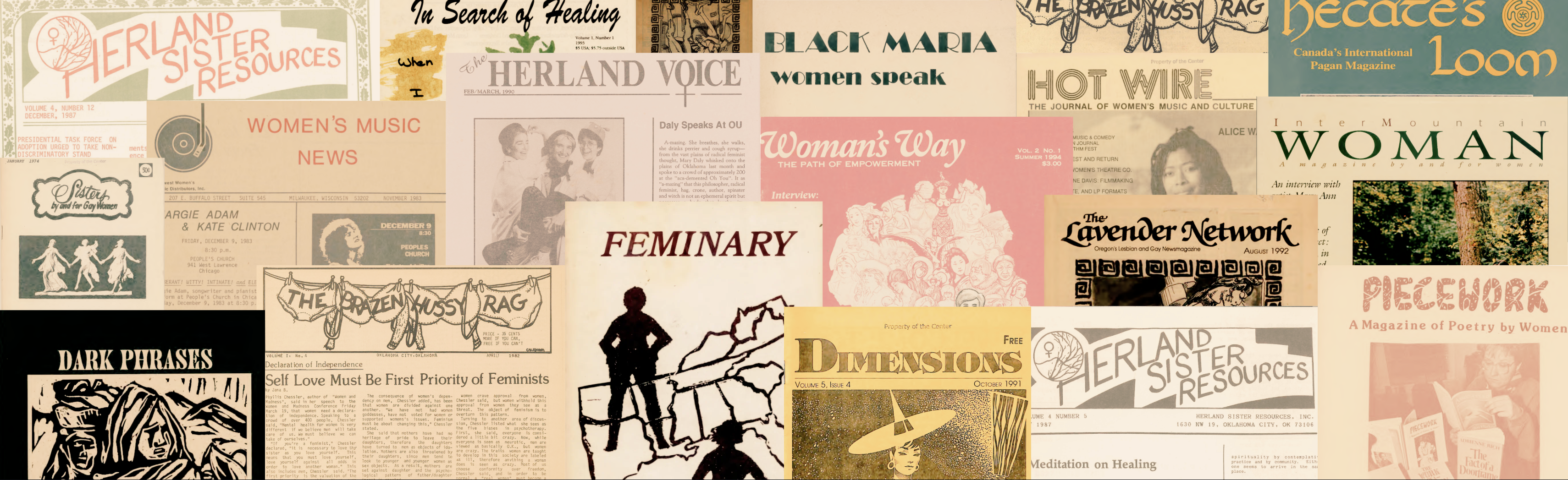
Herland Sister Resources : v.1: no.2(1985)
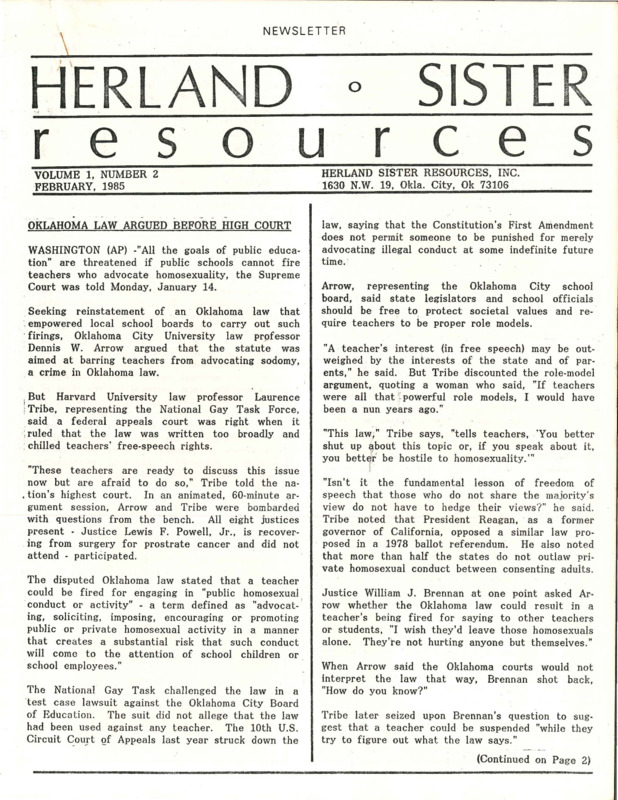
- Title
- Herland Sister Resources : v.1: no.2(1985)
- Description
- The Herland Sister Resources newsletter is the monthly publication of Herland Sister Resources, a womanist organization with a strong lesbian focus based in Oklahoma City.
- Publisher
- en_US Herland Sister Resources
- Date Issued
- 1985-02
- Rights
- All rights reserved by Herland Sister Resources. Contact UCO Archives & Special Collections for the permission policy on the use, reproduction or distribution of these materials.
- Is Part Of
- Herland Sisters Resources
- Creator
- Herland Sister Resources
- Date
- 2022-01-27T17:50:44Z
- Date Available
- 2022-01-27T17:50:44Z
- Subject
- Oklahoma
- Type
- application/pdf
- extracted text
-
NEWSLETTER
SISTE
H'ERLAND
e s
r e s 0 LI r
0
VOLUME l, NUMBER 2
FEBRUARY, 1985
. OKLAHOMA LAW ARGUED BEFORE HIGH COURT
WASHINGTON (AP) -"All the goals of public education" are threatened if public schools cannot fire
teachers who advocate homosexuality, the Supreme
Court was told Monday, January 14.
.·Seeking reinstatement of . an Oklahoma law that
local school boards to carry out such
· firings, Oklahoma City University law pr,:>fessor
· Dennis W. Arrow argued that the statute was
aimed at barring teachers from advocating sodomy,
. a crime in Oklahoma law.
~ empowered
I But Harvard University law professor Laurence
; Tribe, representing the National Gay Task Force,
. said a federal appeals court was right when it
·~ ruled that the law was written too broadly and
: chilled teachers' free-speech rights.
"These teachers are ready to discuss this issue
now but are afraid to do so," Tribe told the na, tion 's highest court. In an animated, 60-minute argument session, Arrow and Tribe were bombarded
with questions from the bench. All eight justices
present - Justice Lewis F. Powell, Jr., is recovering from surgery for prostrate cancer and did not
attend - partiCipated.
The disputed Oklahoma law stated that a teacher
could be fired for engaging in "public homosexual
·conduct or activity" - a term defined as "advocating, soliciting, imposing, encouraging or promoting
public or private homosexual activity in a manner
that creates a substantial risk that such conduct
will come to the attention of school children or .
school employees."
The National Gay Task challenged the law in a
'test case lawsuit against the Oklahoma City Board
of Education. The suit did not allege that the law
had been used against any teacher. The 10th U.S.
Circuit C_ouyt gf Appeals last year struck down the
HERLAND SISTER RESOURCES, INC.
1630 N.W. 19, Okla. City, Ok 73106
law, seying that the Constitution's First Amendment
does not permit someone to be punished for merely
advocating illegal conduct at some indefinite future
time. '
Arrow, representing the Oklahoma City school
board, said state legislators and school officials
should be free to_ protect societal values and require teachers to be proper role models.
"A · teacher's interest (in free speech) may be outweighed . by the interests of the state and of parents," he said. But Tribe discounted the role-model
argument, quoting a woman who said, "If teachers
were all that ~ powerful role models, I would have
been a nun years ago."
"This law; " Tribe says, "tells teachers, 'You better
shut up ~bout this topic or, if you speak about it,
you bettf be hostile to homosexuality."'
"Isn't it the fundamental lesson of freedom of
speech that those who do not share the majority 's
view do not have to hedge their views?" he said.
Tribe noted that President Reagan, · as a former
governor of California, opposed a similar law pro. posed in a 1978 ballot referendum. He also noted
that more than half the states do not outlaw private homosexual conduct between consenting adults.
Justice William J. Brennan at one point asked Arrow whether the Oklahoma law could result in a
teacher's being fired for saying to other teachers
or students, "I wish they'd leave those homosexuals
alone. They're not hurting anyone but themselves."
When Arrow said the Oklahoma courts would not
interpret the law that way, Brennan shot back,
"How do you know?"
Tribe later seized upon Brennan's quest.ion to suggest that a teacher could be suspended "while they
try to figure out what the law says."
(Continued on Page 2)
(Continued from Page 1) \
Homophobia and internalized homophobia (fear and
hatred of oneself) exist to perpetuate the prejudicial myth that homosexuality is a Biblical evil
which stands separate from the actions and attitudes of the individual. Homophobic reactions are
economic, physical and psychological abuse. Discrimination serves the distinct purpose of keeping people where they want them and the good/ evil dichotomy substantiates the wish for what they believe.
Justices William H. Rehnquist and Thurgood Mar- /
shall asked why the high court had been asked to I
decide t~e validity of a law that has never been
used against anyone and has never been interpreted
by an Oklahoma court.
1
"The law has never been applied to a single living
soul," Rehnquist said.
Tribe countered by arguing that teachers are too
afraid of being fired to test the Jaw. "People don't
get up on soap boxes and say, 'Sodomy now,'" he
said.
Teachers and other workers do lose fobs and famil}', church and community ties without the actual
imposition of the law. The loss is because of who
they are rather than what they are thought to do
to children. (Ninety-nine per cent of child molesters
are heterosexual men.)
(EDITOR'S NOTE:)
Clearly, teachers and workers in every other profession are tried, convicted and sentenced on a
daily basis, without their day in court, over the
issue of advocating the rights of or being a l~sbian
or gay man.
The law needn't be formally imposed. The law
needn't exist only to limit free speech. It does
much more than silence heterosexuals or homosex. uals on this, Oklahoma's precedent for the nation
I
'
which may have come to the attention of school
children.
Whether one's choice of sexual partners is political
or personal, hetero or same gender, no one is exempt from a label. No matter if one is married, has
been married ten times and has ten children, it is
impossible to prove sexual identity because it· is
intangible.
The gay man or lesbian who is private, closed,
quiet and careful should, according to the way the
(never interpreted) law is written, fall outside of
wrong-doing; outside of the accusations of negative
influence on young impressionables; outside of the
fear of loss of livelihood. That individual is
oftentimes the most preoccupied with covering his
or her tracks. The law has done its intended fob.
That individual is of~ntimes the most unlikely
threat to the social system. They are or become
the least activist-oriented. They may live in a similar kind of intimidation and paranoia and struggle
to maintain control of their lives as women do as
potential victims of rape.
The law does not affect so much what is "advocated, solicited, imposed, encouraged or promoted"
in front of students or co-workers as it affects
their very lives everywhere and all the time.
Sexual suspects are harassed, manipulated and coerced out of their fobs in subtle and vicous ways.
They may be set up and then caught in an incompetence charge. Their work lives may be made intolerably miserable. They may be simply asked to
resign with a spoken or underlyuing threat of being
fired if they challenge the employer, resulting in
no references and no unemployment compensation.
The question is not whether an employer has the
1
! right to fire an employee for inadequate job performance. The informal, out of court interpretation is
l that it provides tacit approval for the right of the
employer to fire, resulting from perceived or actual
sexual preferen<?e/ life style. Soliciting sexual part; ners in t~e primary and secondary classrooms is a
. se~sation~ization of the issue of homosexual rights
which sefves to protect the true perpetrators of
! this crim~. Advocating, imposing, encouraging or
promoting homosexuality and sharing information or
opinions are not the issues. The law has to do
with keeping homosexuals behind the rest of us
. economically and socially, isolated and afraid.
1
1
I
The homophobic fear and hatred and the internalized homophobia which are the result of such a law
is counterbalanced by the fact that there are les-bians and gay men in Oklahoma who are teachers.
And, they are survivors.
HERLAND SISTER RESOURCES, INC.
announces
our next Collective meeting
open to public
FEBRUARY 3, 1985
6:30 p.m.
call 524-3017, 521-8434 or 946-5395
...
I
STATE NOW SETS '85 GOALS
WOMEN'S SELF-ESTEEM STUDY GROUP SHARES
The State Council for the Oklahoma Chapter of the
National Organization for Women met recently to
formulate goals for the coming year.
The Women's Self-Esteem Study Group is not a
class and not a therapy group. It is a casual and
friendly small group of women who want to be supportive to other women and who want to practice
thinking and sharing their thoughts about common
concerns.
According to a report by Loretta Pecchioni, chapter representative, published in the Metro OKC
NOW Newsletter, the organization has identified
three goals: to network with other human rights
organizations; to develop four workshops on four
different topics; and to raise $500.
The topics selected for the workshops, the chapters recommended to spearhead them and tentative
timetables are:
1) Advertising, Tulsa/Bartlesville, March/ April
2) CR on Racism/Martin Luther King "action
technique", OKC/Lawton, mid-May
3) Preventing Violence Against Women,
Enid/OKC, September
4) "One-ness" networking workshop, Stillwater,
October
Why a women's self-esteem study group? One answer may be that *sex role stereotypes are far
more limiting and debilitating to women than to
men, for the realm of human experience and behavior· that has been designated female is much more
narrowly defined than the range that has been labeled male.
Contact NOW for further information about these
upcoming workshops. Susan Kokojan and Margaret
Cox, Coordinators, 755-2186 and 737-0562.
The group meets Wednesdays from 5:30 to 6:30
p.m. through March 27, 1985, at 5500 N. Western,
Suite · 102, Oklahoma City. The fee is $20 per
month, prorated if you enter the group at the middle or end of the month. You can foin any time by
calling Pat Walke at 848-0050. Please feel free to
talk with Pat Walke whether or not the group may
be appropriate for you. There is no charge for attending one meeting if you would like to get a better idea if it is something you are interested in.
LEGISLATIVE CLEARINGHOUSE FORMS
Suggested reading: Woman & Self-Esteem, by Linda
Tschirhart Sanford and Mary Ellen Donovan.
t."
A coalition of citizen-action groups, including human
rights, civil rights, women's rights, consumer rights,
environmental, peace, etc., in Oklahoma City, meet
Fridays at noon at 433 N.W. 23, Suite 201; I
Common Cause office. Call Keith Smith at 528-2835
for further information.
HERLAND SISTER RESOURCES, INC.
has just received
a ma.ior shipment of new books
STORE HOURS: .
Saturday, 10:00 a.m. - 6:00 p.m.
Sunday,
1:00 p.m. - 6:00 p.m.
Women's Wednesday Night winter series for February includes Karen Carlson, a local songwriter,
who wilol ·;perform February 13, 7:00 to 8:30 p.m.
The fee ts $5 at the door. Karen's songs come
from her f own experiences and her own fourney.
"Tiny Innocent Child" and "You Better Keep Your
Cotton Pickin' Hands Off of Me" emerged from her
experiences as an incest survivor. "The Bent Over
Woman" is a song which rose from her development
as a feminist Christian. Other songs deal with
friendship, a 40th birthday and love.
Three Story Suite, a video, will be screened and
discussed, February 27, from 7:00 to 8:30 p.m., $5
fee. The video is a trio of feminist folktales from
Persia, Africa and Polynesia, performed by storyteller Laura Simms. Fetnah tells how an intelligent
and beautiful woman taught wisdom and humility to
a king; Spirit Basket is the story of a goddess
struggling to teach man the treasures of the spirit;
and Hina is a Polynesian myth in which a woman 1
escapes earthly life by transforming her daily work
into moonbeams and stars. The brilliance of Laura
Simms' animated style, combined with Chase's ,
stunning visual effects, carries your imagination to
the land of dream and myth.
Contact Pat Walke for additional information.
*from Sanford and Donovan's Women & Self-Esteem
Contributions of Women, a series of 12 books,
$8.95 each, The Dillon Press (Minneapolis)
BOOKS FOR CHILDREN
1
History of Women for Children, by Vivian SheldonEpstein, 31 pp. illustrations, The Quality Press
(Denver), 1984, 44.95.
The History of Women for
human liberation." Vivian
exactly that by presenting
a manner that is certain
young readers.
Children is "dedicated to
Sheldon-Epstein advances
the history of women in
to prove stimulating to
The author traces the evolution of women in society, from their prehistoric status as mysterious,
magical creators of new life · to their eventual subjugation as the property of men and theri recent,
piecemeal liberation. Various aspects of women's
oppression are chronicled, including the denial of
their inheritances, lack of educational opportunities,
and deprecation through organized religion. At one
point, Sheldon-Epstein explains, "If a woman's family, school, religion and community all tell a woman
from the time she is a small girl that she is not as
important and valuable as a man and that she is
not allowed to do what a man does, a woman .. may
believe that she is truly inferior." It is in such instances, when the effects of historic events and
cultural developments on the lives of individuals
are described, that the History of Women for
Children is most educational and provocative.
The author goes on to outline the growth and success of the modern women's movement, citing Mary
Wollstonecraft's Vindication of the Rights of
Women, the 1848 Seneca Falls conference, the 19th
Amendment, the entrance of women into the work
force during World War · II, Betty Friedan's The
Feminine Mystique, and the Civil Rights Act of
1964.
She emphasizes that the goal of the woman's movement is not that of turning women away from marriage, motherhood and homemaking, but that of ensuring that each woman has a choice of how to
live her life. She also provides lengthy lists of
women achievers in fields from literature to mathematics to politics, thereby making the options open
to women readily apparent. The book's closing paragraphs remind the reader that "much more has to
be done to make and keep women's chances equal
all over the world," and that by enabling each individual to realize his or her full potential, we can
make the world a better place.
The History of Women for Children is enhanced
throughout by large, expressive illustrations, which
are racially and culturally balanced, and over of
half of which are appropriate for a child's imaginative coloring with crayons or pastels.
What do Jerrie Mock Helen Taussig, M.D., Florence
Kelley, Mary Cassatt and Tillie Lewis have in common? In addition to being influential figures in
their respective fields of aviation, medicine, social
reform, art and business, each is profiled in Contributions of Women, a series of 12 books designed
for young readers. Each book in the series portrays
an array of women in a given field, providing
young readers with a concrete sense of their
female heritage as well as with inspiring role
models in every career area imaginable. All of the
books in the series follow a similar format,
recounting the stories of between four and six
women.
The series' excellence lies in its diversity. The individual books' topics include art, dance, social reform and theatre, as well as the more traditionally
male-dominated fields of aviation, business, labor,
literature, medicine, science and sports. One book
also presents the stories of the "first women who
spoke out."
The figures profiled range from Sarah and Angelina
Grimke, the first female abolitionists in the US, to
Eugenie Clark, an ichthyologist whose speciality is
shark behavior, not to mention such better known
figures as Margaret Mead, Elizabeth Cady Stanton,
Eleanor Roosevelt, Isadora Duncan and Ethyl Barrymore. The series includes biographies of women
leaders d~ting from as far back as 1792, to contemporary ~:women.
'~ '
read~~
1
The
is drawn into the world of these women
at various stages in their rise to prominence.
Three-time Olympic gold medalist Wilma Rudolph is
introduced as she is positioned on the track, tensely waiting for her teammate to pass her the baton
during the 400-meter relay at the 1960 Olympics in
Rome. The account of Amelia Earhart's life begins
on the island in the Pacific where her radio distress signals were first heard in 1937. Closing sections, entitled "Other Outstanding Women," provide
brief descriptions of other women in each given
field. On the whole, these stories are enticing, exploring not only the bare facts of each woman's
life, but also her fantasies, emotions and commitmen ts.
from Graduate Woman, Nov-Dec., 1984, Vol. 78, No.
10, p. 10.
Publisher: Herland Sister Resources, Inc.
Editor: Elaine Barton
Typesetter: Marian Hulsey
Copying: Laura Choate
Circulation: 398
I
EARLY CHILDHOOD EDUCATION RESOURCES
Activity Books for Teaching International Education
in Grades K-12, a free publications catalog available upon request from the Center for Teaching
International Relations, Publications Office, University of Denver, Denver, CO 80209, 303-871-2426
Increased competition for admission to prestigious
schools, the availability of advanced educational
technologies for home use and publicity about "super babies" who learn to walk, talk, read and write
at a young age, have resulted in heightened public
interest in early childhood education.
Educational Resources Catalog, Oxfam America, 115
Broadway, Boston, MA 02116, 617-482-1211.
(Free
catalog of audiovisual materials, books, crafts and
organizations dealing with international relations
available upon request.)
The effectiveness of early education efforts, especially those not conducted by educational professionnals, is the subject of a hot national debate.
Concerns often focus on whether the potential
benefits of the intensive education of young
children outweigh the harm that may result from
pressure to achieve at an early age.
Global Perspectives in Education, Inc., 218 East
18th St., New York, NY 10003, 212-475-0850
Internationalizing Your School: A Resource Guide
for Teachers, Administrators, Parents and School
Board Members, the National Council on Foreign
Language and International Studies, 605 Third Ave.,
17th FL, New York, NY 10158, 212-490-3520,
($7 .50)
To learn more about early childhood education,
contact:
The Association for Childhood Education International (ACEI), 3615 Wisconsin Ave., N.W., Washington, D.C. 20016, 202-363-6963. Membership includes
a subscription (5 issues per year) to Childhood Education: Infancy through Eady Adolescence ($35
inst., $32 indiv., $15 student, retired). To ,. foin,
write ACEI;, 11141 Georgia Ave., Suite 200,
Wheaton, MD 20902.
The Child Development Associate National Credentialing Program, 1341 G. St., N.W., Suite 802,
Washington, D.C. 20005, 202-638-6656 and 800-4244310.
The National Association for the Education of
Young Children (NAEYC), 1834 Connecticut Ave.,
N.W., Washington, D.C. 20009, 202-332-8777 and
800-424-2460. Membership includes a subscription to
Young Children (bimonthly magazine) and eligibility
for grants ($40 for comprehensive membership and
$15 for regular or student membership).
The National Council on World Affairs Organizations is a network for pre-collegiate educational
efforts. To be placed on the mailing list, contact
Margaret Lonzetta, The World Affairs Council of
Philadelphia, John Wanamaker Bldg., 3rd FL Gallery, 13th and Market St., Philadelphia, PA 19107,
215-563-5363
1
For additional resources on these subjects, contact:
American AssoCiation of University Women/Member
Education and Training, 2401 Virginia Ave., N.W.,
Washington, D.C. 20037
1
~.
'
f
_Y o u' re I n v it e d/
Susan B. Anthony's 165th Birthday Party
and
Open House
Friday, February 15, 1985
7:00 - 9:00 p.m.
INT'NAT'L RELATIONS FOR YOUNG AMERICANS
In recent years, often the task of educating young
Americans about the culture, history and politics of
other nations has fallen to volunteers. American
Association of University Women branches are among the volunteer organizations that have worked
to increase international understanding by establishing special programs to teach children about other
nations and by encouraging schools to include international subject matter in their regular curriculum.
Organizations and resources that can be useful in
such educational efforts include:
HERLAND SISTER RESOURCES, INC.
1630 N.W. 19
HERLAND COFFEEHOUSE
presents
Donn a De Sa Iv o
for your entertainment
Friday, February 22, 1985
8:00 p.m.
HERLAND SISTER RESOURCES, INC.
1630 N.W. 19
LETTERS COLUMN ADDED
CURRENT NEEDS LIST:
The HSR Collective agreed to begin publishing a
letters column in the March issue of the Newsletter.
(listed in order of priority)
We encourage the exchange of information, personal opinions on issues of concern to the Oklahoma women's community, and your stories and experiences. The content of letters should concentrate on issues.
Rent on Store
per month, due 1st
Bills on Store
percentage, due 15th
j
The HSR editor reserves the right to edit and con- I
dense letters according to space limitations. Let- ]
ters should be typed, double-spaced and signed by
the writer (s). Include your address and telephone
number. If you wish your letter to be published
anonymously, indicate so, but include your name, I
etc., for our information in case theeditor has
questions.
Mail or deliver your letter to HSR, Inc., 1630 N.W.
19, Oklahoma City, OK 73106. Deadline is the 15th
of each month.
YALE STRIKE CONTINUES
The strike by Yale's clerical and technical workers
includes 1500 individuals, 82% of whom are women,
and many of whom are female heads of households .
They have been walking the picket lines which surround Yale for the past 10 weeks, holding out for
a contract that will move toward eliminating the
fob segregation which has kept women and Black
employees earning significantly less than their
white male counterparts.
$125.00
(approx.)
10.00
Bulk Mail Permit
one-time cost, 5.2 cent mailings
80.00
Corporate Seal
one-time, verifies non-profit
23.05
Contents and Liability Insurance
per year
150.00
Gatewood Neighborhood Assoc.
per year membership
10.00
Supplies
paper, per month
labels, postage, misc.
20.00
15.00
Newsletter Mailing
current cost per month
cost after acquiring permit
41.00
22.00
SHELTER SIGNS UNION CONTRACT
/
Members t~f , District
During all this time, the University administration
has refused to negotiate on the outstanding differences and has consistently refused binding and
non-binding arbitration. Recently the union made a
strategic decision to take take the struggle back ,
inside and return to work over the long holiday
break--a slack per1.od when most students and many
faculty are not present. The strike resumes midJanuary if a settlement is not reached.
The issues at stake here go well beyond the confines of Yale University. The striking union, Local
34, is the largest union of clerical and technical
workers to endeavor to settle a contract in the
private sector. What happens at Yale will undoubtedly set precedents for similar unions in other
parts of the country. Indeed, what happens here
will have an impact on e~ployers' acceptance of
the concept of comparable worth to address and II
change past discriminatory practices.
II
1
To help, write Strike and Hardship Funds, c/o
Pargo MacLeod, 88 Prospect St., New Haven, CT
06511.
HSR. INC.
65, U.A.W. employed at Women
Against ~buse, an organization for battered women
in Philadelphia, successfully negotiated their first
contract November 21, 1984. WAA is a large emergency shelter and a Legal Center - one of the
largest programs for battered women in the U.S.
Among the gains for employeees: a grievance procedure; the District 65 Health Plan; and an education
scholarship fund.
Key demands not met: shift
differential payment; extra compensation for using
bilingual skills on the fob; effective health and
safety
guidelines;
strong
affirmative
action
guidelines; and discontinuing the use of open-ended
job descriptions.
Negotiations were begun in july and eventually
handled by five of the 26 employees. Raises were
awarded on a graduated scale, with employees
earning between $11-12,000 receiving $1050, employees earning $15,000 receiving $650, and all
others falling between.
For further information, call Joanne Brown: 215386-1280-W, 215-727-6570-H; or Fran Smith, Vice
President, District 65, Vineland: 609-696-4713.
1
-
NEWSLETTER
SISTE
H'ERLAND
e s
r e s 0 LI r
0
VOLUME l, NUMBER 2
FEBRUARY, 1985
. OKLAHOMA LAW ARGUED BEFORE HIGH COURT
WASHINGTON (AP) -"All the goals of public education" are threatened if public schools cannot fire
teachers who advocate homosexuality, the Supreme
Court was told Monday, January 14.
.·Seeking reinstatement of . an Oklahoma law that
local school boards to carry out such
· firings, Oklahoma City University law pr,:>fessor
· Dennis W. Arrow argued that the statute was
aimed at barring teachers from advocating sodomy,
. a crime in Oklahoma law.
~ empowered
I But Harvard University law professor Laurence
; Tribe, representing the National Gay Task Force,
. said a federal appeals court was right when it
·~ ruled that the law was written too broadly and
: chilled teachers' free-speech rights.
"These teachers are ready to discuss this issue
now but are afraid to do so," Tribe told the na, tion 's highest court. In an animated, 60-minute argument session, Arrow and Tribe were bombarded
with questions from the bench. All eight justices
present - Justice Lewis F. Powell, Jr., is recovering from surgery for prostrate cancer and did not
attend - partiCipated.
The disputed Oklahoma law stated that a teacher
could be fired for engaging in "public homosexual
·conduct or activity" - a term defined as "advocating, soliciting, imposing, encouraging or promoting
public or private homosexual activity in a manner
that creates a substantial risk that such conduct
will come to the attention of school children or .
school employees."
The National Gay Task challenged the law in a
'test case lawsuit against the Oklahoma City Board
of Education. The suit did not allege that the law
had been used against any teacher. The 10th U.S.
Circuit C_ouyt gf Appeals last year struck down the
HERLAND SISTER RESOURCES, INC.
1630 N.W. 19, Okla. City, Ok 73106
law, seying that the Constitution's First Amendment
does not permit someone to be punished for merely
advocating illegal conduct at some indefinite future
time. '
Arrow, representing the Oklahoma City school
board, said state legislators and school officials
should be free to_ protect societal values and require teachers to be proper role models.
"A · teacher's interest (in free speech) may be outweighed . by the interests of the state and of parents," he said. But Tribe discounted the role-model
argument, quoting a woman who said, "If teachers
were all that ~ powerful role models, I would have
been a nun years ago."
"This law; " Tribe says, "tells teachers, 'You better
shut up ~bout this topic or, if you speak about it,
you bettf be hostile to homosexuality."'
"Isn't it the fundamental lesson of freedom of
speech that those who do not share the majority 's
view do not have to hedge their views?" he said.
Tribe noted that President Reagan, · as a former
governor of California, opposed a similar law pro. posed in a 1978 ballot referendum. He also noted
that more than half the states do not outlaw private homosexual conduct between consenting adults.
Justice William J. Brennan at one point asked Arrow whether the Oklahoma law could result in a
teacher's being fired for saying to other teachers
or students, "I wish they'd leave those homosexuals
alone. They're not hurting anyone but themselves."
When Arrow said the Oklahoma courts would not
interpret the law that way, Brennan shot back,
"How do you know?"
Tribe later seized upon Brennan's quest.ion to suggest that a teacher could be suspended "while they
try to figure out what the law says."
(Continued on Page 2)
(Continued from Page 1) \
Homophobia and internalized homophobia (fear and
hatred of oneself) exist to perpetuate the prejudicial myth that homosexuality is a Biblical evil
which stands separate from the actions and attitudes of the individual. Homophobic reactions are
economic, physical and psychological abuse. Discrimination serves the distinct purpose of keeping people where they want them and the good/ evil dichotomy substantiates the wish for what they believe.
Justices William H. Rehnquist and Thurgood Mar- /
shall asked why the high court had been asked to I
decide t~e validity of a law that has never been
used against anyone and has never been interpreted
by an Oklahoma court.
1
"The law has never been applied to a single living
soul," Rehnquist said.
Tribe countered by arguing that teachers are too
afraid of being fired to test the Jaw. "People don't
get up on soap boxes and say, 'Sodomy now,'" he
said.
Teachers and other workers do lose fobs and famil}', church and community ties without the actual
imposition of the law. The loss is because of who
they are rather than what they are thought to do
to children. (Ninety-nine per cent of child molesters
are heterosexual men.)
(EDITOR'S NOTE:)
Clearly, teachers and workers in every other profession are tried, convicted and sentenced on a
daily basis, without their day in court, over the
issue of advocating the rights of or being a l~sbian
or gay man.
The law needn't be formally imposed. The law
needn't exist only to limit free speech. It does
much more than silence heterosexuals or homosex. uals on this, Oklahoma's precedent for the nation
I
'
which may have come to the attention of school
children.
Whether one's choice of sexual partners is political
or personal, hetero or same gender, no one is exempt from a label. No matter if one is married, has
been married ten times and has ten children, it is
impossible to prove sexual identity because it· is
intangible.
The gay man or lesbian who is private, closed,
quiet and careful should, according to the way the
(never interpreted) law is written, fall outside of
wrong-doing; outside of the accusations of negative
influence on young impressionables; outside of the
fear of loss of livelihood. That individual is
oftentimes the most preoccupied with covering his
or her tracks. The law has done its intended fob.
That individual is of~ntimes the most unlikely
threat to the social system. They are or become
the least activist-oriented. They may live in a similar kind of intimidation and paranoia and struggle
to maintain control of their lives as women do as
potential victims of rape.
The law does not affect so much what is "advocated, solicited, imposed, encouraged or promoted"
in front of students or co-workers as it affects
their very lives everywhere and all the time.
Sexual suspects are harassed, manipulated and coerced out of their fobs in subtle and vicous ways.
They may be set up and then caught in an incompetence charge. Their work lives may be made intolerably miserable. They may be simply asked to
resign with a spoken or underlyuing threat of being
fired if they challenge the employer, resulting in
no references and no unemployment compensation.
The question is not whether an employer has the
1
! right to fire an employee for inadequate job performance. The informal, out of court interpretation is
l that it provides tacit approval for the right of the
employer to fire, resulting from perceived or actual
sexual preferen<?e/ life style. Soliciting sexual part; ners in t~e primary and secondary classrooms is a
. se~sation~ization of the issue of homosexual rights
which sefves to protect the true perpetrators of
! this crim~. Advocating, imposing, encouraging or
promoting homosexuality and sharing information or
opinions are not the issues. The law has to do
with keeping homosexuals behind the rest of us
. economically and socially, isolated and afraid.
1
1
I
The homophobic fear and hatred and the internalized homophobia which are the result of such a law
is counterbalanced by the fact that there are les-bians and gay men in Oklahoma who are teachers.
And, they are survivors.
HERLAND SISTER RESOURCES, INC.
announces
our next Collective meeting
open to public
FEBRUARY 3, 1985
6:30 p.m.
call 524-3017, 521-8434 or 946-5395
...
I
STATE NOW SETS '85 GOALS
WOMEN'S SELF-ESTEEM STUDY GROUP SHARES
The State Council for the Oklahoma Chapter of the
National Organization for Women met recently to
formulate goals for the coming year.
The Women's Self-Esteem Study Group is not a
class and not a therapy group. It is a casual and
friendly small group of women who want to be supportive to other women and who want to practice
thinking and sharing their thoughts about common
concerns.
According to a report by Loretta Pecchioni, chapter representative, published in the Metro OKC
NOW Newsletter, the organization has identified
three goals: to network with other human rights
organizations; to develop four workshops on four
different topics; and to raise $500.
The topics selected for the workshops, the chapters recommended to spearhead them and tentative
timetables are:
1) Advertising, Tulsa/Bartlesville, March/ April
2) CR on Racism/Martin Luther King "action
technique", OKC/Lawton, mid-May
3) Preventing Violence Against Women,
Enid/OKC, September
4) "One-ness" networking workshop, Stillwater,
October
Why a women's self-esteem study group? One answer may be that *sex role stereotypes are far
more limiting and debilitating to women than to
men, for the realm of human experience and behavior· that has been designated female is much more
narrowly defined than the range that has been labeled male.
Contact NOW for further information about these
upcoming workshops. Susan Kokojan and Margaret
Cox, Coordinators, 755-2186 and 737-0562.
The group meets Wednesdays from 5:30 to 6:30
p.m. through March 27, 1985, at 5500 N. Western,
Suite · 102, Oklahoma City. The fee is $20 per
month, prorated if you enter the group at the middle or end of the month. You can foin any time by
calling Pat Walke at 848-0050. Please feel free to
talk with Pat Walke whether or not the group may
be appropriate for you. There is no charge for attending one meeting if you would like to get a better idea if it is something you are interested in.
LEGISLATIVE CLEARINGHOUSE FORMS
Suggested reading: Woman & Self-Esteem, by Linda
Tschirhart Sanford and Mary Ellen Donovan.
t."
A coalition of citizen-action groups, including human
rights, civil rights, women's rights, consumer rights,
environmental, peace, etc., in Oklahoma City, meet
Fridays at noon at 433 N.W. 23, Suite 201; I
Common Cause office. Call Keith Smith at 528-2835
for further information.
HERLAND SISTER RESOURCES, INC.
has just received
a ma.ior shipment of new books
STORE HOURS: .
Saturday, 10:00 a.m. - 6:00 p.m.
Sunday,
1:00 p.m. - 6:00 p.m.
Women's Wednesday Night winter series for February includes Karen Carlson, a local songwriter,
who wilol ·;perform February 13, 7:00 to 8:30 p.m.
The fee ts $5 at the door. Karen's songs come
from her f own experiences and her own fourney.
"Tiny Innocent Child" and "You Better Keep Your
Cotton Pickin' Hands Off of Me" emerged from her
experiences as an incest survivor. "The Bent Over
Woman" is a song which rose from her development
as a feminist Christian. Other songs deal with
friendship, a 40th birthday and love.
Three Story Suite, a video, will be screened and
discussed, February 27, from 7:00 to 8:30 p.m., $5
fee. The video is a trio of feminist folktales from
Persia, Africa and Polynesia, performed by storyteller Laura Simms. Fetnah tells how an intelligent
and beautiful woman taught wisdom and humility to
a king; Spirit Basket is the story of a goddess
struggling to teach man the treasures of the spirit;
and Hina is a Polynesian myth in which a woman 1
escapes earthly life by transforming her daily work
into moonbeams and stars. The brilliance of Laura
Simms' animated style, combined with Chase's ,
stunning visual effects, carries your imagination to
the land of dream and myth.
Contact Pat Walke for additional information.
*from Sanford and Donovan's Women & Self-Esteem
Contributions of Women, a series of 12 books,
$8.95 each, The Dillon Press (Minneapolis)
BOOKS FOR CHILDREN
1
History of Women for Children, by Vivian SheldonEpstein, 31 pp. illustrations, The Quality Press
(Denver), 1984, 44.95.
The History of Women for
human liberation." Vivian
exactly that by presenting
a manner that is certain
young readers.
Children is "dedicated to
Sheldon-Epstein advances
the history of women in
to prove stimulating to
The author traces the evolution of women in society, from their prehistoric status as mysterious,
magical creators of new life · to their eventual subjugation as the property of men and theri recent,
piecemeal liberation. Various aspects of women's
oppression are chronicled, including the denial of
their inheritances, lack of educational opportunities,
and deprecation through organized religion. At one
point, Sheldon-Epstein explains, "If a woman's family, school, religion and community all tell a woman
from the time she is a small girl that she is not as
important and valuable as a man and that she is
not allowed to do what a man does, a woman .. may
believe that she is truly inferior." It is in such instances, when the effects of historic events and
cultural developments on the lives of individuals
are described, that the History of Women for
Children is most educational and provocative.
The author goes on to outline the growth and success of the modern women's movement, citing Mary
Wollstonecraft's Vindication of the Rights of
Women, the 1848 Seneca Falls conference, the 19th
Amendment, the entrance of women into the work
force during World War · II, Betty Friedan's The
Feminine Mystique, and the Civil Rights Act of
1964.
She emphasizes that the goal of the woman's movement is not that of turning women away from marriage, motherhood and homemaking, but that of ensuring that each woman has a choice of how to
live her life. She also provides lengthy lists of
women achievers in fields from literature to mathematics to politics, thereby making the options open
to women readily apparent. The book's closing paragraphs remind the reader that "much more has to
be done to make and keep women's chances equal
all over the world," and that by enabling each individual to realize his or her full potential, we can
make the world a better place.
The History of Women for Children is enhanced
throughout by large, expressive illustrations, which
are racially and culturally balanced, and over of
half of which are appropriate for a child's imaginative coloring with crayons or pastels.
What do Jerrie Mock Helen Taussig, M.D., Florence
Kelley, Mary Cassatt and Tillie Lewis have in common? In addition to being influential figures in
their respective fields of aviation, medicine, social
reform, art and business, each is profiled in Contributions of Women, a series of 12 books designed
for young readers. Each book in the series portrays
an array of women in a given field, providing
young readers with a concrete sense of their
female heritage as well as with inspiring role
models in every career area imaginable. All of the
books in the series follow a similar format,
recounting the stories of between four and six
women.
The series' excellence lies in its diversity. The individual books' topics include art, dance, social reform and theatre, as well as the more traditionally
male-dominated fields of aviation, business, labor,
literature, medicine, science and sports. One book
also presents the stories of the "first women who
spoke out."
The figures profiled range from Sarah and Angelina
Grimke, the first female abolitionists in the US, to
Eugenie Clark, an ichthyologist whose speciality is
shark behavior, not to mention such better known
figures as Margaret Mead, Elizabeth Cady Stanton,
Eleanor Roosevelt, Isadora Duncan and Ethyl Barrymore. The series includes biographies of women
leaders d~ting from as far back as 1792, to contemporary ~:women.
'~ '
read~~
1
The
is drawn into the world of these women
at various stages in their rise to prominence.
Three-time Olympic gold medalist Wilma Rudolph is
introduced as she is positioned on the track, tensely waiting for her teammate to pass her the baton
during the 400-meter relay at the 1960 Olympics in
Rome. The account of Amelia Earhart's life begins
on the island in the Pacific where her radio distress signals were first heard in 1937. Closing sections, entitled "Other Outstanding Women," provide
brief descriptions of other women in each given
field. On the whole, these stories are enticing, exploring not only the bare facts of each woman's
life, but also her fantasies, emotions and commitmen ts.
from Graduate Woman, Nov-Dec., 1984, Vol. 78, No.
10, p. 10.
Publisher: Herland Sister Resources, Inc.
Editor: Elaine Barton
Typesetter: Marian Hulsey
Copying: Laura Choate
Circulation: 398
I
EARLY CHILDHOOD EDUCATION RESOURCES
Activity Books for Teaching International Education
in Grades K-12, a free publications catalog available upon request from the Center for Teaching
International Relations, Publications Office, University of Denver, Denver, CO 80209, 303-871-2426
Increased competition for admission to prestigious
schools, the availability of advanced educational
technologies for home use and publicity about "super babies" who learn to walk, talk, read and write
at a young age, have resulted in heightened public
interest in early childhood education.
Educational Resources Catalog, Oxfam America, 115
Broadway, Boston, MA 02116, 617-482-1211.
(Free
catalog of audiovisual materials, books, crafts and
organizations dealing with international relations
available upon request.)
The effectiveness of early education efforts, especially those not conducted by educational professionnals, is the subject of a hot national debate.
Concerns often focus on whether the potential
benefits of the intensive education of young
children outweigh the harm that may result from
pressure to achieve at an early age.
Global Perspectives in Education, Inc., 218 East
18th St., New York, NY 10003, 212-475-0850
Internationalizing Your School: A Resource Guide
for Teachers, Administrators, Parents and School
Board Members, the National Council on Foreign
Language and International Studies, 605 Third Ave.,
17th FL, New York, NY 10158, 212-490-3520,
($7 .50)
To learn more about early childhood education,
contact:
The Association for Childhood Education International (ACEI), 3615 Wisconsin Ave., N.W., Washington, D.C. 20016, 202-363-6963. Membership includes
a subscription (5 issues per year) to Childhood Education: Infancy through Eady Adolescence ($35
inst., $32 indiv., $15 student, retired). To ,. foin,
write ACEI;, 11141 Georgia Ave., Suite 200,
Wheaton, MD 20902.
The Child Development Associate National Credentialing Program, 1341 G. St., N.W., Suite 802,
Washington, D.C. 20005, 202-638-6656 and 800-4244310.
The National Association for the Education of
Young Children (NAEYC), 1834 Connecticut Ave.,
N.W., Washington, D.C. 20009, 202-332-8777 and
800-424-2460. Membership includes a subscription to
Young Children (bimonthly magazine) and eligibility
for grants ($40 for comprehensive membership and
$15 for regular or student membership).
The National Council on World Affairs Organizations is a network for pre-collegiate educational
efforts. To be placed on the mailing list, contact
Margaret Lonzetta, The World Affairs Council of
Philadelphia, John Wanamaker Bldg., 3rd FL Gallery, 13th and Market St., Philadelphia, PA 19107,
215-563-5363
1
For additional resources on these subjects, contact:
American AssoCiation of University Women/Member
Education and Training, 2401 Virginia Ave., N.W.,
Washington, D.C. 20037
1
~.
'
f
_Y o u' re I n v it e d/
Susan B. Anthony's 165th Birthday Party
and
Open House
Friday, February 15, 1985
7:00 - 9:00 p.m.
INT'NAT'L RELATIONS FOR YOUNG AMERICANS
In recent years, often the task of educating young
Americans about the culture, history and politics of
other nations has fallen to volunteers. American
Association of University Women branches are among the volunteer organizations that have worked
to increase international understanding by establishing special programs to teach children about other
nations and by encouraging schools to include international subject matter in their regular curriculum.
Organizations and resources that can be useful in
such educational efforts include:
HERLAND SISTER RESOURCES, INC.
1630 N.W. 19
HERLAND COFFEEHOUSE
presents
Donn a De Sa Iv o
for your entertainment
Friday, February 22, 1985
8:00 p.m.
HERLAND SISTER RESOURCES, INC.
1630 N.W. 19
LETTERS COLUMN ADDED
CURRENT NEEDS LIST:
The HSR Collective agreed to begin publishing a
letters column in the March issue of the Newsletter.
(listed in order of priority)
We encourage the exchange of information, personal opinions on issues of concern to the Oklahoma women's community, and your stories and experiences. The content of letters should concentrate on issues.
Rent on Store
per month, due 1st
Bills on Store
percentage, due 15th
j
The HSR editor reserves the right to edit and con- I
dense letters according to space limitations. Let- ]
ters should be typed, double-spaced and signed by
the writer (s). Include your address and telephone
number. If you wish your letter to be published
anonymously, indicate so, but include your name, I
etc., for our information in case theeditor has
questions.
Mail or deliver your letter to HSR, Inc., 1630 N.W.
19, Oklahoma City, OK 73106. Deadline is the 15th
of each month.
YALE STRIKE CONTINUES
The strike by Yale's clerical and technical workers
includes 1500 individuals, 82% of whom are women,
and many of whom are female heads of households .
They have been walking the picket lines which surround Yale for the past 10 weeks, holding out for
a contract that will move toward eliminating the
fob segregation which has kept women and Black
employees earning significantly less than their
white male counterparts.
$125.00
(approx.)
10.00
Bulk Mail Permit
one-time cost, 5.2 cent mailings
80.00
Corporate Seal
one-time, verifies non-profit
23.05
Contents and Liability Insurance
per year
150.00
Gatewood Neighborhood Assoc.
per year membership
10.00
Supplies
paper, per month
labels, postage, misc.
20.00
15.00
Newsletter Mailing
current cost per month
cost after acquiring permit
41.00
22.00
SHELTER SIGNS UNION CONTRACT
/
Members t~f , District
During all this time, the University administration
has refused to negotiate on the outstanding differences and has consistently refused binding and
non-binding arbitration. Recently the union made a
strategic decision to take take the struggle back ,
inside and return to work over the long holiday
break--a slack per1.od when most students and many
faculty are not present. The strike resumes midJanuary if a settlement is not reached.
The issues at stake here go well beyond the confines of Yale University. The striking union, Local
34, is the largest union of clerical and technical
workers to endeavor to settle a contract in the
private sector. What happens at Yale will undoubtedly set precedents for similar unions in other
parts of the country. Indeed, what happens here
will have an impact on e~ployers' acceptance of
the concept of comparable worth to address and II
change past discriminatory practices.
II
1
To help, write Strike and Hardship Funds, c/o
Pargo MacLeod, 88 Prospect St., New Haven, CT
06511.
HSR. INC.
65, U.A.W. employed at Women
Against ~buse, an organization for battered women
in Philadelphia, successfully negotiated their first
contract November 21, 1984. WAA is a large emergency shelter and a Legal Center - one of the
largest programs for battered women in the U.S.
Among the gains for employeees: a grievance procedure; the District 65 Health Plan; and an education
scholarship fund.
Key demands not met: shift
differential payment; extra compensation for using
bilingual skills on the fob; effective health and
safety
guidelines;
strong
affirmative
action
guidelines; and discontinuing the use of open-ended
job descriptions.
Negotiations were begun in july and eventually
handled by five of the 26 employees. Raises were
awarded on a graduated scale, with employees
earning between $11-12,000 receiving $1050, employees earning $15,000 receiving $650, and all
others falling between.
For further information, call Joanne Brown: 215386-1280-W, 215-727-6570-H; or Fran Smith, Vice
President, District 65, Vineland: 609-696-4713.
1
- Temporal Coverage
- 1980-1989
Linked resources
- Hierarchies
-
Herland Archive
- All Resources (Private)
- Themes
- LGBTQ+ (482 items)
- Feminism (40 items)
- Faith and Religion (51 items)
- Activism and Advocacy (69 items)
- HIV/AIDS (25 items)
- Education (18 items)
- Literature (20 items)
- Art (16 items)
- Themes
- All Resources (Private)