
Groundings : v.4:no.1(1995)
- Title
- Groundings : v.4:no.1(1995)
- Description
- Groundings is a newsletter published by the Common Ground Center, which is a faith-based community committed to nonviolence and justice. The goal of this newsletter is to create a space for members of the Common Ground network to communicate about different issues and conversations important to them. This issue of Groundings was published in fall of 1995 and discusses many different topics, including female circumcision, violence against women, contributors to Common Ground, a journal created by Appalachian women, and more.
- Date Issued
- 1995
- Relation
- Groundings
- Rights
- Contact UCO Chambers Library's Digital Initiatives Working Group at diwg@uco.edu for the permission policy on the use, reproduction or distribution of this material.
- Contributor
- Common Ground Center for Nonviolence
- Date
- 2024-08-30T18:45:51Z
- Date Available
- 2024-08-30T18:45:51Z
- Subject
- Appalachia
- extracted text
-
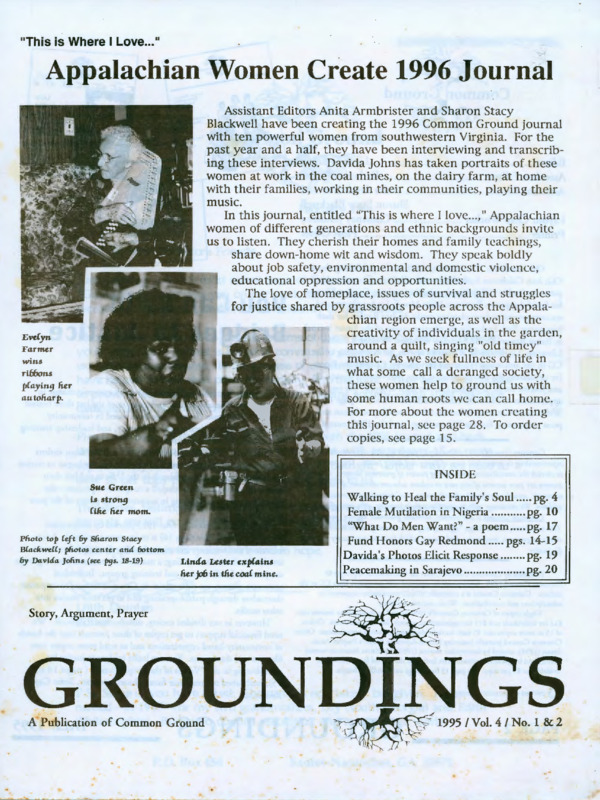
"This is Where I Love ... "
Appalachian Women Create 1996 Journal
Assistant Editors Anita Armbrister and Sharon Stacy
Blackwell have been creating the 1996 Common Ground journal
with ten powerful women from southwestern Virginia. For the
p ast year and a half, they have been interviewing and transcribing these interviews. Davida Johns has taken portraits of these
women at work in the coal mines, on the dairy farm, at home
with their families, working in their communities, playing their
music.
In this journal, entitled "This is where I love ... ," Appalachian
women of different generations and ethnic backgrounds invite
us to listen. They cherish their homes and family teachings,
share down-home wit and wisdom. They speak boldly
about job safety, environmental and domestic violence,
educational oppression and opportunities.
The love of homeplace, issues of survival and struggles
for justice shared by grassroots people across the Appalachian region emerge, as well as the
creativity of individuals in the garden,
around a quilt, singing "old timey"
music. As we seek fullness of life in
what some call a deranged society,
these women help to ground us with
some human roots we can call home.
For more about the women creating
this journal, see page 28. To order
copies, see page 15.
EveCyn
Fanner
wins
ribbons
pCa.yin9 fur
a.utoliarp.
INSIDE
Sue Grun
is st ro"-9
Cifie fur mom.
Pfioto top Ceft 6y Sliaron Stacy
BCackweCC; phot os cen ter a.ru( 6ottom
6y Dav ida. Johns (se£ p9s. 18-19)
Un4a. Lester expCa.ins
. fur jo6 in tlu coa.C mine.
Walking to Heal the Family's Soul ..... pg. 4
Female Mutilation in Nigeria .......... . pg. 10
"What Do Men Want?" - a poem ..... pg. 17
Fund Honors Gay Redmond ..... pgs. 14-15
Davida's Photos Elicit Response ........ pg. 19
Peacemaking in Sarajevo .................. .. pg. 20
Story, Argument, Prayer
- Jll
G·R OUNDINGS
A Publication of Common Ground
- 1995 I Vol. 4 / No. 1 & 2
Love.
Jus\ice.
Tru\h.
Sriri\uali\Y:
ltidll't'l-1\l,llglu,tn
.
g1No1U1ni11t.1~1
w~vs IKSu-11111'.
Editor...................................................... Lilith Quinlan
Associate Editor .................................. Katherine Prince
Assistant Editor ............................ Anita Armbrister and
Sharon Stacy Blackwell
Layout Core Worker ....... ................ Courtney Johnston
Printer ........................................................ Hoyt Oliver
Our thanks to: The McAuley Institute for publishing about
CG; Ann Calarnease for her help with the Smart journal and her
patience; Buddy Gill for fundraising suggestions; Carolyn Kinman
for faithful support; Reverend Mary Moody for her prayers and
encouragement to keep planting seeds; Andrea Rankin for data
base entry; Earl Taylor for distributing copies of the Smart journal
in Baton Rouge; Phyllis Holman Weisbard, Women's Studies
Librarian, University of Wisconsin system, for continuing to list
CG in the annotated "Feminist Periodicals;" Christopher Peters
for circulating the Bosnia petition; Amy Sullivan of Phoenix, Az.
and Joanne Steele ofSautee, Ga. for their artwork. See our
appreciation of Associate Editor Katherine Prince on page 13.
Welcome to Courtney Johnston who is working on layout and
press preparation for this "Groundings" and the 1996 journal.
Common Ground is a community ofpeople offaith committed to
experimenting in nonviolent ways ofliving and doing j mtia. Our priority is
to cherish the contributions and healing powers ofgraJSroots women. Grassroots
women are poor women ofany race or culture who are survivors of racism; of
economic, sexual, or culmral mbordination; or ofdomestic or international
violence. We encourage men to contribute their learning. gifts, and efforts.
Common Ground is our annual, thematic grassroots women Sjournal.
This newsletter, "Groundings.• offers space for members ofour network to share
swries, arguments, prophecies, and prayers which focus on spirituality as a farce
far justice.
Published by Common Ground Center for Nonviolence, copyright©
Common Ground 1995. Articles may be reprinted wirh permission from CG or rhe
authors. Common Ground is a nonprofit S0l(c)3 organization supported by
subscriptions and contributions. We do our own printing.
Single copies of Common Ground's 1996 journal by Appalachian women cosr
$12 for individuals and $15 for organizations, schools, libraries, and stores. Orders
of IS or more copies cost $5 each for individuals and grassroots organizations. Other
Common Ground journals: honoring African-American People's Prophet Annie
Smart (1994); created by farmworker women (1993); by Native American women
(1992); and by grassroots women from India and rhe Unircd States (1990) are
available for $5 per copy. Sec page 15 for postage and handling charges.
Q
printed on recycled paper
PAGE 2
~~
..,
nrolof.,,,
Oootlnloo.
\\r"\l>i•r
You Can Build
Bridges to Justice
Common Ground journals contribute to systemic change in
several ways. The envisioning and creation of the last three bound
volumes of Common Ground have been based in community
organizing. They are being used for literacy, and leadership training
in community-based organizations.
In the mid-80's, during our work with children from violent
homes and with refugees from Central America, we began to receive
invitations from grassroots friends in the U.S. to publish their
voices. In response, we developed a cooperative process-the
foundation of our publishing in support of the power of the poor
since 1987.
We have had successes: Our 1993 journal by farmworker
women in Florida (see page 16) is in its second printing. A few
university and seminary libraries subscribe. Some professors use
articles for classroom teaching; a number of peace and justice groups
use journals for discussion and training groups. Individual
grassroots women use their stories in Common Ground to empower
themselves through public speaking and to get their stories into
other media.
However in our divided society, distribution is difficult. We
need financial support to get copies of these journals into the hands
of community-based organizations and to send more copies into
libraries and classrooms. You can build bridges to justice by
contributing to our "Voices of the People Fund," ( pages 14 and
15), established to honor our former board member, Sister Gay
Redmond.
GROUNDINGS
FALL 1995
Looking for
the Next Job
Sister Gay Redmond often challenged other members
of the Common Ground board to ask the deeper questions: Are we flowing with the river of the wider movement for peace and justice? Are we meeting a need for
prophetic leadership?
She understood our calling as a community to be that
of peacemakers: trying to put ourselves out of a job
while realizing that there will always be peacemaking to
do. She gave me a sign which sits next to our Common
Ground computer: "Blessed are the peacemakers, for
they shall never be unemployed."
We are still "employed" as our publishing work
continues. Subscriptions are still valid, both for this
double edition of "Groundings" and for the 1996
Appalachian women's journal. Your donations are still
supponing our ministry of solidarity and connection.
However,
our relative
_______, -tlil silence over the
5-lonoring
last two years
a Peop{e 's Propliet:
does reflect
some hard
times: In order
5!Lnnie
for us to continue
for the
5Zlrmstead
next couple of
Smart
t;.
years, our board
"
decided to sell
t...,_- , .,.Common
11\:. ·_:_ ~-··-: .·
Ground's office/
house/ printshop
on Bienville Street
in Baton Rouge.
This will pay for
publication of this
"Groundings,"
the 1996 Appalachian women's
journal, and for
Dessie, "<,rnnnyl Moore
their distribution.
Also, although it was tough to leave friends in the
Deep South, Hoyt and I -after almost three decades of
following the Spirit's lead into flatlands-decided to
move back closer to our families and into the mountains
we love.
For Common Ground folks, it is time to ask Gay's
questions again: What is our next challenge? What is
the prophetic need? And does Common Ground as an
organization serve that need, that challenge?
In order to distribute copies of back issues on hand
and to reprint a limited number of journal sets for
libraries and schools, wf are establishing the "Voices of
the People Fund" in Gay Redmond's memory. Please
see pages 14 and 15 for more about Gay's ministry and
ways you can contribute to this fund.
Beyond this distribution work, we seek your prayers,
suppon, and vision-sharing as we discern this winter
over Gay's deeper questions.
... Lilith Quinlan
Founder and Editor
••••••••••••••••••••••••••••••••••••••••
We Ii.ave several huru!red journals lionorin9 Annie Smart in stock.
Members of the African-American community in Baton Rouge created this
journal to teach leadership an4 African-American history, and to 6rin9
liope to 6roken communities. To order, see pa9e 15.
••••••••••••••••••••••••••••••••••••••••••••••••••••••••••••••••••••
FALL 1995
GROUNDINGS
PAGE 3
from Auschwitz to Hiroshima:
Walking to Heal the Family's Soul
·Martha Penzer has been walking around the world for peace-peace in
the world and in the souls of her family. During fall 1994 and spring 1995,
she was on pilgrimage through Poland, the Czech Republic, Germany,
Austria, Croatia, Bosnia, Greece, Israel, Jordan, and India. This Interfaith
Pilgrimage for Peace & Life-from Auschwitz to Hiroshima-was organized
by Nipponzan Myohoji Buddhist Religious Order. Martha traveled as a
representative of Cambridge Meeting of the Religious Society of Friends
(Quakers) in Massachusetts.
The pilgrimage points to two anniversaries in 1995: the final liberation
of Nazi camps and the bombings of Hiroshima and Nagasaki. Averaging 20
miles a day, the pilgrims also walked and prayed with people at scenes of
present-day suffering to: awaken memory, renounce war, offer solidarity to
today's victims, say no to continuing injustice, and affirm nonviolent
resolution of conflicts. The walk concluded in Hiroshima this past August.
This Journey has special significance for Martha. Her mother is a survivor
of the massacre of the Otwock Jewish community in Poland, her father a
survivor of the Auschwitz-Birkenau concentration camp. Her account is both
personal and profound:
II. Amm.an, Jordan
9. B.1g.hd•d. Iraq
10 ~,ac:hl, Palwtan
11 . t.lanub.d, p,.w,an
h, . K.anyakumari, lndUI
lb Bombay
12 . N•w Delhi, lndUI
13. Slllgap01't
14 Ki.ala Lumpur, Malay1ia
PAGE 4
15.
16
17 .
18.
19.
20.
Bangkok, Thailand
Phom Penh , CambodLII
Ho Chi Minh City, Vi,tnam
Manila, PhilippiMt
Os.aka, Japan
Hi.rothima
21 . Tokyo
--+
trav,I ovuland ,
by foot . bu,, rte .
>>>> tn1vel by air
GROUNDINGS
FALL 1995
Poland: A lifetime of longing to see for responsible for public policy.
myself my parents' origins is fulfilled: the
Polish guides fluent in our various
birch forests; the pine forests; the filigree mother tongues lead us through the grim
woodworking on cottages; the mists and red brick confinement of Auschwitz I and
magic of Cracow, my father's hometown. the eerie vastness of the satellite camp,
No wonder his implacable sense of loss.
Birkenau. By 1944, Birkenau alone reached
I am plunged into the culture of the first a population of 100,000 "Haftling" (prisonlanguage of my coners) on 425
sciousness. This enacres.
In
chants me.
stables .deShe doesn't exPlain much:
Yet, I know my
signed for 5 2
shadows Pass throuah her eyes.
mother must be seehorses, up to
ing spectres. She has
She says she feels like RiP Uan Winkle. 1,000 people
returned for a week
came to be
to Poland at the bebivouacked.
ginning of the pil1,500,000
grimage. It is the first time since her escape citizens from all over Europe are estimated
in August 1942, during the liquidation of to have perished in the 5 crematoria- four
the Otwock Ghetto. She doesn't explain at Birkenau; one at Auschwitz I. For 30
much; shadows pass through her eyes. She years after, the stench of burnt flesh and
excrement lingered.
says she feels like Rip Van Winkle.
As we walked south from AuschwitzThe pathos of a people can be read in its
monuments. A rough-hewn stone slab is Birkenau, we saw many plaques commemolost from public view in a small Polish town, rating the forced-march routes of prisoners
down a labyrinth of back streets: "5,000 who were evacuated from the camp in
Jews ... 19 August 1942 ... murdered in the January 1945. After six years of war, my
time of Hitler terror." My mother explains father didn't know how much longer he
that as she ran away 5 2 years ago, she heard could endure or even if he wanted to. In the
the gun fire and knew her parents must be final months of the Third Reich, my father
among the dead. Is this the actual site of was transferred from Auschwitz-Birkenau.
I find his name in alphabetical order and
their mass grave? We are uncertain.
One of the greate5t risks to human life is other vital statistics in the transport roster.
A woman in Pszczyna, then a little girl,
breach of conscience. "I pay with guilt for
having held my tongue in many circum- recalls for us the shock of their spectral
stances," a former Waffen SS man admits appearance and how townspeople tried to
through a German translator. He addresses throw them bread without provoking camp
close to 200 people-from Bangkok, Bos- guards. My father remembers that town.
ton, Australia, Austria-convened at I have been retracing his journey. He and
Oswiecim, Poland, site of the Auschwitz other camp prisoners trudged through deep
concentration camp established in 1940. snow and merciless cold, five prisoners
He impresses upon us the cost to the soul abreast. Over three days, they were marched
when we avert our eyes and don't ask on to Cieszyn. No rations. No shelter. At
questions, when fear rules our responses. Cieszyn, they were loaded in cattle cars that
The dicta and analyses of government must arrived at Mauthausen Concentration Camp
always be challenged no matter how benign west of Vienna, five days later...
or righteous-seeming. We are morally
FALL 1995
GROUNDINGS
PAGE 5
The Czech Republic: The walk is seven hard to conceive of 18,000 people in an
days in progress, advanced 178 kilometers area smaller than a K-Mart. There were
beyond the death gates at Auschwitz- seven wooden barracks with 2,700 p risonBirkenau to Prerov in Moravia, Czech Re- ers packed in each. 20 holes in the ground
public for the first rest day. We've received for latrines. I imagine my father here at
hospitality from churches and municipali- age 26.
I attend the official ceremony. It's polyties along the way that gives new depth of
glot-all the languages of Europe .... the atmeaning to the word ....
It's hard to describe the exhaustion and mosphere of a college reunion with a macaexhilaration of walking all day long, every bre core curriculum. Former prisoners file
day. I exult at the many steep hills we've into the Appellplatz to a brass band arrangement of Chopin's, "Marche
traversed. Towns that beckon
Funebre." Many are wearing
ahead eventually pass behind
scrapsoftheirold uniforms. They
us. I walk with awareness of the
limaSine
identify
themselves by number.
Nazi prisoner evacuations across
mYfather
P 48639. I 135478. J 27489. My
Czechoslovakia fifty years ago.
here
at
aae
26.
father was P 119164 with a star
Outside Pohorelice, a towering
of David. This is where my father
cross with a thorny crown by
was freed. Freed? Memory serves
the roadside memorializes 800
people who died from exposure and
a life sentence.
I weep with admiration for the continduress.
gents of Austrians, Germans, Italians, and
Germany: ... an invitation to the ceremony Spaniards-dissidents in their homelandsat the sub-camp of Mauthausen where my antifascists. I weep for "]'s"-Jugoslawiens.
father was liberated 50 years ago. May 4. Though they suffered together here, today
I don't remen1ber the first time I heard they live in warring countries and walk
about the unseasonably late snow in spring under separate flags: Bosnia, Croatia,
1945, followed by the ineffable succor of Slovenia, Yugoslavia. And the "Sowjetische
freedom. Gunskirchen-concentration Kriegsfegangene" -" Soviet P.O.W."s. Of all
camps bear the names of the neighboring the nationalities, they sustained the hightowns. I am the guest of the community. est casualities. Their flag, anthem, boundThe young woman who drives me to the aries have changed; they are now Estolager site, less than 5 minutes from the nians, Latvians, Lithuanians, Ukrainians entown hall, explains that local people had tering the Appellplatz independently.
been told it was a pencil factory by the
We-survivors and former members of
authorities. Yet, the 71 st Infantry Division the 71st Infantry Division-are received
of the United States Third Army, which with the greatest graciousness of all. Our
discovered the camp, claims the stench of Austrian hosts listen. High school students
decaying bodies permeated the air for miles. attend the ceremony and luncheon followAccording to American testimony, "... The ing. They gather with survivors to talk, to
buildings, the woods, the roads near understand.
Gunskirchen Lager were choked with
At the end of the afternoon, I am driven
bodies ... 'atrocity' is a mild word."
the distance my father walked with his two
As we arrive, I cry. The forest grove is buddies to the , town of Weis their first
innocent. The camp in its stone massive- morning of freedom. The headlines about
ness presides over a fecund valley. It's massacres in Rwanda, reports about a PalPAGE 6
GROUNDINGS
FALL 1995
estinian man shaken to death while in
Israeli custody, and the resumption of fighting in Croatia have been screaming inside
my head. What is my responsibility in my
own time?
Croatia, Bosnia, Serbia: Three year-old
Adriana climbs into my lap and demands
I read to her. It's a Slavic tongue like Polish;
I have some affinity for the sounds but
understand little. She corrects my pronunciation. Maybe cherishing the weight of a
child is a prayer for peace.
In the rubble of Mostar, we fast and
pray-one day on the Muslim East side, the
next on the Christian west. The lingering
shock expressed by one young woman that
neighbors betrayed each other .... reminds
me of my mother's enduring grief.
In Croatia and Bosnia, we've met
refugees and
wo men who
were raped.
We've walked
in towns ravaged by shelling. Serbia
has been accused. The
Serbian inspectors have
turned away
our advance
team at the
border; they
are hostile to
our mission.
We will apply as individuals ("peace tourists?"). I wonder if our prevarication will
have consequences. Collectedness. Succinctness. Fearlessness. My father's war stories
have trained me to contend with these
authorities.
At Subotica, a separated group of us is
motioned off the train and detained without explanation. We insist we're in transit.
FALL 1995
I have a ticket to Athens to prove it. The
guards are bullying. It takes discipline not
to be defensive. I've never had my papers
rifled through before. We purged evidence
of the pilgrimage from our belongings as
the organizers suggested. Even so, there
are incriminating traces -watercolors of
Mostar (in Bosnia), my personal calendar
with penciled-in itinerary.
Phones ring. Words are exchanged in
Serbian, a language I cannot decipher. Our
visas are stamped "canceled." There is no
appeal. As the hours stretch on, I consider
that we are treated with distrust because we
are behaving in a less than forthright way.
One of the ingredients of peacemaking is
respect. Is defying governments moral or
presumptious? I am appalled; I was docile,
following the organizer's orders to obtain a
visa deceptively ... then I remember that my
mother and many others would not have
survived without false p apers.
We are not manhandled. We are not
separated. We are not locked up. But ... it's
not hard to
imagine the
possibilities.
Maybe cherishing
I pray for
the wei2ht of a child
people in deis a Prayer for Peace. tention the
world over.
LovingGodverb and adjective. A person of faith has
resort. This trust composes me.
,
We're locked into a compartment on the
next train back to Budapest. On returning,
we discover the rest of the group has been
deported, too. Are there repercussions for
our hosts? We do not know.
Israel: I realize the challenge to a society
where the Muslim holy day is Friday, the
Jewish is Saturday, and the Christian is
Sunday. How do you devise a civil calendar
that respects everyone? We hear grief and
grievances of many people. Often I feel
GROUNDINGS
PAGE 7
harangued. The deep, still voice within murmurs: "Listen. Love; do not judge."
The School for Peace at Neve Shalom/
Wahat as-Salam (Oasis of Peace) has conducted programs since 1979 to promote
communication and understanding for Jews
and Arabs from around the country and
occupied territories. When Father Bruno,
the founder, greets me at his residence, I am
struck by his beatific countenance. He has
dedicated his life to loving God. This is the
source of his vision of reconciliation. This
is how I would like to look at his age, past 80.
... Guard towers at the prison in Jenin,
where Palestinians from the West Bank are
kept, bear an eerie sameness to the ones
I have seen at Auschwitz ....We are told at
least 80% of Palestinian men have been in
Israeli jails since the Intifada.... Israelis recoil at equating Zionism with Nazism as
some Palestinians claim. Its aims are not to
annihilate a people but to create refuge for
another.
We meet an Israeli who explains his
refusal to serve in the occupied territories.
After the birth of his daughter, he could no
longer see "enemy" through a gun sight. In
Gaza, now under Palestinian authority, multitudes of children welcome us as we walk.
Their teeth are rotten. The squalor reminds
me of ghettos in Washington, D.C. and New
York.
After the birth of his dauahter.
he could no lonaer
see "enemy"
throuah a aun sil!ht.
Is it any surprise people erupt with frustration?
At the Jordan River Border control, newly
opened since the peace with Jordan was
signed, we request the exit stamp separate
from our passports. Although this is comPAGE 8
mon practice (any evfdence of being in
Israel jeopardizes entry into Iraq and other
Arab countries), the Israeli official refuses
categorically. There is no dissuading himeven with copies of our friendly press in
Israel about our interfaith prayers for peace
and commemoration of the Shoah.
"What kind of peace is this (that Iraq
denies our existence)?" he rages. This is
a glimmer of the pathos of the Middle East.
Without that stamp on my passport, I cannot continue with the pilgrimage to Iraq... to
see for myself the consequences of the Gulf
War on the Iraqi people.
We are bused from Gaza to Jordan where
we arrive at night to a resplendent homepalm tree gardens, goldfish pool, tiled swimming pool, servants. I have only seen such
wealth in movies. Our orientation speaker's
view is corroborated: The commitment of
Palestinians to democratic rule is a threat to
the monarchies of Arab states.
India: On arrival in New Delhi, I encounter
the twelfth language of this odyssey. One of
our hostesses explains there are 1,652 languages in India; the government recognizes
18. Polish, German, Croatian, Bosniac, Hungarian use the Roman alphabet like English;
Serbian is Cyrillic like Russian. Greek,
Hebrew, and Arabic have their distinctive
systems. Japanese uses characters. English
is the lingua franca of the pilgrimage. Sometimes complaint arises against this monopoly, but no better solution is found. No
one speaks Esperanto.
It is March; we join the walk, "Padayatra,"
which began in October from the tip of
India. The 50th anniversary of the end of
WWII coincides with the 125th anniversary
of Gandhi's birth. I am impressed by
Gandhi's devoutness but find many of his
attitudes self-scourging. Veneration demands examination. God's authority does
not rest in other persons; no one else's
inward-turning should supplant our own.
GROUNDINGS
FALL 1995
At first, I consider warnings about hygiene and water to be Western patronizing.
I am not discriminating about what I ingest.
I succumb. As I writhe with dysentery,
I identify with the dislocation of concentration camp inmates. In that state of revulsion, I find I have to embrace myself as
never before--reminded that an essential
ingredient of peace is peace with oneself.
I welcome the rigor of walking. My heart
is raw from the grief and grievance we've
witnessed. I yearn for a better way with
every stride, drum beat, and syllable of our
chant: Na-Mu-Myo-Ho-Ren-Ge-Kyo. I am
humbled by these travels. Maybe this is
their purpose; maybe this is how prayer
Delhi, The Hague, Brussels. Although the
governments of Serbia and Singapore did
not welcome the pilgrimage mission for
peace, we found that people everywhere
deplore war. Why are we so impotent in
averting it?
•
I am led to visit my own capital, Washington, DC. I lobby dutifully with my representatives, urging appropriations that
favor social programs over the bloated Pentagon budget .... Aides listen to me politely,
but I feel as though it's all a charade. We live
in a plutocracy. How do we re-invigorate
our democracy?
Many may wonder what value there is in
simply walking, honoring, and praying.
"I Yearn for a better way with every stride1' drum beat1' and syllable of our chant:
~Na-Mu-MYo-Ho-Ren-Ge-Kyo•
•trust and Peace are the values of time Yet to be fully uncovered.
This is our task now and in our century to come·:·
begins. Unless I find compassion for those
I reflexively condemn, I become part of an
ever-escalating antagonism.
Part of the privilege of pilgrimage is
being privy to how people understand themselves. In Hindi, there's a word-"darshan"forGod's presence manifest through people.
No reconciliation comes through accusation. It requires admitting wrongs, asking
forgiveness, making reparation. Part of the
privilege of pilgrimage is realizing my own
presumptions.
This year of remembrance brings me to
many capitals of the world: Warsaw, Vienna,
Zagreb, Budapest, Athens, Jerusalem, New
FALL 1995
Surely more value than sitting back and
detachedly deploring the 6:00 news. We
never know whose hearts are touched. In
every case, our own.
During the war, my mother recalls the
Jewish people felt terribly abandoned by
the world. I can not-we can not-abandon
people again. "Na Mu Myo Ho Ren Ge Kyo"
is the Buddhist chant to which we walked on
pilgrimage: "Trust and peace are the values
of time yet to be fully uncovered. This is our
task now and in our century to come." ♦
GROUNDINGS
PAGE 9
female Circumcision Decried
by Hannah EdemikPOni!
Hannah Edemikpong lives in Nigeria, where she helps run a shelter for battered and abandoned
women and where she campaigns with other women to stop female genital mutilation.
Female circumcision is the popular but me~cally
incorrect name for a variety of mutilating geni.9! qperations to which female children and young girls are sub- -jeaed in many parts of Africa, the Middle East, Europe,
and America where immigrant African populations exist.
Circumcision is the cutting of the hood of the clitoris.
Excision is the cutting of the clitoris and of all or part of
the labia minora. But the worst of all these is infibulation,
the cutting of the clitoris, labia minora, and at least the
anterior two-thirds, and often the whole, of the medial part
of the rnajora. The two sides of the vulva are stitched
together except for a small opening left for the passage of
urine and menstrual blood.
These young girls are mutilated to damper sexual
desire, thereby ensuring virginity until marriage, a
condition still valued in many cultures. Uncircumcized
women are considered to be unclean and promiscuous.
Their chances of marrying are non-existent. Thus, the
roots of female genital mutilation lie in the male desire to
control women's sexuality.
A host of other superstitions and beliefs have sustained
the practice. Some Muslim groups mistakenly believe that
it is demanded by Islamic faith. A Muslim Sheik, Abdul
Rahman, in the Malian town of Mopti says, "Excision is a
religious requirement; if a woman has a clitoris, she is
impure, and her prayers are unacceptable co Allah." Some
Christian denominations in Africa also lend their support
to the practice. According to Reverend Augustine Peters of
the God Reformed Mission in Nigeria, "Circumcision was
a command of God to the Israelites. Therefore, true
Christians must practice it." Reverend Uzodima Eze of the
First Century Mission in Nigeria affirms, "His church
cannot preach against the practice because it was one of the
commands given by God to Abraham" in Genesis 17.
Shon- and long-term health risks associated with the
practice range from hemorrhage, tetanus, and septicemia
PAGE 10
infections from unsterile a.i;id often primitive cutting
implements, such as a traditional knife, razor blade, or
broken glass; to shock from the pain of the operation,
which is carried out without anesthesia. Loss of sexual
feelings, chronic urinary tract and pelvic infections, coital
difficulties, and problems during childbirth also occur.
Elizabeth lnyang Ecuk oflkom in Nigeria cells her
stoty. "I was infibulaced at the age of six. I remember
every bit of it .... The terrible pain and lying tied up for
several weeks. It hun terribly, and I cried and cried. I
could not understand why this was done to me. When I
was 13, my aunts examined me and declared that I was not
closed enough. They took me to a traditional midwife
who lived a few screets away. When I noticed where they
were taking me, I cried to escape, but they held me firmly
and dragged me to the midwife's home. They held me
down and covered my mouth so that I could not scream.
They cut my genitals again, and this time the traditional
midwife made sure chat I was closed.
"With terrible pain, I was carried home. I was tied up
and could not move. I could not urinate, and my stomach
became swollen. Some few days later the midwife came.
I thought she wanted to operate on me again. I screamed
and lose consciousness. I woke up in a private hospital's
ward. There were moaning women all around me. I did
not know where I was and was in terrible pain. My legs
and my genital area were all swollen.
"Later the doctor told me that reinfibulation had been
performed on me to let urine and puss pass out so that my
swollen stomach could subside. I was terribly weak and
wanted to die. Why would my mother do this to me?
What had I done to be hun so terribly? It has been years
now; the doctors told me that I can never have children
because of infection. Therefore no one will marry me, for
no one wants a wife who cannot have a child."
Another survivor, 30-year-old Arit Etim from Eniong
GROUNDINGS
FALL 1995
Abatim in Nigeria, said, "I was infibulated at the age of
eight, and my vagina was dosed by sewing amidst terrible
physical pain. At 18, I was married and became pregnant.
At childbirth, the scar was split to let the baby out. The
tough, abliterated vulva had lost its elasticity, and the head
of the baby was pushed through
the perineum (which tears more
easily thanthe infibulation scar
during the second stage of
labor). However, the baby
I delivered died, and since then
my vagina has been ruptured,
leading to a continual dribbling
of urine. Although my husband has married a second wife,
the shame and the embarrassments that I have been
subjected to are greater than
ifl had been divorced.
I rarely attend public gatherings because my apparel
around my buttocks would
always be wet as I if am
• "
menstruatmg.
Our women's shelter is
now actively engaged in
organizing public awareness
campaigns in our community
through radio and television
jingles and newspaper advertisements. Our field counselors
spend a lot of time simply
talking to women about these
issues, which have been
shrouded by secrecy and myth and supponed by strong
social pressure. By talking to women, we have begun to
break the silence and expose the oppressiveness of female
genital mutilation.
A letter from NnenaJumbo ofOpobo Nigeria reads,
"I met your campaign team one market day, discussing
circumcision and its effects on women's health. It was my
first time hearing women discussing circumcision . . .. It was
my first time hearing [about] sex issues in public, since sex
is not even discussed with one's own husband .... I have
since then been told to break this silence by discussing my
sexual problems with my husband .... "
FALL 1995
While legislation is one tool to be used in fighting
genital mutilation, we don't consider it the best, especially
since it cannot be translated into firm commitment or
action. It might simply drive the practice w1derground,
making it even more difficult to eradicate. Our strategy is
to mobilize women to fight this oppressive practice.
However, our greatest handicap at the moment is
financial. More funding is needed to meet our operational
costs, as ours is a continuous campaign of education to
show the traditionalists the undesirable consequences of the
practices they are tempted to follow. We
therefore appeal for your support and
ask you ro join us as a sponsor
so char you become a part
of our network of sharing
information and
building support.
Donations in support of our campaign programs
should be sent by registered mail to:
Hannah EdemikPOIU!
Box 185 Eket
Akwa lbom State. Nieeria
West Africa
GROUNDINGS
PAGE 11
Female Genital Mutilation is Social Control:
On The Spectrutn of
All Violence against Wotnen
by Katherine Prince
Easily viewed by people in the United States as a
practice distant from our culture, female genital mutilation concerns women worldwide because it exists within
a continuous spectrum of violence against women.
Separating female genital mutilation from women's
experience in this country perpetuates the fragmentation
of our unity and denies that the patriarchal desire to
control women lies at the root of every form of violence
against women.
Some cultures sanction female genital mutilation.
The United States continues to let rapists escape unpunished, and many states refuse to define marital rape as a
crime. Both female genital mutilation and rape cause
deep and lasting psychological pain.
In the United States, one-third of women's trips to
emergency rooms result from battery. At least one in
every four women will be raped during her life. Sexual
harassment is only now pushing its way toward public
consciousness. Anorexia and bulimia reflect females'
struggles to conform to unrealistic images of beauty.
Girls in the United States loose self-esteem in early
puberty and do not regain it during adulthood.
These and all manifestations of violence against
women create fear and constrict freedom. They announce to women that it is not safe to be our full selves
and ~uggest that we lack sovereignty over our own
bodies.
Cultures that practice female genital mutilation
regard it as both a necessary rite of passage and a prerequisite for marriage and ostracize uncircumcised women.
Because the practice is deeply ingrained, women perpetuate it by mutilating girls in their care. Likewise,
women in the United States help teach girls the ideal of
being thin. Some women protect themselves from the
fear of rape by claiming that other women bring it upon
themselves by dressing provocatively or walking alone at
night.
PAGE 12
The World Health Organization estimates that 90
million women have been genitally mutilated. Each
year, two million girls (six thousand per day) suffer the
crudely-performed operation. Often justified by religion even though none mandates it, female genital
mutilation occurs in Sahelian (central) Africa and in
some Arab and Asian countries and continues among
immigrants to Western Europe and the United States.
Through the 1950's, women in England and in the
United States endured female genital mutilation at the
hands of doctors who sought to "cure" nymphomania,
masturbation, and lesbianism.
These uses of female genital mutilation illustrate
vividly its function as a tool of social control. Women
deserve to define ourselves, not to be limited and hurt
by brutal violence. Human rights transcend cultural
sanctity, and, in our patriarchal world, every country
condones violence against women. Female genital
mutilation is our business. It is the business of every
human being. ❖
Sources:
"Ban FGM." Congressional Record -House." 10/7/93. Equality
Now, 226 West 58th Street #4, New York,NY 10019.
Kaplan, David, Lewis, Shawn, and Hammer, Joshua. "Is It Torture or
Tradition?" Newsweek. 12/20/93.
Hampton, Janie. "Going to Granny's." Womenstruggie!
{Vol. 1:4) Spring 1994.
"Mutilation Practice Spreads." The Morning Advocate.
Baton Rouge, 1A 5/6/94.
Walker, Alice. "A Legacy of Betrayal." Ms. Nov./
Dec. 1993, 55-57.
Walker, Alice. Possessing the Secret of]oy. New York:
Simon and Schuster, 1992.
GROUNDINGS
FALL 1995
Katherine Prince & CG Board Members:
Peop(e Who've Kept CG Movin9
Katherine Prince has worked as Associate office management, brochure design, corresponEditor of Common Ground journal and our newslet- dence, and events like CG's 10th Anniversary
ter, "Groundings" from 1992 to 1995. Common Celebration in 1992. She initiated some other CG
Ground has been blessed by Katherine's friendship, programing to involve women from the Baton
her understanding and dedication to this work, her Rouge community.
gifts of creativity, intellect, and devotion to stopping
When Katherine moved to California in
violence against women.
1994 to a job with a public relations firm, she
Katherine moved to Baton Rouge shortly continued to help edit CG's upcoming journal
after graduating from Ohio Wesleyan. She is an with Appalachian women. Now Katherine has
outstanding editor who
moved back to the Midwest-to Iowa City; she
has been responsible for many aspects of
has been awarded a full teaching
publication at Common Ground. She
assistantship in literature at the
worked on organization, layout
University of Iowa
and press preparation for Comgraduate school.
mon Ground's 1993 journal
with farmworker women, our
Congratulations,
1994 journal honoring
Katherine. We deeply
people's prophet Annie
appreciate your partnerSmart, and issues of
ship and many contribu"Groundings."
tions. We wish you chalKatherine worked
and joy in all your
lenge
with assistant editors, art❖
new
endeavors!
ists, photographers, and interns. She pitched in with
Common Ground board members have guided our work through some rough fiscal and organizational seas these last several years. Recognition and thanks to these friends: Barbara Barrett, who
has a private practice counseling women in Denton, Texas; Cora Lee Johnson, a national grassroots
leader and founder of a sewing center in her home town of Soperton, Georgia; Sister Madeline
Gianforte, Director and CG liason with Connective Ministries, an interfaith grassroots network in the
Southeast; Hoyt Oliver, professor and printer, who has served as Treasurer and printer for CG; Sister
Jacque Roller, who works in vocation and spiritual formation for her religious order in Milwaukee and
has done grassroots work in Mississippi.
Sister Gay Redmond, a devoted supporter, good friend, and a CG board member since 1987, died in
1993. Please see page 13 for more about Gay's commitments and the fund we are establishing to
honor her memory. This fund will pay for distribution of Common Ground journals to more communitybased organizations, churches, synagogues, libraries, and clas·srooms. ❖
FALL 1995
GROUNDINGS
PAGE 13
Prac.titaJ Dreamer:
Gay Redmond Devoted
to Solidarity, Spirituality, Justice
Gay Redmond, a Sister of St. Joseph ofMedaille, served on the Common Ground board from 1987
until her death in 1993. New Orleans was her home town; she was devoted to its people and to their
ethnic diversity; she loved chicory-blend coffee. Gay's razor-sharp intellect was insistent on analysis
whether following a Saints game, organizing, or teaching. She taught Spanish, Latin, and religion at her
Alma Mater, St. Joseph's Academy. Her fluency in Spanish and a sense of mission led Gay to work from
1964 to 1967 with three other Sisters of St. Joseph in Veraguas, Panama. There, she said, she learned
more about the causes of poverty, the role of the church, and the oppression of women. She returned to
teaching, also ministering in the New Orleans Parish prison, and in literacy programs in Southeast
Louisiana
GcJyRdmon4
However, Gay's great love was pilgrimage to and with the people of Panama, Mexico, Honduras, El Salvador, Nicaragua, Guatemala.. Costa Rica, Bolivia, and Chile. As Janet Franklin expressed it so beautifully in her eulogy: "The people became her people, the
orphaned teenagers in Tegucigalpa like her little sisters, the writers in liberation theology her inspiration and strength." Gay prophetically called others to include different voices and perspectives, to break through their naivete about the evil of the national security
state, to heed both the cries of the poor and the power of their leadership along the human path.
Social justice was Gay's mission. She was a practical visionary. In the early 1980's, Gay founded the Center of the Americas in
New Orleans. She was a powerhouse----organizing, educating, publishing information, and leading delegations to Latin America in
order to save lives, expose political lies, and change public policies. When Baton Rouge Friends Meeting declared public Sanctuary
for refugees from Central America, she offered encouragement, information, and concrete support. When she joined the Common
Ground board, she shared her dream -a women's center teaching the connections of justice and spirituality.
Gay earned a Masters in Theology at Maryknoll in 1987. She had almost completed work on chapter one of her doctoral dissertation at Drew University in New Jersey at the time of her death. Her research on "The Aceveda Movement in Pinochet's Chile"
included her courageous interviewing, in Chile, of over thirty people-victims as well as torturers of the Pinochet regime. She was
deeply moved by the powerful use of ritual there as part of nonviolent actions opposing evil.
A deep, strong faith sustained Gay's intense commitments. Yet she was quick to laugh at herself and others who even bordered on
being pompous. Her dry wit was lightning fast and she loved a fast return, a rousing argument. Gay respected people who stood up
for themselves-and, at times, stood up to her. Her last note to
us was gracious-and tragic. For the esophageal cancer which
she fought with her great strength had literally taken her voice.
We ask you to honor Gay's memory and commitments by
contributing to Common Ground's "Voices of the People
Fund" and by sharing this opportunity with others. We hope
that people who contribute will also carry the story of her life
and voice to others. Gay accompanied people who were
suffering, people trying to change their lives. Her life and
spirit challenge those of us who inherit privilege to keep the
faith, to listen for the call from our sisters and brothers, to walk
farther along paths of solidarity and justice.
...Lilith Quinlan
Founder and Editor
6y Martlia Vufrim
PAGE 14
GROUNDINGS
FALL 1995
I
"Voices ofthe People" Fund
Honors Sister Gay Redmond
"Voices of the People" Fund: This
fund is established to honor the memory
and life-commitments of Gay Redmond,
a Sister of St. Joseph and a member of
the Common Ground board from 1987
until her death in 1993.
Use of Contributions to the Fund:
We seek to find spaces for Common
Ground journals in university, seminary, church, and synagogue libraries
and classrooms, in schools and community-based organizations. These
spaces, these sanctuaries, make the
Mission of the Fund: The voices of
powerful voices of the marginalized
marginalized people and their moral
part of the written record and may
leadership need to be read and heard
touch the hearts of the "overclass"
by more people across the US. and
read them. Contributions to this
who
...
fund will be used only during 1996
beyond our borders. People empower
and will pay for:
themselves by telling their stories and
Gay Rdmoni •
1) copies of Common Ground to .be
organizing to speak truth to power. We
given or sold at low cost to grassroots groups; and
believe that when the hearts and minds of the
2) postage and contact brochures for distribution
"overclass" are touched by the struggles and leadership of the "underclass," partnership and soliof CG journals to educational institutions, religious orders, libraries, and centers. Please return
darity-common ground-can be built for social
this page with your gift and by copying it to share
change, for human rights, for justice.
with other individuals and organizations.
* Photo Courtesy Sisters of St. Joseph
My/Our Gift to "Voices of the People" Fund:
$1000_ $500_ $250_ $100_ $50_ $30_Other_ __
Order for Copies of Common Ground:
Appalachian Women {1996)
Single copies:
$12 per copy for individuals ($10 plus $2 postage and handling)
$15 per copy total for libraries, stores, or schools (plus $2 p & h)
Multiple copies: $ 5 per copy for 15 or more copies ordered by individuals or grassroots groups
(add $7 for postage and handling for 15)
Other Journals: $ 5 per copy plus postage and handling as above. Circle titles and put # of copies each:
Annie Smart: Honoring an African American Peoples Prophet {1994) _ _ __
Fannworker Women (1993) _ _ _ _ Indigenous Women in North America (1992) _ _ __
Grassroots Women in the U.S. and India (1990)_ _ __
Name /Organization: _ _ _ _ _ _ _ _ _ _ _ _ __
Fund Contribution: $ _ _ __
Address:
Order Cost:
$ _ _ __
Total Enclosed:
$
-------------------
City: _ _ _ _ _ _ _ _State:_ _~Zip: _ _ __
====
Common Ground is a 501{c)3 nonprofit organization. Contributions are tax-deductible.
GROUNDINGS
PAGE 15
Common Ground's
farmworker Journal Changes llvesl 11
11
by Margarita Romo
Director, Farmworker Self-Help
For us furnworker women the journal
Another lady and her husband read the
we created is priceless. It's as ifwe were to
book on the way to Michigan. The
go to Mexiro and dig up something from
journal is changing the lives of the people
before Cortez came and destroyed all of our
who read it.
history. Now we can begin to build our
A lot of people in our rommunity
history again because it's in writing.
see these women were willing to tell their
Fifty per cent of furnworkers are
ttue stories. So they say, 'We have penniswomen, and almost nobody's ever thought
sion to talk about what happened to us."
about that. I've had women write from all
••-'·"··The women in the book have given them
over ~ying, "I cried when I read this book.
rourage to change their lives.
I never knew."
We have rerommended the journal
The journal has made us more visible.
to churches as a guide to study how women
It's so much easier for me to tell people
can hdp other women, and they' re using it.
about furnworker women and their
Foundations have put pictures from the
struggles using this journal:
- - ..:::s,=:::
book in their stories about us. 1be St.
A lady who's on the Hillsborough
Petersburg Times did a tremendous article
County School Board put the journal in the
Ma.r94 rit4 Romo •
cilled "Stories from the Fields;" the Tampa
library of the dementary schools. The Commission on the
Tribune did one cilled 'Women of the Fields."
Status ofWomen invited me to make a presentation. I also did
I spoke at the Rotary. The lady who invited me has
a workshop about furnworkers for a conference on hunger at
become a good friend and a champion for us. When she
the University of South Florida. Davida (see pages 18-19 for
presented me, she said, "Every woman at this Rotary meeting is
photos) had a show and reception at the 1ECO Plaza in
going to get one ofthese books. When you get this book,
Tampa.
•you'll understand"
The journal has raised people's consciousness: We
Our representatives have gotten it too. I gave copies to a
furn worker women have read that book over and over. Now
lady who works in the Department of labor-and to Mrs.
we value oursdves more because our lives are in black and
Clinton and Mrs. Gore.
white.
If we' re going to bring healing to our land, it'll take many
We feel very proud that the journal was put together. It's
women working together. I went to Honduras and talked to
not something that we would ever have thought could happen.
the women in the coffee bean and sugar cane fidds. I saw
It has opened doors: Guadalupe and Maria Isabd spoke at a
women in India working in the fidds with no shoes.
NOW group. They have had problems with having one foot
I lea.med that their stories and ours are not that different.
in Mexiro and one in the United States. The book has caused
I realized that we women are keepers of the soil.
chem to speak out so that their lives will be stronger.
This journal can bring about real sisterhood It can be a
The journal also has caused us to make friends with folks
guide, encouraging women to write their stories. We need for
whom our lives probably would have never touched: One
its words to get out to more people. 1bese stories can open
woman told me she read the book to her mother as they were
more hearts. Then maybe one day there'll be more peace
driving. Pretty soon they couldn't see the road for crying.
because we'll understand each other. ❖
* Photo by Davida Johns
PAGE 16
GROUNDINGS
FALL 1995
What Do Men Want?
by Tony Abbott
"Drums, sweat, and tears," says Newsweek
Magazine, telling of wild-man weekends
in the woods and tales of missing fathers
in the sweat-house. It's not so simple.
In my fifteenth year my mother died.
Embarassed not to cry, I tucked my head
under the sheets and feigned tears
for my older sister's eyes and ears.
In my thirtieth year on the Monday
after Easter my daughter went to bed
and never woke. Strong men carried her out.
Her arm hung down below the stretcher's
side. Dry-eyed I picked it up and put
it back. At thirty-five I struck
a boy for stealing from my son.
I spun and spun, darkly off balance,
hearing my voice, as if a stranger's,
ringing in distant ears. By forty
I learned the stepping stones of grief
and how the smallest things are joined.
Bach and the Beatles and "Amazing Grace,"
the quaking aspen leaves and sugar maples
in the fall could set me off on cue.
At fifty I fake colds instead of tears,
blowing my nose at "Thelma and Louise."
What do men want? I don't know.
The right to grieve and not be mocked,
to touch and be touched, to walk
beyond the porch steps of the soul,
to have dreams and speak them without fear.
To lie under the willow tree of love.
To seek truth in whispers not in shouts.
Tony.AfJ6ott
Tony Abbott is Professor of English
and Chair of the English Department at Davidson College in North
Carolina. He is the author of two
books of poems: The Girl in the
Yellow Raincoat (1989) and A Small
Thing Like a Breath (1993), both
published by St. Andrew's Press,
Laurinhurg, North Carolina. "What
Do Men Want?" is reprinted here
with pe1mission of the author.
Several years ago, when Tony Abbott
wrote this poem, he was responding
to a Newsweek article describing
men in search of themselves. Fall
1995 book reviews in the same
publication explore the same subject.
As Tony says, "The question and the
issues remain the same."
I like that better than drumming.
FALL 1995
GROUNDINGS
PAGE 17
POSTCARDS
Farm Worker Women Series:
12 sepia-toned images depict Mexican women and children
in the Central Florida fields
' .
:,-:
J
-
-...:.;;..
·::J
i·
.r
...,_.ir·=-,,.
•
1
• _ ...
'
•
-
'
Women at Work Series 1 & 2:
Each set contains 8 black and white images of women in nontraditional occupations such as Welder, Police Officer, Glass
Blower, Judge ...
Davida Johns, Feminist Photographer
P. 0. Box 20574, Tampa, Florida 33622-0574
(813) 521-3829
- - - - - - RETAIL PRICES - - - - - -
$ 1.00 eadi postcanC or
Farm Worker Women:
$10.00 for slirink-wra ppeu set of lZ inta9es
Women at Work:
$ 6.00 for slirink-wrappd set of 8 images
Shippin9:
$ Z
-
l or
Z
sets, $3 - a![ tliree,
$ 5
Sena du.ck or money orcfer to aliove
PAGE 18
-
4 or more
acfcf
ress.
GROUNDINGS
FALL 1995
Her Art EHclts Responses
To Women'& Couraae. Endurance. Beauty ·
Davida joined the Navyat age 18, was sent to
Davida Johns got up at 3 a.m. on weekFlorida and has lived there since. She was
ends and her days off. She and Margarita
married twice, mother to a son and to a
Romo, director of Farmworker Self-Help in
daughter who died of heart d isease in her
Dade City, Florida (see page 16) wanted to
teens. In 1989, she went to Eckerd College
be in the fields as farmworker women began
to finish an art degree begun 20 years earlier.
their daily work. Davida was taking photoNow she does computer programming to
graphs for Common Ground's 1993 journal
help support her photography.
by farmworker women in Central Florida.
Davida's "Women at Work" series celThis past year she has traveled through the
ebrates
women working in non-traditional
mountains of southwest Virginia as the phooccupations. These photos express both her
tographer for our 1996 journal by Appalapassion for equal rights for women and her
chian women.
Davida Johns
con fid
1 ence •
m women s progress: "A s an
We chose Davida because of her
skills with the camera and in the darkroom. We also share Observer/Plotter in the Fleet Weather Service in the U.S.
a philosophy: Davida understands the dangers of objecti- Navy in the mid '60'sand a Letter Carrier in the U.S. postal
fication for women. She gets to know people as she takes Service in the late '70's, I speak from experience. Women
•their pictures. In an anicle in Florida, Magazine, August are endowed with the ability to perform in any capacity we
27, 1995, featuring Davida and her farmworker photo- desire."
Her photographs of farmworker women, Davida says,
graphs, Bill Belleville describes Davida as: ... "not just a
photographer who records what she sees. She is a woman make visible, " hope forcheirchildren's future and commitwho makes a point to record what she feels. It's a strong, ment to each other... .Through the adversities these women
visceral vision, uncompromised by the market whims ofan face shines a resolve, not only to survive but to succeed. All
show patrons or publications driven by the trendy or chic of us can be inspired." Davida Johns is part also ofwhat she
or demographically correct." Davida says," I believe the hopes to share: "a vision of women's courage, endurance,
purpose ofan is to make an impression or elicit a response. and beauty." ❖
Otherwise it's just a couch-compatible decoration. I want
to make people laugh or cry or be happy or sad. I love it
w?en people see one of my photos and it makes them stop
and look at things differently.
Davida devotes her work to bringing about equal rights
and justice for women. And in contradiction of some
current backlash, her career as a self-proclaimed "feminist
photographer" is taking of£ She has exhibited throughout Florida and as far away as Boston at galleries, women's
conferences, an centers, tl1e Florida State Capitol and
Governor'sMansion. InApril 1993,Davidawon lstPlace
Photography in the juried competition for the state-wide
Women's Caucus on An.
However, her path to doing more of this work she loves
has not been easy or straight: Raised nonhwest ofAtlanta,
Photo 6y Davida Joli.n.s
I
FALL 1995
GROUNDINGS
PAGE 19
Peacemakin9 in Sarajevo
A ConveRso'Cfon
c.vi'Cb Jfrn Douglass
Headlines in the mainstream U.S. media now wonder if peace accords are finally at hand for BosniaHerzegovina. During the four-year horrors of ethnic cleansing, mass rapes, and cities held hostage by snipers,
peacemakers have made constant efforts to bring an end to the violence as well as to bring hope and healing to
those living in the midst of it. The courageous acts of most of these peacemakers have been invisible to even
the minority of U.S. citizens who have followed the war.
The Fellowship of Reconciliation reports on sixteen such efforts during the first year and a half of the war.
There have been individual acts of courage: Vedran Smailovic, a cellist in the Sarajevo orchestra, played
Albion i's Adagio for 22 days following the 1992 bakery massacre in memory of his brother and the 21 other
victims. Joan Baez gave concerts and other artists have kept hope alive. There have also been workshops on
conflict resolution, a Listening Project with multiethnic groups, transport of humanitarian aid, peace caravans of
up to 500 people, a rally in Belgrade by thousands of Serbian opponents of the war. Some fifty communities
across the U.S. have held regular interfaith prayer services for the people under seige.
On May 28,1995, 35 women and three men from 10 countries, ranging in age from 22 to 72, rallied at the
initiative of Croatian and Bosnian women. They demanded the closure of armament factories and decommissioning of weaponry. The visitors descended Mount lgman on foot by night and went into Sarajevo-bent
double, through muddy trenches and sniper fire. This "Through Heart to Peace" initiative was started in
Samobor near Zagreb in 1993 by a Croatian woman, Ema Miocinaovic, and a Bosnian, Emsuda Mujagic, in conjunction with Hazelwood House in England. The second initiative called for a ceasefire in this "war against
women and children," freedom of movement for supplies and people in beseiged cities, closure of armaments
factories, decommissioning of weaponry, removal of snipers, and inclusion of women in negotiations at all levels
of leadership.
"Speeches were made, music and poetry shared, a communique written. A tree of peace was planted and a
foundation stone for a House of Peace was presented. This stone from Kozarac was joined with one from a
powerful mountain in Wales-carried all the way by one of the women." One of the speakers reminded those
gathered: "Sarajevo has stood for tolerance, peace, celebration of our different religions and ethnic backgrounds."
In the spring of 1994, we talked with Jim Douglass, a teacher of nonviolence, peace activist, and author living
in Birmingham, Alabama. Through his pilgrimage and fast for Sarajevo, he was trying to bring religious leaders
into the midst of the suffering in former Yugoslavia, to have them embrace and pray for peace. Some of the
seeds Jim planted bore fruit, as his story here shows. Other efforts did not flower: Danger turned away the
Pope; this past August 28, another market in Sarajevo was bombed, killing 37 people and leading to NATO air
strikes. The healing work of the courageous Women in Black-who are now listening to the stories of thousands
of women raped during this war-will need to continue for many years.
We publish this conversation with Jim to lift up his work and that of these many peacemakers--especially the
Women in Black. We hope this will encourage our readers to seek out ways to make contributions to peace and
reconciliation-which require far more than an end to hostilities.
CG: During the interfaithfast andpilgrimagefor Sarajevo last
year, J{)U tried tv bring leaders ofthe Mus/i,m and Orthodox Serb
and Catholic Croatian faiths together. What was the seed.from
which the pilgrimagefor Sarajevo grew?
to the genocide. I came across an appeal written by the head of
the Islamic rommunity in Bosnia-Herzegovi..na, asking religious
leaders around the world to rome to Sarajevo. He had despaired ofpolitical leaders' responding.
Jim: I had visited the four major religious communities in
Sarajevo, which include a small but significant Jewish community as wdl as the Serbian Orthodox, the Croatian C.acholic,
and the Muslim communities. I discovered that their leaders
bdievai srrongly in living together. I sought a way to respond
CG: This fat andpilgrimage corresponded tv the sacred times of
fast--calls tv remembrance and repentance-by several, W<Jr!d
reugions.
PAGE 20
Jim: I began the fut in Rome immediarely after leaving
GROUNDINGS
FALL 1995
the mass. Gianni translated it into Italian.
CG: You smt with the Easter letter a_ rock from the
bomb crater at the Sarajevo market. What did that
rock signi_fr for you?
Jim: 1be entire time that we were vigiling in
Piazza San Piedro, I was carrying that rock next to
my hean. The day the bomb exploded, I was in
downtown Sarajevo. I had a meeting with Mirlco
Pejanovich, one of the two Serb representatives on
the Presidency of Bosnia-Henegovina. He let me
know that he was giving the official suppon of the
government of Bosnia-Herzegovina for the
pilgrimage. 1ben he started crying and told me
about the terrible massacre.
l'fwto Cour1uy Jim D>u_g(=
I went from there to the market. It had been
VigiC in Pia= San Pidro on February 13, 1994, tM th.ire! c!ay of Ramac!an. Pictuw{ Ctft to
raining that afternoon, and the blood and the
ri!Jlit: Sistu Mary Anne Faucftu, Sister Mary LittdC, F46rino Truini, Sister Henrietta Frost, Jim
DoJ4ass, anc! Sister Marietta MiC(er. ~ 6anntr was mac!t 6y ShdCey Dm19Cass.
water were coming across my boots. The bodies
had just been removed. I walked to the crater
and picked up four pieces of rock from the
Sarajevo on February 11, the first day of Ramadan. Then came renter. I gave one to the Pope with the Ea.<.ter letter.
Shabbat Zachor, the Jewish day of futing in preparation for
CG: You also encouraged the Pope to involve other religwus
Purim, and Ash Wednesday, the beginning oflent. In the
middle of March, the great fut ofthe Serbian Onhodox liturgy leaders?
began. My fut lasted 51 days.
Jim: In the letter, I said, "Ifyour pilgrimage is to be seen as
Every day in Rome, I went with the leadeIB ofwomen's
truly representative of the church, please invite Catholic women
congregations to Piazza San Piedro and stood futing and
leaders to walk the streets of Sarajevo with you and pray
praying in front ofthe obelisk at the renter of the square facing
alongside you. Such women as Mother Theresa, Sister Mary
the basilica. There were ten or twelve people every day, roughly Littell, and Sister Mary Evdyn Jegen of Pax Christi Interna90 percent ofwhom were women religious from Rome.
tional."
CG: You also sen,t an Easter letter to the Pope.
Jim: I gained an appointment with Oudinal Roger Etchegara.y
through Sister Mary Littell ofthe Franciscan Siste1'5' headquarteIB. Gu-dinal Etchegara.y is the President ofthe Pontifical
Council fur Justice and Peace. We met several times. He told
me that the Pope supported my fut, and he asked me to
prepare a repon on all my conversations with Serbian Onhodox
church leadeIB, including Patriarch Pavle.
On late Holy Saturday night, he called to ask ifhe amid
celebrate the final Easter mass with Gianni Novelli, a priest
friend of mine, at the Franciscan women's headquarteIB on
Sunday night. 1 woke early on Easter morning and started
scribbling final thoughts regarding the interfaith pilgrimage.
1bat was my letter to the Pope, and it became the homily for
FALL 1995
I mentioned that Metropolitan Spyridon ofVenire, a
leader from the Onhodox church, had written to me saying
that he would join such a pilgrimage. I also said that I hoped
the Dalai lama and Elie Wiesel would be invited
Patriarch Pavle is the other major figure. He is the leader
ofthe Serbian Onhodox church in Belgrade. Jim Forest, the
secretary of the Onhodox Peare Fellowship, and I met with
him; he said, "I will go to Sarajevo with Pope John Paul II,
provided my bishops suppon me".
This would be the first time in the history of the thousandyear division between the Eastern and the Western churches
that a Patriarch from the Serbian Onhodox Church met with
a Pope. It would be an act of healing in this terrible war and in
the schism between the churches, which is a factor in the war
itsel£
GROUNDINGS
PAGE 21
CG· You mentioned some ofthe horrors going on in Bosnia/-/erzegpvina. We petitioned national, andinternational, agencies
to stop the mass rapes {see box nextpage]...
Jim: Women in Black have done the most to respond. 1bey
did not want the rape ofwomen to be used as a justification
for political stands by any of the parties in the war because
women were being raped by all sides in large numbers, and a
lot of the publicity about it was political manipulation.
Women in Black have a projea called "I Remember." They
go to refugee camps and work with the women who have
suffered the killing of their family members. The women
make cards on which they draw piaures and write poems and
reflections about things they feel they should remember and
work d1tough.
T11e Women in Black are not identified with any partirular
faid1. Their black stands for mourning. Like Women in Black
in Jerusalem, they vigil once a week in the center ofthe city,
whid1 takes great courage and integrity.
Women in Black maintains f oreign currency
accounts into wliicli donations may 6e
deposited. Contact:
Tlie M~yar Ku.fkereskedef mi Bank
R t., S~ent Ist van ter Branch,
Budapest, Hungary
USD account: 401-4039-844-99i DEM account:
407-5039-844-99. Account name: Intercliurcli
Aid, C(ear(y Designate for Women in B(ack.
l'ftoto C.Ourttsy Jim Dou9(a.,s
Women in BCcu:k Yigifing in Bdgraae's Repw,(ic square (Wdnesany , March
16, 1994~ ~Y vigi( in 6fock atuf sifena for an fwu.r every Wdnesaay aft£moon.
~Y are afso sreking futufing for a hta(ing project: (istening to w stories of
women wFw were rapd cfuring w war, pu6fisliing 6otli. W suffering ancf w
courage of wse women, atuf offering support.
Jim: Yes. That's the usual way our media mvers everything.
They also simplify to an extraordinary degree. For example,
you probably would not know unless you went to Belgrade that
the sanctions are creating enormous, indiscriminate suffering
across Serbia and are supported by virtually no one in the peace
movement there. The sanctions are deadly to hundreds of
thousands of innocent people, especially the infirm and
wounded. Leaders have used them to excuse their own economic exploitation and destruction and to gain a stronger hold
on the eleaorate.
CG: Where do you see hopefor peace in the midst ofsuch suffering?
1ney have no address. They keep moving around the city.
When Jim Forest and I went to Belgrade, they gave us hospitality in their office. We were moved by their helping two men
whom they had never seen before and who were working with
patriarchal struaures with which they weren't particularly
sympathetic. They thought what we were doing was valuable
in terms of seeking the repentance of religious leaders who had
been involved in the war.
Jim: The people in.Bosnia not only want peace; they want a
justice which will enable them to have a country again.
30 percent ofBosnia-Henegovina, which includes enclaves
separated from one other, is not a muntty. T11e Palestine of
Europe has been created, and it's predominantly Muslim.
That's no accident. It was created largely through an attitude
almost never said publicly, "We must not allow a Muslim
beachhead in Europe." Many leaders of government said that
quietly.
CG· Such a story ofcourage. You also t,e/1, ofa cellist in Sarajevo
CG: What is at stake in Sarajevo andfor the US. as a multi.who played an adagio each day for 21 days at the scene ofthe bakery rebgi()UJ, multi-ethnic society?
massacre. I hadn t seen or heard anything about that. Is the
mainstream media in our country covering war but notpeace?
Jim: Sarajevo is a more profoundly united Jerusalem. If you
PAGE 22
GROUNDINGS
FALL 1995
walk the streets of the old city, you encounter within a few steps
of one another the Catholic cathedral, the old Muslim mosque,
the old synagogue, and the Orthodox church. They're only a
few meters away from that market that was bombed, where
people ofall those communities were shopping together.
In Sarajevo, we have a modd for the rest of the world as to
how people from those great religious traditions can and must
live together in mutual support. We even have an example of
an interfaith community that is supported by both Muslims
and Jews from beyond Sarajevo. That city is a key to the
Middle East. We must not let it go under.
Those who have been uying to destroy Sarajevo are saying,
"These people cannot and must not live together." But the
Muslim and Croatian communities have agreed not only to live
together, but to work together and to govern together. That's
a veiy important step towards reconstituting Bosnia, but it still
leaves out 70 percent ofthe country.
CG: What were your moments ofgreatest horror am/greatest hope
on yourpilgrimage?
Jim: I became veiy dose to a man named Jagger. He was my
guide last August, and I stayed with him in Sarajevo. When I
returned to Sarajevo in Februaty, his sister-in-law, Renata, told
me that he had become a deserter. He didn't want to kill any
longer. He had been hiding out &om the army, and they
disrovered him and took him off. Renata didn't know where
he Weis, and she feared fur his life.
He returned to the apartment while I was there. He had
decided, rather than go to jail for two to ten years, that he
would return to the front lines. I took a letter from him to his
wife, Ljeela, and four and-a-halfyear old son, Dado, and was
able to be with them fur a veiy beautiful a_pd painful day. Like
many funilies, Ljeda's is ofa di.Rerent national origin than
Jagger's. He's Muslim; she's Serb. At his urging, she and Dado
went to live with her parents in Serbia.
Jagger's life is in danger. He's an outlaw to the Bosnian army
because he won't kill. He's regarded as a Muslim terrorist by
the Serbian government, which has been srouring Ljeela's mail
and asking questions. As a Muslim, he's not wdcome in
Croatia either. This man is an outlaw everywhere in the former
Yugoslavia.
I saw him for tl1e last time two days before I left Sarajevo.
He kissed me on both cheeks and said, "Good-bye, Jimmy,"
and disappeared into the Sarajevan night witl1 a canteen that
I had given him and my father's fishing knife. I remember and
pray for my good friend Jagger. I hope he is alive today. ❖
Will U.S. media cover the trial - as rapists and murderers of an estimated 20,000 to 50,000 women and children in Eastern Europe are held
responsible for these war crimes? Friends for a Non-violent World in Minneapolis, Minnesota joined Common Ground and Bienville House Center for Peace and
Justice in Baton Rouge, Louisiana in circulating a petition against the systematic
rape of women as a weapon of war in Bosnia. Signers addressed the United Nations,
U.S. Department of State, and International Red Cross, urging actions to: 1) get immediate medical care and counseling to women and girls who have been raped; 2)
hold perpetrators accountable by prosecuting them in international war crime tribunals.
A letter from the U.S. Department of State reminded us that "with strong U.S. support, 11 the United Nations Security Council has decided to establish an international
tribunal with jurisdiction over atrocities in the former Yugoslavia. Article 27 of the
Geneva Convention Relative to the Protection of Civilian Persons in Time of War
provides that women shall be "especially protected ... against rape. 11 The Department
of State reported sexual assaults to the U.N. as "grave breaches" of these Conventions, requiring trial or extradition for trial, along with names of individual leaders
responsible for upholding the Conventions. Public pressure is needed to pressure
media to cover this process!
FALL 1995
GROUNDINGS
PAGE 23
Ellen Klemperer
Great Compassion,
Great Sou(
Ellen Klemperer, a donor and constant
encourager of Common Ground's work died
early this year at the age of 83 . Months
before, Ellen called to say that she had
been reading our 1994 journal honoring
Annie Smart and understanding its purpose
"as if it were my own work."
Ellen's life was spent working for justice and spiritual empowerment across
racial and cultural barriers. Publishing and
correspondence were her two most powerful uehicles .
A Quaker by conuincement, Ellen offered her Indiana farm as a place of retreat for African-American ministers. A
close friend of Black theologian/mystic/
preacher/writer Howard Thurman, she
worked for the Thurman Trust, setting up
ouer a hundred listening rooms for spiritual nurture and spreading Thurman's
teachings across the U.S. and abroad. She
traueled to Nigeria, and to Crossroads,
South Africa during apartheid as an ambassador of hope.
During the last seueral years, Ellen was
helping her Quaker friend Anna Pierce.
They met when Anna was a member of the
Black Sash women's
organization opposing apartheid in
South Africa. Anna
has been trying to
produce and distribECCen KCemperer
ute a "wonder boH"
and solar cooker for poor women in the
two-third's world to fiH nutritious meals
with less fuel.
Last year, Ellen wrote to us:
"Wonder Bo Hes Still Cooking: I had a twoday uisit with Anna Pearce in London. She
wants so much to find a manufacturer and
distributor for her latest cooking creation,
which could lift the liues of millions of
women and their families.
"Anna went to an assembly in London
where ... she was asked for copies of my
article in the April 1993 'Groundings,' which
she made on the spot. Her reaction to the
assembly, and theirs to her, was uery positiue."
We were blessed by Ellen's loue- the wonderful energy of her great compassion and
her great soul. ❖
Pray for Our Friends the Yoders in Burundi and Rwanda:
•
Suzy and Buzz Yoder left their home in North Carolina this summer to supervise Mennonite Central
Committee workers in Rwanda and Burundi. The Yoders have lived in Africa before for a number of
years; their son was born there. They are both fluent in French and Buzz speaks Swahili. The Yoders
are living in Bujumbura, Burundi and traveling from there to refugee projects in the region. Relief
workers are trying to bring healing in the wake of genocide and to plant seeds for future stability. Suzy
writes of Burundi: "This country is too beautiful for self-destruction. Terror, vengeance and greed are
the main spiritual struggles." Mennonite theology supports living simply so that others may live. Suzy
notes that "Even Burundian bishops and other church leaders drive big cars like Mercedes."
Hope in such circumstances can become a rare medium of exchange. Please join us in praying
for these .courageous friends, for their co-workers, and for peace among the divided and struggling
people of Burundi and Rwanda. ❖
PAGE 24
GROUNDINGS
FALL 1995
Ilse Ackerman • Dale & Jennifer Amy-Dressler • Pam Arnold • Jane Avineer • Jean Barker • Battered
Women·s Proeram of Baton Rouee • Marearet Bayer• Benedictine Monks. Weston Priory• W.H. &
Carol Bernstein Ferry• Robert Bero• Sharon Stacy Blackwell• Cynthia Bland • Delbert & Louise
Blickenstaff • Maxine Broemmelsiek • Brenda Broussard • Helen Brown • Jeanette Brown • Carol
Brownine • Paul Burns • Ann Calamease • Catholic Life Center of Baton Rouee • Bernice Carter •
Hester Carver • Conereeation of St. JosePh. Cleveland. Ohio • Elizabeth Crofts • Tempe & RalPh
Crosby • frank & Carol Cummines • Vicky Curtiss • And ria Delisle-Heath. YWCA. Utica. New York•
Kathleen Desautels. 8th Day Center Wo men 1s Grou p • Debbie & StePhen Dixon • Sister Frances Duos
• Nancy Finneran • Elisabeth Schussler Fiorenza. Harvard Divinity School• Rebecca Fox • RalPh &
Wendall Gable• B. Gilbert• Rachel Gill• Kendra Golden • Sister Terry Graf. Nursine Sisters of the
Sick Poor • Mary EIIYn. David. & Elizabeth Hale • Alice & Samuel Hartman • Mary L. Hiatt • Patty
Hill • Rev. Nan Lilianne Hofheinz • Claire James • Brideet Jensen • Davida Johns • Kathryn Johnson
• Ramya Kane • Dot & Dave Kaylor • Jeanne Kerwin • Chelsea Kesselheim • Carolyn Kinman • Ellen
Many thanks to our faithfu( donors
We're still publishing thanks to the support of these CG donors who have contributed more than
the basic subscription or price per copy over the last two years:
KlemPerer • Betty Latner • Fran Levin • Nancy Lincoln • Rev. Matt Lorrain • Mary McCaffery • Claire
McGowan. OP• Rev. Douelas McNeil• Maedalen McNemar. SSND • Roberta M. Madd en • Sharon
Martinas •Menasha Corporation• Rose Mary Meyer. Sisters of Charity Women's Office • Jane
Meyerdine • Gertrude Meyers • Sue Minter • Ginnie Morrow • Pee Morton • Maureen o ·connell •
OPen Meadows Foundation. Bronx. New York• Elizabeth Palwick-Goebel • Peace & Justice Center of
So. California. Los Aneeles • Mary Elizabeth Perry • Emma Prince • Kenille Prosser • Bill & Debbie
QuieleY • Sue Reamer • Becky Reiners-Savoie. Baton Rouee Catholic Life Center • Joe. Ann. & Matthew Retzer• Sue & Jess Riley• Herb Rothschild • Mary Louise Rouleau • Susan Russell• Amelie
Scheltema • School Sisters of Notre Dame. St. Louis• Eleanor A. Schuster• Ruth Shaw • Mrs. L. A.
Sistrunk• Jim Sizelove• Sue Walton Smart• Elizabeth Smith • Southern Reeional Council• Marearet
St. Amant • St. Georee Catholic Church • Della Stanley-Green & Kerry Green • Rhoda Stauffer.
McAuleY Institute • Amy Sullivan • Barbara SYivester • Jennie Th omas • Sue & Al Thor p • Fred &
Linda Tiffany • Janie & Fred Turner • Twin Cities Friends Meetine • Selma Unruh • Lonnie Valentine.
Earlham School of Relieion • John Cole Vodicka. Prison & Jail Project. Americus. Georeia • Eleanor
Warnock• Dorothy Warrineton • Frances Wilks• Pat Wixom• Suzy & Buzz Yoder
FALL 1995
GROUNDI NG S
PAGE 25
6y Betty Gifforc!
Denver, Co[oracfo
Dorothy Day was fond of quoting St.
Teresa of Avila, who said, "Life is a night
spent in an uncomfortable inn." Do you
and I lay our heads down at night in
comfortable beds, or do we spend our lives
in an uncomfortable inn?
Many of God's poor and unfortunate
people live St. Teresa's words. Every
person who considers herself or himself a
Christian should spend a week in the lower
east side of Manhattan or in the slum area
of any large town in the United States. There people
know no other life than that of an uncomfortable inn.
The inn has roaches, rats, filch from factories, and
garbage in the streets. Dope addicts and drunks pass
out on the sidewalk. Prostitutes walk to the sounds of
PAGE 26
quarrelling, fighting, violence, and loud
noises of frustrated trucks, cars, and motorcycles. The heat of summer and the cold
of winter are unrelieved by air conditioning
or adequate heating. This inn lacks adequate medical care, so people of 40 look
50, and people of 50 look 60. Many
people there are toothless. Because we
"comfortable Christians" can't even imagine this discomfort, we need to experience
it. Peter Maurin and Dorothy Day experienced it and cried out for houses of hospitality to serve
Christ's poor and outcast people. They realized that
not everyone can witness for Christ as they did. Yet
they believed that everyone can extend Christ's love and
hospitality.
One way to do this is to designate a room or pan of
one's home as a "Christ room," available to someone
who has no place to live- a relative, friend, or anyone,
for every person is Christ. If all homes called Christian
took in one homeless person, there would be no people
without homes. Can we serve Christ, sleeping in our
comfortable inns and ignoring our brothers and sisters
who live in life's uncomfortable inn? ❖
GROUNDINGS
FALL 1995
The People's Institute
for Survival and Beyond
A banyan
tree, sending
out shoots
and putting
down roots.
~/~
~
The Thanks Beto
GrandmodterWinifral
Undoing Racism Workshops
In New Orleans
&
Across the United States
FOlllda1i>n
"to develop and implement projects
or programs that empower and enrich one or more aspects of
the cultural, economic, educational, ethnic, mental, physica4
professiona4 racial, sexua4 social, and
spiritual well-being of women"
P.fJ. is'cu, 1449
~m
11975
(516) 725-0323
1 ( / ~ . ?w.t,
"Alternatives to Uiolence:
The Gandhian Experiment"
For information:
1444 North Johnson Street
New Orleans, LA 70116-1767
(504) 944-2354
••••••••••••••••••••••••••••••
T eat'brop Crafts is
a tt0tt-proflt or5attizati0tt
t,et"»catet, to hdpitts
rcfosees & tt1ar5ittalizet,
people from the two-thirt,s
worlt, britts thcir crafts to
markct. Sources of survival:
Ma\jatt lttbiatt wcavh15s
Amcatt cott0tt prittt dotttc:s
Lwmat, jcwclr\j fr.,m tm M1ilippittl?•
Daskru fr.,m Ni5aia.
January 2 - 30. 1996
An OPPortunitY to reflect and learn with
Eastern Practitioners for three weeks:
Delhi. Banealore. Bombay
$900 Plus round triP air fare
Please write to: 2~" Columbia Avmue,
Castle5ar. O.C.. CANADA VIN 2Xu
••••••••••••••••••••••••••••••
~~IO
~o ►••
~! ~U~, F~
;:--
J(,
.,. 'f <I(
NA
Contact: Nonviolent A(terna.tives
825 4th St., Brookin9s, S.D. 57006
(605) 692-8465
FALL 1995
The Woma.nSource
CataCo9 & Review
Ibe
Launch
8311 Jackson Springs Rd.
Tampa, FL 33615-2812
(800) 841-BOOK
A vital resource
for women
in the 190s
and beyond
Practica! am! empowerin9 products
spedficaffy designed for or created by women
GROUNDINGS
PAGE 27
Anita Arm6rister arni Snaron Stacy BCackwef[ are Assistant Eaitors
of Common Groumf 1s 1996 JournaC 6y AppaCacnian Women. Tfie voices
on tliis page are tliose of tlie women in tliis journaC.
Stinron Stacy BfadiwcCC •
'' I think the moW1tain
people are survivors. Especially the old people that's
got a lot of age on em, got a
lot of wear and tear. They're
survivors. They've been
through it all."
"My grandmother... she
played the claw hammer
banjo and the fiddle, so she
taught my W1cles to play.
That's where my music
roots come from."
".. .it's imponant for our kids apd grandkids
to come along and say listen, you know, we
got family. We've got a background. We've
got somebody there that cares about us ... "
"... the creeks are all going dry,
the river's going dry, people's
wells are dry. People's houses,
the foundations of their homes,
is totally destroyed .... And longwall mining has done all of this."
"I tell 'em, like Jackie Robinson was first in Baseball, I had to break the
barrier in FHA. So I was the first black person
ever got a loan in Grayson Collilty."
Anita Armbrist~r •
• Pliotos 6y Davu!a Johns
Nonprofit Organization
U.S. Postage
PAJD
Sautee-Nacoochee, GA
Co~nd
Permit No. 5
P.O. Box 454
Sauree-Nacoochee, GA
30571
Herland Sister Reso1Sces, Inc.
2312 NW 39th.
Oklahoma City, OK 73112
February 1996
Dear Feminist BcxJkstere Friends:
I am sending you this most recent issue ct Canmrn Ground's nev.rsletter,
"Groundings" to update you on our work, rn our uproming 1996 journal by
wanen in Appalachia, and rn the availability of back issues.
I hope you will help us to distribute sane of these journals by selling ropies in
your store. Each journal is based in ccmmunity organizing, in wanen's shared
experiences and dreams. In the proress ct creating the journals, pocr wanen
have helped to heal each other by stepping into the light. They have also chosen
to provide leadership-in an even-crazier-it-seems society-with their courage,
determinatirn and wisdan.
Please see page 15 for details about erdering both the 1996 journal and back
issues. Your selling rn crnsignment is an optirn with an erder ct 15 er mere
copies of any issue. Sane prefer to buy copies outright. Either way, we need to
clear $5 per ropy plus postage and handling costs to us.
The stories, testimonies, and struggles ct the wanen in Canmrn Ground's
journals are still current; the perspectives are needed!
With appreciation fer your werk and in hope,
~4-~~---~Lilith Quinlan
Editor
P.S. Sane ct you have asked: The name is not "taken" but given. I was
named-in 1947-for my two grandmothers, Lily (south Gecrgia) and Edith
(Philadelphia). Born into conflict resolution and muticultural work!
P.O. Box454
•Sautee-Nacoochee, GA 30571
-
"This is Where I Love ... "
Appalachian Women Create 1996 Journal
Assistant Editors Anita Armbrister and Sharon Stacy
Blackwell have been creating the 1996 Common Ground journal
with ten powerful women from southwestern Virginia. For the
p ast year and a half, they have been interviewing and transcribing these interviews. Davida Johns has taken portraits of these
women at work in the coal mines, on the dairy farm, at home
with their families, working in their communities, playing their
music.
In this journal, entitled "This is where I love ... ," Appalachian
women of different generations and ethnic backgrounds invite
us to listen. They cherish their homes and family teachings,
share down-home wit and wisdom. They speak boldly
about job safety, environmental and domestic violence,
educational oppression and opportunities.
The love of homeplace, issues of survival and struggles
for justice shared by grassroots people across the Appalachian region emerge, as well as the
creativity of individuals in the garden,
around a quilt, singing "old timey"
music. As we seek fullness of life in
what some call a deranged society,
these women help to ground us with
some human roots we can call home.
For more about the women creating
this journal, see page 28. To order
copies, see page 15.
EveCyn
Fanner
wins
ribbons
pCa.yin9 fur
a.utoliarp.
INSIDE
Sue Grun
is st ro"-9
Cifie fur mom.
Pfioto top Ceft 6y Sliaron Stacy
BCackweCC; phot os cen ter a.ru( 6ottom
6y Dav ida. Johns (se£ p9s. 18-19)
Un4a. Lester expCa.ins
. fur jo6 in tlu coa.C mine.
Walking to Heal the Family's Soul ..... pg. 4
Female Mutilation in Nigeria .......... . pg. 10
"What Do Men Want?" - a poem ..... pg. 17
Fund Honors Gay Redmond ..... pgs. 14-15
Davida's Photos Elicit Response ........ pg. 19
Peacemaking in Sarajevo .................. .. pg. 20
Story, Argument, Prayer
- Jll
G·R OUNDINGS
A Publication of Common Ground
- 1995 I Vol. 4 / No. 1 & 2
Love.
Jus\ice.
Tru\h.
Sriri\uali\Y:
ltidll't'l-1\l,llglu,tn
.
g1No1U1ni11t.1~1
w~vs IKSu-11111'.
Editor...................................................... Lilith Quinlan
Associate Editor .................................. Katherine Prince
Assistant Editor ............................ Anita Armbrister and
Sharon Stacy Blackwell
Layout Core Worker ....... ................ Courtney Johnston
Printer ........................................................ Hoyt Oliver
Our thanks to: The McAuley Institute for publishing about
CG; Ann Calarnease for her help with the Smart journal and her
patience; Buddy Gill for fundraising suggestions; Carolyn Kinman
for faithful support; Reverend Mary Moody for her prayers and
encouragement to keep planting seeds; Andrea Rankin for data
base entry; Earl Taylor for distributing copies of the Smart journal
in Baton Rouge; Phyllis Holman Weisbard, Women's Studies
Librarian, University of Wisconsin system, for continuing to list
CG in the annotated "Feminist Periodicals;" Christopher Peters
for circulating the Bosnia petition; Amy Sullivan of Phoenix, Az.
and Joanne Steele ofSautee, Ga. for their artwork. See our
appreciation of Associate Editor Katherine Prince on page 13.
Welcome to Courtney Johnston who is working on layout and
press preparation for this "Groundings" and the 1996 journal.
Common Ground is a community ofpeople offaith committed to
experimenting in nonviolent ways ofliving and doing j mtia. Our priority is
to cherish the contributions and healing powers ofgraJSroots women. Grassroots
women are poor women ofany race or culture who are survivors of racism; of
economic, sexual, or culmral mbordination; or ofdomestic or international
violence. We encourage men to contribute their learning. gifts, and efforts.
Common Ground is our annual, thematic grassroots women Sjournal.
This newsletter, "Groundings.• offers space for members ofour network to share
swries, arguments, prophecies, and prayers which focus on spirituality as a farce
far justice.
Published by Common Ground Center for Nonviolence, copyright©
Common Ground 1995. Articles may be reprinted wirh permission from CG or rhe
authors. Common Ground is a nonprofit S0l(c)3 organization supported by
subscriptions and contributions. We do our own printing.
Single copies of Common Ground's 1996 journal by Appalachian women cosr
$12 for individuals and $15 for organizations, schools, libraries, and stores. Orders
of IS or more copies cost $5 each for individuals and grassroots organizations. Other
Common Ground journals: honoring African-American People's Prophet Annie
Smart (1994); created by farmworker women (1993); by Native American women
(1992); and by grassroots women from India and rhe Unircd States (1990) are
available for $5 per copy. Sec page 15 for postage and handling charges.
Q
printed on recycled paper
PAGE 2
~~
..,
nrolof.,,,
Oootlnloo.
\\r"\l>i•r
You Can Build
Bridges to Justice
Common Ground journals contribute to systemic change in
several ways. The envisioning and creation of the last three bound
volumes of Common Ground have been based in community
organizing. They are being used for literacy, and leadership training
in community-based organizations.
In the mid-80's, during our work with children from violent
homes and with refugees from Central America, we began to receive
invitations from grassroots friends in the U.S. to publish their
voices. In response, we developed a cooperative process-the
foundation of our publishing in support of the power of the poor
since 1987.
We have had successes: Our 1993 journal by farmworker
women in Florida (see page 16) is in its second printing. A few
university and seminary libraries subscribe. Some professors use
articles for classroom teaching; a number of peace and justice groups
use journals for discussion and training groups. Individual
grassroots women use their stories in Common Ground to empower
themselves through public speaking and to get their stories into
other media.
However in our divided society, distribution is difficult. We
need financial support to get copies of these journals into the hands
of community-based organizations and to send more copies into
libraries and classrooms. You can build bridges to justice by
contributing to our "Voices of the People Fund," ( pages 14 and
15), established to honor our former board member, Sister Gay
Redmond.
GROUNDINGS
FALL 1995
Looking for
the Next Job
Sister Gay Redmond often challenged other members
of the Common Ground board to ask the deeper questions: Are we flowing with the river of the wider movement for peace and justice? Are we meeting a need for
prophetic leadership?
She understood our calling as a community to be that
of peacemakers: trying to put ourselves out of a job
while realizing that there will always be peacemaking to
do. She gave me a sign which sits next to our Common
Ground computer: "Blessed are the peacemakers, for
they shall never be unemployed."
We are still "employed" as our publishing work
continues. Subscriptions are still valid, both for this
double edition of "Groundings" and for the 1996
Appalachian women's journal. Your donations are still
supponing our ministry of solidarity and connection.
However,
our relative
_______, -tlil silence over the
5-lonoring
last two years
a Peop{e 's Propliet:
does reflect
some hard
times: In order
5!Lnnie
for us to continue
for the
5Zlrmstead
next couple of
Smart
t;.
years, our board
"
decided to sell
t...,_- , .,.Common
11\:. ·_:_ ~-··-: .·
Ground's office/
house/ printshop
on Bienville Street
in Baton Rouge.
This will pay for
publication of this
"Groundings,"
the 1996 Appalachian women's
journal, and for
Dessie, "<,rnnnyl Moore
their distribution.
Also, although it was tough to leave friends in the
Deep South, Hoyt and I -after almost three decades of
following the Spirit's lead into flatlands-decided to
move back closer to our families and into the mountains
we love.
For Common Ground folks, it is time to ask Gay's
questions again: What is our next challenge? What is
the prophetic need? And does Common Ground as an
organization serve that need, that challenge?
In order to distribute copies of back issues on hand
and to reprint a limited number of journal sets for
libraries and schools, wf are establishing the "Voices of
the People Fund" in Gay Redmond's memory. Please
see pages 14 and 15 for more about Gay's ministry and
ways you can contribute to this fund.
Beyond this distribution work, we seek your prayers,
suppon, and vision-sharing as we discern this winter
over Gay's deeper questions.
... Lilith Quinlan
Founder and Editor
••••••••••••••••••••••••••••••••••••••••
We Ii.ave several huru!red journals lionorin9 Annie Smart in stock.
Members of the African-American community in Baton Rouge created this
journal to teach leadership an4 African-American history, and to 6rin9
liope to 6roken communities. To order, see pa9e 15.
••••••••••••••••••••••••••••••••••••••••••••••••••••••••••••••••••••
FALL 1995
GROUNDINGS
PAGE 3
from Auschwitz to Hiroshima:
Walking to Heal the Family's Soul
·Martha Penzer has been walking around the world for peace-peace in
the world and in the souls of her family. During fall 1994 and spring 1995,
she was on pilgrimage through Poland, the Czech Republic, Germany,
Austria, Croatia, Bosnia, Greece, Israel, Jordan, and India. This Interfaith
Pilgrimage for Peace & Life-from Auschwitz to Hiroshima-was organized
by Nipponzan Myohoji Buddhist Religious Order. Martha traveled as a
representative of Cambridge Meeting of the Religious Society of Friends
(Quakers) in Massachusetts.
The pilgrimage points to two anniversaries in 1995: the final liberation
of Nazi camps and the bombings of Hiroshima and Nagasaki. Averaging 20
miles a day, the pilgrims also walked and prayed with people at scenes of
present-day suffering to: awaken memory, renounce war, offer solidarity to
today's victims, say no to continuing injustice, and affirm nonviolent
resolution of conflicts. The walk concluded in Hiroshima this past August.
This Journey has special significance for Martha. Her mother is a survivor
of the massacre of the Otwock Jewish community in Poland, her father a
survivor of the Auschwitz-Birkenau concentration camp. Her account is both
personal and profound:
II. Amm.an, Jordan
9. B.1g.hd•d. Iraq
10 ~,ac:hl, Palwtan
11 . t.lanub.d, p,.w,an
h, . K.anyakumari, lndUI
lb Bombay
12 . N•w Delhi, lndUI
13. Slllgap01't
14 Ki.ala Lumpur, Malay1ia
PAGE 4
15.
16
17 .
18.
19.
20.
Bangkok, Thailand
Phom Penh , CambodLII
Ho Chi Minh City, Vi,tnam
Manila, PhilippiMt
Os.aka, Japan
Hi.rothima
21 . Tokyo
--+
trav,I ovuland ,
by foot . bu,, rte .
>>>> tn1vel by air
GROUNDINGS
FALL 1995
Poland: A lifetime of longing to see for responsible for public policy.
myself my parents' origins is fulfilled: the
Polish guides fluent in our various
birch forests; the pine forests; the filigree mother tongues lead us through the grim
woodworking on cottages; the mists and red brick confinement of Auschwitz I and
magic of Cracow, my father's hometown. the eerie vastness of the satellite camp,
No wonder his implacable sense of loss.
Birkenau. By 1944, Birkenau alone reached
I am plunged into the culture of the first a population of 100,000 "Haftling" (prisonlanguage of my coners) on 425
sciousness. This enacres.
In
chants me.
stables .deShe doesn't exPlain much:
Yet, I know my
signed for 5 2
shadows Pass throuah her eyes.
mother must be seehorses, up to
ing spectres. She has
She says she feels like RiP Uan Winkle. 1,000 people
returned for a week
came to be
to Poland at the bebivouacked.
ginning of the pil1,500,000
grimage. It is the first time since her escape citizens from all over Europe are estimated
in August 1942, during the liquidation of to have perished in the 5 crematoria- four
the Otwock Ghetto. She doesn't explain at Birkenau; one at Auschwitz I. For 30
much; shadows pass through her eyes. She years after, the stench of burnt flesh and
excrement lingered.
says she feels like Rip Van Winkle.
As we walked south from AuschwitzThe pathos of a people can be read in its
monuments. A rough-hewn stone slab is Birkenau, we saw many plaques commemolost from public view in a small Polish town, rating the forced-march routes of prisoners
down a labyrinth of back streets: "5,000 who were evacuated from the camp in
Jews ... 19 August 1942 ... murdered in the January 1945. After six years of war, my
time of Hitler terror." My mother explains father didn't know how much longer he
that as she ran away 5 2 years ago, she heard could endure or even if he wanted to. In the
the gun fire and knew her parents must be final months of the Third Reich, my father
among the dead. Is this the actual site of was transferred from Auschwitz-Birkenau.
I find his name in alphabetical order and
their mass grave? We are uncertain.
One of the greate5t risks to human life is other vital statistics in the transport roster.
A woman in Pszczyna, then a little girl,
breach of conscience. "I pay with guilt for
having held my tongue in many circum- recalls for us the shock of their spectral
stances," a former Waffen SS man admits appearance and how townspeople tried to
through a German translator. He addresses throw them bread without provoking camp
close to 200 people-from Bangkok, Bos- guards. My father remembers that town.
ton, Australia, Austria-convened at I have been retracing his journey. He and
Oswiecim, Poland, site of the Auschwitz other camp prisoners trudged through deep
concentration camp established in 1940. snow and merciless cold, five prisoners
He impresses upon us the cost to the soul abreast. Over three days, they were marched
when we avert our eyes and don't ask on to Cieszyn. No rations. No shelter. At
questions, when fear rules our responses. Cieszyn, they were loaded in cattle cars that
The dicta and analyses of government must arrived at Mauthausen Concentration Camp
always be challenged no matter how benign west of Vienna, five days later...
or righteous-seeming. We are morally
FALL 1995
GROUNDINGS
PAGE 5
The Czech Republic: The walk is seven hard to conceive of 18,000 people in an
days in progress, advanced 178 kilometers area smaller than a K-Mart. There were
beyond the death gates at Auschwitz- seven wooden barracks with 2,700 p risonBirkenau to Prerov in Moravia, Czech Re- ers packed in each. 20 holes in the ground
public for the first rest day. We've received for latrines. I imagine my father here at
hospitality from churches and municipali- age 26.
I attend the official ceremony. It's polyties along the way that gives new depth of
glot-all the languages of Europe .... the atmeaning to the word ....
It's hard to describe the exhaustion and mosphere of a college reunion with a macaexhilaration of walking all day long, every bre core curriculum. Former prisoners file
day. I exult at the many steep hills we've into the Appellplatz to a brass band arrangement of Chopin's, "Marche
traversed. Towns that beckon
Funebre." Many are wearing
ahead eventually pass behind
scrapsoftheirold uniforms. They
us. I walk with awareness of the
limaSine
identify
themselves by number.
Nazi prisoner evacuations across
mYfather
P 48639. I 135478. J 27489. My
Czechoslovakia fifty years ago.
here
at
aae
26.
father was P 119164 with a star
Outside Pohorelice, a towering
of David. This is where my father
cross with a thorny crown by
was freed. Freed? Memory serves
the roadside memorializes 800
people who died from exposure and
a life sentence.
I weep with admiration for the continduress.
gents of Austrians, Germans, Italians, and
Germany: ... an invitation to the ceremony Spaniards-dissidents in their homelandsat the sub-camp of Mauthausen where my antifascists. I weep for "]'s"-Jugoslawiens.
father was liberated 50 years ago. May 4. Though they suffered together here, today
I don't remen1ber the first time I heard they live in warring countries and walk
about the unseasonably late snow in spring under separate flags: Bosnia, Croatia,
1945, followed by the ineffable succor of Slovenia, Yugoslavia. And the "Sowjetische
freedom. Gunskirchen-concentration Kriegsfegangene" -" Soviet P.O.W."s. Of all
camps bear the names of the neighboring the nationalities, they sustained the hightowns. I am the guest of the community. est casualities. Their flag, anthem, boundThe young woman who drives me to the aries have changed; they are now Estolager site, less than 5 minutes from the nians, Latvians, Lithuanians, Ukrainians entown hall, explains that local people had tering the Appellplatz independently.
been told it was a pencil factory by the
We-survivors and former members of
authorities. Yet, the 71 st Infantry Division the 71st Infantry Division-are received
of the United States Third Army, which with the greatest graciousness of all. Our
discovered the camp, claims the stench of Austrian hosts listen. High school students
decaying bodies permeated the air for miles. attend the ceremony and luncheon followAccording to American testimony, "... The ing. They gather with survivors to talk, to
buildings, the woods, the roads near understand.
Gunskirchen Lager were choked with
At the end of the afternoon, I am driven
bodies ... 'atrocity' is a mild word."
the distance my father walked with his two
As we arrive, I cry. The forest grove is buddies to the , town of Weis their first
innocent. The camp in its stone massive- morning of freedom. The headlines about
ness presides over a fecund valley. It's massacres in Rwanda, reports about a PalPAGE 6
GROUNDINGS
FALL 1995
estinian man shaken to death while in
Israeli custody, and the resumption of fighting in Croatia have been screaming inside
my head. What is my responsibility in my
own time?
Croatia, Bosnia, Serbia: Three year-old
Adriana climbs into my lap and demands
I read to her. It's a Slavic tongue like Polish;
I have some affinity for the sounds but
understand little. She corrects my pronunciation. Maybe cherishing the weight of a
child is a prayer for peace.
In the rubble of Mostar, we fast and
pray-one day on the Muslim East side, the
next on the Christian west. The lingering
shock expressed by one young woman that
neighbors betrayed each other .... reminds
me of my mother's enduring grief.
In Croatia and Bosnia, we've met
refugees and
wo men who
were raped.
We've walked
in towns ravaged by shelling. Serbia
has been accused. The
Serbian inspectors have
turned away
our advance
team at the
border; they
are hostile to
our mission.
We will apply as individuals ("peace tourists?"). I wonder if our prevarication will
have consequences. Collectedness. Succinctness. Fearlessness. My father's war stories
have trained me to contend with these
authorities.
At Subotica, a separated group of us is
motioned off the train and detained without explanation. We insist we're in transit.
FALL 1995
I have a ticket to Athens to prove it. The
guards are bullying. It takes discipline not
to be defensive. I've never had my papers
rifled through before. We purged evidence
of the pilgrimage from our belongings as
the organizers suggested. Even so, there
are incriminating traces -watercolors of
Mostar (in Bosnia), my personal calendar
with penciled-in itinerary.
Phones ring. Words are exchanged in
Serbian, a language I cannot decipher. Our
visas are stamped "canceled." There is no
appeal. As the hours stretch on, I consider
that we are treated with distrust because we
are behaving in a less than forthright way.
One of the ingredients of peacemaking is
respect. Is defying governments moral or
presumptious? I am appalled; I was docile,
following the organizer's orders to obtain a
visa deceptively ... then I remember that my
mother and many others would not have
survived without false p apers.
We are not manhandled. We are not
separated. We are not locked up. But ... it's
not hard to
imagine the
possibilities.
Maybe cherishing
I pray for
the wei2ht of a child
people in deis a Prayer for Peace. tention the
world over.
LovingGodverb and adjective. A person of faith has
resort. This trust composes me.
,
We're locked into a compartment on the
next train back to Budapest. On returning,
we discover the rest of the group has been
deported, too. Are there repercussions for
our hosts? We do not know.
Israel: I realize the challenge to a society
where the Muslim holy day is Friday, the
Jewish is Saturday, and the Christian is
Sunday. How do you devise a civil calendar
that respects everyone? We hear grief and
grievances of many people. Often I feel
GROUNDINGS
PAGE 7
harangued. The deep, still voice within murmurs: "Listen. Love; do not judge."
The School for Peace at Neve Shalom/
Wahat as-Salam (Oasis of Peace) has conducted programs since 1979 to promote
communication and understanding for Jews
and Arabs from around the country and
occupied territories. When Father Bruno,
the founder, greets me at his residence, I am
struck by his beatific countenance. He has
dedicated his life to loving God. This is the
source of his vision of reconciliation. This
is how I would like to look at his age, past 80.
... Guard towers at the prison in Jenin,
where Palestinians from the West Bank are
kept, bear an eerie sameness to the ones
I have seen at Auschwitz ....We are told at
least 80% of Palestinian men have been in
Israeli jails since the Intifada.... Israelis recoil at equating Zionism with Nazism as
some Palestinians claim. Its aims are not to
annihilate a people but to create refuge for
another.
We meet an Israeli who explains his
refusal to serve in the occupied territories.
After the birth of his daughter, he could no
longer see "enemy" through a gun sight. In
Gaza, now under Palestinian authority, multitudes of children welcome us as we walk.
Their teeth are rotten. The squalor reminds
me of ghettos in Washington, D.C. and New
York.
After the birth of his dauahter.
he could no lonaer
see "enemy"
throuah a aun sil!ht.
Is it any surprise people erupt with frustration?
At the Jordan River Border control, newly
opened since the peace with Jordan was
signed, we request the exit stamp separate
from our passports. Although this is comPAGE 8
mon practice (any evfdence of being in
Israel jeopardizes entry into Iraq and other
Arab countries), the Israeli official refuses
categorically. There is no dissuading himeven with copies of our friendly press in
Israel about our interfaith prayers for peace
and commemoration of the Shoah.
"What kind of peace is this (that Iraq
denies our existence)?" he rages. This is
a glimmer of the pathos of the Middle East.
Without that stamp on my passport, I cannot continue with the pilgrimage to Iraq... to
see for myself the consequences of the Gulf
War on the Iraqi people.
We are bused from Gaza to Jordan where
we arrive at night to a resplendent homepalm tree gardens, goldfish pool, tiled swimming pool, servants. I have only seen such
wealth in movies. Our orientation speaker's
view is corroborated: The commitment of
Palestinians to democratic rule is a threat to
the monarchies of Arab states.
India: On arrival in New Delhi, I encounter
the twelfth language of this odyssey. One of
our hostesses explains there are 1,652 languages in India; the government recognizes
18. Polish, German, Croatian, Bosniac, Hungarian use the Roman alphabet like English;
Serbian is Cyrillic like Russian. Greek,
Hebrew, and Arabic have their distinctive
systems. Japanese uses characters. English
is the lingua franca of the pilgrimage. Sometimes complaint arises against this monopoly, but no better solution is found. No
one speaks Esperanto.
It is March; we join the walk, "Padayatra,"
which began in October from the tip of
India. The 50th anniversary of the end of
WWII coincides with the 125th anniversary
of Gandhi's birth. I am impressed by
Gandhi's devoutness but find many of his
attitudes self-scourging. Veneration demands examination. God's authority does
not rest in other persons; no one else's
inward-turning should supplant our own.
GROUNDINGS
FALL 1995
At first, I consider warnings about hygiene and water to be Western patronizing.
I am not discriminating about what I ingest.
I succumb. As I writhe with dysentery,
I identify with the dislocation of concentration camp inmates. In that state of revulsion, I find I have to embrace myself as
never before--reminded that an essential
ingredient of peace is peace with oneself.
I welcome the rigor of walking. My heart
is raw from the grief and grievance we've
witnessed. I yearn for a better way with
every stride, drum beat, and syllable of our
chant: Na-Mu-Myo-Ho-Ren-Ge-Kyo. I am
humbled by these travels. Maybe this is
their purpose; maybe this is how prayer
Delhi, The Hague, Brussels. Although the
governments of Serbia and Singapore did
not welcome the pilgrimage mission for
peace, we found that people everywhere
deplore war. Why are we so impotent in
averting it?
•
I am led to visit my own capital, Washington, DC. I lobby dutifully with my representatives, urging appropriations that
favor social programs over the bloated Pentagon budget .... Aides listen to me politely,
but I feel as though it's all a charade. We live
in a plutocracy. How do we re-invigorate
our democracy?
Many may wonder what value there is in
simply walking, honoring, and praying.
"I Yearn for a better way with every stride1' drum beat1' and syllable of our chant:
~Na-Mu-MYo-Ho-Ren-Ge-Kyo•
•trust and Peace are the values of time Yet to be fully uncovered.
This is our task now and in our century to come·:·
begins. Unless I find compassion for those
I reflexively condemn, I become part of an
ever-escalating antagonism.
Part of the privilege of pilgrimage is
being privy to how people understand themselves. In Hindi, there's a word-"darshan"forGod's presence manifest through people.
No reconciliation comes through accusation. It requires admitting wrongs, asking
forgiveness, making reparation. Part of the
privilege of pilgrimage is realizing my own
presumptions.
This year of remembrance brings me to
many capitals of the world: Warsaw, Vienna,
Zagreb, Budapest, Athens, Jerusalem, New
FALL 1995
Surely more value than sitting back and
detachedly deploring the 6:00 news. We
never know whose hearts are touched. In
every case, our own.
During the war, my mother recalls the
Jewish people felt terribly abandoned by
the world. I can not-we can not-abandon
people again. "Na Mu Myo Ho Ren Ge Kyo"
is the Buddhist chant to which we walked on
pilgrimage: "Trust and peace are the values
of time yet to be fully uncovered. This is our
task now and in our century to come." ♦
GROUNDINGS
PAGE 9
female Circumcision Decried
by Hannah EdemikPOni!
Hannah Edemikpong lives in Nigeria, where she helps run a shelter for battered and abandoned
women and where she campaigns with other women to stop female genital mutilation.
Female circumcision is the popular but me~cally
incorrect name for a variety of mutilating geni.9! qperations to which female children and young girls are sub- -jeaed in many parts of Africa, the Middle East, Europe,
and America where immigrant African populations exist.
Circumcision is the cutting of the hood of the clitoris.
Excision is the cutting of the clitoris and of all or part of
the labia minora. But the worst of all these is infibulation,
the cutting of the clitoris, labia minora, and at least the
anterior two-thirds, and often the whole, of the medial part
of the rnajora. The two sides of the vulva are stitched
together except for a small opening left for the passage of
urine and menstrual blood.
These young girls are mutilated to damper sexual
desire, thereby ensuring virginity until marriage, a
condition still valued in many cultures. Uncircumcized
women are considered to be unclean and promiscuous.
Their chances of marrying are non-existent. Thus, the
roots of female genital mutilation lie in the male desire to
control women's sexuality.
A host of other superstitions and beliefs have sustained
the practice. Some Muslim groups mistakenly believe that
it is demanded by Islamic faith. A Muslim Sheik, Abdul
Rahman, in the Malian town of Mopti says, "Excision is a
religious requirement; if a woman has a clitoris, she is
impure, and her prayers are unacceptable co Allah." Some
Christian denominations in Africa also lend their support
to the practice. According to Reverend Augustine Peters of
the God Reformed Mission in Nigeria, "Circumcision was
a command of God to the Israelites. Therefore, true
Christians must practice it." Reverend Uzodima Eze of the
First Century Mission in Nigeria affirms, "His church
cannot preach against the practice because it was one of the
commands given by God to Abraham" in Genesis 17.
Shon- and long-term health risks associated with the
practice range from hemorrhage, tetanus, and septicemia
PAGE 10
infections from unsterile a.i;id often primitive cutting
implements, such as a traditional knife, razor blade, or
broken glass; to shock from the pain of the operation,
which is carried out without anesthesia. Loss of sexual
feelings, chronic urinary tract and pelvic infections, coital
difficulties, and problems during childbirth also occur.
Elizabeth lnyang Ecuk oflkom in Nigeria cells her
stoty. "I was infibulaced at the age of six. I remember
every bit of it .... The terrible pain and lying tied up for
several weeks. It hun terribly, and I cried and cried. I
could not understand why this was done to me. When I
was 13, my aunts examined me and declared that I was not
closed enough. They took me to a traditional midwife
who lived a few screets away. When I noticed where they
were taking me, I cried to escape, but they held me firmly
and dragged me to the midwife's home. They held me
down and covered my mouth so that I could not scream.
They cut my genitals again, and this time the traditional
midwife made sure chat I was closed.
"With terrible pain, I was carried home. I was tied up
and could not move. I could not urinate, and my stomach
became swollen. Some few days later the midwife came.
I thought she wanted to operate on me again. I screamed
and lose consciousness. I woke up in a private hospital's
ward. There were moaning women all around me. I did
not know where I was and was in terrible pain. My legs
and my genital area were all swollen.
"Later the doctor told me that reinfibulation had been
performed on me to let urine and puss pass out so that my
swollen stomach could subside. I was terribly weak and
wanted to die. Why would my mother do this to me?
What had I done to be hun so terribly? It has been years
now; the doctors told me that I can never have children
because of infection. Therefore no one will marry me, for
no one wants a wife who cannot have a child."
Another survivor, 30-year-old Arit Etim from Eniong
GROUNDINGS
FALL 1995
Abatim in Nigeria, said, "I was infibulated at the age of
eight, and my vagina was dosed by sewing amidst terrible
physical pain. At 18, I was married and became pregnant.
At childbirth, the scar was split to let the baby out. The
tough, abliterated vulva had lost its elasticity, and the head
of the baby was pushed through
the perineum (which tears more
easily thanthe infibulation scar
during the second stage of
labor). However, the baby
I delivered died, and since then
my vagina has been ruptured,
leading to a continual dribbling
of urine. Although my husband has married a second wife,
the shame and the embarrassments that I have been
subjected to are greater than
ifl had been divorced.
I rarely attend public gatherings because my apparel
around my buttocks would
always be wet as I if am
• "
menstruatmg.
Our women's shelter is
now actively engaged in
organizing public awareness
campaigns in our community
through radio and television
jingles and newspaper advertisements. Our field counselors
spend a lot of time simply
talking to women about these
issues, which have been
shrouded by secrecy and myth and supponed by strong
social pressure. By talking to women, we have begun to
break the silence and expose the oppressiveness of female
genital mutilation.
A letter from NnenaJumbo ofOpobo Nigeria reads,
"I met your campaign team one market day, discussing
circumcision and its effects on women's health. It was my
first time hearing women discussing circumcision . . .. It was
my first time hearing [about] sex issues in public, since sex
is not even discussed with one's own husband .... I have
since then been told to break this silence by discussing my
sexual problems with my husband .... "
FALL 1995
While legislation is one tool to be used in fighting
genital mutilation, we don't consider it the best, especially
since it cannot be translated into firm commitment or
action. It might simply drive the practice w1derground,
making it even more difficult to eradicate. Our strategy is
to mobilize women to fight this oppressive practice.
However, our greatest handicap at the moment is
financial. More funding is needed to meet our operational
costs, as ours is a continuous campaign of education to
show the traditionalists the undesirable consequences of the
practices they are tempted to follow. We
therefore appeal for your support and
ask you ro join us as a sponsor
so char you become a part
of our network of sharing
information and
building support.
Donations in support of our campaign programs
should be sent by registered mail to:
Hannah EdemikPOIU!
Box 185 Eket
Akwa lbom State. Nieeria
West Africa
GROUNDINGS
PAGE 11
Female Genital Mutilation is Social Control:
On The Spectrutn of
All Violence against Wotnen
by Katherine Prince
Easily viewed by people in the United States as a
practice distant from our culture, female genital mutilation concerns women worldwide because it exists within
a continuous spectrum of violence against women.
Separating female genital mutilation from women's
experience in this country perpetuates the fragmentation
of our unity and denies that the patriarchal desire to
control women lies at the root of every form of violence
against women.
Some cultures sanction female genital mutilation.
The United States continues to let rapists escape unpunished, and many states refuse to define marital rape as a
crime. Both female genital mutilation and rape cause
deep and lasting psychological pain.
In the United States, one-third of women's trips to
emergency rooms result from battery. At least one in
every four women will be raped during her life. Sexual
harassment is only now pushing its way toward public
consciousness. Anorexia and bulimia reflect females'
struggles to conform to unrealistic images of beauty.
Girls in the United States loose self-esteem in early
puberty and do not regain it during adulthood.
These and all manifestations of violence against
women create fear and constrict freedom. They announce to women that it is not safe to be our full selves
and ~uggest that we lack sovereignty over our own
bodies.
Cultures that practice female genital mutilation
regard it as both a necessary rite of passage and a prerequisite for marriage and ostracize uncircumcised women.
Because the practice is deeply ingrained, women perpetuate it by mutilating girls in their care. Likewise,
women in the United States help teach girls the ideal of
being thin. Some women protect themselves from the
fear of rape by claiming that other women bring it upon
themselves by dressing provocatively or walking alone at
night.
PAGE 12
The World Health Organization estimates that 90
million women have been genitally mutilated. Each
year, two million girls (six thousand per day) suffer the
crudely-performed operation. Often justified by religion even though none mandates it, female genital
mutilation occurs in Sahelian (central) Africa and in
some Arab and Asian countries and continues among
immigrants to Western Europe and the United States.
Through the 1950's, women in England and in the
United States endured female genital mutilation at the
hands of doctors who sought to "cure" nymphomania,
masturbation, and lesbianism.
These uses of female genital mutilation illustrate
vividly its function as a tool of social control. Women
deserve to define ourselves, not to be limited and hurt
by brutal violence. Human rights transcend cultural
sanctity, and, in our patriarchal world, every country
condones violence against women. Female genital
mutilation is our business. It is the business of every
human being. ❖
Sources:
"Ban FGM." Congressional Record -House." 10/7/93. Equality
Now, 226 West 58th Street #4, New York,NY 10019.
Kaplan, David, Lewis, Shawn, and Hammer, Joshua. "Is It Torture or
Tradition?" Newsweek. 12/20/93.
Hampton, Janie. "Going to Granny's." Womenstruggie!
{Vol. 1:4) Spring 1994.
"Mutilation Practice Spreads." The Morning Advocate.
Baton Rouge, 1A 5/6/94.
Walker, Alice. "A Legacy of Betrayal." Ms. Nov./
Dec. 1993, 55-57.
Walker, Alice. Possessing the Secret of]oy. New York:
Simon and Schuster, 1992.
GROUNDINGS
FALL 1995
Katherine Prince & CG Board Members:
Peop(e Who've Kept CG Movin9
Katherine Prince has worked as Associate office management, brochure design, corresponEditor of Common Ground journal and our newslet- dence, and events like CG's 10th Anniversary
ter, "Groundings" from 1992 to 1995. Common Celebration in 1992. She initiated some other CG
Ground has been blessed by Katherine's friendship, programing to involve women from the Baton
her understanding and dedication to this work, her Rouge community.
gifts of creativity, intellect, and devotion to stopping
When Katherine moved to California in
violence against women.
1994 to a job with a public relations firm, she
Katherine moved to Baton Rouge shortly continued to help edit CG's upcoming journal
after graduating from Ohio Wesleyan. She is an with Appalachian women. Now Katherine has
outstanding editor who
moved back to the Midwest-to Iowa City; she
has been responsible for many aspects of
has been awarded a full teaching
publication at Common Ground. She
assistantship in literature at the
worked on organization, layout
University of Iowa
and press preparation for Comgraduate school.
mon Ground's 1993 journal
with farmworker women, our
Congratulations,
1994 journal honoring
Katherine. We deeply
people's prophet Annie
appreciate your partnerSmart, and issues of
ship and many contribu"Groundings."
tions. We wish you chalKatherine worked
and joy in all your
lenge
with assistant editors, art❖
new
endeavors!
ists, photographers, and interns. She pitched in with
Common Ground board members have guided our work through some rough fiscal and organizational seas these last several years. Recognition and thanks to these friends: Barbara Barrett, who
has a private practice counseling women in Denton, Texas; Cora Lee Johnson, a national grassroots
leader and founder of a sewing center in her home town of Soperton, Georgia; Sister Madeline
Gianforte, Director and CG liason with Connective Ministries, an interfaith grassroots network in the
Southeast; Hoyt Oliver, professor and printer, who has served as Treasurer and printer for CG; Sister
Jacque Roller, who works in vocation and spiritual formation for her religious order in Milwaukee and
has done grassroots work in Mississippi.
Sister Gay Redmond, a devoted supporter, good friend, and a CG board member since 1987, died in
1993. Please see page 13 for more about Gay's commitments and the fund we are establishing to
honor her memory. This fund will pay for distribution of Common Ground journals to more communitybased organizations, churches, synagogues, libraries, and clas·srooms. ❖
FALL 1995
GROUNDINGS
PAGE 13
Prac.titaJ Dreamer:
Gay Redmond Devoted
to Solidarity, Spirituality, Justice
Gay Redmond, a Sister of St. Joseph ofMedaille, served on the Common Ground board from 1987
until her death in 1993. New Orleans was her home town; she was devoted to its people and to their
ethnic diversity; she loved chicory-blend coffee. Gay's razor-sharp intellect was insistent on analysis
whether following a Saints game, organizing, or teaching. She taught Spanish, Latin, and religion at her
Alma Mater, St. Joseph's Academy. Her fluency in Spanish and a sense of mission led Gay to work from
1964 to 1967 with three other Sisters of St. Joseph in Veraguas, Panama. There, she said, she learned
more about the causes of poverty, the role of the church, and the oppression of women. She returned to
teaching, also ministering in the New Orleans Parish prison, and in literacy programs in Southeast
Louisiana
GcJyRdmon4
However, Gay's great love was pilgrimage to and with the people of Panama, Mexico, Honduras, El Salvador, Nicaragua, Guatemala.. Costa Rica, Bolivia, and Chile. As Janet Franklin expressed it so beautifully in her eulogy: "The people became her people, the
orphaned teenagers in Tegucigalpa like her little sisters, the writers in liberation theology her inspiration and strength." Gay prophetically called others to include different voices and perspectives, to break through their naivete about the evil of the national security
state, to heed both the cries of the poor and the power of their leadership along the human path.
Social justice was Gay's mission. She was a practical visionary. In the early 1980's, Gay founded the Center of the Americas in
New Orleans. She was a powerhouse----organizing, educating, publishing information, and leading delegations to Latin America in
order to save lives, expose political lies, and change public policies. When Baton Rouge Friends Meeting declared public Sanctuary
for refugees from Central America, she offered encouragement, information, and concrete support. When she joined the Common
Ground board, she shared her dream -a women's center teaching the connections of justice and spirituality.
Gay earned a Masters in Theology at Maryknoll in 1987. She had almost completed work on chapter one of her doctoral dissertation at Drew University in New Jersey at the time of her death. Her research on "The Aceveda Movement in Pinochet's Chile"
included her courageous interviewing, in Chile, of over thirty people-victims as well as torturers of the Pinochet regime. She was
deeply moved by the powerful use of ritual there as part of nonviolent actions opposing evil.
A deep, strong faith sustained Gay's intense commitments. Yet she was quick to laugh at herself and others who even bordered on
being pompous. Her dry wit was lightning fast and she loved a fast return, a rousing argument. Gay respected people who stood up
for themselves-and, at times, stood up to her. Her last note to
us was gracious-and tragic. For the esophageal cancer which
she fought with her great strength had literally taken her voice.
We ask you to honor Gay's memory and commitments by
contributing to Common Ground's "Voices of the People
Fund" and by sharing this opportunity with others. We hope
that people who contribute will also carry the story of her life
and voice to others. Gay accompanied people who were
suffering, people trying to change their lives. Her life and
spirit challenge those of us who inherit privilege to keep the
faith, to listen for the call from our sisters and brothers, to walk
farther along paths of solidarity and justice.
...Lilith Quinlan
Founder and Editor
6y Martlia Vufrim
PAGE 14
GROUNDINGS
FALL 1995
I
"Voices ofthe People" Fund
Honors Sister Gay Redmond
"Voices of the People" Fund: This
fund is established to honor the memory
and life-commitments of Gay Redmond,
a Sister of St. Joseph and a member of
the Common Ground board from 1987
until her death in 1993.
Use of Contributions to the Fund:
We seek to find spaces for Common
Ground journals in university, seminary, church, and synagogue libraries
and classrooms, in schools and community-based organizations. These
spaces, these sanctuaries, make the
Mission of the Fund: The voices of
powerful voices of the marginalized
marginalized people and their moral
part of the written record and may
leadership need to be read and heard
touch the hearts of the "overclass"
by more people across the US. and
read them. Contributions to this
who
...
fund will be used only during 1996
beyond our borders. People empower
and will pay for:
themselves by telling their stories and
Gay Rdmoni •
1) copies of Common Ground to .be
organizing to speak truth to power. We
given or sold at low cost to grassroots groups; and
believe that when the hearts and minds of the
2) postage and contact brochures for distribution
"overclass" are touched by the struggles and leadership of the "underclass," partnership and soliof CG journals to educational institutions, religious orders, libraries, and centers. Please return
darity-common ground-can be built for social
this page with your gift and by copying it to share
change, for human rights, for justice.
with other individuals and organizations.
* Photo Courtesy Sisters of St. Joseph
My/Our Gift to "Voices of the People" Fund:
$1000_ $500_ $250_ $100_ $50_ $30_Other_ __
Order for Copies of Common Ground:
Appalachian Women {1996)
Single copies:
$12 per copy for individuals ($10 plus $2 postage and handling)
$15 per copy total for libraries, stores, or schools (plus $2 p & h)
Multiple copies: $ 5 per copy for 15 or more copies ordered by individuals or grassroots groups
(add $7 for postage and handling for 15)
Other Journals: $ 5 per copy plus postage and handling as above. Circle titles and put # of copies each:
Annie Smart: Honoring an African American Peoples Prophet {1994) _ _ __
Fannworker Women (1993) _ _ _ _ Indigenous Women in North America (1992) _ _ __
Grassroots Women in the U.S. and India (1990)_ _ __
Name /Organization: _ _ _ _ _ _ _ _ _ _ _ _ __
Fund Contribution: $ _ _ __
Address:
Order Cost:
$ _ _ __
Total Enclosed:
$
-------------------
City: _ _ _ _ _ _ _ _State:_ _~Zip: _ _ __
====
Common Ground is a 501{c)3 nonprofit organization. Contributions are tax-deductible.
GROUNDINGS
PAGE 15
Common Ground's
farmworker Journal Changes llvesl 11
11
by Margarita Romo
Director, Farmworker Self-Help
For us furnworker women the journal
Another lady and her husband read the
we created is priceless. It's as ifwe were to
book on the way to Michigan. The
go to Mexiro and dig up something from
journal is changing the lives of the people
before Cortez came and destroyed all of our
who read it.
history. Now we can begin to build our
A lot of people in our rommunity
history again because it's in writing.
see these women were willing to tell their
Fifty per cent of furnworkers are
ttue stories. So they say, 'We have penniswomen, and almost nobody's ever thought
sion to talk about what happened to us."
about that. I've had women write from all
••-'·"··The women in the book have given them
over ~ying, "I cried when I read this book.
rourage to change their lives.
I never knew."
We have rerommended the journal
The journal has made us more visible.
to churches as a guide to study how women
It's so much easier for me to tell people
can hdp other women, and they' re using it.
about furnworker women and their
Foundations have put pictures from the
struggles using this journal:
- - ..:::s,=:::
book in their stories about us. 1be St.
A lady who's on the Hillsborough
Petersburg Times did a tremendous article
County School Board put the journal in the
Ma.r94 rit4 Romo •
cilled "Stories from the Fields;" the Tampa
library of the dementary schools. The Commission on the
Tribune did one cilled 'Women of the Fields."
Status ofWomen invited me to make a presentation. I also did
I spoke at the Rotary. The lady who invited me has
a workshop about furnworkers for a conference on hunger at
become a good friend and a champion for us. When she
the University of South Florida. Davida (see pages 18-19 for
presented me, she said, "Every woman at this Rotary meeting is
photos) had a show and reception at the 1ECO Plaza in
going to get one ofthese books. When you get this book,
Tampa.
•you'll understand"
The journal has raised people's consciousness: We
Our representatives have gotten it too. I gave copies to a
furn worker women have read that book over and over. Now
lady who works in the Department of labor-and to Mrs.
we value oursdves more because our lives are in black and
Clinton and Mrs. Gore.
white.
If we' re going to bring healing to our land, it'll take many
We feel very proud that the journal was put together. It's
women working together. I went to Honduras and talked to
not something that we would ever have thought could happen.
the women in the coffee bean and sugar cane fidds. I saw
It has opened doors: Guadalupe and Maria Isabd spoke at a
women in India working in the fidds with no shoes.
NOW group. They have had problems with having one foot
I lea.med that their stories and ours are not that different.
in Mexiro and one in the United States. The book has caused
I realized that we women are keepers of the soil.
chem to speak out so that their lives will be stronger.
This journal can bring about real sisterhood It can be a
The journal also has caused us to make friends with folks
guide, encouraging women to write their stories. We need for
whom our lives probably would have never touched: One
its words to get out to more people. 1bese stories can open
woman told me she read the book to her mother as they were
more hearts. Then maybe one day there'll be more peace
driving. Pretty soon they couldn't see the road for crying.
because we'll understand each other. ❖
* Photo by Davida Johns
PAGE 16
GROUNDINGS
FALL 1995
What Do Men Want?
by Tony Abbott
"Drums, sweat, and tears," says Newsweek
Magazine, telling of wild-man weekends
in the woods and tales of missing fathers
in the sweat-house. It's not so simple.
In my fifteenth year my mother died.
Embarassed not to cry, I tucked my head
under the sheets and feigned tears
for my older sister's eyes and ears.
In my thirtieth year on the Monday
after Easter my daughter went to bed
and never woke. Strong men carried her out.
Her arm hung down below the stretcher's
side. Dry-eyed I picked it up and put
it back. At thirty-five I struck
a boy for stealing from my son.
I spun and spun, darkly off balance,
hearing my voice, as if a stranger's,
ringing in distant ears. By forty
I learned the stepping stones of grief
and how the smallest things are joined.
Bach and the Beatles and "Amazing Grace,"
the quaking aspen leaves and sugar maples
in the fall could set me off on cue.
At fifty I fake colds instead of tears,
blowing my nose at "Thelma and Louise."
What do men want? I don't know.
The right to grieve and not be mocked,
to touch and be touched, to walk
beyond the porch steps of the soul,
to have dreams and speak them without fear.
To lie under the willow tree of love.
To seek truth in whispers not in shouts.
Tony.AfJ6ott
Tony Abbott is Professor of English
and Chair of the English Department at Davidson College in North
Carolina. He is the author of two
books of poems: The Girl in the
Yellow Raincoat (1989) and A Small
Thing Like a Breath (1993), both
published by St. Andrew's Press,
Laurinhurg, North Carolina. "What
Do Men Want?" is reprinted here
with pe1mission of the author.
Several years ago, when Tony Abbott
wrote this poem, he was responding
to a Newsweek article describing
men in search of themselves. Fall
1995 book reviews in the same
publication explore the same subject.
As Tony says, "The question and the
issues remain the same."
I like that better than drumming.
FALL 1995
GROUNDINGS
PAGE 17
POSTCARDS
Farm Worker Women Series:
12 sepia-toned images depict Mexican women and children
in the Central Florida fields
' .
:,-:
J
-
-...:.;;..
·::J
i·
.r
...,_.ir·=-,,.
•
1
• _ ...
'
•
-
'
Women at Work Series 1 & 2:
Each set contains 8 black and white images of women in nontraditional occupations such as Welder, Police Officer, Glass
Blower, Judge ...
Davida Johns, Feminist Photographer
P. 0. Box 20574, Tampa, Florida 33622-0574
(813) 521-3829
- - - - - - RETAIL PRICES - - - - - -
$ 1.00 eadi postcanC or
Farm Worker Women:
$10.00 for slirink-wra ppeu set of lZ inta9es
Women at Work:
$ 6.00 for slirink-wrappd set of 8 images
Shippin9:
$ Z
-
l or
Z
sets, $3 - a![ tliree,
$ 5
Sena du.ck or money orcfer to aliove
PAGE 18
-
4 or more
acfcf
ress.
GROUNDINGS
FALL 1995
Her Art EHclts Responses
To Women'& Couraae. Endurance. Beauty ·
Davida joined the Navyat age 18, was sent to
Davida Johns got up at 3 a.m. on weekFlorida and has lived there since. She was
ends and her days off. She and Margarita
married twice, mother to a son and to a
Romo, director of Farmworker Self-Help in
daughter who died of heart d isease in her
Dade City, Florida (see page 16) wanted to
teens. In 1989, she went to Eckerd College
be in the fields as farmworker women began
to finish an art degree begun 20 years earlier.
their daily work. Davida was taking photoNow she does computer programming to
graphs for Common Ground's 1993 journal
help support her photography.
by farmworker women in Central Florida.
Davida's "Women at Work" series celThis past year she has traveled through the
ebrates
women working in non-traditional
mountains of southwest Virginia as the phooccupations. These photos express both her
tographer for our 1996 journal by Appalapassion for equal rights for women and her
chian women.
Davida Johns
con fid
1 ence •
m women s progress: "A s an
We chose Davida because of her
skills with the camera and in the darkroom. We also share Observer/Plotter in the Fleet Weather Service in the U.S.
a philosophy: Davida understands the dangers of objecti- Navy in the mid '60'sand a Letter Carrier in the U.S. postal
fication for women. She gets to know people as she takes Service in the late '70's, I speak from experience. Women
•their pictures. In an anicle in Florida, Magazine, August are endowed with the ability to perform in any capacity we
27, 1995, featuring Davida and her farmworker photo- desire."
Her photographs of farmworker women, Davida says,
graphs, Bill Belleville describes Davida as: ... "not just a
photographer who records what she sees. She is a woman make visible, " hope forcheirchildren's future and commitwho makes a point to record what she feels. It's a strong, ment to each other... .Through the adversities these women
visceral vision, uncompromised by the market whims ofan face shines a resolve, not only to survive but to succeed. All
show patrons or publications driven by the trendy or chic of us can be inspired." Davida Johns is part also ofwhat she
or demographically correct." Davida says," I believe the hopes to share: "a vision of women's courage, endurance,
purpose ofan is to make an impression or elicit a response. and beauty." ❖
Otherwise it's just a couch-compatible decoration. I want
to make people laugh or cry or be happy or sad. I love it
w?en people see one of my photos and it makes them stop
and look at things differently.
Davida devotes her work to bringing about equal rights
and justice for women. And in contradiction of some
current backlash, her career as a self-proclaimed "feminist
photographer" is taking of£ She has exhibited throughout Florida and as far away as Boston at galleries, women's
conferences, an centers, tl1e Florida State Capitol and
Governor'sMansion. InApril 1993,Davidawon lstPlace
Photography in the juried competition for the state-wide
Women's Caucus on An.
However, her path to doing more of this work she loves
has not been easy or straight: Raised nonhwest ofAtlanta,
Photo 6y Davida Joli.n.s
I
FALL 1995
GROUNDINGS
PAGE 19
Peacemakin9 in Sarajevo
A ConveRso'Cfon
c.vi'Cb Jfrn Douglass
Headlines in the mainstream U.S. media now wonder if peace accords are finally at hand for BosniaHerzegovina. During the four-year horrors of ethnic cleansing, mass rapes, and cities held hostage by snipers,
peacemakers have made constant efforts to bring an end to the violence as well as to bring hope and healing to
those living in the midst of it. The courageous acts of most of these peacemakers have been invisible to even
the minority of U.S. citizens who have followed the war.
The Fellowship of Reconciliation reports on sixteen such efforts during the first year and a half of the war.
There have been individual acts of courage: Vedran Smailovic, a cellist in the Sarajevo orchestra, played
Albion i's Adagio for 22 days following the 1992 bakery massacre in memory of his brother and the 21 other
victims. Joan Baez gave concerts and other artists have kept hope alive. There have also been workshops on
conflict resolution, a Listening Project with multiethnic groups, transport of humanitarian aid, peace caravans of
up to 500 people, a rally in Belgrade by thousands of Serbian opponents of the war. Some fifty communities
across the U.S. have held regular interfaith prayer services for the people under seige.
On May 28,1995, 35 women and three men from 10 countries, ranging in age from 22 to 72, rallied at the
initiative of Croatian and Bosnian women. They demanded the closure of armament factories and decommissioning of weaponry. The visitors descended Mount lgman on foot by night and went into Sarajevo-bent
double, through muddy trenches and sniper fire. This "Through Heart to Peace" initiative was started in
Samobor near Zagreb in 1993 by a Croatian woman, Ema Miocinaovic, and a Bosnian, Emsuda Mujagic, in conjunction with Hazelwood House in England. The second initiative called for a ceasefire in this "war against
women and children," freedom of movement for supplies and people in beseiged cities, closure of armaments
factories, decommissioning of weaponry, removal of snipers, and inclusion of women in negotiations at all levels
of leadership.
"Speeches were made, music and poetry shared, a communique written. A tree of peace was planted and a
foundation stone for a House of Peace was presented. This stone from Kozarac was joined with one from a
powerful mountain in Wales-carried all the way by one of the women." One of the speakers reminded those
gathered: "Sarajevo has stood for tolerance, peace, celebration of our different religions and ethnic backgrounds."
In the spring of 1994, we talked with Jim Douglass, a teacher of nonviolence, peace activist, and author living
in Birmingham, Alabama. Through his pilgrimage and fast for Sarajevo, he was trying to bring religious leaders
into the midst of the suffering in former Yugoslavia, to have them embrace and pray for peace. Some of the
seeds Jim planted bore fruit, as his story here shows. Other efforts did not flower: Danger turned away the
Pope; this past August 28, another market in Sarajevo was bombed, killing 37 people and leading to NATO air
strikes. The healing work of the courageous Women in Black-who are now listening to the stories of thousands
of women raped during this war-will need to continue for many years.
We publish this conversation with Jim to lift up his work and that of these many peacemakers--especially the
Women in Black. We hope this will encourage our readers to seek out ways to make contributions to peace and
reconciliation-which require far more than an end to hostilities.
CG: During the interfaithfast andpilgrimagefor Sarajevo last
year, J{)U tried tv bring leaders ofthe Mus/i,m and Orthodox Serb
and Catholic Croatian faiths together. What was the seed.from
which the pilgrimagefor Sarajevo grew?
to the genocide. I came across an appeal written by the head of
the Islamic rommunity in Bosnia-Herzegovi..na, asking religious
leaders around the world to rome to Sarajevo. He had despaired ofpolitical leaders' responding.
Jim: I had visited the four major religious communities in
Sarajevo, which include a small but significant Jewish community as wdl as the Serbian Orthodox, the Croatian C.acholic,
and the Muslim communities. I discovered that their leaders
bdievai srrongly in living together. I sought a way to respond
CG: This fat andpilgrimage corresponded tv the sacred times of
fast--calls tv remembrance and repentance-by several, W<Jr!d
reugions.
PAGE 20
Jim: I began the fut in Rome immediarely after leaving
GROUNDINGS
FALL 1995
the mass. Gianni translated it into Italian.
CG: You smt with the Easter letter a_ rock from the
bomb crater at the Sarajevo market. What did that
rock signi_fr for you?
Jim: 1be entire time that we were vigiling in
Piazza San Piedro, I was carrying that rock next to
my hean. The day the bomb exploded, I was in
downtown Sarajevo. I had a meeting with Mirlco
Pejanovich, one of the two Serb representatives on
the Presidency of Bosnia-Henegovina. He let me
know that he was giving the official suppon of the
government of Bosnia-Herzegovina for the
pilgrimage. 1ben he started crying and told me
about the terrible massacre.
l'fwto Cour1uy Jim D>u_g(=
I went from there to the market. It had been
VigiC in Pia= San Pidro on February 13, 1994, tM th.ire! c!ay of Ramac!an. Pictuw{ Ctft to
raining that afternoon, and the blood and the
ri!Jlit: Sistu Mary Anne Faucftu, Sister Mary LittdC, F46rino Truini, Sister Henrietta Frost, Jim
DoJ4ass, anc! Sister Marietta MiC(er. ~ 6anntr was mac!t 6y ShdCey Dm19Cass.
water were coming across my boots. The bodies
had just been removed. I walked to the crater
and picked up four pieces of rock from the
Sarajevo on February 11, the first day of Ramadan. Then came renter. I gave one to the Pope with the Ea.<.ter letter.
Shabbat Zachor, the Jewish day of futing in preparation for
CG: You also encouraged the Pope to involve other religwus
Purim, and Ash Wednesday, the beginning oflent. In the
middle of March, the great fut ofthe Serbian Onhodox liturgy leaders?
began. My fut lasted 51 days.
Jim: In the letter, I said, "Ifyour pilgrimage is to be seen as
Every day in Rome, I went with the leadeIB ofwomen's
truly representative of the church, please invite Catholic women
congregations to Piazza San Piedro and stood futing and
leaders to walk the streets of Sarajevo with you and pray
praying in front ofthe obelisk at the renter of the square facing
alongside you. Such women as Mother Theresa, Sister Mary
the basilica. There were ten or twelve people every day, roughly Littell, and Sister Mary Evdyn Jegen of Pax Christi Interna90 percent ofwhom were women religious from Rome.
tional."
CG: You also sen,t an Easter letter to the Pope.
Jim: I gained an appointment with Oudinal Roger Etchegara.y
through Sister Mary Littell ofthe Franciscan Siste1'5' headquarteIB. Gu-dinal Etchegara.y is the President ofthe Pontifical
Council fur Justice and Peace. We met several times. He told
me that the Pope supported my fut, and he asked me to
prepare a repon on all my conversations with Serbian Onhodox
church leadeIB, including Patriarch Pavle.
On late Holy Saturday night, he called to ask ifhe amid
celebrate the final Easter mass with Gianni Novelli, a priest
friend of mine, at the Franciscan women's headquarteIB on
Sunday night. 1 woke early on Easter morning and started
scribbling final thoughts regarding the interfaith pilgrimage.
1bat was my letter to the Pope, and it became the homily for
FALL 1995
I mentioned that Metropolitan Spyridon ofVenire, a
leader from the Onhodox church, had written to me saying
that he would join such a pilgrimage. I also said that I hoped
the Dalai lama and Elie Wiesel would be invited
Patriarch Pavle is the other major figure. He is the leader
ofthe Serbian Onhodox church in Belgrade. Jim Forest, the
secretary of the Onhodox Peare Fellowship, and I met with
him; he said, "I will go to Sarajevo with Pope John Paul II,
provided my bishops suppon me".
This would be the first time in the history of the thousandyear division between the Eastern and the Western churches
that a Patriarch from the Serbian Onhodox Church met with
a Pope. It would be an act of healing in this terrible war and in
the schism between the churches, which is a factor in the war
itsel£
GROUNDINGS
PAGE 21
CG· You mentioned some ofthe horrors going on in Bosnia/-/erzegpvina. We petitioned national, andinternational, agencies
to stop the mass rapes {see box nextpage]...
Jim: Women in Black have done the most to respond. 1bey
did not want the rape ofwomen to be used as a justification
for political stands by any of the parties in the war because
women were being raped by all sides in large numbers, and a
lot of the publicity about it was political manipulation.
Women in Black have a projea called "I Remember." They
go to refugee camps and work with the women who have
suffered the killing of their family members. The women
make cards on which they draw piaures and write poems and
reflections about things they feel they should remember and
work d1tough.
T11e Women in Black are not identified with any partirular
faid1. Their black stands for mourning. Like Women in Black
in Jerusalem, they vigil once a week in the center ofthe city,
whid1 takes great courage and integrity.
Women in Black maintains f oreign currency
accounts into wliicli donations may 6e
deposited. Contact:
Tlie M~yar Ku.fkereskedef mi Bank
R t., S~ent Ist van ter Branch,
Budapest, Hungary
USD account: 401-4039-844-99i DEM account:
407-5039-844-99. Account name: Intercliurcli
Aid, C(ear(y Designate for Women in B(ack.
l'ftoto C.Ourttsy Jim Dou9(a.,s
Women in BCcu:k Yigifing in Bdgraae's Repw,(ic square (Wdnesany , March
16, 1994~ ~Y vigi( in 6fock atuf sifena for an fwu.r every Wdnesaay aft£moon.
~Y are afso sreking futufing for a hta(ing project: (istening to w stories of
women wFw were rapd cfuring w war, pu6fisliing 6otli. W suffering ancf w
courage of wse women, atuf offering support.
Jim: Yes. That's the usual way our media mvers everything.
They also simplify to an extraordinary degree. For example,
you probably would not know unless you went to Belgrade that
the sanctions are creating enormous, indiscriminate suffering
across Serbia and are supported by virtually no one in the peace
movement there. The sanctions are deadly to hundreds of
thousands of innocent people, especially the infirm and
wounded. Leaders have used them to excuse their own economic exploitation and destruction and to gain a stronger hold
on the eleaorate.
CG: Where do you see hopefor peace in the midst ofsuch suffering?
1ney have no address. They keep moving around the city.
When Jim Forest and I went to Belgrade, they gave us hospitality in their office. We were moved by their helping two men
whom they had never seen before and who were working with
patriarchal struaures with which they weren't particularly
sympathetic. They thought what we were doing was valuable
in terms of seeking the repentance of religious leaders who had
been involved in the war.
Jim: The people in.Bosnia not only want peace; they want a
justice which will enable them to have a country again.
30 percent ofBosnia-Henegovina, which includes enclaves
separated from one other, is not a muntty. T11e Palestine of
Europe has been created, and it's predominantly Muslim.
That's no accident. It was created largely through an attitude
almost never said publicly, "We must not allow a Muslim
beachhead in Europe." Many leaders of government said that
quietly.
CG· Such a story ofcourage. You also t,e/1, ofa cellist in Sarajevo
CG: What is at stake in Sarajevo andfor the US. as a multi.who played an adagio each day for 21 days at the scene ofthe bakery rebgi()UJ, multi-ethnic society?
massacre. I hadn t seen or heard anything about that. Is the
mainstream media in our country covering war but notpeace?
Jim: Sarajevo is a more profoundly united Jerusalem. If you
PAGE 22
GROUNDINGS
FALL 1995
walk the streets of the old city, you encounter within a few steps
of one another the Catholic cathedral, the old Muslim mosque,
the old synagogue, and the Orthodox church. They're only a
few meters away from that market that was bombed, where
people ofall those communities were shopping together.
In Sarajevo, we have a modd for the rest of the world as to
how people from those great religious traditions can and must
live together in mutual support. We even have an example of
an interfaith community that is supported by both Muslims
and Jews from beyond Sarajevo. That city is a key to the
Middle East. We must not let it go under.
Those who have been uying to destroy Sarajevo are saying,
"These people cannot and must not live together." But the
Muslim and Croatian communities have agreed not only to live
together, but to work together and to govern together. That's
a veiy important step towards reconstituting Bosnia, but it still
leaves out 70 percent ofthe country.
CG: What were your moments ofgreatest horror am/greatest hope
on yourpilgrimage?
Jim: I became veiy dose to a man named Jagger. He was my
guide last August, and I stayed with him in Sarajevo. When I
returned to Sarajevo in Februaty, his sister-in-law, Renata, told
me that he had become a deserter. He didn't want to kill any
longer. He had been hiding out &om the army, and they
disrovered him and took him off. Renata didn't know where
he Weis, and she feared fur his life.
He returned to the apartment while I was there. He had
decided, rather than go to jail for two to ten years, that he
would return to the front lines. I took a letter from him to his
wife, Ljeela, and four and-a-halfyear old son, Dado, and was
able to be with them fur a veiy beautiful a_pd painful day. Like
many funilies, Ljeda's is ofa di.Rerent national origin than
Jagger's. He's Muslim; she's Serb. At his urging, she and Dado
went to live with her parents in Serbia.
Jagger's life is in danger. He's an outlaw to the Bosnian army
because he won't kill. He's regarded as a Muslim terrorist by
the Serbian government, which has been srouring Ljeela's mail
and asking questions. As a Muslim, he's not wdcome in
Croatia either. This man is an outlaw everywhere in the former
Yugoslavia.
I saw him for tl1e last time two days before I left Sarajevo.
He kissed me on both cheeks and said, "Good-bye, Jimmy,"
and disappeared into the Sarajevan night witl1 a canteen that
I had given him and my father's fishing knife. I remember and
pray for my good friend Jagger. I hope he is alive today. ❖
Will U.S. media cover the trial - as rapists and murderers of an estimated 20,000 to 50,000 women and children in Eastern Europe are held
responsible for these war crimes? Friends for a Non-violent World in Minneapolis, Minnesota joined Common Ground and Bienville House Center for Peace and
Justice in Baton Rouge, Louisiana in circulating a petition against the systematic
rape of women as a weapon of war in Bosnia. Signers addressed the United Nations,
U.S. Department of State, and International Red Cross, urging actions to: 1) get immediate medical care and counseling to women and girls who have been raped; 2)
hold perpetrators accountable by prosecuting them in international war crime tribunals.
A letter from the U.S. Department of State reminded us that "with strong U.S. support, 11 the United Nations Security Council has decided to establish an international
tribunal with jurisdiction over atrocities in the former Yugoslavia. Article 27 of the
Geneva Convention Relative to the Protection of Civilian Persons in Time of War
provides that women shall be "especially protected ... against rape. 11 The Department
of State reported sexual assaults to the U.N. as "grave breaches" of these Conventions, requiring trial or extradition for trial, along with names of individual leaders
responsible for upholding the Conventions. Public pressure is needed to pressure
media to cover this process!
FALL 1995
GROUNDINGS
PAGE 23
Ellen Klemperer
Great Compassion,
Great Sou(
Ellen Klemperer, a donor and constant
encourager of Common Ground's work died
early this year at the age of 83 . Months
before, Ellen called to say that she had
been reading our 1994 journal honoring
Annie Smart and understanding its purpose
"as if it were my own work."
Ellen's life was spent working for justice and spiritual empowerment across
racial and cultural barriers. Publishing and
correspondence were her two most powerful uehicles .
A Quaker by conuincement, Ellen offered her Indiana farm as a place of retreat for African-American ministers. A
close friend of Black theologian/mystic/
preacher/writer Howard Thurman, she
worked for the Thurman Trust, setting up
ouer a hundred listening rooms for spiritual nurture and spreading Thurman's
teachings across the U.S. and abroad. She
traueled to Nigeria, and to Crossroads,
South Africa during apartheid as an ambassador of hope.
During the last seueral years, Ellen was
helping her Quaker friend Anna Pierce.
They met when Anna was a member of the
Black Sash women's
organization opposing apartheid in
South Africa. Anna
has been trying to
produce and distribECCen KCemperer
ute a "wonder boH"
and solar cooker for poor women in the
two-third's world to fiH nutritious meals
with less fuel.
Last year, Ellen wrote to us:
"Wonder Bo Hes Still Cooking: I had a twoday uisit with Anna Pearce in London. She
wants so much to find a manufacturer and
distributor for her latest cooking creation,
which could lift the liues of millions of
women and their families.
"Anna went to an assembly in London
where ... she was asked for copies of my
article in the April 1993 'Groundings,' which
she made on the spot. Her reaction to the
assembly, and theirs to her, was uery positiue."
We were blessed by Ellen's loue- the wonderful energy of her great compassion and
her great soul. ❖
Pray for Our Friends the Yoders in Burundi and Rwanda:
•
Suzy and Buzz Yoder left their home in North Carolina this summer to supervise Mennonite Central
Committee workers in Rwanda and Burundi. The Yoders have lived in Africa before for a number of
years; their son was born there. They are both fluent in French and Buzz speaks Swahili. The Yoders
are living in Bujumbura, Burundi and traveling from there to refugee projects in the region. Relief
workers are trying to bring healing in the wake of genocide and to plant seeds for future stability. Suzy
writes of Burundi: "This country is too beautiful for self-destruction. Terror, vengeance and greed are
the main spiritual struggles." Mennonite theology supports living simply so that others may live. Suzy
notes that "Even Burundian bishops and other church leaders drive big cars like Mercedes."
Hope in such circumstances can become a rare medium of exchange. Please join us in praying
for these .courageous friends, for their co-workers, and for peace among the divided and struggling
people of Burundi and Rwanda. ❖
PAGE 24
GROUNDINGS
FALL 1995
Ilse Ackerman • Dale & Jennifer Amy-Dressler • Pam Arnold • Jane Avineer • Jean Barker • Battered
Women·s Proeram of Baton Rouee • Marearet Bayer• Benedictine Monks. Weston Priory• W.H. &
Carol Bernstein Ferry• Robert Bero• Sharon Stacy Blackwell• Cynthia Bland • Delbert & Louise
Blickenstaff • Maxine Broemmelsiek • Brenda Broussard • Helen Brown • Jeanette Brown • Carol
Brownine • Paul Burns • Ann Calamease • Catholic Life Center of Baton Rouee • Bernice Carter •
Hester Carver • Conereeation of St. JosePh. Cleveland. Ohio • Elizabeth Crofts • Tempe & RalPh
Crosby • frank & Carol Cummines • Vicky Curtiss • And ria Delisle-Heath. YWCA. Utica. New York•
Kathleen Desautels. 8th Day Center Wo men 1s Grou p • Debbie & StePhen Dixon • Sister Frances Duos
• Nancy Finneran • Elisabeth Schussler Fiorenza. Harvard Divinity School• Rebecca Fox • RalPh &
Wendall Gable• B. Gilbert• Rachel Gill• Kendra Golden • Sister Terry Graf. Nursine Sisters of the
Sick Poor • Mary EIIYn. David. & Elizabeth Hale • Alice & Samuel Hartman • Mary L. Hiatt • Patty
Hill • Rev. Nan Lilianne Hofheinz • Claire James • Brideet Jensen • Davida Johns • Kathryn Johnson
• Ramya Kane • Dot & Dave Kaylor • Jeanne Kerwin • Chelsea Kesselheim • Carolyn Kinman • Ellen
Many thanks to our faithfu( donors
We're still publishing thanks to the support of these CG donors who have contributed more than
the basic subscription or price per copy over the last two years:
KlemPerer • Betty Latner • Fran Levin • Nancy Lincoln • Rev. Matt Lorrain • Mary McCaffery • Claire
McGowan. OP• Rev. Douelas McNeil• Maedalen McNemar. SSND • Roberta M. Madd en • Sharon
Martinas •Menasha Corporation• Rose Mary Meyer. Sisters of Charity Women's Office • Jane
Meyerdine • Gertrude Meyers • Sue Minter • Ginnie Morrow • Pee Morton • Maureen o ·connell •
OPen Meadows Foundation. Bronx. New York• Elizabeth Palwick-Goebel • Peace & Justice Center of
So. California. Los Aneeles • Mary Elizabeth Perry • Emma Prince • Kenille Prosser • Bill & Debbie
QuieleY • Sue Reamer • Becky Reiners-Savoie. Baton Rouee Catholic Life Center • Joe. Ann. & Matthew Retzer• Sue & Jess Riley• Herb Rothschild • Mary Louise Rouleau • Susan Russell• Amelie
Scheltema • School Sisters of Notre Dame. St. Louis• Eleanor A. Schuster• Ruth Shaw • Mrs. L. A.
Sistrunk• Jim Sizelove• Sue Walton Smart• Elizabeth Smith • Southern Reeional Council• Marearet
St. Amant • St. Georee Catholic Church • Della Stanley-Green & Kerry Green • Rhoda Stauffer.
McAuleY Institute • Amy Sullivan • Barbara SYivester • Jennie Th omas • Sue & Al Thor p • Fred &
Linda Tiffany • Janie & Fred Turner • Twin Cities Friends Meetine • Selma Unruh • Lonnie Valentine.
Earlham School of Relieion • John Cole Vodicka. Prison & Jail Project. Americus. Georeia • Eleanor
Warnock• Dorothy Warrineton • Frances Wilks• Pat Wixom• Suzy & Buzz Yoder
FALL 1995
GROUNDI NG S
PAGE 25
6y Betty Gifforc!
Denver, Co[oracfo
Dorothy Day was fond of quoting St.
Teresa of Avila, who said, "Life is a night
spent in an uncomfortable inn." Do you
and I lay our heads down at night in
comfortable beds, or do we spend our lives
in an uncomfortable inn?
Many of God's poor and unfortunate
people live St. Teresa's words. Every
person who considers herself or himself a
Christian should spend a week in the lower
east side of Manhattan or in the slum area
of any large town in the United States. There people
know no other life than that of an uncomfortable inn.
The inn has roaches, rats, filch from factories, and
garbage in the streets. Dope addicts and drunks pass
out on the sidewalk. Prostitutes walk to the sounds of
PAGE 26
quarrelling, fighting, violence, and loud
noises of frustrated trucks, cars, and motorcycles. The heat of summer and the cold
of winter are unrelieved by air conditioning
or adequate heating. This inn lacks adequate medical care, so people of 40 look
50, and people of 50 look 60. Many
people there are toothless. Because we
"comfortable Christians" can't even imagine this discomfort, we need to experience
it. Peter Maurin and Dorothy Day experienced it and cried out for houses of hospitality to serve
Christ's poor and outcast people. They realized that
not everyone can witness for Christ as they did. Yet
they believed that everyone can extend Christ's love and
hospitality.
One way to do this is to designate a room or pan of
one's home as a "Christ room," available to someone
who has no place to live- a relative, friend, or anyone,
for every person is Christ. If all homes called Christian
took in one homeless person, there would be no people
without homes. Can we serve Christ, sleeping in our
comfortable inns and ignoring our brothers and sisters
who live in life's uncomfortable inn? ❖
GROUNDINGS
FALL 1995
The People's Institute
for Survival and Beyond
A banyan
tree, sending
out shoots
and putting
down roots.
~/~
~
The Thanks Beto
GrandmodterWinifral
Undoing Racism Workshops
In New Orleans
&
Across the United States
FOlllda1i>n
"to develop and implement projects
or programs that empower and enrich one or more aspects of
the cultural, economic, educational, ethnic, mental, physica4
professiona4 racial, sexua4 social, and
spiritual well-being of women"
P.fJ. is'cu, 1449
~m
11975
(516) 725-0323
1 ( / ~ . ?w.t,
"Alternatives to Uiolence:
The Gandhian Experiment"
For information:
1444 North Johnson Street
New Orleans, LA 70116-1767
(504) 944-2354
••••••••••••••••••••••••••••••
T eat'brop Crafts is
a tt0tt-proflt or5attizati0tt
t,et"»catet, to hdpitts
rcfosees & tt1ar5ittalizet,
people from the two-thirt,s
worlt, britts thcir crafts to
markct. Sources of survival:
Ma\jatt lttbiatt wcavh15s
Amcatt cott0tt prittt dotttc:s
Lwmat, jcwclr\j fr.,m tm M1ilippittl?•
Daskru fr.,m Ni5aia.
January 2 - 30. 1996
An OPPortunitY to reflect and learn with
Eastern Practitioners for three weeks:
Delhi. Banealore. Bombay
$900 Plus round triP air fare
Please write to: 2~" Columbia Avmue,
Castle5ar. O.C.. CANADA VIN 2Xu
••••••••••••••••••••••••••••••
~~IO
~o ►••
~! ~U~, F~
;:--
J(,
.,. 'f <I(
NA
Contact: Nonviolent A(terna.tives
825 4th St., Brookin9s, S.D. 57006
(605) 692-8465
FALL 1995
The Woma.nSource
CataCo9 & Review
Ibe
Launch
8311 Jackson Springs Rd.
Tampa, FL 33615-2812
(800) 841-BOOK
A vital resource
for women
in the 190s
and beyond
Practica! am! empowerin9 products
spedficaffy designed for or created by women
GROUNDINGS
PAGE 27
Anita Arm6rister arni Snaron Stacy BCackwef[ are Assistant Eaitors
of Common Groumf 1s 1996 JournaC 6y AppaCacnian Women. Tfie voices
on tliis page are tliose of tlie women in tliis journaC.
Stinron Stacy BfadiwcCC •
'' I think the moW1tain
people are survivors. Especially the old people that's
got a lot of age on em, got a
lot of wear and tear. They're
survivors. They've been
through it all."
"My grandmother... she
played the claw hammer
banjo and the fiddle, so she
taught my W1cles to play.
That's where my music
roots come from."
".. .it's imponant for our kids apd grandkids
to come along and say listen, you know, we
got family. We've got a background. We've
got somebody there that cares about us ... "
"... the creeks are all going dry,
the river's going dry, people's
wells are dry. People's houses,
the foundations of their homes,
is totally destroyed .... And longwall mining has done all of this."
"I tell 'em, like Jackie Robinson was first in Baseball, I had to break the
barrier in FHA. So I was the first black person
ever got a loan in Grayson Collilty."
Anita Armbrist~r •
• Pliotos 6y Davu!a Johns
Nonprofit Organization
U.S. Postage
PAJD
Sautee-Nacoochee, GA
Co~nd
Permit No. 5
P.O. Box 454
Sauree-Nacoochee, GA
30571
Herland Sister Reso1Sces, Inc.
2312 NW 39th.
Oklahoma City, OK 73112
February 1996
Dear Feminist BcxJkstere Friends:
I am sending you this most recent issue ct Canmrn Ground's nev.rsletter,
"Groundings" to update you on our work, rn our uproming 1996 journal by
wanen in Appalachia, and rn the availability of back issues.
I hope you will help us to distribute sane of these journals by selling ropies in
your store. Each journal is based in ccmmunity organizing, in wanen's shared
experiences and dreams. In the proress ct creating the journals, pocr wanen
have helped to heal each other by stepping into the light. They have also chosen
to provide leadership-in an even-crazier-it-seems society-with their courage,
determinatirn and wisdan.
Please see page 15 for details about erdering both the 1996 journal and back
issues. Your selling rn crnsignment is an optirn with an erder ct 15 er mere
copies of any issue. Sane prefer to buy copies outright. Either way, we need to
clear $5 per ropy plus postage and handling costs to us.
The stories, testimonies, and struggles ct the wanen in Canmrn Ground's
journals are still current; the perspectives are needed!
With appreciation fer your werk and in hope,
~4-~~---~Lilith Quinlan
Editor
P.S. Sane ct you have asked: The name is not "taken" but given. I was
named-in 1947-for my two grandmothers, Lily (south Gecrgia) and Edith
(Philadelphia). Born into conflict resolution and muticultural work!
P.O. Box454
•Sautee-Nacoochee, GA 30571
-
"This is Where I Love ... "
Appalachian Women Create 1996 Journal
Assistant Editors Anita Armbrister and Sharon Stacy
Blackwell have been creating the 1996 Common Ground journal
with ten powerful women from southwestern Virginia. For the
p ast year and a half, they have been interviewing and transcribing these interviews. Davida Johns has taken portraits of these
women at work in the coal mines, on the dairy farm, at home
with their families, working in their communities, playing their
music.
In this journal, entitled "This is where I love ... ," Appalachian
women of different generations and ethnic backgrounds invite
us to listen. They cherish their homes and family teachings,
share down-home wit and wisdom. They speak boldly
about job safety, environmental and domestic violence,
educational oppression and opportunities.
The love of homeplace, issues of survival and struggles
for justice shared by grassroots people across the Appalachian region emerge, as well as the
creativity of individuals in the garden,
around a quilt, singing "old timey"
music. As we seek fullness of life in
what some call a deranged society,
these women help to ground us with
some human roots we can call home.
For more about the women creating
this journal, see page 28. To order
copies, see page 15.
EveCyn
Fanner
wins
ribbons
pCa.yin9 fur
a.utoliarp.
INSIDE
Sue Grun
is st ro"-9
Cifie fur mom.
Pfioto top Ceft 6y Sliaron Stacy
BCackweCC; phot os cen ter a.ru( 6ottom
6y Dav ida. Johns (se£ p9s. 18-19)
Un4a. Lester expCa.ins
. fur jo6 in tlu coa.C mine.
Walking to Heal the Family's Soul ..... pg. 4
Female Mutilation in Nigeria .......... . pg. 10
"What Do Men Want?" - a poem ..... pg. 17
Fund Honors Gay Redmond ..... pgs. 14-15
Davida's Photos Elicit Response ........ pg. 19
Peacemaking in Sarajevo .................. .. pg. 20
Story, Argument, Prayer
- Jll
G·R OUNDINGS
A Publication of Common Ground
- 1995 I Vol. 4 / No. 1 & 2
Love.
Jus\ice.
Tru\h.
Sriri\uali\Y:
ltidll't'l-1\l,llglu,tn
.
g1No1U1ni11t.1~1
w~vs IKSu-11111'.
Editor...................................................... Lilith Quinlan
Associate Editor .................................. Katherine Prince
Assistant Editor ............................ Anita Armbrister and
Sharon Stacy Blackwell
Layout Core Worker ....... ................ Courtney Johnston
Printer ........................................................ Hoyt Oliver
Our thanks to: The McAuley Institute for publishing about
CG; Ann Calarnease for her help with the Smart journal and her
patience; Buddy Gill for fundraising suggestions; Carolyn Kinman
for faithful support; Reverend Mary Moody for her prayers and
encouragement to keep planting seeds; Andrea Rankin for data
base entry; Earl Taylor for distributing copies of the Smart journal
in Baton Rouge; Phyllis Holman Weisbard, Women's Studies
Librarian, University of Wisconsin system, for continuing to list
CG in the annotated "Feminist Periodicals;" Christopher Peters
for circulating the Bosnia petition; Amy Sullivan of Phoenix, Az.
and Joanne Steele ofSautee, Ga. for their artwork. See our
appreciation of Associate Editor Katherine Prince on page 13.
Welcome to Courtney Johnston who is working on layout and
press preparation for this "Groundings" and the 1996 journal.
Common Ground is a community ofpeople offaith committed to
experimenting in nonviolent ways ofliving and doing j mtia. Our priority is
to cherish the contributions and healing powers ofgraJSroots women. Grassroots
women are poor women ofany race or culture who are survivors of racism; of
economic, sexual, or culmral mbordination; or ofdomestic or international
violence. We encourage men to contribute their learning. gifts, and efforts.
Common Ground is our annual, thematic grassroots women Sjournal.
This newsletter, "Groundings.• offers space for members ofour network to share
swries, arguments, prophecies, and prayers which focus on spirituality as a farce
far justice.
Published by Common Ground Center for Nonviolence, copyright©
Common Ground 1995. Articles may be reprinted wirh permission from CG or rhe
authors. Common Ground is a nonprofit S0l(c)3 organization supported by
subscriptions and contributions. We do our own printing.
Single copies of Common Ground's 1996 journal by Appalachian women cosr
$12 for individuals and $15 for organizations, schools, libraries, and stores. Orders
of IS or more copies cost $5 each for individuals and grassroots organizations. Other
Common Ground journals: honoring African-American People's Prophet Annie
Smart (1994); created by farmworker women (1993); by Native American women
(1992); and by grassroots women from India and rhe Unircd States (1990) are
available for $5 per copy. Sec page 15 for postage and handling charges.
Q
printed on recycled paper
PAGE 2
~~
..,
nrolof.,,,
Oootlnloo.
\\r"\l>i•r
You Can Build
Bridges to Justice
Common Ground journals contribute to systemic change in
several ways. The envisioning and creation of the last three bound
volumes of Common Ground have been based in community
organizing. They are being used for literacy, and leadership training
in community-based organizations.
In the mid-80's, during our work with children from violent
homes and with refugees from Central America, we began to receive
invitations from grassroots friends in the U.S. to publish their
voices. In response, we developed a cooperative process-the
foundation of our publishing in support of the power of the poor
since 1987.
We have had successes: Our 1993 journal by farmworker
women in Florida (see page 16) is in its second printing. A few
university and seminary libraries subscribe. Some professors use
articles for classroom teaching; a number of peace and justice groups
use journals for discussion and training groups. Individual
grassroots women use their stories in Common Ground to empower
themselves through public speaking and to get their stories into
other media.
However in our divided society, distribution is difficult. We
need financial support to get copies of these journals into the hands
of community-based organizations and to send more copies into
libraries and classrooms. You can build bridges to justice by
contributing to our "Voices of the People Fund," ( pages 14 and
15), established to honor our former board member, Sister Gay
Redmond.
GROUNDINGS
FALL 1995
Looking for
the Next Job
Sister Gay Redmond often challenged other members
of the Common Ground board to ask the deeper questions: Are we flowing with the river of the wider movement for peace and justice? Are we meeting a need for
prophetic leadership?
She understood our calling as a community to be that
of peacemakers: trying to put ourselves out of a job
while realizing that there will always be peacemaking to
do. She gave me a sign which sits next to our Common
Ground computer: "Blessed are the peacemakers, for
they shall never be unemployed."
We are still "employed" as our publishing work
continues. Subscriptions are still valid, both for this
double edition of "Groundings" and for the 1996
Appalachian women's journal. Your donations are still
supponing our ministry of solidarity and connection.
However,
our relative
_______, -tlil silence over the
5-lonoring
last two years
a Peop{e 's Propliet:
does reflect
some hard
times: In order
5!Lnnie
for us to continue
for the
5Zlrmstead
next couple of
Smart
t;.
years, our board
"
decided to sell
t...,_- , .,.Common
11\:. ·_:_ ~-··-: .·
Ground's office/
house/ printshop
on Bienville Street
in Baton Rouge.
This will pay for
publication of this
"Groundings,"
the 1996 Appalachian women's
journal, and for
Dessie, "<,rnnnyl Moore
their distribution.
Also, although it was tough to leave friends in the
Deep South, Hoyt and I -after almost three decades of
following the Spirit's lead into flatlands-decided to
move back closer to our families and into the mountains
we love.
For Common Ground folks, it is time to ask Gay's
questions again: What is our next challenge? What is
the prophetic need? And does Common Ground as an
organization serve that need, that challenge?
In order to distribute copies of back issues on hand
and to reprint a limited number of journal sets for
libraries and schools, wf are establishing the "Voices of
the People Fund" in Gay Redmond's memory. Please
see pages 14 and 15 for more about Gay's ministry and
ways you can contribute to this fund.
Beyond this distribution work, we seek your prayers,
suppon, and vision-sharing as we discern this winter
over Gay's deeper questions.
... Lilith Quinlan
Founder and Editor
••••••••••••••••••••••••••••••••••••••••
We Ii.ave several huru!red journals lionorin9 Annie Smart in stock.
Members of the African-American community in Baton Rouge created this
journal to teach leadership an4 African-American history, and to 6rin9
liope to 6roken communities. To order, see pa9e 15.
••••••••••••••••••••••••••••••••••••••••••••••••••••••••••••••••••••
FALL 1995
GROUNDINGS
PAGE 3
from Auschwitz to Hiroshima:
Walking to Heal the Family's Soul
·Martha Penzer has been walking around the world for peace-peace in
the world and in the souls of her family. During fall 1994 and spring 1995,
she was on pilgrimage through Poland, the Czech Republic, Germany,
Austria, Croatia, Bosnia, Greece, Israel, Jordan, and India. This Interfaith
Pilgrimage for Peace & Life-from Auschwitz to Hiroshima-was organized
by Nipponzan Myohoji Buddhist Religious Order. Martha traveled as a
representative of Cambridge Meeting of the Religious Society of Friends
(Quakers) in Massachusetts.
The pilgrimage points to two anniversaries in 1995: the final liberation
of Nazi camps and the bombings of Hiroshima and Nagasaki. Averaging 20
miles a day, the pilgrims also walked and prayed with people at scenes of
present-day suffering to: awaken memory, renounce war, offer solidarity to
today's victims, say no to continuing injustice, and affirm nonviolent
resolution of conflicts. The walk concluded in Hiroshima this past August.
This Journey has special significance for Martha. Her mother is a survivor
of the massacre of the Otwock Jewish community in Poland, her father a
survivor of the Auschwitz-Birkenau concentration camp. Her account is both
personal and profound:
II. Amm.an, Jordan
9. B.1g.hd•d. Iraq
10 ~,ac:hl, Palwtan
11 . t.lanub.d, p,.w,an
h, . K.anyakumari, lndUI
lb Bombay
12 . N•w Delhi, lndUI
13. Slllgap01't
14 Ki.ala Lumpur, Malay1ia
PAGE 4
15.
16
17 .
18.
19.
20.
Bangkok, Thailand
Phom Penh , CambodLII
Ho Chi Minh City, Vi,tnam
Manila, PhilippiMt
Os.aka, Japan
Hi.rothima
21 . Tokyo
--+
trav,I ovuland ,
by foot . bu,, rte .
>>>> tn1vel by air
GROUNDINGS
FALL 1995
Poland: A lifetime of longing to see for responsible for public policy.
myself my parents' origins is fulfilled: the
Polish guides fluent in our various
birch forests; the pine forests; the filigree mother tongues lead us through the grim
woodworking on cottages; the mists and red brick confinement of Auschwitz I and
magic of Cracow, my father's hometown. the eerie vastness of the satellite camp,
No wonder his implacable sense of loss.
Birkenau. By 1944, Birkenau alone reached
I am plunged into the culture of the first a population of 100,000 "Haftling" (prisonlanguage of my coners) on 425
sciousness. This enacres.
In
chants me.
stables .deShe doesn't exPlain much:
Yet, I know my
signed for 5 2
shadows Pass throuah her eyes.
mother must be seehorses, up to
ing spectres. She has
She says she feels like RiP Uan Winkle. 1,000 people
returned for a week
came to be
to Poland at the bebivouacked.
ginning of the pil1,500,000
grimage. It is the first time since her escape citizens from all over Europe are estimated
in August 1942, during the liquidation of to have perished in the 5 crematoria- four
the Otwock Ghetto. She doesn't explain at Birkenau; one at Auschwitz I. For 30
much; shadows pass through her eyes. She years after, the stench of burnt flesh and
excrement lingered.
says she feels like Rip Van Winkle.
As we walked south from AuschwitzThe pathos of a people can be read in its
monuments. A rough-hewn stone slab is Birkenau, we saw many plaques commemolost from public view in a small Polish town, rating the forced-march routes of prisoners
down a labyrinth of back streets: "5,000 who were evacuated from the camp in
Jews ... 19 August 1942 ... murdered in the January 1945. After six years of war, my
time of Hitler terror." My mother explains father didn't know how much longer he
that as she ran away 5 2 years ago, she heard could endure or even if he wanted to. In the
the gun fire and knew her parents must be final months of the Third Reich, my father
among the dead. Is this the actual site of was transferred from Auschwitz-Birkenau.
I find his name in alphabetical order and
their mass grave? We are uncertain.
One of the greate5t risks to human life is other vital statistics in the transport roster.
A woman in Pszczyna, then a little girl,
breach of conscience. "I pay with guilt for
having held my tongue in many circum- recalls for us the shock of their spectral
stances," a former Waffen SS man admits appearance and how townspeople tried to
through a German translator. He addresses throw them bread without provoking camp
close to 200 people-from Bangkok, Bos- guards. My father remembers that town.
ton, Australia, Austria-convened at I have been retracing his journey. He and
Oswiecim, Poland, site of the Auschwitz other camp prisoners trudged through deep
concentration camp established in 1940. snow and merciless cold, five prisoners
He impresses upon us the cost to the soul abreast. Over three days, they were marched
when we avert our eyes and don't ask on to Cieszyn. No rations. No shelter. At
questions, when fear rules our responses. Cieszyn, they were loaded in cattle cars that
The dicta and analyses of government must arrived at Mauthausen Concentration Camp
always be challenged no matter how benign west of Vienna, five days later...
or righteous-seeming. We are morally
FALL 1995
GROUNDINGS
PAGE 5
The Czech Republic: The walk is seven hard to conceive of 18,000 people in an
days in progress, advanced 178 kilometers area smaller than a K-Mart. There were
beyond the death gates at Auschwitz- seven wooden barracks with 2,700 p risonBirkenau to Prerov in Moravia, Czech Re- ers packed in each. 20 holes in the ground
public for the first rest day. We've received for latrines. I imagine my father here at
hospitality from churches and municipali- age 26.
I attend the official ceremony. It's polyties along the way that gives new depth of
glot-all the languages of Europe .... the atmeaning to the word ....
It's hard to describe the exhaustion and mosphere of a college reunion with a macaexhilaration of walking all day long, every bre core curriculum. Former prisoners file
day. I exult at the many steep hills we've into the Appellplatz to a brass band arrangement of Chopin's, "Marche
traversed. Towns that beckon
Funebre." Many are wearing
ahead eventually pass behind
scrapsoftheirold uniforms. They
us. I walk with awareness of the
limaSine
identify
themselves by number.
Nazi prisoner evacuations across
mYfather
P 48639. I 135478. J 27489. My
Czechoslovakia fifty years ago.
here
at
aae
26.
father was P 119164 with a star
Outside Pohorelice, a towering
of David. This is where my father
cross with a thorny crown by
was freed. Freed? Memory serves
the roadside memorializes 800
people who died from exposure and
a life sentence.
I weep with admiration for the continduress.
gents of Austrians, Germans, Italians, and
Germany: ... an invitation to the ceremony Spaniards-dissidents in their homelandsat the sub-camp of Mauthausen where my antifascists. I weep for "]'s"-Jugoslawiens.
father was liberated 50 years ago. May 4. Though they suffered together here, today
I don't remen1ber the first time I heard they live in warring countries and walk
about the unseasonably late snow in spring under separate flags: Bosnia, Croatia,
1945, followed by the ineffable succor of Slovenia, Yugoslavia. And the "Sowjetische
freedom. Gunskirchen-concentration Kriegsfegangene" -" Soviet P.O.W."s. Of all
camps bear the names of the neighboring the nationalities, they sustained the hightowns. I am the guest of the community. est casualities. Their flag, anthem, boundThe young woman who drives me to the aries have changed; they are now Estolager site, less than 5 minutes from the nians, Latvians, Lithuanians, Ukrainians entown hall, explains that local people had tering the Appellplatz independently.
been told it was a pencil factory by the
We-survivors and former members of
authorities. Yet, the 71 st Infantry Division the 71st Infantry Division-are received
of the United States Third Army, which with the greatest graciousness of all. Our
discovered the camp, claims the stench of Austrian hosts listen. High school students
decaying bodies permeated the air for miles. attend the ceremony and luncheon followAccording to American testimony, "... The ing. They gather with survivors to talk, to
buildings, the woods, the roads near understand.
Gunskirchen Lager were choked with
At the end of the afternoon, I am driven
bodies ... 'atrocity' is a mild word."
the distance my father walked with his two
As we arrive, I cry. The forest grove is buddies to the , town of Weis their first
innocent. The camp in its stone massive- morning of freedom. The headlines about
ness presides over a fecund valley. It's massacres in Rwanda, reports about a PalPAGE 6
GROUNDINGS
FALL 1995
estinian man shaken to death while in
Israeli custody, and the resumption of fighting in Croatia have been screaming inside
my head. What is my responsibility in my
own time?
Croatia, Bosnia, Serbia: Three year-old
Adriana climbs into my lap and demands
I read to her. It's a Slavic tongue like Polish;
I have some affinity for the sounds but
understand little. She corrects my pronunciation. Maybe cherishing the weight of a
child is a prayer for peace.
In the rubble of Mostar, we fast and
pray-one day on the Muslim East side, the
next on the Christian west. The lingering
shock expressed by one young woman that
neighbors betrayed each other .... reminds
me of my mother's enduring grief.
In Croatia and Bosnia, we've met
refugees and
wo men who
were raped.
We've walked
in towns ravaged by shelling. Serbia
has been accused. The
Serbian inspectors have
turned away
our advance
team at the
border; they
are hostile to
our mission.
We will apply as individuals ("peace tourists?"). I wonder if our prevarication will
have consequences. Collectedness. Succinctness. Fearlessness. My father's war stories
have trained me to contend with these
authorities.
At Subotica, a separated group of us is
motioned off the train and detained without explanation. We insist we're in transit.
FALL 1995
I have a ticket to Athens to prove it. The
guards are bullying. It takes discipline not
to be defensive. I've never had my papers
rifled through before. We purged evidence
of the pilgrimage from our belongings as
the organizers suggested. Even so, there
are incriminating traces -watercolors of
Mostar (in Bosnia), my personal calendar
with penciled-in itinerary.
Phones ring. Words are exchanged in
Serbian, a language I cannot decipher. Our
visas are stamped "canceled." There is no
appeal. As the hours stretch on, I consider
that we are treated with distrust because we
are behaving in a less than forthright way.
One of the ingredients of peacemaking is
respect. Is defying governments moral or
presumptious? I am appalled; I was docile,
following the organizer's orders to obtain a
visa deceptively ... then I remember that my
mother and many others would not have
survived without false p apers.
We are not manhandled. We are not
separated. We are not locked up. But ... it's
not hard to
imagine the
possibilities.
Maybe cherishing
I pray for
the wei2ht of a child
people in deis a Prayer for Peace. tention the
world over.
LovingGodverb and adjective. A person of faith has
resort. This trust composes me.
,
We're locked into a compartment on the
next train back to Budapest. On returning,
we discover the rest of the group has been
deported, too. Are there repercussions for
our hosts? We do not know.
Israel: I realize the challenge to a society
where the Muslim holy day is Friday, the
Jewish is Saturday, and the Christian is
Sunday. How do you devise a civil calendar
that respects everyone? We hear grief and
grievances of many people. Often I feel
GROUNDINGS
PAGE 7
harangued. The deep, still voice within murmurs: "Listen. Love; do not judge."
The School for Peace at Neve Shalom/
Wahat as-Salam (Oasis of Peace) has conducted programs since 1979 to promote
communication and understanding for Jews
and Arabs from around the country and
occupied territories. When Father Bruno,
the founder, greets me at his residence, I am
struck by his beatific countenance. He has
dedicated his life to loving God. This is the
source of his vision of reconciliation. This
is how I would like to look at his age, past 80.
... Guard towers at the prison in Jenin,
where Palestinians from the West Bank are
kept, bear an eerie sameness to the ones
I have seen at Auschwitz ....We are told at
least 80% of Palestinian men have been in
Israeli jails since the Intifada.... Israelis recoil at equating Zionism with Nazism as
some Palestinians claim. Its aims are not to
annihilate a people but to create refuge for
another.
We meet an Israeli who explains his
refusal to serve in the occupied territories.
After the birth of his daughter, he could no
longer see "enemy" through a gun sight. In
Gaza, now under Palestinian authority, multitudes of children welcome us as we walk.
Their teeth are rotten. The squalor reminds
me of ghettos in Washington, D.C. and New
York.
After the birth of his dauahter.
he could no lonaer
see "enemy"
throuah a aun sil!ht.
Is it any surprise people erupt with frustration?
At the Jordan River Border control, newly
opened since the peace with Jordan was
signed, we request the exit stamp separate
from our passports. Although this is comPAGE 8
mon practice (any evfdence of being in
Israel jeopardizes entry into Iraq and other
Arab countries), the Israeli official refuses
categorically. There is no dissuading himeven with copies of our friendly press in
Israel about our interfaith prayers for peace
and commemoration of the Shoah.
"What kind of peace is this (that Iraq
denies our existence)?" he rages. This is
a glimmer of the pathos of the Middle East.
Without that stamp on my passport, I cannot continue with the pilgrimage to Iraq... to
see for myself the consequences of the Gulf
War on the Iraqi people.
We are bused from Gaza to Jordan where
we arrive at night to a resplendent homepalm tree gardens, goldfish pool, tiled swimming pool, servants. I have only seen such
wealth in movies. Our orientation speaker's
view is corroborated: The commitment of
Palestinians to democratic rule is a threat to
the monarchies of Arab states.
India: On arrival in New Delhi, I encounter
the twelfth language of this odyssey. One of
our hostesses explains there are 1,652 languages in India; the government recognizes
18. Polish, German, Croatian, Bosniac, Hungarian use the Roman alphabet like English;
Serbian is Cyrillic like Russian. Greek,
Hebrew, and Arabic have their distinctive
systems. Japanese uses characters. English
is the lingua franca of the pilgrimage. Sometimes complaint arises against this monopoly, but no better solution is found. No
one speaks Esperanto.
It is March; we join the walk, "Padayatra,"
which began in October from the tip of
India. The 50th anniversary of the end of
WWII coincides with the 125th anniversary
of Gandhi's birth. I am impressed by
Gandhi's devoutness but find many of his
attitudes self-scourging. Veneration demands examination. God's authority does
not rest in other persons; no one else's
inward-turning should supplant our own.
GROUNDINGS
FALL 1995
At first, I consider warnings about hygiene and water to be Western patronizing.
I am not discriminating about what I ingest.
I succumb. As I writhe with dysentery,
I identify with the dislocation of concentration camp inmates. In that state of revulsion, I find I have to embrace myself as
never before--reminded that an essential
ingredient of peace is peace with oneself.
I welcome the rigor of walking. My heart
is raw from the grief and grievance we've
witnessed. I yearn for a better way with
every stride, drum beat, and syllable of our
chant: Na-Mu-Myo-Ho-Ren-Ge-Kyo. I am
humbled by these travels. Maybe this is
their purpose; maybe this is how prayer
Delhi, The Hague, Brussels. Although the
governments of Serbia and Singapore did
not welcome the pilgrimage mission for
peace, we found that people everywhere
deplore war. Why are we so impotent in
averting it?
•
I am led to visit my own capital, Washington, DC. I lobby dutifully with my representatives, urging appropriations that
favor social programs over the bloated Pentagon budget .... Aides listen to me politely,
but I feel as though it's all a charade. We live
in a plutocracy. How do we re-invigorate
our democracy?
Many may wonder what value there is in
simply walking, honoring, and praying.
"I Yearn for a better way with every stride1' drum beat1' and syllable of our chant:
~Na-Mu-MYo-Ho-Ren-Ge-Kyo•
•trust and Peace are the values of time Yet to be fully uncovered.
This is our task now and in our century to come·:·
begins. Unless I find compassion for those
I reflexively condemn, I become part of an
ever-escalating antagonism.
Part of the privilege of pilgrimage is
being privy to how people understand themselves. In Hindi, there's a word-"darshan"forGod's presence manifest through people.
No reconciliation comes through accusation. It requires admitting wrongs, asking
forgiveness, making reparation. Part of the
privilege of pilgrimage is realizing my own
presumptions.
This year of remembrance brings me to
many capitals of the world: Warsaw, Vienna,
Zagreb, Budapest, Athens, Jerusalem, New
FALL 1995
Surely more value than sitting back and
detachedly deploring the 6:00 news. We
never know whose hearts are touched. In
every case, our own.
During the war, my mother recalls the
Jewish people felt terribly abandoned by
the world. I can not-we can not-abandon
people again. "Na Mu Myo Ho Ren Ge Kyo"
is the Buddhist chant to which we walked on
pilgrimage: "Trust and peace are the values
of time yet to be fully uncovered. This is our
task now and in our century to come." ♦
GROUNDINGS
PAGE 9
female Circumcision Decried
by Hannah EdemikPOni!
Hannah Edemikpong lives in Nigeria, where she helps run a shelter for battered and abandoned
women and where she campaigns with other women to stop female genital mutilation.
Female circumcision is the popular but me~cally
incorrect name for a variety of mutilating geni.9! qperations to which female children and young girls are sub- -jeaed in many parts of Africa, the Middle East, Europe,
and America where immigrant African populations exist.
Circumcision is the cutting of the hood of the clitoris.
Excision is the cutting of the clitoris and of all or part of
the labia minora. But the worst of all these is infibulation,
the cutting of the clitoris, labia minora, and at least the
anterior two-thirds, and often the whole, of the medial part
of the rnajora. The two sides of the vulva are stitched
together except for a small opening left for the passage of
urine and menstrual blood.
These young girls are mutilated to damper sexual
desire, thereby ensuring virginity until marriage, a
condition still valued in many cultures. Uncircumcized
women are considered to be unclean and promiscuous.
Their chances of marrying are non-existent. Thus, the
roots of female genital mutilation lie in the male desire to
control women's sexuality.
A host of other superstitions and beliefs have sustained
the practice. Some Muslim groups mistakenly believe that
it is demanded by Islamic faith. A Muslim Sheik, Abdul
Rahman, in the Malian town of Mopti says, "Excision is a
religious requirement; if a woman has a clitoris, she is
impure, and her prayers are unacceptable co Allah." Some
Christian denominations in Africa also lend their support
to the practice. According to Reverend Augustine Peters of
the God Reformed Mission in Nigeria, "Circumcision was
a command of God to the Israelites. Therefore, true
Christians must practice it." Reverend Uzodima Eze of the
First Century Mission in Nigeria affirms, "His church
cannot preach against the practice because it was one of the
commands given by God to Abraham" in Genesis 17.
Shon- and long-term health risks associated with the
practice range from hemorrhage, tetanus, and septicemia
PAGE 10
infections from unsterile a.i;id often primitive cutting
implements, such as a traditional knife, razor blade, or
broken glass; to shock from the pain of the operation,
which is carried out without anesthesia. Loss of sexual
feelings, chronic urinary tract and pelvic infections, coital
difficulties, and problems during childbirth also occur.
Elizabeth lnyang Ecuk oflkom in Nigeria cells her
stoty. "I was infibulaced at the age of six. I remember
every bit of it .... The terrible pain and lying tied up for
several weeks. It hun terribly, and I cried and cried. I
could not understand why this was done to me. When I
was 13, my aunts examined me and declared that I was not
closed enough. They took me to a traditional midwife
who lived a few screets away. When I noticed where they
were taking me, I cried to escape, but they held me firmly
and dragged me to the midwife's home. They held me
down and covered my mouth so that I could not scream.
They cut my genitals again, and this time the traditional
midwife made sure chat I was closed.
"With terrible pain, I was carried home. I was tied up
and could not move. I could not urinate, and my stomach
became swollen. Some few days later the midwife came.
I thought she wanted to operate on me again. I screamed
and lose consciousness. I woke up in a private hospital's
ward. There were moaning women all around me. I did
not know where I was and was in terrible pain. My legs
and my genital area were all swollen.
"Later the doctor told me that reinfibulation had been
performed on me to let urine and puss pass out so that my
swollen stomach could subside. I was terribly weak and
wanted to die. Why would my mother do this to me?
What had I done to be hun so terribly? It has been years
now; the doctors told me that I can never have children
because of infection. Therefore no one will marry me, for
no one wants a wife who cannot have a child."
Another survivor, 30-year-old Arit Etim from Eniong
GROUNDINGS
FALL 1995
Abatim in Nigeria, said, "I was infibulated at the age of
eight, and my vagina was dosed by sewing amidst terrible
physical pain. At 18, I was married and became pregnant.
At childbirth, the scar was split to let the baby out. The
tough, abliterated vulva had lost its elasticity, and the head
of the baby was pushed through
the perineum (which tears more
easily thanthe infibulation scar
during the second stage of
labor). However, the baby
I delivered died, and since then
my vagina has been ruptured,
leading to a continual dribbling
of urine. Although my husband has married a second wife,
the shame and the embarrassments that I have been
subjected to are greater than
ifl had been divorced.
I rarely attend public gatherings because my apparel
around my buttocks would
always be wet as I if am
• "
menstruatmg.
Our women's shelter is
now actively engaged in
organizing public awareness
campaigns in our community
through radio and television
jingles and newspaper advertisements. Our field counselors
spend a lot of time simply
talking to women about these
issues, which have been
shrouded by secrecy and myth and supponed by strong
social pressure. By talking to women, we have begun to
break the silence and expose the oppressiveness of female
genital mutilation.
A letter from NnenaJumbo ofOpobo Nigeria reads,
"I met your campaign team one market day, discussing
circumcision and its effects on women's health. It was my
first time hearing women discussing circumcision . . .. It was
my first time hearing [about] sex issues in public, since sex
is not even discussed with one's own husband .... I have
since then been told to break this silence by discussing my
sexual problems with my husband .... "
FALL 1995
While legislation is one tool to be used in fighting
genital mutilation, we don't consider it the best, especially
since it cannot be translated into firm commitment or
action. It might simply drive the practice w1derground,
making it even more difficult to eradicate. Our strategy is
to mobilize women to fight this oppressive practice.
However, our greatest handicap at the moment is
financial. More funding is needed to meet our operational
costs, as ours is a continuous campaign of education to
show the traditionalists the undesirable consequences of the
practices they are tempted to follow. We
therefore appeal for your support and
ask you ro join us as a sponsor
so char you become a part
of our network of sharing
information and
building support.
Donations in support of our campaign programs
should be sent by registered mail to:
Hannah EdemikPOIU!
Box 185 Eket
Akwa lbom State. Nieeria
West Africa
GROUNDINGS
PAGE 11
Female Genital Mutilation is Social Control:
On The Spectrutn of
All Violence against Wotnen
by Katherine Prince
Easily viewed by people in the United States as a
practice distant from our culture, female genital mutilation concerns women worldwide because it exists within
a continuous spectrum of violence against women.
Separating female genital mutilation from women's
experience in this country perpetuates the fragmentation
of our unity and denies that the patriarchal desire to
control women lies at the root of every form of violence
against women.
Some cultures sanction female genital mutilation.
The United States continues to let rapists escape unpunished, and many states refuse to define marital rape as a
crime. Both female genital mutilation and rape cause
deep and lasting psychological pain.
In the United States, one-third of women's trips to
emergency rooms result from battery. At least one in
every four women will be raped during her life. Sexual
harassment is only now pushing its way toward public
consciousness. Anorexia and bulimia reflect females'
struggles to conform to unrealistic images of beauty.
Girls in the United States loose self-esteem in early
puberty and do not regain it during adulthood.
These and all manifestations of violence against
women create fear and constrict freedom. They announce to women that it is not safe to be our full selves
and ~uggest that we lack sovereignty over our own
bodies.
Cultures that practice female genital mutilation
regard it as both a necessary rite of passage and a prerequisite for marriage and ostracize uncircumcised women.
Because the practice is deeply ingrained, women perpetuate it by mutilating girls in their care. Likewise,
women in the United States help teach girls the ideal of
being thin. Some women protect themselves from the
fear of rape by claiming that other women bring it upon
themselves by dressing provocatively or walking alone at
night.
PAGE 12
The World Health Organization estimates that 90
million women have been genitally mutilated. Each
year, two million girls (six thousand per day) suffer the
crudely-performed operation. Often justified by religion even though none mandates it, female genital
mutilation occurs in Sahelian (central) Africa and in
some Arab and Asian countries and continues among
immigrants to Western Europe and the United States.
Through the 1950's, women in England and in the
United States endured female genital mutilation at the
hands of doctors who sought to "cure" nymphomania,
masturbation, and lesbianism.
These uses of female genital mutilation illustrate
vividly its function as a tool of social control. Women
deserve to define ourselves, not to be limited and hurt
by brutal violence. Human rights transcend cultural
sanctity, and, in our patriarchal world, every country
condones violence against women. Female genital
mutilation is our business. It is the business of every
human being. ❖
Sources:
"Ban FGM." Congressional Record -House." 10/7/93. Equality
Now, 226 West 58th Street #4, New York,NY 10019.
Kaplan, David, Lewis, Shawn, and Hammer, Joshua. "Is It Torture or
Tradition?" Newsweek. 12/20/93.
Hampton, Janie. "Going to Granny's." Womenstruggie!
{Vol. 1:4) Spring 1994.
"Mutilation Practice Spreads." The Morning Advocate.
Baton Rouge, 1A 5/6/94.
Walker, Alice. "A Legacy of Betrayal." Ms. Nov./
Dec. 1993, 55-57.
Walker, Alice. Possessing the Secret of]oy. New York:
Simon and Schuster, 1992.
GROUNDINGS
FALL 1995
Katherine Prince & CG Board Members:
Peop(e Who've Kept CG Movin9
Katherine Prince has worked as Associate office management, brochure design, corresponEditor of Common Ground journal and our newslet- dence, and events like CG's 10th Anniversary
ter, "Groundings" from 1992 to 1995. Common Celebration in 1992. She initiated some other CG
Ground has been blessed by Katherine's friendship, programing to involve women from the Baton
her understanding and dedication to this work, her Rouge community.
gifts of creativity, intellect, and devotion to stopping
When Katherine moved to California in
violence against women.
1994 to a job with a public relations firm, she
Katherine moved to Baton Rouge shortly continued to help edit CG's upcoming journal
after graduating from Ohio Wesleyan. She is an with Appalachian women. Now Katherine has
outstanding editor who
moved back to the Midwest-to Iowa City; she
has been responsible for many aspects of
has been awarded a full teaching
publication at Common Ground. She
assistantship in literature at the
worked on organization, layout
University of Iowa
and press preparation for Comgraduate school.
mon Ground's 1993 journal
with farmworker women, our
Congratulations,
1994 journal honoring
Katherine. We deeply
people's prophet Annie
appreciate your partnerSmart, and issues of
ship and many contribu"Groundings."
tions. We wish you chalKatherine worked
and joy in all your
lenge
with assistant editors, art❖
new
endeavors!
ists, photographers, and interns. She pitched in with
Common Ground board members have guided our work through some rough fiscal and organizational seas these last several years. Recognition and thanks to these friends: Barbara Barrett, who
has a private practice counseling women in Denton, Texas; Cora Lee Johnson, a national grassroots
leader and founder of a sewing center in her home town of Soperton, Georgia; Sister Madeline
Gianforte, Director and CG liason with Connective Ministries, an interfaith grassroots network in the
Southeast; Hoyt Oliver, professor and printer, who has served as Treasurer and printer for CG; Sister
Jacque Roller, who works in vocation and spiritual formation for her religious order in Milwaukee and
has done grassroots work in Mississippi.
Sister Gay Redmond, a devoted supporter, good friend, and a CG board member since 1987, died in
1993. Please see page 13 for more about Gay's commitments and the fund we are establishing to
honor her memory. This fund will pay for distribution of Common Ground journals to more communitybased organizations, churches, synagogues, libraries, and clas·srooms. ❖
FALL 1995
GROUNDINGS
PAGE 13
Prac.titaJ Dreamer:
Gay Redmond Devoted
to Solidarity, Spirituality, Justice
Gay Redmond, a Sister of St. Joseph ofMedaille, served on the Common Ground board from 1987
until her death in 1993. New Orleans was her home town; she was devoted to its people and to their
ethnic diversity; she loved chicory-blend coffee. Gay's razor-sharp intellect was insistent on analysis
whether following a Saints game, organizing, or teaching. She taught Spanish, Latin, and religion at her
Alma Mater, St. Joseph's Academy. Her fluency in Spanish and a sense of mission led Gay to work from
1964 to 1967 with three other Sisters of St. Joseph in Veraguas, Panama. There, she said, she learned
more about the causes of poverty, the role of the church, and the oppression of women. She returned to
teaching, also ministering in the New Orleans Parish prison, and in literacy programs in Southeast
Louisiana
GcJyRdmon4
However, Gay's great love was pilgrimage to and with the people of Panama, Mexico, Honduras, El Salvador, Nicaragua, Guatemala.. Costa Rica, Bolivia, and Chile. As Janet Franklin expressed it so beautifully in her eulogy: "The people became her people, the
orphaned teenagers in Tegucigalpa like her little sisters, the writers in liberation theology her inspiration and strength." Gay prophetically called others to include different voices and perspectives, to break through their naivete about the evil of the national security
state, to heed both the cries of the poor and the power of their leadership along the human path.
Social justice was Gay's mission. She was a practical visionary. In the early 1980's, Gay founded the Center of the Americas in
New Orleans. She was a powerhouse----organizing, educating, publishing information, and leading delegations to Latin America in
order to save lives, expose political lies, and change public policies. When Baton Rouge Friends Meeting declared public Sanctuary
for refugees from Central America, she offered encouragement, information, and concrete support. When she joined the Common
Ground board, she shared her dream -a women's center teaching the connections of justice and spirituality.
Gay earned a Masters in Theology at Maryknoll in 1987. She had almost completed work on chapter one of her doctoral dissertation at Drew University in New Jersey at the time of her death. Her research on "The Aceveda Movement in Pinochet's Chile"
included her courageous interviewing, in Chile, of over thirty people-victims as well as torturers of the Pinochet regime. She was
deeply moved by the powerful use of ritual there as part of nonviolent actions opposing evil.
A deep, strong faith sustained Gay's intense commitments. Yet she was quick to laugh at herself and others who even bordered on
being pompous. Her dry wit was lightning fast and she loved a fast return, a rousing argument. Gay respected people who stood up
for themselves-and, at times, stood up to her. Her last note to
us was gracious-and tragic. For the esophageal cancer which
she fought with her great strength had literally taken her voice.
We ask you to honor Gay's memory and commitments by
contributing to Common Ground's "Voices of the People
Fund" and by sharing this opportunity with others. We hope
that people who contribute will also carry the story of her life
and voice to others. Gay accompanied people who were
suffering, people trying to change their lives. Her life and
spirit challenge those of us who inherit privilege to keep the
faith, to listen for the call from our sisters and brothers, to walk
farther along paths of solidarity and justice.
...Lilith Quinlan
Founder and Editor
6y Martlia Vufrim
PAGE 14
GROUNDINGS
FALL 1995
I
"Voices ofthe People" Fund
Honors Sister Gay Redmond
"Voices of the People" Fund: This
fund is established to honor the memory
and life-commitments of Gay Redmond,
a Sister of St. Joseph and a member of
the Common Ground board from 1987
until her death in 1993.
Use of Contributions to the Fund:
We seek to find spaces for Common
Ground journals in university, seminary, church, and synagogue libraries
and classrooms, in schools and community-based organizations. These
spaces, these sanctuaries, make the
Mission of the Fund: The voices of
powerful voices of the marginalized
marginalized people and their moral
part of the written record and may
leadership need to be read and heard
touch the hearts of the "overclass"
by more people across the US. and
read them. Contributions to this
who
...
fund will be used only during 1996
beyond our borders. People empower
and will pay for:
themselves by telling their stories and
Gay Rdmoni •
1) copies of Common Ground to .be
organizing to speak truth to power. We
given or sold at low cost to grassroots groups; and
believe that when the hearts and minds of the
2) postage and contact brochures for distribution
"overclass" are touched by the struggles and leadership of the "underclass," partnership and soliof CG journals to educational institutions, religious orders, libraries, and centers. Please return
darity-common ground-can be built for social
this page with your gift and by copying it to share
change, for human rights, for justice.
with other individuals and organizations.
* Photo Courtesy Sisters of St. Joseph
My/Our Gift to "Voices of the People" Fund:
$1000_ $500_ $250_ $100_ $50_ $30_Other_ __
Order for Copies of Common Ground:
Appalachian Women {1996)
Single copies:
$12 per copy for individuals ($10 plus $2 postage and handling)
$15 per copy total for libraries, stores, or schools (plus $2 p & h)
Multiple copies: $ 5 per copy for 15 or more copies ordered by individuals or grassroots groups
(add $7 for postage and handling for 15)
Other Journals: $ 5 per copy plus postage and handling as above. Circle titles and put # of copies each:
Annie Smart: Honoring an African American Peoples Prophet {1994) _ _ __
Fannworker Women (1993) _ _ _ _ Indigenous Women in North America (1992) _ _ __
Grassroots Women in the U.S. and India (1990)_ _ __
Name /Organization: _ _ _ _ _ _ _ _ _ _ _ _ __
Fund Contribution: $ _ _ __
Address:
Order Cost:
$ _ _ __
Total Enclosed:
$
-------------------
City: _ _ _ _ _ _ _ _State:_ _~Zip: _ _ __
====
Common Ground is a 501{c)3 nonprofit organization. Contributions are tax-deductible.
GROUNDINGS
PAGE 15
Common Ground's
farmworker Journal Changes llvesl 11
11
by Margarita Romo
Director, Farmworker Self-Help
For us furnworker women the journal
Another lady and her husband read the
we created is priceless. It's as ifwe were to
book on the way to Michigan. The
go to Mexiro and dig up something from
journal is changing the lives of the people
before Cortez came and destroyed all of our
who read it.
history. Now we can begin to build our
A lot of people in our rommunity
history again because it's in writing.
see these women were willing to tell their
Fifty per cent of furnworkers are
ttue stories. So they say, 'We have penniswomen, and almost nobody's ever thought
sion to talk about what happened to us."
about that. I've had women write from all
••-'·"··The women in the book have given them
over ~ying, "I cried when I read this book.
rourage to change their lives.
I never knew."
We have rerommended the journal
The journal has made us more visible.
to churches as a guide to study how women
It's so much easier for me to tell people
can hdp other women, and they' re using it.
about furnworker women and their
Foundations have put pictures from the
struggles using this journal:
- - ..:::s,=:::
book in their stories about us. 1be St.
A lady who's on the Hillsborough
Petersburg Times did a tremendous article
County School Board put the journal in the
Ma.r94 rit4 Romo •
cilled "Stories from the Fields;" the Tampa
library of the dementary schools. The Commission on the
Tribune did one cilled 'Women of the Fields."
Status ofWomen invited me to make a presentation. I also did
I spoke at the Rotary. The lady who invited me has
a workshop about furnworkers for a conference on hunger at
become a good friend and a champion for us. When she
the University of South Florida. Davida (see pages 18-19 for
presented me, she said, "Every woman at this Rotary meeting is
photos) had a show and reception at the 1ECO Plaza in
going to get one ofthese books. When you get this book,
Tampa.
•you'll understand"
The journal has raised people's consciousness: We
Our representatives have gotten it too. I gave copies to a
furn worker women have read that book over and over. Now
lady who works in the Department of labor-and to Mrs.
we value oursdves more because our lives are in black and
Clinton and Mrs. Gore.
white.
If we' re going to bring healing to our land, it'll take many
We feel very proud that the journal was put together. It's
women working together. I went to Honduras and talked to
not something that we would ever have thought could happen.
the women in the coffee bean and sugar cane fidds. I saw
It has opened doors: Guadalupe and Maria Isabd spoke at a
women in India working in the fidds with no shoes.
NOW group. They have had problems with having one foot
I lea.med that their stories and ours are not that different.
in Mexiro and one in the United States. The book has caused
I realized that we women are keepers of the soil.
chem to speak out so that their lives will be stronger.
This journal can bring about real sisterhood It can be a
The journal also has caused us to make friends with folks
guide, encouraging women to write their stories. We need for
whom our lives probably would have never touched: One
its words to get out to more people. 1bese stories can open
woman told me she read the book to her mother as they were
more hearts. Then maybe one day there'll be more peace
driving. Pretty soon they couldn't see the road for crying.
because we'll understand each other. ❖
* Photo by Davida Johns
PAGE 16
GROUNDINGS
FALL 1995
What Do Men Want?
by Tony Abbott
"Drums, sweat, and tears," says Newsweek
Magazine, telling of wild-man weekends
in the woods and tales of missing fathers
in the sweat-house. It's not so simple.
In my fifteenth year my mother died.
Embarassed not to cry, I tucked my head
under the sheets and feigned tears
for my older sister's eyes and ears.
In my thirtieth year on the Monday
after Easter my daughter went to bed
and never woke. Strong men carried her out.
Her arm hung down below the stretcher's
side. Dry-eyed I picked it up and put
it back. At thirty-five I struck
a boy for stealing from my son.
I spun and spun, darkly off balance,
hearing my voice, as if a stranger's,
ringing in distant ears. By forty
I learned the stepping stones of grief
and how the smallest things are joined.
Bach and the Beatles and "Amazing Grace,"
the quaking aspen leaves and sugar maples
in the fall could set me off on cue.
At fifty I fake colds instead of tears,
blowing my nose at "Thelma and Louise."
What do men want? I don't know.
The right to grieve and not be mocked,
to touch and be touched, to walk
beyond the porch steps of the soul,
to have dreams and speak them without fear.
To lie under the willow tree of love.
To seek truth in whispers not in shouts.
Tony.AfJ6ott
Tony Abbott is Professor of English
and Chair of the English Department at Davidson College in North
Carolina. He is the author of two
books of poems: The Girl in the
Yellow Raincoat (1989) and A Small
Thing Like a Breath (1993), both
published by St. Andrew's Press,
Laurinhurg, North Carolina. "What
Do Men Want?" is reprinted here
with pe1mission of the author.
Several years ago, when Tony Abbott
wrote this poem, he was responding
to a Newsweek article describing
men in search of themselves. Fall
1995 book reviews in the same
publication explore the same subject.
As Tony says, "The question and the
issues remain the same."
I like that better than drumming.
FALL 1995
GROUNDINGS
PAGE 17
POSTCARDS
Farm Worker Women Series:
12 sepia-toned images depict Mexican women and children
in the Central Florida fields
' .
:,-:
J
-
-...:.;;..
·::J
i·
.r
...,_.ir·=-,,.
•
1
• _ ...
'
•
-
'
Women at Work Series 1 & 2:
Each set contains 8 black and white images of women in nontraditional occupations such as Welder, Police Officer, Glass
Blower, Judge ...
Davida Johns, Feminist Photographer
P. 0. Box 20574, Tampa, Florida 33622-0574
(813) 521-3829
- - - - - - RETAIL PRICES - - - - - -
$ 1.00 eadi postcanC or
Farm Worker Women:
$10.00 for slirink-wra ppeu set of lZ inta9es
Women at Work:
$ 6.00 for slirink-wrappd set of 8 images
Shippin9:
$ Z
-
l or
Z
sets, $3 - a![ tliree,
$ 5
Sena du.ck or money orcfer to aliove
PAGE 18
-
4 or more
acfcf
ress.
GROUNDINGS
FALL 1995
Her Art EHclts Responses
To Women'& Couraae. Endurance. Beauty ·
Davida joined the Navyat age 18, was sent to
Davida Johns got up at 3 a.m. on weekFlorida and has lived there since. She was
ends and her days off. She and Margarita
married twice, mother to a son and to a
Romo, director of Farmworker Self-Help in
daughter who died of heart d isease in her
Dade City, Florida (see page 16) wanted to
teens. In 1989, she went to Eckerd College
be in the fields as farmworker women began
to finish an art degree begun 20 years earlier.
their daily work. Davida was taking photoNow she does computer programming to
graphs for Common Ground's 1993 journal
help support her photography.
by farmworker women in Central Florida.
Davida's "Women at Work" series celThis past year she has traveled through the
ebrates
women working in non-traditional
mountains of southwest Virginia as the phooccupations. These photos express both her
tographer for our 1996 journal by Appalapassion for equal rights for women and her
chian women.
Davida Johns
con fid
1 ence •
m women s progress: "A s an
We chose Davida because of her
skills with the camera and in the darkroom. We also share Observer/Plotter in the Fleet Weather Service in the U.S.
a philosophy: Davida understands the dangers of objecti- Navy in the mid '60'sand a Letter Carrier in the U.S. postal
fication for women. She gets to know people as she takes Service in the late '70's, I speak from experience. Women
•their pictures. In an anicle in Florida, Magazine, August are endowed with the ability to perform in any capacity we
27, 1995, featuring Davida and her farmworker photo- desire."
Her photographs of farmworker women, Davida says,
graphs, Bill Belleville describes Davida as: ... "not just a
photographer who records what she sees. She is a woman make visible, " hope forcheirchildren's future and commitwho makes a point to record what she feels. It's a strong, ment to each other... .Through the adversities these women
visceral vision, uncompromised by the market whims ofan face shines a resolve, not only to survive but to succeed. All
show patrons or publications driven by the trendy or chic of us can be inspired." Davida Johns is part also ofwhat she
or demographically correct." Davida says," I believe the hopes to share: "a vision of women's courage, endurance,
purpose ofan is to make an impression or elicit a response. and beauty." ❖
Otherwise it's just a couch-compatible decoration. I want
to make people laugh or cry or be happy or sad. I love it
w?en people see one of my photos and it makes them stop
and look at things differently.
Davida devotes her work to bringing about equal rights
and justice for women. And in contradiction of some
current backlash, her career as a self-proclaimed "feminist
photographer" is taking of£ She has exhibited throughout Florida and as far away as Boston at galleries, women's
conferences, an centers, tl1e Florida State Capitol and
Governor'sMansion. InApril 1993,Davidawon lstPlace
Photography in the juried competition for the state-wide
Women's Caucus on An.
However, her path to doing more of this work she loves
has not been easy or straight: Raised nonhwest ofAtlanta,
Photo 6y Davida Joli.n.s
I
FALL 1995
GROUNDINGS
PAGE 19
Peacemakin9 in Sarajevo
A ConveRso'Cfon
c.vi'Cb Jfrn Douglass
Headlines in the mainstream U.S. media now wonder if peace accords are finally at hand for BosniaHerzegovina. During the four-year horrors of ethnic cleansing, mass rapes, and cities held hostage by snipers,
peacemakers have made constant efforts to bring an end to the violence as well as to bring hope and healing to
those living in the midst of it. The courageous acts of most of these peacemakers have been invisible to even
the minority of U.S. citizens who have followed the war.
The Fellowship of Reconciliation reports on sixteen such efforts during the first year and a half of the war.
There have been individual acts of courage: Vedran Smailovic, a cellist in the Sarajevo orchestra, played
Albion i's Adagio for 22 days following the 1992 bakery massacre in memory of his brother and the 21 other
victims. Joan Baez gave concerts and other artists have kept hope alive. There have also been workshops on
conflict resolution, a Listening Project with multiethnic groups, transport of humanitarian aid, peace caravans of
up to 500 people, a rally in Belgrade by thousands of Serbian opponents of the war. Some fifty communities
across the U.S. have held regular interfaith prayer services for the people under seige.
On May 28,1995, 35 women and three men from 10 countries, ranging in age from 22 to 72, rallied at the
initiative of Croatian and Bosnian women. They demanded the closure of armament factories and decommissioning of weaponry. The visitors descended Mount lgman on foot by night and went into Sarajevo-bent
double, through muddy trenches and sniper fire. This "Through Heart to Peace" initiative was started in
Samobor near Zagreb in 1993 by a Croatian woman, Ema Miocinaovic, and a Bosnian, Emsuda Mujagic, in conjunction with Hazelwood House in England. The second initiative called for a ceasefire in this "war against
women and children," freedom of movement for supplies and people in beseiged cities, closure of armaments
factories, decommissioning of weaponry, removal of snipers, and inclusion of women in negotiations at all levels
of leadership.
"Speeches were made, music and poetry shared, a communique written. A tree of peace was planted and a
foundation stone for a House of Peace was presented. This stone from Kozarac was joined with one from a
powerful mountain in Wales-carried all the way by one of the women." One of the speakers reminded those
gathered: "Sarajevo has stood for tolerance, peace, celebration of our different religions and ethnic backgrounds."
In the spring of 1994, we talked with Jim Douglass, a teacher of nonviolence, peace activist, and author living
in Birmingham, Alabama. Through his pilgrimage and fast for Sarajevo, he was trying to bring religious leaders
into the midst of the suffering in former Yugoslavia, to have them embrace and pray for peace. Some of the
seeds Jim planted bore fruit, as his story here shows. Other efforts did not flower: Danger turned away the
Pope; this past August 28, another market in Sarajevo was bombed, killing 37 people and leading to NATO air
strikes. The healing work of the courageous Women in Black-who are now listening to the stories of thousands
of women raped during this war-will need to continue for many years.
We publish this conversation with Jim to lift up his work and that of these many peacemakers--especially the
Women in Black. We hope this will encourage our readers to seek out ways to make contributions to peace and
reconciliation-which require far more than an end to hostilities.
CG: During the interfaithfast andpilgrimagefor Sarajevo last
year, J{)U tried tv bring leaders ofthe Mus/i,m and Orthodox Serb
and Catholic Croatian faiths together. What was the seed.from
which the pilgrimagefor Sarajevo grew?
to the genocide. I came across an appeal written by the head of
the Islamic rommunity in Bosnia-Herzegovi..na, asking religious
leaders around the world to rome to Sarajevo. He had despaired ofpolitical leaders' responding.
Jim: I had visited the four major religious communities in
Sarajevo, which include a small but significant Jewish community as wdl as the Serbian Orthodox, the Croatian C.acholic,
and the Muslim communities. I discovered that their leaders
bdievai srrongly in living together. I sought a way to respond
CG: This fat andpilgrimage corresponded tv the sacred times of
fast--calls tv remembrance and repentance-by several, W<Jr!d
reugions.
PAGE 20
Jim: I began the fut in Rome immediarely after leaving
GROUNDINGS
FALL 1995
the mass. Gianni translated it into Italian.
CG: You smt with the Easter letter a_ rock from the
bomb crater at the Sarajevo market. What did that
rock signi_fr for you?
Jim: 1be entire time that we were vigiling in
Piazza San Piedro, I was carrying that rock next to
my hean. The day the bomb exploded, I was in
downtown Sarajevo. I had a meeting with Mirlco
Pejanovich, one of the two Serb representatives on
the Presidency of Bosnia-Henegovina. He let me
know that he was giving the official suppon of the
government of Bosnia-Herzegovina for the
pilgrimage. 1ben he started crying and told me
about the terrible massacre.
l'fwto Cour1uy Jim D>u_g(=
I went from there to the market. It had been
VigiC in Pia= San Pidro on February 13, 1994, tM th.ire! c!ay of Ramac!an. Pictuw{ Ctft to
raining that afternoon, and the blood and the
ri!Jlit: Sistu Mary Anne Faucftu, Sister Mary LittdC, F46rino Truini, Sister Henrietta Frost, Jim
DoJ4ass, anc! Sister Marietta MiC(er. ~ 6anntr was mac!t 6y ShdCey Dm19Cass.
water were coming across my boots. The bodies
had just been removed. I walked to the crater
and picked up four pieces of rock from the
Sarajevo on February 11, the first day of Ramadan. Then came renter. I gave one to the Pope with the Ea.<.ter letter.
Shabbat Zachor, the Jewish day of futing in preparation for
CG: You also encouraged the Pope to involve other religwus
Purim, and Ash Wednesday, the beginning oflent. In the
middle of March, the great fut ofthe Serbian Onhodox liturgy leaders?
began. My fut lasted 51 days.
Jim: In the letter, I said, "Ifyour pilgrimage is to be seen as
Every day in Rome, I went with the leadeIB ofwomen's
truly representative of the church, please invite Catholic women
congregations to Piazza San Piedro and stood futing and
leaders to walk the streets of Sarajevo with you and pray
praying in front ofthe obelisk at the renter of the square facing
alongside you. Such women as Mother Theresa, Sister Mary
the basilica. There were ten or twelve people every day, roughly Littell, and Sister Mary Evdyn Jegen of Pax Christi Interna90 percent ofwhom were women religious from Rome.
tional."
CG: You also sen,t an Easter letter to the Pope.
Jim: I gained an appointment with Oudinal Roger Etchegara.y
through Sister Mary Littell ofthe Franciscan Siste1'5' headquarteIB. Gu-dinal Etchegara.y is the President ofthe Pontifical
Council fur Justice and Peace. We met several times. He told
me that the Pope supported my fut, and he asked me to
prepare a repon on all my conversations with Serbian Onhodox
church leadeIB, including Patriarch Pavle.
On late Holy Saturday night, he called to ask ifhe amid
celebrate the final Easter mass with Gianni Novelli, a priest
friend of mine, at the Franciscan women's headquarteIB on
Sunday night. 1 woke early on Easter morning and started
scribbling final thoughts regarding the interfaith pilgrimage.
1bat was my letter to the Pope, and it became the homily for
FALL 1995
I mentioned that Metropolitan Spyridon ofVenire, a
leader from the Onhodox church, had written to me saying
that he would join such a pilgrimage. I also said that I hoped
the Dalai lama and Elie Wiesel would be invited
Patriarch Pavle is the other major figure. He is the leader
ofthe Serbian Onhodox church in Belgrade. Jim Forest, the
secretary of the Onhodox Peare Fellowship, and I met with
him; he said, "I will go to Sarajevo with Pope John Paul II,
provided my bishops suppon me".
This would be the first time in the history of the thousandyear division between the Eastern and the Western churches
that a Patriarch from the Serbian Onhodox Church met with
a Pope. It would be an act of healing in this terrible war and in
the schism between the churches, which is a factor in the war
itsel£
GROUNDINGS
PAGE 21
CG· You mentioned some ofthe horrors going on in Bosnia/-/erzegpvina. We petitioned national, andinternational, agencies
to stop the mass rapes {see box nextpage]...
Jim: Women in Black have done the most to respond. 1bey
did not want the rape ofwomen to be used as a justification
for political stands by any of the parties in the war because
women were being raped by all sides in large numbers, and a
lot of the publicity about it was political manipulation.
Women in Black have a projea called "I Remember." They
go to refugee camps and work with the women who have
suffered the killing of their family members. The women
make cards on which they draw piaures and write poems and
reflections about things they feel they should remember and
work d1tough.
T11e Women in Black are not identified with any partirular
faid1. Their black stands for mourning. Like Women in Black
in Jerusalem, they vigil once a week in the center ofthe city,
whid1 takes great courage and integrity.
Women in Black maintains f oreign currency
accounts into wliicli donations may 6e
deposited. Contact:
Tlie M~yar Ku.fkereskedef mi Bank
R t., S~ent Ist van ter Branch,
Budapest, Hungary
USD account: 401-4039-844-99i DEM account:
407-5039-844-99. Account name: Intercliurcli
Aid, C(ear(y Designate for Women in B(ack.
l'ftoto C.Ourttsy Jim Dou9(a.,s
Women in BCcu:k Yigifing in Bdgraae's Repw,(ic square (Wdnesany , March
16, 1994~ ~Y vigi( in 6fock atuf sifena for an fwu.r every Wdnesaay aft£moon.
~Y are afso sreking futufing for a hta(ing project: (istening to w stories of
women wFw were rapd cfuring w war, pu6fisliing 6otli. W suffering ancf w
courage of wse women, atuf offering support.
Jim: Yes. That's the usual way our media mvers everything.
They also simplify to an extraordinary degree. For example,
you probably would not know unless you went to Belgrade that
the sanctions are creating enormous, indiscriminate suffering
across Serbia and are supported by virtually no one in the peace
movement there. The sanctions are deadly to hundreds of
thousands of innocent people, especially the infirm and
wounded. Leaders have used them to excuse their own economic exploitation and destruction and to gain a stronger hold
on the eleaorate.
CG: Where do you see hopefor peace in the midst ofsuch suffering?
1ney have no address. They keep moving around the city.
When Jim Forest and I went to Belgrade, they gave us hospitality in their office. We were moved by their helping two men
whom they had never seen before and who were working with
patriarchal struaures with which they weren't particularly
sympathetic. They thought what we were doing was valuable
in terms of seeking the repentance of religious leaders who had
been involved in the war.
Jim: The people in.Bosnia not only want peace; they want a
justice which will enable them to have a country again.
30 percent ofBosnia-Henegovina, which includes enclaves
separated from one other, is not a muntty. T11e Palestine of
Europe has been created, and it's predominantly Muslim.
That's no accident. It was created largely through an attitude
almost never said publicly, "We must not allow a Muslim
beachhead in Europe." Many leaders of government said that
quietly.
CG· Such a story ofcourage. You also t,e/1, ofa cellist in Sarajevo
CG: What is at stake in Sarajevo andfor the US. as a multi.who played an adagio each day for 21 days at the scene ofthe bakery rebgi()UJ, multi-ethnic society?
massacre. I hadn t seen or heard anything about that. Is the
mainstream media in our country covering war but notpeace?
Jim: Sarajevo is a more profoundly united Jerusalem. If you
PAGE 22
GROUNDINGS
FALL 1995
walk the streets of the old city, you encounter within a few steps
of one another the Catholic cathedral, the old Muslim mosque,
the old synagogue, and the Orthodox church. They're only a
few meters away from that market that was bombed, where
people ofall those communities were shopping together.
In Sarajevo, we have a modd for the rest of the world as to
how people from those great religious traditions can and must
live together in mutual support. We even have an example of
an interfaith community that is supported by both Muslims
and Jews from beyond Sarajevo. That city is a key to the
Middle East. We must not let it go under.
Those who have been uying to destroy Sarajevo are saying,
"These people cannot and must not live together." But the
Muslim and Croatian communities have agreed not only to live
together, but to work together and to govern together. That's
a veiy important step towards reconstituting Bosnia, but it still
leaves out 70 percent ofthe country.
CG: What were your moments ofgreatest horror am/greatest hope
on yourpilgrimage?
Jim: I became veiy dose to a man named Jagger. He was my
guide last August, and I stayed with him in Sarajevo. When I
returned to Sarajevo in Februaty, his sister-in-law, Renata, told
me that he had become a deserter. He didn't want to kill any
longer. He had been hiding out &om the army, and they
disrovered him and took him off. Renata didn't know where
he Weis, and she feared fur his life.
He returned to the apartment while I was there. He had
decided, rather than go to jail for two to ten years, that he
would return to the front lines. I took a letter from him to his
wife, Ljeela, and four and-a-halfyear old son, Dado, and was
able to be with them fur a veiy beautiful a_pd painful day. Like
many funilies, Ljeda's is ofa di.Rerent national origin than
Jagger's. He's Muslim; she's Serb. At his urging, she and Dado
went to live with her parents in Serbia.
Jagger's life is in danger. He's an outlaw to the Bosnian army
because he won't kill. He's regarded as a Muslim terrorist by
the Serbian government, which has been srouring Ljeela's mail
and asking questions. As a Muslim, he's not wdcome in
Croatia either. This man is an outlaw everywhere in the former
Yugoslavia.
I saw him for tl1e last time two days before I left Sarajevo.
He kissed me on both cheeks and said, "Good-bye, Jimmy,"
and disappeared into the Sarajevan night witl1 a canteen that
I had given him and my father's fishing knife. I remember and
pray for my good friend Jagger. I hope he is alive today. ❖
Will U.S. media cover the trial - as rapists and murderers of an estimated 20,000 to 50,000 women and children in Eastern Europe are held
responsible for these war crimes? Friends for a Non-violent World in Minneapolis, Minnesota joined Common Ground and Bienville House Center for Peace and
Justice in Baton Rouge, Louisiana in circulating a petition against the systematic
rape of women as a weapon of war in Bosnia. Signers addressed the United Nations,
U.S. Department of State, and International Red Cross, urging actions to: 1) get immediate medical care and counseling to women and girls who have been raped; 2)
hold perpetrators accountable by prosecuting them in international war crime tribunals.
A letter from the U.S. Department of State reminded us that "with strong U.S. support, 11 the United Nations Security Council has decided to establish an international
tribunal with jurisdiction over atrocities in the former Yugoslavia. Article 27 of the
Geneva Convention Relative to the Protection of Civilian Persons in Time of War
provides that women shall be "especially protected ... against rape. 11 The Department
of State reported sexual assaults to the U.N. as "grave breaches" of these Conventions, requiring trial or extradition for trial, along with names of individual leaders
responsible for upholding the Conventions. Public pressure is needed to pressure
media to cover this process!
FALL 1995
GROUNDINGS
PAGE 23
Ellen Klemperer
Great Compassion,
Great Sou(
Ellen Klemperer, a donor and constant
encourager of Common Ground's work died
early this year at the age of 83 . Months
before, Ellen called to say that she had
been reading our 1994 journal honoring
Annie Smart and understanding its purpose
"as if it were my own work."
Ellen's life was spent working for justice and spiritual empowerment across
racial and cultural barriers. Publishing and
correspondence were her two most powerful uehicles .
A Quaker by conuincement, Ellen offered her Indiana farm as a place of retreat for African-American ministers. A
close friend of Black theologian/mystic/
preacher/writer Howard Thurman, she
worked for the Thurman Trust, setting up
ouer a hundred listening rooms for spiritual nurture and spreading Thurman's
teachings across the U.S. and abroad. She
traueled to Nigeria, and to Crossroads,
South Africa during apartheid as an ambassador of hope.
During the last seueral years, Ellen was
helping her Quaker friend Anna Pierce.
They met when Anna was a member of the
Black Sash women's
organization opposing apartheid in
South Africa. Anna
has been trying to
produce and distribECCen KCemperer
ute a "wonder boH"
and solar cooker for poor women in the
two-third's world to fiH nutritious meals
with less fuel.
Last year, Ellen wrote to us:
"Wonder Bo Hes Still Cooking: I had a twoday uisit with Anna Pearce in London. She
wants so much to find a manufacturer and
distributor for her latest cooking creation,
which could lift the liues of millions of
women and their families.
"Anna went to an assembly in London
where ... she was asked for copies of my
article in the April 1993 'Groundings,' which
she made on the spot. Her reaction to the
assembly, and theirs to her, was uery positiue."
We were blessed by Ellen's loue- the wonderful energy of her great compassion and
her great soul. ❖
Pray for Our Friends the Yoders in Burundi and Rwanda:
•
Suzy and Buzz Yoder left their home in North Carolina this summer to supervise Mennonite Central
Committee workers in Rwanda and Burundi. The Yoders have lived in Africa before for a number of
years; their son was born there. They are both fluent in French and Buzz speaks Swahili. The Yoders
are living in Bujumbura, Burundi and traveling from there to refugee projects in the region. Relief
workers are trying to bring healing in the wake of genocide and to plant seeds for future stability. Suzy
writes of Burundi: "This country is too beautiful for self-destruction. Terror, vengeance and greed are
the main spiritual struggles." Mennonite theology supports living simply so that others may live. Suzy
notes that "Even Burundian bishops and other church leaders drive big cars like Mercedes."
Hope in such circumstances can become a rare medium of exchange. Please join us in praying
for these .courageous friends, for their co-workers, and for peace among the divided and struggling
people of Burundi and Rwanda. ❖
PAGE 24
GROUNDINGS
FALL 1995
Ilse Ackerman • Dale & Jennifer Amy-Dressler • Pam Arnold • Jane Avineer • Jean Barker • Battered
Women·s Proeram of Baton Rouee • Marearet Bayer• Benedictine Monks. Weston Priory• W.H. &
Carol Bernstein Ferry• Robert Bero• Sharon Stacy Blackwell• Cynthia Bland • Delbert & Louise
Blickenstaff • Maxine Broemmelsiek • Brenda Broussard • Helen Brown • Jeanette Brown • Carol
Brownine • Paul Burns • Ann Calamease • Catholic Life Center of Baton Rouee • Bernice Carter •
Hester Carver • Conereeation of St. JosePh. Cleveland. Ohio • Elizabeth Crofts • Tempe & RalPh
Crosby • frank & Carol Cummines • Vicky Curtiss • And ria Delisle-Heath. YWCA. Utica. New York•
Kathleen Desautels. 8th Day Center Wo men 1s Grou p • Debbie & StePhen Dixon • Sister Frances Duos
• Nancy Finneran • Elisabeth Schussler Fiorenza. Harvard Divinity School• Rebecca Fox • RalPh &
Wendall Gable• B. Gilbert• Rachel Gill• Kendra Golden • Sister Terry Graf. Nursine Sisters of the
Sick Poor • Mary EIIYn. David. & Elizabeth Hale • Alice & Samuel Hartman • Mary L. Hiatt • Patty
Hill • Rev. Nan Lilianne Hofheinz • Claire James • Brideet Jensen • Davida Johns • Kathryn Johnson
• Ramya Kane • Dot & Dave Kaylor • Jeanne Kerwin • Chelsea Kesselheim • Carolyn Kinman • Ellen
Many thanks to our faithfu( donors
We're still publishing thanks to the support of these CG donors who have contributed more than
the basic subscription or price per copy over the last two years:
KlemPerer • Betty Latner • Fran Levin • Nancy Lincoln • Rev. Matt Lorrain • Mary McCaffery • Claire
McGowan. OP• Rev. Douelas McNeil• Maedalen McNemar. SSND • Roberta M. Madd en • Sharon
Martinas •Menasha Corporation• Rose Mary Meyer. Sisters of Charity Women's Office • Jane
Meyerdine • Gertrude Meyers • Sue Minter • Ginnie Morrow • Pee Morton • Maureen o ·connell •
OPen Meadows Foundation. Bronx. New York• Elizabeth Palwick-Goebel • Peace & Justice Center of
So. California. Los Aneeles • Mary Elizabeth Perry • Emma Prince • Kenille Prosser • Bill & Debbie
QuieleY • Sue Reamer • Becky Reiners-Savoie. Baton Rouee Catholic Life Center • Joe. Ann. & Matthew Retzer• Sue & Jess Riley• Herb Rothschild • Mary Louise Rouleau • Susan Russell• Amelie
Scheltema • School Sisters of Notre Dame. St. Louis• Eleanor A. Schuster• Ruth Shaw • Mrs. L. A.
Sistrunk• Jim Sizelove• Sue Walton Smart• Elizabeth Smith • Southern Reeional Council• Marearet
St. Amant • St. Georee Catholic Church • Della Stanley-Green & Kerry Green • Rhoda Stauffer.
McAuleY Institute • Amy Sullivan • Barbara SYivester • Jennie Th omas • Sue & Al Thor p • Fred &
Linda Tiffany • Janie & Fred Turner • Twin Cities Friends Meetine • Selma Unruh • Lonnie Valentine.
Earlham School of Relieion • John Cole Vodicka. Prison & Jail Project. Americus. Georeia • Eleanor
Warnock• Dorothy Warrineton • Frances Wilks• Pat Wixom• Suzy & Buzz Yoder
FALL 1995
GROUNDI NG S
PAGE 25
6y Betty Gifforc!
Denver, Co[oracfo
Dorothy Day was fond of quoting St.
Teresa of Avila, who said, "Life is a night
spent in an uncomfortable inn." Do you
and I lay our heads down at night in
comfortable beds, or do we spend our lives
in an uncomfortable inn?
Many of God's poor and unfortunate
people live St. Teresa's words. Every
person who considers herself or himself a
Christian should spend a week in the lower
east side of Manhattan or in the slum area
of any large town in the United States. There people
know no other life than that of an uncomfortable inn.
The inn has roaches, rats, filch from factories, and
garbage in the streets. Dope addicts and drunks pass
out on the sidewalk. Prostitutes walk to the sounds of
PAGE 26
quarrelling, fighting, violence, and loud
noises of frustrated trucks, cars, and motorcycles. The heat of summer and the cold
of winter are unrelieved by air conditioning
or adequate heating. This inn lacks adequate medical care, so people of 40 look
50, and people of 50 look 60. Many
people there are toothless. Because we
"comfortable Christians" can't even imagine this discomfort, we need to experience
it. Peter Maurin and Dorothy Day experienced it and cried out for houses of hospitality to serve
Christ's poor and outcast people. They realized that
not everyone can witness for Christ as they did. Yet
they believed that everyone can extend Christ's love and
hospitality.
One way to do this is to designate a room or pan of
one's home as a "Christ room," available to someone
who has no place to live- a relative, friend, or anyone,
for every person is Christ. If all homes called Christian
took in one homeless person, there would be no people
without homes. Can we serve Christ, sleeping in our
comfortable inns and ignoring our brothers and sisters
who live in life's uncomfortable inn? ❖
GROUNDINGS
FALL 1995
The People's Institute
for Survival and Beyond
A banyan
tree, sending
out shoots
and putting
down roots.
~/~
~
The Thanks Beto
GrandmodterWinifral
Undoing Racism Workshops
In New Orleans
&
Across the United States
FOlllda1i>n
"to develop and implement projects
or programs that empower and enrich one or more aspects of
the cultural, economic, educational, ethnic, mental, physica4
professiona4 racial, sexua4 social, and
spiritual well-being of women"
P.fJ. is'cu, 1449
~m
11975
(516) 725-0323
1 ( / ~ . ?w.t,
"Alternatives to Uiolence:
The Gandhian Experiment"
For information:
1444 North Johnson Street
New Orleans, LA 70116-1767
(504) 944-2354
••••••••••••••••••••••••••••••
T eat'brop Crafts is
a tt0tt-proflt or5attizati0tt
t,et"»catet, to hdpitts
rcfosees & tt1ar5ittalizet,
people from the two-thirt,s
worlt, britts thcir crafts to
markct. Sources of survival:
Ma\jatt lttbiatt wcavh15s
Amcatt cott0tt prittt dotttc:s
Lwmat, jcwclr\j fr.,m tm M1ilippittl?•
Daskru fr.,m Ni5aia.
January 2 - 30. 1996
An OPPortunitY to reflect and learn with
Eastern Practitioners for three weeks:
Delhi. Banealore. Bombay
$900 Plus round triP air fare
Please write to: 2~" Columbia Avmue,
Castle5ar. O.C.. CANADA VIN 2Xu
••••••••••••••••••••••••••••••
~~IO
~o ►••
~! ~U~, F~
;:--
J(,
.,. 'f <I(
NA
Contact: Nonviolent A(terna.tives
825 4th St., Brookin9s, S.D. 57006
(605) 692-8465
FALL 1995
The Woma.nSource
CataCo9 & Review
Ibe
Launch
8311 Jackson Springs Rd.
Tampa, FL 33615-2812
(800) 841-BOOK
A vital resource
for women
in the 190s
and beyond
Practica! am! empowerin9 products
spedficaffy designed for or created by women
GROUNDINGS
PAGE 27
Anita Arm6rister arni Snaron Stacy BCackwef[ are Assistant Eaitors
of Common Groumf 1s 1996 JournaC 6y AppaCacnian Women. Tfie voices
on tliis page are tliose of tlie women in tliis journaC.
Stinron Stacy BfadiwcCC •
'' I think the moW1tain
people are survivors. Especially the old people that's
got a lot of age on em, got a
lot of wear and tear. They're
survivors. They've been
through it all."
"My grandmother... she
played the claw hammer
banjo and the fiddle, so she
taught my W1cles to play.
That's where my music
roots come from."
".. .it's imponant for our kids apd grandkids
to come along and say listen, you know, we
got family. We've got a background. We've
got somebody there that cares about us ... "
"... the creeks are all going dry,
the river's going dry, people's
wells are dry. People's houses,
the foundations of their homes,
is totally destroyed .... And longwall mining has done all of this."
"I tell 'em, like Jackie Robinson was first in Baseball, I had to break the
barrier in FHA. So I was the first black person
ever got a loan in Grayson Collilty."
Anita Armbrist~r •
• Pliotos 6y Davu!a Johns
Nonprofit Organization
U.S. Postage
PAJD
Sautee-Nacoochee, GA
Co~nd
Permit No. 5
P.O. Box 454
Sauree-Nacoochee, GA
30571
Herland Sister Reso1Sces, Inc.
2312 NW 39th.
Oklahoma City, OK 73112
February 1996
Dear Feminist BcxJkstere Friends:
I am sending you this most recent issue ct Canmrn Ground's nev.rsletter,
"Groundings" to update you on our work, rn our uproming 1996 journal by
wanen in Appalachia, and rn the availability of back issues.
I hope you will help us to distribute sane of these journals by selling ropies in
your store. Each journal is based in ccmmunity organizing, in wanen's shared
experiences and dreams. In the proress ct creating the journals, pocr wanen
have helped to heal each other by stepping into the light. They have also chosen
to provide leadership-in an even-crazier-it-seems society-with their courage,
determinatirn and wisdan.
Please see page 15 for details about erdering both the 1996 journal and back
issues. Your selling rn crnsignment is an optirn with an erder ct 15 er mere
copies of any issue. Sane prefer to buy copies outright. Either way, we need to
clear $5 per ropy plus postage and handling costs to us.
The stories, testimonies, and struggles ct the wanen in Canmrn Ground's
journals are still current; the perspectives are needed!
With appreciation fer your werk and in hope,
~4-~~---~Lilith Quinlan
Editor
P.S. Sane ct you have asked: The name is not "taken" but given. I was
named-in 1947-for my two grandmothers, Lily (south Gecrgia) and Edith
(Philadelphia). Born into conflict resolution and muticultural work!
P.O. Box454
•Sautee-Nacoochee, GA 30571
- Temporal Coverage
- 1990-1999
- Media
-
 Groundings_1995.pdf
- Hierarchies
-
Herland Archive
- All Resources (Private)
- Themes
- LGBTQ+ (482 items)
- Feminism (40 items)
- Faith and Religion (51 items)
- Activism and Advocacy (69 items)
- HIV/AIDS (25 items)
- Education (18 items)
- Literature (20 items)
- Art (16 items)
- Themes
- All Resources (Private)