

Piecework : v.1:no.3(1987)
- Title
- Piecework : v.1:no.3(1987)
- Description
- This edition of Piecework’s featured artist is Dahra Latham and there is a small biography about her as well as six poems written by her. There is a section highlighting another artist Bernice McDonald and about the importance of poetry especially with women. Other than that, the collection of poetry has no overarching theme and has a wide array of poets. They have a small section dedicated to poetry for young children as well.
- Date Issued
- 1987
- Relation
- Piecework
- Rights
- Contact UCO Chambers Library's Digital Initiatives Working Group at diwg@uco.edu for the permission policy on the use, reproduction or distribution of this material.
- Is Part Of
- Piecework: A Magazine of Poetry by Women
- Contributor
- Red Dirt Press, Inc.
- Date
- 2024-11-26T00:00:06Z
- Date Available
- 2024-11-26T00:00:06Z
- Subject
- Poetry
- extracted text
-
o•c"
.,.,
i,~ ft~
t'I ,~Lt: W,I KII,
A Magazine of Poetry by Women
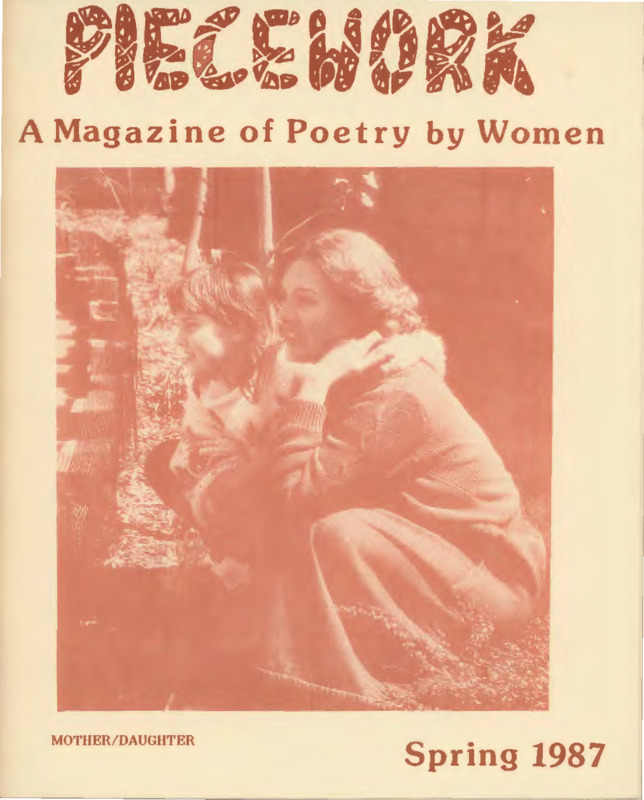
MOTHER/DAUGHTER
Spring 1987
Cover photo of mother and daughter,
Tina and Laura Page, by Robin Smitli
PIECEWORK is published four times a year. Subscriptions are $12 per year for individuals, $16 for libraries
and institutions. A free copy of PIECEWORK will be
furnished, on request, to the libraries of prisons and/ or
mental institutions. Single copy price if $4. Address all
correspondence to PIECEWORK, Red Dirt Press, Inc.,
P.O. Box 60693, Oklahoma City, OK 73146.
A MAGAZINE OF POETRY BY WOMEN
SPRING 1987
VOLUME 1, NUMBER 3
Poetry Editors: Ann Carlton, Abigail Keegan
Production: Elaine- Barton, Martha Hayes, Marian Hulsey
Distribution: Eloise Dycus, Nancy Viviani
Publi(i Relations: Peggy Durham, Eloise Dycus
Business Manager: Loral Reeves
Red Dirt Press, Inc., is the result of the vision of nine women who wanted to provide more publication opportunities for
women. The publication of this magazine of women's poetry,
aptly named PIECEWORK, which draws on all the images of
women's work that is done "by the piece," is dedicated to all
the women who write poetry, sometimes in spite of their lives
and families.
Published by Red Dirt Press, Inc.
Oklahoma City, Oklahoma
°Copyright 1987 by Red Dirt Press, Inc.
No part of this publication may be copied
or reproduced without written permission
UCOWomen'IRIIUldtABOL'!Qf-a...
100 N. University Dr
Edmond. OK 73034
TABLE OF CONTENTS
Featured Artist, Dahra Latham...............................................
Poems by Featured Artist, Dahra Latham
"I begin poetry".................................................................
"After rain"........................................................................
"Anima"...............................................................................
"The light comes through the window"..............................
"Conversation with the Mother of Roses".........................
"Sonnet 9: A Conversation with Mother" ..........................
"Ode to December 18" by Nelda Latham................................
"God, It's Windy" by Nelda Latham ........................................
"Who Writes Poetry?" (Editors' Note) .....................................
"Signs. of Spring" by Bernice McDonald .................................
"The Blizzard" by Bernice McDonald ......................................
"Just Madness" by Annette Van Dusen ...................................
"Sarah" by Jacoba Hood .........................................................
"Joanne" by Katharine Privett................................................
"Before This Life What Was I to You?"
by Sharon E. Martin ..........................................................
Untitled Poems by Nancy Lavender ........................................
"The Order"· by Linda Leebron ................................................
"In Memory of Arthur" by Lou Aubrey .. .................................
"Tandem" by Julie Beth Lannigan ...........................................
"Bliss" by Barbara Thrash ......................................................
"Cuckold" by Katharine Privett ...............................................
"Fruit, Off Season" by Kennette H. Wilkes ............................
"Nightfall" by Elizabeth A. Hollen ..........................................
"Hollow Bones" by Linda Leebron ...........................................
"Final Chapter" by Patricia Wade ...........................................
"Grief" by Elizabeth A. Hollen ................................................
"Starving the Third" by Linda Leebron ..................................
"The Pear" by Mary Menges Myers ........................................
"An Early Fall in '72" by Jacoba Hood ..................................
"Fulfillment" by Linda Knight Mayberry .................................
"Moon, Night and Time" by Karen A. Murphy ........................
"Blue Creek Canyon" by Susan L. Smith ................................
"A Holiday in July" by Patricia Heck .....................................
Page 2, Spring 1987, PIEOEWORK
4
6
6
7
8
9
10
11
11
12
13
14
15
16
17
18
19
20
21
22
23
24
25
26
27
28
28
29
30
31
32
33
34
35
"When We Came to Oklahoma" by Kathryn Rojas ..................
"We Walked" by Kennette H. Wilkes ......................................
"A Visitor's Notes" by Sharon E. Martin ...............................
"Birthday" by Mary Menges Myers.........................................
"Class Reunion" by Susan L. Smith ................................. .......
36
37
38
39
40
Poetry for Younger Readers
"In Exoneration" by Jacoba Hood ........................................... 42
"Cats" by Jean Stiles .............................................................. 44
Works in this issue that were published previously are
here republished with permission of the authors.
PIECEWORK, Spring 1987, Page 3
FEATURED ARTIST-DAHRA LATHAM
Dahra Latham, a seventeen-year-old Stillwater resident who is
currently attending St. John's College in Annapolis, Maryland, is this
issue's featured poet. Dahra has also lived in Guatemala, California
and spent a summer as an exchange student in Sabris, France.
A National Merit Scholarship Finalist in 1987, she also won first
place in the state French contest and fourth at nationals. Dahra
participated in the Oklahoma Summer Arts Institute at Quartz
Mountain State Park, where she .won a creative writing award in
1986.
Her response to our inquiry of why she wrote was: "When I was very
young, I read easily, and when I had exhausted the books of nursery
rhymes in the house, began reading 'adult poetry' without ever
realizing that there was a difference. I have been writing ever since
I was about five and, while I hope that my work has matured since
then, I consider the compositions of children, myself included, to be
worthy of serious attention. I believe almost all children would write
if they were not taught that poetry is the realm of bespectacled
professors and garret-dwelling lunatics. Why that would be wonderful,
and why I continue to write, are things which, in the words of Louis
Armstrong~ 'If you don't know by yourself, ain't nobody can teach
you."'
We are excited to be sharing the works of such a young artist, and
are also pleased to publish two works of Dahra's mother, Nelda
Putting Dahra's work together and
Latham, in this same issue.
learning about her has been a collaborative effort between the
women of the press and a mother and daughter--an effort which has
reminded us of the potential of PIECEWORK to help women recognize
the importance of our work and our relationships to one another.
We are making a way, as Adrienne Rich has said, for women to see
"... eye to eye/ measuring each other's spirit, each other's/ limitless
desire," and this is a "whole new poetry beginning here."
Page 4, Spring 1987, PIECEWOilK
Thank, you Dahra and Nelda, for your work which we know will be a
yeast, a starter, for our new bread, our "new poetry."
Creative
pointers
Summer
courtesy
writing instructor John Lane offers Dahra Latham some
on her writing at last summer's session of the Oklahoma
Arts Institute, at Quartz Mountain State Park. (Photo,
of Oklahoma Arts Institute)
PIECEWORK, Spring 1987, Page 5
I begin poetry
in my true face
Coming home,
seal away
weed-green contact lenses
scrub away
molten golden color that the world imposes
rise through fathoms of falsehood revealing
pearl-pale and storm-eyed body
Stepped uut of Renaissance portrait
Shining
like dolphin through ocean
through
ragged breaker of hair
washed suddenly
from red to brown.
I take up the pen.
And all the hard-birthed beauties I have ever read
Fall about me
an irrelevant rain.
--Dahra Latham
After rain
In lavender weather I drove
Stopped, backed, turned,
And climbed to stop at a hill's crest
Closed the door with an echoing sound
And walked to gather you thistles
Having no knife nor gloves, I sawed them with my key
The thorns were fierce--they bit me
And my blood ran hot among the green-and-silver leaves
A grass snake coiled at the road's edge;
I picked it too
Went back to the car
To bring you
With a handful of thornflowers
And a jeweled whip
Hard news.
--Dahra Latham
Page 6, Spring 1987, PIECEWORK
ANIMA
Silk and frenzy petals of sunflowers,
and punk-cut blocks of pines
the red clay opiate of masses
of foliage perfectly balanced
slide from my shoulders
with the stiff rustling
of snakeskin or taffeta.
You remain.
With daggers on your hips,
And silence in your mouth
in a red cape,
and leather sword harness
leaping
from balcony to tree
with blood in your teeth
with the pointed ears
and philosopher's voice
of my other soul
walking
in your dragon shoes
chiming
through the porphry columns of my heart
your light laugh going before you,
and swinging behind
your white hair, bright
as the scimitar of death.
--Dahra Latham
PIECEWORK, Spring 1987, Page 7
The light comes through the window--plants a cold
and thin green liquor and I lie back drunk
to turn before my vision for a time
an immemorial regret.
I am seventeen: I have loQked into fire
until my eyes stung blind and all the world
was white as ash, and then a certain flame
ate all my flesh to ashes from within,
and dropped in folds on the cold floor my skin;
a small smoke from the pile
rose and slid down the room on a small wind
opened a door sealed like an ancient wound
and saw the flat expanse of earth beyond.
I am seventeen: I have known the names of trees
and their root's voices, slept within their wood
with moss upon my breasts and on my belly,
with owls-nests in my arm-pits, and my mouth
dry-tongued with wormwood. Tension in my legs,
and like a crystal dancer's my feet's points
white arms reaching to heaven like a saint's,
green fingernails for leaves.
Apples on the ground
dissolve and feed their white flame hearts to sound
that rings within me: I am seventeen
and all around me ash-grey people go
the muscles in my arms are made of snow
and wire and slender filaments of god
and all around the ash-grey people nod
into a claycold sleep of desperation.
--Dahra Latham
Page 8, Spring 1987, PIECEWORK
CONVERSATION WITH THE MOTHER OF ROSES
The Woman:
0 thou that stand within the strange
and cinnamon-scented whisper of a wounded wind
(pricked, sharp, by icy-golden fire of thy sweet sway,)
and bleeding crimson petals down the sky...
Hpw goes the day?
The Rose:
I see the time away and fear no rain
wait until mariposa comes again
laugh in the wind and whisper sly, sweet tales
(incarnadine revenge on nightingales)
and brew red wine beneath the wine-dark tree ...
What know you of my children, gone from me?
The Woman:
They're gone to all the corners of the sea,
And all who know love name them reverently
And all who love them name themselves love's harpers
That spread her song wherever song may be.
The Rose:
Somehow I always knew it would be so-They were such fair, sweet children
when I saw them go.
--Dahra Latham
PIBCEWORK, Spring 1987, Page 9
SONNET 9:
A CONVERSATION WITH MOTHER
I watch as if from far away
The thunderous progress of your face
Within a little minute's space
From emptiness to screaming rage.
I shall not argue with you now-Why should I, when your ears are shut?
No thought I muster can rebut
The blue vein beating on your brow.
The logic of your glazing eye
Logic dethrones, and passion sets
Above that power, that leaps from earth
To chart the dances of the sky
Upset the silent sky with jets
And teach your human soul its worth.
--Dahra Latham
Page 10, Spring 1987, PIECEWORK
ODE TO DECEMBER 18
I see the bark of the dog in the air;
Light and vaporous and grey.
It matches the sky,
And for that matter, the day.
Inside the cat is lying on the rug,
Black and soft and warm.
The yule tree is waiting in its stand.
It is crooked, but nice.
It will be cheerier later, when decorated
The clothes are tossing softly in the dryer,
Life is made of such strangely small things.
--Nelda Latham
Stillwater
GOD, IT'S WINDY
The wind sure howls
around buildings which are square.
If we all lived in round houses
we'd have much quieter air.
--Nelda Latham
Stillwater
PIECEWORK, Spring 1987, Page 11
WHO WRITES POETRY?
BERNICE MCDONALD DOES
When Red Dirt Press started planning a poetry journal, one of the
publishers, somewhat fearful about our undertaking, asked, "But where
will this poetry come from? Who writes poetry?"
We have had this question answered by the responses from women
all over the Southwestern Region--sometimes in poetry, sometimes just
letters. Often they write poems to celebrate "occasions" or to rid
themselves of frustrations (creative activity does this!), or to share
emotions. But many write poetry because it's what they do; as one
poet writes, "We ... write our poetry in spite of our lives and families."
Bernice McDonald is this kind of person. She writes poetry and
has always done so, ever since she can remember, she says. When
she was a child in St. Joseph's Orphanage ii1 Oklahoma City, Sister
Rosalee found some of Bernice's poetry in her notebook. After the
usual questioning of "Did you write this?" and "When did you write
this?" Sister Rosalee sent it away to a Catholic newspaper, where it
wa8 published. Bernice's first published poem at age eleven.
She continued to write as she grew up, because writing poetry
was just something she did. She grew up and married and reared five
childrti~ .... and wrote poetry in Blueback and Mohawk notebooks. When
one notebook was filled, she bought another. Writing poetry was not
a driving passion in her life--it was something she did, like cook and
clean and care for children. Other people were hardly aware that she
wrote.
When Bernice's children were almost grown and she was working
as a dental clinic supervisor at Children's Memorial Hospital, she
read about a modern poetry workshop at Central State (then) College.
She cajoled and threatened her hospital directors until they changed
her work schedule so she could attend this class, the summer of
1966. As a result, one of her poems was published in OKLAHOMA
POETRY, 1968. In 1970 she had a poem published in THE DAILY
OKLAHOMAN. Bernice was not very interested in publishing, but she
did keep writing poetry.
When the first issue of PIECEWORK came out, her daughter
showed Bernice a poem by one of her friends. This prompted Bernice
to bring her notebooks out of her trunk and show her daughter some
of the poetry she had written through the years. First the daughter
had to deal with this unrecognized part of her mother's life--then she
brought one of the notebooks to us. It was a delight to see this
woman's biography--her history--reflected in these poems.
Page 12, Spring 1987, PIECEWORK
When Bernice was asked about her writing, asked why she wrote
poetry, she replied, "It's .iust something I've always done. I love
rhymes and I love the music of words."
Red Dirt Press is discovering a community of poetry writers--some
who publish and some who write in spiral notebooks and pack them
We are happy that a conversation about
away in a trunk.
PIECEWORK unearthed Bernice McDonald's poetry. And we are
pleased to publish these poems of hers.
SIGNS OF SPRING
The signs of spring are a promise
Of new beginnings, better ways,
A promise of renewal, and
Of summer's softer, lazy days.
The wistful sound of peepers calling
In the early morning dawn,
And near the edge of the meadow
I see a soft-brown, speckled fawn.
In the swamp, the gray-brown phoebes call,
And red-winged blackbirds sing,
The trees are veiled in misty green
And the crocus shyly peeps at spring.
I hear a chorus of gabbling geese,
In the dark of the cold, clear night.
And with their V-shaped flight, they sketch
A trail across the pale moonlight.
The days are growing longer now,
We've felt the last of winter's sting,
I dislike the ice and the snow,
But without it, we would have no spring.
--Bernice McDonald
Oklahoma City
PIBCEWORK, Spring 1987, Page 13
THE BLIZZARD
Winter strikes with sudden fury
From the sullen, lowering sky,
With biting bullets of driven snow
And screaming wind, a banshee cry.
Down from the icy frozen North
The blasting blizzard strikes its blow,
With vicious, hissing, slashing sleet
That pelts the shivering earth below.
The tearing tempest brings with it
The howling wind's crescendo wail,
The spitting snow and scudding sleet
That strikes the ground like minute hail.
Ice-laden trees with heads bowed low
Before the frigid Arctic blast,
Quiver and quake with each new gust,
As though each one would be their last.
Hour after hour, it rages on,
Until at last, its wrath grown quiet,
It leaves a silent, weary world
Crouched beneath its blanket white.
--Bernice McDonald
Oklahoma City
Page 14, Spring 1987, PIECEWORK
JUST MADNESS ...
The crazy woman
in the attic got loose again today
lamenting dark yesterdays
failures
first love and other disasters-unicorns she had never seen
much less tamed with the golden bridle.
"That damned unicorn," she said,
"I just about convince myself
mythical beasts do not exist-then through early morning clouds
the drum of golden hooves
clatters outside my window."
"Always is not forever," she said,
and expounded on the point
"Take lovers for instance
(there's certainly a variety to choose from)
I never could sustain reality
the day-to-day refused to fit the dream
pain-tinged memories remain
long after the rest is dead."
The crazy woman
in the attic got loose again today
said her say
and strayed
wild-haired back from where she came
unicorns
leaving me to ponder
and the day-to-day.
--Annette Van Dusen
Oklahoma City
PIECEWORK, Spring 1987, Page 15
SARAH
She sings beside me, filling my ears
with a low sweetness. I who have
only heard sopranos am charmed
and blessed by this hymn
sung in a pitch of fire. No
music necessary.
She is like a bird
that sits on eggs.
She gathers her eggs into her warmth
and waits for them to develop.
She accepts my eggs, too,
fully aware that babies that hatch
may be lizards.
Knowing this, I offer her my stories.
I watch her arrange them and me,
making patient comparisons.
She knows all time is hers.
I wonder what incantation
this particular conjurer will make of my words.
--Jacoba Hood
Weatherford
Page 16, Spring 1987, PIECEWORK
JOANNE
We have been friends for years.
Yet when I think of you
or hear your name mentioned,
I see you as I saw you first-walking fast across the crest
of a steep hillside school-yard.
What really stunned me was
the cape you wore--dark blue,
regal, blowing out behind you
free as wing, as sail,
as wind itself-and your long, blonde hair
lifting and blowing, too,
at dance with light
and devil-may-care
like .the splendid cape.
The same bright image flares
again, again.
It is like a promise
or a truth revealed.
--Katharine Privett
Pawnee
PIECEWORK, Spring 1987, Page 17
BEFORE THIS LIFE WHAT WAS I TO YOU?
Your dreams, my son,
Antedate your current history.
Who were you before you were mine?
Six, and already
You own a repertoire of anecdotes,
Delight your gallery with tales.
Delight me, too.
And the deja vu
When you tell a tale from my recall.
--Sharon E. Martin
Cushing
Page 18, Spring 1987, PlBCEWORK
In my English classes
I define a rough draft as Adam.
I read it in a magazine-Sounded good to me.
The girls usually have to explain it to the boys,
proving the final copy is always clearer on the facts .
•••
God has to be a man.
Were he a woman
He would have cleaned up
That first mess He made
Once He perfected the model.
•••
Ear piercing
Hair perming
Gold chains and bracelets
Sequined jackets
Matching glove ...
Sons sure are getting expensive these days.
--Nancy Lavender
Lawton
PIBCBWORK, Spring 1987, Page 19
THE ORDER
Get angry, you said,
at what,
too many commuters
with big hands and fiery words,
a bag of bones
that will soon break on the snow
storm of reality,
the bathroom light
at early morning
and the alarm clock helicopter
that forks me
like a mole from underground,
I water my lawn in winter
when there are no more
songs to sing,
when I distrust
the small colonies
of people at the grocery
store who wear tired faces
and chapped, pinched lips,
when old friends
start to line and gray
and throw their children
up into the air into a tree,
anger has no future,
I learned that
back there with Soupy Sales
dancing with the Mouseketeers,
when Cinderella got the handsome prince
after she'd worn her anger
like that one glass slipper
that I tried so hard to find.
--Linda Leebron
Edmond
Page 20, Spring 1987, PIECEWORK
IN MEMORY OF ARTHUR
The chrysanthemum you sent looks like
Rich yellow sherbet
Poured from a glass
Made out of silk
Thru the heart of a wide buttercup
Into a shiny mold of soft petals-And laced with sweetest kind thoughts.
Its mirrored folds lend a vast canvas to my mind,
That lingers, dear one
On the abundance of your nature,
Where all precious nectars are gathered
And so gallantly fused
Into the sweet breath of you.
--Lou Aubrey
Oklahoma City
PIECEWORK, Spring 1987, Page 21
TANDEM
True love enters,
a raging ocean tide.
Lovers like blankets wrap,
bodily boundaries gone:
two
in tandem ride.
The soul of passion
lifts;
The peak of action
halts
the solitary life.
Find a buoy
find an anchor
find an ending
to the strife.
Conceive the gentle family:
the grasping silence
of one who needs
only one to hear.
Bring the babies gently
as the lovers sigh:
Now side by side,
loving, draw near.
--Julie Beth Lannigan •
Poteau
Page 22, Spring 1987, PIECEWORK
BLISS
Turn over, George, you are keeping me awake,
With that tossing and snoring and wheezing you make.
Get out of the middle, would you please, Mother?
And could I have just a bit of the cover?
Get those feet off me, although you're so nice.
Your feet are as cold as a chunk of ice.
George, why do you always turn on the light
Every time that you have to get up at night?
Why are you cold?
It's so hot in here.
Could we turn down the heat just a bit, dear?
The conflicts go on forever like this.
It's commonly known, and called wedded bliss.
--Barbara Thrash
Texhoma
PIECEWORK, Spring 1987, Page 23
CUCKOLD
A passive man,
a faithless wife.
She has transferred
her affection to cloth.
Sheathed in new rose silk,
she feels less lonely.
And as though,
dressed in warm challis,
arms hold her close.
Chiffon touches her breasts.
Tenderly, linen folds
around her thighs.
Like fabric woven of flame,
velvet desires her.
Blood pulses red red satin.
Love quickens under lame.
Brocade's weight,
the press of fleece,
the tease and itch of lace
arouse her.
Her husband is preoccupied.
He seldom notices
what she is wearing
or cares about the cost.
--Katharine Privett
Pawnee
Page 24, S!){'ing 1987, PIECEWORK
FRUIT, OFF SEASON
I have forgiven myself
of everyone I loved before you
hair that grows and grows on my
armpits and legs
my children's bad mann.ars
my bad back
the dog's escape
the dead battery when I left
the lights on in the parking lot
of the supermarket where I bought
kiwi fruit off season at its highest price
and the grapes I bought and hid
in the egg compartment so I didn't
have to share them, and all the times
I shared and shouldn't have
the shoulds and should nots
of a lifetime
the cave-in on my brother when
it was my idea to dig to China
icing I snitched off my father's
birthday cake before it was cut
of being 45 and not flossing
my teeth every day.
--Kennette H. Wilkes
Edmond
PIECEWORK, Spring 1987, Page 25
NIGHTFALL
My love came like the desert breeze at dawn
Slim cool fingers caressing me
Leading me to unknown heights
Spurring me on by golden dreams
The joys of youth.
My love was with me through the morning hours
The warmth and splendor of her
Seemed a world apart
And when the sun was high at noontime
My love was hot with passion
Too great for human heart,
The heat oppressing me
Blinding me, wilting ambition
My heart writhed under the pain
And I would be free from it.
My love clung with me through the evening hours
Did she temper the heat of her affection
Or did my soul rear beneath its glow
As the sun sank?
As night comes down my love is near me,
Warming my chilling soul,
Soothing the bitterness,
Wiping away poignant griefs,
As the desert breeze at nightfall
Blots out remembrance.
--Hlizabeth A. Hollen
Alva
Page 26, Spring 1987. PIECEWORK
HOLLOW BONES
These days are the same size,
small and dark,
the quiet snow is falling
on your faithless hands
that know no bound'ries,
with wind as sharp as finely honed steel,
slivers of ice
penetrate these eyes full of grief,
you told me that you held
no promises,
that was just so many words.
You know, a woman is her mother,
a wild haired wife,
a dim movie that's been played before
and watched by small faces
pressed in dark windows
learning that role,
now there is no music
and I am bleeding from my mouth
for endless repetition of your name.
It is January
and the days are ice
and sticking to your calendar,
I look at you through frozen eyelashes
and know that my name, too,
is listed with forsaken women
on a bare stage
each pounding a crucifix
into the very center of her heart.
So, this is a burial song
to the rhythm
of flesh on flesh in time
and the comfort of your warm throat
and your hands.
--Linda Leebron
Edmond
P!ECEWORK, Spring 1987, Page 27
Wanting you was easy
Losing you became a way of life.
Each step forward has brought me closer
To the empty pages of our love.
My heart would have them written
with passion and delight,
But my soul sees now what I
escaped.
Faded and worn emotions imprinted
on my mind
Complete the final chapter of
our love.
--Patricia Wade
Owasso
GRIEF
I have known Silence
Deep and long:
So deep the winds forgot to whisper
And the song of the night was stilled.
So completely the silence filled
My heart, that when my small son spoke,
Softly its taut strings quivered,
And more softly broke.
--Elizabeth Anne Hollen
Alva
(reprinted from WORLD OF POETRY)
Page 28, Spring 1987, PIECEWORK
ST ARVlNG THE THIRD
The black and white photograph
captures flies on matted hair, •
they lie in death's place
like an untimely joke,
these people
with skin on the eyelids
thin as transparent glass,
with beautiful bones
and swollen bellies
eating fingernails for food.
Was it the rock and roll bureaucracy
Godless and corrupt
scattering bread to those
with thirsty flesh
for the salvation of their bones,
we're told it never got there,
never reached the starved bodies,
the afflicted people,
a pleading nation
who reach with the voices of hands
for the forgotten covenant
with childlike grace.
We are freely evil
and must look
to our qwn shame
and these issues
of the tiny politics of home,
we are a fallen generation
of waste and blood
where there is no more hope.
--Linda Leebron
Edmond
PIECEWORK, Spring 1987, Page 29
THE PEAR
I hold the chilled pear
in my palm,
feeling its ripeness
pressed against my fingers.
Inserting the sharp edge
of the knife,
I carefully carve away
the skin.
It falls-a golden spiral.
I put the peeled pear
on the plate.
Again I take the knife,
and slice by slice,
place the luscious fruit
upon my tongue.
How sweet the taste.
--Mary Menges Myers
Oklahoma City
Page 30, Spring 1987. PIECEWORK
AN EARLY FALL IN '72
To eat authentic cabbage rolls requires having very
old German neighbors.
If they're Catholic so much
the better, you can go eat the cabbage rolls for
lunch on Sunday.
The stout old lady will have
discharged her sins the night before while you
heard bells calling; no wrongs will have
been kneaded into the dough tender as the
flesh of Christ.
Once after lunch the old
lady spread out in her chair and while
she -slept I went outside to find Mr. Heffel
in the flower bed.
Wearing his yellow
fishing hat, he'd thrust an electric prod
deeply among the roots of iris that waved
guileless colors in my face.
Even his accent
blushed because I'd caught him shocking
worms on the Sabbath.
Their mute moist
bodies twisted at our feet, and I knew
limblessness as I moved back inside
the house to eat a now chilled cabbage roll.
--Jacoba Hood
Weatherford
VC:OWOllllll'tlllealdiABOLTQi-Cclllcr PIECEWORK, Sprins 1987, Pase 31
100 N. University Dr
Edmond. OK 73034
FULFILLMENT
Last night I ran near
mistral trees and melic brooks,
while pend 'lums clocked
my mortal steps.
Then from a veil a V1s1on rose
around this fettered flesh,_
to offer from the mist a metamorphosis: .
I became a tree last night
as winds bewitched me back through time.
My roots sprang out beneath cool earth.
My trunk flowed through with vital sparks.
My leaves tantalized toward sunlight.
I was teeming power trilling through time.
As a young pine,
I saw kaleidoscopes of centuries beside seas.
Then from the V1s1on strength arose,
and glowed my earthly ego.
It lent my daily cycles vigor
and eased the rigor from this pulsing flesh.
--Linda Knight Mayberry
Norman
Page 32, Spring 1987, PIECEWORK
MOON, NIGHT AND TIME
Last night the moon was full.
I stood at the door,
looking, watching, trying to feel the light.
It should have been tangible; it was vivid, cool, bright,
falling on trees, highlighting leaves, more
concealing than revealing.
Quiet, the night
accepted the moon, calmly permitting shine
to outline its shape and caress its face with fine
attention to detail, sensuously filled with delight.
The moon and night are unconcerned with time.
They are bound by its laws but appear to care not
for its restrictions.
That was what we sought,
held by laws and limits, yours and mine;
that natural unconcern, light within dark,
reaching, holding, one another's heart.
--Karen A. Murphy
Temple, Texas
PIECEWORK, Spring 1987, Page 33
BLUE CREEK CANYON
You pitched your North Face tent on a gabbro exposure,
weathered smooth by the action of water and wind,
and later, as the campfire died into embers,
you looked for Saturn and Jupiter in the sky
as the moon washed your face
as white as unstained quartz.
The night grew cold just before dawn,
and though your sleeping bag
had a goose-down filler, you felt
a chill as if the sun had
moved far from this planet.
When you awoke, the sun was shining
but it was cooler somehow, and dim,
as if it were as lost in time
as the volcanoes that poured
Carlton Rhyolite onto the earth
millions of years ago.
You tried to re-start the fire,
fix some coffee,
but the wind was too gusty.
Instead, you sat, buffeted for the first time
by a solitude as cold as a distant sun
while you wondered
if the sun would ever warm this earth again
and if all igneous rocks and jagged hearts
would eventually be worn as smooth
by the action of solitude
as the gabbro on which you made your bed.
--Susan L. Smith
Norman
Page 34, Spring 1987, PIECEWORK
A HOLIDAY IN JULY
On a hot July day
work and passion intermingle
then lie contentedly on an office floor,
satiated for the moment.
Much later
heat changes to cool breezes
and in dark taverns music begins.
Whispered words quiet old fears, night wins.
Warm bodies touch, responding to liquid and solid
tranquilizers.
As hours pass
fellow travelers glide through space and time,
adventurously sharing the joys of serendipity.
Seemingly, forever caught in a lovely web
on a large bed of sensual delight.
The night dies
but, then abruptly arising on the fourth
a glaring sun and foreign multi-visual images bombard the
eyes.
Cognitively integrating another perspective
of reality
I see that Swiss men live here
where I spent the night.
--Patricia Heck
Miami
PIECEWORK, Sprins 1987, Pace 35
WHEN WE CAME TO OKLAHOMA
We drove north 500 miles or so-late August, in the sun,
the three of us, alone
with our cat panting in the heat
(he sat on the hot car floor,
. while the children fed him ice)-pulling a trailerful of our past
to make ourselves a home.
I cried each night for nearly a month;
sometimes I hid, ashamed of the flow
of tears, afraid the children would see
and share my pain; closed into my closet
I clung to my coat,
wrapped its arms around me for small comfort,
and wept into the rough blue cloth.
It was a good move--I knew that;
knew the foreign streets would take on names,
faces grow familiar, wave to new-made friends,
explore the snowfall (my delight,
like a small child, who only saw it snow
four times before)--played and laughed,
at last, at peace with this new place.
So gradually, without my knowing how,
the pace, environment, crept into me;
indelibly--red dirt and wind,
all mapped out in my mind; sung in my sleep
a tune of happiness, content, part of the land:
We drove 500 miles or so--my two, the cat and I-to make, and keep inside ourselves, a home.
--Kathryn Rojas
Midwest City
Page 36, Spring 1987, PIECEWORK
WE WALKED
In England we walked
in a field like this. The new green
sponge sank beneath my feet. I put out
fine root hairs which grew strong, spread
across the Salisbury Plain, sent up
a circle of massive stones to greet the sun
at summer solstice.
Yet this is not Sto'nehenge
not even England, hard red clay
land that favors yellow--daffodils, jonquils
forsythia and sunflowers. Even the sunsets
are red, with oil derricks silhouetted
against the west. This place
where the trail of tears ended, and reservation
became another name for graveyard. Where one thing dies
another grows. So with wet drops
I will soften hard clay
and fashion my own bowl
to catch the rain.
--Kennette H. Wilkes
Edmond
PIECEWORK, Spring 1987, Page 37
A VISITOR'S NOTES
I'm sitting in a small Midwestern cafe
Somewhere in the mid-December of the universe.
On the far wall
a timepiece
Chews up the minutes
And spits them out again.
Rolling them on his tongue,
They have no taste.
My coffee cup is empty.
The waitress ignores my motion
And the whitewashed concrete walls
Shift their stare my way.
All these little towns
the same-Cold and hard
And windows barred
To keep out everything
But dust and rust and time.
Page 38, Spring 1987, PIECEWORK
The dust has crowded out all thoughts
From everybody's mind
Except for hopes of future
and imaginary heavens.
What I do here will not alter;
Everything remains the same
Except the hand that shows the hour.
--Sharon E. Martin
Cushing
BIRTHDAY
It snowed on my sixteenth birthday.
Unusual for October 3rd.
I in a red and white checked dress,
watching the fat flakes float by the window.
And you coming in out of the snow
with a "new" second-hand Philco radio
which was, of course, for the whole family.
But you said, "It's for your birthday."
And even with no cake and no candles
it was a celebration.
--Mary Menges Myers
Oklahoma City
PIECEWORK, Spring 1987, Page 39
CLASS REUNION
My "Class of '76" tassel
still hangs in my '74 Camaro
swinging from the rearview mirror
twirling in the sunlight into endless mirrors
when I drive down roads
miles distant from the red-carpeted room at the Holiday Inn
where Doneta and Darryl and you, Josie,
and I drank Lone Star beer and Jack Daniels
until the moon rose yellow-green
like an over-ripe Osage Apple
and late that night,
on motel sheets smelling vaguely of Clorux,
the stars rained down like confetti
as we bared ourselves to the future
and to each other,
def ens es down,
barbed wire tangle around our hearts gone for once,
naked chest against naked chest,
I liked you like that.
But the next morning,
when the sun blistered up and
knots twisted in our eyes,
we fled the Holiday Inn
and the fresh cold pool
we had swum in the night before.
I moved to the Oklahoma Panhandle
to ranch and raise wheat around Black Mesa
and you,
someone told me that they saw you,
thin-armed and big-hipped,
in a Fort Worth Wal-Mart
with t wo little ones and one on the way.
I don 't know about that.
Page 40, Spring 1987, PIECEWORK
All I know is that this morning
when I opened the letter inviting me to ou·r graduating
class'
ten-year reunion,
I couldn't think, I just had to get outside,
survey my ranch on Black Mesa,
assess the damage the record-breaking drought
did to my tender winter wheat
and wonder what the weather would bring.
Spring showers to settle the dust?
A Blue Norther to spit a blizzard on the cold-cracked earth?
Or just more of the same dry cold,
and never a hope of a rainbow.
Yet the hope of holding you again rises
like the buttes on Black Mesa,
decapitated volcanoes,
encrusted with rock armor that was molten lava once
but now is riddled with brittle Apache Tears
everywhere except the core
that, still warm, has not yet hardened into volcanic glass.
Around the buttes,
the prairie is brown from the hard winter,
a wasteland of dead grasses.
I watch the cold wind blowing waves
in this cadaverous ocean of stunted wheat,
near the place where Coronado camped overnight,
searching for the seven cities of Cibola,
and suddenly I must look for you,
even if I find nothing but rumors and deserted campsites.
But first I'll fetch a can of gasoline
to soak the prairie around Black Mesa, enough
that with the help of a dry north wind,
I can burn the dead winter wheat to the ground
and allow the new growth of Spring to emerge.
--Susan L. Smith
Norman
PIECEWORK, Spring 1987, Page 41
Poetry for Younger Readers
IN EXONERATION
One age, somewhere, lay a sylvan glen.
A cave in it served as a dragon's den.
And two friends sat at . tea on the lawn,
One was the dragon, the other was a swan.
Lulled by the food, they began to reminisce.
The dragon told stories that made the swan hiss.
Then, grabbing a chance to butt in, the swan
told tales that made the dragon yawn.
They bombarded each other with histories,
each detailing virtues of her own species.
Then thinking to dramatize her stories,
the swan offered to show her glories
of flying. The dragon gave her consent
and the swan commenced a wobbly ascent,
which soon smoothed out to a graceful spiral
that gave the dragon quite an eyeful.
It woke in her a compelling need
to do the swan a dirty deed.
So the dragon tactfully tried to hint
to the swan that she should made her descent.
For she felt it would be impolite to say
that the swan made an excellent target that way.
Page 42, Spring 1987, PIECEWORK
But when swans get started, the urge to fly
becomes a joy they dislike to deny.
Every creature must be what it is,
The swan was no exception to this.
And since nothing can break the force
of genes, the dragon had no recourse
but to open her mouth and spit her fire
on the fated swan who must soon expire.
Gad, but it was a horrible sight,
that flaming swan in the pale moonlight.
The bird t-hen sang her fa bled song;
it sounded very pretty, though it wasn't very long.
The dragon's face became quite wan.
She felt ashamed of the thing she'd done,
So seeking to honor her friend, the dragon
crept into her lair in search of the flagon
of rarest wine she had saved for years,
now to be diluted with reptile tears.
The dragon sobbed, then drank a toast.
"Dearest little Swan, I must entrust
you to the ages, since you have bit the dust."
Then the dragon curled up to get a little sleep.
Her snores were loud and her dreams were deep.
For every creature must be what it is
and a dragon is no exception to this.
--Jacoba Hood
Weatherford
PIECEWORK, Spring 1987, Page 43
CATS
I should always want a cat
To be curled on my fireside mat.
A pussy cat, content and fat,
Or an alley cat to chase a rat,
They're my kind of creatures,
And that is that.
Only a cat can purr so sweet,
Only a cat will be so neat,
Forever washing its velvet feet
And everywhere else--what a feat!
They're my kind of creatures,
I now repeat.
A cat is icy and serene,
Haughty as a king or queen.
A cat will purr and primp and preen
No other care will intervene.
They're my kind of creatures,
That's what I mean.
Velvet paws hide needle claws.
Friendly first, till given cause
To pounce and tear without a pause,
Heeding only primeval laws.
They're my kind of creatures.
Because; because.
--Jean Stiles
Owasso
Page 44, Spring 1987, PIECEWORK
1
Univlllllr111 111111jjij)1
l~ ~lll i1i1~1ri~~llf~[lllld, OK
M 001 109 401
Red Dirt Press, Inc., a women-owned and womenoperated publishing company, is seeking manuscripts by
women writers. Novels, volumes of poetry and books of
short stories will be accepted. c;;end your typed, doublespaced (except for poetry) manuscripts for consideration, along with a SASE, to Manuscripts, Red Dirt
Press, Inc., P.O. Box 60693, Oklahoma City, OK 73146.
SUBMISSION DEADLINES: May 15 for summer issue; August
15 for fall issue; November 15 for winter issue; February 15
for spring issue.
SUBMISSION POLICY: PIECEWORK accepts submissions of
poetry by women, particularly from Oklahoma and the south
central region. Payment is in one contributor's copy, with Red
Dirt Press, Inc., retaining first rights only. Simultaneous submissions are acceptable, but please inform us of this. Submissions should be typed and accompanied by a brief biographical
statement of the poet and a SASE. We will report within three
months.
PIECEWORK is also accepting submissions of art work and
photographs, especially seasonal to be used as covers for the
quarterlies. Send black and white photographs or black ink line
drawings to PIECEWORK, Red Dirt Press, Inc., P.O. Box
60693, Oklahoma City, OK 73146, by the submission dates
listed above. Payment is in one contributor's copy. Please
enclose a SASE.
SUBSCRIBER CHANGE OF ADDRESS: Please notify
Red Dirt Press, Inc., promptly of all address changes.
To insure uninterrupted service, send changes on the
form below by the 15th of December, March, June and
September, respectively, to PIECEWORK, Red Dirt
Press, Inc., P.O. Box 60693, Oklahoma City, OK 73146.
1-------------------------1
I
ADDRESS CHANGE
I
I
I
I
I
I
Name
Old Address
I
New Address._ _ _ _ _ _ _ _ _ _ _ _ _ _ _~
I
Date Effective.________
I
Send to: PIECEWORK, Red Dirt Press, Inc.
P.O. Box 60693
I
I
I
I
t-----~~~~~~~~~~~~-------J
~--------------------------i
I
I
I
I
I
I
I
I
I
I
I
I
I
PLEASE ST ART MY SUBSCRIPTION TO
W~~~~YL~i~~&P
~ ~ w ~o ~~ \(Ofl ~C7
r,
~(j
A Magazine of Poetry by Women
I
I
1
I
I
I
Name._ _ _ _ _ _ _ _ _ _ _ _ _ _ _ _ _ _ _ I
Address _ _ _ _ _ _ _ _ _ _ _ _ _ _ _ _ _
i
- - - - - - - - - - - - 1I
I
I
Send $12 per subscription to:
PIECEWORK, Red Dirt Press, Inc.
P.O. Box 60693, Oklahoma City, OK 76146
L-------------------- ------'
PIECEWORK
SPRING 1987
VOLUME 1, NUMBER 3
Pl1
_J-·
Red Dirt Press, Inc., P.O. Box 60693, Oklahoma City, OK 73146
-
o•c"
.,.,
i,~ ft~
t'I ,~Lt: W,I KII,
A Magazine of Poetry by Women
MOTHER/DAUGHTER
Spring 1987
Cover photo of mother and daughter,
Tina and Laura Page, by Robin Smitli
PIECEWORK is published four times a year. Subscriptions are $12 per year for individuals, $16 for libraries
and institutions. A free copy of PIECEWORK will be
furnished, on request, to the libraries of prisons and/ or
mental institutions. Single copy price if $4. Address all
correspondence to PIECEWORK, Red Dirt Press, Inc.,
P.O. Box 60693, Oklahoma City, OK 73146.
A MAGAZINE OF POETRY BY WOMEN
SPRING 1987
VOLUME 1, NUMBER 3
Poetry Editors: Ann Carlton, Abigail Keegan
Production: Elaine- Barton, Martha Hayes, Marian Hulsey
Distribution: Eloise Dycus, Nancy Viviani
Publi(i Relations: Peggy Durham, Eloise Dycus
Business Manager: Loral Reeves
Red Dirt Press, Inc., is the result of the vision of nine women who wanted to provide more publication opportunities for
women. The publication of this magazine of women's poetry,
aptly named PIECEWORK, which draws on all the images of
women's work that is done "by the piece," is dedicated to all
the women who write poetry, sometimes in spite of their lives
and families.
Published by Red Dirt Press, Inc.
Oklahoma City, Oklahoma
°Copyright 1987 by Red Dirt Press, Inc.
No part of this publication may be copied
or reproduced without written permission
UCOWomen'IRIIUldtABOL'!Qf-a...
100 N. University Dr
Edmond. OK 73034
TABLE OF CONTENTS
Featured Artist, Dahra Latham...............................................
Poems by Featured Artist, Dahra Latham
"I begin poetry".................................................................
"After rain"........................................................................
"Anima"...............................................................................
"The light comes through the window"..............................
"Conversation with the Mother of Roses".........................
"Sonnet 9: A Conversation with Mother" ..........................
"Ode to December 18" by Nelda Latham................................
"God, It's Windy" by Nelda Latham ........................................
"Who Writes Poetry?" (Editors' Note) .....................................
"Signs. of Spring" by Bernice McDonald .................................
"The Blizzard" by Bernice McDonald ......................................
"Just Madness" by Annette Van Dusen ...................................
"Sarah" by Jacoba Hood .........................................................
"Joanne" by Katharine Privett................................................
"Before This Life What Was I to You?"
by Sharon E. Martin ..........................................................
Untitled Poems by Nancy Lavender ........................................
"The Order"· by Linda Leebron ................................................
"In Memory of Arthur" by Lou Aubrey .. .................................
"Tandem" by Julie Beth Lannigan ...........................................
"Bliss" by Barbara Thrash ......................................................
"Cuckold" by Katharine Privett ...............................................
"Fruit, Off Season" by Kennette H. Wilkes ............................
"Nightfall" by Elizabeth A. Hollen ..........................................
"Hollow Bones" by Linda Leebron ...........................................
"Final Chapter" by Patricia Wade ...........................................
"Grief" by Elizabeth A. Hollen ................................................
"Starving the Third" by Linda Leebron ..................................
"The Pear" by Mary Menges Myers ........................................
"An Early Fall in '72" by Jacoba Hood ..................................
"Fulfillment" by Linda Knight Mayberry .................................
"Moon, Night and Time" by Karen A. Murphy ........................
"Blue Creek Canyon" by Susan L. Smith ................................
"A Holiday in July" by Patricia Heck .....................................
Page 2, Spring 1987, PIEOEWORK
4
6
6
7
8
9
10
11
11
12
13
14
15
16
17
18
19
20
21
22
23
24
25
26
27
28
28
29
30
31
32
33
34
35
"When We Came to Oklahoma" by Kathryn Rojas ..................
"We Walked" by Kennette H. Wilkes ......................................
"A Visitor's Notes" by Sharon E. Martin ...............................
"Birthday" by Mary Menges Myers.........................................
"Class Reunion" by Susan L. Smith ................................. .......
36
37
38
39
40
Poetry for Younger Readers
"In Exoneration" by Jacoba Hood ........................................... 42
"Cats" by Jean Stiles .............................................................. 44
Works in this issue that were published previously are
here republished with permission of the authors.
PIECEWORK, Spring 1987, Page 3
FEATURED ARTIST-DAHRA LATHAM
Dahra Latham, a seventeen-year-old Stillwater resident who is
currently attending St. John's College in Annapolis, Maryland, is this
issue's featured poet. Dahra has also lived in Guatemala, California
and spent a summer as an exchange student in Sabris, France.
A National Merit Scholarship Finalist in 1987, she also won first
place in the state French contest and fourth at nationals. Dahra
participated in the Oklahoma Summer Arts Institute at Quartz
Mountain State Park, where she .won a creative writing award in
1986.
Her response to our inquiry of why she wrote was: "When I was very
young, I read easily, and when I had exhausted the books of nursery
rhymes in the house, began reading 'adult poetry' without ever
realizing that there was a difference. I have been writing ever since
I was about five and, while I hope that my work has matured since
then, I consider the compositions of children, myself included, to be
worthy of serious attention. I believe almost all children would write
if they were not taught that poetry is the realm of bespectacled
professors and garret-dwelling lunatics. Why that would be wonderful,
and why I continue to write, are things which, in the words of Louis
Armstrong~ 'If you don't know by yourself, ain't nobody can teach
you."'
We are excited to be sharing the works of such a young artist, and
are also pleased to publish two works of Dahra's mother, Nelda
Putting Dahra's work together and
Latham, in this same issue.
learning about her has been a collaborative effort between the
women of the press and a mother and daughter--an effort which has
reminded us of the potential of PIECEWORK to help women recognize
the importance of our work and our relationships to one another.
We are making a way, as Adrienne Rich has said, for women to see
"... eye to eye/ measuring each other's spirit, each other's/ limitless
desire," and this is a "whole new poetry beginning here."
Page 4, Spring 1987, PIECEWOilK
Thank, you Dahra and Nelda, for your work which we know will be a
yeast, a starter, for our new bread, our "new poetry."
Creative
pointers
Summer
courtesy
writing instructor John Lane offers Dahra Latham some
on her writing at last summer's session of the Oklahoma
Arts Institute, at Quartz Mountain State Park. (Photo,
of Oklahoma Arts Institute)
PIECEWORK, Spring 1987, Page 5
I begin poetry
in my true face
Coming home,
seal away
weed-green contact lenses
scrub away
molten golden color that the world imposes
rise through fathoms of falsehood revealing
pearl-pale and storm-eyed body
Stepped uut of Renaissance portrait
Shining
like dolphin through ocean
through
ragged breaker of hair
washed suddenly
from red to brown.
I take up the pen.
And all the hard-birthed beauties I have ever read
Fall about me
an irrelevant rain.
--Dahra Latham
After rain
In lavender weather I drove
Stopped, backed, turned,
And climbed to stop at a hill's crest
Closed the door with an echoing sound
And walked to gather you thistles
Having no knife nor gloves, I sawed them with my key
The thorns were fierce--they bit me
And my blood ran hot among the green-and-silver leaves
A grass snake coiled at the road's edge;
I picked it too
Went back to the car
To bring you
With a handful of thornflowers
And a jeweled whip
Hard news.
--Dahra Latham
Page 6, Spring 1987, PIECEWORK
ANIMA
Silk and frenzy petals of sunflowers,
and punk-cut blocks of pines
the red clay opiate of masses
of foliage perfectly balanced
slide from my shoulders
with the stiff rustling
of snakeskin or taffeta.
You remain.
With daggers on your hips,
And silence in your mouth
in a red cape,
and leather sword harness
leaping
from balcony to tree
with blood in your teeth
with the pointed ears
and philosopher's voice
of my other soul
walking
in your dragon shoes
chiming
through the porphry columns of my heart
your light laugh going before you,
and swinging behind
your white hair, bright
as the scimitar of death.
--Dahra Latham
PIECEWORK, Spring 1987, Page 7
The light comes through the window--plants a cold
and thin green liquor and I lie back drunk
to turn before my vision for a time
an immemorial regret.
I am seventeen: I have loQked into fire
until my eyes stung blind and all the world
was white as ash, and then a certain flame
ate all my flesh to ashes from within,
and dropped in folds on the cold floor my skin;
a small smoke from the pile
rose and slid down the room on a small wind
opened a door sealed like an ancient wound
and saw the flat expanse of earth beyond.
I am seventeen: I have known the names of trees
and their root's voices, slept within their wood
with moss upon my breasts and on my belly,
with owls-nests in my arm-pits, and my mouth
dry-tongued with wormwood. Tension in my legs,
and like a crystal dancer's my feet's points
white arms reaching to heaven like a saint's,
green fingernails for leaves.
Apples on the ground
dissolve and feed their white flame hearts to sound
that rings within me: I am seventeen
and all around me ash-grey people go
the muscles in my arms are made of snow
and wire and slender filaments of god
and all around the ash-grey people nod
into a claycold sleep of desperation.
--Dahra Latham
Page 8, Spring 1987, PIECEWORK
CONVERSATION WITH THE MOTHER OF ROSES
The Woman:
0 thou that stand within the strange
and cinnamon-scented whisper of a wounded wind
(pricked, sharp, by icy-golden fire of thy sweet sway,)
and bleeding crimson petals down the sky...
Hpw goes the day?
The Rose:
I see the time away and fear no rain
wait until mariposa comes again
laugh in the wind and whisper sly, sweet tales
(incarnadine revenge on nightingales)
and brew red wine beneath the wine-dark tree ...
What know you of my children, gone from me?
The Woman:
They're gone to all the corners of the sea,
And all who know love name them reverently
And all who love them name themselves love's harpers
That spread her song wherever song may be.
The Rose:
Somehow I always knew it would be so-They were such fair, sweet children
when I saw them go.
--Dahra Latham
PIBCEWORK, Spring 1987, Page 9
SONNET 9:
A CONVERSATION WITH MOTHER
I watch as if from far away
The thunderous progress of your face
Within a little minute's space
From emptiness to screaming rage.
I shall not argue with you now-Why should I, when your ears are shut?
No thought I muster can rebut
The blue vein beating on your brow.
The logic of your glazing eye
Logic dethrones, and passion sets
Above that power, that leaps from earth
To chart the dances of the sky
Upset the silent sky with jets
And teach your human soul its worth.
--Dahra Latham
Page 10, Spring 1987, PIECEWORK
ODE TO DECEMBER 18
I see the bark of the dog in the air;
Light and vaporous and grey.
It matches the sky,
And for that matter, the day.
Inside the cat is lying on the rug,
Black and soft and warm.
The yule tree is waiting in its stand.
It is crooked, but nice.
It will be cheerier later, when decorated
The clothes are tossing softly in the dryer,
Life is made of such strangely small things.
--Nelda Latham
Stillwater
GOD, IT'S WINDY
The wind sure howls
around buildings which are square.
If we all lived in round houses
we'd have much quieter air.
--Nelda Latham
Stillwater
PIECEWORK, Spring 1987, Page 11
WHO WRITES POETRY?
BERNICE MCDONALD DOES
When Red Dirt Press started planning a poetry journal, one of the
publishers, somewhat fearful about our undertaking, asked, "But where
will this poetry come from? Who writes poetry?"
We have had this question answered by the responses from women
all over the Southwestern Region--sometimes in poetry, sometimes just
letters. Often they write poems to celebrate "occasions" or to rid
themselves of frustrations (creative activity does this!), or to share
emotions. But many write poetry because it's what they do; as one
poet writes, "We ... write our poetry in spite of our lives and families."
Bernice McDonald is this kind of person. She writes poetry and
has always done so, ever since she can remember, she says. When
she was a child in St. Joseph's Orphanage ii1 Oklahoma City, Sister
Rosalee found some of Bernice's poetry in her notebook. After the
usual questioning of "Did you write this?" and "When did you write
this?" Sister Rosalee sent it away to a Catholic newspaper, where it
wa8 published. Bernice's first published poem at age eleven.
She continued to write as she grew up, because writing poetry
was just something she did. She grew up and married and reared five
childrti~ .... and wrote poetry in Blueback and Mohawk notebooks. When
one notebook was filled, she bought another. Writing poetry was not
a driving passion in her life--it was something she did, like cook and
clean and care for children. Other people were hardly aware that she
wrote.
When Bernice's children were almost grown and she was working
as a dental clinic supervisor at Children's Memorial Hospital, she
read about a modern poetry workshop at Central State (then) College.
She cajoled and threatened her hospital directors until they changed
her work schedule so she could attend this class, the summer of
1966. As a result, one of her poems was published in OKLAHOMA
POETRY, 1968. In 1970 she had a poem published in THE DAILY
OKLAHOMAN. Bernice was not very interested in publishing, but she
did keep writing poetry.
When the first issue of PIECEWORK came out, her daughter
showed Bernice a poem by one of her friends. This prompted Bernice
to bring her notebooks out of her trunk and show her daughter some
of the poetry she had written through the years. First the daughter
had to deal with this unrecognized part of her mother's life--then she
brought one of the notebooks to us. It was a delight to see this
woman's biography--her history--reflected in these poems.
Page 12, Spring 1987, PIECEWORK
When Bernice was asked about her writing, asked why she wrote
poetry, she replied, "It's .iust something I've always done. I love
rhymes and I love the music of words."
Red Dirt Press is discovering a community of poetry writers--some
who publish and some who write in spiral notebooks and pack them
We are happy that a conversation about
away in a trunk.
PIECEWORK unearthed Bernice McDonald's poetry. And we are
pleased to publish these poems of hers.
SIGNS OF SPRING
The signs of spring are a promise
Of new beginnings, better ways,
A promise of renewal, and
Of summer's softer, lazy days.
The wistful sound of peepers calling
In the early morning dawn,
And near the edge of the meadow
I see a soft-brown, speckled fawn.
In the swamp, the gray-brown phoebes call,
And red-winged blackbirds sing,
The trees are veiled in misty green
And the crocus shyly peeps at spring.
I hear a chorus of gabbling geese,
In the dark of the cold, clear night.
And with their V-shaped flight, they sketch
A trail across the pale moonlight.
The days are growing longer now,
We've felt the last of winter's sting,
I dislike the ice and the snow,
But without it, we would have no spring.
--Bernice McDonald
Oklahoma City
PIBCEWORK, Spring 1987, Page 13
THE BLIZZARD
Winter strikes with sudden fury
From the sullen, lowering sky,
With biting bullets of driven snow
And screaming wind, a banshee cry.
Down from the icy frozen North
The blasting blizzard strikes its blow,
With vicious, hissing, slashing sleet
That pelts the shivering earth below.
The tearing tempest brings with it
The howling wind's crescendo wail,
The spitting snow and scudding sleet
That strikes the ground like minute hail.
Ice-laden trees with heads bowed low
Before the frigid Arctic blast,
Quiver and quake with each new gust,
As though each one would be their last.
Hour after hour, it rages on,
Until at last, its wrath grown quiet,
It leaves a silent, weary world
Crouched beneath its blanket white.
--Bernice McDonald
Oklahoma City
Page 14, Spring 1987, PIECEWORK
JUST MADNESS ...
The crazy woman
in the attic got loose again today
lamenting dark yesterdays
failures
first love and other disasters-unicorns she had never seen
much less tamed with the golden bridle.
"That damned unicorn," she said,
"I just about convince myself
mythical beasts do not exist-then through early morning clouds
the drum of golden hooves
clatters outside my window."
"Always is not forever," she said,
and expounded on the point
"Take lovers for instance
(there's certainly a variety to choose from)
I never could sustain reality
the day-to-day refused to fit the dream
pain-tinged memories remain
long after the rest is dead."
The crazy woman
in the attic got loose again today
said her say
and strayed
wild-haired back from where she came
unicorns
leaving me to ponder
and the day-to-day.
--Annette Van Dusen
Oklahoma City
PIECEWORK, Spring 1987, Page 15
SARAH
She sings beside me, filling my ears
with a low sweetness. I who have
only heard sopranos am charmed
and blessed by this hymn
sung in a pitch of fire. No
music necessary.
She is like a bird
that sits on eggs.
She gathers her eggs into her warmth
and waits for them to develop.
She accepts my eggs, too,
fully aware that babies that hatch
may be lizards.
Knowing this, I offer her my stories.
I watch her arrange them and me,
making patient comparisons.
She knows all time is hers.
I wonder what incantation
this particular conjurer will make of my words.
--Jacoba Hood
Weatherford
Page 16, Spring 1987, PIECEWORK
JOANNE
We have been friends for years.
Yet when I think of you
or hear your name mentioned,
I see you as I saw you first-walking fast across the crest
of a steep hillside school-yard.
What really stunned me was
the cape you wore--dark blue,
regal, blowing out behind you
free as wing, as sail,
as wind itself-and your long, blonde hair
lifting and blowing, too,
at dance with light
and devil-may-care
like .the splendid cape.
The same bright image flares
again, again.
It is like a promise
or a truth revealed.
--Katharine Privett
Pawnee
PIECEWORK, Spring 1987, Page 17
BEFORE THIS LIFE WHAT WAS I TO YOU?
Your dreams, my son,
Antedate your current history.
Who were you before you were mine?
Six, and already
You own a repertoire of anecdotes,
Delight your gallery with tales.
Delight me, too.
And the deja vu
When you tell a tale from my recall.
--Sharon E. Martin
Cushing
Page 18, Spring 1987, PlBCEWORK
In my English classes
I define a rough draft as Adam.
I read it in a magazine-Sounded good to me.
The girls usually have to explain it to the boys,
proving the final copy is always clearer on the facts .
•••
God has to be a man.
Were he a woman
He would have cleaned up
That first mess He made
Once He perfected the model.
•••
Ear piercing
Hair perming
Gold chains and bracelets
Sequined jackets
Matching glove ...
Sons sure are getting expensive these days.
--Nancy Lavender
Lawton
PIBCBWORK, Spring 1987, Page 19
THE ORDER
Get angry, you said,
at what,
too many commuters
with big hands and fiery words,
a bag of bones
that will soon break on the snow
storm of reality,
the bathroom light
at early morning
and the alarm clock helicopter
that forks me
like a mole from underground,
I water my lawn in winter
when there are no more
songs to sing,
when I distrust
the small colonies
of people at the grocery
store who wear tired faces
and chapped, pinched lips,
when old friends
start to line and gray
and throw their children
up into the air into a tree,
anger has no future,
I learned that
back there with Soupy Sales
dancing with the Mouseketeers,
when Cinderella got the handsome prince
after she'd worn her anger
like that one glass slipper
that I tried so hard to find.
--Linda Leebron
Edmond
Page 20, Spring 1987, PIECEWORK
IN MEMORY OF ARTHUR
The chrysanthemum you sent looks like
Rich yellow sherbet
Poured from a glass
Made out of silk
Thru the heart of a wide buttercup
Into a shiny mold of soft petals-And laced with sweetest kind thoughts.
Its mirrored folds lend a vast canvas to my mind,
That lingers, dear one
On the abundance of your nature,
Where all precious nectars are gathered
And so gallantly fused
Into the sweet breath of you.
--Lou Aubrey
Oklahoma City
PIECEWORK, Spring 1987, Page 21
TANDEM
True love enters,
a raging ocean tide.
Lovers like blankets wrap,
bodily boundaries gone:
two
in tandem ride.
The soul of passion
lifts;
The peak of action
halts
the solitary life.
Find a buoy
find an anchor
find an ending
to the strife.
Conceive the gentle family:
the grasping silence
of one who needs
only one to hear.
Bring the babies gently
as the lovers sigh:
Now side by side,
loving, draw near.
--Julie Beth Lannigan •
Poteau
Page 22, Spring 1987, PIECEWORK
BLISS
Turn over, George, you are keeping me awake,
With that tossing and snoring and wheezing you make.
Get out of the middle, would you please, Mother?
And could I have just a bit of the cover?
Get those feet off me, although you're so nice.
Your feet are as cold as a chunk of ice.
George, why do you always turn on the light
Every time that you have to get up at night?
Why are you cold?
It's so hot in here.
Could we turn down the heat just a bit, dear?
The conflicts go on forever like this.
It's commonly known, and called wedded bliss.
--Barbara Thrash
Texhoma
PIECEWORK, Spring 1987, Page 23
CUCKOLD
A passive man,
a faithless wife.
She has transferred
her affection to cloth.
Sheathed in new rose silk,
she feels less lonely.
And as though,
dressed in warm challis,
arms hold her close.
Chiffon touches her breasts.
Tenderly, linen folds
around her thighs.
Like fabric woven of flame,
velvet desires her.
Blood pulses red red satin.
Love quickens under lame.
Brocade's weight,
the press of fleece,
the tease and itch of lace
arouse her.
Her husband is preoccupied.
He seldom notices
what she is wearing
or cares about the cost.
--Katharine Privett
Pawnee
Page 24, S!){'ing 1987, PIECEWORK
FRUIT, OFF SEASON
I have forgiven myself
of everyone I loved before you
hair that grows and grows on my
armpits and legs
my children's bad mann.ars
my bad back
the dog's escape
the dead battery when I left
the lights on in the parking lot
of the supermarket where I bought
kiwi fruit off season at its highest price
and the grapes I bought and hid
in the egg compartment so I didn't
have to share them, and all the times
I shared and shouldn't have
the shoulds and should nots
of a lifetime
the cave-in on my brother when
it was my idea to dig to China
icing I snitched off my father's
birthday cake before it was cut
of being 45 and not flossing
my teeth every day.
--Kennette H. Wilkes
Edmond
PIECEWORK, Spring 1987, Page 25
NIGHTFALL
My love came like the desert breeze at dawn
Slim cool fingers caressing me
Leading me to unknown heights
Spurring me on by golden dreams
The joys of youth.
My love was with me through the morning hours
The warmth and splendor of her
Seemed a world apart
And when the sun was high at noontime
My love was hot with passion
Too great for human heart,
The heat oppressing me
Blinding me, wilting ambition
My heart writhed under the pain
And I would be free from it.
My love clung with me through the evening hours
Did she temper the heat of her affection
Or did my soul rear beneath its glow
As the sun sank?
As night comes down my love is near me,
Warming my chilling soul,
Soothing the bitterness,
Wiping away poignant griefs,
As the desert breeze at nightfall
Blots out remembrance.
--Hlizabeth A. Hollen
Alva
Page 26, Spring 1987. PIECEWORK
HOLLOW BONES
These days are the same size,
small and dark,
the quiet snow is falling
on your faithless hands
that know no bound'ries,
with wind as sharp as finely honed steel,
slivers of ice
penetrate these eyes full of grief,
you told me that you held
no promises,
that was just so many words.
You know, a woman is her mother,
a wild haired wife,
a dim movie that's been played before
and watched by small faces
pressed in dark windows
learning that role,
now there is no music
and I am bleeding from my mouth
for endless repetition of your name.
It is January
and the days are ice
and sticking to your calendar,
I look at you through frozen eyelashes
and know that my name, too,
is listed with forsaken women
on a bare stage
each pounding a crucifix
into the very center of her heart.
So, this is a burial song
to the rhythm
of flesh on flesh in time
and the comfort of your warm throat
and your hands.
--Linda Leebron
Edmond
P!ECEWORK, Spring 1987, Page 27
Wanting you was easy
Losing you became a way of life.
Each step forward has brought me closer
To the empty pages of our love.
My heart would have them written
with passion and delight,
But my soul sees now what I
escaped.
Faded and worn emotions imprinted
on my mind
Complete the final chapter of
our love.
--Patricia Wade
Owasso
GRIEF
I have known Silence
Deep and long:
So deep the winds forgot to whisper
And the song of the night was stilled.
So completely the silence filled
My heart, that when my small son spoke,
Softly its taut strings quivered,
And more softly broke.
--Elizabeth Anne Hollen
Alva
(reprinted from WORLD OF POETRY)
Page 28, Spring 1987, PIECEWORK
ST ARVlNG THE THIRD
The black and white photograph
captures flies on matted hair, •
they lie in death's place
like an untimely joke,
these people
with skin on the eyelids
thin as transparent glass,
with beautiful bones
and swollen bellies
eating fingernails for food.
Was it the rock and roll bureaucracy
Godless and corrupt
scattering bread to those
with thirsty flesh
for the salvation of their bones,
we're told it never got there,
never reached the starved bodies,
the afflicted people,
a pleading nation
who reach with the voices of hands
for the forgotten covenant
with childlike grace.
We are freely evil
and must look
to our qwn shame
and these issues
of the tiny politics of home,
we are a fallen generation
of waste and blood
where there is no more hope.
--Linda Leebron
Edmond
PIECEWORK, Spring 1987, Page 29
THE PEAR
I hold the chilled pear
in my palm,
feeling its ripeness
pressed against my fingers.
Inserting the sharp edge
of the knife,
I carefully carve away
the skin.
It falls-a golden spiral.
I put the peeled pear
on the plate.
Again I take the knife,
and slice by slice,
place the luscious fruit
upon my tongue.
How sweet the taste.
--Mary Menges Myers
Oklahoma City
Page 30, Spring 1987. PIECEWORK
AN EARLY FALL IN '72
To eat authentic cabbage rolls requires having very
old German neighbors.
If they're Catholic so much
the better, you can go eat the cabbage rolls for
lunch on Sunday.
The stout old lady will have
discharged her sins the night before while you
heard bells calling; no wrongs will have
been kneaded into the dough tender as the
flesh of Christ.
Once after lunch the old
lady spread out in her chair and while
she -slept I went outside to find Mr. Heffel
in the flower bed.
Wearing his yellow
fishing hat, he'd thrust an electric prod
deeply among the roots of iris that waved
guileless colors in my face.
Even his accent
blushed because I'd caught him shocking
worms on the Sabbath.
Their mute moist
bodies twisted at our feet, and I knew
limblessness as I moved back inside
the house to eat a now chilled cabbage roll.
--Jacoba Hood
Weatherford
VC:OWOllllll'tlllealdiABOLTQi-Cclllcr PIECEWORK, Sprins 1987, Pase 31
100 N. University Dr
Edmond. OK 73034
FULFILLMENT
Last night I ran near
mistral trees and melic brooks,
while pend 'lums clocked
my mortal steps.
Then from a veil a V1s1on rose
around this fettered flesh,_
to offer from the mist a metamorphosis: .
I became a tree last night
as winds bewitched me back through time.
My roots sprang out beneath cool earth.
My trunk flowed through with vital sparks.
My leaves tantalized toward sunlight.
I was teeming power trilling through time.
As a young pine,
I saw kaleidoscopes of centuries beside seas.
Then from the V1s1on strength arose,
and glowed my earthly ego.
It lent my daily cycles vigor
and eased the rigor from this pulsing flesh.
--Linda Knight Mayberry
Norman
Page 32, Spring 1987, PIECEWORK
MOON, NIGHT AND TIME
Last night the moon was full.
I stood at the door,
looking, watching, trying to feel the light.
It should have been tangible; it was vivid, cool, bright,
falling on trees, highlighting leaves, more
concealing than revealing.
Quiet, the night
accepted the moon, calmly permitting shine
to outline its shape and caress its face with fine
attention to detail, sensuously filled with delight.
The moon and night are unconcerned with time.
They are bound by its laws but appear to care not
for its restrictions.
That was what we sought,
held by laws and limits, yours and mine;
that natural unconcern, light within dark,
reaching, holding, one another's heart.
--Karen A. Murphy
Temple, Texas
PIECEWORK, Spring 1987, Page 33
BLUE CREEK CANYON
You pitched your North Face tent on a gabbro exposure,
weathered smooth by the action of water and wind,
and later, as the campfire died into embers,
you looked for Saturn and Jupiter in the sky
as the moon washed your face
as white as unstained quartz.
The night grew cold just before dawn,
and though your sleeping bag
had a goose-down filler, you felt
a chill as if the sun had
moved far from this planet.
When you awoke, the sun was shining
but it was cooler somehow, and dim,
as if it were as lost in time
as the volcanoes that poured
Carlton Rhyolite onto the earth
millions of years ago.
You tried to re-start the fire,
fix some coffee,
but the wind was too gusty.
Instead, you sat, buffeted for the first time
by a solitude as cold as a distant sun
while you wondered
if the sun would ever warm this earth again
and if all igneous rocks and jagged hearts
would eventually be worn as smooth
by the action of solitude
as the gabbro on which you made your bed.
--Susan L. Smith
Norman
Page 34, Spring 1987, PIECEWORK
A HOLIDAY IN JULY
On a hot July day
work and passion intermingle
then lie contentedly on an office floor,
satiated for the moment.
Much later
heat changes to cool breezes
and in dark taverns music begins.
Whispered words quiet old fears, night wins.
Warm bodies touch, responding to liquid and solid
tranquilizers.
As hours pass
fellow travelers glide through space and time,
adventurously sharing the joys of serendipity.
Seemingly, forever caught in a lovely web
on a large bed of sensual delight.
The night dies
but, then abruptly arising on the fourth
a glaring sun and foreign multi-visual images bombard the
eyes.
Cognitively integrating another perspective
of reality
I see that Swiss men live here
where I spent the night.
--Patricia Heck
Miami
PIECEWORK, Sprins 1987, Pace 35
WHEN WE CAME TO OKLAHOMA
We drove north 500 miles or so-late August, in the sun,
the three of us, alone
with our cat panting in the heat
(he sat on the hot car floor,
. while the children fed him ice)-pulling a trailerful of our past
to make ourselves a home.
I cried each night for nearly a month;
sometimes I hid, ashamed of the flow
of tears, afraid the children would see
and share my pain; closed into my closet
I clung to my coat,
wrapped its arms around me for small comfort,
and wept into the rough blue cloth.
It was a good move--I knew that;
knew the foreign streets would take on names,
faces grow familiar, wave to new-made friends,
explore the snowfall (my delight,
like a small child, who only saw it snow
four times before)--played and laughed,
at last, at peace with this new place.
So gradually, without my knowing how,
the pace, environment, crept into me;
indelibly--red dirt and wind,
all mapped out in my mind; sung in my sleep
a tune of happiness, content, part of the land:
We drove 500 miles or so--my two, the cat and I-to make, and keep inside ourselves, a home.
--Kathryn Rojas
Midwest City
Page 36, Spring 1987, PIECEWORK
WE WALKED
In England we walked
in a field like this. The new green
sponge sank beneath my feet. I put out
fine root hairs which grew strong, spread
across the Salisbury Plain, sent up
a circle of massive stones to greet the sun
at summer solstice.
Yet this is not Sto'nehenge
not even England, hard red clay
land that favors yellow--daffodils, jonquils
forsythia and sunflowers. Even the sunsets
are red, with oil derricks silhouetted
against the west. This place
where the trail of tears ended, and reservation
became another name for graveyard. Where one thing dies
another grows. So with wet drops
I will soften hard clay
and fashion my own bowl
to catch the rain.
--Kennette H. Wilkes
Edmond
PIECEWORK, Spring 1987, Page 37
A VISITOR'S NOTES
I'm sitting in a small Midwestern cafe
Somewhere in the mid-December of the universe.
On the far wall
a timepiece
Chews up the minutes
And spits them out again.
Rolling them on his tongue,
They have no taste.
My coffee cup is empty.
The waitress ignores my motion
And the whitewashed concrete walls
Shift their stare my way.
All these little towns
the same-Cold and hard
And windows barred
To keep out everything
But dust and rust and time.
Page 38, Spring 1987, PIECEWORK
The dust has crowded out all thoughts
From everybody's mind
Except for hopes of future
and imaginary heavens.
What I do here will not alter;
Everything remains the same
Except the hand that shows the hour.
--Sharon E. Martin
Cushing
BIRTHDAY
It snowed on my sixteenth birthday.
Unusual for October 3rd.
I in a red and white checked dress,
watching the fat flakes float by the window.
And you coming in out of the snow
with a "new" second-hand Philco radio
which was, of course, for the whole family.
But you said, "It's for your birthday."
And even with no cake and no candles
it was a celebration.
--Mary Menges Myers
Oklahoma City
PIECEWORK, Spring 1987, Page 39
CLASS REUNION
My "Class of '76" tassel
still hangs in my '74 Camaro
swinging from the rearview mirror
twirling in the sunlight into endless mirrors
when I drive down roads
miles distant from the red-carpeted room at the Holiday Inn
where Doneta and Darryl and you, Josie,
and I drank Lone Star beer and Jack Daniels
until the moon rose yellow-green
like an over-ripe Osage Apple
and late that night,
on motel sheets smelling vaguely of Clorux,
the stars rained down like confetti
as we bared ourselves to the future
and to each other,
def ens es down,
barbed wire tangle around our hearts gone for once,
naked chest against naked chest,
I liked you like that.
But the next morning,
when the sun blistered up and
knots twisted in our eyes,
we fled the Holiday Inn
and the fresh cold pool
we had swum in the night before.
I moved to the Oklahoma Panhandle
to ranch and raise wheat around Black Mesa
and you,
someone told me that they saw you,
thin-armed and big-hipped,
in a Fort Worth Wal-Mart
with t wo little ones and one on the way.
I don 't know about that.
Page 40, Spring 1987, PIECEWORK
All I know is that this morning
when I opened the letter inviting me to ou·r graduating
class'
ten-year reunion,
I couldn't think, I just had to get outside,
survey my ranch on Black Mesa,
assess the damage the record-breaking drought
did to my tender winter wheat
and wonder what the weather would bring.
Spring showers to settle the dust?
A Blue Norther to spit a blizzard on the cold-cracked earth?
Or just more of the same dry cold,
and never a hope of a rainbow.
Yet the hope of holding you again rises
like the buttes on Black Mesa,
decapitated volcanoes,
encrusted with rock armor that was molten lava once
but now is riddled with brittle Apache Tears
everywhere except the core
that, still warm, has not yet hardened into volcanic glass.
Around the buttes,
the prairie is brown from the hard winter,
a wasteland of dead grasses.
I watch the cold wind blowing waves
in this cadaverous ocean of stunted wheat,
near the place where Coronado camped overnight,
searching for the seven cities of Cibola,
and suddenly I must look for you,
even if I find nothing but rumors and deserted campsites.
But first I'll fetch a can of gasoline
to soak the prairie around Black Mesa, enough
that with the help of a dry north wind,
I can burn the dead winter wheat to the ground
and allow the new growth of Spring to emerge.
--Susan L. Smith
Norman
PIECEWORK, Spring 1987, Page 41
Poetry for Younger Readers
IN EXONERATION
One age, somewhere, lay a sylvan glen.
A cave in it served as a dragon's den.
And two friends sat at . tea on the lawn,
One was the dragon, the other was a swan.
Lulled by the food, they began to reminisce.
The dragon told stories that made the swan hiss.
Then, grabbing a chance to butt in, the swan
told tales that made the dragon yawn.
They bombarded each other with histories,
each detailing virtues of her own species.
Then thinking to dramatize her stories,
the swan offered to show her glories
of flying. The dragon gave her consent
and the swan commenced a wobbly ascent,
which soon smoothed out to a graceful spiral
that gave the dragon quite an eyeful.
It woke in her a compelling need
to do the swan a dirty deed.
So the dragon tactfully tried to hint
to the swan that she should made her descent.
For she felt it would be impolite to say
that the swan made an excellent target that way.
Page 42, Spring 1987, PIECEWORK
But when swans get started, the urge to fly
becomes a joy they dislike to deny.
Every creature must be what it is,
The swan was no exception to this.
And since nothing can break the force
of genes, the dragon had no recourse
but to open her mouth and spit her fire
on the fated swan who must soon expire.
Gad, but it was a horrible sight,
that flaming swan in the pale moonlight.
The bird t-hen sang her fa bled song;
it sounded very pretty, though it wasn't very long.
The dragon's face became quite wan.
She felt ashamed of the thing she'd done,
So seeking to honor her friend, the dragon
crept into her lair in search of the flagon
of rarest wine she had saved for years,
now to be diluted with reptile tears.
The dragon sobbed, then drank a toast.
"Dearest little Swan, I must entrust
you to the ages, since you have bit the dust."
Then the dragon curled up to get a little sleep.
Her snores were loud and her dreams were deep.
For every creature must be what it is
and a dragon is no exception to this.
--Jacoba Hood
Weatherford
PIECEWORK, Spring 1987, Page 43
CATS
I should always want a cat
To be curled on my fireside mat.
A pussy cat, content and fat,
Or an alley cat to chase a rat,
They're my kind of creatures,
And that is that.
Only a cat can purr so sweet,
Only a cat will be so neat,
Forever washing its velvet feet
And everywhere else--what a feat!
They're my kind of creatures,
I now repeat.
A cat is icy and serene,
Haughty as a king or queen.
A cat will purr and primp and preen
No other care will intervene.
They're my kind of creatures,
That's what I mean.
Velvet paws hide needle claws.
Friendly first, till given cause
To pounce and tear without a pause,
Heeding only primeval laws.
They're my kind of creatures.
Because; because.
--Jean Stiles
Owasso
Page 44, Spring 1987, PIECEWORK
1
Univlllllr111 111111jjij)1
l~ ~lll i1i1~1ri~~llf~[lllld, OK
M 001 109 401
Red Dirt Press, Inc., a women-owned and womenoperated publishing company, is seeking manuscripts by
women writers. Novels, volumes of poetry and books of
short stories will be accepted. c;;end your typed, doublespaced (except for poetry) manuscripts for consideration, along with a SASE, to Manuscripts, Red Dirt
Press, Inc., P.O. Box 60693, Oklahoma City, OK 73146.
SUBMISSION DEADLINES: May 15 for summer issue; August
15 for fall issue; November 15 for winter issue; February 15
for spring issue.
SUBMISSION POLICY: PIECEWORK accepts submissions of
poetry by women, particularly from Oklahoma and the south
central region. Payment is in one contributor's copy, with Red
Dirt Press, Inc., retaining first rights only. Simultaneous submissions are acceptable, but please inform us of this. Submissions should be typed and accompanied by a brief biographical
statement of the poet and a SASE. We will report within three
months.
PIECEWORK is also accepting submissions of art work and
photographs, especially seasonal to be used as covers for the
quarterlies. Send black and white photographs or black ink line
drawings to PIECEWORK, Red Dirt Press, Inc., P.O. Box
60693, Oklahoma City, OK 73146, by the submission dates
listed above. Payment is in one contributor's copy. Please
enclose a SASE.
SUBSCRIBER CHANGE OF ADDRESS: Please notify
Red Dirt Press, Inc., promptly of all address changes.
To insure uninterrupted service, send changes on the
form below by the 15th of December, March, June and
September, respectively, to PIECEWORK, Red Dirt
Press, Inc., P.O. Box 60693, Oklahoma City, OK 73146.
1-------------------------1
I
ADDRESS CHANGE
I
I
I
I
I
I
Name
Old Address
I
New Address._ _ _ _ _ _ _ _ _ _ _ _ _ _ _~
I
Date Effective.________
I
Send to: PIECEWORK, Red Dirt Press, Inc.
P.O. Box 60693
I
I
I
I
t-----~~~~~~~~~~~~-------J
~--------------------------i
I
I
I
I
I
I
I
I
I
I
I
I
I
PLEASE ST ART MY SUBSCRIPTION TO
W~~~~YL~i~~&P
~ ~ w ~o ~~ \(Ofl ~C7
r,
~(j
A Magazine of Poetry by Women
I
I
1
I
I
I
Name._ _ _ _ _ _ _ _ _ _ _ _ _ _ _ _ _ _ _ I
Address _ _ _ _ _ _ _ _ _ _ _ _ _ _ _ _ _
i
- - - - - - - - - - - - 1I
I
I
Send $12 per subscription to:
PIECEWORK, Red Dirt Press, Inc.
P.O. Box 60693, Oklahoma City, OK 76146
L-------------------- ------'
PIECEWORK
SPRING 1987
VOLUME 1, NUMBER 3
Pl1
_J-·
Red Dirt Press, Inc., P.O. Box 60693, Oklahoma City, OK 73146
- Temporal Coverage
- 1980-1989
- Media
-
 Piecework_Spring1987.pdf
Linked resources
- Hierarchies
-
Herland Archive
- All Resources (Private)
- Themes
- LGBTQ+ (482 items)
- Feminism (40 items)
- Faith and Religion (51 items)
- Activism and Advocacy (69 items)
- HIV/AIDS (25 items)
- Education (18 items)
- Literature (20 items)
- Art (16 items)
- Themes
- All Resources (Private)