Transformation : v.11:no.1(1996:Winter)
- Title
- Transformation : v.11:no.1(1996:Winter)
- Description
- Transformation is published by the Women's Project. This issue discusses issues of systemic inequality regarding race, economics, and sexuality. It also has a section on new books in the Women's Project Library.
- Date Issued
- 1996
- Relation
- Transformation
- Rights
- Contact UCO Chambers Library's Digital Initiatives Working Group at diwg@uco.edu for the permission policy on the use, reproduction or distribution of this material.
- Is Part Of
-
 Transformation: Women's Watchcare Network Log
- Transformation: Women's Watchcare Network Log
- Creator
- Pharr, Suzanne
- Contributor
- Women's Project
- Date
- 2025-04-18T14:52:54Z
- Date Available
- 2025-04-18T14:52:54Z
- Subject
- LGBTQ+ newsletters
- Women
- Type
- Periodical
- extracted text
-
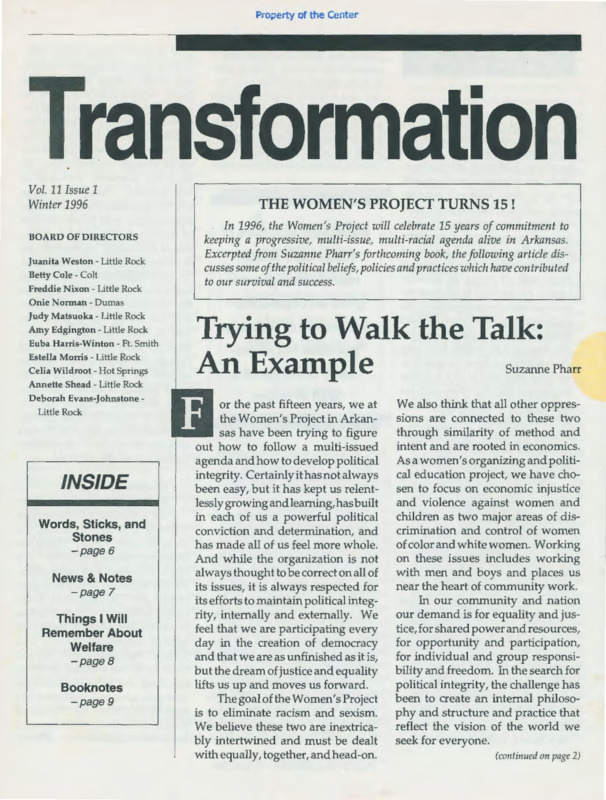
Property of the Center
Vol. 11 Issue 1
Winter 1996
BOARD OF DIRECTORS
Juanita Weston - Little Rock
Betty Cole - Colt
Freddie Nixon - Little Rock
Onie Norman - Dumas
Judy Matsuoka - Little Rock
Amy Edgington - Little Rock
Euba Harris-Winton - Ft. Smith
Estella Morris - Little Rock
Celia Wildroot - Hot Springs
Annette Shead - Little Rock
Deborah Evans-Johnstone Little Rock
INSIDE
Words, Sticks, and
Stones
-page6
News & Notes
-page 7
Things I Will
Remember About
Welfare
-page8
Booknotes
-page9
THE WOMEN'S PROJECT TURNS 15 !
In 1996, the Women's Projectwill celebrate15 years of commitment to
keeping a progressive,multi-issue, multi-racialagenda alive in Arkansas.
Excerptedfrom Suzanne Pharr's forthcoming book,thefollowing articlediscussessomeof thepoliticalbeliefs,policiesandpracticeswhichhavecontributed
to our survival and success.
Trying to Walk the Talk:
An Example
SuzannePharr
or the past fifteen years, we at
the Women's Project in Arkansas have been trying to figure
out how to follow a multi-issued
agenda and how to develop political
integrity. Certainly it has not always
been easy, but it has kept us relentlesslygrowing andlearning,has built
in each of us a powerful political
conviction and determination, and
has made all of us feel more whole.
And while the organization is not
always thought to be correct on all of
its issues, it is always respected for
its efforts to maintain political integrity, internally and externally. We
feel that we are participating every
day in the creation of democracy
and that we are as unfinished as it is,
but the dream of justice and equality
lifts us up and moves us forward.
The goal of the Women's Project
is to eliminate racism and sexism.
We believe these two are inextricably intertwined and must be dealt
with equally, together, and head-on.
We also think that all other oppressions are connected to these two
through similarity of method and
intent and are rooted in economics.
As a women's organizing and political education project, we have chosen to focus on economic injustice
and violence against women and
children as two major areas of discrimination and control of women
of color and white women. Working
on these issues includes working
with men and boys and places us
near the heart of community work.
In our community and nation
our demand is for equality and justice, for shared power and resources,
for opportunity and participation,
for individual and group responsibility and freedom. In the search for
political integrity, the challenge has
been to create an internal philosophy and structure and practice that
reflect the vision of the world we
seek for everyone.
(continuedon page2)
Walkingthe Talk
from page 1
Economics
Much of our political analysis
is focused on economics as the
root source of inequality, and we
have seen it at work everywhere.
Daily, we witness women unable
to leave their batterers because
they cannot afford to feed their
children. We witness people condemned because of their poverty.
We see the poverty of people of
color viewed as an indication of
their lack of value in society.
Hence, we decided to address the
internal issue of economics first. We
payeveryoneattheWomen'sProject
the same salary, no matter what job
she does, and no matter how long
she has worked there. At any time
we have only four to five full-time
employees, and pay others such as a
bookkeeper, child care providers,
and layout designers for the newsletter on an hourly basis at the same
rate the full-time staff is paid. Longevity is rewarded with other forms
of compensation: a month yearly
vacation after two years of employment; a retirement pension after five
years; five month's paid sabbatical
after every five years worked.
We believe that an hour of
one woman working as hard as
she is able is equal to another
woman's working hard, no matterwhatthetaskathand:
whether
it is writing funding proposals,
providing care for children, giving speeches, clipping newspaper
articles and logging violence, or
cleaning the office. What is most
important to us is commitment to
the work and working hard. Consequently, we try to be very careful in our hiring. As a community-based, social change organi-
zation, our first concern is that a
potential employee have a passion for social and economic justice and a desire to give her best
self to the job. After that, we look
at skills and the way needed skills
can be learned during employment at the Project. Using these
criteria, we are able to hire women
Increasing numbersof
historicallyunderrepresentedgroups
gives an organization
integrationor diversity,
but does not necessarily bring about a
shift in power.
whose life experiences are rich but
who may not be formally educated and are inexperienced in a
conventional workplace.
Our annual budget is slightly
over $200,000,derived from foundation grants, churches, individual
donors and pledges, compensation
for services, sales ofbooks and products. Every member of the staff
participates in fundraising. This
way, weunderstand where our salaries and resources come from, participate in their creation, and are
prepared to make decisions about
their distribution.
When describing the organizational structure of the Women's
Project, I am often told by people
from larger organizations that
such a pay structure could work
Page 2 • Transformation
• Winter 1996
only in such a small place. Perhaps so, but a variation on it could
also work. Larger organizations
could create a policy to allow no
more than a 20% differential between the highest paid employees
and the lowest paid. If we do not
do this, then the structure of our
social change organizations reflects the economic pyramid of
this country. Those at the apex
(the fewest) make the most money
and have the most power (control
of decision making and distribution of resources). Accountability
is vertical rather than horizontal.
Those at the bottom make the least
and are not allowed to take part in
the decisions that affect their lives
and the life of the organization
and its constituency. It is common, for instance, in many social
change and social service organizations for those who have the
most contact with the constituency (battered women, for instance) to make the least money.
Those who have the most contact
with power (funders, community
leaders) make the most money.
Historic Inequality:
Beyond Affirmative Action
As a women's organization
working to eliminate racism, we
try to do what we call "tilting the
balance of historic inequality." We
live in a country that has systematically withheld access to opportunity and participation from
people of color, a country that has
practiced genocide in particular
against American Indians and
African Americans and blamed
them for it, has induced poverty,
has dealt the blows of substandard education and healthcare, has
both appropriated the culture of
people of color and condemned it
as primitive and inferior-all lead-
ing to enforced inequality. We do
not believe this history of injustice
and inequality can be easily overcome but we want to try to make
major changes both organizationally and individually. We want to
change engrained thinking and
assumptions.
We believe that when everything is placed in the balance, that
racial parity is more than creating
simply an accurate reflection of
the racial makeup of the population, or balancing 50% white
women and 50% women of color.
White women belong to only one
of many racial groups in this country and that particular group has
been the dominant power which
has created the historic inequality. Quite simply, once domination has been engrained for generations, for centuries, it is extremely difficult to throw off its
assumptions and behavior during efforts for equality. Major
structural changes have to be made
to ensure and support changes.
And it is still difficult.
The way we try to tilt the balance is to make the majority of our
organization women of color,
earning equal salaries and having
equal decision making power. Our
board is eleven women, seven
African American, one Asian
American and three white, and
the staff of five is two African
American and three white women.
Out of sixteen women, seven are
lesbians, four are over 50, half are
rural, and most are working class.
Where we are weak is in our development of youth participation
and of women of color other than
African American.
Changing the Agenda
Increasing numbers of historically underrepresented
groups
gives an organization integration
or diversity, but it does not necessarily bring about a shift in power.
One of the ways we have tried to
bring about this shift is to share
access to decision making equally.
We believe that when there are
predominantly women of color on
the staff and board and everyone
As white people,
we have to be
traitors to the
domination politics
of our race. The
same is true for all
areas of
domination.
has equal say in the decision making, then the agenda and how resources are used to support it will
change.
Much responsibility is required: knowing about all aspects
of the organization, attending
weekly staff meetings and quarterly retreats, communicating
well, and talking through issues
until group agreement is reached.
Each staff member is a lead organizer for a portion of the work. It
is her job to oversee the vision,
strategy, recruitment of other staff
and volunteers to participate, keep
the rest of the staff abreast of what
is happening, etc. However, each
staff member works on all areas,
not just the one she is responsible
for. In an annual board and staff
Page 3 • Transformation • Winter 1996
retreat, we assess the year's work
and lay out the strategy for the
next year. The staff meets quarterlyto do the same on a three month
basis, and then at the beginning of
each month, we provide each other
with a work plan for what we hope
to accomplish during the month.
There are constant opportunities for
analysis, criticism, disagreements,
revision. In addition to a strong
framework of meetings and exchange, we have autonomy and independence; we are expected to
dream big, to take on hard personal
challenges, to think on our feet and
be creative.
If we were a much larger organization, we would have to
modify this structure, i.e., have
people meet together in smaller
work or issue groupings. The principle would be the same: everyone should take part in the decision makingthat affects theirwork
and lives at the organization.
Our ability to do good work
and participate strongly in decision making is affected by the opportunities we have to be infused
with new ideas both from the local
community and nationally. We
constantly work to try to equalize
the privilege of access. For instance, I spend a lot of my time
traveling, making speeches, attending conferences, and doing
strategic work with groups. Each
trip gives me great opportunities
to learn new ideas, to make contacts with helpful people. If others on the staff do not have similar
opportunities, then the way we
work and interact together is affected. We look for opportunities
for everyone to travel, to represent the organization in meetings
and conferences, to be spokesperson with the press. All honoraria
goes to the Women's Project. Our
policy is to provide financial support for each staff member to attend one conference a year just for
her own education, not as a representative of the Project.
Relationships
All of what we do is built on a
foundation of. developing and
maintaining strong relationships
with one another. We not only
work with each other, we know
and care about each other's lives.
In a world of entrenched racism,
strong relationships
between
women of color and white women
are not built overnight. There are
many stops and starts and uneven, rough terrain to cross.
One very difficult area in the
work to create equality is that of
white privilege. What is one to do
with the privilege that society
gives a person simply because of
the color of one's skin-so that
when a white woman and an African American woman are together
in public they are always treated
differently? One cannot change
the color of one's skin and necessarily society's response, but one
can change how that privilege is
used. It can be used-or spentfor oneself or on behalf of those
who do not receive it.
"Spending privilege" is not
just a matter of becoming an advocate and a friend, though those are
important roles. It also means
using privilege to make gains for
others rather than for oneself, using it to open doors to helpful
people, to sources of money, to
information, etc. It means moving
out of the way for someone else to
be in leadership, be the face of the
organization, be the major contact. Itdoesnotmean paternalism
or off and on involvement in issues that are more crucial to the
lives of others than one's own.
For trust to be built, those with
privilege have to take great risks,
putting the loss of that privilege at
risk on behalf of the liberation of
others. Why, for example should
a black woman ever trust a white
woman unless she sees that white
woman is willing to take risks in
the effort to bring about racial justice? A common slang expression
is "yougetmybackforme," meaning I trust you to cover my vulnerable side that I cannot see or protect. That trust is not to be placed
in someone who, when the bottom line is reached, is going to
escape into her privilege to save
her skin. The rhetoric of race relations has to be moved into action.
As white people, we have to be
traitors to the domination politics
of our race. The same is true for all
areas of domination. Heterosexuals, to earn trust, have to be willing to put their privilege at risk on
behalf of lesbians and gay men,
that is, by never hiding behind
their heterosexuality and being
willing to let the public think that
they are homosexual. Men, in
fighting sexism, have to be willing
to be seen as foes of male suPage 4 • Transformation• Winter 1996
premacy, as gender traitors, as not
"real men," for that is how they
will be attacked. People who believe in equality have to be willing
to be identified with the oppressed
and willing to lose their unearned
privilege in the process. We have
to be willing to go to the line for
each other. Otherwise, we are
dealing with only rhetoric and
good intentions.
All of us constantly have to
check the assumptions that come
from our privilege. It is no easy
task. But the reward of struggling
for shared power and the elimination of privilege is the expansion
of possibility for genuine friendship and the bond of common
humanity.
At the Women's
Project, we seek friendships in our
work. African American and
white women, lesbians and heterosexuals socialize with each
other outside the office. Much of
our best thinking and work occurs
in raucous, no-holds-barred conversations in the hallway, around
the copier, at the local blue plate
diner. We joke, tease, disagree,
fuss with each other, and we talk,
talk, talk. Our work is often
enough to break our hearts, but
we also believe wholeheartedly in
fun, in the outrageous, in high
waves of satirical response to the
morning newspaper and the telephone call that pushed us over the
line. Mostly, we believe that we
have to bring our whole selves to
these many hours we work together each day, that we have to
be living the vision of the world
we want to create.
Results
Does it work? Not always.
Sometimes we are overwhelmed
by the murders of women we
document, the entrenched pov-
erty of so many of our constituency, the relentless racism, the reactionary legislature, the crack
cocaine in our neighborhoods, the
obscene greed of the billionaire
Tysons and Waltons of our state.
We do not always bring our best
selvestothework. Wehavehadour
share of conflicts about race, class,
andsexualidentity. Wehavesometimesfailed thecommunitythrough
lack of imagination or understanding ofissues. Westumble. Wemove
too fast without thinking through
our strategy and possible outcomes.
Most of the time, however, it
works. Our board meetings are
daylong political conversations,
with lots of food and laughter. We
have to chase people out at the end.
Even our most stressful days at the
office are lightened by laughter and
a sense of some accomplishment.
Every staff member grows politically during her tenure with us and
if she leaves, she exits as a strong
social change worker.
But mostly we point to the
work for our assessment. We think
these policies account for our ability to get so much done with so
few people and so little money.
With our small budget and a current staff of five, we
•conduct an African American Women's Institute that works
with women in local communities
to develop leadership, to organize
to solve community problems, to
conduct political education;
•monitorracist,religious,sexist, anti-gay and lesbian violence,
aswellastheactivitiesofthe White
Supremacists and religious Right,
document these activities and publish them in a yearly log, publish
bi-monthly reports, work with
community groups to do hate violence education and to organize
against biased violence, work with
allies to make public policy
change, do political education
about the economic and racist
underpinnings of incarceration;
•produce written materials
arndyzing the Right, work with
national groups to produce strategies to oppose them, provide political education nationally;
•provide incarcerated women
weekly sessions for battered
women, work with United Methodist women to transport children
to visit their mothers in prison,
work with allies to change prison
policies;
•publish an economic analysis of women's work and income
inArkansas;providepoliticaleducation on economics; work with
women in the Delta on economic
issues;
•provide HIV education and
training for women-especially
lesbians, women of color, and in-
carcerated women;
• operate a lending library and
a bookstore of women's books;
•produce a bi-monthly newsletter of political analysis and opinion;
• operate a women's monthly
coffeehouse, conduct a lesbian
support group, produce women's
concerts, organize statewide conferences and national strategy
meetings.
The work is slow but it sustains us. It is hard but we draw
inspiration from it. We recognize
that every day we are struggling
uphill against centuries of prejudice
and injustice. We are all too aware
that we do not have all the answers,
but we are deeply convinced that
we have a significant beginning.
This is the only way we know how
to advance a progressive agenda:
to practice our politics as close to
home as possible.
■
STAFF AND BOARD MEMBERS OF THE WOMEN'S PROJECT
BACK ROW FROM LEFT TO RIGHT: Linda Coyle, Onie Norman, Lynn
Frost, Annette Shead, Felicia Davidson and Amy Edgington.
MIDDLE ROW LEFT TO RIGHT: Deborah Evans-Johnstone, Judy Matsuoka,
Freddie Nixon, Suzanne Pharr and Estella Morris.
FRONT ROW LEFT TO RIGHT: Juanita Weston and Janet Perkins.
Page 5 • Transformation • Winter 1996
Words,Sticks,
and Stones
T
hese days, I often hear
words like homophobia
and racism used in the
national media and in my home
town, as if they could be defined
as painful personal experiences
with prejudiced individuals.
When I hear lesbians and gay men
accused of "heterophobia" and,
over and over, white people attacking the "racism" of African
Americans, I feel as ifI'mlistening
to language that attempts not just
to rewrite history, but to distort
reality. I keep reminding myself
that I learned long ago to use my
own experience and that of other
lesbians and gay men, those I know
in person and in writing, as the
experts on homophobia. I extend
the same reasoning to other oppressions-racism,
for example.
To me the experts on racism are
those who experience it on their
own bodies in ways that I never
will. By listening, reading and a
great deal of bungling, I have come
to undertstand, that even though
racism and homophobia are very
differentinmanyways, they share
this feature: they are much more
than prejudice, even though
people commonly believe that
eliminating prejudice would end
all oppressions.
Prejudice causes us to treat
people as types, rather than waiting to find out what kind of individuals they are. As the Lesbian
poet Adrienne Rich explains, it is
a shortcut through the complexities of life. This is also her definition of a lie. Anybody can be
Amy Edgington
prejudiced and in fact we all are to
some degree. Butiflexhibitprejudice towards a straight person am
I guilty of "heterophobia"? No,
I'mnot. Imighthurtherfeelings;if
I were bigger I might inflict injury.
But I am not backed up by a legislature that makes it a crime for hetero-
•• •even though racism
and homophobia
are very differentin
many ways, they
share this feature:
they are much more
than prejudice...
sexuals to have intercourse, that forbids them the right to marry; movies
do not portray heterosexuals as perverts; school systems do not ban
openly straight people from teaching; libraries do not receive protests
when they buy books about straight
families; courts do not frequently
give light sentences to lesbians and
gay men who hunt down straights
and brutally murder them because
they are straight. That would be institutionalized power; that would
tum my prejudices about straight
people into an oppression equal to
homophobia.
Page 6 •Transformation• Winter 1996
When straight people, men, or
white people sincerely want to stop
being oppressors, they try to shed
their prejudices, they treat people
they've been taught to look down
on with courtesy, even bend over
backwards. I have been treated
this way by a few well-meaning
straights, and I appreciate it to a
degree. But. These same friends
can hold hands fearlessly in public, put their wedding pictures in
the paper, have never lost a job,
church, home or family because
they were straight. They cannot
help but benefit from privileges
bestowed on them and denied to
me by the institutions of our society. I wish they would object out
loud in public to homophobic remarks, sign letters to the editor
supporting civil rights for lesbians
and gay men, call their legislators
and demand that they repeal the
sodomy law, in short, do something to attack the power bases,
the sticks and stones, of homophobia. Straightpeoplemaysense
my lack of satisfaction with their
efforts to be nice to me, and guilt
makes them jump on my resentment or any evidence of prejudice
towards them. See, they say, you're
just as bad as we are-you're
heterophobic! Perhaps they don't
understand that lesbians and gay
men just don't have that kind of
power over their lives. Or they
want off the hook, so they won't
have to take the risks involved in
confronting a power structure they
benefit from. Or they don't really
want to let go of any of that power,
and want us to back down and be
satisfied that they haven't personally bashed anybody.
What I have learned growing
up in Little Rock as a white lesbian
in the near-apartheid conditions
Property of the Center
that existed between 1946and 1969
and what African-Americans have
taught me in person and in writing, leads me to believe that I cannot stop being an oppressor by
shedding my prejudices, even if
that were possible, or by being
"nice" to people of color. It is
worse than useless for me to wallow in guilt about the enormous
amount of privilege having white
skin has bestowed on me. It would
be insulting for me to equate that
advantage with a glare or even a
racial slur from a Black stranger.
There is nothing I can change about
my personal behavior that would
enable me to stop benefiting from
my white skin, because oppression,
of anybody, goes way beyond personal power. To stop being an oppressor, I can only join my efforts
with others who seek to eliminate
the sticks and stones of oppression:
political tokenism, legal discrimination, police brutality, distorted media images, biased educations, economic injustice, etc.
It's hard to give up power. If we
have been oppressed, because we
are lesbians or gay men, for instance,
that doesn't necessarily make it
easier. Because we have been
stripped ofpower ourselves,we tend
to cling in terror to whatever we
have left. We huddle, ashamed and
furious, behind the barricades of our
own guilt, precisely because we do
know what it feels like to be on the
receiving end of oppression, and we
wantdesperatelyto believewe could
never do to others what is done to us.
But only when we work against oppression wherever we find it,
whether it hurts or bestows advantage on us, will we be able to build
coalitions strong enough to create a
world where everyone isjudged and
■
treated on individual merit.
News&Notes
Ann Gallmeyer, a long-time
friend of the Women's
' Project and disability rights
activist, died November 9,
1995. Memorial contributions may be made to the
Women's Project or to Mainstream Living, 1501 Main St.,
Little Rock, AR 72202.
♦♦♦
Beginning January 1996,
Transfonnation will be
published quarterly.
money is already starting to
run thin. Even though the
Women's Project does not
directly depend on government money, those who are
will be tapping into our
funding sources more and
more.
If you can afford to increase
your membership dues when
you receive your reminder to
renew, that would help a lot!
Our goal is to have at least
1/3 of our budget met
♦♦♦
LOCAL PBS AFFILIATE
WILL SHOW NOT IN OUR
TOWN
Shown in most states in
December and in a special
screening by the Women's
Project on Dec. 14, Not In
Our Town, a half-hour film
about how the Billings,
Montana community
worked together in response
to white supremacist hate
crimes, will air on AETN
Tuesday, January 23 at 9:30
p.m.
♦♦♦
MEMBERSHIP DRIVE
SEEKS TO FILL FUNDING
GAPS
The "Contract on America"
is only a year old and the
Page 7 • Transformation• Winter 1996
through memberships,
pledges and other donations
from individuals. If you
can't increase your membership dues, convince a friend
to join.
♦♦♦
JOIN US ON-LINE
We are creating an e-mail
directory for rapid and
inexpensive communication.
To receive our calendar
through e-mail, or if you are
a member and want to receive the newsletter also,
please send us your name
and e-mail address.
Things I WillRemember
About Welfare
Felicia Davidson
m
eing a former AFDC recipient, I know how it
feels when you have to
choose between paying bills or
buying the children some of the
things they need (not want). I can
remember clearly when I gave up
welfare for the workplace. Many
nights the children went to bed
hungry because I had to ration the
food so that it would last until
next payday. It is a hurting feeling to hear your child crying to
sleep night after night because the
little food mom gave was not
enough to satisfy his hunger.
For the last year, we have been
workingwithAFDCwomeninan
effort to evaluate what they need
to move from welfare to the workplace. We often heard affordable
childcare, affordable housing, affordable health care and transportation. Our work is to present
information and opportunities for
people to build their confidence
and to gain hope in the possibility
that their lives and communities
can grow and change. We are
facing great needs.
After working with several
women on welfare, just listening
to their struggles took me back to
where I came from. Several have
tried to give up welfare to work,
but the jobs do not pay enough to
take care or their basic needs like
childcare, transportation, food,
and paying the bills. Once a
woman living in a Housing Development (projects) takes a job,
her rent goes up, her food stamps
are cut and she doesn't have any
medical benefits for herself or children. So before you judge them,
get to know them.
A woman who has very little or
no work experience tends to accept any job, even if it does not fit
well with her skill, to improve her
current situation. Having a job is
as important to poor women as it
is to "rich people". Work offers
the opportunity to advance a
person's dignity, self-esteem and
economic situation.
The hopelessness and shame
that women feel in admitting that
their lives have become unmanageable and need welfare is devastating. I don't know anyone
who wants to be on welfare, but
there are plenty who need welfare
in order to provide for their families.
The myth that welfare recipients are lazy is not true. In one
rural area I visited recently women
on welfare were chopping cotton
to make ends meet. Think for a
minute, how hot it was just walking from the car to the house?
Well, these women were out in the
heat for eight hours trying to better their family situation.
The Department of Human Services offers a program to welfare
recipients called "Project Success".
Services are provided to certain
AFDC and Food Stamp clients for
the purpose of increasing self-sufficiency. This program provides
Page 8 • Transfonnation• Winter 1996
clients with opportunity to acquire
the basic education and skills necessary to qualify for employment.
Project Success services include
job skills training, job readiness
activities, and job placement assistance. Childcare and other supportive services are available so
that clients can participate in the
program and accept employment.
But the reality is those programs
have been cut, so where does that
leave women who were participating in the program. So I wonder if they really want poor people
to better their lives. Some women
had created their own jobs as
childcare providers for recipients,
but once the program was cut, so
were the jobs. I agree that welfare
needs to be reformed, but in ways
that realistically move women
from welfare to work, with education, job training, childcare and
transportation, so it will be permanent.
The AFDC program consumes
1% of the federal budget and 2% of
the average state budget. After
adjusting for inflation, AFDC benefits increased -47% from 1970 to
1994. In 1994, the median AFDC
maximum benefit was 36% of the
poverty line. In the United States,
government tax and transfer systems (AFDC, Food Stamps, etc.)
lifted less than 5% of single-parent families out of poverty. (Poverty & Race, Vol. 4, No. 4, July/
August 1995).
It is not welfare that is so hard to
escape. ITISPOVERTY.Those who
follow their parents onto the welfare rolls do so because it is very
difficult for children of poor women
to work their way out of poverty,
especially in the current economy
of high unemployment.
■
BOOKNOTES
WQMEN'S
PROJECT
-~
New Books In The Library
Lynn Frost
Making Ourselves At Home:
Women Builders & Designers
Of "Sluts" and "Bastards:"
A Feminist Decodes The Child
Welfare Debate
by JaniceGoldfrank
by LouiseArmstrong
This book is a wake-up call for
women-untangling
the New(t)
American Dream and unmasking
the all-out war on women and
children. What has reality been
for women when the child welfare arm of the state intervenes?
What do children so "rescued"
have to tell us? Armstrong compellingly argues that the issue of
child welfare, like its twin issue,
welfare, has long cried out for a
strong feminist response.
A collection of incredible true accounts of women who have mustered the courage and resources to
do what few men and even few
women ever do: design and build
their own homes.
Eyes Right! Challenging The
Right Wing Backlash
edited by Chip Berlet
This anthology unmasks the rightwing movements whose authoritarianism and intolerance pose a
frightening threat to democracy
and diversity in America. It proPage 9 • Transformation• Winter 1996
vides essential facts, analysis and
advice for anyone wanting to oppose the Radical Right' s agenda.
Great Gay & Lesbian Places
To Live
by Lanie Dills & Lynn West
Covers 133 U.S. cities and towns,
detailing every pertinent aspect
regarding the best places for gays,
lesbians and bisexuals to live. Interviews with "locals" tell what
individuals think of their town.
Sexual Harassment:
High School Girls Speak Out
by June Larkin
A riveting expose based on first-
hand interviews with teenage girls.
Sexual harassment is a part of daily
high school life, with teachers,
administrators and officials reinforcing the problem by ignoring
the situation.
Juanita Fights The
School Board
The Delany Sisters' Book Of
Everyday Wisdom
Racism 101
by Nikki Giovanni
with Amy Hill Hearth
"These two strong, beautiful
women ... are role models for
women of the 90's." ...The New
York Amsterdam News.
by GloriaVelasquez
A young adult novel about a poor
Mexican-American girl faced with
expulsion from high school. To
fight for her rights, Juanita must
confront the powerful school
board of her district.
Uprooting Racism:
How White People Can Work
For Racial Justice
Moon Marked &
Touched by Sun:
Plays by African American
Women
Stir-Fry
The Vinyl Closet:
Gays In The Music World
by Emma Donoghue
(LesbianNovel)
by BozeHadleigh
Sisterfire: Black Womanist
Fiction & Poetry
Transforming Abuse:
Nonviolent Resistance And
Recovery
editedby CharlotteWatson
Sherman
by LouiseK. Schmidt
Horseshoe Sky
by Chris Anne Wolfe
(LesbianScienceFiction)
by Paul Kivel
This book talks about racism without rhetoric or attack. It helps us
understand the dynamics of racism in our society, institutions and
daily lives, and it shares stories,
suggestions, advice, exercises and
approaches for working together
to fight racism.
Blood, Bread, and Roses:
How Menstruation Created
The World
Letters to the editor are welcome.
by SarahDreher
editedby Sydne Mahone
MORE NEW BOOKS IN
THE LIBRARY:
by CatherineKoger
(LesbianNovel)
Published four times a year
by the Women's Project,
2224 Main Street, Little Rock,
Arkansas, 72206.
Phone: 501-372-5113
OtherWorld: A Stoner
McTavish Mystery
Fires of Aggar
Wounded In The House Of A
Friend
by Sonia Sanchez
(African American Poetry)
by Judy Grahn
Transformation
Editor
Art Director
*
Printed
Suzanne Pharr
Melissa Britton James
on recycled paper.
*
Page 10 •Transformation• Winter 1996
Women's Project Staff:
Linda Coyle
Felicia Davidson
Lynn Frost
Janet Perkins
Suzanne Pharr
©1996 The Women's Project
■
Property of the Center
Univl1(ii1~[11l~11ii~I
~lllllf
lililllif
m1[1liil~d,
OK
M 001 111 297
Our goal is social change or, as the poet Adrienne
Rich writes, "the transformation of the world." We
believe this world can be changed to become a place
of peace and justice for all women.
We take_risks in our work; we take unpopular
stands. We work for all women and against all
forms of discrimination and oppression. We believe
that we cannot work for all women and against
sexism unless we also work against racism, classism,
ageism,
anti-Semitism,
heterosexism
and
homophobia. We see the connection among these
oppressions as the context for violence against
women in this society.
We are concerned in particular about issues of
importance to traditionally underrepresented
women: poor women, aged women~women of color,
teenage mothers, lesbians, women in prisons, etc.
All are women who experience discrimination and
violence against their lives.
We are committed to working multi-culturally,
multi-racially, and to making our work and cultural
events accessible to low income women. We believe
that women will not know equality until they know
economic justice.
We believe that a few committed women working
in coalition and in consensus with other women can
make significant change in the quality of life for all
women.
Trans/ormation is published four times every year.
In each issue, members and volunteers receive analysis of contemporary issues,
information about Women's Project upcoming events and activities, book reviews, and more.
If you are not a Women's Project member or volunteer and would like to continue
receiving the newsletter, please fill out the membership form on this page.
Current Projects
■
,------------------7
~ Yes,I wouldliketo join
~ the Women'sProject.
Prison Projeel
A support and advocacy project for women in prison that provides
support groups for battered women in prison, a prisoner-led AIDS
program and a transportation program for the children of
incarcerated mothers.
■
Name _________________
Women's Watchcare Network
A project to monitor and respond to incidents of racial, religious,
sexual, and anti-gay violence; and to provide education and strategies
to counter the activities of hate groups and the Radical Right.
■
City __________________
_
Phone/evening
_
Zip _________
_
_
----------------
Women and AIDS
A project to develop strategies for working with women and
caregivers around AIDS issues.
■
_
Phone/day ________________
Workshops on understanding
racism and homophobia and
developing methods to eliminate them; women's economic issues;
organizational development for social change organizations.
■
Address _________________
State ______
The Social Justice Project
_
□
$ 7.50
(low income)
African-American Women's Institute for Social Justice
A project which creates strategies for overcoming the barriers that
hinder African-American women's efforts toward power and selfdeterrnination.
■ Communications and Events
A newsletter, a lending library, statewide and regional conferences,
and production of women singers, poets and novelists.
□
□
$ 20
$ 25
□ $ 50
□ $100
Make checks payable to:
Women's Project
2224 Main Street
Little Rock, AR 72206
L __________________
Page 11 •Transformation•
Winter 1996
_J
Women's
Project
Non-Profit Organization
U. S. Postage Paid
Little Rock, Arkansas
Permit No. 448
2224 Main Street
Little Rock, AR 72206
ADDRESS CORRECTION REQUESTED
HERLAND
SISTER RES.
2312 NW39TH
OKLAHOMA
CITY OK 73112
-
Property of the Center
Vol. 11 Issue 1
Winter 1996
BOARD OF DIRECTORS
Juanita Weston - Little Rock
Betty Cole - Colt
Freddie Nixon - Little Rock
Onie Norman - Dumas
Judy Matsuoka - Little Rock
Amy Edgington - Little Rock
Euba Harris-Winton - Ft. Smith
Estella Morris - Little Rock
Celia Wildroot - Hot Springs
Annette Shead - Little Rock
Deborah Evans-Johnstone Little Rock
INSIDE
Words, Sticks, and
Stones
-page6
News & Notes
-page 7
Things I Will
Remember About
Welfare
-page8
Booknotes
-page9
THE WOMEN'S PROJECT TURNS 15 !
In 1996, the Women's Projectwill celebrate15 years of commitment to
keeping a progressive,multi-issue, multi-racialagenda alive in Arkansas.
Excerptedfrom Suzanne Pharr's forthcoming book,thefollowing articlediscussessomeof thepoliticalbeliefs,policiesandpracticeswhichhavecontributed
to our survival and success.
Trying to Walk the Talk:
An Example
SuzannePharr
or the past fifteen years, we at
the Women's Project in Arkansas have been trying to figure
out how to follow a multi-issued
agenda and how to develop political
integrity. Certainly it has not always
been easy, but it has kept us relentlesslygrowing andlearning,has built
in each of us a powerful political
conviction and determination, and
has made all of us feel more whole.
And while the organization is not
always thought to be correct on all of
its issues, it is always respected for
its efforts to maintain political integrity, internally and externally. We
feel that we are participating every
day in the creation of democracy
and that we are as unfinished as it is,
but the dream of justice and equality
lifts us up and moves us forward.
The goal of the Women's Project
is to eliminate racism and sexism.
We believe these two are inextricably intertwined and must be dealt
with equally, together, and head-on.
We also think that all other oppressions are connected to these two
through similarity of method and
intent and are rooted in economics.
As a women's organizing and political education project, we have chosen to focus on economic injustice
and violence against women and
children as two major areas of discrimination and control of women
of color and white women. Working
on these issues includes working
with men and boys and places us
near the heart of community work.
In our community and nation
our demand is for equality and justice, for shared power and resources,
for opportunity and participation,
for individual and group responsibility and freedom. In the search for
political integrity, the challenge has
been to create an internal philosophy and structure and practice that
reflect the vision of the world we
seek for everyone.
(continuedon page2)
Walkingthe Talk
from page 1
Economics
Much of our political analysis
is focused on economics as the
root source of inequality, and we
have seen it at work everywhere.
Daily, we witness women unable
to leave their batterers because
they cannot afford to feed their
children. We witness people condemned because of their poverty.
We see the poverty of people of
color viewed as an indication of
their lack of value in society.
Hence, we decided to address the
internal issue of economics first. We
payeveryoneattheWomen'sProject
the same salary, no matter what job
she does, and no matter how long
she has worked there. At any time
we have only four to five full-time
employees, and pay others such as a
bookkeeper, child care providers,
and layout designers for the newsletter on an hourly basis at the same
rate the full-time staff is paid. Longevity is rewarded with other forms
of compensation: a month yearly
vacation after two years of employment; a retirement pension after five
years; five month's paid sabbatical
after every five years worked.
We believe that an hour of
one woman working as hard as
she is able is equal to another
woman's working hard, no matterwhatthetaskathand:
whether
it is writing funding proposals,
providing care for children, giving speeches, clipping newspaper
articles and logging violence, or
cleaning the office. What is most
important to us is commitment to
the work and working hard. Consequently, we try to be very careful in our hiring. As a community-based, social change organi-
zation, our first concern is that a
potential employee have a passion for social and economic justice and a desire to give her best
self to the job. After that, we look
at skills and the way needed skills
can be learned during employment at the Project. Using these
criteria, we are able to hire women
Increasing numbersof
historicallyunderrepresentedgroups
gives an organization
integrationor diversity,
but does not necessarily bring about a
shift in power.
whose life experiences are rich but
who may not be formally educated and are inexperienced in a
conventional workplace.
Our annual budget is slightly
over $200,000,derived from foundation grants, churches, individual
donors and pledges, compensation
for services, sales ofbooks and products. Every member of the staff
participates in fundraising. This
way, weunderstand where our salaries and resources come from, participate in their creation, and are
prepared to make decisions about
their distribution.
When describing the organizational structure of the Women's
Project, I am often told by people
from larger organizations that
such a pay structure could work
Page 2 • Transformation
• Winter 1996
only in such a small place. Perhaps so, but a variation on it could
also work. Larger organizations
could create a policy to allow no
more than a 20% differential between the highest paid employees
and the lowest paid. If we do not
do this, then the structure of our
social change organizations reflects the economic pyramid of
this country. Those at the apex
(the fewest) make the most money
and have the most power (control
of decision making and distribution of resources). Accountability
is vertical rather than horizontal.
Those at the bottom make the least
and are not allowed to take part in
the decisions that affect their lives
and the life of the organization
and its constituency. It is common, for instance, in many social
change and social service organizations for those who have the
most contact with the constituency (battered women, for instance) to make the least money.
Those who have the most contact
with power (funders, community
leaders) make the most money.
Historic Inequality:
Beyond Affirmative Action
As a women's organization
working to eliminate racism, we
try to do what we call "tilting the
balance of historic inequality." We
live in a country that has systematically withheld access to opportunity and participation from
people of color, a country that has
practiced genocide in particular
against American Indians and
African Americans and blamed
them for it, has induced poverty,
has dealt the blows of substandard education and healthcare, has
both appropriated the culture of
people of color and condemned it
as primitive and inferior-all lead-
ing to enforced inequality. We do
not believe this history of injustice
and inequality can be easily overcome but we want to try to make
major changes both organizationally and individually. We want to
change engrained thinking and
assumptions.
We believe that when everything is placed in the balance, that
racial parity is more than creating
simply an accurate reflection of
the racial makeup of the population, or balancing 50% white
women and 50% women of color.
White women belong to only one
of many racial groups in this country and that particular group has
been the dominant power which
has created the historic inequality. Quite simply, once domination has been engrained for generations, for centuries, it is extremely difficult to throw off its
assumptions and behavior during efforts for equality. Major
structural changes have to be made
to ensure and support changes.
And it is still difficult.
The way we try to tilt the balance is to make the majority of our
organization women of color,
earning equal salaries and having
equal decision making power. Our
board is eleven women, seven
African American, one Asian
American and three white, and
the staff of five is two African
American and three white women.
Out of sixteen women, seven are
lesbians, four are over 50, half are
rural, and most are working class.
Where we are weak is in our development of youth participation
and of women of color other than
African American.
Changing the Agenda
Increasing numbers of historically underrepresented
groups
gives an organization integration
or diversity, but it does not necessarily bring about a shift in power.
One of the ways we have tried to
bring about this shift is to share
access to decision making equally.
We believe that when there are
predominantly women of color on
the staff and board and everyone
As white people,
we have to be
traitors to the
domination politics
of our race. The
same is true for all
areas of
domination.
has equal say in the decision making, then the agenda and how resources are used to support it will
change.
Much responsibility is required: knowing about all aspects
of the organization, attending
weekly staff meetings and quarterly retreats, communicating
well, and talking through issues
until group agreement is reached.
Each staff member is a lead organizer for a portion of the work. It
is her job to oversee the vision,
strategy, recruitment of other staff
and volunteers to participate, keep
the rest of the staff abreast of what
is happening, etc. However, each
staff member works on all areas,
not just the one she is responsible
for. In an annual board and staff
Page 3 • Transformation • Winter 1996
retreat, we assess the year's work
and lay out the strategy for the
next year. The staff meets quarterlyto do the same on a three month
basis, and then at the beginning of
each month, we provide each other
with a work plan for what we hope
to accomplish during the month.
There are constant opportunities for
analysis, criticism, disagreements,
revision. In addition to a strong
framework of meetings and exchange, we have autonomy and independence; we are expected to
dream big, to take on hard personal
challenges, to think on our feet and
be creative.
If we were a much larger organization, we would have to
modify this structure, i.e., have
people meet together in smaller
work or issue groupings. The principle would be the same: everyone should take part in the decision makingthat affects theirwork
and lives at the organization.
Our ability to do good work
and participate strongly in decision making is affected by the opportunities we have to be infused
with new ideas both from the local
community and nationally. We
constantly work to try to equalize
the privilege of access. For instance, I spend a lot of my time
traveling, making speeches, attending conferences, and doing
strategic work with groups. Each
trip gives me great opportunities
to learn new ideas, to make contacts with helpful people. If others on the staff do not have similar
opportunities, then the way we
work and interact together is affected. We look for opportunities
for everyone to travel, to represent the organization in meetings
and conferences, to be spokesperson with the press. All honoraria
goes to the Women's Project. Our
policy is to provide financial support for each staff member to attend one conference a year just for
her own education, not as a representative of the Project.
Relationships
All of what we do is built on a
foundation of. developing and
maintaining strong relationships
with one another. We not only
work with each other, we know
and care about each other's lives.
In a world of entrenched racism,
strong relationships
between
women of color and white women
are not built overnight. There are
many stops and starts and uneven, rough terrain to cross.
One very difficult area in the
work to create equality is that of
white privilege. What is one to do
with the privilege that society
gives a person simply because of
the color of one's skin-so that
when a white woman and an African American woman are together
in public they are always treated
differently? One cannot change
the color of one's skin and necessarily society's response, but one
can change how that privilege is
used. It can be used-or spentfor oneself or on behalf of those
who do not receive it.
"Spending privilege" is not
just a matter of becoming an advocate and a friend, though those are
important roles. It also means
using privilege to make gains for
others rather than for oneself, using it to open doors to helpful
people, to sources of money, to
information, etc. It means moving
out of the way for someone else to
be in leadership, be the face of the
organization, be the major contact. Itdoesnotmean paternalism
or off and on involvement in issues that are more crucial to the
lives of others than one's own.
For trust to be built, those with
privilege have to take great risks,
putting the loss of that privilege at
risk on behalf of the liberation of
others. Why, for example should
a black woman ever trust a white
woman unless she sees that white
woman is willing to take risks in
the effort to bring about racial justice? A common slang expression
is "yougetmybackforme," meaning I trust you to cover my vulnerable side that I cannot see or protect. That trust is not to be placed
in someone who, when the bottom line is reached, is going to
escape into her privilege to save
her skin. The rhetoric of race relations has to be moved into action.
As white people, we have to be
traitors to the domination politics
of our race. The same is true for all
areas of domination. Heterosexuals, to earn trust, have to be willing to put their privilege at risk on
behalf of lesbians and gay men,
that is, by never hiding behind
their heterosexuality and being
willing to let the public think that
they are homosexual. Men, in
fighting sexism, have to be willing
to be seen as foes of male suPage 4 • Transformation• Winter 1996
premacy, as gender traitors, as not
"real men," for that is how they
will be attacked. People who believe in equality have to be willing
to be identified with the oppressed
and willing to lose their unearned
privilege in the process. We have
to be willing to go to the line for
each other. Otherwise, we are
dealing with only rhetoric and
good intentions.
All of us constantly have to
check the assumptions that come
from our privilege. It is no easy
task. But the reward of struggling
for shared power and the elimination of privilege is the expansion
of possibility for genuine friendship and the bond of common
humanity.
At the Women's
Project, we seek friendships in our
work. African American and
white women, lesbians and heterosexuals socialize with each
other outside the office. Much of
our best thinking and work occurs
in raucous, no-holds-barred conversations in the hallway, around
the copier, at the local blue plate
diner. We joke, tease, disagree,
fuss with each other, and we talk,
talk, talk. Our work is often
enough to break our hearts, but
we also believe wholeheartedly in
fun, in the outrageous, in high
waves of satirical response to the
morning newspaper and the telephone call that pushed us over the
line. Mostly, we believe that we
have to bring our whole selves to
these many hours we work together each day, that we have to
be living the vision of the world
we want to create.
Results
Does it work? Not always.
Sometimes we are overwhelmed
by the murders of women we
document, the entrenched pov-
erty of so many of our constituency, the relentless racism, the reactionary legislature, the crack
cocaine in our neighborhoods, the
obscene greed of the billionaire
Tysons and Waltons of our state.
We do not always bring our best
selvestothework. Wehavehadour
share of conflicts about race, class,
andsexualidentity. Wehavesometimesfailed thecommunitythrough
lack of imagination or understanding ofissues. Westumble. Wemove
too fast without thinking through
our strategy and possible outcomes.
Most of the time, however, it
works. Our board meetings are
daylong political conversations,
with lots of food and laughter. We
have to chase people out at the end.
Even our most stressful days at the
office are lightened by laughter and
a sense of some accomplishment.
Every staff member grows politically during her tenure with us and
if she leaves, she exits as a strong
social change worker.
But mostly we point to the
work for our assessment. We think
these policies account for our ability to get so much done with so
few people and so little money.
With our small budget and a current staff of five, we
•conduct an African American Women's Institute that works
with women in local communities
to develop leadership, to organize
to solve community problems, to
conduct political education;
•monitorracist,religious,sexist, anti-gay and lesbian violence,
aswellastheactivitiesofthe White
Supremacists and religious Right,
document these activities and publish them in a yearly log, publish
bi-monthly reports, work with
community groups to do hate violence education and to organize
against biased violence, work with
allies to make public policy
change, do political education
about the economic and racist
underpinnings of incarceration;
•produce written materials
arndyzing the Right, work with
national groups to produce strategies to oppose them, provide political education nationally;
•provide incarcerated women
weekly sessions for battered
women, work with United Methodist women to transport children
to visit their mothers in prison,
work with allies to change prison
policies;
•publish an economic analysis of women's work and income
inArkansas;providepoliticaleducation on economics; work with
women in the Delta on economic
issues;
•provide HIV education and
training for women-especially
lesbians, women of color, and in-
carcerated women;
• operate a lending library and
a bookstore of women's books;
•produce a bi-monthly newsletter of political analysis and opinion;
• operate a women's monthly
coffeehouse, conduct a lesbian
support group, produce women's
concerts, organize statewide conferences and national strategy
meetings.
The work is slow but it sustains us. It is hard but we draw
inspiration from it. We recognize
that every day we are struggling
uphill against centuries of prejudice
and injustice. We are all too aware
that we do not have all the answers,
but we are deeply convinced that
we have a significant beginning.
This is the only way we know how
to advance a progressive agenda:
to practice our politics as close to
home as possible.
■
STAFF AND BOARD MEMBERS OF THE WOMEN'S PROJECT
BACK ROW FROM LEFT TO RIGHT: Linda Coyle, Onie Norman, Lynn
Frost, Annette Shead, Felicia Davidson and Amy Edgington.
MIDDLE ROW LEFT TO RIGHT: Deborah Evans-Johnstone, Judy Matsuoka,
Freddie Nixon, Suzanne Pharr and Estella Morris.
FRONT ROW LEFT TO RIGHT: Juanita Weston and Janet Perkins.
Page 5 • Transformation • Winter 1996
Words,Sticks,
and Stones
T
hese days, I often hear
words like homophobia
and racism used in the
national media and in my home
town, as if they could be defined
as painful personal experiences
with prejudiced individuals.
When I hear lesbians and gay men
accused of "heterophobia" and,
over and over, white people attacking the "racism" of African
Americans, I feel as ifI'mlistening
to language that attempts not just
to rewrite history, but to distort
reality. I keep reminding myself
that I learned long ago to use my
own experience and that of other
lesbians and gay men, those I know
in person and in writing, as the
experts on homophobia. I extend
the same reasoning to other oppressions-racism,
for example.
To me the experts on racism are
those who experience it on their
own bodies in ways that I never
will. By listening, reading and a
great deal of bungling, I have come
to undertstand, that even though
racism and homophobia are very
differentinmanyways, they share
this feature: they are much more
than prejudice, even though
people commonly believe that
eliminating prejudice would end
all oppressions.
Prejudice causes us to treat
people as types, rather than waiting to find out what kind of individuals they are. As the Lesbian
poet Adrienne Rich explains, it is
a shortcut through the complexities of life. This is also her definition of a lie. Anybody can be
Amy Edgington
prejudiced and in fact we all are to
some degree. Butiflexhibitprejudice towards a straight person am
I guilty of "heterophobia"? No,
I'mnot. Imighthurtherfeelings;if
I were bigger I might inflict injury.
But I am not backed up by a legislature that makes it a crime for hetero-
•• •even though racism
and homophobia
are very differentin
many ways, they
share this feature:
they are much more
than prejudice...
sexuals to have intercourse, that forbids them the right to marry; movies
do not portray heterosexuals as perverts; school systems do not ban
openly straight people from teaching; libraries do not receive protests
when they buy books about straight
families; courts do not frequently
give light sentences to lesbians and
gay men who hunt down straights
and brutally murder them because
they are straight. That would be institutionalized power; that would
tum my prejudices about straight
people into an oppression equal to
homophobia.
Page 6 •Transformation• Winter 1996
When straight people, men, or
white people sincerely want to stop
being oppressors, they try to shed
their prejudices, they treat people
they've been taught to look down
on with courtesy, even bend over
backwards. I have been treated
this way by a few well-meaning
straights, and I appreciate it to a
degree. But. These same friends
can hold hands fearlessly in public, put their wedding pictures in
the paper, have never lost a job,
church, home or family because
they were straight. They cannot
help but benefit from privileges
bestowed on them and denied to
me by the institutions of our society. I wish they would object out
loud in public to homophobic remarks, sign letters to the editor
supporting civil rights for lesbians
and gay men, call their legislators
and demand that they repeal the
sodomy law, in short, do something to attack the power bases,
the sticks and stones, of homophobia. Straightpeoplemaysense
my lack of satisfaction with their
efforts to be nice to me, and guilt
makes them jump on my resentment or any evidence of prejudice
towards them. See, they say, you're
just as bad as we are-you're
heterophobic! Perhaps they don't
understand that lesbians and gay
men just don't have that kind of
power over their lives. Or they
want off the hook, so they won't
have to take the risks involved in
confronting a power structure they
benefit from. Or they don't really
want to let go of any of that power,
and want us to back down and be
satisfied that they haven't personally bashed anybody.
What I have learned growing
up in Little Rock as a white lesbian
in the near-apartheid conditions
Property of the Center
that existed between 1946and 1969
and what African-Americans have
taught me in person and in writing, leads me to believe that I cannot stop being an oppressor by
shedding my prejudices, even if
that were possible, or by being
"nice" to people of color. It is
worse than useless for me to wallow in guilt about the enormous
amount of privilege having white
skin has bestowed on me. It would
be insulting for me to equate that
advantage with a glare or even a
racial slur from a Black stranger.
There is nothing I can change about
my personal behavior that would
enable me to stop benefiting from
my white skin, because oppression,
of anybody, goes way beyond personal power. To stop being an oppressor, I can only join my efforts
with others who seek to eliminate
the sticks and stones of oppression:
political tokenism, legal discrimination, police brutality, distorted media images, biased educations, economic injustice, etc.
It's hard to give up power. If we
have been oppressed, because we
are lesbians or gay men, for instance,
that doesn't necessarily make it
easier. Because we have been
stripped ofpower ourselves,we tend
to cling in terror to whatever we
have left. We huddle, ashamed and
furious, behind the barricades of our
own guilt, precisely because we do
know what it feels like to be on the
receiving end of oppression, and we
wantdesperatelyto believewe could
never do to others what is done to us.
But only when we work against oppression wherever we find it,
whether it hurts or bestows advantage on us, will we be able to build
coalitions strong enough to create a
world where everyone isjudged and
■
treated on individual merit.
News&Notes
Ann Gallmeyer, a long-time
friend of the Women's
' Project and disability rights
activist, died November 9,
1995. Memorial contributions may be made to the
Women's Project or to Mainstream Living, 1501 Main St.,
Little Rock, AR 72202.
♦♦♦
Beginning January 1996,
Transfonnation will be
published quarterly.
money is already starting to
run thin. Even though the
Women's Project does not
directly depend on government money, those who are
will be tapping into our
funding sources more and
more.
If you can afford to increase
your membership dues when
you receive your reminder to
renew, that would help a lot!
Our goal is to have at least
1/3 of our budget met
♦♦♦
LOCAL PBS AFFILIATE
WILL SHOW NOT IN OUR
TOWN
Shown in most states in
December and in a special
screening by the Women's
Project on Dec. 14, Not In
Our Town, a half-hour film
about how the Billings,
Montana community
worked together in response
to white supremacist hate
crimes, will air on AETN
Tuesday, January 23 at 9:30
p.m.
♦♦♦
MEMBERSHIP DRIVE
SEEKS TO FILL FUNDING
GAPS
The "Contract on America"
is only a year old and the
Page 7 • Transformation• Winter 1996
through memberships,
pledges and other donations
from individuals. If you
can't increase your membership dues, convince a friend
to join.
♦♦♦
JOIN US ON-LINE
We are creating an e-mail
directory for rapid and
inexpensive communication.
To receive our calendar
through e-mail, or if you are
a member and want to receive the newsletter also,
please send us your name
and e-mail address.
Things I WillRemember
About Welfare
Felicia Davidson
m
eing a former AFDC recipient, I know how it
feels when you have to
choose between paying bills or
buying the children some of the
things they need (not want). I can
remember clearly when I gave up
welfare for the workplace. Many
nights the children went to bed
hungry because I had to ration the
food so that it would last until
next payday. It is a hurting feeling to hear your child crying to
sleep night after night because the
little food mom gave was not
enough to satisfy his hunger.
For the last year, we have been
workingwithAFDCwomeninan
effort to evaluate what they need
to move from welfare to the workplace. We often heard affordable
childcare, affordable housing, affordable health care and transportation. Our work is to present
information and opportunities for
people to build their confidence
and to gain hope in the possibility
that their lives and communities
can grow and change. We are
facing great needs.
After working with several
women on welfare, just listening
to their struggles took me back to
where I came from. Several have
tried to give up welfare to work,
but the jobs do not pay enough to
take care or their basic needs like
childcare, transportation, food,
and paying the bills. Once a
woman living in a Housing Development (projects) takes a job,
her rent goes up, her food stamps
are cut and she doesn't have any
medical benefits for herself or children. So before you judge them,
get to know them.
A woman who has very little or
no work experience tends to accept any job, even if it does not fit
well with her skill, to improve her
current situation. Having a job is
as important to poor women as it
is to "rich people". Work offers
the opportunity to advance a
person's dignity, self-esteem and
economic situation.
The hopelessness and shame
that women feel in admitting that
their lives have become unmanageable and need welfare is devastating. I don't know anyone
who wants to be on welfare, but
there are plenty who need welfare
in order to provide for their families.
The myth that welfare recipients are lazy is not true. In one
rural area I visited recently women
on welfare were chopping cotton
to make ends meet. Think for a
minute, how hot it was just walking from the car to the house?
Well, these women were out in the
heat for eight hours trying to better their family situation.
The Department of Human Services offers a program to welfare
recipients called "Project Success".
Services are provided to certain
AFDC and Food Stamp clients for
the purpose of increasing self-sufficiency. This program provides
Page 8 • Transfonnation• Winter 1996
clients with opportunity to acquire
the basic education and skills necessary to qualify for employment.
Project Success services include
job skills training, job readiness
activities, and job placement assistance. Childcare and other supportive services are available so
that clients can participate in the
program and accept employment.
But the reality is those programs
have been cut, so where does that
leave women who were participating in the program. So I wonder if they really want poor people
to better their lives. Some women
had created their own jobs as
childcare providers for recipients,
but once the program was cut, so
were the jobs. I agree that welfare
needs to be reformed, but in ways
that realistically move women
from welfare to work, with education, job training, childcare and
transportation, so it will be permanent.
The AFDC program consumes
1% of the federal budget and 2% of
the average state budget. After
adjusting for inflation, AFDC benefits increased -47% from 1970 to
1994. In 1994, the median AFDC
maximum benefit was 36% of the
poverty line. In the United States,
government tax and transfer systems (AFDC, Food Stamps, etc.)
lifted less than 5% of single-parent families out of poverty. (Poverty & Race, Vol. 4, No. 4, July/
August 1995).
It is not welfare that is so hard to
escape. ITISPOVERTY.Those who
follow their parents onto the welfare rolls do so because it is very
difficult for children of poor women
to work their way out of poverty,
especially in the current economy
of high unemployment.
■
BOOKNOTES
WQMEN'S
PROJECT
-~
New Books In The Library
Lynn Frost
Making Ourselves At Home:
Women Builders & Designers
Of "Sluts" and "Bastards:"
A Feminist Decodes The Child
Welfare Debate
by JaniceGoldfrank
by LouiseArmstrong
This book is a wake-up call for
women-untangling
the New(t)
American Dream and unmasking
the all-out war on women and
children. What has reality been
for women when the child welfare arm of the state intervenes?
What do children so "rescued"
have to tell us? Armstrong compellingly argues that the issue of
child welfare, like its twin issue,
welfare, has long cried out for a
strong feminist response.
A collection of incredible true accounts of women who have mustered the courage and resources to
do what few men and even few
women ever do: design and build
their own homes.
Eyes Right! Challenging The
Right Wing Backlash
edited by Chip Berlet
This anthology unmasks the rightwing movements whose authoritarianism and intolerance pose a
frightening threat to democracy
and diversity in America. It proPage 9 • Transformation• Winter 1996
vides essential facts, analysis and
advice for anyone wanting to oppose the Radical Right' s agenda.
Great Gay & Lesbian Places
To Live
by Lanie Dills & Lynn West
Covers 133 U.S. cities and towns,
detailing every pertinent aspect
regarding the best places for gays,
lesbians and bisexuals to live. Interviews with "locals" tell what
individuals think of their town.
Sexual Harassment:
High School Girls Speak Out
by June Larkin
A riveting expose based on first-
hand interviews with teenage girls.
Sexual harassment is a part of daily
high school life, with teachers,
administrators and officials reinforcing the problem by ignoring
the situation.
Juanita Fights The
School Board
The Delany Sisters' Book Of
Everyday Wisdom
Racism 101
by Nikki Giovanni
with Amy Hill Hearth
"These two strong, beautiful
women ... are role models for
women of the 90's." ...The New
York Amsterdam News.
by GloriaVelasquez
A young adult novel about a poor
Mexican-American girl faced with
expulsion from high school. To
fight for her rights, Juanita must
confront the powerful school
board of her district.
Uprooting Racism:
How White People Can Work
For Racial Justice
Moon Marked &
Touched by Sun:
Plays by African American
Women
Stir-Fry
The Vinyl Closet:
Gays In The Music World
by Emma Donoghue
(LesbianNovel)
by BozeHadleigh
Sisterfire: Black Womanist
Fiction & Poetry
Transforming Abuse:
Nonviolent Resistance And
Recovery
editedby CharlotteWatson
Sherman
by LouiseK. Schmidt
Horseshoe Sky
by Chris Anne Wolfe
(LesbianScienceFiction)
by Paul Kivel
This book talks about racism without rhetoric or attack. It helps us
understand the dynamics of racism in our society, institutions and
daily lives, and it shares stories,
suggestions, advice, exercises and
approaches for working together
to fight racism.
Blood, Bread, and Roses:
How Menstruation Created
The World
Letters to the editor are welcome.
by SarahDreher
editedby Sydne Mahone
MORE NEW BOOKS IN
THE LIBRARY:
by CatherineKoger
(LesbianNovel)
Published four times a year
by the Women's Project,
2224 Main Street, Little Rock,
Arkansas, 72206.
Phone: 501-372-5113
OtherWorld: A Stoner
McTavish Mystery
Fires of Aggar
Wounded In The House Of A
Friend
by Sonia Sanchez
(African American Poetry)
by Judy Grahn
Transformation
Editor
Art Director
*
Printed
Suzanne Pharr
Melissa Britton James
on recycled paper.
*
Page 10 •Transformation• Winter 1996
Women's Project Staff:
Linda Coyle
Felicia Davidson
Lynn Frost
Janet Perkins
Suzanne Pharr
©1996 The Women's Project
■
Property of the Center
Univl1(ii1~[11l~11ii~I
~lllllf
lililllif
m1[1liil~d,
OK
M 001 111 297
Our goal is social change or, as the poet Adrienne
Rich writes, "the transformation of the world." We
believe this world can be changed to become a place
of peace and justice for all women.
We take_risks in our work; we take unpopular
stands. We work for all women and against all
forms of discrimination and oppression. We believe
that we cannot work for all women and against
sexism unless we also work against racism, classism,
ageism,
anti-Semitism,
heterosexism
and
homophobia. We see the connection among these
oppressions as the context for violence against
women in this society.
We are concerned in particular about issues of
importance to traditionally underrepresented
women: poor women, aged women~women of color,
teenage mothers, lesbians, women in prisons, etc.
All are women who experience discrimination and
violence against their lives.
We are committed to working multi-culturally,
multi-racially, and to making our work and cultural
events accessible to low income women. We believe
that women will not know equality until they know
economic justice.
We believe that a few committed women working
in coalition and in consensus with other women can
make significant change in the quality of life for all
women.
Trans/ormation is published four times every year.
In each issue, members and volunteers receive analysis of contemporary issues,
information about Women's Project upcoming events and activities, book reviews, and more.
If you are not a Women's Project member or volunteer and would like to continue
receiving the newsletter, please fill out the membership form on this page.
Current Projects
■
,------------------7
~ Yes,I wouldliketo join
~ the Women'sProject.
Prison Projeel
A support and advocacy project for women in prison that provides
support groups for battered women in prison, a prisoner-led AIDS
program and a transportation program for the children of
incarcerated mothers.
■
Name _________________
Women's Watchcare Network
A project to monitor and respond to incidents of racial, religious,
sexual, and anti-gay violence; and to provide education and strategies
to counter the activities of hate groups and the Radical Right.
■
City __________________
_
Phone/evening
_
Zip _________
_
_
----------------
Women and AIDS
A project to develop strategies for working with women and
caregivers around AIDS issues.
■
_
Phone/day ________________
Workshops on understanding
racism and homophobia and
developing methods to eliminate them; women's economic issues;
organizational development for social change organizations.
■
Address _________________
State ______
The Social Justice Project
_
□
$ 7.50
(low income)
African-American Women's Institute for Social Justice
A project which creates strategies for overcoming the barriers that
hinder African-American women's efforts toward power and selfdeterrnination.
■ Communications and Events
A newsletter, a lending library, statewide and regional conferences,
and production of women singers, poets and novelists.
□
□
$ 20
$ 25
□ $ 50
□ $100
Make checks payable to:
Women's Project
2224 Main Street
Little Rock, AR 72206
L __________________
Page 11 •Transformation•
Winter 1996
_J
Women's
Project
Non-Profit Organization
U. S. Postage Paid
Little Rock, Arkansas
Permit No. 448
2224 Main Street
Little Rock, AR 72206
ADDRESS CORRECTION REQUESTED
HERLAND
SISTER RES.
2312 NW39TH
OKLAHOMA
CITY OK 73112
-
Property of the Center
Vol. 11 Issue 1
Winter 1996
BOARD OF DIRECTORS
Juanita Weston - Little Rock
Betty Cole - Colt
Freddie Nixon - Little Rock
Onie Norman - Dumas
Judy Matsuoka - Little Rock
Amy Edgington - Little Rock
Euba Harris-Winton - Ft. Smith
Estella Morris - Little Rock
Celia Wildroot - Hot Springs
Annette Shead - Little Rock
Deborah Evans-Johnstone Little Rock
INSIDE
Words, Sticks, and
Stones
-page6
News & Notes
-page 7
Things I Will
Remember About
Welfare
-page8
Booknotes
-page9
THE WOMEN'S PROJECT TURNS 15 !
In 1996, the Women's Projectwill celebrate15 years of commitment to
keeping a progressive,multi-issue, multi-racialagenda alive in Arkansas.
Excerptedfrom Suzanne Pharr's forthcoming book,thefollowing articlediscussessomeof thepoliticalbeliefs,policiesandpracticeswhichhavecontributed
to our survival and success.
Trying to Walk the Talk:
An Example
SuzannePharr
or the past fifteen years, we at
the Women's Project in Arkansas have been trying to figure
out how to follow a multi-issued
agenda and how to develop political
integrity. Certainly it has not always
been easy, but it has kept us relentlesslygrowing andlearning,has built
in each of us a powerful political
conviction and determination, and
has made all of us feel more whole.
And while the organization is not
always thought to be correct on all of
its issues, it is always respected for
its efforts to maintain political integrity, internally and externally. We
feel that we are participating every
day in the creation of democracy
and that we are as unfinished as it is,
but the dream of justice and equality
lifts us up and moves us forward.
The goal of the Women's Project
is to eliminate racism and sexism.
We believe these two are inextricably intertwined and must be dealt
with equally, together, and head-on.
We also think that all other oppressions are connected to these two
through similarity of method and
intent and are rooted in economics.
As a women's organizing and political education project, we have chosen to focus on economic injustice
and violence against women and
children as two major areas of discrimination and control of women
of color and white women. Working
on these issues includes working
with men and boys and places us
near the heart of community work.
In our community and nation
our demand is for equality and justice, for shared power and resources,
for opportunity and participation,
for individual and group responsibility and freedom. In the search for
political integrity, the challenge has
been to create an internal philosophy and structure and practice that
reflect the vision of the world we
seek for everyone.
(continuedon page2)
Walkingthe Talk
from page 1
Economics
Much of our political analysis
is focused on economics as the
root source of inequality, and we
have seen it at work everywhere.
Daily, we witness women unable
to leave their batterers because
they cannot afford to feed their
children. We witness people condemned because of their poverty.
We see the poverty of people of
color viewed as an indication of
their lack of value in society.
Hence, we decided to address the
internal issue of economics first. We
payeveryoneattheWomen'sProject
the same salary, no matter what job
she does, and no matter how long
she has worked there. At any time
we have only four to five full-time
employees, and pay others such as a
bookkeeper, child care providers,
and layout designers for the newsletter on an hourly basis at the same
rate the full-time staff is paid. Longevity is rewarded with other forms
of compensation: a month yearly
vacation after two years of employment; a retirement pension after five
years; five month's paid sabbatical
after every five years worked.
We believe that an hour of
one woman working as hard as
she is able is equal to another
woman's working hard, no matterwhatthetaskathand:
whether
it is writing funding proposals,
providing care for children, giving speeches, clipping newspaper
articles and logging violence, or
cleaning the office. What is most
important to us is commitment to
the work and working hard. Consequently, we try to be very careful in our hiring. As a community-based, social change organi-
zation, our first concern is that a
potential employee have a passion for social and economic justice and a desire to give her best
self to the job. After that, we look
at skills and the way needed skills
can be learned during employment at the Project. Using these
criteria, we are able to hire women
Increasing numbersof
historicallyunderrepresentedgroups
gives an organization
integrationor diversity,
but does not necessarily bring about a
shift in power.
whose life experiences are rich but
who may not be formally educated and are inexperienced in a
conventional workplace.
Our annual budget is slightly
over $200,000,derived from foundation grants, churches, individual
donors and pledges, compensation
for services, sales ofbooks and products. Every member of the staff
participates in fundraising. This
way, weunderstand where our salaries and resources come from, participate in their creation, and are
prepared to make decisions about
their distribution.
When describing the organizational structure of the Women's
Project, I am often told by people
from larger organizations that
such a pay structure could work
Page 2 • Transformation
• Winter 1996
only in such a small place. Perhaps so, but a variation on it could
also work. Larger organizations
could create a policy to allow no
more than a 20% differential between the highest paid employees
and the lowest paid. If we do not
do this, then the structure of our
social change organizations reflects the economic pyramid of
this country. Those at the apex
(the fewest) make the most money
and have the most power (control
of decision making and distribution of resources). Accountability
is vertical rather than horizontal.
Those at the bottom make the least
and are not allowed to take part in
the decisions that affect their lives
and the life of the organization
and its constituency. It is common, for instance, in many social
change and social service organizations for those who have the
most contact with the constituency (battered women, for instance) to make the least money.
Those who have the most contact
with power (funders, community
leaders) make the most money.
Historic Inequality:
Beyond Affirmative Action
As a women's organization
working to eliminate racism, we
try to do what we call "tilting the
balance of historic inequality." We
live in a country that has systematically withheld access to opportunity and participation from
people of color, a country that has
practiced genocide in particular
against American Indians and
African Americans and blamed
them for it, has induced poverty,
has dealt the blows of substandard education and healthcare, has
both appropriated the culture of
people of color and condemned it
as primitive and inferior-all lead-
ing to enforced inequality. We do
not believe this history of injustice
and inequality can be easily overcome but we want to try to make
major changes both organizationally and individually. We want to
change engrained thinking and
assumptions.
We believe that when everything is placed in the balance, that
racial parity is more than creating
simply an accurate reflection of
the racial makeup of the population, or balancing 50% white
women and 50% women of color.
White women belong to only one
of many racial groups in this country and that particular group has
been the dominant power which
has created the historic inequality. Quite simply, once domination has been engrained for generations, for centuries, it is extremely difficult to throw off its
assumptions and behavior during efforts for equality. Major
structural changes have to be made
to ensure and support changes.
And it is still difficult.
The way we try to tilt the balance is to make the majority of our
organization women of color,
earning equal salaries and having
equal decision making power. Our
board is eleven women, seven
African American, one Asian
American and three white, and
the staff of five is two African
American and three white women.
Out of sixteen women, seven are
lesbians, four are over 50, half are
rural, and most are working class.
Where we are weak is in our development of youth participation
and of women of color other than
African American.
Changing the Agenda
Increasing numbers of historically underrepresented
groups
gives an organization integration
or diversity, but it does not necessarily bring about a shift in power.
One of the ways we have tried to
bring about this shift is to share
access to decision making equally.
We believe that when there are
predominantly women of color on
the staff and board and everyone
As white people,
we have to be
traitors to the
domination politics
of our race. The
same is true for all
areas of
domination.
has equal say in the decision making, then the agenda and how resources are used to support it will
change.
Much responsibility is required: knowing about all aspects
of the organization, attending
weekly staff meetings and quarterly retreats, communicating
well, and talking through issues
until group agreement is reached.
Each staff member is a lead organizer for a portion of the work. It
is her job to oversee the vision,
strategy, recruitment of other staff
and volunteers to participate, keep
the rest of the staff abreast of what
is happening, etc. However, each
staff member works on all areas,
not just the one she is responsible
for. In an annual board and staff
Page 3 • Transformation • Winter 1996
retreat, we assess the year's work
and lay out the strategy for the
next year. The staff meets quarterlyto do the same on a three month
basis, and then at the beginning of
each month, we provide each other
with a work plan for what we hope
to accomplish during the month.
There are constant opportunities for
analysis, criticism, disagreements,
revision. In addition to a strong
framework of meetings and exchange, we have autonomy and independence; we are expected to
dream big, to take on hard personal
challenges, to think on our feet and
be creative.
If we were a much larger organization, we would have to
modify this structure, i.e., have
people meet together in smaller
work or issue groupings. The principle would be the same: everyone should take part in the decision makingthat affects theirwork
and lives at the organization.
Our ability to do good work
and participate strongly in decision making is affected by the opportunities we have to be infused
with new ideas both from the local
community and nationally. We
constantly work to try to equalize
the privilege of access. For instance, I spend a lot of my time
traveling, making speeches, attending conferences, and doing
strategic work with groups. Each
trip gives me great opportunities
to learn new ideas, to make contacts with helpful people. If others on the staff do not have similar
opportunities, then the way we
work and interact together is affected. We look for opportunities
for everyone to travel, to represent the organization in meetings
and conferences, to be spokesperson with the press. All honoraria
goes to the Women's Project. Our
policy is to provide financial support for each staff member to attend one conference a year just for
her own education, not as a representative of the Project.
Relationships
All of what we do is built on a
foundation of. developing and
maintaining strong relationships
with one another. We not only
work with each other, we know
and care about each other's lives.
In a world of entrenched racism,
strong relationships
between
women of color and white women
are not built overnight. There are
many stops and starts and uneven, rough terrain to cross.
One very difficult area in the
work to create equality is that of
white privilege. What is one to do
with the privilege that society
gives a person simply because of
the color of one's skin-so that
when a white woman and an African American woman are together
in public they are always treated
differently? One cannot change
the color of one's skin and necessarily society's response, but one
can change how that privilege is
used. It can be used-or spentfor oneself or on behalf of those
who do not receive it.
"Spending privilege" is not
just a matter of becoming an advocate and a friend, though those are
important roles. It also means
using privilege to make gains for
others rather than for oneself, using it to open doors to helpful
people, to sources of money, to
information, etc. It means moving
out of the way for someone else to
be in leadership, be the face of the
organization, be the major contact. Itdoesnotmean paternalism
or off and on involvement in issues that are more crucial to the
lives of others than one's own.
For trust to be built, those with
privilege have to take great risks,
putting the loss of that privilege at
risk on behalf of the liberation of
others. Why, for example should
a black woman ever trust a white
woman unless she sees that white
woman is willing to take risks in
the effort to bring about racial justice? A common slang expression
is "yougetmybackforme," meaning I trust you to cover my vulnerable side that I cannot see or protect. That trust is not to be placed
in someone who, when the bottom line is reached, is going to
escape into her privilege to save
her skin. The rhetoric of race relations has to be moved into action.
As white people, we have to be
traitors to the domination politics
of our race. The same is true for all
areas of domination. Heterosexuals, to earn trust, have to be willing to put their privilege at risk on
behalf of lesbians and gay men,
that is, by never hiding behind
their heterosexuality and being
willing to let the public think that
they are homosexual. Men, in
fighting sexism, have to be willing
to be seen as foes of male suPage 4 • Transformation• Winter 1996
premacy, as gender traitors, as not
"real men," for that is how they
will be attacked. People who believe in equality have to be willing
to be identified with the oppressed
and willing to lose their unearned
privilege in the process. We have
to be willing to go to the line for
each other. Otherwise, we are
dealing with only rhetoric and
good intentions.
All of us constantly have to
check the assumptions that come
from our privilege. It is no easy
task. But the reward of struggling
for shared power and the elimination of privilege is the expansion
of possibility for genuine friendship and the bond of common
humanity.
At the Women's
Project, we seek friendships in our
work. African American and
white women, lesbians and heterosexuals socialize with each
other outside the office. Much of
our best thinking and work occurs
in raucous, no-holds-barred conversations in the hallway, around
the copier, at the local blue plate
diner. We joke, tease, disagree,
fuss with each other, and we talk,
talk, talk. Our work is often
enough to break our hearts, but
we also believe wholeheartedly in
fun, in the outrageous, in high
waves of satirical response to the
morning newspaper and the telephone call that pushed us over the
line. Mostly, we believe that we
have to bring our whole selves to
these many hours we work together each day, that we have to
be living the vision of the world
we want to create.
Results
Does it work? Not always.
Sometimes we are overwhelmed
by the murders of women we
document, the entrenched pov-
erty of so many of our constituency, the relentless racism, the reactionary legislature, the crack
cocaine in our neighborhoods, the
obscene greed of the billionaire
Tysons and Waltons of our state.
We do not always bring our best
selvestothework. Wehavehadour
share of conflicts about race, class,
andsexualidentity. Wehavesometimesfailed thecommunitythrough
lack of imagination or understanding ofissues. Westumble. Wemove
too fast without thinking through
our strategy and possible outcomes.
Most of the time, however, it
works. Our board meetings are
daylong political conversations,
with lots of food and laughter. We
have to chase people out at the end.
Even our most stressful days at the
office are lightened by laughter and
a sense of some accomplishment.
Every staff member grows politically during her tenure with us and
if she leaves, she exits as a strong
social change worker.
But mostly we point to the
work for our assessment. We think
these policies account for our ability to get so much done with so
few people and so little money.
With our small budget and a current staff of five, we
•conduct an African American Women's Institute that works
with women in local communities
to develop leadership, to organize
to solve community problems, to
conduct political education;
•monitorracist,religious,sexist, anti-gay and lesbian violence,
aswellastheactivitiesofthe White
Supremacists and religious Right,
document these activities and publish them in a yearly log, publish
bi-monthly reports, work with
community groups to do hate violence education and to organize
against biased violence, work with
allies to make public policy
change, do political education
about the economic and racist
underpinnings of incarceration;
•produce written materials
arndyzing the Right, work with
national groups to produce strategies to oppose them, provide political education nationally;
•provide incarcerated women
weekly sessions for battered
women, work with United Methodist women to transport children
to visit their mothers in prison,
work with allies to change prison
policies;
•publish an economic analysis of women's work and income
inArkansas;providepoliticaleducation on economics; work with
women in the Delta on economic
issues;
•provide HIV education and
training for women-especially
lesbians, women of color, and in-
carcerated women;
• operate a lending library and
a bookstore of women's books;
•produce a bi-monthly newsletter of political analysis and opinion;
• operate a women's monthly
coffeehouse, conduct a lesbian
support group, produce women's
concerts, organize statewide conferences and national strategy
meetings.
The work is slow but it sustains us. It is hard but we draw
inspiration from it. We recognize
that every day we are struggling
uphill against centuries of prejudice
and injustice. We are all too aware
that we do not have all the answers,
but we are deeply convinced that
we have a significant beginning.
This is the only way we know how
to advance a progressive agenda:
to practice our politics as close to
home as possible.
■
STAFF AND BOARD MEMBERS OF THE WOMEN'S PROJECT
BACK ROW FROM LEFT TO RIGHT: Linda Coyle, Onie Norman, Lynn
Frost, Annette Shead, Felicia Davidson and Amy Edgington.
MIDDLE ROW LEFT TO RIGHT: Deborah Evans-Johnstone, Judy Matsuoka,
Freddie Nixon, Suzanne Pharr and Estella Morris.
FRONT ROW LEFT TO RIGHT: Juanita Weston and Janet Perkins.
Page 5 • Transformation • Winter 1996
Words,Sticks,
and Stones
T
hese days, I often hear
words like homophobia
and racism used in the
national media and in my home
town, as if they could be defined
as painful personal experiences
with prejudiced individuals.
When I hear lesbians and gay men
accused of "heterophobia" and,
over and over, white people attacking the "racism" of African
Americans, I feel as ifI'mlistening
to language that attempts not just
to rewrite history, but to distort
reality. I keep reminding myself
that I learned long ago to use my
own experience and that of other
lesbians and gay men, those I know
in person and in writing, as the
experts on homophobia. I extend
the same reasoning to other oppressions-racism,
for example.
To me the experts on racism are
those who experience it on their
own bodies in ways that I never
will. By listening, reading and a
great deal of bungling, I have come
to undertstand, that even though
racism and homophobia are very
differentinmanyways, they share
this feature: they are much more
than prejudice, even though
people commonly believe that
eliminating prejudice would end
all oppressions.
Prejudice causes us to treat
people as types, rather than waiting to find out what kind of individuals they are. As the Lesbian
poet Adrienne Rich explains, it is
a shortcut through the complexities of life. This is also her definition of a lie. Anybody can be
Amy Edgington
prejudiced and in fact we all are to
some degree. Butiflexhibitprejudice towards a straight person am
I guilty of "heterophobia"? No,
I'mnot. Imighthurtherfeelings;if
I were bigger I might inflict injury.
But I am not backed up by a legislature that makes it a crime for hetero-
•• •even though racism
and homophobia
are very differentin
many ways, they
share this feature:
they are much more
than prejudice...
sexuals to have intercourse, that forbids them the right to marry; movies
do not portray heterosexuals as perverts; school systems do not ban
openly straight people from teaching; libraries do not receive protests
when they buy books about straight
families; courts do not frequently
give light sentences to lesbians and
gay men who hunt down straights
and brutally murder them because
they are straight. That would be institutionalized power; that would
tum my prejudices about straight
people into an oppression equal to
homophobia.
Page 6 •Transformation• Winter 1996
When straight people, men, or
white people sincerely want to stop
being oppressors, they try to shed
their prejudices, they treat people
they've been taught to look down
on with courtesy, even bend over
backwards. I have been treated
this way by a few well-meaning
straights, and I appreciate it to a
degree. But. These same friends
can hold hands fearlessly in public, put their wedding pictures in
the paper, have never lost a job,
church, home or family because
they were straight. They cannot
help but benefit from privileges
bestowed on them and denied to
me by the institutions of our society. I wish they would object out
loud in public to homophobic remarks, sign letters to the editor
supporting civil rights for lesbians
and gay men, call their legislators
and demand that they repeal the
sodomy law, in short, do something to attack the power bases,
the sticks and stones, of homophobia. Straightpeoplemaysense
my lack of satisfaction with their
efforts to be nice to me, and guilt
makes them jump on my resentment or any evidence of prejudice
towards them. See, they say, you're
just as bad as we are-you're
heterophobic! Perhaps they don't
understand that lesbians and gay
men just don't have that kind of
power over their lives. Or they
want off the hook, so they won't
have to take the risks involved in
confronting a power structure they
benefit from. Or they don't really
want to let go of any of that power,
and want us to back down and be
satisfied that they haven't personally bashed anybody.
What I have learned growing
up in Little Rock as a white lesbian
in the near-apartheid conditions
Property of the Center
that existed between 1946and 1969
and what African-Americans have
taught me in person and in writing, leads me to believe that I cannot stop being an oppressor by
shedding my prejudices, even if
that were possible, or by being
"nice" to people of color. It is
worse than useless for me to wallow in guilt about the enormous
amount of privilege having white
skin has bestowed on me. It would
be insulting for me to equate that
advantage with a glare or even a
racial slur from a Black stranger.
There is nothing I can change about
my personal behavior that would
enable me to stop benefiting from
my white skin, because oppression,
of anybody, goes way beyond personal power. To stop being an oppressor, I can only join my efforts
with others who seek to eliminate
the sticks and stones of oppression:
political tokenism, legal discrimination, police brutality, distorted media images, biased educations, economic injustice, etc.
It's hard to give up power. If we
have been oppressed, because we
are lesbians or gay men, for instance,
that doesn't necessarily make it
easier. Because we have been
stripped ofpower ourselves,we tend
to cling in terror to whatever we
have left. We huddle, ashamed and
furious, behind the barricades of our
own guilt, precisely because we do
know what it feels like to be on the
receiving end of oppression, and we
wantdesperatelyto believewe could
never do to others what is done to us.
But only when we work against oppression wherever we find it,
whether it hurts or bestows advantage on us, will we be able to build
coalitions strong enough to create a
world where everyone isjudged and
■
treated on individual merit.
News&Notes
Ann Gallmeyer, a long-time
friend of the Women's
' Project and disability rights
activist, died November 9,
1995. Memorial contributions may be made to the
Women's Project or to Mainstream Living, 1501 Main St.,
Little Rock, AR 72202.
♦♦♦
Beginning January 1996,
Transfonnation will be
published quarterly.
money is already starting to
run thin. Even though the
Women's Project does not
directly depend on government money, those who are
will be tapping into our
funding sources more and
more.
If you can afford to increase
your membership dues when
you receive your reminder to
renew, that would help a lot!
Our goal is to have at least
1/3 of our budget met
♦♦♦
LOCAL PBS AFFILIATE
WILL SHOW NOT IN OUR
TOWN
Shown in most states in
December and in a special
screening by the Women's
Project on Dec. 14, Not In
Our Town, a half-hour film
about how the Billings,
Montana community
worked together in response
to white supremacist hate
crimes, will air on AETN
Tuesday, January 23 at 9:30
p.m.
♦♦♦
MEMBERSHIP DRIVE
SEEKS TO FILL FUNDING
GAPS
The "Contract on America"
is only a year old and the
Page 7 • Transformation• Winter 1996
through memberships,
pledges and other donations
from individuals. If you
can't increase your membership dues, convince a friend
to join.
♦♦♦
JOIN US ON-LINE
We are creating an e-mail
directory for rapid and
inexpensive communication.
To receive our calendar
through e-mail, or if you are
a member and want to receive the newsletter also,
please send us your name
and e-mail address.
Things I WillRemember
About Welfare
Felicia Davidson
m
eing a former AFDC recipient, I know how it
feels when you have to
choose between paying bills or
buying the children some of the
things they need (not want). I can
remember clearly when I gave up
welfare for the workplace. Many
nights the children went to bed
hungry because I had to ration the
food so that it would last until
next payday. It is a hurting feeling to hear your child crying to
sleep night after night because the
little food mom gave was not
enough to satisfy his hunger.
For the last year, we have been
workingwithAFDCwomeninan
effort to evaluate what they need
to move from welfare to the workplace. We often heard affordable
childcare, affordable housing, affordable health care and transportation. Our work is to present
information and opportunities for
people to build their confidence
and to gain hope in the possibility
that their lives and communities
can grow and change. We are
facing great needs.
After working with several
women on welfare, just listening
to their struggles took me back to
where I came from. Several have
tried to give up welfare to work,
but the jobs do not pay enough to
take care or their basic needs like
childcare, transportation, food,
and paying the bills. Once a
woman living in a Housing Development (projects) takes a job,
her rent goes up, her food stamps
are cut and she doesn't have any
medical benefits for herself or children. So before you judge them,
get to know them.
A woman who has very little or
no work experience tends to accept any job, even if it does not fit
well with her skill, to improve her
current situation. Having a job is
as important to poor women as it
is to "rich people". Work offers
the opportunity to advance a
person's dignity, self-esteem and
economic situation.
The hopelessness and shame
that women feel in admitting that
their lives have become unmanageable and need welfare is devastating. I don't know anyone
who wants to be on welfare, but
there are plenty who need welfare
in order to provide for their families.
The myth that welfare recipients are lazy is not true. In one
rural area I visited recently women
on welfare were chopping cotton
to make ends meet. Think for a
minute, how hot it was just walking from the car to the house?
Well, these women were out in the
heat for eight hours trying to better their family situation.
The Department of Human Services offers a program to welfare
recipients called "Project Success".
Services are provided to certain
AFDC and Food Stamp clients for
the purpose of increasing self-sufficiency. This program provides
Page 8 • Transfonnation• Winter 1996
clients with opportunity to acquire
the basic education and skills necessary to qualify for employment.
Project Success services include
job skills training, job readiness
activities, and job placement assistance. Childcare and other supportive services are available so
that clients can participate in the
program and accept employment.
But the reality is those programs
have been cut, so where does that
leave women who were participating in the program. So I wonder if they really want poor people
to better their lives. Some women
had created their own jobs as
childcare providers for recipients,
but once the program was cut, so
were the jobs. I agree that welfare
needs to be reformed, but in ways
that realistically move women
from welfare to work, with education, job training, childcare and
transportation, so it will be permanent.
The AFDC program consumes
1% of the federal budget and 2% of
the average state budget. After
adjusting for inflation, AFDC benefits increased -47% from 1970 to
1994. In 1994, the median AFDC
maximum benefit was 36% of the
poverty line. In the United States,
government tax and transfer systems (AFDC, Food Stamps, etc.)
lifted less than 5% of single-parent families out of poverty. (Poverty & Race, Vol. 4, No. 4, July/
August 1995).
It is not welfare that is so hard to
escape. ITISPOVERTY.Those who
follow their parents onto the welfare rolls do so because it is very
difficult for children of poor women
to work their way out of poverty,
especially in the current economy
of high unemployment.
■
BOOKNOTES
WQMEN'S
PROJECT
-~
New Books In The Library
Lynn Frost
Making Ourselves At Home:
Women Builders & Designers
Of "Sluts" and "Bastards:"
A Feminist Decodes The Child
Welfare Debate
by JaniceGoldfrank
by LouiseArmstrong
This book is a wake-up call for
women-untangling
the New(t)
American Dream and unmasking
the all-out war on women and
children. What has reality been
for women when the child welfare arm of the state intervenes?
What do children so "rescued"
have to tell us? Armstrong compellingly argues that the issue of
child welfare, like its twin issue,
welfare, has long cried out for a
strong feminist response.
A collection of incredible true accounts of women who have mustered the courage and resources to
do what few men and even few
women ever do: design and build
their own homes.
Eyes Right! Challenging The
Right Wing Backlash
edited by Chip Berlet
This anthology unmasks the rightwing movements whose authoritarianism and intolerance pose a
frightening threat to democracy
and diversity in America. It proPage 9 • Transformation• Winter 1996
vides essential facts, analysis and
advice for anyone wanting to oppose the Radical Right' s agenda.
Great Gay & Lesbian Places
To Live
by Lanie Dills & Lynn West
Covers 133 U.S. cities and towns,
detailing every pertinent aspect
regarding the best places for gays,
lesbians and bisexuals to live. Interviews with "locals" tell what
individuals think of their town.
Sexual Harassment:
High School Girls Speak Out
by June Larkin
A riveting expose based on first-
hand interviews with teenage girls.
Sexual harassment is a part of daily
high school life, with teachers,
administrators and officials reinforcing the problem by ignoring
the situation.
Juanita Fights The
School Board
The Delany Sisters' Book Of
Everyday Wisdom
Racism 101
by Nikki Giovanni
with Amy Hill Hearth
"These two strong, beautiful
women ... are role models for
women of the 90's." ...The New
York Amsterdam News.
by GloriaVelasquez
A young adult novel about a poor
Mexican-American girl faced with
expulsion from high school. To
fight for her rights, Juanita must
confront the powerful school
board of her district.
Uprooting Racism:
How White People Can Work
For Racial Justice
Moon Marked &
Touched by Sun:
Plays by African American
Women
Stir-Fry
The Vinyl Closet:
Gays In The Music World
by Emma Donoghue
(LesbianNovel)
by BozeHadleigh
Sisterfire: Black Womanist
Fiction & Poetry
Transforming Abuse:
Nonviolent Resistance And
Recovery
editedby CharlotteWatson
Sherman
by LouiseK. Schmidt
Horseshoe Sky
by Chris Anne Wolfe
(LesbianScienceFiction)
by Paul Kivel
This book talks about racism without rhetoric or attack. It helps us
understand the dynamics of racism in our society, institutions and
daily lives, and it shares stories,
suggestions, advice, exercises and
approaches for working together
to fight racism.
Blood, Bread, and Roses:
How Menstruation Created
The World
Letters to the editor are welcome.
by SarahDreher
editedby Sydne Mahone
MORE NEW BOOKS IN
THE LIBRARY:
by CatherineKoger
(LesbianNovel)
Published four times a year
by the Women's Project,
2224 Main Street, Little Rock,
Arkansas, 72206.
Phone: 501-372-5113
OtherWorld: A Stoner
McTavish Mystery
Fires of Aggar
Wounded In The House Of A
Friend
by Sonia Sanchez
(African American Poetry)
by Judy Grahn
Transformation
Editor
Art Director
*
Printed
Suzanne Pharr
Melissa Britton James
on recycled paper.
*
Page 10 •Transformation• Winter 1996
Women's Project Staff:
Linda Coyle
Felicia Davidson
Lynn Frost
Janet Perkins
Suzanne Pharr
©1996 The Women's Project
■
Property of the Center
Univl1(ii1~[11l~11ii~I
~lllllf
lililllif
m1[1liil~d,
OK
M 001 111 297
Our goal is social change or, as the poet Adrienne
Rich writes, "the transformation of the world." We
believe this world can be changed to become a place
of peace and justice for all women.
We take_risks in our work; we take unpopular
stands. We work for all women and against all
forms of discrimination and oppression. We believe
that we cannot work for all women and against
sexism unless we also work against racism, classism,
ageism,
anti-Semitism,
heterosexism
and
homophobia. We see the connection among these
oppressions as the context for violence against
women in this society.
We are concerned in particular about issues of
importance to traditionally underrepresented
women: poor women, aged women~women of color,
teenage mothers, lesbians, women in prisons, etc.
All are women who experience discrimination and
violence against their lives.
We are committed to working multi-culturally,
multi-racially, and to making our work and cultural
events accessible to low income women. We believe
that women will not know equality until they know
economic justice.
We believe that a few committed women working
in coalition and in consensus with other women can
make significant change in the quality of life for all
women.
Trans/ormation is published four times every year.
In each issue, members and volunteers receive analysis of contemporary issues,
information about Women's Project upcoming events and activities, book reviews, and more.
If you are not a Women's Project member or volunteer and would like to continue
receiving the newsletter, please fill out the membership form on this page.
Current Projects
■
,------------------7
~ Yes,I wouldliketo join
~ the Women'sProject.
Prison Projeel
A support and advocacy project for women in prison that provides
support groups for battered women in prison, a prisoner-led AIDS
program and a transportation program for the children of
incarcerated mothers.
■
Name _________________
Women's Watchcare Network
A project to monitor and respond to incidents of racial, religious,
sexual, and anti-gay violence; and to provide education and strategies
to counter the activities of hate groups and the Radical Right.
■
City __________________
_
Phone/evening
_
Zip _________
_
_
----------------
Women and AIDS
A project to develop strategies for working with women and
caregivers around AIDS issues.
■
_
Phone/day ________________
Workshops on understanding
racism and homophobia and
developing methods to eliminate them; women's economic issues;
organizational development for social change organizations.
■
Address _________________
State ______
The Social Justice Project
_
□
$ 7.50
(low income)
African-American Women's Institute for Social Justice
A project which creates strategies for overcoming the barriers that
hinder African-American women's efforts toward power and selfdeterrnination.
■ Communications and Events
A newsletter, a lending library, statewide and regional conferences,
and production of women singers, poets and novelists.
□
□
$ 20
$ 25
□ $ 50
□ $100
Make checks payable to:
Women's Project
2224 Main Street
Little Rock, AR 72206
L __________________
Page 11 •Transformation•
Winter 1996
_J
Women's
Project
Non-Profit Organization
U. S. Postage Paid
Little Rock, Arkansas
Permit No. 448
2224 Main Street
Little Rock, AR 72206
ADDRESS CORRECTION REQUESTED
HERLAND
SISTER RES.
2312 NW39TH
OKLAHOMA
CITY OK 73112
- Temporal Coverage
- 1990-1999
Linked resources
- Hierarchies
-
Herland Archive
- All Resources (Private)
- Themes
- LGBTQ+ (482 items)
- Feminism (40 items)
- Faith and Religion (51 items)
- Activism and Advocacy (69 items)
- HIV/AIDS (25 items)
- Education (18 items)
- Literature (20 items)
- Art (16 items)
- Themes
- All Resources (Private)