
Transformation : v.9:no.1(1994:Jan./Feb.)
- Title
- Transformation : v.9:no.1(1994:Jan./Feb.)
- Description
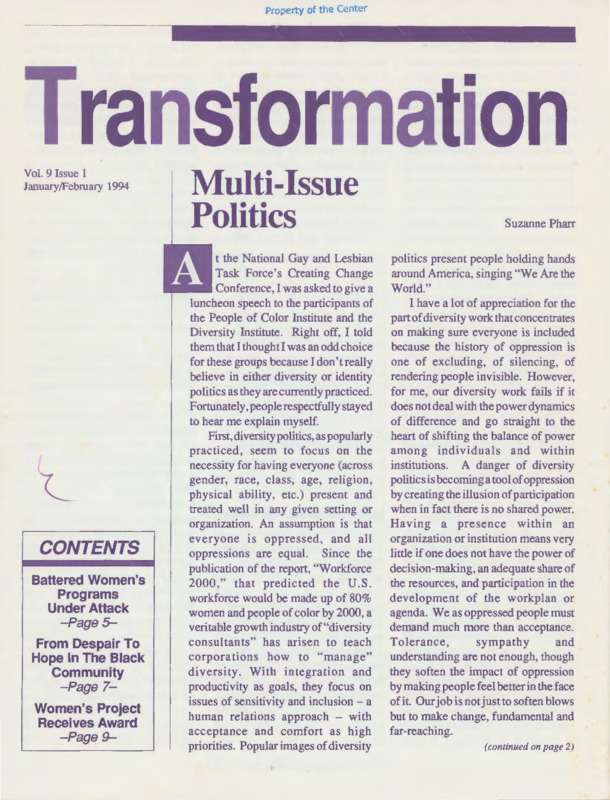
- Transformation is published by the Women's Project. This issue covers multi-issue politics and identity politics. Some of these issues include homophobia, racism, and domestic violence. This issue also includes an announcement that Women's Project received the 1993 Creating Change Award from the National Gay and Lesbian Taskforce.
- Date Issued
- 1994-01
- Relation
- Transformation
- Rights
- Contact UCO Chambers Library's Digital Initiatives Working Group at diwg@uco.edu for the permission policy on the use, reproduction or distribution of this material.
- Is Part Of
-
 Transformation: Women's Watchcare Network Log
- Transformation: Women's Watchcare Network Log
- Creator
- Pharr, Suzanne
- Contributor
- Women's Project
- Date
- 2025-04-18T14:47:05Z
- Date Available
- 2025-04-18T14:47:05Z
- Subject
- LGBTQ+ newsletters
- Arkansas
- Type
- Periodical
- extracted text
-
Property of the Center
■
rans orma 10n
Vol. 9 Issue 1
January/February1994
CONTENTS
BatteredWomen's
Programs
UnderAttack
-Page5From DespairTo
Hope In The Black
Community
-Page 7Women's Project
ReceivesAward
-Page 9-
Multi-Issue
Politics
Suzanne Pharr
t the National Gay and Lesbian
politics present people holding hands
Task Force's Creating Change
around America, singing "We Are the
Conference, I was asked to give a
World."
luncheon speech to the participants of
I have a lot of appreciation for the
the People of Color Institute and the
part of diversity work that concentrates
Diversity Institute. Right off, I told
on making sure everyone is included
them that I thought I was an odd choice
because the history of oppression is
one of excluding, of silencing, of
for these groups because I don't real!y
believe in either diversity or identity
rendering people invisible. However,
politics as they are currently practiced.
for me, our diversity work fails if it
Fortunately, people respectfully stayed does not deal with the power dynamics
to hear me explain myself.
of difference and go straight to the
First, diversitypolitics, as popularly . heart of shifting the balance of power
practiced, seem to focus on the
among individuals
and within
necessity for having everyone (across
institutions. A danger of diversity
gender, race, class, age, religion,
politics is becoming a tool of oppression
physical ability, etc.) present and
by creating the illusion of participation
treated well in any given setting or
when in fact there is no shared power.
Having a presence within an
organization. An assumption is that
everyone is oppressed, and all
organization or institution means very
oppressions are equal. Since the
little if one does not have the power of
decision-making, an adequate share of
publication of the report, "Workforce
2000," that predicted the U.S.
the resources, and participation in the
workforce would be made up of 80% development of the workplan or
agenda. We as oppressed people must
women and people of color by 2000, a
veritable growth industry of "diversity
demand much more than acceptance.
Tolerance,
sympathy
and
consultants" has arisen to teach
corporations
how to "manage"
understanding are not enough, though
they soften the impact of oppression
diversity. With integration and
by making people feel better in the face
productivity as goals, they focus on
of it. Our job is not just to soften blows
issues of sensitivity and inclusion - a
but to make change, fundamental and
human relations approach - with
far-reaching.
acceptance and comfort as high
priorities. Popular images of diversity
(continued on page 2)
Identity politics, on the other
hand, rather than trying to include
everyone, brings together people
who share a single common identity
such as sexual orientation, gender,
or race. Generally, it focuses on the
elimination of a single oppression,
the one that is based on the common
identity;
i.e.,
homophobia/
heterosexism; sexism, racism.
However, this can be a limited,
hierarchical approach, reducing
people of multiple identities to a
single identity. Which identity
should a lesbian of color choose as a
priority - gender, race or sexual
orientation? And does choosing one
necessitate leaving the other two at
home? What do we say to bisexual
or biracial people? Choose, damnit,
choose??? Our multiple identities
allow us to develop a politic that is
broad in scope because itis grounded
in a wide range of experiences.
There are positive aspects of
organizing along identity lines:
clarity of single focus in tactics and
strategies, self-examination and
education apart from the dominant
culture, development of solidarity
and group bonding, etc. Creating
organizations based on identity
allows us to have visibility and
collective power, to advance
concerns that otherwise would never
be recognized because of our
marginalization within the dominant
society.
However, identity politics often
suffers from failing to acknowledge
that the same multiplicity of
oppressions, a similar imbalance of
power, exists within identity groups
as within the larger society. People
who group together on the basis of
their sexual orientation still find
within their groups sexism and
racism that have to be dealt with- or
if gathering on the basis of race,
there is still sexism and homophobia
to be confronted. Whole,notpartial,
people come to identity groups,
carrying several identities. Some of
the major barriers of our liberation
movements to being able to mount a
unified or cohesive strategy, I
believe, come from our refusal to
work directly on the oppressions the fundamental issues of power within our own groups. A successful
liberation movement cannot be built
on the effort to liberate only a few
and only a piece of who we are.
Diversity and identity politics
Ingeniously, they
blend race, class,
gender and sexual
identity issues into
.
one campaign
whose success
has profound
implicationsfor the
destructionof
democracy.
are responses to oppression. In
confronting oppressions, we must
remember that they are more than
people just not being nice to one
another: they are systemic, based in
institutions and in general society,
where one group of people is allowed
to exert power and control over
members of another group, denying
them fundamental rights. Also, we
must remember that oppressions are
interconnected, operating in similar
ways, and that many people
experience
more than one
oppression.
.
Page 2 • Transformation• Janul!l)'/February 1994
'
I believe that all oppressions in
this country tum on an economic
wheel; they all, in the long run, serve
to consolidate and keep wealth in
the hands of the few, with the many
fighting over crumbs. Oppressions
are built in particular on the dynamic
intersection of race and class.
Without work against economic
injustice, against the excesses of
capitalism, there can be no deep and
lasting work on oppression. Why?
Because it is always in the best
interest of the dominators, the
greedy, to maintain and expand
oppression -the feeding of economic
and social injustice.
Unless we understand the
interconnections of oppressions and
the economic exploitation of
oppressed groups, we have little hope
of succeeding in a liberation
movement. The religious Right has
been successful in driving wedges
between oppressed groups because
there is little common understanding
of the linkages of oppressions.
Progressives, including lesbians and
gay men, have contributed to these
divisions because generally we have
dealt with only single pieces of the
fabric of injustice. We stand ready
to be divided. If, for example, an
organization has worked only on
sexual identity issues and has not
worked internally on issues of race
and gender, then it is ripe for being
divided on those issues.
The Right has had extraordinary
success in using homosexuality as a
wedge issue, dividing people on the
issues clustered around the Right's
two central organizing points:
traditional family values and
economics. An example is their
success in using homosexuality as a
way to organize people to oppose
multicultural curricula, which
particularly affects people of color
and women; while acting to "save
the family from homosexuals,"
women and people of color find
themselves working against their
own inclusion. If women's groups,
people of color and lesbian and gay
groups worked on gender, race and
sexual identity issues internally, then
perhaps we would recognize the need
for a coalition and a common agenda
for multicultural education.
An even more striking example
is how the Right, in its "No Special
Rights" campaign, successfully
plays upon the social and economic
fears of people, using homosexuality
as the wedge issue, and as the coup
de grace, pits the lesbian and gay
community against the AfricanAmerican community. Ingeniously,
they blend race, class, gender and
sexual identity issues into one
campaign whose success has
profound implications for the
destruction of democracy.
In summary, the goal of the "No
Special Rights" campaign is to
change the way this nation thinks
about civil rights so that the
groundwork is laid for the gradual
elimination of civil rights. This is
not an easy idea to present to the
general public in a straightforward
manner. Therefore, the religious
Right has chosen homosexuality and
homophobia to open the door to
thinking that is influenced by racial
hatred and its correlatives, gender
and class prejudice.
(See
"Eliminating
Civil Rights,"
Transformation, Nov.-Dec. 1993,
Vol. 8, 6, pp. 1-2)
Depending upon the persuasion
of racism, sexism and homophobia,
the religious Right seeks these basic
twisted and distorted changes in our
thinking about civil rights:
1) They suggest that civil rights
do not already exist in our
'
Constitution and Bill of Rights; they
are a special category for
"minorities" such as people of color
and women. The religious Right
refers to these people as having
"minority status," a term they have
invented to keep us focused on the
word minority. Most people think
of minorities as people of color.
Recently in Oregon, signs appeared
that read, "End Minority Status."
They did not specify gay and lesbian:
the message was about minorities
and what that so-called "status"
brings them.
2) Then they say that basic
civil rights are themselves "Special
Rights" that can be given or taken
away by the majority who has
ordinary rights, not "special rights."
3) They argue that "Special
Rights" should be given to people
based on deserving behavior and
hardship conditions (especially
economic) that require special
treatment. In their words, people
who "qualify" for"minority status."
4) Then they introduce the
popularbeliefthat "Special Rights"
given to people of color and women
and people with disabilities have
resulted in the loss of jobs for
deserving, "qualified" people
through affirmative action and
quotas. This introduces the notion
that rights for some has an economic
cost for others; therefore the
enhancement of civil rights for
everyone is not a good thing.
5) They argue that lesbians
and gay men have no hardship
conditions that would require
extending "Special Rights" to them.
Further, homosexuals disqualify
themselves from basic civil rights
because, by the nature of who they
are, they exhibit bad behavior. They
do not, according to the Right' s
formula, "qualify" for "minority
Page 3 • Transfor,mation• January/February 1994
status."
6) Then there is the pernicious
connection: There are other people
who already have "Special Rights"
who exhibit bad behavior and prove
themselves undeserving as they use
and deal drugs and commit crimes
of violence and welfare fraud. The
popular perception is that these are
minorities. However, the Right also
extends its description of the
undeserving to those who bear
children outside of two-parent
married families, women who
choose abortion, and even those who
receive public assistance.
7) And finally, their logical
and dangerous conclusion:
because giving "Special Rights" to
undeserving groups is destroying our
families, communities and jobs for
good people, who deserves and does
not deserve to be granted "Special
Rights" should be put to the popular
vote and good, ordinary citizens
allowed to decide who gets them
and who gets to keep them.
Clearly, the religious Right
understands the interconnection
among oppressions and in this
campaign plays directly to that
interweaving of racism, sexism,
classism and homophobia that is
virtually impossible to tease apart.
To see this campaign as single issue,
i.e., simply about lesbians and gay
men, is to ensure defeat of our efforts
in opposing it. It has to be responded
toas the multi-issue campaign thatit
is. If the "No Special Rights"
campaign is successful, everyone
stands to lose.
The question, as ever, is what to
do? I do not believe that either a
diversity or identity politics
approach will work unless they are
changed to incorporate a multi-issue
analysis and strategy that combine
(continued on page 4)
the politics of inclusion with shared
power. But, you say, it will spread
us too thin if we try to work on
everyone's issue, and ours will fall
by the wayside. In our external
work (doing women's anti-violence
work, working against police
brutality
in people-of-color
communities, seeking government
funding for AIDS research, etc.), we
do not have to work on "everybody's
issue" but how can we do true social
change work unless we look at all
within our constituency who are
affected by our particular issue?
People who are inf~cted with the
HIV virus are of every race, class,
age, gender, geographic location,
yet when research and services are
sought, it is women, people of color,
poor people, etc., who are usually
overlooked. Yet today, the AIDS
virus rages on because those in power
think that the people who contract it
are dispensible. Are we to be like
those currently in power? To
understand why police brutality is
so much more extreme in people-ofcolor communities, we have to
understand why, even within that
community, it is so much greater
against poor people of color,
prostituted women and gay men and
lesbians of color. To leave any
group out leaves a hole for
everyone's freedoms and rights to
fall through. It becomes an issue of
"acceptable" and "unacceptable"
people, deserving and undeserving
of rights.
Identity politics offers a strong,
vital place for bonding, for
developing political analysis, for
understanding our relationship to a
world that says on the one hand that
we are no more than our identity,
and on the other, that there is no real
oppression based on the identity of
race or gender or sexual identity.
Our challenge is to learn how to use
the experiences of our many
identities to forge an inclusive social
change politic. The question that
faces us is how to do multi-issue
coalition building from an identity
base. The hope for a multi-racial,
multi-issue movement rests in large
part on the answer to this question.
Our linkages can create a
movement, and our divisions can
destroy us.
Internally, if our organizations
are not committed to the inclusion
and shared power of all those who
Toleave any
groupout leaves
a hole for
everyone's
freedomsand
rightsto fall
through.
share our issue, how can we with
any integrity demand inclusion and
shared,power in society at large? If
women, lesbians and gay men are
treated as people undeserving of
equality within civil rights
organizations, how can those
organizations demand equality? If
women of color and poor women
are marginalized in women's rights
organizations, how can those
organizations argue that women as a
class should be moved into full
participation in the mainstream? If
lesbian and gay organizations are
not anti-racist and feminist in all
their practices, what hope is there
Page 4 • Tramformalifm
• January/February 1994
for the elimination of homophobia
and heterosexism in a racist, sexist
society?
When we grasp the value and
interconnectedness of our liberation
issues, then we will at last be able to
make true coalition and begin
building a common agenda that
eliminates oppression and brings
forth a vision of diversity that shares
power and resources. In particular,
I think there is great hope for this
work among lesbians and gay men.
First, we must reconceptualize who
we are and see ourselves not as the
wedge, not as the divisive,
diversionary issue of the religious
Right - but as the bridge that links
the issues and people together. If we
indeed represent everyone - cutting
across all sectors of society, race,
gender, age, ability, geographic
location, religion -and if we develop
a liberation
politic that is
transformational,
that is, that
eliminates the power and dominance
of one group over another within
our own organizations - we as old
and young, people of color and white,
rich and poor, rural and urban
lesbians and gay men can provide
the forum for bringing people and
groups together to form a
progressive, multi-issue, truly
diverse liberation movement. Our
success will be decided by the depth
of our work on race, class and gender
issues.
Instead of the flashpoint for
division, we can be the flashpoint
for developing common ground, a
common agenda, a common
humanity. We can be at the heart of
hope for creating true inclusive,
participatory democracy in this
country.♦
This is article #9 in an ongoing series on the
religious Right. The complete series may be
ordered from the Women's Project for $9.95.
BatteredWomen's
ProgramsUnderAttack
m
any, if not most, of the institutions that
advocate social change in this country are
under attack. One need not look very far for
examples. For instance, the Right has gone on the
offensive to shift public funding from public to private
schools through school voucher programs, hounded
abortion providers so that the number of physicians
available to perform the procedure grows smaller and
smaller, founded organizations like the False Memory
Foundation to discredit survivors of child sexual and
physical abuse, and filed litigation to support the
burgeoning so-called father's rights movement. They
have used anti-gay and lesbian rhetoric to create a
wedge in people of color communities and racist codewords to gain a foothold with unemployed whites.
With so many attacks coming from so many different
directions it is easy for most people to miss the fact that
the entire battered women's movement continues to be
under attack.
Recently, however, we heard the story of Allegra
Perhaes, the director of a battered women's shelter in
Hawaii. Her program has gone through the ringer and
she is one of those examples of a baby who has been
thrown out with the bathwater. The Family Crisis
Shelter Inc. runs shelters in west Hawaii and east Hawaii
and has always held itself up as a feminist program. The
program has spent the better part of the summer and fall
under attack and Allegra has resigned hoping to remove
at least one source of the heat from the work. You can
like Allegra or not, but the basis of attacks for the
programs should be of concern to us all.
What follows are some quotations from a preliminary
investigative report conducted by the state of Hawaii,
Department of the Attorney General. It should be noted
that this report was issued to the press prior to being
forwarded to either shelter staff or board members. The
report's contents are in italics, my responses are in
regular type.
Unqualified staff
Kerry Lobel
experience in social work or counseling. Witnesses told us
that the nwst desirable qualifications for employment at
FCSI are to be a former client and to have a commitment
to feminist philosophy.
Your CPS social workers believe that those who have
been personally involved in family violence bring an
important perspective to the work of helping battered
women. However your staff also believes that those who
are in the midst of their own family crises, or who are
currently involved in abusive relationships, are in no
position to act as counselors, advocates or role nwdelsfor
battered women."
Battered and formerly battered women have guided
the battered women's movement since its inception. So
long as battered women's advocates were underpaid and
undervalued in our society, there wasn't a big push to
staff shelters with professionals. As shelter budgets
grew and as there was a glut of Masters of Social Work
on the job market, there becamealargerpush by funders
and others to mandate the hiring of professionals.
Programs that were initiated on a peer-support and goalsetting model rapidly turned into counseling and
treatment programs. Credentialed battered women's
advocates realized that a degree is no replacement for
experience. Involving professionals was no substitute
for setting a clear program direction that relied on
supporting women's experiences and strengthening their
ability to make their own choices.
Anyone who has worked in a shelter realizes that
working there alone is enough to create a family crisis.
Long hours, crisis calls in the middle of the night, and the
constant demands of working in a battered women's
program are a challenge to any relationship. But many
of us also realize that family crises are endemic to life in
our society. Caring for family members living with
AIDS, supporting aging parents and raising children
alone don't even begin to cover it. Battered women's
advocates should be provided with the same
understanding and support as any worker in any field.
Do we really want the government to decide whose
crisis should be the basis for the job we do?
"Most of the staff do not have college degrees or
Page 5 • Transf,zrmation • January/February 1994
(continued on page 6)
Racia.l Discrimination
"Numerous current and former employees testified
about FCSI' s near-obsession with racism. Some of their
complaints may fairly be categorized as a disagreement
with the executive director's ideology and philosophy.
Social scientists may debate whether or not battering is
another manifestation of the same dynamics of power and
control which are at the core of racism. Virtually every
current orformer employee whom we interviewed confirmed
that FCSI conducted racially segregated staff meetings on
a monthly basis. Employees were categorized as either
WhiteWomen(WW)orWomenofColor(WOC).
WWwere
required to participate in an indoctrination session and
monthly meetings of the 'White Women's Liberation
Group,' 'White Women Against Racism,' or similarly
named groups."
While social scientists may debate whether racism is
related to the same dynamics of power and control as
woman abuse, those of us working in the battered
women's movement know from our own experiences
and those of other women that in fact these two are
related. A fundamental cornerstone of the battered
women's movement has been its active commitment to
working against racial injustice and racism. Women-ofcolor activists have fought and won the right to meet in
their own spaces and discuss their own issues since the
early 1970s. Just as important has been the choice by
some women of color to organize with others to end
violence in their own communities. Similarly white
women have realized that fighting racism is our
responsibility and that we cannot hope to support the
choices of women of color without understanding our
own racism and prejudice.
Non-Cooperation with Child
Protective Services
"CPS workers complained that they were routinely
denied telephone and physical access to parents and
children at the West Hawaii Shelter, that they wereforced
to have an 'advocate' present during their meetings with
parents, and that these advocates were often obstructive in
their communications with parents."
For many years, battered women's programs have
had to contend with sometimes adversarial relationships
between shelter staff and zealous CPS workers. When
and where CPS intervenes often reflects their gender
bias. While women in shelters are faced with losing their
children for "failure to protect them from abuse," battered
women fight a system that often refuses to intervene
when batterers physically or sexually abuse their children.
Too often, shelters have had to provide safe harbor for
women and children fleeing from abusive fathers and
abusive courts.
The allegations faced by the Hawaii program have a
familiar ring to most every battered women's program.
Their struggle is shared by many.
Realizing that, we must be intentional about the
consequences of our programs' policies and procedures.
At one time shelters' very existence was enough to rattle
the status quo. So while it was never "safe" for battered
women's programs to espouse feminist ideals, these
programs now are being challenged like never before.
Starting as small, fly-by-the-seats-of-their-pants
operations, many programs' fiscal policies have not kept
up with increasing budgets. Programs that worked well
because a small intimate core group of advocates shared
a vision and philosophy are being rocked as they shift to
accommodate the changing interests, values and priorities
of new staff. Once shelter staffing was a political priority,
now it's a job.
It must be understood that while shelters have always
been subject to attack by the Right, new challenges are
also under way. A so-called return to "family values" and
a re-emphasis on keeping families together and supporting
the male gender role as provider and boss, are the
cornerstone of the ever-growing Right. Shelters, as the
symbols of alternatives for women, are under great
pressure to justify their very existence. The pressure to
fit in has forced many programs to simply declare
themselves as havens from violence, rather than as an
alternative to a male-dominated, violent relationship.
As some shelters continue to change their image to
conform and hide among social service programs, those
that challenge the status quo will come increasingly
under attack and will need our support. The main areas
of attack? The very areas that are of concern to the Right
today-economics, children as property, and maintaining
white power and control.
We must stay strong in our belief that our energies
must be used to stop battering rather than to control
battered women's services. We must understand that the
Right hates anything that allows women to have
independent and autonomous lives outside the home.
Hence their attacks on programs such as childcare and
Headstart. Both are programs that offer children some
measure of exposure to forces outside the family and both
offer women an alternative to staying home. Male authority
cannot be absolute when women live their own lives.
Battered women's programs at their core offer a
refuge from male domination and control. Challenging
that control by including survivors at all levels of battered
women's services is essential if women are ever to have
their freedom. ♦
Page 6 • TramjcJrmation • January/February 199-4
Property of the Center
<
From Despair To Hope
In The Black Community
11
notheryearisabouttoend.
Unfortunately, whether it
is nationally,
internationally or locally, when we
review the events and happenings of
'93 the bad far outweighs the good.
Or should I say the things that
happened which pointed to some
hope and improvement were
overshadowed and swallowed up
by such incredible acts of craziness
and irrationality
that I keep
questioning whether the whole world
has gone mad.
At the end of each year or at the
beginning of a new one, I review my
lifefromeveryaspect-work,family,
love, health, dreams, goals and
desires.
I look at what I
accomplished and where I failed.
This is when I determine what is
needed for me to go on and just how
I look at life in general. This is my
attempt to keep on top of life,
maintain the little sanity that remains
and to stay focused. But in doing
this review of my life, my work, my
place in the community, how I fit
into the larger scheme of things, I
must tell you I'm afraid. Some days
I feel I'm not doing nearly enough
to make change. Sometimes I feel
that each of us at the Women's
Project are dancing as fast as we
can, but we just can't keep up with
the beat.
Because the African-American
community appears to be quickly
sinking under the weight of violence,
economic deprivation, inequities in
healthcare and many other problems
th~t absorb so much of our energy, I
no longer will spend time and energy
reviewing and just talking about the
problems.
Mind you, I didn't say waste
time, because I do not feel it is a
waste of time for us to understand
the problems we face. We must
understand the cycle of drugs, for
example. Basically, black folks have
no money to import drugs to this
country, but we are the main culprits
who are arrested and who line the
prison walls. We are the ones who
are dying from the violence
associated with drugs. We must be
curious about why the AfricanAmerican
community
is
experiencing the majority of the
death and crime when we know white
people are just as heavy into the
drug culture as importers, dealers
and users. Why is the face that we
see attached to drugs primarily some
shade of color?
Additionally, it is crucial we
have discussions about why so many
of our children are dropping out of
school and why, at the completion
of 12years, far too many are basically
illiterate. I don't feel it's being
disrespectful to those who fought
for integrating the schools for us to
question how desegregation helped
or hurt us. Some time must be
devoted to understanding, if I'm a
black female or black male, why my
wages will be lower than my white
counterparts with the same amount
of education and experience. The
list goes on.
Page 7 •Transformation• January/February 1994
7
Janet Perkins
We have to look at the disparity
regarding health issues, infant
mortality, the banking industry,
housing, etc.
And we must
understand the power of racism and
how our lives have been shaped,
guided, controlled and impaired by
it. Everytime we talk about the
problems, we must be equally as
expansive
in exploring
the
possibilities to change the situation,
and take the steps to establish plans
of action.
We must raise the questions of
how and why we practice classism,
homophobia, sexism, ableism and
ageism in the black community.
Why do we want to deny we are still
playing the color and hair game in
our community? Why is it when we
look at each other we see nothing,
and we demonstrate to each other
day in and day out a level of
disrespect that communicates that
we see each other as less than human?
And is this why we are killing each
other in such large numbers? Or is
all the death we are seeing in our
communities mercy killings? Are
people actually assisting others to
escape the hopelessness and despair
by killing them and knowing they
too will find a solace through being
killed or being removed from
circulation through going to prison?
Please
don't
think I'm
underestimating or not recognizing
the programs and activities that are
efforts to build the AfricanAmerican community. I know there
(continued on page 8)
are many people who have dedicated
their lives and almost every waking
moment to concentrating on the
development and survival of our
community-but it's still not enough,
because the efforts lack the support
of the total community.
Now I must take my own advice
not to raise an issue without the
discussion of how we can make
change. I've raised an issue about
the lack of support from everyone in
the community participating in the
growth and stabilization of the
community. First, somequestions.
Those of us who say we are working
for the empowerment and strength
of the community, are we really
sincere, or are we part of the
problem? The programs that we
work in, are they really a catalyst for
change or just a paycheck for us or a
way for us to establish our names as
somebody? Do we really love and
embrace our community or do we
stay in the community because we
don't have anywhere else to go? Is
it because we don't have the money
or resources to flee to the suburbs
with all those other black folks we
call traitors that we stay and do the
best we can to maintain some
structure and order? I'm just asking
the questions because I think we
must examine our commitment and
motives for working and living in
the black community.
First of all, we must believe
change can occur in our community;
if we don't believe it, we are guilty
of just marking time and adding to
the devastation. We must view the
community as valuable and worth
investing in. Instead of always
lamenting
about
what the
community isn't, we should be
building on what is outstanding about
our community, visioning what it
can become and working toward
that goal.
With all of our differences based
on economics, class, sexual identity,
age, color and hair, education, and
all the other things that separate us,
we must see ourselves as a unit of
one. We all must see ourselves as
responsible for the leadership of our
communities; this is not just one
person's duty. And we all must
understand how dependent we are
on each other for our community to
be protected, stabilizedand growing.
One of the major elements
crucial to our survival is trust - the
ability for one black person to be
able to trust another. The most
horrible condition that has resulted
from racism is how black people see
white people as the champions of
this world. There is an old saying in
the black community that we believe
white folks' ice is colder and it
doesn't melt as fast.
Many of us prefertodo business
with white people because they will
treat us better, though these same
white businesses will not hire
African-Americans nor will they
make investments
in our
communities. If white people are
not involved, we feel the activity
must not be about much or worth our
time and attention. In 1990 the
Women's Project was questioned as
to why we were doing a conference
just for black women, since we don't
live in a world that is "black only,"
and we require the tools and skills to
be able to participate in the world
with white people. Sadly, we
continuously had to explain that
black women needed their own
space, that when white women or
men enter into the picture, the
dynamics totally change, the
dialogue changes and the true
exploration of self that is needed to
build strength and power does not
Page 8 •Transformation• January/February 1994
occur. Many people feel a real
accomplishment has occurred if you
can have black and white people
together in any setting, i.e., work,
church, etc., Who is in the power
position?
Who has access to
information and resources? Who
makes the decisions? These are
questions we must ponder when we
talk about black and white being
together. Unfortunately we were
questioned by just as many black
women as white women about the
black women's conference.
Whatever is needed in the
African-American community, I
believe we can provide it. We
continue to see the economic base
become weaker and weaker, in spite
of the news that the unemployment
rate is lower. Why can't we build
businesses in our communities
ourselves? Why can't we take our
skills and talents and develop them
into businesses? We have been so
conditioned to work for someone
else, we fail to see that many
businesses started small and grew to
be large corporations. I know banks
don't lend us money as readily as
they do whites. We need to develop
banks in our own communities, with
our money. We are the largest
consumers of many products. Many
of our churches are very large
depositors in banks. We must find
methods to maintain more of our
dollars in our communities, instead
of our money being more beneficial
to other communities.
How many of our children will
have to die before we say we have
had enough? The government is
building more penitentiaries and
jails. They say this is the answer.
There are more and more task forces
being developed to deal with youth
violence. A few members of the
African-American community are
involved but there are not nearly
enough. When did we give our
children to the streets? When did we
decide we were too afraid to talk
with our children and be involved in
their lives? There was a time when
there was a collective approach taken
to dealing with the children in the
community. Whether a child was
yours or not, ·there was a sense of
responsibility that was taken for that
child. Have we gone too far that we
can't have that kind of concern and
involvement?
When you look at the AfricanAmerican community there is plenty
of blame to go around as to what is
wrong with the community and
who's at fault. By the same token,
there is plenty of work for all of us to
do if we are really sincere about the
black community departing the dark
shadows of despair.
No single person has the power
to bring about change to our
community. Our elected officials
can only do so much. The real hard
work must come from a total
community effort. This effort must
struggle against the odds to
overcome the problems we are
currently burdened with, and
actively develop a plan of action
that will continue to build strength
and power for years to come. We
must create within ourselves and
each other a spirit that eliminates all
doubts and fears as to whether the
task before us is possible.
How will we measure our work?
..
Women'sProject
ReceivesAwar.d
..
The Women's Projectwas chosenby the NationalGay and Lesbian
Task Force Policy Institute to receive the 1993 Creating Change
Award. The award was presented at the closing plenary on Sunday,
Nov. 14 at the sixth annualCreatingChange Conferencesponsoredby
NGLTF.
PastrecipientsincludetheLosAngelesGayandLesbianCommunity
Services Center, the "No on 9" campaign in Oregon, the National
Latina/o Lesbian and Gay Organization and the Equal Protection
Campaign.
The plaquepresentedto the Women's Project reads, "The National
Gay and Lesbian Task Force Policy Institute honors the Women's
Project for its extraordinary work in building alliances across the
boundariesof gender, race, class and sexual orientation."
....
More businesses will be located in
our communities that are owned by
African-Americans and employ
African-Americans. There will be
an absence of jobs that reward men
and women differently. We will
have learned we can't swap one
oppression for another. There will
be fewer liquor stores and pawn
shops and more grocery stores,
pharmacies, cleaners and shoe repair
shops, and there might even be a
photo developing shop in the inner
city. You will not be able to tell if
you are in a low-income
neighborhood or middle-class
neighborhood, because streets and
sidewalks will be well kept.
Children and older people will face
a lot less uncertainty about their care
and their futures because so many
are involved in making sure they are
well taken care of. And most of all,
the signs of hopelessness, anger and
fear will have dissipated. I know
this is a lot to ask, but it does give my
life the meaning that is necessary for
me to survive. And no, I do not feel
I'm setting
myself up for
disappointment. I learned long ago
you must first know what you want,
before you can get it - I definitely
know what I want and I will continue
to work to make it a reality.❖
Transformation
Published six times a year by the
Women's Project, 2224 Main Street,
Little Rock, Arlcansas, 72206.
Letters to the editor are welcome.
©1994 The Women's Project
Editor
Art Director
Proofreader
Suzanne Pharr
Kelly Henry
Denise Dorton
* Printed on recycled paper. *
Page 9 • Transf9rmation • January/February1994
Women'sProjectSIil//:
Lynn Frost, Kerry Lobel,
Janet Perkins, Suzanne Pharr,
Donna Rayford, Juanita Weston
Book Notes
From The Women'sProjectLibrary
llew
Books in the Library:
You Don't Have to Take It! A Woman's Guide to
Confronting Emotional Abuse at Work by Ginny
NiCarthy,NaomiGottlieb& SandraCoffman.Packed
with information, this book provides exercises and
practical advice for coping with controlling, abusive
supervisors and harassing co-workers, as well as
suggestions for assertive confrontation and workplace
organizing. Woven through the book are real-life
accounts from women in all kinds of jobs who tell about
the abuse they experienced and how they fought it.
The Black Woman's Gumbo Ya-Ya: Quotations by
Black Women, edited by Terri L. Jewell. "Gumbo YaYa" means "rich words, found words" - the thoughts,
observations, viewpoints, songs, poetry and dreams of
black women. The author has collected true words,
including poetry, jazz lyrics and proverbs, from 350
black women the world over. These women are survivors,
rulers, thinkers, warriors, instigators, lovers,
investigators, critics, navigators, movers and shakers.
Every Employee's Guide to the La.w:Everything You
Need to Know about Your Rights in the Workplace and What to Do if They Are Violated byLewinG. Joel,
III. From reading the want ads to coping with on-thejob problems to negotiating your severance pay, this
easy-to-read, concise and reassuring guide explains
everything you will ever need to know about your rights
as an employee. Whether you work in an office, a
factory, a small business or at home, this book takes you
through each step of the employment process, from the
initial interview to the pink slip.
More to Life Than Mr. Right: Stories for Young
Feminists, compiled by Rosemary Stones. These 8
short stories throw new and surprising lights on the
choices facing young adults in today's world. But the
stories don't offer easy answers: How do you act when
your mother has a new boyfriend? If a girl acts like a
boy, will she be treated like a boy? What makes a
Lynn Frost
feminist-ideas or actions? This provides a contemporary
alternative to romance fiction, and a challenge to teenage
readers to define feminism for their own generation.
Blanche on the Lam by Barbara Neely. In an effort to
avoid jail, Blanche White goes into hiding in the home
of a wealthy white family. Blanche can hide in plain
view, stay on the lam in her own town, because no one
really sees her: as a middle-aged, fat (she prefers "bigboned"), working-class, African-American woman,
Blanche is invisible to the white powers that be. This
first novel by an African-American woman uses the
crime-fiction genre and humor effectively to make some
sharp political points, and the book jacket promises that
Neely is at work on the next Blanche White mystery.
From a review by Maureen Reddy in Sojourner: The
Women's Forum, 8/92.
$3 OFF ALL CALENDARS AND
DATEBOOKS UNTIL FEB. 5!
'DiningOut !ForLife
The Women's Project, along with seven other
organizations, will participate in "Dining Out for Life" on
Feb. 3, 1994, a national event to benefit organizations that
offer HIV prevention or services to people living with HIV
and AIDS. Restaurants in the Central Arkansas area have
been asked to donate a percentage of their proceeds from
lunch and dinner on Feb. 3 to the Women's Project, the
Ryan White Center, Jefferson Managed Care, R.A.I.N.,
Arkansas AIDS Foundation, Helping People With AIDS,
Arkansas Association of People With AIDS and Arkansas
AIDS Outreach.
By Dining Out at participating restaurants on that day,
you'll be helping the Women's Project as well as other
organizations. For a list of restaurants participating in
DiningOutForLife,call the Women'sProjectat372-5113
( voice) or 372-6853 (TTY).
Page10 •Transformation• Janulll'Y,/February
1994
Property of the Ce:nter
Univlli1lr1~111l111f
iiij)
1Iil1l~~lilllif
~~~11111~1r,,d,
OK
Ourgoal is social change or, as the poet Adrienne
Rich writes, "the transformation of the world." We
believe this world can be changed to become a place of
peace and justice for all women.
We take risks in our work; we take unpopular stands.
We work for all women and against all forms of
discrimination and oppression. We believe that we
cannot work for all women and against sexism unless we
also work against racism, classism, ageism, antiSemitism, heterosexism and homophobia. We see the
connection among these oppressions as the context for
violence against women in this society.
We are concerned in particular about issues of
importance to traditionally underrepresented women:
poor women, aged women, women. of color, teenage
mothers, lesbians, women in prisons, etc. All are women
who experience discrimination and violence against
their lives.
Wearecommittedtoworkingmulti-culturally,multiracially, and to making our work and cultural events
accessible to low income women. We believe that
women will not know equality until they know economic
justice.
We believe that a few committed women working in
coalition and in consensus with other women can make
significant change in the quality of life for all women.
Trans/ ormation
is published six times every year.
In each issue, members and volunteers receive analysis of contemporary issues,
information about Women's Project upcoming events and activities, book reviews, and more.
If you are not a Women's Project member or volunteer and would like to continue
receiving the newsletter, please fill out the membership form on this page.
Current Projects
Prison Project
,------------------7
rii
Yes, I wouldlike to join
~ the Women's Project.
A support and advocacy project for women in prison that provides
support groups for battered women in prison, a prisoner-led AIDS
program and a transportation program for the children of incarcerated
mothers.
Name _________________
Address ________________
_
Women's Watchcare Network
A project to monitor and respond to incidents of racial, religious,
City _________________
_
sexual, and anti-gay violence; and to provide education and strategies to
counter the activities of hate groups and the religious Right.
State ______
The Social Justice Project
Phone/day ________________
Workshops on understanding racism and homophobia and developing
methods to eliminate them; women's economic issues; organizational
development for social change organizations.
_
_
Zip _________
_
_
Phone/evening ______________
_
Women and AIDS
A project to develop strategies for working with women and caregivers
around AIDS issues.
□
$ 7.50
(low income)
African-American Women's Institute for Social Justice
A project which creates strategies for overcoming the barriers that
hinder African-American women's efforts toward power and selfdetermination.
Communications and Events
A newsletter, a lending library, statewide and regional conferences, and
production of women singers, poets and novelists.
□ $ 25
□ $ 50
□
□ $100
$ 50
Make checks payable to:
Women's Project
2224 Main Street
Little Rock, AR 72206
L __________________
Page 11 •Transformation• January/February 1994
~
Women's
Project
Non-Profit Organization
U.S. Postage Paid
Little Rock, Arkansas
Permit No. 448
2224 Main Street
Little Rock, AR 72206
ADDRESS CORRECTION REQUESTED
HERLAND
SISTER RES.
OKLAHOMA
CITY OK 73112
73ii:2.-870i
:22.
• II1 111 11 II111,1111, 11,1I,IInl,f111III11111 ,I111,1111 I1I 111 1 11
-
Property of the Center
■
rans orma 10n
Vol. 9 Issue 1
January/February1994
CONTENTS
BatteredWomen's
Programs
UnderAttack
-Page5From DespairTo
Hope In The Black
Community
-Page 7Women's Project
ReceivesAward
-Page 9-
Multi-Issue
Politics
Suzanne Pharr
t the National Gay and Lesbian
politics present people holding hands
Task Force's Creating Change
around America, singing "We Are the
Conference, I was asked to give a
World."
luncheon speech to the participants of
I have a lot of appreciation for the
the People of Color Institute and the
part of diversity work that concentrates
Diversity Institute. Right off, I told
on making sure everyone is included
them that I thought I was an odd choice
because the history of oppression is
one of excluding, of silencing, of
for these groups because I don't real!y
believe in either diversity or identity
rendering people invisible. However,
politics as they are currently practiced.
for me, our diversity work fails if it
Fortunately, people respectfully stayed does not deal with the power dynamics
to hear me explain myself.
of difference and go straight to the
First, diversitypolitics, as popularly . heart of shifting the balance of power
practiced, seem to focus on the
among individuals
and within
necessity for having everyone (across
institutions. A danger of diversity
gender, race, class, age, religion,
politics is becoming a tool of oppression
physical ability, etc.) present and
by creating the illusion of participation
treated well in any given setting or
when in fact there is no shared power.
Having a presence within an
organization. An assumption is that
everyone is oppressed, and all
organization or institution means very
oppressions are equal. Since the
little if one does not have the power of
decision-making, an adequate share of
publication of the report, "Workforce
2000," that predicted the U.S.
the resources, and participation in the
workforce would be made up of 80% development of the workplan or
agenda. We as oppressed people must
women and people of color by 2000, a
veritable growth industry of "diversity
demand much more than acceptance.
Tolerance,
sympathy
and
consultants" has arisen to teach
corporations
how to "manage"
understanding are not enough, though
they soften the impact of oppression
diversity. With integration and
by making people feel better in the face
productivity as goals, they focus on
of it. Our job is not just to soften blows
issues of sensitivity and inclusion - a
but to make change, fundamental and
human relations approach - with
far-reaching.
acceptance and comfort as high
priorities. Popular images of diversity
(continued on page 2)
Identity politics, on the other
hand, rather than trying to include
everyone, brings together people
who share a single common identity
such as sexual orientation, gender,
or race. Generally, it focuses on the
elimination of a single oppression,
the one that is based on the common
identity;
i.e.,
homophobia/
heterosexism; sexism, racism.
However, this can be a limited,
hierarchical approach, reducing
people of multiple identities to a
single identity. Which identity
should a lesbian of color choose as a
priority - gender, race or sexual
orientation? And does choosing one
necessitate leaving the other two at
home? What do we say to bisexual
or biracial people? Choose, damnit,
choose??? Our multiple identities
allow us to develop a politic that is
broad in scope because itis grounded
in a wide range of experiences.
There are positive aspects of
organizing along identity lines:
clarity of single focus in tactics and
strategies, self-examination and
education apart from the dominant
culture, development of solidarity
and group bonding, etc. Creating
organizations based on identity
allows us to have visibility and
collective power, to advance
concerns that otherwise would never
be recognized because of our
marginalization within the dominant
society.
However, identity politics often
suffers from failing to acknowledge
that the same multiplicity of
oppressions, a similar imbalance of
power, exists within identity groups
as within the larger society. People
who group together on the basis of
their sexual orientation still find
within their groups sexism and
racism that have to be dealt with- or
if gathering on the basis of race,
there is still sexism and homophobia
to be confronted. Whole,notpartial,
people come to identity groups,
carrying several identities. Some of
the major barriers of our liberation
movements to being able to mount a
unified or cohesive strategy, I
believe, come from our refusal to
work directly on the oppressions the fundamental issues of power within our own groups. A successful
liberation movement cannot be built
on the effort to liberate only a few
and only a piece of who we are.
Diversity and identity politics
Ingeniously, they
blend race, class,
gender and sexual
identity issues into
.
one campaign
whose success
has profound
implicationsfor the
destructionof
democracy.
are responses to oppression. In
confronting oppressions, we must
remember that they are more than
people just not being nice to one
another: they are systemic, based in
institutions and in general society,
where one group of people is allowed
to exert power and control over
members of another group, denying
them fundamental rights. Also, we
must remember that oppressions are
interconnected, operating in similar
ways, and that many people
experience
more than one
oppression.
.
Page 2 • Transformation• Janul!l)'/February 1994
'
I believe that all oppressions in
this country tum on an economic
wheel; they all, in the long run, serve
to consolidate and keep wealth in
the hands of the few, with the many
fighting over crumbs. Oppressions
are built in particular on the dynamic
intersection of race and class.
Without work against economic
injustice, against the excesses of
capitalism, there can be no deep and
lasting work on oppression. Why?
Because it is always in the best
interest of the dominators, the
greedy, to maintain and expand
oppression -the feeding of economic
and social injustice.
Unless we understand the
interconnections of oppressions and
the economic exploitation of
oppressed groups, we have little hope
of succeeding in a liberation
movement. The religious Right has
been successful in driving wedges
between oppressed groups because
there is little common understanding
of the linkages of oppressions.
Progressives, including lesbians and
gay men, have contributed to these
divisions because generally we have
dealt with only single pieces of the
fabric of injustice. We stand ready
to be divided. If, for example, an
organization has worked only on
sexual identity issues and has not
worked internally on issues of race
and gender, then it is ripe for being
divided on those issues.
The Right has had extraordinary
success in using homosexuality as a
wedge issue, dividing people on the
issues clustered around the Right's
two central organizing points:
traditional family values and
economics. An example is their
success in using homosexuality as a
way to organize people to oppose
multicultural curricula, which
particularly affects people of color
and women; while acting to "save
the family from homosexuals,"
women and people of color find
themselves working against their
own inclusion. If women's groups,
people of color and lesbian and gay
groups worked on gender, race and
sexual identity issues internally, then
perhaps we would recognize the need
for a coalition and a common agenda
for multicultural education.
An even more striking example
is how the Right, in its "No Special
Rights" campaign, successfully
plays upon the social and economic
fears of people, using homosexuality
as the wedge issue, and as the coup
de grace, pits the lesbian and gay
community against the AfricanAmerican community. Ingeniously,
they blend race, class, gender and
sexual identity issues into one
campaign whose success has
profound implications for the
destruction of democracy.
In summary, the goal of the "No
Special Rights" campaign is to
change the way this nation thinks
about civil rights so that the
groundwork is laid for the gradual
elimination of civil rights. This is
not an easy idea to present to the
general public in a straightforward
manner. Therefore, the religious
Right has chosen homosexuality and
homophobia to open the door to
thinking that is influenced by racial
hatred and its correlatives, gender
and class prejudice.
(See
"Eliminating
Civil Rights,"
Transformation, Nov.-Dec. 1993,
Vol. 8, 6, pp. 1-2)
Depending upon the persuasion
of racism, sexism and homophobia,
the religious Right seeks these basic
twisted and distorted changes in our
thinking about civil rights:
1) They suggest that civil rights
do not already exist in our
'
Constitution and Bill of Rights; they
are a special category for
"minorities" such as people of color
and women. The religious Right
refers to these people as having
"minority status," a term they have
invented to keep us focused on the
word minority. Most people think
of minorities as people of color.
Recently in Oregon, signs appeared
that read, "End Minority Status."
They did not specify gay and lesbian:
the message was about minorities
and what that so-called "status"
brings them.
2) Then they say that basic
civil rights are themselves "Special
Rights" that can be given or taken
away by the majority who has
ordinary rights, not "special rights."
3) They argue that "Special
Rights" should be given to people
based on deserving behavior and
hardship conditions (especially
economic) that require special
treatment. In their words, people
who "qualify" for"minority status."
4) Then they introduce the
popularbeliefthat "Special Rights"
given to people of color and women
and people with disabilities have
resulted in the loss of jobs for
deserving, "qualified" people
through affirmative action and
quotas. This introduces the notion
that rights for some has an economic
cost for others; therefore the
enhancement of civil rights for
everyone is not a good thing.
5) They argue that lesbians
and gay men have no hardship
conditions that would require
extending "Special Rights" to them.
Further, homosexuals disqualify
themselves from basic civil rights
because, by the nature of who they
are, they exhibit bad behavior. They
do not, according to the Right' s
formula, "qualify" for "minority
Page 3 • Transfor,mation• January/February 1994
status."
6) Then there is the pernicious
connection: There are other people
who already have "Special Rights"
who exhibit bad behavior and prove
themselves undeserving as they use
and deal drugs and commit crimes
of violence and welfare fraud. The
popular perception is that these are
minorities. However, the Right also
extends its description of the
undeserving to those who bear
children outside of two-parent
married families, women who
choose abortion, and even those who
receive public assistance.
7) And finally, their logical
and dangerous conclusion:
because giving "Special Rights" to
undeserving groups is destroying our
families, communities and jobs for
good people, who deserves and does
not deserve to be granted "Special
Rights" should be put to the popular
vote and good, ordinary citizens
allowed to decide who gets them
and who gets to keep them.
Clearly, the religious Right
understands the interconnection
among oppressions and in this
campaign plays directly to that
interweaving of racism, sexism,
classism and homophobia that is
virtually impossible to tease apart.
To see this campaign as single issue,
i.e., simply about lesbians and gay
men, is to ensure defeat of our efforts
in opposing it. It has to be responded
toas the multi-issue campaign thatit
is. If the "No Special Rights"
campaign is successful, everyone
stands to lose.
The question, as ever, is what to
do? I do not believe that either a
diversity or identity politics
approach will work unless they are
changed to incorporate a multi-issue
analysis and strategy that combine
(continued on page 4)
the politics of inclusion with shared
power. But, you say, it will spread
us too thin if we try to work on
everyone's issue, and ours will fall
by the wayside. In our external
work (doing women's anti-violence
work, working against police
brutality
in people-of-color
communities, seeking government
funding for AIDS research, etc.), we
do not have to work on "everybody's
issue" but how can we do true social
change work unless we look at all
within our constituency who are
affected by our particular issue?
People who are inf~cted with the
HIV virus are of every race, class,
age, gender, geographic location,
yet when research and services are
sought, it is women, people of color,
poor people, etc., who are usually
overlooked. Yet today, the AIDS
virus rages on because those in power
think that the people who contract it
are dispensible. Are we to be like
those currently in power? To
understand why police brutality is
so much more extreme in people-ofcolor communities, we have to
understand why, even within that
community, it is so much greater
against poor people of color,
prostituted women and gay men and
lesbians of color. To leave any
group out leaves a hole for
everyone's freedoms and rights to
fall through. It becomes an issue of
"acceptable" and "unacceptable"
people, deserving and undeserving
of rights.
Identity politics offers a strong,
vital place for bonding, for
developing political analysis, for
understanding our relationship to a
world that says on the one hand that
we are no more than our identity,
and on the other, that there is no real
oppression based on the identity of
race or gender or sexual identity.
Our challenge is to learn how to use
the experiences of our many
identities to forge an inclusive social
change politic. The question that
faces us is how to do multi-issue
coalition building from an identity
base. The hope for a multi-racial,
multi-issue movement rests in large
part on the answer to this question.
Our linkages can create a
movement, and our divisions can
destroy us.
Internally, if our organizations
are not committed to the inclusion
and shared power of all those who
Toleave any
groupout leaves
a hole for
everyone's
freedomsand
rightsto fall
through.
share our issue, how can we with
any integrity demand inclusion and
shared,power in society at large? If
women, lesbians and gay men are
treated as people undeserving of
equality within civil rights
organizations, how can those
organizations demand equality? If
women of color and poor women
are marginalized in women's rights
organizations, how can those
organizations argue that women as a
class should be moved into full
participation in the mainstream? If
lesbian and gay organizations are
not anti-racist and feminist in all
their practices, what hope is there
Page 4 • Tramformalifm
• January/February 1994
for the elimination of homophobia
and heterosexism in a racist, sexist
society?
When we grasp the value and
interconnectedness of our liberation
issues, then we will at last be able to
make true coalition and begin
building a common agenda that
eliminates oppression and brings
forth a vision of diversity that shares
power and resources. In particular,
I think there is great hope for this
work among lesbians and gay men.
First, we must reconceptualize who
we are and see ourselves not as the
wedge, not as the divisive,
diversionary issue of the religious
Right - but as the bridge that links
the issues and people together. If we
indeed represent everyone - cutting
across all sectors of society, race,
gender, age, ability, geographic
location, religion -and if we develop
a liberation
politic that is
transformational,
that is, that
eliminates the power and dominance
of one group over another within
our own organizations - we as old
and young, people of color and white,
rich and poor, rural and urban
lesbians and gay men can provide
the forum for bringing people and
groups together to form a
progressive, multi-issue, truly
diverse liberation movement. Our
success will be decided by the depth
of our work on race, class and gender
issues.
Instead of the flashpoint for
division, we can be the flashpoint
for developing common ground, a
common agenda, a common
humanity. We can be at the heart of
hope for creating true inclusive,
participatory democracy in this
country.♦
This is article #9 in an ongoing series on the
religious Right. The complete series may be
ordered from the Women's Project for $9.95.
BatteredWomen's
ProgramsUnderAttack
m
any, if not most, of the institutions that
advocate social change in this country are
under attack. One need not look very far for
examples. For instance, the Right has gone on the
offensive to shift public funding from public to private
schools through school voucher programs, hounded
abortion providers so that the number of physicians
available to perform the procedure grows smaller and
smaller, founded organizations like the False Memory
Foundation to discredit survivors of child sexual and
physical abuse, and filed litigation to support the
burgeoning so-called father's rights movement. They
have used anti-gay and lesbian rhetoric to create a
wedge in people of color communities and racist codewords to gain a foothold with unemployed whites.
With so many attacks coming from so many different
directions it is easy for most people to miss the fact that
the entire battered women's movement continues to be
under attack.
Recently, however, we heard the story of Allegra
Perhaes, the director of a battered women's shelter in
Hawaii. Her program has gone through the ringer and
she is one of those examples of a baby who has been
thrown out with the bathwater. The Family Crisis
Shelter Inc. runs shelters in west Hawaii and east Hawaii
and has always held itself up as a feminist program. The
program has spent the better part of the summer and fall
under attack and Allegra has resigned hoping to remove
at least one source of the heat from the work. You can
like Allegra or not, but the basis of attacks for the
programs should be of concern to us all.
What follows are some quotations from a preliminary
investigative report conducted by the state of Hawaii,
Department of the Attorney General. It should be noted
that this report was issued to the press prior to being
forwarded to either shelter staff or board members. The
report's contents are in italics, my responses are in
regular type.
Unqualified staff
Kerry Lobel
experience in social work or counseling. Witnesses told us
that the nwst desirable qualifications for employment at
FCSI are to be a former client and to have a commitment
to feminist philosophy.
Your CPS social workers believe that those who have
been personally involved in family violence bring an
important perspective to the work of helping battered
women. However your staff also believes that those who
are in the midst of their own family crises, or who are
currently involved in abusive relationships, are in no
position to act as counselors, advocates or role nwdelsfor
battered women."
Battered and formerly battered women have guided
the battered women's movement since its inception. So
long as battered women's advocates were underpaid and
undervalued in our society, there wasn't a big push to
staff shelters with professionals. As shelter budgets
grew and as there was a glut of Masters of Social Work
on the job market, there becamealargerpush by funders
and others to mandate the hiring of professionals.
Programs that were initiated on a peer-support and goalsetting model rapidly turned into counseling and
treatment programs. Credentialed battered women's
advocates realized that a degree is no replacement for
experience. Involving professionals was no substitute
for setting a clear program direction that relied on
supporting women's experiences and strengthening their
ability to make their own choices.
Anyone who has worked in a shelter realizes that
working there alone is enough to create a family crisis.
Long hours, crisis calls in the middle of the night, and the
constant demands of working in a battered women's
program are a challenge to any relationship. But many
of us also realize that family crises are endemic to life in
our society. Caring for family members living with
AIDS, supporting aging parents and raising children
alone don't even begin to cover it. Battered women's
advocates should be provided with the same
understanding and support as any worker in any field.
Do we really want the government to decide whose
crisis should be the basis for the job we do?
"Most of the staff do not have college degrees or
Page 5 • Transf,zrmation • January/February 1994
(continued on page 6)
Racia.l Discrimination
"Numerous current and former employees testified
about FCSI' s near-obsession with racism. Some of their
complaints may fairly be categorized as a disagreement
with the executive director's ideology and philosophy.
Social scientists may debate whether or not battering is
another manifestation of the same dynamics of power and
control which are at the core of racism. Virtually every
current orformer employee whom we interviewed confirmed
that FCSI conducted racially segregated staff meetings on
a monthly basis. Employees were categorized as either
WhiteWomen(WW)orWomenofColor(WOC).
WWwere
required to participate in an indoctrination session and
monthly meetings of the 'White Women's Liberation
Group,' 'White Women Against Racism,' or similarly
named groups."
While social scientists may debate whether racism is
related to the same dynamics of power and control as
woman abuse, those of us working in the battered
women's movement know from our own experiences
and those of other women that in fact these two are
related. A fundamental cornerstone of the battered
women's movement has been its active commitment to
working against racial injustice and racism. Women-ofcolor activists have fought and won the right to meet in
their own spaces and discuss their own issues since the
early 1970s. Just as important has been the choice by
some women of color to organize with others to end
violence in their own communities. Similarly white
women have realized that fighting racism is our
responsibility and that we cannot hope to support the
choices of women of color without understanding our
own racism and prejudice.
Non-Cooperation with Child
Protective Services
"CPS workers complained that they were routinely
denied telephone and physical access to parents and
children at the West Hawaii Shelter, that they wereforced
to have an 'advocate' present during their meetings with
parents, and that these advocates were often obstructive in
their communications with parents."
For many years, battered women's programs have
had to contend with sometimes adversarial relationships
between shelter staff and zealous CPS workers. When
and where CPS intervenes often reflects their gender
bias. While women in shelters are faced with losing their
children for "failure to protect them from abuse," battered
women fight a system that often refuses to intervene
when batterers physically or sexually abuse their children.
Too often, shelters have had to provide safe harbor for
women and children fleeing from abusive fathers and
abusive courts.
The allegations faced by the Hawaii program have a
familiar ring to most every battered women's program.
Their struggle is shared by many.
Realizing that, we must be intentional about the
consequences of our programs' policies and procedures.
At one time shelters' very existence was enough to rattle
the status quo. So while it was never "safe" for battered
women's programs to espouse feminist ideals, these
programs now are being challenged like never before.
Starting as small, fly-by-the-seats-of-their-pants
operations, many programs' fiscal policies have not kept
up with increasing budgets. Programs that worked well
because a small intimate core group of advocates shared
a vision and philosophy are being rocked as they shift to
accommodate the changing interests, values and priorities
of new staff. Once shelter staffing was a political priority,
now it's a job.
It must be understood that while shelters have always
been subject to attack by the Right, new challenges are
also under way. A so-called return to "family values" and
a re-emphasis on keeping families together and supporting
the male gender role as provider and boss, are the
cornerstone of the ever-growing Right. Shelters, as the
symbols of alternatives for women, are under great
pressure to justify their very existence. The pressure to
fit in has forced many programs to simply declare
themselves as havens from violence, rather than as an
alternative to a male-dominated, violent relationship.
As some shelters continue to change their image to
conform and hide among social service programs, those
that challenge the status quo will come increasingly
under attack and will need our support. The main areas
of attack? The very areas that are of concern to the Right
today-economics, children as property, and maintaining
white power and control.
We must stay strong in our belief that our energies
must be used to stop battering rather than to control
battered women's services. We must understand that the
Right hates anything that allows women to have
independent and autonomous lives outside the home.
Hence their attacks on programs such as childcare and
Headstart. Both are programs that offer children some
measure of exposure to forces outside the family and both
offer women an alternative to staying home. Male authority
cannot be absolute when women live their own lives.
Battered women's programs at their core offer a
refuge from male domination and control. Challenging
that control by including survivors at all levels of battered
women's services is essential if women are ever to have
their freedom. ♦
Page 6 • TramjcJrmation • January/February 199-4
Property of the Center
<
From Despair To Hope
In The Black Community
11
notheryearisabouttoend.
Unfortunately, whether it
is nationally,
internationally or locally, when we
review the events and happenings of
'93 the bad far outweighs the good.
Or should I say the things that
happened which pointed to some
hope and improvement were
overshadowed and swallowed up
by such incredible acts of craziness
and irrationality
that I keep
questioning whether the whole world
has gone mad.
At the end of each year or at the
beginning of a new one, I review my
lifefromeveryaspect-work,family,
love, health, dreams, goals and
desires.
I look at what I
accomplished and where I failed.
This is when I determine what is
needed for me to go on and just how
I look at life in general. This is my
attempt to keep on top of life,
maintain the little sanity that remains
and to stay focused. But in doing
this review of my life, my work, my
place in the community, how I fit
into the larger scheme of things, I
must tell you I'm afraid. Some days
I feel I'm not doing nearly enough
to make change. Sometimes I feel
that each of us at the Women's
Project are dancing as fast as we
can, but we just can't keep up with
the beat.
Because the African-American
community appears to be quickly
sinking under the weight of violence,
economic deprivation, inequities in
healthcare and many other problems
th~t absorb so much of our energy, I
no longer will spend time and energy
reviewing and just talking about the
problems.
Mind you, I didn't say waste
time, because I do not feel it is a
waste of time for us to understand
the problems we face. We must
understand the cycle of drugs, for
example. Basically, black folks have
no money to import drugs to this
country, but we are the main culprits
who are arrested and who line the
prison walls. We are the ones who
are dying from the violence
associated with drugs. We must be
curious about why the AfricanAmerican
community
is
experiencing the majority of the
death and crime when we know white
people are just as heavy into the
drug culture as importers, dealers
and users. Why is the face that we
see attached to drugs primarily some
shade of color?
Additionally, it is crucial we
have discussions about why so many
of our children are dropping out of
school and why, at the completion
of 12years, far too many are basically
illiterate. I don't feel it's being
disrespectful to those who fought
for integrating the schools for us to
question how desegregation helped
or hurt us. Some time must be
devoted to understanding, if I'm a
black female or black male, why my
wages will be lower than my white
counterparts with the same amount
of education and experience. The
list goes on.
Page 7 •Transformation• January/February 1994
7
Janet Perkins
We have to look at the disparity
regarding health issues, infant
mortality, the banking industry,
housing, etc.
And we must
understand the power of racism and
how our lives have been shaped,
guided, controlled and impaired by
it. Everytime we talk about the
problems, we must be equally as
expansive
in exploring
the
possibilities to change the situation,
and take the steps to establish plans
of action.
We must raise the questions of
how and why we practice classism,
homophobia, sexism, ableism and
ageism in the black community.
Why do we want to deny we are still
playing the color and hair game in
our community? Why is it when we
look at each other we see nothing,
and we demonstrate to each other
day in and day out a level of
disrespect that communicates that
we see each other as less than human?
And is this why we are killing each
other in such large numbers? Or is
all the death we are seeing in our
communities mercy killings? Are
people actually assisting others to
escape the hopelessness and despair
by killing them and knowing they
too will find a solace through being
killed or being removed from
circulation through going to prison?
Please
don't
think I'm
underestimating or not recognizing
the programs and activities that are
efforts to build the AfricanAmerican community. I know there
(continued on page 8)
are many people who have dedicated
their lives and almost every waking
moment to concentrating on the
development and survival of our
community-but it's still not enough,
because the efforts lack the support
of the total community.
Now I must take my own advice
not to raise an issue without the
discussion of how we can make
change. I've raised an issue about
the lack of support from everyone in
the community participating in the
growth and stabilization of the
community. First, somequestions.
Those of us who say we are working
for the empowerment and strength
of the community, are we really
sincere, or are we part of the
problem? The programs that we
work in, are they really a catalyst for
change or just a paycheck for us or a
way for us to establish our names as
somebody? Do we really love and
embrace our community or do we
stay in the community because we
don't have anywhere else to go? Is
it because we don't have the money
or resources to flee to the suburbs
with all those other black folks we
call traitors that we stay and do the
best we can to maintain some
structure and order? I'm just asking
the questions because I think we
must examine our commitment and
motives for working and living in
the black community.
First of all, we must believe
change can occur in our community;
if we don't believe it, we are guilty
of just marking time and adding to
the devastation. We must view the
community as valuable and worth
investing in. Instead of always
lamenting
about
what the
community isn't, we should be
building on what is outstanding about
our community, visioning what it
can become and working toward
that goal.
With all of our differences based
on economics, class, sexual identity,
age, color and hair, education, and
all the other things that separate us,
we must see ourselves as a unit of
one. We all must see ourselves as
responsible for the leadership of our
communities; this is not just one
person's duty. And we all must
understand how dependent we are
on each other for our community to
be protected, stabilizedand growing.
One of the major elements
crucial to our survival is trust - the
ability for one black person to be
able to trust another. The most
horrible condition that has resulted
from racism is how black people see
white people as the champions of
this world. There is an old saying in
the black community that we believe
white folks' ice is colder and it
doesn't melt as fast.
Many of us prefertodo business
with white people because they will
treat us better, though these same
white businesses will not hire
African-Americans nor will they
make investments
in our
communities. If white people are
not involved, we feel the activity
must not be about much or worth our
time and attention. In 1990 the
Women's Project was questioned as
to why we were doing a conference
just for black women, since we don't
live in a world that is "black only,"
and we require the tools and skills to
be able to participate in the world
with white people. Sadly, we
continuously had to explain that
black women needed their own
space, that when white women or
men enter into the picture, the
dynamics totally change, the
dialogue changes and the true
exploration of self that is needed to
build strength and power does not
Page 8 •Transformation• January/February 1994
occur. Many people feel a real
accomplishment has occurred if you
can have black and white people
together in any setting, i.e., work,
church, etc., Who is in the power
position?
Who has access to
information and resources? Who
makes the decisions? These are
questions we must ponder when we
talk about black and white being
together. Unfortunately we were
questioned by just as many black
women as white women about the
black women's conference.
Whatever is needed in the
African-American community, I
believe we can provide it. We
continue to see the economic base
become weaker and weaker, in spite
of the news that the unemployment
rate is lower. Why can't we build
businesses in our communities
ourselves? Why can't we take our
skills and talents and develop them
into businesses? We have been so
conditioned to work for someone
else, we fail to see that many
businesses started small and grew to
be large corporations. I know banks
don't lend us money as readily as
they do whites. We need to develop
banks in our own communities, with
our money. We are the largest
consumers of many products. Many
of our churches are very large
depositors in banks. We must find
methods to maintain more of our
dollars in our communities, instead
of our money being more beneficial
to other communities.
How many of our children will
have to die before we say we have
had enough? The government is
building more penitentiaries and
jails. They say this is the answer.
There are more and more task forces
being developed to deal with youth
violence. A few members of the
African-American community are
involved but there are not nearly
enough. When did we give our
children to the streets? When did we
decide we were too afraid to talk
with our children and be involved in
their lives? There was a time when
there was a collective approach taken
to dealing with the children in the
community. Whether a child was
yours or not, ·there was a sense of
responsibility that was taken for that
child. Have we gone too far that we
can't have that kind of concern and
involvement?
When you look at the AfricanAmerican community there is plenty
of blame to go around as to what is
wrong with the community and
who's at fault. By the same token,
there is plenty of work for all of us to
do if we are really sincere about the
black community departing the dark
shadows of despair.
No single person has the power
to bring about change to our
community. Our elected officials
can only do so much. The real hard
work must come from a total
community effort. This effort must
struggle against the odds to
overcome the problems we are
currently burdened with, and
actively develop a plan of action
that will continue to build strength
and power for years to come. We
must create within ourselves and
each other a spirit that eliminates all
doubts and fears as to whether the
task before us is possible.
How will we measure our work?
..
Women'sProject
ReceivesAwar.d
..
The Women's Projectwas chosenby the NationalGay and Lesbian
Task Force Policy Institute to receive the 1993 Creating Change
Award. The award was presented at the closing plenary on Sunday,
Nov. 14 at the sixth annualCreatingChange Conferencesponsoredby
NGLTF.
PastrecipientsincludetheLosAngelesGayandLesbianCommunity
Services Center, the "No on 9" campaign in Oregon, the National
Latina/o Lesbian and Gay Organization and the Equal Protection
Campaign.
The plaquepresentedto the Women's Project reads, "The National
Gay and Lesbian Task Force Policy Institute honors the Women's
Project for its extraordinary work in building alliances across the
boundariesof gender, race, class and sexual orientation."
....
More businesses will be located in
our communities that are owned by
African-Americans and employ
African-Americans. There will be
an absence of jobs that reward men
and women differently. We will
have learned we can't swap one
oppression for another. There will
be fewer liquor stores and pawn
shops and more grocery stores,
pharmacies, cleaners and shoe repair
shops, and there might even be a
photo developing shop in the inner
city. You will not be able to tell if
you are in a low-income
neighborhood or middle-class
neighborhood, because streets and
sidewalks will be well kept.
Children and older people will face
a lot less uncertainty about their care
and their futures because so many
are involved in making sure they are
well taken care of. And most of all,
the signs of hopelessness, anger and
fear will have dissipated. I know
this is a lot to ask, but it does give my
life the meaning that is necessary for
me to survive. And no, I do not feel
I'm setting
myself up for
disappointment. I learned long ago
you must first know what you want,
before you can get it - I definitely
know what I want and I will continue
to work to make it a reality.❖
Transformation
Published six times a year by the
Women's Project, 2224 Main Street,
Little Rock, Arlcansas, 72206.
Letters to the editor are welcome.
©1994 The Women's Project
Editor
Art Director
Proofreader
Suzanne Pharr
Kelly Henry
Denise Dorton
* Printed on recycled paper. *
Page 9 • Transf9rmation • January/February1994
Women'sProjectSIil//:
Lynn Frost, Kerry Lobel,
Janet Perkins, Suzanne Pharr,
Donna Rayford, Juanita Weston
Book Notes
From The Women'sProjectLibrary
llew
Books in the Library:
You Don't Have to Take It! A Woman's Guide to
Confronting Emotional Abuse at Work by Ginny
NiCarthy,NaomiGottlieb& SandraCoffman.Packed
with information, this book provides exercises and
practical advice for coping with controlling, abusive
supervisors and harassing co-workers, as well as
suggestions for assertive confrontation and workplace
organizing. Woven through the book are real-life
accounts from women in all kinds of jobs who tell about
the abuse they experienced and how they fought it.
The Black Woman's Gumbo Ya-Ya: Quotations by
Black Women, edited by Terri L. Jewell. "Gumbo YaYa" means "rich words, found words" - the thoughts,
observations, viewpoints, songs, poetry and dreams of
black women. The author has collected true words,
including poetry, jazz lyrics and proverbs, from 350
black women the world over. These women are survivors,
rulers, thinkers, warriors, instigators, lovers,
investigators, critics, navigators, movers and shakers.
Every Employee's Guide to the La.w:Everything You
Need to Know about Your Rights in the Workplace and What to Do if They Are Violated byLewinG. Joel,
III. From reading the want ads to coping with on-thejob problems to negotiating your severance pay, this
easy-to-read, concise and reassuring guide explains
everything you will ever need to know about your rights
as an employee. Whether you work in an office, a
factory, a small business or at home, this book takes you
through each step of the employment process, from the
initial interview to the pink slip.
More to Life Than Mr. Right: Stories for Young
Feminists, compiled by Rosemary Stones. These 8
short stories throw new and surprising lights on the
choices facing young adults in today's world. But the
stories don't offer easy answers: How do you act when
your mother has a new boyfriend? If a girl acts like a
boy, will she be treated like a boy? What makes a
Lynn Frost
feminist-ideas or actions? This provides a contemporary
alternative to romance fiction, and a challenge to teenage
readers to define feminism for their own generation.
Blanche on the Lam by Barbara Neely. In an effort to
avoid jail, Blanche White goes into hiding in the home
of a wealthy white family. Blanche can hide in plain
view, stay on the lam in her own town, because no one
really sees her: as a middle-aged, fat (she prefers "bigboned"), working-class, African-American woman,
Blanche is invisible to the white powers that be. This
first novel by an African-American woman uses the
crime-fiction genre and humor effectively to make some
sharp political points, and the book jacket promises that
Neely is at work on the next Blanche White mystery.
From a review by Maureen Reddy in Sojourner: The
Women's Forum, 8/92.
$3 OFF ALL CALENDARS AND
DATEBOOKS UNTIL FEB. 5!
'DiningOut !ForLife
The Women's Project, along with seven other
organizations, will participate in "Dining Out for Life" on
Feb. 3, 1994, a national event to benefit organizations that
offer HIV prevention or services to people living with HIV
and AIDS. Restaurants in the Central Arkansas area have
been asked to donate a percentage of their proceeds from
lunch and dinner on Feb. 3 to the Women's Project, the
Ryan White Center, Jefferson Managed Care, R.A.I.N.,
Arkansas AIDS Foundation, Helping People With AIDS,
Arkansas Association of People With AIDS and Arkansas
AIDS Outreach.
By Dining Out at participating restaurants on that day,
you'll be helping the Women's Project as well as other
organizations. For a list of restaurants participating in
DiningOutForLife,call the Women'sProjectat372-5113
( voice) or 372-6853 (TTY).
Page10 •Transformation• Janulll'Y,/February
1994
Property of the Ce:nter
Univlli1lr1~111l111f
iiij)
1Iil1l~~lilllif
~~~11111~1r,,d,
OK
Ourgoal is social change or, as the poet Adrienne
Rich writes, "the transformation of the world." We
believe this world can be changed to become a place of
peace and justice for all women.
We take risks in our work; we take unpopular stands.
We work for all women and against all forms of
discrimination and oppression. We believe that we
cannot work for all women and against sexism unless we
also work against racism, classism, ageism, antiSemitism, heterosexism and homophobia. We see the
connection among these oppressions as the context for
violence against women in this society.
We are concerned in particular about issues of
importance to traditionally underrepresented women:
poor women, aged women, women. of color, teenage
mothers, lesbians, women in prisons, etc. All are women
who experience discrimination and violence against
their lives.
Wearecommittedtoworkingmulti-culturally,multiracially, and to making our work and cultural events
accessible to low income women. We believe that
women will not know equality until they know economic
justice.
We believe that a few committed women working in
coalition and in consensus with other women can make
significant change in the quality of life for all women.
Trans/ ormation
is published six times every year.
In each issue, members and volunteers receive analysis of contemporary issues,
information about Women's Project upcoming events and activities, book reviews, and more.
If you are not a Women's Project member or volunteer and would like to continue
receiving the newsletter, please fill out the membership form on this page.
Current Projects
Prison Project
,------------------7
rii
Yes, I wouldlike to join
~ the Women's Project.
A support and advocacy project for women in prison that provides
support groups for battered women in prison, a prisoner-led AIDS
program and a transportation program for the children of incarcerated
mothers.
Name _________________
Address ________________
_
Women's Watchcare Network
A project to monitor and respond to incidents of racial, religious,
City _________________
_
sexual, and anti-gay violence; and to provide education and strategies to
counter the activities of hate groups and the religious Right.
State ______
The Social Justice Project
Phone/day ________________
Workshops on understanding racism and homophobia and developing
methods to eliminate them; women's economic issues; organizational
development for social change organizations.
_
_
Zip _________
_
_
Phone/evening ______________
_
Women and AIDS
A project to develop strategies for working with women and caregivers
around AIDS issues.
□
$ 7.50
(low income)
African-American Women's Institute for Social Justice
A project which creates strategies for overcoming the barriers that
hinder African-American women's efforts toward power and selfdetermination.
Communications and Events
A newsletter, a lending library, statewide and regional conferences, and
production of women singers, poets and novelists.
□ $ 25
□ $ 50
□
□ $100
$ 50
Make checks payable to:
Women's Project
2224 Main Street
Little Rock, AR 72206
L __________________
Page 11 •Transformation• January/February 1994
~
Women's
Project
Non-Profit Organization
U.S. Postage Paid
Little Rock, Arkansas
Permit No. 448
2224 Main Street
Little Rock, AR 72206
ADDRESS CORRECTION REQUESTED
HERLAND
SISTER RES.
OKLAHOMA
CITY OK 73112
73ii:2.-870i
:22.
• II1 111 11 II111,1111, 11,1I,IInl,f111III11111 ,I111,1111 I1I 111 1 11
-
Property of the Center
■
rans orma 10n
Vol. 9 Issue 1
January/February1994
CONTENTS
BatteredWomen's
Programs
UnderAttack
-Page5From DespairTo
Hope In The Black
Community
-Page 7Women's Project
ReceivesAward
-Page 9-
Multi-Issue
Politics
Suzanne Pharr
t the National Gay and Lesbian
politics present people holding hands
Task Force's Creating Change
around America, singing "We Are the
Conference, I was asked to give a
World."
luncheon speech to the participants of
I have a lot of appreciation for the
the People of Color Institute and the
part of diversity work that concentrates
Diversity Institute. Right off, I told
on making sure everyone is included
them that I thought I was an odd choice
because the history of oppression is
one of excluding, of silencing, of
for these groups because I don't real!y
believe in either diversity or identity
rendering people invisible. However,
politics as they are currently practiced.
for me, our diversity work fails if it
Fortunately, people respectfully stayed does not deal with the power dynamics
to hear me explain myself.
of difference and go straight to the
First, diversitypolitics, as popularly . heart of shifting the balance of power
practiced, seem to focus on the
among individuals
and within
necessity for having everyone (across
institutions. A danger of diversity
gender, race, class, age, religion,
politics is becoming a tool of oppression
physical ability, etc.) present and
by creating the illusion of participation
treated well in any given setting or
when in fact there is no shared power.
Having a presence within an
organization. An assumption is that
everyone is oppressed, and all
organization or institution means very
oppressions are equal. Since the
little if one does not have the power of
decision-making, an adequate share of
publication of the report, "Workforce
2000," that predicted the U.S.
the resources, and participation in the
workforce would be made up of 80% development of the workplan or
agenda. We as oppressed people must
women and people of color by 2000, a
veritable growth industry of "diversity
demand much more than acceptance.
Tolerance,
sympathy
and
consultants" has arisen to teach
corporations
how to "manage"
understanding are not enough, though
they soften the impact of oppression
diversity. With integration and
by making people feel better in the face
productivity as goals, they focus on
of it. Our job is not just to soften blows
issues of sensitivity and inclusion - a
but to make change, fundamental and
human relations approach - with
far-reaching.
acceptance and comfort as high
priorities. Popular images of diversity
(continued on page 2)
Identity politics, on the other
hand, rather than trying to include
everyone, brings together people
who share a single common identity
such as sexual orientation, gender,
or race. Generally, it focuses on the
elimination of a single oppression,
the one that is based on the common
identity;
i.e.,
homophobia/
heterosexism; sexism, racism.
However, this can be a limited,
hierarchical approach, reducing
people of multiple identities to a
single identity. Which identity
should a lesbian of color choose as a
priority - gender, race or sexual
orientation? And does choosing one
necessitate leaving the other two at
home? What do we say to bisexual
or biracial people? Choose, damnit,
choose??? Our multiple identities
allow us to develop a politic that is
broad in scope because itis grounded
in a wide range of experiences.
There are positive aspects of
organizing along identity lines:
clarity of single focus in tactics and
strategies, self-examination and
education apart from the dominant
culture, development of solidarity
and group bonding, etc. Creating
organizations based on identity
allows us to have visibility and
collective power, to advance
concerns that otherwise would never
be recognized because of our
marginalization within the dominant
society.
However, identity politics often
suffers from failing to acknowledge
that the same multiplicity of
oppressions, a similar imbalance of
power, exists within identity groups
as within the larger society. People
who group together on the basis of
their sexual orientation still find
within their groups sexism and
racism that have to be dealt with- or
if gathering on the basis of race,
there is still sexism and homophobia
to be confronted. Whole,notpartial,
people come to identity groups,
carrying several identities. Some of
the major barriers of our liberation
movements to being able to mount a
unified or cohesive strategy, I
believe, come from our refusal to
work directly on the oppressions the fundamental issues of power within our own groups. A successful
liberation movement cannot be built
on the effort to liberate only a few
and only a piece of who we are.
Diversity and identity politics
Ingeniously, they
blend race, class,
gender and sexual
identity issues into
.
one campaign
whose success
has profound
implicationsfor the
destructionof
democracy.
are responses to oppression. In
confronting oppressions, we must
remember that they are more than
people just not being nice to one
another: they are systemic, based in
institutions and in general society,
where one group of people is allowed
to exert power and control over
members of another group, denying
them fundamental rights. Also, we
must remember that oppressions are
interconnected, operating in similar
ways, and that many people
experience
more than one
oppression.
.
Page 2 • Transformation• Janul!l)'/February 1994
'
I believe that all oppressions in
this country tum on an economic
wheel; they all, in the long run, serve
to consolidate and keep wealth in
the hands of the few, with the many
fighting over crumbs. Oppressions
are built in particular on the dynamic
intersection of race and class.
Without work against economic
injustice, against the excesses of
capitalism, there can be no deep and
lasting work on oppression. Why?
Because it is always in the best
interest of the dominators, the
greedy, to maintain and expand
oppression -the feeding of economic
and social injustice.
Unless we understand the
interconnections of oppressions and
the economic exploitation of
oppressed groups, we have little hope
of succeeding in a liberation
movement. The religious Right has
been successful in driving wedges
between oppressed groups because
there is little common understanding
of the linkages of oppressions.
Progressives, including lesbians and
gay men, have contributed to these
divisions because generally we have
dealt with only single pieces of the
fabric of injustice. We stand ready
to be divided. If, for example, an
organization has worked only on
sexual identity issues and has not
worked internally on issues of race
and gender, then it is ripe for being
divided on those issues.
The Right has had extraordinary
success in using homosexuality as a
wedge issue, dividing people on the
issues clustered around the Right's
two central organizing points:
traditional family values and
economics. An example is their
success in using homosexuality as a
way to organize people to oppose
multicultural curricula, which
particularly affects people of color
and women; while acting to "save
the family from homosexuals,"
women and people of color find
themselves working against their
own inclusion. If women's groups,
people of color and lesbian and gay
groups worked on gender, race and
sexual identity issues internally, then
perhaps we would recognize the need
for a coalition and a common agenda
for multicultural education.
An even more striking example
is how the Right, in its "No Special
Rights" campaign, successfully
plays upon the social and economic
fears of people, using homosexuality
as the wedge issue, and as the coup
de grace, pits the lesbian and gay
community against the AfricanAmerican community. Ingeniously,
they blend race, class, gender and
sexual identity issues into one
campaign whose success has
profound implications for the
destruction of democracy.
In summary, the goal of the "No
Special Rights" campaign is to
change the way this nation thinks
about civil rights so that the
groundwork is laid for the gradual
elimination of civil rights. This is
not an easy idea to present to the
general public in a straightforward
manner. Therefore, the religious
Right has chosen homosexuality and
homophobia to open the door to
thinking that is influenced by racial
hatred and its correlatives, gender
and class prejudice.
(See
"Eliminating
Civil Rights,"
Transformation, Nov.-Dec. 1993,
Vol. 8, 6, pp. 1-2)
Depending upon the persuasion
of racism, sexism and homophobia,
the religious Right seeks these basic
twisted and distorted changes in our
thinking about civil rights:
1) They suggest that civil rights
do not already exist in our
'
Constitution and Bill of Rights; they
are a special category for
"minorities" such as people of color
and women. The religious Right
refers to these people as having
"minority status," a term they have
invented to keep us focused on the
word minority. Most people think
of minorities as people of color.
Recently in Oregon, signs appeared
that read, "End Minority Status."
They did not specify gay and lesbian:
the message was about minorities
and what that so-called "status"
brings them.
2) Then they say that basic
civil rights are themselves "Special
Rights" that can be given or taken
away by the majority who has
ordinary rights, not "special rights."
3) They argue that "Special
Rights" should be given to people
based on deserving behavior and
hardship conditions (especially
economic) that require special
treatment. In their words, people
who "qualify" for"minority status."
4) Then they introduce the
popularbeliefthat "Special Rights"
given to people of color and women
and people with disabilities have
resulted in the loss of jobs for
deserving, "qualified" people
through affirmative action and
quotas. This introduces the notion
that rights for some has an economic
cost for others; therefore the
enhancement of civil rights for
everyone is not a good thing.
5) They argue that lesbians
and gay men have no hardship
conditions that would require
extending "Special Rights" to them.
Further, homosexuals disqualify
themselves from basic civil rights
because, by the nature of who they
are, they exhibit bad behavior. They
do not, according to the Right' s
formula, "qualify" for "minority
Page 3 • Transfor,mation• January/February 1994
status."
6) Then there is the pernicious
connection: There are other people
who already have "Special Rights"
who exhibit bad behavior and prove
themselves undeserving as they use
and deal drugs and commit crimes
of violence and welfare fraud. The
popular perception is that these are
minorities. However, the Right also
extends its description of the
undeserving to those who bear
children outside of two-parent
married families, women who
choose abortion, and even those who
receive public assistance.
7) And finally, their logical
and dangerous conclusion:
because giving "Special Rights" to
undeserving groups is destroying our
families, communities and jobs for
good people, who deserves and does
not deserve to be granted "Special
Rights" should be put to the popular
vote and good, ordinary citizens
allowed to decide who gets them
and who gets to keep them.
Clearly, the religious Right
understands the interconnection
among oppressions and in this
campaign plays directly to that
interweaving of racism, sexism,
classism and homophobia that is
virtually impossible to tease apart.
To see this campaign as single issue,
i.e., simply about lesbians and gay
men, is to ensure defeat of our efforts
in opposing it. It has to be responded
toas the multi-issue campaign thatit
is. If the "No Special Rights"
campaign is successful, everyone
stands to lose.
The question, as ever, is what to
do? I do not believe that either a
diversity or identity politics
approach will work unless they are
changed to incorporate a multi-issue
analysis and strategy that combine
(continued on page 4)
the politics of inclusion with shared
power. But, you say, it will spread
us too thin if we try to work on
everyone's issue, and ours will fall
by the wayside. In our external
work (doing women's anti-violence
work, working against police
brutality
in people-of-color
communities, seeking government
funding for AIDS research, etc.), we
do not have to work on "everybody's
issue" but how can we do true social
change work unless we look at all
within our constituency who are
affected by our particular issue?
People who are inf~cted with the
HIV virus are of every race, class,
age, gender, geographic location,
yet when research and services are
sought, it is women, people of color,
poor people, etc., who are usually
overlooked. Yet today, the AIDS
virus rages on because those in power
think that the people who contract it
are dispensible. Are we to be like
those currently in power? To
understand why police brutality is
so much more extreme in people-ofcolor communities, we have to
understand why, even within that
community, it is so much greater
against poor people of color,
prostituted women and gay men and
lesbians of color. To leave any
group out leaves a hole for
everyone's freedoms and rights to
fall through. It becomes an issue of
"acceptable" and "unacceptable"
people, deserving and undeserving
of rights.
Identity politics offers a strong,
vital place for bonding, for
developing political analysis, for
understanding our relationship to a
world that says on the one hand that
we are no more than our identity,
and on the other, that there is no real
oppression based on the identity of
race or gender or sexual identity.
Our challenge is to learn how to use
the experiences of our many
identities to forge an inclusive social
change politic. The question that
faces us is how to do multi-issue
coalition building from an identity
base. The hope for a multi-racial,
multi-issue movement rests in large
part on the answer to this question.
Our linkages can create a
movement, and our divisions can
destroy us.
Internally, if our organizations
are not committed to the inclusion
and shared power of all those who
Toleave any
groupout leaves
a hole for
everyone's
freedomsand
rightsto fall
through.
share our issue, how can we with
any integrity demand inclusion and
shared,power in society at large? If
women, lesbians and gay men are
treated as people undeserving of
equality within civil rights
organizations, how can those
organizations demand equality? If
women of color and poor women
are marginalized in women's rights
organizations, how can those
organizations argue that women as a
class should be moved into full
participation in the mainstream? If
lesbian and gay organizations are
not anti-racist and feminist in all
their practices, what hope is there
Page 4 • Tramformalifm
• January/February 1994
for the elimination of homophobia
and heterosexism in a racist, sexist
society?
When we grasp the value and
interconnectedness of our liberation
issues, then we will at last be able to
make true coalition and begin
building a common agenda that
eliminates oppression and brings
forth a vision of diversity that shares
power and resources. In particular,
I think there is great hope for this
work among lesbians and gay men.
First, we must reconceptualize who
we are and see ourselves not as the
wedge, not as the divisive,
diversionary issue of the religious
Right - but as the bridge that links
the issues and people together. If we
indeed represent everyone - cutting
across all sectors of society, race,
gender, age, ability, geographic
location, religion -and if we develop
a liberation
politic that is
transformational,
that is, that
eliminates the power and dominance
of one group over another within
our own organizations - we as old
and young, people of color and white,
rich and poor, rural and urban
lesbians and gay men can provide
the forum for bringing people and
groups together to form a
progressive, multi-issue, truly
diverse liberation movement. Our
success will be decided by the depth
of our work on race, class and gender
issues.
Instead of the flashpoint for
division, we can be the flashpoint
for developing common ground, a
common agenda, a common
humanity. We can be at the heart of
hope for creating true inclusive,
participatory democracy in this
country.♦
This is article #9 in an ongoing series on the
religious Right. The complete series may be
ordered from the Women's Project for $9.95.
BatteredWomen's
ProgramsUnderAttack
m
any, if not most, of the institutions that
advocate social change in this country are
under attack. One need not look very far for
examples. For instance, the Right has gone on the
offensive to shift public funding from public to private
schools through school voucher programs, hounded
abortion providers so that the number of physicians
available to perform the procedure grows smaller and
smaller, founded organizations like the False Memory
Foundation to discredit survivors of child sexual and
physical abuse, and filed litigation to support the
burgeoning so-called father's rights movement. They
have used anti-gay and lesbian rhetoric to create a
wedge in people of color communities and racist codewords to gain a foothold with unemployed whites.
With so many attacks coming from so many different
directions it is easy for most people to miss the fact that
the entire battered women's movement continues to be
under attack.
Recently, however, we heard the story of Allegra
Perhaes, the director of a battered women's shelter in
Hawaii. Her program has gone through the ringer and
she is one of those examples of a baby who has been
thrown out with the bathwater. The Family Crisis
Shelter Inc. runs shelters in west Hawaii and east Hawaii
and has always held itself up as a feminist program. The
program has spent the better part of the summer and fall
under attack and Allegra has resigned hoping to remove
at least one source of the heat from the work. You can
like Allegra or not, but the basis of attacks for the
programs should be of concern to us all.
What follows are some quotations from a preliminary
investigative report conducted by the state of Hawaii,
Department of the Attorney General. It should be noted
that this report was issued to the press prior to being
forwarded to either shelter staff or board members. The
report's contents are in italics, my responses are in
regular type.
Unqualified staff
Kerry Lobel
experience in social work or counseling. Witnesses told us
that the nwst desirable qualifications for employment at
FCSI are to be a former client and to have a commitment
to feminist philosophy.
Your CPS social workers believe that those who have
been personally involved in family violence bring an
important perspective to the work of helping battered
women. However your staff also believes that those who
are in the midst of their own family crises, or who are
currently involved in abusive relationships, are in no
position to act as counselors, advocates or role nwdelsfor
battered women."
Battered and formerly battered women have guided
the battered women's movement since its inception. So
long as battered women's advocates were underpaid and
undervalued in our society, there wasn't a big push to
staff shelters with professionals. As shelter budgets
grew and as there was a glut of Masters of Social Work
on the job market, there becamealargerpush by funders
and others to mandate the hiring of professionals.
Programs that were initiated on a peer-support and goalsetting model rapidly turned into counseling and
treatment programs. Credentialed battered women's
advocates realized that a degree is no replacement for
experience. Involving professionals was no substitute
for setting a clear program direction that relied on
supporting women's experiences and strengthening their
ability to make their own choices.
Anyone who has worked in a shelter realizes that
working there alone is enough to create a family crisis.
Long hours, crisis calls in the middle of the night, and the
constant demands of working in a battered women's
program are a challenge to any relationship. But many
of us also realize that family crises are endemic to life in
our society. Caring for family members living with
AIDS, supporting aging parents and raising children
alone don't even begin to cover it. Battered women's
advocates should be provided with the same
understanding and support as any worker in any field.
Do we really want the government to decide whose
crisis should be the basis for the job we do?
"Most of the staff do not have college degrees or
Page 5 • Transf,zrmation • January/February 1994
(continued on page 6)
Racia.l Discrimination
"Numerous current and former employees testified
about FCSI' s near-obsession with racism. Some of their
complaints may fairly be categorized as a disagreement
with the executive director's ideology and philosophy.
Social scientists may debate whether or not battering is
another manifestation of the same dynamics of power and
control which are at the core of racism. Virtually every
current orformer employee whom we interviewed confirmed
that FCSI conducted racially segregated staff meetings on
a monthly basis. Employees were categorized as either
WhiteWomen(WW)orWomenofColor(WOC).
WWwere
required to participate in an indoctrination session and
monthly meetings of the 'White Women's Liberation
Group,' 'White Women Against Racism,' or similarly
named groups."
While social scientists may debate whether racism is
related to the same dynamics of power and control as
woman abuse, those of us working in the battered
women's movement know from our own experiences
and those of other women that in fact these two are
related. A fundamental cornerstone of the battered
women's movement has been its active commitment to
working against racial injustice and racism. Women-ofcolor activists have fought and won the right to meet in
their own spaces and discuss their own issues since the
early 1970s. Just as important has been the choice by
some women of color to organize with others to end
violence in their own communities. Similarly white
women have realized that fighting racism is our
responsibility and that we cannot hope to support the
choices of women of color without understanding our
own racism and prejudice.
Non-Cooperation with Child
Protective Services
"CPS workers complained that they were routinely
denied telephone and physical access to parents and
children at the West Hawaii Shelter, that they wereforced
to have an 'advocate' present during their meetings with
parents, and that these advocates were often obstructive in
their communications with parents."
For many years, battered women's programs have
had to contend with sometimes adversarial relationships
between shelter staff and zealous CPS workers. When
and where CPS intervenes often reflects their gender
bias. While women in shelters are faced with losing their
children for "failure to protect them from abuse," battered
women fight a system that often refuses to intervene
when batterers physically or sexually abuse their children.
Too often, shelters have had to provide safe harbor for
women and children fleeing from abusive fathers and
abusive courts.
The allegations faced by the Hawaii program have a
familiar ring to most every battered women's program.
Their struggle is shared by many.
Realizing that, we must be intentional about the
consequences of our programs' policies and procedures.
At one time shelters' very existence was enough to rattle
the status quo. So while it was never "safe" for battered
women's programs to espouse feminist ideals, these
programs now are being challenged like never before.
Starting as small, fly-by-the-seats-of-their-pants
operations, many programs' fiscal policies have not kept
up with increasing budgets. Programs that worked well
because a small intimate core group of advocates shared
a vision and philosophy are being rocked as they shift to
accommodate the changing interests, values and priorities
of new staff. Once shelter staffing was a political priority,
now it's a job.
It must be understood that while shelters have always
been subject to attack by the Right, new challenges are
also under way. A so-called return to "family values" and
a re-emphasis on keeping families together and supporting
the male gender role as provider and boss, are the
cornerstone of the ever-growing Right. Shelters, as the
symbols of alternatives for women, are under great
pressure to justify their very existence. The pressure to
fit in has forced many programs to simply declare
themselves as havens from violence, rather than as an
alternative to a male-dominated, violent relationship.
As some shelters continue to change their image to
conform and hide among social service programs, those
that challenge the status quo will come increasingly
under attack and will need our support. The main areas
of attack? The very areas that are of concern to the Right
today-economics, children as property, and maintaining
white power and control.
We must stay strong in our belief that our energies
must be used to stop battering rather than to control
battered women's services. We must understand that the
Right hates anything that allows women to have
independent and autonomous lives outside the home.
Hence their attacks on programs such as childcare and
Headstart. Both are programs that offer children some
measure of exposure to forces outside the family and both
offer women an alternative to staying home. Male authority
cannot be absolute when women live their own lives.
Battered women's programs at their core offer a
refuge from male domination and control. Challenging
that control by including survivors at all levels of battered
women's services is essential if women are ever to have
their freedom. ♦
Page 6 • TramjcJrmation • January/February 199-4
Property of the Center
<
From Despair To Hope
In The Black Community
11
notheryearisabouttoend.
Unfortunately, whether it
is nationally,
internationally or locally, when we
review the events and happenings of
'93 the bad far outweighs the good.
Or should I say the things that
happened which pointed to some
hope and improvement were
overshadowed and swallowed up
by such incredible acts of craziness
and irrationality
that I keep
questioning whether the whole world
has gone mad.
At the end of each year or at the
beginning of a new one, I review my
lifefromeveryaspect-work,family,
love, health, dreams, goals and
desires.
I look at what I
accomplished and where I failed.
This is when I determine what is
needed for me to go on and just how
I look at life in general. This is my
attempt to keep on top of life,
maintain the little sanity that remains
and to stay focused. But in doing
this review of my life, my work, my
place in the community, how I fit
into the larger scheme of things, I
must tell you I'm afraid. Some days
I feel I'm not doing nearly enough
to make change. Sometimes I feel
that each of us at the Women's
Project are dancing as fast as we
can, but we just can't keep up with
the beat.
Because the African-American
community appears to be quickly
sinking under the weight of violence,
economic deprivation, inequities in
healthcare and many other problems
th~t absorb so much of our energy, I
no longer will spend time and energy
reviewing and just talking about the
problems.
Mind you, I didn't say waste
time, because I do not feel it is a
waste of time for us to understand
the problems we face. We must
understand the cycle of drugs, for
example. Basically, black folks have
no money to import drugs to this
country, but we are the main culprits
who are arrested and who line the
prison walls. We are the ones who
are dying from the violence
associated with drugs. We must be
curious about why the AfricanAmerican
community
is
experiencing the majority of the
death and crime when we know white
people are just as heavy into the
drug culture as importers, dealers
and users. Why is the face that we
see attached to drugs primarily some
shade of color?
Additionally, it is crucial we
have discussions about why so many
of our children are dropping out of
school and why, at the completion
of 12years, far too many are basically
illiterate. I don't feel it's being
disrespectful to those who fought
for integrating the schools for us to
question how desegregation helped
or hurt us. Some time must be
devoted to understanding, if I'm a
black female or black male, why my
wages will be lower than my white
counterparts with the same amount
of education and experience. The
list goes on.
Page 7 •Transformation• January/February 1994
7
Janet Perkins
We have to look at the disparity
regarding health issues, infant
mortality, the banking industry,
housing, etc.
And we must
understand the power of racism and
how our lives have been shaped,
guided, controlled and impaired by
it. Everytime we talk about the
problems, we must be equally as
expansive
in exploring
the
possibilities to change the situation,
and take the steps to establish plans
of action.
We must raise the questions of
how and why we practice classism,
homophobia, sexism, ableism and
ageism in the black community.
Why do we want to deny we are still
playing the color and hair game in
our community? Why is it when we
look at each other we see nothing,
and we demonstrate to each other
day in and day out a level of
disrespect that communicates that
we see each other as less than human?
And is this why we are killing each
other in such large numbers? Or is
all the death we are seeing in our
communities mercy killings? Are
people actually assisting others to
escape the hopelessness and despair
by killing them and knowing they
too will find a solace through being
killed or being removed from
circulation through going to prison?
Please
don't
think I'm
underestimating or not recognizing
the programs and activities that are
efforts to build the AfricanAmerican community. I know there
(continued on page 8)
are many people who have dedicated
their lives and almost every waking
moment to concentrating on the
development and survival of our
community-but it's still not enough,
because the efforts lack the support
of the total community.
Now I must take my own advice
not to raise an issue without the
discussion of how we can make
change. I've raised an issue about
the lack of support from everyone in
the community participating in the
growth and stabilization of the
community. First, somequestions.
Those of us who say we are working
for the empowerment and strength
of the community, are we really
sincere, or are we part of the
problem? The programs that we
work in, are they really a catalyst for
change or just a paycheck for us or a
way for us to establish our names as
somebody? Do we really love and
embrace our community or do we
stay in the community because we
don't have anywhere else to go? Is
it because we don't have the money
or resources to flee to the suburbs
with all those other black folks we
call traitors that we stay and do the
best we can to maintain some
structure and order? I'm just asking
the questions because I think we
must examine our commitment and
motives for working and living in
the black community.
First of all, we must believe
change can occur in our community;
if we don't believe it, we are guilty
of just marking time and adding to
the devastation. We must view the
community as valuable and worth
investing in. Instead of always
lamenting
about
what the
community isn't, we should be
building on what is outstanding about
our community, visioning what it
can become and working toward
that goal.
With all of our differences based
on economics, class, sexual identity,
age, color and hair, education, and
all the other things that separate us,
we must see ourselves as a unit of
one. We all must see ourselves as
responsible for the leadership of our
communities; this is not just one
person's duty. And we all must
understand how dependent we are
on each other for our community to
be protected, stabilizedand growing.
One of the major elements
crucial to our survival is trust - the
ability for one black person to be
able to trust another. The most
horrible condition that has resulted
from racism is how black people see
white people as the champions of
this world. There is an old saying in
the black community that we believe
white folks' ice is colder and it
doesn't melt as fast.
Many of us prefertodo business
with white people because they will
treat us better, though these same
white businesses will not hire
African-Americans nor will they
make investments
in our
communities. If white people are
not involved, we feel the activity
must not be about much or worth our
time and attention. In 1990 the
Women's Project was questioned as
to why we were doing a conference
just for black women, since we don't
live in a world that is "black only,"
and we require the tools and skills to
be able to participate in the world
with white people. Sadly, we
continuously had to explain that
black women needed their own
space, that when white women or
men enter into the picture, the
dynamics totally change, the
dialogue changes and the true
exploration of self that is needed to
build strength and power does not
Page 8 •Transformation• January/February 1994
occur. Many people feel a real
accomplishment has occurred if you
can have black and white people
together in any setting, i.e., work,
church, etc., Who is in the power
position?
Who has access to
information and resources? Who
makes the decisions? These are
questions we must ponder when we
talk about black and white being
together. Unfortunately we were
questioned by just as many black
women as white women about the
black women's conference.
Whatever is needed in the
African-American community, I
believe we can provide it. We
continue to see the economic base
become weaker and weaker, in spite
of the news that the unemployment
rate is lower. Why can't we build
businesses in our communities
ourselves? Why can't we take our
skills and talents and develop them
into businesses? We have been so
conditioned to work for someone
else, we fail to see that many
businesses started small and grew to
be large corporations. I know banks
don't lend us money as readily as
they do whites. We need to develop
banks in our own communities, with
our money. We are the largest
consumers of many products. Many
of our churches are very large
depositors in banks. We must find
methods to maintain more of our
dollars in our communities, instead
of our money being more beneficial
to other communities.
How many of our children will
have to die before we say we have
had enough? The government is
building more penitentiaries and
jails. They say this is the answer.
There are more and more task forces
being developed to deal with youth
violence. A few members of the
African-American community are
involved but there are not nearly
enough. When did we give our
children to the streets? When did we
decide we were too afraid to talk
with our children and be involved in
their lives? There was a time when
there was a collective approach taken
to dealing with the children in the
community. Whether a child was
yours or not, ·there was a sense of
responsibility that was taken for that
child. Have we gone too far that we
can't have that kind of concern and
involvement?
When you look at the AfricanAmerican community there is plenty
of blame to go around as to what is
wrong with the community and
who's at fault. By the same token,
there is plenty of work for all of us to
do if we are really sincere about the
black community departing the dark
shadows of despair.
No single person has the power
to bring about change to our
community. Our elected officials
can only do so much. The real hard
work must come from a total
community effort. This effort must
struggle against the odds to
overcome the problems we are
currently burdened with, and
actively develop a plan of action
that will continue to build strength
and power for years to come. We
must create within ourselves and
each other a spirit that eliminates all
doubts and fears as to whether the
task before us is possible.
How will we measure our work?
..
Women'sProject
ReceivesAwar.d
..
The Women's Projectwas chosenby the NationalGay and Lesbian
Task Force Policy Institute to receive the 1993 Creating Change
Award. The award was presented at the closing plenary on Sunday,
Nov. 14 at the sixth annualCreatingChange Conferencesponsoredby
NGLTF.
PastrecipientsincludetheLosAngelesGayandLesbianCommunity
Services Center, the "No on 9" campaign in Oregon, the National
Latina/o Lesbian and Gay Organization and the Equal Protection
Campaign.
The plaquepresentedto the Women's Project reads, "The National
Gay and Lesbian Task Force Policy Institute honors the Women's
Project for its extraordinary work in building alliances across the
boundariesof gender, race, class and sexual orientation."
....
More businesses will be located in
our communities that are owned by
African-Americans and employ
African-Americans. There will be
an absence of jobs that reward men
and women differently. We will
have learned we can't swap one
oppression for another. There will
be fewer liquor stores and pawn
shops and more grocery stores,
pharmacies, cleaners and shoe repair
shops, and there might even be a
photo developing shop in the inner
city. You will not be able to tell if
you are in a low-income
neighborhood or middle-class
neighborhood, because streets and
sidewalks will be well kept.
Children and older people will face
a lot less uncertainty about their care
and their futures because so many
are involved in making sure they are
well taken care of. And most of all,
the signs of hopelessness, anger and
fear will have dissipated. I know
this is a lot to ask, but it does give my
life the meaning that is necessary for
me to survive. And no, I do not feel
I'm setting
myself up for
disappointment. I learned long ago
you must first know what you want,
before you can get it - I definitely
know what I want and I will continue
to work to make it a reality.❖
Transformation
Published six times a year by the
Women's Project, 2224 Main Street,
Little Rock, Arlcansas, 72206.
Letters to the editor are welcome.
©1994 The Women's Project
Editor
Art Director
Proofreader
Suzanne Pharr
Kelly Henry
Denise Dorton
* Printed on recycled paper. *
Page 9 • Transf9rmation • January/February1994
Women'sProjectSIil//:
Lynn Frost, Kerry Lobel,
Janet Perkins, Suzanne Pharr,
Donna Rayford, Juanita Weston
Book Notes
From The Women'sProjectLibrary
llew
Books in the Library:
You Don't Have to Take It! A Woman's Guide to
Confronting Emotional Abuse at Work by Ginny
NiCarthy,NaomiGottlieb& SandraCoffman.Packed
with information, this book provides exercises and
practical advice for coping with controlling, abusive
supervisors and harassing co-workers, as well as
suggestions for assertive confrontation and workplace
organizing. Woven through the book are real-life
accounts from women in all kinds of jobs who tell about
the abuse they experienced and how they fought it.
The Black Woman's Gumbo Ya-Ya: Quotations by
Black Women, edited by Terri L. Jewell. "Gumbo YaYa" means "rich words, found words" - the thoughts,
observations, viewpoints, songs, poetry and dreams of
black women. The author has collected true words,
including poetry, jazz lyrics and proverbs, from 350
black women the world over. These women are survivors,
rulers, thinkers, warriors, instigators, lovers,
investigators, critics, navigators, movers and shakers.
Every Employee's Guide to the La.w:Everything You
Need to Know about Your Rights in the Workplace and What to Do if They Are Violated byLewinG. Joel,
III. From reading the want ads to coping with on-thejob problems to negotiating your severance pay, this
easy-to-read, concise and reassuring guide explains
everything you will ever need to know about your rights
as an employee. Whether you work in an office, a
factory, a small business or at home, this book takes you
through each step of the employment process, from the
initial interview to the pink slip.
More to Life Than Mr. Right: Stories for Young
Feminists, compiled by Rosemary Stones. These 8
short stories throw new and surprising lights on the
choices facing young adults in today's world. But the
stories don't offer easy answers: How do you act when
your mother has a new boyfriend? If a girl acts like a
boy, will she be treated like a boy? What makes a
Lynn Frost
feminist-ideas or actions? This provides a contemporary
alternative to romance fiction, and a challenge to teenage
readers to define feminism for their own generation.
Blanche on the Lam by Barbara Neely. In an effort to
avoid jail, Blanche White goes into hiding in the home
of a wealthy white family. Blanche can hide in plain
view, stay on the lam in her own town, because no one
really sees her: as a middle-aged, fat (she prefers "bigboned"), working-class, African-American woman,
Blanche is invisible to the white powers that be. This
first novel by an African-American woman uses the
crime-fiction genre and humor effectively to make some
sharp political points, and the book jacket promises that
Neely is at work on the next Blanche White mystery.
From a review by Maureen Reddy in Sojourner: The
Women's Forum, 8/92.
$3 OFF ALL CALENDARS AND
DATEBOOKS UNTIL FEB. 5!
'DiningOut !ForLife
The Women's Project, along with seven other
organizations, will participate in "Dining Out for Life" on
Feb. 3, 1994, a national event to benefit organizations that
offer HIV prevention or services to people living with HIV
and AIDS. Restaurants in the Central Arkansas area have
been asked to donate a percentage of their proceeds from
lunch and dinner on Feb. 3 to the Women's Project, the
Ryan White Center, Jefferson Managed Care, R.A.I.N.,
Arkansas AIDS Foundation, Helping People With AIDS,
Arkansas Association of People With AIDS and Arkansas
AIDS Outreach.
By Dining Out at participating restaurants on that day,
you'll be helping the Women's Project as well as other
organizations. For a list of restaurants participating in
DiningOutForLife,call the Women'sProjectat372-5113
( voice) or 372-6853 (TTY).
Page10 •Transformation• Janulll'Y,/February
1994
Property of the Ce:nter
Univlli1lr1~111l111f
iiij)
1Iil1l~~lilllif
~~~11111~1r,,d,
OK
Ourgoal is social change or, as the poet Adrienne
Rich writes, "the transformation of the world." We
believe this world can be changed to become a place of
peace and justice for all women.
We take risks in our work; we take unpopular stands.
We work for all women and against all forms of
discrimination and oppression. We believe that we
cannot work for all women and against sexism unless we
also work against racism, classism, ageism, antiSemitism, heterosexism and homophobia. We see the
connection among these oppressions as the context for
violence against women in this society.
We are concerned in particular about issues of
importance to traditionally underrepresented women:
poor women, aged women, women. of color, teenage
mothers, lesbians, women in prisons, etc. All are women
who experience discrimination and violence against
their lives.
Wearecommittedtoworkingmulti-culturally,multiracially, and to making our work and cultural events
accessible to low income women. We believe that
women will not know equality until they know economic
justice.
We believe that a few committed women working in
coalition and in consensus with other women can make
significant change in the quality of life for all women.
Trans/ ormation
is published six times every year.
In each issue, members and volunteers receive analysis of contemporary issues,
information about Women's Project upcoming events and activities, book reviews, and more.
If you are not a Women's Project member or volunteer and would like to continue
receiving the newsletter, please fill out the membership form on this page.
Current Projects
Prison Project
,------------------7
rii
Yes, I wouldlike to join
~ the Women's Project.
A support and advocacy project for women in prison that provides
support groups for battered women in prison, a prisoner-led AIDS
program and a transportation program for the children of incarcerated
mothers.
Name _________________
Address ________________
_
Women's Watchcare Network
A project to monitor and respond to incidents of racial, religious,
City _________________
_
sexual, and anti-gay violence; and to provide education and strategies to
counter the activities of hate groups and the religious Right.
State ______
The Social Justice Project
Phone/day ________________
Workshops on understanding racism and homophobia and developing
methods to eliminate them; women's economic issues; organizational
development for social change organizations.
_
_
Zip _________
_
_
Phone/evening ______________
_
Women and AIDS
A project to develop strategies for working with women and caregivers
around AIDS issues.
□
$ 7.50
(low income)
African-American Women's Institute for Social Justice
A project which creates strategies for overcoming the barriers that
hinder African-American women's efforts toward power and selfdetermination.
Communications and Events
A newsletter, a lending library, statewide and regional conferences, and
production of women singers, poets and novelists.
□ $ 25
□ $ 50
□
□ $100
$ 50
Make checks payable to:
Women's Project
2224 Main Street
Little Rock, AR 72206
L __________________
Page 11 •Transformation• January/February 1994
~
Women's
Project
Non-Profit Organization
U.S. Postage Paid
Little Rock, Arkansas
Permit No. 448
2224 Main Street
Little Rock, AR 72206
ADDRESS CORRECTION REQUESTED
HERLAND
SISTER RES.
OKLAHOMA
CITY OK 73112
73ii:2.-870i
:22.
• II1 111 11 II111,1111, 11,1I,IInl,f111III11111 ,I111,1111 I1I 111 1 11
- Temporal Coverage
- 1990-1999
Linked resources
- Hierarchies
-
Herland Archive
- All Resources (Private)
- Themes
- LGBTQ+ (482 items)
- Feminism (40 items)
- Faith and Religion (51 items)
- Activism and Advocacy (69 items)
- HIV/AIDS (25 items)
- Education (18 items)
- Literature (20 items)
- Art (16 items)
- Themes
- All Resources (Private)