

WOJ : v.1:no.1(1990)
- Title
- WOJ : v.1:no.1(1990)
- Description
- WOJ is an outdoor guide with women specifically in mind. This volume features informative articles about constellations and their position in relation to each other, as well as how to treat and prevent hypothermia. There is a journal on the Alaskan oil spill and other environmental disasters. Personal accounts retelling the stories of two women as they continuously hike up Mount Rainier, as well as one on backpacking experiences as a woman. There’s a review of Isle Royale National Park in Michigan. They also have a section of recipes that are specifically for people on the trail, or in parks.
- Date Issued
- 1990-11
- Relation
- WOJ
- Rights
- Contact UCO Chambers Library's Digital Initiatives Working Group at diwg@uco.edu for the permission policy on the use, reproduction or distribution of this material.
- Contributor
- Liberty Ridge Publishing
- Date
- 2024-11-26T00:00:09Z
- Date Available
- 2024-11-26T00:00:09Z
- Subject
- Environmental news
- extracted text
-
rmpertf of tt1e Center
Volume 1, Number 4
November/December 1990
Publisher/Editor
Rebecca A. Hinton
Editorial Advisor
Copy Editing
CONTENTS
Mary Jeanne Schumacher
Creative Services
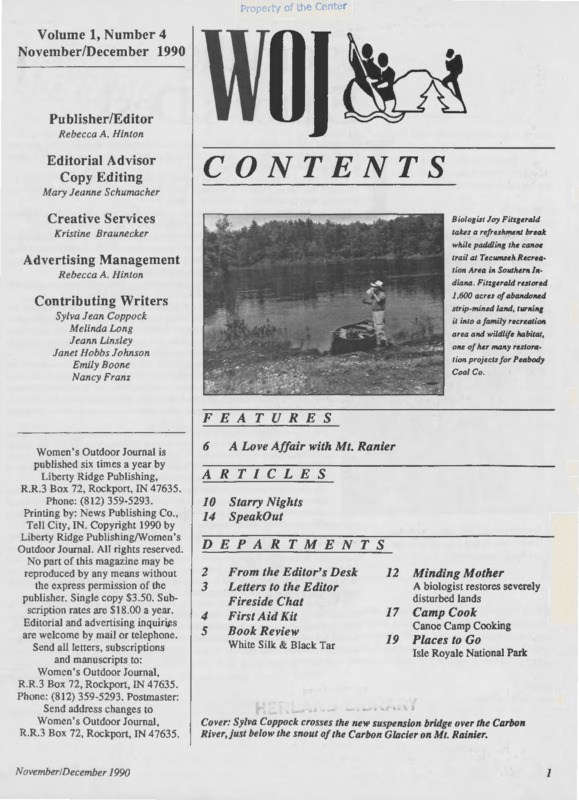
Biologist Joy Fitzgerald
takes a refresh~nt break.
while paddling the canoe
trail at Tecumseh Recreation Area in Sowthern Indiana . Fitzgerald restored
1,600 acres of abandoned
strip-mined land, turning
it into a family recreation
area and wildlife habitat,
one of her many restoration projects for Peabody
Coal Co.
Kristine Braunecker
Advertising Management
Rebecca A. Hinton
Contributing Writers
Sylva Jean Coppock
Melinda Long
J eann Linsley
Janet Hobbs Johnson
Emily Boone
Nancy Franz
FEATURES
Women's Outdoor Journal is
published six times a year by
Liberty Ridge Publishing,
R.R.3 Box 72, Rockport, IN 47635.
Phone: (812) 359-5293.
Printing by: News Publishing Co.,
Tell City, IN. Copyright 1990 by
Liberty Ridge Publishing/Women's
Outdoor Journal. All rights reserved.
No part of this magazine may be
reproduced by any means without
the express permission of the
publisher. Single copy $3.50. Subscription rates are $18.00 a year.
Editorial and advertising inquirir,s
are welcome by mail or telephone.
Send all letters, subscriptions
and manuscripts to:
Women's Outdoor Journal,
R.R.3 Box 72, Rockport, IN 47635.
Phone: (812) 359-5293. Postmaster:
Send address changes to
Women's Outdoor Journal,
R.R.3 Box 72, Rockport, IN 47635.
November/December 1990
6
A Love Affair with Mt. Ranier
ARTICLES
10
14
Starry Nights
SpeakOut
DEPARTMENTS
2
3
4
5
From the Editor's Desk
. Letters to the Editor
Fireside Chat
First Aid Kit
Book Review
White Silk & Black Tar
12
Minding Mother
A biologist restores severely
disturbed lands
17
Camp Cook
19
Places to Go
Canoe Camp Cooking
Isle Royale National Park
Cover: Sylva Coppock crosses the new suspension bridge over the Carbon
River, just below the snout of the Carbon Glacier on Mt. Rainier.
1
From the
Editor's Desk
Joy Fitzgerald, left, shows Rebecca
Hinton how to use a spotting scope
to identify waterfowl.
t's amazing how things evolve. WOJ has just passed the halfway mark in its first year and
already changes are evident. In addition to being the voice of outdoor women, WOJ is proud
to be an outspoken advocate of women's rights.
In that vein, I have created a special column, SpeakOut, for opinions too lengthy for
Fireside Chat. Jeann Linsley, a freelance writer from Seattle, speaks out first about her
frustration with the invisibility of outdoor women.
Also, in this issue, Sylva Jean Coppock, a capricious grandmother from Renton,
Washington, reminds us you're never too old to enjoy the great outdoors.
My mom always used to tell me I was too stubborn to admit when I was wrong (I
told her if I ever was wrong, I'd be the first to admit it!), but, in all fairness, I must
give a hat-in-hand apology to Peabody Coal Co., the world's largest coal producer,
for all the nasty things I've said about strip mining.
Not, mind you, that I now condone strip mining. You could hang me up by my
thumbs and I'd never say that, but I do have to give credit where credit is due.
Twelve years ago, Peabody had the wisdom and foresight to hire biologist Joy
Fitzgerald. As manager of their post-mined lands, Joy is responsible for reintroducing plants, animals and land-use programs to reclaimed mining areas. At a time when
forests and wetlands are disappearing at an alarming rate, Joy is turning thousands of
acres of land into wildlife refuges and recreational areas.
I've spent the better part of a month tagging along behind Joy as she manages her
projects in Illinois, Indiana, Kentucky and Ohio. We've counted waterfowl, checked
food plots, looked for coyotes, examined wetlands, canoed a chain of lakes towing
goose nesting boxes to shore for repair, and began a feasibility study of a "Rails to
Trails" project which will turn a seven-mile unused railroad into a hiking and biking
path.
Joy is an excellent example of how women can excel in corporate America and use
their clout to save the environment. After earning her biology degree, she taught high
school while going to graduate school in environmental studies, specializing in severely disturbed land reclamation. In 1972, she was recruited by the Ohio Department of
Natural Resources as their first woman reclamation scientist.
She has helped Boys Inc. reclaim land and build structures to house a rehabilitation
program for minority young men. As a consultant, she studied environmental
problems relating to mining and helped put together the national guidelines now used
to govern surface mining and reclamation.
Creating safe habitats for wildlife is more than a job for the 43-year-old Appalachian native. "It's my lifestyle," she says. Further proof of that is her 30-acre homestead near
Gentryville, Indiana, located on the road Abraham Lincoln often walked. Joy and her husband, Michael, operate a log cabin bed and breakfast inn. They offer guests meals authentic to Lincoln's day (com cakes and maple syrup and Indian fry bread for breakfast, venison
stew or buffalo steaks prepared over an outdoor wood fire for dinner).
In addition, they are turning their farm into a wood and prairie habitat also authentic to
the mid-1800s, when Lincoln lived there. Guests can take guided or unguided hikes on their
farm and state-owned wetlands behind their home. Eventually, more guest cabins will be
erected and outdoor skills and wildlife interpretation classes taught. Read about Joy's awardwinning work in Minding Mother.
Rebecca A. Hinton, Publisher/Editor
2
Women's Outdoor Journal
Letters to
the Editor
Dear Rebecca,
Thank you for my complimentary copy. I found your journal to be OK. Naturally in your first issue you 're missing
some amount of diversity. I applaud your efforts at putting
together this magazine which I think there has been a great
need for. I'm looking forward to future issues that include
lesbians.
That word was left out of all your articles. "Sex and
Hygiene" said nothing to me. Remember bug repellant on
fingers? Arctic Daughter--another heterosexual slant to
your magazine.
Once you've said the word, I' ll feel included. Now I
wonder why I've been, it seems, purposefully excluded. Are
you homophobic?
D. Baum
Cary, NC
Rebecca Hinton,
I am a woman. I love the outdoors and I sell lots of
women's books and magazines. In fact, Inklings is one of
the top 20 or so feminist bookstores in the U.S.
So why did your first issue infuriate me? Because like all
the other women/sport or women/outdoors magazines, it is
homophobic. It makes lesbians disappear into thin air, as if
we didn't exist.
If you want to run a fashion magazine and assume everyone
is heterosexual, I'll understand. But outdoors?! Let's get
real. If you address outdoor women about "snuggling with
your loved one," and talk only about birth control devices,
you are not addressing a significant part of outdoorswomen.
(I know it was a reprint, but you're still in charge.)
Let me know if you magazine chooses to acknowledge lesbians and I'll consider carrying it. P.S. Good luck, anyway.
P. Anderson
Houston, Texas
I appreciate you pointing out slights, even when they are unintentionally made. Of course, lesbians will be acknowledged and represented.
These two letters give me a chance to state WOJ's position on discrimination. I should have done it earlier,just so there'd be no question.
"WOJ celebrates the diversity ofall women, regardless of color, religion,
sexual preference, age, differently abled, weight and socio-economic
status." We'd like to see women accept our differences and work together
for our common good.
As publisher and editor, I will work hard to make sure each sub-group
gets its share of attention. You can help me by submitting information
about your particular group. But, also understand, depending on space
and availability ofmaterial, each group may not be represented in EVERY
issue. Please don't consider that unless a specific group is mentioned,
that we are negative toward that group. We are all women. We are all
important. Fighting among ourselves divides our strength and dilutes
our power. Don't you agree? Ed.
Fireside Chat~-----. .;i C>
Dear Rebecca,
Have enjoyed your magazine. We have another use for the
bandanna. We needed one to wipe the ears from our eyes
when we laughed so hard we cried. The reason was our
guide, Pat Sterns' (of Orient Trails), rendition of the bull elk's
call during rut, while on a canoe trip on the Wolf River in
Wisconsin. We laughed so hard the tent poles shook as we
tried the wild animal calls we heard.
J. Miller
Paulding, Ohio •
November/December 1990
Dear Rebecca,
My last backpacking trip to the Pisgah Wilderness, specifically the Shining Rock area, was like going to a "happening."
It was VERY crowded! There was much alcohol and beer
use by the horseback riders and we saw only two deer. I suggest people visit the Pisgah Wilderness in the off season-winter.
E. Boone
Louisville, Kentucky
3
F z rs t
Aid
Kl t
inter camping has a lot going for it. It's quiet, uncrowded; there are no bugs,
mosquitos, ticks or snakes; and snuggling in a sleeping bag never felt so good. Armed
with a basic understanding of the cold, it's possible to enjoy camping, hiking, backpacking and even canoeing, year round.
The first line of defense in understanding cold weather is learning the dangers of
hypothermia--an intense lowering of the body's core temperature. Hypothermia
means the body's core temperature has fallen so low it can no longer keep the body
warm. Most people associate hypothermia with falling into frigid water. Actually, a
combination of cool weather, dampness, chilling wind, hunger and physical stress can
cause hypothermia in temperatures up to 50 degrees.
If the body's core temperature drops from 98.6 degrees (normal) to 96 degrees, the
body attempts to generate heat by shivering. Shivering becomes violent and occurs
in waves as the core temperature drops to 91 degrees.
As this occurs, the brain ceases to function normally. Judgment is impaired and the
victim becomes irritable and often denies a problem. Muscular coordination
deteriorates. If the chilling continues, disorientation, sleepiness and incoherence sets
in. If uncorrected, pulse and respiration slow, and unconsciousness and death can
occur.
If trip conditions are right for hypothermia to occur, all trip participants should
learn to keep an eye on each other, especially since denial is generally a symptom.
If someone is suspected of hypothermia, try this test: Mark a 30-foot line on the
ground. Have the person walk heel to toe on the line. If there is stumbling or unsteadiness or signs of disorientation, stop and treat the victim. Test each person in
the group before continuing.
Prevention
Never skimp on clothing on a wilderness trip. Although it may be tempting, especially on a backpack trip where all gear must be carried, it is prudent to include enough
warm clothing for any potential weather condition. Dressing in layers creates an insulating layer of air between garments and makes it easy to add or remove clothing
to stay comfortable.
Rain gear is especially important; so is a hat. A hat hold.s in heat, shades the sun
and deflects rain.
Drink plenty of fluids and eat high energy foods. Rest often enough to keep ordinary fatigue from turning into exhaustion.
Also, you're never too old to use the buddy system--double your pleasure by taking
a companion with you, and keep an eye on each other.
Treatment
TTTTTTT'T''T''T''T'
Once hypothermia is suspected, take steps to prevent further heat loss by getting the
victim into a shelter or out of the wind. Remove wet clothing and redress in dry
clothes.
Have someone get into a sleeping bag to warm it, then place the victim inside the
warmed bag. If the person is extremely cold, zip two sleeping bags together and have
the victim and another trip member snuggle, undressed, inside the bag. If the bag is
large enough, add a third person; one on each side of the victim.
If the victim is conscious, give warm drinks. High-energy food such as candy or
dried fruit is good, also. If no shelter is available, build a fire near the victim, or better yet, one on either side.
Allow ample time for the re-warming process, up to eight hours. Do not move victim until the shivering has stopped and her mind is clear.
Medical attention is advised after a severe bout. Keep the victim warm while
transporting to a medical facility.
By Rebecca Hinton
4
Women's Outdoor Journal
Book
Review
WIIlTE SILK AND BLACK TAR:
A Journal of the Alaska Oil Spill
T
he beauty of Alaska draws many of us to her shores for a visit or
at least for some daydreaming. Page Spencer, a PhD. ecologist with
the National Park Service, was born and raised on these shores.
"White Silk and Black Tar: A Journal of the Alaska Oil Spill" is her
story of the daily activities of responding to the Exxon Valdez oil
spill. It is a mixture of natural wonders and human desecration.
Page's interest in the oil spill was sparked by a plane ride with her brother
several days after the Valdez went aground. She relates the shock of the
visual destruction and the sickening smell of petroleum from the air. She
also tells of the difficulty of returning from the mountains where she spent
her honeymoon to the harmful invasion of humans on the land she loves.
Six days after the spill, Page has moved from a joyful wedding
and honeymoon to spending all of her waking hours battling the
invasion of crude oil on the beaches of the Kenai Fjords National
Park. She is one of many people brought into Seward, Alaska, to
monitor the state of the park shoreline prior to the spill and the
progression and effects of the oil as it arrives.
On a daily basis, she lives the splendor of the Alaskan spring
while discovering animals and vegetation dying in the midst of
oil. She also finds herself in charge of a unit of scientists who personally walk and test miles of beaches, river mouths and rocky
shoreline.
The impact of this work and the increase of human activity wear
on her physically and mentally as weeks pass by. Yet she is dedicated to documenting the damage and assisting with the cleanup
of the land she loves. In the meantime, Page tries to get time with
her new husband, who is also heavily involved with oil spill activities for the park. Together, they try to snatch moments to enjoy
spring in the wilderness amidst the chaos of the spill.
Throughout her oil spill experiences, Page relates the beauty and
interactions of the natural world and the importance of her connection to the earth. Often, she finds herself personally out of
balance with the earth and in tears from the impact of the spill.
She attempts to heal herself by remembering past experiences in
the pristine park, spending time with supportive friends and writing down her thoughts, feelings and discoveries.
Page's account of the oil spill will personally affect anyone concerned
about the welfare of the earth--even to the point of reviewing daily practices
that support oil companies. She is a voice to be heard and heeded.
"White Silk and Black Tar: A Journal of the Alaska Oil Spill" is available from Bergamot Books, P.O. Box 7413, Minneapolis, MN 55407 for
$9.95 plus $1.50 shipping or from WOJ Campstore, R. 3 Box 72, Rockport, IN 47635for$11.45 postpaid.
TTTTTTTTTTT
By Nancy Franz
Women's Outdoor Journal
5
A
Love
Affair
With
Molillt
er
Sylva Coppock, left, and her hiking
companion, Yvette Doolittle, have hiked
nearly 400 miles in Mt. Rainier National
Park.
TTTTTTTTTTTTT
By Sylva Coppock
6
We really didn ' t plan to take up
hiking as a hobby. As with so many of
life's most meaningful changes, it just
happened. I was about midway
through my mid-life crisis when I said
to my friend, Yvette, who is 10 years
my junior, "Let's walk in the March of
Dimes Walk-a-Thon."
She said okay, so we spent $100 each
for hiking boots and another 30 bucks
for daypacks so we could carry our
peanut butter and jelly sandwiches,
and we were off. Twenty miles later,
we had blisters, sore muscles and sunburned noses, but our pledges netted
about $200 for the March of Dimes and
I felt we'd done something good.
Yvette had several hundred dollars'
worth of medical bills during the next
few weeks (bad knees). She still hasn 't
quite forgiven me for going dancing
that night!
It was less than a month before we
started planning a real hiking trip. We
supplemented our basic camera gear
with a few fancy filters. We invested
in a few more pieces of hiking equipment and drove 200 miles to the ocean
where we put 14 miles on our new
pedometers, trudging along the beach
largely without incident.
Unfortunately,
it was so grey and
foggy that the new
camera
gear
stayed in the pack
most
of
the
weekend. Now, if
you've ever been
to Washington,
you know that our
most scenic state
feature is Mount
Rainier. It's not so
famous as Mount
St. Helens perhaps, but is unthe
doubtedly
most photographed and most revered
of Washington's natural wonders.
If you've never been to Washington,
it's worth the trip from anywhere in the
world to see the 14,410-foot mountain,
towering above its Cascade neighbors.
On a clear summer day, it is snowy
white against the brightness of blue
skies, and in the evening looks like a
strawberry ice cream sundae, painted
pink by the setting sun.
After our success with the beach
hike, we decided to explore up around
Mount Rainier a bit, so that summer we
hiked past beautiful 320-foot Comet
Falls adorned with misty rainbows. We
explored Van Trump Park, named for
one of the earliest Mount Rainier explorers.
It was the first time we had seen deer
in the wilds ... a beautiful doe and her
frisky fawn. We wandered through the
alpine flower meadows, committing to
memory as many flower names as we
could identify in the guide book, and
we hiked up to the Paradise Ice Caves.
' That winter I gave Yvette a book for
her birthday, 50 Hikes in Mount
Rainier National Park. That's when
the hiking really began. Since that
time, we have logged nearly 400 miles
on trails within the park, plus many unrecorded miles which we laughingly
refer to as "training hikes."
We've done 38 of the 50 hikes.
We've learned about elevation gain,
having logged well over 50,000 vertical feet. For those statistically inclined, that's the equivalent of
climbing the 14,410-foot mountain,
from sea level to Liberty Cap, several
times.
Of course, I realize we are not the
first to have developed a full-scale fascination with this ancient volcano and
the forested park around what is
known as The Mountain. There are
many who have climbed all the way to
Liberty Cap and Columbia Crest and
Success Cleaver, the ultimate Mount
Rainier climbing destinations.
But, for a 55-year-old grandmother
who took up hiking just a few years
ago, and her friend with bad knees, it's
adventure. When friends ask why we
don't hike other trails, we just reply,
"We're not tired of Mount Rainier
yet."
We have strict rules about hiking
season. We hike only between late
June and late September, attempting to
avoid snow. Once a month is enough,
except for training hikes. Preceding
Christmas, training hikes are always in
shopping malls. One annual ski trip
counts for two training hikes and our
Women's Outdoor Journal
F,\:,pr:rty of the Ct:r,ter
Deet.
season tickets to the Seattle Repertory
We had planned our hike to Camp
Theater assures us six brisk hikes from
Muir, at the 10,000-foot level, for over
the parking lot to the theater lobby.
a year. This was to be our really big
When it comes to real hiking, our
climb. Camp Muir is the base camp for
timing has been incredible. We got to
those who climb the mountain from the
explore inside the Paradise Ice Caves
south side. It is a favorite goal for
just a week before they were ofthose of us who recognize our
ficially closed because of
limitations and consider the sumdangerous ice falls. We arrived at
mit beyond our ability.
Indian
Henry's
Hunting
We were at Paradise, registering
Grounds, at 5,500 feet, in 10 inat the ranger station, at 8 a.m. The
ches of new-fallen snow. Our
view of Nisqually Glacier from
Christmas cards that year pictured deer foraging midst
the Skyline Trail on a ridge above
Alta Vista was inspiring. We lost
snowclad alpine firs.
the trail a bit below Pebble Creek
Sometimes our timing has been
less than perfect. For example,
but soon found it again, and the
the time we got to Longmire
stairsteps in the snowfields above
Campground too late to get a
the creek left no doubt about
which way to go.
campsite. We just parked near a
log building ~nd slept in the back
Looking back, south, across the
Tatoosh range, we could see the
of Yvette's station wagon. Next
glistening crown of Mount Adams
morning, while I was trying to
and the gaping wound in the north
fasten my bra, there was an attractive man in a park ranger
side of Mount St. Helens. We
uniform knocking on the window
trudged upwards for hours, determinedly placing our boots in the
of our makeshift bedroom to tell
The author, Sylva Coppock, crosses a new suspension bridge
us we were parked illegally.
bootprints of those who had gone
across the Carbon River just below the snout of the Carbon
before us.
On a few camping occasions, Glacier.
we've forgotten some things that
At Muir, we were surprised to
ly, "Only another 100 yards to
were pretty important...like forks. But
find ourselves in a crowd of perhaps a
Sacramento."
we just whittled a couple of chopsticks
hundred other hikers and mountain
"Is the bar open?" I wanted to know.
climbers who would go the next day to
out of a split cedar log and used them
At the top of Gobbler's Knob, we
to stab our stew. And one night we forthe summit. Yvette struggled out of her
shared Fritos with Mitchell and the
got and left the keys in the ignition,
pack and produced two very fine crysever-present "camp robbers." The park
locking ourselves out of the car in a
tal goblets and a flask of Bailey's Irish
ranger gave us a lesson on using the
drenching rainstorm.
Cream for toasting our success.
range finder to pinpoint the location of
It was a super test for our new tent,
We spent time working on camera
a forest fire. We shared philosophy and
which, incidentally, failed. It leaked. It
focus, deciding which lens to use and
book recommendations. We talked of
took five rangers and a "Slim Jim" to
discussing f-stop settings. On the way
loneliness, beauty, history and The
down, we learned to glissade in the
get into the Buick that Sunday mornMountain; we were reluctant for the
ing.
snow. Soon we realized it was getting
sharing to end.
More than once we've been put to
late and we had no flashlights. Now we
Almost without fail, the good times
shame when we've grumbled about the
were racing the setting sun and did the
outweigh the bad times. I have had to
difficulty of this or that trail. Early in
last hour of the descent at double time,
continually remind Yvette of that
our hiking careers, we moaned and
signing out at the ranger station at 8
when her knees are screaming out in
groaned our way up to Eagle Peak Sadp.m., exactly 12 hours after we signed
pain, usually on our way down from a
dle, with an elevation gain of nearly
in.
climb. Or, when faced with a suspen3,000 feet in about three miles, to find
Up to this point, our hikes had been
sion bridge midway between camp and
an 80-year-old man hiking with his
limited to one or two days and usually
our goal for the day.
granddaughter.
we were equipped with a daypack, a
It was real hard to remember one inAnd there was one hot, dry July day,
minimum of camping gear, a handful
credibly hot August day when we were
we laboriously worked our way up to
of gorp (good old raisins and peanuts),
both lying by the side of the trail to
Gobbler's Knob. A young man, in his
and about $3,000 worth of camera
Shriner's Peak, suffering from heat exmid-twenties, was alternately carrying
equipment.
haustion and too tired to fight off the
or walking very slowly, to give his
mosquitos that were getting high on
two-year-old nephew, Mitchell, a
hiking experience.
And, laughs? That same day we were
pressing, hoping not to make another
rest stop on the way to the fire lookout
on Gobbler's Knob, when a hiker on
his way down commented, offhanded-
November/December 1990
7
But now we were ready to try a 20mile adventure with a full pack and all
the necessary equipment to survive
three full days in the wilderness. And,
not only to survive, but to hike from
Sunrise on the northeast side to Ipsut
Creek Campground on the northwest
comer of Mount Rainier.
We had consulted our maps and gotten advice from Park Service rangers.
We had carefully planned lightweight
menus and scheduled transportation.
We had packed and weighed and
repacked the backpacks. We even
made a pact not to use makeup for three
whole days so we didn't have to pack a
lipstick.
A friend drove us from Renton to
Mount Rainier National Park and we
arrived at the White River Entrance an
hour before opening time. At the
Hiker's Center, we found the selfregistration information and began the
permit process. We were not happy to
find that the two locations we had
chosen as camp options were already
full at 7 a.m.
Shifting mental gears, we filled out a
permit for Mystic Lake Camp, which
was 11.5 miles from Sunrise, duly
noting the sign about a bear sighting at
Mystic Lake. That would be our Friday
destination. We could only hope that
we would find a campsite at Ipsut
Creek campground when we reached
the Carbon River area on Saturday
night. My daughter was to meet us at
Ipsut on Sunday afternoon to drive us
home.
We waved goodbye to our friend just
before 8 a.m. at Sunrise, hoisted unfamiliar, heavily loaded backpacks
and enthusiastically trudged up the
trail toward a series of peaks known
collectively as the Sourdough Mountains, under cloudless skies.
We covered some familiar trail to
Frozen Lake and just below Burroughs
Mountain into the basin marked
Berkeley Park on our map, where we
joined the Wonderland Trail. The
name promised magnificent things to
see.
Already, mantled ground squirrels
were expectantly watching us for
dropped crumbs or handouts, and in
Berkeley Park we could hear the shrill
8
whistle of hoary marmots. We spotted
several, foraging in rocky meadows.
One big old fellow, looking like the
grandfather of all, supervised a family
of four--mom and pop and two frisky
twins.
We stopped to take pictures and
refresh ourselves with granola bars and
juice, then started up a long ascent
which would take us across Skyscraper
Mountain. We stopped often, purportedly to admire the meadows below,
but in reality to adjust our breathing to
the exertion and higher altitude. The
elevation gain was gradual but, as
usual, our training for this hike (as with
others) had been virtually nonexistent.
As we rounded a bend in the trail at
Skyscraper Pass, the sight of Mount
Rainier was breathtaking in its open
grandeur. A single photograph with a
55mm lens could not begin to take it
all in, so we panned the scene. It took
four shots to capture the panorama.
We stopped to chat with a young
couple who had started at Longmire a
few days earlier and were well on their
way to circling the mountain on the 92mile Wonderland Trail. They told us
that Skyscraper Pass was the highest
point on the Wonderland Trail and we
felt justified pride at having reached
this milestone.
A series of switchbacks brought us
down through a valley lying north of
Burroughs Mountain. And when it was
time for those inevitable peanut butter
and jelly sandwiches, we were resting
beside a small waterfall at bubbling
Granite Creek.
In this cool glen along the creek bed,
the arnica, touched by dappled sunshine, were brilliant yellow-gold; sharing the scene were cow parsnip that
looked like ancient lace and rich green
foliage. We spent an hour photographing the little falls and the flowers.
We had another hour or so in the cool
forest with Douglas squirrels for company before we started down a rugged
ridge paralleling the eastern edge of
the magnificent Winthrop Glacier. The
roar of the glacier defies description,
but imagine the constant roar of jets
overhead or thunder that never ceases.
Rocks cascade over the great icy grey
glacier wall in clattering avalanches.
The trail was rocky and rough. We
worked our way down the mountainside until we no longer looked down on
the glacier but were dwarfed by its immensity. At the snout of the glacier, the
West Fork of the White River rushed
from under the ice with frightening
force, churning and bubbling, leaving
the surrounding rocks coated white
with glacial flour.
We crossed a log foot bridge a scant
100 yards from the visible origin of the
river and worked our way up the edge
of a rocky ravine. Looking back, we
were surprised to see Garda Falls cascading down on the mountain we had
just descended.
Now the sun was directly overhead
and the heat relentless. The glare from
the snow on top of Mount Rainier and
from the glacial ice on Winthrop
Glacier prohibited picture-taking. We
concentrated on the trudge toward a
wooded area we believed sheltered
Mystic Lake.
The heat was intense and we were
beginning to feel ill from fatigue. Our
rest stops were longer than the hiking
between. We kept assuring ourselves
that Mystic Lake was just a few
minutes away. It wasn't.
We looked up at Old Desolate and
tried to fight down the fear that our
goal might be somewhere beyond that
imposing wall of rocky mountain. We
were now climbing southeast and nearing another wooded area. Surely Mystic Lake was tu.eked amidst the trees.
But, after another half hour, we again
walked into a rugged, rocky area much
like the terrain around the tip of
Winthrop Glacier. The sound of rushing water told us we were to cross yet
another stream.
According to the map, Winthrop
Creek came from beneath the glacier
farther up on the mountain. Some distance ahead, we could see another
patch of forest that promised to shelter
the lake and we pressed on--now fearing darkness might descend before we
found a campsite.
We found Mystic Camp before we
dared hope we were near the lake, and
we stumbled in to secure the last available campsite. We had beaten the darkness. After the tent was up, we warmed
Women's Outdoor Journal
were no empty sites. Filled with
Creek through a narrow pass, stopping
dinner and belted down a foamy Tab in
numerous times to admire the brilliant
despair, we vowed this would be the
a double shot of Bacardi rum.
stands of red monkey flowers that borgrand finale to our hiking careers. We
Suddenly, we discovered we still had
had pushed ourselves to the limit
enough strength and daylight to
of our ability, and we were still
find Mystic Lake. The trail sign
two miles from the next camping
read, "Mystic Lake .2 miles." It
option.
didn't say the .2 miles was a very
We tried to submerge our hot
long, very steep flight of cedar
aching feet in the water below the
log stairsteps.
falls, but discovered it was boneIn the evening light, Mineral
chilling cold. But a little later,
Mountain, Rainier, Skyscraper
rested and refreshed, we arranged
Mountain and Old Desolate were
to share a campsite with other
clearly reflected in the beautiful
hikers, heated some soup, and
emerald-green waters of Mystic
were in our sleeping bags by 7
Lake. The quiet made one relucp.m.
tant to speak at all.
The two-mile hike into Ipsut
Back at the campsite, we hung
our food out of reach, out of
Creek Campground the next
deference to the reported bear
morning was easy and we arrived
several hours before our transporsighting at Mystic Camp early in Skyscraper Mountain is reflected in the pristine waters
tation out of the park was
the week. Secretly, we hoped the of Mystic Lake.
bear might help himself so we
scheduled to arrive. We had
rested only briefly when we
didn't have to pack so much the
dered the creek bed. A huge flat rock
next day.
decided
to have a look at Ipsut Falls.
just below a small falls provided the
We were ready to strike camp about
Shouldering our backpacks again,
perfect table for lunch.
8:30 a.m .. The view of Mount Rainier
we climbed the quarter mile through
Below the small, tumbling falls at
from the Mystic Lake ranger station
moss-carpeted forest up to the falls.
Dick Creek, the trail was rocky and the
was unprecedented in all our hiking
We had lunch and watched unencumgoing slow. On the right, above us,
experiences, and we spent an extra half
bered campers scramble easily over
were the rocky walls of the Northern
hour photographing the rugged feathe great logs and rocks at the base of
Crags. The glacier was just to our left
tures of the Willis Wall in the morning
the falls to get a closer look. Our first
and in full view now. Somewhat less
sunshine, despite glare on the snow. As
sighting of a pine marten made the hike
noisy than the Winthrop Glacier and
anticipated, the pictures were terseem special, but we were ready to go
perhaps less impressive in size, it was
minally overexposed.
home.
nonetheless attention-grabbing. It was
Wonderland Trail circled around the
As we cooled down, the leg muscles
difficult to watch one's step and the
eastern and southern shores of the
tightened up and the shoulders would
rockslides cascading down the sides of
beautifully reflective lake, and then
no longer tolerate the straps of the
the glacier.
began a gradual ascent over a pass that
backpack. Yvette's knees were ready
Up ahead, not far below the snout of
led to Moraine Park, above the eastern
to buckle and we discussed alternative
the glacier, I remembered a suspension
edge of the Carbon Glacier. When we
.. .ceramics, perhaps. Somehobbies
bridge. We had crossed that bridge
stopped for a snack, midst alpine trees,
how
nothing
in the world seemed more
several years ago, as it swung heartClark's Nutcracker Jays were so agimportant
than
an icy cold Tab, our
stoppingly over the rushing waters of
gressive they took crackers from our
drink
of
choice,
and a hot bath.
the Carbon River originating under
hands and flapped about our heads anBack
at
the
campground,
we dropped
that mighty glacier.
noyingly.
the backpacks and waited, envying the
My recollections were of broken and
The open meadows were filled with
campers and hikers leaving for home.
missing boards, loose cables and overflowers: fading purple asters, brilliant
We played cards to pass the time and
whelming waves of nausea. It was a
red Indian paintbrush, the snowballtalked about the flowers, the trees, the
welcome sight to see that old bridge
shaped heads of the yampah, and dark
animals, The Mountain and how much
had been replaced with a new one,
we were going to miss these experiendusty blue pleated gentians. The
beautifully braced with shiny new
thistles were filled with bees.
ces when we gave up hiking.
cable and evenly spaced footing.
We were soon up and over the ridge
Next month we're going to climb
The Carbon River Campground was
and descending sharply into a beautiMount St. Helens.
practically hidden in the trees above a
ful meadow identified on the map as
beautiful falls on Cataract Creek,
Moraine Park. This was to be our last
where it joins the Carbon River. We
spectacular panoramic view of the
were eager to establish camp, but there
mountain. We followed Moraine
November/December 1990
9
s
H
By Melinda Long
uman nature always
strives to bring order out
of chaos, and nothing
seemed more chaotic to
primitive people than the
sky with its thunder and lightning and
mysterious eclipses. Ancient people
searched for explanations to escape
10
YNIG---- s
their feelings of vulnerability. They
did not believe in accidents or coincidence. Most of their knowledge
about the stars was based on superstition. Although this method of reasoning was crude, it proved useful. A
calendar was established. Astrology
was born. The invention of gods and
demons in the heavens who fought for
control over humankind was the basis
for religion.
Great drama of 5,000 years is played
out in our starry skies every night. For
us in the Northern Hemisphere, the Big
Dipper is the ringmaster of this celestial show. It is our guide not only to
Polaris, our north star, but also to
several bright stars and constellations.
Polaris is at center stage and it has
a supporting cast of five constellations
Women's Outdoor Journal
made up of "cjrcumpolar" stars. Because of the Earth's rotation, constellations
appear
to
rotate
counterclockwise around the sky.
While constellations farther away
from Polaris set below the horizon at
different times of the year, circumpolar constellations never do.
The Big Dipper is part of a circumpolar constellation called the Big Bear
(Ursa Major). The two stars at the end
of the Big Dipper's bowl are called
"pointers." An imaginary line drawn
through these stars leads to Polaris.
One legend says that the Big Bear
would like to take Polaris for herself
because the brightness of Polaris
matches the brightness of her own
seven stars in the Big Dipper. But
Polaris belongs to the constellation
Little Bear (Ursa Minor). The Little
Dipper is part of this constellation as
well. It is the two stars at the end of the
Little Dipper's bowl that guard Polaris
and they are called "guardians." We
are lucky to have a Pole Star such as
Polaris. It is only one-half of a degree
off the direction of true north.
Another circumpolar constellation is
the Dragon. It is dim, but can be found
between the Dippers as it winds its way
upward toward the bright star Vega.
The Dragon played a major role in
dramas of the past. A star near its tail
named Thuban was the Pole Star
during the time of the ancient Egyptians. Several pyramids were built with
Thuban as their focal point.
Two other interesting circumpolar
constellations are Cepheus and Cassiopeia. Cepheus was the African King
of Ethiopia and Cassiopeia was his
vain and boastful wife. Once,
Cassiopeia's bragging angered the sea
nymphs. They persuaded Poseidon,
the God of the Sea, to avenge them.
Poseidon sent a terrible sea monster in
the form of a whale called Cetus to
destroy the royal couple's kingdom. In
an attempt to appease the terrible
monster, Cepheus and Cassiopeia ultimately offered their daughter,
Andromeda, as sacrifice to end the
monster's destruction. They chained
Andromeda to a rock near the shore.
As the monster was closing in, her fate
was spied by Perseus who was returnNovember/December 1990
ing from an adventure where he had
slain Medusa. Riding his winged
horse, Pegasus, Perseus flew down and
rescued Andromeda.
The whole cast of this tale can be
seen in the autumn skies. As if to insure their eternal protection of
Andromeda, she is located between
Perseus and Pegasus. Andromeda
touches the Window of Pegasus that is
part of the winged horse's constellation. This Window of Pegasus or the
"Great Square" allows the naked eye to
see great distances toward the edge of
our galaxy. The Great Square can be
found from the Big Dipper by the two
top stars of the bowl with lines running
through Polaris past Cassiopeia.
By neglecting to mention many great
constellations and for not giving all a
fair star billing in this review, I fear the
gods will reign havoc on me. Yet for
the sake of brevity, I mention only
those constellations that contain the
brightest stars in our hemisphere to aid
in fruitful stargazing.
A diagonal line through the Dipper's
bowl leads to the winter constellation
of Gemini. Two bright stars side by
side mark the heads of the twins. Under
the Twins, Orion is found. Once you
have found the three bright stars in
Orion• s belt, he will never be hard to
spot again. And this "belt of stars"
guides us to Sirius, the brightest star in
our sight, which is part of Canis Major,
the Big Dog constellation. The bright
star on Orion's shoulder, Betelgeuse,
leads to the star Procyon in Canis
Minor. These constellations are said to
be Orion's hunting dogs. Orion was the
Great Hunter and he has been a faithful friend to sea navigators for centuries.
Starry nights are not only entertaining, but they are useful for orienting
direction as well. Polaris is the best
reference point for finding the northern
direction. You can still find Polaris
even if the Big Dipper is hidden. The
top of Orion points toward the direction of the Pole Star. And if you are
familiar with Leo, the Lion, you will
always find Polaris above his back.
Even without using any of the constellations, you can orient yourself by
selecting one star and watching its
movement for a few minutes. A way to
do this is to lie on your back under a
tree and find a star between the
branches that is near the zenith
(straight up). As the Earth rotates, you
will notice in your reference area between the branches that the motion of
the star is westward.
Not a whole lot has changed since the
days when ancient people looked to the
sky for an understanding of their
world. We still look to the skies for
guidance ourselves. We watch unfolding weather conditions, enjoy dramatic
sunsets, marvel at rainbows and wish
on falling stars. And a good thing about
it all is, it's free.
11
Minding
Mother
en Two Wrongs
MakeARight
Unruly auburn curls scramble from beneath the wide-brimmed hat. A
plaid wool shirt covers the strong shoulders and angles down into slimhipped Levis. Long legs, laced to the knee in leather boots, stride with purpose toward two hunters.
The men are trespassing, holding guns. She is a woman, alone, armed only
with a can of Mace and a hunting knife strapped to her belt.
Joy Fitzgerald is a formidable presence.
Her tanned hand pushes back the hat to expose crinkling hazel
eyes and a grin that splits the face. She reaches out her hand. Her
handshake is firm, tight.
Maybe not so formidable after all.
Fitzgerald has taken on an awesome project--to tum 1,600 acres
of abandoned, strip-mined land into a wildlife habitat and recreation area. Most say it can't be done. Many say she's crazy to even
try.
Fitzgerald is used to doing the impossible. As a biologist whose
expertise is healing severely disturbed land and making it productive again, she has devoted her life to making rights out of wrongs.
Joy Fitzgerald records
waterfowl sightings during fall
migration.
TTTTTTTTTTT
By Rebecca Hinton
12
At the Tecumseh mine site in Warrick County, Indiana, two great
wrongs had been committed. First, fifty years ago, strip mining
had cut ugly deep gashes into the land. It was planted in trees and
abandoned. "Rape and run," Fitzgerald describes strip mining before the
1977 Surface Mining Control and Reclamation Act required surface-mined
land to be returned to its original contour and use.
Secondly, the wilderness had turned into a haven for outlaws, drug dealers
and trespassers. Crime was getting out of hand and the Warrick County
Sheriff demanded the landowner, Peabody Coal Co., do something about it.
It became Fitzgerald's project.
Fitzgerald had one thing working for her at the site--Mother Nature had
been quietly licking her wounds, breathing life back into the mine-ravaged
land. She could see why people were attracted to its wildness.
Fitzgerald's first act was to camp on the land, alone, for days. She walked
the land and paddled the lakes, opening her senses. She felt the spirit of
Tecumseh, the Indian chief for whom the mine was named, whisper through
the pines and a peace settled over her. She had a vision of what it should
be.
Nature had done its work well. Water filled the numerous pits (enormous
trenches from which coal had been removed) forming a chain of serene
lakes. Trees were reaching maturity. Wildlife found a refuge in the safety
of the abandoned land.
However, because the land was perceived as wasteland, no one cared
Women's Outdoor Journal
enough to save it. It had become an unofficial landfill. Trash and abandoned
cars littered the landscape. There were no roads, only rutted trails cut by the
four-wheel-drive mudrunners and off-road motorcyclists. Drug dealers made
deliveries in the wooded privacy and users left spent syringes on the ground.
"I knew it wouldn't work for me to go in there and play cop," Fitzgerald
said. "There was no way one person could keep anyone out of the area. I
knew a lot of good people were attracted to its beauty and wildness and were
concerned about the environment. I had to attract them. My philosophy was
to reward responsible behavior to the extent that it discouraged bad behavior.
I wanted to show them Peabody cared, but more than that, I had to show them
Joy Fitzgerald cared."
She talked to everyone who would listen about her plans--adjoining landowners, local sporting clubs, even trespassers who came onto the property to
hunt and fish. "I'd go up to them, shake hands, share my vision and ask for
their input. I'd always get their name and would write them a thank-you note.
Once they realized they could use the area if they followed the rules, they
wanted to help."
Fitzgerald talked so much she was hoarse when she went home at night, but
she got the support she needed. Most people, it seemed, were concerned
about the crime, and wanted to help her stop it.
Volunteer groups converged on the area. Their first job was to clean up the
grounds. Tons of trash was removed, three miles of roads were built, boat
ramps installed, weeds and grass mowed. Toilets and picnic tables soon
dotted the landscape. A canoe path was created, along with two hiking trails
and a horse trail. The eight major lakes were ready for fishing.
A permit system was set up to limit the number of users and to keep out
people who refused to follow the rules. Volunteers were rewarded with permits and their own campsites.
"Once the land was cleaned up, the area's perceived value went up,"
Fitzgerald said. People began policing the grounds themselves, taking pride
in their creation. Trespassers and crime dwindled and it became a safe place
for families.
Once the initial work was finished, she began doing what she loves the
most--creating wildlife habitats and teaching grassroots biology to her volunteers. It's easy to learn from her. Her voice rises in excitement as she
describes the wildlife that inhabits the recreation area. She helped the volunteers stock the lakes and encouraged non-consumptive uses such as hiking,
wildlife photography, bird watching and scuba diving. She initiated projects
to encourage waterfowl nesting and led programs to plant grasses for wildlife
habitat.
You'll see a lot of women and children at the Tecumseh Recreation Area.
Fitzgerald only introduces land-use programs which include women and
children, because when they are present, the groups are less confrontational,
less trash is left and less land abuse occurs.
Through it all, Fitzgerald has been a constant presence at Tecumseh--talking, encouraging and working alongside her volunteers. Although she also
manages other wildlife reconstruction areas in a four-state area, you can often
find Fitzgerald at her base camp on the shores of L3ke Tecumseh, communing with the spirit of Chief Tecumseh. And on clear, starry nights when the
wind is still and paddling is good, you may also hear the soulful sound of her
harmonica floating across the water.
Her tanned hand pushes
back the hat to expose
crinkling hazel eyes
and a grin that splits the
face. She reaches out her
hand. Her handshake is
firm and tight.
"Y"Y"Y"YTT"Y"Y"Y"YTTTT"Y"Y
Joy Fitzgerald recei11ed the Wildlife Consenationist of the Year Award from the National
Wildlife Federation in 1978, and in 1987, Indiana's Isaac Walton League presented her their
State En11ironmental Achie11ement Award. Most recently, she was the 1988 recipient of the
Warrick County Chamber of Commerce Community De11elopment Award/or her work with
the Tecumseh Recreational Area.
November/December 1990
13
SpeakOut
OneOutdoor
Woman F. ts Back
omen in the wilderness. A perfect story idea. Or at least, I assumed it was.
From my own perspective as a veteran backpacker, news reporter and observer of women's issues, I had noticed that women's wilderness and adventure travel groups had been surfacing with regularity across the country.
Women have had their own hiking and climbing networks for years. But
just recently, it seemed to me, these groups had gained an element of sophistication and popularity that had placed them more in the public eye. No less
a popular culture publication than People magazine had run a story about
one Seattle-based group in a 1989 issue.
Some of these groups seemed to have a unique, woman-oriented
philosophy about outdoor leadership. Some were challenging the methods
of more traditional outdoor schools like NOLS and Outward Bound.
The stories behind some of the groups were inspiring and unique. The 40year-old founder of one Northwest outdoor group got her start by arranging
the first all-woman bike tour of China. She now is organizing an all-woman
hike in the Soviet Union, and an all-woman African safari. A first and only,
to be sure.
The sport of backpacking--declared by some mass media stories to be on
the downswing among the general population--is booming among women
who sign up for trips organized by one large Minneapolis-based women's
outdoor group, its director told me earlier this year. Definitely worth exploring in a feature story, I thought.
In addition, women (including myself and many I've talked with) seem
fascinated by outdoor books that have been written by and about women:
Annapurna: A Woman's Place, Nanda Devi, Women in the Wilderness.
I decided to present my idea to the regional editor of a national outdoor
magazine. We arranged to meet to discuss my great idea.
Once we had slipped past the niceties of our initial meeting, sipped some
tea and talked a bit about outdoor subjects, he wondered out loud, "Are
women in the wilderness worth a story? Do our female readers really want
to read about women in the outdoors?" he asked, incredulous. "Is it an
TT-YT-Y-Y-YT-YT-Y
By Jeann Linsley
14
issue?" A footnote, perhaps, but not a big feature, he concluded.
I disguised my disappointment. Then the editor continued on the theme.
Women's Outdoor Journal
Some women had written in to protest a cover photo in his magazine which
showed a woman standing in a field of wildflowers, he said. The woman was
clearly in a mountaineering situation, so the photo shouldn'lhave been offensive, in his view.
Still in a stew about my story idea flop, I was only half listening. Clearly
concerned about the issue, the editor persisted on his theme. Had his
magazine given women a raw deal? Was the cover photo a sexist statement?
He wanted to know.
I looked at the photo, not visibly disturbed by the portrayal. But thinking
about a larger issue. Like my story idea. Defend it--now; don't throw in the
towel.
Help me, Sisters, I thought. At times like this, even the boldest, outdoorsiest feminist spirit withers and dies. The malaise of the tired feminist sets
in. "Feminist fatigue," to borrow a phrase from Boston Globe columnist
Ellen Goodman.
Ah, yes, feminist fatigue. A familiar feeling. Like when I must explain to
my elderly uncle why I really don't like to be whistled at or called "girl" by
a bunch of execs in an elevator.
Or telling Dad for the thousandth time that women really are able to serve
in the military. Or telling mom that I really am capable of spending a week
on the trail, alone, with only my pack for company. The temptation was great
to head out the door, strap on a pack and hit the trail. A long trail. Away from
Alright pal, so
what's to argue?
I'll tell you what
the issue is. It's
women who feed,
clothe and mother
their men on a
daily, hourly
basis, who
manage a home,
a super career,
kids, pets and .
houseplants, who
clean the toilet,
sink and
bathroom bowl,
and manage to
keep their grey
hairs covered
while still making
less than half the
average wage that
men make.
editors.
My mind trundled through several would-be strategies. Among them the
hostile approach:
Alright pal, so what's to argue? I'll tell you what the issue is. It's women
TTTTTTTTTT
who feed, clothe and mother their men on a daily, hourly basis, who manage
a home, a super career, kids, pets and houseplants, who clean the toilet, sink
and bathroom bowl, and manage to keep their grey hairs covered while still
making less than half the average wage that men make.
Look at the studies, pal. Women polled in recent university studies worked
just as hard at their careers as did men, and still did the bulk of the
housework.
Look at the pay statistics: women still earn less than half what men earn.
And women who graduate from college make, on the average, lower salaries
than men who have only high school diplomas.
Look at the editorial boards and top management at most major
newspapers across the country. Outdoor groups are the same. Most of the
top executives are men.
And, yes, while we've come a long way baby, whether in the outdoors or
in the executive suite, we' re still often portrayed as smiling ,fragile lifeforms.
Indeed, all too often, the woman may be wearing a doctor's coat, carrying
a lawyer's briefcase or hoisting 60 pounds of gear on her shoulders, but still
fumbling for the mascara, pantyhose and lipstick.
November/December !990
15
Take a stroll to the magazine rack. You might count 15 or 20 glossies with
wispy suntanned beauties smiling seductively, blowing kisses or just being
sexy for the camera. You might count three or four with smiling, seductive
male models.
Take a look at some random publications. Yes, even outdoor magazines. I
recall vividly the ad recently run in a local Seattle water sports publication-cutesy blond in bathing suit carrying outboard motor. I mean, get real.
What did this babe (or more rightly, her editors) have in mind? A beachblanket boat blast?
Take a look at television. You might still find the brunette bimbo caressing the carpeted seats of a four-wheel drive. Yeah, pal, I'll tell you what the
issue is. Women--yes even women in the enlightened 1990s, even strong,
capable, backpacking and mountain-climbing women--sometimes get tired
of sexism and inequality. Some are still tired of taking care of their men.
So what's the relevance to backpacking and the outdoors? Some women
(I'm not saying all) are getting into getting away from their men. To have
some sisterhood. Talk women's issues. Preach to the converted.
Some simply want to get together with other women. Not to trash men, but
to, well, do a little female bonding. To feel strong and competent on a mountain trail. To heft big packs, to figure out routes, without the temptation of
having the man help out.
Most important, they want to read about it. And the writer tailormadefor
the job is sitting right here in front of you, pal.
Nah, I thought. Too strident. Not good for the cause. Besides, the Amazon
warrior approach might poison the well for good. As an outdoor writer
wanna-bee, I couldn't risk that.
I left the office, took a deep breathful of big Northwestern forest air and
pondered our conversation. What I will say, for the record, is this:
I have no gripe with this magazine. Maybe my- sisters do. Perhaps some
of us look for oppression where none exists. But, give us a break. We've got
a collective chip on our shoulders. But that's only out of collective weariness.
We're tired. Too much time battling the "one-down" position, seeing our
sisters in scanty dress toting outboard motors or blowing kisses from RVs.
Listening to one-too-many jokes about jugs or bullet-boobed bathing suits.
If we get defensive about the fragile flower smiling out from the cover of
some magazines, have sympathy. If I get hostile defending my story idea, try
to understand. Chalk it up to feminist fatigue.
16
Women's Outdoor Journal
Camp
Cook
FIVE-STAR
CANOE
COOKING
By Janet Hobbs Johnson
P
iz~a wi~ z~cchini. Brow~ies ~i~ c~shews. Walleye
with wtld nee. Sounds like dmmg m your favorite
five-star restaurant. Would you expect to dine so
well on a canoe trip? These dishes are regular items
on our family's menu when cooking on the trail.
With a little planning, nutritious, close-to-gourmet meals
can easily be prepared on the trail. First, check camping
supply stores, supermarket shelves and neighborhood co-ops
to find out what foods are available and then plan your
menus.
Keep in mind that the food pack is always the heaviest at
the beginning of the trip. Many parks restrict bringing in
cans, bottles and other nondisposable containers. Know the
regulations of the park you are going to visit before you plan
your trip.
Camping supply stores carry a wide assortment of freezedried foods, many prepackaged for entire meals. Although
the packaged foods are convenient, they are expensive.
However, powdered eggs are difficult to find anywhere
else. We try to avoid using eggs by buying mixes that require
only liquid for preparation. If powdered eggs are used in biscuit or cake mixes, add more water than the recipe calls for
to rehydrate the eggs.
Supermarkets carry dried fruits and vegetables, ready-toeat cereal mixes, breakfast bars and prepackaged dinners.
Many mixes, such as biscuits, cornbread, gingerbread, cakes
and brownies, need only liquid for preparation.
Instant coffee and teas of every description beckon from
the shelves. Fruit-flavored drink mixes such as lemonade
remain the standard drink for canoers.
Bacon bits and a . Jriety of sausages which require no
refrigeration are also found on grocery shelves. Canadian
bacon and pepperoni slices are in the meat department.
Neighborhood co-ops are wonderful places for canoe
campers--offering jars of spices, dehydrated vegetables and
fruits such as carrots, green peppers, mushrooms, apricots,
bananas and pineapple. Bins overflow with dried beans,
peas, nuts and flour and vegetable pasta.
We carry a few fresh potatoes, carrots, zucchini and onions
November/December 1990
Susan Johnson, the author's daughter, bakes a batch of sweet
rolls in a Dutch oven. Photo by Gt!rluirdl. Joh11Son
in the bottom of our food pack. For us, the extra weight is
worth having some fresh vegetables after a few days of dried
foods.
For breakfast, our old standbys are oatmeal, pancakes,
orange-flavored drink mix with vitamin C, coffee, tea and
cocoa. If we have time, we make coffeecake in the Dutch
oven using muffin mix topped with dried fruit or cinnamon
and sugar.
Lunch is any combination of cheeses, summer sausage,
hardtack, peanut butter, granola, gorp, candy bars, dried
fruit, nuts and fruit-flavored drink mixes. Sometimes, we
heat water on a small, portable stove for hot drinks or instant
soup.
Supper presents more of a challenge. If your family members are not big meat eaters, meal planning for a canoe trip
is easier. If you like meat, take along plenty of summer
sausage, dried pepperoni and bacon bits. We often take hotdogs or pocket stews prepared at home for the first night out.
The many kinds of vegetable-flavored pasta now available
add a gourmet touch to spaghetti and macaroni and cheese.
Dehydrated hashbrown potatoes or wild rice prepared with
dehydrated onions and mushrooms complement either fresh
fish or fish baked in aluminum foil over the coals. It's like
"eating off the land" to feast on wild rice with freshly caught
walleye and muffins made with wild blueberries.
Breads and desserts made in the Dutch oven round out the
main dishes. If you must have bread, try the small loaves of
white, wheat or rye cocktail bread, which travel better than
regular bread. Our favorite desserts are brownies, spice cake
17
and gingerbread made in the Dutch oven.
When we pack for a trip, we place each item in a plastic
bag. "In one of those little plastic bags" has become a family canoe trip joke. Extra plastic bags come in handy. Too
often, little critters chew holes in a bag of granola or gorp,
making a mess of the food pack.
Eitherthe self-lock type orregularplastic bags can be used.
All non-burnable trash needs to be carried out, including
twisters. Plastic bags long enough to be tied avoid the need
for twisters.
Food packs can be organized in many ways. Some canoers
like to put everything for a meal or everything for one day
together in one large bag. We put similar items together:
breakfast fixings in one bag, lunch fixings in another bag,
dinner fixings in the third; drink mixes in a bag, spices in
another. Three unbreakable plastic jars with screw-on caps
hold margarine, shortening and peanut butter.
The following recipes satisfied my husband, daughter, sonin-law and me on a recent canoe trip and elicited this
response from my son-in-law: "I never knew you could eat
so well on a canoe trip." Accustomed to eating "mostly
macaroni and cheese with the guys," he was surprised with
the delicious meals we concocted over the open campfire.
Dried onion, dried mushrooms, dried green pepper, garlic powder, parsley
Salt and pepper
Combine tomato soup, water, spices and dried vegetables and let stand for
a few minutes to rehydrate the vegetables. Make crust from biscuit mix,
following directions on package. Spread in greased Dutch oven. Place zucchini and pepperoni slices on crust. Add rehydrated vegetables. Pour on
tomato sauce. Place cheese on top. Cover and bake over hot coals until
cheese melts and crust is browned. Makes 2 pizzas, one at a time in Dutch
oven.
One-Pot Stew
2 quarts water
2 cups dried carrots, peas, beans, potatoes
2 Tablespoons dried onion
1 Tablespoon dried green pepper
1/4 cup dried mushrooms
4 teaspoons bouillon or 4 bouillon cubes
1 package gravy mix
Salt and pepper to taste
7-oz. package biscuit mix or 1 1/2 cups Homemade Muffin Mix
1/2 cup milk
Combine water, dried vegetables and bouillon. Let stand 15 minutes to
rehydrate the vegetables. Bring to boil. Add gravy mix and salt and pepper
to taste. To make dumplings, combine biscuit mix and milk. Drop by spoonfuls into hot, simmering stew. Cook until dumplings are done.
Pocket Stews
For each pocket stew:
1 or 2 strips of bacon
1 hamburger patty
Slices of potato, carrot, green pepper, onion
Salt and pepper
Lay bacon strips on individual pieces of heavy-duty aluminum foil. Place
hamburger patty on bacon, and vegetables on top of patty. Sprinkle with
salt and pepper. Wrap bacon strips over top. Fold and seal foil. Cook over
Chili
hot coals 10 minutes on each side.
spices and sausage. Bring to boil. Simmer for 30 minutes.
Spaghetti
Homemade Muffin Mix
16-oz. package spinach fettucini
4 packages instant tomato soup
4 cups water
Dried onion, garlic powder, marjoram, oregano, parsley, salt, pepper,
sugar to taste
Parmesan cheese
Sliced pepperoni or sausage chunks, if desired
1 cup dried kidney beans
4 packages instant tomato soup
6 cups water
Dried onion, chili powder, garlic powder, salt and pepper
1 cup cut-up sausage, if desired
Soak kidney beans in water to cover, overnight or all day. Drain. Cover
beans with fresh water and cook until soft. Add tomato soup mix, water,
2 heaping cups flour
1/4 cup sugar
4 1/2 teaspoons baking powder
1/2 teaspoon salt
1/3 cup powdered milk or powdered buttermilk
Combine ingredients. Store in plastic bags. Makes 3 cups of mix. 1 1/2 cups
Combine tomato soup, water and spices. Bring to boil. Simmer while cook-
of mix equals one 7-oz. package of purchased muffin mix. To use, combine
1 1/2 cups mix with 1/2 cup water or milk and 2 Tablespoons softened mar-
ing fettucini. Cook fettucini until soft, drain and add tomato sauce. Sprinkle
with cheese.
garine or butter.
Pizza
4 packages instant tomato soup
2 cups water
Gourmet Brownies
1 package brownie mix
1/2 cup unsalted cashews
1/2 cup chocolate chips
2 7-oz. packages biscuit mix or 3 cups Homemade Muffin Mix
Mix brownie mix according to directions on package. Fold in cashews,
(see below)
available from co-op. Bake in Dutch oven until batter springs back to touch.
Sprinkle chocolate chips over warm brownies. Let stand a few minutes,
then spread with a knife.
2 cups cut-up cheese
10-oz. package pepperoni
2 small zucchini, peeled and sliced (optional)
18
Women's Outdoor Journal
Places
t
0
Go
In the northwestern part of Lake Superior is Isle Royale, untouched by
motorized vehicles and visited only by
ferry, private boat (over 20 feet), or
plane (private or chartered).
Isle Royale is rugged, unlittered and
dynamic with 166 miles of foot trails
traversing its 45-mile length and 8.5mile width. It is 73 miles from
Houghton, 56 miles from Copper Harbor, both on Michigan's Upper Peninsula, and 22 miles from Grand Portage,
Minnesota.
Ferry transportation is available
from mid-May through October. There
is no public telephone service. No pets
are allowed. Rock Harbor Lodge is
operated by the Nat~~:1al Park Service
(NPS) and is the only available paid island accommodations.
Recreational activities include backpacking, boating, camping, canoeing,
fishing, hiking, kayaking, photographing wildlife, portaging, scuba diving
November/December 1990
(requires preregistration at ranger station), and swimming (if you like 50degree water).
At 19 of the 36 designated camping
areas, there are a total of 88 screened
wooden shelters, each with a picnic
table and campfire area. These shelters
are located at the coastal, harbor, bay
and cove campsites. There are no
camping fees or park entrance fees.
The ferry is the main expense, costing between $25 and $37 for an adult
one-way fare. One-way fares for handcarried boats range from $12 to $15.
Ferry reservations are essential.
Upon debarking, the friendly park
rangers give an orientation talk and
issue each person a camping permit
outlining your itinerary (which you are
free to change during your trip).
Detailed topographical and nautical
maps are available for purchase along
with some camping supplies at the
TT TT TT TT TT
store.
By Emily Boone
Emily Boone takes advantage of
calm seas to kayak the harbors of
Isle Royale National Park. The park
is located in Lake Superior north of
Michigan's Upper Peninsula. Boone
is an adventurer and social worker
form Louisville, Kentucky.
19
We embarked on our Isle Royale
kayaking trip from Copper Harbor and
for 4 1/2 hours enjoyed one of the
smoothest crossings possible. It was a
welcome rest after packing and loading our 130-pound kayaks onto the
upper deck of the Isle Royale Queen
III. Lake Superior is known for its unpredictability and rough seas occur frequently, so be prepared for
seasickness.
Upon landing at Rock Harbor, I was
amazed at the clarity of the water and
saw a school of herring 40 to 50 feet
below our kayaks. The extremely calm
weather (seas at less than one foot) permitted us to paddle around Blake
Point, the eastern tip of the island,
which can be very dangerous because
of unpredictable waves.
Relieved that we had avoided the
most difficult portage on the island (.8
mile, 175-foot climb, extremely
steep), we overlooked the significance
of the white buoy marking the
Monarch shipwreck of 1906. There are
10 buoys marking other shipwrecks
around the island between 1877 and
1947. The shipwrecks are popular with
scuba divers, even in the frigid Superior waters.
Two miles further, we located a
serene shelter at Duncan Narrows and
stayed there two nights as the rains fell.
On the third day, we got a short taste
of what paddling is like in one-meter
waves on open Lake Superior. Belle
Isle was a welcome sight after two
short portages (.3 mile) and a
windward paddle.
The next day, the excitement of twometer seas and winds gusting up to 30
knots left us exhausted by the time we
found shelter at McCargoe Cove. From
there we began serious portaging (3.5
20
miles) and the most strenuous part of the
trip. The inland portage trails revealed
the beauty and solitude of this wilderness. We had several pleasant encounters with wildlife--moose, fox,
wolf prints.
The last two days of our 10-day adventure were the least pressured as we
paddled in calm seas with partly sunny
skys, listened intently to the loons and
went ashore for relaxed sightseeing of
small harbors, points, a lighthouse, an
historic fishing village and meanderings among the islands that form Rock
Harbor. We came to know Isle Royale
as a rare and special place and look forward to returning there to circumnavigate this wilderness wonderland.
For information, contact Isle Royale
National Park, Headquarters, 87
North Ripley St., Houghton, Ml
49931; phone 906-482-0984.
.....
THE FDKE BOAT'~
ITS EVERITHING
A CANOE ISN'T.
A canoe is tippy. A Poke Boat
isn't. It's remarkably
stable .
A canoe is hard to
turn and difficult
to keep in a
straight line.
A Poke Boat
isn't. It stays in a
straight line, yet is
easy to maneuver.
A canoe is heavy. A Poke
Boat isn't. It weighs
only 28 pounds built with aircraft
strength.
For under
$700 you can
buy more
than a canoe.
For more information,
give us a call.
Toll free 1-800-354-0190.
INNAT
l\ldge
A quiet country place
especially for women
Joanne McGibbon
Charlotte Gervais
innkeepers
Just off 1-94 in
Central Wisconsin
R. 1, Box 28
Hixton, WI 54635
715-984-2272
Bed and Breakfast
Commune with nature in a
150-year-old lo¥_ cabin near
Abe Lincoln s boyhood
home in the wooded hills of
southern Indiana
-modern conveniences-homecooked native foods-woods, wildlife, nature trails-
R. 1, Box 598
Gentryville, IN 47537
7 miles south of 1-64 (Dale Exit)
Indiana state road 231
812-937-2152
Women's Outdoor Journal
WOMEN'S
OUTDOOR
JOURNAL
~
:::::.
§'
<'
i
0
-------------------------------------------------- o"""""""'m
-0
Subscription Order }onn 1 Year (6 ~es) $18.00
0 Please send a sample copy to:
Enclosed is $2.00
0 please send a gift subscription to:
g
......
......
I
}
~
....i.-r
~
ff
CJl
~
CXl
!~
w=m
Name__________
0
Addres..___ _ _ _ _ _ __
--------
-----------..__-,..
-----------------_______..
_ _ _ _ State_
EVERY ISSUE BRINGS YOU ■ PERSONAL
STORIES OF ADVENTURE TRIPS ■ OUTDOOR
COOKING RECIPES AND TIPS ■
ENVIRONMENTAL NEWS ■ INFORMATIVE
HOW-TO ARTICLES ■ READERS FORUM,
WOMEN SHARING NEWS AND VIEWS ■
REVIEWS OF TRAILS, PARKS, LAKES AND
RIVERS ■ FIRST AID ADVICE ■ BOOK
REVIEWS ■ REVIEWS OF THE NEWEST AND
BEST IN OUTDOOR EQUIPMENT
Addres~---------
_ Zip__ City_ _ _ _ State_ _ Zip____
0 Please send me one year (6 issues) at Mail check or rrwney order to:
the special $18 rate:
Name _ _ _ _ _ _ _ _ __
Address _ _ _ _ _ _ _ __
City_ _ _ State_Zip _ _
Women's Outdoor Journal
R.R.3Box72
Rockport, IN 47635
Phone (812) 359-5293
L___________________________________________________ J
Cut along dotted line OR simply write out infonnation by hand or make copies.
"
CAMPSTORE
ARCTIC
DAUGHTER
RIVERS
RUNNING
FREE
A Wilderness journey
Down the WIid River North
by Contance He/mericks
Arctic Daughter
by Jean Aspen
For two successive sum mars, Connie Helmericks and her two daughters,
Jean, 14, and Ann, 12, canoed down the
Peace, Slave and Mackenzie river systems to the Arctic Ocean. They
navigated 3,000 miles of rapids and
floating tree jams on the flooded rivers,
lived with bugs, wind and mud, visited
isolated riverside inhabitants and enjoyed it all with great good humor. It is
a story of love, bonding, great courage
and adventure.
Equipped with good motherly advice
("Never shoot a moose in the river"), a
canoe full of supplies and a lot of
courage, Jean Aspen and her friend,
Phil, paddled up an unknown river in
Alaska to build a cabin in the Brooks
Moun lain Range and i ive off the land.·
•Artie Daughter" chronicles their first
year of near-starvation and life in asmall
nylon tent at 40 below zero and they
struggled lo build a log cabin in a harsh
but beautiful land. Aspen is the 14-yearold Jean in "Down the Wild River North.·
Order #201 B-DWR
$10.95..plus $1.50 shipping
TOTAL........................$12.45
Order #202 B-AD
$8.95 plus $1.50 shipping
TOTAL...............................$10.45
Rivers Running Free
edited by Judith Niemi and
Barbara Wieser
"Rivers Running Free• is a collection
of writings from 1900 to the present tl')'
women who have "paddled away from
civilization• and found joy and freedom
on the waterways of North America.
From adventurous ladies in long skirts
who explored Labrador in 1905 to
modern day paddlers whose trip
spanned the entire length of the busy
Mississippi River, these stories appeal
not only to the canoeists but are for "any
woman with a drop of adventure in her
soul." Order #203 B-RRF
$12.50 plus $1.50 shipping
TOTAL...........................$14.00
--------------------Number
Description
Size
Quant~y
Cost
Total
White SIik & Black Tar
A Journal of the Alaska 011 Spill
by Page Spencer
"White Silk and Black Tar" is a journal of the Alaskan Oil Spill. Page Spencer, PhD., ecologist with the National
Park Service had been married less
than a week when the EXXON tanker
Valdez went aground spilling 11 million
gallons of crude oil into Prince William
Sound. Six days later she was at Kenai
Fjords National Park heading up ateam
lo monitor the effects of the spill on the
pristine wilderness of the park. Horrified
and overwhelmed tl')' the destruction of
the land she loved so much, she wrote
this journal of healing. In speaking for
herself, she speaks eloquently for the
earth. Order #204 B-WS
$9.95 plus $1.50 shipping
TOTAL. ..............................$11.45
WO
WOMEN'S
OUTDOOR
JOURNAL
Back Issues of WOJ
May/June 1990
..
One-year (6Issues) subscnpt1on to WOJ .
$18.00
Sub Total
5% Sales Tax
(IN residents only)
TOTAL ENCLOSED
Send check or money order to: Women's Outdoor Journal, R.3,
Box 72, Rockport, IN 47635. Phone (812) 359-5293.
---------------------
WOJ T•Shlrts
Celebrate the fun of playing outdoors
and help spread the word of women's
commitment to the environment with a
WOJ I-shirt. Shirt has logo and creed:
"Do not follow where the path may lead.
Go where there is no path and leave a
trail." 50% polyester. Peach shirt with
dark green letters. State adult size,
S,M,L,XL
Order #100 TS
Postpaid ............................$12.00
• VermIIIon River Canoe Adventul9
• Female Hygiene in the Backwoods
• 28 Uses for a Bandanna
Order #001 WOJ
Postpald.............................$4.00
July/August 1990
• Backpacking the Pacific
Northwest Trail
• Make Your O.Vn Camping Gear
• Canoe Basics
Order # 002 WOJ
Postpald............................$4.00
-
rmpertf of tt1e Center
Volume 1, Number 4
November/December 1990
Publisher/Editor
Rebecca A. Hinton
Editorial Advisor
Copy Editing
CONTENTS
Mary Jeanne Schumacher
Creative Services
Biologist Joy Fitzgerald
takes a refresh~nt break.
while paddling the canoe
trail at Tecumseh Recreation Area in Sowthern Indiana . Fitzgerald restored
1,600 acres of abandoned
strip-mined land, turning
it into a family recreation
area and wildlife habitat,
one of her many restoration projects for Peabody
Coal Co.
Kristine Braunecker
Advertising Management
Rebecca A. Hinton
Contributing Writers
Sylva Jean Coppock
Melinda Long
J eann Linsley
Janet Hobbs Johnson
Emily Boone
Nancy Franz
FEATURES
Women's Outdoor Journal is
published six times a year by
Liberty Ridge Publishing,
R.R.3 Box 72, Rockport, IN 47635.
Phone: (812) 359-5293.
Printing by: News Publishing Co.,
Tell City, IN. Copyright 1990 by
Liberty Ridge Publishing/Women's
Outdoor Journal. All rights reserved.
No part of this magazine may be
reproduced by any means without
the express permission of the
publisher. Single copy $3.50. Subscription rates are $18.00 a year.
Editorial and advertising inquirir,s
are welcome by mail or telephone.
Send all letters, subscriptions
and manuscripts to:
Women's Outdoor Journal,
R.R.3 Box 72, Rockport, IN 47635.
Phone: (812) 359-5293. Postmaster:
Send address changes to
Women's Outdoor Journal,
R.R.3 Box 72, Rockport, IN 47635.
November/December 1990
6
A Love Affair with Mt. Ranier
ARTICLES
10
14
Starry Nights
SpeakOut
DEPARTMENTS
2
3
4
5
From the Editor's Desk
. Letters to the Editor
Fireside Chat
First Aid Kit
Book Review
White Silk & Black Tar
12
Minding Mother
A biologist restores severely
disturbed lands
17
Camp Cook
19
Places to Go
Canoe Camp Cooking
Isle Royale National Park
Cover: Sylva Coppock crosses the new suspension bridge over the Carbon
River, just below the snout of the Carbon Glacier on Mt. Rainier.
1
From the
Editor's Desk
Joy Fitzgerald, left, shows Rebecca
Hinton how to use a spotting scope
to identify waterfowl.
t's amazing how things evolve. WOJ has just passed the halfway mark in its first year and
already changes are evident. In addition to being the voice of outdoor women, WOJ is proud
to be an outspoken advocate of women's rights.
In that vein, I have created a special column, SpeakOut, for opinions too lengthy for
Fireside Chat. Jeann Linsley, a freelance writer from Seattle, speaks out first about her
frustration with the invisibility of outdoor women.
Also, in this issue, Sylva Jean Coppock, a capricious grandmother from Renton,
Washington, reminds us you're never too old to enjoy the great outdoors.
My mom always used to tell me I was too stubborn to admit when I was wrong (I
told her if I ever was wrong, I'd be the first to admit it!), but, in all fairness, I must
give a hat-in-hand apology to Peabody Coal Co., the world's largest coal producer,
for all the nasty things I've said about strip mining.
Not, mind you, that I now condone strip mining. You could hang me up by my
thumbs and I'd never say that, but I do have to give credit where credit is due.
Twelve years ago, Peabody had the wisdom and foresight to hire biologist Joy
Fitzgerald. As manager of their post-mined lands, Joy is responsible for reintroducing plants, animals and land-use programs to reclaimed mining areas. At a time when
forests and wetlands are disappearing at an alarming rate, Joy is turning thousands of
acres of land into wildlife refuges and recreational areas.
I've spent the better part of a month tagging along behind Joy as she manages her
projects in Illinois, Indiana, Kentucky and Ohio. We've counted waterfowl, checked
food plots, looked for coyotes, examined wetlands, canoed a chain of lakes towing
goose nesting boxes to shore for repair, and began a feasibility study of a "Rails to
Trails" project which will turn a seven-mile unused railroad into a hiking and biking
path.
Joy is an excellent example of how women can excel in corporate America and use
their clout to save the environment. After earning her biology degree, she taught high
school while going to graduate school in environmental studies, specializing in severely disturbed land reclamation. In 1972, she was recruited by the Ohio Department of
Natural Resources as their first woman reclamation scientist.
She has helped Boys Inc. reclaim land and build structures to house a rehabilitation
program for minority young men. As a consultant, she studied environmental
problems relating to mining and helped put together the national guidelines now used
to govern surface mining and reclamation.
Creating safe habitats for wildlife is more than a job for the 43-year-old Appalachian native. "It's my lifestyle," she says. Further proof of that is her 30-acre homestead near
Gentryville, Indiana, located on the road Abraham Lincoln often walked. Joy and her husband, Michael, operate a log cabin bed and breakfast inn. They offer guests meals authentic to Lincoln's day (com cakes and maple syrup and Indian fry bread for breakfast, venison
stew or buffalo steaks prepared over an outdoor wood fire for dinner).
In addition, they are turning their farm into a wood and prairie habitat also authentic to
the mid-1800s, when Lincoln lived there. Guests can take guided or unguided hikes on their
farm and state-owned wetlands behind their home. Eventually, more guest cabins will be
erected and outdoor skills and wildlife interpretation classes taught. Read about Joy's awardwinning work in Minding Mother.
Rebecca A. Hinton, Publisher/Editor
2
Women's Outdoor Journal
Letters to
the Editor
Dear Rebecca,
Thank you for my complimentary copy. I found your journal to be OK. Naturally in your first issue you 're missing
some amount of diversity. I applaud your efforts at putting
together this magazine which I think there has been a great
need for. I'm looking forward to future issues that include
lesbians.
That word was left out of all your articles. "Sex and
Hygiene" said nothing to me. Remember bug repellant on
fingers? Arctic Daughter--another heterosexual slant to
your magazine.
Once you've said the word, I' ll feel included. Now I
wonder why I've been, it seems, purposefully excluded. Are
you homophobic?
D. Baum
Cary, NC
Rebecca Hinton,
I am a woman. I love the outdoors and I sell lots of
women's books and magazines. In fact, Inklings is one of
the top 20 or so feminist bookstores in the U.S.
So why did your first issue infuriate me? Because like all
the other women/sport or women/outdoors magazines, it is
homophobic. It makes lesbians disappear into thin air, as if
we didn't exist.
If you want to run a fashion magazine and assume everyone
is heterosexual, I'll understand. But outdoors?! Let's get
real. If you address outdoor women about "snuggling with
your loved one," and talk only about birth control devices,
you are not addressing a significant part of outdoorswomen.
(I know it was a reprint, but you're still in charge.)
Let me know if you magazine chooses to acknowledge lesbians and I'll consider carrying it. P.S. Good luck, anyway.
P. Anderson
Houston, Texas
I appreciate you pointing out slights, even when they are unintentionally made. Of course, lesbians will be acknowledged and represented.
These two letters give me a chance to state WOJ's position on discrimination. I should have done it earlier,just so there'd be no question.
"WOJ celebrates the diversity ofall women, regardless of color, religion,
sexual preference, age, differently abled, weight and socio-economic
status." We'd like to see women accept our differences and work together
for our common good.
As publisher and editor, I will work hard to make sure each sub-group
gets its share of attention. You can help me by submitting information
about your particular group. But, also understand, depending on space
and availability ofmaterial, each group may not be represented in EVERY
issue. Please don't consider that unless a specific group is mentioned,
that we are negative toward that group. We are all women. We are all
important. Fighting among ourselves divides our strength and dilutes
our power. Don't you agree? Ed.
Fireside Chat~-----. .;i C>
Dear Rebecca,
Have enjoyed your magazine. We have another use for the
bandanna. We needed one to wipe the ears from our eyes
when we laughed so hard we cried. The reason was our
guide, Pat Sterns' (of Orient Trails), rendition of the bull elk's
call during rut, while on a canoe trip on the Wolf River in
Wisconsin. We laughed so hard the tent poles shook as we
tried the wild animal calls we heard.
J. Miller
Paulding, Ohio •
November/December 1990
Dear Rebecca,
My last backpacking trip to the Pisgah Wilderness, specifically the Shining Rock area, was like going to a "happening."
It was VERY crowded! There was much alcohol and beer
use by the horseback riders and we saw only two deer. I suggest people visit the Pisgah Wilderness in the off season-winter.
E. Boone
Louisville, Kentucky
3
F z rs t
Aid
Kl t
inter camping has a lot going for it. It's quiet, uncrowded; there are no bugs,
mosquitos, ticks or snakes; and snuggling in a sleeping bag never felt so good. Armed
with a basic understanding of the cold, it's possible to enjoy camping, hiking, backpacking and even canoeing, year round.
The first line of defense in understanding cold weather is learning the dangers of
hypothermia--an intense lowering of the body's core temperature. Hypothermia
means the body's core temperature has fallen so low it can no longer keep the body
warm. Most people associate hypothermia with falling into frigid water. Actually, a
combination of cool weather, dampness, chilling wind, hunger and physical stress can
cause hypothermia in temperatures up to 50 degrees.
If the body's core temperature drops from 98.6 degrees (normal) to 96 degrees, the
body attempts to generate heat by shivering. Shivering becomes violent and occurs
in waves as the core temperature drops to 91 degrees.
As this occurs, the brain ceases to function normally. Judgment is impaired and the
victim becomes irritable and often denies a problem. Muscular coordination
deteriorates. If the chilling continues, disorientation, sleepiness and incoherence sets
in. If uncorrected, pulse and respiration slow, and unconsciousness and death can
occur.
If trip conditions are right for hypothermia to occur, all trip participants should
learn to keep an eye on each other, especially since denial is generally a symptom.
If someone is suspected of hypothermia, try this test: Mark a 30-foot line on the
ground. Have the person walk heel to toe on the line. If there is stumbling or unsteadiness or signs of disorientation, stop and treat the victim. Test each person in
the group before continuing.
Prevention
Never skimp on clothing on a wilderness trip. Although it may be tempting, especially on a backpack trip where all gear must be carried, it is prudent to include enough
warm clothing for any potential weather condition. Dressing in layers creates an insulating layer of air between garments and makes it easy to add or remove clothing
to stay comfortable.
Rain gear is especially important; so is a hat. A hat hold.s in heat, shades the sun
and deflects rain.
Drink plenty of fluids and eat high energy foods. Rest often enough to keep ordinary fatigue from turning into exhaustion.
Also, you're never too old to use the buddy system--double your pleasure by taking
a companion with you, and keep an eye on each other.
Treatment
TTTTTTT'T''T''T''T'
Once hypothermia is suspected, take steps to prevent further heat loss by getting the
victim into a shelter or out of the wind. Remove wet clothing and redress in dry
clothes.
Have someone get into a sleeping bag to warm it, then place the victim inside the
warmed bag. If the person is extremely cold, zip two sleeping bags together and have
the victim and another trip member snuggle, undressed, inside the bag. If the bag is
large enough, add a third person; one on each side of the victim.
If the victim is conscious, give warm drinks. High-energy food such as candy or
dried fruit is good, also. If no shelter is available, build a fire near the victim, or better yet, one on either side.
Allow ample time for the re-warming process, up to eight hours. Do not move victim until the shivering has stopped and her mind is clear.
Medical attention is advised after a severe bout. Keep the victim warm while
transporting to a medical facility.
By Rebecca Hinton
4
Women's Outdoor Journal
Book
Review
WIIlTE SILK AND BLACK TAR:
A Journal of the Alaska Oil Spill
T
he beauty of Alaska draws many of us to her shores for a visit or
at least for some daydreaming. Page Spencer, a PhD. ecologist with
the National Park Service, was born and raised on these shores.
"White Silk and Black Tar: A Journal of the Alaska Oil Spill" is her
story of the daily activities of responding to the Exxon Valdez oil
spill. It is a mixture of natural wonders and human desecration.
Page's interest in the oil spill was sparked by a plane ride with her brother
several days after the Valdez went aground. She relates the shock of the
visual destruction and the sickening smell of petroleum from the air. She
also tells of the difficulty of returning from the mountains where she spent
her honeymoon to the harmful invasion of humans on the land she loves.
Six days after the spill, Page has moved from a joyful wedding
and honeymoon to spending all of her waking hours battling the
invasion of crude oil on the beaches of the Kenai Fjords National
Park. She is one of many people brought into Seward, Alaska, to
monitor the state of the park shoreline prior to the spill and the
progression and effects of the oil as it arrives.
On a daily basis, she lives the splendor of the Alaskan spring
while discovering animals and vegetation dying in the midst of
oil. She also finds herself in charge of a unit of scientists who personally walk and test miles of beaches, river mouths and rocky
shoreline.
The impact of this work and the increase of human activity wear
on her physically and mentally as weeks pass by. Yet she is dedicated to documenting the damage and assisting with the cleanup
of the land she loves. In the meantime, Page tries to get time with
her new husband, who is also heavily involved with oil spill activities for the park. Together, they try to snatch moments to enjoy
spring in the wilderness amidst the chaos of the spill.
Throughout her oil spill experiences, Page relates the beauty and
interactions of the natural world and the importance of her connection to the earth. Often, she finds herself personally out of
balance with the earth and in tears from the impact of the spill.
She attempts to heal herself by remembering past experiences in
the pristine park, spending time with supportive friends and writing down her thoughts, feelings and discoveries.
Page's account of the oil spill will personally affect anyone concerned
about the welfare of the earth--even to the point of reviewing daily practices
that support oil companies. She is a voice to be heard and heeded.
"White Silk and Black Tar: A Journal of the Alaska Oil Spill" is available from Bergamot Books, P.O. Box 7413, Minneapolis, MN 55407 for
$9.95 plus $1.50 shipping or from WOJ Campstore, R. 3 Box 72, Rockport, IN 47635for$11.45 postpaid.
TTTTTTTTTTT
By Nancy Franz
Women's Outdoor Journal
5
A
Love
Affair
With
Molillt
er
Sylva Coppock, left, and her hiking
companion, Yvette Doolittle, have hiked
nearly 400 miles in Mt. Rainier National
Park.
TTTTTTTTTTTTT
By Sylva Coppock
6
We really didn ' t plan to take up
hiking as a hobby. As with so many of
life's most meaningful changes, it just
happened. I was about midway
through my mid-life crisis when I said
to my friend, Yvette, who is 10 years
my junior, "Let's walk in the March of
Dimes Walk-a-Thon."
She said okay, so we spent $100 each
for hiking boots and another 30 bucks
for daypacks so we could carry our
peanut butter and jelly sandwiches,
and we were off. Twenty miles later,
we had blisters, sore muscles and sunburned noses, but our pledges netted
about $200 for the March of Dimes and
I felt we'd done something good.
Yvette had several hundred dollars'
worth of medical bills during the next
few weeks (bad knees). She still hasn 't
quite forgiven me for going dancing
that night!
It was less than a month before we
started planning a real hiking trip. We
supplemented our basic camera gear
with a few fancy filters. We invested
in a few more pieces of hiking equipment and drove 200 miles to the ocean
where we put 14 miles on our new
pedometers, trudging along the beach
largely without incident.
Unfortunately,
it was so grey and
foggy that the new
camera
gear
stayed in the pack
most
of
the
weekend. Now, if
you've ever been
to Washington,
you know that our
most scenic state
feature is Mount
Rainier. It's not so
famous as Mount
St. Helens perhaps, but is unthe
doubtedly
most photographed and most revered
of Washington's natural wonders.
If you've never been to Washington,
it's worth the trip from anywhere in the
world to see the 14,410-foot mountain,
towering above its Cascade neighbors.
On a clear summer day, it is snowy
white against the brightness of blue
skies, and in the evening looks like a
strawberry ice cream sundae, painted
pink by the setting sun.
After our success with the beach
hike, we decided to explore up around
Mount Rainier a bit, so that summer we
hiked past beautiful 320-foot Comet
Falls adorned with misty rainbows. We
explored Van Trump Park, named for
one of the earliest Mount Rainier explorers.
It was the first time we had seen deer
in the wilds ... a beautiful doe and her
frisky fawn. We wandered through the
alpine flower meadows, committing to
memory as many flower names as we
could identify in the guide book, and
we hiked up to the Paradise Ice Caves.
' That winter I gave Yvette a book for
her birthday, 50 Hikes in Mount
Rainier National Park. That's when
the hiking really began. Since that
time, we have logged nearly 400 miles
on trails within the park, plus many unrecorded miles which we laughingly
refer to as "training hikes."
We've done 38 of the 50 hikes.
We've learned about elevation gain,
having logged well over 50,000 vertical feet. For those statistically inclined, that's the equivalent of
climbing the 14,410-foot mountain,
from sea level to Liberty Cap, several
times.
Of course, I realize we are not the
first to have developed a full-scale fascination with this ancient volcano and
the forested park around what is
known as The Mountain. There are
many who have climbed all the way to
Liberty Cap and Columbia Crest and
Success Cleaver, the ultimate Mount
Rainier climbing destinations.
But, for a 55-year-old grandmother
who took up hiking just a few years
ago, and her friend with bad knees, it's
adventure. When friends ask why we
don't hike other trails, we just reply,
"We're not tired of Mount Rainier
yet."
We have strict rules about hiking
season. We hike only between late
June and late September, attempting to
avoid snow. Once a month is enough,
except for training hikes. Preceding
Christmas, training hikes are always in
shopping malls. One annual ski trip
counts for two training hikes and our
Women's Outdoor Journal
F,\:,pr:rty of the Ct:r,ter
Deet.
season tickets to the Seattle Repertory
We had planned our hike to Camp
Theater assures us six brisk hikes from
Muir, at the 10,000-foot level, for over
the parking lot to the theater lobby.
a year. This was to be our really big
When it comes to real hiking, our
climb. Camp Muir is the base camp for
timing has been incredible. We got to
those who climb the mountain from the
explore inside the Paradise Ice Caves
south side. It is a favorite goal for
just a week before they were ofthose of us who recognize our
ficially closed because of
limitations and consider the sumdangerous ice falls. We arrived at
mit beyond our ability.
Indian
Henry's
Hunting
We were at Paradise, registering
Grounds, at 5,500 feet, in 10 inat the ranger station, at 8 a.m. The
ches of new-fallen snow. Our
view of Nisqually Glacier from
Christmas cards that year pictured deer foraging midst
the Skyline Trail on a ridge above
Alta Vista was inspiring. We lost
snowclad alpine firs.
the trail a bit below Pebble Creek
Sometimes our timing has been
less than perfect. For example,
but soon found it again, and the
the time we got to Longmire
stairsteps in the snowfields above
Campground too late to get a
the creek left no doubt about
which way to go.
campsite. We just parked near a
log building ~nd slept in the back
Looking back, south, across the
Tatoosh range, we could see the
of Yvette's station wagon. Next
glistening crown of Mount Adams
morning, while I was trying to
and the gaping wound in the north
fasten my bra, there was an attractive man in a park ranger
side of Mount St. Helens. We
uniform knocking on the window
trudged upwards for hours, determinedly placing our boots in the
of our makeshift bedroom to tell
The author, Sylva Coppock, crosses a new suspension bridge
us we were parked illegally.
bootprints of those who had gone
across the Carbon River just below the snout of the Carbon
before us.
On a few camping occasions, Glacier.
we've forgotten some things that
At Muir, we were surprised to
ly, "Only another 100 yards to
were pretty important...like forks. But
find ourselves in a crowd of perhaps a
Sacramento."
we just whittled a couple of chopsticks
hundred other hikers and mountain
"Is the bar open?" I wanted to know.
climbers who would go the next day to
out of a split cedar log and used them
At the top of Gobbler's Knob, we
to stab our stew. And one night we forthe summit. Yvette struggled out of her
shared Fritos with Mitchell and the
got and left the keys in the ignition,
pack and produced two very fine crysever-present "camp robbers." The park
locking ourselves out of the car in a
tal goblets and a flask of Bailey's Irish
ranger gave us a lesson on using the
drenching rainstorm.
Cream for toasting our success.
range finder to pinpoint the location of
It was a super test for our new tent,
We spent time working on camera
a forest fire. We shared philosophy and
which, incidentally, failed. It leaked. It
focus, deciding which lens to use and
book recommendations. We talked of
took five rangers and a "Slim Jim" to
discussing f-stop settings. On the way
loneliness, beauty, history and The
down, we learned to glissade in the
get into the Buick that Sunday mornMountain; we were reluctant for the
ing.
snow. Soon we realized it was getting
sharing to end.
More than once we've been put to
late and we had no flashlights. Now we
Almost without fail, the good times
shame when we've grumbled about the
were racing the setting sun and did the
outweigh the bad times. I have had to
difficulty of this or that trail. Early in
last hour of the descent at double time,
continually remind Yvette of that
our hiking careers, we moaned and
signing out at the ranger station at 8
when her knees are screaming out in
groaned our way up to Eagle Peak Sadp.m., exactly 12 hours after we signed
pain, usually on our way down from a
dle, with an elevation gain of nearly
in.
climb. Or, when faced with a suspen3,000 feet in about three miles, to find
Up to this point, our hikes had been
sion bridge midway between camp and
an 80-year-old man hiking with his
limited to one or two days and usually
our goal for the day.
granddaughter.
we were equipped with a daypack, a
It was real hard to remember one inAnd there was one hot, dry July day,
minimum of camping gear, a handful
credibly hot August day when we were
we laboriously worked our way up to
of gorp (good old raisins and peanuts),
both lying by the side of the trail to
Gobbler's Knob. A young man, in his
and about $3,000 worth of camera
Shriner's Peak, suffering from heat exmid-twenties, was alternately carrying
equipment.
haustion and too tired to fight off the
or walking very slowly, to give his
mosquitos that were getting high on
two-year-old nephew, Mitchell, a
hiking experience.
And, laughs? That same day we were
pressing, hoping not to make another
rest stop on the way to the fire lookout
on Gobbler's Knob, when a hiker on
his way down commented, offhanded-
November/December 1990
7
But now we were ready to try a 20mile adventure with a full pack and all
the necessary equipment to survive
three full days in the wilderness. And,
not only to survive, but to hike from
Sunrise on the northeast side to Ipsut
Creek Campground on the northwest
comer of Mount Rainier.
We had consulted our maps and gotten advice from Park Service rangers.
We had carefully planned lightweight
menus and scheduled transportation.
We had packed and weighed and
repacked the backpacks. We even
made a pact not to use makeup for three
whole days so we didn't have to pack a
lipstick.
A friend drove us from Renton to
Mount Rainier National Park and we
arrived at the White River Entrance an
hour before opening time. At the
Hiker's Center, we found the selfregistration information and began the
permit process. We were not happy to
find that the two locations we had
chosen as camp options were already
full at 7 a.m.
Shifting mental gears, we filled out a
permit for Mystic Lake Camp, which
was 11.5 miles from Sunrise, duly
noting the sign about a bear sighting at
Mystic Lake. That would be our Friday
destination. We could only hope that
we would find a campsite at Ipsut
Creek campground when we reached
the Carbon River area on Saturday
night. My daughter was to meet us at
Ipsut on Sunday afternoon to drive us
home.
We waved goodbye to our friend just
before 8 a.m. at Sunrise, hoisted unfamiliar, heavily loaded backpacks
and enthusiastically trudged up the
trail toward a series of peaks known
collectively as the Sourdough Mountains, under cloudless skies.
We covered some familiar trail to
Frozen Lake and just below Burroughs
Mountain into the basin marked
Berkeley Park on our map, where we
joined the Wonderland Trail. The
name promised magnificent things to
see.
Already, mantled ground squirrels
were expectantly watching us for
dropped crumbs or handouts, and in
Berkeley Park we could hear the shrill
8
whistle of hoary marmots. We spotted
several, foraging in rocky meadows.
One big old fellow, looking like the
grandfather of all, supervised a family
of four--mom and pop and two frisky
twins.
We stopped to take pictures and
refresh ourselves with granola bars and
juice, then started up a long ascent
which would take us across Skyscraper
Mountain. We stopped often, purportedly to admire the meadows below,
but in reality to adjust our breathing to
the exertion and higher altitude. The
elevation gain was gradual but, as
usual, our training for this hike (as with
others) had been virtually nonexistent.
As we rounded a bend in the trail at
Skyscraper Pass, the sight of Mount
Rainier was breathtaking in its open
grandeur. A single photograph with a
55mm lens could not begin to take it
all in, so we panned the scene. It took
four shots to capture the panorama.
We stopped to chat with a young
couple who had started at Longmire a
few days earlier and were well on their
way to circling the mountain on the 92mile Wonderland Trail. They told us
that Skyscraper Pass was the highest
point on the Wonderland Trail and we
felt justified pride at having reached
this milestone.
A series of switchbacks brought us
down through a valley lying north of
Burroughs Mountain. And when it was
time for those inevitable peanut butter
and jelly sandwiches, we were resting
beside a small waterfall at bubbling
Granite Creek.
In this cool glen along the creek bed,
the arnica, touched by dappled sunshine, were brilliant yellow-gold; sharing the scene were cow parsnip that
looked like ancient lace and rich green
foliage. We spent an hour photographing the little falls and the flowers.
We had another hour or so in the cool
forest with Douglas squirrels for company before we started down a rugged
ridge paralleling the eastern edge of
the magnificent Winthrop Glacier. The
roar of the glacier defies description,
but imagine the constant roar of jets
overhead or thunder that never ceases.
Rocks cascade over the great icy grey
glacier wall in clattering avalanches.
The trail was rocky and rough. We
worked our way down the mountainside until we no longer looked down on
the glacier but were dwarfed by its immensity. At the snout of the glacier, the
West Fork of the White River rushed
from under the ice with frightening
force, churning and bubbling, leaving
the surrounding rocks coated white
with glacial flour.
We crossed a log foot bridge a scant
100 yards from the visible origin of the
river and worked our way up the edge
of a rocky ravine. Looking back, we
were surprised to see Garda Falls cascading down on the mountain we had
just descended.
Now the sun was directly overhead
and the heat relentless. The glare from
the snow on top of Mount Rainier and
from the glacial ice on Winthrop
Glacier prohibited picture-taking. We
concentrated on the trudge toward a
wooded area we believed sheltered
Mystic Lake.
The heat was intense and we were
beginning to feel ill from fatigue. Our
rest stops were longer than the hiking
between. We kept assuring ourselves
that Mystic Lake was just a few
minutes away. It wasn't.
We looked up at Old Desolate and
tried to fight down the fear that our
goal might be somewhere beyond that
imposing wall of rocky mountain. We
were now climbing southeast and nearing another wooded area. Surely Mystic Lake was tu.eked amidst the trees.
But, after another half hour, we again
walked into a rugged, rocky area much
like the terrain around the tip of
Winthrop Glacier. The sound of rushing water told us we were to cross yet
another stream.
According to the map, Winthrop
Creek came from beneath the glacier
farther up on the mountain. Some distance ahead, we could see another
patch of forest that promised to shelter
the lake and we pressed on--now fearing darkness might descend before we
found a campsite.
We found Mystic Camp before we
dared hope we were near the lake, and
we stumbled in to secure the last available campsite. We had beaten the darkness. After the tent was up, we warmed
Women's Outdoor Journal
were no empty sites. Filled with
Creek through a narrow pass, stopping
dinner and belted down a foamy Tab in
numerous times to admire the brilliant
despair, we vowed this would be the
a double shot of Bacardi rum.
stands of red monkey flowers that borgrand finale to our hiking careers. We
Suddenly, we discovered we still had
had pushed ourselves to the limit
enough strength and daylight to
of our ability, and we were still
find Mystic Lake. The trail sign
two miles from the next camping
read, "Mystic Lake .2 miles." It
option.
didn't say the .2 miles was a very
We tried to submerge our hot
long, very steep flight of cedar
aching feet in the water below the
log stairsteps.
falls, but discovered it was boneIn the evening light, Mineral
chilling cold. But a little later,
Mountain, Rainier, Skyscraper
rested and refreshed, we arranged
Mountain and Old Desolate were
to share a campsite with other
clearly reflected in the beautiful
hikers, heated some soup, and
emerald-green waters of Mystic
were in our sleeping bags by 7
Lake. The quiet made one relucp.m.
tant to speak at all.
The two-mile hike into Ipsut
Back at the campsite, we hung
our food out of reach, out of
Creek Campground the next
deference to the reported bear
morning was easy and we arrived
several hours before our transporsighting at Mystic Camp early in Skyscraper Mountain is reflected in the pristine waters
tation out of the park was
the week. Secretly, we hoped the of Mystic Lake.
bear might help himself so we
scheduled to arrive. We had
rested only briefly when we
didn't have to pack so much the
dered the creek bed. A huge flat rock
next day.
decided
to have a look at Ipsut Falls.
just below a small falls provided the
We were ready to strike camp about
Shouldering our backpacks again,
perfect table for lunch.
8:30 a.m .. The view of Mount Rainier
we climbed the quarter mile through
Below the small, tumbling falls at
from the Mystic Lake ranger station
moss-carpeted forest up to the falls.
Dick Creek, the trail was rocky and the
was unprecedented in all our hiking
We had lunch and watched unencumgoing slow. On the right, above us,
experiences, and we spent an extra half
bered campers scramble easily over
were the rocky walls of the Northern
hour photographing the rugged feathe great logs and rocks at the base of
Crags. The glacier was just to our left
tures of the Willis Wall in the morning
the falls to get a closer look. Our first
and in full view now. Somewhat less
sunshine, despite glare on the snow. As
sighting of a pine marten made the hike
noisy than the Winthrop Glacier and
anticipated, the pictures were terseem special, but we were ready to go
perhaps less impressive in size, it was
minally overexposed.
home.
nonetheless attention-grabbing. It was
Wonderland Trail circled around the
As we cooled down, the leg muscles
difficult to watch one's step and the
eastern and southern shores of the
tightened up and the shoulders would
rockslides cascading down the sides of
beautifully reflective lake, and then
no longer tolerate the straps of the
the glacier.
began a gradual ascent over a pass that
backpack. Yvette's knees were ready
Up ahead, not far below the snout of
led to Moraine Park, above the eastern
to buckle and we discussed alternative
the glacier, I remembered a suspension
edge of the Carbon Glacier. When we
.. .ceramics, perhaps. Somehobbies
bridge. We had crossed that bridge
stopped for a snack, midst alpine trees,
how
nothing
in the world seemed more
several years ago, as it swung heartClark's Nutcracker Jays were so agimportant
than
an icy cold Tab, our
stoppingly over the rushing waters of
gressive they took crackers from our
drink
of
choice,
and a hot bath.
the Carbon River originating under
hands and flapped about our heads anBack
at
the
campground,
we dropped
that mighty glacier.
noyingly.
the backpacks and waited, envying the
My recollections were of broken and
The open meadows were filled with
campers and hikers leaving for home.
missing boards, loose cables and overflowers: fading purple asters, brilliant
We played cards to pass the time and
whelming waves of nausea. It was a
red Indian paintbrush, the snowballtalked about the flowers, the trees, the
welcome sight to see that old bridge
shaped heads of the yampah, and dark
animals, The Mountain and how much
had been replaced with a new one,
we were going to miss these experiendusty blue pleated gentians. The
beautifully braced with shiny new
thistles were filled with bees.
ces when we gave up hiking.
cable and evenly spaced footing.
We were soon up and over the ridge
Next month we're going to climb
The Carbon River Campground was
and descending sharply into a beautiMount St. Helens.
practically hidden in the trees above a
ful meadow identified on the map as
beautiful falls on Cataract Creek,
Moraine Park. This was to be our last
where it joins the Carbon River. We
spectacular panoramic view of the
were eager to establish camp, but there
mountain. We followed Moraine
November/December 1990
9
s
H
By Melinda Long
uman nature always
strives to bring order out
of chaos, and nothing
seemed more chaotic to
primitive people than the
sky with its thunder and lightning and
mysterious eclipses. Ancient people
searched for explanations to escape
10
YNIG---- s
their feelings of vulnerability. They
did not believe in accidents or coincidence. Most of their knowledge
about the stars was based on superstition. Although this method of reasoning was crude, it proved useful. A
calendar was established. Astrology
was born. The invention of gods and
demons in the heavens who fought for
control over humankind was the basis
for religion.
Great drama of 5,000 years is played
out in our starry skies every night. For
us in the Northern Hemisphere, the Big
Dipper is the ringmaster of this celestial show. It is our guide not only to
Polaris, our north star, but also to
several bright stars and constellations.
Polaris is at center stage and it has
a supporting cast of five constellations
Women's Outdoor Journal
made up of "cjrcumpolar" stars. Because of the Earth's rotation, constellations
appear
to
rotate
counterclockwise around the sky.
While constellations farther away
from Polaris set below the horizon at
different times of the year, circumpolar constellations never do.
The Big Dipper is part of a circumpolar constellation called the Big Bear
(Ursa Major). The two stars at the end
of the Big Dipper's bowl are called
"pointers." An imaginary line drawn
through these stars leads to Polaris.
One legend says that the Big Bear
would like to take Polaris for herself
because the brightness of Polaris
matches the brightness of her own
seven stars in the Big Dipper. But
Polaris belongs to the constellation
Little Bear (Ursa Minor). The Little
Dipper is part of this constellation as
well. It is the two stars at the end of the
Little Dipper's bowl that guard Polaris
and they are called "guardians." We
are lucky to have a Pole Star such as
Polaris. It is only one-half of a degree
off the direction of true north.
Another circumpolar constellation is
the Dragon. It is dim, but can be found
between the Dippers as it winds its way
upward toward the bright star Vega.
The Dragon played a major role in
dramas of the past. A star near its tail
named Thuban was the Pole Star
during the time of the ancient Egyptians. Several pyramids were built with
Thuban as their focal point.
Two other interesting circumpolar
constellations are Cepheus and Cassiopeia. Cepheus was the African King
of Ethiopia and Cassiopeia was his
vain and boastful wife. Once,
Cassiopeia's bragging angered the sea
nymphs. They persuaded Poseidon,
the God of the Sea, to avenge them.
Poseidon sent a terrible sea monster in
the form of a whale called Cetus to
destroy the royal couple's kingdom. In
an attempt to appease the terrible
monster, Cepheus and Cassiopeia ultimately offered their daughter,
Andromeda, as sacrifice to end the
monster's destruction. They chained
Andromeda to a rock near the shore.
As the monster was closing in, her fate
was spied by Perseus who was returnNovember/December 1990
ing from an adventure where he had
slain Medusa. Riding his winged
horse, Pegasus, Perseus flew down and
rescued Andromeda.
The whole cast of this tale can be
seen in the autumn skies. As if to insure their eternal protection of
Andromeda, she is located between
Perseus and Pegasus. Andromeda
touches the Window of Pegasus that is
part of the winged horse's constellation. This Window of Pegasus or the
"Great Square" allows the naked eye to
see great distances toward the edge of
our galaxy. The Great Square can be
found from the Big Dipper by the two
top stars of the bowl with lines running
through Polaris past Cassiopeia.
By neglecting to mention many great
constellations and for not giving all a
fair star billing in this review, I fear the
gods will reign havoc on me. Yet for
the sake of brevity, I mention only
those constellations that contain the
brightest stars in our hemisphere to aid
in fruitful stargazing.
A diagonal line through the Dipper's
bowl leads to the winter constellation
of Gemini. Two bright stars side by
side mark the heads of the twins. Under
the Twins, Orion is found. Once you
have found the three bright stars in
Orion• s belt, he will never be hard to
spot again. And this "belt of stars"
guides us to Sirius, the brightest star in
our sight, which is part of Canis Major,
the Big Dog constellation. The bright
star on Orion's shoulder, Betelgeuse,
leads to the star Procyon in Canis
Minor. These constellations are said to
be Orion's hunting dogs. Orion was the
Great Hunter and he has been a faithful friend to sea navigators for centuries.
Starry nights are not only entertaining, but they are useful for orienting
direction as well. Polaris is the best
reference point for finding the northern
direction. You can still find Polaris
even if the Big Dipper is hidden. The
top of Orion points toward the direction of the Pole Star. And if you are
familiar with Leo, the Lion, you will
always find Polaris above his back.
Even without using any of the constellations, you can orient yourself by
selecting one star and watching its
movement for a few minutes. A way to
do this is to lie on your back under a
tree and find a star between the
branches that is near the zenith
(straight up). As the Earth rotates, you
will notice in your reference area between the branches that the motion of
the star is westward.
Not a whole lot has changed since the
days when ancient people looked to the
sky for an understanding of their
world. We still look to the skies for
guidance ourselves. We watch unfolding weather conditions, enjoy dramatic
sunsets, marvel at rainbows and wish
on falling stars. And a good thing about
it all is, it's free.
11
Minding
Mother
en Two Wrongs
MakeARight
Unruly auburn curls scramble from beneath the wide-brimmed hat. A
plaid wool shirt covers the strong shoulders and angles down into slimhipped Levis. Long legs, laced to the knee in leather boots, stride with purpose toward two hunters.
The men are trespassing, holding guns. She is a woman, alone, armed only
with a can of Mace and a hunting knife strapped to her belt.
Joy Fitzgerald is a formidable presence.
Her tanned hand pushes back the hat to expose crinkling hazel
eyes and a grin that splits the face. She reaches out her hand. Her
handshake is firm, tight.
Maybe not so formidable after all.
Fitzgerald has taken on an awesome project--to tum 1,600 acres
of abandoned, strip-mined land into a wildlife habitat and recreation area. Most say it can't be done. Many say she's crazy to even
try.
Fitzgerald is used to doing the impossible. As a biologist whose
expertise is healing severely disturbed land and making it productive again, she has devoted her life to making rights out of wrongs.
Joy Fitzgerald records
waterfowl sightings during fall
migration.
TTTTTTTTTTT
By Rebecca Hinton
12
At the Tecumseh mine site in Warrick County, Indiana, two great
wrongs had been committed. First, fifty years ago, strip mining
had cut ugly deep gashes into the land. It was planted in trees and
abandoned. "Rape and run," Fitzgerald describes strip mining before the
1977 Surface Mining Control and Reclamation Act required surface-mined
land to be returned to its original contour and use.
Secondly, the wilderness had turned into a haven for outlaws, drug dealers
and trespassers. Crime was getting out of hand and the Warrick County
Sheriff demanded the landowner, Peabody Coal Co., do something about it.
It became Fitzgerald's project.
Fitzgerald had one thing working for her at the site--Mother Nature had
been quietly licking her wounds, breathing life back into the mine-ravaged
land. She could see why people were attracted to its wildness.
Fitzgerald's first act was to camp on the land, alone, for days. She walked
the land and paddled the lakes, opening her senses. She felt the spirit of
Tecumseh, the Indian chief for whom the mine was named, whisper through
the pines and a peace settled over her. She had a vision of what it should
be.
Nature had done its work well. Water filled the numerous pits (enormous
trenches from which coal had been removed) forming a chain of serene
lakes. Trees were reaching maturity. Wildlife found a refuge in the safety
of the abandoned land.
However, because the land was perceived as wasteland, no one cared
Women's Outdoor Journal
enough to save it. It had become an unofficial landfill. Trash and abandoned
cars littered the landscape. There were no roads, only rutted trails cut by the
four-wheel-drive mudrunners and off-road motorcyclists. Drug dealers made
deliveries in the wooded privacy and users left spent syringes on the ground.
"I knew it wouldn't work for me to go in there and play cop," Fitzgerald
said. "There was no way one person could keep anyone out of the area. I
knew a lot of good people were attracted to its beauty and wildness and were
concerned about the environment. I had to attract them. My philosophy was
to reward responsible behavior to the extent that it discouraged bad behavior.
I wanted to show them Peabody cared, but more than that, I had to show them
Joy Fitzgerald cared."
She talked to everyone who would listen about her plans--adjoining landowners, local sporting clubs, even trespassers who came onto the property to
hunt and fish. "I'd go up to them, shake hands, share my vision and ask for
their input. I'd always get their name and would write them a thank-you note.
Once they realized they could use the area if they followed the rules, they
wanted to help."
Fitzgerald talked so much she was hoarse when she went home at night, but
she got the support she needed. Most people, it seemed, were concerned
about the crime, and wanted to help her stop it.
Volunteer groups converged on the area. Their first job was to clean up the
grounds. Tons of trash was removed, three miles of roads were built, boat
ramps installed, weeds and grass mowed. Toilets and picnic tables soon
dotted the landscape. A canoe path was created, along with two hiking trails
and a horse trail. The eight major lakes were ready for fishing.
A permit system was set up to limit the number of users and to keep out
people who refused to follow the rules. Volunteers were rewarded with permits and their own campsites.
"Once the land was cleaned up, the area's perceived value went up,"
Fitzgerald said. People began policing the grounds themselves, taking pride
in their creation. Trespassers and crime dwindled and it became a safe place
for families.
Once the initial work was finished, she began doing what she loves the
most--creating wildlife habitats and teaching grassroots biology to her volunteers. It's easy to learn from her. Her voice rises in excitement as she
describes the wildlife that inhabits the recreation area. She helped the volunteers stock the lakes and encouraged non-consumptive uses such as hiking,
wildlife photography, bird watching and scuba diving. She initiated projects
to encourage waterfowl nesting and led programs to plant grasses for wildlife
habitat.
You'll see a lot of women and children at the Tecumseh Recreation Area.
Fitzgerald only introduces land-use programs which include women and
children, because when they are present, the groups are less confrontational,
less trash is left and less land abuse occurs.
Through it all, Fitzgerald has been a constant presence at Tecumseh--talking, encouraging and working alongside her volunteers. Although she also
manages other wildlife reconstruction areas in a four-state area, you can often
find Fitzgerald at her base camp on the shores of L3ke Tecumseh, communing with the spirit of Chief Tecumseh. And on clear, starry nights when the
wind is still and paddling is good, you may also hear the soulful sound of her
harmonica floating across the water.
Her tanned hand pushes
back the hat to expose
crinkling hazel eyes
and a grin that splits the
face. She reaches out her
hand. Her handshake is
firm and tight.
"Y"Y"Y"YTT"Y"Y"Y"YTTTT"Y"Y
Joy Fitzgerald recei11ed the Wildlife Consenationist of the Year Award from the National
Wildlife Federation in 1978, and in 1987, Indiana's Isaac Walton League presented her their
State En11ironmental Achie11ement Award. Most recently, she was the 1988 recipient of the
Warrick County Chamber of Commerce Community De11elopment Award/or her work with
the Tecumseh Recreational Area.
November/December 1990
13
SpeakOut
OneOutdoor
Woman F. ts Back
omen in the wilderness. A perfect story idea. Or at least, I assumed it was.
From my own perspective as a veteran backpacker, news reporter and observer of women's issues, I had noticed that women's wilderness and adventure travel groups had been surfacing with regularity across the country.
Women have had their own hiking and climbing networks for years. But
just recently, it seemed to me, these groups had gained an element of sophistication and popularity that had placed them more in the public eye. No less
a popular culture publication than People magazine had run a story about
one Seattle-based group in a 1989 issue.
Some of these groups seemed to have a unique, woman-oriented
philosophy about outdoor leadership. Some were challenging the methods
of more traditional outdoor schools like NOLS and Outward Bound.
The stories behind some of the groups were inspiring and unique. The 40year-old founder of one Northwest outdoor group got her start by arranging
the first all-woman bike tour of China. She now is organizing an all-woman
hike in the Soviet Union, and an all-woman African safari. A first and only,
to be sure.
The sport of backpacking--declared by some mass media stories to be on
the downswing among the general population--is booming among women
who sign up for trips organized by one large Minneapolis-based women's
outdoor group, its director told me earlier this year. Definitely worth exploring in a feature story, I thought.
In addition, women (including myself and many I've talked with) seem
fascinated by outdoor books that have been written by and about women:
Annapurna: A Woman's Place, Nanda Devi, Women in the Wilderness.
I decided to present my idea to the regional editor of a national outdoor
magazine. We arranged to meet to discuss my great idea.
Once we had slipped past the niceties of our initial meeting, sipped some
tea and talked a bit about outdoor subjects, he wondered out loud, "Are
women in the wilderness worth a story? Do our female readers really want
to read about women in the outdoors?" he asked, incredulous. "Is it an
TT-YT-Y-Y-YT-YT-Y
By Jeann Linsley
14
issue?" A footnote, perhaps, but not a big feature, he concluded.
I disguised my disappointment. Then the editor continued on the theme.
Women's Outdoor Journal
Some women had written in to protest a cover photo in his magazine which
showed a woman standing in a field of wildflowers, he said. The woman was
clearly in a mountaineering situation, so the photo shouldn'lhave been offensive, in his view.
Still in a stew about my story idea flop, I was only half listening. Clearly
concerned about the issue, the editor persisted on his theme. Had his
magazine given women a raw deal? Was the cover photo a sexist statement?
He wanted to know.
I looked at the photo, not visibly disturbed by the portrayal. But thinking
about a larger issue. Like my story idea. Defend it--now; don't throw in the
towel.
Help me, Sisters, I thought. At times like this, even the boldest, outdoorsiest feminist spirit withers and dies. The malaise of the tired feminist sets
in. "Feminist fatigue," to borrow a phrase from Boston Globe columnist
Ellen Goodman.
Ah, yes, feminist fatigue. A familiar feeling. Like when I must explain to
my elderly uncle why I really don't like to be whistled at or called "girl" by
a bunch of execs in an elevator.
Or telling Dad for the thousandth time that women really are able to serve
in the military. Or telling mom that I really am capable of spending a week
on the trail, alone, with only my pack for company. The temptation was great
to head out the door, strap on a pack and hit the trail. A long trail. Away from
Alright pal, so
what's to argue?
I'll tell you what
the issue is. It's
women who feed,
clothe and mother
their men on a
daily, hourly
basis, who
manage a home,
a super career,
kids, pets and .
houseplants, who
clean the toilet,
sink and
bathroom bowl,
and manage to
keep their grey
hairs covered
while still making
less than half the
average wage that
men make.
editors.
My mind trundled through several would-be strategies. Among them the
hostile approach:
Alright pal, so what's to argue? I'll tell you what the issue is. It's women
TTTTTTTTTT
who feed, clothe and mother their men on a daily, hourly basis, who manage
a home, a super career, kids, pets and houseplants, who clean the toilet, sink
and bathroom bowl, and manage to keep their grey hairs covered while still
making less than half the average wage that men make.
Look at the studies, pal. Women polled in recent university studies worked
just as hard at their careers as did men, and still did the bulk of the
housework.
Look at the pay statistics: women still earn less than half what men earn.
And women who graduate from college make, on the average, lower salaries
than men who have only high school diplomas.
Look at the editorial boards and top management at most major
newspapers across the country. Outdoor groups are the same. Most of the
top executives are men.
And, yes, while we've come a long way baby, whether in the outdoors or
in the executive suite, we' re still often portrayed as smiling ,fragile lifeforms.
Indeed, all too often, the woman may be wearing a doctor's coat, carrying
a lawyer's briefcase or hoisting 60 pounds of gear on her shoulders, but still
fumbling for the mascara, pantyhose and lipstick.
November/December !990
15
Take a stroll to the magazine rack. You might count 15 or 20 glossies with
wispy suntanned beauties smiling seductively, blowing kisses or just being
sexy for the camera. You might count three or four with smiling, seductive
male models.
Take a look at some random publications. Yes, even outdoor magazines. I
recall vividly the ad recently run in a local Seattle water sports publication-cutesy blond in bathing suit carrying outboard motor. I mean, get real.
What did this babe (or more rightly, her editors) have in mind? A beachblanket boat blast?
Take a look at television. You might still find the brunette bimbo caressing the carpeted seats of a four-wheel drive. Yeah, pal, I'll tell you what the
issue is. Women--yes even women in the enlightened 1990s, even strong,
capable, backpacking and mountain-climbing women--sometimes get tired
of sexism and inequality. Some are still tired of taking care of their men.
So what's the relevance to backpacking and the outdoors? Some women
(I'm not saying all) are getting into getting away from their men. To have
some sisterhood. Talk women's issues. Preach to the converted.
Some simply want to get together with other women. Not to trash men, but
to, well, do a little female bonding. To feel strong and competent on a mountain trail. To heft big packs, to figure out routes, without the temptation of
having the man help out.
Most important, they want to read about it. And the writer tailormadefor
the job is sitting right here in front of you, pal.
Nah, I thought. Too strident. Not good for the cause. Besides, the Amazon
warrior approach might poison the well for good. As an outdoor writer
wanna-bee, I couldn't risk that.
I left the office, took a deep breathful of big Northwestern forest air and
pondered our conversation. What I will say, for the record, is this:
I have no gripe with this magazine. Maybe my- sisters do. Perhaps some
of us look for oppression where none exists. But, give us a break. We've got
a collective chip on our shoulders. But that's only out of collective weariness.
We're tired. Too much time battling the "one-down" position, seeing our
sisters in scanty dress toting outboard motors or blowing kisses from RVs.
Listening to one-too-many jokes about jugs or bullet-boobed bathing suits.
If we get defensive about the fragile flower smiling out from the cover of
some magazines, have sympathy. If I get hostile defending my story idea, try
to understand. Chalk it up to feminist fatigue.
16
Women's Outdoor Journal
Camp
Cook
FIVE-STAR
CANOE
COOKING
By Janet Hobbs Johnson
P
iz~a wi~ z~cchini. Brow~ies ~i~ c~shews. Walleye
with wtld nee. Sounds like dmmg m your favorite
five-star restaurant. Would you expect to dine so
well on a canoe trip? These dishes are regular items
on our family's menu when cooking on the trail.
With a little planning, nutritious, close-to-gourmet meals
can easily be prepared on the trail. First, check camping
supply stores, supermarket shelves and neighborhood co-ops
to find out what foods are available and then plan your
menus.
Keep in mind that the food pack is always the heaviest at
the beginning of the trip. Many parks restrict bringing in
cans, bottles and other nondisposable containers. Know the
regulations of the park you are going to visit before you plan
your trip.
Camping supply stores carry a wide assortment of freezedried foods, many prepackaged for entire meals. Although
the packaged foods are convenient, they are expensive.
However, powdered eggs are difficult to find anywhere
else. We try to avoid using eggs by buying mixes that require
only liquid for preparation. If powdered eggs are used in biscuit or cake mixes, add more water than the recipe calls for
to rehydrate the eggs.
Supermarkets carry dried fruits and vegetables, ready-toeat cereal mixes, breakfast bars and prepackaged dinners.
Many mixes, such as biscuits, cornbread, gingerbread, cakes
and brownies, need only liquid for preparation.
Instant coffee and teas of every description beckon from
the shelves. Fruit-flavored drink mixes such as lemonade
remain the standard drink for canoers.
Bacon bits and a . Jriety of sausages which require no
refrigeration are also found on grocery shelves. Canadian
bacon and pepperoni slices are in the meat department.
Neighborhood co-ops are wonderful places for canoe
campers--offering jars of spices, dehydrated vegetables and
fruits such as carrots, green peppers, mushrooms, apricots,
bananas and pineapple. Bins overflow with dried beans,
peas, nuts and flour and vegetable pasta.
We carry a few fresh potatoes, carrots, zucchini and onions
November/December 1990
Susan Johnson, the author's daughter, bakes a batch of sweet
rolls in a Dutch oven. Photo by Gt!rluirdl. Joh11Son
in the bottom of our food pack. For us, the extra weight is
worth having some fresh vegetables after a few days of dried
foods.
For breakfast, our old standbys are oatmeal, pancakes,
orange-flavored drink mix with vitamin C, coffee, tea and
cocoa. If we have time, we make coffeecake in the Dutch
oven using muffin mix topped with dried fruit or cinnamon
and sugar.
Lunch is any combination of cheeses, summer sausage,
hardtack, peanut butter, granola, gorp, candy bars, dried
fruit, nuts and fruit-flavored drink mixes. Sometimes, we
heat water on a small, portable stove for hot drinks or instant
soup.
Supper presents more of a challenge. If your family members are not big meat eaters, meal planning for a canoe trip
is easier. If you like meat, take along plenty of summer
sausage, dried pepperoni and bacon bits. We often take hotdogs or pocket stews prepared at home for the first night out.
The many kinds of vegetable-flavored pasta now available
add a gourmet touch to spaghetti and macaroni and cheese.
Dehydrated hashbrown potatoes or wild rice prepared with
dehydrated onions and mushrooms complement either fresh
fish or fish baked in aluminum foil over the coals. It's like
"eating off the land" to feast on wild rice with freshly caught
walleye and muffins made with wild blueberries.
Breads and desserts made in the Dutch oven round out the
main dishes. If you must have bread, try the small loaves of
white, wheat or rye cocktail bread, which travel better than
regular bread. Our favorite desserts are brownies, spice cake
17
and gingerbread made in the Dutch oven.
When we pack for a trip, we place each item in a plastic
bag. "In one of those little plastic bags" has become a family canoe trip joke. Extra plastic bags come in handy. Too
often, little critters chew holes in a bag of granola or gorp,
making a mess of the food pack.
Eitherthe self-lock type orregularplastic bags can be used.
All non-burnable trash needs to be carried out, including
twisters. Plastic bags long enough to be tied avoid the need
for twisters.
Food packs can be organized in many ways. Some canoers
like to put everything for a meal or everything for one day
together in one large bag. We put similar items together:
breakfast fixings in one bag, lunch fixings in another bag,
dinner fixings in the third; drink mixes in a bag, spices in
another. Three unbreakable plastic jars with screw-on caps
hold margarine, shortening and peanut butter.
The following recipes satisfied my husband, daughter, sonin-law and me on a recent canoe trip and elicited this
response from my son-in-law: "I never knew you could eat
so well on a canoe trip." Accustomed to eating "mostly
macaroni and cheese with the guys," he was surprised with
the delicious meals we concocted over the open campfire.
Dried onion, dried mushrooms, dried green pepper, garlic powder, parsley
Salt and pepper
Combine tomato soup, water, spices and dried vegetables and let stand for
a few minutes to rehydrate the vegetables. Make crust from biscuit mix,
following directions on package. Spread in greased Dutch oven. Place zucchini and pepperoni slices on crust. Add rehydrated vegetables. Pour on
tomato sauce. Place cheese on top. Cover and bake over hot coals until
cheese melts and crust is browned. Makes 2 pizzas, one at a time in Dutch
oven.
One-Pot Stew
2 quarts water
2 cups dried carrots, peas, beans, potatoes
2 Tablespoons dried onion
1 Tablespoon dried green pepper
1/4 cup dried mushrooms
4 teaspoons bouillon or 4 bouillon cubes
1 package gravy mix
Salt and pepper to taste
7-oz. package biscuit mix or 1 1/2 cups Homemade Muffin Mix
1/2 cup milk
Combine water, dried vegetables and bouillon. Let stand 15 minutes to
rehydrate the vegetables. Bring to boil. Add gravy mix and salt and pepper
to taste. To make dumplings, combine biscuit mix and milk. Drop by spoonfuls into hot, simmering stew. Cook until dumplings are done.
Pocket Stews
For each pocket stew:
1 or 2 strips of bacon
1 hamburger patty
Slices of potato, carrot, green pepper, onion
Salt and pepper
Lay bacon strips on individual pieces of heavy-duty aluminum foil. Place
hamburger patty on bacon, and vegetables on top of patty. Sprinkle with
salt and pepper. Wrap bacon strips over top. Fold and seal foil. Cook over
Chili
hot coals 10 minutes on each side.
spices and sausage. Bring to boil. Simmer for 30 minutes.
Spaghetti
Homemade Muffin Mix
16-oz. package spinach fettucini
4 packages instant tomato soup
4 cups water
Dried onion, garlic powder, marjoram, oregano, parsley, salt, pepper,
sugar to taste
Parmesan cheese
Sliced pepperoni or sausage chunks, if desired
1 cup dried kidney beans
4 packages instant tomato soup
6 cups water
Dried onion, chili powder, garlic powder, salt and pepper
1 cup cut-up sausage, if desired
Soak kidney beans in water to cover, overnight or all day. Drain. Cover
beans with fresh water and cook until soft. Add tomato soup mix, water,
2 heaping cups flour
1/4 cup sugar
4 1/2 teaspoons baking powder
1/2 teaspoon salt
1/3 cup powdered milk or powdered buttermilk
Combine ingredients. Store in plastic bags. Makes 3 cups of mix. 1 1/2 cups
Combine tomato soup, water and spices. Bring to boil. Simmer while cook-
of mix equals one 7-oz. package of purchased muffin mix. To use, combine
1 1/2 cups mix with 1/2 cup water or milk and 2 Tablespoons softened mar-
ing fettucini. Cook fettucini until soft, drain and add tomato sauce. Sprinkle
with cheese.
garine or butter.
Pizza
4 packages instant tomato soup
2 cups water
Gourmet Brownies
1 package brownie mix
1/2 cup unsalted cashews
1/2 cup chocolate chips
2 7-oz. packages biscuit mix or 3 cups Homemade Muffin Mix
Mix brownie mix according to directions on package. Fold in cashews,
(see below)
available from co-op. Bake in Dutch oven until batter springs back to touch.
Sprinkle chocolate chips over warm brownies. Let stand a few minutes,
then spread with a knife.
2 cups cut-up cheese
10-oz. package pepperoni
2 small zucchini, peeled and sliced (optional)
18
Women's Outdoor Journal
Places
t
0
Go
In the northwestern part of Lake Superior is Isle Royale, untouched by
motorized vehicles and visited only by
ferry, private boat (over 20 feet), or
plane (private or chartered).
Isle Royale is rugged, unlittered and
dynamic with 166 miles of foot trails
traversing its 45-mile length and 8.5mile width. It is 73 miles from
Houghton, 56 miles from Copper Harbor, both on Michigan's Upper Peninsula, and 22 miles from Grand Portage,
Minnesota.
Ferry transportation is available
from mid-May through October. There
is no public telephone service. No pets
are allowed. Rock Harbor Lodge is
operated by the Nat~~:1al Park Service
(NPS) and is the only available paid island accommodations.
Recreational activities include backpacking, boating, camping, canoeing,
fishing, hiking, kayaking, photographing wildlife, portaging, scuba diving
November/December 1990
(requires preregistration at ranger station), and swimming (if you like 50degree water).
At 19 of the 36 designated camping
areas, there are a total of 88 screened
wooden shelters, each with a picnic
table and campfire area. These shelters
are located at the coastal, harbor, bay
and cove campsites. There are no
camping fees or park entrance fees.
The ferry is the main expense, costing between $25 and $37 for an adult
one-way fare. One-way fares for handcarried boats range from $12 to $15.
Ferry reservations are essential.
Upon debarking, the friendly park
rangers give an orientation talk and
issue each person a camping permit
outlining your itinerary (which you are
free to change during your trip).
Detailed topographical and nautical
maps are available for purchase along
with some camping supplies at the
TT TT TT TT TT
store.
By Emily Boone
Emily Boone takes advantage of
calm seas to kayak the harbors of
Isle Royale National Park. The park
is located in Lake Superior north of
Michigan's Upper Peninsula. Boone
is an adventurer and social worker
form Louisville, Kentucky.
19
We embarked on our Isle Royale
kayaking trip from Copper Harbor and
for 4 1/2 hours enjoyed one of the
smoothest crossings possible. It was a
welcome rest after packing and loading our 130-pound kayaks onto the
upper deck of the Isle Royale Queen
III. Lake Superior is known for its unpredictability and rough seas occur frequently, so be prepared for
seasickness.
Upon landing at Rock Harbor, I was
amazed at the clarity of the water and
saw a school of herring 40 to 50 feet
below our kayaks. The extremely calm
weather (seas at less than one foot) permitted us to paddle around Blake
Point, the eastern tip of the island,
which can be very dangerous because
of unpredictable waves.
Relieved that we had avoided the
most difficult portage on the island (.8
mile, 175-foot climb, extremely
steep), we overlooked the significance
of the white buoy marking the
Monarch shipwreck of 1906. There are
10 buoys marking other shipwrecks
around the island between 1877 and
1947. The shipwrecks are popular with
scuba divers, even in the frigid Superior waters.
Two miles further, we located a
serene shelter at Duncan Narrows and
stayed there two nights as the rains fell.
On the third day, we got a short taste
of what paddling is like in one-meter
waves on open Lake Superior. Belle
Isle was a welcome sight after two
short portages (.3 mile) and a
windward paddle.
The next day, the excitement of twometer seas and winds gusting up to 30
knots left us exhausted by the time we
found shelter at McCargoe Cove. From
there we began serious portaging (3.5
20
miles) and the most strenuous part of the
trip. The inland portage trails revealed
the beauty and solitude of this wilderness. We had several pleasant encounters with wildlife--moose, fox,
wolf prints.
The last two days of our 10-day adventure were the least pressured as we
paddled in calm seas with partly sunny
skys, listened intently to the loons and
went ashore for relaxed sightseeing of
small harbors, points, a lighthouse, an
historic fishing village and meanderings among the islands that form Rock
Harbor. We came to know Isle Royale
as a rare and special place and look forward to returning there to circumnavigate this wilderness wonderland.
For information, contact Isle Royale
National Park, Headquarters, 87
North Ripley St., Houghton, Ml
49931; phone 906-482-0984.
.....
THE FDKE BOAT'~
ITS EVERITHING
A CANOE ISN'T.
A canoe is tippy. A Poke Boat
isn't. It's remarkably
stable .
A canoe is hard to
turn and difficult
to keep in a
straight line.
A Poke Boat
isn't. It stays in a
straight line, yet is
easy to maneuver.
A canoe is heavy. A Poke
Boat isn't. It weighs
only 28 pounds built with aircraft
strength.
For under
$700 you can
buy more
than a canoe.
For more information,
give us a call.
Toll free 1-800-354-0190.
INNAT
l\ldge
A quiet country place
especially for women
Joanne McGibbon
Charlotte Gervais
innkeepers
Just off 1-94 in
Central Wisconsin
R. 1, Box 28
Hixton, WI 54635
715-984-2272
Bed and Breakfast
Commune with nature in a
150-year-old lo¥_ cabin near
Abe Lincoln s boyhood
home in the wooded hills of
southern Indiana
-modern conveniences-homecooked native foods-woods, wildlife, nature trails-
R. 1, Box 598
Gentryville, IN 47537
7 miles south of 1-64 (Dale Exit)
Indiana state road 231
812-937-2152
Women's Outdoor Journal
WOMEN'S
OUTDOOR
JOURNAL
~
:::::.
§'
<'
i
0
-------------------------------------------------- o"""""""'m
-0
Subscription Order }onn 1 Year (6 ~es) $18.00
0 Please send a sample copy to:
Enclosed is $2.00
0 please send a gift subscription to:
g
......
......
I
}
~
....i.-r
~
ff
CJl
~
CXl
!~
w=m
Name__________
0
Addres..___ _ _ _ _ _ __
--------
-----------..__-,..
-----------------_______..
_ _ _ _ State_
EVERY ISSUE BRINGS YOU ■ PERSONAL
STORIES OF ADVENTURE TRIPS ■ OUTDOOR
COOKING RECIPES AND TIPS ■
ENVIRONMENTAL NEWS ■ INFORMATIVE
HOW-TO ARTICLES ■ READERS FORUM,
WOMEN SHARING NEWS AND VIEWS ■
REVIEWS OF TRAILS, PARKS, LAKES AND
RIVERS ■ FIRST AID ADVICE ■ BOOK
REVIEWS ■ REVIEWS OF THE NEWEST AND
BEST IN OUTDOOR EQUIPMENT
Addres~---------
_ Zip__ City_ _ _ _ State_ _ Zip____
0 Please send me one year (6 issues) at Mail check or rrwney order to:
the special $18 rate:
Name _ _ _ _ _ _ _ _ __
Address _ _ _ _ _ _ _ __
City_ _ _ State_Zip _ _
Women's Outdoor Journal
R.R.3Box72
Rockport, IN 47635
Phone (812) 359-5293
L___________________________________________________ J
Cut along dotted line OR simply write out infonnation by hand or make copies.
"
CAMPSTORE
ARCTIC
DAUGHTER
RIVERS
RUNNING
FREE
A Wilderness journey
Down the WIid River North
by Contance He/mericks
Arctic Daughter
by Jean Aspen
For two successive sum mars, Connie Helmericks and her two daughters,
Jean, 14, and Ann, 12, canoed down the
Peace, Slave and Mackenzie river systems to the Arctic Ocean. They
navigated 3,000 miles of rapids and
floating tree jams on the flooded rivers,
lived with bugs, wind and mud, visited
isolated riverside inhabitants and enjoyed it all with great good humor. It is
a story of love, bonding, great courage
and adventure.
Equipped with good motherly advice
("Never shoot a moose in the river"), a
canoe full of supplies and a lot of
courage, Jean Aspen and her friend,
Phil, paddled up an unknown river in
Alaska to build a cabin in the Brooks
Moun lain Range and i ive off the land.·
•Artie Daughter" chronicles their first
year of near-starvation and life in asmall
nylon tent at 40 below zero and they
struggled lo build a log cabin in a harsh
but beautiful land. Aspen is the 14-yearold Jean in "Down the Wild River North.·
Order #201 B-DWR
$10.95..plus $1.50 shipping
TOTAL........................$12.45
Order #202 B-AD
$8.95 plus $1.50 shipping
TOTAL...............................$10.45
Rivers Running Free
edited by Judith Niemi and
Barbara Wieser
"Rivers Running Free• is a collection
of writings from 1900 to the present tl')'
women who have "paddled away from
civilization• and found joy and freedom
on the waterways of North America.
From adventurous ladies in long skirts
who explored Labrador in 1905 to
modern day paddlers whose trip
spanned the entire length of the busy
Mississippi River, these stories appeal
not only to the canoeists but are for "any
woman with a drop of adventure in her
soul." Order #203 B-RRF
$12.50 plus $1.50 shipping
TOTAL...........................$14.00
--------------------Number
Description
Size
Quant~y
Cost
Total
White SIik & Black Tar
A Journal of the Alaska 011 Spill
by Page Spencer
"White Silk and Black Tar" is a journal of the Alaskan Oil Spill. Page Spencer, PhD., ecologist with the National
Park Service had been married less
than a week when the EXXON tanker
Valdez went aground spilling 11 million
gallons of crude oil into Prince William
Sound. Six days later she was at Kenai
Fjords National Park heading up ateam
lo monitor the effects of the spill on the
pristine wilderness of the park. Horrified
and overwhelmed tl')' the destruction of
the land she loved so much, she wrote
this journal of healing. In speaking for
herself, she speaks eloquently for the
earth. Order #204 B-WS
$9.95 plus $1.50 shipping
TOTAL. ..............................$11.45
WO
WOMEN'S
OUTDOOR
JOURNAL
Back Issues of WOJ
May/June 1990
..
One-year (6Issues) subscnpt1on to WOJ .
$18.00
Sub Total
5% Sales Tax
(IN residents only)
TOTAL ENCLOSED
Send check or money order to: Women's Outdoor Journal, R.3,
Box 72, Rockport, IN 47635. Phone (812) 359-5293.
---------------------
WOJ T•Shlrts
Celebrate the fun of playing outdoors
and help spread the word of women's
commitment to the environment with a
WOJ I-shirt. Shirt has logo and creed:
"Do not follow where the path may lead.
Go where there is no path and leave a
trail." 50% polyester. Peach shirt with
dark green letters. State adult size,
S,M,L,XL
Order #100 TS
Postpaid ............................$12.00
• VermIIIon River Canoe Adventul9
• Female Hygiene in the Backwoods
• 28 Uses for a Bandanna
Order #001 WOJ
Postpald.............................$4.00
July/August 1990
• Backpacking the Pacific
Northwest Trail
• Make Your O.Vn Camping Gear
• Canoe Basics
Order # 002 WOJ
Postpald............................$4.00
-
rmpertf of tt1e Center
Volume 1, Number 4
November/December 1990
Publisher/Editor
Rebecca A. Hinton
Editorial Advisor
Copy Editing
CONTENTS
Mary Jeanne Schumacher
Creative Services
Biologist Joy Fitzgerald
takes a refresh~nt break.
while paddling the canoe
trail at Tecumseh Recreation Area in Sowthern Indiana . Fitzgerald restored
1,600 acres of abandoned
strip-mined land, turning
it into a family recreation
area and wildlife habitat,
one of her many restoration projects for Peabody
Coal Co.
Kristine Braunecker
Advertising Management
Rebecca A. Hinton
Contributing Writers
Sylva Jean Coppock
Melinda Long
J eann Linsley
Janet Hobbs Johnson
Emily Boone
Nancy Franz
FEATURES
Women's Outdoor Journal is
published six times a year by
Liberty Ridge Publishing,
R.R.3 Box 72, Rockport, IN 47635.
Phone: (812) 359-5293.
Printing by: News Publishing Co.,
Tell City, IN. Copyright 1990 by
Liberty Ridge Publishing/Women's
Outdoor Journal. All rights reserved.
No part of this magazine may be
reproduced by any means without
the express permission of the
publisher. Single copy $3.50. Subscription rates are $18.00 a year.
Editorial and advertising inquirir,s
are welcome by mail or telephone.
Send all letters, subscriptions
and manuscripts to:
Women's Outdoor Journal,
R.R.3 Box 72, Rockport, IN 47635.
Phone: (812) 359-5293. Postmaster:
Send address changes to
Women's Outdoor Journal,
R.R.3 Box 72, Rockport, IN 47635.
November/December 1990
6
A Love Affair with Mt. Ranier
ARTICLES
10
14
Starry Nights
SpeakOut
DEPARTMENTS
2
3
4
5
From the Editor's Desk
. Letters to the Editor
Fireside Chat
First Aid Kit
Book Review
White Silk & Black Tar
12
Minding Mother
A biologist restores severely
disturbed lands
17
Camp Cook
19
Places to Go
Canoe Camp Cooking
Isle Royale National Park
Cover: Sylva Coppock crosses the new suspension bridge over the Carbon
River, just below the snout of the Carbon Glacier on Mt. Rainier.
1
From the
Editor's Desk
Joy Fitzgerald, left, shows Rebecca
Hinton how to use a spotting scope
to identify waterfowl.
t's amazing how things evolve. WOJ has just passed the halfway mark in its first year and
already changes are evident. In addition to being the voice of outdoor women, WOJ is proud
to be an outspoken advocate of women's rights.
In that vein, I have created a special column, SpeakOut, for opinions too lengthy for
Fireside Chat. Jeann Linsley, a freelance writer from Seattle, speaks out first about her
frustration with the invisibility of outdoor women.
Also, in this issue, Sylva Jean Coppock, a capricious grandmother from Renton,
Washington, reminds us you're never too old to enjoy the great outdoors.
My mom always used to tell me I was too stubborn to admit when I was wrong (I
told her if I ever was wrong, I'd be the first to admit it!), but, in all fairness, I must
give a hat-in-hand apology to Peabody Coal Co., the world's largest coal producer,
for all the nasty things I've said about strip mining.
Not, mind you, that I now condone strip mining. You could hang me up by my
thumbs and I'd never say that, but I do have to give credit where credit is due.
Twelve years ago, Peabody had the wisdom and foresight to hire biologist Joy
Fitzgerald. As manager of their post-mined lands, Joy is responsible for reintroducing plants, animals and land-use programs to reclaimed mining areas. At a time when
forests and wetlands are disappearing at an alarming rate, Joy is turning thousands of
acres of land into wildlife refuges and recreational areas.
I've spent the better part of a month tagging along behind Joy as she manages her
projects in Illinois, Indiana, Kentucky and Ohio. We've counted waterfowl, checked
food plots, looked for coyotes, examined wetlands, canoed a chain of lakes towing
goose nesting boxes to shore for repair, and began a feasibility study of a "Rails to
Trails" project which will turn a seven-mile unused railroad into a hiking and biking
path.
Joy is an excellent example of how women can excel in corporate America and use
their clout to save the environment. After earning her biology degree, she taught high
school while going to graduate school in environmental studies, specializing in severely disturbed land reclamation. In 1972, she was recruited by the Ohio Department of
Natural Resources as their first woman reclamation scientist.
She has helped Boys Inc. reclaim land and build structures to house a rehabilitation
program for minority young men. As a consultant, she studied environmental
problems relating to mining and helped put together the national guidelines now used
to govern surface mining and reclamation.
Creating safe habitats for wildlife is more than a job for the 43-year-old Appalachian native. "It's my lifestyle," she says. Further proof of that is her 30-acre homestead near
Gentryville, Indiana, located on the road Abraham Lincoln often walked. Joy and her husband, Michael, operate a log cabin bed and breakfast inn. They offer guests meals authentic to Lincoln's day (com cakes and maple syrup and Indian fry bread for breakfast, venison
stew or buffalo steaks prepared over an outdoor wood fire for dinner).
In addition, they are turning their farm into a wood and prairie habitat also authentic to
the mid-1800s, when Lincoln lived there. Guests can take guided or unguided hikes on their
farm and state-owned wetlands behind their home. Eventually, more guest cabins will be
erected and outdoor skills and wildlife interpretation classes taught. Read about Joy's awardwinning work in Minding Mother.
Rebecca A. Hinton, Publisher/Editor
2
Women's Outdoor Journal
Letters to
the Editor
Dear Rebecca,
Thank you for my complimentary copy. I found your journal to be OK. Naturally in your first issue you 're missing
some amount of diversity. I applaud your efforts at putting
together this magazine which I think there has been a great
need for. I'm looking forward to future issues that include
lesbians.
That word was left out of all your articles. "Sex and
Hygiene" said nothing to me. Remember bug repellant on
fingers? Arctic Daughter--another heterosexual slant to
your magazine.
Once you've said the word, I' ll feel included. Now I
wonder why I've been, it seems, purposefully excluded. Are
you homophobic?
D. Baum
Cary, NC
Rebecca Hinton,
I am a woman. I love the outdoors and I sell lots of
women's books and magazines. In fact, Inklings is one of
the top 20 or so feminist bookstores in the U.S.
So why did your first issue infuriate me? Because like all
the other women/sport or women/outdoors magazines, it is
homophobic. It makes lesbians disappear into thin air, as if
we didn't exist.
If you want to run a fashion magazine and assume everyone
is heterosexual, I'll understand. But outdoors?! Let's get
real. If you address outdoor women about "snuggling with
your loved one," and talk only about birth control devices,
you are not addressing a significant part of outdoorswomen.
(I know it was a reprint, but you're still in charge.)
Let me know if you magazine chooses to acknowledge lesbians and I'll consider carrying it. P.S. Good luck, anyway.
P. Anderson
Houston, Texas
I appreciate you pointing out slights, even when they are unintentionally made. Of course, lesbians will be acknowledged and represented.
These two letters give me a chance to state WOJ's position on discrimination. I should have done it earlier,just so there'd be no question.
"WOJ celebrates the diversity ofall women, regardless of color, religion,
sexual preference, age, differently abled, weight and socio-economic
status." We'd like to see women accept our differences and work together
for our common good.
As publisher and editor, I will work hard to make sure each sub-group
gets its share of attention. You can help me by submitting information
about your particular group. But, also understand, depending on space
and availability ofmaterial, each group may not be represented in EVERY
issue. Please don't consider that unless a specific group is mentioned,
that we are negative toward that group. We are all women. We are all
important. Fighting among ourselves divides our strength and dilutes
our power. Don't you agree? Ed.
Fireside Chat~-----. .;i C>
Dear Rebecca,
Have enjoyed your magazine. We have another use for the
bandanna. We needed one to wipe the ears from our eyes
when we laughed so hard we cried. The reason was our
guide, Pat Sterns' (of Orient Trails), rendition of the bull elk's
call during rut, while on a canoe trip on the Wolf River in
Wisconsin. We laughed so hard the tent poles shook as we
tried the wild animal calls we heard.
J. Miller
Paulding, Ohio •
November/December 1990
Dear Rebecca,
My last backpacking trip to the Pisgah Wilderness, specifically the Shining Rock area, was like going to a "happening."
It was VERY crowded! There was much alcohol and beer
use by the horseback riders and we saw only two deer. I suggest people visit the Pisgah Wilderness in the off season-winter.
E. Boone
Louisville, Kentucky
3
F z rs t
Aid
Kl t
inter camping has a lot going for it. It's quiet, uncrowded; there are no bugs,
mosquitos, ticks or snakes; and snuggling in a sleeping bag never felt so good. Armed
with a basic understanding of the cold, it's possible to enjoy camping, hiking, backpacking and even canoeing, year round.
The first line of defense in understanding cold weather is learning the dangers of
hypothermia--an intense lowering of the body's core temperature. Hypothermia
means the body's core temperature has fallen so low it can no longer keep the body
warm. Most people associate hypothermia with falling into frigid water. Actually, a
combination of cool weather, dampness, chilling wind, hunger and physical stress can
cause hypothermia in temperatures up to 50 degrees.
If the body's core temperature drops from 98.6 degrees (normal) to 96 degrees, the
body attempts to generate heat by shivering. Shivering becomes violent and occurs
in waves as the core temperature drops to 91 degrees.
As this occurs, the brain ceases to function normally. Judgment is impaired and the
victim becomes irritable and often denies a problem. Muscular coordination
deteriorates. If the chilling continues, disorientation, sleepiness and incoherence sets
in. If uncorrected, pulse and respiration slow, and unconsciousness and death can
occur.
If trip conditions are right for hypothermia to occur, all trip participants should
learn to keep an eye on each other, especially since denial is generally a symptom.
If someone is suspected of hypothermia, try this test: Mark a 30-foot line on the
ground. Have the person walk heel to toe on the line. If there is stumbling or unsteadiness or signs of disorientation, stop and treat the victim. Test each person in
the group before continuing.
Prevention
Never skimp on clothing on a wilderness trip. Although it may be tempting, especially on a backpack trip where all gear must be carried, it is prudent to include enough
warm clothing for any potential weather condition. Dressing in layers creates an insulating layer of air between garments and makes it easy to add or remove clothing
to stay comfortable.
Rain gear is especially important; so is a hat. A hat hold.s in heat, shades the sun
and deflects rain.
Drink plenty of fluids and eat high energy foods. Rest often enough to keep ordinary fatigue from turning into exhaustion.
Also, you're never too old to use the buddy system--double your pleasure by taking
a companion with you, and keep an eye on each other.
Treatment
TTTTTTT'T''T''T''T'
Once hypothermia is suspected, take steps to prevent further heat loss by getting the
victim into a shelter or out of the wind. Remove wet clothing and redress in dry
clothes.
Have someone get into a sleeping bag to warm it, then place the victim inside the
warmed bag. If the person is extremely cold, zip two sleeping bags together and have
the victim and another trip member snuggle, undressed, inside the bag. If the bag is
large enough, add a third person; one on each side of the victim.
If the victim is conscious, give warm drinks. High-energy food such as candy or
dried fruit is good, also. If no shelter is available, build a fire near the victim, or better yet, one on either side.
Allow ample time for the re-warming process, up to eight hours. Do not move victim until the shivering has stopped and her mind is clear.
Medical attention is advised after a severe bout. Keep the victim warm while
transporting to a medical facility.
By Rebecca Hinton
4
Women's Outdoor Journal
Book
Review
WIIlTE SILK AND BLACK TAR:
A Journal of the Alaska Oil Spill
T
he beauty of Alaska draws many of us to her shores for a visit or
at least for some daydreaming. Page Spencer, a PhD. ecologist with
the National Park Service, was born and raised on these shores.
"White Silk and Black Tar: A Journal of the Alaska Oil Spill" is her
story of the daily activities of responding to the Exxon Valdez oil
spill. It is a mixture of natural wonders and human desecration.
Page's interest in the oil spill was sparked by a plane ride with her brother
several days after the Valdez went aground. She relates the shock of the
visual destruction and the sickening smell of petroleum from the air. She
also tells of the difficulty of returning from the mountains where she spent
her honeymoon to the harmful invasion of humans on the land she loves.
Six days after the spill, Page has moved from a joyful wedding
and honeymoon to spending all of her waking hours battling the
invasion of crude oil on the beaches of the Kenai Fjords National
Park. She is one of many people brought into Seward, Alaska, to
monitor the state of the park shoreline prior to the spill and the
progression and effects of the oil as it arrives.
On a daily basis, she lives the splendor of the Alaskan spring
while discovering animals and vegetation dying in the midst of
oil. She also finds herself in charge of a unit of scientists who personally walk and test miles of beaches, river mouths and rocky
shoreline.
The impact of this work and the increase of human activity wear
on her physically and mentally as weeks pass by. Yet she is dedicated to documenting the damage and assisting with the cleanup
of the land she loves. In the meantime, Page tries to get time with
her new husband, who is also heavily involved with oil spill activities for the park. Together, they try to snatch moments to enjoy
spring in the wilderness amidst the chaos of the spill.
Throughout her oil spill experiences, Page relates the beauty and
interactions of the natural world and the importance of her connection to the earth. Often, she finds herself personally out of
balance with the earth and in tears from the impact of the spill.
She attempts to heal herself by remembering past experiences in
the pristine park, spending time with supportive friends and writing down her thoughts, feelings and discoveries.
Page's account of the oil spill will personally affect anyone concerned
about the welfare of the earth--even to the point of reviewing daily practices
that support oil companies. She is a voice to be heard and heeded.
"White Silk and Black Tar: A Journal of the Alaska Oil Spill" is available from Bergamot Books, P.O. Box 7413, Minneapolis, MN 55407 for
$9.95 plus $1.50 shipping or from WOJ Campstore, R. 3 Box 72, Rockport, IN 47635for$11.45 postpaid.
TTTTTTTTTTT
By Nancy Franz
Women's Outdoor Journal
5
A
Love
Affair
With
Molillt
er
Sylva Coppock, left, and her hiking
companion, Yvette Doolittle, have hiked
nearly 400 miles in Mt. Rainier National
Park.
TTTTTTTTTTTTT
By Sylva Coppock
6
We really didn ' t plan to take up
hiking as a hobby. As with so many of
life's most meaningful changes, it just
happened. I was about midway
through my mid-life crisis when I said
to my friend, Yvette, who is 10 years
my junior, "Let's walk in the March of
Dimes Walk-a-Thon."
She said okay, so we spent $100 each
for hiking boots and another 30 bucks
for daypacks so we could carry our
peanut butter and jelly sandwiches,
and we were off. Twenty miles later,
we had blisters, sore muscles and sunburned noses, but our pledges netted
about $200 for the March of Dimes and
I felt we'd done something good.
Yvette had several hundred dollars'
worth of medical bills during the next
few weeks (bad knees). She still hasn 't
quite forgiven me for going dancing
that night!
It was less than a month before we
started planning a real hiking trip. We
supplemented our basic camera gear
with a few fancy filters. We invested
in a few more pieces of hiking equipment and drove 200 miles to the ocean
where we put 14 miles on our new
pedometers, trudging along the beach
largely without incident.
Unfortunately,
it was so grey and
foggy that the new
camera
gear
stayed in the pack
most
of
the
weekend. Now, if
you've ever been
to Washington,
you know that our
most scenic state
feature is Mount
Rainier. It's not so
famous as Mount
St. Helens perhaps, but is unthe
doubtedly
most photographed and most revered
of Washington's natural wonders.
If you've never been to Washington,
it's worth the trip from anywhere in the
world to see the 14,410-foot mountain,
towering above its Cascade neighbors.
On a clear summer day, it is snowy
white against the brightness of blue
skies, and in the evening looks like a
strawberry ice cream sundae, painted
pink by the setting sun.
After our success with the beach
hike, we decided to explore up around
Mount Rainier a bit, so that summer we
hiked past beautiful 320-foot Comet
Falls adorned with misty rainbows. We
explored Van Trump Park, named for
one of the earliest Mount Rainier explorers.
It was the first time we had seen deer
in the wilds ... a beautiful doe and her
frisky fawn. We wandered through the
alpine flower meadows, committing to
memory as many flower names as we
could identify in the guide book, and
we hiked up to the Paradise Ice Caves.
' That winter I gave Yvette a book for
her birthday, 50 Hikes in Mount
Rainier National Park. That's when
the hiking really began. Since that
time, we have logged nearly 400 miles
on trails within the park, plus many unrecorded miles which we laughingly
refer to as "training hikes."
We've done 38 of the 50 hikes.
We've learned about elevation gain,
having logged well over 50,000 vertical feet. For those statistically inclined, that's the equivalent of
climbing the 14,410-foot mountain,
from sea level to Liberty Cap, several
times.
Of course, I realize we are not the
first to have developed a full-scale fascination with this ancient volcano and
the forested park around what is
known as The Mountain. There are
many who have climbed all the way to
Liberty Cap and Columbia Crest and
Success Cleaver, the ultimate Mount
Rainier climbing destinations.
But, for a 55-year-old grandmother
who took up hiking just a few years
ago, and her friend with bad knees, it's
adventure. When friends ask why we
don't hike other trails, we just reply,
"We're not tired of Mount Rainier
yet."
We have strict rules about hiking
season. We hike only between late
June and late September, attempting to
avoid snow. Once a month is enough,
except for training hikes. Preceding
Christmas, training hikes are always in
shopping malls. One annual ski trip
counts for two training hikes and our
Women's Outdoor Journal
F,\:,pr:rty of the Ct:r,ter
Deet.
season tickets to the Seattle Repertory
We had planned our hike to Camp
Theater assures us six brisk hikes from
Muir, at the 10,000-foot level, for over
the parking lot to the theater lobby.
a year. This was to be our really big
When it comes to real hiking, our
climb. Camp Muir is the base camp for
timing has been incredible. We got to
those who climb the mountain from the
explore inside the Paradise Ice Caves
south side. It is a favorite goal for
just a week before they were ofthose of us who recognize our
ficially closed because of
limitations and consider the sumdangerous ice falls. We arrived at
mit beyond our ability.
Indian
Henry's
Hunting
We were at Paradise, registering
Grounds, at 5,500 feet, in 10 inat the ranger station, at 8 a.m. The
ches of new-fallen snow. Our
view of Nisqually Glacier from
Christmas cards that year pictured deer foraging midst
the Skyline Trail on a ridge above
Alta Vista was inspiring. We lost
snowclad alpine firs.
the trail a bit below Pebble Creek
Sometimes our timing has been
less than perfect. For example,
but soon found it again, and the
the time we got to Longmire
stairsteps in the snowfields above
Campground too late to get a
the creek left no doubt about
which way to go.
campsite. We just parked near a
log building ~nd slept in the back
Looking back, south, across the
Tatoosh range, we could see the
of Yvette's station wagon. Next
glistening crown of Mount Adams
morning, while I was trying to
and the gaping wound in the north
fasten my bra, there was an attractive man in a park ranger
side of Mount St. Helens. We
uniform knocking on the window
trudged upwards for hours, determinedly placing our boots in the
of our makeshift bedroom to tell
The author, Sylva Coppock, crosses a new suspension bridge
us we were parked illegally.
bootprints of those who had gone
across the Carbon River just below the snout of the Carbon
before us.
On a few camping occasions, Glacier.
we've forgotten some things that
At Muir, we were surprised to
ly, "Only another 100 yards to
were pretty important...like forks. But
find ourselves in a crowd of perhaps a
Sacramento."
we just whittled a couple of chopsticks
hundred other hikers and mountain
"Is the bar open?" I wanted to know.
climbers who would go the next day to
out of a split cedar log and used them
At the top of Gobbler's Knob, we
to stab our stew. And one night we forthe summit. Yvette struggled out of her
shared Fritos with Mitchell and the
got and left the keys in the ignition,
pack and produced two very fine crysever-present "camp robbers." The park
locking ourselves out of the car in a
tal goblets and a flask of Bailey's Irish
ranger gave us a lesson on using the
drenching rainstorm.
Cream for toasting our success.
range finder to pinpoint the location of
It was a super test for our new tent,
We spent time working on camera
a forest fire. We shared philosophy and
which, incidentally, failed. It leaked. It
focus, deciding which lens to use and
book recommendations. We talked of
took five rangers and a "Slim Jim" to
discussing f-stop settings. On the way
loneliness, beauty, history and The
down, we learned to glissade in the
get into the Buick that Sunday mornMountain; we were reluctant for the
ing.
snow. Soon we realized it was getting
sharing to end.
More than once we've been put to
late and we had no flashlights. Now we
Almost without fail, the good times
shame when we've grumbled about the
were racing the setting sun and did the
outweigh the bad times. I have had to
difficulty of this or that trail. Early in
last hour of the descent at double time,
continually remind Yvette of that
our hiking careers, we moaned and
signing out at the ranger station at 8
when her knees are screaming out in
groaned our way up to Eagle Peak Sadp.m., exactly 12 hours after we signed
pain, usually on our way down from a
dle, with an elevation gain of nearly
in.
climb. Or, when faced with a suspen3,000 feet in about three miles, to find
Up to this point, our hikes had been
sion bridge midway between camp and
an 80-year-old man hiking with his
limited to one or two days and usually
our goal for the day.
granddaughter.
we were equipped with a daypack, a
It was real hard to remember one inAnd there was one hot, dry July day,
minimum of camping gear, a handful
credibly hot August day when we were
we laboriously worked our way up to
of gorp (good old raisins and peanuts),
both lying by the side of the trail to
Gobbler's Knob. A young man, in his
and about $3,000 worth of camera
Shriner's Peak, suffering from heat exmid-twenties, was alternately carrying
equipment.
haustion and too tired to fight off the
or walking very slowly, to give his
mosquitos that were getting high on
two-year-old nephew, Mitchell, a
hiking experience.
And, laughs? That same day we were
pressing, hoping not to make another
rest stop on the way to the fire lookout
on Gobbler's Knob, when a hiker on
his way down commented, offhanded-
November/December 1990
7
But now we were ready to try a 20mile adventure with a full pack and all
the necessary equipment to survive
three full days in the wilderness. And,
not only to survive, but to hike from
Sunrise on the northeast side to Ipsut
Creek Campground on the northwest
comer of Mount Rainier.
We had consulted our maps and gotten advice from Park Service rangers.
We had carefully planned lightweight
menus and scheduled transportation.
We had packed and weighed and
repacked the backpacks. We even
made a pact not to use makeup for three
whole days so we didn't have to pack a
lipstick.
A friend drove us from Renton to
Mount Rainier National Park and we
arrived at the White River Entrance an
hour before opening time. At the
Hiker's Center, we found the selfregistration information and began the
permit process. We were not happy to
find that the two locations we had
chosen as camp options were already
full at 7 a.m.
Shifting mental gears, we filled out a
permit for Mystic Lake Camp, which
was 11.5 miles from Sunrise, duly
noting the sign about a bear sighting at
Mystic Lake. That would be our Friday
destination. We could only hope that
we would find a campsite at Ipsut
Creek campground when we reached
the Carbon River area on Saturday
night. My daughter was to meet us at
Ipsut on Sunday afternoon to drive us
home.
We waved goodbye to our friend just
before 8 a.m. at Sunrise, hoisted unfamiliar, heavily loaded backpacks
and enthusiastically trudged up the
trail toward a series of peaks known
collectively as the Sourdough Mountains, under cloudless skies.
We covered some familiar trail to
Frozen Lake and just below Burroughs
Mountain into the basin marked
Berkeley Park on our map, where we
joined the Wonderland Trail. The
name promised magnificent things to
see.
Already, mantled ground squirrels
were expectantly watching us for
dropped crumbs or handouts, and in
Berkeley Park we could hear the shrill
8
whistle of hoary marmots. We spotted
several, foraging in rocky meadows.
One big old fellow, looking like the
grandfather of all, supervised a family
of four--mom and pop and two frisky
twins.
We stopped to take pictures and
refresh ourselves with granola bars and
juice, then started up a long ascent
which would take us across Skyscraper
Mountain. We stopped often, purportedly to admire the meadows below,
but in reality to adjust our breathing to
the exertion and higher altitude. The
elevation gain was gradual but, as
usual, our training for this hike (as with
others) had been virtually nonexistent.
As we rounded a bend in the trail at
Skyscraper Pass, the sight of Mount
Rainier was breathtaking in its open
grandeur. A single photograph with a
55mm lens could not begin to take it
all in, so we panned the scene. It took
four shots to capture the panorama.
We stopped to chat with a young
couple who had started at Longmire a
few days earlier and were well on their
way to circling the mountain on the 92mile Wonderland Trail. They told us
that Skyscraper Pass was the highest
point on the Wonderland Trail and we
felt justified pride at having reached
this milestone.
A series of switchbacks brought us
down through a valley lying north of
Burroughs Mountain. And when it was
time for those inevitable peanut butter
and jelly sandwiches, we were resting
beside a small waterfall at bubbling
Granite Creek.
In this cool glen along the creek bed,
the arnica, touched by dappled sunshine, were brilliant yellow-gold; sharing the scene were cow parsnip that
looked like ancient lace and rich green
foliage. We spent an hour photographing the little falls and the flowers.
We had another hour or so in the cool
forest with Douglas squirrels for company before we started down a rugged
ridge paralleling the eastern edge of
the magnificent Winthrop Glacier. The
roar of the glacier defies description,
but imagine the constant roar of jets
overhead or thunder that never ceases.
Rocks cascade over the great icy grey
glacier wall in clattering avalanches.
The trail was rocky and rough. We
worked our way down the mountainside until we no longer looked down on
the glacier but were dwarfed by its immensity. At the snout of the glacier, the
West Fork of the White River rushed
from under the ice with frightening
force, churning and bubbling, leaving
the surrounding rocks coated white
with glacial flour.
We crossed a log foot bridge a scant
100 yards from the visible origin of the
river and worked our way up the edge
of a rocky ravine. Looking back, we
were surprised to see Garda Falls cascading down on the mountain we had
just descended.
Now the sun was directly overhead
and the heat relentless. The glare from
the snow on top of Mount Rainier and
from the glacial ice on Winthrop
Glacier prohibited picture-taking. We
concentrated on the trudge toward a
wooded area we believed sheltered
Mystic Lake.
The heat was intense and we were
beginning to feel ill from fatigue. Our
rest stops were longer than the hiking
between. We kept assuring ourselves
that Mystic Lake was just a few
minutes away. It wasn't.
We looked up at Old Desolate and
tried to fight down the fear that our
goal might be somewhere beyond that
imposing wall of rocky mountain. We
were now climbing southeast and nearing another wooded area. Surely Mystic Lake was tu.eked amidst the trees.
But, after another half hour, we again
walked into a rugged, rocky area much
like the terrain around the tip of
Winthrop Glacier. The sound of rushing water told us we were to cross yet
another stream.
According to the map, Winthrop
Creek came from beneath the glacier
farther up on the mountain. Some distance ahead, we could see another
patch of forest that promised to shelter
the lake and we pressed on--now fearing darkness might descend before we
found a campsite.
We found Mystic Camp before we
dared hope we were near the lake, and
we stumbled in to secure the last available campsite. We had beaten the darkness. After the tent was up, we warmed
Women's Outdoor Journal
were no empty sites. Filled with
Creek through a narrow pass, stopping
dinner and belted down a foamy Tab in
numerous times to admire the brilliant
despair, we vowed this would be the
a double shot of Bacardi rum.
stands of red monkey flowers that borgrand finale to our hiking careers. We
Suddenly, we discovered we still had
had pushed ourselves to the limit
enough strength and daylight to
of our ability, and we were still
find Mystic Lake. The trail sign
two miles from the next camping
read, "Mystic Lake .2 miles." It
option.
didn't say the .2 miles was a very
We tried to submerge our hot
long, very steep flight of cedar
aching feet in the water below the
log stairsteps.
falls, but discovered it was boneIn the evening light, Mineral
chilling cold. But a little later,
Mountain, Rainier, Skyscraper
rested and refreshed, we arranged
Mountain and Old Desolate were
to share a campsite with other
clearly reflected in the beautiful
hikers, heated some soup, and
emerald-green waters of Mystic
were in our sleeping bags by 7
Lake. The quiet made one relucp.m.
tant to speak at all.
The two-mile hike into Ipsut
Back at the campsite, we hung
our food out of reach, out of
Creek Campground the next
deference to the reported bear
morning was easy and we arrived
several hours before our transporsighting at Mystic Camp early in Skyscraper Mountain is reflected in the pristine waters
tation out of the park was
the week. Secretly, we hoped the of Mystic Lake.
bear might help himself so we
scheduled to arrive. We had
rested only briefly when we
didn't have to pack so much the
dered the creek bed. A huge flat rock
next day.
decided
to have a look at Ipsut Falls.
just below a small falls provided the
We were ready to strike camp about
Shouldering our backpacks again,
perfect table for lunch.
8:30 a.m .. The view of Mount Rainier
we climbed the quarter mile through
Below the small, tumbling falls at
from the Mystic Lake ranger station
moss-carpeted forest up to the falls.
Dick Creek, the trail was rocky and the
was unprecedented in all our hiking
We had lunch and watched unencumgoing slow. On the right, above us,
experiences, and we spent an extra half
bered campers scramble easily over
were the rocky walls of the Northern
hour photographing the rugged feathe great logs and rocks at the base of
Crags. The glacier was just to our left
tures of the Willis Wall in the morning
the falls to get a closer look. Our first
and in full view now. Somewhat less
sunshine, despite glare on the snow. As
sighting of a pine marten made the hike
noisy than the Winthrop Glacier and
anticipated, the pictures were terseem special, but we were ready to go
perhaps less impressive in size, it was
minally overexposed.
home.
nonetheless attention-grabbing. It was
Wonderland Trail circled around the
As we cooled down, the leg muscles
difficult to watch one's step and the
eastern and southern shores of the
tightened up and the shoulders would
rockslides cascading down the sides of
beautifully reflective lake, and then
no longer tolerate the straps of the
the glacier.
began a gradual ascent over a pass that
backpack. Yvette's knees were ready
Up ahead, not far below the snout of
led to Moraine Park, above the eastern
to buckle and we discussed alternative
the glacier, I remembered a suspension
edge of the Carbon Glacier. When we
.. .ceramics, perhaps. Somehobbies
bridge. We had crossed that bridge
stopped for a snack, midst alpine trees,
how
nothing
in the world seemed more
several years ago, as it swung heartClark's Nutcracker Jays were so agimportant
than
an icy cold Tab, our
stoppingly over the rushing waters of
gressive they took crackers from our
drink
of
choice,
and a hot bath.
the Carbon River originating under
hands and flapped about our heads anBack
at
the
campground,
we dropped
that mighty glacier.
noyingly.
the backpacks and waited, envying the
My recollections were of broken and
The open meadows were filled with
campers and hikers leaving for home.
missing boards, loose cables and overflowers: fading purple asters, brilliant
We played cards to pass the time and
whelming waves of nausea. It was a
red Indian paintbrush, the snowballtalked about the flowers, the trees, the
welcome sight to see that old bridge
shaped heads of the yampah, and dark
animals, The Mountain and how much
had been replaced with a new one,
we were going to miss these experiendusty blue pleated gentians. The
beautifully braced with shiny new
thistles were filled with bees.
ces when we gave up hiking.
cable and evenly spaced footing.
We were soon up and over the ridge
Next month we're going to climb
The Carbon River Campground was
and descending sharply into a beautiMount St. Helens.
practically hidden in the trees above a
ful meadow identified on the map as
beautiful falls on Cataract Creek,
Moraine Park. This was to be our last
where it joins the Carbon River. We
spectacular panoramic view of the
were eager to establish camp, but there
mountain. We followed Moraine
November/December 1990
9
s
H
By Melinda Long
uman nature always
strives to bring order out
of chaos, and nothing
seemed more chaotic to
primitive people than the
sky with its thunder and lightning and
mysterious eclipses. Ancient people
searched for explanations to escape
10
YNIG---- s
their feelings of vulnerability. They
did not believe in accidents or coincidence. Most of their knowledge
about the stars was based on superstition. Although this method of reasoning was crude, it proved useful. A
calendar was established. Astrology
was born. The invention of gods and
demons in the heavens who fought for
control over humankind was the basis
for religion.
Great drama of 5,000 years is played
out in our starry skies every night. For
us in the Northern Hemisphere, the Big
Dipper is the ringmaster of this celestial show. It is our guide not only to
Polaris, our north star, but also to
several bright stars and constellations.
Polaris is at center stage and it has
a supporting cast of five constellations
Women's Outdoor Journal
made up of "cjrcumpolar" stars. Because of the Earth's rotation, constellations
appear
to
rotate
counterclockwise around the sky.
While constellations farther away
from Polaris set below the horizon at
different times of the year, circumpolar constellations never do.
The Big Dipper is part of a circumpolar constellation called the Big Bear
(Ursa Major). The two stars at the end
of the Big Dipper's bowl are called
"pointers." An imaginary line drawn
through these stars leads to Polaris.
One legend says that the Big Bear
would like to take Polaris for herself
because the brightness of Polaris
matches the brightness of her own
seven stars in the Big Dipper. But
Polaris belongs to the constellation
Little Bear (Ursa Minor). The Little
Dipper is part of this constellation as
well. It is the two stars at the end of the
Little Dipper's bowl that guard Polaris
and they are called "guardians." We
are lucky to have a Pole Star such as
Polaris. It is only one-half of a degree
off the direction of true north.
Another circumpolar constellation is
the Dragon. It is dim, but can be found
between the Dippers as it winds its way
upward toward the bright star Vega.
The Dragon played a major role in
dramas of the past. A star near its tail
named Thuban was the Pole Star
during the time of the ancient Egyptians. Several pyramids were built with
Thuban as their focal point.
Two other interesting circumpolar
constellations are Cepheus and Cassiopeia. Cepheus was the African King
of Ethiopia and Cassiopeia was his
vain and boastful wife. Once,
Cassiopeia's bragging angered the sea
nymphs. They persuaded Poseidon,
the God of the Sea, to avenge them.
Poseidon sent a terrible sea monster in
the form of a whale called Cetus to
destroy the royal couple's kingdom. In
an attempt to appease the terrible
monster, Cepheus and Cassiopeia ultimately offered their daughter,
Andromeda, as sacrifice to end the
monster's destruction. They chained
Andromeda to a rock near the shore.
As the monster was closing in, her fate
was spied by Perseus who was returnNovember/December 1990
ing from an adventure where he had
slain Medusa. Riding his winged
horse, Pegasus, Perseus flew down and
rescued Andromeda.
The whole cast of this tale can be
seen in the autumn skies. As if to insure their eternal protection of
Andromeda, she is located between
Perseus and Pegasus. Andromeda
touches the Window of Pegasus that is
part of the winged horse's constellation. This Window of Pegasus or the
"Great Square" allows the naked eye to
see great distances toward the edge of
our galaxy. The Great Square can be
found from the Big Dipper by the two
top stars of the bowl with lines running
through Polaris past Cassiopeia.
By neglecting to mention many great
constellations and for not giving all a
fair star billing in this review, I fear the
gods will reign havoc on me. Yet for
the sake of brevity, I mention only
those constellations that contain the
brightest stars in our hemisphere to aid
in fruitful stargazing.
A diagonal line through the Dipper's
bowl leads to the winter constellation
of Gemini. Two bright stars side by
side mark the heads of the twins. Under
the Twins, Orion is found. Once you
have found the three bright stars in
Orion• s belt, he will never be hard to
spot again. And this "belt of stars"
guides us to Sirius, the brightest star in
our sight, which is part of Canis Major,
the Big Dog constellation. The bright
star on Orion's shoulder, Betelgeuse,
leads to the star Procyon in Canis
Minor. These constellations are said to
be Orion's hunting dogs. Orion was the
Great Hunter and he has been a faithful friend to sea navigators for centuries.
Starry nights are not only entertaining, but they are useful for orienting
direction as well. Polaris is the best
reference point for finding the northern
direction. You can still find Polaris
even if the Big Dipper is hidden. The
top of Orion points toward the direction of the Pole Star. And if you are
familiar with Leo, the Lion, you will
always find Polaris above his back.
Even without using any of the constellations, you can orient yourself by
selecting one star and watching its
movement for a few minutes. A way to
do this is to lie on your back under a
tree and find a star between the
branches that is near the zenith
(straight up). As the Earth rotates, you
will notice in your reference area between the branches that the motion of
the star is westward.
Not a whole lot has changed since the
days when ancient people looked to the
sky for an understanding of their
world. We still look to the skies for
guidance ourselves. We watch unfolding weather conditions, enjoy dramatic
sunsets, marvel at rainbows and wish
on falling stars. And a good thing about
it all is, it's free.
11
Minding
Mother
en Two Wrongs
MakeARight
Unruly auburn curls scramble from beneath the wide-brimmed hat. A
plaid wool shirt covers the strong shoulders and angles down into slimhipped Levis. Long legs, laced to the knee in leather boots, stride with purpose toward two hunters.
The men are trespassing, holding guns. She is a woman, alone, armed only
with a can of Mace and a hunting knife strapped to her belt.
Joy Fitzgerald is a formidable presence.
Her tanned hand pushes back the hat to expose crinkling hazel
eyes and a grin that splits the face. She reaches out her hand. Her
handshake is firm, tight.
Maybe not so formidable after all.
Fitzgerald has taken on an awesome project--to tum 1,600 acres
of abandoned, strip-mined land into a wildlife habitat and recreation area. Most say it can't be done. Many say she's crazy to even
try.
Fitzgerald is used to doing the impossible. As a biologist whose
expertise is healing severely disturbed land and making it productive again, she has devoted her life to making rights out of wrongs.
Joy Fitzgerald records
waterfowl sightings during fall
migration.
TTTTTTTTTTT
By Rebecca Hinton
12
At the Tecumseh mine site in Warrick County, Indiana, two great
wrongs had been committed. First, fifty years ago, strip mining
had cut ugly deep gashes into the land. It was planted in trees and
abandoned. "Rape and run," Fitzgerald describes strip mining before the
1977 Surface Mining Control and Reclamation Act required surface-mined
land to be returned to its original contour and use.
Secondly, the wilderness had turned into a haven for outlaws, drug dealers
and trespassers. Crime was getting out of hand and the Warrick County
Sheriff demanded the landowner, Peabody Coal Co., do something about it.
It became Fitzgerald's project.
Fitzgerald had one thing working for her at the site--Mother Nature had
been quietly licking her wounds, breathing life back into the mine-ravaged
land. She could see why people were attracted to its wildness.
Fitzgerald's first act was to camp on the land, alone, for days. She walked
the land and paddled the lakes, opening her senses. She felt the spirit of
Tecumseh, the Indian chief for whom the mine was named, whisper through
the pines and a peace settled over her. She had a vision of what it should
be.
Nature had done its work well. Water filled the numerous pits (enormous
trenches from which coal had been removed) forming a chain of serene
lakes. Trees were reaching maturity. Wildlife found a refuge in the safety
of the abandoned land.
However, because the land was perceived as wasteland, no one cared
Women's Outdoor Journal
enough to save it. It had become an unofficial landfill. Trash and abandoned
cars littered the landscape. There were no roads, only rutted trails cut by the
four-wheel-drive mudrunners and off-road motorcyclists. Drug dealers made
deliveries in the wooded privacy and users left spent syringes on the ground.
"I knew it wouldn't work for me to go in there and play cop," Fitzgerald
said. "There was no way one person could keep anyone out of the area. I
knew a lot of good people were attracted to its beauty and wildness and were
concerned about the environment. I had to attract them. My philosophy was
to reward responsible behavior to the extent that it discouraged bad behavior.
I wanted to show them Peabody cared, but more than that, I had to show them
Joy Fitzgerald cared."
She talked to everyone who would listen about her plans--adjoining landowners, local sporting clubs, even trespassers who came onto the property to
hunt and fish. "I'd go up to them, shake hands, share my vision and ask for
their input. I'd always get their name and would write them a thank-you note.
Once they realized they could use the area if they followed the rules, they
wanted to help."
Fitzgerald talked so much she was hoarse when she went home at night, but
she got the support she needed. Most people, it seemed, were concerned
about the crime, and wanted to help her stop it.
Volunteer groups converged on the area. Their first job was to clean up the
grounds. Tons of trash was removed, three miles of roads were built, boat
ramps installed, weeds and grass mowed. Toilets and picnic tables soon
dotted the landscape. A canoe path was created, along with two hiking trails
and a horse trail. The eight major lakes were ready for fishing.
A permit system was set up to limit the number of users and to keep out
people who refused to follow the rules. Volunteers were rewarded with permits and their own campsites.
"Once the land was cleaned up, the area's perceived value went up,"
Fitzgerald said. People began policing the grounds themselves, taking pride
in their creation. Trespassers and crime dwindled and it became a safe place
for families.
Once the initial work was finished, she began doing what she loves the
most--creating wildlife habitats and teaching grassroots biology to her volunteers. It's easy to learn from her. Her voice rises in excitement as she
describes the wildlife that inhabits the recreation area. She helped the volunteers stock the lakes and encouraged non-consumptive uses such as hiking,
wildlife photography, bird watching and scuba diving. She initiated projects
to encourage waterfowl nesting and led programs to plant grasses for wildlife
habitat.
You'll see a lot of women and children at the Tecumseh Recreation Area.
Fitzgerald only introduces land-use programs which include women and
children, because when they are present, the groups are less confrontational,
less trash is left and less land abuse occurs.
Through it all, Fitzgerald has been a constant presence at Tecumseh--talking, encouraging and working alongside her volunteers. Although she also
manages other wildlife reconstruction areas in a four-state area, you can often
find Fitzgerald at her base camp on the shores of L3ke Tecumseh, communing with the spirit of Chief Tecumseh. And on clear, starry nights when the
wind is still and paddling is good, you may also hear the soulful sound of her
harmonica floating across the water.
Her tanned hand pushes
back the hat to expose
crinkling hazel eyes
and a grin that splits the
face. She reaches out her
hand. Her handshake is
firm and tight.
"Y"Y"Y"YTT"Y"Y"Y"YTTTT"Y"Y
Joy Fitzgerald recei11ed the Wildlife Consenationist of the Year Award from the National
Wildlife Federation in 1978, and in 1987, Indiana's Isaac Walton League presented her their
State En11ironmental Achie11ement Award. Most recently, she was the 1988 recipient of the
Warrick County Chamber of Commerce Community De11elopment Award/or her work with
the Tecumseh Recreational Area.
November/December 1990
13
SpeakOut
OneOutdoor
Woman F. ts Back
omen in the wilderness. A perfect story idea. Or at least, I assumed it was.
From my own perspective as a veteran backpacker, news reporter and observer of women's issues, I had noticed that women's wilderness and adventure travel groups had been surfacing with regularity across the country.
Women have had their own hiking and climbing networks for years. But
just recently, it seemed to me, these groups had gained an element of sophistication and popularity that had placed them more in the public eye. No less
a popular culture publication than People magazine had run a story about
one Seattle-based group in a 1989 issue.
Some of these groups seemed to have a unique, woman-oriented
philosophy about outdoor leadership. Some were challenging the methods
of more traditional outdoor schools like NOLS and Outward Bound.
The stories behind some of the groups were inspiring and unique. The 40year-old founder of one Northwest outdoor group got her start by arranging
the first all-woman bike tour of China. She now is organizing an all-woman
hike in the Soviet Union, and an all-woman African safari. A first and only,
to be sure.
The sport of backpacking--declared by some mass media stories to be on
the downswing among the general population--is booming among women
who sign up for trips organized by one large Minneapolis-based women's
outdoor group, its director told me earlier this year. Definitely worth exploring in a feature story, I thought.
In addition, women (including myself and many I've talked with) seem
fascinated by outdoor books that have been written by and about women:
Annapurna: A Woman's Place, Nanda Devi, Women in the Wilderness.
I decided to present my idea to the regional editor of a national outdoor
magazine. We arranged to meet to discuss my great idea.
Once we had slipped past the niceties of our initial meeting, sipped some
tea and talked a bit about outdoor subjects, he wondered out loud, "Are
women in the wilderness worth a story? Do our female readers really want
to read about women in the outdoors?" he asked, incredulous. "Is it an
TT-YT-Y-Y-YT-YT-Y
By Jeann Linsley
14
issue?" A footnote, perhaps, but not a big feature, he concluded.
I disguised my disappointment. Then the editor continued on the theme.
Women's Outdoor Journal
Some women had written in to protest a cover photo in his magazine which
showed a woman standing in a field of wildflowers, he said. The woman was
clearly in a mountaineering situation, so the photo shouldn'lhave been offensive, in his view.
Still in a stew about my story idea flop, I was only half listening. Clearly
concerned about the issue, the editor persisted on his theme. Had his
magazine given women a raw deal? Was the cover photo a sexist statement?
He wanted to know.
I looked at the photo, not visibly disturbed by the portrayal. But thinking
about a larger issue. Like my story idea. Defend it--now; don't throw in the
towel.
Help me, Sisters, I thought. At times like this, even the boldest, outdoorsiest feminist spirit withers and dies. The malaise of the tired feminist sets
in. "Feminist fatigue," to borrow a phrase from Boston Globe columnist
Ellen Goodman.
Ah, yes, feminist fatigue. A familiar feeling. Like when I must explain to
my elderly uncle why I really don't like to be whistled at or called "girl" by
a bunch of execs in an elevator.
Or telling Dad for the thousandth time that women really are able to serve
in the military. Or telling mom that I really am capable of spending a week
on the trail, alone, with only my pack for company. The temptation was great
to head out the door, strap on a pack and hit the trail. A long trail. Away from
Alright pal, so
what's to argue?
I'll tell you what
the issue is. It's
women who feed,
clothe and mother
their men on a
daily, hourly
basis, who
manage a home,
a super career,
kids, pets and .
houseplants, who
clean the toilet,
sink and
bathroom bowl,
and manage to
keep their grey
hairs covered
while still making
less than half the
average wage that
men make.
editors.
My mind trundled through several would-be strategies. Among them the
hostile approach:
Alright pal, so what's to argue? I'll tell you what the issue is. It's women
TTTTTTTTTT
who feed, clothe and mother their men on a daily, hourly basis, who manage
a home, a super career, kids, pets and houseplants, who clean the toilet, sink
and bathroom bowl, and manage to keep their grey hairs covered while still
making less than half the average wage that men make.
Look at the studies, pal. Women polled in recent university studies worked
just as hard at their careers as did men, and still did the bulk of the
housework.
Look at the pay statistics: women still earn less than half what men earn.
And women who graduate from college make, on the average, lower salaries
than men who have only high school diplomas.
Look at the editorial boards and top management at most major
newspapers across the country. Outdoor groups are the same. Most of the
top executives are men.
And, yes, while we've come a long way baby, whether in the outdoors or
in the executive suite, we' re still often portrayed as smiling ,fragile lifeforms.
Indeed, all too often, the woman may be wearing a doctor's coat, carrying
a lawyer's briefcase or hoisting 60 pounds of gear on her shoulders, but still
fumbling for the mascara, pantyhose and lipstick.
November/December !990
15
Take a stroll to the magazine rack. You might count 15 or 20 glossies with
wispy suntanned beauties smiling seductively, blowing kisses or just being
sexy for the camera. You might count three or four with smiling, seductive
male models.
Take a look at some random publications. Yes, even outdoor magazines. I
recall vividly the ad recently run in a local Seattle water sports publication-cutesy blond in bathing suit carrying outboard motor. I mean, get real.
What did this babe (or more rightly, her editors) have in mind? A beachblanket boat blast?
Take a look at television. You might still find the brunette bimbo caressing the carpeted seats of a four-wheel drive. Yeah, pal, I'll tell you what the
issue is. Women--yes even women in the enlightened 1990s, even strong,
capable, backpacking and mountain-climbing women--sometimes get tired
of sexism and inequality. Some are still tired of taking care of their men.
So what's the relevance to backpacking and the outdoors? Some women
(I'm not saying all) are getting into getting away from their men. To have
some sisterhood. Talk women's issues. Preach to the converted.
Some simply want to get together with other women. Not to trash men, but
to, well, do a little female bonding. To feel strong and competent on a mountain trail. To heft big packs, to figure out routes, without the temptation of
having the man help out.
Most important, they want to read about it. And the writer tailormadefor
the job is sitting right here in front of you, pal.
Nah, I thought. Too strident. Not good for the cause. Besides, the Amazon
warrior approach might poison the well for good. As an outdoor writer
wanna-bee, I couldn't risk that.
I left the office, took a deep breathful of big Northwestern forest air and
pondered our conversation. What I will say, for the record, is this:
I have no gripe with this magazine. Maybe my- sisters do. Perhaps some
of us look for oppression where none exists. But, give us a break. We've got
a collective chip on our shoulders. But that's only out of collective weariness.
We're tired. Too much time battling the "one-down" position, seeing our
sisters in scanty dress toting outboard motors or blowing kisses from RVs.
Listening to one-too-many jokes about jugs or bullet-boobed bathing suits.
If we get defensive about the fragile flower smiling out from the cover of
some magazines, have sympathy. If I get hostile defending my story idea, try
to understand. Chalk it up to feminist fatigue.
16
Women's Outdoor Journal
Camp
Cook
FIVE-STAR
CANOE
COOKING
By Janet Hobbs Johnson
P
iz~a wi~ z~cchini. Brow~ies ~i~ c~shews. Walleye
with wtld nee. Sounds like dmmg m your favorite
five-star restaurant. Would you expect to dine so
well on a canoe trip? These dishes are regular items
on our family's menu when cooking on the trail.
With a little planning, nutritious, close-to-gourmet meals
can easily be prepared on the trail. First, check camping
supply stores, supermarket shelves and neighborhood co-ops
to find out what foods are available and then plan your
menus.
Keep in mind that the food pack is always the heaviest at
the beginning of the trip. Many parks restrict bringing in
cans, bottles and other nondisposable containers. Know the
regulations of the park you are going to visit before you plan
your trip.
Camping supply stores carry a wide assortment of freezedried foods, many prepackaged for entire meals. Although
the packaged foods are convenient, they are expensive.
However, powdered eggs are difficult to find anywhere
else. We try to avoid using eggs by buying mixes that require
only liquid for preparation. If powdered eggs are used in biscuit or cake mixes, add more water than the recipe calls for
to rehydrate the eggs.
Supermarkets carry dried fruits and vegetables, ready-toeat cereal mixes, breakfast bars and prepackaged dinners.
Many mixes, such as biscuits, cornbread, gingerbread, cakes
and brownies, need only liquid for preparation.
Instant coffee and teas of every description beckon from
the shelves. Fruit-flavored drink mixes such as lemonade
remain the standard drink for canoers.
Bacon bits and a . Jriety of sausages which require no
refrigeration are also found on grocery shelves. Canadian
bacon and pepperoni slices are in the meat department.
Neighborhood co-ops are wonderful places for canoe
campers--offering jars of spices, dehydrated vegetables and
fruits such as carrots, green peppers, mushrooms, apricots,
bananas and pineapple. Bins overflow with dried beans,
peas, nuts and flour and vegetable pasta.
We carry a few fresh potatoes, carrots, zucchini and onions
November/December 1990
Susan Johnson, the author's daughter, bakes a batch of sweet
rolls in a Dutch oven. Photo by Gt!rluirdl. Joh11Son
in the bottom of our food pack. For us, the extra weight is
worth having some fresh vegetables after a few days of dried
foods.
For breakfast, our old standbys are oatmeal, pancakes,
orange-flavored drink mix with vitamin C, coffee, tea and
cocoa. If we have time, we make coffeecake in the Dutch
oven using muffin mix topped with dried fruit or cinnamon
and sugar.
Lunch is any combination of cheeses, summer sausage,
hardtack, peanut butter, granola, gorp, candy bars, dried
fruit, nuts and fruit-flavored drink mixes. Sometimes, we
heat water on a small, portable stove for hot drinks or instant
soup.
Supper presents more of a challenge. If your family members are not big meat eaters, meal planning for a canoe trip
is easier. If you like meat, take along plenty of summer
sausage, dried pepperoni and bacon bits. We often take hotdogs or pocket stews prepared at home for the first night out.
The many kinds of vegetable-flavored pasta now available
add a gourmet touch to spaghetti and macaroni and cheese.
Dehydrated hashbrown potatoes or wild rice prepared with
dehydrated onions and mushrooms complement either fresh
fish or fish baked in aluminum foil over the coals. It's like
"eating off the land" to feast on wild rice with freshly caught
walleye and muffins made with wild blueberries.
Breads and desserts made in the Dutch oven round out the
main dishes. If you must have bread, try the small loaves of
white, wheat or rye cocktail bread, which travel better than
regular bread. Our favorite desserts are brownies, spice cake
17
and gingerbread made in the Dutch oven.
When we pack for a trip, we place each item in a plastic
bag. "In one of those little plastic bags" has become a family canoe trip joke. Extra plastic bags come in handy. Too
often, little critters chew holes in a bag of granola or gorp,
making a mess of the food pack.
Eitherthe self-lock type orregularplastic bags can be used.
All non-burnable trash needs to be carried out, including
twisters. Plastic bags long enough to be tied avoid the need
for twisters.
Food packs can be organized in many ways. Some canoers
like to put everything for a meal or everything for one day
together in one large bag. We put similar items together:
breakfast fixings in one bag, lunch fixings in another bag,
dinner fixings in the third; drink mixes in a bag, spices in
another. Three unbreakable plastic jars with screw-on caps
hold margarine, shortening and peanut butter.
The following recipes satisfied my husband, daughter, sonin-law and me on a recent canoe trip and elicited this
response from my son-in-law: "I never knew you could eat
so well on a canoe trip." Accustomed to eating "mostly
macaroni and cheese with the guys," he was surprised with
the delicious meals we concocted over the open campfire.
Dried onion, dried mushrooms, dried green pepper, garlic powder, parsley
Salt and pepper
Combine tomato soup, water, spices and dried vegetables and let stand for
a few minutes to rehydrate the vegetables. Make crust from biscuit mix,
following directions on package. Spread in greased Dutch oven. Place zucchini and pepperoni slices on crust. Add rehydrated vegetables. Pour on
tomato sauce. Place cheese on top. Cover and bake over hot coals until
cheese melts and crust is browned. Makes 2 pizzas, one at a time in Dutch
oven.
One-Pot Stew
2 quarts water
2 cups dried carrots, peas, beans, potatoes
2 Tablespoons dried onion
1 Tablespoon dried green pepper
1/4 cup dried mushrooms
4 teaspoons bouillon or 4 bouillon cubes
1 package gravy mix
Salt and pepper to taste
7-oz. package biscuit mix or 1 1/2 cups Homemade Muffin Mix
1/2 cup milk
Combine water, dried vegetables and bouillon. Let stand 15 minutes to
rehydrate the vegetables. Bring to boil. Add gravy mix and salt and pepper
to taste. To make dumplings, combine biscuit mix and milk. Drop by spoonfuls into hot, simmering stew. Cook until dumplings are done.
Pocket Stews
For each pocket stew:
1 or 2 strips of bacon
1 hamburger patty
Slices of potato, carrot, green pepper, onion
Salt and pepper
Lay bacon strips on individual pieces of heavy-duty aluminum foil. Place
hamburger patty on bacon, and vegetables on top of patty. Sprinkle with
salt and pepper. Wrap bacon strips over top. Fold and seal foil. Cook over
Chili
hot coals 10 minutes on each side.
spices and sausage. Bring to boil. Simmer for 30 minutes.
Spaghetti
Homemade Muffin Mix
16-oz. package spinach fettucini
4 packages instant tomato soup
4 cups water
Dried onion, garlic powder, marjoram, oregano, parsley, salt, pepper,
sugar to taste
Parmesan cheese
Sliced pepperoni or sausage chunks, if desired
1 cup dried kidney beans
4 packages instant tomato soup
6 cups water
Dried onion, chili powder, garlic powder, salt and pepper
1 cup cut-up sausage, if desired
Soak kidney beans in water to cover, overnight or all day. Drain. Cover
beans with fresh water and cook until soft. Add tomato soup mix, water,
2 heaping cups flour
1/4 cup sugar
4 1/2 teaspoons baking powder
1/2 teaspoon salt
1/3 cup powdered milk or powdered buttermilk
Combine ingredients. Store in plastic bags. Makes 3 cups of mix. 1 1/2 cups
Combine tomato soup, water and spices. Bring to boil. Simmer while cook-
of mix equals one 7-oz. package of purchased muffin mix. To use, combine
1 1/2 cups mix with 1/2 cup water or milk and 2 Tablespoons softened mar-
ing fettucini. Cook fettucini until soft, drain and add tomato sauce. Sprinkle
with cheese.
garine or butter.
Pizza
4 packages instant tomato soup
2 cups water
Gourmet Brownies
1 package brownie mix
1/2 cup unsalted cashews
1/2 cup chocolate chips
2 7-oz. packages biscuit mix or 3 cups Homemade Muffin Mix
Mix brownie mix according to directions on package. Fold in cashews,
(see below)
available from co-op. Bake in Dutch oven until batter springs back to touch.
Sprinkle chocolate chips over warm brownies. Let stand a few minutes,
then spread with a knife.
2 cups cut-up cheese
10-oz. package pepperoni
2 small zucchini, peeled and sliced (optional)
18
Women's Outdoor Journal
Places
t
0
Go
In the northwestern part of Lake Superior is Isle Royale, untouched by
motorized vehicles and visited only by
ferry, private boat (over 20 feet), or
plane (private or chartered).
Isle Royale is rugged, unlittered and
dynamic with 166 miles of foot trails
traversing its 45-mile length and 8.5mile width. It is 73 miles from
Houghton, 56 miles from Copper Harbor, both on Michigan's Upper Peninsula, and 22 miles from Grand Portage,
Minnesota.
Ferry transportation is available
from mid-May through October. There
is no public telephone service. No pets
are allowed. Rock Harbor Lodge is
operated by the Nat~~:1al Park Service
(NPS) and is the only available paid island accommodations.
Recreational activities include backpacking, boating, camping, canoeing,
fishing, hiking, kayaking, photographing wildlife, portaging, scuba diving
November/December 1990
(requires preregistration at ranger station), and swimming (if you like 50degree water).
At 19 of the 36 designated camping
areas, there are a total of 88 screened
wooden shelters, each with a picnic
table and campfire area. These shelters
are located at the coastal, harbor, bay
and cove campsites. There are no
camping fees or park entrance fees.
The ferry is the main expense, costing between $25 and $37 for an adult
one-way fare. One-way fares for handcarried boats range from $12 to $15.
Ferry reservations are essential.
Upon debarking, the friendly park
rangers give an orientation talk and
issue each person a camping permit
outlining your itinerary (which you are
free to change during your trip).
Detailed topographical and nautical
maps are available for purchase along
with some camping supplies at the
TT TT TT TT TT
store.
By Emily Boone
Emily Boone takes advantage of
calm seas to kayak the harbors of
Isle Royale National Park. The park
is located in Lake Superior north of
Michigan's Upper Peninsula. Boone
is an adventurer and social worker
form Louisville, Kentucky.
19
We embarked on our Isle Royale
kayaking trip from Copper Harbor and
for 4 1/2 hours enjoyed one of the
smoothest crossings possible. It was a
welcome rest after packing and loading our 130-pound kayaks onto the
upper deck of the Isle Royale Queen
III. Lake Superior is known for its unpredictability and rough seas occur frequently, so be prepared for
seasickness.
Upon landing at Rock Harbor, I was
amazed at the clarity of the water and
saw a school of herring 40 to 50 feet
below our kayaks. The extremely calm
weather (seas at less than one foot) permitted us to paddle around Blake
Point, the eastern tip of the island,
which can be very dangerous because
of unpredictable waves.
Relieved that we had avoided the
most difficult portage on the island (.8
mile, 175-foot climb, extremely
steep), we overlooked the significance
of the white buoy marking the
Monarch shipwreck of 1906. There are
10 buoys marking other shipwrecks
around the island between 1877 and
1947. The shipwrecks are popular with
scuba divers, even in the frigid Superior waters.
Two miles further, we located a
serene shelter at Duncan Narrows and
stayed there two nights as the rains fell.
On the third day, we got a short taste
of what paddling is like in one-meter
waves on open Lake Superior. Belle
Isle was a welcome sight after two
short portages (.3 mile) and a
windward paddle.
The next day, the excitement of twometer seas and winds gusting up to 30
knots left us exhausted by the time we
found shelter at McCargoe Cove. From
there we began serious portaging (3.5
20
miles) and the most strenuous part of the
trip. The inland portage trails revealed
the beauty and solitude of this wilderness. We had several pleasant encounters with wildlife--moose, fox,
wolf prints.
The last two days of our 10-day adventure were the least pressured as we
paddled in calm seas with partly sunny
skys, listened intently to the loons and
went ashore for relaxed sightseeing of
small harbors, points, a lighthouse, an
historic fishing village and meanderings among the islands that form Rock
Harbor. We came to know Isle Royale
as a rare and special place and look forward to returning there to circumnavigate this wilderness wonderland.
For information, contact Isle Royale
National Park, Headquarters, 87
North Ripley St., Houghton, Ml
49931; phone 906-482-0984.
.....
THE FDKE BOAT'~
ITS EVERITHING
A CANOE ISN'T.
A canoe is tippy. A Poke Boat
isn't. It's remarkably
stable .
A canoe is hard to
turn and difficult
to keep in a
straight line.
A Poke Boat
isn't. It stays in a
straight line, yet is
easy to maneuver.
A canoe is heavy. A Poke
Boat isn't. It weighs
only 28 pounds built with aircraft
strength.
For under
$700 you can
buy more
than a canoe.
For more information,
give us a call.
Toll free 1-800-354-0190.
INNAT
l\ldge
A quiet country place
especially for women
Joanne McGibbon
Charlotte Gervais
innkeepers
Just off 1-94 in
Central Wisconsin
R. 1, Box 28
Hixton, WI 54635
715-984-2272
Bed and Breakfast
Commune with nature in a
150-year-old lo¥_ cabin near
Abe Lincoln s boyhood
home in the wooded hills of
southern Indiana
-modern conveniences-homecooked native foods-woods, wildlife, nature trails-
R. 1, Box 598
Gentryville, IN 47537
7 miles south of 1-64 (Dale Exit)
Indiana state road 231
812-937-2152
Women's Outdoor Journal
WOMEN'S
OUTDOOR
JOURNAL
~
:::::.
§'
<'
i
0
-------------------------------------------------- o"""""""'m
-0
Subscription Order }onn 1 Year (6 ~es) $18.00
0 Please send a sample copy to:
Enclosed is $2.00
0 please send a gift subscription to:
g
......
......
I
}
~
....i.-r
~
ff
CJl
~
CXl
!~
w=m
Name__________
0
Addres..___ _ _ _ _ _ __
--------
-----------..__-,..
-----------------_______..
_ _ _ _ State_
EVERY ISSUE BRINGS YOU ■ PERSONAL
STORIES OF ADVENTURE TRIPS ■ OUTDOOR
COOKING RECIPES AND TIPS ■
ENVIRONMENTAL NEWS ■ INFORMATIVE
HOW-TO ARTICLES ■ READERS FORUM,
WOMEN SHARING NEWS AND VIEWS ■
REVIEWS OF TRAILS, PARKS, LAKES AND
RIVERS ■ FIRST AID ADVICE ■ BOOK
REVIEWS ■ REVIEWS OF THE NEWEST AND
BEST IN OUTDOOR EQUIPMENT
Addres~---------
_ Zip__ City_ _ _ _ State_ _ Zip____
0 Please send me one year (6 issues) at Mail check or rrwney order to:
the special $18 rate:
Name _ _ _ _ _ _ _ _ __
Address _ _ _ _ _ _ _ __
City_ _ _ State_Zip _ _
Women's Outdoor Journal
R.R.3Box72
Rockport, IN 47635
Phone (812) 359-5293
L___________________________________________________ J
Cut along dotted line OR simply write out infonnation by hand or make copies.
"
CAMPSTORE
ARCTIC
DAUGHTER
RIVERS
RUNNING
FREE
A Wilderness journey
Down the WIid River North
by Contance He/mericks
Arctic Daughter
by Jean Aspen
For two successive sum mars, Connie Helmericks and her two daughters,
Jean, 14, and Ann, 12, canoed down the
Peace, Slave and Mackenzie river systems to the Arctic Ocean. They
navigated 3,000 miles of rapids and
floating tree jams on the flooded rivers,
lived with bugs, wind and mud, visited
isolated riverside inhabitants and enjoyed it all with great good humor. It is
a story of love, bonding, great courage
and adventure.
Equipped with good motherly advice
("Never shoot a moose in the river"), a
canoe full of supplies and a lot of
courage, Jean Aspen and her friend,
Phil, paddled up an unknown river in
Alaska to build a cabin in the Brooks
Moun lain Range and i ive off the land.·
•Artie Daughter" chronicles their first
year of near-starvation and life in asmall
nylon tent at 40 below zero and they
struggled lo build a log cabin in a harsh
but beautiful land. Aspen is the 14-yearold Jean in "Down the Wild River North.·
Order #201 B-DWR
$10.95..plus $1.50 shipping
TOTAL........................$12.45
Order #202 B-AD
$8.95 plus $1.50 shipping
TOTAL...............................$10.45
Rivers Running Free
edited by Judith Niemi and
Barbara Wieser
"Rivers Running Free• is a collection
of writings from 1900 to the present tl')'
women who have "paddled away from
civilization• and found joy and freedom
on the waterways of North America.
From adventurous ladies in long skirts
who explored Labrador in 1905 to
modern day paddlers whose trip
spanned the entire length of the busy
Mississippi River, these stories appeal
not only to the canoeists but are for "any
woman with a drop of adventure in her
soul." Order #203 B-RRF
$12.50 plus $1.50 shipping
TOTAL...........................$14.00
--------------------Number
Description
Size
Quant~y
Cost
Total
White SIik & Black Tar
A Journal of the Alaska 011 Spill
by Page Spencer
"White Silk and Black Tar" is a journal of the Alaskan Oil Spill. Page Spencer, PhD., ecologist with the National
Park Service had been married less
than a week when the EXXON tanker
Valdez went aground spilling 11 million
gallons of crude oil into Prince William
Sound. Six days later she was at Kenai
Fjords National Park heading up ateam
lo monitor the effects of the spill on the
pristine wilderness of the park. Horrified
and overwhelmed tl')' the destruction of
the land she loved so much, she wrote
this journal of healing. In speaking for
herself, she speaks eloquently for the
earth. Order #204 B-WS
$9.95 plus $1.50 shipping
TOTAL. ..............................$11.45
WO
WOMEN'S
OUTDOOR
JOURNAL
Back Issues of WOJ
May/June 1990
..
One-year (6Issues) subscnpt1on to WOJ .
$18.00
Sub Total
5% Sales Tax
(IN residents only)
TOTAL ENCLOSED
Send check or money order to: Women's Outdoor Journal, R.3,
Box 72, Rockport, IN 47635. Phone (812) 359-5293.
---------------------
WOJ T•Shlrts
Celebrate the fun of playing outdoors
and help spread the word of women's
commitment to the environment with a
WOJ I-shirt. Shirt has logo and creed:
"Do not follow where the path may lead.
Go where there is no path and leave a
trail." 50% polyester. Peach shirt with
dark green letters. State adult size,
S,M,L,XL
Order #100 TS
Postpaid ............................$12.00
• VermIIIon River Canoe Adventul9
• Female Hygiene in the Backwoods
• 28 Uses for a Bandanna
Order #001 WOJ
Postpald.............................$4.00
July/August 1990
• Backpacking the Pacific
Northwest Trail
• Make Your O.Vn Camping Gear
• Canoe Basics
Order # 002 WOJ
Postpald............................$4.00
- Temporal Coverage
- 1990-1999
- Site pages
- Creating an Archive

- Hierarchies
-
Herland Archive
- All Resources (Private)
- Themes
- LGBTQ+ (482 items)
- Feminism (40 items)
- Faith and Religion (51 items)
- Activism and Advocacy (69 items)
- HIV/AIDS (25 items)
- Education (18 items)
- Literature (20 items)
- Art (16 items)
- Themes
- All Resources (Private)