NOLOSE News : no.9:(2000:Spring)
- Title
- NOLOSE News : no.9:(2000:Spring)
- Description
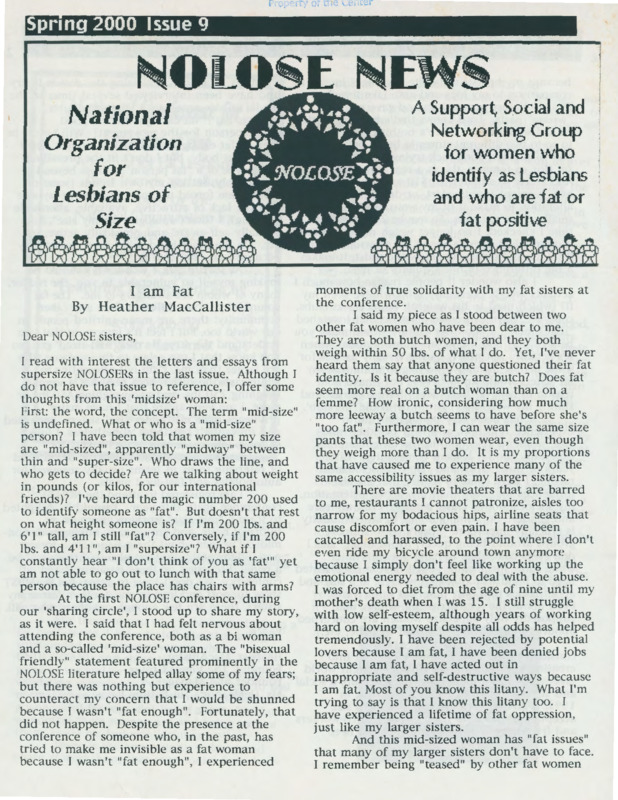
- NOLOSE News is a newsletter for lesbians "of size." This periodical focuses on body and fat positivity. It features letters from self-identified fat readers, information on gatherings, and shared experiences. This issue discusses local group happenings and family stories.
- Date Issued
- 2000
- Relation
- NOLOSE News
- Rights
- Contact UCO Chambers Library's Digital Initiatives Working Group at diwg@uco.edu for the permission policy on the use, reproduction or distribution of this material.
- Is Part Of
- NOLOSE News
- Creator
- MacCallister, Heather
- Contributor
- National Organization for Lesbians of Size
- Date
- 2025-04-25T16:35:47Z
- Date Available
- 2025-04-25T16:35:47Z
- Subject
- Lesbian periodicals
- Fat
- Type
- Periodical
- extracted text
-
Spring 2000 Issue 9
~OLOSE ~EWS
National
Organization
A Support Social and
Networking Group
for women who
for
identify as Lesbians
Lesbians of
and who are fat or
fat positive
I am Fat
By Heather MacCallister
Dear NOLOSE sisters,
I read with interest the letters and essays from
supersize NOLOSERs in the last issue. Although I
do not have that issue to reference, I offer some
thoughts from this 'midsize' woman:
First: the word, the concept. The term "mid-size"
is undefined. What or who is a "mid-size"
person? I have been told that women my size
are "mid-sized", apparently "midway" between
thin and "super-size". Who draws the line, and
who gets to decide? Are we talking about weight
in pounds ( or kilos, for our international
friends)? I've heard the magic number 200 used
to identify someone as "fat". But doesn't that rest
on what height someone is? If I'm 200 lbs. and
6'1" tall, am I still "fat"? Conversely, if I'm 200
lbs. and 4'11 ", am I "supersize"? What if I
constantly hear "1 don't think of you as 'fat"' yet
am not able to go out to lunch with that same
person because the place has chairs with arms?
At the first NOLOSE conference, during
our 'sharing circle', I stood up to share my story,
as it were. I said that I had felt nervous about
attending the conference, both as a bi woman
and a so-called 'mid-size' woman. The "bisexual
friendly" statement featured prominently in the
NOLOSE literature helped allay some of my fears;
but there was nothing but experience to
counteract my concern that I would be shunned
because I wasn't "fat enough". Fortunately, that
did not happen. Despite the presence at the
conference of someone who, in the past, has
tried to make me invisible as a fat woman
because I wasn't "fat enough", I experienced
moments of true solidarity with my fat sisters at
the conference.
I said my piece as I stood between two
other fat women who have been dear to me.
They are both butch women, and they both
weigh within 50 lbs. of what I do. Yet, I've never
heard them say that anyone questioned their fat
identity. Is it because they are butch? Does fat
seem more real on a butch woman than on a
femme? How ironic, considering how much
more leeway a butch seems to have before she's
"too fat". Furthermore, I can wear the same size
pants that these two women wear, even though
they weigh more than I do. It is my proportions
that have caused me to experience many of the
same accessibility issues as my larger sisters.
There are movie theaters that are barred
to me, restaurants I cannot patronize, aisles too
narrow for my bodacious hips, airline seats that
cause discomfort or even pain. I have been
catcalled and harassed, to the point where I don't
even ride my bicycle around town anymore
because I simply don't feel like working up the
emotional energy needed to deal with the abuse.
I was forced to diet from the age of nine until my
mother's death when I was 15. I still struggle
with low self-esteem, although years of working
hard on loving myself despite all odds has helped
tremendously. I have been rejected by potential
lovers because I am fat, I have been denied jobs
because I am fat, I have acted out in
inappropriate and self-destructive ways because
I am fat. Most of you know this litany. What I'm
trying to say is that I know this litany too. I
have experienced a lifetime of fat oppression,
just like my larger sisters.
And this mid-sized woman has "fat issues"
that many of my larger sisters don't have to face.
I remember being "teased" by other fat women
2
because my breasts are quite "average" in size in
comparison to my hips and ass. Like somehow,
Mother Nature screwed up and gave me the
"wrong" parts. Lord knows that's how I'm made
to feel sometimes. There's nothing like having
to go to two different stores to buy a bra and a
pair of panties; good luck trying to get a matched
set (for us femmes, this is a real conundrum)!
And I have to add at least $10 to the price of any
new garment (pants, skirt, or dress) for
alteration to make it fit my waist, which is 19"
smaller than my hips. So maybe 240 lbs. (last
time I checked, I no longer weigh myself, I find
it oppressive) doesn't seem "fat" to you, but when
it's collected primarily below the waist, it makes
a big difference in one's quality of life.
I also wonder if people realize how much 1
actually weigh. Certainly folks who've seen my
ID (which used to list weight), bouncers at clubs,
cops, etc. have expressed surprise that I weighed
"that much". I know our culture would make you
believe that 200 lbs. is this 'huge' amount, when
it's actually not nearly as big visually as it is for
some people mentally. I'd like to think that my
fat sisters would know better, but I have no
reason to believe that. I feel I have to go around
stating my weight so I get to be in the 'fat club'.
It has been very painful for me to
experience rejection, and hear of other 'midsize' women's rejection, in the fat community,
especially the fat lesbian community. After
years of inner work and outer consciousness
raising, I have come to realize that my size
influences me more than my sexual orientation,
my socioeconomic class, possibly even my race
and gender. So 'coming home' to fat community
is crucially important. I don't go to support
groups around being queer, for instance, and I
don't feel compelled to hang out with other
white folks specifically. But I have a deep-seated
need to bond with other fat women, in a way and
about issues that only other fat women can.
Even about the 'embarrassing' things that
supposedly only supersize women are concerned
about (thigh chafing, personal hygiene, etc.).
This rejection is doubly painful
considering the love and work I've put into
creating a fat community (if not outright world
takeover :) ). I founded the Venus Group, a social
and support network for large women, in
1992. I give speeches in colleges about size
acceptance, and have tried to educate co-workers
and friends on a grassroots level. I've been
involved in actions criticizing the diet industry
and have been interviewed several times in the
media on size acceptance. But the doubts
surface: am I "fat enough" to be a good
spokesperson for the movement? Will ii even be
seen as fat enough, even by the media? Yes, I
have a fat body, but I don't fit the prev.i.iling
stereotype of a "fat person": I dress beyt0nd
fashionably, setting my own trends (sOIIl'ile of
which I am forced to create because of my size
and the lack of attractive, available, affordable
clothing), I "don't apologize for my size"',. I am
sexually self-aware and physically acti.~, etc.
etc. On the other hand, will I be accepted only
because I am "not that fat"?
As I write this, I wonder if I shoukl be
making myself so vulnerable to you, the reader,
many of whom are strangers to me. Th,e· fat
community, is no different than any o,ther
community: there are mean-spirited poople in
our world too. But I feel it's important that you
understand the struggle of a 'mid-sized' grrl, so
you know that I can relate to those of yoo who
are larger than me. I am not attempting to
whitewash the differences between a wvman
weighing 250 lbs. and one weighing 450 lbs or
more. I am very aware that I have majorr
privileges over my 'super-size' sisters, unearned
and unwanted, but there nonetheless. I fully
support safe space that is exclusively fGi
'supersize' women. On the other hand, rm tired
of referring to us in terms usually reselfved for
automobiles and fast-food meals.
I am registered to attend the NOLOSE
conference again this year. I would be delighted
to form a "mid-size" working group on an
informal basis, and am open to talkin,g with nonmidsize women about these issues, in .a loving,
non judgmental way. I am also told there will be
a panel discussion on these issues at the
conference. We don't have to agree, but 'INe MUST
show support and love to one another~ ''cause my
sisters, there are few enough out there ~·ho will.
Peace.
Heather MacAllister
Founder, The Venus Group
Founder and Manager,
Ms. DeMeanor's Fat-Bottom Revue
Nlllion,J Confmna for
Lalliasofsizt
A festival for Fat Lesbians,
their friends and allies
Sponsored by the
National Organization for
Lesbians of Size
July 14-16th,
Ramada Inn, Kingston 1 NY
Featuring Performances by
(fr_:
C.C. Carter and
f~[~\
CJ.u'
Nedra Johnson
<-1-:;~.
~ I
'-(,_J.,,.
' •, . . ,
Reg1s
• t ra t·10n In fo:
~~
" -J
_.LJ
CaN: (718) 622-7631
NoLoseLass@excite.com
V\/rite: NOLOSE
245 Eighth Ave.
NY, NY 100·11
NOLOSE
By Diana Lee
The NOLOS E conference is coming up fast.
Only about a month left, and we will again be
meeting in Kingston, New York
to celebrate our sisterhood and rejoice in being
the big, beautiful women that we are. So I ask
myself, what was it that made last year so
special? And what is it that I am so looking
forward to this year?
For those of you who have never been to a
fat conference, l have to tell you that being
surrounded by so many women who
UNDERSTAND and share the experience of
growing up and/ or being fat is perhaps the most
validating experience I've ever had. Just to feel
normal when surrounded by other fat women is
a wonderful feeling. But being able to see how
wonderful these woman are and being part of
them, made me feel wonderful as well.
There is the opportunity to learn and
share at workshoos that soan tooics from bodv
image, to sex, to dealing with a fat and
disability unfriendly world to butch/ femme. Bu1.
my fondest memories are not of t1'e "business" 01
the conference, as important as that is; They ~
of the play ..... .
I don't dance. I've never been ablE; to
dance being too self-conscious as a teen to ever
be comfortable moving my body in ways that
would emphasize all that fat. But watching the
other women dance last year made me wish l
could achieve that freedom too. One woman in
particular: a super-sized woman who can move
with such grace, and such
I wish that I could do that, but since I can't, I
can take my inspiration from those women who
can move to 8. rhythm in such a way to weave a
visual poetry.
And then there are the pool parties. I
know of many friends who hadn't worn a
swimsuit in years, perhaps not since childhood,
and then they come to a conference like ours
and rediscover the freedom and beauty of their
bodies. l LOVE cleavage; mine and that of other
women, and what better way to show it off than
in a swimsuit? And what greater freedom than
romping with other women in a medium that
buoys the body and the spirit?
But perhaps the most moving moments o f
the conference are at the closing ceremony. By
then, we have made friends, shared experiences,,
and saying goodbye is bitter, yet sweet, because
the new friendships can and do outlast the
conference. Last year, I got to meet an on-line
friend l had known for three years, and spent a
memorable couple of hours with her. I made tw<i
new friends as well, whom l am so looking
forward to seeing again. And then there was the
new girl-friend .....
We always end the conference with one
particular song, and many of us always cry. The
words are: "Don't let anyone ever tell you that
your anything less then beautiful." And then
it's time to go home. Until next year.
4
in the long run. (NIH Technology Assessment
Conference Panel, "Methods for Voluntary
Weight Loss and Control," Annals of Internal
Medicine, 116: 943-949.)
•
Since there is currently no known
method of weight loss that is safe, effective, and
permanent. it is irresponsible for doctors to tell
th~ir patients that weight is their problem, that
failure to maintain a weight loss is their own
fault, or that they themselves are to blame for
By Mfr1arn Berg
any and all of their health problems. It is
obviously time for a paradigm shift. Doctors and
oth~r h_ealth professionals should be teaching
their clients how to achieve better health at
I have a sign on my kitchen wall. It
their current body weight. Nutrition erlucation
says: Thank You for Not Talking
shou!d repl~c~ calorie restriction, and making
phys1eal act1v1ty part of one's lifestyle should
About Your Diet. It continues: Please be
replace
exercise whose sole purpose is weight
considerate of other people. Please do not obsess
loss.
And
these programs need to be broad based
about your weight in this area. I would like to
since
they
would improve everyone's health. '
see signs like this posted all over. It's time we all
People
must
not be singled out for hea!lthy
stopped treating ourselves and other people as if
lifestyle
education
simply because the-.: are
we were morally obliged to criticize and demean
larger
than
average.
~
ourselves because of our body size.
How did our culture become so obsessed
~et me tell you a little about the group I
with
thinness?
Some say it started with the
work with. The Council on Size & Weight
advent
of
the
motion
picture, since film makes
Discrimination is a not-for profit advocacy
people
look
heavier.
Some
say it was the advent
group that works to end discrimination based on
of
ready-to-wear
clothing.
Before 1900 all
body size, weight, or shape. We provide
clothing
was
homemade
or
custom mad~, so
information and referral to those who are
differences
in
size
were
basically
irrekvant.
victims _of weight discrimination on the job, we
One~
clothing
came
in
standard
sizes,
anything
work with the medical and scientific
outs~de
the
standard
was
a
problem.
Some
say the
communities to ensure fair and unbiased
med~cal
community
is
to
blame,
since
ihey
have
research and treatment, and we do public
contmued
to
stand
behind
the
prescription
of
education to change our society's prejudiced
diets
and
diet
drugs
even
in
the
face
of
the
attitudes towards larger people.
abysmal failure of those medical treatments.
Fatphobia and weight discrimination are
Some
say it started as a backlash to feminism. As
based on the false assumption that a person
women
became empowered, the male ~wer
could lose weight if they would simply "use will
structure
insisted that women be petite, dainty,
power and stop being so self-indulgent". The
and
concerned
mostly with their appea1rance, so
scientific fact, confirmed over and over in
as
not
to
threaten
the men's position of
rigorous, controlled studies, and published in
aut1?ori~y.
Some
say
the fashion industry is
peer-reviewed journals, is that there is no
behind
1t.
Some
think
it is the media, who even if
currently known method of weight loss that is
•they
did_
1;1ot
~tart
the
craze are definitely guilty
effective and permanent.
of
explmting
1t.
Oprah's
battles with wt:ight have
In 1992, the National Institutes of Health
sold
millions
of
copies
of
tabloids. Womm's
convened a Technology Assessment Conference
magazines
tout
new
diets
in every issue, right
to study which weight-loss methods were most
alongside
recipes
for
rich
desserts.
effective. They reviewed more than 1,000
•
When
you
look
for
the
origin olf a cultural
research papers on dieting and came to two
ideal
in
the
United
States,
you
must alw.xys ask
majo~ conclusions. They said that although
one
simple
question:
Who
profits?
Who profits
heavier people do have greater risk for health
f~on:i
weight
obsession,
chronic
and
y-o-yo
problems, there was no evidence to prove that
dieting,
and
the
social
stigma
against
larger
weight loss reduces that increased risk. Their
There
is
one
culprit
that
earns
people?
second conclusion was that there are no diets
that can be considered to be effective treatment
5
the lion's share of the blame for our culture's
hatred of fat people and glorification of
thinness. And that culprit is the weight-loss
industry.
As our level of weight obsession rises, so
do the profits of the weight-loss industry. Diet
programs, diet foods, diet soft drinks, and the
highly profitable diet drug portion of the
pharmaceutical industry, bilk the American
public out of somewhere between 30 and 60
billion dollars each year.
They thrive on the fact that most people
trying to achieve a smaller body size will become
chronic or yo-yo dieters. In fact, in one ad for a
weight-loss franchise for sale, potential
investors were told that they could count on
"guaranteed repeat business". ln other words,
they know their programs don't work. They
vigorously promote the false notions that dieting
is easy, that dieting is effective, that weight loss
is permanent, that one's body size is within one's
total control, and that becoming thin is the only
way to be happy, healthy, attractive, popular, or
successful.
American culture is protective of business
and its profits. Our protest movement won't be
likely to get supportive coverage from the
media, because the media depends on the diet
industry's advertising dollars. The Council has
had some success working with regulatory
agencies, but the resulting guidelines for
responsible business practices were not
mandatory but merely suggested. There have
been some minor victories. You may have
noticed on TV ads for diet programs that they
now have fine print at the bottom of the screen.
The image is of a woman whose "before" picture
is not only fat, but also unsmiling, wearing illfitting clothes, and looking haggard and lifeles's.
After joining the weight-loss program, the same
woman 1s shown as 50 pounds thinner, active,
fashionably dressed, and surrounded by friends
and admirers. If you look carefully, there are
words at the bottom of the screen. They say:
"Results not typical". So far, that is the extent to
which the government is willing to regulate the
advertising claims of weight loss companies.
Results not typical. Boy is that an
understatement. If these programs had to state
their actual long-term results, they would be
revealed as the consumer frauds they are.
It's not easy to fight a Goliath like the
weight-loss industry. But we have no choice. Our
health, our lives, and our well-being depend on
it. We need to challenge diet programs to disclose
their rates of successful and long-term weight
loss. We need to interrupt fatphobia and weight
discrimination wherever and whenever we see
them. We need to take action in our personal
lives by getting off the diet roller coaster, and
by encouraging others to stop their obsession
with weight. We need to educate doctors,
teachers, and the general public about the
scientific facts. And we need to teach our
children that they are beautiful, capable, and
lovable at whatever size they happen to be.
This is an important struggle. It won't be
easy. But we can do it. We are fighting for our
lives, for our health, and for our well-being. In
the words of the great anthropologist Margaret
Mead, "Never doubt that a small group of
thoughtful, committed citizens can change the
world. Indeed, it's the only thing that ever has.
Excerpted from a speech given March 4, 2000
Rally Against Fat Hatred
Northampton, MA
Website: www.cswd.org
What My Hair Has Taught Me
by Amy E. Winter
last week I shaved my head. So what, you say?
Well, I found out that hair can mean more than
you might think. It was a drastic change; I had
long hair, halfway to my waist, and now it's
half-inch hair sticking out all over my head.
It's gotten me a lot of attention, but I have to tell
you, other people's responses have paled next to
the rush of power I got from what I thought
would be simply a cosmetic change.
Since I cut my hair, I've been reexperiencing in an even stronger way the
heady freedom of indifference to social (i.e.,
male) approval. When I first became involved
with my partner almost four years ago, I
remember noticing my automatic habit of
smiling ingratiatingly at men on the street, in
the halls at work, in the grocery store. I finally
noticed because I didn't have to smile anymore; I
realized I was no longer hoping that the next
man I passed might be THE ONE who would see
beyond my fat and love me for who I am. I
stopped smiling. I started walking stronger,
Jetting my whole foot strike the ground with my
whole body weight behind it on each step. It was
fascinating and empowering to watch the
reactions of men who used to walk by me without
a glance.
My long hair was camouflage; it was drag.
It was a palliative for the feeling that my body
was wrong, too big, too clumsy, not female
enough. My long hair, I thought, helped me
look attractive, despite my weight. People would
like me better, I thought, because my hair would
let them know I cared about looking good,
looking feminine, looking socia!ly appropriate.
I needed long hair, I thought, to balance my toolarge body and my too-small head.
Since I cut my hair, I walk strong and I
smile whenever I feel like it. When I see my
shadow or mv reflection in a window, I see a
round head that's not too small for the round
body it rides on. I've taken back the job of
defining what is attractive and deciding
whether or not I need to look 'feminine.'
I found a picture of myself taken ten
years ago, when I weighed about 200 pounds.
Looking now at myself then, I realize with some
shock that I looked fine; I looked pretty much
like everyone else, maybe a little bigger around
the middle, but certainly well within the normal
range. I thought about how I felt at that time;
conditioned by endless slurs from my family and
schoolmates, I hated myself, believed myself
hideous, and was continually astonished when I
received positive attention from anyone about
anything.
Now, I weigh about 400 pounds. I would
love to look like I did in that photo, but I'm
learning that my subjective beliefs about my
body from the inside and objective opinions
about my body from the outside can be
completely different and unrelated. My level of
self-confidence can be completely unrelated to
how I actually look. That 200-pound twentyyear-old would NEVER have shaved her head.
Her hair was the one feature that redeemed her
to herself. If I can feel light-years better about
myself now that I weigh twice as much and have
no hair, maybe I can begin to understand that
fat is just fat, hair is just hair, a body is just a
body, food is just food. None of them are love or
liberty or oppression or happiness or obsession
or redemption.
My long hair used to say, Don't worry, I'm not
threatening. Even though I'm fat and I talk
tough about feminism, there's· no need to be
afraid. I'd really prefer to be just like you. Now,
my hair says, Wrong. I don't believe what you
believe; in fact, I advocate its radical
transformation. I am fat; I don't feel the need to
conform to any standard of beauty. I love myself
and I love women, and I'm not hiding any more.
I am a threat to this culture's most treasured
conventions. Be very afraid.
SHAPING OUR SITUATION
by Alison Dubois
Our community has always been one of refuge,
change and diversity. Over the years we have
adopted others into our fold that we originally
rejected, such as transgendered persons,
bisexuals and even those in politically sensitive
areas like Christian lesbians. Our ability to
change and continue to evolve is perhaps one of
our greatest gifts to each other as a community_
But like all groups, our good intentions
sometimes go askew with the end result being
some people get overlooked along the way.
Specifically, I am talking about the disahled fat
lesbians within our community. While fat is not
a new issue and neither is able-bodineS1,~ the
combination together is still a quagmire within
our group. It seems that many lesbians either
want to clump us into one or the other of the
categories, which of course does not work.
Anymore than it would work putting a Native
American disabled dyke in with just Nallive
Americans while overlooking her disability
that's every bit as much a part of her as her
heritage.
For me the situation has an additional
twist, because in addition to my physical
struggles and size issues, I am also going with a .
woman who is height/weight proportionate and
isn't disabled. It has been a challenge at times,
especially initially, adjusting to my limitations,,
our respective feelings on it, feelings a!l>out fat
(weight and the whole montage of isslli.'S that go
along with it) her size, able-bodiedness and how
7
friends/ the community receive us, and how we
respond to their reception has been a mixed bag
within the community. Some women of varying
sizes (including h/ w proportionate) have been
accepting, positive, etc., etc. While others have
been completely negative, unaccepting, etc. We
get the "looks" from thinner women who look at
me with a range of emotions from disapproval to
disdain. Some of them treat my partner with pity
that she has to deal with that or with praise, as if
she were a saint to do so. My sweetie is not a
saint; she is however a wonderful woman who
loves me and has come to this place after years
of interpersonal struggles, to accept me and my
limitations unconditionally. Besides the obvious
ambiguity within the community, I get PO'ed
with women who treat me as if I should feel
lucky to have someone like her. I do feel lucky
that she loves me but not because I am a large,
physically challenged dyke but rather that we
have found each other in a world that is not
kind to lesbians in the first place and certainly
doesn't make it easy for two women to live and
love each other in a committed relationship in
general. The thing is, why should my woman be
perceived as being so wonderful just because she
accepts my physical state of being? Why is it so
hard for so many to acknowledge that in spite of
any physical/size limitations I may have, I am a
good catch too? It reinforces the prejudice that
just because of my size and physical challenges,
I am less attractive, desirable, and ultimately less
valuable
By continuing to endorse negative
stereotypes we perpetuate the very system that
has restricted and oppressed women for
centuries. As a community the ultimate goal
should be one of acceptance, the very
preponderance behind the Hate Is Not A Family
Value campaign for basic civil rights. Until we
all have rights and acceptance, we will remain a
community divided.
It is my profound hope that someday
words like "fat", "large", and "heavy", will only
be used to describe a shape instead of being a
verbal weapon used to proliferate negative
associations. It is equally my hope that someday I
won't get those looks within our community, but
will see couples of colors, sizes and degrees of
ablcbodiedness thriving harmoniously together.
After all, haven't we been subjected to enough
negative associations already by just being who
we are? I think so. How about you?
Ja1e$ from tbe <rlp
by Mary Frances Platt
CELEBRATION OF LIFE
( a fat crip's affirmation/ prayer)
The taunts used to ridicule roIJ off my tongue in
celebration.
FaL Crippled. Queer.
I scoot up and take my place at the table of life.
All creatures great and small. I, the fattest
person in this room, the fattest
person in the Pioneer Valley, perhaps the fattest
in the state, the country, the world.
I am the reflection of life, of bounty, of
difference, of loving, of desire, of wisdom.
I am beautiful, intelligent, independent and
whole.
Smart as a coyote and sexy as your wildest dream.
Fat . Crippled. Queer.
This land is my la..-id too. This planet my home. I
live alongside ants and
elephants, winged ones and whales, skinny
folks fat folks and everything
in between.
It is after all largeness that sustains us. There is
room at the table for all colors, ages, abilities,
ethnicities, religions and sizes. We are a diverse
creation, each our own unique and individual
celebration of life.
Fat Women's images adapted from
Clip Art by Susan Mason
8
Thanks to all the Uendors and Sponsors
of the NOLOSE 1999 Conference!
Our Sponsors:
In Full Swing
5937 College Ave
Oakland, CA 94618
Spinsters Ink
32 E. First St. #330
Duluth, MN 55802
(218) 727-3222
Good Vibrations
938 Howard Street
# 101
Sumiche Jewelry
PO Box 428
Walterville, OR 97 489
(514) 896-9841
www.efn.org / sumiche
San Francisco, CA 94110
1-800-BUY-VIBE
You can contact NOLOSE by writing to the
above address or:
E-mail: NOLOSEE@aol.com
Phone:(201)843-4629
Website: www.NOLOSE.org
If you cannot afford to join NOLOSE at this time,
even a small donation would be appreciated. If
you join within 6 months of giving us your
donation, we wil1 deduct your donation amount
from your membership fee!!
Amplestuff
PO Box 116
Bearsville, NY 12409
(914) 679-3316
K'haria rai Zen
PO Box41836
Philadelphia, PA 19101
Babygrll@netaxs.com
Artist in the Atti c
/ Fat Ass Pants
3405 White Ave.
Baltimore, ivID 21214
Shirrah@aol.com
Myles Ahead
6652 NW 57 St
Tamarac, FL 33319
(954) 393-9873
National Directory of
Local Support Groups
This is a partial listing of fat support groups that
are either lesbian or lesbian friendly. This list
inc1udes names of women who want to start
groups in their own area as well. You should
contact them if you are interested in helping to
start a group or join in a new group.
If you want help starting a support group,
please contact us and we wil1 help in any way
that we can. If you have a support group that is
not listed here, please notify us so that we can
inc1ude them in out next listing.
Terra Nova
PO Box4265
South Georgia/
North Florida
Highland Park, NJ 08904
Melissa S.
(850) 875-6187
Thatfatgirl@aol.coin
Our Uendors:
Big Daddy Boxers
Bigboxers@hotmail.com
(732) 393-9873
Thunder Road Book
Club
PO Box 1203
Secaucus, NJ 07096
(201) 863-3931
There is still time to register for the
National Conference for Lesbians of Size!!!
See the Ad on page 3 for information.
Memberships
Membership dues are $20 annually.
Limited scholarships and work exchange
available.
Send your checks payable to NOLOSE to:
NOLOSE
245 Eighth Ave. PMB #107
New York, NY 10011
Southeastern Michigan
The Venus Group
234 Goodison Hall
Ypsilanti, MI 48197
San Francisco, CA
WON
(Women of Width)
Joyce Wermont
Jwermont@sonic.net
Seattle, Washington
SeaFATtle
10026 51st Ave. SW
Seattle, WA 98146
www.wolfnet.com/
~marymc/ seafattle.htm
New York, New York
Fat is a Lesbian
Issue / FLAB
cl o NOLOSE
(201) 843-4629
Philadelphia, PA &
SouthiCentrai New
Jersey
Ful1 Bloom Women
c/ o Louis Rubalow
1 Tasley Ct.
Marlton, NJ 08053
Washington DC
Cynthia Newcomer
207 Lincoln Ave.
Takoma Park,
MD20912
cjnewc@igc.org
I
-
Spring 2000 Issue 9
~OLOSE ~EWS
National
Organization
A Support Social and
Networking Group
for women who
for
identify as Lesbians
Lesbians of
and who are fat or
fat positive
I am Fat
By Heather MacCallister
Dear NOLOSE sisters,
I read with interest the letters and essays from
supersize NOLOSERs in the last issue. Although I
do not have that issue to reference, I offer some
thoughts from this 'midsize' woman:
First: the word, the concept. The term "mid-size"
is undefined. What or who is a "mid-size"
person? I have been told that women my size
are "mid-sized", apparently "midway" between
thin and "super-size". Who draws the line, and
who gets to decide? Are we talking about weight
in pounds ( or kilos, for our international
friends)? I've heard the magic number 200 used
to identify someone as "fat". But doesn't that rest
on what height someone is? If I'm 200 lbs. and
6'1" tall, am I still "fat"? Conversely, if I'm 200
lbs. and 4'11 ", am I "supersize"? What if I
constantly hear "1 don't think of you as 'fat"' yet
am not able to go out to lunch with that same
person because the place has chairs with arms?
At the first NOLOSE conference, during
our 'sharing circle', I stood up to share my story,
as it were. I said that I had felt nervous about
attending the conference, both as a bi woman
and a so-called 'mid-size' woman. The "bisexual
friendly" statement featured prominently in the
NOLOSE literature helped allay some of my fears;
but there was nothing but experience to
counteract my concern that I would be shunned
because I wasn't "fat enough". Fortunately, that
did not happen. Despite the presence at the
conference of someone who, in the past, has
tried to make me invisible as a fat woman
because I wasn't "fat enough", I experienced
moments of true solidarity with my fat sisters at
the conference.
I said my piece as I stood between two
other fat women who have been dear to me.
They are both butch women, and they both
weigh within 50 lbs. of what I do. Yet, I've never
heard them say that anyone questioned their fat
identity. Is it because they are butch? Does fat
seem more real on a butch woman than on a
femme? How ironic, considering how much
more leeway a butch seems to have before she's
"too fat". Furthermore, I can wear the same size
pants that these two women wear, even though
they weigh more than I do. It is my proportions
that have caused me to experience many of the
same accessibility issues as my larger sisters.
There are movie theaters that are barred
to me, restaurants I cannot patronize, aisles too
narrow for my bodacious hips, airline seats that
cause discomfort or even pain. I have been
catcalled and harassed, to the point where I don't
even ride my bicycle around town anymore
because I simply don't feel like working up the
emotional energy needed to deal with the abuse.
I was forced to diet from the age of nine until my
mother's death when I was 15. I still struggle
with low self-esteem, although years of working
hard on loving myself despite all odds has helped
tremendously. I have been rejected by potential
lovers because I am fat, I have been denied jobs
because I am fat, I have acted out in
inappropriate and self-destructive ways because
I am fat. Most of you know this litany. What I'm
trying to say is that I know this litany too. I
have experienced a lifetime of fat oppression,
just like my larger sisters.
And this mid-sized woman has "fat issues"
that many of my larger sisters don't have to face.
I remember being "teased" by other fat women
2
because my breasts are quite "average" in size in
comparison to my hips and ass. Like somehow,
Mother Nature screwed up and gave me the
"wrong" parts. Lord knows that's how I'm made
to feel sometimes. There's nothing like having
to go to two different stores to buy a bra and a
pair of panties; good luck trying to get a matched
set (for us femmes, this is a real conundrum)!
And I have to add at least $10 to the price of any
new garment (pants, skirt, or dress) for
alteration to make it fit my waist, which is 19"
smaller than my hips. So maybe 240 lbs. (last
time I checked, I no longer weigh myself, I find
it oppressive) doesn't seem "fat" to you, but when
it's collected primarily below the waist, it makes
a big difference in one's quality of life.
I also wonder if people realize how much 1
actually weigh. Certainly folks who've seen my
ID (which used to list weight), bouncers at clubs,
cops, etc. have expressed surprise that I weighed
"that much". I know our culture would make you
believe that 200 lbs. is this 'huge' amount, when
it's actually not nearly as big visually as it is for
some people mentally. I'd like to think that my
fat sisters would know better, but I have no
reason to believe that. I feel I have to go around
stating my weight so I get to be in the 'fat club'.
It has been very painful for me to
experience rejection, and hear of other 'midsize' women's rejection, in the fat community,
especially the fat lesbian community. After
years of inner work and outer consciousness
raising, I have come to realize that my size
influences me more than my sexual orientation,
my socioeconomic class, possibly even my race
and gender. So 'coming home' to fat community
is crucially important. I don't go to support
groups around being queer, for instance, and I
don't feel compelled to hang out with other
white folks specifically. But I have a deep-seated
need to bond with other fat women, in a way and
about issues that only other fat women can.
Even about the 'embarrassing' things that
supposedly only supersize women are concerned
about (thigh chafing, personal hygiene, etc.).
This rejection is doubly painful
considering the love and work I've put into
creating a fat community (if not outright world
takeover :) ). I founded the Venus Group, a social
and support network for large women, in
1992. I give speeches in colleges about size
acceptance, and have tried to educate co-workers
and friends on a grassroots level. I've been
involved in actions criticizing the diet industry
and have been interviewed several times in the
media on size acceptance. But the doubts
surface: am I "fat enough" to be a good
spokesperson for the movement? Will ii even be
seen as fat enough, even by the media? Yes, I
have a fat body, but I don't fit the prev.i.iling
stereotype of a "fat person": I dress beyt0nd
fashionably, setting my own trends (sOIIl'ile of
which I am forced to create because of my size
and the lack of attractive, available, affordable
clothing), I "don't apologize for my size"',. I am
sexually self-aware and physically acti.~, etc.
etc. On the other hand, will I be accepted only
because I am "not that fat"?
As I write this, I wonder if I shoukl be
making myself so vulnerable to you, the reader,
many of whom are strangers to me. Th,e· fat
community, is no different than any o,ther
community: there are mean-spirited poople in
our world too. But I feel it's important that you
understand the struggle of a 'mid-sized' grrl, so
you know that I can relate to those of yoo who
are larger than me. I am not attempting to
whitewash the differences between a wvman
weighing 250 lbs. and one weighing 450 lbs or
more. I am very aware that I have majorr
privileges over my 'super-size' sisters, unearned
and unwanted, but there nonetheless. I fully
support safe space that is exclusively fGi
'supersize' women. On the other hand, rm tired
of referring to us in terms usually reselfved for
automobiles and fast-food meals.
I am registered to attend the NOLOSE
conference again this year. I would be delighted
to form a "mid-size" working group on an
informal basis, and am open to talkin,g with nonmidsize women about these issues, in .a loving,
non judgmental way. I am also told there will be
a panel discussion on these issues at the
conference. We don't have to agree, but 'INe MUST
show support and love to one another~ ''cause my
sisters, there are few enough out there ~·ho will.
Peace.
Heather MacAllister
Founder, The Venus Group
Founder and Manager,
Ms. DeMeanor's Fat-Bottom Revue
Nlllion,J Confmna for
Lalliasofsizt
A festival for Fat Lesbians,
their friends and allies
Sponsored by the
National Organization for
Lesbians of Size
July 14-16th,
Ramada Inn, Kingston 1 NY
Featuring Performances by
(fr_:
C.C. Carter and
f~[~\
CJ.u'
Nedra Johnson
<-1-:;~.
~ I
'-(,_J.,,.
' •, . . ,
Reg1s
• t ra t·10n In fo:
~~
" -J
_.LJ
CaN: (718) 622-7631
NoLoseLass@excite.com
V\/rite: NOLOSE
245 Eighth Ave.
NY, NY 100·11
NOLOSE
By Diana Lee
The NOLOS E conference is coming up fast.
Only about a month left, and we will again be
meeting in Kingston, New York
to celebrate our sisterhood and rejoice in being
the big, beautiful women that we are. So I ask
myself, what was it that made last year so
special? And what is it that I am so looking
forward to this year?
For those of you who have never been to a
fat conference, l have to tell you that being
surrounded by so many women who
UNDERSTAND and share the experience of
growing up and/ or being fat is perhaps the most
validating experience I've ever had. Just to feel
normal when surrounded by other fat women is
a wonderful feeling. But being able to see how
wonderful these woman are and being part of
them, made me feel wonderful as well.
There is the opportunity to learn and
share at workshoos that soan tooics from bodv
image, to sex, to dealing with a fat and
disability unfriendly world to butch/ femme. Bu1.
my fondest memories are not of t1'e "business" 01
the conference, as important as that is; They ~
of the play ..... .
I don't dance. I've never been ablE; to
dance being too self-conscious as a teen to ever
be comfortable moving my body in ways that
would emphasize all that fat. But watching the
other women dance last year made me wish l
could achieve that freedom too. One woman in
particular: a super-sized woman who can move
with such grace, and such
I wish that I could do that, but since I can't, I
can take my inspiration from those women who
can move to 8. rhythm in such a way to weave a
visual poetry.
And then there are the pool parties. I
know of many friends who hadn't worn a
swimsuit in years, perhaps not since childhood,
and then they come to a conference like ours
and rediscover the freedom and beauty of their
bodies. l LOVE cleavage; mine and that of other
women, and what better way to show it off than
in a swimsuit? And what greater freedom than
romping with other women in a medium that
buoys the body and the spirit?
But perhaps the most moving moments o f
the conference are at the closing ceremony. By
then, we have made friends, shared experiences,,
and saying goodbye is bitter, yet sweet, because
the new friendships can and do outlast the
conference. Last year, I got to meet an on-line
friend l had known for three years, and spent a
memorable couple of hours with her. I made tw<i
new friends as well, whom l am so looking
forward to seeing again. And then there was the
new girl-friend .....
We always end the conference with one
particular song, and many of us always cry. The
words are: "Don't let anyone ever tell you that
your anything less then beautiful." And then
it's time to go home. Until next year.
4
in the long run. (NIH Technology Assessment
Conference Panel, "Methods for Voluntary
Weight Loss and Control," Annals of Internal
Medicine, 116: 943-949.)
•
Since there is currently no known
method of weight loss that is safe, effective, and
permanent. it is irresponsible for doctors to tell
th~ir patients that weight is their problem, that
failure to maintain a weight loss is their own
fault, or that they themselves are to blame for
By Mfr1arn Berg
any and all of their health problems. It is
obviously time for a paradigm shift. Doctors and
oth~r h_ealth professionals should be teaching
their clients how to achieve better health at
I have a sign on my kitchen wall. It
their current body weight. Nutrition erlucation
says: Thank You for Not Talking
shou!d repl~c~ calorie restriction, and making
phys1eal act1v1ty part of one's lifestyle should
About Your Diet. It continues: Please be
replace
exercise whose sole purpose is weight
considerate of other people. Please do not obsess
loss.
And
these programs need to be broad based
about your weight in this area. I would like to
since
they
would improve everyone's health. '
see signs like this posted all over. It's time we all
People
must
not be singled out for hea!lthy
stopped treating ourselves and other people as if
lifestyle
education
simply because the-.: are
we were morally obliged to criticize and demean
larger
than
average.
~
ourselves because of our body size.
How did our culture become so obsessed
~et me tell you a little about the group I
with
thinness?
Some say it started with the
work with. The Council on Size & Weight
advent
of
the
motion
picture, since film makes
Discrimination is a not-for profit advocacy
people
look
heavier.
Some
say it was the advent
group that works to end discrimination based on
of
ready-to-wear
clothing.
Before 1900 all
body size, weight, or shape. We provide
clothing
was
homemade
or
custom mad~, so
information and referral to those who are
differences
in
size
were
basically
irrekvant.
victims _of weight discrimination on the job, we
One~
clothing
came
in
standard
sizes,
anything
work with the medical and scientific
outs~de
the
standard
was
a
problem.
Some
say the
communities to ensure fair and unbiased
med~cal
community
is
to
blame,
since
ihey
have
research and treatment, and we do public
contmued
to
stand
behind
the
prescription
of
education to change our society's prejudiced
diets
and
diet
drugs
even
in
the
face
of
the
attitudes towards larger people.
abysmal failure of those medical treatments.
Fatphobia and weight discrimination are
Some
say it started as a backlash to feminism. As
based on the false assumption that a person
women
became empowered, the male ~wer
could lose weight if they would simply "use will
structure
insisted that women be petite, dainty,
power and stop being so self-indulgent". The
and
concerned
mostly with their appea1rance, so
scientific fact, confirmed over and over in
as
not
to
threaten
the men's position of
rigorous, controlled studies, and published in
aut1?ori~y.
Some
say
the fashion industry is
peer-reviewed journals, is that there is no
behind
1t.
Some
think
it is the media, who even if
currently known method of weight loss that is
•they
did_
1;1ot
~tart
the
craze are definitely guilty
effective and permanent.
of
explmting
1t.
Oprah's
battles with wt:ight have
In 1992, the National Institutes of Health
sold
millions
of
copies
of
tabloids. Womm's
convened a Technology Assessment Conference
magazines
tout
new
diets
in every issue, right
to study which weight-loss methods were most
alongside
recipes
for
rich
desserts.
effective. They reviewed more than 1,000
•
When
you
look
for
the
origin olf a cultural
research papers on dieting and came to two
ideal
in
the
United
States,
you
must alw.xys ask
majo~ conclusions. They said that although
one
simple
question:
Who
profits?
Who profits
heavier people do have greater risk for health
f~on:i
weight
obsession,
chronic
and
y-o-yo
problems, there was no evidence to prove that
dieting,
and
the
social
stigma
against
larger
weight loss reduces that increased risk. Their
There
is
one
culprit
that
earns
people?
second conclusion was that there are no diets
that can be considered to be effective treatment
5
the lion's share of the blame for our culture's
hatred of fat people and glorification of
thinness. And that culprit is the weight-loss
industry.
As our level of weight obsession rises, so
do the profits of the weight-loss industry. Diet
programs, diet foods, diet soft drinks, and the
highly profitable diet drug portion of the
pharmaceutical industry, bilk the American
public out of somewhere between 30 and 60
billion dollars each year.
They thrive on the fact that most people
trying to achieve a smaller body size will become
chronic or yo-yo dieters. In fact, in one ad for a
weight-loss franchise for sale, potential
investors were told that they could count on
"guaranteed repeat business". ln other words,
they know their programs don't work. They
vigorously promote the false notions that dieting
is easy, that dieting is effective, that weight loss
is permanent, that one's body size is within one's
total control, and that becoming thin is the only
way to be happy, healthy, attractive, popular, or
successful.
American culture is protective of business
and its profits. Our protest movement won't be
likely to get supportive coverage from the
media, because the media depends on the diet
industry's advertising dollars. The Council has
had some success working with regulatory
agencies, but the resulting guidelines for
responsible business practices were not
mandatory but merely suggested. There have
been some minor victories. You may have
noticed on TV ads for diet programs that they
now have fine print at the bottom of the screen.
The image is of a woman whose "before" picture
is not only fat, but also unsmiling, wearing illfitting clothes, and looking haggard and lifeles's.
After joining the weight-loss program, the same
woman 1s shown as 50 pounds thinner, active,
fashionably dressed, and surrounded by friends
and admirers. If you look carefully, there are
words at the bottom of the screen. They say:
"Results not typical". So far, that is the extent to
which the government is willing to regulate the
advertising claims of weight loss companies.
Results not typical. Boy is that an
understatement. If these programs had to state
their actual long-term results, they would be
revealed as the consumer frauds they are.
It's not easy to fight a Goliath like the
weight-loss industry. But we have no choice. Our
health, our lives, and our well-being depend on
it. We need to challenge diet programs to disclose
their rates of successful and long-term weight
loss. We need to interrupt fatphobia and weight
discrimination wherever and whenever we see
them. We need to take action in our personal
lives by getting off the diet roller coaster, and
by encouraging others to stop their obsession
with weight. We need to educate doctors,
teachers, and the general public about the
scientific facts. And we need to teach our
children that they are beautiful, capable, and
lovable at whatever size they happen to be.
This is an important struggle. It won't be
easy. But we can do it. We are fighting for our
lives, for our health, and for our well-being. In
the words of the great anthropologist Margaret
Mead, "Never doubt that a small group of
thoughtful, committed citizens can change the
world. Indeed, it's the only thing that ever has.
Excerpted from a speech given March 4, 2000
Rally Against Fat Hatred
Northampton, MA
Website: www.cswd.org
What My Hair Has Taught Me
by Amy E. Winter
last week I shaved my head. So what, you say?
Well, I found out that hair can mean more than
you might think. It was a drastic change; I had
long hair, halfway to my waist, and now it's
half-inch hair sticking out all over my head.
It's gotten me a lot of attention, but I have to tell
you, other people's responses have paled next to
the rush of power I got from what I thought
would be simply a cosmetic change.
Since I cut my hair, I've been reexperiencing in an even stronger way the
heady freedom of indifference to social (i.e.,
male) approval. When I first became involved
with my partner almost four years ago, I
remember noticing my automatic habit of
smiling ingratiatingly at men on the street, in
the halls at work, in the grocery store. I finally
noticed because I didn't have to smile anymore; I
realized I was no longer hoping that the next
man I passed might be THE ONE who would see
beyond my fat and love me for who I am. I
stopped smiling. I started walking stronger,
Jetting my whole foot strike the ground with my
whole body weight behind it on each step. It was
fascinating and empowering to watch the
reactions of men who used to walk by me without
a glance.
My long hair was camouflage; it was drag.
It was a palliative for the feeling that my body
was wrong, too big, too clumsy, not female
enough. My long hair, I thought, helped me
look attractive, despite my weight. People would
like me better, I thought, because my hair would
let them know I cared about looking good,
looking feminine, looking socia!ly appropriate.
I needed long hair, I thought, to balance my toolarge body and my too-small head.
Since I cut my hair, I walk strong and I
smile whenever I feel like it. When I see my
shadow or mv reflection in a window, I see a
round head that's not too small for the round
body it rides on. I've taken back the job of
defining what is attractive and deciding
whether or not I need to look 'feminine.'
I found a picture of myself taken ten
years ago, when I weighed about 200 pounds.
Looking now at myself then, I realize with some
shock that I looked fine; I looked pretty much
like everyone else, maybe a little bigger around
the middle, but certainly well within the normal
range. I thought about how I felt at that time;
conditioned by endless slurs from my family and
schoolmates, I hated myself, believed myself
hideous, and was continually astonished when I
received positive attention from anyone about
anything.
Now, I weigh about 400 pounds. I would
love to look like I did in that photo, but I'm
learning that my subjective beliefs about my
body from the inside and objective opinions
about my body from the outside can be
completely different and unrelated. My level of
self-confidence can be completely unrelated to
how I actually look. That 200-pound twentyyear-old would NEVER have shaved her head.
Her hair was the one feature that redeemed her
to herself. If I can feel light-years better about
myself now that I weigh twice as much and have
no hair, maybe I can begin to understand that
fat is just fat, hair is just hair, a body is just a
body, food is just food. None of them are love or
liberty or oppression or happiness or obsession
or redemption.
My long hair used to say, Don't worry, I'm not
threatening. Even though I'm fat and I talk
tough about feminism, there's· no need to be
afraid. I'd really prefer to be just like you. Now,
my hair says, Wrong. I don't believe what you
believe; in fact, I advocate its radical
transformation. I am fat; I don't feel the need to
conform to any standard of beauty. I love myself
and I love women, and I'm not hiding any more.
I am a threat to this culture's most treasured
conventions. Be very afraid.
SHAPING OUR SITUATION
by Alison Dubois
Our community has always been one of refuge,
change and diversity. Over the years we have
adopted others into our fold that we originally
rejected, such as transgendered persons,
bisexuals and even those in politically sensitive
areas like Christian lesbians. Our ability to
change and continue to evolve is perhaps one of
our greatest gifts to each other as a community_
But like all groups, our good intentions
sometimes go askew with the end result being
some people get overlooked along the way.
Specifically, I am talking about the disahled fat
lesbians within our community. While fat is not
a new issue and neither is able-bodineS1,~ the
combination together is still a quagmire within
our group. It seems that many lesbians either
want to clump us into one or the other of the
categories, which of course does not work.
Anymore than it would work putting a Native
American disabled dyke in with just Nallive
Americans while overlooking her disability
that's every bit as much a part of her as her
heritage.
For me the situation has an additional
twist, because in addition to my physical
struggles and size issues, I am also going with a .
woman who is height/weight proportionate and
isn't disabled. It has been a challenge at times,
especially initially, adjusting to my limitations,,
our respective feelings on it, feelings a!l>out fat
(weight and the whole montage of isslli.'S that go
along with it) her size, able-bodiedness and how
7
friends/ the community receive us, and how we
respond to their reception has been a mixed bag
within the community. Some women of varying
sizes (including h/ w proportionate) have been
accepting, positive, etc., etc. While others have
been completely negative, unaccepting, etc. We
get the "looks" from thinner women who look at
me with a range of emotions from disapproval to
disdain. Some of them treat my partner with pity
that she has to deal with that or with praise, as if
she were a saint to do so. My sweetie is not a
saint; she is however a wonderful woman who
loves me and has come to this place after years
of interpersonal struggles, to accept me and my
limitations unconditionally. Besides the obvious
ambiguity within the community, I get PO'ed
with women who treat me as if I should feel
lucky to have someone like her. I do feel lucky
that she loves me but not because I am a large,
physically challenged dyke but rather that we
have found each other in a world that is not
kind to lesbians in the first place and certainly
doesn't make it easy for two women to live and
love each other in a committed relationship in
general. The thing is, why should my woman be
perceived as being so wonderful just because she
accepts my physical state of being? Why is it so
hard for so many to acknowledge that in spite of
any physical/size limitations I may have, I am a
good catch too? It reinforces the prejudice that
just because of my size and physical challenges,
I am less attractive, desirable, and ultimately less
valuable
By continuing to endorse negative
stereotypes we perpetuate the very system that
has restricted and oppressed women for
centuries. As a community the ultimate goal
should be one of acceptance, the very
preponderance behind the Hate Is Not A Family
Value campaign for basic civil rights. Until we
all have rights and acceptance, we will remain a
community divided.
It is my profound hope that someday
words like "fat", "large", and "heavy", will only
be used to describe a shape instead of being a
verbal weapon used to proliferate negative
associations. It is equally my hope that someday I
won't get those looks within our community, but
will see couples of colors, sizes and degrees of
ablcbodiedness thriving harmoniously together.
After all, haven't we been subjected to enough
negative associations already by just being who
we are? I think so. How about you?
Ja1e$ from tbe <rlp
by Mary Frances Platt
CELEBRATION OF LIFE
( a fat crip's affirmation/ prayer)
The taunts used to ridicule roIJ off my tongue in
celebration.
FaL Crippled. Queer.
I scoot up and take my place at the table of life.
All creatures great and small. I, the fattest
person in this room, the fattest
person in the Pioneer Valley, perhaps the fattest
in the state, the country, the world.
I am the reflection of life, of bounty, of
difference, of loving, of desire, of wisdom.
I am beautiful, intelligent, independent and
whole.
Smart as a coyote and sexy as your wildest dream.
Fat . Crippled. Queer.
This land is my la..-id too. This planet my home. I
live alongside ants and
elephants, winged ones and whales, skinny
folks fat folks and everything
in between.
It is after all largeness that sustains us. There is
room at the table for all colors, ages, abilities,
ethnicities, religions and sizes. We are a diverse
creation, each our own unique and individual
celebration of life.
Fat Women's images adapted from
Clip Art by Susan Mason
8
Thanks to all the Uendors and Sponsors
of the NOLOSE 1999 Conference!
Our Sponsors:
In Full Swing
5937 College Ave
Oakland, CA 94618
Spinsters Ink
32 E. First St. #330
Duluth, MN 55802
(218) 727-3222
Good Vibrations
938 Howard Street
# 101
Sumiche Jewelry
PO Box 428
Walterville, OR 97 489
(514) 896-9841
www.efn.org / sumiche
San Francisco, CA 94110
1-800-BUY-VIBE
You can contact NOLOSE by writing to the
above address or:
E-mail: NOLOSEE@aol.com
Phone:(201)843-4629
Website: www.NOLOSE.org
If you cannot afford to join NOLOSE at this time,
even a small donation would be appreciated. If
you join within 6 months of giving us your
donation, we wil1 deduct your donation amount
from your membership fee!!
Amplestuff
PO Box 116
Bearsville, NY 12409
(914) 679-3316
K'haria rai Zen
PO Box41836
Philadelphia, PA 19101
Babygrll@netaxs.com
Artist in the Atti c
/ Fat Ass Pants
3405 White Ave.
Baltimore, ivID 21214
Shirrah@aol.com
Myles Ahead
6652 NW 57 St
Tamarac, FL 33319
(954) 393-9873
National Directory of
Local Support Groups
This is a partial listing of fat support groups that
are either lesbian or lesbian friendly. This list
inc1udes names of women who want to start
groups in their own area as well. You should
contact them if you are interested in helping to
start a group or join in a new group.
If you want help starting a support group,
please contact us and we wil1 help in any way
that we can. If you have a support group that is
not listed here, please notify us so that we can
inc1ude them in out next listing.
Terra Nova
PO Box4265
South Georgia/
North Florida
Highland Park, NJ 08904
Melissa S.
(850) 875-6187
Thatfatgirl@aol.coin
Our Uendors:
Big Daddy Boxers
Bigboxers@hotmail.com
(732) 393-9873
Thunder Road Book
Club
PO Box 1203
Secaucus, NJ 07096
(201) 863-3931
There is still time to register for the
National Conference for Lesbians of Size!!!
See the Ad on page 3 for information.
Memberships
Membership dues are $20 annually.
Limited scholarships and work exchange
available.
Send your checks payable to NOLOSE to:
NOLOSE
245 Eighth Ave. PMB #107
New York, NY 10011
Southeastern Michigan
The Venus Group
234 Goodison Hall
Ypsilanti, MI 48197
San Francisco, CA
WON
(Women of Width)
Joyce Wermont
Jwermont@sonic.net
Seattle, Washington
SeaFATtle
10026 51st Ave. SW
Seattle, WA 98146
www.wolfnet.com/
~marymc/ seafattle.htm
New York, New York
Fat is a Lesbian
Issue / FLAB
cl o NOLOSE
(201) 843-4629
Philadelphia, PA &
SouthiCentrai New
Jersey
Ful1 Bloom Women
c/ o Louis Rubalow
1 Tasley Ct.
Marlton, NJ 08053
Washington DC
Cynthia Newcomer
207 Lincoln Ave.
Takoma Park,
MD20912
cjnewc@igc.org
I
-
Spring 2000 Issue 9
~OLOSE ~EWS
National
Organization
A Support Social and
Networking Group
for women who
for
identify as Lesbians
Lesbians of
and who are fat or
fat positive
I am Fat
By Heather MacCallister
Dear NOLOSE sisters,
I read with interest the letters and essays from
supersize NOLOSERs in the last issue. Although I
do not have that issue to reference, I offer some
thoughts from this 'midsize' woman:
First: the word, the concept. The term "mid-size"
is undefined. What or who is a "mid-size"
person? I have been told that women my size
are "mid-sized", apparently "midway" between
thin and "super-size". Who draws the line, and
who gets to decide? Are we talking about weight
in pounds ( or kilos, for our international
friends)? I've heard the magic number 200 used
to identify someone as "fat". But doesn't that rest
on what height someone is? If I'm 200 lbs. and
6'1" tall, am I still "fat"? Conversely, if I'm 200
lbs. and 4'11 ", am I "supersize"? What if I
constantly hear "1 don't think of you as 'fat"' yet
am not able to go out to lunch with that same
person because the place has chairs with arms?
At the first NOLOSE conference, during
our 'sharing circle', I stood up to share my story,
as it were. I said that I had felt nervous about
attending the conference, both as a bi woman
and a so-called 'mid-size' woman. The "bisexual
friendly" statement featured prominently in the
NOLOSE literature helped allay some of my fears;
but there was nothing but experience to
counteract my concern that I would be shunned
because I wasn't "fat enough". Fortunately, that
did not happen. Despite the presence at the
conference of someone who, in the past, has
tried to make me invisible as a fat woman
because I wasn't "fat enough", I experienced
moments of true solidarity with my fat sisters at
the conference.
I said my piece as I stood between two
other fat women who have been dear to me.
They are both butch women, and they both
weigh within 50 lbs. of what I do. Yet, I've never
heard them say that anyone questioned their fat
identity. Is it because they are butch? Does fat
seem more real on a butch woman than on a
femme? How ironic, considering how much
more leeway a butch seems to have before she's
"too fat". Furthermore, I can wear the same size
pants that these two women wear, even though
they weigh more than I do. It is my proportions
that have caused me to experience many of the
same accessibility issues as my larger sisters.
There are movie theaters that are barred
to me, restaurants I cannot patronize, aisles too
narrow for my bodacious hips, airline seats that
cause discomfort or even pain. I have been
catcalled and harassed, to the point where I don't
even ride my bicycle around town anymore
because I simply don't feel like working up the
emotional energy needed to deal with the abuse.
I was forced to diet from the age of nine until my
mother's death when I was 15. I still struggle
with low self-esteem, although years of working
hard on loving myself despite all odds has helped
tremendously. I have been rejected by potential
lovers because I am fat, I have been denied jobs
because I am fat, I have acted out in
inappropriate and self-destructive ways because
I am fat. Most of you know this litany. What I'm
trying to say is that I know this litany too. I
have experienced a lifetime of fat oppression,
just like my larger sisters.
And this mid-sized woman has "fat issues"
that many of my larger sisters don't have to face.
I remember being "teased" by other fat women
2
because my breasts are quite "average" in size in
comparison to my hips and ass. Like somehow,
Mother Nature screwed up and gave me the
"wrong" parts. Lord knows that's how I'm made
to feel sometimes. There's nothing like having
to go to two different stores to buy a bra and a
pair of panties; good luck trying to get a matched
set (for us femmes, this is a real conundrum)!
And I have to add at least $10 to the price of any
new garment (pants, skirt, or dress) for
alteration to make it fit my waist, which is 19"
smaller than my hips. So maybe 240 lbs. (last
time I checked, I no longer weigh myself, I find
it oppressive) doesn't seem "fat" to you, but when
it's collected primarily below the waist, it makes
a big difference in one's quality of life.
I also wonder if people realize how much 1
actually weigh. Certainly folks who've seen my
ID (which used to list weight), bouncers at clubs,
cops, etc. have expressed surprise that I weighed
"that much". I know our culture would make you
believe that 200 lbs. is this 'huge' amount, when
it's actually not nearly as big visually as it is for
some people mentally. I'd like to think that my
fat sisters would know better, but I have no
reason to believe that. I feel I have to go around
stating my weight so I get to be in the 'fat club'.
It has been very painful for me to
experience rejection, and hear of other 'midsize' women's rejection, in the fat community,
especially the fat lesbian community. After
years of inner work and outer consciousness
raising, I have come to realize that my size
influences me more than my sexual orientation,
my socioeconomic class, possibly even my race
and gender. So 'coming home' to fat community
is crucially important. I don't go to support
groups around being queer, for instance, and I
don't feel compelled to hang out with other
white folks specifically. But I have a deep-seated
need to bond with other fat women, in a way and
about issues that only other fat women can.
Even about the 'embarrassing' things that
supposedly only supersize women are concerned
about (thigh chafing, personal hygiene, etc.).
This rejection is doubly painful
considering the love and work I've put into
creating a fat community (if not outright world
takeover :) ). I founded the Venus Group, a social
and support network for large women, in
1992. I give speeches in colleges about size
acceptance, and have tried to educate co-workers
and friends on a grassroots level. I've been
involved in actions criticizing the diet industry
and have been interviewed several times in the
media on size acceptance. But the doubts
surface: am I "fat enough" to be a good
spokesperson for the movement? Will ii even be
seen as fat enough, even by the media? Yes, I
have a fat body, but I don't fit the prev.i.iling
stereotype of a "fat person": I dress beyt0nd
fashionably, setting my own trends (sOIIl'ile of
which I am forced to create because of my size
and the lack of attractive, available, affordable
clothing), I "don't apologize for my size"',. I am
sexually self-aware and physically acti.~, etc.
etc. On the other hand, will I be accepted only
because I am "not that fat"?
As I write this, I wonder if I shoukl be
making myself so vulnerable to you, the reader,
many of whom are strangers to me. Th,e· fat
community, is no different than any o,ther
community: there are mean-spirited poople in
our world too. But I feel it's important that you
understand the struggle of a 'mid-sized' grrl, so
you know that I can relate to those of yoo who
are larger than me. I am not attempting to
whitewash the differences between a wvman
weighing 250 lbs. and one weighing 450 lbs or
more. I am very aware that I have majorr
privileges over my 'super-size' sisters, unearned
and unwanted, but there nonetheless. I fully
support safe space that is exclusively fGi
'supersize' women. On the other hand, rm tired
of referring to us in terms usually reselfved for
automobiles and fast-food meals.
I am registered to attend the NOLOSE
conference again this year. I would be delighted
to form a "mid-size" working group on an
informal basis, and am open to talkin,g with nonmidsize women about these issues, in .a loving,
non judgmental way. I am also told there will be
a panel discussion on these issues at the
conference. We don't have to agree, but 'INe MUST
show support and love to one another~ ''cause my
sisters, there are few enough out there ~·ho will.
Peace.
Heather MacAllister
Founder, The Venus Group
Founder and Manager,
Ms. DeMeanor's Fat-Bottom Revue
Nlllion,J Confmna for
Lalliasofsizt
A festival for Fat Lesbians,
their friends and allies
Sponsored by the
National Organization for
Lesbians of Size
July 14-16th,
Ramada Inn, Kingston 1 NY
Featuring Performances by
(fr_:
C.C. Carter and
f~[~\
CJ.u'
Nedra Johnson
<-1-:;~.
~ I
'-(,_J.,,.
' •, . . ,
Reg1s
• t ra t·10n In fo:
~~
" -J
_.LJ
CaN: (718) 622-7631
NoLoseLass@excite.com
V\/rite: NOLOSE
245 Eighth Ave.
NY, NY 100·11
NOLOSE
By Diana Lee
The NOLOS E conference is coming up fast.
Only about a month left, and we will again be
meeting in Kingston, New York
to celebrate our sisterhood and rejoice in being
the big, beautiful women that we are. So I ask
myself, what was it that made last year so
special? And what is it that I am so looking
forward to this year?
For those of you who have never been to a
fat conference, l have to tell you that being
surrounded by so many women who
UNDERSTAND and share the experience of
growing up and/ or being fat is perhaps the most
validating experience I've ever had. Just to feel
normal when surrounded by other fat women is
a wonderful feeling. But being able to see how
wonderful these woman are and being part of
them, made me feel wonderful as well.
There is the opportunity to learn and
share at workshoos that soan tooics from bodv
image, to sex, to dealing with a fat and
disability unfriendly world to butch/ femme. Bu1.
my fondest memories are not of t1'e "business" 01
the conference, as important as that is; They ~
of the play ..... .
I don't dance. I've never been ablE; to
dance being too self-conscious as a teen to ever
be comfortable moving my body in ways that
would emphasize all that fat. But watching the
other women dance last year made me wish l
could achieve that freedom too. One woman in
particular: a super-sized woman who can move
with such grace, and such
I wish that I could do that, but since I can't, I
can take my inspiration from those women who
can move to 8. rhythm in such a way to weave a
visual poetry.
And then there are the pool parties. I
know of many friends who hadn't worn a
swimsuit in years, perhaps not since childhood,
and then they come to a conference like ours
and rediscover the freedom and beauty of their
bodies. l LOVE cleavage; mine and that of other
women, and what better way to show it off than
in a swimsuit? And what greater freedom than
romping with other women in a medium that
buoys the body and the spirit?
But perhaps the most moving moments o f
the conference are at the closing ceremony. By
then, we have made friends, shared experiences,,
and saying goodbye is bitter, yet sweet, because
the new friendships can and do outlast the
conference. Last year, I got to meet an on-line
friend l had known for three years, and spent a
memorable couple of hours with her. I made tw<i
new friends as well, whom l am so looking
forward to seeing again. And then there was the
new girl-friend .....
We always end the conference with one
particular song, and many of us always cry. The
words are: "Don't let anyone ever tell you that
your anything less then beautiful." And then
it's time to go home. Until next year.
4
in the long run. (NIH Technology Assessment
Conference Panel, "Methods for Voluntary
Weight Loss and Control," Annals of Internal
Medicine, 116: 943-949.)
•
Since there is currently no known
method of weight loss that is safe, effective, and
permanent. it is irresponsible for doctors to tell
th~ir patients that weight is their problem, that
failure to maintain a weight loss is their own
fault, or that they themselves are to blame for
By Mfr1arn Berg
any and all of their health problems. It is
obviously time for a paradigm shift. Doctors and
oth~r h_ealth professionals should be teaching
their clients how to achieve better health at
I have a sign on my kitchen wall. It
their current body weight. Nutrition erlucation
says: Thank You for Not Talking
shou!d repl~c~ calorie restriction, and making
phys1eal act1v1ty part of one's lifestyle should
About Your Diet. It continues: Please be
replace
exercise whose sole purpose is weight
considerate of other people. Please do not obsess
loss.
And
these programs need to be broad based
about your weight in this area. I would like to
since
they
would improve everyone's health. '
see signs like this posted all over. It's time we all
People
must
not be singled out for hea!lthy
stopped treating ourselves and other people as if
lifestyle
education
simply because the-.: are
we were morally obliged to criticize and demean
larger
than
average.
~
ourselves because of our body size.
How did our culture become so obsessed
~et me tell you a little about the group I
with
thinness?
Some say it started with the
work with. The Council on Size & Weight
advent
of
the
motion
picture, since film makes
Discrimination is a not-for profit advocacy
people
look
heavier.
Some
say it was the advent
group that works to end discrimination based on
of
ready-to-wear
clothing.
Before 1900 all
body size, weight, or shape. We provide
clothing
was
homemade
or
custom mad~, so
information and referral to those who are
differences
in
size
were
basically
irrekvant.
victims _of weight discrimination on the job, we
One~
clothing
came
in
standard
sizes,
anything
work with the medical and scientific
outs~de
the
standard
was
a
problem.
Some
say the
communities to ensure fair and unbiased
med~cal
community
is
to
blame,
since
ihey
have
research and treatment, and we do public
contmued
to
stand
behind
the
prescription
of
education to change our society's prejudiced
diets
and
diet
drugs
even
in
the
face
of
the
attitudes towards larger people.
abysmal failure of those medical treatments.
Fatphobia and weight discrimination are
Some
say it started as a backlash to feminism. As
based on the false assumption that a person
women
became empowered, the male ~wer
could lose weight if they would simply "use will
structure
insisted that women be petite, dainty,
power and stop being so self-indulgent". The
and
concerned
mostly with their appea1rance, so
scientific fact, confirmed over and over in
as
not
to
threaten
the men's position of
rigorous, controlled studies, and published in
aut1?ori~y.
Some
say
the fashion industry is
peer-reviewed journals, is that there is no
behind
1t.
Some
think
it is the media, who even if
currently known method of weight loss that is
•they
did_
1;1ot
~tart
the
craze are definitely guilty
effective and permanent.
of
explmting
1t.
Oprah's
battles with wt:ight have
In 1992, the National Institutes of Health
sold
millions
of
copies
of
tabloids. Womm's
convened a Technology Assessment Conference
magazines
tout
new
diets
in every issue, right
to study which weight-loss methods were most
alongside
recipes
for
rich
desserts.
effective. They reviewed more than 1,000
•
When
you
look
for
the
origin olf a cultural
research papers on dieting and came to two
ideal
in
the
United
States,
you
must alw.xys ask
majo~ conclusions. They said that although
one
simple
question:
Who
profits?
Who profits
heavier people do have greater risk for health
f~on:i
weight
obsession,
chronic
and
y-o-yo
problems, there was no evidence to prove that
dieting,
and
the
social
stigma
against
larger
weight loss reduces that increased risk. Their
There
is
one
culprit
that
earns
people?
second conclusion was that there are no diets
that can be considered to be effective treatment
5
the lion's share of the blame for our culture's
hatred of fat people and glorification of
thinness. And that culprit is the weight-loss
industry.
As our level of weight obsession rises, so
do the profits of the weight-loss industry. Diet
programs, diet foods, diet soft drinks, and the
highly profitable diet drug portion of the
pharmaceutical industry, bilk the American
public out of somewhere between 30 and 60
billion dollars each year.
They thrive on the fact that most people
trying to achieve a smaller body size will become
chronic or yo-yo dieters. In fact, in one ad for a
weight-loss franchise for sale, potential
investors were told that they could count on
"guaranteed repeat business". ln other words,
they know their programs don't work. They
vigorously promote the false notions that dieting
is easy, that dieting is effective, that weight loss
is permanent, that one's body size is within one's
total control, and that becoming thin is the only
way to be happy, healthy, attractive, popular, or
successful.
American culture is protective of business
and its profits. Our protest movement won't be
likely to get supportive coverage from the
media, because the media depends on the diet
industry's advertising dollars. The Council has
had some success working with regulatory
agencies, but the resulting guidelines for
responsible business practices were not
mandatory but merely suggested. There have
been some minor victories. You may have
noticed on TV ads for diet programs that they
now have fine print at the bottom of the screen.
The image is of a woman whose "before" picture
is not only fat, but also unsmiling, wearing illfitting clothes, and looking haggard and lifeles's.
After joining the weight-loss program, the same
woman 1s shown as 50 pounds thinner, active,
fashionably dressed, and surrounded by friends
and admirers. If you look carefully, there are
words at the bottom of the screen. They say:
"Results not typical". So far, that is the extent to
which the government is willing to regulate the
advertising claims of weight loss companies.
Results not typical. Boy is that an
understatement. If these programs had to state
their actual long-term results, they would be
revealed as the consumer frauds they are.
It's not easy to fight a Goliath like the
weight-loss industry. But we have no choice. Our
health, our lives, and our well-being depend on
it. We need to challenge diet programs to disclose
their rates of successful and long-term weight
loss. We need to interrupt fatphobia and weight
discrimination wherever and whenever we see
them. We need to take action in our personal
lives by getting off the diet roller coaster, and
by encouraging others to stop their obsession
with weight. We need to educate doctors,
teachers, and the general public about the
scientific facts. And we need to teach our
children that they are beautiful, capable, and
lovable at whatever size they happen to be.
This is an important struggle. It won't be
easy. But we can do it. We are fighting for our
lives, for our health, and for our well-being. In
the words of the great anthropologist Margaret
Mead, "Never doubt that a small group of
thoughtful, committed citizens can change the
world. Indeed, it's the only thing that ever has.
Excerpted from a speech given March 4, 2000
Rally Against Fat Hatred
Northampton, MA
Website: www.cswd.org
What My Hair Has Taught Me
by Amy E. Winter
last week I shaved my head. So what, you say?
Well, I found out that hair can mean more than
you might think. It was a drastic change; I had
long hair, halfway to my waist, and now it's
half-inch hair sticking out all over my head.
It's gotten me a lot of attention, but I have to tell
you, other people's responses have paled next to
the rush of power I got from what I thought
would be simply a cosmetic change.
Since I cut my hair, I've been reexperiencing in an even stronger way the
heady freedom of indifference to social (i.e.,
male) approval. When I first became involved
with my partner almost four years ago, I
remember noticing my automatic habit of
smiling ingratiatingly at men on the street, in
the halls at work, in the grocery store. I finally
noticed because I didn't have to smile anymore; I
realized I was no longer hoping that the next
man I passed might be THE ONE who would see
beyond my fat and love me for who I am. I
stopped smiling. I started walking stronger,
Jetting my whole foot strike the ground with my
whole body weight behind it on each step. It was
fascinating and empowering to watch the
reactions of men who used to walk by me without
a glance.
My long hair was camouflage; it was drag.
It was a palliative for the feeling that my body
was wrong, too big, too clumsy, not female
enough. My long hair, I thought, helped me
look attractive, despite my weight. People would
like me better, I thought, because my hair would
let them know I cared about looking good,
looking feminine, looking socia!ly appropriate.
I needed long hair, I thought, to balance my toolarge body and my too-small head.
Since I cut my hair, I walk strong and I
smile whenever I feel like it. When I see my
shadow or mv reflection in a window, I see a
round head that's not too small for the round
body it rides on. I've taken back the job of
defining what is attractive and deciding
whether or not I need to look 'feminine.'
I found a picture of myself taken ten
years ago, when I weighed about 200 pounds.
Looking now at myself then, I realize with some
shock that I looked fine; I looked pretty much
like everyone else, maybe a little bigger around
the middle, but certainly well within the normal
range. I thought about how I felt at that time;
conditioned by endless slurs from my family and
schoolmates, I hated myself, believed myself
hideous, and was continually astonished when I
received positive attention from anyone about
anything.
Now, I weigh about 400 pounds. I would
love to look like I did in that photo, but I'm
learning that my subjective beliefs about my
body from the inside and objective opinions
about my body from the outside can be
completely different and unrelated. My level of
self-confidence can be completely unrelated to
how I actually look. That 200-pound twentyyear-old would NEVER have shaved her head.
Her hair was the one feature that redeemed her
to herself. If I can feel light-years better about
myself now that I weigh twice as much and have
no hair, maybe I can begin to understand that
fat is just fat, hair is just hair, a body is just a
body, food is just food. None of them are love or
liberty or oppression or happiness or obsession
or redemption.
My long hair used to say, Don't worry, I'm not
threatening. Even though I'm fat and I talk
tough about feminism, there's· no need to be
afraid. I'd really prefer to be just like you. Now,
my hair says, Wrong. I don't believe what you
believe; in fact, I advocate its radical
transformation. I am fat; I don't feel the need to
conform to any standard of beauty. I love myself
and I love women, and I'm not hiding any more.
I am a threat to this culture's most treasured
conventions. Be very afraid.
SHAPING OUR SITUATION
by Alison Dubois
Our community has always been one of refuge,
change and diversity. Over the years we have
adopted others into our fold that we originally
rejected, such as transgendered persons,
bisexuals and even those in politically sensitive
areas like Christian lesbians. Our ability to
change and continue to evolve is perhaps one of
our greatest gifts to each other as a community_
But like all groups, our good intentions
sometimes go askew with the end result being
some people get overlooked along the way.
Specifically, I am talking about the disahled fat
lesbians within our community. While fat is not
a new issue and neither is able-bodineS1,~ the
combination together is still a quagmire within
our group. It seems that many lesbians either
want to clump us into one or the other of the
categories, which of course does not work.
Anymore than it would work putting a Native
American disabled dyke in with just Nallive
Americans while overlooking her disability
that's every bit as much a part of her as her
heritage.
For me the situation has an additional
twist, because in addition to my physical
struggles and size issues, I am also going with a .
woman who is height/weight proportionate and
isn't disabled. It has been a challenge at times,
especially initially, adjusting to my limitations,,
our respective feelings on it, feelings a!l>out fat
(weight and the whole montage of isslli.'S that go
along with it) her size, able-bodiedness and how
7
friends/ the community receive us, and how we
respond to their reception has been a mixed bag
within the community. Some women of varying
sizes (including h/ w proportionate) have been
accepting, positive, etc., etc. While others have
been completely negative, unaccepting, etc. We
get the "looks" from thinner women who look at
me with a range of emotions from disapproval to
disdain. Some of them treat my partner with pity
that she has to deal with that or with praise, as if
she were a saint to do so. My sweetie is not a
saint; she is however a wonderful woman who
loves me and has come to this place after years
of interpersonal struggles, to accept me and my
limitations unconditionally. Besides the obvious
ambiguity within the community, I get PO'ed
with women who treat me as if I should feel
lucky to have someone like her. I do feel lucky
that she loves me but not because I am a large,
physically challenged dyke but rather that we
have found each other in a world that is not
kind to lesbians in the first place and certainly
doesn't make it easy for two women to live and
love each other in a committed relationship in
general. The thing is, why should my woman be
perceived as being so wonderful just because she
accepts my physical state of being? Why is it so
hard for so many to acknowledge that in spite of
any physical/size limitations I may have, I am a
good catch too? It reinforces the prejudice that
just because of my size and physical challenges,
I am less attractive, desirable, and ultimately less
valuable
By continuing to endorse negative
stereotypes we perpetuate the very system that
has restricted and oppressed women for
centuries. As a community the ultimate goal
should be one of acceptance, the very
preponderance behind the Hate Is Not A Family
Value campaign for basic civil rights. Until we
all have rights and acceptance, we will remain a
community divided.
It is my profound hope that someday
words like "fat", "large", and "heavy", will only
be used to describe a shape instead of being a
verbal weapon used to proliferate negative
associations. It is equally my hope that someday I
won't get those looks within our community, but
will see couples of colors, sizes and degrees of
ablcbodiedness thriving harmoniously together.
After all, haven't we been subjected to enough
negative associations already by just being who
we are? I think so. How about you?
Ja1e$ from tbe <rlp
by Mary Frances Platt
CELEBRATION OF LIFE
( a fat crip's affirmation/ prayer)
The taunts used to ridicule roIJ off my tongue in
celebration.
FaL Crippled. Queer.
I scoot up and take my place at the table of life.
All creatures great and small. I, the fattest
person in this room, the fattest
person in the Pioneer Valley, perhaps the fattest
in the state, the country, the world.
I am the reflection of life, of bounty, of
difference, of loving, of desire, of wisdom.
I am beautiful, intelligent, independent and
whole.
Smart as a coyote and sexy as your wildest dream.
Fat . Crippled. Queer.
This land is my la..-id too. This planet my home. I
live alongside ants and
elephants, winged ones and whales, skinny
folks fat folks and everything
in between.
It is after all largeness that sustains us. There is
room at the table for all colors, ages, abilities,
ethnicities, religions and sizes. We are a diverse
creation, each our own unique and individual
celebration of life.
Fat Women's images adapted from
Clip Art by Susan Mason
8
Thanks to all the Uendors and Sponsors
of the NOLOSE 1999 Conference!
Our Sponsors:
In Full Swing
5937 College Ave
Oakland, CA 94618
Spinsters Ink
32 E. First St. #330
Duluth, MN 55802
(218) 727-3222
Good Vibrations
938 Howard Street
# 101
Sumiche Jewelry
PO Box 428
Walterville, OR 97 489
(514) 896-9841
www.efn.org / sumiche
San Francisco, CA 94110
1-800-BUY-VIBE
You can contact NOLOSE by writing to the
above address or:
E-mail: NOLOSEE@aol.com
Phone:(201)843-4629
Website: www.NOLOSE.org
If you cannot afford to join NOLOSE at this time,
even a small donation would be appreciated. If
you join within 6 months of giving us your
donation, we wil1 deduct your donation amount
from your membership fee!!
Amplestuff
PO Box 116
Bearsville, NY 12409
(914) 679-3316
K'haria rai Zen
PO Box41836
Philadelphia, PA 19101
Babygrll@netaxs.com
Artist in the Atti c
/ Fat Ass Pants
3405 White Ave.
Baltimore, ivID 21214
Shirrah@aol.com
Myles Ahead
6652 NW 57 St
Tamarac, FL 33319
(954) 393-9873
National Directory of
Local Support Groups
This is a partial listing of fat support groups that
are either lesbian or lesbian friendly. This list
inc1udes names of women who want to start
groups in their own area as well. You should
contact them if you are interested in helping to
start a group or join in a new group.
If you want help starting a support group,
please contact us and we wil1 help in any way
that we can. If you have a support group that is
not listed here, please notify us so that we can
inc1ude them in out next listing.
Terra Nova
PO Box4265
South Georgia/
North Florida
Highland Park, NJ 08904
Melissa S.
(850) 875-6187
Thatfatgirl@aol.coin
Our Uendors:
Big Daddy Boxers
Bigboxers@hotmail.com
(732) 393-9873
Thunder Road Book
Club
PO Box 1203
Secaucus, NJ 07096
(201) 863-3931
There is still time to register for the
National Conference for Lesbians of Size!!!
See the Ad on page 3 for information.
Memberships
Membership dues are $20 annually.
Limited scholarships and work exchange
available.
Send your checks payable to NOLOSE to:
NOLOSE
245 Eighth Ave. PMB #107
New York, NY 10011
Southeastern Michigan
The Venus Group
234 Goodison Hall
Ypsilanti, MI 48197
San Francisco, CA
WON
(Women of Width)
Joyce Wermont
Jwermont@sonic.net
Seattle, Washington
SeaFATtle
10026 51st Ave. SW
Seattle, WA 98146
www.wolfnet.com/
~marymc/ seafattle.htm
New York, New York
Fat is a Lesbian
Issue / FLAB
cl o NOLOSE
(201) 843-4629
Philadelphia, PA &
SouthiCentrai New
Jersey
Ful1 Bloom Women
c/ o Louis Rubalow
1 Tasley Ct.
Marlton, NJ 08053
Washington DC
Cynthia Newcomer
207 Lincoln Ave.
Takoma Park,
MD20912
cjnewc@igc.org
I
- Temporal Coverage
- 2000-2009
Linked resources
- Hierarchies
-
Herland Archive
- All Resources (Private)
- Themes
- LGBTQ+ (482 items)
- Feminism (40 items)
- Faith and Religion (51 items)
- Activism and Advocacy (69 items)
- HIV/AIDS (25 items)
- Education (18 items)
- Literature (20 items)
- Art (16 items)
- Themes
- All Resources (Private)