
Varied Voices : v.1:no.2(1991)
- Title
- Varied Voices : v.1:no.2(1991)
- Description
- Varied Voices is a newsletter that promotes artists, primarily women, who represent a wide range of cultures and traditions. In this edition, Varied Voices does staff profiles, interviews staff on the political climate of Central America, and boosts the artists within their company. Artistic works and interviews are also present within this edition.
- Date Issued
- 1991
- Relation
-
 Varied Voices : v.1:no.1(1992)
- Rights
- Contact UCO Chambers Library's Digital Initiatives Working Group at diwg@uco.edu for the permission policy on the use, reproduction or distribution of this material.
- Date
- 2024-11-26T00:00:09Z
- Date Available
- 2024-11-26T00:00:09Z
- Subject
- Central America
- extracted text
-
coo
co
,,,,,, co
a
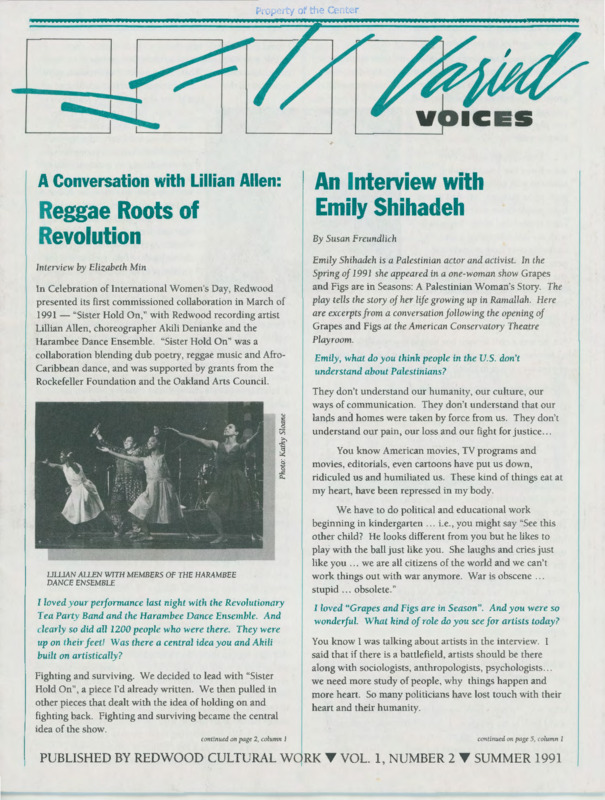
A Conversation with Lillian Allen:
Reggae Roots of
Revolution
An Interview with
Emily Shihadeh
By Susan Freundlich
Interview by Elizabeth Min
In Celebration of International Women's Day, Redwood
presented its first commissioned collaboration in March of
1991 - "Sister Hold On," with Redwood recording artist
Lillian Allen, choreographer Akili Denianke and the
Harambee Dance Ensemble. "Sister Hold On" was a
collaboration blending dub poetry, reggae music and AfroCaribbean dance, and was supported by grants from the
Rockefeller Foundation and the Oakland Arts Council.
Emily Shihadeh is a Palestinian actor and activist. In the
Spring of 1991 she appeared in a one-woman show Grapes
and Figs are in Seasons: A Palestinian Woman's Story. The
play tells the story of her life growing up in Ramallah. Here
are excerpts from a conversation following the opening of
Grapes and Figs at the American Conservatory Theatre
Playroom.
Emily, what do you think people in the U.S. don't
understand about Palestinians?
They don't understand our humanity, our culture, our
ways of communication. They don't understand that our
lands and homes were taken by force from us. They don't
understand our pain, our loss and our fight for justice ...
You know American movies, TV programs and
movies, editorials, even cartoons have put us down,
ridiculed us and humiliated us. These kind of things eat at
my heart, have been repressed in my body.
LILLIAN ALLEN WITH MEMBERS OF THE HARAMBEE
DANCE ENSEMBLE
I loved your perfonnance last night with the Revolutionary
Tea Party Band and the Harambee Dance Ensemble. And
clearly so did all 1200 people who were there. They were
up on their feet! Was there a central idea you and Akili
built on artistically?
Fighting and surviving. We decided to lead with "Sister
Hold On", a piece I'd already written. We then pulled in
other pieces that dealt with the idea of holding on and
fighting back. Fighting and surviving became the central
idea of the show.
continued on page 2, column l
We have to do political and educational work
beginning in kindergarten .. . i.e., you might say "See this
other child? He looks different from you but he likes to
play with the ball just like you. She laughs and cries just
like you ... we are all citizens of the world and we can't
work things out with war anymore. War is obscene ...
stupid ... obsolete."
I loved "Grapes and Figs are in Season". And you were so
wonderful. What kind of role do you see for artists today?
You know I was talking about artists in the interview. I
said that if there is a battlefield, artists should be there
along with sociologists, anthropologists, psychologists ...
we need more study of people, why things happen and
more heart. So many politicians have lost touch with their
heart and their humanity.
con tinu ed on page 5, column 1
PUBLISHED BY REDWOOD CULTURAL W RK T VOL 1, NUMBER 2 T SUMMER 1991
•••••••••••••••••••••••••••••••••••••••••••••••••••••••••••••••••••••••••••••••••••••••• fi
Lillian Allen: continued from previous page
I move on." Right? I think if you do that, then after
awhile you learn and begin to trust that you do have the
power to transform. That in the midst of oppression and
exploitation that you can maintain your humanity. And
that is one thing that they really can't
take away from you. O1)-ly if they
take your life. They can take
everything and beat and strip you
of all of that, but you yourself can
go on and hold on and find a way
to move. The more you move, the
more you see that there are options
and there are roads. Also you need
to have some kind of understanding
that you are not unique in the
world. And that in one way, the
development of the system is quite
arbitrary, in terms of the cosmology
of things. You could as easily have
been born white. The whole system
of exploitation builds around what
I consider to be free black labor. That is the basis of the
system. The exploitation of the land and the resources
that the native peoples have had to endure, that is the
foundation of exploitation. Our cultures were not interested in building the Tower of Babel. We were interested
in relating to people with life and meaning. When ~e
came up against greed, that's where they overtook and
started accumulating power. Once they had done that, we
were no match. We weren't in that arena.
For me, it was very clear when you were on the stage
that you were a strong, grown woman who had done a lot
of fighting. But it was also easy for me to imagine you
growing up, building your skills and
playing with words. What were
you like as a girl? Did you
always write?
I was always active, ever
since I was five I was teaching
adults to read and write - I
grew up in Jamaica. My dad would
have people come over at night to
learn to read and write. I would go
with my dad when they were
changing over from pounds and
pence to dollars. He would go into
the countryside to tell people about
that, and I would go with him and
help him.
LILLIAN ALLEN
Was he a teacher?
No, he was a civil servant but he was a very active person
so he managed to open a lot of doors that way. He was
always very much in touch with the community.
At what point did you get into poetry?
It wasn't so much poetry as an appreciation of words and
speaking. In the community people told jokes and stories.
Going to church, not when the boring preachers were
there, but going when the interesting storytellers, the
damn and damnation people talked. I liked the excitement.
Is there a particular incident for you that kicked you into
actually writing poetry? Was it a growing awareness?
Your pieces are so story-oriented.
What church did your family go to?
Being a poet is almost incidental. It has to do with my
activism, with my political awakening. My awakening
came pretty early on. My church was my major social life
outside of school, but I couldn't do with rules. I thought,
I'm not God but I wouldn't let anybody burn. Why does
he have to be so mean? At 9 or 10, I asked the minister,
why would anyone want to burn up people? If they're
wrong, they can probably change. I couldn't understand.
And then some people had so much. And there were
others that had so little and had so hard a time making
ends meet. I kept thinking, they must have 50 hours in
their day. Nobody worked harder than the people I knew
and they had so little. So I started thinking about those
things and it made me realize that we'd been had. The
system tells you all you have to do is work hard, study
hard, be good, lighten up and whiten up, and you're going
to make it. Right? So we all bought into that. Nobody
works harder than people who are slaves. What the hell is
going on? We are believing this? So very early I had that
awareness and it was a big conflict at school, where I
wanted to challenge the system and ask what's going on?
It was Methodist Baptist. Also, occasionally right beside
our yard, when I was much younger, this fundamental
church would set up a little stage and they would preach.
More drama. That was my cultural context. I had a real
understanding of communication and a real enjoyment of
the festivity and drama of the language. The way to move
people, the way to make people feel, to make them come
over. I always had that feeling. So then you go to school
and they try to kill it. Or the critics need some credential
and kill the life out of it. Then you know something is
going on.
In your show, you spoke several times about courage.
What is your personal source of courage and where do you
get your confidence to do this unusual art form?
I don't remember who said it. Could have been Rosa Parks
who said, "When I look around me and see how things are
and I look at my progress, I just get overwhelmed and
immobilized. But if I get up and start to do something
about it, any kind of problem for anybody, then somehow
2
.........................................................................................,
That became the driving force in terms of what kind of
material I found meaningful and interesting to write. My
life, you know. I wanted to say the things that nobody
else would say were true.
didn't talk about what the media put out as popular
culture. She talked about the market lady, about mass
weddings - where white folks came and organized mass
weddings. She talked about the politicians. There was
nothing that was sacred. She talked about the stupidity
within the society. About our sadness and our joy. She
talked about everything. In terms of a spirit of cultural
empowerment, I think you can say she was the first.
Everyone before that was practically British; they didn't
come from the people's culture.
Dub poetry seems to be about truth. Can you talk about
Louise Bennett? What kind of woman is she?
Growing up in the '30s and '40s in Jamaica, you had a
very formal education which taught you must do very well
and maybe one or two could become a doctor or a lawyer,
if they had money. She grew up in that. If you did really
well and you didn't have money, you could become a
teacher or bank clerk. If you had lighter skin, you did
better. But there were other people in the culture who
seemed quite happy to be doing what they were doing.
They weren't doctors or lawyers or bank clerks and they
were pissed off at not having enough. So they spent a lot
of time being critical, but they didn't spend all their time
trying to get. I think that opened it up for someone like
me. Louise Bennett was writing at a time when the schools
insisted on using the formal language and not the people's
language. Not for people who couldn't quite pull together
the King's English or who came from the rural areas and
were called "country bumpkin." It was a real class thing.
So the thing was that Louise was a beacon, because amidst
all of this "culture's bad" and "people you will amount to
nothing," Louise Bennett, although she had an opportunity
to be a professor and was university-educated, her solidarity was squarely with the people. She came back and was
patronized like hell. She was excluded from the literary
culture and at most she was considered a comedian.
You are coming out with a new album or two?
I'm going to do two albums by the end of the year. One by
end of spring. With music.
Are you a musician yourself?
No. Actually, it's a curious thing but dub poets are usually
not musicians.
You looked like a pretty good band leader the other night. I
thought the connection between the bass lines and the
words worked really well. The work seems very grounded
to the bass.
You learn and begin to trust
that you do have the power to
transform . . . that in the midst
of oppression and exploitation
-you can maintain your
humanity.
So how did she get her work out?
She took her stuff around the country. She went around
the country and went to work in communities, not the
literary circles or elite circles, but the music circles,
community circles, and the festival circle.
Yeah, the bass is what I feel. I think that the bass in the
reggae is the heartbeat. I think that in the way it's played
it has revolutionary intentions.
Did she use music with poetry as well?
She didn't use music, no. Maybe occassionally. You
know, I'm very drawn to culture. And also my dad was
involved in the festival life. They would have festivals
where you would compete in poetry, drama and so on. My
father was part of that - and I would be involved too. So
Louise would come and work in the community. Then
she started to appear on radio. Then she had a book out.
She is probably the best known in Jamaica. There, she was
a house hold word. I consider the thing that she was
doing in her time very revolutionary. She gave the
Jamaican people permission to be themselves. She was the
first to say "you are yourself - get up."
What do you mean by that?
It has certain possibilities. There is something out there
that we don't know, but we're going to get there. That's
how I hear it and that's the instrument I hear.
You know, Oakland is a center for rap. What's the
connection between dub poetry and rap?
Well, I think it's reality in black culture that you have a
spectrum. You have the storytellers and the preachers,
comedians, politicans beyond that. Then you go over to
the work songs and music, all kinds. So I don't think
there's a line. I think it's a spectrum and you've got more
or less on this side or that. Rap in itself, its development
has been traced to Jamaican DJs. DJs went to New York
Because she said it in words, in poetry?
Because she said it in words that made Jamaicans feel
whole, without having to be a super race. In words that
continued on next page, column 1
3
♦ ♦ ♦♦♦♦♦♦♦♦♦♦♦♦♦♦♦♦♦♦♦♦♦♦♦♦♦♦♦♦♦♦♦♦♦♦♦♦♦♦♦♦♦♦♦♦♦♦♦♦♦♦♦♦♦♦♦♦♦♦♦♦♦♦♦♦♦♦♦♦♦♦♦♦♦♦♦♦♦♦♦♦♦♦♦♦♦♦♦◄
Lillian Allen: continued from previous page
Yeah, I'm going to start calling people on this. I've been
thinking about it a lot. It's very incredible to me that with
our level of consciousness that we still think kids are
disposable. When we think about democratizing our
work or accessibility, we don't think about young people.
If we're not doing it for them, then why are we .doing it?
That's a problem with the feminist movement. We're out
there organizing all these rallies and we hear a big speech
by a politico and our kids are in the basement watching
Cinderella. We have to carry on the tradition. Politically,
we need to give them vision.
and started to DJ over rhythms. And then, New Yorkers
started to do that within their own cultural context.
You won JUNO awards for your first two albums - for
very revolutionary music - it seems that would never
happen here with our Grammy Awards.
The thing with the Juno Awards was that we had a panel of
experts to do it. And the panel of experts were people who
were taken from the reggae community for that category,
because the people in the mainstream industry don't know
how to judge these forms and probably don't care. So it
was a major accomplishment to have gotten a panel. They
go across the country and talk to producers, radio and
adjudicate. So the Juno's are taken out of the industry
influence.
Is there anything else you'd like to say before we close?
In general, I think culture is one of the most valid ways to
accomplish anything. To mobilize, to communicate, a
place where we give and a place where we get. It gives us
an opportunity to be complete and to share.
That's a political act in itself.
It was my sense that many in the audience Saturday night
really loved the combination of art farms, and perhaps had
not seen African dance, live reggae music or knew dub
poetry. It all came across as being very fresh and also very
old.
That's the way that happened, yeah. But the struggle for
black artists, even within the arts community, is still great.
I can count the Black artists who are visible on one hand.
What artists don't realize is that they have to change, they
have to give something up. You can't be perpetrating a
racist practice and doing art that reinforces stereotypes and
forms the basis for exploitation. So for me, when they talk
about censorship, it's nationalism and censorship that are
issues for white artists. White Canadian nationalism. I'm
interested in the censorship of the society, of capitalism.
The sense that our essential lives as women and people of
color, are so one-dimensional and exploited - that's what
I want to talk about. I think that our lives are being
censored. And when you talk about stereotyping, I think
that's a major form of censorship. And nationalism is very
problematic. Nationalism is a strategy to reinforce and
build the infrastructure with oppression. Nationalism as
an ideology -I don't go for it. Nationalism is in the
consciousness of white Canada and I don't want to be part
of that.
Yeah, that's the path. 'Cause it depends on community, on
a sense of belonging. You have to go way back. If you
can't see in the past, you can't see in the future . T
Elizabeth Min is currently Artistic Consultant to Redwood
Cultural Work . She is Artistic Director of Oakland Youth
Chorus, where multicultural ensembles (ages 14 to 21)
perform music from diverse global roots spanning four
centuries. Elizabeth was also one of the founders of the
nationally-acclaimed (Bay Area) Women's Philharmonic.
What are some of the particular challenges of being an
artist and being a parent? How old is your daughter?
She's nine. In terms of time challenges - you're a mother
full-time , everything else fits around that. When you have
a kid, you're well set for many years. She's my greatest
work in progress and the one I'm most proud of. She's the
source of a lot of inspiration, and a lot about the world.
Young people make you see your own biases. Particularly
in relation to kids. It seems we are very bigoted and biased
about kids. A lot of people are going to be very sad when
they wake up to that consciousness. Kids are full human
beings.
I know what you mean. I work with kids and I see them run
over all the time. It's so widespread.
4
························································································•◄
some of that! Except I wasn't aware then as I am now. On
Emily Shihadeh, continued from page 1
Yes. I think people connect best heart to heart, sometimes
avoiding their preconceived notions, or prejudices. Heart to
heart, without a filter of fear which says "how can I protect
myself from this person who I think is very different from
me?".
Yes, especially when we can see the commonality between
us. When I speak about my parents, my sisters .. . I have a
line in the show about when I was getting married. I was
17. At the time I said, "Well, now I'm going to stop
masturbating." I said this line to my stage manager, then
said, "I don't think I should keep that line. I might offend
Arabs who come and see the show." Her response was "I
didn't know Palestinians masturbated." I said, "Good, I'm
going to keep that line!" It just humanizes. Many Jewish
people in my audience say to me, "Your music, your
stories, they're my stories".
Exactly! That's what I really believe - that we are so
deeply connected - and that the rest of this is ...
Garbage.
Yes.
The way they look at us. Oh God, it was a nightmare. The Americans in Ramallah were loving people.
They came to our home, talked and ate with us. They
were a different kind of Americans. Quakers - teachers
in the Quaker schools. So I came to this country and I was
very lonely until I met- do you know who? Jews. I
could talk to Jews, I could hear them, understand them. I
could share - there were feelings, emotions, passion,
LIFE! Goddamn life! I began to realize what has happened to Americans. They've become dehumanized.
Priorities have become what's good for your career. Going
for that extra meeting, catching a plane, instead of spending intimate, healing time with people.
So this is the play. Grapes and Figs grew in the front
yard of our house. My father loved fruits, and taught us
how to love fruits - like all the beautiful things of
Palestinian culture that have been
trampled to the ground.
I realized that when I first came I
didn't think I could speak. I didn't
know what to say. Where do I
start? I wanted to talk about
Palestinians, about what had
happened to us. Nobody knew
about us. I remember talking to my
pillow. At night, I went to bed, and
I told these stories over and over
again to my pillow.
You're Jewish.
Yes.
Ah ... bless your heart. You see,
when I first came to this country I
was 17. I felt so different from
people here. I was a bride, not
much self-confidence. I thought I
was American because growing up
in Ramallah, just ten miles north of
Jerusalem, I wore blue jeans and I
read comic books - Archie and
Jughead. I was a Quaker. And the
movies, Hollywood, all of that. I
spoke English. So when I first
came to America I was sure I was
American. However, I quickly
found out I wasn't. I was totally
different, especially in San Francisco.
top of that, I realized with horror what people in this
country thought of Arabs, Palestinians or Muslims.
You were trying to heal the pain?
EMILY SHIHADEH
I was a small town girl - young woman. The
warmth, friendliness, and knowing everybody, that I was
used to, was missing. I had come to a very conservative,
repressed, business-like society. I
was freaked out, to be honest with you. I'd go downtown
to the deli to get a sandwich. There would be all these
different kinds of cold cuts and all these different kinds of
bread .. . in Ramallah we had one cold cut and one kind of
bread! So I would stand there staring and someone would
say, "Hurry up, what do you want? Move out of the way
and let somebody else order!" To my soul it was so
jarring, like poking a stick in my heart every time I got
Yes. I was trying to do something.
This process developed slowly.
What I started to do at first is speak
- to tell our story. I didn't have
much confidence in myself. I didn't
think I had good enough grammar.
I didn't think my stories were
important. But very slowly I started. I spoke at my child's
school and got good results. I took some things from my
house, some Palestinian things - some embroidery, and
some olivewood, and some mother of pearl. I wrote my
name in Arabic on the board, and I told them about my
life. The kids were taking it all in. Slowly I spoke more
and more. Today, when I speak, it's very personal,
powerful. Yes, I learned in the process that I'm powerful,
especially when I speak from my heart.
I spoke in synagogues and temples. I would say,
"Listen. The creation of the state of Israel devastated us as
Palestinians. You have to know that. But I say it not with
continued on next page, column 1
························································································•◄
I am afraid. For the first time I believe that Israel
Emily Shihadeh: continu ed from previous page
might annex the West Bank. For the first time I believe
that mass transference of Palestinians out of their homes,
out of their country is a possibility. I am really afraid.
bitterness, I say it with love." And they feel it with love.
Why am I able to get past the bitterness?
I used to be full of bitterness and misery. I would
lash out at myself as if with a whip , putting myself down in
every way. But with a lot of work, asking questions, doing
therapy, seeking a spiritual life, the message came that my
essence is beauty and love, kindness and decency, and my
eyes began to see all this in other people too, in my enemy.
I began to ask why do things happen? Why do people do
what they do? Why do we hurt each other and ourselves?
There are always reasons.
Terrible things are happening right now in the
Middle East. They're doing what they want with people,
treating them very badly, and getting away with it. It's
almost like history repeating itse,l.f. People get away with
things when no one is really watching.
On the second day of rehearsal for my show the war
broke out. And for me that war represented everything
oppressive that I've had to deal with. Every bomb that
dropped on Iraq, felt like a stick beating on my body. I
took it very personally. The unfairness of it. People were
shocked ... maybe that's one of the good things about this
war - that some Americans couldn't believe how such a
thing could happen.
Do you think the lashing out at yourself was the result of
racism you had internalized?
I am not sure I even like the word racism. I like to
describe what happens rather than give it a name. To me,
racism is ignorance that comes from people who have
suffered, who are afraid, insecure, are have not been taught
to go beyond.
So what is your hope for your audience? What do you want
people to walk away with?
I have a son who's very wonderful, very spiritual, very
deep . He's 26 right now, but he's an old soul. He said to
me, "Mom, they hear you . Whether they respond now, or
whether they respond later, they are hearing every word
you're saying. "
Yesterday, this man was talking to me about racism
in Israel. The word racism does not begin to describe the
situation. Israelis are mostly people coming out of the
Holocaust carrying a lot of unbearable suffering. They have
directed their anger and bitterness towards Palestinians.
We get abused, we abuse others. It is a circle we have to
stop by introducing love, forgiveness, and humility. We
have to say we're sorry for the hurt we have caused each
other. We have all been oppressors of ourselves and each
other. I was a young, angry, frustrated mother and I
abused my children psychologically. I have written them
one extensive letter of apology and we are still working
things out.
I'm planting seeds. You see, I have a lot of faith in
these little victories. This to me is very important. These
are the kinds of things that will really bring peace. I did
this show to put a human face on Palestinians. As simple
as that. I just want people to know we are human beings.
Not terrorists, belly dancers, ugly sheiks.
Palestinians today are suffering. I would like to be
able to stop that. I can't, right now. I was talkingwith a
dear of mine about the Passover Seder. I said to her,
"Jewish people keep repeating the
story about slavery in Egypt. Well
I don't think that's healing. " I
said, "If you want me to tell my
children, and their children about
what Israeli soldiers are doing to
Palestinians now, is that healing?
I don't think so." She said, "Yes,
but we have to remember. We're
working for peace here." I said,
"Yes I know."
Photo: Jan Watson
...,;
"-'
RA NC H ROMANCE AT THE REDWOOD MUSIC FESTIVAL '91
6
························································································•◄
I understand what you're saying. I went to a seder and had
Redwood Cultural Work is a
non-profit 501 (c)(J)
organization. All contributions
are tax deductible to the f ull
extent allowable by law.
to get up from the table and walk away because I could not
read one more time about how the Jews suffered as slaves in
Egypt. I think it's time to stop saying this. It's not
accomplishing anything. It helps to hold in place a kind of
internalized oppression based on victimization, and shifts
people's attention away from the horror that the Israeli
government is perpetrating against Palestinians. Let's talk
about that in our Seder.
I've never heard anyone say that before. And you're
Jewish. Never. As a matter of fact my friend got upset
with me. "This is my dignity", she said.
My dignity is about reaching out to another person. Saying
let us be for each other, with each other. We don't have to
compete over who has been hurt the most.
Our Wish List:
I totally agree. I really think Israelis need to get together.
To talk, and love and share. To find a higher power, or
whatever you call it, God or Goddess. I believe I created
my own God. And my God, my Goddess, my higher
power is a combination of love, justice, decency, kindness,
and beauty. And these qualities, they're not floating
around out there in the world. They are inside of me, and
inside of you. When I used to pray in the old days, I'd say,
"Please God help me." I don't do that anymore. I say,
"Please help me bring out my own qualities of beauty.
Help me recognize them and express them." T
T
Travel (frequent flyer) coupons for artist travel
to concerts, and for Redwood staff use for
fundraising, and conferences.
These are extremeley helpful to us!
T
Printing donation for fall catalog, stationary
T
Intern to work on Redwood Festival for 1992
T
Copying machine
T
Donations of food, bottled water and wine for
special events
T
Office furniture: computer chairs, and desk
chairs
T
Transcribed by Susan Mayo, Lezlie Frishman and Bea
Andrade.
An auto-reverse tape player to hook up to the
phone system, so callers will hear Redwood
music
T
Video tape player (VHS)
Susan Freundlich is currently the Development Director of
T
A video camera and playback monitor
Grapes and Figs will run from August 22-September 22
at the Marsh at Cafe Beano in San Francisco, CA.
Call 641-0235 for tickets.
Redwood Cultural Work, and is Editor of Varied Voices. She
also works with New Bridges, a youth organization that
works toward the elimination of social oppression by building
alliances among people of diverse groups .
Special thanks to Virginia King for our wonderful new
CD player, to Susan Anderson for our new computers
and laser printer and to Ethan Willard from People's
Telecom for our modular cables!
We love our new equipment!
Donations of goods and
services to Redwood Cultural
Work are tax-deductible at
their current market value.
7
························································································•◄
Do Not Despair of the Mercy of Allah
Intifada
Fig trees will grow and oranges
erupt from desert
holdings on which plastic
bullets (70% zinc, 20% glass, and 10%
plastic) will prove blood
soluble and fertilize the earth
where sheepwill graze
and women no longer grieve and beat
their breasts
They will beat clean
fine-woven rugs outside a house
smelling of cinnamon
and nutmeg
by June Jordan
In detention
in concentration camps
we trade stories
we take turns sharing the straw mat
or a pencil
we watch what crawls in and out
of the sand
As-Saliimm 'Alaykum
Ahamdullilah
The guards do not allow the blue
woolen blanket
my family travelled far
to bring
to this crepuscular and gelid cell
where my still breathing infant son
and I
defy the purgatory implications
of a state-created hell
So says Iman
the teacher of peace
the shepherd on the mountain of the lamb
the teacher of peace
who will subdue the howling of the lion
so that we may kneel
as we must
five times beginning just after dawn
and ending just before dusk
in the Ibadah
of prayer
Wa 'Alaikum As-Salam
The village trembles from the heavy
tanks that try
to terrify the children:
Everyday
my little brother runs behind the rubble
practicing the tactics of the stones
against the rock.
In January soldiers broke his fingers
one by one. Time has healed
his hands but not the fury that controls
what used to be
his heart.
Alliihu Akbar
Allahu Akbar
Alliihu Akbar
Alliihu Akbar
Glossary:
As-Saliimm 'Alaykum: peace be unto you
Wa 'Alaikum As-Salam: and peace be unto you
Insha A'llah: as/if Allah wills it
"Do Not Despair of the Mercy of Allah" : verse from
The Qur'an
Ahamdullilah: praise be to Allah
Iman: faith
Ibiidah: worship in a ritual sense
Allahu Akbar: Allah is the Greatest
Insha A'lliih
Close the villages
Close the clinics
Close the school
Close the house
Close the windows of the house
Kill the vegetables languishing under the sun
Kill the milk of the cow's left to the swelling of pain
Cut the electricity
Cut the telephones
Confine the people to the people
© JuneJordan
Reprinted by permission of author from Naming Our
Destiny, Thunder's Mouth Press, 1990.
8
························································································•◄
express themselves. In order to effectively fight these
The NEA Is the Least
of It
attacks, however, it should be understood that this
growing repression is inherent in the capitalist political
and economic system that engenders it. Attempts to
suppress art are perfectly consistent in a historical period
when access to legal abortion is being curtailed; hate
crimes (often carried out by well-organized hate groups)
against people of color, Jews, lesbians, gays, and women
are skyrocketing; laws that protect basic civil rights have
been weakened or overturned; the First Amendment rights
of radical, gay, Third World, and
feminist teachers are under attack;
the federal government engages in
blatant union busting; and the
United States sees fit to disrupt the
governments of countries it views as
threatening to its imperialist hegemony.
By Barbara Smith
When I was growing up, my sister and I were so shy that
family and friends inevitably commented on our "bashfulness." I spent a lot of the first 18 years of my life seeing,
thinking, and feeling, but not speaking.
Of course, my shyness, my
efforts to erase myself, were not
solely the result of my socioeconomic status. But looking back
I'm sure that being born black,
female, and working class in the
mid-1940s affected my perception
of how safe it was to speak, as well
as made me question whether I
even had the right to do so.
White middle-class artists are
discovering that this system parcels
out freedoms stingily and unfairly
and withdraws them arbitrarily,
depending upon the vagaries of the
economy, foreign policy, and the
electoral climate. It should surprise
no one that a right-wing government
would oppose the funding of work
that is lesbian, gay, or sexually
explicit, since art from these perspectives depicts alternatives to the
institutions of compulsory heterosexuality and the monogamous
nuclear family, without which
capitalism could not function.
If it were not for political
activism - the civil rights
movement, black student organizing, the anti-Vietnam war movement, and particularly the feminist movement - I doubt that I
ever would have learned to speak
out. Fortunately, I also found a
remarkable role model. I'd always
loved books and writing, but
almost everyone I know of who
engaged in these activities was
BARBARA SMITH
white. And then I discovered
James Baldwin. Here was a black person who was simultaneously angry, sensitive, and analytical, and who wrote
brilliantly about things that mattered to me.
But the silencing of lesbians and gay men of color
takes many forms. The most galling is not being perpetrated by the NEA, but comes instead from within oppressed groups to which we supposedly belong.
Because of his passionate activism and command of
craft, Baldwin fed my dreams of wanting to write. He
proved that breaking silences, as a black gay man, can
make a difference. To me, a lesbian feminist of color,
silencing, censorship, and the need to challenge them have
never been abstract. Long before the right wing began a
focused attack upon government funding of artists who
counter the status quo, it was clear to those of us who are
multiply oppressed that our right to speak out, write,
dissent politically, or merely exist are considered rebellious acts. ·Racism, sexism, homophobia, and class
oppression have silenced far more people than the withdrawal of National Endowment for the Arts grants since
the summer of 1989.
A Euro-American lesbian and gay community up in
arms about the NEA should consider how their all-white
readings, exhibits, theatrical productions, conferences, and
periodicals - or their token efforts to be inclusive effectively silence lesbians and gay men of color.
Tokenizing is a form of silencing too, because even if a
person of color appears, it is not possible to share the
range of her or his creativity when she or he is objectified
and isolated.
Ironically, as this country moves further to the right,
a large sector of the lesbian and gay community also
becomes more conservative, focusing on electoral politics,
legislative agendas, and lobbying. The upsurge in confrontation tactics and zap actions such as "outing" of apolitical
Of course, the campaign to place restrictions on the
content of what the NEA funds has serious repercussions
and potentially threatens the right of all individuals to
Continued on next page
9
························································································•◄
are fascist carry ou_t crimes of violence against us, includBarabara Smith: continued from previous page
and reactionary public figures is not a sign of increasing
radicalism, since it generally does not spring from a
multileveled analysis of oppression or challenge oppression at its roots.
ing murder. The ones who are liberal claim that they do
not mind if we exist, just so we don't call attention to that
fact.
As a black lesbian writer, my entire career has been
affected by the reality of homophobia in my racial community, and I've devoted much of my work to challenging it.
In early 1988 Joseph Beam and I drafted a statement,
which was signed by 20 black lesbian and gay writers,
about the silencing we experience at the hands of the black
literary establishment. We presented the statement at the
Second National Black Writers Conference at Medgar
Evers College in Brooklyn. It stated in part:
Racism and segregation are also alive and well in the
feminist movement. There are still white women's organizations perplexed about how to do "outreach" to women
of color, as well as white women who resent and obstruct
efforts by women of color to organize autonomously.
Although there are inspiring examples of radical women of
color and radical white women working together politically, the bourgeois elements that dominate the movement
are still characterized by exclusivity and tokenizing.
"We are well aware that despite our commitment to
exploring gender roles and to challenging sexual, racial,
and class oppression, work that has been essential to
transforming the practice of African American literature in
this era, the Black literary establishment systematically
chooses to exclude us from the range of its activities.
These include participation in conferences, invitations to
submit work to journals and anthologies, serious and nonhomophobic criticism of our writing, positive depictions of
Lesbians and Gay characters, inclusion in Black studies
course curricula, and all levels of formal and informal
mentoring and support. If we are sometimes included in
token numbers, it is often amid heterosexist protest and
homophobic attacks."
Even when the lesbian, gay, and feminist movements
attempt to confront racism, a major obstacle is the assumption that it is feasible to address racism solely within
movement contexts and to ignore its destruction of the
society as a whole. When whites in these movements
demonstrate a consistent commitment to speaking out and
organizing offensives against racist violence, police
brutality, homelessness, economic exploitation, and
unequal access to quality education and health care,
people of color can begin to take their anti racist actions
seriously.
Sexism and heterosexism among people of color can
be even more demoralizing since our racial, ethnic, and
nationality communities have usually represented home, a
physical and emotional place we could rely upon to help
counter the effects of white domination. Since the late
1960s, despite criticism, ridicule, and ostracism, feminists
of color - American Indian, Asian American, Latina, and
African American - have spoken out about sexual
oppression in our home communities.
Despite our fears, our reading of this statement was
met with widespread applause and a public invitation from
the conference director to help in planning the next
conference.
The final aspect of silencing I want to examine is that
of the closet itself. I constantly hear about prominent and
productive African American women - writers, artists,
and political figures - who could share the responsibility
of changing our community's attitudes, but who have
instead chosen to hold onto the secrecy of their closets.
There are real and sometimes dangerous sanctions against
being out, and there are lesbians and gays who do not have
the option: who might, for example, lose jobs, housing, or
custody of their children. The individuals I am referring
to, however, have secure academic positions or are
successfully self-employed, yet still refuse to take a
political stand.
In the African American community numerous
controversies have focused directly upon work by black
women writers. Reactionary forces have stated that we
should not be allowed to address the realities of male
supremacy and sexual violence in our writing, that to do
so is somehow disloyal to the race. The nineties have
ushered in a resurgence of black nationalism accompanied,
not surprisingly, by more and more public expressions of
misogyny. Shahrazad Ali's book, The Blackman's Guide to
Understanding the Blackwoman, the lyrics of many rap
songs, and the films of Spike Lee are only three popular
examples. In this climate it is crucial for black women
writers to continue to speak out.
It is ironic that those of us who have helped to build
the lesbian, gay, and feminist movements have made it a
lot easier for them to have their relationships with other
women "in private." A handful of out lesbians of color
have gone into the wilderness and hacked through the
seemingly impenetrable jungle of homophobia. Our
closeted sisters come upon the wilderness, which now is
not nearly as frightening, and walk the path we have
Heterosexism within communities of color is
undoubtedly the most volatile of the issues that lead to
internal censoring and silencing. The closet itself is a form
of censoring and erasure that the heterosexual majority
imposes in order to maintain its privilege. The ones who
10
························································································•◄
cleared, even pausing at times to comment upon the
beautiful view. In the meantime, we are on the other side
of the continent hacking through another jungle.
GIVE ME A HOME
At the very least, people who choose to be closeted
can speak out against homophobia whenever it occurs.
Like principled heterosexuals, they can protest the oppression without having to come out themselves.
by Odilia Galvan Rodriguez
BANTUSTANS
The depth of this problem was brought home to me
last November. I had been on a panel during a weekend of
events celebrating the twentieth anniversary of co-education at Yale. The next day a black woman graduate student
drove me to the airport. I meet hundreds of students each
year, but I still remember Tonnia. It wasn't only because
she was so bright, and planned to use her talents in the
working-class African American community from which
she'd come. I remember her because of the urgent questions she put to me about how she might survive as an out
black lesbian artist in the decades that lay before her. Her
questions reminded me of my own at her age when there
were even fewer signs one could be a black lesbian and live
to tell about it.
from living with the earth
TOWNSHIPS
they took our ancestors
GHETTOS
with guns, greed
RESERVATIONS
promises and lies
At one point I said, "You don't have many role
models, do you?" Just saying the words made me furious
because it struck me how the black women writers,
academics, and politicos who protect their closets never
think about people like Tonnia or about how their silences
contribute to the silencing of others.
HOUSING PROJECTS
to these alien places
BARRIOS
we must now call home.
From my own experience I know that it is quite
possible to provide support to students of all races,
genders, and sexual orientations, and still be black and still
be out. Young people respond positively to those who
demonstrate integrity and courage and who genuinely care
about them. Recent studies indicate that 30 percent of
youth suicides can be attributed to turmoil about sexual
orientation and the fear or actual experience of
homophobia. Young lesbians and gay men of color are
especially vulnerable since there are so few adults of color
they can turn to for support. If I had to choose, I would
rather have the respect of the generation coming up than
of my own. They are the ones who will shape the next
century, and who will undoubtedly be leaders in the
revolutionary struggles that will ultimately make it
possible for every person's voice to be heard. T
© Odilia Galvan Rodriguez.
Reprinted with permission of author.
Barbara Smith is a writer and activist. She is the editor of
Home Girls: .A Black Feminist Anthology and is a cofounder
of publisher of Kitchen Table: Women of Color Press.
Excerpt reprinted by permission of author. The American
Voice, Winter 1990.
11
•••••••••••••••••••••••••••••••••••••••••••••••••••••••••••••••••••••••••••••••••••••••• fi
Our Grandmothers
In Virginia tobacco fields,
leaning into the curve
on Steinway
pianos, along Arkansas roads,
in the red hills of Georgia,
into the palms of her chained hands, she
cried against calamity,
You have tried to destroy me
and though I perish daily,
by Maya Angelou
She lay, skin down on the moist dirt,
the canebrake rustling
with the whispers of leaves, and
loud longing of hounds and
the ransack of hunters crackling the near branches.
I shall not be moved.
She muttered, lifting her head a nod toward freedom,
I shall not, I shall not be moved.
Her universe, often
summarized into one black body
made her cry each time in a new voice.
All my past hastens to defeat,
and strangers claim the glory of my love,
Iniquity has bound me to his bed,
She gathered her babies,
their tears slick as oil on black faces,
their young eyes canvassing mornings of madness.
Momma, is Master going to sell you
from us tomorrow?
yet, I must not be moved.
Yes.
Unless you keep walking more
and talking less.
Yes.
Unless the keeper of our lives
releases me from all commandments.
Yes.
And your lives,
never mine to live,
will be executed upon the killing floor of innocents.
She heard the names,
swirling ribbons in the wind of history:
nigger, nigger bitch, heifer,
mammy, property, creature, ape, baboon,
whore, hot tail, thing, it.
She said, But my description cannot
fit your tongue, for
I have a certain way being in this world,
and I shall not, I shall not be moved.
Unless you match my heart and words,
saying with me,
No angel stretched protecting wings
above the heads of her children,
fluttering and urging the winds of reason
into the confusion of their lives.
They sprouted like young weeds,
but she could not shield their growth
from the grinding blades of ignorance, nor
shape them into symbolic topiaries.
She sent them away,
underground, overland, in coaches and
shoeless.
When you learn, teach.
When you get, give.
As for me,
I shall not be moved.
I shall not be moved.
She stood in midocean, seeking dry land.
She searched God's face .
Assured,
she placed her fire of service
on the altar, and though
clothed in the finery of faith,
DIANE FERLA TTE WITH REDWOOD STAFF MEMBER BEA
ANDRADE AT THE REDWOOD MUSIC FESTIVAL '91.
12
•••••••••••••••••••••••••••••••••••••••••••••••••••••••••••••••••••••••••••••••••••••••• fi
when she appeared at the temple door,
no sign welcomed
Black Grandmother. Enter here.
Thoughts On A Diary
by Susan Griffin
Into the crashing sound,
into wickedness, she cried,
No one, no, nor no one million
ones dare deny me God. I go forth
alone, and stand as ten thousand.
Silences. Not the silences between notes of music,
or the silences of a sleeping animal, or the calm of
a glassy surfaced river witnessing the outstretched
wings of a heron. Not the silence of an emptied
mind. But this other silence. That silence which
can feel like a scream, in which there is no peace.
The grim silence between two lovers who are
quarreling. The painful silence of the one with
tears in her eyes who will not cry. The silence of the
child who knows she will not be heard. The silence
of a whole people who have been massacred. Of a
whole sex made mute, or not educated to speech.
The silence of a mind afraid to admit truth to
itself. This is the silence the poet dreads.
The Divine upon my right
impels me to pull forever
at the latch on Freedom's gate.
The Holy Spirit upon my left leads my
feet without ceasing into the camp of the
righteous and into the tents of the free.
These momma faces, lemon-yellow, plum-purple,
honey-brown, have grimaced and twisted
down a pyramid of years.
She is Sheba and Sojourner,
Harriet and Zora,
Mary Bethune and Angela,
Annie to Zenobia.
© Susan Griffin.
Reprinted by permission of author.
She stands
before the abortion clinic,
confounded by the lack of choices.
In the Welfare line,
reduced to the pity of handouts.
Ordained in the pulpit, shielded
by the mysteries.
In the operating room,
husbanding life.
In the choir loft,
holding God in her throat.
On lonely street corners,
hawking her body.
In the classroom, loving the
children to understanding.
Photo:Jan Watson
Centered on the world's stage,
she sings to her loves and beloveds,
to her foes and detractors:
COMIC MARGA GOMEZ WITH ASL INTERPRETER MARILYN VAN
VEERSEN AT THE REDWOOD MUS IC FESTI VAL '91 .
However I am perceived and deceived,
however my ignorance and conceits,
lay aside your fears that I will be undone,
for I shall not be moved .
....
© Maya Angelou. Reprinted by permission of author.
13
...........................................................................................
A Letter from Amy Bank:
Chamorro to fulfill her promises of land and services.
This, coupled with former owners coming back from
Miami and Costa Rica to reclaim their confiscated property, as well as the government policy of re-privatizing
state farms while agricultural workers insist that they have
a right to the land they work, has caused serious tensions
in the countryside, undermining agricultural production,
the mainstay of the Nicaraguan economy.
Former Redwood staff member and editor
of Voices. Amy has been living and working
in Managua since 1984.
February 25, 1991
Managua, Nicaragua
In the cities, unemployment has reached an all-time
high of 40% as the government has laid off thousands of
public employees in an attempt to reduce the fiscal deficit
and comply with IMF and World Bank requirements for
receiving aid. The lack of job security and demands for
salary increases in the face of exorbitant prices for even the
Dear Friends:
most basic goods provoked two national strikes that
paralyzed the country in the first three months of the new
administration.
One year ago today, the Frente Sandinista lost the elections, contrary to everyone's expectations. The ground
war in the Gulf began less than thirty-six hours ago,
wiping out whatever memory in the US there might have
been of an event that radically changed the course of this small, underdeveloped, war-ravaged revolutionary country. Even without the horrifying developments in the Gulf,
from what I hear about US news coverage over the last
year, it would seem that Nicaragua had virtually dropped
off the map. But just in case anyone has forgotten,
Nicaragua does still exist.
It now seems like an eternity ago when we - a
group of young Nicaraguans and a few "gringas" - sat
stone-faced in the dead of the night, trying to convince
ourselves that the election results were just a bad dream,
that we could go to sleep and wake up the next morning
and that the Frente Sandinista would have won.
But no one could sleep and it wasn't just a bad
dream. So what's happening a year later? Are people
better off now that a government friendly to the U.S. is in
power? Yes and no. But in fact, it's much more complicated than that.
AMYBANK
One of the more interesting dynamics has been
Chamorro's decision to retain Humberto Ortega as head of
the Sandinista army, despite pressures from the United
States and the extreme right-wing. In any other Latin
American country, the general strike last July- which
reached near-insurrectional proportions - would have
resulted in dozens dead, scores wounded, and thousands
arrested. That didn't happen, consequence of General
Ortega's public position that while the army is loyal to the
new government, it will never turn its weapons against the
people.
Obviously the main positive thing that has happened
is that the war ended. But the problem is that the end of
the war did not bring with it social peace. While the fear
that a new civil war could break out has subsided, there is
a very delicate balance both in the countryside and in the
cities that continually threatens to explode. The government is under pressure from all sides - demobilized
contras, demobilized members of the Popular Sandinista
Army, extremist factions within its own governing coalition, a strong Sandinista opposition, unions, right-wing
businessmen, the IMF and World Bank- making any
kind of political and social stability, not to mention
coherent economic recovery difficult, if not impossible.
True to his promise, Bush lifted the embargo. There
is an illusion of affluence because the rich are much more
visible. The "Miami boys" have come back with their new
cars and latest fashions, and there are more products on
the shelves.
On one side, there are the tens of thousands of
demobilized contras who have resorted to land takeovers-many times violent-as a pressure tactic to get
14.
But the reality is that the vast majority of the population can't afford to buy all the new products on the
shelves. Nicaragua has gone from being the least expensive country in Central America to being the most expensive, with prices being equivalent to or higher than New
York prices. Many are struggling to put two meals a day
on the table, much less three, while government leaders
are earning astronomical (in relative ternis) salaries that
one economist calculated comprises 10% of the national
budget. With the budget cuts in and privatization of
health and education, more people are dying of treatable
diseases, illiteracy is on the rise, and more and more kids
are dropping out of school earlier because they can't afford
the books. But those kids can't find jobs. So, while
mothers may not worry that their sons will be killed on the
battlefield, they now worry that they may become juvenile
delinquents, alcoholics, or drug addicts, or that they'll get
killed in a knife-fight in the streets.
it means to be revolutionaries in a new context, both
inside Nicaragua and in the "new world order". The
process of regrouping has not been easy.
In the limbo between the electoral defeat and the
first party congress scheduled for July, many Sandinistas
have felt disoriented and disconnected. Thousands of
Sandinistas who had interrupted or postponed their
studies, their careers, their families, their personal lives in
order to dedicate themselves full time to the revolution
were left without jobs or hope. Some high-ranking party
members made off with cars, houses, and other goods in
what has become known as the "Sandinista piftata" .
As could have been expected, there has been considerable disaffection within the Sandinistas ranks (as well as
among "internacionalistas", many of whom have left).
Many began to "speak bitterness" about the abuses of
power, the corruption, and the lack of iQ!ernal democracy
they had experienced but had been too afral.d to voice for
fear of party discipline. Many have decided that it was
now time for them to finally dedicate themselves to their
personal lives and economic survival, and there's a definite
turning inward.
All of this is to say that the mood in the country is
not particularly jubilant. Even people who have come back
to Nicaragua with high hopes that things would be better
now that the Sandinistas were out of power are disappointed. Many have decided not to stay. And many
people - including friends of mine - who never would
have thought of leaving Nicaragua when the Sandinistas
were in power because they felt they had something to
fight for are now thinking of emigrating. People are tired
and burned out, and there are not a whole lot of reasons to
have much hope that things will improve in the foreseeable future.
One of the positive side effects of the Sandinistas'
defeat is that hundreds of new, independent and progressive organizations and institutions have surfaced. Whereas
progressive political organizing under the Sandinistas was
for the most part limited to the Sandinista-linked mass
organizations that had top-down leadership, many activists
are now developing new, more democratic organizations
and movements, where being in the opposition is, ironically, an advantage. The women's movement, the gay
movement, and the union movement, for example, are in
fact better off now than they were under the Sandinistas,
not because the Sandinistas didn't believe in these things,
but because they too were walking a tightrope to try to
keep the country together. And it's important to remember
that it was the Sandinistas who opened up the political
•space for all of this to be possible.
Given the urgency of creating a stable environment
that will entice investors, the government is walking a
tightrope, trying to accommodate all the social, economic
and political forces that tug at it from all sides. Everyone
blames everyone else for the country's ills. The rightwingers blame the Sandinistas for leaving the country
bankrupt and causing social unrest. The Sandinistas blame
the government for implementing policies that erode the
rights of working people and the poor and provoke unrest.
The government blames both the right-wingers and the
Sandinistas. And while everyone blames everyone else,
they're also making alliances with each other. Politics
makes strange bedfellows.
The point is that the revolution is not over, although
the terms have changed dramatically. Revolution is not a
thing, it is a process, and as long as there are dedicated
people willing to engage in that process, the revolution in
Nicaragua will stay alive. It's not easy, there's no formula,
and it certainly isn't romantic, but it is still worth fighting
for, even when the odds are against us. 'Y
As for the Sandinistas, there was a short-lived postdefeat euphoria. Ironically, many were relieved that they
lost the elections. The defeat gave them a bit of breathing
space to be able to engage in a real internal evaluation of
the party, as well as the freedom to develop and carry out
new strategies for organizing and defending revolutionary
gains without the pressures of being the government.
But the wearing off of that euphoria very quickly
turned into a rather profound collective existential crisis,
as the Sandinistas began to face the larger question of what
15
♦♦♦♦♦♦♦♦♦♦♦♦♦♦♦♦♦♦♦♦♦♦♦♦♦♦♦♦♦♦♦♦♦♦ ♦♦♦♦♦ ♦♦♦ ♦ ♦♦♦♦♦♦♦♦♦♦♦♦♦♦♦♦♦♦♦♦♦♦♦♦♦♦♦♦♦♦♦♦♦♦♦♦♦♦♦♦♦♦♦♦♦♦◄
Since August we have been involved in reorganizing
the women's movement in the new context we find
ourselves in without the powerful ally of Sandinista
government. We also face a new situation where progressive forces all over world are at low ebb, both in the East
and West. We have begun to analyse the dilemmas and
challenges facing the women's movement, and I can say
with some satisfaction, that we have agreed on the basic
premises so the movement can take off under these new
conditions.
What will be the difference between this new movement and
the women's movement that has existed up until now?
First we need to come to consensus on what kind of
movement we want, what our common struggles are, and
then each sector will define its issues according to its own
priorites and needs. We hope to create something more
dialectical: a consensus on a common struggle and then
each group will set its own priorities within a framework
of clearly articulated alliances so that the political force of
all women is felt. To avoid the fragmentation that has
been the experience of women's movements in the US,
Europe and even elsewhere in Latin America, we need a
common strategy that respects differences. That's critical.
We want to be felt and heard as a movement. We also
have to take on a gender perspective. We can't go around
wavering on feminism. It is an anaylsis that has to be
assimilated by everyone.
SOFIA MONTENEGRO
Sofia Montenegro
Interview by Julie Light
Sofia Montenegro is the irreverant, razor sharp editor of
Gente, the Barricada's weekly supplement and Sandinista
daily. Montenegro has been at Barricada for the last 11 years,
and previously edited the paper's opinion page. She says
Gente's guiding ideology is feminist, even though the magazine covers a wide range of issues and there are men on staff.
Managua-basedjoumalist]ulie Light recently spoke with
Montenegro about current efforts by Nicaraguan feminists to
build an independent grassroots movement, and about the
Sandinista's no-holds-barred self-criticism leading up to their
first party congress set for July 19-21. Both AMNLAE (the
official Sandinista women's association), and the Sandinista
Frente are set to elect new leaders. But the process is one that
goes far beyond internal elections. As Montenegro eloquently
points out, it is part of a struggle for autonomy and identity
when it is no longer clear what it means to be "revolutionary"
in a rapidly shifting world order.
So you think fem in ism will stop being a dirty word in
Nicaragua?
At least in Nicaragua feminism has a better chance than
elsewhere. Maybe because here we incorporate experiences in a short period. In addition, this is an epoch of
synthesis. The left all over the world is going through hard
times, even more so with this damn war in the Persian
Gulf.
This gives us more force now, in the face of the
collapse of the East bloc countries. They were bureaucratic, geriatric societies that were above all profoundly
patriarchal. This demonstrates that where women do not
have the space to struggle for their equality results in an
extremely conservative society that eventually disappoints
the great majority of people.
THE NICARAGUAN WOMEN'S MOVEMENT
Is the AMNLAE leadership more inclined towards a topdown chain of command, taking their direction from the
Sandinista Frente, or do they also accept the idea of gender
consciousness within a broadbased movement?
How has the Sandinistas electoral defeat affected the
women's movement?
The electoral defeat affected the women's movement in the
same way grassroots movments as a whole have been
affected. After the initial distress we've entered into a
certain paralysis and disorganization. Which doesn't mean
the movement is dead, because revolution is not dead.
People don't change overnight. We Sandinistas come out
of a political/military tradition that is authoritarian. In the
case of AMNLAE there is a group represented by longtime Sandinista leaders who have a mentality that is
difficult to change quickly. If they can't change their way
16
························································································•◄
Frente had been more audacious long before and if the
of thinking, we will have to change leaders. The times we
women's association had been more daring and
broadbased, women would have been much more conscious of what they had to lose in these elections.
live in demand an open mind, truly democratic ways of
working, constant debate and a clear vision of what we
want. One woman cannot do it alone. All women have to
participate together so we all feel this project is ours. No
matter what the Sandinista Frente might think, this is not
their decision, it belongs to the women of Nicaragua.
Are the Sandinistas in crisis?
Obviously we are in crisis. But the crisis in the Frente is
not one of decline, it's one of growth. In Nicaragua the
crisis is a youthful one, we are passing through our
adolesence towards adulthood in circumstances never
before seen in the world. We are a single generation that
in 10 years has lived through a war of liberation and a war
of sovereignty. We went from the thesis of the taking of
power to the antithesis of governing and if we are lucky we
will move on to the synthesis while we are still a young
generation. The average age of most Sandinistas is under
40.
We want an alliance, but not a marriage. We want
an adored and well behaved lover, not a husband who
wants to give orders. We don't rule out alliances with
women from the right-wing parties based on a common
interest as women. The broadbased movement we're
trying to create cannot be subordinated ideolgically or
politically, much less economically. What we want as
women is what we want as a movement: autonomy.
Do you think men in this country will support a feminist
movement?
In the worst moments of crisis the Frente has had the
capacity for self-criticism that has allowed it to advance. If
not we would have not survived more than 20 years as
underground movment, or survived two wars.
Our culture is patriarchal, and men too are its victims. We
have to have mass struggle that includes men. We have to
make them see that their true interests for their own
happiness, their psychological, and economic well being
rest in their search for the ideal of an egalitarian society. If
we are incapable of sowing the aspiration for an egalitarian
society in men's souls, that means we haven't done our job.
We should be self-critical as feminists, if we can't make
this beautiful ideal sellable to other human beings who
happen to be men. I've always said that true socialism, if it
exists, has to be feminist or it won't work. We have to
convince all men who consider themselves revolutionaries
of this essential fact.
ON VIOLETA
What do you think of Violeta Chamorro, as a symbol, as
Nicaragua's first woman president?
My gut reaction is that she is a poor devil. My second,
perhaps more rational thought, is that as a woman I don't
identify with her. She has been a lesson to all of us,
especially to our male companeros and that will be an
advantage to the women's movement. This senora has
shown the world that the fact that you have a woman in
office doesn't guarantee your interests as a gender. That's
the first lesson. I've met some unaware feminists abroad
who even congratulate me because we have a woman in
office. Being a feminist doesn't give me a biological
identifcation with Violeta, the problem is that there is no
political identification. As an image she's touched something. The Frente has a ton of brilliant capable women
and it never gave them the place they deserved in leadership. That's the second lesson. Even many men feel that
with so many great capable women we have to have the
worst of the lot as President. Even Gen. Humberto Ortega
has to salute her and call her Senora Presidente. It's been a
maginificent blow to the machista pride in the country. In
future no one will be able to say that women cannot be
president or anything else. 'Y
That's why feminism has to have a political strategy
for what the hell to do with men. What do we have to offer
them in a world where disillusionment, intellectual and
spiritual misery is on the rise, especially in face of worldwide catastrophe in the Persian Gulf.
The perception exists that the gender gap in last year's
elections favo red President Chamorro. How is it that the
Sandinistas lost women, or a group of women whose sons
were drafted, or who could no longer stretch their family
budgets?
The reason is simple and complicated at the same time.
There are several elements. One is that their sons were
draft age. There are not a lot of women who want their
children to go off and get killed. We have yet to see the
reaction of yankee mothers when their sons come home in
body bags. They will react the same as Nicaraguans, let's
be clear. Feminine culture was at work: they voted for life.
Women's psyches make us live for others, and before
thinking of our own rights and what is at stake for us in
these elections. Women voted for their sons, for their
husbands, for men, but not for their own interests. The
other element at play was the economic crisis. If the
17
························································································•◄
A Just War
by Kathy Engel
A just
and racist war
I heard a famous writer say
on national television
the other night
just and racist
yes, it is a just war
as just as the slaying of Yusef Hawkins
as just as the rape of Yanira Corea
as just as watching your child tortured
as just as no water on one side of the West Bank
as just as Jews in ovens
as just as anyone gassed
as just as African people rounded up and
numberless dead in the sea
as just as 70% of homeless men war veterans
as just as them living in armories
as just as the young recruiter promising a new life
as just as 7000 Panamanians in mass graves since
December 20, 1989
as just as mining harbors
as just as Wounded Knee
as just as handsome young Ismael Cotto
out of the forgotten, forbidden South Bronx streets
out of the no chance for anything
and into uniform, pressed and shining
proud man of his proud family
as just as his death in the Arabian Desert
as just as the girl in Tel Aviv with a gas mask
and the girl in Ramallah without one
as just as my friend's son
who will remain nameless
writes poetry from the desert:
I have only one wish to witness
the safe return of the thousands and thousands of soldiers
I've seen going in different directions
convoying across this vast expanse
of sand and sky ...
I have to grapple and yet to come to terms
with the fact that I may have to shed
the blood of a fellow human being ...
From the divine and spiritual perspective,,
it is senseless and immoral.
as just as no water
as just as the child in Baghdad
as just as the ten year old Upstate New York
who writes he's worried
about kids in Iraq
as just as Americans calling other Americans
"towel-heads," burning their stores and restaurants
as just as 9 year old Carina
she writes: Dear Soldier why do you go to war?
and is ostracized in school.
As just as Hiroshima
A just and racist war
is how Hitler's people
came up with the idea
of a new World order.
As just as the best lie.
I call for not a moment of silence.
Thousands of moments of silence
will not make up for the thousands of points of pain
centuries of blood wrenched agony
ejected onto
the most ancient cities in the world.
We have never needed a world order.
What we need is something a two minute
sound bite cannot reflect.
Something a New York Times
Op-Ed cannot hold.
What we need is something even Peter Jennings
can't talk about.
What we need is not Nightline.
But a line of truth.
The carpet bomb sortie
the surgical strike capacity
will replace humanity.
The oil will spoil.
What we need
is to listen.
More than a thousand moments of silence
What we need is to listen
We need to lister1.
And scream.
A just war
as just as the newly sealed homes in Jerusalem
and the homes that have been sealed for 23 years
© Kathy Engel. Printed with the permission of the author.
18
.........................................................................................,
Varied Voices profiles those who work with Redwood with a
look at Angela Johnson, Production Manager and Treasurer of
the Board.
Staff Profile:
Angela L. Johnson
My identical twin sister and I were born in Los Angeles,
California close to three decades ago. After graduating
from the University of California at Berkeley with degrees
in Ethnic Studies and Mass Communications, I went to
work with Redwood Records as Advertising and Publicity
Director. From Redwood, I continued to work on a variety
of political and cultural projects including the first Spring
Mobilization for Peace, Jobs and Justice in San Francisco;
SISTERFIRE in Washington,D.C.; and the Annual Wome
of Color Conference at U.C. Berkeley. I've worked as
house manager at U.C. Berkeley's Zellerbach Auditorium,
for the past few years. I've also worked in production with
a number of dance and music organizations, including
CitiCentre Dance Theatre, Dance Brigade, Faculty Against
Apartheid, Alliance for Cultural Democracy, the Northern
California Nelson Mandela Program, and most recently
with the Oakland Ballet as their Director of Operations.
ANGELA JOHNSON
been created during Redwood presentations is a testament
to Redwood's particular vision. Redwood's direction of
presenting work that inspires and rejuvenates people to
work toward the development of a more just and peaceful
world makes Redwood an organization for whom I choose
to work.
Currently, I work part-time at Redwood Cultural
Work and continue my business as a freelance production
and arts development consultant. My interests include
dance, music, film, the visual arts, food and wine and
catering for various events. I also love literature and
animals.
Redwood's belief that culture has a role to play in
creating social transformation matches my own sensibilities. Redwood's desire and commitment to developing and
maintaining a strong multicultural institution, and my
own need to work with a socially-conscious organization,
was another reason why I wanted to work here.
I returned to Redwood as a volunteer for the 1989
Festival and member of the Production Committee.
Following the Festival, I stage managed several events, and
eventually was asked to join the Board in 1990. When
Redwood received funding for the position of a production
coordinator, Joanie Shoemaker offered me the opportunity
to return to Redwood as a staff member.
Of course, everyone brings their own life experience
to their work, but it's more than the fact that I am a Black
woman that influences my work at Redwood. My experiences as a person who has continually worked on social
justice issues within a cultural setting have provided me
with multiple opportunities to develop a particular
sensibility. This sensibility, not the least of which has to
do with functioning as a Black woman in the dominant
society, has created a distinctive personality; one which is
fiercely loyal, dedicated, independent, forthright, opinionated, fun-loving and compassionate.
It never ceases to amaze me how Redwood's work
moves people. Whether it be the presentation of our
annual Music Festival featuring over a dozen multicultural artists from Oakland and around the country·and
the world; or an afternoon of discussion with such noted
authors as Isabel Allende, June Jordan, Harriet Lerner and
Holly Near; or a multi-disciplinary artistic collaboration
between African-derived dance group Harambee Dance
Ensemble and Jamaican-born Canadian poet Lillian Allen
and her musicians - people are deeply touched by
Redwood productions. Having watched others and felt
incredibly moved myself by the words and music that have
I feel very fortunate to be a part of the Redwood staff
and a significant part of the important work that Redwood
accomplishes. If you're ever visiting the office or at one of
our events, be sure to come by and say "hello!" T
19
························································································•◄
New from Redwood
The Words and Wisdom of Isabel Allende, June Jordan,
Harriet Lerner and Holly Near - audio and video tape.
"Pain and failure are taboo in this country, like death
and poverty. You have the constitutional right to pursue
happiness, haven't you? If I had the choice I would prefer
to have the consitutitional right to pursue wisdom."
- Isabel Allende
In December of 1990, Redwood hosted an extraordinary
literary event entitled "In Celebration of Women Writers."
We invited women who have inspired us deeply- Isabel
Allende,JuneJordan and Harriet Goldhor Lerner and
Holly for an evening of lively discussion - about the
forces that have shaped each of their lives as artists, about
how each writer's personal politics appear in her work. It
was a one-of-a-kind hilarious, stimulating and remarkably
captivating evening.
JUNE JORDAN AND ISABEL ALLENDE
The inspiration of these four wonderful women can
be your own, to enjoy again and again with a tax-deductible contribution to Redwood Cultural Work of $75 for the
video or $40 for the audio tape.
Write to P.O. Box 10408, Oakland, CA 94610; or
phone 1-800-888-SONG; or use the enclosed envelope. T
HARRIET GOLDHOR LERNER AND HOLLY NEAR
New Music From
Redwood
Photos: Greg Day
Redwood Records is celebrating the release of SOUL
VIBRATIONS: BLACK HISTORY/BLACK CULTURE on
CD and casette. This new release coincides with their 30city tour of the U.S. and Canada. The music of SOUL
VIBRATIONS brings together elements of the diverse
cultures of the Atlantic Coast of Nicaragua: English
speaking "Creoles," Mestizo, Miskito, Sumo and Rama
Amerindians, and several communities of afro-indigenous
garifonas - the descendants of the "Black Caribs." This
region has a different culture and history than the rest of
Nicaragua. SOUL VIBRATIONS brings together elements
of three cultures mixed with a strong dose of roots reggae.
Their music video "Rock Down Central America" won a
Coral Award for best music video at the Latin American
Film Festival in Cuba, 1989. T
ISABEL ALLENDE
HARRIET GOLDHOR LERNER
20
♦♦♦♦♦♦♦♦♦♦♦♦♦♦♦♦♦♦♦♦♦♦♦♦♦♦♦♦♦♦♦♦♦♦♦♦♦♦♦♦♦♦♦♦♦♦♦♦♦♦♦♦♦♦♦♦♦♦♦♦♦♦♦♦♦♦♦♦♦♦♦♦♦♦♦♦♦♦♦♦♦♦♦♦♦♦♦♦♦◄
Redwood Artists
On the Road
Thinking Out Loud:
Excerpt from an Artist's
Journal
HOLLYNEAR
Ithaca, NY, September 28
New York City, September 29
Toronto, Ontario, October 4
Croton-on-Hudson, NY, October 5
Kitchener, Ontario, October 6
Orono, ME October 12
Santa Rosa, CA, October 25
Salem, OR, October 30
Spokane, WA, November 1
PBS Specials:
August 7 (Northern CA) "The Creative Mind"
&: "Singing for our Lives"
By Holly Near
Guilt/self esteem and their affect on the work of
social change, political growth, and creative human
progress-
If I am to successfully challenge racism, then I
cannot begin by hating my whiteness. I must reimage whiteness - impressing upon myself an image
of whiteness that has a particular role in the journey
towards a world without racism - for it is not my
skin that commits the offense, it is my mind, my
heart, my attitude, my "well taught" behavior.
FERRON
Edmonton, ALB, August 9-11
Edmonton Folk Festival
Hart, MI, August 14-18
Michigan Womyn's Music Festival
Cambridge, MA, August 23
Westboro, MA, August 25
Groveland, CA, August 30
Despite the internal process, there is privilege
attached to the external qualities of dominant
identities, i.e., male, white, ruling class, adult. This
does not go away no matter how much we work on
attitudes. In film, male characters can (and do) kill
people for minor offenses all the time, and it is not
noticed because it is acceptable behavior, or it is
celebrated and another hero emerges. However,
Thelma and Louise defend themselves, and the world
is in an uproar.
RONNIE GILBERT
Cincinnati, OH, Nov 22
Ann Arbor, MI, Nov 24
Dominant culture filmmakers constantly
portray women, lesbians, gay men, and people of
color in offensive or stereotypical ways, and for the
most part it goes unnoticed. There is no "W" rating
that warns the viewer "W" = Wrong! However when
Spike lee investigates one perspective on racism in
American life, he is crucified for his attack on white
racism. Interestingly enough and predictably, not for
his sexism or homophobia.
FAITH NOLAN
Rhythmfest, GA, Aug 30-Sept 2
SOTAVENTO
Salt Lake City, UT, Aug 1
Sweet Pea Festival, Aug 3, MT
Joliet, IL, Sept 19
DePe~, WI, Sept
Madison, WI, Sept 28
Denver, CO, Oct 6-10
Cleveland, OH, Oct 12
Palatine, IL, Oct 14-15
San Antonio, TX, Oct 16 or 17
San Angelo, TX, Oct 18
Austin, TX, Oct 19
El Paso, TX, Oct 20
Central Missouri State, MO, Oct 24
Bowling Green, MI, Oct 26
Weslayan Univ., Marion, IN, Feb 14
Networks were concerned about airing "Do the
Right Thing" - but it goes unnoticed that they will
air films where Arabs are always terrorists, women
are helpless victims, Indians are endlessly screaming
on the plains killing white pioneers, and gay men
and lesbians are portrayed as rapists, child abusers
and murderers. Hoping to offer another view based
in reality, progressive artists, while focusing on one
oppression, often times perpetuate another.
The brave work of the artist committed to
building on a vision versus perpetuating an error is
huge and under constant attack - a lifelong journey,
a painting never finished, a song with no end.
ALTAZOR
Michigan Womyn's Music Festival
Hart, MI, Aug 14-17
Santa Barbara, CA, Sept 1
We make a bold stroke and then pass the
brush. 't'
For more information please send a SASE to RCW, P.O. Box 10408,
Oakland, CA 94610 't'
21
························································································•◄
Varied Voices
Redwood Cultural Work
Getting More Than One
Mailing?
Varied Voices has a history in the documentation of culture.
Varied Voices of Black Women was the title of the first national
tour of black women's music, organized by Roadwork, Inc., in
1978. Through this journal of art and politics, we want to
follow in this tradition, bringing you the voices of women and
men who are carriers of culture, toward the development of a
richer, multicultural society.
Redwood is trying to keep up with our friends and
supporters - especially when you move or change
your address. If you are getting more than one
mailing or want to change your address with
Redwood, please send in the mailing label(s) and
tell us which one is correct. T
The mission of Redwood Cultural Work is to produce
performing arts which promote international peace, and
human understanding for all people by presenting artists,
primarily women, who represent a wide spectrum of cultures
and artistic traditions ..
We carry out our mission by
'Y presenting an annual season of concerts, and by
recording and distributing music of significant national
and international composers and performers whose
work illuminates cultural and social issues of our time;
'Y commissioning and presenting collaborative new works
involving artists of diverse cultural perspectives;
'Y and by undertaking cultural advocacy work locally
and nationally.
Redwood Cultural WorJ<'s programs are rooted in nearly 20
years of national leadership<in the field of socially relevant and
culturally diverse music. This experience reflects the profound
ways that music and culture empower, change and enrich
people's lives.
Volunteers: A very special heartfelt thank you to all of you
who so generously give your time, energy and resources to
Redwood. We couldn't do this work without you!
Varied Voices is published bi-annually by Redwood
Cultural Work with the help of volunteers and friends. We're
grateful for the generous gifts of time, energy and expertise
from Peter Kiehm and Mimi Heft. Our thanks to you all.
SKSa11 Freundlich, Editor
Managing Editor: Peter Kiehm
Production Art & Illustration: Mimi Heft
Printing: Alonzo
Festival T-Shirts
Board of Directors
Dulce Arguelles
Leslie Cagan
Helen Cohen
Jo Durand
Lisa Honig
Angela Johnson
Holly Near
Gus Newport
Robbie Osman
Joanie Shoemaker
Jo-Lynne Worley,
President
Staff Members
Bea Andrade
Karen Cagan
Judy Evans
Cynthia Frenz
Susan Freundlich
Theresa Harlan
Karen Hester
Angela Johnson
Jan Jue
Susan Sage
Joanie Shoemaker,
Exec. Director
We have beautiful commorative t-shirts from our
1991 Festival! The shirts are designed by Bay
Area artist Nancy Hom. The design represents
music of peace and hope from Redwood artists
the world over. The 3-color design (teal, red and
white) on a black t-shirt is a 100% Beefy-Tin a
roomy size XL Available from Redwood for $15
(sales tax and shipping included). Use the
envelope to order. T
Elizabeth Min, Artistic Consultant
Jeff Jones, Development Consultant
Chris Kovich, Financial Consultant
22
♦♦♦♦♦♦♦♦♦♦♦♦♦♦♦♦♦♦♦♦♦♦♦♦♦♦♦♦♦♦♦ +
1
Univl1(ilr1~[11l~11iil1 ~ll[llllililllili[llllli~md, OK
Redwood's Annual
Membership Program
.................................,
M 001 111 631
Job opening:
$25 Individual Membership
Includes: 5% discount on all catalog items for one year and
subscription to Varied Voices.
Artistic Director
for Redwood Cultural Work
$35 Friendship Membership
One free record/cassette or CD; 10% discount on every
item in the catalog for one year; and subscription to Varied
Voices.
Redwood Cultural Work is a non-profit, cultural
arts organization and independent record label
that promotes, presents, and distributes music
with a social, progressive, political and/or feminist
perspective. Redwood is seeking an Artistic
Director with vision and a proven track record.
$50 Contributing Membership
Two free records/cassettes or CDs; poster; 10% discount
on every item in the catalog for one year; and subscription
to Varied Voices.
$JOO Supporting Membership
Four free records/cassettes or CDs; one Redwood T-Shirt;
20% discount on every item in the catalog for one year;
and subscription to Varied Voices.
Redwood's concert and festival presentations
and collaborations have entertained and challenged audiences for almost 20 years with folk,
gospel, blues, reggae, rock, Latin American New
Song, women's, jazz, and classical music genres.
$500 Sustaining Membership
Fifteen records/cassettes or CDs; one Redwood T-Shirt;
25% discount on every item in the catalog for one year;
and subscription to Varied Voices.
The ideal Artistic Director will build on this
foundation and energetically pursue Redwood's
goal to present a wide variety of multicultural
artists who make "Music that Rocks the Boat".
$ IOOO Redwood Benefactor
A complete library of Redwood music; Redwood T-Shirt; a
complimentary copy of every new Redwood release that
year; 25% discount on every item in the catalog; and
subscription to Varied Voices.
Until now, this position has been filled by
founder Holly Near. Holly's visionary musical and
collaborative work has brought many artists of
national and international stature to the Redwood
label. Holly will continue to be an active Board
member, organizational spokesperson, and
Redwood's headline artist.
$2000 Redwood Presenter
As a Redwood Presenter you will be helping Redwood
produce music on an on-going basis. You will receive
complimentary tickets to Redwood concerts of your
choice. You will also receive a complete library of Redwood music and a complimentary copy of each new release
as it becomes available, along with your subscription to
Varied Voices.
The search for a new Artistic Director is in
keeping with Holly's desire that, after 20 years, it's
time to pass the torch, bringing in energy and new
perspectives. She will play a key role in selecting
the new Artistic Director, and will be available as
a consultant during the transition.
$5000 Redwood Producer
As a Redwood Producer you will be helping Redwood
produce music on an on-going basis. You will receive
complimentary tickets to Redwood concerts of your
choice, along with backstage privileges. Special recognition of your support will be made within album projects
and/or concerts you help to produce. You will also receive
a complete library of Redwood music and a complimentary
copy of each new release as it becomes available along with
your subscription to Varied Voices and other special
Redwood gifts.
For a complete job description, call
1-510-835-1445. T
All memberships are
tax- deductible less the value
of the free items.
Send or phone for your catalog to take advantage of your
membership benefits. Write to P.O.Box 10408, Oakland,
CA 94610; or phone 1-800-888-SONG; or return enclosed
envelope with your membership gift contribution. T
23
························································································""
'i
Photos: Jan Watson
BOBI CESPEDES AT THE REDWOOD
MUSIC FESTIVAL '91.
RHIANNON AND LINDA TILLERY AT THE REDWOOD MUSIC FESTIVAL '91.
Non-Profit Organization
U.S. Postage
PAID
Permit No. 489
Oakland, CA
Redwood
CULTURAL WORK
POST OFFICE BOX 10408
OAKLAND, CA 94610
TIME-DATED MATERIAL-DO NOT DELAY
-
coo
co
,,,,,, co
a
A Conversation with Lillian Allen:
Reggae Roots of
Revolution
An Interview with
Emily Shihadeh
By Susan Freundlich
Interview by Elizabeth Min
In Celebration of International Women's Day, Redwood
presented its first commissioned collaboration in March of
1991 - "Sister Hold On," with Redwood recording artist
Lillian Allen, choreographer Akili Denianke and the
Harambee Dance Ensemble. "Sister Hold On" was a
collaboration blending dub poetry, reggae music and AfroCaribbean dance, and was supported by grants from the
Rockefeller Foundation and the Oakland Arts Council.
Emily Shihadeh is a Palestinian actor and activist. In the
Spring of 1991 she appeared in a one-woman show Grapes
and Figs are in Seasons: A Palestinian Woman's Story. The
play tells the story of her life growing up in Ramallah. Here
are excerpts from a conversation following the opening of
Grapes and Figs at the American Conservatory Theatre
Playroom.
Emily, what do you think people in the U.S. don't
understand about Palestinians?
They don't understand our humanity, our culture, our
ways of communication. They don't understand that our
lands and homes were taken by force from us. They don't
understand our pain, our loss and our fight for justice ...
You know American movies, TV programs and
movies, editorials, even cartoons have put us down,
ridiculed us and humiliated us. These kind of things eat at
my heart, have been repressed in my body.
LILLIAN ALLEN WITH MEMBERS OF THE HARAMBEE
DANCE ENSEMBLE
I loved your perfonnance last night with the Revolutionary
Tea Party Band and the Harambee Dance Ensemble. And
clearly so did all 1200 people who were there. They were
up on their feet! Was there a central idea you and Akili
built on artistically?
Fighting and surviving. We decided to lead with "Sister
Hold On", a piece I'd already written. We then pulled in
other pieces that dealt with the idea of holding on and
fighting back. Fighting and surviving became the central
idea of the show.
continued on page 2, column l
We have to do political and educational work
beginning in kindergarten .. . i.e., you might say "See this
other child? He looks different from you but he likes to
play with the ball just like you. She laughs and cries just
like you ... we are all citizens of the world and we can't
work things out with war anymore. War is obscene ...
stupid ... obsolete."
I loved "Grapes and Figs are in Season". And you were so
wonderful. What kind of role do you see for artists today?
You know I was talking about artists in the interview. I
said that if there is a battlefield, artists should be there
along with sociologists, anthropologists, psychologists ...
we need more study of people, why things happen and
more heart. So many politicians have lost touch with their
heart and their humanity.
con tinu ed on page 5, column 1
PUBLISHED BY REDWOOD CULTURAL W RK T VOL 1, NUMBER 2 T SUMMER 1991
•••••••••••••••••••••••••••••••••••••••••••••••••••••••••••••••••••••••••••••••••••••••• fi
Lillian Allen: continued from previous page
I move on." Right? I think if you do that, then after
awhile you learn and begin to trust that you do have the
power to transform. That in the midst of oppression and
exploitation that you can maintain your humanity. And
that is one thing that they really can't
take away from you. O1)-ly if they
take your life. They can take
everything and beat and strip you
of all of that, but you yourself can
go on and hold on and find a way
to move. The more you move, the
more you see that there are options
and there are roads. Also you need
to have some kind of understanding
that you are not unique in the
world. And that in one way, the
development of the system is quite
arbitrary, in terms of the cosmology
of things. You could as easily have
been born white. The whole system
of exploitation builds around what
I consider to be free black labor. That is the basis of the
system. The exploitation of the land and the resources
that the native peoples have had to endure, that is the
foundation of exploitation. Our cultures were not interested in building the Tower of Babel. We were interested
in relating to people with life and meaning. When ~e
came up against greed, that's where they overtook and
started accumulating power. Once they had done that, we
were no match. We weren't in that arena.
For me, it was very clear when you were on the stage
that you were a strong, grown woman who had done a lot
of fighting. But it was also easy for me to imagine you
growing up, building your skills and
playing with words. What were
you like as a girl? Did you
always write?
I was always active, ever
since I was five I was teaching
adults to read and write - I
grew up in Jamaica. My dad would
have people come over at night to
learn to read and write. I would go
with my dad when they were
changing over from pounds and
pence to dollars. He would go into
the countryside to tell people about
that, and I would go with him and
help him.
LILLIAN ALLEN
Was he a teacher?
No, he was a civil servant but he was a very active person
so he managed to open a lot of doors that way. He was
always very much in touch with the community.
At what point did you get into poetry?
It wasn't so much poetry as an appreciation of words and
speaking. In the community people told jokes and stories.
Going to church, not when the boring preachers were
there, but going when the interesting storytellers, the
damn and damnation people talked. I liked the excitement.
Is there a particular incident for you that kicked you into
actually writing poetry? Was it a growing awareness?
Your pieces are so story-oriented.
What church did your family go to?
Being a poet is almost incidental. It has to do with my
activism, with my political awakening. My awakening
came pretty early on. My church was my major social life
outside of school, but I couldn't do with rules. I thought,
I'm not God but I wouldn't let anybody burn. Why does
he have to be so mean? At 9 or 10, I asked the minister,
why would anyone want to burn up people? If they're
wrong, they can probably change. I couldn't understand.
And then some people had so much. And there were
others that had so little and had so hard a time making
ends meet. I kept thinking, they must have 50 hours in
their day. Nobody worked harder than the people I knew
and they had so little. So I started thinking about those
things and it made me realize that we'd been had. The
system tells you all you have to do is work hard, study
hard, be good, lighten up and whiten up, and you're going
to make it. Right? So we all bought into that. Nobody
works harder than people who are slaves. What the hell is
going on? We are believing this? So very early I had that
awareness and it was a big conflict at school, where I
wanted to challenge the system and ask what's going on?
It was Methodist Baptist. Also, occasionally right beside
our yard, when I was much younger, this fundamental
church would set up a little stage and they would preach.
More drama. That was my cultural context. I had a real
understanding of communication and a real enjoyment of
the festivity and drama of the language. The way to move
people, the way to make people feel, to make them come
over. I always had that feeling. So then you go to school
and they try to kill it. Or the critics need some credential
and kill the life out of it. Then you know something is
going on.
In your show, you spoke several times about courage.
What is your personal source of courage and where do you
get your confidence to do this unusual art form?
I don't remember who said it. Could have been Rosa Parks
who said, "When I look around me and see how things are
and I look at my progress, I just get overwhelmed and
immobilized. But if I get up and start to do something
about it, any kind of problem for anybody, then somehow
2
.........................................................................................,
That became the driving force in terms of what kind of
material I found meaningful and interesting to write. My
life, you know. I wanted to say the things that nobody
else would say were true.
didn't talk about what the media put out as popular
culture. She talked about the market lady, about mass
weddings - where white folks came and organized mass
weddings. She talked about the politicians. There was
nothing that was sacred. She talked about the stupidity
within the society. About our sadness and our joy. She
talked about everything. In terms of a spirit of cultural
empowerment, I think you can say she was the first.
Everyone before that was practically British; they didn't
come from the people's culture.
Dub poetry seems to be about truth. Can you talk about
Louise Bennett? What kind of woman is she?
Growing up in the '30s and '40s in Jamaica, you had a
very formal education which taught you must do very well
and maybe one or two could become a doctor or a lawyer,
if they had money. She grew up in that. If you did really
well and you didn't have money, you could become a
teacher or bank clerk. If you had lighter skin, you did
better. But there were other people in the culture who
seemed quite happy to be doing what they were doing.
They weren't doctors or lawyers or bank clerks and they
were pissed off at not having enough. So they spent a lot
of time being critical, but they didn't spend all their time
trying to get. I think that opened it up for someone like
me. Louise Bennett was writing at a time when the schools
insisted on using the formal language and not the people's
language. Not for people who couldn't quite pull together
the King's English or who came from the rural areas and
were called "country bumpkin." It was a real class thing.
So the thing was that Louise was a beacon, because amidst
all of this "culture's bad" and "people you will amount to
nothing," Louise Bennett, although she had an opportunity
to be a professor and was university-educated, her solidarity was squarely with the people. She came back and was
patronized like hell. She was excluded from the literary
culture and at most she was considered a comedian.
You are coming out with a new album or two?
I'm going to do two albums by the end of the year. One by
end of spring. With music.
Are you a musician yourself?
No. Actually, it's a curious thing but dub poets are usually
not musicians.
You looked like a pretty good band leader the other night. I
thought the connection between the bass lines and the
words worked really well. The work seems very grounded
to the bass.
You learn and begin to trust
that you do have the power to
transform . . . that in the midst
of oppression and exploitation
-you can maintain your
humanity.
So how did she get her work out?
She took her stuff around the country. She went around
the country and went to work in communities, not the
literary circles or elite circles, but the music circles,
community circles, and the festival circle.
Yeah, the bass is what I feel. I think that the bass in the
reggae is the heartbeat. I think that in the way it's played
it has revolutionary intentions.
Did she use music with poetry as well?
She didn't use music, no. Maybe occassionally. You
know, I'm very drawn to culture. And also my dad was
involved in the festival life. They would have festivals
where you would compete in poetry, drama and so on. My
father was part of that - and I would be involved too. So
Louise would come and work in the community. Then
she started to appear on radio. Then she had a book out.
She is probably the best known in Jamaica. There, she was
a house hold word. I consider the thing that she was
doing in her time very revolutionary. She gave the
Jamaican people permission to be themselves. She was the
first to say "you are yourself - get up."
What do you mean by that?
It has certain possibilities. There is something out there
that we don't know, but we're going to get there. That's
how I hear it and that's the instrument I hear.
You know, Oakland is a center for rap. What's the
connection between dub poetry and rap?
Well, I think it's reality in black culture that you have a
spectrum. You have the storytellers and the preachers,
comedians, politicans beyond that. Then you go over to
the work songs and music, all kinds. So I don't think
there's a line. I think it's a spectrum and you've got more
or less on this side or that. Rap in itself, its development
has been traced to Jamaican DJs. DJs went to New York
Because she said it in words, in poetry?
Because she said it in words that made Jamaicans feel
whole, without having to be a super race. In words that
continued on next page, column 1
3
♦ ♦ ♦♦♦♦♦♦♦♦♦♦♦♦♦♦♦♦♦♦♦♦♦♦♦♦♦♦♦♦♦♦♦♦♦♦♦♦♦♦♦♦♦♦♦♦♦♦♦♦♦♦♦♦♦♦♦♦♦♦♦♦♦♦♦♦♦♦♦♦♦♦♦♦♦♦♦♦♦♦♦♦♦♦♦♦♦♦♦◄
Lillian Allen: continued from previous page
Yeah, I'm going to start calling people on this. I've been
thinking about it a lot. It's very incredible to me that with
our level of consciousness that we still think kids are
disposable. When we think about democratizing our
work or accessibility, we don't think about young people.
If we're not doing it for them, then why are we .doing it?
That's a problem with the feminist movement. We're out
there organizing all these rallies and we hear a big speech
by a politico and our kids are in the basement watching
Cinderella. We have to carry on the tradition. Politically,
we need to give them vision.
and started to DJ over rhythms. And then, New Yorkers
started to do that within their own cultural context.
You won JUNO awards for your first two albums - for
very revolutionary music - it seems that would never
happen here with our Grammy Awards.
The thing with the Juno Awards was that we had a panel of
experts to do it. And the panel of experts were people who
were taken from the reggae community for that category,
because the people in the mainstream industry don't know
how to judge these forms and probably don't care. So it
was a major accomplishment to have gotten a panel. They
go across the country and talk to producers, radio and
adjudicate. So the Juno's are taken out of the industry
influence.
Is there anything else you'd like to say before we close?
In general, I think culture is one of the most valid ways to
accomplish anything. To mobilize, to communicate, a
place where we give and a place where we get. It gives us
an opportunity to be complete and to share.
That's a political act in itself.
It was my sense that many in the audience Saturday night
really loved the combination of art farms, and perhaps had
not seen African dance, live reggae music or knew dub
poetry. It all came across as being very fresh and also very
old.
That's the way that happened, yeah. But the struggle for
black artists, even within the arts community, is still great.
I can count the Black artists who are visible on one hand.
What artists don't realize is that they have to change, they
have to give something up. You can't be perpetrating a
racist practice and doing art that reinforces stereotypes and
forms the basis for exploitation. So for me, when they talk
about censorship, it's nationalism and censorship that are
issues for white artists. White Canadian nationalism. I'm
interested in the censorship of the society, of capitalism.
The sense that our essential lives as women and people of
color, are so one-dimensional and exploited - that's what
I want to talk about. I think that our lives are being
censored. And when you talk about stereotyping, I think
that's a major form of censorship. And nationalism is very
problematic. Nationalism is a strategy to reinforce and
build the infrastructure with oppression. Nationalism as
an ideology -I don't go for it. Nationalism is in the
consciousness of white Canada and I don't want to be part
of that.
Yeah, that's the path. 'Cause it depends on community, on
a sense of belonging. You have to go way back. If you
can't see in the past, you can't see in the future . T
Elizabeth Min is currently Artistic Consultant to Redwood
Cultural Work . She is Artistic Director of Oakland Youth
Chorus, where multicultural ensembles (ages 14 to 21)
perform music from diverse global roots spanning four
centuries. Elizabeth was also one of the founders of the
nationally-acclaimed (Bay Area) Women's Philharmonic.
What are some of the particular challenges of being an
artist and being a parent? How old is your daughter?
She's nine. In terms of time challenges - you're a mother
full-time , everything else fits around that. When you have
a kid, you're well set for many years. She's my greatest
work in progress and the one I'm most proud of. She's the
source of a lot of inspiration, and a lot about the world.
Young people make you see your own biases. Particularly
in relation to kids. It seems we are very bigoted and biased
about kids. A lot of people are going to be very sad when
they wake up to that consciousness. Kids are full human
beings.
I know what you mean. I work with kids and I see them run
over all the time. It's so widespread.
4
························································································•◄
some of that! Except I wasn't aware then as I am now. On
Emily Shihadeh, continued from page 1
Yes. I think people connect best heart to heart, sometimes
avoiding their preconceived notions, or prejudices. Heart to
heart, without a filter of fear which says "how can I protect
myself from this person who I think is very different from
me?".
Yes, especially when we can see the commonality between
us. When I speak about my parents, my sisters .. . I have a
line in the show about when I was getting married. I was
17. At the time I said, "Well, now I'm going to stop
masturbating." I said this line to my stage manager, then
said, "I don't think I should keep that line. I might offend
Arabs who come and see the show." Her response was "I
didn't know Palestinians masturbated." I said, "Good, I'm
going to keep that line!" It just humanizes. Many Jewish
people in my audience say to me, "Your music, your
stories, they're my stories".
Exactly! That's what I really believe - that we are so
deeply connected - and that the rest of this is ...
Garbage.
Yes.
The way they look at us. Oh God, it was a nightmare. The Americans in Ramallah were loving people.
They came to our home, talked and ate with us. They
were a different kind of Americans. Quakers - teachers
in the Quaker schools. So I came to this country and I was
very lonely until I met- do you know who? Jews. I
could talk to Jews, I could hear them, understand them. I
could share - there were feelings, emotions, passion,
LIFE! Goddamn life! I began to realize what has happened to Americans. They've become dehumanized.
Priorities have become what's good for your career. Going
for that extra meeting, catching a plane, instead of spending intimate, healing time with people.
So this is the play. Grapes and Figs grew in the front
yard of our house. My father loved fruits, and taught us
how to love fruits - like all the beautiful things of
Palestinian culture that have been
trampled to the ground.
I realized that when I first came I
didn't think I could speak. I didn't
know what to say. Where do I
start? I wanted to talk about
Palestinians, about what had
happened to us. Nobody knew
about us. I remember talking to my
pillow. At night, I went to bed, and
I told these stories over and over
again to my pillow.
You're Jewish.
Yes.
Ah ... bless your heart. You see,
when I first came to this country I
was 17. I felt so different from
people here. I was a bride, not
much self-confidence. I thought I
was American because growing up
in Ramallah, just ten miles north of
Jerusalem, I wore blue jeans and I
read comic books - Archie and
Jughead. I was a Quaker. And the
movies, Hollywood, all of that. I
spoke English. So when I first
came to America I was sure I was
American. However, I quickly
found out I wasn't. I was totally
different, especially in San Francisco.
top of that, I realized with horror what people in this
country thought of Arabs, Palestinians or Muslims.
You were trying to heal the pain?
EMILY SHIHADEH
I was a small town girl - young woman. The
warmth, friendliness, and knowing everybody, that I was
used to, was missing. I had come to a very conservative,
repressed, business-like society. I
was freaked out, to be honest with you. I'd go downtown
to the deli to get a sandwich. There would be all these
different kinds of cold cuts and all these different kinds of
bread .. . in Ramallah we had one cold cut and one kind of
bread! So I would stand there staring and someone would
say, "Hurry up, what do you want? Move out of the way
and let somebody else order!" To my soul it was so
jarring, like poking a stick in my heart every time I got
Yes. I was trying to do something.
This process developed slowly.
What I started to do at first is speak
- to tell our story. I didn't have
much confidence in myself. I didn't
think I had good enough grammar.
I didn't think my stories were
important. But very slowly I started. I spoke at my child's
school and got good results. I took some things from my
house, some Palestinian things - some embroidery, and
some olivewood, and some mother of pearl. I wrote my
name in Arabic on the board, and I told them about my
life. The kids were taking it all in. Slowly I spoke more
and more. Today, when I speak, it's very personal,
powerful. Yes, I learned in the process that I'm powerful,
especially when I speak from my heart.
I spoke in synagogues and temples. I would say,
"Listen. The creation of the state of Israel devastated us as
Palestinians. You have to know that. But I say it not with
continued on next page, column 1
························································································•◄
I am afraid. For the first time I believe that Israel
Emily Shihadeh: continu ed from previous page
might annex the West Bank. For the first time I believe
that mass transference of Palestinians out of their homes,
out of their country is a possibility. I am really afraid.
bitterness, I say it with love." And they feel it with love.
Why am I able to get past the bitterness?
I used to be full of bitterness and misery. I would
lash out at myself as if with a whip , putting myself down in
every way. But with a lot of work, asking questions, doing
therapy, seeking a spiritual life, the message came that my
essence is beauty and love, kindness and decency, and my
eyes began to see all this in other people too, in my enemy.
I began to ask why do things happen? Why do people do
what they do? Why do we hurt each other and ourselves?
There are always reasons.
Terrible things are happening right now in the
Middle East. They're doing what they want with people,
treating them very badly, and getting away with it. It's
almost like history repeating itse,l.f. People get away with
things when no one is really watching.
On the second day of rehearsal for my show the war
broke out. And for me that war represented everything
oppressive that I've had to deal with. Every bomb that
dropped on Iraq, felt like a stick beating on my body. I
took it very personally. The unfairness of it. People were
shocked ... maybe that's one of the good things about this
war - that some Americans couldn't believe how such a
thing could happen.
Do you think the lashing out at yourself was the result of
racism you had internalized?
I am not sure I even like the word racism. I like to
describe what happens rather than give it a name. To me,
racism is ignorance that comes from people who have
suffered, who are afraid, insecure, are have not been taught
to go beyond.
So what is your hope for your audience? What do you want
people to walk away with?
I have a son who's very wonderful, very spiritual, very
deep . He's 26 right now, but he's an old soul. He said to
me, "Mom, they hear you . Whether they respond now, or
whether they respond later, they are hearing every word
you're saying. "
Yesterday, this man was talking to me about racism
in Israel. The word racism does not begin to describe the
situation. Israelis are mostly people coming out of the
Holocaust carrying a lot of unbearable suffering. They have
directed their anger and bitterness towards Palestinians.
We get abused, we abuse others. It is a circle we have to
stop by introducing love, forgiveness, and humility. We
have to say we're sorry for the hurt we have caused each
other. We have all been oppressors of ourselves and each
other. I was a young, angry, frustrated mother and I
abused my children psychologically. I have written them
one extensive letter of apology and we are still working
things out.
I'm planting seeds. You see, I have a lot of faith in
these little victories. This to me is very important. These
are the kinds of things that will really bring peace. I did
this show to put a human face on Palestinians. As simple
as that. I just want people to know we are human beings.
Not terrorists, belly dancers, ugly sheiks.
Palestinians today are suffering. I would like to be
able to stop that. I can't, right now. I was talkingwith a
dear of mine about the Passover Seder. I said to her,
"Jewish people keep repeating the
story about slavery in Egypt. Well
I don't think that's healing. " I
said, "If you want me to tell my
children, and their children about
what Israeli soldiers are doing to
Palestinians now, is that healing?
I don't think so." She said, "Yes,
but we have to remember. We're
working for peace here." I said,
"Yes I know."
Photo: Jan Watson
...,;
"-'
RA NC H ROMANCE AT THE REDWOOD MUSIC FESTIVAL '91
6
························································································•◄
I understand what you're saying. I went to a seder and had
Redwood Cultural Work is a
non-profit 501 (c)(J)
organization. All contributions
are tax deductible to the f ull
extent allowable by law.
to get up from the table and walk away because I could not
read one more time about how the Jews suffered as slaves in
Egypt. I think it's time to stop saying this. It's not
accomplishing anything. It helps to hold in place a kind of
internalized oppression based on victimization, and shifts
people's attention away from the horror that the Israeli
government is perpetrating against Palestinians. Let's talk
about that in our Seder.
I've never heard anyone say that before. And you're
Jewish. Never. As a matter of fact my friend got upset
with me. "This is my dignity", she said.
My dignity is about reaching out to another person. Saying
let us be for each other, with each other. We don't have to
compete over who has been hurt the most.
Our Wish List:
I totally agree. I really think Israelis need to get together.
To talk, and love and share. To find a higher power, or
whatever you call it, God or Goddess. I believe I created
my own God. And my God, my Goddess, my higher
power is a combination of love, justice, decency, kindness,
and beauty. And these qualities, they're not floating
around out there in the world. They are inside of me, and
inside of you. When I used to pray in the old days, I'd say,
"Please God help me." I don't do that anymore. I say,
"Please help me bring out my own qualities of beauty.
Help me recognize them and express them." T
T
Travel (frequent flyer) coupons for artist travel
to concerts, and for Redwood staff use for
fundraising, and conferences.
These are extremeley helpful to us!
T
Printing donation for fall catalog, stationary
T
Intern to work on Redwood Festival for 1992
T
Copying machine
T
Donations of food, bottled water and wine for
special events
T
Office furniture: computer chairs, and desk
chairs
T
Transcribed by Susan Mayo, Lezlie Frishman and Bea
Andrade.
An auto-reverse tape player to hook up to the
phone system, so callers will hear Redwood
music
T
Video tape player (VHS)
Susan Freundlich is currently the Development Director of
T
A video camera and playback monitor
Grapes and Figs will run from August 22-September 22
at the Marsh at Cafe Beano in San Francisco, CA.
Call 641-0235 for tickets.
Redwood Cultural Work, and is Editor of Varied Voices. She
also works with New Bridges, a youth organization that
works toward the elimination of social oppression by building
alliances among people of diverse groups .
Special thanks to Virginia King for our wonderful new
CD player, to Susan Anderson for our new computers
and laser printer and to Ethan Willard from People's
Telecom for our modular cables!
We love our new equipment!
Donations of goods and
services to Redwood Cultural
Work are tax-deductible at
their current market value.
7
························································································•◄
Do Not Despair of the Mercy of Allah
Intifada
Fig trees will grow and oranges
erupt from desert
holdings on which plastic
bullets (70% zinc, 20% glass, and 10%
plastic) will prove blood
soluble and fertilize the earth
where sheepwill graze
and women no longer grieve and beat
their breasts
They will beat clean
fine-woven rugs outside a house
smelling of cinnamon
and nutmeg
by June Jordan
In detention
in concentration camps
we trade stories
we take turns sharing the straw mat
or a pencil
we watch what crawls in and out
of the sand
As-Saliimm 'Alaykum
Ahamdullilah
The guards do not allow the blue
woolen blanket
my family travelled far
to bring
to this crepuscular and gelid cell
where my still breathing infant son
and I
defy the purgatory implications
of a state-created hell
So says Iman
the teacher of peace
the shepherd on the mountain of the lamb
the teacher of peace
who will subdue the howling of the lion
so that we may kneel
as we must
five times beginning just after dawn
and ending just before dusk
in the Ibadah
of prayer
Wa 'Alaikum As-Salam
The village trembles from the heavy
tanks that try
to terrify the children:
Everyday
my little brother runs behind the rubble
practicing the tactics of the stones
against the rock.
In January soldiers broke his fingers
one by one. Time has healed
his hands but not the fury that controls
what used to be
his heart.
Alliihu Akbar
Allahu Akbar
Alliihu Akbar
Alliihu Akbar
Glossary:
As-Saliimm 'Alaykum: peace be unto you
Wa 'Alaikum As-Salam: and peace be unto you
Insha A'llah: as/if Allah wills it
"Do Not Despair of the Mercy of Allah" : verse from
The Qur'an
Ahamdullilah: praise be to Allah
Iman: faith
Ibiidah: worship in a ritual sense
Allahu Akbar: Allah is the Greatest
Insha A'lliih
Close the villages
Close the clinics
Close the school
Close the house
Close the windows of the house
Kill the vegetables languishing under the sun
Kill the milk of the cow's left to the swelling of pain
Cut the electricity
Cut the telephones
Confine the people to the people
© JuneJordan
Reprinted by permission of author from Naming Our
Destiny, Thunder's Mouth Press, 1990.
8
························································································•◄
express themselves. In order to effectively fight these
The NEA Is the Least
of It
attacks, however, it should be understood that this
growing repression is inherent in the capitalist political
and economic system that engenders it. Attempts to
suppress art are perfectly consistent in a historical period
when access to legal abortion is being curtailed; hate
crimes (often carried out by well-organized hate groups)
against people of color, Jews, lesbians, gays, and women
are skyrocketing; laws that protect basic civil rights have
been weakened or overturned; the First Amendment rights
of radical, gay, Third World, and
feminist teachers are under attack;
the federal government engages in
blatant union busting; and the
United States sees fit to disrupt the
governments of countries it views as
threatening to its imperialist hegemony.
By Barbara Smith
When I was growing up, my sister and I were so shy that
family and friends inevitably commented on our "bashfulness." I spent a lot of the first 18 years of my life seeing,
thinking, and feeling, but not speaking.
Of course, my shyness, my
efforts to erase myself, were not
solely the result of my socioeconomic status. But looking back
I'm sure that being born black,
female, and working class in the
mid-1940s affected my perception
of how safe it was to speak, as well
as made me question whether I
even had the right to do so.
White middle-class artists are
discovering that this system parcels
out freedoms stingily and unfairly
and withdraws them arbitrarily,
depending upon the vagaries of the
economy, foreign policy, and the
electoral climate. It should surprise
no one that a right-wing government
would oppose the funding of work
that is lesbian, gay, or sexually
explicit, since art from these perspectives depicts alternatives to the
institutions of compulsory heterosexuality and the monogamous
nuclear family, without which
capitalism could not function.
If it were not for political
activism - the civil rights
movement, black student organizing, the anti-Vietnam war movement, and particularly the feminist movement - I doubt that I
ever would have learned to speak
out. Fortunately, I also found a
remarkable role model. I'd always
loved books and writing, but
almost everyone I know of who
engaged in these activities was
BARBARA SMITH
white. And then I discovered
James Baldwin. Here was a black person who was simultaneously angry, sensitive, and analytical, and who wrote
brilliantly about things that mattered to me.
But the silencing of lesbians and gay men of color
takes many forms. The most galling is not being perpetrated by the NEA, but comes instead from within oppressed groups to which we supposedly belong.
Because of his passionate activism and command of
craft, Baldwin fed my dreams of wanting to write. He
proved that breaking silences, as a black gay man, can
make a difference. To me, a lesbian feminist of color,
silencing, censorship, and the need to challenge them have
never been abstract. Long before the right wing began a
focused attack upon government funding of artists who
counter the status quo, it was clear to those of us who are
multiply oppressed that our right to speak out, write,
dissent politically, or merely exist are considered rebellious acts. ·Racism, sexism, homophobia, and class
oppression have silenced far more people than the withdrawal of National Endowment for the Arts grants since
the summer of 1989.
A Euro-American lesbian and gay community up in
arms about the NEA should consider how their all-white
readings, exhibits, theatrical productions, conferences, and
periodicals - or their token efforts to be inclusive effectively silence lesbians and gay men of color.
Tokenizing is a form of silencing too, because even if a
person of color appears, it is not possible to share the
range of her or his creativity when she or he is objectified
and isolated.
Ironically, as this country moves further to the right,
a large sector of the lesbian and gay community also
becomes more conservative, focusing on electoral politics,
legislative agendas, and lobbying. The upsurge in confrontation tactics and zap actions such as "outing" of apolitical
Of course, the campaign to place restrictions on the
content of what the NEA funds has serious repercussions
and potentially threatens the right of all individuals to
Continued on next page
9
························································································•◄
are fascist carry ou_t crimes of violence against us, includBarabara Smith: continued from previous page
and reactionary public figures is not a sign of increasing
radicalism, since it generally does not spring from a
multileveled analysis of oppression or challenge oppression at its roots.
ing murder. The ones who are liberal claim that they do
not mind if we exist, just so we don't call attention to that
fact.
As a black lesbian writer, my entire career has been
affected by the reality of homophobia in my racial community, and I've devoted much of my work to challenging it.
In early 1988 Joseph Beam and I drafted a statement,
which was signed by 20 black lesbian and gay writers,
about the silencing we experience at the hands of the black
literary establishment. We presented the statement at the
Second National Black Writers Conference at Medgar
Evers College in Brooklyn. It stated in part:
Racism and segregation are also alive and well in the
feminist movement. There are still white women's organizations perplexed about how to do "outreach" to women
of color, as well as white women who resent and obstruct
efforts by women of color to organize autonomously.
Although there are inspiring examples of radical women of
color and radical white women working together politically, the bourgeois elements that dominate the movement
are still characterized by exclusivity and tokenizing.
"We are well aware that despite our commitment to
exploring gender roles and to challenging sexual, racial,
and class oppression, work that has been essential to
transforming the practice of African American literature in
this era, the Black literary establishment systematically
chooses to exclude us from the range of its activities.
These include participation in conferences, invitations to
submit work to journals and anthologies, serious and nonhomophobic criticism of our writing, positive depictions of
Lesbians and Gay characters, inclusion in Black studies
course curricula, and all levels of formal and informal
mentoring and support. If we are sometimes included in
token numbers, it is often amid heterosexist protest and
homophobic attacks."
Even when the lesbian, gay, and feminist movements
attempt to confront racism, a major obstacle is the assumption that it is feasible to address racism solely within
movement contexts and to ignore its destruction of the
society as a whole. When whites in these movements
demonstrate a consistent commitment to speaking out and
organizing offensives against racist violence, police
brutality, homelessness, economic exploitation, and
unequal access to quality education and health care,
people of color can begin to take their anti racist actions
seriously.
Sexism and heterosexism among people of color can
be even more demoralizing since our racial, ethnic, and
nationality communities have usually represented home, a
physical and emotional place we could rely upon to help
counter the effects of white domination. Since the late
1960s, despite criticism, ridicule, and ostracism, feminists
of color - American Indian, Asian American, Latina, and
African American - have spoken out about sexual
oppression in our home communities.
Despite our fears, our reading of this statement was
met with widespread applause and a public invitation from
the conference director to help in planning the next
conference.
The final aspect of silencing I want to examine is that
of the closet itself. I constantly hear about prominent and
productive African American women - writers, artists,
and political figures - who could share the responsibility
of changing our community's attitudes, but who have
instead chosen to hold onto the secrecy of their closets.
There are real and sometimes dangerous sanctions against
being out, and there are lesbians and gays who do not have
the option: who might, for example, lose jobs, housing, or
custody of their children. The individuals I am referring
to, however, have secure academic positions or are
successfully self-employed, yet still refuse to take a
political stand.
In the African American community numerous
controversies have focused directly upon work by black
women writers. Reactionary forces have stated that we
should not be allowed to address the realities of male
supremacy and sexual violence in our writing, that to do
so is somehow disloyal to the race. The nineties have
ushered in a resurgence of black nationalism accompanied,
not surprisingly, by more and more public expressions of
misogyny. Shahrazad Ali's book, The Blackman's Guide to
Understanding the Blackwoman, the lyrics of many rap
songs, and the films of Spike Lee are only three popular
examples. In this climate it is crucial for black women
writers to continue to speak out.
It is ironic that those of us who have helped to build
the lesbian, gay, and feminist movements have made it a
lot easier for them to have their relationships with other
women "in private." A handful of out lesbians of color
have gone into the wilderness and hacked through the
seemingly impenetrable jungle of homophobia. Our
closeted sisters come upon the wilderness, which now is
not nearly as frightening, and walk the path we have
Heterosexism within communities of color is
undoubtedly the most volatile of the issues that lead to
internal censoring and silencing. The closet itself is a form
of censoring and erasure that the heterosexual majority
imposes in order to maintain its privilege. The ones who
10
························································································•◄
cleared, even pausing at times to comment upon the
beautiful view. In the meantime, we are on the other side
of the continent hacking through another jungle.
GIVE ME A HOME
At the very least, people who choose to be closeted
can speak out against homophobia whenever it occurs.
Like principled heterosexuals, they can protest the oppression without having to come out themselves.
by Odilia Galvan Rodriguez
BANTUSTANS
The depth of this problem was brought home to me
last November. I had been on a panel during a weekend of
events celebrating the twentieth anniversary of co-education at Yale. The next day a black woman graduate student
drove me to the airport. I meet hundreds of students each
year, but I still remember Tonnia. It wasn't only because
she was so bright, and planned to use her talents in the
working-class African American community from which
she'd come. I remember her because of the urgent questions she put to me about how she might survive as an out
black lesbian artist in the decades that lay before her. Her
questions reminded me of my own at her age when there
were even fewer signs one could be a black lesbian and live
to tell about it.
from living with the earth
TOWNSHIPS
they took our ancestors
GHETTOS
with guns, greed
RESERVATIONS
promises and lies
At one point I said, "You don't have many role
models, do you?" Just saying the words made me furious
because it struck me how the black women writers,
academics, and politicos who protect their closets never
think about people like Tonnia or about how their silences
contribute to the silencing of others.
HOUSING PROJECTS
to these alien places
BARRIOS
we must now call home.
From my own experience I know that it is quite
possible to provide support to students of all races,
genders, and sexual orientations, and still be black and still
be out. Young people respond positively to those who
demonstrate integrity and courage and who genuinely care
about them. Recent studies indicate that 30 percent of
youth suicides can be attributed to turmoil about sexual
orientation and the fear or actual experience of
homophobia. Young lesbians and gay men of color are
especially vulnerable since there are so few adults of color
they can turn to for support. If I had to choose, I would
rather have the respect of the generation coming up than
of my own. They are the ones who will shape the next
century, and who will undoubtedly be leaders in the
revolutionary struggles that will ultimately make it
possible for every person's voice to be heard. T
© Odilia Galvan Rodriguez.
Reprinted with permission of author.
Barbara Smith is a writer and activist. She is the editor of
Home Girls: .A Black Feminist Anthology and is a cofounder
of publisher of Kitchen Table: Women of Color Press.
Excerpt reprinted by permission of author. The American
Voice, Winter 1990.
11
•••••••••••••••••••••••••••••••••••••••••••••••••••••••••••••••••••••••••••••••••••••••• fi
Our Grandmothers
In Virginia tobacco fields,
leaning into the curve
on Steinway
pianos, along Arkansas roads,
in the red hills of Georgia,
into the palms of her chained hands, she
cried against calamity,
You have tried to destroy me
and though I perish daily,
by Maya Angelou
She lay, skin down on the moist dirt,
the canebrake rustling
with the whispers of leaves, and
loud longing of hounds and
the ransack of hunters crackling the near branches.
I shall not be moved.
She muttered, lifting her head a nod toward freedom,
I shall not, I shall not be moved.
Her universe, often
summarized into one black body
made her cry each time in a new voice.
All my past hastens to defeat,
and strangers claim the glory of my love,
Iniquity has bound me to his bed,
She gathered her babies,
their tears slick as oil on black faces,
their young eyes canvassing mornings of madness.
Momma, is Master going to sell you
from us tomorrow?
yet, I must not be moved.
Yes.
Unless you keep walking more
and talking less.
Yes.
Unless the keeper of our lives
releases me from all commandments.
Yes.
And your lives,
never mine to live,
will be executed upon the killing floor of innocents.
She heard the names,
swirling ribbons in the wind of history:
nigger, nigger bitch, heifer,
mammy, property, creature, ape, baboon,
whore, hot tail, thing, it.
She said, But my description cannot
fit your tongue, for
I have a certain way being in this world,
and I shall not, I shall not be moved.
Unless you match my heart and words,
saying with me,
No angel stretched protecting wings
above the heads of her children,
fluttering and urging the winds of reason
into the confusion of their lives.
They sprouted like young weeds,
but she could not shield their growth
from the grinding blades of ignorance, nor
shape them into symbolic topiaries.
She sent them away,
underground, overland, in coaches and
shoeless.
When you learn, teach.
When you get, give.
As for me,
I shall not be moved.
I shall not be moved.
She stood in midocean, seeking dry land.
She searched God's face .
Assured,
she placed her fire of service
on the altar, and though
clothed in the finery of faith,
DIANE FERLA TTE WITH REDWOOD STAFF MEMBER BEA
ANDRADE AT THE REDWOOD MUSIC FESTIVAL '91.
12
•••••••••••••••••••••••••••••••••••••••••••••••••••••••••••••••••••••••••••••••••••••••• fi
when she appeared at the temple door,
no sign welcomed
Black Grandmother. Enter here.
Thoughts On A Diary
by Susan Griffin
Into the crashing sound,
into wickedness, she cried,
No one, no, nor no one million
ones dare deny me God. I go forth
alone, and stand as ten thousand.
Silences. Not the silences between notes of music,
or the silences of a sleeping animal, or the calm of
a glassy surfaced river witnessing the outstretched
wings of a heron. Not the silence of an emptied
mind. But this other silence. That silence which
can feel like a scream, in which there is no peace.
The grim silence between two lovers who are
quarreling. The painful silence of the one with
tears in her eyes who will not cry. The silence of the
child who knows she will not be heard. The silence
of a whole people who have been massacred. Of a
whole sex made mute, or not educated to speech.
The silence of a mind afraid to admit truth to
itself. This is the silence the poet dreads.
The Divine upon my right
impels me to pull forever
at the latch on Freedom's gate.
The Holy Spirit upon my left leads my
feet without ceasing into the camp of the
righteous and into the tents of the free.
These momma faces, lemon-yellow, plum-purple,
honey-brown, have grimaced and twisted
down a pyramid of years.
She is Sheba and Sojourner,
Harriet and Zora,
Mary Bethune and Angela,
Annie to Zenobia.
© Susan Griffin.
Reprinted by permission of author.
She stands
before the abortion clinic,
confounded by the lack of choices.
In the Welfare line,
reduced to the pity of handouts.
Ordained in the pulpit, shielded
by the mysteries.
In the operating room,
husbanding life.
In the choir loft,
holding God in her throat.
On lonely street corners,
hawking her body.
In the classroom, loving the
children to understanding.
Photo:Jan Watson
Centered on the world's stage,
she sings to her loves and beloveds,
to her foes and detractors:
COMIC MARGA GOMEZ WITH ASL INTERPRETER MARILYN VAN
VEERSEN AT THE REDWOOD MUS IC FESTI VAL '91 .
However I am perceived and deceived,
however my ignorance and conceits,
lay aside your fears that I will be undone,
for I shall not be moved .
....
© Maya Angelou. Reprinted by permission of author.
13
...........................................................................................
A Letter from Amy Bank:
Chamorro to fulfill her promises of land and services.
This, coupled with former owners coming back from
Miami and Costa Rica to reclaim their confiscated property, as well as the government policy of re-privatizing
state farms while agricultural workers insist that they have
a right to the land they work, has caused serious tensions
in the countryside, undermining agricultural production,
the mainstay of the Nicaraguan economy.
Former Redwood staff member and editor
of Voices. Amy has been living and working
in Managua since 1984.
February 25, 1991
Managua, Nicaragua
In the cities, unemployment has reached an all-time
high of 40% as the government has laid off thousands of
public employees in an attempt to reduce the fiscal deficit
and comply with IMF and World Bank requirements for
receiving aid. The lack of job security and demands for
salary increases in the face of exorbitant prices for even the
Dear Friends:
most basic goods provoked two national strikes that
paralyzed the country in the first three months of the new
administration.
One year ago today, the Frente Sandinista lost the elections, contrary to everyone's expectations. The ground
war in the Gulf began less than thirty-six hours ago,
wiping out whatever memory in the US there might have
been of an event that radically changed the course of this small, underdeveloped, war-ravaged revolutionary country. Even without the horrifying developments in the Gulf,
from what I hear about US news coverage over the last
year, it would seem that Nicaragua had virtually dropped
off the map. But just in case anyone has forgotten,
Nicaragua does still exist.
It now seems like an eternity ago when we - a
group of young Nicaraguans and a few "gringas" - sat
stone-faced in the dead of the night, trying to convince
ourselves that the election results were just a bad dream,
that we could go to sleep and wake up the next morning
and that the Frente Sandinista would have won.
But no one could sleep and it wasn't just a bad
dream. So what's happening a year later? Are people
better off now that a government friendly to the U.S. is in
power? Yes and no. But in fact, it's much more complicated than that.
AMYBANK
One of the more interesting dynamics has been
Chamorro's decision to retain Humberto Ortega as head of
the Sandinista army, despite pressures from the United
States and the extreme right-wing. In any other Latin
American country, the general strike last July- which
reached near-insurrectional proportions - would have
resulted in dozens dead, scores wounded, and thousands
arrested. That didn't happen, consequence of General
Ortega's public position that while the army is loyal to the
new government, it will never turn its weapons against the
people.
Obviously the main positive thing that has happened
is that the war ended. But the problem is that the end of
the war did not bring with it social peace. While the fear
that a new civil war could break out has subsided, there is
a very delicate balance both in the countryside and in the
cities that continually threatens to explode. The government is under pressure from all sides - demobilized
contras, demobilized members of the Popular Sandinista
Army, extremist factions within its own governing coalition, a strong Sandinista opposition, unions, right-wing
businessmen, the IMF and World Bank- making any
kind of political and social stability, not to mention
coherent economic recovery difficult, if not impossible.
True to his promise, Bush lifted the embargo. There
is an illusion of affluence because the rich are much more
visible. The "Miami boys" have come back with their new
cars and latest fashions, and there are more products on
the shelves.
On one side, there are the tens of thousands of
demobilized contras who have resorted to land takeovers-many times violent-as a pressure tactic to get
14.
But the reality is that the vast majority of the population can't afford to buy all the new products on the
shelves. Nicaragua has gone from being the least expensive country in Central America to being the most expensive, with prices being equivalent to or higher than New
York prices. Many are struggling to put two meals a day
on the table, much less three, while government leaders
are earning astronomical (in relative ternis) salaries that
one economist calculated comprises 10% of the national
budget. With the budget cuts in and privatization of
health and education, more people are dying of treatable
diseases, illiteracy is on the rise, and more and more kids
are dropping out of school earlier because they can't afford
the books. But those kids can't find jobs. So, while
mothers may not worry that their sons will be killed on the
battlefield, they now worry that they may become juvenile
delinquents, alcoholics, or drug addicts, or that they'll get
killed in a knife-fight in the streets.
it means to be revolutionaries in a new context, both
inside Nicaragua and in the "new world order". The
process of regrouping has not been easy.
In the limbo between the electoral defeat and the
first party congress scheduled for July, many Sandinistas
have felt disoriented and disconnected. Thousands of
Sandinistas who had interrupted or postponed their
studies, their careers, their families, their personal lives in
order to dedicate themselves full time to the revolution
were left without jobs or hope. Some high-ranking party
members made off with cars, houses, and other goods in
what has become known as the "Sandinista piftata" .
As could have been expected, there has been considerable disaffection within the Sandinistas ranks (as well as
among "internacionalistas", many of whom have left).
Many began to "speak bitterness" about the abuses of
power, the corruption, and the lack of iQ!ernal democracy
they had experienced but had been too afral.d to voice for
fear of party discipline. Many have decided that it was
now time for them to finally dedicate themselves to their
personal lives and economic survival, and there's a definite
turning inward.
All of this is to say that the mood in the country is
not particularly jubilant. Even people who have come back
to Nicaragua with high hopes that things would be better
now that the Sandinistas were out of power are disappointed. Many have decided not to stay. And many
people - including friends of mine - who never would
have thought of leaving Nicaragua when the Sandinistas
were in power because they felt they had something to
fight for are now thinking of emigrating. People are tired
and burned out, and there are not a whole lot of reasons to
have much hope that things will improve in the foreseeable future.
One of the positive side effects of the Sandinistas'
defeat is that hundreds of new, independent and progressive organizations and institutions have surfaced. Whereas
progressive political organizing under the Sandinistas was
for the most part limited to the Sandinista-linked mass
organizations that had top-down leadership, many activists
are now developing new, more democratic organizations
and movements, where being in the opposition is, ironically, an advantage. The women's movement, the gay
movement, and the union movement, for example, are in
fact better off now than they were under the Sandinistas,
not because the Sandinistas didn't believe in these things,
but because they too were walking a tightrope to try to
keep the country together. And it's important to remember
that it was the Sandinistas who opened up the political
•space for all of this to be possible.
Given the urgency of creating a stable environment
that will entice investors, the government is walking a
tightrope, trying to accommodate all the social, economic
and political forces that tug at it from all sides. Everyone
blames everyone else for the country's ills. The rightwingers blame the Sandinistas for leaving the country
bankrupt and causing social unrest. The Sandinistas blame
the government for implementing policies that erode the
rights of working people and the poor and provoke unrest.
The government blames both the right-wingers and the
Sandinistas. And while everyone blames everyone else,
they're also making alliances with each other. Politics
makes strange bedfellows.
The point is that the revolution is not over, although
the terms have changed dramatically. Revolution is not a
thing, it is a process, and as long as there are dedicated
people willing to engage in that process, the revolution in
Nicaragua will stay alive. It's not easy, there's no formula,
and it certainly isn't romantic, but it is still worth fighting
for, even when the odds are against us. 'Y
As for the Sandinistas, there was a short-lived postdefeat euphoria. Ironically, many were relieved that they
lost the elections. The defeat gave them a bit of breathing
space to be able to engage in a real internal evaluation of
the party, as well as the freedom to develop and carry out
new strategies for organizing and defending revolutionary
gains without the pressures of being the government.
But the wearing off of that euphoria very quickly
turned into a rather profound collective existential crisis,
as the Sandinistas began to face the larger question of what
15
♦♦♦♦♦♦♦♦♦♦♦♦♦♦♦♦♦♦♦♦♦♦♦♦♦♦♦♦♦♦♦♦♦♦ ♦♦♦♦♦ ♦♦♦ ♦ ♦♦♦♦♦♦♦♦♦♦♦♦♦♦♦♦♦♦♦♦♦♦♦♦♦♦♦♦♦♦♦♦♦♦♦♦♦♦♦♦♦♦♦♦♦♦◄
Since August we have been involved in reorganizing
the women's movement in the new context we find
ourselves in without the powerful ally of Sandinista
government. We also face a new situation where progressive forces all over world are at low ebb, both in the East
and West. We have begun to analyse the dilemmas and
challenges facing the women's movement, and I can say
with some satisfaction, that we have agreed on the basic
premises so the movement can take off under these new
conditions.
What will be the difference between this new movement and
the women's movement that has existed up until now?
First we need to come to consensus on what kind of
movement we want, what our common struggles are, and
then each sector will define its issues according to its own
priorites and needs. We hope to create something more
dialectical: a consensus on a common struggle and then
each group will set its own priorities within a framework
of clearly articulated alliances so that the political force of
all women is felt. To avoid the fragmentation that has
been the experience of women's movements in the US,
Europe and even elsewhere in Latin America, we need a
common strategy that respects differences. That's critical.
We want to be felt and heard as a movement. We also
have to take on a gender perspective. We can't go around
wavering on feminism. It is an anaylsis that has to be
assimilated by everyone.
SOFIA MONTENEGRO
Sofia Montenegro
Interview by Julie Light
Sofia Montenegro is the irreverant, razor sharp editor of
Gente, the Barricada's weekly supplement and Sandinista
daily. Montenegro has been at Barricada for the last 11 years,
and previously edited the paper's opinion page. She says
Gente's guiding ideology is feminist, even though the magazine covers a wide range of issues and there are men on staff.
Managua-basedjoumalist]ulie Light recently spoke with
Montenegro about current efforts by Nicaraguan feminists to
build an independent grassroots movement, and about the
Sandinista's no-holds-barred self-criticism leading up to their
first party congress set for July 19-21. Both AMNLAE (the
official Sandinista women's association), and the Sandinista
Frente are set to elect new leaders. But the process is one that
goes far beyond internal elections. As Montenegro eloquently
points out, it is part of a struggle for autonomy and identity
when it is no longer clear what it means to be "revolutionary"
in a rapidly shifting world order.
So you think fem in ism will stop being a dirty word in
Nicaragua?
At least in Nicaragua feminism has a better chance than
elsewhere. Maybe because here we incorporate experiences in a short period. In addition, this is an epoch of
synthesis. The left all over the world is going through hard
times, even more so with this damn war in the Persian
Gulf.
This gives us more force now, in the face of the
collapse of the East bloc countries. They were bureaucratic, geriatric societies that were above all profoundly
patriarchal. This demonstrates that where women do not
have the space to struggle for their equality results in an
extremely conservative society that eventually disappoints
the great majority of people.
THE NICARAGUAN WOMEN'S MOVEMENT
Is the AMNLAE leadership more inclined towards a topdown chain of command, taking their direction from the
Sandinista Frente, or do they also accept the idea of gender
consciousness within a broadbased movement?
How has the Sandinistas electoral defeat affected the
women's movement?
The electoral defeat affected the women's movement in the
same way grassroots movments as a whole have been
affected. After the initial distress we've entered into a
certain paralysis and disorganization. Which doesn't mean
the movement is dead, because revolution is not dead.
People don't change overnight. We Sandinistas come out
of a political/military tradition that is authoritarian. In the
case of AMNLAE there is a group represented by longtime Sandinista leaders who have a mentality that is
difficult to change quickly. If they can't change their way
16
························································································•◄
Frente had been more audacious long before and if the
of thinking, we will have to change leaders. The times we
women's association had been more daring and
broadbased, women would have been much more conscious of what they had to lose in these elections.
live in demand an open mind, truly democratic ways of
working, constant debate and a clear vision of what we
want. One woman cannot do it alone. All women have to
participate together so we all feel this project is ours. No
matter what the Sandinista Frente might think, this is not
their decision, it belongs to the women of Nicaragua.
Are the Sandinistas in crisis?
Obviously we are in crisis. But the crisis in the Frente is
not one of decline, it's one of growth. In Nicaragua the
crisis is a youthful one, we are passing through our
adolesence towards adulthood in circumstances never
before seen in the world. We are a single generation that
in 10 years has lived through a war of liberation and a war
of sovereignty. We went from the thesis of the taking of
power to the antithesis of governing and if we are lucky we
will move on to the synthesis while we are still a young
generation. The average age of most Sandinistas is under
40.
We want an alliance, but not a marriage. We want
an adored and well behaved lover, not a husband who
wants to give orders. We don't rule out alliances with
women from the right-wing parties based on a common
interest as women. The broadbased movement we're
trying to create cannot be subordinated ideolgically or
politically, much less economically. What we want as
women is what we want as a movement: autonomy.
Do you think men in this country will support a feminist
movement?
In the worst moments of crisis the Frente has had the
capacity for self-criticism that has allowed it to advance. If
not we would have not survived more than 20 years as
underground movment, or survived two wars.
Our culture is patriarchal, and men too are its victims. We
have to have mass struggle that includes men. We have to
make them see that their true interests for their own
happiness, their psychological, and economic well being
rest in their search for the ideal of an egalitarian society. If
we are incapable of sowing the aspiration for an egalitarian
society in men's souls, that means we haven't done our job.
We should be self-critical as feminists, if we can't make
this beautiful ideal sellable to other human beings who
happen to be men. I've always said that true socialism, if it
exists, has to be feminist or it won't work. We have to
convince all men who consider themselves revolutionaries
of this essential fact.
ON VIOLETA
What do you think of Violeta Chamorro, as a symbol, as
Nicaragua's first woman president?
My gut reaction is that she is a poor devil. My second,
perhaps more rational thought, is that as a woman I don't
identify with her. She has been a lesson to all of us,
especially to our male companeros and that will be an
advantage to the women's movement. This senora has
shown the world that the fact that you have a woman in
office doesn't guarantee your interests as a gender. That's
the first lesson. I've met some unaware feminists abroad
who even congratulate me because we have a woman in
office. Being a feminist doesn't give me a biological
identifcation with Violeta, the problem is that there is no
political identification. As an image she's touched something. The Frente has a ton of brilliant capable women
and it never gave them the place they deserved in leadership. That's the second lesson. Even many men feel that
with so many great capable women we have to have the
worst of the lot as President. Even Gen. Humberto Ortega
has to salute her and call her Senora Presidente. It's been a
maginificent blow to the machista pride in the country. In
future no one will be able to say that women cannot be
president or anything else. 'Y
That's why feminism has to have a political strategy
for what the hell to do with men. What do we have to offer
them in a world where disillusionment, intellectual and
spiritual misery is on the rise, especially in face of worldwide catastrophe in the Persian Gulf.
The perception exists that the gender gap in last year's
elections favo red President Chamorro. How is it that the
Sandinistas lost women, or a group of women whose sons
were drafted, or who could no longer stretch their family
budgets?
The reason is simple and complicated at the same time.
There are several elements. One is that their sons were
draft age. There are not a lot of women who want their
children to go off and get killed. We have yet to see the
reaction of yankee mothers when their sons come home in
body bags. They will react the same as Nicaraguans, let's
be clear. Feminine culture was at work: they voted for life.
Women's psyches make us live for others, and before
thinking of our own rights and what is at stake for us in
these elections. Women voted for their sons, for their
husbands, for men, but not for their own interests. The
other element at play was the economic crisis. If the
17
························································································•◄
A Just War
by Kathy Engel
A just
and racist war
I heard a famous writer say
on national television
the other night
just and racist
yes, it is a just war
as just as the slaying of Yusef Hawkins
as just as the rape of Yanira Corea
as just as watching your child tortured
as just as no water on one side of the West Bank
as just as Jews in ovens
as just as anyone gassed
as just as African people rounded up and
numberless dead in the sea
as just as 70% of homeless men war veterans
as just as them living in armories
as just as the young recruiter promising a new life
as just as 7000 Panamanians in mass graves since
December 20, 1989
as just as mining harbors
as just as Wounded Knee
as just as handsome young Ismael Cotto
out of the forgotten, forbidden South Bronx streets
out of the no chance for anything
and into uniform, pressed and shining
proud man of his proud family
as just as his death in the Arabian Desert
as just as the girl in Tel Aviv with a gas mask
and the girl in Ramallah without one
as just as my friend's son
who will remain nameless
writes poetry from the desert:
I have only one wish to witness
the safe return of the thousands and thousands of soldiers
I've seen going in different directions
convoying across this vast expanse
of sand and sky ...
I have to grapple and yet to come to terms
with the fact that I may have to shed
the blood of a fellow human being ...
From the divine and spiritual perspective,,
it is senseless and immoral.
as just as no water
as just as the child in Baghdad
as just as the ten year old Upstate New York
who writes he's worried
about kids in Iraq
as just as Americans calling other Americans
"towel-heads," burning their stores and restaurants
as just as 9 year old Carina
she writes: Dear Soldier why do you go to war?
and is ostracized in school.
As just as Hiroshima
A just and racist war
is how Hitler's people
came up with the idea
of a new World order.
As just as the best lie.
I call for not a moment of silence.
Thousands of moments of silence
will not make up for the thousands of points of pain
centuries of blood wrenched agony
ejected onto
the most ancient cities in the world.
We have never needed a world order.
What we need is something a two minute
sound bite cannot reflect.
Something a New York Times
Op-Ed cannot hold.
What we need is something even Peter Jennings
can't talk about.
What we need is not Nightline.
But a line of truth.
The carpet bomb sortie
the surgical strike capacity
will replace humanity.
The oil will spoil.
What we need
is to listen.
More than a thousand moments of silence
What we need is to listen
We need to lister1.
And scream.
A just war
as just as the newly sealed homes in Jerusalem
and the homes that have been sealed for 23 years
© Kathy Engel. Printed with the permission of the author.
18
.........................................................................................,
Varied Voices profiles those who work with Redwood with a
look at Angela Johnson, Production Manager and Treasurer of
the Board.
Staff Profile:
Angela L. Johnson
My identical twin sister and I were born in Los Angeles,
California close to three decades ago. After graduating
from the University of California at Berkeley with degrees
in Ethnic Studies and Mass Communications, I went to
work with Redwood Records as Advertising and Publicity
Director. From Redwood, I continued to work on a variety
of political and cultural projects including the first Spring
Mobilization for Peace, Jobs and Justice in San Francisco;
SISTERFIRE in Washington,D.C.; and the Annual Wome
of Color Conference at U.C. Berkeley. I've worked as
house manager at U.C. Berkeley's Zellerbach Auditorium,
for the past few years. I've also worked in production with
a number of dance and music organizations, including
CitiCentre Dance Theatre, Dance Brigade, Faculty Against
Apartheid, Alliance for Cultural Democracy, the Northern
California Nelson Mandela Program, and most recently
with the Oakland Ballet as their Director of Operations.
ANGELA JOHNSON
been created during Redwood presentations is a testament
to Redwood's particular vision. Redwood's direction of
presenting work that inspires and rejuvenates people to
work toward the development of a more just and peaceful
world makes Redwood an organization for whom I choose
to work.
Currently, I work part-time at Redwood Cultural
Work and continue my business as a freelance production
and arts development consultant. My interests include
dance, music, film, the visual arts, food and wine and
catering for various events. I also love literature and
animals.
Redwood's belief that culture has a role to play in
creating social transformation matches my own sensibilities. Redwood's desire and commitment to developing and
maintaining a strong multicultural institution, and my
own need to work with a socially-conscious organization,
was another reason why I wanted to work here.
I returned to Redwood as a volunteer for the 1989
Festival and member of the Production Committee.
Following the Festival, I stage managed several events, and
eventually was asked to join the Board in 1990. When
Redwood received funding for the position of a production
coordinator, Joanie Shoemaker offered me the opportunity
to return to Redwood as a staff member.
Of course, everyone brings their own life experience
to their work, but it's more than the fact that I am a Black
woman that influences my work at Redwood. My experiences as a person who has continually worked on social
justice issues within a cultural setting have provided me
with multiple opportunities to develop a particular
sensibility. This sensibility, not the least of which has to
do with functioning as a Black woman in the dominant
society, has created a distinctive personality; one which is
fiercely loyal, dedicated, independent, forthright, opinionated, fun-loving and compassionate.
It never ceases to amaze me how Redwood's work
moves people. Whether it be the presentation of our
annual Music Festival featuring over a dozen multicultural artists from Oakland and around the country·and
the world; or an afternoon of discussion with such noted
authors as Isabel Allende, June Jordan, Harriet Lerner and
Holly Near; or a multi-disciplinary artistic collaboration
between African-derived dance group Harambee Dance
Ensemble and Jamaican-born Canadian poet Lillian Allen
and her musicians - people are deeply touched by
Redwood productions. Having watched others and felt
incredibly moved myself by the words and music that have
I feel very fortunate to be a part of the Redwood staff
and a significant part of the important work that Redwood
accomplishes. If you're ever visiting the office or at one of
our events, be sure to come by and say "hello!" T
19
························································································•◄
New from Redwood
The Words and Wisdom of Isabel Allende, June Jordan,
Harriet Lerner and Holly Near - audio and video tape.
"Pain and failure are taboo in this country, like death
and poverty. You have the constitutional right to pursue
happiness, haven't you? If I had the choice I would prefer
to have the consitutitional right to pursue wisdom."
- Isabel Allende
In December of 1990, Redwood hosted an extraordinary
literary event entitled "In Celebration of Women Writers."
We invited women who have inspired us deeply- Isabel
Allende,JuneJordan and Harriet Goldhor Lerner and
Holly for an evening of lively discussion - about the
forces that have shaped each of their lives as artists, about
how each writer's personal politics appear in her work. It
was a one-of-a-kind hilarious, stimulating and remarkably
captivating evening.
JUNE JORDAN AND ISABEL ALLENDE
The inspiration of these four wonderful women can
be your own, to enjoy again and again with a tax-deductible contribution to Redwood Cultural Work of $75 for the
video or $40 for the audio tape.
Write to P.O. Box 10408, Oakland, CA 94610; or
phone 1-800-888-SONG; or use the enclosed envelope. T
HARRIET GOLDHOR LERNER AND HOLLY NEAR
New Music From
Redwood
Photos: Greg Day
Redwood Records is celebrating the release of SOUL
VIBRATIONS: BLACK HISTORY/BLACK CULTURE on
CD and casette. This new release coincides with their 30city tour of the U.S. and Canada. The music of SOUL
VIBRATIONS brings together elements of the diverse
cultures of the Atlantic Coast of Nicaragua: English
speaking "Creoles," Mestizo, Miskito, Sumo and Rama
Amerindians, and several communities of afro-indigenous
garifonas - the descendants of the "Black Caribs." This
region has a different culture and history than the rest of
Nicaragua. SOUL VIBRATIONS brings together elements
of three cultures mixed with a strong dose of roots reggae.
Their music video "Rock Down Central America" won a
Coral Award for best music video at the Latin American
Film Festival in Cuba, 1989. T
ISABEL ALLENDE
HARRIET GOLDHOR LERNER
20
♦♦♦♦♦♦♦♦♦♦♦♦♦♦♦♦♦♦♦♦♦♦♦♦♦♦♦♦♦♦♦♦♦♦♦♦♦♦♦♦♦♦♦♦♦♦♦♦♦♦♦♦♦♦♦♦♦♦♦♦♦♦♦♦♦♦♦♦♦♦♦♦♦♦♦♦♦♦♦♦♦♦♦♦♦♦♦♦♦◄
Redwood Artists
On the Road
Thinking Out Loud:
Excerpt from an Artist's
Journal
HOLLYNEAR
Ithaca, NY, September 28
New York City, September 29
Toronto, Ontario, October 4
Croton-on-Hudson, NY, October 5
Kitchener, Ontario, October 6
Orono, ME October 12
Santa Rosa, CA, October 25
Salem, OR, October 30
Spokane, WA, November 1
PBS Specials:
August 7 (Northern CA) "The Creative Mind"
&: "Singing for our Lives"
By Holly Near
Guilt/self esteem and their affect on the work of
social change, political growth, and creative human
progress-
If I am to successfully challenge racism, then I
cannot begin by hating my whiteness. I must reimage whiteness - impressing upon myself an image
of whiteness that has a particular role in the journey
towards a world without racism - for it is not my
skin that commits the offense, it is my mind, my
heart, my attitude, my "well taught" behavior.
FERRON
Edmonton, ALB, August 9-11
Edmonton Folk Festival
Hart, MI, August 14-18
Michigan Womyn's Music Festival
Cambridge, MA, August 23
Westboro, MA, August 25
Groveland, CA, August 30
Despite the internal process, there is privilege
attached to the external qualities of dominant
identities, i.e., male, white, ruling class, adult. This
does not go away no matter how much we work on
attitudes. In film, male characters can (and do) kill
people for minor offenses all the time, and it is not
noticed because it is acceptable behavior, or it is
celebrated and another hero emerges. However,
Thelma and Louise defend themselves, and the world
is in an uproar.
RONNIE GILBERT
Cincinnati, OH, Nov 22
Ann Arbor, MI, Nov 24
Dominant culture filmmakers constantly
portray women, lesbians, gay men, and people of
color in offensive or stereotypical ways, and for the
most part it goes unnoticed. There is no "W" rating
that warns the viewer "W" = Wrong! However when
Spike lee investigates one perspective on racism in
American life, he is crucified for his attack on white
racism. Interestingly enough and predictably, not for
his sexism or homophobia.
FAITH NOLAN
Rhythmfest, GA, Aug 30-Sept 2
SOTAVENTO
Salt Lake City, UT, Aug 1
Sweet Pea Festival, Aug 3, MT
Joliet, IL, Sept 19
DePe~, WI, Sept
Madison, WI, Sept 28
Denver, CO, Oct 6-10
Cleveland, OH, Oct 12
Palatine, IL, Oct 14-15
San Antonio, TX, Oct 16 or 17
San Angelo, TX, Oct 18
Austin, TX, Oct 19
El Paso, TX, Oct 20
Central Missouri State, MO, Oct 24
Bowling Green, MI, Oct 26
Weslayan Univ., Marion, IN, Feb 14
Networks were concerned about airing "Do the
Right Thing" - but it goes unnoticed that they will
air films where Arabs are always terrorists, women
are helpless victims, Indians are endlessly screaming
on the plains killing white pioneers, and gay men
and lesbians are portrayed as rapists, child abusers
and murderers. Hoping to offer another view based
in reality, progressive artists, while focusing on one
oppression, often times perpetuate another.
The brave work of the artist committed to
building on a vision versus perpetuating an error is
huge and under constant attack - a lifelong journey,
a painting never finished, a song with no end.
ALTAZOR
Michigan Womyn's Music Festival
Hart, MI, Aug 14-17
Santa Barbara, CA, Sept 1
We make a bold stroke and then pass the
brush. 't'
For more information please send a SASE to RCW, P.O. Box 10408,
Oakland, CA 94610 't'
21
························································································•◄
Varied Voices
Redwood Cultural Work
Getting More Than One
Mailing?
Varied Voices has a history in the documentation of culture.
Varied Voices of Black Women was the title of the first national
tour of black women's music, organized by Roadwork, Inc., in
1978. Through this journal of art and politics, we want to
follow in this tradition, bringing you the voices of women and
men who are carriers of culture, toward the development of a
richer, multicultural society.
Redwood is trying to keep up with our friends and
supporters - especially when you move or change
your address. If you are getting more than one
mailing or want to change your address with
Redwood, please send in the mailing label(s) and
tell us which one is correct. T
The mission of Redwood Cultural Work is to produce
performing arts which promote international peace, and
human understanding for all people by presenting artists,
primarily women, who represent a wide spectrum of cultures
and artistic traditions ..
We carry out our mission by
'Y presenting an annual season of concerts, and by
recording and distributing music of significant national
and international composers and performers whose
work illuminates cultural and social issues of our time;
'Y commissioning and presenting collaborative new works
involving artists of diverse cultural perspectives;
'Y and by undertaking cultural advocacy work locally
and nationally.
Redwood Cultural WorJ<'s programs are rooted in nearly 20
years of national leadership<in the field of socially relevant and
culturally diverse music. This experience reflects the profound
ways that music and culture empower, change and enrich
people's lives.
Volunteers: A very special heartfelt thank you to all of you
who so generously give your time, energy and resources to
Redwood. We couldn't do this work without you!
Varied Voices is published bi-annually by Redwood
Cultural Work with the help of volunteers and friends. We're
grateful for the generous gifts of time, energy and expertise
from Peter Kiehm and Mimi Heft. Our thanks to you all.
SKSa11 Freundlich, Editor
Managing Editor: Peter Kiehm
Production Art & Illustration: Mimi Heft
Printing: Alonzo
Festival T-Shirts
Board of Directors
Dulce Arguelles
Leslie Cagan
Helen Cohen
Jo Durand
Lisa Honig
Angela Johnson
Holly Near
Gus Newport
Robbie Osman
Joanie Shoemaker
Jo-Lynne Worley,
President
Staff Members
Bea Andrade
Karen Cagan
Judy Evans
Cynthia Frenz
Susan Freundlich
Theresa Harlan
Karen Hester
Angela Johnson
Jan Jue
Susan Sage
Joanie Shoemaker,
Exec. Director
We have beautiful commorative t-shirts from our
1991 Festival! The shirts are designed by Bay
Area artist Nancy Hom. The design represents
music of peace and hope from Redwood artists
the world over. The 3-color design (teal, red and
white) on a black t-shirt is a 100% Beefy-Tin a
roomy size XL Available from Redwood for $15
(sales tax and shipping included). Use the
envelope to order. T
Elizabeth Min, Artistic Consultant
Jeff Jones, Development Consultant
Chris Kovich, Financial Consultant
22
♦♦♦♦♦♦♦♦♦♦♦♦♦♦♦♦♦♦♦♦♦♦♦♦♦♦♦♦♦♦♦ +
1
Univl1(ilr1~[11l~11iil1 ~ll[llllililllili[llllli~md, OK
Redwood's Annual
Membership Program
.................................,
M 001 111 631
Job opening:
$25 Individual Membership
Includes: 5% discount on all catalog items for one year and
subscription to Varied Voices.
Artistic Director
for Redwood Cultural Work
$35 Friendship Membership
One free record/cassette or CD; 10% discount on every
item in the catalog for one year; and subscription to Varied
Voices.
Redwood Cultural Work is a non-profit, cultural
arts organization and independent record label
that promotes, presents, and distributes music
with a social, progressive, political and/or feminist
perspective. Redwood is seeking an Artistic
Director with vision and a proven track record.
$50 Contributing Membership
Two free records/cassettes or CDs; poster; 10% discount
on every item in the catalog for one year; and subscription
to Varied Voices.
$JOO Supporting Membership
Four free records/cassettes or CDs; one Redwood T-Shirt;
20% discount on every item in the catalog for one year;
and subscription to Varied Voices.
Redwood's concert and festival presentations
and collaborations have entertained and challenged audiences for almost 20 years with folk,
gospel, blues, reggae, rock, Latin American New
Song, women's, jazz, and classical music genres.
$500 Sustaining Membership
Fifteen records/cassettes or CDs; one Redwood T-Shirt;
25% discount on every item in the catalog for one year;
and subscription to Varied Voices.
The ideal Artistic Director will build on this
foundation and energetically pursue Redwood's
goal to present a wide variety of multicultural
artists who make "Music that Rocks the Boat".
$ IOOO Redwood Benefactor
A complete library of Redwood music; Redwood T-Shirt; a
complimentary copy of every new Redwood release that
year; 25% discount on every item in the catalog; and
subscription to Varied Voices.
Until now, this position has been filled by
founder Holly Near. Holly's visionary musical and
collaborative work has brought many artists of
national and international stature to the Redwood
label. Holly will continue to be an active Board
member, organizational spokesperson, and
Redwood's headline artist.
$2000 Redwood Presenter
As a Redwood Presenter you will be helping Redwood
produce music on an on-going basis. You will receive
complimentary tickets to Redwood concerts of your
choice. You will also receive a complete library of Redwood music and a complimentary copy of each new release
as it becomes available, along with your subscription to
Varied Voices.
The search for a new Artistic Director is in
keeping with Holly's desire that, after 20 years, it's
time to pass the torch, bringing in energy and new
perspectives. She will play a key role in selecting
the new Artistic Director, and will be available as
a consultant during the transition.
$5000 Redwood Producer
As a Redwood Producer you will be helping Redwood
produce music on an on-going basis. You will receive
complimentary tickets to Redwood concerts of your
choice, along with backstage privileges. Special recognition of your support will be made within album projects
and/or concerts you help to produce. You will also receive
a complete library of Redwood music and a complimentary
copy of each new release as it becomes available along with
your subscription to Varied Voices and other special
Redwood gifts.
For a complete job description, call
1-510-835-1445. T
All memberships are
tax- deductible less the value
of the free items.
Send or phone for your catalog to take advantage of your
membership benefits. Write to P.O.Box 10408, Oakland,
CA 94610; or phone 1-800-888-SONG; or return enclosed
envelope with your membership gift contribution. T
23
························································································""
'i
Photos: Jan Watson
BOBI CESPEDES AT THE REDWOOD
MUSIC FESTIVAL '91.
RHIANNON AND LINDA TILLERY AT THE REDWOOD MUSIC FESTIVAL '91.
Non-Profit Organization
U.S. Postage
PAID
Permit No. 489
Oakland, CA
Redwood
CULTURAL WORK
POST OFFICE BOX 10408
OAKLAND, CA 94610
TIME-DATED MATERIAL-DO NOT DELAY
-
coo
co
,,,,,, co
a
A Conversation with Lillian Allen:
Reggae Roots of
Revolution
An Interview with
Emily Shihadeh
By Susan Freundlich
Interview by Elizabeth Min
In Celebration of International Women's Day, Redwood
presented its first commissioned collaboration in March of
1991 - "Sister Hold On," with Redwood recording artist
Lillian Allen, choreographer Akili Denianke and the
Harambee Dance Ensemble. "Sister Hold On" was a
collaboration blending dub poetry, reggae music and AfroCaribbean dance, and was supported by grants from the
Rockefeller Foundation and the Oakland Arts Council.
Emily Shihadeh is a Palestinian actor and activist. In the
Spring of 1991 she appeared in a one-woman show Grapes
and Figs are in Seasons: A Palestinian Woman's Story. The
play tells the story of her life growing up in Ramallah. Here
are excerpts from a conversation following the opening of
Grapes and Figs at the American Conservatory Theatre
Playroom.
Emily, what do you think people in the U.S. don't
understand about Palestinians?
They don't understand our humanity, our culture, our
ways of communication. They don't understand that our
lands and homes were taken by force from us. They don't
understand our pain, our loss and our fight for justice ...
You know American movies, TV programs and
movies, editorials, even cartoons have put us down,
ridiculed us and humiliated us. These kind of things eat at
my heart, have been repressed in my body.
LILLIAN ALLEN WITH MEMBERS OF THE HARAMBEE
DANCE ENSEMBLE
I loved your perfonnance last night with the Revolutionary
Tea Party Band and the Harambee Dance Ensemble. And
clearly so did all 1200 people who were there. They were
up on their feet! Was there a central idea you and Akili
built on artistically?
Fighting and surviving. We decided to lead with "Sister
Hold On", a piece I'd already written. We then pulled in
other pieces that dealt with the idea of holding on and
fighting back. Fighting and surviving became the central
idea of the show.
continued on page 2, column l
We have to do political and educational work
beginning in kindergarten .. . i.e., you might say "See this
other child? He looks different from you but he likes to
play with the ball just like you. She laughs and cries just
like you ... we are all citizens of the world and we can't
work things out with war anymore. War is obscene ...
stupid ... obsolete."
I loved "Grapes and Figs are in Season". And you were so
wonderful. What kind of role do you see for artists today?
You know I was talking about artists in the interview. I
said that if there is a battlefield, artists should be there
along with sociologists, anthropologists, psychologists ...
we need more study of people, why things happen and
more heart. So many politicians have lost touch with their
heart and their humanity.
con tinu ed on page 5, column 1
PUBLISHED BY REDWOOD CULTURAL W RK T VOL 1, NUMBER 2 T SUMMER 1991
•••••••••••••••••••••••••••••••••••••••••••••••••••••••••••••••••••••••••••••••••••••••• fi
Lillian Allen: continued from previous page
I move on." Right? I think if you do that, then after
awhile you learn and begin to trust that you do have the
power to transform. That in the midst of oppression and
exploitation that you can maintain your humanity. And
that is one thing that they really can't
take away from you. O1)-ly if they
take your life. They can take
everything and beat and strip you
of all of that, but you yourself can
go on and hold on and find a way
to move. The more you move, the
more you see that there are options
and there are roads. Also you need
to have some kind of understanding
that you are not unique in the
world. And that in one way, the
development of the system is quite
arbitrary, in terms of the cosmology
of things. You could as easily have
been born white. The whole system
of exploitation builds around what
I consider to be free black labor. That is the basis of the
system. The exploitation of the land and the resources
that the native peoples have had to endure, that is the
foundation of exploitation. Our cultures were not interested in building the Tower of Babel. We were interested
in relating to people with life and meaning. When ~e
came up against greed, that's where they overtook and
started accumulating power. Once they had done that, we
were no match. We weren't in that arena.
For me, it was very clear when you were on the stage
that you were a strong, grown woman who had done a lot
of fighting. But it was also easy for me to imagine you
growing up, building your skills and
playing with words. What were
you like as a girl? Did you
always write?
I was always active, ever
since I was five I was teaching
adults to read and write - I
grew up in Jamaica. My dad would
have people come over at night to
learn to read and write. I would go
with my dad when they were
changing over from pounds and
pence to dollars. He would go into
the countryside to tell people about
that, and I would go with him and
help him.
LILLIAN ALLEN
Was he a teacher?
No, he was a civil servant but he was a very active person
so he managed to open a lot of doors that way. He was
always very much in touch with the community.
At what point did you get into poetry?
It wasn't so much poetry as an appreciation of words and
speaking. In the community people told jokes and stories.
Going to church, not when the boring preachers were
there, but going when the interesting storytellers, the
damn and damnation people talked. I liked the excitement.
Is there a particular incident for you that kicked you into
actually writing poetry? Was it a growing awareness?
Your pieces are so story-oriented.
What church did your family go to?
Being a poet is almost incidental. It has to do with my
activism, with my political awakening. My awakening
came pretty early on. My church was my major social life
outside of school, but I couldn't do with rules. I thought,
I'm not God but I wouldn't let anybody burn. Why does
he have to be so mean? At 9 or 10, I asked the minister,
why would anyone want to burn up people? If they're
wrong, they can probably change. I couldn't understand.
And then some people had so much. And there were
others that had so little and had so hard a time making
ends meet. I kept thinking, they must have 50 hours in
their day. Nobody worked harder than the people I knew
and they had so little. So I started thinking about those
things and it made me realize that we'd been had. The
system tells you all you have to do is work hard, study
hard, be good, lighten up and whiten up, and you're going
to make it. Right? So we all bought into that. Nobody
works harder than people who are slaves. What the hell is
going on? We are believing this? So very early I had that
awareness and it was a big conflict at school, where I
wanted to challenge the system and ask what's going on?
It was Methodist Baptist. Also, occasionally right beside
our yard, when I was much younger, this fundamental
church would set up a little stage and they would preach.
More drama. That was my cultural context. I had a real
understanding of communication and a real enjoyment of
the festivity and drama of the language. The way to move
people, the way to make people feel, to make them come
over. I always had that feeling. So then you go to school
and they try to kill it. Or the critics need some credential
and kill the life out of it. Then you know something is
going on.
In your show, you spoke several times about courage.
What is your personal source of courage and where do you
get your confidence to do this unusual art form?
I don't remember who said it. Could have been Rosa Parks
who said, "When I look around me and see how things are
and I look at my progress, I just get overwhelmed and
immobilized. But if I get up and start to do something
about it, any kind of problem for anybody, then somehow
2
.........................................................................................,
That became the driving force in terms of what kind of
material I found meaningful and interesting to write. My
life, you know. I wanted to say the things that nobody
else would say were true.
didn't talk about what the media put out as popular
culture. She talked about the market lady, about mass
weddings - where white folks came and organized mass
weddings. She talked about the politicians. There was
nothing that was sacred. She talked about the stupidity
within the society. About our sadness and our joy. She
talked about everything. In terms of a spirit of cultural
empowerment, I think you can say she was the first.
Everyone before that was practically British; they didn't
come from the people's culture.
Dub poetry seems to be about truth. Can you talk about
Louise Bennett? What kind of woman is she?
Growing up in the '30s and '40s in Jamaica, you had a
very formal education which taught you must do very well
and maybe one or two could become a doctor or a lawyer,
if they had money. She grew up in that. If you did really
well and you didn't have money, you could become a
teacher or bank clerk. If you had lighter skin, you did
better. But there were other people in the culture who
seemed quite happy to be doing what they were doing.
They weren't doctors or lawyers or bank clerks and they
were pissed off at not having enough. So they spent a lot
of time being critical, but they didn't spend all their time
trying to get. I think that opened it up for someone like
me. Louise Bennett was writing at a time when the schools
insisted on using the formal language and not the people's
language. Not for people who couldn't quite pull together
the King's English or who came from the rural areas and
were called "country bumpkin." It was a real class thing.
So the thing was that Louise was a beacon, because amidst
all of this "culture's bad" and "people you will amount to
nothing," Louise Bennett, although she had an opportunity
to be a professor and was university-educated, her solidarity was squarely with the people. She came back and was
patronized like hell. She was excluded from the literary
culture and at most she was considered a comedian.
You are coming out with a new album or two?
I'm going to do two albums by the end of the year. One by
end of spring. With music.
Are you a musician yourself?
No. Actually, it's a curious thing but dub poets are usually
not musicians.
You looked like a pretty good band leader the other night. I
thought the connection between the bass lines and the
words worked really well. The work seems very grounded
to the bass.
You learn and begin to trust
that you do have the power to
transform . . . that in the midst
of oppression and exploitation
-you can maintain your
humanity.
So how did she get her work out?
She took her stuff around the country. She went around
the country and went to work in communities, not the
literary circles or elite circles, but the music circles,
community circles, and the festival circle.
Yeah, the bass is what I feel. I think that the bass in the
reggae is the heartbeat. I think that in the way it's played
it has revolutionary intentions.
Did she use music with poetry as well?
She didn't use music, no. Maybe occassionally. You
know, I'm very drawn to culture. And also my dad was
involved in the festival life. They would have festivals
where you would compete in poetry, drama and so on. My
father was part of that - and I would be involved too. So
Louise would come and work in the community. Then
she started to appear on radio. Then she had a book out.
She is probably the best known in Jamaica. There, she was
a house hold word. I consider the thing that she was
doing in her time very revolutionary. She gave the
Jamaican people permission to be themselves. She was the
first to say "you are yourself - get up."
What do you mean by that?
It has certain possibilities. There is something out there
that we don't know, but we're going to get there. That's
how I hear it and that's the instrument I hear.
You know, Oakland is a center for rap. What's the
connection between dub poetry and rap?
Well, I think it's reality in black culture that you have a
spectrum. You have the storytellers and the preachers,
comedians, politicans beyond that. Then you go over to
the work songs and music, all kinds. So I don't think
there's a line. I think it's a spectrum and you've got more
or less on this side or that. Rap in itself, its development
has been traced to Jamaican DJs. DJs went to New York
Because she said it in words, in poetry?
Because she said it in words that made Jamaicans feel
whole, without having to be a super race. In words that
continued on next page, column 1
3
♦ ♦ ♦♦♦♦♦♦♦♦♦♦♦♦♦♦♦♦♦♦♦♦♦♦♦♦♦♦♦♦♦♦♦♦♦♦♦♦♦♦♦♦♦♦♦♦♦♦♦♦♦♦♦♦♦♦♦♦♦♦♦♦♦♦♦♦♦♦♦♦♦♦♦♦♦♦♦♦♦♦♦♦♦♦♦♦♦♦♦◄
Lillian Allen: continued from previous page
Yeah, I'm going to start calling people on this. I've been
thinking about it a lot. It's very incredible to me that with
our level of consciousness that we still think kids are
disposable. When we think about democratizing our
work or accessibility, we don't think about young people.
If we're not doing it for them, then why are we .doing it?
That's a problem with the feminist movement. We're out
there organizing all these rallies and we hear a big speech
by a politico and our kids are in the basement watching
Cinderella. We have to carry on the tradition. Politically,
we need to give them vision.
and started to DJ over rhythms. And then, New Yorkers
started to do that within their own cultural context.
You won JUNO awards for your first two albums - for
very revolutionary music - it seems that would never
happen here with our Grammy Awards.
The thing with the Juno Awards was that we had a panel of
experts to do it. And the panel of experts were people who
were taken from the reggae community for that category,
because the people in the mainstream industry don't know
how to judge these forms and probably don't care. So it
was a major accomplishment to have gotten a panel. They
go across the country and talk to producers, radio and
adjudicate. So the Juno's are taken out of the industry
influence.
Is there anything else you'd like to say before we close?
In general, I think culture is one of the most valid ways to
accomplish anything. To mobilize, to communicate, a
place where we give and a place where we get. It gives us
an opportunity to be complete and to share.
That's a political act in itself.
It was my sense that many in the audience Saturday night
really loved the combination of art farms, and perhaps had
not seen African dance, live reggae music or knew dub
poetry. It all came across as being very fresh and also very
old.
That's the way that happened, yeah. But the struggle for
black artists, even within the arts community, is still great.
I can count the Black artists who are visible on one hand.
What artists don't realize is that they have to change, they
have to give something up. You can't be perpetrating a
racist practice and doing art that reinforces stereotypes and
forms the basis for exploitation. So for me, when they talk
about censorship, it's nationalism and censorship that are
issues for white artists. White Canadian nationalism. I'm
interested in the censorship of the society, of capitalism.
The sense that our essential lives as women and people of
color, are so one-dimensional and exploited - that's what
I want to talk about. I think that our lives are being
censored. And when you talk about stereotyping, I think
that's a major form of censorship. And nationalism is very
problematic. Nationalism is a strategy to reinforce and
build the infrastructure with oppression. Nationalism as
an ideology -I don't go for it. Nationalism is in the
consciousness of white Canada and I don't want to be part
of that.
Yeah, that's the path. 'Cause it depends on community, on
a sense of belonging. You have to go way back. If you
can't see in the past, you can't see in the future . T
Elizabeth Min is currently Artistic Consultant to Redwood
Cultural Work . She is Artistic Director of Oakland Youth
Chorus, where multicultural ensembles (ages 14 to 21)
perform music from diverse global roots spanning four
centuries. Elizabeth was also one of the founders of the
nationally-acclaimed (Bay Area) Women's Philharmonic.
What are some of the particular challenges of being an
artist and being a parent? How old is your daughter?
She's nine. In terms of time challenges - you're a mother
full-time , everything else fits around that. When you have
a kid, you're well set for many years. She's my greatest
work in progress and the one I'm most proud of. She's the
source of a lot of inspiration, and a lot about the world.
Young people make you see your own biases. Particularly
in relation to kids. It seems we are very bigoted and biased
about kids. A lot of people are going to be very sad when
they wake up to that consciousness. Kids are full human
beings.
I know what you mean. I work with kids and I see them run
over all the time. It's so widespread.
4
························································································•◄
some of that! Except I wasn't aware then as I am now. On
Emily Shihadeh, continued from page 1
Yes. I think people connect best heart to heart, sometimes
avoiding their preconceived notions, or prejudices. Heart to
heart, without a filter of fear which says "how can I protect
myself from this person who I think is very different from
me?".
Yes, especially when we can see the commonality between
us. When I speak about my parents, my sisters .. . I have a
line in the show about when I was getting married. I was
17. At the time I said, "Well, now I'm going to stop
masturbating." I said this line to my stage manager, then
said, "I don't think I should keep that line. I might offend
Arabs who come and see the show." Her response was "I
didn't know Palestinians masturbated." I said, "Good, I'm
going to keep that line!" It just humanizes. Many Jewish
people in my audience say to me, "Your music, your
stories, they're my stories".
Exactly! That's what I really believe - that we are so
deeply connected - and that the rest of this is ...
Garbage.
Yes.
The way they look at us. Oh God, it was a nightmare. The Americans in Ramallah were loving people.
They came to our home, talked and ate with us. They
were a different kind of Americans. Quakers - teachers
in the Quaker schools. So I came to this country and I was
very lonely until I met- do you know who? Jews. I
could talk to Jews, I could hear them, understand them. I
could share - there were feelings, emotions, passion,
LIFE! Goddamn life! I began to realize what has happened to Americans. They've become dehumanized.
Priorities have become what's good for your career. Going
for that extra meeting, catching a plane, instead of spending intimate, healing time with people.
So this is the play. Grapes and Figs grew in the front
yard of our house. My father loved fruits, and taught us
how to love fruits - like all the beautiful things of
Palestinian culture that have been
trampled to the ground.
I realized that when I first came I
didn't think I could speak. I didn't
know what to say. Where do I
start? I wanted to talk about
Palestinians, about what had
happened to us. Nobody knew
about us. I remember talking to my
pillow. At night, I went to bed, and
I told these stories over and over
again to my pillow.
You're Jewish.
Yes.
Ah ... bless your heart. You see,
when I first came to this country I
was 17. I felt so different from
people here. I was a bride, not
much self-confidence. I thought I
was American because growing up
in Ramallah, just ten miles north of
Jerusalem, I wore blue jeans and I
read comic books - Archie and
Jughead. I was a Quaker. And the
movies, Hollywood, all of that. I
spoke English. So when I first
came to America I was sure I was
American. However, I quickly
found out I wasn't. I was totally
different, especially in San Francisco.
top of that, I realized with horror what people in this
country thought of Arabs, Palestinians or Muslims.
You were trying to heal the pain?
EMILY SHIHADEH
I was a small town girl - young woman. The
warmth, friendliness, and knowing everybody, that I was
used to, was missing. I had come to a very conservative,
repressed, business-like society. I
was freaked out, to be honest with you. I'd go downtown
to the deli to get a sandwich. There would be all these
different kinds of cold cuts and all these different kinds of
bread .. . in Ramallah we had one cold cut and one kind of
bread! So I would stand there staring and someone would
say, "Hurry up, what do you want? Move out of the way
and let somebody else order!" To my soul it was so
jarring, like poking a stick in my heart every time I got
Yes. I was trying to do something.
This process developed slowly.
What I started to do at first is speak
- to tell our story. I didn't have
much confidence in myself. I didn't
think I had good enough grammar.
I didn't think my stories were
important. But very slowly I started. I spoke at my child's
school and got good results. I took some things from my
house, some Palestinian things - some embroidery, and
some olivewood, and some mother of pearl. I wrote my
name in Arabic on the board, and I told them about my
life. The kids were taking it all in. Slowly I spoke more
and more. Today, when I speak, it's very personal,
powerful. Yes, I learned in the process that I'm powerful,
especially when I speak from my heart.
I spoke in synagogues and temples. I would say,
"Listen. The creation of the state of Israel devastated us as
Palestinians. You have to know that. But I say it not with
continued on next page, column 1
························································································•◄
I am afraid. For the first time I believe that Israel
Emily Shihadeh: continu ed from previous page
might annex the West Bank. For the first time I believe
that mass transference of Palestinians out of their homes,
out of their country is a possibility. I am really afraid.
bitterness, I say it with love." And they feel it with love.
Why am I able to get past the bitterness?
I used to be full of bitterness and misery. I would
lash out at myself as if with a whip , putting myself down in
every way. But with a lot of work, asking questions, doing
therapy, seeking a spiritual life, the message came that my
essence is beauty and love, kindness and decency, and my
eyes began to see all this in other people too, in my enemy.
I began to ask why do things happen? Why do people do
what they do? Why do we hurt each other and ourselves?
There are always reasons.
Terrible things are happening right now in the
Middle East. They're doing what they want with people,
treating them very badly, and getting away with it. It's
almost like history repeating itse,l.f. People get away with
things when no one is really watching.
On the second day of rehearsal for my show the war
broke out. And for me that war represented everything
oppressive that I've had to deal with. Every bomb that
dropped on Iraq, felt like a stick beating on my body. I
took it very personally. The unfairness of it. People were
shocked ... maybe that's one of the good things about this
war - that some Americans couldn't believe how such a
thing could happen.
Do you think the lashing out at yourself was the result of
racism you had internalized?
I am not sure I even like the word racism. I like to
describe what happens rather than give it a name. To me,
racism is ignorance that comes from people who have
suffered, who are afraid, insecure, are have not been taught
to go beyond.
So what is your hope for your audience? What do you want
people to walk away with?
I have a son who's very wonderful, very spiritual, very
deep . He's 26 right now, but he's an old soul. He said to
me, "Mom, they hear you . Whether they respond now, or
whether they respond later, they are hearing every word
you're saying. "
Yesterday, this man was talking to me about racism
in Israel. The word racism does not begin to describe the
situation. Israelis are mostly people coming out of the
Holocaust carrying a lot of unbearable suffering. They have
directed their anger and bitterness towards Palestinians.
We get abused, we abuse others. It is a circle we have to
stop by introducing love, forgiveness, and humility. We
have to say we're sorry for the hurt we have caused each
other. We have all been oppressors of ourselves and each
other. I was a young, angry, frustrated mother and I
abused my children psychologically. I have written them
one extensive letter of apology and we are still working
things out.
I'm planting seeds. You see, I have a lot of faith in
these little victories. This to me is very important. These
are the kinds of things that will really bring peace. I did
this show to put a human face on Palestinians. As simple
as that. I just want people to know we are human beings.
Not terrorists, belly dancers, ugly sheiks.
Palestinians today are suffering. I would like to be
able to stop that. I can't, right now. I was talkingwith a
dear of mine about the Passover Seder. I said to her,
"Jewish people keep repeating the
story about slavery in Egypt. Well
I don't think that's healing. " I
said, "If you want me to tell my
children, and their children about
what Israeli soldiers are doing to
Palestinians now, is that healing?
I don't think so." She said, "Yes,
but we have to remember. We're
working for peace here." I said,
"Yes I know."
Photo: Jan Watson
...,;
"-'
RA NC H ROMANCE AT THE REDWOOD MUSIC FESTIVAL '91
6
························································································•◄
I understand what you're saying. I went to a seder and had
Redwood Cultural Work is a
non-profit 501 (c)(J)
organization. All contributions
are tax deductible to the f ull
extent allowable by law.
to get up from the table and walk away because I could not
read one more time about how the Jews suffered as slaves in
Egypt. I think it's time to stop saying this. It's not
accomplishing anything. It helps to hold in place a kind of
internalized oppression based on victimization, and shifts
people's attention away from the horror that the Israeli
government is perpetrating against Palestinians. Let's talk
about that in our Seder.
I've never heard anyone say that before. And you're
Jewish. Never. As a matter of fact my friend got upset
with me. "This is my dignity", she said.
My dignity is about reaching out to another person. Saying
let us be for each other, with each other. We don't have to
compete over who has been hurt the most.
Our Wish List:
I totally agree. I really think Israelis need to get together.
To talk, and love and share. To find a higher power, or
whatever you call it, God or Goddess. I believe I created
my own God. And my God, my Goddess, my higher
power is a combination of love, justice, decency, kindness,
and beauty. And these qualities, they're not floating
around out there in the world. They are inside of me, and
inside of you. When I used to pray in the old days, I'd say,
"Please God help me." I don't do that anymore. I say,
"Please help me bring out my own qualities of beauty.
Help me recognize them and express them." T
T
Travel (frequent flyer) coupons for artist travel
to concerts, and for Redwood staff use for
fundraising, and conferences.
These are extremeley helpful to us!
T
Printing donation for fall catalog, stationary
T
Intern to work on Redwood Festival for 1992
T
Copying machine
T
Donations of food, bottled water and wine for
special events
T
Office furniture: computer chairs, and desk
chairs
T
Transcribed by Susan Mayo, Lezlie Frishman and Bea
Andrade.
An auto-reverse tape player to hook up to the
phone system, so callers will hear Redwood
music
T
Video tape player (VHS)
Susan Freundlich is currently the Development Director of
T
A video camera and playback monitor
Grapes and Figs will run from August 22-September 22
at the Marsh at Cafe Beano in San Francisco, CA.
Call 641-0235 for tickets.
Redwood Cultural Work, and is Editor of Varied Voices. She
also works with New Bridges, a youth organization that
works toward the elimination of social oppression by building
alliances among people of diverse groups .
Special thanks to Virginia King for our wonderful new
CD player, to Susan Anderson for our new computers
and laser printer and to Ethan Willard from People's
Telecom for our modular cables!
We love our new equipment!
Donations of goods and
services to Redwood Cultural
Work are tax-deductible at
their current market value.
7
························································································•◄
Do Not Despair of the Mercy of Allah
Intifada
Fig trees will grow and oranges
erupt from desert
holdings on which plastic
bullets (70% zinc, 20% glass, and 10%
plastic) will prove blood
soluble and fertilize the earth
where sheepwill graze
and women no longer grieve and beat
their breasts
They will beat clean
fine-woven rugs outside a house
smelling of cinnamon
and nutmeg
by June Jordan
In detention
in concentration camps
we trade stories
we take turns sharing the straw mat
or a pencil
we watch what crawls in and out
of the sand
As-Saliimm 'Alaykum
Ahamdullilah
The guards do not allow the blue
woolen blanket
my family travelled far
to bring
to this crepuscular and gelid cell
where my still breathing infant son
and I
defy the purgatory implications
of a state-created hell
So says Iman
the teacher of peace
the shepherd on the mountain of the lamb
the teacher of peace
who will subdue the howling of the lion
so that we may kneel
as we must
five times beginning just after dawn
and ending just before dusk
in the Ibadah
of prayer
Wa 'Alaikum As-Salam
The village trembles from the heavy
tanks that try
to terrify the children:
Everyday
my little brother runs behind the rubble
practicing the tactics of the stones
against the rock.
In January soldiers broke his fingers
one by one. Time has healed
his hands but not the fury that controls
what used to be
his heart.
Alliihu Akbar
Allahu Akbar
Alliihu Akbar
Alliihu Akbar
Glossary:
As-Saliimm 'Alaykum: peace be unto you
Wa 'Alaikum As-Salam: and peace be unto you
Insha A'llah: as/if Allah wills it
"Do Not Despair of the Mercy of Allah" : verse from
The Qur'an
Ahamdullilah: praise be to Allah
Iman: faith
Ibiidah: worship in a ritual sense
Allahu Akbar: Allah is the Greatest
Insha A'lliih
Close the villages
Close the clinics
Close the school
Close the house
Close the windows of the house
Kill the vegetables languishing under the sun
Kill the milk of the cow's left to the swelling of pain
Cut the electricity
Cut the telephones
Confine the people to the people
© JuneJordan
Reprinted by permission of author from Naming Our
Destiny, Thunder's Mouth Press, 1990.
8
························································································•◄
express themselves. In order to effectively fight these
The NEA Is the Least
of It
attacks, however, it should be understood that this
growing repression is inherent in the capitalist political
and economic system that engenders it. Attempts to
suppress art are perfectly consistent in a historical period
when access to legal abortion is being curtailed; hate
crimes (often carried out by well-organized hate groups)
against people of color, Jews, lesbians, gays, and women
are skyrocketing; laws that protect basic civil rights have
been weakened or overturned; the First Amendment rights
of radical, gay, Third World, and
feminist teachers are under attack;
the federal government engages in
blatant union busting; and the
United States sees fit to disrupt the
governments of countries it views as
threatening to its imperialist hegemony.
By Barbara Smith
When I was growing up, my sister and I were so shy that
family and friends inevitably commented on our "bashfulness." I spent a lot of the first 18 years of my life seeing,
thinking, and feeling, but not speaking.
Of course, my shyness, my
efforts to erase myself, were not
solely the result of my socioeconomic status. But looking back
I'm sure that being born black,
female, and working class in the
mid-1940s affected my perception
of how safe it was to speak, as well
as made me question whether I
even had the right to do so.
White middle-class artists are
discovering that this system parcels
out freedoms stingily and unfairly
and withdraws them arbitrarily,
depending upon the vagaries of the
economy, foreign policy, and the
electoral climate. It should surprise
no one that a right-wing government
would oppose the funding of work
that is lesbian, gay, or sexually
explicit, since art from these perspectives depicts alternatives to the
institutions of compulsory heterosexuality and the monogamous
nuclear family, without which
capitalism could not function.
If it were not for political
activism - the civil rights
movement, black student organizing, the anti-Vietnam war movement, and particularly the feminist movement - I doubt that I
ever would have learned to speak
out. Fortunately, I also found a
remarkable role model. I'd always
loved books and writing, but
almost everyone I know of who
engaged in these activities was
BARBARA SMITH
white. And then I discovered
James Baldwin. Here was a black person who was simultaneously angry, sensitive, and analytical, and who wrote
brilliantly about things that mattered to me.
But the silencing of lesbians and gay men of color
takes many forms. The most galling is not being perpetrated by the NEA, but comes instead from within oppressed groups to which we supposedly belong.
Because of his passionate activism and command of
craft, Baldwin fed my dreams of wanting to write. He
proved that breaking silences, as a black gay man, can
make a difference. To me, a lesbian feminist of color,
silencing, censorship, and the need to challenge them have
never been abstract. Long before the right wing began a
focused attack upon government funding of artists who
counter the status quo, it was clear to those of us who are
multiply oppressed that our right to speak out, write,
dissent politically, or merely exist are considered rebellious acts. ·Racism, sexism, homophobia, and class
oppression have silenced far more people than the withdrawal of National Endowment for the Arts grants since
the summer of 1989.
A Euro-American lesbian and gay community up in
arms about the NEA should consider how their all-white
readings, exhibits, theatrical productions, conferences, and
periodicals - or their token efforts to be inclusive effectively silence lesbians and gay men of color.
Tokenizing is a form of silencing too, because even if a
person of color appears, it is not possible to share the
range of her or his creativity when she or he is objectified
and isolated.
Ironically, as this country moves further to the right,
a large sector of the lesbian and gay community also
becomes more conservative, focusing on electoral politics,
legislative agendas, and lobbying. The upsurge in confrontation tactics and zap actions such as "outing" of apolitical
Of course, the campaign to place restrictions on the
content of what the NEA funds has serious repercussions
and potentially threatens the right of all individuals to
Continued on next page
9
························································································•◄
are fascist carry ou_t crimes of violence against us, includBarabara Smith: continued from previous page
and reactionary public figures is not a sign of increasing
radicalism, since it generally does not spring from a
multileveled analysis of oppression or challenge oppression at its roots.
ing murder. The ones who are liberal claim that they do
not mind if we exist, just so we don't call attention to that
fact.
As a black lesbian writer, my entire career has been
affected by the reality of homophobia in my racial community, and I've devoted much of my work to challenging it.
In early 1988 Joseph Beam and I drafted a statement,
which was signed by 20 black lesbian and gay writers,
about the silencing we experience at the hands of the black
literary establishment. We presented the statement at the
Second National Black Writers Conference at Medgar
Evers College in Brooklyn. It stated in part:
Racism and segregation are also alive and well in the
feminist movement. There are still white women's organizations perplexed about how to do "outreach" to women
of color, as well as white women who resent and obstruct
efforts by women of color to organize autonomously.
Although there are inspiring examples of radical women of
color and radical white women working together politically, the bourgeois elements that dominate the movement
are still characterized by exclusivity and tokenizing.
"We are well aware that despite our commitment to
exploring gender roles and to challenging sexual, racial,
and class oppression, work that has been essential to
transforming the practice of African American literature in
this era, the Black literary establishment systematically
chooses to exclude us from the range of its activities.
These include participation in conferences, invitations to
submit work to journals and anthologies, serious and nonhomophobic criticism of our writing, positive depictions of
Lesbians and Gay characters, inclusion in Black studies
course curricula, and all levels of formal and informal
mentoring and support. If we are sometimes included in
token numbers, it is often amid heterosexist protest and
homophobic attacks."
Even when the lesbian, gay, and feminist movements
attempt to confront racism, a major obstacle is the assumption that it is feasible to address racism solely within
movement contexts and to ignore its destruction of the
society as a whole. When whites in these movements
demonstrate a consistent commitment to speaking out and
organizing offensives against racist violence, police
brutality, homelessness, economic exploitation, and
unequal access to quality education and health care,
people of color can begin to take their anti racist actions
seriously.
Sexism and heterosexism among people of color can
be even more demoralizing since our racial, ethnic, and
nationality communities have usually represented home, a
physical and emotional place we could rely upon to help
counter the effects of white domination. Since the late
1960s, despite criticism, ridicule, and ostracism, feminists
of color - American Indian, Asian American, Latina, and
African American - have spoken out about sexual
oppression in our home communities.
Despite our fears, our reading of this statement was
met with widespread applause and a public invitation from
the conference director to help in planning the next
conference.
The final aspect of silencing I want to examine is that
of the closet itself. I constantly hear about prominent and
productive African American women - writers, artists,
and political figures - who could share the responsibility
of changing our community's attitudes, but who have
instead chosen to hold onto the secrecy of their closets.
There are real and sometimes dangerous sanctions against
being out, and there are lesbians and gays who do not have
the option: who might, for example, lose jobs, housing, or
custody of their children. The individuals I am referring
to, however, have secure academic positions or are
successfully self-employed, yet still refuse to take a
political stand.
In the African American community numerous
controversies have focused directly upon work by black
women writers. Reactionary forces have stated that we
should not be allowed to address the realities of male
supremacy and sexual violence in our writing, that to do
so is somehow disloyal to the race. The nineties have
ushered in a resurgence of black nationalism accompanied,
not surprisingly, by more and more public expressions of
misogyny. Shahrazad Ali's book, The Blackman's Guide to
Understanding the Blackwoman, the lyrics of many rap
songs, and the films of Spike Lee are only three popular
examples. In this climate it is crucial for black women
writers to continue to speak out.
It is ironic that those of us who have helped to build
the lesbian, gay, and feminist movements have made it a
lot easier for them to have their relationships with other
women "in private." A handful of out lesbians of color
have gone into the wilderness and hacked through the
seemingly impenetrable jungle of homophobia. Our
closeted sisters come upon the wilderness, which now is
not nearly as frightening, and walk the path we have
Heterosexism within communities of color is
undoubtedly the most volatile of the issues that lead to
internal censoring and silencing. The closet itself is a form
of censoring and erasure that the heterosexual majority
imposes in order to maintain its privilege. The ones who
10
························································································•◄
cleared, even pausing at times to comment upon the
beautiful view. In the meantime, we are on the other side
of the continent hacking through another jungle.
GIVE ME A HOME
At the very least, people who choose to be closeted
can speak out against homophobia whenever it occurs.
Like principled heterosexuals, they can protest the oppression without having to come out themselves.
by Odilia Galvan Rodriguez
BANTUSTANS
The depth of this problem was brought home to me
last November. I had been on a panel during a weekend of
events celebrating the twentieth anniversary of co-education at Yale. The next day a black woman graduate student
drove me to the airport. I meet hundreds of students each
year, but I still remember Tonnia. It wasn't only because
she was so bright, and planned to use her talents in the
working-class African American community from which
she'd come. I remember her because of the urgent questions she put to me about how she might survive as an out
black lesbian artist in the decades that lay before her. Her
questions reminded me of my own at her age when there
were even fewer signs one could be a black lesbian and live
to tell about it.
from living with the earth
TOWNSHIPS
they took our ancestors
GHETTOS
with guns, greed
RESERVATIONS
promises and lies
At one point I said, "You don't have many role
models, do you?" Just saying the words made me furious
because it struck me how the black women writers,
academics, and politicos who protect their closets never
think about people like Tonnia or about how their silences
contribute to the silencing of others.
HOUSING PROJECTS
to these alien places
BARRIOS
we must now call home.
From my own experience I know that it is quite
possible to provide support to students of all races,
genders, and sexual orientations, and still be black and still
be out. Young people respond positively to those who
demonstrate integrity and courage and who genuinely care
about them. Recent studies indicate that 30 percent of
youth suicides can be attributed to turmoil about sexual
orientation and the fear or actual experience of
homophobia. Young lesbians and gay men of color are
especially vulnerable since there are so few adults of color
they can turn to for support. If I had to choose, I would
rather have the respect of the generation coming up than
of my own. They are the ones who will shape the next
century, and who will undoubtedly be leaders in the
revolutionary struggles that will ultimately make it
possible for every person's voice to be heard. T
© Odilia Galvan Rodriguez.
Reprinted with permission of author.
Barbara Smith is a writer and activist. She is the editor of
Home Girls: .A Black Feminist Anthology and is a cofounder
of publisher of Kitchen Table: Women of Color Press.
Excerpt reprinted by permission of author. The American
Voice, Winter 1990.
11
•••••••••••••••••••••••••••••••••••••••••••••••••••••••••••••••••••••••••••••••••••••••• fi
Our Grandmothers
In Virginia tobacco fields,
leaning into the curve
on Steinway
pianos, along Arkansas roads,
in the red hills of Georgia,
into the palms of her chained hands, she
cried against calamity,
You have tried to destroy me
and though I perish daily,
by Maya Angelou
She lay, skin down on the moist dirt,
the canebrake rustling
with the whispers of leaves, and
loud longing of hounds and
the ransack of hunters crackling the near branches.
I shall not be moved.
She muttered, lifting her head a nod toward freedom,
I shall not, I shall not be moved.
Her universe, often
summarized into one black body
made her cry each time in a new voice.
All my past hastens to defeat,
and strangers claim the glory of my love,
Iniquity has bound me to his bed,
She gathered her babies,
their tears slick as oil on black faces,
their young eyes canvassing mornings of madness.
Momma, is Master going to sell you
from us tomorrow?
yet, I must not be moved.
Yes.
Unless you keep walking more
and talking less.
Yes.
Unless the keeper of our lives
releases me from all commandments.
Yes.
And your lives,
never mine to live,
will be executed upon the killing floor of innocents.
She heard the names,
swirling ribbons in the wind of history:
nigger, nigger bitch, heifer,
mammy, property, creature, ape, baboon,
whore, hot tail, thing, it.
She said, But my description cannot
fit your tongue, for
I have a certain way being in this world,
and I shall not, I shall not be moved.
Unless you match my heart and words,
saying with me,
No angel stretched protecting wings
above the heads of her children,
fluttering and urging the winds of reason
into the confusion of their lives.
They sprouted like young weeds,
but she could not shield their growth
from the grinding blades of ignorance, nor
shape them into symbolic topiaries.
She sent them away,
underground, overland, in coaches and
shoeless.
When you learn, teach.
When you get, give.
As for me,
I shall not be moved.
I shall not be moved.
She stood in midocean, seeking dry land.
She searched God's face .
Assured,
she placed her fire of service
on the altar, and though
clothed in the finery of faith,
DIANE FERLA TTE WITH REDWOOD STAFF MEMBER BEA
ANDRADE AT THE REDWOOD MUSIC FESTIVAL '91.
12
•••••••••••••••••••••••••••••••••••••••••••••••••••••••••••••••••••••••••••••••••••••••• fi
when she appeared at the temple door,
no sign welcomed
Black Grandmother. Enter here.
Thoughts On A Diary
by Susan Griffin
Into the crashing sound,
into wickedness, she cried,
No one, no, nor no one million
ones dare deny me God. I go forth
alone, and stand as ten thousand.
Silences. Not the silences between notes of music,
or the silences of a sleeping animal, or the calm of
a glassy surfaced river witnessing the outstretched
wings of a heron. Not the silence of an emptied
mind. But this other silence. That silence which
can feel like a scream, in which there is no peace.
The grim silence between two lovers who are
quarreling. The painful silence of the one with
tears in her eyes who will not cry. The silence of the
child who knows she will not be heard. The silence
of a whole people who have been massacred. Of a
whole sex made mute, or not educated to speech.
The silence of a mind afraid to admit truth to
itself. This is the silence the poet dreads.
The Divine upon my right
impels me to pull forever
at the latch on Freedom's gate.
The Holy Spirit upon my left leads my
feet without ceasing into the camp of the
righteous and into the tents of the free.
These momma faces, lemon-yellow, plum-purple,
honey-brown, have grimaced and twisted
down a pyramid of years.
She is Sheba and Sojourner,
Harriet and Zora,
Mary Bethune and Angela,
Annie to Zenobia.
© Susan Griffin.
Reprinted by permission of author.
She stands
before the abortion clinic,
confounded by the lack of choices.
In the Welfare line,
reduced to the pity of handouts.
Ordained in the pulpit, shielded
by the mysteries.
In the operating room,
husbanding life.
In the choir loft,
holding God in her throat.
On lonely street corners,
hawking her body.
In the classroom, loving the
children to understanding.
Photo:Jan Watson
Centered on the world's stage,
she sings to her loves and beloveds,
to her foes and detractors:
COMIC MARGA GOMEZ WITH ASL INTERPRETER MARILYN VAN
VEERSEN AT THE REDWOOD MUS IC FESTI VAL '91 .
However I am perceived and deceived,
however my ignorance and conceits,
lay aside your fears that I will be undone,
for I shall not be moved .
....
© Maya Angelou. Reprinted by permission of author.
13
...........................................................................................
A Letter from Amy Bank:
Chamorro to fulfill her promises of land and services.
This, coupled with former owners coming back from
Miami and Costa Rica to reclaim their confiscated property, as well as the government policy of re-privatizing
state farms while agricultural workers insist that they have
a right to the land they work, has caused serious tensions
in the countryside, undermining agricultural production,
the mainstay of the Nicaraguan economy.
Former Redwood staff member and editor
of Voices. Amy has been living and working
in Managua since 1984.
February 25, 1991
Managua, Nicaragua
In the cities, unemployment has reached an all-time
high of 40% as the government has laid off thousands of
public employees in an attempt to reduce the fiscal deficit
and comply with IMF and World Bank requirements for
receiving aid. The lack of job security and demands for
salary increases in the face of exorbitant prices for even the
Dear Friends:
most basic goods provoked two national strikes that
paralyzed the country in the first three months of the new
administration.
One year ago today, the Frente Sandinista lost the elections, contrary to everyone's expectations. The ground
war in the Gulf began less than thirty-six hours ago,
wiping out whatever memory in the US there might have
been of an event that radically changed the course of this small, underdeveloped, war-ravaged revolutionary country. Even without the horrifying developments in the Gulf,
from what I hear about US news coverage over the last
year, it would seem that Nicaragua had virtually dropped
off the map. But just in case anyone has forgotten,
Nicaragua does still exist.
It now seems like an eternity ago when we - a
group of young Nicaraguans and a few "gringas" - sat
stone-faced in the dead of the night, trying to convince
ourselves that the election results were just a bad dream,
that we could go to sleep and wake up the next morning
and that the Frente Sandinista would have won.
But no one could sleep and it wasn't just a bad
dream. So what's happening a year later? Are people
better off now that a government friendly to the U.S. is in
power? Yes and no. But in fact, it's much more complicated than that.
AMYBANK
One of the more interesting dynamics has been
Chamorro's decision to retain Humberto Ortega as head of
the Sandinista army, despite pressures from the United
States and the extreme right-wing. In any other Latin
American country, the general strike last July- which
reached near-insurrectional proportions - would have
resulted in dozens dead, scores wounded, and thousands
arrested. That didn't happen, consequence of General
Ortega's public position that while the army is loyal to the
new government, it will never turn its weapons against the
people.
Obviously the main positive thing that has happened
is that the war ended. But the problem is that the end of
the war did not bring with it social peace. While the fear
that a new civil war could break out has subsided, there is
a very delicate balance both in the countryside and in the
cities that continually threatens to explode. The government is under pressure from all sides - demobilized
contras, demobilized members of the Popular Sandinista
Army, extremist factions within its own governing coalition, a strong Sandinista opposition, unions, right-wing
businessmen, the IMF and World Bank- making any
kind of political and social stability, not to mention
coherent economic recovery difficult, if not impossible.
True to his promise, Bush lifted the embargo. There
is an illusion of affluence because the rich are much more
visible. The "Miami boys" have come back with their new
cars and latest fashions, and there are more products on
the shelves.
On one side, there are the tens of thousands of
demobilized contras who have resorted to land takeovers-many times violent-as a pressure tactic to get
14.
But the reality is that the vast majority of the population can't afford to buy all the new products on the
shelves. Nicaragua has gone from being the least expensive country in Central America to being the most expensive, with prices being equivalent to or higher than New
York prices. Many are struggling to put two meals a day
on the table, much less three, while government leaders
are earning astronomical (in relative ternis) salaries that
one economist calculated comprises 10% of the national
budget. With the budget cuts in and privatization of
health and education, more people are dying of treatable
diseases, illiteracy is on the rise, and more and more kids
are dropping out of school earlier because they can't afford
the books. But those kids can't find jobs. So, while
mothers may not worry that their sons will be killed on the
battlefield, they now worry that they may become juvenile
delinquents, alcoholics, or drug addicts, or that they'll get
killed in a knife-fight in the streets.
it means to be revolutionaries in a new context, both
inside Nicaragua and in the "new world order". The
process of regrouping has not been easy.
In the limbo between the electoral defeat and the
first party congress scheduled for July, many Sandinistas
have felt disoriented and disconnected. Thousands of
Sandinistas who had interrupted or postponed their
studies, their careers, their families, their personal lives in
order to dedicate themselves full time to the revolution
were left without jobs or hope. Some high-ranking party
members made off with cars, houses, and other goods in
what has become known as the "Sandinista piftata" .
As could have been expected, there has been considerable disaffection within the Sandinistas ranks (as well as
among "internacionalistas", many of whom have left).
Many began to "speak bitterness" about the abuses of
power, the corruption, and the lack of iQ!ernal democracy
they had experienced but had been too afral.d to voice for
fear of party discipline. Many have decided that it was
now time for them to finally dedicate themselves to their
personal lives and economic survival, and there's a definite
turning inward.
All of this is to say that the mood in the country is
not particularly jubilant. Even people who have come back
to Nicaragua with high hopes that things would be better
now that the Sandinistas were out of power are disappointed. Many have decided not to stay. And many
people - including friends of mine - who never would
have thought of leaving Nicaragua when the Sandinistas
were in power because they felt they had something to
fight for are now thinking of emigrating. People are tired
and burned out, and there are not a whole lot of reasons to
have much hope that things will improve in the foreseeable future.
One of the positive side effects of the Sandinistas'
defeat is that hundreds of new, independent and progressive organizations and institutions have surfaced. Whereas
progressive political organizing under the Sandinistas was
for the most part limited to the Sandinista-linked mass
organizations that had top-down leadership, many activists
are now developing new, more democratic organizations
and movements, where being in the opposition is, ironically, an advantage. The women's movement, the gay
movement, and the union movement, for example, are in
fact better off now than they were under the Sandinistas,
not because the Sandinistas didn't believe in these things,
but because they too were walking a tightrope to try to
keep the country together. And it's important to remember
that it was the Sandinistas who opened up the political
•space for all of this to be possible.
Given the urgency of creating a stable environment
that will entice investors, the government is walking a
tightrope, trying to accommodate all the social, economic
and political forces that tug at it from all sides. Everyone
blames everyone else for the country's ills. The rightwingers blame the Sandinistas for leaving the country
bankrupt and causing social unrest. The Sandinistas blame
the government for implementing policies that erode the
rights of working people and the poor and provoke unrest.
The government blames both the right-wingers and the
Sandinistas. And while everyone blames everyone else,
they're also making alliances with each other. Politics
makes strange bedfellows.
The point is that the revolution is not over, although
the terms have changed dramatically. Revolution is not a
thing, it is a process, and as long as there are dedicated
people willing to engage in that process, the revolution in
Nicaragua will stay alive. It's not easy, there's no formula,
and it certainly isn't romantic, but it is still worth fighting
for, even when the odds are against us. 'Y
As for the Sandinistas, there was a short-lived postdefeat euphoria. Ironically, many were relieved that they
lost the elections. The defeat gave them a bit of breathing
space to be able to engage in a real internal evaluation of
the party, as well as the freedom to develop and carry out
new strategies for organizing and defending revolutionary
gains without the pressures of being the government.
But the wearing off of that euphoria very quickly
turned into a rather profound collective existential crisis,
as the Sandinistas began to face the larger question of what
15
♦♦♦♦♦♦♦♦♦♦♦♦♦♦♦♦♦♦♦♦♦♦♦♦♦♦♦♦♦♦♦♦♦♦ ♦♦♦♦♦ ♦♦♦ ♦ ♦♦♦♦♦♦♦♦♦♦♦♦♦♦♦♦♦♦♦♦♦♦♦♦♦♦♦♦♦♦♦♦♦♦♦♦♦♦♦♦♦♦♦♦♦♦◄
Since August we have been involved in reorganizing
the women's movement in the new context we find
ourselves in without the powerful ally of Sandinista
government. We also face a new situation where progressive forces all over world are at low ebb, both in the East
and West. We have begun to analyse the dilemmas and
challenges facing the women's movement, and I can say
with some satisfaction, that we have agreed on the basic
premises so the movement can take off under these new
conditions.
What will be the difference between this new movement and
the women's movement that has existed up until now?
First we need to come to consensus on what kind of
movement we want, what our common struggles are, and
then each sector will define its issues according to its own
priorites and needs. We hope to create something more
dialectical: a consensus on a common struggle and then
each group will set its own priorities within a framework
of clearly articulated alliances so that the political force of
all women is felt. To avoid the fragmentation that has
been the experience of women's movements in the US,
Europe and even elsewhere in Latin America, we need a
common strategy that respects differences. That's critical.
We want to be felt and heard as a movement. We also
have to take on a gender perspective. We can't go around
wavering on feminism. It is an anaylsis that has to be
assimilated by everyone.
SOFIA MONTENEGRO
Sofia Montenegro
Interview by Julie Light
Sofia Montenegro is the irreverant, razor sharp editor of
Gente, the Barricada's weekly supplement and Sandinista
daily. Montenegro has been at Barricada for the last 11 years,
and previously edited the paper's opinion page. She says
Gente's guiding ideology is feminist, even though the magazine covers a wide range of issues and there are men on staff.
Managua-basedjoumalist]ulie Light recently spoke with
Montenegro about current efforts by Nicaraguan feminists to
build an independent grassroots movement, and about the
Sandinista's no-holds-barred self-criticism leading up to their
first party congress set for July 19-21. Both AMNLAE (the
official Sandinista women's association), and the Sandinista
Frente are set to elect new leaders. But the process is one that
goes far beyond internal elections. As Montenegro eloquently
points out, it is part of a struggle for autonomy and identity
when it is no longer clear what it means to be "revolutionary"
in a rapidly shifting world order.
So you think fem in ism will stop being a dirty word in
Nicaragua?
At least in Nicaragua feminism has a better chance than
elsewhere. Maybe because here we incorporate experiences in a short period. In addition, this is an epoch of
synthesis. The left all over the world is going through hard
times, even more so with this damn war in the Persian
Gulf.
This gives us more force now, in the face of the
collapse of the East bloc countries. They were bureaucratic, geriatric societies that were above all profoundly
patriarchal. This demonstrates that where women do not
have the space to struggle for their equality results in an
extremely conservative society that eventually disappoints
the great majority of people.
THE NICARAGUAN WOMEN'S MOVEMENT
Is the AMNLAE leadership more inclined towards a topdown chain of command, taking their direction from the
Sandinista Frente, or do they also accept the idea of gender
consciousness within a broadbased movement?
How has the Sandinistas electoral defeat affected the
women's movement?
The electoral defeat affected the women's movement in the
same way grassroots movments as a whole have been
affected. After the initial distress we've entered into a
certain paralysis and disorganization. Which doesn't mean
the movement is dead, because revolution is not dead.
People don't change overnight. We Sandinistas come out
of a political/military tradition that is authoritarian. In the
case of AMNLAE there is a group represented by longtime Sandinista leaders who have a mentality that is
difficult to change quickly. If they can't change their way
16
························································································•◄
Frente had been more audacious long before and if the
of thinking, we will have to change leaders. The times we
women's association had been more daring and
broadbased, women would have been much more conscious of what they had to lose in these elections.
live in demand an open mind, truly democratic ways of
working, constant debate and a clear vision of what we
want. One woman cannot do it alone. All women have to
participate together so we all feel this project is ours. No
matter what the Sandinista Frente might think, this is not
their decision, it belongs to the women of Nicaragua.
Are the Sandinistas in crisis?
Obviously we are in crisis. But the crisis in the Frente is
not one of decline, it's one of growth. In Nicaragua the
crisis is a youthful one, we are passing through our
adolesence towards adulthood in circumstances never
before seen in the world. We are a single generation that
in 10 years has lived through a war of liberation and a war
of sovereignty. We went from the thesis of the taking of
power to the antithesis of governing and if we are lucky we
will move on to the synthesis while we are still a young
generation. The average age of most Sandinistas is under
40.
We want an alliance, but not a marriage. We want
an adored and well behaved lover, not a husband who
wants to give orders. We don't rule out alliances with
women from the right-wing parties based on a common
interest as women. The broadbased movement we're
trying to create cannot be subordinated ideolgically or
politically, much less economically. What we want as
women is what we want as a movement: autonomy.
Do you think men in this country will support a feminist
movement?
In the worst moments of crisis the Frente has had the
capacity for self-criticism that has allowed it to advance. If
not we would have not survived more than 20 years as
underground movment, or survived two wars.
Our culture is patriarchal, and men too are its victims. We
have to have mass struggle that includes men. We have to
make them see that their true interests for their own
happiness, their psychological, and economic well being
rest in their search for the ideal of an egalitarian society. If
we are incapable of sowing the aspiration for an egalitarian
society in men's souls, that means we haven't done our job.
We should be self-critical as feminists, if we can't make
this beautiful ideal sellable to other human beings who
happen to be men. I've always said that true socialism, if it
exists, has to be feminist or it won't work. We have to
convince all men who consider themselves revolutionaries
of this essential fact.
ON VIOLETA
What do you think of Violeta Chamorro, as a symbol, as
Nicaragua's first woman president?
My gut reaction is that she is a poor devil. My second,
perhaps more rational thought, is that as a woman I don't
identify with her. She has been a lesson to all of us,
especially to our male companeros and that will be an
advantage to the women's movement. This senora has
shown the world that the fact that you have a woman in
office doesn't guarantee your interests as a gender. That's
the first lesson. I've met some unaware feminists abroad
who even congratulate me because we have a woman in
office. Being a feminist doesn't give me a biological
identifcation with Violeta, the problem is that there is no
political identification. As an image she's touched something. The Frente has a ton of brilliant capable women
and it never gave them the place they deserved in leadership. That's the second lesson. Even many men feel that
with so many great capable women we have to have the
worst of the lot as President. Even Gen. Humberto Ortega
has to salute her and call her Senora Presidente. It's been a
maginificent blow to the machista pride in the country. In
future no one will be able to say that women cannot be
president or anything else. 'Y
That's why feminism has to have a political strategy
for what the hell to do with men. What do we have to offer
them in a world where disillusionment, intellectual and
spiritual misery is on the rise, especially in face of worldwide catastrophe in the Persian Gulf.
The perception exists that the gender gap in last year's
elections favo red President Chamorro. How is it that the
Sandinistas lost women, or a group of women whose sons
were drafted, or who could no longer stretch their family
budgets?
The reason is simple and complicated at the same time.
There are several elements. One is that their sons were
draft age. There are not a lot of women who want their
children to go off and get killed. We have yet to see the
reaction of yankee mothers when their sons come home in
body bags. They will react the same as Nicaraguans, let's
be clear. Feminine culture was at work: they voted for life.
Women's psyches make us live for others, and before
thinking of our own rights and what is at stake for us in
these elections. Women voted for their sons, for their
husbands, for men, but not for their own interests. The
other element at play was the economic crisis. If the
17
························································································•◄
A Just War
by Kathy Engel
A just
and racist war
I heard a famous writer say
on national television
the other night
just and racist
yes, it is a just war
as just as the slaying of Yusef Hawkins
as just as the rape of Yanira Corea
as just as watching your child tortured
as just as no water on one side of the West Bank
as just as Jews in ovens
as just as anyone gassed
as just as African people rounded up and
numberless dead in the sea
as just as 70% of homeless men war veterans
as just as them living in armories
as just as the young recruiter promising a new life
as just as 7000 Panamanians in mass graves since
December 20, 1989
as just as mining harbors
as just as Wounded Knee
as just as handsome young Ismael Cotto
out of the forgotten, forbidden South Bronx streets
out of the no chance for anything
and into uniform, pressed and shining
proud man of his proud family
as just as his death in the Arabian Desert
as just as the girl in Tel Aviv with a gas mask
and the girl in Ramallah without one
as just as my friend's son
who will remain nameless
writes poetry from the desert:
I have only one wish to witness
the safe return of the thousands and thousands of soldiers
I've seen going in different directions
convoying across this vast expanse
of sand and sky ...
I have to grapple and yet to come to terms
with the fact that I may have to shed
the blood of a fellow human being ...
From the divine and spiritual perspective,,
it is senseless and immoral.
as just as no water
as just as the child in Baghdad
as just as the ten year old Upstate New York
who writes he's worried
about kids in Iraq
as just as Americans calling other Americans
"towel-heads," burning their stores and restaurants
as just as 9 year old Carina
she writes: Dear Soldier why do you go to war?
and is ostracized in school.
As just as Hiroshima
A just and racist war
is how Hitler's people
came up with the idea
of a new World order.
As just as the best lie.
I call for not a moment of silence.
Thousands of moments of silence
will not make up for the thousands of points of pain
centuries of blood wrenched agony
ejected onto
the most ancient cities in the world.
We have never needed a world order.
What we need is something a two minute
sound bite cannot reflect.
Something a New York Times
Op-Ed cannot hold.
What we need is something even Peter Jennings
can't talk about.
What we need is not Nightline.
But a line of truth.
The carpet bomb sortie
the surgical strike capacity
will replace humanity.
The oil will spoil.
What we need
is to listen.
More than a thousand moments of silence
What we need is to listen
We need to lister1.
And scream.
A just war
as just as the newly sealed homes in Jerusalem
and the homes that have been sealed for 23 years
© Kathy Engel. Printed with the permission of the author.
18
.........................................................................................,
Varied Voices profiles those who work with Redwood with a
look at Angela Johnson, Production Manager and Treasurer of
the Board.
Staff Profile:
Angela L. Johnson
My identical twin sister and I were born in Los Angeles,
California close to three decades ago. After graduating
from the University of California at Berkeley with degrees
in Ethnic Studies and Mass Communications, I went to
work with Redwood Records as Advertising and Publicity
Director. From Redwood, I continued to work on a variety
of political and cultural projects including the first Spring
Mobilization for Peace, Jobs and Justice in San Francisco;
SISTERFIRE in Washington,D.C.; and the Annual Wome
of Color Conference at U.C. Berkeley. I've worked as
house manager at U.C. Berkeley's Zellerbach Auditorium,
for the past few years. I've also worked in production with
a number of dance and music organizations, including
CitiCentre Dance Theatre, Dance Brigade, Faculty Against
Apartheid, Alliance for Cultural Democracy, the Northern
California Nelson Mandela Program, and most recently
with the Oakland Ballet as their Director of Operations.
ANGELA JOHNSON
been created during Redwood presentations is a testament
to Redwood's particular vision. Redwood's direction of
presenting work that inspires and rejuvenates people to
work toward the development of a more just and peaceful
world makes Redwood an organization for whom I choose
to work.
Currently, I work part-time at Redwood Cultural
Work and continue my business as a freelance production
and arts development consultant. My interests include
dance, music, film, the visual arts, food and wine and
catering for various events. I also love literature and
animals.
Redwood's belief that culture has a role to play in
creating social transformation matches my own sensibilities. Redwood's desire and commitment to developing and
maintaining a strong multicultural institution, and my
own need to work with a socially-conscious organization,
was another reason why I wanted to work here.
I returned to Redwood as a volunteer for the 1989
Festival and member of the Production Committee.
Following the Festival, I stage managed several events, and
eventually was asked to join the Board in 1990. When
Redwood received funding for the position of a production
coordinator, Joanie Shoemaker offered me the opportunity
to return to Redwood as a staff member.
Of course, everyone brings their own life experience
to their work, but it's more than the fact that I am a Black
woman that influences my work at Redwood. My experiences as a person who has continually worked on social
justice issues within a cultural setting have provided me
with multiple opportunities to develop a particular
sensibility. This sensibility, not the least of which has to
do with functioning as a Black woman in the dominant
society, has created a distinctive personality; one which is
fiercely loyal, dedicated, independent, forthright, opinionated, fun-loving and compassionate.
It never ceases to amaze me how Redwood's work
moves people. Whether it be the presentation of our
annual Music Festival featuring over a dozen multicultural artists from Oakland and around the country·and
the world; or an afternoon of discussion with such noted
authors as Isabel Allende, June Jordan, Harriet Lerner and
Holly Near; or a multi-disciplinary artistic collaboration
between African-derived dance group Harambee Dance
Ensemble and Jamaican-born Canadian poet Lillian Allen
and her musicians - people are deeply touched by
Redwood productions. Having watched others and felt
incredibly moved myself by the words and music that have
I feel very fortunate to be a part of the Redwood staff
and a significant part of the important work that Redwood
accomplishes. If you're ever visiting the office or at one of
our events, be sure to come by and say "hello!" T
19
························································································•◄
New from Redwood
The Words and Wisdom of Isabel Allende, June Jordan,
Harriet Lerner and Holly Near - audio and video tape.
"Pain and failure are taboo in this country, like death
and poverty. You have the constitutional right to pursue
happiness, haven't you? If I had the choice I would prefer
to have the consitutitional right to pursue wisdom."
- Isabel Allende
In December of 1990, Redwood hosted an extraordinary
literary event entitled "In Celebration of Women Writers."
We invited women who have inspired us deeply- Isabel
Allende,JuneJordan and Harriet Goldhor Lerner and
Holly for an evening of lively discussion - about the
forces that have shaped each of their lives as artists, about
how each writer's personal politics appear in her work. It
was a one-of-a-kind hilarious, stimulating and remarkably
captivating evening.
JUNE JORDAN AND ISABEL ALLENDE
The inspiration of these four wonderful women can
be your own, to enjoy again and again with a tax-deductible contribution to Redwood Cultural Work of $75 for the
video or $40 for the audio tape.
Write to P.O. Box 10408, Oakland, CA 94610; or
phone 1-800-888-SONG; or use the enclosed envelope. T
HARRIET GOLDHOR LERNER AND HOLLY NEAR
New Music From
Redwood
Photos: Greg Day
Redwood Records is celebrating the release of SOUL
VIBRATIONS: BLACK HISTORY/BLACK CULTURE on
CD and casette. This new release coincides with their 30city tour of the U.S. and Canada. The music of SOUL
VIBRATIONS brings together elements of the diverse
cultures of the Atlantic Coast of Nicaragua: English
speaking "Creoles," Mestizo, Miskito, Sumo and Rama
Amerindians, and several communities of afro-indigenous
garifonas - the descendants of the "Black Caribs." This
region has a different culture and history than the rest of
Nicaragua. SOUL VIBRATIONS brings together elements
of three cultures mixed with a strong dose of roots reggae.
Their music video "Rock Down Central America" won a
Coral Award for best music video at the Latin American
Film Festival in Cuba, 1989. T
ISABEL ALLENDE
HARRIET GOLDHOR LERNER
20
♦♦♦♦♦♦♦♦♦♦♦♦♦♦♦♦♦♦♦♦♦♦♦♦♦♦♦♦♦♦♦♦♦♦♦♦♦♦♦♦♦♦♦♦♦♦♦♦♦♦♦♦♦♦♦♦♦♦♦♦♦♦♦♦♦♦♦♦♦♦♦♦♦♦♦♦♦♦♦♦♦♦♦♦♦♦♦♦♦◄
Redwood Artists
On the Road
Thinking Out Loud:
Excerpt from an Artist's
Journal
HOLLYNEAR
Ithaca, NY, September 28
New York City, September 29
Toronto, Ontario, October 4
Croton-on-Hudson, NY, October 5
Kitchener, Ontario, October 6
Orono, ME October 12
Santa Rosa, CA, October 25
Salem, OR, October 30
Spokane, WA, November 1
PBS Specials:
August 7 (Northern CA) "The Creative Mind"
&: "Singing for our Lives"
By Holly Near
Guilt/self esteem and their affect on the work of
social change, political growth, and creative human
progress-
If I am to successfully challenge racism, then I
cannot begin by hating my whiteness. I must reimage whiteness - impressing upon myself an image
of whiteness that has a particular role in the journey
towards a world without racism - for it is not my
skin that commits the offense, it is my mind, my
heart, my attitude, my "well taught" behavior.
FERRON
Edmonton, ALB, August 9-11
Edmonton Folk Festival
Hart, MI, August 14-18
Michigan Womyn's Music Festival
Cambridge, MA, August 23
Westboro, MA, August 25
Groveland, CA, August 30
Despite the internal process, there is privilege
attached to the external qualities of dominant
identities, i.e., male, white, ruling class, adult. This
does not go away no matter how much we work on
attitudes. In film, male characters can (and do) kill
people for minor offenses all the time, and it is not
noticed because it is acceptable behavior, or it is
celebrated and another hero emerges. However,
Thelma and Louise defend themselves, and the world
is in an uproar.
RONNIE GILBERT
Cincinnati, OH, Nov 22
Ann Arbor, MI, Nov 24
Dominant culture filmmakers constantly
portray women, lesbians, gay men, and people of
color in offensive or stereotypical ways, and for the
most part it goes unnoticed. There is no "W" rating
that warns the viewer "W" = Wrong! However when
Spike lee investigates one perspective on racism in
American life, he is crucified for his attack on white
racism. Interestingly enough and predictably, not for
his sexism or homophobia.
FAITH NOLAN
Rhythmfest, GA, Aug 30-Sept 2
SOTAVENTO
Salt Lake City, UT, Aug 1
Sweet Pea Festival, Aug 3, MT
Joliet, IL, Sept 19
DePe~, WI, Sept
Madison, WI, Sept 28
Denver, CO, Oct 6-10
Cleveland, OH, Oct 12
Palatine, IL, Oct 14-15
San Antonio, TX, Oct 16 or 17
San Angelo, TX, Oct 18
Austin, TX, Oct 19
El Paso, TX, Oct 20
Central Missouri State, MO, Oct 24
Bowling Green, MI, Oct 26
Weslayan Univ., Marion, IN, Feb 14
Networks were concerned about airing "Do the
Right Thing" - but it goes unnoticed that they will
air films where Arabs are always terrorists, women
are helpless victims, Indians are endlessly screaming
on the plains killing white pioneers, and gay men
and lesbians are portrayed as rapists, child abusers
and murderers. Hoping to offer another view based
in reality, progressive artists, while focusing on one
oppression, often times perpetuate another.
The brave work of the artist committed to
building on a vision versus perpetuating an error is
huge and under constant attack - a lifelong journey,
a painting never finished, a song with no end.
ALTAZOR
Michigan Womyn's Music Festival
Hart, MI, Aug 14-17
Santa Barbara, CA, Sept 1
We make a bold stroke and then pass the
brush. 't'
For more information please send a SASE to RCW, P.O. Box 10408,
Oakland, CA 94610 't'
21
························································································•◄
Varied Voices
Redwood Cultural Work
Getting More Than One
Mailing?
Varied Voices has a history in the documentation of culture.
Varied Voices of Black Women was the title of the first national
tour of black women's music, organized by Roadwork, Inc., in
1978. Through this journal of art and politics, we want to
follow in this tradition, bringing you the voices of women and
men who are carriers of culture, toward the development of a
richer, multicultural society.
Redwood is trying to keep up with our friends and
supporters - especially when you move or change
your address. If you are getting more than one
mailing or want to change your address with
Redwood, please send in the mailing label(s) and
tell us which one is correct. T
The mission of Redwood Cultural Work is to produce
performing arts which promote international peace, and
human understanding for all people by presenting artists,
primarily women, who represent a wide spectrum of cultures
and artistic traditions ..
We carry out our mission by
'Y presenting an annual season of concerts, and by
recording and distributing music of significant national
and international composers and performers whose
work illuminates cultural and social issues of our time;
'Y commissioning and presenting collaborative new works
involving artists of diverse cultural perspectives;
'Y and by undertaking cultural advocacy work locally
and nationally.
Redwood Cultural WorJ<'s programs are rooted in nearly 20
years of national leadership<in the field of socially relevant and
culturally diverse music. This experience reflects the profound
ways that music and culture empower, change and enrich
people's lives.
Volunteers: A very special heartfelt thank you to all of you
who so generously give your time, energy and resources to
Redwood. We couldn't do this work without you!
Varied Voices is published bi-annually by Redwood
Cultural Work with the help of volunteers and friends. We're
grateful for the generous gifts of time, energy and expertise
from Peter Kiehm and Mimi Heft. Our thanks to you all.
SKSa11 Freundlich, Editor
Managing Editor: Peter Kiehm
Production Art & Illustration: Mimi Heft
Printing: Alonzo
Festival T-Shirts
Board of Directors
Dulce Arguelles
Leslie Cagan
Helen Cohen
Jo Durand
Lisa Honig
Angela Johnson
Holly Near
Gus Newport
Robbie Osman
Joanie Shoemaker
Jo-Lynne Worley,
President
Staff Members
Bea Andrade
Karen Cagan
Judy Evans
Cynthia Frenz
Susan Freundlich
Theresa Harlan
Karen Hester
Angela Johnson
Jan Jue
Susan Sage
Joanie Shoemaker,
Exec. Director
We have beautiful commorative t-shirts from our
1991 Festival! The shirts are designed by Bay
Area artist Nancy Hom. The design represents
music of peace and hope from Redwood artists
the world over. The 3-color design (teal, red and
white) on a black t-shirt is a 100% Beefy-Tin a
roomy size XL Available from Redwood for $15
(sales tax and shipping included). Use the
envelope to order. T
Elizabeth Min, Artistic Consultant
Jeff Jones, Development Consultant
Chris Kovich, Financial Consultant
22
♦♦♦♦♦♦♦♦♦♦♦♦♦♦♦♦♦♦♦♦♦♦♦♦♦♦♦♦♦♦♦ +
1
Univl1(ilr1~[11l~11iil1 ~ll[llllililllili[llllli~md, OK
Redwood's Annual
Membership Program
.................................,
M 001 111 631
Job opening:
$25 Individual Membership
Includes: 5% discount on all catalog items for one year and
subscription to Varied Voices.
Artistic Director
for Redwood Cultural Work
$35 Friendship Membership
One free record/cassette or CD; 10% discount on every
item in the catalog for one year; and subscription to Varied
Voices.
Redwood Cultural Work is a non-profit, cultural
arts organization and independent record label
that promotes, presents, and distributes music
with a social, progressive, political and/or feminist
perspective. Redwood is seeking an Artistic
Director with vision and a proven track record.
$50 Contributing Membership
Two free records/cassettes or CDs; poster; 10% discount
on every item in the catalog for one year; and subscription
to Varied Voices.
$JOO Supporting Membership
Four free records/cassettes or CDs; one Redwood T-Shirt;
20% discount on every item in the catalog for one year;
and subscription to Varied Voices.
Redwood's concert and festival presentations
and collaborations have entertained and challenged audiences for almost 20 years with folk,
gospel, blues, reggae, rock, Latin American New
Song, women's, jazz, and classical music genres.
$500 Sustaining Membership
Fifteen records/cassettes or CDs; one Redwood T-Shirt;
25% discount on every item in the catalog for one year;
and subscription to Varied Voices.
The ideal Artistic Director will build on this
foundation and energetically pursue Redwood's
goal to present a wide variety of multicultural
artists who make "Music that Rocks the Boat".
$ IOOO Redwood Benefactor
A complete library of Redwood music; Redwood T-Shirt; a
complimentary copy of every new Redwood release that
year; 25% discount on every item in the catalog; and
subscription to Varied Voices.
Until now, this position has been filled by
founder Holly Near. Holly's visionary musical and
collaborative work has brought many artists of
national and international stature to the Redwood
label. Holly will continue to be an active Board
member, organizational spokesperson, and
Redwood's headline artist.
$2000 Redwood Presenter
As a Redwood Presenter you will be helping Redwood
produce music on an on-going basis. You will receive
complimentary tickets to Redwood concerts of your
choice. You will also receive a complete library of Redwood music and a complimentary copy of each new release
as it becomes available, along with your subscription to
Varied Voices.
The search for a new Artistic Director is in
keeping with Holly's desire that, after 20 years, it's
time to pass the torch, bringing in energy and new
perspectives. She will play a key role in selecting
the new Artistic Director, and will be available as
a consultant during the transition.
$5000 Redwood Producer
As a Redwood Producer you will be helping Redwood
produce music on an on-going basis. You will receive
complimentary tickets to Redwood concerts of your
choice, along with backstage privileges. Special recognition of your support will be made within album projects
and/or concerts you help to produce. You will also receive
a complete library of Redwood music and a complimentary
copy of each new release as it becomes available along with
your subscription to Varied Voices and other special
Redwood gifts.
For a complete job description, call
1-510-835-1445. T
All memberships are
tax- deductible less the value
of the free items.
Send or phone for your catalog to take advantage of your
membership benefits. Write to P.O.Box 10408, Oakland,
CA 94610; or phone 1-800-888-SONG; or return enclosed
envelope with your membership gift contribution. T
23
························································································""
'i
Photos: Jan Watson
BOBI CESPEDES AT THE REDWOOD
MUSIC FESTIVAL '91.
RHIANNON AND LINDA TILLERY AT THE REDWOOD MUSIC FESTIVAL '91.
Non-Profit Organization
U.S. Postage
PAID
Permit No. 489
Oakland, CA
Redwood
CULTURAL WORK
POST OFFICE BOX 10408
OAKLAND, CA 94610
TIME-DATED MATERIAL-DO NOT DELAY
- Temporal Coverage
- 1990-1999
Linked resources
- Hierarchies
-
Herland Archive
- All Resources (Private)
- Themes
- LGBTQ+ (482 items)
- Feminism (40 items)
- Faith and Religion (51 items)
- Activism and Advocacy (69 items)
- HIV/AIDS (25 items)
- Education (18 items)
- Literature (20 items)
- Art (16 items)
- Themes
- All Resources (Private)