
Transformation : v.12:no.1(1997:Winter)
- Title
- Transformation : v.12:no.1(1997:Winter)
- Description
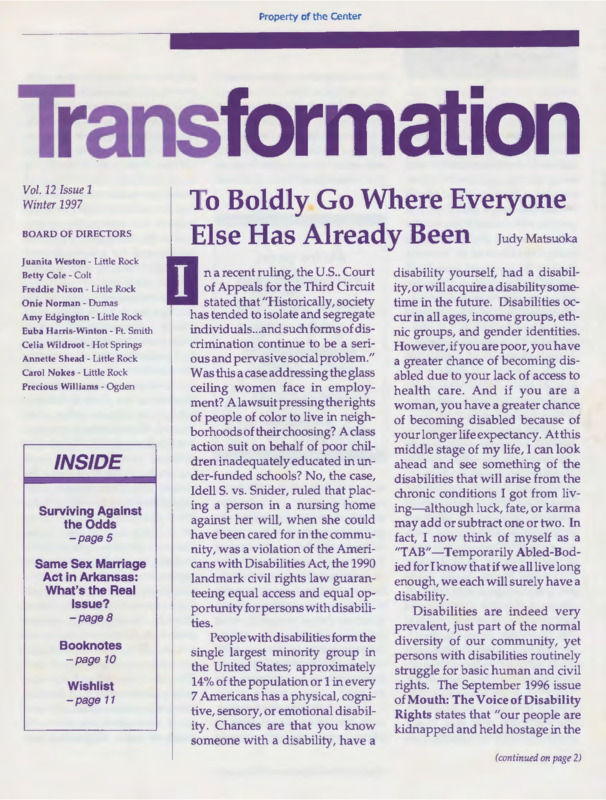
- Transformation is published by the Women's Project. This issue discusses disability rights and issues of accessibility. There is also an article about the climate of same-sex marriage in Arkansas and civil rights more generally. The end of the publication has a section on new books in the Women's Project Library.
- Date Issued
- 1997
- Relation
- Transformation
- Rights
- Contact UCO Chambers Library's Digital Initiatives Working Group at diwg@uco.edu for the permission policy on the use, reproduction or distribution of this material.
- Is Part Of
-
 Transformation: Women's Watchcare Network Log
- Transformation: Women's Watchcare Network Log
- Creator
- Matsuoka, Judy
- Contributor
- Women's Project
- Date
- 2025-04-18T14:57:58Z
- Date Available
- 2025-04-18T14:57:58Z
- Subject
- LGBTQ+ newsletters
- Women
- Type
- Periodical
- extracted text
-
Property of the Center
■
10n
Vol. 12 Issue 1
Winter 1997
BOARD OF DIRECTORS
Juanita Weston - Little Rock
Betty Cole - Colt
Freddie Nixon - Little Rock
Onie Norman - Dumas
Amy Edgington - Little Rock
Euba Harris-Winton - Ft. Smith
Celia Wildroot - Hot Springs
Annette Shead - Little Rock
Carol Nokes - Little Rock
Precious Williams - Ogden
INSIDE
Surviving Against
the Odds
-pages
Same Sex Marriage
Act in Arkansas:
What's the Real
Issue?
-pageB
Booknotes
-page 10
Wishlist
-page 11
To Boldly Go Where Everyone
Else Has Already Been JudyMatsuoka
n a recent ruling, the U.S.. Court
of Appeals for the Third Circuit
stated that "Historically, society
has tended to isolate and segregate
individuals ...andsuchformsofdiscrimination continue to be a serious and pervasive social problem."
Was this a case addressing the glass
ceiling women face in employment? Alawsuitpressingtherights
of people of color to live in neighborhoods of their choosing? A class
action suit on behalf of poor children inadequately educated in under-funded schools? No, the case,
Idell S. vs. Snider, ruled that placing a person in a nursing home
against her will, when she could
have been cared for in the community, was a violation of the Americans with Disabilities Act, the 1990
landmark civil rights law guaranteeing equal access and equal opportunity for persons with disabilities.
Peoplewithdisabilitiesform the
single largest minority group in
the United States; approximately
14% of the population or 1 in every
7 Americans has a physical, cognitive, sensory, or emotional disability. Chances are that you know
someone with a disability, have a
disability yourself, had a disability, or will acquire a disability sometime in the future. Disabilities occur in all ages, income groups, ethnic groups, and gender identities.
However, if you are poor, you have
a greater chance of becoming disabled due to your lack of access to
health care. And if you are a
woman, you have a greater chance
of becoming disabled because of
your longer life expectancy. At this
middle stage of my life, I can look
ahead and see something of the
disabilities that will arise from the
chronic conditions I got from living-although luck, fate, or karma
may add or subtract one or two. In
fact, I now think of myself as a
"TAB"-Temporarily Abled-Bodied for I know that if we all live long
enough, we each will surely have a
disability.
Disabilities are indeed very
prevalent, just part of the normal
diversity of our community, yet
persons with disabilities routinely
struggle for basic human and civil
rights. The September 1996 issue
of Mouth: The Voice of Disability
Rights states that "our people are
kidnapped and held hostage in the
(continuedon page2)
To BoldlyGo
from page 1
name of care, that we are murdered in the name of mercy, enslaved in the name of sheltered
employment, exploited by charities and politicians alike." Harsh
words for harsh realities. Yet
people with disabilities are the
only minority group involuntarily incarcerated in nursing
homes "for our own good" and
treated as the subject of discussion once the topic turns to assisted suicide ("I'd rather be dead
than to be in her shoes"-blind ...
paralyzed ...or unable to speak.)
To date, people with disabilities
are the last minority group in the
U.S. to have gotten civil rights
legislation providing equal access and equal opportunity.
Equal access is the right to
(boldly) go where everyone else
can go, to use the same facilities
and services, and to get the same
information in a timely fashion.
Equal opportunity is the right to
compete, to make the same life
decisions, to take on the same
life risks and responsibilities as
persons without disabilities at
home and school, in the workplace and in the community. At
the least, the lack of access and
opportunity-a step in front of
the restaurant door, an overlyperfumed woman on the escalator in front of you, the small print
on a want ad-may be an inconvenience, an annoyance, a temporary obstacle. At the worst,
inaccessibility and lack of opportunity can mean the stripping
awayofalmosteveryhumanand
civil right you have. It can mean
the involuntary placement in an
institution.
Can you imagine being told
when to go to bed, what to eat,
and what to wear just because
you have a disability? It is hard
At the worst,
inaccessibility and
lack of opportunity
can mean the
stripping away of
almost every human
and civil right
you have.
to feel like an adult with equal
rights and responsibilities when
somebody else decides when you
go to the toilet. Yet this is the
daily experience of the tens of
thousands of Americans who live
in nursing homes. If suddenly,
tomorrow, you did not have the
ability to get yourself out of bed,
toilet or bathe yourself, what
would you want to do-go to a
nursing home or remain with
your family and friends as a contributing member of your community?
Tens of thousands of Americans live in nursing homes or
other institutions; many could
Page2 •Transformation• Winter 1997
live in their own· homes with
personal assistance services.
Personal assistance services
(PAS)are provided by non-medical assistants-people who are
employed by persons with disabilities to help with everything
from ha thing, dressing, and
toileting to housework and cooking. Personal assistance services
prevent the segregation of persons with disabilities into institutions and the overburdening
of their families and friends
should they remain at home.
Additionally, using personal assistance services is more costeffective than nursing homes
with costs that range from onehalf to one-fourth that of institutionalization.
Sowhyaremanypeoplewith
disabilities not given a choice, a
voice in deciding how they want
to live? The answer is complex
but familiar-an intertwining of
political, economic, and social
factors that serve to preserve the
power structure. People with
disabilities have been systematically marginalized. The long
term care policy of the United
States has given people with disabilities an entitlement to nursing homes and other institutionalized services while barely funding home- and community-based
services. Economically, people
with disabilities are usually poor
people; 75% of those with disabilities are unemployed and
75% of the employed can find
only part-time work. Affording
private personal assistance services is beyond the financial
reach of most. Legislated into
poverty by "benefits" which link
health care to welfare, people
with disabilities are seen solely
as the recipients of services, not
as policy makers and potential
service providers. Stereotypes
perpetuate "the disempowerment: disabled Americans are
seen as unable-too incompetent
to share the power.
(And
ableism, like the other "isms,"
perhaps has its greatest power to
wound when it is internalized.)
There is a 1qtat stake. The nursing home industry is a multibillion dollar business with no
financial interest in seeing "patients" living in their own homes
and directing their own lives at
lower costs than institutionalization. Hence people with disabilities are told that there is no option but to enter nursing homes
in order to receive the needed
assistance with daily activities.
Idell S. vs. Snider may be the
disability community's Brown
vs. the Board of Education, the
1954 Supreme Court ruling
which determined that segregated schools were inherently
unfair and illegal. Idell S. vs.
Snider will put pressure on state
health care agencies to shift funds
from institutional services (nursing homes) to community-based
home care. Laws already have
been passed in several states to
divert a portion of Medicaid
funds from institutional care to
in-home personal assistance services, and the Arkansas state legislature will have the opportunity this session to do the same.
The Arkansas bill, which requests that 25% of the Medicaid
allocation for nursing homes be
used to fund community-based
personal assistance services, also
has a provision that persons with
disabilities may have the choice
to directly hire, train, and fire
their personal care assistants.
This choicewill tum persons with
disabilities from being the objects of care into the employers
of caregivers, empowered to determine who will provide their
personal care and how that care
is to be delivered.
The Women's Project has, for
fifteen years, worked for all
women and against all forms of
discrimination and oppression.
Working to see that women and
men with disabilities have the
same rights for self-determination as others without disabilities is certainly part of our progressive agenda.
Whatmustwedo? Wemust
remain vigilant that the federal
Page 3 • Transformation• Winter 1997
law, the Americans with Disabilities Act (ADA) is not eroded.
The ADA does place demands
for accessibility· and non-discrimination on local and state
governments, employers, and
public facilities. Because of this,
the ADA is a favorite target of
the Right Wing which would like
to drastically reduce the role of
the federal government as a protector of civil rights. Philip
Howard, author of The Death of
Common Sense, proposed repealing the ADA and other federal laws affecting persons with
disabilities (namely Section 504
of the Rehabilitation Act and the
Individuals with Disabilities
Education Act) as the first step to
eliminating government regulations based on the efforts to promote equality. He states in his
1995 best seller that the federal
government cannot and should
not promote equality between
citizens because such attempts
to change the distribution of
privilege and resources between
the "haves" and the "have nots"
provoke too much resentment.
Mr. Howard uses the ADA as his
primary example of the government out of control since the
ADA requirements seem difficult for non-disabled people to
understand and because complying with the ADA costs the nondisabled money for curb cuts,
ramps, and other accommodations-money
that can seem
wasted if it is spent on people the
society doesn't value.
Far right conservative legislators also view the ADA as a
federal burden. Newt Gingrich,
soon after being named Speaker
of the House, stated that he
wanted to "study" the idea of
turning civil rights protections
for persons wi~ disabilities over
to the states-in other words,
repeal federal legal protections.
Representative Dick Armey
stated that he wants to "rewrite''
the ADA since it is a" disaster" in
its current state. Senator Phil
Gramm, recently a contender for
the Republican presidential
nomination, said that the ADA is
an intrusion into states' rights
and is a burden on business.
And on the local level, in California, South Carolina, and
Washington State, some municipal officials announced their intentions to refuse to comply with
the ADA as part of the so-called
"counties movement," based on
their movement's legal theory
that the Constitution and English
common law make counties the
most important and powerful
units of government. According
to this theory, counties can nullify and disobey state and federallaws. It is most interesting to
note that the legal theories expounded by the counties movement were developed by members of the Posse Comitatus, the
oldest and largest right wing
militia group in the United States.
We must remain vigilant that
the state laws protecting the human rights of people with disabilities remain intact and protected if we are to avoid repeating the horrors of history. Over
half of the states in the U.S. during the 1930s had laws allowing
the involuntary sterilization of
people with disabilities (the Eugenics movement) and people
with disabilities were the involuntary subjects of medical experimentation. Peoplewithmental and physical disabilities were
among the first groups the Nazi
genocide targeted as "expendable for the greater good." Now
we have Dr. Jack Kevorkian saying that physician assisted suicide needn't be just for those who
are terminally ill but "for those
Now we have Dr.
Jack Kevorkian
saying that physician
assisted suicide
needn't be just for
those who are
terminally ill...
whose quality of life is nil, like
quadriplegics." Dr. Kevorkian
is not advocating fair housing,
affordable health care, personal
assistance services, accessible
transportation, and equal employment opportunities to increase the quality of life, but
rather death as a quick fix social
solution. (At a recent protest,
activists carried signs reading
''KKK-Kevorkian Kills Krips"
as a not-too-subtle labeling of
Page 4 •Transformation• Winter 1997
physician assisted suicide as a
hate crime against people with
disabilities.) The first priority
should be life with dignity; legalized physician assisted suicide threatens the lives of only
one minority group-people
with disabilities.
We must actively include
people with disabilities in our
personal and collective work to
bring about justice and equality
for everyone: to end discrimination in public policy and social
services, to bring about affordable health care, to end violence
in our communities. This means
adding the organizing around
issues such as personal assistance
services to free persons with disabilities from involuntary incarceration and to give back the
rights and responsibilities of selfdetermination. It also means continuing our struggles against racism, sexism, and economic injustice while considering the issues
of disability as certainly no person with a disability is without
race or gender and few are free
of economic interests. Women
with disabilities and people of
color with disabilities deal with
the multiplicity of oppressions
as the lines which so often divide
us intersect in their lives. They
who occupy the interstices know
what others do not about reconciling differences in their lives
and how to push the parameters
of existing communities wide
open so that the struggles of different communities overlap and
become the common struggles
of us all. ■
Surviving Against the Odds
Janet Perkins
n the last two years I have
been very fortunate to
have had the opportunity
to travel to many communities
throughout the Southeastern
United States. I'm on the board
of the Bert and Mary Meyer
Foundation, and each year the
board members visit with community based organizations who
are applying to the Foundation
for financial support.
My awareness has been
broadened
tremendously.
Sometimes in doing this work
we think we know the issues in
all of the various forms, but I
realize I have been stretched and
challenged over the last two
years to really increase my understanding of poverty, hatred
and injustice. I've seen what
downright evil looks like and
how frightening it can be.
I love fresh cut flowers. I often will buy a bouquet of brightly
colored daisies or sunflowers or
bachelor buttons, asters and
glads with sprigs of fern and
baby's breath. I never gave a
second thought to how these
treasured beauties, that have the
power to lift my spirits, got to
my florist or the local market
where I purchase them.
In the fall of 1995, I did a site
visit with a farmworker advocacy group in Apopka, Florida.
The focus of the group's work is
to educate farmworkers about
I
their rights, provide information
to farmworkers and farmers
about the dangers of pesticides,
and to overall push for better
working and living conditions
for farmworkers.
Many of the workers
had skin
discolorations, or
respiratory problems
or other health
problems they
constantly faced with
few options for
treatment or cure.
On this visit, I was escorted
to plants where vegetables and
fruits are grown and processed.
I was not allowed to enter a
mushroom plant, but my patient
guides explained to me the process of how mushrooms were
grown and the conditions of the
plant, which is dark and cold. I
was taken to nursery after nursery to see how all the beautiful
flowers are grown or shipped
from other countries for processing. And I saw fields and fields
Page 5 • Transformation•Winter 1997
of ferns that extended for miles
and miles. Apopka is known as
the "Fern Capital of the World".
All of the ferns that are in our
flower arrangements or those big
lush baskets of ferns we hang on
our porches in the spring, more
than likely originated in Apopka,
Florida.
The workers are Latina,,o,
Haitian and African-American,
with over 85% of the workers
being Latina,,o. More women are
hired in the nurseries than men.
In the fern fields you find more
men than women. The wages for
the nurseries or the fern fields
are low, but the better pay is
drawn from working in the fern
fields. I spoke with female and
maleworkerswhorecounted the
same experiences of reaching
down to cut the plants or ferns
and encountering a snake. Or
snakes would be hanging above
their heads from trees and just
fall on them.
Manyoftheworkershad skin
discolorations, or respiratory
problems or other health problems they constantly faced with
fewoptionsfortreatmentorcure.
The workers made the connection that their medical problems
are related to the pesticides that
are sprayed in the fields. When
the issue was raised with the
farmowner, they deny that the
pesticides had any connection,
and refer to the pesticides as
medicine used to help the plants
to be healthier and to protect the
workers against diseases.
Seeking medical attention
was a last resort due to the lack of
insurance or the financial resources necessary to see a physician. And most of the time if the
workers became so ill that seeing
a doctor was their only alternative, the doctor would only prescribe drugs to treat the symptoms, again refusing to affirm
the connection between their
exposure to the pesticides and
the physical problems they were
having.
I visited the homes of many
of the Latina/o farm workers.
Mobile homes were the primary
dwellings available to these
farmworkers. The rent ranged
from $400.00 to $700.00 or more
per month. Therefore, you seldom saw a trailer being occupied by just one person or one
family unit. The norm was for at
least 5 to 12 people to live in one
dilapidated, rat infested, 2 bedroom trailer. The farm owner
generally is the owner of these
trailer communities that should
be condemned. The workers
mustpaythefarmownerforrent,
the use of the butane tanks and
for sewer privileges.
Many of these trailer communities are located on the land
next to the farms where people
work. When the fields are
sprayed, the pesticides drain off
into the water supply of the trailers. The children's playground
is in these fields and on the dirt
roads where puddles of contaminated water stand for long periods of time.
Now my trips to the market
and the florist are not so casual. I
have the faces of women, chil-
dren and men etched in my
memory each time I purchase a
bouquet of flowers or carrots or
mushrooms that remind me
someone that works under the
most indecent conditions, lives
in less than human surroundings and labors minus a hope of
getting ahead enough to college
educate their children or purchaseahome, toprovidemewith
I've met community
organizers who don't
take a salary for their
work, therefore they
must work a full-time
job elsewhere to
support themselves
and their families.
fruits and vegetables and flowers for my pleasure.
Although I'm well aware of
how greed motivates some to be
totally uncaring and disrespectful of others, I have been startled
and horrified at how far people
will go to take advantage of entire communities because they
are poor or communities ofcolor.
By their calculations these communities are worthless and the
ideal spots for any kind of activity no matter how harmful it can
be to the residents.
Chemical plants, phosphate
Page 6 •Transformation• Winter 1997
mines and defense plants have
been deliberately located in rural, poor, African-American communities. People are sick and
dying. I've gone into communities where house after house was
pointed out to me as empty because the entire family died from
cancer. I've met people with unexplainable skin growths and
lumps and bumps.
In North Carolina, I had the
painful experience of meeting
young women who are physically disabled from working in
the poultry plants. They are unable to use their hands because
of the fast speed they had to
work processing chickens.
Grown women have had to work
in urine-soaked clothing because
they could not leave the line to
use the bathroom.
One woman was so badly
injured from a fall in a North
Carolina poultry plant that she
had to have surgery and was
confined to a wheelchair. Three
weeks after surgery the company
insisted that she return to work,
because otherwise she would not
be covered by the workers compensation insurance. Not knowing her rights, and fearing all
loss of income, this woman returned to work on the line in a
wheelchair.
Over this two year period of
visiting these communities and
being educated about how
people must survive, and moved
by the incredibly indecent treatment of people, I had to question
what I was witnessing. We live
in a world that teaches us that
Property of the Center
our primary goal in life should
be to get ahead. What does that
mean? Is it perfectly alright to
get ahead by any means necessary? Is it okay to totally disregard others. and value those
whom you see as less than you as
a human commodity placed in
this world for your benefit and
your means of gaining more from
the sweat of their brows?
I've gone through these exchanges with myself more than
once in an effort to understand
the degradation of other human
beings. I finally resolved within
myself that I really did not want
to understand the minds and
hearts of people who are capable
of mistreatment of others. These
people are evil and too often they
are held in high esteem because
of their skills in business. At
whose expense did they gain
their success is never questioned.
We are entirely too impressed
with money, power and what
someone has acquired.
The outright unkindness and
mistreatmentofothersstoodout
and grabbed me throughout all
my visits to these communities,
but the strength, determination
and tenacity of those to survive
in spite of the conditions is what
truly stayed with me. Many of
the community-based groups I
havebeenfortunatetolearnfrom
do this work with little or no
resources, and whatever financial support they are able to raise
is reserved for their work. I've
met community organizers who
don't take a salary for their work,
therefore they must work a full-
time job elsewhere to support
themselves and their families.
Some take incredible risks, face
physical threats and have lost
their livelihoods because of their
determination
to organize
against the injustices in their communities. Nothing deters them.
They never shrink from the task
no matter what the obstacles or
barriers are.
Whenever I return from these
trips my vision is refined and
depth is added to my work as a
funder and as a community organizer. Asafunderl'velearned
that sometimes you must go see
what people are writing about in
a proposal. It can sound very
dry and uneventful on paper,
but once you enter their community and see the devastation and
the efforts they have launched to
correct the wrongs you can be
more than impressed. Also, hatred and evil have had a long run
of damaging and destroying
communities, therefore it's going to take more than one or two
Page 7 • Transformation• Winter 1997
years of providing financial support and being in partnership
with a community in order for
change to occur.
As an organizer I know my
work cannot be limited or reduced to working on behalf of
only a few. All of our lives are so
connected and tied to each other,
and our ability to experience a
better life will also take all of us
crossing many lines of diversity
and showing an interest in issues other than our own. I feel
strongly that more and more
opportunities must be offered for
people to get together and share
who they are and what their
struggles are. The isolation and
lack of information has got to be
dealt with in order for us to truly
embrace each other and for us to
have some involvement in each
others' work.
I've also learned that if we
are going to get anywhere in this
struggle for justice, we had better identify who the enemy is
and come to recognize that we
spend too much energy fighting
each other. Too many organizations and individuals who say they
are on the sideofjustice,createmore
havoc and chaosamong each other,
keeping us from really making the
progress of which we're capable.
Wemustnever lose sight of what
is really important and not get
hung up over process and analysis, and in thinking one way is
better than another. The paths that
we are going to take are going to
be many; my only hope and desire is that we all are able to
experiencejustice and freedom. ■
Sallle Sex Marriage
Act in Arkansas:What's
the Real Issue?
Judy Matsuoka
hen the Arkansas legislature convenes this
month, legislators in
both houses will be asked to vote
on a bill defining marriage in
Arkansas as "only between a
man and a woman" and prohibiting the recognition of same-sex
marriages performed in other
states. This bill is patterned after
the federal Defense of Marriage
Act (OOMA) which President
Clinton signed in September,
1996. The lead sponsor of the
Arkansas bill, Rep. Doug Kidd
(D.), said he introduced the bill
because of the calls he received
from constituents following the
signing of DOMA.
To respond to this bill, a political action group, the Arkansas Non-Discrimination Alliance
(ANDA)wasformed. This group
is a coalition of organizations
fighting for civil rights,and includes the Women's Project, the
Coalition for Choice, Mainstream, and theACLU,andleaders in the gay, lesbian, bisexual
and transgender community.
This group has already begun
planning and organizing to
lobby against the same-sex marriage bill in Arkansas.
But, what is the real issue?
Gays and lesbians are not "attacking" the institution of marriage-so what need is there for
W
a law defending (heterosexual)
marriage? Although ANDA
leaders will fight against the
same-sex marriage bill, they also
say that legislators should focus
on the real problem of discrimi-
Most Arkansans,
including Governor
Huckabee, believe that
existing laws prohibit
discrimination against
lesbians and gay men
in employment.
nation against gays and lesbians
in employment, housing, and
public accommodations.
Most Arkansans, including
Governor Huckabee, believe that
existing laws prohibit discrimination against lesbians and gay
men in employment. According
to a December, 1996 poll of Arkansans conducted by the Opinion Research Associates, 72%
believe that it is currently illegal
to fire someone because that person is gay or lesbian. In fact,
Page 8 • Transformation•Winter 1997
however, the Arkansas Civil
Rights Act of 1993 does not include protection against such discrimination because of "sexual
orientation."
The Opinion Research Associates' statewide poll showed
that 67% of Arkansans would be
strongly opposed to state legislation that would allow persons
of the same sex to marry. To
some, this is not a surprising response given the Southern stereotypesforconservatism.However, these same respondents
were strongly opposed to discrimination against gays and lesbians in employment, public accommodations, and housing.
Eighty-four percent (84%)
believe that a person should not
be denied the right to rent or buy
a home solely because they are
gay or lesbian, and 85% believe
that gays and lesbians should
not be denied service in public
accommodations (stores, restaurants, theaters,etc.). Seventy-six
percent (76%) believe that employers should not be allowed to
fire employees solely because
they are lesbians or gay men,
and 55% would favor the passage of state legislation-such as
an amendment to the Arkansas
Civil Rights Act-to prohibit
such discrimination.
Every civil rights movement
needs the support of individuals
who believe in fairness and
equality. We must help people
understand that equal rights are
not special rights. We must get
the word out that Arkansans
believe that basic civil rights
should be extended to people
who are lesbian and gay. If you
are a registered voter in Arkansas, let your legislators and the
Governor know that you, their
constituent, support non-discrimination in employment,
housing, public accommodations, and yes, marriage. If you
are gay or lesbian and have experienced discrimination on the
job or in housing and public accommodations-or are a family
member or friend of someone
gay or lesbian-share your story.
Every civil rights
IN THETIME
OFTHERIGHT
Reflections
on Liberation
"This essential book provides keen
analysis and tactical guidance to
author of Homophobia:
people concerned about the
A Weapon of Sexism
growing power of the Right. Pharr s
dissection of the Right is accessible,
informed and always strategic."
Suzanne Pharr
-Urvashi
Vaid, author of Virtual Equality: The Mainstreaming of
Gay and Lesbian Liberation
movement needs the
support of individuals
who believe in
fairness and equality.
Reassure the legislators of your
support (the poll showed that
only 22% of people would be less
likely to vote for a legislator who
supported non-discrimination
against gays and lesbians in employment). And above all, be
faithful that this civil rights
movement, like the ones before
it, will be successful. ■
IN THE TIME OF THE RIGIIT: Reflections on Liberation
constructs a progressive view of the politics of our time that will
make sense to students, activists and all who are trying to understand
the current threat to democracy. A long-time economic and social
justice activist from the South, Pharr blends personal anecdote and
contemporary cutting-edge analysis-along with a vision of a multiissue, multi-racial movement-to create a powerful call to action
for each of us.
r--------------------------,
....................
ORDER FORM
# Copies
__
In the Timeof the Right:Rtjleaionson Liberation @ $10.95
__
Homophobia:A Weapona/Sexism
@ $9.95
(400/odiscount on orders of 5 or more books)
Shipping & Handling: $2.00 for 1st book, $.SOeach add'l.
TOTAL
Women's Project membership
D
NAME.
____________
For more information or to
help with donations of time or
money,contactANDA,P.O.Box
55851, Little Rock, AR 72215 or
call the Women's Project at 501/
372-5113 or wproject@aol.com
_
ADDRESS____________
CITY______
□
MC
STATE__
Exp.date __
ZIP__
$ Amount
$25.00
Maluchecks
payabltto
TheWomen'sProjectandmailto:
The Women's Project
2224 Main Street
Little Rock, AR 72206
_
account number
L __________________________
Page 9 • Transformation• Winter 1997
J
New Books in the Library
-
Pushing The Limits: Disabled Dykes
Produce Culture
edited by Shelley
Tremain, Women's
Press, Canada-Addressing the
power and importance of language, graphically illustrating
the misuse of power, corruption and convenience that governs the medical profession,
and questioning the passive disinterest of our non-disabled sisters, this book is both painful
and celebratory. Contributors
include Audre Lorde, Connie
Panzarino and Pat Parker.
Autobiography Of A Family
Photo by Jacqueline Woodson,
N.A.L. -This novel "will open
your heart, show you somethingyou need to see: the slow,
long dissolution of the family
she loves; the slow, long growth
of strength in a girl too stubborn to be broken down. Look
closely. This is a photo of great
beauty, great heartbreak,
greater love."-Dorothy Allison.
"Brilliant, moving, semi-surreal-and daring." -Publishers
ans, gay men, and bisexuals
from discrimination. Written by
the director of the lesbian and
gay and AIDS projects at the
ACLU.
Keeping Women and Children
Last: America's War on the
Poor by Ruth Side}, Penguin
Books - "A powerful economic
and political analysis, soberly
convincing. A very important,
wisely written book at a cold
time in our nation's history."
...Jonathan Kozol
EVEN MORE NEW BOOKS:
• We Know WhereYou Live by
JeanTaylor(LesbianMystery)
• The BlackExperienceIn Books
ForChildrenAnd YoungAdults
by Ersye Kirk.
• ChallengingConceptions:Planning A Family By Self-Insemination by Lisa Saffron.
• VoiceofIndigenousPeoples:Native PeopleAddress The United
Nations, edited by Alexander
Ewen.
• BlackBetty by Walter Mosley
(African-American Mystery)
Weekly.
NEW VIDEOS:
Try This At Home! A Do-ItYourself Guide To Winning Lesbian and Gay Civil Rights by
Matthew A. Coles, The New
Press, is a practical guide for
grass roots groups and individuals on how to pass laws
and policies that protect lesbi-
• 500 Nations: The True Native
American Experience
• Straight from the Heart
• The Best Defense: Self Defense for the Gay & Lesbian
Community
• Daughters of the Dust
• Fiction & Other Truths:
A Film about Jane Rule
Page 10 • Transformation• Winter 1997
BOOK NEWS:
A Banned Books Week article in PublishersWeekly, Sept.
23, 1996,pointed out that while
attempts to censor books fell by
11%, broad challenges to the
freedom to read, including attacks on entire curricula, rose
by 46%. A third of the attacks
directly or indirectly involve the
religious right. The book challenged most often was I Know
Why the Caged Bird Sings by
Maya Angelou, which reflects
the disproportionate number of
attacks on books written by
African American women.
Coincidentally, the Women's
Project has begun a reading
group which, through the discussion of fiction by people of
color, is attempting to learn
more about racism. Their first
book is Sula by Toni Morrison.
Call us for more information.
•••••••
The Women's Prison Book
Project is a group of volunteers
providing women in prison
with free reading material spanning a broad range of topics.
Based in Minneapolis, they receive and fill requests from
women imprisoned throughout
the U.S. Financialcontributions
and book donations, new or
used, are always welcome.
WPBP,c/ o Arise Resource Center & Bookstore, 2441 Lyndale
Ave. South, Minneapolis, MN
55405. ■
The Women's Project is in need of the following items:
Office Supplies
t/ photocopier paper
t/ black pens and markers
t/ red pens and markers
t/ Royal Alpha 6000
typewriter
t/ box sealing tape
t/ Imagewriter printer
ribbons
Published four times a year
by the Women's Project,
2224 Main Street, Little Rock,
Arkansas, 72206.
Phone: 501-372-5113
Letters to the editor are welcome.
t/ Apple laser printer
cartridges
For MIWatch Program
t/ infant and child car seats
For the Library
t/ bookcases
t/ gently used books
t/ subscriptions to
For Accessibility
t/ doorbell on ramp
For Marianna Food Bank
t/ Macintosh computer
& printer
periodicals
Women's Project Staff:
Felicia Davidson
Lynn Frost
Judy Matsuoka
SofiaMemon
Janet Perkins
Suzanne Pharr
Transformation
Editor
Art Director
*
Suzanne Pharr
Melissa Britton James
Printed on recycled paper.
*
©1997The Women's Project
Current Projects
■
r-------------------,
Yes, I would like to join
the Women'sProject.
Prison Project
A support and advocacy project for women in prison that provides
support groups for battered women in prison, a prisoner-led AIDS
program and a transportation program for the children of
incarcerated mothers.
■
Name __________________
Women's Watchcare Network
A project to monitor and respond to incidents of racial, religious,
sexual, and anti-gay violence; and to provideeducationand strategies
to counter the activities of hate groups and the Radical Right.
■
_
City __________________
_
_
Zip_________
_
Phone/day________________
Workshops on understanding racism and homophobia and
developing methods to eliminate them; women's economic issues;
organizational development for social change organizations.
■
Address _________________
State ______
The Social Justice Project
_
_
Phone/evening _______________
_
Women and AIDS
A project to develop strategies for working with women and
caregivers around AIDS issues.
■
African-American Women's Institute for Social Justice
A project which creates strategies for overcoming the barriers that
hinder African-American women's efforts toward power and selfdetermination.
■ Communications and Events
A newsletter, a lending library, statewide and regional conferences,
and production of women singers, poets and novelists.
□ $10.00
□ $ 25
□ $ 50
( low income)
□ $ 75
□ $100
Make checks payable to:
Women's Project
2224 Main Street
Little Rock, AR 72206
L ___________________
Page 11 •Transformation•
Winter 1997
...J
Women's
Project
2224 Main Street
Little Rock, AR 72206
ADDRESS CORRECTION REQUESTED
MS
Non-Profit Organization
U.S. Postage Paid
Little Rock, Arkansas
Permit No. 448
-
Property of the Center
■
10n
Vol. 12 Issue 1
Winter 1997
BOARD OF DIRECTORS
Juanita Weston - Little Rock
Betty Cole - Colt
Freddie Nixon - Little Rock
Onie Norman - Dumas
Amy Edgington - Little Rock
Euba Harris-Winton - Ft. Smith
Celia Wildroot - Hot Springs
Annette Shead - Little Rock
Carol Nokes - Little Rock
Precious Williams - Ogden
INSIDE
Surviving Against
the Odds
-pages
Same Sex Marriage
Act in Arkansas:
What's the Real
Issue?
-pageB
Booknotes
-page 10
Wishlist
-page 11
To Boldly Go Where Everyone
Else Has Already Been JudyMatsuoka
n a recent ruling, the U.S.. Court
of Appeals for the Third Circuit
stated that "Historically, society
has tended to isolate and segregate
individuals ...andsuchformsofdiscrimination continue to be a serious and pervasive social problem."
Was this a case addressing the glass
ceiling women face in employment? Alawsuitpressingtherights
of people of color to live in neighborhoods of their choosing? A class
action suit on behalf of poor children inadequately educated in under-funded schools? No, the case,
Idell S. vs. Snider, ruled that placing a person in a nursing home
against her will, when she could
have been cared for in the community, was a violation of the Americans with Disabilities Act, the 1990
landmark civil rights law guaranteeing equal access and equal opportunity for persons with disabilities.
Peoplewithdisabilitiesform the
single largest minority group in
the United States; approximately
14% of the population or 1 in every
7 Americans has a physical, cognitive, sensory, or emotional disability. Chances are that you know
someone with a disability, have a
disability yourself, had a disability, or will acquire a disability sometime in the future. Disabilities occur in all ages, income groups, ethnic groups, and gender identities.
However, if you are poor, you have
a greater chance of becoming disabled due to your lack of access to
health care. And if you are a
woman, you have a greater chance
of becoming disabled because of
your longer life expectancy. At this
middle stage of my life, I can look
ahead and see something of the
disabilities that will arise from the
chronic conditions I got from living-although luck, fate, or karma
may add or subtract one or two. In
fact, I now think of myself as a
"TAB"-Temporarily Abled-Bodied for I know that if we all live long
enough, we each will surely have a
disability.
Disabilities are indeed very
prevalent, just part of the normal
diversity of our community, yet
persons with disabilities routinely
struggle for basic human and civil
rights. The September 1996 issue
of Mouth: The Voice of Disability
Rights states that "our people are
kidnapped and held hostage in the
(continuedon page2)
To BoldlyGo
from page 1
name of care, that we are murdered in the name of mercy, enslaved in the name of sheltered
employment, exploited by charities and politicians alike." Harsh
words for harsh realities. Yet
people with disabilities are the
only minority group involuntarily incarcerated in nursing
homes "for our own good" and
treated as the subject of discussion once the topic turns to assisted suicide ("I'd rather be dead
than to be in her shoes"-blind ...
paralyzed ...or unable to speak.)
To date, people with disabilities
are the last minority group in the
U.S. to have gotten civil rights
legislation providing equal access and equal opportunity.
Equal access is the right to
(boldly) go where everyone else
can go, to use the same facilities
and services, and to get the same
information in a timely fashion.
Equal opportunity is the right to
compete, to make the same life
decisions, to take on the same
life risks and responsibilities as
persons without disabilities at
home and school, in the workplace and in the community. At
the least, the lack of access and
opportunity-a step in front of
the restaurant door, an overlyperfumed woman on the escalator in front of you, the small print
on a want ad-may be an inconvenience, an annoyance, a temporary obstacle. At the worst,
inaccessibility and lack of opportunity can mean the stripping
awayofalmosteveryhumanand
civil right you have. It can mean
the involuntary placement in an
institution.
Can you imagine being told
when to go to bed, what to eat,
and what to wear just because
you have a disability? It is hard
At the worst,
inaccessibility and
lack of opportunity
can mean the
stripping away of
almost every human
and civil right
you have.
to feel like an adult with equal
rights and responsibilities when
somebody else decides when you
go to the toilet. Yet this is the
daily experience of the tens of
thousands of Americans who live
in nursing homes. If suddenly,
tomorrow, you did not have the
ability to get yourself out of bed,
toilet or bathe yourself, what
would you want to do-go to a
nursing home or remain with
your family and friends as a contributing member of your community?
Tens of thousands of Americans live in nursing homes or
other institutions; many could
Page2 •Transformation• Winter 1997
live in their own· homes with
personal assistance services.
Personal assistance services
(PAS)are provided by non-medical assistants-people who are
employed by persons with disabilities to help with everything
from ha thing, dressing, and
toileting to housework and cooking. Personal assistance services
prevent the segregation of persons with disabilities into institutions and the overburdening
of their families and friends
should they remain at home.
Additionally, using personal assistance services is more costeffective than nursing homes
with costs that range from onehalf to one-fourth that of institutionalization.
Sowhyaremanypeoplewith
disabilities not given a choice, a
voice in deciding how they want
to live? The answer is complex
but familiar-an intertwining of
political, economic, and social
factors that serve to preserve the
power structure. People with
disabilities have been systematically marginalized. The long
term care policy of the United
States has given people with disabilities an entitlement to nursing homes and other institutionalized services while barely funding home- and community-based
services. Economically, people
with disabilities are usually poor
people; 75% of those with disabilities are unemployed and
75% of the employed can find
only part-time work. Affording
private personal assistance services is beyond the financial
reach of most. Legislated into
poverty by "benefits" which link
health care to welfare, people
with disabilities are seen solely
as the recipients of services, not
as policy makers and potential
service providers. Stereotypes
perpetuate "the disempowerment: disabled Americans are
seen as unable-too incompetent
to share the power.
(And
ableism, like the other "isms,"
perhaps has its greatest power to
wound when it is internalized.)
There is a 1qtat stake. The nursing home industry is a multibillion dollar business with no
financial interest in seeing "patients" living in their own homes
and directing their own lives at
lower costs than institutionalization. Hence people with disabilities are told that there is no option but to enter nursing homes
in order to receive the needed
assistance with daily activities.
Idell S. vs. Snider may be the
disability community's Brown
vs. the Board of Education, the
1954 Supreme Court ruling
which determined that segregated schools were inherently
unfair and illegal. Idell S. vs.
Snider will put pressure on state
health care agencies to shift funds
from institutional services (nursing homes) to community-based
home care. Laws already have
been passed in several states to
divert a portion of Medicaid
funds from institutional care to
in-home personal assistance services, and the Arkansas state legislature will have the opportunity this session to do the same.
The Arkansas bill, which requests that 25% of the Medicaid
allocation for nursing homes be
used to fund community-based
personal assistance services, also
has a provision that persons with
disabilities may have the choice
to directly hire, train, and fire
their personal care assistants.
This choicewill tum persons with
disabilities from being the objects of care into the employers
of caregivers, empowered to determine who will provide their
personal care and how that care
is to be delivered.
The Women's Project has, for
fifteen years, worked for all
women and against all forms of
discrimination and oppression.
Working to see that women and
men with disabilities have the
same rights for self-determination as others without disabilities is certainly part of our progressive agenda.
Whatmustwedo? Wemust
remain vigilant that the federal
Page 3 • Transformation• Winter 1997
law, the Americans with Disabilities Act (ADA) is not eroded.
The ADA does place demands
for accessibility· and non-discrimination on local and state
governments, employers, and
public facilities. Because of this,
the ADA is a favorite target of
the Right Wing which would like
to drastically reduce the role of
the federal government as a protector of civil rights. Philip
Howard, author of The Death of
Common Sense, proposed repealing the ADA and other federal laws affecting persons with
disabilities (namely Section 504
of the Rehabilitation Act and the
Individuals with Disabilities
Education Act) as the first step to
eliminating government regulations based on the efforts to promote equality. He states in his
1995 best seller that the federal
government cannot and should
not promote equality between
citizens because such attempts
to change the distribution of
privilege and resources between
the "haves" and the "have nots"
provoke too much resentment.
Mr. Howard uses the ADA as his
primary example of the government out of control since the
ADA requirements seem difficult for non-disabled people to
understand and because complying with the ADA costs the nondisabled money for curb cuts,
ramps, and other accommodations-money
that can seem
wasted if it is spent on people the
society doesn't value.
Far right conservative legislators also view the ADA as a
federal burden. Newt Gingrich,
soon after being named Speaker
of the House, stated that he
wanted to "study" the idea of
turning civil rights protections
for persons wi~ disabilities over
to the states-in other words,
repeal federal legal protections.
Representative Dick Armey
stated that he wants to "rewrite''
the ADA since it is a" disaster" in
its current state. Senator Phil
Gramm, recently a contender for
the Republican presidential
nomination, said that the ADA is
an intrusion into states' rights
and is a burden on business.
And on the local level, in California, South Carolina, and
Washington State, some municipal officials announced their intentions to refuse to comply with
the ADA as part of the so-called
"counties movement," based on
their movement's legal theory
that the Constitution and English
common law make counties the
most important and powerful
units of government. According
to this theory, counties can nullify and disobey state and federallaws. It is most interesting to
note that the legal theories expounded by the counties movement were developed by members of the Posse Comitatus, the
oldest and largest right wing
militia group in the United States.
We must remain vigilant that
the state laws protecting the human rights of people with disabilities remain intact and protected if we are to avoid repeating the horrors of history. Over
half of the states in the U.S. during the 1930s had laws allowing
the involuntary sterilization of
people with disabilities (the Eugenics movement) and people
with disabilities were the involuntary subjects of medical experimentation. Peoplewithmental and physical disabilities were
among the first groups the Nazi
genocide targeted as "expendable for the greater good." Now
we have Dr. Jack Kevorkian saying that physician assisted suicide needn't be just for those who
are terminally ill but "for those
Now we have Dr.
Jack Kevorkian
saying that physician
assisted suicide
needn't be just for
those who are
terminally ill...
whose quality of life is nil, like
quadriplegics." Dr. Kevorkian
is not advocating fair housing,
affordable health care, personal
assistance services, accessible
transportation, and equal employment opportunities to increase the quality of life, but
rather death as a quick fix social
solution. (At a recent protest,
activists carried signs reading
''KKK-Kevorkian Kills Krips"
as a not-too-subtle labeling of
Page 4 •Transformation• Winter 1997
physician assisted suicide as a
hate crime against people with
disabilities.) The first priority
should be life with dignity; legalized physician assisted suicide threatens the lives of only
one minority group-people
with disabilities.
We must actively include
people with disabilities in our
personal and collective work to
bring about justice and equality
for everyone: to end discrimination in public policy and social
services, to bring about affordable health care, to end violence
in our communities. This means
adding the organizing around
issues such as personal assistance
services to free persons with disabilities from involuntary incarceration and to give back the
rights and responsibilities of selfdetermination. It also means continuing our struggles against racism, sexism, and economic injustice while considering the issues
of disability as certainly no person with a disability is without
race or gender and few are free
of economic interests. Women
with disabilities and people of
color with disabilities deal with
the multiplicity of oppressions
as the lines which so often divide
us intersect in their lives. They
who occupy the interstices know
what others do not about reconciling differences in their lives
and how to push the parameters
of existing communities wide
open so that the struggles of different communities overlap and
become the common struggles
of us all. ■
Surviving Against the Odds
Janet Perkins
n the last two years I have
been very fortunate to
have had the opportunity
to travel to many communities
throughout the Southeastern
United States. I'm on the board
of the Bert and Mary Meyer
Foundation, and each year the
board members visit with community based organizations who
are applying to the Foundation
for financial support.
My awareness has been
broadened
tremendously.
Sometimes in doing this work
we think we know the issues in
all of the various forms, but I
realize I have been stretched and
challenged over the last two
years to really increase my understanding of poverty, hatred
and injustice. I've seen what
downright evil looks like and
how frightening it can be.
I love fresh cut flowers. I often will buy a bouquet of brightly
colored daisies or sunflowers or
bachelor buttons, asters and
glads with sprigs of fern and
baby's breath. I never gave a
second thought to how these
treasured beauties, that have the
power to lift my spirits, got to
my florist or the local market
where I purchase them.
In the fall of 1995, I did a site
visit with a farmworker advocacy group in Apopka, Florida.
The focus of the group's work is
to educate farmworkers about
I
their rights, provide information
to farmworkers and farmers
about the dangers of pesticides,
and to overall push for better
working and living conditions
for farmworkers.
Many of the workers
had skin
discolorations, or
respiratory problems
or other health
problems they
constantly faced with
few options for
treatment or cure.
On this visit, I was escorted
to plants where vegetables and
fruits are grown and processed.
I was not allowed to enter a
mushroom plant, but my patient
guides explained to me the process of how mushrooms were
grown and the conditions of the
plant, which is dark and cold. I
was taken to nursery after nursery to see how all the beautiful
flowers are grown or shipped
from other countries for processing. And I saw fields and fields
Page 5 • Transformation•Winter 1997
of ferns that extended for miles
and miles. Apopka is known as
the "Fern Capital of the World".
All of the ferns that are in our
flower arrangements or those big
lush baskets of ferns we hang on
our porches in the spring, more
than likely originated in Apopka,
Florida.
The workers are Latina,,o,
Haitian and African-American,
with over 85% of the workers
being Latina,,o. More women are
hired in the nurseries than men.
In the fern fields you find more
men than women. The wages for
the nurseries or the fern fields
are low, but the better pay is
drawn from working in the fern
fields. I spoke with female and
maleworkerswhorecounted the
same experiences of reaching
down to cut the plants or ferns
and encountering a snake. Or
snakes would be hanging above
their heads from trees and just
fall on them.
Manyoftheworkershad skin
discolorations, or respiratory
problems or other health problems they constantly faced with
fewoptionsfortreatmentorcure.
The workers made the connection that their medical problems
are related to the pesticides that
are sprayed in the fields. When
the issue was raised with the
farmowner, they deny that the
pesticides had any connection,
and refer to the pesticides as
medicine used to help the plants
to be healthier and to protect the
workers against diseases.
Seeking medical attention
was a last resort due to the lack of
insurance or the financial resources necessary to see a physician. And most of the time if the
workers became so ill that seeing
a doctor was their only alternative, the doctor would only prescribe drugs to treat the symptoms, again refusing to affirm
the connection between their
exposure to the pesticides and
the physical problems they were
having.
I visited the homes of many
of the Latina/o farm workers.
Mobile homes were the primary
dwellings available to these
farmworkers. The rent ranged
from $400.00 to $700.00 or more
per month. Therefore, you seldom saw a trailer being occupied by just one person or one
family unit. The norm was for at
least 5 to 12 people to live in one
dilapidated, rat infested, 2 bedroom trailer. The farm owner
generally is the owner of these
trailer communities that should
be condemned. The workers
mustpaythefarmownerforrent,
the use of the butane tanks and
for sewer privileges.
Many of these trailer communities are located on the land
next to the farms where people
work. When the fields are
sprayed, the pesticides drain off
into the water supply of the trailers. The children's playground
is in these fields and on the dirt
roads where puddles of contaminated water stand for long periods of time.
Now my trips to the market
and the florist are not so casual. I
have the faces of women, chil-
dren and men etched in my
memory each time I purchase a
bouquet of flowers or carrots or
mushrooms that remind me
someone that works under the
most indecent conditions, lives
in less than human surroundings and labors minus a hope of
getting ahead enough to college
educate their children or purchaseahome, toprovidemewith
I've met community
organizers who don't
take a salary for their
work, therefore they
must work a full-time
job elsewhere to
support themselves
and their families.
fruits and vegetables and flowers for my pleasure.
Although I'm well aware of
how greed motivates some to be
totally uncaring and disrespectful of others, I have been startled
and horrified at how far people
will go to take advantage of entire communities because they
are poor or communities ofcolor.
By their calculations these communities are worthless and the
ideal spots for any kind of activity no matter how harmful it can
be to the residents.
Chemical plants, phosphate
Page 6 •Transformation• Winter 1997
mines and defense plants have
been deliberately located in rural, poor, African-American communities. People are sick and
dying. I've gone into communities where house after house was
pointed out to me as empty because the entire family died from
cancer. I've met people with unexplainable skin growths and
lumps and bumps.
In North Carolina, I had the
painful experience of meeting
young women who are physically disabled from working in
the poultry plants. They are unable to use their hands because
of the fast speed they had to
work processing chickens.
Grown women have had to work
in urine-soaked clothing because
they could not leave the line to
use the bathroom.
One woman was so badly
injured from a fall in a North
Carolina poultry plant that she
had to have surgery and was
confined to a wheelchair. Three
weeks after surgery the company
insisted that she return to work,
because otherwise she would not
be covered by the workers compensation insurance. Not knowing her rights, and fearing all
loss of income, this woman returned to work on the line in a
wheelchair.
Over this two year period of
visiting these communities and
being educated about how
people must survive, and moved
by the incredibly indecent treatment of people, I had to question
what I was witnessing. We live
in a world that teaches us that
Property of the Center
our primary goal in life should
be to get ahead. What does that
mean? Is it perfectly alright to
get ahead by any means necessary? Is it okay to totally disregard others. and value those
whom you see as less than you as
a human commodity placed in
this world for your benefit and
your means of gaining more from
the sweat of their brows?
I've gone through these exchanges with myself more than
once in an effort to understand
the degradation of other human
beings. I finally resolved within
myself that I really did not want
to understand the minds and
hearts of people who are capable
of mistreatment of others. These
people are evil and too often they
are held in high esteem because
of their skills in business. At
whose expense did they gain
their success is never questioned.
We are entirely too impressed
with money, power and what
someone has acquired.
The outright unkindness and
mistreatmentofothersstoodout
and grabbed me throughout all
my visits to these communities,
but the strength, determination
and tenacity of those to survive
in spite of the conditions is what
truly stayed with me. Many of
the community-based groups I
havebeenfortunatetolearnfrom
do this work with little or no
resources, and whatever financial support they are able to raise
is reserved for their work. I've
met community organizers who
don't take a salary for their work,
therefore they must work a full-
time job elsewhere to support
themselves and their families.
Some take incredible risks, face
physical threats and have lost
their livelihoods because of their
determination
to organize
against the injustices in their communities. Nothing deters them.
They never shrink from the task
no matter what the obstacles or
barriers are.
Whenever I return from these
trips my vision is refined and
depth is added to my work as a
funder and as a community organizer. Asafunderl'velearned
that sometimes you must go see
what people are writing about in
a proposal. It can sound very
dry and uneventful on paper,
but once you enter their community and see the devastation and
the efforts they have launched to
correct the wrongs you can be
more than impressed. Also, hatred and evil have had a long run
of damaging and destroying
communities, therefore it's going to take more than one or two
Page 7 • Transformation• Winter 1997
years of providing financial support and being in partnership
with a community in order for
change to occur.
As an organizer I know my
work cannot be limited or reduced to working on behalf of
only a few. All of our lives are so
connected and tied to each other,
and our ability to experience a
better life will also take all of us
crossing many lines of diversity
and showing an interest in issues other than our own. I feel
strongly that more and more
opportunities must be offered for
people to get together and share
who they are and what their
struggles are. The isolation and
lack of information has got to be
dealt with in order for us to truly
embrace each other and for us to
have some involvement in each
others' work.
I've also learned that if we
are going to get anywhere in this
struggle for justice, we had better identify who the enemy is
and come to recognize that we
spend too much energy fighting
each other. Too many organizations and individuals who say they
are on the sideofjustice,createmore
havoc and chaosamong each other,
keeping us from really making the
progress of which we're capable.
Wemustnever lose sight of what
is really important and not get
hung up over process and analysis, and in thinking one way is
better than another. The paths that
we are going to take are going to
be many; my only hope and desire is that we all are able to
experiencejustice and freedom. ■
Sallle Sex Marriage
Act in Arkansas:What's
the Real Issue?
Judy Matsuoka
hen the Arkansas legislature convenes this
month, legislators in
both houses will be asked to vote
on a bill defining marriage in
Arkansas as "only between a
man and a woman" and prohibiting the recognition of same-sex
marriages performed in other
states. This bill is patterned after
the federal Defense of Marriage
Act (OOMA) which President
Clinton signed in September,
1996. The lead sponsor of the
Arkansas bill, Rep. Doug Kidd
(D.), said he introduced the bill
because of the calls he received
from constituents following the
signing of DOMA.
To respond to this bill, a political action group, the Arkansas Non-Discrimination Alliance
(ANDA)wasformed. This group
is a coalition of organizations
fighting for civil rights,and includes the Women's Project, the
Coalition for Choice, Mainstream, and theACLU,andleaders in the gay, lesbian, bisexual
and transgender community.
This group has already begun
planning and organizing to
lobby against the same-sex marriage bill in Arkansas.
But, what is the real issue?
Gays and lesbians are not "attacking" the institution of marriage-so what need is there for
W
a law defending (heterosexual)
marriage? Although ANDA
leaders will fight against the
same-sex marriage bill, they also
say that legislators should focus
on the real problem of discrimi-
Most Arkansans,
including Governor
Huckabee, believe that
existing laws prohibit
discrimination against
lesbians and gay men
in employment.
nation against gays and lesbians
in employment, housing, and
public accommodations.
Most Arkansans, including
Governor Huckabee, believe that
existing laws prohibit discrimination against lesbians and gay
men in employment. According
to a December, 1996 poll of Arkansans conducted by the Opinion Research Associates, 72%
believe that it is currently illegal
to fire someone because that person is gay or lesbian. In fact,
Page 8 • Transformation•Winter 1997
however, the Arkansas Civil
Rights Act of 1993 does not include protection against such discrimination because of "sexual
orientation."
The Opinion Research Associates' statewide poll showed
that 67% of Arkansans would be
strongly opposed to state legislation that would allow persons
of the same sex to marry. To
some, this is not a surprising response given the Southern stereotypesforconservatism.However, these same respondents
were strongly opposed to discrimination against gays and lesbians in employment, public accommodations, and housing.
Eighty-four percent (84%)
believe that a person should not
be denied the right to rent or buy
a home solely because they are
gay or lesbian, and 85% believe
that gays and lesbians should
not be denied service in public
accommodations (stores, restaurants, theaters,etc.). Seventy-six
percent (76%) believe that employers should not be allowed to
fire employees solely because
they are lesbians or gay men,
and 55% would favor the passage of state legislation-such as
an amendment to the Arkansas
Civil Rights Act-to prohibit
such discrimination.
Every civil rights movement
needs the support of individuals
who believe in fairness and
equality. We must help people
understand that equal rights are
not special rights. We must get
the word out that Arkansans
believe that basic civil rights
should be extended to people
who are lesbian and gay. If you
are a registered voter in Arkansas, let your legislators and the
Governor know that you, their
constituent, support non-discrimination in employment,
housing, public accommodations, and yes, marriage. If you
are gay or lesbian and have experienced discrimination on the
job or in housing and public accommodations-or are a family
member or friend of someone
gay or lesbian-share your story.
Every civil rights
IN THETIME
OFTHERIGHT
Reflections
on Liberation
"This essential book provides keen
analysis and tactical guidance to
author of Homophobia:
people concerned about the
A Weapon of Sexism
growing power of the Right. Pharr s
dissection of the Right is accessible,
informed and always strategic."
Suzanne Pharr
-Urvashi
Vaid, author of Virtual Equality: The Mainstreaming of
Gay and Lesbian Liberation
movement needs the
support of individuals
who believe in
fairness and equality.
Reassure the legislators of your
support (the poll showed that
only 22% of people would be less
likely to vote for a legislator who
supported non-discrimination
against gays and lesbians in employment). And above all, be
faithful that this civil rights
movement, like the ones before
it, will be successful. ■
IN THE TIME OF THE RIGIIT: Reflections on Liberation
constructs a progressive view of the politics of our time that will
make sense to students, activists and all who are trying to understand
the current threat to democracy. A long-time economic and social
justice activist from the South, Pharr blends personal anecdote and
contemporary cutting-edge analysis-along with a vision of a multiissue, multi-racial movement-to create a powerful call to action
for each of us.
r--------------------------,
....................
ORDER FORM
# Copies
__
In the Timeof the Right:Rtjleaionson Liberation @ $10.95
__
Homophobia:A Weapona/Sexism
@ $9.95
(400/odiscount on orders of 5 or more books)
Shipping & Handling: $2.00 for 1st book, $.SOeach add'l.
TOTAL
Women's Project membership
D
NAME.
____________
For more information or to
help with donations of time or
money,contactANDA,P.O.Box
55851, Little Rock, AR 72215 or
call the Women's Project at 501/
372-5113 or wproject@aol.com
_
ADDRESS____________
CITY______
□
MC
STATE__
Exp.date __
ZIP__
$ Amount
$25.00
Maluchecks
payabltto
TheWomen'sProjectandmailto:
The Women's Project
2224 Main Street
Little Rock, AR 72206
_
account number
L __________________________
Page 9 • Transformation• Winter 1997
J
New Books in the Library
-
Pushing The Limits: Disabled Dykes
Produce Culture
edited by Shelley
Tremain, Women's
Press, Canada-Addressing the
power and importance of language, graphically illustrating
the misuse of power, corruption and convenience that governs the medical profession,
and questioning the passive disinterest of our non-disabled sisters, this book is both painful
and celebratory. Contributors
include Audre Lorde, Connie
Panzarino and Pat Parker.
Autobiography Of A Family
Photo by Jacqueline Woodson,
N.A.L. -This novel "will open
your heart, show you somethingyou need to see: the slow,
long dissolution of the family
she loves; the slow, long growth
of strength in a girl too stubborn to be broken down. Look
closely. This is a photo of great
beauty, great heartbreak,
greater love."-Dorothy Allison.
"Brilliant, moving, semi-surreal-and daring." -Publishers
ans, gay men, and bisexuals
from discrimination. Written by
the director of the lesbian and
gay and AIDS projects at the
ACLU.
Keeping Women and Children
Last: America's War on the
Poor by Ruth Side}, Penguin
Books - "A powerful economic
and political analysis, soberly
convincing. A very important,
wisely written book at a cold
time in our nation's history."
...Jonathan Kozol
EVEN MORE NEW BOOKS:
• We Know WhereYou Live by
JeanTaylor(LesbianMystery)
• The BlackExperienceIn Books
ForChildrenAnd YoungAdults
by Ersye Kirk.
• ChallengingConceptions:Planning A Family By Self-Insemination by Lisa Saffron.
• VoiceofIndigenousPeoples:Native PeopleAddress The United
Nations, edited by Alexander
Ewen.
• BlackBetty by Walter Mosley
(African-American Mystery)
Weekly.
NEW VIDEOS:
Try This At Home! A Do-ItYourself Guide To Winning Lesbian and Gay Civil Rights by
Matthew A. Coles, The New
Press, is a practical guide for
grass roots groups and individuals on how to pass laws
and policies that protect lesbi-
• 500 Nations: The True Native
American Experience
• Straight from the Heart
• The Best Defense: Self Defense for the Gay & Lesbian
Community
• Daughters of the Dust
• Fiction & Other Truths:
A Film about Jane Rule
Page 10 • Transformation• Winter 1997
BOOK NEWS:
A Banned Books Week article in PublishersWeekly, Sept.
23, 1996,pointed out that while
attempts to censor books fell by
11%, broad challenges to the
freedom to read, including attacks on entire curricula, rose
by 46%. A third of the attacks
directly or indirectly involve the
religious right. The book challenged most often was I Know
Why the Caged Bird Sings by
Maya Angelou, which reflects
the disproportionate number of
attacks on books written by
African American women.
Coincidentally, the Women's
Project has begun a reading
group which, through the discussion of fiction by people of
color, is attempting to learn
more about racism. Their first
book is Sula by Toni Morrison.
Call us for more information.
•••••••
The Women's Prison Book
Project is a group of volunteers
providing women in prison
with free reading material spanning a broad range of topics.
Based in Minneapolis, they receive and fill requests from
women imprisoned throughout
the U.S. Financialcontributions
and book donations, new or
used, are always welcome.
WPBP,c/ o Arise Resource Center & Bookstore, 2441 Lyndale
Ave. South, Minneapolis, MN
55405. ■
The Women's Project is in need of the following items:
Office Supplies
t/ photocopier paper
t/ black pens and markers
t/ red pens and markers
t/ Royal Alpha 6000
typewriter
t/ box sealing tape
t/ Imagewriter printer
ribbons
Published four times a year
by the Women's Project,
2224 Main Street, Little Rock,
Arkansas, 72206.
Phone: 501-372-5113
Letters to the editor are welcome.
t/ Apple laser printer
cartridges
For MIWatch Program
t/ infant and child car seats
For the Library
t/ bookcases
t/ gently used books
t/ subscriptions to
For Accessibility
t/ doorbell on ramp
For Marianna Food Bank
t/ Macintosh computer
& printer
periodicals
Women's Project Staff:
Felicia Davidson
Lynn Frost
Judy Matsuoka
SofiaMemon
Janet Perkins
Suzanne Pharr
Transformation
Editor
Art Director
*
Suzanne Pharr
Melissa Britton James
Printed on recycled paper.
*
©1997The Women's Project
Current Projects
■
r-------------------,
Yes, I would like to join
the Women'sProject.
Prison Project
A support and advocacy project for women in prison that provides
support groups for battered women in prison, a prisoner-led AIDS
program and a transportation program for the children of
incarcerated mothers.
■
Name __________________
Women's Watchcare Network
A project to monitor and respond to incidents of racial, religious,
sexual, and anti-gay violence; and to provideeducationand strategies
to counter the activities of hate groups and the Radical Right.
■
_
City __________________
_
_
Zip_________
_
Phone/day________________
Workshops on understanding racism and homophobia and
developing methods to eliminate them; women's economic issues;
organizational development for social change organizations.
■
Address _________________
State ______
The Social Justice Project
_
_
Phone/evening _______________
_
Women and AIDS
A project to develop strategies for working with women and
caregivers around AIDS issues.
■
African-American Women's Institute for Social Justice
A project which creates strategies for overcoming the barriers that
hinder African-American women's efforts toward power and selfdetermination.
■ Communications and Events
A newsletter, a lending library, statewide and regional conferences,
and production of women singers, poets and novelists.
□ $10.00
□ $ 25
□ $ 50
( low income)
□ $ 75
□ $100
Make checks payable to:
Women's Project
2224 Main Street
Little Rock, AR 72206
L ___________________
Page 11 •Transformation•
Winter 1997
...J
Women's
Project
2224 Main Street
Little Rock, AR 72206
ADDRESS CORRECTION REQUESTED
MS
Non-Profit Organization
U.S. Postage Paid
Little Rock, Arkansas
Permit No. 448
-
Property of the Center
■
10n
Vol. 12 Issue 1
Winter 1997
BOARD OF DIRECTORS
Juanita Weston - Little Rock
Betty Cole - Colt
Freddie Nixon - Little Rock
Onie Norman - Dumas
Amy Edgington - Little Rock
Euba Harris-Winton - Ft. Smith
Celia Wildroot - Hot Springs
Annette Shead - Little Rock
Carol Nokes - Little Rock
Precious Williams - Ogden
INSIDE
Surviving Against
the Odds
-pages
Same Sex Marriage
Act in Arkansas:
What's the Real
Issue?
-pageB
Booknotes
-page 10
Wishlist
-page 11
To Boldly Go Where Everyone
Else Has Already Been JudyMatsuoka
n a recent ruling, the U.S.. Court
of Appeals for the Third Circuit
stated that "Historically, society
has tended to isolate and segregate
individuals ...andsuchformsofdiscrimination continue to be a serious and pervasive social problem."
Was this a case addressing the glass
ceiling women face in employment? Alawsuitpressingtherights
of people of color to live in neighborhoods of their choosing? A class
action suit on behalf of poor children inadequately educated in under-funded schools? No, the case,
Idell S. vs. Snider, ruled that placing a person in a nursing home
against her will, when she could
have been cared for in the community, was a violation of the Americans with Disabilities Act, the 1990
landmark civil rights law guaranteeing equal access and equal opportunity for persons with disabilities.
Peoplewithdisabilitiesform the
single largest minority group in
the United States; approximately
14% of the population or 1 in every
7 Americans has a physical, cognitive, sensory, or emotional disability. Chances are that you know
someone with a disability, have a
disability yourself, had a disability, or will acquire a disability sometime in the future. Disabilities occur in all ages, income groups, ethnic groups, and gender identities.
However, if you are poor, you have
a greater chance of becoming disabled due to your lack of access to
health care. And if you are a
woman, you have a greater chance
of becoming disabled because of
your longer life expectancy. At this
middle stage of my life, I can look
ahead and see something of the
disabilities that will arise from the
chronic conditions I got from living-although luck, fate, or karma
may add or subtract one or two. In
fact, I now think of myself as a
"TAB"-Temporarily Abled-Bodied for I know that if we all live long
enough, we each will surely have a
disability.
Disabilities are indeed very
prevalent, just part of the normal
diversity of our community, yet
persons with disabilities routinely
struggle for basic human and civil
rights. The September 1996 issue
of Mouth: The Voice of Disability
Rights states that "our people are
kidnapped and held hostage in the
(continuedon page2)
To BoldlyGo
from page 1
name of care, that we are murdered in the name of mercy, enslaved in the name of sheltered
employment, exploited by charities and politicians alike." Harsh
words for harsh realities. Yet
people with disabilities are the
only minority group involuntarily incarcerated in nursing
homes "for our own good" and
treated as the subject of discussion once the topic turns to assisted suicide ("I'd rather be dead
than to be in her shoes"-blind ...
paralyzed ...or unable to speak.)
To date, people with disabilities
are the last minority group in the
U.S. to have gotten civil rights
legislation providing equal access and equal opportunity.
Equal access is the right to
(boldly) go where everyone else
can go, to use the same facilities
and services, and to get the same
information in a timely fashion.
Equal opportunity is the right to
compete, to make the same life
decisions, to take on the same
life risks and responsibilities as
persons without disabilities at
home and school, in the workplace and in the community. At
the least, the lack of access and
opportunity-a step in front of
the restaurant door, an overlyperfumed woman on the escalator in front of you, the small print
on a want ad-may be an inconvenience, an annoyance, a temporary obstacle. At the worst,
inaccessibility and lack of opportunity can mean the stripping
awayofalmosteveryhumanand
civil right you have. It can mean
the involuntary placement in an
institution.
Can you imagine being told
when to go to bed, what to eat,
and what to wear just because
you have a disability? It is hard
At the worst,
inaccessibility and
lack of opportunity
can mean the
stripping away of
almost every human
and civil right
you have.
to feel like an adult with equal
rights and responsibilities when
somebody else decides when you
go to the toilet. Yet this is the
daily experience of the tens of
thousands of Americans who live
in nursing homes. If suddenly,
tomorrow, you did not have the
ability to get yourself out of bed,
toilet or bathe yourself, what
would you want to do-go to a
nursing home or remain with
your family and friends as a contributing member of your community?
Tens of thousands of Americans live in nursing homes or
other institutions; many could
Page2 •Transformation• Winter 1997
live in their own· homes with
personal assistance services.
Personal assistance services
(PAS)are provided by non-medical assistants-people who are
employed by persons with disabilities to help with everything
from ha thing, dressing, and
toileting to housework and cooking. Personal assistance services
prevent the segregation of persons with disabilities into institutions and the overburdening
of their families and friends
should they remain at home.
Additionally, using personal assistance services is more costeffective than nursing homes
with costs that range from onehalf to one-fourth that of institutionalization.
Sowhyaremanypeoplewith
disabilities not given a choice, a
voice in deciding how they want
to live? The answer is complex
but familiar-an intertwining of
political, economic, and social
factors that serve to preserve the
power structure. People with
disabilities have been systematically marginalized. The long
term care policy of the United
States has given people with disabilities an entitlement to nursing homes and other institutionalized services while barely funding home- and community-based
services. Economically, people
with disabilities are usually poor
people; 75% of those with disabilities are unemployed and
75% of the employed can find
only part-time work. Affording
private personal assistance services is beyond the financial
reach of most. Legislated into
poverty by "benefits" which link
health care to welfare, people
with disabilities are seen solely
as the recipients of services, not
as policy makers and potential
service providers. Stereotypes
perpetuate "the disempowerment: disabled Americans are
seen as unable-too incompetent
to share the power.
(And
ableism, like the other "isms,"
perhaps has its greatest power to
wound when it is internalized.)
There is a 1qtat stake. The nursing home industry is a multibillion dollar business with no
financial interest in seeing "patients" living in their own homes
and directing their own lives at
lower costs than institutionalization. Hence people with disabilities are told that there is no option but to enter nursing homes
in order to receive the needed
assistance with daily activities.
Idell S. vs. Snider may be the
disability community's Brown
vs. the Board of Education, the
1954 Supreme Court ruling
which determined that segregated schools were inherently
unfair and illegal. Idell S. vs.
Snider will put pressure on state
health care agencies to shift funds
from institutional services (nursing homes) to community-based
home care. Laws already have
been passed in several states to
divert a portion of Medicaid
funds from institutional care to
in-home personal assistance services, and the Arkansas state legislature will have the opportunity this session to do the same.
The Arkansas bill, which requests that 25% of the Medicaid
allocation for nursing homes be
used to fund community-based
personal assistance services, also
has a provision that persons with
disabilities may have the choice
to directly hire, train, and fire
their personal care assistants.
This choicewill tum persons with
disabilities from being the objects of care into the employers
of caregivers, empowered to determine who will provide their
personal care and how that care
is to be delivered.
The Women's Project has, for
fifteen years, worked for all
women and against all forms of
discrimination and oppression.
Working to see that women and
men with disabilities have the
same rights for self-determination as others without disabilities is certainly part of our progressive agenda.
Whatmustwedo? Wemust
remain vigilant that the federal
Page 3 • Transformation• Winter 1997
law, the Americans with Disabilities Act (ADA) is not eroded.
The ADA does place demands
for accessibility· and non-discrimination on local and state
governments, employers, and
public facilities. Because of this,
the ADA is a favorite target of
the Right Wing which would like
to drastically reduce the role of
the federal government as a protector of civil rights. Philip
Howard, author of The Death of
Common Sense, proposed repealing the ADA and other federal laws affecting persons with
disabilities (namely Section 504
of the Rehabilitation Act and the
Individuals with Disabilities
Education Act) as the first step to
eliminating government regulations based on the efforts to promote equality. He states in his
1995 best seller that the federal
government cannot and should
not promote equality between
citizens because such attempts
to change the distribution of
privilege and resources between
the "haves" and the "have nots"
provoke too much resentment.
Mr. Howard uses the ADA as his
primary example of the government out of control since the
ADA requirements seem difficult for non-disabled people to
understand and because complying with the ADA costs the nondisabled money for curb cuts,
ramps, and other accommodations-money
that can seem
wasted if it is spent on people the
society doesn't value.
Far right conservative legislators also view the ADA as a
federal burden. Newt Gingrich,
soon after being named Speaker
of the House, stated that he
wanted to "study" the idea of
turning civil rights protections
for persons wi~ disabilities over
to the states-in other words,
repeal federal legal protections.
Representative Dick Armey
stated that he wants to "rewrite''
the ADA since it is a" disaster" in
its current state. Senator Phil
Gramm, recently a contender for
the Republican presidential
nomination, said that the ADA is
an intrusion into states' rights
and is a burden on business.
And on the local level, in California, South Carolina, and
Washington State, some municipal officials announced their intentions to refuse to comply with
the ADA as part of the so-called
"counties movement," based on
their movement's legal theory
that the Constitution and English
common law make counties the
most important and powerful
units of government. According
to this theory, counties can nullify and disobey state and federallaws. It is most interesting to
note that the legal theories expounded by the counties movement were developed by members of the Posse Comitatus, the
oldest and largest right wing
militia group in the United States.
We must remain vigilant that
the state laws protecting the human rights of people with disabilities remain intact and protected if we are to avoid repeating the horrors of history. Over
half of the states in the U.S. during the 1930s had laws allowing
the involuntary sterilization of
people with disabilities (the Eugenics movement) and people
with disabilities were the involuntary subjects of medical experimentation. Peoplewithmental and physical disabilities were
among the first groups the Nazi
genocide targeted as "expendable for the greater good." Now
we have Dr. Jack Kevorkian saying that physician assisted suicide needn't be just for those who
are terminally ill but "for those
Now we have Dr.
Jack Kevorkian
saying that physician
assisted suicide
needn't be just for
those who are
terminally ill...
whose quality of life is nil, like
quadriplegics." Dr. Kevorkian
is not advocating fair housing,
affordable health care, personal
assistance services, accessible
transportation, and equal employment opportunities to increase the quality of life, but
rather death as a quick fix social
solution. (At a recent protest,
activists carried signs reading
''KKK-Kevorkian Kills Krips"
as a not-too-subtle labeling of
Page 4 •Transformation• Winter 1997
physician assisted suicide as a
hate crime against people with
disabilities.) The first priority
should be life with dignity; legalized physician assisted suicide threatens the lives of only
one minority group-people
with disabilities.
We must actively include
people with disabilities in our
personal and collective work to
bring about justice and equality
for everyone: to end discrimination in public policy and social
services, to bring about affordable health care, to end violence
in our communities. This means
adding the organizing around
issues such as personal assistance
services to free persons with disabilities from involuntary incarceration and to give back the
rights and responsibilities of selfdetermination. It also means continuing our struggles against racism, sexism, and economic injustice while considering the issues
of disability as certainly no person with a disability is without
race or gender and few are free
of economic interests. Women
with disabilities and people of
color with disabilities deal with
the multiplicity of oppressions
as the lines which so often divide
us intersect in their lives. They
who occupy the interstices know
what others do not about reconciling differences in their lives
and how to push the parameters
of existing communities wide
open so that the struggles of different communities overlap and
become the common struggles
of us all. ■
Surviving Against the Odds
Janet Perkins
n the last two years I have
been very fortunate to
have had the opportunity
to travel to many communities
throughout the Southeastern
United States. I'm on the board
of the Bert and Mary Meyer
Foundation, and each year the
board members visit with community based organizations who
are applying to the Foundation
for financial support.
My awareness has been
broadened
tremendously.
Sometimes in doing this work
we think we know the issues in
all of the various forms, but I
realize I have been stretched and
challenged over the last two
years to really increase my understanding of poverty, hatred
and injustice. I've seen what
downright evil looks like and
how frightening it can be.
I love fresh cut flowers. I often will buy a bouquet of brightly
colored daisies or sunflowers or
bachelor buttons, asters and
glads with sprigs of fern and
baby's breath. I never gave a
second thought to how these
treasured beauties, that have the
power to lift my spirits, got to
my florist or the local market
where I purchase them.
In the fall of 1995, I did a site
visit with a farmworker advocacy group in Apopka, Florida.
The focus of the group's work is
to educate farmworkers about
I
their rights, provide information
to farmworkers and farmers
about the dangers of pesticides,
and to overall push for better
working and living conditions
for farmworkers.
Many of the workers
had skin
discolorations, or
respiratory problems
or other health
problems they
constantly faced with
few options for
treatment or cure.
On this visit, I was escorted
to plants where vegetables and
fruits are grown and processed.
I was not allowed to enter a
mushroom plant, but my patient
guides explained to me the process of how mushrooms were
grown and the conditions of the
plant, which is dark and cold. I
was taken to nursery after nursery to see how all the beautiful
flowers are grown or shipped
from other countries for processing. And I saw fields and fields
Page 5 • Transformation•Winter 1997
of ferns that extended for miles
and miles. Apopka is known as
the "Fern Capital of the World".
All of the ferns that are in our
flower arrangements or those big
lush baskets of ferns we hang on
our porches in the spring, more
than likely originated in Apopka,
Florida.
The workers are Latina,,o,
Haitian and African-American,
with over 85% of the workers
being Latina,,o. More women are
hired in the nurseries than men.
In the fern fields you find more
men than women. The wages for
the nurseries or the fern fields
are low, but the better pay is
drawn from working in the fern
fields. I spoke with female and
maleworkerswhorecounted the
same experiences of reaching
down to cut the plants or ferns
and encountering a snake. Or
snakes would be hanging above
their heads from trees and just
fall on them.
Manyoftheworkershad skin
discolorations, or respiratory
problems or other health problems they constantly faced with
fewoptionsfortreatmentorcure.
The workers made the connection that their medical problems
are related to the pesticides that
are sprayed in the fields. When
the issue was raised with the
farmowner, they deny that the
pesticides had any connection,
and refer to the pesticides as
medicine used to help the plants
to be healthier and to protect the
workers against diseases.
Seeking medical attention
was a last resort due to the lack of
insurance or the financial resources necessary to see a physician. And most of the time if the
workers became so ill that seeing
a doctor was their only alternative, the doctor would only prescribe drugs to treat the symptoms, again refusing to affirm
the connection between their
exposure to the pesticides and
the physical problems they were
having.
I visited the homes of many
of the Latina/o farm workers.
Mobile homes were the primary
dwellings available to these
farmworkers. The rent ranged
from $400.00 to $700.00 or more
per month. Therefore, you seldom saw a trailer being occupied by just one person or one
family unit. The norm was for at
least 5 to 12 people to live in one
dilapidated, rat infested, 2 bedroom trailer. The farm owner
generally is the owner of these
trailer communities that should
be condemned. The workers
mustpaythefarmownerforrent,
the use of the butane tanks and
for sewer privileges.
Many of these trailer communities are located on the land
next to the farms where people
work. When the fields are
sprayed, the pesticides drain off
into the water supply of the trailers. The children's playground
is in these fields and on the dirt
roads where puddles of contaminated water stand for long periods of time.
Now my trips to the market
and the florist are not so casual. I
have the faces of women, chil-
dren and men etched in my
memory each time I purchase a
bouquet of flowers or carrots or
mushrooms that remind me
someone that works under the
most indecent conditions, lives
in less than human surroundings and labors minus a hope of
getting ahead enough to college
educate their children or purchaseahome, toprovidemewith
I've met community
organizers who don't
take a salary for their
work, therefore they
must work a full-time
job elsewhere to
support themselves
and their families.
fruits and vegetables and flowers for my pleasure.
Although I'm well aware of
how greed motivates some to be
totally uncaring and disrespectful of others, I have been startled
and horrified at how far people
will go to take advantage of entire communities because they
are poor or communities ofcolor.
By their calculations these communities are worthless and the
ideal spots for any kind of activity no matter how harmful it can
be to the residents.
Chemical plants, phosphate
Page 6 •Transformation• Winter 1997
mines and defense plants have
been deliberately located in rural, poor, African-American communities. People are sick and
dying. I've gone into communities where house after house was
pointed out to me as empty because the entire family died from
cancer. I've met people with unexplainable skin growths and
lumps and bumps.
In North Carolina, I had the
painful experience of meeting
young women who are physically disabled from working in
the poultry plants. They are unable to use their hands because
of the fast speed they had to
work processing chickens.
Grown women have had to work
in urine-soaked clothing because
they could not leave the line to
use the bathroom.
One woman was so badly
injured from a fall in a North
Carolina poultry plant that she
had to have surgery and was
confined to a wheelchair. Three
weeks after surgery the company
insisted that she return to work,
because otherwise she would not
be covered by the workers compensation insurance. Not knowing her rights, and fearing all
loss of income, this woman returned to work on the line in a
wheelchair.
Over this two year period of
visiting these communities and
being educated about how
people must survive, and moved
by the incredibly indecent treatment of people, I had to question
what I was witnessing. We live
in a world that teaches us that
Property of the Center
our primary goal in life should
be to get ahead. What does that
mean? Is it perfectly alright to
get ahead by any means necessary? Is it okay to totally disregard others. and value those
whom you see as less than you as
a human commodity placed in
this world for your benefit and
your means of gaining more from
the sweat of their brows?
I've gone through these exchanges with myself more than
once in an effort to understand
the degradation of other human
beings. I finally resolved within
myself that I really did not want
to understand the minds and
hearts of people who are capable
of mistreatment of others. These
people are evil and too often they
are held in high esteem because
of their skills in business. At
whose expense did they gain
their success is never questioned.
We are entirely too impressed
with money, power and what
someone has acquired.
The outright unkindness and
mistreatmentofothersstoodout
and grabbed me throughout all
my visits to these communities,
but the strength, determination
and tenacity of those to survive
in spite of the conditions is what
truly stayed with me. Many of
the community-based groups I
havebeenfortunatetolearnfrom
do this work with little or no
resources, and whatever financial support they are able to raise
is reserved for their work. I've
met community organizers who
don't take a salary for their work,
therefore they must work a full-
time job elsewhere to support
themselves and their families.
Some take incredible risks, face
physical threats and have lost
their livelihoods because of their
determination
to organize
against the injustices in their communities. Nothing deters them.
They never shrink from the task
no matter what the obstacles or
barriers are.
Whenever I return from these
trips my vision is refined and
depth is added to my work as a
funder and as a community organizer. Asafunderl'velearned
that sometimes you must go see
what people are writing about in
a proposal. It can sound very
dry and uneventful on paper,
but once you enter their community and see the devastation and
the efforts they have launched to
correct the wrongs you can be
more than impressed. Also, hatred and evil have had a long run
of damaging and destroying
communities, therefore it's going to take more than one or two
Page 7 • Transformation• Winter 1997
years of providing financial support and being in partnership
with a community in order for
change to occur.
As an organizer I know my
work cannot be limited or reduced to working on behalf of
only a few. All of our lives are so
connected and tied to each other,
and our ability to experience a
better life will also take all of us
crossing many lines of diversity
and showing an interest in issues other than our own. I feel
strongly that more and more
opportunities must be offered for
people to get together and share
who they are and what their
struggles are. The isolation and
lack of information has got to be
dealt with in order for us to truly
embrace each other and for us to
have some involvement in each
others' work.
I've also learned that if we
are going to get anywhere in this
struggle for justice, we had better identify who the enemy is
and come to recognize that we
spend too much energy fighting
each other. Too many organizations and individuals who say they
are on the sideofjustice,createmore
havoc and chaosamong each other,
keeping us from really making the
progress of which we're capable.
Wemustnever lose sight of what
is really important and not get
hung up over process and analysis, and in thinking one way is
better than another. The paths that
we are going to take are going to
be many; my only hope and desire is that we all are able to
experiencejustice and freedom. ■
Sallle Sex Marriage
Act in Arkansas:What's
the Real Issue?
Judy Matsuoka
hen the Arkansas legislature convenes this
month, legislators in
both houses will be asked to vote
on a bill defining marriage in
Arkansas as "only between a
man and a woman" and prohibiting the recognition of same-sex
marriages performed in other
states. This bill is patterned after
the federal Defense of Marriage
Act (OOMA) which President
Clinton signed in September,
1996. The lead sponsor of the
Arkansas bill, Rep. Doug Kidd
(D.), said he introduced the bill
because of the calls he received
from constituents following the
signing of DOMA.
To respond to this bill, a political action group, the Arkansas Non-Discrimination Alliance
(ANDA)wasformed. This group
is a coalition of organizations
fighting for civil rights,and includes the Women's Project, the
Coalition for Choice, Mainstream, and theACLU,andleaders in the gay, lesbian, bisexual
and transgender community.
This group has already begun
planning and organizing to
lobby against the same-sex marriage bill in Arkansas.
But, what is the real issue?
Gays and lesbians are not "attacking" the institution of marriage-so what need is there for
W
a law defending (heterosexual)
marriage? Although ANDA
leaders will fight against the
same-sex marriage bill, they also
say that legislators should focus
on the real problem of discrimi-
Most Arkansans,
including Governor
Huckabee, believe that
existing laws prohibit
discrimination against
lesbians and gay men
in employment.
nation against gays and lesbians
in employment, housing, and
public accommodations.
Most Arkansans, including
Governor Huckabee, believe that
existing laws prohibit discrimination against lesbians and gay
men in employment. According
to a December, 1996 poll of Arkansans conducted by the Opinion Research Associates, 72%
believe that it is currently illegal
to fire someone because that person is gay or lesbian. In fact,
Page 8 • Transformation•Winter 1997
however, the Arkansas Civil
Rights Act of 1993 does not include protection against such discrimination because of "sexual
orientation."
The Opinion Research Associates' statewide poll showed
that 67% of Arkansans would be
strongly opposed to state legislation that would allow persons
of the same sex to marry. To
some, this is not a surprising response given the Southern stereotypesforconservatism.However, these same respondents
were strongly opposed to discrimination against gays and lesbians in employment, public accommodations, and housing.
Eighty-four percent (84%)
believe that a person should not
be denied the right to rent or buy
a home solely because they are
gay or lesbian, and 85% believe
that gays and lesbians should
not be denied service in public
accommodations (stores, restaurants, theaters,etc.). Seventy-six
percent (76%) believe that employers should not be allowed to
fire employees solely because
they are lesbians or gay men,
and 55% would favor the passage of state legislation-such as
an amendment to the Arkansas
Civil Rights Act-to prohibit
such discrimination.
Every civil rights movement
needs the support of individuals
who believe in fairness and
equality. We must help people
understand that equal rights are
not special rights. We must get
the word out that Arkansans
believe that basic civil rights
should be extended to people
who are lesbian and gay. If you
are a registered voter in Arkansas, let your legislators and the
Governor know that you, their
constituent, support non-discrimination in employment,
housing, public accommodations, and yes, marriage. If you
are gay or lesbian and have experienced discrimination on the
job or in housing and public accommodations-or are a family
member or friend of someone
gay or lesbian-share your story.
Every civil rights
IN THETIME
OFTHERIGHT
Reflections
on Liberation
"This essential book provides keen
analysis and tactical guidance to
author of Homophobia:
people concerned about the
A Weapon of Sexism
growing power of the Right. Pharr s
dissection of the Right is accessible,
informed and always strategic."
Suzanne Pharr
-Urvashi
Vaid, author of Virtual Equality: The Mainstreaming of
Gay and Lesbian Liberation
movement needs the
support of individuals
who believe in
fairness and equality.
Reassure the legislators of your
support (the poll showed that
only 22% of people would be less
likely to vote for a legislator who
supported non-discrimination
against gays and lesbians in employment). And above all, be
faithful that this civil rights
movement, like the ones before
it, will be successful. ■
IN THE TIME OF THE RIGIIT: Reflections on Liberation
constructs a progressive view of the politics of our time that will
make sense to students, activists and all who are trying to understand
the current threat to democracy. A long-time economic and social
justice activist from the South, Pharr blends personal anecdote and
contemporary cutting-edge analysis-along with a vision of a multiissue, multi-racial movement-to create a powerful call to action
for each of us.
r--------------------------,
....................
ORDER FORM
# Copies
__
In the Timeof the Right:Rtjleaionson Liberation @ $10.95
__
Homophobia:A Weapona/Sexism
@ $9.95
(400/odiscount on orders of 5 or more books)
Shipping & Handling: $2.00 for 1st book, $.SOeach add'l.
TOTAL
Women's Project membership
D
NAME.
____________
For more information or to
help with donations of time or
money,contactANDA,P.O.Box
55851, Little Rock, AR 72215 or
call the Women's Project at 501/
372-5113 or wproject@aol.com
_
ADDRESS____________
CITY______
□
MC
STATE__
Exp.date __
ZIP__
$ Amount
$25.00
Maluchecks
payabltto
TheWomen'sProjectandmailto:
The Women's Project
2224 Main Street
Little Rock, AR 72206
_
account number
L __________________________
Page 9 • Transformation• Winter 1997
J
New Books in the Library
-
Pushing The Limits: Disabled Dykes
Produce Culture
edited by Shelley
Tremain, Women's
Press, Canada-Addressing the
power and importance of language, graphically illustrating
the misuse of power, corruption and convenience that governs the medical profession,
and questioning the passive disinterest of our non-disabled sisters, this book is both painful
and celebratory. Contributors
include Audre Lorde, Connie
Panzarino and Pat Parker.
Autobiography Of A Family
Photo by Jacqueline Woodson,
N.A.L. -This novel "will open
your heart, show you somethingyou need to see: the slow,
long dissolution of the family
she loves; the slow, long growth
of strength in a girl too stubborn to be broken down. Look
closely. This is a photo of great
beauty, great heartbreak,
greater love."-Dorothy Allison.
"Brilliant, moving, semi-surreal-and daring." -Publishers
ans, gay men, and bisexuals
from discrimination. Written by
the director of the lesbian and
gay and AIDS projects at the
ACLU.
Keeping Women and Children
Last: America's War on the
Poor by Ruth Side}, Penguin
Books - "A powerful economic
and political analysis, soberly
convincing. A very important,
wisely written book at a cold
time in our nation's history."
...Jonathan Kozol
EVEN MORE NEW BOOKS:
• We Know WhereYou Live by
JeanTaylor(LesbianMystery)
• The BlackExperienceIn Books
ForChildrenAnd YoungAdults
by Ersye Kirk.
• ChallengingConceptions:Planning A Family By Self-Insemination by Lisa Saffron.
• VoiceofIndigenousPeoples:Native PeopleAddress The United
Nations, edited by Alexander
Ewen.
• BlackBetty by Walter Mosley
(African-American Mystery)
Weekly.
NEW VIDEOS:
Try This At Home! A Do-ItYourself Guide To Winning Lesbian and Gay Civil Rights by
Matthew A. Coles, The New
Press, is a practical guide for
grass roots groups and individuals on how to pass laws
and policies that protect lesbi-
• 500 Nations: The True Native
American Experience
• Straight from the Heart
• The Best Defense: Self Defense for the Gay & Lesbian
Community
• Daughters of the Dust
• Fiction & Other Truths:
A Film about Jane Rule
Page 10 • Transformation• Winter 1997
BOOK NEWS:
A Banned Books Week article in PublishersWeekly, Sept.
23, 1996,pointed out that while
attempts to censor books fell by
11%, broad challenges to the
freedom to read, including attacks on entire curricula, rose
by 46%. A third of the attacks
directly or indirectly involve the
religious right. The book challenged most often was I Know
Why the Caged Bird Sings by
Maya Angelou, which reflects
the disproportionate number of
attacks on books written by
African American women.
Coincidentally, the Women's
Project has begun a reading
group which, through the discussion of fiction by people of
color, is attempting to learn
more about racism. Their first
book is Sula by Toni Morrison.
Call us for more information.
•••••••
The Women's Prison Book
Project is a group of volunteers
providing women in prison
with free reading material spanning a broad range of topics.
Based in Minneapolis, they receive and fill requests from
women imprisoned throughout
the U.S. Financialcontributions
and book donations, new or
used, are always welcome.
WPBP,c/ o Arise Resource Center & Bookstore, 2441 Lyndale
Ave. South, Minneapolis, MN
55405. ■
The Women's Project is in need of the following items:
Office Supplies
t/ photocopier paper
t/ black pens and markers
t/ red pens and markers
t/ Royal Alpha 6000
typewriter
t/ box sealing tape
t/ Imagewriter printer
ribbons
Published four times a year
by the Women's Project,
2224 Main Street, Little Rock,
Arkansas, 72206.
Phone: 501-372-5113
Letters to the editor are welcome.
t/ Apple laser printer
cartridges
For MIWatch Program
t/ infant and child car seats
For the Library
t/ bookcases
t/ gently used books
t/ subscriptions to
For Accessibility
t/ doorbell on ramp
For Marianna Food Bank
t/ Macintosh computer
& printer
periodicals
Women's Project Staff:
Felicia Davidson
Lynn Frost
Judy Matsuoka
SofiaMemon
Janet Perkins
Suzanne Pharr
Transformation
Editor
Art Director
*
Suzanne Pharr
Melissa Britton James
Printed on recycled paper.
*
©1997The Women's Project
Current Projects
■
r-------------------,
Yes, I would like to join
the Women'sProject.
Prison Project
A support and advocacy project for women in prison that provides
support groups for battered women in prison, a prisoner-led AIDS
program and a transportation program for the children of
incarcerated mothers.
■
Name __________________
Women's Watchcare Network
A project to monitor and respond to incidents of racial, religious,
sexual, and anti-gay violence; and to provideeducationand strategies
to counter the activities of hate groups and the Radical Right.
■
_
City __________________
_
_
Zip_________
_
Phone/day________________
Workshops on understanding racism and homophobia and
developing methods to eliminate them; women's economic issues;
organizational development for social change organizations.
■
Address _________________
State ______
The Social Justice Project
_
_
Phone/evening _______________
_
Women and AIDS
A project to develop strategies for working with women and
caregivers around AIDS issues.
■
African-American Women's Institute for Social Justice
A project which creates strategies for overcoming the barriers that
hinder African-American women's efforts toward power and selfdetermination.
■ Communications and Events
A newsletter, a lending library, statewide and regional conferences,
and production of women singers, poets and novelists.
□ $10.00
□ $ 25
□ $ 50
( low income)
□ $ 75
□ $100
Make checks payable to:
Women's Project
2224 Main Street
Little Rock, AR 72206
L ___________________
Page 11 •Transformation•
Winter 1997
...J
Women's
Project
2224 Main Street
Little Rock, AR 72206
ADDRESS CORRECTION REQUESTED
MS
Non-Profit Organization
U.S. Postage Paid
Little Rock, Arkansas
Permit No. 448
- Temporal Coverage
- 1990-1999
Linked resources
- Hierarchies
-
Herland Archive
- All Resources (Private)
- Themes
- LGBTQ+ (482 items)
- Feminism (40 items)
- Faith and Religion (51 items)
- Activism and Advocacy (69 items)
- HIV/AIDS (25 items)
- Education (18 items)
- Literature (20 items)
- Art (16 items)
- Themes
- All Resources (Private)