
Transformation_v12.no3.1997.Summer.pdf
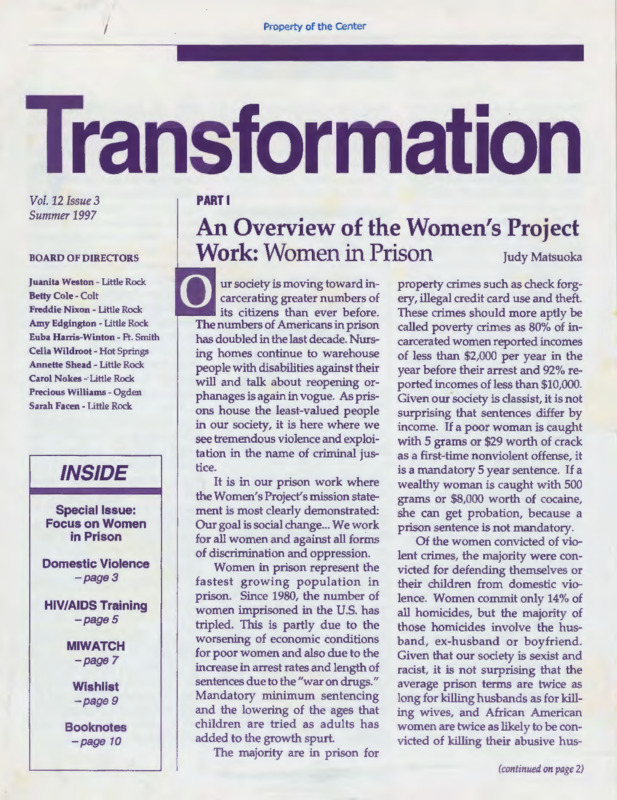
- Title
- Transformation_v12.no3.1997.Summer.pdf
- extracted text
-
Property of the Center
I
Vol. 12 Issue3
Summer1997
BOARD OF DIRECTORS
Juanita Weston - Little Rock
Betty Cole - Colt
Freddie Nixon - Little Rock
Amy Edgington - Little Rock
Euba Harris-Winton - Ft. Smith
Celia Wildroot - Hot Springs
Annette Shead - Little Rock
Carol Nokes-· Little Rock
Precious Williams - Ogden
Sarah Facen - Little Rock
INSIDE
Special Issue:
Focus on Women
in Prison
Domestic Violence
-page3
HIV/AIDS Training
-page5
MIWATCH
-page 7
Wishlist
-page9
Booknotes
-page 10
PART
I
An Overview of the Women's Project
Judy Matsuoka
Work: Women in Prison
ur society is moving toward incarcerating greater numbers of
its citizens than ever before.
The numbers of Americans in prison
has doubled in the last decade. Nursing homes continue to warehouse
people with disabilities against their
will and talk about reopening orphanages is again in vogue. As prisons house the least-valued people
in our society, it is here where we
see tremendous violence and exploitation in the name of criminal justice.
It is in our prison work where
the Women's Project's mission statement is most clearly demonstrated:
Our goal is social change ... We work
for all women and against all forms
of discrimination and oppression.
Women in prison represent the
fastest growing population in
prison. Since 1980, the number of
women imprisoned in the U.S. has
tripled. This is partly due to the
worsening of economic conditions
for poor women and also due to the
increase in arrest rates and length of
sentences due to the "war on drugs."
Mandatory minimum sentencing
and the lowering of the ages that
children are tried as adults has
added to the growth spurt.
The majority are in prison for
property crimes such as check forgery, illegal credit card use and theft.
These crimes should more aptly be
called poverty crimes as 80% of incarcerated women reported incomes
of less than $2,000 per year in the
year before their arrest and 92% reported incomes of less than $10,000.
Given our society is classist, it is not
surprising that sentences differ by
income. If a poor woman is caught
with 5 grams or $29 worth of crack
as a first-time nonviolent offense, it
is a mandatory 5 year sentence. If a
wealthy woman is caught with 500
grams or $8,000 worth of cocaine,
she can get probation, because a
prison sentence is not mandatory.
Of the women convicted of violent crimes, the majority were convicted for defending themselves or
their children from domestic violence. Women commit only 14% of
all homicides, but the majority of
those homicides involve the husband, ex-husband or boyfriend.
Given that our society is sexist and
racist, it is not surprising that the
average prison terms are twice as
long for killing husbands as for killing wives, and African American
women are twice as likely to be convicted of killing their abusive hus(continuedon page2)
bands than are white women. In
fact, the majority of women (54%)
incarcerated in U.S. prisons are
women of color. African American women, on the average, receive longer jail time and higher
fines than do white women for
the same crimes.
The majority of women (75%)
are mothers of dependent children and six percent are pregnant
when entering prison. Forty-one
percent of the women have experienced physical, sexual or emotional abuse which means that
their children are likely to have
observed the abuse or been
abused themselves. On a national
level, the number of children
separated from their incarcerated
mothers is approximately half a
million, causing damage that will
be felt for generations to come.
These children are 40 to 60 times
more likely to become incarcerated themselves. The violence
done to these children is so great
that in 1993 Congress authorized
the National Institute of Corrections to fund mother/ children
care facilities as an alternative to
incarceration to mothers convicted of non-violent crimes. Congress authorized the allocation of
$8 million dollars a year for these
facilities; by 1997not a single dollar has been spent by the National
Institute of Corrections for this
purpose, thus ensuring a supply
of prisoners for the future.
And why is a steady supply
of prisoners needed? The U.S. is
experiencing
a 35% annual
growth in the number of privately
owned and operated prisons.
These corporate prisons employ
prisoners who will produce $1billion dollars of goods and services
this year. Since prisoners are exempt from minimum wage laws
0fthewomen
convicted of violent
crimes, the majority
were convicted for
defending themselves
or their children from
domestic violence.
and occupational safety standards, do not receive benefits and
cannot organize, corporations
find U.S. prisons an attractive alternative to Third World laborand an attractive alternative to
creating free world jobs that will
pay good wages and provide benefits. Today we see prisoners sewing jeans, assembling computer
components, and taking phone
orders and reservations for major
corporations such as JC Penney's
and Microsoft. Increasingly we
see a world in which some are
rich and free and others are poor
and incarcerated.
The Women's Project has been
engaged in prison work since
Page 2 • Transformation• Summer 1997
1989. Our goal of ~ocial change
drives all of our prison work but
the work is done at a variety of
levels: empowering incarcerated
individuals, changing institutional policies and systems, developing alternatives, and educating others. We use our newsletter
as an educational tool to reach
out to others committed to social
justice. We work in coalitions to
find alternatives to incarceration,
to prevent the damage to families
caused by a mother's incarceration and to change the prison policies which oppress women, poor
people and people of color. Perhaps most radical is our work
with individuals who are incarcerated-radical in this society because we believe these women
and men are persons of worth
who are capable of changing the
conditions of their lives. We work
in the prisons to empower incarcerated women and men by providing them with information
about the causes and consequences of domestic violence and
HNI AIDS-information they are
not receiving from any other
source-to effect change in their
lives and ultimately in the lives of
their families and communities.
•••••••••••••••••••
This issue of Transformation
will give an overview of our
prison work in Arkansas and the
Fall issue will introduce you to a
recently initiated project and discuss some of the pressing political concerns about our nation's
criminal justice system. ■
The Prison Project:
Dom.estic Violence
I
t is through the Prison
Project that the Women's
Project has been able to
work within the Arkansas prison
system to provide a weekly support group/ class for incarcerated,
battered women, train women to
be HIV/ AIDS educators, and provide transportation to children
through the MIWATCH program
to visit their mothers in prison.
Recently we began a domestic violence class for incarcerated men
and an HIV/ AIDS informational
class for men. These projects allow us to work directly with incarcerated women and men to
empower them to effect change in
their lives as well as giving us the
opportunity to witness the prison
system and its impact on prisoners.
Coalition
Work
To effect change in the system,
the Women's Project has long
worked with community organizations on advocacy efforts. We
were supporters of the formation
of Second Genesis, a transitional
facility for formerly incarcerated
women, and worked with the prerelease program at the Women's
Unit to provide a non-traditional
jobs training program. The Project
staff initiated the formation of the
Ad Hoc Committee for Women in
Prison and Their Children, an Arkansas-based coalition of organizations and individuals. The work
of this committee resulted in
Felicia Davidson
Parenting from Prison classes offered by the Parent Center, and
is currently involved with lobbying for alternatives to incarceration for mothers convicted of nonviolent offenses. Current members of the Ad Hoc Committee
also include: Advocates and Relatives for Kids, Arkansas Cares,
Black Community Developers,
Second Genesis, and the Women's
Project.
Domestic
Violence
Group
forWomen
In 1989, a weekly support
group for battered women was
started and in 1991,a class on domestic violence was instituted.
These educational classes and
support activities for women in
prison who had been physically,
sexually and emotionally abused
have continued virtually uninterrupted. In general, the group included and continues to include
personal sharing as well as informational presentations about the
dynamics of battering (physical,
emotional, economic and sexual
abuse, threat and isolation).
Who are the women we see in
prison? The profile that emerges
in study after study is that of a
young, single mother with few job
skills, poor education and who
lives below the poverty level.
Seventy-five percent are between
the ages of 25 and 34, 75% are
mothers of dependent children,
and 85%have experienced sexual
Page 3 • Transformation• Summer 1997
and physical abuse. Ninety percent have a drug oi: alcohol-related history. The majority of
women are in prison for relatively
minor offenses such as theft, fraud
or forgery, which are typically referred to as property crimes.
When women do engage in violent crimes, it is often against a
male partner. Women are much
more likely to kill a male partner
in self-defense in response to the
man's battering and threats and
typically after an extended period
of abuse-making it unlikely a
woman will repeat a homicide.
Although no one knows exactly how many American women
are in prison for killing an abusive
husband or boyfriend, it is believed that 33% of women serving
sentences for murder were convicted of killing a husband, ex-husband or boyfriend. Charles Patrick
Ewing, a psychologist, states that,
"This small but increasingly visible minority of battered women
are in many cases doubly victimized: once by the men who have
battered them and again by a system of criminal justice which holds
them to an unrealistic standard of
accountability."
In March, 1991,it hit home for
me. I had a sister incarcerated for
killing her abuser. She was loving, caring, honest and educated
in all the things society expects of
a person to "fit in." My sister got
married in July, 1981,to what had
seemed like a nice man. Six
months or less into the marriage,
we would see her with black eyes,
scratches, bite marks, patches of
hair pulled out, and so many more
horrible things. She went to the
(continuedon page4)
police for help and got an order
of protection. This did not stop
her husband from coming and
beating her, and after each arrest,
the beatings g~t worse. My sister
left the house after he tried to kill
her and went to a battered
women's shelter. She lost jobs because he would show up, talking
loud and causing trouble. The
Women are much more
likely to kill a male
partner in self-defense in
response to the man's
battering and threats and
typically after an extended period of abuse.
night she killed her abuser the
police had· arrested him only two
hours earlier. They let him out
and he went to their house where
he beat her almost to death with a
gun before she got the gun away
from him and shot him.
I also survived an abusive relationship-for the record, with a
man who had been with me when
I answered the late night calls from
my sister, took me to pick her up,
held her hands on many nights,
put ice on her bruises, and gave
her money to go away from her
abuser. It seemed that when my
sister went to prison, he started to
make me feel guilty for helping
my mother with my sister's children. He played mind games:
DomesticViolence/Battered
Women
Group:ReflectionsbyWomenatTucker
1
' ..
,DomesticlJiolenceis bemg
things }mppenedtht' wuy tlu:ydid.
abused tl1roiighout your lJft::in 1 realize thut aftl-'1'all tlu,t I have
childhood,marriageor relnHanship. been through, 1 da,i't have to go
I was abusedin many relatio11sltipts throughthe samesl11JJ.that
I have
and didn't realize 1 was being beenthroughbecall',eI knowthatiJ.
abusrd. But now I realizewhere1 don't have to dealwith that. I can
went wrong to causeme to iKcq,t w, lk awaytmd not go back.
tlte abuse1 u,,astakmg throughout
Mary Cooper
my life. "
Aurelia Barnes
"1
from a very dysfunc"To me, tJ1isdass is theplace[ tionalandalc:oholic,
drugftlledchildfound out tlwt 1 cau [ir.,ca different 1wciti.I Havecometo understand
lifewith ttnabsena nf abuseinq~y, that .although1 myselfhave.never
form....This classhas becomea ha- b •enxiwfcntr or a drng or alcohol
ven in only tumsessions.I feel that user,
as a resultof my ~hildhood1
if and wli 11 1 tMnt to sh,ire my have/med my lifewith [O'Wst!lfe.storyoropinions,I canwithouttile teem,self unworthiness,and guilt
frar that T will be judged,or tllat which led me i11fl1 a 12-yearmarmy "business''will bebrnadmstall riage with an almsh1e alcolwlu:... .I
over tlte compmmd."
searcr1cd
for a reasonfor my behavLou Gentry 10r wh1d1has causedme to Write
come
,r (4 I likesinu: l'Vt been..;amt
(] the Domestic''iolt'11Ll um
that.11
hashelpedmebecome
a_trongrr per.on.1 no lungerfeel like I
_Jwck•.to do. ··U""-if.-,
frm.ti 't'
to
1v• c '1,to
things
stayJntrouble,tocome
hereto '!'mk and to causehurt to
my,·dj.myJmmly.andmy children.
CarryingrJroimtl all this . mlt and
have to de,:1endan any01re,except lowselfworththroughoutmy childmyself,andnomatterwhatwehave, hoodandpastmarriagehad caused
we shouldn't stay in an abusive re
me to acceptbeatingsand mental
Intionship. I now Juwea perspec- abuseandgivenme thefeelingthat
tive on life. And 1 now can talk I'ddonesomething
todeserveit. But
about how I was treatedwifhouf
until I u•a• ri/lmg to acceptfhat I
feelingashamedand embarrassed, hfld a problem,searchfor a cause
because1b10u•I am not alone.''
and a direction,I couldnotfind a
M. Walker solutionto cfmngt. l alsolearnedno
ma ter /u,u•much self destruction
..,w,wr.I hme gottenfrom lfiis u.,,ernay do, oncewe areaccepting
class is tfwt J har,e been able to and willingfv change,let go andlet
forgivemyselfand leam howother God, t1uitthese ate tile toolstor
peoplehave bet'tfthroughthe same build a strong foundationfor rJlJr
1
thing that I have, but 1 can truly
l10nestlysay tliat1 will do betterfor
myself and understandwhy some
(continuedon page5)
Page 4 •
Transformation• Summer 1997
future."
Chamaine Youngblood
Cousatte
Women in Prison
HIV/ AIDS Training
"You care more for them than for
me." He threatened to leave if I
didn't stop going to visit them.
He started to use isolation to control me: too½ the phones to work
with him, and took the keys to
both cars. To intimidate me, he
would bum my clothes. It never
occurred to me that I was being
abused because we were not fight-
We empower women by
giving them the
information and support
to know that domestic
violence is never
deserved.
ing-yet. The fighting came when
he found out that I had extra keys
made and bought more phones.
For a long time I didn't tell anyone
because I was ashamed and felt
like it was my fault because the
fighting wouldn't have started if I
hadn't gotten more keys and
phones.
Today I know the difference
and through the Women's Project
work with the domestic violence
group at Tucker, we empower
women by giving them the information and support to know that
domestic violence is never deserved. It is in these classes and
support activities that we work
for social change, a just and violence-free world-one woman at
a time. ■
The Prison Project:
HIV/ AIDS Peer Training
Felicia Davidson
V drug use by a woman or
her sex partner, having
multiple sex partners, being in an abusive relationship
where the woman has little control over her sex life, and lack of
information about AIDS and safer
sex put women at increased risk
for HIV infection and AIDS.
Women, especially women of
color, are the fastest growing
group of people being diagnosed
with HIV infection or AIDS in
Arkansas.
The women incarcerated in
Arkansas, like women nationwide, tend to be young and poorly
educated. Many have alcohol or
drug addiction which put them
at increased risk for HIV infection. And many come from communities where there has been
limited access to health information. Prison then becomes an important time for women to gain
access to information that can result in changed behaviors to reduce their risk for HIV infection
as well as skills to pass on the
information to others in their communities.
Each month women are paroled out into the free world and
new women take their place at
the Women's Unit at Tucker
prison. Manywomenarrivewith
concern about their health status,
with myths about how HIV is
contracted, and with fears about
peoplewithHIV and AIDS. Many
I
Page 5 • Transformation• Summer 1997
womenatthe Women's Unit have
not had access to AIDS information, basic facts about reproduction and sexuality, or opportunities to talk about their bodies and
sex.
Given these realities and with
the belief thatwomenshouldhave
the information to have control
over their own bodies, the
Women's Project initiated a peerled training program which focuses on HIV, AIDS, sexually
transmitted diseases and reproductive health. We worked with
prison residents to develop a
projectmanualentitledHN,AlDS
and ReproductiveHealth: A Peer
Trainer'sGuide for use in the program and for distribution to programs around the country.
Seventy-five women incarcerated at the Women's Unit have
participated in the four 19-hoursessions to become certified in
the Centers for Disease Control
courseforHIVserologictestcounseling and partner notification
techniques. Prisoners trained
through this program act as resource people for their peers in
prison as well as being able to
return to their homes, communities, schools, churches and workplaces with the knowledge and
skills necessary to deliver HIV/
AIDS information and resources.
Additionally, bi-monthly 2hour training sessions provide
(continuedon page6)
any woman with the opportunity
to learn, without threat of stigma,
basic information about HIV/
AIDS, high risk behaviors and
Many women at the
Women's Unit have not
had access to AIDS
information, basic
facts about reproduction and sexuality,
or opportunities to talk
about their bodies
and sex.
HIV prevention. These prisonerled sessions are taken seriously
by the other incarcerated women
who feel that their peers really
know about life back out on the
street.
These 2-hour training sessions
are now being given to the men
incarcerated at Tucker. Many of
themenareincarceratedatTucker
only until they can be transferred
to another facility. This gives the
Women's Project the opportunity
to give these men information
about HIV/ AIDS with the hopes
that they will incorporate the
knowledge into their own lives
and share it with their peers. ■
What I Learnedfrom the Battered
Women's Grou /HIV Training
Shirley
Of all th prublentsourcountry is plagued ·with these days,
perhaps domestic violence and
HN / AIDS are two of tl most
outstanding and especially relevant to the prison population.
Some of the facts rve learned
sinc these topics have been
taught at the Tucker ,v men's
Uni
• Over 1 million women se
help yearly for injuries caus d
by ba ttcrin "".
• At least 6 million women are
battered yearly by husbands or
boyfriends; 4,000 ar actually
killed.
• Children are traumatiz d by
se ing this battering and many
grow up tor peat the behavior,
• Batterers have ce ain char cteristics and battered vome
have certain trruts.
• incc 1983,2 0'"c ·es f AIDS
ha e been reported in Arkansa . Half have dieL.
• The fastest growing popu.la•onof people infected with HIV
are female and heterooexual t
is not a gay person's dis -ase.
• AIDS has killed 6.4 million
worldwide.
22.6 million are
vorldwide.
lV infected
Although AIDS and domestic violence may not appear to
Page 6 •Transformation• Summer 1997
Danner
ha much in
mon,bo hare
~ idenc~d in th inc rcerated
po ulation. Women especially
are more often vichn s of vio4
Jenee, sometimes beginning iii
childhood. This can be a never
ending cycle;leading to dysfunction m the home, lo self-esteem, u ntal illn ~ , pr· on or
death. LlkewiseAJDSi p1 yi
a l rger role in the li ' of the
incarcet· ed. Drug addictionfa
spu-alin upward and. has.a d,i..;
reel link to HIV/ AIDS? O\ ,
Drug addiction can cause ap!?J.'•
son to lower moral standards,
take risks, engag in very dangero sbehaviorsthatspreaddisea ·es.cause others harm and lead
to disa, er for all involved.
1
'I he key is education. Ho~
can a person fight ome h.ing.of
which th y are ignorant"? Th
Domestic Vi 1 nee/Bat ered
Women' group h ld each week
at the Women's Unit na les
those involved to am, hare
and finally grow into hcalthi r
persons emotionally, thub- returning to ramllies as betterp~sons, wi •e ·,mothe s,si.sterscind
daughters
People ev •wh re should
ha 1ethe O\ •ledgeoffer dhe:re.
But at ]east some v,:omen will
1eav hereandhe]peducate'othen;, th r by no longe!' being a
partof th prob em but a portion
of the solution •·it\.
our. society,
Property of the Center
MIWATCH:
Ministries to Incarcerated Women
and Their Children
Freddie Nixon
ince 1990, the Women's
Project and the United
Methodist Women of the
Little Rock and North Arkansas
Conferences have sponsored the
MIW A TCH program. At the
heart of the program is the desire
to keep mothers and their children united in order to stem the
tide of children becoming incarcerated.
Nationalstatisticsshow75%of
women prisoners have children
and 50% are the sole supporters
of their family. In Arkansas, at
any time there are 14,000 children whose mothers are in prison.
In August, 1990, in a survey of
288 women at Tucker, 43 women
reported that they were unable to
see their children on a regular
basis because of the lack of transportation for their children. The
population at the Women's Unit
has grown to 568 in 1997, with
another 144 women incarcerated
at the Central Arkansas Community Punishment Center, which
only increases the number of incarcerated women unable to see
their children.
The incarceration of their mothers is highly traumatic for the
children and often results in a
lack of contact with their mothers
and the move from one home to
another. Children often respond
with poor school performance
S
J
and inappropriate behavior, resulting for some in their own incarceration. For many children
with mothers in prison, months,
even years pass with no physical
contact with their mothers. The
reasons for this are numerous,
but often involve the inability of
the children's primary caretaker
to bring them to the prison.
MIWA TCH remedies this
problem by pairing children, living in Arkansas who are unable
tovisittheirmothers, with volunteers in the child's community
who will transport them on a
monthly basis to the Women's
Unit at Tucker Prison or the Central Arkansas Community Punishment Center in Little Rock.
During an average year, 65 chilPage 7 • Transformation• Summer 1997
dren are given transportation by
MIWATCH volunteers to visit
their mothers.
MIWATCH has also held two
retreats for children and their caretakers. The retreats brought together youth, their caretakers,
formerly incarcerated womenand
community resource people for a
day of information and resource
sharing. Currently, MIWATCH
participates in the Ad Hoc Committee on Women in Prison and
their Children, advocating for alternatives to incarceration for
women convicted of violent
crimes. The committee has given
presentations
to community
groups to bring awareness of the
needs and issues of incarcerated
women, their children and the
families providing care.
Additionally, the women in local church units provide personal
hygiene items (soap, shampoo,
etc.) for the incarcerated women
as the prison or the Community
Punishment Center requires residents to purchase these items,
thus penalizing poor women and
women without family support.
In 1996, over 15,000personal hygiene items were donated. The
chaplains of each facility distributes the items to women in need.
As we look forward to 1998,we
are faced with the challenges that
the new privately operated
women's prison will bring. The
new 600-bed prison, one of two
being builtnear Newport in northern Arkansas, will be operated by
the Wackenhut Correction Corporation of Palm Beach Gardens,
(continuedon page8)
Women in Prison
MIWATCH
Fla. Upon completion, it is
planned that the Women's Unit
will be moved there from Pine
Bluff in central Arkansas. lbis
move will significantly increase
the distance that some children
The incarceration of
their mothers is highly
traumatic for the
children and often
results in a lack of
contact with their
mothers and a move
from one home to
another.
will have to travel in order to visit
their mothers and may decrease
the opportunity for visits. It will
also mean that the MIWATCH
program
operated
by the
Women's Project will have tonegotiate with the operators of this
for-profit prison in order to continue our work with the women
incarcerated in the Women's Unit
or find other ways to fulfill our
commitment to mothers in prison.
FreddieNixon is the Coordinator
of the MIWATCH Programand is a
board member of the Women's
From A MIWATCH Volunteer
Debbie and Bill Thomas
I travel with two young children, ages three and four,
from Fort Smith to Tucker. I's abou a hree and a hal
hour drive. The first time 1eprison came into view, the
young boy cried out, '"There's my Mom's house." felt
ick to nty stomach but then I came to learn he had said
the truth, this was hi - mo hers house. He taug t my
eyes to see in a different light. The children are now five
and six and when I come for ou journey, I'm greeted
with hugs and kisse , for th ·s day is a real treat or them.
I also teach a High School-age das at church and
usually have one of my te nagers with me as a helper.
They truly are a big help. They Tead and color \'\riththe
children. We have don ts for break ast and we stop
along the way to play at a park and on the way home
cDonald's is a must. I have learned to make their day
a specia day ...'cause you see, we're on om way tQ
Mom's house.
Congratulations
Dana Shook
1997 Volunteer of the Year
The MIWATCH Volunteers were presented
the Evangeline K. Brown Award at the
Women's Project Annual Open House,
June 13, 1997
Project. ■
Page 8 • Transfonnation• Summer 1997
off our backs
A big thank-you to those who have helped the work of the Women's
Project by donating office supplies and equipment. These tax deductible gifts facilitate our work while reducing our operating expenses. To s1:1-pport
our prison work, we have a continuing need for:
Supplies
for Domestic
Violence
andHIV/AIDS
Classes
• photocopier paper (white)
• black pens
• folders (2 pocket)
• manila file folders
• 8-1/2 x 11 inch writing pads
• double density 3.5 inch diskettes
• l" 3-ring binders
ForMeetings
• flip chart pads
• bold tipped markers
News
International
Health
Conferences
Lesbian issues Interviews
Sexuality
Radical
Subscribe Today!
ForMIWATCH
Project
• personal hygiene products
• used books andmagazines
Forthe Library
• $ to purchase resource books on
HIV/ AIDS and domestic violence
• bookshelf
New
2 7 years of the
finest feminist
journalism
ONE YEAR FOR JUST $25
Name
Address
City
State, Zip
off our backs
2337B 18th St. NW
Washington, DC 20009
Expanded
Edition!
This classic book, newly expanded with an informative afterword and annotated bibliography, is essential reading for anyone wishing a greater understanding of how homophobia
works as a tool to keep all people-not just those lesbian, gay, bisexual and transgenderedfrom realizing their full potential.
Homophobia:
A WeaponofSexism,used by countless individuals and organizations and taught
in colleges and universities across the country, provides a powerful tool for both education and
organizing.
$12.00 ISBN 1-890759-01-5
Availablefrom:
THE WOMEN'S PROJECT
2224 Main Street
Little Rock, AR 72206
phone: 501-372-5113
fax: 372-0009
wproject@aol.com
s&h $2.00 + 50¢ each add'l book• visa & me accepted
Page 9 • Transformation• Summer 1997
Lynn Frost
-Books
on
Prisonin our
library:
Criminal Injustice: Confronting the Prison Crisis,
edited by Elihu Rosenblatt
(South End Press). This
book IIexplores the connections between imprisonment,
racism, class domination,
misogyny, and homophobia
and offers us invaluable
information and compelling
arguments for placing prison
issues on the agenda of every
progressive organization."
...Angela Davis
Dead Man Walking: An
Eyewitness Account of the
Death Penalty in the U.S. by
Helen Prejean, C.S.J. (Random House). The author's
indictment of capital punishment sensitively navigates
the complex personal, ethical, and legal issues involved, balancing compassion for both the criminals
and the people whose lives
they destroy.
Cages of Steel: The Politics
of Imprisonment in the U.S.,
edited by Ward Churchill &
J.J.Vander Wall
(Maisonneuve Press) collects the work of some 50
political prisoners and
prisoner's rights activists to
document a systematic program to isolate political prisoners and subject them to psychological experiments
designed to destroy their
revolutionary beliefs and
breakdown their ability to
organize political action with
others.
•••••••
New Books in the Library
Oral Tradition: Selected Poems Old & New by Jewelle
Gomez (Firebrand Books)
Taking their inspiration from
the author's African American
and Native American
storytelling heritage, these are
poems of finding home, making love, learning history. They
tell the tales of women and
satisfaction, regret, love, danger, death, and eternal life.
Gender Shock: Exploding the
Myths of Male & Female by
Phyllis Burke (Anchor) deftly
interweaves investigative
journalism, personal stories,
and cultural criticism. The
author examines how gender
differences emerge, how we
are trained to inhabit them,
and how the psychiatric profession has developed a diagnosis known as Gender IdenPage 10 •Transformation• Summer 1997
tity Disorder for children
who exhibit IIgender inappropriate" behavior.
Hunger's Table: Women,
Food & Politics by Margaret
Randall (Papier-Mache
Press)
"The poems are about being
alive in a world filled with
injustice, with pain and
misery, but one in which
hope, ideals, love and responsibility exist in equal
measure. From the heat of
stove and anger, from the
warmth of hearth and heart,
comes this book as a generous feast for all." ...Paula
Frosch, Small Press Magazine
Into the Forest by Jean
Hegland (Bantam). Originally published by the feminist press, Calyx, this book
has garnered wonderful
reviews, calling it "stunning
in its power" and comparing
the writing to Margaret
Atwood's and Doris
Lessing' s. The story is both
inspiring and disturbing; a
fantastic voyage to the near
future, and a touching journey of two sisters searching
for their place in the world,
and with each other. "Highly
recommended" (Lynn)
Property of the Center
CurrentProjects
• Women's Watchcare Network
•Social Justice Project
The Women's Watchcare Network monitors and
documents biased violence, whether it be from far
right groups such as the KKK or militias, the religious right, or-individual acts of violence against
people because of their race, gender, class, age,
disability, ethnicity, sexual orientation, gender
identity or religion. We publish a yearly log of
anecdotal evidence of this violence and use it to
educate the general public, advocate with public
officials to ensure civil rights protections and to work
with communities to prevent violence.
Through the Social Justice Project, we provide popular education about the oppressions, how they are
linked, and develop strategies for dismantling them.
We work with social change organizations to
strengthen them, incubate new projects, and bring
people together in Arkansas and the South to form
progressive networks that support a progressive
agenda that includes everyone. Through our African
American Women's Institute for Social Justice, we
create strategies for overcoming the barriers that
hinder African American women's efforts toward
power and self-determination.
• Prison Project
Through the Prison Project we provide support
groups for battered women, train women to be HIV/
AIDS educators, provide domestic violence education for incarcerated men, work with community
organizations on advocacy for prisoners and work
with United Methodist Women to provide transportation for children to visit their mothers (MIWATCH)
and to provide toiletry items to women who cannot
purchase them.
In our struggle for economic justice we work with
low-income women to understand economic realities,
to fight discrimination and to create employment
opportunities.
Transformation
Editor
• Publications and Events
Our publications and events include a newsletter, a
lending library, resource manuals, statewide and
regional conferences, and the production of women
performers and writers. We also distribute Homophobia: A Weapon of Sexism and In the Time of
the Right: Reflections on Liberation~by Suzanne
Pharr.
Transformation is alsoavailableasan ASCII.file and
• Economic Justice Project
Art Director
Judy Matsuoka
Melissa Britton James
on audiotape.
r-------------------,
~ Yes,I wouldliketo join
~ the Women'sProject.
Name________________
Published four times a year by the Women's Project,
2224 Main Street,
Llttle Rock, Arkansas, 72206.
Phone: 501-372-5113
_
City_________________
_
_
Zip _________
_
Phone/day_______________
_
Phone/evening
---------------
□
$10.00
(low income)
□
$ 25
□ $ 75
□ $ 50
□ $100
Make checks payable to:
Women's Project
2224 Main Street
Little Rock, AR 72206
Letters to the editor are welcome.
©1997 The Women's Project
_
Address________________
State_____
Women's Project Staff:
Felicia Davidson
Sofia Memon
Lynn Frost
Janet Perkins
Judy Matsuoka
Suzanne Pharr
.. Printed on recycled paper. ..
.
L ___________________
Page 11 •Transformation• Summer 1997
J
Women's
Project
2224 Main Street
Little Rock, AR 72206
Non-ProfitOrganization
U. S. PostagePaid
LittleRock,Arkansas
PermitNo. 448
ADDRESS CORRECTION REQUESTED
HERLAND
SISTERRESOURCES
2312 NW39TH
OKLAHOMA
CITYOK 73112