Crossroads_1998.pdf
- Title
- Crossroads_1998.pdf
- extracted text
-
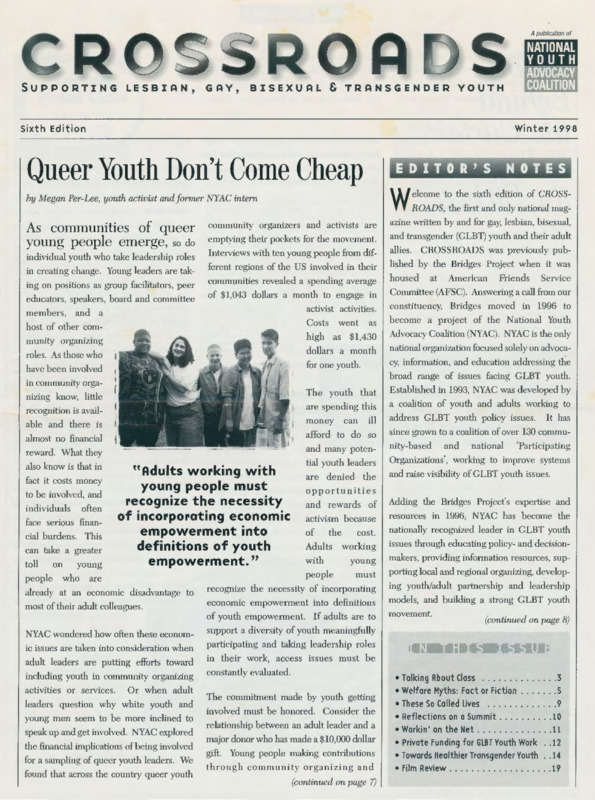
R
SUPPORTING LESBIAN,
GAY,
BISEXUAL
&
A publication of
A
,1 ,,
I
II
I
I
TRANSGENDER YOUTH
l
..
I
I
II I
Ir•
I 111
Winter 199 8
Sixth Edition
Queer Youth Don't Come Cheap
W
elcome to the sixth edition of CROSS-
by Megan Per-Lee, youth activist and former NYAC intern
ROADS, the first and only national mag-
emptying their pockets for the movement.
azine written by and for gay, lesbian, bisexual,
and transgender (GLBT) youth and their adult
individual youth who take leadership roles
Interviews with ten young people from dif-
allies.
in creating change. Young leaders are tak-
ferent regions of the US involved in their
lished by the Bridges Project when it was
ing on positions as group facilitators, peer
communities revealed a spending average
housed
educators, speakers, board and committee
members, and a
of $1,043 dollars a month to engage in
activist activities.
Committee (AFSC). Answering a call from our
As communities of queer
young people emerge, so do
community organizers and activists are
Costs
at
American
Friends
Service
constituency, Bridges moved in 1996 to
as
become a project of the National Youth
$1,430
Advocacy Coalition (NYAC). NYAC is the only
dollars a month
for one youth.
national organization focus ed solely on advocacy, infonnation, and education addressing the
nizing know, little
The youth that
broad range of issues facing GLBT youth.
Established in 1993, NYAC was developed by
recognition is avail-
are spending this
a coalition of youth and adults working to
host of other com-
went
CROSSROADS was previously pub-
high as
munity organizing
roles. As those who
have been involved
in community orga-
address GLBT youth policy issues.
It has
money
almost no financial
affo rd to do so
reward. What they
and many poten-
nity-based
tial youth leaders
Organizations', working to improve systems
are denied th e
and raise visibility of GLBT youth issues.
also know is that in
fact it costs money
to be involved, and
individuals
often
face serious financial burdens. This
can take a greater
toll
on
young
ttAdults working with
young people must
recognize the necessity
of incorporating economic
empowerment into
definitions of youth
empowerment."
can
ill
able and there is
since grown to a coalition of over 130 commuand
national
'Participating
opportunities
and rewards of
activism because
Adding the Bridges Project's expertise and
resources in 1996, NYAC has become the
of
th e
cost.
Adults working
issues through educating policy- and decision-
with
nationally recognized leader in GLBT youth
young
makers, providing information resources, sup-
must
porting local and regional organizing, develop-
already at an economic disadvantage to
recognize the necessity of incorporating
ing youth/adult partnership and leadership
most of their adult colleagues.
economic empowerment into definitions
of youth empowerment. If adults are to
movement.
NYAC wondered how often these econom-
support a diversity of youth meaningfully
people
who
people
are
ic issues are taken into consideration when
participating and taking leadership roles
adult leaders are putting efforts toward
in their work, access issues must be
including youth in community organizing
constantly evaluated.
activities or services.
Or when adult
leaders question why white youth and
young men seem to be more inclined to
speak up and get involved. NYAC explored
the financial implications of being involved
for a sampling of queer youth leaders. We
found that across the counhy queer youth
The commitment made by youth getting
involved must be honored. Consider the
relationship between an adult leader and a
major donor who has made a $10,000 dollar
gift.
Young people making contributions
through commun ity organizing and
(continued on page 7)
models, and building a strong GLBT youth
•
•
•
•
•
•
•
•
(continued on page 8)
Talking About Closs . ... . . ... ..... 3
Welfare Myths: fact or Fiction . ...... 5
These So Coiled Lives .. ..... . ... . . 9
Reflections on a Summit . . . .... .. . 10
Workin' on the Net .............. 11
Private Funding for GLBT Youth Work .. 12
Towards Healthier Tronsgender Youth .. 14
Film Review ....... . .. .. . .. . .. . 19
Who~s
Behind
the Curtain
Pulling
the Strings?
is truly committed to young people's self-
ment where being straight is not the norm.
determination, this will be reflected in the
amount of responsibility held by young peo-
Young women are respected, not exploited
pie in the organization.
and are given power. This makes it essential
The Center for Young Women's Develop-
responsibly.
that we teach and learn how to use power
ment is based on the principle that young
by Kelly O'Neill
women can and are independent and
Employment can be an excellent mechanism
norms and expectations.
for teaching skills and building leadership
train young women to do a variety of things
including health education, street outreach,
responsible.
We work against age-based
We employ and
In order to truly incorporate young people
into power structures, it is important not to
expect that they do all the changing. The
agency itself may need to change. Adults in
among young people. Through an employment setting, youth are able to interact with
advocacy, fundraising, accounting, program
quish some of their decision making power,
adults in a colleague-based relationship. A
planning, researching and facilitating.
as well as assist young people with devel-
We
the organization must be willing to relin-
queer-based work environment gives young
expect young women to be colleagues with
oping skills so that they can adequately
queers an opportunity to be out about who
adults and to learn the skills necessary to
take and use this power. Young people can
th ey are, have a positive influence on their
plan and direct their own projects.
take on responsibility, design programs, and
become supervisors or directors. This can
"In order to truly incorporate young people
into power structures, it is important not to
expect that they do all the changing."
benefit the organization in a number of
ways: programs will be improved by the
insights and intellect of young staff; young
people will gain skills and employment
experience; and the organization will gain
communities, and meet adults who may
We have created a space where young
credibility in the community, particularly
prove to be allies. In order for employment
women have political power, where our
amongst young people.
to be meaningful and effective, employers
ideas and assets are respected and utilized,
must believe that young people truly can be
where learning is encouraged and expected.
colleagues, and they must make a commit-
Young women of different cultures and sex-
ment to devote the time and energy neces-
ual
sary to help young people develop skills and
together
gain experience.
environ-
It is important that young people be given a
job description, opportunities for skill
development and advancement, consistent supervision, and fl exibil-
orientations
in
an
work
Kelly O'Neill is the former Director of
Community Building at the Center for Young
Women's Development in San Francisco.
CYWD is a youth-run agency providing
emploument and skill development for queer
and straight young women who are
on their own. Contact: 1095
Market Street, Suite 608, San
Francisco, CA 94103, 415487-8662.
ity. Too often 'youth jobs'
are irrelevant tasks that
adults have devised simply to fill time. Jobs for young
people should be challenging and
meaningful both to the young person and
to the organization as a whole. Few people
succeed in environments where they feel
inferior or incompetent. If an organization
2 • ceosseoaps • winter 1998
EDITOR'S NOTE:
For information and referrals
on GLBT youth programs
that directly promote the
value of youth empowerment
through employing young
people, contact NYAC's
Bridges Project.
interview
survive. I am talking about the dreams people
Talking
About Class
An interview with
Susan Raffo
access that includes an explicit understanding of
spin about who they are and what they can
race and racism. One problem is that the major-
expect from the years ahead, from the people
ity of people of color living in the United States
around them, and from the institutions that
whose lives are not attached to welfare or crime
serve them.
or a sweat shop must constantly fight the
assumptions that they are.
NYAC: You've said that class is not a conversa tion that happens easily in the United States, yet
we are, in fact , talking about it all the time.
Could you begin by expanding on this idea?
SUSAN RAFFO: Absolutely. Class is a conversa-
Additionally, the
NYAC: You mentioned earlier that many people
white faces receiving welfare, living in poverty,
talk about class by talking about race. Could
working in a sweat shop, or dealing with the
you spend some more time talking about the
cycle of crime and drug addiction become invis-
intersection of race and class?
ible in a mainstream conversation.
SR: The two are so entwined in the U.S., I think
it's pretty impossible to talk about them separately. I've been to many conferences in which
discussions about race and class have been
tion that rarely takes place in a formal way but
scheduled separately but at the same time. You
one that buzzes continually. Eve1y time we talk
go into the room with the focus on race and you
NYAC: And it's not just class and race that are
intertwined, is it?
You've already said that
"class is always there," which means it is present in gay, lesbian, bisexual and transgender
(GLBT) communities.
about health and money and work and the mall,
find a majority of people of color with some
SR: Class is partnered witl1 eve1ything, not as an
we are talking about class. Eve1y time we won-
white folks. You cross the hall and go into the
issue of greatest importance but instead, as a
der about affirmative action or immigration, we
room focusing on class and you see a lot of white
kind of lens that intensifies tl1e specifics of
talk about class. Class sits with us when we gro-
people - mostly white people raised working
everything it is turned upon. Class depends on
ce1y shop and it bangs against us when we think
class and poor.
about paying the bills. It is fundamentally
Class is always
This separation has to stop.
th ere. It is something we are in constant rela-
When I talk about class I'm
entwined with queer lives.
tionship to, whether we think about it or not.
not just talking about white
people, using class as a way
NYAC: Why do you think we are reluctant to talk
to talk about my experience
about it, formally?
as a white working class
SR: I think that in the US, we are all raised with
about the experiences of people of color. I am
a class st01y, the one that says if we work hard
also not ignoring race by using the word class
enough, we can all own a home, have a good job,
and dynamics. 'Relationships' is the impo,tant
alone. Class and race across the histo1y of the
and take vacations. Even when we don't believe
word here: both between individuals and within
United States have been tied and continue to be
that the American dream is equally available to
individuals and within systems and across insti-
tied in a confusing and sometimes impenetrable
all people, it's a hard sto1y to shake. Poverty and
tangle. I don't believe we can talk about class
woman and race to talk
the use of social services is still implied to be the
witl10ut talking about race nor talk about race
result of not working hard enough.
without talking about class. The class conversations in tl1e United States that do happen are
NYAC: It also seems like people have differing
generally about economics and public spending
ideas of what class is, or at least different ways
and tl1ey are racialized conversations. For exam-
of talking about it.
ple, mention the word "welfare" in the United
SR: Right. Some people use the terms blue and
States and tl1e face attached to the word welfare
white collar to talk about class, others use work-
is usually a Black woman's face. It doesn't mat-
ing class, middle class and rich. Still others only
ter that the large majority of individuals and fam-
talk about class by talking about race, using
ilies receiving public assistance are white.
images of people of color to imply poverty and
tutions.
Class is about relationships and it is
about comparatives. Rich and poor, union and
non-union, Black and Asian, rural and suburban,
gay and sh·aight, n01th and south. Eve1ytl1ing, in
part, understands itself by what it is in relationship to. But this isn't just a conversation across
separate differences. The queer community just like eve1y other community - is not a monolithic entity of singular tl1ought and analysis. Yet,
policy is often decided for the queer community
as though tl1ere were singular queer issues that
were equally experienced by all of its members queer issues tl1at are only seen in opposition to
white people to demonsb·ate middle class life or
NYAC: What are the results of this kind of auto-
wealth . When I am talking about class, I am not
matic imagery?
just talking about working class lives nor am I
SR:
just talking about rich people.
and dete1mines a system of power relationships
The conversation about welfare, then,
straight issues.
NYAC:
GLBT youth are among those whose
I am talking
becomes a nan-ow conversation about race
particular issues are often overlooked in our
about work, about jobs, and about how people
rather than a conversation about power and
communities. Do you agree?
(continued on page 4)
CROSSROQPS •
winter 1998 • 3
interview
(Talking About Class continued from page 3)
SR: Yes, yes, and yes again. Queer youth have
to deal with class issues in all the same ways as
about their own community. Queer glossy magazines present a particular kind of queer image
reforn1 becomes a lived reality than they are
with celebrity lives. There are GLBT immi-
queer adults but there are also issues specific to
and, through their illustrations, their aiticles
grants unconcerned with the philosophical ram-
queer youth. Queer youth are in a different
and their advertising, determine a popular pic-
ifications of gay marriage and more concerned
relationship to their sexuality than adults.
ture of "lesbian" or "gay man." Rarely do bisex-
about their ability to stay in the United States
Exploring and experiencing sexuality and iden-
ual or transgender lives get detailed unless that
and the stress that immigration places on their
tity happens differently for those under 21 than
it does for those over 30. There are different
person is already famous. We are part of a
media moment that most often details the lives
relationships and their lives. To fully understa11d heterosexism a11d homophobia, to under-
vulnerabilities to homophobia and heterosex-
and bodies of artistic, political and marketing
ism, different pressures around com ing out, and
different avenues to independence and self-sufficiency. Coming out to someone - such as a
parent or guardian - who might still be financially and legally responsible for you is not the
same thing as coming out in later life. Class is
also a particular issue for the young person who
is thrown out on the streets for being quee1:
Homeless youth are disproportionately GLBT.
Those who live in a large urban area may find
services for homeless youth, sometimes with
stand the complexities of issues such as gay marriage, what we do in bed and how we do it, com-
''When I first went to
a private liberal arts
college, I realized how
much more I had been
informed by my
extended family than
I was by my mother's
dreams about
professional careers . "
programming aimed at GLBT issues. Smaller
munity funding, and the words that we call ourselves, it is necessary that all experiences are
brought to the table. And more than brought to
the table, they need to be given the respect and
space they deserve.
Susan Raffo is editor of the anthology, Queerlu
Classed: Gau Men and Lesbians Talk about
Class, South Encl Press, March 1997. She is still
trying to stretch her brain around issues of class
- and of class and queerness - in the United
cities, towns and rural areas may not be able to
superstars. We are out and about in the main-
States and invites all comments to spur her
afford the same kind of services provided by the
stream more than ever before but the bodies
thinking along (rciffoOOl@tc.umn.edu). She cur-
bigger cities. The wider queer community
should be watching out for its younger mem-
that are out and about do not represent the
majority of our lives.
rently lives in Minneapolis with her lover,
Raquel.
bers as much as it does for its members with the
NYAC: So, we're back again to power relation-
most buying powe1:
ships and automatic imagery?
NYAC: But we know this is not always the case.
Why do you think that is?
SR: Yes, because these are the bodies that those
struggling to come out must measure them-
SR: The biggest reason is that queer adults are
selves against. They are the bodies that those
no different from straight adults when it comes
living isolated or non-urban queer lives have to
to really getting youth issues. Not adequately
supporting and honoring youth is shared across
see themselves in relationship to. This is not a
most communities. Additionally, I think a lot of
queer adults who struggled during their youth
with coming out and finding community
trivial thing. When we do not cover the breadth
of issues and experiences that represent queer
lives, we shut out many of our own members.
When we report on domestic partnership orga-
remember only the hard icky pa1ts. They forget
nizing without talking about the lives of those
the strength and beauty of their survivability.
who have jobs with no benefits or are unem-
They forget that queer youth today are not the
same as queer youth ten and twenty and thirty
ployed or reliant upon social services, we cut off
most of our body.
or more years ago.
Queer youth become
defined only as a body of people in need of
NYAC: How can members of GLBT communities
being protected and not as a group of people
begin to develop a class consciousness?
with a varied and diverse culture full of
strengths and joys as much as sorrows.
SR: Having a class consciousness is about
understanding that "queer issues" are broader
And I think it's more than that. The queer com-
than they are sometimes described in our own
munity -
and I use that phrase in its loosest
media. It is understanding that there are queers
sense - is part of a marketing moment in which
who are more concerned right now with how
many of its members believe the hype they hear
they and their families will survive as welfare
4 •
CROSSROQPS •
winte r
1998
CROSSROADS is a publication of the National Youth
Advocacy Coalition. NYAC is the only national organization solely focused on the broad range of issues
facing gay, lesbian, bisexual and tronsgender (GIBT)
youth. Through education and information, NYAC advocates for and with GlllTyouth through the collaboration
of a brood spectrum of community-based and notional
organizations. NYAC's Bridges Project, the national
information clearinghouse on GlllT youth issues, provides information resources, referrals and assistance.
1711 Connecticut Avenue, NW, Suite 206
Washington, DC 20009
202-319-7596 • 202-319-7365 fax
NYouthAC@aol.com
M'Bwende Anderson
011treach & Education Coordinator
Rea Carey, Exec11tive Director
Ken Carl, Bridges Project Coordinator
Andres Garcia
HIV/STD Technical Assistance Coordinator
Audrey Denson, Graphic Design
Every issue of CROSSROADS seeks to capture the
perspectives and experiences of GLBT young
people, their service providers and adult allies.
If you hove ideas or would like to write for
CROSSROADS, contact Ken Corl, Editor, at NYAC.
Welfare Myths:
Fact or Fiction?
two-thirds of them have recent work experience from employment while receiving aid or
before they applied for aid.
MYTH: Families stay on welfare for a long time
and don't make any effort to get off.
MYTH: Families wouldn't need assistance if they
would just go to work.
Less than half of the families that
receive Aids to Families with Dependent
Children (AFDC) receive it for more th an 36
months overall and most families receive aid
for no more than two years at a time.
Many families who are in th e
workplace cannot make it on their earnin gs
alone and need assistance in order to have
any decent standard ofliving.
FACT:
MYTH: Welfare benefits for families provide
them with enough to meet all their basic needs.
AFDC and Food Stamp benefits
combined produce less than a poverty level
income in all states and their value has been
going steadily downward for many years.
FACT:
MYTH: People need welfare because they won't
work.
FACT: The only adults receiving AFDC are
those who are caring for children and over
NYAC Supports Transgender,
Gender-Bending, and Gender
Questioning Youth Connecting
At NYAC's First Annual Summit in the spring
of 1997, discussions were held on Gender
Fluidity, Gender Identity Disorde1; and supporting youth who express their gender in
non-traditional ways. As prut of an ongoing
dialogue, that has been continued at a number of venues throughout 1997, NYAC is supporting the creation of a Transgender Youth
Network. Young t:ransgender; gender-bending, gender questioning and allied activists
ru·e working to create a forum for social, informational, and support connections.
F01warding the NYAC value that young people provide the best available suppo1t to each
othe1; NYAC's Bridges Project Coordinator is
facilitating Trans Youth Network cxmnection
being made. The Trans Youth Network's first
projects are: A 'Zine, A Transgender/Gender-
FACT:
MYTH: Almost all of the families receiving AFDC
are Black or Hispanic.
FACT: Many more White famili es than Black
families or Hispanic families are helped by
the AFDC program.
MYTH: Large numbers of families are receiving
AFDC benefits they are not entitled to and the
government isn't doing anything about it.
FACT: The evidence indicates that only a small
percentage of recipients ru·e overpaid and that
most of these errors are due to honest mis-
takes, and their are 1igorous programs in place
to limit all overpayments and weed out fraud.
MYTH: Spending on welfare programs to aid
needy families is a major part of the federal
budget.
FACT: Spending fo r poor families with
children under all public assistance programs
that provide for basic needs including medical
care amounts to about 6% of the budget.
*MYTH: Poor people are the only people
benefitting from 'welfare' assistance from the
government.
FACT: Corporate welfare, in the fonn of tax
breaks and other government-sponsored
initiatives, benefit many wealthy people and
business owners.
Partially reproduced with permission of the Welfare Law
Center, ©1 996. NYAC encourages readers to obtain the
full publication Welfare Muth s: Fact or Fiction?
Explorin g the Truth About Welfa re. Contact: Welfare
Law Center, 275 7th Ave., Suite 1205, New York, NY
10001, 212-633-6967, hn0135@handsnet.org. *Not
f rom the Welfare Law Center.
NYAC is currently seeking submissions
from young people of writing (non-fiction
or fiction), poetry, personal stories, artwork or other works for inclusion in a 'zine
to be dish·ibuted widely to other young
and gender identity issues and/or transgen-
people across the US. Submissions should
preferably be under 1,500 words, and submitted to the NYAC office. As part of
NYAC' s Youth Stories Project, collecting
of
stories
New Resource on Youth and
Gender Identity
young peopl e to be
shared with
d e cision
mak e rs ,
NYACisalso
seeking personal sto1ies
of young 22
and under. Contact NYAC for Youth Stories
Project outreach fonns. Finally, if you have
access to training curricula addressing youth
der youth , please submit a copy to the
NYAC office.
This spring, NYAC debuts a Gender
Identity/Iransgender Youth Information
Packet! With this packet, NYAC seeks to fill
the resource gap on gender identity issues in
GLBT youth communities, and the resource
gap on youth issues in gender/h·ansgender
communities. The packet is a compilation of
aiticles on mental and physical health issues,
working with transgendere<l youth, gender
fluidity, language and definitions, frequently
asked questions, personal stories and
resource listings. It is intended for youth,
service providers and adult allies. For ordering information, contact the NYAC office.
Bending/Gender Questioning Youth Stories
Project, and a composite trnining curriculum
on youth and gender issues.
fill
CROSSROQPS •
winter
1998 •
5
National Hotlines:
One Story
Be Careful Who You Call
by Tctrnara Fry
GLBT youth and ally organizations' publications often include resource listings.
I am lesbian-transgender. I don't have insur-
this battle is often a silent one. There is a
These listings sometimes offer regional or
ance.
I spend twenty dollars a month on
cannon of queer works being published and
national telephone helplines directed at
food. Somehow I go to college. I work at
performed. Yet many of these works are not
young people.
Carved in Stone.
for or by queer people with economic hard-
may be from friendly sources, youth often
know about me and they don't harass me.
ships.
They are by those who are visible
know nothing about them other than titles
My lesbian friends barely make a living. Two
now. They are written by queers who can
such as 'Runaway Hotline' or 'Youth
have tried to commit suicide. One of them is
afford to write.
We carve rocks.
They
Hotline'.
living in her car. Her parents kicked her out
If we want the best for youth then we must
make sacrifices. Part of this sacrifice means
refuse to conform. I have to be out. I must
giving up the lies we have embraced. We
be able to sleep at night and I could not if I
must confront the lies told to our youth and
lived a lie.
When
ourselves.
we
hear of the
effects
of
coming
out
Although we expect not all
helplines are completely up-to-speed on
a paycheck away from being homeless but I
from her house when she was sixteen. I am
Although these resources
"How con you begin to help?
Hire o young person. Support o
youth going to your physician
ond poy or shore expenses."
and the bat-
We must confront the idea
that there is
no racism m
our communities.
We
GLBT youth issues, we do not expect them
to be anti-gay.
NYAC's Bridges Project Coordinatot~ Ken
Carl, recently checked out two national
helplines that we often encounter in publications:
The
'National
Runaway
Switchboard' and the 'Youth Crisis Hotline'.
He received one pleasant and one alarming
response.
The National Runaway Switchboard (N RS)
tles of today's youth, do we think there is
must confront the idea that there is no room
(800-621-4000) has been around for a num-
some magical organization ready to help?
for transgender persons. When we as a com-
ber of years and offers trained GLBT-friend-
How many actually hear the stories of youth?
munity address these issues, the economic
ly volunteers and extensive national refer-
Today's youth are willing to sacrifice scholar-
hardships youth face will also be confronted.
rals. NRS folks take action to be inclusive of
and friendly to GLBT young people and
ships and jobs to come out. Today's youth
NYAC has an ongoing relationship with the
leaders risk being shamed and humiliated to
How can you begin to help? Hire a young
go to school. For a brief moment we will
person. Support a youth going to your physi-
NRS.
This yeai~ in fact, NYAC provided
cian and pay or share expenses. Support a
NRS with a current listing of GLBT youth
tears, sympathy, and telling others some-
youth doing volunteer work for your favorite
specific groups and se1vices in the US.
thing must be done? How often do we think
charity. Support a homeless youth to sleep
of young people with no homes or health
in a bed somewhere that is not bigoted.
care as a result of having the courage to come
Support a youth going to a local festival or
out?
For a culture that places such an
park for a day. The youth's self-esteem will
emphasis on youth, we as a community have
increase greatly. I know. One of my friends
watched without support and action. When
offered me her place when I didn't have one.
the streets become safer than the homes, we
She gave me a chance to better myself. I
expressed are tltose of religious fundamental-
as a community must respond. When living
could not have learned the lessons that I did
ists. NYAC respects and supports faith-based
in one's car is safer than a school, church or
in school.
Education is not always some
programs supportive to GLBT young people,
home, a community that does nothing is only
exploration of the mind. It can be support-
including our members in rnral areas with
adding to the pain.
ing youth to have a chance and a place to be.
programs based in churches. Unfortunately,
The war we wage is an economic one. It is a
Tamara Fry is 23 years old and lives in North
war against time and hatred. It is a war to
Carolina.
NYAC
NOT affirming or supportive. When asked
buy a loaf of bread, and find a place to sleep
Participating Organization Time Out Youth in
what a youtl1 witl1 questions about sexuality
for the night, and have a place to work. And
Charlotte, NC.
remember the voices. But what comes after
On the other extreme, the Youth Crisis
Hotline is offered by Youth Development
International in San Diego, CA, an agency
supplying religious-based information to
callers. Those staffing the hotline receive orientation, but no training.
The views
tl1e inforn1ation and counsel offered to young
6 •
C ROS S ROOP S •
wi n te r 1998
She
volunteers
with
people calling tlie Youtli Crisis Hotline is
(continued on next page)
(Queer Youth Don't Come Cheap continued from page 1)
activism do not often receive the
same recognition or respect.
Organizations must take a serious
look at what the work of these
young leaders is worth to them.
Mutually beneficial and affordable relationships with young
people must be explored if adults
are truly committed to youth
empowerment.
THE PRICE OF SOCIAL CHANGE
HOME STATE OF YOUTH INTERVIEWED
CA
DC
GA
KY
MA
NY
TX
Avg.
$40
$100
$80
$50
$44
$60
$5
$54
Materials for activism activities/mtgs.
25
100
30
0
20
110
300
84
Long distance phone bills fo r
activism activities
10
30
80
150
0
100
0
53
Meals at lunch or dinner
activism activities/ meetings
0
40
20
40
0
30
0
19
Money spent eating out when
unable to eat at home, minus
amount of food for home meal
300
200
20
100
10
150
50
118
* Unpa id hou rs spent on activis m,
multiplied by hourly wage at paid job
900
700
520
1000
180
700
560
65 1
70
105
50
90
50
80
0
64
Spending Category (per month)
Transportation to and from
activism activities/meetings
HIP TIPS FOR REDUCING
COSTS FOR YOUTH ACTIVISTS
• Provide food at meetings .
• Offer travel scholarships for
organizational activities.
• Make organizational phones
accessible to you th for long
distance calls that benefit the
organization.
• Make organizational Internet
service accessible to youth.
• Seek specific funding to offer
youth stipends for speaking
engagements or other activities.
**Conferences attended in one
year , divided by twelve months
Total Amount
$1345 $1275
$800 $1430
• Offer paid internships within an organization.
• Subsidize youth leader's registration fees,
transportation costs, and expenses for conferences. Also, support youth in applying
for scholarships an<l/or reducing costs by
presenting workshops. (Of all the costs,
this was the one that youth inte1viewed
thought was most beneficial for organizations to subsidize.)
Encourage other youth-serving agencies
to do the same.
(National Hotlines continued from page 6)
youth to this Youth Crisis Hotline!
would be told, a YCH volunteer said only to
"Find Jesus Christ." The organizational refer-
Young people in crisis are put at se1ious risk
when they are supplied with inaccurate information. Youth are not the cause of the their
crisis situations . The cause stems from living
in a homophobic society offering unsupportive, unaffirming messages, and
condoning
violence
and
rals offered were to ex-gay ministries around
the country, including Exodus International
affiliates and 'Transformation' ex-gay groups.
Literature resources offered included
Homosexualitv: Laying the Ax to the
Roots, Steps out ofHomosexualitv,
and You Don't Have to be
harassment against GLBT
youth.
NYAC' s principles
include supplying factbased information to
youth, along with empowering and supporting them
to make healthy decisions
for themselves. Do not refer
$915 $1043
* This includes preparation, participation, and transportation for activism activities/meetings.
** Activists were asked the expense of conferences they attend, without subsidizing by an organization or scholarship.
This includes registration fees, transportation, and expenses while attending.
• Do not require youth to donate
honorariums to the organization.
Gav.
$304 $1230
In addition to the
National Runaway
Switchboard, we
would like to
highlight two of our
member organizations'
national GLBT youth focused
All of these ideas cost organizations time and
money, something everyone is short on. In
the long run, however, it will be well worth
the effort. The key is maintaining a dialogue
with young people to find a plan that works
for the organization and for everyone.
peer helplines.
For some years, both
OutYouth Austin (800-96-YOUTH) and the
Indiana Youth Group (IYG) (800-347-TEEN)
have provided GLBT youth peer counseling
on national toll-free helplines. We acknowledge their groundbreaking and valuable work
not only in providing services, but also sharing
their program resources through NYAC' s
Biidges Project. These helplines, as well as
great regional helplines around the country
like LYRIC's Youth Empowerment Line in
San Francisco (415-863-3636) and Fenway's
Peer Listening Line in Boston (617-267-2535),
provide invaluable peer suppmt to young
people who often expe1ience extreme isolation.
Please contact NYAC for a listing of GLBT
youth suppo1tive hotlines.
ceosseoaos • winter t
998 •
1
(Editor's Notes continued from page 1)
NYAC's founding principles are
tacts have sky-rocketed.
The
field develops. Along with gen-
National Summit in Ap1il, 1997
based in productive partnerships
number of young people who
era! information on GLBT youth
was created a Transgender Youili
between
contact
for
and creating safer environments,
Network. NYAC currently sup-
national and community-based
resources and refe1rals has also
common requests are for pro-
ports tl1e Trans Youtl1 Network's
organizations,
and
grown, especially with outreach
gram models (mentorship, HIV
initial goals of compiling youth
youth
and
adu lts,
policy
NYAC
directly
resources, and CROSSROADS
opportunities such as being
prevention), needs assessments
stories and publishing a youth
and its readership. We hope to
included in Ann Landers' col-
and evaluative tools, research sta-
Zine.
continue
CROSS-
umn. NYAC is currently devel-
tistics, and most notably, informa-
NYAC/Bridges has played an
tion on school-based efforts.
From Moine to Florido,
New Mexico and Montono,
with the National Gay and
providing
ROADS as a unique forum for
oping a World Wide Web site for
discussion of cutting-edge issues.
debut this spring.
To do this we need your help. As
function of the site will be to offer
A primary
a constituency written
Bridges Project services online,
publication, we encour-
including refe1rals.
age you, the reader, to
submit ideas and articles
NYAC' s Bridges Project distrib-
for
utes five information packets on
youth and adults ore
making progress working
with their local school
systems to address GLBT
For tlie past three years
organizing role in partnership
Lesbian Task Force on the Youtl1
Leadership Training Institute.
NYAC regularly supplies contacts, resources and assistance to
individual
youth
organizers.
editions will focus on gender
General
identity/transgender
issues,
Issues, Religious Issues, Policy/
youth issues. Some efforts
are teacher driven and have instituted in-service trainings; some
lesbian/bisexua!/trans-
Procedure Models, and Gender
are parent driven (often tl1rough
Sometl1ing! youtl1 activist foundation grants program.
CROSSROADS.
young
Future
Issues,
Education
Youth
PFLAG) and provide library
Each is compiled of
books, matedals and speakers;
materials developed and shared
and many more are student dri-
gender women's issues, and
Identity/Transgender
HIV/AIDS/STD's.
Issues.
NYAC has also supported activi-
ties such as the California Queer
Youth Lobby Day and the Do
As you can see, our work contin-
by tl1ose working in the
ues to grow as do the challenges
Bridges Project Update
field of GLBT youth.
of supporting a GLBT youth
Throughout 1997, many of you
Along with resources,
grow for NYAC's continued
development is our member-
movement. What must also
have contacted us, wondering
NYAC' s database is ilie
where the B1idges Project is and
most
comprehensive
ship. NYAC currently offers
seeking resources. Here, we offer
referral source on GLBT
organizational and individual
an update on B1idges and its new
you th issues available.
memberships. Members receive
and stronger existence within
NYAC tracks nearly 500
a range of benefits including
NYAC. August, 1997, marked one
community-based GLBT
fonding and advocacy alerts, pref-
year since the B1idges Project
youth support groups
erence for new cutting-edge
In this time, we have
and programs, hundreds
resources, discounts on NYAC
activities (including regional con-
moved.
reached and surpassed previous
of high school and col-
levels of resource provision and
lege-based groups, and
support of GLBT youtl1 commu-
others providing expertise in spe-
ven, working on all of the above
and
nity organizing and services.
Information E Resource Provision
On overage, NYAC's Bridges
Project answer over 170
in-depth requests for
information per month.
The volume of those seeking
ferences and national Summit)
as well as Gay-Straight Alliances
ROADS
and support groups.
Prime
Monthly Membership Update.
issues such as outreach, commu-
examples of this work are 'Safer
I strongly encourage you to con-
and
our
nity support, coalition building,
Schools Coalitions' forming in
sider joining and lend your and
communities across tl1e US.
your organization's voice to a chorus growing stronger eve1y day.
empowerment and involvement.
Youth Organizing
Trends
Ken Corl
NYAC and its B1idges Project
Bridges Project Coordinator,
Crossroads Editor
continue to support GLBT youth
NYAC
in their political and community
has slowed little.
advanced as tl1e capacity of the
winter
magazine
and most importantly youth
Requests for information from
CQOSSQOQDS •
CROSS-
cialized areas. NYAC also offers
starting new groups or services
8 •
the
expertise and guidance around
information and assistance on
Repeat con-
materials,
1998
are
becoming
more
organizing.
Out of NYAC's
opinion
by Athena Douris
Perhaps homophobia isn't the
biggest problem faced by lesbian
youth. Maybe it's paying the rent.
Sex may be powe1; but there's nothing
empowering about being homeless, hungry,
and destitute because your parents discovered you kissing your girlfriend. As good as
it may feel to be in love with another girl for
the first tim e, the way American society is
set up now, the direc t consequence of baby
dyke lust is extreme, life-threatening economic impoverishment.
Thousands of lesbian teens across the country are experiencing this phenomenon as we
speak: according to statistics, nearly two million young queers who come out to their
parents this year will be kicked out of their
homes. Anecdotal evidence says, moreover,
that a young lesbian who leaves home will
drop, instantaneously, to the poorest class in
society - regardless of her ethnicity, her
class background, or whether she grew up in
anymore since I was gay."
Sedgewick moved out immediately and lived
with her boss until she finished high school
and entered college. After completing one
year of college, she tiied to return home, but
feared for her safety. After living out of her
car for a couple of weeks, Sedgewick began
working as a stripper to pay for an apartment.
She tried unsuccessfully to go back to college
once.
Today, at 20,
Sedgewick works as a
call girl in New York.
Although she works less
and makes more money
than she ever did
dancing, she suffers
from chronic depression.
She dreams of going
back to school again,
but fears re-entering
the mainstream.
Incredibly, according to a U.S. Department of
Health and Human Services study, one in
four gay and lesbian teens are forced to leave
home because of a conflict over sexual orientation. As a result, according to a 1993
Lesbian and Gay Community Services
Center Survey, queer kids account for over 25
percent of homeless youth in America. (The
estimated number of homeless youth varies;
experts count between 112,000 and 500,000
gay and lesbian homeless you th in this country.) Like Sedgewick, many gay youth are
dropouts: nearly a third dorit even make it
through high school. And although absolutely no statistics exis t for the number of
unskilled lesbians who enter the sex industiy
after leaving home, for young gay males, the
figure is a whopping 50 percent.
Because families are the principle means by
which youth in our society are supported, a
child or teen whose family stops providing for
her essentially falls through society cracks .
Unbelievably, parents or caretakers may
decide to withdraw their support at any time
with no real threat of recourse from the government or their child. Whether the child is
an abandoned minor (also know as a "throwaway") or a runaway (often a minor who is
forced, like Sedgewick, to leave an unbearable living situation), caretakers are not held
a rural or urban environment. With no job
skills, savings, or funds for education, she'll
stay that way. Although support groups for
lesbian youth have exploded across th e
country, what the gay community refus es to
admit is that struggling queers under 25
don't need conscious raising if they are to
''This profession takes a huge toll me. I'd like
to change professions, but now my perception of human nature is so skewed because of
what I've done."
survive-they need money.
Unfortunately, Sedgewick's story is not an
isolated case; nor is she merely a victim of cir-
responsible for their child once they decide to
end the relationship. Only the most flagrant,
cumstance. Sedgewick' s initial homelessness, her difficulty finding a job that would
meet her most basic needs, her decision to
drop out of school, and her involvement in
the sex industry - all of these experiences
are economic difficulties endemic to a gener-
public neglect or abuse will cause a governmen t agency to make sure a family pays for its
children's food, clothing, and housing.
Ironically, when grown adults are involved,
money is no idle concern: husbands are
forced by law to maintain their ex-wives at the
ation of teenage lesbians who dare to practice
sexual self-determination in a society that
standard of living they enjoyed before the
break up, and women who make more money
punishes homosexuals. In fact, Sedgewick's
sto1y isn't unusual, it's typical.
than their ex-husbands write palimony
checks. But children and teens cut off from
their providers receive no support check in
the mail.
Maxine Sedgewick, for example, didn't really need any hand holding for her queer sensibility. She kn ew she was gay when she was
12 and came out to her family and her high
school when she was 17.
"My parents were really mad that I had
come out when I did," she recalls. "Th ey
said I should have waited until later, when I
wasn't associated with them. They said I
was in a phase, I just wanted attention, and
that I wasn't a real lesbian. My dad wouldn't talk to me for a week after I came out, and
then he raped me. H e said I didn't love him
Like Sedgewick, most gay youth's financial
difficulties begin when they intentionally or
accidentally come out to their famili es .
(continued on page 13)
ceosseoaps • winter 1998 • 9
R E F L E C T I 0 N
s
0 N
NYAC held its First Annual Summit,
strengths of GLBT youth from the perspective of
b1inging together 200 youth and adults from across
youth themselves, service providers, researchers,
the countiy to discuss the critical issues facing gay,
and national
lesbian, bisexual and transgender (GLBT) youth
announces the Second Annual Summit, to
April 27 - 29, 1997, in Washington, DC. With the
support of the Henry van Ameringen, Colin
take place in Washington, DC, Saturday,
May 2 • Monday, May 4, 1998.
organizations.
NYAC
proudly
Higgins, and Gill Foundations, NYAC was able to
provide $8,000 in travel scholarships to 42 youth -
Here we offer reflections from Megan Per-Lee,
almost half the you th in attendance!
Sexual
Minority
Youth
Assistance
League
(SMYAL) Board member, NYAC 1997 summer
NYAC will continue its commitinent to making the
intern, and 1997 Summit keynote speaker:
Summit accessible to youth in future years and we
hope to steadily increase the number of youth
receiving scholarships. NYAC will be publishing
the proceedings of the Summit, creating the onlv
annual document which addresses the needs and
10 •
CROSSROOPS •
winter
1998
"... I'm sitting in the NYAC office typing up the flip
chart notes from the Summit and having flashbacks. The other staff give me funny looks as I
break into laughter remembering a funny com-
A
ment or become quiet recalling a moving story.
For me, the most inspiring part of the Summit was
meeting and learning from youth all over the
country that are doing the same work I am doing.
We spend so much time focused on our own organizations and issues that we sometimes lose sight
of the larger picture. The Summit provided me
with an opportunity to brainstorm and exchange
strategies with over one hundred youth activists
who have experiences ancl viewpoints as diverse
as this country is.
Just within D. C. I can see the results of the
Summit every clay. As SMYAL (Sexual Minority
Youth Assistance League) looks at moving in new
editorial
Workin' on the Net
by Andy Garcia, HIV/ STD Technical Assistance Coordinator
The Internet is a driving
force in shaping global
culture. It certainly plays a major role in
la1y that alienates potential users who may
not know what 'browsers' and 'chat rooms'
organizing gay, lesbian , bisexual and trans-
HTML stand foe
are, let alone what ISPs, ISDNs, URLs, and
gender (GLBT) communities in the 90s.
GLBT young people are turning more and
Many GLBT youth have more pressing con-
more to th e Internet to find resources and
cerns.
support, to get politically active, or to just find
time to learn how to use one, is not going to
out what's going on and feel connected.
be high on the list of priorities for a homeless
Indeed, the Internet is a great way to get
"connected." What we all need to consider,
young person, or someone working two jobs
to survive on their own. Service providers
however, are the ways in which the Internet
is limited in its ability to connect everyone.
Access
Internet
directions, I know that the chance to hear from
other organizations influenced th e decisions
that are being made now.
Owning a computei; or finding the
the
to
requires
need to continue providing non-Internet outreach services. We are not now, nor will we
for some time be, at a place where we can
abandon
brochures,
street out-
access to computers.
reach ,
Although
telephone
increasing number
helplines ,
of people have com-
It's also thrilling to see that out of a dinner
discussion and networking lunch the 1l-cms Youth
Network is evolving from an idea into a reality.
It's encouraging to know that these incredible
people are out there. When burnout sets in, it
gives me new strength and energy to realize that
all of you are fighting the same fight and making
great things happen in your home town."
For more info1matio11 on NYAC's Summit or
Regional Conferences and events, contact NYAC.
drop-in
centers, or
puters
in
their
schools, homes, and
one-to-
offices (not to men-
one
tion portable laptops), computers are
still costly, nonessential
items.
Many young people
do not attend schools or work in offices with
computers. Public libraries also increasingly
offer Internet access, but for many young
people, transportation and time constraints
make utilizing these services difficult. And,
sup-
port. It is
critical for
local and
national
organizers to recognize that employing a
diverse aITay of communication tools (mail,
phone, fax) is the only way to avoid leaving
out organizations and individuals not connected to the Internet.
by definition, "public" libraries cannot provide the privacy that attracts many GLBT
youth to the Internet in the first place.
Access to the Internet also requires knowledge of how to use a computer. It is unrealistic to expect someone to access on-line services when they may not know how to turn on
a computer. To make matters more difficult,
Internet regulars employ an entire vocabu-
If we are truly committed to understanding, identifying and eliminating
classism, we must acknowledge that
technology is often expensive and
privileged. Instead of telling non Internet users to ''get with the program, " we need to be teaching the
program to one another and considering our own privilege.
CQOSSROOOS •
winter 1998 •
11
Private
Funding for
GLBT Youth
Work
by Nancy Cunningham
1995 was a banner year
for charitable contributions
with individuals, foundations and corporations giving 143.85 billion, according to
Giving USA 1996. You may be surprised to
learn that the vast majority of this funding,
116.23 billion, came from individuals.
SOURCE
AMOUNT
PERCENT
(in billions)
Individuals
Bequests
Foundations
116.23
9.77
10.44
Corporations
7.40
80.8%
6.8%
7.3%
5.1%
You may also be surprised to learn that estimates show less than 3/lOths of one percent
of foundation and corporate dollars are
awarded to gay, lesbian, bisexual and transgender (GLBT) programs annuall y.
When you begin your search for foundation
and individual contributors, begin at home.
Funders, including individuals, are often
more likely to give to local programs and
most foundations/corporations restrict their
giving to a local or regional geographic area.
Foundations and Corporations
Alth ough foundations and corporations
together account for a small percentage of
total gifts, they nevertheless remain an
important funding source. A logical place to
begin your search for GLBT youth program
funding is with GLBT-specific foundations,
all of whom fund youth projects. Currently,
less than twenty-five such foundations are
operational and most fund a specific geo-
12 •
ceosseoaos • winter 1998
graphic area. I-Ioweve1; new funds are
emerging throughout the country. Other
sources of funding for GLBT youth programs these days are women's funds (over 70
in the US and Canada), progressive social
change funders and your local United Way.
the types of organizations they have funded
in the past. Save your time and the funder's
time by only applying to those foundations/corporations whose guidelines you
meet.
The Working Group on Funding
Community foundations are also a good
potential source of grants to GLBT youth
programs. Most communities across the
country have a community foundation serving their geographic area. Sixteen community foundations currently participate in the
National Lesbian and Gay Funding
Partnership which provides matching grants
to community foundations to fund local
GLBT organizations. Youth programs tend
to be a high priority for these funders. One
example, the Atlanta Georgia Community
Foundation exclusively funds GLBT youth
projects.
If you have corporations in your area, check
to see if th ey have a GLBT corporate
employee group. These groups are valuable
allies and resources for volunteers as well as
corporate sponsorships and possible grants.
Many corporations already have charitable
giving programs. Make them aware of your
organization's efforts in their community.
Contributions from small businesses are also
worth seeking out. Although they may not
be able to give large amounts of cash, they
can often provide valuable in-kind support
and sponsorship.
Lesbian and Goy Issues publishes
Funders
of
Lesbian,
Goy
and
Bisexual Programs: A Directory for
Grontseekers containing nearly 200
listings of funders who hove funded GLBT programs, including
fun-
ders referenced above.
The Foundation Center (New York City)
publishes extensive information on foundation and corporate giving as well as
grantwriting skills in both hardcopy and
online. The center has cooperating libraries
in over 200 cities across the country, so
check with your local libra1y for this invaluable and free resource. All GLBT specific
funders are included in the Working Group
Directory along with many more. You
should, however, also be researching funders who fund mainstream youth programs,
peer education programs, progressive social
change efforts, anti-violence programs, antismoking programs and other areas that you
as a GLBT youth program undertake and for
which your agency should be fund ed!
Grantwriting
How do I find these funders?
Several resources exist to help identify
potential foundations and corporate giving
programs.
It is
imperative that you
research potential
funders to find
those
with
gu id e lin es
that match
your
programs. Always
write or call the
foundation and
ask for their funding guidelines and
grantee lists to see
Once you have a few model grant proposals
under your belt, the task becomes much
more fami liar. Local United Ways and nonprofit support centers often offer grantwriting seminars at reasonable cost. An excellent book is available entitled
Grassroots Grants: An
Activist's Guide to
Proposal Writing by
Andy Robinson. If you
can, find allies in
prosimi lar
grams locally
I'
or elsewh ere
who may be
willing to share
past model or template
proposals.
Fundraising from Ind ividuals
Over 80 percent of all funding to non-profit
organizations comes from individual conhibutions. Knowing this, you should focus
most of your time on fundraising from individuals. Many resources exist to help you
with these efforts , including seminars, workshops and publications. An excellent publication by Kim Klein is Fundraising for Social
Change. She also publishes the bimonthly
Grassroots Fundraising Journal which
includes invaluable information. For example, an article in the February 1996 Journal
presents '55 Ways for Board Members to
Raise 500 Dollars .'
Start by identifying those around you now.
Once you have a base list of individual
donors you are off to a great start. Offer
these donors opportunities to contribute on
a regular basis or to sponsor individual projects. Be sure to ask them to ask their
friends. Always be sure to include donation
requests in your organi zation's informational materials. And remember, the number
one reason individuals give money to char-
ity: Someone asks them for it! Don' t be
intimidated by asking for money. Chances
are your organization does good work and
deserves to be supported by members of
your community whe ther it's a small town, a
major metropolitan area, or the entire US .
Final Thoughts
Two important things to remember when
fundraising:
•
Do your homework
Do the 'ask'
You will not get money unless you ask for it.
Be sure to research funders to identify good
prospects. It is helpful to talk with a potential funder about your program prior to submitting a proposal, if possible. D evelop a
good grant proposal or individual contribution requ est and send it to all prospects. Do
not be deterred if you are turned down the
first time. T1y to determine the reasons for
the turn down, address those concerns, and
re-submit your proposal or ask again the
next year.
Nancy Cunningham is the Executive Director
of the Working Group on Funding Lesbian
and Gay Issues and the National Lesbian and
Gay Community Funding Partnership.
Res 0--1lU:~:
Foundation Center
79 Fifth Avenue
New York, NY
10003
212-620-4230
Funding Exchange
Network
666 Broadway
Suite 500
New York, NY
10012
212-529-5300
Women's Funding
Network
332 Minnesota St.
Suite E-840
St. Paul, MN
612-227-1911
Working Group on
Funding Lesbian
and Gay I ssues
116 East 16th St.
New York, NY
10003
212-475-2930
Kim Klein and
Andy Robinson
publications available from
Chardon Press
PO Box 11607
Berkeley, CA 94712
510-704-8714
(These So Called Lives continued from page 9)
Significantly enough, in all states teens have a
legal right to food, housing, and clothing at
their parents' expense until they're 18,
tion. In this counhy, in fact, if eve1y single
child in foster care were quee1; that would
regardless of whether they've told their parents they're gay. However, almost no teens
are empowered with this information. When
I called, the staffers for the National Runaway
Switchboard had never heard of such a law.
After I told them I was a runaway gay kid,
they advised me to obtain legal emancipation,
population of gay youth estranged from their
parents. Furthermore, whatever the program , money is consistently dispersed
through the hands of adults, a process that
involves its own risks .
tee children some accessibility to their parents' or caretakers' wage in the case of inadequate support. The next step may be facilitating the process through which a teen
declares herself independent. According to
the guidelines at many colleges, unless a girl
"A youth mode poor as
a result of coming out
to her parents will
also find little
encouragement from
other governmental
programs."
is 24 or married, she must undergo psychiatric evaluation to be deemed independent of
her parents and thus eligible for financial aid.
Undeniably, adult lesbians must work to create
jobs for teens that offer a living wage. In many
states, the family comts literally enforce heterosexuality by reserving maniage as the only
a process that would relieve my parents of
their financial obligations. The only other
option I was given was to sue my parents for
a divorce, but I was assured that my chances
for success were close to non-existent, especially because I'm gay.
A youth made poor as a result of coming out
to her parents will also find little encouragement from other governm ental programs.
This is because foster care and other social
assistance programs for youth are structured
to account for a minuscule, "ideal" popula-
still only account for 19 percent of the total
AJthough the vehicles may not be there just
yet, young lesbians have a long wish list: shelters; vocational training; financial counseling;
safe, low-income or subsidized housing for
teens; and scholarsh ips and financial aid at
trade schools, colleges, and graduate programs. The first step for the gay movement
may be creating a system that would guaran-
alternative to active militaiy duty for a teen
who wishes to be liberated from her parents.
Partially reprinted with permission from
Girlfriends Magazine. Contact: Girlfriends,
3415 Cesar Chavez, Suite 101, San Francisco,
CA 94110, 1-800-GRL-FRIENDS.
CROSSROQDS •
winter
1998 •
13
res ul t is the same: transgender you th
Towards Healthier
Transgender Youth
become further at-risk. Those on the street
are often faced with double and triple stigmas that can direc tly and negatively impact
their health.
by Richard Haynes
For instance, transgender
youth taking hormones are often doing so
without the supervision of a licensed med-
No one wants to go to the
doctor, right? Studies indicate that
agencies. They are even more likely to access
ical provider. They may be using bootleg
care when those healtl1 and social services are
substances, may be over self medicating, and
young people especially do not seek health
appropriate to their needs, respectful, and
may be incorrectly injecting or sharing nee-
care unless they are sick or in ciisis.
accessible on all levels (no cost, easily reach-
dles to administer their hormones.
Of
course, these studies usually describe only a
able location, culturally competent staff).
certain segment of young people - namely
Few medical providers are adequately
those with homes, with families, in school,
Many youth expressing non-gender conform-
trained in the proper hormonal treatment of
and not gay, lesbian, bisexual or transgender
ing behavior or iden tifying as transgender
transgender people, and those that are,
(GLBT) identified. These youth, in stable
find tl1emselves rejected by family, school,
environments are the youth most likely to be
church, peers and other communities of ori-
healthy and not engage in risky behaviors in
gin. They often become homeless and unem-
rarely provide care to minors without
parental consent. Since parental consent is
not the norm, especially for those who are
homeless or othe1wise detached from their
fami lies, many young people legitimately
the first place.
ployable, and are forced into the sh·eet econ-
Recent studies of New York City's homeless
omy - very often into sex work. Compared to
their gay, lesbian and bisex-
youth, unsurprisingly, show many pressing
ual (GLB) peers, transgen-
health care needs. Because of the exposure
der youth are often far
they endure on the street, these youth are
more marginalized and dis-
particularly susceptible to many negative
enfranchised, often finding
health conditions.
themselves
Violence, rape, sexually
transmitted diseases (STDs), tuberculosis
HIV/AIDS, poor nutrition, poor
(TB),
unwelcome
"The economics of sex work puts
youth at risk for HIV /AIDS and
STD's, exploitation and violence,
and chemical dependency."
even at GLB youth-serving
agencies.
'Traditional' housing alternatives,
requiring hormonal therapy go without until
hygiene, chemical dependency and a host of
drug treatment programs, healtl1 centers and
they reach the age of majority. They also
other health-related issues that are the result
other services are ill-prepared to work with
encounter disreputable providers with a
of surviving on the street are not uncommon.
transgender youtl1 in any kind of affirming,
'street reputation' who are willing to sell hormones to anyone with the resources to afford
However, one study also showed that when
supportive mannec The educational system,
youth on the street have a respectful, trust-
while slowly moving towards a more GLB
them, but who dangerously and unethically
ing and meaningful relationship with an
friendly environment is still transgender-
do not provide the comprehensive follow-up
outreach worker they are more likely to
ignorant and -phobic. These places for youth
that is critical
seek health care services - both acute ser-
refuse to deal with young people who do not
Hormone therapy, with either female or
vices (like STD treatment) and preventive
fit their 'norms.' Youtli who present these
male hormones is not without risks and
services
challenges
(like
are
often just left out.
i mm uniza tion s).
Also, when connected
respectful
to
needs to be regularly monitored for negative
side effects that can be life threatening. The
transgender youth engage to get the money
out-
I
I
offering
referrals, they are
therapy.
risk-taking behaviors in which homeless
a
reach worker or
team
to successful
Transgender
Youth Health
Risks
to pay for their illicit hormones also places
their health in jeopardy. The economics of
sex work puts youth at risk for HIV/AIDS
and STD's, exploitation and violence, and
/
The list of nega-
chemical dependency.
and psychosocial
tive
influences
usually pay more money or provide more
services
from
could go on, and
youth-serving
unfortunately the
drugs if condoms are not used. Youth also
use crack or other illegal substances to
apt to seek social
14 •
CROSSROQDS •
winter
1998
'Johns' and 'dates'
'numb the pain' of their lives and make th e
support services appears to be the single best
sex work tolerable, impairing their judgment
predictor of successful b·ansition. Social isola-
reduction models of care to support h·ansgen-
and lowering their resistance.
tion can be a devastating factor in the lives of
der youth in their struggle to balance making
Supportive Health Services
all GLB and b·ansgender you th. When b·ans-
their transitions while staying healthy.
gender youth find peer support, role model-
Agencies must meet youth where they are at,
ing and mentorship from peer counselors, the
even while they are surviving in an economic
results are positive and life-affinning.
and social system designed to keep them on
the streets, engaging in sex work, and receiv-
Managing the health care of a transgender
youth is a complicated matter. A patientprovider relationship requires several criti-
ing services from disreputable providers.
Economic Barriers to Services
cal components for maximum positive effect:
an
ongoing
and
trusting
agencies must adopt non-judgmental harm
Education must include not only safer sex,
but safer sex work, safer needle use and
relationship
Of course, the health care described above is
between the youth and the provider; a com-
not inexpensive. Few transgender youth are
access to needle exchange programs, development of peer and other support systems,
mitment by the provider to addressing the
medicaily insured, privately or publicly.
and instruction on how to talk to a medical
stigmas, disenfranchisement, and added
Coverage for hormone treatment, even for
provide1: An effective health education com-
challenges faced by transgender youth; and
those with insurance, is not always immedi-
ponent for transgender youth must include
a personal commitment by the young person
ate. In the age of managed care, few health
specific information about the health risks
to their overall health and well-being. Since
centers or private physicians are prepared
associated with cross gender hormone thera-
many of us are not the best health care con -
or able to provide the intensive medical
py, so that young people can make informed
choices about their lives.
sumers, empowering youth to accept this
and case management services needed to
personal commitment may be the most crit-
appropriately care for transgender youth.
ical component.
The economic realities of this situation
Transgender youth and their providers
It is ironic that while the medical profession
strongly contribute to transgender youth
has advanced to the point of being able to
engaging in sex work and being exposed to
effectively and appropriately treat transgender individuals, there is an internalized sys-
must realize the holistic health needs other
the potentially negative health outcomes
than just those surrounding gender identi-
resulting from it. There is no simple answer.
tem-wide phobia that prohibits it from
ty. Gender transitioning is never a simple
The economic, ethical, racial, class and
embracing the challenge. On the brighter
matter
hormones.
access issues involved are complicated.
side, there are a few pioneering health care
Optimally, it includes primary health care,
of
merely
taking
Even health care systems designed for the
programs that have begun addressing the
psychosocial support, mental health ser-
underserved are not often designed to be
needs of transgender individuals, and are
vices, peer support and education . For those
able to meet the specific needs of transgen-
leading the way for these services to become
on the street, case management (including
der individuals.
Those that are, are also
more mainstream in both GLBT and traditional health care settings. Unfortunately, in
entitlements and benefits advocacy), sup-
faced with the medical ethics issues sur-
portive housing services, harm reduction
rounding hormonal therapy for minors.
the meantime, the health and well-being of
and drug treatment services, HIV/AIDS
Those that have surmounted the ethical
transgender youth hangs in jeopardy.
care, and employment and educational
issues and are willing to treat transgender
opportunities are required as well. We also
youth are often themselves small and under-
must not overlook the necessity of educating
funded.
transgender youth and all youth to make
Richard Haynes is the Associate Executive
Director of the Community Health Project
(CHP) in New York City. CHP provides free,
healthy choices. This is done through com-
A systematic shift must begin at the commu-
confidential medical care and health services,
including HIV-related, to GLBT, homeless,
prehensive health and sexuality education
nity-based level, with youth workers and the
on issues including proper diet and nutri-
transgender youth they serve. Youth-serving
runaway and throwaway youth on-site and
tion, pregnancy prevention, HIV preven-
agencies working with transgender youth
via Health Outreach To Teens (HOTT) mobile
tion, self breast or testicular examinations,
must give their clients tools to become
medical van. Contact: CHP, 208 West 13th St.,
and vaccinations.
empowered as educated health care con-
2nd Fl., New York, NY 10011, 212-675-3559.
For Community Health Project's Trans-
designed by and for transgender youth to
For information and resources on gender iden-
gender Health and Education (THE) Clinic,
reach them and attractive, supportive envi-
titlJ and transgender issues for young people,
the combination of mental health and peer
ronments in which to learn. Youth-serving
contact NYAC's Bridges Project.
sumers. Agencies must provide materials
CROSSROQPS •
winter
1998 •
15
Recent statistics from studies conducted national-
NYAC Director Rea Carey also provided the
ly, and in Massachusetts and Vern1ont show that
keynote address, opening the conference. Kudos
gay, lesbian, and bisexual youth are three to seven
to LYRIC for their commitment to youth organiz-
times more likely to attempt suicide than their
ing and for hosting a fabulous event.
straight peers (see related article).
The
Massachusetts and Vermont Departments of
Education studies show that gay, lesbian, and
bisexual students are at least four times more likely than their straight peers to skip school because
NYAC Director to Head Fund for Gay-Straight
Alliances Following Death of Student Activist
The National Youth Advocacy Coalition's Directo1;
Rea Carey, has been named as Fund Advisor and
Chair of the Awards Committee of the recently
estahlished 'LIFELINE: National Gay-Straight
Student Alliance Grant Program: Memorial Fund
of feeling unsafe. Rea adds, "Make no mistake
about it, the schools' role is to create an environment in which all students can become productive
citizens. This important Memorial Fund will supplement the school's responsibility and help GayStraight Alliances meet the financial burdens that
often are associated with their fonnation and continued existence."
NYAC partnered with LYRIC to organize and host
the NYAC Pacific Regional Conference in con-
for Jacob Orosco, 1980-1997,' giving money to stu-
For info1mation or an application for funds, please
junction with Young, Loud, and Proud.
dents fighting homophobia in schools.
contact NYAC. To make a tax-deductible donation
spilit of youth-adult partnership, NYAC offered a
The Memorial Fund was established with an initial
grant from the Tzabaco Safe Schools Initiative following the September 3, suicide of the Salt Lake
City student leade1: Along with his schoolmates at
to the Fund call 800-856-1667 (reference Jacob), or
workshop track open to both youth and adults
send a check payable to the Tides Foundation,
offering adult allies an oppmtunity to participate
Memorial Fund, c/o TCLGCF, PO Box 460607,
while preserving the conference's youth-only
San Francisco, CA 94146.
space. The sessions generated great discussions
on topics including regional organizing, transgen-
East High School, Jacob Orosco had been fighting
der youth organizing, youth on Boards of
for the right to form an officially recognized
Gay-Straight Student Alliance (GSA).
In the
Directors, and youth-adult partnerships in com-
The
munity activism and change. NYAC looks forward
Alliance has yet to be allowed to meet at East High
to further collaboration with LYRIC, and to sup-
School like the other student clubs and continues
pmting GLBT youth activism and community
to face an uphill battle with administrators. Money
organ izing.
from the Memorial Fund will be given to GayStraight Alliances across the countiy to support
their activities.
NYAC Recommended Resources
A national Awards Committee, made up of youth
from across the countty, has been established to
Youth Activism Update
make decisions on distribution of the funds. In
This past July, Everett Middle School in San
addition to NYAC, member agencies PFLAG and
Francisco, CA was the site of one of the largest
GLSEN are represented by youth on the commit-
gatherings of GLBT youth ever. The second annu-
tee. To receive funding, GSAs will need to apply
al Young, Loud, and Proud conference sponsored
in collaboration with a 'local partner agency' which
by NYAC member the Lavender Youth Recreation
could be a NYAC member agency, GLSEN or
and Info1mation Center (LYRIC), attracted over
PFLAG chapte1; or other non-profit organization.
"Through the Yiemorial Fund, we look fo1ward to
channeling the grief, ange1; and compassion of
individuals and business leaders to support schoolbased Gay-Straight Alliances,'' said Rea Carey.
She further added, "This fund will not only put
money in the hands of student leaders, but will
also support community building and raise awareness about the strnggles and discrimination faced
by our nation's youth and Gay Straight Student
Alliances."
16 •
CROSSROOPS •
winter 1998
500 youth from around the countiy. This conference was wholly organized and run by and for
t NYAC continues to offer
Safe
Zone
materials,
enhancing the creation of
spaces that are supportive
S A F E
Z O N E
and
friendly
young people.
to
GLBT
They are
available in 2" X 4-1/4"
stickers or 8-1/2" X 11'' posters. Contact NYAC for
ordering infonnation.
youth with participation limited to youth under
t
twenty-five years of age. One of the highlights was
Adolescent AIDS Program (NYAC
the opening presentation "Thespians and Drama
member) in New York, NY and
Donna Futtennan, MD, of the
Queens" by youth from Philadelphia-based NYAC
Caitlin Ryan, MSW have completed
member the Attic. This improvisational perfor-
tl1eir publication Lesbian and Gay Youth: Care and
mance explored the diversity of realities involved
Counseling.
with life as queer youth today. A great precursor
CENT MEDICINE: STATE OF THE ART
Oiiginally published in ADOLES-
to the conference, the Attic's presentation chal-
REVIEWS, tl1e official journal of the Section on
lenged assumptions and pushed boundaries.
Adolescent Health of the Ame1ican Academy of
Pediah·ics, June 1997, this is a groundbreaking
Invisible: Counseling Gav and Lesbian Youth, No
scholarly work on the care, counseling and support
Safe Bed: Lesbian. Gay, and Bisexual Youth in
needs of GLBT youth for providers, advocates,
Residential Services, and Opening Doors: Making
parents and interested readers. NYAC considers
Substance Abuse and Other Services More
this to be one of the best resources available on the
Accessible to Lesbian, Gav, and Bisexual Youth, all
NYAC Conferences & Presentations
NYAC Well Represented at National Research
and Practice Conference
mental and physical health issues faced by GLBT
published by Central Toronto Youth Services,
youth.
Michel at Columbia
provide a wealth of expertise to share. They pro-
One of tl1e premier conferences for researchers
University Press, (212) 666-1000, ext. 7137 for a
vide a framework for management of issues
addressing GLBT youth issues, Interventions
special discount price.
which arise when working with GLB young peo-
witl1 Lesbian, Gay, Bisexual, and Transgender
ple. Contact: National Resource Center for Youth
Youths: From Practice to Policy, was held on
Services, 202 West 8th Street, Tulsa, OK 74119-
October 3-5, 1997, at Pennsylvania State
Contact John
t NYAC member the Shared
Heart Project is a traveling exh ibit
University. The annual conference attended by
1419, 918-585-2986.
of photos and stories of GLBT
researchers, social workers, counselors, educa-
youth. This past October, a book
t Resource Update! Featured in
titled The Shared Heart: Porh·aits and Sto1ies
tlie last issue of CROSSROADS,
Celebrating Lesbian, Gav and Bisexual Young
groundbreaking documentmy Teen
cuss current issues & practical applications in
People was released by Morrow Publishers (1997).
Sexuality in a Culture of Confusion
working with GLBT youth .
Youth featured in the Shared Heart come from a
continues to receive critical praise. With the addi-
tors, and other GLBT youth advocates, provided
an opportunity to listen to presentations and disNYAC Executive
Director Rea Carey presented 'National Advocacy
diverse range of racial, economic and family back-
tion of a web site, this multimedia resource
grounds. NYAC recommends this beautiful book
expands its accessibility to both youth and adults
of compelling photos and powerful stories that are
around the globe. Dealing with sex, sexuality, and
tl1e Shared Heart as a great resource for all youth
sexual mientation as well as race and class, Teen
many NYAC Steering Committee members,
Sexuality paints tl1e lives of a diverse group of
friends, and member agencies! Presenters includ-
teenagers.
ed NYAC member agency representatives Verna
and allies.
t Available from NYAC member the
American Counseling Association,
Career and Life Planning with Gay.
Lesbian and Bisexual Persons, by
Check out website www.intac.com/
Eggelston
800-514-2085, ktag1vnh@aol.com.
Administration of Services for Lesbian, Gay, and
day of Oasis Webzine for GLBT
youth by visiting their Internet
options. Explaining why tl1ere is a need for special
Website. Oasis continues to provide
career and life planning for GLB persons, this
a fornm for GLBT young people
book offers guidance on such issues as decision
from a diversity of backgrounds and from all over
making, goal setting and assessments of interests,
the US to share their experiences. From being in
skills and values. Contact: American Counseling
school to coming out at home to growing up in the
Association, 5999 Stevenson Avenue, Alexand,ia,
'90's Oasis writers impart a wealth of knowledge
VA 22304, 703-823-9800.
and insight, to be shared by all (for free! ). Check
out: ww,v.oasismag.com.
t HIV Prevention
to
Grants from the Ryan White
Campus
Education
Comprehensive
Foundation are available for youth-
Manual. Givng practical infonnation on creating
led groups with a non-profit spon-
Organizing:
A
and effectively maintaining student, faculty, staff or
sor organization.
alumni groups on college campuses, tl1is truly com-
youth and/ or students about community health
prehensive manual also includes an organizing
education, safer sex counseling, and/ or HIV prevention may apply for a one-year grant of between
NGLTF, 2320 17tl1 Sh·eet, N\,V, Washington, DC
$100 and $500 dollars. Eligible programs must be
20009-2702,
conceived and implemented by youtl1. Contact:
202-332-6483,
ngltf@ngltf.org,
http://www. ngltforg.
t Still available from NYAC mem-
'The
(HIV Center for Clinical and Behavioral Studies),
'A Social Histmy of Methods of Working witl1
LGBT Youtl1s'; Sterling Stowell (Boston Alliance
for Gay and Lesbian Youth), 'Collaborating witl1
Transgender Youths: Critical Services Needed';
Robin Passariello (Children from th e Shadows),
'Grassroots Community Programs for LGBT
Youths'; and David Buckel (Lambda Legal
Defense and Education Fund), 'Protecting
Lesbian, Gay, and Bisexual Youths in Schools: The
Conference planners hope to publish a book of
presentations and research discussed at past conferences.
Groups with efforts targeting
guide on a valiety of GLBT issues.
Contact:
Institute),
Nabozny Case.'
and Lesbian Task Force offers a howLGBT
(Hetrick-Martin
Bisexual Youths: The HMI Sto,y'; Joyce Hunter
t Help celebrate tl1e second birth-
Susan Gelberg and Joseph Chojnacki, should
resource
The conference was a homecoming event for
-jdeck/habib/ or contact: Knox Turner Associates,
prove helpful to those conside1ing future career
t NYAC member tl1e National Gay
Needs for LGBT Youths.'
Grants Manage,; Ryan White Foundation, 1717
West 86th Street, Suite 220, Indianapolis, IN
46260, 800-444-RYAN.
ber the National Resource Center
for Youth Services is a trio of invaluable resource publications. Often
CQOSSQOQDS •
winter 1998 • 17
(NYAC News continued from page 17)
NYAC Offers Youth Institute at National
Lesbian and Gay Health Conference
tion and strategies, as well as opportunities
for participants to connect on the bigger picture of a GLBT youth movement. Later in
For the second year, NYAC organized and
the conference NYAC Executive Director
hosted a day-long preconference Youth
Rea Carey presented a workshop session,
Institute at the
''The Good, the Bad, and the Ugly," which
ational Lesbian and Gay
Health Conference.
early 100 youth and
adults participated in a range of discussion
addressed GLBT youth policy and legisla-
ence. Representatives from NYAC member
On September 12, during the national conference
of Parents, Family and Friends of Lesbians and
Gays in Orlando, FL, NYAC co-hosted th e
Leadership 1J-c1i11i11g Institute (LTI), 'Creating
Safe Space for Sexual Minority Youth in Schools .'
tive issues.
The day-long
LTI brought
United States Conference on AIDS
together over
75 parents
groups and other sessions, creating one of
the only youth-adult dialogues at the confer-
NYAC and PFLAG Co-Host National Institute
and
youth
agencies from around the country set the
NYAC Board member Adam Tenner coordinated
advocates to
program in the months before the confer-
the Youth and HIV Institute at the United States
discuss critical
issues
and
learn
Conference on AIDS. The conference, sponsored by the National Minority AIDS Council,
was held September 18-21, 1997 in Miami, FL.
NYAC staff member Andy Garcia also facilitated
the day long Institute, which included youth pan-
ence, which happened in Atlanta, GA in July
1997.
Session topics included Youth of
.- - •
concr e te
skills
in
addr e ssing
els and networking sessions. Discussion topics
the needs of
included /\.IDS Policy and Youth'; 'HIV+ Youth
gay, lesbian,
and Protease Inhibitors'; 'Creating Youth Peer
Programs'; 'Prevention vs. Care'; and 'HIV &
bisexual, and transgender youth in schools.
Rural Youth.' Participants also had the opportu-
The opening panel presentation for tl1 e LTI con-
nity to dialogue with members of the United
sisted of experts from across the country, includ-
Houses Outreach Project (UIIOP), who provide
ing NYAC members Chris Ayala (NYAC Board
HIV education and support to young gay Latinos
member of Jacksonville Sexual Minority Youth
in Miami's House scene.
Network); David Buckel, (NYAC member
Lambda Legal Defense and Education Fund);
Color and Immigration Issues, Age
Different Relationships, Gender Identity,
LesBiTrans
Young Women's Issues,
Lance Toma (NYAC's Mid-West Region CoChair) of NYAC member Horizons Community
Substance Abuse, Street Outreach, Support
Groups, and HIV/AIDS. Both the morning
The Culture of Urban Gay Youth .' Special thanks
Following the Institute, an attendee from rural
and afternoon sets of discussion groups
to Chad Martin and the Centers for Disease
Control and Prevention for generous support of
Pennsylvania wrote to NYAC about the day, "l
learned so much about the problems of youth
opened with a panel presentation and dis-
NYAC and the Youth & HIV Institute!
today that I never knew before, and I hope to use
cussion, on Young vVomen's Issues and
Youth of Color Issues respectively. In
YAC
YAC Executive Director Rea Carey; and
Martha Fugate (NYAC member Project YES).
Services also presented 'Deciphering the Diva:
this knowledge in the work of PFLAG locally
among high school students."
ence of those participating, sessions fol-
In addition to co-hosting the LTI, the National
Youth Advocacy Coalition co-hosted an evening
lowed NYAC's discussion group format and
discussion, A Celebration of Youth and Families.'
were facilitated by NYAC member agency
Also during the conference, Rea Carey, NYAC
tradition of valuing the expertise and experi-
representatives and local Atlanta GLBT
Executive Director, presented 'PFLAG and
youth organizers.
Youth: Elements of Successful Programming'
Along with the Youth Institute NYAC hosted
with PFLAG staff member Zoe Hudson and 'The
Good, The Bad, and The Ugly: Progressive and
a nehvorking lunch, a caucus session, and an
evening reception for GLBT youth, adu lt
all ies and se1vice providers. All were productive forums for the exchange of informa-
18 •
CROSSROOPS •
winter 1998
Punitive Education Policies' with David Buckel
of Lambda Legal Defense and Education Fund.
I
"THEt USE THE STR ti. TE Gt TH J'.l. T I VP. LU E MO ST.
LETTIN GTHE STUDENT S TELL THE STORt."
FILM
REVIE~ I
•
•
ty where students are learning about and dis-
One of my favorite lessons that was shown
cussing openly, the words "gay" and "!es-
was one in which the teacher told the stu-
bian."
dents about some famous people who are
For the open-minded, over the
course of the film, these words are demysti-
openly gay or lesbian. Some of the students
fied. Teachers say them without hesitation.
were surprised-that these people were on
Many students say them, wi thout giggling or
their favorite TV shows or part of the music
ridiculing.
they listen to eve1y day.
It 's EI em en ta ry, Ta Ikin g
about Goy Issues in School
Early in the film, a fifth grade student admits
by Bonnie Cullison
that most of the information about gays and
I am an educator in an elementary school and
I know that my students learn about academics, but they also learn about socialization.
Being in the elementary classroom is a time
when they can learn to be unders tanding and
accepting.
the message.
lesbians comes from TV, news and their fam -
If there is one minor fau lt of the film it is that
ily.
it tries to do too much at once. The viewer
Then there are some ve1y sca1y clips
These serve as an
hardly has time to process what is happening
immediate wake-up call, that young children
in each of the classrooms as students make
need to learn the truth early, and not from
real discoveries, but is then shown other
hate-based television.
strategies, such as "Pink Triangle Day" or
from TV talk shows.
It provides
the "Love Makes a Family"
them with opportunities
exhibit.
to be with others that they
might
not
And they liked
them! These students got the point-and
But this is a fault
that can be easily forgiven,
necessarily
and motivates the viewer to
choose to be with. But I
see it again, and again.
teach by the maxim, "children do not inherently
If I
know how to behave.
Elementary a grade, it
would be ';\." Using great
They must be taught."
had
to
give
It's
This applies directly to
sensitivity and directness, it
the acceptance and inclu-
accomplishes the goal of
sion of people who are
educating others. Of course
different from them.
it won't open the most
closed minds, but nothing
With
the
movie
It's
will. Fortunately there are
Elementary, Talking about
Gay Issues in School the
producers,
few of them and the majority of those who just do not
Debra Chasnoff and Helen
Cohen become the educators. They have put
together a masterful lesson in socialization,
for all school employees, parents and especially Boards of Education.
They use the
strategy that I value most, letting the students tell the story.
All perspectives are presented.
There are
students who express sincere distaste and
have enough information should be receptive.
Maybe with the help of this film,
discomfort with the concept of homosexuali-
schools will begin to consider education
ty. Their views are accepted without ques-
about true acceptance of everyone, and all
tion as part of the discussion. But other stu-
students will feel a little safer. Thank you
dents debate that '"'they" are people just like
Debra and Helen.
"us," and that they need to have all the infor-
Bonnie Cullison is the Co-Chair of the GLBT
The purpose of It's Elementary is clear. It is
mation, "so we can decide for ourselves."
to motivate and persuade those who make
This discussion happens in many different
decisions about school curricula to include
classrooms, from the ages of 8 to 15. In each
For information on ordering It's Elementary,
positive information about the range of sexu-
case there is some evolution in thinking and
contact: Women's Educational Media, 2180
al orientations.
The means used to reach
in opinions, but this change is real, and hon-
this goal are looking into classrooms and
est, and the result of open exchanges of
Bryant Street, # 203, San Francisco, CA
94110, 415-641-4616.
schools in 5 very different areas of the coun-
thoughts by students.
caucus of the National Education Association.
CQOSSROQQS •
wi nter 1998 • 19
This issue of C ROSS RO A D S is published and provided at no cost by the National Youth Advocacy Coalition.
NYAC encourages readers to contribute to NYAC, to ensure the continuation of this valuable and unique publication.
0 $15
0 $35
0 $50
0 $100
0 $Other _ _ _ _ __
Please make checks payable to National Youth Advocacy Coalition and return to:
,, !1 I
I
• 111 I
I~!
•II
I
I
11 t1
National Youth Advocacy Coalition
1711 Connecticut Avenue, NW, Suite 206
Washington, DC 20009
202-319-7596 phone • 202-319-7365 fax
To pay by credit card
Choose:
0 Visa
0 MasterCard
Card Number _ _ _ _ _ _ _ _ _ _ _ _ _ _ _ _ _ _ _ Exp. Date _ _ _ __
Signature _ _ _ _ _ _ _ _ _ _ _ _ _ _ _ _ _ __
CROSSROADS
National Youth Advocacy Coalition
1711 Connecticut Ave., NW
Suite 206
Washington, DC 20009
HERLAND SISTER RESOURCES
2312 NW 39TH
OKLAHOMA CITY OK 73112-8701
, , •• •1•• 11 .... , ,••. , , •• , ., , •• ,. , ..• , , ,.•.••• 11 ••• ,, •. , .11 ••• ,,
August 1998
Dear Youth Advocate,
We are delighted to provide you with our most recent edition of CROSSROADS
focussing on class and economic issues. We hope that you will enjoy it. The
CROSSROADS magazine is just one of many benefits and resources that the
National Youth Advocacy Coalition (NYAC) provides to its Associate Members
and Participating Organizations.
Improving the lives of
gay, lesbian, bisexual
and transgender youth
We would also like to take this opportunity to invite your organization to
become a Participating Organization or Associate Member of NY AC. The
National Youth Advocacy Coalition is the only national coalition focused solely
on working for and with young people who are gay, lesbian, bisexual or
transgender (GLBT) to end discrimination against these youth and to ensure
their physical and emotional well being.
NY AC exists to serve as a tool and resource for the work of your organization
and other groups across the country who are committed to improving the lives
of GLBT youth. NYAC believes that the expertise on issues facing GLBT youth
exists not in Washington, but rather with young people, youth-service
providers, and other advocates like you, across the country. When that
expertise is brought together with the expertise of the more than 5000
individuals, groups and organizations with whom we work, or with the many
other local and national organizations that are current NY AC Participating
Organizations - we create a movement!
Whether it is discounted rates on registration to regional conferences and
NY AC' s National Summit, quick access to referrals and resources in your state
or materials to assist you in your work in your community, there are many
benefits to becoming a member of NY AC.
We hope you'll take the time to look over our latest edition of CROSSROADS
and gain a better understanding of NY AC' s work. Please also review the
enclosed materials on NYAC's membership structure, benefits, criteria and fees
and see how membership with NYAC will benefit you.
We invite you to join the many other organizations advocating, nationally and
locally, for and with gay, lesbian, bisexual, and transgender youth, by
becoming a member today.
1711 Connecticut Ave., NW
Suite 206
Washington, DC 20009-1139
202-319-7596
Fax 202-319-7365
If you have questions about membership or NY AC' s activities, please do not
hesitate to contact M'Bwende Anderson, Outreach and Education Coordinator,
at 202/319-7596 ext. 14. Also, please be sure to keep our Bridges Project
ClearingHouse abreast of the work going on in your community with and on
behalf of GLBT youth by calling Ken Carl at ext. 10. We look forward to
working with you!
E-mail: NYouthAC@aol.com
Sincerely,
Executive Director
Encl.
M'Bwende N. Anderson
Outreach and Education Coordinator
National Youth Advocacy Coalition
Improving the lives of lesbian, gay, bisexual and transgender youth
1711 Connecticut Ave, NWT Suite 206 T Washington, DC 20009
202\319-7596 T 202\319-7365 (fax) T nyac@nyacyouth.org T www.nyacyouth.org
The National Youth Advocacy Coalition (NYAC) invites your organization to sign on as
a Participating Organization! Please refer to the dues structure below to determine
your organization's NYAC Annual Dues for 1998.
MEMBERSHIP BENEFITS
Benefits of becoming a Participating Organization or Associate Member of the National Youth
Advocacy Coalition include:
•
•
•
•
•
•
•
Referrals, resources and technical assistance from NYAC staff. Member organizations are
guaranteed a response call within three business days of a request;
Being part of this country's only national organization focused solely on advocacy, education, and
information affecting the lives of GLBT youth and their allies;
Discount rates on our Bridges Project publications and registration fees for NYAC national and
regional conferences, including NYAC's upcoming Third Annual Summit;
Information on legislative and other advocacy issues affecting the lives of GLBT youth through NYAC
Action Alerts;
Information on funding opportunities for organizations serving and advocating for & with GLBT youth;
Receipt of national CROSSROADS newsletter on issues of concern to GLBT youth and their allies
and NYAC's Membership Update Newsletter; and
Access to strategies and information from other national and community-based organizations working
on issues affecting GLBT youth.
Additionally, the Coalition is often asked to work with government and private agencies to set up advisory
panels or identify individuals with expertise on GLBT youth. In fulfilling these requests, NYAC
Participating Organizations are given preference through this process.
DUES STRUCTURE GUIDELINES!
Community-Based Organization's Annual Budget
NYAC Dues (1 Year Membership)
$199 ,999 or below
$1002
$200,000-$299,999
$200
$300, 000-$399, 999
$300
$400 000-$499 I 999
$400
$500 000-$599, 999
$500
$600 000-$699, 999
$600
$700,000-$799,999
$700
$800 000-$899, 999
$800
$900, 000-$999, 999
$900
$1,000,000 and above
$1,000 3
1
I
I
I
National Organizations (all sizes) Fees
$250
Associate Membership Fees
$150
1
See other side for Criteria in membership categories.
Minimum annual dues for all Participating Organizations.
3 Maximum annual dues for Participating Organizations with $1,000,000 + budgets.
2
NYAC PARTICIPATING ORGANIZATION SIGN-ON FORM
Criteria for Sign-On as a Participating Organization
To become a NYAC Participating Organization, an organization must:
1)
Be independently chartered or incorporated as a not-for-profit, 501 (C)(3) agency; and
2)
Formally sign-on in support of NYAC's Mission Statement; and
3)
Pay annual dues based on your operating budget.
(i.e. - Community-Based Organizations and National Organizations)
_ _ Yes! We would like to sign on as a Participating Organization
Criteria for Sign-On as an Associate Member
Associate Memberships are available for only those associations, projects, groups, institutions and
agencies who are interested in membership, but are not independently chartered or incorporated as a
not-for-profit, 501 (c)(3) agency. Such members are still required to formally sign-on in support of
NYAC's Mission Statement and pay dues.
(i.e. - Safe Schools Projects, Religious Institutions, PTA's, etc.)
_ _ Yes! We would like to sign on as an Associate Member
Mission Statement
The mission of National Youth Advocacy Coalition is to advocate for and with young people who are
gay, lesbian, or bisexual as well as youth with gender identity issues. The Coalition seeks to end
discrimination against these youth and to ensure their physical and emotional well being.
Yes! We are in support of NYAC's Mission Statement.
Annual Dues Payment
__Based on our organization's annual budget and/or membership category, I have enclosed a check
in the amount of $____ , made payable to the "National Youth Advocacy Coalition." (See
enclosed Dues Structure Guidelines for annual dues.)
__ My organization would like to pay dues on a semi-annual basis and has enclosed a check for 50%
of our membership dues based on our organization's annual budget and/or membership category
AUTHORIZED SIGNATURE: - - - - - - - - - - - - DATE:- - - PRINT NAME:
TITLE:
------------------
---------------------
vvvvvvvvvvvvvvvvvvvvvvvvvvvvv
PRIMARY CONTACT NAME
-------------------
TITLE
---------------------------
ORGAN IZAT ION _ _ _ _ _ _ _ _ _ _ _ _ _ _ _ _ _ __
ADDRESS
-------------------------
CITY - - - - - - - - - - STATE - - - ZIP- - - - - - - TELEPHONE
------------------------
FAX
---------------------------
E-MA IL ADDRESS _ _ _ _ _ _ _ _ _ _ _ _ _ _ _ _ _ __
We want to learn more about your work -- please enclose background information on your
organization! Please keep a copy for your files and return this original to: Attn: Membership; National
Youth Advocacy Coalition; 1711 Connecticut Avenue, NW; Suite 206; Washington, DC 20009.
National Youth Advocacy Coalition
Improving the lives of lesbian, gay, bisexual and transgender youth
1711 Connecticut Ave, NWT Suite 206 T Washington, DC 20009
202\319-7596 T 202\319-7365 (fax)Tnyac@nyacyouth.orgTwww.nyacyouth.org
Bridges Project Resources
(CROSSROADS,MaQazine)
The National Youth Advocacy Coalition
is the only national organization focused solely
on the range of issues affecting gay, lesbian,
bisexual and transgender (GLBT) youth. NYAC
advocates for and with GLBT youth through the
collaboration of a broad spectrum of communitybased and national organizations, working to end
discrimination against these youth and to ensure
their physical and emotional well-being.
NYAC's Bridges Project is the national
information clearinghouse on GLBT youth issues.
Originally established by the American Friends
Service Committee, the project continues to
provide information resources, technical assistance, and referrals to GLBT youth & their allies.
A publication by and for GLBT youth and their
allies addressing critical issues and concerns,
program models, and news. Also highlighted are
cutting-edge resources and action items. $3.00 each.
0
0
0
0
0
Spring '93 - Schools, education and training
resources.
Fall '93 - The impact of HIV/ AIDS on GLBT youth.
Spring/Summer '94 - Negative/positive impact
of religion on GLBT youth; the role of the church.
Winter/Spring '96 - GLBT Youth of Color;
issues, respect and inclusivity.
Winter '98- Class and access; economic
empowerment; GLBT youth program funding.
( I nforn,ation~Packets )
Each information packet in NYAC's series contains practical information and literature resources
from around the country on GLBT youth issues. Included are fact sheets, articles, policy papers, program
models, resource referrals, and previous issues of CROSSROADS. $15.00 each.
0
0
General Information - Statistics, fact sheets and articles on working with & creating support for GLBT youth.
Education Issues - Information and models addressing sexual orientation, sexuality issues and developing
0
0
Religious Issues - Policies and resources addressing religion, spirituality, and faith communities.
Policy Packet -A compilation of program models and policies on organizational development, governance,
0
guidelines and volunteer issues from GLBT youth direct-service providers.
Gender ldentity/Transgender Youth Issues - A compilation of articles on mental and physical health
issues, language and definitions, gender fluidity, Frequently Asked Questions, stories, and resource listings.
GLBT youth support systems in schools; also includes the Alone No More publication.
( Safe Zone- Prc:>Sram )
0 Stickers or posters display a triangle in a circle above the text "SAFE ZONE, The Safe Zone symbol is a
message to GLBT youth and adult allies. The message is that a person displaying this symbol is one who
will be understanding, supportive, and trustworthy if a GLBT youth needs help, advice, or just someone with
whom they can talk." Available in 2" x 4" sticker, $6.00/dozen; or 8-1/2" x 11" poster, $20.00/dozen ($2.00 each).
NOTE: NYAC's Bridges Project offers an array of technical assistance and resources on topics including, but not
limited to: mentoring, education campaigns, helpline training/guidelines, volunteer programs, funding, bibliographies, peer counseling, coalition building, starting/maintaining youth groups, and organizational development.
CROSSROADS Magazine (specify)
$2
$3
Information Packet (specify)
$10
$15
Safe Zone Stickers (per dozen)
$4
$6
Safe Zone Posters (per dozen)
$15 ($1.50 each)
$20 ($2.00 each)
Other (specify)
0
Check Enclosed
O Credit Card Information:
O VISA
O MasterCard
O Novus/Discover
O American Express
Card Number_ _ _ _ _ _ _ _ _ _ _ _ _ _ Expiration Date __/__
Signature._ _ _ _ _ _ _ _ _ _ _ _ _ _ _ _ _ _ _ _ _ _ _ __
Please make checks payable to: National Youth Advocacy Coalition
( ContactlrifOrrri!ation )
Name______________________
Title- - - - - - - - - - - - - Organization, ____________________________________
Address._____________________________________
Phone_ _ _ _ _ __ Fax- - - - - - - Email- - - - - - - Web Site- - - - - - - Please describe your GLBT youth organization/work/profession. ________________
Available directly from American Friends Service Committee
Contact: AFSC Literature Resources Department
1501 Cherry Street. Philadelphia, PA 19102. 215\241-7048. 215\241-7275 (fax)
Puentes de Respeto: Creacion de Apoyo para la Juventad Lesbiana y Homosexual
(Bridges of Respect: Creating Support for Lesbian and Gay Youth) - First published in 1989 (English version) by the AFSC, this
groundbreaking resource guide led to the creation of the Bridges Project. Designed for those who work with youth, Puentes de
Respeto presents a powerful and culturally appropriate analysis of the effects of homophobia on young people, creative ideas
and approaches for effecting constructive change. (English version no longer available) $8.00
Part of Crossroads : v.6(1998)