
Transformation_v16.no1.2001.Winter.pdf
- Title
- Transformation_v16.no1.2001.Winter.pdf
- extracted text
-
Property of the Center
■
ran
Vol. 16 Issue 1
Winter 2001
BOARD OF DIRECTORS
Yvonne Croston - North Little Rock
Amy Edgington - Little Rock
Sarah Facen - Little Rock
Laura Miller - Little Rock
Sandra Mitchell - Little Rock
Tufara Waller Muhammad - Little Rock
Freddie Nixon - Little Rock
Brenda Olive - North Little Rock
Tammy Roberson - Little Rock
Annette Shead - Little Rock
Celia Wildroot - Hot Springs
Precious Williams - Ogden
INSIDE
Memories of the Future
-page4
10n
Looking
Looking
Back,
Forward
n 1980, when I was working as a
Vista volunteer and beginning to
build the idea of the Women's
Project by talking with folks
around the state, there was a presidential campaign going on between
Jimmy Carter and Ronald Reagan.
When I talked with Tom McRae at
the Winthrop Rockefeller Foundation
about funding for the Project, he told
me that the election of Ronald
Reagan would bring a dramatic
change in this country toward conservatism and against progressive ideas.
Tom advised me to find a church that
would provide the fiscal umbrella for
this new women's organization so we
would be positioned to deal with the
growing attacks by Christian fundamentalists and anti-feminists. That's
how the Women's Project ended up
Suzanne Pharr
being under the umbrella of the
United Methodist Church for its fast
five years, and that's how one presidential election enabled the rightwing to rise in power, bringing with
it the destruction of social programs,
worker's rights, the safety net, and a
rollback of civil rights, leading to the
greatest disparity between the rich
and poor this country has ever
known.
And now we are back full cycle, having just elected another deeply conservative president, George W. Bush,
who offers the right-wing not just a
chance to grow but to be institutionalized throughout government and
the courts. During these two decades,
we at the Women's Project knew it
was vital to keep a progressive vision
(continued on page 2)
Social Justice Song and
Dance
-page 6
Lessons for the Long
Haul
-page 10
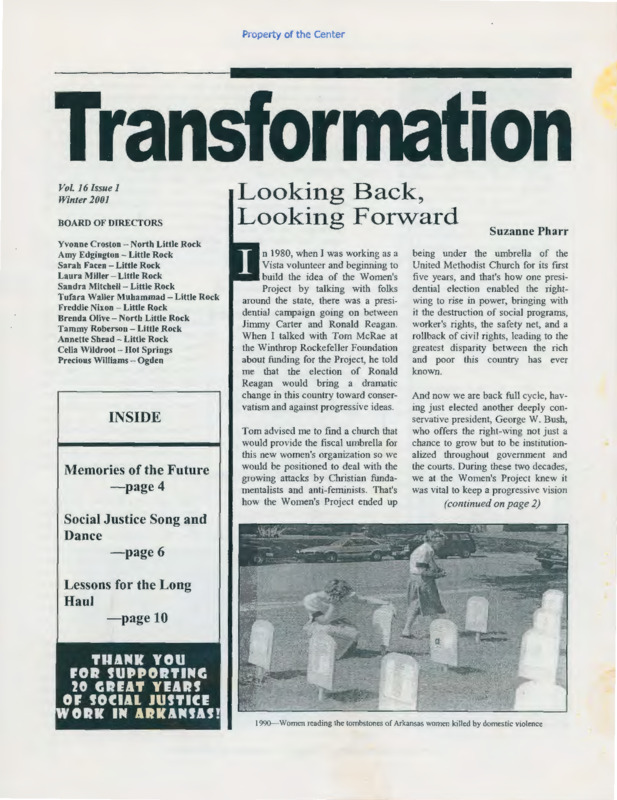
1990---Women reading the tombstones of Arkansas women killed by domestic violence
oo mg orwar ,
ooking Back
from age 1
and agenda alive in the state, no matter how strong the opposition. Something in us said that we should not
change with the times and move
more towar·d the center. Instead, our
pledge was to remain on course: to
work to eliminate sexism and racism
while focusing on issues of violence
and economics; to work with others
to gain an understanding that all oppressions are connected and that
those who are targeted by them could
unite, forging trans.formative social
relationships. We could achieve
equality and justice.
When I look back over these twenty
years, I am filled with images of our
work, moments when we were bold
in our political struggle and lives
were changed. Here are a few of
those memories:
✓
The first women's retreat
(or "advance" as we called
it) at the Little Red School
House in Eureka Springs;
✓
The one-foot high stack of
photocopied articles from
the press when we spoke out
about the rape of a woman
by five University of Arkansas basketball players during
a championship season;
✓
✓
✓
The weekly protests against
the anti-choice, anti-gay
Rev. Otwell during the first
Clinton presidential campaign;
The score or more tombstones on the front lawn of
the Women's Project, one
each with the name and description of a woman killed
by a man;
The moment in Dermott
when octagenarian and civil
rights veteran, Mrs. Evange-
line K. Brown, told me that she
wanted me as a white woman to
challenge the local hospital who
refused to provide rape exams
to black women;
✓
The four Sweet Honey in the
Rock concerts we sponsored for
the community;
✓
The assault on the legislature
and local government for lack
of voting access for people with
disabilities, led by Ann Gallmeyer and other members of
ADAPT;
✓
✓
The day we lost our rented
office because people in the
community thought
that
radicals like us brought the
neighborhood down, and the
day we bought the house we
currently use as an office,
the place we and other
women can call home with
a sense of assurance and security;
✓
The day women were included in the proposed national hate crimes bill, after
a decade of our working toward
this
goal.
Kelly Mitchell-Clark facing up
to the Klan at a Fort Smith
rally;
In a time when most
social forces were
creating individualism
isolation, free market'
competitiveness,
and
consumer manipulation,
we wanted to create
an organization that
valued collectivity,
coope~ation, honesty,
equality, and strong
relationships.
✓
on domestic violence;
Janet Perkins in her nontraditional jobs training class working with a hammer and saw;
✓
Felicia Davidson demonstrating
safe sex with a banana and a
condom in her HIV training
session;
✓
The Southern Regional Domestic Violence conference, featuring leaders from NCADV who
then were taken on a tour of the
South;
✓
Kerry Lobel leaving the
Women's Project in her 1971
VW bug every Monday night
to drive to the Women's Prison
at Pine Bluff to conduct a class
Most of all, I remember and cherish
the relationships and politics I developed at the Women's Project; the two
were inseparable. From the beginning, we believed that the most vital
part of what we were doing was forging a way of doing political work that
had integrity. That is, in a time when
most social forces were creating individualism, isolation, free market
competitiveness, and consumer manipulation, we wanted to create an
organization that valued collectivity,
cooperation, honesty, equality, and
strong relationships.
We wanted our internal politics to
mirror our external politics in a way
that created integrity between the
two. We believed this would give us
a strong spiritual and political base in
the struggle for equality and justice.
These core values have been the heart
of our work, and it has not been easy
to go against the prevailing culture to
achieve them. Our effort to begin dismantling historic racism led us to
have women of color take the leadership as a majority on the staff and
board. Our effort to bring about
equality led us to paying each staff
person the same salary, to involving
everyone in decision making about
the organization's agenda and use of
resources, and to giving each staff
person a place of leadership.
www.womens-project.org/ * Page 2 * Tranifonnation * Wmter 2001
The difficult part is that equality does
not just happen. It takes constant
work and vigilance. Having good
systems and procedures in place
helps, but the greater task is to engage in the regular meetings and conversations and challenges to unjust
power and_practices that are necessary for people to have equal participation and voice. This internal effort
is as much a part of the work of the
Women's Project as its outside work
with communities. Our national reputation has come primarily from this
internal work and has brought numerous people to us to learn about and
share in the development of political
integrity.
When I think back over the past two
decades, I find my life inseparable
from the Women's Project and from
the community who became my
friends and comrades as we grew together, developed
our politics
through intense engagement with one
another, and created better lives for
women and children and the communities we live in.
The Women's Project is needed now
as much if not more than it was when
Reagan was elected two decades ago.
We have even greater challenges before us: our communities have been
weakened; racism is rampant; new
prisons are built every day; reproductive choice is limited; health care is
too expensive; the environment is
under attack; public education is in
Transformation
TheWomen's
Project
isneedednow
as muchif notmore
thanitwaswhen
Reaganwaselected
twodecades
ago.
trouble; people have little faith in government and most other institutions of
our society.
Again, we must stay the course. The
Women's Project, because of its work on
political integrity, can show the way to
live the politics we advocate. We can
continue to build community, to fight
oppressions, to take on issues that are
unpopular, and to help those who have
little voice organize for power.
For many ofus, the Women's Project has
been home. It is the place where we
could bring our whole selves and grow
politically and persona11y.Until our society is filled with such places, its work is
not done. Thanks, Women's Project, for
20 great years. May there be more wonderful years of work for justice and
equality, until our goal is reached. ■
Published four times a year
by the Women's Project,
2224 Main Street, Little Rock,
Arkansas, 72206
Phone: 501-372-5113
Letters to the editor are welcome.
Editor
Production
Layout
Amy Edgington
Felicia Davidson
Staff
Women's Project Staff:
Felicia Davidson, Lynn Frost,
Judy Matsuoka, Dee Dee Green,
Pat Schuyler, Anne Shelley
Staff Emeritus:
Suzanne Pharr
* Printed on recycled paper.*
(0
2001 The Women's Project
Join
IJs
torour
20th
Anniversary
Hometomine
Celebration
June
9,2001
MatJlrthur
Par
""'··~"'
<'I\·
1990---Non-traditional jobs training class for women. Janet Perkins is holding the hammer.
www.womens-project.org/ * Page 3 * Transfonnation * Winter 2001
Memoriesof theFuture
~\1
hen I was asked to mite about
my memories of the Women's
Project, what I recalled most vividly we_rethe moments when our
work has given me glimpses of the
future--a future free of racism, sexism
and homophobia; a future where people with disabilities are neither overlooked nor excluded; a future where
young people and their elders enjoy
mutual respect and equal power; a
future where resources are shared
fairly and used sensibly.
Amy Edgington
began to see how straight people, under
homophobia's thumb, must conform to
rigid sex roles and suppress their affection towards members of their own gender, in order to avoid any suspicion of
being "queer." I glimpsed a future where
all men and women would be able to
live and love honorably.
Kerry Lobel, a major mover and shaker
with the Project between 1986 and 1994,
edited a groundbreaking book on battered lesbians, Naming the Violence, in
1987. This book was the frrst major
I had known Suzanne Pharr,
founder of the Women's Project,
in the mid 70's in Northwest Arkansas, but I encountered her
again a decade later, at a workshop she gave on internalized
homophobia. Such workshops
were part of the work she was
doing for the Women's Project in
1986, when the Project was still
based in her home across from
historic Central High School in
Little Rock.
As I listened to Suzanne and the
workshop participants talk about
how often lesbians choose or are
forced to lie or to conceal the
truth or are simply rendered invisible
by the assumption that everyone is
straight, I exploded: "What does this
do," I asked, "to our sense of ourselves
as honorable
people?"
"Exactly!" said Suzanne. It was an
"Aha!" moment for me and for many
in the workshop. I began to see that
what we were fighting for was not
just physical safety, warm, fuzzy
"acceptance," or equality before the
law. We also needed to restore moral
integrity and spiritual wholeness to
souls devastated by lifetimes of enforced deception and invisibility.
As Suzanne made the connection between homophobia and sexism, I also
1985-Women attend a workshop on racism,
sexism and homophobia.
validation from the feminist community
of a traumatic experience I and many
others had survived ( or not). In the past,
those of us who had spoken out not only
risked further violence from our abusers,
we faced disbelief, ridicule, rage and
rejection from women who saw our stories as a challenge to the premise
(spoken or unspoken) of female moral
superiority.
With Kerry's support, I started a group
for formerly battered lesbians. Overcoming our profound isolation was such a
heady experience, we decided, with
Women's Project backing, to sponsor the
first national conference for battered lesbians. The conference prompted several
of us to publish work about our experiences in feminist papers for the
first time, and to continue to push
battered women's shelters to acknowledge our existence and needs.
This was a profoundly healing
glimpse into a future where no one
would be silenced in the name of
solidarity, where the agenda of liberation does not depend upon tired
notions of the supposed moral superiority of the victim. After all, if oppression turned us into saints, what
better excuse could there be for continuing to oppress?
This was my first experience with the
Women's Project's commitment
to address causes that had been
pushed to the bottom of the liberation agenda. I saw this commitment continue in subsequent
years. A coalition of local
groups came together to discuss
how to improve AIDS/HIV education and prevention locally.
Various groups were mentioned
as targets for outreach; the
Women's Project representative
said, "What about prostitutes?"
There were audible snickers in
the room, and clearly no one else
felt this work was a priority.
So the Women's Project organized a group of volunteers to approach and get to know women
working the streets in our area. The
Women's Project handed out countless safe sex kits and gave respectful,
non-judgmental education on how to
avoid sexually transmitted diseases.
The outreach effort was expanded to
the African-American community
through house parties and distribution
of safe sex kits by beauty parlors in
the African American community.
Kerry Lobel first took the work of the
Women's Project to incarcerated
women in 1989, and nearly every
staff member and many board members have participated in this work up
www.womens-project.org/ * Page 4 * Traniforma.tion * Wmter 2001
to the present day. Incarcerated people have extremely little control over
their daily lives. What has impressed
me most about our prison work is the
way the Women's Project has given
the prisoners as much control as possible over the work we do inside the
prison. What started as a group on
domestic violence for women in
prison expanded over the years into
numerous programs suggested by the
prisoners themselves.
I made a couple of visits to the prison
to speak on lesbian battering, before
the prison officials decided it would
no longer tolerate open discussion of
lesbianism. I was made to feel welcome by the women there, and I took
to heart something I already knew:
that only a few accidents of fate and
degrees of privilege separates me
from women serving time. We lock
women up mostly for crimes related
to poverty, drug abuse and domestic
violence.
These women have an
enormous amount to offer society. I
glimpsed a future where we would
spend money to set people free-giving them the chance to thrive and
the means to do so--that we now
spend to deprive them of their last bit
of freedom and dignity.
Women's Project volunteer Ann Gallmeyer, who had recently begun to
use a wheelchair, had a profound impact on my disability consciousness.
With Women's Project support, Ann
and I started a support group for lesbians with disabilities, which continued for several years, until the local
chapter for ADAPT got started.
In 1987 the Women's Project moved
into a rental house on Main Street in
Little Rock. Soon after the move, the
staff made the decision to install a
wheelchair ramp. The landlord denied
permission to install a ramp, citing
the tired old excuse that providing
access to people with disabilities
would cause "unacceptable insurance
risks." The Project decided that not only
was this excuse unacceptable, the incident indicated an unacceptable vulnerability of our work, much of which
might antagonize a landlord's prejudices.
So the Women's Project decided to take
a brave step for a fledgling organization:
we took out a mortgage to buy the building--and installed a beautiful ramp and
wheelchair-accessible bathroom. This
showed me that we build a future of social justice by our actions--by walking
(and rolling) what we talk.
It was a time of high spirits and energy.
In addition to Kerry and Suzanne, Janet
Perkins and then Kelly-Mitchell Clark
joined the staff. Each of these African
American women, in her own unique
way would have a profound impact on
the future of. the Women's Project.
Kelly, who had been strongly influenced
by Black nationalist philosophy, rose to
the challenge of dedicating herself to an
organization that is multi-racial, multicultural and multi-issue. At the same
time she challenged and sharpened our
focus on racism. Janet, who was born
and raised in Little Rock, brought a local
perspective to the issues of sexism and
racism, through her own experiences and
her family's experiences with segregation. Janet became the Director of the
Women's Project in 1991.
I was deeply moved that Janet, as a heterosexual woman, was willing to publicly confront homophobia, risking the
support of her church and community,
which is life and death support for any
African American, especially in the
South. I learned a lesson about my own
responsibility to risk my privileges as a
white person by taking a stand against
racial discrimination.
I learned a lot about the realities of life
for African-Americans in the Delta--the
poorest region of Arkansas--when
Felecia Davidson joined the board and
then the staff. And when Judy Matsuoka,
whose parents were interned during
WWII in the Japanese relocation camp
in Jerome, became director of the
Women's Project in 1997 she helped
to enlarge my understanding of racial
politics beyond the Black-white paradigm so familiar to us in the South.
The staff of the Project and my sister
board members, past and present
have been role models for me in how
to work together, how to stretch ourselves, how to rise to challenges and
how to meet adversity with laughter.
Some of our most memorable moments came during press conferences, which put the Women's Project on the local map as an organization dedicated to social justice. In
I glimpsed
a future
wherewe would
spendmoneyto
setpeoplefree-givingthemthe
chanceto thrive
andthemeans
to doso-thatwe now
spendto deprive
themoftheirlast
bitoffreedom
anddignity.
1989, the Women's Project supported
a new trial for Barry Lee Fairchild
(an African- American sentenced to
death for the rape and murder of a
white woman), due to strong evidence that his "confession" was coerced by assault, that he lacked the
mental ability to understand his
Miranda rights, and evidence suggesting that he may not have been the
actual perpetrator of the crimes.
On the other hand, In 1991 Kelly and
Suzanne appeared together in an interview in the Arkansas DemocratGazette, in support of a white woman
(continued on page 8)
www.womens-project.org/
* Page 5 * Transformation* Wmter 2001
Social Justice Song and Dance
Cl
ultural work as a means toward
social change has always been
part of the mission of the
Women's Project. When I came
to the Women's Project in 1987, to
volunteer, I had an idea that fit right
in with their work.
My vision was a library of materials
about cultural diversity, political organizing, the history of social justice
movements, women's health, domestic violence, as well as fiction, poetry
and films which reflected the lives of
the people engaged in the work of the
Women's Project. Staff members
Suzanne Pharr and Kerry Lobel had
large collections of books they were
willing to donate and I had a source
of hard-to-find feminist, gay and lesbian, multicultural and other progressive books at wholesale prices.
With the help of a committed group
of volunteers, we had yard sales and
sold books to raise money to buy
more books. Items were then categorized and prepared for checking out,
and extensive shelving was built by
Teresa Lipsmeyer. One room was set
aside to hold the collection and we
had a grand opening celebration.
Today, 12 years later, the library consists of over 5,000 items and is running
out of space in the three rooms it now
occupies. A small bookstore continues to
raise money to buy new books for the
library and, because the store is listed in
various lesbian and gay travel guides,
we meet a number of folks who stop in
for local information while on a trip or
when planning to relocate to Arkansas.
I have watched the library become a
meaningful resource for individuals who
find support in their struggles in the
pages of our books or who seek a comfortable and stimulating place to volunteer their time. We've had students researching controversial political issues,
who weie unable to find pertinent materials in their school libraries. We've
helped men and women and their families fmd books, articles and videos dealing with coming out as lesbian or gay.
There have been older women excited to
find a copy of the first novel they had
ever read about a lesbian. Others have
been gratified to find a large section of
the library devoted to fiction and nonfiction by and about African Americans.
The selling of books has been integrated
into cultural events sponsored by the
Women's Project and other groups. For
Lynn Frost
I have watched
the librarybecome
a meaningfulresource
for individualswho find
supportin their
strugglesin the
pages of our books
example, I would pack up boxes of
books and carry them to sell at our
African American Women's Conferences in 1990 and 1995, to the Arkansas Deptartment of Education's
Cultural Diversity Conferences, and
to the Arkansas Gay & Lesbian Task
Force Coming Out Day and Pride
Week events.
When Reverend Otwell brought his
hate bus from Texas every Sunday
for three months prior to the 1992
Presidential election to protest Bill
Clinton's pro-choice, pro-gay candidacy, the Women's Project organized
counter-demonstrations. I turned my
minivan into a traveling bookstore,
complete with "Hate Is Not A Family
Value" T-shirts and bumper stickers.
To celebrate "another decade of
working for social justice" in June of
1991, we produced our first cultural
festival in MacArthur Park, where
folks from many ethnic and racial
backgrounds came together to share
their cultures through music, dance,
food and crafts. Along with many
culturally diverse local entertainers,
we were treated to the dynamic
sounds of Pam Hall, an African
American lesbian from Jackson, Mississippi, and Jane Sapp, a cultural
1996----Former staffer Linda Coyle (center) talks with Lynn Frost (right) at the Women's Project Bookstore.
www.womens-project.org/
* Page 6 * Transformation * Wmter 2001
Property of the Ceut
r
worker from the East Coast, bringing
her songs which have been an integral part of many social change
movements.
Anniversary celebrations have been
opportunities for the Women's Project
to give· back to the community by
producing the concerts of Cassellberry and Dupree in 1986 for our fifth
anniversary and Odetta in 1996 for
our fifteenth anniversary. At the 10th
anniversary celebration in February
of 1991, Sweet Honey in the Rock,
the all female, a capella quintet, performed for an overflow crowd. Before the concert Evangeline K.
Brown, Arkansas civil rights worker,
was recognized for her work. During
the concert Bernice Reagon announced that the ground war in Kuwait had begun at 7:30 p.m. that evening, and the group sang Peace I'll
write your name.
In February and March of 1992, we
added a film series to our cultural
work, to celebrate both African
American and Women's History
months. The Reel Women Film Festival presented 34 films honoring the
contributions of women to film as
directors, actors, producers and writers. Included was the Southern premiere of Julie Dash's award-winning
portrayal
of a Gullah family,
"Daughters of the Dust."
Cultural events are
occasions for joy
and hope as well.
For me, singing along
(or dancing along)
has
.
.been
.
inspiring,
uplift~n~,
energizing.
1996---Suzanne Pharr (left) discusses her book with Daisy Bates at the Open House
And, of course, the Women's Project has
Cultural events are occasions for joy
consistently brought entertaining and
and hope as well. For me, singing
inspiring individuals and groups to the
along (or dancing along) has been
Women's Coffeehouse, again through
inspiring, uplifting, energizing and a
the work of a group of committed volunway to feel more committed to the
teers. I will never forget meeting Leslie
struggles I've been involved in these
Feinberg, transgender activist, when she
past 30 years. For some, a cultural
came to Little Rock to talk about her
event can also be the first experience
book, Stone Butch Blues, and to present . of meeting other like-minded folks in
a ground-breaking slide show on the hisa world where one feels alone.
tory oftransgender people.
For instance, lesbians who had been
What a treat to have S. Diane Bogus
totally in the closet for years have
here from California, performing her
found safety and friendship in the
highly political and erotic poetry; Alix
company of other women at the AnDobkin from New York, reminiscing
nual Women's Retreat at Lake Ft.
about the beginnings of women's music
Smith State Park. Here we can relax,
build women's community, greet old
in the 70s; Jorjet Harper from Chicago,
with her "Lesbomania" show, poking
friends and meet new ones. Primarily
fun at the lesbian community; the excitattended by Arkansas women, the
ing, can't stay in your seat sounds of the
retreat has also hosted women from
women drummers from New Orleans,
the mid-South, both Coasts and from
Sister Beat; as well as many talented
as far away as Ireland!
local women singing, dancing and reading their poetry.
April 5-8, 2001, we will have a special 20th anniversary retreat, starting
But is all this fun really political work?
one day earlier on a Thursday, and
Of course it is! An event like a poetry
lasting all the way through Sunday
reading provides exposure to political
night. Whether it's music, sharing
writing that helps us to get in touch with
stories or just hanging out with other
our anger about our oppression. And
women that makes you feel part of
perhaps when we hear a poem about inthe community, join us in a celebrajustice to others, those of us whose privition of the 20th Women's Retreat. ■
leges are part of the problem, will be
inspired to become part of the solution.
www.womens-project.org/
* Page 7 * Transfonnation * Wmter 2001
emones o t e Future
from age 5
who said she had been gang-raped by
Black athletes in a dorm at the University of Arkansas in Fayetteville.
They made a point of acknowledging
the complex historical issues involved: the frequent false accusations
against Black men involving white
women as an excuse for racially motivated violence and repression and
the frequent disbelief and dismissal of
claims of rape by women all races. In
this case, however, the white
woman's willing association with
Black men was being used to damage
her reputation and credibility with the
white public.
It was a complex and principled stand
in a controversy which was being
framed in a way that pitted feminists
against civil rights activists. Press
conferences such as these taught me
to take a deeper look at how the
strands of sexism and racism have
been woven together, and they gave
me a vision of how and why we must
Press conferences
such as these taught
me to take a deeper
look at how the
strands of sexism
and racism have
been woven together,
and they gave me a
vision of how and
why we must work
to eliminate all forms
of violence and injustice.
work to eliminate all forms of violence and injustice.
A similar press conference, brought
together a multi-racial coalition of
gay and straight supporters to take a
stand against the
almost exclusive
targeting by local
police of gay (but
not straight) men
soliciting sex in
public places and
the decision of
the local paper to
publish
the
names of gays
(but not straights)
arrested, resulting in at least one
confirmed
smcide.
I 991-Suzanne Pharr (left) and Janet Perkins (right) are interviewed at
Demonstration against David Duke. Suzanne's sign reads: If Duke sends
African Americans back to Africa, will he return me to Germany?
Gays and lesbians who participated in the press conference had to face
not only the prospect of being publicly
"out," many also had to resolve their
squeamishness about associating themselves with behavior they deplore.
Straight people who participated in the
press conference had to risk the very
strong likelihood that they would also be
labeled as queers--and the "worst kind"
of queers--in the public mind. But no
one has ever been granted civil rights as
a reward for good behavior. I glimpsed
a future where we all will have rights to
equal treatment by the press and law enforcement, because we choose to stand
together whenever anyone's rights are
threatened.
Demonstrations tested our mettle too. In
1991, David Duke was invited to address the Republican club in Crittenden
County. Despite his refurbished exterior,
"ex" Klan-member Duke is still an ardent white supremacist who has learned
to cloak and hood his agenda in coded
language about "welfare" and "crime."
The Women's Project organized a coalition of progressive students from nearby
Arkansas State University in Jonesboro
and volunteers, staff and board members
from the Women's Project, many of
them African-American.
Imagine the surprise of Duke and the
Crittenden County Republicans when
they arrived to find a biracial protest
vigil outside their meeting place.
Most of them looked angry and
somewhat shame-faced to have the
veneer of respectability removed
from their racism. I felt great respect
for my African American sisters for
standing in the face of a known Klan
leader (I have no doubt there were
other Klan members present). I
glimpsed a future where we will
never remain silent and invisible
while the enemies of justice organize
against any ofus.
In the summer of 1992, during Clinton's presidential campaign, right
wing activist Rev. Otwell brought a
busload of his supporters to Immanuel Baptist Church to demand that the
pastor expel Clinton from the congregation because of his support of feminism, reproductive choice and homosexuals. His anti-gay rhetoric was
especially violent. None of this
namby-pamby "Love the sinner--hate
the sin" stuff for Otwell.
The Women's Project organized a
coalition of feminist, gay and lesbian,
pro-choice, anti-racist supporters and
progressive college students to
counter-demonstrate every Sunday
www.womens-project.org/ * Page 8 * Traniformation * Wmter 2001
through the elections. As Otwell
bussed in more and more supporters,
every week the progressive coalition
turned out an even larger number. I
remember most vividly the children
Otwell's group brought along, presumably to teach them hatred at an
early age. I wonder what those children thought as they viewed the two
sides of the street--one filled with
purple-faced white people spewing
violent rhetoric, the other filled with
vibrant people singing, chanting,
laughing, while deliberately avoiding
hostile confrontation. Who will those
children want to emulate when they
grow up? I glimpsed a future where,
because we showed them another op-
Felicia Davidson and DeeDee Green and
board member Sarah Facen have been
organizing a group of young people to
help register voters in the largely African-American community near the
Women's Project. They decided to rent a
van and take a group of youngsters to
the alternative convention held outside
the Republican Convention in Philadelphia last year. It was a radical experience for all involved to see the massive
demonstrations and intense cooperation
between groups around many social justice issues. The young people asked
many questions and took pictures and
wrote journals about their experience.
Now they had some ideas about what
democracy means and why it is important to work for. I
believe that we will
be led into a just
future by young
people like these.
At the Women's
Project
I have
learned that it is
impossible to create a future without
sexism unless we
dismantle racism
I 991-Women's Project Demonstration against Duke in Jonesboro.
and economic inFelicia Davidson is second from left.
justice. I have also
come to believe
tion, those children may choose the
that our direction and leadership must
path of love and justice.
come from working class women and
women of color, who experience the imRecently the Women's Project
pact of a combination of these realities
worked with a group of young artists
on their own bodies. The Women's Proin New Orleans to create banners ject's philosophy and work can look
highlighting the deaths of victims of
complex, even messy, to those used to
hate violence--part of our Watchcare
dealing with single issue organizations
Project which has sought to document
(including potential donors and funders).
and combat bias-based violence since
We have often been asked to narrow the
1989. In the process of creating the
focus of our work, but we have refused
banners, the youngsters had the opto compromise. Explaining the work of
portunity to question and learn about
the Project gives me the opportunity to
different forms of oppression they
help others understand the connections
had not been aware of. And the banbetween the issues we address in our
ners made a dramatic way to present
work. I hope to give others a glimpse of
the future the Women's Project has
the facts to the local press.
shown me and an invitation to join us in
Women's Project staff members
creating that future. ■
Trans/ ormation ...
is published four times
every year. In each issue,
members receive analysis
of contemporary issues,
information about Women's
Project upcoming events
and activities, book
reviews, and more. If you
are not a Women's Project
member and would like to
continue receiving the
journal, please fill out the
membership form below.
J.,:---
- - --- -- - - -,
: [A Yes, I would like to :
I ~ join the Women's
I
I
Project.
I
I
I
Name
I Address
City
I State
I Phone/day
I Phone/evening
I E-mail
Zip
$25 regular
D
$100 supporting
$50 sustaining
D
$15 low income
I I'd like to pay by D check D
I
Visa
Mastercard
I
I
I
I Account No.
credit
I Exp. Date
I Signature
I
I
I
I
I
I
I
L-
Make checks payable to:
Women's Project
2224 Main Street
Little Rock, AR 72206
I
-
--
www.womens-project.org/ * Page 9 * Traniformation * Wmter 2001
-
-
-
-
-
-
-
-
-
_
_.
J.
V)ir,, ..
~:'9,}
Lessons
for
the
Long
Haul
Janet Perkins
D
would like to share some of what I
have learned from being on the
staff of the Women's Project for I I
years. I believe in holding on to
your dreams very tightly and never
giving up even when it seems that
change will never come. You must be
solid in your convictions and passionate about the pursuit of the desired
goal. You must never try to quiet
your spirit as you are being nudged to
do something to make a difference.
Taking a risk can be a scary affair,
but the safety net is always there to
catch you when you are taking that
risky step toward justice.
In order to keep the steady course of
seeking justice you must pace yourself, because it is a long, tedious journey and you want to make certain you
don't bum out half-way there. Hate,
bigotry, divisiveness and power seekers determined to destroy and devour
the powerless have been with us far
longer than we want to remember.
Therefore, those of us who have visions and ideas of justice and freedom embedded in our hearts, souls
and spirits can't give up, nor get
tired ...pace yourself for the long haul.
We must always find the joy while we
are on this journey. We will have some
defeats, but we will have many victories,
as we have witnessed over the years. We
should never become so bogged down
with the struggle that we neglect to celebrate and be lighthearted, finding reasons to laugh and be glad that we are
involved in this pursuit at this time and
in this place.
along the way make this work worth
doing, full of richness and possibilities. The real heart of this work is
about dignity, respect, integrity and
love, not just for those who share the
same vision, but also for those with
whom we share little.
And may we never forget, that although
the ideals, philosophies, theories, strategies, and all we commit to paper have
their value and importance, people are
the most important element of social justice work. The relationships we build
I just want to say thank you to the
Women's Project for not tiring or
becoming discouraged in the fight
for justice. The Women's Project's
motto is to "transform the world." I
would say they have been able to do
that over their 20 year history, one
person at a time. I hope that many,
many more people will be able to
participate in the Women's Project
and continue to raise the bar of excellence for justice.
The relationshipswe
build along the way
make this work
worth doing,
full of richness
and possibilities.
Twenty years is a long time for a
non-profit to survive, but I'm hopeful
that the Women's Project will manage to stay around as long as there is
a need for that intentional work that
moves us closer to real justice for all
people. Again, congratulations and
thank you for all you do to make this
a better world. ■
Our goal is social change or, as the poet Adrienne Rich writes, "the transformation of the world." We believe
this world can be changed to become a place of peace and justice for all women.
We take risks in our work; we take unpopular stands. We work for all women and against all forms of discrimination and oppression. We believe that we cannot work for all women and against sexism unless we also work against racism, classism, ageism, anti-Semitism, heterosexism and homophobia. We see the connection among these oppressions as
the context for violence against women in this society.
We are concerned in particular about issues of importance to traditionally underrepresented women: poor
women, aged women, women of color, teenage mothers, women with disabilities, lesbians, women in prisons, etc. All are
women who experience discrimination and violence against their lives.
We are committed to working multi-culturally, multi-racially, and to making our work and cultural events accessible to low income women. We believe that women will not know equality until they know economic justice.
We believe that a few committed women working in coalition and in consensus with other women can make significant change in the quality of life for all women.
www.womens-project.org/ * Page 10 * Transfonnation * Wmter 2001
Property of the Center
(}I( Jwre,9t~ 200'1 tk u/4/f(e,I(
~ Pl"fje,et «1111'
l/olf(e,e(Jlf(t1f
(}e,/eb!"a;r-(Jaclf',!w.rta 2Ot/4,1l(l(tve!".s>a!"JI
tiM at ;ffaeAr-tkl" Pa!"i ti( little Roei.
k/4«1111'
be,
.s>e,/'t1f
/l"tljl"aJffJ'«Jkle/4
«1111'
t'trefa.cle
;ret(l.l"M Mel/f(l?,/f((J-
/4tk 91r-it
!"abil'iaf/"(J/f((J(I.I"
20 Jl(?,af"
/4r:?t(Jr-1.
6f
th's' (Jeea.s>10"1
«1e,
r'trw'te,
!(Ja t(J tale, th's' tJ/
;(Jr-twrr-C,
t(J
;dtet,
lf(aclea
t/4Mi (Jf"13/ tr-ibate t(Jtk «)(J/f(l?,I(
«IM /4ave
c!if
fe,r-Mee,
ti( !(J(I./"l'ife,.
¼a /f(a,,ak(J.s>/4af"e,
/f(e,/f((Jl"feJ'
(Jf ufolf(M~ Pl"fje,et e,velfh t/4at M.ve9uial
201 f{ANNlVERSARY
/f(e,a!ft1f,'
t(J!(Ja. ¼(I.I"/e,1".s>Mal'
tN'bate«1111'
be,/N'trtecl
ti( tk /t"tlfl"~
«1/4re/4
«1111'
be,J>(Jl'cl
at tk ee,lebr-atrol(
To:-----------------
cftze,:
----------
h-(Jlf(,'-------------$'25....................
/4af/
/~
11o.................... rc~ar-te,t<I~
15..................... ba..f11ru.s'
earl S'1ze
/1/4/f(el(
; Pl'fju t
2221 #at!( cftt<Ut
little Roat, AR12206
Oeaclt1re
ftJt<S'ablf(t~S'/171(.s'
1~ #a, 1, 2001
;kl(e 501-312-5113
Retu./'lfttJ Ua'W
#at.ratJia
at tie /1/4/f(el(;Pt<-tJjut
/M 501-312-0009
elf(at'f:
j/f(at.5'75@/t<-tJd(ff.lfet
Women's
Project
2224 Main Street
Little Rock, AR 72206
Non-Profit Organization
U.S. Postage Paid
Little Rock, Arkansas
Permit No. 448
ADDRESS CORRECTION
REQUESTED
Herland Sister Resources
2312 NW 39th
Oklahoma City OK 73112