

Feminary_v12.no1.pdf
- Title
- Feminary_v12.no1.pdf
- extracted text
-
,
· FEM/NARY .
C:,''
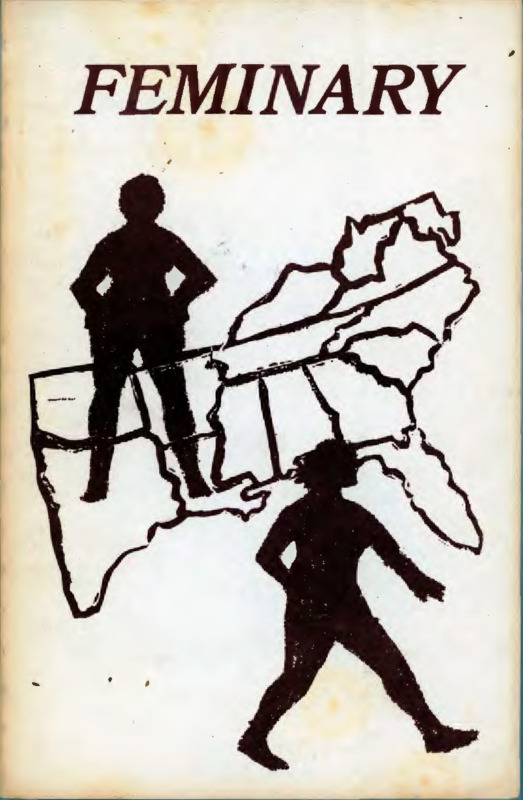
FEMINARY
VOL.XIl:1
A Feminist Journal
for the South
Emphasizing Lesbian Visions
THE SOUTH AS HOME:
STAYING OR LEAVING
S u e Sneddon
UCO Women's RaeardlA BOLTQ+Centc
100 N. University Dr
Edmond, OK 73034
FEMINARY, which began in 1969 as the F emale Liberation Newsletter of Durham-Chapel Hill, was renamed in 1974 from a passage
in Monigue Wittig's Les Guerilleres:
The women are seen to have in their hands small books
which they say are feminaries ... ..In one of them someone has written an inscription which they whisper in
each other's ears and which provokes them to fullthroated laughter. When it is leafed through the
feminary presents numerous pages in which they
write from time to time.
MEMBERS OF THE COLLECTIVE ARE Eleanor Holland,
Helen Langa, Minnie Bruce Pratt, Mab Segrest, and Cris South.
COORDINATING EDITOR for Volume XII :l was Mab Segrest.
PRINTED BY Iowa City Women's Press
~
BOUND BY A Fine Bind
\\.,...,.,}
THE COLLECTIVE ENCOURAGES our readers to send us
articles, personal narratives, journal excerpts, letters, short
fiction, poetry, drawings, reproductions of artwork, and
photographs. Please type and double-space articles, send
copy-ready drawings and black-and-white reproductions
and glossy photographs, and enclose a stamped, selfaddressed envelope for return of your work. We request
material be signed but we will refrain from printing an
author's name if she wishes. Women with Southern experience, Southern-born women now living elsewhere,
as well as women currently residing in the South, are
invited to send their manuscripts and /or artwork to :
FEMINARY, PO Box 954, Chapel Hill, NC 27514
SUBSCRIPTION RATE : Individual, $6.50/2 issues;
Institutions, $13.00/ 2 issues; Bookstores, 40% discount
with a minimum order of 5 copies. Single copies, $3.75
plus .75 postage.
The publication of this journal was made possible in part
by a grant from the Coordinating Council of Literary
Magazines.
Copyright (c) 1982 By FEMINAR Y . A ll rights reserved
to individual authors and artists.
TABLE OF CONTENTS
COLLECTIVE COMMENTS, by Cris
••. . . . . . . . . . . . . . . . . . . . . . . .
5
DELTA, a story by Raymina Y. Mays
~~ • • •• •: •••• • ••• • • • • . ... . ... : : : : : : : : : : : : : : : : : : : : : : : : : : J;
racm w/o papa, pensul, a story by lindajean brown
BUBBA MEISSA, a poem by Susan Jacob
THE ABILITY TO SLIP IN AND OUT OF
• •••. . . .. ... .. . J 6
~~~ ~O· M
• •B. • • • • • • • • • • • • 20
, a poem
MAP
by Susan Jacob
••• • • • • • • •• •• • ••. . .. .. ... · · · · · · · · · 22
CHRI~~;~· • •• • • • • •• •• ••• • • •• •• • ••• • .. . ... . · · · · · · · · · · · · · · 24
SBURG, VIRGINIA, a story by Amy Oppenheimer
26
MAP
• ••••
THE ~~~~~~·~ • • •••••• •• • •• •• • • ••• ••••• ••. . · · · · · · · · · · · · · · 38
THEY BRING, a chapter excerpt by Cris South
40
APPLEODEUM, a poem by Maxine Alexander
GHOSTS, a poem by Ann Blackford
• •••• •• • • •••• • •••• • SJ
LEROY'S BIRTHDAY, a story by Ray~i~~ ·;.· ~~~~·. . • • • • • • • • • • • • 53
MAP
•••...... .. ... 59
••• •••••••• • •• •• •••••• • .. ... · · · · · · · · · · · · · · · · · · ...
62
TRAILER, a poem by Sara Heslep
•• •
• • • • • • • • • • • • • • • • • · · · · · .... .. . 64
SORTING TO GO WEST, a poem by Sara Heslep
NOTES F
•• • • • • • • • • • • • • • • • 65
THE B ROM MECCA, journal excerpts by Jean Swallow .. . .. . . . .. 67
OOTED RECOLLECTION, a story by Ruthann Robson
75
HOW TO MAKE A GARDEN IN THE CITY
b
•.•• ••• ••
, a poem y Catherme
Risingflame Moirai
STRANGE
• •••• • • •• • • ••• •• • •••. · · · · · · · · · · 78
RS YOU SLEEP WITH, a poem by Rachael de Vries
79
MAP
UNTI~~~~ ~~~~·~; ~a·t~;e~~·~~I~...... ... ... .. .... .. ... .. .. 80
RECOVERING YOU, a poem by Cami;!~ ~~s~~· • •• •••• •• •••• • ••• • 82
MAP. ..
• • • ••• • • • • • • • • • • • 83
~~~~~~~: ~ ~~~r~· ~~i~~ ~~~~~~;I·
BACKWA~~
~;
• • • • •• • • • • • • • • 84
ADVERSI
•• ••• • • • • • • • • • 86
TY , a poem by Flying Thunder Cloud, RDOC
106
REMEMBERING HELOISA, a poem by Claudia Canuto • • • • • • • • • • • 116
BIRDS & KKK, a poem by Claudia Canuto
••• ••• •• • • •
• • • • • • • • • · . . . . . . . . . . 117
2
3
THESE LAST DAYS, a poem by Sue Silvermarie • • • • • • • • • • • • • • •
READING MAPS: TWO, a poem by Minnie Bruce Pratt • • • • • • • • • •
118
121
COLLECTIVE COMMENTS
REVIEWS:
Flannery O'Connor ' by Catherine Risingflame Moirai •••••• 129
Linda Hogan, by Mab Segrest ..... . • • • • • • • • • • • • • • • • • • •
Ann Allen Shockley' by Merril Mushroom .....••• • • • ••• •
SOURCES & RESOURCES
· · · · · · · · · · · · · • • • • • • •• ••••••••• • •
BOOKS RECEIVED . · · · · · · · · · · · · · · · · · · • • ••••••••••• • •••••
CONTRIBUTOR'S NOTES
CLASSIFIEDS
· · · · · · · · · · · · · · • • • ••••••• •• ••• • ••
... · · · · · · · · · · · · · · · · · • • • •••••••••••••••
147
152
162
164
169
171
(The maps appearillg ill this issu e represcllt several mollths of collective
.
•
re bi• Eleanor Holland
1 grap I ucs
research, thought, alld disc11ss1011. Tie
a
,
alld He/ell /,allga.)
"Let's get Iowa City Women's Press to do the
printing."
One of the collective members made that statement during a weekend-long retreat we had a few
months ago. It was obvious. The immediate
response was probably on all our tongues at once,
"How will we pay for it?" but the dream comes first
and money usually follows. At least, that is how
we have functioned for several years now. The
women on the collective who are printers (Eleanor
and Cris) had reached burnout and we had no more
volunteer printers. We also no longer had access
to free printing equipment. And we wanted to use
that energy which was being spent on physical
production of the magazine for other things, like
content, for example.
In October of '81, the entire collective
attended the Women in Print Conference in Washington D.C. and we came away with an emotional charge,
a change in vision, and higher expectation for the
magazine, as well as for ourselves as individuals.
We wanted to dig deeper, look for the hidden connections, find ways of hearing and understanding
that we had overlooked or had not recognized
before. We were excited; we were scared. During
our retreat, we tried to talk it through. We tried
to put the visions into some form we could follow
on the actual pages of the magazine itself. It
was a difficult, emotionally charged weekend,
fourteen hours of meetings, discussions, tears,
anger, laughter, and celebration. We knew one
another a little better when it was over than
when we began.
\
I
4
5
The collective underwent another change in .
the 9pring when Deborah decided to move to Georg:a.
We were back to five women again, Mab, Helen, Cris,
Minnie Bruce, and Eleanor. But it didn't change
the vision.
DELTA
Raymina Y. Mays
The last time Delta went home, she went on a
Greyhound bus. When she had arrived and bathed
and settled in a rocking chair on her mother's
porch with a glass of lemonade, was surrounded by
her aunts who had all gathered to give her mother
and each other some back up for the long list of
stories that they would tell, she was told a story
about her arrival. The Aunts and her mother sat
and encouraged each other, added missing details
and supplied the right voices, walks and facial
expressions. When her little sister Beth Ann was
told she was coming home, she sang a little song
called "My sister is coming home on a greyhound
bus."
The South is our home. Mab, Minnie Bruce, and
Cris were born and raised here and hav~ sta~ed all
of our lives. Eleanor was born and raised in
Georgia and left the country but returned ~fter
being away for seven years. Helen thought it w~uld
be temporary when she moved here, but now she is
putting down roots too. What about all of the
other women, women who are here, ~omen who have
left, and women who have returned. We had
.
·t
before
in
our
lives,
in
the
magazine,
h
d
approac e i
,
b ·
but now we wanted to dive into the depths and egin
to really see this place we call Home.
, get I owa ci·ty Women's Press to do the
"Lets
..
..
ff
printing.
"Okay!"
And we all wanted to say a very heart-felt
thank you to those wonderful women who responded
to our request for money. Whether you gave $10
or $150 your donations came at a much-needed
time and they enabled us to pay the bills and
gave us a spark. Thanks, from all of us on the
FEMINARY collective.
"Now I know them songs them babies sing when
they jumpin rope," one aunt said, "And that wasn't
hardly one of em. Is say, Bell, come out here.
I b'lieve this baby out here makin up new rhymes.
Don't you know this girl had them kids jumpin rope
to you comin home?"
This time when Delta called to tell her sister
she was coming home on the bus, she was asked if
she couldn't get there sooner. Couldn't she take
a plane?
Delta was so caught up in her memories that
she didn't realize that she was in town until the
bus driver announced "Raytown." The bus stop was
still a bench in front of the pharmacy, and the
faded Greyhound Bus sign was still pasted to the
window. The bus driver put Delta's bags on the
sidewalk next to the bench.
Delta saw her mother's continental parked not
©
6
by Raymina Y. Mays, 1982
7
far from where she stood. She waved to the figure
behind the wheel and waited impatiently for the
door to open and her sister, Beth Ann to get out
of the car. She walked towards Beth Ann. Almost
ran toward her. When she couldn't seem to get to
her fast enough, Delta let out a joyful holler
from where she stood. People turned their heads,
some smiled.
When Delta reached Beth Ann she hugged her
hard and then pushed her back so she could eye the
changes. Beth Ann was a woman who looked much like
Delta. Busy eyes. Cheek bones and nose. All a
lot like her own. When she had her eyes filled
she reached for Beth Ann again. They cried in each
•
d "Momma I s d ea d . II
other's arms and Beth Ann whispere,
And they hugged so tightly that Delta forgot where
her tears ended and Beth's began .
Once the bags were loaded into the trunk of
the car, Beth Ann drove through the town so that
Delta could see what had changed and what had
remained the same. Between questions, Beth Ann
would point out different people old and new. It
seemed that before Delta could answer one question,
Beth Ann had another one.
out and took her kids away from her. Had she
slept with Sonja? Did she want to go by Sonja's
house when she got rested and the funeral was over?
Delta tried to answer all of Beth's questions and
to save her questions for later.
Delta had wished first that her mother hadn't
died. But she wished second that death would have
slipped up on her in the flower garden and not
while scrubbing some woman's floors. When Beth Ann
parked the car, Delta walked in search of her
mother's garden. She was amazed at her mother's
ability to grow flowers that would grow past a tall
person's knees. She picked flowers for the table
inside, but dropped them because she didn't want
to look at the table .
Delta entered the house from the back porch.
She walked through quickly, not looking at the
furniture or pictures or at the room that she and
Beth Ann had shared as children. She made way
to the front porch . She heard the laughter of her
Aunt Beth and Aunt Delta and Aunt Martha. She
pushed the screen door open and the laughter
stopped .
11
Did she still live with that woman up in New
York? Why didn't she call or write more often?
Miss Perry and them still live in that green house.
Mrs. Sara still get drunk and cain't find her way
home. What happened when word got to her that
her momma died of a heart stroke? Did she cry?
They only had three Aunts left and not four as
before. Aunt Lovie died last year of the same
thing momma died of. Delta's friend Sonja Jean
didn't ever leave town. She had taken to going
to the Illusion bar, only bar in town. And Sonja
be sittin up in the bar in the middle of the day
drinkin beer out of a styrafoam cup with folk who
didn't have no job. Sonja slept with women and
her husband nearly beat her to death when he found
8
L oooooor,
d
II
Aunt Delta said pulling at
Delta's army coat, "If this ain ' t Bell ' s child
then I don't know who is . Delta leaned over so
that the woman whose name she had been given could
kiss her. She went to her other Aunts one at a
time and waited until they positioned their snuff
so that they could say hello. Then she sat in a
chair next to her Aunt Delta, and waited for the
questions.
What happened to that woman you brought down
the last time you was here? Did you feel bad bout
being away for this many years? You married? What
New York like? You still teach? You still smart?
9
Delta looked at her Aunt Delta. She remembered her for being good with making her comfortabl e
when she really wasn't. Taking away a fair amount
of girlhood pain. Understanding when no one else
seemed to.
"Loooorrd. Jesus. The girl jus t go t i n t own
and yall tryin to get her whole life story. Leave
her lone," Aunt Del ta persuaded. "Rean they ques tion in you so close is cause they think you gonna
go to the funeral then leave right away. Leave h er
be I said."
"You gonna stay awhile?"
Delta said yes, though she told her lover
before leaving New York that she would leave wh en
the funeral was over. She could not stay i n her
mo t her's house . Her mother had said never come
home again and she took her word for it and t h e
fact that she was dead didn't make it any easier
to come home.
When Delta looked away from her Aunts , Be th
was standing behind the screen door beckon i n g h e r
from t he porch. She excused herself then fo llowed
Beth to her mother's room. She looked at t he
dresser to briefly see herself in the mi rro r . Sh e 1
was nauseated by seeing herself in her mo the r's
mirror. She was in the one room where she and Be th
had not been a l lowed. If they went in tha t ro om
when her mother was away visiting or shop ping , s he
always knew and punished them .
Beth Ann hugged Delta. "Stay. It ' s summe r
and since you and the woman who you're wi th t each
and schools out, she can come here too . Del ta
wanted to be with Beth too and she knew tha t Beth
Ann would l ike her lover.
For a long time she had wanted to talk wi th
10
Beth about growi·ng up , telli' ng secre t s, swi•mming
•
naked in the pond, getting mad at their momma for
being nice to that other wom an's children and
having the patience as long as a short s tick when
it came to she and Beth. She wanted to talk a bout
how when their father died, the wall s seemed t o
pick up their mother's grief and places in the
floor creaked where they never had before and how
they seemed so close to their mother then. Delta
told Beth that she would stay for the summer and
maybe she could meet her womanfriend.
"Momma kept a Direy," Beth Ann said. "I r ead
it. She talk about you mostly. You probably
mentioned on every other page. I'll keep our
Aunties company while you look at the books. She
wrote about ten."
Delta couldn't imagine her mother with a
journal. The first page was dedicated "For Mrs.
Johnson, who told me to keep this." Mrs. Johns on
was the woman she worked for.
There was a slip of paper in one of the pa ges
and Delta turned to that one and began to read:
"Today is the day Delta came home from school
up north. She change. her hair is bushy. her
clothes not cleaned or ironed. I am ashame of her
to come in here with her Aunties here dressed like
that. Her friend look no better. She live bout
50 mile south of her but stayin here with Delta
before she go home. I don't know who her people
are."
Delta skipped pages and read more.
"They was in Delta bed like they was married.
This the only way I can explain it. Kissing and
holding. I don't allow that in my house. If I
hadda been able to sleep last night I wouldn't
11
know.
Who woulda tole me?"
Delta skipped more pages.
"Delta called. She cried. I told her I would
kill myself for making her like that if I did it.
I think I •did. I hate myself. Queer. Folk in
town know. Go to the hairdresser and things get
hushed. Beth Ann got picked on in school. I got
to watch Beth Ann so she won't be one too."
hate
come
Mrs.
love
"I
h
d
On another page was a passage tat
rea:
myself. I called Delta today. I tell her to
on home and don't bring that woman. Told her
Johnson know a doctor for her sickness. I
her. I hate myself. She hung up in my face."
Delta lay across her mother's bed consumed by
the journal. She was holding a year of her mother's
thoughts in her hand. She would ask Beth Ann if
she could keep the journals.
As Delta continued to read, she came to a page
about Sonja Jean. She couldn't imagine that her
mother would write anything about Sonja Jean except
that she hated her.
Delta's mother never called.
"They say Sonja called Delta's name one or two
times while she was under the needle. Delta didn't
go to Sonja's wedding folks say because there was
a big fight last time Delta came home. I didn't
know nothing about this. Show how folk talk behind
your back. Sonja must have been the first one for
Delta. Why didn't I know?"
Delta wiped away bitter tears. Where was
Sonja's house? Beth Ann would take her there.
Delta searched for the last journal. She turned
pages, though she did not know exactly what she was
looking for. Finally she began to read.
"She may not be a mental case. It sure ain't
natural though. Someone I brought into the world
sleeping with women and doing only god knows what."
Delta frantically turned more pages. She
read: "I couldn't accept it. I'll go to my grave
not accepting that someone who came out of me
sleeps with women."
"Melvira's girl Sonja is like Delta, but when
she found out she married Ruth's boy. They got
babies. Sonja stay in and out of the hospital.
Her mind is nearly bout gone. Folk say she leave
town to sleep with womens. Melvira and them say
the girl crazy. If I say Sonja Jean crazy then I
have to say Delta crazy and I know Delta ain't
crazy. That is the one reason I didn't like Sonja
cause she was too smart like Delta and the two of
them together was enough to make my pressure rise.
I want to call Delta and tell her they put Sonja
away tonight. She said don't call and it be about
two in the morning so I might call tommorrow anyway.
Dant' care what she say."
13
12
...
... the "educational" prehistoric mounds by the
Black Warrior: the bones of a living people
dug up, exposed, desecrated, on display for
white grammar school children: I was told that
no one knew why these Indian peoples had
disappeared, long before white people; I was not
told
ON DISPLAY
SURROUNDED
CONFINED
D.ESEX:RATION
KEEP YOUR PLACE
that in the beginning the first Choctaws
crawled from the mound of the great mother,
Nanih Waiya; that by 1820 white settlers had
surrounded the Southern Indian Nations; that
in 1838 16,000 Cherokees were driven out of the
South, 4,000 died during forced marches to
Oklahoma;
that in 1853 whites continued to try to
drive the Seminoles from Florida swamps where
they welcomed escaped black slaves; that in
1861 my great-grandfather got 160 acres of
government land for fighting in the Seminole
Wars ...
.. ,in 1951 ~y grandmother taught me to
count to ten in Choctaw; she knew little
else about where she lived at Pushmataha,
named for one who asked for peace "in the
presence of that Being under the shadow of
whose far spreading wings we all exist, who
extends through all order of animal creation
and down into the lowest grass and herbs in
the forest" ...
ESCAPE
DISSAPEARANCE
DRIVEN Olll'
DISSAPEARANCE
ASSIMILATION
FORCED MARCHES
MA.5SACRJiS
DRIVEN Olll'
SEGREGATION
ON DISPLAY
DESEX:RATION
SURROUNDED
KEEP YOUR PLACE
SEGREGATION
ON DISPLAY
• •• t~e garden I share in the country with two other
l esbians ••• how my mother wants the lesbian
part of_me to ~isappear ... how my AngloA•lll!!II
Scot-Irish family made a place for
on--~~""•
stolen ground ... how I don't want
to disappear in this male
heterosexual dominated
... in 1958 the KKK burned crosses to warn
the Lumbees to "keep their place" in schools
segregated from blacks and whites; in 1979
over 75,000 Indians of different tribes lived
in the South; in 1979 Joy Harjo, Creek poet
from Oklahoma, wrote "oh woman/remember who
you are/woman/it is the whole earth" ...
14
ASSIMILATION
assimilation .. '
15
tracin w/o papa, pensul
lindajean brown
in whutever year that wuz, my great grandpa got into a fight wif a white man. he kill the man, tho
we never been tol how. or why, fo that matter.
it wuz monticello, georgia. in a year when no justice could be had fo a black man o woman anywhere
in this big country. well, today either, but ...
great grandma decide they should leave. no one
ever said run. she decide they should fly--fast as
they feet could peddle--up an out o the georgia
woods. resettle. nobody ever said--o say, now-run. "cause we done enouf runnin in our time."
ast grandma how she feel bout it, now. she'll tell
yo straight.
the kids wuz small--all stairsteps, still--wif big
roun eyes, an straight long skinny limbs, just like
those i inherit from them. an, at night, yo truly
could see the whites o they eyes in the moonlite.
no Jive. africa wuz closer to them then it has
come to be to me. today.
great unca john had a wagon. an he carry great
grandpa home to momma (great-grandma), in haste,
from the side o the road where the thing happen.
then he went home; callee great aunt lula them.
they all jump in the wagon, go pick up momma,
great grandpa, an them kids (where my grandma wuz
just one skinny ole little girl), an they roll out
o town near bout the middle o the night. fore that
white man body wuz foun.
©
m~ twice ~reat grandma, bernice, knowd everythin
wifout• bein
h tol. she say spirits come to warn h er.
h 1
s e ive t e :es o her life out real long, but didn
see her boy, Joe--o the other one, john--no mo.
ever.
i seen a pi?ture o her, sittin in a yard on a rickety ol str~ight-back chair, wif a baby on her lap.
she look _like ~ young girl, cept in her face. she
wuz
a single roun bracelet on her lef arm,
. wearin
.
like i sometime do, now.
guess letters move slow in them days. 0 not at all.
o guess
could write • o read . O , d anger
. nobody
.
made it impossible to ever see home agin. 0 nobody
had_n~ money. / cause nobody from them two resettlin
families never seed georgia agin.
missouri
an great
be, whut
my daddy,
pa.
wuzn t oo ba d • 1eas, there wuz lotsa space .
grandpa had a farm. an grandma grew up to
they call, a fine woman. an when she had
she name him joe, too--after his grand-
an that's part o how i come.
my mother's mama say we only come f rom as b ury park,
new jersey. an nowhere before.
even when i wuz a little girl, i knowd she wuz
stretchin the truf a little bit on that.
but, it got to be somethin she don wanna remember.
~ mama wuz name ollie bolen.
at 16, ollie wuz
on
her
own
an
w
k"
.d
. newark new
.
,
or in as a mai in
Jersey. robin an me foun her in the 1880,census
by Lindajean Brown, 1982
16
17
when we went to jersey to look everybody up.
seem her daddy wuz name randolph. an he an his
brother, cornelius,come to newark, new jersey wif
they families in much the same way joe an john
brown went to missouri. like i tol you before.
only, we don know the reason.
in this case.
the white bolens wuz scottish farmers in virginia.
but they didn have no luck at keepin slaves. so
by 1663, everybody wuz free. leas ways, ~i~in ~n
they own: in one o the firs black communities in
virginia.
mama grew to a teenager.
nurse.
knew she wanted to be a
in new york city, new york, at the time, black girls
couldn train in none o the hospitals. bellevue let
you work there, but wouldn let you train. tol mama,
they didn have no facilities for cuilmd girls to
stay at. to live.
gramma have a brother who settle in saint louis,
missouri. he work his way wes from jersey wif the
intent to go to california. but, he got stuck in
saint louis, missouri, doin caterin work fo white
folks' parties.
my people--the african bolens--wuz citizens among
that community.
in saint louis, missouri, wuz/is a black nursin
school an hospital run by nuns. mama figure she
could train there an stay wif our uncle.
there wuz a ol man name george, an his wife, eva.
that's whut she did.
things get sketchy aft~r that.
she got her degree.
but then we foun two o they kids, randolph an cornelius, on the nex page.
she met my daddy.
randolph marry dorcas page, from virginia, too.
bein nomadic peoples already, decidin to settle in
new york city, new york, wuz no feat. really.
dorcas become my great great grandma. then she
have ollie. then ollie have gramma. gramma, mama.
mama, me.
talk to mama, but she don know why they lef virginia. nobody really know, fo a long time, now.
they did.
marry.
i wuz born.
grarrnna might know--but like i said--her memry don
wanna go back beyon jersey.
gramma marry jon hunt, originally from charleston,
south carolina--but findin his fortune in newark,
new jersey, too. they move to new rochelle, new
york.
18
19
BUBBA MEISSA *
Susan Jacob
Bubbie~ I think of you
in Kishbaru selling herring and
bread to the farmers.
Uncle Jake had left, gone to America
to find fortune at the end of his needle.
They told you you'd have to get married,
needed a man to run the store.
They chose you a husband,
a big bootlegger from another village.
You never even saw him, till he
put the veil down over your eyes.
He complained, "She's too short
to be ~ wife." Told him
you were young, feed her good,
she has inches yet to grow.
But you must have heard them talk and
if you grew you did it only in the night.
Bubbie, I think of you on the boat
somewhere between Hungary and America.
Were you counting small graves on your fingers?
One by famine, one by plague, one
swallowed by the water.
Did you know two more would go,
smitten by the pox, the fever-America.
H~ thou~ht ~ou'd go into the sweatshops.
Sing union instead of psalms.
Or at least give him small workers.
Here in America, everyone was fertile.
But you had done your birthing in Europe, and
if your womb began to grow you contained it
in its night.
And I think of you, Bubbie,
in your long widowhood, alone in those
three carpeted rooms. Caught
between the languages, loosing the Hungarian,
never really catching hold of the English.
You made your speeches into your cooking pots
sewed your romances into the hems of your dre~ses.
Once a year they would take you to his gr
Shl
.
ave.
omo who died six months before I was born.
They gave me his name.
Shulamite the grand daughter who would grow tall.
You used to sign your card to me
Love From Your Grandmother. I n~ver
called you that, not even once.
But I've walked with you in Kishbaru and
my poems are written with your pen.
And in your night we meet to dance,
two Jewish daughters rejoicing.
Five years gone, he waited on the dock.
Bearded bootlegger turned unionman presser.
Brought you to your new village,
Delancy Street, U.S.A.
(Bubba Me·issa-- y·dd"
i ish for a grandmother's tale)
C .by Susan Jacob, 198 2
20
21
THE ABILITY TO SLIP IN AND OUT OF THE WOMB
Susan Jacob
I.
You want to buy all your garments
elsewear. Pay in currency
instead of compromising exchange.
I offer no sales, no
cheap cutrate prices, no
solutions, no resolutions, just
a good fit, a solid foundation,
just a set of arms, sometimes
strong, sometimes not.
Slip into my bed, reluctant woman,
so that I can tell you with
my fingers all the words
I can't get past my tongue.
III.
Let me tell you in my arms
that I know the woman
still a small girl, needing
womb space to sleep in.
We are women in a world
that does not often fit.
Paradoxes refuse fusing,
public personas seem to battle private.
Loosen your clothes, let me loosen
mine. Let us make a tent,
shade in the desert,
easy access in and out.
Maybe, you can clear your life,
be free of the paradoxes. Become like
men, clarity of thought
an individualistic process,
void of weakness and confusion.
II.
I say our liberation must be built
on feelings. Dependency is
our strength. Warm comfort
our ammunition against their paradoxes.
What makes you think,
your search for balance
will move quicker if it is
solitary?
I have faith in feelings,
in comforts of warm flesh-ass next to stomach-discarding the technology of your electric blanket.
The ability to slip in and out
of the womb. Be big, be
small on either side of a minute.
Be dressed, be undressed.
I'll guard your clothes,
I'll help you to button your blouse.
Like a hot breakfast,
before you leave the house,
my love can coat your insides,
fit any size it needs to be.
@by Susan Jacob, 1982
22
23
....
HOME: AFRICA.
Then slavers: The
MIDDLE PASSAGE,
millions of Africans
packed in ships across
the Atlantic; as many
as 1/3 die on the voyage.
Slaves traded for molasses,
molasses for rum, rum for
slaves. First slave to North
America in 1526 with Spanish in
Florida. To English colonies,
1619, Jamestown.
CABIN:
HOME: REFUGE, AFRICA.
RAILROAD:
KIDNAPPED: The Middle Passage,
up the Missslaves. Cotton plantations,
issippi and
hard labor, a long way from
Ohio rivers,
home. Estimated cost to keep
or through
one slave: $9/year.
Pennsylvania
ight,
"stations", "freight", 40,000 to 100,000 escape to
Canada. Harriet Tubman makes 19 trips into and
out of the slave south:
~~~~
x,1
x,U
x, \;1'- ~~\) tv"' S~x,
~RR'i
~
10RC
s~~\J
co11°~1 ~o~ •• 1 ~~cx, • ~ux,R
1'~~~1 Rx,S~S
~
1>0R·
"
GRO
•
-
~~ R~S~~
THE CHICKENBONE SPECIAL: trains to Harlem, Philadelphia, Los Angeles. In the 1920's the Black population in these cities more than doubles. Harlem's
population increases 5 times. The Harlem Renaissance.
Zora Neal to New York, then back South gathering
folk lore. Marcus Garvey: Back to Africa.
HOME: GHETTO. Migrants move into the most
congested and deteriorating neighborhoods:
• economically and legally enforced segregation.
Baltimore: 1941, 1/5 of the population lives in
1/50 of the space. Depression: the Agricultural
Adjustment Act limits how much land is farmed, drives
tenant farmers to cities. World War II: more
defense jobs in cities. Southern soil increasingly
depleted, agriculture mechanized. 1950's: Black
_people into central cities, White
flight to suburbs.
or-.U •
~o1 C ";!I.X,
c~R c~RR'i
Yl-x,, M-x, . .••
,._-, \\0
'"
HOME:
AFRICA
HOME: SLAVE
CABIN.
"EMANCIPATION":
r HOME:
SHARECROPPER'S
SHACK.
90% of Blacks in
1 the U.S. live in the South;
wages in Alabama for sharecroppers, 50 cents a day.
I
THE GREAT MIGRATION
(THE MIDDLE PASSAGE
Northerm cities beg
Northern cities ($3
UNDERGROUND RAILROAD) to
916, defense jobs in
day).
1960: 2/3 of Black population in
in
metropolitan areas, 1/2 in central
cities.
RIOTS: Harlem (1963), Watts (1965), Chicago (1966),
Detroit and Newark (1967). 1970: 3/4 Black population in metropolitan areas, 3/5 in central cities.
53% of U.S. Blacks live in South.
REAGONOMICS: largest budget cuts in public housing.
GHETTOS: SLAVE CABINS: TENANT SHACKS: RESERVATIONS:
CLOSETS FOR QUEERS: DETENTION CENTERS: GENOCIDE.
25
kittens and throw them into a pond, forcing them
to swim to shore over and over until they died of
exhaustion.
CHRISTIANSBURG, VIRGINIA
Amy Oppenheimer
I have come to live in Appalachia. The hills
of Virginia, soft, alive and rich with beauty.
Color and nuance. The Shenendoah Valley.
Tradition. The Church. I am to live in Christiansburg. I joke to friends that I will sta:t a ~earby
ghetto: Jewsville. I have left the ~alif~r~ia
Bay area. Mecca for lesbians, women identified
women. We walk the streets proud there. We are
not often afraid.
I have come here fresh out of law school, to
work with battered women. Having spent the previous
summer in eastern Kentucky I must have looked like
a perfect match to the man who placed me here. I
was a feminist, a community activist, and I had
told my interviewer that were I to work in Appalachia I would want to do advocacy for and with the
battered women whom I knew to be numerous and
isolated. Such a person was needed in Christiansburg and so they disregarded my request to go to
West Virginia. I suppose all of Appalachia s~e~ed
the same to them. But Christiansburg was definitely
different; part Southern, part hills, with a large
University only fifteen miles away.
A woman comes to see me because she wants to
have her husband committed.
They are now separated. He sits in the parking lot where she works
and watches her through binoculars. He comes to
her house and tears the kitchen apart. It has
been a while since he has beaten her but she thinks
he will again soon. He calls her house at all
hours of the morning cussing her or just hanging
up. She tells me that there must be something
wrong with him. When he was a boy he used to take
C 1982 by Amy Oppenheimer
26
This woman leaves my office and another one
comes in. She tells me that a woman at the mental
health office told her to come talk to me because
I fight for the rights of women. Last week she
took out a warrant against her husband. He had
hit her, thrown hot beans in her face (the dinner
she had cooked for him), and forced her head into
the commode. She couldn't decide whether or not
to go back to him.
I have been looking for a place to live all
week; driving from one county to the next in search
of my dream house in the country. Nothing is just
right. I call a friend back in California for
advice, describing to her my options. The best is
an old farm house in a beautiful location but with
more space than one person can possibly use. She
tells me that she would not move into such a large
space unless she were committed to finding roommates
or to using the space for community needs. I tell
her there is no one here with whom I could live
and that the community does not need space in the
country. I tell her that I will be working with
battered women every day and I could not make my
home into a shelter and stay sane. She questions
my politics. She tells me the space is a luxury.
I marvel at the luxury of living in Berkeley,
California.
I have dinner with a retired professor from
the University. As the evening wears on his charm
and brilliance can no longer hide the fascism of
his beliefs. First he talks about how "fascinated"
he is by Appalachia. We talk about Pikeville,
Kentucky where they are moving a mountain and
redirecting the river to make more available land.
27
He tells me how great Man's achievements are - yes,
he can move a mountain. He doesn't give a second
thought to strip mining; as far as he's concerned
they should cut the whole mountain down to get to
the land. The final insult comes when he praises
the Germans for their excellent engineering.
"Yes," I reply, "they were very good at killing
people." Still, I hesitated, I did not say
"MY people."
The secretary at work has made an appointment
for me on a day that I usually don't take appointments. I ask her about it. "He's a Jew-" she
says, stopping herself. "What did you say?" I
ask her. "Oh nothing." "Is he a juvenile?" I
ask, trying to pry it out of her and hoping for
some other explanation. "No, he's a foreigner.
He talks so funny you'll probably need an interpreter." He was Black, African, and spoke perfect
English.
My co-workers are telling me about the abused
women that have come to the office. Stories of
knives, beatings, mental abuse. They tell me that
the worst, the most disgusting case they had seen
was the one where the woman's husband was screwing
the family pig. Still she stayed with him.
"Isn't that the worst thing you've every heard?"
they ask me. "No," I think to myself. But I
did feel sorry for the pig.
I go to an office party. Everyone is watching
a basketball game. Faye, forever looking for a
man, is oohing and aahing over the players. "Umm,"
she says, "wouldn't I like one of those hunks."
Tim tells her she would look funny with a 6'2''
black man. She does not attempt to hide her
repulsion at the suggestion and tells him that
"Blacks are ugly."
28
I am not used to hearing racism stated so
overtly with no thought of shame.
I drive around winding roads exhilarated. I
love the country yet I feel the confusion of not
being able to call it "mine." My people live in
cities. Up through the twentieth century in many
parts of Europe, Jewish people, by law, couldn't
own land. I begin to understand the magnitude of
this. That the only place the Jew is not a foreigner is the inner city. Or a suburb of the
nouveau riche. Or Israel? More alienation. My
ancestors were forced into occupations that Christians would not engage in; money lenders, tradespeople - whatever was "beneath" them. We were
forced into work now used as an excuse to, at best,
belittle us and at worst, exterminate us. Shoved
into ghettos and town trades, are we always to be
outsiders on the land? I love this land yet I
must fight to feel I belong here.
I have finally found a place to live after
staying on the couch of a hostile co-worker for
over a month. A one-room log cabin in the woods;
just what I wanted. Isolated. My nearest neighbors
are an elderly couple. They live a quarter mile
down the road. This is what I have come here for:
the solitude, and being so close to the hills and
the woods. I am excited and feel strong.
I am told that if I am to live in the cabin
I must surely get a dog - and a gun. But I don't
like dogs and I don't believe in guns - I protest.
My landlady tells me that just a week ago, while
the cabin was still being built, it had been shot
up. Went right through the front door to the back
window. Shattered them both.
I get a dog - and a gun.
29
My landlady is concerned about my safety. She
takes me out shooting with a friend and I do well.
She is relieved. She says "By tomorrow the whole
county will know you're a good shot; they won't
bother you."
I have made friends with this woman who is
renting the cabin to me. We spend evenings
drinking tea and talk openly while awaiting the
finishing of the cabin. She wears baggy clothes,
has short white hair, and spends her time painting.
Her eyesight is beginning to go so she listens to
tapes instead of reading. She hates TV and tells
me she doesn't like men much. They tend to
encroach upon her.
One night I talk to her about my anger at men
for limiting my life through their violence. The
cabin shot up. Having to get a gun. Living in
fear. The next night I go to visit her. Her
attitude towards me has changed. She tells me
that I can't move in. That I will be unhappy
there. That I am messing up her life. She begins
to shout at me. I realize how deeply she had been
shaken up by talking with me. She says yes, I
have scared her. Perhaps she has understood that
I am a lesbian. I can't be sure. I try to calm
her down. Finally she hugs me. She says I can
move in, that we are friends again. I am relieved,
but I know now that I must carefully watch my words.
I go to court with a client who has taken an
assault warrant out against her husband. They
have separated and are now fighting over custody
of their child. The husband approaches me in the
hall and tells me that she has his frying pan and
he wants it back. I tell him I don't want to hear
about it and he tells me to go to hell. I laugh.
My client is upset though. How can he talk to her
lawyer like that? It must mean he is more powerful than we. She wants me to take out a warrant
30
against him for cussing me.
The hearing is long and heated. The judge
shouts at me and at my client. Finally he makes
a decision in her favor. Her husband walks out
muttering that he will kill her. Back in the
office she gives me a hug and says she loves me.
A woman comes to see me to talk about getting
a divorce. She's been beat up for nearly twenty
years. Been in the hospital twice. "You know what
finally did it?" she asks. "This." She thrusts a
bottle of Kwell on my desk, the proof that he has
been going out on her. "I wasn't going to leave
him, but when I found out he was seeing another
woman, well that's it!"
As I talk to these women I feel we are at once
different and the same. A slender thread separates
us and I bless the luck that has put me on my side
of the line.
I am driving home at night. It is clear and
the sky is full of stars. I can see galaxies and
all the constellations. I am exhilarated, mesmerized. I crane my neck out further wanting to see
more and more, wanting to become a part of the sky.
As I look, my car veers dangerously off to the side
of the road and I must remind myself to watch
where I am going.
I am home one Saturday when the postman comes
by • • He introduces himself and makes small talk.
Finally he asks "Are you a foreigner?" I tell him
that I am an American thinking "Yes, I am a
foreigner."
31
UCO Women's Research & BGLTQt Center
100 N. University Dr
I am overcome by feelings of wanting to
really talk to the women who come to see me. I
want to sit with them. To hold them. To heal
them. To make them whole. Sitting across from
them, a wide desk separating us, I feel ineffectual.
A lawyer is not what _they need. Instead I want to
talk to them about the ways I love women. I want
them ·to see that through being a lesbian I am
finding a joy and wholeness I never thought existed.
I want to tell them that they could find this too.
But I know that I cannot do this. That in
fact I must hide who I am in a way that I have
never had to before. That I must learn a skill
that I have never had to use when I was living so
openly in California. I have to learn how to act
like a professional. I have to assess exactly
what I can say and to whom. I have to judge how
great the risks are and hope that my judgements
are correct.
Often, I think I have gone beyond the limits.
A slip-up could be dangerous. I would be discredited in the community. And I would become a
greater target for their violence. Other times
I think I am being too conservative;' I must take
greater risks. The more open I can be the more
room it could make for other women to see their
possibilities.
I lead a double life, one at the office, the
other at the cabin. My self begins to emerge as
I dive deeper into the country.
My nearest neighbor is a woodsman. He cuts
wood and gives me his old double headed axe without understanding my glee. He and his wife live
in a tiny ci~der block house. They have no plumb•
ing,
no car , no phone. They have a TV set and
four dogs.
I am told that if I need help I should run to
this neighbor. He wouldn't hesitate to defend me;
he's killed two men, one said to be in self-defence,
the other ... ? His wife is half-crazy. He beats
her silly, but only when he's drunk.
At times I feel fear here, and then I remind
myself of how safe I have felt while I was living
in eastern Kentucky - just over the hills. I
learned there that the violence was within the
family, and as a stranger I would be left alone.
But here there is a mixture of people. Students
from a nearby University, local folk, and the
hunters. The pattern of violence is less predictable.
It is hunting season. Everywhere I look there
are trucks full of men in camouflage with guns on
the rack in the back. I wake up to the sound of
gun shot. Dawn is the best time to hunt.
The people down the road have caught a bear.
I see them driving down the mountain, the bear on
the hood of their pickup truck. A local tells me
that they hunt bears by stalking them out with dogs
and radios. It's no sport, the bear hasn't got a
chance.
I dream of making friends with a bear who asks
if she can stay with me on the land that I am
living on. We talk to each other and she tells me
that she will not hurt me, that she only tried to
hurt the men because they went after her. I have
heard that there is a bear living on my mountain.
I want her to stay.
I have finally made a real friend! A lesbian,
closeted, but still a lesbian. She even lives in
32
33
the tiny rural county that I live in, and does work
similar to mine. We compare our lives. She tells
me what it's like to grow up on a dirt farm in
North Carolina, and I tell her about being a New
York Jew. I ask her what she learned about Jews
when she was growing up. She tells me that her
parents told her things about Black people, but she
learned nothing about Jews. One lazy day we are
talking. She tells me what a bargain hunter her
mother is. "Yes," she says, "She'd always Jew em
down." Quickly she apologizes and go~s o~ tal~ing.
r can no longer listen. She asks me if Im still
there. "No" I say, but I find I can't talk about
it.
I am going away for a few days. I ask my
neighbor to look after my dog (the cat is coming
with me). He doesn't mind at all. He likes dogs.
Can't stand cats though. One time his wife
brought one home - crazy thing it was. He came in
the door and it spruhg out at him. He shot it then
and there. No he never did like cats. Mean
things.
I feel more like a cat every day.
I keep hearing stories about guns. A woman
was being threatened by her husband, he held a gun
to her forehead and made her get down on her knees
and beg forgiveness. For what? Fo: talking t~ ?er
friend on the phone, for getting a Job, for smiling
at a stranger, for not living her whole life for
him. "He accuses me of going out on him, he checks
the speedometer when I return from work to make
sure I went only to work and back. Where else
would I go?"
should keep mine loaded. I keep thinking I should
practice shooting. But I don't.
Violence has become more obvious to me here.
The subtlety of a particular piece of pornography
or advertisement is no longer what I notice. Here
r feel closer to the violence. But still I remember feeling bombarded by violence in the city:
screaming out at me from billboards, and inherent
in the fear of walking alone at night.
Perhaps here it is the contrast that makes it
so difficult for me. I came to the country as a
refuge. I feel protected by the land around me.
I feel deceived when I learn that danger stalks
these hills.
The director of the woman's shelter tells me
she wants me to give a talk about women and violence. Connections keep rolling through my mind.
About the way that men keep women in fear. Fear
of being lonely, raped, alone. Fear of being
unwanted by a man, ugly, a lesbian, an old maid.
Once married, fear of being beaten, yelled at,
demeaned, abused. About the ways that the women,
and the hills, and the animals have been broken,
tamed. The violence of the choices as they have
been named by men. The choice of marriage
(beaten, abused), a single life (raped, lonely),
or lesbianism (outcast, ugly). I want to tell them
they can redefine their choices. I search my mind
for ways to say these things without exposing
myself too much. and without saying things that
Will cause others to run in fear.
These guns haunt me. The power of the shot.
The disassociation from the act. The finger pulls
the trigger, the gun does the rest. I wonder if I
I go back to California for a month. It is
spring there. The plum trees are in bloom and the
daffodils have come up. The grass is a lush green.
It is like a carnival.
34
35
Everywhere I go I see lesbians. The woman
selling flowers. The woman riding her bicycle down
the street. Women walking arm in arm. Women
kissing. Bulletin boards are plastered with
flyers shouting out what there is to offer. Groups
for lesbians over 40, fat lesbians, short lesbians,
clas_ses in psychic healing, massage and tarot.
"No, no, not at all," I reply, wishing I had the
courage to say more and wondering what the risks
would be. She goes on talking excitedly as I wonder
what's in store for her in Christiansburg, Virginia.
I feel joy at seeing familiar places and old
friends. These are places I have longed for, yet
part of me remains distant. The contrast is too
great.
I have barely arrived on the west coast before
I feel assaulted by my own "community." Two close
friends of mine are not speaking because one of
them objected to the presence of young boys at an
event and the other did not. S/M is the latest
craze and the topic of endless conversations. I
feel surrounded by disagreements and infighting.
At times I get angry or depressed. Often, I feel
like a spec ta tor.
'
Back in Virginia it is still winter. Wood to
be brought in, stoves to be stoked. I feel welcomed by the hills which are, for now, my home.
A woman who was struck with a soda bottle has gone
back to her husband. Another is feeling stronger.
She comes to my office to tell me that though her
new boyfriend is good to her and wants to marry
her, she doesn't want to marry him. She sounds
defensive as she tells me that after two bad
marriages, it would be foolish to marry again so
soon. In fact, she tells me, she thinks women
don't need men, would be better off without them.
She looks at me for approval. Tentatively she
tells me of her friend who is a lesbian. "It
really is a beautiful thing," she tells me, "not
that I'm that way, but my friend is really a good
person. You probably think I'm crazy," she says.
36
37
HOME: REFUGE. HAITI: Papa Doc and Little Doc
Duvalier, Ton-Ton Macoutes' "security forces".
.,.. .
.........
•
HOME: TERROR, poverty. 8% earn 43 % of revenue.
43% earn $60/year. U.S. sends in Marines in 1915,
helps suppress revolutionary peasant reform.
:
HOME: Corporate interests. 200 companies with
plants in Haiti: Exxon.
Firestone.
ITT.
Texaco.
Citibank.
Reynolds Aluminum.
J.S.
Penney.
Sears.
I
;
,,
)
:
I / •
I
I
;
I
HOME: TERROR, POVERTY. REFUGE: U.S.
REFUGEE. Haitian boat people to U.S.: The Immigration and Naturalization Service declares them
ECONOMIC not POLITICAL refugees. No ASYLUM.
2500 Haitians in DETENTION CENTERS (SLAVE CABINS,
RESERVATIONS, CLOSETS) in Miami, New Orleans, West
Virginia, Kentucky, Texas, New York.
DETENTION CENTERS: FORCED LABOR, women in Alderson
paid $10/month for job mopping floors (SLAVE LABOR,
$9/year, TENANT FARMERS, 50 cents/day, HAITIAN
PEASANTS, $60/year). DETENTION CENTERS: BEATINGS
(OVERSEERS' WHIPS: TON-TON MACOUTES: TERROR).
DETENTION CENTERS: SOLITARY CONFINEMENT (CLOSETS).
At Miami and Alderson, Haitians go on hunger strikes
(RESISTANCE: UNDERGROUND RAILROAD, SLAVE UPRISINGS,
RIOTS--HARLEM, STONEWALL).
MASSACRES. DESECRATION. KEEP YOUR PLACE. ESCAPE.
DISAPPEARANCE. DRIVEN OUT. SEGREGATION. ON DISPLAY. ASSIMILATION. POVERTY. TERROR. DESECRATION
KEEP YOUR PLACE. SURROUNDED. CONFINED. ESCAPE.
38
'
•
39
'
i
THE MESSAGE THEY BRING (from chapter 7)
Cris South
BACKGROUND: Jessie Pyne is a 27 year old white
woman who lives alone in the country and who coowns a small printing business. Although a longtime feminist, she has only recently come out
as a lesbian and is in her first uXJman relationship. In trying to confront and deal with racism,
she attends an anti-Ku Klux Klan protest march
near Raleigh, where she witnesses the beating
of a young Black woman who dies shortly after
the rally. Angered and frightened, Jessie and
several of her friends decide to form an
active anti-Klan organization and begin to
publish an anti-Klan newsletter, much against
the will of Jessie's lover, Kate, who is terrified for Jessie's safety. As an eyewitness to
the beating/murder of the Black woman, Jessie
is expected to testify at the upcoming trial.
She is targeted by Klansmen as someone who
should be silenced and they begin a series
of terrorist attacks, designed to scare her
into complete silence and which later result
in a physical attack against Jessie herself.
Laura poked her head into the back room and
shouted over the roar of the press, "Hey, Jessie!
You have a phone call."
Jessie frowned,
"Can you take a message?"
Laura shook her head. "It's Denny and she
sounds real upset. You'd better talk to her."
(SJby
Cris South, 1982
40
Jessie muttered as she turned off the press.
Work was still backed up from last week when the
press had broken down for two days and she didn't
want to waste precious time on telephone calls.
The shop had suddenly been flooded with jobs, dissertations, handouts, flyers. She crossed the room
to the extension phone and jerked the receiver off
the hook.
"What is it, Denny?"
"Jessie, I'm at your house and I think you
need to come home right now." Denny's voice was
taut.
I
"Denny, I am backed up to my ears with work,"
Jessie said impatiently, "I won't be able to leave
here before midnight. It'll have to wait."
"Somebody broke into your house and completely
wrecked the place. You need to come home!"
Jessie held the phone in stunned silence.
Finally, she found her voice, "I'll come home."
"Good.
Kate's here, too."
"Why ... II
"We came to work in the garden."
her off abruptly.
Denny cut
"I'll be there in half an hour," Jessie said
and hung up slowly. l·Jho would break into her house?
Almost two years there and she had never had any
trouble before. Laura came around the corner and
peered at Jessie.
"What's going on?"
"Denny says somebody broke in and wrecked my
house."
41
Laura stared at her, "Burglars?"
Jessie shook her head, "I don't know. I have
to go home. Can you take care of things here?"
"Go on.
I' 11 manage."
Jessie nodded her thanks and grabbed her knapsack.
She climbed slowly out of the car, uncertain
as to what to expect. Denny was waiting for her
in the yard and Jessie could see Kate standing on
the porch.
"Jess," Denny said hurriedly, "I didn't want
to get into it over the phone but there's something
you need to know before you go in there."
Jessie looked at her, alerted by the nervousness in Denny's voice, ' "Is it that bad?"
Denny nodded, "It's really a mess. They've
torn up furniture, scattered trash all over the
place. They even wrote stuff on the walls. And
II Denny hesitated, not looking at Jessie.
"Go on," Jessi· e prompte,
d f ee 1 ing a sudden
surge of alarm.
"It's Kelly, Jess."
Jessie stared, "Oh shit!" She ran towards the
house, ignoring Kate as she burst inside.
Nothing Denny had said prepared Jessie for the
chaos in front of her. Nothing seemed to be standing, or even in one piece. Tables and chairs were
smashed, all the dishes broken. Trash was everywhere, the smell sickening. She could see the
overturned woodstove in the other room, ashes
42
scattered all over the floor. Then Jessie looked
up. Written across the faded blue walls in large,
red, spray-painted letters were words, "Nigger
lover" and "queer". Jessie could only stare. She
felt nothing.
Finally, she started into the study but Denny
pulled her back, "Don't go in there. There's no
need."
"What did they do to Kelly? Did they kill
her?" Jessie's voice was tight. Denny nodded.
Jessie brushed her hand away and walked into the
other room. It was as bad as the rest of the house.
The sofa and chair and been slashed and the cotton
stuffing was strewn around the room. Her desk had
been overturned and her papers had been scattered
and trampled on. Jessie glanced at Denny as she
gestured towards the closed bedroom door.
"Did they wreck that room, too? Or is Kelly
in there?" Denny didn't answer. Jessie opened the
door and stepped inside.
For some reason, they had not touched this room.
Everything was exactly as Jessie had left it, the
bed neatly made, clothes in their proper places, a
book still open on the bedside table, the lamp
upright.
In the middle of the floor, lying on the old
blanket Jessie had given to her for a bed, was Kelly.
Jessie knelt down beside her. No blood, she thought
to herself as she touched the cold, stiff body. The
dog's eyes were fixed, open. Jessie wished she
could read that final expression. She rocked back
and forth on her knees, not understanding. The pain
was beginning to replace the numbness and she fought
it; there was too much to do to give in to it now.
Too much to do. Denny touched her on the shoulder.
"What happened, Denny?
43
What did they do to
her?"
There was a long pause before Denny answered,
her voice a pinched whisper, "They hung her."
Jessie turned to stare at here, a stunned look
in her eyes, "They hung her? Hung her? Where?"
"From the tree by the porch."
"Oh for ••• hung her. Goddam, Denny, who would
do that?" Jessie's voice cracked. She grabbed a
shoe and threw it as hard as she could. It hit
the wall with a loud thump and crashed to the floor.
She reached for the other but it never left her
hand. She leaned back on her heels and stared at
the dead setter.
"I'll bury her for you, Jessie."
Jessie stood up abruptly, dropping the shoe on
the floor, "I need to do it. Just go home, Denny.
I need to be alone for a while."
Denny shook her head, "We'll stay out of your
way but I won't leave. Kate can help me clean up.
Call if you need us." Denny touched her on the
sleeve then left the room. Jessie didn't move.
She put the shovel in the shed and stood at
the edge of the pasture, smoking a cigarette,
watching the sunset. The digging had been hard.
Kelly was a large dog. Had been. Had been a large
dog. She wiped the sweat from her face and shivered as the chilly night air penetrated her damp
clothes. Her hands shook and her stomach was in
knots. She felt like she might throw up. Where
were the cats? Were they all right?
side of the house, not wanting to go inside to the
mess and the people. She looked at the woodpile.
Many large logs had been left, to be split when .
there was time and energy. Dogwood. No real grain
to work with, a killer to split. Killer. She
placed a log against the old stump she used as a
block and picked up the heavy maul. She tapped a
wedge into place then stepped back and brought the
1 down with a loud crash of metal on metal. The
mau
log cracked. She worked in another we d ge, ro 11·
_in g
the log onto its side. Down came the maul ag~in.
Three strokes and the log split. She tossed it
aside and reached for another. Over and over, she
brought -the maul down, faster, as she swung her
grief into each blow. Down. Metal against metal.
Sparks flew when her aim was off. Down, metal
retorts like shots in the dark. I could ki~l, she
thought. I could kill them. I ... could ... kill ...
them. Down came the maul. Down.
For almost an hour she worked, until the
muscles in her shoulders and arms felt torn from
place. Blisters rose on her hands. 1 The p~le of
split wood grew larger. Jessie didn t notice the
darkness or the blisters or the tears. She swung
the maul, driving her anger into the_wood, harder
and harder, hearing only the shell-like retorts.
She didn't feel the skin shredding on her hands.
She didn't hear Denny's car leave or Kate come onto
the porch.
She turned to grab another log, but there were
none left. She dropped the maul on the ground and
stared at the woodpile. Kate came down the steps,
took Jessie's arm, and led her inside without
saying a word.
Jessie threw the cigarette on the ground and
crushed it under her heel. She walked to the other
There was a fire in the woodstove. Den~y and
Kate had managed to get it upright and replaced the
vent-pipe. Pillows from Jessie's bed were on the
floor in front of the stove. Kate motioned for
Jessie to sit down and then she handed her a cup of
44
45
coffee. Jessie dropped onto a pillow and accepted
the hot cup, then almost dropped it. She turned
her hand over. The palm was raw and bleeding.
Kate's face tightened but she said nothing. She
left the room and returned with a pan of water.
Setting it on the floor, she rolled back Jessie's
sleeves and immersed her hands in the water.
''Denny and I got most of the mess up. Some
things can be fixed. Most of the dishes will have
to be replaced. The cats came home a little while
ago and I fed them. They both seem to be all
right." Kate's tone was quiet and conversational.
She sat close to Jessie but did not touch her.
"Who would do this, Kate?
my house and kill my dog?"
Who would tear up
Kate hesitated for a moment, then reached into
her pocket, bringing out a slip of paper. She held
it out so Jessie could read the words. "This was
hanging on the door when we got here."
YOU DIDN'T SEE ANYBODY. YOU CAN'T IDENTIFY
ANYBODY. WE KNOW WHO YOU ARE. AND WE CAN COME
BACK AGAIN. TELL THE D.A. YOU HAVE NOTHING TO SAY.
Jessie looked at Kate, "That answers my
question."
"I think so."
Kate carefully dried and bandaged Jessie's
hands. Then she slipped an arm around her lover's
shoulders and leaned close to her.
Kate was terrified, despite her calm appearance. If they would do this, wreck a house and
hang a dog, what would they do to Jessie? Should
she tell Jessie that they had cut the phone wire,
probably in anticipation of finding her at home?
"They're trying to scare me off." Jessie
46
looked at Kate, "They're trying to get me to say
I lied, trying to get me not to testify at that
trial in January."
"I know." Kate lit a digarette and tried to
steady her hands. She needed to be calm for Jessie
right now, "Are you going to stay here?"
"I don't want to be chased out of my home."
"Have you thought what might have happened to
.f
you 1 you had been here when those men came?"
"No."
"I'm not asking you to make any kind of decision right this minute. But please, think about
that. These men obviously think they have nothing
to fear. They came in broad daylight. It could've
been you instead of Kelly, Jess. I really believe
that."
Jessie picked up her cup awkwardly and sipped
the cooling coffee, "I love this old place. I
don't want to leave."
"Baby, I know," Kate whispered, "But I'm so
afraid for you. I'm so scared they'll do something
to you. Men can be horrible. I know that. Please
don't stay here, especially not tonight. Come to
my house and think about it. Please."
Kate's hands were shaking. She was scared to
leave Jessie there alone, and scared to stay with
her. What if they came back? She watched Jessie's
pale face silently, willing herself to be quiet,
forcing herself not to bodily carry Jessie to the
car and drive her away, drive them both away, from
the danger Kate felt all through the house. She
could feel Jessie's anger and pain, not spoken of
but filling the room, surrounding them.
Suddenly, Kate felt a wild urge to run, to
47
leave and to not come back. She couldn't take
this. She couldn't just stand by and watch Jessie
get hurt. And she couldn't put herself in a position to be hurt either. She had been hurt enough,
too much. She knew about men. She knew what they
could do. Kate couldn't protect Jessie. There
was nothing she could do to protect her. Nothing.
is that I have to stop the newsletter and that I
can't testify at the trial."
;,
!
"Nobody said that," Denny pointed out.
Jessie glanced at Laura who was leaning against
the desk, her arms folded across her chest, silent,
watchful.
Jessie felt numb, and tired. All she wanted
to do was sleep. She looked at Kate quietly,
"I'll get some clothes and then we can go to your
house,"
"Ignoring what happened is just plain stupid."
It was Val again. The other women nodded. Finally
Laura straightened, stretched, and spoke for the
first time.
Kate almost shouted with relief as Jessie
rose and went into the bedroom. Once she got her
into town, once Jessie got some rest, maybe then
Kate could talk some sense into her. Jessie just
had to leave this house. She had to.
"You remember that story I told you about my
grandparents, Jessie?" Jessie nodded, "It was a
true story." Laura turned and left the room,
quietly closing the door to the shop behind her.
Denny spoke again, "The next time they might wreck
more than your house, Jessie."
_I
11
"Y ou I ve got to move into town, Jessie.
It's
very dangerous for you to be way out there alone.
It's too damned far from everything and everybody."
1,
Jessie jumped to her feet, "And just where
would I go? They can find me if they want to, even
if I live in town."
"I don't want to be forced out of my home,
Val's answer was quick, "You can live with
Denny and me. God knows we've got enough room in
that house. The idea is to discourage them.
Knowing that you're not alone out in some isolated
house in the country might just do that."
Val."
"You've got to protect yourself."
"It's 11· ke a dmitting
•
defeat."
II
11
"It's 11·ke b eing
•
alive! "
sack.
Denny, Val, Kate, Laura, and Jessie were all
crow~ed into the small office of her print shop.
Jessie was exhausted. She had not slept the night
before and the bandages on her hands had made it
nearly impossible for her to work. She was tired
and irritable, sick of this line of argument,
having heard it already from Kate.
Jessie turned her back and picked up her knap"I have to think about it."
Val kicked a case of paper, "I hope you live
long enough to make up your mind! Are you going
back out there tonight?" she demanded.
"Yes," Jessie shouted, "Now if you will be so
kind as to leave, I will lock up and go home!"
The women left silently, not looking at Jessie.
"The next thing you're going to be telling me
49
48
l_
I
!
She locked the door tiredly and headed for her car.
Maybe they were ri ght. She looked at the lights
and buildings and felt the surroundings close in
on her. She hated the city. Then she climbed
into her car and drove away.
I
Jessie was still not rested when she got up
the next morning. She had overslept. She pulled
on clothes and headed out the door, tryin g to
remember what she had scheduled for the day. As
she turned to lock the door behind her, a piece of
paper caught her attention. She pulled it down,
filled with a sudden fear. In the same block print
as the last note, it read, THREE STRIKES AND YOU'RE
OUT. YOU NEVER EVEN HEARD US, DID YOU? YOU'D
BETTER HAVE A TALK WITH THE D.A. BEFORE IT'S TOO
LATE TO CHANGE YOUR MIND.
APPLEODEUM
-----
Maxine Alexander
(for Zora Neale Hurston, who said it first)
Didn't we sing ..... and sometimes swing
(with sword in hand)
lor d !
Didn't we stride
And fly
Didn't we stride
And fly
And didn't we sing
lord .'
And inhale the WORD
And be in the music
And breathin
thru harlembright
midnights
and lower east side
madness
(with sword in hand)
the staged and
unstaged word
from poet and prophet
wino and child
(And all in between)
Discarding fake heroes
In search of TRUTH and
LOVE
And haven't those we loved the most
deserted us
one
by
one
50
51
Leaving us to sing alone
(with sword in hand)
~
GHOSTS
·•
- - - - - - - - - -- -- - -1
I
Anne Blackford
"Well, I'm my own mother," said Louie,
with out emotion. "And I can look after
myself. I want you to let me go away ••• "
I
Christina Stead
The Nan Who Loved Children
I
I.
II
KITCHEN TABLE
Wary, odd, I grow into my body,
an amarylis too tall on its stalk
As a child too old
not to understand
WOMEN
but not old enough
to speak clearly
of
Now, 1.n my thirties,
feeling my way back into that house
COLOR
PRESS
I want to know
how to grow up out of myself
Dust blurs on the windows,
films of old cobY.€bs
BOX 592 VAN BRUNT STATION
BROOKLYN NY 11215
.1
my need to shrug off
old layers of lies
Growing up in a family
sharing two mothers
@by Maxine Alexander, 1982
52
© by
Anne Blackford 1982
53
'I
long after she could
care for them
each suffering in denial
of her love and anger
unable to tell the other
what she really felt across
the segregated boundaries
of the 1950's
Iii
Dreaming over the kitchen table
I told Savella all my stories '
Peeling potatoes, she leaned back
listening, not listening
to al l I wanted to say.
Her own beliefs I never ou t - t a lk e d ,
how Marion's ghost came back
to find her
how babies are born with eyes shut
like puppies
1,
how I was not the same
as her real daughter
Like my little brothers,
they rocked on her wide shoulder
We ll, I'm older now:
the guilt that pulled me
f rom r e al mother to
r e al mother is not so strong
I could never be the daughter/mother
of any woman whose life
couldn't be her own
Always turning, when my mother
turned away, to the kind, slow body
o f the woman I was
almost afraid to touch
Bo th of us suffered from my fear
of her blackness, my need
for her warmth
I know now how much she must have
'I
Water scours the kitchen sink
obliterating our words
dreaded my whiteness
II.
strips of potato skins
glued to the enamel
How I needed her to recognize me,
bringing my little boys home
54
Summer. Diarrhea.
The wavering light of the laundry room.
I fold the diapers
swiftly, smooth them under my hand
55
I
Her strength gives me strength
in these gestures
But this childhood
split into race and fear hurts me still
Upstairs, I hear her walking,
humming in snatches to lull
That odd half-note
of a woman hunnning catches
a fretful baby
Sometimes it feels like my own body
my throat
I know I've survived
takes its only gracefulness
from this earliest memory
by right of her love
I
of my black mother
What she taught me
long after I was grown up
llli
'"
The secrets of race,
unspoken and casual,
is that the listener
makes the poem
Ill
preceded us, built up walls
I'm only beginning to see were real
recreates my language
and gives it back to me
At night I dream
I am digging up this house
Savella's images weave
back and forth
its cinder-block foundation
the toys and clotted mud
in all I want to say
11
I can have no history
if I don't pull this down
Ill
The intent to hurt
was cemented in its walls
Yes, I'm older.
I pick my family as I go along
The isolation and wordlessness
of nurturing these warm, small bodies
leaning down to kiss their
duck-fuzzed necks
1 close the screendoor
on that shade-drenched
kitchen, I hold the mesh
of my sadness I could never
56
..
57
I
tell her If history
goes on repeating
I
LEROY'S BIRTHDAY
- - - - - - - -- - - -- - - - - - -- - - -- - - -- - ------' .,
its wal l s and broken lives ,
Savella ' s dea t h by cirrhosis,
my complicitou s si l ence,
I have to speak across
my guilt and distance
to pie r ce the hear t' s s l ow mending
I have t o wa l k out
to live my own life .
Raymina Y. Mays
Leroy was sitting in the easy chair, next to
the stereo and not paying much attention to the
rise and fall of Nina Simone's voice. When he was
a boy he'd pound a closed hand on the arm of the
chair to keep time. He knew the words to "Here
Comes the Sun", but he did not sing. Knew how
to weave in and out of the song, harmonize, meet
Nina with his own melodious movements, but he did
not. He just sat there, in the chair, fire in his
eyes. Shaken. The impact of the I-don't-love-youanymore of his voice still hanging over the silence.
April couldn't believe she was sitting on the
couch across from him. Couldn't believe she was
chain-smoking Nuella's cigarettes, blowing smoke
rings but thinking fire. Couldn't remember if
that room had ever been that hot.
Leroy was ten when he last visited her and
Nuella. It was after his daddy got custody though
there had been no divorce or custody case. His
daddy decided by himself, that he'd keep Leroy
with him. He'd spend his weekends, Thanksgivings,
and one month of his summer vacation with his momma.
If she wanted to buy Leroy's clothes and toys and
pay for all or some of his education, she could .
But, if she had any thoughts about trying to keep
Leroy for good she could forget them because a
judge would have to settle the problem, making
known officially that she was an unfit mother, a
dyke, and no woman besides. Then, she would in
fact, never see Leroy. Never live on the south
side of town where she was living or never be able
to live in the town of Busheville for that matter.
And, Roy, Leroy's daddy, was sure she'd back away
from a scandal like that.
©
58
by Raymina Y. Mays, 1982
59
Roy had his way about the arrangements, even
though word got around town that she was in love
with Nuella and had been seen in the bar on fortysecond street, where Nuella and women in love hung
out. Somebody in the neighborhood found out, threw
bricks through their garage windows and spraypainted -DYKE on one of its doors and BULLDAGGER on
the other, and she and Nuella had to move. They
moved to South Bend, close to the bar of which
Nuella had part ownership.
Every Saturday she and Nuella would drive to
Busheville, pick up Leroy at his daddy's house and
give him what they thought was a week's worth of
love in two days.
One Sunday morning while Leroy was visiting,
he walked in on April and Nuella while they were
in bed to tell them that if they planned to catch
any fish that day they'd better get to it. Fish
biting and them laying up in bed.
That was Leroy's last weekend with them because
as far as she could tell Leroy had gone back and
told his daddy that he liked being around April and
Nuella because they loved each othe·r, slept
together, held each other.
Hell broke loose with Roy in Busheville because
that was exactly what he wanted to hear. He had no
witnesses before, to prove that April was actually
sleeping with Nuella. Where speculation only lent
itself to name calling and partial custody, a
witness, her son, sent Roy to a lawyer and a judge
and it became legal that she couldn't see Leroy
any m..ore .
During the first few years she'd ride past his
school and look for him or past where he lived,
then she gave him up entirely and she and Nuella
tried to learn how to live without him. On his
birthdays they'd buy wine and bad-mouth all the
blues and the bitterness that the loss had caused.
April wanted badly to know how Leroy remembered things and how long it had taken him to
hate her. She was thinking those thoughts before
he rang her doorbell because it was his birthday.
Nuella had gone out to buy wine and she had been
sitting in the easy chair, next to the stereo
feeling good about being thirty-seven and looking
forward to thirty-eight. Having considerably warm
feelings about Nuella and their years together.
When the bell rang April ran to answer it because
she thought that it was Nuella. Leroy stood six
feet tall in front of her. His bowed-legs gave
him away. April reached for him, but he stepped
to the side and brushed past her into the living
room. He seemed to be looking for Nuella, so
April told him about the store and the wine, but
before she could tell him the reasons for it, he
said he couldn't stay long and he had just three
things to say. First, he hated her because she
was a lesbian . Two, he'd never forgive her.
Three , she was not his mother and she was no woman
besides.
For what seemed like days he had been sitting
in the easy chair, his words still echoing in
April's ears, and her own words echoing in her own
ears . Her words that she loved Nuella. And, when
he asked if that was all she had to say for herself,
the words "yes", that her life with Nuella was not
open for debate with him at that moment and ever,
because circumstances put ten years between that
kind of sharing. Not open for discussion right
then. That if he wanted apologies, she was only
sorry that he had to grow up around such stupidity
and intolerance. That it was his birthday, his
birthday and he could stay i f he wanted to.
(This sto r y also appea y,s in HOME GIRLS, A Flac>k
Fem1:n1:s t Anthology , edited by BarlYx.ha Smltl-t ,
Persephone Press , l982 )
61
60
MIGRANT WORKERS.
HOME: BASE STATES, Texas, Cali-
fornia, Florida, Puerto Rico.
tobacco
cotton
cane
peppers
oranges
cotton
cane
peppers
oranges
potatoes
corn
cane
peppers
peppers
oranges
corn
Migrants "STREA.'1S"
(HIDDLE PASSAGE, TRAIL OF TEARS, UNDERGROUND RAIL
ROAD), Florida and Puerto Rico north to New York.
Texas to Washington state, California up the
Pacific coast.
HOME: FIELDS, orange groves in Florida, tobacco,
peppers in North Carolina, potatoes in New Jersey,
cotton in Arkansas, Illinois corn, Wisconsin
asparagus, Ohio onions. HOME: LABOR CAMPS, poor
sanitation, no plumbing, polluted water, disease
from dehydration (in migrant STREAM), heat stroke,
poor sanitation, pesticides. Average life expectancy 40 years. Farm work third most dangerous
occupation in U.S. (LABOR CAMPS: DETENTION CENTERS,
SHARECROPPER'S CABINS, GHETTOS, RESERVATIONS).
In Belle Glade, Florida, Jamaicans work for
$3.79/hr and must cut 8 tons of cane, each, each
day, or face deportation-:--u.s. Sugar and Gulfand-Western fields. Workers who join unions are
deported (UNITED FARM WORKERS: RESISTANCE, UNDERGROUND RAILROAD, SLAVE UPRISINGS, RIOTS--HARLEH,
STONEWALL).
HOME: FIELDS. Workers and crops sprayed with
pesticides, DDT, organophosphates. Symptoms:
skin rash, headache, vomiting, dizziness. 8001000 workers killed, 80,000 injured by pesticides
peppers
oranges
potatoes
corn
onions
peaches
pecans
tobacco
potatoes
corn
onions
peaches
pecans
cotton
cane
peppers
oranges
cane
potatoes
corn
onions
peaches
pecans
tobacco
cane
peppers
oranges
potatoes
annually.
Poor housing, health problems, income: $5,000/yr.
LABOR CAMPS: Housing owned by the company. Stores
are company stores, Asked if this wasn't like
slavery, a cane company owner answered, "Yes, but
peppers
oranges
potatoes
corn
it works,"
LABOB.. CAHP: SLAVE CABIN: GHETTO: DETENTION CENTER.
UNITED FARMWORKERS, UNIONS, RESISTANCE.
63
62
Ill
TRAILER
SORTING TO GO WEST
Sara Heslep
I live on the edge of a great
clearing
where sun
warms every inch of hidden skin
until there are no
mysteries
in coveredness
restive with cloth, I do not quilt
cold galaxies are not
now
where I would live
On the other edge of me, a wood
black with evergreens
curling with giant ferns
pulling so
I plunge in to explore
divining a path
to heat and light and rain
the foliage expands here
everything blooms and fruits
before my eyes
and so I begin
but I go back toward the dappled places
tugged back
into the sun
having visited even abandon
gone far
into the cave of firs
into the one-eyed cabin
where loves fell to griefs
and gone out again
into the live
air
leaving the talismans
where they had been cast
it would take strength
to breathe in this place again
and I am on the edge
still
hungry for sun.
Sara Heslep
the box
once cut open
proved to have some mother material
in it, tax folders and
the sponsored Indian child
when I cut
Peter off without a letter
it was because of her
cutting at her
for dying on me
now
somewhere in Arizona
a young man
finishes high school
I hope
the old woman in Maryland
a picture in his wallet
what does he think about
is he still
on the hot sidewalks of Flagstaff
does he have work
what does he want
from life
this Hopi child
t
who grinned
from grade school photographs
she would know
© by
@by Sara Heslep, 1982
64
she wrote every month to his mother
Sara Heslep, 1982
65
was it her white liberal atonement
here is my money
save a
NOTES FROM MECCA
child for me, daughter of Oregon pioneers
Jean Swallow
or
writing
from the lonely suburb
of a Southern town
did she choose her grandchild
blood of the West
somewhere
she knew she would not see
a grandchild, blood of the line.
AUGUST, 1980:
We have just arrived in San Franciso.
I am barely able to speak, the
journey from North Carolina was unspeakable; what
we left behind is immeasureable. I am not sure
what we left. All I know is that I am still acting
in desperation, that the entire trip was made in
terror. I am drinking heavily. I do not care
about that; I care about surviving. Diane and I
go down to Fisherman's Wharf with our friend Sunshine. The boys on the dock selling fish insolently sing out when we go by, "find a dyke, pick a
fight." My friend Sunshine holds me by the shoulders like a mother would, "never mind, never mind."
My notes read:
"Certainly this welling of anger that seeps
through me now is nothing like what I'd experienced
in North Carolina, except only in the very worst
times and only when I felt safe to say it, which
was never. This new anger is so strong at the
source, feels as immutable as the fields bordering
the highways in Carolina. It feels unanswerable,
it feels as though this pilgrimage to Mecca has
indeed shown me a truth. This is where Mecca is
supposed to be. And it's not any better here.
Different but not better."
SEPTEMBER:
We have sublet a flat in the Mission
District. When we are on the way home
from a women's- bar one night, a car full of young
men pulls up just as we are about to enter the
flat: "Hey, want to go to a party? Hey, what's
wrong with you, girls? Dykes, just a couple of
dykes. How would you like a broomstick shoved up
your ass?" We get into the house and move boxes
against the front door. We hardly speak.
©by Jean Swallow, 198 2
66
67
I am looking desperately for a job. Writers
here are valued only for how well they can do
technical writing. Downtown is very conservative;
broadcloth cotton shirts, navy or grey suits, both
the men and the women. A young woman, going to
school downtown at night, is raped by a group of
men, be_a ten and then run over with her own car. It
is about this time I decide that I can not run in
heels and therefore will never wear them again.
But I am still trying to get a job as a writer; I
still make the rounds of the downtown agencies. It
is not clear to me yet that writing is what I do,
it is not who I am.
My oldest friend Cindy writes me to say I am
"taking things too seriously." I do not recognize
this as a code. Long before, she taught me that
"to live outside the law, you must be honest." She
was one of the only ones to whom I had tried to
explain what had happened in North Carolina. When
I get her letter, I am so crushed it is all I can
do to sit down. I sit in the sun in a downtown
plaza and cry silently. It is lunch hour but no
one notices or speaks. I feel invisible. But on
the subway going to interview for a job, I am trying
to read the writing on a young boy's cap. He turns
to me and says: "If you don't stop staring at me
I am going to cut those green cat eyes right out
of your head." My notes read:
"It's so cold here--it feels like I'm cold all
the time. They tell me it will be better. They
tell me 'it will all be okay soon.' 'You'll find
a job.' 'It will get warmer.' 'Soon as you get
settled, you'll be able to appreciate the city.'
On the bus yesterday I heard one woman say to
another as she was leaving, 'It will all turn out
okay.' But they didn't look at each other.
Isn't that what we always say? Will we say
that forever? Is that the only comfort we have to
offer? There is no sanctuary here. I have traveled
to the other side of the country and there is no
sanctuary for queers anywhere. I am so tired of
68
trying to find warmth. I miss the nights when the
heat of the day lingers and slips around you like
the hug of an old friend."
OCTOBER:
I find a job. We move to another flat,
in a white, hetero, professional-type
neighborhood. I hate it but I feel safer there.
I stop smoking October 5. Healer Jane is here,
helping, I don't remember the first few days but
I make it. I can not sustain the new job, though
it is very like the job I left in North Carolina,
publishing environmental reports. Good salary but
I can not sustain it. I yell at the men, even the
boss men. All the workers are isolated into
cubicle offices. The only other queer is a word
processor who used to be an interior decorator. I
keep feeling like I am in the wrong office. I quit.
I can not face the agencies again, so I decide to
free-lance. Depression steals what is left of me;
when Cindy comes to visit I do not feel safe
enough to let her stay with us. This has never
happened before in our thirteen year friendship.
We do not meet; I do not return her phone call.
NOVEMBER:
It is too hard to get up in the morning.
I call Diane (who has found work) on the
telephone and beg her to come home in the middle
of the day. I am drinking steadily. We have
joined an anti-racism group for white women. Each
woman seems very powerful and ready to change. I
am afraid. The image of the South that comes up
is "hot, poor and almost always irreversibly, unredeemably racist, sexist, anti-semitic, in short,
insufferable. "It is hard to answer," my notes say,
"it seemed insufferable to me--I left. I took with
me a sense of destruction, of power, powerful
violence, but not impersonal hatred. They deliberately hurt us in Chapel Hill; us, not just any
'white faggot bitch' as they call us here."
Nothing is making much sense. A friend throws
the I-Ching for me and the hexagram says things are
69
starting to move. I can't believe it. I can't
stop crying. Finally I go to Marcy, a lesbian
therapist. When I tell her my story and how we
left North Carolina, she cries. She tells me: I
am not crazy though I will not forget f his year or
next. When men in a New York bar are sprayed with
a machi~e gun held by a queer-hater she calls to
reassure me, to steady me. She is proud that I
have survived; gives me that to hold. She says I
must stop drinking. I do. But I want to claw my
throat out.
I know what home is--all I know is that if I look
for a place where "the people" will accept me, I
will look forever. I'm waiting only until I can
find a place where I accept the earth, she accepts
me, the cycle is a circle and I am reassured
enough to keep living."
DECEMBER:
My job throws me back into terror. My
boss has decided I am the answer to his
mid-life crisis. Offers to take me to plays,
dinners. He doodles womeq's breasts on his rough
drafts sent to me for typing. But this time, I do
it right. I am less confused. I know this fucker.
I take notes. I keep a record. And I slam down
the lid on his fingers as hard as I can. Then I
wait, ready to fight. He calmly hides in manners
and just asks again next week. I am learning the
obscenity of politeness.
JANUARY, 1981:
I am not writing anything except fragmentary
notes. Soon even this stops. Marcy leads me back
through my life, retelling the story from a dyke
perspective. Suddenly, old hidden parts make
sense, the years of tranquilizers and alcohol, anything to keep me quiet. I can not feel all of it
at once. I stop talking about my parents. My
anger is astonishing even me.
I stop speaking to the friend who
brought me out. When she asks about
Christmas, I reply that we do not celebrate Christmas, we celebrate Solstice. She snaps, "even that,
can't you leave even that?" But I am beginning to
see that lesbians are a people and we have an old,
old story. I have the scent of it now and I will
not let go. Marcy says take a job, any job. I am
hired on Christmas eve. I am exhausted.
I am working as a secretary. I am
very silent. My notes read:
"When I was leaving North Carolina this past summer
people would ask me why I was moving. I would tell
them that at least once in their lives every queer
needed to make the journey to Mecca--and I would
always laugh--but the laughter did not diminish the
fact that somewhere, hidden as it may have been, I
truly believed that I was moving to Mecca. The
rest of that sentence goes, in Mecca I would become
safe and find a home.
But it is not a very pleasant story I have to
tell this New Year's Day of 1981. The day is
pleasant enough, I am sitting in the sunshine in my
work room, an enviable position to begin with. And
then there is the rest: the work room is in a turnof-the-century Victorian on the top of a hill in a
city where, I have been told, we all want to live,
San Francisco. But it is not home. I am not sure
70
FEBRUARY:
I am beginning to understand about the alcohol,
about how we silence ourselves with it. We use it
like the code words: to help us not "take things
too seriously," to let us forget each time it
doesn't "turn out alright." We use it and cry in
our beer instead of screaming in the streets. We
use it so the lies don't feel so bad. We use it
and they know it and they like it this way. And
we are doing their work for them. This understanding sickens me. But it keeps me sober--for
the longest time in ten years.
MARCH, APRIL, MAY:
I am hanging on. There are no
notes. But as the anger seeps
into me, I am getting stronger. I am not making
71
apologies. In May, Marcy and I agree I am through
with therapy for now. Diane and I celebrate with
sparkling apple cider and I do not feel foolish. I
hear Judy Grahn read from her new book of lesbian/
gay history. We are a people. We have a history.
I am greedy for more.
Now,- the weather is warmer. I join my union
and start working against racism on the job. We
wear our green ribbons. The man in Carolina is
beaten to death for being where queers are suspected
to be. My anger does not diminish or recede into
the background. The volume is up full blast.
JUNE:
My mother calls on her birthday. We scream
at each other. I only hold back a little.
She is trying. I am trying. We talk again on
Solstice, which was also Father's Day but no one
seems to notice.
I have my hair cut to an inch long. Straight
people are incredibly rude; apparently the taboo
was much stronger than I realized. But the dykes
and faggots on the street smile and nod. It is
worth it. In San Francisco, there is not just a
Lesbian/Gay Pride Day, the entire month of June is
filled with an array of events. We go to the
Parade, march with the Southern Women's Contingent.
Three hundred thousand other people attend in celebration of not only lesbian/gay pride but also resistance. We have a history of resistance. They
don't tell us that. But we do. At the parade, for
the first time in my entire life I feel proud of
being a lesbian; not angry proud, I feel that
always; or proud but nervous, or proud but drunk.
Just plain whole proud. My life changes. I begin
to look at San Francisco in a new way. We move to
a flat in the Haight, a mixed neighborhood. Also
in the Haight is Cole Street, one of the few streets
in the world with a visible lesbian presence. We
live near there and I walk on Cole Street each day
as I go to work.
72
JULY:
My boss leaves for a month-long visit abroad.
I join a writer's group. And finally, a
poem. And finally, I am thinking I will stay here.
San Francisco is a city of survivors and refugees.
Because there are so many of us, and because there
is so much anger here, San Francisco extends the
possibilities of life for queers. In that way, it
is better here. I can be out here. I can see
other dykes here. I can fight back. And I can do
my work here. I will not come home.
What happened at home? Oh, another horror
story although it is my own: Someone "saw" me on
the street holding hands with Diane. They told
everyone at work. The guy who had been sexually
harassing both of us went after us, verbally and
physically. The company did not back us up but
used us as a racial and sexual wedge. Threats of
public hearings. Choosing sides. Lawyers. And
in a day, people I had worked with for a year and
a half stopped speaking to me. Total silence as I
walked into the room. Silence for all eight hours
except the loud mutterings: "dyke," "white
bitches." Our house was mysteriously broken into
four times during these six months, eggs were
thrown down the hall, beers and a bike were stolen,
and my rings--they stole my rings and scattered
the contents of my Wicca-blessed box.
Each time this happened, the silence got
deeper. I wouldn't say it then; I couldn't believe
it. But we were run out. I knew it somewhere, but
the implications of believing what I knew was true
kept me silent, haunted and gutted. The journey
away from that silence started when I heard the
other stories, when I learned how to decipher the
codes, when I realized that not only was North
Carolina not safe, but nowhere was safe and that
none of us, anywhere were making that up.
In my new house, a poster of Carolina hangs
just to the right of my desk, directly across from
my bed. The poster focuses the room. Looks like
73
upstream on the Haw Ri v e r, a lthough it could be any
rive r, ev en the Little Riv e r. Sometimes I just
sta re a t it. Well, her e ' s the other part of it:
they didn't t a ke my life but they sur e took my home.
It was a bitter ba r gain . But I survived. And
here, in San Franci s co among the dykes, I am
recovering . I hav e my lif e and my l ove and I am
learning to speak, the truth this time.
f{e'°1'ds &Tapes
~
W~r,
most comprehensive
collection In the world
to order free catalog
send address to:
LADYSUPPER, INC.
POBOX3124
DURHAM, NC 27705
THE BOOTED RECOLLECTION
Ruthann Robson
When you are bleeding "in and about the head"
as the prosecutor would later say, what do you think
of if you are a nice Southern girl who came to New
York for a part in soap opera? It is hard to think
of anything. You can still feel the stitching of
his boots whf p your temples.
You think you might be dying. It is hard not
to be melodramatic, it is your heritage. You would
have been so good in that daytime drama, but you did
not get the part. Something about your voice not
being quite right.
You wait for your life to flash by frame by
frame transforming you into a lovely creature with
"all the elegant things." There is a wonderful still
shot of your debut in Charleston. But such debuts
do not happen to white trash girls from Dillon
County, South Carolina.
Even your tatted fantasy life is useless in New
York. Southern belles are not welcome here. They
are not survivors. The scarce winding staircases
will not be given to foreigners.
You are grateful for the cold, for once in your
life. You know the subzero temperature is an asset
to your clotting factors. You try to remember your
biology notes with all the arrows. The word FIBROGE N appears in_your own tenth grade handwriting.
But you can not recollect. This is New York--you
correct yourself--you can not remember.
You hold dirty snow to your face, like an
afternoon movie of a courageous woman in the Alps.
© by
74
Ruthann Rob s on, 1982
75
Will the blood chap your cheeks? You can not help
wondering. The loss of a mere pint or two can not
dull your inbred blade of vanity. It is acceptable to look tragic, but never ill kempt.
You wander in your blizzard of blood until
you reach a hospital. They will not take you.
You are not a resident of this borough. You can
produce no proof of insurance. No one knows who
your daddy is.
The heat of the emergency room makes your
wounds run faster.
of the North. Your mother was right.
should never have married a Yankee.
But you are a survivor. The people in Dillon
think you were a success in New York, but your show
was cancelled, and you hungered for home.
When your best friend asks you why you r eally
left New York, you will say, "Boots."
"All the men wore boots with brown snow lines."
In a way, you will not be lying.
You cannot recall how you found the help of
that young woman. You stained her camel hair
coat. She said she was an attorney and wiped your
face with her glove.
She will be responsible for taking you to the
police and swearing out a complaint against your
husband. She will be responsible for your ascent
onto the witness stand to testify how the man you
married beat you and kicked you when you said you
wanted to go back home.
She will not be responsible for the Juror who
laughed at your accent or for the smirk of your
husband at the not guilty verdict.
She will file the papers that will institute
the dissolution-of-marriage proceedings. The
family law judge will enjoy hearing about the sordid little criminal trial that resulted in an acquittal. He will not reward you with alimony.
It will not make Divorce Court. You will never
be on TV.
You learn your place. The ma gnolias were not
so brutally white when c ompared to the blizzards
76
You
77
HOW TO MAKE A GARDEN IN THE CITY
l
STRANGERS YOU SLEEP WITH
Rachel deVries
Catherine Risingflame Moirai
Go for a walk. Look for weeds.
Learn which you can eat.
Eat them.
Walk the train tracks;
look for what falls off.
Use it.
Find yourself a pot;
put a little dirt in it.
Find some old leaves, look for worms beneath.
Add them all to the pot,
and eggshells, onion skins, leftover tea.
Give the worms some time to work.
Plant something.
Do it again
and again.
Every morning touch the earth.
Every night praise the worms.
Listen.
@by Catherine RisingFlame Moirai, 1982
78
Early morning. You wake to the sound
of birds and the first hint of light.
In your dream you have been
fighting with a stranger, all the while
keeping your eyes fixed on her mouth.
You watched her words form, knowing
the smoke of anger that would curl
from her lips. You cannot remember
the fight, only its intensity and
the way you wanted to stop and take
her in your arms. When you wake
you remember you've spent the night
with an old lover. You watch her
sleep in the half-light of early
dawn, you see how her breath moves
a wisp of hair across her cheek, you
see her hands fanned out on the sheets,
defenseless. You think of other
lovers, how they've looked on these
same sheets, of the way they slept,
how some of them hid their hands
in the dark, or made fists even
in sleep. You want to lean
into this woman beside you, but
something stops you. You realize
you recognize nothing in her
but the shape she takes in sleep.
(£}by Rachel deVries, 1982
79
Henry Grady 1886 "the New South" "and yet the
miners gasping for breath fifteen hundred feet
below the earth's surface get bare existence out
of the splendor"
"in 1907 proposed to establish 14 years as the
minimum age for child labor ... proposed to limit
hours from 60 to 54 per week"
Frona went to
work turning stockings at Carr Mill when she was
eight
National Emergency Council on Economic Conditions
in the South 1938
1975 Southern black women
46.Sc to Southern white men's dollar, in
Louisiana 38C, in Georgia 44C, in Alabama 45C
1978 unemployment black women 15.9%, black men
8.7 %, white women 6.0 %, white men 3.5 %
in the hosiery plant 25 years, a knitter,
female $3.85 an hour
Walker County, Alabama 1981 "largest coal-producing
county in that state
28 largest holders own
more than 65 % of the mineral wealth ... contribute
only $8,807 in taxes on mineral rights ... of this
$5,020 goes to education ... for the last 16 years,
the county has been forced to borrow money to
open the schools"
the Mississippi plan 1898 literacy provision,
poll tax, mode of registration, list of indiscretions
"disenfranchisement of both Negro and
borderline white voters"
the Louisiana grandfather
clause
property qualification
.
.
er.
.
.
o
...
~
~~1:!):&-t.i
- ·
. __ . , ___ . .....
tto
the KKK
Vietnamese fisherman in Galveston
Alabama women coal miners tires slashed "In an
economic system which feeds on the lives of workers
chicanas are devoured. U.S. government figures
show that almost half of all Mexican American women
16 years of age or older do not go beyond the
eighth grade"
ta.p
xt1~s
81
UNTITLED
RECOVERING YOU
Kathleen Hall
Camilla Mason
i use this pen
to reach your face
to find
what touch has lost
I thought I missed the fall
the most I miss the summer
most of all the stick
the frizz where I was hatched
the chigger
scabs
Children of this city's
streets at thirty
will remember, sigh
for cool Julys
sweaters required
under smog stars
it will always be the first morning
that moment when sun turned upon wet lilies
damp glory,
like birth,
whenever I find your face again:
and I will meet it often
for a woman once loved
is carried always:
found in the motions of a stranger-stirring the choice of friend or lover
I thought I missed the drift
of leaves I miss the hot
seat outside Rockwood Dairy Bar
my hand touches her cheek
it trembles at the sweep of bone you share-hollow shadows
I will always half love any face that is kin to yours
©
©by Kathleen Hall, 1982
82
by Camilla Hason, 1980
83
By the third grade, I knew I would have to leave.
I was too queer to stay. My family loved me, and
I loved them. But we didn't know what to do with
how I was different. It was like solitary convinement, but I couldn't see the bars. Some of my friends
ran off at 16, or got married. When I thought about
getting married, all that came to mind was bridesmaids. ·so I went off to school. It was the only
work I knew I could do. The first time I walked into
a room full of lesbians, I felt it: home.
segregation
on display
surrounded
confined
reservations
ghettos
closets for queers
detention centers
confined
assimilation
forced marches
massacres
Once I went through Gay American History looking for
information on Southern queers and found it. In 1903
a Texas doctor gave a paper in New York advocating
castration and removal of ovaries to "eliminate much
that is defective in human genesis and bring to bear
in the breeding of people the principles recognized
and utilized by every intelligent stock raiser in the
improvement of his cattle." Atlanta, 1937: "All
homosexual desires had disappeared after the ninetieth
shock ... said to have been a lesbian since puberty, ten
grand mal seizures were induced." A young man committed "by parents to private mental hospital in
Southern state" explains the effects: "For the first
eight years after shock treatment, I never knew if I
would be able to connect my thought ... Amnesia
happened maybe a thousand times." Erasure. And
confinement; a former head of the Miami Vice Squad
comments, "How do you love a homosexual? You love
him this way. You put him in prison." And "I would
rather see any of my children dead than homosexual."
assimilation
forced marches
desecration
keep your place
Yellow Thunder Camp
reservations
ghettos
closets for queers
whole life long. But we survive. The Miami cop
explains: "Homos want privacy. Any house in which
yo~ find homos living, you'll also find a lot of
shrubs, hedges, trees, a dog in the driveway ...
They're always having parties." And "They have the
grapevine in the world." When my first lover asked
my mother what she thought of our relationship, she
said, "She's happy now." She told me how she defended homoSEXshuls to her Sunday School class.
Allan's mother came to the Gay Pride March in Durham.
My brother, knowing, asked me to be godparent to his
children. This year the Atlanta City Council declared
June 26 Lesbian, Gay Male and Transperson Pride Day.
3,000 march in Atlanta, 60,000 in Houston. In
Montgomery, black and white queers go to the bar
together, in spite of police harassment. And we
keep having parties.
escape
driven out
segretation
confined
In Durham, 1980, a man is beaten to death while sunbathing for being a faggot. I am nauseous for a week
thinking: I have heard this crack on my skull my
84
85
BACKWARD JOURNEY
Anita Cornwell
Nowadays, it is often said that the new South
is the coming place for black people to live and
get ahead. And perhaps that is so, although I was
born in the Deep South at a time when the lynching
was almost as prevalent as apple pie and motherhood.
Water coolers and rest rooms plastered with
the legend "White" and "Colored" will probably
remain etched in my brain forever. I still remember there being no public high school for black
children in two towns that we lived in, and, perhaps worst of all, I recall, as a child, yearning
for something tasty to eat so bad that I once
snatched a dirty, dried-up scrap of apple peeling
from the ground and ate it.
Just about the entire time I lived in the
South--and we resided there until my second year
in junior high school--1 was consumed with the
desire to go "Up North." And in spite of all the
tribulations I have experienced since coming here,
I have never regretted having done so. Yet I came
almost on the spur of the moment. And, unconsciously, I think I long held the feeling that
some part of myself remained in that land of magnolias and peanut farms.
Consequently, early one July morning--several
years before the soaring Sixties got underway-I went by train from Philadelphia to Washington,
D.C., to visit an aunt and grandmother. Then, by
car, we prepared to travel South to the very house
in which I was born in Greenwood, S.C., many
Septembers ago.
©
1982 by Anita Cornwell
86
Deep in some corner of my mind,
reluctant to venture again into that
of my youth. Yet, that was probably
reason I was returning to see if the
still astirring.
I was most
unhappy land
the main
ghosts were
In time-honored, black Southern tradition, we
took our lunch--fried chicken and potato salad
amongst other goodies--so we wouldn't have to confront our old nemesis, dandy jim crow.
Obviously, we could not take along our own
washroom and gasoline station. So, finally, somewhere deep in the heart of Ole Virginny, we made
our first service stop.
Then, in mounting dread, I watched the skinny,
sunbaked white Southern male as he slowly approached
our dusty Olds.
"Can I help you, Ma'am?" he asked aunt Laurie
who sat behind the wheel as she was the one driving
us down into rebel land.
Ma'am? What is this! An old-timey minstrel
show or a prelude to the lynching bee?
"Fill the tank up, please," Laurie said, then
asked him to check the water and oil.
He was about to walk away. Well, it's now or
never ... , "Can you tell us where the rest room is?"
I called out to him.
"Yes, Ma'am. It's 'round yonder," he drawled,
pointing a long bony finger.
I approached the side of the building with
mis givings. But surely it couldn't be an out-house
that close to the highway? And was my old friend,
dandy Jim, waitin g 'round yonder to guide my steps?
Then, when I came upon the rest rooms, twin white
87
doors informed me:
Well.
WOMEN
MEN
The times, they do change.
A little.
When I returned, Laurie had moved the car
away from the station proper over under a group
of trees. And she and my grandmother were well
into lunch. Quickly, I joined them. I helped
myself to the potato salad and a golden brown
drumstick.
"We have some cheese and crackers, too, Nita,"
my grandmother said from the back seat as she
tilted the portable cooler and poured me a glass
of lemonade into one of the paper cups.
"It was as spic and span as a commercial for
sunny-glow cleanser," I told here. Then I looked
back at my grandmother. "Mother, don't you want to
go to the john, too?"
"Oh, no!" she quickly replied.
thanks!"
"I'm fine,
Grandmother doesn't want to go because she's
afraid of their johns. The thought made me hotter
than the scorching pavement out there under the
Virginny sun. She would never be rid of those
invisible slave chains. Was I doomed also? What
if I had to spend the rest of my life trying to
erase the vestiges left by dandy jim crow and his
lynching-bee buddies? What if they got us once we
were far enough down the way?
"How is the ice supply, Mother?" Laurie asked.
"Mine has melted already--"
"We've still got plenty," my grandmother
replied, then gave Laurie two or three medium size
cubes.
Finally, Laurie came back, and we were ready
to leave. She looked through her purse, then
turned toward me. "Nita, do you have my keys ... ?"
"Keys?
What keys?"
"It's good Mother thought about the ice," I
said to Laurie as I stared out across the highway.
"It must be at least one hundred and ten degrees
out there on the road!"
"Oh, all of my keys. The ignition, the key
to the gas tank, my house keys," she replied, her
voice betraying her anxiety.
"Yeah. That's why I like to ride in the back,"
my grandmother said. "It's cooler back here."
"You gave them to the attendant," I reminded
her, a tight feeling suddenly pricking the back of
my neck.
I turned around to look at her. "With all
that stuff crowded around you back there, I don't
see why you don't smother," I declared.
She and Laurie chuckled as they finished up
their lunch. Then Laurie asked, "How was the rest
room, Nita? I think I'd better wash up a bit
before we hit the road again."
88
"But he must have given them back, otherwise
I couldn't have driven over here under the shade,"
she pointed out.
Ah, the ghost-riders under the Ole Virginny
sky! "Well, you may have left them in the john,"
I said. "I' 11 go check--"
89
Then, just as I opened the car door, she
declared, "Oh, I remember now. The attendant
wanted to check on something, so I gave the keys
back to him. But it looks as if they've all gone
off somewhere," she murmured, staring at the quiet
little red and white service station shimmering
under the relentless sun that was already beginning
to give me a suntan although we were travelling
in a hardtop sedan.
"I guess it's their lunchtime too," I said
calmly. But I was really wondering if they
weren't out rounding up the rest of the mob.
My grandmother gave a loud grunt from the
back seat then declared, "Lord, whoever hear of
anybody not keeping up with their car keys? We
never will get anywhere if you keep doing that,
Laurie!"
Laurie didn't say anything, but I could tell
she was unhappy over my grandmother's criticism.
Is it too late already for me to get out of this
business. How far to the next Greyhound stop,
y'all?
I lit a camel to steady my nerves.
my grandmother more upset.
It made
"Nita, you smoke too much!"
"This is only the second one I've had since
we left Washington, Mother," I informed her in my
bland, pseudo-calm voice.
Then a deeply-tanned white man stepped out
the front door of the service station, a toothpick
dangling from the side of his mouth. "That's him!
Isn't it?" my grandmother exclaimed.
"I don't think so," Laurie replied slowly.
"The one who waited on us had on a white shirt.
90
And he was much taller, I think ... "
"Naw, he's not the one," I agree. "The bird
who helped us was as thin as a typewriter ribbon."
"You should have watched what he was doing
with your keys!" my grandmother said in a sharp
tone. It was evident she was more worried than I
although I was concerned enough for a busload of
worriers.
Laurie finally motioned to the attendant who
ambled over to the car. "You want something else,
Ma'am?"
"It seems the other attendant may have forgot
to return our keys," Laurie said. "Is he still
around."
"Well, I can call him, Ma'am. He lives right
over yonder. He just went home t' dinna-"
After the man left to make the telephone call
to the other attendant, I looked at my grandmother
and Laurie. "They sure are polite, aren't they?
I wouldn't have believed we'd get all that 'Ma'am
this and Ma'am that,' would you?"
Laurie laughed, but my grandmother, who had
seen far more horrible sights than Laurie and I,
came up with a timely reminder, "They're always
nice to you as long as you stay in your place!"
"Here he comes!" Laurie suddenly says, nodding
toward the tall skinny white man running across
the field with our car keys dangling from his hand,
so sunburned it was the color of my own.
"I'm sorry about that, Ma'am," the attendant
apologized as he gave Laurie her keys. "I guess
they just slipped my mind a bit."
91
"Oh, that's all right," Laurie assured him.
"I should have remembered them sooner. I'm sorry
we had to disturb your lunch."
"That's perfectly all right, Ma'am. No harm
done at all," he replied, nodding as we prepared
to get underway again.
Then we fell silent as the black and blue Olds
streaked down the highway once more, plunging us
deeper into the inferno. Soon we left Virginia
and passed into North Carolina. The net grows
tighter. Why am I coming back to the land that
crippled me. What manner of folly is this. Why
am I not home in my den listening to cool,
soothing music on the phonograph?
Will we leave this rebel land alive. Who are
those grim, silent strangers who infrequently
zoom by on the North-bound side of this two-lane
interstate highway. Why isn't it wide. Why is it
so sparingly travelled. How many of my ancestors
have been sacrificed on this inhospitable terrain?
Shortly before sundown, we reach the outskirts
of Charlotte, the first lap of our flight to freedom several lifetimes ago. But it is as though I
have never been here before.
Strange streets, don't you remember me? I
huddled here a thousand years ago. I have my scartissues to prove it. They are invisible to most,
but my dear friend, dandy jim, will bear witness.
He rides on the bumper like an idiot. But he has
his place in the scheme of things.
I was fleeing my place. Yet it pursued me as
doggedly as the ravages of time.
"Are we going to spend the night here?" my
92
grandmother asks now that converstion is possible
with our greatly reduced speed.
"Yes," Laurie replies. "I made reservations
in Washington for us to stay at the YW here."
Laurie is weary from the long drive. I could
spell her a bit, but I doubt that she'll ask me.
My driving is rusty like the rest of my capabilities. Anyway, Grandmother would probably faint
if I took the wheel. She has visions of me still
in rompers.
What ho! We are stopping before the YWCA.
It looks like enemy territory!
I hold my breath. I hear my grandmother
stirring in the rear. She can scent such turf
more readily than Laurie or I. The door of the Y
suddenly opens discharging a woman and several
youngsters. They are all very blonde.
My grandmother speaks. "Laurie, this is a
white place! You know they don't want us in there.
Why you make reservations with them?"
"Mother, I had no idea this place was white as
the reservations' clerk in Washington made no mention of the fact over the telephone," Laurie
declares.
"Well, let's don't bother with them then,"
Grandmother says, leaning forward to give weight
to her suggestion. "We can find some place to
stay in the colored section."
Slowly, unwillingly, I turn around to look at
my grandmother. She sits there--intense and upset-surrounded by an incredible array of bags, boxes,
suitcases and other paraphernalia--most of it hers
as Laurie and I are travelling light. Her spirit
is trapped too, more burdened than her body, by
93
excess baggage that was never designed to serve a
single decent human need.
made in Washington for tonight," Laurie informs her.
"I think we ought to go in and hear what they
have to say," I finally suggest to her.
The clerk's mouth flies open she is so astonished. "You mean to say they sent you here?" she
exclaims.
"What for!" she exclaims. "Nita, you know
we didn't come down here to start trouble!"--
Laurie nods as she hands the clerk the address
she had written down in D.C.
Her anger and anxiety make me more frightened
and angry. But I am determined not to show it.
"That's not starting trouble, Mother," I protest
mildly. "We have a reservation, so the least they
can do is to recommend some other place for us to
stay."
Laurie places a weary hand on my arm. "Don't
argue with Mother, Anita. You know how she is.
Such things as this upset her easily."
"I'm not upset," Grandmother retorts. "I'm
just saying we ought not to go in places where
they don't want us!"
The discussion circles around in dispirited
fashion for several more minutes. Then Laurie and
I leave to go into the Y to explain the situation
while my grandmother remains in the car, her mouth
set in firm disapproval.
The building is cool, calm, subdued. Humane-on the surface. We are met by a few curious
glances as we make our way toward the business
office, but we're not otherwise challenged.
A thin, middle-aged woman hunched over a small
crowded desk seems a bit startled to see us entering her office. She approaches the counter rather
gingerly. "Yes, is there something I can do for
you?" she inquires in a doubtful tone.
"Isn't this the place?"
"Yes," the clerk admits.
this isn't the colored YW."
"But--well, you see,
"We see it isn't, but we were wondering if you
might be able to direct us to a reputable hotel
where the three of us could spend the night?"
Laurie replies.
An intense look of relief sweeps the woman's
face. Then she is suddenly brought up short. "The
three of you?" she declares in a voice filled with
alarm. "Is there a ~ with you?"
"Oh, no," Laurie says, shaking her head wearily, "my mother is out in the car."
The clerk finally recommends The Carlyle, a
black tourist home on South McDowell, the same
street that my mother and I had stopped on when we
first came to Charlotte several light years ago.
llr.n..
h
.
w11at d 1• d ~
say.? II Grandmother eagerly
inquires when Laurie and I return to the Oldsmobile.
"We are going to The Carlyle," Laurie replies.
"A colored place?" Grandmother hastily
inquires.
"We are here to see about the reservation we
"Yes," Laurie says, nodding grimly as she
94
95
settles behind the wheel again.
The Carlyle, a large, newly-painted, white
wood, three-story house squats close to the sidewalk and by the time we get there the heat of the
day has .dwindled down to a pleasant warmth which
greets us as we enter the small, clean lobby.
It is a relief to meet with smiling folk who
seem delighted to usher us up to our large clean
double room on the second floor. "This is a nice
place," my grandmother declares after the bellhop
disappears and we begin puttering around.
"Anybody for a little Haig & Haig to help
with the acclimation process?" Laurie inquires as
she brings out the pinch bottle.
"Make mine double on the rocks," I tell her.
Then we devour the remainder of our lunch.
And, finally, the bed and oblivion.
II.
Next morning we breakfast at the tourist home,
refill our cooler with ice and water, then repack
our belongings.
Now for the final plunge.
It is a gray, sunless morning. And my spirit
matches the morning. Dread clamps its fingers
around my head like an iron hat.
Once we are far down the road, however, the
sun comes out with a vengeance. Ah, memories of
those good old days when we tramped ten miles to
the spring for cool water. Drank our fill then
96
hiked back with a bucket of warm wash water.
"Greenwood!" Grandmother suddenly exclaims.
"We're in the city limits, Nita!"
"Already?"
"It's almost noon."
Soon we are turning down Hall Street. We pull
into the driveway of a one-story frame bungalow.
I peer anxiously, expecting to see a seven-year old
me, tearing out the front door, down the steps and
up the dusty road to the candy store, my favorite
clubhouse during those arid years.
"Well, here we are," Grandmother says as I
hold the car door open for her. "It's good to be
home again, isn't it, Nita?"
"Yes, it is, Mother," I mumble, but I am really
not convinced that it is so.
My grandmother is inordinately proud of the
home and land she had once worked so hard to buy
as a young widow with three daughters to support
and educate . Every summer she returns to Greenwood
to see after her house, "And to tend your grandaddy's grave," she often declares.
Once, I almost came back with her. The events
of that time are running through my head as Laurie
and I lug a large, unwieldly bundle up the front
steps.
A smile must have betrayed my thoughts because
Laurie remarks, "I'm glad you seem pleased to be
home again, Anita."
"I was thinking of the time I was packed and
ready to come down here with Mother, but Bertha and
97
I had to go off in search of tennis rackets first.
Remember?"
Laurie nods, then laughs. "Mother left without you but took your loafers that you had asked
her to pack in one of her suitcases ... !"
"Those were the good old days," I say in a
hearty tone as we finally make it through the door
with our ungainly load. "What on earth is this?"
I ask as we drop the bundle in the middle of our
already over-crowded bedroom. "It looks like a
mattress?"
"It is a mattress," Laurie declares, then
laughs at the expression on my face. "Mother
claims she can't sleep on anything but her feather
ticking."
Dinner is finally over. At last I am able to
find a moment of solitude. I wander out onto the
front porch to sit in the old swing. Surely, it
can't be the one I played in as a child! It
squeaks the same in any case. It is dark now.
The Southern darkness I had once hoped never to
see again.
The heat is an oppressive oven, melting all
opposition. I do not resist. I simply wilt.
Even the singing choir of country mosquitoes cannot
bestir me unduly. This time next week, I will be
horn@ again. I hope.
Eventually, Laurie comes out to join me,
carrying a glass of ice tea in one hand and two
large white straw fans in the other. She gives me
one of the fans. "Mother says you might want
this ... ?"
"Thanks." I take the fan from her and start
fanning myself absentmindedly. "I had almost for-
98
gotten how not it gets down here," I begin, looking
at Laurie vaguely outlined in the semidarkness as
she sits in the old rocker next to the swing. "And
the mosquitoes!" I exclaim, whacking my bare legs.
"I guess they'll really have a picnic off us!"
Laurie sips her tea, nodding. "Mother has
some stuff you can rub on your legs if you want."
"No thanks. I don't guess I'll bother. That
stuff never helps me much. We used to use it when
I lived in Yeadon."
"I suppose the trip down has stirred up a lot
of old memories," Laurie says as she turns toward
me slightly.
"Everything seems so different," I murmur as
I swat the mosquitoes with the fan.
"I'm sure it would to you," Laurie concedes.
"I remember the first time I went away to State
College when you were a baby. I was actually
shocked when I came home at Christmas. Everything
seemed to be so much smaller!"
"That's it! The place looks about one-tenth
the size I remember."
She laughs softly then informs me, "Mrs. Lewis
just told us that Edie is back home visiting her
mother across the street. Perhaps you two can
compare notes later?"
Mrs. Lewis is the caretaker who lives in the
house while Grandmother is away. Edie was one of
the playmates I had as a child. "Where does Edie
live now?"
"I understand she lives in Ashville.
her husband teach there."
99
She and
The following day, while Grandmother and
Laurie are out at the cemetary placing fresh
flowers on my grandfather's grave, Edie comes over
to visit me. She is still short. Short and brown
all over--hair, skin, eyelashes. She wears a
yellow, sleeveless frock and white sandals and is
quite as friendly as ever. Her face breaks into
a smile · as we greet one another.
"Does Greenwood look different to you now,
Edie?" I ask as we finally settle down on the
front porch.
"Different?"
"Yes. Smaller. Look at Miss Sarah's old store
up there," I begin, turning to nod up toward
Magnolia Street. "I remember it as being three
times that size. It looks almost like a doll's
house to me now."
Edie gives me an odd look, then a half-smile
touches her mouth. "It was just remodeled last
year," she informs me. "They enlarged it."
"Oh, I see. I guess it's just my imagination,"
I murmur. Then I ask her about her cousin, Robert,
one of our playmates of old.
"He's married and living in Virginia now,"
she relates. "He has three children. A girl and
two boys."
"Do you have any children, Edie?"
"I have two. A girl and a boy.
in Ashville with my husband."
In the afternoon, Grandmother, Laurie and I
drive up town for a bit of shopping. Main Street
is no longer dominated by the railroad tracks that
once split the town in half.
While Laurie and I wait outside the shoppingcenter drugstore for Grandmother, she informs me,
"There's going to be a fish-fry and barbeque over
in Taylor Ring this evening, Nita. Would you care
to take it in?"
•
"Well, I suppose that is better than rocking
on the front porch which seems to be quite the
thing here," I say, then turn as I hear my grandmother tugging at the rear door.
"What are y'all talking about," Grandmother
asks as she leans against the vehicle, her arms
loaded with packages.
"You must be planning on having a party,"
I remark as I get out to help with her load.
Then, once she is settled, I ask if she wants to
go with Laurie and me to the fish-fry later on.
"Oh, no. Your old grandmamma wants to stay
home and rest for a change," she says as Laurie
backs out of the parking area.
I
They're home
"How nice," I murmur, then we wander off into
other areas, mostly concerning our childhood days
in Greenwood.
100
Finally, Edie's mother comes out on the
front porch and calls to her exactly as she had
done when we were children. I wave to her and
she waves back.
Around six-thirty, Laurie and I get in the
Olds and start out for the fish-fry and barbeque
in Taylor Ring, one of the less affluent sections
of town.
"Mother must know something about fish-fries
in Taylor Ring that we don't," I remark to Laurie
101
as we move up Hall Street toward Magnolia.
"I don't suppose either of us will know a
single soul there," Laurie murmurs as she stops
for the traffic sign.
"Maybe we should have invited Edie to go along
with us;" I suggest.
"I thought you knew, Edie went back home this
afternoon," Laurie says as we start up again.
"Oh, I wanted to say goodbye to her," I mumble.
Yet I know very well that Edie and I said our
goodbyes long, long ago.
The fish-fry is held in the front yard of one
of those large, peeling white, rambling houses,
the likes of which I used to think of as being
haunted when I was a child. It has seen brighter
days, probably around the time Fort Sumter was
fired on.
"Things don't look too lively, do they,"
Laurie comments as we gingerly make our way between several old-model, ' mud-caked sedans parked
on the edge of the sparse gathering.
"No, they don't," I agree, reluctantly,
although I don't know what I had been expecting.
Laurie motioning for me to join her over near the
edge of the yard.
"Would you like a drink of liquor?" she asks
when I reach her side. "Our friend over there has
a moderate supply of corn in his car," she relates,
nodding toward a droopy-looking dude in a faded,
sweat-stained shirt leaning against a battered
Chevvy coupe.
"That stuff will grow hair on your chest," I
complain. "What about a fish sandwich or something?
I'm so hungry I'm getting a stomachache!"
"Everything looks like it's burnt and raw to
me," Laurie declares. "I think we'll b·e better
off going home to some of Mother's chicken and
dumplings."
"Well, I'm for that!" I reply with much enthusiasm.
Soon after Laurie has her drink of white
lightning with the obliging stranger, we take our
leave from Taylor Ring. "If I had to stay here
longer than five or six days, I think I would
probably go berserk," I confess to Laurie as we
pull away from the lackluster fish-fry.
"Yes, things are a bit quiet in these parts,
aren't they?" Laurie agrees.
The women stand around in their cotton frocks
--faded and limp--looking at Laurie and me as if
we have just disembarked from the planet Pluto.
Worse still are the men, sporting their rumpled
pants and tattle-tale gray shirts, who try to
pretend they aren't interested in us at all. Yet
they stare more intently than the womenfolk.
"Quiet!" I exclaim, then wonder what my life
would have been like if I had never been able to
get away from Greenwood. Such thoughts depressed
me so much that I am not aware Laurie has taken a
detour until she stops in front of an unfamiliar
house. "Hey, where are we?"
While I'm trying to size up the true status
of the refreshments, I suddenly look up to see
"I want to run in and say hello to Mamie Jackson for a minute," Laurie says. "She went to
102
103
school with your Mother and me, yet I don't think
I've seen her since you were born--"
"Jesus!
Will you recognize each other?"
Laurie laughs. "Probably not," she finally
concedes, then touches my arm. "Don't you want to
come in, ·too? I'm sure she'd love to see you.
You may even remember her ... ?"
I neither remember nor want to see Mamie Jackson. "I'm about to die of starvation," I complain.
"My head is now aching along with my stomach, and
I'll bet Mamie Jackson is a long-winded as any
local politician."
"Oh, no she's not," Laurie says, laughing
again. Then, once more, she urges me to go in
with her. And I decide, what the hell. Why not?
A short, dumpy woman in a long, out-of-fashion
dress that seems to require a shawl, meets us at
the door. A startled look settles on her face.
She stares at Laurie a moment, then suddenly cries,
"Laurie! Oh, how good to see you again! When did
you come down, girl!"
"And this is ... ?"
"This is Anita," Laurie tells her.
Ruth's baby!"
"No!" Mamie Jackson exclaims. "You don't mean
~ i~Ruth's daughter, all growed up!"
Laurie nods, I smile trying to hide my embarrassment, and Mamie Jackson continues, "Why I remember when you were just a little old thing," she
declares, holding her hand just so high, registering
my former height, or lack of same. "You and your
brother," she continues in that warm, down-home
drawl. "You were such sweet little children. And
now here you are, taller than me. All growed up!"
As we departed from Mamie Jackson's, her words
kept rumbling through my head. Then, as Laurie and
I drove toward home, it finally came to me: I need
no longer search for that unhappy child who once
roamed those hot dusty roads and who used to be me.
She was gone. No more. _All gr owed up!
Two days later, we reloaded the Olds then
started on the long drive back home.
We are escorted into Mamie Jackson's crowded,
old-fashioned living room where the thermometer
must hover around ninety-five in spite of the
medium-sized electric fan whirring in one corner.
She and the furniture belong together, survivors
from an era when fringes and large flowers were
in vogue.
In the middle of the living room, Mamie Jackson grabs Laurie and kisses her again. And, again,
they express their delight in seeing one another
for the first time in more than a quarter of a
century.
Then, finally, Mamie Jackson turns toward me.
104
"This is
105
ADVERSITY
of course
i often
feel
oppressed
not my native
New York
Flying Thunder Cloud, RDOC
that i came
to worship
i wonder if its that
i work best
under
Black exploitation
genocide
the
adversity
and i ran into a
lot of problems
that is encased
between a
womon's
legs
is it
because i'm
in the
gay
community
aren't aZ Z
wunm1.n
oppressed
1.n the
south
funky/sweet
perfume
aren't aZ Z dykes
oppressed
everywhere
Black
sure as a
womon
of
color
a Blackdyke
for being
so
young
or am i masochistic?
when i was much
younger
and
although
i started reading
I had
sexual escapades
angie d's
poetry
that i no
see
niki g's
words
as totally
dyke
started believeing
hardy
in panther theology
mus lim theology
i'm happy/proud
to be living
1.n the South
i even spoke out
the
early
stages
of
pre-teenhood
about
the place
of often
scorned
from her
pubic
hairs
i feel
oppressive
kinks
it was
here
not N.Y.
more
keenly
than
others
that i came to
love
the
shyness
but as
far
as where
1.
stand
on who
i am
1. fit
somewhere
in between
the
enchantment/boldness
of a
beautiful
tigress
it was here
@ by Flying Thundercloud, RDOC, 1982
106
107
when I revel
in the
sister spirit
surrounding
me
and sometimes
someplace
way out of the
concern
of many of
my paler skinned
"sisters"
when my sisters
meet
with me
on a
higher plane
the fucked up
condition
that the
south is
1.
in
takes some of
the
that
i work
best
under
adversity?
en
n1-'•
::::,
()Q
from
feel
what
often wonder
if it is
whether
i 'm
1.
the inner
raging that
~
"O
~
::::,
I-'•
en -
t-t,
ro
ro
-
i have
keep on
fightin
the
power.
::::,
cause 1.
can't
forsee
in the
near
future
towards
anything
CJ)
l.
guess
::::,
n-
~
n-
(/)
0
we kind of
roll
with the
punches
ro
ro
0..
'i
o
STRONGER
g
~
t -t,
I-'•
a
~
nn-
but trials
have
always
made my
people
to
()Q
t-t,
pulling
out
from
here
~
::r
I-'•
n-
ro
I-'•
"O
lb
n-
ro
(/)
108
109
Sephardic Jews: driven out of
Spain/1492, Portugal/1498 by the
Inquisition. Fled to Holland and England ,
from there to N. and S. America. Settled as
traders, craftspeople, innkeepers. No laws, or
almost none, to restrict civil or religious rights.
Fought in War of Independence. After war, some
worked in new government, some moved west. 1800:
largest east coast community of Jews: Charleston,
South Carolina.
Few Jews owned land or farmed; some few had slaves,
some few spoke out against slavery. 1840s and '50s:
Second wave of iu1.II1igrants: Ashkenazi Jews from
Northern Europe. Competition with established
Sephardic communities moved Ashkenazi Jews south
and west. Pack peddlers/ wagon peddlers/ storekeepers. Families from several towns met for religious services, set up shared synagogues. In many
communities, only one Jewish family, or only a few.
Southern Jews supported the Confederacy. Under
stress of war Jews sometimes accused of profiteering
or disloyalty. Several Jews were Confederate
generals. Judah P. Benjamin, Jew from New Orleans,
was Confederate Attorney General, and Secretary of
State 1862-1865. 1862: after Grant's victories
in Tennessee cotton market boomed. Grant accused
Jews of speculating, ordered all Jews out of Tennessee in 24 hours. Lincoln rescinded the order one
month later. Jews were expelled from some Southern
towns, stores raided. Many Jews left the South
after the war.
1880-1924: Third wave of immigrants from Eastern
Europe. Total of 23 million foreigners of varied
nationalities came to U.S. between 1881 and 19141
Two million Jews (9%). Fear and prejudice of
foreigners was widespread. Most stayed in Northern
cities, few came south. 1900-1910: foreigners
only 3% of Atlanta's population.
110
1900s: Many Southerner farmers forced off land
and into urban poverty as Southern bankers and
1egislators urged "Yankee industrialists" to move
factories south. Atlanta 1913: Leo Frank, factory
manager, northern Jew, accused, tried and sentenced
for alleged murder of girl millworker. Atlanta
Jews afraid to be out on streets during trial.
1915: Leo Frank taken out of prison and lynched.
1920s and '30s: continued industrial exploitation
of workers. Labor organizers came south, some
Jews. Southern Jews nowhere more than 1% of population, isolated. Speaking out= radicalism
.
yankee ideas=
hatred. Keep quiet or move. '
As Jews assimilated into middle class, doors closed
against them. Organizations eliminated Jewish
members, refused to employ Jews. Housing developments and resorts had signs: "Christians only" or
"No dogs, Negroes or Jews."
1940s: Jewish organizations struggled to get Jews
out of German death camps but immigration quotas
set in 1924 barred all but small percent.
1950s: McCarthy hearings. Many Jews attacked as
radicals, lost jobs. Civil Rights Movement. 1958:
in Atlanta and Birmingham, 5 synagogues bombed for
Jewish support of integration.
1960s: Among Civil Rights activists, many Northern
Jews. 1964, Mississippi Freedom Summer: three
civil rights workers killed: one Black and two Jews.
1970s and '80s: Anti-semitism across U.S. a gain
increasing. Klan numbered 6,500 in 1975 10,000 in 1980. Christian New Right
attacks civil liberties, burns books.
Southern tradition says Jews and Gentiles get
along here. But Jews have almost always kept their
Place. Keep quiet or get out . Always an ~
outsider. The South as
i went to washington to work in the public
interest
THE COMING HOME STORY
Elaine
i had to leave because
mer & mother wore sunglasses all the time
to hide depressions of mysterious origin. they
looked at me through them and whispered 'pretty girl' like a command.
mer & mother & sara went to memphis every
saturday & bought gloves & placemats & lampshades & toiletries & all i ever noticed was
the black woman who was always in the elevator
to push the buttons for us. i threw up once
because i didn't know what else to do & i
could throw up still.
daddy paid for everything before i could
even figure out i didn't want it. he paid for
school & the summers between. one of those
surmners had me down & writhing on the apartment floor i wa s so us eless. at that moment
i became free to move through dangerous spaces
without hesitation.
the first time i left
i was drawn into a string of thrilling
adventures in which all of us characters were
hollow & grotesque with leisure in a country
too poor to be our own. i came back to settle
down alone with dog & garden & fill a year
with the rote detail of university 'education.'
always,
nightmares of having no hands.
& the capital was a gray matter. all
day, in righteousness & fear, we young citizens wearied ourselves pressing against the
granite. at night we came home to big houses
where refugees fresh with the blood & song
of revolution camped in passing. in their
presence, our exhaustion turned restless &
dreamfilled. one by one we grew reasons
to take ourselves away from what we had believed was the center of power .
i went to chile and celebrated martyrs
in churches surrounded by machine guns.
i gathered notebooksful of statistics to prove
that indeed babies were getting smaller,
women were working harder, nonmilitary men
were becoming superfluous, & the rich were
going crazy with pleasure . . . anyone's ears
could have been the military: we could not
speak, could not acknowledge the reality around us, could not dare the obvious rage-except in the company of proven companera/os,
singing the songs quietly after securing the
doors & windows.
yeti was gringa, a blue-eyed temporary
participant, though my throat & palms burned
with recognition, i could not irmnediately
undo the centuries of violent domination that
separated our realities.
time came to go home.
the plane picked me up & set me down in
the industrial midwest & i started speaking
english again but i could not go back to
middle class white america. my sensitive host-
@by elaine, 1982
112
113
esses grew nervous & pointed me towards where
i finally found rosemary. rosemary shared
her house wi th me & i car ed fo r her children
while she worked from 3 to midnight making
cars for general motors. when she came home
from work, she told me stories from her childhood, 20 years & 20 miles from my own. while
my ·own memories wandered through the ample
yards of privilege, hers were packed into
race-bound space--the laughter they called up
was powerfully focused.
coming out & corning home to arkansas,
i travelled through land cared for by
wirnmin. i slept in wornonbuilt houses, i
helped plant womongrown food, sang womonborn
music, in multi-colored, barebreasted circles
in the heart of the woods, sisters told stories
which stirred my viscera from her white sleep.
awkwardly, the struggle against racism became
mine. i have not forgotten since,
i live with my mother now
rosemary is an organizer & i was tur_ning
into one. we got on our knees every morning
to center ourselves on the tasks of justice.
we held political potlucks, picketed, faced
down the newspaper editor, got on tv, wrote
the wives of corporate heads, went to jail,
and strategized the eventual fall of the local
power structure.
evenings while rosemary was bolting seat
bottoms & isaiah & gary were under the shrine
of the tv, i read everything i could by & about
women. i started seeing the connections between pieces of myself & the world around me.
i looked at my body & recognized a worldwide story passed from mother to daughter
that had remained outside of language--a story
that could well include the future unraveling
of the greed- & violence-based hierarchies
which threaten to end life on this plant.
at this point in my story i come out to myself as
a Lesbian Womon.
here i claim & name my own pain, & here
i learn to dance in the whorling center of
our wornonspace, laughing at the false power
of the murderers.
114
& the blood flows again around the disappointments we have buri e d in each other since
my birth. we thrash in pain, but this time
we are each centered in our love for ourselves.
we grow strong enough to touch each other without fear.
i lie with the trees at night. much
closer than the stars, the bombers cross & i
get a deep angry hunger for home. in the day
i walk down sidewalks past women whose bodies
are bound, teased, plucked & painted, & i rage
with nostalgia.
down below words, i trust that the earth
our bones are made of will help us shake free
from the plastic tangle that binds us to exhaust & concrete. i quiver to smell so much
carnage, but my bones feel sure enough to keep
on walking--one womon's child more who plans
to make this place home, or be returned to dirt
in the process.
th i s story belongs to the earth.
115
,
REMEMBERING HELOISA
BIRDS& KKK
Claudia Canuto
sometimes you wondered whether life
would ~eally have an end
you counted days like faded beads
ti l l they came
savage playing with lights
burning eyes like burnt cigars
changing faces into blurred masks
as if you cared
they attacked your teeth with electric needles
lit your breasts with wires
plugged your feet in water
ti 11 they came
Claudia Canuto
They say it is early spring
in Centennial Park
and that all the birds are back.
The crosses are back too-they burn in front of a fraternity
in Vanderbilt University.
So? She's immune to bad news
such as this.
She's been killed many times
in your savage fires.
orgasms spurting dense
vomit upon a luminous doll
'68 and we were seventeen
in a South American country
I read Beauvoir and you read Marcuse
we dreamed of France
how we would one day enter Louvre
stroll streets of the Q;uartier Iatin
but April seemed made for marches
and we were deaf to the pleading of rain
@by Claudia Canuto, 1982
116
© by
Claudia Canuto, 1982
117
THESE LAST DAYS
TO MAKE YOU READY.
YELLOW
This is not the knowing I was ready for.
Sue Silvermarie
"hope": . the stance that what is desirable is also
possible. From Webster's Unabridged.
Each arm, each leg
begins with one branch and ramifies
to the fineness of roots, of twigs:
twenty-seven branches in each of my hands
twenty-six each foot.
This is a dream i'm making happen.
I resemble a young sycamore
in a world of walking trees.
I wade, this way, practicing a new mode:
rooted movement.
Waist-high in my homepl3net,
how can i trip
or forget connections?
My brain is balanced by r.ry feet,
from tip to toe
I move as an organ of knowing.
Half of me drinks from an underground stream,
half turns toward the sun tc breathe.
Through these elements
I glide slowly.
I come upon a sudden bush of yellow
brilliant with delicate petals.
I stop in astonishment!
First color of my first spring in the country.
BUT THIS IS THE END OF THE WA~{ THINGS HAVE BEEN-I hear the voice of the earth through my skin
before i can sing and before i can cry.
THIS IS THE END OF THE WAY THINGS HAVE BEEN
AND I WILL BE GENEROUS THROUGH THE END.
© by
My roots are inside her
my roots extend to her center,
I draw her power up
each long breath pulls up her power
sap through my trunk, my spine,
her life arising, arising in me.
Power bursts from the crown of my head
I feel it sweeping through my branches
in a gusty dance, up
and then down to touch the earth once more.
Yellow
to make me ready.
Optimistic yellow to maintain me
through the last spring
of the way things have been.
This message becomes conscious.
My roots touch those of the bush.
Is it war and rape and fear that end?
or the part of the earth that makes up our bodies.
All ends are also beginnings,
even armageddon
must lie on the circle.
I want to think it's possible
that war
and rape
and fear
now begin to end.
It seems more likely
the part of the earth that makes up our bodies
along with trees and life in every form
will be betrayed by the neutron bomb.
It seems more likely property may stand
on a scorched planet,
silent skyscrapers, intact factories
to mark mass graves.
NO COURSE IS BEYOND CHANGE, she whispers
from the petals of forsythia.
Sue Silvermarie
118
119
Our planet alters her orbit, undetected
alters us all.
NO COURSE IS BZYOND CHANGE
she char.ts into each of my branching bones.
In rooted movement,
I link myself
with trees
with people
with life in every form;
I link myself in rooted movement
with you
and you,
extencling yellow around her
desiring
what IS possible.
...
k
ADING MAPS : TWO
for Mab
Minnie Bruce Pratt
r have no map for the past, for going home to see
my mother, on the back roads between Opelika
and Clanton,
on toward evening. This year she is seventy,
I am thirty-five, grownup but still her child.
We love each other, but she doesn't talk to me much,
not the secret words of the heart, her struggle
to be
a good woman for twice as long as I have lived.
I have heard proverbs from her: a whistlirzg woman,
a crowing hen, always come to a bad end.
About her life, mostly silence, a blank piece
of paper.
I want to rip that up, useless guide to this land
we ~re both born and raised in, the place I
drive through
now, over the Tallapoosa, the Coosa, over roads
made
on dirt paths once marked by Choctaws with painted
trees,
past fields where, within her lifetime, good
christian men
made bonfires, burned black folk like pine, while
the women
lifted up the children to see.
Wnat does she know
that she has not told me? memories locked
in her heart
like letters in the cedar chest, words faded
to brown ink,
memories like old newspapers piled in the garage,
headlines black on brittle paper.
© by Minnie
120
Bruce Pratt, 1982
121
When I was twelve,
I went throug h bureau drawers looking for my mother,
opened a leather diary, written before she married.
The brown ink
curved like her voice. The few lines I saw,
never spoken, doubted my father. When she saw me,
she said ·nothing. Later she took her words behind
the garage
and tore them page by page into a wire wastebasket
and burned them, flames orange as daylilies
in the yard.
The pages flared open, shrivelled, twisted, then
dropped
to ashes on the ground.
I want her to tell me
she doubted them, the men, the women, who taught her
to live with things the way they were. I want
to know
if sometimes she veered from the road she was told
to take;
like the way she drove her father to Bessemer,
the steel mill,
the year she was sixteen, every week left him,
picked him up. He was a security guard,
she said she didn't know exactly what he did.
This year I figured out; that was about when
T.C.I. hired white men with shotguns to walk
the fence,
the noose of barb wire around people
in its company towns,
to lock iron on the feet of black men, prisoners
leased
from the state.
I don't know exactly what he did.
I wanted her to know, and knowing, to have held
herself separate from him. She has always tried
to do the right thing. I don't know exactly
what she did.
122
I want her to be company for me tonight,
on the road
fifteen miles from home, for her to give me
a way to live,
not this puzzle of why she and the women
I call kin
chose the ways they did.
I don't want to be left
alone in this place, once familiar as my own body,
where now the ground heaves around me with secrets
my mother never knew or never told me. I don't
want
to be left here trying to find my way by guess
and memory.
Silent lightning strikes the road ahead, splits
the pink and yellow sky like a peach into halves
like a peach off one of Mr. Randolph's trees
'
that I ate as it lay, warm as a small sun,
in my hands.
The road narrows between sides of red clay,
almost the road I climbed up 1n the afternoons,
the dirt
gullied, crumbling around roots snaked out
from trees,
the stubborn clay that I saw remake itself
into hill, even as it was worn away.
With the lightning and thunder of rain the road
turns
slick as hard clay I once stood on and slid
th~ storm between my feet, felt the downpour
quick and free as a creek over my naked skin.
In the headlights' glare the road turns to steam.
Sudden wind flops the trash, the plastic bags
on the edge of dirt. Out of the corner of my eye
I see
th em. They are bodies convulsing, stirring
in the ground
123
by the side of the same road that once took me
further south,
toward Meridian, to my greataunt's, to
my grandmother's house,
where I sat on the porch by day and watched
the road,
how the white dust stirred hot around
the feet of black women and men, how they turned
off on a path I did not know through the woods.
On moonless nights, when the woods came right up
to the porch,
when the chuck-will's-widow spoke out of miles
of dark,
I sat safe on the other side of the screen
with the women
in my family. We never talked about what went on
in the night
unless one of the neighbors, come over with deer
meat, told
about a hunt, how he and other men shined lights
in wild eyes, made a wall of glare, shot
the animal as it paused to choose a path back
into the woods.
During the day we didn't mention
how the road from Mobile and Jackson, from
Montgomery,
Birmingham, connected to our road, or how
that road became the path that went behind the house,
wore down the grass to the backyard where
a black woman
did our wash in an iron pot over a slow fire.
th 7 years ~hey hooked rugs there, knitted and tatted,
quilted, silently uttered their comforts. Then
I didn't question them; I watched white cotton
thread unroll from between their fingers , present
become
future in rows as patterned as tracks
in the white sand.
I wanted to be ·like them, with hands that could
speak
stitch by stitch, make something out of nothing,
have a house with a porch where men never sat
have an island of shade at the edge of sunlight
the glare netted by clematis vines on t·he screen,
hear no sound but bees or a louder hum
the red-throated hummingbird's wings; ~it safe
at the edge of night, the porch a stretch
of yellow haze
~nder the naked electric bulb, buzzes,
Junebugs stopped by the screen the mesh of light;
to live quiet and sometimes wo;k puzzles
on the card table
with the other women, match jigsaws of color
out of a thousand pieces make a landscape
'
wheat fields under purple clouds a woman'
bending with a scythe in a forei;n countryside.
I wanted to be like them and I was : in the afternoons
1 watched from the porch as the cornfields
stretched
green as a yard around me, and the road that ran
past,
glittering, white, was our road.
I want to drive into the past now and ask
the women
in my family what they thought about what they saw
from the porch, if they thought about what
they didn't see
th h"
I .did not see
he idden road, the one made in the dark blue sands
t e grey, brown, yellow red sands, the river sands '
on th e shore of an ancient sea
'
124
125
the one made
by the feet of Choctaw people walking from
the Tombigbee
to the mound of the great mother, walking
to the west
with the little cry yaiya ishkitini, with
the big cry
yaiya chito, driven out of their woods;
the road
made by the feet of Ibo people stolen
from the land where they hoed their sweet yams, beans,
walking to chop cotton in strange fields at dawn;
the road of their children's children, black women,
Q.T. or Dinah, who came up to clean house,
wash or cook, get Aunt Janie up or put her
to bed, smooth her arthritic legs, then go down
the road just before dark, down the white thread
of sand,
walking home to houses we didn't see from the porch.
I have wanted to be like the women in my family and
I am,
even lately when I don't want to be:
I have
the look of Mary when she sat her horse over fields
rowed green with corn, black with fifteen slaves,
all grist for her mill in the bend of the river
where the road crossed over on her ferry.
I know
I take after Mary Jane who lived her life
insde the fine-toothed shade of black walnuts
on land bountied to her husband for murder
of the Creeks,
who died as she nursed her eldest grandson,
caught
in the bed in mosquito netting on fire, a gauze
of flame.
126
I know I have inherited
the ways of Lethe Ann
whose road ran between the house, the turkey pen,
and church, her eyes fixed on the cross .
And I
am like
my grandmother who never knew who her mother was,
brought home
. birth-red by her father , ri"d•ing
down the river road, the tracks leading back
to Perry County, but his words never to the woman
at the fork of whose legs she began he
·
r Journey.
Tonight if I followed this road,
grey thread,
to each of them, to their graves,
in the grass,
the dew cold on my hands, to tell
to alter the pattern we were born
them
the unwinding
if I knelt
them I wanted
·
into,
to ask
to help me, to show me the hidden ways
that they used to change how things were I am
afraid
•
each voice would sound in the night ·
as ca e •
.
.
air, sweet
P Jessamine, like the only voice that I h
rec~rded, Ora's that spins off the tape
ave
naming my grandsires, not a word of herself except
that she and sister Laura took their fortunes
from f>r>over bs
thirty-one, thirteen: She worketh willingly
with her hands.
I know when she tacked bits of cloth
eve
h" h
together
ryw ic way, made a pattern as she pleased,
cotton from chickenfeed sacks wool
from old coats, she called th~t qui"lt crazy.
!! !
follow ~his road tonight, I will come
y mothers house. I have wanted her
to tell me
how t 1 •
the to ive. I have no record of her work:
wenty years of weekly trips out in the
127
county.
the visits to women with children that had
to be fed,
women trying to teach themselves to read,
women like Mattie who had worked all her life
in the fields,
who prophesied a different world, no more death,
no· sorrow,
all tears wiped from their eyes.
REVIEWS
She wrote d.own
office records, directions for the red tangle? roads,
where to turn left at the pine tree, at the sign
Jesus Saves. I don't know where she stopped,
where sometimes she went further on, or
how she felt as she sat on the porches of the women,
if from there death and sorrow ever looked
like the white men at the courthouse, or herself,
or if she saw how she resembled the woman opposite.
As a devout Catholic child of the late 195O's,
I pledged myself to a schedule of regular attendance at early morning Mass. During those preand early-teen years, I was at the church every
Tuesday morning and on the first Friday of each
month. Often there were only four people in the
church besides the priest: myself, my grandmother,
Regina Cline O'Connor, and her daughter Flannery.
I resemble her, just as when I sat between her legs
in the bath, the water wide as a creek around us.
We were together but separate. I have wanted us .
to be separate, like islands in the bend of the river
apart
from the land we live in, different
from how we have been,
and together.
But when I told her I had separated
from my husband,
was departing from the way things were, when I said
the word lesbian, she wanted to hear no more
in this life, not a word to her people. She saw
silence
between us, in the hereafter: I would burn
like the woods
on fire in September.
I remembered fever as a child,
yellow walls of my room like a sandy road in noon
sun,
t
the bed in flames, my mother at the door. I can no
remember if she came to me or if she walked away.
128
The Habit of Being: Letters of Flannery O'Connor,
;elected and edited by Sally Fitzgerald. Vintage
Books, 1979. Reviewed by Catherine Risingflame
Moirai.
That is how I remember Flannery O'Connor.
The images I carry of her center on those early,
often pre-dawn, encounters at the small church in
Milledgeville. I remember her struggling on
crutches up the church steps, her mother standing
on the porch and waiting. No doubt there were
polite greetings. Our families were of the same
old-Milledgeville class; from listening to the
adults around me, I learned to think of the writer
as simply, familiarly "Flannery." Her mother
was "Regina Cline" with O'Connor sometimes tacked
on as a polite afterthought. But on the church
porch I rarely paid attention to ad~lt greetings.
What I remember best is Flannery's eyes. Unlike
most Milledgeville residents, she looked directly
at me. It didn't surprise me, later, to read
that she painted as a way of teaching herself to
see more.
I responded with interest in her, an interest
mixed with a fair amount of identification and
Perhaps projection. There were some similarities
in our situations, despite the huge difference in
age and experience. Both of us were Catholics in
©by Catherine Risin gFlame Moirai, 1982
129
an area hostile to non-Protestants; both of us
were misfits in a world where southern women were
expected to be conventionally pretty, charming,
gracious, and not too visibly intelligent. Both
of us lived with, and under the power of, Southern
Ladies; both of us were in Milledgeville against
our wil.l. From the adult talk around me, I knew
that Flannery was considered something of a freak-a freak accepted because of her family, and enjoyed
as a local "character," but nonetheless a freak.
Since I too was a freak in that town, I paid attention to her presence and work. I read her books
and listened to what was said about her; when I
went to college later, I often chose to write
papers about her stories. She was perhaps the only
part of my seven years in Milledgeville that I did
not want to forget.
But by the time this collection of Flannery's
letters was published, I had gone a long way from
Milledgeville and that child at morning Mass. I had
left the church, married, moved to the North,
returned to the South, divorced, come out as a
lesbian. And in all that moving, I learned that
as a woman I was a "freak" wherever men ruled, not
just in the South or in the Church. Then I learned
that as a woman I was identified with the dark, as
in the yin/yang dichotomy, and that pale skin was
no sure passport to safety. I couldn't go home
again, whether I wanted to or not; "home" in the
patriarchy is an illusion. Furthermore, there were
some remarkably fine people out there on the edges
--all the "others," the darker, female, and/or nonChristian people who make up most of the world.
Beginning to love them, and to ally myself with
them politically, meant learning to love myself.
I know that in the white male world I am still a
freak, still ugly and stupid. That knowledge
helps keep me from false security and from hoping
to pass back. But the longer I consciously stay
out, the more I develop different standards of
"beauty" and "wisdom."
130
Now, reading these l etters, I am confronted
with a woman who couldn't travel far enough, and
I grieve for Flannery O'Connor who lived and
died and believed in a world which taught her to
despise herself. She did try to move away, physically and otherwise. She went North as soon as
she could; she denied the importance of sex; she
thought of herself as an "integrationist," not a
white supremist. In each case, her physical, emotional and political her i tage kept her "home."
Her mind was turned against herself in a parallel
of her physical disease, for lupus is a sort of
allergic reaction in which the body attacks itself.
Her world told her she was a thing to be scorned,
and she believed it, even though she also knew the
flaws in those who passed judgment on her; she
believed their ideals, even if she knew how the
practice betrayed them.
Lupus attacked as Flannery, who had been
living in Connecticut with the Fitzgerald family,
was traveling back to Milledgeville for a visit.
Her father had died of the disease, so there was
no doubt of the seriousness of the illness. After
the initial crisis, it was decided that Flannery
would stay in Milledgeville where her mother,
Regina, could take care of her. It was a decision
that Flannery later reconciled herself to, on the
same grounds that had justified her departure:
This is a Return I have faced and when I
faced it I was roped and tied and resigned
the way it is necessary to be resigned to
death, and largely because I thought it
would be the end of any creation, any
writing, any WORK from me. And as I told
you by the fence, it was only the beginning.
(9 June 195 7)
I am always vastly irritated by these
people ... who know as much about the South
as I do about lower Hobokin and on the
strength of it advise Southern writers
131
to leave it and forget the myth. Which
myth? If you're a writer and the South is
what you know, then it's what you'll write
about and how you judge it will depend on
how you judge yourself. It's perhaps good
and necessary to get away from it physically
for a while, but this is by no means to
escape it. I stayed away from the time
I was 20 until I was 25 with the notion
that the life of my writing depended on my
staying away. I would certainly have persisted in that delusion had I not got very
ill and had to come home. The best of my
writing has been done here.
This is not to say that what the South
gives is enough, or that it is even significant in any but a practical way--as in providing the texture and the idiom and so
forth. But these things have to be provided.
.. I don't think you can have much of an ear
for what you hear when you're over 20-- that
is, for a new kind of talk and life. The
advantages and disadvantages of being a
Southern writer can be endlessly debated
but the fact remains that if you are, you
are. (16 July 1957)
But if that return was not the end of
F1annery' s writing, the question still remains, how
much and what might she have written if she had not
been confined so much to Milledgeville? How and
what might she have learned that was denied her,
or that she denied herself, to stay safe at home?
There is no doubt that there were denials. For
instance, in 1959 a friend offered to bring James
Baldwin to meet Flannery:
No I can't see James Baldwin in Georgia.
It would cause the greatest trouble and disturbance and disunion. In New York, it would
be nice to meet him; here it would not. I
132
observe the traditions of the society I
feed on--it's only fair. Might as well
expect a mule to fly as me to see James
Baldwin in Georgia. (25 April 1959)
That exchange was symptomatic. Repeatedly,
faced with an issue of racial justice, Flannery
retreated behind the screens of etiquette and
"keeping peace." One can excuse this easily by
the fact that she was, indeed, very dependent on
her mother, and too drained by her illness to
engage in the struggle. But beyond that physical
level, I hear echoes of the training I also received. "Pretty is as pretty does" was one of my
grandmother's expressions, and I heard it often
since neither my face nor my behavior was considered passable. Like most girls being reared to
be middle-class ladies, I learned the lesson that
expression encapsuled: a lady never causes a disturbance, raises her voice, or is conspicuous in
any way; the best way to anything is quietly and
politely. I later realized that the problem with
the lesson is that it is most often taught to
potential victims to make them more susceptible to
oppression. Rape crisis center workers often
remark on how difficult it is for women to scream,
to react quickly and vehemently, to "make a scene"
in the face of danger. That fear of being "unladyl"k"
•
1 e
or " not pretty " a 1 so k eeps us f rom reacting
to the oppression of others, even if we let ourselves perceive it. Flannery's comprehension of
racial issues rarely went beyond a question of
good manners. She said that she became an "integrationist" because she saw a bus driver being
rude to a black passenger. Her comments on a local
incident reveal the same approach:
I hope you don't start hearing about
Milledgeville in the news. The local
Negroes have just petitioned the city
council to do the usual things--integrate
133
the schools and eating places, etc. However,
they also wanted a Negro elementary school
built, so I think this means, build us one
and you won't be bothered. One item on their
list was to integrate the library. It turns
out that the library has been integrated
for a year and they didn't know it. Nine
Neiroes had cards. That's the way things
have to be dome here--completely without
publicity. Then there is no trouble. I
hope the rest of it can be taken care of
as well as the library did it .... (11 Oct.
1963)
By 1963, I was no longer in Milledgeville, but
I have heard about this "integration." An integration of nine people from many thousand, done so
quietly as to maintain the barriers in most people's
minds, meant that the library resources remained
inaccessible to most black citizens. Flannery did
not say (and perhaps she did not know) that the
library tables were removed to prevent black and
white patrons from sitting together. It was an
"integration" designed in every way to accomodate
racism.
These letters are, in fact, full of racism
both overt and subtle. The word "nigger" is
prevalent. There is the arrogance of her stated
intent in the story she called "The Artificial
Nigger": "What I had in mind to suggest with the
artificial nigger was the redemptive quality of the
Negro's suffering for us all." (4 May 1955) Like
the Pope discussing the glories of motherhood,
Flannery O'Connor was finding benefit and meaning
in someone else's situation, in a pain she would
not share. By putting value on that pain, she
could give herself an excuse not to end it.
What distresses me as much as the racism in
the letters is that her editor, Sally Fitzgerald,
tries to deny or gloss over that racism even while
she admits it.
134
. . . her own being would have been . . .
raised and perfected, completed, by a greater
personal empathy with the blacks who were
so important a part of the tissue of the
South, and of the humanity with whose
redemption she was so truly and deeply
concerned. Her will was never in danger
on the score of racism . . . she was an
integrationist. But large social issues
as such were not the subject of her writing,
and she never thought in those terms.
And if she did not live to envision
fully and dramatize their role in the
divine comedy, it was perhaps because it
was her well-met responsibility to her
gift to give dignity and meaning to the
lives of individuals who have far fewer
champions, and enjoy considerably less
sympathy, and are far lonelier than they.
(p. xvi)
If Fitzgerald could write that in 1978, I
wonder how many readers will swallow her argument
that consistent use of words like "nigger" does
not put one's "will . . . in danger on the score of
racism," or if it will occur to them that being
an integrationist is not the same as being antiracist. And if Fitzgerald is able to deny or
ignore something that blatant, I wouder what else
she could ignore or edit out.
But the letters were written between 1948, and
what, after all, could have elicited a different
response from Flannery herself, given the times and
her own situation? What might have helped her take
the kind of journey out of her background that
Lillian Smith, for instance, did? There were, as
far as we now know, two great loves in Flannery's
life: the Church and her writing.
The Church might have. It is true that in the
early 6O's, shortly before I escaped Milledgeville,
the local Catholic Church was integrated. That is
135
to say, one black man, I believe accompanied occasionally by his family, began attending Mass.
There were, to the best of my knowledge, no violent
confrontations--no beatings on the church steps.
But there was considerable talk in the congregation,
which I heard and, to my later shame, mimicked; and
there were exhibitions of feeling, such as refusals
to kneei by the man at the communion rail and isolation of him in the pew. Perhaps there were
threats of violence that I didn't hear. In any
case, one Sunday the priest delivered a sermon
which said, in essence: Catholics have certain
obligations, among which is attendance at Mass on
Sundays and Holy Days of Obligation, and I will not
tolerate anything which interferes with any person's
fulfillment of those requirements. That ended
most demonstrations of hostility, and had a profound
effect on me. It was the first time any authority
in my life spoke out against racism in any form.
I was still trying to be a good Catholic, though
my faith in the Church had already been given its
initial blows. Now, suddenly, for the first time,
my church had separated itself sharply from the
rest of my culture, including my family. I understood the priest's position, and for the first time
I understood that segregation caused pain and was
unjust. Shortly after that, I saw television
accounts of Selma and other Civil Rights efforts,
which reinforced the lesson, and also reinforced
my alienation from my family and culture.
But again, like the library, this was an integration which accomodated racism. The issue was
put in terms of church discipline, not as a question
of justice. The priest's point was that there was
no other Catholic church for miles (I believe the
black man actually commuted from a town some 30
miles away) and therefore we had to allow this
exception to the rules. He in no way, to the best
of my memory, objected to racism or segregation in
principle. I continued attending Mass in that and
other churches for years, and while I heard plenty
136
f sermons on the evils of birth control, the
ecessity for women to wear hats in church, or
:he benefits of tithing, I recall no other
urging to any kind of racial justice. The church
ight provide Flannery with the idea of "the
;edemptive quality of the Negro's suffering for us
11 "but not of her suffering for the Negro.
0
a
'
--
So what of her "responsibility to her gift,"
as Sally Fitzgerald puts it? Her writing was, in
fact, the point on which Flannery wanted to allow
no compromise. She claimed it was for the sake
of her writing that she left home, and as noted
before, it was the fear of losing it that haunted
her return. But again there were few people to
encourage her to understand and confront racism
in her work. Her Southern friends and critics
would be as immersed in the traditional ways as
herself. Northern friends would be bound by both
racism and their prejudices about the South. She
would not allow herself to meet even a prominent
black writer such as Baldwin, and segregation also
prevented contact with local blacks who might
have defied her categories, exciting her imagination or empathy. Given time and a changing
climate, her own drive for improvement might have
opened doors for her. Fitzgerald quotes from the
last year of Flannery's life: "I've been writing
eighteen years and I've reached the point where
I can't do again what I know I can do well, and
the larger things I need to do now, I doubt my
capacity for doing." (p. xvii)
Fitzgerald says, "large social issues as such
were not the subject of her writing," and yet those
"social issues" informed Flannery O'Connor's
writing as they must any work. Displaced persons,
poor white Southerners, poor black Southerners,
white ladies with cold blue eyes--whoever we write
about, we are also writing about the society that
forms them. The way we write, what we say about
the characters and their surroundings, will reflect
our attitudes. Radicals say, "Not to choose is to
137
choose," and feminists say, "The personal is political." That is as true in fiction or poetry as in
"real life." Flannery herself knew her own viewpoint quite well:
I write from the standpoint of Christian
orthodoxy. Nothing is more repulsive to
me than the idea of myself setting up a
little universe of my own choosing and propounding a little immoralistic message.
I write with a solid belief in all the
Christian dogmas. . .
It is popular to
believe that in order to see clearly one
must believe nothing . . . It will not work
if you are writing fiction. For the fiction
writer, to believe nothing is to see
nothing. I don't write to bring anybody
a message, as you know yourself that this is
not the purpose of the novelist; but the
message I find in the life I see is a moral
message. (17 March 1956)
Flannery once said, "All good stories are
about conversion, about a character changing."
Opening up her heart to darker people would necessarily have changed her writing, giving her access
to some "larger thing." So might have opening up
her heart to her own sex. But again all her heritage was working against her. Contempt for women
is a main pillar of the church. A Catholic woman
must either internalize that contempt, or in some
way reject the church. Confronted directly with
the Church's attitude to women, Flannery dealt
with it by either denying emotionally that she was
in the despised group, or by denying the contempt.
What you say about there being two
[sexes] now brings it home to me. I've
always believed there were two but generally
acted as if there were only one. I guess
meditation and contemplation and all the
ways of prayer boil down to keeping it
138
firmly in sight that there are two. I've
never spent much time over the bridegroom
analogy. For me, perhaps because it began
for me in the beginning, it's been more
father and child. (11 Feb. 1956)
On the subject of the feminist business,
I just never think, that is never think
of qualities which are specifically
feminine or masculine. I suppose I divide
people into two classes: the Irksome and
the Non-Irksome without regard to sex.
Yes and there are the medium Irksome and
the rare Irksome. (22 Sept. 1956)
I observe your militant Feminist reaction
to the Rev. Whatshisname -- only one thing:
don't say the Church drags around this dead
weight, just the Rev. So&So drags it around,
or many Rev. So&Sos. The Church would
as soon canonize a woman as a man and I
suppose has done more than any other
force in history to free women . . . .
(28 July 1956)
I think that the letters, like her stories,
show another reason why Flannery O'Connor would
have feelings about her own sex that were at best
amibvalent. Added to the general societal hatred
for women, and to the specific woman-hatred of
the church, there was her relationship with her
mother.
In her introduction, Sally Fitzgerald reports
that when Flannery lived with the Fitzgeralds, she
wrote her mother "every single day. . .
Her
strong family feeling was manifest even then."
Fitzgerald continues:
On the subject of Mrs. O'Connor herself,
I can report a remark that Flannery made
to me the last time I talked to her. She
139
told me that she had fully come to terms
with her confinement and with the physical
danger in which she lived; that she had, in
fact, only one great fear -- that her
mother would die before she did. "I don't
know," she said, "what I would do without
her." The letters themselves are full
of Mrs. O'Connor: she is quoted, referred
to, relished and admired, joked with and
about, altogether clearly loved. (p. x)
"Altogether clearly loved." Maybe. Or perhaps, just as she felt compelled to try to gloss
over Flannery's racism, Sally Fitzgerald also felt
obliged to explain away something else uncomfortable. My own memories, fragmentary as they are,
are not of the kind of ideal mother-daughter
relationship Fitzgerald implies. Rather, what I
remember is a tenseness. The expression I remember
on Regina's face as she watched Flannery was often
something I identified as impatience and irritation;
Flannery usually looked withdrawn or carefully,
deliberately, politely controlled. I took it for
granted that there was a good bit of friction
between them. But I was only a child, while Sally
Fitzgerald was an adult friend to Flannery; it
would be easy to dismiss my perceptions as unfounded if it weren't for Flannery's own words in
her letters and stories. I think the image of
that relationship as it appears, repeatedly, in
her work is closer to mine than to Fitzgerald's.
There were jokes all right -- but jokes with a
sting to them, and the "relish" was mixed with
some resentment.
We have got the bull, this one from Perry
. . . . My mother has named him Banjo. I
couldn't say why. I always thought that
if she had a dog she'd name him Spot -without irony. If I had a dog, I'd name
him Spot, with irony. But for all practical
purposes, nobody would know the difference.
(9 August 1959)
A softening of the top of the leg bone due to
a failure of the circulation to the hip . . .
I got this straight, having seen the X rays
and spoken with the scientist before the
parental conference with him. (30 Sept. 1955)
. . . the parental presence never contributes
to my articulateness, and I might have done
better at answering some of your questions had
I entertained you in the hen house. That's a
place I would like to keep two cane-bottomed
chairs in if there were any way to keep the
chickens from sitting in my absence. My
ambition is to have a private office out there
complete with refrigerator. My mother's contention would be that my own room looks enough
like a chicken pen that I ought to be satisfied.
(9 Jan. 1957)
I don't think it is an accident that some
characters in Flannery's work are so much like
Regina, determined ladies with cold blue eyes, and
that such characters tend to end up humiliated and
dead (gored by a bull, for instance). Flannery
once said, "Perhaps you are able to see things in
these stories that I can't see because if I did see
I would be too frightened to write them." (24
March 1956) When Fitzgerald reports Flannery's
fear that Regina would die before her, I remember
myself a few years ago praying that I would never
have to go on living past my husband. At some
point I realized that my terror at the prospect was
based in the fact that I was ready to fantasize
what life would be without him.
In fact, it would be more surprising if there
were not tension and resentment between Flannery
and Regina, than that there was. Dependency is
more likely to produce feelings of hatred than love,
as most children and wives know but are rarely
allowed to express. Flannery's disease made her
again dependent on her mother, and the letters give
141
evidence of her struggle to maintain some adult
space, literally: to keep her room the way she
wanted, to choose her own curtains, to find a
place to speak privately with friends, to know her
own medical condition, to have respect for her work.
For her work, Flannery would and did, on occasion,
react ag~inst her mother:
Your sale to the Post ought to impress your
mother greatly. It sure has impressed my
mother who brought the postcard home. The
other day she asked me why I didn't try to
write something the people liked instead of
the kind of thing I do write. Do you think,
she said, that you are really using the talent
God gave you when you don't write something
that a lot, a LOT, of people like? This
always leaves me shaldng and speechless,
raises my blood pressure 140 degrees, etc.
All I can ever say is, if you have to ask,
you'll never know. (3 April 1959)
Or more humorously:
My parent took advantage of my absence to
clean up my room and install revolting ruffled
curtains. I can't put the dust back but I
have ultimated that the curtains have got to
go, lest they ruin my prose. She looks
forward to any departure of mine as an
opportunity to ravage my room . . . .
(17 April 1957)
But in a struggle for emotional independence
from her mother, Flannery's writing was a limited
tool. Because the respect for her work was not
shared by her mother, it could not be used as a
lever from within. Within her daily world, within
the Milledgeville world, Flannery was usually regarded with affectionate, rather amused tolerance,
or with pity for her illness, but not with respect
as a writer. She knew that very well.
142
I once had the feeling I would dig my
mother's grave with my writing too, but I
later discovered this was vanity on my part.
They are hardier than we think. (19 Feb.
1956)
The current ordeal is that my mother is
now in the process of reading [The Violent
Bear It Away]. She reads about two pages,
gets up and goes to the barn. Yesterday
she read a whole chapter. There are twelve
chapters. All the time she is reading, I
know she would like to be in the yard digging.
I think the reason I am a short-story writer
is so my mother can read my work in one
sitting. (17 July 1959)
I hadn't realized that life in Brazil might
resemble life here in the South but I guess
there are many similarities. We have a lot
of students who come here from South America.
A friend of mine who taught a special course
designed for them . . . told me he found them
much disgruntled at having to read the short
stories he assigned. "Why do we have to
read stories like these?" one of them asked
him. "Nobody gets married in them." Which
is an attitude I am right familiar with from
hearing my connections estimate my own work.
(13 Jan. 1957)
Local people did feel they had to read Flannery's work because after all, she was Regina's
daughter, but the prevailing opinion was that the
sto:ies were neither nice nor particularly interest~ng--leaving aside the fun of recognizing local
residents in the stories. But those strange
st_ories
•
won awards and attention from the establ~~hment. So Milledgeville contented itself with
being proud of her recognition without much pretense of agreement with the critics.
143
I watched the TV play, disliking it
heartily from first to last. However, that
was not nearly so bad as having to sustain all
manner of enthusiastic congratulations from
the local citizens. They feel that I have
arrived at last. They are willing to forget
that the original story was not as good as
the television play. (6 March 1957)
My memory is that Milledgeville thought of
Flannery's work and recognition as something of a
joke on the critics, especially the Northern establishment. They liked to quote a comment she made
when she was asked why Southern authors wrote about
grotesque characters. Her answer was to the effect
that in the South, we still know a freak when we
see one. This was relished as a put-down on the
North in general, and on Northern critics in particular, since they required a Southerner to show
then reality.
Among those freaks, of course, was Flannery
herself, since she wrote from a complete acceptance
of the patriarchal ideal. She said once, "If I
were to live long enough and develop as an artist
to the proper extent, I would like to write a comic
novel about a woman--and what is more comic and
terrible than the angular intellectual proud woman
approaching God inch by inch with ground teeth?"
(24 Sept. 1955) The picture she drew of Hulga in
"Good Country People"--proud, intellectual, crippled, female, "bloated, rude and squint-eyed"--is
too much like Flannery herself to be ignored, in
spite of her own disclaimer:
She is full of contempt for the Bible salesman
until she finds he is full of contempt for
her. Nothing "comes to flower" here except
her realization in the end that she ain't
so smart . . . Further it's not said that
she's ever loved anybody, only that she's
never been kissed by anybody--a very different
144
thing. And of course I have thrown you off
myself by informing you that Hulga is like
me . . . . but you cannot read a story from
what you get out of a letter. Nor I repeat,
can you . . . . read the author by the story.
You may but you shouldn't . . .
That my stories scream to you that I
have never consented to be in love with anybody is merely to prove that they are
screaming an historical inaccuracy. I have
God help me consented to this frequently.
Now that Hulga is repugnant to you only
makes her more believable. (24 Aug. 1956)
I never heard talk in Milledgeville about any
romantic attachments for Flannery. I don't think
anyone thought it was possible, given her distance
from the social norm. Barbara Grier says that
when all records of someone's romantic interests
are missing or deliberately destroyed, that in
itself is evidence of a sort. Romantic or not,
Flannery's longest and most affectionate correspondences were with women. She was not unaware of
the possiblity of homoerotic attachments. Speaking
of her stay at Yaddo, she wrote, "if you do not
sleep with the opposite sex, it is assumed that you
sleep with your own . . . . You survive in this
atmosphere by minding your own business . . . . and
by not being afraid to be different from the rest
of them." (23 Dec. 1959) But in love or not,
with anyone, Flannery O'Connor wasn't very likely
to express those feelings physically. From a
Catholic stance, such emotions were to be simply
repressed, and Flannery was very clear about how
Catholics were to deal with themselves: "This is
surely what it means to bear away the kingdom of
heaven with violence: the violence is directed
inward." (4 Aug. 1963) If internal vigilance
failed, there was always her own sense of herself
as "terribly comic" and ugly, which has a tendency
to repress one's willingness to be vulnerable.
Finally, in Milledgeville and living with her
145
mother , t here would be l i t tle chance to admi t or
explore s uch feelings . But if she did, and if the
evidence is anywhere in wri t ing, we are not l i kely
t o lea rn of it from the people curren tly i n charge
of h er papers . As us ual , Flannery herself took
comfort for her loneliness from her writing , saying
"The r e is a grea t deal t hat has t o ei t her be given
up o r ~e t aken away f r om yo u if you a r e going to
succeed i n wr i t ing a body of wo r k . There seem t o
be o t her conditi ons in l ife t hat demand ce l ibacy
besides the pr ies th ood . " (22 Sept. 1956)
Reading t hese le tt ers r emi nded me of what
"home " i n th e pa tr iarchy meant fo r me : th e lon el iness , the r epression, t he i nt e r nal and ex t e r nal
violence . I am also r eminded how hard it is to
leave home emo t ionally, even if we can move away
physica lly . Mos t of us will be unlearning "home "
fo r the r est of our lives, as femin is t s a nd les bians
and ant i -racis t s. Along the way, i t is impo rt an t
t o rememb e r th e on es l ike Flann ery , who didn't make
Calling Myself Home. Linda Ho gan , The Gr een f ie l d
~iew Press, 1978, pap e r, $3 . 00 . Rev i ewe d by
Mab Segrest.
"From my family I have learned the secrets/ Of
never having a home," writes Ch ickasaw and whi t e poe t
Linda Hogan. Her poems in Calling Myself fume remember growing up on Chickasaw "relocation land" in
Oklahoma. Loss and absence fill the poems, but also
magic and presence. In her land of the turtle, crow,
firefly, tadpole, hackberry tree, "Everything speaks."
Listening , the poet shows that land can be stolen ,
but the spirit of the land cannot be .
Anger at the theft of land and home sounds most
clearly in "Blessing," through the father's voice:
it.
~~PU~~~~~~S.~~~-~~~
lady-unique-inclination-of-the-night
~
Cycle 6
Special issue forthcoming 1982
Women's Altars and Shrines
work he says
all your damn life
and at the end
you don't even own a piece of land.
Th e daughter reflects :
Blessed are the rich
for they eat meat every night.
They have already inherited the earth.
Blessed are the rich
for they don't have the same old
Everyday to put up with
like my father
who's gotten old
Hand laid covers, numbered, perfect bound
$6.00 postpaid
Cycles 2, 3, 4@ $3.00 each + $.75 postage each
Cycle 5@ $3 .50 each + $.75 postage each
146
Chickasaw
chikkih asachi, which means
@by Mab Segrest, 1982
147
they left as a tribe not a very great while ago,
They are always leaving, these people. (pp. 2627)
Not only have white people stolen the land, but also
"trees at night/ stolen by the dark silhouettes of
men" ("Stolen Trees," p. 10).
In •11 Going to Town," a lovely memory poem, the
speaker tells of rising early for the ride to town
with her sister and father. In the wagon,
The dust moves closer to us,
the place is dark
where we have disappeared.
Our family returns to us
in the bodies of children, of dogs
stretched across the road,
cats who ran away from home.
What do we have left
except the mirage of sound,
frogs creaking over the night land.(pp. 8-9)
But if there is loss and grief--"disappearance"-in these poems, there is also presence: spirit and
vision, the "mirage of sound" in a place filled
with life. "Close your eyes and it comes/ The music
of old roads," the poem concludes. The music of
the poems is part of this "mirage," not an illusion
but a different level of reality. "The sound is all
that can find us," help locate us, relocate the spirit in this place.
Loss in Hogan's world takes place against a
background of elemental cycles, of natural regeneration. The first half of the book is called "By the
Dry Pond." In the dry season, the pond is "an old
bowl of earth." The turtle--"that pupil in the eye
we called water/ that watched us grow dry"--has left•
Or, in winter, the turtle buries itself at the pond's
bottom, "growing/ a larger shell, calcium/ from in,
side sleep." The moon above, likewise, grows "lay-
148
er on layer/ across iced black water" ("Red Clay, 11
P· 5). Everywhere, life reforms-like the red
dust clouds (that could "put flesh back on the
birds,( red or~ans drumming inside") rising from
the dried ponds bottom which holds the bead-like
small bones of birds. ("Finding Beads," p. 7).
The "clear thread" of life everywhere joins tadpole, firefly, turtle, crickets, locusts, the
poet, all beads on its string.
Nor does dryness last forever.
sky "rains fish":
Sometimes the
It's morning and the children
in loose cotton pajamas
let screen doors slam behind them.
Bare feet are slipping,
clear scales and roe
pressed into pavement.
Rusty pails fill up. ("Rain," p. 31).
Or wetness comes in "Celebration:
Birth of a Colt":
while the liquid breaks
down Lady's dark legs
and that slick wet colt
like a tadpole
darts out. (p. 13)
This is much-loved landscape, "Land that will always
own us" ( p. 13).
In these poems the poet changes too. She is
calling herself home, to name and claim her people
and her place. She is also leaving, saying her
goodbyes:
My house-cut-off people, I'm saying good-bye
to that person behind me.
She's the one
who tried to please her father
the one an uncle loved for her ' dark hair.
149
All my people are weeping
when I step out of my old skin
like a locust singing goodbye,
feet still clinging
to the black walnut tree.
("Leaving," pp. 22-23)
If the locust has left one shell, it still sings in
its new, softer body. Nor has the poet taken her
heart away; she still watches the mosquito bite her
arm, "my blood carried into air." Blood becomes air.
The speaker becomes the place spoken of.
The poet's voice is, then, part of the "mirage
of sound." It is also one of the old voices of her
tribe. "I think I can hear them/ speaking/ up the
long steps of my back" (p. 33). This voice inherits
a different earth than the rich "who eat meat every
night," for her people can
... go live in places
a rich man can't inhabit,
in the sunfish and jackrabbits,
in the cinnamon colored soil. ("Blessing,"
p. 26)
In "Left Hand Canyon" she takes her place with
Chief Left Hand:
where another man
builds his house.
And the night animals,
their yellow eyes
give back words
while you are sleeping
when all the old animals
come back from their secret houses
of air. (p. 28)
With her ear to the earth, Linda Hogan has written a beautiful book of poems. As she herself realizes:
Blessed
are those who listen
when no one is left to speak. (p. 27)
The Chickasaws were one of the Southern tribes
"relocated 11 --forcib ly evicted--from what was be coming the Southern "states" by the U.S. government.
In ?klahoma, again, they were vulnerable to having
their home stolen by "rich men." But there is not
defeat in Linda Hogan's poems. Nor is there homelessness. There is instead a deeper hearing and
seeing, and a oneness with the world that is her
home.
Left Hand returns to speak,
wind in the blood of those
who will listen.
If his words were taken from him,
I'm giving them back.
Everything speaks.
Put your ear to the earth
and hear it, the trees speaking,
mining for minerals.
You can't take a man's words.
They are his even as the land
is taken away
150
151
The Black and White of It. Ann Allen Shockley.
The Naiad Press, Inc, 1980, paper, $5.95. Reviewed by Merril Mushroom.
"Oid fashioned" is the description that immediately came to my mind and stuck there as I read
Ann Allen's stories. I liked them. They are about
me, about women I knew in the SO's when I was
coming out, and about women I know today. The
characters and the situations are typed into almost
perfect studies, and I was able to relate with both
through my own perspective.
I am 40 years old, and my teeth are starting
to go. The fact of bridgework has become a new
and highly significant age-related part of my life;
so I immediately identified with Penelope Bullock,
the first character in the first story, "Spring
into Autumn," on the first page of the book, when
an entire sentence is devoted to her partial plate
--and I am further delighted when it is mentioned
twice more in the story, once in relation to
Penelope's need for privacy in the bathroom.
These "insignificant" things are meaningful to some
of us, and we don't often read about them.
My identification with Penelope is far from
total, but it is enough so that her story touches
me in a very personal way. Penelope is 42. She
no longer takes minor disturbances in her life
with ease; however she still manages to flow with
the tides of her existence, doing what she does,
experiencing the pleasures and pains and the different emotions aroused by different incidents,
experienced enough in life to maintain her equi~ibrium. She is comfortable with herself as she is,
regrets the loss of her lover because of the way
she is, but exhibits no pressing need to be different than she is.
I liked reading, for a change, a story about a
middle-aged lesbian who is not in a state of crisis,
who lives a rather ordinary existence, and has a
love affair which she ends when it is time to end
it, with no catastrophes, no breakdowns, no high
drama, histrionics, or tensions, but a clear and
open understanding of what she is and what she
feels.
Penelope is the lesbian of the SO's; JD, the
student who seduces Penelope, is the dyke of the
70's. I have known both of them, and I have been
both of them -- I have been a young, sassy, aggressive dyke barnstorming my way into a relationship
with an older woman, and I have been an older lesbian myself allowing myself to be seduced by a
sassy, high-spirited, smart young woman, knowing
how little we had in common aside from our thorough enjoyment of each other and good sex. I liked
a lot that neither Penelope nor JD is conventionally
beautiful. Penelope is aging, and JD is fat. Both
are presented as sensual, sexual women, as whole
women, and this neither in spite nor because of
their physical characteristics.
Penelope is the lesbian of the SO's -- careful,
hidden, closeted. JD is the dyke of the 70's -out, blatant, obvious. JD, in the voice of the
70's, says in reference to coming out, "'What's
there to be ashamed of?'" (11), and Penelope
responds in thought with the SO's attitude, "What
indeed? But there is that to be afraid of. "(11)
"She couldn't afford to come out like others of
her colleagues. To catch harrassment from the
administration." (12)
This same fear is expressed through Mattie
@ by Merril Mushroom, 1982
152
153
Brown in "Play It, But Don't Say It": "Fear of
what might become known and defensiveness against
the possible hostility of those who discovered."
(32), and also in the younger, more modern dykes
in "Home to Meet the Folks": "There was always
the nagging fear that someone had guessed -- or
knew. "(56).
I came out as a lesbian in the 50's. Dyke,
lesbian, queer were all dirty words, and being one
was nothing to be proud over but, rather, something
to either hide or else to be defensively aggressive
about. Most of all, it was something to be terrified over being found out about. I will never
forget the newspaper photograph of a young gay man
impaled on the spikes of an iron fence, after
jumping from a second floor window of the police
station in his terror, because he was arrested in
a raid of a gay bar. Today, when gay activist
groups are pushing for acceptance on college
campuses, when gay lawyers and gay rights groups
are pushing for social, political, and professional
equality, I remember back to the sickening investigations of state universities in Florida in the
50's -- the Charlie Johns investigations -- to
purge the campuses of lesbian and homosexual faculty and students. Informers were paid to trap and
turn in queers, motel and dormitory rooms were
bugged with microphones and recording equipment,
guilty faculty members were dismissed amid a great
deal of scandal, and students either kicked out of
school or sometimes permitted to stay if they went
to a psychiatrist for "help". I was one of the
queers caught in this mess, and it was extremely
unpleasant.
Gay bars and beaches were also periodically
raided by the police, especially in election years.
Lesbians and gay men were arrested, held in jail
overnight, and publically humiliated by having
their names, addresses, and places of employment
154
published in the local newspapers as having been
busted in a raid on a queer establishment. Many
lesbians and gay men lost jobs, families, and
friends as a result; and a few even took their
lives because they couldn't face the stigma of
being known as a queer.
We were all very closeted in the 50's, afraid
that anyone should know or even suspect; and Ann
Allen writes about us and about the things we did
to hide our lesbianism -- the denial, the hiding
and sneaking, the sex with men, the games, the
signals, the deviousness and deceit, all of which
were necessary, because we were so intimidated by
the threat of exposure. There was too much that
could be lost. This is all a real part of our
pasts, of our lesbian herstory, no matter how distasteful this fact might be to some modern-day
lesbians. In those days there were few gay activists, no strong role models to help us raise a
feeling of confidence in what we were. Back then
it was not a point of pride to be "in the life":
it was queer to be queer, it was all the things
that Roz hears from her family when she comes out
to them in "Home to Meet the Folks" -- it was
against god, against nature, morally wrong, psychologically sick, emotionally disturbed, undesirable,
and something for which blame must be placed.
Many lesbians who have come out recently are
critical of the way things were then; many of us
who are not as politically aware or outspoken have
lived through it, may still be living through it.
Ann Allen writes about the realities of our lives.
The only things missing are the blackmail and extortion attempts, the buying of temporary safety
from exposure as a queer by someone who Knew. I
knew, I know women alone and isolated, women in a
relationship because there was no one else, and
Women like Penelope and Claire, like Mattie, Holly,
and Lynn, who deny being lesbians even while they
155
are loving other women.
"The Play" took me back 20 years to a similar
situation in my own life. Both Robin in the story
and I in reality lived with a lover who had to go
out and have sex with m2n every so often to prove
she was not queer. The difference was that Robin's
lover Lynn takes her along; my lover only came
home and verbally, sometimes physically, purged
herself of it to me afterwards. I understood
immediately from my own memories the look in
Lynn's eyes, the plea, hPl'.' '\.,;ay of saying despite
what happens, it's you."(43)
In the same manner, "Holly Craft Isn't Gay"
because she married a man, even though she continues to love women, to sing to women, to pick
up women in gay bars, remaining in love with
Adrienne who brought her out. There was an often
used saying in the SO's that once a woman had been
with a~other woman, she'd never be satisfied with
a man again; and there was, among many lesbians
I knew then, a somewhat melodramatic acceptance of
"the life" as tragic and the fact that once we
were in it, it was part of us forever.
This once-a-lesbian-always-a-lesbian philosophy is also reflected in "One More Saturday Night
Around" which follows the SO's real life theme of
college sweethearts later on. A series of 5 classic white lesbian novels was written in the SO's
around this situation -- the Ann Bannon books
about Beth, Laura, and Beebo. I read them and reread them. I loved them. In Ann Allen's story,
Marcia and Bethany are college lovers, closeted.
After graduation, Marcia remains a lesbian, Bethany marries and has children. They meet at a
reunion and renew their closeted relationship,
sneaking hours together at a motel on Saturday
night when they can. The relationship is special
for them both, but in different ways. Marcia
156
accepts what she gets and does not push Bethany,
although she wonders how long they can go on that
-way: "She realized that Bethany would never leave
him . . . another might, but not Bethany who lacked
~ strength to leave.
But if crumbs were all she would have, then
crumbs she would take . . . In the morning she would
get up and leave to go home where someone waited
for her too." (86)
I have lived through "A Special Evening" myself
many times. I loved the way that Ann Allen set
forth the courting rituals, the fears overcome by
anticipations, the hoping, the drama, the foreplay
through conversation, the savor of the situation.
I loved the part where Toni lights Letia's cigarette
and pokes fun at herself about it being butch of
her. The lighting of the cigarette was a very
important part of being butch in the 50's, and my
friends and I used to practice for hours to become
adept at the fancy use of the zippo lighter or
pack of matches. I have experienced the caution
and fear of misinterpretation that Toni feels -the few past mistakes she had made in approaching
another woman as a lesbian being "Enough to have
left a bottomless reservoir of hurt inside her
brimming with the painful words: I'm not like
that." (99). Holly Craft says those very words
in her own story, as she slaps a woman who has
made a pass at her: "I'm not like that." (75)
Women who are terrified of the potential lesbian
within themselves can be extremely hurtful to those
of us who spot them -- after all, it takes one to
know one, to use another popular expression of the
SO's -- and act openly with them. But this is a
happy story with a happy situation, Letia is gentle
and patient, and Toni overcomes her fears. The
theme of the story is set forth in the last line,
which is also the last line in the book: "
for
wasn't waiting and wishing and hoping the vine of
157
life -- in the life?" (103). Indeed it was; and
this philosophy and the drama and pathos associated with it was common among many of the
lesbians I knew, rich, poor, middle-class, workingclass, educated, uneducated, living inside or outside the law.
"Home to Meet the Folks," a more up-to-date
story, is about younger, more confident lesbians
who are coming out to their families with pride and
strength, while "A Birthday Remembered" is a sweet
story that shows hope for the future. Teenaged
Tobie comes to visit her "Aunt El" on Ellen's
birthday. Tobie has had to leave Ellen and go live
with her father after living for ten years with
Ellen and Tobie's mother, Ellen's lover, Jackie,
when Jackie died. Tobie brings a friend with her
to Ellen's and she acknowledges the relationship
that Ellen and her mother had in a very lovely way.
Radical black lesbians I knew in New York City
associated superficially, if at all, with nonblacks. They were fortunate in having a strong
group where there was support in numbers. Lettie
and Patrice in "A Meeting of the Sapphic Daughters"
don't know any other black lesbians. The futility
of trying to make do with the white lesbian community is pointed out in the story, as Lettie and
Patrice go to the meeting to hear a lesbian poet
who Patrice was interested in and experience
basically absence of other black ·lesbians, white
women's hypocrisy, awkwardness, condescension,
hostility, superficiality, phony liberalism, overpriced sandwiches, and warm beer. Lettie has
warned Patrice: "I don't care how friendly some
of them are, when push comes to shove, they're
white first!" (62)
The problems in acceptance by black straights,
even radicals, was told almost verbatim the way
I heard it from the black lesbians I knew in New
York City in the 60's: Lettie says to Patrice in
158
"A Meeting of the Sapphic Daughters," "It's bad
enough being looked on as lepers by whites, let
alone by blacks. You know how blacks feel about
__ bulldaggers!" (62). Louie tells Roz how when
she comes out to him in "Home to Meet the Folks":
"I can't own no sister who's a bulldagger. You're
not even a woman --" (57), and his wife Kitty
gives the reason why: "It's a white trick for
black genocide. Lesbians can't get babies. Black
women should have black men to get black babies and
build a strong black nation!" (57). I can relate
with this last especially as a Jewish woman who
was supposed to have a Jewish husband and get many
Jewish babies to help make up for the numbers lost
in the Holocaust.
Ann Allen writes nice love scenes -- some
pretty, some not so pretty, about real bodies and
what women do in bed with them, how we look, how
we feel, what we say, all different. The sexuality
of the women in the stories is very much in keeping
with their characters. Mattie in bed rubs Alice's
breasts and talks of politics and power, then tells
Alice "OK -- Babes -- do your thing." (34), while
Alice was" . . . wishing Mattie would kiss her.
Kisses were important." (33). With Penelope and
JD, although JD is more stereotypically butchie
and is the aggressor at first, the older, more
experienced Penelope takes the sexual lead when
they finally do get it on. Bethany's and Marcia's
life together revolves around making love in the
motel room. Roz and Marge are in love, are demonstrative, comfortable with each other and with
their relationship in general. Nicie, trapped
beneath a man, fantasizes a woman making love to
her. Adrienne is both tender and forceful with
Holly, caring and seductive. Holly is in love with
Adrienne but "isn't gay" and plans her straight
future while they make love.
I liked the fact that I, as a white Jewish
lesbian who came out in the 50's, could relate
159
with aspects of both the white characters and the
black characters. Ann Allen shows me in her
stories ways that we are alike and ways that we
are different, shows me ethnically individual
expressions of a common situation and feelings that
we all have, and shows me experiences that are a
unique part of one's culture. She shows me that
there are aspects of ourselves where we differ and
points where we can come to common understandings,
and that we can see ourselves and one another in
terms of these differences and in terms of these
similarities.
The women Ann Allen writes about, black or
white, are privileged, career-oriented, comfortable
materially, and striving to succeed according to
the criteria of the dominant society; but the situations they are in were common to many lesbians
I knew, regardless of their income level or life
style. Ann Allen does not represent all lesbians
in her stories (who does?), but those she does
characterize are real people with real feelings
and real lives that other lesbians can relate with.
The fact that some of us don't have demons screaming in our souls does not necessarily make our
reality any less relevant or our lives any less
uncomfortable.
process. Ann Allen shows me through her stories
the past when I came out, the present when more
dykes are becoming strong and proud and op en , and
hope for the future. She writes to me fro m her ovm
experience, and I'm glad she had the strengt h to
not try to step out from that element in order to
satisfy literary and political requirements of
women who may n ot be sympathetic to where she's
coming from. Simply and without frills, she tells
how it was and how it is for some of us. She
writes in plain , stark language, almost stream of
consciousness in many places, in unpredictable
sentences (which I sometimes had difficulty with)
and a detached manner, presenting her stories the
way they were, presenting her characters as I knew
them and as I know them.
Ann Allen is writing about what she knows, not
about something outside her own sphere of experience. To attempt to do more than she does would
be dishonest. Her characters are both stereotyped
and individual, the stories simple and blatant,
the situations obvious, honest, and up front. The
characters do what they have to do, make their
compromises, display their weaknesses, and take
what they can get of what they want from life.
Like them, most of us are rather ordinary people,
doing our best to keep our trip together, doing
what we have to do, and trying to create as
little discomfort as possible for ourselves in the
160
161
SOURCES AND RESOURCES
Haitian Refugee Project
110 Maryland Avenue NE
Washington, D.C. 20009
~sistance to Reagan's Housing Policies
Native American Resources:
Strawberry Press
Box 451
Bowling Green Station
New York, New York 10004
National Low Income Housing Coalition
215 Eighth Street NE
Washington, DC 20002
Farmworkers/Migrant Workers Resources
Greenfield Review
RDI Box 80
Greenfield Center, New York 12833
Farmworkers Legal Services
Box 398
New t on Grove, NC 28366
(919) 594-0437
Council of the Southern Mountains Bookstore
104 Center Street
Berea, Kentucky 40403
Mountain Life and Work--newspaper published
by Council of the Southern Mountains
Drawer N
Clintwood, Virginia 24228
SINISTER WISDOM
Haitian Resources
A Lesbian/Feminist Journal of Art, Language
and Politics, committed to dialogue among
women beyond all assumed/existing boundaries
Haitian Refugee Center
32 N.C. 54th Street
PO Box 370543
Miami, Florida 33137
Women's Task Force for Haitian Political Prisoners
PO Box 2293
Washington, D.C. 20013
202-544-7475
4 issues : $10 individual
S15 institutional
S 12 out-of-U .S.
Single copy: SJ .60
Free on request to women in
prisons and mental institutions
Box 660
Amherst, Massachusetts 01004
Haitian Legal Hotline
Florida: 800-432-4337
Elsewhere : 800-3 27-7519
162
163
Childress, Alice. RAINBOW JORDAN, novel (Putnam)
$8.95.
BOOKS RECIEVED
Clausen, Jan. MOTHER, SISTER, DAUGHTER, LOVER, short
stories (The Crossing Press) $4.95 paper.
Adler, Margot. DRAWING DOWN THE MOON, herstory
(Beacon Press), $8.95 paper.
Albright, Mia. A SCRAP OF ROYAL NEED, poems
(ananke's Woman Pub.), $4.00 paper.
cooper, Jane, Gwen Head, Adelaide Morris, Marcia
Southwick, eds. EXTENDED OUTLOOKS: THE IOWA REVIEW
COLLECTION OF CONTEMPORARY WRITING BY WOMEN (the
Univ. of Iowa Press, Iowa City, IA) $7.50.
Alta. THE SHAMELESS HUSSY: SELECTED STORIES, ESSAYS,
AND POETRY (The Crossing Press, Trumansberg, NY,
14886) $5.95 paper).
Darr, Ann. RIDING WITH THE FIREWORKS!, poems (Alice
James Books, 138 Mt. Auburn St., Cambridge, MA
02138) $4.95 paper.
Anzaldua, Gloria and Cherrie Moraga, eds. THIS
BRIDGE CALLED MY BACK: WRITINGS BY RADICAL WOMEN OF
COLOR (Persephone Press, PO Box 7222, Watertown,
MA 02172), $8.95 paper.
Deming, Barbara. REMEMBERING WHO WE ARE, essays
(Pagoda Publications, dist. by The Crossing Press)
$6.50.
Beck, Evelyn Torten. NICE JEWISH GIRLS: A LESBIAN
ANTHOLOGY (Persephone Press), $8.95 + $1 postage.
Baetz, Ruth. LESBIAN CROSSROADS: PERSONAL STORIES
OF LESBIAN STRUGGLES AND TRIUMPHS (Morrow),$10.95.
The Bloodroot Collective (Betsy Beaven, Noel Giordano, Selma Miriam, Pat Shea). THE POLITICAL PALATE:
A FEMINIST VEGETARIAN COOKBOOK (The Crossing Press)
$8.95 paper.
Boucher, Sandy. THE NOTEBOOKS OF LENI CLARE, short
stories (The Crossing Press) $5.95 paper.
Brittain, Vera. CHRONICLE OF YOUTH (Morrow) $15.50.
Dykewomon, Elana. FRAGMENTS FROM LESBOS, poems
(Diaspora Distribution, P.O. Box 272, Langlois,
OR 97450) $6.75 paper. For womyn only.
Faderman, Lillian and Brigitte Eriksson, ed. and
trans .. LESBIAN-FEMINISM IN TURN OF THE CENTURY
GERMANY (The Naiad Press) $5.95 paper.
Faderman, Lillian. SURPASSING THE LOVE OF MEN,
herstory (William Morrow) $10.95 paper.
Fenton, Lisa Howell I SLEEP WITH TRAINS, poems,
(Words Out Press, Houston).
Freespirit, Judy. DADDY'S GIRL: AN INCEST SURVIVOR 'S STORY (Diaspora Distribution) $3.25 paper.
For womyn only.
Brown, Lindajean. THE RAINBOW RIVER: STORIES OF
CULLURED WOMYN IN NORTH AMERICA (Iridian Press,
314 East 91st St., #SE, NYC 10028) $3.00 paper.
GAI A'S GUIDE, 8th edition (Bookpeople, 2940 7th St.,
Berkeley, CA 94701) $8.50 paper.
Bulkin, Elly, ed. LESBIAN FICTION: AN ANTHOLOGY
(Persephone Press) $10.95 paper.
Gidlow, Elsa. SAPPHIC SONGS, poems (The Naiad Press)
$5 . 95 paper.
Bulkin, Elly and Joan Larkin, eds. LESBIAN POETRY:
AN ANTHOLOGY (Persephone Press) $10.95 paper.
Grahn, Judy, ed. TRUE-TO-LIFE ADVENTURE STORIES:
VOLUME TWO (The Crossing Press) $5.95 paper.
Califia, Pat. SAPPHISTRY: THE BOOK OF LESBIAN SEXUALITY (The Naiad Press, P.O. Box 10543, Tallahassee, FL 32302) $6.95 paper.
Hanscombe, Gillian E. and Jackie Forster. ROCKING
THE CRADLE: LESBIAN MOTHERS, A CHALLENGE IN FAMILY
164
165
LIVING (Alyson Publications, PO Box 2783, Boston,
MA 02208), $5.95 paper.
Sarton, May.
$12.95
Healy, Eloise Klein. A PACKET BEATING LIKE A HEART,
poems (Books of a Feather Press, dist. by The
Crossing Press).
Segrest, Mab. LIVING IN A HOUSE I DO NOT OWN, poems
(Night Heron Press, PO Box 3103, West Durham Station,
Durham, NC 27705), $3.00 paper.
no~fr:1an, J',;ancy. WOMAN'S TRUE PROFESSION: VOICES
PROX THE HISTORY OF TEACHING (The Feminist Press)
$6.95 paper.
Scott, Claudia. LESBIAN WRITER: COLLECTED WORK (The
Naiad Press) eds. Frances Hanckle and Susan Windle,
$4.50 paper.
Hoo k s, Be 11 . AIN'T I A WOMAN: BLACK WOMEN AND FEMINISM (South End Press, Box 68, Astor Station, Boston
MA 02123) $7.00 paper.
Schockley, Ann Allen. SAY JESUS AND COME TO ME,
novel (Avon) $2.95 paper.
Jelinek, Estelle C. WOMEN'S AUTOBIOGRAPHY: ESSAYS
IN CRITICISM (Indiana U. Press) $9.95 paper.
Karen, Jeanine, and Sue Skope, eds. SAPPHIC TOUCH,
lesbian erotica (Pamir Productions, PO Box 40218,
San Francisco, CA 94140) $6.00 paper.
Kaye, Melanie. WE SPEAK IN CODE: POEMS & OTHER
WRITINGS (Motheroot Pubs., 214 Dewey St., Pittsburgh, PA 15218) $4.75 + .50 postage.
Lederer, Laura, ed. TAKE BACK THE NIGHT: WOMEN ON
PORNOGRAPHY (Wm. Morrow) $7.95 paper.
Lumpkin, Katherine DuPre. THE MAKING OF A SOUTHERNER, autobiography (The Univ. of Georgia Press)
$6. 96 paper.
Miner, Valerie. MOVEMENT, novel (The Crossing
Press) $6.95 paper.
Rich, Adrienne. A WILD PATIENCE HAS TAKEN ME THIS
FAR: POEMS 1978-1981 (Norton) $4.95 paper.
Roberts, J. R., compiler. BLACK LESBIANS: A BIBLIOGRAPHY (The Naiad Press) $5.95 paper.
Rowbotham, Sheila, Lynne Segal and Hilary Wainwright. BEYOND THE FRAGMENTS, theory (Alyson Pubs)
$6.95 paper.
Rule, Jane. OUTLANDER, stories and essays (The
Naiad Press) $6.95 paper.
166
HALFWAY TO SILENCE, poems (Norton)
Sisley, Emily. THE NOVEL WRITERS, novel (The Mosaic
Press, PO Box 41502, Tucson, AZ 85717), $2.95.
Snively, Susan. FROM THIS DISTANCE, poems (Alice
James Books) $4.95 paper.
Sternburg, Janet. THE WRITER ON HER WORK: CONTEMPORARY WOMEN WRITERS REFLECT ON THEIR ART AND SITUATION (Norton) $14.95.
Straayer, Arny Christine. A BOOK OF ONE'S OWN :
GUIDE TO SELF-PUBLISHING (Metis Press, PO Box 25187,
Chicago, IL 60625).
Straayer, Arny Christine. HURTI N & HEALI N & TALKI N
IT OVER, short stories (Metis Press).
Straayer, Arny Christine.
f iction (Metis Press).
Tax, Meredith.
$15.50.
THE aOCK & HE, chil<lren's
RIVINGTON STREET, novel (Wm. Morrow)
Tatum, Emily. NO BLUE RIBBONS FOR RACES WON BEFORE
DAWN, poems (Brindle Claire & Co., PO Box 8178,
Kansas City, MO 74112), $4.50 paper.
Thomas, Sherry, Ed., WE DIDN'T HAVE MUCH, BUT WE SURE
HAD PLENTY: STORIES OF RURAL WOMEN (Anchor/Doubleday ) $7.95 paper.
Willis, Ellen. BEGINNING TO SEE THE LIGHT, essays
(Wideview Books, 1633 Broadway, NYC 10019) $7.95
Paper.
167
Wolf, Deborah. THE LESBIAN COMMUNITY, herstory
(Univ. of California Press) $4.95 paper.
•
PRISM, novel (The Naiad Press)
Taylor, Va 1 en.e.
$6.95 paper.
T1ylor, Valerie. JOURNEY TO FULFILLMENT, A WORLD
WITHOUT MEN, RETURN TO LESBOS, the Erika novels
(The Naiid Press) $3.95 each.
CONTRIBUTORS NOTES
~
Va~ Bronkhorst, Marie. HOW TO STOP SEXUAL HARASSMENT: STRATEGIES FOR WOMEN ON THE JOB. (Facts for
Women, PO Box 15113, Seattle, WA 98115) $3.50
paper.
Wilson, Barbara Ellen. AMBITIOUS WOMEN, novel
(Spinsters In k , Rd . 1 , Argy 1 e, NY• 12809) $7.95
paper.
~
MAXINE ALEXANDER is an editor with Southern Exposure.
She has been writing for a long time and not doing
anything with it. Now she's looking for all kinds
of praise.
ANN BLACKFORD grew up in Washington, D.C. She
teaches creative writing to writers from elementary
school through college and thinks 4th grade poets
are the finest she's run across. She has a poem in
a recent collection of women's writing published by
The Iowa Review called Extended Outlooks.
LINDAJEAN BROWN is a black lesbian writer; co-editor
of Azalea, a magazine by Third World lesbians; and
author of The Rainbow River, short stories, and jazz
dancin wif mama, narrative fiction.
MENOPAUSE, CHANCING ROLES, AND
THE JOB MARKET
ARE JUST SOME OF THE TOPICS
COVERED IN
BROOMSTICK
A NATIONAL, FEMINIST,
READER-PART/Cl PA TION MAGAZINE
BY, FOR, AND ABOUT
WOMEN OVER FORTY
S10 per year in US. S15 in Canada
Sample copy S2.00
BROOMSTICK
3543 18th St.
San Francisco. CA 94110
168
CLAUDIA CANUTO came from Brazil to the U.S. four
years ago, and she's been struggling with the English
language ever since. Some of her work appears in Cat's
Eye and in The Equinox. She's a feminist dedicated to
women's spirituality.
ELAINE returned from Chile to Arkansas in 1980.
FLYING THUNDER CLOUD, RDOC: "i am a 26 year old black
woman of native-amerikan-west indyan heritage. i'm
a biological motha (co-parent of my mate's daughta).
i've often lamented about not writing in a form that
would be reminiscent of my bloodcultas as a red womyn/
brown womyn/black womyn. i write in urban."
KATHLEEN HALL, a graduate of Durham High School (N.C.),
lived a long time in California and recently took the
Trailways to Atlanta.
169
SARA HESLEP lives on women's land in Oregon.
CLASSIFIEDS
SUSAN JACOB lives in Atlanta.
MERRIL :'1USHROOM used to be a 1950's South Florida
Lesbian. She is now a 1980's Tennessee Lesbian.
CATHERINE .RISINGFLAME MOIRAI lives on a women's
farm in east Tennessee.
AMY OPPENHEIMER: "I have lived in many parts of the
country. The most important thing I've brought with
me, everywhere I've gone, is my identity as alesbian and a Jew. Although I'm currently practicing
law, theatre and writing are my true loves . "
RUTHANN ROBSON is a member of the collective which
publishes Kalliope: A Journal of Women's Art. She
has published in feminist publications such a~
Room of One's Own, Maenad, off our backs, Day/Tonight
Night Today, and Sojourner. She's been moving around
Florida for the past several years.
SUE SILVERMARIE: Currently in transition from rural
West Virginia to city life in Milwaukee, Wisconsin, I
am trying to learn that every part of my homeplanet
has something about her I can love. I say to the city ,
Teach me to feel this part of my mother that holds
us both!
UMOJA: Support network for moms (parents) of
physically/emotionally handicapped kids. i am
looking for contact dykes to reply to letters of
distraught parents, specifically kids of color as
well as interracial kids. special outreach is to
physically/emotionally challenged children. for
information contact FLYING THUNDER CLOUD RDOC,
#j-3 broad river terrac e a pt s , co lumbia s . c . 29201
A REAL PROFESSIONAL WOMEN'S THEATRE COMPANY of
Portland Oregon is soliciting plays and other original material for their upcoming theatrical season.
Submit your work to: A Real Professional Women's
Theatre Company, c/o Nancy S. Vanderburgh, 555
N.C. Fargo #1, Portland, Oregon 97212.
LEFT BANK BOOKS in Seattle sponsors a Books for
Prisoners project. Through donations and a postage
grant they are able to send free miscellaneous
books to inmates everywhere (provided the institution allows them in). They offer special order
books at cost (usually 35-40% off). Prisoners and
people interested in contributing books or money
write Books for Prisoners, Box A, 92 Pike St.,
Seattle, WA 98101.
WANTED : Apprentice Small Engine Mechanic. Experience unnecessary. We are a lawn and garden/power
equipment business looking for an energetic, pleasant, creative, ongoing lesbian/feminist with an
interest in mechanics and experience with hand
tools. Beginning salary minimum wage with increase
and future profit sharing as business progresses.
Must be able to deal diplomatically with public and
be discreet about life style. Send resume to Sunrab
Enterprises, 1578 Hal Greer Blvd., Huntington, WV
25701.
170
171
TURTLE GRANDMOTHER BOOKS: A wonderful collection
of mail-order books, specializing in words by women
of color. An extensive catalogue for $2.00 full of
books you've heard of or will be glad to hear about.
Write P.O. Box 33964, Detroit, MI 48232.
S.A.~.E. and brief autobiographical note to:
Maggie McKenna, 332 So. Silver Lane Sunderland
MA 01375.
'
'
Need poems, short prose, fiction, graphics for
anthology on Mastectomy. Send work with selfaddressed stamped envelope for return to L. Lifshitz,
22 Waverly Place, Monsey, NY 10952.
AZALEA: a magazine by 3rd world lesbians. Quarterly. _Fi~tion, poetry, essays, reviews, visuals.
Subsc:ipt~ons: $2 single/$6 yrly/$10 institutions,
orga~iz~tions /free to womyn in prison. Accepting
submissions from lesbians of color only. AZALEA
P.O. Box 200, Cooper Station, NYC 10276.
Monika Kehoe, of the Center for Research and Education in Sexuality, at San Francisco State University,
San Francisco, CA 94132, is conducting a study of
lesbians over 65. Dr. Kehoe would appreciate any
referrals from those acquainted with lesbians over
65 who might be willing to respond to an anonymous
questionnaire.
THE SOUND OF ONE FORK, poems by Minnie Bruce Pratt,
is available from Night Heron Press, P.O. Box 3103,
West Durham Station, Durhan, NC 27703 for $2.00
plus $.50 postage. LIVING IN A HOUSE I DO NOT OWN,
poems by Mab Segrest, is also available from Night
Heron for $2.50 plus $.50 postage. Bookstore orders
discounted 40 %.
RIPENING: AN ALMANAC OF LESBIAN LORE AND VISION,
a sourcebook in eight seasonal sections, weaving
pieces of who we are as Lesbians, of what we know
to be true, is available for $4.95 + .50 postage
from Word Weavers, P.O. Box 8742, Minneapolis,
MN 55408-0742.
For FREE ANNOTATED CATALOG of feminist, lesbian, &
New Age titles, write Womankind Books, 2011 Belmont
Blvd., Nashville, TN 37212.
PRISON EXPERIENCE: Seeking material of all kinds,
by womyn, for publication in anthology. Send
READ & SUBSCRIBE TO
NO MORE CAGES,
A BI-MONlHL y
WOMEN'S PRISON NEWSLETTER
The Nov./Dec. Issue Includes Articles On:
Dessie Woods is Out of Prison!
News from the Sisters of Innerconnections
The Fight Against More Prisons
Letters from Women Inside and much more.
Available at women's and
progressive bookstores or from
Women Free Women in Prison
PO Box 90, Bklyn, NY 1121s'.
$ I each copy, $6 per yr.
more if you can, less if you can't
FREE TO PRISONERS
AND PSYCHIATRIC INMATES
172
173
Out and About
Seattle Lesbian/ Feminist Newsletter
The Regulator Bookshop
720 Ninth Street • 286-2700
Durham, North Carolina 27705
105 14th Ave .. Suite "8''
Seattle . WA 98122
"A s we need to share our words for power.
so also do we need to share the contours of
our faces . and the visual shape of our lov ing
and of our lives. The splendid vitality
captured within Eye to Eye makes this
poss ible."
- Audre Larde
Subscriptions $4/ year
Free to women in prison .
EYE TO EYE:
PORTRAITS OF LESBIANS
,
d Women~
......
,,
~
' , -,.
PHOTOGRAPHS BY JEB
TEI9EWOf\(jN
P. 0. 5ox 2 JOG
leasant liiU, Cd 9,{.52
By mail from Glad Hag Books
Box 2934 B, Wash., DC 20013
$10 postpaid, plain wrapper
send $1.00 for sample issue
174
175
con it ions
a magazine of writing by women
with an emphasis on writing by lesbians
•,. fhere is no magazine I look forward to more eagerly
than CONDITIONS .
. CONDITIONS is essential
reading."
-TILLIE OLSEN
"CONDITIONS is highly recommended for academic
libraries and is essential for all collections of lesbian/
feminist writing."
- Library Journal
On Conditions: Five-The Black Women's Issue, guestedited by Lorraine Bethel and Barbara Smith:
"Reading the collection is not unlike seeing women
breaking chains with their bare hands ."
-ALICE WAU~ER in Ms.
Subscriptions: S 11 / 3 issues: $ 6 "hardship" rate . S2 2
institutions , $15 . $25 , $50 supporting subscription ;
$4.50 single issue.
Indicate with which issue your subscription should begin. Card will be sent with gift issue or subscription.
CONDITIONS: FOUR and subsequent back issues
still available.
CONDITIONS, P.O. Box 56
Van Brunt Station, Brooklyn, N.Y. 11215
176
Part of Feminary : v.12:no.1(1982)