
Transformation_v15.no4.2000.Fall.pdf
- Title
- Transformation_v15.no4.2000.Fall.pdf
- extracted text
-
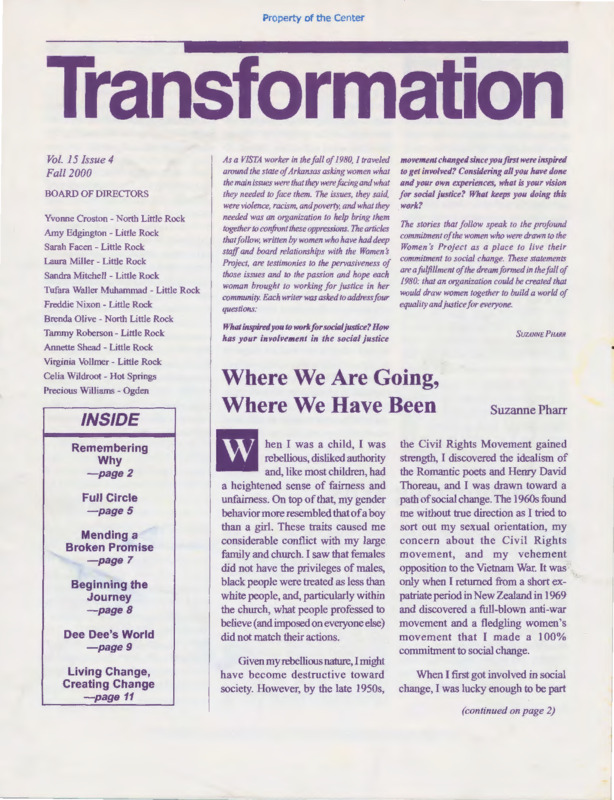
Property of the Center
Transformation
Vol. 15 Issue 4
Fall 2000
BOARD OF DIRECTORS
Yvonne Croston - North Little Rock
Amy Edgington - Little Rock
Sarah Facen - Little Rock
Laura Miller - Little Rock
Sandra Mitchell - Little Rock
Tufara Waller Muhammad - Little Rock
Freddie Nixon - Little Rock
Brenda Olive - North Little Rock
Tammy Roberson - Little Rock
Annette Shead - Little Rock
Virginia Vollmer - Little Rock
Celia Wildroot - Hot Springs
Precious Williams - Ogden
INSIDE
Remembering
Why
-page2
Full Circle
-page5
Mending a
Broken Promise
-page 7
Beginning the
Journey
-pages
Dee Dee's World
-page9
Living Change,
Creating Change
-page 11
As a VISTAworkerin thefall of 1980,I traveled
aroundthe state of Arkansasaskingwomenwhat
themainissueswerethattheywerefacingandwhat
they needed toface them. The issues, they said,
wereviolence,racism,andpoverty,and whatthey
needed was an organizationto help bring them
togethertoconfronttheseoppressions.Thearticles
thatfollow, writtenby womenwhohavehad deep
staff and board relationshipswith the Womens
Project, are testimoniesto the pervasivenessof
those issues and to the passion and hope each
woman brought to workingfor justice in her
community.Eachwriterwasaskedto addressfour
questions:
movementchangedsinceyoufirst wereinspired
to get involved?Consideringallyou have done
and your own experiences,what is your vision
for socialjustice? What keeps you doing this
.work?
The stories that follow speak to the profound
commitmentof the womenwho weredrawnto the
Women'.sProject as a place to live their
commitmentto social change. Thesestatements
areafulfillment of the dreamformed in thefall of
1980:that an organizationcould be createdthat
woulddraw womentogetherto build a world of
equalityandjusticefor everyone.
Whatinspiredyou to workfor socialjustice?How
has your involvement in the social justice
SUZANNE PHARR
•
Where We Are Going,
Where We Have Been
m
hen I was a child, I was
rebellious, disliked authority
and, like most children, had
a heightened sense of fairness and
unfairness. On top of that, my gender
behavior more resembled that of a boy
than a girl. These traits caused me
considerable conflict with my large
family and church. I saw that females
did not have the privileges of males,
black people were treated as less than
white people, and, particularly within
the church, what people professed to
believe (and imposed on everyone else)
did not match their actions.
Given my rebelliousnature, I might
have become destructive toward
society. However, by the late 1950s,
Suzanne Pharr
the Civil Rights Movement gained
strength, I discovered the idealism of
the Romantic poets and Henry David
Thoreau, and I was drawn toward a
path of social change. The 1960s found
me without true direction as I tried to
sort out my sexual orientation, my
concern about the Civil Rights
movement,
and my vehement
opposition to the Vietnam War. It was'''
only when I returned from a short expatriate period in New Zealand in 1969
and discovered a full-blown anti-war
movement and a fledgling women's
movement that I made a 100%
commitment to social change.
When I first got involved in social
change, I was lucky enough to be part
(continued on page 2)
Where We Are Going,
Where We Have Been
from page 1
of creatingnew ideas,new systems,new
analyses. Because there were so many
of us focusing in the same direction,
there was a tremendous sense of energy
and support. All of the movements of
that time--Civil Rights, women's, gay
and lesbian, anti-war-were charged
with idealism and sexual energy. Very
few of us were paid organizers; we
simply organized. We were young, we
had passion and ideas, and we made
things happen. Back then, we expected
young people to be leaders, to recreate
the world. However, many of us who
were involved back then are now
currently in paid positions in social
change organizations,and young people
have few places to enter where they can
be treated as equals and leaders. As the
61 year-old director of Highlander, a
68 year-old social change organization,
I'm wondering if too many directors of
organizations have gray hair. I'm
wondering if we should be using the
full force of our power and privilege to
work with young people, to place all
that we do on the progressive left up
for examination and radical change. A
big piece of that change might be
moving ourselves out of leadership
positions, in order to ensure that we are
not gatekeepers.
economicjustice and to choose survival
and well being instead of destroying the
planet in the name of greed.
What keeps me doing this work is
the rightness of it. The deepest sense of
spiritualityI have is tapped when I stand
shoulder to shoulder with people who
My vision for social change has are united in their passion for freedom
remained pretty much the same from and justice. When I see people of color
the first: that we must demand and and women in occupations and social
maintain equality and justice for settings that were closed to them 50
everyone, no matter who they are. years ago, when I see queer folks out
Every person has equal worth and must and vocal, when I see the U.S.
be given opportunity and treated with population reluctant to lose even one
dignity.I believe that all oppressionsare person in a military battle, I know that
interconnectedand their eliminationwill although the world continues to be an
happen when those who are targeted imperfect place, we have changed it.
by oppression also connect to confront Social change work has given me my
power and make change occur. most profound friendships, my deepest
Capitalism remains an obstacle that beliefs, and my greatest sense of
brings our efforts up short again and accomplishment.One could ask for little
again. In the next decade, we will have more in a lifetime search for purpose
increased opportunities to mobilize and meaning. ■
great numbers of people to demand
Remembering Why
m
uring my college career in the
early 70's, I registered for
Western Civilization four or
five times. Each time I would end up
dropping the course a month or so
into the class. Years later, I realized
that one of my problems with this
course was that I rarely saw me-as
an African-American
or as a
woman---on any of the pages. When
African-Americans or women did
appear in these books,
the
conversation was very short, and
most times we were defined by our
weaknesses, never by our strengths.
Certainly few words were printed
about our contributions to the world.
I finally made it through Western
Civilization, because I found some
balance: courses in Black History and
in Women's Literature were offered
that same semester. This combination
of courses helped the Western
Civilization experience take on new
Janet Perkins
meaning. The Black History course
built on and expanded what I had
learned during years of being in all
black schools throughout
my
formative education years. No longer
was I marginalized or rendered nonexistent throughout the entire course.
Studying
Black History
was
enriching, and, thanks to an excellent
professor, we were encouraged to
analyze and question what was being
presented to us.
(continued on page 3)
www.womens-project.org/ • Page 2 •Transformation• Fall 2000
The Women's Literature class was
also exciting because this was a space
where we studied writings of women
and discussed the experiences of
women in the world. What was
missing were the writings and
experiences of women of color.
Although this course was quite onesided, it still provided an opportunity
for women to be brought into focus
as we examined history.
As I moved from school to
various employment situations, I
always questioned what I saw, felt and
heard, but I didn't have a place to go
to examine these experiences or know
how to challenge them in a way that
would make a difference. Sure, many
times I spoke with supervisors and
personnel departments about what I
thought were company practices that
were unfair to women and AfricanAmericans only to be politely told,
"the wheels of progress turn slowly."
When I was in school trying to
make it through Western Civilization
or in my early working career, I might
not have been able to articulate clearly
what the injustices were, but on a very
fundamental level I knew that people
should not be mistreated regardless
of who they were.
My most memorable working
experience will always be the
Women's Project. When I walked into
the Women's Project each day,I didn't
have to deny my race, gender,
religious beliefs or any aspect of who
I was in order to fit into the culture of
this organization. What was required
of me was to be committed to going
beyond my own feelings of frustration
and anger caused by my experiences
body. Another shot showed a woman
being surrounded by men as they
taunted her and touched her body. My
first impression was that I had come
upon a movie that reminded me so
much of the book, Lord of the Flies.
To my dismay, I realized that what I
As many of you know, I am no was watching was the news, and the
longer on the staff of the Women's horrible scenes I had just witnessed
Project. However, I continue to be had actually happened to women in
involved in striving to make this a New York's Central Park during a
better world through my work as Puerto Rican celebration.
program director at the Southern
Partners Fund, a new public
During the Southern Baptist
foundation which has been created Convention the decision was made
and is governed by grassroots
that women were restricted from
community leaders throughout the being pastors. They explained that
South. The Southern Partners Fund, women's participationis welcomed in
like the Women's Project, values the many areas of the Baptist church, but
richness and power which exist in a congregation's leader should not be
communities. We know those a woman.
communities can more than survive
In a rural community in Utah, a
if people are willing to challenge
young
African-American male was
injustices and if resources are
available to support their efforts for brutally murdered because he was
gay. In Mississippi, an Africansocial change.
American male teenager was found
My personal experiences with hanging from a tree. Immediately,
injustice and witnessing how it hurts, news reports claimed the Mississippi
degrades and marginalizes others teenager's death was a suicide. Later,
always troubled me. Far too many news reports suggested further
people lack hope and have succumbed investigations would be conducted
to drugs, alcohol and illegal activities. because new information suggested
It hurts so much to witness people that the young man might have been
destroying themselves and others. lynched because ofhis friendshipwith
These were the things that motivated two White females.
me to work for social justice.
What is my vision for social
Several events captured my justice? Very simply put, I don't want
attention this summer. I was another person, especially another
flipping channels trying to find woman humiliated, raped, killed or to
something I wanted to watch on experience any kind of abuse. I want
television when I turned to a channel a woman's talents, skills and abilities
where women were hollering and to be the determining factor as to
crying. One scene showed a woman's whether she qualifies for a certain job
top being forcibly ripped from her
of being black and a female. I was
challenged to stretch and broaden my
definition of injustice to include how
people experience life who are
disabled, Jewish, gay, lesbian,
bisexual, transgendered, and elderly.
www.womens-project.org/ • Page 3 •Transformation• Fall 2000
(continued on page 4)
Remembering Why
from page 3
or position. I don't want another
lesbian or gay man persecuted, beaten
and murdered just because of their
sexual identity. I want the freedom to
choose my friends and love interest
based on trust and common interest,
not on race.
Whether or not we are able to
eradicate all the oppression that exists
is not the issue. We must continue to
try because our activism does make a
difference. We must continue to make
connections with each other and be
All of us who have made a choice
committed to stand together in
opposition to injustice. We must to work for social justice have
examine our own work to make different reasons and motivations for
certain that we are not guilty of being getting involved. What we have in
as racist, homophobic, sexist, or anti- common is that we have a desire to
Semitic as those we see as the major live in a better world where people
opponents of justice. How do we, lead whole, healthy and decent lives.
those of us who say we are on the I want a world where respect, love
side of justice, handle power? Do we and integrity rule, rather than hate. I
know how to share resources, skills, learned a long time ago, whatever you
opportunities and information to want in life, you must be willing to
ensure that we are being inclusive and diligently work for it. ■
are developing the leadership skills of
others involved in the work?
Our Mission ...
Ourgoalis socialchangeor,asthepoetAdrienneRichwrites,
''the transformationof the world."We believethis worldcan be
changedto becomea placeofpeaceandjusticeforall women.
We take risks in our work; we take unpopularstands.We
work for all womenand againstall formsof discriminationand
oppression.We believethat we cannotwork for all womenand
againstsexismunlesswealsoworkagainstracism,classism,ageism,
anti-Semitism,
heterosexism
andhomophobia.
Weseetheconnection
amongtheseoppressionsasthecontextforviolenceagainstwomen
in thissociety.
Weare concernedin particularaboutissuesof importanceto
traditionallyunderrepresented
women:poor women,agedwomen,
womenof color,teenagemothers,womenwithdisabilities,lesbians,
womeninprisons,etc.Allarewomenwhoexperiencediscrimination
andviolenceagainsttheirlives.
Weare committedto workingmulti-culturally,
multi-racially,
andto makingourworlcandculturaleventsaccessibleto lowincome
women.Webelievethatwomenwillnotknowequalityuntiltheyknow
economicjustice.
Webelievethata fewcommittedwomenworkingin coalition
andin consensuswithotherwomencan makesignificantchangein
the qualityoflife forall women.
Trans/ ormation
is published four times every year.
In each issue, members receive analysis of contemporary issues, information about Women's Project upcoming
events and activities, book reviews, and more. If you are not a Women's Project member and would like to
continue receiving the journal, please fill out the membership form on page 6.
www.womens-project.org/ • Page 4 • Transformation • Fall 2000
Full Circle
m
ithout a doubt my longing
for social justice was
inspired by the civil rights
movement as I grew up in Little Rock.
I was awed by the courage of Daisy
Bates and the nine school children,
just four or five years older than I was,
who faced the mobs at Central High
School in 1957. Another role model
was my Sunday school teacher,
Adolphine Terry, a white woman of
the "plantation class," who fought for
desegregation. She never failed to use
Bible stories to illustrate the need for
social justice, which she pursued on
many fronts all her long life.
My mother was a role model too.
She was a "special education"
teacher, with students from 6 to 18,
who had all types of disabilities. She
recognized the fact that children were
often dumped in her classroom,
simply because they were "difficult,"
"disfigured", or very poor, and she did
whatever it took to get them back into
the mainstream. She worked hard to
prepare her students, whatever their
disabilities, for employment and
independence, at a time when this was
a novel idea.
In high school and college, I
became involved with the Quakers in
civil rights work and the anti-war
movement at the beginnings of the
Vietnam war. However, my attempts
to deal with racism and violence as
purely moral issues left me feeling
inadequate and deeply ashamed of my
identity as a Southern white. A year
after college, I moved to Europe,
because it was as far away as I could
get.
Amy Edgington
I studied at the University in
Marburg, Germany, where my
favorite professor was Wolfgang
Abendroth, one of the leading
communist thinkers in Western
Europe. I was as much influenced by
his aura of personal courage (he was
a concentration camp survivor), as I
was by his brilliant analyses of history
and current events. Like most
Americans, I had never learned much
about history and less about
economics, and my grasp of issues
such as class and race had been greatly
hampered by these deficits in my
education. The prime example of my
ignorance, was the fact that I moved
to Germany, of all places, to flee
racism.
Most of my education, however,
took place outside the classroom. As
I traveled, worked and lived in
Europe and North Africa for the next
four years, I saw examples of racism,
classism and imperialism, in places far
removed from Arkansas. I began to
understand my home far better than I
had been able to up close. Seeing
different ways societies could work
and different ways individuals could
view the world, also gave me a sense
of the possibilities for change.
Back in Fayetteville, Arkansas in
1973, I was hit with the revolution in
feminist consciousness which had
begun to take place in the U.S. I
finally came to terms with my identity
as a woman and a lesbian. This
happened with the force of religious
conversion,
and for a while,
separatism provided a place where I
felt free for the first time from fear
and shame, a place where I developed
valuable leadership skills, and a place
where I learned to listen to and
respect other women.
I becameincreasinglyuncomfortable
in the separatist enclave in Northwest
ArkansasandlaterinNorthernCalifornia,
however.Althoughwomenof colorwere
pushing for a meaningful share of the
agenda in the feministmovement,white
women, even with the best intentions,
seemed unable to maintain a focus on
(continued on page 6)
Published four times a year
by the Women's Project,
2224 Main Street, Little Rock,
Arkansas, 72206.
Phone: 501-372-5113
Letters to the editor are welcome.
Editor
Production
Layout
Amy Edgington
Felicia Davidson
AndreaDega
Women's Project Staff:
Felicia Davidson, Lynn Frost,
Judy Matsuoka, Vedisia Green,
Pat Schuyler, Anne Shelley
Staff Emeritus:
Suzanne Pharr
* Printed on recycled paper. *
©2000 The Women's Project
www.womens-project.org/ • Page 5 •Transformation• Fall 2000
racism as a feminist issue. We tended privilege. Yet the violent system of
to treat racism and classism as matters legal apartheid was gone, and that
of personal behavior, divorced from made a palpable difference. I sat in a
the enormous social, political and concert hall and heard Bernice
economic forces at work.
Reagon call Little Rock "hallowed
ground." I heard Maya Angelou
In California, I belonged to a remind us that we have all been "paid
wonderful support group for lesbians for." I began to be very glad to be
with disabilities. Here I claimed back in Little Rock, to have the
without
shame
the epithet chance to pay back a fraction of what
"hunchback," hurled at me since I owe to those who came before me.
childhood, and I felt whole for the first
time in my life. Yet in that group I
At this juncture in my life I
also learned the limits of identity discovered the Women's Project.
politics. How long we had been Kerry Lobel's work around lesbian
disabled, whether we expected to get battering rekindled my hope that here
better or worse, when and how well was a place where I could belong
we could "pass," and the quality of without being silenced. As the
care we could buy determined how Women's Project took shape around
each of us experienced living with a Kerry, Suzanne Pharr, Janet Perkins,
disability. We had to talk about issues Kelly Mitchell-Clarkand others, I saw
like money, access and power in order the start of a true coalition to fight
to understand each other.
racism, sexism and homophobia. With
the leadership of the organization in
When I returned to Arkansas, I the hands of those who know both
was trapped in an abusive relationship racism and sexism on their own
with a "feminist" lesbian. By the time bodies, the Women's Project has
I freed myself, I felt real despairabout retained a clear focus on its multia movement that denied what I had issue agenda.
experienced
in the name of
As a Women's Project volunteer
"solidarity."
and board member, I have learned
I also began to understand that many new lessons,which are the same
this was what women of color had lessons my life has brought me over
always felt about the feminist and over: that privilege creates
movement.
discrimination and inequality, that
history and economics shape our daily
When I moved to Little Rock late
lives, that all people have dignity and
in 1986, to take care of my mother, I
value, that love is the root of justice,
found it depressing and ironic that I
that our souls are homesick for true
was back in exactly the place I had
democracy.
always wanted to leave. Little Rock
still simmered with racial tension;
whites still ruled through economic
I believe that social justice work
requires the willingness to learn and
teach the same lessons again and
again, as we journey with others along
a spiral path towards liberation. We
all resist change. To see a single
person unfold and blossom, to see a
community strive for greater fairness
and understanding towards one
another, is to witness a miracle. I keep
working for social justice because I
have witnessed miracles, and I could
not bear to miss the chance to see the
next miracle happen. ■
r------------,
~Yes,
I would like to
L.!Jjoin the Women's
Project.
Name
Address
City
State
Zip
Phone/day
Phone/evening
E-mail
D
D $25 regular
D $50 sustaining D
I'd like to pay by
$100 supporting
$15 low income
D check D credit
Visa_ Mastercard_
Account No.
Exp. date
Signature
Make checks payable to:
Women's Project
2224 Main Street
Little Rock, AR 72206
L ____________
www.womens-project.org/ • Page 6 • Transformation • Fall 2000
...J
Mending a Broken Promise
,.
tarting from an early age I
asked a lot of questions
without getting answers. I
remember the injustice when I was
a young girl working in the cotton
fields. We were in the hot sun
chopping the white man's cotton
and his kids were playing in the
pool. I remember asking my mother
"Why can't I go play in the water?"
She smiled and said, "One day you
can." I didn't know the words
"social injustice," but I knew that it
was not right for us to be chopping
cotton in the hot sun when they
didn't have to.
battered women's shelter. Her
abuser followed her there from
work one night, and she was put
out. Going through the trial process
was devastating. She was treated
worse than an animal. All the system
saw was a poor black woman who
had killed her husband. It didn't
matter that she had never been in
trouble before. We are talking about
a loving, caring mother of three that
went to work everyday, not
someone with a long history of
criminal activities. My brother-inlaw was the one with the criminal
history but none of this was
presented at the trial. The lawyer
Even in school whites and didn't use any of the evidence, like
blacks were treated differently. In the picture with her eyes black and
the eighth grade, the science teacher swollen or hospital bills for stitches
caught two boys cheating on a test. from when he busted her head with
He balled the black boy's paper up a 40 ounce beer bottle. Not one of
and put it in the trash can, but he the police records was presented
moved the white boy to the front of from the many trips they made to
the class to finish his test. Here I go their house. On the night the killing
again asking questions: "Why did happened, the police had been there
you take his paper and not the other and arrested him for third degree
boy's?" The teacher told me to be battery, but less than three hours
quiet or he would put my test in the later he was out of jail and fighting
trash too. Yes, my paper ended up again. Can someone please show me
in the trash as well. Again I didn't the justice in this situation?
understand. I told my mother about
what happened at school. She said,
I knew that injustice had stuck
"You, need to learn to mind your its ugly head up again, but this time
own business." I went through life I vowed to fight. I had two strikes
always in other people's business, against me: poor and black. It
because I would question things that seemed everywhere I turned we
I felt were not right.
were running into brick walls. I
thank God for the strong family ties
The real test came in 1991, my mother instilled in us at a young
when my sister was incarcerated for age. We never had much, but we
killing her abuser. She went to the could always depend on each other.
police for help and got an order of This tragedy brought our family
protection.
Nothing she tried closer together. We pooled our
helped, not even going to the
DI
Felicia Davidson
money and hired her a lawyer
because we had noticed from the
start the public defender was not
interested in whether she would be
free or go to prison. The lawyer we
hired was just as bad. He never had
time to sit down and talk to us about
the case. We set up appointments
and he didn't keep them. He lied and
kept telling us that she was not
going to do any time, until they
shipped her to Tucker Women's
Unit. I recall the trial like it was
yesterday. The lawyer didn't object
to anything. When it was his time
to ask questions he never had any.
Sitting in that court I vowed that I
would not sit back and let another
person be hoodwinked like that
again. I left that courtroom full of
hatred and bitterness for all white
people; I felt like a victim of a
broken promise.
I was introduced
to the
Women's Project in 1992 through
the non-traditional job program
where they prepared us to work on
jobs normally held by men. A part
of their mission statement moved my
spirit. "We are concerned in particular
about issues of importance to
traditionallyunderrepresentedwomen:
poor women, aged women, women of
color, teenage mothers, women with
disabilities, lesbians and women in
prison, etc. All are women who
experiencediscriminationand violence
against their lives." I felt that I had
found some people to help me in all
areas ofmy life. I was a single parent
of two and I was raising the three
children of my sister while she was in
pnson.
www.womens-project.org/ • Page 7 • Transformation • Fall 2000
(continued on page 9)
Beginning the Journey
II
Judy Matsuoka
grew up during the 1950s and
60s-turbulent times full of hope
for social change. Although this
was the time of the Civil Rights
Movement and the beginnings of the
Women's Movement and the anti-war
movement, it was blindness that gave
me a vision for social justice. When I
was growing up in Chicago, there was
a blind man who begged in all kinds of
weather on a nearby street comer, and
a blind woman who ran her own snack
shop in the building where my father
worked. Being seven and less than
tactful, I asked the woman if she knew
the man (don't all blind people know
each other?) and why he chose to beg.
From her, I learned about the lack of
job opportunities for people who were
blind, the discrimination faced by those
who sought work outside of the few
select vocations for blind persons, and
the difficulty for those who were also
people of color, who had less education
or additional disabilities. She also spoke
of the man as a fighter, as someone who
chose to make it on his own terms rather
than bow to a system that said that blind
men who were also black could not
work in offices, could not run
businesses, but should be hidden away
to work in sheltered workshops for little
pay.
citizen, voting, serving on juries, or
owning land, he used his legal training
to help other Japanese immigrants fight
the system. I learned that my
grandmother, Chiyo Sakamoto Hirata,
had resisted the traditional Japanese
arranged marriage and had instead
married a man she picked, attended
college and worked. I learned that even
through the experiences of being
interned in concentration camps in
Arkansas during World War II, my
family resistedthrough humor, hope and
community.
others who braved police clubs and
police dogs, fire hoses and fire bombs,
and the fury of mobs in order to make
social justice the social norm.
In high school, I decided that I
wanted to work with people who were
blind to help remove the barriers that
severely restricted their life choices.
After college I taught children with
visual disabilities, and later I worked
with adults who were newly blinded. I
found that blindness was only the icing
on the cake of racism, sexism, ableism
and economic injustice. Mr. T. was 63
and had never gone to school because
he had begun working in the coal mines
at the age of 7 to help his family. He
had to learn to read before he could
learn Braille. Ms. J. was a woman
whose husband did not want her to learn
to use a white cane, so that she would
not be able to go outside of the house
without him. M.M. was a young
Palestinian man who could not get a
job because of anti-Arab sentiment and
because people were afraid he would
not be able to find his way to the
bathroom or cafeteria. Ms. G. was
passed over for promotion time and
again because her company would not
put the necessary manuals into Braille.
And R. could not get an apartment
because she was trans gendered. It was
clear that teaching people the tools of
blindness would not change their social
reality, unless it was coupled with
changing society by eradicatingracism,
sexism, homophobia, ableism, classism
and other oppressions.
At the age of 10, I was spat upon
by a man and called a "Jap." At the age
of 10, a former classmate was raped.
By this time, we lived in Skokie,lliinois,
home to the largest number of
Holocaust survivors in the US. My
friends' parents were survivors ofNazi
concentration camps and work camps.
From them, I learned that the long road
to the death camps began with gradual
elimination of civil rights, growing
social intolerance, job discrimination,
restrictions on housing and travel, and
increasingly random harassment and
violence. By comparing our personal
and family experiences, I understood
that none of us can be safe unless all of
us resist oppression and work for a true
democracy, which would respect and
The idea of resistance to oppression uphold our freedoms and rights and
was a new one, and I began to listen to treat every individual with justice and
family stories with a new awareness. I fairness regardless of race, ethnicity,
learned that my grandfather, Nobuo religion, age or gender.
Matsuoka, wanted to be a lawyer but
I also understood that the awful past
was unable to practice given the classist
was
still the present for many in this
constraints of late 19th century Japan.
For almost twenty years, as I
He fled to the United States, only to country. The Civil Rights Movement
continued
to work in the field of
was
in
full
swing.
On
the
news,
I
saw
encounter racism. Prevented by U.S.
scenes of marchers, demonstrators, and blindness, I looked for a place where
law from becoming a naturalized
www.womens-project.org/ • Page 8 •Transformation• Fall 2000
Property of the Center
all oppressions were connected and
challenged. I truly believe this is the
way we need to work, so that no one is
left behind in our quest for socialjustice.
I took courses in Women's Studies,
participated in women's study circles,
attended meetings and still found that
my experiences as a woman of color
were not reflected. I volunteered with
AIDS groups in the early 80s and found
a middle-class, white male focus. I
taught at two universities and worked
with different disability rights groups
and found, with the exception of
ADAPT, a lack of willingness to claim
issues of racism and sexism as disability
issues. I joined people of color groups
and found sexism, homophobia and a
discomfort with people with disabilities.
It was not until I found the Women's
Project that I found a place with people
who have a clear vision of how all our
struggles are connected, who were
willing to be challenged to stretch
beyond their own experiences and to
work for a true democracy.
Mending a Broken
Promise
from page 7
Almost forty years after getting my
I am grateful to God for putting
first lesson in social inequality, what sisters like Janet Perkins and Damita
keeps me going are others in the Marks in my life when times got tough
movement for social justice-the other for me and the children. They stood by
voices in the crowd, the other bricks in me and gave me the love and support I
the wall. It is a tremendous lift to open needed to be the sister I am today.
a letter from a woman who has moved
away and to read of her work to get
The Women's Project found me a
legal representation for poor people or job. Unfortunately, it did not work out
to protect the environment. It is a rush as I anticipated, but those ladies
to hear a young person say,"I went from encouraged me to come and volunteer
doing nothing to being willing to do for the Women's Project during the time
anything for social justice." It is I was not working. I started working
powerful to connect with someone from for the Women's Project on a part-time
a totally different background, who has basis in 1993. This is when I learned
a shared vision for a future of peace that I had a voice, and what I had to
and justice. At times like these, I know say was important. I learned more about
we cannot fail. ■
the political process from talking to my
co-workers in the halls at work than
from anywhere else. It was during this
time that I began to value myself as
being a real "sister," not just in words
Dee Dee Green but by accepting the thick lips, the bow
hips and the napped hair. I was not
outside of the Pulaski County Special ashamed of being a black woman
School District. These schools were anymore.
implementing programs that standard
I have been involved in prison work
public schoolswerenot, suchas advanced
or alternative coursesin thearts,language, since 1995, educating about the cause
science and mathematics. We received a and consequences of domestic violence
wonderfulappeal from the head principal and HIV/AIDS, identifying alternatives
to incarceration to prevent damage to
about how advantageous
this
programming would be for students families and to assist in changing polices
interestedin leavingthe district, especially that will benefit the victim. I have come
thosewho werecollege-bolilldTherewas full circle, back to the beginning. Now
one catchto allof this:only white students I am working to assist other women so
could take advantage of this opportunity. that they do not have to experience what
The Black studentsat the assembly were my sister experienced. That's why I
outraged Boos and walkoutsfollowedthe keep doing what I do. I am keeping a
announcement.I thinkthatthisis the point vow to myself and in the process
making the lives of others more
at which my consciousnesswas raised
bearable, if not better. ■
Dee Dee's World
m
eing an older sister to my
brother afforded me the
opportunity to fall victim to the
double standard at an early age. As my
brother got older, I noticed that he could
participate in activities or attend events
withoutadultsupervisionlongbeforeI was
able to do so.When questionedaboutwhy
this was "cool" for my brother at such a
young age and not for me, my parents
respondedwiththatever-so-infamousline,
"He's a boy; it's differentfor boys."
I recognized similar disparities
regarding race and economic standingall
around me-at school,work, church and
play.I recall an assemblybeingheld atmy
high school to announce this wonderful
opportunityfor studentsto attend schools
(continued on page 10)
www.womens-project.org/ • Page 9 •Transformation• Fall 2000
Dee Dee's World
from page 9
I wasunfamiliarwithphrasessuchas
"social justice"until I entered college.
Reading and enrolling in courses like
Gender Studies and Applied
Anthropologyrevealedto me that all of
my questions about the lack of parity
between sexes and races were neither
isolatednor alien.Formuchof my young
life society had dictated that "white is
right." It also said to me that being a
successfulwomanwouldmean fulfilling
certainroles in order to gain acceptance
frommenandsociety-at-large.
Mycollege
experiencedirectedme to the realization
thatallof thiswasbullshit!I knewthatthe
inequalityI felt as a teen was not simply
hormonal.My feelingswere a reflection
of the oppressionsthat have allowedour
systemto thrivefor centuries.
I went to the Women's Projectone
dayafterclassin 1995andmetLynnFrost
Lynninvitedme to comeby theofficeon
Saturdaysto volunteer.Volunteeringwas
atop my listof prioritiesfor personaland
professionalreasons.Theexperiencewas
gratifying and educational. I was
introduced to a different form of
oppression:homophobiaIknewvezylittle
abouthomosexualityotherthanwhatwas
containedin the Scripture.Personally,I
did not know whether same-sex
relationshipswere right or wrong. I did
know that we are all God's childrenand
are createdequal. I began realizingthat
this"socialjusticething"isnot onlyabout
being a woman of color, but it is all
encompassing.It means that people are
peopleand shouldbe treatedwithrespect.
We have an inherentrightto equality.As
citizensof this country,we each deserve
the samefimdamentallibertiesandjustice
uponwhichthisnationwas founded.This
line of thinkingsparkeda greaterinterest
in how much our differencesmake us
similaras humanbeings.
have enjoyedworking for and learning
from the Women'sProject.I hesitateto
callmyselfan Organizerbecauseafter20
monthson staff,I have yet to do enough
of the grassroots work that results in
effectiveorganizing.I am not much of a
leader;I am more of a follower.I don't
mindthat aboutmyselfbecausethatis the
sourceof my personalgrowth.However,
I envisiona future fullof followerswho
aredestinedto becomeleaderswithinthe
socialjusticemovementAtthesametime
I haveto wonderwhattypeof rolepeople
of color will play in the mass effort for
social change. If you are talking about
equality,thepeopleforwhomit shouldbe
achievedneed to standin the forefront.I
don't see enough of that yet within the
socialjusticemovement.
Abouta yearaftercollege,I washired
as a Women'sAdvocatewith Advocates
forBatteredWomen.Thiswastheperfect
opportunityto work on behalfof women
whosevoicesaresuppressedby violence.
Theorganization
isa sourceofintervention
for victimsas wellas an outreachagency
that works to prevent violence against
families before it ever occurs. The
preventative
measuresconfusedmeatfirst,
becauseI feltthatwe couldnotadequately
servethevictimifwe concernedourselves
too much with trying to prevent the
victimiz.ation.
I wasaskedtojointheBoanl
For a good part of my life I have
of the Women'sProjectin 1998.Here I
achieveda better understandingof why despised systems and attitudes of
socialjusticecouldnotbe achievedwithout oppression.Thatis why I workfor social
social change. The prevention and justice.My contributionto socialchange
interventionservices of Advocates for is minimaL
but my smalleffortsthat will
BatteredWomenbeganrnakingsense.The leadto biggerstrideswillultimatelyresult
outreachthatthestaffof ABWperformed intruesocialchangeforfuturegenerations.
was about educating and changing Somethingmust give becauseI am tired
innightclubs
attitudesabout violenceagainstwomen. of raidingthemen'sres1roorn
That was social change. What a novel just to relievemy bladder.Haveyou ever
concept!
noticed that there are severalurinals in
addition to the stalls in the men's
In 1999, I joined the staff of the restroom,whilethewomen'srestroomhas
Women'sProject.Sincethattime,I have lots of mirrorsbut only two stalls?Talk
learned a great deal about progressive aboutinjustice!■
thinking. Some people appear to be
frightenedby the term ''progressive"for
whatever reason. To progress simply
meansto move onwardor forward.This
notionappearstoointimidatingforsome,
butthismovementwon'tdissolveaslong
as conservatismcontinuesto oppress.I
www.womens-project.org/ • Page 10 •Transformation• Fall 2000
Living Change,
Creating Change
from page 11
also has a comfortable chair, everyone
is hungry for true justice and everyone
gets equal portions of food to fill them
up. The meals may be spiced very
differently, but there's enough to go
around. Each individual is welcomed
and appreciated for their genuine
differences, not judged by them. The
dinner conversation is thoughtful,
compassionate and punctuated by
laughter about the ironic ways in
which we can appear to be so
different, but are often so alike. And
everyone really listens to each other.
I keep doing social justice
work, because I have always had a
passion for understanding human
relationships-how
they're built,
strengthened, grown, etc. And, at its
core, organizing is about folks
building relationships with other folks
and counting on those relationships
as the foundation for building change.
I absolutely love it when people work
together to create change.
extremely important to my growth as
an individual. I've had similar
epiphanies over the years regarding
gender identity and other issues that
continue to expand my vision of what
equality really means.
And lastly, I am a chronic
optimist. I believe in the politics of
hope and in the human capacity for
change. I think the process of working
together for social change is one of
I'm also addicted to expanding my the most rewarding processes we can
mind. Experiences like that anti- share as human beings. ■
racism workshop in 1990, are
Women's
Project
Non-Profit Organization
U.S. Postage Paid
Little Rock, Arkansas
Permit No. 448
2224 Main Street
Little Rock, AR 72206
ADDRESS CORRECTION
REQUESTED
Herland Sister Resources
2312 NW 39th
Oklahoma City OK 73112