
HerlandVoice-1987-07-v4-no07_ocr.pdf
- Title
- HerlandVoice-1987-07-v4-no07_ocr.pdf
- extracted text
-
VOLUME 4, NUMBER 7
JULY 1987
HERLAND SISTER RESOURCES, INC.
1630 NW 19, OKC, OK 73106
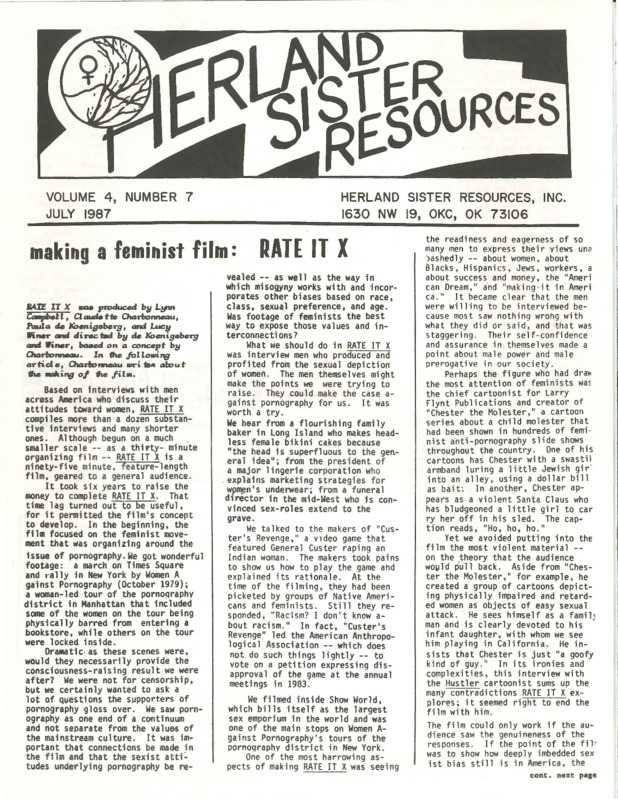
making a feminist film:
MJE IT X
empiletl,
111C1e
produced by Lum
OCIUCl.ta OM:arionneau,
Paula de JIQ.,.igsberg, cand 1..ucy
l'i....- cand dhwc W by de Jlaenigabey;g
cand fi,..r, &c.eed on ca concept by
OM:arionn8CIU. In ihe Jal towing
article, OM:ario- _.i
ea. _.ing o/ fae /il•.
a..
Qb:1ut
Based on interviews with men
across America who discuss their
attitudes tcward women, RATE IT X
compiles more than a dozen substantive fnterviews and many shorter
ones. A1though begun on a much .
smaller scale -- as a thi~ty- mfnute
organfzfng f il m - - RATE IT X is a
ninety-five mi nute , feature-length
film, geared to a general audience.
It took six years to raise the
money to complete RATE IT X. That
time lag turned out to be useful,
for it pennitted the film's concept
to develop. In the beginning, the
film focused on the feminist movement that was organizing around the
issue of pornography.We got wonderful
footage: a march on Times Square
and r·ally in New York by Women A
gainst Pornography (October 1979);
a woman-led tour of the pornoqraphv
district in Manhattan that included
some of the women on the tour being
physically barred from entering a
bookstore, while others on the tour
were locked inside.
Dra111at1c· :as these scenes were,
would they necessarily provide the
consciousness-raising result we were
after? We were not for censorship,
but we certainly wanted to ask a
lot o.f q1,1estions the sµpporters of
pornography gloss over. We saw pornography as one end of a continuum
and not separate from the value.s of
the mainstream culture. It was important that connections be made Jn
the film and that the sexist attitudes underlying pornography be re-
RATE IT X
vealed -- as well as the way in
which misogyny works with and incorporates other biases based on race,
class, sexual preference, and age.
Was footage of feminists the best
way to expose those values and interconnections?
What we should do in RATE IT X
was interview men who produced and
profited from the sexua 1 depiction
of wome~. The men themselves might
make the points we were trying to
raise. They could make the case against pornography for us. It was
worth a try.
We hear from a flourishing family
baker in Long Island who makes headless female bikini cakes because
"the head is superfluous to the general idea"; from the president of
a m4jor lingerie corporation who
.explains marketing strategies for
wp~n's underwear; from a funeral
director 1n the mid-West who is convinced sex-roles extend to the
grave.
We talked to the makers of "Custer's Revenge," a video game that
featured General Custer raping an
Indian woman. The makers took pains
to show us how to play the game ahd
explained its rationale. At the
time of the filming, they had been
picketed by groups of Native Americans and ferni nis ts. St i 11 they res ponded, "Racism? I don't know about racism." In fact, "Custer's
Revenge" led the American Anthropological Association -- which does
not do such things lightly -- to
vote on a petition expressing disapproval of the game at the annual
meetings in 1983.
We filmed inside Show World,
which bills itself as the largest
sex emporium in the world and was
one of the main stops on Women Against Pornography's tours of the
pornoc:iraphy district in New York.
One of the most harrowing aspects of making RATE IT X was seeing
the readiness and eagerness of so
many men to express their views una
jashedly -- about women, about
Blacks, Hispanics, Jews, workers, a
about success and money, the "Ameri
can Dream," a·nd "making·it in Ameri ·
ca." It became clear that the men
were willing to be interviewed because most saw nothing wrohg with
what they did or said, and that was
staggering. Their self-confidence
and assurance in . themselves made a
point about male power and male
prerogative in our society.
Perhaps the figure who had draw
the most attention of feminists wa~
the chief cartoonist for Larry
Flynt Publications and creator of
"Chester the Molester," a cartoon
series about a child molester that
had been shown in hundreds of femi nist anti-pornography slide shows
throughout the country. One of his
cartoons has Chester with a swasti ~
armband luring a little Jewish gir'
into an alley, using a dollar bill
as bait: In another, Chester appears as a violent Santa Claus who
has bludgeoned a little girl to car
ry her off in his sled. The cap•
tion reads, "Ho, ho, ho."
Yet we avoided putting into the
film the most violent material -on the _theory that the audience
would pul 1 back. Aside from "Chester the Molester," for example, he
created a group of cartoons depicting physically impaired and retarded women as objects of easy sexual
attack. He sees himself as a famil)
man and is clearly devoted to his
infant daughter, with whom we see
him playing in California. He insists that Chester is just "a goofy
kind of guy." In its ironies and
complexities, this interview with
the Hustler cartoonist sums up the
many contradictions RATE IT X explores; it seemed right to end the
film with him.
The film could only work if the audience saw the genuineness of the
responses. If the point of the fil r
was to show how deeply imbedded sexist bias still is in America, the
cont. next page
camera had to capture that bias in
the act of ·revealing itself. It
also had to capture gradations in
consciousness, sensitivity and awareness. Occasionally, some men
do catch themselves at moments in
RATE IT X and real.ize the implications of what they are saying, and
how they deal with that realization
becomes a further ·part of the point.
A few are confused and- less adamant,
suggesting the possibility of changing their minds .1
The attention the film received
proves that feminist issues still
matter and that the Women's Movement has succeeded in more profound
ways than its detractors wish to acknowledge. Great changes have occurred . . Twenty years ago RATE IT X
could not have been made -- it would
not have been understood. Before
feminism, audiences would not necessarily have grasped what ·was wrong
with the sexist conments the men
make throughout the course of . the
film. Today they do. Even the
reviews which were unfavo~able
showed an awareness of sexism that
just simply would not have existed
in the past.
It is too easy to re 1ega te pornography safely to a far-out corner,
to view it as a fringe phenomenon
and not recoqnize its kinship with
mainstream values. It is too easy
to be against "smut peddling" on the
one hand, but to approve of traditional sex roles on the other. It
is too easy to forget or ·igrt0re their
interrelationship. We needed to reemphasize the broad continuum. We_
needed to talk to more men, in differeAt parts of the country, in different occupations.Through networkinq
we broadened the focus of our
interviews. Whether it be advertising executives or retired legionnaires, the mindset that sexist
values creates is all too similar.
It is up to audiences now to judge:
but it seems to me that we have managed to make a film that in its own
way is not a love story.
r'Or 11Dre inJ'onna fion on RAZE IT X,
c.ontact the film's di.sfribubr,
In terQlllQ, a t .301 Wes t 53rd S t. ,
Ne., Y,rlt, NJ 10019.
june 1987/off our backs
xxxxxxxxxx
TIENTSIN--In Tientsin, in northern
China, a forty-year-old lesbian
has been put in a re-education
camp for having a sexual relationship with another woman, ·according
to the West German feminist magazine Emma.
--info from .9!i'. community news
Off our backs
Iceland: feminists gain power
REYKJAVIK--On April 26, a feminist
political party; the Women's Alliance, won 10% of the vote in Iceland's parliamentary elections.
The party will have-six seats in
the country's parliaments, double
its previous three seats.
Moreover, the Women's Alliance
victory is seen as shifting the
balance of power. A center-right
coalition government headed by
the Progressive Party's Prime Minister Steingrimur Her~annsson resigned.
Reportedly, a government .will
be formed that will be either a
coalition of the Progressive and
Independence parties and the Women's
Alliance or of the Independence
and Social Democratic parties and
the Women's Alliance. "We will consider every offer, but it is too
early to tell what kind of government will be formed," said alliance
member Kristin Halldorsdottir. She
said the party will enter a government only if the coalition promises
to raise women's wages and improve
child care and increase maternity
leave.
The Women's Alliance does not
believe in hierarchy. It has no
leader, and says that its members
of parliament will rotate out of
office after six years. Men can become members, but they can't become
candidates for office.
Iceland, the first country fn
the world to have members of a feminist party in its parliament, thus
seems about to become the first nation to have members of a feminist
party in its governing coalition.
Iceland already has the world's
first democratically elected woman
head of state, President Vigdis
Finnbogadottir. (India, Israel and
Sri Lanka have had women heads of
government, or prime ministers, but
not heads of state.)
Iceland has had an equal rights
amendment since 1976. Women always
have kept their own names after
marriage.
oH our backs
--info from new f;irk times, 4.~27/87
an<re en goodman's co111111n
announces
Collective Meeting .
Sunday, July 19, 3: 3Ci p.m.
at Herland
HERLAND SISTER RESOURCES. INC.
... a specialty center for women
Resource Library
Monthly Newsletter
Educational Public Programs
Books, Music. Art Sales
Cultural Events
SAT. 10-6, SUN. 1- 6
1630 N.W. 19 ST. OKLAHOMA CITY
PUBLISHED BY: BERLAND SISTER RESOURCES
CIRCULATION: 600
PHONE NUMBER (WEEKENDS): 524-7108
GENERAL INFO: 733-9331
672-6459
794-'/464
1-353-6861 (LAWTON)
VOLUNTEER INFO: 672-4141
ADVERTISING: 495-4390
If you are interested in conducting a
workshop, please contact Herland as soon as
This year's Fall Retreat will be held
October 23- 25 at Robbers Cave State Park
Group Camp #2.
possible.
We would like to schedule these
before the Retreat.
The group camp has cabins
Also, we have several tasks that require
with bunks (you provide your own sleeping
assistance.
bag or bedroll and pillow). a dining hall
please indicate so on the registration form.
and fully equipped kitchen facility.
Saturday morning there are workshops;
Saturday afternoon features open mic for
If you would like to help,
Upon receipt of you completed regis tration form you will be sent a map to the
campsite.
anyone wishing to sing, play, or read
poetry.
Opening our Saturday evening
concert will be Donna DeSalvo, followed
by our very special guest, Nancy Day.
Herland will again provide coffee and
tea for the weekend.
Bring your own food
NAME ( S) _________________________________ _
ADDRESS.________________.__________________ _
CITY __________________
for Friday night through Sunday break-
STATE_______ ZIP _______
fast, plus something for the traditional
PHONE ( ·----- ) ______________ _
Saturday night pot luck/pigout.
Also
bring toilet articles, musical instruments,
I would like to help at the Retreat.
I can provide_________________ _
games, flashlights, campfire goodies, and
sports equipment.
_____ I would like to provide a Scholarship .
Due to ·an increase in cost for the group
I would like a scholarship.
camp, it has been necessary to raise the
registration fee.
Pre- registration will
be on a sliding scale of $17- $20; please
Deadline for pre- registratiorl is Oct.18,
1987.
Mail this form and your check to:
pay in that range based on your ability.
Herland Sister Resources
On- sight registration will be $25 (Those
c/o Laura, Camp Director
wighing to attend the concert only may do
so for $5 at the door.).
4924
Kathy Dr.
4924
There are five
scholarships currently available for those
s.
Kathy Dr.
Okla. City, OK 73135
with financial need. Please let us know
if the increase in cost would prevent you
from attending and we will work out some-
s.
For any info phone (405)672 - 4141.
. .900. ._.I~...._.
rl~l--~nr...~a.,,_._,nD
thing with you.
Check-in time is anytime after 4:00 p.m.
Friday.
Upon arrival you will check in
with the Camp Director and select a cabin
(there are chemical- free, smoking, and nonsmoking available).
on Sunday.
I
Loral
c.
Reeves
C.P.A.
Check- out is noon
101' Cedardale Drive
Okla. City, OK 73127
40'/'9'-1094
.....~........."......................................i
Fodder forgive our trezpasses against us
like a lean-to I
We no knot whad we due.
The arrows of missiles, lazer bearnies
open the eyeball of the urth.
Druzzle in the wigwam.
Wheezing chilems.
Tutal cumz to tell uz how to read
theze blocks of letters.
Boz. Wheebut. lz wuz nerd ezy.
We god to laughing.
Hemry ezpecially garfooned on the table.
Here iz ours I
the storehouse, sheds, all the fieldstones
of our taking breath I
incumbent wurds that make our farms
& iz the animals that urnhabit them.
Az what wurds iz, Tutal saz, angry at our laf.
Seeze the room!
Sneeze iz ours.
Achoom. Who brings it?
Great Spirid vacoom.
I HAVE BOWED BEFORE THE SUN
ANNA LEE WALTERS
PAWNEE-OTOE
My name is "I am living."
My home is all directions and is everlasting.
Instructed and carried to you by the wind,
I have felt the feathers in pale clouds and bowed before the Sun
who watches me from a blanket of faded blue.
In a gentle whirlwind I was shaken,
made to see on earth in many ways.
And when in awe my mouth fell open, .
I tasted a .fine red clay.
Its B.avor has remained after uncounted days.
This gave me cause to drink from a crystal stream
that only I have seen.
So I listened to all its flowing wisdom
and learned from it a SongThis song the wind and I
have since sung together.
Unknowing. I was encircled by its water and cleansed.
Naked and damp, I was embraced and dried
by the warmth of your presence.
Dressed forever in the scent of dry cedar,
I am puri.6ed and free.
And I will not allow you to ignore me.
'V
I have brought to you:; gift.
It is all I have but it is yours.
You may reach out and enfold it.
It is only the strength in the caress of a gentle breeze,
But it will carry you to meet the eagle in the sky.
My name is "I am living." I am here.
My name is "I am living." I am here.
I
Sounds running oud our mouth & noz.
Meaning out of eyez,
not connected yet to the sounds we make.
Father Jezus dominion bee yurz.
The white bird in the winter tree iz a star.
Whee whee I
yeur wurds of baffaloing the medicine men.
Scaffoling of language. The squaws. Childem.
Holy wurds. Manger still gruzzling animals.
Hauze.
Cattle.
Gupe.
Geraf.
Zereba with stripes.
Camuel.
My wicket spirit buzzards yeur wruds I Tutal.
White star in a tree.
DIANE GLANCY
Feminist Studies 13, no. 1 (Spring 1987).
848-6429
SHIRLEY M. HUNTER, M.A.
LICENSED PROFElllONAL COUNSELOR
PENN PARK OFFICE COMPLEX • IUITI 102
IOOI N PENNSYLVANIA• OKLAHOMA CITY. OK 13112
Up and coming
Duet
Tall and slender in her long black dress,
a red scar circling her throat
like a delicate necklace,
my sister floats in a white moon
on the stage of the dark auditorium.
The keys gleam against the ebony clarinet
like light through a keyhole
into a room where two girls
play a duet over and over.
We practiced to be perfectit was what everyone wanteduntil our lips were numb,
then silent, then sealed.
For she became more perfect,
and I, a forgotten interval.
While she haunted the practice rooms
of musty music halls,
I tried on clothes,
cropped my hair close as a nun's,
dropped acid .
But I still remember the fingering,
and as she plays
I make up a harmony
to the tune of "two sisters, two sisters."
Judith Kirkwood
FRONTIERS Vol. IX, No. 2
Dear friends
I know how hard many of you have been
hit in these uncertain economic times.
Knowing this, I still must appeal to you,
those who benefit from the existance of
Herland. We are now in a severe struggle.
Our finances are extremely low and our
spirits are not much higher. Burnout has
taken many of us from the active roster,
and those of us who are left need your
help.
I ask you to reflect on the time when
there was no Herland, no newsletter, no
efforts to get you records and books, no
workshops, no spring and fall retreats,
no listings in national guides, such as
Places of Interest
to Women,
Gala's
Guide, and Gayellow Pages for a women's
center such as ours in Oklahoma City, and
no Herland library. If you find the time
before
to be no different than the time
now, then this appeal is not for you and
you need not read on. BUT, if you
are
aware of our efforts and find them worthy,
please help us with our growth.
So I ask you.
Do you want us to
continue, and will you help?
I know many
of you
have donated willingly of your
time as well as your money. For this we
thank you. Yet there are over 600 persons
receiving the newsletter . If everyone on
the mailing list would donate $12, which
is only $1 per month, we would be able to
stock shelves, try new things, plan concerts, sponsor workshops, and move to a
place that is warm in the winter and cool
in the summer, and we could have a place
that we all would be truly proud of. Think
of it.
All we need to do to raise $7200
if for 600 people to
donate $12. Please
take us seriously and send
a check
or
money order today, or drop by on a Saturday
or Sunday with your donation, when we are
open.
Sincerely,
'
BC/Berland Collectd. ve,
Our shelves are bare and we are not
individually capable of handling
the
total financial load of operating Herland.
Herland is a non-profit organization and
we volunteer because
we believe in the
cause.
YES.' I wanl fo h~lp Her/and wifh
an annu,g/ dona lion ol' I 12.
Your fax-deductible donal/on enfilles qou
to use of fhe lend/nq /1/Jr,gry as well as
d/scovnls on slore s7"oci and concerf ft"t:kels.
Herland is not able to forward
your newsletter unless you send
us a change of address (just
sending one to the Post Office
won't do it).
This form may also be used to
add a name to the mailing list.
Alame:
Name:
___ YES! I wanf fo help lier/and w1ih a
6-monfh a'onalion of .f 6.
Old Address:
llddress:
City:
Cif(I_:
Sl11fe:
State:
Phone:
Mat! To: Her/and Sisler Resources, Inc.
1630 Al.
19
OKC, OK 7.3106
THANKS.' (lier/and will send you a receipf
l'or !fOVr fa,r purposes.)
w.
Zip=
New Address=
I
City:
---------
1
I
I
1
I
State•
---
Zip:
'Tl7EN~
C1.
L •l
U .J
521-8176
Two years ago Donna Becht e l was convic.ted of first degree murder and
sentenced to
life
imprisonment
for
killing her abusive husband in
self-defense .
On Friday ,
June 19 the Court of Criminal Appeals handed
down it's unanimous opinion granting Donna a new trial .
They base their
opinion
on the denial of the "[appellant's] right
of cross-examination
and confrontation when the trial court denied a
key witness .. . "
The
opinion states, "the jury was also entitled to hear the witness' opinion,
as
they were to determine
whether the appellant
knowingly and
intelligently waived her rights . "
As we
write,
Donna
is still
incarcerated at
Mabel
Bassett
Correctional
Center .
The Di:;trict Attorney may petition the Court of
Criminal Appeals for a re-hearing.
We feel sure that his petition will
be denied and that
bond will be set for Donna by the week of July '6tl:). .
We have heard rumors that the bond might be set at $100,000,
which means
that several thousand dollars must
be raised
in the next f 'e w days in
order to gain Donna's release as soon as possible .
Due
to her previous trial,
unjust imprisonment,
and pending civil
suits ,
all Donna's economic resources have been depleted .
Without your
help she will remain
in jail.
Your contributicn of $5 . 00 or more will
help to make possible bond,
expert
witnesses,
and the
necessar y
depositions .
Donna is confident that this new trial will be successful .
S he is
excited,
eager,
and ready to prove herself innocent.
She r:fo8ds your
help .
Please send your c ontribution to :
C itizen · s for Donna Bechtel
c/ o American Bank and Trust
15 E.
Edmond,
15th
Oklahoma 73034
You can be certain that
you will
be a
possible for at least one battered woman.
part
of
making
real justice
RED DIRT IN MOTION
a celebration of Oklahoma women in the arts
in honor of the first year of PIECEWORK, a magazine of poetry by women
Exhibi tS
by artists Rebecca Friedman, Marsha Greenwood, and others
photography by Robin Smith
quilts, crafts, and more
books by regional authors
Readings 2 pm
4 pm
Videos
7 pm
Music
8 pm
by contributors to PIECEWORK
reception
by Jeanne Hollenbeck
records, tapes by Mary Reynolds, Peggy Johnson
SISTERS OF SWING
Saturday, July 25, 1987
your $5. admission to all events supports RED DIRT PRESS in furthering
the written record of women's lives
First Unitarian Church
600 NW 13th & Dewey
Oklahoma City
_ _ _ _ _ to participate call 525·6000 or 947·1106 _ _ _ _ _ _ _ _ _ _ _ _ ____.
HERLAND ANNUAL GARAGE SALE
Retail
-
Wholesale
It's time once again for Herlands an-
nual garage sale.
This is another way you
can help support Herland's efforts without
actually giving money.
STUDIO OF ANNE COOPER
Minerals, Crystals and Custom Jewelry
Thanks to all of
our supporters who gave last years garage
PRIM POLK, Mgr.
4007 Wycliff
Dallas, Tx 75219
sale (which brought in over $500)!
Hours: 11 :00 A.M .-7:00 P.M.
Tuesday-Saturday
214/522-2864
This gives you an opportunity to clean
out your closets and garage of all the
things you've been meaning to "do something with".
We'll sell just about anything.
Please bring your "stuff" by the book-
IEIECCA I. COHN, Ph.D.
CLINICAL PSYCHOLOGY
store during regular operating hours: Sat
10 to 6 or Sun 1 to 6 and you will receive
a receipt for your tax purposes.
If you choose to sell your own "stuff"
Norman, Okla.
321·2141
lntllYldaal •••
CoaplH ••• Group•••
Fam11y Therapy
...
we provide space and advertising and request
25% of your sales as a donation.
need volunteers to help
sale.
We also
the days of the
The sale will be held Saturday,
August 1st from 7 a.m. to 6 p.m. and Sunday
August 2nd from 7 a.m. to 2 p.m.
For more
information contact Laura at 672- 4141.
366-09'23
Wttf
···~
r
HELEN HOLGATI: t
Certified AJcohollsm 8t Drug Abuse
Counselor
·
i
"LOVB MAY BR 81.IND, BUT
HANDWRITING'S NOT
Professional Analysis of Compatibility
Confidential report on caaette
Shelly Zaikis, C.M.G.
405-946-6928
FAITH AND PSYCHOLOGY WORKSHOP
"The Impact of Faith on Women's Psychological Development", is the topic of the
workshop to be sponsored by the Women's
Resource Center, 1- 3:30 p.m., July 17, at
the Women's Resource Center in Norman.
Quality Service With That Personal Touch
The workshop is free and open to the public,
however because of limited seating space,
Ink Well 10rinttng
TERI HOELTZEL
SUSAN BROOKS
C>.Nners
942-5693
P.O. BOX 270033
Oklahoma City, OK 73127
tt is necessary to pre- register for the
workshop.
For further information, contact the
women's Resource Center at: 364- 9424, or
226 East Gray Street, Norman, OK.
Recovery and Integrity:
The Music of Meg Christian
The development of a feminist consciousness means
progress toward integrity-toward wholeness and selfknowledge, toward fairness in our relationships, and
toward consistency between principles and actions. Meg
Christian's lyric "I Wish You Well" articulates the double
nature of the integrated life-the recovery of past selves
and the spirit of community:
And all the children that I have been
Need to know where I am now, know what I have seen
And all the children that I have been
Need my arms to go around them, take them back in
And all the women that I have seen
Fighting and falling, can they rise again
And all my sisters, will we ever learn
How to dance out the fires and not to get burned .. . 1
For Meg Christian, integrity involves not merely an otherdirected ethic but an ethical responsibility to the self. Her
music and women's culture in general help us validate our
struggles for wholeness in a patriarchal system that
fragments and alienates women.
Meg Christian has been one of the creators of contemporary women's culture; in fact, without her, contemporary women's music as we know it might not exist. She
speaks to us, I think, more directly than any other woman
musician about her struggle toward integrity, about the
development of her political principles, and about the conflicts between her individual needs and the political needs
of her audience.
POLLOCK: Women's music, obviously, has a lot of common themes in the. lyrics. Do you see it as different from
other contemporary music?
CHRISTIAN: If there's a similarity in most of the women
artists I know [it is that] we tend to combine a number
of different musical styles. And another thing is a sense
of musicians working together on a more mutual basis.
Even when there are an artist and an accompanist, there
is more of a cooperative spirit. That may be a product
of my imagination, but I have experienced it over and over.
I think that all the time there are new women artists and
new women's groups who are exploring different musical
styles, and so I think it's too soon to try to do an analysis
of musical theory or structure. But I think it's interesting
that finally we have other women artists to influence us,
and that we have all-women musical products or albums
to influence us. Maybe it will be generations before we
know what women's musical structure is. I grew up in an
absolutely male musical tradition, and I will never lose
those influences- I've learned a lot from them. At the
same time, I've always been curious about what women
do with art, particularly what women do with music. I
can't aniculate a theory of women's music yet, but maybe
our granddaughters will be able to.
POLLOCK: Which musicians or poets give you strength
and influence your music?
CHRISTIAN: The first song I ever performed in public
was a Teresa Brewer song. And then I got crazy for people
like Harry Belafonte and Johnny Mathis- I used to learn
all his mushy songs, his unrequited-love songs. And I used
to love sound tracks and show tunes; I used to act out
Broadway plays in my living room with my friends. And
then I got crazy about folk music. I really feel I blossomed
as a musician. I listened to people like the Limelighters
and Joan Baez, Buffy Sainte Marie, Carolyn Hester. Then
I moved to North Carolina and got really interested in
mountain music-folk lyrics and various Appalachian
guitar styles. And then I discovered classical music. I had
a double major in music and English. 3 The classical
guitar became the main focus for a couple of years. Then
the singer I song writers like Joni Mitchell and James
Taylor and Carole King and Laura Nyro were getting
popular, and I just soaked up their music. I adjusted to
it naturally and loved to perform it.
It was at that point that I started meeting other women
who were working in an alternative musical vein. I
remember when I first heard Cris Williamson's music. I
thought, "This woman and I are coming from a common
place"-1 don't know what it is, but her music just absolutely touches a place inside me other musicians haven't
reached. And when I met her in late 1972, she had not
been very politically involved, and I had been very involved ·
in radical feminism, so I went to her and I said, "So what
do you think about women's music"-or something I had
sort of made up the week before. She looked at m¢ as if
I were probably a very nice person, but a little dementea.
Not too long after that, we started hanging out together
and jamming together. And at that point I realized that
I could actually start sharing my music with and learning
from other women musicians. Not too Jong after that, I
also met Margie Adam, Kay Gardner, and Alix Dobkin.
Around 1973, '74, I realized that a whole lot of women
out there were making a conscious effort to speak from
their experiences as women through their music. That was
when we started influencing one another. 4
POLLOCK: You really have allowed yours.elf to be turned
around by the audience-responding to what they say they
need?
CHRISTIAN: And to satisfy my own sense of what was
appropriate. It's interesting. For years I had been trying
to combat a male left idea of what is political. For that
group, the political has to do with external issues. There's
a lot of leftist criticism of women's culture that says that
we talk about the personal too much. Of course, I think
that's what makes feminism unique as a political idea.
Feminism is an internal as well as an external politic. We're
talking about changing inside, changing the way that you
and I sit on this sofa and talk, the kind of mutual respect
we share, power-sharing, a sense of equality as we talk,
a sense of compassion about the world and its inhabitants.
All this, I believe, is something intuitively a part of
women's essence and something that we incorporate into
our politics. We can't change the world until we change
ourselves. This idea has always been a part of feminism.
POLLOCK:
historically women haven't been
perceived as instrumentalists or, reali'y, as musicians.
CHRISTIAN: Yes, and it's exciting to me to be taking
myself seriously as a composer. Before, that always sounded a little pretentious to me. I remember in the spring of
1980 I was sitting in a-actually, I was sitting in a cemetery
in Munich. I'd just gone out to lunch with this classical
composer, who was talking about doing music every day.
Even if the results were only one line or three notes or
two chords, then work would have been done that day.
The act of composing would have happened. I got excited
about that. I ran off and bought the perfect little composition book and the perfect pencil, you know, the perfect
little accouterment that you always have to have when
you're going to write the perfect thing. Then I sat in the
cemetery, and I wrote, "I am an artist." I looked at it,
and I got all embarrassed, so I sat there and I looked at
it until I could take it in without feeling embarrassed about
it. "Artist" doesn't mean this prissy thing; it's a definition of what you are. But it sounded elitist. It had all kinds
of old political negative implications. But as I looked at
it, I began to say, "You know, guess what, Meg? You're
an artist, whether you want to call yourself that or not.
You are." So, of course, I had to write, "I am an artist.
I am. I am." Then I started writing a song. I started
writing "Restless." And I've had a whole different attitude
towards composing since then. I guess that's what I was
talking about earlier-about being in the state of creating.
I feel that somehow I gave myself permission to be a
songwriter and decided that it was O.K. to go around with
my head filled with music.
I remember sitting in an Olivia business meeting once
many years ago with Mary Watkins. We were talking
about postage rates or something, and I was thinking,
"Ho-hum," and everybody was just arguing away about
something. And I looked over at Mary and she was writing
music. I got so mad at her, and I said, "Mary, you're not
paying attention." I envied her because I wanted to be
there writing music. Mary's a real composer. She composes twenty-four hours a day. She's amazing. You know,
I used to think that maybe I was less of a musician because
I didn't do that or because I didn't practice three or four
hours a day the way I've heard Julie Homi do. But now
I think there 's no definition of how much time and energy
you need to spend in order to be a legitimate artist. To
me, the secret is allowing myself to let out what is in there,
in whatever way it needs to come.
POLLOCK: How have you made that transition?
CHRISTIAN: Well, let's just say that a lot of my growth
the past few years has been focused on learning what
spirituality means in my life. In August of 1977, I stopped
drinking after having drunk alcoholically for fourteen
years. I finally discovered that I was, in fact, an alcoholic
and that if I didn't stop drinking, I was going to die. And
I decided that enough of me that wanted to live wanted
to stop internalizing all the self-hate, guilt, and inadequacy
that women grow up with. There are a lot of good reasons
for women to want to get fucked up on drugs, alcohol,
food, ulcers, and any other form of self-destruction. There
are lots of good reasons. There are even more good reasons
for lesbians. There are even more good reasons for Third
World lesbians. But the fact is that alcoholism is a disease,
that it's a functional abnormality in the body; the body
just doesn't process alcohol. And I could have all the good
reasons in the world, but it was me who was dying. So
I had to start a recovery process that enabled me to deal
with reality, so I didn't feel I had to put alcohol between
me and the atrocities going on every second in the world.
That meant I had to change my way of seeing things
because once I took a drink, it would be all over. I would
lose control to the alcohol. So the recovery process is really
a daily one. It involves a massive reorientation of myself
physically, emotionally, and spITitually. A lot of the
changes that I talk about in my music, in my life, come
from that process of finding a healthy way to live. It's
reallv hard to talk about in more detail than that. I know
so ~any women who were doing that same basic thing
in so many different ways. We're just coming to understand that it's ridiculous to be making a revolution that
is saving other lives and ruining our own.
POLLOCK: Do you think feeling such an enormous
responsibility for other women increased your alcohol
dependency?
CHRISTIAN: A lot of people say that alcoholism is inherited. I think that I was an alcoholic from the flfst drink.
I remember that I drank to get drunk on my first drink
when I was thirteen. Women have a lot of built-in reasons
for wanting to put up some padding between ourselves and
reality. We are taught to be passive, self-hating, and guilty.
We are taught to take care of everybody but ourselves.
That's part of the socialization process for women. Then
gay people are taught most of their lives that they are sick
and disgusting. How do you learn to reconcile the notion
that you're sick and disgusting with what you feel are the
most natural, beautiful, and positive feelings [about.Joving] in your daily experience? That reconciliation requires
some internal gymnastics that wreak a lot of destruction
inside. Not all of us become alcohohcs, not all of us
become addicts, but many of us do develop self-destructive
behavior.
The alcoholism for me is a disease; it's like diabetes.
My body cannot handle alcohol. What I have to learn for
myself is how to change so that the realities of my oppression don't send me back to the bottle, so that I can
cope with them, so that I can transform them, so that I
don't have to walk around with them. As I said in
"Turning It Over," that old righteous anger ate me to the
core. Many of us are beginning to realize th~t we are dying
behind our own political analysis.
'
POLLOCK: So in a sense there's a stage at which a
feminist consciousness can make life much harder?
CHRISTIAN: Certainly for me. I used just to get the hell
out in any way I could. But what I'm learning, of course,
is that I can look at the atrocities-which I absolutely
focused on for ten years-or I can look between the
atrocities at the way that we can make positive change,
starting inside Meg.
POLLOCK: What do you want your music to
communicate?
CHRISTIAN: I want to make other women feel that
they're O.K. and to let them know that they're not alone.
I think that absolutely the most destructive thing in my
life has been the feeling that I was alone, feeling that no
one else felt the way I did about one thing or another.
For a long time in my life I was too conscious of being
different from the world's idea of what a woman should
be-how she should feel, who she should love, what work
she should pursue.
Then for a long time after I found the women's movement and got that tremendous support, I started feeling
alone because I had all this support. I mean, I had more
support than anybody I knew. I would go out there and
work, and people would stand up and cheer, and I was
dying inside from old self-hate that never got healed. I
went straight from political analysis to political action and
didn't give myself time to sew up the wounds, and so I
stuffed it all [inside] and was drinking and drinking and
pretending that I was just fine, just fine, and thinking I
was the only one.
Then when I started to get help for my alcoholism, I
met thousands of other women who had felt that same
isolation. We wondered, "How can I be so miserable? I
understand my oppression; I have a support group for
making change; I can go out there and be who I want to
be." But the parts inside that were not healed were saying, "No, no, I can't take it. I'm no good. I can't do that.
If you only saw me as I really was, you would throw eggs
instead of cheers." Those are the common elements of the
emotional part of alcoholism that I have talked to many,
many others about.
So that's a very long-winded way of saying that every
woman I've ever met has lived for at least some part of
her life with a sense of isolation and a feeling that she's
not O.K. And women's music? Well, the function of my
music is to explore our commonalities, is for me to say
to you, "This is the way that I feel," and for you to say
back to me, "Oh, I've felt that way, too." We all know
then from that exchange that we're not alone.
... music at its best.
'V '
NOTES
I. Turning Ir Over, © 1981 Thurnbelina Music (BM!).
3. Her college years were spem at the University of North Carolina;
she grew up in Lynchburg, Virginia .
4. She was one of the five original members of the Olivia Collective.
At the suggestion of Cris Williamson, Meg Christian and four other
women established this first, and best known, producer and distributor
of women's music in 1973.
DISCOGRAPHY
Face the Music, Olivia (LF 913). 1977.
From the Heart , Olivia (LF 937), 1984.
I Know You Know, Olivia (LF 902), 1974.
"Lady," Olivia (LF 901 -A), 1974.
Meg / Cri.< at Carnegie Hall, Olivia (LF 933), 1983.
"Nina," On Lesbian Concentrate: Anthology of Songs and Poems,
Olivia (LF 915), 1977.
Turning It Over, Olivia (LF 925), 1981.
MARY POLLOCK
ll
I st unitarian church
13th & dewey
FRONTIERS Vol. IX, No. 2
KEMCO
PRINTING INC.
Kelley Mattocks
.
concessions
no alcohol available
34CM301
1801 S. Broedwey. Unit D •Edmond. Okla. 73013
Don't be a no-show.•• • •
Gi.l€5T
App11MANC.1' By C.CM.lc_
1-\ i \A.Ry ~iS