Peace and Freedom : v.57:no.5(1997:Oct./Nov.)
- Title
- Peace and Freedom : v.57:no.5(1997:Oct./Nov.)
- Description
- Peace & Freedom is the magazine of the Women's International League for Peace and Freedom.
- Date Issued
- 1997-10
- Relation
- Peace and Freedom
- Rights
- Contact UCO Chambers Library's Digital Initiatives Working Group at diwg@uco.edu for the permission policy on the use, reproduction or distribution of this material.
- Is Part Of
- Peace and Freedom
- Contributor
- Women's International League for Peace and Freedom
- Date
- 2025-04-25T15:51:41Z
- Date Available
- 2025-04-25T15:51:41Z
- Subject
- Feminism
- Feminism
- Type
- Periodical
- extracted text
-
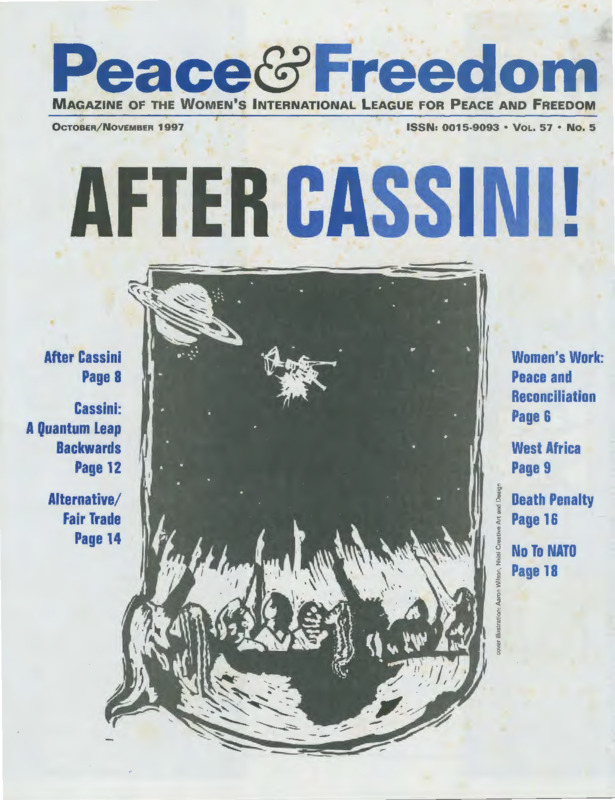
Peace&Freedom
MAGAZINE
OF THE WOMEN'S
OCTOBER/NOVEMBER
INTERNATIONAL
1997
LEAGUE FOR PEACE AND FREEDOM
• VoL. 57 • No. 5
ISSN: 0015-9093
■
AfterCassini
PageB
Women's
Work:
Peaceand
Reconciliation
Page6
Cassini:
A Quantum
Leap
Backwards
Page12
WestAfrica
Page9
C
O>
·;;;
Alternative/
FairTrade
Page14
Q)
Cl
"O
C
t"'
<t
Q)
DeathPenalty
Page16
>
~
~
0
·;;;
:;;,
z
c'
g
~
C
e
"'
<t
i::
..
0
J
:;;
>
0
'-'
-
NoToNATO
Page18
Editor:
Tobi White
EditorialIntern:
Sylvia T. Glover
Features
layout and Design:
J. Harding
6
EditorialAssistance:
Women'sWork:
Peaceand Reconciliation
.....................
Page6
AfterCassini.......................................
Page8
PublicationsCommittee:
.BettyBurkes, Kay Camp, Marilyn Clement,
WILPF- WestAfrica...........................
Page9
Louise Dunlap, Mary Ellen Guerrero-Clay,
•Anne Ivey, Adeya Richmond, Lisa Silverman,
and Tobi White
Let'sHearIt
For LaborUnionWork .....................
Page10
9
TheWomen'sInternational League for Peace and Freedom
{WILPF)
has beenworking since 1915 to unite women worldwidewhooppose oppression and exploitation. WILPF stands
Cassini:
A QuantumLeapBackwards............Page12
for equality of all people in a world free of racism, sexism and
the building of a constructive peace through
world disarmament; and the changing of government prioritiestQ meethuman needs.
Alternative/Fair
Trade .....................
Page14
National
Program:WILPF envisions a world free of violence,
poverty; pollution and domination - a genuine New World
Order of peace and justice. WILPF's program stands firm for
disarmament and against oppression. The 1997-2000 program
.~ has fourkey campaign areas: Disarmament; Ending U.S.
Intervention; Racial Justice; and Women•s Rights/Ending
Vtolence.Eachcampaign area focuses on local and national
effectiveness
in creating lasting social change.
DeathPenalty....................................
Page16
NoToNATO....................................
Page18
Departments
Reader'sForum .................................
Page4
12
~bia;
Wtl,.PFhassectk>nsin 42 countries, coordinated by an internationaloffice in Geneva. U.S. WILPF carries out its work
thr®gh grassroots organizing by WILPF branches, coordinatedby a national office in Philadelphia, PA WILPF supports the
work of the United Nations and has NGO (Non•~ntal
Organization) status. We invite all people who
. 'SUpportour goals to join us.
Sedion WILPF:1213 Race Street, Philadelphia, PA 19107;
UNReport ..........................................
Page5
Leadership/Outreach........................
Page6
ActionAlert.......................................
Page20
PeaceEducation ..............................
Page24
WILPFAction....................................
Page26
Resources..........................................
Page30
14
Celia Daldy
: (215) 563-7110; fax (215) 563-5527; e-mail: wilpf-
gc.apc.org
President: Betty Burkes
Executive Director: Marilyn Clement
UN Representative: Paula Tasso
: 'Jane
AddamsPeace Association UAPA): 777 United Nations
1 f'la,za,New York,
NY10017; phone: (212) 682-8830. JAPA is
Wll.PF's educational fund.
Executive Director: Karen Gellen
Administrator: Eurydice Kelley
h'iternational
WILPF:
1 rue de VarembE, 1211 Geneva 20,
, SWttterland;
phone: 41•22-733-6175;fax: 41-22-740-1063.
President: Edith Ballantyne
Secretary-General: Barbara Lochbihler
WILPF
UNLiaison Office: Pamella Saffer
and Freed<>mmagazine is published
6 times a year by
n's International League for Peace and Freedom
f), U.S. Section. Subscriptions: $12/yr.; free to WILPF
Submissions welcome, but queries suggested first
2 October November 199
Peace& Freedom
From the President's Desk
R
elationships are central to both the form and content of the work we do in WILPF. They either support or distract us from getting on with our aim of
preventing war and achieving a sustainable environment.
As this issue of Peace and Freedom was being produced, I was in London with JS other North Americans
attending the IEC (International Executive Committee)
Meeting.
The meeting opened in early August at the Quaker
International ·Center with 23 sections represented and 70
women in attendance. During the week many reports and
workshops were presented by standing committees and
staff, but the report from the Rainbow Committee was especially stimulating and informative.
The Rainbow Committee is International WILPF's
Change Maven equivalent, convened by Bruna Nota from
Canada, the head of the Rainbow Committee. Bruna
reviewed the Coru'mittee's mandate reminding us that conflict is fertile ground for creativity and energy. Presenting an
exercise on pblarities, we were invited to explore the differences between problems and polarities. Bruna explained
that unlike problems, which seek solutions, polarities, seeking inclusion, ~xist in relationship to each other. Like inhaling and exhaling', one can not exist without the other.
We constructed a quadrant and brainstormed some negative and positive qualities associated with authoritative and
democratic leadership styles. Using this 'thinking tool' for
evaluating our.organizational structures and relationships,
we recognized that our positives on both sides of the quadrant were complementary and could easily be integrated
while the negatives reflected our fears and reinforced isolation and non-cooperation.
The polarity analysis model takes away blame, guilt and
accusation. It acknowledges and honors differences, building
trust in the process of reviewing current WILPF structures
and relations.
The following day, we heard from a diverse and dynamic
panel of Black women speaking about the practices of
racism and the threats to Peace in Europe.
Mukami McCrum, born and educated in Kenya, works as
a sociologist and is Director of Central Scotland Racial
Equality Council. Patricia Johnson, a probation officer, prepares briefs for trials and works with young offenders.
Eugenie Quenum has lived in France for 27 years but comes
If
,
Peace & Freedom
,
from Benin. She is a biologist doing research on the health
of rural populations in less developed countries. Josephine
Ocloo is a lecturer in Social Work at the University of North
London.
A brilliant workshop on Racism, led by Deidre Leaske,
U.K. WILPF and our own Mary Zepernick, followed the
panel which resulted in a self appointed committee to sift
through the ideas and issues generated from _thepanel and
workshop.
Proposals and recommendations have been presented to
the IEC and we can expect the discourse on race and
racism to continue at the 1998 International Congress in
Baltimore.
Most women at the IEC welcome the opportunity to
deepen our analysis of globalization, security and disarma-
Betty J.Burkes
U.S. Section President
ment by also deepening our understanding of the relationship between those issues and racism in WILPF.
Today with candles and song we assembled to remember
Hiroshima. We spoke of peace knowing that even now Japan
is seeking to rearm and the United States prepares to send
plutonium into space. ( see Cassini article inside)
We were 70 women, speaking 10 different languages,
related in our insistence on peace and our commitment to
sustaining WILPF.
The women of Japan and the U.S. embraced and through
our tears we smiled, remembering the words of Katie
Cannon.
This work is difficult, daily labor. It is unglamorous, incremental, unsensational, and often invisible. It demands vigilance and courage and it must be lubricated by humor. In
this spirit, the IEC in London joined in generous cooperation and thoughtful collaboration to reaffirm WILPF's aim to
confront problems of the 21st century, the color line, class
and gender. ■
October/November
1997 3
the Editor
..n a year of great change
';.allhave seen the gradual
. n.with each issue. Over •t
Reader's Forum
•vedboth
positive and negativ~
f •constructive - of P&F. I have all i
+fating those suggestions into my plan
+
issues.
••••
: Peaceand Freedomhas also suffered major pt
ti()n problems throughout the year, hence the late
ery ·datesto your homes. I apologize for thosej'
and hope to work those kinks out for future is
Thanks to everyone for their patience, understa
ahd support throughout the year!
..
.
,...
i
Dear Editor,
I would just like to congratulate you
on the new Peace and Freedom it
seems to get better with every issue.
The lay out and design are really
good as well as the articles. I especially took a lot of interest in an article that appeared in the June/July
issue called "The Genocidal Impact
of Executive, Legislative and Judicial
Decision- Making" by Nkechi Taifa. I
would like to see more articles written by Ms. Taifa and on the topic of
systemic genocide as well.
Keep up the good work!
Peace and Freedom Copy Due Dates for 1998!
Dear Editor,
I have an addendum to "The
Myth of Social Security's Imminent
Collapse," which appeared in the
Jan./Feb. 1997 issue of Peace and
Freedom. Frances Perkins, Secretary
of Labor under Roosevelt, was the
architect of Social Security. The
Department of Labor office building
is named after her.
Vivian Schatz
Philadelphia, PA
Editor's Note: There was a typographical error in that article. Social
Security was signed into law in 1935
not 1953.
1997
..
I
r
WILPFer
4 October/November
,mture
l
r
We welcome your articles, book reviews, Op.Ed's,'.;
and notices. Submissions will be used based on availability of space,topic relevancy to WILPF program and
current issue focus and timeliness. Feel free to call
before submitting material.
t
Issue Due Date
January/February
March/ April
May/June
July/ August
September/October
November/December
1998
1998
1998
1998
1998
1998
.....................
.....................
.....................
.....................
.....................
.....................
November 15, 1997
January 15, 1998
March 15, 1998
May 15, 1998
July 15, 1998
September 15, 1998
Letters to the editor are welcome.
Letters should be under 300 words.
Peace and Freedom reserves the right
to choose and edit letters.
Peace & Freedom
T
wo major issues this day face all of us who care about
internationalism.
First, about the nuclearization of outer
space. This October, NASA is planning a launch from
Cape Canaveral of a space probe with 72.3 pounds of deadly
plutonium aboard. The probe is called the "Cassini," and it will
use the plutonium to power its electrical instruments during its
voyage to explore the plant Saturn. The plutonium is so toxic
that less than one-millionth of a gram, an invisible particle is a
carcinogenic dose. One pound, if uniformly distributed, could
hypothetically induce lung cancer in every person on earth.
If all goes according to plan, the space probe will swing
around Venus, shoot past the earth. and then speed to Saturn to
explore the planet. If there is a mishap, either on takeoff or
when Cassini hurtles past earth, and it
One pound, if uniformly explodes or disintegrates, plutonium could
distributed, could hypothetically be scattered over much of the globe. This
is a complicated voyage with many opporinduce lung cancer in every tunities for problems. And it is quite posperson on earth. sible to change the plutonium for solar
energy. NASA's experts say there is little
chance of disaster, but physicist Michio Kaku says that this figure borders on scientific dishonesty. The real chance of a failure, based on past accidents of launches of similar rockets,
Kaku says is 1 in 20.
But most problematic of all is that the Cassini mission could
be just the tip of the iceberg bringing additional nuclearization
and militarization of space. What a horrendous prospect!!
U.N. Report
by Paula Tasso,
UN Representative
And regarding our only hope - the consensus of nation-states
at the United Nations - the Helms-Biden Bill is disastrous. The
New York Times called it "assisted suicide for the United
Nations." But nonetheless this anti-UN bill must be taken seriously. Senator Helms, the great American patriot, based on his
years of service in the Senate, and his endless fight against
internationalism,
has spoken on what the United States should
pay the United Nations. Very little, it turns out, only part of the
US debt, and with many conditions - unilateral.
It is important that we oppose this bill. Senator Helms has
very little understanding of what is going on this country.
Or this world. ■
Peace & Freedom
October/November
1997 5
Membership
by Chris Morin, Leadership/Outreach
Coordinator
As I write my first columnfor Peace&
Freedom,I want to tell you how excitedI am
to be the Leadership/Outreach
Coordinator.I bringwith me
experienceof working on
the local and regionallevel
and haveservedon the
NationalBoard,but I am
anticipatingcontinueddialoguewith eachof you, so
that our joint concerns,ideas,and
visionswill enhancemembership.
I havemet manyof you at nationalcongresses,regionalmeetingsand branchprogramsand I continueto be inspiredby so
manywild WILPFwomen,who are the heart
and soul of our organization.
The membersof WILPFhavegot to be
someof the most dynamic,passionateand
persistentpeople on this earth. As I continue
to travelto the regionsto meetwith mem-
bersof WILPF,I look forwardwith great
expectationsto exchangingideaswith you
about how we can makeour organization
grow.
WILPFis in the midstof change.We are
reevaluatingour organizationand lookingat
how we can be more effectivein building
communitywithin our branchesand doing
our politicalwork. Everyonelooksat change
differently. It can be scaryor excitingor
both. Forme, changebringsnew energyto
the planningtable and the chanceto grow
personallyby beingopen to new perspectives.
Thisfall, FelicityHill, an Australianintern
from our internationaloffice in Geneva,is
touringcampusesaroundthe United States.
Shewill be speakingabout WILPFand what
avenuesyoung peoplecan taketo pursue
their activism.It hasbeenan excitingundertakingin planningthe itineraryand hearing
from the campusesall over the country. This
youngwoman speakingto young women,is
a greatsignof hope that the torch will be
passedto the next generationwho will work
for and demanda just society.
Therehavebeenmanydiscussions
amongst
membersand brancheson "where are the
young peoplein our organization?"The contactsfrom Felicity'stout isan opportunitythat
we do not want to miss. We have great
expectationsthat many young women will
becomemembersof WILPF,duringand after
Felicity'stour. As they join us, via national
office or local branches,we will be welcoming them to our planning and discussion
tables.As moreand moreyoungwomenjoin
our ranks,new ideaswill meetthe old. It will
be a wonderful intergenerationalexchange.
Both old and new honoring the passionin
each other while working for justice. The
young honoring the old -their experience,
their activism,their persistenceto not giveup
the fight. Theold honoringthe young- their
energy,their enthusiasm,their yearning to
know more.
Thisis a very excitingtime for WILPFwith
two generationsjoining eachother. We can
get strongerby listeningto eachother and
acceptingthat everyonehassomethingto
offer.Thiscan fuel our passionand make
our work more effective.■
Women's Work: Peace and Reconciliation
Eighth Congress of Vietnam Women's Union - May 1997
J'Women
active in study, creative in labor, good
at bringing up their children and building
happy families" was the theme of the Eighth
National Congress where nearly one thousand Vietnamese
women gathered in Hanoi on May 19, 20 - to launch the
nationwide women's movement for the next five years. With
this effort they consciously and soberly will attempt to counteract the negative impacts of the market economy, which
they view as "having inhibited the advancement of women
and the development of our movement."
This was truly a grassroots affair. Thirty-nine international
delegates represented women's organizations from all continents - representatives of governmental and non-governmental organizations - were chosen "because they reflected
the solidarity and integration of actions" within the Vietnam
Women's Union (VWU). It was truly a joy to be there to represent the Women's International League for Peace and
Freedom, based in Geneva.
The occasion was also enhanced by the fact that all
over Vietnam, the people were celebrating the 107th
6 October/November
1997
birthday of the late President Ho Chi Minh. The
Vietnamese women paid tribute to him - who had laid the
foundation for the viewpoint that considers women's
emancipation and children's well being as priority objectives of Vietnam's revolution.
The Work of the Congress
President Troung My Hao called for the delegates to
share concerns and activities, which related to the equality
and development of women. It was evident that the
Women's Union was implementing the Development
Strategy for the Advancement of Women to the year 2000
with its goals of actions for equality, development and
peace. Vietnam had sent over one hundred delegates to
Beijing. After enduring long isolation from the international
scene, they cherished active participation. They announced
lofty goals for the next five years and set out guidelines for
five task forces to assess objectively and comprehensively
several
implement them. The goals came into being
years of assessment and dialogue with the grassroots.
?"
Peace & Freedom
They pledged:
To forge broad solidarity and encourage women of all
strata to tap all potentials, creativity and fine qualities of the
Vietnamese Women;
1' to continue improving tn~,miW)l
and raising the all aro
'' to effect
1'
t·
'
personnel into an
fectively play its
int. It has b
ernment in
eir .obsession witfl.'TJl~""
Arr(bassador of the q,.s. I •
of American soldiers were at
..
Vietnam is
economyvalues t
workin
with concerns about the
en's Union are intentionally
·th the new challenges of
ng legacy of involve
t. The determinarn of WILPF and Quaker wnttn+•n
ship. We refused to 'see' an enemy ir{ the'~~
wept with them in anguish over the
. We went to Vietnam in spite of the
at war. Dorothy Steffens and Marii Hasegawa, with an
international delegation, visited American prisoners of
war in 1972. Other trips followed.
In 1980, when a troubled and tenuous peace still persisted, a delegation of WILPF and Women's Strike for
Peace, which I led, renewed that pledge. Numerous gathhave been held that brought the Indo-Chinese and
·an sisters together. In 1983 at the WILPF
eld in Goteborg, Sweden, eleven women
their hearts to each other in relating their
ersonal stories at a special Peace Institute.
dochina was being challenged and overthe only country that would allow the
ambodian, Vietnamese and Lao
y are part of the ASEAN Women's
Conference. We h
years. WILPF and th
nion have consolidated this relationship into a strong, firming and enduring presence.
How did it happen?
is because of WILPF's long time
concept of peace. Emil Greene Balch, Nobel Prize winner and noted WILPFe
ur patient faces, little children
ould we not love you?
tience and understanding to
barriers caused by the great
ola
selves. We are also believers in
wor
1
ene that "secur
not in armaments, but in just
tice" and that "we ne
leader to define for us an
enemy" - Jane Adda
open arms. I shall never forget the
ation - we were bombing Vietnam en and the Women's Union embraced
w
-----,11111.Jl'.._
....
••
could we not love these sisters! Such
peace movement in the USA.
sition into a new and exciting historical
is coming, the U.S. government is still
ll have work to do with the Vietnamese
er struggling peoples of the world - to be
the perils of the "free market" and that uncontrollable force unleashed in our and their exploitation the pursuit of mindless heartless corporate profits. But let
us close this chapter with joy and peace and a sense of
accomplishment in these days when the pursuit of things
peaceful seems so elusive. ■
Ruth Cadwallader is the Chair of WILPF'sAsia Pacific
rec
Committee.
Peace & Freedom
October/November 1997 7
After Cassini
W
hen this issue went to press, we were not sure
what will have happened with the Cassini Space
Probe. Cassini may have been cancelled. If so,
that is a great victory for the movement of people who
learned about it and built a massive opposition - despite every
effort of the nuclear and space industries to keep it from the
public. Cassini may have blasted into orbit. If so, the people
of earth are expecting a Second Coming - a dangerous missile crashing toward earth at 42,000 miles per hour two years
from now. Cassini may have been delayed again. The Titan IV
missile is so unstable that it could have developed a leakage
problem again. Or it could have exploded on the launch pad
yet another time - possibly radiating all of Florida and eventually the world. Order Jay Gould's book The Enemy Within
about low-level radiation from our resources department to
get clear about the links to cancer and other dangers.
Whatever the outcome of this particular plutonium launch
the end is not in sight. The nuclear and space industries
intend to continue shooting nuclear powered explorations
into orbit, a plan that will bolster industries and continue to
endanger everyone on earth. And we intend to stop them.
After we put the Cassini ad in the New York Times on
Monday, September 8, it was an amazing month at WILPF
national headquarters. We want to say thank you to all who
have made extraordinary efforts to publicize and oppose the
Cassini Space Probe. The opposition has become massive
even though the ordinary Josephine on the street may still
say, "What is it?" when you mention "Cassini." We want to say
thank you to the whistle-blower inside NASA who gave us the
information on Cassini, also the NASA employee who went to
an anti-Cassini demonstration. These are true patriots. And
we need to thank the people who opened up the discussion
on cyberspace which made it possible for people to find out
about this in spite of the virtually total media block-out.
Thankfully there is still a place where ordinary people can
pass along information.
This was probably the most important hidden issue this
year simply crying out for a breakthrough in the press. The
big bucks media had done nothing, even though we knew the
story was on their desks - until our ad came out in the mostread space in the New York Times, the op-ed page, where
usually we could not get space in a timely fashion even of we
could afford it. (An ad had been cancelled, and they called us
to see if we wanted it - three days in advance).
We are still hustling to raise the rest of the money to pay
for the ad, but the results have far surpassed our hopes. Of
8 October/November
1997
course, our primary hope was to stop Cassini and ultimately
to stop the nuclear industry from building.a military/nuclear
presence in space, thereby setting the stage for nuclear wars
in space in the next century - and, not coincidentally, continuing to line their own pockets.
As a result of our ad, all kinds of media began to cover the
story including the New York Times itself, TIME magazine,
60 MINUTES, FOX News, and dozens of lesser media who
have contacted us. Sadly, it proves once again that those who
pay for media get it. We heard from hundreds of people who
saw the ad and called us for more information. Many
strangers sent money and also sent telegrams to President
Clinton. We have already reached 1,000 WILPF telegrams, ad
we are told that Cassini is the #l issue in terms of current
mail to the White House.
The Florida Coalition for Peace and Justice, the Lawyer's
Committee for Nuclear Policy, the Fund for New Priorities,
Abolition 2000, Physicians for Social Responsibility, Love
Earth and hundreds of WILPF branches and other organizations have been working on this issue for many months.
Helen Caldicott and Michio Kaku and many other scientists
have sounded the alarm and organized tirelessly. All of the
above and many, many more deserve credit for any successes
against Cassini. Please forgive all the omissions, because I
know the impact of this organizing would have been impossible without you.
We have had speakers at all the major national and local
demonstrations. Former president of WILPF, Mary Zepernick,
is speaking on the issue at MIT, and we have been invited to
join a Cassini delegation of scientists and moral leaders organized by the War and Peace Foundation to meet with
President Bill Clinton. We have heard that he has ordered his
Science Advisor to take another look at Cassini. I hope he will
read the absolutely chilling environmental impact statement
that came out of NASA outlining the dangers at every stage.
If you want to know more about Cassini, please do get a
copy of Karl Grossman's book, The Wrong Stuff. Also, at the
WILPF office, you can rent the video made by Joan Flynn,
one of our members fre>mLong Island, which exposes the
plan for "Nukes in Space." Also, read The Fifth Sacred Thing
by Starhawk, a novel about life without nukes.
Even after Cassini, whatever that means, the movement
that has begun to build around this issue is a sign of hope for
the future. The importance of our work on this issue will continue to expand because the nuclear industry is bound and
determined to continue their profitable business. On the
other hand, we are bound and determined to continue life on
earth - life without nukes of any kind.
Marilyn Clement, Executive Director
Peace & Freedom
WILPF - West Africa
by _Regina_
Birch em
so happy! The network is
working. We will keep the fire
for peace going in our country."
These are the words of Nanette
Thomas of WILPF West Africa as she
met women in Maputo, Mozambique,
at a land mine conference (WILPF
member Liz Bernstein, Coordinator).
Members of the Dutch WILPF section
came to the airport to meet her and
give her support as she passed
through on her journey from West
Africa to soutpern Africa.
" lam
WILPF Sierra Leone will be officially recognized as a new section at
the 1998 Congress in Baltimore. In
the fall 1997, Sierra Leone is a country now devastated by yet another
military coup.
The story of the women's peace
movement in West Africa and the
WILPF history there is a multifaceted story as complex, painful and
surprising as Africa itself.
WILPF Sierra Leone got its start
with the work of the Women's Peace
Movement, a long-established coalition of women working for the participation of the civil society in decision-making and for the laying down
of weapons throughout the country.
Two of the members went daily to
the Peace Tent in Beijing at the 1995
UN Fourth World Conference on
Women and there met Edith
Ballantyne and other WILPF members.
This space provided a meeting
point for women around the world to
meet and learn what is happening in
countries such as Sierra Leone about
which many of us know so little.
At the time of the Beijing confer-
Peace & Freedom
ence, a brutal war was raging in the
Sierra Leone countryside. There were
camps of thousands of refugees and
the capital city Freetown swelled to
five times its normal size because of
war, torture and destruction in the
countryside. Amazingly, even while
the rebel war continued, the peace
movement succeeded in achieving
civil elections with full participation
of the people in February 1996.
By November 1996 a Peace Accord
was signed between the civilian government and the Revolutionary
United Front. The people were jubilant.
The new WILPF Sierra Leone
began immediately to plan a resource
center for women for recovery from
the trauma of the war, for training in
conflict resolution and to begin work
on economic empowerment.
Through the WILPF Geneva office
in 1996-97, members were enabled to
participate in two pan-African conferences on land mines, a post-Beijing
conference in Rwanda, and to participate in the spring 1997 WILPF
human rights training in Geneva. A
Nanette Thomas at the
market with friends.
WILPF Sierra Leone office was opened in the Freetown YWCA.
Tragedy. Not all in the army were
happy about the 1996 Peace Accord.
The prospects of demobilization of
troops and an effort to halt the pirating of diamonds and minerals did not
please everyone.
On May 25, 1997, a military coup
ousted the civilian elected officials,
terrorized the population and sent
most of the WILPF members fleeing
to neighboring countries, to the U.S.
or to Britain.
Along with the problems of open
conflict are of course, all the accompaniments of war and conflict: the
mobilization of children to fight, the
lack of food, the migration of people
to areas of relative safety, the random
looting of homes, the destruction of
the environment, the flourishing of
opportunists who pillage the natural
resources for profit. Especially targeted are those who worked for democracy and a peaceful settlement.
October/November
1997 9
The Washington Office on Africa held an Advocacy Day
for Sierra Leone on September 18. Sierra Leonean nationals and friends researched the issues and lobbied the
Justice Department and members of Congress regarding
the situation to try to enlist all possible support for a
peaceful resolution of the conflict. WILPF is not new to
Africa or Sierra Leone. Members of the British section
(e.g. Ruth Osborn) and Edith Ballantyne know much
about the unrecorded history which I am gradually documenting. Today women in Egypt, Somalia, South Africa,
Zimbabwe, Ghana and elsewhere are members of WILPF
or have contacted the Geneva office to ask that we work
with them on our areas of expertise: peace education,
conflict resolution, human rights, and strengthening
women's networks.
Do you want to know more, invite a speaker, or support this work? Contact Regina Birchem, International
Vice President - WILPF, RD 1, Box 134, Irwin, PA
15642; Tel/fax ( 412) 446-3157; e-mail:
<:birchem@igc.apc.org>
Let's Hear It
For Labor Union Work!
by Kathleen Kelley
........................................
W
ho is Ellen Friedman? I met her several years
ago in Montpelier, Vermont. Since then our
paths have crossed many times because Ellen
is not only a union organizer, she is politically active in
local, national and international people issues. She is a
member of WILPF and is co-chair of the Vermont Labor
Party.
Ellen, who is a labor organizer for the Vermont
Education Association (part of National Education
Association), said her four immigrant Jewish grandparents were working class and lived in poverty. As she grew
up she experienced more comfortable circumstances and
went to college. She had not been a teacher but right out
of college she beqame a community organizer of lowincome people. After that she worked for U.E. (Unite
Electrical Workers) and then AFSCME and has now been
with VEA for 11 to 12 years. Ellen said, that early on, as
she studied political theory including the works of Karl
Marx, she learned that it had always been, and will be,
the organized work of working people in any country that
10 October/November
1997
moves things forward on behalf of everybody. The basic
interest that people have for security, ·healthy environment for themselves and their children, the right to education, and the opportunity to participate in their culture
are freedoms that often working people do not get much
help from courts. "My conviction has always been that
this is where I belong. I have always been involved in progressive politics."
(Q) What has changed, from the beginning in the U.S.
when young people were working long hours and were
under paid and women were being paid less than
men? Are things improving?
(A) Definitely! There have been improvements. The
eight-hour workday, the end of child
labor, Social Security, and the right to unionize took
decades to get. These are all because of the struggle of
workers that was also transformed into political expression. People were blacklisted, murdered, jailed while
fighting for these improvements. Danger, fear, oppression
and exploitation were a big part of people's lives. Having
said that, I must say that, for example, in the last 20 or
30 years we have returned to illegal sweatshops in this
country, people are being paid below minimum wage,
have no access to overtime pay or health and safety protection. There is discrimination against people who have
migrated to this country, against Black youth and no
opportunity for daycare. One of the biggest problems for
U.S. workers is the absence of job security. The drive by
corporations to maximize profits has meant cutting the
work force: downsizing, privatizing, outsourcing, etc.
There is no guarantee for a livable wage.
(Q) Who benefits from labor unions?
(A)Teachers have been organized for the last 20 to 30
years. Kitchen staff, custodians, para-professionals are all
in the VEA. All in one union. Two million are teachers
and one thousand are school support staff. It is the
largest union in the world.
Unions Make A Difference! In public education where
one school is organized and the other is not, twenty
years down the road, the organized school will have higher wages, better benefits and more job security because
employers are required to bargain every year. And the
interesting thing is, the non-union teachers will be doing
better and management will give them more because
they do not want them to organize.
The average starting salary, just out of college, is
$20,000. The standard is set by prevailing wage. It is
only when organized workers get together and fight for
Peace & Freedom
wages, benefits, hours, etc. and there has not been
enough pay to make people better off. There is no organizing. One good thing to come out of it was that labor
leaders and progressives rallied against it and when
President Clinton pushed NAFTA through Congress, the
labor leaders called it a betrayal.
Mexico City has just elected a Socialist mayor, there
has been a change of political focus in Canada with cutbacks and a tremendous fight back by labor across the
continent. Let's join hands, let's build bridges between
working people from one country to the next and get to
a common standard of living for all working people so we
can reclaim our human dignity.
Job creation is incredibly important and governments
should create jobs. This is a moment when there are
such hyper profits, greater than any time in history, in
the salaries of CEO's. It will not make CEO's suffer if
there is an increase in the wages of the workers. There is
plenty of money being made so that there can be an
increase in jobs and workers can be paid more.
mo
(
th
Sob
reform
bit of telie
to
•
prof
. Manufacturing
will a
are Jess to produce the
item. At ·
•••
• t moving manufacturing from •
•use workersin Boston
were paid more. en workers unionized in shoe and
clothing factories and they were moved south. Then on
to other co
get paid
even Jess
ave not
broughtOU
, with DO
healtlaoare
.
f>eople
an und
ing of what
boycotts
place, agai
wherethere
in
( Q) What can we do?
(A) Build the Labor Party. Join and be active in
Women's International League for Peace and Freedom.
Participate in the anti-APEC movement. Give money, go
to the meetings and work with the organizations. Make
links between the local boycotts and conditions and
national and international situations. Join the boycotts!
Join picket lines. Send letters. Get petitions signed and
mail them. Bridges can be built between one area and
the next (local, national and international). For instance,
when Ellen was 14 or 15 years old, living in the eastern
U.S., she heard and read about the United Farm Workers
in the western U.S., and their boycott of grapes. She and
her family participated week after week by boycotting the
local market. The workers were finally recognized.
Women are more representative in the labor movement
than previously, and are becoming leaders. Unionize, join
your union and be active. ■
Kathleen Kelley is the chair for WILPF's Labor
Committee. The above was excerpted from an interview of Ellen David Friedman by Kathleen Kelley which
was videotaped by Esther Farnsworth and was aired
on August 6 and 7 on "Down By the Riverside," Public
Access TV in Vermont, produced by Linda Lehman and
Esther. All are members of Central Vermont WILPF.
exploitation easier to move jobs to Mexico where standards are low:
Peace& Freedom
October/November 1997 11
Cassini- A Quantum Leap
Backwards
by Felicity Hill
..............................
T
he campaign to CANCEL CASSIN! is growing
thanks to the energetic response from WILPF
and other groups working in coalition to ensure
this $ 2. 7 billion Lockheed Martin Titan IV rocket, off to
explore the moons of Saturn with 72 pounds of plutonium on board, never leaves the ground.
Information packs sent to all WILPF branches,
explain that Cassini is not going directly to Saturn but
will do a "fly-by" maneuver. In August 1999, after flying
around Venus it will fly back to earth to literally gain
momentum for the journey to Saturn by bouncing off
earth's gravity. The track record of the Titan IV rocket
is not good; in 1993 a Titan IV blew up soon after take
off, taking a 1 billion dollar spy satellite with it! Taking
into consideration the millions of space miles the probe
will have already done, people are legitimately concerned that any mishaps in the fly-by will mean the
release of vapor and small particles of plutonium. Since
1961, twenty-four nuclear laden missions have resulted
in 3 accidents (that's odds of 8:1). According to NASA's
own Environmental Impact Statement, "If inadvertent
reentry occurred during the flyby, approximately 5 billion of the 7-8 billion on earth could receive 99% of the
radioactive exposure."
Why has the Cassini story been voted as one of the 10
most under-reported stories? Because Cassini is not just
about innocent scientific curiosity; military and corporate
interests are involved and are afraid that public outcry
will reveal and spoil their crazy plans, and for once
they're right! The campaigns in Europe, the U.S. and elsewhere have captured the attention of people all over the
world, including the media ~d political forums. With
such a short time left to defeat Cassini - we must redouble
our efforts. We can CANCEL CASSIN!!
U.S. Military Outpost: Space
Just as the taboo against nuclear weapons is building
to an all-time high, just as the nuclear industry is conceding that nuclear power is not clean, cheap or safe,
another nuclear nightmare descends - nuclear powered
generators for use in space. As with all nuclear games,
this one is also about power and dominance. It stars the
12 October/November 1997
Peace & Freedom
"If inadvertent reentry occurred during the flyby, approximately 5 billion of the 7-8 billion
on earth could receive 99% of the radioactive exposure."
same cowboy actors - the nuclear corporations and the
laboratories at Los Alamos, Savannah River and Oak
Ridge -just a different frontier, space. Cassini is the tip
of an ugly iceberg, or is it the Titanic of the 90's?
Believe it or not, between now and 2009 NASA plans
to launch many more plutonium missions including 2
nuclear reactors for mining colonies on Mars. In news
that won't surprise many WILPFers, the Aviation Week
and Science Technology (June 23, 1997) stated that an
agreement between the U.S. Department of Defense and
NASA could be reached soon on the use of the Space
Shuttle to launch an average of one military pay load
per year. The renewed interest in space weapons technology is connected to the Department of Defense's latest weapons research which involves manipulation of
the ionosphere for communication, surveillance and
possible use of the electricity available in the ionosphere as a weapon. The HAARP Project (High
Frequency Active Auroral Research Program) will be the
subject of future Peace and Freedom articles and
WILPF activity, but it is part of the military interest in
space right now, of which Cassini is just a part.
The U.S. Space Command document, "Vision for
2020" reads like a trashy science fiction novel, "Space
forces will emerge to protect military and commercial
interests and investment in the space medium; there
will be a critical need to control space to ensure U.S.
dominance ... robust capabilities to ensure space superiority must be developed." These intentions are illegal
under the 1967 Outer Space Treaty, which states that
"the moon and all other celestial bodies were to be free
for exploration and use by all states and that international law and the UN Charter would apply." The Treaty
goes on to state that the launching state is liable for
damages to persons or property of another state resulting from its space activities.
Peace& Freedom
Alternatives
The purpose of 99% of the plutonium on board is to
provide 745 watts (a small amount) to power science
experiments. It is not fuel or propulsion, it is a heat
source to create electrical power. NASA puts the plutonium into separate units called Graphite Impact Shells
(GIS), and these units are placed in pairs into 54 units
called GPHS's (General Purpose Heat Sources), eighteen of these are packed into each of the three
Radioactive Thermonuclear Generators (RTG's) on
board Cassini.
European Space Agency physicist Carla Signorini
stated early this year that ESA could develop panels in
5 years if they had the financial resources.
On Monday, June 23, 1997, Dr. Gerhard Strobl stated
on German television that his company, Angewandte
Solarenergie, has developed high-efficiency cells for the
European Space Agency that could be used to power
the Cassini mission. There are alternatives, they don't
use them because the nuclear menace has become so
deeply embedded in the structures of power.
I think that the helplessness and despair felt by my
generation due to living under the nuclear shadow has
affected us more than is documented or explored.
Rather than Generation X, I think it would be more
accurate to call us Generation X-Ray. Whatever generation you come from, wherever you are on planet earth,
the thing to do about Cassini is ... ■
Felicity Hill is an international activist from
Australia who was International WILPF's
Disarmament Intern last year. Felicity is currently
touring the U.S. to university campuses and WILPF
branches speaking on disarmament, anti-racism, feminist theory and other WILPF issues. Call the national
office to find out when she will be in your area.
October/November 1997 13
'~:-
i •••
--~:---
«'
~
,
~
.- . ___
:~
"
.,_
.,
~
;~r~
·-~
?:~
✓~
'~
...
••
-~
. ...
(,
,:,
~li=·=~·-
,,·-~·
-✓
-~
~"
Alternative/Fair Trade:
The Effects on Women in
Producer Communities
by Lisa Silverman
•••••••••••••••••••••••••••••••••••••
I
n the search for a more just way to live in this world, I
have discovered the "fair trade," or also referred to as
"alternative trade," philosophy. Fair trade systems
guarantee paying the producers of crafts and agricultural
products a minimum price for their goods. This ensures
sustainability for their operations. Fair trade is focused on
the workers in developing countries as well as on indigenous people in industrialized nations.
Historically, producers in developing countries have
been taken advantage of in the unfair world 1 trading systems and structures. Many developing countries rely on
exporting raw materials to industrialized nations which
earn less profit than 'the finished products. Fair trade raises the value of raw materials, such as coffee, generally
without adding on additional cost to the consumer. One
way that fair trade does this is by cutting out the "middlemen" who have traditionally received a large profit for
introducing the goods into the market. Since many producers are isolated from world markets and have traditionally not had other options, the middlemen take advantage
of this and pay low prices to the original producers.
In the fair trade market, the goods are marketed
through alternative trade organizations (ATO's). These
international fair trade organizations focus on developing
international trading partnerships based on principles
established in cooperation with producers' representatives. These principles ensure that customers receive a
high quality product and producers receive a fair payment. Other major cultural and economic factors are
taken into account in the processing of the goods. ATO's
are nonprofit organizations and responsible businesses
that provide more services than just marketing products.
The ATO's often offer technical assistance, interest-free or
low-interest loans, and product development advice, as
well as a long-term commitment to purchase products.
The ATO's buy from and provide services to cooperatives,
individual farmers and craftspeople/artists, refugees, persons with disabilities, widows, and small businesses. ATO's
also provide services to consumers by offering high quality, reasonably priced goods while educating consumers
14 October/November 1997
Peace & Freedom
about producers' unjust economic and social conditions.
Fair trade organizations also promote environmentally
sound business practices. ATO's often provide assistance
for training on organic farming and help groups receive
international organic certification. Many cooperatives
have initiated programs to reforest land and to use existing resources in creative ways that do not harm the land,
water or air.
Cultures are preserved as well by fair trade. In addition
to educating consumers about where the products they
buy come from, the artisans are able to sell, for example,
the fabric that their ancestors have taught them how to
make, sometimes with modifications. I recently purchased
a hotpad from Guatemala made out of traditional
Guatemalan woven fabric, in the shape of a chicken. This
is a nontraditional product but is something marketable.
By retaining traditional weaving, but applying the craft to
buyers' interest, people can earn a living while keeping
their traditions alive.
Democratic decision making is also part of the fair
trade ideal. Many producers organize themselves into
cooperatives and associations and the group as a whole
makes the decisions that affect their businesses. The
groups of producers decide how they want to use their
profits in order to develop their communities, provide
education, health, and housing.
Alternative trade organizations provide both economic
development and social development services to women.
One important factor for both urban and rural women is
that they are able to earn an income by selling their
goods through ATO's. Since much of the poverty around
the world is with female-headed households, fair trade can
help women change their living situations.
Another important factor is that women are able to
hold a job that is compatible with their family responsibilities. Women are able to work at home while taking care
of their families.
A third factor that is especially important for rural
women is the social support network women develop
when they work on a project with other women. In many
cultures around the world, peasant and working class
women face a traditional homosocial society, where men
only interact with men and women only with women.
Women spend their time working in their homes doing
chores and taking care of the family while men spend
much of their time earning money. Women feel isolated
from other women when they work all day inside their
homes. Also, their interest and understanding of the
issues facing them is from the perspective of their imme-
Peace& Freedom
diate family's problems and needs. With the help of
ATO's, women are able to develop business ventures with
other women in their communities. The women then have
a network of other women involved in the business on
whom they can rely for support. The social support
women receive from each other helps to break down their
sense of isolation, especially in rural areas. Women who
live in remote areas and who are part of an organized
group with a purpose, such as making fruit jam, are generally more optimistic about their families' futures and are
more confident in their own abilities.
Because rural women generally have few opportunities to advance their education or economic situations,
these are the women who I have found to benefit most
from working with a group of other women. Fair trade
has given them some hope and new skills to develop
more fully.
Women are given the opportunity to make decisions,
something they have limited abilities to do in homosocial
societies. By becoming involved in the fair trade projects,
women are able to achieve better living conditions
through learning new skills and earning an income. Their
self-esteem rises dramatically when these two conditions
exist. Additionally, they begin to understand issues in the
context of the larger community and frequently see potential solutions to aid with these.
As women become more confident, learn new skills
and earn an income, they may eventually be accepted
by the men in their communities as equals in the workplace and as capable leaders. This acceptance will need
to happen gradually over time, and ATO's can help facilitate this process.
We can support women internationally and the alternative trade marketplace by using our purchasing power to
buy goods through ATO's and through local cooperatives.
The fair trade movement is quickly growing in the United
States and a new Consumers Guide to Buying Fairly
Sourced Products is now available from the Fair Trade
Federation. To order a guide, call 1-800-688-5186.
Lisa Silverman has a B.A. in International Relations
and an M.A. in Public Admjnistration and Nonprofit
Organization Management. She conducted research in
Costa Rica in 1995 where she interviewed women artists
and farmers who sell their products through fair trade
markets. ■
Lisa Silverman is a member of the Minnesota WILPF
branch and is involved with the Young Women's
Caucus. Her e-mail address is LisaJoSilv@aol.com
October/November 1997 15
...
..
Death Penalty
by Lynn Furay
..............................
JJstop
Killing Kids.. .Ileal Their Wounds!" was the
theme for the 17th annual conference of the
National Coalition to Abolish the Death Penalty,
WILPF is a national affiliate. The Conference was held on
the campus of the University of Houston, June 20-22. Most
states were represented, including other states and several
countries which do not have the death penalty, but who do
have abolitionist groups.
Steve Hawkins, Executive Director of NCADP, stated that
the theme "Stop Killing Kids" is a strategy that can win.
People don't want to be guilty of sending kids to death.
"Kids" meaning under 18 years old when they were convicted. Texas alone has 25 on death row.
Another aspect of conviction we can eliminate involves
people who are mentally ill or mentally retarded. Far too
many death row inmates suffer from mental illness or mental retardation, a fact not often considered during their trial.
In the July 15 Houston Chronicle, an article reported that a
brain damaged man escaped the death penalty when his
defense asked that he be spared because of his head injury.
Even though the jury was 8-4 for the death penalty they
were unable to get the needed majority and the man
received 40 years. Hopefully this is the beginning of sensitivity on the part of juries and the defense toward mental
health.
Last fall I stood at a vigil in Huntsville, TX during an execution. Next to me stood a man who knew the family of the
man being executed. He said that the man did not know
what was happening. He thought that he was coming back
as King David.
In a workshop called "Building Alliances with Policy
Makers," one of our own WILPF sponsors, Frances "Sissy"
Farenthold, was on the panel. A former state legislator, she
said politicians are followers and we can not expect much
from them. Claiming to be against the death penalty would
be a kiss of death for a politician. Jew Don Boney, a
Houston City Council member and a minister, said we have
to get the churches to take a stand. Reverend Boney also
told us we had to be willing to give to get what we want and
specifically pointed to life without parole.
Something many abolitionists do not like. In the workshop about joining with churches the facilitator felt we
should meet with church leaders and find out what they
16 October/November
1997
Liberty News Service/Pat Averill
Peace & Freedom
want We need to dialogue to see if we can get what we all
want without killing. We have a criminal punishment system instead of a criminal justice system.
Ramsey Clark, former Attorney General under Lyndon B.
Johnson and WILPF sponsor, gave the keynote speech at
the banquet Ramsey Clark has dedicated his life to ending
repression, violations of human rights, the death penalty,
torture, and violence. For member branches he is also available to discuss sanctions in Iraq.
I became newly acquainted with two groups at the conference. One is "Hands Off Cain," an international group
formed for the abolition of the death penalty by the year
2000. Hands off Cain has offices in Rome, Brussels and
New York. They believe that "No state has the right to dispose of the lives of its citizens." They took a resolution to
abolish the death penalty to the UN General Assembly in
1994. Although it did not pass they are encouraged and plan
to continue working through the UN for a worldwide ban on
capital punishment. In April 1997, the UN Committee on
Human Rights voted for a resolution against the death
penalty. The resolution submitted by the
Italian Government and co-sponsored by 45 countries
stemmed from initiatives of Hands Off Cain.
The vote was 27 in favor, 11 against, and 14 abstentions.
The second group is "Murder Victims' Families for
Reconciliation." This group is dedicated to spreading the
word about reconciliation. They are mostly family and
friends of victims of murder. They sponsor the "Journey of
Hope." This takes them into communities and churches to
tell their stories and share their message of reconciliation.
This next year they will journey in Texas.
Members of the Texas Coalition to Abolish the Death
Penalty have been kept busy trying to react to all the executions which have taken place so far this year. By May the
total numbers of executions (24) surpassed 1935- formerly
the high number - with 7 months to go. Weeks went by with
2 or 3 executions each week. One day there were two executions. Members of the TCADP try to go to Huntsville, TX,
where the executions (killings) take place, to maintain a
vigil. It is around 70 miles from Houston. The executions
take place at 6 p.m., on a weekday.
One of our members lost her husband in May. This was
most difficult for all of us. Irineo Montoya had been convicted at age 18. He was from Mexico and did not speak
English, yet there was a signed confession in English.
Foreign nationals are supposed to be able to talk to representatives of their government, but he was not - it was an
unfair trial from the beginning.
Mexican officials tried to intercede. Letters came from all
over the world. Large demonstrations took place on the border. We called our governor. ONE HALF hour before the
execution the word came that Governor Bush would not
issue a stay. ■
Lynn Furay is WILPF's Death Penalty Liaison. She is
also the new Chair of Region III.
Addressesto help you work for the abolition of the death penalty:
• WILPF Death Penalty Group, c/o Lynn
Furay 5929 Queensloch #134, Houston,
TX 77096
• Hands Off Cain USA, 866 United Nations
Plaza #4014, New York, NY 10017;
(212) 980-1031.
Peace & Freedom
• NCADP, 1436 U. Street, Suite 104
(Includes National Execution Alert),
Washington, D.C. 20009,
(202) 387-3890; New member $25.
• National Execution Alert,
address above ($15)
October/November
1997 17
No To NATO
by _Kay_Camp
Most neededis economic.
security,not a beefed-up
military nor the conceptof
nucleardeterrence,which
~ATO still embraces.
I
n the coming century the world faces the threat of
increasing U.S. macho-military imperialism. This is
cloaked in the now rising military budget, aggressive
arms sales, nuclear "stewardship," forward deployment,
UN-bashing, and most blatantly, NATO expansion. That
huge can of worms however, is not yet a done deal as the
Administration would have us believe.
Clinton's stated goals of stability and democracy in
Eastern Europe are not best met through a military
alliance! Most needed is economic security, not a beefedup military nor the concept of nuclear deterrence, which
NATO still embraces. The NATO doctrine of "Defense
Counter-Proliferation" would oppose the spread of
weapons of mass destruction by launching pre-emptive
nuclear strikes! This is immoral and illegal according to
the recent World Court decision and almost anyone's
reasoning.
the EU remains unwilling to admit its poor cousins. And
the Partnership for Peace, while offering access to western weapons and military exercises, extends no guarantee
of security, is still unorganized and perpetuates a divided,
two-tier Europe.
The most logical alternative is the Organization for
Security and Cooperation in Europe. Thirty years ago
when arguments raged between Eastern and Western
Europe on human rights, pressed by the West, and security and disarmament, pressed by the East, a compromise
was reached in the Helsinki Final Act
(1975) which provided for the setting
up of the OSCE. Under funded and
Not long ago, the generals in Brussels were searching
overlooked, the OSCE's fifty-four
for a reason for NATO to exist. NATO should now be
nations already include Russia, the
downsiiied and dismantled.
Eastern bloc and the U.S. Its mission
is security by peaceful means. The
OSCE answers the pro-NATO argument that the poor Eastern nations would have to build
sions and resentments already building across Europe;
up their militaries anyway, by fulfilling its disarmament
and the undermining of the Belarus-Ukraine initiative to
mandate. However, if in a given situation, military force
form a Nuclear Free Zone in mid-eastern Europe.
were deemed necessary, Chapter VII of the UN Charter
In expressing a wish to join NATO, are the Czech
should come into play, and countries would volunteer
Republic's Havel and Poland's Walesa actually yearning to
troops. Expansion of NATO seriously undercuts these two
be a part of a prestigious club promising security and
important institutions which could better handle what
westernization, not underwriters of the huge financial burNATO is attempting. If a fraction of the billions going into
den and cultural pollution of militarization? Recent polls
the new NATO were to be directed instead to the neglectindicate that only 40% of Czechs and 47% of Hungarians
ed OSCE and the dues-starved United Nations, we would
favor their nations' joining NATO. In Poland, however,
all have reason to hope that the next century would see
long victimized by invasion from the East, 88% are
far less war and violence than the present one.
said to be in favor. Wait until they learn of the
Not long ago, the generals in Brussels were searching
cost. According to the Congressional Budget
for a reason for NATO to exist. NATO should now be
Office, that would be about $42 to $52 bildownsized and dismantled. All our troops and all that
lion until 2010 to be paid by the first four
money should come home. We must help the Senate
nations admitted! For the U.S., the CBO
understand just how much is at stake.
figures are $5 to $19 billion of our
taxes. (See Barbara Lochbihler's inforInstead of a world community of problem-solvers seeking primarily to end war and oppression, as envisioned by
mative article in Jan/Feb 1997 Peace
WILPF and enshrined in the UN Charter, our children
and Freedom.)
seem destined to experience a dangerously divided and
What has been largely overhighly militarized planet - if NATO expansion proves inexlooked on this side of the
Atlantic are the alternatives.
orable. ■
While European Union membership could help Eastern
bloc nations economically,
Most readers are familiar with the problems associated
with NATO expansion that caused former Ambassador to
the Soviet Union George Kennan to write ... "expanding
NATO·would be the most fateful error of American policy
in the entire post-cold-war era." These problems include
strengthening Russia's hungry militarists, their probable
refusal to ratify SALT II and negotiate SALT III, their likely military buildup - including nuclear. Add the enormous
costs and the squabbling already begun over who pays
with no consent of the governed, here or abroad; the divi-
October/November 1997 19
''''
••••
Support the Cuban Humanitarian Trade Act and
WILPF's National Campaign to support H.R. 1951
by Janis Strout
...............................
It's time to start activating your
phone and fax machines as the Cuban
Humanitarian Trade Act (HR 1951)
was introduced in the House of
Representatives on June 18 by Rep.
Esteban Torres (D-CA) and nearly 40
other Congresspeople ( as of this writing at the end of July) representing
broad bipartisan support. This bill
would exempt food and medicine from
the standing blockade laws ( which
include the Trading with the Enemy
Act, the Toricelli Law and Helms/Burton). It would allow U.S. aid and
trade exports of food, medicines, medical supplies and equipment to Cuba.
While it's not all that members of
the Cuba solidarity community would
hope for, it's an important strategy to
dismantle the U.S. blockade against
Cuba piece by piece.
Our goal is to secure the broadest
possible co-sponsorship for HR 1951 so
that the bill will be taken seriously by
the House leadership, so that it will
receive favorable hearings and so that
it will pass! We want to reach out to as
many Congresspeople as we can - not
just to established allies, but also, and
especially - to Republicans, to moderates, to reps who have not taken this
issue on before. Let's use the American
Association for World Health (AAWH)
report on the impact of the blockade
on Cuba's health and welfare, the arguments for most-favored trade with
China, and basic humanitarian concerns to educate new members of
Congress and bring new allies on
board. (Contact the Center for Cuban
Studies at (212) 242-0559 for a copy
of the report).
By the time you read this,
WILPF's Cuba Action Committee will
have mailed a resource and action
packet containing information and
background materials on H.R. 1951,
a fact sheet on the Helms-Burton
Law, a talking points sheet on the
U.S. embargo prepared by Oxfam
and the Washington Office on Latin
America, the Sister to Sister delegation "Call to Action: to use for education and organizing women's organizations in your community and information about upcoming women's delegations to Cuba.
WILPF is co-sponsoring a Women's
International Solidarity Conference
with the leadership of the FMC (Federation of Cuban Women) in Havana
from April 13-16, 1998 that will attract
women from around the world to
What Is H.R. 1050. "A Living
Wage, Jobs For All Act?"
by Barbara Arms
••••••••••••••••••••••••••••••••••••
The bill's purpose is to establish a
living wage, jobs for all policy for the
United States in order to reduce
poverty, inequality, and the undue
concentration of wealth, and power
in the United States.
"With the so-called 'welfare reform'
and the growing gap between the
wealthy and poor in this country and
world-wide, there is an increasing
need for this legislation that will transform our country from a war machine
to a country where living wage jobs
and human needs become the first
priority of policy and budget-making,"
states Aileen C. Hernandez, urban
consultant in San Francisco and longtime member of WILPF.
A Demonstration protesting Cuts in Welfare. (On left, Rosa Bernard CAP Board of
Directors and on the right Barbara Arms CAP Executive Director.)
20 October/November
1997
Peace & Freedom
address the consequences of neo-liberal economic policy and globalization
on women's lives from gendered perspectives.
What You Can Do:
1. Contact your congressional re
tatives (202) 225-3121 and urge
to sign on right away as co-sporn
Debates and strategies to address
HR 1951. If the bill has already l
the status of women, will be developed
introduced, urge your Congressp
m me 'roilBwmg areas: economy and
to support re in committee or wll
comes up for a vote.
sustainable development; political par2. Join the WILPF Cuba Action 1
ticipation; health, education, culture
mittee to receive a packet of infc
and social security; mass media; viotion and resources on upcoming
lence and discrimination, national
tion, educational materials and
independence, sovereignty and peace.
upcoming women's delegations
This will be the first opportunity worldCuba or call the WILPF Natiorn
wide to follow-up on the progress of
Office to request a packet.
women since the UN conferences on
3. Save the dates in April 1998 ~
women in Beijing and the additional
opportunity to support Cuban women
ticipate on WILPF's delegation tc
in a special day of solidarity. WILPF
and International Women's Solid
Conference April 13-16, 1998.
will be organizing a delegation of
For more information or to join
women from the Americas representCuba Action Committee, contac
ing all sectors of political work and
interests. Look for details in the next
co-chair Jan Strout, 1834 Old
Stone Mill Drive, Cranbury, Ne..
issue of Peace and Freedom.
Jersey 08512, call (609) 448-38
or e-mail jan.strout@fex.org
H.R. 1050 grew out of basic ideas
set forth by Presidents Roosevelt and
Truman. Professor Bertram Gross, who
participated in writing Roosevelt's Full
Employment Act of 1946 and the
Humphrey-Hawkins Full Employment
and Balanced Growth Act of 1978 was
chief drafter of H.R. 1050.
Congressman Ronald V. Dellums,
9th district, Oakland, CA, introduced
the bill at the request of the
Campaign to Abolish Poverty. H.R.
1050 has 37 co-sponsors including
David Bonier, minority whip.
The bill proposes for the first time
in 50 years, legal endorsement of
F.D.R.'s Economic Bill of Rights (1944)
and updates it for the modern world.
The bill supports international human
rights declarations; conditions financial support of international law that
Peace & Freedom
protects workers and the environment; and requires record keeping of
corporate crimes, with repeat offenders denied government contracts.
The first step in reducing unemployment is implementation of the
Humphrey-Hawkins legislation. This
would reduce official unemployment
to 3% for adults and then continue to
reduce unemployment until everyone
had an opportunity for a living wage
job. This could be achieved in a variety of ways including reduction in the
work week to 30 hours with the same
amount of pay, a federally financed
jobs program similar to Roosevelt's
W.P.A. and a decrease in interest
rates to stimulate growth in business.
Ying Lee, Senior Aide to
Congressman Ronald Dellums,
declares that "only a broad-based,
grassroots movement will make
this bill reality. Call the Campaign
to Abolish Poverty and also urge
your congressional representative to co-sponsor H.R. 1050."
Barbara Arms is executive
director of the Campaign to
Abolish Poverty (CAP), coordinator of the Full Employment
Coalition (FEC) and advisor to
the National Jobs for All
Coalition. To contact CAP/FEC:
220 Golden Gate Avenue,
San Francisco, CA 94102.
Phone: (415) 928-1205; fax:
(415) 928-7252.
October/November
1997 21
ENDA Workplace Protections - We Can
Win This Session!
U.S. Continues as UN Dues Deadbeat
The $1.021 billion debt to the UN, owed by the United
States, is a legal treaty obligation. Not surprisingly, some
members of Congress are trying to withhold payment of
the debt that should be paid by the United States. Twothirds of U.S. arrears are owed to countries that have provided troops to UN peacekeeping actions. The HelmsBiden Foreign Affairs Authorization Bill, HR 1757 - S903, is
currently in conference. The conference committee will
discuss the section of the Senate Bill that sets up more than
three dozen proposed conditions in order for $819 million
in arrears to be paid, instead of the President's request of
$1.021 billion. In order for the US to avoid incurring new
arrears before the complete repayment of the old debt, the
U.S. needs to pay off its current obligations. The U.S. has
no right to make member countries comply with our conditions in order to be eligible for the reimbursement for
expenses to which they are legally entitled.
The Employment Non-Discrimination Act (ENDA) (S.
869) was re-introduced to the Senate by Senators Jeffords
(D-VT), Kennedy (D-MA) and Lieberman (D-CT) and in
the House as H.R. 1858 by Reps. Says (D-CT) and Frank
(D-MA). This bill would make it illegal under federal law
to discriminate in the workplace on the basis of sexual
orientation.
This protection is necessary because there is no federal
law that covers this ground and only 11 states have laws
prohibiting discrimination by sexual orientation. In 39
states, it is explicitly legal for an employer to fire workers
solely because they are lesbian, gay or bisexual.
The provision of ENDA would prohibit employers,
employment agencies and labor unions from using an
individual's sexual preference as a basis for hiring, firing,
promotion or compensation decisions.
ENDA would extend to sexual orientation the same protections against discrimination that federal law currently
WHAT YOU CAN DO:
1. Support the President's request of $1.021 billion for
payment of arrears, instead of the $819 million being discussed in Congress.
2. Support waiver authority for the President regarding
the more than three dozen conditions for payment contained in Helms-Biden.
3. Support full payment of the FY-1998 request to meet
current dues to international organizations.
4. Please write to the President and to members of the
HR 1757 S903 conference committee, urging them to pay
the full amount of arrears, without preconditions.
A preliminary list of conferees:
Senate
House
JesseHelms (R-NC)
Joseph Biden (D-Del)
Paul Coverdell (R-GA)
Chuck Hagel (R-Neb)
Christopher Dodd (D-Conn)
Paul Sarbanes (D-MD)
Rod Grams (R-Minn)
Sam Gejdenson (D-Conn)
Benjamin Gilman (R-NY)
William Goodling (R-PA)
Jim Leach (R-IA)
Doug Bereuter (R-Neb)
Christopher Smith (R-NJ)
Lee Hamilton (D-lnd.)
Howard Berman (D-CA)
Tom Lantos (D-CA)
by Rosie Zaklad - Program Intern
22 October/November
1997
Antiterrorism and Effective Death Penalty
Act of 1996
A Victory the Needs More Organizing to Counter Some
of Its Worst Effects
In a major setback for the Antiterrorism Law, the 9th U.S.
Circuit Court of Appeals in San Francisco rejected the
Clinton administration's arguments under the antiterrorism
law that even constitutionally protected activity such as raising humanitarian aid for a "terrorist" group is grounds for
deportation.
The government has been trying to deport the eight people known as the "Los Angeles 8" for humanitarian assistance to the Popular Front for the Liberation of Palestine for
10 years under a series of accusations, the latest being the
antiterrorism act. The court in this case ruled that secret evidence may not be used in the government's case.
"This should be the first confirmation of the unconstitutionality of a key portion of the antiterrorism act - that of
criminalizing humanitarian aid," said Kit Gage, Washington
representative of the National Committee Against
Repressive Legislation (NCARL). "Immigrants and citizens
alike in the U.S. must have the right to speak out and support lawful activity without fear of deportation or jail," Gage
continued.
"The Congress has enacted some very destructive laws in
recent years - the antiterrorism law among them - so it is a
relief that the Courts have taken their role seriously in this
case. They repeatedly have drawn a line at the First
Peace & Freedom
affords in matters of race, religion, gender, national origin, age and disability. ENDA would not establish a preferential treatment system (quotas). It would not apply to
religious organizations, to uniformed members of the
armed services, or to businesses that employ less than 15.
Despite these and other weaknesses, ENDA would be a
major step in the right direction. It would provide redress
for workplace discrimination based on sexual orientation
and open up a long-overdue dialog on the civil rights of
lesbians, gays and bisexuals.
Surprisingly, ENDA has done quite well in Congress.
In the last session it came within one vote of passage in
the Senate. Since its re-introduction this session, it has
already gotten more co-sponsors than it had at the close
of last session. With a little pressure from the grassroots,
ENDA could become law this year!
ACTION:
Contact your Senators and Representatives and encourage them to co-sponsor ENDA
.Thanks
andKudosto Pat BirnieandVwianSchatz
[Peace& tfuedom
~•..
·~
~·· •and
Z, lP~wm tDitectot,
~ to tJL.iJCUt- two modt 6mfwau
••[P~~
8' dction~utktt!J and
•~
ofadic~
to 8logwm
attJdcticttl.Bua'etin
and [Peaceand
ffueJOtl'I.8~e-t-ytime we Ji! downto
Z - Program Director
y
oou
00,t,
~
ofauic~ a&eaJy-
wti,ttett, tc oee wllate"6e we need,
Amendment and held their ground," stated Gage. "On this
issue - defending unpopular political views - political
activists benefited from good lawyers and clear thinking
judges. I hope when the case surely goes to the Supreme
Court, that court also will recognize those requirements of
the First Amendment."
The National Coalition to Protect Political Freedom was
recently formed to coordinate the fight against the most
unconstitutional parts of the antiterrorism act. Kit Gage of
NCARL played a major role in organizing the coalition,
which held a meeting in Washington at the end of June
with over 50 people who are most involved in fighting
deportations and other aspects of the antiterrorism act.
''The Coalition will work to defend legal and constitutional rights, particularly First Amendment and Fifth
Amendment rights to freedom of religion, speech, press,
assembly, association, and due process for citizens and
non-citizens alike in the U.S. We will seek to protect these
rights by sharing legal resources, providing educational
tools at the grass roots and national levels and reaching out
to the media and public." (from the Mission Statement of
the Coalition) To obtain a copy of the mission statement
and/or connect up with the Coalition in order to take up
these issues in your communities, contact Kit Gage,
National Committee Against Repressive Legislation, 3321
12 St., NE, Washington, D.C. 20017; (202) 529-4225, fax
(202) 526-4611, kgage@igc.org
Vi'Vian Schatz, Ci'Vil Liberties
Peace & Freedom
~ .ic) ae~
aft u,pJate
and
ac.fi:m
ate«ft.em ~\'tan ScJlatiand
S'at~ We want to ta~ t~
~·
to
pu&"icfy
ucogni~ tile
wotlt~ two women Jofot
W9.ffi'tfand tAaJ tlkmfot devotion.,Meadf
aottteM and 6eMe
~
~ a.t.e twc
• •••• •••\1t
of
td'em-0de~we can
to em.ufate1
Committee.
October/November 1997 23
Do Kids Need Competition In School?
Peace
Education
by Janet Newham
24 October/November
For many years competition - the practice of pitting student against student in a contest
of individual abilities - has been a staple of teachers' strategies for arousing students' motivation to achieve. From elementary school spelling bees to class ranking of high school
seniors, children are repeatedly placed in competitive situations where not only are their
strengths displayed but also their weaknesses are exposed to public view.
Recently, however, a number of educators have begun to question the wisdom of motivation through competition. Findings from studies they have conducted indicate that, contrary
to popular belief, the negative effects of competition often outweigh whatever positive results
may be claimed.
For example, Madison, Wisconsin, seventh-grade social studies teacher Lynn Buckmaster
decided she needed to "promote a more congenial, less competitive atmosphere" in her
classroom when she sensed students were becoming overly competitive. She introduced
activities designed to promote closer listening and more cooperative working skills.
Toward the end of the term, Buckmaster interviewed students to find out how
much their attitudes had changed. She found that while many students
remained motivated to compete with each other, most indicated increased
respect for their classmates and felt they understood both themselves and
others better. Buckmaster concluded that, due to the greater ease, informality and sharing of ideas evident during the class activities, the cooperative approach was an effective way to improve students' interpersonal
relationships.
Winsor School, a private school for girls in Boston, began to offer math and science classes emphasizing small-group cooperation and sharing of ideas for problem solving. The
results have been recognized as successful models, and coeducational schools are beginning
to adopt the same methods.
In Gifted Child Today (May/June 1990), Washington University psychologist Peter
Ambrose expresses concern about the number of high school students who seem to be in
"competitive overdrive," setting unattainably high standards for grades and class rankings,
frequently in response to intense parental pressure. Ambrose notes that parents' insistence
that their children qualify for admission to a top-rated university can push the student into
depression, anxiety or even suicide. He advises parents to provide their children with opportunities and support from which to make their own decisions.
"Cooperative Versus Competitive Efforts in Problem Solving," an impressively comprehensive study by Z. Qjn, D. Johnson and R. Johnson of the University of Minnesota, compares
findings from 46 studies by various researchers between 1929 and 1993. Overall, members
of cooperative ,!ams outperformed individuals competing with each other in various types
of problem solving, regardless of age (preschool to college) or difficulty of problems. The
authors conclude that cooperative groups will be better able to deal with complex problems
than will competitors working alone.
What message do we get from all these studies? Not that all competition harmful: children and adults alike often enjoy it. (And no one is suggesting the Olympic games be abolished.) But the studies do emphasize that educators have a responsibility to give children
experiences in cooperating. With our help, children can learn that cooperation is both a joy
and a necessity if we are to live harmoniously with others.
,,.Reprinted from Building Peace
1997
Peace & Freedom
The Childrenof Chernobylin Cuba
After the nuclear reactor explosion at Chernobyl i 1986, the Soviet Union appealed
for international medical aid to radiation viotbns in e Ukraine. Israel accepted SO.
Cuba offered to help as many as necessary. What an ffer that turned out to be! By
1996, Cuban doctors and nurses had
ated 13,000 children for radiation
problems - tumors, leukemia,, cane&~ ijirth defects, skin disorders, other
illnesses, on and on. At a special combitiation camp-and-clinic called
Tarara twenty miles from Havana, some f the children made rather brief
stays for treatment to build up their i
une systems. Many more were
kept longer - for example, a girl born ·th no hipbones. Year after year
she grew through te:t:loperatioQJ until now she walks and runs.
The little.known story oft •s remarkable human endeavor
appears in a book for young aders: I HEAL: THE CIIILDREN
OF CHERNOBYL
IN CUBt b Trish Marx and Dorita Beheger
with photographs by Cindy arp (Lerner Publications,
Minneapolis, 1996). Narrated by twelve-year-old Elena, who
came to Tatal'.athree years o with a huge benign tumor on
her cheek. this acco1,1nt9f.one c ild's moving experience embraces
many others. Elena's friend Ulua contribut d to the book's title ... whenever
visitors asked Ulua what shed~
allday,.shthinks it is a silly question, but
she always answers "I heal.''
For some of these young survivors healing,is ainly play in the warm water at
?
11kinds. Elena reads widely, perthe seashore. For others it is music, danceart9
h soap operas on TV in the room
forms in plays at Tarara'stheater, and loves to
she shares with her mother. Children who are we nough attend classes that keep
them abreast of the work in their schools at home.
Elena's friend, Lubo, who also came to Cuba
his mother, spent months in
chemotherapy for cancer. His healing, like that
the young patients, owed much to
the nurturing ambiance created by the dedicated. prtessionals who see to their needs psychological and social as well as medical . .Alth<>u· food is strictly rationed for
Qubans themselves, exceptions are made for the CH rnobyl kids who often need extra
nutrition. The vibrant photographs of their daily liV' and activities testify to the success of the staff and program at Tarara.
I HEALwill appeal to readers of all ages. In ab • f afterword, the authors say simply that many more children would be treated at Tatara if there were no embargo on
the import of food and medicine. If evidence for th benefits of lifting the embargo
were neajed 1 it's ~~re in this lovely bQC?k,""
Mary Elting Folsom,
member of Jane
Addams Children's
Book Award
Committee
ol
Peace & Freedom
October/November
1997 25
Branch Action News
by _Leslie
__
Reindl
ACTION
In Memoriam
U.S. WILPF mourns the loss
of Margaret Shapiro, a longtime WILPF member, who
passed away last June after
battling a respiratory illness.
Margaret was on U.S. WILPF's
Board for six years and she
also served on WILPF's
Personnel Committee. She
affected many and influenced
a few in particular into becoming a part of WILPF's network
of dangerous women.
1233 Ingerson Road
St. Paul, MN 55112
Nuclear Issues
In August many branches participated in commemorations of
Hiroshima and Nagasaki or in connected actions against nuclear
weapons and nuclear fuel. St. Louis had a picnic and readings
from "On The Wings of Peace - Writers and Illustrators Speak
Out for Peace in Memory of Hiroshima and Nagasaki," a Jane
Addams Peace Association Award book. Portland participated in
Nagasaki day/International day of Action Against Nuclear
Weapons, protesting the proposed Cassini space probe (a plutonium-powered solar system exploration vehicle to be launched
by NASA in October that will come as close as 312 miles above
the Earth's surface) and sub-critical nuclear tests. (See insert
of copy of WILPF's New York Times ad about Cassini in the oped Section.)
Portland also protested "stockpile stewardship" management
(a program of the U.S. Department of Energy to maintain and
expand all current nuclear weapon capabilities into the 21st century; price tag is $40 billion over 10 years); and MOX (a U.S.
DOE plan to use Hanford facilities to process plutonium from
the nuclear weapons stockpile into mixed oxide fuel for commercial reactors).
These and other nuclear issues are also focused on by Seattle
(MOX), Fresno, Berkeley, and Monterey (sub-critical testing, the
"mobile Chernobyl - transport of nuclear waste); Harrisburg (the
nuclear program of NATO), Minnesota, Peninsula, Palo Alto, and
Berkeley ( the National Ignition Facility and the rest of the stockpile stewardship management program); St. Louis (new nuclear
bomb, the B61-ll); and Asheville (Oak Ridge bomb production). Richmond is passing out petitions against the Cassini
launch; Peninsula urges multilateral negotiations on a treaty to
eliminate all nuclear weapons. Greater Lansing focuses on
nuclear weapons systems in Michigan, such as Project ELF.
Asheville co-sponsored a Citizen Summit Conference on
Nuclear Hazards. Helen Caldicott, founder of Physicians for
Social Responsibility and campaigner against nuclear technology, gave the keynote speech. Seattle is circulating a proxy for
nuclear disarmament, which authorizes Women Strike for Peace
to speak for the signer.
Signing on to WILPF International's campaign WIND (Women
Insist on Nuclear Disarmament) as part of Abolition 2000 are
Los Angeles, Greater Lansing, Seattle, among other branches
(Nuclear Abolition Sisters).
f
26 October/November
1997
Peace & Freedom
Change Mavens
A Message From a Navajo Elder
When NASA was preparing for the
Apollo project they did some astronaut training on the Navajo Indian
Reservation. One day, an old Indian
and his son were sheep herding and
came across the NASA crew. A couple of the NASA people walked up
and asked what they wanted. The old
man only spoke Navajo so the son
translated. The question was "What
are those guys in the big
suits doing?" A member of
the crew told them that they
were practicing for their
trip to the Moon. The
old man became very
excited and asked if
he could send a
message to the
Moon with the men.
The NASA people thought this was a
great promotional idea and rustled up
a tape recorder. After the old man
spoke they asked the son to translate,
but he refused.
Later NASA representatives took
the tape to the reservation but all the
Indians just laughed and refused to
translate. Finally they sent for an official translator who translated the
Navajo message. It said: Watch out
for these guys, they've come to steal
your land.
* Reprinted from Just Peace (magazine
of the Florida Coalition for Peace and
Justice).
Peace & Freedom
by Joyce Mclean
....................................
Have you ever moved? Switched jobs? Lived
with growing children? If so, you're an expert (a
Maven) on change.
The furniture is still comfortable, but it may not
fit. At the new workplace your energy and skills
continue, but different personalities and routines
require adjustments. In a family the basic values
remain constant, while the rules and responsibilities must alter as the children mature.
It is not surprising then that WILPF at 82 years
old must also consider some changes. Our principles and goals are the same, but the world situation and technology of communication differs
enormously from even a few years ago, much
less from 1915. Corporations are more powerful than nations. E-mail and faxes provide new ways to work together. Our daughters lead very different lives than our mothers.
In order to keep - no, to
enhance and expand - the
opportunity to work for a
peaceful just world that WILPF
offers, we must consider and
provide for a wide variety of
membership involvement with an open mind as to
the methods and structures that will serve us best.
The Mavens process Round I has already been
helpful as to how we see ourselves and how we
want to see ourselves. Branches have changed
how they work while articulating objectives and
goals. Round II is where we look at possible structural models, analyze how our varying branches
look and ask questions of our long-time, new and
lapsed members.
The greater the participation in Round II the
greater the ease of accommodation to what
WILPF will need for the coming century. So join
in, your Change expertise is needed!
. .
::
~
Joyce McLean's address appeared incorrectly in the last
issue of Peace and freedom. Her correct address is:
25080 Sky/and Road, Los Gatos, CA 95033
October/November
1997 27
-
- ---,.,.. .......,--
.
in the 1950's, a difficult repressive time defined by
the Cold War and the McCarthy period. Progressive
w,LrF
organizations like WILPF, with active social change
programs, were deemed subversive and subjected to
harassment and investigation. As a legally separate
JAPA Celebrates 50 Years of Sisterhood
organization, JAPA was able to protect WILPF's
with WILPF: New drive seeks gifts to
resources during that harsh period and in the
build a dynamic future
decades that followed.
by KarenGellen
...................................
Aware of government scrutiny and potential hostilThe Jane Addams Peace Association (JAPA) has
ity, JAPA has always fiercely guarded its SOl(C) 3
been WILPF's closest partner for nearly a half-centustatus. That means we have adhered strictly to the
ry, but many WILPF members do not know exactly
tax regulations, ensuring that every project we fund
who we are and what we do. Now, a Collaboration
clearly qualifies as educational work and that our
process is under way to enable International
books and other record keeping are impeccable.
WILPF, the U.S. Section and JAPA to jointly define
We view this as an invaluable service to WILPF, in
our respective roles, relationships and priorities.
an arena where many progressive groups have
So it is a particularly good time - as JAPA prebeen vulnerable.
pares for its 50th Anniversary - to "reintroduce"
A large portion of the funds the U.S. Section uses
ourselves to WILPF.
for its educational work, and a similar amount of
JAPA's title includes the phrase, "the Women's
WILPF's international educational budget, is conInternational League for Peace and Freedom
tributed through JAPA. In 1996, for example, JAPA
Educational Fund." This reflects our legal status as a
distributed many large gifts to WILPF's educational
S0l(C) 3, qualified under U.S. tax laws to receive
programs. Half that amount came from bequests and
tax-deductible contributions for educational work. In
other Planned Giving funds raised and managed by
other words, donors who want to support WILPF and
JAPA over many years.
obtain a tax-deduction for their gifts make their
JAPA allocates funds to WILPF in several ways.
donations through JAPA.
Many gifts support ongoing educational work outJAPA manages most of WILPF's Planned Giving
lined in WILPF's annual budget. JAPA's Board makes
donations: paying annuities, selling stock, Il)aking
' some grants, while specific Allocation Committees
investments, and maintaining relationships. Over the
provide many more. These Committees (the Jones
years, JAPA has played the major role in securing
Children's Peace Education Fund, Miami Peace
Planned Gifts, such as bequests, annuities, insurance ,
Education Fund and the Greta Lynch Leadership
and trusts, to build WILPF's long-term resources. We
Development Fund) are made up of WILPF memare now coordinating a dynamic new JAPNWILPF
bers who donate their time. They review funding
Planned Giving Campaign that will ensure WILPF's
applications from the International Office, WILPF
impact for decades to come.
sections throughout the world, and U.S. regions and
This is the nutshell version of JAPA, but its actual
local branches.
work is more complex. The story began in 1948,
These three funds were bequeathed to JAPA by
when a group of WILPF members in Chicago, Jane
California activist Doris Cohen Jones and by Greta
Addams' hometown, decided to carry on Addams'
Kornfeld Lynch, a Miami branch activist who was
spirit and work by raising money for WILPF projects
also a WILPF vice-president and Board member.
that embodied her aims.
They support children's peace camps, projects to
During that period, U.S. tax laws were changed to
train new WILPF leaders and organizers, and innuallow for tax-deductible contributions to non-profit
merable campaigns that expose racism, promote disorganizations doing educational work. Under the new
armament and empower women.
law, "educational work," was strictly defined to
JAPA has set aside some large gifts so the funds
exclude most political lobbying and some forms of
can grow and ensure WILPF's long-term health. The
direct action. JAPA then became WILPF's 501(C)3
Miami Fund and the Freeman Intern Fund (which
arm, a vehicle for funding its educational work.
sponsors human rights and disarmament interns at
These designations became even more important
WILPF's International Office in Geneva) are exam~
~
ACTION con't
-
28 October/November 1997
(
Peace & Freedom
pies of these endowments. The income is used for
current projects, while the principal exists in perpetuity. With some other sizable gifts, like the Greta
Lynch Fund, JAPA draws on the principal, which
means those funds, will eventually be used up.
Securing the Future
JAPA is spearheading the new, joint planned giving effort. There are several ways WILPFers can
make planned gifts to support WILPF. U.S. tax laws
enable donors to receive significant tax benefits by
establishing annuities, trusts and insurance policies
with JAPA. Gifts made to JAPA with appreciated
assets, such as stocks, bonds or real estate, are both
tax-deductible and exempt from capital gains taxes.
Bequests made to JAPA from estates totaling
$600,000 or more are exempt from federal taxes.
We encourage donors making bequests from estates
below that taxable mark to make their gifts directly
to WILPF. This will help ensure funding for WILPF's
non-exempt activist and lobbying work worldwide.
JAPA owns the Jane Addams House in
Philadelphia, which houses the U.S. Section Office.
The JAPA Office is in New York City, at the
Church Center for the United Nations, a non-profit
whose tenants are all S0l(C) 3 peace and justice
organizations. We share our office - which is directly across the street from the UN - with WILPF's UN
Office. This gives WILPF's UN Team a strategic
location at very low rent.
In all, JAPA manages more than $1.5 million in
assets. Our operations are funded in part by an
administrative fee deducted from donations. JAPA
also receives gifts specifically earmarked for its
work. We have a two-person staff: Executive
Director Karen Gellen, who is coordinating the
Planned Giving Campaign; and Administrator
Eurydice Kelley.
A Board of Directors, made up of committed
WILPF members, governs JAPA. The Board includes
the presidents of International WILPF and the U.S.
Section, who are ex officio voting members.
JAPA is excited and optimistic about the current
Collaboration process, which is aimed at increasing cooperation, maximizing resources, raising
money and protecting assets. In sum, it is about
joining hands to build WILPF in the U.S. and
around the world.
Please contact Karen Gellen at JAPA for information on making Planned Gifts and other taxdeductible donations for WILPF's educational work.
Ask for our new, free brochure, "Leave a legacyfor
women, peace and freedom," JAPA is also seeking
candidates for openings on its Board and
Allocation Committees. We can be reached at 777
UN Plaza, New York, NY 10017; (212) 682-8830.
Here is the answer to the Change Mavens exercise in the June/July 1997 issue of Peace and Freedom
called Getting Outside the Box. (The task was to connect all the dots, using only four, lines and not picking up pen or pencil.
Thanks to everyone who sent an entry. The prizewinning name drawn was Alice Engelskirchen, Santa
Cruz. Cheers! Alice! Your prize is a gift certificate for WILPF resources.
Peace & Freedom
October/November
1997 29
TREATY FLIPBOOK
THIS BOOK IS SPANISH ON ONE SIDE, AND
RESOURCES
(FLIP!) ENGLISH ON THE OTHER. IT PROVIDES
THE GUIDELINES ESTABLISHED AS A MEANS TO
ACHIEVE EQUITABLE RELATIONS AMONG
DIVERSE PEOPLE AND NATIONS .. 50 cents.
YOU'LL REALLYFALL
FOR THESE
RESOURCES
WOMEN VS. VIOLENCE SWEATSHIRT
WHITE SWEATSHIRT, WITH RED,
BLACK AND WHITE INK. S,M,L,
$10.00.
PRACTICE ANTI-RACISM TANK
NEW BOOK!
TOPS
100% COTTON, WHITE TANK TOP
CUBA AND THE UNITED STATES-
WITH BLACK INK. M, L, XL, XXL.
A CHRONOLOGICAL HISTORY
$11.00
BY WILPF MEMBER JANE FRANKLIN
THIS BOOK IS AN INVALUABLE
PERSONAL INVENTORIES
RESOURCE FOR ANYONE INTERESTED IN INTERNATIONAL RELATIONS. THIS
UPDATED AND EXPANbED HISTORY DOCU-
ASSESS YOUR OWN ATTITUDES AND BEHAVIORS
REGARDING RACISM WITH THIS "SURVEY" .25
MENTS THE DEVELOPMENTS INVOLVCARTOON MUG
ING THE U.S. AND CUBA SINCE THE
PULITZER AWARD-WINNINGCAR-
1959 CUBAN REVOLUTION
TOONIST SIGNE WILKINSON
'
DESIGNED THIS CARTOON MUG
THROUGH 1995. IT IS AN EYEOPENING NARRATIVE, MIXING
JUST FOR WILPF. LAVENDER INK ON
MAJOR CRISES WITH SEEMINGLY
A BLACK MUG. $6.50.
MINOR OR SECRET EPISODES IN
THIS CONTROVERSIAL RELATIONSHIP.
PAXTOTEBAG
420 PAGES, $21.95
DURABLE CANVAS BAG HOLDS A LOT AND
ABRE LA MURALLA- OPEN THE WALL
THIS MESSAGE IS PRINTED ON A NEW WILPF
'
BUTTON. 2" X 2" SQUARE, BLACK INK ON IVORY.
LOOKS GREAT! VELCRO CLASP. GREEN,
AND GOLD INK ON ROYAL BLUE TOTE BAG.
$10.00.
$1.00.
30 October/November
1997
Peace & Freedom
WILPF POSTER
OF TENS OF THOUSANDS OF PEOPLE. U.S. TAX-
"WE HAVE THE SPIRIT AND THE POWER TO
PAYERSFOOT THE BILL FOR THIS U.S. BASED
CHANGE THIS COUNTRY."THIS IS AN INSPIRA-
SCHOOL!
TIONAL MESSAGEYOU'LL WANT TO SHARE WITH
DEFENDING OUR LIVES
EVERYONE. YELLOW AND BLACK INK ON WHITE
THIS IS AN OSCAR WINNING DOCUMENTARY
HEAVY CARD STOCK.
ABOUT THE MAGNITUDE
$5.00.
AND SEVERITY OF DOMESTIC VIOLENCE IN THIS
RENT SOME VIDEO
COUNTRY.THE VIDEO
TAPES...
FEATURES FOUR WOMEN
YOU CAN RENT WILPF
IMPRISONED FOR KILLING
VIDEO TAPES FOR A
THEIR BATTERERS,AND
MONTH AT A TIME!
THEIR TERRIFYING PER-
RENTALS COST $15.00,
SONAL TESTIMONIES.
$4.00 SHIPPING AND HANDLING CHARGES, PLUS A
SACRED LIES CIVIL
$50.00 DEPOSIT.
TRUTHSTHIS VIDEO IS INTENDED TO EDUCATE AND
SCHOOL OF ASSASSINS
MOTIVATE THOSE FIGHTING THE RELIGIOUS
DESCRIBES HOW GRADUATE SOLDIERS FROM
RIGHT. IT IS A PRODUCTION OF THE NATIONAL
THE UNITED STATESARMY SCHOOL OF THE
GAY AND LESBIAN TASK FORCE.
AMERICA'S ARE RESPONSIBLEFOR THE DEATHS
--------------------------------------------Order form information
Name: ________________
Quantity _______________
Item# ________________
Description _______________
Size _________________
Color ________________
Price Each _______________
_
Address:
City, State, Zip _____________
_
Phone# ________________
_
_
_
_
Line total
_
payment method: check, VISA, MASTERCARD, money
order (please make checks and money orders payable to WILPF)
card # ________
expiration date __/
___
signature ________
_
_
SHIPPING AND HANDLING INFORMATION
$1.00- $25.00 add $4.00; $25.01- $50.00 add $6.00
$50.01- $75.00 add $7.50; $75.01-150.00 add $11.00
$151.00 and up add 6% of total
U.P.S. 2 day air, 3 day air, next day air, call for quotes.
_
Any ideas for new Resources?Call or write to us, we want to hear from you!
Peace & Freedom
October/November 1997 31
:
"Hearts starve a
This line frpm a...spng i11~u·
strike of wool~n wbttket:s i
;
Bread and Roses
The U.S. Section
host the Congress
Women's lntemational
League for Peace & Freedom
Non-profit Organization
1213 Race Street
Philadelphia, PA 19107-1691
U.S. POSTAGE
PAID
Permit No. 109
Philadelphia, PA
TIMEVALUE• DO NOTDELAY
•
(
-
Peace&Freedom
MAGAZINE
OF THE WOMEN'S
OCTOBER/NOVEMBER
INTERNATIONAL
1997
LEAGUE FOR PEACE AND FREEDOM
• VoL. 57 • No. 5
ISSN: 0015-9093
■
AfterCassini
PageB
Women's
Work:
Peaceand
Reconciliation
Page6
Cassini:
A Quantum
Leap
Backwards
Page12
WestAfrica
Page9
C
O>
·;;;
Alternative/
FairTrade
Page14
Q)
Cl
"O
C
t"'
<t
Q)
DeathPenalty
Page16
>
~
~
0
·;;;
:;;,
z
c'
g
~
C
e
"'
<t
i::
..
0
J
:;;
>
0
'-'
-
NoToNATO
Page18
Editor:
Tobi White
EditorialIntern:
Sylvia T. Glover
Features
layout and Design:
J. Harding
6
EditorialAssistance:
Women'sWork:
Peaceand Reconciliation
.....................
Page6
AfterCassini.......................................
Page8
PublicationsCommittee:
.BettyBurkes, Kay Camp, Marilyn Clement,
WILPF- WestAfrica...........................
Page9
Louise Dunlap, Mary Ellen Guerrero-Clay,
•Anne Ivey, Adeya Richmond, Lisa Silverman,
and Tobi White
Let'sHearIt
For LaborUnionWork .....................
Page10
9
TheWomen'sInternational League for Peace and Freedom
{WILPF)
has beenworking since 1915 to unite women worldwidewhooppose oppression and exploitation. WILPF stands
Cassini:
A QuantumLeapBackwards............Page12
for equality of all people in a world free of racism, sexism and
the building of a constructive peace through
world disarmament; and the changing of government prioritiestQ meethuman needs.
Alternative/Fair
Trade .....................
Page14
National
Program:WILPF envisions a world free of violence,
poverty; pollution and domination - a genuine New World
Order of peace and justice. WILPF's program stands firm for
disarmament and against oppression. The 1997-2000 program
.~ has fourkey campaign areas: Disarmament; Ending U.S.
Intervention; Racial Justice; and Women•s Rights/Ending
Vtolence.Eachcampaign area focuses on local and national
effectiveness
in creating lasting social change.
DeathPenalty....................................
Page16
NoToNATO....................................
Page18
Departments
Reader'sForum .................................
Page4
12
~bia;
Wtl,.PFhassectk>nsin 42 countries, coordinated by an internationaloffice in Geneva. U.S. WILPF carries out its work
thr®gh grassroots organizing by WILPF branches, coordinatedby a national office in Philadelphia, PA WILPF supports the
work of the United Nations and has NGO (Non•~ntal
Organization) status. We invite all people who
. 'SUpportour goals to join us.
Sedion WILPF:1213 Race Street, Philadelphia, PA 19107;
UNReport ..........................................
Page5
Leadership/Outreach........................
Page6
ActionAlert.......................................
Page20
PeaceEducation ..............................
Page24
WILPFAction....................................
Page26
Resources..........................................
Page30
14
Celia Daldy
: (215) 563-7110; fax (215) 563-5527; e-mail: wilpf-
gc.apc.org
President: Betty Burkes
Executive Director: Marilyn Clement
UN Representative: Paula Tasso
: 'Jane
AddamsPeace Association UAPA): 777 United Nations
1 f'la,za,New York,
NY10017; phone: (212) 682-8830. JAPA is
Wll.PF's educational fund.
Executive Director: Karen Gellen
Administrator: Eurydice Kelley
h'iternational
WILPF:
1 rue de VarembE, 1211 Geneva 20,
, SWttterland;
phone: 41•22-733-6175;fax: 41-22-740-1063.
President: Edith Ballantyne
Secretary-General: Barbara Lochbihler
WILPF
UNLiaison Office: Pamella Saffer
and Freed<>mmagazine is published
6 times a year by
n's International League for Peace and Freedom
f), U.S. Section. Subscriptions: $12/yr.; free to WILPF
Submissions welcome, but queries suggested first
2 October November 199
Peace& Freedom
From the President's Desk
R
elationships are central to both the form and content of the work we do in WILPF. They either support or distract us from getting on with our aim of
preventing war and achieving a sustainable environment.
As this issue of Peace and Freedom was being produced, I was in London with JS other North Americans
attending the IEC (International Executive Committee)
Meeting.
The meeting opened in early August at the Quaker
International ·Center with 23 sections represented and 70
women in attendance. During the week many reports and
workshops were presented by standing committees and
staff, but the report from the Rainbow Committee was especially stimulating and informative.
The Rainbow Committee is International WILPF's
Change Maven equivalent, convened by Bruna Nota from
Canada, the head of the Rainbow Committee. Bruna
reviewed the Coru'mittee's mandate reminding us that conflict is fertile ground for creativity and energy. Presenting an
exercise on pblarities, we were invited to explore the differences between problems and polarities. Bruna explained
that unlike problems, which seek solutions, polarities, seeking inclusion, ~xist in relationship to each other. Like inhaling and exhaling', one can not exist without the other.
We constructed a quadrant and brainstormed some negative and positive qualities associated with authoritative and
democratic leadership styles. Using this 'thinking tool' for
evaluating our.organizational structures and relationships,
we recognized that our positives on both sides of the quadrant were complementary and could easily be integrated
while the negatives reflected our fears and reinforced isolation and non-cooperation.
The polarity analysis model takes away blame, guilt and
accusation. It acknowledges and honors differences, building
trust in the process of reviewing current WILPF structures
and relations.
The following day, we heard from a diverse and dynamic
panel of Black women speaking about the practices of
racism and the threats to Peace in Europe.
Mukami McCrum, born and educated in Kenya, works as
a sociologist and is Director of Central Scotland Racial
Equality Council. Patricia Johnson, a probation officer, prepares briefs for trials and works with young offenders.
Eugenie Quenum has lived in France for 27 years but comes
If
,
Peace & Freedom
,
from Benin. She is a biologist doing research on the health
of rural populations in less developed countries. Josephine
Ocloo is a lecturer in Social Work at the University of North
London.
A brilliant workshop on Racism, led by Deidre Leaske,
U.K. WILPF and our own Mary Zepernick, followed the
panel which resulted in a self appointed committee to sift
through the ideas and issues generated from _thepanel and
workshop.
Proposals and recommendations have been presented to
the IEC and we can expect the discourse on race and
racism to continue at the 1998 International Congress in
Baltimore.
Most women at the IEC welcome the opportunity to
deepen our analysis of globalization, security and disarma-
Betty J.Burkes
U.S. Section President
ment by also deepening our understanding of the relationship between those issues and racism in WILPF.
Today with candles and song we assembled to remember
Hiroshima. We spoke of peace knowing that even now Japan
is seeking to rearm and the United States prepares to send
plutonium into space. ( see Cassini article inside)
We were 70 women, speaking 10 different languages,
related in our insistence on peace and our commitment to
sustaining WILPF.
The women of Japan and the U.S. embraced and through
our tears we smiled, remembering the words of Katie
Cannon.
This work is difficult, daily labor. It is unglamorous, incremental, unsensational, and often invisible. It demands vigilance and courage and it must be lubricated by humor. In
this spirit, the IEC in London joined in generous cooperation and thoughtful collaboration to reaffirm WILPF's aim to
confront problems of the 21st century, the color line, class
and gender. ■
October/November
1997 3
the Editor
..n a year of great change
';.allhave seen the gradual
. n.with each issue. Over •t
Reader's Forum
•vedboth
positive and negativ~
f •constructive - of P&F. I have all i
+fating those suggestions into my plan
+
issues.
••••
: Peaceand Freedomhas also suffered major pt
ti()n problems throughout the year, hence the late
ery ·datesto your homes. I apologize for thosej'
and hope to work those kinks out for future is
Thanks to everyone for their patience, understa
ahd support throughout the year!
..
.
,...
i
Dear Editor,
I would just like to congratulate you
on the new Peace and Freedom it
seems to get better with every issue.
The lay out and design are really
good as well as the articles. I especially took a lot of interest in an article that appeared in the June/July
issue called "The Genocidal Impact
of Executive, Legislative and Judicial
Decision- Making" by Nkechi Taifa. I
would like to see more articles written by Ms. Taifa and on the topic of
systemic genocide as well.
Keep up the good work!
Peace and Freedom Copy Due Dates for 1998!
Dear Editor,
I have an addendum to "The
Myth of Social Security's Imminent
Collapse," which appeared in the
Jan./Feb. 1997 issue of Peace and
Freedom. Frances Perkins, Secretary
of Labor under Roosevelt, was the
architect of Social Security. The
Department of Labor office building
is named after her.
Vivian Schatz
Philadelphia, PA
Editor's Note: There was a typographical error in that article. Social
Security was signed into law in 1935
not 1953.
1997
..
I
r
WILPFer
4 October/November
,mture
l
r
We welcome your articles, book reviews, Op.Ed's,'.;
and notices. Submissions will be used based on availability of space,topic relevancy to WILPF program and
current issue focus and timeliness. Feel free to call
before submitting material.
t
Issue Due Date
January/February
March/ April
May/June
July/ August
September/October
November/December
1998
1998
1998
1998
1998
1998
.....................
.....................
.....................
.....................
.....................
.....................
November 15, 1997
January 15, 1998
March 15, 1998
May 15, 1998
July 15, 1998
September 15, 1998
Letters to the editor are welcome.
Letters should be under 300 words.
Peace and Freedom reserves the right
to choose and edit letters.
Peace & Freedom
T
wo major issues this day face all of us who care about
internationalism.
First, about the nuclearization of outer
space. This October, NASA is planning a launch from
Cape Canaveral of a space probe with 72.3 pounds of deadly
plutonium aboard. The probe is called the "Cassini," and it will
use the plutonium to power its electrical instruments during its
voyage to explore the plant Saturn. The plutonium is so toxic
that less than one-millionth of a gram, an invisible particle is a
carcinogenic dose. One pound, if uniformly distributed, could
hypothetically induce lung cancer in every person on earth.
If all goes according to plan, the space probe will swing
around Venus, shoot past the earth. and then speed to Saturn to
explore the planet. If there is a mishap, either on takeoff or
when Cassini hurtles past earth, and it
One pound, if uniformly explodes or disintegrates, plutonium could
distributed, could hypothetically be scattered over much of the globe. This
is a complicated voyage with many opporinduce lung cancer in every tunities for problems. And it is quite posperson on earth. sible to change the plutonium for solar
energy. NASA's experts say there is little
chance of disaster, but physicist Michio Kaku says that this figure borders on scientific dishonesty. The real chance of a failure, based on past accidents of launches of similar rockets,
Kaku says is 1 in 20.
But most problematic of all is that the Cassini mission could
be just the tip of the iceberg bringing additional nuclearization
and militarization of space. What a horrendous prospect!!
U.N. Report
by Paula Tasso,
UN Representative
And regarding our only hope - the consensus of nation-states
at the United Nations - the Helms-Biden Bill is disastrous. The
New York Times called it "assisted suicide for the United
Nations." But nonetheless this anti-UN bill must be taken seriously. Senator Helms, the great American patriot, based on his
years of service in the Senate, and his endless fight against
internationalism,
has spoken on what the United States should
pay the United Nations. Very little, it turns out, only part of the
US debt, and with many conditions - unilateral.
It is important that we oppose this bill. Senator Helms has
very little understanding of what is going on this country.
Or this world. ■
Peace & Freedom
October/November
1997 5
Membership
by Chris Morin, Leadership/Outreach
Coordinator
As I write my first columnfor Peace&
Freedom,I want to tell you how excitedI am
to be the Leadership/Outreach
Coordinator.I bringwith me
experienceof working on
the local and regionallevel
and haveservedon the
NationalBoard,but I am
anticipatingcontinueddialoguewith eachof you, so
that our joint concerns,ideas,and
visionswill enhancemembership.
I havemet manyof you at nationalcongresses,regionalmeetingsand branchprogramsand I continueto be inspiredby so
manywild WILPFwomen,who are the heart
and soul of our organization.
The membersof WILPFhavegot to be
someof the most dynamic,passionateand
persistentpeople on this earth. As I continue
to travelto the regionsto meetwith mem-
bersof WILPF,I look forwardwith great
expectationsto exchangingideaswith you
about how we can makeour organization
grow.
WILPFis in the midstof change.We are
reevaluatingour organizationand lookingat
how we can be more effectivein building
communitywithin our branchesand doing
our politicalwork. Everyonelooksat change
differently. It can be scaryor excitingor
both. Forme, changebringsnew energyto
the planningtable and the chanceto grow
personallyby beingopen to new perspectives.
Thisfall, FelicityHill, an Australianintern
from our internationaloffice in Geneva,is
touringcampusesaroundthe United States.
Shewill be speakingabout WILPFand what
avenuesyoung peoplecan taketo pursue
their activism.It hasbeenan excitingundertakingin planningthe itineraryand hearing
from the campusesall over the country. This
youngwoman speakingto young women,is
a greatsignof hope that the torch will be
passedto the next generationwho will work
for and demanda just society.
Therehavebeenmanydiscussions
amongst
membersand brancheson "where are the
young peoplein our organization?"The contactsfrom Felicity'stout isan opportunitythat
we do not want to miss. We have great
expectationsthat many young women will
becomemembersof WILPF,duringand after
Felicity'stour. As they join us, via national
office or local branches,we will be welcoming them to our planning and discussion
tables.As moreand moreyoungwomenjoin
our ranks,new ideaswill meetthe old. It will
be a wonderful intergenerationalexchange.
Both old and new honoring the passionin
each other while working for justice. The
young honoring the old -their experience,
their activism,their persistenceto not giveup
the fight. Theold honoringthe young- their
energy,their enthusiasm,their yearning to
know more.
Thisis a very excitingtime for WILPFwith
two generationsjoining eachother. We can
get strongerby listeningto eachother and
acceptingthat everyonehassomethingto
offer.Thiscan fuel our passionand make
our work more effective.■
Women's Work: Peace and Reconciliation
Eighth Congress of Vietnam Women's Union - May 1997
J'Women
active in study, creative in labor, good
at bringing up their children and building
happy families" was the theme of the Eighth
National Congress where nearly one thousand Vietnamese
women gathered in Hanoi on May 19, 20 - to launch the
nationwide women's movement for the next five years. With
this effort they consciously and soberly will attempt to counteract the negative impacts of the market economy, which
they view as "having inhibited the advancement of women
and the development of our movement."
This was truly a grassroots affair. Thirty-nine international
delegates represented women's organizations from all continents - representatives of governmental and non-governmental organizations - were chosen "because they reflected
the solidarity and integration of actions" within the Vietnam
Women's Union (VWU). It was truly a joy to be there to represent the Women's International League for Peace and
Freedom, based in Geneva.
The occasion was also enhanced by the fact that all
over Vietnam, the people were celebrating the 107th
6 October/November
1997
birthday of the late President Ho Chi Minh. The
Vietnamese women paid tribute to him - who had laid the
foundation for the viewpoint that considers women's
emancipation and children's well being as priority objectives of Vietnam's revolution.
The Work of the Congress
President Troung My Hao called for the delegates to
share concerns and activities, which related to the equality
and development of women. It was evident that the
Women's Union was implementing the Development
Strategy for the Advancement of Women to the year 2000
with its goals of actions for equality, development and
peace. Vietnam had sent over one hundred delegates to
Beijing. After enduring long isolation from the international
scene, they cherished active participation. They announced
lofty goals for the next five years and set out guidelines for
five task forces to assess objectively and comprehensively
several
implement them. The goals came into being
years of assessment and dialogue with the grassroots.
?"
Peace & Freedom
They pledged:
To forge broad solidarity and encourage women of all
strata to tap all potentials, creativity and fine qualities of the
Vietnamese Women;
1' to continue improving tn~,miW)l
and raising the all aro
'' to effect
1'
t·
'
personnel into an
fectively play its
int. It has b
ernment in
eir .obsession witfl.'TJl~""
Arr(bassador of the q,.s. I •
of American soldiers were at
..
Vietnam is
economyvalues t
workin
with concerns about the
en's Union are intentionally
·th the new challenges of
ng legacy of involve
t. The determinarn of WILPF and Quaker wnttn+•n
ship. We refused to 'see' an enemy ir{ the'~~
wept with them in anguish over the
. We went to Vietnam in spite of the
at war. Dorothy Steffens and Marii Hasegawa, with an
international delegation, visited American prisoners of
war in 1972. Other trips followed.
In 1980, when a troubled and tenuous peace still persisted, a delegation of WILPF and Women's Strike for
Peace, which I led, renewed that pledge. Numerous gathhave been held that brought the Indo-Chinese and
·an sisters together. In 1983 at the WILPF
eld in Goteborg, Sweden, eleven women
their hearts to each other in relating their
ersonal stories at a special Peace Institute.
dochina was being challenged and overthe only country that would allow the
ambodian, Vietnamese and Lao
y are part of the ASEAN Women's
Conference. We h
years. WILPF and th
nion have consolidated this relationship into a strong, firming and enduring presence.
How did it happen?
is because of WILPF's long time
concept of peace. Emil Greene Balch, Nobel Prize winner and noted WILPFe
ur patient faces, little children
ould we not love you?
tience and understanding to
barriers caused by the great
ola
selves. We are also believers in
wor
1
ene that "secur
not in armaments, but in just
tice" and that "we ne
leader to define for us an
enemy" - Jane Adda
open arms. I shall never forget the
ation - we were bombing Vietnam en and the Women's Union embraced
w
-----,11111.Jl'.._
....
••
could we not love these sisters! Such
peace movement in the USA.
sition into a new and exciting historical
is coming, the U.S. government is still
ll have work to do with the Vietnamese
er struggling peoples of the world - to be
the perils of the "free market" and that uncontrollable force unleashed in our and their exploitation the pursuit of mindless heartless corporate profits. But let
us close this chapter with joy and peace and a sense of
accomplishment in these days when the pursuit of things
peaceful seems so elusive. ■
Ruth Cadwallader is the Chair of WILPF'sAsia Pacific
rec
Committee.
Peace & Freedom
October/November 1997 7
After Cassini
W
hen this issue went to press, we were not sure
what will have happened with the Cassini Space
Probe. Cassini may have been cancelled. If so,
that is a great victory for the movement of people who
learned about it and built a massive opposition - despite every
effort of the nuclear and space industries to keep it from the
public. Cassini may have blasted into orbit. If so, the people
of earth are expecting a Second Coming - a dangerous missile crashing toward earth at 42,000 miles per hour two years
from now. Cassini may have been delayed again. The Titan IV
missile is so unstable that it could have developed a leakage
problem again. Or it could have exploded on the launch pad
yet another time - possibly radiating all of Florida and eventually the world. Order Jay Gould's book The Enemy Within
about low-level radiation from our resources department to
get clear about the links to cancer and other dangers.
Whatever the outcome of this particular plutonium launch
the end is not in sight. The nuclear and space industries
intend to continue shooting nuclear powered explorations
into orbit, a plan that will bolster industries and continue to
endanger everyone on earth. And we intend to stop them.
After we put the Cassini ad in the New York Times on
Monday, September 8, it was an amazing month at WILPF
national headquarters. We want to say thank you to all who
have made extraordinary efforts to publicize and oppose the
Cassini Space Probe. The opposition has become massive
even though the ordinary Josephine on the street may still
say, "What is it?" when you mention "Cassini." We want to say
thank you to the whistle-blower inside NASA who gave us the
information on Cassini, also the NASA employee who went to
an anti-Cassini demonstration. These are true patriots. And
we need to thank the people who opened up the discussion
on cyberspace which made it possible for people to find out
about this in spite of the virtually total media block-out.
Thankfully there is still a place where ordinary people can
pass along information.
This was probably the most important hidden issue this
year simply crying out for a breakthrough in the press. The
big bucks media had done nothing, even though we knew the
story was on their desks - until our ad came out in the mostread space in the New York Times, the op-ed page, where
usually we could not get space in a timely fashion even of we
could afford it. (An ad had been cancelled, and they called us
to see if we wanted it - three days in advance).
We are still hustling to raise the rest of the money to pay
for the ad, but the results have far surpassed our hopes. Of
8 October/November
1997
course, our primary hope was to stop Cassini and ultimately
to stop the nuclear industry from building.a military/nuclear
presence in space, thereby setting the stage for nuclear wars
in space in the next century - and, not coincidentally, continuing to line their own pockets.
As a result of our ad, all kinds of media began to cover the
story including the New York Times itself, TIME magazine,
60 MINUTES, FOX News, and dozens of lesser media who
have contacted us. Sadly, it proves once again that those who
pay for media get it. We heard from hundreds of people who
saw the ad and called us for more information. Many
strangers sent money and also sent telegrams to President
Clinton. We have already reached 1,000 WILPF telegrams, ad
we are told that Cassini is the #l issue in terms of current
mail to the White House.
The Florida Coalition for Peace and Justice, the Lawyer's
Committee for Nuclear Policy, the Fund for New Priorities,
Abolition 2000, Physicians for Social Responsibility, Love
Earth and hundreds of WILPF branches and other organizations have been working on this issue for many months.
Helen Caldicott and Michio Kaku and many other scientists
have sounded the alarm and organized tirelessly. All of the
above and many, many more deserve credit for any successes
against Cassini. Please forgive all the omissions, because I
know the impact of this organizing would have been impossible without you.
We have had speakers at all the major national and local
demonstrations. Former president of WILPF, Mary Zepernick,
is speaking on the issue at MIT, and we have been invited to
join a Cassini delegation of scientists and moral leaders organized by the War and Peace Foundation to meet with
President Bill Clinton. We have heard that he has ordered his
Science Advisor to take another look at Cassini. I hope he will
read the absolutely chilling environmental impact statement
that came out of NASA outlining the dangers at every stage.
If you want to know more about Cassini, please do get a
copy of Karl Grossman's book, The Wrong Stuff. Also, at the
WILPF office, you can rent the video made by Joan Flynn,
one of our members fre>mLong Island, which exposes the
plan for "Nukes in Space." Also, read The Fifth Sacred Thing
by Starhawk, a novel about life without nukes.
Even after Cassini, whatever that means, the movement
that has begun to build around this issue is a sign of hope for
the future. The importance of our work on this issue will continue to expand because the nuclear industry is bound and
determined to continue their profitable business. On the
other hand, we are bound and determined to continue life on
earth - life without nukes of any kind.
Marilyn Clement, Executive Director
Peace & Freedom
WILPF - West Africa
by _Regina_
Birch em
so happy! The network is
working. We will keep the fire
for peace going in our country."
These are the words of Nanette
Thomas of WILPF West Africa as she
met women in Maputo, Mozambique,
at a land mine conference (WILPF
member Liz Bernstein, Coordinator).
Members of the Dutch WILPF section
came to the airport to meet her and
give her support as she passed
through on her journey from West
Africa to soutpern Africa.
" lam
WILPF Sierra Leone will be officially recognized as a new section at
the 1998 Congress in Baltimore. In
the fall 1997, Sierra Leone is a country now devastated by yet another
military coup.
The story of the women's peace
movement in West Africa and the
WILPF history there is a multifaceted story as complex, painful and
surprising as Africa itself.
WILPF Sierra Leone got its start
with the work of the Women's Peace
Movement, a long-established coalition of women working for the participation of the civil society in decision-making and for the laying down
of weapons throughout the country.
Two of the members went daily to
the Peace Tent in Beijing at the 1995
UN Fourth World Conference on
Women and there met Edith
Ballantyne and other WILPF members.
This space provided a meeting
point for women around the world to
meet and learn what is happening in
countries such as Sierra Leone about
which many of us know so little.
At the time of the Beijing confer-
Peace & Freedom
ence, a brutal war was raging in the
Sierra Leone countryside. There were
camps of thousands of refugees and
the capital city Freetown swelled to
five times its normal size because of
war, torture and destruction in the
countryside. Amazingly, even while
the rebel war continued, the peace
movement succeeded in achieving
civil elections with full participation
of the people in February 1996.
By November 1996 a Peace Accord
was signed between the civilian government and the Revolutionary
United Front. The people were jubilant.
The new WILPF Sierra Leone
began immediately to plan a resource
center for women for recovery from
the trauma of the war, for training in
conflict resolution and to begin work
on economic empowerment.
Through the WILPF Geneva office
in 1996-97, members were enabled to
participate in two pan-African conferences on land mines, a post-Beijing
conference in Rwanda, and to participate in the spring 1997 WILPF
human rights training in Geneva. A
Nanette Thomas at the
market with friends.
WILPF Sierra Leone office was opened in the Freetown YWCA.
Tragedy. Not all in the army were
happy about the 1996 Peace Accord.
The prospects of demobilization of
troops and an effort to halt the pirating of diamonds and minerals did not
please everyone.
On May 25, 1997, a military coup
ousted the civilian elected officials,
terrorized the population and sent
most of the WILPF members fleeing
to neighboring countries, to the U.S.
or to Britain.
Along with the problems of open
conflict are of course, all the accompaniments of war and conflict: the
mobilization of children to fight, the
lack of food, the migration of people
to areas of relative safety, the random
looting of homes, the destruction of
the environment, the flourishing of
opportunists who pillage the natural
resources for profit. Especially targeted are those who worked for democracy and a peaceful settlement.
October/November
1997 9
The Washington Office on Africa held an Advocacy Day
for Sierra Leone on September 18. Sierra Leonean nationals and friends researched the issues and lobbied the
Justice Department and members of Congress regarding
the situation to try to enlist all possible support for a
peaceful resolution of the conflict. WILPF is not new to
Africa or Sierra Leone. Members of the British section
(e.g. Ruth Osborn) and Edith Ballantyne know much
about the unrecorded history which I am gradually documenting. Today women in Egypt, Somalia, South Africa,
Zimbabwe, Ghana and elsewhere are members of WILPF
or have contacted the Geneva office to ask that we work
with them on our areas of expertise: peace education,
conflict resolution, human rights, and strengthening
women's networks.
Do you want to know more, invite a speaker, or support this work? Contact Regina Birchem, International
Vice President - WILPF, RD 1, Box 134, Irwin, PA
15642; Tel/fax ( 412) 446-3157; e-mail:
<:birchem@igc.apc.org>
Let's Hear It
For Labor Union Work!
by Kathleen Kelley
........................................
W
ho is Ellen Friedman? I met her several years
ago in Montpelier, Vermont. Since then our
paths have crossed many times because Ellen
is not only a union organizer, she is politically active in
local, national and international people issues. She is a
member of WILPF and is co-chair of the Vermont Labor
Party.
Ellen, who is a labor organizer for the Vermont
Education Association (part of National Education
Association), said her four immigrant Jewish grandparents were working class and lived in poverty. As she grew
up she experienced more comfortable circumstances and
went to college. She had not been a teacher but right out
of college she beqame a community organizer of lowincome people. After that she worked for U.E. (Unite
Electrical Workers) and then AFSCME and has now been
with VEA for 11 to 12 years. Ellen said, that early on, as
she studied political theory including the works of Karl
Marx, she learned that it had always been, and will be,
the organized work of working people in any country that
10 October/November
1997
moves things forward on behalf of everybody. The basic
interest that people have for security, ·healthy environment for themselves and their children, the right to education, and the opportunity to participate in their culture
are freedoms that often working people do not get much
help from courts. "My conviction has always been that
this is where I belong. I have always been involved in progressive politics."
(Q) What has changed, from the beginning in the U.S.
when young people were working long hours and were
under paid and women were being paid less than
men? Are things improving?
(A) Definitely! There have been improvements. The
eight-hour workday, the end of child
labor, Social Security, and the right to unionize took
decades to get. These are all because of the struggle of
workers that was also transformed into political expression. People were blacklisted, murdered, jailed while
fighting for these improvements. Danger, fear, oppression
and exploitation were a big part of people's lives. Having
said that, I must say that, for example, in the last 20 or
30 years we have returned to illegal sweatshops in this
country, people are being paid below minimum wage,
have no access to overtime pay or health and safety protection. There is discrimination against people who have
migrated to this country, against Black youth and no
opportunity for daycare. One of the biggest problems for
U.S. workers is the absence of job security. The drive by
corporations to maximize profits has meant cutting the
work force: downsizing, privatizing, outsourcing, etc.
There is no guarantee for a livable wage.
(Q) Who benefits from labor unions?
(A)Teachers have been organized for the last 20 to 30
years. Kitchen staff, custodians, para-professionals are all
in the VEA. All in one union. Two million are teachers
and one thousand are school support staff. It is the
largest union in the world.
Unions Make A Difference! In public education where
one school is organized and the other is not, twenty
years down the road, the organized school will have higher wages, better benefits and more job security because
employers are required to bargain every year. And the
interesting thing is, the non-union teachers will be doing
better and management will give them more because
they do not want them to organize.
The average starting salary, just out of college, is
$20,000. The standard is set by prevailing wage. It is
only when organized workers get together and fight for
Peace & Freedom
wages, benefits, hours, etc. and there has not been
enough pay to make people better off. There is no organizing. One good thing to come out of it was that labor
leaders and progressives rallied against it and when
President Clinton pushed NAFTA through Congress, the
labor leaders called it a betrayal.
Mexico City has just elected a Socialist mayor, there
has been a change of political focus in Canada with cutbacks and a tremendous fight back by labor across the
continent. Let's join hands, let's build bridges between
working people from one country to the next and get to
a common standard of living for all working people so we
can reclaim our human dignity.
Job creation is incredibly important and governments
should create jobs. This is a moment when there are
such hyper profits, greater than any time in history, in
the salaries of CEO's. It will not make CEO's suffer if
there is an increase in the wages of the workers. There is
plenty of money being made so that there can be an
increase in jobs and workers can be paid more.
mo
(
th
Sob
reform
bit of telie
to
•
prof
. Manufacturing
will a
are Jess to produce the
item. At ·
•••
• t moving manufacturing from •
•use workersin Boston
were paid more. en workers unionized in shoe and
clothing factories and they were moved south. Then on
to other co
get paid
even Jess
ave not
broughtOU
, with DO
healtlaoare
.
f>eople
an und
ing of what
boycotts
place, agai
wherethere
in
( Q) What can we do?
(A) Build the Labor Party. Join and be active in
Women's International League for Peace and Freedom.
Participate in the anti-APEC movement. Give money, go
to the meetings and work with the organizations. Make
links between the local boycotts and conditions and
national and international situations. Join the boycotts!
Join picket lines. Send letters. Get petitions signed and
mail them. Bridges can be built between one area and
the next (local, national and international). For instance,
when Ellen was 14 or 15 years old, living in the eastern
U.S., she heard and read about the United Farm Workers
in the western U.S., and their boycott of grapes. She and
her family participated week after week by boycotting the
local market. The workers were finally recognized.
Women are more representative in the labor movement
than previously, and are becoming leaders. Unionize, join
your union and be active. ■
Kathleen Kelley is the chair for WILPF's Labor
Committee. The above was excerpted from an interview of Ellen David Friedman by Kathleen Kelley which
was videotaped by Esther Farnsworth and was aired
on August 6 and 7 on "Down By the Riverside," Public
Access TV in Vermont, produced by Linda Lehman and
Esther. All are members of Central Vermont WILPF.
exploitation easier to move jobs to Mexico where standards are low:
Peace& Freedom
October/November 1997 11
Cassini- A Quantum Leap
Backwards
by Felicity Hill
..............................
T
he campaign to CANCEL CASSIN! is growing
thanks to the energetic response from WILPF
and other groups working in coalition to ensure
this $ 2. 7 billion Lockheed Martin Titan IV rocket, off to
explore the moons of Saturn with 72 pounds of plutonium on board, never leaves the ground.
Information packs sent to all WILPF branches,
explain that Cassini is not going directly to Saturn but
will do a "fly-by" maneuver. In August 1999, after flying
around Venus it will fly back to earth to literally gain
momentum for the journey to Saturn by bouncing off
earth's gravity. The track record of the Titan IV rocket
is not good; in 1993 a Titan IV blew up soon after take
off, taking a 1 billion dollar spy satellite with it! Taking
into consideration the millions of space miles the probe
will have already done, people are legitimately concerned that any mishaps in the fly-by will mean the
release of vapor and small particles of plutonium. Since
1961, twenty-four nuclear laden missions have resulted
in 3 accidents (that's odds of 8:1). According to NASA's
own Environmental Impact Statement, "If inadvertent
reentry occurred during the flyby, approximately 5 billion of the 7-8 billion on earth could receive 99% of the
radioactive exposure."
Why has the Cassini story been voted as one of the 10
most under-reported stories? Because Cassini is not just
about innocent scientific curiosity; military and corporate
interests are involved and are afraid that public outcry
will reveal and spoil their crazy plans, and for once
they're right! The campaigns in Europe, the U.S. and elsewhere have captured the attention of people all over the
world, including the media ~d political forums. With
such a short time left to defeat Cassini - we must redouble
our efforts. We can CANCEL CASSIN!!
U.S. Military Outpost: Space
Just as the taboo against nuclear weapons is building
to an all-time high, just as the nuclear industry is conceding that nuclear power is not clean, cheap or safe,
another nuclear nightmare descends - nuclear powered
generators for use in space. As with all nuclear games,
this one is also about power and dominance. It stars the
12 October/November 1997
Peace & Freedom
"If inadvertent reentry occurred during the flyby, approximately 5 billion of the 7-8 billion
on earth could receive 99% of the radioactive exposure."
same cowboy actors - the nuclear corporations and the
laboratories at Los Alamos, Savannah River and Oak
Ridge -just a different frontier, space. Cassini is the tip
of an ugly iceberg, or is it the Titanic of the 90's?
Believe it or not, between now and 2009 NASA plans
to launch many more plutonium missions including 2
nuclear reactors for mining colonies on Mars. In news
that won't surprise many WILPFers, the Aviation Week
and Science Technology (June 23, 1997) stated that an
agreement between the U.S. Department of Defense and
NASA could be reached soon on the use of the Space
Shuttle to launch an average of one military pay load
per year. The renewed interest in space weapons technology is connected to the Department of Defense's latest weapons research which involves manipulation of
the ionosphere for communication, surveillance and
possible use of the electricity available in the ionosphere as a weapon. The HAARP Project (High
Frequency Active Auroral Research Program) will be the
subject of future Peace and Freedom articles and
WILPF activity, but it is part of the military interest in
space right now, of which Cassini is just a part.
The U.S. Space Command document, "Vision for
2020" reads like a trashy science fiction novel, "Space
forces will emerge to protect military and commercial
interests and investment in the space medium; there
will be a critical need to control space to ensure U.S.
dominance ... robust capabilities to ensure space superiority must be developed." These intentions are illegal
under the 1967 Outer Space Treaty, which states that
"the moon and all other celestial bodies were to be free
for exploration and use by all states and that international law and the UN Charter would apply." The Treaty
goes on to state that the launching state is liable for
damages to persons or property of another state resulting from its space activities.
Peace& Freedom
Alternatives
The purpose of 99% of the plutonium on board is to
provide 745 watts (a small amount) to power science
experiments. It is not fuel or propulsion, it is a heat
source to create electrical power. NASA puts the plutonium into separate units called Graphite Impact Shells
(GIS), and these units are placed in pairs into 54 units
called GPHS's (General Purpose Heat Sources), eighteen of these are packed into each of the three
Radioactive Thermonuclear Generators (RTG's) on
board Cassini.
European Space Agency physicist Carla Signorini
stated early this year that ESA could develop panels in
5 years if they had the financial resources.
On Monday, June 23, 1997, Dr. Gerhard Strobl stated
on German television that his company, Angewandte
Solarenergie, has developed high-efficiency cells for the
European Space Agency that could be used to power
the Cassini mission. There are alternatives, they don't
use them because the nuclear menace has become so
deeply embedded in the structures of power.
I think that the helplessness and despair felt by my
generation due to living under the nuclear shadow has
affected us more than is documented or explored.
Rather than Generation X, I think it would be more
accurate to call us Generation X-Ray. Whatever generation you come from, wherever you are on planet earth,
the thing to do about Cassini is ... ■
Felicity Hill is an international activist from
Australia who was International WILPF's
Disarmament Intern last year. Felicity is currently
touring the U.S. to university campuses and WILPF
branches speaking on disarmament, anti-racism, feminist theory and other WILPF issues. Call the national
office to find out when she will be in your area.
October/November 1997 13
'~:-
i •••
--~:---
«'
~
,
~
.- . ___
:~
"
.,_
.,
~
;~r~
·-~
?:~
✓~
'~
...
••
-~
. ...
(,
,:,
~li=·=~·-
,,·-~·
-✓
-~
~"
Alternative/Fair Trade:
The Effects on Women in
Producer Communities
by Lisa Silverman
•••••••••••••••••••••••••••••••••••••
I
n the search for a more just way to live in this world, I
have discovered the "fair trade," or also referred to as
"alternative trade," philosophy. Fair trade systems
guarantee paying the producers of crafts and agricultural
products a minimum price for their goods. This ensures
sustainability for their operations. Fair trade is focused on
the workers in developing countries as well as on indigenous people in industrialized nations.
Historically, producers in developing countries have
been taken advantage of in the unfair world 1 trading systems and structures. Many developing countries rely on
exporting raw materials to industrialized nations which
earn less profit than 'the finished products. Fair trade raises the value of raw materials, such as coffee, generally
without adding on additional cost to the consumer. One
way that fair trade does this is by cutting out the "middlemen" who have traditionally received a large profit for
introducing the goods into the market. Since many producers are isolated from world markets and have traditionally not had other options, the middlemen take advantage
of this and pay low prices to the original producers.
In the fair trade market, the goods are marketed
through alternative trade organizations (ATO's). These
international fair trade organizations focus on developing
international trading partnerships based on principles
established in cooperation with producers' representatives. These principles ensure that customers receive a
high quality product and producers receive a fair payment. Other major cultural and economic factors are
taken into account in the processing of the goods. ATO's
are nonprofit organizations and responsible businesses
that provide more services than just marketing products.
The ATO's often offer technical assistance, interest-free or
low-interest loans, and product development advice, as
well as a long-term commitment to purchase products.
The ATO's buy from and provide services to cooperatives,
individual farmers and craftspeople/artists, refugees, persons with disabilities, widows, and small businesses. ATO's
also provide services to consumers by offering high quality, reasonably priced goods while educating consumers
14 October/November 1997
Peace & Freedom
about producers' unjust economic and social conditions.
Fair trade organizations also promote environmentally
sound business practices. ATO's often provide assistance
for training on organic farming and help groups receive
international organic certification. Many cooperatives
have initiated programs to reforest land and to use existing resources in creative ways that do not harm the land,
water or air.
Cultures are preserved as well by fair trade. In addition
to educating consumers about where the products they
buy come from, the artisans are able to sell, for example,
the fabric that their ancestors have taught them how to
make, sometimes with modifications. I recently purchased
a hotpad from Guatemala made out of traditional
Guatemalan woven fabric, in the shape of a chicken. This
is a nontraditional product but is something marketable.
By retaining traditional weaving, but applying the craft to
buyers' interest, people can earn a living while keeping
their traditions alive.
Democratic decision making is also part of the fair
trade ideal. Many producers organize themselves into
cooperatives and associations and the group as a whole
makes the decisions that affect their businesses. The
groups of producers decide how they want to use their
profits in order to develop their communities, provide
education, health, and housing.
Alternative trade organizations provide both economic
development and social development services to women.
One important factor for both urban and rural women is
that they are able to earn an income by selling their
goods through ATO's. Since much of the poverty around
the world is with female-headed households, fair trade can
help women change their living situations.
Another important factor is that women are able to
hold a job that is compatible with their family responsibilities. Women are able to work at home while taking care
of their families.
A third factor that is especially important for rural
women is the social support network women develop
when they work on a project with other women. In many
cultures around the world, peasant and working class
women face a traditional homosocial society, where men
only interact with men and women only with women.
Women spend their time working in their homes doing
chores and taking care of the family while men spend
much of their time earning money. Women feel isolated
from other women when they work all day inside their
homes. Also, their interest and understanding of the
issues facing them is from the perspective of their imme-
Peace& Freedom
diate family's problems and needs. With the help of
ATO's, women are able to develop business ventures with
other women in their communities. The women then have
a network of other women involved in the business on
whom they can rely for support. The social support
women receive from each other helps to break down their
sense of isolation, especially in rural areas. Women who
live in remote areas and who are part of an organized
group with a purpose, such as making fruit jam, are generally more optimistic about their families' futures and are
more confident in their own abilities.
Because rural women generally have few opportunities to advance their education or economic situations,
these are the women who I have found to benefit most
from working with a group of other women. Fair trade
has given them some hope and new skills to develop
more fully.
Women are given the opportunity to make decisions,
something they have limited abilities to do in homosocial
societies. By becoming involved in the fair trade projects,
women are able to achieve better living conditions
through learning new skills and earning an income. Their
self-esteem rises dramatically when these two conditions
exist. Additionally, they begin to understand issues in the
context of the larger community and frequently see potential solutions to aid with these.
As women become more confident, learn new skills
and earn an income, they may eventually be accepted
by the men in their communities as equals in the workplace and as capable leaders. This acceptance will need
to happen gradually over time, and ATO's can help facilitate this process.
We can support women internationally and the alternative trade marketplace by using our purchasing power to
buy goods through ATO's and through local cooperatives.
The fair trade movement is quickly growing in the United
States and a new Consumers Guide to Buying Fairly
Sourced Products is now available from the Fair Trade
Federation. To order a guide, call 1-800-688-5186.
Lisa Silverman has a B.A. in International Relations
and an M.A. in Public Admjnistration and Nonprofit
Organization Management. She conducted research in
Costa Rica in 1995 where she interviewed women artists
and farmers who sell their products through fair trade
markets. ■
Lisa Silverman is a member of the Minnesota WILPF
branch and is involved with the Young Women's
Caucus. Her e-mail address is LisaJoSilv@aol.com
October/November 1997 15
...
..
Death Penalty
by Lynn Furay
..............................
JJstop
Killing Kids.. .Ileal Their Wounds!" was the
theme for the 17th annual conference of the
National Coalition to Abolish the Death Penalty,
WILPF is a national affiliate. The Conference was held on
the campus of the University of Houston, June 20-22. Most
states were represented, including other states and several
countries which do not have the death penalty, but who do
have abolitionist groups.
Steve Hawkins, Executive Director of NCADP, stated that
the theme "Stop Killing Kids" is a strategy that can win.
People don't want to be guilty of sending kids to death.
"Kids" meaning under 18 years old when they were convicted. Texas alone has 25 on death row.
Another aspect of conviction we can eliminate involves
people who are mentally ill or mentally retarded. Far too
many death row inmates suffer from mental illness or mental retardation, a fact not often considered during their trial.
In the July 15 Houston Chronicle, an article reported that a
brain damaged man escaped the death penalty when his
defense asked that he be spared because of his head injury.
Even though the jury was 8-4 for the death penalty they
were unable to get the needed majority and the man
received 40 years. Hopefully this is the beginning of sensitivity on the part of juries and the defense toward mental
health.
Last fall I stood at a vigil in Huntsville, TX during an execution. Next to me stood a man who knew the family of the
man being executed. He said that the man did not know
what was happening. He thought that he was coming back
as King David.
In a workshop called "Building Alliances with Policy
Makers," one of our own WILPF sponsors, Frances "Sissy"
Farenthold, was on the panel. A former state legislator, she
said politicians are followers and we can not expect much
from them. Claiming to be against the death penalty would
be a kiss of death for a politician. Jew Don Boney, a
Houston City Council member and a minister, said we have
to get the churches to take a stand. Reverend Boney also
told us we had to be willing to give to get what we want and
specifically pointed to life without parole.
Something many abolitionists do not like. In the workshop about joining with churches the facilitator felt we
should meet with church leaders and find out what they
16 October/November
1997
Liberty News Service/Pat Averill
Peace & Freedom
want We need to dialogue to see if we can get what we all
want without killing. We have a criminal punishment system instead of a criminal justice system.
Ramsey Clark, former Attorney General under Lyndon B.
Johnson and WILPF sponsor, gave the keynote speech at
the banquet Ramsey Clark has dedicated his life to ending
repression, violations of human rights, the death penalty,
torture, and violence. For member branches he is also available to discuss sanctions in Iraq.
I became newly acquainted with two groups at the conference. One is "Hands Off Cain," an international group
formed for the abolition of the death penalty by the year
2000. Hands off Cain has offices in Rome, Brussels and
New York. They believe that "No state has the right to dispose of the lives of its citizens." They took a resolution to
abolish the death penalty to the UN General Assembly in
1994. Although it did not pass they are encouraged and plan
to continue working through the UN for a worldwide ban on
capital punishment. In April 1997, the UN Committee on
Human Rights voted for a resolution against the death
penalty. The resolution submitted by the
Italian Government and co-sponsored by 45 countries
stemmed from initiatives of Hands Off Cain.
The vote was 27 in favor, 11 against, and 14 abstentions.
The second group is "Murder Victims' Families for
Reconciliation." This group is dedicated to spreading the
word about reconciliation. They are mostly family and
friends of victims of murder. They sponsor the "Journey of
Hope." This takes them into communities and churches to
tell their stories and share their message of reconciliation.
This next year they will journey in Texas.
Members of the Texas Coalition to Abolish the Death
Penalty have been kept busy trying to react to all the executions which have taken place so far this year. By May the
total numbers of executions (24) surpassed 1935- formerly
the high number - with 7 months to go. Weeks went by with
2 or 3 executions each week. One day there were two executions. Members of the TCADP try to go to Huntsville, TX,
where the executions (killings) take place, to maintain a
vigil. It is around 70 miles from Houston. The executions
take place at 6 p.m., on a weekday.
One of our members lost her husband in May. This was
most difficult for all of us. Irineo Montoya had been convicted at age 18. He was from Mexico and did not speak
English, yet there was a signed confession in English.
Foreign nationals are supposed to be able to talk to representatives of their government, but he was not - it was an
unfair trial from the beginning.
Mexican officials tried to intercede. Letters came from all
over the world. Large demonstrations took place on the border. We called our governor. ONE HALF hour before the
execution the word came that Governor Bush would not
issue a stay. ■
Lynn Furay is WILPF's Death Penalty Liaison. She is
also the new Chair of Region III.
Addressesto help you work for the abolition of the death penalty:
• WILPF Death Penalty Group, c/o Lynn
Furay 5929 Queensloch #134, Houston,
TX 77096
• Hands Off Cain USA, 866 United Nations
Plaza #4014, New York, NY 10017;
(212) 980-1031.
Peace & Freedom
• NCADP, 1436 U. Street, Suite 104
(Includes National Execution Alert),
Washington, D.C. 20009,
(202) 387-3890; New member $25.
• National Execution Alert,
address above ($15)
October/November
1997 17
No To NATO
by _Kay_Camp
Most neededis economic.
security,not a beefed-up
military nor the conceptof
nucleardeterrence,which
~ATO still embraces.
I
n the coming century the world faces the threat of
increasing U.S. macho-military imperialism. This is
cloaked in the now rising military budget, aggressive
arms sales, nuclear "stewardship," forward deployment,
UN-bashing, and most blatantly, NATO expansion. That
huge can of worms however, is not yet a done deal as the
Administration would have us believe.
Clinton's stated goals of stability and democracy in
Eastern Europe are not best met through a military
alliance! Most needed is economic security, not a beefedup military nor the concept of nuclear deterrence, which
NATO still embraces. The NATO doctrine of "Defense
Counter-Proliferation" would oppose the spread of
weapons of mass destruction by launching pre-emptive
nuclear strikes! This is immoral and illegal according to
the recent World Court decision and almost anyone's
reasoning.
the EU remains unwilling to admit its poor cousins. And
the Partnership for Peace, while offering access to western weapons and military exercises, extends no guarantee
of security, is still unorganized and perpetuates a divided,
two-tier Europe.
The most logical alternative is the Organization for
Security and Cooperation in Europe. Thirty years ago
when arguments raged between Eastern and Western
Europe on human rights, pressed by the West, and security and disarmament, pressed by the East, a compromise
was reached in the Helsinki Final Act
(1975) which provided for the setting
up of the OSCE. Under funded and
Not long ago, the generals in Brussels were searching
overlooked, the OSCE's fifty-four
for a reason for NATO to exist. NATO should now be
nations already include Russia, the
downsiiied and dismantled.
Eastern bloc and the U.S. Its mission
is security by peaceful means. The
OSCE answers the pro-NATO argument that the poor Eastern nations would have to build
sions and resentments already building across Europe;
up their militaries anyway, by fulfilling its disarmament
and the undermining of the Belarus-Ukraine initiative to
mandate. However, if in a given situation, military force
form a Nuclear Free Zone in mid-eastern Europe.
were deemed necessary, Chapter VII of the UN Charter
In expressing a wish to join NATO, are the Czech
should come into play, and countries would volunteer
Republic's Havel and Poland's Walesa actually yearning to
troops. Expansion of NATO seriously undercuts these two
be a part of a prestigious club promising security and
important institutions which could better handle what
westernization, not underwriters of the huge financial burNATO is attempting. If a fraction of the billions going into
den and cultural pollution of militarization? Recent polls
the new NATO were to be directed instead to the neglectindicate that only 40% of Czechs and 47% of Hungarians
ed OSCE and the dues-starved United Nations, we would
favor their nations' joining NATO. In Poland, however,
all have reason to hope that the next century would see
long victimized by invasion from the East, 88% are
far less war and violence than the present one.
said to be in favor. Wait until they learn of the
Not long ago, the generals in Brussels were searching
cost. According to the Congressional Budget
for a reason for NATO to exist. NATO should now be
Office, that would be about $42 to $52 bildownsized and dismantled. All our troops and all that
lion until 2010 to be paid by the first four
money should come home. We must help the Senate
nations admitted! For the U.S., the CBO
understand just how much is at stake.
figures are $5 to $19 billion of our
taxes. (See Barbara Lochbihler's inforInstead of a world community of problem-solvers seeking primarily to end war and oppression, as envisioned by
mative article in Jan/Feb 1997 Peace
WILPF and enshrined in the UN Charter, our children
and Freedom.)
seem destined to experience a dangerously divided and
What has been largely overhighly militarized planet - if NATO expansion proves inexlooked on this side of the
Atlantic are the alternatives.
orable. ■
While European Union membership could help Eastern
bloc nations economically,
Most readers are familiar with the problems associated
with NATO expansion that caused former Ambassador to
the Soviet Union George Kennan to write ... "expanding
NATO·would be the most fateful error of American policy
in the entire post-cold-war era." These problems include
strengthening Russia's hungry militarists, their probable
refusal to ratify SALT II and negotiate SALT III, their likely military buildup - including nuclear. Add the enormous
costs and the squabbling already begun over who pays
with no consent of the governed, here or abroad; the divi-
October/November 1997 19
''''
••••
Support the Cuban Humanitarian Trade Act and
WILPF's National Campaign to support H.R. 1951
by Janis Strout
...............................
It's time to start activating your
phone and fax machines as the Cuban
Humanitarian Trade Act (HR 1951)
was introduced in the House of
Representatives on June 18 by Rep.
Esteban Torres (D-CA) and nearly 40
other Congresspeople ( as of this writing at the end of July) representing
broad bipartisan support. This bill
would exempt food and medicine from
the standing blockade laws ( which
include the Trading with the Enemy
Act, the Toricelli Law and Helms/Burton). It would allow U.S. aid and
trade exports of food, medicines, medical supplies and equipment to Cuba.
While it's not all that members of
the Cuba solidarity community would
hope for, it's an important strategy to
dismantle the U.S. blockade against
Cuba piece by piece.
Our goal is to secure the broadest
possible co-sponsorship for HR 1951 so
that the bill will be taken seriously by
the House leadership, so that it will
receive favorable hearings and so that
it will pass! We want to reach out to as
many Congresspeople as we can - not
just to established allies, but also, and
especially - to Republicans, to moderates, to reps who have not taken this
issue on before. Let's use the American
Association for World Health (AAWH)
report on the impact of the blockade
on Cuba's health and welfare, the arguments for most-favored trade with
China, and basic humanitarian concerns to educate new members of
Congress and bring new allies on
board. (Contact the Center for Cuban
Studies at (212) 242-0559 for a copy
of the report).
By the time you read this,
WILPF's Cuba Action Committee will
have mailed a resource and action
packet containing information and
background materials on H.R. 1951,
a fact sheet on the Helms-Burton
Law, a talking points sheet on the
U.S. embargo prepared by Oxfam
and the Washington Office on Latin
America, the Sister to Sister delegation "Call to Action: to use for education and organizing women's organizations in your community and information about upcoming women's delegations to Cuba.
WILPF is co-sponsoring a Women's
International Solidarity Conference
with the leadership of the FMC (Federation of Cuban Women) in Havana
from April 13-16, 1998 that will attract
women from around the world to
What Is H.R. 1050. "A Living
Wage, Jobs For All Act?"
by Barbara Arms
••••••••••••••••••••••••••••••••••••
The bill's purpose is to establish a
living wage, jobs for all policy for the
United States in order to reduce
poverty, inequality, and the undue
concentration of wealth, and power
in the United States.
"With the so-called 'welfare reform'
and the growing gap between the
wealthy and poor in this country and
world-wide, there is an increasing
need for this legislation that will transform our country from a war machine
to a country where living wage jobs
and human needs become the first
priority of policy and budget-making,"
states Aileen C. Hernandez, urban
consultant in San Francisco and longtime member of WILPF.
A Demonstration protesting Cuts in Welfare. (On left, Rosa Bernard CAP Board of
Directors and on the right Barbara Arms CAP Executive Director.)
20 October/November
1997
Peace & Freedom
address the consequences of neo-liberal economic policy and globalization
on women's lives from gendered perspectives.
What You Can Do:
1. Contact your congressional re
tatives (202) 225-3121 and urge
to sign on right away as co-sporn
Debates and strategies to address
HR 1951. If the bill has already l
the status of women, will be developed
introduced, urge your Congressp
m me 'roilBwmg areas: economy and
to support re in committee or wll
comes up for a vote.
sustainable development; political par2. Join the WILPF Cuba Action 1
ticipation; health, education, culture
mittee to receive a packet of infc
and social security; mass media; viotion and resources on upcoming
lence and discrimination, national
tion, educational materials and
independence, sovereignty and peace.
upcoming women's delegations
This will be the first opportunity worldCuba or call the WILPF Natiorn
wide to follow-up on the progress of
Office to request a packet.
women since the UN conferences on
3. Save the dates in April 1998 ~
women in Beijing and the additional
opportunity to support Cuban women
ticipate on WILPF's delegation tc
in a special day of solidarity. WILPF
and International Women's Solid
Conference April 13-16, 1998.
will be organizing a delegation of
For more information or to join
women from the Americas representCuba Action Committee, contac
ing all sectors of political work and
interests. Look for details in the next
co-chair Jan Strout, 1834 Old
Stone Mill Drive, Cranbury, Ne..
issue of Peace and Freedom.
Jersey 08512, call (609) 448-38
or e-mail jan.strout@fex.org
H.R. 1050 grew out of basic ideas
set forth by Presidents Roosevelt and
Truman. Professor Bertram Gross, who
participated in writing Roosevelt's Full
Employment Act of 1946 and the
Humphrey-Hawkins Full Employment
and Balanced Growth Act of 1978 was
chief drafter of H.R. 1050.
Congressman Ronald V. Dellums,
9th district, Oakland, CA, introduced
the bill at the request of the
Campaign to Abolish Poverty. H.R.
1050 has 37 co-sponsors including
David Bonier, minority whip.
The bill proposes for the first time
in 50 years, legal endorsement of
F.D.R.'s Economic Bill of Rights (1944)
and updates it for the modern world.
The bill supports international human
rights declarations; conditions financial support of international law that
Peace & Freedom
protects workers and the environment; and requires record keeping of
corporate crimes, with repeat offenders denied government contracts.
The first step in reducing unemployment is implementation of the
Humphrey-Hawkins legislation. This
would reduce official unemployment
to 3% for adults and then continue to
reduce unemployment until everyone
had an opportunity for a living wage
job. This could be achieved in a variety of ways including reduction in the
work week to 30 hours with the same
amount of pay, a federally financed
jobs program similar to Roosevelt's
W.P.A. and a decrease in interest
rates to stimulate growth in business.
Ying Lee, Senior Aide to
Congressman Ronald Dellums,
declares that "only a broad-based,
grassroots movement will make
this bill reality. Call the Campaign
to Abolish Poverty and also urge
your congressional representative to co-sponsor H.R. 1050."
Barbara Arms is executive
director of the Campaign to
Abolish Poverty (CAP), coordinator of the Full Employment
Coalition (FEC) and advisor to
the National Jobs for All
Coalition. To contact CAP/FEC:
220 Golden Gate Avenue,
San Francisco, CA 94102.
Phone: (415) 928-1205; fax:
(415) 928-7252.
October/November
1997 21
ENDA Workplace Protections - We Can
Win This Session!
U.S. Continues as UN Dues Deadbeat
The $1.021 billion debt to the UN, owed by the United
States, is a legal treaty obligation. Not surprisingly, some
members of Congress are trying to withhold payment of
the debt that should be paid by the United States. Twothirds of U.S. arrears are owed to countries that have provided troops to UN peacekeeping actions. The HelmsBiden Foreign Affairs Authorization Bill, HR 1757 - S903, is
currently in conference. The conference committee will
discuss the section of the Senate Bill that sets up more than
three dozen proposed conditions in order for $819 million
in arrears to be paid, instead of the President's request of
$1.021 billion. In order for the US to avoid incurring new
arrears before the complete repayment of the old debt, the
U.S. needs to pay off its current obligations. The U.S. has
no right to make member countries comply with our conditions in order to be eligible for the reimbursement for
expenses to which they are legally entitled.
The Employment Non-Discrimination Act (ENDA) (S.
869) was re-introduced to the Senate by Senators Jeffords
(D-VT), Kennedy (D-MA) and Lieberman (D-CT) and in
the House as H.R. 1858 by Reps. Says (D-CT) and Frank
(D-MA). This bill would make it illegal under federal law
to discriminate in the workplace on the basis of sexual
orientation.
This protection is necessary because there is no federal
law that covers this ground and only 11 states have laws
prohibiting discrimination by sexual orientation. In 39
states, it is explicitly legal for an employer to fire workers
solely because they are lesbian, gay or bisexual.
The provision of ENDA would prohibit employers,
employment agencies and labor unions from using an
individual's sexual preference as a basis for hiring, firing,
promotion or compensation decisions.
ENDA would extend to sexual orientation the same protections against discrimination that federal law currently
WHAT YOU CAN DO:
1. Support the President's request of $1.021 billion for
payment of arrears, instead of the $819 million being discussed in Congress.
2. Support waiver authority for the President regarding
the more than three dozen conditions for payment contained in Helms-Biden.
3. Support full payment of the FY-1998 request to meet
current dues to international organizations.
4. Please write to the President and to members of the
HR 1757 S903 conference committee, urging them to pay
the full amount of arrears, without preconditions.
A preliminary list of conferees:
Senate
House
JesseHelms (R-NC)
Joseph Biden (D-Del)
Paul Coverdell (R-GA)
Chuck Hagel (R-Neb)
Christopher Dodd (D-Conn)
Paul Sarbanes (D-MD)
Rod Grams (R-Minn)
Sam Gejdenson (D-Conn)
Benjamin Gilman (R-NY)
William Goodling (R-PA)
Jim Leach (R-IA)
Doug Bereuter (R-Neb)
Christopher Smith (R-NJ)
Lee Hamilton (D-lnd.)
Howard Berman (D-CA)
Tom Lantos (D-CA)
by Rosie Zaklad - Program Intern
22 October/November
1997
Antiterrorism and Effective Death Penalty
Act of 1996
A Victory the Needs More Organizing to Counter Some
of Its Worst Effects
In a major setback for the Antiterrorism Law, the 9th U.S.
Circuit Court of Appeals in San Francisco rejected the
Clinton administration's arguments under the antiterrorism
law that even constitutionally protected activity such as raising humanitarian aid for a "terrorist" group is grounds for
deportation.
The government has been trying to deport the eight people known as the "Los Angeles 8" for humanitarian assistance to the Popular Front for the Liberation of Palestine for
10 years under a series of accusations, the latest being the
antiterrorism act. The court in this case ruled that secret evidence may not be used in the government's case.
"This should be the first confirmation of the unconstitutionality of a key portion of the antiterrorism act - that of
criminalizing humanitarian aid," said Kit Gage, Washington
representative of the National Committee Against
Repressive Legislation (NCARL). "Immigrants and citizens
alike in the U.S. must have the right to speak out and support lawful activity without fear of deportation or jail," Gage
continued.
"The Congress has enacted some very destructive laws in
recent years - the antiterrorism law among them - so it is a
relief that the Courts have taken their role seriously in this
case. They repeatedly have drawn a line at the First
Peace & Freedom
affords in matters of race, religion, gender, national origin, age and disability. ENDA would not establish a preferential treatment system (quotas). It would not apply to
religious organizations, to uniformed members of the
armed services, or to businesses that employ less than 15.
Despite these and other weaknesses, ENDA would be a
major step in the right direction. It would provide redress
for workplace discrimination based on sexual orientation
and open up a long-overdue dialog on the civil rights of
lesbians, gays and bisexuals.
Surprisingly, ENDA has done quite well in Congress.
In the last session it came within one vote of passage in
the Senate. Since its re-introduction this session, it has
already gotten more co-sponsors than it had at the close
of last session. With a little pressure from the grassroots,
ENDA could become law this year!
ACTION:
Contact your Senators and Representatives and encourage them to co-sponsor ENDA
.Thanks
andKudosto Pat BirnieandVwianSchatz
[Peace& tfuedom
~•..
·~
~·· •and
Z, lP~wm tDitectot,
~ to tJL.iJCUt- two modt 6mfwau
••[P~~
8' dction~utktt!J and
•~
ofadic~
to 8logwm
attJdcticttl.Bua'etin
and [Peaceand
ffueJOtl'I.8~e-t-ytime we Ji! downto
Z - Program Director
y
oou
00,t,
~
ofauic~ a&eaJy-
wti,ttett, tc oee wllate"6e we need,
Amendment and held their ground," stated Gage. "On this
issue - defending unpopular political views - political
activists benefited from good lawyers and clear thinking
judges. I hope when the case surely goes to the Supreme
Court, that court also will recognize those requirements of
the First Amendment."
The National Coalition to Protect Political Freedom was
recently formed to coordinate the fight against the most
unconstitutional parts of the antiterrorism act. Kit Gage of
NCARL played a major role in organizing the coalition,
which held a meeting in Washington at the end of June
with over 50 people who are most involved in fighting
deportations and other aspects of the antiterrorism act.
''The Coalition will work to defend legal and constitutional rights, particularly First Amendment and Fifth
Amendment rights to freedom of religion, speech, press,
assembly, association, and due process for citizens and
non-citizens alike in the U.S. We will seek to protect these
rights by sharing legal resources, providing educational
tools at the grass roots and national levels and reaching out
to the media and public." (from the Mission Statement of
the Coalition) To obtain a copy of the mission statement
and/or connect up with the Coalition in order to take up
these issues in your communities, contact Kit Gage,
National Committee Against Repressive Legislation, 3321
12 St., NE, Washington, D.C. 20017; (202) 529-4225, fax
(202) 526-4611, kgage@igc.org
Vi'Vian Schatz, Ci'Vil Liberties
Peace & Freedom
~ .ic) ae~
aft u,pJate
and
ac.fi:m
ate«ft.em ~\'tan ScJlatiand
S'at~ We want to ta~ t~
~·
to
pu&"icfy
ucogni~ tile
wotlt~ two women Jofot
W9.ffi'tfand tAaJ tlkmfot devotion.,Meadf
aottteM and 6eMe
~
~ a.t.e twc
• •••• •••\1t
of
td'em-0de~we can
to em.ufate1
Committee.
October/November 1997 23
Do Kids Need Competition In School?
Peace
Education
by Janet Newham
24 October/November
For many years competition - the practice of pitting student against student in a contest
of individual abilities - has been a staple of teachers' strategies for arousing students' motivation to achieve. From elementary school spelling bees to class ranking of high school
seniors, children are repeatedly placed in competitive situations where not only are their
strengths displayed but also their weaknesses are exposed to public view.
Recently, however, a number of educators have begun to question the wisdom of motivation through competition. Findings from studies they have conducted indicate that, contrary
to popular belief, the negative effects of competition often outweigh whatever positive results
may be claimed.
For example, Madison, Wisconsin, seventh-grade social studies teacher Lynn Buckmaster
decided she needed to "promote a more congenial, less competitive atmosphere" in her
classroom when she sensed students were becoming overly competitive. She introduced
activities designed to promote closer listening and more cooperative working skills.
Toward the end of the term, Buckmaster interviewed students to find out how
much their attitudes had changed. She found that while many students
remained motivated to compete with each other, most indicated increased
respect for their classmates and felt they understood both themselves and
others better. Buckmaster concluded that, due to the greater ease, informality and sharing of ideas evident during the class activities, the cooperative approach was an effective way to improve students' interpersonal
relationships.
Winsor School, a private school for girls in Boston, began to offer math and science classes emphasizing small-group cooperation and sharing of ideas for problem solving. The
results have been recognized as successful models, and coeducational schools are beginning
to adopt the same methods.
In Gifted Child Today (May/June 1990), Washington University psychologist Peter
Ambrose expresses concern about the number of high school students who seem to be in
"competitive overdrive," setting unattainably high standards for grades and class rankings,
frequently in response to intense parental pressure. Ambrose notes that parents' insistence
that their children qualify for admission to a top-rated university can push the student into
depression, anxiety or even suicide. He advises parents to provide their children with opportunities and support from which to make their own decisions.
"Cooperative Versus Competitive Efforts in Problem Solving," an impressively comprehensive study by Z. Qjn, D. Johnson and R. Johnson of the University of Minnesota, compares
findings from 46 studies by various researchers between 1929 and 1993. Overall, members
of cooperative ,!ams outperformed individuals competing with each other in various types
of problem solving, regardless of age (preschool to college) or difficulty of problems. The
authors conclude that cooperative groups will be better able to deal with complex problems
than will competitors working alone.
What message do we get from all these studies? Not that all competition harmful: children and adults alike often enjoy it. (And no one is suggesting the Olympic games be abolished.) But the studies do emphasize that educators have a responsibility to give children
experiences in cooperating. With our help, children can learn that cooperation is both a joy
and a necessity if we are to live harmoniously with others.
,,.Reprinted from Building Peace
1997
Peace & Freedom
The Childrenof Chernobylin Cuba
After the nuclear reactor explosion at Chernobyl i 1986, the Soviet Union appealed
for international medical aid to radiation viotbns in e Ukraine. Israel accepted SO.
Cuba offered to help as many as necessary. What an ffer that turned out to be! By
1996, Cuban doctors and nurses had
ated 13,000 children for radiation
problems - tumors, leukemia,, cane&~ ijirth defects, skin disorders, other
illnesses, on and on. At a special combitiation camp-and-clinic called
Tarara twenty miles from Havana, some f the children made rather brief
stays for treatment to build up their i
une systems. Many more were
kept longer - for example, a girl born ·th no hipbones. Year after year
she grew through te:t:loperatioQJ until now she walks and runs.
The little.known story oft •s remarkable human endeavor
appears in a book for young aders: I HEAL: THE CIIILDREN
OF CHERNOBYL
IN CUBt b Trish Marx and Dorita Beheger
with photographs by Cindy arp (Lerner Publications,
Minneapolis, 1996). Narrated by twelve-year-old Elena, who
came to Tatal'.athree years o with a huge benign tumor on
her cheek. this acco1,1nt9f.one c ild's moving experience embraces
many others. Elena's friend Ulua contribut d to the book's title ... whenever
visitors asked Ulua what shed~
allday,.shthinks it is a silly question, but
she always answers "I heal.''
For some of these young survivors healing,is ainly play in the warm water at
?
11kinds. Elena reads widely, perthe seashore. For others it is music, danceart9
h soap operas on TV in the room
forms in plays at Tarara'stheater, and loves to
she shares with her mother. Children who are we nough attend classes that keep
them abreast of the work in their schools at home.
Elena's friend, Lubo, who also came to Cuba
his mother, spent months in
chemotherapy for cancer. His healing, like that
the young patients, owed much to
the nurturing ambiance created by the dedicated. prtessionals who see to their needs psychological and social as well as medical . .Alth<>u· food is strictly rationed for
Qubans themselves, exceptions are made for the CH rnobyl kids who often need extra
nutrition. The vibrant photographs of their daily liV' and activities testify to the success of the staff and program at Tarara.
I HEALwill appeal to readers of all ages. In ab • f afterword, the authors say simply that many more children would be treated at Tatara if there were no embargo on
the import of food and medicine. If evidence for th benefits of lifting the embargo
were neajed 1 it's ~~re in this lovely bQC?k,""
Mary Elting Folsom,
member of Jane
Addams Children's
Book Award
Committee
ol
Peace & Freedom
October/November
1997 25
Branch Action News
by _Leslie
__
Reindl
ACTION
In Memoriam
U.S. WILPF mourns the loss
of Margaret Shapiro, a longtime WILPF member, who
passed away last June after
battling a respiratory illness.
Margaret was on U.S. WILPF's
Board for six years and she
also served on WILPF's
Personnel Committee. She
affected many and influenced
a few in particular into becoming a part of WILPF's network
of dangerous women.
1233 Ingerson Road
St. Paul, MN 55112
Nuclear Issues
In August many branches participated in commemorations of
Hiroshima and Nagasaki or in connected actions against nuclear
weapons and nuclear fuel. St. Louis had a picnic and readings
from "On The Wings of Peace - Writers and Illustrators Speak
Out for Peace in Memory of Hiroshima and Nagasaki," a Jane
Addams Peace Association Award book. Portland participated in
Nagasaki day/International day of Action Against Nuclear
Weapons, protesting the proposed Cassini space probe (a plutonium-powered solar system exploration vehicle to be launched
by NASA in October that will come as close as 312 miles above
the Earth's surface) and sub-critical nuclear tests. (See insert
of copy of WILPF's New York Times ad about Cassini in the oped Section.)
Portland also protested "stockpile stewardship" management
(a program of the U.S. Department of Energy to maintain and
expand all current nuclear weapon capabilities into the 21st century; price tag is $40 billion over 10 years); and MOX (a U.S.
DOE plan to use Hanford facilities to process plutonium from
the nuclear weapons stockpile into mixed oxide fuel for commercial reactors).
These and other nuclear issues are also focused on by Seattle
(MOX), Fresno, Berkeley, and Monterey (sub-critical testing, the
"mobile Chernobyl - transport of nuclear waste); Harrisburg (the
nuclear program of NATO), Minnesota, Peninsula, Palo Alto, and
Berkeley ( the National Ignition Facility and the rest of the stockpile stewardship management program); St. Louis (new nuclear
bomb, the B61-ll); and Asheville (Oak Ridge bomb production). Richmond is passing out petitions against the Cassini
launch; Peninsula urges multilateral negotiations on a treaty to
eliminate all nuclear weapons. Greater Lansing focuses on
nuclear weapons systems in Michigan, such as Project ELF.
Asheville co-sponsored a Citizen Summit Conference on
Nuclear Hazards. Helen Caldicott, founder of Physicians for
Social Responsibility and campaigner against nuclear technology, gave the keynote speech. Seattle is circulating a proxy for
nuclear disarmament, which authorizes Women Strike for Peace
to speak for the signer.
Signing on to WILPF International's campaign WIND (Women
Insist on Nuclear Disarmament) as part of Abolition 2000 are
Los Angeles, Greater Lansing, Seattle, among other branches
(Nuclear Abolition Sisters).
f
26 October/November
1997
Peace & Freedom
Change Mavens
A Message From a Navajo Elder
When NASA was preparing for the
Apollo project they did some astronaut training on the Navajo Indian
Reservation. One day, an old Indian
and his son were sheep herding and
came across the NASA crew. A couple of the NASA people walked up
and asked what they wanted. The old
man only spoke Navajo so the son
translated. The question was "What
are those guys in the big
suits doing?" A member of
the crew told them that they
were practicing for their
trip to the Moon. The
old man became very
excited and asked if
he could send a
message to the
Moon with the men.
The NASA people thought this was a
great promotional idea and rustled up
a tape recorder. After the old man
spoke they asked the son to translate,
but he refused.
Later NASA representatives took
the tape to the reservation but all the
Indians just laughed and refused to
translate. Finally they sent for an official translator who translated the
Navajo message. It said: Watch out
for these guys, they've come to steal
your land.
* Reprinted from Just Peace (magazine
of the Florida Coalition for Peace and
Justice).
Peace & Freedom
by Joyce Mclean
....................................
Have you ever moved? Switched jobs? Lived
with growing children? If so, you're an expert (a
Maven) on change.
The furniture is still comfortable, but it may not
fit. At the new workplace your energy and skills
continue, but different personalities and routines
require adjustments. In a family the basic values
remain constant, while the rules and responsibilities must alter as the children mature.
It is not surprising then that WILPF at 82 years
old must also consider some changes. Our principles and goals are the same, but the world situation and technology of communication differs
enormously from even a few years ago, much
less from 1915. Corporations are more powerful than nations. E-mail and faxes provide new ways to work together. Our daughters lead very different lives than our mothers.
In order to keep - no, to
enhance and expand - the
opportunity to work for a
peaceful just world that WILPF
offers, we must consider and
provide for a wide variety of
membership involvement with an open mind as to
the methods and structures that will serve us best.
The Mavens process Round I has already been
helpful as to how we see ourselves and how we
want to see ourselves. Branches have changed
how they work while articulating objectives and
goals. Round II is where we look at possible structural models, analyze how our varying branches
look and ask questions of our long-time, new and
lapsed members.
The greater the participation in Round II the
greater the ease of accommodation to what
WILPF will need for the coming century. So join
in, your Change expertise is needed!
. .
::
~
Joyce McLean's address appeared incorrectly in the last
issue of Peace and freedom. Her correct address is:
25080 Sky/and Road, Los Gatos, CA 95033
October/November
1997 27
-
- ---,.,.. .......,--
.
in the 1950's, a difficult repressive time defined by
the Cold War and the McCarthy period. Progressive
w,LrF
organizations like WILPF, with active social change
programs, were deemed subversive and subjected to
harassment and investigation. As a legally separate
JAPA Celebrates 50 Years of Sisterhood
organization, JAPA was able to protect WILPF's
with WILPF: New drive seeks gifts to
resources during that harsh period and in the
build a dynamic future
decades that followed.
by KarenGellen
...................................
Aware of government scrutiny and potential hostilThe Jane Addams Peace Association (JAPA) has
ity, JAPA has always fiercely guarded its SOl(C) 3
been WILPF's closest partner for nearly a half-centustatus. That means we have adhered strictly to the
ry, but many WILPF members do not know exactly
tax regulations, ensuring that every project we fund
who we are and what we do. Now, a Collaboration
clearly qualifies as educational work and that our
process is under way to enable International
books and other record keeping are impeccable.
WILPF, the U.S. Section and JAPA to jointly define
We view this as an invaluable service to WILPF, in
our respective roles, relationships and priorities.
an arena where many progressive groups have
So it is a particularly good time - as JAPA prebeen vulnerable.
pares for its 50th Anniversary - to "reintroduce"
A large portion of the funds the U.S. Section uses
ourselves to WILPF.
for its educational work, and a similar amount of
JAPA's title includes the phrase, "the Women's
WILPF's international educational budget, is conInternational League for Peace and Freedom
tributed through JAPA. In 1996, for example, JAPA
Educational Fund." This reflects our legal status as a
distributed many large gifts to WILPF's educational
S0l(C) 3, qualified under U.S. tax laws to receive
programs. Half that amount came from bequests and
tax-deductible contributions for educational work. In
other Planned Giving funds raised and managed by
other words, donors who want to support WILPF and
JAPA over many years.
obtain a tax-deduction for their gifts make their
JAPA allocates funds to WILPF in several ways.
donations through JAPA.
Many gifts support ongoing educational work outJAPA manages most of WILPF's Planned Giving
lined in WILPF's annual budget. JAPA's Board makes
donations: paying annuities, selling stock, Il)aking
' some grants, while specific Allocation Committees
investments, and maintaining relationships. Over the
provide many more. These Committees (the Jones
years, JAPA has played the major role in securing
Children's Peace Education Fund, Miami Peace
Planned Gifts, such as bequests, annuities, insurance ,
Education Fund and the Greta Lynch Leadership
and trusts, to build WILPF's long-term resources. We
Development Fund) are made up of WILPF memare now coordinating a dynamic new JAPNWILPF
bers who donate their time. They review funding
Planned Giving Campaign that will ensure WILPF's
applications from the International Office, WILPF
impact for decades to come.
sections throughout the world, and U.S. regions and
This is the nutshell version of JAPA, but its actual
local branches.
work is more complex. The story began in 1948,
These three funds were bequeathed to JAPA by
when a group of WILPF members in Chicago, Jane
California activist Doris Cohen Jones and by Greta
Addams' hometown, decided to carry on Addams'
Kornfeld Lynch, a Miami branch activist who was
spirit and work by raising money for WILPF projects
also a WILPF vice-president and Board member.
that embodied her aims.
They support children's peace camps, projects to
During that period, U.S. tax laws were changed to
train new WILPF leaders and organizers, and innuallow for tax-deductible contributions to non-profit
merable campaigns that expose racism, promote disorganizations doing educational work. Under the new
armament and empower women.
law, "educational work," was strictly defined to
JAPA has set aside some large gifts so the funds
exclude most political lobbying and some forms of
can grow and ensure WILPF's long-term health. The
direct action. JAPA then became WILPF's 501(C)3
Miami Fund and the Freeman Intern Fund (which
arm, a vehicle for funding its educational work.
sponsors human rights and disarmament interns at
These designations became even more important
WILPF's International Office in Geneva) are exam~
~
ACTION con't
-
28 October/November 1997
(
Peace & Freedom
pies of these endowments. The income is used for
current projects, while the principal exists in perpetuity. With some other sizable gifts, like the Greta
Lynch Fund, JAPA draws on the principal, which
means those funds, will eventually be used up.
Securing the Future
JAPA is spearheading the new, joint planned giving effort. There are several ways WILPFers can
make planned gifts to support WILPF. U.S. tax laws
enable donors to receive significant tax benefits by
establishing annuities, trusts and insurance policies
with JAPA. Gifts made to JAPA with appreciated
assets, such as stocks, bonds or real estate, are both
tax-deductible and exempt from capital gains taxes.
Bequests made to JAPA from estates totaling
$600,000 or more are exempt from federal taxes.
We encourage donors making bequests from estates
below that taxable mark to make their gifts directly
to WILPF. This will help ensure funding for WILPF's
non-exempt activist and lobbying work worldwide.
JAPA owns the Jane Addams House in
Philadelphia, which houses the U.S. Section Office.
The JAPA Office is in New York City, at the
Church Center for the United Nations, a non-profit
whose tenants are all S0l(C) 3 peace and justice
organizations. We share our office - which is directly across the street from the UN - with WILPF's UN
Office. This gives WILPF's UN Team a strategic
location at very low rent.
In all, JAPA manages more than $1.5 million in
assets. Our operations are funded in part by an
administrative fee deducted from donations. JAPA
also receives gifts specifically earmarked for its
work. We have a two-person staff: Executive
Director Karen Gellen, who is coordinating the
Planned Giving Campaign; and Administrator
Eurydice Kelley.
A Board of Directors, made up of committed
WILPF members, governs JAPA. The Board includes
the presidents of International WILPF and the U.S.
Section, who are ex officio voting members.
JAPA is excited and optimistic about the current
Collaboration process, which is aimed at increasing cooperation, maximizing resources, raising
money and protecting assets. In sum, it is about
joining hands to build WILPF in the U.S. and
around the world.
Please contact Karen Gellen at JAPA for information on making Planned Gifts and other taxdeductible donations for WILPF's educational work.
Ask for our new, free brochure, "Leave a legacyfor
women, peace and freedom," JAPA is also seeking
candidates for openings on its Board and
Allocation Committees. We can be reached at 777
UN Plaza, New York, NY 10017; (212) 682-8830.
Here is the answer to the Change Mavens exercise in the June/July 1997 issue of Peace and Freedom
called Getting Outside the Box. (The task was to connect all the dots, using only four, lines and not picking up pen or pencil.
Thanks to everyone who sent an entry. The prizewinning name drawn was Alice Engelskirchen, Santa
Cruz. Cheers! Alice! Your prize is a gift certificate for WILPF resources.
Peace & Freedom
October/November
1997 29
TREATY FLIPBOOK
THIS BOOK IS SPANISH ON ONE SIDE, AND
RESOURCES
(FLIP!) ENGLISH ON THE OTHER. IT PROVIDES
THE GUIDELINES ESTABLISHED AS A MEANS TO
ACHIEVE EQUITABLE RELATIONS AMONG
DIVERSE PEOPLE AND NATIONS .. 50 cents.
YOU'LL REALLYFALL
FOR THESE
RESOURCES
WOMEN VS. VIOLENCE SWEATSHIRT
WHITE SWEATSHIRT, WITH RED,
BLACK AND WHITE INK. S,M,L,
$10.00.
PRACTICE ANTI-RACISM TANK
NEW BOOK!
TOPS
100% COTTON, WHITE TANK TOP
CUBA AND THE UNITED STATES-
WITH BLACK INK. M, L, XL, XXL.
A CHRONOLOGICAL HISTORY
$11.00
BY WILPF MEMBER JANE FRANKLIN
THIS BOOK IS AN INVALUABLE
PERSONAL INVENTORIES
RESOURCE FOR ANYONE INTERESTED IN INTERNATIONAL RELATIONS. THIS
UPDATED AND EXPANbED HISTORY DOCU-
ASSESS YOUR OWN ATTITUDES AND BEHAVIORS
REGARDING RACISM WITH THIS "SURVEY" .25
MENTS THE DEVELOPMENTS INVOLVCARTOON MUG
ING THE U.S. AND CUBA SINCE THE
PULITZER AWARD-WINNINGCAR-
1959 CUBAN REVOLUTION
TOONIST SIGNE WILKINSON
'
DESIGNED THIS CARTOON MUG
THROUGH 1995. IT IS AN EYEOPENING NARRATIVE, MIXING
JUST FOR WILPF. LAVENDER INK ON
MAJOR CRISES WITH SEEMINGLY
A BLACK MUG. $6.50.
MINOR OR SECRET EPISODES IN
THIS CONTROVERSIAL RELATIONSHIP.
PAXTOTEBAG
420 PAGES, $21.95
DURABLE CANVAS BAG HOLDS A LOT AND
ABRE LA MURALLA- OPEN THE WALL
THIS MESSAGE IS PRINTED ON A NEW WILPF
'
BUTTON. 2" X 2" SQUARE, BLACK INK ON IVORY.
LOOKS GREAT! VELCRO CLASP. GREEN,
AND GOLD INK ON ROYAL BLUE TOTE BAG.
$10.00.
$1.00.
30 October/November
1997
Peace & Freedom
WILPF POSTER
OF TENS OF THOUSANDS OF PEOPLE. U.S. TAX-
"WE HAVE THE SPIRIT AND THE POWER TO
PAYERSFOOT THE BILL FOR THIS U.S. BASED
CHANGE THIS COUNTRY."THIS IS AN INSPIRA-
SCHOOL!
TIONAL MESSAGEYOU'LL WANT TO SHARE WITH
DEFENDING OUR LIVES
EVERYONE. YELLOW AND BLACK INK ON WHITE
THIS IS AN OSCAR WINNING DOCUMENTARY
HEAVY CARD STOCK.
ABOUT THE MAGNITUDE
$5.00.
AND SEVERITY OF DOMESTIC VIOLENCE IN THIS
RENT SOME VIDEO
COUNTRY.THE VIDEO
TAPES...
FEATURES FOUR WOMEN
YOU CAN RENT WILPF
IMPRISONED FOR KILLING
VIDEO TAPES FOR A
THEIR BATTERERS,AND
MONTH AT A TIME!
THEIR TERRIFYING PER-
RENTALS COST $15.00,
SONAL TESTIMONIES.
$4.00 SHIPPING AND HANDLING CHARGES, PLUS A
SACRED LIES CIVIL
$50.00 DEPOSIT.
TRUTHSTHIS VIDEO IS INTENDED TO EDUCATE AND
SCHOOL OF ASSASSINS
MOTIVATE THOSE FIGHTING THE RELIGIOUS
DESCRIBES HOW GRADUATE SOLDIERS FROM
RIGHT. IT IS A PRODUCTION OF THE NATIONAL
THE UNITED STATESARMY SCHOOL OF THE
GAY AND LESBIAN TASK FORCE.
AMERICA'S ARE RESPONSIBLEFOR THE DEATHS
--------------------------------------------Order form information
Name: ________________
Quantity _______________
Item# ________________
Description _______________
Size _________________
Color ________________
Price Each _______________
_
Address:
City, State, Zip _____________
_
Phone# ________________
_
_
_
_
Line total
_
payment method: check, VISA, MASTERCARD, money
order (please make checks and money orders payable to WILPF)
card # ________
expiration date __/
___
signature ________
_
_
SHIPPING AND HANDLING INFORMATION
$1.00- $25.00 add $4.00; $25.01- $50.00 add $6.00
$50.01- $75.00 add $7.50; $75.01-150.00 add $11.00
$151.00 and up add 6% of total
U.P.S. 2 day air, 3 day air, next day air, call for quotes.
_
Any ideas for new Resources?Call or write to us, we want to hear from you!
Peace & Freedom
October/November 1997 31
:
"Hearts starve a
This line frpm a...spng i11~u·
strike of wool~n wbttket:s i
;
Bread and Roses
The U.S. Section
host the Congress
Women's lntemational
League for Peace & Freedom
Non-profit Organization
1213 Race Street
Philadelphia, PA 19107-1691
U.S. POSTAGE
PAID
Permit No. 109
Philadelphia, PA
TIMEVALUE• DO NOTDELAY
•
(
-
Peace&Freedom
MAGAZINE
OF THE WOMEN'S
OCTOBER/NOVEMBER
INTERNATIONAL
1997
LEAGUE FOR PEACE AND FREEDOM
• VoL. 57 • No. 5
ISSN: 0015-9093
■
AfterCassini
PageB
Women's
Work:
Peaceand
Reconciliation
Page6
Cassini:
A Quantum
Leap
Backwards
Page12
WestAfrica
Page9
C
O>
·;;;
Alternative/
FairTrade
Page14
Q)
Cl
"O
C
t"'
<t
Q)
DeathPenalty
Page16
>
~
~
0
·;;;
:;;,
z
c'
g
~
C
e
"'
<t
i::
..
0
J
:;;
>
0
'-'
-
NoToNATO
Page18
Editor:
Tobi White
EditorialIntern:
Sylvia T. Glover
Features
layout and Design:
J. Harding
6
EditorialAssistance:
Women'sWork:
Peaceand Reconciliation
.....................
Page6
AfterCassini.......................................
Page8
PublicationsCommittee:
.BettyBurkes, Kay Camp, Marilyn Clement,
WILPF- WestAfrica...........................
Page9
Louise Dunlap, Mary Ellen Guerrero-Clay,
•Anne Ivey, Adeya Richmond, Lisa Silverman,
and Tobi White
Let'sHearIt
For LaborUnionWork .....................
Page10
9
TheWomen'sInternational League for Peace and Freedom
{WILPF)
has beenworking since 1915 to unite women worldwidewhooppose oppression and exploitation. WILPF stands
Cassini:
A QuantumLeapBackwards............Page12
for equality of all people in a world free of racism, sexism and
the building of a constructive peace through
world disarmament; and the changing of government prioritiestQ meethuman needs.
Alternative/Fair
Trade .....................
Page14
National
Program:WILPF envisions a world free of violence,
poverty; pollution and domination - a genuine New World
Order of peace and justice. WILPF's program stands firm for
disarmament and against oppression. The 1997-2000 program
.~ has fourkey campaign areas: Disarmament; Ending U.S.
Intervention; Racial Justice; and Women•s Rights/Ending
Vtolence.Eachcampaign area focuses on local and national
effectiveness
in creating lasting social change.
DeathPenalty....................................
Page16
NoToNATO....................................
Page18
Departments
Reader'sForum .................................
Page4
12
~bia;
Wtl,.PFhassectk>nsin 42 countries, coordinated by an internationaloffice in Geneva. U.S. WILPF carries out its work
thr®gh grassroots organizing by WILPF branches, coordinatedby a national office in Philadelphia, PA WILPF supports the
work of the United Nations and has NGO (Non•~ntal
Organization) status. We invite all people who
. 'SUpportour goals to join us.
Sedion WILPF:1213 Race Street, Philadelphia, PA 19107;
UNReport ..........................................
Page5
Leadership/Outreach........................
Page6
ActionAlert.......................................
Page20
PeaceEducation ..............................
Page24
WILPFAction....................................
Page26
Resources..........................................
Page30
14
Celia Daldy
: (215) 563-7110; fax (215) 563-5527; e-mail: wilpf-
gc.apc.org
President: Betty Burkes
Executive Director: Marilyn Clement
UN Representative: Paula Tasso
: 'Jane
AddamsPeace Association UAPA): 777 United Nations
1 f'la,za,New York,
NY10017; phone: (212) 682-8830. JAPA is
Wll.PF's educational fund.
Executive Director: Karen Gellen
Administrator: Eurydice Kelley
h'iternational
WILPF:
1 rue de VarembE, 1211 Geneva 20,
, SWttterland;
phone: 41•22-733-6175;fax: 41-22-740-1063.
President: Edith Ballantyne
Secretary-General: Barbara Lochbihler
WILPF
UNLiaison Office: Pamella Saffer
and Freed<>mmagazine is published
6 times a year by
n's International League for Peace and Freedom
f), U.S. Section. Subscriptions: $12/yr.; free to WILPF
Submissions welcome, but queries suggested first
2 October November 199
Peace& Freedom
From the President's Desk
R
elationships are central to both the form and content of the work we do in WILPF. They either support or distract us from getting on with our aim of
preventing war and achieving a sustainable environment.
As this issue of Peace and Freedom was being produced, I was in London with JS other North Americans
attending the IEC (International Executive Committee)
Meeting.
The meeting opened in early August at the Quaker
International ·Center with 23 sections represented and 70
women in attendance. During the week many reports and
workshops were presented by standing committees and
staff, but the report from the Rainbow Committee was especially stimulating and informative.
The Rainbow Committee is International WILPF's
Change Maven equivalent, convened by Bruna Nota from
Canada, the head of the Rainbow Committee. Bruna
reviewed the Coru'mittee's mandate reminding us that conflict is fertile ground for creativity and energy. Presenting an
exercise on pblarities, we were invited to explore the differences between problems and polarities. Bruna explained
that unlike problems, which seek solutions, polarities, seeking inclusion, ~xist in relationship to each other. Like inhaling and exhaling', one can not exist without the other.
We constructed a quadrant and brainstormed some negative and positive qualities associated with authoritative and
democratic leadership styles. Using this 'thinking tool' for
evaluating our.organizational structures and relationships,
we recognized that our positives on both sides of the quadrant were complementary and could easily be integrated
while the negatives reflected our fears and reinforced isolation and non-cooperation.
The polarity analysis model takes away blame, guilt and
accusation. It acknowledges and honors differences, building
trust in the process of reviewing current WILPF structures
and relations.
The following day, we heard from a diverse and dynamic
panel of Black women speaking about the practices of
racism and the threats to Peace in Europe.
Mukami McCrum, born and educated in Kenya, works as
a sociologist and is Director of Central Scotland Racial
Equality Council. Patricia Johnson, a probation officer, prepares briefs for trials and works with young offenders.
Eugenie Quenum has lived in France for 27 years but comes
If
,
Peace & Freedom
,
from Benin. She is a biologist doing research on the health
of rural populations in less developed countries. Josephine
Ocloo is a lecturer in Social Work at the University of North
London.
A brilliant workshop on Racism, led by Deidre Leaske,
U.K. WILPF and our own Mary Zepernick, followed the
panel which resulted in a self appointed committee to sift
through the ideas and issues generated from _thepanel and
workshop.
Proposals and recommendations have been presented to
the IEC and we can expect the discourse on race and
racism to continue at the 1998 International Congress in
Baltimore.
Most women at the IEC welcome the opportunity to
deepen our analysis of globalization, security and disarma-
Betty J.Burkes
U.S. Section President
ment by also deepening our understanding of the relationship between those issues and racism in WILPF.
Today with candles and song we assembled to remember
Hiroshima. We spoke of peace knowing that even now Japan
is seeking to rearm and the United States prepares to send
plutonium into space. ( see Cassini article inside)
We were 70 women, speaking 10 different languages,
related in our insistence on peace and our commitment to
sustaining WILPF.
The women of Japan and the U.S. embraced and through
our tears we smiled, remembering the words of Katie
Cannon.
This work is difficult, daily labor. It is unglamorous, incremental, unsensational, and often invisible. It demands vigilance and courage and it must be lubricated by humor. In
this spirit, the IEC in London joined in generous cooperation and thoughtful collaboration to reaffirm WILPF's aim to
confront problems of the 21st century, the color line, class
and gender. ■
October/November
1997 3
the Editor
..n a year of great change
';.allhave seen the gradual
. n.with each issue. Over •t
Reader's Forum
•vedboth
positive and negativ~
f •constructive - of P&F. I have all i
+fating those suggestions into my plan
+
issues.
••••
: Peaceand Freedomhas also suffered major pt
ti()n problems throughout the year, hence the late
ery ·datesto your homes. I apologize for thosej'
and hope to work those kinks out for future is
Thanks to everyone for their patience, understa
ahd support throughout the year!
..
.
,...
i
Dear Editor,
I would just like to congratulate you
on the new Peace and Freedom it
seems to get better with every issue.
The lay out and design are really
good as well as the articles. I especially took a lot of interest in an article that appeared in the June/July
issue called "The Genocidal Impact
of Executive, Legislative and Judicial
Decision- Making" by Nkechi Taifa. I
would like to see more articles written by Ms. Taifa and on the topic of
systemic genocide as well.
Keep up the good work!
Peace and Freedom Copy Due Dates for 1998!
Dear Editor,
I have an addendum to "The
Myth of Social Security's Imminent
Collapse," which appeared in the
Jan./Feb. 1997 issue of Peace and
Freedom. Frances Perkins, Secretary
of Labor under Roosevelt, was the
architect of Social Security. The
Department of Labor office building
is named after her.
Vivian Schatz
Philadelphia, PA
Editor's Note: There was a typographical error in that article. Social
Security was signed into law in 1935
not 1953.
1997
..
I
r
WILPFer
4 October/November
,mture
l
r
We welcome your articles, book reviews, Op.Ed's,'.;
and notices. Submissions will be used based on availability of space,topic relevancy to WILPF program and
current issue focus and timeliness. Feel free to call
before submitting material.
t
Issue Due Date
January/February
March/ April
May/June
July/ August
September/October
November/December
1998
1998
1998
1998
1998
1998
.....................
.....................
.....................
.....................
.....................
.....................
November 15, 1997
January 15, 1998
March 15, 1998
May 15, 1998
July 15, 1998
September 15, 1998
Letters to the editor are welcome.
Letters should be under 300 words.
Peace and Freedom reserves the right
to choose and edit letters.
Peace & Freedom
T
wo major issues this day face all of us who care about
internationalism.
First, about the nuclearization of outer
space. This October, NASA is planning a launch from
Cape Canaveral of a space probe with 72.3 pounds of deadly
plutonium aboard. The probe is called the "Cassini," and it will
use the plutonium to power its electrical instruments during its
voyage to explore the plant Saturn. The plutonium is so toxic
that less than one-millionth of a gram, an invisible particle is a
carcinogenic dose. One pound, if uniformly distributed, could
hypothetically induce lung cancer in every person on earth.
If all goes according to plan, the space probe will swing
around Venus, shoot past the earth. and then speed to Saturn to
explore the planet. If there is a mishap, either on takeoff or
when Cassini hurtles past earth, and it
One pound, if uniformly explodes or disintegrates, plutonium could
distributed, could hypothetically be scattered over much of the globe. This
is a complicated voyage with many opporinduce lung cancer in every tunities for problems. And it is quite posperson on earth. sible to change the plutonium for solar
energy. NASA's experts say there is little
chance of disaster, but physicist Michio Kaku says that this figure borders on scientific dishonesty. The real chance of a failure, based on past accidents of launches of similar rockets,
Kaku says is 1 in 20.
But most problematic of all is that the Cassini mission could
be just the tip of the iceberg bringing additional nuclearization
and militarization of space. What a horrendous prospect!!
U.N. Report
by Paula Tasso,
UN Representative
And regarding our only hope - the consensus of nation-states
at the United Nations - the Helms-Biden Bill is disastrous. The
New York Times called it "assisted suicide for the United
Nations." But nonetheless this anti-UN bill must be taken seriously. Senator Helms, the great American patriot, based on his
years of service in the Senate, and his endless fight against
internationalism,
has spoken on what the United States should
pay the United Nations. Very little, it turns out, only part of the
US debt, and with many conditions - unilateral.
It is important that we oppose this bill. Senator Helms has
very little understanding of what is going on this country.
Or this world. ■
Peace & Freedom
October/November
1997 5
Membership
by Chris Morin, Leadership/Outreach
Coordinator
As I write my first columnfor Peace&
Freedom,I want to tell you how excitedI am
to be the Leadership/Outreach
Coordinator.I bringwith me
experienceof working on
the local and regionallevel
and haveservedon the
NationalBoard,but I am
anticipatingcontinueddialoguewith eachof you, so
that our joint concerns,ideas,and
visionswill enhancemembership.
I havemet manyof you at nationalcongresses,regionalmeetingsand branchprogramsand I continueto be inspiredby so
manywild WILPFwomen,who are the heart
and soul of our organization.
The membersof WILPFhavegot to be
someof the most dynamic,passionateand
persistentpeople on this earth. As I continue
to travelto the regionsto meetwith mem-
bersof WILPF,I look forwardwith great
expectationsto exchangingideaswith you
about how we can makeour organization
grow.
WILPFis in the midstof change.We are
reevaluatingour organizationand lookingat
how we can be more effectivein building
communitywithin our branchesand doing
our politicalwork. Everyonelooksat change
differently. It can be scaryor excitingor
both. Forme, changebringsnew energyto
the planningtable and the chanceto grow
personallyby beingopen to new perspectives.
Thisfall, FelicityHill, an Australianintern
from our internationaloffice in Geneva,is
touringcampusesaroundthe United States.
Shewill be speakingabout WILPFand what
avenuesyoung peoplecan taketo pursue
their activism.It hasbeenan excitingundertakingin planningthe itineraryand hearing
from the campusesall over the country. This
youngwoman speakingto young women,is
a greatsignof hope that the torch will be
passedto the next generationwho will work
for and demanda just society.
Therehavebeenmanydiscussions
amongst
membersand brancheson "where are the
young peoplein our organization?"The contactsfrom Felicity'stout isan opportunitythat
we do not want to miss. We have great
expectationsthat many young women will
becomemembersof WILPF,duringand after
Felicity'stour. As they join us, via national
office or local branches,we will be welcoming them to our planning and discussion
tables.As moreand moreyoungwomenjoin
our ranks,new ideaswill meetthe old. It will
be a wonderful intergenerationalexchange.
Both old and new honoring the passionin
each other while working for justice. The
young honoring the old -their experience,
their activism,their persistenceto not giveup
the fight. Theold honoringthe young- their
energy,their enthusiasm,their yearning to
know more.
Thisis a very excitingtime for WILPFwith
two generationsjoining eachother. We can
get strongerby listeningto eachother and
acceptingthat everyonehassomethingto
offer.Thiscan fuel our passionand make
our work more effective.■
Women's Work: Peace and Reconciliation
Eighth Congress of Vietnam Women's Union - May 1997
J'Women
active in study, creative in labor, good
at bringing up their children and building
happy families" was the theme of the Eighth
National Congress where nearly one thousand Vietnamese
women gathered in Hanoi on May 19, 20 - to launch the
nationwide women's movement for the next five years. With
this effort they consciously and soberly will attempt to counteract the negative impacts of the market economy, which
they view as "having inhibited the advancement of women
and the development of our movement."
This was truly a grassroots affair. Thirty-nine international
delegates represented women's organizations from all continents - representatives of governmental and non-governmental organizations - were chosen "because they reflected
the solidarity and integration of actions" within the Vietnam
Women's Union (VWU). It was truly a joy to be there to represent the Women's International League for Peace and
Freedom, based in Geneva.
The occasion was also enhanced by the fact that all
over Vietnam, the people were celebrating the 107th
6 October/November
1997
birthday of the late President Ho Chi Minh. The
Vietnamese women paid tribute to him - who had laid the
foundation for the viewpoint that considers women's
emancipation and children's well being as priority objectives of Vietnam's revolution.
The Work of the Congress
President Troung My Hao called for the delegates to
share concerns and activities, which related to the equality
and development of women. It was evident that the
Women's Union was implementing the Development
Strategy for the Advancement of Women to the year 2000
with its goals of actions for equality, development and
peace. Vietnam had sent over one hundred delegates to
Beijing. After enduring long isolation from the international
scene, they cherished active participation. They announced
lofty goals for the next five years and set out guidelines for
five task forces to assess objectively and comprehensively
several
implement them. The goals came into being
years of assessment and dialogue with the grassroots.
?"
Peace & Freedom
They pledged:
To forge broad solidarity and encourage women of all
strata to tap all potentials, creativity and fine qualities of the
Vietnamese Women;
1' to continue improving tn~,miW)l
and raising the all aro
'' to effect
1'
t·
'
personnel into an
fectively play its
int. It has b
ernment in
eir .obsession witfl.'TJl~""
Arr(bassador of the q,.s. I •
of American soldiers were at
..
Vietnam is
economyvalues t
workin
with concerns about the
en's Union are intentionally
·th the new challenges of
ng legacy of involve
t. The determinarn of WILPF and Quaker wnttn+•n
ship. We refused to 'see' an enemy ir{ the'~~
wept with them in anguish over the
. We went to Vietnam in spite of the
at war. Dorothy Steffens and Marii Hasegawa, with an
international delegation, visited American prisoners of
war in 1972. Other trips followed.
In 1980, when a troubled and tenuous peace still persisted, a delegation of WILPF and Women's Strike for
Peace, which I led, renewed that pledge. Numerous gathhave been held that brought the Indo-Chinese and
·an sisters together. In 1983 at the WILPF
eld in Goteborg, Sweden, eleven women
their hearts to each other in relating their
ersonal stories at a special Peace Institute.
dochina was being challenged and overthe only country that would allow the
ambodian, Vietnamese and Lao
y are part of the ASEAN Women's
Conference. We h
years. WILPF and th
nion have consolidated this relationship into a strong, firming and enduring presence.
How did it happen?
is because of WILPF's long time
concept of peace. Emil Greene Balch, Nobel Prize winner and noted WILPFe
ur patient faces, little children
ould we not love you?
tience and understanding to
barriers caused by the great
ola
selves. We are also believers in
wor
1
ene that "secur
not in armaments, but in just
tice" and that "we ne
leader to define for us an
enemy" - Jane Adda
open arms. I shall never forget the
ation - we were bombing Vietnam en and the Women's Union embraced
w
-----,11111.Jl'.._
....
••
could we not love these sisters! Such
peace movement in the USA.
sition into a new and exciting historical
is coming, the U.S. government is still
ll have work to do with the Vietnamese
er struggling peoples of the world - to be
the perils of the "free market" and that uncontrollable force unleashed in our and their exploitation the pursuit of mindless heartless corporate profits. But let
us close this chapter with joy and peace and a sense of
accomplishment in these days when the pursuit of things
peaceful seems so elusive. ■
Ruth Cadwallader is the Chair of WILPF'sAsia Pacific
rec
Committee.
Peace & Freedom
October/November 1997 7
After Cassini
W
hen this issue went to press, we were not sure
what will have happened with the Cassini Space
Probe. Cassini may have been cancelled. If so,
that is a great victory for the movement of people who
learned about it and built a massive opposition - despite every
effort of the nuclear and space industries to keep it from the
public. Cassini may have blasted into orbit. If so, the people
of earth are expecting a Second Coming - a dangerous missile crashing toward earth at 42,000 miles per hour two years
from now. Cassini may have been delayed again. The Titan IV
missile is so unstable that it could have developed a leakage
problem again. Or it could have exploded on the launch pad
yet another time - possibly radiating all of Florida and eventually the world. Order Jay Gould's book The Enemy Within
about low-level radiation from our resources department to
get clear about the links to cancer and other dangers.
Whatever the outcome of this particular plutonium launch
the end is not in sight. The nuclear and space industries
intend to continue shooting nuclear powered explorations
into orbit, a plan that will bolster industries and continue to
endanger everyone on earth. And we intend to stop them.
After we put the Cassini ad in the New York Times on
Monday, September 8, it was an amazing month at WILPF
national headquarters. We want to say thank you to all who
have made extraordinary efforts to publicize and oppose the
Cassini Space Probe. The opposition has become massive
even though the ordinary Josephine on the street may still
say, "What is it?" when you mention "Cassini." We want to say
thank you to the whistle-blower inside NASA who gave us the
information on Cassini, also the NASA employee who went to
an anti-Cassini demonstration. These are true patriots. And
we need to thank the people who opened up the discussion
on cyberspace which made it possible for people to find out
about this in spite of the virtually total media block-out.
Thankfully there is still a place where ordinary people can
pass along information.
This was probably the most important hidden issue this
year simply crying out for a breakthrough in the press. The
big bucks media had done nothing, even though we knew the
story was on their desks - until our ad came out in the mostread space in the New York Times, the op-ed page, where
usually we could not get space in a timely fashion even of we
could afford it. (An ad had been cancelled, and they called us
to see if we wanted it - three days in advance).
We are still hustling to raise the rest of the money to pay
for the ad, but the results have far surpassed our hopes. Of
8 October/November
1997
course, our primary hope was to stop Cassini and ultimately
to stop the nuclear industry from building.a military/nuclear
presence in space, thereby setting the stage for nuclear wars
in space in the next century - and, not coincidentally, continuing to line their own pockets.
As a result of our ad, all kinds of media began to cover the
story including the New York Times itself, TIME magazine,
60 MINUTES, FOX News, and dozens of lesser media who
have contacted us. Sadly, it proves once again that those who
pay for media get it. We heard from hundreds of people who
saw the ad and called us for more information. Many
strangers sent money and also sent telegrams to President
Clinton. We have already reached 1,000 WILPF telegrams, ad
we are told that Cassini is the #l issue in terms of current
mail to the White House.
The Florida Coalition for Peace and Justice, the Lawyer's
Committee for Nuclear Policy, the Fund for New Priorities,
Abolition 2000, Physicians for Social Responsibility, Love
Earth and hundreds of WILPF branches and other organizations have been working on this issue for many months.
Helen Caldicott and Michio Kaku and many other scientists
have sounded the alarm and organized tirelessly. All of the
above and many, many more deserve credit for any successes
against Cassini. Please forgive all the omissions, because I
know the impact of this organizing would have been impossible without you.
We have had speakers at all the major national and local
demonstrations. Former president of WILPF, Mary Zepernick,
is speaking on the issue at MIT, and we have been invited to
join a Cassini delegation of scientists and moral leaders organized by the War and Peace Foundation to meet with
President Bill Clinton. We have heard that he has ordered his
Science Advisor to take another look at Cassini. I hope he will
read the absolutely chilling environmental impact statement
that came out of NASA outlining the dangers at every stage.
If you want to know more about Cassini, please do get a
copy of Karl Grossman's book, The Wrong Stuff. Also, at the
WILPF office, you can rent the video made by Joan Flynn,
one of our members fre>mLong Island, which exposes the
plan for "Nukes in Space." Also, read The Fifth Sacred Thing
by Starhawk, a novel about life without nukes.
Even after Cassini, whatever that means, the movement
that has begun to build around this issue is a sign of hope for
the future. The importance of our work on this issue will continue to expand because the nuclear industry is bound and
determined to continue their profitable business. On the
other hand, we are bound and determined to continue life on
earth - life without nukes of any kind.
Marilyn Clement, Executive Director
Peace & Freedom
WILPF - West Africa
by _Regina_
Birch em
so happy! The network is
working. We will keep the fire
for peace going in our country."
These are the words of Nanette
Thomas of WILPF West Africa as she
met women in Maputo, Mozambique,
at a land mine conference (WILPF
member Liz Bernstein, Coordinator).
Members of the Dutch WILPF section
came to the airport to meet her and
give her support as she passed
through on her journey from West
Africa to soutpern Africa.
" lam
WILPF Sierra Leone will be officially recognized as a new section at
the 1998 Congress in Baltimore. In
the fall 1997, Sierra Leone is a country now devastated by yet another
military coup.
The story of the women's peace
movement in West Africa and the
WILPF history there is a multifaceted story as complex, painful and
surprising as Africa itself.
WILPF Sierra Leone got its start
with the work of the Women's Peace
Movement, a long-established coalition of women working for the participation of the civil society in decision-making and for the laying down
of weapons throughout the country.
Two of the members went daily to
the Peace Tent in Beijing at the 1995
UN Fourth World Conference on
Women and there met Edith
Ballantyne and other WILPF members.
This space provided a meeting
point for women around the world to
meet and learn what is happening in
countries such as Sierra Leone about
which many of us know so little.
At the time of the Beijing confer-
Peace & Freedom
ence, a brutal war was raging in the
Sierra Leone countryside. There were
camps of thousands of refugees and
the capital city Freetown swelled to
five times its normal size because of
war, torture and destruction in the
countryside. Amazingly, even while
the rebel war continued, the peace
movement succeeded in achieving
civil elections with full participation
of the people in February 1996.
By November 1996 a Peace Accord
was signed between the civilian government and the Revolutionary
United Front. The people were jubilant.
The new WILPF Sierra Leone
began immediately to plan a resource
center for women for recovery from
the trauma of the war, for training in
conflict resolution and to begin work
on economic empowerment.
Through the WILPF Geneva office
in 1996-97, members were enabled to
participate in two pan-African conferences on land mines, a post-Beijing
conference in Rwanda, and to participate in the spring 1997 WILPF
human rights training in Geneva. A
Nanette Thomas at the
market with friends.
WILPF Sierra Leone office was opened in the Freetown YWCA.
Tragedy. Not all in the army were
happy about the 1996 Peace Accord.
The prospects of demobilization of
troops and an effort to halt the pirating of diamonds and minerals did not
please everyone.
On May 25, 1997, a military coup
ousted the civilian elected officials,
terrorized the population and sent
most of the WILPF members fleeing
to neighboring countries, to the U.S.
or to Britain.
Along with the problems of open
conflict are of course, all the accompaniments of war and conflict: the
mobilization of children to fight, the
lack of food, the migration of people
to areas of relative safety, the random
looting of homes, the destruction of
the environment, the flourishing of
opportunists who pillage the natural
resources for profit. Especially targeted are those who worked for democracy and a peaceful settlement.
October/November
1997 9
The Washington Office on Africa held an Advocacy Day
for Sierra Leone on September 18. Sierra Leonean nationals and friends researched the issues and lobbied the
Justice Department and members of Congress regarding
the situation to try to enlist all possible support for a
peaceful resolution of the conflict. WILPF is not new to
Africa or Sierra Leone. Members of the British section
(e.g. Ruth Osborn) and Edith Ballantyne know much
about the unrecorded history which I am gradually documenting. Today women in Egypt, Somalia, South Africa,
Zimbabwe, Ghana and elsewhere are members of WILPF
or have contacted the Geneva office to ask that we work
with them on our areas of expertise: peace education,
conflict resolution, human rights, and strengthening
women's networks.
Do you want to know more, invite a speaker, or support this work? Contact Regina Birchem, International
Vice President - WILPF, RD 1, Box 134, Irwin, PA
15642; Tel/fax ( 412) 446-3157; e-mail:
<:birchem@igc.apc.org>
Let's Hear It
For Labor Union Work!
by Kathleen Kelley
........................................
W
ho is Ellen Friedman? I met her several years
ago in Montpelier, Vermont. Since then our
paths have crossed many times because Ellen
is not only a union organizer, she is politically active in
local, national and international people issues. She is a
member of WILPF and is co-chair of the Vermont Labor
Party.
Ellen, who is a labor organizer for the Vermont
Education Association (part of National Education
Association), said her four immigrant Jewish grandparents were working class and lived in poverty. As she grew
up she experienced more comfortable circumstances and
went to college. She had not been a teacher but right out
of college she beqame a community organizer of lowincome people. After that she worked for U.E. (Unite
Electrical Workers) and then AFSCME and has now been
with VEA for 11 to 12 years. Ellen said, that early on, as
she studied political theory including the works of Karl
Marx, she learned that it had always been, and will be,
the organized work of working people in any country that
10 October/November
1997
moves things forward on behalf of everybody. The basic
interest that people have for security, ·healthy environment for themselves and their children, the right to education, and the opportunity to participate in their culture
are freedoms that often working people do not get much
help from courts. "My conviction has always been that
this is where I belong. I have always been involved in progressive politics."
(Q) What has changed, from the beginning in the U.S.
when young people were working long hours and were
under paid and women were being paid less than
men? Are things improving?
(A) Definitely! There have been improvements. The
eight-hour workday, the end of child
labor, Social Security, and the right to unionize took
decades to get. These are all because of the struggle of
workers that was also transformed into political expression. People were blacklisted, murdered, jailed while
fighting for these improvements. Danger, fear, oppression
and exploitation were a big part of people's lives. Having
said that, I must say that, for example, in the last 20 or
30 years we have returned to illegal sweatshops in this
country, people are being paid below minimum wage,
have no access to overtime pay or health and safety protection. There is discrimination against people who have
migrated to this country, against Black youth and no
opportunity for daycare. One of the biggest problems for
U.S. workers is the absence of job security. The drive by
corporations to maximize profits has meant cutting the
work force: downsizing, privatizing, outsourcing, etc.
There is no guarantee for a livable wage.
(Q) Who benefits from labor unions?
(A)Teachers have been organized for the last 20 to 30
years. Kitchen staff, custodians, para-professionals are all
in the VEA. All in one union. Two million are teachers
and one thousand are school support staff. It is the
largest union in the world.
Unions Make A Difference! In public education where
one school is organized and the other is not, twenty
years down the road, the organized school will have higher wages, better benefits and more job security because
employers are required to bargain every year. And the
interesting thing is, the non-union teachers will be doing
better and management will give them more because
they do not want them to organize.
The average starting salary, just out of college, is
$20,000. The standard is set by prevailing wage. It is
only when organized workers get together and fight for
Peace & Freedom
wages, benefits, hours, etc. and there has not been
enough pay to make people better off. There is no organizing. One good thing to come out of it was that labor
leaders and progressives rallied against it and when
President Clinton pushed NAFTA through Congress, the
labor leaders called it a betrayal.
Mexico City has just elected a Socialist mayor, there
has been a change of political focus in Canada with cutbacks and a tremendous fight back by labor across the
continent. Let's join hands, let's build bridges between
working people from one country to the next and get to
a common standard of living for all working people so we
can reclaim our human dignity.
Job creation is incredibly important and governments
should create jobs. This is a moment when there are
such hyper profits, greater than any time in history, in
the salaries of CEO's. It will not make CEO's suffer if
there is an increase in the wages of the workers. There is
plenty of money being made so that there can be an
increase in jobs and workers can be paid more.
mo
(
th
Sob
reform
bit of telie
to
•
prof
. Manufacturing
will a
are Jess to produce the
item. At ·
•••
• t moving manufacturing from •
•use workersin Boston
were paid more. en workers unionized in shoe and
clothing factories and they were moved south. Then on
to other co
get paid
even Jess
ave not
broughtOU
, with DO
healtlaoare
.
f>eople
an und
ing of what
boycotts
place, agai
wherethere
in
( Q) What can we do?
(A) Build the Labor Party. Join and be active in
Women's International League for Peace and Freedom.
Participate in the anti-APEC movement. Give money, go
to the meetings and work with the organizations. Make
links between the local boycotts and conditions and
national and international situations. Join the boycotts!
Join picket lines. Send letters. Get petitions signed and
mail them. Bridges can be built between one area and
the next (local, national and international). For instance,
when Ellen was 14 or 15 years old, living in the eastern
U.S., she heard and read about the United Farm Workers
in the western U.S., and their boycott of grapes. She and
her family participated week after week by boycotting the
local market. The workers were finally recognized.
Women are more representative in the labor movement
than previously, and are becoming leaders. Unionize, join
your union and be active. ■
Kathleen Kelley is the chair for WILPF's Labor
Committee. The above was excerpted from an interview of Ellen David Friedman by Kathleen Kelley which
was videotaped by Esther Farnsworth and was aired
on August 6 and 7 on "Down By the Riverside," Public
Access TV in Vermont, produced by Linda Lehman and
Esther. All are members of Central Vermont WILPF.
exploitation easier to move jobs to Mexico where standards are low:
Peace& Freedom
October/November 1997 11
Cassini- A Quantum Leap
Backwards
by Felicity Hill
..............................
T
he campaign to CANCEL CASSIN! is growing
thanks to the energetic response from WILPF
and other groups working in coalition to ensure
this $ 2. 7 billion Lockheed Martin Titan IV rocket, off to
explore the moons of Saturn with 72 pounds of plutonium on board, never leaves the ground.
Information packs sent to all WILPF branches,
explain that Cassini is not going directly to Saturn but
will do a "fly-by" maneuver. In August 1999, after flying
around Venus it will fly back to earth to literally gain
momentum for the journey to Saturn by bouncing off
earth's gravity. The track record of the Titan IV rocket
is not good; in 1993 a Titan IV blew up soon after take
off, taking a 1 billion dollar spy satellite with it! Taking
into consideration the millions of space miles the probe
will have already done, people are legitimately concerned that any mishaps in the fly-by will mean the
release of vapor and small particles of plutonium. Since
1961, twenty-four nuclear laden missions have resulted
in 3 accidents (that's odds of 8:1). According to NASA's
own Environmental Impact Statement, "If inadvertent
reentry occurred during the flyby, approximately 5 billion of the 7-8 billion on earth could receive 99% of the
radioactive exposure."
Why has the Cassini story been voted as one of the 10
most under-reported stories? Because Cassini is not just
about innocent scientific curiosity; military and corporate
interests are involved and are afraid that public outcry
will reveal and spoil their crazy plans, and for once
they're right! The campaigns in Europe, the U.S. and elsewhere have captured the attention of people all over the
world, including the media ~d political forums. With
such a short time left to defeat Cassini - we must redouble
our efforts. We can CANCEL CASSIN!!
U.S. Military Outpost: Space
Just as the taboo against nuclear weapons is building
to an all-time high, just as the nuclear industry is conceding that nuclear power is not clean, cheap or safe,
another nuclear nightmare descends - nuclear powered
generators for use in space. As with all nuclear games,
this one is also about power and dominance. It stars the
12 October/November 1997
Peace & Freedom
"If inadvertent reentry occurred during the flyby, approximately 5 billion of the 7-8 billion
on earth could receive 99% of the radioactive exposure."
same cowboy actors - the nuclear corporations and the
laboratories at Los Alamos, Savannah River and Oak
Ridge -just a different frontier, space. Cassini is the tip
of an ugly iceberg, or is it the Titanic of the 90's?
Believe it or not, between now and 2009 NASA plans
to launch many more plutonium missions including 2
nuclear reactors for mining colonies on Mars. In news
that won't surprise many WILPFers, the Aviation Week
and Science Technology (June 23, 1997) stated that an
agreement between the U.S. Department of Defense and
NASA could be reached soon on the use of the Space
Shuttle to launch an average of one military pay load
per year. The renewed interest in space weapons technology is connected to the Department of Defense's latest weapons research which involves manipulation of
the ionosphere for communication, surveillance and
possible use of the electricity available in the ionosphere as a weapon. The HAARP Project (High
Frequency Active Auroral Research Program) will be the
subject of future Peace and Freedom articles and
WILPF activity, but it is part of the military interest in
space right now, of which Cassini is just a part.
The U.S. Space Command document, "Vision for
2020" reads like a trashy science fiction novel, "Space
forces will emerge to protect military and commercial
interests and investment in the space medium; there
will be a critical need to control space to ensure U.S.
dominance ... robust capabilities to ensure space superiority must be developed." These intentions are illegal
under the 1967 Outer Space Treaty, which states that
"the moon and all other celestial bodies were to be free
for exploration and use by all states and that international law and the UN Charter would apply." The Treaty
goes on to state that the launching state is liable for
damages to persons or property of another state resulting from its space activities.
Peace& Freedom
Alternatives
The purpose of 99% of the plutonium on board is to
provide 745 watts (a small amount) to power science
experiments. It is not fuel or propulsion, it is a heat
source to create electrical power. NASA puts the plutonium into separate units called Graphite Impact Shells
(GIS), and these units are placed in pairs into 54 units
called GPHS's (General Purpose Heat Sources), eighteen of these are packed into each of the three
Radioactive Thermonuclear Generators (RTG's) on
board Cassini.
European Space Agency physicist Carla Signorini
stated early this year that ESA could develop panels in
5 years if they had the financial resources.
On Monday, June 23, 1997, Dr. Gerhard Strobl stated
on German television that his company, Angewandte
Solarenergie, has developed high-efficiency cells for the
European Space Agency that could be used to power
the Cassini mission. There are alternatives, they don't
use them because the nuclear menace has become so
deeply embedded in the structures of power.
I think that the helplessness and despair felt by my
generation due to living under the nuclear shadow has
affected us more than is documented or explored.
Rather than Generation X, I think it would be more
accurate to call us Generation X-Ray. Whatever generation you come from, wherever you are on planet earth,
the thing to do about Cassini is ... ■
Felicity Hill is an international activist from
Australia who was International WILPF's
Disarmament Intern last year. Felicity is currently
touring the U.S. to university campuses and WILPF
branches speaking on disarmament, anti-racism, feminist theory and other WILPF issues. Call the national
office to find out when she will be in your area.
October/November 1997 13
'~:-
i •••
--~:---
«'
~
,
~
.- . ___
:~
"
.,_
.,
~
;~r~
·-~
?:~
✓~
'~
...
••
-~
. ...
(,
,:,
~li=·=~·-
,,·-~·
-✓
-~
~"
Alternative/Fair Trade:
The Effects on Women in
Producer Communities
by Lisa Silverman
•••••••••••••••••••••••••••••••••••••
I
n the search for a more just way to live in this world, I
have discovered the "fair trade," or also referred to as
"alternative trade," philosophy. Fair trade systems
guarantee paying the producers of crafts and agricultural
products a minimum price for their goods. This ensures
sustainability for their operations. Fair trade is focused on
the workers in developing countries as well as on indigenous people in industrialized nations.
Historically, producers in developing countries have
been taken advantage of in the unfair world 1 trading systems and structures. Many developing countries rely on
exporting raw materials to industrialized nations which
earn less profit than 'the finished products. Fair trade raises the value of raw materials, such as coffee, generally
without adding on additional cost to the consumer. One
way that fair trade does this is by cutting out the "middlemen" who have traditionally received a large profit for
introducing the goods into the market. Since many producers are isolated from world markets and have traditionally not had other options, the middlemen take advantage
of this and pay low prices to the original producers.
In the fair trade market, the goods are marketed
through alternative trade organizations (ATO's). These
international fair trade organizations focus on developing
international trading partnerships based on principles
established in cooperation with producers' representatives. These principles ensure that customers receive a
high quality product and producers receive a fair payment. Other major cultural and economic factors are
taken into account in the processing of the goods. ATO's
are nonprofit organizations and responsible businesses
that provide more services than just marketing products.
The ATO's often offer technical assistance, interest-free or
low-interest loans, and product development advice, as
well as a long-term commitment to purchase products.
The ATO's buy from and provide services to cooperatives,
individual farmers and craftspeople/artists, refugees, persons with disabilities, widows, and small businesses. ATO's
also provide services to consumers by offering high quality, reasonably priced goods while educating consumers
14 October/November 1997
Peace & Freedom
about producers' unjust economic and social conditions.
Fair trade organizations also promote environmentally
sound business practices. ATO's often provide assistance
for training on organic farming and help groups receive
international organic certification. Many cooperatives
have initiated programs to reforest land and to use existing resources in creative ways that do not harm the land,
water or air.
Cultures are preserved as well by fair trade. In addition
to educating consumers about where the products they
buy come from, the artisans are able to sell, for example,
the fabric that their ancestors have taught them how to
make, sometimes with modifications. I recently purchased
a hotpad from Guatemala made out of traditional
Guatemalan woven fabric, in the shape of a chicken. This
is a nontraditional product but is something marketable.
By retaining traditional weaving, but applying the craft to
buyers' interest, people can earn a living while keeping
their traditions alive.
Democratic decision making is also part of the fair
trade ideal. Many producers organize themselves into
cooperatives and associations and the group as a whole
makes the decisions that affect their businesses. The
groups of producers decide how they want to use their
profits in order to develop their communities, provide
education, health, and housing.
Alternative trade organizations provide both economic
development and social development services to women.
One important factor for both urban and rural women is
that they are able to earn an income by selling their
goods through ATO's. Since much of the poverty around
the world is with female-headed households, fair trade can
help women change their living situations.
Another important factor is that women are able to
hold a job that is compatible with their family responsibilities. Women are able to work at home while taking care
of their families.
A third factor that is especially important for rural
women is the social support network women develop
when they work on a project with other women. In many
cultures around the world, peasant and working class
women face a traditional homosocial society, where men
only interact with men and women only with women.
Women spend their time working in their homes doing
chores and taking care of the family while men spend
much of their time earning money. Women feel isolated
from other women when they work all day inside their
homes. Also, their interest and understanding of the
issues facing them is from the perspective of their imme-
Peace& Freedom
diate family's problems and needs. With the help of
ATO's, women are able to develop business ventures with
other women in their communities. The women then have
a network of other women involved in the business on
whom they can rely for support. The social support
women receive from each other helps to break down their
sense of isolation, especially in rural areas. Women who
live in remote areas and who are part of an organized
group with a purpose, such as making fruit jam, are generally more optimistic about their families' futures and are
more confident in their own abilities.
Because rural women generally have few opportunities to advance their education or economic situations,
these are the women who I have found to benefit most
from working with a group of other women. Fair trade
has given them some hope and new skills to develop
more fully.
Women are given the opportunity to make decisions,
something they have limited abilities to do in homosocial
societies. By becoming involved in the fair trade projects,
women are able to achieve better living conditions
through learning new skills and earning an income. Their
self-esteem rises dramatically when these two conditions
exist. Additionally, they begin to understand issues in the
context of the larger community and frequently see potential solutions to aid with these.
As women become more confident, learn new skills
and earn an income, they may eventually be accepted
by the men in their communities as equals in the workplace and as capable leaders. This acceptance will need
to happen gradually over time, and ATO's can help facilitate this process.
We can support women internationally and the alternative trade marketplace by using our purchasing power to
buy goods through ATO's and through local cooperatives.
The fair trade movement is quickly growing in the United
States and a new Consumers Guide to Buying Fairly
Sourced Products is now available from the Fair Trade
Federation. To order a guide, call 1-800-688-5186.
Lisa Silverman has a B.A. in International Relations
and an M.A. in Public Admjnistration and Nonprofit
Organization Management. She conducted research in
Costa Rica in 1995 where she interviewed women artists
and farmers who sell their products through fair trade
markets. ■
Lisa Silverman is a member of the Minnesota WILPF
branch and is involved with the Young Women's
Caucus. Her e-mail address is LisaJoSilv@aol.com
October/November 1997 15
...
..
Death Penalty
by Lynn Furay
..............................
JJstop
Killing Kids.. .Ileal Their Wounds!" was the
theme for the 17th annual conference of the
National Coalition to Abolish the Death Penalty,
WILPF is a national affiliate. The Conference was held on
the campus of the University of Houston, June 20-22. Most
states were represented, including other states and several
countries which do not have the death penalty, but who do
have abolitionist groups.
Steve Hawkins, Executive Director of NCADP, stated that
the theme "Stop Killing Kids" is a strategy that can win.
People don't want to be guilty of sending kids to death.
"Kids" meaning under 18 years old when they were convicted. Texas alone has 25 on death row.
Another aspect of conviction we can eliminate involves
people who are mentally ill or mentally retarded. Far too
many death row inmates suffer from mental illness or mental retardation, a fact not often considered during their trial.
In the July 15 Houston Chronicle, an article reported that a
brain damaged man escaped the death penalty when his
defense asked that he be spared because of his head injury.
Even though the jury was 8-4 for the death penalty they
were unable to get the needed majority and the man
received 40 years. Hopefully this is the beginning of sensitivity on the part of juries and the defense toward mental
health.
Last fall I stood at a vigil in Huntsville, TX during an execution. Next to me stood a man who knew the family of the
man being executed. He said that the man did not know
what was happening. He thought that he was coming back
as King David.
In a workshop called "Building Alliances with Policy
Makers," one of our own WILPF sponsors, Frances "Sissy"
Farenthold, was on the panel. A former state legislator, she
said politicians are followers and we can not expect much
from them. Claiming to be against the death penalty would
be a kiss of death for a politician. Jew Don Boney, a
Houston City Council member and a minister, said we have
to get the churches to take a stand. Reverend Boney also
told us we had to be willing to give to get what we want and
specifically pointed to life without parole.
Something many abolitionists do not like. In the workshop about joining with churches the facilitator felt we
should meet with church leaders and find out what they
16 October/November
1997
Liberty News Service/Pat Averill
Peace & Freedom
want We need to dialogue to see if we can get what we all
want without killing. We have a criminal punishment system instead of a criminal justice system.
Ramsey Clark, former Attorney General under Lyndon B.
Johnson and WILPF sponsor, gave the keynote speech at
the banquet Ramsey Clark has dedicated his life to ending
repression, violations of human rights, the death penalty,
torture, and violence. For member branches he is also available to discuss sanctions in Iraq.
I became newly acquainted with two groups at the conference. One is "Hands Off Cain," an international group
formed for the abolition of the death penalty by the year
2000. Hands off Cain has offices in Rome, Brussels and
New York. They believe that "No state has the right to dispose of the lives of its citizens." They took a resolution to
abolish the death penalty to the UN General Assembly in
1994. Although it did not pass they are encouraged and plan
to continue working through the UN for a worldwide ban on
capital punishment. In April 1997, the UN Committee on
Human Rights voted for a resolution against the death
penalty. The resolution submitted by the
Italian Government and co-sponsored by 45 countries
stemmed from initiatives of Hands Off Cain.
The vote was 27 in favor, 11 against, and 14 abstentions.
The second group is "Murder Victims' Families for
Reconciliation." This group is dedicated to spreading the
word about reconciliation. They are mostly family and
friends of victims of murder. They sponsor the "Journey of
Hope." This takes them into communities and churches to
tell their stories and share their message of reconciliation.
This next year they will journey in Texas.
Members of the Texas Coalition to Abolish the Death
Penalty have been kept busy trying to react to all the executions which have taken place so far this year. By May the
total numbers of executions (24) surpassed 1935- formerly
the high number - with 7 months to go. Weeks went by with
2 or 3 executions each week. One day there were two executions. Members of the TCADP try to go to Huntsville, TX,
where the executions (killings) take place, to maintain a
vigil. It is around 70 miles from Houston. The executions
take place at 6 p.m., on a weekday.
One of our members lost her husband in May. This was
most difficult for all of us. Irineo Montoya had been convicted at age 18. He was from Mexico and did not speak
English, yet there was a signed confession in English.
Foreign nationals are supposed to be able to talk to representatives of their government, but he was not - it was an
unfair trial from the beginning.
Mexican officials tried to intercede. Letters came from all
over the world. Large demonstrations took place on the border. We called our governor. ONE HALF hour before the
execution the word came that Governor Bush would not
issue a stay. ■
Lynn Furay is WILPF's Death Penalty Liaison. She is
also the new Chair of Region III.
Addressesto help you work for the abolition of the death penalty:
• WILPF Death Penalty Group, c/o Lynn
Furay 5929 Queensloch #134, Houston,
TX 77096
• Hands Off Cain USA, 866 United Nations
Plaza #4014, New York, NY 10017;
(212) 980-1031.
Peace & Freedom
• NCADP, 1436 U. Street, Suite 104
(Includes National Execution Alert),
Washington, D.C. 20009,
(202) 387-3890; New member $25.
• National Execution Alert,
address above ($15)
October/November
1997 17
No To NATO
by _Kay_Camp
Most neededis economic.
security,not a beefed-up
military nor the conceptof
nucleardeterrence,which
~ATO still embraces.
I
n the coming century the world faces the threat of
increasing U.S. macho-military imperialism. This is
cloaked in the now rising military budget, aggressive
arms sales, nuclear "stewardship," forward deployment,
UN-bashing, and most blatantly, NATO expansion. That
huge can of worms however, is not yet a done deal as the
Administration would have us believe.
Clinton's stated goals of stability and democracy in
Eastern Europe are not best met through a military
alliance! Most needed is economic security, not a beefedup military nor the concept of nuclear deterrence, which
NATO still embraces. The NATO doctrine of "Defense
Counter-Proliferation" would oppose the spread of
weapons of mass destruction by launching pre-emptive
nuclear strikes! This is immoral and illegal according to
the recent World Court decision and almost anyone's
reasoning.
the EU remains unwilling to admit its poor cousins. And
the Partnership for Peace, while offering access to western weapons and military exercises, extends no guarantee
of security, is still unorganized and perpetuates a divided,
two-tier Europe.
The most logical alternative is the Organization for
Security and Cooperation in Europe. Thirty years ago
when arguments raged between Eastern and Western
Europe on human rights, pressed by the West, and security and disarmament, pressed by the East, a compromise
was reached in the Helsinki Final Act
(1975) which provided for the setting
up of the OSCE. Under funded and
Not long ago, the generals in Brussels were searching
overlooked, the OSCE's fifty-four
for a reason for NATO to exist. NATO should now be
nations already include Russia, the
downsiiied and dismantled.
Eastern bloc and the U.S. Its mission
is security by peaceful means. The
OSCE answers the pro-NATO argument that the poor Eastern nations would have to build
sions and resentments already building across Europe;
up their militaries anyway, by fulfilling its disarmament
and the undermining of the Belarus-Ukraine initiative to
mandate. However, if in a given situation, military force
form a Nuclear Free Zone in mid-eastern Europe.
were deemed necessary, Chapter VII of the UN Charter
In expressing a wish to join NATO, are the Czech
should come into play, and countries would volunteer
Republic's Havel and Poland's Walesa actually yearning to
troops. Expansion of NATO seriously undercuts these two
be a part of a prestigious club promising security and
important institutions which could better handle what
westernization, not underwriters of the huge financial burNATO is attempting. If a fraction of the billions going into
den and cultural pollution of militarization? Recent polls
the new NATO were to be directed instead to the neglectindicate that only 40% of Czechs and 47% of Hungarians
ed OSCE and the dues-starved United Nations, we would
favor their nations' joining NATO. In Poland, however,
all have reason to hope that the next century would see
long victimized by invasion from the East, 88% are
far less war and violence than the present one.
said to be in favor. Wait until they learn of the
Not long ago, the generals in Brussels were searching
cost. According to the Congressional Budget
for a reason for NATO to exist. NATO should now be
Office, that would be about $42 to $52 bildownsized and dismantled. All our troops and all that
lion until 2010 to be paid by the first four
money should come home. We must help the Senate
nations admitted! For the U.S., the CBO
understand just how much is at stake.
figures are $5 to $19 billion of our
taxes. (See Barbara Lochbihler's inforInstead of a world community of problem-solvers seeking primarily to end war and oppression, as envisioned by
mative article in Jan/Feb 1997 Peace
WILPF and enshrined in the UN Charter, our children
and Freedom.)
seem destined to experience a dangerously divided and
What has been largely overhighly militarized planet - if NATO expansion proves inexlooked on this side of the
Atlantic are the alternatives.
orable. ■
While European Union membership could help Eastern
bloc nations economically,
Most readers are familiar with the problems associated
with NATO expansion that caused former Ambassador to
the Soviet Union George Kennan to write ... "expanding
NATO·would be the most fateful error of American policy
in the entire post-cold-war era." These problems include
strengthening Russia's hungry militarists, their probable
refusal to ratify SALT II and negotiate SALT III, their likely military buildup - including nuclear. Add the enormous
costs and the squabbling already begun over who pays
with no consent of the governed, here or abroad; the divi-
October/November 1997 19
''''
••••
Support the Cuban Humanitarian Trade Act and
WILPF's National Campaign to support H.R. 1951
by Janis Strout
...............................
It's time to start activating your
phone and fax machines as the Cuban
Humanitarian Trade Act (HR 1951)
was introduced in the House of
Representatives on June 18 by Rep.
Esteban Torres (D-CA) and nearly 40
other Congresspeople ( as of this writing at the end of July) representing
broad bipartisan support. This bill
would exempt food and medicine from
the standing blockade laws ( which
include the Trading with the Enemy
Act, the Toricelli Law and Helms/Burton). It would allow U.S. aid and
trade exports of food, medicines, medical supplies and equipment to Cuba.
While it's not all that members of
the Cuba solidarity community would
hope for, it's an important strategy to
dismantle the U.S. blockade against
Cuba piece by piece.
Our goal is to secure the broadest
possible co-sponsorship for HR 1951 so
that the bill will be taken seriously by
the House leadership, so that it will
receive favorable hearings and so that
it will pass! We want to reach out to as
many Congresspeople as we can - not
just to established allies, but also, and
especially - to Republicans, to moderates, to reps who have not taken this
issue on before. Let's use the American
Association for World Health (AAWH)
report on the impact of the blockade
on Cuba's health and welfare, the arguments for most-favored trade with
China, and basic humanitarian concerns to educate new members of
Congress and bring new allies on
board. (Contact the Center for Cuban
Studies at (212) 242-0559 for a copy
of the report).
By the time you read this,
WILPF's Cuba Action Committee will
have mailed a resource and action
packet containing information and
background materials on H.R. 1951,
a fact sheet on the Helms-Burton
Law, a talking points sheet on the
U.S. embargo prepared by Oxfam
and the Washington Office on Latin
America, the Sister to Sister delegation "Call to Action: to use for education and organizing women's organizations in your community and information about upcoming women's delegations to Cuba.
WILPF is co-sponsoring a Women's
International Solidarity Conference
with the leadership of the FMC (Federation of Cuban Women) in Havana
from April 13-16, 1998 that will attract
women from around the world to
What Is H.R. 1050. "A Living
Wage, Jobs For All Act?"
by Barbara Arms
••••••••••••••••••••••••••••••••••••
The bill's purpose is to establish a
living wage, jobs for all policy for the
United States in order to reduce
poverty, inequality, and the undue
concentration of wealth, and power
in the United States.
"With the so-called 'welfare reform'
and the growing gap between the
wealthy and poor in this country and
world-wide, there is an increasing
need for this legislation that will transform our country from a war machine
to a country where living wage jobs
and human needs become the first
priority of policy and budget-making,"
states Aileen C. Hernandez, urban
consultant in San Francisco and longtime member of WILPF.
A Demonstration protesting Cuts in Welfare. (On left, Rosa Bernard CAP Board of
Directors and on the right Barbara Arms CAP Executive Director.)
20 October/November
1997
Peace & Freedom
address the consequences of neo-liberal economic policy and globalization
on women's lives from gendered perspectives.
What You Can Do:
1. Contact your congressional re
tatives (202) 225-3121 and urge
to sign on right away as co-sporn
Debates and strategies to address
HR 1951. If the bill has already l
the status of women, will be developed
introduced, urge your Congressp
m me 'roilBwmg areas: economy and
to support re in committee or wll
comes up for a vote.
sustainable development; political par2. Join the WILPF Cuba Action 1
ticipation; health, education, culture
mittee to receive a packet of infc
and social security; mass media; viotion and resources on upcoming
lence and discrimination, national
tion, educational materials and
independence, sovereignty and peace.
upcoming women's delegations
This will be the first opportunity worldCuba or call the WILPF Natiorn
wide to follow-up on the progress of
Office to request a packet.
women since the UN conferences on
3. Save the dates in April 1998 ~
women in Beijing and the additional
opportunity to support Cuban women
ticipate on WILPF's delegation tc
in a special day of solidarity. WILPF
and International Women's Solid
Conference April 13-16, 1998.
will be organizing a delegation of
For more information or to join
women from the Americas representCuba Action Committee, contac
ing all sectors of political work and
interests. Look for details in the next
co-chair Jan Strout, 1834 Old
Stone Mill Drive, Cranbury, Ne..
issue of Peace and Freedom.
Jersey 08512, call (609) 448-38
or e-mail jan.strout@fex.org
H.R. 1050 grew out of basic ideas
set forth by Presidents Roosevelt and
Truman. Professor Bertram Gross, who
participated in writing Roosevelt's Full
Employment Act of 1946 and the
Humphrey-Hawkins Full Employment
and Balanced Growth Act of 1978 was
chief drafter of H.R. 1050.
Congressman Ronald V. Dellums,
9th district, Oakland, CA, introduced
the bill at the request of the
Campaign to Abolish Poverty. H.R.
1050 has 37 co-sponsors including
David Bonier, minority whip.
The bill proposes for the first time
in 50 years, legal endorsement of
F.D.R.'s Economic Bill of Rights (1944)
and updates it for the modern world.
The bill supports international human
rights declarations; conditions financial support of international law that
Peace & Freedom
protects workers and the environment; and requires record keeping of
corporate crimes, with repeat offenders denied government contracts.
The first step in reducing unemployment is implementation of the
Humphrey-Hawkins legislation. This
would reduce official unemployment
to 3% for adults and then continue to
reduce unemployment until everyone
had an opportunity for a living wage
job. This could be achieved in a variety of ways including reduction in the
work week to 30 hours with the same
amount of pay, a federally financed
jobs program similar to Roosevelt's
W.P.A. and a decrease in interest
rates to stimulate growth in business.
Ying Lee, Senior Aide to
Congressman Ronald Dellums,
declares that "only a broad-based,
grassroots movement will make
this bill reality. Call the Campaign
to Abolish Poverty and also urge
your congressional representative to co-sponsor H.R. 1050."
Barbara Arms is executive
director of the Campaign to
Abolish Poverty (CAP), coordinator of the Full Employment
Coalition (FEC) and advisor to
the National Jobs for All
Coalition. To contact CAP/FEC:
220 Golden Gate Avenue,
San Francisco, CA 94102.
Phone: (415) 928-1205; fax:
(415) 928-7252.
October/November
1997 21
ENDA Workplace Protections - We Can
Win This Session!
U.S. Continues as UN Dues Deadbeat
The $1.021 billion debt to the UN, owed by the United
States, is a legal treaty obligation. Not surprisingly, some
members of Congress are trying to withhold payment of
the debt that should be paid by the United States. Twothirds of U.S. arrears are owed to countries that have provided troops to UN peacekeeping actions. The HelmsBiden Foreign Affairs Authorization Bill, HR 1757 - S903, is
currently in conference. The conference committee will
discuss the section of the Senate Bill that sets up more than
three dozen proposed conditions in order for $819 million
in arrears to be paid, instead of the President's request of
$1.021 billion. In order for the US to avoid incurring new
arrears before the complete repayment of the old debt, the
U.S. needs to pay off its current obligations. The U.S. has
no right to make member countries comply with our conditions in order to be eligible for the reimbursement for
expenses to which they are legally entitled.
The Employment Non-Discrimination Act (ENDA) (S.
869) was re-introduced to the Senate by Senators Jeffords
(D-VT), Kennedy (D-MA) and Lieberman (D-CT) and in
the House as H.R. 1858 by Reps. Says (D-CT) and Frank
(D-MA). This bill would make it illegal under federal law
to discriminate in the workplace on the basis of sexual
orientation.
This protection is necessary because there is no federal
law that covers this ground and only 11 states have laws
prohibiting discrimination by sexual orientation. In 39
states, it is explicitly legal for an employer to fire workers
solely because they are lesbian, gay or bisexual.
The provision of ENDA would prohibit employers,
employment agencies and labor unions from using an
individual's sexual preference as a basis for hiring, firing,
promotion or compensation decisions.
ENDA would extend to sexual orientation the same protections against discrimination that federal law currently
WHAT YOU CAN DO:
1. Support the President's request of $1.021 billion for
payment of arrears, instead of the $819 million being discussed in Congress.
2. Support waiver authority for the President regarding
the more than three dozen conditions for payment contained in Helms-Biden.
3. Support full payment of the FY-1998 request to meet
current dues to international organizations.
4. Please write to the President and to members of the
HR 1757 S903 conference committee, urging them to pay
the full amount of arrears, without preconditions.
A preliminary list of conferees:
Senate
House
JesseHelms (R-NC)
Joseph Biden (D-Del)
Paul Coverdell (R-GA)
Chuck Hagel (R-Neb)
Christopher Dodd (D-Conn)
Paul Sarbanes (D-MD)
Rod Grams (R-Minn)
Sam Gejdenson (D-Conn)
Benjamin Gilman (R-NY)
William Goodling (R-PA)
Jim Leach (R-IA)
Doug Bereuter (R-Neb)
Christopher Smith (R-NJ)
Lee Hamilton (D-lnd.)
Howard Berman (D-CA)
Tom Lantos (D-CA)
by Rosie Zaklad - Program Intern
22 October/November
1997
Antiterrorism and Effective Death Penalty
Act of 1996
A Victory the Needs More Organizing to Counter Some
of Its Worst Effects
In a major setback for the Antiterrorism Law, the 9th U.S.
Circuit Court of Appeals in San Francisco rejected the
Clinton administration's arguments under the antiterrorism
law that even constitutionally protected activity such as raising humanitarian aid for a "terrorist" group is grounds for
deportation.
The government has been trying to deport the eight people known as the "Los Angeles 8" for humanitarian assistance to the Popular Front for the Liberation of Palestine for
10 years under a series of accusations, the latest being the
antiterrorism act. The court in this case ruled that secret evidence may not be used in the government's case.
"This should be the first confirmation of the unconstitutionality of a key portion of the antiterrorism act - that of
criminalizing humanitarian aid," said Kit Gage, Washington
representative of the National Committee Against
Repressive Legislation (NCARL). "Immigrants and citizens
alike in the U.S. must have the right to speak out and support lawful activity without fear of deportation or jail," Gage
continued.
"The Congress has enacted some very destructive laws in
recent years - the antiterrorism law among them - so it is a
relief that the Courts have taken their role seriously in this
case. They repeatedly have drawn a line at the First
Peace & Freedom
affords in matters of race, religion, gender, national origin, age and disability. ENDA would not establish a preferential treatment system (quotas). It would not apply to
religious organizations, to uniformed members of the
armed services, or to businesses that employ less than 15.
Despite these and other weaknesses, ENDA would be a
major step in the right direction. It would provide redress
for workplace discrimination based on sexual orientation
and open up a long-overdue dialog on the civil rights of
lesbians, gays and bisexuals.
Surprisingly, ENDA has done quite well in Congress.
In the last session it came within one vote of passage in
the Senate. Since its re-introduction this session, it has
already gotten more co-sponsors than it had at the close
of last session. With a little pressure from the grassroots,
ENDA could become law this year!
ACTION:
Contact your Senators and Representatives and encourage them to co-sponsor ENDA
.Thanks
andKudosto Pat BirnieandVwianSchatz
[Peace& tfuedom
~•..
·~
~·· •and
Z, lP~wm tDitectot,
~ to tJL.iJCUt- two modt 6mfwau
••[P~~
8' dction~utktt!J and
•~
ofadic~
to 8logwm
attJdcticttl.Bua'etin
and [Peaceand
ffueJOtl'I.8~e-t-ytime we Ji! downto
Z - Program Director
y
oou
00,t,
~
ofauic~ a&eaJy-
wti,ttett, tc oee wllate"6e we need,
Amendment and held their ground," stated Gage. "On this
issue - defending unpopular political views - political
activists benefited from good lawyers and clear thinking
judges. I hope when the case surely goes to the Supreme
Court, that court also will recognize those requirements of
the First Amendment."
The National Coalition to Protect Political Freedom was
recently formed to coordinate the fight against the most
unconstitutional parts of the antiterrorism act. Kit Gage of
NCARL played a major role in organizing the coalition,
which held a meeting in Washington at the end of June
with over 50 people who are most involved in fighting
deportations and other aspects of the antiterrorism act.
''The Coalition will work to defend legal and constitutional rights, particularly First Amendment and Fifth
Amendment rights to freedom of religion, speech, press,
assembly, association, and due process for citizens and
non-citizens alike in the U.S. We will seek to protect these
rights by sharing legal resources, providing educational
tools at the grass roots and national levels and reaching out
to the media and public." (from the Mission Statement of
the Coalition) To obtain a copy of the mission statement
and/or connect up with the Coalition in order to take up
these issues in your communities, contact Kit Gage,
National Committee Against Repressive Legislation, 3321
12 St., NE, Washington, D.C. 20017; (202) 529-4225, fax
(202) 526-4611, kgage@igc.org
Vi'Vian Schatz, Ci'Vil Liberties
Peace & Freedom
~ .ic) ae~
aft u,pJate
and
ac.fi:m
ate«ft.em ~\'tan ScJlatiand
S'at~ We want to ta~ t~
~·
to
pu&"icfy
ucogni~ tile
wotlt~ two women Jofot
W9.ffi'tfand tAaJ tlkmfot devotion.,Meadf
aottteM and 6eMe
~
~ a.t.e twc
• •••• •••\1t
of
td'em-0de~we can
to em.ufate1
Committee.
October/November 1997 23
Do Kids Need Competition In School?
Peace
Education
by Janet Newham
24 October/November
For many years competition - the practice of pitting student against student in a contest
of individual abilities - has been a staple of teachers' strategies for arousing students' motivation to achieve. From elementary school spelling bees to class ranking of high school
seniors, children are repeatedly placed in competitive situations where not only are their
strengths displayed but also their weaknesses are exposed to public view.
Recently, however, a number of educators have begun to question the wisdom of motivation through competition. Findings from studies they have conducted indicate that, contrary
to popular belief, the negative effects of competition often outweigh whatever positive results
may be claimed.
For example, Madison, Wisconsin, seventh-grade social studies teacher Lynn Buckmaster
decided she needed to "promote a more congenial, less competitive atmosphere" in her
classroom when she sensed students were becoming overly competitive. She introduced
activities designed to promote closer listening and more cooperative working skills.
Toward the end of the term, Buckmaster interviewed students to find out how
much their attitudes had changed. She found that while many students
remained motivated to compete with each other, most indicated increased
respect for their classmates and felt they understood both themselves and
others better. Buckmaster concluded that, due to the greater ease, informality and sharing of ideas evident during the class activities, the cooperative approach was an effective way to improve students' interpersonal
relationships.
Winsor School, a private school for girls in Boston, began to offer math and science classes emphasizing small-group cooperation and sharing of ideas for problem solving. The
results have been recognized as successful models, and coeducational schools are beginning
to adopt the same methods.
In Gifted Child Today (May/June 1990), Washington University psychologist Peter
Ambrose expresses concern about the number of high school students who seem to be in
"competitive overdrive," setting unattainably high standards for grades and class rankings,
frequently in response to intense parental pressure. Ambrose notes that parents' insistence
that their children qualify for admission to a top-rated university can push the student into
depression, anxiety or even suicide. He advises parents to provide their children with opportunities and support from which to make their own decisions.
"Cooperative Versus Competitive Efforts in Problem Solving," an impressively comprehensive study by Z. Qjn, D. Johnson and R. Johnson of the University of Minnesota, compares
findings from 46 studies by various researchers between 1929 and 1993. Overall, members
of cooperative ,!ams outperformed individuals competing with each other in various types
of problem solving, regardless of age (preschool to college) or difficulty of problems. The
authors conclude that cooperative groups will be better able to deal with complex problems
than will competitors working alone.
What message do we get from all these studies? Not that all competition harmful: children and adults alike often enjoy it. (And no one is suggesting the Olympic games be abolished.) But the studies do emphasize that educators have a responsibility to give children
experiences in cooperating. With our help, children can learn that cooperation is both a joy
and a necessity if we are to live harmoniously with others.
,,.Reprinted from Building Peace
1997
Peace & Freedom
The Childrenof Chernobylin Cuba
After the nuclear reactor explosion at Chernobyl i 1986, the Soviet Union appealed
for international medical aid to radiation viotbns in e Ukraine. Israel accepted SO.
Cuba offered to help as many as necessary. What an ffer that turned out to be! By
1996, Cuban doctors and nurses had
ated 13,000 children for radiation
problems - tumors, leukemia,, cane&~ ijirth defects, skin disorders, other
illnesses, on and on. At a special combitiation camp-and-clinic called
Tarara twenty miles from Havana, some f the children made rather brief
stays for treatment to build up their i
une systems. Many more were
kept longer - for example, a girl born ·th no hipbones. Year after year
she grew through te:t:loperatioQJ until now she walks and runs.
The little.known story oft •s remarkable human endeavor
appears in a book for young aders: I HEAL: THE CIIILDREN
OF CHERNOBYL
IN CUBt b Trish Marx and Dorita Beheger
with photographs by Cindy arp (Lerner Publications,
Minneapolis, 1996). Narrated by twelve-year-old Elena, who
came to Tatal'.athree years o with a huge benign tumor on
her cheek. this acco1,1nt9f.one c ild's moving experience embraces
many others. Elena's friend Ulua contribut d to the book's title ... whenever
visitors asked Ulua what shed~
allday,.shthinks it is a silly question, but
she always answers "I heal.''
For some of these young survivors healing,is ainly play in the warm water at
?
11kinds. Elena reads widely, perthe seashore. For others it is music, danceart9
h soap operas on TV in the room
forms in plays at Tarara'stheater, and loves to
she shares with her mother. Children who are we nough attend classes that keep
them abreast of the work in their schools at home.
Elena's friend, Lubo, who also came to Cuba
his mother, spent months in
chemotherapy for cancer. His healing, like that
the young patients, owed much to
the nurturing ambiance created by the dedicated. prtessionals who see to their needs psychological and social as well as medical . .Alth<>u· food is strictly rationed for
Qubans themselves, exceptions are made for the CH rnobyl kids who often need extra
nutrition. The vibrant photographs of their daily liV' and activities testify to the success of the staff and program at Tarara.
I HEALwill appeal to readers of all ages. In ab • f afterword, the authors say simply that many more children would be treated at Tatara if there were no embargo on
the import of food and medicine. If evidence for th benefits of lifting the embargo
were neajed 1 it's ~~re in this lovely bQC?k,""
Mary Elting Folsom,
member of Jane
Addams Children's
Book Award
Committee
ol
Peace & Freedom
October/November
1997 25
Branch Action News
by _Leslie
__
Reindl
ACTION
In Memoriam
U.S. WILPF mourns the loss
of Margaret Shapiro, a longtime WILPF member, who
passed away last June after
battling a respiratory illness.
Margaret was on U.S. WILPF's
Board for six years and she
also served on WILPF's
Personnel Committee. She
affected many and influenced
a few in particular into becoming a part of WILPF's network
of dangerous women.
1233 Ingerson Road
St. Paul, MN 55112
Nuclear Issues
In August many branches participated in commemorations of
Hiroshima and Nagasaki or in connected actions against nuclear
weapons and nuclear fuel. St. Louis had a picnic and readings
from "On The Wings of Peace - Writers and Illustrators Speak
Out for Peace in Memory of Hiroshima and Nagasaki," a Jane
Addams Peace Association Award book. Portland participated in
Nagasaki day/International day of Action Against Nuclear
Weapons, protesting the proposed Cassini space probe (a plutonium-powered solar system exploration vehicle to be launched
by NASA in October that will come as close as 312 miles above
the Earth's surface) and sub-critical nuclear tests. (See insert
of copy of WILPF's New York Times ad about Cassini in the oped Section.)
Portland also protested "stockpile stewardship" management
(a program of the U.S. Department of Energy to maintain and
expand all current nuclear weapon capabilities into the 21st century; price tag is $40 billion over 10 years); and MOX (a U.S.
DOE plan to use Hanford facilities to process plutonium from
the nuclear weapons stockpile into mixed oxide fuel for commercial reactors).
These and other nuclear issues are also focused on by Seattle
(MOX), Fresno, Berkeley, and Monterey (sub-critical testing, the
"mobile Chernobyl - transport of nuclear waste); Harrisburg (the
nuclear program of NATO), Minnesota, Peninsula, Palo Alto, and
Berkeley ( the National Ignition Facility and the rest of the stockpile stewardship management program); St. Louis (new nuclear
bomb, the B61-ll); and Asheville (Oak Ridge bomb production). Richmond is passing out petitions against the Cassini
launch; Peninsula urges multilateral negotiations on a treaty to
eliminate all nuclear weapons. Greater Lansing focuses on
nuclear weapons systems in Michigan, such as Project ELF.
Asheville co-sponsored a Citizen Summit Conference on
Nuclear Hazards. Helen Caldicott, founder of Physicians for
Social Responsibility and campaigner against nuclear technology, gave the keynote speech. Seattle is circulating a proxy for
nuclear disarmament, which authorizes Women Strike for Peace
to speak for the signer.
Signing on to WILPF International's campaign WIND (Women
Insist on Nuclear Disarmament) as part of Abolition 2000 are
Los Angeles, Greater Lansing, Seattle, among other branches
(Nuclear Abolition Sisters).
f
26 October/November
1997
Peace & Freedom
Change Mavens
A Message From a Navajo Elder
When NASA was preparing for the
Apollo project they did some astronaut training on the Navajo Indian
Reservation. One day, an old Indian
and his son were sheep herding and
came across the NASA crew. A couple of the NASA people walked up
and asked what they wanted. The old
man only spoke Navajo so the son
translated. The question was "What
are those guys in the big
suits doing?" A member of
the crew told them that they
were practicing for their
trip to the Moon. The
old man became very
excited and asked if
he could send a
message to the
Moon with the men.
The NASA people thought this was a
great promotional idea and rustled up
a tape recorder. After the old man
spoke they asked the son to translate,
but he refused.
Later NASA representatives took
the tape to the reservation but all the
Indians just laughed and refused to
translate. Finally they sent for an official translator who translated the
Navajo message. It said: Watch out
for these guys, they've come to steal
your land.
* Reprinted from Just Peace (magazine
of the Florida Coalition for Peace and
Justice).
Peace & Freedom
by Joyce Mclean
....................................
Have you ever moved? Switched jobs? Lived
with growing children? If so, you're an expert (a
Maven) on change.
The furniture is still comfortable, but it may not
fit. At the new workplace your energy and skills
continue, but different personalities and routines
require adjustments. In a family the basic values
remain constant, while the rules and responsibilities must alter as the children mature.
It is not surprising then that WILPF at 82 years
old must also consider some changes. Our principles and goals are the same, but the world situation and technology of communication differs
enormously from even a few years ago, much
less from 1915. Corporations are more powerful than nations. E-mail and faxes provide new ways to work together. Our daughters lead very different lives than our mothers.
In order to keep - no, to
enhance and expand - the
opportunity to work for a
peaceful just world that WILPF
offers, we must consider and
provide for a wide variety of
membership involvement with an open mind as to
the methods and structures that will serve us best.
The Mavens process Round I has already been
helpful as to how we see ourselves and how we
want to see ourselves. Branches have changed
how they work while articulating objectives and
goals. Round II is where we look at possible structural models, analyze how our varying branches
look and ask questions of our long-time, new and
lapsed members.
The greater the participation in Round II the
greater the ease of accommodation to what
WILPF will need for the coming century. So join
in, your Change expertise is needed!
. .
::
~
Joyce McLean's address appeared incorrectly in the last
issue of Peace and freedom. Her correct address is:
25080 Sky/and Road, Los Gatos, CA 95033
October/November
1997 27
-
- ---,.,.. .......,--
.
in the 1950's, a difficult repressive time defined by
the Cold War and the McCarthy period. Progressive
w,LrF
organizations like WILPF, with active social change
programs, were deemed subversive and subjected to
harassment and investigation. As a legally separate
JAPA Celebrates 50 Years of Sisterhood
organization, JAPA was able to protect WILPF's
with WILPF: New drive seeks gifts to
resources during that harsh period and in the
build a dynamic future
decades that followed.
by KarenGellen
...................................
Aware of government scrutiny and potential hostilThe Jane Addams Peace Association (JAPA) has
ity, JAPA has always fiercely guarded its SOl(C) 3
been WILPF's closest partner for nearly a half-centustatus. That means we have adhered strictly to the
ry, but many WILPF members do not know exactly
tax regulations, ensuring that every project we fund
who we are and what we do. Now, a Collaboration
clearly qualifies as educational work and that our
process is under way to enable International
books and other record keeping are impeccable.
WILPF, the U.S. Section and JAPA to jointly define
We view this as an invaluable service to WILPF, in
our respective roles, relationships and priorities.
an arena where many progressive groups have
So it is a particularly good time - as JAPA prebeen vulnerable.
pares for its 50th Anniversary - to "reintroduce"
A large portion of the funds the U.S. Section uses
ourselves to WILPF.
for its educational work, and a similar amount of
JAPA's title includes the phrase, "the Women's
WILPF's international educational budget, is conInternational League for Peace and Freedom
tributed through JAPA. In 1996, for example, JAPA
Educational Fund." This reflects our legal status as a
distributed many large gifts to WILPF's educational
S0l(C) 3, qualified under U.S. tax laws to receive
programs. Half that amount came from bequests and
tax-deductible contributions for educational work. In
other Planned Giving funds raised and managed by
other words, donors who want to support WILPF and
JAPA over many years.
obtain a tax-deduction for their gifts make their
JAPA allocates funds to WILPF in several ways.
donations through JAPA.
Many gifts support ongoing educational work outJAPA manages most of WILPF's Planned Giving
lined in WILPF's annual budget. JAPA's Board makes
donations: paying annuities, selling stock, Il)aking
' some grants, while specific Allocation Committees
investments, and maintaining relationships. Over the
provide many more. These Committees (the Jones
years, JAPA has played the major role in securing
Children's Peace Education Fund, Miami Peace
Planned Gifts, such as bequests, annuities, insurance ,
Education Fund and the Greta Lynch Leadership
and trusts, to build WILPF's long-term resources. We
Development Fund) are made up of WILPF memare now coordinating a dynamic new JAPNWILPF
bers who donate their time. They review funding
Planned Giving Campaign that will ensure WILPF's
applications from the International Office, WILPF
impact for decades to come.
sections throughout the world, and U.S. regions and
This is the nutshell version of JAPA, but its actual
local branches.
work is more complex. The story began in 1948,
These three funds were bequeathed to JAPA by
when a group of WILPF members in Chicago, Jane
California activist Doris Cohen Jones and by Greta
Addams' hometown, decided to carry on Addams'
Kornfeld Lynch, a Miami branch activist who was
spirit and work by raising money for WILPF projects
also a WILPF vice-president and Board member.
that embodied her aims.
They support children's peace camps, projects to
During that period, U.S. tax laws were changed to
train new WILPF leaders and organizers, and innuallow for tax-deductible contributions to non-profit
merable campaigns that expose racism, promote disorganizations doing educational work. Under the new
armament and empower women.
law, "educational work," was strictly defined to
JAPA has set aside some large gifts so the funds
exclude most political lobbying and some forms of
can grow and ensure WILPF's long-term health. The
direct action. JAPA then became WILPF's 501(C)3
Miami Fund and the Freeman Intern Fund (which
arm, a vehicle for funding its educational work.
sponsors human rights and disarmament interns at
These designations became even more important
WILPF's International Office in Geneva) are exam~
~
ACTION con't
-
28 October/November 1997
(
Peace & Freedom
pies of these endowments. The income is used for
current projects, while the principal exists in perpetuity. With some other sizable gifts, like the Greta
Lynch Fund, JAPA draws on the principal, which
means those funds, will eventually be used up.
Securing the Future
JAPA is spearheading the new, joint planned giving effort. There are several ways WILPFers can
make planned gifts to support WILPF. U.S. tax laws
enable donors to receive significant tax benefits by
establishing annuities, trusts and insurance policies
with JAPA. Gifts made to JAPA with appreciated
assets, such as stocks, bonds or real estate, are both
tax-deductible and exempt from capital gains taxes.
Bequests made to JAPA from estates totaling
$600,000 or more are exempt from federal taxes.
We encourage donors making bequests from estates
below that taxable mark to make their gifts directly
to WILPF. This will help ensure funding for WILPF's
non-exempt activist and lobbying work worldwide.
JAPA owns the Jane Addams House in
Philadelphia, which houses the U.S. Section Office.
The JAPA Office is in New York City, at the
Church Center for the United Nations, a non-profit
whose tenants are all S0l(C) 3 peace and justice
organizations. We share our office - which is directly across the street from the UN - with WILPF's UN
Office. This gives WILPF's UN Team a strategic
location at very low rent.
In all, JAPA manages more than $1.5 million in
assets. Our operations are funded in part by an
administrative fee deducted from donations. JAPA
also receives gifts specifically earmarked for its
work. We have a two-person staff: Executive
Director Karen Gellen, who is coordinating the
Planned Giving Campaign; and Administrator
Eurydice Kelley.
A Board of Directors, made up of committed
WILPF members, governs JAPA. The Board includes
the presidents of International WILPF and the U.S.
Section, who are ex officio voting members.
JAPA is excited and optimistic about the current
Collaboration process, which is aimed at increasing cooperation, maximizing resources, raising
money and protecting assets. In sum, it is about
joining hands to build WILPF in the U.S. and
around the world.
Please contact Karen Gellen at JAPA for information on making Planned Gifts and other taxdeductible donations for WILPF's educational work.
Ask for our new, free brochure, "Leave a legacyfor
women, peace and freedom," JAPA is also seeking
candidates for openings on its Board and
Allocation Committees. We can be reached at 777
UN Plaza, New York, NY 10017; (212) 682-8830.
Here is the answer to the Change Mavens exercise in the June/July 1997 issue of Peace and Freedom
called Getting Outside the Box. (The task was to connect all the dots, using only four, lines and not picking up pen or pencil.
Thanks to everyone who sent an entry. The prizewinning name drawn was Alice Engelskirchen, Santa
Cruz. Cheers! Alice! Your prize is a gift certificate for WILPF resources.
Peace & Freedom
October/November
1997 29
TREATY FLIPBOOK
THIS BOOK IS SPANISH ON ONE SIDE, AND
RESOURCES
(FLIP!) ENGLISH ON THE OTHER. IT PROVIDES
THE GUIDELINES ESTABLISHED AS A MEANS TO
ACHIEVE EQUITABLE RELATIONS AMONG
DIVERSE PEOPLE AND NATIONS .. 50 cents.
YOU'LL REALLYFALL
FOR THESE
RESOURCES
WOMEN VS. VIOLENCE SWEATSHIRT
WHITE SWEATSHIRT, WITH RED,
BLACK AND WHITE INK. S,M,L,
$10.00.
PRACTICE ANTI-RACISM TANK
NEW BOOK!
TOPS
100% COTTON, WHITE TANK TOP
CUBA AND THE UNITED STATES-
WITH BLACK INK. M, L, XL, XXL.
A CHRONOLOGICAL HISTORY
$11.00
BY WILPF MEMBER JANE FRANKLIN
THIS BOOK IS AN INVALUABLE
PERSONAL INVENTORIES
RESOURCE FOR ANYONE INTERESTED IN INTERNATIONAL RELATIONS. THIS
UPDATED AND EXPANbED HISTORY DOCU-
ASSESS YOUR OWN ATTITUDES AND BEHAVIORS
REGARDING RACISM WITH THIS "SURVEY" .25
MENTS THE DEVELOPMENTS INVOLVCARTOON MUG
ING THE U.S. AND CUBA SINCE THE
PULITZER AWARD-WINNINGCAR-
1959 CUBAN REVOLUTION
TOONIST SIGNE WILKINSON
'
DESIGNED THIS CARTOON MUG
THROUGH 1995. IT IS AN EYEOPENING NARRATIVE, MIXING
JUST FOR WILPF. LAVENDER INK ON
MAJOR CRISES WITH SEEMINGLY
A BLACK MUG. $6.50.
MINOR OR SECRET EPISODES IN
THIS CONTROVERSIAL RELATIONSHIP.
PAXTOTEBAG
420 PAGES, $21.95
DURABLE CANVAS BAG HOLDS A LOT AND
ABRE LA MURALLA- OPEN THE WALL
THIS MESSAGE IS PRINTED ON A NEW WILPF
'
BUTTON. 2" X 2" SQUARE, BLACK INK ON IVORY.
LOOKS GREAT! VELCRO CLASP. GREEN,
AND GOLD INK ON ROYAL BLUE TOTE BAG.
$10.00.
$1.00.
30 October/November
1997
Peace & Freedom
WILPF POSTER
OF TENS OF THOUSANDS OF PEOPLE. U.S. TAX-
"WE HAVE THE SPIRIT AND THE POWER TO
PAYERSFOOT THE BILL FOR THIS U.S. BASED
CHANGE THIS COUNTRY."THIS IS AN INSPIRA-
SCHOOL!
TIONAL MESSAGEYOU'LL WANT TO SHARE WITH
DEFENDING OUR LIVES
EVERYONE. YELLOW AND BLACK INK ON WHITE
THIS IS AN OSCAR WINNING DOCUMENTARY
HEAVY CARD STOCK.
ABOUT THE MAGNITUDE
$5.00.
AND SEVERITY OF DOMESTIC VIOLENCE IN THIS
RENT SOME VIDEO
COUNTRY.THE VIDEO
TAPES...
FEATURES FOUR WOMEN
YOU CAN RENT WILPF
IMPRISONED FOR KILLING
VIDEO TAPES FOR A
THEIR BATTERERS,AND
MONTH AT A TIME!
THEIR TERRIFYING PER-
RENTALS COST $15.00,
SONAL TESTIMONIES.
$4.00 SHIPPING AND HANDLING CHARGES, PLUS A
SACRED LIES CIVIL
$50.00 DEPOSIT.
TRUTHSTHIS VIDEO IS INTENDED TO EDUCATE AND
SCHOOL OF ASSASSINS
MOTIVATE THOSE FIGHTING THE RELIGIOUS
DESCRIBES HOW GRADUATE SOLDIERS FROM
RIGHT. IT IS A PRODUCTION OF THE NATIONAL
THE UNITED STATESARMY SCHOOL OF THE
GAY AND LESBIAN TASK FORCE.
AMERICA'S ARE RESPONSIBLEFOR THE DEATHS
--------------------------------------------Order form information
Name: ________________
Quantity _______________
Item# ________________
Description _______________
Size _________________
Color ________________
Price Each _______________
_
Address:
City, State, Zip _____________
_
Phone# ________________
_
_
_
_
Line total
_
payment method: check, VISA, MASTERCARD, money
order (please make checks and money orders payable to WILPF)
card # ________
expiration date __/
___
signature ________
_
_
SHIPPING AND HANDLING INFORMATION
$1.00- $25.00 add $4.00; $25.01- $50.00 add $6.00
$50.01- $75.00 add $7.50; $75.01-150.00 add $11.00
$151.00 and up add 6% of total
U.P.S. 2 day air, 3 day air, next day air, call for quotes.
_
Any ideas for new Resources?Call or write to us, we want to hear from you!
Peace & Freedom
October/November 1997 31
:
"Hearts starve a
This line frpm a...spng i11~u·
strike of wool~n wbttket:s i
;
Bread and Roses
The U.S. Section
host the Congress
Women's lntemational
League for Peace & Freedom
Non-profit Organization
1213 Race Street
Philadelphia, PA 19107-1691
U.S. POSTAGE
PAID
Permit No. 109
Philadelphia, PA
TIMEVALUE• DO NOTDELAY
•
(
- Temporal Coverage
- 1990-1999
Linked resources
- Hierarchies
-
Herland Archive
- All Resources (Private)
- Themes
- LGBTQ+ (482 items)
- Feminism (40 items)
- Faith and Religion (51 items)
- Activism and Advocacy (69 items)
- HIV/AIDS (25 items)
- Education (18 items)
- Literature (20 items)
- Art (16 items)
- Themes
- All Resources (Private)