
Transformation_v17.no1.2002.Winter.pdf
- Title
- Transformation_v17.no1.2002.Winter.pdf
- extracted text
-
Property of the Center
■
10n
ran
Vol. 17 Issue I
Winter 2002
BOARD OF DIRECTORS
Deborah Cooper - Little Rock
Yvonne Croston -NLR
Amy Edgington - Little Rock
Sarah Facen - Little Rock
Linda Kamara - Little Rock
Barb L'Eplattenier - NLR
Laura Miller - Little Rock
Freddie Nixon - Little Rock
Brenda Olive - NLR
Tammy Roberson - Little Rock
Annette Sanders - Little Rock
Annette Shead - Little Rock
Sybil Ward - Little Rock
Celia Wildroot - Hot Springs
Precious Williams - Ogden
STAFF
Felicia Davidson-Richardson
Angeline Echeverria
Lynn Frost
Dee Dee Green
Judy Matsuoka
Pat Schuyler
Tufara Waller Muhammad
Suzanne Pharr, Staff Emeritus
INSIDE
The Border Crossed Us
-Page2
Between Black and White
-Page4
Connecting the Dots
-Page6
Race
-Page8
Arkansas Timeline,
Suggested Reading List
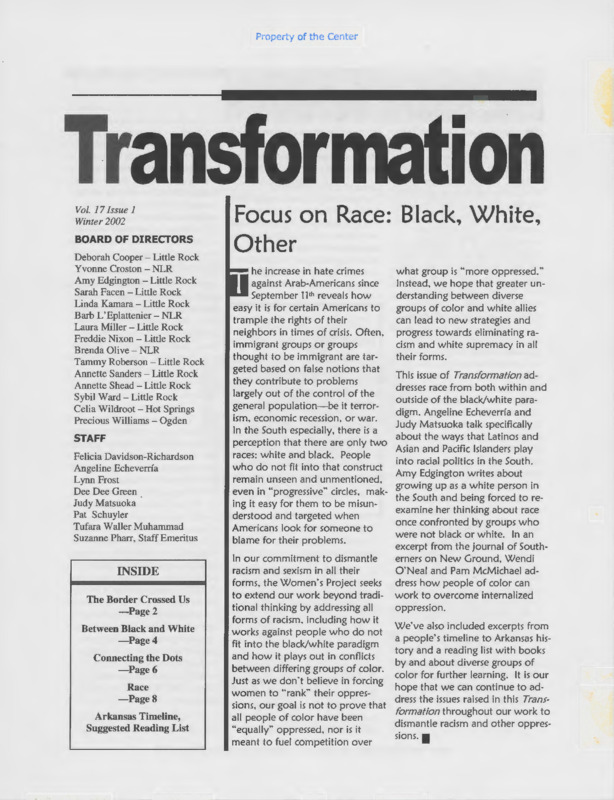
Focuson Race: Black,White,
Other
he increase in hate crimes
against Arab-Americans since
September 11th reveals how
easy it is for certain Americans to
trample the rights of their
neighbors in times of crisis. Often,
immigrant groups or groups
thought to be immigrant are targeted based on false notions that
they contribute to problems
largely out of the control of the
general population-be
it terrorism, economic recession, or war.
In the South especially, there is a
perception that there are only two
races: white and black. People
who do not fit into that construct
remain unseen and unmentioned,
even in "progressive" circles, making it easy for them to be misunderstood and targeted when
Americans look for someone to
blame for their problems.
what group is "more oppressed."
Instead, we hope that greater understanding between diverse
groups of color and white allies
can lead to new strategies and
progress towards eliminating racism and white supremacy in all
their forms.
This issue of Transformation addresses race from both within and
outside of the black/white paradigm. Angeline Echeverria and
Judy Matsuoka talk specifically
about the ways that Latinos and
Asian and Pacific Islanders play
into racial politics in the South.
Amy Edgington writes about
growing up as a white person in
the South and being forced to reexamine her thinking about race
once confronted by groups who
were not black or white. In an
excerpt from the journal of Southerners on New Ground, Wendi
O'Neal and Pam McMichael address how people of color can
work to overcome internalized
oppression.
In our commitment to dismantle
racism and sexism in all their
forms, the Women's Project seeks
to extend our work beyond traditional thinking by addressing all
forms of racism. including how it
We've also included excerpts from
works against people who do not
a people's timeline to Arkansas hisfit into the black/white paradigm
tory and a reading list with books
and how it plays out in conflicts
by and about diverse groups of
between differing groups of color.
color for further learning. It is our
Just as we don't believe in forcing
hope that we can continue to adwomen to "rank" their oppresdress the issues raised in this Transsions, our goal is not to prove that
formation throughout our work to
all people of color have been
dismantle racism and other oppres"equally" oppressed, nor is it
sions. ■
meant to fuel competition over
The Border Crossed Us: Latinos and Race in the
South
Angeline Echeverrfa
,:,
onestly, there's no such thing
as a Hispanic, Latino or
Latina. Chilean culture has
very little in common with that of
Mexico. It is not until a person
from Latin America comes to the
US that s/he encounters the labels
"Latino" and "Hispanic." Latinos
and Hispanics in the US have
roots in parts of the Caribbean,
South, Central, and North America and, depending on who you
talk to, Spain. There is no one
race that we share. Latinos may
look black, white, indigenous
(Native Caribbean or American,
a.k.a. Indian), Asian, or just about
any combination of racial backgrounds one can imagine. Different Latin American countries have
different racial and ethnic compositions based on their history of
conquest and immigration. Argentina and Chile, for example, have
a reputation for being "white"
countries, because of their large
European immigrant populations;
other South American countries,
like Bolivia and Peru, are largely
indigenous; and countries like
Cuba and Brazil have large African-descended populations.
Any of the following women
could consider themselves
"Latina": a second generation
white-skinned Cuban-American
(like me), a recently immigrated
indigenous Honduran citizen, and
a Chicana (Mexican-American)
whose family has lived in Arizona
since it was part of Mexico.
(Contrary to popular belief, all of
the Latinos in the US are not here
due to immigration; parts or all of
California, Arizona, New Mexico,
Nevada, Utah, Colorado, Wyoming and Texas have been Mexican territory in the past. US
claims to the land were enforced
through the Mexican-American
War and other state-sanctioned
and/or individual acts of violence).
Generally, the only thing
"Latinas" might share would be
the Spanish language, but even
that is not a given. The Honduran
woman may speak an indigenous
language and have little to no
knowledge of Spanish. The Chicana might only speak English or
"spanglish." Brazilians are also
grow here and throughout the
South. The fact that Latino is an
ethnic and not a racial classification further complicates matters.
Although Latinos are largely seen
as non-white "people of color,"
38,463 of the 86,866 Latinos in
Arkansas identified racially as
white in the 2000 Census. When
Latinos identify racially as white,
it serves to inflate statistics that
indicate a white majority in the
US, whether or not their interests
are reflected in the interests of the
non-Hispanic white (a.k.a. Anglo)
community.
Although many Latinos experience
racism based on skin color, white.-------------.
skinned Latinos experience racism
that
is based more on cultureContrary to popular
and may have the opportunity to
belief, all of the Latinos "pass." Latin American countries
in the US are not here have their own unique histories of
racism and white supremacy, so
due to immigration;
Latino immigrants may bring presparts or all of
sure to look, act, and identify as
"white" from their home counCalifornia, Arizona,
tries. This pressure from home
New Mexico, Nevada, countries, coupled with the white
supremacy that permeates US culUtah, Colorado,
ture, impacts why some Latinos
Wyoming and Texas who may not look "white" by US
have all been Mexican standards would choose to call
themselves white when forced to
territory in the past.
call themselves something (like on
.. ___________
_. the Census). As progressive
often considered Latino, even
though Portuguese is Brazil's national language.
groups work to dismantle racism
and oppression against people of
color, they typically define people
of color as people of African,
So, why write this article if there's
Asian, Latino, and indigenous deno such thing as a Latino anyway?
scent. Including Latinos in this
Although race, class, and other
model challenges us by including
factors divide Latinos and the
people who may have varying
category is invented, we still live
degrees of white-skin privilege
our lives under this label, iminto the "people of color" catepacted by the generalizations
gory. It also forces us to look at
made about Latinos as a people.
the hidden ways that racism
We present a different challenge
works to dismantle non-Anglo
to the black/white racial paracultures and stratify them along
digm-one that progressive peocolor lines.
ple in Arkansas (and the South as
a whole) must grapple with as the In addition to the 38,463 Latinos
who identified as white, a larger
Latino population continues to
www.womens-project.org *Page 2* Transformation * Winter 2002
group (39,080) rejected all the
given racial categories in favor of
"some other race." MexicanAmericans often refer to themselves as "la raza" which literally
means, '.'the race," due to their
mestizo (mixed indigenous, European, and less often recognized
African) heritage. The National
Council of La Raza is one of the
largest and most well-known Latino civil rights organizations in
the country.
as a valid form of classification.
The idea of seeing Hispanic as its
own race, however, flattens the
diverse racial heritage of people
of Latin descent and fails to address the power dynamics of race
between and within different La-
racist because, in this "nation of
immigrants," only groups of color
are never allowed to become
truly"American."
Oftentimes, due to language and
other barriers, Latino immigrants
and migrants find work in lowtino ethnic groups.
paying jobs that have historically
Although Hispanic is not a race,
been occupied by Africanthe fact that it's treated as such
Americans. Searching for cheap
affects much of how racism plays housing, immigrants may also
out in our lives. More and more move into low income Black
Latino immigrants are finding
neighborhoods. A lack of cultural
In many Latin American countries, their way to the Southeast where understanding between these two
race is a more fluid concept than
employers welcome them as a
groups often results in conflict
it is in the US. For example, a
cheap, docile workforce. Our as- where people of color are pitted
popular Cuban expression is, Si no sociation with immigrants affects against each other for scarce retiene de Congo tiene de Carabali, all Latinos, whether or not we
sources and opportunities that
meaning that if one doesn't ~------------~---~
really shouldn't be scarce in
have blood from one part of
the first place.
Africa, s/he (no matter how
One of the most evident
white s/he looks) has blood
ways that the current exfrom another African region.
ploitation of Latinos directly
This attitude is very different
reflects the historical and
from the historical rule in the
continued exploitation of
US that one drop of black
African-Americans is in the
blood is enough to "taint"
field of farmwork. Throughsomeone racially. Conseout the Southeast today, a
quently, Latinos who would
majority Latino workforce
'--'----"----'-~--'
never come close to
is responsible for agriculThe field of farm work reflects the parallels between
"qualifying" under the oneexploitation of African-Americans and Latino immigrants. tural production that Afridrop rule still might identify
(Illustration by Maria Okie-Baum. courtesy of Student Action
can slaves completed prior
themselves racially as white
with Farmworkers.)
to the Civil War. Through
or prefer not to identify rathe H2A Guest worker procially at all. There are a million
have immigrated in our lifetime.
gram, growers are able to import
different ways to refer to skin
Just like other immigrant groups,
temporary workers directly from
color in Spanish, and the language Latinos become the victims of
Mexico. These workers have perreflects nuances in shade and iden- hate crimes and are often blamed
mission to work only in agricultity that cannot be captured under for "taking jobs from Americans"
ture, one of the most poorly comthe "concrete" racial categories
or "being threats to national secupensated and dangerous occupaused by the Census, or by the
rity." Since September 11th , many
tions in the country. They are alLatinos have been harassed and
black/white analysis of race most
lowed to work for only one emprevalent in the South. The unvictimized for fitting the so-called
ployer and are expressly forbidderstanding of race varies as much Arab profile. Any group associden from any type of labor orgaated with immigrants is subject to
among Latinos as it does among
nizing while in the US.
any group and reflects the unique having their loyalty and claims to
an American identity challenged
The parallels between the exploimanifestations of white supremin times of crisis, just as people of tation of Latino immigrants and
acy in Latin culture (both within
Middle Eastern descent and Mus- African-Americans reflect the need
and outside of the US). The fact
that many Latinos cannot choose lims found themselves questioned for diverse groups of people of
any of the given racial categories and vilified post-911. This antichallenges the very notion of race immigrant sentiment is expressly
Continued on page 9...
www.womens-project.org *Page 3* Transformation * Winter 2002
Between Black and White: Asians and PacificIslandersin the South
Judy Matsuoka
46 different countries ranging
from Nepal to Singapore, Pakistan
Folks act like Asians and Pacific
The question is not
to Korea, Malaysia to Vietnam,
Islanders are brand new additions Guam to Bangladesh. It is imporwho suffered the
to our Southern communities.
tant to remember that there are
most but how do
We forget that there have been
no Asians in Asia. There are no
Asian Pacific Americans in the
Pacific Islanders in the Pacific. It is
we use our new
South for many years--although
only here that we become Asians
learning to
our presence, as well as the
or Pacific Islanders. And most of
presence of Native Americans,
dismantle racism.....
us do not have a sense of identity
didn't change the perception of
as Asian Pacific Americans--until
race as a black/white dichotomy.
we become politicized by the exharassment, and realize that we
For example, Filipino sailors
perience of racism.
share a common identity as Asian
settled communities in Louisiana
We do not have the same skin
Pacific Americans in the hate vioin the 1700s, Indian sailors on
lence directed against us. The
slave ships were sold into slavery tones, hair colors or eye shapes.
Asian and Pacific Islanders reflect racism we experience is often
by their shipmates, and Chinese
railroad workers were brought to a wide mixture of racial and eth- cloaked as anti-immigrant sentiment and backlash against interthe South as cheap labor after the nic groups that reflect immigranational events. It is important
end of slavery and the completion tion, imperialism and colonization. We are not united by a com- that progressives understand the
of the Transcontinental Railroad.
mon religion-we are Catholic,
different forms that racism takes
What's happening that is new is
Buddhist, Confucian, Protestant,
and the devastation that it creates.
that Asians and Pacific Islanders
Hindu, Muslim, Jewish, Shinto,
It is also important that as we
are becoming more numerous,
Sikh and so on. We do not have a look at racism and the experiences
diverse and less segregated,
common language or cultureof different groups that we not
invisible and controlled as in
although our cultures are different construct a hierarchy of oppresearlier years.
from the cultures of our ancestry
sion which pits people of color
(e.g. Japanese American culture is against people of color. The
No, Really. What are
unique-neither Japanese nor
question is not who suffered the
you? Where are you
mainstream American). We do
most but how do we use our new
from?
not even have a common history learning to dismantle racism rein the US, and we are divided by gardless of its form.
According to the 2000 census,
our
histories of oppressing and
Asian Pacific Americans (APA) are
being
oppressed by each other in In this land of European immithe fastest growing demographic
grants, we Asian Pacific Americans
our ancestral countries.
group in the United States and
are seen as a race of permanent
certainly in the South. We are
Much divides us but what ties us
aliens or immigrants regardless
essentially multi-cultural, marked
APAs together is racism. While
how many generations our famiby extreme internal diversity as
Asian Pacific Americans report a
lies may have lived in the US.
our families (this generation or 10 high level of personal experience
And racism has worked to keep us
generations ago) came from over with discrimination, second only
as aliens-without a history in
to African Americans in some sur- America, seen as not "real" Ameriveys, very few white or black
Muchdivides us
cans, and continually viewed as
Americans report viewing Asian
not really belonging. To avoid
but what ties us
Pacific Americans as targets of ra- the "problems" presented by free
Asian Pacific
cial discrimination.
African Americans in the South
Americans together
We APAs recognize racism by the during Reconstruction, Asian immigration was strictly controlled.
myths and the stereotypes, the
is racism.
Asian
immigrants could not besubtle acts of discrimination and
Changing Demographics
www.womens-project.org *Page 4* Transformation
* Winter 2002
come naturalized citizens until the
1940s and 1950s, which prevented Asians from challenging
the status quo by voting, serving
on juries, or running for office. In
places with sizable APA communities, public schools were segregated and there was considerable
institutionalized housing and job
discrimination. Severe immigration restrictions, which had been
in place since the 1870s, were not
lifted until 1965.
Our association with immigrants
affects all Asian Pacific Americans,
whether newly arrived or 10th
generation. We are blamed for
taking jobs from Americans in
retail, health care, and
manufacturing. The prevailing
perception that we are
unalterably loyal to and informed
about political and corporate
policies of the collective countries
of our ancestries blames us for
corporate America's decision to
move factories to Asia, where
Asians, instead of working class
African Americans and whites, can
be exploited.
Finally, perceived as aliens, we
encounter not only domestic
stereotypes, but international
racial prejudice as well. These
stereotypes have unfortunately
become tied to fears about
national security and international
conflicts, old and new. As a
result, we endure racial profiling,
discrimination and violence such
as the case against Wen Ho Lee,
the harassment of Chinese
restaurants during the spy plane
incident, and the fatal shooting of
a Sikh gas station owner and the
deliberate hit and run attack on a
female Pakistani pedestrian
following September 11th.
Is Yellow Black or White?
Being APA in the South
identity as APAsis discounted.
Instead a situational identity is being imposed on us.
We are seen as either "white
enough" or "black enough" to be
included or excluded. We are
"white enough" to live in some
white neighborhoods. We are
"black enough" to be excluded
from top positions in management. We are racially triangulated, shunted back and forth between black and white positions,
but always to enforce the status
quo of white superiority and
black inferiority.
The primary use of our "white
enough" status is to be pitted
against African Americans in the
attempt to maintain white supremacy. We are characterized as
"model minorities," so any APA
achievement may be used to demonstrate the existence of the
imaginary level playing field. And
if there is a level playing field, it is
thought, then African Americans
The current racial paradigm in the must blame themselves, not institutionalized racism, for their social
South is often expressed as
condition.
"you're either black or you're
not" or "you're either white or
But often Asian Pacific Americans
you're not." For Asian Pacific
are not aliens, not model minoriAmericans in the South, our racial ties, but just invisible. And we are
In the 21st century, with American
demographics changing dramatically, we need to break out of the
rigid black/white paradigm and
include the diverse voices of other
people of color in understanding
race and racism. Unless we do so,
potential allies will be missed and
institutionalized racism will continue to strengthen and evolve.
invisible by both white and black
Americans. We are often told
that our issues are not of importance because there aren't enough
of us or that the inclusion of our
issues would divert attention from
more pressing (to others) concerns. Reading scores, HIV infection rates, domestic violence statistics, poverty and other social
indicators are typically reported in
"Black," "White" and "Other"
categories. On those occasions
we are visible, our actions are
scrutinized to see if we are closer
iiiiii.:::=:=___J to black or white. "Why are you
The Japanese-American owner of this store had to go to great lengths to
opening stores in the African
prove he was a "real"American in 1942. .
American neighborhood?" Why
(Image courtesy of Owens Valley History http://www.owensvalleyh1story.com).
www.womens-project.org *Page 5* Transformation
* Winter 2002
are you sitting with white people?" "Why do you go to a Korean church? This is America and
you should try to fit in."
US history is studded with examples of exploitation of poor
whites and people of color. We
no longer have to steal Africans
from their lands to work on land
stolen from Native Americans.
We now have the capacity to exploit working people in their own
lands. We now have the capacity
to export our toxic waste to pollute the air, water and soil of
countries populated by people of
color. We now have the capacity
to export our media images of
women and people of color
around the world. As progressives, we need to work to bring
people of color, women and
poor people together across the
barriers that serve only to protect
white capitalist privilege. We
need to work together across
race, ethnicity and class to revision the United States along antiracist, anti-sexist and antiimperialist lines. The presence and
issues of Asian Pacific Americans
provides an opportunity to link
local organizing with global organizing to dismantle oppression for
women and people of color
around the world. ■
==============
Cong,.rqfuhJtions
Fe 1c1j/
\-Women'sProied stqff
member FeliciqDqvi4son
WqSmqrried to Richqrd
Richqrdson on ,Mqy12th.
Co11grqtufati0ns,Mi-.qnd
Mrs. Richqt-dson!
Connecting the Dots
Amy Edgington
II
grew up in Little Rock during
the eras of Jim Crow segregation and the Civil Rights
movement. For me, understanding racism initially meant moving
from a white-centered point of
view to include the experiences of
African Americans. I had much to
learn about our history together,
but the consequences of that history felt intimate to me. I had
been advantaged in every way-materially, socially, educationally,
politically--by my whiteness.
These privileges were the direct
legacy of a society that had enabled white people to profit from
slavery and state-enforced segregation at the expense of Black
people.
For them, becoming American
meant becoming "white," and being "white" was defined as being
"not black."
It is a definition guaranteed to
sow hostility between people of
color, since it seems to hold out
the possibility of being included in
the privileged boundaries of
whiteness to everyone except African Americans. It also makes it
seem as if racism is something that
can only ever be authentically experienced by people of African
descent. And last of all it seems to
offer the vain reverse hope that
by outdoing the Americanism of
white Americans, a person of
color might escape the scourge of
racism.
I also learned that, contrary to
what I had been taught in school,
there is no biological basis for dividing human beings into races.
Instead, race is a powerful social
construct that includes elements of
shared culture, experience, history
and language. The boundaries of
racial identity may be chosen as a
resource for pride, community
and survival, but when they are
imposed by force in order to exclude people from their fair share
of economic and political power,
race becomes racism.
Nevertheless, the privileges of
whiteness are extended to people
of color whose ancestors were
not African only rarely, minimally
and provisionally, in a way that
undermines alliances between
people of color but never challenges the mastery of European
Americans. Why aren't all people
who are "not black" offered the
choice of becoming "white" the
way European immigrants were?
How do people of color who are
not African American experience
racism? My continuing effort to
Recently, historians who have ex- answer these questions gives me a
plored the origins of white idenmore complex picture of racism,
tity in the U.S. have talked about white privilege, and American hishow successive waves of Eurotory.
pean immigrants have been subAfrican Americans experienced a
jected at first to racial stereotypes
uniquely intimate and brutal hisand discrimination. Gradually
tory of ownership by European
however, many European immiAmericans. Because of class inegrants and their descendants
quality only a minority of whites
adopted racist views towards Afriever owned slaves, but generally
can-Americans as a way to fit in.
"whiteness" evolved to define
www.womens-project.org *Page 6* Transformation
* Winter 2002
who could become a master and
who could be enslaved. The rights
of the master included:
• the right of property ownership;
• the _control of labor and its
profits;
• the right to kidnap, imprison,
rape, torture and kill;
• the control of boundaries,
borders and movement;
• the right to impose or deny
education, religion, sexuality,
reproduction, kinship, nourishment, clothing, shelter,
health, standards of beauty,
culture, language, history, and
visibility.
When I look at the way all people
of color have been treated in this
country (or by this country) I see
these "white powers" being exercised again and again, although
each group's experience and resistance is unique.
The African slave trade was not
the first manifestation of white
power: conquest, slavery and
genocide of Indian peoples and
the theft of their land came with
the Europeans to this hemisphere.
The theft continued with the conquest of Mexico, which included
what we now call the Western
States, and which calls into question who the real illegal immigrants are in those lands.
The indentured labor of Chinese
immigrants under harsh, prisonlike conditions built the railroad
systems that consolidated the political and economic power of the
white elite in the U.S. Yet, for
most of our history, people of
Asian descent were explicitly denied the right to become citizens.
Even citizenship gave no protection to Japanese Americans who
were placed in internment camps
during World War II.
As the U.S. grew powerful and
wealthy from cheap labor and
conquered resources the government used its economic and military might to enforce an explicit
policy of white entitlement
("Manifest Destiny"), which dominated and exploited Mexico, Central America, the Caribbean and
South America. The U.S. used the
same power and justifications to
seize and colonize Hawaii, the
Philippines, Guam, Puerto Rico,
and other Pacific and Caribbean
islands.
and the School of the Americas.
I have begun to understand that
racism, which I grew up thinking
of as a Southern regional moral
issue, was always global (just
think of the trans-Atlantic slave
trade), no matter how local it
seemed; and dismantling white
supremacy requires profound systematic economic and political
changes, not just personal changes
in attitude and behavior.
Racism has always provided a
.. ------------
.. shortcut through reality for white
people, a way to barrel through
other
people's cultures, languages,
Racism has always
and viewpoints, while remaining
provided a shortcut
largely unaware not only of the
richness and variety we are tramthrough reality for
pling, but of our own sense of enwhite people, a way titlement and superiority. We
to barrel through other lump together those we believe
we have been taught to exploit
people's cultures,
and "master," not those we relanguages, and
gard as equals. We have no trouble thinking of the French as disviewpoints ...
____________
_. tinctly different from the English,
but most Americans would not be
White supremacy evolved to de- aware of any differences between
Mexicans and Guatemalans.
fine who could own and master
not just people's bodies, but also
Even in our anti-racist work white
their labor, their land and its repeople must be aware that when
sources. It is a system centered on
we use terms like "people of
protecting property rights and
color," "Hispanics," "Middle Eastmaximizing profits by any means
erners," or "Asian Americans," we
necessary, whether through slavmay be imposing categories that
ery, indentured labor, braceros
have not been chosen by the peoharvesting Arkansas tomatoes, or
ple we are trying to identify with
maquiladora factories across the
these labels. In our eagerness to
border in Mexico.
build coalitions we may unwittingly continue to over-simplify,
Moving beyond the Black/White
erase and dominate.
paradigm has given me a way to
connect the dots between racism
Coalitions between equals take
and genocide, militarism, colonialtime, work, understanding and
ism, imperialism, environmental
respect. No shortcuts allowed.
pillage, capitalism and globalizaThey are time-consuming, messy,
tion, between the white plantanoisy, hilarious, furious, intoxicattion overseer, the Klansman, the
ing, hungry, powerful and unstop"Ugly American" tourist, Nike
pable. 0 brave new world, that
sweatshops, police brutality, prishas such people-together-in
ons for profit, the World Bank
'ti
'·■
www.womens-project.org *Page 7* Transformation * Winter 2002
Race
Wendi O'Neal and Pam McMichael
(excerpt from the Journal of Southerners on New Ground)
Race is a_central thread that
continues to divide, that frames
every aspect of our lives and that
presents a strategic, critical block
to people coming together.
Therefore, understanding race is a
strategic, critical key to
dismantling systems of oppression
across the board.
•
•
If we only address racism as treating people nicely, then the systemic nature of racism is maintained. We have to actively and
•
consistently challenge white supremacy. All of us have a stake in
overturning racism because everyone's human potential is limited
•
by racism.
We think the following conversations have to enter regularly, intentionally and in depth to help
move the goals of anti-racist
work, our own and yours, forward:
•
•
about a global economy that
still works to the disadvantage
of people of color.
We have to talk about the
role of patriarchy and capitalism in maintaining chattel
slavery, and the role of capitalism in the global economy.
We have to talk about the
dynamics of the relationships
among people of color and
white people living in the
same land of such destruction.
We have to talk about white
privilege and white supremacy and the impact on everyone's daily lives.
We have to get honest about
the implications in ways that
move us through guilt and
fear and anger to redemption
and changed ways.
Action Steps to Fight
Racism:
We all need to seek out opportunities to better understand racism
and learn ways to dismantle it.
The more we learn about domination, who benefits, who loses
and why, the more we can understand what each of us would gain
by living in a world free from racism.
As people of color, we need this
power analysis for movement to
action and for throwing off internalized oppression. We receive
the same racist messages as white
people do about ourselves and
each other. While we do not
have institutional power to be
racist, if we are not actively challenging racism we are supporting
white supremacy. We need to
seek out opportunities to better
understand how we may have
internalized racism and learn ways
to decolonize our minds, bodies,
and spirits.
We must be able to label rac- Get Schooled:
As people of color we need to get
ist behavior as racist when we
schooled about
see it.
,-------.,.------------------------,
horizontal hosWe have
tility and unto talk
derstand that
about the
anti-immigrant
history of
sentiment is
enslaveracist. Whoment in
ever we are,
this counwe can learn
try, the
about coloemotional
nized people
and psyaround the
chological
11/EY'
CbMe IIS?e,TAKe
world and
devasta0/Jll JOB.SI RUIN ()(IR..
Black, Asian/
tion of
Asian Pacific
NCl(,H
IJ()~.D.
. .
enslaveIslander,
-"'----""""-----'
ment but
Latina/a
and
'ih people of color, we need to ... understand that
also how
Native people.
anti-immigrant sentiment is racist... "
enslave(Illustration by Wen-Ti Tsen from The Asian American Comic Book. copyright© !99! by Asian
We need to
American Resource Workshop and Wen-Ti Tsen.)
ment was
seek out each
www.womens-project.org *Page 8* Transformation * Winter 2002
Property of the Center
Continued from page 3 ...
against racism, but we must also
challenge each other on our intercolor to work together. against
We think of trainings as one small
nalized racism and horizontal hoswhite supremacy and the systems
step in becoming an anti-racist actility.
of domination that seek to divide
tivist. It can't be the only thing
us in our quest for justice. Just as
we do to fight racism.
Don't Go it Alone:
the Women's Project seeks to go
Listen:
As people of color, we cannot
beyond the idea of one dominant
pretend that racism doesn't affect oppression to incorporate a multiAs people of color in the United
us. If we are isolated we need to dimensional approach to social
States, we have not been taught
seek support, both for maintainchange, we must also seek to
our own histories in a racist
ing
sanity
and
to
find
collective
expand our analysis of racism to
school system. We also have not
power.
incorporate more voices of
learned about each other's histopeople who are not black or
ries. We cannot expect instant
Don't just accept racist behaviorwhite, whether we have an
trust and alliance among each
find others who believe as you do accurate name for them or not. ■
other. We earn trust by being
and organize collectively to fight
there for each other's struggles.
racism.
We must also hear each other
when we are challenged by other Act. Put your body in the path
people of color as promoting rac- of racism:
ist ideas. When a Haitian farmLearning, listening and talking are
worker says to a Black American, for naught if we don't put the
Published four times a year
"Your privilege as an American
by the Women's Project,
things we are learning into action.
citizen helps maintain my invisibil- Racism is so pernicious and perva2224 Main Street, Little Rock,
ity and the invisibility of my strug- sive that it can feel overwhelming.
Arkansas 72206
gle for justice in the global econPhone: 501-372-5113
It is a construct that was built and
Spanish: 501-907-0529
omy'' or when a Black person says as such can be dismantled. We
to a Latino immigrant, "You need must find our voices and use
to understand the complexity of
them. ■
Letters to the editor are welcome.
what it means to be a US citizen
in Black skin and the complexity
Join the Women's
of our history in the US," it's time
for us to listen to each other. We
Editors
Amy Edgington
Project in Creating a
have to build solidarity in spite of
Stacey McAdoo
Hate-Free Arkansas!
complex relationships to power,
Laura Miller
and figure out what those comLayout
Staff
plex relationships to power mean
The Hate-Free Arkansas
in determining action that is muCampaignis a traveling exhibit
tually beneficial.
Women's Project Staff:
that includes nearly 300
banners commemorating the
Felicia Davidson-Richardson,
lives of Arkansans who have
As people of color we must seek
Angeline Echeverria, Lynn Frost,
converts from internalized racism
Dee Dee Green, Judy Matsuoka,
been victimized by bias and
Pat Schuyler, Tufara Waller
and horizontal hostility. We canhate. If you are interested in
Muhammad
not afford to buy into the patholhelping to organize a media
ogy of racism. We must love ourevent in your community to
Staff Emeritus:
selves in spite of white supremacy
raise awareness about bias and
Suzanne Pharr
and we must share that self-love
hate in Arkansas, contact the
with our communities. It is im* Printed on recycled paper.*
portant that we affirm and supWomen's Project for more
2002 The Women's Project
port each other by speaking out
information.
other's stories.
Transformation
www.womens-project.org *Page 9* Transfonnation
*
Winter 2002
A PEOPLE'S
TIMELINE TO ARKANSASHISTORY
Excerpted from complete timeline by Amy Edgington
1000 B.C Indians in southern and eastern Arkansas have begun to construct large permanent villages with
burial mounds.
1541 De Soto's expedition arrives in Arkansas. They find large settlements of Indians living in city-states with
temple mounds constructed around central plazas. Population estimate: 75,000.
1673 Explorers Joliet and Marquette arrive in Arkansas, finding an already greatly reduced Indian population due to drought and European diseases. Population estimate: 15,000.
1682 Explorer LaSalle takes possession of Louisiana (which includes Arkansas) for France.
1686 Henri de Tonty establishes Arkansas Post as a fur trading station. British and French agents seeking Indian slaves for the plantations arrive along with trappers.
1721 La Harpe explores the Arkansas River. John Law establishes the first European settlement at Arkansas
Post. The settlement is abandoned in 1723, but re-established by the French in 1731.
1763 France cedes Louisiana Territory to Spain.
1787 Future president Andrew Jackson begins his career of speculation in Indian lands and military campaigns against the Indians. Bands of Cherokee, Creek and other eastern tribes cross the Mississippi into Arkansas, fleeing the warfare.
1798 A Spanish census of Arkansas Post lists 393 inhabitants, 56 of whom were Black slaves.
1800 Napoleon forces Spain to return Louisiana Territory to the French.
1803-1805 The United States acquires Arkansas as part of the Louisiana Purchase.
1808-1835 The Cherokee and Quapaw are removed to reservations, but are soon forced to sell all their remaining lands to the US government and move to Indian Territory (Oklahoma).
1836 Arkansas Territory becomes a state. In the 1830s land grants and sales increase dramatically and the
population triples by 1840. 20% of the population are Black slaves.
1842-1844 Arkansas passes laws prohibiting the immigration of free Blacks into the state, unless brought in
by citizens as laborers. Free Blacks living in the state are required to prove they arrived before March 1,
1843.
1850-1860 Cotton cultivation is firmly established in the lowland areas, where 80% of the Black slaves are
held. Plantation owners dominate the state's politics.
1859 The State Legislature passes a measure requiring all free Blacks to leave the state by January 1860 or
face enslavement.
1861-1864 Arkansas secedes from the United States and is embroiled in a Civil War.
1865-1874 The 13th , 14th and 15th amendments to the Constitution abolish slavery, establish the citizenship of
www.womens-project.org *Page 10* Transformation * Winter 2002
African Americans, and enfranchise African American males. Reconstruction Republican government in
Arkansas brings the election of a few African-Americans in Arkansas. Violence against freed Blacks begins
immediately, culminating in the rule by terror of the Ku Klux Klan through beating, burning, lynching and
rape.
1870 Chinese laborers are invited into the South by white landowners to replace slave labor without being a threat to the white political power base. (Only "free whites" and "African aliens" have the right to
become· naturalized citizens under the 1870 Nationality Act.) Most soon flee the plantations, but some set
up small businesses.
1888 Democrats enact a series of laws effectively disenfranchising most Black voters and many poor
whites, to prevent any coalition between African Americans and white farmers and laborers.
1891 In spite of the 1875 Civil Rights Act, the Arkansas legislature easily passes the first of many "Jim
Crow" laws legalizing segregation in public facilities, transportation and education, though 12 Black legislators still sit in the General Assembly.
1900 Foreign-born citizens represent 5 percent of the population of Little Rock, Fort Smith and Hot
Springs.
1902 State colleges for Blacks are forced to switch from a classical curriculum to a trade curriculum.
1905 Black farmers are warned by a group of whites called the "Lonoke Country Club" to vacate their
farms because, "This is white man country." Threats of violence occur throughout the state, including one
against 17 Mexican workers employed at a fruit farm in Horatio. Harvest of fruit and vegetable crops will
continue to depend on migrant labor into the next century.
1915When wood veneer mills in Arkansas begin to lay off workers, threatening notices appear demanding that Black workers quit, so that white workers can keep their jobs.
1919 Blacks in Elaine form a chapter of the Progressive Farmers and Household Union of America, hire a
lawyer, and attempt to sue white landowners under federal peonage statutes. The deputy sheriff and a
railroad agent open fire on a Union meeting at a Black church. When Blacks return fire, a posse is organized to arrest union members. When Blacks resisted, 500 troops were sent from Little Rock. 25-100 Blacks
(possibly many more) are killed, and hundreds arrested. 5 whites die.
1917-1919Black resistance to racism increases following the end of World War I, and whites respond with
mob violence.
1920's The Ku Klux Klan, newly revitalized, encourages attacks on Blacks, Jews, Catholics, foreigners, radicals, bootleggers, gamblers and fornicators.
1927 Denied access to a 17 year-old Black suspect in the murder of a young white girl, a white mob in Little Rock lynches another Black suspect. For 2 days the mob terrorizes the Black community.
1938 Roosevelt's New Deal programs, designed to aid the depression economy, wind up helping large
planters in Arkansas the most. Black families received relief grants half as large as white families. Black
men in Arkansas were excluded from the CCC and usually from the WPA. When WPA wages are lowered, Black men protesting at the Little Rock office are clubbed and arrested.
1941 A wave of anti-Japanese prejudice grips Arkansas following Pearl Harbor. War bonds are sold in
Jonesboro by "Slap a Jap" clubs.
www.womens-project.org *Page 11* Transformation * Winter 2002
1942 Americans of Japanese ancestry on the West Coast are forcibly
Transformation ...
relocated to internment camps, including camps in Rohwer (Desha
County) and Jerome (Chicot County). Act 47, in 1943, prohibits persons of Japanese ancestry from owning property in Arkansas. The
state Attorney General directs officials not to issue birth certificates to
children-born in the camps. The Arkansas Medical Association prohibits Arkansas doctors from treating camp residents. Probably no more
than 6 Japanese families remained in Arkansas at the end of the war.
In contrast many German and some Italian prisoners of war were
made welcome and many stayed on.
is published four times
every year. In each issue,
members receive analysis
of contemporary issues,
information about Women's
Project upcoming events
and activities, book
reviews, and more. If you
are not a Women's Project
member and would like to
continue receiving the
journal, please fill out the
membership form below.
1940-1943 LC. Bates begins publishing the first statewide Black news-
paper, the State Press. Although there are 900 teaching vacancies in
state schools, districts refuse to apply for federal assistance because
they do not want to share the funds with Black schools.
1945 State laws finally allow Blacks to vote in primaries, but poll
taxes and intimidation still present major barriers. Susie Morris, a
Black teacher at Little Rock's Dunbar High, wins a federal decision,
granting her equal pay with white teachers. She is immediately fired.
1948 The University of Arkansas admits the first Black students, Silas
Hunt to law school and Edith Jones to medical school.
1954 In Brown vs. the Board of Education, the Supreme Court
strikes down the practice of "separate but equal" segregated education. Fayetteville schools integrate with no reaction from state officials. When attempts to integrate the Hoxie school system are met
with threats of violence, federal officials become involved in Arkansas desegregation for the first time. Segregationist Jim Johnson proposes Amendment 44, nullifying the Brown decision as a violation
of "state's rights." It passes and remains part of the Arkansas Constitution until 1990.
~-- - - - - - - - - - - - - ..
: [A'
Yes, I would like to
I ~ join the Women's
I
Project.
I
:
I
I
I
I Name
I Address
City
I State
Zip
I Phone/day
I Phone/evening
I E-mail
1957 Nine Black children in Little Rock, supported by the NAACP
president Daisy Bates, attempt to integrate Central High School. As
mobs gather at the school, Faubus sends the Arkansas National
Guard to bar the students' entry. Blacks all over the city are harassed
severely. Eisenhower sends federal troops to enforce the court ordered desegregation, but quickly turns the protection of the Black
students back over to the federalized Guard, who sympathize with
the segregationists.
1962 The Supreme Court overturns Arkansas' legislative districts,
which favored whites over Blacks.
$25 regular
D
$100 supporting
D
$50 sustaining
D
$15 low income
I'd like to pay by
Visa
D check D credit
Mastercard
Account No.
Exp. Date
Signature
1961 Freedom Riders are arrested for attempting to integrate the Lit-
tle Rock bus depot. The State Capitol cafeteria remains segregated
despite protests. Students from Philander Smith and Pine Bluff sit-in
at segregated lunch counters in Arkansas cities. Boycotts are held in
Pine Bluff and elsewhere.
D
I
I
I
I
I
I
Make checks payable to:
Women's Project
2224 Main Street
Little Rock, AR 72206
.,_- - - - - - - - - - - I
www.womens-project.org *Page 12* Transformation * Winter 2002
_..I
1964 Congress passes the Civil Rights Act ending segregation in all public facilities. Amendment 51 to the
State constitution ends poll taxes.
1970-1980 As Blacks become increasing unwilling to submit to racism, violence breaks out sporadically in
Delta towns, and 2 Black churches are burned in Texarkana. Discrimination suits are filed against many
major employers. Little Rock begins busing in an attempt to achieve integration in spite of segregated
housing patterns in the city. Due to white flight, the school district is 64% Black by 1981.
1972 Dr. Jerry Jewell becomes the first Black person elected to the state Senate since Reconstruction.
1973-1975 As the Vietnam War winds down, refugees are brought to Fort Chaffee near Fort Smith. Despite racism, many Southeast Asians stay to work in the chicken and egg processing industry. The oil embargo in the Middle East brings hardship to Arkansas farmers and anti-Arab prejudice rises.
1978 Fort Smith press stirs up racist sentiment against Cuban refugees housed by the federal government
at Fort Chaffee.
1980s Filipino nurses are invited to Arkansas to ease a severe nursing crisis. Arkansas industries are among
the first affected by the global-wide hunt for cheaper labor, and plants close around the state. White supremacist groups find a haven in Northwest Arkansas.
1990s Arkansas legislators oppose comprehensive civil rights and hate crimes legislation. Racial tension increases in Northwest Arkansas, where many workers from Mexico and Central America work in the
chicken processing industry. Economic segregation and oppression continue to limit opportunities for African Americans.
Sources:
The History of Arkansas. Fred Berry & John Novak. Little Rock, AR: Rose Pub., 1987
Arkansas Odyssey: the saga of Arkansas from prehistoric times to present: a history. Michael B. Dougan.
Little Rock, AR: Rose Pub., 1994.
Caste & Class: the black experience in Arkansas, 1880-1920. Fon Louise Gordon. Athens: University of
Georgia Press, 1995
Arkansas: a people and their reputation. David M. Tucker. Memphis, TN: Memphis State University Press,
1985.
Arkansas: an illustrated history of the Land of Opportunity. C. Fred Williams. Northridge, CA: Windsor
Publications, 1986.
Cultural Encounters in the Early South: Indians and Europeans in Arkansas. Jeannie Whayne. Fayetteville:
University of Arkansas Press, 1995.
Arkansas, 1800-1860: remote and restless. S. Charles Bolton. Fayetteville: University of Arkansas Press,
1998.
www.womens-project.org *Page 13* Transformation
* Winter 2002
READING LIST FOR FURTHER LEARNING
Hispanic/Latino
Herencia: The Anthology of Hispanic literature of the United States/ editor, Nicolas Kanellos ; co-editors,
Kenya Dworkin y Mendez ... [et al.] ; coordinator, Alejandra Balestra. Oxford University Press, 2002
Latino Workers in the Contemporary South/ edited by Arthur D. Murphy, Colleen Blanchard, and Jennifer A. Hill. University of Georgia Press, 2001.
American Chica: Two Worlds, One Childhood/
Maria Arana. Dial Press, 2001
Harvest of Empire: A History of Latinos in America/ Juan Gonzalez. Viking, 2000.
Strangers Among Us: Latino Lives in a Changing America/ Roberto Suro. Vintage Books, 1999
Chicano! The History of the Mexican American Civil Rights Movement/
Press, 1996.
F. Arturo Rosales. Arte Publico
Growing Up Chicana/a: An Anthology/ Tiffany Ann Lopez, ed. William Morrow, 1993.
Borderlands/la Frontera/ Gloria Anzaldua. Spinsters, 1987.
Native American
The Woman who Watches Over the World: A Native Memoir/ Linda Hogan. W.W. Norton, 2001.
Dancing at Halftime: Sports and the Controversy Over American Indian Mascots/ Carol Spindel. New
York University Press, 2000.
Here First: Autobiographical Essays by Native American Writers /edited by Arnold Krupat and Brian
Swann. Modern Library, 2000.
The Toughest Indian in the World: Stories/ by Sherman Alexie. Atlantic Monthly Press, 2000.
Off The Reservation: Reflections on Boundary-Busting/ Paula Gunn Allen. Beacon Press, 1998.
The Earth Shall Weep: A History of Native America/ James Wilson. Grove Press, 1998.
Like A Hurricane: The Indian Movement from Alcatraz to Wounded Knee/ Paul Chaat Smith, Robert Allen Warrior. The New Press, 1996.
Indians Are Us: Culture and Genocide in Native North America/ Ward Churchill. Common Courage
Press, 1994.
Growing Up Native American: An Anthology/ Patricia Riley, ed. William Morrow, 1993.
Without Discovery: A Native Response to Columbus/ Ray Gonzalez, ed. Broken Moon Press, 1992.
www.womens-project.org
*Page 14* Transformation * Winter 2002
1
Univi)Jj[111111J1111iiiji
1!~
~,1~[1i11Jillm11i~~1J11d,
OK
M 001 111 352
Property of the Center
Asian American
Asian American Dreams: The Emergence of an American People/ Helen Zia. Farrar, Straus and Giroux,
2000.
Only What We Could Carry: The Japanese American Internment Experience/ Lawson F. lnada, ed. Heyday Books, 2000.
Where the Body Meets Memory: An Odyssey of Race, Sexuality & Identity/ David Mura. Anchor/
Doubleday, 1996.
Growing up Asian American: An Anthology/ edited and with an introduction by Maria Hong ; afterword
by Stephen H. Sumida. New York: W. Morrow, 1993.
Making Waves: An Anthology of Writings by and about Asian American Women/ Asian Women United
of California. Beacon Press, 1989.
Arab American
Saffron Sky/ Gelareh Asayesh. Beacon Press, 2000.
Arabs in America: Building A New Future/ Michael W. Suleiman (Editor). Temple Univ. Press, 2000.
Post-Gibran: Anthology of New Arab American Writing/ edited by Munir Akash & Khaled Mattawa Kitab; Distributed by Syracuse University Press, 1999.
Strike Back: Lentil Soup for the Arab American Soul/ Ray Hanania. USG Publishing, 1999.
Bint Arab/ Evelyn Shakir. Praeger Pub., 1997.
I'm Glad I Look Like A Terrorist: Growing Up Arab in America/ Ray Hanania. USG Publishing, 1996.
Food For Our Grandmothers: Writings by Arab-American and Arab-Canadian Feminists/ Joanna Kadi.
Lightning Source, 1994.
General Multicultural
Deculturalization and the Struggle for Equality: A Brief History of the Education of Dominated Cultures in
the United States/ Joel Spring. McGraw-Hill, 2001
How Race is Lived in America: Pulling Together, Pulling Apart/ correspondents of the New York Times;
introduction by Joseph Lelyveld. Times Books/Henry Holt, 2001
What do I Read Next? : Multicultural Literature/ Rafaela G. Castro ... [et al.]. Gale, 1997.
Race: An Anthology in the First Person/ edited by Bart Schneider. Crown Trade Paperbacks, 1997.
Skin Deep: Women Writing on Color, Culture, and Identity/ Elena Featherston, ed. Crossing Press, 1994.
Making Face, Making Soul: Creative and Critical Perspectives by Women of Color/ Gloria Anzaldua, ed.
Aunt Lute Foundation, 1990.
This Bridge Called My Back: Writings by Radical Women of Color/ Cherrie Moraga and Gloria Anzaldua,
eds. Kitchen Table Press, 1981.
www.womens-project.org
*Page 15* Transformation * Winter 2002
Women's Project
Non-Profit Organization
U.S. Postage Paid
Little Rock, Arkansas
Permit No. 448
2224 MainStreet
Little Rock,AR 72206
RETURN SERVICE REQUESTED
HerlandSister Resources
2312NW
39th
Oklahoma
City, OK73112